George Saunders on Sarah Palin

Excerpt from “My Gal” by George Saunders, one of my favorite funny but twisted authors.

“Explaining how she felt when John McCain offered her the Vice-Presidential spot, my Vice-Presidential candidate, Governor Sarah Palin, said something very profound: “I answered him ‘Yes’ because I have the confidence in that readiness and knowing that you can’t blink, you have to be wired in a way of being so committed to the mission, the mission that we’re on, reform of this country and victory in the war, you can’t blink. So I didn’t blink then even when asked to run as his running mate.”

Isn’t that so true? I know that many times, in my life, while living it, someone would come up and, because of I had good readiness, in terms of how I was wired, when they asked that—whatever they asked—I would just not blink, because, knowing that, if I did blink, or even wink, that is weakness, therefore you can’t, you just don’t. You could, but no—you aren’t.”

The article devolves into the usual George Saunders weirdness, but it’s worth a few minutes, if for no other reason than to get a taste of Saunders himself! Read the full article in The New Yorker online.
No hope

Jason Godeke illustrates George Saunders
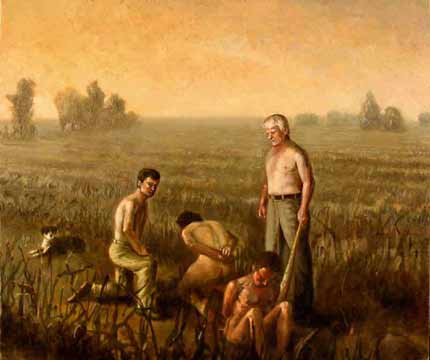
This painting is called Me and Dad with captives. No explanation proffered. It’s by New Mexico artist Jason Godeke as part of a series about inhumanity.

The scene recreated here haunts me every time I look upon it, and reminds me of the George Saunders novella Bounty. From his collection CivilWarLand in bad decline written in 1996, Bounty describes a timeless America where slavery divides Normals and Flaweds. The story offers the reader a point of view with which he can identify, as any average imperfect person, facing a world were all laws, comforts and sympathies are against him. Escape leads only to the next captor’s depravity, (Normals being just as vulnerable to human frailty as the random genetically Flawed). For the unfortunates, damned by birth, there is no landscape or impending social reform to offer hope of reprieve.

Godeke’s farm scene suggests an identical terror. Two people, indistinguishable from any other, are bound and at the mercy of two others. One looks despondent, the other is reacting to a mistreatment. The two tormentors act with fresh enthusiasm for the power they wield over their captives, recording, as the painting’s title suggests, this snapshot for posterity. Not “our captives,” not “the captives,” but simply that opportunity’s “captives.” The field extends further than the victims’ voices can carry, there is no sanctuary on the horizon and time stands still.