
Inured to war crime.

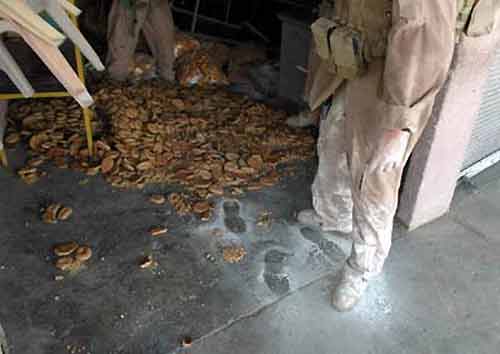
US soldiers TOSS a bakery in Fallujah
In a recent harder-than-usual puff piece report, the Stars and Stripes described a day of hunting insurgents in Fallujah.
 
Nevermind that Fallujah was supposed to have been pacified, razed to the ground more precisely, and barricaded to such an extent that only residents with approved retina scans could get back in. Nevermind. Insurgents are planting IEDs again, they’re sniping at our soldiers again, and we’re conducting patrols to stop them again.

On this patrol, an Iraqi sniper keeps popping up in a particular neighborhood. Our intrepid soldiers have become upset with the shopkeepers on the block because not one of them will rat on who’s doing the sniping. One of the shops is a bakery.

Here’s what our GIs come up with their down-home plan. “Toss” the bakery.

They blast the business’s lock, or drive into the door with their Humvee, then “toss the place,” throwing everything to the floor including bread, flour and utensils. The strategy being that maybe the bakery will reconsider collaborating with our soldiers.

Here’s the deal. Are you interested? Expecting Iraqi civilians to take a side is not only bad form, it’s a war crime. The tactic which the Stars & Stripes article paints as affable American ingenuity, is in reality an action that comprises three distinct war crimes. Violations of a code to which the American public has become inured, perhaps because of our media’s repeated pandering.

1. Coercing civilians to be our military scouts is forced conscription, a war crime.

2. Meting out collective punishment is a war crime.

3. Destroying civilian food is a war crime.

Such actions have long been designated as war crimes by international consensus, based on centuries of abuse suffered by civilians at the hands of soldiers. Since forever war makers have improvised many cruelties to visit upon uncooperative peoples, two testaments later there are codes of conduct to stop each one.

B.
For the stubborn faint-of-mind: Yes, the Iraqis are supposed to adhere to the same laws and conventions. Yes, hiding behind non-combatants is a crime. But do you think their actions justify your commiting crimes?

Probably you remember a rule your mother taught you: Just because somebody else does it, doesn’t mean you have to.
Who are the unlawful combatants?

Who are the combatants fighting an illegal war? It’s US. The entire of the world, not including the Murdoch NewsCorp empire of Britain, Australia and the US, have declared the Iraq War to have been an illegal act of agression. Even the Secretary General of the U.N. stated as much. We’re quibbling about whether fighters captured in this war and in Afghanistan have to be considered legal combatants and subject to protection under the Geneva Conventions. We are asserting they do not.

It looks like we are the illegal combatants. Our soldiers and their mercenary counterparts may not be entitled to prisoner of war status either, if you adher to our logic.

King’s missing dong, episode 1

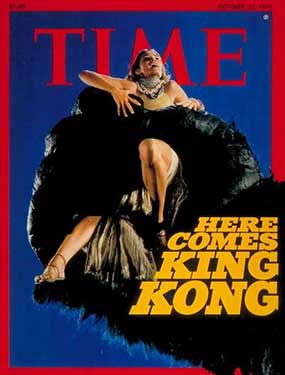
Time Magazine characterizes King Kong’s enthousiasmOkay, I admit that’s my own headline. There was indeed no trace of a King dong, but neither was there lust, nor anything more than a communication barrier overcome by physical clowning. A young white lass with Vaudeville chops was able to cajole the mighty Kong where scores of unfortunate black maidens had failed.
 
But really the special effects in the latest King Kong were amazing.

With special effects the filmmakers were able to create a giant gorilla who went ape at the sound of tom-toms summoning him to dine on a mouse-sized snack.

Special effects recreated superstitious black peoples who subsisted on the craggy coast of Skull Island, separating themselves from the island’s vegetation to live behind great fortifications and beneath countless pointy sticks on which were impaled human sacrificees.

Special effects produced dinosaurs also very keen to fight over what would be a tiny human morsel, willing to discard bigger kill for the smaller bird in the bush, even gnash away at a rocky surface trying to snatch said bony morsel.

To another extreme, special effects created bats which prey on animals larger than insects, and they stalk their target, hanging upside down each time a bit closer.

Convenient for the slow shutter rate of film projectors, these bats fly with the awkwardness of pterodactyls, the beating of their wings visible to human eyes. Lucky for our heroes who escape by holding on to the wing of a bat, while he flies with the other. A feat clearly accomplished only through special effects.

Special effects depict a world plainly ignorant of what some know as the food chain. The filmmakers can adhere to the laws of gravity, sort of, and whichever laws of physics can be illustrated, but they can’t grasp the food chain or that animals kill to eat, they do not maraud mercilessly.

By depicting nature as malevolent, we are expressing the highest disrespect for what really have become our wards. Like depicting Jesus with a machine gun for example. It might be funny, but it would be pretty undeserved.

But there’s more. Special effects produced stampedes both human and Jurassic, from which few casualties are seen. Men are able to keep pace beneath Brontosaurus legs to make the Spaniards who run with the bulls every year in Pamplona look like wusses.

And in the end you have Kong flinging blond lasses left and right, you have an entire opera house audience stampede to the exits with nary a body left behind.

In fact, given Peter Jackson’s fondness for gross-out scenes like the close-up of the carnivorous worm devouring a man head first, it seems strange that they cranked back the special effects for Kong’s final splat unto street level from the Empire State building. Kong’s body at rest on the street is shown not one bit like a sack empty of its potatoes, the usual sudden end to a 100 story fall.

David Letterman fans might have hoped to see Kong burst like a watermelon fallen from a great height, but special effects intervened.

And so the special effects try to approximate mechanical consequences, but ignore the organic, what used to be the common knowledge of life.

While this might suit the lower educated of today’s movie audience, Peter Jackson certainly does not limit himself to that denominator. In an early scene he risks boring that crowd with three interminable inside jokes: the actress they had wanted to cast for this adventure, “Fay,” was already doing an “RKO” picture for that damned “Cooper.” Rocky Horror Picture Show fans would get those references, but so what? Why not throw some bones to zoology majors and enlighten everyone.

The special effects in King Kong trade not merely in the currency of the implausible or improbable or impossible, they perpetuate the currency of ignorance with which people do great evil to nature and the environment and other cultures, particularly indigenous ones.

This film plays with lots of movie land conventions, but to an audience that is less privy to the inside references and more prone to base human reactions to the demonized stereotypes.