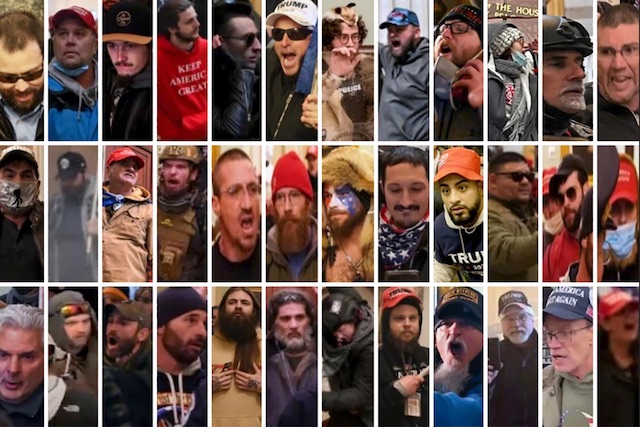
The FBI Wants You to Identify These Participatory Democracy Enthusiasts

Speaking as a street activist, I can assure you that any protester who has traveled to a demonstration in Washington DC would have stormed the Capital Building if the opportunity arose instead of being ignored outside it. Especially if the customary paramilitary posts were unattended and police undercover provocateurs were breaking the windows and doors to ease your access to an edifice that belongs to the people more than any other. Obviously the game plan was to let Trump supporters have their brief moment of unsuppressed anger, then let a “riot” discredit the outgoing party.

What a sham to accuse Trump’s would be rescuers of trespass! How dare law enforcement charge nonviolent demonstrators for the damage which their MAGA-clad plainclothes officers coordinated if not perpetrated?! An unarmed female Air Force veteran was shot dead trying to climb through a window – and who are we calling terrorists?!

Now the FBI is circulating photos of their top 37 persons of interests, wanted for violating a curfew and treading on the sanctity of our congressional den of thieves. The curfew was a blatant breach of the First Amendment and Congress is the People’s House. The demonstrators wanted to confront their pretend representatives and they did it. Trump expressed his gratitude and they earned it.

Whatever their politics, they are heroes and genuine patriots. They look funny because the FBI and the media shitshowrunners selected for cross-eyes and cro-magnon brows, but such alleged freaks showed initiative, restraint, a sense of humor, and an audacious love of their country. They braved COVID to save Democracy, they accused Congress of betraying the people and they’re not wrong. Their critics don’t have a clue, and the smarter among those let Bernie and Elizabeth Warren deliver them hook line and sinker into the fold of the Democratic Party, where status quo reigns at its ugliest. As a Biden presidency sinks in, their skin will crawl once more, and the cycle of impotent “resistance” will begin again at square one.

Whose racism are you protesting exactly?

SO “WOKE” America is protesting the racist brutality of capitalism’s hired thugs. What are the cops supposed to stop doing exactly? Are they supposed to let poor blacks breathe? Or stop killing poor blacks in such vivid disproportion? What an aimless message these riots bring! Of course the mainstream media is on board. Their theme is domestic unrest with an eye on regime change. It’s what they incite everywhere else. I’m surprised they haven’t labeled this a “color” revolution –except the color is already chosen and it’s their least favorite.

The only result of the visibility which the Black Lives Matter movement has brought to police lynchings is that now you hear regret that poor white criminals aren’t dished out the beatings reserved for blacks. Do we want more police brutality so long as it is equally distributed? Cops aren’t going to stop beating people. It’s their job. In an unequal, predatory economic system, cruelty is a cop’s function.

I also laugh at the celebrity blow-back at unfortunate white protesters who take up the chant “All Lives Matter” usually in earnest because their marches, reflecting their local populations, are mainly white. Their chants don’t negate “Black Lives Matter,” they broaden it. Face it, the BLM slogan is pedantic. Of course Black Lives Matter. The protesters are not illiterate and neither are the police, the supposed audience.

And BLM is such an inarticulate ask. Try “Drone Victims Matter!” Uh, agreed, but the US drone terror program is not going to stand down.

And “hands up” and “taking a knee” are demonstrations of submission. Ugh.

If the issue is in-the-line-of-duty lynchings, I’m sorry but there are unfortunates a rung below African Americans. Per capita, Native Americans die more often at the hand of law enforcement, and below them, the homeless. Constables have been “rolling” poor bums since antiquity. Vulnerable homeless are killed, white and black, in dark alleys, without witnesses sober enough to record it with charged cell phones and Youtube accounts at home. And without faith leaders to rouse their congregations, or order churchgoers to heel once the fundraising was done.

If the George Floyd protests are made to be about discrimination against African Americans in general, and not Floyd’s tragic death-by-cop, then who is co-opting the message really?

Fortunately these riots will prove a difficult genie to ride. Images of civil discord make Trump look bad, but the more violent they become, the more activated will be the middle Americans who cheer for order to be restored.

That same white middle class wants their landscapers and household help to be hispanic who won’t expect to be treated as equals. Immigrant labor is preferred for the same reason. The upper class don’t have to discriminate by skin color. If you are underclass, YOU Do Not Matter.

Supposedly all of America is expected to suppress its racism. That’ll happen when you cease showing deference to family members over strangers, or when you quit disabusing sports fans for rooting against your home team. Clans, schools, ethnicity, and nationality are natural constructs where people feel communal bonds. They are also the only instinctive means by which people find their strength in numbers. Strange we’re all being told to disavow those instincts.

Meanwhile ethnocentrism relating to religious affiliation, if you’ve got one, is still encouraged. Nationalism, when it comes to kicking other religious ass overseas is still applauded. What of that racism?

When cops start beating bank chairmen, when the international brotherhood of man includes the bosses who deploy the cops and not simply the dupes more easily oppressed with racist state terrorism, then we can consider integrating the role of police into our vision of a desirable community. In other words, it ain’t going to happen. Calls to disband or defund the police are great, but until people wield the political power to do it, the calls will be easily refused.

Focusing on race doesn’t unite people, and it doesn’t only divide black and white, it attempts to efface everyone’s chief means to draw individuals together in united fronts against their common foe. Once we’re all free we can talk about equality.

Now addressing the systemic repression of blacks is another matter. African Americans were not immigrants. They alone came to these shores without the promise of the American dream of making a better life for themselves. REPARATIONS and affirmative action, that’s the only recourse to attempt to redress such inequality of footing.

Join the protests if you want, but know they’re serving only the corporate agenda of international liberalism. If you’re all about that, do your best to pull the demonstrations toward the peaceful, lest our president benefit from the gesture of saving middle America from anarchy. But know that team .gov holds all the cards when it comes to inciting and even instigating the violence. They are both ANTI and FA.

Corporate News Streetwalker Didn’t See That Coming

Local news reporter Alex Bozarjian felt “violated, objectified, and embarrassed” when a passing marathon runner grabbed her butt on live TV. Hopefully we’ll be seeing more of that! Corporate media INDULGES in disrespect and objectification, shouldn’t their representatives be braced for the consequence? Was it a sexual assault? Not of Bozarjian! The grinning runner did that FOR THE CAMERA! It was a slap aimed to denigrate and disrespect the media, and should forewarn every mainstream news hack who presumes their victimized public cannot strike back. Bozarjian’s station says “No woman should have to endure that abuse simply for doing her job.” Doing THAT job — how about ALL of them? Male AND female! Whether fool or knave, unknowing or mendacious, media whores deserve a slap whenever they surface in public. Granted, that slap will probably be more effective delivered in the face. Bozarjian got off easy.

Jeffrey Epstein escapes federal jail

Even petty blackmailer extortionists know to warn “if anything happens to me, incriminating evidence will be released to the media.” Billionaire sex offender Jeffrey Epstein is already fading from the news and not one manila envelope has dropped. What does that tell you about what “happened” to Jeffrey Epstein? It didn’t. You might think his suicide was really a murder, but let’s remember he counted the most powerful pervs among his friends. Fat chance any of them wanted their friend and primo procurer killed. Before his suicide, Jeffrey Epstein signed a will, his last legal opportunity to do so, then he did El Chapo one better. With allegedly dozing guards (one of them a temp with a shorter personnel record, maybe more easily impersonated), and under faulty surveillance cameras, El Epstein disappeared from federal custody into his own self-financed witness protection plan. What’s it take? An anesthetic cocktail for the short gurney ride, not that many parties to pay off or knock off later, your body is released to an unnamed “Epstein Associate,” and it’s party time again at your Virgin Island! Pretty damn obvious.

Programmed obsolescence for iPhone? Apple has an app for that! iOS update.

Forget planned obsolescence, the digital age means manufacturers can trigger killer apps like a remote switch for the hangman’s trap door. Just poke a hole in your customer’s canteen if you want to bring them back to your watering hole.

Was Apple’s throttling of late model iPhones mentioned in the fine print which users approve every time they authorize a software update? I doubt it. First the suspicious timing of the dumbing of smart phones was dismissed as urban myth. Next sleuths learned that googles of “iPhone slow” spiked before launches of new models. Then someone benchmarked the IQ drops of the transformed dumb phones. Now Apple has been forced to admit it programed the slowdowns.

Apple says they had to hobble your phone to go easy on its aging battery. Imagine a car dealership progressively disabling cylinders in your car engine, to secretly save you on gas.

Essentially Apple is retiring your phone on a fixed income of energy while you consider its functionality still under contract to you, under your employ. Whose iPhone is it?

Is Colo. Attorney General worried that Colorado River rights case will reduce Land of Many Uses to too few abuses?


DENVER, COLORADO- Do you know about the lawsuit brought on behalf of the COLORADO RIVER, suing the State of Colorado for interfering with its right to flow into the sea? It’s a “Rights of Nature” initiative which suggests that if corporations can have rights, why shouldn’t natural stakeholders? Although environmental entities have been granted recent legal protections by various progressive nations around the world, the Colorado team bringing the lawsuit is widely expected to be rebuffed. The court has already delayed the initial hearing where first arguments will be presented, but this week brought a surprise development that suggests that the lawsuit’s defendants give the case better prospects. This week the Colorado Attorney General’s office served a letter to the plaintiff’s lead council, attorney Jason Flores-Williams, warning they would initiate sanctions against him if he did not voluntarily withdraw the lawsuit. Intimidating, but really a very good sign.

The Fourth Estate is a Fifth Column


The Premier, Seconde, and Tier Etats were pre-revolutionary constructs to harness the power dynamics of the Ançien Regime. Academics and journalists then sought to pretend impartiality by pronouncing themselves a Fourth Estate, but there is no such division. That concept is a fabrication of the press to feign independence from their bosses. If we must talk in terms of arrondissements, the Fourth Estate in reality is a Fifth Column. It acts like it seeks the truth, in the interest of the people, but in reality propagandizes for the oppressors.

The conventional 1st and 2nd classes, the clergy and the nobility of all monarchies, disguise a single religious scam that presents the despot’s raison d’etre. The two were only ever one. Even now that partnership persists in today’s simulated democracies.

The Third Estate, meant to represent the populace, is not an estate at all. It’s a people deprived of unity and, literally, estate. There are only two classes: the haves and the have no estates.

Schools and media indoctrinate members of the public about the inherent superiority and inevitable supremacy of their betters, and assure us that these journalistic conclusions have been independently sourced.

Oscar Wilde wrote in 1891:

In old days men had the rack. Now they have the Press. That is an improvement certainly. But still it is very bad, and wrong, and demoralizing. Somebody — was it Burke? — called journalism the fourth estate. That was true at the time no doubt. But at the present moment it is the only estate. It has eaten up the other three. The Lords Temporal say nothing, the Lords Spiritual have nothing to say, and the House of Commons has nothing to say and says it. We are dominated by Journalism.

Unexpected hagiography of pedophilic sodomy admitted by catholic priests to being “suggestive” instead of noxious.


The pedophile priest theme has been set in stone. A catholic school in Australia commissioned a statue of St Martin de Porres offering a penis sandwich to a child who stands no taller than most convenient. The child’s hands are cupped as if receiving communion. Is the granite statue historically inaccurate? Probably its likeness is timeless. I’m thinking of the resignation to mechanical carnality and the stone cold gaze. De Porres was a Dominican brother in 16th Century Lima, Peru. No doubt the ritual depicted here reflects “Martin the Compassionate” at his least menacing. When he wasn’t molesting children, De Porres was administrating the enslavement of South America’s indigenous people for Spain’s colonial silver mines.

When repulsed parents lambasted the newly installed statue at the Blackfriars Priory School in Adelaide, the priests agreed to cover it up. They conceded that the placement of the loaf of bread -in hand- was “suggestive” of a less palatable offering. While indeed the pose could be said to suggest misconduct, the adjective was paired with another term which only a pederast would be clueless enough to offer: “riské!” Yes, Father, do cover the statue if you suspect your fellow friars will find the little scene titillating. So that’s the Catholic church on pedophilia: it’s set in stone, and kept under wraps.

Who is this El Paso Sheriffs undercover infiltrator provocateur? We don’t care!

El Paso County Sheriffs Undercover OperativeCOLO. SPRINGS– Lawyers for the city are fighting defense team efforts to expose who, how, when and why local law enforcement agencies infiltrated a campus political activist group. The 2017 undercover operation was revealed in CSPD bodycam videos, but city courthouse lawyers and judges are preventing the evidence from being made public.

Alerted to the October 17 evidentiary hearing meant to shed light on the bodycam video, journalists and news crews instead witnessed stonewalling by city attorneys but made to look like a disorganized defense. They saw municipal Judge Kristen Hoffecker blame the defendants for not submitting to a sham proceding, when the judge should have confessed that the defense’s subpoenas had not been honored.

Today the city learned that our defense team went around them and served the subpoenas directly, requiring the responsible law agency parties to testify as witnesses at an evidentiary hearing on November 3. Now the city wants to use a November 1 status hearing to quash the subpoenas.

What’s the big deal? The city asserts the confidential identity of its undercovers is a stake. That is of course the least of it.

The city’s own evidence against the defendants, accused of marching in the street on March 26, 2017, documents police officers deciding to issue tickets. What’s clear from the video is that the police issued tickets, not to cite wrongdoers, nor to halt law-breaking, but to 1) “identify everyone”, 2) arrest an undercover agent, and 3) disperse a lawful assembly. It’s all on tape.

When defendants first grasped what they were seeing on the bodycam video, they brought it to the attention of the various municipal court judges who take turns directing the daily court matters. Asked to produce the written reports generated by the officers on the video but missing from the discovery evidence, the judges declined. Asked to subpoena the officers involved, the judges declined. After each defendant’s pro se arguments were rebuffed, one motions hearing after the other, the defendants sought legal help. Actually Judge Hayden Kane II did eventually grant a hearing to look into the video, but he told us he’d already watched it in private and was not inclined to find it relevant, so defendants were not encouraged that his opinion would change.

In the meantime civil rights lawyers were highly interested in the police activity documented by the video. They submitted 20 pages of argument for the dismissal of charges against the defendants, citing outrageous police misconduct in violation of the Code of Federal Regulations, part 23. They requested that the sheriff, the police chief, the commander of CSPD intelligence, and others named and unnamed, be subpoenaed to testify at an evidentiary hearing on October 17. That didn’t happen, as everyone saw. The subpoenas didn’t even go out.

The October 17 hearing misfire was simply the latest of months of attempts by the defendants to bring this story to light.

This time around the city wasn’t given the chance to sit on the subpoenas, they’ve been served directly. On November 1, will Judge Hoffecker invalidate the subpoenas two days before the witnesses are compelled to appear? The question reporters can ask is should she?

The city’s argument will be that the police undercover operation, however illegal, does not have anything to do with the guilt or innocence of the socialists charged with marching in the street. Outrageous police misconduct is a matter for federal court, that’s true. But have a look at the video. Notice that the first marcher fingered for arrest, the only one assigned an arrest team, was the undercover “Mark Jackson.” When the police shouted their warning that all who remained in front of City Hall would be issued citations, their only unequivocable target was Jackson.

Without the motive of arresting Jackson, whether it was to provoke the crowd or to embed their infiltrator, and until the order “LT wants everyone identified”, the police weren’t going to make any arrests. What does that say about the supposed guilt of the accused?

The police had already told the socialists “you’re free to carry on with your rally so long as you don’t step back unto the street.”

What the socialists were doing on March 26 was the essence of protected speech. But senior officers not on the scene had a crime of their own up their sleeves, and they needed an arrest or two to set it into motion.

Should we get to the bottom of this story, or let the city pretend it didn’t happen until the defendants get to turn the tables in federal court?

One presumes that undercover agents are only performing the intelligence function of surveillance, monitoring protest activity for hints of criminal behavior. At worse, we call them agent provocateurs, trying to encourage illegality, and believe that everyday nonviolent activists should know better than to be entrapped into illegal acts.

But undercover officers are much more disruptive than that. Undercovers sow dischord and mistrust among strangers who’ve come together to advocate for a common cause. Infiltrators pit activists against each other and confound organizers with sabotage. They volunteer for responsibilities then drop the ball. They complicate discussions with irrelevant, impractical, or illegal suggestions. When their ideas are rejected they express frustration by demeaning their fellow participants for being unmotivated. When “Mark Jackson” was found out, and it took many weeks for everyone to become convinced he was an undercover, he berated everyone for every personal failing in the book. He accused individuals of paranoia, ineptitude, or lacking courage. “Get back to me when you decide you want to DO SOMETHING” were his parting words.

Police infiltration harms every citizen effort to organize. The Code of Federal Regulations mandates that police agencies have suspicion of real crime before embedding infiltrators.

If CSPD or the El Paso County Sheriff’s Office or the Department of Homeland Security or the Colorado Bureau of Investigation has proof of a crime brewing among the Colorado Springs Socialists, wouldn’t we all benefit to know about it? We would if their motive is truly crime prevention.

The real identities of “Mark Jackson” and his partner “Aimee Walter” doesn’t matter at all. Who they work for is paramount. Are they “with the Sheriffs” or contracted or embedded from another agency? As the video shows, Jackson’s jittery hyperactive behavior while detained in the cruiser doesn’t give one much confidence about who law enforcement is entrusting with a loaded weapon in a crowd they hope to be inciting to riot.

The city’s determination to quash the question of whether or not such evidence exists points to police malfeasance, not the Socialists’.

Justice delayed is justice denied. Colorado Springs police infiltration operations against social justice activism should be brought to heel sooner rather than later.

OCTOBER 27 UPDATE:
According to Judge Hoffecker’s order: November 1st at 2:30pm will be the city’s next chance to quash the subpoenas. If they do not succeed, the evidentiary hearing is scheduled for November 3rd at 8:15am.

City plan to snuff socialist infiltration hearing blows up in courtroom’s face

El Paso County undercovers
COLORADO SPRINGS, COLORADO– If you attended today’s evidentiary hearing about the police infiltration of a local student group, you are no doubt left wondering what happened. Where were the defendants and why was the judge so angry? The outcome was not what either side wanted, but still it was a huge false step for the city. The defense was not provided the police witnesses it requested, but the prosecution was prevented from quashing those subpoenas outright. As a truant co-defendant, I had a unique vantage point on today’s anticlimax and I apologize I was unable to explain it in person.

Today’s hearing, it turns out, was supposed to exclude the defendants. The review of evidence relating to the police infiltration operation was intended to happen outside of public view. The lawyers signed the setting slips, not the defendants, who were kept uninformed of the October 17 hearing. The judge had specified lawyers only, to keep the details and identities of the undercovers confidential.

Can courts exclude defendants from their own hearings? Not really, but anyway.

It turns out the judge wanted privacy because she had no intention of conducting the hearing at all. Without an audience to offend, this judge planned to summarily quash the defense motions to make police administrators testify and that would be the end of it. Objections be damned, let the lawyers take it up on appeal. Push this hot potato off a year or two.

However, through documents obtained directly from the courthouse, the defendants did learn about the hearing. So the defendants made plans to attend the hearing regardless of a judge’s preferences, and they publicized the event for what it promised to be, a scandalous exposé of CSPD intelligence overreach. Subpoenaed to testify were El Paso County Sheriff Bill Elder, Colorado Springs Police Chief Peter Carey, Lieutenant Mark Comte of the CSPD Intelligence Divison, and Sergeant Clayton Blackwell, among others.

Colorado Springs prosecutors did not inform the defense team that they had no intention of honoring those subpoenas. Instead they planned to motion to quash the subpoenas and truncate the hearing. The city attorneys did not file those motions beforehand nor give the defense any indication they were contesting the subpoenas.

I can only surmise that the city prosecutors began receiving calls from the media about the anticipated testimony of the sheriff and chief of police, because it wasn’t until late morning on the day of the hearing, after our press release went out, that the city emailed the defense team to say that “Sgt Blackwell is on vacation.” Blackwell wouldn’t be attending the hearing, they said, and by the way, his was the only subpoena delivered.

To which I imagine our legal team said: WTF?! Now we needed a hearing to learn why the city thought it could unilaterally decide to whom to deliver our subpoenas.

It’s one thing to disrespect the rights of defendants. Our municipal court does it ALL THE TIME. Everyday, sadly. In fact, it’s done it repeatedly to the very defendants in this case, before we got lawyers. But it’s quite another thing to trample on our rights when a civil rights attorney is involved.

If Blackwell was on vacation, the case needed a continuance. And if subpoenas were going to be quashed, we needed a motions hearing. Oddly, the judge was demanding our defense attorneys show up in person. To arrange a continuance?! Riiiiiight.

Our lawyers quickly let us know there was to be no hearing. Since the defendants weren’t supposed to attend today’s hearing anyway, we deemed it prudent not to attend the prosecution’s switcheroo. Without defendants, whatever the prosecution planned couldn’t proceed. Meanwhile the defense lawyers weren’t going to abide a Podunk Springs Judge Roy Bean throwing the law book out the window. If subpoenas aren’t going to be honored, you have to present the legal basis beforehand. Them’s the rules, Hayseeds.

So the courtroom audience, including journalists and media crews who had to leave their television cameras outside, were left to witness a Colorado Springs judge fuming at being out-thunk. The defense lawyers weren’t there to let her quash away with her gavel, without regard for the Colorado Rules of Proceedure, and the judge’s original scheme excluded the defendants so as a result there were no defendants present to accept her rulings. The judge could do nothing but seethe and lecture the audience about big lawyers disrespecting municipal courts. Nevermind that our courts are corrupt mechanisms that trample rights for breakfast. (The ACLU recently released a report damning Alamosa’s city courts: Justice Derailed. Believe me, the identical abuses of power occur in Colorado Springs.)

Nevermind too, what today’s court hearing was supposed to be about: Outrageous Conduct on the part of CSPD and EPCSO, and violations of the Code of Federal Conduct. Today’s defendants were arrested on March 26, 2017, but not for walking in the street. The socialists were arrested because the Intelligence Division wanted to “arrest” an undercover officer, maybe two, in order to give them deeper cover as they infiltrated a student-led group just formed in Colorado Springs. The CSPD body-cam video released to the defendants already proves this. We wanted the decision makers responsible to explain it.

Instead of a comedy of errors spotlighting local law enforcement ignoring the people’s Bill of Rights, the courtroom audience today saw another facet of our corrupt judicial system. They witnessed a judge prepared to ride roughshod over further rights that protect citizens from authoritarian zeal. You may not care how police abuse “socialists” but the whims of a municipal court despot affect everyone caught in their dragnet, be it a ticket or a zoning dispute. Even with an expensive lawyer, you are powerless to object when a judge pretends there are no rules.

What the judge saw today was a courtroom filled with supporters of the defendants and a media interested in their story. She saw that she and her gavel are not going to make this story go away.

Why should you attend the Denver Nalty-Byfield ENTERPRISE TRIAL?

Why support the “We The People” public-oath sticklers who the state is prosecuting like a criminal enterprise? A few reasons: Solidarity. Because as hardheaded as they might be, defendants Stephen Nalty and Steve Byfield are still JUDICIAL REFORM ACTIVISTS. Sense of fair play. Half the courtroom gallery is filled with Colorado Attorney General staffers and FBI special agents chumming it up with jurors and briefing their THREE FBI UNDERCOVER WITNESSES while the defendant pariah side of the audience is warned by the judge that even a whisper will result in ejection. Thrills. Where else are you going to see this many federal agents pushing their weight around, barking at you in the hallways, swaggering gleefully about how much smarter they are than the defendants? Pathos. Come watch the Assistant Fucking Colorado Attorney General, Robert Shapiro himself, lead a team of prosecutors against the unrepresented defendants, watch Shapiro belittle them, lecture them, trivialize their difficulties defending themselves in jail, and pretend they can review “tens of thousands” of pages of evidence and “hours and hours” of undercover surveillance tapes in a single day. Because you can make a difference. Come push the FBI-guys’ buttons. Come witness and document the abuses of the overbearing prosecution team. Come lend public pressure on the judge, whose conscience is already bothering him about how unfair this sham trial has become.

Liens
You don’t have to agree with how Nalty and Byfield went about trying to reform the judicial system, but aren’t they mostly right? Judges ARE corrupt. Local officials ARE NOT accountable to the people. Law enforcement WON’T pursue charges of their own corruption and the media certainly won’t side with the reformers. When Nalty, Byfield and Co, served commercial liens valued at billions and trillions of dollar against officials who hadn’t filed oaths of office, it was an effort of last resort to get someone’s attention. No one was thinking, hey, maybe this eleven-figure dollar demand will slip through the cracks and the billions will be ours!

Each lien was calculated to represent the sum defrauded from and owed to the American People. Prosecutors can tap these defendants for conspiring and racketeering and extorting and attempting to influence public officials, but they can’t say the defendants aimed to obscond with one single penny. Throwing three undercover infiltrators at a twenty member judicial reform group, putting thousands of manpower hours into locking these defendants away, is gross abuse of authority and it’s hubris.

Authentic transgressions
As the sham trial goes on, the pieces are coming together on the cases of Nalty and crew. It turns out federal investigators labeled them “sovereigns” because they’ve held themselves not responsible for paying traffic tickets, property taxes, and the like. In the end I’ll grant you Nalty’s group may be guilty of those. I say “may” because such citations may have been retaliatory for their political beliefs.

As to the punishment, I believe adjudicators should take into account that the defendants acted not to enrich themselves, nor to flaunt the law per se, but to assert political rights about which they may have been misguided. Again I say may because the defendants are being tried, after all, according to a set of laws, which enforce a social contract, the terms of which the parties do not agree.

I use the word misguided as a nod to those who think the Nalty gang have acted like idiots. That’s easy to say, and easy to laugh, but no one’s yet figured out how to emancipate labor from the yoke of capital. You may regard interest and rent as your inherent debts. These sovereigns don’t and they’re trying to say so.

Economic slavery
Ours is a system of peonage to which this crew feels they never indentured themselves. The ersatz writs and liens they spammed to every official they encountered were the legal loopholes they thought could break the bank and liberate everyone from financial tyranny. While Nalty’s scheme intended insurrection, it wasn’t against democracy or the republic, it was against taxation without representation, the same beast Americans pretend to have overthrown with the Declaration of Independance.

Instead of tea into Boston Harbor, this crew dumped a bunch of junk paper unto the reception counters of Colorado public offices. Charge Nalty’s crew with littering maybe, at most, vandalism, though it’s hard to say these vandals caused even a scratch. Every public official who testified as a victim said they didn’t take the ersatz documents seriously.

The writs and liens looked officious, but weren’t attributed to known government or banking institutions. Likewise signatures were signed in red. Red was chosen to represent the signer’s blood, even though red is a color which automated banking systems reject as unreadable, therefore invalid.

Not one witness expressed confusion about the validity of the papers. They mentioned too the rambling diatribes in the text block.

To call the defendants “paper terrorists” wildly overstates the effect they achieved. They didn’t terrorize anyone. Governments like to accuse rebellious insurgents of “terrorism”, but that’s another paralegal threshold with which most common citizens, and certainly these “sovereigns”, disagree.

Real funny money
These guys did the equivalent of feed Monopoly Money into ATMs. No bank balances were changed and no real money came out. Counterfeit currency is one thing, but denominations of your own handywork pretending to be only that does not qualify as funny money in the illegal sense. I’m guessing forms submitted in a language foreign to bank clerks would be rejected out of hand. How are these any different? Irregular submissions, as one witness called them, need not generate calls to the FBI or the Colorado Joint Terrorism Task Force. I’ll bet that ATMs know to reject Monopoly Money. If they don’t, whose problem is that?

The trial of defendants Stephen Nalty and Steve Byfield is due to wrap up Friday. The prosecution will have taken seven days to present its case and Assistant Attorney General Robert Shapiro intends to object if the defense rebuttal takes more than a half day, maybe a whole. This trial is meant to intimidate the other defendants to convince them to take pleas.

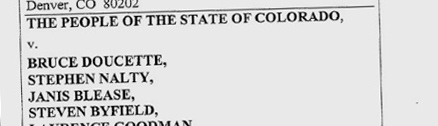
Next in the pipeline is Bruce Doucette whose trial starts October 16. Defendants Harlan Smith and Dave Coffelt have hearings on October 18. If they do not take deals, Shapiro intends to enjoin their cases, to save time and money. He’s already convinced defendant Brian Baylog to take a deal and turn state’s evidence. Baylog is scheduled to testify against Nalty and Byfield shortly.

By now the condemnation of Nalty’s commercial lien scheme will have cost Colorado millions in man hours and legal expenses. You can fine a graffiti artist for having to restore an edifice to its original lustre, but you can’t expect him to bear the full cost if you chose a cleanup crew that wears Gucci loafers, most of whose jobs is to pat the other on the back.

Colorado’s overkill with federal agents and counter-terrorism experts is a problem of its own making.

The Nalty-Byfield trial continues through this week 8:30am – 5pm, at Denver’s Lindsey Flanigan Courthouse, in Division 2H, ironically, “Juvenile Court”.

FBI undercover rats on sovereign pals, says they planned to seize small county jails, except he was their lone soldier.


DENVER, COLORADO- Very interesting testimony Friday at the trial of sovereigns Stephen Nalty and Steve Byfield. The prosecution’s latest witness was FBI INFORMER Marshall Ringer. Not a sovereign citizen type turned by government agents, Ringer is a disgraced police officer hired by the FBI and inserted into the so-called “enterprise” to report its activities and propose courses of action conducive to arrests. Ringer calls himself a “self-employed security expert.” His handler FBI Special Agent Ryan English calls him an “embedded confidencial human source”. His targets gave him the title “Continental U.S. Marshall”. They hoped he would recruit like-minded sovereigns to the cause of correcting what they saw as a corrupt judicial system. Ringer’s FBI codename was “Earp”.

The accusations corruption hinged on the understanding that according to Article VI of the US Constitution, positions of public authority must take an oath secured by a bond. The “enterprise” had discovered that many Colorado judges and prosecutors and sheriffs and other elected officials didn’t have oaths or bonds on file. If this expectation was indeed a misconception, and Article VI is inapplicable, you’d think the remedy might be to tell the would-be reformers, “no, that is not a requirement, here’s why, etc.” Strangely that was never done. Neither to their person, in a handout, or to reporters looking into this sad case. An undercover would present an excellent opportunity to huddle with the enterprise and say “hey guys, I was looking into this oath stuff and discovered that according to such and such law, or ruling or whatnot, oaths and bonds are no longer mandatory, end of story!”

But “Earp” didn’t. Nobody did. Nobody has yet to spell it out, even in this courtroom. When the defendants have tried to put Article VI into the trial record, they’ve been refused. So the issue is certainly a curious one.

Instead of using an undercover to diffuse the oath-seekers by presenting the incontrovertible truth of their error, the FBI and the state prosecutors instead gathered evidence to ridicule their character. We’re told they met in trailerhomes, they struggled to cobble enough money together to give their marshall a pair of handcuffs. They dreamed of putting together a network of De Jure judges to replace the corrupt ones currently alas De Facto.

Tapes
You might think the taped conversations of the sovereigns would be damning. The defendants certainly seem to be embarassed by them, but they’re less incriminating than disarming. When “Earp” asked what was he to do with the officials he arrested, he was told, nothing, for now. Do not take any action on your own. Wait for instructions from the People’s Grand Jury. Every time “Earp” goaded his colleagues about what he could do, they’d tell him to wait until matters could be addressed democratically and judicially.

The most interesting information to come from the undercover testimony was about how the FBI wires up its informants. Colorado law requires that at least on person in a conversation consents to being recorded. As a result, every recording presented to the court begins with the person wearing the wire dictating this preamble: “This is confidential human source X, on such and such date, etc” before that informant gets out of his car or enters a meeting area.

This offers potential targets a remedy for how to avoid intrusive surveillance by authoritarian law enforcement agencies IN COLORADO. Before every meeting, have everyone say out loud: “I do not consent to being recorded.” In unison is fine. Then a leader can then ask: “Was that everyone?” To which everyone can answer in unison: “Yes.” Provided that everyone said it, that meeting cannot be recorded. Such a method not only invalidates a recording being used as evidence later, it makes the recording a crime and the agency undertaking it and in possession of it, cupabe. If an undercover continues with the recording, he’s committing a crime.

In the case of te sovereigns, and likely your scenario as well, the government’s criminal act will far exceed in severity what they thought they were recording you doing.

We’ve yet to learn how, but apparently this undercover was discovered by the defendants early in 2017. They outed him by accusing him of making recordings and giving them to the FBI. That’s when he extracted himself and the indictments and arrests happened immediately thereafter.

The Enterprise
However you may feel about these perhaps misguided judicial reformers, their adversaries are behaving every bit the corrupt villains they pretend not to be.

The accused called themselves the People’s Grand Jury, the Indestructible People’s Trust, The Colorado Supreme Court, the Continental US Marshalls, the De Jure whatnot, or simply We The People. There seems to be no end to the permutations but they never called themselves “The Enterprise”. Yet that is what their accusers call them. In fact, for the duration of the prosecution’s case, a posterboard has been left in the center of the courtroom, beneath the judge’s dias, from which the jury cannot look away, it’s titled The Enterprise, with photos of ten member now-defendants, like employees of the month, except with mugshots, ranked in order of their title or prominence. Another ten members didn’t warrant photos or arrest, yet are listed as culpable parties, guilty by association and without the chance to . You wonder if that is legal. It certainly is prejudicial. Never mind if the witness testimonies don’t add up, there is The Enterprise, like it’s a thing instead of a characterization fashioned by frame-up artists.

MONDAY UPDATE:
On Monday defendants were given one day’s recess to review the evidence for their defense, which being incarcerated has impeded. So FBI informer Marshall Springs will resume his testimony tomorrow. But the courtroom also heard that the prosecution plans to bring TWO MORE UNDERCOVERS to testify, plus two cooperative witnesses, one of whom is a co-defendant who’s taken a plea to turn STATE’S EVIDENCE.

So that makes THREE undercover officers infiltrating “the enterprise” of not much more than a dozen conspirators, two of whom have become so intimidated they’ve changed their minds about what they were trying to achieve.

The next few days should prove enlightening and heartbreaking because although prosecutors have been documenting what the defendants did, they haven’t demonstrated the acts were crimes,. As much as defendants conspired, organized and racketeered, they didn’t aim to make one cent profit, illicit or otherwise. To what offenses did the cooperative witnesses plead guilty and what accusations do they make toward their friends?

So Nalty and Byfield have the rest of the day to study the evidence against them. The jail has not provided the paper and pencils ordered by the judge. The jail hasn’t afforded the defendants access to the case evidence either. Nalty indicated today that he’d spent a sum total of 45 minutes with the electronic files. He asked for a break of four days to prepare for the rest of the trial.

Both are in Denver jail, though their legal papers were not transferred with them when the defendants are on loan from Adams and Arapahoe Counties respectively. All the defendants being charged with conspiracy are being detained in different jails to prevent them talking to each other. But the problem is they don’t have their case papers or filings, and are in Denver’s customary 22 hour lockdown in their cells, which inhibits using the jail computers which are confined to the jail law library.

Prosecutor Shapiro responded to the defendant’s complaints of the jail not providing paper and pencils by cavalierly handing them writing pads, which they grasped with handcuffed hands, with polite thankyous. Though Shapiro no doubt know they won’t be allowed to take these into the jail. Then he condescendingly bragged that he’d resolved that complaint by providing “brand new” pads to each defendant. Defendant Byfield’s pad had a couple sheets missing, so he immediately pointed out that his pad wasn’t new. I couldn’t help but burst out with a laugh.

The judge thought there was merit to Nalty’s complaint Both defendants have scant access to the jail computers necessary to see the evidence. By the prosecutor’s own admission, the “tens of thousands of pages” would have been prohibitive to provide on paper, and the “hours and hours of taped testimony” likewise can only be provided electronically.

Prosecutor Shapiro acquiesced to allowing the defendants one day to catch up, though it sounds like he is well aware that analyzing tens of thousands of pages and hours and hours of evidence would take longer than that. Shapiro told the judge he calculated the state had wiggle room to allow a one day delay and still finish with the case by Friday. Here’s what he calculated: The state figures to rest its case by Thursday afternoon. That should leave a day and a half, less closing arguments and jury instructions and jury deliberations, to finish the trial on Friday. The prosecutors’s case will have taken six and a half days, but Shapiro thought the extra day needed to look over the evidence could come out of the defense’s day planned for defense.

To help the defendants prepare, Shapiro volunteered a preview of the witnesses to expect to testify to close out their case. Coming up we have four Gilpin County administrators, but we have also two more government undercovers, and the two cooperating witnesses. One of them co-defendant Bryan Baylog.

Not The People v. Stephen Nalty and Steven Byfield. Right to an Unfair Trial.

Paper Terrorists Tried in Juvenile CourtDENVER, COLORADO– The trial of accused “Paper Terrorists” Stephen Nalty and Steve Byfield began Monday in courtroom 2H of Denver district court. The two face 28 odd charges, from conspiracy, criminal enterprise, to racketeering, brought by the Colorado Attorney General and the FBI.

And they’re defending themselves. In handcuffs.

Don’t worry, they’re holding their own. But already it’s day one and authorities are piling on every disadvantage. On Monday the defendants were cheated of being able to prevent the state from stacking the jury (and the defendants don’t even know it because they weren’t in the courtroom to see it done).

Watching the court clerks and lawyers prepare for the trial, you cannot but admire their civil spirit. In every hearing Nalty and Byfield have declined advisements and refused to recognize the authority of their adjudicators. The two sound like broken records about “oaths” and sovereign stuff, yet the judicial mechanism inches forward. It should of course, because the defendants have been jailed since MARCH.

For six months Nalty and Byfield have been held on $350,000 bonds. Neither of them can afford even the interest on those sums. Of course their indictment and prosecution is a travesty and a misappropriation of public resources, but how else could the state stop their criminal enterprise except to admit wrongdoing itself?

Nalty and Byfield are being railroaded and they’re sure a jury will conclude the same.

The People’s Grand Jury
For the last few years, among a team of eight “sovereign citizen” types, Nalty and Byfield have been serving judges and other public officials with legal papers and liens which achieved no response. Until Colorado’s attorney general enlisted the FBI to squash the “criminal enterprise.” The sovereigns face 28 charges of all the racketeering and conspiracy lingo, essentially for questioning why their local magistrates and officials had no oaths or bonds on file. When the sovereigns got no response, they formed a “People’s Grand Jury” to indict the violators with their ad hoc public courts. Then they’d file commercial liens against those accused for defrauding the public in violation of Article 6 of the US constitution.

When confronted from podiums, judges and lawmen dismiss the oath requirement out of hand, but it’s interesting that none spell out exactly what law supersedes the US Constitution. News articles about the Paper Terrorists list the litany of criminal charges the defendants face, but have yet to mention the asserted law-breaking which is the Paper Terrorists’ only complaint.

It is hard to get a handle on what the “People’s Grand Jury” really wants. In their dreams, they assert that the lack of filing of oaths should mean that all affected legal judgements should be overturned, and that all salaries drawn by government employees who did not file oaths or bonds should be returned to taxpayers, with interest. They calculate the total sum owed to the American people is in the multi trillions. So there’s that.

Some of the public officials targeted by the People’s Grand Jury began to suffer strikes against their credit records when they didn’t contest liens filed against them. You’d think the credit monitoring algorythms would flag multi billion dollar liens. You’d think someone could suggest a method to filter such paralegal filings.

Instead the state chose to hit back hard. Last March, the eight troublemakers were indicted for two dozen paper crimes. The state imposed bonds averaging a quarter million each. It hasn’t stopped the crew, as their wives and friends keep serving more notices and liens. So now the state intends to make them examples and imprison them for life.

Jury Selection, Only For the Prosecution
Here’s what happened Monday during jury selection, when both sides are meant to parse a jury pool to pick an impartial jury. You know, a defendant’s right to a jury of their peers?

Nalty and Byfield still don’t know what hit them. The prosecution was given the jurors’ details, the defendants learned none. They blindly accepted jurors whom the prosecutors had already carefully weeded. The defendants never knew it and the court was not “on the record” when this happened because it was before the judge entered the courtroom. But audience members saw the whole thing.

Actually, once he was presiding over the entrance of the jury pool, the judge was in a position to observe the prosecution desk already progressing well through the jury questionnaires while the defendants sat idle. Perhaps the judge didn’t know his court clerk had provided no instruction to the defendants. Ultimately whose responsibility would that be?

Monday for jury selection, the court decided it needed a jury pool of SIXTY from which to choose twelve jurors plus two alternates. To save time, the court had prospective jurors fill out 4-page questionnaires instead of having them deliver the customary recitation of their biographical details. The court assigned four digit non-sequential numbers to each candidate. Copies of these forms were made for all parties, stacked according to the seating order of the jury pool. They were put on the desks before sheriffs had brought in the defendants. The team of four prosecutors began pouring over the questionnaires and were warned by the court clerk not to get them out of order as it corresponded to how the jury pool would be admitted.

Team leader, Assistant AG Shapiro noticed that the forms bore the jurors’ signatures, which he instructed should be blacked out from the copies provided to the defendants. Two clerks set themselves to redacting the stacks for defendants Nalty and Byfield. Meanwhile the prosecution studied the forms, made their notes, and drew each other’s attention to details. This information included the applicants’ names and signatures. Trial lawyers do not discount surnames and autographs as irrelevant to evaluating a juror.

When the clerks finished their redactions there were still other courtroom delays and by the time the defendants were finally brought back from their holding cell, the prosecution had a full half hour head start studying the questionnaires, and of course twice the pairs of eyes.

The defendants were not told what the stacks were, nor that they were in any order. The defendants had barely been seated before the judge made his entrance and the jury pool was paraded into the courtroom. The defendants thus got no time to examine the questionnaires. They looked at the stacks dumbly, not knowing what they were supposed to do with them, or how, with their wrists in handcuffs. Defendant Byfield tried to shuffle through some of forms while the judge advised the jury pool. With shackles on he couldn’t manage the stack, much less keep it in order, even if he knew that would matter. Forget managing pen and paper, in addition to taking notes.

You’d hope that jurors will wonder why these “paper terrorists” are kept shackled. Who has ever asserted they pose a threat of violence to anyone?

On the other hand, if you doubt that the failure to file a public oath should earn a prosecutor the accusation of fraud, if you doubt it means they’re untrustworthy, the unfairness they eagerly exploited on the first day of trial would give you pause. They behaved every bit as corrupt and mendatious as Nalty and Byfield have been saying. How unfortunate the jury didn’t see it.

Denver magistrate separates mother from breastfeeding infant. Jail refuses pump, as they do common decency.


DENVER, COLORADO- A heartbreaking scene unfolded yesterday when Denver Magistrate Kate Boland decided to impose a $10,000 bond on a domestic violence detainee, against the recommendations of the husband (victim), the public defender, and even the city prosecutor, who all wanted the 35-yr-old mother of five released on personal recognizance. Most critical, no consideration was paid to the family’s month-old infant who is breastfeeding. Neither by Boland, nor the downtown detention center, known for its systemic disrespect for the rights and needs of its inmates.

You might not care how poorly criminals or their children are treated, but the inmates of jails are suspects, not convicts. They are unconvicted detainees held on some officer’s probable cause. They’re suspected of a crime, but have a right to a fair trial (under the 6th Amendment) and a right not to be punished before conviction (under the 14th). Depending on who calls 911, they could be YOU.

For those reasons (and the Golden Rule and the social contract), jails have to show a semblance of concern for the still innocent lives disrupted in their care. Denver’s Van Cise-Simonet Detention Center has a famously outlandish record in that regard. Marvin Booker and Michael Marshall are two well known extremes to which Denver sheriffs deputies have disrespected inmates’ lives. A rare survivor, Jamal Hunter, was awarded $3.25 million for beatings he received there. Unfortunately his settlement was contingent on burying the evidence of broader misconduct, thanks Jamal.

Those cases have generated reviews and reforms, but abuses persist. Isn’t it amazing that after repeated court-ordered overhauls, the public could still be told “the detention cenver has no protocols for breastfeeding mothers.”

Magistrate Boland made no allowance for the accused mother to maintain her feedings. After the morning hearing, friends learned the jail didn’t care to accomodate the mother either. That afternoon Baby Thomas became ill and began vomiting, so the father brought the baby to the visitor’s lobby hoping emergency visits could be arranged. The jail said no, though after some persuading, a sergeant agreed to convey a breastpump to the mother if one was supplied. A device was purchased and submitted, but the jail recinded their offer. This time a charge nurse named “Monica” explained she was under no obligation to comply, that she’d called her boss at Denver General who confirmed it. Without a court order, she said, the jail had no further responsibility.

By now activists with Denver Court Support were agitating online about the plight of Baby Thomas. The jail was innundated with telephone calls. The sheriffs cleared the public lobby, cancelled visitations, and put the facility in lockdown in anticipation of a rally.

Nevermind feeding Baby Thomas, release his mother immediately. Activists had raised the monies needed to hire a bondsman to post the bond. The jail was urged to expedite the mother’s release once bond was posted.

Shouldn’t inmates be release when they’ve paid to have their freedom? This is where the Van Cise-Simonet’s disrespect is arbitrary, punitive, and universal. Time to process inmates, either intake or release, takes forever, or just feels like it. Denver’s Van Cise-Simonet Detention Center likes to take a MINIMUM of 11 HOURS for these proceedures.

The pretext for the first delay is “for fingerprints to clear”. Enough time for INTERPOL in Timbuktu to review your prints and give the all clear, because they can’t be expected to be standing at the fax machine at all hours of the day, the jailers explain.

That step is required before a bond can be posted. Once a bond is paid, an inmate’s release requires a second computer delay. Also commonly at least eleven hours. The jailers attribute that wait to “that’s how long the system takes.”

On occasion we’ve seen public pressure result in a shortening of the release time. The upshot is the the release time appears to be at the jail’s whim. In the case of our breastfeeding mother the jail wouldn’t budge.

Worse for Baby Thomas’ mother, someone new to the bonding desk re-initiated the print clearing process instead of terminating it. She had to wait another interminable cycle.

The mother was taken into custody on Monday, her prints cleared by Tuesday morning. After the hearing in Room 2300, where the $10,000 bond was set, the bondsman tried to pay but learned he had to wait. The aforementioned administrative error meant it wouldn’t be before WEDNESDAY morning when her bond could be posted. Everyone is awaiting her release STILL.

As it stands, the mother is supposed to be fitted with an ankle bracelet by 8pm today. That will make it more than 48 hours that she’ll have been in custody. Mothers under stress withheld from feeding infants can stop lactating in less than that time.

The specifics of this domestic violence case are few. A neighbor called the police because the mother was seen holding a knife. The police chose to charge the mother and take her into custody. Who knows what the whole story is. The Denver Court Support activists didn’t get involved to solve the couple’s problems. Because that’s beside the point.

A child shouldn’t have to be harmed while authorities sort this out. An infant deprived of breastmilk suffers a calculable detriment which this magistrate and this jail could minimize, if they cared.

It’s hard to imagine anyone cares at Van Cise-Simonet. The jail is notorious for inedible food and poor health standards. The 23-hour lockdown is standard in all pods. Right now we hear that inmates are sleeping three to four in a cell which has only bunks for two. The one or two extra sleep on the concrete floor. This of course in addition to the litigated sadism of the Denver jailers.

Last night, outside the door of the jail, the Denver sheriffs deputies eventually re-admitted visitors into the lobby at 8pm, but kept the activists outside. Then deputies lined up and started warning the father’s friends to “calm down”. That warning and the posture of the deputies was recognizable to activists –and to many African Americans– as the precursor to the use of tasers. The only option was to leave.

UPDATE: The mother wasn’t able to rejoin her children until 10PM Wednesday. The baby is okay, although no doubt impacted by the interrupted feedings. At a public meeting the next evening to address law enforcement accountability to the community, activists told officials about what happened. They were told by the Denver Sheriff Patrick Firman that the jail DOES HAVE A POLICY to handle breastfeeding and that he was very sorry his employees didn’t know to tell the complainant.

Radiolab episode on jury nullification is less bothered by state abuse of power than public desperation to fight back.

It should come as no surprise that public radio’s RADIOLAB would take government’s side against the growing grassroots effort to awaken citizens to the repressed potential of jury nullification. Any attention to the subject helps inform ordinary jurors of the power they have to stand up to the regular abuses of our judicial system. The benefit is tempered of course when liberal gatekeepers lean in with theatrics to fearmonger about anarchistic challenges to law and order and security. That’s exactly what Radiolab achieved though given plenty of material with which to have taken a more honest tack. Their program “Null and Void” aired May 12 and painted nullifiers as irrational extremists, giving a pass to the judges who purge juries and break the law by having nullifiers arrested.

I had high hopes when contacted by a producer for Radiolab in March. Our federal injunction protecting Denver jury nullification outreach efforts against an order by the Second Judicial District’s Chief Judge Michael Martinez was coming to trial in April. I imagined reporters would be sympathetic to our predicted success making our injunction permanent and the similar likeliness of our prevailing on contempt charges in a hearing which was to follow. I faciliated Radiolab’s access to Mark Iannicelli, who Denver arrested in violation of our injunction, and whose dismissed charges of felony tampering continue to be appealed by our legal adversaries. Thus far it’s a simple story of hoisting a chief justice on his own petard, using the justice system against itself, in defense of the people’s historical power as jurors.

Heicklen
But Radiolab had an alternate narrative in mind. Their story would center on a jury nullification champion who they could characterize as coming off the rails, the celebrated frequent arrestee Julian Heicklen. Septegenarian Heicklen became tired of judges warning him of arrest, despite his continued legal victories. By November 2016, Heicklen issued a manifesto of sorts, asking for armed backup to preempt a judge from making good on his renewed threat to arrest him. Heicklen posted this warning online and called it to everyone’s attention. Presumably it’s what drew Radiolab’s attention. Heicklen had put it out there, hoping to spark a John Brown-esque conflagration, I’d call it a bluff, meant to curtail the court’s continued abuse of power. It’s obvious from Heicklan’s hyperbole. I attach the significant excerpt in the notes below.

Radiolab didn’t reference this tract, nor mention their and the court’s foreknowledge of it. As they interviewed Heicklen, they asked him about his cause and even brought him to tears as he explained his distress about the injustice of the system, which continues to reinforce inequity and deny jurors their prerogative to step in its way. Then Radiolab prodded Heicklen to explain what he anticipated would happen when he showed up at the courthouse in defiance of the judge’s threat. On cue, Heicklen repeated his entreaty that supporters show up with guns to enforce his right to pass out fliers and avert the judge’s illegal threat to arrest him.

Many of us might share the elderly activist’s frustration with being habitually arrested then exhonerated, each time without apparent progress being made. Radiolab’s pretend reaction was to cue ominous silence, let the pin drop, cue indignant alarm, ostracize Heicklen, cue a spontaneous meting of Radiolab minds to elect to call the cops on Heicklen lest law enforcement personnel be shot.

Radiolab didn’t call the Chief Judge Frederick J. Lauten to question the irregularity of his repeating an illegal threat. How absolutely insane for a judge, already proven to be in the wrong, to keep asserting his authority to have a citizen falsely arrested?

When Heicklen showed up to the courthouse, with a friend, both without weapons of any kind, and without the backup support of “Tyranny Fighters” he’d hoped to mobilize, Heicklen was arrested for the more serious charges involving threats.

Radiolab may or may to have exacerbated Heicklen’s arrest. They certainly took credit for it, which is the least they could do for having exploited Heicklen as their straw man extremist.

Because Radiolab makes little effort to conceal their liberal bourgeois elitism. FIJA, the Fully Informed Jury Association was founded, according to Radiolab, in a Montana “bunghole”, which they qualify, they are entitled to call Helena, the capitol of Montana, because one of the show’s producers is from Montana.

Wolverine
You might ask, what’s Wolverine got to do with this? Anyone who’s read Ariel Dorfman knows better than to bring superheroes into political discourse. Radiolab didn’t know how better to distinguish between a citizen’s right, as proscribed by the Bill of Rights, and a power, something grown from common law. Whatever, they’re wrong. Juries are guaranteed by the sixth amendment, now commonly understood to be “a jury of your peers.”

Radiolab never uses that phrase, it’s too everyman. But they do riff ad nauseum on Wolverine, who’s a superhero with superpowers, namely CLAWS, which for Radiolab described this aberrant power that jury nullification advocates are promoting. The public as beast, and mutant power threatening elitists like a werewolf’s claws. Someone adds, as a further irrelevance, that Wolverine’s real superpower is regenerative, the power to heal but nevermind. They say that, and it’s the only trivia that actually does apply to jury nullification. Radiolab autistic savants.

They recorded Mark Iannicelli in front of the Denver courthouse, that was our single consolation!

It’s no surprise that Radiolab takes the government’s side against the public’s growing inclination to “burn it down.” Radiolab got great quotes from Mark, but chose to demonize other jury nullification pamphleteers who were so frustrated with being arrested that wanted to deter future arrests with guns.

By the show’s end, the white privileged NPR broadcasters feel more comfortable with the law in the hands of “unelected, white” judges over inexpert jurors described as “twelve random jerk-offs from the street.” They’re taking about your constitutionally protected jury of your peers.

Hopefully listeners will glean the great information offered by this piece and nullify Radiolabs’s privileged condescension.

NOTES:
1. Julian Heicklen’s post of November 24:

Hi Tyranny Fighters:

Orlando Courthouse: I plan to be at the Orange County Courthouse in Orlando, FL distributing Fully Informed Jury information from 10:30 am – 1:30 pm, unless arrested earlier, on Monday-Wednesday, December 5-8, 2016. All of you are invited (urged) to join me. Bring your guns. I have requested protection from the Florida Militia, the Department of Homeland Security, and the Governor of Florida. None of them responded to my requests. Copies of the letters to the Department of Homeland Security and the governor were sent to the Clerk of the Orange County Court and to you in my previous report.

I have not received replies from any of these people. However I have received a letter from Frederick J. Lauten, Chief Judge, Ninth Judicial Cicuit of Georgia. Here is his letter:

Dear Mr. Heicklen:

A copy of your letter to Rick Scott dated October 13, 2016, was given to me. In your letter, you stateit is your intent to “distribute flyers regarding the duties of jurors and witnesses at criminal trials” at the Orange County Courthouse during th first week of December.” This letter is a reminder that such conduct continues to be proscribed on courthouse grounds under Administrative Order 2011-03 which governs expressive conduct taward summoned jurors. Enclosed is a copy of Adminiustrative Order 2011-03 for your perusal.

As you know, this Administrative Order is constituional as the Fifth District Court of appeal had “no difficulry upholding Administrative Order No. 2011–03 as reasonable, viewpoint neutral regulation….” Schmidter & Heicklen v. State, 103 So. 3d 2663,270 (Fla. 5th DCA 2012)(a copy of which is enclosed). This Court, as well as the Orange Cpounty Sheriff, qill enforce the provisions of Admionistrative Order No. 2011-03 to ensure the fair and orderly conduct of jury trials and to prevent dissruptions or interference with that basic right.

Based on the Administrative Order’s continuing validity, you may wish to reconsider your intended course of action and find alternative means in which to disseminate your message. If you intend on distributing materials to jurors, you will be issued a trespass notice and if you then remain on courthouse grounds, you could be arrested for trespass.

Sincerely,

Frederick J. Lauten

Chief Judge

____________________________________

Unfortunately there seems to be a disagreement between the Florida court and the United States Federal Court. I was one of the appellants in the Florida case. The decision was based on lies and incorrect information introduced by the state attorneys. The judges should have know this, since I carefully pointed out the errors, but they did not care. They had made up their minds before hearing the case.

Previously I was arrested 5 times for distributing this literature at the the U. S. District Court in Manhattan, NY. I was arrested and charged with jury tampering. After 17 months of trial, Judge Kimba Wood declared that distributing this literature was not jury tampering because I did not discuss any case with a juror sitting on that trial. She dismissed my case. Her decision is at: http://constitution.org/jury/pj/10-cr-01154-KMW_order.pdf This decision was published in many journals. The NY Times publication is at: http://www.nytimes.com/2012/04/20/nyregion/indictment-against-julian-heicklen-jury-nullification-advocate-is-dismissed.html

Other publications can be found at: http://search.myway.com/search/GGmain.jhtml?p2=%5EC73%5Exdm007%5ETTAB02%5Eus&ptb=304CD70B-562C-491B-9E0F-EEEA96D81532&n=782b17fd&ind=&tpr=hpsb&trs=wtt&cn=us&ln=en&si=CJSjz-LK7s4CFdgQgQodEmkJvA&brwsid=343148da-648b-46c2-8171-a9e312ac5776&searchfor=Jury%20nullification%20case%20of%20Julian%20Heicklen&st=tab

I was invited to Harvard University Law School to give a lecture on my case. Also I have been informed that my case is being taught to all students at Yale Law School. Presumably it is being taught elsewhere as well.

Currently I distribute the same flyers at both state and federal courthouses around the country. None of them arrest me. Three of these courthouses are state courthouses. They are in Fort Lauderdale, Fl; Pittsburgh, PA (last week); and Newark, NJ. The federal courthouses this year have been in Fort Lauderdale, FL; Newark, NJ; Manhattan, NY; Palo Alto, CA; Pittsburgh, PA (last week) and San Jose, CA; The state courthouses do not approach me. The federal courthouse Homeland Security officers at federal courts all threatened to arrest me until I told them to check it with a judge. They did, and none of them made an arrest.

December 5, 2016 will be a critical day in the history of the United States. I will appear at the Orange County Courthouse, 425 N. Orange Avenue, Orlando, FL and distribute “Nullification by Jury” flyers on the public sidewalk leading from the parking lot to the courthouse. I am asking all Tyranny fighters and anyone else to join me armed with loaded guns to shoot any courthouse employee or officer of the court (i.e. guards, Orlando police, State police, Sheriffs, or lawyers) that approach within 15 feet of me. One of 4 things can happen:

Neither the court personnel, the Tyranny Fighters, nor the press will appear. That will be the smoothest, but dullest, situation.

The Court officers only will appear and arrest me.

The Tyranny Fighters only will appear and protect me.

Both the Court officers and the Tyranny Fighters will appear. The gun battle for the return of a free country with a democratic republic will occur.

I am irrelevant. The future of the United States will be determined by the others or by you. Either we will continue the route to the gas chambers as described in the attached document, or we shall backtrack to a democratic republic. In either case I will have died by then.

The choice is yours—Julian

Colo. Springs police disperse March 26 anti-imperialism rally because it was easier than listening to socialists

Colorado Springs Socialists
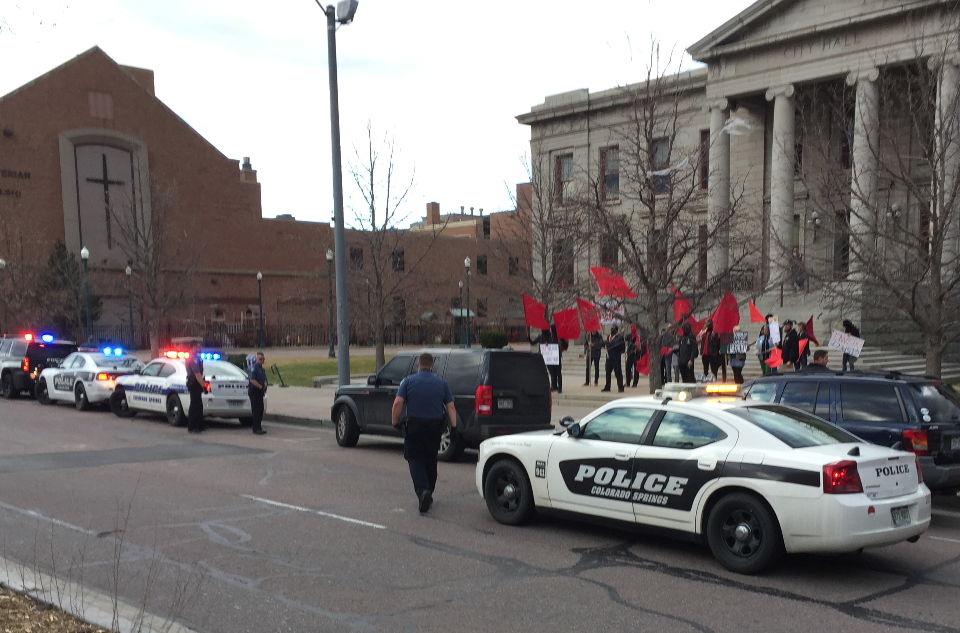
COLORADO SPRINGS, CO- Local socialists assembled at City Hall on Sunday to “March Against Imperialism”. After a brief march and an half-hour rally while encircled by CSPD, the socialists were informed they were “free to carry on with their assembly” but whoever lingered would be issued a citation for having been in the street. Making no distinction for who had and who hadn’t, the police began handcuffing participants and the couple dozen others quickly dispersed. Five socialists were issued citations for “pedestrian in the highway” and “failure to disperse” while another was arrested and detained for failing to show an ID while filming the police. That person was taken to the downtown police station and held until officers finally informed her of the charges for which she was being cited, after which she identified herself. Throughout her detainment, multiple officers kept up a harassment of questions, refusing her requests that she contact her lawyer. CSPD never issued an order to disperse, a fact that is borne out by witness video. But in effect that is what the officers accomplished. They threatened the legal assembly with citations, for failure to disperse!

CSPD cruiser gunboat diplomacy

It made a funny scene. Around thirty self-declared socialists, blockaded by eight sometimes more CSPD cruisers, in a standoff that lasted until the police lost their patience. Socialists spoke against imperialism, the police officers being their main audience that quiet Sunday downtown. Immediately as the march had ended the police had announced that anyone stepping back into the street would be arrested, and so no one did. But a half-hour of speeches proved too much for the officers to bear and so they interjected again, this time to discuss the problem they had with what had happened earlier. We told those officers they were of course free to discuss such matters individually with whoever they considered a person of interest, BUT AFTERWARD, because they were otherwise interrupting our legal assembly. But the officers persisted in their interruption, deciding after the fact what charges to bring, regardless that they’d forgotten to provide the evidence to back them up. “See you in court” they laughed! We’ve heard that before.

On a serious note. What happened Sunday could have a chilling effect on the nascent kick-ass Colorado Springs Socialists. Unwarranted police attention is an unhappy tradition for socialist organizers, from anarchists to trade unions. Sunday’s denouement confirms all their parents’ worst worries, the folly of declaring yourself to be a socialist in a regressive backwater like Colorado Springs. People were arrested? Handcuffed?! Now you’re on a police watch list! I remember my father’s alarm when he learned his college sophmore had a subscription to Mother Jones Magazine.

Fun as it was, Sunday’s event was essentially uneventful: no altercations, no property damage, not even rhetoric to threaten infrastructure. Minus any media attention, or much of an audience at all on a sleepy Sunday evening, these socialists were determined to parade their dissent where and how those around could see, and reaped more law enforcement than the circumstances required.

While you might say the outcome was predictable, it needn’t have been. Students from the wealthier Colorado College have free range on downtown streets, protesting racism or election outcomes on the street without arrests or citations. Every full moon CC students ride the length of downtown’s main street on bike, skate or skateboard, without even police escort. Sunday’s fledgeling socialist organization is a student club of the UCCS campus. UCCS is more working class, for many a commuter campus, and obviously isn’t shown any deference by city administrators.

Compared to the liberal arts curriculum of Colorado College. UCCS is considered more conservative. UCCS hosts business and military related classes. It even has a Brazil-esque Department of Homeland Security -um- Department. So I think it’s all the more admirable that UCCS has spawned a bonafide socialist group that dwarfs even their school’s Young Republican franchise. I’ve no doubt those socialists I met on Sunday will not be cowed by CSPD’s preemptive aggressions. Hopefully their more timid members will take heart.

Public protests are regularly given use of the streets, which like parks are considered traditional free speech zones. The Tea Party and Occupy took to the streets of Colorado Springs without incurring arrests. More recently people have marched for Black Lives Matter and for solidarity with Native Americans fighting oil pipelines. These have produced zero arrests.

In the meantime it will be important to debrief on what happened and unify the legal strategies. All defendants face the traffic offense of being a pedestrian on the highway [sic] and the misdemeanor of failure to disperse, no doubt tacked on to be a droppable charge as fodder for plea bargains. The recalcitrant videographer faces an added charge of misdemeanor interference for failing to produce her ID. They give her no extra credit for providing a pretext for interrogation because she wouldn’t say zilch without a lawyer present, except to explain where and when they were violating her rights. It used to be that cops had to read us our rights.

Police can issue all the tickets they want when there’s probable cause. They can’t threaten to issue tickets for the solitary purpose of disbanding a legal assembly. In the end, the only socialists who got citations were punished not for being in the street but for standing their ground in front of City Hall.

DAPL used helicopters to down drones, cut live feeds as Rosebud camp swept


Forty seven water protectors were arrested yesterday as militarized police cleared both Oceti and Rosebud camps along the Cannonball River in Standing Rock. Helicopters flew low, not to support the ground troops conducting tent to tent raids, but to interfere with resistance drones recording the spectacle. Drone operators report their links being jammed and their drones being forced into collisions if they were unable to avoid the Homeland Security choppers. There were many live feeds being broadcast from drones, long distance cameras and on the front lines. Once Oceti camp was cleared, one by one the feeds were interrupted and dropped. When connections resumed, viewers learned that Rosebud camp too was swept and cleared. Rosebud was on reservation land, not disputed treaty land, but BIA officers helped by militarized police evicted everyone.

Colo. US District Court judge enjoins DIA to limit restriction of free speech (grants our preliminary injunction!)

Plaintiffs Nazli McDonnell and Eric Verlo
DENVER, COLORADO- If your civil liberties have ever been violated by a cop, over your objections, only to have the officer say “See you in court”, this victory is for YOU! On January 29 we were threatened with arrest for protesting the “Muslim Ban” at Denver International Airport. We argued that our conduct was protected speech and that they were violating our rights. They dismissed our complaints with, in essense: “That’s for a court to decide.” And today IT HAS! On Feb 15 we summoned the cops to federal court and this morning, Feb 22, US District Court Judge William Martinez granted our preliminary injunction, severely triming DIA’s protest permit process. In a nutshell: no restrictions on signs, size of assemblies or their location within the main terminal (so long as the airport’s function is not impeded). Permits are still required but with 24 hours advance notice, not seven days. Below is Judge Martinez’ 46-page court order in full:

Document 29 Filed 02/22/17 USDC Colorado

IN THE UNITED STATES DISTRICT COURT
FOR THE DISTRICT OF COLORADO

Judge William J. Martínez

Civil Action No. 17-cv-0332-WJM-MJW

NAZLI MCDONNELL, and
ERIC VERLO,

Plaintiffs,

v.

CITY AND COUNTY OF DENVER,?
DENVER POLICE COMMANDER ANTONIO LOPEZ,
in his individual and official capacity, and?
DENVER POLICE SERGEANT VIRGINIA QUIÑONES,
in her individual and official capacity,

Defendants.

________________________________________________________

ORDER GRANTING PRELIMINARY INJUNCTION IN PART
________________________________________________________

Plaintiffs Nazli McDonnell (“McDonnell”) and Eric Verlo (“Verlo”) (together, “Plaintiffs”) sue the City and County of Denver (“Denver”), Denver Police Commander Antonio Lopez (“Lopez”) and Denver Police Sergeant Virginia Quiñones (“Quiñones”) (collectively, “Defendants”) for allegedly violating Plaintiffs’ First and Fourteenth Amendment rights when they prevented Plaintiffs from protesting without a permit in the Jeppesen Terminal at Denver International Airport (“Airport” or “Denver Airport”). (ECF No. 1.) Currently before the Court is Plaintiffs’ Motion for Preliminary Injunction, which seeks to enjoin Denver from enforcing some of its policies regarding demonstrations and protests at the Airport. (ECF No. 2.) This motion has been fully briefed (see ECF Nos. 2, 20, 21, 23) and the Court held an evidentiary hearing on February 15, 2017 (“Preliminary Injunction Hearing”).

For the reasons explained below, Plaintiffs’ Motion is granted to the following limited extent:

• Defendants must issue an expressive activity permit on twenty-four hours’ notice in circumstances where an applicant, in good faith, seeks a permit for the purpose of communicating topical ideas reasonably relevant to the purposes and mission of the Airport, the immediate importance of which could not have been foreseen seven days or more in advance of the commencement of the activity for which the permit is sought, or when circumstances beyond the control of the permit applicant prevented timely filing of the application; ?

• Defendants must make all reasonable efforts to accommodate the applicant’s preferred demonstration location, whether inside or outside of the Jeppesen Terminal, so long as the location is a place where the unticketed public is normally allowed to be; ?

• Defendants may not enforce Denver Airport Regulation 50.09’s prohibition against “picketing” (as that term is defined in Denver Airport Regulation 50.02-8) within the Jeppesen Terminal; and ?

• Defendants may not restrict the size of a permit applicant’s proposed signage beyond that which may be reasonably required to prevent the impeding of the normal flow of travelers and visitors in and out of Jeppesen Terminal; and specifically, Defendants may not enforce Denver Airport Regulation 50.08-12’s requirement that signs or placards be no larger than one foot by one foot. ??

Any relief Plaintiffs seek beyond the foregoing is denied at this phase of the case. In particular, the Court will not require the Airport to accommodate truly spontaneous demonstrations (although the Airport remains free to do so); the Court will not require the Airport to allow demonstrators to unilaterally determine the location within the Jeppesen Terminal that they wish to demonstrate; and the Court will not strike down the Airport’s usual seven-day notice-and-permit requirement as unconstitutional in all circumstances.

I. FINDINGS OF FACT

Based on the parties’ filings, and on the documentary and testimonial evidence received at the evidentiary hearing, the Court makes the following findings of fact for purposes of resolving Plaintiffs’ Motion.?

A. Regulation 50

Pursuant to Denver Municipal Code § 5-16(a), Denver’s manager of aviation may “adopt rules and regulations for the management, operation and control of [the] Denver Municipal Airport System, and for the use and occupancy, management, control, operation, care, repair and maintenance of all structures and facilities thereon, and all land on which [the] Denver Municipal Airport System is located and operated.” Under that authority, the manager of aviation has adopted “Rules and Regulations for the Management, Operation, Control, and Use of the Denver Municipal Airport System.” See https://www.flydenver.com/about/administration/rules_regulations (last accessed Feb. 16, 2017). Part 50 of those rules and regulations governs picketing, protesting, soliciting, and similar activities at the Airport. See https://www.flydenver.com/sites/default/files/rules/50_leafleting.pdf (last accessed Feb. 16, 2017). The Court will refer to Part 50 collectively as “Regulation 50.”

The following subdivisions of Regulation 50 are relevant to the parties’ current dispute:

Regulation 50.03: “No person or organization shall leaflet, conduct surveys, display signs, gather signatures, solicit funds, or engage in other speech related activity at Denver International Airport for religious, charitable, or political purposes, or in connection with a labor dispute, except pursuant to, and in compliance with, a permit for such activity issued by the CEO [of the Airport] or his or her designee. . . .” ?

Regulation 50.04-1: “Any person or organization desiring to leaflet, display signs, gather signatures, solicit funds, or engage in other speech related activity at Denver International Airport for religious, charitable, or political purposes, or in connection with a labor dispute, shall complete a permit application and submit it during regular business hours, at least seven (7) days prior to the commencement of the activity for which the permit is sought and no earlier than thirty (30) days prior to commencement of the activity. The permit application shall be submitted using the form provided by the Airport. The applicant shall provide the name and address of the person in charge of the activity, the names of the persons engaged in the activity, the nature of the activity, each location at which the activity is proposed to be conducted, the purpose of the activity, the hours during which the activity is proposed to be conducted, and the beginning and end dates of such activity. A labor organization shall also identify the employer who is the target of the proposed activity.”

Regulation 50.04-3: “Upon presentation of a complete permit application ?and all required documentation, the CEO shall issue a permit to the applicant, if there is space available in the Terminal, applying only the limitations and regulations set forth in this Rule and Regulation . . . . Permits shall be issued on a first come-first served basis. No permits shall be issued by the CEO for a period of time in excess of thirty-one (31) days.” ?

Regulation 50.04-5: “In issuing permits or allocating space, the CEO shall not exercise any discretion or judgment regarding the purpose or content of the proposed activity, except as provided in these Rules and Regulations. The issuance of a permit is a strictly ministerial function and does not constitute an endorsement by the City and County of Denver of any organization, cause, religion, political issue, or other matter.” ?

Regulation 50.04-6: “The CEO may move expressive activity from one location to another and/or disperse such activity around the airport upon reasonable notice to each affected person when in the judgment of the CEO such action is necessary for the efficient and effective operation of the transportation function of the airport.” ?

Regulation 50.08-12: “Individuals and organizations engaged in leafleting, solicitation, picketing, or other speech related activity shall not: * * * [w]ear or carry a sign or placard larger than one foot by one foot in size . . . .” (underscoring in original).

Regulation 50.09: “Picketing not related to a labor dispute is prohibited in ?all interior areas of the Terminal and concourses, in the Restricted Area, and on all vehicular roadways, and shall not be conducted by more than two (2) persons at any one location upon the Airport.” ?

Regulation 50.02-8: “Picketing shall mean one or more persons marching or stationing themselves in an area in order to communicate their position on a political, charitable, or religious issue, or a labor dispute, by displaying one or more signs, posters or similar devices” (underscoring in original).

The Airport receives about forty-five permit requests a year. No witness at the Preliminary Injunction Hearing (including Airport administrators who directly or indirectly supervise the permit process) could remember an instance in which a permit had been denied.

?Although there is no formal written, prescribed procedure for requesting expedited treatment of permit requests, the Airport not infrequently processes such requests and issues permits in less than seven days. Last November, less than seven days before Election Day, the Airport received a request from “the International Machinists” 1 to stage a demonstration ahead of the election. The Airport was able to process that request in two days and thereby permit the demonstration before Election Day.
?
——————————
1 Presumably, the International Association of Machinists and Aerospace Workers. ?
———————

B. The Executive Order

On Friday, January 27, 2017, President Trump signed Executive Order 13769 (“Executive Order”). See 82 Fed. Reg. 8977. The Executive Order, among other things, established a 90-day ban on individuals from seven Muslim-majority countries from entering the United States, a 120-day suspension of all refugee admissions, and an indefinite suspension of refugee admissions from Syria. Id. §§ 3(c), 5(a), 5(c). “The impact of the Executive Order was immediate and widespread. It was reported that thousands of visas were immediately canceled, hundreds of travelers with such visas were prevented from boarding airplanes bound for the United States or denied entry on arrival, and some travelers were detained.” Washington v. Trump, ___ F.3d. ___, ___, 2017 WL 526497, at *2 (9th Cir. Feb. 9, 2017). As is well known, demonstrators and attorneys quickly began to assemble at certain American airports, both to protest the Executive Order and potentially to offer assistance to travelers being detained upon arrival.?

C. The January 28 Protest at the Denver Airport

Shortly after 1:00 p.m. on the following day—Saturday, January 28, 2017— Airport public information officer Heath Montgomery e-mailed Defendant Lopez, the police commander responsible for Denver’s police district encompassing the Airport. Lopez was off-duty at the time. Montgomery informed Lopez that he had received media inquiries about a protest being planned for the Airport later that day, and that no Regulation 50 permit had been issued for such a protest.

Not knowing any details about the nature or potential size of the protest, and fearing the possibility of “black bloc” and so-called “anarchist activities,” Lopez coordinated with other Denver Police officials to redeploy Denver Police’s gang unit from their normal assignments to the Airport. Denver Police also took uniformed officers out of each of the various other police districts and redeployed them to the Airport. Lopez called for these reinforcements immediately in light of the Airport’s significant distance from any other police station or normal patrol area. Lopez knew that if an unsafe situation developed, he could not rely on additional officers being able to get to the Airport quickly.

Through his efforts, Lopez was eventually able to assemble a force of about fifty officers over “the footprint of the entire airport,” meaning inclusive of all officers already assigned to the Airport who remained on their normal patrol duties. Lopez himself also came out to the Airport.

In the meantime, Montgomery had somehow learned of an organization known as the Colorado Muslim Connection that was organizing protesters through Facebook. Montgomery reached out to this organization through the Airport’s own Facebook account and informed them of Regulation 50’s permit requirement. (Ex. 32.) One of the Colorado Muslim Connection’s principals, Nadeen Ibrahim, then e-mailed Montgomery “to address the permit.” (Ex. 30.) Ibrahim told Montgomery:

The group of people we have will have a peaceful assembly carrying signs saying welcome here along with a choir and lots of flowers. Our goal is to stand in solidarity with our community members that have been detained at the airports since the signing of the executive order, though they do have active, legal visas/green cards. Additionally, we would like to show our physical welcoming presence for any newly arriving Middle Eastern sisters and brothers with visas. We do not intend to block any access to [the Airport].

(Id.) Montgomery apparently did not construe this e-mail as a permit request, or at least not a properly prepared one, and stated that “Denver Police will not allow a protest at the airport tonight. We are willing to work with you like any other group but there is a formal process for that.” (Id.)

Nonetheless, protesters began to assemble in the late afternoon and early evening in the Airport’s Jeppesen Terminal, specifically in the multi-storied central area known as the “Great Hall.” The Great Hall is a very large, rectangular area that runs north and south. The lower level of the Great Hall (level 5) has an enormous amount of floor space, and is ringed with offices and some retail shops, but the floor space itself is largely taken up by security screening facilities for departing passengers. The only relatively unobstructed area on level 5 is the middle third, which is currently designed primarily as a location for “meeters-and-greeters,” i.e., individuals waiting for passengers arriving from domestic flights who come up from the underground train connecting the Jeppesen Terminal with the various concourses. There is a much smaller meeters-and-greeters waiting area at the north end of level 5, where international arrivals exit from customs screening.

The upper level of the Great Hall (level 6) has much less floor space than level 5 given that it is mostly open to level 5 below. It is ringed with retail shops and restaurants. At its north end is a pedestrian bridge to and from the “A” concourse and its separate security screening area.

Given this design, every arriving and departing passenger at the Airport (i.e., all passengers except those only connecting through Denver), and nearly every other person having business at the airport (including employees, delivery persons, meeters-and-greeters, etc.), must pass through some portion of the Great Hall. In 2016, the Airport served 58.3 million passengers, making it the sixth busiest airport in the United States and the eighteenth busiest in the world. Approximately 36,000 people also work at the airport.

The protesters who arrived on the evening of January 28 largely congregated in the middle third of the Great Hall (the domestic-arrivals meeter-and-greeter area). The protesters engaged in singing, chanting, praying, and holding up signs. At least one of them had a megaphone.

The size of the protest at its height is unclear. The witnesses at the evidentiary hearing gave varying estimates ranging from as low as 150 to as high as 1,000. Most estimates, however, centered in the range of about 200. Lopez, who believed that the protest eventually comprised about 300 individuals, did not believe that his fifty officers throughout the Airport were enough to ensure safety and security for that size of protest, even if he could pull all of his officers away from their normal duties.

Most of the details of the January 28 protest are not relevant for present purposes. Suffice it to say that Lopez eventually approached those who appeared to be the protest organizers and warned them multiple times that they could be arrested if they continued to protest without a permit. Airport administration later agreed to allow the protest to continue on “the plaza,” an area just outside the Jeppesen Terminal to its south, between the Terminal itself and the Westin Hotel. Protesters then moved to that location, and the protest dispersed later in the evening. No one was arrested and no illegal activity stemming from the protest (e.g., property damage) was reported, nor was there any report of disruption to travel operations or any impeding of the normal flow of travelers and visitors in and out of Jeppesen Terminal.

D. The January 29 Protest at the Denver Airport

Plaintiffs disagree strongly with the Executive Order and likewise wished to protest it, but, due to their schedules, were unable to participate in the January 28 protest. They decided instead to go to the Airport on the following day, Sunday, January 29. They came that afternoon and stationed themselves at a physical barrier just outside the international arrival doors at the north end of the Great Hall, level 5. They each held up a sign of roughly poster board size expressing a message of opposition to the Executive Order and solidarity with those affected by it. (See Exs. 2, 4, M.)

Plaintiffs were soon approached by Defendant Quiñones, who warned them that they could be arrested for demonstrating without a permit. Plaintiffs felt threatened, as well as disheartened that they could not freely exercise their First Amendment rights then and there. Plaintiffs felt it was important to be demonstrating both at that particular time, given the broad news coverage of the effects of the Executive Order, and at that particular place (the international arrivals area), given a desire to express solidarity with those arriving directly from international destinations—whom Plaintiffs apparently assumed would be most likely to be affected by the Executive Order in some way.

Plaintiffs left the Airport later that day without being arrested, and without incident. They have never returned to continue their protest, nor have they applied for a permit to do so.

E. Permits Since Issued

The airport has since issued permits to demonstrators opposed to the Executive Order. At least one of these permits includes permission for four people to demonstrate in the international arrivals area, where Plaintiffs demonstrated on January 29.

II. REQUESTED INJUNCTION

Plaintiffs have never proposed specific injunction language. In their Motion, they asked for “an injunction prohibiting their arrest for standing in peaceful protest within Jeppesen Terminal and invalidating Regulation 50 as violative of the First and Fourteenth Amendments to the United States Constitution.” (ECF No. 2 at 4.) At the Preliminary Injunction Hearing, Plaintiffs’ counsel asked the Court to enjoin Defendants (1) “from arresting people for engaging in behavior that the plaintiffs or people similarly situated were engaging in,” (2) from enforcing Regulation 50.09 (which forbids non- labor demonstrators from holding up signs within the Jeppesen Terminal), and (3) from administering Regulation 50 without an “exigent circumstances exception.” Counsel also argued that requiring a permit application seven days ahead of time is unconstitutionally long in any circumstance, exigent or not.

III. LEGAL STANDARD

A. The Various Standards

In a sense, there are at least three preliminary injunction standards. The first, typically-quoted standard requires: (1) a likelihood of success on the merits, (2) a threat of irreparable harm, which (3) outweighs any harm to the non-moving party, and (4) that the injunction would not adversely affect the public interest. See, e.g., Awad v. Ziriax, 670 F.3d 1111, 1125 (10th Cir. 2012).

If, however, the injunction will (1) alter the status quo, (2) mandate action by the defendant, or (3) afford the movant all the relief that it could recover at the conclusion of a full trial on the merits, a second standard comes into play, one in which the movant must meet a heightened burden. See O Centro Espirita Beneficiente Uniao do Vegetal v. Ashcroft, 389 F.3d 973, 975 (10th Cir. 2004) (en banc). Specifically, the proposed injunction “must be more closely scrutinized to assure that the exigencies of the case support the granting of a remedy that is extraordinary even in the normal course” and “a party seeking such an injunction must make a strong showing both with regard to the likelihood of success on the merits and with regard to the balance of harms.” Id.

On the other hand, the Tenth Circuit also approves of a

modified . . . preliminary injunction test when the moving party demonstrates that the [irreparable harm], [balance of harms], and [public interest] factors tip strongly in its favor. In such situations, the moving party may meet the requirement for showing [likelihood of] success on the merits by showing that questions going to the merits are so serious, substantial, difficult, and doubtful as to make the issue ripe for litigation and deserving of more deliberate investigation.

Verlo v. Martinez, 820 F.3d 1113, 1128 n.5 (10th Cir. 2016). This standard, in other words, permits a weaker showing on likelihood of success when the party’s showing on the other factors is strong. It is not clear how this standard would apply if the second standard also applies.

In any event, “a preliminary injunction is an extraordinary remedy,” and therefore “the right to relief must be clear and unequivocal.” Greater Yellowstone Coal. v. Flowers, 321 F.3d 1250, 1256 (10th Cir. 2003).

B. Does Any Modified Standard Apply?

The status quo for preliminary injunction purposes is “the last peaceable uncontested status existing between the parties before the dispute developed.” Schrier v. Univ. of Colo., 427 F.3d 1253, 1260 (10th Cir. 2005) (internal quotation marks omitted). By asking that portions of Regulation 50 be invalidated, Plaintiffs are seeking to change the status quo. Therefore they must make a stronger-than-usual showing on likelihood of success and the balance of harms.

IV. ANALYSIS

A. Irreparable Harm as it Relates to Standing

Under the circumstances, the Court finds it appropriate to begin by discussing the irreparable harm element of the preliminary injunction test as it relates Plaintiffs’ standing to seek an injunction.

Testimony at the Preliminary Injunction Hearing revealed that certain groups wishing to protest the Executive Order have since applied for and obtained permits. Thus, Plaintiffs could get a permit to demonstrate at the airport on seven days’ advance notice—although Regulation 50.09 would still prohibit them from demonstrating by wearing or holding up signs. In addition, as discussed in more detail below (Part IV.B.3.c), Plaintiffs could potentially get a permit to hold a protest parade on public streets in the City and County of Denver with as little as 24 hours’ notice. And as far as the Court is aware, the two Plaintiffs may be able to stand on any public street corner and hold up signs without any prior notice or permit requirement. Thus, Plaintiffs’ alleged irreparable harm must be one or both of the following: (1) the prospect of not being able to demonstrate specifically at the airport on less than seven days’ notice, or (2) the inability to picket in opposition to the government action they oppose—that is, the inability to hold up “signs, posters or similar devices” while engaging in expressive activity at the airport. The Court finds that the second of these options is a fairly traditional allegation of First Amendment injury—even if they do apply for and obtain a permit, by the express terms of Regulation 50.09 Plaintiffs will not be allowed to carry or hold up signs, posters, or the like. The first option, however, requires more extensive discussion and analysis.

The rapidly developing situation that prompted Plaintiffs to go to the Airport on January 29 has since somewhat subsided. The Executive Order remains a newsworthy topic, but a nationwide injunction now prevents its enforcement, see Washington, ___ F.3d at ___, 2017 WL 526497, at *9, and—to the Court’s knowledge—none of the most urgent effects that led to airport-based protests, such as individuals being detained upon arrival, have since repeated themselves. Nonetheless, the circumstances that prompted this lawsuit reveal a number of unassailable truths about “freedom of speech . . . [and] the right of the people peaceably to assemble, and to petition the government for a redress of grievances.” U.S. Const. amend. I.

One indisputable truth is that the location of expressive activity can have singular First Amendment significance, or as the Tenth Circuit has pithily put it: “Location, location, location. It is cherished by property owners and political demonstrators alike.” Pahls v. Thomas, 718 F.3d 1210, 1216 (10th Cir. 2013). The ability to convey a message to a particular person is crucial, and that ability often turns entirely on location.

Thus, location has specifically been at issue in a number of First Amendment decisions. See, e.g., McCullen v. Coakley, 134 S. Ct. 2518, 2535 (2014) (abortion protesters’ ability to approach abortion clinic patrons within a certain distance); Pahls, 718 F.3d at 1216–17 (protesters’ ability to be in a location where the President could see them as his motorcade drove past); Citizens for Peace in Space v. City of Colo. Springs, 477 F.3d 1212, 1218–19 (10th Cir. 2007) (peace activists’ ability to be near a hotel and conference center where a NATO conference was taking place); Tucker v. City of Fairfield, 398 F.3d 457, 460 (6th Cir. 2005) (labor protesters’ ability to demonstrate outside a car dealership); Friends of Animals, Inc. v. City of Bridgeport, 833 F. Supp. 2d 205, 207–08 (D. Conn. 2011) (animal rights protesters’ ability to protest near a circus), aff’d sub nom. Zalaski v. City of Bridgeport Police Dep’t, 475 F. App’x 805 (2d Cir. 2012).

Another paramount truth is that the timing of expressive activity can also have irreplaceable First Amendment value and significance: “simple delay may permanently vitiate the expressive content of a demonstration.” NAACP, W. Region v. City of Richmond, 743 F.2d 1346, 1356 (9th Cir. 1984); see also American-Arab Anti-Discrimination Comm. v. City of Dearborn, 418 F.3d 600, 605 (6th Cir. 2005) (“Any notice period is a substantial inhibition on speech.”); Church of Am. Knights of Ku Klux Klan v. City of Gary, 334 F.3d 676, 682 (7th Cir. 2003) (“given that . . . political demonstrations are often engendered by topical events, a very long period of advance notice with no exception for spontaneous demonstrations unreasonably limits free speech”); Douglas v. Brownell, 88 F.3d 1511, 1524 (8th Cir. 1996) (“The five-day notice requirement restricts a substantial amount of speech that does not interfere with the city’s asserted goals of protecting pedestrian and vehicle traffic, and minimizing inconvenience to the public.”).

This case provides an excellent example of this phenomena given that —whether intentionally or not— the President’s announcement of his Supreme Court nomination on January 31 (four days after signing the Executive Order) permitted the President to shift the media’s attention to a different topic of national significance. Thus, the inability of demonstrators to legally “strike while the iron’s hot” mattered greatly in this instance. Cf. City of Gary, 334 F.3d at 682 (in the context of a 45-day application period for a parade, noting that “[a] group that had wanted to hold a rally to protest the U.S. invasion of Iraq and had applied for a permit from the City of Gary on the first day of the war would have found that the war had ended before the demonstration was authorized”).

These principles are not absolute, however, nor self-applying. The Court must analyze them in the specific context of the Airport. But for present purposes, the Court notes that the Plaintiffs’ alleged harm of being unable to protest at a specific location on short notice states a cognizable First Amendment claim. In addition, by its very nature, this is the sort of claim that is “capable of repetition, yet evading review.” S. Pac. Terminal Co. v. Interstate Commerce Comm’n, 219 U.S. 498, 515 (1911). Here, “the challenged action”—enforcement of the seven-day permit requirement during an event of rapidly developing significance —“was in its duration too short to be fully litigated prior to its cessation or expiration.” Weinstein v. Bradford, 423 U.S. 147, 149 (1975). Further, “there [is] a reasonable expectation that the same complaining party would be subjected to the same action again.” Id. More specifically, the Court credits Plaintiffs’ testimony that they intend to return to the Airport for future protests, and, given continuing comments by the Trump Administration that new immigration and travel- related executive orders are forthcoming, the Court agrees with Plaintiffs that it is reasonably likely a similar situation will recur —i.e., government action rapidly creating consequences relevant specifically to the Airport.

Thus, although the prospect of being unable to demonstrate at the Airport on short notice is not, literally speaking, an “irreparable harm” (because the need for such demonstration may never arise again), it is nonetheless a sufficient harm for purposes of standing and seeking a preliminary injunction.

The Court now turns to the heart of this case—whether Plaintiffs are likely to succeed on the merits of their claims. Following that, the Court will reprise the irreparable harm analysis in the specific context of the likelihood-of-success findings.

B. Likelihood of Success on the Merits

Evaluating likelihood of success requires evaluating the substantive merit of Plaintiffs’ claim that Regulation 50, or any portion of it, violates their First Amendment rights. To answer this question, the Supreme Court prescribes the following analysis:

1. Is the expression at issue protected by the First Amendment? ?

2. If so, is the location at issue a traditional public forum, a designated public ?forum, or a nonpublic forum? ?

3. If the location is a traditional or designated public forum, is the ?government’s speech restriction narrowly tailored to meet a compelling ?state interest? ?

4. If the location is a nonpublic forum, is the government’s speech restriction ? ?reasonable in light of the purpose served by the forum, and viewpoint neutral?

See Cornelius v. NAACP Legal Def. & Educ. Fund, Inc., 473 U.S. 788, 797–806 (1985).

The Court will address these inquiries in turn.

1. Does the First Amendment Protect Plaintiffs’ Expressive Conduct?

The Court “must first decide whether [the speech at issue] is speech protected by the First Amendment, for, if it is not, we need go no further.” Id. at 797. There appears to be no contest that the sorts of activities Plaintiffs attempted to engage in at the Airport (including holding up signs) are expressive endeavors protected by the First Amendment. Accordingly, the Court deems it conceded for preliminary injunction purposes that Plaintiffs are likely to succeed on this element of the Cornelius analysis.

2. Is the Jeppesen Terminal a Public Forum (Traditional or Designated)?

The Court must next decide whether the Jeppesen Terminal is a public forum:

. . . the extent to which the Government can control access [to government property for expressive purposes] depends on the nature of the relevant forum. Because a principal purpose of traditional public fora is the free exchange of ideas, speakers can be excluded from a public forum only when the exclusion is necessary to serve a compelling state interest and the exclusion is narrowly drawn to achieve that interest. Similarly, when the Government has intentionally designated a place or means of communication as a public forum[,] speakers cannot be excluded without a compelling governmental interest. Access to a nonpublic forum, however, can be restricted as long as the restrictions are reasonable and are not an effort to suppress expression merely because public officials oppose the speaker’s view.

Id. at 800 (citations and internal quotation marks omitted; alterations incorporated).

a. Is the Jeppesen Terminal a Traditional Public Forum??

Plaintiffs claim that “[t]he Supreme Court has not definitively decided whether airport terminals . . . are public forums.” (ECF No. 2 at 7.) This is either an intentional misstatement or a difficult-to-understand misreading of the most relevant case (which Plaintiffs repeatedly cite), International Society for Krishna Consciousness, Inc. v. Lee, 505 U.S. 672, 679 (1992) (“Lee”).

The plaintiffs in Lee were disseminating religious literature and soliciting funds at the airports controlled by the Port Authority of New York and New Jersey (JFK, LaGuardia, and Newark). Id. at 674–75. By regulation, however, the Port Authority prohibited “continuous or repetitive” person-to-person solicitation and distribution of literature. Id. at 675–76. The Second Circuit held that the airports were not public fora and that the regulation was reasonable as to solicitation but not as to distribution. Id. at 677. The dispute then went to the Supreme Court, which granted certiorari specifically “to resolve whether airport terminals are public fora,” among other questions. Id.

The Court answered the public forum question in the negative. Relying on the historical use of airport terminals generally, the Court found that “the tradition of airport activity does not demonstrate that airports have historically been made available for speech activity.” Id. at 680. “Nor can we say,” the Court continued, “that these particular terminals, or airport terminals generally, have been intentionally opened by their operators to such activity; the frequent and continuing litigation evidencing the operators’ objections belies any such claim.” Id. at 680–81. Then, invoking the reasonableness test that applies to government regulation of nonpublic fora, the Court affirmed the Second Circuit’s holding that the solicitation ban was reasonable. Id. at 683–85.

Five justices (Rehnquist, White, O’Connor, Scalia, and Thomas) joined all of the major rulings regarding the solicitation ban, including the nonpublic forum status of airport terminals and the reasonableness of the ban. The outcome regarding the distribution ban, however, commanded no majority opinion. Justice O’Connor, applying the reasonableness standard for nonpublic fora, agreed with the Second Circuit that the distribution ban was not reasonable. Id. at 690–93 (opn. of O’Connor, J.). Justice Kennedy, joined in relevant part by Justices Blackmun, Stevens, and Souter, agreed that the Second Circuit’s judgment regarding the distribution ban should be affirmed, but on different grounds, namely, under a strict scrutiny test (because these justices believed that the airport terminals should be deemed a public forum). Id. at 708–10 (opn. of Kennedy, J.). The result was that the Second Circuit’s invalidation of the distribution ban was affirmed without any opinion commanding a majority view.

Regardless of the outcome with respect to the distribution ban, it is beyond debate that five Supreme Court justices in Lee agreed that airport terminals are not public fora. Id. at 680–81. The Tenth Circuit has acknowledged this holding. Mocek v. City of Albuquerque, 813 F.3d 912, 930 (10th Cir. 2015) (“As an initial matter, an airport is a nonpublic forum, where restrictions on expressive activity need only ‘satisfy a requirement of reasonableness.’” (quoting Lee, 505 U.S. at 683)). Notably, Plaintiffs have cited no case in which any court anywhere has deemed an airport to be a public forum.

b. Is the Jeppesen Terminal a Designated Public Forum??

Even though the Jeppesen Terminal is not a traditional public forum, Denver could still designate it as a public forum if Denver “intentionally [opens the Jeppesen Terminal] for public discourse.” Cornelius, 473 U.S. at 802. Denver denies that it has done so, and Plaintiffs’ arguments to the contrary lack merit.

i. Terminal Visitors’ Incidental Expressive Activities

Plaintiffs argue that visitors to the Jeppesen Terminal “engage in First Amendment activity; they wear buttons, shirts, and hats that convey distinct messages to other visitors. They engage in one-on-one conversations.” (ECF No. 21 at 3.) Thus, Plaintiffs say, Denver has designated a public forum within the Jeppesen Terminal.

The Tenth Circuit has already foreclosed this argument. Addressing the public forum status of the Denver Performing Arts Complex, the Court stated the following: “Even if Denver allowed patrons to wear political buttons or shirts with slogans, this would not be sufficient to establish a designated public forum. The First Amendment does not require the government to impose a ‘zone of silence’ on its property to maintain its character as a nonpublic forum.” Hawkins v. City & Cnty. of Denver, 170 F.3d 1281, 1288 (10th Cir. 1999).

Indeed, even if it wanted to, Denver almost certainly could not impose such a “zone of silence,” as illustrated by Board of Airport Commissioners of City of Los Angeles v. Jews for Jesus, Inc., 482 U.S. 569 (1987). There, the Los Angeles airport authority adopted a resolution announcing that “the Central Terminal Area at Los Angeles International Airport [LAX] is not open for First Amendment activities.” Id. at 570–71 (internal quotation marks omitted). The Supreme Court found that this provision did not “merely reach the activity of [the religious proselytizers who challenged it],” but also prohibited

even talking and reading, or the wearing of campaign buttons or symbolic clothing. Under such a sweeping ban, virtually every individual who enters LAX may be found to violate the resolution by engaging in some “First Amendment activit[y].” We think it obvious that such a ban cannot be justified even if LAX were a nonpublic forum because no conceivable governmental interest would justify such an absolute prohibition of speech.

Id. at 574–75. Thus, the evidence at the Preliminary Injunction Hearing established beyond any possible dispute that Denver has shown no intent to designate the Airport as a public forum by allowing speech at that location which it may not disallow in the first instance.

ii. The Effect of Regulation 50 Itself?

Plaintiffs further argue, “Regulation 50 states that free speech activity is proper in the Jeppesen Terminal (pursuant to a restriction). Denver has [thus] designated the Jeppesen Terminal a public forum for leafleting, conducting surveys, displaying signs, gathering signatures, soliciting funds, and other speech related activity for religious, charitable, or political purposes.” (ECF No. 21 at 3–4.) Although clever, this argument cannot be correct. 2

First, the Airport knows from the Supreme Court’s Jews for Jesus decision, just discussed, that it cannot prohibit all behavior that can be characterized as First Amendment-protected expressive activity.

Second, the Airport also knows from the Lee decision that it likely cannot completely ban some forms of intentional First Amendment communication (such as leafleting) given that the Jeppesen T erminal, like the Port Authority terminals at issue in Lee, is a large multipurpose facility that can reasonably accommodate some amount of intentional First Amendment activity. So, again, the Airport’s choice to regulate what it could not prohibit in the first place is not evidence of intent to designate a public forum. See Stanton v. Fort Wayne-Allen Cnty. Airport Auth., 834 F. Supp. 2d 865, 872 (N.D. Ind. 2011) (“[t]he designation of certain free speech zones, along with the permit requirement and limitation of expression to certain times, manners, and places as set forth in the permit, are marks of the Airport Authority’s attempt to restrict public discourse, and are inconsistent with an intent to designate a public forum” (emphasis in original)).

Third, Plaintiffs’ position, if accepted, would likely turn out to chill expressive speech in the long run. If a government will be deemed to have designated a public forum every time it accommodates citizens’ natural desire to engage in expressive activity in a nonpublic forum, governments will likely cut back on such accommodations as far as they are constitutionally allowed. Cf. Perry Educ. Ass’n v. Perry Local Educators’ Ass’n, 460 U.S. 37, 46 (1983) (government may un-designate a designated public forum).

—————
2 Plaintiffs have unsurprisingly cited no decision from any court adopting their reasoning.
————

iii. “Welcome Home” Messages?

Plaintiffs finally argue that “[s]ome individuals (who, importantly, are not airlines passengers) hold signs welcoming home loved ones or those returning from overseas deployment.” (ECF No. 21 at 3.) The Court will address signs welcoming home veterans and active-duty military members in Part IV.B.3.f, below, and for the reasons stated there finds that this practice, to the extent it exists, does not show intent to designate a public forum. As for welcoming home loved ones, the Court sees no greater religious, charitable, political, or labor-related significance in a typical welcome home sign than standing in the meeter-and-greeter area with a pleasant smile.

In any event, to the extent a welcome home sign has greater significance, “[t]he government does not create a public forum by inaction.” Cornelius, 473 U.S. at 802. Thus, simple failure to enforce Regulation 50 against such signholders is not itself sufficient to infer that the Airport intended to designate a public forum. And finally, even if the Court were to find such an intent, the Court would still be required to consider whether the Airport only intended to designate a public forum specifically for, e.g., those wishing to convey welcome home messages: “A public forum may be created for a limited purpose such as use by certain groups, or for the discussion of certain subjects.” Perry, 460 U.S. at 45 n.7 (1983) (citations omitted). Plaintiffs have nowhere addressed this.

For all these reasons, Plaintiffs have failed to demonstrate that the Jeppesen Terminal is a designated public forum. 3

—————
3 Plaintiffs also attack Regulation 50 as a “prior restraint.” (ECF No. 2 at 6–7.) “The term prior restraint is used ‘to describe administrative and judicial orders forbidding certain communications when issued in advance of the time that such communications are to occur.’” Alexander v. United States, 509 U.S. 544, 550 (1993) (quoting M. Nimmer, Nimmer on Freedom of Speech § 4.03, p. 4-14 (1984)) (emphasis in original). Whether or not that definition could fit Regulation 50, it adds nothing to this case because the Supreme Court’s forum analysis provides the governing principles.
————

3. Given that the Jeppesen Terminal Is Not a Public Forum, Is Regulation 50 Reasonable in Light of the Purposes Served by the Airport, and Is It Viewpoint-Neutral?

a. Reasonableness of the Need for a Permit Submitted in Advance, Generally

Reasonableness is a fact-intensive inquiry into the “particular nature of the public expression” at issue and “the extent to which it interferes with the designated purposes” of the nonpublic forum. Hawkins, 170 F.3d at 1290. Justice O’Connor’s concurring opinion in Lee is significant here, both because of its reasoning and because it has reached the somewhat paradoxical status of a “controlling concurrence.” See id. at 1289 (“In actuality, [Justice O’Connor’s reasonableness analysis in Lee] constitutes only Justice O’Connor’s view, who provided the swing vote in the highly-fractured Lee decision, but as the narrowest majority holding, we are bound by it.”).

In Lee, Justice O’Connor noted the Port Authority’s airports were not single-purpose facilities (unlike many other locations where the Supreme Court had previously examined speech restrictions). 505 U.S. at 688. Rather, the airports were “huge complex[es] open to travelers and nontravelers alike,” id. at 688, and had essentially become “shopping mall[s] as well as . . . airport[s],” id. at 689. The question, then, was whether Port Authority’s restrictions were “reasonably related to maintaining the multipurpose environment that the Port Authority has deliberately created.” Id.

Justice O’Connor’s description of the Port Authority Airports aptly describes the Jeppesen Terminal, to an extent. The Great Hall is lined with restaurants and retail establishments, and in that sense is reminiscent of a shopping mall. On the other hand, most of the floor space on level 6 is simply the floor space needed to get from location to location (the equivalent of wide hallways), and most of the floor space on level 5 is dedicated to security screening. The only large area that is usually free of significant obstructions is the central meeter-and-greeter area—and even that area has at times been taken up by art installations or other features. 4

Moreover, despite certain characteristics of the Airport that may resemble a shopping mall, the Airport’s undisputed primary purpose is to facilitate safe and efficient air travel. The need for safety hopefully needs no discussion —for decades, airports and airplanes have been the specific target of terrorists. As for efficiency, the significance of the Great Hall within the Jeppesen Terminal is particularly evident given that it is the node through which every arriving and departing passenger must pass. As noted, the Airport served 58.3 million passengers last year. Even assuming that just 20 million (about a third) were arrivals and departures (the remainder being those who connect through without reaching the Jeppesen Terminal), this still comes to more than 55,000 passengers moving through the Great Hall per day, or about 2,300 per hour. If the Airport could somehow maintain precisely that average over all days and hours of its operation —which of course never happens— it would still be the equivalent of perpetually filling and emptying a large concert hall every hour.

In this light, the Airport’s general purposes for requiring demonstrators to apply for a permit in advance are difficult to question. As stated by the various Airport administrators who testified at the Preliminary Injunction Hearing (Ken Greene, chief operations officer; Patrick Heck, chief commercial officer; and Dave Dalton, assistant director for terminal operations), it is important for the Airport to have advance notice regarding the presence of individuals coming for reasons other than normal airport- related activities, and particularly those who come to the airport intending to attract the attention of passengers and others. The Airport needs an opportunity to determine the appropriate location for a group of the requested size in light of the day(s) and time(s) requested. The permitting requirement also gives the Airport the opportunity to point out Regulation 50’s code of conduct (Regulation 50.08), so that demonstrators know what activities are and are not permissible.

In addition, the Airport fairly desires an opportunity to understand the nature of the expressive activity, which can inform whether additional security is needed. As Lopez’s testimony illustrates, it is not a simple matter to bring additional police officers to the Airport on a moment’s notice. Lopez further pointed out the advantage of understanding the subject matter of the dispute so that he can anticipate whether counter-protesters might arrive and potentially create at least a difficult, if not dangerous, situation.

Importantly, Denver does not need to prove that any particular past event has raised serious congestion or safety concerns: “Although Denver admits that plaintiffs did not cause any congestion problems or major disruption on the particular occasion that they demonstrated . . . , that is not dispositive. ‘[T]he Government need not wait until havoc is wreaked to restrict access to a nonpublic forum.’” Hawkins, 170 F.3d at 1290 (quoting Cornelius, 473 U.S. at 810). Thus, the Airport may reasonably require a permit applied for in advance. The Court does not understand Plaintiffs to be arguing to the contrary, i.e., that the Airport is never justified in requiring an advance permit under any circumstances.

———
4 Plaintiffs’ Exhibit 15, for example, is a photograph of the meeter-and-greeter area in 2008, and shows that a fountain occupied a significant portion of floor space at the time.
———

?b. Reasonableness of the Seven-Day Requirement, Specifically

Plaintiffs do attack Regulation 50.03’s requirement that permit applications be submitted seven days in advance of the desired activity, apparently arguing that this is unconstitutionally unreasonable in all circumstances. Given both Plaintiffs’ testimony at the Preliminary Injunction Hearing, it is not clear that they would be satisfied by a shorter advance-notice period, nor that it would redress their claimed injury —the inability to protest essentially at a moment’s notice on a topical event. But, to the extent Plaintiffs are challenging the seven-day requirement through the overbreadth doctrine (see Part IV.B.4, below), the Court finds that they have not met their higher burden (or even the normal preliminary injunction burden) to show that they are likely to succeed on proving the seven-day requirement unreasonable in all circumstances.

The Airport’s witnesses were not aware of any other airport with a seven-day requirement. The Indiana airport at issue in the Stanton case —which Defendants have relied upon heavily— had a two-day notice requirement, and also a provision by which the airport could accept an application on even shorter notice. 834 F. Supp. 2d at 870. On the other hand, that Airport handled about 40,000 departing and arriving passengers per month, id. at 868, whereas the Denver Airport handles far more than that per day.

The Court’s own research has revealed that airports ahead of the Denver Airport in 2016 passenger statistics have varied requirements:

• O’Hare International Airport (Chicago) — six business days, see Chicago Department of Aviation Amended Rules and Regulations Governing First Amendment Activities at the City of Chicago Airports § 3(A) (Sept. 18, 2015), available at http://www.flychicago.com/SiteCollectionDocuments/ OHare/AboutUs/cdaamendedRulesandRegs.pdf (last accessed Feb. 16, 2017);

• Dallas-Fort Worth International Airport — three business days, see Code of Rules and Regulations of the Dallas-Fort Worth International Airport Board, ch. 3, § 4, art. VI(A) (2006), available at https://www.dfwairport.com/cs/groups/public/documents/webasset/p1_008800.pdf (last accessed Feb. 16, 2017); ?

• John F. Kennedy International Airport (New York City) — twenty-four hours, see Port Authority of New York and New Jersey Airport Rules and Regulations § XV(B)(2)(a) (Aug. 4, 2009), available at http://www.panynj.gov/airports/pdf/Rules_Regs_Revision_8_04_09.pdf (last accessed Feb. 16, 2017). ??

Obviously there is no clear trend. Depending on how these airports define “business day,” some of these time periods may actually be longer than the Denver Airport’s seven-day requirement. ?

In any event, Plaintiffs have never explained how the Airport, in its particular circumstances, cannot reasonably request seven days’ advance notice as a general rule. Indeed, Plaintiffs could not cite to this Court any case holding that any advance notice requirement applicable to a nonpublic forum was unconstitutional in all circumstances. Accordingly, Plaintiffs have not made a strong showing of likelihood of success on this particular theory of relief.

c. Reasonableness of the Regulation 50.03’s Lack of a Formal Process for Handling Permit Application More Quickly in Exigent Circumstances

Plaintiffs would prefer that they be allowed to demonstrate at the Airport without any advance notice in “exigent circumstances.” Given the serious and substantial purposes served by an advance notice requirement, the Court cannot say that Plaintiffs are likely to succeed on this score. Plaintiffs have given the Court no reason to hold that the Airport has a constitutional duty, even in exigent circumstances, to accommodate demonstrators as they show up, without any advance warning whatsoever.

Nonetheless, the Airport’s complete lack of any formal mechanism for at least expediting the permit application process in unusual circumstances raises a substantial and serious question for this Court. As noted in Part IV.A, above, timing and location are cardinal First Amendment considerations, and a number of cases regarding public fora (streets and parks) have held or strongly suggested that an advance notice requirement is unconstitutional if it does not account for the possibility of spontaneous or short-notice demonstrations regarding suddenly relevant issues.

Indeed, as the undersigned pointed out to Defendants’ counsel at the Preliminary Injunction Hearing, Denver itself is willing to accept an application for a street parade on twenty-four hours’ notice (as opposed to its standard requirement of thirty days) “if the proposed parade is for the purpose of spontaneous communication of topical ideas that could not have been foreseen in advance of [the] required application period or when circumstances beyond the control of the applicant prevented timely filing of the application.” Denver Mun. Code § 54-361(d). But again, this governs a public forum (city streets), where time, place, and manner restrictions such as this must satisfy a narrow tailoring analysis and leave open ample alternative channels for communication. See Perry, 460 U.S. at 45. As the above discussion makes clear, under controlling authority the Airport need not satisfy the same legal standards.

The parties have not cited, nor has the Court located, any case specifically discussing the need for a nonpublic forum to accommodate short-notice demonstrations. But the Court likewise has not found any case expressly precluding that consideration when evaluating reasonableness in the context of a nonpublic forum. It is perhaps unsurprising that the specific question has never come up in a nonpublic forum until now. The Court believes it to be an accurate observation that this country has never before experienced a situation in which (a) the motivation to protest developed so rapidly and (b) the most obviously relevant protest locations was a place the Supreme Court had already declared to be a nonpublic forum—the airport terminal.

When evaluating the reasonableness of a First Amendment restriction in a nonpublic forum, the Court concludes that it may appropriately consider the ability to shorten an advance notice requirement in a place like the Airport, given how unique airports are within the category of nonpublic fora. As Justice O’Connor noted in Lee, most of the Supreme Court’s major nonpublic forum cases aside from airport cases have involved

discrete, single-purpose facilities. See, e.g., [United States v.] Kokinda, [497 U.S. 720 (1990)] (dedicated sidewalk between parking lot and post office); Cornelius v. NAACP Legal Defense & Ed. Fund, Inc., 473 U.S. 788 (1985) (literature for charity drive); City Council of Los Angeles v. Taxpayers for Vincent, 466 U.S. 789 (1984) (utility poles); Perry, supra (interschool mail system); Postal Service v. Council of Greenburgh Civic Assns., [453 U.S. 114 (1981)] (household mail boxes); Adderley v. Florida, 385 U.S. 39 (1966) (curtilage of jailhouse).

505 U.S. at 688 (parallel citations omitted). As Justice O’Connor observed, however, many airports have become large, multipurpose facilities, see id. at 688–89, and that describes the Denver Airport well. To be sure, the reason for expanding beyond the bare minimum of infrastructure needed to handle travelers and airplanes is to promote air travel—to make the airport a more convenient and welcoming location specifically (although not exclusively) for travelers—but the reasonableness of First Amendment restrictions must nonetheless be judged according to the “multipurpose environment that [airport authorities] ha[ve] deliberately created.” Id. at 689.

Moreover, modern airports are almost always owned and operated by a political body, as well as secured by government employees. Thus, short-notice demonstrations reasonably relevant to an airport are also reasonably likely to be demonstrations about political or otherwise governmental topics, “an area in which the importance of First Amendment protections is at its zenith.” Meyer v. Grant, 486 U.S. 414, 425 (1988) (internal quotation marks omitted).

Given all this, and in light of the First Amendment interests in location and timing that this very case has made salient, the Court finds it unreasonable for the Airport to have no formal process by which demonstrators can obtain an expedited permit when -to borrow from the Denver parade ordinance— they seek to communicate topical ideas reasonably relevant to the Airport, the immediate importance of which could not have been foreseen in advance of the usual seven-day period, or when circumstances beyond the control of the applicant prevented timely filing of the application. The Court further finds in the particular circumstances of the Airport that reasonableness requires a process by which an applicant who faces such circumstances can request a permit on twenty-four hours’ notice. If this is all the notice Denver needs to prepare for a street parade, the Court can see no reason why more notice is needed (in exigent circumstances) for a substantially more confined environment like the Airport. 5

Accordingly, the Court finds that Plaintiffs are strongly likely to succeed in their challenge to Regulation 50.03 to this limited extent.

———-
5 At the Preliminary Injunction Hearing, Defendants’ counsel argued that preparing for a street parade is actually easier than preparing for demonstrations at the airport. The Court cannot fathom how this could possibly be the case, at least when comparing a typical street parade request to the typical Airport demonstration request. Indeed, the normal street parade request window is thirty days, suggesting just the opposite. Denver Mun. Code § 54-361(d). The challenges may be different, but the Court cannot accept—on this record, at least—that Airport demonstrations on average require more preparation time than do public parades or marches.
——-

d. Reasonableness of the Airport’s Power to Control the Location of Permitted Expressive Activity

At the Preliminary Injunction Hearing, it became clear that Plaintiffs not only wish for a more expansive right to protest in the Jeppesen T erminal, but they also argue for the right to select precisely where in the Terminal they should be allowed to stand. The Court recognizes that, from Plaintiffs’ perspective, their message is diluted if they cannot demonstrate in the international arrivals area, and this is a legitimate concern for all the reasons discussed previously about the power of location when conveying a message. The Court must also account, however, for Airport administrators’ superior knowledge about airport operations, foot traffic patterns, concerns particular to the specific day of the protest, and so forth.

?Regulation 50.04-1 requires permit applicants to specify “each location at which the [expressive] activity is proposed to be conducted,” but nowhere in Regulation 50 is there any limitation on the Airport’s discretion whether to approve the location request. Rather, the only provision addressing this topic is Regulation 50.04-6, which applies to a demonstration already underway: “The CEO may move expressive activity from one location to another and/or disperse such activity around the airport upon reasonable notice to each affected person when in the judgment of the CEO such action is necessary for the efficient and effective operation of the transportation function of the airport.”

There is no evidence that Airport administrators are using their discretion when approving a demonstration’s location to suppress or dilute a particular message, but there is also no logical reason to leave Airport administrators’ discretion essentially unfettered at the permitting stage while restricting it once the demonstration is underway. The Court finds Plaintiffs are likely to succeed at least in proving that Regulation 50.04-1 is unreasonable to the extent the Airport’s discretion is not restrained to the same degree as in Regulation 50.04-6. Defendants will therefore be enjoined to follow the same restraints in both settings.

e. Reasonableness of Regulation 50.09’s Prohibition of Signage Within the Jeppesen Terminal, and Regulation 50.08-12’s Limitation of All Signs to One Square Foot

Regulation 50.09 establishes that “picketing” (defined to include “displaying one or more signs, posters or similar devices,” Regulation 50.02-8) is totally prohibited in the Jeppesen Terminal unless as part of a labor protest. And, under Regulation 50.08-12, any permissible sign may be no larger than “one foot by one foot in size.”

?Any argument that the picketing ban is reasonable in the context of the Airport is foreclosed by Justice O’Connor’s analysis of the leafleting band at issue in Lee. See 505 U.S. at 690–93. Leafleting usually involves an individual moving around, at least within a small area, and actively offering literature to passersby. Signholding is usually less obtrusive, given that the signholder often stays within an even smaller area and conveys his or her message passively to those who walk by and notice the sign. The Court simply cannot discern what legitimate or reasonable Airport purpose is served by a complete ban on “picketing” or signholding among permitted demonstrators in the Jeppesen Terminal.

The Court also finds the one-foot-by-one-foot signage restriction unreasonable. The Airport has a legitimate interest in regulating the size of signs, as well as other aspects of their display (such as whether they will be held in the air, as in traditional picketing), but a one-foot-by-one-foot restriction is barely distinguishable, both legally and as a factual matter, from a complete ban. The point of a sign is to make a message readable from a distance. Few messages of substance are readable from any kind of distance if they must be condensed into one foot square. Reasonableness instead requires the Airport to consider the size of the signs that a permit applicant wishes to display as compared to the needs and limitations of the location where the applicant will demonstrate. Any restriction by the Airport which limits the size of a permit applicant’s signage beyond that which may be reasonably required to prevent the restriction or impeding of the normal flow of travelers and visitors in and out of Jeppesen Terminal will be preliminarily enjoined.

f. Viewpoint Neutrality

?A nonpublic forum is not required to be content-neutral, but it is required to be viewpoint-neutral with respect to the First Amendment activity it permits. Hawkins, 170 F.3d at 1288. Regulation 50, on its face, is viewpoint neutral, and Plaintiffs do not argue otherwise. Rather, they say that “Regulation 50 is being enforced as a clearly view-point-based restriction.” (ECF No. 2 at 14 (emphasis added).) This appears to be an as-applied challenge:

Individuals walk through Denver International Airport with political messages and slogans on their shirts and luggage and discuss politics on a daily basis. Counsel for Plaintiffs has worn political shirts while traveling through Denver International Airport and discussed modern politics with fellow passengers on many occasions. However, no other individual, to Plaintiffs or Plaintiffs’ counsel’s knowledge, has been threatened with arrest for engaging in this political speech. Nor has any individual been arrested for displaying pro-President Trump messages, for example a red hat that reads “Make America Great Again.” Only Plaintiffs’ expressive activity against the President’s Executive Order, and others advocating similarly, has been threatened with arrest.

(Id.) Denver responds:

The permit requirement furthers the nonpublic forum purpose by mitigating disruption at the airport by individuals who choose to be at the airport for non-travel related activities. In Stanton, the [Northern District of Indiana] rejected this exact argument challenging a nearly identical permitting rule of the Fort Wayne-Allen County Airport on an as applied basis by distinguishing between incidental expressive activities by members of the traveling public versus those arriving at the airport solely for purposes of engaging in expressive speech. Any messages a traveler or individual picking up a family member conveys by wearing T-shirts or hats are “incidental to the use of the Airport’s facilities” by persons whose “primary purpose for being present at the Airport is a purpose other than expressing free speech rights,” which is different in kind than individuals arriving at an airport whose primary purpose is expressive speech. Id. at 880–882.

(ECF No. 20 at 11 (emphasis added).)?

This argument obviously relies on a particular interpretation of Regulation 50 (given that the Regulation itself makes no explicit distinction between those who arrive at the airport for travel-related purposes and those who do not). Nonetheless, this is how Airport administrators interpret Regulation 50, as they made clear at the Preliminary Injunction Hearing. They also made clear that they have never sought to enforce Regulation 50 against someone wearing a political shirt, for example, while on airport-related business. Plaintiffs’ own arguments support the sincerity of the Airport administrators’ testimony. By Plaintiffs’ own admission, they are unaware of anyone going about his or her typical airport-related business who has been arrested or even threatened with arrest for wearing a political shirt, discussing politics, etc.

At the Preliminary Injunction Hearing, Plaintiffs attempted to present an as- applied viewpoint discrimination case by showing that the Airport regularly allows individuals to hold rallies, display signs, and so forth, for returning servicemembers and veterans, yet without requiring those individuals to obtain a permit under Regulation 50. The Court agrees that pro-military and pro-veteran messages are political statements, at least to the extent being conveyed by someone not at the Airport to welcome home a relative or loved one (and perhaps even by those persons as well). Thus, it would seem that pro-military messages would fall under Regulation 50. However, Plaintiffs have failed at this stage to show that the Airport’s alleged treatment of pro-military and pro-veteran messages amounts to viewpoint discrimination.

At the outset, Plaintiffs fail to note the subjective element of their claim: “viewpoint discrimination in contravention of the First Amendment requires a plaintiff to show that the defendant acted with a viewpoint-discriminatory purpose.” Pahls, 718 F.3d at 1230. In that light, it is tenuous to suggest that allowing (allegedly) unpermitted pro-military or pro-veteran expression at various times in the past but not allowing these recent unpermitted protests against the Executive Order is evidence of viewpoint discrimination. The question of whether our nation should honor servicemembers and the question of how our nation should treat foreign nationals affected by the Executive Order are not really in the same universe of discourse. To bridge the gap, it takes a number of assumptions about where pro-military attitudes tend to fall in the American political spectrum, and what people with those attitudes might also think about the Executive Order. This would be a fairly tall order of proof even outside the preliminary injunction context.

Moreover, Plaintiffs’ evidence of unpermitted pro-military expression is fairly weak. Plaintiffs’ main example is the activities of the Rocky Mountain Honor Flight, an organization that assists World War II veterans to travel to Washington, D.C., and visit the World War II Memorial, and then welcomes them home with a large and boisterous rally held in the meeter-and-greeter portion of the Great Hall. A former servicemember who helped to organize one of these rallies testified that she inquired of a more-senior organizer whether the Airport required any special procedures, and the answer she received was “no.” However, Airport administrators presented unrebutted testimony that Rocky Mountain Honor Flight rallies are planned far in advance and sponsored by the Airport itself, in connection with TSA and certain airlines. The Airport does not need a Regulation 50 permit for its own expressive activities, and a government entity’s expression about a topic is not a matter of First Amendment concern. See Pleasant Grove City v. Summum, 555 U.S. 460, 467 (2009) (“The Free Speech Clause restricts government regulation of private speech; it does not regulate government speech.”).

Apart from the Rocky Mountain Honor Flight, Plaintiffs’ evidence comprises photos they gleaned from a Getty Images database showing individuals over the last decade or so being greeted at the Airport by persons holding signs. Some of these signs appear to be simple “welcome home” signs directed at specific returning family members. In the obviously servicemember-related photos, American flags are common. The Court finds that these photos, presented out of context, are not sufficient evidence to make a strong showing of likelihood of success regarding viewpoint discrimination, particularly the subjective intent requirement. Thus, the Court finds no reason for an injunction based on alleged viewpoint-discriminatory conduct. 6

————
6 Even if Plaintiffs’ evidence were enough, the Court would find at this stage of this litigation that the only injunctive relief appropriate in light of the balance-of-harms and public interest considerations, below, would be an injunction to enforce Regulation 50 evenhandedly. Such an outcome would not advance Plaintiffs’ interests here.
———

4. Is Regulation 50 Overbroad or Vague?

Plaintiffs bring both overbreadth and vagueness challenges to Regulation 50, which, in this case, are really two sides of the same coin. If a speech regulation’s sweep is unclear and may potentially apply to protected conduct, a court may invalidate the regulation as vague; whereas if the regulation actually applies to unprotected as well as protected speech, an individual who violates the regulation through unprotected speech may nonetheless challenge the entire statute as overbroad. See Grayned v. City of Rockford, 408 U.S. 104, 108–09, 114–15 (1972); 1 Smolla & Nimmer on Freedom of Speech ch. 6 (Oct. 2016 update). Here, Plaintiffs argue either that Regulation 50 is overbroad because it forbids (without a permit) protected conduct such as wearing a political hat while walking to one’s flight (ECF No. 2 at 16–18); or it is vague because it is unclear to what it applies precisely, given that Plaintiffs have seen Regulation 50 enforced against themselves but not against those who wear political hats or buttons, who are welcoming home military veterans, etc., all of whom are “seemingly in violation” of the Regulation (id. at 18–20).

The first task, then, is to determine what Regulation 50 actually encompasses. Again, the Regulation states that “no person or organization shall leaflet, conduct surveys, display signs, gather signatures, solicit funds, or engage in other speech related activity at Denver International Airport for religious, charitable, or political purposes, or in connection with a labor dispute, except pursuant to, and in compliance with, a permit for such activity issued by the CEO or his or her designee.”

The portion about leafleting, conducting surveys, displaying signs, gathering signatures, or soliciting funds is not vague. It does not fail to “give the person of ordinary intelligence a reasonable opportunity to know what is prohibited.” Grayned, 408 U.S. at 108. Nor is it overbroad given that it is not a complete prohibition of leafleting (as in Lee), but simply a prohibition without a permit.

The arguably difficult portion of Regulation 50 is the “or engage in other speech related activity at Denver International Airport for religious, charitable, or political purposes” clause. It is grammatically possible to interpret this passage as extending to any religious, charitable, or political “speech related activity” by anyone at the Airport, including travelers wearing political buttons or sharing their religious beliefs with others.

Denver argues that no person of ordinary intelligence would have such a worry: “a person of ordinary intelligence cannot reasonably claim that they are unable to discern the difference between a traveler walking through the airport with a ‘make America great again’ baseball cap or travelers discussing politics as they walk to their intended destination and a gathering of people who have no purpose for being at the airport other than to march or station themselves in order to communicate their position on a political issue.” (ECF No. 20 at 14.) This argument is slightly inapposite. The question is not whether someone can distinguish between a passenger’s pro-Trump hat and a gathering of anti-Trump protesters. The question is whether Regulation 50 contains such a distinction, and particularly a distinction between the incidental activities of those who come to the airport for airport-related purposes and the intentional activities of those who come to the airport to demonstrate.

However, to the extent Denver means to say that Regulation 50 would not be interpreted by a person of ordinary intelligence to encompass, e.g., a traveler choosing to wear a “Make America Great Again” hat, the Court agrees. Regulation 50 is not, as Plaintiffs suggest, just one paragraph from Regulation 50.03. Regulation 50 comprises sixteen major subdivisions, many of which are themselves subdivided. A person of ordinary intelligence who reads Regulation 50 —all of it— cannot avoid the overwhelming impression that its purpose is to regulate the expressive conduct of those who come to the Airport specifically to engage in expressive conduct. Thus, Regulation 50 is not vague.

As for overbreadth, “[t]he first step in [the] analysis is to construe the challenged statute; it is impossible to determine whether a statute reaches too far without first knowing what the statute covers.” United States v. Williams, 553 U.S. 285, 293 (2008). For the reasons already stated, the Court finds that the only reasonable construction is one that does not extend to an airline passenger wearing a political T-shirt, or anything of that character. Cf. Jews for Jesus, 482 U.S. at 575. This is, moreover, the Airport’s own interpretation, the sincerity of which is borne out by Plaintiffs’ own experience. Thus, Regulation 50 is not overbroad. 7

————
7 Even if Regulation 50 were vague or overbroad, the Court would nonetheless find that an injunction against enforcing Regulation 50 as a whole would be against the public interest. The more appropriate remedy would be an injunction to follow precisely the interpretation that the Airport currently follows, but that would be of no benefit to Plaintiffs.
————

?C. Irreparable Harm

Having found that Plaintiffs are strongly likely to succeed in invalidating a narrow subset of Regulation 50, the Court returns to irreparable harm. Given that Plaintiffs First Amendment rights are at stake in those portions of Regulation 50 that the Court finds to be unreasonable, irreparable harm almost inevitably follows: “the loss of First Amendment freedoms, for even minimal periods of time, unquestionably constitutes irreparable injury.” Heideman v. S. Salt Lake City, 348 F.3d 1182, 1190 (10th Cir. 2003) (internal quotation marks omitted).

?D. Balance of Harms

The injury to a plaintiff deprived of his or her legitimate First Amendment rights almost always outweighs potential harm to the government if the injunction is granted. See Awad v. Ziriax, 670 F.3d 1111, 1131 (10th Cir. 2012); ACLU v. Johnson, 194 F.3d 1149, 1163 (10th Cir. 1999). Thus, the Court finds that the harm to Plaintiffs from the Airport’s continued enforcement of the unreasonable portions of Regulation 50 would be greater than the harm to the Airport in refraining from such enforcement, particularly given that the unreasonable portions are quite limited and most of Regulation 50 will remain unchanged.

?E. Public Interest

Finally, as with irreparable injury and balancing of interests, it is almost always in the public interest to prevent a First Amendment violation. See Awad, 670 F.3d at 1132; Johnson, 194 F.3d at 1163. Moreover, the Court is not striking down Regulation 50 or even altering it in any significant respect. Thus, the public’s interest in safe and efficient Airport operations remains unaffected.?

F. Bond

A party awarded a preliminary injunction normally must “give[] security in an amount that the court considers proper to pay the costs and damages sustained by any party found to have been wrongfully enjoined or restrained.” Fed. R. Civ. P. 65(c). The Tenth Circuit has held, however, that “a trial court may, in the exercise of discretion, determine a bond is unnecessary to secure a preliminary injunction if there is an absence of proof showing a likelihood of harm.” Coquina Oil Corp. v. Transwestern Pipeline Co., 825 F.2d 1461, 1462 (10th Cir. 1987) (internal quotation marks omitted); see also 11A Charles Alan Wright et al., Federal Practice & Procedure § 2954 n.29 (3d ed., Apr. 2016 update) (citing public rights cases where the bond was excused or significantly reduced). Denver has not argued that Plaintiffs should be required to post a bond, and the Court finds that waiver of the bond is appropriate in any event.

V. CONCLUSION

For the reasons set forth above, the Court ORDERS as follows:

1. Plaintiffs’ Motion for Preliminary Injunction (ECF No. 2) is GRANTED to the ?limited extent stated in this order and otherwise DENIED; ?

2. The City and County of Denver (including its respective officers, agents, ?servants, employees, attorneys, and other persons who are in active concert or participation with any of them, and further including without limitation Defendants Lopez and Quiñones) (collectively, “Defendants”) are PRELIMINARILY ENJOINED as follows:

a. Defendants must timely process a permit application under Denver Airport Regulation 50.04-1 that is received less than 7 days but at least 24 hours prior to the commencement of the activity for which the permit is sought, provided that the applicant, in good faith, seeks a permit for the purpose of communicating topical ideas reasonably relevant to the purposes and mission of the Airport, the immediate importance of which could not have been foreseen 7 days or more in advance of the commencement of the activity for which the permit is sought, or when circumstances beyond the control of the applicant prevented timely filing of the application; however, circumstances beyond Defendants’ control may excuse strict compliance with this requirement to the extent those circumstances demonstrably interfere with the expedited permitting process; ?

b. So long as a permit applicant seeks to demonstrate in a location where the unticketed public is normally allowed to be, Defendants must make all reasonable efforts to accommodate the applicant’s preferred location, whether inside or outside of the Jeppesen Terminal;

c. Defendants may not enforce Denver Airport Regulation 50.09’s prohibition against “picketing” (as that term is defined in Regulation 50.02-8) within the Jeppesen Terminal; and

d. Defendants may not restrict the size of a permit applicant’s proposed signage beyond that which may be reasonably required to prevent the impeding of the normal flow of travelers and visitors in and out of Jeppesen Terminal; and specifically, Defendants may not enforce Denver Airport Regulation 50.08-12’s requirement that signs or placards be no larger than one foot by one foot.

3. This Preliminary Injunction is effective immediately upon issuance of this Order, and will remain in force for the duration of this action unless otherwise modified by Order of this Court.

Dated this 22nd day of February, 2017, at 8:05 a.m. Mountain Standard Time. BY THE COURT:

__________________________
William J. Martínez?
United States District Judge

Two arrested at Colorado Springs bank, asking Wells Fargo to divest from DAPL

Water Protectors Jerima King and Karyna
COLORADO SPRINGS, COLO- Water Protectors Jerima King (on left) and Karyna Lemus were arrested inside a downtown bank on Friday while trying to convey a message to Wells Fargo Bank to divest its interest in Energy Transfer’s controversial Dakota Access Pipeline. Protesters were denied entry into the Wells Fargo main location but marched to a nearby branch and entered its lobby before police were called. Several dozen Springs activists participated in coordination with protests at Wells Fargo banks across the country.

Protest outside Wells Fargo Bank
The bank doors were locked against the Water Protectors, who’d been asked to act in support of the Standing Rock encampment which is actively trying to block the construction.

Police threatening sitters with arrest
CSPD officers emerge to warn protesters that those who remain seated will be arrested. Before the protest had even begun, a CSPD paddy wagon was parked on the sidewalk next to the bank, to intimidate the activists. Earlier police officers circulated to tell everyone that they’d be allowed to enter, and be arrested if they wish. The police said they’d seen Facebook references to the desire to be arrested. They wanted to know specifics of what to expect to ensure that no one would have to be hurt getting arrested.

When the group tried to enter, the same officers blocked our way. They said “you can’t come in.” When I disagreed and pushed past them, they physically ejected me out the door. Then commanded me to rebove my foot from holding the door ajar.

So much for the pre-arrangements touted by those protesters who’d taken their council. Since there was no gameplan to discuss, meaning there was no way to tell the police what to expect, the police were effectively disseminating the warning that being arrested unpredictably would mean getting hurt. And there was never an intention to allow the demonstrators to enter the bank atrium, no matter how peaceful.

Jerima King and Karyna told they faced arrestThe new CSPD warning was conveyed to Karyna and Jerima. But everyone remained, whether seated or standing.

After a brief rally at the front door. The water protectors discussed visiting a Wells Fargo branch four blocks to the south. Over the bullhorn we feigned disbanding, thanking everyone for joining in, then going to our cars. Except we appeared to have left our cars, all of them, in the same direction. CSPD did not take note and we were able to reach the branch location and enter its lobby.


There was not room enough for everyone in the tiny lobby. Note the bullhorn.


Officers arrest the two water protectors who stayed behind after the bank employees locked the doors.


Water Protector Jerima King is led out in handcuffs.


El Paso County Green Party upstart Karyna Lemus is taken in handcuffs.


Arrestees were taken to CSPD HQ in a police van.

How I nearly got arrested for holding a sign at Denver International Airport


DIA, COLORADO- Last weekend I joined thousands across the country protesting Trump’s executive order restricting entry visas from seven predominantly Muslim countries. Spontaneous demonstrations had erupted at international airports nationwide on Saturday January 27. Denver’s airport was no exception but the lively gathering of sign holders was ultimately persuaded by police to leave the premises. Supposedly a permit was required to hold signs. Demonstrators the next day were quickly ushered outside, to rally instead between the terminal and adjacent lightrail station, where only a tiny fraction of travelers would see them. This much we knew as we monitored events online while we reconnoitered DIA from the short-term parking garage. We made our way swiftly to the International Arrivals doors at the north end of the main terminal WITH OUR SIGNS.

International Arrivals
The point was to reach immigrants, right? We walked to our intended protest spot unhindered and inconspicuous, because of course signs are not an unusual sight at an airport. Travelers who’ve been a long time away, in particular soldiers returning from deployment, are frequently greeted by family members holding signs. Often limo drivers have to page their corporate clients. We carried our placards with their message facing inward hoping they’d be mistaken for everyday signs. When we raised them above our heads we attracted immediate attention. They read “#NO MUSLIM BAN #NO REGISTRY, END WHITE PATRIARCHY” and “FIRST THEY CAME FOR THE MUSLIMS AND WE SAID: NOT TODAY MOTHERFUCKER.” Immediately a man with a “DIA Operations” cap informed us that we weren’t allowed to hold signs. We assured him the opposite was true. He called for backup.

We weren’t alone in front of International Arrivals. In addition to the families awaiting loved ones, there were a couple dozen law firm employees holding signs which read “Pro Bono Immigration Legal Services”. We surmised that their presence might have already been negotiated with DIA. Soon a couple of those lawyers approached us to announce loudly that the public protest was outside the building and that we could continue there unmolested. We thanked them for their assistance but urged that they also clarify publicly that we were within our rights to stay inside as well. I was upset that their gravitas, as lawyers, was seen as supportive of the authorities telling us to stop.

Police officers arrived in short order, a first one filming us with a digital point-and-shoot, then a second filming with a cell phone, both surely streaming to a command center. After six officers assembled, a sergeant approached us flanked by two DIA employees. She gave us our formal warnings. We were given instructions to “cease and desist” while we countered that we knew our rights. After a second warning we were assured that a third would mean our immediate arrest. We held our signs higher, all the while asserting their order was unlawful. The immigration lawyers huddled as far away from us as they could. Sgt. Virginia Quinones then got on her phone to consult somebody.

I recount this scene like it was a nail-biter, but of course we’ve held this standoff many, many times before. For activists with Occupy Denver, it’s become the routine. I was wearing an OD hoodie on this visit to DIA and I suspected whoever was on the line with Sgt Quinones had likely dealt with OD before. To be honest, this standoff too often does lead to arrest, so we were not proceeding without trepidation. Denver jail is an excreble experience. But it’s an unlawful arrest and that’s where we have to push back. As the sergeant kept talking, she and her entourage retreated. We stood our ground smiling and winked to each other. For onlookers however, the tension lingered. Several lawyers approached us to offer their cards, in case of arrest.

Intimidation
Though we were confident about asserting our rights, the six officers standing at the ready made it near impossible to entice other sign holders to join us. Our encourgements would be followed by the DIA operatives offering their advice to the newcomers. Nearly every newcomer opted to go outside. Only after hours of detente, with officers projecting a more relaxed inattentiveness, did we succeed in building a consensus of demonstrators.

In the meantime DIA operatives installed queue barriers to keep us from intermingling with the lawyers and family members waiting for international travelers. This strategy might also have meant to force us into the flow of passengers entering the nearby security check. We stood clear and even as our numbers grew, no obstruction occured.

One interesting fellow, a Mr. Gene Wells, wore a jacket with a message taped on its back. It read:

“D. TRUMP
IS A SMALL MAN
WHO CONTINUES
TO SHRINK
AS A PERSON”

with the letters diminishing in size every line. He was warned by DIA personnel that he could only wear his jacket outside. DIA operatives wouldn’t leave his side as he walked through the terminal, but abandoned their effort to intimidate him as he rejoined us at the arrivals door.

A couple of travelers joined in before they had to catch a flight, they held signs they’d printed that morning at their AirBnB. We were joined by Quakers and even a former Denver Occupier. At most we numbered eight, compared to the hundred outside.

The protest outside
The protest outside was seen only by those travelers arriving or leaving by light-rail. And potentially by only half of those departing DIA through the B and C terminals, whose security check queue necessitated passing the windows facing the south. Perhaps. Most travelers approaching security aren’t lingering to take in the sights. The other half of passengers departing DIA go through the north security check, or over the walkway to Terminal A.

All arriving passengers, on the other hand, enter the main terminal from the north or using the underground train. They pass through the center of the main terminal before exiting at the baggage claims to the east and west. International arrivals enter the terminal from the north and proceed directly to parking or ground transport. If they are met by family they are very UNlikely to be riding the light-rail to downtown Denver.

While the protest outside did garner local television coverage, it was prevented from reaching immigrants or those awaiting arrivals, to convey the solidarity which those who opposed the Muslim Ban wished to express.

Inside our signs prompted a constant stream of public support. Passing travelers gave us thumbs up, high fives and thank yous. Muslims shook our hands and offered their heartfelt thanks. A couple gentlemen made speeches expressing their pubic appreciation of what we and the lawyers were doing.

Permits
The DIA operatives kept explaining that protesters need only apply for permits. The catch was that they required seven days advance notice. And of course activist do not expect permits to be granted.

One of the Quakers who joined us expressed confidence that her group would be granted a permit to protest at DIA. She explained to me that she was personal friends with the new Denver DA.

I told her applying for permits set a bad precedent. Asking for permission implies those rights are not already protected by the First Amendment. Permits also restrict others to the code of conduct agreed by those who signed permit agreements. Often permits are used to exclude public participation on public grounds temporarily reserved for the use of the permit holder.

Worse, the police can intervene when “others” aren’t abiding by the permit agreement, when they aren’t complying with police intrusion, or aren’t acquiescing to the authority of the permit holder.

Never the less, this Quaker wanted to inform me that as the anticipated holder of the permit at DIA, she wished to invite me to participate with her group. However, she anticipated that her church colleagues would be made most uncomfortable by my sign (which ended with the word “motherfucker”). So if I did choose to join, she was expressing her preference that I not bring my sign.

March on DC with your own protest message, not one dictated by NGOs. Yes, you’ll need a banner and poles.

Denver Womens March 2012Organizers of the post-inaugural WOMEN’S MARCH in Washington DC this weekend are telling participants not to bring poles for signs or flags, or even knapsacks. Ha ha ha. As you travel across the country to march, remember who’s making the real sacrifice. The march coordinators are paid. You are spending the time and expense because you have something to express. Bring it. The only reason organizers want you unequipped is so your [rogue] message won’t stray from theirs. Does that sound democratic? They also have a different goal than you. Their mission is to pull off a smooth event. Yours is to make history.

As a veteran of countless protest marches, national, regional and international, I encourage newcomers to stick to their nonconformist inclinations. Independent critical thinking is what led you to take action in the first place.

To begin, THIS IS YOUR MARCH.
Washington DC belongs to you. Inauguration Day and its aftermath belong to you. Just because someone squats a Facebook event on a day conducive to public gathering doesn’t give them dibs to call the shots. A stand-alone call to arms, such as MLK’s Million Man March or CodePink’s A Billion Rising, is another matter. Spontaneous uprisings against historic events are no one organization’s to control or temper. Especially if they begin with capitulations to the state.

Here’s the usual pattern. After a FB event goes viral, nonprofit activist groups jump in to offer their expertise, resources and manpower. The nonprofits thus dominate the details and the event originators have little ground to object. Thrilled to see “their” event succeed, these new-to-the-spotlight activists don’t know that street protest is anathema to nonprofits whose existential foundation is not to disrupt politics as usual. Falling into the trap of coordinating ineffective demonstrations is often blamed on newbie error, but in Washington DC, newbies making the newbie mistakes are employees of nonprofits seeded to pretend the event had a grassroots origin. What the NGOs are really doing is setting a prescribed burn, or backfire.

Backfire: a fire set intentionally to arrest the progress of an approaching fire by creating a burned area in its path, thus depriving the fire of fuel.

Bastards! Fortunately backfire has a further meaning, probably not unrelated to the sketchy forestry strategem.

Backfire: rebound adversely on the originator; have the opposite effect to what was intended.

Just as DC lobbyists monopolize your representatives, professional activists have staked out the capitol and squatted on what is the public’s only access to speak to power. Accept their invitation to come to DC. Thank them for their legal support, their logistics and water bottles, but you’ll handle your messaging thank you.

NOTES FOR NEXT TIME
(If you’d prefer not to dwell on criticism, please skip to the section on RULES. For me, these counterproductive “mistakes” set us back every time we give them a pass.)

1. Telling participants they can’t bring stuff like food or chairs! The event’s duration is being throttled to what can be endured between meals, without a pause for rest. Do you go to meetings without chairs? In the cold outdoors one can’t even sit on the ground.

2. Hiring private security contractors, “some identifiable, some undercover”. WTF? DC’s cops, National Guard, Secret Service, and “Shadow Teams” aren’t enough?

3. Coordinating with police. What? What?! To whom Black Lives Can’t Even Matter? Sorry no.

4. Stifling expression with limits on how to carry signs. Without sticks. “Flags but without poles.” Restricting marchers to signs reinforced with only cardboard tubing. Viewed from a perspective to show the numbers, the march will bear no legible message at all.

5. Telling marchers they must handcarry small bags. You’d think they don’t want marchers’ hands free to carry signs at all.

6. Stooping to a permit, as an excuse to self-police and make participants feel honor bound to unecessary concessions (the permit terms). You don’t need a permit for First Amendment activities. NGOs use permits to effectively reserve public areas and restrict their concurrent use by others. It’s a means to control public space.

7. Scheduling the march on the day after the main event, in time to disrupt nothing. Diluting the inherent outcry, expending from everyone’s discretionary resources to converge on DC. As a result we’ll have two mobilizations. Both massive, hopefully, intead of one which could have TIPPED THE SCALE.

RULES ARE
Meant to be broken. Permit holders can enforce rules within the confines of their event area, with the assistance of authorities if needed, but not outside it. Organizer “rules” can’t be enforced on Metro, or on public streets, or along march route. DC police may pretend they have that authority but they don’t. Cops lie. Know your rights.

To hold a sign where it’s visible in a march, and big enough to where it can be seen among multitudes, you need poles.

BRING POLES.
There is no safety reason whatsoever, in Washington DC, for forbidding the use of sign poles. We’ve seen pole restrictions attempted at national conventions, in close-in urban areas with vulnerable storefront windows, but Washington’s boulevards and setbacked facades evolved with political marches. Demonstrations, parades and motorcades are everyday for DC. Your sign poles pose zero threat and you don’t have to relinquish them. Not Post-911, nor in the Age of Trump. If an NGO-deputized cop won’t allow your entry to their rally, their privatized-park, have someone wait with the contraband outside its bounds. Banners are best seen on the edges of rallies anyway. When attendance numbers reach overload, you’re golden. Move with the numbers. Otherwise wait and join in as the march departs from the rally.

What’s best for poles? Lengths of bamboo from garden nurseries. Bamboo is stiff, light, and utterly non-threatening. Eight footers will hold a banner above marchers’ heads while still allowing you to rest the poles on the ground when the march lags. Six foot lengths give you adequate leverage to keep the banner taut but are more work. Either are cheap and expendable. Bring extra. Bamboo are thin enough to hold reserve pieces bundled. You can grasp a bundle of three as readily as a single pole. Those extra poles can be allocated as you see other marchers in need.

Let’s rule out pipe, lumber and dowels for being too heavy. Broom handles are expensive. Wooden stakes are uncomfortable and too short, and apparently, too “pointy”.

Various widths of PVC are rigid enough to about eight feet. Steel electrical conduit can give you ten feet. Both are cheaply available at neighborhood hardware stores. The baggage holds of charter buses can’t accommodate pieces over eight feet.

Alternatives to fixed lengths poles would be telescoping poles such as hiking sticks or monopods. Usually these do not extend beyond five feet. Longer telescoping tool handles used for painting for example extend but won’t contract to shorter than five feet or so.

Sectional poles such as geodesic tent poles can be folded to different length permutations. Depending on the weight of your banner material, multiple tent poles may be required to provide sufficient stiffness.

The benefit of collapsible poles is that you can conceal them until you are ready. Provided you have a BAG.

BRING A BAG
There are plenty of ordinary reasons to need a bag. Lunch. Extra layers of clothing. Hat, sunglasses, bandana. Extra gloves, hand warmers, snacks, literature to share, stuff handed you at the rally.

As a banner holder you’ll need supplies like duct tape, markers and string to fix signs, and those aforementioned extra tent poles. Maybe a backup banner or gag props for an alternative photo op.

We bring bags to work, school and play. Who expects that a day traversing DC doesn’t call for a bag?

Don’t be fooled into believing that for safety reasons all bags must be clear plastic. DC surveillance can spot the excess heft of dangerous materials such as explosives or weapons, without having to see them. What they’re really looking for are items like ropes, carabiners, harnesses, goggles, which activists can use for nonviolent fun, to mix things up and entertain, provide media moments and get attention.

Besides which, clear bags will make for unsightly messy photos. Neither does your bag need to be restricted in size. Bring a backpack or knapsack. Leave your hands free to carry that sign!

The best reason for you to shoulder an ordinary opaque knapsack is to give cover for others to bring bags with necessities you overlooked. Cameras, accessories, extra socks, bullhorns, batteries, umbrellas etc.

There’s nothing so heartbreaking as a mass of people who’ve come from across the country to participate in a march that goes nowhere. An uneventful demonstration garners no press, wins no recruits, and only burns out those who thought they came to DC to effect change.

I watched half a million hispanic Americans assemble on the National Mall for Immigrant Rights. Many of those half million took a great risk marching in DC. It’s possible many as a result were deported. They could only follow the rules of course, received no media coverage, and accomplished fuck-all.

BRING CHAIRS
Come to DC with a demand, but bring more than the leverage of numbers. Carry with you the potential that you might LINGER. That’s the pressure the media can’t ignore.

Chairs, umbrellas, canopies, tents, enhance your stamina and protect you from the elements. The longer your protest runs, the more time there will be for latecomers to join in. That’s the momentum the state is worried about. Project that.

“Power concedes nothing without a demand. It never did and it never will.” – Frederick Douglass

Douglass also said: “If there is no struggle, there is no progress.” Your march organizers have promised their DC colleagues a toothless beast. It’s not what they tell their donors, nor how they phrased their invitation to you. You brought your physical body to DC to support the cause. Is it theirs to squander?

Unresolved 2015 protest case reveals Denver police have been concealing evidence from all activist trials

Eric Brandt on the hoof
DENVER, COLORADO- A seemingly ordinary protester-in-the-roadway case has exploded in the face of Denver city lawyers from the prosecutor’s office to the department of civil liabilities. The case against activist Eric Brandt, for chasing a police motorcade which had falsely arrested a fellow demonstrator, today revealed that in arrests made at political protests, Denver police have been withholding key reports from the evidence disclosed to those defendants.

Denver police file what’s called an “After Action Report” for public protests that prompt a mobilized law enforcement response. But the department doesn’t release the report to arrestees who face charges stemming from those actions. Ostensibly the reports are kept secret to avoid public scrutiny of crowd control strategies, but the reports also document the attendance of officers who witness the purported crimes. Those –otherwise undocumented– personnel write reports which are then not included in the discovery evidence. That is what defense lawyers call “Brady Material”, witnesses who are not consulted about what they saw, possibly exculpatory evidence which is being denied to the accused. What role those officers might play in the circumstances leading to the arrests is also kept a mystery.

Last week just before Eric Brandt’s trial, a DPD After Action Report for the protest arrests of August 28, 2015 was accidentally brought to the court’s attention the morning of trial. DPD Commander Tony Lopez brought the AAR report with him as a crib sheet to help his officers corroborate their witness testimonies. The prosecuting attorney coaching the witnesses was offered the report as an aid and as a consequence she was obligated to reveal it to the defense. At first Judge Frederick Rogers gave the defense one hour to study the new document. An hour later, after everyone had pondered the implications, the jury pool was excused for good and Rogers conceded that more time was needed for further subpoenas.

At a pretrial conference today Judge Rogers tried to limit the extent of additional evidence needed before the case could proceed. He rejected a subpoena which he deemed too broad, and limited requests for further AARs to those filed August 26 and 28th. While a prosecuting attorney described such reports as so rare she’s never encountered one before, another city attorney sheepishly admitted that a paralegal in his office had unearthed three AARs that may meet the criteria. So much for rare, that’s three in as many days. Another city attorney insisted that she needed to vet those beforehand, but a peeved Judge Rogers volunteered to assess their applicability himself. If they weren’t in his in-box by 4pm, he’d assume they were forwarded to the defense as ordered.

In question in this particular case was a mention that the head of Denver’s Dept of Public Works had ordered the police action on August 28. This is at odds with all previous police testimony which denied communication with Public Works. It goes toward impeachment of those officers as well as establishing whether Denver police have been abusing the city’s “encumbrance” ordinance. The encumbrance code is what Denver has used to squash sustained protests beginning with the original 2011 Occupy Denver encampments.

This is not the first time After Action Reports have come to light. A lieutenant testifying against an activist last November mentioned in his testimony that the reason he was fully confident in answering how many officers had responded to the protest in question was that he’s just reviewed the AAR. Unfortunately the lawyer defending that case didn’t bite.

And the public learned about AARs when one was accidentally included in the discovery evidence of an Anonymous protester arrested at MMM2015. That report famously revealed that the police outnumbered the protesters, 27% of whom were undercover “Shadow Teams”. Unfortunately the furthest defense attorneys got to more evidence were reports sent for in-camera review by the judge, in that case municipal Judge Espinosa, who ruled there was nothing relevant to the case. The case by the way is under appeal.

Now it remains for someone to file a CORA Colorado Open Records Act request for the missing AARs. There’s one for every public protest countered by police. Anyone who has been convicted of an infraction at a protest, or was coerced into taking a plea deal on the face of one-sided evidence, was denied the full story they needed to defend themselves.

For Eric Brandt’s current case, his being the last of charges filed against activists who occupied the Lindsey Flanigan Courthouse plaza in Fall months of 2015, the defense is seeking the AARs for the 26 police raids made against the protest, from its start on August 26 to its terminal extraction on October 22. Were the police acting within their authority? Were their orders legal? Did Denver abuse an ordinance to curtail free speech in the plaza? Ultimately authorities curbed the protest by imposing a curfew. Was that a flagrant work-around to circumvent a federal injunction meant to prevent their harassment of protected activity in not only a traditional free speech area but a designated free speech zone. That battle is already scheduled in April 2017 in federal court.

NOTES:
Those dates, if you’re interested, were Aug 26, 10am & 11pm; Aug 28, 6pm & 7:30pm; Sep 2, 6pm; Sep 8, 4:30pm; Sep 12, 1am; Sep 13, 3am & 11pm; Sep 14, 11am & 1:30pm; Sep 15, 3am; Sep 16, 12am; Sep 17, 1:20am; Sep 18, 1:20am & 5pm; Sep 19, 2:40am; Sep 22, 12:30am; Sep 24, 3am; Sep 25, 8:30pm & 9:30pm; Sep 26, 2:15am; Oct 9, 1pm; Oct 10, 10:20am; Oct 21, 2pm; and Oct 22, 10am. There may have been more.

DIY legal strategies for defendants to give their lawyers a running start

If you’ve been arrested at a protest action you’ve got more legal options than paying the fine or taking a plea deal. Whether or not your act was constitutionally protected, or should be, or whether it was civil disobedience and was meant not to be, there are a couple good reasons to fight your charges in court. First, to draw further attention to your issue, and second, to give your prosecutors more incentive to offer a better plea deal. They might even drop your charges altogether.

Let’s assume you have the time to attend multiple court dates and that your low income means you qualify for a public defender.

Don’t have the time?
If you don’t have the time, make it. Every court appearance is a chance for a press release. Example: City Prosecutes Activists Instead of Indicting Killer Cops. Not only are you forfeiting the opportunity for more publicity, you are resigning yourself to a stiffer plea offer. Probation, or deferred judgement, or deferred prosecution for a probationary period, will take a larger chunk of your time from activism than a few court dates.

If you are eventually planing to hire a private lawyer, the same initial strategy applies. Your inconvenience is nothing compared to the wrench you’re throwing into the city’s injustice machine, by merely fighting your case.

Let’s assume also that you have bonded out of jail. Your first court appearance will be a BOND RETURN DATE. If you did not bond out and remain in custody, your first court appearance will usually be the morning after your booking and will be called an ARRAIGNMENT. Both are supervised by a magistrate before whom you will be expected to plead guilty or not guilty.

You are going to do neither.

That said, if you are still in custody, your first objective would be to hasten your release, hopefully on a PR bond. In such case, the following steps need not be uncompromising.

City Attorneys
If your event is a bond return date, you will first be called out of the courtroom by a city attorney to discuss a plea deal. Here’s where most people think they can candidly argue their case in hope that the prosecutors will decide to drop the charges. Those defendants are only giving the city more cards to deal against them. Your first move will be to DECLINE TO SPEAK TO CITY ATTORNEYS. You can ask what deal they are offering, but you say nothing about your case and admit to nothing. You are better off not even sitting down. Tell them from the hall that you have nothing to discuss, have them please bring your case before the magistrate.

The Magistrate
When the magistrate calls you up, tell him or her that you DO NOT CONSENT TO A MAGISTRATE adjudicating your case, you want the judge to which you are entitled. The magistrate will have to reschedule your court date before a judge, in the division to which your case was assigned. This might be one or two weeks later.

Bond Return Date, Round Two
Your second date, this time titled an “Arraignment” will be another chance for the city attorneys to pretend they have a right to interview you. Again you brush them off. When you’re finally called before the judge, he or she will ask you what you plead. Say that you CANNOT PLEAD BEFORE CONSULTING AN ATTORNEY. Asked if you have an attorney, say no, you require a public defender.

The judge will tell you a public defender will only be assigned after you’ve entered a not-guilty plea. Stand your ground, ask how are you supposed to make a legal decision without the advice of the public defender? The judge will decide to enter a not-guilty plea on your behalf, to which you will OBJECT.

A plea made over your objection will be a potential element of a future appeal. Likewise was the attempt by city attorneys to pretend they had authority to discuss your case without your having an attorney present. These will be two factors that will give you leverage in negotiating a better plea offer.

The judge will ask if you want a jury trial, to which you will answer YES. You’ll be assigned a pretrial conference date, or reset date, and a trial date. Your next task will be to apply for a public defender.

Representation
If you make too much money to qualify for a public defender, you might want to hire a lawyer, or find one who is sympathetic to your cause who can represent you Pro Bono. If you are smart enough on your feet, you can represent yourself PRO SE.

One possible advantage to proceeding Pro Se is that the city might eventually drop the charges, calculating that if you couldn’t find an attorney to defend your criminal case, you are unlikely to find one to bring a civil suit against the city for false arrest. They risk little to drop your case instead of spending an awkward day in court trouncing a DIY defendant in front of a sympathetic jury of his peers.

If your application for a public defender is accepted, they’ll also waive the $25 jury fee. If you can’t apply for the public defender within 30 days of your forced not-guilty plea, you should file the jury trial request yourself and pay for it.

No not under any circumstance elect a trial by judge. Denfense lawyers call that a “slow motion guilty plea.” You’ll soon learn that judges work for the same side as the prosecutors. So do the public defenders, but they can serve your purpose for the time being.

In a future article I’ll discuss what to do with public defenders.

UPDATE: Deaf blind judge gives Shadoe Garner 75 DAYS JAIL for possession of Wicca ritual athame and for littering.


DENVER, COLORADO- Shadoe Garner was found guilty today by a judge who didn’t blink at the public defender having no time to prepare, at discovery evidence not being provided to defense, at prosecutors withholding half their witnesses and videos (depriving the defense of knowing what might have be exculpable evidence), at being forwarned that a 35C Appeal was virtually guaranteed, and despite two police videos making very clear that Shadoe’s rights were violated, if only the judge had ears and eyes to see it.

The courtroom staff should have seen trouble brewing earlier in the morning when an attorney announced “the court will call Emanuel Wilson” and the old judge replied “I’m sorry, did you say Javier Lopez?” Uh, no.

Judge Frederick Rogers is a dead ringer for filmmaker John Huston, with none of the latter’s sense of humor. He tried a case before Shadoe’s, a young black vet with PTSD who was awarded a large settlement for a traumatic brain injury and who went off on his lawyers for witholding the award in a conservatorship. The judge found him guilty of making threats, however exaggerated, giving no allowances for his mental disability.

In Shadow’s case, Judge Rogers denied all motions to wave speedy trial, and declared he wouldn’t suppress the prosecution’s evidence based on the defense not having seen it. The judge wanted to see it presented first so he could assess its worth to the charges before considering suppression. Essentially, motion quashed.

The evidence wound up supporting Shadoe’s claims, that he identified himself, that he had served papers on Commander Tony Lopez, not littered, and that the “weapon” he carried was a religious talisman, if also a knife.

“My name is Shadoe Garner”
Three times on the video Shadoe Garner told officers his name when asked, both first name and last. He even provided his date of birth. From that the officers could have run a check on his identity without having to take him into custody for not having an ID. The officers even testified that they heard Shadoe say all that. But the judge only heard the defendant say “Shadows” and so felt the defendant was being evasive. Officers can even be heard on the video using Shadoe’s name as they talked to him!

Instead of cross-checking his info in their system, the officers took Shadoe from the crowd and that operation required a pat down. Before doing that, Officer Montathong asked Shadoe, “do you have a weapon or anything that could poke me?”

Weapon vs. Athame
“Yes” Shadoe replied, I have an Athame” and he gestured to his left thigh. The officers retrieved what they alerted each other was a knife. Shadow countered “It’s not a knife, it’s an athame, a ceremonial object.” He repeated that explanation several times on the video.

It might be relevant to point out that Shadoe was wearing his robe, a distinct purple garment which officers would recognize over and over on the 16th Street Mall or at Stoner Hill, where the Dirty Kids live.

Shadow thinks of himself as a Wiccan druid, and the ceremonial dagger he refers to as an athame is as ritualistic as his robe. Shadoe told me he had ground-scored the robe weeks before. It’s a hooded cape that can only be described as a theatrical vestment.

The “knife” too was theatrical. The prosecutor constantly pointed out that its length was longer twelve inches, much too long for a pocket knife. It’s length was more like a kitchen knife or, more obviously, a SWORD.

The weapon pulled from a sheath strapped to Shadoe’s leg was a 12″ bowie knife manufactured by “Force Recon”. Sargent Martinez recognized it from his Marine days as a military combat weapon.

The First Amendment isn’t a pass to COSPLAY in urban environments, but a homeless person doesn’t have much choice about what possessions they can leave at home and which they have to carry.

Both Sargent Martinez and Officer Montathong said Shadoe was wearing a trench coat, even though the videos depicted the robe clearly. What trench coat has a hood? The officers stuck to their story because it’s regulation they say to suspect protesters wearing trench coats. Officer Montathong said protesters “always hide pee containers under their trench coats to throw at police.”

I’ll note here the officers removed Shadoe from the protest because they felt unsafe in the crowd. Sargent Martinez was calling the shots that day and testified the crowd numbered “five to six” peaceful, seated, protesters. Though the police numbered twenty, Martinez didn’t feel safe. For backup Commander Lopez called in Metro SWAT too.

“I am a process server”
Shadow repeated multiple times that he was a “process server”. No one questioned the officers whether it was customary to charge process servers with littering.

Shadow was arrested for littering because he served Commander Tony Lopez with an 11-page notice of a federal lawsuit. Lopez refused to take the document so Shadoe thrust it at his chest and it bounced to the sidewalk. “Cite him for littering” barked Lopez. Officers gave Shadoe a chance to pick up his “trash” or be ticketed for littering. Shadoe replied that he couldn’t retreive the papers, they now belonged to Lopez. Lopez had been officially served, documented by a witness video. If Shadoe took back the papers the transaction would be undone. As he explained this, Shadoe cast aside a cigarette butt. “Pick that up” ordered the officers, “or you’ll be cited for littering.” Shadoe dutifully bent and retrieved the cigarette butt. He wasn’t about to be given a ticket for littering.

He didn’t have an ID. Like many homeless, he’d lost it in a previous interaction with DPD. The police confiscate IDs from Denver homeless, probably as a deterrant to further contact. But Shadoe gave his name when asked, even though the police inquiry was unwarranted.

Appeal
The next step will be for Shadoe to appeal, but he’s got to do it from jail. The public defender’s office has to meet with Shadoe before the deadline expires and that’s not a likely priority for them. His next hearing is August 22 in District Court, division 5G. Shadoe is charged with felony weapons possession on account of a second offense, his persisting in carrying a ceremonial athame.

Shadoe’s single request to Judge Rogers, as the judge considered his sentencing, was to ask that the weapon not be destroyed, as called for by Denver ordinance. The city objected but the judge ruled that the evidence was required for Shadoe’s appeal. By his plea, Shadoe demonstrated that the evidence means more to him than a mere knife.

Shadoe has a very good case. The DPD abused his Fourth Amendment protection against illegal search and seizure. There’s the First Amendment right to his religion practices. And there’s the right to effective counsel which Shadoe was denied.

Judge Rogers has made a lot of work for the courts above him. Who knows how many other defendants are going to be jailed before judicial superiors figure out that Rogers has got to go.

Shadoe Garner jailed because Denver police fear the homeless Dirty Kids.

DENVER, COLORADO- Credit Shadoe Garner and his fellow Dirty Kids for Denver’s current police crackdown on the downtown homeless. Credit might not be the word you choose, because the consequences have been disastrous for those living and panhandling on the street, but the homeless teens known by their community as the “dirty kids” were the first to stand up against the abuse. They refused to abide being commanded to stand when they needed to sit, or make themselves scarce on public property.

In May 2016 a dozen were arrested defying Denver’s sit-lie ordinance, to test the law’s constitutionality, but DPD found other infractions with which to charge them. Shadoe was jailed for possession of an illegal weapon, but the pretext for taking him in was even more contrived.

As a Wiccan druid, Shadoe carries a ritual dagger called an Athame. He wasn’t threateding anyone with it, but a second stop and frisk revealed a repeat offense, so now Shadoe’s bond is set at $10,000, beyond what any homeless person can raise. The pretext for Shadoe Garner’s arrest wasn’t the weapon, but a charge of LITTERING.

On the third day of their sit-in protest at the 16th Street Mall, Shadoe was trying to serve District Six Commander Tony Lopez with notice of a federal suit being filed against the DPD by 27 homeless complainants, for their continued harassment downtown. Though Garner informed Lopez that he was a contracted process server, Commander Lopez refused to take the 11 page document. When Shadoe dropped it at his feet, Commander Lopez gave the order to have Shadoe arrested.

Shadoe appears in court on Thursday, August 11, in division 3F of the Lindsey Flanigan Courthouse. Shadoe will be brought into the courtroom in shackles and will likely be represented only by a public defender.