Eisenstein at the Colo Springs symphony

Battleship Potemkin -Sergei EisensteinI’m really impressed that
the Colorado Springs Philharmonic was able to attract a nearly full house for a screening of Sergei Eisenstein’s BATTLESHIP POTEMKIN, the 1925 Soviet revolutionary call to arms that became even too subversive for Stalin’s taste.
 
The newly restored version adds more graphic pieces to the Odessa steps sequence, but my favorite scene remains aboard the battleship deck, when the rebellious sailors cower under a tarpaulin, awaiting the bullets of the firing squad.

It reminds me of my favorite story about the few proud Marines. The Marine Corps, now its own branch of the Defense Department, evolved from a very particular function in every nation’s navy. (Like MARINE biologists, their function has obviously to do with the sea.) On warships since the Napoleonic Wars, marines were the only enlisted men entrusted with guns. Their role, beside serving as landing parties, was to protect the officers from mutiny by the sailors; a function they were prepared to serve on the Potemkin until thankfully the revolutionary rhetoric held sway.
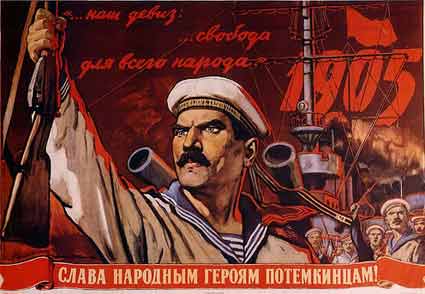
Battleship Potemkin Soviet propaganda poster

I wonder if our few proud US Marines will have brains enough to side with their families and comrades when Bush orders them to fire on his insurgents.

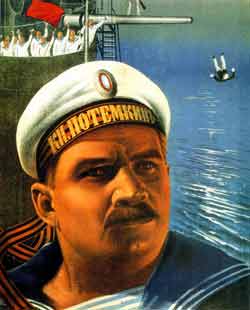
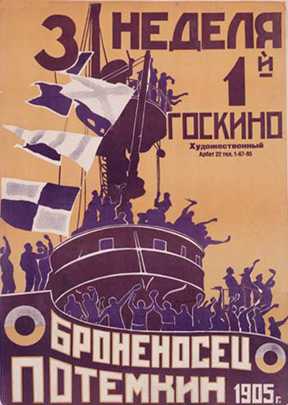
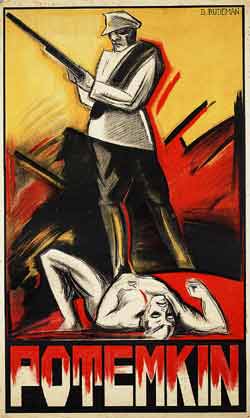
Panzercruizer Potemkin -German film posterIn promoting the Toons film collection, I’ve made a preoccupation with data mining for every poster incarnation of our diverse films. Since the Toons website has been down for a bit, I thought I’d represent here our gathering of Potemkin posters.

Kudos to the Pikes Peak Center team for delivering Eisenstein to the Rocky Mountain art Bourgeois. We showed up three generations deep, each age this evening running into others they knew. And everyone loved it.

La Corazata Potemkin -Italian film poster
A highlight of the event for me occurred when the battleship fired its salvo into the city. After the sailors had rebelled, the city populace had risen in support. To subdue the masses, Tsarist Cossacks marched down the Odessa steps, shooting into the crowd. In angry response, the crew of the Potemkin aimed its big guns at the headquarters of their Tsarist oppressors, or so explained the inter-title cards, further specified in the text as the Opera House! We were Colorado Springs symphony-goers, at the town’s premiere performing arts center, rooting for the Russian workers as they united against their ruling class.

Battleship Potemkin call to arms

Battleship Potemkin -contemporary Soviet poster

Battleship Potemkin uprising leader

Battleship Potemkin

Battleship Potemkin -Modern Russian print

Battleship Potemkin

Battleship Potemkin -stamp

?????????? ???????? - Battleship Potemkin by Sergei Eisenstein

In defense of fundamentalism

Mankind is going in circles.

When you look at the Greek histories you can see periods of democracy and liberty lead to corruption and oppression, until the next democracy emerges centuries later.

From the dark ages emerged the Renaissance whose sun is still shining on our times, if perhaps just our subconscience by twilight. For we are descending again into darkness, this time a secular dark age.

The common man’s adventures in self fulfillment are going off cycle.

Advances in medicine and science, our understanding of the natural world, make us think that humanity is progressing. But this is not progress. this is merely complication. Who’s to say that a scientist has any better grasp of the workings of the universe than does a shaman? Because you can read a book doesn’t mean you can throw it further.

In philosophy as well as science, there is a sense that through time, each successive thought builds upon our past. Yet you’d be hard pressed to find a scholar who could say that any philosopher or scientist has surpassed yet Aristotle. As Eisenstein was to be with film, so Aristotle was to rational man: medium fully explored.

From an Eastern perspective, Buddhism has for quite a long time been trying to raise the world’s consciousness. An admirable goal, but has it succeeded from one generation to the next?

Man’s personal development certainly goes in circles. Development leads to entropy and decay. Vitality flourishes then becomes decadence. By the time you have a culture preoccupied with its sex life, you’ve got a people with a spirituality going nowhere.

You can look around today and see signs of this decay everywhere. Look at the ultra-violent video games or at a mass media obsessed with sex: a sexuality absolutely removed from procreation.

While it’s hard to explain why any of these preoccupations are vices per se, they are traditional signs of end times. They accompany the death of culture, as the decline of the Roman Empire, as before them the Greeks. They signal biblical end times like Babel, Sodom and so on.

To champion personal freedoms may feel righteous. What feels more natural than the motivation to explore and indulge our personal proclivities? But perhaps this is only hastening the end of our cycle.

Why not instead try to transcend this downward curve?

Fundamentalist religions do this. They deny human nature because they want to transcend it. They see mankind’s weakness to succumb to idolatry and self destruction and they think maybe this time they can avert it.

That’s my guess as to what they think they are doing.