“Comfort Women” aren’t unique to Japan and Korea. In the US military they’re called service women.

As a South Korean court decides that Japan owes more compensation to the Korean women it abducted during WWII to serve as “Comfort Women” for the Japanese troops, Americans should own up to the reality that all militaries rely on involuntary prostitution and gang rape to motivate their soldiers.

From antiquity through the Napoleonic Wars, through America’s Civil War to its imperial conquests westward and abroad, and until World War One immobilized warfare, “comfort women” were called “camp followers.” US servicemen in Vietnam established a sex industry in Southeast Asia that is fertilized still today by veterans of all nationalities. But while America’s Defense Department outsources more and more of its functions to contractor profiteers, it has moved the sexual services in-house. This shifts the customary impact on victim populations unto another consumable pool of sexual prey called FELLOW SOLDIERS.

In brief the scheme is simple: Recruit young women, let male soldiers to rape them, replenish as needed. Mission Accomplished as they say. Among your female grunts, purge would-be careerists to ensure you are trafficking in only the age of vulnerability suited to your comfort-seekers. That perverse finess is of course the giveaway.

In the US military, 100% of women are sexually harassed or raped. Officials say the figure is 70%, or they discount attacks as cases of harassment and not rape. This allows service women who chose not to report their rapes to save face, and it ameleorates the stigma which otherwise would fall on every woman in uniform. Like the single blank bullet issued to firing squads to ease the conscience of every member allowing them to believe their gun did not chamber a live and fatal bullet. The confidential medical records say the frequency of sexual victimhood is actually 90%, but that suggestes an improbable paucity of unreported cases. In the civilian world, it’s believed that half of all rapes go unreported. Assuming a correlation, how can you have twice as many as 90%?

Besides addressing the rape culture endemic to professioonal soldiering, a remedy suggests itself in at least pretending to care about the well being of female soldiers. For a start, America’s military branches could easily relax the basic training requirements for women. The current standards, which pander to a feminist insistance on a physical equality of the genders, quickly destroy all female recruits. The same backpack weight loads of boot camp, which eventually debilitate men’s backs and knees by the time they’re 40, cripple women before they’re 25. An obscenely high percentage of women have to be med-boarded out of active duty with destroyed backs, ankles and wrists. And the female re-enlistment rate is abysmal. You’d think the army, navy, air force and marines would want to retain trained soldiers. Unless women are more valuable to them young, untrained, and uninitiated.

Comfort Women and Camp followers suffered attrition from the natural consequences of communicable disease and abuse, allowing for a regular turnover of fresh stock. Pretending your soldiers don’t consume comfort women means having to be duplicitous about where you are dumping your bodies.

What’s behind the Churchill adoration?


What’s behind the current wave of Churchill-mania? I’m inclined to think it’s about rebooting pan-nationalism. Churchill was a hero of WWII, propping up the supposition that WWII was a just war where Churchill led the defense against Fascism. The victors have been embellishing that history since before that capitalist scam began.

The latest movie, DARKEST HOUR, presumes to glorify Winston Churchill BE MOFO SOB as England’s savior, begging to presume there’s no argument it was her darkest hour. Aimed to pull the wool back of the eyes after Britain’s improbable moment of clarity about their opportunity to make a BREXIT from the talons of their banker overlords.

Churchill was an adventurer and glory-seeker whose every move supported colonialism and imperialism. His first taste of war was on the side of the Spanish as they suppressed independence movement in Cuba. Next he fought the Boers in South Africa. Next opposed labor struggles. He ordered the immolation of Anarchists. He sent death squads to Ireland. He disparaged Indian attempts at sovereignty, suggesting Gandhi should be bound hand and foot and crushed beneath an elephant. He bombed Dresden. He gave Palestine over to Zionists. He held rebellious Kenyan tribes in concentration camps.

This was a warmonger war criminal we’re praising as one of History’s greatest leaders, probably because these are times of war and today’s sadists need affirmation their actions will be similarly lionized.

Kimya Dawson knows from where protest must burst: At the Seams.

Kimya Dawson not only nailed the essence of protests for #BlackLivesMatter. She knew in which direction the protest marches needed to push. Toward our system’s seams. If you are having trouble finding the lyrics of her song about HANDS UP DON’T SHOOT I CAN’T BREATH, it’s because it’s called At the Seams.

I’ve taken the liberty to reformat Dawson’s brilliant lyrics to unpack her references and simulate her cadence.

AT THE SEAMS by Kimya Dawson

1.
Left hands hold the leashes
and the right hands hold the torches,
And Grandpas holding shotguns
swing on porch swings hung on porches,
And the Grandmas in their gardens
plant more seeds to cut their losses,
And the poachers,
with the pooches
and the nooses,
preheat crosses.

And the pooches see the Grandpas
and they bare their teeth and growl,
While their owners turn their noses up
like they smell something foul,
And they fumble with their crosses
and they start to mumble curses,
And they plot ways
to get Grandpas
off of porches
into hearses.

But the Grandpas on the porches
are just scarecrows holding toys,
And the Grandmas in the gardens
are papier-mâché decoys,
While the real Grandmas and Grandpas
are with all the girls and boys
Marching downtown to the City Hall
to make a lot of noise,
Saying:

  Hands up. Don’t shoot. I can’t breathe.
  BLACK LIVES MATTER. No justice No Peace.
  I know that we can overcome because I had a dream-
  A dream we tore this racist broken system apart at the seams.

2.
Sometimes it seems like
we’ve reached the end of the road
We’ve seen cops and judges sleep together
wearing long white robes.
And they put their white hoods up,
Try to take the black hoods down,
And they don’t plan on stopping
til we’re all in the ground.

Til we’re dead in the ground
or we’re incarcerated
‘Cause prison’s
a big business form
of enslavement
Plantations that profit
on black folks in cages
They’ll break our backs
and keep the wages.

It’s outrageous that there’s no place
we can feel safe in this nation
Not in our cars, Not at the park,
Not in subway stations,
Not at church, The pool, The store,
Not asking for help,
Not walking down the street,
So we’ve gotta scream and yell:

  Hands up. Don’t shoot. I can’t breathe.
  BLACK LIVES MATTER. No justice No Peace.
  I know that we can overcome because I had a dream-
  A dream we tore this racist broken system apart at the seams.

3.
You tweet me my own lyrics,
Tell me to stop
Letting a few bad apples
ruin the bunch.
Don’t minimize the fight
comparing apples to cops
This is about the orchard’s poisoned roots,
not loose fruits in a box.

Once the soil’s been spoiled,
the whole crop’s corrupt.
That’s why we need the grassroots
working from the ground up.
And we look to Black Twitter,
to stay woke and get some truth,
‘Stead of smiling cops
and black mugshots
from biased corporate news.

‘Cause if you steal cigarillos,
or you sell loose cigarettes,
Or you forget your turn signal,
will they see your skin as a threat?
Will they KILL you, And then SMEAR you,
And COVER IT UP and LIE?
Will they call it “self defense”?
Will they call it “suicide”?

  Hands up. Don’t shoot. I can’t breathe.
  BLACK LIVES MATTER. No justice No Peace.
  I know that we can overcome because I had a dream-
  A dream we tore this racist broken system apart at the seams.

4.
Decades of cultivation start
from tiny seeds that were once planted.
And we mustn’t take the gardens that
our elders grew for granted,
Though it is up to our youth
how new rows sown are organized,
Because movements can’t keep moving
if old and unsharpened eyes
Can’t see the need to hear
what those on the ground hafta say,
In Ferguson and Cleveland,
Staten Island, The East Bay,
Charleston, Phoenix,
Detroit, Sanford Waller,
Seattle, Los Angeles,
Chicago, Baltimore.

Climbing flagpoles, Taking bridges,
Locked together to the BART,
Speaking up about injustice
in our music and our art,
Storming stages to ask candidates
when they’re gonna start
Really DIRECTLY addressing issues
BREAKING OUR HEARTS.

  Hands up. Don’t shoot. I can’t breathe.
  BLACK LIVES MATTER. No justice No Peace.
  I know that we can overcome because I had a dream-
  A dream we tore this racist broken system apart at the seams.

    Hands up. Don’t shoot. I can’t breathe.
    BLACK LIVES MATTER. No justice No Peace.
    I know that we can overcome because I had a dream-
    A dream we tore this racist broken system apart at the seams.

5.
And if the altars are torn down,
we’ll just keep on placing flowers
For the boy whose body was in the road
FOR MORE THAN FOUR HOURS.
We will honor the dead
of every age and every gender
‘Cause we can’t just have it be
the brothers’ names that we remember.

Oh black boys with skateboards,
and black boys with hoodies,
And little black girls who
are on the couch sleeping,
And all of the black trans
women massacred,
Too many black folks killed and brutalized,
And there’s no justice served.

After the lynchings of our people
by the murderous police,
Who stand like hunters ’round their prey
gasping helpless in the street,
Feet from the TEEN SISTER they tackled
and locked handcuffed in the car,
Feet from her TWELVE YEAR OLD BROTHER DYING —

WHILE NO ONE DID CPR…

6.
And we’ll keep on planting flowers,
and we’ll fight until the day
That we don’t have to pick them all
to put them all on graves.
Yeah we’ll keep planting flowers
and we’ll fight until the day
That we don’t have to pick them all
to put them all on graves.

  Hands up. Don’t shoot. I can’t breathe.
  BLACK LIVES MATTER. No justice No Peace.
  I know that we can overcome because I had a dream-
  A dream we tore this racist broken system apart at the seams.

Springs municipal judge gives blessing to lucrative yet illegal I-25 speed trap.


COLORADO SPRINGS, COLO.- Local municipal court judge Matthew Ramirez was presented with evidence today that the city is operating an UNJUSTIFIED SPEED LIMIT TRAP in the construction zone at the intersection of Highway-24 and Interstate-25. Though drivers are regularly cited for exceeding a 30mph speed limit, the posted speed does not meet the 85% compliance rule, nor the “pedal test” for enforceable speed reductions. Both are characteristics of improper and legally unenforceable “speed traps”. Plus, it turns out, 30pmh is not even the minimum speed required to cross under I-25 before the traffic light turns red.

At 30pmh it takes a motorist 8.75 seconds to cross the intersection from West to East. But the traffic light allows only 2.75 seconds! No wonder drivers don’t want to slow down. Upon seeing the video, instead of calling traffic engineers to set appropriate speed restrictions and adjust the timings, Judge Ramirez instead put his stamp of approval on CSPD’s very lucrative speed trap.

YES, I got a speeding ticket. Haha. And yes, today I was found guilty. I’m not upset so much as disappointed that the judge made himself complicit with the city’s scheme.

I know that “speed trap” has come to designate anywhere that police monitor traffic speeds, sometimes in hiding, and issue tickets. But I’m not using the term in the general sense. “Speed trap” has a legal definition which describes a scenario where police are ticketing motorists who have been forced, by circumstances under the control of the police, to violate the law and thus become eligible to be asked to contribute to the local administration’s fee based tax. “Speed traps” are abuses by law enforcement to maximize citation revenues without having to come across and apprehend offenders operating autonomously to local fundraising schemes.

On August 31 of this year, I was clocked going 43mph in a 30mph construction zone. Except for a vague feeling that I had not been “speeding”, I had no intention of fighting the ticket. I support the enforcement of speed limits and I accept that being pulled over is more or less a random hazard of going with the flow. No objection. But my recent attendance at municipal cases brought against activists has meant a lot of time spent in courtrooms where I couldn’t help but notice that many, many drivers were being cited for the same ticket as me, crossing the same intersection, their fines doubled because it’s a construction zone, almost all of them taking a plea.

My decision to plead not guilty led to a fruitful survey of legal abuses perpetrated by our traffic courts; on the part of the city attorneys, on the part of the police officers, and on the part of the judges. It was worth the fight and I assure you it’s not over.

Hundreds, if possibly thousands, of motorists have been ticketed, and are still being ticketed, like I was. Unless they’re riding the brake as they approach the intersection, they are considered speeding. Often, hitting the brake at that approach means upsetting drivers around you impatient to build speed for the on-ramp or impatient to cross the long intersection. To slow to 30mph when surrounded by others causes you to “impede the flow of traffic”, which is itself a driving offense in Colorado. Yes, driving the speed limit, when it impedes speeders, is illegal because the disruption it causes is considered unsafe. A traffic instruction that causes a driver to commit a worse infraction is not enforceable.

Likewise, if you have to choose between maintaining your speed to cross an intersection legally, before the light turns red, or lingering in the middle at risk of colliding with cross traffic, the safest recourse is also clear.

Judge Ramirez rejected the necessity defense, which protects accused if their infraction is incurred while trying to avoid more hazardous violations. He did not find it troublesome that local drivers were being forced to decide between speeding or running a red light, knowing they could be punished in either case.

Colorado Springs traffic ticket revenues are relying heavily on drivers being fraudulently stopped and fined. At ten dollars per mile over the limit, doubled for the construction zone, the fines add up. These penalties are for driving the intuitive speed calculated by the engineers who designed the motorway, in this case also by the engineers who time the traffic lights to facilitate flow.

A FOIA request will probably reveal the revenue to number in the millions, coming from local citizens feeling wronged. And if they took their case to court, feeling further wronged by the unjust process.

To begin with, they won’t show you the evidence against you. And it gets worse from there. With just this case I’ve documented abuses to rival the ACLU’s condemnation of the corrupt court system of the Colorado town of Alamosa. Their chief judge resigned in disgrace.

Check back as I update this article to recount the unending duplicity of the city attorney’s office. Then there are the dishonest public safety managers. And the police officers who outright lie. Aided and abetted by judges who know better. It’s a long story and all the more ugly because it could happen to anyone. And if Judge Matthew Ramirez has his way it will happen to you.

Who is this El Paso Sheriffs undercover infiltrator provocateur? We don’t care!

El Paso County Sheriffs Undercover OperativeCOLO. SPRINGS– Lawyers for the city are fighting defense team efforts to expose who, how, when and why local law enforcement agencies infiltrated a campus political activist group. The 2017 undercover operation was revealed in CSPD bodycam videos, but city courthouse lawyers and judges are preventing the evidence from being made public.

Alerted to the October 17 evidentiary hearing meant to shed light on the bodycam video, journalists and news crews instead witnessed stonewalling by city attorneys but made to look like a disorganized defense. They saw municipal Judge Kristen Hoffecker blame the defendants for not submitting to a sham proceding, when the judge should have confessed that the defense’s subpoenas had not been honored.

Today the city learned that our defense team went around them and served the subpoenas directly, requiring the responsible law agency parties to testify as witnesses at an evidentiary hearing on November 3. Now the city wants to use a November 1 status hearing to quash the subpoenas.

What’s the big deal? The city asserts the confidential identity of its undercovers is a stake. That is of course the least of it.

The city’s own evidence against the defendants, accused of marching in the street on March 26, 2017, documents police officers deciding to issue tickets. What’s clear from the video is that the police issued tickets, not to cite wrongdoers, nor to halt law-breaking, but to 1) “identify everyone”, 2) arrest an undercover agent, and 3) disperse a lawful assembly. It’s all on tape.

When defendants first grasped what they were seeing on the bodycam video, they brought it to the attention of the various municipal court judges who take turns directing the daily court matters. Asked to produce the written reports generated by the officers on the video but missing from the discovery evidence, the judges declined. Asked to subpoena the officers involved, the judges declined. After each defendant’s pro se arguments were rebuffed, one motions hearing after the other, the defendants sought legal help. Actually Judge Hayden Kane II did eventually grant a hearing to look into the video, but he told us he’d already watched it in private and was not inclined to find it relevant, so defendants were not encouraged that his opinion would change.

In the meantime civil rights lawyers were highly interested in the police activity documented by the video. They submitted 20 pages of argument for the dismissal of charges against the defendants, citing outrageous police misconduct in violation of the Code of Federal Regulations, part 23. They requested that the sheriff, the police chief, the commander of CSPD intelligence, and others named and unnamed, be subpoenaed to testify at an evidentiary hearing on October 17. That didn’t happen, as everyone saw. The subpoenas didn’t even go out.

The October 17 hearing misfire was simply the latest of months of attempts by the defendants to bring this story to light.

This time around the city wasn’t given the chance to sit on the subpoenas, they’ve been served directly. On November 1, will Judge Hoffecker invalidate the subpoenas two days before the witnesses are compelled to appear? The question reporters can ask is should she?

The city’s argument will be that the police undercover operation, however illegal, does not have anything to do with the guilt or innocence of the socialists charged with marching in the street. Outrageous police misconduct is a matter for federal court, that’s true. But have a look at the video. Notice that the first marcher fingered for arrest, the only one assigned an arrest team, was the undercover “Mark Jackson.” When the police shouted their warning that all who remained in front of City Hall would be issued citations, their only unequivocable target was Jackson.

Without the motive of arresting Jackson, whether it was to provoke the crowd or to embed their infiltrator, and until the order “LT wants everyone identified”, the police weren’t going to make any arrests. What does that say about the supposed guilt of the accused?

The police had already told the socialists “you’re free to carry on with your rally so long as you don’t step back unto the street.”

What the socialists were doing on March 26 was the essence of protected speech. But senior officers not on the scene had a crime of their own up their sleeves, and they needed an arrest or two to set it into motion.

Should we get to the bottom of this story, or let the city pretend it didn’t happen until the defendants get to turn the tables in federal court?

One presumes that undercover agents are only performing the intelligence function of surveillance, monitoring protest activity for hints of criminal behavior. At worse, we call them agent provocateurs, trying to encourage illegality, and believe that everyday nonviolent activists should know better than to be entrapped into illegal acts.

But undercover officers are much more disruptive than that. Undercovers sow dischord and mistrust among strangers who’ve come together to advocate for a common cause. Infiltrators pit activists against each other and confound organizers with sabotage. They volunteer for responsibilities then drop the ball. They complicate discussions with irrelevant, impractical, or illegal suggestions. When their ideas are rejected they express frustration by demeaning their fellow participants for being unmotivated. When “Mark Jackson” was found out, and it took many weeks for everyone to become convinced he was an undercover, he berated everyone for every personal failing in the book. He accused individuals of paranoia, ineptitude, or lacking courage. “Get back to me when you decide you want to DO SOMETHING” were his parting words.

Police infiltration harms every citizen effort to organize. The Code of Federal Regulations mandates that police agencies have suspicion of real crime before embedding infiltrators.

If CSPD or the El Paso County Sheriff’s Office or the Department of Homeland Security or the Colorado Bureau of Investigation has proof of a crime brewing among the Colorado Springs Socialists, wouldn’t we all benefit to know about it? We would if their motive is truly crime prevention.

The real identities of “Mark Jackson” and his partner “Aimee Walter” doesn’t matter at all. Who they work for is paramount. Are they “with the Sheriffs” or contracted or embedded from another agency? As the video shows, Jackson’s jittery hyperactive behavior while detained in the cruiser doesn’t give one much confidence about who law enforcement is entrusting with a loaded weapon in a crowd they hope to be inciting to riot.

The city’s determination to quash the question of whether or not such evidence exists points to police malfeasance, not the Socialists’.

Justice delayed is justice denied. Colorado Springs police infiltration operations against social justice activism should be brought to heel sooner rather than later.

OCTOBER 27 UPDATE:
According to Judge Hoffecker’s order: November 1st at 2:30pm will be the city’s next chance to quash the subpoenas. If they do not succeed, the evidentiary hearing is scheduled for November 3rd at 8:15am.

City plan to snuff socialist infiltration hearing blows up in courtroom’s face

El Paso County undercovers
COLORADO SPRINGS, COLORADO– If you attended today’s evidentiary hearing about the police infiltration of a local student group, you are no doubt left wondering what happened. Where were the defendants and why was the judge so angry? The outcome was not what either side wanted, but still it was a huge false step for the city. The defense was not provided the police witnesses it requested, but the prosecution was prevented from quashing those subpoenas outright. As a truant co-defendant, I had a unique vantage point on today’s anticlimax and I apologize I was unable to explain it in person.

Today’s hearing, it turns out, was supposed to exclude the defendants. The review of evidence relating to the police infiltration operation was intended to happen outside of public view. The lawyers signed the setting slips, not the defendants, who were kept uninformed of the October 17 hearing. The judge had specified lawyers only, to keep the details and identities of the undercovers confidential.

Can courts exclude defendants from their own hearings? Not really, but anyway.

It turns out the judge wanted privacy because she had no intention of conducting the hearing at all. Without an audience to offend, this judge planned to summarily quash the defense motions to make police administrators testify and that would be the end of it. Objections be damned, let the lawyers take it up on appeal. Push this hot potato off a year or two.

However, through documents obtained directly from the courthouse, the defendants did learn about the hearing. So the defendants made plans to attend the hearing regardless of a judge’s preferences, and they publicized the event for what it promised to be, a scandalous exposé of CSPD intelligence overreach. Subpoenaed to testify were El Paso County Sheriff Bill Elder, Colorado Springs Police Chief Peter Carey, Lieutenant Mark Comte of the CSPD Intelligence Divison, and Sergeant Clayton Blackwell, among others.

Colorado Springs prosecutors did not inform the defense team that they had no intention of honoring those subpoenas. Instead they planned to motion to quash the subpoenas and truncate the hearing. The city attorneys did not file those motions beforehand nor give the defense any indication they were contesting the subpoenas.

I can only surmise that the city prosecutors began receiving calls from the media about the anticipated testimony of the sheriff and chief of police, because it wasn’t until late morning on the day of the hearing, after our press release went out, that the city emailed the defense team to say that “Sgt Blackwell is on vacation.” Blackwell wouldn’t be attending the hearing, they said, and by the way, his was the only subpoena delivered.

To which I imagine our legal team said: WTF?! Now we needed a hearing to learn why the city thought it could unilaterally decide to whom to deliver our subpoenas.

It’s one thing to disrespect the rights of defendants. Our municipal court does it ALL THE TIME. Everyday, sadly. In fact, it’s done it repeatedly to the very defendants in this case, before we got lawyers. But it’s quite another thing to trample on our rights when a civil rights attorney is involved.

If Blackwell was on vacation, the case needed a continuance. And if subpoenas were going to be quashed, we needed a motions hearing. Oddly, the judge was demanding our defense attorneys show up in person. To arrange a continuance?! Riiiiiight.

Our lawyers quickly let us know there was to be no hearing. Since the defendants weren’t supposed to attend today’s hearing anyway, we deemed it prudent not to attend the prosecution’s switcheroo. Without defendants, whatever the prosecution planned couldn’t proceed. Meanwhile the defense lawyers weren’t going to abide a Podunk Springs Judge Roy Bean throwing the law book out the window. If subpoenas aren’t going to be honored, you have to present the legal basis beforehand. Them’s the rules, Hayseeds.

So the courtroom audience, including journalists and media crews who had to leave their television cameras outside, were left to witness a Colorado Springs judge fuming at being out-thunk. The defense lawyers weren’t there to let her quash away with her gavel, without regard for the Colorado Rules of Proceedure, and the judge’s original scheme excluded the defendants so as a result there were no defendants present to accept her rulings. The judge could do nothing but seethe and lecture the audience about big lawyers disrespecting municipal courts. Nevermind that our courts are corrupt mechanisms that trample rights for breakfast. (The ACLU recently released a report damning Alamosa’s city courts: Justice Derailed. Believe me, the identical abuses of power occur in Colorado Springs.)

Nevermind too, what today’s court hearing was supposed to be about: Outrageous Conduct on the part of CSPD and EPCSO, and violations of the Code of Federal Conduct. Today’s defendants were arrested on March 26, 2017, but not for walking in the street. The socialists were arrested because the Intelligence Division wanted to “arrest” an undercover officer, maybe two, in order to give them deeper cover as they infiltrated a student-led group just formed in Colorado Springs. The CSPD body-cam video released to the defendants already proves this. We wanted the decision makers responsible to explain it.

Instead of a comedy of errors spotlighting local law enforcement ignoring the people’s Bill of Rights, the courtroom audience today saw another facet of our corrupt judicial system. They witnessed a judge prepared to ride roughshod over further rights that protect citizens from authoritarian zeal. You may not care how police abuse “socialists” but the whims of a municipal court despot affect everyone caught in their dragnet, be it a ticket or a zoning dispute. Even with an expensive lawyer, you are powerless to object when a judge pretends there are no rules.

What the judge saw today was a courtroom filled with supporters of the defendants and a media interested in their story. She saw that she and her gavel are not going to make this story go away.

Why should you attend the Denver Nalty-Byfield ENTERPRISE TRIAL?

Why support the “We The People” public-oath sticklers who the state is prosecuting like a criminal enterprise? A few reasons: Solidarity. Because as hardheaded as they might be, defendants Stephen Nalty and Steve Byfield are still JUDICIAL REFORM ACTIVISTS. Sense of fair play. Half the courtroom gallery is filled with Colorado Attorney General staffers and FBI special agents chumming it up with jurors and briefing their THREE FBI UNDERCOVER WITNESSES while the defendant pariah side of the audience is warned by the judge that even a whisper will result in ejection. Thrills. Where else are you going to see this many federal agents pushing their weight around, barking at you in the hallways, swaggering gleefully about how much smarter they are than the defendants? Pathos. Come watch the Assistant Fucking Colorado Attorney General, Robert Shapiro himself, lead a team of prosecutors against the unrepresented defendants, watch Shapiro belittle them, lecture them, trivialize their difficulties defending themselves in jail, and pretend they can review “tens of thousands” of pages of evidence and “hours and hours” of undercover surveillance tapes in a single day. Because you can make a difference. Come push the FBI-guys’ buttons. Come witness and document the abuses of the overbearing prosecution team. Come lend public pressure on the judge, whose conscience is already bothering him about how unfair this sham trial has become.

Liens
You don’t have to agree with how Nalty and Byfield went about trying to reform the judicial system, but aren’t they mostly right? Judges ARE corrupt. Local officials ARE NOT accountable to the people. Law enforcement WON’T pursue charges of their own corruption and the media certainly won’t side with the reformers. When Nalty, Byfield and Co, served commercial liens valued at billions and trillions of dollar against officials who hadn’t filed oaths of office, it was an effort of last resort to get someone’s attention. No one was thinking, hey, maybe this eleven-figure dollar demand will slip through the cracks and the billions will be ours!

Each lien was calculated to represent the sum defrauded from and owed to the American People. Prosecutors can tap these defendants for conspiring and racketeering and extorting and attempting to influence public officials, but they can’t say the defendants aimed to obscond with one single penny. Throwing three undercover infiltrators at a twenty member judicial reform group, putting thousands of manpower hours into locking these defendants away, is gross abuse of authority and it’s hubris.

Authentic transgressions
As the sham trial goes on, the pieces are coming together on the cases of Nalty and crew. It turns out federal investigators labeled them “sovereigns” because they’ve held themselves not responsible for paying traffic tickets, property taxes, and the like. In the end I’ll grant you Nalty’s group may be guilty of those. I say “may” because such citations may have been retaliatory for their political beliefs.

As to the punishment, I believe adjudicators should take into account that the defendants acted not to enrich themselves, nor to flaunt the law per se, but to assert political rights about which they may have been misguided. Again I say may because the defendants are being tried, after all, according to a set of laws, which enforce a social contract, the terms of which the parties do not agree.

I use the word misguided as a nod to those who think the Nalty gang have acted like idiots. That’s easy to say, and easy to laugh, but no one’s yet figured out how to emancipate labor from the yoke of capital. You may regard interest and rent as your inherent debts. These sovereigns don’t and they’re trying to say so.

Economic slavery
Ours is a system of peonage to which this crew feels they never indentured themselves. The ersatz writs and liens they spammed to every official they encountered were the legal loopholes they thought could break the bank and liberate everyone from financial tyranny. While Nalty’s scheme intended insurrection, it wasn’t against democracy or the republic, it was against taxation without representation, the same beast Americans pretend to have overthrown with the Declaration of Independance.

Instead of tea into Boston Harbor, this crew dumped a bunch of junk paper unto the reception counters of Colorado public offices. Charge Nalty’s crew with littering maybe, at most, vandalism, though it’s hard to say these vandals caused even a scratch. Every public official who testified as a victim said they didn’t take the ersatz documents seriously.

The writs and liens looked officious, but weren’t attributed to known government or banking institutions. Likewise signatures were signed in red. Red was chosen to represent the signer’s blood, even though red is a color which automated banking systems reject as unreadable, therefore invalid.

Not one witness expressed confusion about the validity of the papers. They mentioned too the rambling diatribes in the text block.

To call the defendants “paper terrorists” wildly overstates the effect they achieved. They didn’t terrorize anyone. Governments like to accuse rebellious insurgents of “terrorism”, but that’s another paralegal threshold with which most common citizens, and certainly these “sovereigns”, disagree.

Real funny money
These guys did the equivalent of feed Monopoly Money into ATMs. No bank balances were changed and no real money came out. Counterfeit currency is one thing, but denominations of your own handywork pretending to be only that does not qualify as funny money in the illegal sense. I’m guessing forms submitted in a language foreign to bank clerks would be rejected out of hand. How are these any different? Irregular submissions, as one witness called them, need not generate calls to the FBI or the Colorado Joint Terrorism Task Force. I’ll bet that ATMs know to reject Monopoly Money. If they don’t, whose problem is that?

The trial of defendants Stephen Nalty and Steve Byfield is due to wrap up Friday. The prosecution will have taken seven days to present its case and Assistant Attorney General Robert Shapiro intends to object if the defense rebuttal takes more than a half day, maybe a whole. This trial is meant to intimidate the other defendants to convince them to take pleas.

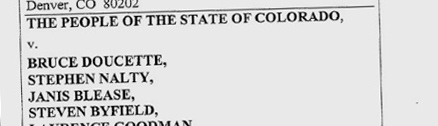
Next in the pipeline is Bruce Doucette whose trial starts October 16. Defendants Harlan Smith and Dave Coffelt have hearings on October 18. If they do not take deals, Shapiro intends to enjoin their cases, to save time and money. He’s already convinced defendant Brian Baylog to take a deal and turn state’s evidence. Baylog is scheduled to testify against Nalty and Byfield shortly.

By now the condemnation of Nalty’s commercial lien scheme will have cost Colorado millions in man hours and legal expenses. You can fine a graffiti artist for having to restore an edifice to its original lustre, but you can’t expect him to bear the full cost if you chose a cleanup crew that wears Gucci loafers, most of whose jobs is to pat the other on the back.

Colorado’s overkill with federal agents and counter-terrorism experts is a problem of its own making.

The Nalty-Byfield trial continues through this week 8:30am – 5pm, at Denver’s Lindsey Flanigan Courthouse, in Division 2H, ironically, “Juvenile Court”.

FBI undercover rats on sovereign pals, says they planned to seize small county jails, except he was their lone soldier.


DENVER, COLORADO- Very interesting testimony Friday at the trial of sovereigns Stephen Nalty and Steve Byfield. The prosecution’s latest witness was FBI INFORMER Marshall Ringer. Not a sovereign citizen type turned by government agents, Ringer is a disgraced police officer hired by the FBI and inserted into the so-called “enterprise” to report its activities and propose courses of action conducive to arrests. Ringer calls himself a “self-employed security expert.” His handler FBI Special Agent Ryan English calls him an “embedded confidencial human source”. His targets gave him the title “Continental U.S. Marshall”. They hoped he would recruit like-minded sovereigns to the cause of correcting what they saw as a corrupt judicial system. Ringer’s FBI codename was “Earp”.

The accusations corruption hinged on the understanding that according to Article VI of the US Constitution, positions of public authority must take an oath secured by a bond. The “enterprise” had discovered that many Colorado judges and prosecutors and sheriffs and other elected officials didn’t have oaths or bonds on file. If this expectation was indeed a misconception, and Article VI is inapplicable, you’d think the remedy might be to tell the would-be reformers, “no, that is not a requirement, here’s why, etc.” Strangely that was never done. Neither to their person, in a handout, or to reporters looking into this sad case. An undercover would present an excellent opportunity to huddle with the enterprise and say “hey guys, I was looking into this oath stuff and discovered that according to such and such law, or ruling or whatnot, oaths and bonds are no longer mandatory, end of story!”

But “Earp” didn’t. Nobody did. Nobody has yet to spell it out, even in this courtroom. When the defendants have tried to put Article VI into the trial record, they’ve been refused. So the issue is certainly a curious one.

Instead of using an undercover to diffuse the oath-seekers by presenting the incontrovertible truth of their error, the FBI and the state prosecutors instead gathered evidence to ridicule their character. We’re told they met in trailerhomes, they struggled to cobble enough money together to give their marshall a pair of handcuffs. They dreamed of putting together a network of De Jure judges to replace the corrupt ones currently alas De Facto.

Tapes
You might think the taped conversations of the sovereigns would be damning. The defendants certainly seem to be embarassed by them, but they’re less incriminating than disarming. When “Earp” asked what was he to do with the officials he arrested, he was told, nothing, for now. Do not take any action on your own. Wait for instructions from the People’s Grand Jury. Every time “Earp” goaded his colleagues about what he could do, they’d tell him to wait until matters could be addressed democratically and judicially.

The most interesting information to come from the undercover testimony was about how the FBI wires up its informants. Colorado law requires that at least on person in a conversation consents to being recorded. As a result, every recording presented to the court begins with the person wearing the wire dictating this preamble: “This is confidential human source X, on such and such date, etc” before that informant gets out of his car or enters a meeting area.

This offers potential targets a remedy for how to avoid intrusive surveillance by authoritarian law enforcement agencies IN COLORADO. Before every meeting, have everyone say out loud: “I do not consent to being recorded.” In unison is fine. Then a leader can then ask: “Was that everyone?” To which everyone can answer in unison: “Yes.” Provided that everyone said it, that meeting cannot be recorded. Such a method not only invalidates a recording being used as evidence later, it makes the recording a crime and the agency undertaking it and in possession of it, cupabe. If an undercover continues with the recording, he’s committing a crime.

In the case of te sovereigns, and likely your scenario as well, the government’s criminal act will far exceed in severity what they thought they were recording you doing.

We’ve yet to learn how, but apparently this undercover was discovered by the defendants early in 2017. They outed him by accusing him of making recordings and giving them to the FBI. That’s when he extracted himself and the indictments and arrests happened immediately thereafter.

The Enterprise
However you may feel about these perhaps misguided judicial reformers, their adversaries are behaving every bit the corrupt villains they pretend not to be.

The accused called themselves the People’s Grand Jury, the Indestructible People’s Trust, The Colorado Supreme Court, the Continental US Marshalls, the De Jure whatnot, or simply We The People. There seems to be no end to the permutations but they never called themselves “The Enterprise”. Yet that is what their accusers call them. In fact, for the duration of the prosecution’s case, a posterboard has been left in the center of the courtroom, beneath the judge’s dias, from which the jury cannot look away, it’s titled The Enterprise, with photos of ten member now-defendants, like employees of the month, except with mugshots, ranked in order of their title or prominence. Another ten members didn’t warrant photos or arrest, yet are listed as culpable parties, guilty by association and without the chance to . You wonder if that is legal. It certainly is prejudicial. Never mind if the witness testimonies don’t add up, there is The Enterprise, like it’s a thing instead of a characterization fashioned by frame-up artists.

MONDAY UPDATE:
On Monday defendants were given one day’s recess to review the evidence for their defense, which being incarcerated has impeded. So FBI informer Marshall Springs will resume his testimony tomorrow. But the courtroom also heard that the prosecution plans to bring TWO MORE UNDERCOVERS to testify, plus two cooperative witnesses, one of whom is a co-defendant who’s taken a plea to turn STATE’S EVIDENCE.

So that makes THREE undercover officers infiltrating “the enterprise” of not much more than a dozen conspirators, two of whom have become so intimidated they’ve changed their minds about what they were trying to achieve.

The next few days should prove enlightening and heartbreaking because although prosecutors have been documenting what the defendants did, they haven’t demonstrated the acts were crimes,. As much as defendants conspired, organized and racketeered, they didn’t aim to make one cent profit, illicit or otherwise. To what offenses did the cooperative witnesses plead guilty and what accusations do they make toward their friends?

So Nalty and Byfield have the rest of the day to study the evidence against them. The jail has not provided the paper and pencils ordered by the judge. The jail hasn’t afforded the defendants access to the case evidence either. Nalty indicated today that he’d spent a sum total of 45 minutes with the electronic files. He asked for a break of four days to prepare for the rest of the trial.

Both are in Denver jail, though their legal papers were not transferred with them when the defendants are on loan from Adams and Arapahoe Counties respectively. All the defendants being charged with conspiracy are being detained in different jails to prevent them talking to each other. But the problem is they don’t have their case papers or filings, and are in Denver’s customary 22 hour lockdown in their cells, which inhibits using the jail computers which are confined to the jail law library.

Prosecutor Shapiro responded to the defendant’s complaints of the jail not providing paper and pencils by cavalierly handing them writing pads, which they grasped with handcuffed hands, with polite thankyous. Though Shapiro no doubt know they won’t be allowed to take these into the jail. Then he condescendingly bragged that he’d resolved that complaint by providing “brand new” pads to each defendant. Defendant Byfield’s pad had a couple sheets missing, so he immediately pointed out that his pad wasn’t new. I couldn’t help but burst out with a laugh.

The judge thought there was merit to Nalty’s complaint Both defendants have scant access to the jail computers necessary to see the evidence. By the prosecutor’s own admission, the “tens of thousands of pages” would have been prohibitive to provide on paper, and the “hours and hours of taped testimony” likewise can only be provided electronically.

Prosecutor Shapiro acquiesced to allowing the defendants one day to catch up, though it sounds like he is well aware that analyzing tens of thousands of pages and hours and hours of evidence would take longer than that. Shapiro told the judge he calculated the state had wiggle room to allow a one day delay and still finish with the case by Friday. Here’s what he calculated: The state figures to rest its case by Thursday afternoon. That should leave a day and a half, less closing arguments and jury instructions and jury deliberations, to finish the trial on Friday. The prosecutors’s case will have taken six and a half days, but Shapiro thought the extra day needed to look over the evidence could come out of the defense’s day planned for defense.

To help the defendants prepare, Shapiro volunteered a preview of the witnesses to expect to testify to close out their case. Coming up we have four Gilpin County administrators, but we have also two more government undercovers, and the two cooperating witnesses. One of them co-defendant Bryan Baylog.

Radiolab episode on jury nullification is less bothered by state abuse of power than public desperation to fight back.

It should come as no surprise that public radio’s RADIOLAB would take government’s side against the growing grassroots effort to awaken citizens to the repressed potential of jury nullification. Any attention to the subject helps inform ordinary jurors of the power they have to stand up to the regular abuses of our judicial system. The benefit is tempered of course when liberal gatekeepers lean in with theatrics to fearmonger about anarchistic challenges to law and order and security. That’s exactly what Radiolab achieved though given plenty of material with which to have taken a more honest tack. Their program “Null and Void” aired May 12 and painted nullifiers as irrational extremists, giving a pass to the judges who purge juries and break the law by having nullifiers arrested.

I had high hopes when contacted by a producer for Radiolab in March. Our federal injunction protecting Denver jury nullification outreach efforts against an order by the Second Judicial District’s Chief Judge Michael Martinez was coming to trial in April. I imagined reporters would be sympathetic to our predicted success making our injunction permanent and the similar likeliness of our prevailing on contempt charges in a hearing which was to follow. I faciliated Radiolab’s access to Mark Iannicelli, who Denver arrested in violation of our injunction, and whose dismissed charges of felony tampering continue to be appealed by our legal adversaries. Thus far it’s a simple story of hoisting a chief justice on his own petard, using the justice system against itself, in defense of the people’s historical power as jurors.

Heicklen
But Radiolab had an alternate narrative in mind. Their story would center on a jury nullification champion who they could characterize as coming off the rails, the celebrated frequent arrestee Julian Heicklen. Septegenarian Heicklen became tired of judges warning him of arrest, despite his continued legal victories. By November 2016, Heicklen issued a manifesto of sorts, asking for armed backup to preempt a judge from making good on his renewed threat to arrest him. Heicklen posted this warning online and called it to everyone’s attention. Presumably it’s what drew Radiolab’s attention. Heicklen had put it out there, hoping to spark a John Brown-esque conflagration, I’d call it a bluff, meant to curtail the court’s continued abuse of power. It’s obvious from Heicklan’s hyperbole. I attach the significant excerpt in the notes below.

Radiolab didn’t reference this tract, nor mention their and the court’s foreknowledge of it. As they interviewed Heicklen, they asked him about his cause and even brought him to tears as he explained his distress about the injustice of the system, which continues to reinforce inequity and deny jurors their prerogative to step in its way. Then Radiolab prodded Heicklen to explain what he anticipated would happen when he showed up at the courthouse in defiance of the judge’s threat. On cue, Heicklen repeated his entreaty that supporters show up with guns to enforce his right to pass out fliers and avert the judge’s illegal threat to arrest him.

Many of us might share the elderly activist’s frustration with being habitually arrested then exhonerated, each time without apparent progress being made. Radiolab’s pretend reaction was to cue ominous silence, let the pin drop, cue indignant alarm, ostracize Heicklen, cue a spontaneous meting of Radiolab minds to elect to call the cops on Heicklen lest law enforcement personnel be shot.

Radiolab didn’t call the Chief Judge Frederick J. Lauten to question the irregularity of his repeating an illegal threat. How absolutely insane for a judge, already proven to be in the wrong, to keep asserting his authority to have a citizen falsely arrested?

When Heicklen showed up to the courthouse, with a friend, both without weapons of any kind, and without the backup support of “Tyranny Fighters” he’d hoped to mobilize, Heicklen was arrested for the more serious charges involving threats.

Radiolab may or may to have exacerbated Heicklen’s arrest. They certainly took credit for it, which is the least they could do for having exploited Heicklen as their straw man extremist.

Because Radiolab makes little effort to conceal their liberal bourgeois elitism. FIJA, the Fully Informed Jury Association was founded, according to Radiolab, in a Montana “bunghole”, which they qualify, they are entitled to call Helena, the capitol of Montana, because one of the show’s producers is from Montana.

Wolverine
You might ask, what’s Wolverine got to do with this? Anyone who’s read Ariel Dorfman knows better than to bring superheroes into political discourse. Radiolab didn’t know how better to distinguish between a citizen’s right, as proscribed by the Bill of Rights, and a power, something grown from common law. Whatever, they’re wrong. Juries are guaranteed by the sixth amendment, now commonly understood to be “a jury of your peers.”

Radiolab never uses that phrase, it’s too everyman. But they do riff ad nauseum on Wolverine, who’s a superhero with superpowers, namely CLAWS, which for Radiolab described this aberrant power that jury nullification advocates are promoting. The public as beast, and mutant power threatening elitists like a werewolf’s claws. Someone adds, as a further irrelevance, that Wolverine’s real superpower is regenerative, the power to heal but nevermind. They say that, and it’s the only trivia that actually does apply to jury nullification. Radiolab autistic savants.

They recorded Mark Iannicelli in front of the Denver courthouse, that was our single consolation!

It’s no surprise that Radiolab takes the government’s side against the public’s growing inclination to “burn it down.” Radiolab got great quotes from Mark, but chose to demonize other jury nullification pamphleteers who were so frustrated with being arrested that wanted to deter future arrests with guns.

By the show’s end, the white privileged NPR broadcasters feel more comfortable with the law in the hands of “unelected, white” judges over inexpert jurors described as “twelve random jerk-offs from the street.” They’re taking about your constitutionally protected jury of your peers.

Hopefully listeners will glean the great information offered by this piece and nullify Radiolabs’s privileged condescension.

NOTES:
1. Julian Heicklen’s post of November 24:

Hi Tyranny Fighters:

Orlando Courthouse: I plan to be at the Orange County Courthouse in Orlando, FL distributing Fully Informed Jury information from 10:30 am – 1:30 pm, unless arrested earlier, on Monday-Wednesday, December 5-8, 2016. All of you are invited (urged) to join me. Bring your guns. I have requested protection from the Florida Militia, the Department of Homeland Security, and the Governor of Florida. None of them responded to my requests. Copies of the letters to the Department of Homeland Security and the governor were sent to the Clerk of the Orange County Court and to you in my previous report.

I have not received replies from any of these people. However I have received a letter from Frederick J. Lauten, Chief Judge, Ninth Judicial Cicuit of Georgia. Here is his letter:

Dear Mr. Heicklen:

A copy of your letter to Rick Scott dated October 13, 2016, was given to me. In your letter, you stateit is your intent to “distribute flyers regarding the duties of jurors and witnesses at criminal trials” at the Orange County Courthouse during th first week of December.” This letter is a reminder that such conduct continues to be proscribed on courthouse grounds under Administrative Order 2011-03 which governs expressive conduct taward summoned jurors. Enclosed is a copy of Adminiustrative Order 2011-03 for your perusal.

As you know, this Administrative Order is constituional as the Fifth District Court of appeal had “no difficulry upholding Administrative Order No. 2011–03 as reasonable, viewpoint neutral regulation….” Schmidter & Heicklen v. State, 103 So. 3d 2663,270 (Fla. 5th DCA 2012)(a copy of which is enclosed). This Court, as well as the Orange Cpounty Sheriff, qill enforce the provisions of Admionistrative Order No. 2011-03 to ensure the fair and orderly conduct of jury trials and to prevent dissruptions or interference with that basic right.

Based on the Administrative Order’s continuing validity, you may wish to reconsider your intended course of action and find alternative means in which to disseminate your message. If you intend on distributing materials to jurors, you will be issued a trespass notice and if you then remain on courthouse grounds, you could be arrested for trespass.

Sincerely,

Frederick J. Lauten

Chief Judge

____________________________________

Unfortunately there seems to be a disagreement between the Florida court and the United States Federal Court. I was one of the appellants in the Florida case. The decision was based on lies and incorrect information introduced by the state attorneys. The judges should have know this, since I carefully pointed out the errors, but they did not care. They had made up their minds before hearing the case.

Previously I was arrested 5 times for distributing this literature at the the U. S. District Court in Manhattan, NY. I was arrested and charged with jury tampering. After 17 months of trial, Judge Kimba Wood declared that distributing this literature was not jury tampering because I did not discuss any case with a juror sitting on that trial. She dismissed my case. Her decision is at: http://constitution.org/jury/pj/10-cr-01154-KMW_order.pdf This decision was published in many journals. The NY Times publication is at: http://www.nytimes.com/2012/04/20/nyregion/indictment-against-julian-heicklen-jury-nullification-advocate-is-dismissed.html

Other publications can be found at: http://search.myway.com/search/GGmain.jhtml?p2=%5EC73%5Exdm007%5ETTAB02%5Eus&ptb=304CD70B-562C-491B-9E0F-EEEA96D81532&n=782b17fd&ind=&tpr=hpsb&trs=wtt&cn=us&ln=en&si=CJSjz-LK7s4CFdgQgQodEmkJvA&brwsid=343148da-648b-46c2-8171-a9e312ac5776&searchfor=Jury%20nullification%20case%20of%20Julian%20Heicklen&st=tab

I was invited to Harvard University Law School to give a lecture on my case. Also I have been informed that my case is being taught to all students at Yale Law School. Presumably it is being taught elsewhere as well.

Currently I distribute the same flyers at both state and federal courthouses around the country. None of them arrest me. Three of these courthouses are state courthouses. They are in Fort Lauderdale, Fl; Pittsburgh, PA (last week); and Newark, NJ. The federal courthouses this year have been in Fort Lauderdale, FL; Newark, NJ; Manhattan, NY; Palo Alto, CA; Pittsburgh, PA (last week) and San Jose, CA; The state courthouses do not approach me. The federal courthouse Homeland Security officers at federal courts all threatened to arrest me until I told them to check it with a judge. They did, and none of them made an arrest.

December 5, 2016 will be a critical day in the history of the United States. I will appear at the Orange County Courthouse, 425 N. Orange Avenue, Orlando, FL and distribute “Nullification by Jury” flyers on the public sidewalk leading from the parking lot to the courthouse. I am asking all Tyranny fighters and anyone else to join me armed with loaded guns to shoot any courthouse employee or officer of the court (i.e. guards, Orlando police, State police, Sheriffs, or lawyers) that approach within 15 feet of me. One of 4 things can happen:

Neither the court personnel, the Tyranny Fighters, nor the press will appear. That will be the smoothest, but dullest, situation.

The Court officers only will appear and arrest me.

The Tyranny Fighters only will appear and protect me.

Both the Court officers and the Tyranny Fighters will appear. The gun battle for the return of a free country with a democratic republic will occur.

I am irrelevant. The future of the United States will be determined by the others or by you. Either we will continue the route to the gas chambers as described in the attached document, or we shall backtrack to a democratic republic. In either case I will have died by then.

The choice is yours—Julian

Colo. US District Court judge enjoins DIA to limit restriction of free speech (grants our preliminary injunction!)

Plaintiffs Nazli McDonnell and Eric Verlo
DENVER, COLORADO- If your civil liberties have ever been violated by a cop, over your objections, only to have the officer say “See you in court”, this victory is for YOU! On January 29 we were threatened with arrest for protesting the “Muslim Ban” at Denver International Airport. We argued that our conduct was protected speech and that they were violating our rights. They dismissed our complaints with, in essense: “That’s for a court to decide.” And today IT HAS! On Feb 15 we summoned the cops to federal court and this morning, Feb 22, US District Court Judge William Martinez granted our preliminary injunction, severely triming DIA’s protest permit process. In a nutshell: no restrictions on signs, size of assemblies or their location within the main terminal (so long as the airport’s function is not impeded). Permits are still required but with 24 hours advance notice, not seven days. Below is Judge Martinez’ 46-page court order in full:

Document 29 Filed 02/22/17 USDC Colorado

IN THE UNITED STATES DISTRICT COURT
FOR THE DISTRICT OF COLORADO

Judge William J. Martínez

Civil Action No. 17-cv-0332-WJM-MJW

NAZLI MCDONNELL, and
ERIC VERLO,

Plaintiffs,

v.

CITY AND COUNTY OF DENVER,?
DENVER POLICE COMMANDER ANTONIO LOPEZ,
in his individual and official capacity, and?
DENVER POLICE SERGEANT VIRGINIA QUIÑONES,
in her individual and official capacity,

Defendants.

________________________________________________________

ORDER GRANTING PRELIMINARY INJUNCTION IN PART
________________________________________________________

Plaintiffs Nazli McDonnell (“McDonnell”) and Eric Verlo (“Verlo”) (together, “Plaintiffs”) sue the City and County of Denver (“Denver”), Denver Police Commander Antonio Lopez (“Lopez”) and Denver Police Sergeant Virginia Quiñones (“Quiñones”) (collectively, “Defendants”) for allegedly violating Plaintiffs’ First and Fourteenth Amendment rights when they prevented Plaintiffs from protesting without a permit in the Jeppesen Terminal at Denver International Airport (“Airport” or “Denver Airport”). (ECF No. 1.) Currently before the Court is Plaintiffs’ Motion for Preliminary Injunction, which seeks to enjoin Denver from enforcing some of its policies regarding demonstrations and protests at the Airport. (ECF No. 2.) This motion has been fully briefed (see ECF Nos. 2, 20, 21, 23) and the Court held an evidentiary hearing on February 15, 2017 (“Preliminary Injunction Hearing”).

For the reasons explained below, Plaintiffs’ Motion is granted to the following limited extent:

• Defendants must issue an expressive activity permit on twenty-four hours’ notice in circumstances where an applicant, in good faith, seeks a permit for the purpose of communicating topical ideas reasonably relevant to the purposes and mission of the Airport, the immediate importance of which could not have been foreseen seven days or more in advance of the commencement of the activity for which the permit is sought, or when circumstances beyond the control of the permit applicant prevented timely filing of the application; ?

• Defendants must make all reasonable efforts to accommodate the applicant’s preferred demonstration location, whether inside or outside of the Jeppesen Terminal, so long as the location is a place where the unticketed public is normally allowed to be; ?

• Defendants may not enforce Denver Airport Regulation 50.09’s prohibition against “picketing” (as that term is defined in Denver Airport Regulation 50.02-8) within the Jeppesen Terminal; and ?

• Defendants may not restrict the size of a permit applicant’s proposed signage beyond that which may be reasonably required to prevent the impeding of the normal flow of travelers and visitors in and out of Jeppesen Terminal; and specifically, Defendants may not enforce Denver Airport Regulation 50.08-12’s requirement that signs or placards be no larger than one foot by one foot. ??

Any relief Plaintiffs seek beyond the foregoing is denied at this phase of the case. In particular, the Court will not require the Airport to accommodate truly spontaneous demonstrations (although the Airport remains free to do so); the Court will not require the Airport to allow demonstrators to unilaterally determine the location within the Jeppesen Terminal that they wish to demonstrate; and the Court will not strike down the Airport’s usual seven-day notice-and-permit requirement as unconstitutional in all circumstances.

I. FINDINGS OF FACT

Based on the parties’ filings, and on the documentary and testimonial evidence received at the evidentiary hearing, the Court makes the following findings of fact for purposes of resolving Plaintiffs’ Motion.?

A. Regulation 50

Pursuant to Denver Municipal Code § 5-16(a), Denver’s manager of aviation may “adopt rules and regulations for the management, operation and control of [the] Denver Municipal Airport System, and for the use and occupancy, management, control, operation, care, repair and maintenance of all structures and facilities thereon, and all land on which [the] Denver Municipal Airport System is located and operated.” Under that authority, the manager of aviation has adopted “Rules and Regulations for the Management, Operation, Control, and Use of the Denver Municipal Airport System.” See https://www.flydenver.com/about/administration/rules_regulations (last accessed Feb. 16, 2017). Part 50 of those rules and regulations governs picketing, protesting, soliciting, and similar activities at the Airport. See https://www.flydenver.com/sites/default/files/rules/50_leafleting.pdf (last accessed Feb. 16, 2017). The Court will refer to Part 50 collectively as “Regulation 50.”

The following subdivisions of Regulation 50 are relevant to the parties’ current dispute:

Regulation 50.03: “No person or organization shall leaflet, conduct surveys, display signs, gather signatures, solicit funds, or engage in other speech related activity at Denver International Airport for religious, charitable, or political purposes, or in connection with a labor dispute, except pursuant to, and in compliance with, a permit for such activity issued by the CEO [of the Airport] or his or her designee. . . .” ?

Regulation 50.04-1: “Any person or organization desiring to leaflet, display signs, gather signatures, solicit funds, or engage in other speech related activity at Denver International Airport for religious, charitable, or political purposes, or in connection with a labor dispute, shall complete a permit application and submit it during regular business hours, at least seven (7) days prior to the commencement of the activity for which the permit is sought and no earlier than thirty (30) days prior to commencement of the activity. The permit application shall be submitted using the form provided by the Airport. The applicant shall provide the name and address of the person in charge of the activity, the names of the persons engaged in the activity, the nature of the activity, each location at which the activity is proposed to be conducted, the purpose of the activity, the hours during which the activity is proposed to be conducted, and the beginning and end dates of such activity. A labor organization shall also identify the employer who is the target of the proposed activity.”

Regulation 50.04-3: “Upon presentation of a complete permit application ?and all required documentation, the CEO shall issue a permit to the applicant, if there is space available in the Terminal, applying only the limitations and regulations set forth in this Rule and Regulation . . . . Permits shall be issued on a first come-first served basis. No permits shall be issued by the CEO for a period of time in excess of thirty-one (31) days.” ?

Regulation 50.04-5: “In issuing permits or allocating space, the CEO shall not exercise any discretion or judgment regarding the purpose or content of the proposed activity, except as provided in these Rules and Regulations. The issuance of a permit is a strictly ministerial function and does not constitute an endorsement by the City and County of Denver of any organization, cause, religion, political issue, or other matter.” ?

Regulation 50.04-6: “The CEO may move expressive activity from one location to another and/or disperse such activity around the airport upon reasonable notice to each affected person when in the judgment of the CEO such action is necessary for the efficient and effective operation of the transportation function of the airport.” ?

Regulation 50.08-12: “Individuals and organizations engaged in leafleting, solicitation, picketing, or other speech related activity shall not: * * * [w]ear or carry a sign or placard larger than one foot by one foot in size . . . .” (underscoring in original).

Regulation 50.09: “Picketing not related to a labor dispute is prohibited in ?all interior areas of the Terminal and concourses, in the Restricted Area, and on all vehicular roadways, and shall not be conducted by more than two (2) persons at any one location upon the Airport.” ?

Regulation 50.02-8: “Picketing shall mean one or more persons marching or stationing themselves in an area in order to communicate their position on a political, charitable, or religious issue, or a labor dispute, by displaying one or more signs, posters or similar devices” (underscoring in original).

The Airport receives about forty-five permit requests a year. No witness at the Preliminary Injunction Hearing (including Airport administrators who directly or indirectly supervise the permit process) could remember an instance in which a permit had been denied.

?Although there is no formal written, prescribed procedure for requesting expedited treatment of permit requests, the Airport not infrequently processes such requests and issues permits in less than seven days. Last November, less than seven days before Election Day, the Airport received a request from “the International Machinists” 1 to stage a demonstration ahead of the election. The Airport was able to process that request in two days and thereby permit the demonstration before Election Day.
?
——————————
1 Presumably, the International Association of Machinists and Aerospace Workers. ?
———————

B. The Executive Order

On Friday, January 27, 2017, President Trump signed Executive Order 13769 (“Executive Order”). See 82 Fed. Reg. 8977. The Executive Order, among other things, established a 90-day ban on individuals from seven Muslim-majority countries from entering the United States, a 120-day suspension of all refugee admissions, and an indefinite suspension of refugee admissions from Syria. Id. §§ 3(c), 5(a), 5(c). “The impact of the Executive Order was immediate and widespread. It was reported that thousands of visas were immediately canceled, hundreds of travelers with such visas were prevented from boarding airplanes bound for the United States or denied entry on arrival, and some travelers were detained.” Washington v. Trump, ___ F.3d. ___, ___, 2017 WL 526497, at *2 (9th Cir. Feb. 9, 2017). As is well known, demonstrators and attorneys quickly began to assemble at certain American airports, both to protest the Executive Order and potentially to offer assistance to travelers being detained upon arrival.?

C. The January 28 Protest at the Denver Airport

Shortly after 1:00 p.m. on the following day—Saturday, January 28, 2017— Airport public information officer Heath Montgomery e-mailed Defendant Lopez, the police commander responsible for Denver’s police district encompassing the Airport. Lopez was off-duty at the time. Montgomery informed Lopez that he had received media inquiries about a protest being planned for the Airport later that day, and that no Regulation 50 permit had been issued for such a protest.

Not knowing any details about the nature or potential size of the protest, and fearing the possibility of “black bloc” and so-called “anarchist activities,” Lopez coordinated with other Denver Police officials to redeploy Denver Police’s gang unit from their normal assignments to the Airport. Denver Police also took uniformed officers out of each of the various other police districts and redeployed them to the Airport. Lopez called for these reinforcements immediately in light of the Airport’s significant distance from any other police station or normal patrol area. Lopez knew that if an unsafe situation developed, he could not rely on additional officers being able to get to the Airport quickly.

Through his efforts, Lopez was eventually able to assemble a force of about fifty officers over “the footprint of the entire airport,” meaning inclusive of all officers already assigned to the Airport who remained on their normal patrol duties. Lopez himself also came out to the Airport.

In the meantime, Montgomery had somehow learned of an organization known as the Colorado Muslim Connection that was organizing protesters through Facebook. Montgomery reached out to this organization through the Airport’s own Facebook account and informed them of Regulation 50’s permit requirement. (Ex. 32.) One of the Colorado Muslim Connection’s principals, Nadeen Ibrahim, then e-mailed Montgomery “to address the permit.” (Ex. 30.) Ibrahim told Montgomery:

The group of people we have will have a peaceful assembly carrying signs saying welcome here along with a choir and lots of flowers. Our goal is to stand in solidarity with our community members that have been detained at the airports since the signing of the executive order, though they do have active, legal visas/green cards. Additionally, we would like to show our physical welcoming presence for any newly arriving Middle Eastern sisters and brothers with visas. We do not intend to block any access to [the Airport].

(Id.) Montgomery apparently did not construe this e-mail as a permit request, or at least not a properly prepared one, and stated that “Denver Police will not allow a protest at the airport tonight. We are willing to work with you like any other group but there is a formal process for that.” (Id.)

Nonetheless, protesters began to assemble in the late afternoon and early evening in the Airport’s Jeppesen Terminal, specifically in the multi-storied central area known as the “Great Hall.” The Great Hall is a very large, rectangular area that runs north and south. The lower level of the Great Hall (level 5) has an enormous amount of floor space, and is ringed with offices and some retail shops, but the floor space itself is largely taken up by security screening facilities for departing passengers. The only relatively unobstructed area on level 5 is the middle third, which is currently designed primarily as a location for “meeters-and-greeters,” i.e., individuals waiting for passengers arriving from domestic flights who come up from the underground train connecting the Jeppesen Terminal with the various concourses. There is a much smaller meeters-and-greeters waiting area at the north end of level 5, where international arrivals exit from customs screening.

The upper level of the Great Hall (level 6) has much less floor space than level 5 given that it is mostly open to level 5 below. It is ringed with retail shops and restaurants. At its north end is a pedestrian bridge to and from the “A” concourse and its separate security screening area.

Given this design, every arriving and departing passenger at the Airport (i.e., all passengers except those only connecting through Denver), and nearly every other person having business at the airport (including employees, delivery persons, meeters-and-greeters, etc.), must pass through some portion of the Great Hall. In 2016, the Airport served 58.3 million passengers, making it the sixth busiest airport in the United States and the eighteenth busiest in the world. Approximately 36,000 people also work at the airport.

The protesters who arrived on the evening of January 28 largely congregated in the middle third of the Great Hall (the domestic-arrivals meeter-and-greeter area). The protesters engaged in singing, chanting, praying, and holding up signs. At least one of them had a megaphone.

The size of the protest at its height is unclear. The witnesses at the evidentiary hearing gave varying estimates ranging from as low as 150 to as high as 1,000. Most estimates, however, centered in the range of about 200. Lopez, who believed that the protest eventually comprised about 300 individuals, did not believe that his fifty officers throughout the Airport were enough to ensure safety and security for that size of protest, even if he could pull all of his officers away from their normal duties.

Most of the details of the January 28 protest are not relevant for present purposes. Suffice it to say that Lopez eventually approached those who appeared to be the protest organizers and warned them multiple times that they could be arrested if they continued to protest without a permit. Airport administration later agreed to allow the protest to continue on “the plaza,” an area just outside the Jeppesen Terminal to its south, between the Terminal itself and the Westin Hotel. Protesters then moved to that location, and the protest dispersed later in the evening. No one was arrested and no illegal activity stemming from the protest (e.g., property damage) was reported, nor was there any report of disruption to travel operations or any impeding of the normal flow of travelers and visitors in and out of Jeppesen Terminal.

D. The January 29 Protest at the Denver Airport

Plaintiffs disagree strongly with the Executive Order and likewise wished to protest it, but, due to their schedules, were unable to participate in the January 28 protest. They decided instead to go to the Airport on the following day, Sunday, January 29. They came that afternoon and stationed themselves at a physical barrier just outside the international arrival doors at the north end of the Great Hall, level 5. They each held up a sign of roughly poster board size expressing a message of opposition to the Executive Order and solidarity with those affected by it. (See Exs. 2, 4, M.)

Plaintiffs were soon approached by Defendant Quiñones, who warned them that they could be arrested for demonstrating without a permit. Plaintiffs felt threatened, as well as disheartened that they could not freely exercise their First Amendment rights then and there. Plaintiffs felt it was important to be demonstrating both at that particular time, given the broad news coverage of the effects of the Executive Order, and at that particular place (the international arrivals area), given a desire to express solidarity with those arriving directly from international destinations—whom Plaintiffs apparently assumed would be most likely to be affected by the Executive Order in some way.

Plaintiffs left the Airport later that day without being arrested, and without incident. They have never returned to continue their protest, nor have they applied for a permit to do so.

E. Permits Since Issued

The airport has since issued permits to demonstrators opposed to the Executive Order. At least one of these permits includes permission for four people to demonstrate in the international arrivals area, where Plaintiffs demonstrated on January 29.

II. REQUESTED INJUNCTION

Plaintiffs have never proposed specific injunction language. In their Motion, they asked for “an injunction prohibiting their arrest for standing in peaceful protest within Jeppesen Terminal and invalidating Regulation 50 as violative of the First and Fourteenth Amendments to the United States Constitution.” (ECF No. 2 at 4.) At the Preliminary Injunction Hearing, Plaintiffs’ counsel asked the Court to enjoin Defendants (1) “from arresting people for engaging in behavior that the plaintiffs or people similarly situated were engaging in,” (2) from enforcing Regulation 50.09 (which forbids non- labor demonstrators from holding up signs within the Jeppesen Terminal), and (3) from administering Regulation 50 without an “exigent circumstances exception.” Counsel also argued that requiring a permit application seven days ahead of time is unconstitutionally long in any circumstance, exigent or not.

III. LEGAL STANDARD

A. The Various Standards

In a sense, there are at least three preliminary injunction standards. The first, typically-quoted standard requires: (1) a likelihood of success on the merits, (2) a threat of irreparable harm, which (3) outweighs any harm to the non-moving party, and (4) that the injunction would not adversely affect the public interest. See, e.g., Awad v. Ziriax, 670 F.3d 1111, 1125 (10th Cir. 2012).

If, however, the injunction will (1) alter the status quo, (2) mandate action by the defendant, or (3) afford the movant all the relief that it could recover at the conclusion of a full trial on the merits, a second standard comes into play, one in which the movant must meet a heightened burden. See O Centro Espirita Beneficiente Uniao do Vegetal v. Ashcroft, 389 F.3d 973, 975 (10th Cir. 2004) (en banc). Specifically, the proposed injunction “must be more closely scrutinized to assure that the exigencies of the case support the granting of a remedy that is extraordinary even in the normal course” and “a party seeking such an injunction must make a strong showing both with regard to the likelihood of success on the merits and with regard to the balance of harms.” Id.

On the other hand, the Tenth Circuit also approves of a

modified . . . preliminary injunction test when the moving party demonstrates that the [irreparable harm], [balance of harms], and [public interest] factors tip strongly in its favor. In such situations, the moving party may meet the requirement for showing [likelihood of] success on the merits by showing that questions going to the merits are so serious, substantial, difficult, and doubtful as to make the issue ripe for litigation and deserving of more deliberate investigation.

Verlo v. Martinez, 820 F.3d 1113, 1128 n.5 (10th Cir. 2016). This standard, in other words, permits a weaker showing on likelihood of success when the party’s showing on the other factors is strong. It is not clear how this standard would apply if the second standard also applies.

In any event, “a preliminary injunction is an extraordinary remedy,” and therefore “the right to relief must be clear and unequivocal.” Greater Yellowstone Coal. v. Flowers, 321 F.3d 1250, 1256 (10th Cir. 2003).

B. Does Any Modified Standard Apply?

The status quo for preliminary injunction purposes is “the last peaceable uncontested status existing between the parties before the dispute developed.” Schrier v. Univ. of Colo., 427 F.3d 1253, 1260 (10th Cir. 2005) (internal quotation marks omitted). By asking that portions of Regulation 50 be invalidated, Plaintiffs are seeking to change the status quo. Therefore they must make a stronger-than-usual showing on likelihood of success and the balance of harms.

IV. ANALYSIS

A. Irreparable Harm as it Relates to Standing

Under the circumstances, the Court finds it appropriate to begin by discussing the irreparable harm element of the preliminary injunction test as it relates Plaintiffs’ standing to seek an injunction.

Testimony at the Preliminary Injunction Hearing revealed that certain groups wishing to protest the Executive Order have since applied for and obtained permits. Thus, Plaintiffs could get a permit to demonstrate at the airport on seven days’ advance notice—although Regulation 50.09 would still prohibit them from demonstrating by wearing or holding up signs. In addition, as discussed in more detail below (Part IV.B.3.c), Plaintiffs could potentially get a permit to hold a protest parade on public streets in the City and County of Denver with as little as 24 hours’ notice. And as far as the Court is aware, the two Plaintiffs may be able to stand on any public street corner and hold up signs without any prior notice or permit requirement. Thus, Plaintiffs’ alleged irreparable harm must be one or both of the following: (1) the prospect of not being able to demonstrate specifically at the airport on less than seven days’ notice, or (2) the inability to picket in opposition to the government action they oppose—that is, the inability to hold up “signs, posters or similar devices” while engaging in expressive activity at the airport. The Court finds that the second of these options is a fairly traditional allegation of First Amendment injury—even if they do apply for and obtain a permit, by the express terms of Regulation 50.09 Plaintiffs will not be allowed to carry or hold up signs, posters, or the like. The first option, however, requires more extensive discussion and analysis.

The rapidly developing situation that prompted Plaintiffs to go to the Airport on January 29 has since somewhat subsided. The Executive Order remains a newsworthy topic, but a nationwide injunction now prevents its enforcement, see Washington, ___ F.3d at ___, 2017 WL 526497, at *9, and—to the Court’s knowledge—none of the most urgent effects that led to airport-based protests, such as individuals being detained upon arrival, have since repeated themselves. Nonetheless, the circumstances that prompted this lawsuit reveal a number of unassailable truths about “freedom of speech . . . [and] the right of the people peaceably to assemble, and to petition the government for a redress of grievances.” U.S. Const. amend. I.

One indisputable truth is that the location of expressive activity can have singular First Amendment significance, or as the Tenth Circuit has pithily put it: “Location, location, location. It is cherished by property owners and political demonstrators alike.” Pahls v. Thomas, 718 F.3d 1210, 1216 (10th Cir. 2013). The ability to convey a message to a particular person is crucial, and that ability often turns entirely on location.

Thus, location has specifically been at issue in a number of First Amendment decisions. See, e.g., McCullen v. Coakley, 134 S. Ct. 2518, 2535 (2014) (abortion protesters’ ability to approach abortion clinic patrons within a certain distance); Pahls, 718 F.3d at 1216–17 (protesters’ ability to be in a location where the President could see them as his motorcade drove past); Citizens for Peace in Space v. City of Colo. Springs, 477 F.3d 1212, 1218–19 (10th Cir. 2007) (peace activists’ ability to be near a hotel and conference center where a NATO conference was taking place); Tucker v. City of Fairfield, 398 F.3d 457, 460 (6th Cir. 2005) (labor protesters’ ability to demonstrate outside a car dealership); Friends of Animals, Inc. v. City of Bridgeport, 833 F. Supp. 2d 205, 207–08 (D. Conn. 2011) (animal rights protesters’ ability to protest near a circus), aff’d sub nom. Zalaski v. City of Bridgeport Police Dep’t, 475 F. App’x 805 (2d Cir. 2012).

Another paramount truth is that the timing of expressive activity can also have irreplaceable First Amendment value and significance: “simple delay may permanently vitiate the expressive content of a demonstration.” NAACP, W. Region v. City of Richmond, 743 F.2d 1346, 1356 (9th Cir. 1984); see also American-Arab Anti-Discrimination Comm. v. City of Dearborn, 418 F.3d 600, 605 (6th Cir. 2005) (“Any notice period is a substantial inhibition on speech.”); Church of Am. Knights of Ku Klux Klan v. City of Gary, 334 F.3d 676, 682 (7th Cir. 2003) (“given that . . . political demonstrations are often engendered by topical events, a very long period of advance notice with no exception for spontaneous demonstrations unreasonably limits free speech”); Douglas v. Brownell, 88 F.3d 1511, 1524 (8th Cir. 1996) (“The five-day notice requirement restricts a substantial amount of speech that does not interfere with the city’s asserted goals of protecting pedestrian and vehicle traffic, and minimizing inconvenience to the public.”).

This case provides an excellent example of this phenomena given that —whether intentionally or not— the President’s announcement of his Supreme Court nomination on January 31 (four days after signing the Executive Order) permitted the President to shift the media’s attention to a different topic of national significance. Thus, the inability of demonstrators to legally “strike while the iron’s hot” mattered greatly in this instance. Cf. City of Gary, 334 F.3d at 682 (in the context of a 45-day application period for a parade, noting that “[a] group that had wanted to hold a rally to protest the U.S. invasion of Iraq and had applied for a permit from the City of Gary on the first day of the war would have found that the war had ended before the demonstration was authorized”).

These principles are not absolute, however, nor self-applying. The Court must analyze them in the specific context of the Airport. But for present purposes, the Court notes that the Plaintiffs’ alleged harm of being unable to protest at a specific location on short notice states a cognizable First Amendment claim. In addition, by its very nature, this is the sort of claim that is “capable of repetition, yet evading review.” S. Pac. Terminal Co. v. Interstate Commerce Comm’n, 219 U.S. 498, 515 (1911). Here, “the challenged action”—enforcement of the seven-day permit requirement during an event of rapidly developing significance —“was in its duration too short to be fully litigated prior to its cessation or expiration.” Weinstein v. Bradford, 423 U.S. 147, 149 (1975). Further, “there [is] a reasonable expectation that the same complaining party would be subjected to the same action again.” Id. More specifically, the Court credits Plaintiffs’ testimony that they intend to return to the Airport for future protests, and, given continuing comments by the Trump Administration that new immigration and travel- related executive orders are forthcoming, the Court agrees with Plaintiffs that it is reasonably likely a similar situation will recur —i.e., government action rapidly creating consequences relevant specifically to the Airport.

Thus, although the prospect of being unable to demonstrate at the Airport on short notice is not, literally speaking, an “irreparable harm” (because the need for such demonstration may never arise again), it is nonetheless a sufficient harm for purposes of standing and seeking a preliminary injunction.

The Court now turns to the heart of this case—whether Plaintiffs are likely to succeed on the merits of their claims. Following that, the Court will reprise the irreparable harm analysis in the specific context of the likelihood-of-success findings.

B. Likelihood of Success on the Merits

Evaluating likelihood of success requires evaluating the substantive merit of Plaintiffs’ claim that Regulation 50, or any portion of it, violates their First Amendment rights. To answer this question, the Supreme Court prescribes the following analysis:

1. Is the expression at issue protected by the First Amendment? ?

2. If so, is the location at issue a traditional public forum, a designated public ?forum, or a nonpublic forum? ?

3. If the location is a traditional or designated public forum, is the ?government’s speech restriction narrowly tailored to meet a compelling ?state interest? ?

4. If the location is a nonpublic forum, is the government’s speech restriction ? ?reasonable in light of the purpose served by the forum, and viewpoint neutral?

See Cornelius v. NAACP Legal Def. & Educ. Fund, Inc., 473 U.S. 788, 797–806 (1985).

The Court will address these inquiries in turn.

1. Does the First Amendment Protect Plaintiffs’ Expressive Conduct?

The Court “must first decide whether [the speech at issue] is speech protected by the First Amendment, for, if it is not, we need go no further.” Id. at 797. There appears to be no contest that the sorts of activities Plaintiffs attempted to engage in at the Airport (including holding up signs) are expressive endeavors protected by the First Amendment. Accordingly, the Court deems it conceded for preliminary injunction purposes that Plaintiffs are likely to succeed on this element of the Cornelius analysis.

2. Is the Jeppesen Terminal a Public Forum (Traditional or Designated)?

The Court must next decide whether the Jeppesen Terminal is a public forum:

. . . the extent to which the Government can control access [to government property for expressive purposes] depends on the nature of the relevant forum. Because a principal purpose of traditional public fora is the free exchange of ideas, speakers can be excluded from a public forum only when the exclusion is necessary to serve a compelling state interest and the exclusion is narrowly drawn to achieve that interest. Similarly, when the Government has intentionally designated a place or means of communication as a public forum[,] speakers cannot be excluded without a compelling governmental interest. Access to a nonpublic forum, however, can be restricted as long as the restrictions are reasonable and are not an effort to suppress expression merely because public officials oppose the speaker’s view.

Id. at 800 (citations and internal quotation marks omitted; alterations incorporated).

a. Is the Jeppesen Terminal a Traditional Public Forum??

Plaintiffs claim that “[t]he Supreme Court has not definitively decided whether airport terminals . . . are public forums.” (ECF No. 2 at 7.) This is either an intentional misstatement or a difficult-to-understand misreading of the most relevant case (which Plaintiffs repeatedly cite), International Society for Krishna Consciousness, Inc. v. Lee, 505 U.S. 672, 679 (1992) (“Lee”).

The plaintiffs in Lee were disseminating religious literature and soliciting funds at the airports controlled by the Port Authority of New York and New Jersey (JFK, LaGuardia, and Newark). Id. at 674–75. By regulation, however, the Port Authority prohibited “continuous or repetitive” person-to-person solicitation and distribution of literature. Id. at 675–76. The Second Circuit held that the airports were not public fora and that the regulation was reasonable as to solicitation but not as to distribution. Id. at 677. The dispute then went to the Supreme Court, which granted certiorari specifically “to resolve whether airport terminals are public fora,” among other questions. Id.

The Court answered the public forum question in the negative. Relying on the historical use of airport terminals generally, the Court found that “the tradition of airport activity does not demonstrate that airports have historically been made available for speech activity.” Id. at 680. “Nor can we say,” the Court continued, “that these particular terminals, or airport terminals generally, have been intentionally opened by their operators to such activity; the frequent and continuing litigation evidencing the operators’ objections belies any such claim.” Id. at 680–81. Then, invoking the reasonableness test that applies to government regulation of nonpublic fora, the Court affirmed the Second Circuit’s holding that the solicitation ban was reasonable. Id. at 683–85.

Five justices (Rehnquist, White, O’Connor, Scalia, and Thomas) joined all of the major rulings regarding the solicitation ban, including the nonpublic forum status of airport terminals and the reasonableness of the ban. The outcome regarding the distribution ban, however, commanded no majority opinion. Justice O’Connor, applying the reasonableness standard for nonpublic fora, agreed with the Second Circuit that the distribution ban was not reasonable. Id. at 690–93 (opn. of O’Connor, J.). Justice Kennedy, joined in relevant part by Justices Blackmun, Stevens, and Souter, agreed that the Second Circuit’s judgment regarding the distribution ban should be affirmed, but on different grounds, namely, under a strict scrutiny test (because these justices believed that the airport terminals should be deemed a public forum). Id. at 708–10 (opn. of Kennedy, J.). The result was that the Second Circuit’s invalidation of the distribution ban was affirmed without any opinion commanding a majority view.

Regardless of the outcome with respect to the distribution ban, it is beyond debate that five Supreme Court justices in Lee agreed that airport terminals are not public fora. Id. at 680–81. The Tenth Circuit has acknowledged this holding. Mocek v. City of Albuquerque, 813 F.3d 912, 930 (10th Cir. 2015) (“As an initial matter, an airport is a nonpublic forum, where restrictions on expressive activity need only ‘satisfy a requirement of reasonableness.’” (quoting Lee, 505 U.S. at 683)). Notably, Plaintiffs have cited no case in which any court anywhere has deemed an airport to be a public forum.

b. Is the Jeppesen Terminal a Designated Public Forum??

Even though the Jeppesen Terminal is not a traditional public forum, Denver could still designate it as a public forum if Denver “intentionally [opens the Jeppesen Terminal] for public discourse.” Cornelius, 473 U.S. at 802. Denver denies that it has done so, and Plaintiffs’ arguments to the contrary lack merit.

i. Terminal Visitors’ Incidental Expressive Activities

Plaintiffs argue that visitors to the Jeppesen Terminal “engage in First Amendment activity; they wear buttons, shirts, and hats that convey distinct messages to other visitors. They engage in one-on-one conversations.” (ECF No. 21 at 3.) Thus, Plaintiffs say, Denver has designated a public forum within the Jeppesen Terminal.

The Tenth Circuit has already foreclosed this argument. Addressing the public forum status of the Denver Performing Arts Complex, the Court stated the following: “Even if Denver allowed patrons to wear political buttons or shirts with slogans, this would not be sufficient to establish a designated public forum. The First Amendment does not require the government to impose a ‘zone of silence’ on its property to maintain its character as a nonpublic forum.” Hawkins v. City & Cnty. of Denver, 170 F.3d 1281, 1288 (10th Cir. 1999).

Indeed, even if it wanted to, Denver almost certainly could not impose such a “zone of silence,” as illustrated by Board of Airport Commissioners of City of Los Angeles v. Jews for Jesus, Inc., 482 U.S. 569 (1987). There, the Los Angeles airport authority adopted a resolution announcing that “the Central Terminal Area at Los Angeles International Airport [LAX] is not open for First Amendment activities.” Id. at 570–71 (internal quotation marks omitted). The Supreme Court found that this provision did not “merely reach the activity of [the religious proselytizers who challenged it],” but also prohibited

even talking and reading, or the wearing of campaign buttons or symbolic clothing. Under such a sweeping ban, virtually every individual who enters LAX may be found to violate the resolution by engaging in some “First Amendment activit[y].” We think it obvious that such a ban cannot be justified even if LAX were a nonpublic forum because no conceivable governmental interest would justify such an absolute prohibition of speech.

Id. at 574–75. Thus, the evidence at the Preliminary Injunction Hearing established beyond any possible dispute that Denver has shown no intent to designate the Airport as a public forum by allowing speech at that location which it may not disallow in the first instance.

ii. The Effect of Regulation 50 Itself?

Plaintiffs further argue, “Regulation 50 states that free speech activity is proper in the Jeppesen Terminal (pursuant to a restriction). Denver has [thus] designated the Jeppesen Terminal a public forum for leafleting, conducting surveys, displaying signs, gathering signatures, soliciting funds, and other speech related activity for religious, charitable, or political purposes.” (ECF No. 21 at 3–4.) Although clever, this argument cannot be correct. 2

First, the Airport knows from the Supreme Court’s Jews for Jesus decision, just discussed, that it cannot prohibit all behavior that can be characterized as First Amendment-protected expressive activity.

Second, the Airport also knows from the Lee decision that it likely cannot completely ban some forms of intentional First Amendment communication (such as leafleting) given that the Jeppesen T erminal, like the Port Authority terminals at issue in Lee, is a large multipurpose facility that can reasonably accommodate some amount of intentional First Amendment activity. So, again, the Airport’s choice to regulate what it could not prohibit in the first place is not evidence of intent to designate a public forum. See Stanton v. Fort Wayne-Allen Cnty. Airport Auth., 834 F. Supp. 2d 865, 872 (N.D. Ind. 2011) (“[t]he designation of certain free speech zones, along with the permit requirement and limitation of expression to certain times, manners, and places as set forth in the permit, are marks of the Airport Authority’s attempt to restrict public discourse, and are inconsistent with an intent to designate a public forum” (emphasis in original)).

Third, Plaintiffs’ position, if accepted, would likely turn out to chill expressive speech in the long run. If a government will be deemed to have designated a public forum every time it accommodates citizens’ natural desire to engage in expressive activity in a nonpublic forum, governments will likely cut back on such accommodations as far as they are constitutionally allowed. Cf. Perry Educ. Ass’n v. Perry Local Educators’ Ass’n, 460 U.S. 37, 46 (1983) (government may un-designate a designated public forum).

—————
2 Plaintiffs have unsurprisingly cited no decision from any court adopting their reasoning.
————

iii. “Welcome Home” Messages?

Plaintiffs finally argue that “[s]ome individuals (who, importantly, are not airlines passengers) hold signs welcoming home loved ones or those returning from overseas deployment.” (ECF No. 21 at 3.) The Court will address signs welcoming home veterans and active-duty military members in Part IV.B.3.f, below, and for the reasons stated there finds that this practice, to the extent it exists, does not show intent to designate a public forum. As for welcoming home loved ones, the Court sees no greater religious, charitable, political, or labor-related significance in a typical welcome home sign than standing in the meeter-and-greeter area with a pleasant smile.

In any event, to the extent a welcome home sign has greater significance, “[t]he government does not create a public forum by inaction.” Cornelius, 473 U.S. at 802. Thus, simple failure to enforce Regulation 50 against such signholders is not itself sufficient to infer that the Airport intended to designate a public forum. And finally, even if the Court were to find such an intent, the Court would still be required to consider whether the Airport only intended to designate a public forum specifically for, e.g., those wishing to convey welcome home messages: “A public forum may be created for a limited purpose such as use by certain groups, or for the discussion of certain subjects.” Perry, 460 U.S. at 45 n.7 (1983) (citations omitted). Plaintiffs have nowhere addressed this.

For all these reasons, Plaintiffs have failed to demonstrate that the Jeppesen Terminal is a designated public forum. 3

—————
3 Plaintiffs also attack Regulation 50 as a “prior restraint.” (ECF No. 2 at 6–7.) “The term prior restraint is used ‘to describe administrative and judicial orders forbidding certain communications when issued in advance of the time that such communications are to occur.’” Alexander v. United States, 509 U.S. 544, 550 (1993) (quoting M. Nimmer, Nimmer on Freedom of Speech § 4.03, p. 4-14 (1984)) (emphasis in original). Whether or not that definition could fit Regulation 50, it adds nothing to this case because the Supreme Court’s forum analysis provides the governing principles.
————

3. Given that the Jeppesen Terminal Is Not a Public Forum, Is Regulation 50 Reasonable in Light of the Purposes Served by the Airport, and Is It Viewpoint-Neutral?

a. Reasonableness of the Need for a Permit Submitted in Advance, Generally

Reasonableness is a fact-intensive inquiry into the “particular nature of the public expression” at issue and “the extent to which it interferes with the designated purposes” of the nonpublic forum. Hawkins, 170 F.3d at 1290. Justice O’Connor’s concurring opinion in Lee is significant here, both because of its reasoning and because it has reached the somewhat paradoxical status of a “controlling concurrence.” See id. at 1289 (“In actuality, [Justice O’Connor’s reasonableness analysis in Lee] constitutes only Justice O’Connor’s view, who provided the swing vote in the highly-fractured Lee decision, but as the narrowest majority holding, we are bound by it.”).

In Lee, Justice O’Connor noted the Port Authority’s airports were not single-purpose facilities (unlike many other locations where the Supreme Court had previously examined speech restrictions). 505 U.S. at 688. Rather, the airports were “huge complex[es] open to travelers and nontravelers alike,” id. at 688, and had essentially become “shopping mall[s] as well as . . . airport[s],” id. at 689. The question, then, was whether Port Authority’s restrictions were “reasonably related to maintaining the multipurpose environment that the Port Authority has deliberately created.” Id.

Justice O’Connor’s description of the Port Authority Airports aptly describes the Jeppesen Terminal, to an extent. The Great Hall is lined with restaurants and retail establishments, and in that sense is reminiscent of a shopping mall. On the other hand, most of the floor space on level 6 is simply the floor space needed to get from location to location (the equivalent of wide hallways), and most of the floor space on level 5 is dedicated to security screening. The only large area that is usually free of significant obstructions is the central meeter-and-greeter area—and even that area has at times been taken up by art installations or other features. 4

Moreover, despite certain characteristics of the Airport that may resemble a shopping mall, the Airport’s undisputed primary purpose is to facilitate safe and efficient air travel. The need for safety hopefully needs no discussion —for decades, airports and airplanes have been the specific target of terrorists. As for efficiency, the significance of the Great Hall within the Jeppesen Terminal is particularly evident given that it is the node through which every arriving and departing passenger must pass. As noted, the Airport served 58.3 million passengers last year. Even assuming that just 20 million (about a third) were arrivals and departures (the remainder being those who connect through without reaching the Jeppesen Terminal), this still comes to more than 55,000 passengers moving through the Great Hall per day, or about 2,300 per hour. If the Airport could somehow maintain precisely that average over all days and hours of its operation —which of course never happens— it would still be the equivalent of perpetually filling and emptying a large concert hall every hour.

In this light, the Airport’s general purposes for requiring demonstrators to apply for a permit in advance are difficult to question. As stated by the various Airport administrators who testified at the Preliminary Injunction Hearing (Ken Greene, chief operations officer; Patrick Heck, chief commercial officer; and Dave Dalton, assistant director for terminal operations), it is important for the Airport to have advance notice regarding the presence of individuals coming for reasons other than normal airport- related activities, and particularly those who come to the airport intending to attract the attention of passengers and others. The Airport needs an opportunity to determine the appropriate location for a group of the requested size in light of the day(s) and time(s) requested. The permitting requirement also gives the Airport the opportunity to point out Regulation 50’s code of conduct (Regulation 50.08), so that demonstrators know what activities are and are not permissible.

In addition, the Airport fairly desires an opportunity to understand the nature of the expressive activity, which can inform whether additional security is needed. As Lopez’s testimony illustrates, it is not a simple matter to bring additional police officers to the Airport on a moment’s notice. Lopez further pointed out the advantage of understanding the subject matter of the dispute so that he can anticipate whether counter-protesters might arrive and potentially create at least a difficult, if not dangerous, situation.

Importantly, Denver does not need to prove that any particular past event has raised serious congestion or safety concerns: “Although Denver admits that plaintiffs did not cause any congestion problems or major disruption on the particular occasion that they demonstrated . . . , that is not dispositive. ‘[T]he Government need not wait until havoc is wreaked to restrict access to a nonpublic forum.’” Hawkins, 170 F.3d at 1290 (quoting Cornelius, 473 U.S. at 810). Thus, the Airport may reasonably require a permit applied for in advance. The Court does not understand Plaintiffs to be arguing to the contrary, i.e., that the Airport is never justified in requiring an advance permit under any circumstances.

———
4 Plaintiffs’ Exhibit 15, for example, is a photograph of the meeter-and-greeter area in 2008, and shows that a fountain occupied a significant portion of floor space at the time.
———

?b. Reasonableness of the Seven-Day Requirement, Specifically

Plaintiffs do attack Regulation 50.03’s requirement that permit applications be submitted seven days in advance of the desired activity, apparently arguing that this is unconstitutionally unreasonable in all circumstances. Given both Plaintiffs’ testimony at the Preliminary Injunction Hearing, it is not clear that they would be satisfied by a shorter advance-notice period, nor that it would redress their claimed injury —the inability to protest essentially at a moment’s notice on a topical event. But, to the extent Plaintiffs are challenging the seven-day requirement through the overbreadth doctrine (see Part IV.B.4, below), the Court finds that they have not met their higher burden (or even the normal preliminary injunction burden) to show that they are likely to succeed on proving the seven-day requirement unreasonable in all circumstances.

The Airport’s witnesses were not aware of any other airport with a seven-day requirement. The Indiana airport at issue in the Stanton case —which Defendants have relied upon heavily— had a two-day notice requirement, and also a provision by which the airport could accept an application on even shorter notice. 834 F. Supp. 2d at 870. On the other hand, that Airport handled about 40,000 departing and arriving passengers per month, id. at 868, whereas the Denver Airport handles far more than that per day.

The Court’s own research has revealed that airports ahead of the Denver Airport in 2016 passenger statistics have varied requirements:

• O’Hare International Airport (Chicago) — six business days, see Chicago Department of Aviation Amended Rules and Regulations Governing First Amendment Activities at the City of Chicago Airports § 3(A) (Sept. 18, 2015), available at http://www.flychicago.com/SiteCollectionDocuments/ OHare/AboutUs/cdaamendedRulesandRegs.pdf (last accessed Feb. 16, 2017);

• Dallas-Fort Worth International Airport — three business days, see Code of Rules and Regulations of the Dallas-Fort Worth International Airport Board, ch. 3, § 4, art. VI(A) (2006), available at https://www.dfwairport.com/cs/groups/public/documents/webasset/p1_008800.pdf (last accessed Feb. 16, 2017); ?

• John F. Kennedy International Airport (New York City) — twenty-four hours, see Port Authority of New York and New Jersey Airport Rules and Regulations § XV(B)(2)(a) (Aug. 4, 2009), available at http://www.panynj.gov/airports/pdf/Rules_Regs_Revision_8_04_09.pdf (last accessed Feb. 16, 2017). ??

Obviously there is no clear trend. Depending on how these airports define “business day,” some of these time periods may actually be longer than the Denver Airport’s seven-day requirement. ?

In any event, Plaintiffs have never explained how the Airport, in its particular circumstances, cannot reasonably request seven days’ advance notice as a general rule. Indeed, Plaintiffs could not cite to this Court any case holding that any advance notice requirement applicable to a nonpublic forum was unconstitutional in all circumstances. Accordingly, Plaintiffs have not made a strong showing of likelihood of success on this particular theory of relief.

c. Reasonableness of the Regulation 50.03’s Lack of a Formal Process for Handling Permit Application More Quickly in Exigent Circumstances

Plaintiffs would prefer that they be allowed to demonstrate at the Airport without any advance notice in “exigent circumstances.” Given the serious and substantial purposes served by an advance notice requirement, the Court cannot say that Plaintiffs are likely to succeed on this score. Plaintiffs have given the Court no reason to hold that the Airport has a constitutional duty, even in exigent circumstances, to accommodate demonstrators as they show up, without any advance warning whatsoever.

Nonetheless, the Airport’s complete lack of any formal mechanism for at least expediting the permit application process in unusual circumstances raises a substantial and serious question for this Court. As noted in Part IV.A, above, timing and location are cardinal First Amendment considerations, and a number of cases regarding public fora (streets and parks) have held or strongly suggested that an advance notice requirement is unconstitutional if it does not account for the possibility of spontaneous or short-notice demonstrations regarding suddenly relevant issues.

Indeed, as the undersigned pointed out to Defendants’ counsel at the Preliminary Injunction Hearing, Denver itself is willing to accept an application for a street parade on twenty-four hours’ notice (as opposed to its standard requirement of thirty days) “if the proposed parade is for the purpose of spontaneous communication of topical ideas that could not have been foreseen in advance of [the] required application period or when circumstances beyond the control of the applicant prevented timely filing of the application.” Denver Mun. Code § 54-361(d). But again, this governs a public forum (city streets), where time, place, and manner restrictions such as this must satisfy a narrow tailoring analysis and leave open ample alternative channels for communication. See Perry, 460 U.S. at 45. As the above discussion makes clear, under controlling authority the Airport need not satisfy the same legal standards.

The parties have not cited, nor has the Court located, any case specifically discussing the need for a nonpublic forum to accommodate short-notice demonstrations. But the Court likewise has not found any case expressly precluding that consideration when evaluating reasonableness in the context of a nonpublic forum. It is perhaps unsurprising that the specific question has never come up in a nonpublic forum until now. The Court believes it to be an accurate observation that this country has never before experienced a situation in which (a) the motivation to protest developed so rapidly and (b) the most obviously relevant protest locations was a place the Supreme Court had already declared to be a nonpublic forum—the airport terminal.

When evaluating the reasonableness of a First Amendment restriction in a nonpublic forum, the Court concludes that it may appropriately consider the ability to shorten an advance notice requirement in a place like the Airport, given how unique airports are within the category of nonpublic fora. As Justice O’Connor noted in Lee, most of the Supreme Court’s major nonpublic forum cases aside from airport cases have involved

discrete, single-purpose facilities. See, e.g., [United States v.] Kokinda, [497 U.S. 720 (1990)] (dedicated sidewalk between parking lot and post office); Cornelius v. NAACP Legal Defense & Ed. Fund, Inc., 473 U.S. 788 (1985) (literature for charity drive); City Council of Los Angeles v. Taxpayers for Vincent, 466 U.S. 789 (1984) (utility poles); Perry, supra (interschool mail system); Postal Service v. Council of Greenburgh Civic Assns., [453 U.S. 114 (1981)] (household mail boxes); Adderley v. Florida, 385 U.S. 39 (1966) (curtilage of jailhouse).

505 U.S. at 688 (parallel citations omitted). As Justice O’Connor observed, however, many airports have become large, multipurpose facilities, see id. at 688–89, and that describes the Denver Airport well. To be sure, the reason for expanding beyond the bare minimum of infrastructure needed to handle travelers and airplanes is to promote air travel—to make the airport a more convenient and welcoming location specifically (although not exclusively) for travelers—but the reasonableness of First Amendment restrictions must nonetheless be judged according to the “multipurpose environment that [airport authorities] ha[ve] deliberately created.” Id. at 689.

Moreover, modern airports are almost always owned and operated by a political body, as well as secured by government employees. Thus, short-notice demonstrations reasonably relevant to an airport are also reasonably likely to be demonstrations about political or otherwise governmental topics, “an area in which the importance of First Amendment protections is at its zenith.” Meyer v. Grant, 486 U.S. 414, 425 (1988) (internal quotation marks omitted).

Given all this, and in light of the First Amendment interests in location and timing that this very case has made salient, the Court finds it unreasonable for the Airport to have no formal process by which demonstrators can obtain an expedited permit when -to borrow from the Denver parade ordinance— they seek to communicate topical ideas reasonably relevant to the Airport, the immediate importance of which could not have been foreseen in advance of the usual seven-day period, or when circumstances beyond the control of the applicant prevented timely filing of the application. The Court further finds in the particular circumstances of the Airport that reasonableness requires a process by which an applicant who faces such circumstances can request a permit on twenty-four hours’ notice. If this is all the notice Denver needs to prepare for a street parade, the Court can see no reason why more notice is needed (in exigent circumstances) for a substantially more confined environment like the Airport. 5

Accordingly, the Court finds that Plaintiffs are strongly likely to succeed in their challenge to Regulation 50.03 to this limited extent.

———-
5 At the Preliminary Injunction Hearing, Defendants’ counsel argued that preparing for a street parade is actually easier than preparing for demonstrations at the airport. The Court cannot fathom how this could possibly be the case, at least when comparing a typical street parade request to the typical Airport demonstration request. Indeed, the normal street parade request window is thirty days, suggesting just the opposite. Denver Mun. Code § 54-361(d). The challenges may be different, but the Court cannot accept—on this record, at least—that Airport demonstrations on average require more preparation time than do public parades or marches.
——-

d. Reasonableness of the Airport’s Power to Control the Location of Permitted Expressive Activity

At the Preliminary Injunction Hearing, it became clear that Plaintiffs not only wish for a more expansive right to protest in the Jeppesen T erminal, but they also argue for the right to select precisely where in the Terminal they should be allowed to stand. The Court recognizes that, from Plaintiffs’ perspective, their message is diluted if they cannot demonstrate in the international arrivals area, and this is a legitimate concern for all the reasons discussed previously about the power of location when conveying a message. The Court must also account, however, for Airport administrators’ superior knowledge about airport operations, foot traffic patterns, concerns particular to the specific day of the protest, and so forth.

?Regulation 50.04-1 requires permit applicants to specify “each location at which the [expressive] activity is proposed to be conducted,” but nowhere in Regulation 50 is there any limitation on the Airport’s discretion whether to approve the location request. Rather, the only provision addressing this topic is Regulation 50.04-6, which applies to a demonstration already underway: “The CEO may move expressive activity from one location to another and/or disperse such activity around the airport upon reasonable notice to each affected person when in the judgment of the CEO such action is necessary for the efficient and effective operation of the transportation function of the airport.”

There is no evidence that Airport administrators are using their discretion when approving a demonstration’s location to suppress or dilute a particular message, but there is also no logical reason to leave Airport administrators’ discretion essentially unfettered at the permitting stage while restricting it once the demonstration is underway. The Court finds Plaintiffs are likely to succeed at least in proving that Regulation 50.04-1 is unreasonable to the extent the Airport’s discretion is not restrained to the same degree as in Regulation 50.04-6. Defendants will therefore be enjoined to follow the same restraints in both settings.

e. Reasonableness of Regulation 50.09’s Prohibition of Signage Within the Jeppesen Terminal, and Regulation 50.08-12’s Limitation of All Signs to One Square Foot

Regulation 50.09 establishes that “picketing” (defined to include “displaying one or more signs, posters or similar devices,” Regulation 50.02-8) is totally prohibited in the Jeppesen Terminal unless as part of a labor protest. And, under Regulation 50.08-12, any permissible sign may be no larger than “one foot by one foot in size.”

?Any argument that the picketing ban is reasonable in the context of the Airport is foreclosed by Justice O’Connor’s analysis of the leafleting band at issue in Lee. See 505 U.S. at 690–93. Leafleting usually involves an individual moving around, at least within a small area, and actively offering literature to passersby. Signholding is usually less obtrusive, given that the signholder often stays within an even smaller area and conveys his or her message passively to those who walk by and notice the sign. The Court simply cannot discern what legitimate or reasonable Airport purpose is served by a complete ban on “picketing” or signholding among permitted demonstrators in the Jeppesen Terminal.

The Court also finds the one-foot-by-one-foot signage restriction unreasonable. The Airport has a legitimate interest in regulating the size of signs, as well as other aspects of their display (such as whether they will be held in the air, as in traditional picketing), but a one-foot-by-one-foot restriction is barely distinguishable, both legally and as a factual matter, from a complete ban. The point of a sign is to make a message readable from a distance. Few messages of substance are readable from any kind of distance if they must be condensed into one foot square. Reasonableness instead requires the Airport to consider the size of the signs that a permit applicant wishes to display as compared to the needs and limitations of the location where the applicant will demonstrate. Any restriction by the Airport which limits the size of a permit applicant’s signage beyond that which may be reasonably required to prevent the restriction or impeding of the normal flow of travelers and visitors in and out of Jeppesen Terminal will be preliminarily enjoined.

f. Viewpoint Neutrality

?A nonpublic forum is not required to be content-neutral, but it is required to be viewpoint-neutral with respect to the First Amendment activity it permits. Hawkins, 170 F.3d at 1288. Regulation 50, on its face, is viewpoint neutral, and Plaintiffs do not argue otherwise. Rather, they say that “Regulation 50 is being enforced as a clearly view-point-based restriction.” (ECF No. 2 at 14 (emphasis added).) This appears to be an as-applied challenge:

Individuals walk through Denver International Airport with political messages and slogans on their shirts and luggage and discuss politics on a daily basis. Counsel for Plaintiffs has worn political shirts while traveling through Denver International Airport and discussed modern politics with fellow passengers on many occasions. However, no other individual, to Plaintiffs or Plaintiffs’ counsel’s knowledge, has been threatened with arrest for engaging in this political speech. Nor has any individual been arrested for displaying pro-President Trump messages, for example a red hat that reads “Make America Great Again.” Only Plaintiffs’ expressive activity against the President’s Executive Order, and others advocating similarly, has been threatened with arrest.

(Id.) Denver responds:

The permit requirement furthers the nonpublic forum purpose by mitigating disruption at the airport by individuals who choose to be at the airport for non-travel related activities. In Stanton, the [Northern District of Indiana] rejected this exact argument challenging a nearly identical permitting rule of the Fort Wayne-Allen County Airport on an as applied basis by distinguishing between incidental expressive activities by members of the traveling public versus those arriving at the airport solely for purposes of engaging in expressive speech. Any messages a traveler or individual picking up a family member conveys by wearing T-shirts or hats are “incidental to the use of the Airport’s facilities” by persons whose “primary purpose for being present at the Airport is a purpose other than expressing free speech rights,” which is different in kind than individuals arriving at an airport whose primary purpose is expressive speech. Id. at 880–882.

(ECF No. 20 at 11 (emphasis added).)?

This argument obviously relies on a particular interpretation of Regulation 50 (given that the Regulation itself makes no explicit distinction between those who arrive at the airport for travel-related purposes and those who do not). Nonetheless, this is how Airport administrators interpret Regulation 50, as they made clear at the Preliminary Injunction Hearing. They also made clear that they have never sought to enforce Regulation 50 against someone wearing a political shirt, for example, while on airport-related business. Plaintiffs’ own arguments support the sincerity of the Airport administrators’ testimony. By Plaintiffs’ own admission, they are unaware of anyone going about his or her typical airport-related business who has been arrested or even threatened with arrest for wearing a political shirt, discussing politics, etc.

At the Preliminary Injunction Hearing, Plaintiffs attempted to present an as- applied viewpoint discrimination case by showing that the Airport regularly allows individuals to hold rallies, display signs, and so forth, for returning servicemembers and veterans, yet without requiring those individuals to obtain a permit under Regulation 50. The Court agrees that pro-military and pro-veteran messages are political statements, at least to the extent being conveyed by someone not at the Airport to welcome home a relative or loved one (and perhaps even by those persons as well). Thus, it would seem that pro-military messages would fall under Regulation 50. However, Plaintiffs have failed at this stage to show that the Airport’s alleged treatment of pro-military and pro-veteran messages amounts to viewpoint discrimination.

At the outset, Plaintiffs fail to note the subjective element of their claim: “viewpoint discrimination in contravention of the First Amendment requires a plaintiff to show that the defendant acted with a viewpoint-discriminatory purpose.” Pahls, 718 F.3d at 1230. In that light, it is tenuous to suggest that allowing (allegedly) unpermitted pro-military or pro-veteran expression at various times in the past but not allowing these recent unpermitted protests against the Executive Order is evidence of viewpoint discrimination. The question of whether our nation should honor servicemembers and the question of how our nation should treat foreign nationals affected by the Executive Order are not really in the same universe of discourse. To bridge the gap, it takes a number of assumptions about where pro-military attitudes tend to fall in the American political spectrum, and what people with those attitudes might also think about the Executive Order. This would be a fairly tall order of proof even outside the preliminary injunction context.

Moreover, Plaintiffs’ evidence of unpermitted pro-military expression is fairly weak. Plaintiffs’ main example is the activities of the Rocky Mountain Honor Flight, an organization that assists World War II veterans to travel to Washington, D.C., and visit the World War II Memorial, and then welcomes them home with a large and boisterous rally held in the meeter-and-greeter portion of the Great Hall. A former servicemember who helped to organize one of these rallies testified that she inquired of a more-senior organizer whether the Airport required any special procedures, and the answer she received was “no.” However, Airport administrators presented unrebutted testimony that Rocky Mountain Honor Flight rallies are planned far in advance and sponsored by the Airport itself, in connection with TSA and certain airlines. The Airport does not need a Regulation 50 permit for its own expressive activities, and a government entity’s expression about a topic is not a matter of First Amendment concern. See Pleasant Grove City v. Summum, 555 U.S. 460, 467 (2009) (“The Free Speech Clause restricts government regulation of private speech; it does not regulate government speech.”).

Apart from the Rocky Mountain Honor Flight, Plaintiffs’ evidence comprises photos they gleaned from a Getty Images database showing individuals over the last decade or so being greeted at the Airport by persons holding signs. Some of these signs appear to be simple “welcome home” signs directed at specific returning family members. In the obviously servicemember-related photos, American flags are common. The Court finds that these photos, presented out of context, are not sufficient evidence to make a strong showing of likelihood of success regarding viewpoint discrimination, particularly the subjective intent requirement. Thus, the Court finds no reason for an injunction based on alleged viewpoint-discriminatory conduct. 6

————
6 Even if Plaintiffs’ evidence were enough, the Court would find at this stage of this litigation that the only injunctive relief appropriate in light of the balance-of-harms and public interest considerations, below, would be an injunction to enforce Regulation 50 evenhandedly. Such an outcome would not advance Plaintiffs’ interests here.
———

4. Is Regulation 50 Overbroad or Vague?

Plaintiffs bring both overbreadth and vagueness challenges to Regulation 50, which, in this case, are really two sides of the same coin. If a speech regulation’s sweep is unclear and may potentially apply to protected conduct, a court may invalidate the regulation as vague; whereas if the regulation actually applies to unprotected as well as protected speech, an individual who violates the regulation through unprotected speech may nonetheless challenge the entire statute as overbroad. See Grayned v. City of Rockford, 408 U.S. 104, 108–09, 114–15 (1972); 1 Smolla & Nimmer on Freedom of Speech ch. 6 (Oct. 2016 update). Here, Plaintiffs argue either that Regulation 50 is overbroad because it forbids (without a permit) protected conduct such as wearing a political hat while walking to one’s flight (ECF No. 2 at 16–18); or it is vague because it is unclear to what it applies precisely, given that Plaintiffs have seen Regulation 50 enforced against themselves but not against those who wear political hats or buttons, who are welcoming home military veterans, etc., all of whom are “seemingly in violation” of the Regulation (id. at 18–20).

The first task, then, is to determine what Regulation 50 actually encompasses. Again, the Regulation states that “no person or organization shall leaflet, conduct surveys, display signs, gather signatures, solicit funds, or engage in other speech related activity at Denver International Airport for religious, charitable, or political purposes, or in connection with a labor dispute, except pursuant to, and in compliance with, a permit for such activity issued by the CEO or his or her designee.”

The portion about leafleting, conducting surveys, displaying signs, gathering signatures, or soliciting funds is not vague. It does not fail to “give the person of ordinary intelligence a reasonable opportunity to know what is prohibited.” Grayned, 408 U.S. at 108. Nor is it overbroad given that it is not a complete prohibition of leafleting (as in Lee), but simply a prohibition without a permit.

The arguably difficult portion of Regulation 50 is the “or engage in other speech related activity at Denver International Airport for religious, charitable, or political purposes” clause. It is grammatically possible to interpret this passage as extending to any religious, charitable, or political “speech related activity” by anyone at the Airport, including travelers wearing political buttons or sharing their religious beliefs with others.

Denver argues that no person of ordinary intelligence would have such a worry: “a person of ordinary intelligence cannot reasonably claim that they are unable to discern the difference between a traveler walking through the airport with a ‘make America great again’ baseball cap or travelers discussing politics as they walk to their intended destination and a gathering of people who have no purpose for being at the airport other than to march or station themselves in order to communicate their position on a political issue.” (ECF No. 20 at 14.) This argument is slightly inapposite. The question is not whether someone can distinguish between a passenger’s pro-Trump hat and a gathering of anti-Trump protesters. The question is whether Regulation 50 contains such a distinction, and particularly a distinction between the incidental activities of those who come to the airport for airport-related purposes and the intentional activities of those who come to the airport to demonstrate.

However, to the extent Denver means to say that Regulation 50 would not be interpreted by a person of ordinary intelligence to encompass, e.g., a traveler choosing to wear a “Make America Great Again” hat, the Court agrees. Regulation 50 is not, as Plaintiffs suggest, just one paragraph from Regulation 50.03. Regulation 50 comprises sixteen major subdivisions, many of which are themselves subdivided. A person of ordinary intelligence who reads Regulation 50 —all of it— cannot avoid the overwhelming impression that its purpose is to regulate the expressive conduct of those who come to the Airport specifically to engage in expressive conduct. Thus, Regulation 50 is not vague.

As for overbreadth, “[t]he first step in [the] analysis is to construe the challenged statute; it is impossible to determine whether a statute reaches too far without first knowing what the statute covers.” United States v. Williams, 553 U.S. 285, 293 (2008). For the reasons already stated, the Court finds that the only reasonable construction is one that does not extend to an airline passenger wearing a political T-shirt, or anything of that character. Cf. Jews for Jesus, 482 U.S. at 575. This is, moreover, the Airport’s own interpretation, the sincerity of which is borne out by Plaintiffs’ own experience. Thus, Regulation 50 is not overbroad. 7

————
7 Even if Regulation 50 were vague or overbroad, the Court would nonetheless find that an injunction against enforcing Regulation 50 as a whole would be against the public interest. The more appropriate remedy would be an injunction to follow precisely the interpretation that the Airport currently follows, but that would be of no benefit to Plaintiffs.
————

?C. Irreparable Harm

Having found that Plaintiffs are strongly likely to succeed in invalidating a narrow subset of Regulation 50, the Court returns to irreparable harm. Given that Plaintiffs First Amendment rights are at stake in those portions of Regulation 50 that the Court finds to be unreasonable, irreparable harm almost inevitably follows: “the loss of First Amendment freedoms, for even minimal periods of time, unquestionably constitutes irreparable injury.” Heideman v. S. Salt Lake City, 348 F.3d 1182, 1190 (10th Cir. 2003) (internal quotation marks omitted).

?D. Balance of Harms

The injury to a plaintiff deprived of his or her legitimate First Amendment rights almost always outweighs potential harm to the government if the injunction is granted. See Awad v. Ziriax, 670 F.3d 1111, 1131 (10th Cir. 2012); ACLU v. Johnson, 194 F.3d 1149, 1163 (10th Cir. 1999). Thus, the Court finds that the harm to Plaintiffs from the Airport’s continued enforcement of the unreasonable portions of Regulation 50 would be greater than the harm to the Airport in refraining from such enforcement, particularly given that the unreasonable portions are quite limited and most of Regulation 50 will remain unchanged.

?E. Public Interest

Finally, as with irreparable injury and balancing of interests, it is almost always in the public interest to prevent a First Amendment violation. See Awad, 670 F.3d at 1132; Johnson, 194 F.3d at 1163. Moreover, the Court is not striking down Regulation 50 or even altering it in any significant respect. Thus, the public’s interest in safe and efficient Airport operations remains unaffected.?

F. Bond

A party awarded a preliminary injunction normally must “give[] security in an amount that the court considers proper to pay the costs and damages sustained by any party found to have been wrongfully enjoined or restrained.” Fed. R. Civ. P. 65(c). The Tenth Circuit has held, however, that “a trial court may, in the exercise of discretion, determine a bond is unnecessary to secure a preliminary injunction if there is an absence of proof showing a likelihood of harm.” Coquina Oil Corp. v. Transwestern Pipeline Co., 825 F.2d 1461, 1462 (10th Cir. 1987) (internal quotation marks omitted); see also 11A Charles Alan Wright et al., Federal Practice & Procedure § 2954 n.29 (3d ed., Apr. 2016 update) (citing public rights cases where the bond was excused or significantly reduced). Denver has not argued that Plaintiffs should be required to post a bond, and the Court finds that waiver of the bond is appropriate in any event.

V. CONCLUSION

For the reasons set forth above, the Court ORDERS as follows:

1. Plaintiffs’ Motion for Preliminary Injunction (ECF No. 2) is GRANTED to the ?limited extent stated in this order and otherwise DENIED; ?

2. The City and County of Denver (including its respective officers, agents, ?servants, employees, attorneys, and other persons who are in active concert or participation with any of them, and further including without limitation Defendants Lopez and Quiñones) (collectively, “Defendants”) are PRELIMINARILY ENJOINED as follows:

a. Defendants must timely process a permit application under Denver Airport Regulation 50.04-1 that is received less than 7 days but at least 24 hours prior to the commencement of the activity for which the permit is sought, provided that the applicant, in good faith, seeks a permit for the purpose of communicating topical ideas reasonably relevant to the purposes and mission of the Airport, the immediate importance of which could not have been foreseen 7 days or more in advance of the commencement of the activity for which the permit is sought, or when circumstances beyond the control of the applicant prevented timely filing of the application; however, circumstances beyond Defendants’ control may excuse strict compliance with this requirement to the extent those circumstances demonstrably interfere with the expedited permitting process; ?

b. So long as a permit applicant seeks to demonstrate in a location where the unticketed public is normally allowed to be, Defendants must make all reasonable efforts to accommodate the applicant’s preferred location, whether inside or outside of the Jeppesen Terminal;

c. Defendants may not enforce Denver Airport Regulation 50.09’s prohibition against “picketing” (as that term is defined in Regulation 50.02-8) within the Jeppesen Terminal; and

d. Defendants may not restrict the size of a permit applicant’s proposed signage beyond that which may be reasonably required to prevent the impeding of the normal flow of travelers and visitors in and out of Jeppesen Terminal; and specifically, Defendants may not enforce Denver Airport Regulation 50.08-12’s requirement that signs or placards be no larger than one foot by one foot.

3. This Preliminary Injunction is effective immediately upon issuance of this Order, and will remain in force for the duration of this action unless otherwise modified by Order of this Court.

Dated this 22nd day of February, 2017, at 8:05 a.m. Mountain Standard Time. BY THE COURT:

__________________________
William J. Martínez?
United States District Judge

Denver judge rules BEING HOMELESS IS IRRELEVANT to defendants charged with violating city’s urban camping ban

DHOL defendants with attorney Jason Flores-Williams
DENVER, COLORADO- A hearing was held today to review motions submitted before the criminal trial of three homeless activists arrested last November for violating Denver’s Urban Camping Ban. Terese Howard, Jerry Burton, and Randy Russel featured in the infamous 2016 video that showed Denver police officers confiscating their sleeping bags and blankets on the snowy steps of city hall. Through attorney Jason Flores-Williams, fellow Denver Homeless Out Loud (DHOL) activists have filed a civil lawsuit to halt the city’s homeless sweeps. In municipal court DHOL hopes to challenge the ordinance being used to harass, displace and imprison the downtown homeless. Already the city’s case appears to be derailing based on developments at the motions hearing. Denver municipal court judge Kerri Lombardi approved all the city’s motions and none for the defense. Lombardi approved the use of 404B evidence for the city, but simultaneously restricted Res Gestae evidence for the defense. In particular, she refused to qualify two experts on homelessness, precluding the accused from arguing a “necessity defense”. Judge Lombardi stated that being homeless was irrelevant to whether they were violating the urban camping ban. When asked to recuse herself, the judge declined, so attorney Flores-Williams declared his intent to file an interlocutory appeal to bump the case to district court. Meanwhile speedy trial was waived and a new court date was set for April 5th.

DHOL’s 2/17 press release:

Yesterday there was a dispositive motions hearing in the Camping Ban criminal cases where homeless and poor people are being charged with crimes for sleeping on the streets with blankets and shelter in Winter. The hearing was noteworthy for the bias and prejudice shown toward Defendants by the Court.

1) At the start of the hearing, prior to any argument, the Judge looked at Defense counsel and said: “The one thing I don’t want is any drama from you, Mr. Flores-Williams.” Defense counsel had never practiced in this court.

2) Without allowing any substantive legal argument, the Court ruled that it was permissible for theProsecution to file a 34-person witness list eight days after the court’s deadline and only two weeks prior to trial.

3) The Court then Excluded all of Defense’s expert witnesses without hearing or testimony, saying that “Homelessness has nothing to do with this case.”

4) The Court then ordered Defense counsel to limit all arguments so that no argument or line of questioning could be construed at trial as an attempt to persuade the jury that the Camping Ban ordinance is itself unjust.

5) At this juncture, defense counsel cited to Fed R. 37(c)and its CO equivalent concerning the prejudice resulting from late disclosure of witnesses. No court response. Defense counsel then quoted from sections from Chambers v. Mississippi, a landmark 1973 civil rights case concerned with due process in which the overall prejudice to defendants becomes so cumulative and egregious that defendants fair trial rights are eviscerated. No response.

6) The Court then took up a Motion from the prosecution that does not exist. A “Res Gestae/404(b) Motion” that wrongfully conflates two different types of evidentiary concepts and underlying analyses. Res Gestae is concerned with the natural narrative of a case. Example: someone robs a liquor store, the fact that they stopped at two bars and to pick up their weapon on the way to the robbery. 404(b)has to do with a very specific set of factors that a defendant leaves at various crime scenes as identifiers. Not to be rude, but the classic example is when serial killer leaves identifiers at numerous crime scenes showing his m.o. The court conflated these two very different legal concepts and construed the “Res Gestae/404b” motion as allowing the prosecution to offer proof of Defendants’ mental states, but not the fact that defendants were homeless. (If this seems like 2+2=5, Wintston, they are….)(The court also disregarded that the motion was filed late and that it was amended without leave of court.)

7) Defense counsel then objected to the fact that the court had asked the prosecution for their jury instructions without asking defense for their jury instructions, and now was reverse injuring the court’s ruling from the prosecutions jury instructions. Objection overruled.

8) Defense counsel made oral motion for the judge to recuse, i.e. that he Judge take herself off the case for bias against defendants. Denied.

9) Defense counsel cited to several cases concerning due process rights, wrongful exclusion of defense witnesses, and the right to fairly address criminal accusations. No response.

10) Defense requested findings of law and fact – none given.

11) Defense counsel asked for a stay of the proceeding to file an interlocutory appeal regarding the court’s rulings.

12) Court stated that interlocutory orders cannot be appealed from municipal court so that none of the court’s decisions are reviewable.

13) Court ruled that the prosecution’s disclosure of 95 police body cameras three days prior to the hearing was permissible, then scolded defense for not reviewing the 95 videos prior to hearing. Defense counsel, concerned that the court would issue sanctions if he responded, had no comment.

We are now seeking an interlocutory appeal of the Court’s rulings.

The trial is scheduled for April 5th, 2017. Mark your calendar.

Occupy v. Martinez (Plaza Protest Ban) 2016 US 10th Circuit Court of Appeals Decision AFFIRMING Prelim Injunction


Yesterday I published the federal judge’s order to grant the 2015 preliminary injunction against the Lindsey Flanigan Courthouse. Since that time the city motioned to dismiss, there were show cause hearings, and depositions, and an appeal to the 10th Circuit Court of Appeals. On April 8, 2016 the appeals court AFFIRMED the preliminary injunction. As a result this legal action is on the road to becoming a permanent injunction, to be decided at trial this April. The prospects look promising, based on how the appelate judges schooled our First Amendment adversaries. I’m reprinting their full decision below.

In particular you might enjoy Judge McHugh’s citing of US Supreme Court Justice Owen Roberts, writing in 1939 for the majority, in a decision to uphold public first amendment rights in Hague v. [AFL-]CIO. Robert affirmed that streets were traditional free speech areas:

“Wherever the title of streets and parks may rest, they have immemorially been held in trust for the use of the public and, time out of mind, have been used for purposes of assembly, communicating thoughts between citizens, and discussing public questions. Such use of the streets and public places has, from ancient times, been a part of the privileges, immunities, rights, and liberties of citizens. The privilege of a citizen of the United States to use the streets and parks for communication of views on national questions may be regulated in the interest of all; it is not absolute, but relative, and must be exercised in subordination to the general comfort and convenience, and in consonance with peace and good order; but it must not, in the guise of regulation, be abridged or denied.”

Here’s the full 2016 opinion rejecting Denver’s appeal of our federal injunction:

Document: 01019599889 Date Filed: 04/08/2016

UNITED STATES COURT OF APPEALS
FOR THE TENTH CIRCUIT

_________________________________

ERIC VERLO; JANET MATZEN; and FULLY INFORMED JURY ASSOCIATION,

Plaintiffs – Appellees,

v.

THE HONORABLE MICHAEL MARTINEZ, in his official capacity as Chief Judge of the Second Judicial District,

Defendant – Appellant,

v.

THE CITY AND COUNTY OF DENVER, COLORADO, a municipality; ROBERT C. WHITE, in his official capacity as Denver Chief of Police,
Defendants – Appellees.

_______________

FILED ?United States Court of Appeals Tenth Circuit

April 8, 2016

Elisabeth A. Shumaker Clerk of Court

No. 15-1319

_________________________________

Appeal from the United States District Court for the District of Colorado ?(D.C. No. 1:15-CV-01775-WJM-MJW)
_________________________________

Stephanie Lindquist Scoville, Senior Assistant Attorney General, Office of the Attorney General for the State of Colorado, Denver, Colorado (Cynthia H. Coffman, Attorney General; Frederick R. Yarger, Solicitor General; Matthew D. Grove, Assistant Solicitor General; Ralph L. Carr, Colorado Judicial Center, Denver, Colorado, with her on the briefs) for Defendant – Appellant.

David A. Lane, Killmer, Lane & Newman, LLP, Denver, Colorado, for Plaintiffs – Appellees.

Wendy J. Shea, Assistant City Attorney; Geoffrey C. Klingsporn, Assistant City Attorney; Evan P. Lee, Assistant City Attorney; Cristina Peña Helm, Assistant City Attorney, Denver City Attorney’s Office, Denver, Colorado, filed a brief on behalf of Defendants – Appellees.
_________________________________

Before BRISCOE, McKAY, and McHUGH, Circuit Judges.
_________________________________

McHUGH, Circuit Judge.
_________________________________

This is an interlocutory appeal challenging the district court’s grant of a preliminary injunction, enjoining in part the enforcement of an administrative order (Order) issued by Defendant-Appellant Judge Michael Martinez, acting in his official capacity as Chief Judge of the Second Judicial District of Colorado (Judicial District). The Order prohibits all expressive activities within an area immediately surrounding the Lindsey-Flanigan Courthouse in Denver (Courthouse). Plaintiffs-Appellees Eric Verlo, Janet Matzen, and the Fully Informed Jury Association (collectively, Plaintiffs) sought the preliminary injunction to stop enforcement of the Order against their expressive activities. Following an evidentiary hearing, the district court enjoined enforcement of a portion of the Order as against Plaintiffs. The Judicial District now appeals.

Based on the arguments made and evidence presented at the preliminary injunction hearing, we hold the district court did not abuse its discretion in granting Plaintiffs’ motion in part. Although we affirm the district court’s order granting a limited preliminary injunction, we express no opinion as to whether a permanent injunction should issue. Instead, we provide guidance to the district court and the parties regarding the factual inquiry and the applicable legal standard relevant to that question on remand.

I. BACKGROUND

The genesis of this case is an incident involving nonparties. On July 27, 2015, two men were distributing pamphlets on the plaza outside the Courthouse (Plaza). The pamphlets contained information about jury nullification, a practice in which a jury refuses to convict a defendant despite legal evidence of guilt because the jury members believe the law at issue is immoral. 1 Both men were arrested and charged with jury tampering in violation of Colorado law. See Colo. Rev. Stat. § 18-8-609(1) (“A person commits jury-tampering if, with intent to influence a jury’s vote, opinion, decision, or other action in a case, he attempts directly or indirectly to communicate with a juror other than as a part of the proceedings in the trial of the case.”).

———
1 Jury nullification has been defined as “[a] jury’s knowing and deliberate rejection of the evidence or refusal to apply the law either because the jury wants to send a message about some social issue that is larger than the case itself or because the result dictated by law is contrary to the jury’s sense of justice, morality, or fairness.” Jury Nullification, Black’s Law Dictionary (10th ed. 2014).
———

Plaintiffs, like the men who were arrested, wish to distribute literature relating to and advocating for jury nullification to individuals approaching the Courthouse who might be prospective jurors. Fearing they too would be subject to arrest, Plaintiffs brought suit against the City and County of Denver and Robert C. White, Denver’s police chief, in his official capacity (collectively, Denver) to establish their First Amendment right to engage in this activity. On the same day they filed suit, Plaintiffs also moved for a preliminary injunction, seeking to restrain Defendants from taking action to prevent Plaintiffs from distributing jury nullification literature on the Plaza. Two days later, Plaintiffs amended their complaint to also challenge the Order issued by the Judicial District.

That Order, entitled Chief Judge Order Regarding Expressive Activities at the Lindsey-Flanigan Courthouse, states in relevant part:

The Court has the responsibility and authority to ensure the safe and orderly use of the facilities of the Second Judicial District; to minimize activities which unreasonably disrupt, interrupt, or interfere with the orderly and peaceful conduct of court business in a neutral forum free of actual or perceived partiality, bias, prejudice, or favoritism; to provide for the fair and orderly conduct of hearings and trials; to promote the free flow of pedestrian and vehicular traffic on sidewalks and streets; and to maintain proper judicial decorum. Those having business with the courts must be able to enter and exit the Lindsey-Flanigan Courthouse freely, in a safe and orderly fashion and unhindered by threats, confrontation, interference, or harassment. Accordingly, the Court hereby prohibits certain expressive activities on the grounds of the Courthouse, without regard to the content of any particular message, idea, or form of speech.

Prohibited Activities: The activities listed below shall be prohibited in the following areas: anywhere inside the Lindsey-Flanigan Courthouse, including courtrooms, corridors, hallways, and lobbies; the areas, lawns, walkways, or roadways between the Courthouse and public sidewalks and roads; and any areas, walkways, or roadways that connect public sidewalks and roads to Courthouse entrances or exits. This includes, but is not limited to, the Courthouse entrance plaza areas on the east and west sides of the Courthouse as depicted in the highlighted areas of the attached map.

1. Demonstrating; picketing; protesting; marching; parading; holding vigils or religious services; proselytizing or preaching; distributing literature or other materials, or engaging in similar conduct that involves the communication or expression of views or grievances; soliciting sales or donations; or engaging in any commercial activity; unless specifically authorized in writing by administration; ?

2. Obstructing the clear passage, entry, or exit of law enforcement and emergency vehicles and personnel, Courthouse personnel, and other persons having business with the courts through Courthouse parking areas, entrances, and roadways to and from Courthouse and Courthouse grounds;

3. Erecting structures or other facilities, whether for a single proceeding or intended to remain in place until the conclusion of a matter; or placing tents, chairs, tables, or similar items on Courthouse grounds; except as specifically authorized in writing by administration; and ?

4. Using sound amplification equipment in a manner that harasses or interferes with persons entering or leaving Courthouse grounds or persons waiting in line to enter the Courthouse. ?

The Order was accompanied by an image depicting an aerial view of the Courthouse and its grounds, with the areas in which the Order prohibited expressive activity highlighted in yellow (Restricted Areas).

The Courthouse is bordered on its north side by Colfax Avenue and on its west side by Fox Street. Both Colfax Avenue and Fox Street have public sidewalks running along the perimeter of the Courthouse. Immediately to the east of the Courthouse lies the Plaza. The Plaza is bisected by Elati Street, which is closed to traffic other than police vehicles. Elati Street runs through a large circular area (Main Plaza) between the Courthouse and the Van Cise-Simonet Detention Center (Detention Center), which houses pretrial detainees. The Main Plaza contains planters, benches, public artwork, sidewalks, and gravel areas and is suitable for public gatherings.

Of relevance to this appeal are the Restricted Areas, which include an arc-shaped walkway and planter area immediately to the east of the Courthouse. The arced walkway runs from the corner of Elati Street and Colfax Avenue in a curved path across the front of the Courthouse and ends where it intersects with an open area in front of the Courthouse containing planters and benches (the Patio), which also forms part of the Restricted Areas. The Patio provides access to the main entrance on the east side of the Courthouse. Thus, the Restricted Areas encompass only the portions of the Plaza closest to the Courthouse.

The Judicial District opposed Plaintiffs’ motion for a preliminary injunction and, in doing so, defended the Order. In contrast, Denver entered into a joint stipulation (the Stipulation) with Plaintiffs. The Stipulation asserted that the entire Plaza between the Courthouse and the Detention Center—specifically including the Restricted Areas—was “a public forum and any content-based regulations must be narrowly drawn to effectuate a compelling state interest and reasonable time, place and manner regulations.” It further acknowledged that Plaintiffs were entitled to distribute jury nullification literature on the Plaza and pledged that Denver would not “arrest or otherwise charge Plaintiffs for handing out literature regarding jury nullification so long as Plaintiffs do not violate Colorado law or Denver’s Revised Municipal Code when they are handing out their literature.” The Stipulation specifically referenced the Judicial District’s Order, indicating Denver did not “intend to enforce [the Order] as written and will only impose content and viewpoint neutral reasonable time, place and manner restrictions on the use of the Plaza, and/or other exterior areas surrounding the Plaza if Denver determines that a compelling need exists to do so.”

At the preliminary injunction hearing, the parties called only two witnesses. Plaintiffs called Commander Antonio Lopez of the Denver Police Department. Commander Lopez described the Plaza as a public “open space” much like the city’s various parks. He testified that in the five years since the Courthouse opened he has witnessed “more First Amendment activity take place in [the Plaza] than [he] can recall.” Specifically, Commander Lopez described a variety of protest activities “at one point . . . averaging about two or three a week” in the Plaza. He further testified that the Denver Police Department had never taken steps to stop protest activity in the Plaza, other than intervening if protesters became violent or otherwise broke the law. Relevant to this appeal, Commander Lopez testified that in his experience, the entire Plaza—including the Restricted Areas—has traditionally been used for First Amendment protest activities. On cross-examination, Commander Lopez acknowledged that the “majority” of the protests in the Plaza occurred closer to the Detention Center, but that he had also seen protests directed at the Courthouse.

The Judicial District called Steven Steadman, administrator of judicial security for Colorado. Mr. Steadman testified that the Order was motivated by concern about anticipated protests of a verdict in a death penalty case being tried at the Courthouse.?Mr. Steadman explained that he met with Chief Judge Martinez to discuss security concerns relating to that verdict and recommended the Judicial District adopt a policy similar to one recently implemented in Arapahoe County during another high-profile capital trial.

Mr. Steadman also testified about the design of the Plaza, including the Restricted Areas. He indicated that the planters, gravel areas, and sidewalks were intentionally designed to “signal to the average user how to find their way, and where you should go and what the main travel ways are.” Mr. Steadman explained that the Patio and arced walkway’s “sole purpose is to allow people, the public, to enter and exit the [Courthouse] without being interfered with.” But Mr. Steadman also stated that, prior to imposition of the Order, protestors—including pamphleteers—were allowed to protest immediately in front of the doors to the Courthouse, provided they did not interfere with ingress or egress from the Courthouse. He explained that the “general response” of protestors was to cease their activities when requested by Courthouse security not to interfere with public access to the Courthouse. Mr. Steadman further testified that no person had ever been arrested for blocking ingress or egress from the Courthouse since it opened in 2010. Important to this appeal, Mr. Steadman acknowledged that Plaintiffs’ activities of passing out jury nullification literature did not present “any security risk” beyond what had previously been tolerated without incident throughout the time the Courthouse had been open.

The district court also accepted a proffer of Plaintiffs’ testimony, indicating that their intent was to approach people entering the Courthouse to discuss quietly the concept of jury nullification and to distribute their literature. Plaintiffs asserted that proximity to the front door of the Courthouse was key to their message because otherwise their intended audience—“people who are going to serve or are in fact serving on juries”—will “very frequently just bypass them” in the designated free speech zone by “walking on one of the sidewalks that is part of the [Restricted Areas].” By contrast, positioning themselves near the front door would allow Plaintiffs “to pass out literature to anyone who wants it” and “if people want to stop and talk about [it], they can then explain to them what the concept of jury nullification is.” Thus, according to Plaintiffs, the Order effectively prevented them from reaching their target audience. Finally, the district court accepted the parties’ jointly stipulated exhibits, which consisted of a series of images of the Plaza and Restricted Areas, as well as a copy of the Order.

Following the evidentiary hearing, the district court granted Plaintiffs’ request for a preliminary injunction. In doing so, the district court relied on Denver’s Stipulation that the Plaza was a public forum and the Judicial District’s position that resolving the forum status was not necessary because the Order “would satisfy even the strictest test.” The district court concluded Plaintiffs had demonstrated a likelihood of success on the merits because, treating the Restricted Areas as public fora, the Order’s complete ban on expressive activity was not narrowly tailored to accomplish a significant government interest.

Accordingly, the district court entered a carefully circumscribed preliminary injunction in favor of Plaintiffs. Specifically, the district court enjoined enforcement of Paragraph 1 of the Order against Plaintiffs “to the extent he or she is otherwise lawfully seeking to distribute and/or orally advocate the message contained in [Plaintiffs’ pamphlets]” in the Restricted Areas. But the district court expressly left the remainder of the Order in place.

Following entry of the preliminary injunction, the Judicial District moved to stay the injunction pending appeal pursuant to Rule 62(c) of the Federal Rules of Civil Procedure. In its motion to stay, the Judicial District introduced evidence that— subsequent to entry of the preliminary injunction—protesters had “descended on the Courthouse Plaza” and engaged in a pattern of disruptive and inappropriate behavior, including erecting canopies, harassing citizens seeking to enter the Courthouse, damaging the Courthouse landscaping, yelling and taunting court personnel, and posting signs in the planters and on the flagpoles in the Plaza. The Judicial District argued that a stay of the injunction was appropriate because protesters had been “emboldened” by the injunction to violate even the portions of the Order not subject to the injunction, thereby irreparably harming the Judicial District. The district court declined to stay the injunction, finding the Judicial District had not demonstrated a likelihood of success on appeal because the harm identified was not caused by the injunction. The district court reasoned the Judicial District and Denver were free to enforce the Order against the parties engaging in the complained-of disruptive behavior because such behavior was unlawful and not protected by the narrow injunction issued by the court with respect to Plaintiffs’ activities only.

The Judicial District now appeals. Exercising jurisdiction pursuant to 28 U.S.C. § 1292(a)(1), we affirm.

II. DISCUSSION

On appeal, the Judicial District raises two arguments. First, it asserts the district court erred when it concluded the Plaintiffs had demonstrated a likelihood of success in establishing the Restricted Areas are public fora. Second, the Judicial District argues the district court incorrectly applied strict scrutiny when evaluating the Order. As a result, the Judicial District asks this court to reverse the district court’s entry of the preliminary injunction and remand for further proceedings.

We review the district court’s grant of a preliminary injunction for abuse of discretion. Planned Parenthood of Kan. & Mid-Mo. v. Moser, 747 F.3d 814, 822 (10th Cir. 2014). “A district court abuses its discretion when it commits an error of law or makes clearly erroneous factual findings.” Id.

A. Scope of Review

Before addressing the merits of the parties’ arguments, we pause to clarify the scope of our review. The district court granted a narrow preliminary injunction drafted to address Plaintiffs’ First Amendment concerns related to their specific expressive activities. Although Plaintiffs asked the district court to prohibit enforcement of the entire Order, the court enjoined only the first paragraph, which imposes a complete ban on First Amendment activities—picketing, pamphleteering, protesting—within the Restricted Areas. The district court left in place the rest of the Order, including the prohibitions against obstructing Courthouse entrances, erecting structures, and using sound amplification equipment in the Restricted Areas.

The district court further limited the scope of the preliminary injunction by enjoining the first paragraph of the Order only as to Plaintiffs’ specific pamphleteering activities. In fact, the court enjoined enforcement of the Order only as to Plaintiffs’ distribution and discussion of two specifically identified pamphlets. The Judicial District remains free to enforce the first paragraph of the Order—even against Plaintiffs—for all other First Amendment activities within the Restricted Areas.

Finally, the district court limited the geographic scope of the injunction. Although the Order prohibits First Amendment activity both inside and outside the Courthouse, the district court enjoined enforcement of Paragraph 1 as to Plaintiffs only outside the Courthouse, leaving the entirety of the Order intact within the Courthouse. And the district court did not enjoin enforcement of any part of the Order within those portions of the Restricted Areas dedicated to Courthouse landscaping and security features. Thus, the Order continues to prohibit all expressive activity in the planter boxes or other landscaping and in the gravel security areas. Accordingly, the features of the Restricted Area to which the preliminary injunction applies are limited to (1) the arced walkway running south from Colfax Avenue between the gravel security area (to the west of the walkway) and a raised planter (to the east of the walkway) and ending at the Patio area at the main entrance on the east side of the Courthouse; 2 and (2) the Patio area at the main entrance. 3

————–
2 As discussed, the Order’s prohibition on expressive activities in the planter and gravel security areas were not enjoined by the district court.

3 The evidence presented about the geographic layout and physical features of the Restricted Area consisted primarily of approximately fifteen photographs. Because the record contains little testimony about the photographs, we rely on our own review of them to describe the Restricted Areas. In particular, it is unclear whether and to what extent the Restricted Areas include the sidewalk running along Fox Street on the west side of the Courthouse. The exhibit appears to highlight some areas of the sidewalk, but counsel for the Judicial District conceded at oral argument that it would be “constitutionally questionable” to prevent speech on a public sidewalk, and then indicated “[t]hat is precisely why the order here does not extend that far.” Therefore, we do not treat the Fox Street sidewalk as part of the Restricted Areas for purposes of our analysis.
——————

Our task in this appeal is to determine whether the district court abused its discretion when, based on the record before it at the preliminary injunction hearing, it issued this narrow, targeted injunction. But the Judicial District asks us to consider events occurring after the preliminary injunction hearing to determine whether the district court abused its discretion in issuing the preliminary injunction. Specifically, the Judicial District points to evidence introduced during the Rule 62(c) hearing on the motion to stay the injunction pending appeal, which indicated that following the injunction, protestors had engaged in a series of inappropriate and disruptive behaviors. Some of these behaviors included harassing court personnel seeking to enter the Courthouse, erecting canopies and signs, and trampling Courthouse landscaping. According to the Judicial District, these post-injunction events demonstrate the “concrete concerns” motivating the creation of the Restricted Areas and therefore should have been considered by the district court.

Although we share the Judicial District’s concern about the disruptions created by some protestors following issuance of the injunction, these post-injunction events are not relevant to our resolution of this interlocutory appeal for two reasons. First, this evidence relates to events occurring after the preliminary injunction issued, and therefore none of it was presented to the district court at the hearing. We will not hold that the district court abused its discretion based on evidence not before it when it ruled. See Adler v. Wal-Mart Stores, Inc., 144 F.3d 664, 671 (10th Cir. 1998) (noting the general principle, in the context of de novo review of a summary judgment disposition, that we conduct our review “from the perspective of the district court at the time it made its ruling, ordinarily limiting our review to the materials adequately brought to the attention of the district court by the parties”); Theriot v. Par. of Jefferson, 185 F.3d 477, 491 n.26 (5th Cir. 1999) (“An appellate court may not consider . . . facts which were not before the district court at the time of the challenged ruling.”). Cf. Ambus v. Granite Bd. of Educ., 975 F.2d 1555, 1569 (10th Cir. 1992) (“[W]e will not reverse the grant of summary judgment . . . based on evidence not before the district court.”). Accordingly, our review is limited to the evidence before the district court at the time of the preliminary injunction hearing, and we will not consider post-injunction events.

Second, even if we were to consider the post-decision evidence, it would not alter our analysis. The evidence the Judicial District relies on to demonstrate the negative effects of the preliminary injunction, in fact, does not implicate the injunction at all. As discussed, the preliminary injunction enjoins enforcement of Paragraph 1 of the Order specifically against Plaintiffs’ pamphleteering activities in certain parts of the Restricted Areas. The district court expressly allowed the Judicial District to continue enforcing the entire Order as to all other parties and all other First Amendment activities in the Restricted Areas. Importantly, the preliminary injunction does not affect the Judicial District’s ability to enforce the Order against any protestors, including the Plaintiffs, who engage in disruptive behaviors. For example, the injunction does not prohibit the Judicial District from taking action against protestors who obstruct Courthouse entrances, damage the Courthouse landscaping, or erect structures. All of this behavior remained prohibited by the Order after issuance of the injunction. In short, nothing in the preliminary injunction before us on appeal interferes with the Judicial District’s or Denver’s ability to enforce the Order against anyone, including Plaintiffs, engaging in such behavior.

The evidence of post-injunction bad behavior of some protestors may be relevant on remand to a motion to modify the injunction4 or to the district court’s ultimate decision on whether to issue a permanent injunction. But for the purposes of this appeal, we limit our review to the evidence before the district court at the time it issued the preliminary injunction.

—————
4 As the district court noted, the Judicial District did not move to modify the preliminary injunction based on changed circumstances. See Fed. R. Civ. P. 60(b)(5) (allowing a party to obtain relief from a judgment or order when “applying [the judgment or order] prospectively is no longer equitable”); Horne v. Flores, 557 U.S. 433, 447 (2009) (noting that under Rule 60(b)(5) “[t]he party seeking relief bears the burden of establishing that changed circumstances warrant relief”).
—————

B. Abuse of Discretion

We now turn our attention to the question of whether the district court abused its discretion when it issued the preliminary injunction.

To obtain a preliminary injunction the moving party must demonstrate: (1) a likelihood of success on the merits; (2) a likelihood that the moving party will suffer irreparable harm if the injunction is not granted; (3) the balance of equities is in the moving party’s favor; and (4) the preliminary injunction is in the public interest.

Republican Party of N.M. v. King, 741 F.3d 1089, 1092 (10th Cir. 2013). In the First Amendment context, “the likelihood of success on the merits will often be the determinative factor” because of the seminal importance of the interests at stake. Hobby Lobby Stores, Inc. v. Sebelius, 723 F.3d 1114, 1145 (10th Cir. 2013) (internal quotation marks omitted); see also Heideman v. S. Salt Lake City, 348 F.3d 1182, 1190 (10th Cir. 2003) (“[T]he loss of First Amendment freedoms, for even minimal periods of time, unquestionably constitutes irreparable injury.”).

1. The district court did not abuse its discretion in finding the second, third, and fourth factors weighed in Plaintiffs’ favor.

Here, the district court found the second (irreparable harm), third (balance of equities), and fourth (public interest) factors weighed in Plaintiffs’ favor in light of the important First Amendment interests at stake. As an initial matter, the Judicial District has not challenged the district court’s determination as to these factors beyond a single footnote in its opening brief stating it had challenged them before the district court. A party’s offhand reference to an issue in a footnote, without citation to legal authority or reasoned argument, is insufficient to present the issue for our consideration. See San Juan Citizens All. v. Stiles, 654 F.3d 1038, 1055–56 (10th Cir. 2011). Accordingly, the Judicial District has waived any challenge to the district court’s findings related to the elements of irreparable harm, the balance of equities, and the public interest. But even if the Judicial District had properly challenged these factors on appeal, we would nevertheless affirm the district court’s conclusion that they weigh in Plaintiffs’ favor.

The Supreme Court has instructed that “[t]he loss of First Amendment freedoms, for even minimal periods of time, unquestionably constitutes irreparable injury.” Elrod v. Burns, 427 U.S. 347, 373 (1976); see also Awad v. Ziriax, 670 F.3d 1111, 1131 (10th Cir. 2012) (“[W]hen an alleged constitutional right is involved, most courts hold that no further showing of irreparable injury is necessary.”). There is no dispute that Plaintiffs’ pamphleteering constitutes First Amendment activity. See McCullen v. Coakley, 134 S. Ct. 2518, 2536 (2014) (recognizing that one-on-one communication and leafletting are First Amendment-protected activities). And the Judicial District does not dispute that the Order would bar Plaintiffs from engaging in their pamphleteering in the Restricted Areas. Accordingly, the district court did not abuse its discretion in finding that the factor of irreparable harm weighs in Plaintiffs’ favor.

The third factor—balance of equities—also tips in Plaintiffs’ favor. Before the district court, Plaintiffs proffered testimony that the Order would substantially impair their ability to convey their intended message to their target audience because it would prevent Plaintiffs from approaching potential jurors and engaging in a meaningful discussion of jury nullification. The district court also heard testimony from Mr. Steadman that Plaintiffs’ distribution of jury nullification literature and one-on-one discussions with potential jurors did not present a security risk. And the Judicial District presented no evidence that Plaintiffs’ activities otherwise interfered with Courthouse functions. On this record, the district court did not abuse its discretion in finding the balance of equities weighed in favor of Plaintiffs. See Awad, 670 F.3d at 1132 (“Delayed implementation of a [governmental] measure that does not appear to address any immediate problem will generally not cause material harm, even if the measure were eventually found to be constitutional and enforceable.”).

As to whether the preliminary injunction is in the public interest, we agree with the district court that “it is always in the public interest to prevent the violation of a party’s constitutional rights.” Id. (internal quotation marks omitted); Pac. Frontier v. Pleasant Grove City, 414 F.3d 1221, 1237 (10th Cir. 2005) (“Vindicating First Amendment freedoms is clearly in the public interest.”). The district court did not abuse its discretion in finding the public interest was served by issuing the preliminary injunction to prevent the violation of Plaintiffs’ First Amendment rights.

Thus, we agree the second, third, and fourth factors weigh in Plaintiffs’ favor. The only remaining question, then, is whether the district court abused its discretion in finding Plaintiffs demonstrated a likelihood of success on the merits. 5 Specifically, we must determine whether the Order violated Plaintiffs’ First Amendment right to distribute jury nullification pamphlets and engage in one-on-one conversations with individuals entering and leaving the Courthouse.

————
5 The Tenth Circuit has modified the preliminary injunction test when the moving party demonstrates that the second, third, and fourth factors “tip strongly” in its favor. See Oklahoma ex rel. Okla. Tax Comm’n v. Int’l Registration Plan, Inc., 455 F.3d 1107, 1113 (10th Cir. 2006). “In such situations, the moving party may meet the requirement for showing success on the merits by showing that questions going to the merits are so serious, substantial, difficult, and doubtful as to make the issue ripe for litigation and deserving of more deliberate investigation.” Id. (internal quotation marks omitted). But because we conclude the district court did not abuse its discretion in finding Plaintiffs demonstrated a likelihood of success on the merits, we need not decide whether this more lenient test applies.
—–

2. On this record, the district court did not abuse its discretion in finding Plaintiffs demonstrated a likelihood of success on the merits.

To demonstrate a violation of their First Amendment rights, Plaintiffs must first establish that their activities are protected by the First Amendment. See Cornelius v. NAACP Legal Def. & Educ. Fund, Inc., 473 U.S. 788, 797 (1985). If so, a court must identify whether the challenged restrictions impact a public or nonpublic forum, because that determination dictates the extent to which the government can restrict First Amendment activities within the forum. See id. Finally, courts must determine whether the proffered justifications for prohibiting speech in the forum satisfy the requisite standard of review. Id. We address each element in turn.

a. Plaintiffs’ activities are protected by the First Amendment

The Supreme Court recently reaffirmed that pamphleteering and one-on-one communications are First-Amendment-protected activities. See McCullen, 134 S. Ct. at 2536. The Court “observed that one-on-one communication is the most effective, fundamental, and perhaps economical avenue of political discourse” and that “no form of speech is entitled to greater constitutional protection” than leafletting. Id. (internal quotation marks and alteration omitted). The Court went on to state, “[w]hen the government makes it more difficult to engage in these modes of communication, it imposes an especially significant First Amendment burden.” Id. Thus, Plaintiffs’ activities are protected by the First Amendment.

b. The district court did not abuse its discretion by assuming for purposes of analysis that the Restricted Areas are public fora

To properly place the district court’s decision in context, we begin with a brief discussion of the significance of forum status to the protection afforded under the First Amendment to public speech on government property. We then review the argument presented by the Judicial District to the district court regarding the forum status of the Restricted Areas here. Because the Judicial District either made a strategic decision to forgo any argument that the Restricted Areas are nonpublic fora, or inadequately presented that argument to the district court, we conclude the argument is waived. As a result, the district court did not abuse its discretion by scrutinizing the Order under public forum analysis for purposes of the preliminary injunction motion.

Turning now to the constitutional restrictions on speech, our analysis is guided by Plaintiffs’ wish to engage in First Amendment-protected activity on government property. “Nothing in the Constitution requires the Government freely to grant access to all who wish to exercise their right to free speech on every type of Government property without regard to the nature of the property or to the disruption that might be caused by the speaker’s activities.” Cornelius, 473 U.S. at 799–800. But in some instances, the public may have acquired by tradition or prior permission the right to use government property for expressive purposes. See id. at 802. To determine when and to what extent the Government may properly limit expressive activity on its property, the Supreme Court has adopted a range of constitutional protections that varies depending on the nature of the government property, or forum. Id. at 800.

The Court has identified three types of speech fora: the traditional public forum, the designated public forum, and the nonpublic forum. Id. at 802. Traditional public fora are places that by long tradition have been open to public assembly and debate. See id.; Perry Educ. Ass’n v. Perry Local Educators’ Ass’n, 460 U.S. 37, 45 (1983) (“At one end of the spectrum are streets and parks which ‘have immemorially been held in trust for the use of the public and, time out of mind, have been used for purposes of assembly, communicating thoughts between citizens, and discussing public questions.’” (quoting Hague v. Comm. for Indus. Org., 307 U.S. 496, 515 (1939))). In these traditional public fora, the government’s right to “limit expressive activity [is] sharply circumscribed.” Id. A designated public forum is public property, not constituting a traditional public forum, which the government has intentionally opened to the public for expressive activity. Id. The government is not required to retain the open character of the property indefinitely, but “as long as it does so, it is bound by the same standards as apply in a traditional public forum.” Id. at 46. If the property is not a traditional public forum and it has not been designated as a public forum, it is a nonpublic forum. “Access to a nonpublic forum . . . can be restricted as long as the restrictions are ‘reasonable and are not an effort to suppress expression merely because public officials oppose the speaker’s view.’” 6 Cornelius, 473 U.S. at 800 (brackets omitted) (quoting Perry Educ., 460 U.S. at 46).

————
6 Not relevant to this appeal, the Supreme Court has also recognized that the government can create a “limited public forum” by allowing “selective access to some speakers or some types of speech in a nonpublic forum,” while not opening “the property sufficiently to become a designated public forum.” Summum v. Callaghan, 130 F.3d 906, 916 (10th Cir. 1997) (citing Rosenberger v. Rector & Visitors of the Univ. of Va., 515 U.S. 819, 829–30 (1995)).
—————

Because the nature of the forum dictates the standard of scrutiny with which restrictions on speech are reviewed, courts typically begin the analysis of a challenge to restrictions on speech involving government property by identifying the nature of the forum involved. See, e.g., Doe v. City of Albuquerque, 667 F.3d 1111, 1128 (10th Cir. 2012). But the procedural posture of this appeal restricts the scope of our inquiry. That is, we need not determine whether the Restricted Areas are, in fact, public or nonpublic fora to resolve this interlocutory appeal. Rather, our task is to determine whether the district court abused its discretion when it found, based on the evidence and arguments presented, that Plaintiffs had demonstrated a likelihood of success on the merits. See Atchison, Topeka & Santa Fe Ry. Co. v. Lennen, 640 F.2d 255, 261 (10th Cir. 1981) (“It is only necessary that plaintiffs establish a reasonable probability of success, and not an ‘overwhelming’ likelihood of success, in order for a preliminary injunction to issue.”). Because the Judicial District waived any argument that the Restricted Areas are nonpublic fora, we conclude the district court did not abuse its discretion by evaluating the Plaintiffs’ likelihood of success under the scrutiny applicable to public fora.

To explain our rationale for this conclusion, we track the evolution of the Judicial District’s arguments in the district court regarding the forum status of the Restricted Areas. Plaintiffs argued in their motion for preliminary injunction that the entire Plaza, including the Restricted Areas, constitutes a traditional public forum. Denver also stipulated with Plaintiffs that the Plaza is a public forum.

In response to the motion for preliminary injunction, the Judicial District claimed Plaintiffs were unlikely to prevail on the merits of their First Amendment claim because “[i]rrespective of Denver’s view of the courthouse plaza, it is not a traditional public forum. And even if it were, the [Order] comes nowhere near banning all expressive activity in that area. To the contrary, it is a reasonable time, place, and manner restriction.” But the Judicial District did not then provide any support for its assertion that the Plaza is not a public forum. Rather, it first claimed that Plaintiffs lacked standing to challenge the Order and then continued its argument under the heading, “This Court need not decide whether the plaza is a traditional public forum for the purposes of this proceeding.” Under that heading, the Judicial District asserted that the Stipulation between the Plaintiffs and Denver did not bind the Judicial District or the district court and that therefore “[t]he status of the plaza is an open question.” But, again, rather than present argument on the correct forum status of the Plaza or ask the district court to reach a contrary conclusion, the Judicial District stated the district court need not identify the precise forum status of the Restricted Areas “because [the Order] would satisfy even the strictest test.” That is, the Judicial District claimed that “[e]ven if Plaintiffs were correct that the entire plaza is a traditional public forum,” and thus subject to a higher standard of review, the Order was constitutional as a reasonable time, place, and manner restriction. The Judicial District maintained this tactical approach through oral argument on the motion for a preliminary injunction.

After the close of evidence at the hearing on Plaintiffs’ motion for a preliminary injunction, the district court attempted to clarify the Judicial District’s position:

THE COURT: In your briefing the Attorney General took the position that it doesn’t matter whether the area in question is a public forum or a non-public forum area, because the Attorney General believes that you can establish the grounds necessary under the standards to apply in either case.

JUDICIAL DIST.: To be clear, our position is that this is not a public forum. However, that is a factually intensive question that I don’t think the Court has been presented with sufficient evidence to decide today.

THE COURT: Well, I have a stipulation from the owner of the property that it is a public forum area.

JUDICIAL DIST.: I understand that. I don’t think that binds either [the Judicial District] or this Court.

THE COURT: Well, that’s something I need to decide, right?

JUDICIAL DIST.: Not necessarily.

THE COURT: Okay. But here’s what I am getting at. Your position is, whether it’s public or non-public, you believe that the . . . Plaza Order . . . is sufficiently narrowly tailored to meet the concerns of ingress and egress to the courthouse and threat to the public safety. Is that your position?

JUDICIAL DIST.: Yes. Our position is that the order satisfies time, place, and manner requirements. . . .

The discussion then proceeded under the assumption that the Order impacted a public forum and therefore had to be narrowly tailored. Recall that the government has broad discretion to restrict expressive activity in a nonpublic forum, irrespective of whether the restrictions are narrowly tailored. Perry Educ., 460 U.S. at 46. But, as will be discussed in more detail below, even content-neutral restrictions on speech in a public forum—whether a traditional public forum or a designated public forum—must be narrowly tailored to advance a significant government interest. See id. at 45–46.

Consistent with its acquiescence to the district court’s application of a public forum analysis at the preliminary injunction stage, the Judicial District limited its oral argument on the motion for preliminary injunction to the proper definition of “narrowly- tailored.” Tellingly, the Judicial District provided no argument relevant to whether the Restricted Area was, in fact, a public forum, or that the restrictions did not have to be narrowly tailored at all because they impacted only nonpublic fora. Instead, the Judicial District conceded that the evidence was insufficient to allow the district court to determine the forum status of the Restricted Areas. But it claimed the district court could proceed to the merits under a public forum analysis nevertheless, because the result would be the same whether the Restricted Areas were public or nonpublic fora. That is, the Judicial District argued the district court could assume for purposes of analysis that the Restricted Areas are public fora. And the district court did as suggested in its Order Granting Motion for Preliminary Injunction.

In the Preliminary Injunction Order’s discussion of the likelihood that Plaintiffs will succeed on the merits, the district court discussed forum in a section titled, “Is the Courthouse Plaza a Public Forum?” In this section, the district court considered the significance of the nature of the forum, the disagreement between Denver and the Judicial District on that issue, and the Stipulation between Denver and Plaintiffs that the Restricted Areas are public fora. Relying in part on the Stipulation, the district court concluded Plaintiffs are “likely to prevail in their claim that the Courthouse Plaza is at least a designated public forum, if not a traditional public forum.” But the district court also notes “the Second Judicial District has not specifically argued for a finding that the Courthouse Plaza is a nonpublic forum. Rather, it says that ‘resolving [the type of forum at issue] is not necessary for the purposes of this proceeding because the [Plaza Order] would satisfy even the strictest test.’”

Our review of the record is consistent with the district court’s assessment of the Judicial District’s argument. During the briefing and argument to the district court in opposition to Plaintiffs’ motion for preliminary injunction, the Judicial District never provided legal argument supporting its conclusory statement that the Restricted Areas are nonpublic fora. As noted, it instead indicated the forum status of the Plaza was an open question the district court need not decide, and further conceded it was a question the district court could not decide based on the evidence presented. In sum, the Judicial District made the strategic decision to accept Plaintiffs’ characterization of the Restricted Areas as a public forum for purposes of analysis and to present only an argument that the Order is constitutional under the scrutiny applicable to restrictions of speech in public fora. And the Judicial District maintained that position throughout the district court proceedings.

The Judicial District filed a motion in the district court to stay the injunction pending appeal, in which it stated “courthouse plazas are not traditional public fora,” and cited, without further analysis, Hodge v. Talkin, 799 F.3d 1145 (D.C. Cir. 2015), a new decision at the time holding the plaza of the Supreme Court building is not a public forum. But again, the Judicial District did not seek a ruling that the Restricted Areas are nonpublic fora or provide reasoned analysis to support such a claim. Consistent with its earlier strategy, the Judicial District argued that “even if the [Courthouse Plaza] were a traditional public forum,” the district court applied the wrong level of scrutiny. Significantly, the Judicial District never claimed it could bar or reasonably restrict speech in the Restricted Areas because they were nonpublic fora; it argued the district court had erred because “[s]trict scrutiny applies only to content-based restrictions on speech in a public forum.”

For the first time on appeal, the Judicial District provides substantive argument for the claim that the Restricted Areas are nonpublic fora and, therefore, the district court should have considered only whether the content-neutral restrictions contained in the Order were reasonable. When a party pursues a new legal theory for the first time on appeal, we usually refuse to consider it. See Richison v. Ernest Grp., Inc., 634 F.3d 1123, 1127–28 (10th Cir. 2011); Lone Star Steel Co. v. United Mine Workers of Am., 851 F.2d 1239, 1243 (10th Cir. 1988) (“Ordinarily, a party may not lose in the district court on one theory of the case, and then prevail on appeal on a different theory.”).

As noted, the Judicial District was aware of the “open question” with respect to the forum status of the Restricted Areas but made the strategic decision to forgo presenting meaningful argument on this point. In its response brief to Plaintiffs’ motion for preliminary injunction filed with the district court, the Judicial District cited three cases in support of its statement that the forum question remains open. But it provided no argument incorporating those decisions into a cogent legal analysis of the Restricted Areas as nonpublic fora. See United States v. Wooten, 377 F.3d 1134, 1145 (10th Cir. 2004) (“The court will not consider such issues adverted to in a perfunctory manner, unaccompanied by some effort at developed argumentation.” (internal quotation marks omitted)). And although forum status is a fact-intensive inquiry, the Judicial District failed to explain how the particular facts here color that analysis. Cf. Fed. R. App. P. 28(a)(8)(A) (providing that appellant’s opening brief must contain an argument section that includes “appellant’s contentions and the reasons for them, with citations to the authorities and parts of the record on which the appellant relies”).

Thus, the Judicial District has waived this issue, at least for purposes of our review of the preliminary injunction order. Richison, 634 F.3d at 1127 (explaining that if a party intentionally chooses not to pursue an argument before the district court, “we usually deem it waived and refuse to consider it”). 7 And the forum status issue is not properly before us even if we generously conclude the Judicial District presented alternative arguments to the district court that (1) the Restricted Areas are not public fora; or (2) even if the Restricted Areas are public fora, the Order can survive the applicable level of scrutiny. Although the Judicial District presented cogent legal argument on the second issue, it failed to present reasoned argument on the first to the district court. See Ark Initiative v. U.S. Forest Serv., 660 F.3d 1256, 1263 (10th Cir. 2011) (holding that the “scant discussion” of an issue in the district court “appear[ed] as an afterthought, and [did] not meet the standard for preserving an issue for review”).

—————
7 Even if this argument had been merely forfeited, it would nevertheless be an inappropriate basis for reversal because the Judicial District has not argued plain error. See Richison v. Ernest Grp., Inc., 634 F.3d 1123, 1131 (10th Cir. 2011) (“And the failure to do so —the failure to argue for plain error and its application on appeal— surely marks the end of the road for an argument for reversal not first presented to the district court.”). Nor are we inclined to exercise our discretion to consider the forum status issue despite the failure to raise it to the district court because we agree with the Judicial District that the preliminary injunction record is inadequate for that purpose. Cf. Cox v. Glanz, 800 F.3d 1231, 1244–45 (10th Cir. 2015) (exercising discretion to consider forfeited argument on “clearly established” prong of qualified immunity).
———————

Our conclusion that the Judicial District failed to adequately present this issue to the district court is further supported by the district court’s view that “the Second Judicial District ha[d] not specifically argued for a finding that the Courthouse Plaza is a nonpublic forum.” Id. (“Not surprisingly, the district court never addressed” the issue.). Accordingly, the argument that the Restricted Areas are nonpublic fora was waived either by the Judicial District’s strategic decision not to present it, or by the Judicial District’s failure to adequately brief the issue. As such, the district court’s application of a public forum analysis is not a legitimate ground on which to reverse the preliminary injunction order.

We now address the only other challenge the Judicial District makes to the preliminary injunction: that the district court abused its discretion by applying the wrong test, even if the Restricted Areas are public fora.

c. The district court did not apply the wrong standard to the content-neutral restrictions imposed by the Order

Having determined the district court did not abuse its discretion by treating the Restricted Areas as public fora for purposes of analysis, we next consider whether the district court abused its discretion when it found Plaintiffs had demonstrated a likelihood of success on the question of whether the Order violated their constitutional rights under the relevant First Amendment standards. 8 In a public forum, the government cannot ban all expressive activity. Perry Educ., 460 U.S. at 45. But even in a public forum, the government can restrict speech through “content-neutral time, place, and manner restrictions that: (a) serve a significant government interest; (b) are narrowly tailored to advance that interest; and (c) leave open ample alternative channels of communication.” Doe, 667 F.3d at 1130–31. Content-based restrictions, however, “must satisfy strict scrutiny, that is, the restriction must be narrowly tailored to serve a compelling government interest.” Summum, 555 U.S. at 469.

The Judicial District argues the district court abused its discretion by applying an incorrect legal standard. Specifically, the Judicial District contends the district court applied the stringent strict scrutiny analysis reserved for content-based restrictions. And because the Order imposes only content-neutral restrictions, the Judicial District claims this was an abuse of discretion. Although we agree the restrictions are content-neutral, we are not convinced the district court applied the more stringent standard applicable to content-based restrictions.

The district court explained that under the relevant standard, “[t]he state may . . . enforce regulations of the time, place, and manner of expression which [1] are content- neutral, [2] are narrowly tailored to serve a significant government interest, and [3] leave open ample alternative channels of communication.” On its face, then, the district court appears to have invoked the correct legal standard. Cf. Doe, 667 F.3d at 1130–31 (same). Nevertheless, the Judicial District argues that in considering whether the restrictions are “narrowly tailored,” the district court inappropriately applied the more demanding standard applicable to content-based regulations.

————
8 “Government restrictions on speech in a designated public forum are subject to the same strict scrutiny as restrictions in a traditional public forum.” Pleasant Grove City v. Summum, 555 U.S. 460, 470 (2009). Thus, our analysis does not turn on whether the Restricted Areas are considered traditional or designated public fora.
——————

The term “narrowly tailored” appears in the tests for both content-based and content-neutral regulations on speech. See Doe, 667 F.3d at 1130–31 (indicating a content-neutral regulation must be “narrowly tailored” to advance a significant government interest); Pleasant Grove, 555 U.S. at 469 (stating that content-based restrictions “must be narrowly tailored to serve a compelling government interest”) (emphasis added)). And, as the Judicial District correctly notes, there are subtle differences in the way courts apply the concept of narrow tailoring in the two contexts. For the purposes of a content-neutral regulation, “the requirement of narrow tailoring is satisfied so long as the regulation promotes a substantial government interest that would be achieved less effectively absent the regulation, and does not burden substantially more speech than is necessary to further the government’s legitimate interests.” Wells v. City & Cty. of Denver, 257 F.3d 1132, 1148 (10th Cir. 2001) (ellipsis and internal quotation marks omitted). In contrast, a content-based restriction is narrowly tailored only if it is the least restrictive means of achieving the government’s compelling objective. See Ashcroft v. ACLU, 542 U.S. 656, 666 (2004); United States v. Playboy Entm’t Grp., Inc., 529 U.S. 803, 813 (2000).

According to the Judicial District, the district court considered alternatives to the Order that might have been employed to achieve the Judicial District’s objectives, and such consideration proves the district court applied the “least restrictive means” standard. In the Judicial District’s view, any inquiry into alternative means of achieving the government objective is inappropriate where, like here, the restrictions are content-neutral, rather than content-based, and thus not subject to the least restrictive alternative form of narrow tailoring. We disagree.

The Supreme Court has not discouraged courts from considering alternative approaches to achieving the government’s goals when determining whether a content- neutral regulation is narrowly tailored to advance a significant government interest. Although the Court has held that a content-neutral regulation “need not be the least restrictive or least intrusive means of serving the government’s interests,” it has also explained that “the government still may not regulate expression in such a manner that a substantial portion of the burden on speech does not serve to advance its goals.” McCullen, 134 S. Ct. at 2535 (internal quotation marks omitted). And when considering content-neutral regulations, the Court itself has examined possible alternative approaches to achieving the government’s objective to determine whether the government’s chosen approach burdens substantially more speech than necessary. Id. at 2537–39. That is, the government may not “forgo[] options that could serve its interests just as well,” if those options would avoid “substantially burdening the kind of speech in which [Plaintiffs’] wish to engage.” Id. at 2537; id. at 2539 (“The point is not that [the government] must enact all or even any of the proposed [alternative approaches]. The point is instead that the [government] has available to it a variety of approaches that appear capable of serving its interests, without excluding individuals from areas historically open for speech and debate.”). Thus, “[t]o meet the requirement of narrow tailoring [in the context of content-neutral regulations], the government must demonstrate that alternative measures that burden substantially less speech would fail to achieve the government’s interests, not simply that the chosen route is easier.” Id. at 2540.

As a result, we cannot conclude the district court applied the wrong legal standard merely because it considered whether the Judicial District had options other than the complete ban on speech contained in Paragraph 1 of the Order that would equally serve its interests. We now turn our attention to whether, under the standard applicable to content-neutral regulations in a public forum, the district court abused its discretion when it found Plaintiffs had demonstrated a likelihood of success on the question of whether the Order survives constitutional scrutiny.

d. The district court did not abuse its discretion by concluding that Plaintiffs were likely to succeed on the merits

As discussed, for purposes of the preliminary injunction analysis, the Judicial District acquiesced in the district court’s acceptance of Plaintiffs’ characterization, and Denver’s Stipulation, that the Restricted Areas are public fora. Under that assumption, we can easily conclude the district court did not abuse its discretion in finding Plaintiffs were likely to succeed on their claim that a complete ban of their expressive activities violates the First Amendment. Our resolution of this issue is informed by the Supreme Court’s recent decision in McCullen, which is highly analogous.

In McCullen, the Supreme Court considered the constitutionality of a state law creating thirty-five-foot buffer zones around the entrances of facilities where abortions are performed. Id. at 2525. The McCullen plaintiffs wished to approach and talk to women outside such facilities —to engage in “sidewalk counseling”— in an attempt to dissuade the women from obtaining abortions. Id. at 2527. The buffer zones forced the McCullen plaintiffs away from their preferred positions outside the clinics’ entrances, thereby hampering their sidewalk counseling efforts. Id. at 2527–28. The McCullen plaintiffs brought suit, arguing the buffer zones restricted their First Amendment rights and seeking to enjoin enforcement of the statute creating the buffer zones. Id. at 2528. After the First Circuit upheld the statute as a reasonable content-neutral time, place, and manner restriction, the Supreme Court granted certiorari. Id.

The Court began its analysis by recognizing that the buffer-zone statute operated to restrict speech in traditional public fora: streets and sidewalks. Id. at 2529. It then held the buffer-zone statute was a content-neutral restriction because violations of the act depended not on what the plaintiffs said, but on where they said it. Id. at 2531 (“Indeed, petitioners can violate the Act merely by standing in a buffer zone, without displaying a sign or uttering a word.”). The Court then proceeded to apply the test for content-neutral restrictions in a public forum, assessing whether the buffer-zone statute was “narrowly tailored to serve a significant governmental interest.” Id. at 2534. Because the plaintiffs had not challenged the significance of the government’s asserted interests, the Court’s analysis largely focused on the question of whether the statute was narrowly tailored to serve that interest.

The Court noted the buffer zones placed serious burdens on the plaintiffs’ speech activities. Id. at 2535. Specifically, by preventing the plaintiffs from engaging in quiet, one-on-one conversations about abortion and distributing literature, the buffer zones “operate[d] to deprive petitioners of their two primary methods of communicating with patients.” Id. at 2536. Although the First Amendment does not guarantee a right to any particular form of speech, the Supreme Court explained that some forms of speech -one-on-one conversation and leafletting on public sidewalks— “have historically been more closely associated with the transmission of ideas than others.” Id. The Court held that “[w]hen the government makes it more difficult to engage in [one-on-one communication and leafletting], it imposes an especially significant First Amendment burden.” Id.

The Court also rejected the idea that the buffer zones were constitutional because they left ample alternative channels for communication. Id. at 2536–37. In McCullen, the size of the buffer zone made it difficult to distinguish persons headed to the clinic from passersby “in time to initiate a conversation before they enter[ed] the buffer zone.” Id. at 2535. As a result, the plaintiffs were often forced to raise their voices from outside the buffer zone once they identified the clinic patients, thereby forcing a mode of communication contrary to their compassionate message and preventing them from distributing pamphlets. Id. at 2535-36. Where the plaintiffs wished to engage in quiet conversations with women seeking abortions and not in noisy protest speech, the Court held it was “no answer to say that petitioners can still be ‘seen and heard’ by women within the buffer zones.” Id. at 2537. Instead, the Supreme Court concluded the thirty-five foot buffer zones had “effectively stifled petitioners’ message” by prohibiting the plaintiffs’ chosen means of communication. Id.

Finally, the Court held the buffer zones burdened substantially more speech than necessary to achieve the state’s asserted interests in public safety, preventing harassment of women and clinic staff seeking entrance to clinics, and preventing deliberate obstruction of clinic entrances. Id. Although the Court acknowledged the importance of these interests, it determined the state’s chosen method of achieving them —categorically excluding most individuals from the buffer zones— was not narrowly tailored. Id. at 2537–41. That is, the Court held the government had not demonstrated “that alternative measures that burden substantially less speech would fail to achieve the government’s interests.” Id. at 2540. In so doing, the Court expressly rejected the argument that the government could choose a particular means of achieving its interests merely because that method was easier to administer. Id.

Here, the Order imposes substantially similar restrictions on Plaintiffs’ First Amendment activities as the buffer-zone statute did in McCullen. Specifically, the Order imposes a categorical ban on First Amendment activity within the Restricted Areas. This ban effectively destroys Plaintiffs’ ability to engage in one-on-one communication and leafletting within the Restricted Areas. And the record is silent on whether Plaintiff could adequately identify and thereby engage in their preferred method of communication before the public entered the Restricted Areas. Where the district court’s preliminary injunction analysis was based on a public forum analysis and the record does not contain facts to distinguish McCullen, we cannot conclude that the district court abused its discretion in finding that the Plaintiffs are likely to succeed on the merits of their First Amendment claim.

Moreover, the Judicial District’s asserted interests in banning First Amendment activity in the Restricted Areas are largely identical to the government interests asserted in McCullen: unhindered ingress and egress and public safety. See id. We agree these interests are legitimate. But on this record at least, the district court did not abuse its discretion in concluding the means chosen to achieve those interests —a total ban on expressive activity— is not narrowly tailored, as even content-neutral regulations in a public forum must be. 9

————–
9 This is not to say that the Judicial District cannot impose content-neutral time, place, and manner restrictions that are narrowly-tailored to advance the significant interests it identifies. Indeed, several of the provisions contained in the Order were not enjoined by the district court. As one example, paragraph 4 of the Order prohibits the use of sound amplification equipment. This type of content-neutral restriction has long been upheld. See Ward v. Rock Against Racism, 491 U.S. 781, 796–97 (1989).
——————

In summary, the district court did not abuse its discretion by analyzing the issues at the preliminary injunction stage as if the Restricted Areas were public fora, or by considering alternative means of achieving the governmental interests in determining whether the Order is narrowly tailored to serve a significant government interest. Similarly, the district court did not abuse its discretion by finding Plaintiffs were likely to prevail on their claim that the complete prohibition of Plaintiffs’ plans to distribute pamphlets to people in a public forum is unconstitutional. See United States v. Apel, __ U.S. __, 134 S. Ct. 1144, 1154–55 (2014) (Ginsburg, J., concurring) (“When the Government permits the public onto part of its property, in either a traditional or designated public forum, its ‘ability to permissibly restrict expressive conduct is very limited.’” (quoting United States v. Grace, 461 U.S. 171, 177 (1983)).

Nevertheless, because the question of the forum status of the Restricted Areas will remain central to the district court’s permanent injunction analysis on remand, we now address principles relevant to the resolution of this issue. See Cook v. Rockwell Int’l Corp., 618 F.3d 1127, 1142 n.15 (10th Cir. 2010) (“[I]t is proper to . . . decide questions of law raised in this appeal that are certain to arise again . . . in order to guide the district court on remand.”). In doing so, we express no opinion as to the merits of that question.

C. Issues on Remand

To determine whether a permanent injunction should be granted, the district court must reach a final decision on the First Amendment issues in this case. Because the relevant First Amendment test varies according to the nature of the forum involved and because the Judicial District will presumably contest Plaintiffs’ characterization of the Restricted Areas as public fora, the district court is required to first determine the forum status of the Restricted Areas. In resolving this question, the parties must present evidence, and the district court must enter factual findings supporting its conclusion, that each of the Restricted Areas constitutes a traditional public forum, a designated public forum, or a nonpublic forum. See, e.g., Huminski v. Corsones, 396 F.3d 53, 90–92 (2d Cir. 2004) (separately considering the forum status of state courthouses, court lands/grounds, and parking lots); Sammartano v. First Judicial Dist. Ct., 303 F.3d 959, 966–68 (9th Cir. 2002) (concluding plaintiffs were likely to succeed on First Amendment challenge to rule restricting expressive clothing in municipal complex, including courtrooms, because the rule “does not differentiate between courtrooms and other public areas”), abrogated on other grounds by Winter v. Nat. Res. Def. Council, Inc., 555 U.S. 7 (2008); United States v. Gilbert, 920 F.2d 878, 884 (11th Cir. 1991) (Gilbert I) (holding portions of courthouse grounds were designated public fora, while other parts of the grounds were nonpublic fora). We summarize the relevant precedent on these issues now in an attempt to aid the district court and the parties in this task on remand. In addition, we provide some limited guidance to the district court and the parties on the tension between the Judicial District and Denver over the appropriate use of the Restricted Areas.

1. Traditional Public Fora

The Supreme Court has long recognized “that public places historically associated with the free exercise of expressive activities, such as streets, sidewalks, and parks, are considered, without more, to be public forums.” United States v. Grace, 461 U.S. 171, 177 (1983) (internal quotation marks omitted); see also Perry Educ. Ass’n v. Perry Local Educators’ Ass’n, 460 U.S. 37, 45 (1983) (identifying as “quintessential” public fora those spaces that “time out of mind[] have been used for purposes of assembly, communicating thoughts between citizens, and discussing public questions”). Here, the Restricted Areas include the arced walkway that runs from the corner of Elati Street and Colfax Avenue in a curved path across the front of the Courthouse to the Patio in front of the main entrance to the Courthouse. The inclusion of this area raises at least a question concerning its status as traditional a public forum.

The Supreme Court has also cautioned, however, that not all streets and sidewalks are traditional public fora. See United States v. Kokinda, 497 U.S. 720, 727 (1990) (discussing a postal sidewalk “constructed solely to provide for the passage of individuals engaged in postal business” from the parking area to the post office door); Greer v. Spock, 424 U.S. 828, 835–37 (1976) (speech restrictions on a military reservation that contained streets and sidewalks). Instead, the particular characteristics of a sidewalk are highly relevant to the inquiry. See Grace, 461 U.S. at 179–80. “The mere physical characteristics of the property cannot dictate” the outcome of the forum analysis. Kokinda, 497 U.S. at 727. Rather, “the location and purpose of a publicly owned sidewalk is critical to determining whether such a sidewalk constitutes a public forum.” Id. at 728–29.

The Supreme Court’s discussion in Grace is likely to be of particular relevance on remand. In Grace, the Court considered whether a federal statute prohibiting expressive activities on the Supreme Court’s grounds could be constitutionally applied to the adjacent public sidewalks. 461 U.S. at 172–73. The Court found the public sidewalks along the perimeter of the grounds were physically indistinguishable from other public sidewalks in Washington, D.C. Id. at 179. “There is no separation, no fence, and no indication whatever to persons stepping from the street to the curb and sidewalks that serve as the perimeter of the Court grounds that they have entered some special type of enclave.” Id. at 180. See also Int’l Soc’y for Krishna Consciousness, Inc. v. Lee, 505 U.S. 672, 680 (1992) (“[W]e have recognized that the location of property also has a bearing [on whether it is a traditional public forum] because separation from acknowledged public areas may serve to indicate that the separated property is a special enclave, subject to greater restriction.”). In the absence of some physical distinction between typical public sidewalks and the sidewalks making up the perimeter of the Court grounds, the Court in Grace held the perimeter sidewalks were traditional public fora, subject only to those restrictions normally allowed in such spaces. 461 U.S. at 180. Thus, on remand here, the district court must determine whether the evidence supports a finding that the arced walkway is physically distinguishable from other public sidewalks.

But the physical similarity to public sidewalks is not alone determinative of these sidewalks’ forum status. In Kokinda, the Supreme Court held that a sidewalk owned by and in front of a United States Post Office was not a traditional public forum, despite the fact that it was physically identical to a public sidewalk across the parking lot from the post office entrance. 497 U.S. at 727. The Court reasoned the post office sidewalk did not share the characteristics of a sidewalk open to the public at large. Although the public sidewalk formed a public passageway that served as a general thoroughfare, in contrast, “the postal sidewalk was constructed solely to provide for the passage of individuals engaged in postal business.” Id. As a result, the Court held the postal sidewalk was not a traditional public forum. Id. at 729–30. Accordingly, the evidence and findings of fact on remand should be focused on the physical characteristics and the intended and actual use of any sidewalks included in the Restricted Areas.

Importantly, the mere fact a sidewalk abuts a courthouse or its grounds is not determinative of the forum status of the sidewalk. 10 The Grace Court expressly rejected the idea that a traditional public forum could be transformed into a nonpublic forum merely because of its physical proximity to government property. 461 U.S. at 180. The Court stated

[t]raditional public forum property occupies a special position in terms of First Amendment protection and will not lose its historically recognized character for the reason that it abuts government property that has been dedicated to a use other than as a forum for public expression. Nor may the government transform the character of the property by the expedient of including it within the statutory definition of what might be considered a non-public forum parcel of property.

Id.; see also Rodney A. Smolla, 1 Smolla & Nimmer on Freedom of Speech § 8:32 (“With the development of modern public forum doctrine, courts increasingly have come to recognize that they are not immune from the rules set down for other public property.”). In Grace, the Supreme Court concluded, “[w]e are convinced . . . that the [statute], which totally bans the specified communicative activity on the public sidewalks around the Court grounds, cannot be justified as a reasonable place restriction primarily because it has an insufficient nexus with any of the public interests [asserted].” 461 U.S. at 181. Similarly, the fact that the arced walkway abuts the Courthouse here is not determinative alone of its forum status.

——————
10 The cases relied on by the Judicial District do not support the blanket proposition that all courthouse grounds are automatically nonpublic fora merely because they physically abut a courthouse. Rather, these cases first conclude the grounds are not a traditional public forum and then carefully consider the physical characteristics of the government property, as well as the prior use of that property for expressive activities, to determine its forum status. See Huminski v. Corsones, 396 F.3d 53, 90–92 (2d Cir. 2004) (holding courthouses were nonpublic fora where buildings housing the courts had not been traditionally open to the public for expressive activities and such activities inside the courthouse would likely be incompatible with the purposes the courthouse serves); Sammartano v. First Judicial Dist. Ct., 303 F.3d 959, 966 (9th Cir. 2002) (holding civil complex, including courts and public offices had not “by long tradition or by government fiat” been open to public expression and agreeing with parties that it was a nonpublic forum), abrogated on other grounds by Winter v. Nat. Res. Def. Council, Inc., 555 U.S. 7 (2008). See also United States v. Gilbert (Gilbert I), 920 F.2d 878, 884–85 (11th Cir. 1991) (considering prior expressive activities on different areas of court grounds and holding some portions had been designated as public fora, while other parts of the grounds were nonpublic fora).
——————

The district court will also be required to decide the forum status of the Patio before it can apply the proper standard to restrictions on expressive activity in that Restricted Area. The D.C. Circuit recently applied the Court’s forum analysis in Grace to the question of whether the plaza in front of the Supreme Court was a traditional public forum. See Hodge v. Talkin, 799 F.3d 1145, 1158 (D.C. Cir. 2015), petition for cert. filed, 84 U.S.L.W. 3388 (U.S. Jan. 4, 2016) (No. 15-863). The court’s analysis focused on the plaza’s physical characteristics, emphasizing the architectural integration of the plaza with the Supreme Court building itself, as well as the physical separation between the plaza and the perimeter sidewalks. Id. at 1158–59. In particular, the D.C. Circuit relied on evidence that the Supreme Court plaza is elevated from the public sidewalk by a set of marble steps that contrast with the public sidewalk, but match the steps leading to the entrance of the Supreme Court building. It also relied on evidence that the plaza is surrounded by a low wall that matches the wall surrounding the Supreme Court building. Id. at 1158. According to the court, a visitor would be on notice that the pathway to the Supreme Court begins on the plaza. Id. Because the physical characteristics of the plaza indicated an intentional separation from the surrounding sidewalks and because the plaza had not traditionally been a space open for expressive activities, the D.C. Circuit held the Supreme Court plaza was a nonpublic forum. Id. at 1159–60.

Here, the parties should present evidence and the district court should make findings about the physical characteristics of the arced walkway and Patio, with attention to the ways in which each is distinguished from public sidewalks and the public areas of the Plaza. Specifically, the district court should consider whether it would be apparent to a visitor that by entering the Patio he is entering an enclave connected with the Courthouse and whether the use of the arced walkway is limited to courthouse ingress and egress.

?2. Designated Public Fora

If the district court finds that one or more of the Restricted Areas is not a traditional public forum, it must next consider whether the Restricted Area has been nevertheless designated as public fora. The Supreme Court has explained that “a government entity may create ‘a designated public forum’ if government property that has not traditionally been regarded as a public forum is intentionally opened up for that purpose.” Pleasant Grove City v. Summum, 555 U.S. 460, 469 (2009) (holding that placement of certain privately donated permanent monuments in public park while rejecting others constituted government, not public, speech). To create a designated public forum, “the government must make an affirmative choice to open up its property for use as a public forum.” United States v. Am. Library Ass’n, Inc., 539 U.S. 194, 206 (2003) (holding that library’s provision of internet access did not open a designated public forum, but was offered as a technological extension of its book collection). The Court has further cautioned that “[t]he government does not create a public forum by inaction or by permitting limited discourse, but only by intentionally opening a nontraditional forum for public discourse.” Cornelius v. NAACP Legal Def. & Educ. Fund, 473 U.S. 788, 802 (1985). See also Walker v. Tex. Div., Sons of Confederate Veterans, Inc., ___ U.S. ___, 135 S. Ct. 2239, 2249–50 (2015) (holding that Texas did not intentionally open its license plates to public discourse). Thus, the government’s intent is the focus of this inquiry. See Cornelius, 473 U.S. at 802; see also Gen. Media Commc’ns, Inc. v. Cohen, 131 F.3d 273, 279 (2d Cir. 1997) (“Governmental intent is said to be the ‘touchstone’ of forum analysis.”), as corrected and reported at 1997 U.S. App. LEXIS 40571, *15 (March 25, 1998).

The Supreme Court has further instructed that it “will not find that a public forum has been created in the face of clear evidence of a contrary intent, nor will [it] infer that the government intended to create a public forum when the nature of the property is inconsistent with expressive activity.” Cornelius, 473 U.S. at 803. If the “principal function of the property would be disrupted by expressive activity,” the Supreme Court is “particularly reluctant” to conclude the government designated it as a public forum. Id. at 804. Consequently, prohibitions on speech within a courthouse have been routinely upheld. 11 See, e.g., Hodge, 799 F.3d at 1158 (upholding statute banning expressive activities within Supreme Court building); Mezibov v. Allen, 411 F.3d 712, 718 (6th Cir. 2005) (“The courtroom is a nonpublic forum.”); Huminski, 396 F.3d at 91 (collecting cases and holding that the interior of a courthouse is not a public forum); Sefick v. Gardner, 164 F.3d 370, 372 (7th Cir. 1998) (“The lobby of the courthouse is not a traditional public forum or a designated public forum, not a place open to the public for the presentation of views. No one can hold a political rally in the lobby of a federal courthouse.”); Berner v. Delahanty, 129 F.3d 20, 26 (1st Cir. 1997) (holding that courtroom is a nonpublic forum).

———–
11 The preliminary injunction here does not enjoin the Order’s restrictions on speech within the Courthouse.
—————

Under facts similar to those here, the Seventh Circuit held the plaintiffs had no First Amendment right to distribute jury nullification pamphlets in the lobby of the county courthouse. Braun v. Baldwin, 346 F.3d 761, 764 (7th Cir. 2003) (“[Plaintiffs] have no greater right than a criminal defendant’s lawyer to tell jurors in the courthouse to disobey the judge’s instructions.” (emphasis added)). See also United States v. Ogle, 613 F.2d 233 (10th Cir. 1979) (upholding conviction for jury tampering where the defendant, who did not raise a First Amendment defense, attempted to have jury nullification literature delivered to a juror in a pending case).

Although there is little doubt the interior of a courthouse is a nonpublic forum, the forum status of a courthouse’s exterior is dependent upon the unique facts involved. Compare Grace, 461 U.S. at 182 (acknowledging “necessity to protect persons and property or to maintain proper order and decorum within the Supreme Court grounds,” but striking as unconstitutional a ban on expressive activities on abutting sidewalks), with Cox v. Louisiana, 379 U.S. 559, 562–64, 572–74 (1965) (upholding statute prohibiting demonstration outside a courthouse intended to affect the outcome of pending criminal charges, but reversing defendant’s conviction pursuant to the statute under the circumstances). In determining whether the government “intended to designate a place not traditionally open to assembly and debate as a public forum,” the Supreme Court “has looked to the policy and practice of the government and to the nature of the property and its compatibility with expressive activity.” Walker, 135 S. Ct. at 2250 (internal quotation marks omitted).

Applying these principles, the Eleventh Circuit reached contrary conclusions regarding different portions of the grounds of a federal building housing a federal district court and federal agencies. Gilbert I, 902 F.2d at 884. In Gilbert I, the plaintiff challenged an injunction prohibiting him from using the federal building as his home and from engaging in certain expressive activities in and around the building. The ground level of the federal building included an interior lobby and, outside the lobby doors, a covered portico leading to an uncovered plaza. Id. at 880–81. Because demonstrations had occurred frequently on the uncovered plaza, the Eleventh Circuit held the uncovered plaza had been designated as a public forum. In contrast, it determined the covered portico area was not a public forum. In reaching that conclusion, the court relied in part on the district court’s finding that the Government Services Agency (GSA) had an unwritten policy of excluding demonstrators from the covered portico. Although there was evidence demonstrators had occasionally used the portico during protest activities, the Eleventh Circuit relied on the district court’s finding that these were “isolated instances of undiscovered violations” of the GSA policy and not the intentional “opening of a nontraditional forum for public discourse.” 12 Id. at 884–85.

———————
12 After the Eleventh Circuit issued this decision, an unrelated security issue caused the GSA to place a row of planters across the uncovered plaza and to issue a statement limiting the public forum to the area between the planters and the public street. Mr. Gilbert again sued and the circuit court upheld the district court’s ruling that the GSA had effectively withdrawn the area between the planters and the building previously designated as a public forum. See United States v. Gilbert (Gilbert III), 130 F.3d 1458, 1461 (11th Cir. 1997) (“The government is not required to retain indefinitely the open character of a facility.”). Between Gilbert I and Gilbert III, the Eleventh Circuit upheld Mr. Gilbert’s conviction for obstructing the entrance to the federal building. United States v. Gilbert (Gilbert II), 47 F.3d 1116, 1117 (11th Cir. 1995).
————————————

As the decision in Gilbert I demonstrates, the issue of whether an area associated with a courthouse has been designated as a public or nonpublic forum is highly dependent on the evidence of the government’s intent to open the area to public speech. That intent can be established by the government’s policy statements, 13 affirmative actions by the government to designate the area as a public forum, 14 stipulation, 15 the compatibility of expressive activity with the principal function of the property, 16 and whether and the frequency with which public speech has been permitted in the forum. 17 To avoid post hoc justification for a desire to suppress a particular message, courts have considered the government’s statement of policy in light of the government’s actual practice. Air Line Pilots Ass’n, Int’l v. Dep’t of Aviation of City of Chi., 45 F.3d 1144, 1153–54 (7th Cir. 1995) (“[A] court must examine the actual policy —as gleaned from the consistent practice with regard to various speakers— to determine whether a state intended to create a designated public forum.”); Hays Cty. Guardian v. Supple, 969 F.2d 111, 117–18 (5th Cir. 1992) (“[T]he government’s policy is indicated by its consistent practice, not each exceptional regulation that departs from the consistent practice.”). Accordingly, forum status is an inherently factual inquiry about the government’s intent and the surrounding circumstances that requires the district court to make detailed factual findings. See Stewart v. D. C. Armory Bd., 863 F.2d 1013, 1018 (D.C. Cir. 1988) (holding that “identifying the government’s intent . . . raises inherently factual issues that cannot be resolved on a Rule 12(b)(6) motion”); Air Line Pilots, 45 F.3d at 1154 (same). And the ultimate question is whether the facts indicate the government intended to open a nontraditional forum to expressive activity. See Cornelius, 473 U.S. at 802 (“The government does not create a public forum by inaction or by permitting limited discourse, but only by intentionally opening a nontraditional forum for public discourse.”).

——————————
13 Church on the Rock v. City of Albuquerque, 84 F.3d 1273, 1276-77 (10th Cir. 1996) (relying on senior citizen center policies to determine forum status of senior centers); Paulsen v. County of Nassau, 925 F.2d 65, 69 (2d Cir. 1991) (relying on county charter and local law as indicia of county’s intent to dedicate coliseum to a broad array of public and expressive purposes); Gilbert I, 920 F.2d at 884 (relying on unwritten GSA policy banning demonstrations from the covered portico).

14 Church on the Rock, 84 F.3d at 1278 (holding that senior centers were designated as public fora because the city had “permitted lectures and classes on a broad range of subjects by both members and non-members”); Huminski, 396 F.3d at 91 (holding courthouse parking lot is not a public forum because there was no evidence the government did anything to designate it as such).

15 Grider v. Abramson, 180 F.3d 739, 748 n.11 (6th Cir. 1999) (relying on stipulation of the parties that courthouse steps are a public forum).

16 Paulsen, 925 F.3d at 70 (holding that coliseum grounds are a public forum, in part, because the property can accommodate a wide variety of expressive activity without threatening the government function of the facility); Greer v. Spock, 424 U.S. 828, 835– 37 (1976) (holding military reservation is not a public forum); Adderley v. Florida, 385 U.S. 39, 47 (1966) (same as to jailhouse).

17 Widmar v. Vincent, 454 U.S. 263, 267-68 (1981) (holding university’s policy of accommodating student meetings created a forum generally open for student use); Paulsen, 925 F.3d at 70 (“The grounds of the Coliseum have been used for parades, political rallies and speeches, religious weddings and circuses. . . . Routinely, banners have been displayed by patrons . . . . Significantly, . . . many groups, including war veterans, the Christian Joy Fellowship and the Salvation Army, were regularly permitted to solicit contributions or distribute literature.”); Gilbert I, 920 F.2d at 884 (holding that unenclosed plaza of a federal building that houses courtrooms has been opened by the government as a public forum because “[d]emonstrations occur there on a frequent basis,” but holding covered portico was not opened as a public forum because occasional demonstrations there were undetected violations of GSA policy).
—————————————————

3. Disagreement Over Opening the Restricted Areas as Public Fora

Here, the issue of the government’s intent is complicated by the disagreement between Denver and the Judicial District about the forum status of the Restricted Areas.

According to Denver, it intended to and did open all areas of the Plaza, including those within the Restricted Areas, to the public for expressive activity. In fact, Denver (one of the Defendants) entered into a Stipulation to this effect with Plaintiffs. Cf. Grider v. Abramson, 180 F.3d 739, 748 n.11 (6th Cir. 1999) (noting that parties had stipulated that courthouse steps are a public forum). In contrast, the Judicial District argues Denver’s Stipulation that the entire Plaza is a public forum cannot control the status of the Restricted Areas because Colorado law vests the judicial branch with inherent authority to regulate state courthouses. As such, the Judicial District asserts that its intent —not Denver’s— should control the forum status of the Restricted Areas.

This argument between Defendants raises difficult and novel questions about the intersection between a government property owner’s power to designate its property as a public forum and the rights of the occupant of the government property —in this case another governmental entity— to use that property without interference. The parties have not directed us to any authority addressing the question of whose intent controls when two governmental entities disagree about the status of the same forum, and our own research has not revealed any decision precisely on point. But a review of the evolution of the Supreme Court’s doctrine on speech forums reveals some fundamental principles that may guide resolution of this difficult question.

The Supreme Court has not always recognized a First Amendment right of the public to use publicly owned property for expressive purposes. Indeed, the Court’s early jurisprudence recognized the absolute right of the government to exclude the public from using its property. See Davis v. Massachusetts, 167 U.S. 43, 46–47 (1897); see also Geoffrey R. Stone, Fora Americana: Speech in Public Places, 1974 Sup. Ct. Rev. 233, 236–37 (discussing the Supreme Court’s early forum jurisprudence). In Davis, the Court considered a First Amendment challenge to a Boston city ordinance forbidding “any public address” on public property “except in accordance with a permit from the mayor.” 167 U.S. at 44. The Supreme Judicial Court of Massachusetts had affirmed a preacher’s conviction for violating the ordinance by preaching on Boston Common without first obtaining a permit from the mayor, stating “[f]or the Legislature absolutely or conditionally to forbid public speaking in a highway or public park is no more an infringement of the rights of a member of the public than for the owner of a private house to forbid it in his house.” Id. at 47 (quoting Commonwealth v. Davis, 39 N.E. 113, 113 (Mass. 1895) (Holmes, J.)). The Supreme Court unanimously affirmed, concluding that “[t]he right to absolutely exclude all right to use necessarily includes the authority to determine under what circumstances such use may be availed of, as the greater power contains the lesser.” Id. at 48. Under the Supreme Court’s jurisprudence at the time, the government —as the owner of public property— retained an absolute right to exclude the public from that property, just as any private property owner would have the right to exclude others. See Stone, supra, at 237 (“[T]he state possessed the power absolutely to prohibit the exercise of First Amendment rights of speech on public property simply by asserting the prerogatives traditionally associated with the private ownership of land. The complex and difficult problem of the public forum had been ‘solved’ by resort to common law concepts of private property.”).

Later, the Supreme Court revisited the question of the public’s use of government property for expressive purposes and again relied on traditional notions of private property ownership. See Hague v. Comm. for Indus. Org., 307 U.S. 496 (1939). In Hague, the Court considered the constitutionality of city ordinances prohibiting all public meetings and leafletting in streets and other public places without a permit. Id. at 501–03. Departing from its analysis in Davis, Justice Roberts, writing for a plurality of the Court, stated:

Wherever the title of streets and parks may rest, they have immemorially been held in trust for the use of the public and, time out of mind, have been used for purposes of assembly, communicating thoughts between citizens, and discussing public questions. Such use of the streets and public places has, from ancient times, been a part of the privileges, immunities, rights, and liberties of citizens. The privilege of a citizen of the United States to use the streets and parks for communication of views on national questions may be regulated in the interest of all; it is not absolute, but relative, and must be exercised in subordination to the general comfort and convenience, and in consonance with peace and good order; but it must not, in the guise of regulation, be abridged or denied.

Id. at 515–16. Justice Roberts’s position accepted the underlying premise of Davis —that the owner of government property enjoyed the same prerogatives as any private property owner— but then extended that premise to predicate a “public forum right upon established common law notions of adverse possession and public trust.” Stone, supra, at 238. See also Harry Kalven, Jr., The Concept of the Public Forum: Cox v. Louisiana, 1965 Sup. Ct. Rev. 1, 13 (describing Justice Roberts’s analysis in Hague as establishing “a kind of First-Amendment easement” in which the public, through long use and tradition, has acquired a right to use certain types of public property for First Amendment purposes).

Although Justice Roberts spoke only for a plurality of the Hague Court, his formulation has since been accepted by the Supreme Court as the prevailing rationale underlying the concept of traditional public fora. See, e.g., Perry Educ., 460 U.S. at 45 (defining traditional public fora by adopting Justice Roberts’s “time out of mind” description). Even in the context of a traditional public forum in which the government property owner’s power to exclude and curtail use is sharply circumscribed, the underlying rationale is premised on traditional notions of private property ownership. Indeed, the government’s power to control speech in a traditional public forum is circumscribed precisely because the public has, through the extent and nature of its use of these types of government property, acquired, in effect, a “speech easement” that the government property owner must now honor.

The Supreme Court has continued to rely on traditional notions of property ownership to describe the government’s ability to control the use of its property. For example, the Supreme Court has recognized that the government, “no less than a private owner of property, has power to preserve the property under its control for the use to which it is lawfully dedicated.” Greer, 424 U.S. at 836 (emphasis added). This includes the ability to designate portions of government property for expressive purposes. See Perry Educ., 460 U.S. at 45. But the underlying rationale of a designated public forum is that the governmental entity with control over the property can decide whether and to what extent to open nontraditional fora to public speech. See Christian Legal Soc’y Chapter of the Univ. of Cal., Hastings Coll. of Law v. Martinez, 561 U.S. 661, 679 (2010) (“[I]n a progression of cases, this Court has employed forum analysis to determine when a governmental entity, in regulating property in its charge, may place limitations on speech.”) (emphasis added)).

In this case, the record before the district court at the preliminary injunction hearing indicated that Denver is the owner of the Courthouse and its surrounding grounds. It was also undisputed that there is no lease agreement between Denver and the Judicial District that could have transferred some of Denver’s property interests to the Judicial District. And the Judicial District is not the only occupant of the building; the county also has courtrooms in the building. As a result, Denver’s intent will be particularly relevant to a determination of whether the Restricted Areas were designated as a public forum.

Nevertheless, the Judicial District argues Denver may not unilaterally designate the Restricted Areas as public fora because, under Colorado law, the state judicial branch is endowed with inherent authority as an independent and co-equal branch of government to regulate state courthouses. The first problem with this argument is that it ignores the limits of that inherent authority. Although Colorado permits its courts to do all that is “reasonably required to enable a court to perform efficiently its judicial functions, to protect its dignity, independence, and integrity, and to make its lawful actions effective,” the Colorado Supreme Court has recognized that this inherent authority is not without its limitations. Bd. of Cty. Comm’rs of Weld Cty. v. Nineteenth Judicial Dist., 895 P.2d 545, 547–48 (Colo. 1995) (quoting Pena v. District Ct., 681 P.2d 953, 956 (Colo.1984)). Specifically, the “court’s inherent authority terminates when its ability to carry out its constitutional duty to administer justice is no longer threatened.” Id. at 549.

On the existing record, the Judicial District has not demonstrated that Plaintiffs’ First Amendment activities interfered with the ability of the Judicial District to carry out its essential functions. Mr. Steadman testified that Plaintiffs’ pamphleteering presented no security risk to the Courthouse. And the Judicial District presented no evidence indicating that the narrow preliminary injunction issued by the district court would interfere with its judicial functions. On the record before us, therefore, the Judicial District has not demonstrated that the preliminary injunction issued by the district court implicates the court’s inherent authority.

But it is also true that Denver’s statement of its intent is only one factor to be considered by the district court in determining whether a permanent injunction should issue. Recall that the government’s statement of policy should be weighed against the evidence of its actual practice to avoid post hoc justifications. See Air Line Pilots, 45 F.3d at 1153; Hays Cty. Guardian, 969 F.2d at 117–18. Denver’s concession in the Stipulation and its expressions of past intent could be motivated by fiscal or other considerations that are inconsistent with its actual practice.

For example, although the evidence indicated that some expressive activity has occurred in the Restricted Areas, those occasions may have been “isolated incidents of undiscovered violations,” rather than evidence of affirmative acts to open the Restricted Areas as public fora. Gilbert I, 920 F.2d at 885. And a contrary intent might be gleaned from the design of the Restricted Areas and the extent to which public and private areas are clearly separated. See Grace, 461 U.S. at 179–80. Also of importance in assessing whether the Restricted Areas have been designated as public fora is the extent to which doing so is incompatible with the primary use of the Courthouse. See Cornelius, 473 U.S. at 803. That is, it would be strong evidence that Denver did not intend to designate all of the Restricted Areas as public fora if to do so would destroy the primary function of the Courthouse. Or in different terms, the district court must assess whether it is credible that a governmental owner would construct a courthouse and install state and county judicial operations within it, only to designate public fora so intrusively that the essential function of the courthouse is thwarted. Thus, although the Stipulation provides some evidence on the question of whether the Restricted Areas have been designated as public fora, it is not alone determinative of that question.

III. CONCLUSION

Based on the record before it, the district court did not abuse its discretion in granting Plaintiffs’ request for a preliminary injunction. We therefore AFFIRM the order entering a limited preliminary injunction in favor of Plaintiffs, and REMAND for further proceedings consistent with this decision.

I am being prevented from defending myself in Denver Municipal Court

What I filed today in Denver Municipal Court, as my jury trial is about to begin…

DEFENDANT’S ASSERTIONS, NOTICES, OBJECTIONS AND SUPPLEMENTAL RECORD
The Defendant, Eric Patrick Brandt – sui juris and pro se, having been ordered silenced by the judge from making any record of objections, arguments, or any other statement in retaliation for challenging the validity of the judges authority and needing to ensure sufficient record of defendant’s concerns and objections, do hereby enter into the record numerous documents anticipated will be essential should he need to appeal a conviction following trial.

Broadly, the Defendant broadly alleges the judicial bias is so intense that a fair trial is not just unlikely but in fact unintended. He has been treated to conditions and rulings uniquely applied where quick and inexpensive convictions with immediate long jail sentencing is the justice the City desires above the Defendant’s rights.

Besides vindictive actions of police, prosecution and the judge, the Defendant continues to suffer from counsel that is unresponsive, unzealous, and ineffective. The entire situation is a stream of apathy, incompetence, corruption and conspiracy bearing no resemblance to the liberty and justice of a free people protected by constitution.

This is, sadly, a concerted effort to silence a prominent, harsh, and very tenacious critic of government abuses against the people. The Defendant objects to the entire proceedings of the cases listed above and preserves for appellate review any issue, currently known or unknown, which might exist or be thought to exist whether raised specifically during the proceedings or not. The Defendant expressly preserves for appellate review the issues raised in this supplemental record.

[The 2015 Protest]
This case is one of about a dozen cases brought against this defendant and others stemming from a group of activists two-month long non-stop 24/7 protest against police brutality, unjust prosecutions and ordinances and practices abusive to the homeless as well as advocating for jury nullification and human rights. This action was in direct response to the felony arrests of the defendant and one Mark Iannicelli alleging the distribution of jury nullification literature constituted jury tampering which resulted in a federal civil rights lawsuit and the issuance by the federal court of an injunction barring Denver Police from arresting those who would share jury nullification messages and a finding that the courthouse plaza was a traditional free speech zone 24/7.

Denver Police responded in massive forces immediately within hours the first day activists returned to the plaza confiscating materials and property and issuing arrests for practically anything BUT jury nullification.

During the next 56 days, the City evolved ever novel tactics clearly attempting to drive the activists away from the courthouse. Responses with militarized riot police numbering sometimes near 100 regularly stormed the group any hour of the day or night.

[Arrests]
There were arrests for Obstructing Public Passageways for the existence of small tents, carts, and various other personal property and property was booked into evidence, taken for storage, or immediately discarded as trash almost every day.

DPD conspired with the City Attorney’s office and Public Works, at a minimum, first attempting to criminalize activists having any property, claiming obstruction of a public passage. Immediately the police misapplied codes regarding ENCUMBRANCES and issued almost daily unlawful orders, making arrests for failure to obey those unlawful orders. Specifically, the City asserted a criminal consequence under color of a complex civil question expressly under the authority of Public Works; Denver Police in fact have no authority regarding encumbrances.

The City Attorney’s office ordered signs be erected asserting 49-246 D.R.M.C. criminally applied to any thing what so ever on the plaza. This unlawfully legislated policy by the judicial and executive bodies defied the separation of powers and the activists defied their unlawful policy despite repeated arrests for nearly 30 days.

Then the City Attorney’s Office called Public Works and ordered 36 signs to be erected at various city building plazas instituting an overnight curfew subject to arrest for trespassing which was successful, immediately forcing the activists to move across the street at night instantly quashing the effectiveness of the activists speech to almost nothing; the group could not recover from this curfew action and dwindled over three weeks until the Police delivered a fatal blow confiscating everything the activists owned during a cold rain storm.

Again circumventing the safeguards of the separation of powers, the very entities being most directly impacted by the activists message – the city attorneys for unjust prosecutions and jury nullification and the police for abuses, beatings, killings, and other misconduct – took deliberate actions and conspired to establish a city-wide curfew policy without the approval of the legislative body, lacking any significant and legitimate government interest, and in direct retaliation for protected speech with the intent and indeed result of silencing that voice.

[The Prosecutions]
In excess of 20 criminal prosecutions followed in the wake of that intense 56 days. The vast majority of defendants either prevailed, appealed, or received sentences much lighter than prosecution desired. This defendant was subjected to the most cases filed and prosecutors were not achieving their goals with him either.

Furthermore, defendants enjoyed large numbers of activists showing court support which effectively brought anti-police and anti-prosecution messages directly into the courthouse. Discovery issues, overloaded ADC, witness issues, and unexpected family death with ADC lead to the Defendant’s cases being repeatedly continued out for over a year.

During this time the Defendant aggressively investigated the conspiracy between the various departments and the unlawful institution of the encumbrance and curfew policies. The City was tight-lipped about the subjects and concrete evidence eluded discovery. Scant pieces of evidence painted a circumstantial picture but the evidence was insufficient to compel the Courts to grant subpoenas or permit use at trial to show motive and attack credibility. Despite nexus of this concerted plan through almost every case, each case was handled as it’s own unique package.

[A Special Judge]
Ultimately this defendant was assigned a hand-picked judge – Frederick Rodgers – and assigned entirely to his own courtroom – the unused 4B. The details of the assignment are unclear except that it appears Judge Teresa Spahn likely requested the special treatment, and Rodgers has made comments on the record indicating he was assigned to move the defendant’s cases along and that it was desired to get these cases out of the general sessions dockets. The Defendant alleges this was a deliberate act to further isolate the activists from the people in the general sessions corridor and to a courtroom that was essentially vacant.

Rodgers issued a very bizarre order concerning conduct on August 24th, 2016 which was unknown to the Defendant until the night before his September 7th trial setting. Attached with this filing – because oddly enough the clerks cannot find the order filed in any of the defendant’s case files but furnished a copy from an email they found – the strange order, which published the Defendant’s other acts as well as his associates acts along with a claim these associates create serious disruptions, was published loud and clear to the prospective jurors waiting to enter the courtroom and to the actual jurors during breaks.

It is undoubtedly this 3-page document directed against alleged disruptions coupled with the constant presence of up to a dozen armed sheriff’s deputies throughout the proceedings that caused the jurors in that trial to ask the court to assign extra law enforcement to escort them to their vehicles. It was this first Rodgers trial where the Defense council withdrew for ineffectiveness after being unable to meet with the Defendant on the case or go over discovery, then the Defendant was denied new council, forced to proceed pro se, denied discovery, and even denied the right to subpoena witnesses essential to his defense. Withdrawn Council was ordered under his express objections to remain as assistance of council – a claim the judge denied in another strange order entered after the trial.

The Court then denied the entry of evidence clearly defining the terms ENCUMBRANCE and OBSTRUCTION which was essential to the police were unlawfully applying a criminal penalty to a civil code.

The inevitable conclusion of course was a conviction rendered by six terrified jurors followed by immediate sentencing and remand to custody. The remand was thwarted when a very clearly irritated judge was forced to research and agree with the Defendant that a stay of execution was MANDATORY under Rule 37f and a very clearly irritated judge.

[The Missing Oath]
From the very beginning, the Defendant objected to Rodger’s authority and has repeatedly challenged his jurisdiction and demanded a showing in the record he was lawfully empowered to preside over his cases. The defendant was already aware of issues Rodgers had with his qualification. Rodgers was already on a watch list of bad judges. As such, the Defendant had already attempted to obtain a copy of his Oath of Office from the Clerk and Recorder’s office.

Constitution, statute and code obligate a Denver Municipal Court Judge SUBSCRIBE AND FILE WITH THE CLERK AND RECORDER’S OFFICE AN OATH OF OFFICE BEFORE ACTING AS A JUDGE. The consequences for neglecting to accomplish this requirement is that the person has no authority, their office is IPSO FACTO VACANT and all findings, Judgments, orders etc are NULL AND VOID.

Frederick Barker Rodgers did not file an oath of office as required and there have been numerous attempts by the defendant and others in the past year to obtain it. The De Jure Peoples Grand Jury indicted Rodgers for oath problems while he was in Gilpin County and complete copies of that indictment were entered into the record on all three of my then pending cases. I advised Rodgers in court to put his house in order before peering into mine.

I then demanded records showing his appointment as a retired judge. The presiding judge’s clerk responded with a letter stating there are no such records and she offered a copy of his oath of office – signatures redacted for privacy. That oath of office was dated July 27, 2011! I demanded a non-redacted oath and demanded it to be the one filed with the clerk and recorder’s office as required by law. She responded with a redacted signature copy of a copy copy showing a received stamp dated 2015DEC02!

In court next, Rodgers proudly displayed that original oath of office in a gold frame on the bench. It bears no received stamp. At the same time Stephen Nalty obtained a certified copy of the oath from the clerk and recorders office. This time the oath existed where it had not several times before. This oath copy was not redacted and most disturbingly did not bear the received stamp which was passed off to me on the copy claimed to have been filed. Clearly hanky panky is going on.

To date the City has failed to show Rodgers has any lawful appointment. He is 76 years old, has no contract, has no valid oath of office, has no official bond, and he was assigned to my cases “to move things along” which I allege means get me convicted and in jail.

OBJECTION TO ORDER OF SILENCE
After filing his indictment into the record, Rodgers issued an order of silence and removed me to a secret room when I objected. This is in retaliation for the indictment and oath demand as I have never created a disruption before in his court. He also beefed up security and has me under armed guard of 4 to 6 deputies all the time. I object to not being allowed to address the court and I object to being treated like a criminal under guard.

NOTICE OF INEFFECTIVE LEGAL COUNCIL
My attorney has had a constant history of not responding to me and not doing the research I require in my case. The email record is repeat with my objections to her lack of commitment to my cases.

OBJECTION TO UNIQUE / UNEQUAL ENVIRONMENT
I was removed from the 3rd floor and given my own special courtroom with my own special (imposter) judge because Judge Theresa Spahn was mad at me for my free speech critical of her performance WHILE OUTSIDE ANY CASES SHE WAS CONDUCTING. She was mad because our group is helpful to other defendants and our assistance to them has resulted in them achieving success in their cases. The city is upset they are losing our cases left and right and they want to separate us from the masses and get us convicted. Ho better than Rodgers – who doesn’t let good law and reason stand in the way of lousy rulings and judgments.

NOTICE OF PRESERVATION OF APPEAL ISSUES
Because I have been silenced and my lawyer is ineffective I hereby reserve the right to raise ANY issue on appeal regardless of it having been preserved on the record.

OBJECTION TO DENIAL OF NEW EVIDENCE
There is new evidence revealed which demonstrates without a doubt there was conspiracy to silence our protest through the misapplication of a civil code. That evidence is being denied despite clearly speaking to prosecutorial motives and credibility of officer’s statements.

CHALLENGE TO ORDINANCE CONSTITUTIONALITY
My lawyer failed to challenge the pedestrian in a roadway ordinance as overbroad as I demanded. I object and preserve for appeal.

ASSERTION CONDUCT PROTECTED FIRST AMENDMENT EXPRESSION
My lawyer failed to file a motion to dismiss as protected expression my actions leading to these charges. I object and preserve for appeal.

CHALLENGE TO JUDICIAL AUTHORITY OF FREDERICK BARKER RODGERS
Rodgers has REFUSED to enter into the record any authority he has to preside over my cases. He is essentially an unauthorized permanent judge with no contract, a 6-year old expired oath of office (which was never properly filed anyway) who is apparently exempt from the 72 year mandatory retirement age and exempt from the people having opportunity to vote him out of office. He has absolutely no authority and apparently perfect immunity to do what ever the city wants him to do. I REJECT FREDERICK RODGERS AND EVERY THIING HE HAS DONE OR WILL DO IS NULL AND VOID. HE IS OPERATING IN AN IPSO FACTO VACANT OFFICE. I OBJECT AND PRESERVE FOR APPEAL.

Unresolved 2015 protest case reveals Denver police have been concealing evidence from all activist trials

Eric Brandt on the hoof
DENVER, COLORADO- A seemingly ordinary protester-in-the-roadway case has exploded in the face of Denver city lawyers from the prosecutor’s office to the department of civil liabilities. The case against activist Eric Brandt, for chasing a police motorcade which had falsely arrested a fellow demonstrator, today revealed that in arrests made at political protests, Denver police have been withholding key reports from the evidence disclosed to those defendants.

Denver police file what’s called an “After Action Report” for public protests that prompt a mobilized law enforcement response. But the department doesn’t release the report to arrestees who face charges stemming from those actions. Ostensibly the reports are kept secret to avoid public scrutiny of crowd control strategies, but the reports also document the attendance of officers who witness the purported crimes. Those –otherwise undocumented– personnel write reports which are then not included in the discovery evidence. That is what defense lawyers call “Brady Material”, witnesses who are not consulted about what they saw, possibly exculpatory evidence which is being denied to the accused. What role those officers might play in the circumstances leading to the arrests is also kept a mystery.

Last week just before Eric Brandt’s trial, a DPD After Action Report for the protest arrests of August 28, 2015 was accidentally brought to the court’s attention the morning of trial. DPD Commander Tony Lopez brought the AAR report with him as a crib sheet to help his officers corroborate their witness testimonies. The prosecuting attorney coaching the witnesses was offered the report as an aid and as a consequence she was obligated to reveal it to the defense. At first Judge Frederick Rogers gave the defense one hour to study the new document. An hour later, after everyone had pondered the implications, the jury pool was excused for good and Rogers conceded that more time was needed for further subpoenas.

At a pretrial conference today Judge Rogers tried to limit the extent of additional evidence needed before the case could proceed. He rejected a subpoena which he deemed too broad, and limited requests for further AARs to those filed August 26 and 28th. While a prosecuting attorney described such reports as so rare she’s never encountered one before, another city attorney sheepishly admitted that a paralegal in his office had unearthed three AARs that may meet the criteria. So much for rare, that’s three in as many days. Another city attorney insisted that she needed to vet those beforehand, but a peeved Judge Rogers volunteered to assess their applicability himself. If they weren’t in his in-box by 4pm, he’d assume they were forwarded to the defense as ordered.

In question in this particular case was a mention that the head of Denver’s Dept of Public Works had ordered the police action on August 28. This is at odds with all previous police testimony which denied communication with Public Works. It goes toward impeachment of those officers as well as establishing whether Denver police have been abusing the city’s “encumbrance” ordinance. The encumbrance code is what Denver has used to squash sustained protests beginning with the original 2011 Occupy Denver encampments.

This is not the first time After Action Reports have come to light. A lieutenant testifying against an activist last November mentioned in his testimony that the reason he was fully confident in answering how many officers had responded to the protest in question was that he’s just reviewed the AAR. Unfortunately the lawyer defending that case didn’t bite.

And the public learned about AARs when one was accidentally included in the discovery evidence of an Anonymous protester arrested at MMM2015. That report famously revealed that the police outnumbered the protesters, 27% of whom were undercover “Shadow Teams”. Unfortunately the furthest defense attorneys got to more evidence were reports sent for in-camera review by the judge, in that case municipal Judge Espinosa, who ruled there was nothing relevant to the case. The case by the way is under appeal.

Now it remains for someone to file a CORA Colorado Open Records Act request for the missing AARs. There’s one for every public protest countered by police. Anyone who has been convicted of an infraction at a protest, or was coerced into taking a plea deal on the face of one-sided evidence, was denied the full story they needed to defend themselves.

For Eric Brandt’s current case, his being the last of charges filed against activists who occupied the Lindsey Flanigan Courthouse plaza in Fall months of 2015, the defense is seeking the AARs for the 26 police raids made against the protest, from its start on August 26 to its terminal extraction on October 22. Were the police acting within their authority? Were their orders legal? Did Denver abuse an ordinance to curtail free speech in the plaza? Ultimately authorities curbed the protest by imposing a curfew. Was that a flagrant work-around to circumvent a federal injunction meant to prevent their harassment of protected activity in not only a traditional free speech area but a designated free speech zone. That battle is already scheduled in April 2017 in federal court.

NOTES:
Those dates, if you’re interested, were Aug 26, 10am & 11pm; Aug 28, 6pm & 7:30pm; Sep 2, 6pm; Sep 8, 4:30pm; Sep 12, 1am; Sep 13, 3am & 11pm; Sep 14, 11am & 1:30pm; Sep 15, 3am; Sep 16, 12am; Sep 17, 1:20am; Sep 18, 1:20am & 5pm; Sep 19, 2:40am; Sep 22, 12:30am; Sep 24, 3am; Sep 25, 8:30pm & 9:30pm; Sep 26, 2:15am; Oct 9, 1pm; Oct 10, 10:20am; Oct 21, 2pm; and Oct 22, 10am. There may have been more.

DAPL buys ranchland to separate water protector campsites from oil pipeline.


STANDING ROCK SIOUX ENCAMPMENT, CANNONBALL, ND- Energy Transfer Partners have upped the ante by purchasing the Cannonball Ranch and the 1,500 ft easement which surrounds it, effectively forcing Camp Standing Rock to move south of the Cannonball River. Even though an injunction has halted construction and winter cold will forestall escavation until the spring, the North Dakota State Police are pressing for the closure of the camp’s northern outpost, manned to physically block further demolition of the sacred burial ground, and the National Guard are pressing for additional millions to finance their containment of the protests. In a private meeting on Monday, the tribal council signaled its willingness to meet law enforcement demands, under protest by activists at the blockade. While the indigenous gathering vows to resist through the winter, logistics are steadily stacking against it. Escalation will be hindered by the limited rivershore next to the Sacred Stone camp, and water protectors will now have to cross a river and several hills of National Guard defenses to reach the pipeline.

UPDATE: Deaf blind judge gives Shadoe Garner 75 DAYS JAIL for possession of Wicca ritual athame and for littering.


DENVER, COLORADO- Shadoe Garner was found guilty today by a judge who didn’t blink at the public defender having no time to prepare, at discovery evidence not being provided to defense, at prosecutors withholding half their witnesses and videos (depriving the defense of knowing what might have be exculpable evidence), at being forwarned that a 35C Appeal was virtually guaranteed, and despite two police videos making very clear that Shadoe’s rights were violated, if only the judge had ears and eyes to see it.

The courtroom staff should have seen trouble brewing earlier in the morning when an attorney announced “the court will call Emanuel Wilson” and the old judge replied “I’m sorry, did you say Javier Lopez?” Uh, no.

Judge Frederick Rogers is a dead ringer for filmmaker John Huston, with none of the latter’s sense of humor. He tried a case before Shadoe’s, a young black vet with PTSD who was awarded a large settlement for a traumatic brain injury and who went off on his lawyers for witholding the award in a conservatorship. The judge found him guilty of making threats, however exaggerated, giving no allowances for his mental disability.

In Shadow’s case, Judge Rogers denied all motions to wave speedy trial, and declared he wouldn’t suppress the prosecution’s evidence based on the defense not having seen it. The judge wanted to see it presented first so he could assess its worth to the charges before considering suppression. Essentially, motion quashed.

The evidence wound up supporting Shadoe’s claims, that he identified himself, that he had served papers on Commander Tony Lopez, not littered, and that the “weapon” he carried was a religious talisman, if also a knife.

“My name is Shadoe Garner”
Three times on the video Shadoe Garner told officers his name when asked, both first name and last. He even provided his date of birth. From that the officers could have run a check on his identity without having to take him into custody for not having an ID. The officers even testified that they heard Shadoe say all that. But the judge only heard the defendant say “Shadows” and so felt the defendant was being evasive. Officers can even be heard on the video using Shadoe’s name as they talked to him!

Instead of cross-checking his info in their system, the officers took Shadoe from the crowd and that operation required a pat down. Before doing that, Officer Montathong asked Shadoe, “do you have a weapon or anything that could poke me?”

Weapon vs. Athame
“Yes” Shadoe replied, I have an Athame” and he gestured to his left thigh. The officers retrieved what they alerted each other was a knife. Shadow countered “It’s not a knife, it’s an athame, a ceremonial object.” He repeated that explanation several times on the video.

It might be relevant to point out that Shadoe was wearing his robe, a distinct purple garment which officers would recognize over and over on the 16th Street Mall or at Stoner Hill, where the Dirty Kids live.

Shadow thinks of himself as a Wiccan druid, and the ceremonial dagger he refers to as an athame is as ritualistic as his robe. Shadoe told me he had ground-scored the robe weeks before. It’s a hooded cape that can only be described as a theatrical vestment.

The “knife” too was theatrical. The prosecutor constantly pointed out that its length was longer twelve inches, much too long for a pocket knife. It’s length was more like a kitchen knife or, more obviously, a SWORD.

The weapon pulled from a sheath strapped to Shadoe’s leg was a 12″ bowie knife manufactured by “Force Recon”. Sargent Martinez recognized it from his Marine days as a military combat weapon.

The First Amendment isn’t a pass to COSPLAY in urban environments, but a homeless person doesn’t have much choice about what possessions they can leave at home and which they have to carry.

Both Sargent Martinez and Officer Montathong said Shadoe was wearing a trench coat, even though the videos depicted the robe clearly. What trench coat has a hood? The officers stuck to their story because it’s regulation they say to suspect protesters wearing trench coats. Officer Montathong said protesters “always hide pee containers under their trench coats to throw at police.”

I’ll note here the officers removed Shadoe from the protest because they felt unsafe in the crowd. Sargent Martinez was calling the shots that day and testified the crowd numbered “five to six” peaceful, seated, protesters. Though the police numbered twenty, Martinez didn’t feel safe. For backup Commander Lopez called in Metro SWAT too.

“I am a process server”
Shadow repeated multiple times that he was a “process server”. No one questioned the officers whether it was customary to charge process servers with littering.

Shadow was arrested for littering because he served Commander Tony Lopez with an 11-page notice of a federal lawsuit. Lopez refused to take the document so Shadoe thrust it at his chest and it bounced to the sidewalk. “Cite him for littering” barked Lopez. Officers gave Shadoe a chance to pick up his “trash” or be ticketed for littering. Shadoe replied that he couldn’t retreive the papers, they now belonged to Lopez. Lopez had been officially served, documented by a witness video. If Shadoe took back the papers the transaction would be undone. As he explained this, Shadoe cast aside a cigarette butt. “Pick that up” ordered the officers, “or you’ll be cited for littering.” Shadoe dutifully bent and retrieved the cigarette butt. He wasn’t about to be given a ticket for littering.

He didn’t have an ID. Like many homeless, he’d lost it in a previous interaction with DPD. The police confiscate IDs from Denver homeless, probably as a deterrant to further contact. But Shadoe gave his name when asked, even though the police inquiry was unwarranted.

Appeal
The next step will be for Shadoe to appeal, but he’s got to do it from jail. The public defender’s office has to meet with Shadoe before the deadline expires and that’s not a likely priority for them. His next hearing is August 22 in District Court, division 5G. Shadoe is charged with felony weapons possession on account of a second offense, his persisting in carrying a ceremonial athame.

Shadoe’s single request to Judge Rogers, as the judge considered his sentencing, was to ask that the weapon not be destroyed, as called for by Denver ordinance. The city objected but the judge ruled that the evidence was required for Shadoe’s appeal. By his plea, Shadoe demonstrated that the evidence means more to him than a mere knife.

Shadoe has a very good case. The DPD abused his Fourth Amendment protection against illegal search and seizure. There’s the First Amendment right to his religion practices. And there’s the right to effective counsel which Shadoe was denied.

Judge Rogers has made a lot of work for the courts above him. Who knows how many other defendants are going to be jailed before judicial superiors figure out that Rogers has got to go.

BREAKING: Denver judge rules DPD “Shadow Officers” will be compelled to testify in Guy Fawkes protest case


DENVER, COLORADO- Judge Theresa Spahn ruled this morning that Commander Fountain of DPD Intelligence, and “Shadow Team” Lieutenants Mitchell and Jimenez, will be compelled to testify in the case of Selayna Bechtold, a 19-yr-old arrested at last November’s Guy Fawkes Day march. Selayna was accused of obstructing the roadway and was among nine jailed that night, out of one hundred who marched. Curiously, a document accidentally released into one of the defendant’s discovery evidence revealed that 27 of those 100 were “shadow officers”. That march was 27% cop. From a leaked DPD crowd management manual we know that undercover shadow teams assist the arrest teams by pointing out “persons of interest”. What Cmdr Fountain and his men can testify to is how the undercovers pretend to be protesters. Do they take the streets? Do they pretend to assault policemen? Do they ingratiate themselves with real protesters by encouraging or leading in acts of unlawfulness? The city lawyers lost their bid to quash the subpoena motion of the intelligence and shadow personnel, but they will probably keep resisting defense efforts to shine the light on Denver’s heavy handed suppression of public protest. Even funnier: have them watch surveillance footage of the march and ask them to identify those seen misbehaving. Which are protesters and which are cops? If neither side know, there’s a 27% chance they are cops!

UPDATE: This afternoon, after the jury was seated and after opening arguments were made, the city lawyers told the judge they finally had the chance to review the defense evidence, which included a video of Selayna being jumped from behind, dragged across the street, tugged this way and that until eventually piled upon by riot officers. Based on that video, the city no longer wished to proceed. That video had been posted to Facebook within minutes of Selayna’s arrest November 5th of last year. It’s remained online for nine months. Count me among activists who thought the authorities scrutinized social media more closely. Was this the reason or did higherups spend lunchtime discussing what shadow officers were going to reveal? The testimony of shadow officers will have to wait until the next pending tials, five remain and all the defense lawyers have now motioned to subpoena these gentlemen. Selayna’s courtroom by the way was filled with Denver city attorneys preparing for those upcoming cases…

Mistakenly released DPD After Action Report reveals 27 officers on “shadow operations” at Denver 100 Mask March


DENVER, COLORADO- Hidden deep in the evidence against one of nine protesters arrested at last year’s Guy Fawkes’ Day march in Denver, was an “AFTER ACTION REPORT” never encountered before in discovery evidence available to previous Denver activism defendants. This report has provided the first public mention of “Shadow Teams” deployed on “Shadow Operations” against peaceful demonstrators. Most remarkable was that 27 officers were mobilized for shadow operations, among a total of 169, clocking a total of 1379 man hours, against a rally and march that numbered “around 100” at its peak, to quote the report.

The report was presented to Denver municipal judge Beth Faragher on Monday before the trial of one of the Anonymous arrestees. The judge was asked why discovery evidence didn’t include reports from the “Shadow Teams” detailing, for example, what their shadow operations were. Judge Faragher agreed to continue the trial until September to allow city attorneys to come up with some answers.

One defendant’s lawyer was also provided the Denver Police Department’s Crowd Management Manual, an earlier edition of which was leaked last year by Denver’s Unicorn Riot. The current manual does not differ on this subject and defines Shadow Team as: “A team of officers assigned to identify Persons of Interest as being involved in possible criminal activity based on Reasonable Suspicion.”

There is no disagreement that shadow operations involve undercover officers following targeted activists. The question is what were they doing to maintain their cover? You can’t surveil moving marches from under storefront awnings or hotel windows. To mingle with protesters who have to march with them. To ingratiate yourself with hosts you have to participate. To impress leaders you have to delegate. So what actions were the shadow offices mimicking?

The title “Million Mask March” means to aggregate all the actions across the world demonstrating on Guy Fawkes’ Day, every 5th of November. Individual marches are ridiculed for being mere fractions of a million, in Denver for example, marshalling only a hundred or so. Now, even more humiliating for Denver may be the revelation that up to a quarter of the marchers were undercover cops.

Denver activists are accustomed to infiltrators, such have been photographed and outed regularly, but 27 officers operating in “shadow teams” is news. It may rewrite the last several years of arrest incidents. Arrests of Denver protesters have appeared sporatic and haphazard. Now it seems the targeting may have been restricted to actual protesters, because their shadow companions were not arrestible, by virtue of being cops.

Although Shadow Teams are mentioned in the DPD manual, this After Action Report is the first to itemize their deployment.

Here’s the command structure which list the names of three officers whom lawyers may be able to depose: a Commander Fountain, Lieutenant Mitchell, and Lieutenant Jimenez. Defense lawyers are now considering deposing these officers to learn more about what their operations entail.

Unfortunately the narrative provided in the 4-page after action report does not detail the “shadow” activity. It does however mention the number of anonymous activists which Denver was mobilizing against. From 20 building up to 100 tops. Here’s the full narrative:

Denver Police Department AFTER ACTION REPORT

NARRATIVE OF INCIDENT (Chronological log, if applicable, to be attached)

On 11-05-2015 members of the Denver Police Department were assigned to various locations throughout downtown Denver to monitor the Million Mask March. Response personnel consisted primarily of District SCAT teams, DMU, Metro/Swat and Gang Bureau officers. The MAP Team was staged at 14th and Delaware to facilitate arrest processing. On-duty traffic resources and DPD special units assisted as well. District Six Commander Tony Lopez acted as the Operations Chief and managed activity in the field. The Command Post was maintained at the Denver Crime Lab with representatives from RTD, DSD, DFD, CSP and DHPD.

By 1130 hours about 10 protestors gathered in the 1400 block of Lincoln on the west side of the Capitol. The participants were primarily dressed in black clothing and many were wearing masks. By 1245 hours the crowd grew to over 40 people. They demonstrated peacefully by holding signs and banners. On November 4th the protest group announced a planned march between the hours of 4 – 5 pm. The morning crowds and noon marches that took place in 2013 and 2014 did not occur this year.

Afternoon March

At 1420 hours some group members were observed making signs with spray paint. By 1545 the crowd grew to around 60. At 1640 hours Sergeant Cervera 680 contacted security at the World Trade Center (1625-1675 Broadway) in anticipation of protest activity there (Ben Buthe 720-499-2292 or CP 303-595-7049). DPD was advised that the WTC Plaza closes at 1800 hours.

At approximately 1650 hours officers contacted occupants of a suspicious dark truck NY GMY4295 parked on the elevated lot just east of DPD HQ (1400 blk of Cherokee). The incident checked clear.

At 1700 hours, two individuals wearing Guy Fawkes masks were observed walking southbound in the 1300 block of Delaware and then eastbound on W. 13th Avenue past the south side of DPD HQ.

At 1704 hours the group left northbound on Lincoln from the Capitol. They turned left on the 16th Street Mall but appeared to stay on the east sidewalk. The group turned south on Court Place but quickly crossed the street and walked back toward the Mall. At 1714 hours, some members walked in the street upon being encouraged by an individual with a bullhorn. This action interrupted the RTD Shuttle Service. The entire group then continued their march by walking down the center of the Mall. The Federal Reserve Security office was notified.

At 1725 hours the group rallied a short time at Stout Street and then turned around to march back toward Broadway. They turned west on California and walked toward 15th Street, where they remained on the sidewalk. The group turned right on 15th Street and started an unpermitted march in the street shortly thereafter. DMU officers responded to encourage the protestors back on the sidewalk. Verbal orders were given as well.

The group turned east on Stout and then north on the 16th Street Mall. They rallied for a short time at the Federal Reserve Building at 16th and Arapahoe and then continued northbound on the Mall. The group appeared to number around 100 at this time.

At 1750 hours the demonstrators turned right on Lawrence and marched primarily on the sidewalk toward 17th Street. They stopped momentarily midblock in front of the Westin Hotel then continued outbound on Lawrence. The group turned south on 18th Street where some of the members walked in the street. At 1757 hours, most of the crowd began an unpermitted march in the street 1700 block of Arapahoe. Demonstrators were advised to get out of the street and back on the sidewalk. After refusals to comply, four parties were arrested for the continued violations. Traffic officers diverted vehicular traffic at 18th Street for safety and opened the street at 1805 hours. At 1803 hours a female victim contacted 724A Officer Gates and stated she was assaulted by one of the protestors. District 6 officers were dispatched for the report and an ambulance was called.

The demonstrators continued their march on the sidewalk on Arapahoe toward 16th Street, then turned left on the Mall. They turned west on Curtis and marched across 15th to 14th Street. At 1817 hours an individual wearing a grey backpack with a metal baton attached to the back appeared to be trying to incite a disturbance. The group turned south on 14th and walked toward Champa where they stopped and blocked traffic. At 1820 hours a white male wearing all black with a military-type vest and carrying a backpack with white lettering was advised by police to get out of the street at 14th and Champa.

At 1825 hours the group continued to march south on 14th Street. They crossed California, Welton and Glenarm and then turned east on Tremont. At 1835 hours some members attempted to march in the streets again at 15th and Tremont. DMU officers once again responded to order and marshal the violators back on the sidewalk. The group continued south on 15th Street toward Colfax Avenue. The group marched unpermitted in the streets again on Colfax Avenue eastbound toward Broadway.

At 1844 hours a protestor pushed over DPD Lieutenant Mike Wyatt and bicycle officer Tab Davis at Colfax and Broadway. The suspect was arrested shortly thereafter. A second arrest was made after an individual attempted to “unarrest” the first suspect. At 1858 hours Sergeant Horton reported a felony drug arrest. Once again, traffic and DMU personnel assisted with traffic control in order to maintain a safe environment. Two additional protestors were arrested for disobedience. The protestors ultimately gathered back at the State Capitol and dissipated by around 1930 hours.

Throughout the afternoon and evening, multiple announcements were made by police for the demonstrators to get out of the street. Three Use of Force reports were completed in association with the arrests and three officers suffered injuries. One of the three officers (Cash) was transported to DHMC with a knee injury related to an arrest. Except for those officers involved in an arrest, all units were released by 2000 hours.

The Lindsey Flanigan Courthouse Plaza protest timeline (July 2015 – present)


UPDATED: This is a timeline of the legal battle which began in July 2015 over activists’s right to protest in the Lindsey Flanigan Courthouse Plaza. It explains why activists with Occupy Denver did not believe they were being given lawful orders when commanded to stop and why activists still believe the DPD were wrong to make their arrests. The city’s charges of “encumbrance” and “obstruction” appeared calculated to circumvent a federal injunction protecting the public’s First Amendment rights.

July 27, 2015
Mark Iannicelli and Eric Brandt distribute jury nullification literature at Lindsey Flanigan Courthouse (LFC) plaza. Mark Iannicelli is arrested and jailed for two days, charged with seven felony counts of jury tampering. #15CR03981 (charges dismissed 12/16 by Judge Plotz).

Aug 7
Warrant is issued for arrest of Eric Brandt for same incident, same charges. Eric Brandt is arrested and jailed #15CR04212 (charges dismissed 12/16).

Aug 14
Colorado 2nd Judicial District Chief Judge Michael A. Martinez issues order CJO-1 barring protest, including structures, in LFC plaza. (The Chief Judge later explained that his motivation was to preempt racial unrest on occasion of potential death sentence being given to African American Dexter Lewis, so soon after Aurora Theater Shooter James Holmes, who is white, had been spared the death penalty.)

Aug 17
Through attorney David Lane of Kilmer, Lane & Newman, plaintiffs Eric Verlo, Janet Matzen & Fully Informed Jury Association file complaint for federal injunction protection against continued arrest of jury nullification pamphleteers in LFC plaza

Aug 19
Having become apprized of CJO-1 posted at courthouse, Verlo et al file amended complaint to include a challenge of the “plaza order”. US District Court Judge William J. Martinez grants an injunction hearing for August 21.

Aug 21
1. An AMENDED CJO-1 is posted to courthouse entrance. Colorado Chief Judge Martinez amends PLAZA ORDER prohibitions to apply only to “highlighted area”, not entire plaza.

2. US Judge Martinez hears oral arguments on federal injunction. LFC plaza is stipulated to be not just a “designated” free speech zone but a “traditional” free speech zone.

Aug 25
US District Judge William Martinez grants preliminary injunction, strikes first paragraph from amended plaza order. He rules the prohibitions in the highlighted area cannot limit non-amplified speech, the accosting of passersby, or the distribution of literature.

Aug 26   FOUR ARRESTS
8am: New REDACTED amended CJO-1 [Plaza Order] is posted on glass door of Lindsey Flanigan Courthouse. Occupy Denver activists initiate an all-day protest to distribute FIJA fliers.

10am: Protesters erect a popup canopy which is immediately confiscated by DPD citing activist lack of permit. Other materials confiscated include table, chairs, drums, banners, signs and jury nullification brochures. However there are no arrests or citations.

1pm: City Attorney Wendy Shea agrees to have DPD return confiscated property. DPD equivocates (for two days), citing lack of a specific person to whom property should be released.

3pm: Plaintiffs Verlo et al file motion to hold DPD in contempt of federal injunction for the confiscations. (DPD was later found not to be in contempt because evidence was not conclusive that literature had been confiscated.)

9pm: Occupy Denver erects three tents. DPD and SWAT seize the tents. Four protesters arrested for “obstruction”: William Hall #15GS012195 (took a plea deal: probation and area restriction), Adrian Brown #15GS012196 (trial 3/8, not guilty obstruction & failure to obey, guilty interference, 20 days jail, on appeal), Fred Hendrich #15GS012197 (case dismissed 6/13), Eric Verlo #15GS012198 (trial 1/11, guilty obstruction & interference, 20 days jail, on appeal)

10pm: Remaining protesters stay overnight in sleeping bags awaiting release of arrestees. (Thus begins a 24-hour protest which continues for 56 days.)

Aug 28     ONE CITATION, TWO ARRESTS
4pm: After further calls to city attorney, the canopy is reclaimed from DPD property, and is erected immediately. DPD confiscates it as “encumbrance”. Citation is issued for dog off-leash to Caryn Sorado #15GV552914 (dismissed 11/24 via plea deal)

7pm: Immediately after his delayed release from jail, Adrian “Monk” Brown erects a tent. Within half hour, while walking his dog at South end of plaza, Brown is arrested by DPD and tent is confiscated. #15GS012303 (trial 11/16 w Rodarte, jury finds Brown NOT GUILTY)

8pm: Eric Brandt protests Brown’s arrest, chases DPD Commander Lopez car, arrested. #15GS012304 (trial 8/24 w Spahn)

Sept 1
8am: Hearing before US judge Martinez to hold DPD in contempt. Paying a visit to the Denver Department of Pubic Works, activist learn that there is no permit required for “free speech activity” and furthermore the department does not have jurisdiction over the Lindsey Flanigan Courthouse plaza.

4pm: Activists erect three empty tents marked with bold letters “JURY NULLIFICATION TENTS”. At 6pm, DPD arrives in force to confiscate the three tents, and pass out paper notices [Encumbrance Notice] which read:

“!!Notice!! It is illegal to place ANY encumbrance on the public right of way. An encumbrance is defined as “any article, vehicle or thing whatsoever” which is on “any street, alley, sidewalk, parkway or other public way or place.” D.R.M.C. § 49-246 et. seq. The manager of Public Works may order all encumbrances in the public right-of-way to be removed. The failure to remove items so ordered is a criminal offense; the maximum possible penalty for which is up to one year in the county jail and/or up to $999 fine. PLEASE REMOVE ALL PERSONAL ITEMS FROM THIS AREA. If personal items are not removed immediately, you may be subject to an order of removal at which time all items will be subject to removal by the Denver Police Department. Agency – Denver Police Department”

The Denver ordinance cited above reads:

“§ 49-246. The manager of public works or the manager’s designee (hereinafter in this article, “manager”) is authorized to remove or to order the removal of any article, vehicle or thing whatsoever encumbering any street, alley, sidewalk, parkway or other public way or place (any such thing hereinafter in this article to be called an “encumbrance”). The manager may prescribe appropriate methods, specifications, placement and materials for encumbrances in the public right-of-way.”

Sept 3
US District Court Judge William Martinez rules DPD is not in contempt because evidence was not conclusive that literature had been confiscated. (Note: plaintiff’s order to show cause was filed on 8/26 before that evening’s arrests.)

Sept 7
In the LFC Plaza, city workers install steel signs in center of plaza which read: “NOTICE In reference to DRMC Sec. 49-246 this plaza must remain free from all encumbrances/obstructions – Denver Public Works”

Sept 8
4:30pm: DPD conducts sixth raid on protest, confiscating everything that can’t be gathered and held by activists.

Sept 11
Night raid, to avoid arrest everyone must stand and gather personal items as if to leave.

Sept 12
DPD Night raid. Everyone made to stand, no arrests.

plaza-handcuffs-timothy-campbell-nmt

Sept 13
Night raid, stop and frisk of Timothy Campbell because he “looked threatening” to an HSS security guard. Campbell is handcuffed but released. Michael Moore is issued a citation for having his dog Lizzie off leash #15GS013171 (1/5 plea deal, six month probation).

Sept 14
DPD confiscates “encumbrances”: chairs, flags, banners, toilet paper

Sept 15
While Michael Moore is loudly protesting at doors of jail about delayed release of Eric Brandt, jail deputies assault Moore and attempt to take him into custody. DPD arrives and delivers Moore to Detox. No arrests.

Sept 16   ONE ARREST
Surveillance operator observes Jose “Pedro” Trejo urinating in public. DPD force arrives, Pedro arrested #15GS013298 (Plea deal, time served, $50 fine).

Sept 17
1am night raid makes 12th raid. DPD threaten arrest for “violation of urban camping ban”

Sept 18   FOUR ARRESTS
While activists are celebrating 4th anniversary of Occupy Wall Street, DPD evict assembly citing encumbrances, arrest Eric Brandt #15GS013512 (trial 8/29 w Spahn) and confiscate majority of protest equipment and personal property, warn others to leave and face arrest upon return. Activists return and DPD arrest three more: Adrian Brown #15GS013537 (dismissed 3/18), Jay Maxwell #15GS013517 (plea deal, year probation), and Timothy Campbell who is tackled and charged with assault #15CR05088 (jailed 4 days, charges dropped 9/22).

Via their attorney, plaintiffs Verlo et al receive Spoliation Letter to preserve all correspondence, media, eg. evidence of activities in plaza, from August 2015 onward.

Sept 19   ONE ARREST
2:38am: Later that night, Mark Iannicelli is arrested for not removing his chair from plaza #15GS013527 (District court considering motion to dismiss)

Sept 24   THREE ARRESTS
Possible police agent sent into camp to provoke fight. Arrest of Adrian Brown #15M08835 (charges dropped) and Matthew Lentz #15CR05197 (jailed 5 days, charges dropped 9/28). Brandt arrested for interference #15GS013823 (6/13 trial ended in hung jury. Retrial is 8/1 w Faragher).

Sept 25
Adrian Brown files motion for expanded discovery on 8/26 tent arrest case (#15GS012196). Sept 25 is before the 30 day period after which HALO camera footage is regularly overwritten. (Other 8/26 defendants will be told their discovery motions were filed too late to prevent destruction of HALO surveillance video. Although all motions were similarly worded and requested the identical evening’s footage at Brown.)

City challenges temporary injunction with US Court of Appeals.

4pm: CURFEW notice posted by City workers who install eight steel signs on periphery of plaza declaring a curfew. Signs read:

“NOTICE The grounds of the Lindsey-Flanigan Courthouse and the Denver Detention Center are closed to the public from 8:30PM until 7:30AM. Except to conduct official business within tne facilities. Violators are subject to citation or arrest pursuant to D.R.M.C 38-115”

7:25pm: Activist are driven off the plaza by DPD. Protest continues overnight on sidewalk along Colfax Ave. DPD conduct night raid forcing everyone to stand and gather sleeping bags as usual.

Sept 26
Protest relocates across Colfax Ave to triangle shaped park on Northwest corner of Tremont and Colfax.

Sept 28?
After an activist discussion of an alternative fallback location being the plaza in front of the Wellington Webb Building, we discover curfew signs have now been posted there too.

Sep 30
City of Denver files motion to dismiss injunction.

Oct 6   ONE ARREST
Possible infiltrator disrupts camp by stealing property. She is ousted by Caryn Sodaro but later files a complaint in municipal court seeking a protection order against Sodaro. Warrant is issued for Sodaro’s arrest #15GS014734 (11/18 plea deal, 150 days jail).

Oct 9
Plaintiff files response to motion to dismiss.

Oct 16
Reply brief by plaintiffs

Oct 21   ONE ARREST
On first day of rain since plaza protest began, DPD effects full eviction of COLFAX CAMP. Confiscates personal property and protest materials. Hauls much of it in a garbage truck. Eric Brandt is arrested for obstruction and interference #15GS015407 (trial 9/7 w Spahn)

Oct 26
Reply from plaintiffs.

Nov 12
Reply in support of defense

Nov 16
Jury finds Monk Brown no guilty of 8/28 obstruction. Judge Nicole Rodarte in 3G. Deputy city attorney prosecuted the case.

Nov 17
Oral arguments to court of appeals, courtroom III

Dec 16
Denver District Court Judge Kenneth Plotz dismisses Jury Tampering charges against Mark Iannicelli and Eric Brandt (city does not appeal).

Jan 11
8/26 tent arrestee Eric Verlo found guilty of obstruction and interference, 20 days jail. Represented by public defender. On appeal based on ineffective assistance of counsel.

Jan 13
City makes first request for plaintiffs to show documents to defendants, as per spoliation letter. (Meanwhile activist defendants have received discovery motion responses that surveillance video is overwritten and all of city correspondence is privileged.)

Feb 1
Plaintiffs Verlo et al are informed that US District Judge William Martinez wishes to hold a full trial to consider a permanent injunction. Depositions will be recorded on Feb 12.

March 8
8/26 tent arrestee Monk Brown found not guilty of obstruction and failure to obey, but guilty on interference, sentenced to 20 days jail, on appeal based in inconsistent verdict.

March 16
Mark Iannicelli arrested again distributing JN fliers #16GS003320. He’s detained and cited for harassment and violation of CJO-1. Released within hours, charges dropped are 3/18.

May 2
Verlo et al file motion to show cause why former Denver defendants should not be held in contempt of court for the March 16 arrest of Mark Iannicelli. Filing was delayed because city refused to produce discovery evidence. Plaintiffs had to file a CORA request to learn facts of Iannicelli’s arrest.

May 11
Deposition of Chief Justice Michael Martinez

May 31
Order received from Federal Judge William Martinez:

ORDER: Before the Court is Plaintiffs’ Motion for Order to Show Cause Why Former Denver Defendants Should Not Be Held in Contempt of Court [108]. Per D.C.COLO.LCivR 7.1(d) and Federal Rule of Civil Procedure 6(d), the Denver Defendants’ deadline to respond was May 26, 2016. Denver filed nothing on that date, and has since filed nothing. Accordingly, the Court could deem the motion confessed. Solely in the interests of justice, however, Denver is ORDERED to file a response on or before June 3, 2016. No reply will be accepted without prior order or leave of Court. SO ORDERED by Judge William J. Martinez on 05/31/2016.

June 1
Motion to dismiss 8/28 chair arrest of Mark Iannicelli moves case to district court. Dismissal expected.

June 3
City responds to motion to show cause.

June 13
Fred Henrich 8/26 tent case dismissed.

June 20
Federal judge William Martinez responds:

ORDER: Before the Court is Plaintiffs’ Motion for Order to Show Cause Why Former Denver Defendants Should Not Be Held in Contempt of Court [108]. Given the nature of the alleged violation of this Court’s preliminary injunction, and given the lack of evidence that the alleged violation presents an ongoing problem, the Court sees no pressing reason to address potential contempt at this time. Plaintiffs are therefore DIRECTED to file a notice, no later than June 24, 2016, explaining why the Court should give priority to their motion. Otherwise, the Court intends to set this matter for a hearing immediately following the bench trial scheduled to begin on April 17, 2017 between Plaintiffs and the Second Judicial District. SO ORDERED by Judge William J. Martinez on 06/20/2016.

June 22
Jury trial for Eric Brandt’s 9/24 interference arrest results in hung jury. Retrial scheduled for 8/1 w Judge Faragher.

—-

NOTES:
A. List of 2015-16 plaza arrests (20) & citations (2)

No. Name: Date: Offense: Result:
1. Mark Iannicelli 7/27 (jury tampering) DISMISSED 12/16
2. Eric Brandt 7/27 (jury tampering) DISMISSED 12/16
3. William “Reno” Hall 8/26 TENT (obstr.) PLEA, prob., area restriction
4. Adrian “Monk” Brown 8/26 TENT (obstruction) NOT GUILTY obstruct & failure, GUILTY interference
5. Fred Hendrich 8/26 TENT (obstruction, interference, failure to obey) DISMISSED 6/13
6. Eric Verlo 8/26 TENT (obstruction, interference) GUILTY, 20 days jail, on appeal
7. Caryn Sodaro 8/28 (DOG citation) PLEA deal
8. Adrian “Monk” Brown 8/28 TENT (obstruction) NOT GUILTY 11/17
9. Eric Brandt 8/28 (failure to obey) ***trial 8/24
10. Michael Moore 9/13 (DOG citation) PLEA deal
11. Jose “Pedro” Trejo 9/16 (urinating in public) PLEA deal
12. Eric Brandt 9/18 TARP (obstruction) ***trial 8/29
13. Jay Maxwell 9/18 HANDCART (obstruction) PLEA deal
14. Adrian “Monk” Brown 9/18 A COOLER (obstr) DISMISSED 3/8
15. Tim Campbell 9/18 (assault/resisting) DROPPED
16. Mark Iannicelli 9/19 CHAIR (obstruction) to be dismissed
17. Matthew Lentz 9/24 (assault) DROPPED
18. Adrian “Monk” Brown 9/24 (assault) DROPPED
19. Eric Brandt 9/24 (interference) ***hung jury, retrial 8/1
20. Caryn Sodaro 10/6 (disturb, threats) PLEA deal, 150 days concurrent
21. Eric Brandt 10/21 WET PILE (obstruction) ***trial 9/7
22. Mark Iannicelli 3/16/2016 (harassment, violation of CJO-1) DISMISSED

B. Running tally:
Cases dropped or dismissed: 9
Not guilty verdict, obstruction: 2
Guilty verdict, interference: 1
Guilty verdict, obstruction & interference: 1
Plea deals: 6
Cases outstanding: 4

3. Trials still scheduled:
August 1, Eric Brandt (9/24 interloper interference), RETRIAL, LFC 3H
August 24, Eric Brandt (8/28 Lopez failure to obey), jury trial, LFC 3F
August 29, Eric Brandt (9/18 tarp obstruction), jury trial, LFC 3F
September 7, Eric Brandt (10/21 Tremont obstruct.), jury trial, LFC 3F
April 17-19, 2017, Verlo v Martinez, permanent injunction, Araj Federal Courthouse Rm A801

HOW TO GET OUT OF JURY DUTY

[Disclaimer: Jury duty is a service we owe our fellow citizens. It is a critical community responsibility. That said. If you really absolutely can’t. This instructional allows you to make an alternative civic contribution.]

Here’s how to get out of jury duty. GUARANTEED to work. I just did it and you can too, without getting into trouble, without feeling like you’re not being a responsible member of society, and while providing a laudable service to other prospective jurors in the courtroom, not least of all to the defendant.

Please note: This doesn’t work for civil trials. To get yourself out of adjudicating a civil dispute you need a pressing previous engagement. For criminal cases, this single spoken line will make defense attorneys love you but more to the point, city prosecutors will immediately wipe you from the list and hope you never show up to pee in their jury pool again.

I’m talking about being an apostle for “jury nullification”. That’s two words, and they’re fully legal. But please, please, do explain them or you really will be copping out. You have a constitutionally guaranteed right to talk about jury nullification. And where better than in front of prospective jurors about to take responsibility for a defendant’s fate?

Here’s how it works. Every jury selection involves “voir dire”, where attorneys question potential jurors to weed out difficult ones. During every voir dire the prosecution will ask “Is there anyone here who cannot follow what the judge instructs you to do?”

Take a deep breath, raise your hand, that’s your cue.

The prosecutor will likely elaborate, to pretend you may have misheard. “Does anyone think they don’t have to reach a verdict based on the judge’s expert instructions?”

The prosecutor may have already explained that jurors are often surprised to find their own interpretation of the law at odds with that of the judge. Regardless of personal feelings, the prosecutor will insist, jurors must weigh the evidence according to the law AS INSTRUCTED.

Your hand is still raised. You answer:

“Not really. The legal principle of jury nullification holds that it’s a citizen’s responsibility to consider their conscience in whether or not a law is applied or how it is applied.”

A foolish prosecutor will ask you to explain, and you can.

“Jury Nullification is the only way that people have changed repressive laws in this country. The decision to discard unfair or abusive laws is made by juries who refuse to enforce them. Jurors, for example, who came to feel that maybe it shouldn’t be illegal for slaves to run away from slave owners.”

At this point you are essentially contaminating the jury with a very subversive idea. Though you’ll be eliminated, the concept will hang in the back of the other jurors’ heads. If the prosecutor wants to hear more, or wants to debate, let them have it.

“The constitution guarantees us all the right to a trial by a jury of our peers. Not a jury composed of judges. Of peers. That’s us. Common citizens, like the defendant. A jury of peers are meant to provide parity against an abusive justice system or government.”

Very likely the jury orientation video or presentation in the jury assembly room will have mentioned that Thomas Jefferson considered the right to be a juror more valuable than the right to vote. You can invoke their own propaganda.

“If Thomas Jefferson valued the individual power of a juror over the power to vote in elections, you can bet he was talking about more than just walking into a jury box, doing what the judge told you, and walking out.”

At this point a prosecuting attorney might try to ostracize you by asking “does anyone else agree with this person?” Most will submissively shake their heads and frown, but quick thinking prospects will raise their hands too. If they do, and if they have grasped what you are saying, they too will be excused. You have essentially offered everyone the chance to escape this jury if they want to.

At worse, the slower thinkers will revisit your words as they spend the next hours and days getting to know the defendant. Very likely the prosecutor will be up at the bench, motioning for a fresh pool of jurors.

There is of course more you can say. You need only respond to what is asked, so as not to look like you’re being deliberate. Relax, the defense team will have their turn and they are CERTAIN to revisit the subject you’ve raised. The judge might prevent them from letting you ramble on, but make the most of it until that happens.

“Pot laws had to be relaxed when juries stopped convicting smokers of what they considered to be victimless crimes. Judges didn’t do that. Juries did.”

“And think about it: should poor people really be prosecuted if they have to shoplift food to feed themselves? Shouldn’t that be for a jury of poor people to decide?”

“And what if you realize that our prisons and jails are too full, and certainly too full of a disproportionate number of people of color? If police and judges are going to keep targeting certain people for convictions, how will we ever empty the jails? Thoughtful jurors can do it!”

“And the joy if it is, it only takes one juror on the jury to stand up for the defendant. Guilty verdicts require a unanimous vote. Just one juror can deprive the state of a conviction. That one juror who saves the defendant’s neck can be YOU!”

Don’t feel bad if the defense attorney doesn’t exploit you as much as you’d like. Keep in mind the defense attorney is incurring the wrath of the judge the longer you go on.

All US lawyers are forbidden to talk about jury nullification unless the subject comes up. Of course a defense attorney cannot ask a jury to disregard the law, but once you’ve brought up the legal concept, it’s their golden opportunity to kick the idea around.

Denver charges against plaza occupier so bogus even court recorder objected.


DENVER, COLORADO- Denver County Court Judge Beth Faragher says she’s never seen such a thing happen. Her courtroom audio recording device STOPPED RECORDING, at mid day, but it didn’t let on, and it was hours before somebody noticed. It was the defendant who noticed the machine’s erratic digital readout. An emergency IT specialist was sent to the courtroom. He confirmed that none of the trial had been recorded. The options were to repeat the testimony or declare a mistrial.

Eric Brandt is accused of interfering with the arrest of two fellow protesters who were being apprehended for felony menacy and assault on September 24, during the occupy encampment of the Lindsey Flanigan Courthouse Plaza last year. Judge Faragher has never seen such an electronic malfunction, but she probably can’t say the same for prosecutorial frame-ups. Denver’s machinations are so obvious and they’re not backing down from an arrest they engineered. Will the Denver goons be smart enough to pull it off? They can’t even fool their own RECORDING DEVICE. Unfortunately the human components of Denver’s injustice team are yet showing no embarassment for being party to this sham. Here’s how the city schemers are failing so far:

The trial today began with a defense motion to declare a mistrial, based on a DPD officer testifying that the plaza occupiers had a history of necessitating large police turnouts, implying protesters were violent where there was no record to support the inference. With the recording mishap, Judge Faragher has indicated she cannot but grant a mistrial if the defense motions for it. However Brandt and his attorney Sherry Deatch may not. Why? Because the prosecutors have not even finished with their first witness and he’s already destroyed the city’s case. Why start from scratch when the cat’s already out of the bag?

The city asserts that police were already on the scene, behind it actually, investigating a potential drug violation in progress on the plaza when they witnessed an altercation which necessitated their intervention. A lone visitor woke the sleeping protesters and they in turn ganged up on him. Though the police were outnumbered, they struggled to arrest two assailants and Eric “Fuck Cops” Brandt got in their way, vilating a Denver ordinance that forbids interfering with police.

The trouble is, the city’s first witness, arresting officer Sgt. Connover, testified to much more, and his cross-examination is not even complete. Already Connover described how officers were visiting the courthouse “control room” in the middle of the night, 2:30am, to study video evidence of illegal narcotics use. Lo and behold, a rukus errupts as campers wake to expel an intruder caught pilfering from people’s bags. Officer Conniver reported that officers eavesdropped on the live audio of the plaza being monitored by the security staff. They heard the activists confront the intruder about the thefts, ask for the return of their things and insist that the intruder leave. He would not leave and several attempts were made to drag him away, or to dissuade him from staying. Officers understood what was going on but watched until the expulsion efforts escalated.

According to Connover there were too few officers to act immediately, his team of six plus that many courthouse deputies were not enough for 15 sleepyhead activists. Connover relied on HALO cam footage to show the midnight’s events. It was an ackward angle unlike the camera feed he’d monitored that night, which showed much more. Connover admitted that DPD had collected the tape but couldn’t explain why it wasn’t produced in evidence, nor revealed to the defense under the rules of discovery. Because that angle would have showed the details of the scene, how many more officers there were in reality and how little violence the officers pretended to be apprehending. So little evidence in fact that the charges were dropped against the two original arrestees. Eric Brandt it turns out was right to berate the officers for arresting the wrong parties.


Brandt witnesses arrest of Matthew Lentz


Brandt protests the arrest of Matthew Lentz


Brandt informs officers they are arresting the wrong party


Brandt arrested, charged with interference


Lentz, Brandt and Brown arrested, provocateur released

Mark Iannicelli Denver Revolutionary

Mark Iannicelli
The heart and soul of any revolution is found in the people who find the courage to stand up to the power of the state and cry out for justice. Such a man is Mark Iannicelli. Mark’s crime is to quietly and consistently inform the citizens of their rights. For this the state have brought the full force and power of their kangaroo courts with the aid of the Denver puppet police. Mark must be silenced, the status quo must be maintained.

Mark has been at the center of this revolution, a genteel giant who has faced the wrath of the courts and police with courage. Now comes May 31, 2016 when once again the state with all of the taxpayers resources will prosecute in their efforts to silence him with jail. The trial will be held in the Lindsay-Flanigan Courthouse.
Mark’s champion, a 90 pound woman, with the heart and courage of a lion, defense attorney, Katayoun Donnelly, will face off with the state in his defense.

I can think of no greater gesture to Mark, then for each of us to attend Mark’s trial and stand in solitary to say; We will not be silenced.

Judges need to see we are watching

Today 5/9/16, a small defense attorney, Katayoun Donnelly, with a powerful voice, stood up for Mark Iannicelli, an activist. She faced off against Judge Theresa Spahn in courtroom 3F of Denver’s municipal court.

Many of us have been crushed by the power and weight of the State when we become a defendant in their Kangaroo Kourts, and often we have faced that power with a attorney who we at times thought was working for the other side.

Today was much different, as I sat watching this little woman with a booming voice defend Mark. She was forceful and courageous with a strong spirit for justice. She was not intimidated. And I don’t believe the words “Back down” is in her vocabulary.

When May 31, 2016 at 10:00 AM rolls around, I’ll be there in courtroom 3F.

As I sat there watching it unfold, I was reminded of a time when 43 people filled a courtroom on my behalf, and the difference it made in my case.

I believe that it is inherent of us who have sat there as a defendant, to give back to someone like Mark, who has given so much of his time on social issues, and support such a worthy attorney that is rare and hard to find.

It is my hope that you will be there with us as this small woman with the powerful voice for justice cries out on Mark’s behalf. It would be wonderful to fill every seat in that courtroom and send a message to this judge “We Are Watching.”

There will be fireworks, you don’t want to miss it.

Denver jury convicts homeless man of trespassing on their yuppy lifestyle. DJ Razee’s tiny house idea was too big.

Delbert J. Razee
DENVER, COLORADO- In the witness stand Delbert “DJ” Razee spoke eloquently about the Tiny House movement and Resurrection Village, a local experiment sponsored by advocates Denver Homeless Out Loud to suggest one remedy for the house-less of Colorado. Razee’s lawyer Frank Ingham made fools of the Denver Housing Authority stooge and four police officers who testified against the chronically homeless English Lit grad. Razee was charged with trespass on public land, on an empty city block which was supposed to have been used for affordable housing. Razee was among ten homeless activists arrested one night in November for refusing to vacate several very small structures they’d erected on property which the DHA was converting from a community garden to gentrified condos. After two days of trial, a jury of well-housed peers found Razee guilty, lest others of his untouchable caste darken their doorsteps or the vacant lots near them. On Thursday March 3rd at 8:30am DJ Razee reports to Judge Beth Faragher for sentencing.

It was an amazing trial. While his compatriots sought continuances or plea deals, DJ held his ground and never waived speedy trial. DJ was impatient to put the Denver Housing Authority on the stand. Their representative Ryan Tobin blew off a February 3rd subpoena, but when DJ’s lawyer Frank Ingham cross-examined Tobin on the 22nd, Tobin incriminated himself more than Razee. Ryan Tobin was the DHA goon who pressed charges against the activists for trespassing on the public lot opposite his $650K home. Tobin also sought a protection order against one of the activists, which restrained that person from approaching not just Tobin but the entire public lot. Can one do that? The protection order didn’t come up at DJ’s trial.

DHA
The DHA is a quasi-municipal entity which handles city property meant to accomodate lower income residents. The DHA is Denver’s second largest property owner. The city blocks at 26th and Lawrence used to be low income housing but have been razed for years. More recently a portion was used for a community garden but the DHA was evicting the urban farmers to sell the block to a high rise developer.

The logic offered was that DHA could use the proceeds of land speculation to build more affordable housing elsewhere. That strategy might impress business people but it’s clearly absurd. Instead of being a counterbalance to gentrification, this housing authority thinks its role is to be a tool for displacement.

Tobin’s testimony will benefit all the Tiny House defendants, depending on their juries. DJ is only the first of the arrestees to be brought to trial. Tobin admitted he had never clearly expressed who had the authority to issue a trespass order. Tobin also couldn’t say who precisely was present when he made his initial announcement to the group, although he claimed it was “everyone”. This was a chief contention of the city attorneys.

How about an sidebar for activists, as a sort of debrief:

On Tobin’s first visit, someone among the activists called EVERYONE together to listen to his announcement, austensibly to have a dialog. As a matter of practice this was regretable. First, because the action was already underway and there was no expectation that dialog could or should redirect the action. Second, it presented exactly what an authority issuing a formal notice needed: everyone in one place to BE GIVEN NOTICE.

Two, the city prosecutors used a video recording of the event, made by the activists themselves, to prove that the trespassers had received notice. While the taped discussion was not so clear, and the many subsequent announcements over police bullhorns were garbled, it didn’t help that the videographer offered narration to make what was being said explicit to viewers and bystanders. Offering, for example: “so basically we’ve been given notice that if we don’t leave the cops will come to arrest us.” Which alas is the confirmation prosecutors need that lawful orders were understood.

Although the city sought to incriminate Razee with the video, the footage provided wonderful context for the larger issue, the paradox faced by the homeless, had the jury been receptive. It also captured Ryan Tobin’s cavalier attitude about housing inequities. When he was asked by the group “Move along to where?” Tobin made this thoughtless suggestion: “Where did you come from?” Boos from his audience at the scene were echoed by the viewers in the courtroom.

Ryan Tobin couldn’t identify DJ at all, neither that he’d given DJ notice to leave, nor that he’d ever seen DJ before in his life. DJ described Tobin’s failure to recognize him in a FB post:

For six weeks, from October 23rd until December 9th, I shoveled the walks, carted away the trash, and resided at Resurrection Village at the same location as Sustainability Park, and Ryan Tobin who lives directly across the street from the property, testified that he has never seen my face. Of course, he hadn’t- I am one of the invisible people who is a criminal in the eyes of the housed, and the law.

DPD
The testimony of four DPD officers was also self-damning. Neither commander, nor lieutenants, nor arresting officer could fully justify why they deployed in combat gear. Even the jurors were set back by the militarized atmosphere, the helicopter overhead, and the overabundance of cops for a TRESPASS INFRACTION. About the helicopter, a lieutenant claimed she called in a mere “fly-by” but police video proved it hovered for nearly an hour.

One amusing aspect for many of us in the audience, was how the DPD witnesses would always refer to the offending activists as “Occupiers”. Denver Homeless Out Loud, in its need to gain cooperation with civic and law enforcement entities, takes great pains to distance itself from its roots in Occupy Denver. At any demonstration in Denver, an “Occupy” presence, usually merely the familiar OD faces, always means an escalated police escort and unseen armored-up reserves. While it may have been inaccurate to label the Tiny House trespassers as occupiers, it’s true that when protesters are holding their ground in Denver, refusing police orders, they are occupying. Like the Black Bloc, it’s not a who, it’s a tactic.

Attending the trials of activists is worth it if only to hear the testimony of the police. You learn what they’re trained to do, what their objectives are, and what they think you’re doing. Most officers, even commanders, think we need a permit to demonstrate. HA!

The first four witnesses could not place DJ at the scene, but the arresting officer finally fingered the accused. Asked if he could identify DJ, he pointed to the defendant’s table and described DJ’s courtroom attire for the record. You have to wonder if police witnesses look to the defendant’s chair by default, without regard to what they remember. How could they remember so many arrestees, months after the incident? I’m guessing that anyone sitting in DJ’s seat would have been ID’d as DJ.

I pose this question because of how DJ’s arresting officer was allowed to identify DJ on the crime scene video. Instead of letting the video play through and asking the officer if DJ appeared on the video and where, DJ’s prosecutors froze the video when the camera lingered on DJ and then asked the officer to ID him. The defense counsel objected vehemently and when overruled he motioned for a mistrial. So the judge reconsidered and granted Ingham’s motion. She then asked the jury to disregard the officer’s response and she made the prosecutor play the video again without prompting the officer, even though of course now he knew at which frame DJ appeared.

The jury
The entire trial was so farcical and so mercenary considering the inconsequence of the charge, that audience members were certain the jury was empathic to DJ and the victimization of Denver’s homeless. Nope. We knew from Voir Dire that the jury included an entrepreneur, a trader, and an inheritance consultant. All but one of the NPR listeners had been eliminated but we hoped she’d be a holdout. It was not to be. When the jury emerged with its verdict, the foreman carrying the written decision was the fratboy day trader.

Fratboy had been the juror submitting written questions to supplement what neither attorney had asked. We knew from the bent of his inquiries that he was playing a role that defense attorneys fear, a self-deputized investigator for the prosecutor, filling in the gaps of the testimony, seeking, if even unconsciously, to eliminate the “reasonable doubt” which is supposed to remain as a reason to aquit. That’s why defense attorneys generally object to Colorado’s rule allowing jurors to interject with their own questions to witnesses. On the plus side, such questions do offer both sides a hint of where those jurors are leaning.

As Denver gentrifies, it should be no surprise that juries will represent the affluent more than the demographics being displaced. DJ’s jury had absolutely zero concern for punishing a homeless man for his elegant protest gesture or for his unresolved circumstance. They laughed and made no eye contact with the audience as they turned their backs to return to their homes and leave a homeless man in greater jeopardy with the penal system.

DJ was not tried by a jury of his peers. Can the homeless get justice in the US court system? American juries are racist and classist, but you’re unlikely to find someone more untouchable to jurors than someone who is dispossessed.

As activists, we’ve got to do something about these Denver juries. Advocating for jury nullification is not enough. Denver’s urban social climbers need a welcome-to-the-community brochure, or swift kicks in the ass until they acknowledge there’s a brotherhood of man.