 It is not illegal for US consumers to boycott anyone’s products. But the business decisions of companies affiliated with Israel do enjoy some curious protective constraints…
It’s ironic that as the US enforces rigid sanctions against international companies which violate its embargo against Cuba, the US has enacted laws simultaneously which prohibit its companies from complying with trade restrictions called by others.
As a further embarrassment, the antiboycotting measure specifies just one boycott, literally: the League of Arab Nations boycott of Israel.
So while American consumers are free to make the buying decisions they wish, it is illegal for an American business to adjust its business practices to boycott Israel.
In other words, as much as social justice activists might like to ask a department store not to carry Ahava beauty products taken from Occupied Territory shores, the store would be prohibited by US law to do so as an act of compliance.  For another example, fashion labels such as DKNY and cK could decide to discontinue carrying undergarments manufactured by Delta Galil from settler farms in Palestine, but they couldn’t do it because of someone’s boycott.
(Delta Galil supplies clothing to the Gap, Banana Republic, Structure, J-Crew, JC Penny, Pryca, Lindex, DIM, Donna Karan, Ralph Lauren, Playtex, Calvin Klein, and Hugo Boss.)
This law makes a commercial boycott impossible to resolve between customer and business, but ultimately results in more pressure being applied to the source cause, which are the policies of Israel.
According to the US Department of Commerce, Bureau of Industry and Security, Office of Antiboycott Compliance, in the 1970s two laws were enacted “to counteract the participation of U.S. citizens in other nation’s economic boycotts or embargoes. These ‘antiboycott’ laws are the 1977 amendments to the Export Administration Act (EAA) and the Ribicoff Amendment to the 1976 Tax Reform Act (TRA). While these laws share a common purpose, there are distinctions in their administration.”
Antiboycott Compliance
The Bureau is charged with administering and enforcing the Antiboycott Laws under the Export Administration Act. Those laws discourage, and in some circumstances, prohibit U.S. companies from furthering or supporting the boycott of Israel sponsored by the Arab League, and certain Moslem countries, including complying with certain requests for information designed to verify compliance with the boycott. Compliance with such requests may be prohibited by the Export Administration Regulations (EAR) and may be reportable to the Bureau.
The law specifies boycotts called by foreign nations, leaving the possibility that US citizens can declare themselves the originators of a boycott. However other language makes clear that no boycott is to contravene the US government’s declared trade policy with Israel. To elaborate on the EAR:
Objectives:
The antiboycott laws were adopted to encourage, and in specified cases, require U.S. firms to refuse to participate in foreign boycotts that the United States does not sanction. They have the effect of preventing U.S. firms from being used to implement foreign policies of other nations which run counter to U.S. policy.
Primary Impact:
The Arab League boycott of Israel is the principal foreign economic boycott that U.S. companies must be concerned with today. The antiboycott laws, however, apply to all boycotts imposed by foreign countries that are unsanctioned by the United States.
Who Is Covered by the Laws?
The antiboycott provisions of the Export Administration Regulations (EAR) apply to the activities of U.S. persons in the interstate or foreign commerce of the United States. The term “U.S. person” includes all individuals, corporations and unincorporated associations resident in the United States, including the permanent domestic affiliates of foreign concerns. U.S. persons also include U.S. citizens abroad (except when they reside abroad and are employed by non-U.S. persons) and the controlled in fact affiliates of domestic concerns. The test for “controlled in fact” is the ability to establish the general policies or to control the day to day operations of the foreign affiliate.
The scope of the EAR, as defined by Section 8 of the EAA, is limited to actions taken with intent to comply with, further, or support an unsanctioned foreign boycott.
These amendments are examples of Israel’s stranglehold on US legislation. Anti-Israel voices like to paint the picture that as a result, American citizens have been denied the freedom to vote with their pocketbooks where it comes to opposing the policies of Israel. Likewise, pro-Israel groups are content to leave the issue ambiguous. But clearly US individuals are free to make consumer choices and encourage others as they wish.
The function of the TRA further explains its business-limited scope:
What do the Laws Prohibit?
Conduct that may be penalized under the TRA and/or prohibited under the EAR includes:
• Agreements to refuse or actual refusal to do business with or in Israel or with blacklisted companies.
• Agreements to discriminate or actual discrimination against other persons based on race, religion, sex, national origin or nationality.
• Agreements to furnish or actual furnishing of information about business relationships with or in Israel or with blacklisted companies.
• Agreements to furnish or actual furnishing of information about the race, religion, sex, or national origin of another person.
Implementing letters of credit containing prohibited boycott terms or conditions.
The TRA does not “prohibit” conduct, but denies tax benefits (“penalizes”) for certain types of boycott-related agreements.

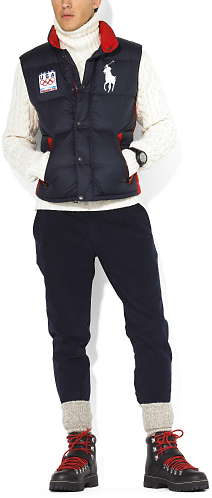 You might wonder why a polo player features so prominently on the official clothing of the 2010 Winter Olympics. Well of course, because the haberdasher au contract is Ralph Lauren, who one-upped Lacoste so many years ago when so many of the hoi polloi began sporting the little alligators that yuppies needed to differentiate themselves once again.