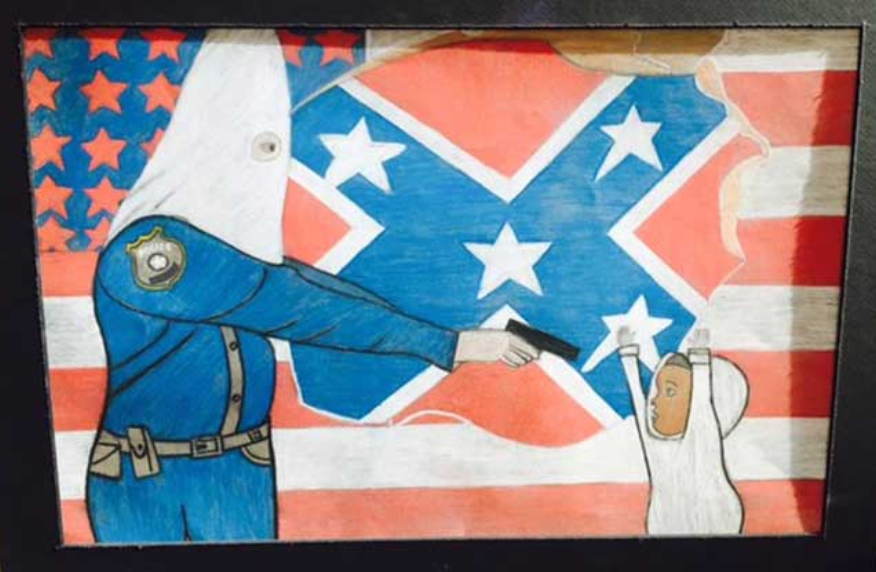
Activist Corey Donahue is free, despite supra-judicial ploys to halt his release.

Michael Corey Donahue
DENVER, COLORADO- Occupy Denver veteran Corey Donahue was released from county jail on Thursday, thwarting two surprise court filings to keep the activist in custody for additional months. Donahue had negotiated a global plea deal to serve concurrent sentences for his outstanding charges of inciting public protests in 2011 and 2012.

Yeah, those aren’t crimes, but when you’re an involuntary guest of the Denver jail, your stamina for disputing bogus accusations wanes with every bogus meal. Municipal court judges are as vindictive and perfunctory as the petty officials pressing the original charges. Engaging that crowd is not reciprocal, so it’s especially unrewarding if it means enduring protracted incarceration.

Having cleared his cases and completed the good-behavior obligations of a 9-month sentence for the nut-tap crime, Donahue was due to be released Thursday. But that morning, the Lindsey-Flanagan justice center activated an additional 2012 case which lawyers had been prevented from negotiating because the Division-3D judge withheld it from the docket. Neither private attorneys nor public defenders had been able to compel 3D to address that lingering case number. On Thursday the case mysteriously engaged…

As a result, on Thursday Denver sheriffs demanded a large cash bond and they scheduled Corey for an in-custody court appearance the next day. When funds were rushed to the bonding office, an even larger bond was imposed for a 2011 case specifically stipulated to have been dismissed by the terms of Donahue’s global plea.

Can they fucking do that? No. And yes, everyday. Municipal court despots are not accountable even to their consciences. We’ve seen Lindsey-Flanagan chief justice Martinez confabulate on the witness stand in federal court to suit his duplicitous machinations, and his minions embellished on his lead. Usually their victims, locked in the Van Cise-Simonet Detention Center across the plaza, are powerless to decline their sadism.

Clearing up this clerical error would take until after Christmas, so it seemed more in the holiday spirit to give Denver their blood money and take the courthouse to task afterward, from the relative comfort of being out of custody. WTF.

City plan to snuff socialist infiltration hearing blows up in courtroom’s face

El Paso County undercovers
COLORADO SPRINGS, COLORADO– If you attended today’s evidentiary hearing about the police infiltration of a local student group, you are no doubt left wondering what happened. Where were the defendants and why was the judge so angry? The outcome was not what either side wanted, but still it was a huge false step for the city. The defense was not provided the police witnesses it requested, but the prosecution was prevented from quashing those subpoenas outright. As a truant co-defendant, I had a unique vantage point on today’s anticlimax and I apologize I was unable to explain it in person.

Today’s hearing, it turns out, was supposed to exclude the defendants. The review of evidence relating to the police infiltration operation was intended to happen outside of public view. The lawyers signed the setting slips, not the defendants, who were kept uninformed of the October 17 hearing. The judge had specified lawyers only, to keep the details and identities of the undercovers confidential.

Can courts exclude defendants from their own hearings? Not really, but anyway.

It turns out the judge wanted privacy because she had no intention of conducting the hearing at all. Without an audience to offend, this judge planned to summarily quash the defense motions to make police administrators testify and that would be the end of it. Objections be damned, let the lawyers take it up on appeal. Push this hot potato off a year or two.

However, through documents obtained directly from the courthouse, the defendants did learn about the hearing. So the defendants made plans to attend the hearing regardless of a judge’s preferences, and they publicized the event for what it promised to be, a scandalous exposé of CSPD intelligence overreach. Subpoenaed to testify were El Paso County Sheriff Bill Elder, Colorado Springs Police Chief Peter Carey, Lieutenant Mark Comte of the CSPD Intelligence Divison, and Sergeant Clayton Blackwell, among others.

Colorado Springs prosecutors did not inform the defense team that they had no intention of honoring those subpoenas. Instead they planned to motion to quash the subpoenas and truncate the hearing. The city attorneys did not file those motions beforehand nor give the defense any indication they were contesting the subpoenas.

I can only surmise that the city prosecutors began receiving calls from the media about the anticipated testimony of the sheriff and chief of police, because it wasn’t until late morning on the day of the hearing, after our press release went out, that the city emailed the defense team to say that “Sgt Blackwell is on vacation.” Blackwell wouldn’t be attending the hearing, they said, and by the way, his was the only subpoena delivered.

To which I imagine our legal team said: WTF?! Now we needed a hearing to learn why the city thought it could unilaterally decide to whom to deliver our subpoenas.

It’s one thing to disrespect the rights of defendants. Our municipal court does it ALL THE TIME. Everyday, sadly. In fact, it’s done it repeatedly to the very defendants in this case, before we got lawyers. But it’s quite another thing to trample on our rights when a civil rights attorney is involved.

If Blackwell was on vacation, the case needed a continuance. And if subpoenas were going to be quashed, we needed a motions hearing. Oddly, the judge was demanding our defense attorneys show up in person. To arrange a continuance?! Riiiiiight.

Our lawyers quickly let us know there was to be no hearing. Since the defendants weren’t supposed to attend today’s hearing anyway, we deemed it prudent not to attend the prosecution’s switcheroo. Without defendants, whatever the prosecution planned couldn’t proceed. Meanwhile the defense lawyers weren’t going to abide a Podunk Springs Judge Roy Bean throwing the law book out the window. If subpoenas aren’t going to be honored, you have to present the legal basis beforehand. Them’s the rules, Hayseeds.

So the courtroom audience, including journalists and media crews who had to leave their television cameras outside, were left to witness a Colorado Springs judge fuming at being out-thunk. The defense lawyers weren’t there to let her quash away with her gavel, without regard for the Colorado Rules of Proceedure, and the judge’s original scheme excluded the defendants so as a result there were no defendants present to accept her rulings. The judge could do nothing but seethe and lecture the audience about big lawyers disrespecting municipal courts. Nevermind that our courts are corrupt mechanisms that trample rights for breakfast. (The ACLU recently released a report damning Alamosa’s city courts: Justice Derailed. Believe me, the identical abuses of power occur in Colorado Springs.)

Nevermind too, what today’s court hearing was supposed to be about: Outrageous Conduct on the part of CSPD and EPCSO, and violations of the Code of Federal Conduct. Today’s defendants were arrested on March 26, 2017, but not for walking in the street. The socialists were arrested because the Intelligence Division wanted to “arrest” an undercover officer, maybe two, in order to give them deeper cover as they infiltrated a student-led group just formed in Colorado Springs. The CSPD body-cam video released to the defendants already proves this. We wanted the decision makers responsible to explain it.

Instead of a comedy of errors spotlighting local law enforcement ignoring the people’s Bill of Rights, the courtroom audience today saw another facet of our corrupt judicial system. They witnessed a judge prepared to ride roughshod over further rights that protect citizens from authoritarian zeal. You may not care how police abuse “socialists” but the whims of a municipal court despot affect everyone caught in their dragnet, be it a ticket or a zoning dispute. Even with an expensive lawyer, you are powerless to object when a judge pretends there are no rules.

What the judge saw today was a courtroom filled with supporters of the defendants and a media interested in their story. She saw that she and her gavel are not going to make this story go away.

Why should you attend the Denver Nalty-Byfield ENTERPRISE TRIAL?

Why support the “We The People” public-oath sticklers who the state is prosecuting like a criminal enterprise? A few reasons: Solidarity. Because as hardheaded as they might be, defendants Stephen Nalty and Steve Byfield are still JUDICIAL REFORM ACTIVISTS. Sense of fair play. Half the courtroom gallery is filled with Colorado Attorney General staffers and FBI special agents chumming it up with jurors and briefing their THREE FBI UNDERCOVER WITNESSES while the defendant pariah side of the audience is warned by the judge that even a whisper will result in ejection. Thrills. Where else are you going to see this many federal agents pushing their weight around, barking at you in the hallways, swaggering gleefully about how much smarter they are than the defendants? Pathos. Come watch the Assistant Fucking Colorado Attorney General, Robert Shapiro himself, lead a team of prosecutors against the unrepresented defendants, watch Shapiro belittle them, lecture them, trivialize their difficulties defending themselves in jail, and pretend they can review “tens of thousands” of pages of evidence and “hours and hours” of undercover surveillance tapes in a single day. Because you can make a difference. Come push the FBI-guys’ buttons. Come witness and document the abuses of the overbearing prosecution team. Come lend public pressure on the judge, whose conscience is already bothering him about how unfair this sham trial has become.

Liens
You don’t have to agree with how Nalty and Byfield went about trying to reform the judicial system, but aren’t they mostly right? Judges ARE corrupt. Local officials ARE NOT accountable to the people. Law enforcement WON’T pursue charges of their own corruption and the media certainly won’t side with the reformers. When Nalty, Byfield and Co, served commercial liens valued at billions and trillions of dollar against officials who hadn’t filed oaths of office, it was an effort of last resort to get someone’s attention. No one was thinking, hey, maybe this eleven-figure dollar demand will slip through the cracks and the billions will be ours!

Each lien was calculated to represent the sum defrauded from and owed to the American People. Prosecutors can tap these defendants for conspiring and racketeering and extorting and attempting to influence public officials, but they can’t say the defendants aimed to obscond with one single penny. Throwing three undercover infiltrators at a twenty member judicial reform group, putting thousands of manpower hours into locking these defendants away, is gross abuse of authority and it’s hubris.

Authentic transgressions
As the sham trial goes on, the pieces are coming together on the cases of Nalty and crew. It turns out federal investigators labeled them “sovereigns” because they’ve held themselves not responsible for paying traffic tickets, property taxes, and the like. In the end I’ll grant you Nalty’s group may be guilty of those. I say “may” because such citations may have been retaliatory for their political beliefs.

As to the punishment, I believe adjudicators should take into account that the defendants acted not to enrich themselves, nor to flaunt the law per se, but to assert political rights about which they may have been misguided. Again I say may because the defendants are being tried, after all, according to a set of laws, which enforce a social contract, the terms of which the parties do not agree.

I use the word misguided as a nod to those who think the Nalty gang have acted like idiots. That’s easy to say, and easy to laugh, but no one’s yet figured out how to emancipate labor from the yoke of capital. You may regard interest and rent as your inherent debts. These sovereigns don’t and they’re trying to say so.

Economic slavery
Ours is a system of peonage to which this crew feels they never indentured themselves. The ersatz writs and liens they spammed to every official they encountered were the legal loopholes they thought could break the bank and liberate everyone from financial tyranny. While Nalty’s scheme intended insurrection, it wasn’t against democracy or the republic, it was against taxation without representation, the same beast Americans pretend to have overthrown with the Declaration of Independance.

Instead of tea into Boston Harbor, this crew dumped a bunch of junk paper unto the reception counters of Colorado public offices. Charge Nalty’s crew with littering maybe, at most, vandalism, though it’s hard to say these vandals caused even a scratch. Every public official who testified as a victim said they didn’t take the ersatz documents seriously.

The writs and liens looked officious, but weren’t attributed to known government or banking institutions. Likewise signatures were signed in red. Red was chosen to represent the signer’s blood, even though red is a color which automated banking systems reject as unreadable, therefore invalid.

Not one witness expressed confusion about the validity of the papers. They mentioned too the rambling diatribes in the text block.

To call the defendants “paper terrorists” wildly overstates the effect they achieved. They didn’t terrorize anyone. Governments like to accuse rebellious insurgents of “terrorism”, but that’s another paralegal threshold with which most common citizens, and certainly these “sovereigns”, disagree.

Real funny money
These guys did the equivalent of feed Monopoly Money into ATMs. No bank balances were changed and no real money came out. Counterfeit currency is one thing, but denominations of your own handywork pretending to be only that does not qualify as funny money in the illegal sense. I’m guessing forms submitted in a language foreign to bank clerks would be rejected out of hand. How are these any different? Irregular submissions, as one witness called them, need not generate calls to the FBI or the Colorado Joint Terrorism Task Force. I’ll bet that ATMs know to reject Monopoly Money. If they don’t, whose problem is that?

The trial of defendants Stephen Nalty and Steve Byfield is due to wrap up Friday. The prosecution will have taken seven days to present its case and Assistant Attorney General Robert Shapiro intends to object if the defense rebuttal takes more than a half day, maybe a whole. This trial is meant to intimidate the other defendants to convince them to take pleas.

Next in the pipeline is Bruce Doucette whose trial starts October 16. Defendants Harlan Smith and Dave Coffelt have hearings on October 18. If they do not take deals, Shapiro intends to enjoin their cases, to save time and money. He’s already convinced defendant Brian Baylog to take a deal and turn state’s evidence. Baylog is scheduled to testify against Nalty and Byfield shortly.

By now the condemnation of Nalty’s commercial lien scheme will have cost Colorado millions in man hours and legal expenses. You can fine a graffiti artist for having to restore an edifice to its original lustre, but you can’t expect him to bear the full cost if you chose a cleanup crew that wears Gucci loafers, most of whose jobs is to pat the other on the back.

Colorado’s overkill with federal agents and counter-terrorism experts is a problem of its own making.

The Nalty-Byfield trial continues through this week 8:30am – 5pm, at Denver’s Lindsey Flanigan Courthouse, in Division 2H, ironically, “Juvenile Court”.

Last cruise of pirate chasers Juergen Kantner and Sabine Merz, a geography

Lapu-Lapu beats Magellan
There’s something fishy about the story of German sailor Juergen Gustav Kantner, whose beheading video was just released by Abu Sayyaf rebels (ASG). Apparently Kantner, 70, had been kidnapped by Somali pirates before this. What are the chances, considering all the gin joints and circumnavigators these days? In a further coincidence, the umpteen sensational articles are all short on details, including the dead woman found on Kantner’s boat, her identity discarded by even the media. Why? Her name was Sabine Isne Merz, 59, sometimes cited as Sabina Wetch. She and husband Kantner were ransomed in Somalia in August 2008 after 52 days in captivity. This time Merz’s body was found aboard the Bermuda-rigged “Rockall”, but a whole Sulu Sea away from where the couple was allegedly captured.

I’d like to lay out the geography of what’s been revealed so far, so emerging facts will more easily shake themselves out online.

According to the ASG, the Germans were seized in November 2016 while sailing on Tanjong Luok Pisuk (spelled Luuk in media reports), an inlet on the Northwest coast of Borneo, in the state of Sabah, Malaysia. Then, halfway down Sabah, Merz was purportedly killed in a shootout with her captors off Tawi-Tawi Isand in the Pangutaran province of Western Mindanao, the Philippines. Her body was found beside a shotgun on the Rockall, abandoned off Laparan Island in Sulu province. Some reports say the sailboat was moored, some say adrift. Though Tawi-Tawi and Sulu belong to the Philippines, they are governed by the Autonomous Region of Muslim Mindanao (ARMM), from which today’s gruesome video is thought to originate.

Juergen Kantner met his end at the edge of a curved blade wielded by Muslim rebels in the Philippines’ long contested province of Mindanao. A nearby indigenous resistance in Cebu, under the leadership of Lapu-Lapu five hundred years ago, stopped explorer Ferdinand Magellan halfway round the circumnavigation for which he’s given credit because on a previous trip he’d come around from the other direction to “discover” the Malay Archipelago. By coincidence, Kanter and Merz almost bridged the gap.

Colo. US District Court judge enjoins DIA to limit restriction of free speech (grants our preliminary injunction!)

Plaintiffs Nazli McDonnell and Eric Verlo
DENVER, COLORADO- If your civil liberties have ever been violated by a cop, over your objections, only to have the officer say “See you in court”, this victory is for YOU! On January 29 we were threatened with arrest for protesting the “Muslim Ban” at Denver International Airport. We argued that our conduct was protected speech and that they were violating our rights. They dismissed our complaints with, in essense: “That’s for a court to decide.” And today IT HAS! On Feb 15 we summoned the cops to federal court and this morning, Feb 22, US District Court Judge William Martinez granted our preliminary injunction, severely triming DIA’s protest permit process. In a nutshell: no restrictions on signs, size of assemblies or their location within the main terminal (so long as the airport’s function is not impeded). Permits are still required but with 24 hours advance notice, not seven days. Below is Judge Martinez’ 46-page court order in full:

Document 29 Filed 02/22/17 USDC Colorado

IN THE UNITED STATES DISTRICT COURT
FOR THE DISTRICT OF COLORADO

Judge William J. Martínez

Civil Action No. 17-cv-0332-WJM-MJW

NAZLI MCDONNELL, and
ERIC VERLO,

Plaintiffs,

v.

CITY AND COUNTY OF DENVER,?
DENVER POLICE COMMANDER ANTONIO LOPEZ,
in his individual and official capacity, and?
DENVER POLICE SERGEANT VIRGINIA QUIÑONES,
in her individual and official capacity,

Defendants.

________________________________________________________

ORDER GRANTING PRELIMINARY INJUNCTION IN PART
________________________________________________________

Plaintiffs Nazli McDonnell (“McDonnell”) and Eric Verlo (“Verlo”) (together, “Plaintiffs”) sue the City and County of Denver (“Denver”), Denver Police Commander Antonio Lopez (“Lopez”) and Denver Police Sergeant Virginia Quiñones (“Quiñones”) (collectively, “Defendants”) for allegedly violating Plaintiffs’ First and Fourteenth Amendment rights when they prevented Plaintiffs from protesting without a permit in the Jeppesen Terminal at Denver International Airport (“Airport” or “Denver Airport”). (ECF No. 1.) Currently before the Court is Plaintiffs’ Motion for Preliminary Injunction, which seeks to enjoin Denver from enforcing some of its policies regarding demonstrations and protests at the Airport. (ECF No. 2.) This motion has been fully briefed (see ECF Nos. 2, 20, 21, 23) and the Court held an evidentiary hearing on February 15, 2017 (“Preliminary Injunction Hearing”).

For the reasons explained below, Plaintiffs’ Motion is granted to the following limited extent:

• Defendants must issue an expressive activity permit on twenty-four hours’ notice in circumstances where an applicant, in good faith, seeks a permit for the purpose of communicating topical ideas reasonably relevant to the purposes and mission of the Airport, the immediate importance of which could not have been foreseen seven days or more in advance of the commencement of the activity for which the permit is sought, or when circumstances beyond the control of the permit applicant prevented timely filing of the application; ?

• Defendants must make all reasonable efforts to accommodate the applicant’s preferred demonstration location, whether inside or outside of the Jeppesen Terminal, so long as the location is a place where the unticketed public is normally allowed to be; ?

• Defendants may not enforce Denver Airport Regulation 50.09’s prohibition against “picketing” (as that term is defined in Denver Airport Regulation 50.02-8) within the Jeppesen Terminal; and ?

• Defendants may not restrict the size of a permit applicant’s proposed signage beyond that which may be reasonably required to prevent the impeding of the normal flow of travelers and visitors in and out of Jeppesen Terminal; and specifically, Defendants may not enforce Denver Airport Regulation 50.08-12’s requirement that signs or placards be no larger than one foot by one foot. ??

Any relief Plaintiffs seek beyond the foregoing is denied at this phase of the case. In particular, the Court will not require the Airport to accommodate truly spontaneous demonstrations (although the Airport remains free to do so); the Court will not require the Airport to allow demonstrators to unilaterally determine the location within the Jeppesen Terminal that they wish to demonstrate; and the Court will not strike down the Airport’s usual seven-day notice-and-permit requirement as unconstitutional in all circumstances.

I. FINDINGS OF FACT

Based on the parties’ filings, and on the documentary and testimonial evidence received at the evidentiary hearing, the Court makes the following findings of fact for purposes of resolving Plaintiffs’ Motion.?

A. Regulation 50

Pursuant to Denver Municipal Code § 5-16(a), Denver’s manager of aviation may “adopt rules and regulations for the management, operation and control of [the] Denver Municipal Airport System, and for the use and occupancy, management, control, operation, care, repair and maintenance of all structures and facilities thereon, and all land on which [the] Denver Municipal Airport System is located and operated.” Under that authority, the manager of aviation has adopted “Rules and Regulations for the Management, Operation, Control, and Use of the Denver Municipal Airport System.” See https://www.flydenver.com/about/administration/rules_regulations (last accessed Feb. 16, 2017). Part 50 of those rules and regulations governs picketing, protesting, soliciting, and similar activities at the Airport. See https://www.flydenver.com/sites/default/files/rules/50_leafleting.pdf (last accessed Feb. 16, 2017). The Court will refer to Part 50 collectively as “Regulation 50.”

The following subdivisions of Regulation 50 are relevant to the parties’ current dispute:

Regulation 50.03: “No person or organization shall leaflet, conduct surveys, display signs, gather signatures, solicit funds, or engage in other speech related activity at Denver International Airport for religious, charitable, or political purposes, or in connection with a labor dispute, except pursuant to, and in compliance with, a permit for such activity issued by the CEO [of the Airport] or his or her designee. . . .” ?

Regulation 50.04-1: “Any person or organization desiring to leaflet, display signs, gather signatures, solicit funds, or engage in other speech related activity at Denver International Airport for religious, charitable, or political purposes, or in connection with a labor dispute, shall complete a permit application and submit it during regular business hours, at least seven (7) days prior to the commencement of the activity for which the permit is sought and no earlier than thirty (30) days prior to commencement of the activity. The permit application shall be submitted using the form provided by the Airport. The applicant shall provide the name and address of the person in charge of the activity, the names of the persons engaged in the activity, the nature of the activity, each location at which the activity is proposed to be conducted, the purpose of the activity, the hours during which the activity is proposed to be conducted, and the beginning and end dates of such activity. A labor organization shall also identify the employer who is the target of the proposed activity.”

Regulation 50.04-3: “Upon presentation of a complete permit application ?and all required documentation, the CEO shall issue a permit to the applicant, if there is space available in the Terminal, applying only the limitations and regulations set forth in this Rule and Regulation . . . . Permits shall be issued on a first come-first served basis. No permits shall be issued by the CEO for a period of time in excess of thirty-one (31) days.” ?

Regulation 50.04-5: “In issuing permits or allocating space, the CEO shall not exercise any discretion or judgment regarding the purpose or content of the proposed activity, except as provided in these Rules and Regulations. The issuance of a permit is a strictly ministerial function and does not constitute an endorsement by the City and County of Denver of any organization, cause, religion, political issue, or other matter.” ?

Regulation 50.04-6: “The CEO may move expressive activity from one location to another and/or disperse such activity around the airport upon reasonable notice to each affected person when in the judgment of the CEO such action is necessary for the efficient and effective operation of the transportation function of the airport.” ?

Regulation 50.08-12: “Individuals and organizations engaged in leafleting, solicitation, picketing, or other speech related activity shall not: * * * [w]ear or carry a sign or placard larger than one foot by one foot in size . . . .” (underscoring in original).

Regulation 50.09: “Picketing not related to a labor dispute is prohibited in ?all interior areas of the Terminal and concourses, in the Restricted Area, and on all vehicular roadways, and shall not be conducted by more than two (2) persons at any one location upon the Airport.” ?

Regulation 50.02-8: “Picketing shall mean one or more persons marching or stationing themselves in an area in order to communicate their position on a political, charitable, or religious issue, or a labor dispute, by displaying one or more signs, posters or similar devices” (underscoring in original).

The Airport receives about forty-five permit requests a year. No witness at the Preliminary Injunction Hearing (including Airport administrators who directly or indirectly supervise the permit process) could remember an instance in which a permit had been denied.

?Although there is no formal written, prescribed procedure for requesting expedited treatment of permit requests, the Airport not infrequently processes such requests and issues permits in less than seven days. Last November, less than seven days before Election Day, the Airport received a request from “the International Machinists” 1 to stage a demonstration ahead of the election. The Airport was able to process that request in two days and thereby permit the demonstration before Election Day.
?
——————————
1 Presumably, the International Association of Machinists and Aerospace Workers. ?
———————

B. The Executive Order

On Friday, January 27, 2017, President Trump signed Executive Order 13769 (“Executive Order”). See 82 Fed. Reg. 8977. The Executive Order, among other things, established a 90-day ban on individuals from seven Muslim-majority countries from entering the United States, a 120-day suspension of all refugee admissions, and an indefinite suspension of refugee admissions from Syria. Id. §§ 3(c), 5(a), 5(c). “The impact of the Executive Order was immediate and widespread. It was reported that thousands of visas were immediately canceled, hundreds of travelers with such visas were prevented from boarding airplanes bound for the United States or denied entry on arrival, and some travelers were detained.” Washington v. Trump, ___ F.3d. ___, ___, 2017 WL 526497, at *2 (9th Cir. Feb. 9, 2017). As is well known, demonstrators and attorneys quickly began to assemble at certain American airports, both to protest the Executive Order and potentially to offer assistance to travelers being detained upon arrival.?

C. The January 28 Protest at the Denver Airport

Shortly after 1:00 p.m. on the following day—Saturday, January 28, 2017— Airport public information officer Heath Montgomery e-mailed Defendant Lopez, the police commander responsible for Denver’s police district encompassing the Airport. Lopez was off-duty at the time. Montgomery informed Lopez that he had received media inquiries about a protest being planned for the Airport later that day, and that no Regulation 50 permit had been issued for such a protest.

Not knowing any details about the nature or potential size of the protest, and fearing the possibility of “black bloc” and so-called “anarchist activities,” Lopez coordinated with other Denver Police officials to redeploy Denver Police’s gang unit from their normal assignments to the Airport. Denver Police also took uniformed officers out of each of the various other police districts and redeployed them to the Airport. Lopez called for these reinforcements immediately in light of the Airport’s significant distance from any other police station or normal patrol area. Lopez knew that if an unsafe situation developed, he could not rely on additional officers being able to get to the Airport quickly.

Through his efforts, Lopez was eventually able to assemble a force of about fifty officers over “the footprint of the entire airport,” meaning inclusive of all officers already assigned to the Airport who remained on their normal patrol duties. Lopez himself also came out to the Airport.

In the meantime, Montgomery had somehow learned of an organization known as the Colorado Muslim Connection that was organizing protesters through Facebook. Montgomery reached out to this organization through the Airport’s own Facebook account and informed them of Regulation 50’s permit requirement. (Ex. 32.) One of the Colorado Muslim Connection’s principals, Nadeen Ibrahim, then e-mailed Montgomery “to address the permit.” (Ex. 30.) Ibrahim told Montgomery:

The group of people we have will have a peaceful assembly carrying signs saying welcome here along with a choir and lots of flowers. Our goal is to stand in solidarity with our community members that have been detained at the airports since the signing of the executive order, though they do have active, legal visas/green cards. Additionally, we would like to show our physical welcoming presence for any newly arriving Middle Eastern sisters and brothers with visas. We do not intend to block any access to [the Airport].

(Id.) Montgomery apparently did not construe this e-mail as a permit request, or at least not a properly prepared one, and stated that “Denver Police will not allow a protest at the airport tonight. We are willing to work with you like any other group but there is a formal process for that.” (Id.)

Nonetheless, protesters began to assemble in the late afternoon and early evening in the Airport’s Jeppesen Terminal, specifically in the multi-storied central area known as the “Great Hall.” The Great Hall is a very large, rectangular area that runs north and south. The lower level of the Great Hall (level 5) has an enormous amount of floor space, and is ringed with offices and some retail shops, but the floor space itself is largely taken up by security screening facilities for departing passengers. The only relatively unobstructed area on level 5 is the middle third, which is currently designed primarily as a location for “meeters-and-greeters,” i.e., individuals waiting for passengers arriving from domestic flights who come up from the underground train connecting the Jeppesen Terminal with the various concourses. There is a much smaller meeters-and-greeters waiting area at the north end of level 5, where international arrivals exit from customs screening.

The upper level of the Great Hall (level 6) has much less floor space than level 5 given that it is mostly open to level 5 below. It is ringed with retail shops and restaurants. At its north end is a pedestrian bridge to and from the “A” concourse and its separate security screening area.

Given this design, every arriving and departing passenger at the Airport (i.e., all passengers except those only connecting through Denver), and nearly every other person having business at the airport (including employees, delivery persons, meeters-and-greeters, etc.), must pass through some portion of the Great Hall. In 2016, the Airport served 58.3 million passengers, making it the sixth busiest airport in the United States and the eighteenth busiest in the world. Approximately 36,000 people also work at the airport.

The protesters who arrived on the evening of January 28 largely congregated in the middle third of the Great Hall (the domestic-arrivals meeter-and-greeter area). The protesters engaged in singing, chanting, praying, and holding up signs. At least one of them had a megaphone.

The size of the protest at its height is unclear. The witnesses at the evidentiary hearing gave varying estimates ranging from as low as 150 to as high as 1,000. Most estimates, however, centered in the range of about 200. Lopez, who believed that the protest eventually comprised about 300 individuals, did not believe that his fifty officers throughout the Airport were enough to ensure safety and security for that size of protest, even if he could pull all of his officers away from their normal duties.

Most of the details of the January 28 protest are not relevant for present purposes. Suffice it to say that Lopez eventually approached those who appeared to be the protest organizers and warned them multiple times that they could be arrested if they continued to protest without a permit. Airport administration later agreed to allow the protest to continue on “the plaza,” an area just outside the Jeppesen Terminal to its south, between the Terminal itself and the Westin Hotel. Protesters then moved to that location, and the protest dispersed later in the evening. No one was arrested and no illegal activity stemming from the protest (e.g., property damage) was reported, nor was there any report of disruption to travel operations or any impeding of the normal flow of travelers and visitors in and out of Jeppesen Terminal.

D. The January 29 Protest at the Denver Airport

Plaintiffs disagree strongly with the Executive Order and likewise wished to protest it, but, due to their schedules, were unable to participate in the January 28 protest. They decided instead to go to the Airport on the following day, Sunday, January 29. They came that afternoon and stationed themselves at a physical barrier just outside the international arrival doors at the north end of the Great Hall, level 5. They each held up a sign of roughly poster board size expressing a message of opposition to the Executive Order and solidarity with those affected by it. (See Exs. 2, 4, M.)

Plaintiffs were soon approached by Defendant Quiñones, who warned them that they could be arrested for demonstrating without a permit. Plaintiffs felt threatened, as well as disheartened that they could not freely exercise their First Amendment rights then and there. Plaintiffs felt it was important to be demonstrating both at that particular time, given the broad news coverage of the effects of the Executive Order, and at that particular place (the international arrivals area), given a desire to express solidarity with those arriving directly from international destinations—whom Plaintiffs apparently assumed would be most likely to be affected by the Executive Order in some way.

Plaintiffs left the Airport later that day without being arrested, and without incident. They have never returned to continue their protest, nor have they applied for a permit to do so.

E. Permits Since Issued

The airport has since issued permits to demonstrators opposed to the Executive Order. At least one of these permits includes permission for four people to demonstrate in the international arrivals area, where Plaintiffs demonstrated on January 29.

II. REQUESTED INJUNCTION

Plaintiffs have never proposed specific injunction language. In their Motion, they asked for “an injunction prohibiting their arrest for standing in peaceful protest within Jeppesen Terminal and invalidating Regulation 50 as violative of the First and Fourteenth Amendments to the United States Constitution.” (ECF No. 2 at 4.) At the Preliminary Injunction Hearing, Plaintiffs’ counsel asked the Court to enjoin Defendants (1) “from arresting people for engaging in behavior that the plaintiffs or people similarly situated were engaging in,” (2) from enforcing Regulation 50.09 (which forbids non- labor demonstrators from holding up signs within the Jeppesen Terminal), and (3) from administering Regulation 50 without an “exigent circumstances exception.” Counsel also argued that requiring a permit application seven days ahead of time is unconstitutionally long in any circumstance, exigent or not.

III. LEGAL STANDARD

A. The Various Standards

In a sense, there are at least three preliminary injunction standards. The first, typically-quoted standard requires: (1) a likelihood of success on the merits, (2) a threat of irreparable harm, which (3) outweighs any harm to the non-moving party, and (4) that the injunction would not adversely affect the public interest. See, e.g., Awad v. Ziriax, 670 F.3d 1111, 1125 (10th Cir. 2012).

If, however, the injunction will (1) alter the status quo, (2) mandate action by the defendant, or (3) afford the movant all the relief that it could recover at the conclusion of a full trial on the merits, a second standard comes into play, one in which the movant must meet a heightened burden. See O Centro Espirita Beneficiente Uniao do Vegetal v. Ashcroft, 389 F.3d 973, 975 (10th Cir. 2004) (en banc). Specifically, the proposed injunction “must be more closely scrutinized to assure that the exigencies of the case support the granting of a remedy that is extraordinary even in the normal course” and “a party seeking such an injunction must make a strong showing both with regard to the likelihood of success on the merits and with regard to the balance of harms.” Id.

On the other hand, the Tenth Circuit also approves of a

modified . . . preliminary injunction test when the moving party demonstrates that the [irreparable harm], [balance of harms], and [public interest] factors tip strongly in its favor. In such situations, the moving party may meet the requirement for showing [likelihood of] success on the merits by showing that questions going to the merits are so serious, substantial, difficult, and doubtful as to make the issue ripe for litigation and deserving of more deliberate investigation.

Verlo v. Martinez, 820 F.3d 1113, 1128 n.5 (10th Cir. 2016). This standard, in other words, permits a weaker showing on likelihood of success when the party’s showing on the other factors is strong. It is not clear how this standard would apply if the second standard also applies.

In any event, “a preliminary injunction is an extraordinary remedy,” and therefore “the right to relief must be clear and unequivocal.” Greater Yellowstone Coal. v. Flowers, 321 F.3d 1250, 1256 (10th Cir. 2003).

B. Does Any Modified Standard Apply?

The status quo for preliminary injunction purposes is “the last peaceable uncontested status existing between the parties before the dispute developed.” Schrier v. Univ. of Colo., 427 F.3d 1253, 1260 (10th Cir. 2005) (internal quotation marks omitted). By asking that portions of Regulation 50 be invalidated, Plaintiffs are seeking to change the status quo. Therefore they must make a stronger-than-usual showing on likelihood of success and the balance of harms.

IV. ANALYSIS

A. Irreparable Harm as it Relates to Standing

Under the circumstances, the Court finds it appropriate to begin by discussing the irreparable harm element of the preliminary injunction test as it relates Plaintiffs’ standing to seek an injunction.

Testimony at the Preliminary Injunction Hearing revealed that certain groups wishing to protest the Executive Order have since applied for and obtained permits. Thus, Plaintiffs could get a permit to demonstrate at the airport on seven days’ advance notice—although Regulation 50.09 would still prohibit them from demonstrating by wearing or holding up signs. In addition, as discussed in more detail below (Part IV.B.3.c), Plaintiffs could potentially get a permit to hold a protest parade on public streets in the City and County of Denver with as little as 24 hours’ notice. And as far as the Court is aware, the two Plaintiffs may be able to stand on any public street corner and hold up signs without any prior notice or permit requirement. Thus, Plaintiffs’ alleged irreparable harm must be one or both of the following: (1) the prospect of not being able to demonstrate specifically at the airport on less than seven days’ notice, or (2) the inability to picket in opposition to the government action they oppose—that is, the inability to hold up “signs, posters or similar devices” while engaging in expressive activity at the airport. The Court finds that the second of these options is a fairly traditional allegation of First Amendment injury—even if they do apply for and obtain a permit, by the express terms of Regulation 50.09 Plaintiffs will not be allowed to carry or hold up signs, posters, or the like. The first option, however, requires more extensive discussion and analysis.

The rapidly developing situation that prompted Plaintiffs to go to the Airport on January 29 has since somewhat subsided. The Executive Order remains a newsworthy topic, but a nationwide injunction now prevents its enforcement, see Washington, ___ F.3d at ___, 2017 WL 526497, at *9, and—to the Court’s knowledge—none of the most urgent effects that led to airport-based protests, such as individuals being detained upon arrival, have since repeated themselves. Nonetheless, the circumstances that prompted this lawsuit reveal a number of unassailable truths about “freedom of speech . . . [and] the right of the people peaceably to assemble, and to petition the government for a redress of grievances.” U.S. Const. amend. I.

One indisputable truth is that the location of expressive activity can have singular First Amendment significance, or as the Tenth Circuit has pithily put it: “Location, location, location. It is cherished by property owners and political demonstrators alike.” Pahls v. Thomas, 718 F.3d 1210, 1216 (10th Cir. 2013). The ability to convey a message to a particular person is crucial, and that ability often turns entirely on location.

Thus, location has specifically been at issue in a number of First Amendment decisions. See, e.g., McCullen v. Coakley, 134 S. Ct. 2518, 2535 (2014) (abortion protesters’ ability to approach abortion clinic patrons within a certain distance); Pahls, 718 F.3d at 1216–17 (protesters’ ability to be in a location where the President could see them as his motorcade drove past); Citizens for Peace in Space v. City of Colo. Springs, 477 F.3d 1212, 1218–19 (10th Cir. 2007) (peace activists’ ability to be near a hotel and conference center where a NATO conference was taking place); Tucker v. City of Fairfield, 398 F.3d 457, 460 (6th Cir. 2005) (labor protesters’ ability to demonstrate outside a car dealership); Friends of Animals, Inc. v. City of Bridgeport, 833 F. Supp. 2d 205, 207–08 (D. Conn. 2011) (animal rights protesters’ ability to protest near a circus), aff’d sub nom. Zalaski v. City of Bridgeport Police Dep’t, 475 F. App’x 805 (2d Cir. 2012).

Another paramount truth is that the timing of expressive activity can also have irreplaceable First Amendment value and significance: “simple delay may permanently vitiate the expressive content of a demonstration.” NAACP, W. Region v. City of Richmond, 743 F.2d 1346, 1356 (9th Cir. 1984); see also American-Arab Anti-Discrimination Comm. v. City of Dearborn, 418 F.3d 600, 605 (6th Cir. 2005) (“Any notice period is a substantial inhibition on speech.”); Church of Am. Knights of Ku Klux Klan v. City of Gary, 334 F.3d 676, 682 (7th Cir. 2003) (“given that . . . political demonstrations are often engendered by topical events, a very long period of advance notice with no exception for spontaneous demonstrations unreasonably limits free speech”); Douglas v. Brownell, 88 F.3d 1511, 1524 (8th Cir. 1996) (“The five-day notice requirement restricts a substantial amount of speech that does not interfere with the city’s asserted goals of protecting pedestrian and vehicle traffic, and minimizing inconvenience to the public.”).

This case provides an excellent example of this phenomena given that —whether intentionally or not— the President’s announcement of his Supreme Court nomination on January 31 (four days after signing the Executive Order) permitted the President to shift the media’s attention to a different topic of national significance. Thus, the inability of demonstrators to legally “strike while the iron’s hot” mattered greatly in this instance. Cf. City of Gary, 334 F.3d at 682 (in the context of a 45-day application period for a parade, noting that “[a] group that had wanted to hold a rally to protest the U.S. invasion of Iraq and had applied for a permit from the City of Gary on the first day of the war would have found that the war had ended before the demonstration was authorized”).

These principles are not absolute, however, nor self-applying. The Court must analyze them in the specific context of the Airport. But for present purposes, the Court notes that the Plaintiffs’ alleged harm of being unable to protest at a specific location on short notice states a cognizable First Amendment claim. In addition, by its very nature, this is the sort of claim that is “capable of repetition, yet evading review.” S. Pac. Terminal Co. v. Interstate Commerce Comm’n, 219 U.S. 498, 515 (1911). Here, “the challenged action”—enforcement of the seven-day permit requirement during an event of rapidly developing significance —“was in its duration too short to be fully litigated prior to its cessation or expiration.” Weinstein v. Bradford, 423 U.S. 147, 149 (1975). Further, “there [is] a reasonable expectation that the same complaining party would be subjected to the same action again.” Id. More specifically, the Court credits Plaintiffs’ testimony that they intend to return to the Airport for future protests, and, given continuing comments by the Trump Administration that new immigration and travel- related executive orders are forthcoming, the Court agrees with Plaintiffs that it is reasonably likely a similar situation will recur —i.e., government action rapidly creating consequences relevant specifically to the Airport.

Thus, although the prospect of being unable to demonstrate at the Airport on short notice is not, literally speaking, an “irreparable harm” (because the need for such demonstration may never arise again), it is nonetheless a sufficient harm for purposes of standing and seeking a preliminary injunction.

The Court now turns to the heart of this case—whether Plaintiffs are likely to succeed on the merits of their claims. Following that, the Court will reprise the irreparable harm analysis in the specific context of the likelihood-of-success findings.

B. Likelihood of Success on the Merits

Evaluating likelihood of success requires evaluating the substantive merit of Plaintiffs’ claim that Regulation 50, or any portion of it, violates their First Amendment rights. To answer this question, the Supreme Court prescribes the following analysis:

1. Is the expression at issue protected by the First Amendment? ?

2. If so, is the location at issue a traditional public forum, a designated public ?forum, or a nonpublic forum? ?

3. If the location is a traditional or designated public forum, is the ?government’s speech restriction narrowly tailored to meet a compelling ?state interest? ?

4. If the location is a nonpublic forum, is the government’s speech restriction ? ?reasonable in light of the purpose served by the forum, and viewpoint neutral?

See Cornelius v. NAACP Legal Def. & Educ. Fund, Inc., 473 U.S. 788, 797–806 (1985).

The Court will address these inquiries in turn.

1. Does the First Amendment Protect Plaintiffs’ Expressive Conduct?

The Court “must first decide whether [the speech at issue] is speech protected by the First Amendment, for, if it is not, we need go no further.” Id. at 797. There appears to be no contest that the sorts of activities Plaintiffs attempted to engage in at the Airport (including holding up signs) are expressive endeavors protected by the First Amendment. Accordingly, the Court deems it conceded for preliminary injunction purposes that Plaintiffs are likely to succeed on this element of the Cornelius analysis.

2. Is the Jeppesen Terminal a Public Forum (Traditional or Designated)?

The Court must next decide whether the Jeppesen Terminal is a public forum:

. . . the extent to which the Government can control access [to government property for expressive purposes] depends on the nature of the relevant forum. Because a principal purpose of traditional public fora is the free exchange of ideas, speakers can be excluded from a public forum only when the exclusion is necessary to serve a compelling state interest and the exclusion is narrowly drawn to achieve that interest. Similarly, when the Government has intentionally designated a place or means of communication as a public forum[,] speakers cannot be excluded without a compelling governmental interest. Access to a nonpublic forum, however, can be restricted as long as the restrictions are reasonable and are not an effort to suppress expression merely because public officials oppose the speaker’s view.

Id. at 800 (citations and internal quotation marks omitted; alterations incorporated).

a. Is the Jeppesen Terminal a Traditional Public Forum??

Plaintiffs claim that “[t]he Supreme Court has not definitively decided whether airport terminals . . . are public forums.” (ECF No. 2 at 7.) This is either an intentional misstatement or a difficult-to-understand misreading of the most relevant case (which Plaintiffs repeatedly cite), International Society for Krishna Consciousness, Inc. v. Lee, 505 U.S. 672, 679 (1992) (“Lee”).

The plaintiffs in Lee were disseminating religious literature and soliciting funds at the airports controlled by the Port Authority of New York and New Jersey (JFK, LaGuardia, and Newark). Id. at 674–75. By regulation, however, the Port Authority prohibited “continuous or repetitive” person-to-person solicitation and distribution of literature. Id. at 675–76. The Second Circuit held that the airports were not public fora and that the regulation was reasonable as to solicitation but not as to distribution. Id. at 677. The dispute then went to the Supreme Court, which granted certiorari specifically “to resolve whether airport terminals are public fora,” among other questions. Id.

The Court answered the public forum question in the negative. Relying on the historical use of airport terminals generally, the Court found that “the tradition of airport activity does not demonstrate that airports have historically been made available for speech activity.” Id. at 680. “Nor can we say,” the Court continued, “that these particular terminals, or airport terminals generally, have been intentionally opened by their operators to such activity; the frequent and continuing litigation evidencing the operators’ objections belies any such claim.” Id. at 680–81. Then, invoking the reasonableness test that applies to government regulation of nonpublic fora, the Court affirmed the Second Circuit’s holding that the solicitation ban was reasonable. Id. at 683–85.

Five justices (Rehnquist, White, O’Connor, Scalia, and Thomas) joined all of the major rulings regarding the solicitation ban, including the nonpublic forum status of airport terminals and the reasonableness of the ban. The outcome regarding the distribution ban, however, commanded no majority opinion. Justice O’Connor, applying the reasonableness standard for nonpublic fora, agreed with the Second Circuit that the distribution ban was not reasonable. Id. at 690–93 (opn. of O’Connor, J.). Justice Kennedy, joined in relevant part by Justices Blackmun, Stevens, and Souter, agreed that the Second Circuit’s judgment regarding the distribution ban should be affirmed, but on different grounds, namely, under a strict scrutiny test (because these justices believed that the airport terminals should be deemed a public forum). Id. at 708–10 (opn. of Kennedy, J.). The result was that the Second Circuit’s invalidation of the distribution ban was affirmed without any opinion commanding a majority view.

Regardless of the outcome with respect to the distribution ban, it is beyond debate that five Supreme Court justices in Lee agreed that airport terminals are not public fora. Id. at 680–81. The Tenth Circuit has acknowledged this holding. Mocek v. City of Albuquerque, 813 F.3d 912, 930 (10th Cir. 2015) (“As an initial matter, an airport is a nonpublic forum, where restrictions on expressive activity need only ‘satisfy a requirement of reasonableness.’” (quoting Lee, 505 U.S. at 683)). Notably, Plaintiffs have cited no case in which any court anywhere has deemed an airport to be a public forum.

b. Is the Jeppesen Terminal a Designated Public Forum??

Even though the Jeppesen Terminal is not a traditional public forum, Denver could still designate it as a public forum if Denver “intentionally [opens the Jeppesen Terminal] for public discourse.” Cornelius, 473 U.S. at 802. Denver denies that it has done so, and Plaintiffs’ arguments to the contrary lack merit.

i. Terminal Visitors’ Incidental Expressive Activities

Plaintiffs argue that visitors to the Jeppesen Terminal “engage in First Amendment activity; they wear buttons, shirts, and hats that convey distinct messages to other visitors. They engage in one-on-one conversations.” (ECF No. 21 at 3.) Thus, Plaintiffs say, Denver has designated a public forum within the Jeppesen Terminal.

The Tenth Circuit has already foreclosed this argument. Addressing the public forum status of the Denver Performing Arts Complex, the Court stated the following: “Even if Denver allowed patrons to wear political buttons or shirts with slogans, this would not be sufficient to establish a designated public forum. The First Amendment does not require the government to impose a ‘zone of silence’ on its property to maintain its character as a nonpublic forum.” Hawkins v. City & Cnty. of Denver, 170 F.3d 1281, 1288 (10th Cir. 1999).

Indeed, even if it wanted to, Denver almost certainly could not impose such a “zone of silence,” as illustrated by Board of Airport Commissioners of City of Los Angeles v. Jews for Jesus, Inc., 482 U.S. 569 (1987). There, the Los Angeles airport authority adopted a resolution announcing that “the Central Terminal Area at Los Angeles International Airport [LAX] is not open for First Amendment activities.” Id. at 570–71 (internal quotation marks omitted). The Supreme Court found that this provision did not “merely reach the activity of [the religious proselytizers who challenged it],” but also prohibited

even talking and reading, or the wearing of campaign buttons or symbolic clothing. Under such a sweeping ban, virtually every individual who enters LAX may be found to violate the resolution by engaging in some “First Amendment activit[y].” We think it obvious that such a ban cannot be justified even if LAX were a nonpublic forum because no conceivable governmental interest would justify such an absolute prohibition of speech.

Id. at 574–75. Thus, the evidence at the Preliminary Injunction Hearing established beyond any possible dispute that Denver has shown no intent to designate the Airport as a public forum by allowing speech at that location which it may not disallow in the first instance.

ii. The Effect of Regulation 50 Itself?

Plaintiffs further argue, “Regulation 50 states that free speech activity is proper in the Jeppesen Terminal (pursuant to a restriction). Denver has [thus] designated the Jeppesen Terminal a public forum for leafleting, conducting surveys, displaying signs, gathering signatures, soliciting funds, and other speech related activity for religious, charitable, or political purposes.” (ECF No. 21 at 3–4.) Although clever, this argument cannot be correct. 2

First, the Airport knows from the Supreme Court’s Jews for Jesus decision, just discussed, that it cannot prohibit all behavior that can be characterized as First Amendment-protected expressive activity.

Second, the Airport also knows from the Lee decision that it likely cannot completely ban some forms of intentional First Amendment communication (such as leafleting) given that the Jeppesen T erminal, like the Port Authority terminals at issue in Lee, is a large multipurpose facility that can reasonably accommodate some amount of intentional First Amendment activity. So, again, the Airport’s choice to regulate what it could not prohibit in the first place is not evidence of intent to designate a public forum. See Stanton v. Fort Wayne-Allen Cnty. Airport Auth., 834 F. Supp. 2d 865, 872 (N.D. Ind. 2011) (“[t]he designation of certain free speech zones, along with the permit requirement and limitation of expression to certain times, manners, and places as set forth in the permit, are marks of the Airport Authority’s attempt to restrict public discourse, and are inconsistent with an intent to designate a public forum” (emphasis in original)).

Third, Plaintiffs’ position, if accepted, would likely turn out to chill expressive speech in the long run. If a government will be deemed to have designated a public forum every time it accommodates citizens’ natural desire to engage in expressive activity in a nonpublic forum, governments will likely cut back on such accommodations as far as they are constitutionally allowed. Cf. Perry Educ. Ass’n v. Perry Local Educators’ Ass’n, 460 U.S. 37, 46 (1983) (government may un-designate a designated public forum).

—————
2 Plaintiffs have unsurprisingly cited no decision from any court adopting their reasoning.
————

iii. “Welcome Home” Messages?

Plaintiffs finally argue that “[s]ome individuals (who, importantly, are not airlines passengers) hold signs welcoming home loved ones or those returning from overseas deployment.” (ECF No. 21 at 3.) The Court will address signs welcoming home veterans and active-duty military members in Part IV.B.3.f, below, and for the reasons stated there finds that this practice, to the extent it exists, does not show intent to designate a public forum. As for welcoming home loved ones, the Court sees no greater religious, charitable, political, or labor-related significance in a typical welcome home sign than standing in the meeter-and-greeter area with a pleasant smile.

In any event, to the extent a welcome home sign has greater significance, “[t]he government does not create a public forum by inaction.” Cornelius, 473 U.S. at 802. Thus, simple failure to enforce Regulation 50 against such signholders is not itself sufficient to infer that the Airport intended to designate a public forum. And finally, even if the Court were to find such an intent, the Court would still be required to consider whether the Airport only intended to designate a public forum specifically for, e.g., those wishing to convey welcome home messages: “A public forum may be created for a limited purpose such as use by certain groups, or for the discussion of certain subjects.” Perry, 460 U.S. at 45 n.7 (1983) (citations omitted). Plaintiffs have nowhere addressed this.

For all these reasons, Plaintiffs have failed to demonstrate that the Jeppesen Terminal is a designated public forum. 3

—————
3 Plaintiffs also attack Regulation 50 as a “prior restraint.” (ECF No. 2 at 6–7.) “The term prior restraint is used ‘to describe administrative and judicial orders forbidding certain communications when issued in advance of the time that such communications are to occur.’” Alexander v. United States, 509 U.S. 544, 550 (1993) (quoting M. Nimmer, Nimmer on Freedom of Speech § 4.03, p. 4-14 (1984)) (emphasis in original). Whether or not that definition could fit Regulation 50, it adds nothing to this case because the Supreme Court’s forum analysis provides the governing principles.
————

3. Given that the Jeppesen Terminal Is Not a Public Forum, Is Regulation 50 Reasonable in Light of the Purposes Served by the Airport, and Is It Viewpoint-Neutral?

a. Reasonableness of the Need for a Permit Submitted in Advance, Generally

Reasonableness is a fact-intensive inquiry into the “particular nature of the public expression” at issue and “the extent to which it interferes with the designated purposes” of the nonpublic forum. Hawkins, 170 F.3d at 1290. Justice O’Connor’s concurring opinion in Lee is significant here, both because of its reasoning and because it has reached the somewhat paradoxical status of a “controlling concurrence.” See id. at 1289 (“In actuality, [Justice O’Connor’s reasonableness analysis in Lee] constitutes only Justice O’Connor’s view, who provided the swing vote in the highly-fractured Lee decision, but as the narrowest majority holding, we are bound by it.”).

In Lee, Justice O’Connor noted the Port Authority’s airports were not single-purpose facilities (unlike many other locations where the Supreme Court had previously examined speech restrictions). 505 U.S. at 688. Rather, the airports were “huge complex[es] open to travelers and nontravelers alike,” id. at 688, and had essentially become “shopping mall[s] as well as . . . airport[s],” id. at 689. The question, then, was whether Port Authority’s restrictions were “reasonably related to maintaining the multipurpose environment that the Port Authority has deliberately created.” Id.

Justice O’Connor’s description of the Port Authority Airports aptly describes the Jeppesen Terminal, to an extent. The Great Hall is lined with restaurants and retail establishments, and in that sense is reminiscent of a shopping mall. On the other hand, most of the floor space on level 6 is simply the floor space needed to get from location to location (the equivalent of wide hallways), and most of the floor space on level 5 is dedicated to security screening. The only large area that is usually free of significant obstructions is the central meeter-and-greeter area—and even that area has at times been taken up by art installations or other features. 4

Moreover, despite certain characteristics of the Airport that may resemble a shopping mall, the Airport’s undisputed primary purpose is to facilitate safe and efficient air travel. The need for safety hopefully needs no discussion —for decades, airports and airplanes have been the specific target of terrorists. As for efficiency, the significance of the Great Hall within the Jeppesen Terminal is particularly evident given that it is the node through which every arriving and departing passenger must pass. As noted, the Airport served 58.3 million passengers last year. Even assuming that just 20 million (about a third) were arrivals and departures (the remainder being those who connect through without reaching the Jeppesen Terminal), this still comes to more than 55,000 passengers moving through the Great Hall per day, or about 2,300 per hour. If the Airport could somehow maintain precisely that average over all days and hours of its operation —which of course never happens— it would still be the equivalent of perpetually filling and emptying a large concert hall every hour.

In this light, the Airport’s general purposes for requiring demonstrators to apply for a permit in advance are difficult to question. As stated by the various Airport administrators who testified at the Preliminary Injunction Hearing (Ken Greene, chief operations officer; Patrick Heck, chief commercial officer; and Dave Dalton, assistant director for terminal operations), it is important for the Airport to have advance notice regarding the presence of individuals coming for reasons other than normal airport- related activities, and particularly those who come to the airport intending to attract the attention of passengers and others. The Airport needs an opportunity to determine the appropriate location for a group of the requested size in light of the day(s) and time(s) requested. The permitting requirement also gives the Airport the opportunity to point out Regulation 50’s code of conduct (Regulation 50.08), so that demonstrators know what activities are and are not permissible.

In addition, the Airport fairly desires an opportunity to understand the nature of the expressive activity, which can inform whether additional security is needed. As Lopez’s testimony illustrates, it is not a simple matter to bring additional police officers to the Airport on a moment’s notice. Lopez further pointed out the advantage of understanding the subject matter of the dispute so that he can anticipate whether counter-protesters might arrive and potentially create at least a difficult, if not dangerous, situation.

Importantly, Denver does not need to prove that any particular past event has raised serious congestion or safety concerns: “Although Denver admits that plaintiffs did not cause any congestion problems or major disruption on the particular occasion that they demonstrated . . . , that is not dispositive. ‘[T]he Government need not wait until havoc is wreaked to restrict access to a nonpublic forum.’” Hawkins, 170 F.3d at 1290 (quoting Cornelius, 473 U.S. at 810). Thus, the Airport may reasonably require a permit applied for in advance. The Court does not understand Plaintiffs to be arguing to the contrary, i.e., that the Airport is never justified in requiring an advance permit under any circumstances.

———
4 Plaintiffs’ Exhibit 15, for example, is a photograph of the meeter-and-greeter area in 2008, and shows that a fountain occupied a significant portion of floor space at the time.
———

?b. Reasonableness of the Seven-Day Requirement, Specifically

Plaintiffs do attack Regulation 50.03’s requirement that permit applications be submitted seven days in advance of the desired activity, apparently arguing that this is unconstitutionally unreasonable in all circumstances. Given both Plaintiffs’ testimony at the Preliminary Injunction Hearing, it is not clear that they would be satisfied by a shorter advance-notice period, nor that it would redress their claimed injury —the inability to protest essentially at a moment’s notice on a topical event. But, to the extent Plaintiffs are challenging the seven-day requirement through the overbreadth doctrine (see Part IV.B.4, below), the Court finds that they have not met their higher burden (or even the normal preliminary injunction burden) to show that they are likely to succeed on proving the seven-day requirement unreasonable in all circumstances.

The Airport’s witnesses were not aware of any other airport with a seven-day requirement. The Indiana airport at issue in the Stanton case —which Defendants have relied upon heavily— had a two-day notice requirement, and also a provision by which the airport could accept an application on even shorter notice. 834 F. Supp. 2d at 870. On the other hand, that Airport handled about 40,000 departing and arriving passengers per month, id. at 868, whereas the Denver Airport handles far more than that per day.

The Court’s own research has revealed that airports ahead of the Denver Airport in 2016 passenger statistics have varied requirements:

• O’Hare International Airport (Chicago) — six business days, see Chicago Department of Aviation Amended Rules and Regulations Governing First Amendment Activities at the City of Chicago Airports § 3(A) (Sept. 18, 2015), available at http://www.flychicago.com/SiteCollectionDocuments/ OHare/AboutUs/cdaamendedRulesandRegs.pdf (last accessed Feb. 16, 2017);

• Dallas-Fort Worth International Airport — three business days, see Code of Rules and Regulations of the Dallas-Fort Worth International Airport Board, ch. 3, § 4, art. VI(A) (2006), available at https://www.dfwairport.com/cs/groups/public/documents/webasset/p1_008800.pdf (last accessed Feb. 16, 2017); ?

• John F. Kennedy International Airport (New York City) — twenty-four hours, see Port Authority of New York and New Jersey Airport Rules and Regulations § XV(B)(2)(a) (Aug. 4, 2009), available at http://www.panynj.gov/airports/pdf/Rules_Regs_Revision_8_04_09.pdf (last accessed Feb. 16, 2017). ??

Obviously there is no clear trend. Depending on how these airports define “business day,” some of these time periods may actually be longer than the Denver Airport’s seven-day requirement. ?

In any event, Plaintiffs have never explained how the Airport, in its particular circumstances, cannot reasonably request seven days’ advance notice as a general rule. Indeed, Plaintiffs could not cite to this Court any case holding that any advance notice requirement applicable to a nonpublic forum was unconstitutional in all circumstances. Accordingly, Plaintiffs have not made a strong showing of likelihood of success on this particular theory of relief.

c. Reasonableness of the Regulation 50.03’s Lack of a Formal Process for Handling Permit Application More Quickly in Exigent Circumstances

Plaintiffs would prefer that they be allowed to demonstrate at the Airport without any advance notice in “exigent circumstances.” Given the serious and substantial purposes served by an advance notice requirement, the Court cannot say that Plaintiffs are likely to succeed on this score. Plaintiffs have given the Court no reason to hold that the Airport has a constitutional duty, even in exigent circumstances, to accommodate demonstrators as they show up, without any advance warning whatsoever.

Nonetheless, the Airport’s complete lack of any formal mechanism for at least expediting the permit application process in unusual circumstances raises a substantial and serious question for this Court. As noted in Part IV.A, above, timing and location are cardinal First Amendment considerations, and a number of cases regarding public fora (streets and parks) have held or strongly suggested that an advance notice requirement is unconstitutional if it does not account for the possibility of spontaneous or short-notice demonstrations regarding suddenly relevant issues.

Indeed, as the undersigned pointed out to Defendants’ counsel at the Preliminary Injunction Hearing, Denver itself is willing to accept an application for a street parade on twenty-four hours’ notice (as opposed to its standard requirement of thirty days) “if the proposed parade is for the purpose of spontaneous communication of topical ideas that could not have been foreseen in advance of [the] required application period or when circumstances beyond the control of the applicant prevented timely filing of the application.” Denver Mun. Code § 54-361(d). But again, this governs a public forum (city streets), where time, place, and manner restrictions such as this must satisfy a narrow tailoring analysis and leave open ample alternative channels for communication. See Perry, 460 U.S. at 45. As the above discussion makes clear, under controlling authority the Airport need not satisfy the same legal standards.

The parties have not cited, nor has the Court located, any case specifically discussing the need for a nonpublic forum to accommodate short-notice demonstrations. But the Court likewise has not found any case expressly precluding that consideration when evaluating reasonableness in the context of a nonpublic forum. It is perhaps unsurprising that the specific question has never come up in a nonpublic forum until now. The Court believes it to be an accurate observation that this country has never before experienced a situation in which (a) the motivation to protest developed so rapidly and (b) the most obviously relevant protest locations was a place the Supreme Court had already declared to be a nonpublic forum—the airport terminal.

When evaluating the reasonableness of a First Amendment restriction in a nonpublic forum, the Court concludes that it may appropriately consider the ability to shorten an advance notice requirement in a place like the Airport, given how unique airports are within the category of nonpublic fora. As Justice O’Connor noted in Lee, most of the Supreme Court’s major nonpublic forum cases aside from airport cases have involved

discrete, single-purpose facilities. See, e.g., [United States v.] Kokinda, [497 U.S. 720 (1990)] (dedicated sidewalk between parking lot and post office); Cornelius v. NAACP Legal Defense & Ed. Fund, Inc., 473 U.S. 788 (1985) (literature for charity drive); City Council of Los Angeles v. Taxpayers for Vincent, 466 U.S. 789 (1984) (utility poles); Perry, supra (interschool mail system); Postal Service v. Council of Greenburgh Civic Assns., [453 U.S. 114 (1981)] (household mail boxes); Adderley v. Florida, 385 U.S. 39 (1966) (curtilage of jailhouse).

505 U.S. at 688 (parallel citations omitted). As Justice O’Connor observed, however, many airports have become large, multipurpose facilities, see id. at 688–89, and that describes the Denver Airport well. To be sure, the reason for expanding beyond the bare minimum of infrastructure needed to handle travelers and airplanes is to promote air travel—to make the airport a more convenient and welcoming location specifically (although not exclusively) for travelers—but the reasonableness of First Amendment restrictions must nonetheless be judged according to the “multipurpose environment that [airport authorities] ha[ve] deliberately created.” Id. at 689.

Moreover, modern airports are almost always owned and operated by a political body, as well as secured by government employees. Thus, short-notice demonstrations reasonably relevant to an airport are also reasonably likely to be demonstrations about political or otherwise governmental topics, “an area in which the importance of First Amendment protections is at its zenith.” Meyer v. Grant, 486 U.S. 414, 425 (1988) (internal quotation marks omitted).

Given all this, and in light of the First Amendment interests in location and timing that this very case has made salient, the Court finds it unreasonable for the Airport to have no formal process by which demonstrators can obtain an expedited permit when -to borrow from the Denver parade ordinance— they seek to communicate topical ideas reasonably relevant to the Airport, the immediate importance of which could not have been foreseen in advance of the usual seven-day period, or when circumstances beyond the control of the applicant prevented timely filing of the application. The Court further finds in the particular circumstances of the Airport that reasonableness requires a process by which an applicant who faces such circumstances can request a permit on twenty-four hours’ notice. If this is all the notice Denver needs to prepare for a street parade, the Court can see no reason why more notice is needed (in exigent circumstances) for a substantially more confined environment like the Airport. 5

Accordingly, the Court finds that Plaintiffs are strongly likely to succeed in their challenge to Regulation 50.03 to this limited extent.

———-
5 At the Preliminary Injunction Hearing, Defendants’ counsel argued that preparing for a street parade is actually easier than preparing for demonstrations at the airport. The Court cannot fathom how this could possibly be the case, at least when comparing a typical street parade request to the typical Airport demonstration request. Indeed, the normal street parade request window is thirty days, suggesting just the opposite. Denver Mun. Code § 54-361(d). The challenges may be different, but the Court cannot accept—on this record, at least—that Airport demonstrations on average require more preparation time than do public parades or marches.
——-

d. Reasonableness of the Airport’s Power to Control the Location of Permitted Expressive Activity

At the Preliminary Injunction Hearing, it became clear that Plaintiffs not only wish for a more expansive right to protest in the Jeppesen T erminal, but they also argue for the right to select precisely where in the Terminal they should be allowed to stand. The Court recognizes that, from Plaintiffs’ perspective, their message is diluted if they cannot demonstrate in the international arrivals area, and this is a legitimate concern for all the reasons discussed previously about the power of location when conveying a message. The Court must also account, however, for Airport administrators’ superior knowledge about airport operations, foot traffic patterns, concerns particular to the specific day of the protest, and so forth.

?Regulation 50.04-1 requires permit applicants to specify “each location at which the [expressive] activity is proposed to be conducted,” but nowhere in Regulation 50 is there any limitation on the Airport’s discretion whether to approve the location request. Rather, the only provision addressing this topic is Regulation 50.04-6, which applies to a demonstration already underway: “The CEO may move expressive activity from one location to another and/or disperse such activity around the airport upon reasonable notice to each affected person when in the judgment of the CEO such action is necessary for the efficient and effective operation of the transportation function of the airport.”

There is no evidence that Airport administrators are using their discretion when approving a demonstration’s location to suppress or dilute a particular message, but there is also no logical reason to leave Airport administrators’ discretion essentially unfettered at the permitting stage while restricting it once the demonstration is underway. The Court finds Plaintiffs are likely to succeed at least in proving that Regulation 50.04-1 is unreasonable to the extent the Airport’s discretion is not restrained to the same degree as in Regulation 50.04-6. Defendants will therefore be enjoined to follow the same restraints in both settings.

e. Reasonableness of Regulation 50.09’s Prohibition of Signage Within the Jeppesen Terminal, and Regulation 50.08-12’s Limitation of All Signs to One Square Foot

Regulation 50.09 establishes that “picketing” (defined to include “displaying one or more signs, posters or similar devices,” Regulation 50.02-8) is totally prohibited in the Jeppesen Terminal unless as part of a labor protest. And, under Regulation 50.08-12, any permissible sign may be no larger than “one foot by one foot in size.”

?Any argument that the picketing ban is reasonable in the context of the Airport is foreclosed by Justice O’Connor’s analysis of the leafleting band at issue in Lee. See 505 U.S. at 690–93. Leafleting usually involves an individual moving around, at least within a small area, and actively offering literature to passersby. Signholding is usually less obtrusive, given that the signholder often stays within an even smaller area and conveys his or her message passively to those who walk by and notice the sign. The Court simply cannot discern what legitimate or reasonable Airport purpose is served by a complete ban on “picketing” or signholding among permitted demonstrators in the Jeppesen Terminal.

The Court also finds the one-foot-by-one-foot signage restriction unreasonable. The Airport has a legitimate interest in regulating the size of signs, as well as other aspects of their display (such as whether they will be held in the air, as in traditional picketing), but a one-foot-by-one-foot restriction is barely distinguishable, both legally and as a factual matter, from a complete ban. The point of a sign is to make a message readable from a distance. Few messages of substance are readable from any kind of distance if they must be condensed into one foot square. Reasonableness instead requires the Airport to consider the size of the signs that a permit applicant wishes to display as compared to the needs and limitations of the location where the applicant will demonstrate. Any restriction by the Airport which limits the size of a permit applicant’s signage beyond that which may be reasonably required to prevent the restriction or impeding of the normal flow of travelers and visitors in and out of Jeppesen Terminal will be preliminarily enjoined.

f. Viewpoint Neutrality

?A nonpublic forum is not required to be content-neutral, but it is required to be viewpoint-neutral with respect to the First Amendment activity it permits. Hawkins, 170 F.3d at 1288. Regulation 50, on its face, is viewpoint neutral, and Plaintiffs do not argue otherwise. Rather, they say that “Regulation 50 is being enforced as a clearly view-point-based restriction.” (ECF No. 2 at 14 (emphasis added).) This appears to be an as-applied challenge:

Individuals walk through Denver International Airport with political messages and slogans on their shirts and luggage and discuss politics on a daily basis. Counsel for Plaintiffs has worn political shirts while traveling through Denver International Airport and discussed modern politics with fellow passengers on many occasions. However, no other individual, to Plaintiffs or Plaintiffs’ counsel’s knowledge, has been threatened with arrest for engaging in this political speech. Nor has any individual been arrested for displaying pro-President Trump messages, for example a red hat that reads “Make America Great Again.” Only Plaintiffs’ expressive activity against the President’s Executive Order, and others advocating similarly, has been threatened with arrest.

(Id.) Denver responds:

The permit requirement furthers the nonpublic forum purpose by mitigating disruption at the airport by individuals who choose to be at the airport for non-travel related activities. In Stanton, the [Northern District of Indiana] rejected this exact argument challenging a nearly identical permitting rule of the Fort Wayne-Allen County Airport on an as applied basis by distinguishing between incidental expressive activities by members of the traveling public versus those arriving at the airport solely for purposes of engaging in expressive speech. Any messages a traveler or individual picking up a family member conveys by wearing T-shirts or hats are “incidental to the use of the Airport’s facilities” by persons whose “primary purpose for being present at the Airport is a purpose other than expressing free speech rights,” which is different in kind than individuals arriving at an airport whose primary purpose is expressive speech. Id. at 880–882.

(ECF No. 20 at 11 (emphasis added).)?

This argument obviously relies on a particular interpretation of Regulation 50 (given that the Regulation itself makes no explicit distinction between those who arrive at the airport for travel-related purposes and those who do not). Nonetheless, this is how Airport administrators interpret Regulation 50, as they made clear at the Preliminary Injunction Hearing. They also made clear that they have never sought to enforce Regulation 50 against someone wearing a political shirt, for example, while on airport-related business. Plaintiffs’ own arguments support the sincerity of the Airport administrators’ testimony. By Plaintiffs’ own admission, they are unaware of anyone going about his or her typical airport-related business who has been arrested or even threatened with arrest for wearing a political shirt, discussing politics, etc.

At the Preliminary Injunction Hearing, Plaintiffs attempted to present an as- applied viewpoint discrimination case by showing that the Airport regularly allows individuals to hold rallies, display signs, and so forth, for returning servicemembers and veterans, yet without requiring those individuals to obtain a permit under Regulation 50. The Court agrees that pro-military and pro-veteran messages are political statements, at least to the extent being conveyed by someone not at the Airport to welcome home a relative or loved one (and perhaps even by those persons as well). Thus, it would seem that pro-military messages would fall under Regulation 50. However, Plaintiffs have failed at this stage to show that the Airport’s alleged treatment of pro-military and pro-veteran messages amounts to viewpoint discrimination.

At the outset, Plaintiffs fail to note the subjective element of their claim: “viewpoint discrimination in contravention of the First Amendment requires a plaintiff to show that the defendant acted with a viewpoint-discriminatory purpose.” Pahls, 718 F.3d at 1230. In that light, it is tenuous to suggest that allowing (allegedly) unpermitted pro-military or pro-veteran expression at various times in the past but not allowing these recent unpermitted protests against the Executive Order is evidence of viewpoint discrimination. The question of whether our nation should honor servicemembers and the question of how our nation should treat foreign nationals affected by the Executive Order are not really in the same universe of discourse. To bridge the gap, it takes a number of assumptions about where pro-military attitudes tend to fall in the American political spectrum, and what people with those attitudes might also think about the Executive Order. This would be a fairly tall order of proof even outside the preliminary injunction context.

Moreover, Plaintiffs’ evidence of unpermitted pro-military expression is fairly weak. Plaintiffs’ main example is the activities of the Rocky Mountain Honor Flight, an organization that assists World War II veterans to travel to Washington, D.C., and visit the World War II Memorial, and then welcomes them home with a large and boisterous rally held in the meeter-and-greeter portion of the Great Hall. A former servicemember who helped to organize one of these rallies testified that she inquired of a more-senior organizer whether the Airport required any special procedures, and the answer she received was “no.” However, Airport administrators presented unrebutted testimony that Rocky Mountain Honor Flight rallies are planned far in advance and sponsored by the Airport itself, in connection with TSA and certain airlines. The Airport does not need a Regulation 50 permit for its own expressive activities, and a government entity’s expression about a topic is not a matter of First Amendment concern. See Pleasant Grove City v. Summum, 555 U.S. 460, 467 (2009) (“The Free Speech Clause restricts government regulation of private speech; it does not regulate government speech.”).

Apart from the Rocky Mountain Honor Flight, Plaintiffs’ evidence comprises photos they gleaned from a Getty Images database showing individuals over the last decade or so being greeted at the Airport by persons holding signs. Some of these signs appear to be simple “welcome home” signs directed at specific returning family members. In the obviously servicemember-related photos, American flags are common. The Court finds that these photos, presented out of context, are not sufficient evidence to make a strong showing of likelihood of success regarding viewpoint discrimination, particularly the subjective intent requirement. Thus, the Court finds no reason for an injunction based on alleged viewpoint-discriminatory conduct. 6

————
6 Even if Plaintiffs’ evidence were enough, the Court would find at this stage of this litigation that the only injunctive relief appropriate in light of the balance-of-harms and public interest considerations, below, would be an injunction to enforce Regulation 50 evenhandedly. Such an outcome would not advance Plaintiffs’ interests here.
———

4. Is Regulation 50 Overbroad or Vague?

Plaintiffs bring both overbreadth and vagueness challenges to Regulation 50, which, in this case, are really two sides of the same coin. If a speech regulation’s sweep is unclear and may potentially apply to protected conduct, a court may invalidate the regulation as vague; whereas if the regulation actually applies to unprotected as well as protected speech, an individual who violates the regulation through unprotected speech may nonetheless challenge the entire statute as overbroad. See Grayned v. City of Rockford, 408 U.S. 104, 108–09, 114–15 (1972); 1 Smolla & Nimmer on Freedom of Speech ch. 6 (Oct. 2016 update). Here, Plaintiffs argue either that Regulation 50 is overbroad because it forbids (without a permit) protected conduct such as wearing a political hat while walking to one’s flight (ECF No. 2 at 16–18); or it is vague because it is unclear to what it applies precisely, given that Plaintiffs have seen Regulation 50 enforced against themselves but not against those who wear political hats or buttons, who are welcoming home military veterans, etc., all of whom are “seemingly in violation” of the Regulation (id. at 18–20).

The first task, then, is to determine what Regulation 50 actually encompasses. Again, the Regulation states that “no person or organization shall leaflet, conduct surveys, display signs, gather signatures, solicit funds, or engage in other speech related activity at Denver International Airport for religious, charitable, or political purposes, or in connection with a labor dispute, except pursuant to, and in compliance with, a permit for such activity issued by the CEO or his or her designee.”

The portion about leafleting, conducting surveys, displaying signs, gathering signatures, or soliciting funds is not vague. It does not fail to “give the person of ordinary intelligence a reasonable opportunity to know what is prohibited.” Grayned, 408 U.S. at 108. Nor is it overbroad given that it is not a complete prohibition of leafleting (as in Lee), but simply a prohibition without a permit.

The arguably difficult portion of Regulation 50 is the “or engage in other speech related activity at Denver International Airport for religious, charitable, or political purposes” clause. It is grammatically possible to interpret this passage as extending to any religious, charitable, or political “speech related activity” by anyone at the Airport, including travelers wearing political buttons or sharing their religious beliefs with others.

Denver argues that no person of ordinary intelligence would have such a worry: “a person of ordinary intelligence cannot reasonably claim that they are unable to discern the difference between a traveler walking through the airport with a ‘make America great again’ baseball cap or travelers discussing politics as they walk to their intended destination and a gathering of people who have no purpose for being at the airport other than to march or station themselves in order to communicate their position on a political issue.” (ECF No. 20 at 14.) This argument is slightly inapposite. The question is not whether someone can distinguish between a passenger’s pro-Trump hat and a gathering of anti-Trump protesters. The question is whether Regulation 50 contains such a distinction, and particularly a distinction between the incidental activities of those who come to the airport for airport-related purposes and the intentional activities of those who come to the airport to demonstrate.

However, to the extent Denver means to say that Regulation 50 would not be interpreted by a person of ordinary intelligence to encompass, e.g., a traveler choosing to wear a “Make America Great Again” hat, the Court agrees. Regulation 50 is not, as Plaintiffs suggest, just one paragraph from Regulation 50.03. Regulation 50 comprises sixteen major subdivisions, many of which are themselves subdivided. A person of ordinary intelligence who reads Regulation 50 —all of it— cannot avoid the overwhelming impression that its purpose is to regulate the expressive conduct of those who come to the Airport specifically to engage in expressive conduct. Thus, Regulation 50 is not vague.

As for overbreadth, “[t]he first step in [the] analysis is to construe the challenged statute; it is impossible to determine whether a statute reaches too far without first knowing what the statute covers.” United States v. Williams, 553 U.S. 285, 293 (2008). For the reasons already stated, the Court finds that the only reasonable construction is one that does not extend to an airline passenger wearing a political T-shirt, or anything of that character. Cf. Jews for Jesus, 482 U.S. at 575. This is, moreover, the Airport’s own interpretation, the sincerity of which is borne out by Plaintiffs’ own experience. Thus, Regulation 50 is not overbroad. 7

————
7 Even if Regulation 50 were vague or overbroad, the Court would nonetheless find that an injunction against enforcing Regulation 50 as a whole would be against the public interest. The more appropriate remedy would be an injunction to follow precisely the interpretation that the Airport currently follows, but that would be of no benefit to Plaintiffs.
————

?C. Irreparable Harm

Having found that Plaintiffs are strongly likely to succeed in invalidating a narrow subset of Regulation 50, the Court returns to irreparable harm. Given that Plaintiffs First Amendment rights are at stake in those portions of Regulation 50 that the Court finds to be unreasonable, irreparable harm almost inevitably follows: “the loss of First Amendment freedoms, for even minimal periods of time, unquestionably constitutes irreparable injury.” Heideman v. S. Salt Lake City, 348 F.3d 1182, 1190 (10th Cir. 2003) (internal quotation marks omitted).

?D. Balance of Harms

The injury to a plaintiff deprived of his or her legitimate First Amendment rights almost always outweighs potential harm to the government if the injunction is granted. See Awad v. Ziriax, 670 F.3d 1111, 1131 (10th Cir. 2012); ACLU v. Johnson, 194 F.3d 1149, 1163 (10th Cir. 1999). Thus, the Court finds that the harm to Plaintiffs from the Airport’s continued enforcement of the unreasonable portions of Regulation 50 would be greater than the harm to the Airport in refraining from such enforcement, particularly given that the unreasonable portions are quite limited and most of Regulation 50 will remain unchanged.

?E. Public Interest

Finally, as with irreparable injury and balancing of interests, it is almost always in the public interest to prevent a First Amendment violation. See Awad, 670 F.3d at 1132; Johnson, 194 F.3d at 1163. Moreover, the Court is not striking down Regulation 50 or even altering it in any significant respect. Thus, the public’s interest in safe and efficient Airport operations remains unaffected.?

F. Bond

A party awarded a preliminary injunction normally must “give[] security in an amount that the court considers proper to pay the costs and damages sustained by any party found to have been wrongfully enjoined or restrained.” Fed. R. Civ. P. 65(c). The Tenth Circuit has held, however, that “a trial court may, in the exercise of discretion, determine a bond is unnecessary to secure a preliminary injunction if there is an absence of proof showing a likelihood of harm.” Coquina Oil Corp. v. Transwestern Pipeline Co., 825 F.2d 1461, 1462 (10th Cir. 1987) (internal quotation marks omitted); see also 11A Charles Alan Wright et al., Federal Practice & Procedure § 2954 n.29 (3d ed., Apr. 2016 update) (citing public rights cases where the bond was excused or significantly reduced). Denver has not argued that Plaintiffs should be required to post a bond, and the Court finds that waiver of the bond is appropriate in any event.

V. CONCLUSION

For the reasons set forth above, the Court ORDERS as follows:

1. Plaintiffs’ Motion for Preliminary Injunction (ECF No. 2) is GRANTED to the ?limited extent stated in this order and otherwise DENIED; ?

2. The City and County of Denver (including its respective officers, agents, ?servants, employees, attorneys, and other persons who are in active concert or participation with any of them, and further including without limitation Defendants Lopez and Quiñones) (collectively, “Defendants”) are PRELIMINARILY ENJOINED as follows:

a. Defendants must timely process a permit application under Denver Airport Regulation 50.04-1 that is received less than 7 days but at least 24 hours prior to the commencement of the activity for which the permit is sought, provided that the applicant, in good faith, seeks a permit for the purpose of communicating topical ideas reasonably relevant to the purposes and mission of the Airport, the immediate importance of which could not have been foreseen 7 days or more in advance of the commencement of the activity for which the permit is sought, or when circumstances beyond the control of the applicant prevented timely filing of the application; however, circumstances beyond Defendants’ control may excuse strict compliance with this requirement to the extent those circumstances demonstrably interfere with the expedited permitting process; ?

b. So long as a permit applicant seeks to demonstrate in a location where the unticketed public is normally allowed to be, Defendants must make all reasonable efforts to accommodate the applicant’s preferred location, whether inside or outside of the Jeppesen Terminal;

c. Defendants may not enforce Denver Airport Regulation 50.09’s prohibition against “picketing” (as that term is defined in Regulation 50.02-8) within the Jeppesen Terminal; and

d. Defendants may not restrict the size of a permit applicant’s proposed signage beyond that which may be reasonably required to prevent the impeding of the normal flow of travelers and visitors in and out of Jeppesen Terminal; and specifically, Defendants may not enforce Denver Airport Regulation 50.08-12’s requirement that signs or placards be no larger than one foot by one foot.

3. This Preliminary Injunction is effective immediately upon issuance of this Order, and will remain in force for the duration of this action unless otherwise modified by Order of this Court.

Dated this 22nd day of February, 2017, at 8:05 a.m. Mountain Standard Time. BY THE COURT:

__________________________
William J. Martínez?
United States District Judge

Occupy allstar Caryn Sodaro breaches bank doors, allows water protectors to ask Denver Wells Fargo to defund DAPL

Glenn Morris, Caryn Sodaro
DENVER, COLORADO- At the behest of the beseiged Standing Rock encampment currently blocking the Dakota Access Pipeline, Denver water protectors held an unannounced rally on the capitol steps Friday morning and marched prompty to the Wells Fargo building several blocks north. Led by the American Indian Movement, and joined by allies, the predominantly Native American assembly intended to deliver a message to the major banking entity underwriting the Energy Transfer pipeline project. The action Friday was prompted by President Trump’s recent executive order to bypass legal restrictions holding up the drilling. Arriving at the bank, the hundred fifty marchers found all doors locked.

After a few minutes of rallying outside, a door suddenly opened and everyone rushed inside the atrium. That everyone included drummers, dancers, leaders, and television crews.

After a long rally and a round dance were held in the Wells Fargo atrium, another door leading to the bankteller counters miraculously opened and the group was able to rush in to the bank. Behind these miracles was veteran Occupy Denver activist Caryn Sodaro.

The security guards and police were unable to reach the open door in time, so within a minute the lobby was filled with water protectors making loud their demands. Eventually all the banners were gathered inside and multiple television cameras and reporters covered it all.

Occupy Denver has breached the Wells Fargo Building before, in 2011, for an allied action against the predatory bank. The original feat resulted in an arrest.

In the bank lobby, the water protectors chanted and walked in circles as leaders asked to speak to bank representatives. None appeared, and eventually DPD took to a megaphone and gave the gathering three minutes to leave. That was the cue for AIM leader Glenn Morris to spend well over three minutes telling the bank and the police that the water protectors would be back.

Caryn Sodaro
Caryn Sodaro urges water protectors to raise their voices so that bank officials can hear them from the upper floors.

Caryn’s feat on Friday was unheralded even as participants celebrated their victory. But that’s par for the course for the unsung agitator. Maybe it’s unwise to brag about it here. Nonesense. Activists deserve mythbuilding all the more when the adversarial media and moderate reformists refuse to credit radical actions. I’ve purposefully obfuscated the details of Caryn’s breach so that they remain Occupy Denver trade secrets. But let’s here give Caryn Sodaro her due. If the DPD can glean one lesson from their unsuccessful blockaid of marchers on Friday, it can be this: next time keep better eyes on Caryn!

Occupy v. Martinez (Plaza Protest Ban) 2015 Order Granting Prelim Injunction


While we await a judge’s response to the complaint and motion for a preliminary injunction against DIA’s free speech permit, I was drawn to reminisce about an earlier federal injunction GRANTED against Denver’s 2nd Judicial District. It was/is (!) also a preliminary injunction curbing police intimidation. This one prevents arrests of Jury Nullification pamphleteers at the Lindsey Flanigan Courthouse in Denver. More broadly, it halts the enforcement of the despotic “Chief Justice Order 1” which attempted to curb free speech in Tully Plaza, between the courthouse and the jail, site of innumerable protest rallies since the facility was erected in 2010. After a protracted legal battle, the case will finally come to trial in April 2017. This case also started with police overreach, then a complaint, a motion, and a hearing. In August 2015, US District Judge William Martinez issued the below court order granting the preliminary injunction.

Document 28 Filed 08/25/15 USDC Colorado

IN THE UNITED STATES DISTRICT COURT
FOR THE DISTRICT OF COLORADO
Judge William J. Martínez

Civil Action No. 15-cv-1775-WJM-MJW

ERIC VERLO,?
JANET MATZEN, and?
FULLY INFORMED JURY ASSOCIATION,

Plaintiffs, v.

THE CITY AND COUNTY OF DENVER, COLORADO, a municipality,?ROBERT C. WHITE, in his official capacity as chief of police for Denver, and CHIEF JUDGE MICHAEL MARTINEZ, in his official capacity as chief judge of the Second Judicial District,

Defendants.

______________________________

ORDER GRANTING MOTION FOR PRELIMINARY INJUNCTION
______________________________

Plaintiffs Eric Verlo, Janet Matzen, and the Fully Informed Jury Association (“FIJA”) (collectively, “Plaintiffs”) bring this lawsuit to establish that they have a First Amendment right to distribute and discuss literature regarding jury nullification in the plaza outside of Denver’s Lindsey-Flanigan Courthouse (“Courthouse Plaza” or “Plaza”). (ECF Nos. 1, 13-1.) The Lindsey-Flanigan Courthouse is where most criminal proceedings take place for Colorado’s Second Judicial District (which is coterminous with the City and County of Denver).

Plaintiffs have sued the City and County of Denver itself and its police chief, Robert C. White, in his official capacity (jointly, “Denver”). Plaintiffs have also sued the Hon. Michael A. Martinez 1 in his official capacity as Chief Judge of the Second Judicial District. Out of recognition that Plaintiffs’ lawsuit does not target Chief Judge Martinez himself but rather a policy promulgated by the Second Judicial District through Chief Judge Martinez, the Court will refer below to Chief Judge Martinez as “the Second Judicial District.”

On the same day Plaintiffs filed their complaint, they also moved for a preliminary injunction to restrain Defendants from taking any action to stop them from distributing certain literature regarding, or advocating for, jury nullification on the Courthouse Plaza (“Motion”). (ECF No. 2.) The Second Judicial District, represented by the Colorado Attorney General’s office, filed a response defending its current policy of limiting expressive activities to certain areas away from the main walkways leading to the Courthouse doors. (ECF No. 24.) Denver, represented by the Denver City Attorney’s office, did not file a response, but instead filed a joint stipulation with Plaintiffs regarding the status of the Plaza. (ECF No. 23.) As discussed further below, Denver (a) has no intent to enforce the Second Judicial District’s policy that would otherwise restrict Plaintiffs’ activities, and (b) agrees with Plaintiffs that they have a First Amendment right to distribute and discuss their literature essentially anywhere on the Courthouse Plaza, including in the areas designated as restricted by the Second Judicial District.

This Court held an evidentiary hearing and heard oral argument on August 21, 2015. Having considered all of the filings, evidence, and arguments submitted to date, the Court grants Plaintiffs’ Motion for the reasons explained below.

—————
1 No relation to the undersigned.?
————

I. LEGAL STANDARD

To prevail on a motion for preliminary injunctive relief, Plaintiffs have the burden of establishing that four equitable factors weigh in their favor: (1) they are substantially likely to succeed on the merits; (2) they will suffer irreparable injury if the injunction is denied; (3) their threatened injury outweighs the injury the opposing party will suffer under the injunction; and (4) the injunction would not be adverse to the public interest. See Westar Energy, Inc. v. Lake, 552 F.3d 1215, 1224 (10th Cir. 2009); Gen. Motors Corp. v. Urban Gorilla, LLC, 500 F.3d 1222, 1226 (10th Cir. 2007). “[B]ecause a preliminary injunction is an extraordinary remedy, the right to relief must be clear and unequivocal.” Greater Yellowstone Coal. v. Flowers, 321 F.3d 1250, 1256 (10th Cir. 2003).

II. BACKGROUND

A. Facts Alleged in the Original Complaint

Plaintiffs’ original complaint recounts the story of two non-parties, Mark Iannicelli and Eric Brandt, who were passing out pamphlets on the Courthouse Plaza on July 27, 2015. (ECF No. 1 ¶ 14.) The pamphlets were titled “Fresh Air for Justice” and “Your Jury Rights: True or False?” (Id. ¶ 15; ECF No. 1-3; ECF No. 1-4.) Both pamphlets contain some history of jury nullification and various general statements about the jury’s role as envisioned by the Framers. (See generally ECF Nos. 1-3, 1-4.) But the pamphlets also contain certain calls to action which could raise concern. “Fresh Air for Justice,” for example, contains the following:

• “Judges say the law is for them to decide. That’s not true. When you are a juror, you have the right to decide both law and fact.” (ECF No. 1-3?at 3.) ?

• “If the law violates any human rights, you must vote no against that law by voting ‘not guilty.’” (Id. (emphasis in original).) ?

“Fresh Air for Justice” also contains the following, which could be interpreted as encouraging prospective jurors to lie during voir dire:

When you are called for jury duty, you will be one of the few people in the courtroom who wants justice rather than to win or to score career points. For you to defend against corrupt politicians and their corrupt laws, you must get on the jury. During the jury selection, prosecutors and judges often work together to remove honest, thinking people from juries. ?

When you’re questioned during jury selection, just say you don’t keep track of political issues. Show an impartial attitude. Don’t let the judge and prosecutor stack the jury by removing all the thinking, honest people!

Instructions and oaths are designed to bully jurors and protect political power. Although it all sounds very official, instructions and oaths are not legally binding, or there would be no need for independent thinking jurors like you.?

?(Id. at 4.)

The other pamphlet, “Your Jury Rights: True or False?”, does not contain language quite as direct as the foregoing, but it does declare, “You cannot be forced to obey a ‘juror’s oath.’” (ECF No. 1-4 at 3.) ?

Iannicelli was arrested on the Plaza that day, and Brandt was arrested on a warrant a few days later. (ECF No. 1 ¶ 18.) Both were charged with jury tampering: “A person commits jury-tampering if, with intent to influence a juror’s vote, opinion, decision, or other action in a case, he attempts directly or indirectly to communicate with a juror other than as a part of the proceedings in the trial of the case.” Colo. Rev. Stat. § 18-8-609(1). The affidavit supporting Brandt’s arrest mentions that he and Iannicelli had been on the Courthouse Plaza at a time that jurors “would be expected to be arriving” for the ongoing death penalty prosecution of Dexter Lewis. (ECF No. 1-2 at 4.) 2

Plaintiff Eric Verlo “wishes to pass out the same literature on the Lindsey-Flannigan [sic; ‘Flanigan’] plaza as Eric Brandt and Mark Iannicelli were passing out which caused them to be arrested.” (ECF No. 1 ¶ 9.) Plaintiff Janet Matzen wishes to do the same. (Id. ¶ 10.) Plaintiff FIJA is

an association, based in Montana, who’s [sic] members passionately believe in the concept of jury nullification. FIJA intends to hold an educational campaign in Denver on September 5, 2015 where its members wish to pass out the same brochures on the Lindsey-Flannigan [sic] plaza as Eric Brandt and Mark Iannicelli . . . .

(Id. ¶ 11.) 3 Plaintiffs say that the arrests of Brandt and Iannicelli have caused them to to fear that they too might be arrested and prosecuted. (Id. ¶ 22.)

——————
2 Lewis was charged with murdering five individuals at a Denver bar in 2012. See, e.g., Jordan Steffen & Matthew Nussbaum, “Denver jury hears opening arguments in five Fero’s bar killings,” Denver Post (July 20, 2015), at http://www.denverpost.com/news/ci_28513519/denver-jury-hears-opening-arguments-five-feros-bar (last accessed Aug. 24, 2015).

3 September 5, 2015, is a Saturday —an unlikely day for a jury nullification advocate to reach his or her target audience at a courthouse. When this was pointed out at the preliminary injunction hearing, counsel for Plaintiffs qualified the date with an “on or about.”
——————

?B. Facts Alleged in the Amended Complaint & Supplemental Filings

Two days after filing suit, Plaintiffs filed an amended complaint to insert allegations regarding a Second Judicial District administrative order recently posted on the Courthouse doors. (ECF No. 13-1 ¶ 2.) The order, designated “CJO 15-1” and dated August 14, 2015, was titled “Chief Judge Order Regarding Expressive Activities at the Lindsey-Flanigan Courthouse.” (ECF No. 24-1.) This order was actually amended on August 21, 2015, hours before the preliminary injunction hearing in this Court, and admitted as Exhibit 1 in that hearing. (See ECF No. 25-1.) The Court will refer to the amended order as the “Plaza Order.” In relevant part, it reads as follows:

The Court has the responsibility and authority to ensure the safe and orderly use of the facilities of the Second Judicial District; to minimize activities which unreasonably disrupt, interrupt, or interfere with the orderly and peaceful conduct of court business in a neutral forum free of actual or perceived partiality, bias, prejudice, or favoritism; to provide for the fair and orderly conduct of hearings and trials; to promote the free flow of pedestrian and vehicular traffic on sidewalks and streets; and to maintain proper judicial decorum. Those having business with the courts must be able to enter and exit the Lindsey-Flanigan Courthouse freely, in a safe and orderly fashion and unhindered by threats, confrontation, interference, or harassment. Accordingly, the Court hereby prohibits certain expressive activities on the grounds of the Courthouse, as depicted in the highlighted areas of the attached map [reproduced below], without regard to the content of any particular message, idea, or form of speech.

Prohibited Activities: The activities listed below shall be prohibited in the following areas: anywhere inside the Lindsey-Flanigan Courthouse, including courtrooms, corridors, hallways, and lobbies; the areas, lawns, walkways, or roadways between the Courthouse and public sidewalks and roads; and any areas, walkways, or roadways that connect public sidewalks and roads to Courthouse entrances or exits. This includes the Courthouse entrance plaza areas on the east and west sides of the Courthouse as depicted in the highlighted areas of the attached map.

1. Demonstrating; picketing; protesting; marching; parading; holding vigils or religious services; proselytizing or preaching; distributing literature or other materials, or engaging in similar conduct that involves the communication or expression of views or grievances; soliciting sales or donations; or engaging in any commercial activity; unless specifically authorized in writing by administration;

2. Obstructing the clear passage, entry, or exit of law enforcement and emergency vehicles and personnel, Courthouse personnel, and other persons having business with the courts through Courthouse parking areas, entrances, and roadways to and from Courthouse and Courthouse grounds; ?

3. Erecting structures or other facilities, whether for a single proceeding or intended to remain in place until the conclusion of a matter; or placing tents, chairs, tables, or similar items on Courthouse grounds; except as specifically authorized in writing by administration; and ?

4. Using sound amplification equipment in a manner that harasses or interferes with persons entering or leaving Courthouse grounds or persons waiting in line to enter the Courthouse. ?

(Id. at 1–2 (formatting in original).) The Court will refer to the Plaza Order’s numbered paragraphs by their number, e.g., “Paragraph 1 of the Plaza Order” (referring to the forms of prohibited expressive activity). In their amended complaint, Plaintiffs allege that the Plaza Order was “apparently” entered in response to Brandt’s and Iannicelli’s actions. (ECF No. 13-1 ¶ 2.)

The “attached map” referenced in the Plaza Order is reproduced on the following page:

(Id. at 3.) This map shows an aerial view of the Courthouse. The top of the map is north. The Courthouse itself is the irregularly shaped, white-roofed building occupying the left half of the map. Immediately to the left (west) of the Courthouse is Fox Street. Immediately to the north is Colfax Avenue. Immediately to the right (east) of the Courthouse grounds is Elati Street, which is closed to traffic other than police vehicles as it runs past the Courthouse. Elati bisects a circular area paved in a tan color. Just to the right (east) of Elati, and not depicted in the map, is Denver’s Van Cise-Simonet Detention Center (“Detention Center”), which houses pretrial detainees. Thus, the area between the Courthouse and Detention Center is a fairly spacious place suitable for public gatherings.

Immediately to the east and west of the Courthouse are areas that the Second Judicial District highlighted in yellow to indicate where expressive activity is restricted (“Restricted Area”). This matter principally concerns the arc-shaped portion of the Restricted Area to the east of the Courthouse (“East Restricted Area”). The East Restricted Area comprises the following:

• planter boxes and public art (collectively, “Landscaping”); ?

• sidewalks, including a narrow sidewalk beginning at the north of the map ?(just below the blue bus stop icon) and following the arc of the planter boxes until it reaches a much wider sidewalk that completes the arc, which itself connects with the awning-covered steps leading to the Courthouse front doors depicted in approximately the center of the map (collectively, “Sidewalks”); and ?

• a gravel passive security feature between the narrow sidewalk and the Courthouse itself (“Gravel Area”). ?

C. Evidence Received at the Preliminary Injunction Hearing

1. Commander Lopez

?Plaintiffs called as a witness Commander Antonio Lopez of the Denver Police Department. Lopez oversees the Denver Police district that encompasses the Courthouse and the Detention Center. Lopez testified that the Courthouse opened in 2010 or 2011. During that time, he has seen “more protests [in the area between the Courthouse and the Detention Center] than [he can] recall. At one point w e were averaging about two or three a week, in that area.” On cross-examination, Lopez clarified that most of those protests were nearer to the Detention Center than the Courthouse. Nonetheless, to Lopez’s knowledge, the Denver Police Department has never restricted or interfered with any peaceful First Amendment activity taking place between the Courthouse and the Detention Center.

2. Mr. Steadman

The Second Judicial District called Steven Steadman, who is the Colorado judicial branch’s security administrator. Steadman was closely involved in the discussions leading up to the Plaza Order. Steadman testified that, during those discussions, he was unaware of Brandt and Iannicelli or the distribution of jury nullification literature, and that the Plaza Order actually arose from very different concerns.

According to Steadman, discussions began with Chief Judge Martinez in early July 2015 because the Dexter Lewis trial was scheduled to overlap with another death penalty trial in Arapahoe County, i.e., the trial of Aurora theater shooter James Holmes. Steadman and Chief Judge Martinez specifically worried about potentially violent protests that might break out if Lewis (who is black) eventually received the death penalty but Holmes (who is white) did not. Proactively seeking to avoid such a problem, Steadman gave Chief Judge Martinez a copy of an order entered by the Hon. Carlos A. Samour, Jr., who presided over the Holmes trial in Arapahoe County. Judge Samour’s order apparently was a model for what the Second Judicial District eventually issued as the Plaza Order.

On cross-examination, Steadman confirmed that the Plaza Order was intended specifically to address the protests that might erupt if Holmes and Lewis were treated differently with respect to the death penalty. Steadman admitted, however, that his office could require several hours’ notice between the announcement that the jury had reached a verdict and the actual reading of the verdict, which would permit a police presence to assemble in anticipation of protests. Steadman also admitted that nothing like the Plaza Order had been in place or enforced prior to August 14, 2015, and that passing out jury nullification literature did not present any security risk beyond what the Second Judicial District has tolerated, without incident, since the Courthouse opened.

III. ANALYSIS

A. Article III Standing

As mentioned previously, Denver has stipulated with Plaintiffs that it will not enforce any prohibition on distributing jury nullification literature on the Courthouse Plaza. Specifically, Denver has stipulated that

Plaintiffs who wish to engage in peacefully passing out jury nullification literature to passersby on the Plaza are entitled to do so and that Denver, through its police or sheriff department, will not arrest or otherwise charge Plaintiffs for handing out literature regarding jury nullification so long as Plaintiffs do not violate Colorado law or Denver’s Revised Municipal Code when they are handing out their literature. The parties stipulate that Plaintiffs’ proposed intent of peacefully handing out jury nullification literature to or discussing jury nullification with passersby at the Plaza, without more, does not violate Colorado law. . .

***

. . . Denver stipulates that it does not intend to enforce the [Plaza] Order as written and will only impose content and viewpoint neutral reasonable time, place and manner restrictions on the use of the Plaza, and/or other exterior areas surrounding the Plaza if Denver determines that a compelling need exists to do so.

(ECF No. 23 ¶¶ 2, 4.)

?Given this stipulation, the Second Judicial District argues that Plaintiffs lack Article III standing to bring this lawsuit because no threat of enforcement is imminent. (ECF No. 24 at 6–8.) See Lujan v. Defenders of Wildlife, 504 U.S. 555, 560 (1992) (“the irreducible constitutional minimum of standing” includes, among other things, an “actual or imminent” “invasion of a legally protected interest”); Dias v. City & Cnty. of Denver, 567 F.3d 1169, 1176 (10th Cir. 2009) (to obtain prospective relief, a plaintiff must show a “credible threat of future prosecution”). As stated at the preliminary injunction hearing, however, the Court rejects this contention.

The Second Judicial District’s standing argument assumes that the only way an individual could run afoul of the Plaza Order is through Denver’s independent enforcement efforts. But Chief Judge Martinez, and perhaps any other judge in the Second Judicial District, could issue a contempt citation for violating the Plaza Order. Cf. Schmidter v. State, 103 So. 3d 263, 265–69 (Fla. Dist. Ct. App. 2012) (distributor of FIJA literature convicted of contempt for violating an administrative order similar to the Plaza Order). The violator would then be required to appear before the issuing judge, and if he or she fails to appear, an arrest warrant can issue. See Colo. R. Civ. P. 107(c). Denver may then be obligated to arrest the violator —not on the authority of the Plaza Order, but on the authority of the judge’s contempt citation. See id. (requiring the sheriff to carry out the arrest). The Court takes judicial notice of the fact that Colorado state law enforcement officers, not subject to Denver’s stipulation, could also effect the arrest of such a hypothetical violator.

Thus, the Court finds that Article III standing still exists, and the Court will move on to the elements Plaintiffs must establish to secure a preliminary injunction. To repeat, those elements are: (1) likelihood of success on the merits; (2) irreparable injury if the injunction is denied; (3) the threatened injury outweighs the injury the opposing party will suffer under the injunction; and (4) the injunction would not be adverse to the public interest. Westar Energy, 552 F.3d at 1224.

?B. Likelihood of Success

Evaluating the likelihood of success requires evaluating the substantive merit of Plaintiffs’ claim that the First Amendment grants them a right to discuss and distribute pamphlets about jury nullification with individuals entering and leaving the Courthouse. To answer this question, the Supreme Court prescribes the following analysis:

1. Is the expression at issue protected by the First Amendment? ?

2. If so, is the location at issue a traditional public forum, a designated public ?forum, or a nonpublic forum? ?

3. If the location is a traditional or designated public forum, is the ?government’s speech restriction narrowly tailored to meet a compelling state interest? ?

?4. If the location is a nonpublic forum, is the government’s speech restriction reasonable in light of the purpose served by the forum, and viewpoint neutral?

See Cornelius v. NAACP Legal Def. & Educ. Fund, Inc., 473 U.S. 788, 797–806 (1985). The Court will address these inquiries in turn.

1. Does the First Amendment Protect Plaintiffs’ Pamphlets and Oral Advocacy of the Message Contained in the Pamphlets?

The Court “must first decide whether [the speech at issue] is speech protected by the First Amendment, for, if it is not, we need go no further.” Id. at 797. There appears to be no contest on this point. The Second Judicial District has raised no argument that any part of the message conveyed by the pamphlets is unprotected by the First Amendment. Accordingly, the Court deems it conceded for preliminary injunction purposes that Plaintiffs are likely to succeed on the question of whether the First Amendment protects their message.

2. Is the Courthouse Plaza a Public Forum?

The Court must next decide whether the Courthouse Plaza—and the Restricted Area specifically—is a public or nonpublic forum:

. . . the extent to which the Government can control access [to government property for expressive purposes] depends on the nature of the relevant forum. Because a principal purpose of traditional public fora is the free exchange of ideas, speakers can be excluded from a public forum only when the exclusion is necessary to serve a compelling state interest and the exclusion is narrowly drawn to achieve that interest. Similarly, when the Government has intentionally designated a place or means of communication as a public forum speakers cannot be excluded without a compelling governmental interest. Access to a nonpublic forum, however, can be restricted as long as the restrictions are reasonable and are not an effort to suppress expression merely because public officials oppose the speaker’s view.

Id. at 800 (citations and internal quotation marks omitted; alterations incorporated).

?The public/nonpublic inquiry presents a unique dilemma in this case. On the one hand, Denver’s stipulation with Plaintiffs includes the following: “The Lindsey-Flanigan plaza . . . which is located between the Van Cise-Simonet Detention Center and the Lindsey-Flanigan courthouse is a public forum and any content-based regulations must be narrowly drawn to effectuate a compelling state interest . . . .” (ECF No. 23 ¶ 1 (emphasis added).) On the other hand, the Second Judicial District strong ly disagrees:

. . . Plaintiffs assert that the courthouse plaza is a traditional public forum, and therefore maintain that Chief Judge Martinez’s administrative order must be strictly scrutinized. As a matter of state law, however, Chief Judge Martinez— and not Denver—is responsible for the oversight of the courthouse and the adjoining grounds. Thus, any concession on this point by Denver binds neither the parties nor this Court.

(ECF No. 24 at 8.) Apparently a minor turf war has erupted between Denver and the Second Judicial District over control of the Courthouse grounds.

When asked at the preliminary injunction hearing regarding the “state law” that gives Chief Judge Martinez “responsib[ility] for the oversight of the courthouse and the adjoining grounds,” counsel for the Second Judicial District directed the Court to Colorado Revised Statutes § 13-3-108(1). That subsection reads: “The board of county commissioners in each county shall continue to have the responsibility of providing and maintaining adequate courtrooms and other court facilities including janitorial service, except as otherwise provided in this section.” Neither this language, nor anything else in § 13-3-108, appears to relate to a chief judge’s authority over courthouse policies or courthouse grounds.

?Counsel for the Second Judicial District also pointed this Court to State ex rel. Norton v. Board of County Commissioners of Mesa County, 897 P.2d 788 (Colo. 1995) (“Mesa County”). In Mesa County, the county commissioners defied an order from the Twenty-First Judicial District’s chief judge requiring additional security measures at the county courthouse. See Mesa County, 897 P.2d at 789. The county commissioners further announced their intent to stop providing support of any kind to the Twenty-First Judicial District, arguably in violation of § 13-3-108(1) (quoted above), Colorado Revised Statutes § 13-1-114(2) (requiring county sheriffs to assist the judiciary when the judiciary perceives a “risk of violence in the court”), and Colorado Revised Statutes § 30-11-104(1) (requiring each county to “provide a suitable courthouse”). See id. The county commissioners believed that Colorado’s constitutional Taxpayers’ Bill of Rights allowed the county to disregard the foregoing statutes because they created an impermissible “subsidy” to the court system. Id. at 789–90. The Colorado Supreme Court rejected the county commissioners’ position and held that counties’ statutory duties toward the court system are not “subsidies” under the Taxpayers’ Bill of Rights. Id. at 791.

The Mesa County decision highlights the relationship between counties and the state courts that sit within them. It emphasizes county sheriffs’ duties to assist judges in preventing “violence in the court.” Colo. Rev. Stat. § 13-1-114(2). It does not support the Second Judicial District’s notion that it controls and can speak for the status of the Courthouse grounds.

Finally, counsel for the Second Judicial District cited this Court to In re Court Facilities for Routt County, 107 P.3d 981 (Colo. App. 2004) (“Routt County”). Routt County held that, under certain circumstances, a state judicial district’s chief judge has inherent authority to order the board of county commissioners to design and pay for a new courthouse. Id. at 984. Quoting Peña v. District Court, 681 P.2d 953, 956 (Colo. 1984), Routt County relied on the notion that “courts necessarily possess certain inherent powers, which . . . consist of ‘all powers reasonably required to enable a court to perform efficiently its judicial functions, to protect its dignity, independence, and integrity, and to make its lawful actions effective.’” Routt County, 107 P.3d at 984.

Both Routt County and Peña specifically address the Colorado judiciary’s inherent authority to order another state or municipal entity to spend money on the judiciary’s behalf. That power is not at issue here. Nonetheless, the inherent authority described in Routt County and Peña could conceivably also extend to entering orders such as the Plaza Order. The ultimate question, however, is whether Denver or the Second Judicial District speaks for the First Amendment status of the Courthouse Plaza. For at least three reasons, the Court concludes that Plaintiffs are likely to prevail against the Second Judicial District on that question.

First, counsel for the Second Judicial District agrees that Denver owns the Courthouse itself and all of its grounds.

Second, counsel for the Second Judicial District further stated that there was no lease agreement of which he was aware between Denver and the Second Judicial District. Rather, the Second Judicial District occupies the Courthouse “as provided by law.”

?Third, it is undisputed that the Second Judicial District is not the Courthouse’s sole occupant. Denver County Court also sits in the Courthouse. Denver County Court is unique among county courts in Colorado because the Colorado Constitution grants Denver the authority to set the “number, manner of selection, qualifications, term of office, tenure, and removal of [its] judges.” Colo. Const. art. VI, § 26. Moreover, a Chief Justice Directive from the chief justice of the Colorado Supreme Court states that “[t]he chief judge of the Second Judicial District shall not have administrative authority over the Denver County Court.” CJD 95-01, Preamble (amended Aug. 17, 2012), available at https://www.courts.state.co.us/Courts/Supreme_Court/Directives/95-01amended8-17-12.pdf. Thus, there are two distinct judicial bodies operating in the Courthouse, and the Second Judicial District apparently cannot speak for both.

For all these reasons, the Court finds that Plaintiffs are likely to prevail in their contention that Denver controls and speaks for the Courthouse Plaza. 4 Because Denver has stipulated that the Courthouse Plaza is a public forum, Plaintiffs are likewise likely to prevail in their claim that the Courthouse Plaza is at least a designated public forum, if not a traditional public forum. See Cornelius, 473 U.S. at 800. 5

Moreover, the Court notes that the Second Judicial District has not specif ically argued for a finding that the Courthouse Plaza is a nonpublic forum. Rather, it says that “resolving [the type of forum at issue] is not necessary for the purposes of this proceeding because [the Plaza Order] would satisfy even the strictest test.” (ECF No. 24 at 9.) Thus, the Court turns to the question of whether the Plaza Order can survive a strict scrutiny analysis. 6

—————
4 Ultimately, a Colorado state court may need to resolve this question. See, e.g., CJD 95-01 ¶ 15 (“Any disputes arising from the exercise of the authority described in this directive shall be resolved by the Chief Justice.”). In this posture, however, the Court need only conclude that Plaintiffs are likely to succeed.

5 If the Courthouse Plaza is indeed a public forum, it would be unique in that respect. The parties have not cited, nor could the Court find, a single case in which courthouse grounds were deemed a public forum. Cf. Huminski v. Corsones, 396 F.3d 53, 90–91 (2d Cir. 2005) (courthouse grounds not a public forum); Sammartano v. First Judicial Dist. Court, 303 F.3d 959, 966 (9th Cir. 2002) (same), abrogated on other grounds by Winter v. NRDC, 555 U.S. 7 (2008); Comfort v. MacLaughlin, 473 F. Supp. 2d 1026, 1028 (C.D. Cal. 2006) (same); Schmidter, 103 So. 3d at 270 (same).

6 The ensuing analysis assumes, of course, that the Second Judicial District may attempt to enforce the Plaza Order through its own contempt power. If such power did not exist, there would likely be no reason to scrutinize the Plaza Order under any constitutional standard given Denver’s control over the Plaza and its stipulation not to interfere with Plaintiffs’ intended activities. (See Part III.A, supra.)
—————

3. Is the Plaza Order Narrowly Tailored to Serve a Significant Government Interest, and Does it Leave Open Ample Alternative Means of Communication?

“In [a] quintessential public forum[], the government may not prohibit all communicative activity.” Perry Educ. Ass’n v. Perry Local Educators’ Ass’n, 460 U.S. 37, 45 (1983); see also id. at 46 (holding that the government may un-designate a designated public forum, but until it does so, “it is bound by the same standards as apply in a traditional public forum”). The state may, however, “enforce regulations of the time, place, and manner of expression which [1] are content-neutral, [2] are narrowly tailored to serve a significant government interest, and [3] leave open ample alternative channels of communication.” Id. The Court will address each element in turn as it applies to the Plaza Order.

a. “Content-Neutral”?

The Plaza Order applies “without regard to the content of any particular message, idea, or form of speech.” (ECF No. 25-1 at 1.) On its face, then, it appears content-neutral. Plaintiffs have not argued otherwise.

b. “Narrowly Tailored to Serve a Significant Government Interest”

The Plaza Order itself asserts several interests:

. . . to minimize activities which unreasonably disrupt, interrupt, or interfere with the orderly and peaceful conduct of court business in a neutral forum free of actual or perceived partiality, bias, prejudice, or favoritism; to provide for the fair and orderly conduct of hearings and trials; to promote the free flow of pedestrian and vehicular traffic on sidewalks and streets; and to maintain proper judicial decorum . . . .

(Id.) However, in response to Plaintiffs’ Motion, the Second Judicial District has only defended the Plaza Order on the bases of preserving “the efficient functioning of the court” (e.g., unhindered ingress and egress to the Courthouse) and “maintain[ing] public safety.” (ECF No. 24 at 12.)

These are potentially “significant” government interests. Legitimate time-place- manner restrictions in a public forum can be motivated by “objectives [such as] public safety, accommodating competing uses of the easement, controlling the level and times of noise, and similar interests.” First Unitarian Church of Salt Lake City v. Salt Lake City Corp., 308 F.3d 1114, 1132 (10th Cir. 2002). But the Court finds on this record that Plaintiffs are likely to succeed in proving that the Plaza Order is not narrowly tailored to these stated objectives. Paragraph 1 of the Plaza Order bans essentially all expressive activity regardless of whether it would affect “the efficient functioning of the court” or threaten “public safety.” Courts look dimly on such “First Amendment Free Zones.” See Bd. of Airport Comm’rs of City of Los Angeles v. Jews for Jesus, Inc., 482 U.S. 569, 574 (1987); First Unitarian, 308 F.3d at 1132.

Moreover, in the Second Judicial District’s briefing (see ECF No. 24 at 12) and at the preliminary injunction hearing, it became clear that the sole motivating concern behind the Plaza Order was potentially violent protests that could follow if Dexter Lewis receives the death penalty. Steadman, the Second Judicial District’s witness, agreed that other measures could address that concern, e.g., he could arrange for additional security well in advance of any verdict announcement. He also agreed that Plaintiffs’ activities posed no greater threat to the Courthouse than it has faced in the last five years, when expressive activities have been unrestricted. Thus, the Court finds that Plaintiffs will likely demonstrate that at least Paragraph 1 of the Plaza Order is not narrowly tailored to serve the interests of maintaining public safety and the efficient functioning of the court.

c. “Leave Open Ample Alternative Channels of Communication”

Given the foregoing finding, inquiry into the alternative channels of communication is unnecessary. 7 The Court accordingly holds that Plaintiffs are likely to succeed in defeating at least Paragraph 1 of the Plaza Order under the strict scrutiny test applied to public forums.

————
7 The Court nonetheless notes Plaintiffs’ argument at the preliminary injunction hearing that their advocacy requires person-to-person contact because the concept of jury nullification is obscure and does not lend itself well to pithy slogans that can easily be chanted or placed on a placard (and therefore understood from a distance). Plaintiffs’ counsel could not cite this Court to any authority holding that those wishing to advocate complicated or lesser understood concepts receive more solicitude than others when it comes to available channels of communication. To the contrary, the case law suggests that the government can more easily restrict person-to-person interaction because of its potential for harassment. See, e.g., Madsen v. Women’s Health Ctr., Inc., 512 U.S. 753, 773–74 (1994). The Court need not resolve the issue at this time, but only raises it as a matter of potential concern as this case progresses.
————

?C. Irreparable Injury

“[T]he loss of First Amendment freedoms, for even minimal periods of time, unquestionably constitutes irreparable injury.” Heideman v. S. Salt Lake City, 348 F.3d 1182, 1190 (10th Cir. 2003) (internal quotation marks omitted). Moreover, the Second Judicial District offers no response to Plaintiffs’ irreparable injury argument. Accordingly, the Court finds that Plaintiffs will be irreparably injured absent a preliminary injunction.
?
D. Balancing of Interests

The injury to a plaintiff deprived of his or her First Amendment rights almost always outweighs potential harm to the government if the injunction is granted. See Awad v. Ziriax, 670 F.3d 1111, 1131 (10th Cir. 2012); ACLU v. Johnson, 194 F.3d 1149, 1163 (10th Cir. 1999). And again, the Second Judicial District offers no response to Plaintiffs’ argument that the balance of interests tips in their favor. Accordingly, the Court finds that the balance indeed tips in Plaintiffs’ favor, although the Court will issue the narrowest injunction possible so that the Second Judicial District is not unduly restrained in its ability to maintain safety and proper judicial functioning. (See Part III.F, infra.)?

E. Public Interest

Finally, as with irreparable injury and balancing of interests, it is almost always in the public interest to prevent a First Amendment violation. See Awad, 670 F.3d at 1132; Johnson, 194 F.3d at 1163. The Second Judicial District does not argue otherwise. The Court therefore finds that a narrowly drawn injunction would be in the public interest.

?F. Scope of Injunctive Relief

The Court will enter a preliminary injunction in favor of Plaintiffs. However, the Court will not grant an injunction as broad as Plaintiffs’ counsel requested at the preliminary injunction hearing. Plaintiffs’ counsel requested an injunction stating that their message and form of advocacy is protected speech, supposedly to protect against any other government agency that might try to silence them. But the Court cannot say (on this record at least) that Plaintiffs’ message and form of advocacy is always protected speech under all circumstances. In addition, an injunction must run against a party—this Court cannot enter an injunction against the world at large. See, e.g., Fed. R. Civ. P. 65(d)(2) (describing persons bound by an injunction). If Plaintiffs believe that a particular government agency is likely to attempt to silence them, they need to join that agency as a party and satisfy the preliminary injunction as against that agency. 8

Further, although Plaintiffs apparently seek to strike down the entire Plaza Order as unconstitutional, the Court will limit its injunction only to certain portions of the Plaza Order. As counsel for the Second Judicial District pointed out at the preliminary injunction hearing, the Plaza Order applies both inside and outside the Courthouse, but Plaintiffs have only challenged its restrictions outside the Courthouse. Accordingly, the Court will not disturb the Plaza Order as it operates inside the Courthouse.

In addition, the Court notes the Landscaping and Gravel Area in the East Restricted Area. Although no party discussed the scope of a potential injunction in these specific areas, the Court assumes for present purposes that Denver did not intend its public forum stipulation to authorize Plaintiffs to tramp through the Landscaping or the Gravel Area, both of which are ultimately designed for the Courthouse’s security. The Court therefore will not enjoin the operation of the Plaza Order as it applies to the Landscaping and Gravel Area.

The Court also notes that Plaintiffs have specifically alleged their intent to distribute and discuss the two pamphlets attached to their original complaint, “Fresh Air for Justice” (ECF No. 1-3) and “Your Jury Rights: True or False?” (ECF No. 1-4). At the preliminary injunction hearing, counsel for Plaintiffs reemphasized that these two pamphlets form the basis of what they wish to discuss. The Court will therefore limit its injunction to distribution of those specific pamphlets and oral advocacy of the message contained in those pamphlets.

Finally, only Paragraph 1 of the Plaza Order is truly at issue here. Plaintiffs have not challenged the Second Judicial District’s authority to prevent obstruction of the entryways (Paragraph 2), to prohibit the erection of structures (Paragraph 3), or to restrict sound amplification equipment (Paragraph 4). Thus, the Court will limit the injunction to Paragraph 1 of the Plaza Order. 9

————
8 Plaintiffs’ counsel expressed some concern that the Denver District Attorney’s office had been involved in the arrest of Brandt and Iannicelli and that the DA’s office might continue to pursue similar prosecutions. But Plaintiffs have not joined the DA’s office as a party, and in any event, in light of Denver’s stipulation with Plaintiffs, it is questionable whether the Denver Police Department would execute any arrest warrant based on Plaintiffs’ activities.

9 A party awarded a preliminary injunction normally must “give[] security in an amount that the court considers proper to pay the costs and damages sustained by any party found to have been wrongfully enjoined or restrained.” Fed. R. Civ. P. 65(c). The Tenth Circuit has held that “a trial court may, in the exercise of discretion, determine a bond is unnecessary to secure a preliminary injunction if there is an absence of proof showing a likelihood of harm.” Coquina Oil Corp. v. Transwestern Pipeline Co., 825 F.2d 1461, 1462 (10th Cir. 1987) (internal quotation marks omitted). The Second Judicial District has not put forth any evidence of a likelihood of harm, nor has it argued that Plaintiffs should be required to post a bond. Having considered the issue sua sponte, the Court determines that a bond is unnecessary in light of the lack of likely harm to the Second Judicial District, and in light of the nature of the case. Cf. 11A Charles Alan Wright et al., Federal Practice & Procedure § 2954 n.29 (3d ed., Apr. 2015 update) (citing public rights cases where the bond was excused or significantly reduced).
————

IV. CONCLUSION

For the reasons set forth above, the Court ORDERS as follows:

1. Plaintiffs’ and Denver’s Stipulation (ECF No. 23) is ACCEPTED and shall be treated as if an order from this Court; ?

2. Plaintiffs’ Motion for Preliminary Injunction (ECF No. 2) is GRANTED; and ?

3. The City and County of Denver, its police chief, Robert C. White, in his official capacity, and the Second Judicial District (including their respective officers, agents, servants, employees, attorneys, and other persons who are in active concert or participation with any of them) (collectively, “Defendants”) are PRELIMINARILY ENJOINED as follows (all capitalized terms bear the respective meanings assigned above): ?

a. Save for any Plaintiff physically located on the Landscaping or Gravel Area, Defendants shall not enforce Paragraph 1 of the Plaza Order against any Plaintiff (including any FIJA member) physically located in the Restricted Area to the extent he or she is otherwise lawfully seeking to distribute and/or orally advocate the message contained in the pamphlets titled “Fresh Air for Justice” and/or “Your Jury Rights: True or False?”

b. To the extent consistent with the foregoing prohibition, Defendants remain free to enforce Paragraphs 2–4 of the Plaza Order.

Dated this 25th day of August, 2015.

BY THE COURT:

William J. Martínez?
United States District Judge

March on DC with your own protest message, not one dictated by NGOs. Yes, you’ll need a banner and poles.

Denver Womens March 2012Organizers of the post-inaugural WOMEN’S MARCH in Washington DC this weekend are telling participants not to bring poles for signs or flags, or even knapsacks. Ha ha ha. As you travel across the country to march, remember who’s making the real sacrifice. The march coordinators are paid. You are spending the time and expense because you have something to express. Bring it. The only reason organizers want you unequipped is so your [rogue] message won’t stray from theirs. Does that sound democratic? They also have a different goal than you. Their mission is to pull off a smooth event. Yours is to make history.

As a veteran of countless protest marches, national, regional and international, I encourage newcomers to stick to their nonconformist inclinations. Independent critical thinking is what led you to take action in the first place.

To begin, THIS IS YOUR MARCH.
Washington DC belongs to you. Inauguration Day and its aftermath belong to you. Just because someone squats a Facebook event on a day conducive to public gathering doesn’t give them dibs to call the shots. A stand-alone call to arms, such as MLK’s Million Man March or CodePink’s A Billion Rising, is another matter. Spontaneous uprisings against historic events are no one organization’s to control or temper. Especially if they begin with capitulations to the state.

Here’s the usual pattern. After a FB event goes viral, nonprofit activist groups jump in to offer their expertise, resources and manpower. The nonprofits thus dominate the details and the event originators have little ground to object. Thrilled to see “their” event succeed, these new-to-the-spotlight activists don’t know that street protest is anathema to nonprofits whose existential foundation is not to disrupt politics as usual. Falling into the trap of coordinating ineffective demonstrations is often blamed on newbie error, but in Washington DC, newbies making the newbie mistakes are employees of nonprofits seeded to pretend the event had a grassroots origin. What the NGOs are really doing is setting a prescribed burn, or backfire.

Backfire: a fire set intentionally to arrest the progress of an approaching fire by creating a burned area in its path, thus depriving the fire of fuel.

Bastards! Fortunately backfire has a further meaning, probably not unrelated to the sketchy forestry strategem.

Backfire: rebound adversely on the originator; have the opposite effect to what was intended.

Just as DC lobbyists monopolize your representatives, professional activists have staked out the capitol and squatted on what is the public’s only access to speak to power. Accept their invitation to come to DC. Thank them for their legal support, their logistics and water bottles, but you’ll handle your messaging thank you.

NOTES FOR NEXT TIME
(If you’d prefer not to dwell on criticism, please skip to the section on RULES. For me, these counterproductive “mistakes” set us back every time we give them a pass.)

1. Telling participants they can’t bring stuff like food or chairs! The event’s duration is being throttled to what can be endured between meals, without a pause for rest. Do you go to meetings without chairs? In the cold outdoors one can’t even sit on the ground.

2. Hiring private security contractors, “some identifiable, some undercover”. WTF? DC’s cops, National Guard, Secret Service, and “Shadow Teams” aren’t enough?

3. Coordinating with police. What? What?! To whom Black Lives Can’t Even Matter? Sorry no.

4. Stifling expression with limits on how to carry signs. Without sticks. “Flags but without poles.” Restricting marchers to signs reinforced with only cardboard tubing. Viewed from a perspective to show the numbers, the march will bear no legible message at all.

5. Telling marchers they must handcarry small bags. You’d think they don’t want marchers’ hands free to carry signs at all.

6. Stooping to a permit, as an excuse to self-police and make participants feel honor bound to unecessary concessions (the permit terms). You don’t need a permit for First Amendment activities. NGOs use permits to effectively reserve public areas and restrict their concurrent use by others. It’s a means to control public space.

7. Scheduling the march on the day after the main event, in time to disrupt nothing. Diluting the inherent outcry, expending from everyone’s discretionary resources to converge on DC. As a result we’ll have two mobilizations. Both massive, hopefully, intead of one which could have TIPPED THE SCALE.

RULES ARE
Meant to be broken. Permit holders can enforce rules within the confines of their event area, with the assistance of authorities if needed, but not outside it. Organizer “rules” can’t be enforced on Metro, or on public streets, or along march route. DC police may pretend they have that authority but they don’t. Cops lie. Know your rights.

To hold a sign where it’s visible in a march, and big enough to where it can be seen among multitudes, you need poles.

BRING POLES.
There is no safety reason whatsoever, in Washington DC, for forbidding the use of sign poles. We’ve seen pole restrictions attempted at national conventions, in close-in urban areas with vulnerable storefront windows, but Washington’s boulevards and setbacked facades evolved with political marches. Demonstrations, parades and motorcades are everyday for DC. Your sign poles pose zero threat and you don’t have to relinquish them. Not Post-911, nor in the Age of Trump. If an NGO-deputized cop won’t allow your entry to their rally, their privatized-park, have someone wait with the contraband outside its bounds. Banners are best seen on the edges of rallies anyway. When attendance numbers reach overload, you’re golden. Move with the numbers. Otherwise wait and join in as the march departs from the rally.

What’s best for poles? Lengths of bamboo from garden nurseries. Bamboo is stiff, light, and utterly non-threatening. Eight footers will hold a banner above marchers’ heads while still allowing you to rest the poles on the ground when the march lags. Six foot lengths give you adequate leverage to keep the banner taut but are more work. Either are cheap and expendable. Bring extra. Bamboo are thin enough to hold reserve pieces bundled. You can grasp a bundle of three as readily as a single pole. Those extra poles can be allocated as you see other marchers in need.

Let’s rule out pipe, lumber and dowels for being too heavy. Broom handles are expensive. Wooden stakes are uncomfortable and too short, and apparently, too “pointy”.

Various widths of PVC are rigid enough to about eight feet. Steel electrical conduit can give you ten feet. Both are cheaply available at neighborhood hardware stores. The baggage holds of charter buses can’t accommodate pieces over eight feet.

Alternatives to fixed lengths poles would be telescoping poles such as hiking sticks or monopods. Usually these do not extend beyond five feet. Longer telescoping tool handles used for painting for example extend but won’t contract to shorter than five feet or so.

Sectional poles such as geodesic tent poles can be folded to different length permutations. Depending on the weight of your banner material, multiple tent poles may be required to provide sufficient stiffness.

The benefit of collapsible poles is that you can conceal them until you are ready. Provided you have a BAG.

BRING A BAG
There are plenty of ordinary reasons to need a bag. Lunch. Extra layers of clothing. Hat, sunglasses, bandana. Extra gloves, hand warmers, snacks, literature to share, stuff handed you at the rally.

As a banner holder you’ll need supplies like duct tape, markers and string to fix signs, and those aforementioned extra tent poles. Maybe a backup banner or gag props for an alternative photo op.

We bring bags to work, school and play. Who expects that a day traversing DC doesn’t call for a bag?

Don’t be fooled into believing that for safety reasons all bags must be clear plastic. DC surveillance can spot the excess heft of dangerous materials such as explosives or weapons, without having to see them. What they’re really looking for are items like ropes, carabiners, harnesses, goggles, which activists can use for nonviolent fun, to mix things up and entertain, provide media moments and get attention.

Besides which, clear bags will make for unsightly messy photos. Neither does your bag need to be restricted in size. Bring a backpack or knapsack. Leave your hands free to carry that sign!

The best reason for you to shoulder an ordinary opaque knapsack is to give cover for others to bring bags with necessities you overlooked. Cameras, accessories, extra socks, bullhorns, batteries, umbrellas etc.

There’s nothing so heartbreaking as a mass of people who’ve come from across the country to participate in a march that goes nowhere. An uneventful demonstration garners no press, wins no recruits, and only burns out those who thought they came to DC to effect change.

I watched half a million hispanic Americans assemble on the National Mall for Immigrant Rights. Many of those half million took a great risk marching in DC. It’s possible many as a result were deported. They could only follow the rules of course, received no media coverage, and accomplished fuck-all.

BRING CHAIRS
Come to DC with a demand, but bring more than the leverage of numbers. Carry with you the potential that you might LINGER. That’s the pressure the media can’t ignore.

Chairs, umbrellas, canopies, tents, enhance your stamina and protect you from the elements. The longer your protest runs, the more time there will be for latecomers to join in. That’s the momentum the state is worried about. Project that.

“Power concedes nothing without a demand. It never did and it never will.” – Frederick Douglass

Douglass also said: “If there is no struggle, there is no progress.” Your march organizers have promised their DC colleagues a toothless beast. It’s not what they tell their donors, nor how they phrased their invitation to you. You brought your physical body to DC to support the cause. Is it theirs to squander?

I am being prevented from defending myself in Denver Municipal Court

What I filed today in Denver Municipal Court, as my jury trial is about to begin…

DEFENDANT’S ASSERTIONS, NOTICES, OBJECTIONS AND SUPPLEMENTAL RECORD
The Defendant, Eric Patrick Brandt – sui juris and pro se, having been ordered silenced by the judge from making any record of objections, arguments, or any other statement in retaliation for challenging the validity of the judges authority and needing to ensure sufficient record of defendant’s concerns and objections, do hereby enter into the record numerous documents anticipated will be essential should he need to appeal a conviction following trial.

Broadly, the Defendant broadly alleges the judicial bias is so intense that a fair trial is not just unlikely but in fact unintended. He has been treated to conditions and rulings uniquely applied where quick and inexpensive convictions with immediate long jail sentencing is the justice the City desires above the Defendant’s rights.

Besides vindictive actions of police, prosecution and the judge, the Defendant continues to suffer from counsel that is unresponsive, unzealous, and ineffective. The entire situation is a stream of apathy, incompetence, corruption and conspiracy bearing no resemblance to the liberty and justice of a free people protected by constitution.

This is, sadly, a concerted effort to silence a prominent, harsh, and very tenacious critic of government abuses against the people. The Defendant objects to the entire proceedings of the cases listed above and preserves for appellate review any issue, currently known or unknown, which might exist or be thought to exist whether raised specifically during the proceedings or not. The Defendant expressly preserves for appellate review the issues raised in this supplemental record.

[The 2015 Protest]
This case is one of about a dozen cases brought against this defendant and others stemming from a group of activists two-month long non-stop 24/7 protest against police brutality, unjust prosecutions and ordinances and practices abusive to the homeless as well as advocating for jury nullification and human rights. This action was in direct response to the felony arrests of the defendant and one Mark Iannicelli alleging the distribution of jury nullification literature constituted jury tampering which resulted in a federal civil rights lawsuit and the issuance by the federal court of an injunction barring Denver Police from arresting those who would share jury nullification messages and a finding that the courthouse plaza was a traditional free speech zone 24/7.

Denver Police responded in massive forces immediately within hours the first day activists returned to the plaza confiscating materials and property and issuing arrests for practically anything BUT jury nullification.

During the next 56 days, the City evolved ever novel tactics clearly attempting to drive the activists away from the courthouse. Responses with militarized riot police numbering sometimes near 100 regularly stormed the group any hour of the day or night.

[Arrests]
There were arrests for Obstructing Public Passageways for the existence of small tents, carts, and various other personal property and property was booked into evidence, taken for storage, or immediately discarded as trash almost every day.

DPD conspired with the City Attorney’s office and Public Works, at a minimum, first attempting to criminalize activists having any property, claiming obstruction of a public passage. Immediately the police misapplied codes regarding ENCUMBRANCES and issued almost daily unlawful orders, making arrests for failure to obey those unlawful orders. Specifically, the City asserted a criminal consequence under color of a complex civil question expressly under the authority of Public Works; Denver Police in fact have no authority regarding encumbrances.

The City Attorney’s office ordered signs be erected asserting 49-246 D.R.M.C. criminally applied to any thing what so ever on the plaza. This unlawfully legislated policy by the judicial and executive bodies defied the separation of powers and the activists defied their unlawful policy despite repeated arrests for nearly 30 days.

Then the City Attorney’s Office called Public Works and ordered 36 signs to be erected at various city building plazas instituting an overnight curfew subject to arrest for trespassing which was successful, immediately forcing the activists to move across the street at night instantly quashing the effectiveness of the activists speech to almost nothing; the group could not recover from this curfew action and dwindled over three weeks until the Police delivered a fatal blow confiscating everything the activists owned during a cold rain storm.

Again circumventing the safeguards of the separation of powers, the very entities being most directly impacted by the activists message – the city attorneys for unjust prosecutions and jury nullification and the police for abuses, beatings, killings, and other misconduct – took deliberate actions and conspired to establish a city-wide curfew policy without the approval of the legislative body, lacking any significant and legitimate government interest, and in direct retaliation for protected speech with the intent and indeed result of silencing that voice.

[The Prosecutions]
In excess of 20 criminal prosecutions followed in the wake of that intense 56 days. The vast majority of defendants either prevailed, appealed, or received sentences much lighter than prosecution desired. This defendant was subjected to the most cases filed and prosecutors were not achieving their goals with him either.

Furthermore, defendants enjoyed large numbers of activists showing court support which effectively brought anti-police and anti-prosecution messages directly into the courthouse. Discovery issues, overloaded ADC, witness issues, and unexpected family death with ADC lead to the Defendant’s cases being repeatedly continued out for over a year.

During this time the Defendant aggressively investigated the conspiracy between the various departments and the unlawful institution of the encumbrance and curfew policies. The City was tight-lipped about the subjects and concrete evidence eluded discovery. Scant pieces of evidence painted a circumstantial picture but the evidence was insufficient to compel the Courts to grant subpoenas or permit use at trial to show motive and attack credibility. Despite nexus of this concerted plan through almost every case, each case was handled as it’s own unique package.

[A Special Judge]
Ultimately this defendant was assigned a hand-picked judge – Frederick Rodgers – and assigned entirely to his own courtroom – the unused 4B. The details of the assignment are unclear except that it appears Judge Teresa Spahn likely requested the special treatment, and Rodgers has made comments on the record indicating he was assigned to move the defendant’s cases along and that it was desired to get these cases out of the general sessions dockets. The Defendant alleges this was a deliberate act to further isolate the activists from the people in the general sessions corridor and to a courtroom that was essentially vacant.

Rodgers issued a very bizarre order concerning conduct on August 24th, 2016 which was unknown to the Defendant until the night before his September 7th trial setting. Attached with this filing – because oddly enough the clerks cannot find the order filed in any of the defendant’s case files but furnished a copy from an email they found – the strange order, which published the Defendant’s other acts as well as his associates acts along with a claim these associates create serious disruptions, was published loud and clear to the prospective jurors waiting to enter the courtroom and to the actual jurors during breaks.

It is undoubtedly this 3-page document directed against alleged disruptions coupled with the constant presence of up to a dozen armed sheriff’s deputies throughout the proceedings that caused the jurors in that trial to ask the court to assign extra law enforcement to escort them to their vehicles. It was this first Rodgers trial where the Defense council withdrew for ineffectiveness after being unable to meet with the Defendant on the case or go over discovery, then the Defendant was denied new council, forced to proceed pro se, denied discovery, and even denied the right to subpoena witnesses essential to his defense. Withdrawn Council was ordered under his express objections to remain as assistance of council – a claim the judge denied in another strange order entered after the trial.

The Court then denied the entry of evidence clearly defining the terms ENCUMBRANCE and OBSTRUCTION which was essential to the police were unlawfully applying a criminal penalty to a civil code.

The inevitable conclusion of course was a conviction rendered by six terrified jurors followed by immediate sentencing and remand to custody. The remand was thwarted when a very clearly irritated judge was forced to research and agree with the Defendant that a stay of execution was MANDATORY under Rule 37f and a very clearly irritated judge.

[The Missing Oath]
From the very beginning, the Defendant objected to Rodger’s authority and has repeatedly challenged his jurisdiction and demanded a showing in the record he was lawfully empowered to preside over his cases. The defendant was already aware of issues Rodgers had with his qualification. Rodgers was already on a watch list of bad judges. As such, the Defendant had already attempted to obtain a copy of his Oath of Office from the Clerk and Recorder’s office.

Constitution, statute and code obligate a Denver Municipal Court Judge SUBSCRIBE AND FILE WITH THE CLERK AND RECORDER’S OFFICE AN OATH OF OFFICE BEFORE ACTING AS A JUDGE. The consequences for neglecting to accomplish this requirement is that the person has no authority, their office is IPSO FACTO VACANT and all findings, Judgments, orders etc are NULL AND VOID.

Frederick Barker Rodgers did not file an oath of office as required and there have been numerous attempts by the defendant and others in the past year to obtain it. The De Jure Peoples Grand Jury indicted Rodgers for oath problems while he was in Gilpin County and complete copies of that indictment were entered into the record on all three of my then pending cases. I advised Rodgers in court to put his house in order before peering into mine.

I then demanded records showing his appointment as a retired judge. The presiding judge’s clerk responded with a letter stating there are no such records and she offered a copy of his oath of office – signatures redacted for privacy. That oath of office was dated July 27, 2011! I demanded a non-redacted oath and demanded it to be the one filed with the clerk and recorder’s office as required by law. She responded with a redacted signature copy of a copy copy showing a received stamp dated 2015DEC02!

In court next, Rodgers proudly displayed that original oath of office in a gold frame on the bench. It bears no received stamp. At the same time Stephen Nalty obtained a certified copy of the oath from the clerk and recorders office. This time the oath existed where it had not several times before. This oath copy was not redacted and most disturbingly did not bear the received stamp which was passed off to me on the copy claimed to have been filed. Clearly hanky panky is going on.

To date the City has failed to show Rodgers has any lawful appointment. He is 76 years old, has no contract, has no valid oath of office, has no official bond, and he was assigned to my cases “to move things along” which I allege means get me convicted and in jail.

OBJECTION TO ORDER OF SILENCE
After filing his indictment into the record, Rodgers issued an order of silence and removed me to a secret room when I objected. This is in retaliation for the indictment and oath demand as I have never created a disruption before in his court. He also beefed up security and has me under armed guard of 4 to 6 deputies all the time. I object to not being allowed to address the court and I object to being treated like a criminal under guard.

NOTICE OF INEFFECTIVE LEGAL COUNCIL
My attorney has had a constant history of not responding to me and not doing the research I require in my case. The email record is repeat with my objections to her lack of commitment to my cases.

OBJECTION TO UNIQUE / UNEQUAL ENVIRONMENT
I was removed from the 3rd floor and given my own special courtroom with my own special (imposter) judge because Judge Theresa Spahn was mad at me for my free speech critical of her performance WHILE OUTSIDE ANY CASES SHE WAS CONDUCTING. She was mad because our group is helpful to other defendants and our assistance to them has resulted in them achieving success in their cases. The city is upset they are losing our cases left and right and they want to separate us from the masses and get us convicted. Ho better than Rodgers – who doesn’t let good law and reason stand in the way of lousy rulings and judgments.

NOTICE OF PRESERVATION OF APPEAL ISSUES
Because I have been silenced and my lawyer is ineffective I hereby reserve the right to raise ANY issue on appeal regardless of it having been preserved on the record.

OBJECTION TO DENIAL OF NEW EVIDENCE
There is new evidence revealed which demonstrates without a doubt there was conspiracy to silence our protest through the misapplication of a civil code. That evidence is being denied despite clearly speaking to prosecutorial motives and credibility of officer’s statements.

CHALLENGE TO ORDINANCE CONSTITUTIONALITY
My lawyer failed to challenge the pedestrian in a roadway ordinance as overbroad as I demanded. I object and preserve for appeal.

ASSERTION CONDUCT PROTECTED FIRST AMENDMENT EXPRESSION
My lawyer failed to file a motion to dismiss as protected expression my actions leading to these charges. I object and preserve for appeal.

CHALLENGE TO JUDICIAL AUTHORITY OF FREDERICK BARKER RODGERS
Rodgers has REFUSED to enter into the record any authority he has to preside over my cases. He is essentially an unauthorized permanent judge with no contract, a 6-year old expired oath of office (which was never properly filed anyway) who is apparently exempt from the 72 year mandatory retirement age and exempt from the people having opportunity to vote him out of office. He has absolutely no authority and apparently perfect immunity to do what ever the city wants him to do. I REJECT FREDERICK RODGERS AND EVERY THIING HE HAS DONE OR WILL DO IS NULL AND VOID. HE IS OPERATING IN AN IPSO FACTO VACANT OFFICE. I OBJECT AND PRESERVE FOR APPEAL.

Unresolved 2015 protest case reveals Denver police have been concealing evidence from all activist trials

Eric Brandt on the hoof
DENVER, COLORADO- A seemingly ordinary protester-in-the-roadway case has exploded in the face of Denver city lawyers from the prosecutor’s office to the department of civil liabilities. The case against activist Eric Brandt, for chasing a police motorcade which had falsely arrested a fellow demonstrator, today revealed that in arrests made at political protests, Denver police have been withholding key reports from the evidence disclosed to those defendants.

Denver police file what’s called an “After Action Report” for public protests that prompt a mobilized law enforcement response. But the department doesn’t release the report to arrestees who face charges stemming from those actions. Ostensibly the reports are kept secret to avoid public scrutiny of crowd control strategies, but the reports also document the attendance of officers who witness the purported crimes. Those –otherwise undocumented– personnel write reports which are then not included in the discovery evidence. That is what defense lawyers call “Brady Material”, witnesses who are not consulted about what they saw, possibly exculpatory evidence which is being denied to the accused. What role those officers might play in the circumstances leading to the arrests is also kept a mystery.

Last week just before Eric Brandt’s trial, a DPD After Action Report for the protest arrests of August 28, 2015 was accidentally brought to the court’s attention the morning of trial. DPD Commander Tony Lopez brought the AAR report with him as a crib sheet to help his officers corroborate their witness testimonies. The prosecuting attorney coaching the witnesses was offered the report as an aid and as a consequence she was obligated to reveal it to the defense. At first Judge Frederick Rogers gave the defense one hour to study the new document. An hour later, after everyone had pondered the implications, the jury pool was excused for good and Rogers conceded that more time was needed for further subpoenas.

At a pretrial conference today Judge Rogers tried to limit the extent of additional evidence needed before the case could proceed. He rejected a subpoena which he deemed too broad, and limited requests for further AARs to those filed August 26 and 28th. While a prosecuting attorney described such reports as so rare she’s never encountered one before, another city attorney sheepishly admitted that a paralegal in his office had unearthed three AARs that may meet the criteria. So much for rare, that’s three in as many days. Another city attorney insisted that she needed to vet those beforehand, but a peeved Judge Rogers volunteered to assess their applicability himself. If they weren’t in his in-box by 4pm, he’d assume they were forwarded to the defense as ordered.

In question in this particular case was a mention that the head of Denver’s Dept of Public Works had ordered the police action on August 28. This is at odds with all previous police testimony which denied communication with Public Works. It goes toward impeachment of those officers as well as establishing whether Denver police have been abusing the city’s “encumbrance” ordinance. The encumbrance code is what Denver has used to squash sustained protests beginning with the original 2011 Occupy Denver encampments.

This is not the first time After Action Reports have come to light. A lieutenant testifying against an activist last November mentioned in his testimony that the reason he was fully confident in answering how many officers had responded to the protest in question was that he’s just reviewed the AAR. Unfortunately the lawyer defending that case didn’t bite.

And the public learned about AARs when one was accidentally included in the discovery evidence of an Anonymous protester arrested at MMM2015. That report famously revealed that the police outnumbered the protesters, 27% of whom were undercover “Shadow Teams”. Unfortunately the furthest defense attorneys got to more evidence were reports sent for in-camera review by the judge, in that case municipal Judge Espinosa, who ruled there was nothing relevant to the case. The case by the way is under appeal.

Now it remains for someone to file a CORA Colorado Open Records Act request for the missing AARs. There’s one for every public protest countered by police. Anyone who has been convicted of an infraction at a protest, or was coerced into taking a plea deal on the face of one-sided evidence, was denied the full story they needed to defend themselves.

For Eric Brandt’s current case, his being the last of charges filed against activists who occupied the Lindsey Flanigan Courthouse plaza in Fall months of 2015, the defense is seeking the AARs for the 26 police raids made against the protest, from its start on August 26 to its terminal extraction on October 22. Were the police acting within their authority? Were their orders legal? Did Denver abuse an ordinance to curtail free speech in the plaza? Ultimately authorities curbed the protest by imposing a curfew. Was that a flagrant work-around to circumvent a federal injunction meant to prevent their harassment of protected activity in not only a traditional free speech area but a designated free speech zone. That battle is already scheduled in April 2017 in federal court.

NOTES:
Those dates, if you’re interested, were Aug 26, 10am & 11pm; Aug 28, 6pm & 7:30pm; Sep 2, 6pm; Sep 8, 4:30pm; Sep 12, 1am; Sep 13, 3am & 11pm; Sep 14, 11am & 1:30pm; Sep 15, 3am; Sep 16, 12am; Sep 17, 1:20am; Sep 18, 1:20am & 5pm; Sep 19, 2:40am; Sep 22, 12:30am; Sep 24, 3am; Sep 25, 8:30pm & 9:30pm; Sep 26, 2:15am; Oct 9, 1pm; Oct 10, 10:20am; Oct 21, 2pm; and Oct 22, 10am. There may have been more.

Hillary 2016 as Rosie the Riveter: like we really need another war-machinist.

Hillary 2016 can keep the war machine going forever
You’ve seen meme: Hillary Clinton’s face superimposed over Rosie the Riveter, the original image used to boost war production during WWII. It became a feminist icon in the 70s as historic proof women could do the job of men. Reprising the theme for Hillary 2016, Democratic party photoshoppers opted to erase the source of the original poster, as if it wasn’t true now more than ever. I restored it. Hillary 2016, brought to you by the WAR PRODUCTION CO-ORDINATING COMMITTEE.

Denver charges against plaza occupier so bogus even court recorder objected.


DENVER, COLORADO- Denver County Court Judge Beth Faragher says she’s never seen such a thing happen. Her courtroom audio recording device STOPPED RECORDING, at mid day, but it didn’t let on, and it was hours before somebody noticed. It was the defendant who noticed the machine’s erratic digital readout. An emergency IT specialist was sent to the courtroom. He confirmed that none of the trial had been recorded. The options were to repeat the testimony or declare a mistrial.

Eric Brandt is accused of interfering with the arrest of two fellow protesters who were being apprehended for felony menacy and assault on September 24, during the occupy encampment of the Lindsey Flanigan Courthouse Plaza last year. Judge Faragher has never seen such an electronic malfunction, but she probably can’t say the same for prosecutorial frame-ups. Denver’s machinations are so obvious and they’re not backing down from an arrest they engineered. Will the Denver goons be smart enough to pull it off? They can’t even fool their own RECORDING DEVICE. Unfortunately the human components of Denver’s injustice team are yet showing no embarassment for being party to this sham. Here’s how the city schemers are failing so far:

The trial today began with a defense motion to declare a mistrial, based on a DPD officer testifying that the plaza occupiers had a history of necessitating large police turnouts, implying protesters were violent where there was no record to support the inference. With the recording mishap, Judge Faragher has indicated she cannot but grant a mistrial if the defense motions for it. However Brandt and his attorney Sherry Deatch may not. Why? Because the prosecutors have not even finished with their first witness and he’s already destroyed the city’s case. Why start from scratch when the cat’s already out of the bag?

The city asserts that police were already on the scene, behind it actually, investigating a potential drug violation in progress on the plaza when they witnessed an altercation which necessitated their intervention. A lone visitor woke the sleeping protesters and they in turn ganged up on him. Though the police were outnumbered, they struggled to arrest two assailants and Eric “Fuck Cops” Brandt got in their way, vilating a Denver ordinance that forbids interfering with police.

The trouble is, the city’s first witness, arresting officer Sgt. Connover, testified to much more, and his cross-examination is not even complete. Already Connover described how officers were visiting the courthouse “control room” in the middle of the night, 2:30am, to study video evidence of illegal narcotics use. Lo and behold, a rukus errupts as campers wake to expel an intruder caught pilfering from people’s bags. Officer Conniver reported that officers eavesdropped on the live audio of the plaza being monitored by the security staff. They heard the activists confront the intruder about the thefts, ask for the return of their things and insist that the intruder leave. He would not leave and several attempts were made to drag him away, or to dissuade him from staying. Officers understood what was going on but watched until the expulsion efforts escalated.

According to Connover there were too few officers to act immediately, his team of six plus that many courthouse deputies were not enough for 15 sleepyhead activists. Connover relied on HALO cam footage to show the midnight’s events. It was an ackward angle unlike the camera feed he’d monitored that night, which showed much more. Connover admitted that DPD had collected the tape but couldn’t explain why it wasn’t produced in evidence, nor revealed to the defense under the rules of discovery. Because that angle would have showed the details of the scene, how many more officers there were in reality and how little violence the officers pretended to be apprehending. So little evidence in fact that the charges were dropped against the two original arrestees. Eric Brandt it turns out was right to berate the officers for arresting the wrong parties.


Brandt witnesses arrest of Matthew Lentz


Brandt protests the arrest of Matthew Lentz


Brandt informs officers they are arresting the wrong party


Brandt arrested, charged with interference


Lentz, Brandt and Brown arrested, provocateur released

The Queen can’t name her own successor, get it right.

One of the few good things coming from the Cromwell Regime civil war in England was the Union Constitution. That’s the “British Empire” as represented by the Union Jack flag. Their constitution was much more liberal than that of the US and a hundred years earlier. My apologies, IS more liberal still.

And one part of it is that the succession is decided in Parliament. But there was another (yet another) gaudy news headline on a gossip “news” paper at the checkout line in King Soopers. Stating that QE2 had chosen Prince William to succeed her on the throne.

By the way, all through the time I spent thinking of this and now writing it, I’ve had this Python routine being an obsessive waking dream… “strange ladies lying in puddles distributing swords is no basis for kingship… true executive authority comes by a mandate from The Masses, not some farcical aquatic ceremony” and you either know the rest of that or you really should buy the DVD of Monty Python and the Holy Grail and just damned learn it. It is worthwhile. What Mrs Saxe-Goetheberg needs to really do is make a big grand gesture, not the one involving the middle finger nor the brit version which is a backward peace sign…

Instruct the Prime Minister to push a bill in Parliament to dissolve the monarchy, have all her heirs executed and abdicate.  Charlie and Camilla almost got their asses dragged out of their limo and street justice would have prevailed, blue blood would have run in the gutters of London etc…

5 years ago more or less. I was impressed that the London Anarchists had found a neat way to block and defeat “kettling” and that the issue at hand was BessTwo planning a royal pain in the ass I mean “Royal Wedding” which cost the people millions of USD (only in euros) while and at the same time the Tory government which licks her feet was demanding austerity measures for the peasants.

But in return of the original thread, even though the most recognized Hereditary Dictator on earth, she is powerless to name her successor in advance. I don’t know if Will and Kate actually are the sweetest people in the world. Wouldn’t matter. Nobody is actually born to serve under or rule over any other person. It’s that simple.

As for the niceness of any of the Royals, their family has trained their bastard get to be nothing like nice for generations. Nature v Nurture but they sure have a lot of the latter. And it’s almost universally bad. The family has Dracula, Jack the Ripper and the Bush family tagged onto them.

Very ugly indeed.


Draken Harald: the Vikings are coming!

Dragehode
Apparently it was the traditional Viking practice to wait until launching day of each Operation Rape & Pillage before affixing the dragon heads to the bows of their long ships. Modern Norway’s largest replica Viking ship, the DRAKEN HARALD, began its transatlantic voyage yesterday but press photos circulated to promote the event featured a headless ship instead of a fearsome surface raider. The Vikings were pioneers of exported extortion and exploitation, though apparently they lagged behind on fearmongering propaganda. Just kidding. The dragehode was the original Shock and Awe. The berserker reputation preceeded the Vikings, literally, as the prow of their ship hit shore.

Norwegian reenactors will be rowing the Draken Harald to the New World anew. This time to visit with the Vikings of this age. Gluttons, slavers, and despoilers of an exponentially vast scale. The replica ship is heralded as the world’s largest, but it’s tiny next ships of today, including those belonging to many of today’s celebrated chieftans which they call yachts.

Here’s the itinerary of the Draken Harald vikings, crossing the Atlantic as friendship ambassadors.

Med Vikingskip over Atlanterhavet til USA

Reiserute:
24. april: Avreise frå Haugesund
3. mai: Reykjavik på Island
16. mai: Quqortoq, Greenland
1. june: St Antony, Newfoundland, Canada
15. june: Quebec City, Quebec, Canada
1. – 3. juli: Toronto, Ontario, Canada
8. juli: Fairport Harbor, Ohio, USA
14. juli: Bay City, Michigan, USA
27. juli: Chicago, Illinois, USA
5. august: Green Bay, Wisconsin, USA
18. august: Duluth, Minnesota, USA
September: Oswego, NY Canals, New York, USA
15. september: New York City, New York, USA
Oktober: Mystic Seaport, Connecticut, USA

Founding Fathers dumped Bill of Rights

Religious freedom was passed by popular vote but only after the Official Founding Fathers rejected the entire Bill of Rights, which is why they (ten out of 13, not complete) are the first Amendments to the constitution. Now we have neo-fascist pigs like , well, the entire Republican party wanting to make Muslims wear identification, be registered and monitored like Megan’s Law, all dark skinned persons denied immigrant or refugee status etc.

So much for freedom, respect of the constitution and the “Clearly Defined Original Intent” of the so called foundering (sic) (or maybe just “sick” (I get a little weird about midnight and isn’t it the last night of the full moon?)

Of course the unfounded fatherhood who are supposed to be all knowing made up less of the population than just any others. People who didn’t own land were excluded from any vote. Black people in slavery including those who were owned (and fathered) by such benign leaders as Jefferson. You would think such a great man would at least grant freedom and the vote to his own descendents but no…

Name 40 of the “founding fathers” whose intentions are to be the basis of all our law. Why that number, you may ask.

well, I might answer, there were 4 million people in the bounds of the original United States so 40 would be 1 percent OF one percent of the total population, counting everybody who were on the census…

Yeah, I made an arbitrary statistical standard. Sue me, it would cost more to haul away my chattel than you’ll get paid for it.

But I would bet the moot question won’t be answered unless the Wrong Wing learn how to use Wikipedia. Maybe they could just lift the names of the Rich Bastards who signed the Declaration of Independence.

Paupers, Indians, slaves, women of any race or social status, etc. were denied the voted. Maybe “protected from the brutal duties of suffrage and civic involvement”

A quick guess would put it that a Ten Percent minority elected the representatives.

And we still have the proud symbol of Fascism on our state seal.

Denver art student informs Tale of Two Hoodies with Goya’s Third of May 1808. This KKK cop executes the black child.

A Tale of Two Hoodies
DENVER, COLORADO- Here’s what the Denver Post article didn’t explain about the Denver high school art student who was pressured to remove her controversial piece from public display. Where was it being shown? At the Wellington Webb Building. That’s not irrelevant because it’s where viewers became offended. You could go inquire about the incident, if you knew where to ask, or where to protest the work’s removal. The WELLINGTON WEBB BUILDING downtown on Colfax. What’s so controversial, the scene is real isn’t it? There’s more.

The student’s drawing is essentially a reproduction of Michael D’Antuono’s 2014 piece “A Tale of Two Hoodies” which still sparks outrage. Missing in this version is the bag of Skittles which the black child offers the cop, locking the two figures in a standoff. Or obviously a mugging. The Skittles of course recalls Trayvon Martin and we know how that ended. The hands in the air references “Hands Up Don’t Shoot” and Michael Brown who shared the same fate.

Original 2014 workAll else about the Denver student’s contextualization of D’Antuono’s work is the same, the confederate flag uncovered from beneath the wallpaper of Old Glory. In the student’s piece the American flag appears worn through. In D’Ontuono’s original the racist flag has bursted through. The cop and hood are the same, except in the original the cop was maybe more fat.

What’s also missing in the DenPo whitewash is the context of the unamed student’s assignment. She was tasked with contextualizing TWO works. The influence of the second piece is not as apparent as the first. The boy’s hands-up wasn’t merely recalling the mantra of the Black Lives Matter movement, it was evoking the student’s other chosen influence, Goya’s famous “The Third of May 1808.” In that iconic work, a firing squad is executing a rebel with outstretched arms.

KNOWING THIS, you can see the student’s policeman has drawn his gun for an EXECUTION, not an arrest. The boy is not following an order or raising his hands in surrender. If even in resignation, this boy’s upheld arms communicate a plea. How does that inform you about this young Denver student’s understanding of “Hands Up Don’t Shoot” or “I Can’t Breathe”?

The officer’s Klan hood certifies that this shooting is a lynching. Many lynchings in the traditional sense were perpetrated by deputized citizens.

Denver Chief of Police Robert White said of the student’s work: “I’m greatly concerned about how this painting portrays the police.” Well sure, and Chief White didn’t know the half of it.

Should you go complain at the Wellington Webb Building? The Denpo article mentions Chief White intends to “have a conversation with the student and her parents.” You may want to caution that the Office of the Independent Monitor be invited attend that conversation, as a ride-along so to speak, to assure it isn’t the one-sided transaction to which we are becoming accostomed and inured.

Does Chief White think that racially enhanced officer involved extrajudicial executions should not be a student’s concern? He needs to look past what offended him and try to understand the art piece before he forces a conversation. Or what kind of conversation will it be. The student has already made her statement.

FOOTNOTE:
Here’s what Michael D’Antuono had to say about his original work. I’ve updated the original broken links:

This painting, created during the Trayvon Martin case, symbolizes the travesty of racism in the criminal justice system. It has been the object of much controversy and censorship. In 2014, I was Incensed that George Zimmerman was trying to profit from his notoriety for killing an unarmed teenager by auctioning his painting on eBay. In response, I put this piece on eBay with half of the proceeds going to the Trayvon Martin Foundation. The very same day Zimmerman sold his painting for $100,000, and as soon as it became evident that my piece was on par to pass Zimmerman’s mark, eBay shut mine down for violating their strict policy of not selling anything on their site glorifying hate groups or showing anything symbolic of the Klu Klux Klan. The hypocrisy of eBay was that at the time they killed my auction, they were selling over 1500 other items related to the KKK. Misrepresenting it’s meaning, a hate group co-opted the piece in 2015, passing out flyers in Southfield, Michigan. In 2016, a high school teacher in Nevada, was suspended for using the painting to inspire critical though.

Stakeholders means property owners essentially, for whom the original constitution was drafted, not you.

When you see “stakeholder” it’s the brushoff. When government representatives hold hearings for stakeholders, they want to hear from monied interests and not you. Stakeholders are businesses and their periferal entities which may or may not include community members organized into public interest groups mobilized to grease private profits. Big Green. No room at the table upstarts or activated people whose stake is not commodified. In the West, stakeholders are energy companies, ranchers, and maybe an environmental advocacy group already willing to give industry what it wants. The stakeholder concept pleases conservatives who harken to the founding fathers, who intended the independent colonies be ruled by land holders only. When you’re a have-not, you haven’t a stake.

BREAKING: Denver jury nullification advocate Mark Iannicelli arrested again


DENVER, COLORADO- Activists distributing jury nullification literature in front of the Lindsey Flanigan Courthouse were once again arrested this morning. Sheriffs deputies arrested Mark Iannicelli and Eric Brandt, the pair originally charged last year with jury tampering, based this time on an accusation of harassing people entering the courthouse. Brandt was detained and eventually let go, but Iannicelli was taken into custody after a complainant fingered him for harassment. Once Iannicelli’s lawyer was reached, a timely call to the office of the city attorney freed Iannicelli within the hour.

Mark Iannicelli emerged from the Van Cise Simonet Dentention Facility just before noon with a citation charging him with Disturbing the Peace and “Violation of Court Orders” whatever they think that means. The court order, a federal injunction to be precise, orders the city and county of Denver NOT TO ARREST Iannicelli, Brandt, or anyone, for distributing JN literature in the Lindsey Flanigan plaza.

Last August, Iannicelli and Brandt were charged with seven counts of jury tampering for exactly this activity. In January the charges were dismissed but DA Mitch Morrissey is appealing. Meanwhile the federal injunction will be proceding to trial next month.

Iannicelli and fellow activists with Occupy Denver have been handing out JN fliers every weekday since his arrest last year. The stint begins before 7:30am, while the public is kept waiting at the locked courthouse doors. Then defendents, jurors, lawyers and whatnot arrive in waves until 9:30am. Between those times, activists stand near the front doors quietly passing out fliers and engaging in conversation with whoever inquires.

Mark is the friendliest of all the “lonely pamphleteers” and his being accused of being anything other than friendly will be easily disproved by the security cameras and security personel keeping a close watch on the disputed activity outside.

Mark’s arrest is the twentieth since OD’s jury nullification campaign began, not counting two citations for having an OD leader caught off leash.

Even as Denver loses in court battles the city doubles down. It’s a bitch for civil liberties but the ultimate outcome will be all the more funny.

Is Palin writing for SNL or vice versa? Who are this election’s screenwriters?

Remember when Sarah Palin gave her infamous 2008 Katie Couric interview? Palin’s disordered responses were so Miss Teen Carolina that Saturday Night Live writers didn’t have to wring out a parody. Instead Tina Fey brought down the house by repeating Palin’s folksy schtick verbatim. Essentially SNL added a laugh track. Every week the entire country tuned in to SNL in anticipation of Fey’s mimicry act. Eight years later Palin has come out of the wood paneling to endorse fellow freak Donald Trump. Immediately everyone is salivating for the SNL instant replay. Hmm.

It seems Sarah Palin has reprised her role as fount of Ugly Americanisms and I have to wonder. Maybe SNL’s humorists hadn’t caught a break after all. Maybe they had been hard at work in preproduction. Working on Sarah Palin as season pilot. Gag writers didn’t have to write a Palin parody because they drafted the original jokes.

We like to think of our comedians as authors of their own brilliant wit, yet we know their TV talk shows employ gaggles of writers. It’s true from Comedy Central to the Tonight Show. Why do we give a village idiot like Sarah Palin credit for her seamlessly funny imbecility?

Or Donald Trump for that matter? Trump has yet to miss a single sour note or plumb an inoffensive punchline with his every gutterance.

If we recognize the American two party system and its lesser of bogeymen false choice as an unchanging melodrama, we must consider the show has its screenwriters. Palin and Trump and Hillary and Bernie are reciting lines already tested on focus groups, seasoned to our taste, to manufacture consent for political continuity.

And how about casting directors? Somebody is deciding who gets the screentime. Why is anyone asking Sarah Palin’s opinion about Trump or anything for that matter. What qualifies Palin to opine at all? She’s been neither public figure, candidate, governor, nor mayor of Alaska’s meth capitol, since she came and went two elections cycles ago.

Political kingmaking is frequently attenuated by media gatekeepers but clearly the casting decisions they make are based on viewership ratings.

If there’s a show with cast and crew, there’s a showrunner. Elsewhere in TV-land the spotlights is regularly turned on them. I’m not talking about campaign managers or party heads, they are the stage managers or Don Pardos at best. Showrunners are the real auteurs, if that word doesn’t lend excessive dignity to their oeuvre, which is crap.

Team Obama 2008 won advertizing’s most prestegious award for that brand’s successful campaign. The Cleo is an industry award, generally outside the public’s viewshed. Of course the awards should have been Emmys.

If you want to see the real wits behind the scenes, it’s time to unmask the twits. Exile them to Reality TV where they belong. Let us accept or reject the showrunners if you’re going to pretend this is a democracy.

Denver cops using urban camping ban to harass protest on free speech plaza


DENVER, COLORADO- During their nightly raids of the protest encampment at the Lindsey Flanigan Courthouse, technically Tully Plaza, Denver police are citing the city’s “Urban Camping Ban” to rouse the activist and force them to collect their belongings in semblance of “moving along”. Plaza arrests have reached fourteen but have been for obstructing passageways with “encumbrances” because Denver has been avoiding bringing the camping ban charge down on anyone with the legal means to contest it. Denver is circumventing a federal injunction which protects the Occupy Denver activists from arrest for distributing “Jury Nullification” fliers in front of the courthouse, by finding the protest activities to violate other ordinances. Activists have relied on the injunction to protect all speech, thinking that the original injunction would be unconstitutional if it presumed to dictate the content allowed. The city’s latest ploy was not unexpected and shines a light on the selective enforcement of laws designed to oppress those inhabitants stuck on the streets, who don’t have an activist’s prerogative to move along.

Police take poetic license with wanted posters of New York prison fugitives

LOOKIT! New York authorities have issued fresh images of escapees David Sweat and Richard Matt. You might wonder where they got photos more recent than the last mug shots, which was the last time the prison break fugitives were in custody. Plus the news coverage has been unequivocal that authorities haven’t seen the wayward prisoners since.

It turns out the latest images are called “PROGRESSIVE PHOTOS” depicting how the convicted murderers are supposed to look at ten days into their freedom quest. Authorities are assuming they haven’t reached razors, so each has a ten-day shadow; and police artists have Photoshopped t-shirts over the original penitentiary vestments. But the photo manipulation didn’t stop there. The original mugshots were taken in identical environments, but these renditions feature distinct atmosphere changes, both darker.

The younger David Sweat is now lit with harsh florescent lights as one might encounter him in a convenience store or in YOUR GARAGE. Sweat’s pores are exposed like one might observe from inappropriate intimacy. Sweat’s receding hairline now looks more like hair plugs, as if his first stop after Dannemora was to a hair club for men. Sweat’s original friendly demeanor has been replaced with a calculated desperation. I’m guessing police artists have a PS morph tool labeled “John Wayne Gacy”.

Sweat’s brother-art-thou, alleged lothario Richard Matt, is now bathed in the incandescent light of YOUR BEDROOM.

I’m sure wanted posters have always afforded sheriffs the discretion to paint fugitives as menacing as needed. Photo manipulation is another animal altogether. It’s not poetic license, it’s character assassination. And it’s extrajudicial. Sweat and Matt are guilty of a nonviolent jailbreak. Until we can offer them justice — run boys run.

Get a job you dirty hippie! Unhelpful advice which activists take personally.

Occupy Wall Street composed a chant to rebut the ageless heckle hurled at protesters: GET A JOB YOU DIRTY HIPPIE! After Zuccotti Park was razed and Occupiers regrouped, they offerd this rejoinder. Remember it?
    “Got a JOB. Took a SHOWER.
    We’re still occupying, speaking truth to power!”

Of course it wasn’t true, or at least whether we did or not was as irrelevant as the original misconception. But street activists come up against misguided advice much more pernicious than the crudely insulting. Consider the constructive advice from journeymen activists who’ve been at this for a long time and know how it’s done. You know the ones, who preach nonviolence or you’ll never get anywhere, as if they have a record of success or fount of experience more illustrative than the old grindstone. False history has even robbed them of the authentic lessons to glean from Gandhi and MLK. Yet even the best-intentioned of our peers caution that movements will never take hold without blablabla. This sacred cow, for instance: community outreach.

A colleague of mine recently asked about my ideas to better reach out to the African American community vis-a-vis the protests which Occupy Denver has been spearheading to show solidarity with the Black Lives Matter uprisings in Baltimore and Ferguson. At face value it’s a reasonable question as Occupy franchizes across the country have been predominantly white. At base however, the distinction is academic and the implication insulting.

In Denver, as probably in many multicultural urban centers since Ferguson, authorities have succeeded in working with community leaders to redirect street protest into the usual back channels. In Denver the spiritual leaders have kept their flocks locked in their churches. When Denver high schoolers began to stage walk-outs, school administrators put the schools on lockdown. Traditional social justice groups fell victim to academics and their identity politics diatribes. White priviledge must “make space”, in effect, step back, whether or not alternative leaders were knocking. In Denver the most significant protest entity impervious to scholatisc impotence or the wiles of religious submission was Occupy Denver. Since 2011 this ad hoc collection of protest-hardened activists could mobilize at the flick of a switch, usually through social media. By definition, Occupy refused to bind themselves to everybody else’s longstanding arrangements of detente.

Of course this persistence is not static and there are ceaseless internal pressures to conform and play for crumbs. Table scraps are sustenance after all, and all mature decisions are compromises. Adults choose lesser evils, safety nets, the bird in the hand, wisdom over altruism. Can dreamers even be sure the burning stove isn’t an adage meant to waylay us from our childish intuition about freedom? From the frying pan into the fire is more probably the forbidden roadmap to revolution.

You want to know the sage advice that burns me up the most? Comrades telling me the struggle will be a long haul. A marathon. Are you kidding me? Revolution is a sprint! We’ve got to light a fire under your ass!

In any case. Community outreach. What’s the problem? My first thought was of the criticism protesters still face everyday: “GET A JOB!” Everyone seems to have their own idea about what other activists are supposed to be doing.

On the subject of Occupy and “outreach” I offer six points:

1. Did Occupy Wall Street reach out to the community of brokers and bankers on Wall Street? It did not. Occupy was about disruption, gathering on the street and uniting activists. Community organizing was another sort of activism. Occupy was not voting, or going around trying to get out the vote, or lobbying legislators, or gathering petition signatures, or fundraising, or taking in cats, or walking in people’s shoes. All of these are perfectly constructive things, but they’re fundamental to what Occupy was not. I know it sounds mature to talk about building community and helping out and being less disruptive but those are tasks that keep conventional social justice groups too busy to occupy.

2. I am reminded of a lesson learned as occupiers coordinated their efforts. If you feel there is a task going undone, you probably should step up to do it. Others have their hands full with what they are doing. If you feel there is a deficiency and it’s important to you, fill it.

3. That said, there is an imperative not to dillute the fundamental mission. If tangential efforts drain the human resources needed for the goal that brought everyone together, then somebody is winning and it’s not Occupy.

4. Denver’s African American community already has their leaders, most of them undisposed to street activism. Occupy Denver’s community is with activists of all colors. We reach them through the message, our actions, and our unending persistance. None of these are based on color lines.

5. Occupy has many black activist allies. On the street we support them EVERY TIME regardless of whether they support us. Even if it’s “their” issue. If they are not able to rally as frequently as we can, it’s not their fault. (That is White middle class privilege.)

6. If you think the African American community is central to addressing the probem of racism, that’s a problem. It should be up to the WHITE AMERICAN COMMUNITY to shout “BLACK LIVES MATTER” the loudest of all.

Halloween back on for Poconos! With Eric Frein captured, police won’t snipe at unidentified costumed suspects

Pennsylvania State Police have reopened schools and canceled their prohibition on Halloween activities, originally enacted for the sake of public safety although the suspect police were seeking had only targeted law enforcement officers. Obviously the public were being protected from police bullets. Today suspect Eric Matthiew Frein was captured, we have only the lawmen’s word that his injuries were not caused by his captors.

Bystander video of Schumacher ski crash puts lie to “off-piste” connerie

When Formula One racer Michael Schumacher broke his crown on a French ski slope last week, Meribel resort spokesmen went into damage control mode by declaring the speed champion was skiing “off-piste”. That’s Anglo-French for off-the-trail or out-of-bounds. Initial reports mentioned the specific slope on which Schumacher crashed, but subsequent press releases amended the account to reassure tourists that this downhill interruptus occurred outside of the permitted area. Isn’t that always the official line of resort operators and their insurers –ski accidents result when patrons stray where they’re not allowed? This theme puzzles regular skiers who know the back country is usually thoroughly demarcated and sealed. It was no surprise then when a bystander video emerged which showed Schumacher’s accident happening exactly where originally stated, on the Grand Couloir (trans: Big Corridor) between Mauduit and La Biche. Thus we discover the disingenuous definition of “off-piste”. It means the piste’s edge! Be it trees, rocks or cliff, it’s the most probable thing with which a skier can collide: the border of a groomed slope. Saying Schumacher crashed off-piste is like saying his Ferrarir didn’t crash at a racetrack, but rather against the track’s wall; or like saying a person didn’t fall from a building but rather died on the sidewalk. Now we know how so many ski accident victims got past barriers, substantial enough to deter most reckless impulses: They didn’t, they crashed into them.