Threat of Atmel plant closure prompts city council to rescind support of solar farm, on Earth Day

COLO. SPRINGS- I told the gentleman from Atmel who trolled the city council meeting, this would be my headline: ATMEL KILLS SOLAR IN COLORADO SPRINGS. Prompted by his threat to ship Atmel jobs to Malaysia if a 0.25% utilities rate hike went into effect, the Colorado Springs City Council voted today, inauspiciously the day after Earth Day, to rescind their minuscule subsidy of a community solar farm program. Apparently Atmel is the city’s largest utilities customer, so when Atmel whines, CSU grovels. Actually their rep turns up at every discussion of renewable energy or water restrictions and he’s against everything. Colorado Springs is the coal ash belching, Fountain Creek polluting, burnt foothills, diminished community services, low-tax haven it is today thanks to Atmel and its Tea Party posse.

Working a token solar power start-up into the utility grid would result in a rate increase of 10¢ for monthly energy bill of $100, or 60¢ per $200. Semiconductor manufacturer Atmel faced a potential $6,000 increase per month, enough to jeopardize the multimillion dollar operation according them. It’s the same Powerpoint presentation they conjure when the city’s inquiring about wind turbines or scrubbers on the aging coal plant or solar or water rate hikes.

An Atmel facility in California sources its energy from solar, at a rate of 16¢ per whatever, but our local rate of 3¢ is too high for our local Atmel. He kept saying he was “for solar” but when pressed he answered “but not in Colorado Springs.” You wonder if his headquarters knows their Atmel guy is being such a regressive douche. I plan to inquire.

The vote today meant that Colorado Springs Utilities (CSU) will not implement its tariff planned for May 1st, which solar startup SUNSHARES had been counting on for its financing.

The public turnout at today’s meeting was two thirds in favor of solar power and one third against. (Measured by body weight the two sides were equal. It’s probably no surprise that environmental minded citizens know how to eat sustainably too. The two factions kept to separate sides of the room which was how I formed my size-ist observation.) The pro-solar folk represented themselves, common citizens, but those speaking against solar bore titles with advocacy groups like Americans For Prosperity, Citizens for Affordable Energy, and, get this, the Clean Energy Coalition, which bills itself as the largest advocacy network for renewable energy, but surprise, they’re against solar! Well, not one dared to say they were against solar, in fact they all prefaced their remarks with “I’m for solar, but–“. Their coordinator, noxious AFP henchman Sean Paige explained that climate science is “faith based” and in fact, resistance to fracking is also faith-based. All the anti talking points were boilerplate climate denial crap. Manufacturing solar panels pollutes (what about manufacturing fossil fuel equipment?), renewable energy costs jobs, yada yada. There was even an economics professor from Colorado College, who asserted that solar power was bad for the economy. Weird.

Of course the new slate of city councilors bought it. What has already emerged to be a cabal of mouth breathers conceived of this plan yesterday, EARTH DAY, to rescind their initial foray into solar energy, and today they entertained informed comments from the public and ignored them.

Colorado Springs own cloud maker

capitol climate action
Last week’s POWER SHIFT 09, where 12,000 student environmentalists converged on Washington, culminated with a protest of a DC power plant which still produced 40% of its electricity from coal. A threatened largest act of mass civil disobedience pushed Washington legislators to order the plant converted completely to natural gas. What a contrast to the awareness level in our own Colorado Springs, where the city wraps around a single coal power plant which consumes two coal train loads a day, its billowing stacks, local moms describe to their kids, give it the name “cloud maker.”

From a Capitol Climate Action PDF:

Ten Problems with Coal

1. Coal Fuels Global Warming
Coal is the largest single source of global warming pollution in the United States. The Intergovernmental Panel on Climate Change (IPCC) has reported that global warming threatens human populations and the world’s ecosystems with intensifying heat waves, floods, drought, extreme weather, and by spreading infectious diseases. Furthermore, it is conservatively estimated that the climate crisis will place a $271 billion annual drag on the U.S. economy alone by 2025. According to the IPCC, the United States and other industrialized countries need to reduce global warming pollution by 25–40 percent by 2025 to avoid the most severe impacts of the climate crisis.

climate justice2. Coal Kills People and Causes Disease
According to the American Lung Association, pollution from coal-fired power plants causes 23,600 premature deaths, 21,850 hospital admissions, 554,000 asthma attacks, and 38,200 heart attacks every year. The Center for Disease Control (CDC) estimates that 12,000 coal miners died from black lung disease between 1992 and 2002.

3. Coal Kills Jobs
The coal industry is one of the least job-intensive industries in America. Every dollar we invest in coal is a dollar we can’t spend creating jobs in the clean energy economy. In fact, the country’s wind sector now employs more workers than the coal industry. Investing in wind and solar power would create 2.8 times as many jobs as the same investment in coal; mass transit and conservation would create 3.8 times as many jobs as coal.

4. Coal Costs Billions in Taxpayer Subsidies
The U.S. government continues to subsidize coal-related projects despite its impact on health, climate and the economy.

5. Coal Destroys Mountains
Many coal companies now use mountaintop removal to extract coal. The process involves clear-cutting forests, using dynamite to blast away as much as 800–1000 feet of mountaintop and dumping the waste into nearby valleys and streams. Mountain-top removal has leveled more than 450 mountains across Appalachia. Mountain-top removal destroys ecosystems, stripping away topsoil, trees, and understory habitats, filling streams and valleys with rubble, poisoning water supplies, and generating massive impoundments that can cause catastrophic floods.

6. Burning Coal Emits Mercury
Coal-fired power plants are the largest source of man-made mercury pollution. Mercury can interfere with the development of babies’ brains and neurological systems. Elevated levels of mercury in Americans’ blood puts one in six babies born in the United States at elevated risk of learning disabilities, developmental delays, and problems with fine motor coordination. Already 49 U.S. states have issued fish consumption advisories due to high mercury concentrations in freshwater bodies throughout the country, largely due to coal emissions.

7. There’s No Such Thing as “Clean Coal”
Carbon capture and sequestration (CCS), or what the coal industry is marketing as “clean coal,” is a hypothetical technology that may one day capture carbon dioxide from power plants and store it underground. However, the scheme has never been successfully demonstrated at a commercial scale, is wildly expensive, and can’t deliver in time to help with the climate crisis. Nationwide, approximately $5.2 billion in taxpayer and ratepayer money has been invested in the technology, but a recent government report found that of 13 projects examined, eight had serious delays or financial problems, six were years behind schedule, and two were bankrupt. Even if engineers are able to overcome the chemical and geological challenges of separating and safely storing massive quantities of CO2, a study published recently shows that CCS requires so much energy that it would increase emissions by up to 40 percent of smog, soot, and other dangerous pollution.

8. Coal Kills Rivers
Last December, a billion gallons of toxic coal sludge broke through a dike at the Kingston Fossil Plant in Tennessee and flooded the Emory and Clinch Rivers, tributaries of the massive Tennessee River system. Within hours, ash laden with mercury, lead, arsenic, benzene, and other toxic chemicals had contaminated the river and fish were washing up dead on the shore. The spill, which was followed days later by another coal ash spill at a TVA facility in Alabama, soon became a national symbol of the reality of “clean coal” and led to hearings in Congress; legislation is pending to regulate coal ash as a hazardous waste. The TVA recently estimated the clean-up costs from this one spill to be up to $825 million, with higher costs possible as a result of a variety of pending civil suits against the TVA.

9. Coal Plants Are Expensive
Communities considering construction of new coal-fired power plants are seeing these impacts first-hand. During a recent debate over building a new coal-fired power plant in southwest Virginia, state officials estimated that building a new plant (which would employ just 75 people permanently), would cost 1,474 jobs as businesses laid people off to pay the higher electricity costs from a new coal plant. With the United States running a huge deficit, we’ve got to make sure that whatever investments we do make pack the biggest job-creation bang for the buck.

10. Acid Rain
Acid rain, a byproduct of burning coal, destroys ecosystems, including streams and lakes, by changing their delicate pH balance. It can destroy forests, devastate plant and animal life, and eat away at man-made monuments and buildings.

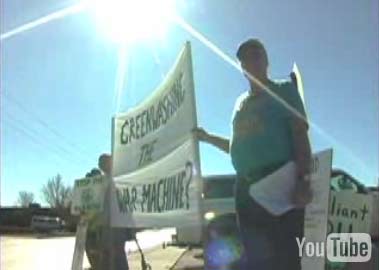
The Pentagon’s green baloney

The Fort Carson Fourth Annual Community Sustainability Conference is playing in town right now, and is part of The Pentagon’s green baloney program.
Sustainability is greewashing military

You might want to take in some of the last sessions over at the Crown Plaza Hotel off of Circle & I-25,and offer up your suggestions that the military use solar power to deliver their future hydrogen bombs and that they now move to require all soldiers to become vegetarians while doing military service, etc., etc. lol… This idea that the US military is part of any sustainability effort is quite laughable one would think?

Unfortunately, there are always some gullible, yet ecology oriented people who will always buy into even the most outlandish notions put forward by those who hold power in our society. But really, what’s the use of pushing for a more ecologically oriented military? Are we really interested in a more Greenly done destruction, since the job of the military is simply to destroy other peoples’ economies? Or did some of the Colorado Springs local community want to forget about that?

Sustainable? How ’bout the US military just cleaning up all the toxic messes they have already made across Planet Earth? I suggest that they start with SE Asia and then head westward.

We can give all our soldiers in uniform sticks with hooks on the end so that they can go around walking through the fields picking up land mines and depleted uranium fragments, and give them suction devices too to help clean up Agent Orange and other chemical weapons residuals that they have used in the past that might be found in leaves and dust that children with deformities now play in.

Dear Pentagon, we urge you not to litter.