
Preserving Cohen v. California in a Denver courtroom can be a team effort
Reply


DENVER, COLORADO- Civil liberties champion David Lane has filed a complaint in US district court challenging Denver’s office of the city attorney for instituting a permit process at DIA to prevent public protest. Holding signs has become impermissible at the airport, without the issuance of a permit seven days in advnace, although police are not bothering themselves about signs welcoming homecomers or seeking to connect business visitors with their limo service. That selective enforcement is unconstitutional of course, and the lawfirm powerhouse of Kilmer Lane & Newman is filing suit on behalf of two Occupy Denver plaintiffs. last Sunday, January 29, both were threatened with arrest by DIA police. While two earlier attempts to assemble had capitulated to DPD intimidation, the Occupy Denver activists stood their ground. Why did you file your lawsuit? “We know our rights. We want the POLICE to know our rights.”
1. Full text of complaint:
Case 1:17-cv-00332 Document 1
Filed 02/06/17 USDC Colorado Page 1 of 14Civil Action No.
IN THE UNITED STATES DISTRICT COURT FOR THE DISTRICT OF COLORADO
NAZLI MCDONNELL,
ERIC VERLO,Plaintiffs, vs.
CITY AND COUNTY OF DENVER,?
DENVER POLICE COMMANDER ANTONIO LOPEZ, in his individual and official capacity,
DENVER POLICE SERGEANT VIRGINIA QUINONES, in her individual and official capacity,Defendants.
______________________________________________________________________________
COMPLAINT
______________________________________________________________________________
Plaintiffs, by and through their attorneys David A. Lane and Andy McNulty of KILLMER, LANE & NEWMAN, LLP, allege as follows:
INTRODUCTION
1. Plaintiffs Eric Verlo and Nazli McDonnell challenge a regulation of alarming breadth that bans all First Amendment expression at Denver International Airport without a permit.
2. Plaintiffs are concerned citizens who believe that President Donald Trump has overstepped his executive authority by signing the January 27, 2017, Executive Order (hereinafter “Muslim Ban”), which permanently bans Syrian refugees from emigrating to the United States, temporarily bans nationals of seven countries (including permanent legal residents and visa-holders), and suspends all applications to the United States refugee program (even as to vetted entrants currently in transit).
3. Plaintiffs wish to express their disgust with President Trump’s (likely unconstitutional) Muslim Ban. They wish to do so in the same place that hundreds of thousands of Americans across the country have done: standing directly outside of the secure Customs and Border Protection (hereinafter “CBP”) screening area within an airport where immigrants to America enter into the main terminal after clearing customs. Plaintiffs, unlike many citizens across this great nation who have exercised their opposition to the Muslim Ban in airports by chanting, singing, dancing, and praying, simply wish to stand in silent protest, holding signs that express their solidarity with immigrants and the Muslim community.
4. Plaintiffs are banned from doing so by DENVER INTERNATIONAL AIRPORT REGULATION 50 (hereinafter “Regulation 50”).
5. Regulation 50 states: “No person or organization shall leaflet, conduct surveys, display signs, gather signatures, solicit funds, or engage in other speech related activity at Denver International Airport for religious, charitable, or political purposes, or in connection with a labor dispute, except pursuant to, and in compliance with, a permit for such activity issued by the CEO or his or her designee.” DENVER INTERNATIONAL AIRPORT REGULATION 50.03. In order to obtain a permit, an individual must “complete a permit application and submit it during regular business hours, at least seven (7) days prior to the commencement of the activity for which the permit is sought[.]” DENVER INTERNATIONAL AIRPORT REGULATION 50.04-1.
6. Plaintiffs ask that this Court enjoin the enforcement of Regulation 50 and prohibit Defendants from arresting them for their First Amendment-protected activity of standing in peaceful protest within Jeppesen Terminal. Regulation 50 is overbroad in violation of the First Amendment and vague in violation of the Fourteenth Amendment’s Due Process Clause.
7. This is a civil rights action for declaratory and injunctive relief as well as fees and costs arising under 42 U.S.C. §§ 1983, 1988 and 28 U.S.C. Section 2201 et seq. due to Defendants’ current and imminent violations of Plaintiffs’ rights guaranteed by the First and Fourteenth Amendments to the Constitution of the United States.
PARTIES
8. Plaintiff Eric Verlo is a citizen of the United States of America. Mr. Verlo wishes to show his resistance to President Trump’s Muslim Ban, so that others will be inspired to join in the resistance.
9. Plaintiff Nazli McDonnell is a citizen of the United States of America. Ms. McDonnell wishes to show her resistance to President Trump’s Muslim Ban, so that others will be inspired to join in the resistance.
10. Defendant City and County of Denver is a municipal corporation and political subdivision of the State of Colorado. Thus, it is an entity subject to the provisions of § 1983.
11. Defendant Antonio Lopez is a Commander with the Denver Police Department. Commander Lopez is responsible for security at Denver International Airport’s Jeppesen Terminal.
12. Defendant Virginia Quinones is a Sergeant with the Denver Police Department. Sergeant Quinones is responsible for security at Denver International Airport’s Jeppesen Terminal.
JURISDICTION AND VENUE
13. Plaintiffs bring this claim pursuant to 42 U.S.C. § 1983; the First Amendment to the United States Constitution, incorporated as against States and their municipal divisions through the Fourteenth Amendment to the United States Constitution; and the Due Process Clause of the Fourteenth Amendment.
14. This Court has jurisdiction under 28 U.S.C. § 1331 over Plaintiffs’ claims that “arise[] under the Constitution of the United States.”
FACTS
15. On January 27, 2017, President Donald Trump signed an Executive Order, which permanently banned Syrian refugees from emigrating to the United States, temporarily banned nationals of seven countries (including permanent legal residents and visa-holders), and suspended all applications to the United States refugee program (even as to vetted entrants currently in transit). President Trump’s Executive Order has been subsequently referred to as a “Muslim Ban,” because it both mirrors President Trump’s racist, anti-Islam statements made on December 7, 2015, that he was planning to ban all Muslims from entering the United States until our representatives can “figure out what’s going on” and the ban targets countries whose population is predominantly Muslim and seemingly bears little rational relation to each country’s security threat to the United States.
16. Immediately upon the enactment of President Trump’s Muslim Ban there was an outpouring of outrage from a large proportion of the American population and across the spectrum of political affiliation. This outrage led to resistance in the form of protests.
17. On January 28, 2017, and January 29, 2017, protests erupted in nearly every major city in the United States. The protests organically formed in our nation’s airports. Protesters chose to express their disgust with President Trump’s Muslim Ban in airports (and specifically outside of the secure CBP screening area) because individuals affected by the ban who were in transit to the United States were being held and questioned by CBP agents there. Many of these travelers, including lawful United States residents, were forced to sign documents revoking their lawful status within the United States and deported. Still others were simply deported with no explanation. Others still were held for hours as teams of lawyers rushed to prepare habeas petitions for their release.
18. News reports about the protests make clear that they have been peaceful and non- disruptive despite the gathering of, in some cases, thousands of people.
19. Airport staff have told protesters, and would-be protesters, at numerous airports across the nation, including Kansas City International Airport, that there are no restrictions on their speech and that all protesters who wish to participate in actions against the Muslim Ban are allowed. Protests have continued in other cities to this day.
20. On January 28, 2017, there was one such protest at Denver International Airport, within the Jeppesen Terminal. At approximately 5:00 p.m. hundreds gathered in the Jeppesen Terminal’s atrium, near arrivals, to protest and many others gathered to bear witness.
21. Prior to the protest, leaders had applied for a permit. It was denied. The reason for its denial was that the permit was not requested with seven days advance notice of the protest occurring. Regulation 50 requires seven days advance notice.
22. The January 28, 2017, protest began with speeches, chants, songs, and prayers. It was a peaceful gathering of solidarity for immigrants and Muslims. Every person at the January 28, 2017, protest was contained in an area of the Jeppesen Terminal atrium that is designed as a gathering space for people to sit, relax, and converse. No one was standing in the walkways or passageways of the terminal.
23. Soon after the January 28, 2017, protest began, members of the Denver Police Department arrived on-scene. Commander Antonio Lopez engaged the leader of the protest, Amal Kassir, along with State Representative Joe Salazar and representatives from the ACLU of Colorado, and informed them that the protest was unlawful. Commander Lopez told Ms. Kassir that anything that “could be construed as Free Speech” was prohibited at the Denver International Airport, including within the Jeppesen Terminal, without a permit. See Exhibit 1, January 28, 2017 Video.
24. Commander Lopez also stated that all “First Amendment expression” was prohibited at the Denver International Airport, including within the Jeppesen Terminal, without a permit on Regulation 50. Commander Lopez handed Regulation 50 to multiple protesters, including Ms. Kassir. See Exhibit 2, January 28, 2017 Video 2.
25. Regulation 50 states (in pertinent part): “No person or organization shall leaflet, conduct surveys, display signs, gather signatures, solicit funds, or engage in other speech related activity at Denver International Airport for religious, charitable, or political purposes, or in connection with a labor dispute, except pursuant to, and in compliance with, a permit for such activity issued by the CEO or his or her designee.” DENVER INTERNATIONAL AIRPORT REGULATION 50.03. In order to obtain a permit, an individual must “complete a permit application and submit it during regular business hours, at least seven (7) days prior to the commencement of the activity for which the permit is sought[.]” DENVER INTERNATIONAL AIRPORT REGULATION 50.04-1.
26. Commander Lopez, along with members of Denver International Security, told Ms. Kassir that every portion of Denver International Airport property, which has an approximately fifty square mile footprint, is off-limits for First Amendment expression. They suggested that Ms. Kassir move her protest to Tower Road, which is approximately six miles from the Jeppesen Terminal and, like most of the land surrounding Denver International Airport, adjacent to open prairie land with no inhabitants.
27. Commander Lopez threatened Ms. Kassir and numerous other demonstrators with arrest if they didn’t immediately cease any “First Amendment expression.” According to Commander Lopez’s directives, the individuals gathered in the Jeppesen Terminal could not stand holding signs, sing, speak to others about matters of public concern, hold the United States Constitution above their shoulders, or stand silently with their arms interlocked.
28. Ultimately, to avoid arrest, Ms. Kassir and the demonstrators moved outside of the Jeppesen Terminal to the large area on its south side, adjacent to the escalators leading to the commuter rail and under the Westin Hotel. The protest continued peacefully for a little while longer, then disbursed without issue.
29. The next day, January 29, 2017, Plaintiffs Eric Verlo and Nazli McDonnell traveled to Denver International Airport’s Jeppesen Terminal to express their opposition to President Trump’s Muslim Ban.
30. Mr. Verlo and Ms. McDonnell brought with them signs expressing support for immigrants and expressing concern that history was repeating itself with disastrous potential consequences.
31. Mr. Verlo and Ms. McDonnell positioned themselves adjacent to the secure CBP screening area within the Jeppesen Terminal at approximately 1:15 p.m.
32. Adjacent the secure CBP screening area at the Jeppesen Terminal is the only place where Mr. Verlo and Ms. McDonnell can reach their intended audience. Mr. Verlo and Ms. McDonnell wish to communicate with those who could be swayed by their message and, particularly, with immigrants. International travelers are often immigrants and/or lawful United States residents, including green card and other visa holders, other than citizens. Mr. Verlo and Ms. McDonnell wish to express their solidarity with immigrants directly to these individuals. Further, United States citizens who arrive from international locations are also individuals with whom Mr. Verlo and Ms. McDonnell wish to communicate. International travelers have experienced other cultures and are likely to be sympathetic to Mr. Verlo and Ms. McDonell’s message.
33. The secure CBP screening area is also the location where the Muslim Ban has been enforced by DHS, both at Denver International Airport and across the nation. Neither Plaintiff attempted to enter any restricted areas of Denver International Airport.
34. While silently displaying their signs, Mr. Verlo and Ms. McDonnell were in the open plaza near the secure CBP screening area within the Jeppesen Terminal and positioned significantly behind the railing, which demarcates where those waiting for loved ones are permitted to stand. Mr. Verlo and Ms. McDonnell did not impede the right of way of any passengers hustling to catch flights at the last moment. They simply stood with placards showing their distaste for the Executive Order and the man who executed it.
35. Mr. Verlo and Mr. McDonnell also observed another man in the terminal, named Gene Wells, who was expressing views similar to theirs.
36. Mr. Wells was wearing a sign taped to the back of his shirt.
37. Mr. Wells left the Jeppesen Terminal, but subsequently returned to protest. When he did, he was stopped by Denver Police Department officers who told him that he could not walk around the terminal with the slogan he had affixed to his back. Mr. Wells eventually rejoined Mr. Verlo and Mr. McDonnell at the international arrivals doors, but not without trepidation. He feared he might be arrested.
38. While Mr. Verlo and Ms. McDonnell were displaying their signs, Defendant Sergeant Virginia Quinones approached Mr. Verlo and Ms. McDonnell and threatened them with arrest if they did not leave Jeppesen Terminal. See Exhibit 3, January 29, 2017, Video.
39. Sergeant Quinones handed Mr. Verlo and Ms. McDonnell Regulation 50 and cited it as the reason they would be arrested if they did not leave Jeppesen Terminal. Id. Sergeant Quinones told Mr. Verlo and Ms. McDonnell that they would need a permit in order to stand silently, holding signs in opposition of the Muslim Ban and be in compliance with Regulation 50.
40. Had Mr. Verlo and Ms. McDonnell applied for a permit the second President Trump signed the Executive Order implementing the Muslim Ban, they still would have been unable to engage in protest within the Jeppesen Terminal under the terms and conditions of Regulation 50 on January 29, 2017.
41. Mr. Verlo and Ms. McDonnell did not immediately leave the Jeppesen Terminal after being threatened with arrest. However, they were startled by Sergeant Quiones’ threat and feared arrest for the duration of the time they were there.
42. Throughout the time Mr. Verlo and Ms. McDonnell were expressing their views within the Jeppesen Terminal they received numerous shows of support from passersby. Multiple self- proclaimed Muslims expressed heart-felt statements of appreciation to Mr. Verlo, Ms. McDonnell, and others holding signs.
43. Mr. Verlo and Ms. McDonnell ultimately left Jeppesen Terminal.
44. Mr. Verlo and Ms. McDonnell wish to return to Jeppesen Terminal to express solidarity with Muslims and opposition to the Muslim Ban, but are reticent to do so for fear of being arrested.
45. Upon information and belief, no individual has been arrested, or threatened with arrest, for wearing a “Make America Great Again” campaign hat without a permit within the Jeppesen Terminal at Denver International Airport.
46. Upon information and belief, no individual has been arrested, or threatened with arrest, for holding a sign welcoming home a member of our military without a permit within the Jeppesen Terminal at Denver International Airport.
47. Upon information and belief, no individual has been arrested, or threatened with arrest, for holding a sign and soliciting passengers for a limousine without a permit within the Jeppesen Terminal at Denver International Airport.
48. Upon information and belief, no individual has been arrested, or threatened with arrest, for discussing current affairs with another person without a permit within the Jeppesen Terminal at Denver International Airport.
49. At all times relevant to this Complaint, Defendants acted under color of law.
CLAIM I: FIRST AMENDMENT
(§ 1983 violation – all Defendants)50. Plaintiffs repeat, re-allege, and incorporate by reference the allegations in the foregoing paragraphs of this Complaint as fully set forth herein.
51. Regulation 50 violates the Free Speech Clause of the First Amendment to the Constitution, on its face and as applied, because it impermissibly curtails Plaintiffs’ free-speech rights.
52. Plaintiffs wish to speak on a matter of public concern. 11
53. Denver International Airport’s Jeppesen Terminal is a public forum.
54. Regulation 50 directly infringes upon and chills reasonable persons from engaging in activity that is protected by the First Amendment.
55. Regulation 50 acts as an unconstitutional prior restraint on speech because it (1) requires a permit before allowing individuals to engage in speech, (2) allows for arbitrary and/or discriminatory permit denials, and (3) requires advance notice that is unconstitutionally excessive.
56. Regulation 50 is overbroad.?
57. Regulation 50 is not narrowly tailored to serve a compelling government interest.?
58. Regulation 50 does not further a substantial government interest.?
59. Regulation 50’s restriction on expressive conduct is greater than necessary to further any
government interest.?60. Defendants’ actions and/or omissions enforcing Regulation 50 caused, directly or
proximately, Plaintiffs to suffer damages.CLAIM II: FIRST AMENDMENT RETALIATION
(§ 1983 violation – all Defendants)1. All statements of fact set forth previously are hereby incorporated into this claim as though set forth fully herein. ?
2. Plaintiffs engaged in First Amendment protected speech on a matter of public concern ?while displaying signs opposing President Trump’s Muslim Ban on January 29, 2017.
3. Defendants jointly and on their own accord responded to Plaintiffs’ First Amendment protected speech with retaliation, including but not limited to threatening Plaintiffs with arrest.
4. Defendants retaliatory actions were substantially motivated by Plaintiffs’ exercise of their First Amendment rights.
5. By unlawfully threatening Plaintiffs with arrest, Defendants sought to punish Plaintiffs for exercising their First Amendment rights and to silence their future speech. Defendants’ retaliatory actions would chill a person of ordinary firmness from engaging in such First Amendment protected activity.
6. Defendants’ actions and/or omissions enforcing Regulation 50 caused, directly and proximately, Plaintiffs to suffer damages.
CLAIM III: FOURTEENTH AMENDMENT DUE PROCESS
(§ 1983 violation – all Defendants)7. All statements of fact set forth previously are hereby incorporated into this claim as though set forth fully herein.
8. The prohibitions of Regulation 50 are vague and not clearly defined. ?
9. Regulation 50 offers no clear and measurable standard by which Plaintiffs and others can ?act lawfully.
10. Regulation 50 does not provide explicit standards for application by law enforcement officers.
11. Regulation 50 fails to provide people of ordinary intelligence a reasonable opportunity to understand what conduct it prohibits, and authorizes or encourages arbitrary and discriminatory enforcement, or both.
12. Defendants’ actions and/or omissions enforcing Regulation 50 caused, directly and proximately, Plaintiffs to suffer damages.
PRAYER FOR RELIEF
WHEREFORE, Plaintiffs respectfully request that this Court enter judgment in their favor and against Defendants, and grant:
(a) Appropriate declaratory and other injunctive and/or equitable relief; 13
(b) Enter a declaration that Regulation 50 is unconstitutional on its face and enjoin its enforcement; ?
(c) Compensatory and consequential damages, including damages for emotional distress, loss of reputation, humiliation, loss of enjoyment of life, and other pain and suffering on all claims allowed by law in an amount to be determined at trial; ?
(d) All economic losses on all claims allowed by law; ?
(e) Punitive damages on all claims allowed by law and in an amount to be determined ?at trial; ?
(f) Attorney’s fees and the costs associated with this action, pursuant to 42 U.S.C. § ?1988; ?
(g) Pre and post-judgment interest at the lawful rate; and ?
(h) Any further relief that this court deems just and proper, and any other relief as ?allowed by law. ?
Dated this 6th day of February 2017.
KILLMER, LANE & NEWMAN, LLP
s/ Andy McNulty___________________________________
David A. Lane
?Andy McNulty?
Killmer, Lane & Newman, LLC
1543 Champa Street, Suite 400 Denver, Colorado 80202?
Attorneys for Plaintiff
2. Full text of Feb 6 motion for preliminary injunction:
Case 1:17-cv-00332 Document 2
Filed 02/06/17 USDC Colorado Page 1 of 23Civil Action No.
IN THE UNITED STATES DISTRICT COURT FOR THE DISTRICT OF COLORADO
NAZLI MCDONNELL,
ERIC VERLO,Plaintiffs, vs.
CITY AND COUNTY OF DENVER,
DENVER POLICE COMMANDER ANTONIO LOPEZ, in his individual and official capacity,
DENVER POLICE SERGEANT VIRGINIA QUINONES, in her individual and official capacity,Defendants.
______________________________________________________________________________
MOTION FOR PRELIMINARY INJUNCTION
______________________________________________________________________________
Plaintiffs, by and through their attorneys David A. Lane and Andy McNulty of KILLMER, LANE & NEWMAN, LLP, hereby submit the following Motion for Preliminary Injunction, and in support thereof, states as follows:
1. Introduction
Over the last four days, many Americans have expressed public disapproval of President Donald Trump’s January 27, 2017, Executive Order, which permanently bans Syrian refugees from emigrating to the United States, temporarily bans nationals of seven countries (including permanent legal residents and visa-holders), and suspends all applications to the United States refugee program (even as to vetted entrants currently in transit). Plaintiffs are concerned and alarmed United States citizens who wish to join the growing chorus of voices expressing opposition to the Executive Order. To do so, they wish to stand in silent protest at the Jeppesen Terminal within Denver International Airport.
Plaintiffs did just this on January 29, 2017, standing in silent protest of the Executive Order outside of the secure Customs and Border Protection (hereinafter “CBP”) screening area within Jeppesen Terminal. Almost immediately, Plaintiffs were threatened with arrest by Denver Police Department Sergeant Virginia Quinones for standing silently and holding signs opposing the Executive Order, despite that fact that the Jeppesen Terminal has previously been used for expressive activity (and that protesters at more than ten major airports nationwide have protested peacefully without major disruption or legal restriction). While silently displaying their signs, Plaintiffs were in the plaza within the Jeppesen Terminal and positioned significantly behind the railing, which demarcates where those waiting for loved ones are permitted to stand, in the open plaza outside of the secure CBP screening area at the Jeppesen Terminal. Plaintiffs did not impede the right of way of any passengers hustling to catch flights at the last moment. They simply stood with placards showing their distaste for the Executive Order and the man who executed it.
Even though Plaintiffs were simply engaged in peaceful First Amendment protected expression, they were threatened with arrest. Sergeant Quinones informed Plaintiffs that, in order to stand silently with political signs, they would need a permit. Without a permit, Sergeant Quinones stated, all “First Amendment expression” at the Denver International Airport was banned.
This was not the first time since the enactment of the Executive Order that the Denver Police Department threatened individuals with arrest for engaging in First Amendment protected activity in Jeppesen Terminal. On January 28, 2016, a protest was held in the plaza of Jeppesen Terminal. During the protest, Denver Police Commander Antonio Lopez instructed multiple individuals, including State Representative Joseph Salazar and representatives from the ACLU of Colorado, that all “First Amendment expression” was banned at Denver International Airport without a permit. See Exhibit 1, January 28, 2017, Video 1; Exhibit 2, January 28, 2017, Video 2. The protesters had, in fact, applied for a permit earlier that day. However, it had not been granted because they had not done so seven days in advance of the protest in compliance with Denver International Airport regulations. Although no arrests were ultimately made, protesters were threatened numerous times by Commander Lopez, and other officers, with arrest.
The Denver International Airport regulation that both Sergeant Quinones and Commander Lopez relied upon in instructing Plaintiffs, and others, that Denver International Airport bans all “First Amendment expression” without a permit is DENVER INTERNATIONAL AIRPORT REGULATION 50 (hereinafter “Regulation 50”). Regulation 50 states that “no person or organization shall leaflet, conduct surveys, display signs, gather signatures, solicit funds, or engage in other speech related activity at Denver International Airport for religious, charitable, or political purposes, or in connection with a labor dispute, except pursuant to, and in compliance with, a permit for such activity issued by the CEO or his or her designee.” DENVER INTERNATIONAL AIRPORT REGULATION 50.03. In order to obtain a permit, an individual must “complete a permit application and submit it during regular business hours, at least seven (7) days prior to the commencement of the activity for which the permit is sought[.]” DENVER INTERNATIONAL AIRPORT REGULATION 50.04-1.
Plaintiffs wish to return to Denver International Airport to protest the Executive Order, but are reasonably frightened of arrest and, absent action by this Court, must choose between lawfully exercising their First Amendment right and being subject to arrest and/or prosecution.
Plaintiffs ask that this Court enter an injunction prohibiting their arrest for standing in peaceful protest within Jeppesen Terminal and invalidating Regulation 50 as violative of the First and Fourteenth Amendments to the United States Constitution.
2. Factual Background
All statements of fact set forth in the simultaneously filed Complaint are hereby incorporated into this Brief as though set forth fully herein.
3. Argument
3.1 The standard for issuance of a preliminary injunction.
When seeking a preliminary injunction, a plaintiff must establish that (1) he is likely to succeed on the merits; (2) he is likely to suffer irreparable harm; (3) the balance of equities tips in his favor; and (4) that an injunction is in the public interest. Winter v. Nat. Res. Def. Council, 555 U.S. 7, 20 (2008); see also ACLU v. Johnson, 194 F.3d 1149, 1155 (10th Cir. 1999).
The Tenth Circuit has modified the preliminary injunction test when the moving party demonstrates that the second, third, and fourth factors “tip strongly” in its favor. See Oklahoma ex rel. Okla. Tax Comm’n v. Int’l Registration Plan, Inc., 455 F.3d 1107, 1113 (10th Cir. 2006); see also 820 F.3d 1113, n.5 (10th Cir. 2016). “In such situations, the moving party may meet the requirement for showing success on the merits by showing that questions going to the merits are so serious, substantial, difficult, and doubtful as to make the issue ripe for litigation and deserving of more deliberate investigation.” Id. (internal quotation marks omitted). Moreover, this “fair chance of prevailing” test is appropriate in this case because Plaintiffs are challenging a policy, not a statue or ordinance. See Planned Parenthood Minn, N.D., & S.D. v. Rounds, 530 F.3d 724, 732 (9th Cir. 2008) (“[C]ourts should… apply the familiar ‘fair chance of prevailing’ test where a preliminary injunction is sought to enjoin something other than government action based on presumptively reasoned democratic processes.”).
Under either standard, Plaintiffs are able to demonstrate that the issuance of a preliminary injunction is appropriate in this matter.
3.3 Regulation 50 implicates Plaintiffs’ First Amendment rights. 1
When the government regulates the exercise of First Amendment rights, the burden is on the proponent of the restriction to establish its constitutionality. Phelps-Roper v. Koster, 713 F.3d 942, 949 (8th Cir. 2013). Moreover, when assessing the preliminary injunction factors in First Amendment cases, “the likelihood of success will often be the determinative factor.” Hobby Lobby Stores, Inc. v. Sebelius, 723 F.3d 1114, 1145 (10th Cir. 2013). This is because “the loss of First Amendment freedoms, for even minimal periods of time, unquestionably, constitutes irreparable injury,” Heideman v. Salt Lake City, 348 F.3d 1182, 1190 (10th Cir. 2003), and it is invariably in the public interest to protect an individual’s First Amendment rights. See Homans v. City of Albuquerque, 264 F.3d 1240, 1244 (10th Cir. 2001) (noting that “the public interest is better served” by protecting First Amendment rights).
[NOTE 1. It is important to note that facial challenges to government policies and statutes, when based on First and Fourteenth Amendment grounds, are not disfavored. See United States v. Stevens, 559 U.S. 460, 473 (2010); City of Chicago v. Morales, 527 U.S. 41 (1999).]
3.4 Plaintiffs are likely to succeed on the merits.
Plaintiffs are likely to succeed on the merits because Regulation 50 violates the Free Speech Clause of the First Amendment and the Due Process Clause of the Fourteenth Amendment.
3.4(a) Plaintiffs engaged, and wish to engage, in speech on a matter of public concern.
Plaintiffs’ speech is at the core of the First Amendment’s protection because it deals with a matter of public concern. “Speech deals with matters of public concern when it can be fairly considered as relating to any matter of political, social, or other concern to the community, or when it is a subject of legitimate news interest; that is, a subject of general interest and of value and concern to the public.” Snyder v. Phelps, 562 U.S. 443, 453 (2011) (internal quotation marks and citation omitted). “Speech on matters of public concern is at the heart of the First Amendment’s protection.” Id. at 451-52 (alterations and quotation marks omitted). “The First Amendment reflects ‘a profound national commitment to the principle that debate on public issues should be uninhibited, robust, and wide-open.’” Id. at 452 (quoting New York Times Co. v. Sullivan, 376 U.S. 254, 270 (1964)). Plaintiffs wish to engage in expression about President Donald Trump’s January 27, 2017, Executive Order, a topic that has generated nearly unprecedented debate and dissent. See Adrienne Mahsa Varkiani, Here’s Your List of All the Protests Happening Against the Muslim Ban, THINK PROGRESS (Jan. 28, 2017), https://thinkprogress.org/muslim-ban-protests-344f6e66022e#.ft1oznfv4 (compiling list of direct actions planned in response to President Trump’s January 27, 2017, Executive Order). Thus, Plaintiffs’ speech “‘occupies the highest rung of the hierarchy of First Amendment values, and is entitled to special protection.’” Snyder, 562 U.S. at 452 (quoting Connick v. Myers, 461 U.S. 138, 145 (1983)).
3.4(b) Regulation 50 acts as a prior restraint.
The restriction at issue in this matter is a prior restraint. “The term prior restraint is used ‘to describe administrative and judicial orders forbidding certain communications when issued in advance of the time that such communications are to occur.’” Alexander v. United States, 509 U.S. 544, 550 (1993) (quoting M. Nimmer, Nimmer on Freedom of Speech § 4.03, p. 4–14 (1984)). Regulation 50 is in an administrative order that forbids future communication and bases the ability to communicate in the future on the discretion of an administrative official. See DENVER INTERNATIONAL AIRPORT REGULATION 50.03 (“no person or organization shall leaflet, conduct surveys, display signs, gather signatures, solicit funds, or engage in other speech related activity at Denver International Airport for religious, charitable, or political purposes, or in connection with a labor dispute, except pursuant to, and in compliance with, a permit for such activity issued by the CEO or his or her designee.” (emphasis added)). It is a prior restraint.
The burden of proving a prior restraint is permissible is particularly steep. The Supreme Court has repeatedly held that “[a]ny system of prior restraints of expression comes to this Court bearing a heavy presumption against its constitutional validity.” Bantam Books, Inc. v. Sullivan, 372 U.S. 58, 70 (1963). For the reasons outlined infra, Defendants cannot meet this especially significant burden.
3.4(c) Jeppesen Terminal, outside of the passenger security zones, is a traditional public forum.
The Supreme Court has not definitively decided whether airport terminals, including Jeppesen Terminal, are public forums. In Lee v. International Society for Krishna Consciousness, Inc., 505 U.S. 830 (1992) (hereinafter “Lee I”), issued the same day as International Society for Krishna Consciousness, Inc. v. Lee, 505 U.S. 672 (1992) (hereinafter “Lee II”), the Supreme Court struck down a total ban on distribution of literature in airports. In Lee I, the Court issued a one sentence per curiam opinion, which affirmed the Second Circuit for the reasons expressed by Justice O’Connor, Justice Kennedy, and Justice Souter in Lee II. See Lee I, 505 U.S. at 831. Justice Kennedy and Justice Souter’s opinions in Lee II found that “airport corridors and shopping areas outside of the passenger security zones… are public forums, and speech in those places is entitled to protection against all government regulation inconsistent with public forum principles.” Lee II, 505 U.S. at 693 (Kennedy, J., concurring in the judgment); but see Lee II, 505 U.S. at 683 (“”[W]e think that neither by tradition nor purpose can the terminals be described as satisfying the standards we have previously set out for identifying a public forum.”).
Therefore, Plaintiffs ask this Court to find the area of Jeppesen Terminal outside of the passenger security zones to be a public forum. The historical use of the Jeppesen Terminal’s plazas and other areas outside of the passenger security zones (including the area outside of the secure CBP screening area) for political speech (particularly, the history of welcoming of American military personnel home from service, discussion between passengers of matters of public concern, and display of clothing advocating for political views and ideals) indicates that it is a public forum. See First Unitarian Church of Salt Lake City v. Salt Lake City Corp., 308 F.3d 1114, 1130 (10th Cir. 2002) (“Where courts have considered the traditional use of publicly accessible property for speech, they have refused to attribute legal significance to an historical absence of speech activities where that non-speech history was created by the very restrictions at issue in the case.”). Further, that the Jeppesen Terminal is free and open to the public (outside of the passenger security zones), illustrates that it is a public forum. See, e.g., Ark. Educ. Television Comm’n v. Forbes, 523 U.S. 666, 676 (1998); Cornelius v. NAACP Legal Def. & Educ. Fund, 473 U.S. 788, 800, 805, 809 (1985). Finally, Jeppesen Terminal retains characteristics similar to parks: it has large plazas lined with benches, it is surrounded by businesses which are open to the public, and it has dedicated walkways, similar to sidewalks, indicating that it is a public forum. See e.g., Frisby v. Schultz, 487 U.S. 474, 480-481 (1988); United States v. Grace, 461 U.S. 171, 177 (1983). Further, the Supreme Court has not strictly limited the public forum category to streets, sidewalks, and parks. See, e.g., Se. Promotions, Ltd. v. Conrad, 420 U.S. 546 (1975) (finding leased municipal theater is a public forum); Heffron v. Int’l Society for Krishna Consciousness, Inc., 452 U.S. 640 (1981) (finding state fair is a public forum); Edwards v. South Carolina, 372 U.S. 229 (1963) (finding grounds of state capitol are a traditional public forum). Even if the City claims that it has never intended for Jeppesen Terminal to be a public forum, this is not dispositive. See Lee, 505 U.S. at 830 (government policy prohibiting distribution of literature at airport on property struck down); Cornelius, 473 U.S. at 805 (government’s decision to limit access is not itself dispositive). Plaintiffs’ ask that this Court find Jeppesen Terminal, outside of the passenger security zones, a traditional public forum.
Since Jeppesen Terminal is a traditional public forum, any restriction on Plaintiffs’ speech must be content-neutral and narrowly tailored to a compelling government interest. Regulation 50 fails at both.
3.4(d) Regulation 50 is content-based.
Regulation 50 is a content-based restriction of expression. Although the Supreme Court has long held that content-based restrictions elicit strict scrutiny, see, e.g., Carey v. Brown, 447 U.S. 455 (1980), lower courts diverged on the meaning of “content-based” until Reed v. Town of Gilbert, 135 S. Ct. 2218 (2015). 2 Reed clarified that a restriction is content based simply if it draws distinctions “based on the message a speaker conveys.” 135 S. Ct. at 2227. Reed is clear that even “subtle” distinctions that define regulated expression “by its function or purpose . . . are distinctions based on the message a speaker conveys, and therefore, are subject to strict scrutiny.” Id. This accords with Texas v. Johnson, which held that “the emotive impact of speech on its audience is not a secondary effect unrelated to the content of the expression itself.” 491 U.S. 491 U.S. 297, 412 (1989) (internal quotations omitted).
[NOTE 2. Reed involved a municipal “sign code” that regulated signs differently based on the kind of message they conveyed (such as “ideological,” “political,” or “temporary directional”). 135 S. Ct. at 2224-25. The Court rejected the city’s argument that a law had to discriminate against certain viewpoints in order to be a content-based restriction. Id. at 2229.]
Regulation 50 is content-based on its face. It distinguishes between content and requires that an official determine the content of the speaker’s message when enforcing its proscriptions. Reed, 135 S. Ct. at 2227; see DENVER INTERNATIONAL AIRPORT REGULATION 50.03 (“No person or organization shall leaflet, conduct surveys, display signs, gather signatures, solicit funds, or engage in other speech related activity at Denver International Airport for religious, charitable, or political purposes, or in connection with a labor dispute[.]” (emphasis added)). The distinctions drawn by Regulation 50 make it a facially content-based restriction on expression that must elicit “the most exacting scrutiny.” Johnson, 491 U.S. at 412; Reed, 135 S. Ct. at 2227.
3.4(e) Regulation 50 is not narrowly tailored to serve a compelling government interest.
As a facially content-based restriction of expression at traditional public fora, Regulation 50 is presumptively unconstitutional unless Defendant “prove[s] that the restriction furthers a compelling interest and is narrowly tailored to achieve that interest.” Reed, 135 St. Ct. at 2231; accord Johnson, 491 U.S. at 412.
“A statute is narrowly tailored if it targets and eliminates no more than the exact source of the ‘evil’ it seeks to remedy.” Frisby v. Schultz, 487 U.S. 474, 485 (1988) (citation omitted). Regulation 50 reaches more speech than that which would impair the security of the airport or ensure that passengers are not unduly encumbered. In fact, it completely bans all “First Amendment expression.” “A complete ban can be narrowly tailored, but only if each activity within the proscription’s scope is an appropriately targeted evil.” Id.. Regulation 50 is not such a ban. For instance, Plaintiffs’ expression does nothing to jeopardize security at Denver International Airport or to inhibit the free flow of passengers through the airport.
Further, any argument that Plaintiffs can engage in expressive activity in another location lacks merit, as the Supreme Court has held that the First Amendment is violated when one specific location or audience, when important to the speaker, is foreclosed. See McCullen v. Coakley, 134 S. Ct. 2518, 2536 (2014); Schenck v. Pro-Choice Network, 519 U.S. 357, 377 (1997) (invalidating a “floating” buffer zone around people entering an abortion clinic partly on the ground that it prevented protestors “from communicating a message from a normal conversational distance or handing leaflets to people entering or leaving the clinics who are walking on the public sidewalks”); Schneider v. New Jersey, 308 U.S. 147, 163 (1939) (invalidating anti-handbilling ordinances even though “their operation is limited to streets and alleys and leaves persons free to distribute printed matter in other public places”). Regulation 50 lacks the narrow tailoring necessary to survive First Amendment strict scrutiny analysis.
3.4(f) Regulation 50 violates the First Amendment even if this Court determines Jeppesen Terminal is a nonpublic forum.
Regulation 50 bans all “First Amendment expression” absent a permit; it is unconstitutional even when analyzed under the lower standard of scrutiny applied by courts to First Amendment political speech in a nonpublic forum. In Board of Airport Commissioners of Los Angeles v. Jews for Jesus, Inc., 482 U.S. 569 (1987), the Supreme Court considered whether a resolution restricting free speech in the airport was constitutional. The resolution at issue stated that the airport “is not open for First Amendment activities by any individual and/or entity.” Id. at 574. Although the Court did not explicitly find that the airport was a nonpublic forum, it did hold that the resolution restricting speech in the airport was facially unreasonable, even if the airport was a nonpublic forum. Id. at 573. The Court noted that enforcing the resolution would prohibit “talking and reading, or the wearing of campaign buttons or symbolic clothing.” Id. at 574. The Court also noted, “[m]uch nondisruptive speech–such as the wearing of a T-shirt or button that contains a political message–may not be ‘airport related’ but is still protected speech even in a nonpublic forum.” Id. at 575 (citing Cohen v. California, 403 U.S. 15 (1971) (holding that wearing of jacket with offensive language in a courthouse was a form of nondisruptive expression that was protected by the First Amendment)). Thus, although specific conduct was not at issue in the Jews for Jesus decision, the Court nonetheless implicitly held that non-disruptive speech is protected by the First Amendment in nonpublic fora and that restrictions that encumber non-disruptive expression are unreasonable.
In Lee II, Justice O’Connor set forth the test for determining reasonableness in the context of nonpublic fora. 505 U.S. at 687 (O’Connor, J., concurring). 3 She stated, ”[t]he reasonableness of the Government’s restriction [on speech in a nonpublic forum] must be assessed in light of the purpose of the forum and all the surrounding circumstances.” Id. (O’Connor, J., concurring) (quoting Cornelius, 473 U.S. at 809). However, Justice O’Connor noted that while “[o]rdinarily . . . we have . . . been confronted with cases where the fora at issue were discrete, single-purpose facilities,” airports present a different analysis because they are multipurpose facilities. Id. at 688 (O’Connor, J., concurring) (citations omitted). She determined airports to be multipurpose facilities because
the Port Authority [has] chosen not to limit access to the airports under its control, [and] has created a huge complex open to travelers and nontravelers alike. The airports house restaurants, cafeterias, snack bars, coffee shops, cocktail lounges, post offices, banks, telegraph offices, clothing shops, drug stores, food stores, nurseries, barber shops, currency exchanges, art exhibits, commercial advertising displays, bookstores, newsstands, dental offices and private clubs.
Id. This led to the finding that “[t]he reasonableness inquiry, therefore, is not whether the restrictions on speech are consistent with preserving the property for air travel, but whether they are reasonably related to maintaining the multipurpose environment that the Port Authority has deliberately created.” Id. at 689. A complete ban on First Amendment activity at the Jeppesen Terminal, absent a permit that must be obtained by providing seven days advance notice, is not a reasonable restriction. Regulation 50 does not comport with Justice O’Connor’s conclusion that airports are more than simply places where air travel occurs.
[NOTE 3. It is important to note that Lee involved a plurality opinion, joined by Justice O’Connor. Therefore, Justice O’Connor’s concurrence is the “narrowest grounds” that justify the Court’s result and her concurrence holds substantial precedential weight.]
Moreover, Justice O’Connor distinguished between solicitations (which the Supreme Court found could be reasonably restricted) and distributing leaflets (which the Supreme Court found could not be reasonably restricted) in the airport:
[L]eafleting does not entail the same kinds of problems presented by face-to-face solicitation. Specifically, “one need not ponder the contents of a leaflet or pamphlet in order mechanically to take it out of someone’s hand . . . . The distribution of literature does not require that the recipient stop in order to receive the message the speaker wishes to convey; instead the recipient is free to read the message at a later time.”
Id. at 690 (quoting United States v. Kokinda, 497 U.S. 720, 734 (1990)).
Thus, the Court held in Lee II that prohibiting solicitation in a nonpublic forum is not unreasonable, but that prohibiting the distribution of leaflets and other literature at a nonpublic forum is unreasonable. See also Lee, 505 U.S. at 830 (decided the same day as Lee II and striking down a prohibition on the distribution of leaflets and other literature at La Guardia, John F. Kennedy, and Newark International airports) (per curiam). Circuit courts have also recognized the inherent right to distribute paper and other information in nonpublic fora. Following Lee I and Lee II, two circuit courts have held that airports, as nonpublic fora, could not preclude newspaper publishers from placing newsracks in airport terminals. See Jacobsen v. City of Rapid City, South Dakota, 128 F.3d 660 (8th Cir. 1997); Multimedia Publishing Co. of South Carolina, Inc. v. Greenville-Spartanburg Airport Dist., 991 F.2d 154 (4th Cir. 1993). To the extent that the airports were concerned about safety or the impediment of traffic flow, the courts held that the airport may impose reasonable restrictions, but they could not enforce an outright ban on the newspaper racks. See Jacobsen, 128 F.3d at 660; Multimedia Publishing Co. of South Carolina, Inc., 991 F.2d at 154.
Denver, through Regulation 50, has banned all “First Amendment expression” including leafleting and protests. In fact, Plaintiffs expression is arguably less intrusive and disruptive to air travel than the form of expression, namely leafletting, that the Court held could not be reasonably restricted in the areas of an airport that precede the security screening area. It is clear from Lee I, Lee II, and Jews for Jesus that Denver cannot ban all “First Amendment expression” at the Jeppesen Terminal.
3.4(f)(1) Independently, the viewpoint-based prohibition of Plaintiffs’ speech, based on Regulation 50, violates the First Amendment.
Even if Jeppesen Terminal is a nonpublic forum, “this does not mean the government has unbridled control over speech, . . . for it is axiomatic that ‘the First Amendment forbids the government to regulate speech in ways that favor some viewpoints or ideas at the expense of others.” Summum v. Callaghan, 130 F.3d 906, 916 (10th Cir. 1997) (quoting Lamb’s Chapel v. Center Moriches Union Free School Dist., 508 U.S. 384, 394, (1993)). “Restrictions on speech in nonpublic fora must be viewpoint neutral[.]” Warren v. Fairfax Cty., 196 F.3d 186, 193 (4th Cir. 1999) (citing Cornelius, 473 at 809). Defendants’ restriction of Plaintiffs’ speech, under the guise of Regulation 50, discriminates on the basis of viewpoint. Individuals walk through Denver International Airport with political messages and slogans on their shirts and luggage and discuss politics on a daily basis. Counsel for Plaintiffs has worn political shirts while traveling through Denver International Airport and discussed modern politics with fellow passengers on many occasions. However, no other individual, to Plaintiffs or Plaintiffs’ counsel’s knowledge, has been threatened with arrest for engaging in this political speech. Nor has any individual been arrested for displaying pro-President Trump messages, for example a red hat that reads “Make America Great Again.” Only Plaintiffs’ expressive activity against the President’s Executive Order, and others advocating similarly, has been threatened with arrest. Regulation 50 is being enforced as a clearly view-point based restriction. Defendants’ application of Regulation 50 to Plaintiffs speech is view-point based and violates the First Amendment.
3.4(g) The seven day advance notice requirement for obtaining a permit is not a reasonable restriction.
Notice periods restrict spontaneous free expression and assembly rights safeguarded in the First Amendment. Plaintiffs, like many others throughout history, wish to engage in First Amendment expression in quick response to topical events. While even in such time-sensitive situations, a municipality may require some short period of advance notice so as to allow it time to take measures to provide for necessary traffic control and other aspects of public safety, the period can be no longer than necessary to meet the City’s urgent and essential needs of this type. See American-Arab Anti-Discrimination Comm. v. City of Dearborn, 418 F.3d 600, 605 (6th Cir. 2005) (“Any notice period is a substantial inhibition on speech.”).
Advance notice requirements that have been upheld by courts have most generally been less than a week. See, e.g., A Quaker Action Group v. Morton, 516 F.2d 717, 735 (D.C. Cir. 1975) (two-day advance notice requirement is reasonable for use of National Park areas in District of Columbia for public gatherings); Powe v. Miles, 407 F.2d 73, 84 (2d Cir. 1968) (two-day advance notice requirement for parade is reasonable); Progressive Labor Party v. Lloyd, 487 F. Supp. 1054, 1059 (D. Mass. 1980) (three-day advance filing requirement for parade permit approved in context of broader challenge); Jackson v. Dobbs, 329 F. Supp. 287, 292 (N.D. Ga. 1970) (marchers must obtain permit by 4 p.m. on day before the march), aff’d, 442 F.2d 928 (5th Cir. 1971). Lengthy advance filing requirements for parade permits, such as the seven day advance notice requirement imposed by Regulation 50, have been struck down as violating the First Amendment. See American-Arab Anti-Discrimination Comm., 418 F.3d at 605-07 (holding that provision requiring thirty days’ notice is overbroad and is not saved by an unwritten policy of waiving the provision); NAACP, W. Region v. City of Richmond, 743 F.2d 1346, 1357 (9th Cir. 1984) (“[A]ll available precedent suggests that a 20-day advance notice requirement is overbroad.”). Even an advance filing requirement of five days has been held too long to comport with the First Amendment. See Douglas v. Brownell, 88 F.3d 1511, 1523-24 (8th Cir. 1996) (city’s asserted goals of protecting pedestrian and vehicular traffic and minimizing inconvenience to the public does not justify five-day advance filing requirement for any parade, defined as ten or more persons).
It is clear that, in the case at bar, a permit requirement of seven days advance notice is not a reasonable restriction of Plaintiffs’ First Amendment rights. Plaintiffs wish to engage in timely, direct action against, what they perceive as, a tyrannical and unconstitutional exercise of the executive power. If Plaintiffs were to have applied for a permit at the exact moment President Trump signed the Executive Order, they would still have been prevented from engaging in First Amendment activity on January 29, 2017. In direct action, like in most things, timing is everything. As evidenced by myriad protests that occurred across the nation’s airports, which were accompanied by no violence or destruction of property and did not otherwise jeopardize security, accommodation of protest at the Jeppesen Terminal is reasonable. Such a lengthy approval period, with no exceptions for spontaneous, peaceful protests, violates the First Amendment. See Church of the American Knights of the Ku Klux Klan v. City of Gary, 334 F.3d 676, 682 (7th Cir. 2003) (noting that “the length of the required period of advance notice is critical to its reasonableness; and given … that political demonstrations are often engendered by topical events, a very long period of advance notice with no exception for spontaneous demonstrations unreasonably limits free speech” (emphasis added)).
3.4(h) Regulation 50 is overbroad in violation of the First Amendment.
“[A] law may be invalidated as overbroad if ‘a substantial number of its applications are unconstitutional, judged in relation to the [ordinance]’s plainly legitimate sweep.’” United States v. Stevens, 559 U.S. 460, 473 (2010) (quoting Wash. State Grange v. Wash. State Republican Party, 552 U.S. 442, 449 n.6 (2008)). An overbroad statute may be challenged on its face even though a more narrowly drawn statute would be valid as applied to the party in the case before it. City Council of L.A. v. Taxpayers for Vincent, 466 U.S. 789, 798 (1984) (“[B]roadly written statutes may have such a deterrent effect on free expression that they should be subject to challenge even by a party whose own conduct may be unprotected.”). The Supreme Court “has repeatedly held that a government purpose to control or prevent activities constitutionally subject to state regulation may not be achieved by means which sweep unnecessarily broadly and thereby invade the area of protected freedoms.” NAACP v. Alabama ex rel. Flowers, 377 U.S. 288, 307 (1964); see also Grayned v. City of Rockford, 408 U.S. 109, 114-15 (1972) (“The crucial question, then, is whether the ordinance sweeps within its prohibitions what may not be punished under the First and Fourteenth Amendments.”). Courts have “provided this expansive remedy out of concern that the threat of enforcement of an overbroad law may deter or ‘chill’ constitutionally protected speech—especially when the overbroad statute imposes criminal sanctions.” Virginia v. Hicks, 539 U.S. 113, 119 (2003).
Determining whether a law is substantially overbroad requires a two-step analysis. First, a court must “construe the challenged [law]; it is impossible to determine whether a [law] reaches too far without first knowing what the [law] covers.” United States v. Williams, 553 U.S. 285, 293 (2008). Second, based on the first step, a court must determine whether the law “criminalizes a substantial amount of protected expressive activity.” Id. at 297.
Regulation 50 provides that “no person or organization shall leaflet, conduct surveys, display signs, gather signatures, solicit funds, or engage in other speech related activity at Denver International Airport for religious, charitable, or political purposes, or in connection with a labor dispute, except pursuant to, and in compliance with, a permit for such activity issued by the CEO or his or her designee.” Those tasked with enforcing Regulation 50, have stated that it bans all “First Amendment expression.” See Exhibit 1, January 28, 2017, Video 1; Exhibit 2, January 28, 2017, Video 2.
A complete prohibition on First Amendment expression and related activity proscripts a substantial amount of protected expressive activity. See Jews for Jesus, 482 U.S. at 569; Lee, 505 U.S. at 830. It prohibits face-to-face conversations and wearing clothing intended to convey a message, along with leafleting and other traditional First Amendment activity, all of which protected expression. Regulation 50’s overbreadth is stark and violates the guarantees of the First Amendment.
3.4(i) Regulation 50 is unconstitutionally vague.
“A fundamental principle in our legal system is that laws which regulate persons or entities must give fair notice of conduct that is forbidden or required.” F.C.C. v. Fox Television Stations, Inc., 132 S. Ct. 2307, 2317 (2012). “A law’s failure to provide fair notice of what constitutes a violation is a special concern where laws ‘abut[ ] upon sensitive areas of basic First Amendment freedoms’ because it ‘inhibit[s] the exercise’ of freedom of expression and ‘inevitably lead[s] citizens to steer far wider of the unlawful zone … than if the boundaries of the forbidden areas were clearly marked.’” Stahl v. City of St. Louis, 687 F.3d 1038, 1041 (8th Cir. 2012) (quoting Grayned, 408 U.S. at 109). For this reason, a stringent vagueness test applies to a law that interferes with the right of free speech. Vill. of Hoffman Estates v. Flipside, Hoffman Estates, Inc., 455 U.S. 489, 499 (1982). “Where a statute’s literal scope, unaided by a narrowing state court interpretation, is capable of reaching expression sheltered by the First Amendment, the doctrine demands a greater degree of specificity than in other contexts.” Smith v. Goguen, 415 U.S. 566, 573 (1974).
Regulation 50 is vague, and therefore unconstitutional, for two separate reasons. First, Regulation 50 fails “to provide the kind of notice that will enable ordinary people to understand what conduct it prohibits.” City of Chicago v. Morales, 527 U.S. 41, 56 (1999). A law is unconstitutionally vague where it “does not provide people with fair notice of when their actions are likely to become unlawful.” Stahl, 687 F.3d at 1041. Because violators of Regulation 50 are subject to criminal sanction, the strictest vagueness test applies. See Reno v. ACLU, 521 U.S. 844, 872 (1997) (recognizing criminal sanctions might “cause speakers to remain silent rather than communicate even arguably unlawful words, ideas, and images” which, together with the “‘risk of discriminatory enforcement’ of vague regulations, poses greater First Amendment concerns than those implicated by [a] civil regulation[.]”). Whether expressive activity will be deemed “First Amendment expression” in the Jeppesen Terminal is not predictable. Plaintiffs have reasonably refrained from protected speech for fear that someone might consider their expression to be in violation of the regulation. However, officials have failed to enforce the regulation against many others who are seemingly in violation, including those discussing politics with other passengers, wearing clothing meant to make some social or political statement, limo drivers soliciting passengers, and those welcoming home military veterans. Although there might be times when a speaker knows, or should know, that certain speech will violate the statute, in many situations such an effect is difficult or impossible to predict. See Stahl, 687 F.3d at 1041 (finding vagueness because even “[t]hough there are certainly times when a speaker knows or should know that certain speech or activities likely will cause a traffic problem, in many situations such an effect is difficult or impossible to predict.”). Regulation 50 fails to give fair notice and therefore violates the mandates of the Fourteenth Amendment.
Regulation 50 is also unconstitutionally broad because it “authorize[s] and even encourage[s] arbitrary and discriminatory enforcement.” Morales, 527 U.S. at 56. Regulation 50’s terms allow law enforcement officials wide discretion to decide whether any given speech is prohibited and arrest the speaker. “Such a statute does not provide for government by clearly defined laws, but rather for government by the moment-to-moment opinions of a policeman on his beat.” Cox v. Louisiana, 379 U.S. 536, 579 (1965); see Norton v. Discipline Comm. of E. Tenn. State Univ., 399 U.S. 906, 909 (1970) (“Officials of public universities . . . are no more free than policemen or prosecutors to punish speech because it is rude or disrespectful, or because it causes in them vague apprehensions, or because for any other reason they do not like its content.”).
Officers have been observed enforcing Regulation 50 against those protesting President Trump’s Executive Order, but not against those wearing other political shirts or buttons. Officers have not enforced the regulation against other political expression, including those standing in support of military veterans returning home from combat. Seemingly, the only ones who have been subject to this regulation are those who are specifically speaking against President Trump’s Executive Order. “The most meaningful aspect of the vagueness doctrine is . . . the requirement that a legislature establish minimal guidelines to govern law enforcement.” Smith, 415 U.S. at 574. Because the terms allow a police officer leeway to determine that expressive conduct is lawful, or not, they are vague. Regulation 50 permits “a standardless sweep [that] allows policemen, prosecutors, and juries to pursue their personal predilections.” Kolender v. Lawson, 461 U.S. 352, 358 (1983) (internal citations omitted). It is unconstitutional.
3.5 Absent an injunction, Plaintiffs will suffer irreparable harm.
“The loss of First Amendment freedoms, for even minimal periods of time, unquestionably constitutes irreparable injury.” Elrod v. Burns, 427 U.S. 347, 373 (1976); see also Verlo v. Martinez, 820 F.3d 1113, 1127 (10th Cir. 2016); Awad v. Ziriax, 670 F.3d 1111, 1131 (10th Cir. 2012) (“[W]hen an alleged constitutional right is involved, most courts hold that no further showing of irreparable injury is necessary.”); Verlo v. Martinez, 820 F.3d 1113, 1127 (10th Cir. 2016).
Moreover, Plaintiffs’ expression is a time-sensitive response to a nearly unprecedented action by our federal government. But see C. Norwood, A Twitter Tribute to Holocaust Victims, THE ATLANTIC (January 27, 2017), https://www.theatlantic.com/politics/archive/2017/01/jewish-refugees-in-the-us/514742/ (describing the rebuff of refugees fleeing Nazi Germany in 1939, many of whom would be murdered during the Holocaust); Korematsu v. United States, 323 U.S. 214 (1944). Delaying Plaintiffs’ protest, and discouraging Plaintiffs and others from demonstrating, detracts from its importance and provides a false appearance that Denver is not like other cities of all sizes across the country that have mustered sizeable protests at their airports. Denver has held itself out as a “sanctuary city.” Jon Murray, Mayor Hancock says he welcomes “sanctuary city” title if it means Denver supports immigrants and refugees, The DENVER POST (January 30, 2017), http://www.denverpost.com/2017/01/30/mayor-hancock-welcomes-sanctuary-city-title-denver-supports-immigrants-refugees/. For Colorado’s citizens to seemingly show lackluster support in this time of trial would not only irreparable harm Plaintiffs, and others, but it would go against the public interest.
3.6 The balance of the equities weighs in favor of granting a preliminary injunction.
“The balance of equities… generally favors the constitutionally-protected freedom of expression.” Phelps-Roper v. Nixon, 545 F.3d 685, 690 (8th Cir. 2008) overruled on other grounds by Phelps-Roper v. City of Manchester, Mo., 697 F.3d 678 (8th Cir. 2012). Courts have consistently held that when First Amendment freedoms are threatened, the balance of the equities weighs in the Plaintiffs’ favor. See Verlo, 820 F.3d at 1127; Awad, 670 F.3d at 1132. There is no harm to Defendant, who has no significant interest in the enforcement of Regulation 50 since it is likely unconstitutional.
3.7 A preliminary injunction is in the public interest.
“[I]t is always in the public interest to prevent the violation of a party’s constitutional rights.” Awad, 670 F.3d at 1133 (internal quotation marks omitted); accord Verlo, 820 F.3d at 1127; Pac. Frontier v. Pleasant Grove City, 414 F.3d 1221, 1237 (10th Cir. 2005) (“Vindicating First Amendment freedoms is clearly in the public interest.”); Cate v. Oldham, 707 F.2d 1176, 1190 (10th Cir. 1983) (noting “[t]he strong public interest in protecting First Amendment values”).
4. Conclusion
For the reasons stated, Plaintiffs respectfully request that this Court grant their Motion for a Preliminary Injunction, enjoin enforcement of Regulation 50, and prohibit Defendants from arresting Plaintiffs and all others similarly situated when they engage in First Amendment protected activity within Jeppesen Terminal.
Dated this 6th day of February, 2017
KILLMER, LANE & NEWMAN, LLP
s/ Andy McNulty
__________________________David Lane
Andy McNulty
1543 Champa Street, Suite 400 Denver, CO 80202
Counsel for Plaintiffs
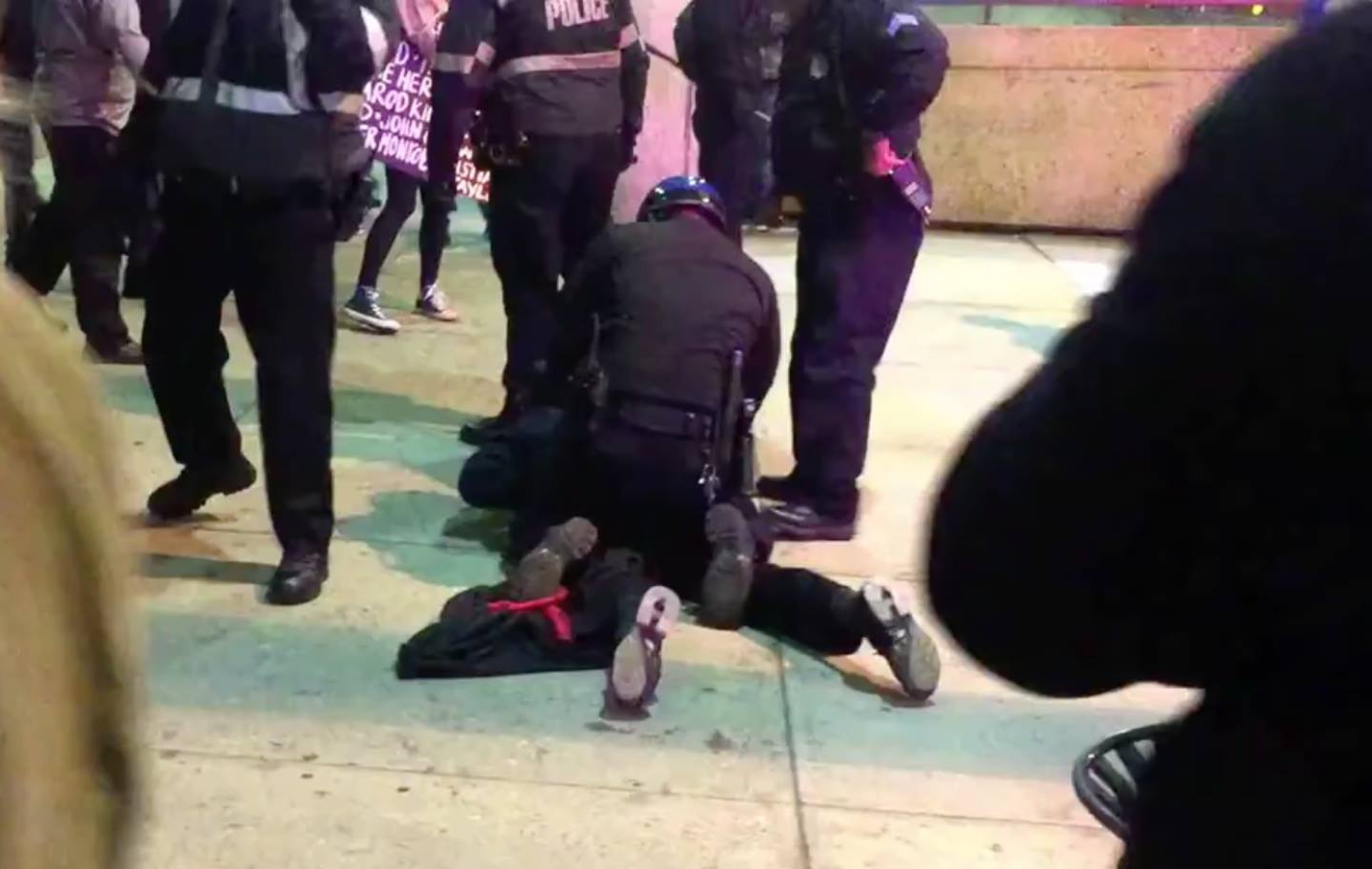
DENVER, COLORADO- Hidden deep in the evidence against one of nine protesters arrested at last year’s Guy Fawkes’ Day march in Denver, was an “AFTER ACTION REPORT” never encountered before in discovery evidence available to previous Denver activism defendants. This report has provided the first public mention of “Shadow Teams” deployed on “Shadow Operations” against peaceful demonstrators. Most remarkable was that 27 officers were mobilized for shadow operations, among a total of 169, clocking a total of 1379 man hours, against a rally and march that numbered “around 100” at its peak, to quote the report.
The report was presented to Denver municipal judge Beth Faragher on Monday before the trial of one of the Anonymous arrestees. The judge was asked why discovery evidence didn’t include reports from the “Shadow Teams” detailing, for example, what their shadow operations were. Judge Faragher agreed to continue the trial until September to allow city attorneys to come up with some answers.
One defendant’s lawyer was also provided the Denver Police Department’s Crowd Management Manual, an earlier edition of which was leaked last year by Denver’s Unicorn Riot. The current manual does not differ on this subject and defines Shadow Team as: “A team of officers assigned to identify Persons of Interest as being involved in possible criminal activity based on Reasonable Suspicion.”
There is no disagreement that shadow operations involve undercover officers following targeted activists. The question is what were they doing to maintain their cover? You can’t surveil moving marches from under storefront awnings or hotel windows. To mingle with protesters who have to march with them. To ingratiate yourself with hosts you have to participate. To impress leaders you have to delegate. So what actions were the shadow offices mimicking?

The title “Million Mask March” means to aggregate all the actions across the world demonstrating on Guy Fawkes’ Day, every 5th of November. Individual marches are ridiculed for being mere fractions of a million, in Denver for example, marshalling only a hundred or so. Now, even more humiliating for Denver may be the revelation that up to a quarter of the marchers were undercover cops.
Denver activists are accustomed to infiltrators, such have been photographed and outed regularly, but 27 officers operating in “shadow teams” is news. It may rewrite the last several years of arrest incidents. Arrests of Denver protesters have appeared sporatic and haphazard. Now it seems the targeting may have been restricted to actual protesters, because their shadow companions were not arrestible, by virtue of being cops.
Although Shadow Teams are mentioned in the DPD manual, this After Action Report is the first to itemize their deployment.
Here’s the command structure which list the names of three officers whom lawyers may be able to depose: a Commander Fountain, Lieutenant Mitchell, and Lieutenant Jimenez. Defense lawyers are now considering deposing these officers to learn more about what their operations entail.

Unfortunately the narrative provided in the 4-page after action report does not detail the “shadow” activity. It does however mention the number of anonymous activists which Denver was mobilizing against. From 20 building up to 100 tops. Here’s the full narrative:
Denver Police Department AFTER ACTION REPORT
NARRATIVE OF INCIDENT (Chronological log, if applicable, to be attached)
On 11-05-2015 members of the Denver Police Department were assigned to various locations throughout downtown Denver to monitor the Million Mask March. Response personnel consisted primarily of District SCAT teams, DMU, Metro/Swat and Gang Bureau officers. The MAP Team was staged at 14th and Delaware to facilitate arrest processing. On-duty traffic resources and DPD special units assisted as well. District Six Commander Tony Lopez acted as the Operations Chief and managed activity in the field. The Command Post was maintained at the Denver Crime Lab with representatives from RTD, DSD, DFD, CSP and DHPD.
By 1130 hours about 10 protestors gathered in the 1400 block of Lincoln on the west side of the Capitol. The participants were primarily dressed in black clothing and many were wearing masks. By 1245 hours the crowd grew to over 40 people. They demonstrated peacefully by holding signs and banners. On November 4th the protest group announced a planned march between the hours of 4 – 5 pm. The morning crowds and noon marches that took place in 2013 and 2014 did not occur this year.
Afternoon March
At 1420 hours some group members were observed making signs with spray paint. By 1545 the crowd grew to around 60. At 1640 hours Sergeant Cervera 680 contacted security at the World Trade Center (1625-1675 Broadway) in anticipation of protest activity there (Ben Buthe 720-499-2292 or CP 303-595-7049). DPD was advised that the WTC Plaza closes at 1800 hours.
At approximately 1650 hours officers contacted occupants of a suspicious dark truck NY GMY4295 parked on the elevated lot just east of DPD HQ (1400 blk of Cherokee). The incident checked clear.
At 1700 hours, two individuals wearing Guy Fawkes masks were observed walking southbound in the 1300 block of Delaware and then eastbound on W. 13th Avenue past the south side of DPD HQ.
At 1704 hours the group left northbound on Lincoln from the Capitol. They turned left on the 16th Street Mall but appeared to stay on the east sidewalk. The group turned south on Court Place but quickly crossed the street and walked back toward the Mall. At 1714 hours, some members walked in the street upon being encouraged by an individual with a bullhorn. This action interrupted the RTD Shuttle Service. The entire group then continued their march by walking down the center of the Mall. The Federal Reserve Security office was notified.
At 1725 hours the group rallied a short time at Stout Street and then turned around to march back toward Broadway. They turned west on California and walked toward 15th Street, where they remained on the sidewalk. The group turned right on 15th Street and started an unpermitted march in the street shortly thereafter. DMU officers responded to encourage the protestors back on the sidewalk. Verbal orders were given as well.
The group turned east on Stout and then north on the 16th Street Mall. They rallied for a short time at the Federal Reserve Building at 16th and Arapahoe and then continued northbound on the Mall. The group appeared to number around 100 at this time.
At 1750 hours the demonstrators turned right on Lawrence and marched primarily on the sidewalk toward 17th Street. They stopped momentarily midblock in front of the Westin Hotel then continued outbound on Lawrence. The group turned south on 18th Street where some of the members walked in the street. At 1757 hours, most of the crowd began an unpermitted march in the street 1700 block of Arapahoe. Demonstrators were advised to get out of the street and back on the sidewalk. After refusals to comply, four parties were arrested for the continued violations. Traffic officers diverted vehicular traffic at 18th Street for safety and opened the street at 1805 hours. At 1803 hours a female victim contacted 724A Officer Gates and stated she was assaulted by one of the protestors. District 6 officers were dispatched for the report and an ambulance was called.
The demonstrators continued their march on the sidewalk on Arapahoe toward 16th Street, then turned left on the Mall. They turned west on Curtis and marched across 15th to 14th Street. At 1817 hours an individual wearing a grey backpack with a metal baton attached to the back appeared to be trying to incite a disturbance. The group turned south on 14th and walked toward Champa where they stopped and blocked traffic. At 1820 hours a white male wearing all black with a military-type vest and carrying a backpack with white lettering was advised by police to get out of the street at 14th and Champa.
At 1825 hours the group continued to march south on 14th Street. They crossed California, Welton and Glenarm and then turned east on Tremont. At 1835 hours some members attempted to march in the streets again at 15th and Tremont. DMU officers once again responded to order and marshal the violators back on the sidewalk. The group continued south on 15th Street toward Colfax Avenue. The group marched unpermitted in the streets again on Colfax Avenue eastbound toward Broadway.
At 1844 hours a protestor pushed over DPD Lieutenant Mike Wyatt and bicycle officer Tab Davis at Colfax and Broadway. The suspect was arrested shortly thereafter. A second arrest was made after an individual attempted to “unarrest” the first suspect. At 1858 hours Sergeant Horton reported a felony drug arrest. Once again, traffic and DMU personnel assisted with traffic control in order to maintain a safe environment. Two additional protestors were arrested for disobedience. The protestors ultimately gathered back at the State Capitol and dissipated by around 1930 hours.
Throughout the afternoon and evening, multiple announcements were made by police for the demonstrators to get out of the street. Three Use of Force reports were completed in association with the arrests and three officers suffered injuries. One of the three officers (Cash) was transported to DHMC with a knee injury related to an arrest. Except for those officers involved in an arrest, all units were released by 2000 hours.
No matter how progressive, humble or earnest he sounds, Pope Francis fronts for the Catholic Church, engine of colonialism, author of vast horrors, ongoing and unrepentant. Pope Francis is the first New World pontiff and so what? Now he’s honoring Conquistador confessor Junipero Serra who established the California mission system which worked their indigenous captives to death, fed a diet intended to starve them. The Third Reich modeled their concentration camp program after the Franciscan forced-labor “missions” which externinated the west coast native Americas.

DENVER, COLORADO- Eric Brandt got a surprise at the detention center courtroom on Friday. Then the magistrate who sentenced Eric for contempt of court got a surprise.
Eric wore his “fuck cops” t-shirt into courtroom 2300 this morning where his friend Monk was making a first appearance while still in custody. Everyone waved to Monk sitting among the inmates and stood in solidarity until the judge entered. But it wasn’t a judge we were used it seeing, it was Magistrate John Hoffman who Eric failed to recognize from one of Eric’s 43 ongoing “fuckcops” cases. The magistrate asked Eric to stand, then read the text of Eric’s shirt into the record, then reminded Eric that he’d warned him if he wore the shirt again in his courtroom he’d be held in contempt, and then he sentenced Eric to twenty days in jail.
Eric objected claiming he had no foreknowledge that this magistrate would preside today and cited “Cohen v. California” as to why this sentence was unconstitutional.
“Tell that to the ACLU” said Magistrate Hoffman as Eric was put in handcuffs.
“Fuck You Judge Hoffman” exclaimed Eric.
“I sentence you to ten more days for that outburst” shouted Hoffman. “Be sure to let the Sheriff know that Eric Brandt is to serve thirty days not twenty” Hoffman explained to the deputy as Eric was moved through the inmate booth.
The magistrate had no name plate and neither the prosecutor nor the deputies would tell us his name. Finally a clerk outside obliged and I made a call to Eric’s lawyer. Within minutes the magistrate announced that Eric should be brought back into the courtroom. A half hour later he was free, ordered out of the building, which he left loudly.
It turns out Eric’s lawyer hadn’t intervened at all. The magistrate’s “tell it to the ACLU” quip was repeated through the courtroom staff where it reached the city attorney’s office. They made the call and told magistrate Hoffman to stand down.
So Eric was sentenced at 9am and out by 10am. A new record for him at least.
The accompanying photos do not have anything to do with Eric’s Jail to Freedom speed record, but they’re not entirely unrelated. They depict his next arrest later that day, the details to follow.


The year 2014 will mark the 150th anniversary of the Sand Creek Massacre, on November 29, two days after Thanksgiving. But on this day, January 29 of the year before, a Shoshone village suffered an identical fate. The Bear Creek Massacre was also once called the Battle of Bear Creek, but the only grounds which western military history buffs have to argue that such engagements were “battles” not massacres, is that was how the US cavalry waged its fights against the hostiles, its only victories were raids upon unsuspecting villages.
Here is the official contemporary report of Colonel Connor’s attack. First the cover letter which sets the scene. From the Official Records of the War of Rebellion (what the Civil War was called then), series 1, volume 50, part 1:
HEADQUARTERS DEPARTMENT OF THE PACIFIC,
San Francisco, February 20, 1863.
Adjt. General L. THOMAS, U. S. Army,
Washington, D. C.:
SIR: I have the honor to inclose herewith the report of Colonel P. E. Connor, Third Infantry California Volunteers of the battle fought on the 29th of January, on Bear River, Utah, Ter., between U. S. troops and hostile Indians. Our victory was complete; 224 of the enemy left dead on the field. Colonel Connor’s loss was heavy. Out of 200 men engaged 14 were killed on the field and 4 officers and 49 men wounded; 1 officer and 5 of the men wounded have since died. Colonel Connor’s report of the suffering of his troops on the march and the gallant and heroic conduct of both officers and men in that terrible combat will commend the Column from California and its brave commander to the favorable notice of the General-in-Chief and War Department.
Very respectfully, your obedient servant,
G. WRIGHT,
Brigadier-General, U. S. Army, Commanding.
I’ll parse those totals for you. Cowboy casualties: 20 dead, 47 wounded. Indians: 224 dead, 0 wounded.
Here are the more relevant passages of Connor’s report. Notice he puts plenty of emphasis on the fight he encountered, even suggesting that the Shoshones initiated the attack. Connor sheds much less light on the aftermath. (I’ve bolded some parts of import:)
Report of Colonel P. Edward Connor, Third California Infantry, commanding District of Utah. (Excerpt)
As daylight was approaching I was apprehensive that the Indians would discover the strength of my force and make their escape. I therefore made a rapid march with the cavalry and reached the bank of the river shortly after daylight in full view of the Indian encampment and about one mile distant. I immediately ordered Major McGarry to advance with the cavalry and surround before attacking them, while I remained a few minutes in the rear to give orders to the infantry and artillery.
On my arrival on the field I found that Major Mcgarry had dismounted the cavalry and was engaged with the Indians who had sallied out of their hiding places on foot and horseback, and with fiendish malignity waved the scalps of white women and challenged the troops to battle, at the same time attacking them. Finding it impossible to surround them in consequence of the nature of the ground, he accepted their challenge.
The “scalps of white women” was a common motif used in justifying ensuing slaughters. Colonel Chivington cited the presence of same at the Sand Creek camp, although none were ever produced.
The position of the Indians was one of strong natural defenses, and almost inaccessible to the troops, being in a deep, dry ravine from six to twelve feet deep and from thirty to forty feet wide, banks and running across level table-land, along which they had constructed steps from which they could deliver their fire without being themselves exposed. Under the embankments they had constructed artificial covers of willows thickly woven together, from being which they could fire without being observed.
After being engaged about twenty minutes I found it was impossible to dislodge them without great sacrifice of life. I accordingly ordered Major McGarry with twenty men to turn their left flank, which was in the ravine where it entered the mountains. Shortly afterward Captain Hoyt reached the ford three-quarters of a mile distant, but found it impossible to cross footmen. Some of them tried it, however, rushing into the river, but, finding it deep and rapid, retired. I immediately ordered a detachment of cavalry with led horses to cross the infantry, which was done accordingly and upon their arrival upon the field I ordered them to the support of Major McGarry’s flanking party, who shortly afterward succeeded in turning the enemy’s flank.
Up to this time, in consequence of being exposed on a level and open plain while the Indians were under cover, they had every advantage of us, fighting with the ferocity of demons. My men fell fast and thick around me, but after flanking them we had the advantage and made good use of it. I ordered the flanking party to advance down the ravine on either side, which gave us the advantage of an enfilading fire and caused some of the Indians to give way and run toward the north of the ravine.
At this point I had a company stationed, who shot them as they ran out. I also ordered a detachment of cavalry across the ravine to cut off the retreat of any fugitives who might escape the company at the mouth of the ravine. But few tried to escape, however, but continued fighting with unyielding obstinacy, frequently engaging hand to hand with the troops until killed in their hiding places.
The most of those who did escape from the ravine were afterward shot in attempting to swim the river, or killed while desperately fighting under cover of the dense willow thicket which lined the river-banks.
Most were shot, but Connor skimps on the detail. The wounded Shoshones and those feigning injury were prodded with bayonettes then shot, violated sometimes before, sometimes after. Few escaped this fate. Like any population of civilians, the village was at least seventyfive percent women and children.
I have also to report to the general commanding that previous to my departure Chief Justice Kinney, of Great Salt Lake City, made a requisition for troops for the purpose of arresting the Indian chiefs Bear Hunter, San Pitch, and Sagwich. I informed the marshal that my arrangements for our expedition against the Indians were made, and that it was not my intention to take any prisoners, but that he could accompany me. Marshal Gibbs accordingly accompanied me and rendered efficient aid in caring for the wounded.
…
Of the good conduct and bravery of both officers and men California has reason to be proud. We found 224 bodies on the field, among which were those of the chiefs Bear Hunter, Sagwich, and Leight. How many more were killed than stated I am unable to say, as the condition of the wounded rendered their immediate removal a necessity. I was unable to examine the field. I captured 175 horses, some arms, destroyed over seventy lodges, a large quantity of wheat and other provisions, which had been furnished them by the Mormons; left a small quantity of wheat for the sustenance of 16 and children, whom I left on the field.
 COLO. SPRINGS- I told the gentleman from Atmel who trolled the city council meeting, this would be my headline: ATMEL KILLS SOLAR IN COLORADO SPRINGS. Prompted by his threat to ship Atmel jobs to Malaysia if a 0.25% utilities rate hike went into effect, the Colorado Springs City Council voted today, inauspiciously the day after Earth Day, to rescind their minuscule subsidy of a community solar farm program. Apparently Atmel is the city’s largest utilities customer, so when Atmel whines, CSU grovels. Actually their rep turns up at every discussion of renewable energy or water restrictions and he’s against everything. Colorado Springs is the coal ash belching, Fountain Creek polluting, burnt foothills, diminished community services, low-tax haven it is today thanks to Atmel and its Tea Party posse.
Working a token solar power start-up into the utility grid would result in a rate increase of 10¢ for monthly energy bill of $100, or 60¢ per $200. Semiconductor manufacturer Atmel faced a potential $6,000 increase per month, enough to jeopardize the multimillion dollar operation according them. It’s the same Powerpoint presentation they conjure when the city’s inquiring about wind turbines or scrubbers on the aging coal plant or solar or water rate hikes.
An Atmel facility in California sources its energy from solar, at a rate of 16¢ per whatever, but our local rate of 3¢ is too high for our local Atmel. He kept saying he was “for solar” but when pressed he answered “but not in Colorado Springs.” You wonder if his headquarters knows their Atmel guy is being such a regressive douche. I plan to inquire.
The vote today meant that Colorado Springs Utilities (CSU) will not implement its tariff planned for May 1st, which solar startup SUNSHARES had been counting on for its financing.
The public turnout at today’s meeting was two thirds in favor of solar power and one third against. (Measured by body weight the two sides were equal. It’s probably no surprise that environmental minded citizens know how to eat sustainably too. The two factions kept to separate sides of the room which was how I formed my size-ist observation.) The pro-solar folk represented themselves, common citizens, but those speaking against solar bore titles with advocacy groups like Americans For Prosperity, Citizens for Affordable Energy, and, get this, the Clean Energy Coalition, which bills itself as the largest advocacy network for renewable energy, but surprise, they’re against solar! Well, not one dared to say they were against solar, in fact they all prefaced their remarks with “I’m for solar, but–“. Their coordinator, noxious AFP henchman Sean Paige explained that climate science is “faith based” and in fact, resistance to fracking is also faith-based. All the anti talking points were boilerplate climate denial crap. Manufacturing solar panels pollutes (what about manufacturing fossil fuel equipment?), renewable energy costs jobs, yada yada. There was even an economics professor from Colorado College, who asserted that solar power was bad for the economy. Weird.
Of course the new slate of city councilors bought it. What has already emerged to be a cabal of mouth breathers conceived of this plan yesterday, EARTH DAY, to rescind their initial foray into solar energy, and today they entertained informed comments from the public and ignored them.

DISNEYLAND, California– Out of Iraq, into Anaheim, Orange County California. You thought the militarization of America’s urban police forces was overkill? You didn’t know the police state they had in mind. Next come the drones.

Denver occupiers took to the streets last night in solidarity with OCCUPYs nationwide to protest the brutal January 27 clampdown on an attempted squat in Oakland, California. My favorite chant of the evening was “THEY SAY GET BACK, WE SAY FUCK THAT!” but by the march’s end it was DPD officers who were told to back off. As the protesters took Colfax Avenue and adjacent street, Denver cruisers kept traffic away, eliminating potential witnesses or passersby who might join in. But when Occupy Denver led their protest to the police station, officers with riot control weapons closed in to encircle them in what’s now referred to as a “kettle”, or extrajudicial detainment. Taking a page from the DPD manual the occupiers told their would-be attackers to “GET BACK, GET BACK!” and Obi-Wan-Kenobied their way out of the uncivil-liberty trap. [more on the evening’s account later today]
It’s tempting to urge organic growers to push ahead with sustainable health communities, agents of the corporate food distopia be damned, but here’s what happened to Rawesome Foods: raided by Feds, food stocks destroyed, arrests and prohibitive fines. How do you combat a police state prohibiting all breaches of Big Agra’s strangle-hold on world health? Natural News has an idea, publicize the names of the Federal Agents persecuting the raw dairy evangelists. Friends and loved ones might be able to talk some sense into them. Remember, in principle these health regulators are the good guys. So whose office has got their boot on the California organic food movement? Scarlett Treviso, Terrence Powell, Kelly Sakir, Siobhan Delancey, Michelle LeCavalier, & FDA Commissioner Margaret Hamburg. Here’s how to contact them, this is your local farmer’s time of need.
 Unless they’re an appointee from an industry lobby group, a professional who pursues a career in public health is more than likely interested in the public’s health. It’s up to you to bring them up to nutritional speed.
Scarlett Treviso, Senior Special Investigator, (mastermind of first raid on Rawesome Foods, heavily involved in intimidation tactics against raw dairy farmers across California) California Dept. of Food and Agriculture, Milk and Dairy Food Safety division. Office phone: 949-716-8913, Email: streviso@cdfa.ca.gov
 Terrance Powell, Bureau Director, Specialized Surveillance & Enforcement Bureau of Los Angeles County Department of Public Health. 5050 Commerce Drive, Baldwin Park, CA 91706, Phone: (626) 430-5150, Fax: (626) 851-3758. Email: tpowell@ph.lacounty.gov
Kelly Sakir, assistant District Attorney of Los Angeles County. Phone: 213-582-3394. Supervisor: Steve Cooley. Phone: 213-974-3512. Public Information Officer: Sandi Gibbons. Phone: 213-974-3525
Siobhan DeLancey FDA Press Officer, participated in the investigation of Rawesome, covers Center for Food Safety and Applied Nutrition. Phone: 301-796-4668. Email: siobhan.delancey@fda.hhs.gov
Michelle LeCavalier, Environmental Health Specialist III at the Department Of Health Services: 1501 Capitol Avenue, Suite 6001, Sacramento, CA 95814-5005. Supervisor: Jesus Urrutia, Chief EHS, 6851 Lennox Ave. # 310, Van Nuys, CA 91405. Phone: (818) 902-4470
 Angelo J. Bellomo, Director of Environmental Health for the County of Los Angeles, 5050 Commerce Drive, Baldwin Park, CA 91706. Phone: (626) 430-5100. Fax: (626) 813-3000. Hotline: (888) 700-9995. Email: abellomo@ph.lacounty.gov
 Margaret Hamburg, FDA Commissioner. Phone: 301-796-5000. Main FDA number: 888-463-6332. Email address #1: margaretahamburg@aol.com. Email address #2: Margaret.Hamburg@fda.hhs.gov
Family of killer cop victim Oscar Grant appealed for calm after officer given Involuntary Manslaughter verdict. How likely would it be that Oakland would riot with court having reaffirmed that police can murder with impunity?
 For those with a curiosity for how wine terroir is holding up against the onslaught of wine factory farming, the 10-hour miniseries version of MONDOVINO is finally available on DVD. For viewers curious about viniculture globalization under Californian colonial domination, the original feature length documentary delivers, with a long finish. Any time critics accuse a film of being one sided, you know it’s about class war.
I had my first lesson in vineyard terroir when my college-aged aunt visited my family in Alsace and spent a season picking grapes. She informed us to our horreur that everything gets stomped in that barrel, bugs and all. I didn’t drink wine then, so what did I care, but it was easy to decide that such was the artistry that probably made French wines great.
But as I said, Mondovino was about much more than wine, and now I’ll get to the point. We may lament the new commercialization of wine, but historically the occupation has always had its strictly-business types. Vintners were rarely agriculturalists who subsisted, they were wine lovers subsidized. We can wince at the Napa Valley nouveau gauche, but even Bordeaux’s great chateaus, and especially all the Premiers Crus, are owned and have been owned by businessmen money lenders, going back centuries.
The modernization and standardization which is destroying contemporary wines is simply the evolution of production control. At last, technology and the ascent of a gilded age have brought vintners to believe they’ve bested nature. It’s true if you don’t care about wine, if you’re content to bottle a soft drink as opposed to allowing wine the breathing space to develop personality. Basically this documentary demonstrates that these gentlemen hobbyists, now plaintively bourgeois about profit, welcome the new global fascism.
Old World Fascists
Of course it is no stretch to imagine that the Mondovino filmmakers are going to ask, how did your father or grandfather like Fascism under the Nazis? They point the question at an Italian family who date their wealth back 900 years as bankers.
Any European documentary delving into family histories will always ask particularly about the war years. In America it’s what did you do during the war Daddy? In Europe it’s about weathering the occupation. Most working class French want to tell you what they did in the Resistance. Rich people you don’t ask because of course they were collaborateurs.
Mondovino’s subjects are the perpetually wealthy, who don’t even register the affront. Of course their families thrived under Fascism, quelle betise to imagine it would be otherwise. How curious it is we are surprised they embrace it so again.
Such moments are the highlights of Mondovino, rich folk posing in elaborate foyers, plaintively matter of fact about Fascism.
One opulent reception room in Florence is packed with ancient paintings, among them a painting of the very room full of paintings, you imagine if you peered closely enough you would see the infinity of mirrors scheme, a Baroque era black velvet number. The Grande Dame mentions that Prince Charles inquired about that painting at breakfast.
Let me add, critics have held Jonathan Nossiter’s camera work to be unstable. Actually he was very easily distracted by momentously relevant tchotchkes and biographical details few commoners are granted audience to encounter.
Fascists in the New World
Mondovino allowed the Napa Valley entrepreneurs to hang themselves. Open mouth, insert vacuous blather, often racist. These nouveau riches landscaped new vineyard for themselves, praising the terrain like it was classic architecture, their aesthetic tributes could only reference the National Mall. That classic.
Over at Mondavi, talk fixated of expansion and conquest. The film’s main plot addressed the Mondavi’s ongoing acquisition of the world’s most treasured appelations. For the worse of course, because what do they know about wine but that it should all taste the same? Son Mondavi dreams of someday having a vineyard on the moon, for no other reason than he thought of it. Wouldn’t it be exciting, he asks, to be able to say: “hey, let’s open a bottle from the moon,” my paraphrase.
The issue of terroir, English readers, has entirely to do with terre which is French for “earth.” Terre with a capital T is “Earth.” Of course the earthbound distinction was lost on this Californian.
Yes, Mondavi is surely alone in pondering what earth, sun and elements would have feed his moon vines.
Most vile of all the New World vintners was a family outfit in Argentina. They sit on a spacious veranda and explain how every boy in the family is named for founding father, the original title holder. Their wealth goes back to the early Spanish settlers and they express the perennial colonizer’s lament, that Los Indios of the regions have no work ethic. Centuries ago the Spaniard had to devise cruel torments to drive their slave laborers to produce. It was an inefficient system to impose on the indigenous and transplanted tribes, unaccustomed to a hierarchical workforce supporting do-nothings at the top.
Globalization
Key to Mondavi’s quest for wine world domination, is a market that has standardized the consumer’s taste. No longer are customers hopping in their car for a Sunday drive, to stop by a neighboring chateau to sample a vintage take a case home. Today the global consumption of wine has meant having to market it without being able to taste it. For that consumers have come to follow the ratings of critics. It was inevitable of course, but Mondovino reveals how hilariously flawed and phony the system is.
Mondovino focuses on two celebrity tasters who make or break wines. Robert Parker and James Suckling. Let’s dispatch the latter quickly.
James Suckling
James Suckling made a niche for himself nurturing Italian wines and coined the term “Super Tuscan.” I didn’t know that, but Mondovino records Suckling attributing the phenomena to the ether before being made to admit that the meme was his own.
More hilarious was a hypothetical question posed to the critic after confessing in an unguarded moment that he might have been too generous with the rating he gave a friend’s wine. The friend, a wealthy vintner, was letting Suckling a villa, which meant he was also his landlord. Naturally Mondovino asked if a discount on the rent would move Suckling to consider a more favorable rating. Suckling took the bait, laughingly nodding, of course, his friend under his breath suggested in such case he could have the villa for free.
It’s not corruption, merely a gentleman’s game. Can we even assert that the ordinary consumer suffers? Taste is subjective. Suckling’s ultimate rating is of negligible consequence to wine drinkers, except to commerce.
Robert Parker
I’m sorry to be getting around to Parker’s scheme so late in this article, because he plays such a profound part in the homogenizing of world wine production. The mechanism is beyond the pale, but it’s simple. Parker is influential and has a distinctive appetite, he has a best friend who consults with vintners about how to make their wine to Parker’s taste. The result has been devastating. Vines that have for ages had their own distinctive gouts have now been McParkered. The consultant charges a large fee to monitor an increasing stable of wines, for the camera his preoccupation was “micro-oxygenate,” and after it’s bottled parker comes around and bestows the high marks. The more they pay, the higher the score.
Mondovino underscores this plot by filming a Burger King billboard as Parker drives past it, while he sings the praises of uniform quality. The filmmakers notice an FBI cap on Parker’s desk and make sure to keep it in the frame. Parker is quite candid and friendly in Mondovino, probably because he had no inkling they did not share his eagerness to see viniculture’s eccentricities ironed to a uniform flat.
When the film was released and Robert Parker emerged as enterprising accomplice to Mondavi’s villain, Parker was enraged. He wrote rant after rant against the film and its makers. I’m not sure he’s over it yet. I wanted to be sure to document what I thought was Mondovino’s most brilliant assault on the witless benefit the Parker-Mondavi venture think they’re bequeathing with their anschluss of world wine. It’s about the subjectivity of taste. Robert Parker’s.
A recurring motif of Mondovino’s interviews was a fascination with dogs. It’s cute, and often we give ourselves leave to believe we have learned something about the owner by just looking at their dog.
In one memorable scene, we’ve met a quite unassuming South American vintner who has only one hectar, but is none the less generous with his wine, his time and friendship. He has a black dog, and when the filmmaker asks his name, the vintner laughs such that the revelation is self-effacing. “Luther King” is his name, because, he tells us in Spanish, he’s “negro.” Mondovino’s dark hats are so distasteful, it’s important that the heroic characters aren’t too pearly clean.
All the asides with the dogs were entertaining in their own right, but could have served entirely to set up Robert Parker’s scene. We’re invited to Parkers home and immediately discover he has something for bulldogs.
Do you like bulldogs? Taste is of course subjective. Robert Parker and his wife love their bulldogs, two, and their home is festooned with Bulldogephemera, statuettes, paintings, the camera frame’s worth. Imagine a wall covered with watercolors and oil portraits of bulldogs as you consider the subjectivity of taste.
Then just as Parker is prompted to discuss that his nose is ensured for a million dollars, we discover that one of the dogs has become incontinent, and there’s the near unbearable dog flatulence from which not even conversation can escape. Imagine Robert Parker’s nose not ensured against that. The interview concludes with Parker rambling about something as a bulldog sits sneering on the carpet forcing the filmmaker to keep a safe distance, and so he focuses in close capturing the ugly, perhaps infirm, definitely defensive, unlikable mug.
The next time you chose a wine because it has a high Parker score, ask yourself how it integrates an atmosphere of dog.
 The University of California San Diego student council decided to postpone its resolution to address the suffering of Palestine, but let public comments play out. UCSD Divest For Peace tweeted the proceeding @ucsddivest, which we retweet below so future student discussions don’t have to rehash the boilerplate AIPAC prevarications.
@ 2nd Divestment Resolution proceeding…
before walking into the ASUCSD meeting, we were notified that it was tabled indefinitely…
public input occurring to revive resolution (or shut it out by opposition)
opposition is trying to make this a joke while we bring them truth about oppression
opposition argument: it’s not our place to do this because there are a lot of places that we have not put our hand in
It is our place. Change starts with us. Stand with those who are oppressed and always constantly silenced.
This movement has been constantly silenced but we will not give up! Truth will emerge!!!
A student is disgusted that people are too cowardly and afraid to give people their right to live.
“What Israel is doing is the dictionary definition of terrorism”
So much obvious truth is being said for this resolution … I can’t keep up…
a student explains how this is not anti-semitic/anti-Jewish which is the opposition’s argument
a student from the committee created last Wednesday to “work together” explained the failed process due to the opposition
Question: Why don’t we invest in Palestine instead of divest from Israel?
Answer: Council, educate yourself on last year’s invasion on Gaza “Operation Cast Lead” and then answer their question
A.S. should honor the majority here at UCSD. One group against so many groups who have come together for this resolution due to PEACE!
How can we invest in Palestine while Israel imposes a blockade upon the Gaza strip and denies it direly needed relief?
Opposition is taking pictures of all our speakers … scare tactic against those for peace, justice and equality?
“You can’t censor my voice!” … against this resolution = alienating and segregating against a side!
Desmond Tutu thanked UCSD for change … let’s do it again.
“Council, you are privileged! … t is the duty of a human being to speak for the voiceless.”
“Standing up for human rights is not a political statement!”
“I will use the rest of my time to remain silent because you won’t listen to my voice anyway.”
This resolution is not against Israel but against companies that the U.S. deals with. Get it straight.
We were just told Israel tolerates everyone … democratic? What’s his definition of democracy?
please educate yourself on Israel and its laws and if you can, go there and see the truth for yourself …
“Council, you do matter and this decision really does matter.”
If this is not the time then when is the time? When will we talk about this? NOW!
We are already divided so let’s make an effort to talk about this b/c people are suffering every day.
Last person to speak
WE JUST WALKED OUT INTO A RALLY!
Peace until later… check in later for results!
Short rally was held leading into amazing speeches with opposition in the back who looked like they were in awe of our unity
This movement will remain strong until justice prevails “Time is on the side of the oppressed.” Malcolm X
Justice in Palestine Week 2010: End the Apartheid is NEXT WEEK! Are you ready UCSD?!? Here we come! http://theapartheid.com/

This year’s AIPAC conference targeted university student body officers in an effort to fend off BDS campaigns at campuses nationwide. Did the controversial strategy just pay off at UC Berkeley? When the student council voted 16 to 4 to divest, student body president Will Smelko vetoed the measure. Intense pressure from Israeli lobby groups were able to prevent overturning the veto.
AIPAC said they were going to do it, and they did it. Here’s what AIPAC’s Leadership Development Director Jonathan Kessler told DC conference attendees:
How are we going to beat back the anti-Israel divestment resolution at Berkeley? We’re going to make certain that pro-Israel students take over the student government and reverse the vote. That is how AIPAC operates in our nation’s capitol. This is how AIPAC must operate on our nation’s campuses.
Though the Berkeley bill SB118 proposed divestment from General Electric and United Technologies only, two military industries which profit from Israel’s subjugation of the Palestinians, it’s true perhaps that the measure opened the door to further BDS inroads to fight Israel Apartheid.
The divestment proposal had the backing of Archbishop Desmond Tutu among many activists. Against was the Israeli lobby. Students were warned that prospective Jewish students would avoid enrolling, etc. Can we imagine the suggestion was made that the current students would be denied jobs? There probably is a corporate future for “made” students who’ve shown their fealty to AIPAC.
Worth reprinting is the statement read by UCB Professor Judth Butler trying to warn the students against AIPAC’s disreputable coercion:
Let us begin with the assumption that it is very hard to hear the debate under consideration here. One hears someone saying something, and one fears that they are saying another thing. It is hard to trust words, or indeed to know what words actually mean. So that is a sign that there is a certain fear in the room, and also, a certain suspicion about the intentions that speakers have and a fear about the implications of both words and deeds. Of course, tonight you do not need a lecture on rhetoric from me, but perhaps, if you have a moment, it might be possible to pause and to consider reflectively what is actually at stake in this vote, and what is not. Let me introduce myself first as a Jewish faculty member here at Berkeley, on the advisory board of Jewish Voice for Peace, on the US executive committee of Faculty for Israeli-Palestinian Peace, a global organization, a member of the Russell Tribunal on Human Rights in Palestine, and a board member of the Freedom Theatre in Jenin. I am at work on a book which considers Jewish criticisms of state violence, Jewish views of co-habitation, and the importance of ‘remembrance’ in both Jewish and Palestinian philosophic and poetic traditions.
The first thing I want to say is that there is hardly a Jewish dinner table left in this country–or indeed in Europe and much of Israel–in which there is not enormous disagreement about the status of the occupation, Israeli military aggression and the future of Zionism, binationalism and citizenship in the lands called Israel and Palestine. There is no one Jewish voice, and in recent years, there are increasing differences among us, as is evident by the multiplication of Jewish groups that oppose the occupation and which actively criticize and oppose Israeli military policy and aggression. In the US and Israel alone these groups include: Jewish Voice for Peace, American Jews for a Just Peace, Jews Against the Occupation, Boycott from Within, New Profile, Anarchists Against the Wall, Women in Black, Who Profits?, Btselem, Zochrot, Black Laundry, Jews for a Free Palestine (Bay Area), No Time to Celebrate and more. The emergence of J Street was an important effort to establish an alternative voice to AIPAC, and though J street has opposed the bill you have before you, the younger generation of that very organization has actively contested the politics of its leadership. So even there you have splits, division and disagreement.
So if someone says that it offends “the Jews” to oppose the occupation, then you have to consider how many Jews are already against the occupation, and whether you want to be with them or against them. If someone says that “Jews” have one voice on this matter, you might consider whether there is something wrong with imagining Jews as a single force, with one view, undivided. It is not true. The sponsors of Monday evening’s round table at Hillel made sure not to include voices with which they disagree. And even now, as demonstrations in Israel increase in number and volume against the illegal seizure of Palestinian lands, we see a burgeoning coalition of those who seek to oppose unjust military rule, the illegal confiscation of lands, and who hold to the norms of international law even when nations refuse to honor those norms.
What I learned as a Jewish kid in my synagogue–which was no bastion of radicalism–was that it was imperative to speak out against social injustice. I was told to have the courage to speak out, and to speak strongly, even when people accuse you of breaking with the common understanding, even when they threaten to censor you or punish you. The worst injustice, I learned, was to remain silent in the face of criminal injustice. And this tradition of Jewish social ethics was crucial to the fights against Nazism, fascism and every form of discrimination, and it became especially important in the fight to establish the rights of refugees after the Second World War. Of course, there are no strict analogies between the Second World War and the contemporary situation, and there are no strict analogies between South Africa and Israel, but there are general frameworks for thinking about co-habitation, the right to live free of external military aggression, the rights of refugees, and these form the basis of many international laws that Jews and non-Jews have sought to embrace in order to live in a more just world, one that is more just not just for one nation or for another, but for all populations, regardless of nationality and citizenship. If some of us hope that Israel will comply with international law, it is precisely so that one people can live among other peoples in peace and in freedom. It does not de-legitimate Israel to ask for its compliance with international law. Indeed, compliance with international law is the best way to gain legitimacy, respect and an enduring place among the peoples of the world.
Of course, we could argue on what political forms Israel and Palestine must take in order for international law to be honored. But that is not the question that is before you this evening. We have lots of time to consider that question, and I invite you to join me to do that in a clear-minded way in the future. But consider this closely: the bill you have before you does not ask that you take a view on Israel. I know that it certainly seems like it does, since the discussion has been all about that. But it actually makes two points that are crucial to consider. The first is simply this: there are two companies that not only are invested in the Israeli occupation of Palestinian lands and peoples, but who profit from that occupation, and which are sustained in part by funds invested by the University of California. They are General Electric and United Technologies. They produce aircraft designed to bomb and kill, and they have bombed and killed civilians, as has been amply demonstrated by Amnesty International and Human Rights Watch. You are being asked to divest funds from these two companies. You are NOT being asked to divest funds from every company that does business with Israel. And you are not being asked to resolve to divest funds from Israeli business or citizens on the basis of their citizenship or national belonging. You are being asked only to call for a divestment from specific companies that make military weapons that kill civilians. That is the bottom line.
If the newspapers or others seek to make inflammatory remarks and to say that this is an attack on Israel, or an attack on Jews, or an upsurge of anti-Semitism, or an act that displays insensitivity toward the feelings of some of our students, then there is really only one answer that you can provide, as I see it. Do we let ourselves be intimidated into not standing up for what is right? It is simply unethical for UC to invest in such companies when they profit from the killing of civilians under conditions of a sustained military occupation that is manifestly illegal according to international law. The killing of civilians is a war crime. By voting yes, you say that you do not want the funds of this university to be invested in war crimes, and that you hold to this principle regardless of who commits the war crime or against whom it is committed.
Of course, you should clearly ask whether you would apply the same standards to any other occupation or destructive military situation where war crimes occur. And I note that the bill before you is committed to developing a policy that would divest from all companies engaged in war crimes. In this way, it contains within it both a universal claim and a universalizing trajectory. It recommends explicitly “additional divestment policies to keep university investments out of companies aiding war crimes throughout the world, such as those taking place in Morocco, the Congo, and other places as determined by the resolutions of the United Nations and other leading human rights organizations.” Israel is not singled out. It is, if anything, the occupation that is singled out, and there are many Israelis who would tell you that Israel must be separated from its illegal occupation. This is clearly why the divestment call is selective: it does not call for divestment from any and every Israeli company; on the contrary, it calls for divestment from two corporations where the links to war crimes are well-documented.
Let this then be a precedent for a more robust policy of ethical investment that would be applied to any company in which UC invests. This is the beginning of a sequence, one that both sides to this dispute clearly want. Israel is not to be singled out as a nation to be boycotted–and let us note that Israel itself is not boycotted by this resolution. But neither is Israel’s occupation to be held exempt from international standards. If you want to say that the historical understanding of Israel’s genesis gives it an exceptional standing in the world, then you disagree with those early Zionist thinkers, Martin Buber and Judah Magnes among them, who thought that Israel must not only live in equality with other nations, but must also exemplify principles of equality and social justice in its actions and policies. There is nothing about the history of Israel or of the Jewish people that sanctions war crimes or asks us to suspend our judgment about war crimes in this instance. We can argue about the occupation at length, but I am not sure we can ever find a justification on the basis of international law for the deprivation of millions of people of their right to self-determination and their lack of protection against police and military harassment and destructiveness. But again, we can have that discussion, and we do not have to conclude it here in order to understand the specific choice that we face. You don’t have to give a final view on the occupation in order to agree that investing in companies that commit war crimes is absolutely wrong, and that in saying this, you join Jews, Muslims, Hindus, Christians and so many other peoples from diverse religious and secular traditions who believe that international governance, justice and peace demand compliance with international law and human rights and the opposition to war crimes. You say that you do not want our money going into bombs and helicopters and military materiel that destroys civilian life. You do not want it in this context, and you do not want it in any context.
Part of me wants to joke–where would international human rights be without the Jews! We helped to make those rights, at Nuremberg and again in Jerusalem, so what does it mean that there are those who tell you that it is insensitive to Jewishness to come out in favor of international law and human rights? It is a lie–and what a monstrous view of what it means to be Jewish. It disgraces the profound traditions of social justice that have emerged from the struggle against fascism and the struggles against racism; it effaces the tradition of ta-ayush, living together, the ethical relation to the non-Jew which is the substance of Jewish ethics, and it effaces the value that is given to life no matter the religion or race of those who live. You do not need to establish that the struggle against this occupation is the same as the historical struggle against apartheid to know that each struggle has its dignity and its absolute value, and that oppression in its myriad forms do not have to be absolutely identical to be equally wrong. For the record, the occupation and apartheid constitute two different versions of settler colonialism, but we do not need a full understanding of this convergence and divergence to settle the question before us today. Nothing in the bill before you depends on the seamless character of that analogy. In voting for this resolution, you stand with progressive Jews everywhere and with broad principles of social justice, which means, that you stand with those who wish to stand not just with their own kind but with all of humanity, and who do this, in part, both because of the religious and non-religious values they follow.
Lastly, let me say this. You may feel fear in voting for this resolution. I was frightened coming here this evening. You may fear that you will seem anti-Semitic, that you cannot handle the appearance of being insensitive to Israel’s needs for self-defense, insensitive to the history of Jewish suffering. Perhaps it is best to remember the words of Primo Levi who survived a brutal internment at Auschwitz when he had the courage to oppose the Israeli bombings of southern Lebanon in the early 1980s. He openly criticized Menachem Begin, who directed the bombing of civilian centers, and he received letters asking him whether he cared at all about the spilling of Jewish blood. He wrote:
I reply that the blood spilled pains me just as much as the blood spilled by all other human beings. But there are still harrowing letters. And I am tormented by them, because I know that Israel was founded by people like me, only less fortunate than me. Men with a number from Auschwitz tattooed on their arms, with no home nor homeland, escaping from the horrors of the Second World War who found in Israel a home and a homeland. I know all this. But I also know that this is Begin’s favourite defence. And I deny any validity to this defence.
As the Israeli historian Idith Zertal makes clear, do not use this most atrocious historical suffering to legitimate military destructiveness–it is a cruel and twisted use of the history of suffering to defend the affliction of suffering on others.
To struggle against fear in the name of social justice is part of a long and venerable Jewish tradition; it is non-nationalist, that is true, and it is committed not just to my freedom, but to all of our freedoms. So let us remember that there is no one Jew, not even one Israel, and that those who say that there are seek to intimidate or contain your powers of criticism. By voting for this resolution, you are entering a debate that is already underway, that is crucial for the materialization of justice, one which involves having the courage to speak out against injustice, something I learned as a young person, but something we each have to learn time and again. I understand that it is not easy to speak out in this way. But if you struggle against voicelessness to speak out for what is right, then you are in the middle of that struggle against oppression and for freedom, a struggle that knows that there is no freedom for one until there is freedom for all. There are those who will surely accuse you of hatred, but perhaps those accusations are the enactment of hatred. The point is not to enter that cycle of threat and fear and hatred–that is the hellish cycle of war itself. The point is to leave the discourse of war and to affirm what is right. You will not be alone. You will be speaking in unison with others, and you will, actually, be making a step toward the realization of peace–the principles of non-violence and co-habitation that alone can serve as the foundation of peace. You will have the support of a growing and dynamic movement, inter-generational and global, by speaking against the military destruction of innocent lives and against the corporate profit that depends on that destruction. You will stand with us, and we will most surely stand with you.

What do home-enabled Coloradans have against disadvantaged people forced to live in tents? The Great Depression saw migrant workers having to subsist under canvas, striking miners have been forced from their homes and into camps in Ludlow and before that Cripple Creek. And of course the first Colorado tent-dwellers to get everyone’s panties in a knot were the Native Americans who held original claim to the territory.
The above photograph is from Dorothea Lange’s historic series which documented the lives of migrant workers as they fled the Dust Bowl for the fertile agricultural plantations of California. The woman at right is the iconic “Migrant Mother” known for a more famous closeup. I chose this shot because it makes clear that she and her seven children were living in a tent.
Colorado was one of the states which the Okies had to cross in search of work in California. As depicted in Grapes of Wrath, Colorado and Arizona only begrudgingly tolerated the vagabonds, making sure they didn’t linger and kept on their way.
Do we fear the poor because they threaten our own sense of prosperity? There but for the grace of God, go ourselves? We shoo them along lest their itinerant ways tax our charity, or they take the righting of economic inequity into their own hands. The Europeans have always shunned the ever-homeless gypsies. Landless people can’t be trusted, they’re in the opposite position of what we look for in businesses, reliable to the extreme of being “bonded.” People unattached to assets don’t have capital to bond them with responsibility.
 Before Coloradans were chasing off out-of-state migrant workers, yesterday’s illegal immigrants, they were offended by earlier indigent encampments. When miners struck in Colorado’s southern coal fields, the mine owners evicted them from the company-owned houses. The unions were left to build a tent city in Ludlow to put pressure on the industry to accept some labor demands. The standoff was spun as a standoff between the ungrateful miners, most of them recent immigrants, and a nation’s critical source of heating fuel. The Colorado population was roused to man a militia and beat the miners into submission. As much as consumers feared an interrupted coal supply in the record cold of the winter of 1914, imagine the miners enduring in their tents. In the end, we all know the result: the Ludlow Massacre and the unions were defeated.
The gold miners fared slightly better in their 1894 strike to preserve the eight hour day. When they closed down the mines and camped on site to keep them shut, the folks of Colorado Springs were rallied to form a near 2000-strong army to go attack the ingrates. Fortunately the miners escaped a battle, but the common population’s prejudice against the laborers in their tents was the same.
Could these have been related to the sentiments which inflamed Colorado Territory settlers in 1864, enough to go after the few remnants of Native Americans encamped along Sand Creek?
The Pikes Peak region plays an ignoble role in all of these examples. Men from Colorado Springs and Colorado City formed the population from which participants were drawn for Chivington’s raid against the Cheyenne, the private army which marched against the Cripple Creek gold strike, and the militia which Rockefeller mobilized to torment the tent city of Ludlow. Colorado Springs was a hotbed of Klu Klux Klan activity in the 1930s, epitomizing local xenophobia.
When Colorado Springs city councilman speak of fielding calls from constituents angry about the growing homeless encampments, I cannot help but think of our legacy of intolerance of people deemed lesser than us. Colorado Springs has always been ripe for bigotry and hatred.
Not so long ago our city was the crucible for Amendment Two which sought to deprive homosexuals of protection from discrimination. More recently fear-mongering about immigration from Mexico made Colorado Springs fertile for recruiting gunmen for the Minutemen, to make pilgrimages to the Mexican border with the promise of getting to shoot Mexicans pell-mell. Since the election of President Obama, we’ve seen a phenomenal growth of Tea Party enthusiasts, white bigots determined not to have their taxes spent by a nigger.
What a sorry racist lot we’ve been, anti-labor, anti-progressive and anti-poor. Somewhere in the past there must have been city leaders who defied the simple-minded xenophobia of our historic population, otherwise all our statues of municipal heroes would be wearing clan gowns. Hopefully with the current bloodlust to run off the victims of our current depression, city politicians will lead my setting a higher moral example.
 It’s getting so you can’t fly a plane into a federal office building and hope somebody will finally find your website. Though engineer Joseph Stack left an online statement to explain his last act of desperation against the IRS, it was deleted “in compliance with a request from the FBI.” I guess his web hosts think the 1st Amendment has an FBI exemption. Even Google’s cache was expunged. This has freed Reporters to characterize Stack’s missive as a crazed rant. Nothing threatens the establishment like this conclusion: “Sadly, though I spent my entire life trying to believe it wasn’t so, … violence … is the only answer. The cruel joke is that [those] at the top have known this all along and have been laughing, at … fools like me all along.” I don’t know about you, but when I hear that a self-made engineer-businessman who has his own plane, commits suicide on principles he has articulated in a manifesto, I’m curious to hear him out.
I’m reminded of the sad story of the desperate antiwar activist who set himself on fire as a final protest of the escalating wars in Iraq and Afghanistan. He knew accomplices would only dissuade him, so he chose an isolated spot where he could proceed unmolested and set up a video camera to record the act. Naturally, policemen were the first to encounter his body and thus the footage of dramatic statement are consigned to the obscurity of their files.
 Fortunately the internet is still too porous for redaction on the grounds of national security, or whatever reason the FBI contrived to censor Stack’s suicide note/screed/diatribe. The Smoking Gun has the usual non-text scans of what Joseph Stack wrote before he piloted his single-engine Piper PA-28 into the Austin TX IRS office. Here’s the full text of Stack’s manifesto.
If you’re reading this, you’re no doubt asking yourself, “Why did this have to happen?” The simple truth is that it is complicated and has been coming for a long time. The writing process, started many months ago, was intended to be therapy in the face of the looming realization that there isn’t enough therapy in the world that can fix what is really broken. Needless to say, this rant could fill volumes with example after example if I would let it. I find the process of writing it frustrating, tedious, and probably pointless… especially given my gross inability to gracefully articulate my thoughts in light of the storm raging in my head. Exactly what is therapeutic about that I’m not sure, but desperate times call for desperate measures.
We are all taught as children that without laws there would be no society, only anarchy. Sadly, starting at early ages we in this country have been brainwashed to believe that, in return for our dedication and service, our government stands for justice for all. We are further brainwashed to believe that there is freedom in this place, and that we should be ready to lay our lives down for the noble principles represented by its founding fathers. Remember? One of these was “no taxation without representation”. I have spent the total years of my adulthood unlearning that crap from only a few years of my childhood. These days anyone who really stands up for that principle is promptly labeled a “crackpot”, traitor and worse.
While very few working people would say they haven’t had their fair share of taxes (as can I), in my lifetime I can say with a great degree of certainty that there has never been a politician cast a vote on any matter with the likes of me or my interests in mind. Nor, for that matter, are they the least bit interested in me or anything I have to say.
Why is it that a handful of thugs and plunderers can commit unthinkable atrocities (and in the case of the GM executives, for scores of years) and when it’s time for their gravy train to crash under the weight of their gluttony and overwhelming stupidity, the force of the full federal government has no difficulty coming to their aid within days if not hours? Yet at the same time, the joke we call the American medical system, including the drug and insurance companies, are murdering tens of thousands of people a year and stealing from the corpses and victims they cripple, and this country’s leaders don’t see this as important as bailing out a few of their vile, rich cronies. Yet, the political “representatives” (thieves, liars, and self-serving scumbags is far more accurate) have endless time to sit around for year after year and debate the state of the “terrible health care problem”. It’s clear they see no crisis as long as the dead people don’t get in the way of their corporate profits rolling in.
And justice? You’ve got to be kidding!
How can any rational individual explain that white elephant conundrum in the middle of our tax system and, indeed, our entire legal system? Here we have a system that is, by far, too complicated for the brightest of the master scholars to understand. Yet, it mercilessly “holds accountable” its victims, claiming that they’re responsible for fully complying with laws not even the experts understand. The law “requires” a signature on the bottom of a tax filing; yet no one can say truthfully that they understand what they are signing; if that’s not “duress” than what is. If this is not the measure of a totalitarian regime, nothing is.
How did I get here?
My introduction to the real American nightmare starts back in the early ‘80s. Unfortunately after more than 16 years of school, somewhere along the line I picked up the absurd, pompous notion that I could read and understand plain English. Some friends introduced me to a group of people who were having ‘tax code’ readings and discussions. In particular, zeroed in on a section relating to the wonderful “exemptions” that make institutions like the vulgar, corrupt Catholic Church so incredibly wealthy. We carefully studied the law (with the help of some of the “best”, high-paid, experienced tax lawyers in the business), and then began to do exactly what the “big boys” were doing (except that we weren’t stealing from our congregation or lying to the government about our massive profits in the name of God). We took a great deal of care to make it all visible, following all of the rules, exactly the way the law said it was to be done.
The intent of this exercise and our efforts was to bring about a much-needed re-evaluation of the laws that allow the monsters of organized religion to make such a mockery of people who earn an honest living. However, this is where I learned that there are two “interpretations” for every law; one for the very rich, and one for the rest of us… Oh, and the monsters are the very ones making and enforcing the laws; the inquisition is still alive and well today in this country.
That little lesson in patriotism cost me $40,000+, 10 years of my life, and set my retirement plans back to 0. It made me realize for the first time that I live in a country with an ideology that is based on a total and complete lie. It also made me realize, not only how naive I had been, but also the incredible stupidity of the American public; that they buy, hook, line, and sinker, the crap about their “freedom”… and that they continue to do so with eyes closed in the face of overwhelming evidence and all that keeps happening in front of them.
Before even having to make a shaky recovery from the sting of the first lesson on what justice really means in this country (around 1984 after making my way through engineering school and still another five years of “paying my dues”), I felt I finally had to take a chance of launching my dream of becoming an independent engineer.
On the subjects of engineers and dreams of independence, I should digress somewhat to say that I’m sure that I inherited the fascination for creative problem solving from my father. I realized this at a very young age.
The significance of independence, however, came much later during my early years of college; at the age of 18 or 19 when I was living on my own as student in an apartment in Harrisburg, Pennsylvania. My neighbor was an elderly retired woman (80+ seemed ancient to me at that age) who was the widowed wife of a retired steel worker. Her husband had worked all his life in the steel mills of central Pennsylvania with promises from big business and the union that, for his 30 years of service, he would have a pension and medical care to look forward to in his retirement. Instead he was one of the thousands who got nothing because the incompetent mill management and corrupt union (not to mention the government) raided their pension funds and stole their retirement. All she had was social security to live on.
In retrospect, the situation was laughable because here I was living on peanut butter and bread (or Ritz crackers when I could afford to splurge) for months at a time. When I got to know this poor figure and heard her story I felt worse for her plight than for my own (I, after all, I thought I had everything to in front of me). I was genuinely appalled at one point, as we exchanged stories and commiserated with each other over our situations, when she in her grandmotherly fashion tried to convince me that I would be “healthier” eating cat food (like her) rather than trying to get all my substance from peanut butter and bread. I couldn’t quite go there, but the impression was made. I decided that I didn’t trust big business to take care of me, and that I would take responsibility for my own future and myself.
Return to the early ‘80s, and here I was off to a terrifying start as a ‘wet-behind-the-ears’ contract software engineer… and two years later, thanks to the fine backroom, midnight effort by the sleazy executives of Arthur Andersen (the very same folks who later brought us Enron and other such calamities) and an equally sleazy New York Senator (Patrick Moynihan), we saw the passage of 1986 tax reform act with its section 1706.
For you who are unfamiliar, here is the core text of the IRS Section 1706, defining the treatment of workers (such as contract engineers) for tax purposes. Visit this link for a conference committee report (http://www.synergistech.com/1706.shtml#ConferenceCommitteeReport) regarding the intended interpretation of Section 1706 and the relevant parts of Section 530, as amended. For information on how these laws affect technical services workers and their clients, read our discussion here (http://www.synergistech.com/ic-taxlaw.shtml).
SEC. 1706. TREATMENT OF CERTAIN TECHNICAL PERSONNEL.
(a) IN GENERAL – Section 530 of the Revenue Act of 1978 is amended by adding at the end thereof the following new subsection:
(d) EXCEPTION. – This section shall not apply in the case of an individual who pursuant to an arrangement between the taxpayer and another person, provides services for such other person as an engineer, designer, drafter, computer programmer, systems analyst, or other similarly skilled worker engaged in a similar line of work.
(b) EFFECTIVE DATE. – The amendment made by this section shall apply to remuneration paid and services rendered after December 31, 1986.
Note:
· “another person” is the client in the traditional job-shop relationship.
· “taxpayer” is the recruiter, broker, agency, or job shop.
· “individual”, “employee”, or “worker” is you.
Admittedly, you need to read the treatment to understand what it is saying but it’s not very complicated. The bottom line is that they may as well have put my name right in the text of section (d). Moreover, they could only have been more blunt if they would have came out and directly declared me a criminal and non-citizen slave. Twenty years later, I still can’t believe my eyes.
During 1987, I spent close to $5000 of my ‘pocket change’, and at least 1000 hours of my time writing, printing, and mailing to any senator, congressman, governor, or slug that might listen; none did, and they universally treated me as if I was wasting their time. I spent countless hours on the L.A. freeways driving to meetings and any and all of the disorganized professional groups who were attempting to mount a campaign against this atrocity. This, only to discover that our efforts were being easily derailed by a few moles from the brokers who were just beginning to enjoy the windfall from the new declaration of their “freedom”. Oh, and don’t forget, for all of the time I was spending on this, I was loosing income that I couldn’t bill clients.
After months of struggling it had clearly gotten to be a futile exercise. The best we could get for all of our trouble is a pronouncement from an IRS mouthpiece that they weren’t going to enforce that provision (read harass engineers and scientists). This immediately proved to be a lie, and the mere existence of the regulation began to have its impact on my bottom line; this, of course, was the intended effect.
Again, rewind my retirement plans back to 0 and shift them into idle. If I had any sense, I clearly should have left abandoned engineering and never looked back.
Instead I got busy working 100-hour workweeks. Then came the L.A. depression of the early 1990s. Our leaders decided that they didn’t need the all of those extra Air Force bases they had in Southern California, so they were closed; just like that. The result was economic devastation in the region that rivaled the widely publicized Texas S&L fiasco. However, because the government caused it, no one gave a shit about all of the young families who lost their homes or street after street of boarded up houses abandoned to the wealthy loan companies who received government funds to “shore up” their windfall. Again, I lost my retirement.
Years later, after weathering a divorce and the constant struggle trying to build some momentum with my business, I find myself once again beginning to finally pick up some speed. Then came the .COM bust and the 911 nightmare. Our leaders decided that all aircraft were grounded for what seemed like an eternity; and long after that, ‘special’ facilities like San Francisco were on security alert for months. This made access to my customers prohibitively expensive. Ironically, after what they had done the Government came to the aid of the airlines with billions of our tax dollars … as usual they left me to rot and die while they bailed out their rich, incompetent cronies WITH MY MONEY! After these events, there went my business but not quite yet all of my retirement and savings.
By this time, I’m thinking that it might be good for a change. Bye to California, I’ll try Austin for a while. So I moved, only to find out that this is a place with a highly inflated sense of self-importance and where damn little real engineering work is done. I’ve never experienced such a hard time finding work. The rates are 1/3 of what I was earning before the crash, because pay rates here are fixed by the three or four large companies in the area who are in collusion to drive down prices and wages… and this happens because the justice department is all on the take and doesn’t give a fuck about serving anyone or anything but themselves and their rich buddies.
To survive, I was forced to cannibalize my savings and retirement, the last of which was a small IRA. This came in a year with mammoth expenses and not a single dollar of income. I filed no return that year thinking that because I didn’t have any income there was no need. The sleazy government decided that they disagreed. But they didn’t notify me in time for me to launch a legal objection so when I attempted to get a protest filed with the court I was told I was no longer entitled to due process because the time to file ran out. Bend over for another $10,000 helping of justice.
So now we come to the present. After my experience with the CPA world, following the business crash I swore that I’d never enter another accountant’s office again. But here I am with a new marriage and a boatload of undocumented income, not to mention an expensive new business asset, a piano, which I had no idea how to handle. After considerable thought I decided that it would be irresponsible NOT to get professional help; a very big mistake.
When we received the forms back I was very optimistic that they were in order. I had taken all of the years information to Bill Ross, and he came back with results very similar to what I was expecting. Except that he had neglected to include the contents of Sheryl’s unreported income; $12,700 worth of it. To make matters worse, Ross knew all along this was missing and I didn’t have a clue until he pointed it out in the middle of the audit. By that time it had become brutally evident that he was representing himself and not me.
This left me stuck in the middle of this disaster trying to defend transactions that have no relationship to anything tax-related (at least the tax-related transactions were poorly documented). Things I never knew anything about and things my wife had no clue would ever matter to anyone. The end result is… well, just look around.
I remember reading about the stock market crash before the “great” depression and how there were wealthy bankers and businessmen jumping out of windows when they realized they screwed up and lost everything. Isn’t it ironic how far we’ve come in 60 years in this country that they now know how to fix that little economic problem; they just steal from the middle class (who doesn’t have any say in it, elections are a joke) to cover their asses and it’s “business-as-usual”. Now when the wealthy fuck up, the poor get to die for the mistakes… isn’t that a clever, tidy solution.
As government agencies go, the FAA is often justifiably referred to as a tombstone agency, though they are hardly alone. The recent presidential puppet GW Bush and his cronies in their eight years certainly reinforced for all of us that this criticism rings equally true for all of the government. Nothing changes unless there is a body count (unless it is in the interest of the wealthy sows at the government trough). In a government full of hypocrites from top to bottom, life is as cheap as their lies and their self-serving laws.
I know I’m hardly the first one to decide I have had all I can stand. It has always been a myth that people have stopped dying for their freedom in this country, and it isn’t limited to the blacks, and poor immigrants. I know there have been countless before me and there are sure to be as many after. But I also know that by not adding my body to the count, I ensure nothing will change. I choose to not keep looking over my shoulder at “big brother” while he strips my carcass, I choose not to ignore what is going on all around me, I choose not to pretend that business as usual won’t continue; I have just had enough.
I can only hope that the numbers quickly get too big to be white-washed and ignored that the American zombies wake up and revolt; it will take nothing less. I would only hope that by striking a nerve that stimulates the inevitable double standard, knee-jerk government reaction that results in more stupid draconian restrictions people wake up and begin to see the pompous political thugs and their mindless minions for what they are. Sadly, though I spent my entire life trying to believe it wasn’t so, but violence not only is the answer, it is the only answer. The cruel joke is that the really big chunks of shit at the top have known this all along and have been laughing, at and using this awareness against, fools like me all along.
I saw it written once that the definition of insanity is repeating the same process over and over and expecting the outcome to suddenly be different. I am finally ready to stop this insanity. Well, Mr. Big Brother IRS man, let’s try something different; take my pound of flesh and sleep well.
The communist creed: From each according to his ability, to each according to his need.
The capitalist creed: From each according to his gullibility, to each according to his greed.
Joe Stack (1956-2010)
02/18/2010
 Colorado Springs has its own loony pro-war vet, every bit the ass like retired sergeant Phil Ward, pictured here trying to intimidate antiwar luminary Cindy Sheehan. The good news is these puffed chests are easily deflated, but you have to act decisively. Sheehan and her colleagues plan to press charges against Ward, who police had let pass, and whom the media permitted to remain nameless.
The media have blamed last week’s altercation on Sheehan, although the video shows otherwise. The elderly vet can be seen moving straight into Sheehan, standing nose to cheek until she steps back and attempts to keep him one bullhorn’s length away. Then Ward strikes at the horn, and pushes others who come to Sheehan’s rescue.
Though he put Sheehan and her fellow activists at risk, Sgt. Ward brought the media’s attention to her new tour to protest the US Air Force bases, in this case Travis AFB in California and Creech AFB in Nevada, from which air strikes on Afghanistan, Pakistan and Iraq are being conducted via unmanned drones.
Hmm. Where is our good old Major George when we need some publicity?
Here is Sheehan’s own account of “What happened at Travis AFB on Saturday.”
“Killing is right and proper”
Cindy Sheehan
On Saturday, Bay Area CODEPINK and I, started our caravan to Creech AFB in Nevada with a morning peace rally at Travis AFB in Fairfield, CA.
After we got there we were informed that we had to move off the base and were shown by MPs where we could protest. As good warriors for free speech and peace, we groused about it and we were moving forward to where we were supposed to go, when a very angry older man pulled up and started yelling at us to: “Don’t go, I want to counter protest you.” I told him, first of all, he shouldn’t be drinking so early in the morning, and secondly not to worry, that we were going anywhere, we were just moving about 100 yards away.
We decided to just stop and take a picture by the Travis AFB sign and then we were going to get back in our cars to caravan down to Lemoore NAS because it was extremely windy and we were running a little late anyway.
I was giving a little speech denouncing the drone-bombing program and the upcoming 50 percent troop escalation to Afghanistan, when the angry old man, now dressed in a military uniform, charged around the corner and got right into my bullhorn-I told him to get out of my face and he very violently slaps the bullhorn away from me.
Everything happened so quickly: I was so shocked that I was actually physically assaulted that I just turned away from him and that’s when my colleague, Suzanne immediately jumped to my aid and got between the man and me. He swore profusely and pushed her-and then a mini-melee ensued. The numerous MPs and POs that were there finally intervened after I asked them to stop the man from assaulting my friends. I touched no one even though I was within my rights to defend myself. The video clearly shows that the aggressor and the person who brought unreasoning anger and violence to the rally was Sgt. Phil Ward
After the mini-melee, a Fairfield Police Officer, told Suzanne and I that we couldn’t press charges against the man who physically assaulted us because it was a “he-said, she-said” situation, when at least one dozen law enforcement officers were standing around and witnessing the events AND if we did press charges, then Suzanne and I would also have to go to jail until things got sorted out! Complete bullshit.
After all that, when we were leaving, like we were asked to, I got about 2 feet out of the parking lot and I noticed one of the CODEPINK women was not in the van, so I pulled over to the side of the road to wait for her and as soon I we got rolling again, to add insult to injury, I WAS PULLED OVER and detained for about one-half hour and kept isolated in my car from the others until I was presented with a ticket for “impeding traffic!”
We dropped my daughter’s car off and I hopped in the van with a group of desperadoes, (with me being the third youngest, at 52, and six out of eleven in the van being over 70), and we headed down to Lemoore NAS and a National Guard post in Fresno. After another three- hour drive from Fresno, we landed at a cheap motel in Mojave California and I was shocked to open my email and see that I had received numerous emails attacking me for essentially “bullying” a poor, old military veteran.
I watched the news videos to confirm my recollection, which was 100 percent correct. I got to watch an interview that Phil Ward did after his attack on us and he says that the killing in the wars is “right and proper” and was exceedingly upset with Obama because he is only sending 34,000 more troops to Afghanistan when the generals asked for 40,000 more. During an interview with me, I am clearly shaken, but I say, “no matter how much violence they bring to us, we will bring them more peace.”
A thing to think about in this whole episode, is that at least one area newspaper posted that we were going to be at Travis AFB, and it only drew ONE person out to protest us who was unreasonably aggressive and almost comically out of control? Hmm-it makes one wonder what Phil Ward was up to. He charged out of his car at us from the second he got there and felt it was okay to be physically aggressive towards me and the other protestors and he did get away with it with impunity?
We will bring them more peace, but we will also bring them justice, too, as we are planning on pressing charges against Phil Ward as soon as we return from Creech AFB.
There’s scum that attack and more scum that protect those attackers.
There’s scum that take away our rights to peaceably assemble and to freedom of speech, and more scum that protect those who try to steal those rights.
We the People need to be the ones to vigorously defend our rights and defend peace on earth from everyone from Sgt. Phil Ward to President Obama who think that killing is “right and proper.”
Video of Phil Ward attacking our protest.
We will be pressing charges against Phil Ward and Officer Glasshoff from Fairfied, CA and I will be fighting the ticket that I received that day
 Reading more about the Tohono O’odham, I came across this speech by the EZLN’s masked leader Subcomandante Marcos, delivered at a 2006 tribal gathering of SW Native American insurgents. It’s about the other Mexico, in solidarity with the other Americas: “La Otra.”
Compared his words to President Obama today telling the tribal summit in DC: “You will not be forgotten.” Sounds like a eulogy.
Doesn’t it? Or simply another white man’s empty promise. It appears to me that Obama is playing the forked tongue white man to Americans of every color, giving them assurances that they are now in good hands, yet turning his back on them all when the speeches are through. It’s Obama the great equalizer, making sure that all Americans, Red, White, Brown and Black, get treated like they’re black.
EZLN: A Meeting with the O’odham
By Subcomandante Insurgente Marcos
La Otra – The Other Mexico
October 26, 2006Bueno, Compañeras and Compañeros:
First we just want to thank the Monroy family, who is receiving the Sixth Commission and the Karavana’s compañeros, who are giving us lodging here, in… Rancho el Peñasco is it called? Thank you Compañeros and Compañeras. And thank you to all of you who have endured the six hours that we have been here, and I hope you have a little patience for what I am going to say.
We especially want to thank the traditional O’odham authorities. Don José, Doña Ofelia – I don’t see her anymore – Is Doña Ofelia still here? No? Brenda, Doña Brenda? They’re not here either, what a pity. Doña Alicia? Well, that’s what happened to us. The traditional authorities went away and we came to listen to them. No? But Don José is here, as I want to bring a message from the indigenous Zapatista communities to the Tohono O’odham people, and also for the Navajo and Cherokee people.
What the compañero, the Purépecha chief Salvador said, from the National Indigenous Congress, also represents our thinking. The traditional O’odham chief, Doña Ofelia, pointed out something that we already see in the papers. That thing that a few people are promoting here, the National Indigenous Convention, is a lie. It is really directed by someone who was an official under President Vicente Fox, and later was unemployed and is now involved with the National Indigenous Convention, which is really a movement to support López Obrador. The Indian peoples don’t interest them. The documents, which they are presenting, which those people are distributing, make no mention of the San Andrés Accords, which have cost blood and death not just to Zapatistas, but to more than 40 Indian peoples, tribes and nations of Mexico, who are in agreement with that struggle. We are in agreement with what was expressed by Doña Ofelia, the O’odham traditional authority.
“We are Zapatistas. We live in the last corner of this country. We are of Mayan roots. We are people of Tzeltal, Tzotzil, Tojolabal, Chol, Zoque and Mam roots.” And it is our custom at times to speak, when we speak with other Indian peoples, to use a symbolic language with tales and legends – ”sometimes we speak about our history, our goals, with tales, legends and symbolic language, and in this time that we have this message for the O’odham and Navajos and Cherokees, we take this root.” To pass on this message that the Compañeros sent me to tell you, we will use that resource. Our elders, our chiefs, say that the gods made the world, that they made the men and women of corn first. And they specifically put the heart of corn in them. But the corn ran out and some men and women didn’t get a heart. The color of the earth ran out, and they began to look for other colors. Then, the heart of corn touched people who are white, red or yellow. So there are people here who don’t have the dark color of indigenous people, but they have the heart of corn, so they are here with us. Our oldest ones say, our chiefs, that the people who didn’t get a heart, took care of it later, they occupied the empty space with money, and that it doesn’t matter what color those people have, they have a heart that is the green color of money. And our old ones also say that, every once in a while, the land seeks to protect its O’odham Representative Doña Ofeliaand Subcomandante Marcos children, the men and women of corn. And that a time comes – which is when the night is the most difficult – when the land gets tired and needs those men and women to help it live.
They were killing our people with diseases, we were going to disappear, just like the Kiliwa people are disappearing, a few hundred kilometers from here where we are, where there are only 54 families left. And of them, only four speak the Kiliwa language here in Mexico, on this side.
We want to say to the O’odham nation, to the Navajo – I don’t know if Michelle is still here? No, not her either, well, we don’t have any messenger, I hope that someone tapes it… pardon me, Michelle. What happened is that in our land, our chiefs – I am a Subcomandante, because I am not the chief – my chiefs are men and women like Doña Ofelia, like Don José, 100 percent indigenous. And it fell on me – together with other compañeros – to do other work.
We were already dead and we were called upon to become warriors, according to our legend. And as we were dead, we became what we are: shadows. And in a strict sense we are that: “shadow’s warriors or warriors of the shadows.” And January 1, 1994, on the wall of a bank in San Cristóbal de las Casas, appeared a sign that we painted which said: here we are the forever dead, dying again, but now to live. And that was the message that we were giving to the rest of the world: that in this country and on this planet, one had to fight and be willing to die to be able to survive.
In the story that we are telling – or what they ordered us to tell you – the land protected us after the Spanish invasion, and it made us survive and resist the North American invasion, and it made us live. And after the invasion of money or big capital, the land that made us survive is at the point of dying, precisely because of those above. If you think that they are going to conform themselves to seeing us as poor people, without schools, without medicine, you are wrong: they want us to disappear completely.
For entire decades we have been living with diseases, without education, scratching the earth to be able to take some produce from it. Now they also want that land. The Escalera Nautica will mean the total disappearance of the Yoreme, the Mayo, Cucapá and Yaqui peoples from the whole coast of Sinaloa, Sonora, Baja California and Baja Sur, for hotel and tourist businesses. There’s not going to be anything more than deceit from the government, for the Yoreme, the Yaqui, the O’odham, the Cucupá and the Kiliwa.
The governments and those who lead them want that land to convert it into a commodity. If we permit that, this land is going to be destroyed. And that which protected us, that made us survive, is also going to die. And if that land and that world die, there will be no reason to fight, or to live, or to study.
What we are proposing here is that we have to unite as Indian peoples. Land dies the same way in O’odham, Navajo, Cherokee, Tzeltal, Tzotzil, Purépecha and Náhuatl territory, and we must unite, but not only in Mexico, but on the whole continent.
They, those who are up above, have already shown for hundreds of years, for centuries, that the only thing that they have done has been to destroy the earth. No more – “no more that’s enough” – it’s sufficient. Now we have to take the land’s destiny and its defense into our hands. Don’t leave it one minute more in the hands of the rich. We, those who have the color of the earth and hearts of corn, without regard to our skin color – we have to do it, because if we don’t, the whole world is going to disappear.
To the one who has money, what’s happening is not important. O’odham and Navajo territory is now a territory of death. Your fields, where your culture flourishes, is where poor Mexicans are killed, families who try to cross to the other side. The O’odham and Navajo people cannot permit that. You know that they are converting our lands, besides, into their garbage can: we are their garbage dumps. Toxic wastes, nuclear wastes, are not going to the residential zones, not in New York or Washington: they are going to Indian lands. And land is like the human body; one cannot inject poison into one part without affecting the rest. They think that they will only poison O’odham and Navajo land. They are going to poison everything and they are going to destroy it.
As the National Indigenous Congress compañero said: “we came to invite you, not to ask the government, but to get rid of it.” Not to be praying that the North American and Mexican governments respect O’odham territory, which is divided by the borderline. And we know that the borderline crosses through your people’s ceremonial center. We want that border to disappear, so that once again the O’odham, Navajo and Cherokee nations exist, as well as our peoples, because they already demonstrated that they cannot conduct this world and take it to a good end. We have to do it, not just for our Indian peoples, but for all humanity. Therefore, we say that our struggle is for humanity and against neoliberalism.
We wanted to invite you to join this movement, which is called the Other Campaign, so that as Indian peoples, the history of each 100 years is not repeated again. It is going to be repeated, but one part is going to change.
In 1810, we struggled for independence against Spanish power; in 1910, against the landowner’s power. In 2010 – and even before – we will struggle against the power of money. But, differently than the 200 and 100 years before, now the Indian peoples will have to be respected. The same thing will not occur again: that another comes to power and the Indian peoples disappear again, or suffer the same poverty and scorn. Therefore, as Indian peoples, we form separately inside of the Other Campaign, and separately we talk to each other and separately we make agreements.
Those who are up there above, compañeros and compañeras of Sonora – Yaquis, Yoremes, Cucapás, O’odham – are only going to deceive you. They are going to buy off one or two of you, they are going to take them on a trip – like traveling around with those who distributed the paper just now – around the world, but their people are going to disappear. And if you are the leaders, it is certain, they are going to take you to hotels, or to the conventions those that the politicians have, but your people are going to disappear. And photos of your leaders are going to come out in the newspapers, but the garbage dump is going to poison your land.
And there will be many gatherings and declarations, but our poor Mexican men and women are going to continue dying on Navajo land, or on the land of the O’odham. Those things are not going to change if we continue believing in those above.
And that’s what the Sonoran government is going to do, after this meeting you are going to see it. It is going to declare that it will resolve the indigenous problem, it is going to seek you out and it is going to invite you to the big hotels; it’s going to give you good food, and it is going to put papers in front of you to sign. It is going to give you some aid and some credit. But nothing, absolutely nothing, is going to change in your territories.
The San Andrés Accords, which are the ones that represent the agreement of more than 40 peoples, tribes, nations and neighborhoods of the Indian peoples of Mexico, they say one thing that everyone forgets they say: that indigenous territory is indigenous. No one can do anything in indigenous territory if the community doesn’t accept it. Not putting a garbage dump, or a hotel, not even crossing through your territory without permission from the authorities – which is certainly what the compañera Ofelia was complaining about, and about which we also complain.
That is what we are saying wherever we go. And in this case, we were thinking that we were only going to talk with the O’odham people, or with Indian peoples, but how good it is that you arrived from many places. And especially, the people who are struggling on the other side in the United States, also with Indian peoples, and also with this injustice, this war of annihilation there is against the undocumented.
A little while ago when we were coming here, we crossed the border, there in Sonoyta, we crossed over on the other side and later we returned because we had to come here. But the big extension of the desert was seen and I was thinking – I imagined what all the compañeros from the Karavana – what it was going to mean crossing that desert, without food. If the heat or the cold doesn’t kill you, the Minutemen kill you, or the ranchers, or the motorcyclists, or La Migra. And no one was going to take count, not even the university studies. If we, as Indian people, do not unite… We are proposing a continental gathering of all the original peoples of these lands, in October of the coming year, when 515 years of the “discovery” are completed. Now it was good! 500 years are enough to show that they couldn’t.
And if the governments of the United States or Mexico didn’t see us when we were few, we will see if the world doesn’t see us when all the Indian peoples of this continent – from Tierra del Fuego to Alaska – unite and begin to tell of all the injustices and struggles. And that gathering is going to be in Northwest Mexico, near the border – which does not exist for us – in other words near the Oodham, Navajo, Cherokee, Cucapá, Kiliwa, Yoreme, Yaqui land, where we have been all these days. In a few days, we are making agreements with each other and taking votes, perhaps next month this call that we are proposing will come out.
That is more or less what we want to tell you. I hope you can pass the message to the traditional chiefs: Ofelia, Brenda, Alicia – Don José is here – Michelle: I ask a favor that you pass it to the Navajo people, the compañera with the Cherokee people.
We only ask you that, we are going to talk directly among ourselves and make an agreement. The next time that we come my chiefs will come, I will not come, they sent me first to see how it was. I report to them and then they will come, those that command me, because that is our way.
That is what we want to say, compañeros and compañeras. Many thanks, Good Night.
From Michael Moore: “15 Things Every American Can Do Right Now:”
> Friends, It’s the #1 question I’m constantly asked after people see my movie: “OK — so NOW what can I DO?!” You want something to do? Well, you’ve come to the right place! ‘Cause I got 15 things you and I can do right now to fight back and try to fix this very broken system. Here they are:
FIVE THINGS WE DEMAND THE PRESIDENT AND CONGRESS DO IMMEDIATELY:
1. Declare a moratorium on all home evictions. Not one more family should be thrown out of their home. The banks must adjust their monthly mortgage payments to be in line with what people’s homes are now truly worth — and what they can afford. Also, it must be stated by law: If you lose your job, you cannot be tossed out of your home.
2. Congress must join the civilized world and expand Medicare For All Americans. A single, nonprofit source must run a universal health care system that covers everyone. Medical bills are now the #1 cause of bankruptcies and evictions in this country. Medicare For All will end this misery. The bill to make this happen is called H.R. 3200. You must call AND write your members of Congress and demand its passage, no compromises allowed.
3. Demand publicly-funded elections and a prohibition on elected officials leaving office and becoming lobbyists. Yes, those very members of Congress who solicit and receive millions of dollars from wealthy interests must vote to remove ALL money from our electoral and legislative process. Tell your members of Congress they must support campaign finance bill H.R.1826.
4. Each of the 50 states must create a state-owned public bank like they have in North Dakota. Then congress MUST reinstate all the strict pre-Reagan regulations on all commercial banks, investment firms, insurance companies — and all the other industries that have been savaged by deregulation: Airlines, the food industry, pharmaceutical companies — you name it. If a company’s primary motive to exist is to make a profit, then it needs a set of stringent rules to live by — and the first rule is “Do no harm.” The second rule: The question must always be asked — “Is this for the common good?” (Click here for some info about the state-owned Bank of North Dakota.)
5. Save this fragile planet and declare that all the energy resources above and beneath the ground are owned collectively by all of us. Just like they do it in Sarah Palin’s socialist Alaska. We only have a few decades of oil left. The public must be the owners and landlords of the natural resources and energy that exists within our borders or we will descend further into corporate anarchy. And when it comes to burning fossil fuels to transport ourselves, we must cease using the internal combustion engine and instruct our auto/transportation companies to rehire our skilled workforce and build mass transit (clean buses, light rail, subways, bullet trains, etc.) and new cars that don’t contribute to climate change. (For more on this, here’s a proposal I wrote in December.) Demand that General Motors’ de facto chairman, Barack Obama, issue a JFK man-on-the-moon-style challenge to turn our country into a nation of trains and buses and subways. For Pete’s sake, people, we were the ones who invented (or perfected) these damn things in the first place!!
FIVE THINGS WE CAN DO TO MAKE CONGRESS AND THE PRESIDENT LISTEN TO US:
1. Each of us must get into the daily habit of taking 5 minutes to make four brief calls: One to the President (202-456-1414), one to your Congressperson (202-224-3121) and one to each of your two Senators (202-224-3121). To find out who represents you, click here. Take just one minute on each of these calls to let them know how you expect them to vote on a particular issue. Let them know you will have no hesitation voting for a primary opponent — or even a candidate from another party — if they don’t do our bidding. Trust me, they will listen. If you have another five minutes, click here to send them each an email. And if you really want to drop an anvil on them, send them a snail mail letter!
2. Take over your local Democratic Party. Remember how much fun you had with all those friends and neighbors working together to get Barack Obama elected? YOU DID THE IMPOSSIBLE. It’s time to re-up! Get everyone back together and go to the monthly meeting of your town or county Democratic Party — and become the majority that runs it! There will not be many in attendance and they will either be happy or in shock that you and the Obama Revolution have entered the room looking like you mean business. President Obama’s agenda will never happen without mass grass roots action — and he won’t feel encouraged to do the right thing if no one has his back, whether it’s to stand with him, or push him in the right direction. When you all become the local Democratic Party, send me a photo of the group and I’ll post it on my website.
3. Recruit someone to run for office who can win in your local elections next year — or, better yet, consider running for office yourself! You don’t have to settle for the incumbent who always expects to win. You can be our next representative! Don’t believe it can happen? Check out these examples of regular citizens who got elected: State Senator Deb Simpson, California State Assemblyman Isadore Hall, Tempe, Arizona City Councilman Corey Woods, Wisconsin State Assemblyman Chris Danou, and Washington State Representative Larry Seaquist. The list goes on and on — and you should be on it!
4. Show up. Picket the local branch of a big bank that took the bailout money. Hold vigils and marches. Consider civil disobedience. Those town hall meetings are open to you, too (and there’s more of us than there are of them!). Make some noise, have some fun, get on the local news. Place “Capitalism Did This” signs on empty foreclosed homes, closed down businesses, crumbling schools and infrastructure. (You can download them from my website.)
5. Start your own media. You. Just you (or you and a couple friends). The mainstream media is owned by corporate America and, with few exceptions, it will never tell the whole truth — so you have to do it! Start a blog! Start a website of real local news (here’s an example: The Michigan Messenger). Tweet your friends and use Facebook to let them know what they need to do politically. The daily papers are dying. If you don’t fill that void, who will?
FIVE THINGS WE SHOULD DO TO PROTECT OURSELVES AND OUR LOVED ONES UNTIL WE GET THROUGH THIS MESS:
1. Take your money out of your bank if it took bailout money and place it in a locally-owned bank or, preferably, a credit union.
2. Get rid of all your credit cards but one — the kind where you have to pay up at the end of the month or you lose your card.
3. Do not invest in the stock market. If you have any extra cash, put it away in a savings account or, if you can, pay down on your mortgage so you can own your home as soon as possible. You can also buy very safe government savings bonds or T-bills. Or just buy your mother some flowers.
4. Unionize your workplace so that you and your coworkers have a say in how your business is run. Here’s how to do it (more info here). Nothing is more American than democracy, and democracy shouldn’t be checked at the door when you enter your workplace. Another way to Americanize your workplace is to turn your business into a worker-owned cooperative. You are not a wage slave. You are a free person, and you giving up eight hours of your life every day to someone else is to be properly compensated and respected.
5. Take care of yourself and your family. Sorry to go all Oprah on you, but she’s right: Find a place of peace in your life and make the choice to be around people who are not full of negativity and cynicism. Look for those who nurture and love. Turn off the TV and the Blackberry and go for a 30-minute walk every day. Eat fruits and vegetables and cut down on anything that has sugar, high fructose corn syrup, white flour or too much sodium (salt) in it (and, as Michael Pollan says, “Eat (real) food, not too much, mostly plants”). Get seven hours of sleep each night and take the time to read a book a month. I know this sounds like I’ve turned into your grandma, but, dammit, take a good hard look at Granny — she’s fit, she’s rested and she knows the names of both of her U.S. Senators without having to Google them. We might do well to listen to her. If we don’t put our own “oxygen mask” on first (as they say on the airplane), we will be of no use to the rest of the nation in enacting any of this action plan!
I’m sure there are many other ideas you can come up with on how we can build this movement. Get creative. Think outside the politics-as-usual box. BE SUBVERSIVE! Think of that local action no one else has tried. Behave as if your life depended on it. Be bold! Try doing something with reckless abandon. It may just liberate you and your community and your nation.
 When it comes to pets, the grass is always cuter on your own side of the fence. But if you think others might share your myopic affections, All American Pet Brands want to hear from you. Do you imagine the sponsor of the Cutest Dog Competition, maker of Grrrnola, Bowwowbreakfast, Fido Flakes, Chompions, and Chewabunga, is offering iPod Nanos, $500 each week, and a grand prize of one million dollars just to get your dog’s picture, name and address? Almost just.
You may shrug off receiving the odd coupon offer for Fido Flakes, but your address and phone number are marketable information for direct mailers and telephone solicitations from local veterinarians, kennels, groomers, pet stores and carpet cleaners. And that’s just the obvious.
It doesn’t take simply a self-centric sense of aesthetic to fix your eyes on the prize money, or the delusion that everyone you know believes you deserve that award. Putting your dog’s mug online only requires the all-too-human desire to represent for your best friend. What kind of dog lover doesn’t want to honor their dog’s ego? I’ll bet those contacted to vote for a friend’s pet have a nagging conscience until they put up a picture of their own. That’s because it’s infidelity, to a dog’s chief nature, fidelity.
Speaking of nagging, if a child is involved in the household, uploading the photo of the family canine, and your personal data, and returning to the website once everyday to vote, is no longer even elective.
What the AAPB outfit in Beverly Hills California is collecting is your social network. Those who can enlist their Facebook friends, the probable winners, will be of less interest than the as-yet unconfirmed email addressees. The users whose dogs will get just a few votes will provide the data clouds that matter.
The information harvested by this contest will add depth to the profiles already circulating about you. Your contacts, their votes, compose an intelligence lattice.
For spooks, the password all participants are required to conjure, simply to vote, may bear no resemblance to the pattern of passwords they use. Although it probably does. Just as might your pet’s name.
Here’s the panel to register for the contest. You can’t collect a check if you give a fake address. And they have a cute chiding about your email too.

It may not matter too that university research labs can find out where to find Fido, as long as they don’t make house calls. I found it a little distressing that the contest entry form asked for your full address, but that apartment or unit number were optional. Would-be pet borrowers are probably deterred by the security of apartment buildings.
When pets do go missing, and their owners surround their neighborhood with Lost Pet fliers, the usual suspects are antifreeze, or abductors who supply private research labs.
NMT has been given a deadline of 5PM MST to inform our readers that California lobbyist Shari McHugh, previously implicated by the savage blogosphere to have shared improper congress with disgraced Calif. Assemblyman Michael Duvall, was wrongly identified as Duvall’s second mistress. In fact, there is no such evidence.
NOT MY TRIBE has been informed by attorney Dale Stern of the law firm of Stern, Van Vleck, and McCarron, LLC, that McHugh, of the “highly regarded Sacramento lobbying firm of McHugh and Associates” is not the “Shar” mentioned in Duvall’s infamously indiscreet bragging. Perfectly fair enough. We regret echoing the false conjecture.
To read the lengthy comment threads on newspaper blogs about the comic fall of Representative Duvall , it’s unsurprising how many readers equate lobbyists with prostitutes. NMT is satisfied then to repeat what we have now verified by the legal notice given us, McHugh is a lobbyist to the California State Legislature.
We have now to ascertain for which special interests her firm of McHugh and Associates lobbied. Consumer advocates, for example, are usually called advocates, not lobbyists. We will then be able to extrapolate how many of our fellow citizens Shari McHugh has screwed.
It’s true, Shari McHugh was tarred with the Michael Duvall scandal on the flimsiest of innuendo. But the charge of being a lobbyist sticks.
 California legislator Michael Duvall has resigned over indiscretions about two infidelities. His wife’s problem, even if he postures as a Family Values politician. Our problem, one of Duvall’s playmates is a utilities industry lobbyist, whose interests Duvall protected. The QUIM PRO QUO for Sempra Energy Global, San Diego Gas and Electric, Southern California Gas Company, and the California Retailers Association is Heidi de Jong Barsuglia.
Duvall’s other infidelity also involved a lobbyist, referred to Duval as “Shar.” According to Reuters:
On July 8, Duvall told fellow Republican Assemblyman Jeff Miller of Corona, a longtime friend, that he also was sleeping with another lobbyist, who has been identified by Capitol sources as a one-time lobbyist for several different interest groups.
9/14 CORRECTION:
The identity of the second lobbyist remains to be divulged. NMT has been assured in a letter from Dale Stern of the law firm of Stern, Van Vleck, and McCarron LLC, that earlier named Shari McHugh of the “highly regarded Sacramento lobbying firm of McHugh and Associates” was not one of the lobbyists with whom Assemblyman Michael Duvall was fraternizing.
While we regret the error, we do wonder about the etiquette of accusations regarding lobbyists and members of a legislature. No quarter? What consideration is ever given the public by lobbyists who serve moneyed interests, whether they are sleeping with them, or greasing their palm?

13-year-old Laura Dekker wants to challenge the recent round-the-world age record, but the Dutch government prevented her departure on the grounds that 13 might be too young. Dekker’s supportive parents are being painted as reckless and cavalier. The spin from the Netherlands bookends well with the little-girl-lost klaxon out of California: eccentrics are untrustworthy. Behavior deviating from norm can be probable cause all of itself to suspect a) child neglect or b) even horrific criminality.
On the improbably wisdom of circling the world at 13: probably if you’re not of legal age to represent yourself on a contract, let alone customs documents, you shouldn’t be traveling solo by boat or plane. That preempts the debate about whether under-age or marginally qualified recreational sailors should put an unwarranted burden on maritime rescue resources.
Shrouded by the implied criticisms of the Dekker family, were some very relevant details that their daughter was born while the couple was circumnavigating the world, and spent her childhood on the sea. Laura Dekker got own yacht when she was six. SIX. And was sailing solo by age ten. Does that register? TEN. Who are we, past-our-prime landlubbers, to assess her competence?
Junior Ms. Dekker ran afoul of authorities when she sailed to England alone. The British insisted that her father fly to accompany her return. He protested that his daughter was fully able to return of her own, but was forced to relent. He flew to England, but secretly cast her off and snuck back by plane. When the Dutch authorities discovered that the daughter was still sailing alone, they intercepted her arrival.
A family of eccentrics shut down.
The off-the-charts ugliness in California, with the rescue of Jaycee Dugard, appears more inhuman with each day’s revelations. And more queasily human, as her zealously religious abductor attempts to communicate to the press about a forthcoming “heartwarming story” he forecasts will emerge.
Victim too of the repulsive mess is feeding of paranoia: the public’s impulse to image how the young Dugard could have been rescued sooner. If only neighbors had been more alert to Phillip Garrido’s creepy behavior; religious zealousness, homeschooling, differently behaved children, the odd eccentricities, become in hindsight the probable cause for our regret not having searched the Garrido backyard sooner.
How many estranged neighbors are now calling the police on each other, hopeful to unearth depraved sexual deviance. How more uncomfortable are we making eccentrics, especially the solitary sort without family, more self-conscious about merely behaving differently?
 Uh.. we’re hearing nothing about a violent prison riot quelled this weekend in California. The rioting involved 1,300 inmates out of 5,900 crowded in the California Institute for Men, East of Los Angeles, otherwise know as CHINO. Why the silence? Correctional officers got the uprising well in hand, minus one burned facility, thanks to the annual industry trade show called MOCK PRISON RIOT. Its slogan is “Where Technology Meets Mahem.”
Training is offered to law enforcement and military too. Register Now! “We hope your experience as a role player is educational, informative, and most of all exciting and enjoyable!”
In a demonstration that they are closing in on Pakistani Taliban chief Baitullah Mehsud, the US military is claiming success with a drone attack on his father-in-law’s Waziristan home, where a missile killed Mehsud’s second wife, three unidentified civilians, and wounded four children.

The US has posted a $5 million bounty on the head of Mehsud, based on charges he bore responsibility in Benazir Bhutto’s 2007 assassination, and for other suicide bombings. All charges he denies, but the Taliban leader won’t face his accusers long enough for unmanned drones to launch a missile his way.
Zanghra village had been targeted by US drones before, but no bounty had yet been announced for Mehsud’s extended family members. That proved to be no indication that US drone pilots in Nevada would not be carving notches for them.
While American warriors, by doing their missile targeting from the continental US, have made legitimate military targets of Air Force bases in Nevada, California and Colorado. Now they expand the battlefield to include combatant wives, relatives and progeny. As it should be.
(Imagine the relatives and cronies of our economic-war combatants, of our war criminal leaders, and our war industry profiteers; their folks at home contemplating their own culpability and vulnerability to suffer for the crimes by which their benefactors were able to enrich them. You don’t have to be remote piloting the Predators or Reapers, nor raining the Hellfire missiles upon America’s civilian adversaries to merit responsibility — it’s enough to be hollering along to “Courtesy of the Red White and Blue.”)
And, as in the case of Baitullah Mehsud, the extra-judicial assassinations are acceptable for even non-combatants, suspected-of-crimes-only, and their family and extended family.