From the Times….

Bichon FriseThis article in the NYT made me laugh. Just this morning, while driving my kids to tennis lessons, we saw a Bichon Frise. I said, “Hey kids, it’s a Bitchin’ Freeze.” Devon, age 9, said, “Mom, is our dog a bitch?” Lara replied, “You just said bitch.” Devon, “Yes, but not IN VAIN!” Ho, ho, ho.

August 7, 2007It’s a Female Dog, or Worse. Or Endearing. And Illegal?
By MICHAEL M. GRYNBAUM

The New York City Council, which drew national headlines when it passed a symbolic citywide ban earlier this year on the use of the so-called n-word, has turned its linguistic (and legislative) lance toward a different slur: bitch.

The term is hateful and deeply sexist, said Councilwoman Darlene Mealy of Brooklyn, who has introduced a measure against the word, saying it creates “a paradigm of shame and indignity” for all women.

But conversations over the last week indicate that the “b-word” (as it is referred to in the legislation) enjoys a surprisingly strong currency — and even some defenders — among many New Yorkers.

And Ms. Mealy admitted that the city’s political ruling class can be guilty of its use. As she circulated her proposal, she said, “even council members are saying that they use it to their wives.”

The measure, which 19 of the 51 council members have signed onto, was prompted in part by the frequent use of the word in hip-hop music. Ten rappers were cited in the legislation, along with an excerpt from an 1811 dictionary that defined the word as “A she dog, or doggess; the most offensive appellation that can be given to an English woman.”

While the bill also bans the slang word “ho,” the b-word appears to have acquired more shades of meaning among various groups, ranging from a term of camaraderie to, in a gerund form, an expression of emphatic approval. Ms. Mealy acknowledged that the measure was unenforceable, but she argued that it would carry symbolic power against the pejorative uses of the word. Even so, a number of New Yorkers said they were taken aback by the idea of prohibiting a term that they not only use, but do so with relish and affection.

“Half my conversation would be gone,” said Michael Musto, the Village Voice columnist, whom a reporter encountered on his bicycle on Sunday night on the corner of Seventh Avenue South and Christopher Street. Mr. Musto, widely known for his coverage of celebrity gossip, dismissed the idea as absurd.

“On the downtown club scene,” he said, munching on an apple, the two terms are often used as terms of endearment. “We divest any negative implication from the word and toss it around with love.”

Darris James, 31, an architect from Brooklyn who was outside the Duplex, a piano bar in the West Village, on Sunday night was similarly opposed. “Hell, if I can’t say bitch, I wouldn’t be able to call half my friends.”

They may not have been the kinds of reaction that Ms. Mealy, a Detroit-born former transit worker serving her first term, was expecting. “They buried the n-word, but what about the other words that really affect women, such as ‘b,’ and ‘ho’? That’s a vile attack on our womanhood,” Ms. Mealy said in a telephone interview. “In listening to my other colleagues, that they say that to their wives or their friends, we have gotten really complacent with it.”

The resolution, introduced on July 25, was first reported by The Daily News. It is being considered by the Council’s Civil Rights Committee and is expected to be discussed next month.

Many of those interviewed for this article acknowledged that the b-word could be quite vicious — but insisted that context was everything.

“I think it’s a description that is used insouciantly in the fashion industry,” said Hamish Bowles, the European editor at large of Vogue, as he ordered a sushi special at the Condé Nast cafeteria last week. “It would only be used in the fashion world with a sense of high irony and camp.”

Mr. Bowles, in salmon seersucker and a purple polo, appeared amused by the Council measure. “It’s very ‘Paris Is Burning,’ isn’t it?” he asked, referring to the film that captured the 1980s drag queen scene in New York.

The b-word has been used to refer to female dogs since around 1000 A.D., according to the Oxford English Dictionary, which traces the term’s derogatory application to women to the 15th century; the entry notes that the term is “not now in decent use.”

But there is much evidence that the word — for better or worse — is part of the accepted vernacular of the city. The cover of this week’s New York magazine features the word, and syndicated episodes of “Sex and the City,” the chronicle of high-heeled Manhattan singledom, include it, though some obscenities were bleeped for its run on family-friendly TBS. A feminist journal with the word as its title is widely available in bookstores here, displayed in the front rung at Borders at the Time Warner Center.

Robin Lakoff, a Brooklyn-born linguist who teaches at the University of California, Berkeley, said that she despised the word, but that enforcing linguistic change through authority “almost never works,” echoing comments from some New Yorkers who believed a ban would only serve to heighten the word’s power.

“If what the City Council wants to do is increase civility, it would have to be able to contextualize it,” said Ms. Lakoff, who studies language and gender. “You forbid the uses that drive people apart, but encourage the ones that drive people together. Which is not easy.”

Councilman Leroy G. Comrie Jr., the Queens Democrat who successfully sponsored a symbolic moratorium on the n-word that was adopted Feb. 28, said he supported Ms. Mealy’s measure, but acknowledged that the term had many uses.

“We want to make sure the context that it’s used is not a negative one,” Mr. Comrie said yesterday.

Back at the West Village piano bar on Sunday evening, Poppi Kramer had just finished up her cabaret set. She scoffed at the proposal. “I’m a stand-up comic. You may as well just say to me, don’t even use the word ‘the.’ ”

But at least one person with a legitimate reason to use the word saw some merit in cutting down on its use.

“We’d be grandfathered in, I would think,” said David Frei, who has been a host of the Westminster Kennel Club dog show in New York since 1990. The word is a formal canine label that appears on the competition’s official materials. But Mr. Frei said he worried about the word’s impact on some viewers, especially younger ones.

“I think we have to take responsibility for that word on the air. The reality is it’s in the realm of responsible conduct to not use that word anymore.

Was Jesus really all that into nonviolence?

Once again, I attended a ‘peace’ meeting dominated by liberal Christians extolling the virtues of nonviolence. The meeting started off with a film about how supposedly Gandhi and MLK, using only methods of nonviolence, had supposedly accomplished great miracles for people. Pretty sad stuff when one considers the situation of Indians and American Blacks today.

But this adulation of these two men by liberal Christians is really a stand in for their adulation of Jesus Christ, supposed human son of God, and their ideal model of what a human being should be. So it pays to take a brief look to see if Jesus in the Bible really was a model of nonviolence. We certainly know that neither Moses, nor the Christian God himself was, and that’s according to the Bible itself. But what about Jesus?

Jesus lived in a time of Roman imperialism. The fate of the Jews in his time was roughly equivalent to the fate of Iraqis and Afghans in our times. It was equivalent to that fate of Palestinian Arabs today under Jewish occupation and domination. The Jews back then, just like the Iraqis, Afghans, and Palestinians today, lived under the thumb of collaborators in their national and religious community who cooperated with the foreign emperor that ran their affairs. And like then, today’s imperial subjects direct much of their anger towards their own collaborators, and not so much always directly to the soldiers and officials of the Empire itself.

Jesus advocated a policy of no direct rebellion against the Roman Emperor who was viewed as much too strong to directly confront. But the collaborators were a different matter altogether. There, Jesus entered their temple with his followers and whip in hand, overturned their tables of money and goods, and chased them out of their places of commerce. Hardly nonviolent acts.

Since temples back then operated much as combination banks, pawnshops, pay day lenders, and currency exchanges all under one giant WalMart sized roof, when Jesus entered the ‘Temple’, in reality he entered the bank, too. His wrath was severe against the moneychangers (bankers) and collaborators, whom he accused of thievery against the common folk. If you or I were to enter a bank today and do as Jesus did, we would hardly be considered pacifists, now would we, Dear Liberal Christian? So why do you think of Jesus as being particularly into ‘nonviolent resistance’?

And what was Jesus’s punishment for his act of rather non pacifist rebellion? He was given the death penalty by a Roman official, who seemed to find the affair amongst the Jewish camp to be rather amusing. I rather think that any liberal Christian today trying to pull off such a stunt, would find themselves at least with life in prison, too. It’s much easier to push off a false image of how Jesus actually acted, and to copy that instead.

I tell this story in historical and Biblical perspective, simply because I am so fed up with American middle class, New Age liberal Christian pacifist idiocy, and their repetitive chants about the primacy of ‘nonviolence’ always recited like a totally broken record. Far from being nonviolent, Jesus actually was quite assaultive. And that is as the story goes from the Bible.

So let us now pray for liberal Christians to stop constantly reciting to us their turn-the-cheek fables. Amen. And now lets get going, Jesus-like, whips in hand, and turn over the banks and tables of today’s ‘moneylenders’ in the ‘temples’, and chase them out of their bank and church, The Pentagon. Hallelujah! Praise Jesus!

Blood diamonds

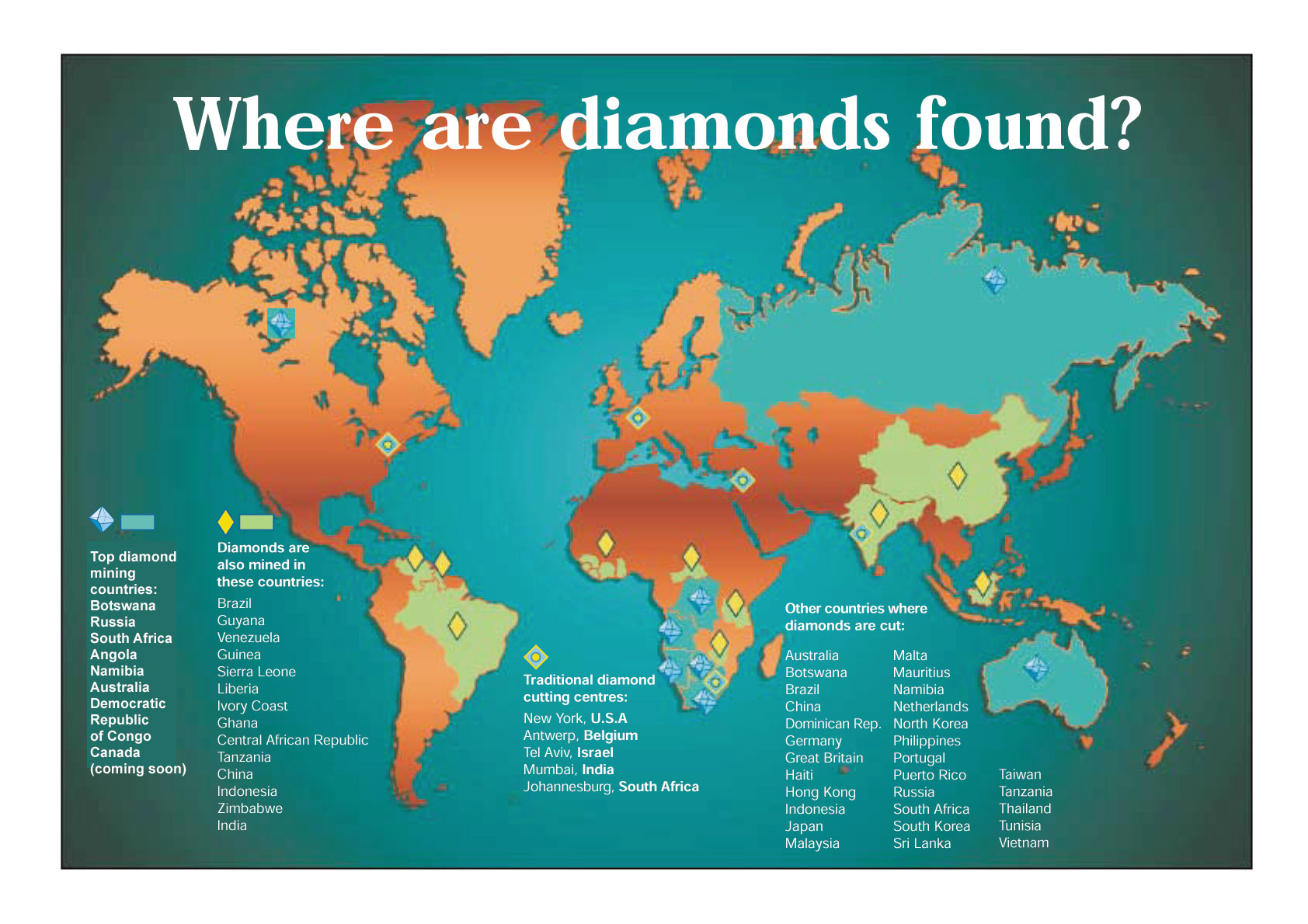
Before it was a movie title, it distinguished a type of diamond. Blood Diamond was a diamond industry term, a Scarlet Letter, to characterize an uncertain, perhaps blood-tainted, provenance. To be specific, a diamond bought from a rebel controlled region of the third world where the diamonds are traded illegally, meaning outside the market share of the diamond cartel, because a diamond sold without profiting the traditional diamond merchants is an illegal diamond. Don’t you find that odd?

The price of diamonds is kept artificially high as a result of the diamond cartel. By a tradition of laws, the Antwerp merchants have managed to make anyone else’s trading of diamonds illegal, enforcing their monopoly. If you were to discover a diamond mine and did not want to do business with the Antwerp monopoly, you’d be considered an international criminal. In the turmoil of a civil war, if you seized a mine, by definition owned by one of their partners, the cartel would label your merchandise bloody.

The diamond cartel/monopoly is reeling, so we hear, from the Hollywood release of the movie Blood Diamonds. Not because it enlightens the public about the diamond market, but because the movie embellishes upon the unpalatable stigma of blood diamonds. Diamond sellers are worried that their business will be tarnished by their own ugly creation, in this case the severed limbs of the people of Liberia forced to work in the diamond mines by feuding rebels. The merchants are selling those same diamonds after all, it only depends on who sold which to whom.

Therefore the industry is stepping up its reassurances that showroom products are guaranteed not to be blood diamonds. There are stamps of authenticity, for example, which would be lacking on blood diamonds. Really? Do you imagine they hold huge bonfires to destroy contraband diamonds like so much unwanted weed? A blood diamond captured from diamond smugglers becomes a plenty-fine diamond, once again profitable to the cartel. The logic being that the diamonds were confiscated, thus no money went to reward their bearers, thus no bloodletting was given a monetary encouragement.

Even if this was true, it doesn’t address what blood diamonds are about.

The diamond cartel was a fortuitous monopoly to grow out of a few merchants’ control of the then known diamond mines. It’s a throwback legacy of the early trade monopolies granted by kings to encourage exploration and trade. The Portuguese were once given the exclusive right to trade around the horn of Africa, then later around the horn of America. The advantage was held later by the Spanish, the Dutch and the English. The Dutch East India Trading Company was a corporate example, the Hudson Bay Fur Trading Company another. We’ve long since outgrown the need to grant exclusives to conquering explorers. Except for diamonds.

The diamond monopoly upholds diamond prices which is sort of in everybody’s interest, the everybody who owns a diamond. Unregulated, it’s calculated that diamonds would lose half their value, maybe more were diamonds to lose their “a diamond is forever” allure.

There’s another common interest which I’ll address in a moment.

For now, imagine the cartel/monopoly concept if it had been granted for automobiles. Daimler Benz would be producing expensive cars for the wealthy and Henry Ford’s Model-T would be a blood-car. Only the rich would be driving cars and policemen would be chasing the poor in illegal vehicles.

Today’s monopolies are granted through patents and copyrights. Artificial rights which ensure high prices and that the poor are left out. As this applies to medicines and technology, the price differential becomes inhumane. Aids drugs are a tragic example.

The other important reason we tolerate the diamond monopoly is to maintain stability for the ownership class within the globalized economy. Diamonds are one of the few commodities which compete with a global currency. Drugs are another. The movement of value, as represented by diamonds, can fuel economic activity outside the control of banks and regulatory agencies. Commodities represent real value, as compared to currency which represents but a representation. As a result, diamonds which are easily concealed from government tax collectors, can readily be used to fund counter-government activities such as rebellions and emancipations. Bad for business.

Desecrating the flag

This fourth of July I was enjoying the usual cook-out buffet, everything looked quite patriotic, Red White and Blue everywhere, including of course the table ware, including the napkins.

Every time I wiped barbecue sauce from my mouth, it was into an American flag. Would burning a flag be more irreverant?

There are countries which forbid the representation of their national flags in any form other than a flag. This even extends to wearing the flag. Such laws are probably to prevent the juxtaposition of their patriotic symbols with impropriety. Would you say wiping one’s mouth or feet on the flag might be an applicable example?

In this country, we’re only concerned about flag burning, the symbolic repudiation of our country’s questionable actions. Maybe that is worse.
 
Writing on US currency is illegal. So is writing on the lids of missile silos.
 
Here’s our chimp-in-chief on a rare occasion, doing something legal.
  autographing flags

King’s missing dong, episode 1

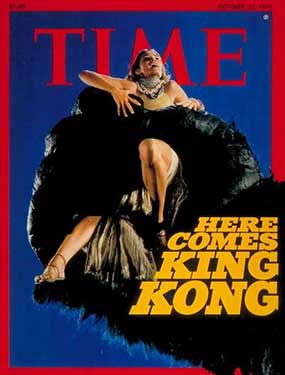
Time Magazine characterizes King Kong’s enthousiasmOkay, I admit that’s my own headline. There was indeed no trace of a King dong, but neither was there lust, nor anything more than a communication barrier overcome by physical clowning. A young white lass with Vaudeville chops was able to cajole the mighty Kong where scores of unfortunate black maidens had failed.
 
But really the special effects in the latest King Kong were amazing.

With special effects the filmmakers were able to create a giant gorilla who went ape at the sound of tom-toms summoning him to dine on a mouse-sized snack.

Special effects recreated superstitious black peoples who subsisted on the craggy coast of Skull Island, separating themselves from the island’s vegetation to live behind great fortifications and beneath countless pointy sticks on which were impaled human sacrificees.

Special effects produced dinosaurs also very keen to fight over what would be a tiny human morsel, willing to discard bigger kill for the smaller bird in the bush, even gnash away at a rocky surface trying to snatch said bony morsel.

To another extreme, special effects created bats which prey on animals larger than insects, and they stalk their target, hanging upside down each time a bit closer.

Convenient for the slow shutter rate of film projectors, these bats fly with the awkwardness of pterodactyls, the beating of their wings visible to human eyes. Lucky for our heroes who escape by holding on to the wing of a bat, while he flies with the other. A feat clearly accomplished only through special effects.

Special effects depict a world plainly ignorant of what some know as the food chain. The filmmakers can adhere to the laws of gravity, sort of, and whichever laws of physics can be illustrated, but they can’t grasp the food chain or that animals kill to eat, they do not maraud mercilessly.

By depicting nature as malevolent, we are expressing the highest disrespect for what really have become our wards. Like depicting Jesus with a machine gun for example. It might be funny, but it would be pretty undeserved.

But there’s more. Special effects produced stampedes both human and Jurassic, from which few casualties are seen. Men are able to keep pace beneath Brontosaurus legs to make the Spaniards who run with the bulls every year in Pamplona look like wusses.

And in the end you have Kong flinging blond lasses left and right, you have an entire opera house audience stampede to the exits with nary a body left behind.

In fact, given Peter Jackson’s fondness for gross-out scenes like the close-up of the carnivorous worm devouring a man head first, it seems strange that they cranked back the special effects for Kong’s final splat unto street level from the Empire State building. Kong’s body at rest on the street is shown not one bit like a sack empty of its potatoes, the usual sudden end to a 100 story fall.

David Letterman fans might have hoped to see Kong burst like a watermelon fallen from a great height, but special effects intervened.

And so the special effects try to approximate mechanical consequences, but ignore the organic, what used to be the common knowledge of life.

While this might suit the lower educated of today’s movie audience, Peter Jackson certainly does not limit himself to that denominator. In an early scene he risks boring that crowd with three interminable inside jokes: the actress they had wanted to cast for this adventure, “Fay,” was already doing an “RKO” picture for that damned “Cooper.” Rocky Horror Picture Show fans would get those references, but so what? Why not throw some bones to zoology majors and enlighten everyone.

The special effects in King Kong trade not merely in the currency of the implausible or improbable or impossible, they perpetuate the currency of ignorance with which people do great evil to nature and the environment and other cultures, particularly indigenous ones.

This film plays with lots of movie land conventions, but to an audience that is less privy to the inside references and more prone to base human reactions to the demonized stereotypes.