Why should you attend the Denver Nalty-Byfield ENTERPRISE TRIAL?

Why support the “We The People” public-oath sticklers who the state is prosecuting like a criminal enterprise? A few reasons: Solidarity. Because as hardheaded as they might be, defendants Stephen Nalty and Steve Byfield are still JUDICIAL REFORM ACTIVISTS. Sense of fair play. Half the courtroom gallery is filled with Colorado Attorney General staffers and FBI special agents chumming it up with jurors and briefing their THREE FBI UNDERCOVER WITNESSES while the defendant pariah side of the audience is warned by the judge that even a whisper will result in ejection. Thrills. Where else are you going to see this many federal agents pushing their weight around, barking at you in the hallways, swaggering gleefully about how much smarter they are than the defendants? Pathos. Come watch the Assistant Fucking Colorado Attorney General, Robert Shapiro himself, lead a team of prosecutors against the unrepresented defendants, watch Shapiro belittle them, lecture them, trivialize their difficulties defending themselves in jail, and pretend they can review “tens of thousands” of pages of evidence and “hours and hours” of undercover surveillance tapes in a single day. Because you can make a difference. Come push the FBI-guys’ buttons. Come witness and document the abuses of the overbearing prosecution team. Come lend public pressure on the judge, whose conscience is already bothering him about how unfair this sham trial has become.

Liens
You don’t have to agree with how Nalty and Byfield went about trying to reform the judicial system, but aren’t they mostly right? Judges ARE corrupt. Local officials ARE NOT accountable to the people. Law enforcement WON’T pursue charges of their own corruption and the media certainly won’t side with the reformers. When Nalty, Byfield and Co, served commercial liens valued at billions and trillions of dollar against officials who hadn’t filed oaths of office, it was an effort of last resort to get someone’s attention. No one was thinking, hey, maybe this eleven-figure dollar demand will slip through the cracks and the billions will be ours!

Each lien was calculated to represent the sum defrauded from and owed to the American People. Prosecutors can tap these defendants for conspiring and racketeering and extorting and attempting to influence public officials, but they can’t say the defendants aimed to obscond with one single penny. Throwing three undercover infiltrators at a twenty member judicial reform group, putting thousands of manpower hours into locking these defendants away, is gross abuse of authority and it’s hubris.

Authentic transgressions
As the sham trial goes on, the pieces are coming together on the cases of Nalty and crew. It turns out federal investigators labeled them “sovereigns” because they’ve held themselves not responsible for paying traffic tickets, property taxes, and the like. In the end I’ll grant you Nalty’s group may be guilty of those. I say “may” because such citations may have been retaliatory for their political beliefs.

As to the punishment, I believe adjudicators should take into account that the defendants acted not to enrich themselves, nor to flaunt the law per se, but to assert political rights about which they may have been misguided. Again I say may because the defendants are being tried, after all, according to a set of laws, which enforce a social contract, the terms of which the parties do not agree.

I use the word misguided as a nod to those who think the Nalty gang have acted like idiots. That’s easy to say, and easy to laugh, but no one’s yet figured out how to emancipate labor from the yoke of capital. You may regard interest and rent as your inherent debts. These sovereigns don’t and they’re trying to say so.

Economic slavery
Ours is a system of peonage to which this crew feels they never indentured themselves. The ersatz writs and liens they spammed to every official they encountered were the legal loopholes they thought could break the bank and liberate everyone from financial tyranny. While Nalty’s scheme intended insurrection, it wasn’t against democracy or the republic, it was against taxation without representation, the same beast Americans pretend to have overthrown with the Declaration of Independance.

Instead of tea into Boston Harbor, this crew dumped a bunch of junk paper unto the reception counters of Colorado public offices. Charge Nalty’s crew with littering maybe, at most, vandalism, though it’s hard to say these vandals caused even a scratch. Every public official who testified as a victim said they didn’t take the ersatz documents seriously.

The writs and liens looked officious, but weren’t attributed to known government or banking institutions. Likewise signatures were signed in red. Red was chosen to represent the signer’s blood, even though red is a color which automated banking systems reject as unreadable, therefore invalid.

Not one witness expressed confusion about the validity of the papers. They mentioned too the rambling diatribes in the text block.

To call the defendants “paper terrorists” wildly overstates the effect they achieved. They didn’t terrorize anyone. Governments like to accuse rebellious insurgents of “terrorism”, but that’s another paralegal threshold with which most common citizens, and certainly these “sovereigns”, disagree.

Real funny money
These guys did the equivalent of feed Monopoly Money into ATMs. No bank balances were changed and no real money came out. Counterfeit currency is one thing, but denominations of your own handywork pretending to be only that does not qualify as funny money in the illegal sense. I’m guessing forms submitted in a language foreign to bank clerks would be rejected out of hand. How are these any different? Irregular submissions, as one witness called them, need not generate calls to the FBI or the Colorado Joint Terrorism Task Force. I’ll bet that ATMs know to reject Monopoly Money. If they don’t, whose problem is that?

The trial of defendants Stephen Nalty and Steve Byfield is due to wrap up Friday. The prosecution will have taken seven days to present its case and Assistant Attorney General Robert Shapiro intends to object if the defense rebuttal takes more than a half day, maybe a whole. This trial is meant to intimidate the other defendants to convince them to take pleas.

Next in the pipeline is Bruce Doucette whose trial starts October 16. Defendants Harlan Smith and Dave Coffelt have hearings on October 18. If they do not take deals, Shapiro intends to enjoin their cases, to save time and money. He’s already convinced defendant Brian Baylog to take a deal and turn state’s evidence. Baylog is scheduled to testify against Nalty and Byfield shortly.

By now the condemnation of Nalty’s commercial lien scheme will have cost Colorado millions in man hours and legal expenses. You can fine a graffiti artist for having to restore an edifice to its original lustre, but you can’t expect him to bear the full cost if you chose a cleanup crew that wears Gucci loafers, most of whose jobs is to pat the other on the back.

Colorado’s overkill with federal agents and counter-terrorism experts is a problem of its own making.

The Nalty-Byfield trial continues through this week 8:30am – 5pm, at Denver’s Lindsey Flanigan Courthouse, in Division 2H, ironically, “Juvenile Court”.

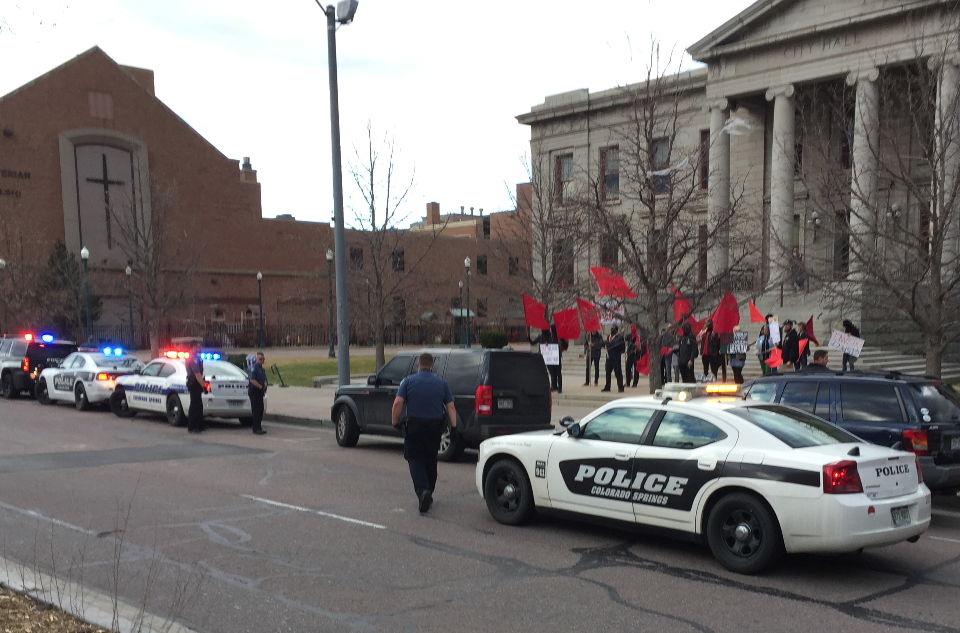
Colo. Springs police disperse March 26 anti-imperialism rally because it was easier than listening to socialists

Colorado Springs Socialists
COLORADO SPRINGS, CO- Local socialists assembled at City Hall on Sunday to “March Against Imperialism”. After a brief march and an half-hour rally while encircled by CSPD, the socialists were informed they were “free to carry on with their assembly” but whoever lingered would be issued a citation for having been in the street. Making no distinction for who had and who hadn’t, the police began handcuffing participants and the couple dozen others quickly dispersed. Five socialists were issued citations for “pedestrian in the highway” and “failure to disperse” while another was arrested and detained for failing to show an ID while filming the police. That person was taken to the downtown police station and held until officers finally informed her of the charges for which she was being cited, after which she identified herself. Throughout her detainment, multiple officers kept up a harassment of questions, refusing her requests that she contact her lawyer. CSPD never issued an order to disperse, a fact that is borne out by witness video. But in effect that is what the officers accomplished. They threatened the legal assembly with citations, for failure to disperse!

CSPD cruiser gunboat diplomacy

It made a funny scene. Around thirty self-declared socialists, blockaded by eight sometimes more CSPD cruisers, in a standoff that lasted until the police lost their patience. Socialists spoke against imperialism, the police officers being their main audience that quiet Sunday downtown. Immediately as the march had ended the police had announced that anyone stepping back into the street would be arrested, and so no one did. But a half-hour of speeches proved too much for the officers to bear and so they interjected again, this time to discuss the problem they had with what had happened earlier. We told those officers they were of course free to discuss such matters individually with whoever they considered a person of interest, BUT AFTERWARD, because they were otherwise interrupting our legal assembly. But the officers persisted in their interruption, deciding after the fact what charges to bring, regardless that they’d forgotten to provide the evidence to back them up. “See you in court” they laughed! We’ve heard that before.

On a serious note. What happened Sunday could have a chilling effect on the nascent kick-ass Colorado Springs Socialists. Unwarranted police attention is an unhappy tradition for socialist organizers, from anarchists to trade unions. Sunday’s denouement confirms all their parents’ worst worries, the folly of declaring yourself to be a socialist in a regressive backwater like Colorado Springs. People were arrested? Handcuffed?! Now you’re on a police watch list! I remember my father’s alarm when he learned his college sophmore had a subscription to Mother Jones Magazine.

Fun as it was, Sunday’s event was essentially uneventful: no altercations, no property damage, not even rhetoric to threaten infrastructure. Minus any media attention, or much of an audience at all on a sleepy Sunday evening, these socialists were determined to parade their dissent where and how those around could see, and reaped more law enforcement than the circumstances required.

While you might say the outcome was predictable, it needn’t have been. Students from the wealthier Colorado College have free range on downtown streets, protesting racism or election outcomes on the street without arrests or citations. Every full moon CC students ride the length of downtown’s main street on bike, skate or skateboard, without even police escort. Sunday’s fledgeling socialist organization is a student club of the UCCS campus. UCCS is more working class, for many a commuter campus, and obviously isn’t shown any deference by city administrators.

Compared to the liberal arts curriculum of Colorado College. UCCS is considered more conservative. UCCS hosts business and military related classes. It even has a Brazil-esque Department of Homeland Security -um- Department. So I think it’s all the more admirable that UCCS has spawned a bonafide socialist group that dwarfs even their school’s Young Republican franchise. I’ve no doubt those socialists I met on Sunday will not be cowed by CSPD’s preemptive aggressions. Hopefully their more timid members will take heart.

Public protests are regularly given use of the streets, which like parks are considered traditional free speech zones. The Tea Party and Occupy took to the streets of Colorado Springs without incurring arrests. More recently people have marched for Black Lives Matter and for solidarity with Native Americans fighting oil pipelines. These have produced zero arrests.

In the meantime it will be important to debrief on what happened and unify the legal strategies. All defendants face the traffic offense of being a pedestrian on the highway [sic] and the misdemeanor of failure to disperse, no doubt tacked on to be a droppable charge as fodder for plea bargains. The recalcitrant videographer faces an added charge of misdemeanor interference for failing to produce her ID. They give her no extra credit for providing a pretext for interrogation because she wouldn’t say zilch without a lawyer present, except to explain where and when they were violating her rights. It used to be that cops had to read us our rights.

Police can issue all the tickets they want when there’s probable cause. They can’t threaten to issue tickets for the solitary purpose of disbanding a legal assembly. In the end, the only socialists who got citations were punished not for being in the street but for standing their ground in front of City Hall.

DPD commander reveals arrest threat is a regular “ploy” to disperse protest

DENVER, COLORADO- We heard on Friday that US judge William Martinez needed more time to craft an opinion on a temporary injunction of DIA’s enforcement of their free speech permit. He commited to a decision early this week, and frankly we don’t know what to expect. From challenges he posed to attorneys at Wednesday’s hearing, the judge appears to think DIA needs some degree of “notice” about potential disruptions. He is unlikely to rule against the permit altogether because he opened the hearing already proclaiming that DIA is a “not a public forum” and thus has discretion about what expression to allow. DIA can limit subject matter, but not viewpoint, and can constrict assemblies. Judge Martinez’s starting point was based on US Supreme Court precedent set at JFK and Dulles airports, ignoring that both of those facilities are decentralized and lack DIA’s literal public square. Ironically, neither JFK or Dulles attempted to quash their Muslim Ban protests as did DIA. I’d like to mention some other details revealed at the preliminary injunction hearing.

For starters, the person in charge of approving permits has a highy subjective attitude about viewpoint. To him, pro-military messages are not oints of view at all, they’re just patriotic. They don’t require permits. Also, his department hasn’t declined to issue permits. They work with applicants to arrive at accommodations suitable to the airport. For example, the American Islamic Society was recently granted a permit, the airport requires they limit their participant numbers to FOUR.

DPD Commander Tony Lopez explained why he needs advance notice of protest actions, to be able to schedule officers without having to pay short-notice overtime. Lopez revealed that his optimal staffing numbers are a one to one ratio with activists. Small wonder he was demoted to DIA from downtown District Six. Lopez also testified that he often threatens to make arrests “as a ploy” to make a crowd disperse. And “it usually works” he said. A next step is to mobilize his officers to appear to be targeting particular activists, to increase the intimidation, without an actual intention of making arrests, or justifying them. His testimony confirmed what I described to the court, of officers often threatening to arrest us, even when they had no legal basis, and telling us we needed a permit when none was required.

From the attitude of the city attorneys and the DIA personnel, one became uneasily aware that administrators don’t even blink at sacrificing civil liberties for the interests of security. If airport surveillance can’t size you up as either a traveller or meetor-greetor, they can’t predict your behavior and you’ve suddenly become a security risk. Airport customs and TSA lines are already areas inhospitable to personal freedoms. Apparently airport managers would like all their hallways and public centers to be as restricted. If cops had their way, public streets and sidewalks would be single-purpose conduits as well.

We await a federal judge’s ruling for now, with optimism in judgement superior to that of petty administrators, city lawyers and police. Seeking protection from the courts is contigent on the premise that if needed, the wisdom of the US Supreme Court could be brought to bear. Of late it’s hard to regard those justices as the brightest minds or uncorrupted. We have the Citizens United decision as an example. To which I would add, the terrible compromise that airports are not public forums.

As President Trump considers a follow-up executive order to replace his first Muslim Ban now stymied by the courts, it’s interesting to note we just marked the anniversary of FDR’s order to put Japanese-Americans, the “others” of his day, into internment camps. The supreme court of his day upheld his order. Technically that legal precedent still stands.

Smokey Bear wants to prevent fires, does he belong to your resistance?

So there’s a t-shirt being pitched by the alt-mod-left, who want to coopt the anti-Trump rallying cry RESIST. It’s Smokey Bear with his head down and fist raised, invoking the Black Panther salute made iconic at the 1968 olympics. Except his fist is on FIRE, and it’s Smokey. WTF. Is he resisting putting it out? Smokey Bear’s singular catch-phrase is about YOU, PREVENTING FIRES. As usual, he’s holding a shovel, a reminder that fighting forest fires is essentially ditch-digging. So what is Smokey resisting? The urge to douse the fire burning up his hand? The image reminds me of the innanity of moderate democrats. Both “Smokey” and “Bear” have long become euphemisms for cops. This Smokey wants to embed with your resistance crew. Knock him out with a shovel.

Occupy v. Martinez (Plaza Protest Ban) 2016 US 10th Circuit Court of Appeals Decision AFFIRMING Prelim Injunction


Yesterday I published the federal judge’s order to grant the 2015 preliminary injunction against the Lindsey Flanigan Courthouse. Since that time the city motioned to dismiss, there were show cause hearings, and depositions, and an appeal to the 10th Circuit Court of Appeals. On April 8, 2016 the appeals court AFFIRMED the preliminary injunction. As a result this legal action is on the road to becoming a permanent injunction, to be decided at trial this April. The prospects look promising, based on how the appelate judges schooled our First Amendment adversaries. I’m reprinting their full decision below.

In particular you might enjoy Judge McHugh’s citing of US Supreme Court Justice Owen Roberts, writing in 1939 for the majority, in a decision to uphold public first amendment rights in Hague v. [AFL-]CIO. Robert affirmed that streets were traditional free speech areas:

“Wherever the title of streets and parks may rest, they have immemorially been held in trust for the use of the public and, time out of mind, have been used for purposes of assembly, communicating thoughts between citizens, and discussing public questions. Such use of the streets and public places has, from ancient times, been a part of the privileges, immunities, rights, and liberties of citizens. The privilege of a citizen of the United States to use the streets and parks for communication of views on national questions may be regulated in the interest of all; it is not absolute, but relative, and must be exercised in subordination to the general comfort and convenience, and in consonance with peace and good order; but it must not, in the guise of regulation, be abridged or denied.”

Here’s the full 2016 opinion rejecting Denver’s appeal of our federal injunction:

Document: 01019599889 Date Filed: 04/08/2016

UNITED STATES COURT OF APPEALS
FOR THE TENTH CIRCUIT

_________________________________

ERIC VERLO; JANET MATZEN; and FULLY INFORMED JURY ASSOCIATION,

Plaintiffs – Appellees,

v.

THE HONORABLE MICHAEL MARTINEZ, in his official capacity as Chief Judge of the Second Judicial District,

Defendant – Appellant,

v.

THE CITY AND COUNTY OF DENVER, COLORADO, a municipality; ROBERT C. WHITE, in his official capacity as Denver Chief of Police,
Defendants – Appellees.

_______________

FILED ?United States Court of Appeals Tenth Circuit

April 8, 2016

Elisabeth A. Shumaker Clerk of Court

No. 15-1319

_________________________________

Appeal from the United States District Court for the District of Colorado ?(D.C. No. 1:15-CV-01775-WJM-MJW)
_________________________________

Stephanie Lindquist Scoville, Senior Assistant Attorney General, Office of the Attorney General for the State of Colorado, Denver, Colorado (Cynthia H. Coffman, Attorney General; Frederick R. Yarger, Solicitor General; Matthew D. Grove, Assistant Solicitor General; Ralph L. Carr, Colorado Judicial Center, Denver, Colorado, with her on the briefs) for Defendant – Appellant.

David A. Lane, Killmer, Lane & Newman, LLP, Denver, Colorado, for Plaintiffs – Appellees.

Wendy J. Shea, Assistant City Attorney; Geoffrey C. Klingsporn, Assistant City Attorney; Evan P. Lee, Assistant City Attorney; Cristina Peña Helm, Assistant City Attorney, Denver City Attorney’s Office, Denver, Colorado, filed a brief on behalf of Defendants – Appellees.
_________________________________

Before BRISCOE, McKAY, and McHUGH, Circuit Judges.
_________________________________

McHUGH, Circuit Judge.
_________________________________

This is an interlocutory appeal challenging the district court’s grant of a preliminary injunction, enjoining in part the enforcement of an administrative order (Order) issued by Defendant-Appellant Judge Michael Martinez, acting in his official capacity as Chief Judge of the Second Judicial District of Colorado (Judicial District). The Order prohibits all expressive activities within an area immediately surrounding the Lindsey-Flanigan Courthouse in Denver (Courthouse). Plaintiffs-Appellees Eric Verlo, Janet Matzen, and the Fully Informed Jury Association (collectively, Plaintiffs) sought the preliminary injunction to stop enforcement of the Order against their expressive activities. Following an evidentiary hearing, the district court enjoined enforcement of a portion of the Order as against Plaintiffs. The Judicial District now appeals.

Based on the arguments made and evidence presented at the preliminary injunction hearing, we hold the district court did not abuse its discretion in granting Plaintiffs’ motion in part. Although we affirm the district court’s order granting a limited preliminary injunction, we express no opinion as to whether a permanent injunction should issue. Instead, we provide guidance to the district court and the parties regarding the factual inquiry and the applicable legal standard relevant to that question on remand.

I. BACKGROUND

The genesis of this case is an incident involving nonparties. On July 27, 2015, two men were distributing pamphlets on the plaza outside the Courthouse (Plaza). The pamphlets contained information about jury nullification, a practice in which a jury refuses to convict a defendant despite legal evidence of guilt because the jury members believe the law at issue is immoral. 1 Both men were arrested and charged with jury tampering in violation of Colorado law. See Colo. Rev. Stat. § 18-8-609(1) (“A person commits jury-tampering if, with intent to influence a jury’s vote, opinion, decision, or other action in a case, he attempts directly or indirectly to communicate with a juror other than as a part of the proceedings in the trial of the case.”).

———
1 Jury nullification has been defined as “[a] jury’s knowing and deliberate rejection of the evidence or refusal to apply the law either because the jury wants to send a message about some social issue that is larger than the case itself or because the result dictated by law is contrary to the jury’s sense of justice, morality, or fairness.” Jury Nullification, Black’s Law Dictionary (10th ed. 2014).
———

Plaintiffs, like the men who were arrested, wish to distribute literature relating to and advocating for jury nullification to individuals approaching the Courthouse who might be prospective jurors. Fearing they too would be subject to arrest, Plaintiffs brought suit against the City and County of Denver and Robert C. White, Denver’s police chief, in his official capacity (collectively, Denver) to establish their First Amendment right to engage in this activity. On the same day they filed suit, Plaintiffs also moved for a preliminary injunction, seeking to restrain Defendants from taking action to prevent Plaintiffs from distributing jury nullification literature on the Plaza. Two days later, Plaintiffs amended their complaint to also challenge the Order issued by the Judicial District.

That Order, entitled Chief Judge Order Regarding Expressive Activities at the Lindsey-Flanigan Courthouse, states in relevant part:

The Court has the responsibility and authority to ensure the safe and orderly use of the facilities of the Second Judicial District; to minimize activities which unreasonably disrupt, interrupt, or interfere with the orderly and peaceful conduct of court business in a neutral forum free of actual or perceived partiality, bias, prejudice, or favoritism; to provide for the fair and orderly conduct of hearings and trials; to promote the free flow of pedestrian and vehicular traffic on sidewalks and streets; and to maintain proper judicial decorum. Those having business with the courts must be able to enter and exit the Lindsey-Flanigan Courthouse freely, in a safe and orderly fashion and unhindered by threats, confrontation, interference, or harassment. Accordingly, the Court hereby prohibits certain expressive activities on the grounds of the Courthouse, without regard to the content of any particular message, idea, or form of speech.

Prohibited Activities: The activities listed below shall be prohibited in the following areas: anywhere inside the Lindsey-Flanigan Courthouse, including courtrooms, corridors, hallways, and lobbies; the areas, lawns, walkways, or roadways between the Courthouse and public sidewalks and roads; and any areas, walkways, or roadways that connect public sidewalks and roads to Courthouse entrances or exits. This includes, but is not limited to, the Courthouse entrance plaza areas on the east and west sides of the Courthouse as depicted in the highlighted areas of the attached map.

1. Demonstrating; picketing; protesting; marching; parading; holding vigils or religious services; proselytizing or preaching; distributing literature or other materials, or engaging in similar conduct that involves the communication or expression of views or grievances; soliciting sales or donations; or engaging in any commercial activity; unless specifically authorized in writing by administration; ?

2. Obstructing the clear passage, entry, or exit of law enforcement and emergency vehicles and personnel, Courthouse personnel, and other persons having business with the courts through Courthouse parking areas, entrances, and roadways to and from Courthouse and Courthouse grounds;

3. Erecting structures or other facilities, whether for a single proceeding or intended to remain in place until the conclusion of a matter; or placing tents, chairs, tables, or similar items on Courthouse grounds; except as specifically authorized in writing by administration; and ?

4. Using sound amplification equipment in a manner that harasses or interferes with persons entering or leaving Courthouse grounds or persons waiting in line to enter the Courthouse. ?

The Order was accompanied by an image depicting an aerial view of the Courthouse and its grounds, with the areas in which the Order prohibited expressive activity highlighted in yellow (Restricted Areas).

The Courthouse is bordered on its north side by Colfax Avenue and on its west side by Fox Street. Both Colfax Avenue and Fox Street have public sidewalks running along the perimeter of the Courthouse. Immediately to the east of the Courthouse lies the Plaza. The Plaza is bisected by Elati Street, which is closed to traffic other than police vehicles. Elati Street runs through a large circular area (Main Plaza) between the Courthouse and the Van Cise-Simonet Detention Center (Detention Center), which houses pretrial detainees. The Main Plaza contains planters, benches, public artwork, sidewalks, and gravel areas and is suitable for public gatherings.

Of relevance to this appeal are the Restricted Areas, which include an arc-shaped walkway and planter area immediately to the east of the Courthouse. The arced walkway runs from the corner of Elati Street and Colfax Avenue in a curved path across the front of the Courthouse and ends where it intersects with an open area in front of the Courthouse containing planters and benches (the Patio), which also forms part of the Restricted Areas. The Patio provides access to the main entrance on the east side of the Courthouse. Thus, the Restricted Areas encompass only the portions of the Plaza closest to the Courthouse.

The Judicial District opposed Plaintiffs’ motion for a preliminary injunction and, in doing so, defended the Order. In contrast, Denver entered into a joint stipulation (the Stipulation) with Plaintiffs. The Stipulation asserted that the entire Plaza between the Courthouse and the Detention Center—specifically including the Restricted Areas—was “a public forum and any content-based regulations must be narrowly drawn to effectuate a compelling state interest and reasonable time, place and manner regulations.” It further acknowledged that Plaintiffs were entitled to distribute jury nullification literature on the Plaza and pledged that Denver would not “arrest or otherwise charge Plaintiffs for handing out literature regarding jury nullification so long as Plaintiffs do not violate Colorado law or Denver’s Revised Municipal Code when they are handing out their literature.” The Stipulation specifically referenced the Judicial District’s Order, indicating Denver did not “intend to enforce [the Order] as written and will only impose content and viewpoint neutral reasonable time, place and manner restrictions on the use of the Plaza, and/or other exterior areas surrounding the Plaza if Denver determines that a compelling need exists to do so.”

At the preliminary injunction hearing, the parties called only two witnesses. Plaintiffs called Commander Antonio Lopez of the Denver Police Department. Commander Lopez described the Plaza as a public “open space” much like the city’s various parks. He testified that in the five years since the Courthouse opened he has witnessed “more First Amendment activity take place in [the Plaza] than [he] can recall.” Specifically, Commander Lopez described a variety of protest activities “at one point . . . averaging about two or three a week” in the Plaza. He further testified that the Denver Police Department had never taken steps to stop protest activity in the Plaza, other than intervening if protesters became violent or otherwise broke the law. Relevant to this appeal, Commander Lopez testified that in his experience, the entire Plaza—including the Restricted Areas—has traditionally been used for First Amendment protest activities. On cross-examination, Commander Lopez acknowledged that the “majority” of the protests in the Plaza occurred closer to the Detention Center, but that he had also seen protests directed at the Courthouse.

The Judicial District called Steven Steadman, administrator of judicial security for Colorado. Mr. Steadman testified that the Order was motivated by concern about anticipated protests of a verdict in a death penalty case being tried at the Courthouse.?Mr. Steadman explained that he met with Chief Judge Martinez to discuss security concerns relating to that verdict and recommended the Judicial District adopt a policy similar to one recently implemented in Arapahoe County during another high-profile capital trial.

Mr. Steadman also testified about the design of the Plaza, including the Restricted Areas. He indicated that the planters, gravel areas, and sidewalks were intentionally designed to “signal to the average user how to find their way, and where you should go and what the main travel ways are.” Mr. Steadman explained that the Patio and arced walkway’s “sole purpose is to allow people, the public, to enter and exit the [Courthouse] without being interfered with.” But Mr. Steadman also stated that, prior to imposition of the Order, protestors—including pamphleteers—were allowed to protest immediately in front of the doors to the Courthouse, provided they did not interfere with ingress or egress from the Courthouse. He explained that the “general response” of protestors was to cease their activities when requested by Courthouse security not to interfere with public access to the Courthouse. Mr. Steadman further testified that no person had ever been arrested for blocking ingress or egress from the Courthouse since it opened in 2010. Important to this appeal, Mr. Steadman acknowledged that Plaintiffs’ activities of passing out jury nullification literature did not present “any security risk” beyond what had previously been tolerated without incident throughout the time the Courthouse had been open.

The district court also accepted a proffer of Plaintiffs’ testimony, indicating that their intent was to approach people entering the Courthouse to discuss quietly the concept of jury nullification and to distribute their literature. Plaintiffs asserted that proximity to the front door of the Courthouse was key to their message because otherwise their intended audience—“people who are going to serve or are in fact serving on juries”—will “very frequently just bypass them” in the designated free speech zone by “walking on one of the sidewalks that is part of the [Restricted Areas].” By contrast, positioning themselves near the front door would allow Plaintiffs “to pass out literature to anyone who wants it” and “if people want to stop and talk about [it], they can then explain to them what the concept of jury nullification is.” Thus, according to Plaintiffs, the Order effectively prevented them from reaching their target audience. Finally, the district court accepted the parties’ jointly stipulated exhibits, which consisted of a series of images of the Plaza and Restricted Areas, as well as a copy of the Order.

Following the evidentiary hearing, the district court granted Plaintiffs’ request for a preliminary injunction. In doing so, the district court relied on Denver’s Stipulation that the Plaza was a public forum and the Judicial District’s position that resolving the forum status was not necessary because the Order “would satisfy even the strictest test.” The district court concluded Plaintiffs had demonstrated a likelihood of success on the merits because, treating the Restricted Areas as public fora, the Order’s complete ban on expressive activity was not narrowly tailored to accomplish a significant government interest.

Accordingly, the district court entered a carefully circumscribed preliminary injunction in favor of Plaintiffs. Specifically, the district court enjoined enforcement of Paragraph 1 of the Order against Plaintiffs “to the extent he or she is otherwise lawfully seeking to distribute and/or orally advocate the message contained in [Plaintiffs’ pamphlets]” in the Restricted Areas. But the district court expressly left the remainder of the Order in place.

Following entry of the preliminary injunction, the Judicial District moved to stay the injunction pending appeal pursuant to Rule 62(c) of the Federal Rules of Civil Procedure. In its motion to stay, the Judicial District introduced evidence that— subsequent to entry of the preliminary injunction—protesters had “descended on the Courthouse Plaza” and engaged in a pattern of disruptive and inappropriate behavior, including erecting canopies, harassing citizens seeking to enter the Courthouse, damaging the Courthouse landscaping, yelling and taunting court personnel, and posting signs in the planters and on the flagpoles in the Plaza. The Judicial District argued that a stay of the injunction was appropriate because protesters had been “emboldened” by the injunction to violate even the portions of the Order not subject to the injunction, thereby irreparably harming the Judicial District. The district court declined to stay the injunction, finding the Judicial District had not demonstrated a likelihood of success on appeal because the harm identified was not caused by the injunction. The district court reasoned the Judicial District and Denver were free to enforce the Order against the parties engaging in the complained-of disruptive behavior because such behavior was unlawful and not protected by the narrow injunction issued by the court with respect to Plaintiffs’ activities only.

The Judicial District now appeals. Exercising jurisdiction pursuant to 28 U.S.C. § 1292(a)(1), we affirm.

II. DISCUSSION

On appeal, the Judicial District raises two arguments. First, it asserts the district court erred when it concluded the Plaintiffs had demonstrated a likelihood of success in establishing the Restricted Areas are public fora. Second, the Judicial District argues the district court incorrectly applied strict scrutiny when evaluating the Order. As a result, the Judicial District asks this court to reverse the district court’s entry of the preliminary injunction and remand for further proceedings.

We review the district court’s grant of a preliminary injunction for abuse of discretion. Planned Parenthood of Kan. & Mid-Mo. v. Moser, 747 F.3d 814, 822 (10th Cir. 2014). “A district court abuses its discretion when it commits an error of law or makes clearly erroneous factual findings.” Id.

A. Scope of Review

Before addressing the merits of the parties’ arguments, we pause to clarify the scope of our review. The district court granted a narrow preliminary injunction drafted to address Plaintiffs’ First Amendment concerns related to their specific expressive activities. Although Plaintiffs asked the district court to prohibit enforcement of the entire Order, the court enjoined only the first paragraph, which imposes a complete ban on First Amendment activities—picketing, pamphleteering, protesting—within the Restricted Areas. The district court left in place the rest of the Order, including the prohibitions against obstructing Courthouse entrances, erecting structures, and using sound amplification equipment in the Restricted Areas.

The district court further limited the scope of the preliminary injunction by enjoining the first paragraph of the Order only as to Plaintiffs’ specific pamphleteering activities. In fact, the court enjoined enforcement of the Order only as to Plaintiffs’ distribution and discussion of two specifically identified pamphlets. The Judicial District remains free to enforce the first paragraph of the Order—even against Plaintiffs—for all other First Amendment activities within the Restricted Areas.

Finally, the district court limited the geographic scope of the injunction. Although the Order prohibits First Amendment activity both inside and outside the Courthouse, the district court enjoined enforcement of Paragraph 1 as to Plaintiffs only outside the Courthouse, leaving the entirety of the Order intact within the Courthouse. And the district court did not enjoin enforcement of any part of the Order within those portions of the Restricted Areas dedicated to Courthouse landscaping and security features. Thus, the Order continues to prohibit all expressive activity in the planter boxes or other landscaping and in the gravel security areas. Accordingly, the features of the Restricted Area to which the preliminary injunction applies are limited to (1) the arced walkway running south from Colfax Avenue between the gravel security area (to the west of the walkway) and a raised planter (to the east of the walkway) and ending at the Patio area at the main entrance on the east side of the Courthouse; 2 and (2) the Patio area at the main entrance. 3

————–
2 As discussed, the Order’s prohibition on expressive activities in the planter and gravel security areas were not enjoined by the district court.

3 The evidence presented about the geographic layout and physical features of the Restricted Area consisted primarily of approximately fifteen photographs. Because the record contains little testimony about the photographs, we rely on our own review of them to describe the Restricted Areas. In particular, it is unclear whether and to what extent the Restricted Areas include the sidewalk running along Fox Street on the west side of the Courthouse. The exhibit appears to highlight some areas of the sidewalk, but counsel for the Judicial District conceded at oral argument that it would be “constitutionally questionable” to prevent speech on a public sidewalk, and then indicated “[t]hat is precisely why the order here does not extend that far.” Therefore, we do not treat the Fox Street sidewalk as part of the Restricted Areas for purposes of our analysis.
——————

Our task in this appeal is to determine whether the district court abused its discretion when, based on the record before it at the preliminary injunction hearing, it issued this narrow, targeted injunction. But the Judicial District asks us to consider events occurring after the preliminary injunction hearing to determine whether the district court abused its discretion in issuing the preliminary injunction. Specifically, the Judicial District points to evidence introduced during the Rule 62(c) hearing on the motion to stay the injunction pending appeal, which indicated that following the injunction, protestors had engaged in a series of inappropriate and disruptive behaviors. Some of these behaviors included harassing court personnel seeking to enter the Courthouse, erecting canopies and signs, and trampling Courthouse landscaping. According to the Judicial District, these post-injunction events demonstrate the “concrete concerns” motivating the creation of the Restricted Areas and therefore should have been considered by the district court.

Although we share the Judicial District’s concern about the disruptions created by some protestors following issuance of the injunction, these post-injunction events are not relevant to our resolution of this interlocutory appeal for two reasons. First, this evidence relates to events occurring after the preliminary injunction issued, and therefore none of it was presented to the district court at the hearing. We will not hold that the district court abused its discretion based on evidence not before it when it ruled. See Adler v. Wal-Mart Stores, Inc., 144 F.3d 664, 671 (10th Cir. 1998) (noting the general principle, in the context of de novo review of a summary judgment disposition, that we conduct our review “from the perspective of the district court at the time it made its ruling, ordinarily limiting our review to the materials adequately brought to the attention of the district court by the parties”); Theriot v. Par. of Jefferson, 185 F.3d 477, 491 n.26 (5th Cir. 1999) (“An appellate court may not consider . . . facts which were not before the district court at the time of the challenged ruling.”). Cf. Ambus v. Granite Bd. of Educ., 975 F.2d 1555, 1569 (10th Cir. 1992) (“[W]e will not reverse the grant of summary judgment . . . based on evidence not before the district court.”). Accordingly, our review is limited to the evidence before the district court at the time of the preliminary injunction hearing, and we will not consider post-injunction events.

Second, even if we were to consider the post-decision evidence, it would not alter our analysis. The evidence the Judicial District relies on to demonstrate the negative effects of the preliminary injunction, in fact, does not implicate the injunction at all. As discussed, the preliminary injunction enjoins enforcement of Paragraph 1 of the Order specifically against Plaintiffs’ pamphleteering activities in certain parts of the Restricted Areas. The district court expressly allowed the Judicial District to continue enforcing the entire Order as to all other parties and all other First Amendment activities in the Restricted Areas. Importantly, the preliminary injunction does not affect the Judicial District’s ability to enforce the Order against any protestors, including the Plaintiffs, who engage in disruptive behaviors. For example, the injunction does not prohibit the Judicial District from taking action against protestors who obstruct Courthouse entrances, damage the Courthouse landscaping, or erect structures. All of this behavior remained prohibited by the Order after issuance of the injunction. In short, nothing in the preliminary injunction before us on appeal interferes with the Judicial District’s or Denver’s ability to enforce the Order against anyone, including Plaintiffs, engaging in such behavior.

The evidence of post-injunction bad behavior of some protestors may be relevant on remand to a motion to modify the injunction4 or to the district court’s ultimate decision on whether to issue a permanent injunction. But for the purposes of this appeal, we limit our review to the evidence before the district court at the time it issued the preliminary injunction.

—————
4 As the district court noted, the Judicial District did not move to modify the preliminary injunction based on changed circumstances. See Fed. R. Civ. P. 60(b)(5) (allowing a party to obtain relief from a judgment or order when “applying [the judgment or order] prospectively is no longer equitable”); Horne v. Flores, 557 U.S. 433, 447 (2009) (noting that under Rule 60(b)(5) “[t]he party seeking relief bears the burden of establishing that changed circumstances warrant relief”).
—————

B. Abuse of Discretion

We now turn our attention to the question of whether the district court abused its discretion when it issued the preliminary injunction.

To obtain a preliminary injunction the moving party must demonstrate: (1) a likelihood of success on the merits; (2) a likelihood that the moving party will suffer irreparable harm if the injunction is not granted; (3) the balance of equities is in the moving party’s favor; and (4) the preliminary injunction is in the public interest.

Republican Party of N.M. v. King, 741 F.3d 1089, 1092 (10th Cir. 2013). In the First Amendment context, “the likelihood of success on the merits will often be the determinative factor” because of the seminal importance of the interests at stake. Hobby Lobby Stores, Inc. v. Sebelius, 723 F.3d 1114, 1145 (10th Cir. 2013) (internal quotation marks omitted); see also Heideman v. S. Salt Lake City, 348 F.3d 1182, 1190 (10th Cir. 2003) (“[T]he loss of First Amendment freedoms, for even minimal periods of time, unquestionably constitutes irreparable injury.”).

1. The district court did not abuse its discretion in finding the second, third, and fourth factors weighed in Plaintiffs’ favor.

Here, the district court found the second (irreparable harm), third (balance of equities), and fourth (public interest) factors weighed in Plaintiffs’ favor in light of the important First Amendment interests at stake. As an initial matter, the Judicial District has not challenged the district court’s determination as to these factors beyond a single footnote in its opening brief stating it had challenged them before the district court. A party’s offhand reference to an issue in a footnote, without citation to legal authority or reasoned argument, is insufficient to present the issue for our consideration. See San Juan Citizens All. v. Stiles, 654 F.3d 1038, 1055–56 (10th Cir. 2011). Accordingly, the Judicial District has waived any challenge to the district court’s findings related to the elements of irreparable harm, the balance of equities, and the public interest. But even if the Judicial District had properly challenged these factors on appeal, we would nevertheless affirm the district court’s conclusion that they weigh in Plaintiffs’ favor.

The Supreme Court has instructed that “[t]he loss of First Amendment freedoms, for even minimal periods of time, unquestionably constitutes irreparable injury.” Elrod v. Burns, 427 U.S. 347, 373 (1976); see also Awad v. Ziriax, 670 F.3d 1111, 1131 (10th Cir. 2012) (“[W]hen an alleged constitutional right is involved, most courts hold that no further showing of irreparable injury is necessary.”). There is no dispute that Plaintiffs’ pamphleteering constitutes First Amendment activity. See McCullen v. Coakley, 134 S. Ct. 2518, 2536 (2014) (recognizing that one-on-one communication and leafletting are First Amendment-protected activities). And the Judicial District does not dispute that the Order would bar Plaintiffs from engaging in their pamphleteering in the Restricted Areas. Accordingly, the district court did not abuse its discretion in finding that the factor of irreparable harm weighs in Plaintiffs’ favor.

The third factor—balance of equities—also tips in Plaintiffs’ favor. Before the district court, Plaintiffs proffered testimony that the Order would substantially impair their ability to convey their intended message to their target audience because it would prevent Plaintiffs from approaching potential jurors and engaging in a meaningful discussion of jury nullification. The district court also heard testimony from Mr. Steadman that Plaintiffs’ distribution of jury nullification literature and one-on-one discussions with potential jurors did not present a security risk. And the Judicial District presented no evidence that Plaintiffs’ activities otherwise interfered with Courthouse functions. On this record, the district court did not abuse its discretion in finding the balance of equities weighed in favor of Plaintiffs. See Awad, 670 F.3d at 1132 (“Delayed implementation of a [governmental] measure that does not appear to address any immediate problem will generally not cause material harm, even if the measure were eventually found to be constitutional and enforceable.”).

As to whether the preliminary injunction is in the public interest, we agree with the district court that “it is always in the public interest to prevent the violation of a party’s constitutional rights.” Id. (internal quotation marks omitted); Pac. Frontier v. Pleasant Grove City, 414 F.3d 1221, 1237 (10th Cir. 2005) (“Vindicating First Amendment freedoms is clearly in the public interest.”). The district court did not abuse its discretion in finding the public interest was served by issuing the preliminary injunction to prevent the violation of Plaintiffs’ First Amendment rights.

Thus, we agree the second, third, and fourth factors weigh in Plaintiffs’ favor. The only remaining question, then, is whether the district court abused its discretion in finding Plaintiffs demonstrated a likelihood of success on the merits. 5 Specifically, we must determine whether the Order violated Plaintiffs’ First Amendment right to distribute jury nullification pamphlets and engage in one-on-one conversations with individuals entering and leaving the Courthouse.

————
5 The Tenth Circuit has modified the preliminary injunction test when the moving party demonstrates that the second, third, and fourth factors “tip strongly” in its favor. See Oklahoma ex rel. Okla. Tax Comm’n v. Int’l Registration Plan, Inc., 455 F.3d 1107, 1113 (10th Cir. 2006). “In such situations, the moving party may meet the requirement for showing success on the merits by showing that questions going to the merits are so serious, substantial, difficult, and doubtful as to make the issue ripe for litigation and deserving of more deliberate investigation.” Id. (internal quotation marks omitted). But because we conclude the district court did not abuse its discretion in finding Plaintiffs demonstrated a likelihood of success on the merits, we need not decide whether this more lenient test applies.
—–

2. On this record, the district court did not abuse its discretion in finding Plaintiffs demonstrated a likelihood of success on the merits.

To demonstrate a violation of their First Amendment rights, Plaintiffs must first establish that their activities are protected by the First Amendment. See Cornelius v. NAACP Legal Def. & Educ. Fund, Inc., 473 U.S. 788, 797 (1985). If so, a court must identify whether the challenged restrictions impact a public or nonpublic forum, because that determination dictates the extent to which the government can restrict First Amendment activities within the forum. See id. Finally, courts must determine whether the proffered justifications for prohibiting speech in the forum satisfy the requisite standard of review. Id. We address each element in turn.

a. Plaintiffs’ activities are protected by the First Amendment

The Supreme Court recently reaffirmed that pamphleteering and one-on-one communications are First-Amendment-protected activities. See McCullen, 134 S. Ct. at 2536. The Court “observed that one-on-one communication is the most effective, fundamental, and perhaps economical avenue of political discourse” and that “no form of speech is entitled to greater constitutional protection” than leafletting. Id. (internal quotation marks and alteration omitted). The Court went on to state, “[w]hen the government makes it more difficult to engage in these modes of communication, it imposes an especially significant First Amendment burden.” Id. Thus, Plaintiffs’ activities are protected by the First Amendment.

b. The district court did not abuse its discretion by assuming for purposes of analysis that the Restricted Areas are public fora

To properly place the district court’s decision in context, we begin with a brief discussion of the significance of forum status to the protection afforded under the First Amendment to public speech on government property. We then review the argument presented by the Judicial District to the district court regarding the forum status of the Restricted Areas here. Because the Judicial District either made a strategic decision to forgo any argument that the Restricted Areas are nonpublic fora, or inadequately presented that argument to the district court, we conclude the argument is waived. As a result, the district court did not abuse its discretion by scrutinizing the Order under public forum analysis for purposes of the preliminary injunction motion.

Turning now to the constitutional restrictions on speech, our analysis is guided by Plaintiffs’ wish to engage in First Amendment-protected activity on government property. “Nothing in the Constitution requires the Government freely to grant access to all who wish to exercise their right to free speech on every type of Government property without regard to the nature of the property or to the disruption that might be caused by the speaker’s activities.” Cornelius, 473 U.S. at 799–800. But in some instances, the public may have acquired by tradition or prior permission the right to use government property for expressive purposes. See id. at 802. To determine when and to what extent the Government may properly limit expressive activity on its property, the Supreme Court has adopted a range of constitutional protections that varies depending on the nature of the government property, or forum. Id. at 800.

The Court has identified three types of speech fora: the traditional public forum, the designated public forum, and the nonpublic forum. Id. at 802. Traditional public fora are places that by long tradition have been open to public assembly and debate. See id.; Perry Educ. Ass’n v. Perry Local Educators’ Ass’n, 460 U.S. 37, 45 (1983) (“At one end of the spectrum are streets and parks which ‘have immemorially been held in trust for the use of the public and, time out of mind, have been used for purposes of assembly, communicating thoughts between citizens, and discussing public questions.’” (quoting Hague v. Comm. for Indus. Org., 307 U.S. 496, 515 (1939))). In these traditional public fora, the government’s right to “limit expressive activity [is] sharply circumscribed.” Id. A designated public forum is public property, not constituting a traditional public forum, which the government has intentionally opened to the public for expressive activity. Id. The government is not required to retain the open character of the property indefinitely, but “as long as it does so, it is bound by the same standards as apply in a traditional public forum.” Id. at 46. If the property is not a traditional public forum and it has not been designated as a public forum, it is a nonpublic forum. “Access to a nonpublic forum . . . can be restricted as long as the restrictions are ‘reasonable and are not an effort to suppress expression merely because public officials oppose the speaker’s view.’” 6 Cornelius, 473 U.S. at 800 (brackets omitted) (quoting Perry Educ., 460 U.S. at 46).

————
6 Not relevant to this appeal, the Supreme Court has also recognized that the government can create a “limited public forum” by allowing “selective access to some speakers or some types of speech in a nonpublic forum,” while not opening “the property sufficiently to become a designated public forum.” Summum v. Callaghan, 130 F.3d 906, 916 (10th Cir. 1997) (citing Rosenberger v. Rector & Visitors of the Univ. of Va., 515 U.S. 819, 829–30 (1995)).
—————

Because the nature of the forum dictates the standard of scrutiny with which restrictions on speech are reviewed, courts typically begin the analysis of a challenge to restrictions on speech involving government property by identifying the nature of the forum involved. See, e.g., Doe v. City of Albuquerque, 667 F.3d 1111, 1128 (10th Cir. 2012). But the procedural posture of this appeal restricts the scope of our inquiry. That is, we need not determine whether the Restricted Areas are, in fact, public or nonpublic fora to resolve this interlocutory appeal. Rather, our task is to determine whether the district court abused its discretion when it found, based on the evidence and arguments presented, that Plaintiffs had demonstrated a likelihood of success on the merits. See Atchison, Topeka & Santa Fe Ry. Co. v. Lennen, 640 F.2d 255, 261 (10th Cir. 1981) (“It is only necessary that plaintiffs establish a reasonable probability of success, and not an ‘overwhelming’ likelihood of success, in order for a preliminary injunction to issue.”). Because the Judicial District waived any argument that the Restricted Areas are nonpublic fora, we conclude the district court did not abuse its discretion by evaluating the Plaintiffs’ likelihood of success under the scrutiny applicable to public fora.

To explain our rationale for this conclusion, we track the evolution of the Judicial District’s arguments in the district court regarding the forum status of the Restricted Areas. Plaintiffs argued in their motion for preliminary injunction that the entire Plaza, including the Restricted Areas, constitutes a traditional public forum. Denver also stipulated with Plaintiffs that the Plaza is a public forum.

In response to the motion for preliminary injunction, the Judicial District claimed Plaintiffs were unlikely to prevail on the merits of their First Amendment claim because “[i]rrespective of Denver’s view of the courthouse plaza, it is not a traditional public forum. And even if it were, the [Order] comes nowhere near banning all expressive activity in that area. To the contrary, it is a reasonable time, place, and manner restriction.” But the Judicial District did not then provide any support for its assertion that the Plaza is not a public forum. Rather, it first claimed that Plaintiffs lacked standing to challenge the Order and then continued its argument under the heading, “This Court need not decide whether the plaza is a traditional public forum for the purposes of this proceeding.” Under that heading, the Judicial District asserted that the Stipulation between the Plaintiffs and Denver did not bind the Judicial District or the district court and that therefore “[t]he status of the plaza is an open question.” But, again, rather than present argument on the correct forum status of the Plaza or ask the district court to reach a contrary conclusion, the Judicial District stated the district court need not identify the precise forum status of the Restricted Areas “because [the Order] would satisfy even the strictest test.” That is, the Judicial District claimed that “[e]ven if Plaintiffs were correct that the entire plaza is a traditional public forum,” and thus subject to a higher standard of review, the Order was constitutional as a reasonable time, place, and manner restriction. The Judicial District maintained this tactical approach through oral argument on the motion for a preliminary injunction.

After the close of evidence at the hearing on Plaintiffs’ motion for a preliminary injunction, the district court attempted to clarify the Judicial District’s position:

THE COURT: In your briefing the Attorney General took the position that it doesn’t matter whether the area in question is a public forum or a non-public forum area, because the Attorney General believes that you can establish the grounds necessary under the standards to apply in either case.

JUDICIAL DIST.: To be clear, our position is that this is not a public forum. However, that is a factually intensive question that I don’t think the Court has been presented with sufficient evidence to decide today.

THE COURT: Well, I have a stipulation from the owner of the property that it is a public forum area.

JUDICIAL DIST.: I understand that. I don’t think that binds either [the Judicial District] or this Court.

THE COURT: Well, that’s something I need to decide, right?

JUDICIAL DIST.: Not necessarily.

THE COURT: Okay. But here’s what I am getting at. Your position is, whether it’s public or non-public, you believe that the . . . Plaza Order . . . is sufficiently narrowly tailored to meet the concerns of ingress and egress to the courthouse and threat to the public safety. Is that your position?

JUDICIAL DIST.: Yes. Our position is that the order satisfies time, place, and manner requirements. . . .

The discussion then proceeded under the assumption that the Order impacted a public forum and therefore had to be narrowly tailored. Recall that the government has broad discretion to restrict expressive activity in a nonpublic forum, irrespective of whether the restrictions are narrowly tailored. Perry Educ., 460 U.S. at 46. But, as will be discussed in more detail below, even content-neutral restrictions on speech in a public forum—whether a traditional public forum or a designated public forum—must be narrowly tailored to advance a significant government interest. See id. at 45–46.

Consistent with its acquiescence to the district court’s application of a public forum analysis at the preliminary injunction stage, the Judicial District limited its oral argument on the motion for preliminary injunction to the proper definition of “narrowly- tailored.” Tellingly, the Judicial District provided no argument relevant to whether the Restricted Area was, in fact, a public forum, or that the restrictions did not have to be narrowly tailored at all because they impacted only nonpublic fora. Instead, the Judicial District conceded that the evidence was insufficient to allow the district court to determine the forum status of the Restricted Areas. But it claimed the district court could proceed to the merits under a public forum analysis nevertheless, because the result would be the same whether the Restricted Areas were public or nonpublic fora. That is, the Judicial District argued the district court could assume for purposes of analysis that the Restricted Areas are public fora. And the district court did as suggested in its Order Granting Motion for Preliminary Injunction.

In the Preliminary Injunction Order’s discussion of the likelihood that Plaintiffs will succeed on the merits, the district court discussed forum in a section titled, “Is the Courthouse Plaza a Public Forum?” In this section, the district court considered the significance of the nature of the forum, the disagreement between Denver and the Judicial District on that issue, and the Stipulation between Denver and Plaintiffs that the Restricted Areas are public fora. Relying in part on the Stipulation, the district court concluded Plaintiffs are “likely to prevail in their claim that the Courthouse Plaza is at least a designated public forum, if not a traditional public forum.” But the district court also notes “the Second Judicial District has not specifically argued for a finding that the Courthouse Plaza is a nonpublic forum. Rather, it says that ‘resolving [the type of forum at issue] is not necessary for the purposes of this proceeding because the [Plaza Order] would satisfy even the strictest test.’”

Our review of the record is consistent with the district court’s assessment of the Judicial District’s argument. During the briefing and argument to the district court in opposition to Plaintiffs’ motion for preliminary injunction, the Judicial District never provided legal argument supporting its conclusory statement that the Restricted Areas are nonpublic fora. As noted, it instead indicated the forum status of the Plaza was an open question the district court need not decide, and further conceded it was a question the district court could not decide based on the evidence presented. In sum, the Judicial District made the strategic decision to accept Plaintiffs’ characterization of the Restricted Areas as a public forum for purposes of analysis and to present only an argument that the Order is constitutional under the scrutiny applicable to restrictions of speech in public fora. And the Judicial District maintained that position throughout the district court proceedings.

The Judicial District filed a motion in the district court to stay the injunction pending appeal, in which it stated “courthouse plazas are not traditional public fora,” and cited, without further analysis, Hodge v. Talkin, 799 F.3d 1145 (D.C. Cir. 2015), a new decision at the time holding the plaza of the Supreme Court building is not a public forum. But again, the Judicial District did not seek a ruling that the Restricted Areas are nonpublic fora or provide reasoned analysis to support such a claim. Consistent with its earlier strategy, the Judicial District argued that “even if the [Courthouse Plaza] were a traditional public forum,” the district court applied the wrong level of scrutiny. Significantly, the Judicial District never claimed it could bar or reasonably restrict speech in the Restricted Areas because they were nonpublic fora; it argued the district court had erred because “[s]trict scrutiny applies only to content-based restrictions on speech in a public forum.”

For the first time on appeal, the Judicial District provides substantive argument for the claim that the Restricted Areas are nonpublic fora and, therefore, the district court should have considered only whether the content-neutral restrictions contained in the Order were reasonable. When a party pursues a new legal theory for the first time on appeal, we usually refuse to consider it. See Richison v. Ernest Grp., Inc., 634 F.3d 1123, 1127–28 (10th Cir. 2011); Lone Star Steel Co. v. United Mine Workers of Am., 851 F.2d 1239, 1243 (10th Cir. 1988) (“Ordinarily, a party may not lose in the district court on one theory of the case, and then prevail on appeal on a different theory.”).

As noted, the Judicial District was aware of the “open question” with respect to the forum status of the Restricted Areas but made the strategic decision to forgo presenting meaningful argument on this point. In its response brief to Plaintiffs’ motion for preliminary injunction filed with the district court, the Judicial District cited three cases in support of its statement that the forum question remains open. But it provided no argument incorporating those decisions into a cogent legal analysis of the Restricted Areas as nonpublic fora. See United States v. Wooten, 377 F.3d 1134, 1145 (10th Cir. 2004) (“The court will not consider such issues adverted to in a perfunctory manner, unaccompanied by some effort at developed argumentation.” (internal quotation marks omitted)). And although forum status is a fact-intensive inquiry, the Judicial District failed to explain how the particular facts here color that analysis. Cf. Fed. R. App. P. 28(a)(8)(A) (providing that appellant’s opening brief must contain an argument section that includes “appellant’s contentions and the reasons for them, with citations to the authorities and parts of the record on which the appellant relies”).

Thus, the Judicial District has waived this issue, at least for purposes of our review of the preliminary injunction order. Richison, 634 F.3d at 1127 (explaining that if a party intentionally chooses not to pursue an argument before the district court, “we usually deem it waived and refuse to consider it”). 7 And the forum status issue is not properly before us even if we generously conclude the Judicial District presented alternative arguments to the district court that (1) the Restricted Areas are not public fora; or (2) even if the Restricted Areas are public fora, the Order can survive the applicable level of scrutiny. Although the Judicial District presented cogent legal argument on the second issue, it failed to present reasoned argument on the first to the district court. See Ark Initiative v. U.S. Forest Serv., 660 F.3d 1256, 1263 (10th Cir. 2011) (holding that the “scant discussion” of an issue in the district court “appear[ed] as an afterthought, and [did] not meet the standard for preserving an issue for review”).

—————
7 Even if this argument had been merely forfeited, it would nevertheless be an inappropriate basis for reversal because the Judicial District has not argued plain error. See Richison v. Ernest Grp., Inc., 634 F.3d 1123, 1131 (10th Cir. 2011) (“And the failure to do so —the failure to argue for plain error and its application on appeal— surely marks the end of the road for an argument for reversal not first presented to the district court.”). Nor are we inclined to exercise our discretion to consider the forum status issue despite the failure to raise it to the district court because we agree with the Judicial District that the preliminary injunction record is inadequate for that purpose. Cf. Cox v. Glanz, 800 F.3d 1231, 1244–45 (10th Cir. 2015) (exercising discretion to consider forfeited argument on “clearly established” prong of qualified immunity).
———————

Our conclusion that the Judicial District failed to adequately present this issue to the district court is further supported by the district court’s view that “the Second Judicial District ha[d] not specifically argued for a finding that the Courthouse Plaza is a nonpublic forum.” Id. (“Not surprisingly, the district court never addressed” the issue.). Accordingly, the argument that the Restricted Areas are nonpublic fora was waived either by the Judicial District’s strategic decision not to present it, or by the Judicial District’s failure to adequately brief the issue. As such, the district court’s application of a public forum analysis is not a legitimate ground on which to reverse the preliminary injunction order.

We now address the only other challenge the Judicial District makes to the preliminary injunction: that the district court abused its discretion by applying the wrong test, even if the Restricted Areas are public fora.

c. The district court did not apply the wrong standard to the content-neutral restrictions imposed by the Order

Having determined the district court did not abuse its discretion by treating the Restricted Areas as public fora for purposes of analysis, we next consider whether the district court abused its discretion when it found Plaintiffs had demonstrated a likelihood of success on the question of whether the Order violated their constitutional rights under the relevant First Amendment standards. 8 In a public forum, the government cannot ban all expressive activity. Perry Educ., 460 U.S. at 45. But even in a public forum, the government can restrict speech through “content-neutral time, place, and manner restrictions that: (a) serve a significant government interest; (b) are narrowly tailored to advance that interest; and (c) leave open ample alternative channels of communication.” Doe, 667 F.3d at 1130–31. Content-based restrictions, however, “must satisfy strict scrutiny, that is, the restriction must be narrowly tailored to serve a compelling government interest.” Summum, 555 U.S. at 469.

The Judicial District argues the district court abused its discretion by applying an incorrect legal standard. Specifically, the Judicial District contends the district court applied the stringent strict scrutiny analysis reserved for content-based restrictions. And because the Order imposes only content-neutral restrictions, the Judicial District claims this was an abuse of discretion. Although we agree the restrictions are content-neutral, we are not convinced the district court applied the more stringent standard applicable to content-based restrictions.

The district court explained that under the relevant standard, “[t]he state may . . . enforce regulations of the time, place, and manner of expression which [1] are content- neutral, [2] are narrowly tailored to serve a significant government interest, and [3] leave open ample alternative channels of communication.” On its face, then, the district court appears to have invoked the correct legal standard. Cf. Doe, 667 F.3d at 1130–31 (same). Nevertheless, the Judicial District argues that in considering whether the restrictions are “narrowly tailored,” the district court inappropriately applied the more demanding standard applicable to content-based regulations.

————
8 “Government restrictions on speech in a designated public forum are subject to the same strict scrutiny as restrictions in a traditional public forum.” Pleasant Grove City v. Summum, 555 U.S. 460, 470 (2009). Thus, our analysis does not turn on whether the Restricted Areas are considered traditional or designated public fora.
——————

The term “narrowly tailored” appears in the tests for both content-based and content-neutral regulations on speech. See Doe, 667 F.3d at 1130–31 (indicating a content-neutral regulation must be “narrowly tailored” to advance a significant government interest); Pleasant Grove, 555 U.S. at 469 (stating that content-based restrictions “must be narrowly tailored to serve a compelling government interest”) (emphasis added)). And, as the Judicial District correctly notes, there are subtle differences in the way courts apply the concept of narrow tailoring in the two contexts. For the purposes of a content-neutral regulation, “the requirement of narrow tailoring is satisfied so long as the regulation promotes a substantial government interest that would be achieved less effectively absent the regulation, and does not burden substantially more speech than is necessary to further the government’s legitimate interests.” Wells v. City & Cty. of Denver, 257 F.3d 1132, 1148 (10th Cir. 2001) (ellipsis and internal quotation marks omitted). In contrast, a content-based restriction is narrowly tailored only if it is the least restrictive means of achieving the government’s compelling objective. See Ashcroft v. ACLU, 542 U.S. 656, 666 (2004); United States v. Playboy Entm’t Grp., Inc., 529 U.S. 803, 813 (2000).

According to the Judicial District, the district court considered alternatives to the Order that might have been employed to achieve the Judicial District’s objectives, and such consideration proves the district court applied the “least restrictive means” standard. In the Judicial District’s view, any inquiry into alternative means of achieving the government objective is inappropriate where, like here, the restrictions are content-neutral, rather than content-based, and thus not subject to the least restrictive alternative form of narrow tailoring. We disagree.

The Supreme Court has not discouraged courts from considering alternative approaches to achieving the government’s goals when determining whether a content- neutral regulation is narrowly tailored to advance a significant government interest. Although the Court has held that a content-neutral regulation “need not be the least restrictive or least intrusive means of serving the government’s interests,” it has also explained that “the government still may not regulate expression in such a manner that a substantial portion of the burden on speech does not serve to advance its goals.” McCullen, 134 S. Ct. at 2535 (internal quotation marks omitted). And when considering content-neutral regulations, the Court itself has examined possible alternative approaches to achieving the government’s objective to determine whether the government’s chosen approach burdens substantially more speech than necessary. Id. at 2537–39. That is, the government may not “forgo[] options that could serve its interests just as well,” if those options would avoid “substantially burdening the kind of speech in which [Plaintiffs’] wish to engage.” Id. at 2537; id. at 2539 (“The point is not that [the government] must enact all or even any of the proposed [alternative approaches]. The point is instead that the [government] has available to it a variety of approaches that appear capable of serving its interests, without excluding individuals from areas historically open for speech and debate.”). Thus, “[t]o meet the requirement of narrow tailoring [in the context of content-neutral regulations], the government must demonstrate that alternative measures that burden substantially less speech would fail to achieve the government’s interests, not simply that the chosen route is easier.” Id. at 2540.

As a result, we cannot conclude the district court applied the wrong legal standard merely because it considered whether the Judicial District had options other than the complete ban on speech contained in Paragraph 1 of the Order that would equally serve its interests. We now turn our attention to whether, under the standard applicable to content-neutral regulations in a public forum, the district court abused its discretion when it found Plaintiffs had demonstrated a likelihood of success on the question of whether the Order survives constitutional scrutiny.

d. The district court did not abuse its discretion by concluding that Plaintiffs were likely to succeed on the merits

As discussed, for purposes of the preliminary injunction analysis, the Judicial District acquiesced in the district court’s acceptance of Plaintiffs’ characterization, and Denver’s Stipulation, that the Restricted Areas are public fora. Under that assumption, we can easily conclude the district court did not abuse its discretion in finding Plaintiffs were likely to succeed on their claim that a complete ban of their expressive activities violates the First Amendment. Our resolution of this issue is informed by the Supreme Court’s recent decision in McCullen, which is highly analogous.

In McCullen, the Supreme Court considered the constitutionality of a state law creating thirty-five-foot buffer zones around the entrances of facilities where abortions are performed. Id. at 2525. The McCullen plaintiffs wished to approach and talk to women outside such facilities —to engage in “sidewalk counseling”— in an attempt to dissuade the women from obtaining abortions. Id. at 2527. The buffer zones forced the McCullen plaintiffs away from their preferred positions outside the clinics’ entrances, thereby hampering their sidewalk counseling efforts. Id. at 2527–28. The McCullen plaintiffs brought suit, arguing the buffer zones restricted their First Amendment rights and seeking to enjoin enforcement of the statute creating the buffer zones. Id. at 2528. After the First Circuit upheld the statute as a reasonable content-neutral time, place, and manner restriction, the Supreme Court granted certiorari. Id.

The Court began its analysis by recognizing that the buffer-zone statute operated to restrict speech in traditional public fora: streets and sidewalks. Id. at 2529. It then held the buffer-zone statute was a content-neutral restriction because violations of the act depended not on what the plaintiffs said, but on where they said it. Id. at 2531 (“Indeed, petitioners can violate the Act merely by standing in a buffer zone, without displaying a sign or uttering a word.”). The Court then proceeded to apply the test for content-neutral restrictions in a public forum, assessing whether the buffer-zone statute was “narrowly tailored to serve a significant governmental interest.” Id. at 2534. Because the plaintiffs had not challenged the significance of the government’s asserted interests, the Court’s analysis largely focused on the question of whether the statute was narrowly tailored to serve that interest.

The Court noted the buffer zones placed serious burdens on the plaintiffs’ speech activities. Id. at 2535. Specifically, by preventing the plaintiffs from engaging in quiet, one-on-one conversations about abortion and distributing literature, the buffer zones “operate[d] to deprive petitioners of their two primary methods of communicating with patients.” Id. at 2536. Although the First Amendment does not guarantee a right to any particular form of speech, the Supreme Court explained that some forms of speech -one-on-one conversation and leafletting on public sidewalks— “have historically been more closely associated with the transmission of ideas than others.” Id. The Court held that “[w]hen the government makes it more difficult to engage in [one-on-one communication and leafletting], it imposes an especially significant First Amendment burden.” Id.

The Court also rejected the idea that the buffer zones were constitutional because they left ample alternative channels for communication. Id. at 2536–37. In McCullen, the size of the buffer zone made it difficult to distinguish persons headed to the clinic from passersby “in time to initiate a conversation before they enter[ed] the buffer zone.” Id. at 2535. As a result, the plaintiffs were often forced to raise their voices from outside the buffer zone once they identified the clinic patients, thereby forcing a mode of communication contrary to their compassionate message and preventing them from distributing pamphlets. Id. at 2535-36. Where the plaintiffs wished to engage in quiet conversations with women seeking abortions and not in noisy protest speech, the Court held it was “no answer to say that petitioners can still be ‘seen and heard’ by women within the buffer zones.” Id. at 2537. Instead, the Supreme Court concluded the thirty-five foot buffer zones had “effectively stifled petitioners’ message” by prohibiting the plaintiffs’ chosen means of communication. Id.

Finally, the Court held the buffer zones burdened substantially more speech than necessary to achieve the state’s asserted interests in public safety, preventing harassment of women and clinic staff seeking entrance to clinics, and preventing deliberate obstruction of clinic entrances. Id. Although the Court acknowledged the importance of these interests, it determined the state’s chosen method of achieving them —categorically excluding most individuals from the buffer zones— was not narrowly tailored. Id. at 2537–41. That is, the Court held the government had not demonstrated “that alternative measures that burden substantially less speech would fail to achieve the government’s interests.” Id. at 2540. In so doing, the Court expressly rejected the argument that the government could choose a particular means of achieving its interests merely because that method was easier to administer. Id.

Here, the Order imposes substantially similar restrictions on Plaintiffs’ First Amendment activities as the buffer-zone statute did in McCullen. Specifically, the Order imposes a categorical ban on First Amendment activity within the Restricted Areas. This ban effectively destroys Plaintiffs’ ability to engage in one-on-one communication and leafletting within the Restricted Areas. And the record is silent on whether Plaintiff could adequately identify and thereby engage in their preferred method of communication before the public entered the Restricted Areas. Where the district court’s preliminary injunction analysis was based on a public forum analysis and the record does not contain facts to distinguish McCullen, we cannot conclude that the district court abused its discretion in finding that the Plaintiffs are likely to succeed on the merits of their First Amendment claim.

Moreover, the Judicial District’s asserted interests in banning First Amendment activity in the Restricted Areas are largely identical to the government interests asserted in McCullen: unhindered ingress and egress and public safety. See id. We agree these interests are legitimate. But on this record at least, the district court did not abuse its discretion in concluding the means chosen to achieve those interests —a total ban on expressive activity— is not narrowly tailored, as even content-neutral regulations in a public forum must be. 9

————–
9 This is not to say that the Judicial District cannot impose content-neutral time, place, and manner restrictions that are narrowly-tailored to advance the significant interests it identifies. Indeed, several of the provisions contained in the Order were not enjoined by the district court. As one example, paragraph 4 of the Order prohibits the use of sound amplification equipment. This type of content-neutral restriction has long been upheld. See Ward v. Rock Against Racism, 491 U.S. 781, 796–97 (1989).
——————

In summary, the district court did not abuse its discretion by analyzing the issues at the preliminary injunction stage as if the Restricted Areas were public fora, or by considering alternative means of achieving the governmental interests in determining whether the Order is narrowly tailored to serve a significant government interest. Similarly, the district court did not abuse its discretion by finding Plaintiffs were likely to prevail on their claim that the complete prohibition of Plaintiffs’ plans to distribute pamphlets to people in a public forum is unconstitutional. See United States v. Apel, __ U.S. __, 134 S. Ct. 1144, 1154–55 (2014) (Ginsburg, J., concurring) (“When the Government permits the public onto part of its property, in either a traditional or designated public forum, its ‘ability to permissibly restrict expressive conduct is very limited.’” (quoting United States v. Grace, 461 U.S. 171, 177 (1983)).

Nevertheless, because the question of the forum status of the Restricted Areas will remain central to the district court’s permanent injunction analysis on remand, we now address principles relevant to the resolution of this issue. See Cook v. Rockwell Int’l Corp., 618 F.3d 1127, 1142 n.15 (10th Cir. 2010) (“[I]t is proper to . . . decide questions of law raised in this appeal that are certain to arise again . . . in order to guide the district court on remand.”). In doing so, we express no opinion as to the merits of that question.

C. Issues on Remand

To determine whether a permanent injunction should be granted, the district court must reach a final decision on the First Amendment issues in this case. Because the relevant First Amendment test varies according to the nature of the forum involved and because the Judicial District will presumably contest Plaintiffs’ characterization of the Restricted Areas as public fora, the district court is required to first determine the forum status of the Restricted Areas. In resolving this question, the parties must present evidence, and the district court must enter factual findings supporting its conclusion, that each of the Restricted Areas constitutes a traditional public forum, a designated public forum, or a nonpublic forum. See, e.g., Huminski v. Corsones, 396 F.3d 53, 90–92 (2d Cir. 2004) (separately considering the forum status of state courthouses, court lands/grounds, and parking lots); Sammartano v. First Judicial Dist. Ct., 303 F.3d 959, 966–68 (9th Cir. 2002) (concluding plaintiffs were likely to succeed on First Amendment challenge to rule restricting expressive clothing in municipal complex, including courtrooms, because the rule “does not differentiate between courtrooms and other public areas”), abrogated on other grounds by Winter v. Nat. Res. Def. Council, Inc., 555 U.S. 7 (2008); United States v. Gilbert, 920 F.2d 878, 884 (11th Cir. 1991) (Gilbert I) (holding portions of courthouse grounds were designated public fora, while other parts of the grounds were nonpublic fora). We summarize the relevant precedent on these issues now in an attempt to aid the district court and the parties in this task on remand. In addition, we provide some limited guidance to the district court and the parties on the tension between the Judicial District and Denver over the appropriate use of the Restricted Areas.

1. Traditional Public Fora

The Supreme Court has long recognized “that public places historically associated with the free exercise of expressive activities, such as streets, sidewalks, and parks, are considered, without more, to be public forums.” United States v. Grace, 461 U.S. 171, 177 (1983) (internal quotation marks omitted); see also Perry Educ. Ass’n v. Perry Local Educators’ Ass’n, 460 U.S. 37, 45 (1983) (identifying as “quintessential” public fora those spaces that “time out of mind[] have been used for purposes of assembly, communicating thoughts between citizens, and discussing public questions”). Here, the Restricted Areas include the arced walkway that runs from the corner of Elati Street and Colfax Avenue in a curved path across the front of the Courthouse to the Patio in front of the main entrance to the Courthouse. The inclusion of this area raises at least a question concerning its status as traditional a public forum.

The Supreme Court has also cautioned, however, that not all streets and sidewalks are traditional public fora. See United States v. Kokinda, 497 U.S. 720, 727 (1990) (discussing a postal sidewalk “constructed solely to provide for the passage of individuals engaged in postal business” from the parking area to the post office door); Greer v. Spock, 424 U.S. 828, 835–37 (1976) (speech restrictions on a military reservation that contained streets and sidewalks). Instead, the particular characteristics of a sidewalk are highly relevant to the inquiry. See Grace, 461 U.S. at 179–80. “The mere physical characteristics of the property cannot dictate” the outcome of the forum analysis. Kokinda, 497 U.S. at 727. Rather, “the location and purpose of a publicly owned sidewalk is critical to determining whether such a sidewalk constitutes a public forum.” Id. at 728–29.

The Supreme Court’s discussion in Grace is likely to be of particular relevance on remand. In Grace, the Court considered whether a federal statute prohibiting expressive activities on the Supreme Court’s grounds could be constitutionally applied to the adjacent public sidewalks. 461 U.S. at 172–73. The Court found the public sidewalks along the perimeter of the grounds were physically indistinguishable from other public sidewalks in Washington, D.C. Id. at 179. “There is no separation, no fence, and no indication whatever to persons stepping from the street to the curb and sidewalks that serve as the perimeter of the Court grounds that they have entered some special type of enclave.” Id. at 180. See also Int’l Soc’y for Krishna Consciousness, Inc. v. Lee, 505 U.S. 672, 680 (1992) (“[W]e have recognized that the location of property also has a bearing [on whether it is a traditional public forum] because separation from acknowledged public areas may serve to indicate that the separated property is a special enclave, subject to greater restriction.”). In the absence of some physical distinction between typical public sidewalks and the sidewalks making up the perimeter of the Court grounds, the Court in Grace held the perimeter sidewalks were traditional public fora, subject only to those restrictions normally allowed in such spaces. 461 U.S. at 180. Thus, on remand here, the district court must determine whether the evidence supports a finding that the arced walkway is physically distinguishable from other public sidewalks.

But the physical similarity to public sidewalks is not alone determinative of these sidewalks’ forum status. In Kokinda, the Supreme Court held that a sidewalk owned by and in front of a United States Post Office was not a traditional public forum, despite the fact that it was physically identical to a public sidewalk across the parking lot from the post office entrance. 497 U.S. at 727. The Court reasoned the post office sidewalk did not share the characteristics of a sidewalk open to the public at large. Although the public sidewalk formed a public passageway that served as a general thoroughfare, in contrast, “the postal sidewalk was constructed solely to provide for the passage of individuals engaged in postal business.” Id. As a result, the Court held the postal sidewalk was not a traditional public forum. Id. at 729–30. Accordingly, the evidence and findings of fact on remand should be focused on the physical characteristics and the intended and actual use of any sidewalks included in the Restricted Areas.

Importantly, the mere fact a sidewalk abuts a courthouse or its grounds is not determinative of the forum status of the sidewalk. 10 The Grace Court expressly rejected the idea that a traditional public forum could be transformed into a nonpublic forum merely because of its physical proximity to government property. 461 U.S. at 180. The Court stated

[t]raditional public forum property occupies a special position in terms of First Amendment protection and will not lose its historically recognized character for the reason that it abuts government property that has been dedicated to a use other than as a forum for public expression. Nor may the government transform the character of the property by the expedient of including it within the statutory definition of what might be considered a non-public forum parcel of property.

Id.; see also Rodney A. Smolla, 1 Smolla & Nimmer on Freedom of Speech § 8:32 (“With the development of modern public forum doctrine, courts increasingly have come to recognize that they are not immune from the rules set down for other public property.”). In Grace, the Supreme Court concluded, “[w]e are convinced . . . that the [statute], which totally bans the specified communicative activity on the public sidewalks around the Court grounds, cannot be justified as a reasonable place restriction primarily because it has an insufficient nexus with any of the public interests [asserted].” 461 U.S. at 181. Similarly, the fact that the arced walkway abuts the Courthouse here is not determinative alone of its forum status.

——————
10 The cases relied on by the Judicial District do not support the blanket proposition that all courthouse grounds are automatically nonpublic fora merely because they physically abut a courthouse. Rather, these cases first conclude the grounds are not a traditional public forum and then carefully consider the physical characteristics of the government property, as well as the prior use of that property for expressive activities, to determine its forum status. See Huminski v. Corsones, 396 F.3d 53, 90–92 (2d Cir. 2004) (holding courthouses were nonpublic fora where buildings housing the courts had not been traditionally open to the public for expressive activities and such activities inside the courthouse would likely be incompatible with the purposes the courthouse serves); Sammartano v. First Judicial Dist. Ct., 303 F.3d 959, 966 (9th Cir. 2002) (holding civil complex, including courts and public offices had not “by long tradition or by government fiat” been open to public expression and agreeing with parties that it was a nonpublic forum), abrogated on other grounds by Winter v. Nat. Res. Def. Council, Inc., 555 U.S. 7 (2008). See also United States v. Gilbert (Gilbert I), 920 F.2d 878, 884–85 (11th Cir. 1991) (considering prior expressive activities on different areas of court grounds and holding some portions had been designated as public fora, while other parts of the grounds were nonpublic fora).
——————

The district court will also be required to decide the forum status of the Patio before it can apply the proper standard to restrictions on expressive activity in that Restricted Area. The D.C. Circuit recently applied the Court’s forum analysis in Grace to the question of whether the plaza in front of the Supreme Court was a traditional public forum. See Hodge v. Talkin, 799 F.3d 1145, 1158 (D.C. Cir. 2015), petition for cert. filed, 84 U.S.L.W. 3388 (U.S. Jan. 4, 2016) (No. 15-863). The court’s analysis focused on the plaza’s physical characteristics, emphasizing the architectural integration of the plaza with the Supreme Court building itself, as well as the physical separation between the plaza and the perimeter sidewalks. Id. at 1158–59. In particular, the D.C. Circuit relied on evidence that the Supreme Court plaza is elevated from the public sidewalk by a set of marble steps that contrast with the public sidewalk, but match the steps leading to the entrance of the Supreme Court building. It also relied on evidence that the plaza is surrounded by a low wall that matches the wall surrounding the Supreme Court building. Id. at 1158. According to the court, a visitor would be on notice that the pathway to the Supreme Court begins on the plaza. Id. Because the physical characteristics of the plaza indicated an intentional separation from the surrounding sidewalks and because the plaza had not traditionally been a space open for expressive activities, the D.C. Circuit held the Supreme Court plaza was a nonpublic forum. Id. at 1159–60.

Here, the parties should present evidence and the district court should make findings about the physical characteristics of the arced walkway and Patio, with attention to the ways in which each is distinguished from public sidewalks and the public areas of the Plaza. Specifically, the district court should consider whether it would be apparent to a visitor that by entering the Patio he is entering an enclave connected with the Courthouse and whether the use of the arced walkway is limited to courthouse ingress and egress.

?2. Designated Public Fora

If the district court finds that one or more of the Restricted Areas is not a traditional public forum, it must next consider whether the Restricted Area has been nevertheless designated as public fora. The Supreme Court has explained that “a government entity may create ‘a designated public forum’ if government property that has not traditionally been regarded as a public forum is intentionally opened up for that purpose.” Pleasant Grove City v. Summum, 555 U.S. 460, 469 (2009) (holding that placement of certain privately donated permanent monuments in public park while rejecting others constituted government, not public, speech). To create a designated public forum, “the government must make an affirmative choice to open up its property for use as a public forum.” United States v. Am. Library Ass’n, Inc., 539 U.S. 194, 206 (2003) (holding that library’s provision of internet access did not open a designated public forum, but was offered as a technological extension of its book collection). The Court has further cautioned that “[t]he government does not create a public forum by inaction or by permitting limited discourse, but only by intentionally opening a nontraditional forum for public discourse.” Cornelius v. NAACP Legal Def. & Educ. Fund, 473 U.S. 788, 802 (1985). See also Walker v. Tex. Div., Sons of Confederate Veterans, Inc., ___ U.S. ___, 135 S. Ct. 2239, 2249–50 (2015) (holding that Texas did not intentionally open its license plates to public discourse). Thus, the government’s intent is the focus of this inquiry. See Cornelius, 473 U.S. at 802; see also Gen. Media Commc’ns, Inc. v. Cohen, 131 F.3d 273, 279 (2d Cir. 1997) (“Governmental intent is said to be the ‘touchstone’ of forum analysis.”), as corrected and reported at 1997 U.S. App. LEXIS 40571, *15 (March 25, 1998).

The Supreme Court has further instructed that it “will not find that a public forum has been created in the face of clear evidence of a contrary intent, nor will [it] infer that the government intended to create a public forum when the nature of the property is inconsistent with expressive activity.” Cornelius, 473 U.S. at 803. If the “principal function of the property would be disrupted by expressive activity,” the Supreme Court is “particularly reluctant” to conclude the government designated it as a public forum. Id. at 804. Consequently, prohibitions on speech within a courthouse have been routinely upheld. 11 See, e.g., Hodge, 799 F.3d at 1158 (upholding statute banning expressive activities within Supreme Court building); Mezibov v. Allen, 411 F.3d 712, 718 (6th Cir. 2005) (“The courtroom is a nonpublic forum.”); Huminski, 396 F.3d at 91 (collecting cases and holding that the interior of a courthouse is not a public forum); Sefick v. Gardner, 164 F.3d 370, 372 (7th Cir. 1998) (“The lobby of the courthouse is not a traditional public forum or a designated public forum, not a place open to the public for the presentation of views. No one can hold a political rally in the lobby of a federal courthouse.”); Berner v. Delahanty, 129 F.3d 20, 26 (1st Cir. 1997) (holding that courtroom is a nonpublic forum).

———–
11 The preliminary injunction here does not enjoin the Order’s restrictions on speech within the Courthouse.
—————

Under facts similar to those here, the Seventh Circuit held the plaintiffs had no First Amendment right to distribute jury nullification pamphlets in the lobby of the county courthouse. Braun v. Baldwin, 346 F.3d 761, 764 (7th Cir. 2003) (“[Plaintiffs] have no greater right than a criminal defendant’s lawyer to tell jurors in the courthouse to disobey the judge’s instructions.” (emphasis added)). See also United States v. Ogle, 613 F.2d 233 (10th Cir. 1979) (upholding conviction for jury tampering where the defendant, who did not raise a First Amendment defense, attempted to have jury nullification literature delivered to a juror in a pending case).

Although there is little doubt the interior of a courthouse is a nonpublic forum, the forum status of a courthouse’s exterior is dependent upon the unique facts involved. Compare Grace, 461 U.S. at 182 (acknowledging “necessity to protect persons and property or to maintain proper order and decorum within the Supreme Court grounds,” but striking as unconstitutional a ban on expressive activities on abutting sidewalks), with Cox v. Louisiana, 379 U.S. 559, 562–64, 572–74 (1965) (upholding statute prohibiting demonstration outside a courthouse intended to affect the outcome of pending criminal charges, but reversing defendant’s conviction pursuant to the statute under the circumstances). In determining whether the government “intended to designate a place not traditionally open to assembly and debate as a public forum,” the Supreme Court “has looked to the policy and practice of the government and to the nature of the property and its compatibility with expressive activity.” Walker, 135 S. Ct. at 2250 (internal quotation marks omitted).

Applying these principles, the Eleventh Circuit reached contrary conclusions regarding different portions of the grounds of a federal building housing a federal district court and federal agencies. Gilbert I, 902 F.2d at 884. In Gilbert I, the plaintiff challenged an injunction prohibiting him from using the federal building as his home and from engaging in certain expressive activities in and around the building. The ground level of the federal building included an interior lobby and, outside the lobby doors, a covered portico leading to an uncovered plaza. Id. at 880–81. Because demonstrations had occurred frequently on the uncovered plaza, the Eleventh Circuit held the uncovered plaza had been designated as a public forum. In contrast, it determined the covered portico area was not a public forum. In reaching that conclusion, the court relied in part on the district court’s finding that the Government Services Agency (GSA) had an unwritten policy of excluding demonstrators from the covered portico. Although there was evidence demonstrators had occasionally used the portico during protest activities, the Eleventh Circuit relied on the district court’s finding that these were “isolated instances of undiscovered violations” of the GSA policy and not the intentional “opening of a nontraditional forum for public discourse.” 12 Id. at 884–85.

———————
12 After the Eleventh Circuit issued this decision, an unrelated security issue caused the GSA to place a row of planters across the uncovered plaza and to issue a statement limiting the public forum to the area between the planters and the public street. Mr. Gilbert again sued and the circuit court upheld the district court’s ruling that the GSA had effectively withdrawn the area between the planters and the building previously designated as a public forum. See United States v. Gilbert (Gilbert III), 130 F.3d 1458, 1461 (11th Cir. 1997) (“The government is not required to retain indefinitely the open character of a facility.”). Between Gilbert I and Gilbert III, the Eleventh Circuit upheld Mr. Gilbert’s conviction for obstructing the entrance to the federal building. United States v. Gilbert (Gilbert II), 47 F.3d 1116, 1117 (11th Cir. 1995).
————————————

As the decision in Gilbert I demonstrates, the issue of whether an area associated with a courthouse has been designated as a public or nonpublic forum is highly dependent on the evidence of the government’s intent to open the area to public speech. That intent can be established by the government’s policy statements, 13 affirmative actions by the government to designate the area as a public forum, 14 stipulation, 15 the compatibility of expressive activity with the principal function of the property, 16 and whether and the frequency with which public speech has been permitted in the forum. 17 To avoid post hoc justification for a desire to suppress a particular message, courts have considered the government’s statement of policy in light of the government’s actual practice. Air Line Pilots Ass’n, Int’l v. Dep’t of Aviation of City of Chi., 45 F.3d 1144, 1153–54 (7th Cir. 1995) (“[A] court must examine the actual policy —as gleaned from the consistent practice with regard to various speakers— to determine whether a state intended to create a designated public forum.”); Hays Cty. Guardian v. Supple, 969 F.2d 111, 117–18 (5th Cir. 1992) (“[T]he government’s policy is indicated by its consistent practice, not each exceptional regulation that departs from the consistent practice.”). Accordingly, forum status is an inherently factual inquiry about the government’s intent and the surrounding circumstances that requires the district court to make detailed factual findings. See Stewart v. D. C. Armory Bd., 863 F.2d 1013, 1018 (D.C. Cir. 1988) (holding that “identifying the government’s intent . . . raises inherently factual issues that cannot be resolved on a Rule 12(b)(6) motion”); Air Line Pilots, 45 F.3d at 1154 (same). And the ultimate question is whether the facts indicate the government intended to open a nontraditional forum to expressive activity. See Cornelius, 473 U.S. at 802 (“The government does not create a public forum by inaction or by permitting limited discourse, but only by intentionally opening a nontraditional forum for public discourse.”).

——————————
13 Church on the Rock v. City of Albuquerque, 84 F.3d 1273, 1276-77 (10th Cir. 1996) (relying on senior citizen center policies to determine forum status of senior centers); Paulsen v. County of Nassau, 925 F.2d 65, 69 (2d Cir. 1991) (relying on county charter and local law as indicia of county’s intent to dedicate coliseum to a broad array of public and expressive purposes); Gilbert I, 920 F.2d at 884 (relying on unwritten GSA policy banning demonstrations from the covered portico).

14 Church on the Rock, 84 F.3d at 1278 (holding that senior centers were designated as public fora because the city had “permitted lectures and classes on a broad range of subjects by both members and non-members”); Huminski, 396 F.3d at 91 (holding courthouse parking lot is not a public forum because there was no evidence the government did anything to designate it as such).

15 Grider v. Abramson, 180 F.3d 739, 748 n.11 (6th Cir. 1999) (relying on stipulation of the parties that courthouse steps are a public forum).

16 Paulsen, 925 F.3d at 70 (holding that coliseum grounds are a public forum, in part, because the property can accommodate a wide variety of expressive activity without threatening the government function of the facility); Greer v. Spock, 424 U.S. 828, 835– 37 (1976) (holding military reservation is not a public forum); Adderley v. Florida, 385 U.S. 39, 47 (1966) (same as to jailhouse).

17 Widmar v. Vincent, 454 U.S. 263, 267-68 (1981) (holding university’s policy of accommodating student meetings created a forum generally open for student use); Paulsen, 925 F.3d at 70 (“The grounds of the Coliseum have been used for parades, political rallies and speeches, religious weddings and circuses. . . . Routinely, banners have been displayed by patrons . . . . Significantly, . . . many groups, including war veterans, the Christian Joy Fellowship and the Salvation Army, were regularly permitted to solicit contributions or distribute literature.”); Gilbert I, 920 F.2d at 884 (holding that unenclosed plaza of a federal building that houses courtrooms has been opened by the government as a public forum because “[d]emonstrations occur there on a frequent basis,” but holding covered portico was not opened as a public forum because occasional demonstrations there were undetected violations of GSA policy).
—————————————————

3. Disagreement Over Opening the Restricted Areas as Public Fora

Here, the issue of the government’s intent is complicated by the disagreement between Denver and the Judicial District about the forum status of the Restricted Areas.

According to Denver, it intended to and did open all areas of the Plaza, including those within the Restricted Areas, to the public for expressive activity. In fact, Denver (one of the Defendants) entered into a Stipulation to this effect with Plaintiffs. Cf. Grider v. Abramson, 180 F.3d 739, 748 n.11 (6th Cir. 1999) (noting that parties had stipulated that courthouse steps are a public forum). In contrast, the Judicial District argues Denver’s Stipulation that the entire Plaza is a public forum cannot control the status of the Restricted Areas because Colorado law vests the judicial branch with inherent authority to regulate state courthouses. As such, the Judicial District asserts that its intent —not Denver’s— should control the forum status of the Restricted Areas.

This argument between Defendants raises difficult and novel questions about the intersection between a government property owner’s power to designate its property as a public forum and the rights of the occupant of the government property —in this case another governmental entity— to use that property without interference. The parties have not directed us to any authority addressing the question of whose intent controls when two governmental entities disagree about the status of the same forum, and our own research has not revealed any decision precisely on point. But a review of the evolution of the Supreme Court’s doctrine on speech forums reveals some fundamental principles that may guide resolution of this difficult question.

The Supreme Court has not always recognized a First Amendment right of the public to use publicly owned property for expressive purposes. Indeed, the Court’s early jurisprudence recognized the absolute right of the government to exclude the public from using its property. See Davis v. Massachusetts, 167 U.S. 43, 46–47 (1897); see also Geoffrey R. Stone, Fora Americana: Speech in Public Places, 1974 Sup. Ct. Rev. 233, 236–37 (discussing the Supreme Court’s early forum jurisprudence). In Davis, the Court considered a First Amendment challenge to a Boston city ordinance forbidding “any public address” on public property “except in accordance with a permit from the mayor.” 167 U.S. at 44. The Supreme Judicial Court of Massachusetts had affirmed a preacher’s conviction for violating the ordinance by preaching on Boston Common without first obtaining a permit from the mayor, stating “[f]or the Legislature absolutely or conditionally to forbid public speaking in a highway or public park is no more an infringement of the rights of a member of the public than for the owner of a private house to forbid it in his house.” Id. at 47 (quoting Commonwealth v. Davis, 39 N.E. 113, 113 (Mass. 1895) (Holmes, J.)). The Supreme Court unanimously affirmed, concluding that “[t]he right to absolutely exclude all right to use necessarily includes the authority to determine under what circumstances such use may be availed of, as the greater power contains the lesser.” Id. at 48. Under the Supreme Court’s jurisprudence at the time, the government —as the owner of public property— retained an absolute right to exclude the public from that property, just as any private property owner would have the right to exclude others. See Stone, supra, at 237 (“[T]he state possessed the power absolutely to prohibit the exercise of First Amendment rights of speech on public property simply by asserting the prerogatives traditionally associated with the private ownership of land. The complex and difficult problem of the public forum had been ‘solved’ by resort to common law concepts of private property.”).

Later, the Supreme Court revisited the question of the public’s use of government property for expressive purposes and again relied on traditional notions of private property ownership. See Hague v. Comm. for Indus. Org., 307 U.S. 496 (1939). In Hague, the Court considered the constitutionality of city ordinances prohibiting all public meetings and leafletting in streets and other public places without a permit. Id. at 501–03. Departing from its analysis in Davis, Justice Roberts, writing for a plurality of the Court, stated:

Wherever the title of streets and parks may rest, they have immemorially been held in trust for the use of the public and, time out of mind, have been used for purposes of assembly, communicating thoughts between citizens, and discussing public questions. Such use of the streets and public places has, from ancient times, been a part of the privileges, immunities, rights, and liberties of citizens. The privilege of a citizen of the United States to use the streets and parks for communication of views on national questions may be regulated in the interest of all; it is not absolute, but relative, and must be exercised in subordination to the general comfort and convenience, and in consonance with peace and good order; but it must not, in the guise of regulation, be abridged or denied.

Id. at 515–16. Justice Roberts’s position accepted the underlying premise of Davis —that the owner of government property enjoyed the same prerogatives as any private property owner— but then extended that premise to predicate a “public forum right upon established common law notions of adverse possession and public trust.” Stone, supra, at 238. See also Harry Kalven, Jr., The Concept of the Public Forum: Cox v. Louisiana, 1965 Sup. Ct. Rev. 1, 13 (describing Justice Roberts’s analysis in Hague as establishing “a kind of First-Amendment easement” in which the public, through long use and tradition, has acquired a right to use certain types of public property for First Amendment purposes).

Although Justice Roberts spoke only for a plurality of the Hague Court, his formulation has since been accepted by the Supreme Court as the prevailing rationale underlying the concept of traditional public fora. See, e.g., Perry Educ., 460 U.S. at 45 (defining traditional public fora by adopting Justice Roberts’s “time out of mind” description). Even in the context of a traditional public forum in which the government property owner’s power to exclude and curtail use is sharply circumscribed, the underlying rationale is premised on traditional notions of private property ownership. Indeed, the government’s power to control speech in a traditional public forum is circumscribed precisely because the public has, through the extent and nature of its use of these types of government property, acquired, in effect, a “speech easement” that the government property owner must now honor.

The Supreme Court has continued to rely on traditional notions of property ownership to describe the government’s ability to control the use of its property. For example, the Supreme Court has recognized that the government, “no less than a private owner of property, has power to preserve the property under its control for the use to which it is lawfully dedicated.” Greer, 424 U.S. at 836 (emphasis added). This includes the ability to designate portions of government property for expressive purposes. See Perry Educ., 460 U.S. at 45. But the underlying rationale of a designated public forum is that the governmental entity with control over the property can decide whether and to what extent to open nontraditional fora to public speech. See Christian Legal Soc’y Chapter of the Univ. of Cal., Hastings Coll. of Law v. Martinez, 561 U.S. 661, 679 (2010) (“[I]n a progression of cases, this Court has employed forum analysis to determine when a governmental entity, in regulating property in its charge, may place limitations on speech.”) (emphasis added)).

In this case, the record before the district court at the preliminary injunction hearing indicated that Denver is the owner of the Courthouse and its surrounding grounds. It was also undisputed that there is no lease agreement between Denver and the Judicial District that could have transferred some of Denver’s property interests to the Judicial District. And the Judicial District is not the only occupant of the building; the county also has courtrooms in the building. As a result, Denver’s intent will be particularly relevant to a determination of whether the Restricted Areas were designated as a public forum.

Nevertheless, the Judicial District argues Denver may not unilaterally designate the Restricted Areas as public fora because, under Colorado law, the state judicial branch is endowed with inherent authority as an independent and co-equal branch of government to regulate state courthouses. The first problem with this argument is that it ignores the limits of that inherent authority. Although Colorado permits its courts to do all that is “reasonably required to enable a court to perform efficiently its judicial functions, to protect its dignity, independence, and integrity, and to make its lawful actions effective,” the Colorado Supreme Court has recognized that this inherent authority is not without its limitations. Bd. of Cty. Comm’rs of Weld Cty. v. Nineteenth Judicial Dist., 895 P.2d 545, 547–48 (Colo. 1995) (quoting Pena v. District Ct., 681 P.2d 953, 956 (Colo.1984)). Specifically, the “court’s inherent authority terminates when its ability to carry out its constitutional duty to administer justice is no longer threatened.” Id. at 549.

On the existing record, the Judicial District has not demonstrated that Plaintiffs’ First Amendment activities interfered with the ability of the Judicial District to carry out its essential functions. Mr. Steadman testified that Plaintiffs’ pamphleteering presented no security risk to the Courthouse. And the Judicial District presented no evidence indicating that the narrow preliminary injunction issued by the district court would interfere with its judicial functions. On the record before us, therefore, the Judicial District has not demonstrated that the preliminary injunction issued by the district court implicates the court’s inherent authority.

But it is also true that Denver’s statement of its intent is only one factor to be considered by the district court in determining whether a permanent injunction should issue. Recall that the government’s statement of policy should be weighed against the evidence of its actual practice to avoid post hoc justifications. See Air Line Pilots, 45 F.3d at 1153; Hays Cty. Guardian, 969 F.2d at 117–18. Denver’s concession in the Stipulation and its expressions of past intent could be motivated by fiscal or other considerations that are inconsistent with its actual practice.

For example, although the evidence indicated that some expressive activity has occurred in the Restricted Areas, those occasions may have been “isolated incidents of undiscovered violations,” rather than evidence of affirmative acts to open the Restricted Areas as public fora. Gilbert I, 920 F.2d at 885. And a contrary intent might be gleaned from the design of the Restricted Areas and the extent to which public and private areas are clearly separated. See Grace, 461 U.S. at 179–80. Also of importance in assessing whether the Restricted Areas have been designated as public fora is the extent to which doing so is incompatible with the primary use of the Courthouse. See Cornelius, 473 U.S. at 803. That is, it would be strong evidence that Denver did not intend to designate all of the Restricted Areas as public fora if to do so would destroy the primary function of the Courthouse. Or in different terms, the district court must assess whether it is credible that a governmental owner would construct a courthouse and install state and county judicial operations within it, only to designate public fora so intrusively that the essential function of the courthouse is thwarted. Thus, although the Stipulation provides some evidence on the question of whether the Restricted Areas have been designated as public fora, it is not alone determinative of that question.

III. CONCLUSION

Based on the record before it, the district court did not abuse its discretion in granting Plaintiffs’ request for a preliminary injunction. We therefore AFFIRM the order entering a limited preliminary injunction in favor of Plaintiffs, and REMAND for further proceedings consistent with this decision.

Occupy v. Martinez (Plaza Protest Ban) 2015 Order Granting Prelim Injunction


While we await a judge’s response to the complaint and motion for a preliminary injunction against DIA’s free speech permit, I was drawn to reminisce about an earlier federal injunction GRANTED against Denver’s 2nd Judicial District. It was/is (!) also a preliminary injunction curbing police intimidation. This one prevents arrests of Jury Nullification pamphleteers at the Lindsey Flanigan Courthouse in Denver. More broadly, it halts the enforcement of the despotic “Chief Justice Order 1” which attempted to curb free speech in Tully Plaza, between the courthouse and the jail, site of innumerable protest rallies since the facility was erected in 2010. After a protracted legal battle, the case will finally come to trial in April 2017. This case also started with police overreach, then a complaint, a motion, and a hearing. In August 2015, US District Judge William Martinez issued the below court order granting the preliminary injunction.

Document 28 Filed 08/25/15 USDC Colorado

IN THE UNITED STATES DISTRICT COURT
FOR THE DISTRICT OF COLORADO
Judge William J. Martínez

Civil Action No. 15-cv-1775-WJM-MJW

ERIC VERLO,?
JANET MATZEN, and?
FULLY INFORMED JURY ASSOCIATION,

Plaintiffs, v.

THE CITY AND COUNTY OF DENVER, COLORADO, a municipality,?ROBERT C. WHITE, in his official capacity as chief of police for Denver, and CHIEF JUDGE MICHAEL MARTINEZ, in his official capacity as chief judge of the Second Judicial District,

Defendants.

______________________________

ORDER GRANTING MOTION FOR PRELIMINARY INJUNCTION
______________________________

Plaintiffs Eric Verlo, Janet Matzen, and the Fully Informed Jury Association (“FIJA”) (collectively, “Plaintiffs”) bring this lawsuit to establish that they have a First Amendment right to distribute and discuss literature regarding jury nullification in the plaza outside of Denver’s Lindsey-Flanigan Courthouse (“Courthouse Plaza” or “Plaza”). (ECF Nos. 1, 13-1.) The Lindsey-Flanigan Courthouse is where most criminal proceedings take place for Colorado’s Second Judicial District (which is coterminous with the City and County of Denver).

Plaintiffs have sued the City and County of Denver itself and its police chief, Robert C. White, in his official capacity (jointly, “Denver”). Plaintiffs have also sued the Hon. Michael A. Martinez 1 in his official capacity as Chief Judge of the Second Judicial District. Out of recognition that Plaintiffs’ lawsuit does not target Chief Judge Martinez himself but rather a policy promulgated by the Second Judicial District through Chief Judge Martinez, the Court will refer below to Chief Judge Martinez as “the Second Judicial District.”

On the same day Plaintiffs filed their complaint, they also moved for a preliminary injunction to restrain Defendants from taking any action to stop them from distributing certain literature regarding, or advocating for, jury nullification on the Courthouse Plaza (“Motion”). (ECF No. 2.) The Second Judicial District, represented by the Colorado Attorney General’s office, filed a response defending its current policy of limiting expressive activities to certain areas away from the main walkways leading to the Courthouse doors. (ECF No. 24.) Denver, represented by the Denver City Attorney’s office, did not file a response, but instead filed a joint stipulation with Plaintiffs regarding the status of the Plaza. (ECF No. 23.) As discussed further below, Denver (a) has no intent to enforce the Second Judicial District’s policy that would otherwise restrict Plaintiffs’ activities, and (b) agrees with Plaintiffs that they have a First Amendment right to distribute and discuss their literature essentially anywhere on the Courthouse Plaza, including in the areas designated as restricted by the Second Judicial District.

This Court held an evidentiary hearing and heard oral argument on August 21, 2015. Having considered all of the filings, evidence, and arguments submitted to date, the Court grants Plaintiffs’ Motion for the reasons explained below.

—————
1 No relation to the undersigned.?
————

I. LEGAL STANDARD

To prevail on a motion for preliminary injunctive relief, Plaintiffs have the burden of establishing that four equitable factors weigh in their favor: (1) they are substantially likely to succeed on the merits; (2) they will suffer irreparable injury if the injunction is denied; (3) their threatened injury outweighs the injury the opposing party will suffer under the injunction; and (4) the injunction would not be adverse to the public interest. See Westar Energy, Inc. v. Lake, 552 F.3d 1215, 1224 (10th Cir. 2009); Gen. Motors Corp. v. Urban Gorilla, LLC, 500 F.3d 1222, 1226 (10th Cir. 2007). “[B]ecause a preliminary injunction is an extraordinary remedy, the right to relief must be clear and unequivocal.” Greater Yellowstone Coal. v. Flowers, 321 F.3d 1250, 1256 (10th Cir. 2003).

II. BACKGROUND

A. Facts Alleged in the Original Complaint

Plaintiffs’ original complaint recounts the story of two non-parties, Mark Iannicelli and Eric Brandt, who were passing out pamphlets on the Courthouse Plaza on July 27, 2015. (ECF No. 1 ¶ 14.) The pamphlets were titled “Fresh Air for Justice” and “Your Jury Rights: True or False?” (Id. ¶ 15; ECF No. 1-3; ECF No. 1-4.) Both pamphlets contain some history of jury nullification and various general statements about the jury’s role as envisioned by the Framers. (See generally ECF Nos. 1-3, 1-4.) But the pamphlets also contain certain calls to action which could raise concern. “Fresh Air for Justice,” for example, contains the following:

• “Judges say the law is for them to decide. That’s not true. When you are a juror, you have the right to decide both law and fact.” (ECF No. 1-3?at 3.) ?

• “If the law violates any human rights, you must vote no against that law by voting ‘not guilty.’” (Id. (emphasis in original).) ?

“Fresh Air for Justice” also contains the following, which could be interpreted as encouraging prospective jurors to lie during voir dire:

When you are called for jury duty, you will be one of the few people in the courtroom who wants justice rather than to win or to score career points. For you to defend against corrupt politicians and their corrupt laws, you must get on the jury. During the jury selection, prosecutors and judges often work together to remove honest, thinking people from juries. ?

When you’re questioned during jury selection, just say you don’t keep track of political issues. Show an impartial attitude. Don’t let the judge and prosecutor stack the jury by removing all the thinking, honest people!

Instructions and oaths are designed to bully jurors and protect political power. Although it all sounds very official, instructions and oaths are not legally binding, or there would be no need for independent thinking jurors like you.?

?(Id. at 4.)

The other pamphlet, “Your Jury Rights: True or False?”, does not contain language quite as direct as the foregoing, but it does declare, “You cannot be forced to obey a ‘juror’s oath.’” (ECF No. 1-4 at 3.) ?

Iannicelli was arrested on the Plaza that day, and Brandt was arrested on a warrant a few days later. (ECF No. 1 ¶ 18.) Both were charged with jury tampering: “A person commits jury-tampering if, with intent to influence a juror’s vote, opinion, decision, or other action in a case, he attempts directly or indirectly to communicate with a juror other than as a part of the proceedings in the trial of the case.” Colo. Rev. Stat. § 18-8-609(1). The affidavit supporting Brandt’s arrest mentions that he and Iannicelli had been on the Courthouse Plaza at a time that jurors “would be expected to be arriving” for the ongoing death penalty prosecution of Dexter Lewis. (ECF No. 1-2 at 4.) 2

Plaintiff Eric Verlo “wishes to pass out the same literature on the Lindsey-Flannigan [sic; ‘Flanigan’] plaza as Eric Brandt and Mark Iannicelli were passing out which caused them to be arrested.” (ECF No. 1 ¶ 9.) Plaintiff Janet Matzen wishes to do the same. (Id. ¶ 10.) Plaintiff FIJA is

an association, based in Montana, who’s [sic] members passionately believe in the concept of jury nullification. FIJA intends to hold an educational campaign in Denver on September 5, 2015 where its members wish to pass out the same brochures on the Lindsey-Flannigan [sic] plaza as Eric Brandt and Mark Iannicelli . . . .

(Id. ¶ 11.) 3 Plaintiffs say that the arrests of Brandt and Iannicelli have caused them to to fear that they too might be arrested and prosecuted. (Id. ¶ 22.)

——————
2 Lewis was charged with murdering five individuals at a Denver bar in 2012. See, e.g., Jordan Steffen & Matthew Nussbaum, “Denver jury hears opening arguments in five Fero’s bar killings,” Denver Post (July 20, 2015), at http://www.denverpost.com/news/ci_28513519/denver-jury-hears-opening-arguments-five-feros-bar (last accessed Aug. 24, 2015).

3 September 5, 2015, is a Saturday —an unlikely day for a jury nullification advocate to reach his or her target audience at a courthouse. When this was pointed out at the preliminary injunction hearing, counsel for Plaintiffs qualified the date with an “on or about.”
——————

?B. Facts Alleged in the Amended Complaint & Supplemental Filings

Two days after filing suit, Plaintiffs filed an amended complaint to insert allegations regarding a Second Judicial District administrative order recently posted on the Courthouse doors. (ECF No. 13-1 ¶ 2.) The order, designated “CJO 15-1” and dated August 14, 2015, was titled “Chief Judge Order Regarding Expressive Activities at the Lindsey-Flanigan Courthouse.” (ECF No. 24-1.) This order was actually amended on August 21, 2015, hours before the preliminary injunction hearing in this Court, and admitted as Exhibit 1 in that hearing. (See ECF No. 25-1.) The Court will refer to the amended order as the “Plaza Order.” In relevant part, it reads as follows:

The Court has the responsibility and authority to ensure the safe and orderly use of the facilities of the Second Judicial District; to minimize activities which unreasonably disrupt, interrupt, or interfere with the orderly and peaceful conduct of court business in a neutral forum free of actual or perceived partiality, bias, prejudice, or favoritism; to provide for the fair and orderly conduct of hearings and trials; to promote the free flow of pedestrian and vehicular traffic on sidewalks and streets; and to maintain proper judicial decorum. Those having business with the courts must be able to enter and exit the Lindsey-Flanigan Courthouse freely, in a safe and orderly fashion and unhindered by threats, confrontation, interference, or harassment. Accordingly, the Court hereby prohibits certain expressive activities on the grounds of the Courthouse, as depicted in the highlighted areas of the attached map [reproduced below], without regard to the content of any particular message, idea, or form of speech.

Prohibited Activities: The activities listed below shall be prohibited in the following areas: anywhere inside the Lindsey-Flanigan Courthouse, including courtrooms, corridors, hallways, and lobbies; the areas, lawns, walkways, or roadways between the Courthouse and public sidewalks and roads; and any areas, walkways, or roadways that connect public sidewalks and roads to Courthouse entrances or exits. This includes the Courthouse entrance plaza areas on the east and west sides of the Courthouse as depicted in the highlighted areas of the attached map.

1. Demonstrating; picketing; protesting; marching; parading; holding vigils or religious services; proselytizing or preaching; distributing literature or other materials, or engaging in similar conduct that involves the communication or expression of views or grievances; soliciting sales or donations; or engaging in any commercial activity; unless specifically authorized in writing by administration;

2. Obstructing the clear passage, entry, or exit of law enforcement and emergency vehicles and personnel, Courthouse personnel, and other persons having business with the courts through Courthouse parking areas, entrances, and roadways to and from Courthouse and Courthouse grounds; ?

3. Erecting structures or other facilities, whether for a single proceeding or intended to remain in place until the conclusion of a matter; or placing tents, chairs, tables, or similar items on Courthouse grounds; except as specifically authorized in writing by administration; and ?

4. Using sound amplification equipment in a manner that harasses or interferes with persons entering or leaving Courthouse grounds or persons waiting in line to enter the Courthouse. ?

(Id. at 1–2 (formatting in original).) The Court will refer to the Plaza Order’s numbered paragraphs by their number, e.g., “Paragraph 1 of the Plaza Order” (referring to the forms of prohibited expressive activity). In their amended complaint, Plaintiffs allege that the Plaza Order was “apparently” entered in response to Brandt’s and Iannicelli’s actions. (ECF No. 13-1 ¶ 2.)

The “attached map” referenced in the Plaza Order is reproduced on the following page:

(Id. at 3.) This map shows an aerial view of the Courthouse. The top of the map is north. The Courthouse itself is the irregularly shaped, white-roofed building occupying the left half of the map. Immediately to the left (west) of the Courthouse is Fox Street. Immediately to the north is Colfax Avenue. Immediately to the right (east) of the Courthouse grounds is Elati Street, which is closed to traffic other than police vehicles as it runs past the Courthouse. Elati bisects a circular area paved in a tan color. Just to the right (east) of Elati, and not depicted in the map, is Denver’s Van Cise-Simonet Detention Center (“Detention Center”), which houses pretrial detainees. Thus, the area between the Courthouse and Detention Center is a fairly spacious place suitable for public gatherings.

Immediately to the east and west of the Courthouse are areas that the Second Judicial District highlighted in yellow to indicate where expressive activity is restricted (“Restricted Area”). This matter principally concerns the arc-shaped portion of the Restricted Area to the east of the Courthouse (“East Restricted Area”). The East Restricted Area comprises the following:

• planter boxes and public art (collectively, “Landscaping”); ?

• sidewalks, including a narrow sidewalk beginning at the north of the map ?(just below the blue bus stop icon) and following the arc of the planter boxes until it reaches a much wider sidewalk that completes the arc, which itself connects with the awning-covered steps leading to the Courthouse front doors depicted in approximately the center of the map (collectively, “Sidewalks”); and ?

• a gravel passive security feature between the narrow sidewalk and the Courthouse itself (“Gravel Area”). ?

C. Evidence Received at the Preliminary Injunction Hearing

1. Commander Lopez

?Plaintiffs called as a witness Commander Antonio Lopez of the Denver Police Department. Lopez oversees the Denver Police district that encompasses the Courthouse and the Detention Center. Lopez testified that the Courthouse opened in 2010 or 2011. During that time, he has seen “more protests [in the area between the Courthouse and the Detention Center] than [he can] recall. At one point w e were averaging about two or three a week, in that area.” On cross-examination, Lopez clarified that most of those protests were nearer to the Detention Center than the Courthouse. Nonetheless, to Lopez’s knowledge, the Denver Police Department has never restricted or interfered with any peaceful First Amendment activity taking place between the Courthouse and the Detention Center.

2. Mr. Steadman

The Second Judicial District called Steven Steadman, who is the Colorado judicial branch’s security administrator. Steadman was closely involved in the discussions leading up to the Plaza Order. Steadman testified that, during those discussions, he was unaware of Brandt and Iannicelli or the distribution of jury nullification literature, and that the Plaza Order actually arose from very different concerns.

According to Steadman, discussions began with Chief Judge Martinez in early July 2015 because the Dexter Lewis trial was scheduled to overlap with another death penalty trial in Arapahoe County, i.e., the trial of Aurora theater shooter James Holmes. Steadman and Chief Judge Martinez specifically worried about potentially violent protests that might break out if Lewis (who is black) eventually received the death penalty but Holmes (who is white) did not. Proactively seeking to avoid such a problem, Steadman gave Chief Judge Martinez a copy of an order entered by the Hon. Carlos A. Samour, Jr., who presided over the Holmes trial in Arapahoe County. Judge Samour’s order apparently was a model for what the Second Judicial District eventually issued as the Plaza Order.

On cross-examination, Steadman confirmed that the Plaza Order was intended specifically to address the protests that might erupt if Holmes and Lewis were treated differently with respect to the death penalty. Steadman admitted, however, that his office could require several hours’ notice between the announcement that the jury had reached a verdict and the actual reading of the verdict, which would permit a police presence to assemble in anticipation of protests. Steadman also admitted that nothing like the Plaza Order had been in place or enforced prior to August 14, 2015, and that passing out jury nullification literature did not present any security risk beyond what the Second Judicial District has tolerated, without incident, since the Courthouse opened.

III. ANALYSIS

A. Article III Standing

As mentioned previously, Denver has stipulated with Plaintiffs that it will not enforce any prohibition on distributing jury nullification literature on the Courthouse Plaza. Specifically, Denver has stipulated that

Plaintiffs who wish to engage in peacefully passing out jury nullification literature to passersby on the Plaza are entitled to do so and that Denver, through its police or sheriff department, will not arrest or otherwise charge Plaintiffs for handing out literature regarding jury nullification so long as Plaintiffs do not violate Colorado law or Denver’s Revised Municipal Code when they are handing out their literature. The parties stipulate that Plaintiffs’ proposed intent of peacefully handing out jury nullification literature to or discussing jury nullification with passersby at the Plaza, without more, does not violate Colorado law. . .

***

. . . Denver stipulates that it does not intend to enforce the [Plaza] Order as written and will only impose content and viewpoint neutral reasonable time, place and manner restrictions on the use of the Plaza, and/or other exterior areas surrounding the Plaza if Denver determines that a compelling need exists to do so.

(ECF No. 23 ¶¶ 2, 4.)

?Given this stipulation, the Second Judicial District argues that Plaintiffs lack Article III standing to bring this lawsuit because no threat of enforcement is imminent. (ECF No. 24 at 6–8.) See Lujan v. Defenders of Wildlife, 504 U.S. 555, 560 (1992) (“the irreducible constitutional minimum of standing” includes, among other things, an “actual or imminent” “invasion of a legally protected interest”); Dias v. City & Cnty. of Denver, 567 F.3d 1169, 1176 (10th Cir. 2009) (to obtain prospective relief, a plaintiff must show a “credible threat of future prosecution”). As stated at the preliminary injunction hearing, however, the Court rejects this contention.

The Second Judicial District’s standing argument assumes that the only way an individual could run afoul of the Plaza Order is through Denver’s independent enforcement efforts. But Chief Judge Martinez, and perhaps any other judge in the Second Judicial District, could issue a contempt citation for violating the Plaza Order. Cf. Schmidter v. State, 103 So. 3d 263, 265–69 (Fla. Dist. Ct. App. 2012) (distributor of FIJA literature convicted of contempt for violating an administrative order similar to the Plaza Order). The violator would then be required to appear before the issuing judge, and if he or she fails to appear, an arrest warrant can issue. See Colo. R. Civ. P. 107(c). Denver may then be obligated to arrest the violator —not on the authority of the Plaza Order, but on the authority of the judge’s contempt citation. See id. (requiring the sheriff to carry out the arrest). The Court takes judicial notice of the fact that Colorado state law enforcement officers, not subject to Denver’s stipulation, could also effect the arrest of such a hypothetical violator.

Thus, the Court finds that Article III standing still exists, and the Court will move on to the elements Plaintiffs must establish to secure a preliminary injunction. To repeat, those elements are: (1) likelihood of success on the merits; (2) irreparable injury if the injunction is denied; (3) the threatened injury outweighs the injury the opposing party will suffer under the injunction; and (4) the injunction would not be adverse to the public interest. Westar Energy, 552 F.3d at 1224.

?B. Likelihood of Success

Evaluating the likelihood of success requires evaluating the substantive merit of Plaintiffs’ claim that the First Amendment grants them a right to discuss and distribute pamphlets about jury nullification with individuals entering and leaving the Courthouse. To answer this question, the Supreme Court prescribes the following analysis:

1. Is the expression at issue protected by the First Amendment? ?

2. If so, is the location at issue a traditional public forum, a designated public ?forum, or a nonpublic forum? ?

3. If the location is a traditional or designated public forum, is the ?government’s speech restriction narrowly tailored to meet a compelling state interest? ?

?4. If the location is a nonpublic forum, is the government’s speech restriction reasonable in light of the purpose served by the forum, and viewpoint neutral?

See Cornelius v. NAACP Legal Def. & Educ. Fund, Inc., 473 U.S. 788, 797–806 (1985). The Court will address these inquiries in turn.

1. Does the First Amendment Protect Plaintiffs’ Pamphlets and Oral Advocacy of the Message Contained in the Pamphlets?

The Court “must first decide whether [the speech at issue] is speech protected by the First Amendment, for, if it is not, we need go no further.” Id. at 797. There appears to be no contest on this point. The Second Judicial District has raised no argument that any part of the message conveyed by the pamphlets is unprotected by the First Amendment. Accordingly, the Court deems it conceded for preliminary injunction purposes that Plaintiffs are likely to succeed on the question of whether the First Amendment protects their message.

2. Is the Courthouse Plaza a Public Forum?

The Court must next decide whether the Courthouse Plaza—and the Restricted Area specifically—is a public or nonpublic forum:

. . . the extent to which the Government can control access [to government property for expressive purposes] depends on the nature of the relevant forum. Because a principal purpose of traditional public fora is the free exchange of ideas, speakers can be excluded from a public forum only when the exclusion is necessary to serve a compelling state interest and the exclusion is narrowly drawn to achieve that interest. Similarly, when the Government has intentionally designated a place or means of communication as a public forum speakers cannot be excluded without a compelling governmental interest. Access to a nonpublic forum, however, can be restricted as long as the restrictions are reasonable and are not an effort to suppress expression merely because public officials oppose the speaker’s view.

Id. at 800 (citations and internal quotation marks omitted; alterations incorporated).

?The public/nonpublic inquiry presents a unique dilemma in this case. On the one hand, Denver’s stipulation with Plaintiffs includes the following: “The Lindsey-Flanigan plaza . . . which is located between the Van Cise-Simonet Detention Center and the Lindsey-Flanigan courthouse is a public forum and any content-based regulations must be narrowly drawn to effectuate a compelling state interest . . . .” (ECF No. 23 ¶ 1 (emphasis added).) On the other hand, the Second Judicial District strong ly disagrees:

. . . Plaintiffs assert that the courthouse plaza is a traditional public forum, and therefore maintain that Chief Judge Martinez’s administrative order must be strictly scrutinized. As a matter of state law, however, Chief Judge Martinez— and not Denver—is responsible for the oversight of the courthouse and the adjoining grounds. Thus, any concession on this point by Denver binds neither the parties nor this Court.

(ECF No. 24 at 8.) Apparently a minor turf war has erupted between Denver and the Second Judicial District over control of the Courthouse grounds.

When asked at the preliminary injunction hearing regarding the “state law” that gives Chief Judge Martinez “responsib[ility] for the oversight of the courthouse and the adjoining grounds,” counsel for the Second Judicial District directed the Court to Colorado Revised Statutes § 13-3-108(1). That subsection reads: “The board of county commissioners in each county shall continue to have the responsibility of providing and maintaining adequate courtrooms and other court facilities including janitorial service, except as otherwise provided in this section.” Neither this language, nor anything else in § 13-3-108, appears to relate to a chief judge’s authority over courthouse policies or courthouse grounds.

?Counsel for the Second Judicial District also pointed this Court to State ex rel. Norton v. Board of County Commissioners of Mesa County, 897 P.2d 788 (Colo. 1995) (“Mesa County”). In Mesa County, the county commissioners defied an order from the Twenty-First Judicial District’s chief judge requiring additional security measures at the county courthouse. See Mesa County, 897 P.2d at 789. The county commissioners further announced their intent to stop providing support of any kind to the Twenty-First Judicial District, arguably in violation of § 13-3-108(1) (quoted above), Colorado Revised Statutes § 13-1-114(2) (requiring county sheriffs to assist the judiciary when the judiciary perceives a “risk of violence in the court”), and Colorado Revised Statutes § 30-11-104(1) (requiring each county to “provide a suitable courthouse”). See id. The county commissioners believed that Colorado’s constitutional Taxpayers’ Bill of Rights allowed the county to disregard the foregoing statutes because they created an impermissible “subsidy” to the court system. Id. at 789–90. The Colorado Supreme Court rejected the county commissioners’ position and held that counties’ statutory duties toward the court system are not “subsidies” under the Taxpayers’ Bill of Rights. Id. at 791.

The Mesa County decision highlights the relationship between counties and the state courts that sit within them. It emphasizes county sheriffs’ duties to assist judges in preventing “violence in the court.” Colo. Rev. Stat. § 13-1-114(2). It does not support the Second Judicial District’s notion that it controls and can speak for the status of the Courthouse grounds.

Finally, counsel for the Second Judicial District cited this Court to In re Court Facilities for Routt County, 107 P.3d 981 (Colo. App. 2004) (“Routt County”). Routt County held that, under certain circumstances, a state judicial district’s chief judge has inherent authority to order the board of county commissioners to design and pay for a new courthouse. Id. at 984. Quoting Peña v. District Court, 681 P.2d 953, 956 (Colo. 1984), Routt County relied on the notion that “courts necessarily possess certain inherent powers, which . . . consist of ‘all powers reasonably required to enable a court to perform efficiently its judicial functions, to protect its dignity, independence, and integrity, and to make its lawful actions effective.’” Routt County, 107 P.3d at 984.

Both Routt County and Peña specifically address the Colorado judiciary’s inherent authority to order another state or municipal entity to spend money on the judiciary’s behalf. That power is not at issue here. Nonetheless, the inherent authority described in Routt County and Peña could conceivably also extend to entering orders such as the Plaza Order. The ultimate question, however, is whether Denver or the Second Judicial District speaks for the First Amendment status of the Courthouse Plaza. For at least three reasons, the Court concludes that Plaintiffs are likely to prevail against the Second Judicial District on that question.

First, counsel for the Second Judicial District agrees that Denver owns the Courthouse itself and all of its grounds.

Second, counsel for the Second Judicial District further stated that there was no lease agreement of which he was aware between Denver and the Second Judicial District. Rather, the Second Judicial District occupies the Courthouse “as provided by law.”

?Third, it is undisputed that the Second Judicial District is not the Courthouse’s sole occupant. Denver County Court also sits in the Courthouse. Denver County Court is unique among county courts in Colorado because the Colorado Constitution grants Denver the authority to set the “number, manner of selection, qualifications, term of office, tenure, and removal of [its] judges.” Colo. Const. art. VI, § 26. Moreover, a Chief Justice Directive from the chief justice of the Colorado Supreme Court states that “[t]he chief judge of the Second Judicial District shall not have administrative authority over the Denver County Court.” CJD 95-01, Preamble (amended Aug. 17, 2012), available at https://www.courts.state.co.us/Courts/Supreme_Court/Directives/95-01amended8-17-12.pdf. Thus, there are two distinct judicial bodies operating in the Courthouse, and the Second Judicial District apparently cannot speak for both.

For all these reasons, the Court finds that Plaintiffs are likely to prevail in their contention that Denver controls and speaks for the Courthouse Plaza. 4 Because Denver has stipulated that the Courthouse Plaza is a public forum, Plaintiffs are likewise likely to prevail in their claim that the Courthouse Plaza is at least a designated public forum, if not a traditional public forum. See Cornelius, 473 U.S. at 800. 5

Moreover, the Court notes that the Second Judicial District has not specif ically argued for a finding that the Courthouse Plaza is a nonpublic forum. Rather, it says that “resolving [the type of forum at issue] is not necessary for the purposes of this proceeding because [the Plaza Order] would satisfy even the strictest test.” (ECF No. 24 at 9.) Thus, the Court turns to the question of whether the Plaza Order can survive a strict scrutiny analysis. 6

—————
4 Ultimately, a Colorado state court may need to resolve this question. See, e.g., CJD 95-01 ¶ 15 (“Any disputes arising from the exercise of the authority described in this directive shall be resolved by the Chief Justice.”). In this posture, however, the Court need only conclude that Plaintiffs are likely to succeed.

5 If the Courthouse Plaza is indeed a public forum, it would be unique in that respect. The parties have not cited, nor could the Court find, a single case in which courthouse grounds were deemed a public forum. Cf. Huminski v. Corsones, 396 F.3d 53, 90–91 (2d Cir. 2005) (courthouse grounds not a public forum); Sammartano v. First Judicial Dist. Court, 303 F.3d 959, 966 (9th Cir. 2002) (same), abrogated on other grounds by Winter v. NRDC, 555 U.S. 7 (2008); Comfort v. MacLaughlin, 473 F. Supp. 2d 1026, 1028 (C.D. Cal. 2006) (same); Schmidter, 103 So. 3d at 270 (same).

6 The ensuing analysis assumes, of course, that the Second Judicial District may attempt to enforce the Plaza Order through its own contempt power. If such power did not exist, there would likely be no reason to scrutinize the Plaza Order under any constitutional standard given Denver’s control over the Plaza and its stipulation not to interfere with Plaintiffs’ intended activities. (See Part III.A, supra.)
—————

3. Is the Plaza Order Narrowly Tailored to Serve a Significant Government Interest, and Does it Leave Open Ample Alternative Means of Communication?

“In [a] quintessential public forum[], the government may not prohibit all communicative activity.” Perry Educ. Ass’n v. Perry Local Educators’ Ass’n, 460 U.S. 37, 45 (1983); see also id. at 46 (holding that the government may un-designate a designated public forum, but until it does so, “it is bound by the same standards as apply in a traditional public forum”). The state may, however, “enforce regulations of the time, place, and manner of expression which [1] are content-neutral, [2] are narrowly tailored to serve a significant government interest, and [3] leave open ample alternative channels of communication.” Id. The Court will address each element in turn as it applies to the Plaza Order.

a. “Content-Neutral”?

The Plaza Order applies “without regard to the content of any particular message, idea, or form of speech.” (ECF No. 25-1 at 1.) On its face, then, it appears content-neutral. Plaintiffs have not argued otherwise.

b. “Narrowly Tailored to Serve a Significant Government Interest”

The Plaza Order itself asserts several interests:

. . . to minimize activities which unreasonably disrupt, interrupt, or interfere with the orderly and peaceful conduct of court business in a neutral forum free of actual or perceived partiality, bias, prejudice, or favoritism; to provide for the fair and orderly conduct of hearings and trials; to promote the free flow of pedestrian and vehicular traffic on sidewalks and streets; and to maintain proper judicial decorum . . . .

(Id.) However, in response to Plaintiffs’ Motion, the Second Judicial District has only defended the Plaza Order on the bases of preserving “the efficient functioning of the court” (e.g., unhindered ingress and egress to the Courthouse) and “maintain[ing] public safety.” (ECF No. 24 at 12.)

These are potentially “significant” government interests. Legitimate time-place- manner restrictions in a public forum can be motivated by “objectives [such as] public safety, accommodating competing uses of the easement, controlling the level and times of noise, and similar interests.” First Unitarian Church of Salt Lake City v. Salt Lake City Corp., 308 F.3d 1114, 1132 (10th Cir. 2002). But the Court finds on this record that Plaintiffs are likely to succeed in proving that the Plaza Order is not narrowly tailored to these stated objectives. Paragraph 1 of the Plaza Order bans essentially all expressive activity regardless of whether it would affect “the efficient functioning of the court” or threaten “public safety.” Courts look dimly on such “First Amendment Free Zones.” See Bd. of Airport Comm’rs of City of Los Angeles v. Jews for Jesus, Inc., 482 U.S. 569, 574 (1987); First Unitarian, 308 F.3d at 1132.

Moreover, in the Second Judicial District’s briefing (see ECF No. 24 at 12) and at the preliminary injunction hearing, it became clear that the sole motivating concern behind the Plaza Order was potentially violent protests that could follow if Dexter Lewis receives the death penalty. Steadman, the Second Judicial District’s witness, agreed that other measures could address that concern, e.g., he could arrange for additional security well in advance of any verdict announcement. He also agreed that Plaintiffs’ activities posed no greater threat to the Courthouse than it has faced in the last five years, when expressive activities have been unrestricted. Thus, the Court finds that Plaintiffs will likely demonstrate that at least Paragraph 1 of the Plaza Order is not narrowly tailored to serve the interests of maintaining public safety and the efficient functioning of the court.

c. “Leave Open Ample Alternative Channels of Communication”

Given the foregoing finding, inquiry into the alternative channels of communication is unnecessary. 7 The Court accordingly holds that Plaintiffs are likely to succeed in defeating at least Paragraph 1 of the Plaza Order under the strict scrutiny test applied to public forums.

————
7 The Court nonetheless notes Plaintiffs’ argument at the preliminary injunction hearing that their advocacy requires person-to-person contact because the concept of jury nullification is obscure and does not lend itself well to pithy slogans that can easily be chanted or placed on a placard (and therefore understood from a distance). Plaintiffs’ counsel could not cite this Court to any authority holding that those wishing to advocate complicated or lesser understood concepts receive more solicitude than others when it comes to available channels of communication. To the contrary, the case law suggests that the government can more easily restrict person-to-person interaction because of its potential for harassment. See, e.g., Madsen v. Women’s Health Ctr., Inc., 512 U.S. 753, 773–74 (1994). The Court need not resolve the issue at this time, but only raises it as a matter of potential concern as this case progresses.
————

?C. Irreparable Injury

“[T]he loss of First Amendment freedoms, for even minimal periods of time, unquestionably constitutes irreparable injury.” Heideman v. S. Salt Lake City, 348 F.3d 1182, 1190 (10th Cir. 2003) (internal quotation marks omitted). Moreover, the Second Judicial District offers no response to Plaintiffs’ irreparable injury argument. Accordingly, the Court finds that Plaintiffs will be irreparably injured absent a preliminary injunction.
?
D. Balancing of Interests

The injury to a plaintiff deprived of his or her First Amendment rights almost always outweighs potential harm to the government if the injunction is granted. See Awad v. Ziriax, 670 F.3d 1111, 1131 (10th Cir. 2012); ACLU v. Johnson, 194 F.3d 1149, 1163 (10th Cir. 1999). And again, the Second Judicial District offers no response to Plaintiffs’ argument that the balance of interests tips in their favor. Accordingly, the Court finds that the balance indeed tips in Plaintiffs’ favor, although the Court will issue the narrowest injunction possible so that the Second Judicial District is not unduly restrained in its ability to maintain safety and proper judicial functioning. (See Part III.F, infra.)?

E. Public Interest

Finally, as with irreparable injury and balancing of interests, it is almost always in the public interest to prevent a First Amendment violation. See Awad, 670 F.3d at 1132; Johnson, 194 F.3d at 1163. The Second Judicial District does not argue otherwise. The Court therefore finds that a narrowly drawn injunction would be in the public interest.

?F. Scope of Injunctive Relief

The Court will enter a preliminary injunction in favor of Plaintiffs. However, the Court will not grant an injunction as broad as Plaintiffs’ counsel requested at the preliminary injunction hearing. Plaintiffs’ counsel requested an injunction stating that their message and form of advocacy is protected speech, supposedly to protect against any other government agency that might try to silence them. But the Court cannot say (on this record at least) that Plaintiffs’ message and form of advocacy is always protected speech under all circumstances. In addition, an injunction must run against a party—this Court cannot enter an injunction against the world at large. See, e.g., Fed. R. Civ. P. 65(d)(2) (describing persons bound by an injunction). If Plaintiffs believe that a particular government agency is likely to attempt to silence them, they need to join that agency as a party and satisfy the preliminary injunction as against that agency. 8

Further, although Plaintiffs apparently seek to strike down the entire Plaza Order as unconstitutional, the Court will limit its injunction only to certain portions of the Plaza Order. As counsel for the Second Judicial District pointed out at the preliminary injunction hearing, the Plaza Order applies both inside and outside the Courthouse, but Plaintiffs have only challenged its restrictions outside the Courthouse. Accordingly, the Court will not disturb the Plaza Order as it operates inside the Courthouse.

In addition, the Court notes the Landscaping and Gravel Area in the East Restricted Area. Although no party discussed the scope of a potential injunction in these specific areas, the Court assumes for present purposes that Denver did not intend its public forum stipulation to authorize Plaintiffs to tramp through the Landscaping or the Gravel Area, both of which are ultimately designed for the Courthouse’s security. The Court therefore will not enjoin the operation of the Plaza Order as it applies to the Landscaping and Gravel Area.

The Court also notes that Plaintiffs have specifically alleged their intent to distribute and discuss the two pamphlets attached to their original complaint, “Fresh Air for Justice” (ECF No. 1-3) and “Your Jury Rights: True or False?” (ECF No. 1-4). At the preliminary injunction hearing, counsel for Plaintiffs reemphasized that these two pamphlets form the basis of what they wish to discuss. The Court will therefore limit its injunction to distribution of those specific pamphlets and oral advocacy of the message contained in those pamphlets.

Finally, only Paragraph 1 of the Plaza Order is truly at issue here. Plaintiffs have not challenged the Second Judicial District’s authority to prevent obstruction of the entryways (Paragraph 2), to prohibit the erection of structures (Paragraph 3), or to restrict sound amplification equipment (Paragraph 4). Thus, the Court will limit the injunction to Paragraph 1 of the Plaza Order. 9

————
8 Plaintiffs’ counsel expressed some concern that the Denver District Attorney’s office had been involved in the arrest of Brandt and Iannicelli and that the DA’s office might continue to pursue similar prosecutions. But Plaintiffs have not joined the DA’s office as a party, and in any event, in light of Denver’s stipulation with Plaintiffs, it is questionable whether the Denver Police Department would execute any arrest warrant based on Plaintiffs’ activities.

9 A party awarded a preliminary injunction normally must “give[] security in an amount that the court considers proper to pay the costs and damages sustained by any party found to have been wrongfully enjoined or restrained.” Fed. R. Civ. P. 65(c). The Tenth Circuit has held that “a trial court may, in the exercise of discretion, determine a bond is unnecessary to secure a preliminary injunction if there is an absence of proof showing a likelihood of harm.” Coquina Oil Corp. v. Transwestern Pipeline Co., 825 F.2d 1461, 1462 (10th Cir. 1987) (internal quotation marks omitted). The Second Judicial District has not put forth any evidence of a likelihood of harm, nor has it argued that Plaintiffs should be required to post a bond. Having considered the issue sua sponte, the Court determines that a bond is unnecessary in light of the lack of likely harm to the Second Judicial District, and in light of the nature of the case. Cf. 11A Charles Alan Wright et al., Federal Practice & Procedure § 2954 n.29 (3d ed., Apr. 2015 update) (citing public rights cases where the bond was excused or significantly reduced).
————

IV. CONCLUSION

For the reasons set forth above, the Court ORDERS as follows:

1. Plaintiffs’ and Denver’s Stipulation (ECF No. 23) is ACCEPTED and shall be treated as if an order from this Court; ?

2. Plaintiffs’ Motion for Preliminary Injunction (ECF No. 2) is GRANTED; and ?

3. The City and County of Denver, its police chief, Robert C. White, in his official capacity, and the Second Judicial District (including their respective officers, agents, servants, employees, attorneys, and other persons who are in active concert or participation with any of them) (collectively, “Defendants”) are PRELIMINARILY ENJOINED as follows (all capitalized terms bear the respective meanings assigned above): ?

a. Save for any Plaintiff physically located on the Landscaping or Gravel Area, Defendants shall not enforce Paragraph 1 of the Plaza Order against any Plaintiff (including any FIJA member) physically located in the Restricted Area to the extent he or she is otherwise lawfully seeking to distribute and/or orally advocate the message contained in the pamphlets titled “Fresh Air for Justice” and/or “Your Jury Rights: True or False?”

b. To the extent consistent with the foregoing prohibition, Defendants remain free to enforce Paragraphs 2–4 of the Plaza Order.

Dated this 25th day of August, 2015.

BY THE COURT:

William J. Martínez?
United States District Judge

Pro-immigrant activists with Occupy Denver file suit against DIA and DPD, challenge airport free speech “permit”


DENVER, COLORADO- Civil liberties champion David Lane has filed a complaint in US district court challenging Denver’s office of the city attorney for instituting a permit process at DIA to prevent public protest. Holding signs has become impermissible at the airport, without the issuance of a permit seven days in advnace, although police are not bothering themselves about signs welcoming homecomers or seeking to connect business visitors with their limo service. That selective enforcement is unconstitutional of course, and the lawfirm powerhouse of Kilmer Lane & Newman is filing suit on behalf of two Occupy Denver plaintiffs. last Sunday, January 29, both were threatened with arrest by DIA police. While two earlier attempts to assemble had capitulated to DPD intimidation, the Occupy Denver activists stood their ground. Why did you file your lawsuit? “We know our rights. We want the POLICE to know our rights.”

1. Full text of complaint:

Case 1:17-cv-00332 Document 1
Filed 02/06/17 USDC Colorado Page 1 of 14

Civil Action No.

IN THE UNITED STATES DISTRICT COURT FOR THE DISTRICT OF COLORADO

NAZLI MCDONNELL,
ERIC VERLO,

Plaintiffs, vs.

CITY AND COUNTY OF DENVER,?
DENVER POLICE COMMANDER ANTONIO LOPEZ, in his individual and official capacity,
DENVER POLICE SERGEANT VIRGINIA QUINONES, in her individual and official capacity,

Defendants.

______________________________________________________________________________

COMPLAINT

______________________________________________________________________________

Plaintiffs, by and through their attorneys David A. Lane and Andy McNulty of KILLMER, LANE & NEWMAN, LLP, allege as follows:

INTRODUCTION

1. Plaintiffs Eric Verlo and Nazli McDonnell challenge a regulation of alarming breadth that bans all First Amendment expression at Denver International Airport without a permit.

2. Plaintiffs are concerned citizens who believe that President Donald Trump has overstepped his executive authority by signing the January 27, 2017, Executive Order (hereinafter “Muslim Ban”), which permanently bans Syrian refugees from emigrating to the United States, temporarily bans nationals of seven countries (including permanent legal residents and visa-holders), and suspends all applications to the United States refugee program (even as to vetted entrants currently in transit).

3. Plaintiffs wish to express their disgust with President Trump’s (likely unconstitutional) Muslim Ban. They wish to do so in the same place that hundreds of thousands of Americans across the country have done: standing directly outside of the secure Customs and Border Protection (hereinafter “CBP”) screening area within an airport where immigrants to America enter into the main terminal after clearing customs. Plaintiffs, unlike many citizens across this great nation who have exercised their opposition to the Muslim Ban in airports by chanting, singing, dancing, and praying, simply wish to stand in silent protest, holding signs that express their solidarity with immigrants and the Muslim community.

4. Plaintiffs are banned from doing so by DENVER INTERNATIONAL AIRPORT REGULATION 50 (hereinafter “Regulation 50”).

5. Regulation 50 states: “No person or organization shall leaflet, conduct surveys, display signs, gather signatures, solicit funds, or engage in other speech related activity at Denver International Airport for religious, charitable, or political purposes, or in connection with a labor dispute, except pursuant to, and in compliance with, a permit for such activity issued by the CEO or his or her designee.” DENVER INTERNATIONAL AIRPORT REGULATION 50.03. In order to obtain a permit, an individual must “complete a permit application and submit it during regular business hours, at least seven (7) days prior to the commencement of the activity for which the permit is sought[.]” DENVER INTERNATIONAL AIRPORT REGULATION 50.04-1.

6. Plaintiffs ask that this Court enjoin the enforcement of Regulation 50 and prohibit Defendants from arresting them for their First Amendment-protected activity of standing in peaceful protest within Jeppesen Terminal. Regulation 50 is overbroad in violation of the First Amendment and vague in violation of the Fourteenth Amendment’s Due Process Clause.

7. This is a civil rights action for declaratory and injunctive relief as well as fees and costs arising under 42 U.S.C. §§ 1983, 1988 and 28 U.S.C. Section 2201 et seq. due to Defendants’ current and imminent violations of Plaintiffs’ rights guaranteed by the First and Fourteenth Amendments to the Constitution of the United States.

PARTIES

8. Plaintiff Eric Verlo is a citizen of the United States of America. Mr. Verlo wishes to show his resistance to President Trump’s Muslim Ban, so that others will be inspired to join in the resistance.

9. Plaintiff Nazli McDonnell is a citizen of the United States of America. Ms. McDonnell wishes to show her resistance to President Trump’s Muslim Ban, so that others will be inspired to join in the resistance.

10. Defendant City and County of Denver is a municipal corporation and political subdivision of the State of Colorado. Thus, it is an entity subject to the provisions of § 1983.

11. Defendant Antonio Lopez is a Commander with the Denver Police Department. Commander Lopez is responsible for security at Denver International Airport’s Jeppesen Terminal.

12. Defendant Virginia Quinones is a Sergeant with the Denver Police Department. Sergeant Quinones is responsible for security at Denver International Airport’s Jeppesen Terminal.

JURISDICTION AND VENUE

13. Plaintiffs bring this claim pursuant to 42 U.S.C. § 1983; the First Amendment to the United States Constitution, incorporated as against States and their municipal divisions through the Fourteenth Amendment to the United States Constitution; and the Due Process Clause of the Fourteenth Amendment.

14. This Court has jurisdiction under 28 U.S.C. § 1331 over Plaintiffs’ claims that “arise[] under the Constitution of the United States.”

FACTS

15. On January 27, 2017, President Donald Trump signed an Executive Order, which permanently banned Syrian refugees from emigrating to the United States, temporarily banned nationals of seven countries (including permanent legal residents and visa-holders), and suspended all applications to the United States refugee program (even as to vetted entrants currently in transit). President Trump’s Executive Order has been subsequently referred to as a “Muslim Ban,” because it both mirrors President Trump’s racist, anti-Islam statements made on December 7, 2015, that he was planning to ban all Muslims from entering the United States until our representatives can “figure out what’s going on” and the ban targets countries whose population is predominantly Muslim and seemingly bears little rational relation to each country’s security threat to the United States.

16. Immediately upon the enactment of President Trump’s Muslim Ban there was an outpouring of outrage from a large proportion of the American population and across the spectrum of political affiliation. This outrage led to resistance in the form of protests.

17. On January 28, 2017, and January 29, 2017, protests erupted in nearly every major city in the United States. The protests organically formed in our nation’s airports. Protesters chose to express their disgust with President Trump’s Muslim Ban in airports (and specifically outside of the secure CBP screening area) because individuals affected by the ban who were in transit to the United States were being held and questioned by CBP agents there. Many of these travelers, including lawful United States residents, were forced to sign documents revoking their lawful status within the United States and deported. Still others were simply deported with no explanation. Others still were held for hours as teams of lawyers rushed to prepare habeas petitions for their release.

18. News reports about the protests make clear that they have been peaceful and non- disruptive despite the gathering of, in some cases, thousands of people.

19. Airport staff have told protesters, and would-be protesters, at numerous airports across the nation, including Kansas City International Airport, that there are no restrictions on their speech and that all protesters who wish to participate in actions against the Muslim Ban are allowed. Protests have continued in other cities to this day.

20. On January 28, 2017, there was one such protest at Denver International Airport, within the Jeppesen Terminal. At approximately 5:00 p.m. hundreds gathered in the Jeppesen Terminal’s atrium, near arrivals, to protest and many others gathered to bear witness.

21. Prior to the protest, leaders had applied for a permit. It was denied. The reason for its denial was that the permit was not requested with seven days advance notice of the protest occurring. Regulation 50 requires seven days advance notice.

22. The January 28, 2017, protest began with speeches, chants, songs, and prayers. It was a peaceful gathering of solidarity for immigrants and Muslims. Every person at the January 28, 2017, protest was contained in an area of the Jeppesen Terminal atrium that is designed as a gathering space for people to sit, relax, and converse. No one was standing in the walkways or passageways of the terminal.

23. Soon after the January 28, 2017, protest began, members of the Denver Police Department arrived on-scene. Commander Antonio Lopez engaged the leader of the protest, Amal Kassir, along with State Representative Joe Salazar and representatives from the ACLU of Colorado, and informed them that the protest was unlawful. Commander Lopez told Ms. Kassir that anything that “could be construed as Free Speech” was prohibited at the Denver International Airport, including within the Jeppesen Terminal, without a permit. See Exhibit 1, January 28, 2017 Video.

24. Commander Lopez also stated that all “First Amendment expression” was prohibited at the Denver International Airport, including within the Jeppesen Terminal, without a permit on Regulation 50. Commander Lopez handed Regulation 50 to multiple protesters, including Ms. Kassir. See Exhibit 2, January 28, 2017 Video 2.

25. Regulation 50 states (in pertinent part): “No person or organization shall leaflet, conduct surveys, display signs, gather signatures, solicit funds, or engage in other speech related activity at Denver International Airport for religious, charitable, or political purposes, or in connection with a labor dispute, except pursuant to, and in compliance with, a permit for such activity issued by the CEO or his or her designee.” DENVER INTERNATIONAL AIRPORT REGULATION 50.03. In order to obtain a permit, an individual must “complete a permit application and submit it during regular business hours, at least seven (7) days prior to the commencement of the activity for which the permit is sought[.]” DENVER INTERNATIONAL AIRPORT REGULATION 50.04-1.

26. Commander Lopez, along with members of Denver International Security, told Ms. Kassir that every portion of Denver International Airport property, which has an approximately fifty square mile footprint, is off-limits for First Amendment expression. They suggested that Ms. Kassir move her protest to Tower Road, which is approximately six miles from the Jeppesen Terminal and, like most of the land surrounding Denver International Airport, adjacent to open prairie land with no inhabitants.

27. Commander Lopez threatened Ms. Kassir and numerous other demonstrators with arrest if they didn’t immediately cease any “First Amendment expression.” According to Commander Lopez’s directives, the individuals gathered in the Jeppesen Terminal could not stand holding signs, sing, speak to others about matters of public concern, hold the United States Constitution above their shoulders, or stand silently with their arms interlocked.

28. Ultimately, to avoid arrest, Ms. Kassir and the demonstrators moved outside of the Jeppesen Terminal to the large area on its south side, adjacent to the escalators leading to the commuter rail and under the Westin Hotel. The protest continued peacefully for a little while longer, then disbursed without issue.

29. The next day, January 29, 2017, Plaintiffs Eric Verlo and Nazli McDonnell traveled to Denver International Airport’s Jeppesen Terminal to express their opposition to President Trump’s Muslim Ban.

30. Mr. Verlo and Ms. McDonnell brought with them signs expressing support for immigrants and expressing concern that history was repeating itself with disastrous potential consequences.

31. Mr. Verlo and Ms. McDonnell positioned themselves adjacent to the secure CBP screening area within the Jeppesen Terminal at approximately 1:15 p.m.

32. Adjacent the secure CBP screening area at the Jeppesen Terminal is the only place where Mr. Verlo and Ms. McDonnell can reach their intended audience. Mr. Verlo and Ms. McDonnell wish to communicate with those who could be swayed by their message and, particularly, with immigrants. International travelers are often immigrants and/or lawful United States residents, including green card and other visa holders, other than citizens. Mr. Verlo and Ms. McDonnell wish to express their solidarity with immigrants directly to these individuals. Further, United States citizens who arrive from international locations are also individuals with whom Mr. Verlo and Ms. McDonnell wish to communicate. International travelers have experienced other cultures and are likely to be sympathetic to Mr. Verlo and Ms. McDonell’s message.

33. The secure CBP screening area is also the location where the Muslim Ban has been enforced by DHS, both at Denver International Airport and across the nation. Neither Plaintiff attempted to enter any restricted areas of Denver International Airport.

34. While silently displaying their signs, Mr. Verlo and Ms. McDonnell were in the open plaza near the secure CBP screening area within the Jeppesen Terminal and positioned significantly behind the railing, which demarcates where those waiting for loved ones are permitted to stand. Mr. Verlo and Ms. McDonnell did not impede the right of way of any passengers hustling to catch flights at the last moment. They simply stood with placards showing their distaste for the Executive Order and the man who executed it.

35. Mr. Verlo and Mr. McDonnell also observed another man in the terminal, named Gene Wells, who was expressing views similar to theirs.

36. Mr. Wells was wearing a sign taped to the back of his shirt.

37. Mr. Wells left the Jeppesen Terminal, but subsequently returned to protest. When he did, he was stopped by Denver Police Department officers who told him that he could not walk around the terminal with the slogan he had affixed to his back. Mr. Wells eventually rejoined Mr. Verlo and Mr. McDonnell at the international arrivals doors, but not without trepidation. He feared he might be arrested.

38. While Mr. Verlo and Ms. McDonnell were displaying their signs, Defendant Sergeant Virginia Quinones approached Mr. Verlo and Ms. McDonnell and threatened them with arrest if they did not leave Jeppesen Terminal. See Exhibit 3, January 29, 2017, Video.

39. Sergeant Quinones handed Mr. Verlo and Ms. McDonnell Regulation 50 and cited it as the reason they would be arrested if they did not leave Jeppesen Terminal. Id. Sergeant Quinones told Mr. Verlo and Ms. McDonnell that they would need a permit in order to stand silently, holding signs in opposition of the Muslim Ban and be in compliance with Regulation 50.

40. Had Mr. Verlo and Ms. McDonnell applied for a permit the second President Trump signed the Executive Order implementing the Muslim Ban, they still would have been unable to engage in protest within the Jeppesen Terminal under the terms and conditions of Regulation 50 on January 29, 2017.

41. Mr. Verlo and Ms. McDonnell did not immediately leave the Jeppesen Terminal after being threatened with arrest. However, they were startled by Sergeant Quiones’ threat and feared arrest for the duration of the time they were there.

42. Throughout the time Mr. Verlo and Ms. McDonnell were expressing their views within the Jeppesen Terminal they received numerous shows of support from passersby. Multiple self- proclaimed Muslims expressed heart-felt statements of appreciation to Mr. Verlo, Ms. McDonnell, and others holding signs.

43. Mr. Verlo and Ms. McDonnell ultimately left Jeppesen Terminal.

44. Mr. Verlo and Ms. McDonnell wish to return to Jeppesen Terminal to express solidarity with Muslims and opposition to the Muslim Ban, but are reticent to do so for fear of being arrested.

45. Upon information and belief, no individual has been arrested, or threatened with arrest, for wearing a “Make America Great Again” campaign hat without a permit within the Jeppesen Terminal at Denver International Airport.

46. Upon information and belief, no individual has been arrested, or threatened with arrest, for holding a sign welcoming home a member of our military without a permit within the Jeppesen Terminal at Denver International Airport.

47. Upon information and belief, no individual has been arrested, or threatened with arrest, for holding a sign and soliciting passengers for a limousine without a permit within the Jeppesen Terminal at Denver International Airport.

48. Upon information and belief, no individual has been arrested, or threatened with arrest, for discussing current affairs with another person without a permit within the Jeppesen Terminal at Denver International Airport.

49. At all times relevant to this Complaint, Defendants acted under color of law.

CLAIM I: FIRST AMENDMENT
(§ 1983 violation – all Defendants)

50. Plaintiffs repeat, re-allege, and incorporate by reference the allegations in the foregoing paragraphs of this Complaint as fully set forth herein.

51. Regulation 50 violates the Free Speech Clause of the First Amendment to the Constitution, on its face and as applied, because it impermissibly curtails Plaintiffs’ free-speech rights.

52. Plaintiffs wish to speak on a matter of public concern. 11

53. Denver International Airport’s Jeppesen Terminal is a public forum.

54. Regulation 50 directly infringes upon and chills reasonable persons from engaging in activity that is protected by the First Amendment.

55. Regulation 50 acts as an unconstitutional prior restraint on speech because it (1) requires a permit before allowing individuals to engage in speech, (2) allows for arbitrary and/or discriminatory permit denials, and (3) requires advance notice that is unconstitutionally excessive.

56. Regulation 50 is overbroad.?

57. Regulation 50 is not narrowly tailored to serve a compelling government interest.?

58. Regulation 50 does not further a substantial government interest.?

59. Regulation 50’s restriction on expressive conduct is greater than necessary to further any
government interest.?

60. Defendants’ actions and/or omissions enforcing Regulation 50 caused, directly or
proximately, Plaintiffs to suffer damages.

CLAIM II: FIRST AMENDMENT RETALIATION
(§ 1983 violation – all Defendants)

1. All statements of fact set forth previously are hereby incorporated into this claim as though set forth fully herein. ?

2. Plaintiffs engaged in First Amendment protected speech on a matter of public concern ?while displaying signs opposing President Trump’s Muslim Ban on January 29, 2017.

3. Defendants jointly and on their own accord responded to Plaintiffs’ First Amendment protected speech with retaliation, including but not limited to threatening Plaintiffs with arrest.

4. Defendants retaliatory actions were substantially motivated by Plaintiffs’ exercise of their First Amendment rights.

5. By unlawfully threatening Plaintiffs with arrest, Defendants sought to punish Plaintiffs for exercising their First Amendment rights and to silence their future speech. Defendants’ retaliatory actions would chill a person of ordinary firmness from engaging in such First Amendment protected activity.

6. Defendants’ actions and/or omissions enforcing Regulation 50 caused, directly and proximately, Plaintiffs to suffer damages.

CLAIM III: FOURTEENTH AMENDMENT DUE PROCESS
(§ 1983 violation – all Defendants)

7. All statements of fact set forth previously are hereby incorporated into this claim as though set forth fully herein.

8. The prohibitions of Regulation 50 are vague and not clearly defined. ?

9. Regulation 50 offers no clear and measurable standard by which Plaintiffs and others can ?act lawfully.

10. Regulation 50 does not provide explicit standards for application by law enforcement officers.

11. Regulation 50 fails to provide people of ordinary intelligence a reasonable opportunity to understand what conduct it prohibits, and authorizes or encourages arbitrary and discriminatory enforcement, or both.

12. Defendants’ actions and/or omissions enforcing Regulation 50 caused, directly and proximately, Plaintiffs to suffer damages.

PRAYER FOR RELIEF

WHEREFORE, Plaintiffs respectfully request that this Court enter judgment in their favor and against Defendants, and grant:

(a) Appropriate declaratory and other injunctive and/or equitable relief; 13

(b)  Enter a declaration that Regulation 50 is unconstitutional on its face and enjoin its enforcement; ?

(c)  Compensatory and consequential damages, including damages for emotional distress, loss of reputation, humiliation, loss of enjoyment of life, and other pain and suffering on all claims allowed by law in an amount to be determined at trial; ?

(d)  All economic losses on all claims allowed by law; ?

(e)  Punitive damages on all claims allowed by law and in an amount to be determined ?at trial; ?

(f)  Attorney’s fees and the costs associated with this action, pursuant to 42 U.S.C. § ?1988; ?

(g)  Pre and post-judgment interest at the lawful rate; and ?

(h)  Any further relief that this court deems just and proper, and any other relief as ?allowed by law. ?

Dated this 6th day of February 2017.

KILLMER, LANE & NEWMAN, LLP
s/ Andy McNulty

___________________________________
David A. Lane
?Andy McNulty?
Killmer, Lane & Newman, LLC
1543 Champa Street, Suite 400 Denver, Colorado 80202?
Attorneys for Plaintiff

2. Full text of Feb 6 motion for preliminary injunction:

Case 1:17-cv-00332 Document 2
Filed 02/06/17 USDC Colorado Page 1 of 23

Civil Action No.

IN THE UNITED STATES DISTRICT COURT FOR THE DISTRICT OF COLORADO

NAZLI MCDONNELL,
ERIC VERLO,

Plaintiffs, vs.

CITY AND COUNTY OF DENVER,
DENVER POLICE COMMANDER ANTONIO LOPEZ, in his individual and official capacity,
DENVER POLICE SERGEANT VIRGINIA QUINONES, in her individual and official capacity,

Defendants.

______________________________________________________________________________

MOTION FOR PRELIMINARY INJUNCTION

______________________________________________________________________________

Plaintiffs, by and through their attorneys David A. Lane and Andy McNulty of KILLMER, LANE & NEWMAN, LLP, hereby submit the following Motion for Preliminary Injunction, and in support thereof, states as follows:

1. Introduction

Over the last four days, many Americans have expressed public disapproval of President Donald Trump’s January 27, 2017, Executive Order, which permanently bans Syrian refugees from emigrating to the United States, temporarily bans nationals of seven countries (including permanent legal residents and visa-holders), and suspends all applications to the United States refugee program (even as to vetted entrants currently in transit). Plaintiffs are concerned and alarmed United States citizens who wish to join the growing chorus of voices expressing opposition to the Executive Order. To do so, they wish to stand in silent protest at the Jeppesen Terminal within Denver International Airport.

Plaintiffs did just this on January 29, 2017, standing in silent protest of the Executive Order outside of the secure Customs and Border Protection (hereinafter “CBP”) screening area within Jeppesen Terminal. Almost immediately, Plaintiffs were threatened with arrest by Denver Police Department Sergeant Virginia Quinones for standing silently and holding signs opposing the Executive Order, despite that fact that the Jeppesen Terminal has previously been used for expressive activity (and that protesters at more than ten major airports nationwide have protested peacefully without major disruption or legal restriction). While silently displaying their signs, Plaintiffs were in the plaza within the Jeppesen Terminal and positioned significantly behind the railing, which demarcates where those waiting for loved ones are permitted to stand, in the open plaza outside of the secure CBP screening area at the Jeppesen Terminal. Plaintiffs did not impede the right of way of any passengers hustling to catch flights at the last moment. They simply stood with placards showing their distaste for the Executive Order and the man who executed it.

Even though Plaintiffs were simply engaged in peaceful First Amendment protected expression, they were threatened with arrest. Sergeant Quinones informed Plaintiffs that, in order to stand silently with political signs, they would need a permit. Without a permit, Sergeant Quinones stated, all “First Amendment expression” at the Denver International Airport was banned.

This was not the first time since the enactment of the Executive Order that the Denver Police Department threatened individuals with arrest for engaging in First Amendment protected activity in Jeppesen Terminal. On January 28, 2016, a protest was held in the plaza of Jeppesen Terminal. During the protest, Denver Police Commander Antonio Lopez instructed multiple individuals, including State Representative Joseph Salazar and representatives from the ACLU of Colorado, that all “First Amendment expression” was banned at Denver International Airport without a permit. See Exhibit 1, January 28, 2017, Video 1; Exhibit 2, January 28, 2017, Video 2. The protesters had, in fact, applied for a permit earlier that day. However, it had not been granted because they had not done so seven days in advance of the protest in compliance with Denver International Airport regulations. Although no arrests were ultimately made, protesters were threatened numerous times by Commander Lopez, and other officers, with arrest.

The Denver International Airport regulation that both Sergeant Quinones and Commander Lopez relied upon in instructing Plaintiffs, and others, that Denver International Airport bans all “First Amendment expression” without a permit is DENVER INTERNATIONAL AIRPORT REGULATION 50 (hereinafter “Regulation 50”). Regulation 50 states that “no person or organization shall leaflet, conduct surveys, display signs, gather signatures, solicit funds, or engage in other speech related activity at Denver International Airport for religious, charitable, or political purposes, or in connection with a labor dispute, except pursuant to, and in compliance with, a permit for such activity issued by the CEO or his or her designee.” DENVER INTERNATIONAL AIRPORT REGULATION 50.03. In order to obtain a permit, an individual must “complete a permit application and submit it during regular business hours, at least seven (7) days prior to the commencement of the activity for which the permit is sought[.]” DENVER INTERNATIONAL AIRPORT REGULATION 50.04-1.

Plaintiffs wish to return to Denver International Airport to protest the Executive Order, but are reasonably frightened of arrest and, absent action by this Court, must choose between lawfully exercising their First Amendment right and being subject to arrest and/or prosecution.

Plaintiffs ask that this Court enter an injunction prohibiting their arrest for standing in peaceful protest within Jeppesen Terminal and invalidating Regulation 50 as violative of the First and Fourteenth Amendments to the United States Constitution.

2. Factual Background

All statements of fact set forth in the simultaneously filed Complaint are hereby incorporated into this Brief as though set forth fully herein.

3. Argument

3.1 The standard for issuance of a preliminary injunction.

When seeking a preliminary injunction, a plaintiff must establish that (1) he is likely to succeed on the merits; (2) he is likely to suffer irreparable harm; (3) the balance of equities tips in his favor; and (4) that an injunction is in the public interest. Winter v. Nat. Res. Def. Council, 555 U.S. 7, 20 (2008); see also ACLU v. Johnson, 194 F.3d 1149, 1155 (10th Cir. 1999).

The Tenth Circuit has modified the preliminary injunction test when the moving party demonstrates that the second, third, and fourth factors “tip strongly” in its favor. See Oklahoma ex rel. Okla. Tax Comm’n v. Int’l Registration Plan, Inc., 455 F.3d 1107, 1113 (10th Cir. 2006); see also 820 F.3d 1113, n.5 (10th Cir. 2016). “In such situations, the moving party may meet the requirement for showing success on the merits by showing that questions going to the merits are so serious, substantial, difficult, and doubtful as to make the issue ripe for litigation and deserving of more deliberate investigation.” Id. (internal quotation marks omitted). Moreover, this “fair chance of prevailing” test is appropriate in this case because Plaintiffs are challenging a policy, not a statue or ordinance. See Planned Parenthood Minn, N.D., & S.D. v. Rounds, 530 F.3d 724, 732 (9th Cir. 2008) (“[C]ourts should… apply the familiar ‘fair chance of prevailing’ test where a preliminary injunction is sought to enjoin something other than government action based on presumptively reasoned democratic processes.”).

Under either standard, Plaintiffs are able to demonstrate that the issuance of a preliminary injunction is appropriate in this matter.

3.3 Regulation 50 implicates Plaintiffs’ First Amendment rights. 1

When the government regulates the exercise of First Amendment rights, the burden is on the proponent of the restriction to establish its constitutionality. Phelps-Roper v. Koster, 713 F.3d 942, 949 (8th Cir. 2013). Moreover, when assessing the preliminary injunction factors in First Amendment cases, “the likelihood of success will often be the determinative factor.” Hobby Lobby Stores, Inc. v. Sebelius, 723 F.3d 1114, 1145 (10th Cir. 2013). This is because “the loss of First Amendment freedoms, for even minimal periods of time, unquestionably, constitutes irreparable injury,” Heideman v. Salt Lake City, 348 F.3d 1182, 1190 (10th Cir. 2003), and it is invariably in the public interest to protect an individual’s First Amendment rights. See Homans v. City of Albuquerque, 264 F.3d 1240, 1244 (10th Cir. 2001) (noting that “the public interest is better served” by protecting First Amendment rights).

[NOTE 1. It is important to note that facial challenges to government policies and statutes, when based on First and Fourteenth Amendment grounds, are not disfavored. See United States v. Stevens, 559 U.S. 460, 473 (2010); City of Chicago v. Morales, 527 U.S. 41 (1999).]

3.4 Plaintiffs are likely to succeed on the merits.

Plaintiffs are likely to succeed on the merits because Regulation 50 violates the Free Speech Clause of the First Amendment and the Due Process Clause of the Fourteenth Amendment.

3.4(a) Plaintiffs engaged, and wish to engage, in speech on a matter of public concern.

Plaintiffs’ speech is at the core of the First Amendment’s protection because it deals with a matter of public concern. “Speech deals with matters of public concern when it can be fairly considered as relating to any matter of political, social, or other concern to the community, or when it is a subject of legitimate news interest; that is, a subject of general interest and of value and concern to the public.” Snyder v. Phelps, 562 U.S. 443, 453 (2011) (internal quotation marks and citation omitted). “Speech on matters of public concern is at the heart of the First Amendment’s protection.” Id. at 451-52 (alterations and quotation marks omitted). “The First Amendment reflects ‘a profound national commitment to the principle that debate on public issues should be uninhibited, robust, and wide-open.’” Id. at 452 (quoting New York Times Co. v. Sullivan, 376 U.S. 254, 270 (1964)). Plaintiffs wish to engage in expression about President Donald Trump’s January 27, 2017, Executive Order, a topic that has generated nearly unprecedented debate and dissent. See Adrienne Mahsa Varkiani, Here’s Your List of All the Protests Happening Against the Muslim Ban, THINK PROGRESS (Jan. 28, 2017), https://thinkprogress.org/muslim-ban-protests-344f6e66022e#.ft1oznfv4 (compiling list of direct actions planned in response to President Trump’s January 27, 2017, Executive Order). Thus, Plaintiffs’ speech “‘occupies the highest rung of the hierarchy of First Amendment values, and is entitled to special protection.’” Snyder, 562 U.S. at 452 (quoting Connick v. Myers, 461 U.S. 138, 145 (1983)).

3.4(b) Regulation 50 acts as a prior restraint.

The restriction at issue in this matter is a prior restraint. “The term prior restraint is used ‘to describe administrative and judicial orders forbidding certain communications when issued in advance of the time that such communications are to occur.’” Alexander v. United States, 509 U.S. 544, 550 (1993) (quoting M. Nimmer, Nimmer on Freedom of Speech § 4.03, p. 4–14 (1984)). Regulation 50 is in an administrative order that forbids future communication and bases the ability to communicate in the future on the discretion of an administrative official. See DENVER INTERNATIONAL AIRPORT REGULATION 50.03 (“no person or organization shall leaflet, conduct surveys, display signs, gather signatures, solicit funds, or engage in other speech related activity at Denver International Airport for religious, charitable, or political purposes, or in connection with a labor dispute, except pursuant to, and in compliance with, a permit for such activity issued by the CEO or his or her designee.” (emphasis added)). It is a prior restraint.

The burden of proving a prior restraint is permissible is particularly steep. The Supreme Court has repeatedly held that “[a]ny system of prior restraints of expression comes to this Court bearing a heavy presumption against its constitutional validity.” Bantam Books, Inc. v. Sullivan, 372 U.S. 58, 70 (1963). For the reasons outlined infra, Defendants cannot meet this especially significant burden.

3.4(c) Jeppesen Terminal, outside of the passenger security zones, is a traditional public forum.

The Supreme Court has not definitively decided whether airport terminals, including Jeppesen Terminal, are public forums. In Lee v. International Society for Krishna Consciousness, Inc., 505 U.S. 830 (1992) (hereinafter “Lee I”), issued the same day as International Society for Krishna Consciousness, Inc. v. Lee, 505 U.S. 672 (1992) (hereinafter “Lee II”), the Supreme Court struck down a total ban on distribution of literature in airports. In Lee I, the Court issued a one sentence per curiam opinion, which affirmed the Second Circuit for the reasons expressed by Justice O’Connor, Justice Kennedy, and Justice Souter in Lee II. See Lee I, 505 U.S. at 831. Justice Kennedy and Justice Souter’s opinions in Lee II found that “airport corridors and shopping areas outside of the passenger security zones… are public forums, and speech in those places is entitled to protection against all government regulation inconsistent with public forum principles.” Lee II, 505 U.S. at 693 (Kennedy, J., concurring in the judgment); but see Lee II, 505 U.S. at 683 (“”[W]e think that neither by tradition nor purpose can the terminals be described as satisfying the standards we have previously set out for identifying a public forum.”).

Therefore, Plaintiffs ask this Court to find the area of Jeppesen Terminal outside of the passenger security zones to be a public forum. The historical use of the Jeppesen Terminal’s plazas and other areas outside of the passenger security zones (including the area outside of the secure CBP screening area) for political speech (particularly, the history of welcoming of American military personnel home from service, discussion between passengers of matters of public concern, and display of clothing advocating for political views and ideals) indicates that it is a public forum. See First Unitarian Church of Salt Lake City v. Salt Lake City Corp., 308 F.3d 1114, 1130 (10th Cir. 2002) (“Where courts have considered the traditional use of publicly accessible property for speech, they have refused to attribute legal significance to an historical absence of speech activities where that non-speech history was created by the very restrictions at issue in the case.”). Further, that the Jeppesen Terminal is free and open to the public (outside of the passenger security zones), illustrates that it is a public forum. See, e.g., Ark. Educ. Television Comm’n v. Forbes, 523 U.S. 666, 676 (1998); Cornelius v. NAACP Legal Def. & Educ. Fund, 473 U.S. 788, 800, 805, 809 (1985). Finally, Jeppesen Terminal retains characteristics similar to parks: it has large plazas lined with benches, it is surrounded by businesses which are open to the public, and it has dedicated walkways, similar to sidewalks, indicating that it is a public forum. See e.g., Frisby v. Schultz, 487 U.S. 474, 480-481 (1988); United States v. Grace, 461 U.S. 171, 177 (1983). Further, the Supreme Court has not strictly limited the public forum category to streets, sidewalks, and parks. See, e.g., Se. Promotions, Ltd. v. Conrad, 420 U.S. 546 (1975) (finding leased municipal theater is a public forum); Heffron v. Int’l Society for Krishna Consciousness, Inc., 452 U.S. 640 (1981) (finding state fair is a public forum); Edwards v. South Carolina, 372 U.S. 229 (1963) (finding grounds of state capitol are a traditional public forum). Even if the City claims that it has never intended for Jeppesen Terminal to be a public forum, this is not dispositive. See Lee, 505 U.S. at 830 (government policy prohibiting distribution of literature at airport on property struck down); Cornelius, 473 U.S. at 805 (government’s decision to limit access is not itself dispositive). Plaintiffs’ ask that this Court find Jeppesen Terminal, outside of the passenger security zones, a traditional public forum.

Since Jeppesen Terminal is a traditional public forum, any restriction on Plaintiffs’ speech must be content-neutral and narrowly tailored to a compelling government interest. Regulation 50 fails at both.

3.4(d) Regulation 50 is content-based.

Regulation 50 is a content-based restriction of expression. Although the Supreme Court has long held that content-based restrictions elicit strict scrutiny, see, e.g., Carey v. Brown, 447 U.S. 455 (1980), lower courts diverged on the meaning of “content-based” until Reed v. Town of Gilbert, 135 S. Ct. 2218 (2015). 2 Reed clarified that a restriction is content based simply if it draws distinctions “based on the message a speaker conveys.” 135 S. Ct. at 2227. Reed is clear that even “subtle” distinctions that define regulated expression “by its function or purpose . . . are distinctions based on the message a speaker conveys, and therefore, are subject to strict scrutiny.” Id. This accords with Texas v. Johnson, which held that “the emotive impact of speech on its audience is not a secondary effect unrelated to the content of the expression itself.” 491 U.S. 491 U.S. 297, 412 (1989) (internal quotations omitted).

[NOTE 2. Reed involved a municipal “sign code” that regulated signs differently based on the kind of message they conveyed (such as “ideological,” “political,” or “temporary directional”). 135 S. Ct. at 2224-25. The Court rejected the city’s argument that a law had to discriminate against certain viewpoints in order to be a content-based restriction. Id. at 2229.]

Regulation 50 is content-based on its face. It distinguishes between content and requires that an official determine the content of the speaker’s message when enforcing its proscriptions. Reed, 135 S. Ct. at 2227; see DENVER INTERNATIONAL AIRPORT REGULATION 50.03 (“No person or organization shall leaflet, conduct surveys, display signs, gather signatures, solicit funds, or engage in other speech related activity at Denver International Airport for religious, charitable, or political purposes, or in connection with a labor dispute[.]” (emphasis added)). The distinctions drawn by Regulation 50 make it a facially content-based restriction on expression that must elicit “the most exacting scrutiny.” Johnson, 491 U.S. at 412; Reed, 135 S. Ct. at 2227.

3.4(e) Regulation 50 is not narrowly tailored to serve a compelling government interest.

As a facially content-based restriction of expression at traditional public fora, Regulation 50 is presumptively unconstitutional unless Defendant “prove[s] that the restriction furthers a compelling interest and is narrowly tailored to achieve that interest.” Reed, 135 St. Ct. at 2231; accord Johnson, 491 U.S. at 412.

“A statute is narrowly tailored if it targets and eliminates no more than the exact source of the ‘evil’ it seeks to remedy.” Frisby v. Schultz, 487 U.S. 474, 485 (1988) (citation omitted). Regulation 50 reaches more speech than that which would impair the security of the airport or ensure that passengers are not unduly encumbered. In fact, it completely bans all “First Amendment expression.” “A complete ban can be narrowly tailored, but only if each activity within the proscription’s scope is an appropriately targeted evil.” Id.. Regulation 50 is not such a ban. For instance, Plaintiffs’ expression does nothing to jeopardize security at Denver International Airport or to inhibit the free flow of passengers through the airport.

Further, any argument that Plaintiffs can engage in expressive activity in another location lacks merit, as the Supreme Court has held that the First Amendment is violated when one specific location or audience, when important to the speaker, is foreclosed. See McCullen v. Coakley, 134 S. Ct. 2518, 2536 (2014); Schenck v. Pro-Choice Network, 519 U.S. 357, 377 (1997) (invalidating a “floating” buffer zone around people entering an abortion clinic partly on the ground that it prevented protestors “from communicating a message from a normal conversational distance or handing leaflets to people entering or leaving the clinics who are walking on the public sidewalks”); Schneider v. New Jersey, 308 U.S. 147, 163 (1939) (invalidating anti-handbilling ordinances even though “their operation is limited to streets and alleys and leaves persons free to distribute printed matter in other public places”). Regulation 50 lacks the narrow tailoring necessary to survive First Amendment strict scrutiny analysis.

3.4(f) Regulation 50 violates the First Amendment even if this Court determines Jeppesen Terminal is a nonpublic forum.

Regulation 50 bans all “First Amendment expression” absent a permit; it is unconstitutional even when analyzed under the lower standard of scrutiny applied by courts to First Amendment political speech in a nonpublic forum. In Board of Airport Commissioners of Los Angeles v. Jews for Jesus, Inc., 482 U.S. 569 (1987), the Supreme Court considered whether a resolution restricting free speech in the airport was constitutional. The resolution at issue stated that the airport “is not open for First Amendment activities by any individual and/or entity.” Id. at 574. Although the Court did not explicitly find that the airport was a nonpublic forum, it did hold that the resolution restricting speech in the airport was facially unreasonable, even if the airport was a nonpublic forum. Id. at 573. The Court noted that enforcing the resolution would prohibit “talking and reading, or the wearing of campaign buttons or symbolic clothing.” Id. at 574. The Court also noted, “[m]uch nondisruptive speech–such as the wearing of a T-shirt or button that contains a political message–may not be ‘airport related’ but is still protected speech even in a nonpublic forum.” Id. at 575 (citing Cohen v. California, 403 U.S. 15 (1971) (holding that wearing of jacket with offensive language in a courthouse was a form of nondisruptive expression that was protected by the First Amendment)). Thus, although specific conduct was not at issue in the Jews for Jesus decision, the Court nonetheless implicitly held that non-disruptive speech is protected by the First Amendment in nonpublic fora and that restrictions that encumber non-disruptive expression are unreasonable.

In Lee II, Justice O’Connor set forth the test for determining reasonableness in the context of nonpublic fora. 505 U.S. at 687 (O’Connor, J., concurring). 3 She stated, ”[t]he reasonableness of the Government’s restriction [on speech in a nonpublic forum] must be assessed in light of the purpose of the forum and all the surrounding circumstances.” Id. (O’Connor, J., concurring) (quoting Cornelius, 473 U.S. at 809). However, Justice O’Connor noted that while “[o]rdinarily . . . we have . . . been confronted with cases where the fora at issue were discrete, single-purpose facilities,” airports present a different analysis because they are multipurpose facilities. Id. at 688 (O’Connor, J., concurring) (citations omitted). She determined airports to be multipurpose facilities because

the Port Authority [has] chosen not to limit access to the airports under its control, [and] has created a huge complex open to travelers and nontravelers alike. The airports house restaurants, cafeterias, snack bars, coffee shops, cocktail lounges, post offices, banks, telegraph offices, clothing shops, drug stores, food stores, nurseries, barber shops, currency exchanges, art exhibits, commercial advertising displays, bookstores, newsstands, dental offices and private clubs.

Id. This led to the finding that “[t]he reasonableness inquiry, therefore, is not whether the restrictions on speech are consistent with preserving the property for air travel, but whether they are reasonably related to maintaining the multipurpose environment that the Port Authority has deliberately created.” Id. at 689. A complete ban on First Amendment activity at the Jeppesen Terminal, absent a permit that must be obtained by providing seven days advance notice, is not a reasonable restriction. Regulation 50 does not comport with Justice O’Connor’s conclusion that airports are more than simply places where air travel occurs.

[NOTE 3. It is important to note that Lee involved a plurality opinion, joined by Justice O’Connor. Therefore, Justice O’Connor’s concurrence is the “narrowest grounds” that justify the Court’s result and her concurrence holds substantial precedential weight.]

Moreover, Justice O’Connor distinguished between solicitations (which the Supreme Court found could be reasonably restricted) and distributing leaflets (which the Supreme Court found could not be reasonably restricted) in the airport:

[L]eafleting does not entail the same kinds of problems presented by face-to-face solicitation. Specifically, “one need not ponder the contents of a leaflet or pamphlet in order mechanically to take it out of someone’s hand . . . . The distribution of literature does not require that the recipient stop in order to receive the message the speaker wishes to convey; instead the recipient is free to read the message at a later time.”

Id. at 690 (quoting United States v. Kokinda, 497 U.S. 720, 734 (1990)).

Thus, the Court held in Lee II that prohibiting solicitation in a nonpublic forum is not unreasonable, but that prohibiting the distribution of leaflets and other literature at a nonpublic forum is unreasonable. See also Lee, 505 U.S. at 830 (decided the same day as Lee II and striking down a prohibition on the distribution of leaflets and other literature at La Guardia, John F. Kennedy, and Newark International airports) (per curiam). Circuit courts have also recognized the inherent right to distribute paper and other information in nonpublic fora. Following Lee I and Lee II, two circuit courts have held that airports, as nonpublic fora, could not preclude newspaper publishers from placing newsracks in airport terminals. See Jacobsen v. City of Rapid City, South Dakota, 128 F.3d 660 (8th Cir. 1997); Multimedia Publishing Co. of South Carolina, Inc. v. Greenville-Spartanburg Airport Dist., 991 F.2d 154 (4th Cir. 1993). To the extent that the airports were concerned about safety or the impediment of traffic flow, the courts held that the airport may impose reasonable restrictions, but they could not enforce an outright ban on the newspaper racks. See Jacobsen, 128 F.3d at 660; Multimedia Publishing Co. of South Carolina, Inc., 991 F.2d at 154.

Denver, through Regulation 50, has banned all “First Amendment expression” including leafleting and protests. In fact, Plaintiffs expression is arguably less intrusive and disruptive to air travel than the form of expression, namely leafletting, that the Court held could not be reasonably restricted in the areas of an airport that precede the security screening area. It is clear from Lee I, Lee II, and Jews for Jesus that Denver cannot ban all “First Amendment expression” at the Jeppesen Terminal.

3.4(f)(1) Independently, the viewpoint-based prohibition of Plaintiffs’ speech, based on Regulation 50, violates the First Amendment.

Even if Jeppesen Terminal is a nonpublic forum, “this does not mean the government has unbridled control over speech, . . . for it is axiomatic that ‘the First Amendment forbids the government to regulate speech in ways that favor some viewpoints or ideas at the expense of others.” Summum v. Callaghan, 130 F.3d 906, 916 (10th Cir. 1997) (quoting Lamb’s Chapel v. Center Moriches Union Free School Dist., 508 U.S. 384, 394, (1993)). “Restrictions on speech in nonpublic fora must be viewpoint neutral[.]” Warren v. Fairfax Cty., 196 F.3d 186, 193 (4th Cir. 1999) (citing Cornelius, 473 at 809). Defendants’ restriction of Plaintiffs’ speech, under the guise of Regulation 50, discriminates on the basis of viewpoint. Individuals walk through Denver International Airport with political messages and slogans on their shirts and luggage and discuss politics on a daily basis. Counsel for Plaintiffs has worn political shirts while traveling through Denver International Airport and discussed modern politics with fellow passengers on many occasions. However, no other individual, to Plaintiffs or Plaintiffs’ counsel’s knowledge, has been threatened with arrest for engaging in this political speech. Nor has any individual been arrested for displaying pro-President Trump messages, for example a red hat that reads “Make America Great Again.” Only Plaintiffs’ expressive activity against the President’s Executive Order, and others advocating similarly, has been threatened with arrest. Regulation 50 is being enforced as a clearly view-point based restriction. Defendants’ application of Regulation 50 to Plaintiffs speech is view-point based and violates the First Amendment.

3.4(g) The seven day advance notice requirement for obtaining a permit is not a reasonable restriction.

Notice periods restrict spontaneous free expression and assembly rights safeguarded in the First Amendment. Plaintiffs, like many others throughout history, wish to engage in First Amendment expression in quick response to topical events. While even in such time-sensitive situations, a municipality may require some short period of advance notice so as to allow it time to take measures to provide for necessary traffic control and other aspects of public safety, the period can be no longer than necessary to meet the City’s urgent and essential needs of this type. See American-Arab Anti-Discrimination Comm. v. City of Dearborn, 418 F.3d 600, 605 (6th Cir. 2005) (“Any notice period is a substantial inhibition on speech.”).

Advance notice requirements that have been upheld by courts have most generally been less than a week. See, e.g., A Quaker Action Group v. Morton, 516 F.2d 717, 735 (D.C. Cir. 1975) (two-day advance notice requirement is reasonable for use of National Park areas in District of Columbia for public gatherings); Powe v. Miles, 407 F.2d 73, 84 (2d Cir. 1968) (two-day advance notice requirement for parade is reasonable); Progressive Labor Party v. Lloyd, 487 F. Supp. 1054, 1059 (D. Mass. 1980) (three-day advance filing requirement for parade permit approved in context of broader challenge); Jackson v. Dobbs, 329 F. Supp. 287, 292 (N.D. Ga. 1970) (marchers must obtain permit by 4 p.m. on day before the march), aff’d, 442 F.2d 928 (5th Cir. 1971). Lengthy advance filing requirements for parade permits, such as the seven day advance notice requirement imposed by Regulation 50, have been struck down as violating the First Amendment. See American-Arab Anti-Discrimination Comm., 418 F.3d at 605-07 (holding that provision requiring thirty days’ notice is overbroad and is not saved by an unwritten policy of waiving the provision); NAACP, W. Region v. City of Richmond, 743 F.2d 1346, 1357 (9th Cir. 1984) (“[A]ll available precedent suggests that a 20-day advance notice requirement is overbroad.”). Even an advance filing requirement of five days has been held too long to comport with the First Amendment. See Douglas v. Brownell, 88 F.3d 1511, 1523-24 (8th Cir. 1996) (city’s asserted goals of protecting pedestrian and vehicular traffic and minimizing inconvenience to the public does not justify five-day advance filing requirement for any parade, defined as ten or more persons).

It is clear that, in the case at bar, a permit requirement of seven days advance notice is not a reasonable restriction of Plaintiffs’ First Amendment rights. Plaintiffs wish to engage in timely, direct action against, what they perceive as, a tyrannical and unconstitutional exercise of the executive power. If Plaintiffs were to have applied for a permit at the exact moment President Trump signed the Executive Order, they would still have been prevented from engaging in First Amendment activity on January 29, 2017. In direct action, like in most things, timing is everything. As evidenced by myriad protests that occurred across the nation’s airports, which were accompanied by no violence or destruction of property and did not otherwise jeopardize security, accommodation of protest at the Jeppesen Terminal is reasonable. Such a lengthy approval period, with no exceptions for spontaneous, peaceful protests, violates the First Amendment. See Church of the American Knights of the Ku Klux Klan v. City of Gary, 334 F.3d 676, 682 (7th Cir. 2003) (noting that “the length of the required period of advance notice is critical to its reasonableness; and given … that political demonstrations are often engendered by topical events, a very long period of advance notice with no exception for spontaneous demonstrations unreasonably limits free speech” (emphasis added)).

3.4(h) Regulation 50 is overbroad in violation of the First Amendment.

“[A] law may be invalidated as overbroad if ‘a substantial number of its applications are unconstitutional, judged in relation to the [ordinance]’s plainly legitimate sweep.’” United States v. Stevens, 559 U.S. 460, 473 (2010) (quoting Wash. State Grange v. Wash. State Republican Party, 552 U.S. 442, 449 n.6 (2008)). An overbroad statute may be challenged on its face even though a more narrowly drawn statute would be valid as applied to the party in the case before it. City Council of L.A. v. Taxpayers for Vincent, 466 U.S. 789, 798 (1984) (“[B]roadly written statutes may have such a deterrent effect on free expression that they should be subject to challenge even by a party whose own conduct may be unprotected.”). The Supreme Court “has repeatedly held that a government purpose to control or prevent activities constitutionally subject to state regulation may not be achieved by means which sweep unnecessarily broadly and thereby invade the area of protected freedoms.” NAACP v. Alabama ex rel. Flowers, 377 U.S. 288, 307 (1964); see also Grayned v. City of Rockford, 408 U.S. 109, 114-15 (1972) (“The crucial question, then, is whether the ordinance sweeps within its prohibitions what may not be punished under the First and Fourteenth Amendments.”). Courts have “provided this expansive remedy out of concern that the threat of enforcement of an overbroad law may deter or ‘chill’ constitutionally protected speech—especially when the overbroad statute imposes criminal sanctions.” Virginia v. Hicks, 539 U.S. 113, 119 (2003).

Determining whether a law is substantially overbroad requires a two-step analysis. First, a court must “construe the challenged [law]; it is impossible to determine whether a [law] reaches too far without first knowing what the [law] covers.” United States v. Williams, 553 U.S. 285, 293 (2008). Second, based on the first step, a court must determine whether the law “criminalizes a substantial amount of protected expressive activity.” Id. at 297.

Regulation 50 provides that “no person or organization shall leaflet, conduct surveys, display signs, gather signatures, solicit funds, or engage in other speech related activity at Denver International Airport for religious, charitable, or political purposes, or in connection with a labor dispute, except pursuant to, and in compliance with, a permit for such activity issued by the CEO or his or her designee.” Those tasked with enforcing Regulation 50, have stated that it bans all “First Amendment expression.” See Exhibit 1, January 28, 2017, Video 1; Exhibit 2, January 28, 2017, Video 2.

A complete prohibition on First Amendment expression and related activity proscripts a substantial amount of protected expressive activity. See Jews for Jesus, 482 U.S. at 569; Lee, 505 U.S. at 830. It prohibits face-to-face conversations and wearing clothing intended to convey a message, along with leafleting and other traditional First Amendment activity, all of which protected expression. Regulation 50’s overbreadth is stark and violates the guarantees of the First Amendment.

3.4(i) Regulation 50 is unconstitutionally vague.

“A fundamental principle in our legal system is that laws which regulate persons or entities must give fair notice of conduct that is forbidden or required.” F.C.C. v. Fox Television Stations, Inc., 132 S. Ct. 2307, 2317 (2012). “A law’s failure to provide fair notice of what constitutes a violation is a special concern where laws ‘abut[ ] upon sensitive areas of basic First Amendment freedoms’ because it ‘inhibit[s] the exercise’ of freedom of expression and ‘inevitably lead[s] citizens to steer far wider of the unlawful zone … than if the boundaries of the forbidden areas were clearly marked.’” Stahl v. City of St. Louis, 687 F.3d 1038, 1041 (8th Cir. 2012) (quoting Grayned, 408 U.S. at 109). For this reason, a stringent vagueness test applies to a law that interferes with the right of free speech. Vill. of Hoffman Estates v. Flipside, Hoffman Estates, Inc., 455 U.S. 489, 499 (1982). “Where a statute’s literal scope, unaided by a narrowing state court interpretation, is capable of reaching expression sheltered by the First Amendment, the doctrine demands a greater degree of specificity than in other contexts.” Smith v. Goguen, 415 U.S. 566, 573 (1974).

Regulation 50 is vague, and therefore unconstitutional, for two separate reasons. First, Regulation 50 fails “to provide the kind of notice that will enable ordinary people to understand what conduct it prohibits.” City of Chicago v. Morales, 527 U.S. 41, 56 (1999). A law is unconstitutionally vague where it “does not provide people with fair notice of when their actions are likely to become unlawful.” Stahl, 687 F.3d at 1041. Because violators of Regulation 50 are subject to criminal sanction, the strictest vagueness test applies. See Reno v. ACLU, 521 U.S. 844, 872 (1997) (recognizing criminal sanctions might “cause speakers to remain silent rather than communicate even arguably unlawful words, ideas, and images” which, together with the “‘risk of discriminatory enforcement’ of vague regulations, poses greater First Amendment concerns than those implicated by [a] civil regulation[.]”). Whether expressive activity will be deemed “First Amendment expression” in the Jeppesen Terminal is not predictable. Plaintiffs have reasonably refrained from protected speech for fear that someone might consider their expression to be in violation of the regulation. However, officials have failed to enforce the regulation against many others who are seemingly in violation, including those discussing politics with other passengers, wearing clothing meant to make some social or political statement, limo drivers soliciting passengers, and those welcoming home military veterans. Although there might be times when a speaker knows, or should know, that certain speech will violate the statute, in many situations such an effect is difficult or impossible to predict. See Stahl, 687 F.3d at 1041 (finding vagueness because even “[t]hough there are certainly times when a speaker knows or should know that certain speech or activities likely will cause a traffic problem, in many situations such an effect is difficult or impossible to predict.”). Regulation 50 fails to give fair notice and therefore violates the mandates of the Fourteenth Amendment.

Regulation 50 is also unconstitutionally broad because it “authorize[s] and even encourage[s] arbitrary and discriminatory enforcement.” Morales, 527 U.S. at 56. Regulation 50’s terms allow law enforcement officials wide discretion to decide whether any given speech is prohibited and arrest the speaker. “Such a statute does not provide for government by clearly defined laws, but rather for government by the moment-to-moment opinions of a policeman on his beat.” Cox v. Louisiana, 379 U.S. 536, 579 (1965); see Norton v. Discipline Comm. of E. Tenn. State Univ., 399 U.S. 906, 909 (1970) (“Officials of public universities . . . are no more free than policemen or prosecutors to punish speech because it is rude or disrespectful, or because it causes in them vague apprehensions, or because for any other reason they do not like its content.”).

Officers have been observed enforcing Regulation 50 against those protesting President Trump’s Executive Order, but not against those wearing other political shirts or buttons. Officers have not enforced the regulation against other political expression, including those standing in support of military veterans returning home from combat. Seemingly, the only ones who have been subject to this regulation are those who are specifically speaking against President Trump’s Executive Order. “The most meaningful aspect of the vagueness doctrine is . . . the requirement that a legislature establish minimal guidelines to govern law enforcement.” Smith, 415 U.S. at 574. Because the terms allow a police officer leeway to determine that expressive conduct is lawful, or not, they are vague. Regulation 50 permits “a standardless sweep [that] allows policemen, prosecutors, and juries to pursue their personal predilections.” Kolender v. Lawson, 461 U.S. 352, 358 (1983) (internal citations omitted). It is unconstitutional.

3.5 Absent an injunction, Plaintiffs will suffer irreparable harm.

“The loss of First Amendment freedoms, for even minimal periods of time, unquestionably constitutes irreparable injury.” Elrod v. Burns, 427 U.S. 347, 373 (1976); see also Verlo v. Martinez, 820 F.3d 1113, 1127 (10th Cir. 2016); Awad v. Ziriax, 670 F.3d 1111, 1131 (10th Cir. 2012) (“[W]hen an alleged constitutional right is involved, most courts hold that no further showing of irreparable injury is necessary.”); Verlo v. Martinez, 820 F.3d 1113, 1127 (10th Cir. 2016).

Moreover, Plaintiffs’ expression is a time-sensitive response to a nearly unprecedented action by our federal government. But see C. Norwood, A Twitter Tribute to Holocaust Victims, THE ATLANTIC (January 27, 2017), https://www.theatlantic.com/politics/archive/2017/01/jewish-refugees-in-the-us/514742/ (describing the rebuff of refugees fleeing Nazi Germany in 1939, many of whom would be murdered during the Holocaust); Korematsu v. United States, 323 U.S. 214 (1944). Delaying Plaintiffs’ protest, and discouraging Plaintiffs and others from demonstrating, detracts from its importance and provides a false appearance that Denver is not like other cities of all sizes across the country that have mustered sizeable protests at their airports. Denver has held itself out as a “sanctuary city.” Jon Murray, Mayor Hancock says he welcomes “sanctuary city” title if it means Denver supports immigrants and refugees, The DENVER POST (January 30, 2017), http://www.denverpost.com/2017/01/30/mayor-hancock-welcomes-sanctuary-city-title-denver-supports-immigrants-refugees/. For Colorado’s citizens to seemingly show lackluster support in this time of trial would not only irreparable harm Plaintiffs, and others, but it would go against the public interest.

3.6 The balance of the equities weighs in favor of granting a preliminary injunction.

“The balance of equities… generally favors the constitutionally-protected freedom of expression.” Phelps-Roper v. Nixon, 545 F.3d 685, 690 (8th Cir. 2008) overruled on other grounds by Phelps-Roper v. City of Manchester, Mo., 697 F.3d 678 (8th Cir. 2012). Courts have consistently held that when First Amendment freedoms are threatened, the balance of the equities weighs in the Plaintiffs’ favor. See Verlo, 820 F.3d at 1127; Awad, 670 F.3d at 1132. There is no harm to Defendant, who has no significant interest in the enforcement of Regulation 50 since it is likely unconstitutional.

3.7 A preliminary injunction is in the public interest.

“[I]t is always in the public interest to prevent the violation of a party’s constitutional rights.” Awad, 670 F.3d at 1133 (internal quotation marks omitted); accord Verlo, 820 F.3d at 1127; Pac. Frontier v. Pleasant Grove City, 414 F.3d 1221, 1237 (10th Cir. 2005) (“Vindicating First Amendment freedoms is clearly in the public interest.”); Cate v. Oldham, 707 F.2d 1176, 1190 (10th Cir. 1983) (noting “[t]he strong public interest in protecting First Amendment values”).

4. Conclusion

For the reasons stated, Plaintiffs respectfully request that this Court grant their Motion for a Preliminary Injunction, enjoin enforcement of Regulation 50, and prohibit Defendants from arresting Plaintiffs and all others similarly situated when they engage in First Amendment protected activity within Jeppesen Terminal.

Dated this 6th day of February, 2017

KILLMER, LANE & NEWMAN, LLP
s/ Andy McNulty
__________________________

David Lane
Andy McNulty
1543 Champa Street, Suite 400 Denver, CO 80202
Counsel for Plaintiffs

March on DC with your own protest message, not one dictated by NGOs. Yes, you’ll need a banner and poles.

Denver Womens March 2012Organizers of the post-inaugural WOMEN’S MARCH in Washington DC this weekend are telling participants not to bring poles for signs or flags, or even knapsacks. Ha ha ha. As you travel across the country to march, remember who’s making the real sacrifice. The march coordinators are paid. You are spending the time and expense because you have something to express. Bring it. The only reason organizers want you unequipped is so your [rogue] message won’t stray from theirs. Does that sound democratic? They also have a different goal than you. Their mission is to pull off a smooth event. Yours is to make history.

As a veteran of countless protest marches, national, regional and international, I encourage newcomers to stick to their nonconformist inclinations. Independent critical thinking is what led you to take action in the first place.

To begin, THIS IS YOUR MARCH.
Washington DC belongs to you. Inauguration Day and its aftermath belong to you. Just because someone squats a Facebook event on a day conducive to public gathering doesn’t give them dibs to call the shots. A stand-alone call to arms, such as MLK’s Million Man March or CodePink’s A Billion Rising, is another matter. Spontaneous uprisings against historic events are no one organization’s to control or temper. Especially if they begin with capitulations to the state.

Here’s the usual pattern. After a FB event goes viral, nonprofit activist groups jump in to offer their expertise, resources and manpower. The nonprofits thus dominate the details and the event originators have little ground to object. Thrilled to see “their” event succeed, these new-to-the-spotlight activists don’t know that street protest is anathema to nonprofits whose existential foundation is not to disrupt politics as usual. Falling into the trap of coordinating ineffective demonstrations is often blamed on newbie error, but in Washington DC, newbies making the newbie mistakes are employees of nonprofits seeded to pretend the event had a grassroots origin. What the NGOs are really doing is setting a prescribed burn, or backfire.

Backfire: a fire set intentionally to arrest the progress of an approaching fire by creating a burned area in its path, thus depriving the fire of fuel.

Bastards! Fortunately backfire has a further meaning, probably not unrelated to the sketchy forestry strategem.

Backfire: rebound adversely on the originator; have the opposite effect to what was intended.

Just as DC lobbyists monopolize your representatives, professional activists have staked out the capitol and squatted on what is the public’s only access to speak to power. Accept their invitation to come to DC. Thank them for their legal support, their logistics and water bottles, but you’ll handle your messaging thank you.

NOTES FOR NEXT TIME
(If you’d prefer not to dwell on criticism, please skip to the section on RULES. For me, these counterproductive “mistakes” set us back every time we give them a pass.)

1. Telling participants they can’t bring stuff like food or chairs! The event’s duration is being throttled to what can be endured between meals, without a pause for rest. Do you go to meetings without chairs? In the cold outdoors one can’t even sit on the ground.

2. Hiring private security contractors, “some identifiable, some undercover”. WTF? DC’s cops, National Guard, Secret Service, and “Shadow Teams” aren’t enough?

3. Coordinating with police. What? What?! To whom Black Lives Can’t Even Matter? Sorry no.

4. Stifling expression with limits on how to carry signs. Without sticks. “Flags but without poles.” Restricting marchers to signs reinforced with only cardboard tubing. Viewed from a perspective to show the numbers, the march will bear no legible message at all.

5. Telling marchers they must handcarry small bags. You’d think they don’t want marchers’ hands free to carry signs at all.

6. Stooping to a permit, as an excuse to self-police and make participants feel honor bound to unecessary concessions (the permit terms). You don’t need a permit for First Amendment activities. NGOs use permits to effectively reserve public areas and restrict their concurrent use by others. It’s a means to control public space.

7. Scheduling the march on the day after the main event, in time to disrupt nothing. Diluting the inherent outcry, expending from everyone’s discretionary resources to converge on DC. As a result we’ll have two mobilizations. Both massive, hopefully, intead of one which could have TIPPED THE SCALE.

RULES ARE
Meant to be broken. Permit holders can enforce rules within the confines of their event area, with the assistance of authorities if needed, but not outside it. Organizer “rules” can’t be enforced on Metro, or on public streets, or along march route. DC police may pretend they have that authority but they don’t. Cops lie. Know your rights.

To hold a sign where it’s visible in a march, and big enough to where it can be seen among multitudes, you need poles.

BRING POLES.
There is no safety reason whatsoever, in Washington DC, for forbidding the use of sign poles. We’ve seen pole restrictions attempted at national conventions, in close-in urban areas with vulnerable storefront windows, but Washington’s boulevards and setbacked facades evolved with political marches. Demonstrations, parades and motorcades are everyday for DC. Your sign poles pose zero threat and you don’t have to relinquish them. Not Post-911, nor in the Age of Trump. If an NGO-deputized cop won’t allow your entry to their rally, their privatized-park, have someone wait with the contraband outside its bounds. Banners are best seen on the edges of rallies anyway. When attendance numbers reach overload, you’re golden. Move with the numbers. Otherwise wait and join in as the march departs from the rally.

What’s best for poles? Lengths of bamboo from garden nurseries. Bamboo is stiff, light, and utterly non-threatening. Eight footers will hold a banner above marchers’ heads while still allowing you to rest the poles on the ground when the march lags. Six foot lengths give you adequate leverage to keep the banner taut but are more work. Either are cheap and expendable. Bring extra. Bamboo are thin enough to hold reserve pieces bundled. You can grasp a bundle of three as readily as a single pole. Those extra poles can be allocated as you see other marchers in need.

Let’s rule out pipe, lumber and dowels for being too heavy. Broom handles are expensive. Wooden stakes are uncomfortable and too short, and apparently, too “pointy”.

Various widths of PVC are rigid enough to about eight feet. Steel electrical conduit can give you ten feet. Both are cheaply available at neighborhood hardware stores. The baggage holds of charter buses can’t accommodate pieces over eight feet.

Alternatives to fixed lengths poles would be telescoping poles such as hiking sticks or monopods. Usually these do not extend beyond five feet. Longer telescoping tool handles used for painting for example extend but won’t contract to shorter than five feet or so.

Sectional poles such as geodesic tent poles can be folded to different length permutations. Depending on the weight of your banner material, multiple tent poles may be required to provide sufficient stiffness.

The benefit of collapsible poles is that you can conceal them until you are ready. Provided you have a BAG.

BRING A BAG
There are plenty of ordinary reasons to need a bag. Lunch. Extra layers of clothing. Hat, sunglasses, bandana. Extra gloves, hand warmers, snacks, literature to share, stuff handed you at the rally.

As a banner holder you’ll need supplies like duct tape, markers and string to fix signs, and those aforementioned extra tent poles. Maybe a backup banner or gag props for an alternative photo op.

We bring bags to work, school and play. Who expects that a day traversing DC doesn’t call for a bag?

Don’t be fooled into believing that for safety reasons all bags must be clear plastic. DC surveillance can spot the excess heft of dangerous materials such as explosives or weapons, without having to see them. What they’re really looking for are items like ropes, carabiners, harnesses, goggles, which activists can use for nonviolent fun, to mix things up and entertain, provide media moments and get attention.

Besides which, clear bags will make for unsightly messy photos. Neither does your bag need to be restricted in size. Bring a backpack or knapsack. Leave your hands free to carry that sign!

The best reason for you to shoulder an ordinary opaque knapsack is to give cover for others to bring bags with necessities you overlooked. Cameras, accessories, extra socks, bullhorns, batteries, umbrellas etc.

There’s nothing so heartbreaking as a mass of people who’ve come from across the country to participate in a march that goes nowhere. An uneventful demonstration garners no press, wins no recruits, and only burns out those who thought they came to DC to effect change.

I watched half a million hispanic Americans assemble on the National Mall for Immigrant Rights. Many of those half million took a great risk marching in DC. It’s possible many as a result were deported. They could only follow the rules of course, received no media coverage, and accomplished fuck-all.

BRING CHAIRS
Come to DC with a demand, but bring more than the leverage of numbers. Carry with you the potential that you might LINGER. That’s the pressure the media can’t ignore.

Chairs, umbrellas, canopies, tents, enhance your stamina and protect you from the elements. The longer your protest runs, the more time there will be for latecomers to join in. That’s the momentum the state is worried about. Project that.

“Power concedes nothing without a demand. It never did and it never will.” – Frederick Douglass

Douglass also said: “If there is no struggle, there is no progress.” Your march organizers have promised their DC colleagues a toothless beast. It’s not what they tell their donors, nor how they phrased their invitation to you. You brought your physical body to DC to support the cause. Is it theirs to squander?

F U and the horseshit you rode in on

Barack Obama is an impressive speaker and a figurehead to make you proud –if you’re not listening or paying attention to what he’s doing. How sickening the fawning over his last addresses and his supposed legacy. Obama was the antithesis of Dubya, now Trump. Obama was probably the world’s most palatable politician in recent memory, but what he said and did was no less nauseating. And damnable. I can sympathize with onlookers mourning the loss of America’s gloss coat. Trump is the ugly face that is Obama unmasked. The king is dead, long live the ugly disreputable can’t-bear-to-listen-to-him king. Frankly, it wasn’t long into his doublespeak that I couldn’t stand listening to President Obama either.

I am being prevented from defending myself in Denver Municipal Court

What I filed today in Denver Municipal Court, as my jury trial is about to begin…

DEFENDANT’S ASSERTIONS, NOTICES, OBJECTIONS AND SUPPLEMENTAL RECORD
The Defendant, Eric Patrick Brandt – sui juris and pro se, having been ordered silenced by the judge from making any record of objections, arguments, or any other statement in retaliation for challenging the validity of the judges authority and needing to ensure sufficient record of defendant’s concerns and objections, do hereby enter into the record numerous documents anticipated will be essential should he need to appeal a conviction following trial.

Broadly, the Defendant broadly alleges the judicial bias is so intense that a fair trial is not just unlikely but in fact unintended. He has been treated to conditions and rulings uniquely applied where quick and inexpensive convictions with immediate long jail sentencing is the justice the City desires above the Defendant’s rights.

Besides vindictive actions of police, prosecution and the judge, the Defendant continues to suffer from counsel that is unresponsive, unzealous, and ineffective. The entire situation is a stream of apathy, incompetence, corruption and conspiracy bearing no resemblance to the liberty and justice of a free people protected by constitution.

This is, sadly, a concerted effort to silence a prominent, harsh, and very tenacious critic of government abuses against the people. The Defendant objects to the entire proceedings of the cases listed above and preserves for appellate review any issue, currently known or unknown, which might exist or be thought to exist whether raised specifically during the proceedings or not. The Defendant expressly preserves for appellate review the issues raised in this supplemental record.

[The 2015 Protest]
This case is one of about a dozen cases brought against this defendant and others stemming from a group of activists two-month long non-stop 24/7 protest against police brutality, unjust prosecutions and ordinances and practices abusive to the homeless as well as advocating for jury nullification and human rights. This action was in direct response to the felony arrests of the defendant and one Mark Iannicelli alleging the distribution of jury nullification literature constituted jury tampering which resulted in a federal civil rights lawsuit and the issuance by the federal court of an injunction barring Denver Police from arresting those who would share jury nullification messages and a finding that the courthouse plaza was a traditional free speech zone 24/7.

Denver Police responded in massive forces immediately within hours the first day activists returned to the plaza confiscating materials and property and issuing arrests for practically anything BUT jury nullification.

During the next 56 days, the City evolved ever novel tactics clearly attempting to drive the activists away from the courthouse. Responses with militarized riot police numbering sometimes near 100 regularly stormed the group any hour of the day or night.

[Arrests]
There were arrests for Obstructing Public Passageways for the existence of small tents, carts, and various other personal property and property was booked into evidence, taken for storage, or immediately discarded as trash almost every day.

DPD conspired with the City Attorney’s office and Public Works, at a minimum, first attempting to criminalize activists having any property, claiming obstruction of a public passage. Immediately the police misapplied codes regarding ENCUMBRANCES and issued almost daily unlawful orders, making arrests for failure to obey those unlawful orders. Specifically, the City asserted a criminal consequence under color of a complex civil question expressly under the authority of Public Works; Denver Police in fact have no authority regarding encumbrances.

The City Attorney’s office ordered signs be erected asserting 49-246 D.R.M.C. criminally applied to any thing what so ever on the plaza. This unlawfully legislated policy by the judicial and executive bodies defied the separation of powers and the activists defied their unlawful policy despite repeated arrests for nearly 30 days.

Then the City Attorney’s Office called Public Works and ordered 36 signs to be erected at various city building plazas instituting an overnight curfew subject to arrest for trespassing which was successful, immediately forcing the activists to move across the street at night instantly quashing the effectiveness of the activists speech to almost nothing; the group could not recover from this curfew action and dwindled over three weeks until the Police delivered a fatal blow confiscating everything the activists owned during a cold rain storm.

Again circumventing the safeguards of the separation of powers, the very entities being most directly impacted by the activists message – the city attorneys for unjust prosecutions and jury nullification and the police for abuses, beatings, killings, and other misconduct – took deliberate actions and conspired to establish a city-wide curfew policy without the approval of the legislative body, lacking any significant and legitimate government interest, and in direct retaliation for protected speech with the intent and indeed result of silencing that voice.

[The Prosecutions]
In excess of 20 criminal prosecutions followed in the wake of that intense 56 days. The vast majority of defendants either prevailed, appealed, or received sentences much lighter than prosecution desired. This defendant was subjected to the most cases filed and prosecutors were not achieving their goals with him either.

Furthermore, defendants enjoyed large numbers of activists showing court support which effectively brought anti-police and anti-prosecution messages directly into the courthouse. Discovery issues, overloaded ADC, witness issues, and unexpected family death with ADC lead to the Defendant’s cases being repeatedly continued out for over a year.

During this time the Defendant aggressively investigated the conspiracy between the various departments and the unlawful institution of the encumbrance and curfew policies. The City was tight-lipped about the subjects and concrete evidence eluded discovery. Scant pieces of evidence painted a circumstantial picture but the evidence was insufficient to compel the Courts to grant subpoenas or permit use at trial to show motive and attack credibility. Despite nexus of this concerted plan through almost every case, each case was handled as it’s own unique package.

[A Special Judge]
Ultimately this defendant was assigned a hand-picked judge – Frederick Rodgers – and assigned entirely to his own courtroom – the unused 4B. The details of the assignment are unclear except that it appears Judge Teresa Spahn likely requested the special treatment, and Rodgers has made comments on the record indicating he was assigned to move the defendant’s cases along and that it was desired to get these cases out of the general sessions dockets. The Defendant alleges this was a deliberate act to further isolate the activists from the people in the general sessions corridor and to a courtroom that was essentially vacant.

Rodgers issued a very bizarre order concerning conduct on August 24th, 2016 which was unknown to the Defendant until the night before his September 7th trial setting. Attached with this filing – because oddly enough the clerks cannot find the order filed in any of the defendant’s case files but furnished a copy from an email they found – the strange order, which published the Defendant’s other acts as well as his associates acts along with a claim these associates create serious disruptions, was published loud and clear to the prospective jurors waiting to enter the courtroom and to the actual jurors during breaks.

It is undoubtedly this 3-page document directed against alleged disruptions coupled with the constant presence of up to a dozen armed sheriff’s deputies throughout the proceedings that caused the jurors in that trial to ask the court to assign extra law enforcement to escort them to their vehicles. It was this first Rodgers trial where the Defense council withdrew for ineffectiveness after being unable to meet with the Defendant on the case or go over discovery, then the Defendant was denied new council, forced to proceed pro se, denied discovery, and even denied the right to subpoena witnesses essential to his defense. Withdrawn Council was ordered under his express objections to remain as assistance of council – a claim the judge denied in another strange order entered after the trial.

The Court then denied the entry of evidence clearly defining the terms ENCUMBRANCE and OBSTRUCTION which was essential to the police were unlawfully applying a criminal penalty to a civil code.

The inevitable conclusion of course was a conviction rendered by six terrified jurors followed by immediate sentencing and remand to custody. The remand was thwarted when a very clearly irritated judge was forced to research and agree with the Defendant that a stay of execution was MANDATORY under Rule 37f and a very clearly irritated judge.

[The Missing Oath]
From the very beginning, the Defendant objected to Rodger’s authority and has repeatedly challenged his jurisdiction and demanded a showing in the record he was lawfully empowered to preside over his cases. The defendant was already aware of issues Rodgers had with his qualification. Rodgers was already on a watch list of bad judges. As such, the Defendant had already attempted to obtain a copy of his Oath of Office from the Clerk and Recorder’s office.

Constitution, statute and code obligate a Denver Municipal Court Judge SUBSCRIBE AND FILE WITH THE CLERK AND RECORDER’S OFFICE AN OATH OF OFFICE BEFORE ACTING AS A JUDGE. The consequences for neglecting to accomplish this requirement is that the person has no authority, their office is IPSO FACTO VACANT and all findings, Judgments, orders etc are NULL AND VOID.

Frederick Barker Rodgers did not file an oath of office as required and there have been numerous attempts by the defendant and others in the past year to obtain it. The De Jure Peoples Grand Jury indicted Rodgers for oath problems while he was in Gilpin County and complete copies of that indictment were entered into the record on all three of my then pending cases. I advised Rodgers in court to put his house in order before peering into mine.

I then demanded records showing his appointment as a retired judge. The presiding judge’s clerk responded with a letter stating there are no such records and she offered a copy of his oath of office – signatures redacted for privacy. That oath of office was dated July 27, 2011! I demanded a non-redacted oath and demanded it to be the one filed with the clerk and recorder’s office as required by law. She responded with a redacted signature copy of a copy copy showing a received stamp dated 2015DEC02!

In court next, Rodgers proudly displayed that original oath of office in a gold frame on the bench. It bears no received stamp. At the same time Stephen Nalty obtained a certified copy of the oath from the clerk and recorders office. This time the oath existed where it had not several times before. This oath copy was not redacted and most disturbingly did not bear the received stamp which was passed off to me on the copy claimed to have been filed. Clearly hanky panky is going on.

To date the City has failed to show Rodgers has any lawful appointment. He is 76 years old, has no contract, has no valid oath of office, has no official bond, and he was assigned to my cases “to move things along” which I allege means get me convicted and in jail.

OBJECTION TO ORDER OF SILENCE
After filing his indictment into the record, Rodgers issued an order of silence and removed me to a secret room when I objected. This is in retaliation for the indictment and oath demand as I have never created a disruption before in his court. He also beefed up security and has me under armed guard of 4 to 6 deputies all the time. I object to not being allowed to address the court and I object to being treated like a criminal under guard.

NOTICE OF INEFFECTIVE LEGAL COUNCIL
My attorney has had a constant history of not responding to me and not doing the research I require in my case. The email record is repeat with my objections to her lack of commitment to my cases.

OBJECTION TO UNIQUE / UNEQUAL ENVIRONMENT
I was removed from the 3rd floor and given my own special courtroom with my own special (imposter) judge because Judge Theresa Spahn was mad at me for my free speech critical of her performance WHILE OUTSIDE ANY CASES SHE WAS CONDUCTING. She was mad because our group is helpful to other defendants and our assistance to them has resulted in them achieving success in their cases. The city is upset they are losing our cases left and right and they want to separate us from the masses and get us convicted. Ho better than Rodgers – who doesn’t let good law and reason stand in the way of lousy rulings and judgments.

NOTICE OF PRESERVATION OF APPEAL ISSUES
Because I have been silenced and my lawyer is ineffective I hereby reserve the right to raise ANY issue on appeal regardless of it having been preserved on the record.

OBJECTION TO DENIAL OF NEW EVIDENCE
There is new evidence revealed which demonstrates without a doubt there was conspiracy to silence our protest through the misapplication of a civil code. That evidence is being denied despite clearly speaking to prosecutorial motives and credibility of officer’s statements.

CHALLENGE TO ORDINANCE CONSTITUTIONALITY
My lawyer failed to challenge the pedestrian in a roadway ordinance as overbroad as I demanded. I object and preserve for appeal.

ASSERTION CONDUCT PROTECTED FIRST AMENDMENT EXPRESSION
My lawyer failed to file a motion to dismiss as protected expression my actions leading to these charges. I object and preserve for appeal.

CHALLENGE TO JUDICIAL AUTHORITY OF FREDERICK BARKER RODGERS
Rodgers has REFUSED to enter into the record any authority he has to preside over my cases. He is essentially an unauthorized permanent judge with no contract, a 6-year old expired oath of office (which was never properly filed anyway) who is apparently exempt from the 72 year mandatory retirement age and exempt from the people having opportunity to vote him out of office. He has absolutely no authority and apparently perfect immunity to do what ever the city wants him to do. I REJECT FREDERICK RODGERS AND EVERY THIING HE HAS DONE OR WILL DO IS NULL AND VOID. HE IS OPERATING IN AN IPSO FACTO VACANT OFFICE. I OBJECT AND PRESERVE FOR APPEAL.

Crowdsourcing vigilante justice against mass-shooter Dylann Roof? Not for me.


White supremacist mass-shooter Dylann Roof was brutalized by a fellow inmate of the Charleston County Jail and social media is applauding the news. Some are even trying to raise money for his attacker, Dwayne Stafford, who breached Roof’s protective custody area, unquestionably with inside help. Do you see nothing wrong with encouraging extrajudicial retribution when the justice system fails to give you blood? This is the essence of what drove lynch mobs to storm jails and courthouses. Dylann Roof, like George Zimmerman, and fellow murderous racists, are products of systemic racism, they’re not driving it. They should bear the full brunt of legal remedies, no more. The people’s fight against racism and violence is against the system. If we are wishing for equitable treatment of white and black suspects under the law, let’s cheerlead for more humane treatment for all, not equitable brutality. Let’s propose that all suspects detained by police be served burgers instead of lead bullets. We don’t have to like Dylann Roof, very likely schitzophrenic, but while Roof is in the custody and at the mercy of our court system he is entrusted to our care, to be treated as we would wish to be treated. I believe violence is a prerogative of individual human beings, a right measured by social contract. But where the machinery of law enforcement is concerned, I favor it be held to strict adherence. Someone punched George Zimmerman in the face for bragging about killing Trayvon Martin? I’m okay with that.

Modern Nat Turner insures Dallas cops cannot assail Black lives with impunity

Chris DornerWas ANYBODY going to stop the unfettered lynching of people of color in America? Did President Obama ever deliver anything more than a eulogy? Few police officers are being convicted or even indicted. Videotaped killings of black men by lawmen have become so common, those disseminating the videos are being accused of harboring fetishes. People expressing offense online are being shamed for being clicktivists, though clearly the only fuels firing public outrage are the videos. Meanwhile Black Lives Matter spokespeople have become so jaded they ridicule the efficacy of street protests. And now everyone is condemning the lone direct action taker.
The killing of any human being is terrible, but the retaliatory killings of police in Dallas could have been prevented. Not by expecting minority communities to stomach further and unending extrajudicial assassinations, but by having police curb their racism and use of lethal force. Or of course by disbanding militarized police departments. Public officials can’t even broach that conversation. Do we expect the police state to dismantle itself?

Self-styled black revolutionary Micah Xavier Johnson, a typical PTSD-hardened Afghan vet, put “suicide by cop” to the service of his embattled community and avenged the deaths of Alton Sterling and Philando Castile. He didn’t shoot their actual killers, but he didn’t hit innocents either. Johnson targeted America’s systemic enforcers of inequity, hitting twelve police officers, five of whom have now died.

Let’s note those cops weren’t “protecting the first amendment rights” of a spontaneous protest of the Sterling and Castile murders, but were harassing and detering demonstrations. The officers could have chosen not to, and hopefully, their comrades in other cities, molesting other legal assemblies, may now choose to stand down, because now authoritarian bullying has come in the line of fire.

There is poetic justice for those who would decry “Blue Lives Matter”. If they’re going to pretend it, let them feel the oppressive threat of violence which black lives bear. For one evening, in a small corner of Dallas, Texas, police brutality faced a comeuppance.

For now Johnson’s act is being condemned as an atrocity, as a massacre even, though obviously his victims 1) met every standard of belligerent adversary, 2) were armed, and 3) outnumbered him. Let’s concede that Johnson is a credit to his military training. He confirms how our soldiers could so murderously rapage through our war zones against lesser equipped combatants. Johnson’s motive echoes that which provoked US atrocities overseas, seeking revenge against civilians, exacting collective punishment for deadly IEDs.

If we acknowledge the violence with which African Americans are oppressed, and the mendacity of its apologists and enablers, can we condemn violent resistance? International law accords oppressed peoples the human right to resist.

Slave rebellion leader Nat Turner is recognized today as a hero, but was exhaustively vilified in his day because he killed slave owners, indescriminate of old or young. Whites retaliated and killed many more blacks. More violence follwed from abolitionsists and Jayhawkers, all of it lamentable. But slavery didn’t end because we willed it.

Because this era’s history is written with erasers, our victors’ primary tool, Micah Johnson will probably never be praised for heroism.

Johnson will join fellow effaced cop-killer Christopher Dorner. A previous African American reservist vet who was immolated alive, killed instead of being apprehended, lest an investigation benefit from his testimony about why he could no longer bear LAPD corruption in 2013.

From Dorner’s “manifesto”, before Michael Brown, Ferguson and Baltimore:

“Those Caucasian officers who join South Bureau divisions (77th,SW,SE, an Harbor) with the sole intent to victimize minorities who are uneducated, and unaware of criminal law, civil law, and civil rights. You prefer the South bureau because a use of force/deadly force is likely and the individual you use UOF on will likely not report it. You are a high value target.

“Those Black officers in supervisory ranks and pay grades who stay in south bureau (even though you live in the valley or OC) for the sole intent of getting retribution toward subordinate caucasian officers for the pain and hostile work environment their elders inflicted on you as probationers (P-1?s) and novice P-2’s. You are a high value target.

You perpetuated the cycle of racism in the department as well. You breed a new generation of bigoted caucasian officer when you belittle them and treat them unfairly.

Mikah Johnson’s last words we only know through the spin of Dallas police, the same people who decided not to wait him out, nor to smoke him or gas him out from hiding in a public parking garage, but instead to send a robot with a bomb and M.O.V.E. his ass like every other black nationalist revolutionary.

No, you murdurous assholes, Johnson didn’t “want to kill all white people.” He wanted to kill white cops. Just like Dorner, he wasn’t a threat to the public, he was a threat to the police state. You cops ensured Mikah Johnson didn’t live to dictate “confessions” and you even obliterated his body like Osama bin Laden. Drawn and quartered essentially, to preclude memorializers being able to center on an idol to build a resistance.

You and I may grapple with what to think of Johnson’s personal rampage, but the state knew immediately his was the selfless heroism they fear most. As with bin Laden, they knew his apprehension must be terminal.

Lest I be misunderstood, I do not promote armed insurrection, sedition or murder. I cannot. But I will not condemn Micah Johnson.

I need not agrandize him either. Taken without his revolutionary ideology, Johnson was an ordinary mentally wounded veteran like many others. Homicidal vets with PTSD are at the core of our epidemic of police brutality. Our law enforcement teams are full of OIF and OEF soldiers who got their start shooting up cars at checkpoints and acting out racist genocide to their heart’s content.

It’s not a new problem, the US has always had active warzones feeding veterans into homelessness for those who couldn’t cope and filling government jobs for those who thrived. Beside policemanship, a very common job for discharged soldiers has always been the post office. Rembember the rampaging gunman problem we used to call “going postal?”

America’s racism problem may be transcended by a succession of church services, but class struggle is not a hearts and minds operation. Fascist rule and its army of the rich are not going to be wished away by militant nonviolence. That’s as likely as counting on the tooth fairy.

Worrying that acts like Johnson’s will provoke increased authoritarian repression is an expression of privilege provided by someone aclimated to a tolerable status quo, clearly a white perspective for whom black lives matter not enough.

Until all of us share the plight of the average Syrian refugee, trapped in our capitalist frontier war zones, none of us are shouldering an equitable burden of the police state.

That’s why it is more than black lives that matter. The middle class greivances of Occupy Wall Street are only a class removed from Black America’s suffering. We’re still talking about privileged Americans who support a grander racism that drives our global exploitation of all peoples.

I don’t have any faith that an arc of history bends toward justice in this corporate dark age. For my own sense of what’s right, it’s important to recognize Micah Johnson and Christopher Dorner for who they were, flawed, maybe very minor, aspiring Nat Turners, who wanted to strike against today’s slave masters and their brutal blue foremen.

Congress protests public right to guns. No checks & balances for constituents.


I do like to see rule-breaking protest normalized, but that’s as far as I’ll go as an endorsement. These US Representatives won’t call an official sit-in to stop war, nor to defend Social Security or heathcare or to end torture or war crimes, but they’ll do it to abridge your rights. Until these MoFos sit-in to rein in the banks and the corporatocracy, I’ll be damned if I’m going to applaud them for wanting to curb the people’s right to bear arms. Take assault rifles from cops and private cops and the bank eviction posses before you deem it insupportable that your victimized constituents weren’t granted the second amendment for a reason. What utter dumbass charlatans! Who needs assault rifles? The Native Americans could have used them. The Puerto Ricans needed them. Hawaiians. Central America. Our slaves. Every African American male. You privileged shills!

Mass shootings prompt calls for gun control, government massacres less so.

Does it downplay the tragedy in Orlando to point out that America’s worst mass shooting, as many have called it, falls well short of the headcounts of shooting massacres which the US perpetrated upon Native Americans? Is it critical to differentiate lone gunmen from state sanctioned crimes against humanity? The first describes renegade racist lunacy, the second systemic. I find the conflation entirely useful. The atrocities of solo shooters spark petition drives to promote gun control. The tyrannical acts of our government against its subjects are reminders why the people fought for and won the right to bear arms.

Yeah, That’s right, I’m saying the U.S. Navy committed piracy

revengeThe day was 20 March 2014. Eastern Med. N Korean tanker Morning Glory departs from a port disapproved of by the American Corporate Police State. The New Libyan Puppet Dictatorship gets a call from the U.S. that the “rebels” had been intercepted and that the oil, claimed by the ‘Oil’-igarchy, is to be turned over to the Puppet “democracy”.

The picture is a “quick sloppy” but the issue at the top shows the front cover. It’s for sale on Ebay as a collectible but I don’t give a damn by whom. Piracy. The date, sometime in 1978. National Lampoon magazine publishes a “revenge” issue.

Showing on the cover is a person who is clearly Arab being punched in the face.

Why and how is it “revenge”? Because the OPEC ‘cartel’ demanded the price they wanted for THEIR property from the US/British Oil Cartels. Oh my, those dark skinned people need to be punished for their impudence. One of the suggested “revenge” tactics suggested was “what if a lot of American Navy crews uh.. “mutineed” and ehrr “Stole” their ships. It wouldn’t be our fault if these Bad Fellows became the Terrors of the Seven Seas, now would it? (Queen Elizabeth I did the same thing to the Spanish)”   Which is true, the English DID that. It goes on with a US submarine with a skull and crossbones (!) flying and the legend “Yo ho ho and $2 a barrel for Arabian crude!”

So now, according to the not-very-abandoned-or-even-noticeably-modified Bush Doctrine, the Navy thieves and murderers don’t even have to mutiny to enjoy their fantasies about being Captain Hook and Captain Kidd and Blackbeard and Long John Silver. The American Taxpayers subsidize their piracy on behalf of the richest 1% who skirt paying their own way through taxes as quickly as they dodge military service for themselves and their demon spawn piglets.

They get to sit around on their fat arses collecting the blood money and not pay nor fight nor work to earn the spoils.

That’s what we of the “Peasant” class get to do for them.


Eric Brandt and the horrible, very bad judge.


WESTMINSTER, COLORADO- Eric Brandt was so sure he was going to jail he got a tattoo. The one-man-band of protest movements had court on August 3rd before Westminster Associate Judge Paul D. Basso, who’d declined on a technicality to give Brandt a jury trial. Eric calls him “Judge Fatso” and lampoons Basso on the courthouse steps and so didn’t expect more than a brisk push into jail. Knowing they’d take his “Fuck Cops” t-shirt, Eric got a hasty tattoo. “It hurt. A LOT” said Eric, who did not intend to cease his protest behind bars. It’s the identical logo, placed just below the sleeve-length of a jail smock, faced forward on the arm he extends to shake hands. Eric’s lawyer, the formidable David Lane, joked that he was stung by Eric’s lack of faith in his attorney.

But Eric Brandt has suffered for two years battling alone against the whims of Westminster injustice. He’s served jail time, been beaten, threatened, tasered so many times the seizures it induces no longer make him pee. And when Judge Basso took the bench the courtroom audience got to see the kangaroo court prepared for Westminster’s public enemy number one. Even David Lane’s sober motions and objections bounced off the stubborn hanging judge.

Ultimately Judge Basso was smart enough to know he had to grant a continuance because discovery was only granted ten minutes before the session started. Discovery included internal affairs investigations of Sergeant Buckner, Eric’s repeat accuser and frequent assailant. Judge Basso asked the sergeant if he’d signed off on their release. “Objection! You’re not his lawyer!” Judge Basso ordered that the documents be surrendered to the court until he’d ruled on their relevance. “Objection!” The audience echoed “WTF!”

David Lane’s motions to dismiss, and for a special prosecutor, and for the judge to recuse himself for interposing himself as advocate for the city, were ignored. Each time the civil liberties expert cited legal precedence, Judge Basso would answer “it’s been a while since I’ve read that one, but I remember its meaning differently.” The city attorney and judge made clumsy attempts to feed each other cues.

Eric Brandt was forced to wave speedy trial in exchange for his continuance, to give his attorney time to peruse the discovery evidence. David Lane objected that “my client has to choose which constitutional right to sacrifice.”

Westminster had hoped to jail Eric Brandt this week to prevent him from getting on this year’s ballot for the city council election. They had to let him walk. A powerful attorney and a roomful of spectators got in the way of someone’s Judge Roy Bean act.

Eric was in tears as he thanked his supporters. His next case is Thursday, August 6, same accusers, same arresting officer. Same crime, telling cops to go fuck themselves. Eric will need the same court support. Trust me it’s entertaining. Between Brandt and Lane, there is no end to the laughter, but I had no idea municipal court would be so suspenseful. The best lawyer around meets his match against Tweedle Dumb.

Eric Brandt has dozens of cases pending in Westminster. The hope is that the provincial berg will figure out it has treed the wrong bear. They’re up against the First Amendment and two tireless defenders.

UPDATE: Eric’s August 6th court date has been continued, it’s now TBA. His next scheduled jury trial is August 13 although word is it will be postponed as well. A motions hearing now set for Wednesday August 12 will probably decide the fate of all of Eric Brandt’s cases. I’m thinking, when a city gives less than a day’s notice to cancel a jury trial, they’re probably doing some heavy thinking. Congratulations Eric!

The History of the Denver Police Department

Before the Denver Police Department began murdering the men, women and children of Denver, they were burglarizing Denver homes and businesses.
 
In 1960, the largest police corruption scandal in the U.S. to date began to unfold. More than 50 area law-enforcement personnel – almost entirely Denver Police Officers were caught in a burglary ring. Cops had stolen over a quarter of a million dollars from businesses they were supposed to be protecting on their beats over a ten-year period. Police cars would close down a few blocks of a major business avenue, such as University or Broadway, then burglarized and stole the safes from the businesses along the closed down portion of the street. Alarms would be going off all up and down the street, they would take their loot, then respond to the alarms and take the reports. It all came to a crashing halt when an officer named Art Winstanley literally had a safe fall out of the back of his police cruiser. He testified against his fellow officers and then by the end of 1961, 47 police officers had lost their badges. The DPD called it “Back Friday”.

Art was sent to the prison in Canon City along with over 40 of his cop buddies. When the prison door swung shut on Art, he complained to the warden that no one liked or respected him, he said the other convicts were being mean to him and spitting on his food tray; these were the convicts that Art had arrested and sent to prison for crimes that he had committed.

Many of these crimes by the Denver Police Department were known and whispered about at the time by other policemen, citizens and politicians, but for fear of retaliation from the cops, they remained silent.

It was only when one rat with his foot in the trap, trying to save himself, exposed the true extent of the crimes of the Denver Police Department. Sixty five years have now passed and the DPD have moved on from burglary to murder.

There are many who speak out for respect for the policeman, they see his blue uniform and badge, read his propaganda of “Protect & Serve” and then slovenly give them a free pass in all matter, they mistakenly think they are incapable of a lie.

These people are the product of police propaganda and a media who quietly sweeps police crimes and brutality under the rug, never to see the eyes of the public.

One of the best examples I can give is of a recent event; A policeman who was called for a disturbance at a Target store, helped a young boy repair his bike.

It seemed the boys bike chain had come off and the policeman helped him put it back on, the incident was reported by another policeman who was also there. It was said the this incident went viral; So what would my complaint be?

Had You or I, ordinary citizens stopped to help this boy, you would never had heard of the incident and it certainly wouldn’t have went viral.

I didn’t see a cop helping the boy, I saw only a man helping the boy. A blue uniform and badge does not make him a saint.
Truth be known; most of the general public have little or no contact with their police department outside of traffic stops. They have little knowledge of how brutal the unchecked police powers have become. And while these brutal crimes go on unchecked by some policemen, the others remain silent; that in itself is a crime. To be a good cop, he must stand up and bear witness to the crimes he has knowledge of, especially when it is wearing a blue uniform and badge. To do less, is to become a partner in crime.

Would that same cop who helped this boy with his bike, if put in the situation where he saw one of his fellow officers commit a crime, speak out and make an arrest of his fellow officer? History has taught us that he would not.
Where the general public see’s a badge, a blue uniform and give’s their respect, I see a human being that is capable of both good and bad deeds, and should be treated as such just as any citizen would be treated.

A question we might ask: How is it that the DA has not filed one criminal case against the police and yet the juries in civil court have awarded million of dollars to victims of police abuse.

Mitchell R. Morrissey was elected District Attorney of Denver in November 2004 and was sworn into office on January 11, 2005. He is responsible for the prosecution of more than 6,000 felony and 18,000 misdemeanor criminal cases every year.

Denver’s Argonaut Wine and Liquor reserves the right to roll their derelict customers without you videotaping it


DENVER, COLORADO- Occupy Denver activist Caryn Sodaro was arrested in April for filming Denver police officers physically tormenting a drunken itinerant behind the Argonant liquor store on 760 East Colfax. Appearing in municipal court yesterday Caryn learned her accusers aren’t the DPD but Argonaut itself, whose employees charge Caryn with trespass for not removing herself from their parking lot with sufficient deference. Caryn was among a group of onlookers who were hoping to curb the police abuse by recording it. Of course documenting police brutality is not illegal, so the City of Denver is relying on private interests to complain to take the heat from law enforcement’s decision to make an arrest. You might well ask, what interest does the Argonaut have to keep customers or passersby from witnessing police officers kicking homeless men behind its store?

Video still from camera footageCaryn was retreating as ordered. In fact she was four spectators removed from the crime scene when DPD reinforcements lunged toward her to nab her.

Now the DPD want to hang Caryn’s arrest on a technicality, that she was trespassing, ignoring whether witnessing the potential commission of a crime wouldn’t be sufficient excuse to bend the Argonaut’s property rights. No one otherwise pretends that crimes like domestic violence are protected by claims to the privacy afforded by private property. Why does the DPD think its officers can indulge sadistic tendencies behind a veil of private security guards?

On Tuesday Argonant dispatched staffers Chris Crowley and William Dehl to bear witness against Caryn Sodaro. I wouldn’t bother to highlight the pair’s personal identities here were it not for a colorful twist in the courtroom which in retrospect is unsurprising from blond thick-necked goons who may delight in watching inebriates get the jack-boot. Waiting their turn to receive instruction from the judge, Crowley and Dehl amused themselves through the long morning docket by making disparaging and racist remarks to each other about the mainly Hispanic and black defendants in the clutches of Denver’s judicial quagmire, many of whom were in-custody and could not post bond.

The Argonaut has been a Capitol Hill favorite for a half-century, and no doubt it has finessed the art of dealing with the regular drunks. No doubt letting local officers vent their anger against bums in back alley is a tradition in the liquor biz. Fortunately cell phone cameras mean those days are waning. The Colorado legislature recently reinforced the public’s right to film the police. It can hardly be in the Argonaut’s best interest to shield police brutality from citizens who want to intervene. The Argonaut doesn’t want to highlight the consequence of alcoholism. Hopefully despite Argonaut’s efforts, getting rolled by the cops will prove to be less inevitable.

Vanity Fair cover spotlights a gender trait Caitlyn Jenner didn’t nip or tuck: male privilege.

Thank you Bruce now Caitlyn Jenner for stepping up to be an olympian standard-bearer to assail the stigma of gender dysphoria. Caitlyn’s reveal on the cover of Vanity Fair is a triumph, for transexuals and, one might hope, “women of a certain age”. But that it certainly is not. Caitlyn owes her magazine cover to her celebrity power of course, to sensationalism, and above all to her male privilege.

And there we have the distinction feminists have long drawn between their struggle and that of man-made women. It’s not about whose struggle is greater. But it’s not the same struggle.

As a woman, Jenner now faces every traditional gender disadvantage except obviously the wage gap. With another exception. If you doubt that Caityn Jenner has yet to shed her alter ego’s male privilege, ask yourself when was the last time Vanity Fair put a 65 year old woman on their cover, wearing a bunny suit? Not that female celebrities even twenty years younger would likely consent to being presented as corseted sexpots.

Jenner claimed in her interview that she is asexual, maybe to un-complicate the anticipated male gaze. Or maybe that’s one hurdle too far for our reality-phobic media which needs to repress sex to sell it.

So Vanity Fair couldn’t help but sexualize the cover, but it leaves viewers with nothing to glean but narcissism. Can we fail to feel in Jenner’s gaze, the arrogance of a conquerer? That’s not an attribute exclusive to masculinity, but Jenner’s comes of privilege.

The Wheaties box superhuman decathlete had her beefcake and now she intends to eat it. No one says a trans feminine must be a shrinking violet, but the public reaction has been to coddle Jenner for her courageous act, though it seems clearly an act. When Jenner came out in April, she predicted a “wild ride”. What the audience took for trepidation was really an artful teaser for the magazine cover and the reality TV specials already in the works. Jenner’s Caitlyn races dirt track thrillcraft. Earlier this year she rear-ended a fellow Malibu driver. Jenner’s SUV fatally bumped the woman into oncoming traffic on PCH.

Forty years ago Bruce Jenner defined the hyper-masculine, now Caitlyn claims the impossibly feminine. I see a craftily Botoxed siren and I’m not sure how our culture is served to efface age and gender, especially as human beings, more fragile than we know, yearn to catch on magazine covers authentic reflections of themselves.

Okay, best thing to come out of this? #MyVanityFairCover

Poster for 2015 Telluride Film Festival

TELLURIDE, COLO- The Nugget Theater boasts two in its window but posters for the 42nd annual SHOW have yet to be distributed. [Update: they’re at TFF online]. This year’s festival poster is by Laurent Durieux and stars the mining town in its box canyon backdrop, a chem-trail, a bear, and most implausible, a theater marquee and box office on the main street. As usual the festival lineup will not be announced until the Thursday before Labor Day.

PHOTOS: DPD riot cops deploy pepper spray like it was Youtube repellent


DENVER, COLORADO- It started with a cop falling off his motorcycle, being pushed it’s alleged, by a bicyclist. Paramilitary officers piled on the cyclist while playing Orkin Man to Civic Center Park’s infestation of free speech. Photos from Denver’s April 29 march against police violence reveal that pepper spray was used less to disperse the hundred or so marchers than to repel Youtube bites. Photos by Patrick Jay and Jason Metter.


Although the marchers had already been herded back unto the sidewalk, militarized state troopers laid down a smokescreen of spray to create a no man’s land around their arrestee.


The march was 2% black, but the DPD chose from the 2% minority for the first arrests. Here activist Al Nesby has been pulled from the crowd while tablet-bearing witness David Long records the irony.


An officer assists in Al’s arrest by directing pepper spray at David whose perspective was apparently too up close and personal.


The officer also arcs his spray toward photojournalist Tanner Spendley.


Here officers spray an activist who was only mouthing off.

When the DPD aimed their pepper spray at individuals, it was because they bore cameras. Otherwise the spray seemed intended to fumigate. At no time were police officers under attack or trying to break apart a stubborn crowd. The pepper spray was dispensed like backwoods insect repellent toward an unseen foe whose sting the officers feared.

Wrote activist Jason Metter:

I believe the cops intended to attack us from the moment the march began. The cop who dropped his motorcycle, unprovoked, started a mini cop-riot by pretending to have been pushed. I did not see any protestors take aggressive actions against the cops. It seems the cops pepper sprayed us to prevent us from photographing and filming them and to punish us for not being meekly obedient to their unreasonable orders.

Even as the clouds of cayenne aerosol appear distant in these photos, each debilitated the nearby subjects and required rinsing of clothes, hands and faces.


Production note: all photographers were harmed in the taking of these pictures.

When comments distract from posts: The dirty ice cream stick in your hand


The Guardian covered the immigrant mothers protesting their detention in the private facilities run by GEO in Texas. Reading the comments on this article, I’m reminded of a story from my youth, some 60 years ago. We young boys would all head for the Midway of the “Iowa State Fair”.

The Midway is where all tents were set up with the tattoo artist, the two headed calf and the bearded lady. This area was sometimes referred to as “The Freak Show” They also had the scantily clad women who came out and danced on a stage for a few minutes to entice the men to buy a ticket for a more revealing show inside.

While the men stood mesmerized by the hoochie-coochie girls dancing on stage, we boys would quietly slip up behind them. Picking up a dirty ice cream stick, we would gently place it in their open hand. Without thinking, unable to tear their eyes away from the girls, they would close their hands tightly on the ice cream stick.

When the girls left the stage the men would come back to their senses; they would look down at their hand holding the dirty ice cream stick with a bewildering look on their face and then fling the stick to the ground, glancing around to see if anyone noticed.

You can be sure of one thing; GEO, the private prison corp. is reading these comments and loving it.

They have you all distracted while they put the “dirty ice cream stick in your hand” (picking your pocket).

I never quite figured out why they called it “The Freak Show”. Was it because of the bearded lady or those who bought the tickets to see her?

If you don’t stand up for these mothers, you probably wouldn’t stand up for your own mother.

CASE DISMISSED! City of Denver drops charges against Occupier Patrick Jay


DENVER, COLORADO- Prosecuting attorneys for the City of Denver were granted their own motion to have their case against Patrick Jay dismissed for lack of evidence! Prominent civil rights lawyer David Lane was informed this weekend that all charges against Patrick have been dropped.

Patrick was arrested last December while returning to his car after a ?#?BlackLivesMatter? protest. He was seized by SWAT officers while VIDEOTAPING the snatch and grab arrest of fellow activist Max Mendieta. Patrick was charged with obstructing traffic while marchers staged die-ins at prominent Denver intersections. *

According to police, HALO cameras recorded Patrick and others blocking vehicles. The cameras might also have confirmed that their actions prevented cars from running over the marchers laying prone on the pavement. We’ll never know because the DPD now says the footage is gone. After defendants declined to take plea deals, Patrick’s defense attorney David Lane learned the HALO footage would not be available for discovery because the surveillance files had been accidentally overwritten! In view of this, David Lane motioned for a dismissal, but city attorneys assured the judge that there were DPD officers enough to bear witness against Patrick Jay. Lane vowed to compel those officers to first have to pick Patrick from out of a line up. Patrick’s jury trial was set for April, but last week city attorneys tendered their own motion for a dismissal and that motion was granted.

Patrick Jay’s charges were dropped and his First Amendment rights were vindicated, but of course the Denver Police achieved their goal of intimidating activists who have to brace themselves for arbitrary arrest even though they know their rights. Over the course of many months of marches, participation has suffered attrition not just because people are frightened, don’t want to or can’t subject themselves to arrest, but some activists who had no alternative but to take plea deals now cannot risk violating the terms of probation which forbid their participation in protests.

Only a few days after Patrick’s arrest, he and I were leaving another anti-police-brutality march when multiple DPD cruisers swooped up to us on the sidewalk. This time instead of jumping off and unto us, an officer in the lead vehicle shouted from his rolled-down window: “Scared you?!”

Yes, officer, you did. **

Arrests and harassment have helped the DPD reduce protest numbers. Because of favorable plea deals or inadequate legal representation, no one has yet had the chance to challenge the veracity of their charges, until now. Several cases, including Max Mendieta’s, are still pending. Max is also represented by David Lane. Hopefully the recognition of Patrick’s arrest being unwarranted will turn the tide.

————-
NOTES:
* PATRICK’S ARREST
WAS SURREAL. Everyone was returning to their cars, putting signs into trunks etc, when the police SUV carrying riot cops on its sideboards made a slow pass. This was a development we began to notice at earlier events. Even though the officers in riot gear might not have had to show themselves during a march, they would emerge afterward on their SUVs to cruise by our vehicles, almost to a stop as if scanning our cars looking for suspicious occupants. We didn’t think much of it except this time they stopped and the entire gang lept off to seize one of our group, Max Mendieta, as he walked the few solitary steps to his car. Patrick started to film the whole incident, from when police forced Max to the ground until they hauled him into custody. We’d reconstituted into a small group of less than a dozen, activists eager to dissuade further arressts, but the riot cops elbowed past us to seize another, which Patrick filmed, and then they grabbed Patrick. Patrick asked what they were arresting him for, but the officers wouldn’t say, only that it would be listed on his arrest warrant.

Ironically their irreverant answer turned out to be incorrect. But first I want to tell you what happened when the police drove off. They left an officer behind. The SUV loaded with riot cops, minus one, stopped several car lengths away when someone noticed the error. Their sargeant had been left on the street, in his cumbersome riot gear, unable to fit in the ordinary cruisers, and barely able to catch up with the waiting SUV. I guess the SUV driver didn’t want to risk backing over his sargeant, so the fat man lumbered slowly back to his perch, his riot gear clinking with every plodding step, like a minuscule robocop, the crowd barely able to sustain its “nah-nah-nah-nah” chant for laughing so hard.

Perhaps as payback, the arrestees that night -there were four total- had to wait sixteen hours “for their fingerprints to clear.”

Back to Patrick’s undeclared charges. Due to what we could only construe to be a typo, Patrick’s citation read “database-error” where the offense was supposed to be. Patrick had to sit in jail for 16 hours, post bail, await arraignment, and seek a lawyer, knowing only that he was charged with database-error. When the magistrate asked if he pled guilty, Patrick said “To what? Database error?” “No.”

** YES THERE’S MORE TO THIS STORY TOO. After the DPD pulled their gag, the officers watched as we walked to the building under which we’d parked our vehicle. The hour having become late, we discovered the stairwell doors locked. We imagined the officers laughing as they saw us circle the office building testing every door. We soon realized that our only recourse was to descend the car ramp to the parking area, but we were afraid that the police would follow and corner us there, out of view of other late night passersby. Security cameras or no, we feared what two dozen or so cops could do to two pedestrians; what we know often happens to homeless indigents in back alleys and poorly lit spaces; what happens to African Americans in broad daylight while they scream “I Can’t Breathe!” So we waited until the police cars lost interest before we ventured down the ramp.

Not being able to count on even our own police to obey the law, knowing the brutality of which police are capable, and witnessing the capriciousness of police abuse of authority, is the terror that defines living in a police state.

The conceivability that climate change, torture, or Pope’s Catholicism isn’t.

The January 2015 Smithsonian Magazine asks “Did Civil War vets suffer from PTSD?” which seems a progressive conceit from an arbitor of the accepted version of events. I think it’s useful to ask “Does a bear shit in the woods?” by which I mean, is it conceivable to you that bears don’t shit in the woods? Because your incredulity is critical. Apparently these days, history is written not by historians but by pollsters. Today the commonplace perception of history and science prevails as the dominant verdict. Whether Climate Change is real, or whether torture is torture, depends on how the public polls. Presumably truth being what we want it to be would poll favorably too.

While the Smithsonian’s question suggests to upend institutional dogma, dragging 19th century medicine into the 21st century, it’s actually the reverse. Doctors treating veterans have always known that nearly all people exposed to combat will suffer PTSD, ancient times didn’t favor acronyms perhaps, yet today’s spin doctors want public comprehension to pivot on a question, contingent upon whether is is. Of course DO BEARS sounds more objective than BEARS DO. It also smells of the dissembling of a torture doctor. TORTURE IS.