Denver cops kill hispanic teen Jessica Hernandez, seize the death video, gag public protest, and now pay her family a pittance because they’re immigrants.


DENVER, COLORADO- Not one Denver cop is going to jail for emptying their sidearm into a carload of teenagers, mostly girls, January 2015, killing just-turned-17 Jessie Hernandez, ON VIDEO, which officers confiscated from a witness. DPD was found to be lying about the joyride suspect aiming her car at officers, wounding one. She did not and the cop was not. The car only veered AFTER officers pumped 18 bullet into the driver as the four other teens screamed. DPD pulled Jessie’s expiring body from the vehicle like a sack of potatos and handcuffed it. Now the City of Denver is settling the matter with Jessie’s family for under a million dollars according to the local press, who’ve played no small role in covering up the missing video and blaming the victim by painting Jessie Hernandez as a petty-criminal, even though the “stolen car” belonged to a relative. As if auto theft calls for the death penalty. Because there’s some question about immigration status in Jessie’s Spanish-speaking family, lawyers and community leaders have quashed public outcry in the interest of working with Denver authorities, to exhonorate the police and minimize a wrongful death settlement.

History of the Death Penalty

There is no written record of the Stone Age executions, but in our recorded history we began with; “Stoning”, “Impaling”, “Disemboweling”, “Beheading”, and “Burning at the Stake”.
 
In our more recent history we have used; “A Firing Squad”, “The Guillotine” “Hanging”, “The Electric Chair”, “The Gas Chamber”, and now we are told “the most humane way to kill a human being”.

“Lethal Injection”.

Why has this search for the “Humane” way to kill a human being continued?

Public executions used to be public but we banned them and moved them to a more dignified private setting with only a few selected witnesses. Are we afraid to face the guilt we feel or agony of the condemned?

Knowing that we are guilty of the very crime the accused must sacrifice their life for is not a very comfortable position, to say nothing about the thought of execution of an innocent person.

No matter how long the search continues, we will never find a “Humane” way to kill another human being. There is none.

Occupy v. Martinez (Plaza Protest Ban) 2016 US 10th Circuit Court of Appeals Decision AFFIRMING Prelim Injunction


Yesterday I published the federal judge’s order to grant the 2015 preliminary injunction against the Lindsey Flanigan Courthouse. Since that time the city motioned to dismiss, there were show cause hearings, and depositions, and an appeal to the 10th Circuit Court of Appeals. On April 8, 2016 the appeals court AFFIRMED the preliminary injunction. As a result this legal action is on the road to becoming a permanent injunction, to be decided at trial this April. The prospects look promising, based on how the appelate judges schooled our First Amendment adversaries. I’m reprinting their full decision below.

In particular you might enjoy Judge McHugh’s citing of US Supreme Court Justice Owen Roberts, writing in 1939 for the majority, in a decision to uphold public first amendment rights in Hague v. [AFL-]CIO. Robert affirmed that streets were traditional free speech areas:

“Wherever the title of streets and parks may rest, they have immemorially been held in trust for the use of the public and, time out of mind, have been used for purposes of assembly, communicating thoughts between citizens, and discussing public questions. Such use of the streets and public places has, from ancient times, been a part of the privileges, immunities, rights, and liberties of citizens. The privilege of a citizen of the United States to use the streets and parks for communication of views on national questions may be regulated in the interest of all; it is not absolute, but relative, and must be exercised in subordination to the general comfort and convenience, and in consonance with peace and good order; but it must not, in the guise of regulation, be abridged or denied.”

Here’s the full 2016 opinion rejecting Denver’s appeal of our federal injunction:

Document: 01019599889 Date Filed: 04/08/2016

UNITED STATES COURT OF APPEALS
FOR THE TENTH CIRCUIT

_________________________________

ERIC VERLO; JANET MATZEN; and FULLY INFORMED JURY ASSOCIATION,

Plaintiffs – Appellees,

v.

THE HONORABLE MICHAEL MARTINEZ, in his official capacity as Chief Judge of the Second Judicial District,

Defendant – Appellant,

v.

THE CITY AND COUNTY OF DENVER, COLORADO, a municipality; ROBERT C. WHITE, in his official capacity as Denver Chief of Police,
Defendants – Appellees.

_______________

FILED ?United States Court of Appeals Tenth Circuit

April 8, 2016

Elisabeth A. Shumaker Clerk of Court

No. 15-1319

_________________________________

Appeal from the United States District Court for the District of Colorado ?(D.C. No. 1:15-CV-01775-WJM-MJW)
_________________________________

Stephanie Lindquist Scoville, Senior Assistant Attorney General, Office of the Attorney General for the State of Colorado, Denver, Colorado (Cynthia H. Coffman, Attorney General; Frederick R. Yarger, Solicitor General; Matthew D. Grove, Assistant Solicitor General; Ralph L. Carr, Colorado Judicial Center, Denver, Colorado, with her on the briefs) for Defendant – Appellant.

David A. Lane, Killmer, Lane & Newman, LLP, Denver, Colorado, for Plaintiffs – Appellees.

Wendy J. Shea, Assistant City Attorney; Geoffrey C. Klingsporn, Assistant City Attorney; Evan P. Lee, Assistant City Attorney; Cristina Peña Helm, Assistant City Attorney, Denver City Attorney’s Office, Denver, Colorado, filed a brief on behalf of Defendants – Appellees.
_________________________________

Before BRISCOE, McKAY, and McHUGH, Circuit Judges.
_________________________________

McHUGH, Circuit Judge.
_________________________________

This is an interlocutory appeal challenging the district court’s grant of a preliminary injunction, enjoining in part the enforcement of an administrative order (Order) issued by Defendant-Appellant Judge Michael Martinez, acting in his official capacity as Chief Judge of the Second Judicial District of Colorado (Judicial District). The Order prohibits all expressive activities within an area immediately surrounding the Lindsey-Flanigan Courthouse in Denver (Courthouse). Plaintiffs-Appellees Eric Verlo, Janet Matzen, and the Fully Informed Jury Association (collectively, Plaintiffs) sought the preliminary injunction to stop enforcement of the Order against their expressive activities. Following an evidentiary hearing, the district court enjoined enforcement of a portion of the Order as against Plaintiffs. The Judicial District now appeals.

Based on the arguments made and evidence presented at the preliminary injunction hearing, we hold the district court did not abuse its discretion in granting Plaintiffs’ motion in part. Although we affirm the district court’s order granting a limited preliminary injunction, we express no opinion as to whether a permanent injunction should issue. Instead, we provide guidance to the district court and the parties regarding the factual inquiry and the applicable legal standard relevant to that question on remand.

I. BACKGROUND

The genesis of this case is an incident involving nonparties. On July 27, 2015, two men were distributing pamphlets on the plaza outside the Courthouse (Plaza). The pamphlets contained information about jury nullification, a practice in which a jury refuses to convict a defendant despite legal evidence of guilt because the jury members believe the law at issue is immoral. 1 Both men were arrested and charged with jury tampering in violation of Colorado law. See Colo. Rev. Stat. § 18-8-609(1) (“A person commits jury-tampering if, with intent to influence a jury’s vote, opinion, decision, or other action in a case, he attempts directly or indirectly to communicate with a juror other than as a part of the proceedings in the trial of the case.”).

———
1 Jury nullification has been defined as “[a] jury’s knowing and deliberate rejection of the evidence or refusal to apply the law either because the jury wants to send a message about some social issue that is larger than the case itself or because the result dictated by law is contrary to the jury’s sense of justice, morality, or fairness.” Jury Nullification, Black’s Law Dictionary (10th ed. 2014).
———

Plaintiffs, like the men who were arrested, wish to distribute literature relating to and advocating for jury nullification to individuals approaching the Courthouse who might be prospective jurors. Fearing they too would be subject to arrest, Plaintiffs brought suit against the City and County of Denver and Robert C. White, Denver’s police chief, in his official capacity (collectively, Denver) to establish their First Amendment right to engage in this activity. On the same day they filed suit, Plaintiffs also moved for a preliminary injunction, seeking to restrain Defendants from taking action to prevent Plaintiffs from distributing jury nullification literature on the Plaza. Two days later, Plaintiffs amended their complaint to also challenge the Order issued by the Judicial District.

That Order, entitled Chief Judge Order Regarding Expressive Activities at the Lindsey-Flanigan Courthouse, states in relevant part:

The Court has the responsibility and authority to ensure the safe and orderly use of the facilities of the Second Judicial District; to minimize activities which unreasonably disrupt, interrupt, or interfere with the orderly and peaceful conduct of court business in a neutral forum free of actual or perceived partiality, bias, prejudice, or favoritism; to provide for the fair and orderly conduct of hearings and trials; to promote the free flow of pedestrian and vehicular traffic on sidewalks and streets; and to maintain proper judicial decorum. Those having business with the courts must be able to enter and exit the Lindsey-Flanigan Courthouse freely, in a safe and orderly fashion and unhindered by threats, confrontation, interference, or harassment. Accordingly, the Court hereby prohibits certain expressive activities on the grounds of the Courthouse, without regard to the content of any particular message, idea, or form of speech.

Prohibited Activities: The activities listed below shall be prohibited in the following areas: anywhere inside the Lindsey-Flanigan Courthouse, including courtrooms, corridors, hallways, and lobbies; the areas, lawns, walkways, or roadways between the Courthouse and public sidewalks and roads; and any areas, walkways, or roadways that connect public sidewalks and roads to Courthouse entrances or exits. This includes, but is not limited to, the Courthouse entrance plaza areas on the east and west sides of the Courthouse as depicted in the highlighted areas of the attached map.

1. Demonstrating; picketing; protesting; marching; parading; holding vigils or religious services; proselytizing or preaching; distributing literature or other materials, or engaging in similar conduct that involves the communication or expression of views or grievances; soliciting sales or donations; or engaging in any commercial activity; unless specifically authorized in writing by administration; ?

2. Obstructing the clear passage, entry, or exit of law enforcement and emergency vehicles and personnel, Courthouse personnel, and other persons having business with the courts through Courthouse parking areas, entrances, and roadways to and from Courthouse and Courthouse grounds;

3. Erecting structures or other facilities, whether for a single proceeding or intended to remain in place until the conclusion of a matter; or placing tents, chairs, tables, or similar items on Courthouse grounds; except as specifically authorized in writing by administration; and ?

4. Using sound amplification equipment in a manner that harasses or interferes with persons entering or leaving Courthouse grounds or persons waiting in line to enter the Courthouse. ?

The Order was accompanied by an image depicting an aerial view of the Courthouse and its grounds, with the areas in which the Order prohibited expressive activity highlighted in yellow (Restricted Areas).

The Courthouse is bordered on its north side by Colfax Avenue and on its west side by Fox Street. Both Colfax Avenue and Fox Street have public sidewalks running along the perimeter of the Courthouse. Immediately to the east of the Courthouse lies the Plaza. The Plaza is bisected by Elati Street, which is closed to traffic other than police vehicles. Elati Street runs through a large circular area (Main Plaza) between the Courthouse and the Van Cise-Simonet Detention Center (Detention Center), which houses pretrial detainees. The Main Plaza contains planters, benches, public artwork, sidewalks, and gravel areas and is suitable for public gatherings.

Of relevance to this appeal are the Restricted Areas, which include an arc-shaped walkway and planter area immediately to the east of the Courthouse. The arced walkway runs from the corner of Elati Street and Colfax Avenue in a curved path across the front of the Courthouse and ends where it intersects with an open area in front of the Courthouse containing planters and benches (the Patio), which also forms part of the Restricted Areas. The Patio provides access to the main entrance on the east side of the Courthouse. Thus, the Restricted Areas encompass only the portions of the Plaza closest to the Courthouse.

The Judicial District opposed Plaintiffs’ motion for a preliminary injunction and, in doing so, defended the Order. In contrast, Denver entered into a joint stipulation (the Stipulation) with Plaintiffs. The Stipulation asserted that the entire Plaza between the Courthouse and the Detention Center—specifically including the Restricted Areas—was “a public forum and any content-based regulations must be narrowly drawn to effectuate a compelling state interest and reasonable time, place and manner regulations.” It further acknowledged that Plaintiffs were entitled to distribute jury nullification literature on the Plaza and pledged that Denver would not “arrest or otherwise charge Plaintiffs for handing out literature regarding jury nullification so long as Plaintiffs do not violate Colorado law or Denver’s Revised Municipal Code when they are handing out their literature.” The Stipulation specifically referenced the Judicial District’s Order, indicating Denver did not “intend to enforce [the Order] as written and will only impose content and viewpoint neutral reasonable time, place and manner restrictions on the use of the Plaza, and/or other exterior areas surrounding the Plaza if Denver determines that a compelling need exists to do so.”

At the preliminary injunction hearing, the parties called only two witnesses. Plaintiffs called Commander Antonio Lopez of the Denver Police Department. Commander Lopez described the Plaza as a public “open space” much like the city’s various parks. He testified that in the five years since the Courthouse opened he has witnessed “more First Amendment activity take place in [the Plaza] than [he] can recall.” Specifically, Commander Lopez described a variety of protest activities “at one point . . . averaging about two or three a week” in the Plaza. He further testified that the Denver Police Department had never taken steps to stop protest activity in the Plaza, other than intervening if protesters became violent or otherwise broke the law. Relevant to this appeal, Commander Lopez testified that in his experience, the entire Plaza—including the Restricted Areas—has traditionally been used for First Amendment protest activities. On cross-examination, Commander Lopez acknowledged that the “majority” of the protests in the Plaza occurred closer to the Detention Center, but that he had also seen protests directed at the Courthouse.

The Judicial District called Steven Steadman, administrator of judicial security for Colorado. Mr. Steadman testified that the Order was motivated by concern about anticipated protests of a verdict in a death penalty case being tried at the Courthouse.?Mr. Steadman explained that he met with Chief Judge Martinez to discuss security concerns relating to that verdict and recommended the Judicial District adopt a policy similar to one recently implemented in Arapahoe County during another high-profile capital trial.

Mr. Steadman also testified about the design of the Plaza, including the Restricted Areas. He indicated that the planters, gravel areas, and sidewalks were intentionally designed to “signal to the average user how to find their way, and where you should go and what the main travel ways are.” Mr. Steadman explained that the Patio and arced walkway’s “sole purpose is to allow people, the public, to enter and exit the [Courthouse] without being interfered with.” But Mr. Steadman also stated that, prior to imposition of the Order, protestors—including pamphleteers—were allowed to protest immediately in front of the doors to the Courthouse, provided they did not interfere with ingress or egress from the Courthouse. He explained that the “general response” of protestors was to cease their activities when requested by Courthouse security not to interfere with public access to the Courthouse. Mr. Steadman further testified that no person had ever been arrested for blocking ingress or egress from the Courthouse since it opened in 2010. Important to this appeal, Mr. Steadman acknowledged that Plaintiffs’ activities of passing out jury nullification literature did not present “any security risk” beyond what had previously been tolerated without incident throughout the time the Courthouse had been open.

The district court also accepted a proffer of Plaintiffs’ testimony, indicating that their intent was to approach people entering the Courthouse to discuss quietly the concept of jury nullification and to distribute their literature. Plaintiffs asserted that proximity to the front door of the Courthouse was key to their message because otherwise their intended audience—“people who are going to serve or are in fact serving on juries”—will “very frequently just bypass them” in the designated free speech zone by “walking on one of the sidewalks that is part of the [Restricted Areas].” By contrast, positioning themselves near the front door would allow Plaintiffs “to pass out literature to anyone who wants it” and “if people want to stop and talk about [it], they can then explain to them what the concept of jury nullification is.” Thus, according to Plaintiffs, the Order effectively prevented them from reaching their target audience. Finally, the district court accepted the parties’ jointly stipulated exhibits, which consisted of a series of images of the Plaza and Restricted Areas, as well as a copy of the Order.

Following the evidentiary hearing, the district court granted Plaintiffs’ request for a preliminary injunction. In doing so, the district court relied on Denver’s Stipulation that the Plaza was a public forum and the Judicial District’s position that resolving the forum status was not necessary because the Order “would satisfy even the strictest test.” The district court concluded Plaintiffs had demonstrated a likelihood of success on the merits because, treating the Restricted Areas as public fora, the Order’s complete ban on expressive activity was not narrowly tailored to accomplish a significant government interest.

Accordingly, the district court entered a carefully circumscribed preliminary injunction in favor of Plaintiffs. Specifically, the district court enjoined enforcement of Paragraph 1 of the Order against Plaintiffs “to the extent he or she is otherwise lawfully seeking to distribute and/or orally advocate the message contained in [Plaintiffs’ pamphlets]” in the Restricted Areas. But the district court expressly left the remainder of the Order in place.

Following entry of the preliminary injunction, the Judicial District moved to stay the injunction pending appeal pursuant to Rule 62(c) of the Federal Rules of Civil Procedure. In its motion to stay, the Judicial District introduced evidence that— subsequent to entry of the preliminary injunction—protesters had “descended on the Courthouse Plaza” and engaged in a pattern of disruptive and inappropriate behavior, including erecting canopies, harassing citizens seeking to enter the Courthouse, damaging the Courthouse landscaping, yelling and taunting court personnel, and posting signs in the planters and on the flagpoles in the Plaza. The Judicial District argued that a stay of the injunction was appropriate because protesters had been “emboldened” by the injunction to violate even the portions of the Order not subject to the injunction, thereby irreparably harming the Judicial District. The district court declined to stay the injunction, finding the Judicial District had not demonstrated a likelihood of success on appeal because the harm identified was not caused by the injunction. The district court reasoned the Judicial District and Denver were free to enforce the Order against the parties engaging in the complained-of disruptive behavior because such behavior was unlawful and not protected by the narrow injunction issued by the court with respect to Plaintiffs’ activities only.

The Judicial District now appeals. Exercising jurisdiction pursuant to 28 U.S.C. § 1292(a)(1), we affirm.

II. DISCUSSION

On appeal, the Judicial District raises two arguments. First, it asserts the district court erred when it concluded the Plaintiffs had demonstrated a likelihood of success in establishing the Restricted Areas are public fora. Second, the Judicial District argues the district court incorrectly applied strict scrutiny when evaluating the Order. As a result, the Judicial District asks this court to reverse the district court’s entry of the preliminary injunction and remand for further proceedings.

We review the district court’s grant of a preliminary injunction for abuse of discretion. Planned Parenthood of Kan. & Mid-Mo. v. Moser, 747 F.3d 814, 822 (10th Cir. 2014). “A district court abuses its discretion when it commits an error of law or makes clearly erroneous factual findings.” Id.

A. Scope of Review

Before addressing the merits of the parties’ arguments, we pause to clarify the scope of our review. The district court granted a narrow preliminary injunction drafted to address Plaintiffs’ First Amendment concerns related to their specific expressive activities. Although Plaintiffs asked the district court to prohibit enforcement of the entire Order, the court enjoined only the first paragraph, which imposes a complete ban on First Amendment activities—picketing, pamphleteering, protesting—within the Restricted Areas. The district court left in place the rest of the Order, including the prohibitions against obstructing Courthouse entrances, erecting structures, and using sound amplification equipment in the Restricted Areas.

The district court further limited the scope of the preliminary injunction by enjoining the first paragraph of the Order only as to Plaintiffs’ specific pamphleteering activities. In fact, the court enjoined enforcement of the Order only as to Plaintiffs’ distribution and discussion of two specifically identified pamphlets. The Judicial District remains free to enforce the first paragraph of the Order—even against Plaintiffs—for all other First Amendment activities within the Restricted Areas.

Finally, the district court limited the geographic scope of the injunction. Although the Order prohibits First Amendment activity both inside and outside the Courthouse, the district court enjoined enforcement of Paragraph 1 as to Plaintiffs only outside the Courthouse, leaving the entirety of the Order intact within the Courthouse. And the district court did not enjoin enforcement of any part of the Order within those portions of the Restricted Areas dedicated to Courthouse landscaping and security features. Thus, the Order continues to prohibit all expressive activity in the planter boxes or other landscaping and in the gravel security areas. Accordingly, the features of the Restricted Area to which the preliminary injunction applies are limited to (1) the arced walkway running south from Colfax Avenue between the gravel security area (to the west of the walkway) and a raised planter (to the east of the walkway) and ending at the Patio area at the main entrance on the east side of the Courthouse; 2 and (2) the Patio area at the main entrance. 3

————–
2 As discussed, the Order’s prohibition on expressive activities in the planter and gravel security areas were not enjoined by the district court.

3 The evidence presented about the geographic layout and physical features of the Restricted Area consisted primarily of approximately fifteen photographs. Because the record contains little testimony about the photographs, we rely on our own review of them to describe the Restricted Areas. In particular, it is unclear whether and to what extent the Restricted Areas include the sidewalk running along Fox Street on the west side of the Courthouse. The exhibit appears to highlight some areas of the sidewalk, but counsel for the Judicial District conceded at oral argument that it would be “constitutionally questionable” to prevent speech on a public sidewalk, and then indicated “[t]hat is precisely why the order here does not extend that far.” Therefore, we do not treat the Fox Street sidewalk as part of the Restricted Areas for purposes of our analysis.
——————

Our task in this appeal is to determine whether the district court abused its discretion when, based on the record before it at the preliminary injunction hearing, it issued this narrow, targeted injunction. But the Judicial District asks us to consider events occurring after the preliminary injunction hearing to determine whether the district court abused its discretion in issuing the preliminary injunction. Specifically, the Judicial District points to evidence introduced during the Rule 62(c) hearing on the motion to stay the injunction pending appeal, which indicated that following the injunction, protestors had engaged in a series of inappropriate and disruptive behaviors. Some of these behaviors included harassing court personnel seeking to enter the Courthouse, erecting canopies and signs, and trampling Courthouse landscaping. According to the Judicial District, these post-injunction events demonstrate the “concrete concerns” motivating the creation of the Restricted Areas and therefore should have been considered by the district court.

Although we share the Judicial District’s concern about the disruptions created by some protestors following issuance of the injunction, these post-injunction events are not relevant to our resolution of this interlocutory appeal for two reasons. First, this evidence relates to events occurring after the preliminary injunction issued, and therefore none of it was presented to the district court at the hearing. We will not hold that the district court abused its discretion based on evidence not before it when it ruled. See Adler v. Wal-Mart Stores, Inc., 144 F.3d 664, 671 (10th Cir. 1998) (noting the general principle, in the context of de novo review of a summary judgment disposition, that we conduct our review “from the perspective of the district court at the time it made its ruling, ordinarily limiting our review to the materials adequately brought to the attention of the district court by the parties”); Theriot v. Par. of Jefferson, 185 F.3d 477, 491 n.26 (5th Cir. 1999) (“An appellate court may not consider . . . facts which were not before the district court at the time of the challenged ruling.”). Cf. Ambus v. Granite Bd. of Educ., 975 F.2d 1555, 1569 (10th Cir. 1992) (“[W]e will not reverse the grant of summary judgment . . . based on evidence not before the district court.”). Accordingly, our review is limited to the evidence before the district court at the time of the preliminary injunction hearing, and we will not consider post-injunction events.

Second, even if we were to consider the post-decision evidence, it would not alter our analysis. The evidence the Judicial District relies on to demonstrate the negative effects of the preliminary injunction, in fact, does not implicate the injunction at all. As discussed, the preliminary injunction enjoins enforcement of Paragraph 1 of the Order specifically against Plaintiffs’ pamphleteering activities in certain parts of the Restricted Areas. The district court expressly allowed the Judicial District to continue enforcing the entire Order as to all other parties and all other First Amendment activities in the Restricted Areas. Importantly, the preliminary injunction does not affect the Judicial District’s ability to enforce the Order against any protestors, including the Plaintiffs, who engage in disruptive behaviors. For example, the injunction does not prohibit the Judicial District from taking action against protestors who obstruct Courthouse entrances, damage the Courthouse landscaping, or erect structures. All of this behavior remained prohibited by the Order after issuance of the injunction. In short, nothing in the preliminary injunction before us on appeal interferes with the Judicial District’s or Denver’s ability to enforce the Order against anyone, including Plaintiffs, engaging in such behavior.

The evidence of post-injunction bad behavior of some protestors may be relevant on remand to a motion to modify the injunction4 or to the district court’s ultimate decision on whether to issue a permanent injunction. But for the purposes of this appeal, we limit our review to the evidence before the district court at the time it issued the preliminary injunction.

—————
4 As the district court noted, the Judicial District did not move to modify the preliminary injunction based on changed circumstances. See Fed. R. Civ. P. 60(b)(5) (allowing a party to obtain relief from a judgment or order when “applying [the judgment or order] prospectively is no longer equitable”); Horne v. Flores, 557 U.S. 433, 447 (2009) (noting that under Rule 60(b)(5) “[t]he party seeking relief bears the burden of establishing that changed circumstances warrant relief”).
—————

B. Abuse of Discretion

We now turn our attention to the question of whether the district court abused its discretion when it issued the preliminary injunction.

To obtain a preliminary injunction the moving party must demonstrate: (1) a likelihood of success on the merits; (2) a likelihood that the moving party will suffer irreparable harm if the injunction is not granted; (3) the balance of equities is in the moving party’s favor; and (4) the preliminary injunction is in the public interest.

Republican Party of N.M. v. King, 741 F.3d 1089, 1092 (10th Cir. 2013). In the First Amendment context, “the likelihood of success on the merits will often be the determinative factor” because of the seminal importance of the interests at stake. Hobby Lobby Stores, Inc. v. Sebelius, 723 F.3d 1114, 1145 (10th Cir. 2013) (internal quotation marks omitted); see also Heideman v. S. Salt Lake City, 348 F.3d 1182, 1190 (10th Cir. 2003) (“[T]he loss of First Amendment freedoms, for even minimal periods of time, unquestionably constitutes irreparable injury.”).

1. The district court did not abuse its discretion in finding the second, third, and fourth factors weighed in Plaintiffs’ favor.

Here, the district court found the second (irreparable harm), third (balance of equities), and fourth (public interest) factors weighed in Plaintiffs’ favor in light of the important First Amendment interests at stake. As an initial matter, the Judicial District has not challenged the district court’s determination as to these factors beyond a single footnote in its opening brief stating it had challenged them before the district court. A party’s offhand reference to an issue in a footnote, without citation to legal authority or reasoned argument, is insufficient to present the issue for our consideration. See San Juan Citizens All. v. Stiles, 654 F.3d 1038, 1055–56 (10th Cir. 2011). Accordingly, the Judicial District has waived any challenge to the district court’s findings related to the elements of irreparable harm, the balance of equities, and the public interest. But even if the Judicial District had properly challenged these factors on appeal, we would nevertheless affirm the district court’s conclusion that they weigh in Plaintiffs’ favor.

The Supreme Court has instructed that “[t]he loss of First Amendment freedoms, for even minimal periods of time, unquestionably constitutes irreparable injury.” Elrod v. Burns, 427 U.S. 347, 373 (1976); see also Awad v. Ziriax, 670 F.3d 1111, 1131 (10th Cir. 2012) (“[W]hen an alleged constitutional right is involved, most courts hold that no further showing of irreparable injury is necessary.”). There is no dispute that Plaintiffs’ pamphleteering constitutes First Amendment activity. See McCullen v. Coakley, 134 S. Ct. 2518, 2536 (2014) (recognizing that one-on-one communication and leafletting are First Amendment-protected activities). And the Judicial District does not dispute that the Order would bar Plaintiffs from engaging in their pamphleteering in the Restricted Areas. Accordingly, the district court did not abuse its discretion in finding that the factor of irreparable harm weighs in Plaintiffs’ favor.

The third factor—balance of equities—also tips in Plaintiffs’ favor. Before the district court, Plaintiffs proffered testimony that the Order would substantially impair their ability to convey their intended message to their target audience because it would prevent Plaintiffs from approaching potential jurors and engaging in a meaningful discussion of jury nullification. The district court also heard testimony from Mr. Steadman that Plaintiffs’ distribution of jury nullification literature and one-on-one discussions with potential jurors did not present a security risk. And the Judicial District presented no evidence that Plaintiffs’ activities otherwise interfered with Courthouse functions. On this record, the district court did not abuse its discretion in finding the balance of equities weighed in favor of Plaintiffs. See Awad, 670 F.3d at 1132 (“Delayed implementation of a [governmental] measure that does not appear to address any immediate problem will generally not cause material harm, even if the measure were eventually found to be constitutional and enforceable.”).

As to whether the preliminary injunction is in the public interest, we agree with the district court that “it is always in the public interest to prevent the violation of a party’s constitutional rights.” Id. (internal quotation marks omitted); Pac. Frontier v. Pleasant Grove City, 414 F.3d 1221, 1237 (10th Cir. 2005) (“Vindicating First Amendment freedoms is clearly in the public interest.”). The district court did not abuse its discretion in finding the public interest was served by issuing the preliminary injunction to prevent the violation of Plaintiffs’ First Amendment rights.

Thus, we agree the second, third, and fourth factors weigh in Plaintiffs’ favor. The only remaining question, then, is whether the district court abused its discretion in finding Plaintiffs demonstrated a likelihood of success on the merits. 5 Specifically, we must determine whether the Order violated Plaintiffs’ First Amendment right to distribute jury nullification pamphlets and engage in one-on-one conversations with individuals entering and leaving the Courthouse.

————
5 The Tenth Circuit has modified the preliminary injunction test when the moving party demonstrates that the second, third, and fourth factors “tip strongly” in its favor. See Oklahoma ex rel. Okla. Tax Comm’n v. Int’l Registration Plan, Inc., 455 F.3d 1107, 1113 (10th Cir. 2006). “In such situations, the moving party may meet the requirement for showing success on the merits by showing that questions going to the merits are so serious, substantial, difficult, and doubtful as to make the issue ripe for litigation and deserving of more deliberate investigation.” Id. (internal quotation marks omitted). But because we conclude the district court did not abuse its discretion in finding Plaintiffs demonstrated a likelihood of success on the merits, we need not decide whether this more lenient test applies.
—–

2. On this record, the district court did not abuse its discretion in finding Plaintiffs demonstrated a likelihood of success on the merits.

To demonstrate a violation of their First Amendment rights, Plaintiffs must first establish that their activities are protected by the First Amendment. See Cornelius v. NAACP Legal Def. & Educ. Fund, Inc., 473 U.S. 788, 797 (1985). If so, a court must identify whether the challenged restrictions impact a public or nonpublic forum, because that determination dictates the extent to which the government can restrict First Amendment activities within the forum. See id. Finally, courts must determine whether the proffered justifications for prohibiting speech in the forum satisfy the requisite standard of review. Id. We address each element in turn.

a. Plaintiffs’ activities are protected by the First Amendment

The Supreme Court recently reaffirmed that pamphleteering and one-on-one communications are First-Amendment-protected activities. See McCullen, 134 S. Ct. at 2536. The Court “observed that one-on-one communication is the most effective, fundamental, and perhaps economical avenue of political discourse” and that “no form of speech is entitled to greater constitutional protection” than leafletting. Id. (internal quotation marks and alteration omitted). The Court went on to state, “[w]hen the government makes it more difficult to engage in these modes of communication, it imposes an especially significant First Amendment burden.” Id. Thus, Plaintiffs’ activities are protected by the First Amendment.

b. The district court did not abuse its discretion by assuming for purposes of analysis that the Restricted Areas are public fora

To properly place the district court’s decision in context, we begin with a brief discussion of the significance of forum status to the protection afforded under the First Amendment to public speech on government property. We then review the argument presented by the Judicial District to the district court regarding the forum status of the Restricted Areas here. Because the Judicial District either made a strategic decision to forgo any argument that the Restricted Areas are nonpublic fora, or inadequately presented that argument to the district court, we conclude the argument is waived. As a result, the district court did not abuse its discretion by scrutinizing the Order under public forum analysis for purposes of the preliminary injunction motion.

Turning now to the constitutional restrictions on speech, our analysis is guided by Plaintiffs’ wish to engage in First Amendment-protected activity on government property. “Nothing in the Constitution requires the Government freely to grant access to all who wish to exercise their right to free speech on every type of Government property without regard to the nature of the property or to the disruption that might be caused by the speaker’s activities.” Cornelius, 473 U.S. at 799–800. But in some instances, the public may have acquired by tradition or prior permission the right to use government property for expressive purposes. See id. at 802. To determine when and to what extent the Government may properly limit expressive activity on its property, the Supreme Court has adopted a range of constitutional protections that varies depending on the nature of the government property, or forum. Id. at 800.

The Court has identified three types of speech fora: the traditional public forum, the designated public forum, and the nonpublic forum. Id. at 802. Traditional public fora are places that by long tradition have been open to public assembly and debate. See id.; Perry Educ. Ass’n v. Perry Local Educators’ Ass’n, 460 U.S. 37, 45 (1983) (“At one end of the spectrum are streets and parks which ‘have immemorially been held in trust for the use of the public and, time out of mind, have been used for purposes of assembly, communicating thoughts between citizens, and discussing public questions.’” (quoting Hague v. Comm. for Indus. Org., 307 U.S. 496, 515 (1939))). In these traditional public fora, the government’s right to “limit expressive activity [is] sharply circumscribed.” Id. A designated public forum is public property, not constituting a traditional public forum, which the government has intentionally opened to the public for expressive activity. Id. The government is not required to retain the open character of the property indefinitely, but “as long as it does so, it is bound by the same standards as apply in a traditional public forum.” Id. at 46. If the property is not a traditional public forum and it has not been designated as a public forum, it is a nonpublic forum. “Access to a nonpublic forum . . . can be restricted as long as the restrictions are ‘reasonable and are not an effort to suppress expression merely because public officials oppose the speaker’s view.’” 6 Cornelius, 473 U.S. at 800 (brackets omitted) (quoting Perry Educ., 460 U.S. at 46).

————
6 Not relevant to this appeal, the Supreme Court has also recognized that the government can create a “limited public forum” by allowing “selective access to some speakers or some types of speech in a nonpublic forum,” while not opening “the property sufficiently to become a designated public forum.” Summum v. Callaghan, 130 F.3d 906, 916 (10th Cir. 1997) (citing Rosenberger v. Rector & Visitors of the Univ. of Va., 515 U.S. 819, 829–30 (1995)).
—————

Because the nature of the forum dictates the standard of scrutiny with which restrictions on speech are reviewed, courts typically begin the analysis of a challenge to restrictions on speech involving government property by identifying the nature of the forum involved. See, e.g., Doe v. City of Albuquerque, 667 F.3d 1111, 1128 (10th Cir. 2012). But the procedural posture of this appeal restricts the scope of our inquiry. That is, we need not determine whether the Restricted Areas are, in fact, public or nonpublic fora to resolve this interlocutory appeal. Rather, our task is to determine whether the district court abused its discretion when it found, based on the evidence and arguments presented, that Plaintiffs had demonstrated a likelihood of success on the merits. See Atchison, Topeka & Santa Fe Ry. Co. v. Lennen, 640 F.2d 255, 261 (10th Cir. 1981) (“It is only necessary that plaintiffs establish a reasonable probability of success, and not an ‘overwhelming’ likelihood of success, in order for a preliminary injunction to issue.”). Because the Judicial District waived any argument that the Restricted Areas are nonpublic fora, we conclude the district court did not abuse its discretion by evaluating the Plaintiffs’ likelihood of success under the scrutiny applicable to public fora.

To explain our rationale for this conclusion, we track the evolution of the Judicial District’s arguments in the district court regarding the forum status of the Restricted Areas. Plaintiffs argued in their motion for preliminary injunction that the entire Plaza, including the Restricted Areas, constitutes a traditional public forum. Denver also stipulated with Plaintiffs that the Plaza is a public forum.

In response to the motion for preliminary injunction, the Judicial District claimed Plaintiffs were unlikely to prevail on the merits of their First Amendment claim because “[i]rrespective of Denver’s view of the courthouse plaza, it is not a traditional public forum. And even if it were, the [Order] comes nowhere near banning all expressive activity in that area. To the contrary, it is a reasonable time, place, and manner restriction.” But the Judicial District did not then provide any support for its assertion that the Plaza is not a public forum. Rather, it first claimed that Plaintiffs lacked standing to challenge the Order and then continued its argument under the heading, “This Court need not decide whether the plaza is a traditional public forum for the purposes of this proceeding.” Under that heading, the Judicial District asserted that the Stipulation between the Plaintiffs and Denver did not bind the Judicial District or the district court and that therefore “[t]he status of the plaza is an open question.” But, again, rather than present argument on the correct forum status of the Plaza or ask the district court to reach a contrary conclusion, the Judicial District stated the district court need not identify the precise forum status of the Restricted Areas “because [the Order] would satisfy even the strictest test.” That is, the Judicial District claimed that “[e]ven if Plaintiffs were correct that the entire plaza is a traditional public forum,” and thus subject to a higher standard of review, the Order was constitutional as a reasonable time, place, and manner restriction. The Judicial District maintained this tactical approach through oral argument on the motion for a preliminary injunction.

After the close of evidence at the hearing on Plaintiffs’ motion for a preliminary injunction, the district court attempted to clarify the Judicial District’s position:

THE COURT: In your briefing the Attorney General took the position that it doesn’t matter whether the area in question is a public forum or a non-public forum area, because the Attorney General believes that you can establish the grounds necessary under the standards to apply in either case.

JUDICIAL DIST.: To be clear, our position is that this is not a public forum. However, that is a factually intensive question that I don’t think the Court has been presented with sufficient evidence to decide today.

THE COURT: Well, I have a stipulation from the owner of the property that it is a public forum area.

JUDICIAL DIST.: I understand that. I don’t think that binds either [the Judicial District] or this Court.

THE COURT: Well, that’s something I need to decide, right?

JUDICIAL DIST.: Not necessarily.

THE COURT: Okay. But here’s what I am getting at. Your position is, whether it’s public or non-public, you believe that the . . . Plaza Order . . . is sufficiently narrowly tailored to meet the concerns of ingress and egress to the courthouse and threat to the public safety. Is that your position?

JUDICIAL DIST.: Yes. Our position is that the order satisfies time, place, and manner requirements. . . .

The discussion then proceeded under the assumption that the Order impacted a public forum and therefore had to be narrowly tailored. Recall that the government has broad discretion to restrict expressive activity in a nonpublic forum, irrespective of whether the restrictions are narrowly tailored. Perry Educ., 460 U.S. at 46. But, as will be discussed in more detail below, even content-neutral restrictions on speech in a public forum—whether a traditional public forum or a designated public forum—must be narrowly tailored to advance a significant government interest. See id. at 45–46.

Consistent with its acquiescence to the district court’s application of a public forum analysis at the preliminary injunction stage, the Judicial District limited its oral argument on the motion for preliminary injunction to the proper definition of “narrowly- tailored.” Tellingly, the Judicial District provided no argument relevant to whether the Restricted Area was, in fact, a public forum, or that the restrictions did not have to be narrowly tailored at all because they impacted only nonpublic fora. Instead, the Judicial District conceded that the evidence was insufficient to allow the district court to determine the forum status of the Restricted Areas. But it claimed the district court could proceed to the merits under a public forum analysis nevertheless, because the result would be the same whether the Restricted Areas were public or nonpublic fora. That is, the Judicial District argued the district court could assume for purposes of analysis that the Restricted Areas are public fora. And the district court did as suggested in its Order Granting Motion for Preliminary Injunction.

In the Preliminary Injunction Order’s discussion of the likelihood that Plaintiffs will succeed on the merits, the district court discussed forum in a section titled, “Is the Courthouse Plaza a Public Forum?” In this section, the district court considered the significance of the nature of the forum, the disagreement between Denver and the Judicial District on that issue, and the Stipulation between Denver and Plaintiffs that the Restricted Areas are public fora. Relying in part on the Stipulation, the district court concluded Plaintiffs are “likely to prevail in their claim that the Courthouse Plaza is at least a designated public forum, if not a traditional public forum.” But the district court also notes “the Second Judicial District has not specifically argued for a finding that the Courthouse Plaza is a nonpublic forum. Rather, it says that ‘resolving [the type of forum at issue] is not necessary for the purposes of this proceeding because the [Plaza Order] would satisfy even the strictest test.’”

Our review of the record is consistent with the district court’s assessment of the Judicial District’s argument. During the briefing and argument to the district court in opposition to Plaintiffs’ motion for preliminary injunction, the Judicial District never provided legal argument supporting its conclusory statement that the Restricted Areas are nonpublic fora. As noted, it instead indicated the forum status of the Plaza was an open question the district court need not decide, and further conceded it was a question the district court could not decide based on the evidence presented. In sum, the Judicial District made the strategic decision to accept Plaintiffs’ characterization of the Restricted Areas as a public forum for purposes of analysis and to present only an argument that the Order is constitutional under the scrutiny applicable to restrictions of speech in public fora. And the Judicial District maintained that position throughout the district court proceedings.

The Judicial District filed a motion in the district court to stay the injunction pending appeal, in which it stated “courthouse plazas are not traditional public fora,” and cited, without further analysis, Hodge v. Talkin, 799 F.3d 1145 (D.C. Cir. 2015), a new decision at the time holding the plaza of the Supreme Court building is not a public forum. But again, the Judicial District did not seek a ruling that the Restricted Areas are nonpublic fora or provide reasoned analysis to support such a claim. Consistent with its earlier strategy, the Judicial District argued that “even if the [Courthouse Plaza] were a traditional public forum,” the district court applied the wrong level of scrutiny. Significantly, the Judicial District never claimed it could bar or reasonably restrict speech in the Restricted Areas because they were nonpublic fora; it argued the district court had erred because “[s]trict scrutiny applies only to content-based restrictions on speech in a public forum.”

For the first time on appeal, the Judicial District provides substantive argument for the claim that the Restricted Areas are nonpublic fora and, therefore, the district court should have considered only whether the content-neutral restrictions contained in the Order were reasonable. When a party pursues a new legal theory for the first time on appeal, we usually refuse to consider it. See Richison v. Ernest Grp., Inc., 634 F.3d 1123, 1127–28 (10th Cir. 2011); Lone Star Steel Co. v. United Mine Workers of Am., 851 F.2d 1239, 1243 (10th Cir. 1988) (“Ordinarily, a party may not lose in the district court on one theory of the case, and then prevail on appeal on a different theory.”).

As noted, the Judicial District was aware of the “open question” with respect to the forum status of the Restricted Areas but made the strategic decision to forgo presenting meaningful argument on this point. In its response brief to Plaintiffs’ motion for preliminary injunction filed with the district court, the Judicial District cited three cases in support of its statement that the forum question remains open. But it provided no argument incorporating those decisions into a cogent legal analysis of the Restricted Areas as nonpublic fora. See United States v. Wooten, 377 F.3d 1134, 1145 (10th Cir. 2004) (“The court will not consider such issues adverted to in a perfunctory manner, unaccompanied by some effort at developed argumentation.” (internal quotation marks omitted)). And although forum status is a fact-intensive inquiry, the Judicial District failed to explain how the particular facts here color that analysis. Cf. Fed. R. App. P. 28(a)(8)(A) (providing that appellant’s opening brief must contain an argument section that includes “appellant’s contentions and the reasons for them, with citations to the authorities and parts of the record on which the appellant relies”).

Thus, the Judicial District has waived this issue, at least for purposes of our review of the preliminary injunction order. Richison, 634 F.3d at 1127 (explaining that if a party intentionally chooses not to pursue an argument before the district court, “we usually deem it waived and refuse to consider it”). 7 And the forum status issue is not properly before us even if we generously conclude the Judicial District presented alternative arguments to the district court that (1) the Restricted Areas are not public fora; or (2) even if the Restricted Areas are public fora, the Order can survive the applicable level of scrutiny. Although the Judicial District presented cogent legal argument on the second issue, it failed to present reasoned argument on the first to the district court. See Ark Initiative v. U.S. Forest Serv., 660 F.3d 1256, 1263 (10th Cir. 2011) (holding that the “scant discussion” of an issue in the district court “appear[ed] as an afterthought, and [did] not meet the standard for preserving an issue for review”).

—————
7 Even if this argument had been merely forfeited, it would nevertheless be an inappropriate basis for reversal because the Judicial District has not argued plain error. See Richison v. Ernest Grp., Inc., 634 F.3d 1123, 1131 (10th Cir. 2011) (“And the failure to do so —the failure to argue for plain error and its application on appeal— surely marks the end of the road for an argument for reversal not first presented to the district court.”). Nor are we inclined to exercise our discretion to consider the forum status issue despite the failure to raise it to the district court because we agree with the Judicial District that the preliminary injunction record is inadequate for that purpose. Cf. Cox v. Glanz, 800 F.3d 1231, 1244–45 (10th Cir. 2015) (exercising discretion to consider forfeited argument on “clearly established” prong of qualified immunity).
———————

Our conclusion that the Judicial District failed to adequately present this issue to the district court is further supported by the district court’s view that “the Second Judicial District ha[d] not specifically argued for a finding that the Courthouse Plaza is a nonpublic forum.” Id. (“Not surprisingly, the district court never addressed” the issue.). Accordingly, the argument that the Restricted Areas are nonpublic fora was waived either by the Judicial District’s strategic decision not to present it, or by the Judicial District’s failure to adequately brief the issue. As such, the district court’s application of a public forum analysis is not a legitimate ground on which to reverse the preliminary injunction order.

We now address the only other challenge the Judicial District makes to the preliminary injunction: that the district court abused its discretion by applying the wrong test, even if the Restricted Areas are public fora.

c. The district court did not apply the wrong standard to the content-neutral restrictions imposed by the Order

Having determined the district court did not abuse its discretion by treating the Restricted Areas as public fora for purposes of analysis, we next consider whether the district court abused its discretion when it found Plaintiffs had demonstrated a likelihood of success on the question of whether the Order violated their constitutional rights under the relevant First Amendment standards. 8 In a public forum, the government cannot ban all expressive activity. Perry Educ., 460 U.S. at 45. But even in a public forum, the government can restrict speech through “content-neutral time, place, and manner restrictions that: (a) serve a significant government interest; (b) are narrowly tailored to advance that interest; and (c) leave open ample alternative channels of communication.” Doe, 667 F.3d at 1130–31. Content-based restrictions, however, “must satisfy strict scrutiny, that is, the restriction must be narrowly tailored to serve a compelling government interest.” Summum, 555 U.S. at 469.

The Judicial District argues the district court abused its discretion by applying an incorrect legal standard. Specifically, the Judicial District contends the district court applied the stringent strict scrutiny analysis reserved for content-based restrictions. And because the Order imposes only content-neutral restrictions, the Judicial District claims this was an abuse of discretion. Although we agree the restrictions are content-neutral, we are not convinced the district court applied the more stringent standard applicable to content-based restrictions.

The district court explained that under the relevant standard, “[t]he state may . . . enforce regulations of the time, place, and manner of expression which [1] are content- neutral, [2] are narrowly tailored to serve a significant government interest, and [3] leave open ample alternative channels of communication.” On its face, then, the district court appears to have invoked the correct legal standard. Cf. Doe, 667 F.3d at 1130–31 (same). Nevertheless, the Judicial District argues that in considering whether the restrictions are “narrowly tailored,” the district court inappropriately applied the more demanding standard applicable to content-based regulations.

————
8 “Government restrictions on speech in a designated public forum are subject to the same strict scrutiny as restrictions in a traditional public forum.” Pleasant Grove City v. Summum, 555 U.S. 460, 470 (2009). Thus, our analysis does not turn on whether the Restricted Areas are considered traditional or designated public fora.
——————

The term “narrowly tailored” appears in the tests for both content-based and content-neutral regulations on speech. See Doe, 667 F.3d at 1130–31 (indicating a content-neutral regulation must be “narrowly tailored” to advance a significant government interest); Pleasant Grove, 555 U.S. at 469 (stating that content-based restrictions “must be narrowly tailored to serve a compelling government interest”) (emphasis added)). And, as the Judicial District correctly notes, there are subtle differences in the way courts apply the concept of narrow tailoring in the two contexts. For the purposes of a content-neutral regulation, “the requirement of narrow tailoring is satisfied so long as the regulation promotes a substantial government interest that would be achieved less effectively absent the regulation, and does not burden substantially more speech than is necessary to further the government’s legitimate interests.” Wells v. City & Cty. of Denver, 257 F.3d 1132, 1148 (10th Cir. 2001) (ellipsis and internal quotation marks omitted). In contrast, a content-based restriction is narrowly tailored only if it is the least restrictive means of achieving the government’s compelling objective. See Ashcroft v. ACLU, 542 U.S. 656, 666 (2004); United States v. Playboy Entm’t Grp., Inc., 529 U.S. 803, 813 (2000).

According to the Judicial District, the district court considered alternatives to the Order that might have been employed to achieve the Judicial District’s objectives, and such consideration proves the district court applied the “least restrictive means” standard. In the Judicial District’s view, any inquiry into alternative means of achieving the government objective is inappropriate where, like here, the restrictions are content-neutral, rather than content-based, and thus not subject to the least restrictive alternative form of narrow tailoring. We disagree.

The Supreme Court has not discouraged courts from considering alternative approaches to achieving the government’s goals when determining whether a content- neutral regulation is narrowly tailored to advance a significant government interest. Although the Court has held that a content-neutral regulation “need not be the least restrictive or least intrusive means of serving the government’s interests,” it has also explained that “the government still may not regulate expression in such a manner that a substantial portion of the burden on speech does not serve to advance its goals.” McCullen, 134 S. Ct. at 2535 (internal quotation marks omitted). And when considering content-neutral regulations, the Court itself has examined possible alternative approaches to achieving the government’s objective to determine whether the government’s chosen approach burdens substantially more speech than necessary. Id. at 2537–39. That is, the government may not “forgo[] options that could serve its interests just as well,” if those options would avoid “substantially burdening the kind of speech in which [Plaintiffs’] wish to engage.” Id. at 2537; id. at 2539 (“The point is not that [the government] must enact all or even any of the proposed [alternative approaches]. The point is instead that the [government] has available to it a variety of approaches that appear capable of serving its interests, without excluding individuals from areas historically open for speech and debate.”). Thus, “[t]o meet the requirement of narrow tailoring [in the context of content-neutral regulations], the government must demonstrate that alternative measures that burden substantially less speech would fail to achieve the government’s interests, not simply that the chosen route is easier.” Id. at 2540.

As a result, we cannot conclude the district court applied the wrong legal standard merely because it considered whether the Judicial District had options other than the complete ban on speech contained in Paragraph 1 of the Order that would equally serve its interests. We now turn our attention to whether, under the standard applicable to content-neutral regulations in a public forum, the district court abused its discretion when it found Plaintiffs had demonstrated a likelihood of success on the question of whether the Order survives constitutional scrutiny.

d. The district court did not abuse its discretion by concluding that Plaintiffs were likely to succeed on the merits

As discussed, for purposes of the preliminary injunction analysis, the Judicial District acquiesced in the district court’s acceptance of Plaintiffs’ characterization, and Denver’s Stipulation, that the Restricted Areas are public fora. Under that assumption, we can easily conclude the district court did not abuse its discretion in finding Plaintiffs were likely to succeed on their claim that a complete ban of their expressive activities violates the First Amendment. Our resolution of this issue is informed by the Supreme Court’s recent decision in McCullen, which is highly analogous.

In McCullen, the Supreme Court considered the constitutionality of a state law creating thirty-five-foot buffer zones around the entrances of facilities where abortions are performed. Id. at 2525. The McCullen plaintiffs wished to approach and talk to women outside such facilities —to engage in “sidewalk counseling”— in an attempt to dissuade the women from obtaining abortions. Id. at 2527. The buffer zones forced the McCullen plaintiffs away from their preferred positions outside the clinics’ entrances, thereby hampering their sidewalk counseling efforts. Id. at 2527–28. The McCullen plaintiffs brought suit, arguing the buffer zones restricted their First Amendment rights and seeking to enjoin enforcement of the statute creating the buffer zones. Id. at 2528. After the First Circuit upheld the statute as a reasonable content-neutral time, place, and manner restriction, the Supreme Court granted certiorari. Id.

The Court began its analysis by recognizing that the buffer-zone statute operated to restrict speech in traditional public fora: streets and sidewalks. Id. at 2529. It then held the buffer-zone statute was a content-neutral restriction because violations of the act depended not on what the plaintiffs said, but on where they said it. Id. at 2531 (“Indeed, petitioners can violate the Act merely by standing in a buffer zone, without displaying a sign or uttering a word.”). The Court then proceeded to apply the test for content-neutral restrictions in a public forum, assessing whether the buffer-zone statute was “narrowly tailored to serve a significant governmental interest.” Id. at 2534. Because the plaintiffs had not challenged the significance of the government’s asserted interests, the Court’s analysis largely focused on the question of whether the statute was narrowly tailored to serve that interest.

The Court noted the buffer zones placed serious burdens on the plaintiffs’ speech activities. Id. at 2535. Specifically, by preventing the plaintiffs from engaging in quiet, one-on-one conversations about abortion and distributing literature, the buffer zones “operate[d] to deprive petitioners of their two primary methods of communicating with patients.” Id. at 2536. Although the First Amendment does not guarantee a right to any particular form of speech, the Supreme Court explained that some forms of speech -one-on-one conversation and leafletting on public sidewalks— “have historically been more closely associated with the transmission of ideas than others.” Id. The Court held that “[w]hen the government makes it more difficult to engage in [one-on-one communication and leafletting], it imposes an especially significant First Amendment burden.” Id.

The Court also rejected the idea that the buffer zones were constitutional because they left ample alternative channels for communication. Id. at 2536–37. In McCullen, the size of the buffer zone made it difficult to distinguish persons headed to the clinic from passersby “in time to initiate a conversation before they enter[ed] the buffer zone.” Id. at 2535. As a result, the plaintiffs were often forced to raise their voices from outside the buffer zone once they identified the clinic patients, thereby forcing a mode of communication contrary to their compassionate message and preventing them from distributing pamphlets. Id. at 2535-36. Where the plaintiffs wished to engage in quiet conversations with women seeking abortions and not in noisy protest speech, the Court held it was “no answer to say that petitioners can still be ‘seen and heard’ by women within the buffer zones.” Id. at 2537. Instead, the Supreme Court concluded the thirty-five foot buffer zones had “effectively stifled petitioners’ message” by prohibiting the plaintiffs’ chosen means of communication. Id.

Finally, the Court held the buffer zones burdened substantially more speech than necessary to achieve the state’s asserted interests in public safety, preventing harassment of women and clinic staff seeking entrance to clinics, and preventing deliberate obstruction of clinic entrances. Id. Although the Court acknowledged the importance of these interests, it determined the state’s chosen method of achieving them —categorically excluding most individuals from the buffer zones— was not narrowly tailored. Id. at 2537–41. That is, the Court held the government had not demonstrated “that alternative measures that burden substantially less speech would fail to achieve the government’s interests.” Id. at 2540. In so doing, the Court expressly rejected the argument that the government could choose a particular means of achieving its interests merely because that method was easier to administer. Id.

Here, the Order imposes substantially similar restrictions on Plaintiffs’ First Amendment activities as the buffer-zone statute did in McCullen. Specifically, the Order imposes a categorical ban on First Amendment activity within the Restricted Areas. This ban effectively destroys Plaintiffs’ ability to engage in one-on-one communication and leafletting within the Restricted Areas. And the record is silent on whether Plaintiff could adequately identify and thereby engage in their preferred method of communication before the public entered the Restricted Areas. Where the district court’s preliminary injunction analysis was based on a public forum analysis and the record does not contain facts to distinguish McCullen, we cannot conclude that the district court abused its discretion in finding that the Plaintiffs are likely to succeed on the merits of their First Amendment claim.

Moreover, the Judicial District’s asserted interests in banning First Amendment activity in the Restricted Areas are largely identical to the government interests asserted in McCullen: unhindered ingress and egress and public safety. See id. We agree these interests are legitimate. But on this record at least, the district court did not abuse its discretion in concluding the means chosen to achieve those interests —a total ban on expressive activity— is not narrowly tailored, as even content-neutral regulations in a public forum must be. 9

————–
9 This is not to say that the Judicial District cannot impose content-neutral time, place, and manner restrictions that are narrowly-tailored to advance the significant interests it identifies. Indeed, several of the provisions contained in the Order were not enjoined by the district court. As one example, paragraph 4 of the Order prohibits the use of sound amplification equipment. This type of content-neutral restriction has long been upheld. See Ward v. Rock Against Racism, 491 U.S. 781, 796–97 (1989).
——————

In summary, the district court did not abuse its discretion by analyzing the issues at the preliminary injunction stage as if the Restricted Areas were public fora, or by considering alternative means of achieving the governmental interests in determining whether the Order is narrowly tailored to serve a significant government interest. Similarly, the district court did not abuse its discretion by finding Plaintiffs were likely to prevail on their claim that the complete prohibition of Plaintiffs’ plans to distribute pamphlets to people in a public forum is unconstitutional. See United States v. Apel, __ U.S. __, 134 S. Ct. 1144, 1154–55 (2014) (Ginsburg, J., concurring) (“When the Government permits the public onto part of its property, in either a traditional or designated public forum, its ‘ability to permissibly restrict expressive conduct is very limited.’” (quoting United States v. Grace, 461 U.S. 171, 177 (1983)).

Nevertheless, because the question of the forum status of the Restricted Areas will remain central to the district court’s permanent injunction analysis on remand, we now address principles relevant to the resolution of this issue. See Cook v. Rockwell Int’l Corp., 618 F.3d 1127, 1142 n.15 (10th Cir. 2010) (“[I]t is proper to . . . decide questions of law raised in this appeal that are certain to arise again . . . in order to guide the district court on remand.”). In doing so, we express no opinion as to the merits of that question.

C. Issues on Remand

To determine whether a permanent injunction should be granted, the district court must reach a final decision on the First Amendment issues in this case. Because the relevant First Amendment test varies according to the nature of the forum involved and because the Judicial District will presumably contest Plaintiffs’ characterization of the Restricted Areas as public fora, the district court is required to first determine the forum status of the Restricted Areas. In resolving this question, the parties must present evidence, and the district court must enter factual findings supporting its conclusion, that each of the Restricted Areas constitutes a traditional public forum, a designated public forum, or a nonpublic forum. See, e.g., Huminski v. Corsones, 396 F.3d 53, 90–92 (2d Cir. 2004) (separately considering the forum status of state courthouses, court lands/grounds, and parking lots); Sammartano v. First Judicial Dist. Ct., 303 F.3d 959, 966–68 (9th Cir. 2002) (concluding plaintiffs were likely to succeed on First Amendment challenge to rule restricting expressive clothing in municipal complex, including courtrooms, because the rule “does not differentiate between courtrooms and other public areas”), abrogated on other grounds by Winter v. Nat. Res. Def. Council, Inc., 555 U.S. 7 (2008); United States v. Gilbert, 920 F.2d 878, 884 (11th Cir. 1991) (Gilbert I) (holding portions of courthouse grounds were designated public fora, while other parts of the grounds were nonpublic fora). We summarize the relevant precedent on these issues now in an attempt to aid the district court and the parties in this task on remand. In addition, we provide some limited guidance to the district court and the parties on the tension between the Judicial District and Denver over the appropriate use of the Restricted Areas.

1. Traditional Public Fora

The Supreme Court has long recognized “that public places historically associated with the free exercise of expressive activities, such as streets, sidewalks, and parks, are considered, without more, to be public forums.” United States v. Grace, 461 U.S. 171, 177 (1983) (internal quotation marks omitted); see also Perry Educ. Ass’n v. Perry Local Educators’ Ass’n, 460 U.S. 37, 45 (1983) (identifying as “quintessential” public fora those spaces that “time out of mind[] have been used for purposes of assembly, communicating thoughts between citizens, and discussing public questions”). Here, the Restricted Areas include the arced walkway that runs from the corner of Elati Street and Colfax Avenue in a curved path across the front of the Courthouse to the Patio in front of the main entrance to the Courthouse. The inclusion of this area raises at least a question concerning its status as traditional a public forum.

The Supreme Court has also cautioned, however, that not all streets and sidewalks are traditional public fora. See United States v. Kokinda, 497 U.S. 720, 727 (1990) (discussing a postal sidewalk “constructed solely to provide for the passage of individuals engaged in postal business” from the parking area to the post office door); Greer v. Spock, 424 U.S. 828, 835–37 (1976) (speech restrictions on a military reservation that contained streets and sidewalks). Instead, the particular characteristics of a sidewalk are highly relevant to the inquiry. See Grace, 461 U.S. at 179–80. “The mere physical characteristics of the property cannot dictate” the outcome of the forum analysis. Kokinda, 497 U.S. at 727. Rather, “the location and purpose of a publicly owned sidewalk is critical to determining whether such a sidewalk constitutes a public forum.” Id. at 728–29.

The Supreme Court’s discussion in Grace is likely to be of particular relevance on remand. In Grace, the Court considered whether a federal statute prohibiting expressive activities on the Supreme Court’s grounds could be constitutionally applied to the adjacent public sidewalks. 461 U.S. at 172–73. The Court found the public sidewalks along the perimeter of the grounds were physically indistinguishable from other public sidewalks in Washington, D.C. Id. at 179. “There is no separation, no fence, and no indication whatever to persons stepping from the street to the curb and sidewalks that serve as the perimeter of the Court grounds that they have entered some special type of enclave.” Id. at 180. See also Int’l Soc’y for Krishna Consciousness, Inc. v. Lee, 505 U.S. 672, 680 (1992) (“[W]e have recognized that the location of property also has a bearing [on whether it is a traditional public forum] because separation from acknowledged public areas may serve to indicate that the separated property is a special enclave, subject to greater restriction.”). In the absence of some physical distinction between typical public sidewalks and the sidewalks making up the perimeter of the Court grounds, the Court in Grace held the perimeter sidewalks were traditional public fora, subject only to those restrictions normally allowed in such spaces. 461 U.S. at 180. Thus, on remand here, the district court must determine whether the evidence supports a finding that the arced walkway is physically distinguishable from other public sidewalks.

But the physical similarity to public sidewalks is not alone determinative of these sidewalks’ forum status. In Kokinda, the Supreme Court held that a sidewalk owned by and in front of a United States Post Office was not a traditional public forum, despite the fact that it was physically identical to a public sidewalk across the parking lot from the post office entrance. 497 U.S. at 727. The Court reasoned the post office sidewalk did not share the characteristics of a sidewalk open to the public at large. Although the public sidewalk formed a public passageway that served as a general thoroughfare, in contrast, “the postal sidewalk was constructed solely to provide for the passage of individuals engaged in postal business.” Id. As a result, the Court held the postal sidewalk was not a traditional public forum. Id. at 729–30. Accordingly, the evidence and findings of fact on remand should be focused on the physical characteristics and the intended and actual use of any sidewalks included in the Restricted Areas.

Importantly, the mere fact a sidewalk abuts a courthouse or its grounds is not determinative of the forum status of the sidewalk. 10 The Grace Court expressly rejected the idea that a traditional public forum could be transformed into a nonpublic forum merely because of its physical proximity to government property. 461 U.S. at 180. The Court stated

[t]raditional public forum property occupies a special position in terms of First Amendment protection and will not lose its historically recognized character for the reason that it abuts government property that has been dedicated to a use other than as a forum for public expression. Nor may the government transform the character of the property by the expedient of including it within the statutory definition of what might be considered a non-public forum parcel of property.

Id.; see also Rodney A. Smolla, 1 Smolla & Nimmer on Freedom of Speech § 8:32 (“With the development of modern public forum doctrine, courts increasingly have come to recognize that they are not immune from the rules set down for other public property.”). In Grace, the Supreme Court concluded, “[w]e are convinced . . . that the [statute], which totally bans the specified communicative activity on the public sidewalks around the Court grounds, cannot be justified as a reasonable place restriction primarily because it has an insufficient nexus with any of the public interests [asserted].” 461 U.S. at 181. Similarly, the fact that the arced walkway abuts the Courthouse here is not determinative alone of its forum status.

——————
10 The cases relied on by the Judicial District do not support the blanket proposition that all courthouse grounds are automatically nonpublic fora merely because they physically abut a courthouse. Rather, these cases first conclude the grounds are not a traditional public forum and then carefully consider the physical characteristics of the government property, as well as the prior use of that property for expressive activities, to determine its forum status. See Huminski v. Corsones, 396 F.3d 53, 90–92 (2d Cir. 2004) (holding courthouses were nonpublic fora where buildings housing the courts had not been traditionally open to the public for expressive activities and such activities inside the courthouse would likely be incompatible with the purposes the courthouse serves); Sammartano v. First Judicial Dist. Ct., 303 F.3d 959, 966 (9th Cir. 2002) (holding civil complex, including courts and public offices had not “by long tradition or by government fiat” been open to public expression and agreeing with parties that it was a nonpublic forum), abrogated on other grounds by Winter v. Nat. Res. Def. Council, Inc., 555 U.S. 7 (2008). See also United States v. Gilbert (Gilbert I), 920 F.2d 878, 884–85 (11th Cir. 1991) (considering prior expressive activities on different areas of court grounds and holding some portions had been designated as public fora, while other parts of the grounds were nonpublic fora).
——————

The district court will also be required to decide the forum status of the Patio before it can apply the proper standard to restrictions on expressive activity in that Restricted Area. The D.C. Circuit recently applied the Court’s forum analysis in Grace to the question of whether the plaza in front of the Supreme Court was a traditional public forum. See Hodge v. Talkin, 799 F.3d 1145, 1158 (D.C. Cir. 2015), petition for cert. filed, 84 U.S.L.W. 3388 (U.S. Jan. 4, 2016) (No. 15-863). The court’s analysis focused on the plaza’s physical characteristics, emphasizing the architectural integration of the plaza with the Supreme Court building itself, as well as the physical separation between the plaza and the perimeter sidewalks. Id. at 1158–59. In particular, the D.C. Circuit relied on evidence that the Supreme Court plaza is elevated from the public sidewalk by a set of marble steps that contrast with the public sidewalk, but match the steps leading to the entrance of the Supreme Court building. It also relied on evidence that the plaza is surrounded by a low wall that matches the wall surrounding the Supreme Court building. Id. at 1158. According to the court, a visitor would be on notice that the pathway to the Supreme Court begins on the plaza. Id. Because the physical characteristics of the plaza indicated an intentional separation from the surrounding sidewalks and because the plaza had not traditionally been a space open for expressive activities, the D.C. Circuit held the Supreme Court plaza was a nonpublic forum. Id. at 1159–60.

Here, the parties should present evidence and the district court should make findings about the physical characteristics of the arced walkway and Patio, with attention to the ways in which each is distinguished from public sidewalks and the public areas of the Plaza. Specifically, the district court should consider whether it would be apparent to a visitor that by entering the Patio he is entering an enclave connected with the Courthouse and whether the use of the arced walkway is limited to courthouse ingress and egress.

?2. Designated Public Fora

If the district court finds that one or more of the Restricted Areas is not a traditional public forum, it must next consider whether the Restricted Area has been nevertheless designated as public fora. The Supreme Court has explained that “a government entity may create ‘a designated public forum’ if government property that has not traditionally been regarded as a public forum is intentionally opened up for that purpose.” Pleasant Grove City v. Summum, 555 U.S. 460, 469 (2009) (holding that placement of certain privately donated permanent monuments in public park while rejecting others constituted government, not public, speech). To create a designated public forum, “the government must make an affirmative choice to open up its property for use as a public forum.” United States v. Am. Library Ass’n, Inc., 539 U.S. 194, 206 (2003) (holding that library’s provision of internet access did not open a designated public forum, but was offered as a technological extension of its book collection). The Court has further cautioned that “[t]he government does not create a public forum by inaction or by permitting limited discourse, but only by intentionally opening a nontraditional forum for public discourse.” Cornelius v. NAACP Legal Def. & Educ. Fund, 473 U.S. 788, 802 (1985). See also Walker v. Tex. Div., Sons of Confederate Veterans, Inc., ___ U.S. ___, 135 S. Ct. 2239, 2249–50 (2015) (holding that Texas did not intentionally open its license plates to public discourse). Thus, the government’s intent is the focus of this inquiry. See Cornelius, 473 U.S. at 802; see also Gen. Media Commc’ns, Inc. v. Cohen, 131 F.3d 273, 279 (2d Cir. 1997) (“Governmental intent is said to be the ‘touchstone’ of forum analysis.”), as corrected and reported at 1997 U.S. App. LEXIS 40571, *15 (March 25, 1998).

The Supreme Court has further instructed that it “will not find that a public forum has been created in the face of clear evidence of a contrary intent, nor will [it] infer that the government intended to create a public forum when the nature of the property is inconsistent with expressive activity.” Cornelius, 473 U.S. at 803. If the “principal function of the property would be disrupted by expressive activity,” the Supreme Court is “particularly reluctant” to conclude the government designated it as a public forum. Id. at 804. Consequently, prohibitions on speech within a courthouse have been routinely upheld. 11 See, e.g., Hodge, 799 F.3d at 1158 (upholding statute banning expressive activities within Supreme Court building); Mezibov v. Allen, 411 F.3d 712, 718 (6th Cir. 2005) (“The courtroom is a nonpublic forum.”); Huminski, 396 F.3d at 91 (collecting cases and holding that the interior of a courthouse is not a public forum); Sefick v. Gardner, 164 F.3d 370, 372 (7th Cir. 1998) (“The lobby of the courthouse is not a traditional public forum or a designated public forum, not a place open to the public for the presentation of views. No one can hold a political rally in the lobby of a federal courthouse.”); Berner v. Delahanty, 129 F.3d 20, 26 (1st Cir. 1997) (holding that courtroom is a nonpublic forum).

———–
11 The preliminary injunction here does not enjoin the Order’s restrictions on speech within the Courthouse.
—————

Under facts similar to those here, the Seventh Circuit held the plaintiffs had no First Amendment right to distribute jury nullification pamphlets in the lobby of the county courthouse. Braun v. Baldwin, 346 F.3d 761, 764 (7th Cir. 2003) (“[Plaintiffs] have no greater right than a criminal defendant’s lawyer to tell jurors in the courthouse to disobey the judge’s instructions.” (emphasis added)). See also United States v. Ogle, 613 F.2d 233 (10th Cir. 1979) (upholding conviction for jury tampering where the defendant, who did not raise a First Amendment defense, attempted to have jury nullification literature delivered to a juror in a pending case).

Although there is little doubt the interior of a courthouse is a nonpublic forum, the forum status of a courthouse’s exterior is dependent upon the unique facts involved. Compare Grace, 461 U.S. at 182 (acknowledging “necessity to protect persons and property or to maintain proper order and decorum within the Supreme Court grounds,” but striking as unconstitutional a ban on expressive activities on abutting sidewalks), with Cox v. Louisiana, 379 U.S. 559, 562–64, 572–74 (1965) (upholding statute prohibiting demonstration outside a courthouse intended to affect the outcome of pending criminal charges, but reversing defendant’s conviction pursuant to the statute under the circumstances). In determining whether the government “intended to designate a place not traditionally open to assembly and debate as a public forum,” the Supreme Court “has looked to the policy and practice of the government and to the nature of the property and its compatibility with expressive activity.” Walker, 135 S. Ct. at 2250 (internal quotation marks omitted).

Applying these principles, the Eleventh Circuit reached contrary conclusions regarding different portions of the grounds of a federal building housing a federal district court and federal agencies. Gilbert I, 902 F.2d at 884. In Gilbert I, the plaintiff challenged an injunction prohibiting him from using the federal building as his home and from engaging in certain expressive activities in and around the building. The ground level of the federal building included an interior lobby and, outside the lobby doors, a covered portico leading to an uncovered plaza. Id. at 880–81. Because demonstrations had occurred frequently on the uncovered plaza, the Eleventh Circuit held the uncovered plaza had been designated as a public forum. In contrast, it determined the covered portico area was not a public forum. In reaching that conclusion, the court relied in part on the district court’s finding that the Government Services Agency (GSA) had an unwritten policy of excluding demonstrators from the covered portico. Although there was evidence demonstrators had occasionally used the portico during protest activities, the Eleventh Circuit relied on the district court’s finding that these were “isolated instances of undiscovered violations” of the GSA policy and not the intentional “opening of a nontraditional forum for public discourse.” 12 Id. at 884–85.

———————
12 After the Eleventh Circuit issued this decision, an unrelated security issue caused the GSA to place a row of planters across the uncovered plaza and to issue a statement limiting the public forum to the area between the planters and the public street. Mr. Gilbert again sued and the circuit court upheld the district court’s ruling that the GSA had effectively withdrawn the area between the planters and the building previously designated as a public forum. See United States v. Gilbert (Gilbert III), 130 F.3d 1458, 1461 (11th Cir. 1997) (“The government is not required to retain indefinitely the open character of a facility.”). Between Gilbert I and Gilbert III, the Eleventh Circuit upheld Mr. Gilbert’s conviction for obstructing the entrance to the federal building. United States v. Gilbert (Gilbert II), 47 F.3d 1116, 1117 (11th Cir. 1995).
————————————

As the decision in Gilbert I demonstrates, the issue of whether an area associated with a courthouse has been designated as a public or nonpublic forum is highly dependent on the evidence of the government’s intent to open the area to public speech. That intent can be established by the government’s policy statements, 13 affirmative actions by the government to designate the area as a public forum, 14 stipulation, 15 the compatibility of expressive activity with the principal function of the property, 16 and whether and the frequency with which public speech has been permitted in the forum. 17 To avoid post hoc justification for a desire to suppress a particular message, courts have considered the government’s statement of policy in light of the government’s actual practice. Air Line Pilots Ass’n, Int’l v. Dep’t of Aviation of City of Chi., 45 F.3d 1144, 1153–54 (7th Cir. 1995) (“[A] court must examine the actual policy —as gleaned from the consistent practice with regard to various speakers— to determine whether a state intended to create a designated public forum.”); Hays Cty. Guardian v. Supple, 969 F.2d 111, 117–18 (5th Cir. 1992) (“[T]he government’s policy is indicated by its consistent practice, not each exceptional regulation that departs from the consistent practice.”). Accordingly, forum status is an inherently factual inquiry about the government’s intent and the surrounding circumstances that requires the district court to make detailed factual findings. See Stewart v. D. C. Armory Bd., 863 F.2d 1013, 1018 (D.C. Cir. 1988) (holding that “identifying the government’s intent . . . raises inherently factual issues that cannot be resolved on a Rule 12(b)(6) motion”); Air Line Pilots, 45 F.3d at 1154 (same). And the ultimate question is whether the facts indicate the government intended to open a nontraditional forum to expressive activity. See Cornelius, 473 U.S. at 802 (“The government does not create a public forum by inaction or by permitting limited discourse, but only by intentionally opening a nontraditional forum for public discourse.”).

——————————
13 Church on the Rock v. City of Albuquerque, 84 F.3d 1273, 1276-77 (10th Cir. 1996) (relying on senior citizen center policies to determine forum status of senior centers); Paulsen v. County of Nassau, 925 F.2d 65, 69 (2d Cir. 1991) (relying on county charter and local law as indicia of county’s intent to dedicate coliseum to a broad array of public and expressive purposes); Gilbert I, 920 F.2d at 884 (relying on unwritten GSA policy banning demonstrations from the covered portico).

14 Church on the Rock, 84 F.3d at 1278 (holding that senior centers were designated as public fora because the city had “permitted lectures and classes on a broad range of subjects by both members and non-members”); Huminski, 396 F.3d at 91 (holding courthouse parking lot is not a public forum because there was no evidence the government did anything to designate it as such).

15 Grider v. Abramson, 180 F.3d 739, 748 n.11 (6th Cir. 1999) (relying on stipulation of the parties that courthouse steps are a public forum).

16 Paulsen, 925 F.3d at 70 (holding that coliseum grounds are a public forum, in part, because the property can accommodate a wide variety of expressive activity without threatening the government function of the facility); Greer v. Spock, 424 U.S. 828, 835– 37 (1976) (holding military reservation is not a public forum); Adderley v. Florida, 385 U.S. 39, 47 (1966) (same as to jailhouse).

17 Widmar v. Vincent, 454 U.S. 263, 267-68 (1981) (holding university’s policy of accommodating student meetings created a forum generally open for student use); Paulsen, 925 F.3d at 70 (“The grounds of the Coliseum have been used for parades, political rallies and speeches, religious weddings and circuses. . . . Routinely, banners have been displayed by patrons . . . . Significantly, . . . many groups, including war veterans, the Christian Joy Fellowship and the Salvation Army, were regularly permitted to solicit contributions or distribute literature.”); Gilbert I, 920 F.2d at 884 (holding that unenclosed plaza of a federal building that houses courtrooms has been opened by the government as a public forum because “[d]emonstrations occur there on a frequent basis,” but holding covered portico was not opened as a public forum because occasional demonstrations there were undetected violations of GSA policy).
—————————————————

3. Disagreement Over Opening the Restricted Areas as Public Fora

Here, the issue of the government’s intent is complicated by the disagreement between Denver and the Judicial District about the forum status of the Restricted Areas.

According to Denver, it intended to and did open all areas of the Plaza, including those within the Restricted Areas, to the public for expressive activity. In fact, Denver (one of the Defendants) entered into a Stipulation to this effect with Plaintiffs. Cf. Grider v. Abramson, 180 F.3d 739, 748 n.11 (6th Cir. 1999) (noting that parties had stipulated that courthouse steps are a public forum). In contrast, the Judicial District argues Denver’s Stipulation that the entire Plaza is a public forum cannot control the status of the Restricted Areas because Colorado law vests the judicial branch with inherent authority to regulate state courthouses. As such, the Judicial District asserts that its intent —not Denver’s— should control the forum status of the Restricted Areas.

This argument between Defendants raises difficult and novel questions about the intersection between a government property owner’s power to designate its property as a public forum and the rights of the occupant of the government property —in this case another governmental entity— to use that property without interference. The parties have not directed us to any authority addressing the question of whose intent controls when two governmental entities disagree about the status of the same forum, and our own research has not revealed any decision precisely on point. But a review of the evolution of the Supreme Court’s doctrine on speech forums reveals some fundamental principles that may guide resolution of this difficult question.

The Supreme Court has not always recognized a First Amendment right of the public to use publicly owned property for expressive purposes. Indeed, the Court’s early jurisprudence recognized the absolute right of the government to exclude the public from using its property. See Davis v. Massachusetts, 167 U.S. 43, 46–47 (1897); see also Geoffrey R. Stone, Fora Americana: Speech in Public Places, 1974 Sup. Ct. Rev. 233, 236–37 (discussing the Supreme Court’s early forum jurisprudence). In Davis, the Court considered a First Amendment challenge to a Boston city ordinance forbidding “any public address” on public property “except in accordance with a permit from the mayor.” 167 U.S. at 44. The Supreme Judicial Court of Massachusetts had affirmed a preacher’s conviction for violating the ordinance by preaching on Boston Common without first obtaining a permit from the mayor, stating “[f]or the Legislature absolutely or conditionally to forbid public speaking in a highway or public park is no more an infringement of the rights of a member of the public than for the owner of a private house to forbid it in his house.” Id. at 47 (quoting Commonwealth v. Davis, 39 N.E. 113, 113 (Mass. 1895) (Holmes, J.)). The Supreme Court unanimously affirmed, concluding that “[t]he right to absolutely exclude all right to use necessarily includes the authority to determine under what circumstances such use may be availed of, as the greater power contains the lesser.” Id. at 48. Under the Supreme Court’s jurisprudence at the time, the government —as the owner of public property— retained an absolute right to exclude the public from that property, just as any private property owner would have the right to exclude others. See Stone, supra, at 237 (“[T]he state possessed the power absolutely to prohibit the exercise of First Amendment rights of speech on public property simply by asserting the prerogatives traditionally associated with the private ownership of land. The complex and difficult problem of the public forum had been ‘solved’ by resort to common law concepts of private property.”).

Later, the Supreme Court revisited the question of the public’s use of government property for expressive purposes and again relied on traditional notions of private property ownership. See Hague v. Comm. for Indus. Org., 307 U.S. 496 (1939). In Hague, the Court considered the constitutionality of city ordinances prohibiting all public meetings and leafletting in streets and other public places without a permit. Id. at 501–03. Departing from its analysis in Davis, Justice Roberts, writing for a plurality of the Court, stated:

Wherever the title of streets and parks may rest, they have immemorially been held in trust for the use of the public and, time out of mind, have been used for purposes of assembly, communicating thoughts between citizens, and discussing public questions. Such use of the streets and public places has, from ancient times, been a part of the privileges, immunities, rights, and liberties of citizens. The privilege of a citizen of the United States to use the streets and parks for communication of views on national questions may be regulated in the interest of all; it is not absolute, but relative, and must be exercised in subordination to the general comfort and convenience, and in consonance with peace and good order; but it must not, in the guise of regulation, be abridged or denied.

Id. at 515–16. Justice Roberts’s position accepted the underlying premise of Davis —that the owner of government property enjoyed the same prerogatives as any private property owner— but then extended that premise to predicate a “public forum right upon established common law notions of adverse possession and public trust.” Stone, supra, at 238. See also Harry Kalven, Jr., The Concept of the Public Forum: Cox v. Louisiana, 1965 Sup. Ct. Rev. 1, 13 (describing Justice Roberts’s analysis in Hague as establishing “a kind of First-Amendment easement” in which the public, through long use and tradition, has acquired a right to use certain types of public property for First Amendment purposes).

Although Justice Roberts spoke only for a plurality of the Hague Court, his formulation has since been accepted by the Supreme Court as the prevailing rationale underlying the concept of traditional public fora. See, e.g., Perry Educ., 460 U.S. at 45 (defining traditional public fora by adopting Justice Roberts’s “time out of mind” description). Even in the context of a traditional public forum in which the government property owner’s power to exclude and curtail use is sharply circumscribed, the underlying rationale is premised on traditional notions of private property ownership. Indeed, the government’s power to control speech in a traditional public forum is circumscribed precisely because the public has, through the extent and nature of its use of these types of government property, acquired, in effect, a “speech easement” that the government property owner must now honor.

The Supreme Court has continued to rely on traditional notions of property ownership to describe the government’s ability to control the use of its property. For example, the Supreme Court has recognized that the government, “no less than a private owner of property, has power to preserve the property under its control for the use to which it is lawfully dedicated.” Greer, 424 U.S. at 836 (emphasis added). This includes the ability to designate portions of government property for expressive purposes. See Perry Educ., 460 U.S. at 45. But the underlying rationale of a designated public forum is that the governmental entity with control over the property can decide whether and to what extent to open nontraditional fora to public speech. See Christian Legal Soc’y Chapter of the Univ. of Cal., Hastings Coll. of Law v. Martinez, 561 U.S. 661, 679 (2010) (“[I]n a progression of cases, this Court has employed forum analysis to determine when a governmental entity, in regulating property in its charge, may place limitations on speech.”) (emphasis added)).

In this case, the record before the district court at the preliminary injunction hearing indicated that Denver is the owner of the Courthouse and its surrounding grounds. It was also undisputed that there is no lease agreement between Denver and the Judicial District that could have transferred some of Denver’s property interests to the Judicial District. And the Judicial District is not the only occupant of the building; the county also has courtrooms in the building. As a result, Denver’s intent will be particularly relevant to a determination of whether the Restricted Areas were designated as a public forum.

Nevertheless, the Judicial District argues Denver may not unilaterally designate the Restricted Areas as public fora because, under Colorado law, the state judicial branch is endowed with inherent authority as an independent and co-equal branch of government to regulate state courthouses. The first problem with this argument is that it ignores the limits of that inherent authority. Although Colorado permits its courts to do all that is “reasonably required to enable a court to perform efficiently its judicial functions, to protect its dignity, independence, and integrity, and to make its lawful actions effective,” the Colorado Supreme Court has recognized that this inherent authority is not without its limitations. Bd. of Cty. Comm’rs of Weld Cty. v. Nineteenth Judicial Dist., 895 P.2d 545, 547–48 (Colo. 1995) (quoting Pena v. District Ct., 681 P.2d 953, 956 (Colo.1984)). Specifically, the “court’s inherent authority terminates when its ability to carry out its constitutional duty to administer justice is no longer threatened.” Id. at 549.

On the existing record, the Judicial District has not demonstrated that Plaintiffs’ First Amendment activities interfered with the ability of the Judicial District to carry out its essential functions. Mr. Steadman testified that Plaintiffs’ pamphleteering presented no security risk to the Courthouse. And the Judicial District presented no evidence indicating that the narrow preliminary injunction issued by the district court would interfere with its judicial functions. On the record before us, therefore, the Judicial District has not demonstrated that the preliminary injunction issued by the district court implicates the court’s inherent authority.

But it is also true that Denver’s statement of its intent is only one factor to be considered by the district court in determining whether a permanent injunction should issue. Recall that the government’s statement of policy should be weighed against the evidence of its actual practice to avoid post hoc justifications. See Air Line Pilots, 45 F.3d at 1153; Hays Cty. Guardian, 969 F.2d at 117–18. Denver’s concession in the Stipulation and its expressions of past intent could be motivated by fiscal or other considerations that are inconsistent with its actual practice.

For example, although the evidence indicated that some expressive activity has occurred in the Restricted Areas, those occasions may have been “isolated incidents of undiscovered violations,” rather than evidence of affirmative acts to open the Restricted Areas as public fora. Gilbert I, 920 F.2d at 885. And a contrary intent might be gleaned from the design of the Restricted Areas and the extent to which public and private areas are clearly separated. See Grace, 461 U.S. at 179–80. Also of importance in assessing whether the Restricted Areas have been designated as public fora is the extent to which doing so is incompatible with the primary use of the Courthouse. See Cornelius, 473 U.S. at 803. That is, it would be strong evidence that Denver did not intend to designate all of the Restricted Areas as public fora if to do so would destroy the primary function of the Courthouse. Or in different terms, the district court must assess whether it is credible that a governmental owner would construct a courthouse and install state and county judicial operations within it, only to designate public fora so intrusively that the essential function of the courthouse is thwarted. Thus, although the Stipulation provides some evidence on the question of whether the Restricted Areas have been designated as public fora, it is not alone determinative of that question.

III. CONCLUSION

Based on the record before it, the district court did not abuse its discretion in granting Plaintiffs’ request for a preliminary injunction. We therefore AFFIRM the order entering a limited preliminary injunction in favor of Plaintiffs, and REMAND for further proceedings consistent with this decision.

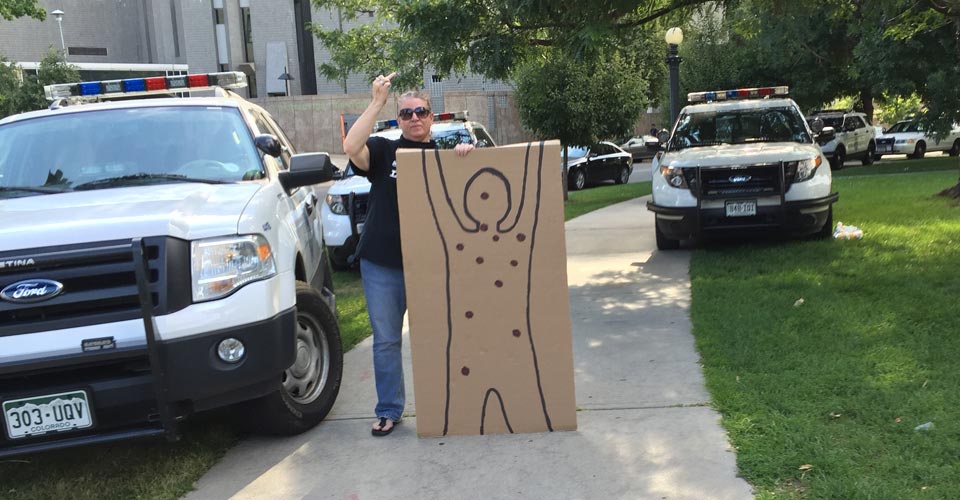
Occupy v. Martinez (Plaza Protest Ban) 2015 Order Granting Prelim Injunction


While we await a judge’s response to the complaint and motion for a preliminary injunction against DIA’s free speech permit, I was drawn to reminisce about an earlier federal injunction GRANTED against Denver’s 2nd Judicial District. It was/is (!) also a preliminary injunction curbing police intimidation. This one prevents arrests of Jury Nullification pamphleteers at the Lindsey Flanigan Courthouse in Denver. More broadly, it halts the enforcement of the despotic “Chief Justice Order 1” which attempted to curb free speech in Tully Plaza, between the courthouse and the jail, site of innumerable protest rallies since the facility was erected in 2010. After a protracted legal battle, the case will finally come to trial in April 2017. This case also started with police overreach, then a complaint, a motion, and a hearing. In August 2015, US District Judge William Martinez issued the below court order granting the preliminary injunction.

Document 28 Filed 08/25/15 USDC Colorado

IN THE UNITED STATES DISTRICT COURT
FOR THE DISTRICT OF COLORADO
Judge William J. Martínez

Civil Action No. 15-cv-1775-WJM-MJW

ERIC VERLO,?
JANET MATZEN, and?
FULLY INFORMED JURY ASSOCIATION,

Plaintiffs, v.

THE CITY AND COUNTY OF DENVER, COLORADO, a municipality,?ROBERT C. WHITE, in his official capacity as chief of police for Denver, and CHIEF JUDGE MICHAEL MARTINEZ, in his official capacity as chief judge of the Second Judicial District,

Defendants.

______________________________

ORDER GRANTING MOTION FOR PRELIMINARY INJUNCTION
______________________________

Plaintiffs Eric Verlo, Janet Matzen, and the Fully Informed Jury Association (“FIJA”) (collectively, “Plaintiffs”) bring this lawsuit to establish that they have a First Amendment right to distribute and discuss literature regarding jury nullification in the plaza outside of Denver’s Lindsey-Flanigan Courthouse (“Courthouse Plaza” or “Plaza”). (ECF Nos. 1, 13-1.) The Lindsey-Flanigan Courthouse is where most criminal proceedings take place for Colorado’s Second Judicial District (which is coterminous with the City and County of Denver).

Plaintiffs have sued the City and County of Denver itself and its police chief, Robert C. White, in his official capacity (jointly, “Denver”). Plaintiffs have also sued the Hon. Michael A. Martinez 1 in his official capacity as Chief Judge of the Second Judicial District. Out of recognition that Plaintiffs’ lawsuit does not target Chief Judge Martinez himself but rather a policy promulgated by the Second Judicial District through Chief Judge Martinez, the Court will refer below to Chief Judge Martinez as “the Second Judicial District.”

On the same day Plaintiffs filed their complaint, they also moved for a preliminary injunction to restrain Defendants from taking any action to stop them from distributing certain literature regarding, or advocating for, jury nullification on the Courthouse Plaza (“Motion”). (ECF No. 2.) The Second Judicial District, represented by the Colorado Attorney General’s office, filed a response defending its current policy of limiting expressive activities to certain areas away from the main walkways leading to the Courthouse doors. (ECF No. 24.) Denver, represented by the Denver City Attorney’s office, did not file a response, but instead filed a joint stipulation with Plaintiffs regarding the status of the Plaza. (ECF No. 23.) As discussed further below, Denver (a) has no intent to enforce the Second Judicial District’s policy that would otherwise restrict Plaintiffs’ activities, and (b) agrees with Plaintiffs that they have a First Amendment right to distribute and discuss their literature essentially anywhere on the Courthouse Plaza, including in the areas designated as restricted by the Second Judicial District.

This Court held an evidentiary hearing and heard oral argument on August 21, 2015. Having considered all of the filings, evidence, and arguments submitted to date, the Court grants Plaintiffs’ Motion for the reasons explained below.

—————
1 No relation to the undersigned.?
————

I. LEGAL STANDARD

To prevail on a motion for preliminary injunctive relief, Plaintiffs have the burden of establishing that four equitable factors weigh in their favor: (1) they are substantially likely to succeed on the merits; (2) they will suffer irreparable injury if the injunction is denied; (3) their threatened injury outweighs the injury the opposing party will suffer under the injunction; and (4) the injunction would not be adverse to the public interest. See Westar Energy, Inc. v. Lake, 552 F.3d 1215, 1224 (10th Cir. 2009); Gen. Motors Corp. v. Urban Gorilla, LLC, 500 F.3d 1222, 1226 (10th Cir. 2007). “[B]ecause a preliminary injunction is an extraordinary remedy, the right to relief must be clear and unequivocal.” Greater Yellowstone Coal. v. Flowers, 321 F.3d 1250, 1256 (10th Cir. 2003).

II. BACKGROUND

A. Facts Alleged in the Original Complaint

Plaintiffs’ original complaint recounts the story of two non-parties, Mark Iannicelli and Eric Brandt, who were passing out pamphlets on the Courthouse Plaza on July 27, 2015. (ECF No. 1 ¶ 14.) The pamphlets were titled “Fresh Air for Justice” and “Your Jury Rights: True or False?” (Id. ¶ 15; ECF No. 1-3; ECF No. 1-4.) Both pamphlets contain some history of jury nullification and various general statements about the jury’s role as envisioned by the Framers. (See generally ECF Nos. 1-3, 1-4.) But the pamphlets also contain certain calls to action which could raise concern. “Fresh Air for Justice,” for example, contains the following:

• “Judges say the law is for them to decide. That’s not true. When you are a juror, you have the right to decide both law and fact.” (ECF No. 1-3?at 3.) ?

• “If the law violates any human rights, you must vote no against that law by voting ‘not guilty.’” (Id. (emphasis in original).) ?

“Fresh Air for Justice” also contains the following, which could be interpreted as encouraging prospective jurors to lie during voir dire:

When you are called for jury duty, you will be one of the few people in the courtroom who wants justice rather than to win or to score career points. For you to defend against corrupt politicians and their corrupt laws, you must get on the jury. During the jury selection, prosecutors and judges often work together to remove honest, thinking people from juries. ?

When you’re questioned during jury selection, just say you don’t keep track of political issues. Show an impartial attitude. Don’t let the judge and prosecutor stack the jury by removing all the thinking, honest people!

Instructions and oaths are designed to bully jurors and protect political power. Although it all sounds very official, instructions and oaths are not legally binding, or there would be no need for independent thinking jurors like you.?

?(Id. at 4.)

The other pamphlet, “Your Jury Rights: True or False?”, does not contain language quite as direct as the foregoing, but it does declare, “You cannot be forced to obey a ‘juror’s oath.’” (ECF No. 1-4 at 3.) ?

Iannicelli was arrested on the Plaza that day, and Brandt was arrested on a warrant a few days later. (ECF No. 1 ¶ 18.) Both were charged with jury tampering: “A person commits jury-tampering if, with intent to influence a juror’s vote, opinion, decision, or other action in a case, he attempts directly or indirectly to communicate with a juror other than as a part of the proceedings in the trial of the case.” Colo. Rev. Stat. § 18-8-609(1). The affidavit supporting Brandt’s arrest mentions that he and Iannicelli had been on the Courthouse Plaza at a time that jurors “would be expected to be arriving” for the ongoing death penalty prosecution of Dexter Lewis. (ECF No. 1-2 at 4.) 2

Plaintiff Eric Verlo “wishes to pass out the same literature on the Lindsey-Flannigan [sic; ‘Flanigan’] plaza as Eric Brandt and Mark Iannicelli were passing out which caused them to be arrested.” (ECF No. 1 ¶ 9.) Plaintiff Janet Matzen wishes to do the same. (Id. ¶ 10.) Plaintiff FIJA is

an association, based in Montana, who’s [sic] members passionately believe in the concept of jury nullification. FIJA intends to hold an educational campaign in Denver on September 5, 2015 where its members wish to pass out the same brochures on the Lindsey-Flannigan [sic] plaza as Eric Brandt and Mark Iannicelli . . . .

(Id. ¶ 11.) 3 Plaintiffs say that the arrests of Brandt and Iannicelli have caused them to to fear that they too might be arrested and prosecuted. (Id. ¶ 22.)

——————
2 Lewis was charged with murdering five individuals at a Denver bar in 2012. See, e.g., Jordan Steffen & Matthew Nussbaum, “Denver jury hears opening arguments in five Fero’s bar killings,” Denver Post (July 20, 2015), at http://www.denverpost.com/news/ci_28513519/denver-jury-hears-opening-arguments-five-feros-bar (last accessed Aug. 24, 2015).

3 September 5, 2015, is a Saturday —an unlikely day for a jury nullification advocate to reach his or her target audience at a courthouse. When this was pointed out at the preliminary injunction hearing, counsel for Plaintiffs qualified the date with an “on or about.”
——————

?B. Facts Alleged in the Amended Complaint & Supplemental Filings

Two days after filing suit, Plaintiffs filed an amended complaint to insert allegations regarding a Second Judicial District administrative order recently posted on the Courthouse doors. (ECF No. 13-1 ¶ 2.) The order, designated “CJO 15-1” and dated August 14, 2015, was titled “Chief Judge Order Regarding Expressive Activities at the Lindsey-Flanigan Courthouse.” (ECF No. 24-1.) This order was actually amended on August 21, 2015, hours before the preliminary injunction hearing in this Court, and admitted as Exhibit 1 in that hearing. (See ECF No. 25-1.) The Court will refer to the amended order as the “Plaza Order.” In relevant part, it reads as follows:

The Court has the responsibility and authority to ensure the safe and orderly use of the facilities of the Second Judicial District; to minimize activities which unreasonably disrupt, interrupt, or interfere with the orderly and peaceful conduct of court business in a neutral forum free of actual or perceived partiality, bias, prejudice, or favoritism; to provide for the fair and orderly conduct of hearings and trials; to promote the free flow of pedestrian and vehicular traffic on sidewalks and streets; and to maintain proper judicial decorum. Those having business with the courts must be able to enter and exit the Lindsey-Flanigan Courthouse freely, in a safe and orderly fashion and unhindered by threats, confrontation, interference, or harassment. Accordingly, the Court hereby prohibits certain expressive activities on the grounds of the Courthouse, as depicted in the highlighted areas of the attached map [reproduced below], without regard to the content of any particular message, idea, or form of speech.

Prohibited Activities: The activities listed below shall be prohibited in the following areas: anywhere inside the Lindsey-Flanigan Courthouse, including courtrooms, corridors, hallways, and lobbies; the areas, lawns, walkways, or roadways between the Courthouse and public sidewalks and roads; and any areas, walkways, or roadways that connect public sidewalks and roads to Courthouse entrances or exits. This includes the Courthouse entrance plaza areas on the east and west sides of the Courthouse as depicted in the highlighted areas of the attached map.

1. Demonstrating; picketing; protesting; marching; parading; holding vigils or religious services; proselytizing or preaching; distributing literature or other materials, or engaging in similar conduct that involves the communication or expression of views or grievances; soliciting sales or donations; or engaging in any commercial activity; unless specifically authorized in writing by administration;

2. Obstructing the clear passage, entry, or exit of law enforcement and emergency vehicles and personnel, Courthouse personnel, and other persons having business with the courts through Courthouse parking areas, entrances, and roadways to and from Courthouse and Courthouse grounds; ?

3. Erecting structures or other facilities, whether for a single proceeding or intended to remain in place until the conclusion of a matter; or placing tents, chairs, tables, or similar items on Courthouse grounds; except as specifically authorized in writing by administration; and ?

4. Using sound amplification equipment in a manner that harasses or interferes with persons entering or leaving Courthouse grounds or persons waiting in line to enter the Courthouse. ?

(Id. at 1–2 (formatting in original).) The Court will refer to the Plaza Order’s numbered paragraphs by their number, e.g., “Paragraph 1 of the Plaza Order” (referring to the forms of prohibited expressive activity). In their amended complaint, Plaintiffs allege that the Plaza Order was “apparently” entered in response to Brandt’s and Iannicelli’s actions. (ECF No. 13-1 ¶ 2.)

The “attached map” referenced in the Plaza Order is reproduced on the following page:

(Id. at 3.) This map shows an aerial view of the Courthouse. The top of the map is north. The Courthouse itself is the irregularly shaped, white-roofed building occupying the left half of the map. Immediately to the left (west) of the Courthouse is Fox Street. Immediately to the north is Colfax Avenue. Immediately to the right (east) of the Courthouse grounds is Elati Street, which is closed to traffic other than police vehicles as it runs past the Courthouse. Elati bisects a circular area paved in a tan color. Just to the right (east) of Elati, and not depicted in the map, is Denver’s Van Cise-Simonet Detention Center (“Detention Center”), which houses pretrial detainees. Thus, the area between the Courthouse and Detention Center is a fairly spacious place suitable for public gatherings.

Immediately to the east and west of the Courthouse are areas that the Second Judicial District highlighted in yellow to indicate where expressive activity is restricted (“Restricted Area”). This matter principally concerns the arc-shaped portion of the Restricted Area to the east of the Courthouse (“East Restricted Area”). The East Restricted Area comprises the following:

• planter boxes and public art (collectively, “Landscaping”); ?

• sidewalks, including a narrow sidewalk beginning at the north of the map ?(just below the blue bus stop icon) and following the arc of the planter boxes until it reaches a much wider sidewalk that completes the arc, which itself connects with the awning-covered steps leading to the Courthouse front doors depicted in approximately the center of the map (collectively, “Sidewalks”); and ?

• a gravel passive security feature between the narrow sidewalk and the Courthouse itself (“Gravel Area”). ?

C. Evidence Received at the Preliminary Injunction Hearing

1. Commander Lopez

?Plaintiffs called as a witness Commander Antonio Lopez of the Denver Police Department. Lopez oversees the Denver Police district that encompasses the Courthouse and the Detention Center. Lopez testified that the Courthouse opened in 2010 or 2011. During that time, he has seen “more protests [in the area between the Courthouse and the Detention Center] than [he can] recall. At one point w e were averaging about two or three a week, in that area.” On cross-examination, Lopez clarified that most of those protests were nearer to the Detention Center than the Courthouse. Nonetheless, to Lopez’s knowledge, the Denver Police Department has never restricted or interfered with any peaceful First Amendment activity taking place between the Courthouse and the Detention Center.

2. Mr. Steadman

The Second Judicial District called Steven Steadman, who is the Colorado judicial branch’s security administrator. Steadman was closely involved in the discussions leading up to the Plaza Order. Steadman testified that, during those discussions, he was unaware of Brandt and Iannicelli or the distribution of jury nullification literature, and that the Plaza Order actually arose from very different concerns.

According to Steadman, discussions began with Chief Judge Martinez in early July 2015 because the Dexter Lewis trial was scheduled to overlap with another death penalty trial in Arapahoe County, i.e., the trial of Aurora theater shooter James Holmes. Steadman and Chief Judge Martinez specifically worried about potentially violent protests that might break out if Lewis (who is black) eventually received the death penalty but Holmes (who is white) did not. Proactively seeking to avoid such a problem, Steadman gave Chief Judge Martinez a copy of an order entered by the Hon. Carlos A. Samour, Jr., who presided over the Holmes trial in Arapahoe County. Judge Samour’s order apparently was a model for what the Second Judicial District eventually issued as the Plaza Order.

On cross-examination, Steadman confirmed that the Plaza Order was intended specifically to address the protests that might erupt if Holmes and Lewis were treated differently with respect to the death penalty. Steadman admitted, however, that his office could require several hours’ notice between the announcement that the jury had reached a verdict and the actual reading of the verdict, which would permit a police presence to assemble in anticipation of protests. Steadman also admitted that nothing like the Plaza Order had been in place or enforced prior to August 14, 2015, and that passing out jury nullification literature did not present any security risk beyond what the Second Judicial District has tolerated, without incident, since the Courthouse opened.

III. ANALYSIS

A. Article III Standing

As mentioned previously, Denver has stipulated with Plaintiffs that it will not enforce any prohibition on distributing jury nullification literature on the Courthouse Plaza. Specifically, Denver has stipulated that

Plaintiffs who wish to engage in peacefully passing out jury nullification literature to passersby on the Plaza are entitled to do so and that Denver, through its police or sheriff department, will not arrest or otherwise charge Plaintiffs for handing out literature regarding jury nullification so long as Plaintiffs do not violate Colorado law or Denver’s Revised Municipal Code when they are handing out their literature. The parties stipulate that Plaintiffs’ proposed intent of peacefully handing out jury nullification literature to or discussing jury nullification with passersby at the Plaza, without more, does not violate Colorado law. . .

***

. . . Denver stipulates that it does not intend to enforce the [Plaza] Order as written and will only impose content and viewpoint neutral reasonable time, place and manner restrictions on the use of the Plaza, and/or other exterior areas surrounding the Plaza if Denver determines that a compelling need exists to do so.

(ECF No. 23 ¶¶ 2, 4.)

?Given this stipulation, the Second Judicial District argues that Plaintiffs lack Article III standing to bring this lawsuit because no threat of enforcement is imminent. (ECF No. 24 at 6–8.) See Lujan v. Defenders of Wildlife, 504 U.S. 555, 560 (1992) (“the irreducible constitutional minimum of standing” includes, among other things, an “actual or imminent” “invasion of a legally protected interest”); Dias v. City & Cnty. of Denver, 567 F.3d 1169, 1176 (10th Cir. 2009) (to obtain prospective relief, a plaintiff must show a “credible threat of future prosecution”). As stated at the preliminary injunction hearing, however, the Court rejects this contention.

The Second Judicial District’s standing argument assumes that the only way an individual could run afoul of the Plaza Order is through Denver’s independent enforcement efforts. But Chief Judge Martinez, and perhaps any other judge in the Second Judicial District, could issue a contempt citation for violating the Plaza Order. Cf. Schmidter v. State, 103 So. 3d 263, 265–69 (Fla. Dist. Ct. App. 2012) (distributor of FIJA literature convicted of contempt for violating an administrative order similar to the Plaza Order). The violator would then be required to appear before the issuing judge, and if he or she fails to appear, an arrest warrant can issue. See Colo. R. Civ. P. 107(c). Denver may then be obligated to arrest the violator —not on the authority of the Plaza Order, but on the authority of the judge’s contempt citation. See id. (requiring the sheriff to carry out the arrest). The Court takes judicial notice of the fact that Colorado state law enforcement officers, not subject to Denver’s stipulation, could also effect the arrest of such a hypothetical violator.

Thus, the Court finds that Article III standing still exists, and the Court will move on to the elements Plaintiffs must establish to secure a preliminary injunction. To repeat, those elements are: (1) likelihood of success on the merits; (2) irreparable injury if the injunction is denied; (3) the threatened injury outweighs the injury the opposing party will suffer under the injunction; and (4) the injunction would not be adverse to the public interest. Westar Energy, 552 F.3d at 1224.

?B. Likelihood of Success

Evaluating the likelihood of success requires evaluating the substantive merit of Plaintiffs’ claim that the First Amendment grants them a right to discuss and distribute pamphlets about jury nullification with individuals entering and leaving the Courthouse. To answer this question, the Supreme Court prescribes the following analysis:

1. Is the expression at issue protected by the First Amendment? ?

2. If so, is the location at issue a traditional public forum, a designated public ?forum, or a nonpublic forum? ?

3. If the location is a traditional or designated public forum, is the ?government’s speech restriction narrowly tailored to meet a compelling state interest? ?

?4. If the location is a nonpublic forum, is the government’s speech restriction reasonable in light of the purpose served by the forum, and viewpoint neutral?

See Cornelius v. NAACP Legal Def. & Educ. Fund, Inc., 473 U.S. 788, 797–806 (1985). The Court will address these inquiries in turn.

1. Does the First Amendment Protect Plaintiffs’ Pamphlets and Oral Advocacy of the Message Contained in the Pamphlets?

The Court “must first decide whether [the speech at issue] is speech protected by the First Amendment, for, if it is not, we need go no further.” Id. at 797. There appears to be no contest on this point. The Second Judicial District has raised no argument that any part of the message conveyed by the pamphlets is unprotected by the First Amendment. Accordingly, the Court deems it conceded for preliminary injunction purposes that Plaintiffs are likely to succeed on the question of whether the First Amendment protects their message.

2. Is the Courthouse Plaza a Public Forum?

The Court must next decide whether the Courthouse Plaza—and the Restricted Area specifically—is a public or nonpublic forum:

. . . the extent to which the Government can control access [to government property for expressive purposes] depends on the nature of the relevant forum. Because a principal purpose of traditional public fora is the free exchange of ideas, speakers can be excluded from a public forum only when the exclusion is necessary to serve a compelling state interest and the exclusion is narrowly drawn to achieve that interest. Similarly, when the Government has intentionally designated a place or means of communication as a public forum speakers cannot be excluded without a compelling governmental interest. Access to a nonpublic forum, however, can be restricted as long as the restrictions are reasonable and are not an effort to suppress expression merely because public officials oppose the speaker’s view.

Id. at 800 (citations and internal quotation marks omitted; alterations incorporated).

?The public/nonpublic inquiry presents a unique dilemma in this case. On the one hand, Denver’s stipulation with Plaintiffs includes the following: “The Lindsey-Flanigan plaza . . . which is located between the Van Cise-Simonet Detention Center and the Lindsey-Flanigan courthouse is a public forum and any content-based regulations must be narrowly drawn to effectuate a compelling state interest . . . .” (ECF No. 23 ¶ 1 (emphasis added).) On the other hand, the Second Judicial District strong ly disagrees:

. . . Plaintiffs assert that the courthouse plaza is a traditional public forum, and therefore maintain that Chief Judge Martinez’s administrative order must be strictly scrutinized. As a matter of state law, however, Chief Judge Martinez— and not Denver—is responsible for the oversight of the courthouse and the adjoining grounds. Thus, any concession on this point by Denver binds neither the parties nor this Court.

(ECF No. 24 at 8.) Apparently a minor turf war has erupted between Denver and the Second Judicial District over control of the Courthouse grounds.

When asked at the preliminary injunction hearing regarding the “state law” that gives Chief Judge Martinez “responsib[ility] for the oversight of the courthouse and the adjoining grounds,” counsel for the Second Judicial District directed the Court to Colorado Revised Statutes § 13-3-108(1). That subsection reads: “The board of county commissioners in each county shall continue to have the responsibility of providing and maintaining adequate courtrooms and other court facilities including janitorial service, except as otherwise provided in this section.” Neither this language, nor anything else in § 13-3-108, appears to relate to a chief judge’s authority over courthouse policies or courthouse grounds.

?Counsel for the Second Judicial District also pointed this Court to State ex rel. Norton v. Board of County Commissioners of Mesa County, 897 P.2d 788 (Colo. 1995) (“Mesa County”). In Mesa County, the county commissioners defied an order from the Twenty-First Judicial District’s chief judge requiring additional security measures at the county courthouse. See Mesa County, 897 P.2d at 789. The county commissioners further announced their intent to stop providing support of any kind to the Twenty-First Judicial District, arguably in violation of § 13-3-108(1) (quoted above), Colorado Revised Statutes § 13-1-114(2) (requiring county sheriffs to assist the judiciary when the judiciary perceives a “risk of violence in the court”), and Colorado Revised Statutes § 30-11-104(1) (requiring each county to “provide a suitable courthouse”). See id. The county commissioners believed that Colorado’s constitutional Taxpayers’ Bill of Rights allowed the county to disregard the foregoing statutes because they created an impermissible “subsidy” to the court system. Id. at 789–90. The Colorado Supreme Court rejected the county commissioners’ position and held that counties’ statutory duties toward the court system are not “subsidies” under the Taxpayers’ Bill of Rights. Id. at 791.

The Mesa County decision highlights the relationship between counties and the state courts that sit within them. It emphasizes county sheriffs’ duties to assist judges in preventing “violence in the court.” Colo. Rev. Stat. § 13-1-114(2). It does not support the Second Judicial District’s notion that it controls and can speak for the status of the Courthouse grounds.

Finally, counsel for the Second Judicial District cited this Court to In re Court Facilities for Routt County, 107 P.3d 981 (Colo. App. 2004) (“Routt County”). Routt County held that, under certain circumstances, a state judicial district’s chief judge has inherent authority to order the board of county commissioners to design and pay for a new courthouse. Id. at 984. Quoting Peña v. District Court, 681 P.2d 953, 956 (Colo. 1984), Routt County relied on the notion that “courts necessarily possess certain inherent powers, which . . . consist of ‘all powers reasonably required to enable a court to perform efficiently its judicial functions, to protect its dignity, independence, and integrity, and to make its lawful actions effective.’” Routt County, 107 P.3d at 984.

Both Routt County and Peña specifically address the Colorado judiciary’s inherent authority to order another state or municipal entity to spend money on the judiciary’s behalf. That power is not at issue here. Nonetheless, the inherent authority described in Routt County and Peña could conceivably also extend to entering orders such as the Plaza Order. The ultimate question, however, is whether Denver or the Second Judicial District speaks for the First Amendment status of the Courthouse Plaza. For at least three reasons, the Court concludes that Plaintiffs are likely to prevail against the Second Judicial District on that question.

First, counsel for the Second Judicial District agrees that Denver owns the Courthouse itself and all of its grounds.

Second, counsel for the Second Judicial District further stated that there was no lease agreement of which he was aware between Denver and the Second Judicial District. Rather, the Second Judicial District occupies the Courthouse “as provided by law.”

?Third, it is undisputed that the Second Judicial District is not the Courthouse’s sole occupant. Denver County Court also sits in the Courthouse. Denver County Court is unique among county courts in Colorado because the Colorado Constitution grants Denver the authority to set the “number, manner of selection, qualifications, term of office, tenure, and removal of [its] judges.” Colo. Const. art. VI, § 26. Moreover, a Chief Justice Directive from the chief justice of the Colorado Supreme Court states that “[t]he chief judge of the Second Judicial District shall not have administrative authority over the Denver County Court.” CJD 95-01, Preamble (amended Aug. 17, 2012), available at https://www.courts.state.co.us/Courts/Supreme_Court/Directives/95-01amended8-17-12.pdf. Thus, there are two distinct judicial bodies operating in the Courthouse, and the Second Judicial District apparently cannot speak for both.

For all these reasons, the Court finds that Plaintiffs are likely to prevail in their contention that Denver controls and speaks for the Courthouse Plaza. 4 Because Denver has stipulated that the Courthouse Plaza is a public forum, Plaintiffs are likewise likely to prevail in their claim that the Courthouse Plaza is at least a designated public forum, if not a traditional public forum. See Cornelius, 473 U.S. at 800. 5

Moreover, the Court notes that the Second Judicial District has not specif ically argued for a finding that the Courthouse Plaza is a nonpublic forum. Rather, it says that “resolving [the type of forum at issue] is not necessary for the purposes of this proceeding because [the Plaza Order] would satisfy even the strictest test.” (ECF No. 24 at 9.) Thus, the Court turns to the question of whether the Plaza Order can survive a strict scrutiny analysis. 6

—————
4 Ultimately, a Colorado state court may need to resolve this question. See, e.g., CJD 95-01 ¶ 15 (“Any disputes arising from the exercise of the authority described in this directive shall be resolved by the Chief Justice.”). In this posture, however, the Court need only conclude that Plaintiffs are likely to succeed.

5 If the Courthouse Plaza is indeed a public forum, it would be unique in that respect. The parties have not cited, nor could the Court find, a single case in which courthouse grounds were deemed a public forum. Cf. Huminski v. Corsones, 396 F.3d 53, 90–91 (2d Cir. 2005) (courthouse grounds not a public forum); Sammartano v. First Judicial Dist. Court, 303 F.3d 959, 966 (9th Cir. 2002) (same), abrogated on other grounds by Winter v. NRDC, 555 U.S. 7 (2008); Comfort v. MacLaughlin, 473 F. Supp. 2d 1026, 1028 (C.D. Cal. 2006) (same); Schmidter, 103 So. 3d at 270 (same).

6 The ensuing analysis assumes, of course, that the Second Judicial District may attempt to enforce the Plaza Order through its own contempt power. If such power did not exist, there would likely be no reason to scrutinize the Plaza Order under any constitutional standard given Denver’s control over the Plaza and its stipulation not to interfere with Plaintiffs’ intended activities. (See Part III.A, supra.)
—————

3. Is the Plaza Order Narrowly Tailored to Serve a Significant Government Interest, and Does it Leave Open Ample Alternative Means of Communication?

“In [a] quintessential public forum[], the government may not prohibit all communicative activity.” Perry Educ. Ass’n v. Perry Local Educators’ Ass’n, 460 U.S. 37, 45 (1983); see also id. at 46 (holding that the government may un-designate a designated public forum, but until it does so, “it is bound by the same standards as apply in a traditional public forum”). The state may, however, “enforce regulations of the time, place, and manner of expression which [1] are content-neutral, [2] are narrowly tailored to serve a significant government interest, and [3] leave open ample alternative channels of communication.” Id. The Court will address each element in turn as it applies to the Plaza Order.

a. “Content-Neutral”?

The Plaza Order applies “without regard to the content of any particular message, idea, or form of speech.” (ECF No. 25-1 at 1.) On its face, then, it appears content-neutral. Plaintiffs have not argued otherwise.

b. “Narrowly Tailored to Serve a Significant Government Interest”

The Plaza Order itself asserts several interests:

. . . to minimize activities which unreasonably disrupt, interrupt, or interfere with the orderly and peaceful conduct of court business in a neutral forum free of actual or perceived partiality, bias, prejudice, or favoritism; to provide for the fair and orderly conduct of hearings and trials; to promote the free flow of pedestrian and vehicular traffic on sidewalks and streets; and to maintain proper judicial decorum . . . .

(Id.) However, in response to Plaintiffs’ Motion, the Second Judicial District has only defended the Plaza Order on the bases of preserving “the efficient functioning of the court” (e.g., unhindered ingress and egress to the Courthouse) and “maintain[ing] public safety.” (ECF No. 24 at 12.)

These are potentially “significant” government interests. Legitimate time-place- manner restrictions in a public forum can be motivated by “objectives [such as] public safety, accommodating competing uses of the easement, controlling the level and times of noise, and similar interests.” First Unitarian Church of Salt Lake City v. Salt Lake City Corp., 308 F.3d 1114, 1132 (10th Cir. 2002). But the Court finds on this record that Plaintiffs are likely to succeed in proving that the Plaza Order is not narrowly tailored to these stated objectives. Paragraph 1 of the Plaza Order bans essentially all expressive activity regardless of whether it would affect “the efficient functioning of the court” or threaten “public safety.” Courts look dimly on such “First Amendment Free Zones.” See Bd. of Airport Comm’rs of City of Los Angeles v. Jews for Jesus, Inc., 482 U.S. 569, 574 (1987); First Unitarian, 308 F.3d at 1132.

Moreover, in the Second Judicial District’s briefing (see ECF No. 24 at 12) and at the preliminary injunction hearing, it became clear that the sole motivating concern behind the Plaza Order was potentially violent protests that could follow if Dexter Lewis receives the death penalty. Steadman, the Second Judicial District’s witness, agreed that other measures could address that concern, e.g., he could arrange for additional security well in advance of any verdict announcement. He also agreed that Plaintiffs’ activities posed no greater threat to the Courthouse than it has faced in the last five years, when expressive activities have been unrestricted. Thus, the Court finds that Plaintiffs will likely demonstrate that at least Paragraph 1 of the Plaza Order is not narrowly tailored to serve the interests of maintaining public safety and the efficient functioning of the court.

c. “Leave Open Ample Alternative Channels of Communication”

Given the foregoing finding, inquiry into the alternative channels of communication is unnecessary. 7 The Court accordingly holds that Plaintiffs are likely to succeed in defeating at least Paragraph 1 of the Plaza Order under the strict scrutiny test applied to public forums.

————
7 The Court nonetheless notes Plaintiffs’ argument at the preliminary injunction hearing that their advocacy requires person-to-person contact because the concept of jury nullification is obscure and does not lend itself well to pithy slogans that can easily be chanted or placed on a placard (and therefore understood from a distance). Plaintiffs’ counsel could not cite this Court to any authority holding that those wishing to advocate complicated or lesser understood concepts receive more solicitude than others when it comes to available channels of communication. To the contrary, the case law suggests that the government can more easily restrict person-to-person interaction because of its potential for harassment. See, e.g., Madsen v. Women’s Health Ctr., Inc., 512 U.S. 753, 773–74 (1994). The Court need not resolve the issue at this time, but only raises it as a matter of potential concern as this case progresses.
————

?C. Irreparable Injury

“[T]he loss of First Amendment freedoms, for even minimal periods of time, unquestionably constitutes irreparable injury.” Heideman v. S. Salt Lake City, 348 F.3d 1182, 1190 (10th Cir. 2003) (internal quotation marks omitted). Moreover, the Second Judicial District offers no response to Plaintiffs’ irreparable injury argument. Accordingly, the Court finds that Plaintiffs will be irreparably injured absent a preliminary injunction.
?
D. Balancing of Interests

The injury to a plaintiff deprived of his or her First Amendment rights almost always outweighs potential harm to the government if the injunction is granted. See Awad v. Ziriax, 670 F.3d 1111, 1131 (10th Cir. 2012); ACLU v. Johnson, 194 F.3d 1149, 1163 (10th Cir. 1999). And again, the Second Judicial District offers no response to Plaintiffs’ argument that the balance of interests tips in their favor. Accordingly, the Court finds that the balance indeed tips in Plaintiffs’ favor, although the Court will issue the narrowest injunction possible so that the Second Judicial District is not unduly restrained in its ability to maintain safety and proper judicial functioning. (See Part III.F, infra.)?

E. Public Interest

Finally, as with irreparable injury and balancing of interests, it is almost always in the public interest to prevent a First Amendment violation. See Awad, 670 F.3d at 1132; Johnson, 194 F.3d at 1163. The Second Judicial District does not argue otherwise. The Court therefore finds that a narrowly drawn injunction would be in the public interest.

?F. Scope of Injunctive Relief

The Court will enter a preliminary injunction in favor of Plaintiffs. However, the Court will not grant an injunction as broad as Plaintiffs’ counsel requested at the preliminary injunction hearing. Plaintiffs’ counsel requested an injunction stating that their message and form of advocacy is protected speech, supposedly to protect against any other government agency that might try to silence them. But the Court cannot say (on this record at least) that Plaintiffs’ message and form of advocacy is always protected speech under all circumstances. In addition, an injunction must run against a party—this Court cannot enter an injunction against the world at large. See, e.g., Fed. R. Civ. P. 65(d)(2) (describing persons bound by an injunction). If Plaintiffs believe that a particular government agency is likely to attempt to silence them, they need to join that agency as a party and satisfy the preliminary injunction as against that agency. 8

Further, although Plaintiffs apparently seek to strike down the entire Plaza Order as unconstitutional, the Court will limit its injunction only to certain portions of the Plaza Order. As counsel for the Second Judicial District pointed out at the preliminary injunction hearing, the Plaza Order applies both inside and outside the Courthouse, but Plaintiffs have only challenged its restrictions outside the Courthouse. Accordingly, the Court will not disturb the Plaza Order as it operates inside the Courthouse.

In addition, the Court notes the Landscaping and Gravel Area in the East Restricted Area. Although no party discussed the scope of a potential injunction in these specific areas, the Court assumes for present purposes that Denver did not intend its public forum stipulation to authorize Plaintiffs to tramp through the Landscaping or the Gravel Area, both of which are ultimately designed for the Courthouse’s security. The Court therefore will not enjoin the operation of the Plaza Order as it applies to the Landscaping and Gravel Area.

The Court also notes that Plaintiffs have specifically alleged their intent to distribute and discuss the two pamphlets attached to their original complaint, “Fresh Air for Justice” (ECF No. 1-3) and “Your Jury Rights: True or False?” (ECF No. 1-4). At the preliminary injunction hearing, counsel for Plaintiffs reemphasized that these two pamphlets form the basis of what they wish to discuss. The Court will therefore limit its injunction to distribution of those specific pamphlets and oral advocacy of the message contained in those pamphlets.

Finally, only Paragraph 1 of the Plaza Order is truly at issue here. Plaintiffs have not challenged the Second Judicial District’s authority to prevent obstruction of the entryways (Paragraph 2), to prohibit the erection of structures (Paragraph 3), or to restrict sound amplification equipment (Paragraph 4). Thus, the Court will limit the injunction to Paragraph 1 of the Plaza Order. 9

————
8 Plaintiffs’ counsel expressed some concern that the Denver District Attorney’s office had been involved in the arrest of Brandt and Iannicelli and that the DA’s office might continue to pursue similar prosecutions. But Plaintiffs have not joined the DA’s office as a party, and in any event, in light of Denver’s stipulation with Plaintiffs, it is questionable whether the Denver Police Department would execute any arrest warrant based on Plaintiffs’ activities.

9 A party awarded a preliminary injunction normally must “give[] security in an amount that the court considers proper to pay the costs and damages sustained by any party found to have been wrongfully enjoined or restrained.” Fed. R. Civ. P. 65(c). The Tenth Circuit has held that “a trial court may, in the exercise of discretion, determine a bond is unnecessary to secure a preliminary injunction if there is an absence of proof showing a likelihood of harm.” Coquina Oil Corp. v. Transwestern Pipeline Co., 825 F.2d 1461, 1462 (10th Cir. 1987) (internal quotation marks omitted). The Second Judicial District has not put forth any evidence of a likelihood of harm, nor has it argued that Plaintiffs should be required to post a bond. Having considered the issue sua sponte, the Court determines that a bond is unnecessary in light of the lack of likely harm to the Second Judicial District, and in light of the nature of the case. Cf. 11A Charles Alan Wright et al., Federal Practice & Procedure § 2954 n.29 (3d ed., Apr. 2015 update) (citing public rights cases where the bond was excused or significantly reduced).
————

IV. CONCLUSION

For the reasons set forth above, the Court ORDERS as follows:

1. Plaintiffs’ and Denver’s Stipulation (ECF No. 23) is ACCEPTED and shall be treated as if an order from this Court; ?

2. Plaintiffs’ Motion for Preliminary Injunction (ECF No. 2) is GRANTED; and ?

3. The City and County of Denver, its police chief, Robert C. White, in his official capacity, and the Second Judicial District (including their respective officers, agents, servants, employees, attorneys, and other persons who are in active concert or participation with any of them) (collectively, “Defendants”) are PRELIMINARILY ENJOINED as follows (all capitalized terms bear the respective meanings assigned above): ?

a. Save for any Plaintiff physically located on the Landscaping or Gravel Area, Defendants shall not enforce Paragraph 1 of the Plaza Order against any Plaintiff (including any FIJA member) physically located in the Restricted Area to the extent he or she is otherwise lawfully seeking to distribute and/or orally advocate the message contained in the pamphlets titled “Fresh Air for Justice” and/or “Your Jury Rights: True or False?”

b. To the extent consistent with the foregoing prohibition, Defendants remain free to enforce Paragraphs 2–4 of the Plaza Order.

Dated this 25th day of August, 2015.

BY THE COURT:

William J. Martínez?
United States District Judge

The Lindsey Flanigan Courthouse Plaza protest timeline (July 2015 – present)


UPDATED: This is a timeline of the legal battle which began in July 2015 over activists’s right to protest in the Lindsey Flanigan Courthouse Plaza. It explains why activists with Occupy Denver did not believe they were being given lawful orders when commanded to stop and why activists still believe the DPD were wrong to make their arrests. The city’s charges of “encumbrance” and “obstruction” appeared calculated to circumvent a federal injunction protecting the public’s First Amendment rights.

July 27, 2015
Mark Iannicelli and Eric Brandt distribute jury nullification literature at Lindsey Flanigan Courthouse (LFC) plaza. Mark Iannicelli is arrested and jailed for two days, charged with seven felony counts of jury tampering. #15CR03981 (charges dismissed 12/16 by Judge Plotz).

Aug 7
Warrant is issued for arrest of Eric Brandt for same incident, same charges. Eric Brandt is arrested and jailed #15CR04212 (charges dismissed 12/16).

Aug 14
Colorado 2nd Judicial District Chief Judge Michael A. Martinez issues order CJO-1 barring protest, including structures, in LFC plaza. (The Chief Judge later explained that his motivation was to preempt racial unrest on occasion of potential death sentence being given to African American Dexter Lewis, so soon after Aurora Theater Shooter James Holmes, who is white, had been spared the death penalty.)

Aug 17
Through attorney David Lane of Kilmer, Lane & Newman, plaintiffs Eric Verlo, Janet Matzen & Fully Informed Jury Association file complaint for federal injunction protection against continued arrest of jury nullification pamphleteers in LFC plaza

Aug 19
Having become apprized of CJO-1 posted at courthouse, Verlo et al file amended complaint to include a challenge of the “plaza order”. US District Court Judge William J. Martinez grants an injunction hearing for August 21.

Aug 21
1. An AMENDED CJO-1 is posted to courthouse entrance. Colorado Chief Judge Martinez amends PLAZA ORDER prohibitions to apply only to “highlighted area”, not entire plaza.

2. US Judge Martinez hears oral arguments on federal injunction. LFC plaza is stipulated to be not just a “designated” free speech zone but a “traditional” free speech zone.

Aug 25
US District Judge William Martinez grants preliminary injunction, strikes first paragraph from amended plaza order. He rules the prohibitions in the highlighted area cannot limit non-amplified speech, the accosting of passersby, or the distribution of literature.

Aug 26   FOUR ARRESTS
8am: New REDACTED amended CJO-1 [Plaza Order] is posted on glass door of Lindsey Flanigan Courthouse. Occupy Denver activists initiate an all-day protest to distribute FIJA fliers.

10am: Protesters erect a popup canopy which is immediately confiscated by DPD citing activist lack of permit. Other materials confiscated include table, chairs, drums, banners, signs and jury nullification brochures. However there are no arrests or citations.

1pm: City Attorney Wendy Shea agrees to have DPD return confiscated property. DPD equivocates (for two days), citing lack of a specific person to whom property should be released.

3pm: Plaintiffs Verlo et al file motion to hold DPD in contempt of federal injunction for the confiscations. (DPD was later found not to be in contempt because evidence was not conclusive that literature had been confiscated.)

9pm: Occupy Denver erects three tents. DPD and SWAT seize the tents. Four protesters arrested for “obstruction”: William Hall #15GS012195 (took a plea deal: probation and area restriction), Adrian Brown #15GS012196 (trial 3/8, not guilty obstruction & failure to obey, guilty interference, 20 days jail, on appeal), Fred Hendrich #15GS012197 (case dismissed 6/13), Eric Verlo #15GS012198 (trial 1/11, guilty obstruction & interference, 20 days jail, on appeal)

10pm: Remaining protesters stay overnight in sleeping bags awaiting release of arrestees. (Thus begins a 24-hour protest which continues for 56 days.)

Aug 28     ONE CITATION, TWO ARRESTS
4pm: After further calls to city attorney, the canopy is reclaimed from DPD property, and is erected immediately. DPD confiscates it as “encumbrance”. Citation is issued for dog off-leash to Caryn Sorado #15GV552914 (dismissed 11/24 via plea deal)

7pm: Immediately after his delayed release from jail, Adrian “Monk” Brown erects a tent. Within half hour, while walking his dog at South end of plaza, Brown is arrested by DPD and tent is confiscated. #15GS012303 (trial 11/16 w Rodarte, jury finds Brown NOT GUILTY)

8pm: Eric Brandt protests Brown’s arrest, chases DPD Commander Lopez car, arrested. #15GS012304 (trial 8/24 w Spahn)

Sept 1
8am: Hearing before US judge Martinez to hold DPD in contempt. Paying a visit to the Denver Department of Pubic Works, activist learn that there is no permit required for “free speech activity” and furthermore the department does not have jurisdiction over the Lindsey Flanigan Courthouse plaza.

4pm: Activists erect three empty tents marked with bold letters “JURY NULLIFICATION TENTS”. At 6pm, DPD arrives in force to confiscate the three tents, and pass out paper notices [Encumbrance Notice] which read:

“!!Notice!! It is illegal to place ANY encumbrance on the public right of way. An encumbrance is defined as “any article, vehicle or thing whatsoever” which is on “any street, alley, sidewalk, parkway or other public way or place.” D.R.M.C. § 49-246 et. seq. The manager of Public Works may order all encumbrances in the public right-of-way to be removed. The failure to remove items so ordered is a criminal offense; the maximum possible penalty for which is up to one year in the county jail and/or up to $999 fine. PLEASE REMOVE ALL PERSONAL ITEMS FROM THIS AREA. If personal items are not removed immediately, you may be subject to an order of removal at which time all items will be subject to removal by the Denver Police Department. Agency – Denver Police Department”

The Denver ordinance cited above reads:

“§ 49-246. The manager of public works or the manager’s designee (hereinafter in this article, “manager”) is authorized to remove or to order the removal of any article, vehicle or thing whatsoever encumbering any street, alley, sidewalk, parkway or other public way or place (any such thing hereinafter in this article to be called an “encumbrance”). The manager may prescribe appropriate methods, specifications, placement and materials for encumbrances in the public right-of-way.”

Sept 3
US District Court Judge William Martinez rules DPD is not in contempt because evidence was not conclusive that literature had been confiscated. (Note: plaintiff’s order to show cause was filed on 8/26 before that evening’s arrests.)

Sept 7
In the LFC Plaza, city workers install steel signs in center of plaza which read: “NOTICE In reference to DRMC Sec. 49-246 this plaza must remain free from all encumbrances/obstructions – Denver Public Works”

Sept 8
4:30pm: DPD conducts sixth raid on protest, confiscating everything that can’t be gathered and held by activists.

Sept 11
Night raid, to avoid arrest everyone must stand and gather personal items as if to leave.

Sept 12
DPD Night raid. Everyone made to stand, no arrests.

plaza-handcuffs-timothy-campbell-nmt

Sept 13
Night raid, stop and frisk of Timothy Campbell because he “looked threatening” to an HSS security guard. Campbell is handcuffed but released. Michael Moore is issued a citation for having his dog Lizzie off leash #15GS013171 (1/5 plea deal, six month probation).

Sept 14
DPD confiscates “encumbrances”: chairs, flags, banners, toilet paper

Sept 15
While Michael Moore is loudly protesting at doors of jail about delayed release of Eric Brandt, jail deputies assault Moore and attempt to take him into custody. DPD arrives and delivers Moore to Detox. No arrests.

Sept 16   ONE ARREST
Surveillance operator observes Jose “Pedro” Trejo urinating in public. DPD force arrives, Pedro arrested #15GS013298 (Plea deal, time served, $50 fine).

Sept 17
1am night raid makes 12th raid. DPD threaten arrest for “violation of urban camping ban”

Sept 18   FOUR ARRESTS
While activists are celebrating 4th anniversary of Occupy Wall Street, DPD evict assembly citing encumbrances, arrest Eric Brandt #15GS013512 (trial 8/29 w Spahn) and confiscate majority of protest equipment and personal property, warn others to leave and face arrest upon return. Activists return and DPD arrest three more: Adrian Brown #15GS013537 (dismissed 3/18), Jay Maxwell #15GS013517 (plea deal, year probation), and Timothy Campbell who is tackled and charged with assault #15CR05088 (jailed 4 days, charges dropped 9/22).

Via their attorney, plaintiffs Verlo et al receive Spoliation Letter to preserve all correspondence, media, eg. evidence of activities in plaza, from August 2015 onward.

Sept 19   ONE ARREST
2:38am: Later that night, Mark Iannicelli is arrested for not removing his chair from plaza #15GS013527 (District court considering motion to dismiss)

Sept 24   THREE ARRESTS
Possible police agent sent into camp to provoke fight. Arrest of Adrian Brown #15M08835 (charges dropped) and Matthew Lentz #15CR05197 (jailed 5 days, charges dropped 9/28). Brandt arrested for interference #15GS013823 (6/13 trial ended in hung jury. Retrial is 8/1 w Faragher).

Sept 25
Adrian Brown files motion for expanded discovery on 8/26 tent arrest case (#15GS012196). Sept 25 is before the 30 day period after which HALO camera footage is regularly overwritten. (Other 8/26 defendants will be told their discovery motions were filed too late to prevent destruction of HALO surveillance video. Although all motions were similarly worded and requested the identical evening’s footage at Brown.)

City challenges temporary injunction with US Court of Appeals.

4pm: CURFEW notice posted by City workers who install eight steel signs on periphery of plaza declaring a curfew. Signs read:

“NOTICE The grounds of the Lindsey-Flanigan Courthouse and the Denver Detention Center are closed to the public from 8:30PM until 7:30AM. Except to conduct official business within tne facilities. Violators are subject to citation or arrest pursuant to D.R.M.C 38-115”

7:25pm: Activist are driven off the plaza by DPD. Protest continues overnight on sidewalk along Colfax Ave. DPD conduct night raid forcing everyone to stand and gather sleeping bags as usual.

Sept 26
Protest relocates across Colfax Ave to triangle shaped park on Northwest corner of Tremont and Colfax.

Sept 28?
After an activist discussion of an alternative fallback location being the plaza in front of the Wellington Webb Building, we discover curfew signs have now been posted there too.

Sep 30
City of Denver files motion to dismiss injunction.

Oct 6   ONE ARREST
Possible infiltrator disrupts camp by stealing property. She is ousted by Caryn Sodaro but later files a complaint in municipal court seeking a protection order against Sodaro. Warrant is issued for Sodaro’s arrest #15GS014734 (11/18 plea deal, 150 days jail).

Oct 9
Plaintiff files response to motion to dismiss.

Oct 16
Reply brief by plaintiffs

Oct 21   ONE ARREST
On first day of rain since plaza protest began, DPD effects full eviction of COLFAX CAMP. Confiscates personal property and protest materials. Hauls much of it in a garbage truck. Eric Brandt is arrested for obstruction and interference #15GS015407 (trial 9/7 w Spahn)

Oct 26
Reply from plaintiffs.

Nov 12
Reply in support of defense

Nov 16
Jury finds Monk Brown no guilty of 8/28 obstruction. Judge Nicole Rodarte in 3G. Deputy city attorney prosecuted the case.

Nov 17
Oral arguments to court of appeals, courtroom III

Dec 16
Denver District Court Judge Kenneth Plotz dismisses Jury Tampering charges against Mark Iannicelli and Eric Brandt (city does not appeal).

Jan 11
8/26 tent arrestee Eric Verlo found guilty of obstruction and interference, 20 days jail. Represented by public defender. On appeal based on ineffective assistance of counsel.

Jan 13
City makes first request for plaintiffs to show documents to defendants, as per spoliation letter. (Meanwhile activist defendants have received discovery motion responses that surveillance video is overwritten and all of city correspondence is privileged.)

Feb 1
Plaintiffs Verlo et al are informed that US District Judge William Martinez wishes to hold a full trial to consider a permanent injunction. Depositions will be recorded on Feb 12.

March 8
8/26 tent arrestee Monk Brown found not guilty of obstruction and failure to obey, but guilty on interference, sentenced to 20 days jail, on appeal based in inconsistent verdict.

March 16
Mark Iannicelli arrested again distributing JN fliers #16GS003320. He’s detained and cited for harassment and violation of CJO-1. Released within hours, charges dropped are 3/18.

May 2
Verlo et al file motion to show cause why former Denver defendants should not be held in contempt of court for the March 16 arrest of Mark Iannicelli. Filing was delayed because city refused to produce discovery evidence. Plaintiffs had to file a CORA request to learn facts of Iannicelli’s arrest.

May 11
Deposition of Chief Justice Michael Martinez

May 31
Order received from Federal Judge William Martinez:

ORDER: Before the Court is Plaintiffs’ Motion for Order to Show Cause Why Former Denver Defendants Should Not Be Held in Contempt of Court [108]. Per D.C.COLO.LCivR 7.1(d) and Federal Rule of Civil Procedure 6(d), the Denver Defendants’ deadline to respond was May 26, 2016. Denver filed nothing on that date, and has since filed nothing. Accordingly, the Court could deem the motion confessed. Solely in the interests of justice, however, Denver is ORDERED to file a response on or before June 3, 2016. No reply will be accepted without prior order or leave of Court. SO ORDERED by Judge William J. Martinez on 05/31/2016.

June 1
Motion to dismiss 8/28 chair arrest of Mark Iannicelli moves case to district court. Dismissal expected.

June 3
City responds to motion to show cause.

June 13
Fred Henrich 8/26 tent case dismissed.

June 20
Federal judge William Martinez responds:

ORDER: Before the Court is Plaintiffs’ Motion for Order to Show Cause Why Former Denver Defendants Should Not Be Held in Contempt of Court [108]. Given the nature of the alleged violation of this Court’s preliminary injunction, and given the lack of evidence that the alleged violation presents an ongoing problem, the Court sees no pressing reason to address potential contempt at this time. Plaintiffs are therefore DIRECTED to file a notice, no later than June 24, 2016, explaining why the Court should give priority to their motion. Otherwise, the Court intends to set this matter for a hearing immediately following the bench trial scheduled to begin on April 17, 2017 between Plaintiffs and the Second Judicial District. SO ORDERED by Judge William J. Martinez on 06/20/2016.

June 22
Jury trial for Eric Brandt’s 9/24 interference arrest results in hung jury. Retrial scheduled for 8/1 w Judge Faragher.

—-

NOTES:
A. List of 2015-16 plaza arrests (20) & citations (2)

No. Name: Date: Offense: Result:
1. Mark Iannicelli 7/27 (jury tampering) DISMISSED 12/16
2. Eric Brandt 7/27 (jury tampering) DISMISSED 12/16
3. William “Reno” Hall 8/26 TENT (obstr.) PLEA, prob., area restriction
4. Adrian “Monk” Brown 8/26 TENT (obstruction) NOT GUILTY obstruct & failure, GUILTY interference
5. Fred Hendrich 8/26 TENT (obstruction, interference, failure to obey) DISMISSED 6/13
6. Eric Verlo 8/26 TENT (obstruction, interference) GUILTY, 20 days jail, on appeal
7. Caryn Sodaro 8/28 (DOG citation) PLEA deal
8. Adrian “Monk” Brown 8/28 TENT (obstruction) NOT GUILTY 11/17
9. Eric Brandt 8/28 (failure to obey) ***trial 8/24
10. Michael Moore 9/13 (DOG citation) PLEA deal
11. Jose “Pedro” Trejo 9/16 (urinating in public) PLEA deal
12. Eric Brandt 9/18 TARP (obstruction) ***trial 8/29
13. Jay Maxwell 9/18 HANDCART (obstruction) PLEA deal
14. Adrian “Monk” Brown 9/18 A COOLER (obstr) DISMISSED 3/8
15. Tim Campbell 9/18 (assault/resisting) DROPPED
16. Mark Iannicelli 9/19 CHAIR (obstruction) to be dismissed
17. Matthew Lentz 9/24 (assault) DROPPED
18. Adrian “Monk” Brown 9/24 (assault) DROPPED
19. Eric Brandt 9/24 (interference) ***hung jury, retrial 8/1
20. Caryn Sodaro 10/6 (disturb, threats) PLEA deal, 150 days concurrent
21. Eric Brandt 10/21 WET PILE (obstruction) ***trial 9/7
22. Mark Iannicelli 3/16/2016 (harassment, violation of CJO-1) DISMISSED

B. Running tally:
Cases dropped or dismissed: 9
Not guilty verdict, obstruction: 2
Guilty verdict, interference: 1
Guilty verdict, obstruction & interference: 1
Plea deals: 6
Cases outstanding: 4

3. Trials still scheduled:
August 1, Eric Brandt (9/24 interloper interference), RETRIAL, LFC 3H
August 24, Eric Brandt (8/28 Lopez failure to obey), jury trial, LFC 3F
August 29, Eric Brandt (9/18 tarp obstruction), jury trial, LFC 3F
September 7, Eric Brandt (10/21 Tremont obstruct.), jury trial, LFC 3F
April 17-19, 2017, Verlo v Martinez, permanent injunction, Araj Federal Courthouse Rm A801

A slum lord as front runner

Some of the issues of today are so far into the wrong, like Trump,
it’s just staggering. Like, where do you start on a mess like that? The
dude reiterated his boast of ripping off “screwing” Gaddafi, and still
calling for the death penalty for the Central Park teenagers who spent
more than a decade in prison for shit they did not do. The lack of
response from the republicans is frightening. Giuliani should have
prosecuted Trump for the hundreds or thousands of New York State tenant
relations laws and especially the one about Gaddafi.

And Tump is the front runner. It’s like reality as we knew it just went
down the rabbit hole. My brother Luke who supports the Bernie candidacy
thinks that the Republicans are playing to lose, and that they’re
playing a spoiler/agent provocateur role for which 9/11 was just a
practice run. And that seems to be the zeitgeist. Fatalism on a scale so
massive that the term “massive” isn’t enough.

BOMBSHELL: Denver courthouse anticipates black folks will be upset when Dexter Lewis gets the death penalty unlike white James Holmes.

DENVER, COLORADO- In federal court on Friday the chief of security of the Lindsey Flanigan Courthouse testified that recent restrictions on protest activity around the building were enacted in anticipation of black community unrest at the likely death sentence for accused murderer Dexter Lewis, who is African American. In view of the fact that James Holmes, the Aurora theater shooter, is white and did not received the death penalty. This story was more likely contrived to cover for the courthouse’s ongoing effort to curtail the distribution of jury nullification pamphlets. But since they brought it up… I should think the Denver community would not want to disappoint authorities with respect to public indignation at our usual broken racist justice system.

The Death Penalty

In May of 1960, I was place in the “Hole” for ten days, at that time they would feed you a bowl of spinach once a day. The “Hole” was in cell house three, which also housed death row. When the guard came to my cell, I refused the spinach. He told me that he bet I’d be eating it by the end of ten days. Directly on the tier above me was death row. One of the prisoners on death row (David F. Early) over-heard my conversation with the guard.

At meal time, David would share his meals with me; he had a string made from his mattress and would lower part of his meal down to me.

On Aug. 12th 1961, David was gassed in the gas chamber.

For those who would cry out, that the death penalty is a deterrent, I would say: we’ve had a few hundred years of this “deterrent” and it doesn’t seem to be working.

My opposition to the death penalty does not come from the kindness or compassion that David showed to me, but rather from the fact that I believed we as a society were more cruel to put a person in a small concrete room and then day after day tell them we were going to kill them.

It seemed to me then as it does now that our crime is far greater than theirs.

It was also a lesson for me about kindness and compassion; it’s possible to find even on death row.

American drone pilots eat massacres like the Boston Marathon for breakfast. Let all bombers share Tsarnaev’s fate.

Wikileaks Collateral MurderShould Boston bomber Dzhokhar Tsarnaev get the death penalty? Should Aurora’s James Holmes or Charleston’s Dylann Roof? How about American sniper Chris Kyle or the Apache gunship assholes exposed by Wikileaks in “Collateral Murder”? Videos abound of US airstrikes and drone strikes far more deadly and indiscriminate than the Boston Marathon Bombing. I don’t agree with capital punishment, as deterrent or justice, but if cultural arbiters want to cry for the blood of terrorists there are a lot of offenders in line before 21-year-old Tsarnaev. I say let he who has bombed fewer innocent people cast the first stone.

On Nikki Haley, calling for the Death Penalty

Let’s all grab our pitch forks, run around and find something to kill. There now! that should make us all feel better about what happened. If you listen to moron politicians like Nikki Halley, then you are the sucker she is counting on. “Kill Dylann”, there! problem solved.
 
It was reported by some news media, that Dylann wanted to start a race war, because he lost a girl he liked to another boy who happen to be black. Guess Dylann wasn’t keeping up with current events, there is already a race war in progress. You need only look at the fact that he is still alive, after the horrific crime he is suspected of, while many, many black men, women and children are dead, committing no crime at all.

The number of these racially motivated crimes by the police are hidden for fear the citizens will see the true nature of their “Protect and Serve” law enforcement. Here are some facts;

1. The NRA; Since 1998, the NRA has spent $28.2 million on lobbying in Washington and employed between 16 and 35 lobbyists in any given year.

2. While The Bureau of Justice Statics does not provide the annual number of arrest-related deaths by race or ethnicity, a rough calculation based on its data shows that black people were about four times as likely to die in custody or while being arrested than whites.

3. Black men were more than six times as likely as white men to be incarcerated in federal and state prisons, and local jails.

4. While people of color make up about 30 percent of the United States’ population, they account for 60 percent of those imprisoned.

I could provide more facts and figures, they are there for anyone wishing to see the truth. As for Nikki and her comments; She is the worst of politicians, she is only appealing to the emotions of the moment.

According to a March 29, 2011 Congressional Research Service report, Congress has approved a total of $1.283 trillion for military operations, this taxpayer money was spent to protect Americans from the “Terrorist”, you know, that brown skinned man who lives in some foreign land. While at home, in the USA, the “Terrorist” is protected by the second amendment.

“There have been at least 70 mass shootings across the country, with the killings unfolding in 30 states from Massachusetts to Hawaii. Thirty-three of these mass shootings have occurred since 2006. Seven of them took place in 2012 alone, including Sandy Hook”.

Mass shootings toll exceeds 900 in past seven years, we can now add another 9 people to that list.

How many tax dollars have been spent keeping guns out of the hands of the “American Terrorist?” ZERO. The NRA has made sure of this with their control of congress. It should be noted that the NRA supports the supply of weapons to both the American and Foreign “Terrorist”.

The NRA like most of American Corporations sole function is to make money, and they have now militarized the police across US in their effort to control the mass population as they awake from a long slumber.

We need to look past the Dylann’s of America and see the culture that created him and then put a gun in his hands. Dylann serves only as a symptom of a greater disease.

It’s time for a revolution.

Is Dzhokhar Tsarnaev guilty of a worse crime than US forces commit overseas?

Dzhokhar TsarnaevDoes the “Boston Marathon Bomber” look like he deserves the death penalty? Funny, you don’t even know what he looks like. US authorities have been meticulous about controlling images of Dzhokhar Tsarnaev since the manhunt for the teen and his older brother ended in extrajudicial firing squads which teen Dzhokhar survived. He’s been in custody since then and the only more recent image his captors released was of Dzhokhar giving the finger to a jail cell surveillance camera. This to influence the jury to give the death penalty. Why the embargo on images? Are authorities afraid the public will feel sympathy for the disfigurement Dzhokhar suffered from his fusillade? Where defense attorneys not permitted to submit images of Dzhokhar smiling? Is the image ban in effect a media blackout? Remember how Saddam Hussein’s trial was broadcast without sound? Now US dumb justice has become literally blind, all Star Chambers and spectral evidence.
 
Is Dzhokhar Tsarnaev guilty of a worse crime than US forces commit overseas? If an American sniper turned in the Tsarnaev brothers headcount, he’d be handed a potato peeler and punished with kitchen duty. Dzhokhar Tsarnaev is a small fry. US drone pilots eat massacres like the Boston Marathon for breakfast.

Bored Oklahoma teen murder suspects not bored or under-educated enough to be considered teens

James Edwards, Chancey Luna and Michael Jones
Bored Oklahoma teens who shot a random jogger in the back are being tried as adults not juveniles because “it was an adult crime”; though killing while bored seems a juvenile crime by definition. So does immediately confessing a motive, “we were bored,” to the police, it would seem to me. But there’s more. Despite the confessions, it was not immediately clear who pulled the trigger as the three teens trailed their victim, Australian college baseball player Christopher Lane, in their car, then sped away to find a next target. But that didn’t stop Oklahoma police from charging just TWO of the boys with first degree murder, bail denied, with the third considered an accessory. I’ve provided the mug shots to give you a hint. For which 15 and 16 year-old do you think the state of Oklahoma is seeking the death penalty? (Spoiler: YES) And the older accessory –17 but white– gets bail and will be tried as a juvenile.
 
Pundits deride African American leaders for not decrying the Lane murder like they did that of Trayvon Martin, presumably because the victim was white. But I’ll ask where is the community outcry for young James Edwards and Chancy Luna, joy-killers they may be? Though I understand full well that other than the “doing it for fun” headlines, this event is unexceptional. Black children bear the brunt of law enforcement everyday, our prison system follows in the lynching tradition.

Julian Assange and Bradley Manning put lie to Western pretense of freedom and rule of law


The UK wouldn’t extradite Pinochet, but they’re threatening to storm the Ecuadorian embassy in London to see that Wikileaks impresario Julian Assange is extradited to Sweden where a prosecutor wants to decide whether to charge him for sexual violations, more likely so that the Australian can then be rendered to the US to be imprisoned like Bradley Manning and face the death penalty for espionage. The US denies this intention, though it voted against Ecuador’s allies to hold a meeting about the continuing US-UK assault on journalism and whistleblowers. Can the Western empire let Assange and Manning escape severe reprimand? The two are only the mastermind and the alleged-source who’ve ignited the global uprising behind the anti- austerity movements, Arab Spring, and Occupy. President Obama cannot leave either off the hook without encouraging a deluge of more insider defections. Bradley Manning is already under torture in military custody, but Assange continues to evade US clutches. Should he escape to asylum in Ecuador where Obama’s exterminator drones can deal “American Justice”? The US has yet to condemn a white man to targeted assassination, but in the Global South, in darker-skinned populations, who will know? I favor Ecuador expanding its embassy to more than the first floor office, to offer Wikileaks an entire center of operations for as long as Julian Assange is confined under virtual house arrest. In Assange’s speech from the embassy balcony he repeated three times: “Bradley Manning must be released.” Journalists must be free to expose the crimes of the rich. Citing prison sentences for a Bahrain dissident and Russia’s Pussy Riot, Assange concluded: “There is unity in the oppression. There must be absolute unity and determination in the response.”

Here’s the full text of Assange’s statement:

“I am here today because I cannot be there with you today. But thank you for coming. Thank you for your resolve and your generosity of spirit.

“On Wednesday night, after a threat was sent to this embassy and the police descended on this building, you came out in the middle of the night to watch over it and you brought the world’s eyes with you.

“Inside this embassy, after dark, I could hear teams of police swarming up into the building through its internal fire escape. But I knew there would be witnesses. And that is because of you.

“If the UK did not throw away the Vienna conventions the other night, it is because the world was watching. And the world was watching because you were watching.

“So, the next time somebody tells you that it is pointless to defend those rights that we hold dear, remind them of your vigil in the dark before the Embassy of Ecuador.

“Remind them how, in the morning, the sun came up on a different world and a courageous Latin America nation took a stand for justice.

And so, to those brave people. I thank President Correa for the courage he has shown in considering and in granting me political asylum.

“And I also thank the government, and in particular Foreign Minister Ricardo Patino, who upheld the Ecuadorian constitution and its notion of universal rights in their consideration of my asylum. And to the Ecuadorian people for supporting and defending this constitution.

“And I also have a debt of gratitude to the staff of this embassy, whose families live in London and who have shown me the hospitality and kindness despite the threats we all received.

“This Friday, there will be an emergency meeting of the foreign ministers of Latin America in Washington DC to address this very situation.

“And so, I am grateful to those people and governments of Argentina, Bolivia, Brazil, Chile, Columbia, El Salvador, Honduras, Mexico, Nicaragua, Argentina, Peru, Venezuela, and to all other Latin American countries who have come out to defend the right to asylum.

“And to the people of the United States, United Kingdom, Sweden and Australia who have supported me in strength, even when their governments have not. And to those wiser heads in government who are still fighting for justice. Your day will come.

“To the staff, supporters and sources of Wikileaks, whose courage and commitment and loyalty has seen no equal.

“To my family and to my children who have been denied their father. Forgive me, we will be reunited soon.

“As Wikileaks stands under threat, so does the freedom of expression and the health of all our societies. We must use this moment to articulate the choice that is before the government of the United States of America.

“Will it return to and reaffirm the values, the revolutionary values it was founded on, or will it lurch off the precipice dragging us all into a dangerous and oppressive world, in which journalists fall silent under the fear of prosecution and citizens must whisper in the dark?

“I say it must turn back. I ask President Obama to do the right thing. The United States must renounce its witch-hunts against Wikileaks. The United States must dissolve its FBI investigation.

“The United States must vow that it will not seek to prosecute our staff or our supporters. The United States must pledge before the world that it will not pursue journalists for shining a light on the secret crimes of the powerful.

“There must be no more foolish talk about prosecuting any media organisation; be it Wikileaks, or be it the New York Times.

“The US administration’s war on whistleblowers must end.

“Thomas Drake, William Binney and John Kirakou and the other heroic whistleblowers must – they must – be pardoned or compensated for the hardships they have endured as servants of the public record.

“And to the Army Private who remains in a military prison in Fort Leavenworth, Kansas, who was found by the United Nations to have endured months of torturous detention in Quantico, Virginia and who has yet – after two years in prison – to see a trial: he must be released.

“Bradley Manning must be released.

“And if Bradley Manning did as he is accused, he is a hero and an example to us all and one of the world’s foremost political prisoners.

“Bradley Manning must be released.

“On Wednesday, Bradley Manning spent his 815th day of detention without trial. The legal maximum is 120 days.

“On Thursday, my friend Nabeel Rajab, President of the Bahrain Human Rights Centre, was sentenced to three years in prison for a tweet. On Friday, a Russian band were sentenced to two years in jail for a political performance.

“There is unity in the oppression. There must be absolute unity and determination in the response.

“Thank you.”

Will state of Georgia murder Troy Davis tomorrow in your name racist America?

The state of Georgia is about to murder the likely innocent Troy Davis in somebody’s name. By now you’ve probably been alerted that Davis is scheduled to be executed for the 1989 shooting of a Savannah policeman, despite witnesses having now recanted and another having implicated himself. Supporters are rallying to ask for clemency for Davis, arguing there is insufficient evidence to uphold the death sentence. So far Georgia’s obstinate. A stay of execution has just been denied. Any link to the state’s lion’s share of the nation’s black population behind bars? Or being second only to Mississippi in number of racial lynchings? Since 1882: 492 versus 539, out of total 3,446.

Obama imprisons civil rights attorney Lynne Stewart instead of George Bush

I’ll admit to a disquieting feeling of topsy-turvy. Until now I would have advised war resisters to take the brig and let Bush’s Democratic successor grant them amnesty. But now a trial for the accused 9/11 conspirators approaches, worrying some that the additional protections of a civilian court might result in the accused might be found not-guilty. To which Attorney General Eric Holder says “Failure is not an option.” Hello? And did I hear President Obama correctly –suggesting the 9/11 perpetrators will get the death penalty? I’d be all for it, IF Obama’s hangmen were eyeballing the real perps! Instead this administration has taking civil rights attorney Lynne Stewart to prison, and rehiring Bush spokesperson Dana Perino. What in Hope’s name is going on?

You can send a letter of support to Lynne Stewart at the following address.

Lynne Stewart
53504-054
MCC-NY
150 Park Row
New York, NY NY 10007

Here’s the interview she gave Democracy Now, in her way to turn herself in:

AMY GOODMAN: Civil rights attorney Lynne Stewart has been ordered to prison to begin serving a two-and-a-half-year sentence after a federal appeals court upheld her conviction on Tuesday.

Lynne Stewart was found guilty in 2005 of distributing press releases on behalf of her jailed client, Sheikh Omar Abdel-Rahman, also known as the “Blind Sheikh,” who’s serving a life sentence on terror-related charges. Prosecutors had sought a thirty-year sentence, but Stewart was sentenced to two-and-a-half years after the judge rejected the prosecutors’ argument that she threatened national security and ruled there was no evidence her actions caused any harm.

On Tuesday, a three-judge appeals court panel ordered the trial judge to revoke Stewart’s bond and said she must begin serving her twenty-eight-month sentence. The panel rejected Stewart’s claim she was acting only as a “zealous advocate” for her imprisoned client when she passed messages for him. The appellate ruling said, quote, “a genuinely held intent to represent a client ‘zealously’ is not necessarily inconsistent with criminal intent.”

The panel also described Stewart’s twenty-eight-month sentence as, quote, “strikingly low” and sent the case back to the trial judge to determine whether she deserved a longer prison term. The ruling said Stewart, who’s seventy years old, was to surrender to US marshals immediately, but her lawyers won her an extension until at least 5:00 p.m. today.

Well, Lynne Stewart has come to our studios here in New York. And we welcome you, Lynne, to Democracy Now! Can you describe your reaction to the ruling?

LYNNE STEWART: Well, in its sweeping and negative tone, I must say I was first a little bit shocked, because we had expected, or had hoped, at least, that some of these important constitutional issues would be decided, and then very disappointed, on my own behalf, certainly—personally, you can’t discount—but actually, for all of us, Amy, because these important constitutional issues—the right to speak to your lawyer privately without the government listening in, the right to be safe from having a search conducted of your lawyer’s office—all these things are now swept under the rug and available to the government.

AMY GOODMAN: Can you, for people who haven’t followed your case, explain exactly what happened, why you were charged?

LYNNE STEWART: I represented Sheikh Omar at trial—that was in 1995—along with Ramsey Clark and Abdeen Jabara. I was lead trial counsel. He was convicted in September of ’95, sentenced to a life prison plus a hundred years, or some sort—one of the usual outlandish sentences. We continued, all three of us, to visit him while he was in jail—he was a political client; that means that he is targeted by the government—and because it is so important to prisoners to be able to have access to their lawyers.

Sometime in 1998, I think maybe it was, they imposed severe restrictions on him. That is, his ability to communicate with the outside world, to have interviews, to be able to even call his family, was limited by something called special administrative measures. The lawyers were asked to sign on for these special administrative measures and warned that if these measures were not adhered to, they could indeed lose contact with their client—in other words, be removed from his case.

In 2000, I visited the sheikh, and he asked me to make a press release. This press release had to do with the current status of an organization that at that point was basically defunct, the Gama’a al-Islamiyya. And I agreed to do that. In May of—maybe it was later than that. Sometime in 2000, I made the press release.

Interestingly enough, we found out later that the Clinton administration, under Janet Reno, had the option to prosecute me, and they declined to do so, based on the notion that without lawyers like me or the late Bill Kunstler or many that I could name, the cause of justice is not well served. They need the gadflies.

So, at any rate, they made me sign onto the agreement again not to do this. They did not stop me from representing him. I continued to represent him.

And it was only after 9/11, in April of 2002, that John Ashcroft came to New York, announced the indictment of me, my paralegal and the interpreter for the case, on grounds of materially aiding a terrorist organization. One of the footnotes to the case, of course, is that Ashcroft also appeared on nationwide television with Letterman that night ballyhooing the great work of Bush’s Justice Department in indicting and making the world safe from terrorism.

The course of the case followed. We tried the case in 2005 to a jury, of course sitting not ten blocks from the World Trade Center, and an anonymous jury, I might add, which I think went a long way to contribute to our convictions. And all three of us were convicted. Since that time, the appeals process has followed. The appeal was argued almost two years ago, and the opinion just came like a—actually like a thunderclap yesterday. And to just put it in perspective, I think, it comes hard on the heels of Holder’s announcement that they are bringing the men from Guantanamo to New York to be tried. That—I’ll expand on that, if you wish, but that basically is where we’re at. It’s said that I should be immediately remanded, my bail revoked.

AMY GOODMAN: We’re talking to Lynne Stewart. She could be going to prison at any point. Lynne, I wanted to read to you from the Times, their description, saying,

“In addressing whether [Ms.] Stewart’s sentence was too lenient, Judge Sack wrote that Judge Koeltl had cited her ‘extraordinary’ personal characteristics, and had described her as ‘a dedicated public servant who had, throughout her career, “represented the poor, the disadvantaged and the unpopular.”’

“But Judge Koeltl had declined to determine whether Ms. Stewart had lied at trial, a factor he should have considered in weighing her sentence, Judge Sack wrote. ‘We think that whether Stewart lied under oath at her trial is directly relevant to whether her sentence was appropriate.’”

What they talking about? What is their accusation about you lying at trial?

LYNNE STEWART: Well, of course, I’m not rendering a legal opinion here, Amy, because I’m officially disbarred. But I will say that my understanding of the law is that the judge may consider whether or not a client or a person who testified in their own defense lied or even shaded the truth to their own benefit. And my sense of reading—and I haven’t read them over recently, but my sense of the sentencing was that the judge did consider it, at least in a manner. He basically said he did not think it was relevant, and the court of appeals argued with this.

I, of course, committed no perjury. I spoke on my own behalf. I described what I did. I’m not sure that the court of appeals may have liked what I said, but that is, you know, because the US attorney went into my politics at great length, as if to say, “See, she has radical politics, so we know she would have done something radical.” I’ve always said my politics are very, very different from the sheikh’s politics, and that was an unfair cut. But notwithstanding that, they do have the right to consider it. It can be something, if the judge believed you lied, that can increase your sentence.

I have every reason to believe that Judge Koeltl, who is a most careful judge, a most—a judge described, in the opinion by Judge Calabresi, as being someone who makes very wise decisions, considered it—considered it, rejected it, and went ahead. This was the number—the sentence he arrived at, twenty-eight months, and we hope that he will retain the courage that he had in making that sentence, to stick with it now that the government, through the Second Circuit, has challenged it.

AMY GOODMAN: Lynne Stewart, as you were being sentenced in 2006, you had breast cancer. How are you today? How’s your health?

LYNNE STEWART: The breast cancer is good; I have no recurrence. I just had a mammogram, even though I’m seventy. I don’t know how that falls into the new warnings. But at any rate, I’m cancer-free. I have some other aging problems, woman plumbing stuff, which I actually am scheduled for surgery on December 7th. My lawyers are hoping to be able to go to the Second Circuit and ask them to extend the period of time that I would have to surrender, in order that this surgery may be accomplished right here in New York at Lenox Hill Hospital. We’re not sure of that. It does seem that they’re—

AMY GOODMAN: Can you explain how this happens today, because at this point you have an extension until 5:00 p.m. today—

LYNNE STEWART: Yes.

AMY GOODMAN: —before going to prison? What will happen today?

LYNNE STEWART: Well, the judge has asked the lawyers to research whether he has the power at this point—I mean, this is like ancient English Magna Carta law. You know, the case has been appealed. It’s in the Second Circuit. In order for him to order me to prison, it has to be before him. In other words, the papers, I guess, have to be carried from the upper floor to the lower floor to the district court. He wanted them to research whether or not he can do anything before he has that mandate. He, of course, can decide that I’m turning myself in tomorrow. He can also decide that he doesn’t have it until—usually the mandate takes a week to ten days to come down. So we’re sort of on the edge. It will not preclude my lawyers from going to the circuit directly and asking them to stay their order of my immediate remand and revocation of bail. So we’re sort of on the edge. We’re—

AMY GOODMAN: Do you know where you will be imprisoned?

LYNNE STEWART: Say that again?

AMY GOODMAN: Do you know where you will be imprisoned?

LYNNE STEWART: No. See, that’s one of the other reasons. It’s not only my surgery. It also is the fact that I’ve never been designated and also the fact that the pre-sentence report on which they usually base these designations is three years old at this point. It doesn’t take into account anything that has happened since then.
So we think there are some grounds for extending the time, but I think it’s fair to say that at this point I have brought my books and my medicines with me to go to court this afternoon, and I expect—I expect the worst, being Irish, but hope for the best, because I’m a leftist and always optimistic.

AMY GOODMAN: What books have you brought with you?

LYNNE STEWART: I have Snow by—I never pronounce his name right—Orhan Pamuk. I have The Field of Poppies; I can’t remember the author, terrible, given to me by a dear comrade, Ralph Schoenman. And I have a couple of mysteries, because I’m an addict of mysteries, and it passes the time quickly for me.

AMY GOODMAN: Lynne, would you do anything differently today, or would you do anything differently back then, if you knew what you knew today?

LYNNE STEWART: I think I should have been a little more savvy that the government would come after me. But do anything differently? I don’t—I’d like to think I would not do anything differently, Amy. I made these decisions based on my understanding of what the client needed, what a lawyer was expected to do. They say that you can’t distinguish zeal from criminal intent sometimes. I had no criminal intent whatsoever. This was a considered decision based on the need of the client. And although some people have said press releases aren’t client needs, I think keeping a person alive when they are in prison, held under the conditions which we now know to be torture, totally incognito—not incognito, but totally held without any contact with the outside world except a phone call once a month to his family and to his lawyers, I think it was necessary. I would do it again. I might handle it a little differently, but I would do it again.

AMY GOODMAN: Lynne Stewart, I want to thank you for being with us. I hope we can talk to you in prison. Lynne Stewart has been sentenced to two-and-a-half years in jail, to be served beginning today, unless a judge is able to intervene. Thanks so much for being with us.

Rock Creek Free Press available in COS

The Rock Creek Free Press is available online, but if you want it in print, the DC monthly is available in Colorado Springs at the Bookman, 3163 W. Colorado. The September issue features a speech given by legendary Australian journalist John Pilger on July 4th in San Francisco.

Here’s the RCFP transcript:

Two years ago I spoke at “Socialism in Chicago” about an invisible government which is a term used by Edward Bernays, one the founders of modern propaganda. It was Bernays, who in the 1920s invented public relations as a euphemism for propaganda. And it was Bernays, deploying the ideas of his uncle Sigmund Freud, who campaigned on behalf of the tobacco industry for women to take up smoking as an act of feminist liberation calling cigarettes “tortures of freedom”. At the same time he was involved in the disinformation which was critical in overthrowing the Arbenz government in Guatemala. So you have the association of cigarettes and regime change. The invisible government that Bernays had in mind brought together all media: PR, the press, broadcasting, advertising and their power of branding and image making. In other words, disinformation.

And I suppose I would like to talk today about this invisible government’s most recent achievement, the rise of Barrack Obama and the silencing of much of the left. But all of this has a history, of course and I’d like to go back, take you back some forty years to a sultry and, for me, very memorable day in Viet Nam.

I was a young war correspondent who had just arrived in a village in the Central Highlands called Tuylon. My assignment was to write about a unit of US Marines who had been sent to the village to win hearts and minds. “My orders,” said the Marine Sergeant, “are to sell the American way of liberty, as stated in the Pacification Handbook, this is designed to win the hearts and minds of folks as stated on page 86.” Now, page 86 was headed in capital letters: WHAM (winning hearts and minds). The Marine Unit was a combined action company which explained the Sergeant, meant, “We attack these folks on Mondays and we win their hearts and minds on Tuesdays.” He was joking, of course, but not quite.

The Sergeant, who didn’t speak Vietnamese, had arrived in the village, stood up on a Jeep and said through a bullhorn: “Come on out everybody we’ve got rice and candies and toothbrushes to give you.” This was greeted by silence. “Now listen, either you gooks come on out or we’re going to come right in there and get you!” Now the people of Tuylon finally came out and they stood in line to receive packets of Uncle Ben’s Miracle Rice, Hershey Bars, party balloons, and several thousand toothbrushes. Three portable, battery operated, yellow, flush lavatories were held back for the arrival of the colonel.

And when the colonel arrived that evening, the district chief was summoned and the yellow, flush lavatories unveiled. The colonel cleared his throat and took out a handwritten speech,

“Mr. District Chief and all you nice people,” said the colonel, “what these gifts represent is more than the sum of their parts, they carry the spirit of America. Ladies and gentlemen there’s no place on Earth like America, it’s the land where miracles happen, it’s a guiding light for me and for you. In America, you see, we count ourselves as real lucky as having the greatest democracy the world has ever known and we want you nice people to share in our good fortune.”

Thomas Jefferson, George Washington, even John Winthrope sitting upon a hill got a mention. All that was missing was the Star Bangled Banner playing softly in the background. Of course the villagers had no idea what the colonel was talking about, but when the Marines clapped, they clapped. And when the colonel waved, the children waved. And when he departed the colonel shook the Sergeant’s hand and said: “We’ve got plenty of hearts and minds here, carry on Sergeant.” “Yes Sir.” In Viet Nam I witnessed many scenes like that.

I’d grown up in faraway Australia on a cinematic diet of John Wayne, Randolph Scott, Walt Disney, and Ronald Reagan. The American way of liberty they portrayed might well have been lifted from the WHAM handbook. I’d learned that the United States had won World War II on its own and now led the free world as the chosen society. It was only later when I read Walter Lippmann’s book, Public Opinion, a manual of the invisible government, that I began to understand the power of emotions attached to false ideas and bad histories on a grand scale.

Now, historians call this exceptionalism, the notion that the United States has a divine right to bring what it calls “liberty” to the rest of humanity. Of course this is a very old refrain. The French and British created and celebrated their own civilizing missions while imposing colonial regimes that denied basic civil liberties. However, the power of the American message was, and remains, different. Whereas the Europeans were proud imperialists, Americans are trained to deny their imperialism. As Mexico was conquered and the Marines sent to Nicaragua, American textbooks referred to an Age of Innocence. American motives were always well meaning, moral, exceptional, as the colonel said, “There was no ideology” and that’s still the case.

Americanism is an ideology that is unique because its main feature is its denial that it is an ideology. It’s both conservative and it’s liberal. And it’s right and it’s left. And Barack Obama is its embodiment. Since Obama was elected leading liberals have talked about America returning to its true status as, “a nation of moral ideals”. Those are the words of Paul Krugman, the liberal columnist of The New York Times. In the San Francisco Chronicle, columnist Mark Morford wrote,

“Spiritually advanced people regard the new president as a light worker who can help usher in a new way of being on the planet.”

Tell that to an Afghan child whose family has been blown away by Obama’s bombs. Or a Pakistani child whose house has been visited by one of Obama’s drones. Or a Palestinian child surveying the carnage in Gaza caused by American “smart” weapons, which, disclosed Seymour Hersh, were re-supplied to Israel for use in the slaughter, and I quote; “Only after the Obama team let if be known, it would not object.” The man who stayed silent on Gaza is the man who now condemns Iran.

In a sense, Obama is the myth that is America’s last taboo. His most consistent theme was never “change”, it was power. “The United States,” he said, “leads the world in battling immediate evils and promoting the ultimate good. We must lead by building a 21st century military to ensure the security of our people and advance the security of all people.” And there is this remarkable statement, “At moments of great peril in the past century our leaders ensured that America, by deed and by example, led and lifted the world; that we stood and fought for the freedoms sought by billions of people beyond our borders.” Words like these remind me of the colonel in the village in Viet Nam, as he spun much the same nonsense.

Since 1945, by deed and by example, to use Obama’s words, America has overthrown 50 governments, including democracies, and crushed some 30 liberation movements and bombed countless men, women, and children to death. I’m grateful to Bill Blum for his cataloging of that. And yet, here is the 45th (sic) president of the United States having stacked his government with war mongers and corporate fraudsters and polluters from the Bush and Clinton eras, promising, not only more of the same, but a whole new war in Pakistan. Justified by the murderous clichés of Hilary Clinton, clichés like, “high value targets”. Within three days of his inauguration, Obama was ordering the death of people in faraway countries: Pakistan and Afghanistan. And yet, the peace movement, it seems, is prepared to look the other way and believe that the cool Obama will restore, as Krugman wrote, “the nation of moral ideals.”

Not long ago, I visited the American Museum of History in the celebrated Smithsonian Institute in Washington. One of the most popular exhibitions was called “The Price of Freedom: Americans at War”. It was holiday time and lines of happy people, including many children, shuffled through a Santa’s grotto of war and conquest. When messages about their nation’s great mission were lit up; these included tributes to the; “…exceptional Americans who saved a million lives…” in Viet Nam; where they were, “…determined to stop Communist expansion.” In Iraq other brave Americans, “employed air-strikes of unprecedented precision.” What was shocking was not so much the revisionism of two of the epic crimes of modern times, but the shear scale of omission.

Like all US presidents, Bush and Obama have very much in common. The wars of both presidents and the wars of Clinton and Reagan, Carter and Ford, Nixon and Kennedy are justified by the enduring myth of exceptional America. A myth the late Harold Pinter described as, “a brilliant, witty, highly successful act of hypnosis.”

The clever young man who recently made it to the White House is a very fine hypnotist; partly because it is indeed extraordinary to see an African American at the pinnacle of power in the land of slavery. However, this is the 21st century and race together with gender, and even class, can be very seductive tools of propaganda. For what is so often overlooked and what matters, I believe above all, is the class one serves. George Bush’s inner circle from the State Department to the Supreme Court was perhaps the most multi-racial in presidential history. It was PC par excellence. Think Condoleezza Rice, Colin Powell. It was also the most reactionary. Obama’s very presence in the White House appears to reaffirm the moral nation. He’s a marketing dream. But like Calvin Klein or Benetton, he’s a brand that promises something special, something exciting, almost risqué. As if he might be radical. As if he might enact change. He makes people feel good; he’s a post-modern man with no political baggage. And all that’s fake.

In his book, Dreams From My Father, Obama refers to the job he took after he graduated from Columbia in 1983; he describes his employer as, “…a consulting house to multi-national corporations.” For some reason he doesn’t say who his employer was or what he did there. The employer was Business International Corporation; which has a long history of providing cover for the CIA with covert action and infiltrating unions from the left. I know this because it was especially active in my own country, Australia. Obama doesn’t say what he did at Business International and they may be absolutely nothing sinister. But it seems worthy of inquiry, and debate, as a clue to, perhaps, who the man is.

During his brief period in the senate, Obama voted to continue the wars in Iraq and Afghanistan. He voted for the Patriot Act. He refused to support a bill for single payer health care. He supported the death penalty. As a presidential candidate he received more corporate backing than John McCain. He promised to close Guantanamo as a priority, but instead he has excused torture, reinstated military commissions, kept the Bush gulag intact, and opposed habeas corpus.

Daniel Ellsberg, the great whistleblower, was right, I believe, when he said, that under Bush a military coup had taken place in the United States giving the Pentagon unprecedented powers. These powers have been reinforced by the presence of Robert Gates – a Bush family crony and George W. Bush’s powerful Secretary of Defense. And by all the Bush Pentagon officials and generals who have kept their jobs under Obama.

In the middle of a recession, with millions of Americans losing their jobs and homes, Obama has increased the military budget. In Colombia he is planning to spend 46 million dollars on a new military base that will support a regime backed by death squads and further the tragic history of Washington’s intervention in that region.

In a pseudo-event in Prague, Obama promised a world without nuclear weapons to a global audience, mostly unaware that America is building new tactical nuclear weapons designed to blur the distinction between nuclear and conventional war. Like George Bush, he used the absurdity of Europe threatened by Iran to justify building a missile system aimed at Russia and China. In another pseudo-event, at the Annapolis Naval Academy, decked with flags and uniforms, Obama lied that America had gone to Iraq to bring freedom to that country. He announced that the troops were coming home. This was another deception. The head of the army, General George Casey says, with some authority, that America will be in Iraq for up to a decade. Other generals say fifteen years.

Chris Hedges, the very fine author of Empire of Illusion, puts it very well; “President Obama,” he wrote, “does one thing and brand Obama gets you to believe another.” This is the essence of successful advertising. You buy or do what the advertiser wants because of how they make you feel. And so you are kept in a perpetual state of childishness. He calls this “junk politics”.

But I think the real tragedy is that Obama, the brand, appears to have crippled or absorbed much of the anti-war movement – the peace movement. Out of 256 Democrats in Congress; 30, just 30, are willing to stand up against Obama’s and Nancy Pelosi’s war party. On June the 16th they voted for 106 billion dollars for more war.

The “Out of Iraq” caucus is out of action. Its member can’t even come up with a form of words of why they are silent. On March the 21st, a demonstration at the Pentagon by the once mighty United for Peace and Justice drew only a few thousand. The out-going president of UFPJ, Lesley Kagen, says her people aren’t turning up because, “It’s enough for many of them that Obama has a plan to end the war and that things are moving in the right direction.” And where is the mighty Move On, these days? Where is its campaign against the wars in Iraq and Afghanistan? And what, exactly, was said when Move On’s executive director, Jason Ruben, met Barack Obama at the White House in February?

Yes, a lot of good people mobilized for Obama. But what did they demand of him? Working to elect the Democratic presidential candidate may seem like activism, but it isn’t. Activism doesn’t give up. Activism doesn’t fall silent. Activism doesn’t rely on the opiate of hope. Woody Allen once said, “I felt a lot better when I gave up hope.” Real activism has little time for identity politics which like exceptionalism, can be fake. These are distractions that confuse and sucker good people. And not only in the United States, I can assure you.

I write for the Italian socialist newspaper, Il Manifesto, or rather I used to write for it. In February I sent the editor an article which raised questions about Obama as a progressive force. The article was rejected. Why, I asked? “For the moment,” wrote the editor, “we prefer to maintain a more positive approach to the novelty presented by Obama. We will take on specific issues, but we would not like to say that he will make no difference.” In other words, an American president drafted to promote the most rapacious system in history, is ordained and depoliticized by important sections of the left. It’s a remarkable situation. Remarkable, because those on the, so called, Radical Left have never been more aware, more conscious of the inequities of power. The Green Movement, for example, has raised the consciousness of millions, so that almost every child knows something about global warming. And yet, there seems to be a resistance, within the Green Movement, to the notion of power as a military force, a military project. And perhaps similar observations can also be made about sections of the Feminist Movement and the Gay Movement and certainly the Union Movement.

One of my favorite quotations is from Milan Kundera,

“The struggle of people against power is [the] struggle of memory against forgetting.”

We should never forget that the primary goal of great power is to distract and limit our natural desire for social justice and equity and real democracy.

Long ago Edward Bernays’ invisible government of propaganda elevated big business from its unpopular status as a kind of mafia to that of a patriotic driving force. The “American way of life” began as an advertising slogan. The modern image of Santa Claus was an invention of Coca Cola.

Today we are presented with an extraordinary opportunity. Thanks to the crash of Wall Street and the revelation, for many ordinary people, that the free market has nothing to do with freedom. The opportunity, within our grasp, is to recognize that something is stirring in America that is unfamiliar, perhaps, to many of us on the left, but is related to a great popular movement that’s growing all over the world. Look down at Latin America, less than twenty years ago there was the usual despair, the usual divisions of poverty and freedom, the usual thugs in uniforms running unspeakable regimes. Today for the first time perhaps in 500 years there’s a people’s movement based on the revival of indigenous cultures and language, a genuine populism. The recent amazing achievements in Bolivia, Ecuador, Venezuela, El Salvador, Argentina, Brazil, and Paraguay represent a struggle for community and political rights that is truly historic, with implications for all of us. The successes in Latin America are expressed perversely in the recent overthrow of the government of Honduras, because the smaller the country, the greater is the threat of a good example that the disease of emancipation will spread.

Indeed, right across the world social movements and grass roots organization have emerged to fight free market dogma. They’ve educated governments in the south that food for export is a problem, rather than a solution to global poverty. They’ve politicized ordinary people to stand up for their rights, as in the Philippines and South Africa. Look at the remarkable boycott, disinvestment and sanctions campaign, BDS, for short, aimed at Israel that’s sweeping the world. Israeli ships have been turned away from South Africa and Western Australia. A French company has been forced to abandon plans to build a railway connecting Jerusalem with illegal Israeli settlements. Israeli sporting bodies find themselves isolated. Universities in the United Kingdom have begun to sever ties with Israel. This is how apartheid South Africa was defeated. And this is how the great wind of the 1960s began to blow. And this is how every gain has been won: the end of slavery, universal suffrage, workers rights, civil rights, environmental protection, the list goes on and on.

And that brings us back, here, to the United States, because I believe something is stirring in this country. Are we aware, that in the last eight months millions of angry e-mails, sent by ordinary Americans, have flooded Washington. And I mean millions. People are outright outraged that their lives are attacked; they bear no resemblance to the passive mass presented by the media. Look at the polls; more than 2/3 of Americans say the government should care for those who cannot care for themselves, sixty-four percent would pay higher taxes to guarantee health care for everyone, sixty percent are favorable towards Unions, seventy percent want nuclear disarmament, seventy-two percent want the US completely out of Iraq and so on and so on. But where is much of the left? Where is the social justice movement? Where is the peace movement? Where is the civil rights movement? Ordinary Americans, for too long, have been misrepresented by stereotypes that are contemptuous. James Madison referred to his compatriots in the public as ignorant and meddlesome outsiders. And this contempt is probably as strong today, among the elite, as it was back then. That’s why the progressive attitudes of the public are seldom reported in the media, because they’re not ignorant, they’re subversive, they’re informed and they’re even anti-American. I once asked a friend, the great American war correspondent and humanitarian, Martha Gellhorn, to explain the term “anti-American” to me. “I’ll tell you what anti-American is,” she said in her forceful way, “its what governments and their vested interests call those who honor America by objecting to war and the theft of resources and believing in all of humanity. There are millions of these anti-Americans in the United States, they are ordinary people who belong to no elite and who judge their government in moral terms though they would call it common decency. They are not vain; they are the people with a waitful conscience, the best of America’s citizens. Sure, they disappear from view now and then, but they are like seeds beneath the snow. I would say they are truly exceptional.” Truly exceptional, I like that.

My own guess is that a populism is growing, once again in America evoking a powerful force beneath the surface which has a proud history. From such authentic grass roots Americanism came women suffrage, the eight hour day, graduated income tax, public ownership of railways and communications, the breaking of the power of corporate lobbyists and much more. In other words, real democracy. The American populists were far from perfect, but they often spoke for ordinary people and they were betrayed by leaders who urged them to compromise and merge with the Democratic Party. That was long ago, but how familiar it sounds. My guess is that something is coming again. The signs are there. Noam Chomsky is right when he says that, “Mere sparks can ignite a popular movement that may seem dormant.” No one predicted 1968, no one predicted the fall of apartheid, or the Berlin Wall, or the civil rights movement, or the great Latino rising of a few years ago.

I suggest that we take Woody Allen’s advice and give up on hope and listen, instead, to voices from below. What Obama and the bankers and the generals and the IMF and the CIA and CNN and BBC fear, is ordinary people coming together and acting together. It’s a fear as old as democracy, a fear that suddenly people convert their anger to action as they’ve done so often throughout history.

“At a time of universal deceit,” wrote George Orwell, “telling the truth is a revolutionary act.”

Thank you.

yet another Triple Standard… (quadruple, quintuple, sextuple ….)

A group of “hippies” including a retired Judge get beaten by the CSPD at a parade where the entrance fees and requirements are fulfilled, the Gag-Zette and all it’s Sieg Heil readership say “well, Free Speech, yes, but there have to recognitions of Consequences of that Speech (In other words, we’re “Free” to say whatever we want as long as the Local Gestapo isn’t offended in any way) Ward Churchill…

Sues because a Government Agency, (state college) machs mit der Sieg Heil and obeys the orders of UnterFuhrer Bill Owens and fires him on made-up charges…

The jury agrees but only awards him a dollar.

One Juror says the same thing, “Free speech, yes, but there has to be recognition of Consequences of Free Speech”

Meaning, once again, that the Local Gestapo can crack down on Free speech…

An American journalist gets arrested in Iraq and it’s a “Hostage Situation” according to the Same Right Wing Freaks who think we should be beaten, impoverished or imprisoned for “free” speech.

The Right Wing FigPuckers like our Regular ChickenHawk Trolls say WE should be docile and accept punishment for Free Speech but not their Right Wing Accomplices.

They say WE should be punished for Civil Disobedience but that THEIR War Criminal “heroes” should go unpunished for THEIR murders and Tortures and other Violent Crimes.

Like the Blackwater Goon Squads.

I’m not for the death penalty, but the four Blackwater Goons who got hacked up and hanged on the Fallujah bridge, while nobody deserves death, they DID get exactly what they and their Comrades in and out of the Official Military dish out routinely.

But again, we should be punished for objecting.

Some of the Right Wing Freaks have suggested that I should be beaten up or even murdered for pointing out these things.

Since they have no MORAL objections to those suggested actions, and their Leaders say that there’s no LEGAL objections, and the Local Gestapo like the EPCSD and the CSPD would look the other way or perhaps even participate in such actions, I guess the only REAL reason they haven’t comes down to Simple Cowardice.

Colorado House Bill 1274 to abolish the death penalty FAILS by one MORSE vote

Senator John MorseFrom the Colorado Criminal Justice Reform Coalition: “HB 1274, the bill that would abolish the death penalty, died in the Senate this afternoon by one vote, 17 in favor and 18 opposed. All the Republican Senators voted against the bill and were joined by Democrat Senators Morse, Hodge, Isgar, and Tochtrop. The bill had earlier passed in the House on a one-vote margin, 33-32.” That’s Colorado Springs own, accountable to only himself, returning from legislative session, District 11 Senator John P. Morse, making sure everyone knows what the “P” stands for.

2 turncoat Democrats are our senators!

Freshly minted US Senator Michael Bennett just voted against the Helping Families Save Their Homes Act of 2009, siding with the usurious banks. Do we give him a pass? It’s not Bennett’s first snub of the November 2008 progressive mandate. What’s it going to take before Colorado constituents shout down the Washington insider for being a fraud? Bennett is speaking at CC’s commencement on May 18. Is he or is he not accountable?

I don’t dare, actually. Some of my friends still think he shows promise. But I had a chance when Governor Ritter first paraded him to Colorado Springs, to look into his averted eyes. I saw the face of a weasel. Bennett spoke too, committing to absolutely nothing. Did I mention he was a Zionist? I’m hoping someone will consider his grace period expired.

As well today on HB 1274, Colorado Senator and proven shit John Morse took “repeal the death penalty” out of the Repeal The Death Penalty Bill. Morse also sponsored SB 241 the DNA Sampling of Felony Arrestees which would mandate that DNA records be kept of all those accused of a felony.

No word yet on John Morse’s next visit to Colorado Springs. He didn’t join Representative Lamborn at the Tax Day Tea Party, but you know he wanted to.

Cheney and other Perverted Torture Freak Scum…

There’s a standard, a psychological finding used to determine
when somebody is a serial killer, and determine whether he is
worthy of the death penalty.
The prosecution doesn’t actually NEED it in many cases, but they
always do the testing and make the determination.

It’s a level of sociopathy wherein one has a fetish for causing
pain, or even death, and becomes sexually aroused by it.

The same standard can be applied to torturers.

Those who do the “dirty work” themselves, and those who direct
their actions, such as George Bush and Richard Cheney.

Their clones John and Sarah as well, and those who, knowing the
bastards were engaged in these unholy perversions, supported them
anyway.

There’s another Legal standard, “accomplice before and/or after the fact”.

This has also been often used in Death Penalty cases, sometimes the
“first to squeal, gets the deal” will be the one who actually
pulled the trigger.

And get a life sentence while his partners in crime get the needle,
or the gas in California or the bullet in Utah.

The standards for determining “torture” and “war crimes” used to
convict the Nazis, and lately Saddam Hussein and many of his
friends and family, also convicts Richard Cheney and his
meat-puppet George Bush.

…and the people who support them.

People like Bobby Jindal and Newt Gingrich, Sarah Palin, the people
who VOTED for them.

I’m often told that this is overly harsh, people say stupid crap
like the Torturers keep us safe.

But the only way a Torturer can accomplish his job is if he or she enjoys it.

On an extremely basic sexual level.

Torture, like serial murder, is a vicious form of rape.

People tell me “How dare you say that! My son, daughter, husband,
father—whoever— works at Abu Ghraib or Khandahar or Guantanamo”

Hey, the fact that the Perverts are related to the whiners who say
that doesn’t make the Perverts any less guilty.

Your son or daughter works at one of the Torture Centers, your son
or daughter is a Rapist. It is EXACTLY that simple.

The Torturers keep us safe? Are you sure?

Do you REALLY want to trust the future governance of our nation to
Perverts who get their rocks off to killing or hurting people?

They’re “only doing their jobs”? They’re not forced to take the
job. They seek out the job because it gives them an opportunity to
exercise Ultimate Control over another human being, and, because
they, like Bush and Cheney and Jindal and Gingrich, are physical
cowards… they have to have helpless victims.

They have to have their Gang back them up on everything.

They took the job not out of Patriotism or a sense of Duty, nothing
nearly that noble. They took the job because they enjoy doing it,
and some Dumbass Dubya appointee hired them to do it and gave them
immunity.

The only substantial difference between them and the dude strapped
to a table with a needle in his arm, THEY have the support of “our”
Government.

And enough people who are Stupid enough to support them unconditionally.

One other thing,..

A determination of somebody being a habitual killer is strengthened
if the person attributes his actions to God.

Like George and Sarah do…

And their good friend Erik Prince, the Murderer in Chief of the
Blackwater mercenaries does…

For those of you who do support those types of action, there’s an
excellent description from Professor Churchill:

Little Eichmanns.

Just following orders, right(wing)?

The Fly in the Ointment…

That’s a bad misquote of the full proverb.

Actually IN the Book of Proverbs and attributed to Solomon.

“as a few dead flies causeth the ointment of the Apothecary to stink, so is a little Foolishness in a man reputed for Wisdom”.

There’s a County Jail, Prison, Detention and Torture Facility whatever… saying that’s much the same…

“Doesn’t matter what else you do in life, if you suck one cock you’re always going to be nothing but ‘that dirty cocksucker’…”

Or even more to the point, “You kill ONE baby and for the rest of your life you’re gonna be called a Baby-Killer”.

See, one of the arguments the Trolls are putting on us is that not ALL of the victims of their various Warmonger Enterprises were innocent.

But you see, “hang for a penny, might as well hang for a pound”

Because just ONE Murder makes you a Murderer.

If the guilt is spread out over a Lynch Mob or the Imperial Stormtroopers and their Entire Chorus of Supporters, that simply makes each and every one of those who support the action to be Murderers.

In Texas, California, Colorado… every accomplice of a crime is equally as guilty of that crime.

Especially if it’s Capital Murder.

I know of one case in Texas where Every person involved in the murder got the Death Penalty except for the guy who actually pulled the trigger….

Because he testified against the others.

But the argument that “only a few” of the victims were completely innocent, well, Legally, and more importantly MORALLY that argument is Bullshit.

If the only profit you get from the Murders done by the Imperial StormTroopers is a condescending pat on the head from your Masters for being such a good little unquestioning Slave and cheerleading and defending the Torturers and Murders, you still were rewarded.

And more importantly you’re complicit in the Murders and the Tortures and just as guilty as the ones who pulled the trigger or strapped the prisoner to the table to be waterboarded.

That’s the fly in THAT ointment.

When you don’t pay ‘war taxes,’ is it ‘peaceful nonviolence’ or more like smug self-righteous religious complacency?

Pontius Pilate chief tax manMonday night I got asked out of the clear blue sky at a meeting of self described ‘Peace’ advocates if I paid taxes? I was kind of drowsy from shift work I had just finished doing, and didn’t really consider the fact that Jesus was asked just about the same question in his time, but by those he considered to be spies of the Roman Empire. I was being asked the question though from a self righteous and complacent ‘Quaker’ woman who was in the process of giving me her idea of a litmus test, for whether I would be allowed by her and her husband to be in one local antiwar grouplet here in Colorado Springs called the PPJPC?

I failed her test when I answered that I did indeed pay taxes (too much so IMO), and my statement that it was so was soon followed by a self righteous and complacent harangue about her opinion that the woman and her ‘leader’ husband did not pay ‘war’ taxes and that that was that and why did I not do as they do? The implication was that I should just shut up and let them run things in the group and keep my mouth shut up for good. Why? Well because I pay my taxes!

Further I was told at the meeting by the Pikes Peak Justice and Peace Commission that I was not ever going to be considered a member of the group, no matter what. I was told that I gave neither time nor money to the group!, and that I was out of it in their eyes because I had written previously in the local press about how the leader of the group had called the cops on us for trying to hold a meeting to plan antiwar activities outside the locked doors of the group’s offices.

“All those bad things you said about us of the PPJPC!”

Locked out, because as members of the group we wanted some democracy inside an organization that has but one pretend membership meeting per year and is run by salaried office folk who want to be small business adminstrators instead of anything much else!

I have been told too that I must sign onto some sort of ‘adherence’ statement to the ‘non-violence’ aim of the group. Further the religious pacifists running the show have stated to the press that I and others, too, do not adhere to their Christian motivated ‘nonviolence’, implying to the police and press that we are time bombs about to go off! Meanwhile, they continually invite representatives of the police to ‘meetings’ with themselves so that they can supposedly make their events more ‘nonviolent’, I guess? A hug here, a handshake there, and let us know what you want us to do, Peace Officers?

So back to the question of whether it is peaceful nonviolence’ or self righteous complacency when one does pay taxes at this time of the year? Let us go to The War Resisters League and examine their understated list of the Consequences of War Tax Resistance some. What can happen if you just opt out and tell IRS to shove it? Here, these Christians tell you that you can go to jail but not to worry about it because almost nobody does (in the US). Go figure? To the feds it is more trouble to jail these few religious ‘resistoes’ than to just harass them in other ways. Why shoot down a gnat with an elephant gun?

However there are other consequences, including your right to travel freely outside the US terminated (one of local pacifist families has been confronting just such a restriction imposed most recently, as they were barred from visiting relatives in Canada). You can lose your income through a restriction coming about on licensing in the line of work you do. You can lose your property, much more of it than if you had actually paid those taxes to the government. That happens a lot per the War Resisters League, but they assure us that it all looks good on their own balance sheet of pros and cons! Well not on mine. Nor on Jesus’s balance sheet either! He was resurrected but I don’t know really whether that would happen to me if IRS decided to crucify?

But back to the case of the Quaker woman and her ‘leader’ husband who don’t pay taxes as they assured me that was the case. Her husband actually was in the military and supposedly gets some special pension for that, that I guess I am stupidly paying taxes for them to then lecture me about what a supposedly moral cretin I must be? Kind of a weird situation, ay?

But then again, let’s say that I’m wrong about that, and that these 2 Quakers get no income for that military ‘service’ at all? Where do they get their money from then? Stocks and bonds? Social Security? God? Plus, how can you draw a line between taxes for the military and taxes for other things, since Quakers do most often pay taxes for ‘other things’ and actually most just subtract some percent away (43%) from the taxes they in fact do pay to the government? Does that make it all Kosher then???

It really does not do anything at all from an individual angle, since the government just ‘garnishes’ the wages with interest added on directly from the salaries of religious protesters. However, non religious tax ‘protesters’ are often time not even given such benign treatment at all, since the government has codified well the idea that all ‘conscientious objection’ comes mainly about because ‘God forbids Believers to do something or other?’

No belief in God? Then you got no ‘Right’ to state morality coming from God as motivation, and no Right to really object, you damn atheists!

Does erecting this artificial accounting wall between supposedly taxes for good purposes and taxes for bad purposes help grind the War Machine down and then out? The AFSC (Quakers/ Friends) thinks it does, and is pushing to have 2 tax barrels put into Federal Law, where their religion’s membership can deposit funds into a ‘Peace’ Barrel, while the other religious folk can get the War Barrel! Is this really all that ‘peaceful non-violence’ comes down to in the concrete? Like it makes some dimes bit of difference to the government to separate ‘war taxes’ from a ‘Peace tax’?

Let’s say though, that you do not pay a cent to the government and some how keep them from garnishing your income with interest added in on top? That’s nice, and some few actually do just that and get away with it without being jailed. That is about as effective a route to fighting war as doing nothing though. To stop the war mass action is necessary, and not just becoming the one or two individuals here and there who sneak by the IRS.

So where does this Quaker couple now get their income from? Due to a successful career perhaps from stocks, and not a dime from military pensions or social security, they’re living off corporate dividends and previous savings not garnished by the government for ‘nonpayment’ of taxes? I can only speculate, however, I don’t think they have accomplished much at all, other than to make themselves smug in their religious complacency, as they drape themselves in flag and ‘peaceful’ Christian mantle for cops and other agents of the Roman Empire.

There are ways of resisting the War Machine but I do not think that trying to withhold tax monies is one of them? Neither did Jesus from what I gather from rather unreliable documentation, but he did try to evade the question of whether one should pay taxes with tricky ‘sayings.’ Ultimately that cleverness and not paying the tax are maybe the issues that got him the death penalty? I wasn’t there so I cannot really say.

Harold Pinter on drama and US banditry

“What has happened to our moral sensibility? Did we ever have any? What do these words mean? Do they refer to a term very rarely employed these days – conscience? A conscience to do not only with our own acts but to do with our shared responsibility in the acts of others? Is all this dead?”
-Harold Pinter (1930-2008)

I’m reminded of a friend of mine who asked “You know what PTSD is? It’s a bad conscience.”

An outspoken critic of the Iraq War, Harold Pinter died Christmas Eve. Here is the address he prerecorded for his acceptance of the Nobel Prize in 2005, when he had become too infirm to attend in person.

Nobel Lecture: Art, Truth & Politics

In 1958 I wrote the following:

‘There are no hard distinctions between what is real and what is unreal, nor between what is true and what is false. A thing is not necessarily either true or false; it can be both true and false.’

I believe that these assertions still make sense and do still apply to the exploration of reality through art. So as a writer I stand by them but as a citizen I cannot. As a citizen I must ask: What is true? What is false?

Truth in drama is forever elusive. You never quite find it but the search for it is compulsive. The search is clearly what drives the endeavour. The search is your task. More often than not you stumble upon the truth in the dark, colliding with it or just glimpsing an image or a shape which seems to correspond to the truth, often without realising that you have done so. But the real truth is that there never is any such thing as one truth to be found in dramatic art. There are many. These truths challenge each other, recoil from each other, reflect each other, ignore each other, tease each other, are blind to each other. Sometimes you feel you have the truth of a moment in your hand, then it slips through your fingers and is lost.

I have often been asked how my plays come about. I cannot say. Nor can I ever sum up my plays, except to say that this is what happened. That is what they said. That is what they did.

Most of the plays are engendered by a line, a word or an image. The given word is often shortly followed by the image. I shall give two examples of two lines which came right out of the blue into my head, followed by an image, followed by me.

The plays are The Homecoming and Old Times. The first line of The Homecoming is ‘What have you done with the scissors?’ The first line of Old Times is ‘Dark.’

In each case I had no further information.

In the first case someone was obviously looking for a pair of scissors and was demanding their whereabouts of someone else he suspected had probably stolen them. But I somehow knew that the person addressed didn’t give a damn about the scissors or about the questioner either, for that matter.

‘Dark’ I took to be a description of someone’s hair, the hair of a woman, and was the answer to a question. In each case I found myself compelled to pursue the matter. This happened visually, a very slow fade, through shadow into light.

I always start a play by calling the characters A, B and C.

In the play that became The Homecoming I saw a man enter a stark room and ask his question of a younger man sitting on an ugly sofa reading a racing paper. I somehow suspected that A was a father and that B was his son, but I had no proof. This was however confirmed a short time later when B (later to become Lenny) says to A (later to become Max), ‘Dad, do you mind if I change the subject? I want to ask you something. The dinner we had before, what was the name of it? What do you call it? Why don’t you buy a dog? You’re a dog cook. Honest. You think you’re cooking for a lot of dogs.’ So since B calls A ‘Dad’ it seemed to me reasonable to assume that they were father and son. A was also clearly the cook and his cooking did not seem to be held in high regard. Did this mean that there was no mother? I didn’t know. But, as I told myself at the time, our beginnings never know our ends.

‘Dark.’ A large window. Evening sky. A man, A (later to become Deeley), and a woman, B (later to become Kate), sitting with drinks. ‘Fat or thin?’ the man asks. Who are they talking about? But I then see, standing at the window, a woman, C (later to become Anna), in another condition of light, her back to them, her hair dark.

It’s a strange moment, the moment of creating characters who up to that moment have had no existence. What follows is fitful, uncertain, even hallucinatory, although sometimes it can be an unstoppable avalanche. The author’s position is an odd one. In a sense he is not welcomed by the characters. The characters resist him, they are not easy to live with, they are impossible to define. You certainly can’t dictate to them. To a certain extent you play a never-ending game with them, cat and mouse, blind man’s buff, hide and seek. But finally you find that you have people of flesh and blood on your hands, people with will and an individual sensibility of their own, made out of component parts you are unable to change, manipulate or distort.

So language in art remains a highly ambiguous transaction, a quicksand, a trampoline, a frozen pool which might give way under you, the author, at any time.

But as I have said, the search for the truth can never stop. It cannot be adjourned, it cannot be postponed. It has to be faced, right there, on the spot.

Political theatre presents an entirely different set of problems. Sermonising has to be avoided at all cost. Objectivity is essential. The characters must be allowed to breathe their own air. The author cannot confine and constrict them to satisfy his own taste or disposition or prejudice. He must be prepared to approach them from a variety of angles, from a full and uninhibited range of perspectives, take them by surprise, perhaps, occasionally, but nevertheless give them the freedom to go which way they will. This does not always work. And political satire, of course, adheres to none of these precepts, in fact does precisely the opposite, which is its proper function.

In my play The Birthday Party I think I allow a whole range of options to operate in a dense forest of possibility before finally focussing on an act of subjugation.

Mountain Language pretends to no such range of operation. It remains brutal, short and ugly. But the soldiers in the play do get some fun out of it. One sometimes forgets that torturers become easily bored. They need a bit of a laugh to keep their spirits up. This has been confirmed of course by the events at Abu Ghraib in Baghdad. Mountain Language lasts only 20 minutes, but it could go on for hour after hour, on and on and on, the same pattern repeated over and over again, on and on, hour after hour.

Ashes to Ashes, on the other hand, seems to me to be taking place under water. A drowning woman, her hand reaching up through the waves, dropping down out of sight, reaching for others, but finding nobody there, either above or under the water, finding only shadows, reflections, floating; the woman a lost figure in a drowning landscape, a woman unable to escape the doom that seemed to belong only to others.

But as they died, she must die too.

Political language, as used by politicians, does not venture into any of this territory since the majority of politicians, on the evidence available to us, are interested not in truth but in power and in the maintenance of that power. To maintain that power it is essential that people remain in ignorance, that they live in ignorance of the truth, even the truth of their own lives. What surrounds us therefore is a vast tapestry of lies, upon which we feed.

As every single person here knows, the justification for the invasion of Iraq was that Saddam Hussein possessed a highly dangerous body of weapons of mass destruction, some of which could be fired in 45 minutes, bringing about appalling devastation. We were assured that was true. It was not true. We were told that Iraq had a relationship with Al Quaeda and shared responsibility for the atrocity in New York of September 11th 2001. We were assured that this was true. It was not true. We were told that Iraq threatened the security of the world. We were assured it was true. It was not true.

The truth is something entirely different. The truth is to do with how the United States understands its role in the world and how it chooses to embody it.

But before I come back to the present I would like to look at the recent past, by which I mean United States foreign policy since the end of the Second World War. I believe it is obligatory upon us to subject this period to at least some kind of even limited scrutiny, which is all that time will allow here.

Everyone knows what happened in the Soviet Union and throughout Eastern Europe during the post-war period: the systematic brutality, the widespread atrocities, the ruthless suppression of independent thought. All this has been fully documented and verified.

But my contention here is that the US crimes in the same period have only been superficially recorded, let alone documented, let alone acknowledged, let alone recognised as crimes at all. I believe this must be addressed and that the truth has considerable bearing on where the world stands now. Although constrained, to a certain extent, by the existence of the Soviet Union, the United States’ actions throughout the world made it clear that it had concluded it had carte blanche to do what it liked.

Direct invasion of a sovereign state has never in fact been America’s favoured method. In the main, it has preferred what it has described as ‘low intensity conflict’. Low intensity conflict means that thousands of people die but slower than if you dropped a bomb on them in one fell swoop. It means that you infect the heart of the country, that you establish a malignant growth and watch the gangrene bloom. When the populace has been subdued – or beaten to death – the same thing – and your own friends, the military and the great corporations, sit comfortably in power, you go before the camera and say that democracy has prevailed. This was a commonplace in US foreign policy in the years to which I refer.

The tragedy of Nicaragua was a highly significant case. I choose to offer it here as a potent example of America’s view of its role in the world, both then and now.

I was present at a meeting at the US embassy in London in the late 1980s.

The United States Congress was about to decide whether to give more money to the Contras in their campaign against the state of Nicaragua. I was a member of a delegation speaking on behalf of Nicaragua but the most important member of this delegation was a Father John Metcalf. The leader of the US body was Raymond Seitz (then number two to the ambassador, later ambassador himself). Father Metcalf said: ‘Sir, I am in charge of a parish in the north of Nicaragua. My parishioners built a school, a health centre, a cultural centre. We have lived in peace. A few months ago a Contra force attacked the parish. They destroyed everything: the school, the health centre, the cultural centre. They raped nurses and teachers, slaughtered doctors, in the most brutal manner. They behaved like savages. Please demand that the US government withdraw its support from this shocking terrorist activity.’

Raymond Seitz had a very good reputation as a rational, responsible and highly sophisticated man. He was greatly respected in diplomatic circles. He listened, paused and then spoke with some gravity. ‘Father,’ he said, ‘let me tell you something. In war, innocent people always suffer.’ There was a frozen silence. We stared at him. He did not flinch.

Innocent people, indeed, always suffer.

Finally somebody said: ‘But in this case “innocent people” were the victims of a gruesome atrocity subsidised by your government, one among many. If Congress allows the Contras more money further atrocities of this kind will take place. Is this not the case? Is your government not therefore guilty of supporting acts of murder and destruction upon the citizens of a sovereign state?’

Seitz was imperturbable. ‘I don’t agree that the facts as presented support your assertions,’ he said.

As we were leaving the Embassy a US aide told me that he enjoyed my plays. I did not reply.

I should remind you that at the time President Reagan made the following statement: ‘The Contras are the moral equivalent of our Founding Fathers.’

The United States supported the brutal Somoza dictatorship in Nicaragua for over 40 years. The Nicaraguan people, led by the Sandinistas, overthrew this regime in 1979, a breathtaking popular revolution.

The Sandinistas weren’t perfect. They possessed their fair share of arrogance and their political philosophy contained a number of contradictory elements. But they were intelligent, rational and civilised. They set out to establish a stable, decent, pluralistic society. The death penalty was abolished. Hundreds of thousands of poverty-stricken peasants were brought back from the dead. Over 100,000 families were given title to land. Two thousand schools were built. A quite remarkable literacy campaign reduced illiteracy in the country to less than one seventh. Free education was established and a free health service. Infant mortality was reduced by a third. Polio was eradicated.

The United States denounced these achievements as Marxist/Leninist subversion. In the view of the US government, a dangerous example was being set. If Nicaragua was allowed to establish basic norms of social and economic justice, if it was allowed to raise the standards of health care and education and achieve social unity and national self respect, neighbouring countries would ask the same questions and do the same things. There was of course at the time fierce resistance to the status quo in El Salvador.

I spoke earlier about ‘a tapestry of lies’ which surrounds us. President Reagan commonly described Nicaragua as a ‘totalitarian dungeon’. This was taken generally by the media, and certainly by the British government, as accurate and fair comment. But there was in fact no record of death squads under the Sandinista government. There was no record of torture. There was no record of systematic or official military brutality. No priests were ever murdered in Nicaragua. There were in fact three priests in the government, two Jesuits and a Maryknoll missionary. The totalitarian dungeons were actually next door, in El Salvador and Guatemala. The United States had brought down the democratically elected government of Guatemala in 1954 and it is estimated that over 200,000 people had been victims of successive military dictatorships.

Six of the most distinguished Jesuits in the world were viciously murdered at the Central American University in San Salvador in 1989 by a battalion of the Alcatl regiment trained at Fort Benning, Georgia, USA. That extremely brave man Archbishop Romero was assassinated while saying mass. It is estimated that 75,000 people died. Why were they killed? They were killed because they believed a better life was possible and should be achieved. That belief immediately qualified them as communists. They died because they dared to question the status quo, the endless plateau of poverty, disease, degradation and oppression, which had been their birthright.

The United States finally brought down the Sandinista government. It took some years and considerable resistance but relentless economic persecution and 30,000 dead finally undermined the spirit of the Nicaraguan people. They were exhausted and poverty stricken once again. The casinos moved back into the country. Free health and free education were over. Big business returned with a vengeance. ‘Democracy’ had prevailed.

But this ‘policy’ was by no means restricted to Central America. It was conducted throughout the world. It was never-ending. And it is as if it never happened.

The United States supported and in many cases engendered every right wing military dictatorship in the world after the end of the Second World War. I refer to Indonesia, Greece, Uruguay, Brazil, Paraguay, Haiti, Turkey, the Philippines, Guatemala, El Salvador, and, of course, Chile. The horror the United States inflicted upon Chile in 1973 can never be purged and can never be forgiven.

Hundreds of thousands of deaths took place throughout these countries. Did they take place? And are they in all cases attributable to US foreign policy? The answer is yes they did take place and they are attributable to American foreign policy. But you wouldn’t know it.

It never happened. Nothing ever happened. Even while it was happening it wasn’t happening. It didn’t matter. It was of no interest. The crimes of the United States have been systematic, constant, vicious, remorseless, but very few people have actually talked about them. You have to hand it to America. It has exercised a quite clinical manipulation of power worldwide while masquerading as a force for universal good. It’s a brilliant, even witty, highly successful act of hypnosis.

I put to you that the United States is without doubt the greatest show on the road. Brutal, indifferent, scornful and ruthless it may be but it is also very clever. As a salesman it is out on its own and its most saleable commodity is self love. It’s a winner. Listen to all American presidents on television say the words, ‘the American people’, as in the sentence, ‘I say to the American people it is time to pray and to defend the rights of the American people and I ask the American people to trust their president in the action he is about to take on behalf of the American people.’

It’s a scintillating stratagem. Language is actually employed to keep thought at bay. The words ‘the American people’ provide a truly voluptuous cushion of reassurance. You don’t need to think. Just lie back on the cushion. The cushion may be suffocating your intelligence and your critical faculties but it’s very comfortable. This does not apply of course to the 40 million people living below the poverty line and the 2 million men and women imprisoned in the vast gulag of prisons, which extends across the US.

The United States no longer bothers about low intensity conflict. It no longer sees any point in being reticent or even devious. It puts its cards on the table without fear or favour. It quite simply doesn’t give a damn about the United Nations, international law or critical dissent, which it regards as impotent and irrelevant. It also has its own bleating little lamb tagging behind it on a lead, the pathetic and supine Great Britain.

What has happened to our moral sensibility? Did we ever have any? What do these words mean? Do they refer to a term very rarely employed these days – conscience? A conscience to do not only with our own acts but to do with our shared responsibility in the acts of others? Is all this dead? Look at Guantanamo Bay. Hundreds of people detained without charge for over three years, with no legal representation or due process, technically detained forever. This totally illegitimate structure is maintained in defiance of the Geneva Convention. It is not only tolerated but hardly thought about by what’s called the ‘international community’. This criminal outrage is being committed by a country, which declares itself to be ‘the leader of the free world’. Do we think about the inhabitants of Guantanamo Bay? What does the media say about them? They pop up occasionally – a small item on page six. They have been consigned to a no man’s land from which indeed they may never return. At present many are on hunger strike, being force-fed, including British residents. No niceties in these force-feeding procedures. No sedative or anaesthetic. Just a tube stuck up your nose and into your throat. You vomit blood. This is torture. What has the British Foreign Secretary said about this? Nothing. What has the British Prime Minister said about this? Nothing. Why not? Because the United States has said: to criticise our conduct in Guantanamo Bay constitutes an unfriendly act. You’re either with us or against us. So Blair shuts up.

The invasion of Iraq was a bandit act, an act of blatant state terrorism, demonstrating absolute contempt for the concept of international law. The invasion was an arbitrary military action inspired by a series of lies upon lies and gross manipulation of the media and therefore of the public; an act intended to consolidate American military and economic control of the Middle East masquerading – as a last resort – all other justifications having failed to justify themselves – as liberation. A formidable assertion of military force responsible for the death and mutilation of thousands and thousands of innocent people.

We have brought torture, cluster bombs, depleted uranium, innumerable acts of random murder, misery, degradation and death to the Iraqi people and call it ‘bringing freedom and democracy to the Middle East’.

How many people do you have to kill before you qualify to be described as a mass murderer and a war criminal? One hundred thousand? More than enough, I would have thought. Therefore it is just that Bush and Blair be arraigned before the International Criminal Court of Justice. But Bush has been clever. He has not ratified the International Criminal Court of Justice. Therefore if any American soldier or for that matter politician finds himself in the dock Bush has warned that he will send in the marines. But Tony Blair has ratified the Court and is therefore available for prosecution. We can let the Court have his address if they’re interested. It is Number 10, Downing Street, London.

Death in this context is irrelevant. Both Bush and Blair place death well away on the back burner. At least 100,000 Iraqis were killed by American bombs and missiles before the Iraq insurgency began. These people are of no moment. Their deaths don’t exist. They are blank. They are not even recorded as being dead. ‘We don’t do body counts,’ said the American general Tommy Franks.

Early in the invasion there was a photograph published on the front page of British newspapers of Tony Blair kissing the cheek of a little Iraqi boy. ‘A grateful child,’ said the caption. A few days later there was a story and photograph, on an inside page, of another four-year-old boy with no arms. His family had been blown up by a missile. He was the only survivor. ‘When do I get my arms back?’ he asked. The story was dropped. Well, Tony Blair wasn’t holding him in his arms, nor the body of any other mutilated child, nor the body of any bloody corpse. Blood is dirty. It dirties your shirt and tie when you’re making a sincere speech on television.

The 2,000 American dead are an embarrassment. They are transported to their graves in the dark. Funerals are unobtrusive, out of harm’s way. The mutilated rot in their beds, some for the rest of their lives. So the dead and the mutilated both rot, in different kinds of graves.

Here is an extract from a poem by Pablo Neruda, ‘I’m Explaining a Few Things’:

And one morning all that was burning,
one morning the bonfires
leapt out of the earth
devouring human beings
and from then on fire,
gunpowder from then on,
and from then on blood.
Bandits with planes and Moors,
bandits with finger-rings and duchesses,
bandits with black friars spattering blessings
came through the sky to kill children
and the blood of children ran through the streets
without fuss, like children’s blood.

Jackals that the jackals would despise
stones that the dry thistle would bite on and spit out,
vipers that the vipers would abominate.

Face to face with you I have seen the blood
of Spain tower like a tide
to drown you in one wave
of pride and knives.

Treacherous
generals:
see my dead house,
look at broken Spain:
from every house burning metal flows
instead of flowers
from every socket of Spain
Spain emerges
and from every dead child a rifle with eyes
and from every crime bullets are born
which will one day find
the bull’s eye of your hearts.

And you will ask: why doesn’t his poetry
speak of dreams and leaves
and the great volcanoes of his native land.

Come and see the blood in the streets.
Come and see
the blood in the streets.
Come and see the blood
in the streets!

Let me make it quite clear that in quoting from Neruda’s poem I am in no way comparing Republican Spain to Saddam Hussein’s Iraq. I quote Neruda because nowhere in contemporary poetry have I read such a powerful visceral description of the bombing of civilians.

I have said earlier that the United States is now totally frank about putting its cards on the table. That is the case. Its official declared policy is now defined as ‘full spectrum dominance’. That is not my term, it is theirs. ‘Full spectrum dominance’ means control of land, sea, air and space and all attendant resources.

The United States now occupies 702 military installations throughout the world in 132 countries, with the honourable exception of Sweden, of course. We don’t quite know how they got there but they are there all right.

The United States possesses 8,000 active and operational nuclear warheads. Two thousand are on hair trigger alert, ready to be launched with 15 minutes warning. It is developing new systems of nuclear force, known as bunker busters. The British, ever cooperative, are intending to replace their own nuclear missile, Trident. Who, I wonder, are they aiming at? Osama bin Laden? You? Me? Joe Dokes? China? Paris? Who knows? What we do know is that this infantile insanity – the possession and threatened use of nuclear weapons – is at the heart of present American political philosophy. We must remind ourselves that the United States is on a permanent military footing and shows no sign of relaxing it.

Many thousands, if not millions, of people in the United States itself are demonstrably sickened, shamed and angered by their government’s actions, but as things stand they are not a coherent political force – yet. But the anxiety, uncertainty and fear which we can see growing daily in the United States is unlikely to diminish.

I know that President Bush has many extremely competent speech writers but I would like to volunteer for the job myself. I propose the following short address which he can make on television to the nation. I see him grave, hair carefully combed, serious, winning, sincere, often beguiling, sometimes employing a wry smile, curiously attractive, a man’s man.

‘God is good. God is great. God is good. My God is good. Bin Laden’s God is bad. His is a bad God. Saddam’s God was bad, except he didn’t have one. He was a barbarian. We are not barbarians. We don’t chop people’s heads off. We believe in freedom. So does God. I am not a barbarian. I am the democratically elected leader of a freedom-loving democracy. We are a compassionate society. We give compassionate electrocution and compassionate lethal injection. We are a great nation. I am not a dictator. He is. I am not a barbarian. He is. And he is. They all are. I possess moral authority. You see this fist? This is my moral authority. And don’t you forget it.’

A writer’s life is a highly vulnerable, almost naked activity. We don’t have to weep about that. The writer makes his choice and is stuck with it. But it is true to say that you are open to all the winds, some of them icy indeed. You are out on your own, out on a limb. You find no shelter, no protection – unless you lie – in which case of course you have constructed your own protection and, it could be argued, become a politician.

I have referred to death quite a few times this evening. I shall now quote a poem of my own called ‘Death’.

Where was the dead body found?
Who found the dead body?
Was the dead body dead when found?
How was the dead body found?

Who was the dead body?

Who was the father or daughter or brother
Or uncle or sister or mother or son
Of the dead and abandoned body?

Was the body dead when abandoned?
Was the body abandoned?
By whom had it been abandoned?

Was the dead body naked or dressed for a journey?

What made you declare the dead body dead?
Did you declare the dead body dead?
How well did you know the dead body?
How did you know the dead body was dead?

Did you wash the dead body
Did you close both its eyes
Did you bury the body
Did you leave it abandoned
Did you kiss the dead body

When we look into a mirror we think the image that confronts us is accurate. But move a millimetre and the image changes. We are actually looking at a never-ending range of reflections. But sometimes a writer has to smash the mirror – for it is on the other side of that mirror that the truth stares at us.

I believe that despite the enormous odds which exist, unflinching, unswerving, fierce intellectual determination, as citizens, to define the real truth of our lives and our societies is a crucial obligation which devolves upon us all. It is in fact mandatory.

If such a determination is not embodied in our political vision we have no hope of restoring what is so nearly lost to us – the dignity of man.

Paging Lucy Shoup aka Lucy McDonald

Who was the Maryland State Trooper infiltrating Silver Springs area peace groups? Unmasked by an ACLU case which represented several dozen activists labeled by “Lucy” as terrorists, even the LA Times article would not reveal her true identity. But certainly there should remain photographs of the undercover officer participating in actions from 2005-2007…

The agent’s cover name “Lucy Shoup” was accidentally left un-redacted from records made public by the Maryland State Police. An activist at Red Emma’s bookstore suspected that an “Ann Shoup” on their email list might be the agent in question. Now 32 activist groups in the area have confirmed that “Lucy,” going by “Shoup” or “McDonald,” pretended to participate in their activities in order to keep tabs on their members.

She used the email addresses ann_378@hotmail.com and shoupy_shoup@yahoo.com. The ACLU of Maryland is asking other activist groups to check their records for traces of this agent, and urging all to file FOIA requests to disclose the breadth of this eavesdropping.

Among the major groups targeted: the ACLU, the American Friends Service Committee, Amnesty International, the Campaign to End the Death Penalty, the International Socialist Organization, the NAACP, and United Catholic Charities.

Among the 57 individuals labeled as “terrorists” by this agent are the Dominican sisters who perpetrated the Colorado nuclear missile silo Plowshare action, Ardeth Platte and Carol Gilbert.

Here is a sample of one of the infiltrator’s email:

July 28, 2005

Due to a change in marital status, my name and e-mail have changed and I will no longer be using or checking my old address.

Please send anything to me (pledge, Save Vernon Evans, etc) at shoupy_shoup@yahoo.com.

Whoops, forgot to tell you my name is Lucy Shoup, has a nice ring, doesn’t it?

Thanks, I will see you soon.

She used the same pretext to avoid giving a physical address:

August 2, 2005

That would be great to be on the list serve for progressive news, alerts, etc., as well as the Baltimore activists’ alert.

I’m in the process of moving, so I will give you my snail mail soon.

I may just get a p.o. box to make life easier.

See you soon, Lucy.

Ralph in Kangaroo Land

Kangaroo courtshipRalph Kohlmann presides over Kangaroo Land, Cuba (Guantanamo). Try finding anything much about this Marine Colonel though? He’s top secret!

Recently, Judge Marine Colonel Kohlmann has been warning Kangaroo Land captives that, even as their own lawyers, they can’t see or challenge classified evidence until their trial. Hard to defend oneself from getting the death penalty without knowing what the Pentagon claims is ‘evidence’ if you can’t actually see the ‘evidence’ against you, one would think? But this is military law (JAG) and that is the law of the land in Kangaroo Land, Cuba.

For more info on Kangaroo Land. Strangely, the Miami newspaper has pulled the complete article! I wonder if the Pentagon had anything to do with that? The Pentagon does run happenings in Kangaroo Land, Cuba after all.

Try 9/11 plotters tell Guantanamo judge of legal woes over at the LA Times perhaps? Interesting place, this Kangaroo Land… where torture is law, and law is torture.

Judge Coronel Ralph has been at work in Kangaroo Land for some time. Strange though, there is hardly any info about the guy on the INTERNET. Go figure? Here in this article, read what ‘Muhammad’ had to say about the Ralph back in 2006 ...Lawyer pleads Fifth in dramatic hearing at Guantanamo Bay

And that’s about it in info for this shadow ‘judge’, Marine Coronel Ralph, executioner, judge, and jury of Kangaroo Land, Cuba. Wikipedia can’t find nothing on the guy either! Does it make you proud to be an American?

Take a close look at Kangaroo Land! This is how our country runs ‘legally’
with shadow ‘judges’ , shadow law, and Kafka on hand, in Kangaroo Land, Cuba.