Whose racism are you protesting exactly?

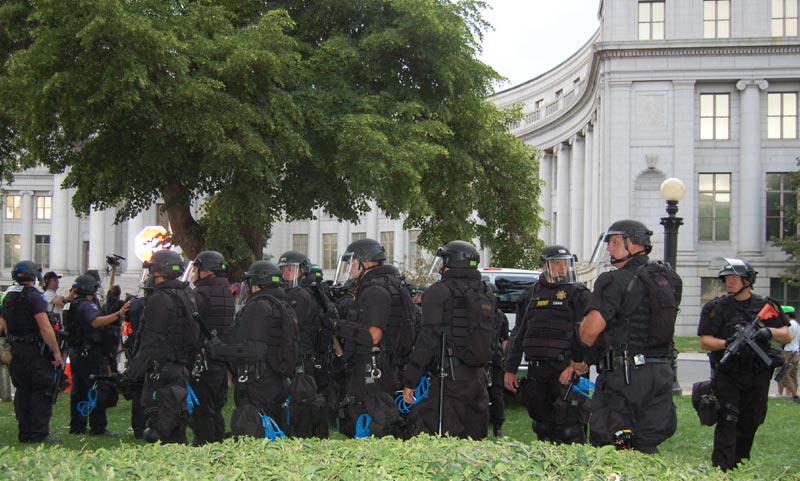
SO “WOKE” America is protesting the racist brutality of capitalism’s hired thugs. What are the cops supposed to stop doing exactly? Are they supposed to let poor blacks breathe? Or stop killing poor blacks in such vivid disproportion? What an aimless message these riots bring! Of course the mainstream media is on board. Their theme is domestic unrest with an eye on regime change. It’s what they incite everywhere else. I’m surprised they haven’t labeled this a “color” revolution –except the color is already chosen and it’s their least favorite.

The only result of the visibility which the Black Lives Matter movement has brought to police lynchings is that now you hear regret that poor white criminals aren’t dished out the beatings reserved for blacks. Do we want more police brutality so long as it is equally distributed? Cops aren’t going to stop beating people. It’s their job. In an unequal, predatory economic system, cruelty is a cop’s function.

I also laugh at the celebrity blow-back at unfortunate white protesters who take up the chant “All Lives Matter” usually in earnest because their marches, reflecting their local populations, are mainly white. Their chants don’t negate “Black Lives Matter,” they broaden it. Face it, the BLM slogan is pedantic. Of course Black Lives Matter. The protesters are not illiterate and neither are the police, the supposed audience.

And BLM is such an inarticulate ask. Try “Drone Victims Matter!” Uh, agreed, but the US drone terror program is not going to stand down.

And “hands up” and “taking a knee” are demonstrations of submission. Ugh.

If the issue is in-the-line-of-duty lynchings, I’m sorry but there are unfortunates a rung below African Americans. Per capita, Native Americans die more often at the hand of law enforcement, and below them, the homeless. Constables have been “rolling” poor bums since antiquity. Vulnerable homeless are killed, white and black, in dark alleys, without witnesses sober enough to record it with charged cell phones and Youtube accounts at home. And without faith leaders to rouse their congregations, or order churchgoers to heel once the fundraising was done.

If the George Floyd protests are made to be about discrimination against African Americans in general, and not Floyd’s tragic death-by-cop, then who is co-opting the message really?

Fortunately these riots will prove a difficult genie to ride. Images of civil discord make Trump look bad, but the more violent they become, the more activated will be the middle Americans who cheer for order to be restored.

That same white middle class wants their landscapers and household help to be hispanic who won’t expect to be treated as equals. Immigrant labor is preferred for the same reason. The upper class don’t have to discriminate by skin color. If you are underclass, YOU Do Not Matter.

Supposedly all of America is expected to suppress its racism. That’ll happen when you cease showing deference to family members over strangers, or when you quit disabusing sports fans for rooting against your home team. Clans, schools, ethnicity, and nationality are natural constructs where people feel communal bonds. They are also the only instinctive means by which people find their strength in numbers. Strange we’re all being told to disavow those instincts.

Meanwhile ethnocentrism relating to religious affiliation, if you’ve got one, is still encouraged. Nationalism, when it comes to kicking other religious ass overseas is still applauded. What of that racism?

When cops start beating bank chairmen, when the international brotherhood of man includes the bosses who deploy the cops and not simply the dupes more easily oppressed with racist state terrorism, then we can consider integrating the role of police into our vision of a desirable community. In other words, it ain’t going to happen. Calls to disband or defund the police are great, but until people wield the political power to do it, the calls will be easily refused.

Focusing on race doesn’t unite people, and it doesn’t only divide black and white, it attempts to efface everyone’s chief means to draw individuals together in united fronts against their common foe. Once we’re all free we can talk about equality.

Now addressing the systemic repression of blacks is another matter. African Americans were not immigrants. They alone came to these shores without the promise of the American dream of making a better life for themselves. REPARATIONS and affirmative action, that’s the only recourse to attempt to redress such inequality of footing.

Join the protests if you want, but know they’re serving only the corporate agenda of international liberalism. If you’re all about that, do your best to pull the demonstrations toward the peaceful, lest our president benefit from the gesture of saving middle America from anarchy. But know that team .gov holds all the cards when it comes to inciting and even instigating the violence. They are both ANTI and FA.

Pro-immigrant activists with Occupy Denver file suit against DIA and DPD, challenge airport free speech “permit”


DENVER, COLORADO- Civil liberties champion David Lane has filed a complaint in US district court challenging Denver’s office of the city attorney for instituting a permit process at DIA to prevent public protest. Holding signs has become impermissible at the airport, without the issuance of a permit seven days in advnace, although police are not bothering themselves about signs welcoming homecomers or seeking to connect business visitors with their limo service. That selective enforcement is unconstitutional of course, and the lawfirm powerhouse of Kilmer Lane & Newman is filing suit on behalf of two Occupy Denver plaintiffs. last Sunday, January 29, both were threatened with arrest by DIA police. While two earlier attempts to assemble had capitulated to DPD intimidation, the Occupy Denver activists stood their ground. Why did you file your lawsuit? “We know our rights. We want the POLICE to know our rights.”

1. Full text of complaint:

Case 1:17-cv-00332 Document 1
Filed 02/06/17 USDC Colorado Page 1 of 14

Civil Action No.

IN THE UNITED STATES DISTRICT COURT FOR THE DISTRICT OF COLORADO

NAZLI MCDONNELL,
ERIC VERLO,

Plaintiffs, vs.

CITY AND COUNTY OF DENVER,?
DENVER POLICE COMMANDER ANTONIO LOPEZ, in his individual and official capacity,
DENVER POLICE SERGEANT VIRGINIA QUINONES, in her individual and official capacity,

Defendants.

______________________________________________________________________________

COMPLAINT

______________________________________________________________________________

Plaintiffs, by and through their attorneys David A. Lane and Andy McNulty of KILLMER, LANE & NEWMAN, LLP, allege as follows:

INTRODUCTION

1. Plaintiffs Eric Verlo and Nazli McDonnell challenge a regulation of alarming breadth that bans all First Amendment expression at Denver International Airport without a permit.

2. Plaintiffs are concerned citizens who believe that President Donald Trump has overstepped his executive authority by signing the January 27, 2017, Executive Order (hereinafter “Muslim Ban”), which permanently bans Syrian refugees from emigrating to the United States, temporarily bans nationals of seven countries (including permanent legal residents and visa-holders), and suspends all applications to the United States refugee program (even as to vetted entrants currently in transit).

3. Plaintiffs wish to express their disgust with President Trump’s (likely unconstitutional) Muslim Ban. They wish to do so in the same place that hundreds of thousands of Americans across the country have done: standing directly outside of the secure Customs and Border Protection (hereinafter “CBP”) screening area within an airport where immigrants to America enter into the main terminal after clearing customs. Plaintiffs, unlike many citizens across this great nation who have exercised their opposition to the Muslim Ban in airports by chanting, singing, dancing, and praying, simply wish to stand in silent protest, holding signs that express their solidarity with immigrants and the Muslim community.

4. Plaintiffs are banned from doing so by DENVER INTERNATIONAL AIRPORT REGULATION 50 (hereinafter “Regulation 50”).

5. Regulation 50 states: “No person or organization shall leaflet, conduct surveys, display signs, gather signatures, solicit funds, or engage in other speech related activity at Denver International Airport for religious, charitable, or political purposes, or in connection with a labor dispute, except pursuant to, and in compliance with, a permit for such activity issued by the CEO or his or her designee.” DENVER INTERNATIONAL AIRPORT REGULATION 50.03. In order to obtain a permit, an individual must “complete a permit application and submit it during regular business hours, at least seven (7) days prior to the commencement of the activity for which the permit is sought[.]” DENVER INTERNATIONAL AIRPORT REGULATION 50.04-1.

6. Plaintiffs ask that this Court enjoin the enforcement of Regulation 50 and prohibit Defendants from arresting them for their First Amendment-protected activity of standing in peaceful protest within Jeppesen Terminal. Regulation 50 is overbroad in violation of the First Amendment and vague in violation of the Fourteenth Amendment’s Due Process Clause.

7. This is a civil rights action for declaratory and injunctive relief as well as fees and costs arising under 42 U.S.C. §§ 1983, 1988 and 28 U.S.C. Section 2201 et seq. due to Defendants’ current and imminent violations of Plaintiffs’ rights guaranteed by the First and Fourteenth Amendments to the Constitution of the United States.

PARTIES

8. Plaintiff Eric Verlo is a citizen of the United States of America. Mr. Verlo wishes to show his resistance to President Trump’s Muslim Ban, so that others will be inspired to join in the resistance.

9. Plaintiff Nazli McDonnell is a citizen of the United States of America. Ms. McDonnell wishes to show her resistance to President Trump’s Muslim Ban, so that others will be inspired to join in the resistance.

10. Defendant City and County of Denver is a municipal corporation and political subdivision of the State of Colorado. Thus, it is an entity subject to the provisions of § 1983.

11. Defendant Antonio Lopez is a Commander with the Denver Police Department. Commander Lopez is responsible for security at Denver International Airport’s Jeppesen Terminal.

12. Defendant Virginia Quinones is a Sergeant with the Denver Police Department. Sergeant Quinones is responsible for security at Denver International Airport’s Jeppesen Terminal.

JURISDICTION AND VENUE

13. Plaintiffs bring this claim pursuant to 42 U.S.C. § 1983; the First Amendment to the United States Constitution, incorporated as against States and their municipal divisions through the Fourteenth Amendment to the United States Constitution; and the Due Process Clause of the Fourteenth Amendment.

14. This Court has jurisdiction under 28 U.S.C. § 1331 over Plaintiffs’ claims that “arise[] under the Constitution of the United States.”

FACTS

15. On January 27, 2017, President Donald Trump signed an Executive Order, which permanently banned Syrian refugees from emigrating to the United States, temporarily banned nationals of seven countries (including permanent legal residents and visa-holders), and suspended all applications to the United States refugee program (even as to vetted entrants currently in transit). President Trump’s Executive Order has been subsequently referred to as a “Muslim Ban,” because it both mirrors President Trump’s racist, anti-Islam statements made on December 7, 2015, that he was planning to ban all Muslims from entering the United States until our representatives can “figure out what’s going on” and the ban targets countries whose population is predominantly Muslim and seemingly bears little rational relation to each country’s security threat to the United States.

16. Immediately upon the enactment of President Trump’s Muslim Ban there was an outpouring of outrage from a large proportion of the American population and across the spectrum of political affiliation. This outrage led to resistance in the form of protests.

17. On January 28, 2017, and January 29, 2017, protests erupted in nearly every major city in the United States. The protests organically formed in our nation’s airports. Protesters chose to express their disgust with President Trump’s Muslim Ban in airports (and specifically outside of the secure CBP screening area) because individuals affected by the ban who were in transit to the United States were being held and questioned by CBP agents there. Many of these travelers, including lawful United States residents, were forced to sign documents revoking their lawful status within the United States and deported. Still others were simply deported with no explanation. Others still were held for hours as teams of lawyers rushed to prepare habeas petitions for their release.

18. News reports about the protests make clear that they have been peaceful and non- disruptive despite the gathering of, in some cases, thousands of people.

19. Airport staff have told protesters, and would-be protesters, at numerous airports across the nation, including Kansas City International Airport, that there are no restrictions on their speech and that all protesters who wish to participate in actions against the Muslim Ban are allowed. Protests have continued in other cities to this day.

20. On January 28, 2017, there was one such protest at Denver International Airport, within the Jeppesen Terminal. At approximately 5:00 p.m. hundreds gathered in the Jeppesen Terminal’s atrium, near arrivals, to protest and many others gathered to bear witness.

21. Prior to the protest, leaders had applied for a permit. It was denied. The reason for its denial was that the permit was not requested with seven days advance notice of the protest occurring. Regulation 50 requires seven days advance notice.

22. The January 28, 2017, protest began with speeches, chants, songs, and prayers. It was a peaceful gathering of solidarity for immigrants and Muslims. Every person at the January 28, 2017, protest was contained in an area of the Jeppesen Terminal atrium that is designed as a gathering space for people to sit, relax, and converse. No one was standing in the walkways or passageways of the terminal.

23. Soon after the January 28, 2017, protest began, members of the Denver Police Department arrived on-scene. Commander Antonio Lopez engaged the leader of the protest, Amal Kassir, along with State Representative Joe Salazar and representatives from the ACLU of Colorado, and informed them that the protest was unlawful. Commander Lopez told Ms. Kassir that anything that “could be construed as Free Speech” was prohibited at the Denver International Airport, including within the Jeppesen Terminal, without a permit. See Exhibit 1, January 28, 2017 Video.

24. Commander Lopez also stated that all “First Amendment expression” was prohibited at the Denver International Airport, including within the Jeppesen Terminal, without a permit on Regulation 50. Commander Lopez handed Regulation 50 to multiple protesters, including Ms. Kassir. See Exhibit 2, January 28, 2017 Video 2.

25. Regulation 50 states (in pertinent part): “No person or organization shall leaflet, conduct surveys, display signs, gather signatures, solicit funds, or engage in other speech related activity at Denver International Airport for religious, charitable, or political purposes, or in connection with a labor dispute, except pursuant to, and in compliance with, a permit for such activity issued by the CEO or his or her designee.” DENVER INTERNATIONAL AIRPORT REGULATION 50.03. In order to obtain a permit, an individual must “complete a permit application and submit it during regular business hours, at least seven (7) days prior to the commencement of the activity for which the permit is sought[.]” DENVER INTERNATIONAL AIRPORT REGULATION 50.04-1.

26. Commander Lopez, along with members of Denver International Security, told Ms. Kassir that every portion of Denver International Airport property, which has an approximately fifty square mile footprint, is off-limits for First Amendment expression. They suggested that Ms. Kassir move her protest to Tower Road, which is approximately six miles from the Jeppesen Terminal and, like most of the land surrounding Denver International Airport, adjacent to open prairie land with no inhabitants.

27. Commander Lopez threatened Ms. Kassir and numerous other demonstrators with arrest if they didn’t immediately cease any “First Amendment expression.” According to Commander Lopez’s directives, the individuals gathered in the Jeppesen Terminal could not stand holding signs, sing, speak to others about matters of public concern, hold the United States Constitution above their shoulders, or stand silently with their arms interlocked.

28. Ultimately, to avoid arrest, Ms. Kassir and the demonstrators moved outside of the Jeppesen Terminal to the large area on its south side, adjacent to the escalators leading to the commuter rail and under the Westin Hotel. The protest continued peacefully for a little while longer, then disbursed without issue.

29. The next day, January 29, 2017, Plaintiffs Eric Verlo and Nazli McDonnell traveled to Denver International Airport’s Jeppesen Terminal to express their opposition to President Trump’s Muslim Ban.

30. Mr. Verlo and Ms. McDonnell brought with them signs expressing support for immigrants and expressing concern that history was repeating itself with disastrous potential consequences.

31. Mr. Verlo and Ms. McDonnell positioned themselves adjacent to the secure CBP screening area within the Jeppesen Terminal at approximately 1:15 p.m.

32. Adjacent the secure CBP screening area at the Jeppesen Terminal is the only place where Mr. Verlo and Ms. McDonnell can reach their intended audience. Mr. Verlo and Ms. McDonnell wish to communicate with those who could be swayed by their message and, particularly, with immigrants. International travelers are often immigrants and/or lawful United States residents, including green card and other visa holders, other than citizens. Mr. Verlo and Ms. McDonnell wish to express their solidarity with immigrants directly to these individuals. Further, United States citizens who arrive from international locations are also individuals with whom Mr. Verlo and Ms. McDonnell wish to communicate. International travelers have experienced other cultures and are likely to be sympathetic to Mr. Verlo and Ms. McDonell’s message.

33. The secure CBP screening area is also the location where the Muslim Ban has been enforced by DHS, both at Denver International Airport and across the nation. Neither Plaintiff attempted to enter any restricted areas of Denver International Airport.

34. While silently displaying their signs, Mr. Verlo and Ms. McDonnell were in the open plaza near the secure CBP screening area within the Jeppesen Terminal and positioned significantly behind the railing, which demarcates where those waiting for loved ones are permitted to stand. Mr. Verlo and Ms. McDonnell did not impede the right of way of any passengers hustling to catch flights at the last moment. They simply stood with placards showing their distaste for the Executive Order and the man who executed it.

35. Mr. Verlo and Mr. McDonnell also observed another man in the terminal, named Gene Wells, who was expressing views similar to theirs.

36. Mr. Wells was wearing a sign taped to the back of his shirt.

37. Mr. Wells left the Jeppesen Terminal, but subsequently returned to protest. When he did, he was stopped by Denver Police Department officers who told him that he could not walk around the terminal with the slogan he had affixed to his back. Mr. Wells eventually rejoined Mr. Verlo and Mr. McDonnell at the international arrivals doors, but not without trepidation. He feared he might be arrested.

38. While Mr. Verlo and Ms. McDonnell were displaying their signs, Defendant Sergeant Virginia Quinones approached Mr. Verlo and Ms. McDonnell and threatened them with arrest if they did not leave Jeppesen Terminal. See Exhibit 3, January 29, 2017, Video.

39. Sergeant Quinones handed Mr. Verlo and Ms. McDonnell Regulation 50 and cited it as the reason they would be arrested if they did not leave Jeppesen Terminal. Id. Sergeant Quinones told Mr. Verlo and Ms. McDonnell that they would need a permit in order to stand silently, holding signs in opposition of the Muslim Ban and be in compliance with Regulation 50.

40. Had Mr. Verlo and Ms. McDonnell applied for a permit the second President Trump signed the Executive Order implementing the Muslim Ban, they still would have been unable to engage in protest within the Jeppesen Terminal under the terms and conditions of Regulation 50 on January 29, 2017.

41. Mr. Verlo and Ms. McDonnell did not immediately leave the Jeppesen Terminal after being threatened with arrest. However, they were startled by Sergeant Quiones’ threat and feared arrest for the duration of the time they were there.

42. Throughout the time Mr. Verlo and Ms. McDonnell were expressing their views within the Jeppesen Terminal they received numerous shows of support from passersby. Multiple self- proclaimed Muslims expressed heart-felt statements of appreciation to Mr. Verlo, Ms. McDonnell, and others holding signs.

43. Mr. Verlo and Ms. McDonnell ultimately left Jeppesen Terminal.

44. Mr. Verlo and Ms. McDonnell wish to return to Jeppesen Terminal to express solidarity with Muslims and opposition to the Muslim Ban, but are reticent to do so for fear of being arrested.

45. Upon information and belief, no individual has been arrested, or threatened with arrest, for wearing a “Make America Great Again” campaign hat without a permit within the Jeppesen Terminal at Denver International Airport.

46. Upon information and belief, no individual has been arrested, or threatened with arrest, for holding a sign welcoming home a member of our military without a permit within the Jeppesen Terminal at Denver International Airport.

47. Upon information and belief, no individual has been arrested, or threatened with arrest, for holding a sign and soliciting passengers for a limousine without a permit within the Jeppesen Terminal at Denver International Airport.

48. Upon information and belief, no individual has been arrested, or threatened with arrest, for discussing current affairs with another person without a permit within the Jeppesen Terminal at Denver International Airport.

49. At all times relevant to this Complaint, Defendants acted under color of law.

CLAIM I: FIRST AMENDMENT
(§ 1983 violation – all Defendants)

50. Plaintiffs repeat, re-allege, and incorporate by reference the allegations in the foregoing paragraphs of this Complaint as fully set forth herein.

51. Regulation 50 violates the Free Speech Clause of the First Amendment to the Constitution, on its face and as applied, because it impermissibly curtails Plaintiffs’ free-speech rights.

52. Plaintiffs wish to speak on a matter of public concern. 11

53. Denver International Airport’s Jeppesen Terminal is a public forum.

54. Regulation 50 directly infringes upon and chills reasonable persons from engaging in activity that is protected by the First Amendment.

55. Regulation 50 acts as an unconstitutional prior restraint on speech because it (1) requires a permit before allowing individuals to engage in speech, (2) allows for arbitrary and/or discriminatory permit denials, and (3) requires advance notice that is unconstitutionally excessive.

56. Regulation 50 is overbroad.?

57. Regulation 50 is not narrowly tailored to serve a compelling government interest.?

58. Regulation 50 does not further a substantial government interest.?

59. Regulation 50’s restriction on expressive conduct is greater than necessary to further any
government interest.?

60. Defendants’ actions and/or omissions enforcing Regulation 50 caused, directly or
proximately, Plaintiffs to suffer damages.

CLAIM II: FIRST AMENDMENT RETALIATION
(§ 1983 violation – all Defendants)

1. All statements of fact set forth previously are hereby incorporated into this claim as though set forth fully herein. ?

2. Plaintiffs engaged in First Amendment protected speech on a matter of public concern ?while displaying signs opposing President Trump’s Muslim Ban on January 29, 2017.

3. Defendants jointly and on their own accord responded to Plaintiffs’ First Amendment protected speech with retaliation, including but not limited to threatening Plaintiffs with arrest.

4. Defendants retaliatory actions were substantially motivated by Plaintiffs’ exercise of their First Amendment rights.

5. By unlawfully threatening Plaintiffs with arrest, Defendants sought to punish Plaintiffs for exercising their First Amendment rights and to silence their future speech. Defendants’ retaliatory actions would chill a person of ordinary firmness from engaging in such First Amendment protected activity.

6. Defendants’ actions and/or omissions enforcing Regulation 50 caused, directly and proximately, Plaintiffs to suffer damages.

CLAIM III: FOURTEENTH AMENDMENT DUE PROCESS
(§ 1983 violation – all Defendants)

7. All statements of fact set forth previously are hereby incorporated into this claim as though set forth fully herein.

8. The prohibitions of Regulation 50 are vague and not clearly defined. ?

9. Regulation 50 offers no clear and measurable standard by which Plaintiffs and others can ?act lawfully.

10. Regulation 50 does not provide explicit standards for application by law enforcement officers.

11. Regulation 50 fails to provide people of ordinary intelligence a reasonable opportunity to understand what conduct it prohibits, and authorizes or encourages arbitrary and discriminatory enforcement, or both.

12. Defendants’ actions and/or omissions enforcing Regulation 50 caused, directly and proximately, Plaintiffs to suffer damages.

PRAYER FOR RELIEF

WHEREFORE, Plaintiffs respectfully request that this Court enter judgment in their favor and against Defendants, and grant:

(a) Appropriate declaratory and other injunctive and/or equitable relief; 13

(b)  Enter a declaration that Regulation 50 is unconstitutional on its face and enjoin its enforcement; ?

(c)  Compensatory and consequential damages, including damages for emotional distress, loss of reputation, humiliation, loss of enjoyment of life, and other pain and suffering on all claims allowed by law in an amount to be determined at trial; ?

(d)  All economic losses on all claims allowed by law; ?

(e)  Punitive damages on all claims allowed by law and in an amount to be determined ?at trial; ?

(f)  Attorney’s fees and the costs associated with this action, pursuant to 42 U.S.C. § ?1988; ?

(g)  Pre and post-judgment interest at the lawful rate; and ?

(h)  Any further relief that this court deems just and proper, and any other relief as ?allowed by law. ?

Dated this 6th day of February 2017.

KILLMER, LANE & NEWMAN, LLP
s/ Andy McNulty

___________________________________
David A. Lane
?Andy McNulty?
Killmer, Lane & Newman, LLC
1543 Champa Street, Suite 400 Denver, Colorado 80202?
Attorneys for Plaintiff

2. Full text of Feb 6 motion for preliminary injunction:

Case 1:17-cv-00332 Document 2
Filed 02/06/17 USDC Colorado Page 1 of 23

Civil Action No.

IN THE UNITED STATES DISTRICT COURT FOR THE DISTRICT OF COLORADO

NAZLI MCDONNELL,
ERIC VERLO,

Plaintiffs, vs.

CITY AND COUNTY OF DENVER,
DENVER POLICE COMMANDER ANTONIO LOPEZ, in his individual and official capacity,
DENVER POLICE SERGEANT VIRGINIA QUINONES, in her individual and official capacity,

Defendants.

______________________________________________________________________________

MOTION FOR PRELIMINARY INJUNCTION

______________________________________________________________________________

Plaintiffs, by and through their attorneys David A. Lane and Andy McNulty of KILLMER, LANE & NEWMAN, LLP, hereby submit the following Motion for Preliminary Injunction, and in support thereof, states as follows:

1. Introduction

Over the last four days, many Americans have expressed public disapproval of President Donald Trump’s January 27, 2017, Executive Order, which permanently bans Syrian refugees from emigrating to the United States, temporarily bans nationals of seven countries (including permanent legal residents and visa-holders), and suspends all applications to the United States refugee program (even as to vetted entrants currently in transit). Plaintiffs are concerned and alarmed United States citizens who wish to join the growing chorus of voices expressing opposition to the Executive Order. To do so, they wish to stand in silent protest at the Jeppesen Terminal within Denver International Airport.

Plaintiffs did just this on January 29, 2017, standing in silent protest of the Executive Order outside of the secure Customs and Border Protection (hereinafter “CBP”) screening area within Jeppesen Terminal. Almost immediately, Plaintiffs were threatened with arrest by Denver Police Department Sergeant Virginia Quinones for standing silently and holding signs opposing the Executive Order, despite that fact that the Jeppesen Terminal has previously been used for expressive activity (and that protesters at more than ten major airports nationwide have protested peacefully without major disruption or legal restriction). While silently displaying their signs, Plaintiffs were in the plaza within the Jeppesen Terminal and positioned significantly behind the railing, which demarcates where those waiting for loved ones are permitted to stand, in the open plaza outside of the secure CBP screening area at the Jeppesen Terminal. Plaintiffs did not impede the right of way of any passengers hustling to catch flights at the last moment. They simply stood with placards showing their distaste for the Executive Order and the man who executed it.

Even though Plaintiffs were simply engaged in peaceful First Amendment protected expression, they were threatened with arrest. Sergeant Quinones informed Plaintiffs that, in order to stand silently with political signs, they would need a permit. Without a permit, Sergeant Quinones stated, all “First Amendment expression” at the Denver International Airport was banned.

This was not the first time since the enactment of the Executive Order that the Denver Police Department threatened individuals with arrest for engaging in First Amendment protected activity in Jeppesen Terminal. On January 28, 2016, a protest was held in the plaza of Jeppesen Terminal. During the protest, Denver Police Commander Antonio Lopez instructed multiple individuals, including State Representative Joseph Salazar and representatives from the ACLU of Colorado, that all “First Amendment expression” was banned at Denver International Airport without a permit. See Exhibit 1, January 28, 2017, Video 1; Exhibit 2, January 28, 2017, Video 2. The protesters had, in fact, applied for a permit earlier that day. However, it had not been granted because they had not done so seven days in advance of the protest in compliance with Denver International Airport regulations. Although no arrests were ultimately made, protesters were threatened numerous times by Commander Lopez, and other officers, with arrest.

The Denver International Airport regulation that both Sergeant Quinones and Commander Lopez relied upon in instructing Plaintiffs, and others, that Denver International Airport bans all “First Amendment expression” without a permit is DENVER INTERNATIONAL AIRPORT REGULATION 50 (hereinafter “Regulation 50”). Regulation 50 states that “no person or organization shall leaflet, conduct surveys, display signs, gather signatures, solicit funds, or engage in other speech related activity at Denver International Airport for religious, charitable, or political purposes, or in connection with a labor dispute, except pursuant to, and in compliance with, a permit for such activity issued by the CEO or his or her designee.” DENVER INTERNATIONAL AIRPORT REGULATION 50.03. In order to obtain a permit, an individual must “complete a permit application and submit it during regular business hours, at least seven (7) days prior to the commencement of the activity for which the permit is sought[.]” DENVER INTERNATIONAL AIRPORT REGULATION 50.04-1.

Plaintiffs wish to return to Denver International Airport to protest the Executive Order, but are reasonably frightened of arrest and, absent action by this Court, must choose between lawfully exercising their First Amendment right and being subject to arrest and/or prosecution.

Plaintiffs ask that this Court enter an injunction prohibiting their arrest for standing in peaceful protest within Jeppesen Terminal and invalidating Regulation 50 as violative of the First and Fourteenth Amendments to the United States Constitution.

2. Factual Background

All statements of fact set forth in the simultaneously filed Complaint are hereby incorporated into this Brief as though set forth fully herein.

3. Argument

3.1 The standard for issuance of a preliminary injunction.

When seeking a preliminary injunction, a plaintiff must establish that (1) he is likely to succeed on the merits; (2) he is likely to suffer irreparable harm; (3) the balance of equities tips in his favor; and (4) that an injunction is in the public interest. Winter v. Nat. Res. Def. Council, 555 U.S. 7, 20 (2008); see also ACLU v. Johnson, 194 F.3d 1149, 1155 (10th Cir. 1999).

The Tenth Circuit has modified the preliminary injunction test when the moving party demonstrates that the second, third, and fourth factors “tip strongly” in its favor. See Oklahoma ex rel. Okla. Tax Comm’n v. Int’l Registration Plan, Inc., 455 F.3d 1107, 1113 (10th Cir. 2006); see also 820 F.3d 1113, n.5 (10th Cir. 2016). “In such situations, the moving party may meet the requirement for showing success on the merits by showing that questions going to the merits are so serious, substantial, difficult, and doubtful as to make the issue ripe for litigation and deserving of more deliberate investigation.” Id. (internal quotation marks omitted). Moreover, this “fair chance of prevailing” test is appropriate in this case because Plaintiffs are challenging a policy, not a statue or ordinance. See Planned Parenthood Minn, N.D., & S.D. v. Rounds, 530 F.3d 724, 732 (9th Cir. 2008) (“[C]ourts should… apply the familiar ‘fair chance of prevailing’ test where a preliminary injunction is sought to enjoin something other than government action based on presumptively reasoned democratic processes.”).

Under either standard, Plaintiffs are able to demonstrate that the issuance of a preliminary injunction is appropriate in this matter.

3.3 Regulation 50 implicates Plaintiffs’ First Amendment rights. 1

When the government regulates the exercise of First Amendment rights, the burden is on the proponent of the restriction to establish its constitutionality. Phelps-Roper v. Koster, 713 F.3d 942, 949 (8th Cir. 2013). Moreover, when assessing the preliminary injunction factors in First Amendment cases, “the likelihood of success will often be the determinative factor.” Hobby Lobby Stores, Inc. v. Sebelius, 723 F.3d 1114, 1145 (10th Cir. 2013). This is because “the loss of First Amendment freedoms, for even minimal periods of time, unquestionably, constitutes irreparable injury,” Heideman v. Salt Lake City, 348 F.3d 1182, 1190 (10th Cir. 2003), and it is invariably in the public interest to protect an individual’s First Amendment rights. See Homans v. City of Albuquerque, 264 F.3d 1240, 1244 (10th Cir. 2001) (noting that “the public interest is better served” by protecting First Amendment rights).

[NOTE 1. It is important to note that facial challenges to government policies and statutes, when based on First and Fourteenth Amendment grounds, are not disfavored. See United States v. Stevens, 559 U.S. 460, 473 (2010); City of Chicago v. Morales, 527 U.S. 41 (1999).]

3.4 Plaintiffs are likely to succeed on the merits.

Plaintiffs are likely to succeed on the merits because Regulation 50 violates the Free Speech Clause of the First Amendment and the Due Process Clause of the Fourteenth Amendment.

3.4(a) Plaintiffs engaged, and wish to engage, in speech on a matter of public concern.

Plaintiffs’ speech is at the core of the First Amendment’s protection because it deals with a matter of public concern. “Speech deals with matters of public concern when it can be fairly considered as relating to any matter of political, social, or other concern to the community, or when it is a subject of legitimate news interest; that is, a subject of general interest and of value and concern to the public.” Snyder v. Phelps, 562 U.S. 443, 453 (2011) (internal quotation marks and citation omitted). “Speech on matters of public concern is at the heart of the First Amendment’s protection.” Id. at 451-52 (alterations and quotation marks omitted). “The First Amendment reflects ‘a profound national commitment to the principle that debate on public issues should be uninhibited, robust, and wide-open.’” Id. at 452 (quoting New York Times Co. v. Sullivan, 376 U.S. 254, 270 (1964)). Plaintiffs wish to engage in expression about President Donald Trump’s January 27, 2017, Executive Order, a topic that has generated nearly unprecedented debate and dissent. See Adrienne Mahsa Varkiani, Here’s Your List of All the Protests Happening Against the Muslim Ban, THINK PROGRESS (Jan. 28, 2017), https://thinkprogress.org/muslim-ban-protests-344f6e66022e#.ft1oznfv4 (compiling list of direct actions planned in response to President Trump’s January 27, 2017, Executive Order). Thus, Plaintiffs’ speech “‘occupies the highest rung of the hierarchy of First Amendment values, and is entitled to special protection.’” Snyder, 562 U.S. at 452 (quoting Connick v. Myers, 461 U.S. 138, 145 (1983)).

3.4(b) Regulation 50 acts as a prior restraint.

The restriction at issue in this matter is a prior restraint. “The term prior restraint is used ‘to describe administrative and judicial orders forbidding certain communications when issued in advance of the time that such communications are to occur.’” Alexander v. United States, 509 U.S. 544, 550 (1993) (quoting M. Nimmer, Nimmer on Freedom of Speech § 4.03, p. 4–14 (1984)). Regulation 50 is in an administrative order that forbids future communication and bases the ability to communicate in the future on the discretion of an administrative official. See DENVER INTERNATIONAL AIRPORT REGULATION 50.03 (“no person or organization shall leaflet, conduct surveys, display signs, gather signatures, solicit funds, or engage in other speech related activity at Denver International Airport for religious, charitable, or political purposes, or in connection with a labor dispute, except pursuant to, and in compliance with, a permit for such activity issued by the CEO or his or her designee.” (emphasis added)). It is a prior restraint.

The burden of proving a prior restraint is permissible is particularly steep. The Supreme Court has repeatedly held that “[a]ny system of prior restraints of expression comes to this Court bearing a heavy presumption against its constitutional validity.” Bantam Books, Inc. v. Sullivan, 372 U.S. 58, 70 (1963). For the reasons outlined infra, Defendants cannot meet this especially significant burden.

3.4(c) Jeppesen Terminal, outside of the passenger security zones, is a traditional public forum.

The Supreme Court has not definitively decided whether airport terminals, including Jeppesen Terminal, are public forums. In Lee v. International Society for Krishna Consciousness, Inc., 505 U.S. 830 (1992) (hereinafter “Lee I”), issued the same day as International Society for Krishna Consciousness, Inc. v. Lee, 505 U.S. 672 (1992) (hereinafter “Lee II”), the Supreme Court struck down a total ban on distribution of literature in airports. In Lee I, the Court issued a one sentence per curiam opinion, which affirmed the Second Circuit for the reasons expressed by Justice O’Connor, Justice Kennedy, and Justice Souter in Lee II. See Lee I, 505 U.S. at 831. Justice Kennedy and Justice Souter’s opinions in Lee II found that “airport corridors and shopping areas outside of the passenger security zones… are public forums, and speech in those places is entitled to protection against all government regulation inconsistent with public forum principles.” Lee II, 505 U.S. at 693 (Kennedy, J., concurring in the judgment); but see Lee II, 505 U.S. at 683 (“”[W]e think that neither by tradition nor purpose can the terminals be described as satisfying the standards we have previously set out for identifying a public forum.”).

Therefore, Plaintiffs ask this Court to find the area of Jeppesen Terminal outside of the passenger security zones to be a public forum. The historical use of the Jeppesen Terminal’s plazas and other areas outside of the passenger security zones (including the area outside of the secure CBP screening area) for political speech (particularly, the history of welcoming of American military personnel home from service, discussion between passengers of matters of public concern, and display of clothing advocating for political views and ideals) indicates that it is a public forum. See First Unitarian Church of Salt Lake City v. Salt Lake City Corp., 308 F.3d 1114, 1130 (10th Cir. 2002) (“Where courts have considered the traditional use of publicly accessible property for speech, they have refused to attribute legal significance to an historical absence of speech activities where that non-speech history was created by the very restrictions at issue in the case.”). Further, that the Jeppesen Terminal is free and open to the public (outside of the passenger security zones), illustrates that it is a public forum. See, e.g., Ark. Educ. Television Comm’n v. Forbes, 523 U.S. 666, 676 (1998); Cornelius v. NAACP Legal Def. & Educ. Fund, 473 U.S. 788, 800, 805, 809 (1985). Finally, Jeppesen Terminal retains characteristics similar to parks: it has large plazas lined with benches, it is surrounded by businesses which are open to the public, and it has dedicated walkways, similar to sidewalks, indicating that it is a public forum. See e.g., Frisby v. Schultz, 487 U.S. 474, 480-481 (1988); United States v. Grace, 461 U.S. 171, 177 (1983). Further, the Supreme Court has not strictly limited the public forum category to streets, sidewalks, and parks. See, e.g., Se. Promotions, Ltd. v. Conrad, 420 U.S. 546 (1975) (finding leased municipal theater is a public forum); Heffron v. Int’l Society for Krishna Consciousness, Inc., 452 U.S. 640 (1981) (finding state fair is a public forum); Edwards v. South Carolina, 372 U.S. 229 (1963) (finding grounds of state capitol are a traditional public forum). Even if the City claims that it has never intended for Jeppesen Terminal to be a public forum, this is not dispositive. See Lee, 505 U.S. at 830 (government policy prohibiting distribution of literature at airport on property struck down); Cornelius, 473 U.S. at 805 (government’s decision to limit access is not itself dispositive). Plaintiffs’ ask that this Court find Jeppesen Terminal, outside of the passenger security zones, a traditional public forum.

Since Jeppesen Terminal is a traditional public forum, any restriction on Plaintiffs’ speech must be content-neutral and narrowly tailored to a compelling government interest. Regulation 50 fails at both.

3.4(d) Regulation 50 is content-based.

Regulation 50 is a content-based restriction of expression. Although the Supreme Court has long held that content-based restrictions elicit strict scrutiny, see, e.g., Carey v. Brown, 447 U.S. 455 (1980), lower courts diverged on the meaning of “content-based” until Reed v. Town of Gilbert, 135 S. Ct. 2218 (2015). 2 Reed clarified that a restriction is content based simply if it draws distinctions “based on the message a speaker conveys.” 135 S. Ct. at 2227. Reed is clear that even “subtle” distinctions that define regulated expression “by its function or purpose . . . are distinctions based on the message a speaker conveys, and therefore, are subject to strict scrutiny.” Id. This accords with Texas v. Johnson, which held that “the emotive impact of speech on its audience is not a secondary effect unrelated to the content of the expression itself.” 491 U.S. 491 U.S. 297, 412 (1989) (internal quotations omitted).

[NOTE 2. Reed involved a municipal “sign code” that regulated signs differently based on the kind of message they conveyed (such as “ideological,” “political,” or “temporary directional”). 135 S. Ct. at 2224-25. The Court rejected the city’s argument that a law had to discriminate against certain viewpoints in order to be a content-based restriction. Id. at 2229.]

Regulation 50 is content-based on its face. It distinguishes between content and requires that an official determine the content of the speaker’s message when enforcing its proscriptions. Reed, 135 S. Ct. at 2227; see DENVER INTERNATIONAL AIRPORT REGULATION 50.03 (“No person or organization shall leaflet, conduct surveys, display signs, gather signatures, solicit funds, or engage in other speech related activity at Denver International Airport for religious, charitable, or political purposes, or in connection with a labor dispute[.]” (emphasis added)). The distinctions drawn by Regulation 50 make it a facially content-based restriction on expression that must elicit “the most exacting scrutiny.” Johnson, 491 U.S. at 412; Reed, 135 S. Ct. at 2227.

3.4(e) Regulation 50 is not narrowly tailored to serve a compelling government interest.

As a facially content-based restriction of expression at traditional public fora, Regulation 50 is presumptively unconstitutional unless Defendant “prove[s] that the restriction furthers a compelling interest and is narrowly tailored to achieve that interest.” Reed, 135 St. Ct. at 2231; accord Johnson, 491 U.S. at 412.

“A statute is narrowly tailored if it targets and eliminates no more than the exact source of the ‘evil’ it seeks to remedy.” Frisby v. Schultz, 487 U.S. 474, 485 (1988) (citation omitted). Regulation 50 reaches more speech than that which would impair the security of the airport or ensure that passengers are not unduly encumbered. In fact, it completely bans all “First Amendment expression.” “A complete ban can be narrowly tailored, but only if each activity within the proscription’s scope is an appropriately targeted evil.” Id.. Regulation 50 is not such a ban. For instance, Plaintiffs’ expression does nothing to jeopardize security at Denver International Airport or to inhibit the free flow of passengers through the airport.

Further, any argument that Plaintiffs can engage in expressive activity in another location lacks merit, as the Supreme Court has held that the First Amendment is violated when one specific location or audience, when important to the speaker, is foreclosed. See McCullen v. Coakley, 134 S. Ct. 2518, 2536 (2014); Schenck v. Pro-Choice Network, 519 U.S. 357, 377 (1997) (invalidating a “floating” buffer zone around people entering an abortion clinic partly on the ground that it prevented protestors “from communicating a message from a normal conversational distance or handing leaflets to people entering or leaving the clinics who are walking on the public sidewalks”); Schneider v. New Jersey, 308 U.S. 147, 163 (1939) (invalidating anti-handbilling ordinances even though “their operation is limited to streets and alleys and leaves persons free to distribute printed matter in other public places”). Regulation 50 lacks the narrow tailoring necessary to survive First Amendment strict scrutiny analysis.

3.4(f) Regulation 50 violates the First Amendment even if this Court determines Jeppesen Terminal is a nonpublic forum.

Regulation 50 bans all “First Amendment expression” absent a permit; it is unconstitutional even when analyzed under the lower standard of scrutiny applied by courts to First Amendment political speech in a nonpublic forum. In Board of Airport Commissioners of Los Angeles v. Jews for Jesus, Inc., 482 U.S. 569 (1987), the Supreme Court considered whether a resolution restricting free speech in the airport was constitutional. The resolution at issue stated that the airport “is not open for First Amendment activities by any individual and/or entity.” Id. at 574. Although the Court did not explicitly find that the airport was a nonpublic forum, it did hold that the resolution restricting speech in the airport was facially unreasonable, even if the airport was a nonpublic forum. Id. at 573. The Court noted that enforcing the resolution would prohibit “talking and reading, or the wearing of campaign buttons or symbolic clothing.” Id. at 574. The Court also noted, “[m]uch nondisruptive speech–such as the wearing of a T-shirt or button that contains a political message–may not be ‘airport related’ but is still protected speech even in a nonpublic forum.” Id. at 575 (citing Cohen v. California, 403 U.S. 15 (1971) (holding that wearing of jacket with offensive language in a courthouse was a form of nondisruptive expression that was protected by the First Amendment)). Thus, although specific conduct was not at issue in the Jews for Jesus decision, the Court nonetheless implicitly held that non-disruptive speech is protected by the First Amendment in nonpublic fora and that restrictions that encumber non-disruptive expression are unreasonable.

In Lee II, Justice O’Connor set forth the test for determining reasonableness in the context of nonpublic fora. 505 U.S. at 687 (O’Connor, J., concurring). 3 She stated, ”[t]he reasonableness of the Government’s restriction [on speech in a nonpublic forum] must be assessed in light of the purpose of the forum and all the surrounding circumstances.” Id. (O’Connor, J., concurring) (quoting Cornelius, 473 U.S. at 809). However, Justice O’Connor noted that while “[o]rdinarily . . . we have . . . been confronted with cases where the fora at issue were discrete, single-purpose facilities,” airports present a different analysis because they are multipurpose facilities. Id. at 688 (O’Connor, J., concurring) (citations omitted). She determined airports to be multipurpose facilities because

the Port Authority [has] chosen not to limit access to the airports under its control, [and] has created a huge complex open to travelers and nontravelers alike. The airports house restaurants, cafeterias, snack bars, coffee shops, cocktail lounges, post offices, banks, telegraph offices, clothing shops, drug stores, food stores, nurseries, barber shops, currency exchanges, art exhibits, commercial advertising displays, bookstores, newsstands, dental offices and private clubs.

Id. This led to the finding that “[t]he reasonableness inquiry, therefore, is not whether the restrictions on speech are consistent with preserving the property for air travel, but whether they are reasonably related to maintaining the multipurpose environment that the Port Authority has deliberately created.” Id. at 689. A complete ban on First Amendment activity at the Jeppesen Terminal, absent a permit that must be obtained by providing seven days advance notice, is not a reasonable restriction. Regulation 50 does not comport with Justice O’Connor’s conclusion that airports are more than simply places where air travel occurs.

[NOTE 3. It is important to note that Lee involved a plurality opinion, joined by Justice O’Connor. Therefore, Justice O’Connor’s concurrence is the “narrowest grounds” that justify the Court’s result and her concurrence holds substantial precedential weight.]

Moreover, Justice O’Connor distinguished between solicitations (which the Supreme Court found could be reasonably restricted) and distributing leaflets (which the Supreme Court found could not be reasonably restricted) in the airport:

[L]eafleting does not entail the same kinds of problems presented by face-to-face solicitation. Specifically, “one need not ponder the contents of a leaflet or pamphlet in order mechanically to take it out of someone’s hand . . . . The distribution of literature does not require that the recipient stop in order to receive the message the speaker wishes to convey; instead the recipient is free to read the message at a later time.”

Id. at 690 (quoting United States v. Kokinda, 497 U.S. 720, 734 (1990)).

Thus, the Court held in Lee II that prohibiting solicitation in a nonpublic forum is not unreasonable, but that prohibiting the distribution of leaflets and other literature at a nonpublic forum is unreasonable. See also Lee, 505 U.S. at 830 (decided the same day as Lee II and striking down a prohibition on the distribution of leaflets and other literature at La Guardia, John F. Kennedy, and Newark International airports) (per curiam). Circuit courts have also recognized the inherent right to distribute paper and other information in nonpublic fora. Following Lee I and Lee II, two circuit courts have held that airports, as nonpublic fora, could not preclude newspaper publishers from placing newsracks in airport terminals. See Jacobsen v. City of Rapid City, South Dakota, 128 F.3d 660 (8th Cir. 1997); Multimedia Publishing Co. of South Carolina, Inc. v. Greenville-Spartanburg Airport Dist., 991 F.2d 154 (4th Cir. 1993). To the extent that the airports were concerned about safety or the impediment of traffic flow, the courts held that the airport may impose reasonable restrictions, but they could not enforce an outright ban on the newspaper racks. See Jacobsen, 128 F.3d at 660; Multimedia Publishing Co. of South Carolina, Inc., 991 F.2d at 154.

Denver, through Regulation 50, has banned all “First Amendment expression” including leafleting and protests. In fact, Plaintiffs expression is arguably less intrusive and disruptive to air travel than the form of expression, namely leafletting, that the Court held could not be reasonably restricted in the areas of an airport that precede the security screening area. It is clear from Lee I, Lee II, and Jews for Jesus that Denver cannot ban all “First Amendment expression” at the Jeppesen Terminal.

3.4(f)(1) Independently, the viewpoint-based prohibition of Plaintiffs’ speech, based on Regulation 50, violates the First Amendment.

Even if Jeppesen Terminal is a nonpublic forum, “this does not mean the government has unbridled control over speech, . . . for it is axiomatic that ‘the First Amendment forbids the government to regulate speech in ways that favor some viewpoints or ideas at the expense of others.” Summum v. Callaghan, 130 F.3d 906, 916 (10th Cir. 1997) (quoting Lamb’s Chapel v. Center Moriches Union Free School Dist., 508 U.S. 384, 394, (1993)). “Restrictions on speech in nonpublic fora must be viewpoint neutral[.]” Warren v. Fairfax Cty., 196 F.3d 186, 193 (4th Cir. 1999) (citing Cornelius, 473 at 809). Defendants’ restriction of Plaintiffs’ speech, under the guise of Regulation 50, discriminates on the basis of viewpoint. Individuals walk through Denver International Airport with political messages and slogans on their shirts and luggage and discuss politics on a daily basis. Counsel for Plaintiffs has worn political shirts while traveling through Denver International Airport and discussed modern politics with fellow passengers on many occasions. However, no other individual, to Plaintiffs or Plaintiffs’ counsel’s knowledge, has been threatened with arrest for engaging in this political speech. Nor has any individual been arrested for displaying pro-President Trump messages, for example a red hat that reads “Make America Great Again.” Only Plaintiffs’ expressive activity against the President’s Executive Order, and others advocating similarly, has been threatened with arrest. Regulation 50 is being enforced as a clearly view-point based restriction. Defendants’ application of Regulation 50 to Plaintiffs speech is view-point based and violates the First Amendment.

3.4(g) The seven day advance notice requirement for obtaining a permit is not a reasonable restriction.

Notice periods restrict spontaneous free expression and assembly rights safeguarded in the First Amendment. Plaintiffs, like many others throughout history, wish to engage in First Amendment expression in quick response to topical events. While even in such time-sensitive situations, a municipality may require some short period of advance notice so as to allow it time to take measures to provide for necessary traffic control and other aspects of public safety, the period can be no longer than necessary to meet the City’s urgent and essential needs of this type. See American-Arab Anti-Discrimination Comm. v. City of Dearborn, 418 F.3d 600, 605 (6th Cir. 2005) (“Any notice period is a substantial inhibition on speech.”).

Advance notice requirements that have been upheld by courts have most generally been less than a week. See, e.g., A Quaker Action Group v. Morton, 516 F.2d 717, 735 (D.C. Cir. 1975) (two-day advance notice requirement is reasonable for use of National Park areas in District of Columbia for public gatherings); Powe v. Miles, 407 F.2d 73, 84 (2d Cir. 1968) (two-day advance notice requirement for parade is reasonable); Progressive Labor Party v. Lloyd, 487 F. Supp. 1054, 1059 (D. Mass. 1980) (three-day advance filing requirement for parade permit approved in context of broader challenge); Jackson v. Dobbs, 329 F. Supp. 287, 292 (N.D. Ga. 1970) (marchers must obtain permit by 4 p.m. on day before the march), aff’d, 442 F.2d 928 (5th Cir. 1971). Lengthy advance filing requirements for parade permits, such as the seven day advance notice requirement imposed by Regulation 50, have been struck down as violating the First Amendment. See American-Arab Anti-Discrimination Comm., 418 F.3d at 605-07 (holding that provision requiring thirty days’ notice is overbroad and is not saved by an unwritten policy of waiving the provision); NAACP, W. Region v. City of Richmond, 743 F.2d 1346, 1357 (9th Cir. 1984) (“[A]ll available precedent suggests that a 20-day advance notice requirement is overbroad.”). Even an advance filing requirement of five days has been held too long to comport with the First Amendment. See Douglas v. Brownell, 88 F.3d 1511, 1523-24 (8th Cir. 1996) (city’s asserted goals of protecting pedestrian and vehicular traffic and minimizing inconvenience to the public does not justify five-day advance filing requirement for any parade, defined as ten or more persons).

It is clear that, in the case at bar, a permit requirement of seven days advance notice is not a reasonable restriction of Plaintiffs’ First Amendment rights. Plaintiffs wish to engage in timely, direct action against, what they perceive as, a tyrannical and unconstitutional exercise of the executive power. If Plaintiffs were to have applied for a permit at the exact moment President Trump signed the Executive Order, they would still have been prevented from engaging in First Amendment activity on January 29, 2017. In direct action, like in most things, timing is everything. As evidenced by myriad protests that occurred across the nation’s airports, which were accompanied by no violence or destruction of property and did not otherwise jeopardize security, accommodation of protest at the Jeppesen Terminal is reasonable. Such a lengthy approval period, with no exceptions for spontaneous, peaceful protests, violates the First Amendment. See Church of the American Knights of the Ku Klux Klan v. City of Gary, 334 F.3d 676, 682 (7th Cir. 2003) (noting that “the length of the required period of advance notice is critical to its reasonableness; and given … that political demonstrations are often engendered by topical events, a very long period of advance notice with no exception for spontaneous demonstrations unreasonably limits free speech” (emphasis added)).

3.4(h) Regulation 50 is overbroad in violation of the First Amendment.

“[A] law may be invalidated as overbroad if ‘a substantial number of its applications are unconstitutional, judged in relation to the [ordinance]’s plainly legitimate sweep.’” United States v. Stevens, 559 U.S. 460, 473 (2010) (quoting Wash. State Grange v. Wash. State Republican Party, 552 U.S. 442, 449 n.6 (2008)). An overbroad statute may be challenged on its face even though a more narrowly drawn statute would be valid as applied to the party in the case before it. City Council of L.A. v. Taxpayers for Vincent, 466 U.S. 789, 798 (1984) (“[B]roadly written statutes may have such a deterrent effect on free expression that they should be subject to challenge even by a party whose own conduct may be unprotected.”). The Supreme Court “has repeatedly held that a government purpose to control or prevent activities constitutionally subject to state regulation may not be achieved by means which sweep unnecessarily broadly and thereby invade the area of protected freedoms.” NAACP v. Alabama ex rel. Flowers, 377 U.S. 288, 307 (1964); see also Grayned v. City of Rockford, 408 U.S. 109, 114-15 (1972) (“The crucial question, then, is whether the ordinance sweeps within its prohibitions what may not be punished under the First and Fourteenth Amendments.”). Courts have “provided this expansive remedy out of concern that the threat of enforcement of an overbroad law may deter or ‘chill’ constitutionally protected speech—especially when the overbroad statute imposes criminal sanctions.” Virginia v. Hicks, 539 U.S. 113, 119 (2003).

Determining whether a law is substantially overbroad requires a two-step analysis. First, a court must “construe the challenged [law]; it is impossible to determine whether a [law] reaches too far without first knowing what the [law] covers.” United States v. Williams, 553 U.S. 285, 293 (2008). Second, based on the first step, a court must determine whether the law “criminalizes a substantial amount of protected expressive activity.” Id. at 297.

Regulation 50 provides that “no person or organization shall leaflet, conduct surveys, display signs, gather signatures, solicit funds, or engage in other speech related activity at Denver International Airport for religious, charitable, or political purposes, or in connection with a labor dispute, except pursuant to, and in compliance with, a permit for such activity issued by the CEO or his or her designee.” Those tasked with enforcing Regulation 50, have stated that it bans all “First Amendment expression.” See Exhibit 1, January 28, 2017, Video 1; Exhibit 2, January 28, 2017, Video 2.

A complete prohibition on First Amendment expression and related activity proscripts a substantial amount of protected expressive activity. See Jews for Jesus, 482 U.S. at 569; Lee, 505 U.S. at 830. It prohibits face-to-face conversations and wearing clothing intended to convey a message, along with leafleting and other traditional First Amendment activity, all of which protected expression. Regulation 50’s overbreadth is stark and violates the guarantees of the First Amendment.

3.4(i) Regulation 50 is unconstitutionally vague.

“A fundamental principle in our legal system is that laws which regulate persons or entities must give fair notice of conduct that is forbidden or required.” F.C.C. v. Fox Television Stations, Inc., 132 S. Ct. 2307, 2317 (2012). “A law’s failure to provide fair notice of what constitutes a violation is a special concern where laws ‘abut[ ] upon sensitive areas of basic First Amendment freedoms’ because it ‘inhibit[s] the exercise’ of freedom of expression and ‘inevitably lead[s] citizens to steer far wider of the unlawful zone … than if the boundaries of the forbidden areas were clearly marked.’” Stahl v. City of St. Louis, 687 F.3d 1038, 1041 (8th Cir. 2012) (quoting Grayned, 408 U.S. at 109). For this reason, a stringent vagueness test applies to a law that interferes with the right of free speech. Vill. of Hoffman Estates v. Flipside, Hoffman Estates, Inc., 455 U.S. 489, 499 (1982). “Where a statute’s literal scope, unaided by a narrowing state court interpretation, is capable of reaching expression sheltered by the First Amendment, the doctrine demands a greater degree of specificity than in other contexts.” Smith v. Goguen, 415 U.S. 566, 573 (1974).

Regulation 50 is vague, and therefore unconstitutional, for two separate reasons. First, Regulation 50 fails “to provide the kind of notice that will enable ordinary people to understand what conduct it prohibits.” City of Chicago v. Morales, 527 U.S. 41, 56 (1999). A law is unconstitutionally vague where it “does not provide people with fair notice of when their actions are likely to become unlawful.” Stahl, 687 F.3d at 1041. Because violators of Regulation 50 are subject to criminal sanction, the strictest vagueness test applies. See Reno v. ACLU, 521 U.S. 844, 872 (1997) (recognizing criminal sanctions might “cause speakers to remain silent rather than communicate even arguably unlawful words, ideas, and images” which, together with the “‘risk of discriminatory enforcement’ of vague regulations, poses greater First Amendment concerns than those implicated by [a] civil regulation[.]”). Whether expressive activity will be deemed “First Amendment expression” in the Jeppesen Terminal is not predictable. Plaintiffs have reasonably refrained from protected speech for fear that someone might consider their expression to be in violation of the regulation. However, officials have failed to enforce the regulation against many others who are seemingly in violation, including those discussing politics with other passengers, wearing clothing meant to make some social or political statement, limo drivers soliciting passengers, and those welcoming home military veterans. Although there might be times when a speaker knows, or should know, that certain speech will violate the statute, in many situations such an effect is difficult or impossible to predict. See Stahl, 687 F.3d at 1041 (finding vagueness because even “[t]hough there are certainly times when a speaker knows or should know that certain speech or activities likely will cause a traffic problem, in many situations such an effect is difficult or impossible to predict.”). Regulation 50 fails to give fair notice and therefore violates the mandates of the Fourteenth Amendment.

Regulation 50 is also unconstitutionally broad because it “authorize[s] and even encourage[s] arbitrary and discriminatory enforcement.” Morales, 527 U.S. at 56. Regulation 50’s terms allow law enforcement officials wide discretion to decide whether any given speech is prohibited and arrest the speaker. “Such a statute does not provide for government by clearly defined laws, but rather for government by the moment-to-moment opinions of a policeman on his beat.” Cox v. Louisiana, 379 U.S. 536, 579 (1965); see Norton v. Discipline Comm. of E. Tenn. State Univ., 399 U.S. 906, 909 (1970) (“Officials of public universities . . . are no more free than policemen or prosecutors to punish speech because it is rude or disrespectful, or because it causes in them vague apprehensions, or because for any other reason they do not like its content.”).

Officers have been observed enforcing Regulation 50 against those protesting President Trump’s Executive Order, but not against those wearing other political shirts or buttons. Officers have not enforced the regulation against other political expression, including those standing in support of military veterans returning home from combat. Seemingly, the only ones who have been subject to this regulation are those who are specifically speaking against President Trump’s Executive Order. “The most meaningful aspect of the vagueness doctrine is . . . the requirement that a legislature establish minimal guidelines to govern law enforcement.” Smith, 415 U.S. at 574. Because the terms allow a police officer leeway to determine that expressive conduct is lawful, or not, they are vague. Regulation 50 permits “a standardless sweep [that] allows policemen, prosecutors, and juries to pursue their personal predilections.” Kolender v. Lawson, 461 U.S. 352, 358 (1983) (internal citations omitted). It is unconstitutional.

3.5 Absent an injunction, Plaintiffs will suffer irreparable harm.

“The loss of First Amendment freedoms, for even minimal periods of time, unquestionably constitutes irreparable injury.” Elrod v. Burns, 427 U.S. 347, 373 (1976); see also Verlo v. Martinez, 820 F.3d 1113, 1127 (10th Cir. 2016); Awad v. Ziriax, 670 F.3d 1111, 1131 (10th Cir. 2012) (“[W]hen an alleged constitutional right is involved, most courts hold that no further showing of irreparable injury is necessary.”); Verlo v. Martinez, 820 F.3d 1113, 1127 (10th Cir. 2016).

Moreover, Plaintiffs’ expression is a time-sensitive response to a nearly unprecedented action by our federal government. But see C. Norwood, A Twitter Tribute to Holocaust Victims, THE ATLANTIC (January 27, 2017), https://www.theatlantic.com/politics/archive/2017/01/jewish-refugees-in-the-us/514742/ (describing the rebuff of refugees fleeing Nazi Germany in 1939, many of whom would be murdered during the Holocaust); Korematsu v. United States, 323 U.S. 214 (1944). Delaying Plaintiffs’ protest, and discouraging Plaintiffs and others from demonstrating, detracts from its importance and provides a false appearance that Denver is not like other cities of all sizes across the country that have mustered sizeable protests at their airports. Denver has held itself out as a “sanctuary city.” Jon Murray, Mayor Hancock says he welcomes “sanctuary city” title if it means Denver supports immigrants and refugees, The DENVER POST (January 30, 2017), http://www.denverpost.com/2017/01/30/mayor-hancock-welcomes-sanctuary-city-title-denver-supports-immigrants-refugees/. For Colorado’s citizens to seemingly show lackluster support in this time of trial would not only irreparable harm Plaintiffs, and others, but it would go against the public interest.

3.6 The balance of the equities weighs in favor of granting a preliminary injunction.

“The balance of equities… generally favors the constitutionally-protected freedom of expression.” Phelps-Roper v. Nixon, 545 F.3d 685, 690 (8th Cir. 2008) overruled on other grounds by Phelps-Roper v. City of Manchester, Mo., 697 F.3d 678 (8th Cir. 2012). Courts have consistently held that when First Amendment freedoms are threatened, the balance of the equities weighs in the Plaintiffs’ favor. See Verlo, 820 F.3d at 1127; Awad, 670 F.3d at 1132. There is no harm to Defendant, who has no significant interest in the enforcement of Regulation 50 since it is likely unconstitutional.

3.7 A preliminary injunction is in the public interest.

“[I]t is always in the public interest to prevent the violation of a party’s constitutional rights.” Awad, 670 F.3d at 1133 (internal quotation marks omitted); accord Verlo, 820 F.3d at 1127; Pac. Frontier v. Pleasant Grove City, 414 F.3d 1221, 1237 (10th Cir. 2005) (“Vindicating First Amendment freedoms is clearly in the public interest.”); Cate v. Oldham, 707 F.2d 1176, 1190 (10th Cir. 1983) (noting “[t]he strong public interest in protecting First Amendment values”).

4. Conclusion

For the reasons stated, Plaintiffs respectfully request that this Court grant their Motion for a Preliminary Injunction, enjoin enforcement of Regulation 50, and prohibit Defendants from arresting Plaintiffs and all others similarly situated when they engage in First Amendment protected activity within Jeppesen Terminal.

Dated this 6th day of February, 2017

KILLMER, LANE & NEWMAN, LLP
s/ Andy McNulty
__________________________

David Lane
Andy McNulty
1543 Champa Street, Suite 400 Denver, CO 80202
Counsel for Plaintiffs

At Colorado Springs UCCS rally protest, Trump critics make his fans look smart.


COLORADO SPRINGS, CO- While protesting Trump’s appearance at UCCS, I found myself on the worng side of the shouting match. Trump supporters were yelling “JAIL HILLARY” and their protesters were drowning them out with chants of “USA USA!” WTF. And our side was shouting “America is Already Great” but that’s what you’d expect from Colorado Springs white people.

Virginia Dare was an “Anchor Baby”

Not meaning to poke fun at young Ms Dare who disappeared along with the rest of the Roanoke Colony more than 400 years ago. More like mocking and reproving redneck bigots who make a big stink about other people having the same immigration privileges as THEIR ancestors did. Especially as it’s an election issue.

Along with the Religious Refugees. See, the first English immigrants were notably religious extremists fleeing from other religious extremists. Virginia the colony was named not for the Virgin Mary, but for Queen Elizabeth. The one who bullied Parliament into passing the Conformity doctrines. Which led to some hugely large massive horrifying monstrous big “civil” wars in England, Scotland, Wales, Ireland. Then exported to America along with the ongoing British v Spain and France wars.  The plan was then as now (think Israel) put a large amount of people who are just too contentious to allow them to stay in the Motherland, give them discount passage and sell them limited supplies and weapons. And do a lot of it on credit. The French term for it was pioneers. A support system for military adventures.  Make sure they’re likely to piss off the natives, but not likely to survive without some “emergency” backup from Momma England.

Others did the same thing, the English just were the ones who got away with it. Davy Crockett was part of two such maneuvers. Born in Tennessee when the Revolution hadn’t been worked out, Tennessee having been treaty land which the Crown was refusing to allow English expansion. One of the sore spots that the sorehead revolutionaries used as an excuse for the revolution. It’s referenced in the Declaration of Independence. The British government honoring some of their treaty obligations by selling weapons to Natives. And blankets (ahem!) and other goods. The Treaties in question being the peace agreements after the 7 Years War which was fought mostly in Europe but in American History class we’re taught to call it the French and Indian War. And since he was born in 1786 which was just barely almost 20 years before the Louisiana purchase, where the kings of  France and Spain took turns financing each others wars by selling land in The New World which had never been visited by any European king. They sold land back and forth that they had never seen. Along with the people of the region. Subject of Spain one morning and France the next. The English and their bastard child The United States did the same thing.

to tie it all together….

Definitely Davy Crockett was born of illegal immigrants on Cherokee land. The Roanoke colony was located in what’s now the Carolinas, named for one of the Kings Charles of England. The Conformity Acts caused such frictions between English Christians that Protestant groups like the Pilgrim Church, Puritans, Presbyterians and of course Catholics were slaughtered and persecuted whenever their factions weren’t persecuting every other faction. And a whole bunch of Christians who just could not conform to other Christian doctrines fled to America to set up shop. And put up shot. There was for instance a running feud which often broke into gunfire between South Carolina and North Carolina about the difference between Presbyterian and Episcopalian and another cross-Potomac same thing because Virginia was mostly Protestant and Maryland was predominately Catholic.  You didn’t have to be across the Catholic Protestant line to piss off the authorities. Just being a Non Conformist protestant would do the trick. I got that from the Oxford World Almanac which interestingly enough is sponsored by the Episcopal Church.

Whatever happened to Ms Dare and the rest of the Roanoke settlers is pure speculation but there sure is a lot of that too. Some have said in my hearing that the Roanoke people assimilated into the Cherokee or other nearby tribes. No documentation of that, all the documentation is on the lines that they Never Were Found Again.   Some of the speculation seems, to me, very cult like.

And a lot of the ones who promote that kind of conspiracy theories are also heavily into the Birther and Minuteman militias. And with ties to the Klan.

But with all these centuries of Christian v Christian slaughter, it’s somehow the fault of Jewish merchants (who say Happy Holidays instead of Merry Christmas)and Muslims. There have already been calls for the opening of internment camps for American Muslims.

Although the Hate Groups keep telling us that Muslims can’t be Americans. Or Native American Church. Or Jews. Or anybody who doesn’t attend Their Church. Ask any of those who proposing a Church State which one is to be the State Church and he’ll probably (eventually) say his own church of course.

Before any of all that comes around, maybe Christians better stop hating each other first. And your fellow Americans regardless of whether you think we’re actually Americans.

Homeland Security gets in on the act, tells Occupy Denver noise complaint will trigger arrest


DENVER, COLORADO- Fresh on the heels of their courtroom victory, Denver police tell protesters at the weekly Tattered Cover picket: “We’ve received a complaint. Stop using the bullhorn or you will be arrested.” This from the window of a Homeland Security vehicle!

On May 6th a jury upheld Denver’s Disturbing the Peace ordinance, giving officers the right to stop political speech if they had the pretext of an onlooker’s complaint that the noise is “loud and unusual”. In the case of the TATTERED COVER FIVE, the objectionable noise was that of bucket drums. Case law has already established that protest drumming is protected speech, but city attorneys argued that didn’t apply if the intent to make noise had nothing to do with the protest message. Though megaphones were cited as contributors to the noise, the city and its police officers were careful to warn the protesters that only the drums were the offending elements, presumedly because what came across over the megaphones was pretty obviously speech.

Denver Occupiers returned to the Friday protest with little trepidation because we didn’t have our drums. We conducted the 5:30pm homeless feeding, then led chants and distributed fliers as we have every week since January 2014. We were discussing perhaps using drums again, maybe beating them softy this time, when activist at the corner holding down the vocal outreach reported an alarming escalation.

At 7pm the protesters at the corner of Wynkoop and 16th were approached by a police vehicle. From a rolled-down window an officer told they had to stop. “We’ve received a complaint” was the introduction we’ve heard before. “Stop using the bullhorn or you will be arrested.”

Um. No?

It’s the slow creep we anticipated, though probably a swifter kick of the boot than we expected. Give the DPD an inch and they want to hang you with it.

Except this was no mere DPD cruiser. It was a police vehicle marked “Federal Protective Service” from the Department of “Homeland Security”. Purportedly enforcing a noise ordinance.

So what next? The course seems obvious but it means someone willing to risk arrest, someone ready with a camera to record official interactions, and others prepared to backup the videographer and act as legal observers. Should a simple protest aming to interact with the public require such an infrastructure of extra activists? When Occupy Denver undertook to boycott the offending businesses behind the Urban Camping Ban, it seemed commitment enough to feed the homeless, hold signs and print fliers. Now we have to consult attorneys and spring legal traps for the popo.

So who’s up to play bait?

April 15: NYC took a bridge, Chicago & Seattle took the streets, Portland took Town Hall, and Denver took the cake

Photo by Laura Avant
DENVER, COLORADO- Yes, Denver’s FIGHT FOR FIFTEEN march kept to the sidewalks. When ISO members (organizing the local “15 NOW” group) pushed the boundaries, SEIU marshals criticized them not just for agitating, but for pushing their socialist agenda. Occupy Denver activists held a prominent banner which referenced reigning minimum wage champion Socialist Alternative. Most of the attendees were union members whose representatives have obviously failed to credit the SA party or Seattle Councilwoman Kshama Sawant for the nation’s first $15 minimum wage victory. We fielded questions all evening from marchers eager to know if an SA chapter was brewing in Colorado.

TO BE FAIR, Denver’s march did take an adventurous turn, by Denver standards, but the rally began as might be expected from an event dominated by the SEIU and other corporate unions and their immobile nonprofit cohorts. Denver’s 4-15 rally started in the middle of CU-Denver’s Auraria campus, invisible from any street and unseeable to even partipants arriving, until they turned the corner to find it, behind the Tivoli Center.

Then organizers had a lineup of speakers which stretched well past expectations, trimming the crowd by over a third as supporters opted to slip away due to the unexpected cold front. Next participants were admonished to stick to the sidewalk, even on campus grounds, and applaud the police who’d agreed to permit the march. We were heading to a neighboring McDonalds, at least we were taking the scenic route.

Throughout the rally and march, a brass band played, and members of the local band Flobots led chants and songs. This lent a fun energy but it did preclude ordinary marchers speaking out or centering the vocal messaging on anything more than the generic themes of financial discontent. Even as crowds lingered in front of McDonalds, the band played on, when poignant denunciations might have provided a suitable climax.

Fortunately, a “Silver Brigade” had been deployed to patronize the fast food monster beforehand, to prevent managers from being able to lock the doors when the marchers arrived. McDs managers did lock the doors and they discussed a number of interesting defensive tactics under the noses of our operatives, but the managers were ultimately unable to refuse senior citizens demanding they be allowed to exit. This exit was timed to allow the Fight-for-Fifteen procession to march straight up to the counter, demanding a living wage, etc. Their objections heard, the marchers left and eventually crossed the street and dissolved into shortcuts through the Auraria campus.

(Note: My account of our inside job may appear indiscrete, but I include it purposefully. One, because even with advance knowledge it’s a difficult tactic to prevent, and two, because organizers of successive protests of establishments such as McDs need to include this tactic if they don’t want to remain locked out.)

Photo by Laura Avant
The highlight for me was infusing the event theme with the S-word. Desperate as they were today to fight for a living wage, vowing “we’ll be back” or else to “shut it down”, these union adherants will shortly become the usual Democrats, waving the Hillary banners, as if there was no alternative.

Whose fault is it that America’s minimum wage has been allowed to lapse below the poverty level? Is the responsibility not in part that of the unions’? The SEIU is driving the official “Fight for Fifteen” campaign, but only after socialists have led the way, as they did whenever the labor movement made its gains.

Denver march against police brutality interrupted by a DPD demonstration

DENVER, COLO.- Saturday’s “Every 5th” Anonymous march didn’t get two blocks along the 16th Street Mall before Denver police officers advanced into the compact procession to extract what looked to be targeted activists. Said one Anon: “One minute we were chanting ‘FUCK THE POLICE’ and the next they were fucking themselves! Our demonstration AGAINST police brutality was in solidarity with the New Mexico action #OpAlbuquerque, but became a demonstration OF police brutality. Thank you DPD!” Hundreds of downtown shoppers were drawn to the shit show, to see four dozen masked protesters menaced by a paramilitary force three times the size, ostensibly for jaywalking.

Local news outlets reported that the marchers were diverted from the pedestrian mall when their path was blocked by a dense row of police. Officers made five quick arrests, spraying pepper spray into the faces of marchers who weren’t accommodating their unprovoked, seemingly arbitrary snatch and grab maneuver.

ftp-nmt-dpd-arrestee-groundA few minutes later, with tension waning, the DPD made an odd sixth arrest, tackling an unrelated passerby who suddenly bolted from between their ranks. Whether opportune or calculated, the officers piled on this small man which provoked the crowd to close in on the action and boo. This resembled an attempt to incite obstruction, to provide a pretext for a police escalation, because the little man’s curious entrance coincided with a squad of riot cops already dismounting from the sideboards of their SUVs, in formation to march but without a situtation to warrant it. Let’s also add that the mystery arrestee was cop-shaped and was led off in a different direction than the other detainees.

There was plenty of shouting “FUCK THE DPD” but protesters didn’t take the bait, hardly resembling the riotous mob the DPD pretended them to be. Instead Denver citizens were treated to a front row DPD command performance of “SHOW ME WHAT A POLICE STATE LOOKS LIKE.”

For me, the FTP message resonates on more levels than the delightfully juvenile. The DPD show of force makes a regular cameo at every political demonstration. Often the military equipment is kept around the corner, but the oppressive presence is made felt. After DPD brutally squashed the Occupy demonstrations of 2011, even activists are deterred from joining protests in large numbers because of the eminent threat of police violence. The ever present police escorts which tail protest marches also taint demonstrators with the implication that their legal assembly verges on illegality. No matter what your issue, the police are going to stand in your way.

Though unpopular with the nonviolence zealots who consider it more effective to be non-confrontational, the FTP theme has become universal across activist disciplines, even with those one might presume were uninitiated. Obviously police violence extends well beyond the curtailment of civil liberties. Earlier on Saturday a group of Colorado Springs Anons stood before the CSPD HQ with a sign than read only “FTP”. It was complemented with posters that tempered the message for the city’s more conservative population, such as “Free the Prisons” and “Failed the People”. Yet countless passing motorists responded by rolling down their windows and pumping their fists shouting “Fuck the Police!”

More photos from Denver Anon and photog Stuart Sipkin.

Here’s the official 4/5 press release, reproduced from Pastebin:

Anonymous Police Brutality Protest/#Every5th/@AnarchoAnon

MEDIA ALERT
FOR IMMEDIATE RELEASE

Contact: anarchoanon@riseup.net / @AnarchoAnon

Denver 4/5—Police in Denver violently attacked a protest march against police brutality on the Downtown 16th street mall a few minutes after it began at 5:30 pm. 6 arrests took place, with police violently tackling individuals in the crowd and spraying pepper spray at protesters and bystanders. A witness said that several of those arrested were passers-by who were not involved in the protest. This protest, called by the informal net-based group known as “Anonymous,” was part of the “Every 5th” event series, in which protesters have gathered downtown on the 5th of every month to protest various issues since November 5, 2013. This particular march was planned in solidarity with protests over a recent police murder of a homeless man in Albuquerque, New Mexico, with an eye to similar ongoing police brutality issues in Denver.

“The Albuquerque Police Department has come under federal scrutiny for being involved in 37 shootings since 2010, 23 of them fatal.” (Democracy Now)

One participant said: “There were about 50 of us at the march. We peacefully marched from Civic Center Park to the 16th st mall, our usual march route. As soon as we turned off the mall, police officers violently tackled individuals, swung clubs at others, and sprayed clouds of pepper spray at the crowd. They then formed a line and took out rubber bullet guns, and continued to try to antagonize the crowd. The crowd grew larger as pedestrians became alarmed by the aggressive behavior of the Denver Police Department. There were also numerous military-style vehicles present with SWAT officers riding on the outside. This seems to be a deliberately intimidating response in which DPD is trying to send a strong message to the citizens of their city that the police will not tolerate people speaking out against police brutality. Despite the police violence, our march continued successfully for several hours, snaking through city streets, denouncing police brutality with chants and fliers. This sort of behavior by the police really only serves to promote our protest, and as we saw today, it actually encourages people to join us.”

UPDATE:

All 6 who were wrongfully arrested have plead not guilty and have been released on bond/PR and reported back the following:

Police kept insisting the protestors’ water bottles in their backpacks were “molotov cocktails” even after smelling the water. Repeatedly.

They were taken to what appeared to be a mass arrest area that had been set up in advance. There was a table piled with sandwiches and frosted cupcakes. When asked by one of the protesters if the cupcakes had been made especially for the occasion. A cop responded “Yes, there are cupcakes. And they aren’t for you!”

One Denver Sheriff was heard bragging in the jail to another sheriff about how he had just said to one of the cuffed arrestees “I can beat the shit out of you and won’t even lose my job. Nothing will happen to me.”

Multiple photos of direct police interaction during the protest were deleted off of one of the arrestee’s cameras.

When one bystander tried to ask a question about the protest, he was called homophobic and sexist slurs by the police as he was being arrested.

Regardless of arguments about reforming the police versus abolishing them altogether one thing the protesters are in agreement about is that DPD acts like a gang of terrorists who aren’t accountable in any way to the people they purport to “Protect and Serve.

Archived livestream footage clips from march: http://www.ustream.tv/channel/anarcho-anon

Twitter handles with details from the event: @anarchoanon @standupdenver @mcsole @occupydenver @internerve

More bilingual protest chants: Obama, Pendejo, Close Gitmo Now You Weirdo!

Must we say please? “OBAMA, PENDEJO, POR FAVOR CLOSE GITMO!” When the chants on your march are multilingual, even in Colorado some people need the Spanish translated for them. Do you know what “Obama, Escucha, Estamos en la lucha” means? Is it true, we’re prepared to fight? This is irrelevant bluster from the mouths of SEIU organizers, paid to rally volunteers in spite of the futility, probably only if futility is guaranteed actually. Otherwise they’re Obama supporters, who assure everyone “This is what democracy looks like” and promise victory through electoral politics. Here’s a popular one: “El pueblo, Unido, Jamas sera vencido!” Really? Shout it with conviction all you want, it doesn’t make success inevitable. For English speakers who don’t drink the Koolaid that’s : The people, Kept busy, Run circles til they’re dizzy.

Facebook advertisers can repost “likes” in your name so you don’t have to

Users of Facebook are accustomed to seeing friends listed in right-column ads, mentioned liking such-and-such a brand, or two or three. It’s understood that those friends at some point visited the brand’s page and clicked “like”, permitting that company, Amazon for example, to pay Facebook to advertise the “like” as frequently as it wishes. It’s also understood that when one “likes” a page, a post is simultaneously shared to herald the act and appears on the user’s wall unless that feature is turned off. What you may not know is that your initial timeline post can be reposted, in the center-thread, at the advertiser’s whim, perhaps limited to when you’re online, perhaps triggered when you log on, but not logged on your wall and thus unseen by you. Does it also boost the number of people pretended to be “talking about” that brand? Are 372,523 talking about Starbucks? That could include “you”, repeating yourself ad-maybe-nauseum.

Or maybe, for a premium, your original “like” is not shared simultaneously, but doled out as each of your friends comes online to guarantee one hundred percent reach. Who knows. As personalized as we know the ads can be, no doubt the algorithm is not calculated for clarity.

Do you remember which pages you’ve liked or not? Perhaps you clicked like to be able to comment on the page, or to monitor a monopolistic miscreant, or perhaps it was before Wells Fargo, Bank of America, or British Petroleum became persons and not-so-grata. Maybe now you’d rather not be said to like Chevron, Monsanto, or killer Coke. You can review your “likes” under INFO, then INTERESTS. Or you can check the list below. On each page, see if beside the LIKE button, you have the option to unlike, for example, Facebook.

Here’s a quick list of corporate brands which have fallen from fashion among those with fashion sense. You can click on each to check whether you are counted among their unpaid repeated endorsers.

Nike
Gap
Fox News
CNN
AT&T
Caterpillar
Disney
Walmart
Target
K-mart
Toys-r-us
Lowes
Ikea
Home Depot

And the fat merchants:
McDonalds
Burger King
Hardees
Carl’s Jr
Wendy’s
Taco Bell
KFC
Pizza Hut
Sonic
Chick-fil-A
Jimmy Johns
Subway
Outback
Dairy Queen
Dunkin Donuts
Krispy Kreme

CSU Martin Drake Coal Power Plant won’t need endless coal trains after all


COLORADO SPRINGS- Downtown merchants have asked the city to consider moving the Martin Drake Coal Power Plant to somewhere further afield, hopefully out of the fossil fuels racket entirely. Apparently that’s all it takes. Tomorrow CSU board president Scott Hente will entertain public input on closing the downtown coal plant.

If you don’t see Merry Christmas in the window, no, you don’t go in that store! The Star of David used to do that trick.

This season’s War-On-Christmas email is pushing a holiday ditty whose refrain goes “If you don’t see Merry Christmas in the window, then you don’t go in that store.” Seems like it might be easier to mark those stores with a Star of David on the window, or would that be too obviously Nazi?
On the other hand, it is refreshing to see even Dumbfox recognize the imperative of targeting commerce to make your point heard. So, boycotts do work?

You can see the Christmas-lovers’ point of course. They’d prefer that merchants exploiting the Christmas purchasing season at least be paying lip service to Christmas and not the ever-looming Godless “Holiday” eclipse, supposed.

This song reminds us “it’s all about the little baby Jesus” and goes on to list all the things Christmas wouldn’t be without him. Of course, half the list traces back to pagan tradition, but what to Christian Holiday-goers know of that?

And the latter half goes back as far as they remember, as their grandmother and her grandmother before might remember, but no more. The commercial Christmas charts its provenance to the industrial revolution, the birth of consumer goods and marketing. Santa Claus as we recognize him stepped right off Coca-cola calendars of the last mid-century.

Christmas was the religious Trojan Horse to pitch the shopping holiday to reluctant hedonists. Now the same parishioners who don’t have an needle’s-eye chance to get to Heaven, feel like the can pay their tithes in Christmas presents.

Yes, I do think it’s funny that people who abhor the prospect of disruptive economic boycotts are willing to consider it at the drop of Santa’s cap. Unless of course they’re satisfied that making this video viral is a shot across the bow enough. I doubt their Christmas Spirit has any room for Lenten restraint.

Oddly enough, one of their potential boycott targets, and mine, has hung banners in its outlets to announce they will be open for Christmas, introducing a delectable dilemma. Starbucks says Merry Christmas in the window, so it’s exempt from this singing email picket, yet it disrespects Christmas by working through it. What do you do?

I answer that one unequivocally. Yes, boycott Starbucks. They fund Israeli settlements in the Occupied Territories. That may be somewhat directly related to their celebrating Hanukkah not Christmas, but that’s NO KIND OF REASON to boycott a business. If you want to boycott a store because it’s not Christian, take it up with the Anti-Defamation League. Leave bigotry to the Zionists.

Occupy chants

OCCUPIED DENVER- So we got a little bored with Saturday’s march, the white-bread marchers being kept to three chants, (99%, Democracy & Our Streets). Parade marshals insisted procession not overtake a fat woman in a wheelchair, preventing the march from stretching out and disrupting any more than two blocks at a time, effectively handicapping the march! For respite we got some giggles by greeting some third story well-wishers with this variant: “OUT OF THE WINDOW, INTO THE STREET!” Absent on Saturday were anti-imperialists to mix it up, which prompted me to inventory chants to remember to bring to the next events.

Ain’t no power like the power of the people
’cause the power of the people don’t stop! –Say what?

Si, se puede! (Because “Yes we can!” is now Obama’s)

WE ARE the ninety-nine percent, (and so are)
YOU ARE the ninety-nine percent, (and so are)

Show me what Democracy looks like.
This is what Democracy looks like!

Off of the sidewalk into the street!

Stop watching, start marching!

Whose streets?!
Our streets!

Hey Wall Street, it’s not a pretty picture
The poor get poorer and the rich get richer

The POLICE ARE the army of the rich.

More anti-police:

From Denver to Greece, Fuck the Police!

Oink oink bang bang, everyday the same old thang.

One bullet, one pig. One bullet one pig.

Banned books: the subversive dystopia

Eugene Zamiatin, We; Jack London, The Iron Heel; Ambrose Bierce, Can Such Things Be?; Aldous Huxley, Brave New World; Ayn Rand, Anthem; Sinclair Lewis, It Can't Happen Here; George Orwell, Nineteen Eighty-Four; Norbert Weiner, The Human Use of Human Beings: Cybernetics and Society; David Karp, One; Frederick Pohl and C. M. Kornbluth, The Space Merchants; Kurt Vonnegut, Jr, Player Piano; Ray Bradbury, Fahrenheit 451; Anthony Burgess, A Clockwork Orange; Harlan Ellison, The Glass Teat; Margaret Atwood, The Handmaid's Tale.Banned Books, p.2–
I put a lot of faith in an internet resilient enough to remain an unrestricted archive of crowd-sourced human knowledge, even more I hope public data will eventually permeate the proprietary, but continued access to subversive literature I have little doubt will meet the full brunt of digital book burners. If there’s any text not to download unto your Kindle, as an easily vaporized or expurgate-able file, it’s one of these classic oft-censored, perpetually-offense-giving titles. These are the dystopian novels and science fictions which paint a bleak picture of the society we are engineering.

As pictured, here are some notoriously subversive dystopian novels, (as differentiated from commercial drivel which reinforces mainstream dogma, such as Lord of the Flies, or Hunger Games)

Atwood, Margaret, THE HANDMAID’S TALE
Bierce, Ambrose, CAN SUCH THINGS BE?
Bradbury, Ray, FAHRENHEIT 451
Burgess, Anthony, A CLOCKWORK ORANGE
Ellison, Harlan, THE GLASS TEAT
Huxley, Aldous, BRAVE NEW WORLD
Karp, David, ONE
Lewis, Sinclair, IT CAN’T HAPPEN HERE
London, Jack, THE IRON HEEL
Orwell, George, NINETEEN EIGHTY FOUR
Pohl, Frederick, & C.M. Kornbluth, THE SPACE MERCHANTS
Rand, Ayn, ANTHEM
Vonnegut, Kurt, PLAYER PIANO
Wiener, Norbert, THE HUMAN USE OF OTHER BEINGS
Zamiatin, Eugene, WE

Haven’t heard of many of these? Curious, don’t you think?

Amazon pedophile guide author Phillip Greaves is going to Disneyland!

PUEBLO, CO – Self-published self-abuser Phillip R. Greaves is going to Disneyland! Do I mean Disney World –because the molestation e-book author is being extradited to Florida? Naw. Thanks to the gung-ho deviant-phobic Florida Polk County Sheriff, the Amazon-banned-infamous, now civil-liberty-abridged, self-scribed child-lover will be jerking off all the way to the bank. Greaves’ The Pedophile’s Guide to Love and Pleasure is accused of violating obscenity laws and haven’t we been down this road before? Freedom of speech, what’s indecent, Larry Flynt, Nabokov, to name the obvious?

Now I have to tell you, I’d much prefer to defend a literary classic than this Stuart Smalley act for the NAMBLA set, and I wince as I imagine the ACLU inviting more tar-and-feathers as it defends another pedophile, but freedom of expression is absolute. It applies to heretical dissidents as much as to Sarah Palin. Idiots have opinions too, that doesn’t mean you have to listen to them.

Greaves’ DIY rotten-oeuvre probably does not redeem itself with literary merit, I’m guessing, nor do charges mention the book contains contraband photos. Thus the Polk County Sheriff attack may be soiling new ground. The how-to manual is being adjudged indecent based on written accounts of defiling underage fictional characters. Greaves is not under suspicion of having committed the crimes. We can deduce by the lack of charges that no minors were harmed in the making of Phillip Greaves’ fantasies. His “guide book” contains no pictures of exploited children. Greaves is being charged with describing illegal sexual acts which are injurious to minors. So what exactly differentiates this book from other tasteless works of fiction which recount criminal acts, even the most taboo?

There will always be a bible-belt backwater to send out invites for a book-burning. I’m upset I suppose because the Polk County authorities were able to convince Colorado law enforcement in Pueblo to arrest Greaves on their behalf, based on his having shipped a copy of his weirdo book over to their Florida jurisdiction. So it turns our Colorado lawmen are uneducated enough that they went along. At least we could be grateful that evidently they lack the initiative to devise such a sting themselves.

In his zeal to whomp on Phillip Greaves on behalf of the angry mob over at Amazon thirsty for fictional pedophile blood, the Polk County Sheriff bragged he hoped to have the author “eating processed-turkey this Christmas.” As good an admission as any that prison chow is intended to be punishment. This one defines “cruel and unusual” which used to be rationale enough to prohibit state practice, but these days we can’t be bothered to prevent torture.

I shouldn’t minimize the ordeal which Greaves will face with his jailers and fellow inmates, needless to say he’ll be earning every penny of the huge civil liberties settlement to which he is entitled. Maybe in turn he’ll be able to sue Amazon too.

The upshot for the residents of Polk County Florida is that internet merchants will have to be very careful about what they ship to zip codes 33830, 33837, 33841, 33843, 33868, 33898, and 34759. I hope the Polkels get nothing at all in the mail until they recall the grandstanding idiot they have for a sheriff.

But seriously. Are we cheerleading for the prosecution of thought crime? If Greaves had written in the third person, would police be serving a warrant on a page-bound protagonist?

Compared to pedestrian pornography, Phillip Greaves is an amateur. In US sex culture every fetish seems to find its audience. Who can deny that the sexualization of American children is pervasive across print and screen? This isn’t about the arbitrary condemnation of the fantasy life of perverts. Subversive classics of literature are often censored based on accusations of obscenity.

Counterfeiting Iran’s Green Movement

Iranian banknotes
Here’s an interesting twist on currency counterfeiting: the forged defacement of Iranian banknotes. Sure it’s a real bill, with real doodles, but did it circulate beyond anyone’s kitchen table? Hmm.

At this moment, Iranian students are protesting a video aired by the government purporting to depict demonstrators defiling a poster of the Ayatollah. They assert the footage was fabricated to accuse them of being counter-revolutionaries. In such a climate, how likely is it students are defacing his image on currency and then passing it on?

It appears to me, this “Banknote Uprising” meme is a shameless and unimaginative contrivance, devised in some expat’s Parisian apartment, to pretend Tehran is being flooded with green-marked bills, hoping to prompt real Iranians to take real risks for such a scheme.

A French account quotes a “Alireza, an artist and journalist in Tehran.”

“Mirhossein Mousavi asked young people to use their imagination. And that’s what they’ve done. These banknotes, marked with images and slogans, are everywhere. I have some myself. The central bank tried to take them out of circulation, but there are so many, they had to give up on the idea. For the young people it’s a way of saying ‘We’re here. The green movement is still going on.'”

You can trace the “Banknote Uprising” story from here to here. A closer source being perhaps here. None offer a hint about from where the bills emerged, or even why we should conclude they have been penned by students.

Customizing currency is an easy thing to do in the privacy of your own home, you can even mount and frame your work, or immortalize it on the internet. But is it fair to pretend it passed through the hands of accomplices and ordinary citizens, merchants and bankers, and back again?

Even in America, imagine writing something unpopular on a bill, and trying to convince a local business owner to accept it, knowing he has to exchange it with others, make the same pitch, and ultimately someone has to cough it up to a bank teller. In America the only penalty you face is the proverbial admonishment that it’s a federal crime to deface US currency, yada yada. But what if the person on the other side of the transaction is really offended? Can you do it anonymously? Money passing hands is the very definition of paper trail.

The gist of this meme is to suggest that disenfranchisement with the government is so prevalent that dissenting slogans are circulating freely as citizens pass money from one to another. Is that true? It supports the theory that the last elections in Iran were stolen. But no evidence of fraud has emerged except as made by the US-backed reform parties. The usual international election watchdogs do not report the wrongdoings they observed in abundance in Afghanistan for example.

Writing slogans on currency is not uncommon. Before the last election, I know people who wrote pro-Obama on every bill that passed their hands. Before that there was always something cute to pass along on dollar bills. Kilroy was here, maybe? But I don’t recall any examples of those marked bills or others, coming back.

The Green Movement protesters of Tehran deserve our admiration for their heroism. Not because they represent a democratic uprising, but for being caught between a repressive system, and Western agitators bent on contriving dissent to serve their own goals of regime change.

I think the forgers give themselves away with their choice of slogans. Have a gander at: Khamenei the non-believer is servant of Putin. OR They stole oil money and give it to Chavez. Best of all are the photos of half-dozen bills marked with a rubber stamp, arrayed before the stamp and ink pad. That’s a how-to illustration, not evidence of currency floating through the market.

Shah of Iran on banknoteThe reporting references Iran’s cultural heritage of marking banknotes with dissenting messages. An example is provided of a banknote with the image of the Shah of Iran, defaced by a rubber stamp on the occasion of the Islamic Revolution. But that’s quite another case, where Iran’s currency couldn’t be pulled immediately upon the Shah’s downfall. The existing bills had to be laundered with an official stamp until new bills could be printed to replace them.

Banknote Uprising we can wish. Do it yourself, but don’t con others into acts you’re not foolhardy enough to try yourself.

Is the Museum of Nature and Science gathering health data for insurers?

dmns expedition health
DENVER- At the Denver Museum of Nature and Science the most popular exhibit this summer is called “Expedition Health” and features high-tech diagnostic kiosks where visitors can gauge the general state of their health. Judging by the long lines, you’d think these people haven’t visited a doctor lately. I suspect that unless the medical insurance underwriters of the exhibit can be trusted, many of the DMNS-goers won’t get to see a doctor again.

My hypothesis– that “Expedition Health” is surreptitiously collecting personal medical data on every visitor who comes through their doors, to add actionable factors to insurance customer files. If this is happening or not, it easily could. And the DMNS is not offering any assurance that it is not.

Basically, everybody who goes through the Expedition Health exhibit is surrendering personal health data, which in the hands of insurers could be critical in their decision about whether or not to offer them medical coverage. Museum staff insist that the personal information is purged every night, although with a simple internet link this explanation is disproved. Staff explain that attendee magnetic cards are erased, perhaps innocently ignorant of where the information actually accrues as the public circulate from one kiosk to the next.

expedition health peak passAt pharmacies you can measure your blood pressure without a personalized magnetic card. But at the DMNS health exhibit, sponsored by Met Life, Kaiser Permanente, et al, you have to tell the machines who you are before you can learn your heart rate, your vital statistics, results of a stress test, a measure of your “stride,” digital imagery of your body at rest and in motion, scans of your fingers and palm, and a 3-D imaging of your face.

A telling detail, to my mind, is that the DMNS offers no printed assurance that the health information of its attendees is not being harvested by data merchants. Is it? Do I have any proof? I will offer you the clues, and you can be the judge. I think there are enough signs of subterfuge to suspect that “Expedition Health” is not serving your health.

Here’s how it looks to the average exhibit visitor: the attendee is given a magnetic card to use at the electronic kiosks, at the culmination of which a “Peak Pass” card will be generated to reflect the user’s health results. In the process the attendee learns about positive and negative factors which govern human health. Attendee are free to initiate the card with whatever fictitious ID data they wish, depending on how helpfully relevant they want their results to be.

The impression of anonymity is bolstered by several insincerities. I will illuminate a few.

A. The ruse of an aliased identity

Part one, the ID. Before museum-goers can attend “Expedition Health,” they must obtain an admission ticket marked with the time they can be scheduled to enter. This is done ostensibly to ease congestion through the exhibit hall.

denver museum peak passIn purchasing their museum passes, or submitting their DMNS membership cards, the visitors are of course revealing their verifiable identities. If they are not already members in the museum’s database, their admission purchase via credit card or personal check and driver’s license confirms who they are. Under the pretense of museum security, driver’s IDs can be inspected all of their own. Who would begrudge the museum knowing who is visiting? And if you had the foresight to worry about your anonymity, what would it matter if the museum recorded too, when you would be presenting yourself at the start of the health exhibit?

Part two: the unclean slate. At the exhibit door attendees submit their tickets and are admitted entrance and given a blank magnetic card. The staffer who collects the tickets is not the same person who immediately hands out the magnetic cards, thus reinforcing the sensation of a severed paper trail. But in actuality, there is no discontinuity because the card-holder immediately queues for a kiosk to personalize the card.

Although the user can chose to conjure personal information entirel fictitious, the impression is given that the card’s data goes no further than the exhibit’s exit door. When I asked, a staff member earnestly assured me that all the cards are erased every night. Which could be true, but irrelevant. The cards serve like a patient wristband at the hospital. The wristband confirms the identity of the patient at the various checkup points, as the medial records accumulate in remote files.

Part three, a false sense of anonymity. The museum patients are free to initiate their magnetic cards with whatever manner of fictitious name and birthday. Especially if it does not matter to them that the final printout will bear false facts. My companion felt he had to turn around to explain to me that he always lies about his birthday, by one day, to shake off the data spooks,. He volunteered this in case I thought he didn’t remember his own birth date. My sense is that most people give their true identity, if only so the kiosks will address them by their given names, the exchanges being in full view of friends and relatives waiting in line.

If the attendee hopes to glean some helpful health advice from the “Expedition Health” experience, they are inclined not to falsify the three remaining details: sex, age, and which “buddy,” among a statistical sampling of lifestyle types, they might identify themselves with.

Tell me that the last three profile items are not enough to provide a match to the hard data from the museum entrance receipts or membership database. Remember, the samples to compare are linked by the window of time the museum alloted to your ticket.

The choice of your “buddy” is the clincher. It might appear to be the most innocuous of indiscretions, but your surrogate patient type relays reliable biographical data about you, and doesn’t add anything to the health exhibit narrative except to use as a third person example, when the patient-specific explanation would reveal the alarming degree to which the diagnostics had taken your measure.

Which, to be fair, would create a liability risk for the museum, to complicate matters with pseudo diagnoses, easily misinterpreted by laymen.

The DMNS “Expedition Health” curators thus know quite definitively who you are, as you pass through their kiosks, putting yourself through a fairly extensive check up, the results of which are explained only generally to you, but to a medical administrator say enough to narrow many odds about your health prospects.

B. Diversionary misapplication of magnetic cards

Several of the Kiosks at “Expedition Health” are not interactive, and do not require the magnetic card. Of course, to assure that your “Peak Pass Personal Profile” data card will be filled print out with your EKG, Resting Heart Rate, Target Heart Rate, whether you reached your heart rate; your Arm Span, Height, Energy Score, Stride Length and Speed, a silhouette of your walking profile and another of your outreached Leonardo DaVinci pose; you’d have to have scanned your magnetic card at those machines.

By the way, the data summarized on the personal profile card was far more rudimentary in comparison to the information shown on the screens, and doubtless neither reflect the sophistication of the diagnostic electronics employed. The optics, for example, are capable of far better than inch-high cameos of your body. The lengths of time for which you have to pose for the scans betray the resolution the graphics engines are really processing.

Here’s the information being gathered at the various stops:

Taking your measure
The station which measures your arm span and height requires you to stand, arms outstretched, shoes off, for a full body digital picture, which records an uncommonly revealing photographic record of the subject’s body fat ratio.

Another station measures your stride length and speed, from which an “energy” score is awarded. To do this, a full motion video records you as you take over a half dozen steps, perhaps pushing yourself purposefully to boost your “energy score.” This video must be invaluable in what it reveals about a person’s vitality or physical challenges.

While the cardio-vascular stress tests might appear to offer mere stationary bicycling experiences, a subject’s entire session can be recorded, offering telltale clues to heart condition and lung stamina. Probably we’d all be more comfortable studying these results with the peace of mind that we have health insurance, as opposed to considering that our results might be grounds used to deny us health insurance coverage.

Diet
Several kiosks would seem to have no need for a card. For example, one featured an interactive script about nutrition. Mostly children sit at this station, to pick among menus of food, the mission being to fortify a climber for an ascent of a peak. Their choice of nutrients determines how far the animated climber will get, before tumbling after from hunger. You plug in your card to begin, and as a result the climbing figure features a Tanqueray-head-type of your chosen buddy. If this kiosk is gleaning a sense of your diet preferences, it’s not revealed on the exhibition debriefing printout.

Identification Marks
Another kiosk teaches you about wind chill. You stick your hand into a plexiglass chamber where lasers measure the change in your skin temperature over the course of several minutes. Curiously, you have to insert the magnetic card at this stop. Why? And you cannot proffer your elbow, your fist, or the back of your hand. Is it possible that the lasers reading your hand are actually scanning the prints of your palm and fingers? I know too little about medicine to conjecture what use the medical industry might have for such information, but the data is certainly marketable to security firms.

Confessions
While on this tangent, there’s another kiosk, the most popular in fact, which DOES NOT REQUIRE A CARD. At this station you get to see your face as it’s projected to age over the course of your life. The line is the longest at this station, while subjects pose, their face held immobile, framed in a stainless steel ring, for an interminable several seconds. I witnessed one person complain that the light into which he had to stare hurt his eyes. Eventually the scan yields only an oddly primitive, cellphone-quality facsimile of the subject’s face, projected on an adjacent flat screen. Next, the subject is asked which among three factors might influence how he’s expected to age. Please check which apply: UV damage, Obesity, and/or Smoker.

By law, none of these behaviors would have to be confessed to a doctor, or an insurance agent, in particular if such was a vice already put well behind. But the aging machine draws out the truth. Because the interrogator machina does not ask for your ID, it creates the semblance that you are being asked anonymously. Who doesn’t fully comprehend by now that sun exposure, obesity and smoking are very tragic predictors of our future health problems?

The pseudo age-disfigured face is disappointing. The transformation is just a transparency of age spots, wrinkles and discoloration overlaid on an initial low-rez photograph. If you are not recording the age-progression with your own camera, the ephemeral image passes, with no trace of what the long facial scan had actually recorded. You’d think since the lines of visitors here are always so long, that the aging image is what visitors might like to take with them as a memento. Alas, there’s no slot on this kiosk into which to insert your magnetic card to “record” it. But the sovereignty of this station is illusory.

Biometrics
If a webcam, a PC, and a common internet connection can transmit video in real-time video, why would this DMNS workstation be laboring for so long over your face? Can I hazard a guess? A 3-dimensional study of your face, and something just short perhaps of a retinal scan? If medical administrators are not looking at symptoms deep in your eyes, or in the translucence of your skin, perhaps this kiosk is for the security interests tabulating your biometrics.

If nothing else, the biometric configuration of your face can be matched to a digital image of your whole body from a previous kiosk, thus confirming your identity, BECAUSE AT THIS KIOSK YOU ENJOYED ANONYMITY. But now your smoker/obesity concession can be deftly noted alongside the other red flags being added to your health profile.

C. The Parting Shot
The last kiosk, in my opinion, gives the game away. If you insert your magnetic card, you can record a video message, a propo anything at all. I saw many takers offering calm Youtube soliloquies, as if composing a greeting to send into space. And AHA –instead of pretending that your video would be encoded on your card, instructions beside the screen offered the internet URL at which you can go see it.

First, this directive gives truth to the lie, the DMNS staffers’ incurious conclusion, that individual records are purged everyday. Your profile lives on on the internet, see it for yourself. Give your six-digit pass-code to a friend and they can see it too. And of course, you’re not the only one with the pass-code.

Second, you might well ask yourself, what does a videogram have to do with apprising me about my health? Unless it’s a time-capsule snapshot of you before you lost your insurance coverage. Because the video has everything to do with breached personal privacy. There you are, in your unguarded candor, sitting not upright like you would for a job interview, nor slouched like you might for Social Security, and you’re providing a recording for voice pattern recognition, for further data triangulation.

Third, you’ll have noticed, if you tried the Peak Pass link to the DMNS website, you get no further with your personal code than an invitation to “extend your experience” by installing Microsoft Silverlight. I hadn’t mentioned that the Gates Foundation was another big sponsor of “Expedition Health.” Beside the security vulnerabilities of client-side code, managing what is supposed to be confidential information, what usual back doors is Microsoft leaving in its pseudo-Flash, offering untold windows into our personal medical records?

The DMNS
I do not believe the museum staff have any idea what becomes of the data, nor the extent of the data, logged as museum visitors recreate through “Expedition Health.” The multiple employees, including a manager to whom I spoke, believed all data was erased daily. I’m not sure why they were untroubled by the internet database that obviously refutes their understanding of the process.

However the IT programmers who wired up the displays, and information managers handling the data, would most certainly know the full extent of this nefarious harvest.

Judging from the recent performance of the CEOs of the top medical insurers before Congress, expressing no remorse about their disreputable practice of rescinding coverage for customers upon their being diagnosed with expensive health problems, I do not think it is alarmist in the least to suspect that projects like “Expedition Health” and other similar museum “exhibits” around the country, are being used to further screen the prospectively less-than healthy.

DNA
Readers who’ve already visited “Expedition Health” will note that I ‘ve omitted mention of a significant corner of the experience, the hands-on, let’s play pathologist portion where visitors don lab-coats and, with the assistance of similarly lab-coated docent/lab-technicians, draw and observe their own DNA samples.

Where I inquired, I saw no magnetic-stripped cards changing hands, so I cannot say, on the hot topic of DNA, that the sky is falling. This holds with my inclination to believe that the museum volunteers are not party to the privacy improprieties of the sponsors running the machines. But what hands-on scientific observations are being conducted on digital equipment, as distinguished from analog microscopes, might be kept in the records, and it would only require just one lab-coated coordinator to monitor which sample came from whom. And wouldn’t that be the whole ball of wax?

CRYING WOLF?
If all this seems implausible, consider what is happening at Buckley AFB, by coincidence only a few miles away in Denver. Although US security agencies refuse to comment, respected intelligence experts have determined that at Buckley reside the data storage units upon which are the recordings of every single cellphone conversation that’s been transmitted via satellite. Every last one, for the past several years. Current technology does not afford agents the capability to monitor all those calls, but the processors are quickly catching up. The spooks can project that the eventual capacity to parse the information is inevitable. So why not begin logging the information now? The public has learned about Buckley from former employees, this is not mere idle speculation. Meanwhile the telecom companies who’ve been complicit in the data collection, have been very adamant about receiving immunity from prosecution for what constitute gross violations of American law.

AND NOW?
The information tracking mechanisms are there, the DMNS staff do not presume to vouch for machines, only for the harmless cards. Meanwhile the DMNS has no written pledge that their visitors’ confidentiality is being respected. Harvesting test data is not illegal after all, and with the pretense of anonymity, it’s even laudable, in the name of Science and Nature. I am awaiting a written response from the “Expedition Health” curator, and I intend to solicit an informed and verifiable refutation of these charges. I’ll keep you posted.

The “Expedition Health” installation went up in April, but it’s not coming down. It’s the most recent PERMANENT EXHIBIT to be added to the DMNS offerings. Add the trajectory of time to the information the diagnostics will be able to assemble about you.

And so, what do you think of a museum of Nature and Science, adding a whole wing about FREE HEALTH TESTING? Is that the dominion of museums, usually public repositories of the archives of knowledge? Or can you imagine a more appropriate setting for equipment and staff to perform medical checkups?

Tea Party Tax Revolt ignorance-mongers rally their usual Republican supporters

COLORADO SPRINGS- The corporate media led by Fox News, local talk radio led by KVOR, and the Gazette editorial page itself, herded their red sheep into Acacia Park today for lunch-time speeches full of hate, ignorance, and good old-fashioned unapologetic self-interest. They didn’t understand my sign, but knew enough to scowl.
Bunch of Republican dim wits who blame their troubles on the poor

Gazette representative Maria St. Louis-Sanchez was live-blogging the event, sitting on the ground beside the stage, which gave her an appropriate lack of perspective for the coverage she intended. For example, this online exchange:

12:33 [Comment From Guest] Is it basically an all white gathering?

12:34 Tough to tell. There seems to be a good mix of people here.

Oh my goodness. The crowd was ALL WHITE! With the lonely exception of deposed-councilman Ed Jones, who delighted the crowd when he proclaimed he was not an African American, he was an American, and derided those critics who would call him an “Uncle Tom.” The crowd cheered Jones, there were even chants exhorting him to run for governor. But if this had been nightfall, and one depression earlier, this is the mob that would have lynched him.

And I’m inclined to imagine that had Jones been Hispanic American, judging from the anti-immigrant rhetoric, they would have jumped him in broad daylight today.

tax day tea party white male

Richard Randall

These were ugly Americans, led by their representative uglies, hate-radio DJ Richard Randall, representative Doug “Porky” Lamborn, the illiterate Quixote Douglas Bruce and business-homophobe Ed Bircham. All pure archetypes of disgruntled white males.

The demographics in my estimation were all white, mostly male, with ugly carved into everyone’s faces from years of being disagreeable and bitter. And a plentiful predominance of pasty obesity.

Disaproval

August 2008 at the Denver Courthouse

Police crowd control at the Denver DNC, August 2008
Spending so much time at the courthouse for the Ward Churchill v CU case, I was prompted to review these yet-unseen photos from last August’s DNC, featuring… the Denver Courthouse!

Monday morning, August 25, 2008
Peacefully assembled demonstrators are protesting the arrest and brutalization of an R-68 organizer and a Code Pink activist. Chants of “LET THEM GO, LET THEM GO” prompt this response from the police.
Police crowd control at the Denver DNC, August 2008

Police crowd control at the Denver DNC, August 2008

Police crowd control at the Denver DNC, August 2008

Monday afternoon, August 25, 2008 same place
Unconventional Action marchers are attempting to leave Civic Center Park, northward on Bannock. Police move in to block their way.
Police crowd control at the Denver DNC, August 2008

Police crowd control at the Denver DNC, August 2008

Police crowd control at the Denver DNC, August 2008

Police crowd control at the Denver DNC, August 2008

Police crowd control at the Denver DNC, August 2008

Police crowd control at the Denver DNC, August 2008

Police crowd control at the Denver DNC, August 2008

Police crowd control at the Denver DNC, August 2008

Which would you find more insulting?

COLORADO SPRINGS- I’m not sure which is the more insulting, being accused of murder, or being likened to a hayseed Howdy Doody with nothing between his ears.
Ear to ear mental floss

However cold-blooded the death merchants may be, calling them murderers to their faces is plain rude. The recent Space-weapons Symposium was an opportunity we couldn’t resist to do just that, but I will never assert that our message was for everyone.

If some peace advocates are uncomfortable with a condemning tone, there are plenty of alternative approaches. But the sanctimonious rancor with which protesters chose sides on Monday, in favor of what they considered a more charitable theme, invites a counterpoint.

First let me say that an advantage to having two distinct messages at the scene meant that at first glance, one protest could be confused for being a counter-protest of the other. Which meant we were able to draw the attention, if only for the seconds it took to realize their curiosity was mistaken, of even the many trying to avert their eyes.

This year, the Citizens for Peace In Space group elected to chide the Space Symposium attendees, those warmongers in space-sheep’s clothing, to “Stop Truth Decay,” using handouts and a puppet to illustrate a complementary pun: “Mental Floss.”

Get it? Well, you probably needed to read the flier. There was also a giant toothbrush, and before and after teeth.

The mental-floss demonstration involved a large paper-mache smiling country bumpkin agitating a string, pulling it literally “in one ear and out the other,” to and fro. For some reason I associate that with some sort of international gesture for a person you think is empty headed. As twirling your finger in the vicinity of your ear expresses disrespect for another’s sanity.

If I were a space technology scientist, even if only accidentally murderous, I think I’d prefer being called a homicidal bastard, sooner than a grinning doofus.

Which is to say, I subscribe to both themes, and the spirit demonstrated by the Truth Decay team was convivial, but judging messages based which opens, rather than shuts down communication, which peace contingent then was being the more condescending?

CPIS Stop truth decay vs CFP silly murderers

Actually, a surprising number of attendees took pictures of our MURDERERS banner, many of them posing with us, sooner that stand next to the puppet, much less take a flier.

Of course, I’m not sure what that indicates about the efficacy of either message.

Coloradans For Peace join ANSWER in DC

answer coloradans for peaceUPDATE MARCH 21 MARCH ON PENTAGON: Students & Communities Mobilize to March on the Pentagon and the Corporate War Profiteers

Students and community organizations from across the country are mobilizing to be in Washington, D.C., on Saturday, March 21 to make their voices heard in the March on the Pentagon and the Corporate War Profiteers.

The PentagonMarch.org website now lists 64 departure locations in 20 states, many of them leaving from college campuses, including: University of Iowa, Georgia State University, University of Massachusetts-Amherst, Central Connecticut State University-New Britain, University of Connecticut-Storrs, Berkshire Community College, and more!

Visit the PentagonMarch Transportation Page to find the departure location nearest you, or to sign-up to list your campus’s or city’s travel plans!

Read more about the exciting plans for March 21st:

The March on the Pentagon on Saturday, March 21 is shaping up to be a dramatic and highly significant demonstration. Many thousands of people are coming to Washington, D.C. to make their voices heard.

March 21 will culminate in a dramatic direct action where hundreds of coffins—representing the multinational victims of militarism, Empire and corporate greed—will be carried and delivered to the headquarters of the Corporate War Profiteers and Merchants of Death.

From the Pentagon, we will march to the nearby giant corporate offices of Boeing Company, Lockheed Martin Corporation, General Dynamics and KBR (the former subsidiary of Halliburton).

The march will start close to the State Department in Washington, D.C. (assemble at 12 noon at 23rd St. and Constitution Ave. NW).

Please make an urgently needed donation today by clicking this link to donate online through our secure server, where you can also find information on how to donate by check.

All out for March 21! Jobs Not War! Schools Not War! Occupation is a Crime!

Mark 6TH YEAR of Iraq Occupation with profiteers Boeing, Lockheed, GD and KBR

answer-march-on-pentagon
A.N.S.W.E.R.’s March 21 MARCH ON THE PENTAGON to mark the sixth year of the War in Iraq will be directed not only at the US Department of Defense, but at the war profiteers for whom 2007 was a record year, among them Boeing, Lockheed Martin, General Dynamics and KBR. In Colorado Springs the merchants of death can be visited on one corner.

answer

On March 21, 2009,
March on the Pentagon and the Corporate War Profiteers

Department of the Defense HeadquartersThe March on the Pentagon on Saturday, March 21 is shaping up to be a dramatic and highly significant demonstration. Many thousands of people are coming to Washington, D.C. to make their voices heard.

March 21 will culminate in a dramatic direct action where hundreds of coffins—representing the multinational victims of militarism, Empire and corporate greed—will be carried and delivered to the headquarters of the Corporate War Profiteers and Merchants of Death.

From the Pentagon, we will march to the nearby giant corporate offices of Boeing Company, Lockheed Martin Corporation, General Dynamics and KBR (the former subsidiary of Halliburton).

The march will start close to the State Department in Washington, D.C. (assemble at 12 noon at 23rd St. and Constitution Ave. NW).

Please make an urgently needed donation today by clicking this link to donate online through our secure server, where you can also find information on how to donate by check.

These are the Corporate War Profiteers and Merchants of Death. They are the vultures who profit off the death and suffering of the people of Iraq, Afghanistan and Palestine, and off of the thousands of U.S. soldiers and marines who have died or been wounded in these wars of aggression. They are anti-worker and anti-union.

The march will be led by a large contingent of veterans and family members of veterans from the Iraq and Afghanistan wars, and from earlier conflicts.

Militarism and Corporate Capitalism
We will march on their slick-and-shiny corporate offices that are located less than a mile from the Pentagon. Their location in the very shadow of the Pentagon speaks volumes about the intimate connection between militarism and corporate capitalism.

When the Pentagon brass retire, they rotate out of their Pentagon offices and directly into the Corporate boardrooms and office suites of the Death Merchants. It is a very cozy and very profitable relationship for the elites—in and out of uniform. They make the profits, others do the bleeding.

Last year was a great year for the Corporate War Profiteers and Merchants of Death. Profits soared even as the rest of the economy neared collapse. The CEOs of the four corporations that we will be visiting on March 21 received more than $319 million in compensation in 2007 alone (and remember, that’s just for four individuals). “We the People” paid the bill for the high tech weapons that were used against occupied people in Iraq, Afghanistan and Palestine. The Corporate Executives laughed all the way to the bank while grieving parents and children buried their loved ones from Baghdad to Kabul to Gaza to Detroit.

A quick examination shows that the CEOs of the Military-Industrial Complex contributed to both the Democratic and Republican Party candidates in almost equal amounts. They favor a system that ensures that politicians will come and go every four years but the military machine—that fusion of industry, banks and the Pentagon brass—will remain as is.

We Need Jobs & Schools – Not War!
The same banks that are being bailed out to the tune of trillions of dollars even while they foreclose families who can’t pay their mortgage debts are double-dipping from the national treasury by making huge profits in their investments in Boeing, Lockheed Martin, General Dynamics and KBR.

War is just good business for these corporate executives. Every F-16 bomber, attack helicopter, cruise missile and Drone bomber is a source of profit. If the wars stopped they would be out of business.

The people of this country are fed up with the status quo. They want decent-paying jobs, and affordable health care and housing for all. Students want to study rather than be driven out by soaring tuition rates. People want a complete—not partial—withdrawal of ALL troops from Iraq. They want the war in Afghanistan to end rather than escalate. They are increasingly opposed to sending $2.6 billion each year to Israel.

People are coming to Washington, D.C. on March 21 from college campuses, high schools, and cities and towns throughout the United States.

It is time for real change. Unless the movement for change stays in the streets, the powerful corporate and banking interests will certainly dominate the politics of this country. That is unacceptable. That is a path toward endless war and occupation abroad, and a massive transfer of wealth to the already rich at home.

All out for March 21! Jobs Not War! Schools Not War! Occupation is a Crime!

From pentagonmarch.org:

Meet the Corporate War Profiteers and Merchants of Death

James Mcnerney Jr BoeingW. James McNerney Jr.
CEO of Boeing.

2007 Total Compensation: $19 million. Value of Boeing Stock Owned: $25.7 million

Facts about Boeing:
Boeing currently produces numerous jets and bombers, including the B-2 Spirit Stealth Bomber and the F/A-22 Raptor, as well as multiple surface-to-air missiles and various bombs. Boeing also produces the bolt-on JDAM (Joint Direct Attack Munition) that turns gravity bombs into “smart” munitions.

Boeing supplies Israel with various weapon systems, including the F-15 Eagle fighter jet and A-64 Apache attack helicopter, as well as numerous types of bombs and missiles. It was these weapons that helped to kill 1,017 Palestinians killed in the Israeli invasion of Gaza in December 2008 and January 2009.

In 2008, Boeing made $2,225,947 in campaign contributions. 58 percent of these contributions were to Democrats, and 42 percent were to Republicans. In 2008, they spent $16,610,000 on lobbying.

Despite massive profits, Boeing opposed raises for plant employees, and attempted to outsource union jobs so that the company could be “more flexible.”

Robert Stevens Lockheed MartinRobert J. Stevens
CEO of Lockheed Martin

2007 Total Compensation: $37 million. Value of Lockheed Martin Stock Owned: $33.8 million

Facts about Lockheed Martin:
Lockheed Martin currently produces the F-117 Stealth Fighter that was used in the brutal “Shock and Awe” bombings of Iraq, as well as the F/A-22 Raptor fighter jet. They also produces various missile systems, including the Hellfire and Javelin, and various nuclear weapon designs. Lockheed supplies fighter jets and other weapon systems to Israel.

Lockheed’s 2008 first-quarter revenue was $9.98 billion–an increase of $700 million from the year prior. By 2015, the F-35 program alone could represent more than $16 billion in annual revenue for the company.

Lockheed’s former vice-president, Bruce Jackson, headed the Committee for the Liberation of Iraq.

In 2005, Lockheed received $65 million every single day of the year from the U.S. government. That year, Lockheed garnered $228 in federal tax money from every household in the United States.

In 2008, Lockheed made $2.6 million in political contributions—49 percent to the Democrats and 51 percent to the Republicans.

In 2004, Lockheed spent nearly $10 million on more than 100 lobbyists. From 2001-2005, only Philip Morris and GE spent more money lobbying Congress. By 2008, that number was $15.8 million.

Nicholas Chabraja General DynamicsNicholas D. Chabraja
CEO of General Dynamics

2007 Total Compensation: $60 million. Value of GD Stock Owned: $154.2 million

Facts about General Dynamics:
General Dynamics currently produces dozens of weapon systems, which include the Stryker Armored Combat Vehicle and the M-1 Abrams Main Battle Tank series, as well as other highly devastating artillery systems and the Trident Nuclear Submarine.

General Dynamics has supplied Israel with various weapon systems, including the F-16 Falcon fighter jet.

In 2008, General Dynamics made $1,682,595 in campaign contributions—58 percent to the Democrats and 42 percent to the Republicans.

Also in 2008, General Dynamics spent $8,562,439 lobbying for government contracts.

Fueled by sales of business jets and military-combat equipment, General Dynamics reported a 32 percent jump in first-quarter profits for 2008, to $573 million. The backlog of work not completed far outpaced revenues, growing by 14 percent to nearly $50 billion.

Analysts think General Dynamics and Mr. Chabraja will do even better next year, noting the “upside potential” of the combat-systems group, which is benefiting from the U.S. Army’s restocking of equipment lost, damaged or worn by operations in Iraq and Afghanistan, in addition to a $12 billion backlog of orders for corporate jets.

William Utt KBRWilliam P. Utt
CEO of Kellogg Brown & Root.

2007 Total Compensation: $3.29 million. Value of KBR Stock Owned: $6.5 million

Facts about KBR:
There are roughly 14,000 KBR employees inside of Iraq that provide logistical support to the U.S. military. KBR has made billions off of “reconstruction” contracts within Iraq.

KBR is the largest non-union construction company in the United States. It has won many contracts with the U.S. government, including $100 million to build a U.S. embassy in Afghanistan, as well as $216 million for the construction of several base camps and training foreign troops from the Republic of Georgia.

Despite at least a dozen former employees alleging they had been raped by co-workers in Iraq and other employees saying co-workers regularly stole gold, artwork, and weapons, KBR remains in the Pentagon’s good graces. In mid-April, it received a 10-year, $150 billion contract to support the military overseas.

CEO William Utt called 2008 an “outstanding year,” saying KBR posted record profitability.

Despite many scandals and controversies, KBR reported that its first quarter net profits for 2008 more than tripled, from $28 million the previous year to $98 million.

answer

ANSWER Coalition Responds to President Obama’s Iraq Speech of Friday, February 27

With his speech today, President Obama has essentially agreed to continue the criminal occupation of Iraq indefinitely. He announced that there will be an occupation force of 50,000 U.S. troops in Iraq for at least three more years. President Obama used carefully chosen words to avoid a firm commitment to remove the 50,000 occupation troops, even after 2011.

The war in Iraq was illegal. It was aggression. It was based on lies and false rationales. President Obama’s speech today made Bush’s invasion sound like a liberating act and congratulated the troops for “getting the job done.” More than a million Iraqis died and a cruel civil war was set into motion because of the foreign invasion. President Obama did not once criticize the invasion itself.

He has also requested an increase in war spending for Iraq and Afghanistan, and plans to double the number of U.S. troops sent to fight in Afghanistan.

President Obama has asked Congress to provide more than $200 billion for the Iraq and Afghanistan wars over the next two years, in addition to increasing the Pentagon budget by four percent.

Based on President Obama’s new budget, the Pentagon would rank as the world’s 17th largest economy—if it were a country. This new budget increases war spending. Total spending in 2010 would roughly equate to an average of $21,000 a second.

This is not the end of the occupation of Iraq, but rather the continuation of the occupation.

There is only one reason that tens of thousands of troops will remain in Iraq: It is because this is a colonial-type occupation of a strategically important and oil-rich country located in the Middle East where two-thirds of the world’s oil reserve can be found.

Obama’s speech was a major disappointment for anyone who was hoping that Obama would renounce the illegal occupation of Iraq. Today, the U.S. government spends $480 million per day to fund the occupation of Iraq. Even if 100,000 troops are drawn out by August 2010, that means the indefinite occupation of Iraq will cost more than $100 million each day. The continued occupation of Iraq for two years or three years or more makes a complete mockery out of the idea that the Iraqi people control their own destiny. It is a violation of Iraq’s sovereignty and independence.

It is no wonder that John McCain came out to support President Obama’s announced plan on Iraq. McCain was an supporter of former President Bush’s and Vice President Cheney’s war and occupation in Iraq.

Bush, Cheney and Rumsfeld—the architects of regime change in Iraq—never had the goal of indefinitely keeping 150,000 U.S. troops in Iraq. They wanted to subdue the Iraqi people and exercise control with a smaller force. The Iraqi armed resistance prolonged the stationing of 150,000 U.S. troops.

Bush’s goal was domination over Iraq and its oil supplies, and domination over the region. This continues to be the goal of the U.S. political and economic establishment, including that of the new administration.

President Obama decided not to challenge the fundamental strategic orientation. That explains why he kept the Bush team—Secretary of Defense Robert Gates, and Generals Petraeus and Odierno—on the job to oversee and manage the Iraq occupation. They will also manage the widening U.S. war in Afghanistan and the aerial assaults on Pakistan. There have been over 30 U.S. bombing attacks in Pakistan in the last two months.

We are marching on Saturday, March 21 because the people of this country are fed up with the status quo. They want decent-paying jobs, and affordable health care and housing for all. Students want to study rather than be driven out by soaring tuition rates. The majority of people want a complete—not partial—withdrawal of ALL troops from Iraq. They want the war in Afghanistan to end rather than escalate. They are increasingly opposed to sending $2.6 billion each year to Israel and want an end to the colonial occupation of Palestine.

“Ollie North warned of Osama threat, Gore scoffed” and other LIES.

Seems even the Coward Colonel wouldn’t attest to this lie
Seems the Truth about it, while widely publicized, just not on certain Right Wing media outlets, would have been too embarrassing.

I received the same email from well-meaning but not-generally-prone-to-researching-stories-before-forwarding-them relatives and friends.

The times Osama bin Laden was mentioned in the Senate hearings on the sale of American Weapons to Iran in order to finance Terrorist Thugs like the Contras and CubanlColombian coke merchants provided a money-laundering and Delivery Service for the Contras and their American-supplied weapons of Church Destruction…

And the Marines killed in Lebanon by people armed by Ollie North, the “Marine”…who sold Real Marines to their deaths…

But the crazy-dazey part of the whole rumor is, when bin Laden WAS mentioned in those hearings…

It was because Ollie and his Demented Murderous Accomplices in Treason called him a Freedom Fighter against the Soviet occupation of Afghanistan.

Seems like the Puppet Masters sometimes have too many Marionets going and the strings get a little tangled.

He’s now a contributing editor and host of a show on DumFox Noose Nutwerks.

ChickenHawks run in packs.

There’s also a rumor of a combination of Sesame Street and “Mickey Mouse” on Arabic TeeVee.

Funny thing about that, the entire concept of Talking Animals offends Fundamentalist Christians and Fundamentalist Jews AND… Fundamentalist Muslims alike.

It’s part of a concept of Witchcraft called “a Familiar Spirit” usually taking the form of a doll or an animal.

Dolls and other graven images are supposed to grant you power over the person or devil represented in the Image.

A Doll fashioned on an Animal would be particularly offensive.

I knew an Assemblies of God preacher (the same denomination as Sarah Palin attends and pretends) who preached that Walt Disney was going directly to Hell because of his Talking Animals… and that the Wonderful World of Disney teevee show came on at the same time as Sunday evening services.

Cotten Mather, the one who the Right Wing worships like he’s the Right Hand of God, George Bush kept harping on the “city on the hill” sermon… had CHILDREN killed as witches for playing with dolls.

It’s fairly common across Fundamentalism.

What I wonder is, how could the SAME people who scream about the Muslims rioting over an Image of the Prophet would turn right around, and make the absurd claim that the same people objecting to the images of Muhammad would somehow put aside that aversion in favor of a Talking Teddy Bear.

Guess the teaching of Logic never reached their primitive school system.

History Begins at Sumer

Sumerian statuesI’m reading about the Sumarians (5,300 – 2,000 B.C.) FROM THE TABLETS OF SUMER: 39 Firsts in Man’s Recorded History. The Sumarians originated civilization as we know it, and their demise may look a lot like ours too. In case you missed the memo, Sumer was earliest Mesopotamia in southern Iraq.
Until the mid 19th Century, we didn’t know Sumerians from Adam. Their history is traced by now deciphered cuneiform writings on clay vessels. Now thanks to Bush’s Folly, we may learn very little more.

Until I have more to relate, I’ll treat you to the table of contents, where Princeton Assyriologist Samuel Noah Kramer lays out his thesis. You might be surprised at which cultural themes are apparently elemental.

From the Tablets of Sumer was published in 1956. The latest edition, History Begins at Sumer can be read online. Kramer also compiled an 18-volume Sumerian dictionary.

Thirty-Nine Firsts in Man’s Recorded History

1.     EDUCATION: The First School
2.     SCHOOLDAYS: The First Case of “Apple-Polishing”
3.     FATHER AND SON: The First Case of Juvenile Delinquency
4.     INTERNATIONAL AFFAIRS: The First “War of Nerves”
5.     GOVERNMENT: The First Bicameral Congress
6.     CIVIL WAR IN SUMER: The First Historian
7.     SOCIAL REFORM: The First Case of Tax Reduction
8.     LAW CODES: The First “Moses”
9.     JUSTICE: The First Legal Precedent
10.   MEDICINE: The First Pharmacopoeia
11.   AGRICULTURE: The First “Farmer’s Almanac”
12.   HORTICULTURE: The First Experiment in Shade-Tree Gardening
13.   PHILOSOPHY: Man’s First Cosmogony and Cosmology
14.   ETHICS: The First Moral Ideals
15.   SUFFERING AND SUBMISSION: The First “Job”
16.   WISDOM: The First Proverbs and Sayings
17.   “AESOPICA”: The First Animal Fables
18.   LOGOMACHY: The First Literary Debates
19.   PARADISE: The First Biblical Parallels
20.   A FLOOD: The First “Noah”
21.   HADES: The First Tale of Resurrection
22.   SLAYING OF THE DRAGON: The First “St. George”
23.   TALES OF GILGAMESH: The First Case of Literary Borrowing
24.   EPIC LITERATURE: Man’s First Heroic Age
25.   TO THE ROYAL BRIDEGROOM: The First Love Song
26.   BOOK LISTS: The First Library Catalogue
27.   WORLD PEACE AND HARMONY: Man’s First Golden Age
28.   ANCIENT COUNTERPARTS OF MODERN WOES:
The First “Sick” Society
29.   DESTRUCTION AND DELIVERANCE: The First Liturgic Laments
30.   THE IDEAL KING: The First Messiahs
31.   SHULGI OF UR: The First Long-Distance Champion
32.   POETRY: The First Literary Imagery
33.   THE SACRED MARRIAGE RITE: The First Sex Symbolism
34.   WEEPING GODDESSES: The First Mater Dolorosa
35.   AU-A A-U-A: The First Lullaby
36.   THE IDEAL MOTHER: Her First Literary Portrait
37.   THREE FUNERAL CHANTS: The First Elegies
38.   THE PICKAXE AND THE PLOW: Labor’s First Victory
39.   HOME OF THE FISH: The First Aquarium

Early voting march merely a Dem rally

CC early voting march
COLORADO COLLEGE- Energized students held a successful march on Monday from the CC campus to a downtown early voting location. Though billed as a non-partisan EARLY VOTING MARCH, the event was purely a pro-Obama rally, and as such, was rigidly controlled.

For example, unannounced speakers included pro-war US Senator Ken Salazar and other local Dems. The marchers were dispatched ahead of schedule, to thwart other participants and sent along Cascade Avenue instead of the highly more visible Tejon Avenue a block away.

It was great to see college students activated and excited, but really they were just wound up and herded like cattle to the polls. As if the local Dems didn’t trust the students to listen their speeches and remember to go vote. The organizers provided further encouragement by bringing a grill and promising a cookout for after the students emerged. Bluegrass accompaniment too. After all, the students had missed lunch to attend the rally. I’ve heard it explained once before by student organizers. If you want participation, serve food.

The upside I suppose was that the students didi take to the street. They felt the excitement of ringing chants. Of projecting a political purpose in public.

Once when a heckler pulled alongside, to boo and display a NOBAMA sticker, the students answered back with boos, until curtailed by their handlers. The same handlers collected the various Obama signs when the group neared the polling place. Will these activist types be lending their skills when things don’t go as planned on November 4th? Will they be rallying the student to take action when elections don’t offer remedy?