Wouldn’t it be wonderful… if only…

… the people who loudly proclaim they oppose Immigration, only on the basis of Respect for Law and Order and not out of racist fear and racist fearmongering, start opposing the United States Army exporting a Violent and Deadly form of illegal immigration, where they forcibly take over a nations economy, government, society…

And imprison, torture or kill anybody in the “Host” country who objects…

That violates many many laws, including and especially the Constitution of the United States, which is the standard by which ALL American laws, statutes and government actions are to be judged.

For instance, foreign treaties, according to the Constitution, are supposed to have as much full weight of law in American Jurisprudence as the Constitution itself.

Treaties like the Charters of the League of Nations and the United Nations, the Geneva Conventions, the Hague conventions, the World Court, the international doctrines which provided the basis for prosecuting the Nazis for war crimes like the ones Mr Bush orders committed daily.

Cesar Sandino versus the US drug fiends

Sandino official postal sealEmiliano Zapata was assassinated on this day, April 10, 1919.
 
The Poncho Villa or Emiliano Zapata of Central America, who like Zapata gave his name to a rebel movement that would eventually oust American imperialism from its shores, was Augusto Cesar Sandino. Did you know that is where the Sandinistas of Nicaragua (FSLN) got their name?

La soberanía de un pueblo no se discute,
se defiende con el arma en la mano.

Cesar Sandino fought an undeclared war against US Marines, which made him an illegal combatant. When Sandino captured a US aviator, tried him for having bombed innocent civilians, and sentenced him to hang –in American eyes, outside of the law– the US declared Sandino and his fighters to be terrorists and exempt from protection under the Hague Conventions.

Sandino fought the Americans for six years until he was assassinated during a cease-fire in 1933 by the Samoza regime which would rule Nicaragua with America’s backing until 1979. After 1979 Ronald Reagan and his Contras would redouble US persecution of the Nicaraguans.

The above image depicts a Nicaraguan freedom fighter about to decapitate a vanquished US marine. This served as Sandino’s official postal stamp. Sandino was equally eloquent in words:

Come on you pack of drug fiends, come on and murder us on our own land. I am waiting for you on my feet at the head of my patriotic soldiers, and I don’t care how many of you there are. You should know that when this happens, the destruction of your mighty power will make the Capitol shake in Washington, and your blood will redden the white dome that crowns the famous White House where you plot your crimes.

US and Hague Rules of Warfare

Extract from the Hague Conventions of 1907
Chapter One: Means of injuring the enemy
 
Article 22.
The right of belligerents to adopt means of injuring the enemy
is not unlimited.

Article 23.
In addition to the prohibitions provided by special Conventions, it is especially forbidden
  (a) To employ poison or poisoned weapons;
  (b) To kill or wound treacherously individuals belonging to the hostile nation or army;
  (c) To kill or wound an enemy who, having laid down his arms, or having no longer means of defence, has surrendered at discretion;
  (d) To declare that no quarter will be given;
  (e) To employ arms, projectiles, or material calculated to cause unnecessary suffering;
  (f) To make improper use of a flag of truce, of the national flag or of the military insignia and uniform of the enemy, as well as the distinctive badges of the Geneva Convention;
  (g) To destroy or seize the enemy’s property, unless such destruction or seizure be imperatively demanded by the necessities of war;
  (h) To declare abolished, suspended, or inadmissible in a court of law the rights and actions of the nationals of the hostile party. A belligerent is likewise forbidden to compel the nationals of the hostile party to take part in the operations of war directed against their own country, even if they were in the belligerent’s service before the commencement of the war.

These are incorporated into the 1940 US Rules of Land Warfare, just after these passages:

US Rules of Land Warfare

US is not sniping indiscriminantly 1-2-3

The good news is that US sniper teams may not be shooting at everyone they come across anymore, as has been alleged though seldom reported. After all, the rules of war apply to snipers just as they would ordinary soldiers or paintballers: don’t shoot at someone who’s not a combatant, who’s unarmed, or who’s otherwise surrendering. But under pressure to up their kills, US snipers are defying the Hague Conventions with such innovations as 1) bait/entrapment, 2) getting go-ahead to assassinate, and 3) using fingerprint identification to confirm eligibility for execution.

1. Bait and switch
The Asymmetric Warfare Group issues to US snipers “drop items,” insurgent-type items which may be planted on Iraqis they’ve shot, but much more productively, to use as bait to lure passing Iraqis, tempting empty-handed civilians to become item-wielding insurgents whom you don’t have to get permission to shoot. The Washington Post reports:

“Baiting is putting an object out there that we know they will use, with the intention of destroying the enemy,” Capt. Matthew P. Didier, the leader of an elite sniper scout platoon attached to the 1st Battalion of the 501st Infantry Regiment, said in a sworn statement. “Basically, we would put an item out there and watch it. If someone found the item, picked it up and attempted to leave with the item, we would engage the individual as I saw this as a sign they would use the item against U.S. Forces.”

2. Under suspicion is as good as being condemned
US snipers are executing targets if they can be confirmed as being suspects. With the cross hairs of your sniper scope aimed at your chosen Iraqi or Afghan, you can await authorization to pull the trigger based on learning the person’s identity, whether by informer or a shouted inquiry. Then according to the US rules of engagement you can terminate him. Here’s an example from the International Herald Tribune.

“From his position about 100 yards away, Master Sergeant Troy Anderson had a clear shot of the Afghan man standing outside a residential compound in a small village near the Pakistan border last October. And when Captain Dave Staffel, the Special Forces officer in charge, gave the order to shoot, Anderson fired a single bullet into the man’s head, killing him instantly.

…the shooting, near the village of Hasan Kheyl last October, was a textbook example of a classified mission completed in accordance with the American rules of engagement. The men said such rules allowed them to kill Buntangyar, whom the American military had designated a terrorist cell leader, once they positively identified him.”

3. Coming soon: fingerprint and biometric matching
In early 2008 US snipers will be given a more efficient system for making split decisions about whether their target may be summarily liquidated. Now with the subject in your sights, you can await instructions from an intelligence database about whether your target has a fingerprint, retina scan, or biometric profile in the records as a suspected insurgent. In which case, be he standing idle, detained or captive, you can shoot him. Read this account from the Washington Post about the JEFF:

“…the Joint Expeditionary Forensics Facilities (JEFF) project or “lab in a box,” analyzes biometrics. It will be delivered to Iraq at the beginning of 2008, the Navy said, to help distinguish insurgents from civilians.

…the military has been scanning the irises and taking the fingerprints of Iraqis, feeding a biometrics data base in West Virginia. To date, a few ad hoc labs have processed about 85,000 pieces of evidence taken from weapons caches or roadside devices.

Each collapsible, sand-colored, 20-by-20-foot unit has its own generator and satellite link. If things go as planned, data will beamed to the Biometric Fusion Center to check against more than a million Iraqi fingerprints.

The next stage is to miniaturize, create “a backpack lab,” so that soldiers who encounter a suspect “could find out within minutes” if he’s on a terrorist watch list, [says the JEFF weapon designer] “A war fighter needs to know one of three things: Do I let him go? Keep him? Or shoot him on the spot?”

Scorched journalist policy

Shall we speculate as to who is killing journalists in Iraq and Afghanistan? (141 to date in Iraq.) Well, the who is documented, much of it labeled “friendly fire.” Shall we speculate about the why? Forgive me if it feels like I am connecting the dots with a crayon.
 
A recent documentary interviewed some Iraqi journalists about their inconsistent use of flack jackets. The journalists said they choose not to wear protection around fellow Iraqis because they don’t want to be mistaken for working for the occupiers. But walking beside American soldiers the journalists do wear flack jackets because they are fearful of being shot …by the Americans.

Witness to a crime
We’ve all seen it in the movies: the protagonist is accidental witness to a crime and becomes targeted by the perpetrator lest he live to testify. Or the victim begging for life, vowing in exchange not to go to the police. Both victim and criminal know it’s an offer the villain cannot risk.

Massacres usually intend to leave no survivors because the dead tell no tales. Countless war movies have depicted the war correspondent happening upon a war crime in progress, recognizing immediately that a “stray bullet” will be eminent.

Kill Boxes
We’ve learned over the course of two Gulf Wars that our military employs such tactics as “Kill Boxes” and “Free Fire Zones.” Both describe a similar US M.O.. The first is Air Force lingo for an area bounded by given coordinates inside of which everything is considered a target. The airmen are tasked with killing everybody in that box. They have the discretion not to shoot something, but they will be held responsible for whatever they leave, authorized as they were to annihilate all.

Photo shown across the world except in the USA renowned Kill Box in 1990 was the Highway of Death, where thousands of Iraqi soldiers fleeing from Kuwait were incinerated in their vehicles. (American viewers were spared the graphic images.)

The Hague Conventions forbid firing upon soldiers who are no longer attacking you. Even cowboys know you don’t shoot somebody in the back. Both the Hague and Geneva Conventions outlaw the indiscriminate killing of civilians and other non-combatants.

Free Fire Zones
Kill Boxes violate all international conventions. They are as illegal as the US Army’s Free Fire Zone in which soldiers are ordered to fire freely at “anything that moves.” Civilians are expected to know beforehand to get out of the way. They figure it out when our snipers begin popping their family members’ heads off in their gardens. IED detonations now trigger automatic Free Fire Zones around the radius of the blast. An American reputation for ruthless overkill now precedes us. As a result, when IEDs explode, Iraqis have learned to run for their lives. Our soldiers lie to themselves that the escaping figures must be responsible for the IED, and are thus combatants. American Humvees carry extra shovels to plant on the bodies of the slain civilians to paint them as bomb laying insurgents.

The US has deliberately shot civilians since the Korean War, though this has only recently been revealed. In No Gun Ri, entire masses of refuges were machine-gunned to prevent fighters from passing amongst them. This policy continued in Vietnam, the My Lai massacre being unique only for having been uncovered. In war, Collateral Damage has always been a tragic unintended consequence, but by no stretch of a JAG’s imagination can it be a sanctioned consequence.

Secret and Confidential
Let’s speculate here… If military manuals exist with instructions for Kill Boxes and Free Fire Zones which explicitly require the killing of civilians and non-combatants, how do you suppose the instructions read for dealing with uninvited members of the press? The US military seems quite preoccupied with how its actions appear in news broadcasts. How might US soldiers be instructed to deal with journalists who stumble upon the bodies and capture the unbecoming bloodshed with their cameras? We’ll find out someday when a witness survives.

Justice in America, RIP

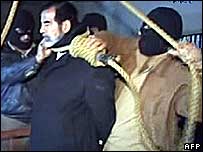
Saddam Hussein being hanged by lynch mob. 
 
Rest in Pieces.
 
Habeus Corpus Act, 1679-2006.
US Bill of Rights, 1791-2006.
Peace of Westphalia, 1648-2006.
Geneva Conventions, 1864-2006.
Hague Conventions, 1899-2006.
Nuremberg London Agreement, 1945-2006.
UN Convention against torture, 1984-2006.