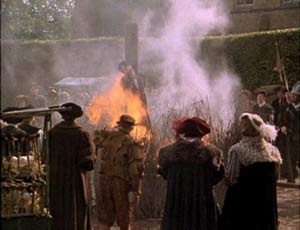
Virginia Dare was an “Anchor Baby”

Not meaning to poke fun at young Ms Dare who disappeared along with the rest of the Roanoke Colony more than 400 years ago. More like mocking and reproving redneck bigots who make a big stink about other people having the same immigration privileges as THEIR ancestors did. Especially as it’s an election issue.

Along with the Religious Refugees. See, the first English immigrants were notably religious extremists fleeing from other religious extremists. Virginia the colony was named not for the Virgin Mary, but for Queen Elizabeth. The one who bullied Parliament into passing the Conformity doctrines. Which led to some hugely large massive horrifying monstrous big “civil” wars in England, Scotland, Wales, Ireland. Then exported to America along with the ongoing British v Spain and France wars.  The plan was then as now (think Israel) put a large amount of people who are just too contentious to allow them to stay in the Motherland, give them discount passage and sell them limited supplies and weapons. And do a lot of it on credit. The French term for it was pioneers. A support system for military adventures.  Make sure they’re likely to piss off the natives, but not likely to survive without some “emergency” backup from Momma England.

Others did the same thing, the English just were the ones who got away with it. Davy Crockett was part of two such maneuvers. Born in Tennessee when the Revolution hadn’t been worked out, Tennessee having been treaty land which the Crown was refusing to allow English expansion. One of the sore spots that the sorehead revolutionaries used as an excuse for the revolution. It’s referenced in the Declaration of Independence. The British government honoring some of their treaty obligations by selling weapons to Natives. And blankets (ahem!) and other goods. The Treaties in question being the peace agreements after the 7 Years War which was fought mostly in Europe but in American History class we’re taught to call it the French and Indian War. And since he was born in 1786 which was just barely almost 20 years before the Louisiana purchase, where the kings of  France and Spain took turns financing each others wars by selling land in The New World which had never been visited by any European king. They sold land back and forth that they had never seen. Along with the people of the region. Subject of Spain one morning and France the next. The English and their bastard child The United States did the same thing.

to tie it all together….

Definitely Davy Crockett was born of illegal immigrants on Cherokee land. The Roanoke colony was located in what’s now the Carolinas, named for one of the Kings Charles of England. The Conformity Acts caused such frictions between English Christians that Protestant groups like the Pilgrim Church, Puritans, Presbyterians and of course Catholics were slaughtered and persecuted whenever their factions weren’t persecuting every other faction. And a whole bunch of Christians who just could not conform to other Christian doctrines fled to America to set up shop. And put up shot. There was for instance a running feud which often broke into gunfire between South Carolina and North Carolina about the difference between Presbyterian and Episcopalian and another cross-Potomac same thing because Virginia was mostly Protestant and Maryland was predominately Catholic.  You didn’t have to be across the Catholic Protestant line to piss off the authorities. Just being a Non Conformist protestant would do the trick. I got that from the Oxford World Almanac which interestingly enough is sponsored by the Episcopal Church.

Whatever happened to Ms Dare and the rest of the Roanoke settlers is pure speculation but there sure is a lot of that too. Some have said in my hearing that the Roanoke people assimilated into the Cherokee or other nearby tribes. No documentation of that, all the documentation is on the lines that they Never Were Found Again.   Some of the speculation seems, to me, very cult like.

And a lot of the ones who promote that kind of conspiracy theories are also heavily into the Birther and Minuteman militias. And with ties to the Klan.

But with all these centuries of Christian v Christian slaughter, it’s somehow the fault of Jewish merchants (who say Happy Holidays instead of Merry Christmas)and Muslims. There have already been calls for the opening of internment camps for American Muslims.

Although the Hate Groups keep telling us that Muslims can’t be Americans. Or Native American Church. Or Jews. Or anybody who doesn’t attend Their Church. Ask any of those who proposing a Church State which one is to be the State Church and he’ll probably (eventually) say his own church of course.

Before any of all that comes around, maybe Christians better stop hating each other first. And your fellow Americans regardless of whether you think we’re actually Americans.

Can Idle No More First Nations assert their sovereignty for real?

Here’s an idea for First Nations rattling their chains with IDLE NO MORE. Declare your sovereignty for real. “Sovereignty” has become a meaningless descriptor, now counting puppet states of Iraq and Afghanistan. How did we expect George W. Bush to explain what sovereignty meant? Even he probably knew what it was supposed to mean, and so do you. Sovereignty doesn’t mean captive reservations, rural ghettos, Gaza Strips or West Banks slowly being ethnically cleansed by attrition. Sovereignty means independent nation states, not dupes of duplicitous treaties. Chief Theresa Spense is right to hold out to meet with the Canadian Prime Minister and a representative of the English crown. First Nations leaders deserve to meet with fellow heads of state, if the treaty lands are truly sovereign.

The Great American Hero

America lives in the heart of every man everywhere who wishes to find a region where he will be free to work out his destiny as he chooses. –Woodrow Wilson

Our understanding of history shapes our perception of the present, and informs our actions in the moment. This post, for example, is given additional flesh by the eviction of Occupiers from Zuccotti Park in Lower Manhattan last night by forces directed by 4.0 × 10⁻⁸ percenter Michael Bloomberg, one of the richest guys in the USA, and probably in accord with Federal direction. Zuccotti Park is a “Privately Owned Public Space,” (POPS), and that odd status has no doubt been notable in current discourse. Across the USA and elsewhere, including here in Colorado Springs, governments at various levels have utilized no-camping ordinances and public park hours to harrass Occupiers, often to such extremes as to soundly demonstrate some of the protesters’ most salient points. So what is the history of “property,” and how does it pertain to the Occupy Movement?

We citizens of the USA are virtually without foundation where historical discussion is concered, unless we educate ourselves beyond the standard drivel so ineptly foisted in our direction by teachers bound by our disastrously faltering public indoctrination system, mislabeled “education.” We learn a sanitized verion of our own history, and the European history from which ours so largely derives, focused on patriotic and Euro-centric hero-worship rather than on the genuine and controversial currents that have effected societal changes at various junctures in world history. We often become enraged when these inane presumptions are questioned, as i have personally witnessed when service veterans have come unglued when protesters suggested they ought not to have been engaged in foriegn adventurism for resources, or when Occupiers have come near to blows over rights or priveleges the foundations for which they often demonstrate but scanty comprehension.

The story of Christopher Columbus and his noble and brave explorations of a frightening unknown quantity for the lofty purpose of betterment of the human condition, followed immediately by even more noble American colonists’ successful efforts to throw off the shackles of monarchical tyranny culminating in the sacrosanct US Constitution is ingrained in our collective psyche like a Freudian complex. The quote from the nearly deified US President Woodrow Wilson at the top of this page is meant to illustrate this phenomenon. Wilson said some things that seemed to spring from a font of humanity, but he was demonstrably a heinous racist and an elitist, encouraging reestablishment of the KKK, turning US finances over to the Federal Reserve, propagating celebrated treaties he subsequently ignored, and intrepidly belittling any expressor of opinion contrary to his own, among other public sins. Columbus filled his own journals with tales of religiously inspired avarice as he gleefully reported his intent, and execution of his plan to conquer the lands and subjugate the peoples he encountered. The US Constitution, while serving to codify some dignified and egalitarian principles, was still seen as some as an instrument of avarice in its formative days, as has proven to be the case with Adam Smith’s doctrines when handed over to naturally acaricious men. Even the highest-minded of US founders–St. Jefferson springs to apperception–firmly established racist, misogynistic doctrine and elitism by excluding all but white, male land owners from the earliest US political process. Those Founders also knew themselves to be limited and allowed the mechanisms for change to exist within the document.

The land owners so favored by the Founders above had been granted holdings either by monarchical fiat, or by purchase from those granted such holdings. Subsequent years were full of similarly motivated action, wh en”pioneers” once again ennobled by our propagandist history strode across North America claiming everything in sight by perfectly legal Homestead acts and the like, and killing or subjugating anyone not European, male, and white, assuaging their consciences with the absurd “moral” doctrine of Manifest Destiny. Many US citizens, usually white and of European descent, have blithely sloughed off Native American claims to the land here as anachronistic, habituating themselves to the notion that a couple of generations represent a lengthy historical stretch. “Indians,” many of whom don’t experience the epoch between, say, the gleeful rape and resettlement of their great-grandmothers as very lengthy at all, advocate for the removal of white Europe from “their” lands. This may not be anachronistic after all, but it has indeed become impractical, and it is no more nobly motivated than the insistence on Americans, or anyone else, to scarf up resources, such as but not limited to land, to which no human being enjoys a more legitimate claim than any other.

The uproar in Zuccotti Park last night is based on laws that derive from the notion of public versus private property. The Banks we Occupiers have been railing against hold the threat of eviction from private property over the specious doctrines of land ownership in this and other countries. The spats in Colorado Springs over tents, where they belong, and who belongs in them derive from the same set of doctrines, which i hearby proclaim to be bogus, in my opinion. The bad habit of human beings to either grovel or dominate is yet another matter.
One can follow the tendency to dominate and conquer, along with the development of Divinely appointed land control in western culture at least as far back as the dubitable stories of Hebrew escapades in the Levant, supposedly ordered by a loving god to kill, pillage, and rape in order to spread their doctrine of light. Ahem.

While the recalcitrant problems of aggression and slithery competitve spirits, as well as our quickness to condemn one another’s mere habits lead us deeper and deeper into an environmental cul de sac, we continue to pursue failed doctrine. The USA has, in apparently actual fact, presented the world with a still viable political framework within which to effect the sort of massive changes necessary for everyone involved, and it may well be our saving grace, if we acknowlege and rectify its initial errors and subequent abuses. Lots of thinking will be necessary. It’s awfully difficult to conclude that genuine unfettered Anarchism is likely to produce a civil society. Laws are not intrinsically bad unless they’re bad laws. Few really believe Libertarian suggestions that unregulated exploitation of natural resources can lead to anything but irredeemable destruction akin to the recent oil spill in the Gulf of Mexico, or the impending collapse of our fisheries.

Did you notice how comfortable my use of the term “our” felt, applied to a natural resource in that last sentence?
Capitalism and the American Constitution found themselves on private property ownership. Some things belong intrinsically to individuals and groups. Marxism denies any right to private property at all and kills innovation, in the argument of McCarthy’s legacy. Marx and Lenin were motivated by historical factors as well, even if their doctrines were no more effective at legislating kindness than ours have been. Most of us will agree that our bodies ought naturally belong to ourselves–the person whose consciousness centers in that particular body–and yet many of our laws belie that acceptance even now that we’ve abolished open slavery. We’ve built a gigantic and Byzantine body of law here in the US, and in countries all over the world, based on principles of subjugation and rapine that are in actual fact now fully anachronistic, using justifications that are fully mythological. The conquering of neighboring lands and their parceling for sale for personal enrichment, using armies fed a long and patriotic line of shyte about motives is simply not sustainable any longer. We can continue to fight over detritus after we, (by which i mean everyone and not just Europeans or Americans), collapse the entire playing field, or we can recognize our errors and take on the extraordinarily difficult prospect of admitting fault and rectifying our relationships with one another both here in the US, and everywhere else. Some things belong to everyone.

This post is largely about bad history, and partly about the failure of both Capitalism and Communism. I’ll be putting it up lacking a certain amount of flesh in order to have it in place. The natural aggression inherent in confronting some of the subject matter contained requires some additional referenceing, which i’ll add later. The characterization of both systems as failures could be entirely specious if i were unprepared to offer alternatives. This is not the case, and i’ll be addressing the whole kit and caboodle, whatever that means, at greater length in the future. The best suggetion i’ve come across thus far is from Henry George, and i hope you’ll investigate. But even if you don’t i hope you’ll give this the thought it warrants. My ideas are unlikely to be the best out there. Look around, though. The one’s we’re working with now are bullshit.

More links are forthcoming, but the take on history expressed here is largely indebted to Howard Zinn’s “Peoples’ History of the United States,” and James E. Lowen’s critique of history as taught in public schools, “Lies My Teacher Told Me.”

Occupy Denver recognizes Colo. AIM, mixes metaphor to Unoccupy America!

This weekend the General Assembly of Occupy Denver recognized that its intended occupation was actually a re-occupation, of lands to which original inhabitants lay claim. On Sunday the GA consensus voiced its solidarity with the American Indian Movement of Colorado who submitted a statement for ratification. It’s reprinted below via The Sole Reader:

COLORADO AIM’S CHALLENGE TO #OCCUPYDENVER

An Indigenous Platform Proposal for “Occupy Denver”

“Now we put our minds together to see what kind of world we can create for the seventh generation yet to come.”

John Mohawk (1944-2006), Seneca Nation

As indigenous peoples, we welcome the awakening of those who are relatively new to our homeland. We are thankful, and rejoice, for the emergence of a movement that is mindful of its place in the environment, that seeks economic and social justice, that strives for an end to oppression in all its forms, that demands an adequate standard of food, employment, shelter and health care for all, and that calls for envisioning a new, respectful and honorable society. We have been waiting for 519 years for such a movement, ever since that fateful day in October, 1492 when a different worldview arrived – one of greed, hierarchy, destruction and genocide.

In observing the “Occupy Together” expansion, we are reminded that the territories of our indigenous nations have been “under occupation” for decades, if not centuries. We remind the occupants of this encampment in Denver that they are on the territories of the Cheyenne, Arapaho and Ute peoples. In the U.S., indigenous nations were the first targets of corporate/government oppression. The landmark case of Johnson v. McIntosh (1823), which institutionalized the “doctrine of discovery” in U.S. law, and which justified the theft of 2 billion acres of indigenous territory, established a framework of corrupt political/legal/corporate collusion that continues throughout indigenous America, to the present.

If this movement is serious about confronting the foundational assumptions of the current U.S. system, then it must begin by addressing the original crimes of the U.S. colonizing system against indigenous nations. Without addressing justice for indigenous peoples, there can never be a genuine movement for justice and equality in the United States. Toward that end, we challenge Occupy Denver to take the lead, and to be the first “Occupy” city to integrate into its philosophy, a set of values that respects the rights of indigenous peoples, and that recognizes the importance of employing indigenous visions and models in restoring environmental, social, cultural, economic and political health to our homeland.

We call on Occupy Denver to adopt, as a starting point, the following:

1. To repudiate the Doctrine of Christian Discovery, to endorse the repeal of the papal bull Inter Caetera (1493) to work for the reversal of the U.S. Supreme Court case of Johnson v. M’Intosh 1823), and call for a repeal of the Columbus Day holiday as a Colorado and United States holiday.

2. To endorse the right of all indigenous peoples to the international right of self-determination, by virtue of which they freely determine their political status, and freely pursue their economic, social and cultural futures.

3. To demand the recognition, observance and enforcement of all treaties and agreements freely entered into `between indigenous nations and the United States. Treaties should be recognized as binding international instruments. Disputes should be recognized as a proper concern of international law, and should be arbitrated by impartial international bodies.

4. To insist that Indigenous people shall never be forcibly relocated from their lands or territories.

5. To acknowledge that Indigenous peoples have the right to practice and teach their spiritual and religious traditions customs and ceremonies, including in institutions of the State, e.g. prisons, jails and hospitals„ and to have access in privacy their religious and cultural sites, and the right to the repatriation of their human remains and funeral objects.

6. To recognize that Indigenous peoples and nations are entitled to the permanent control and enjoyment of their aboriginal-ancestral territories. This includes surface and subsurface rights, inland and coastal waters, renewable and non-renewable resources, and the economies based on these resources. In advancement of this position, to stand in solidarity with the Cree nations, whose territories are located in occupied northern Alberta, Canada, in their opposition to the Tar Sands development, the largest industrial project on earth. Further, to demand that President Barack Obama deny the permit for the Keystone XL Pipeline, proposed to run from the tar sands in Canada into the United States, and that the United States prohibit the use or transportation of Tar Sands oil in the United States.

7. To assert that Indigenous peoples have the right to maintain, control, protect and develop their cultural heritage, traditional knowledge and traditional cultural expressions. They have the right to maintain, control, protect and develop their intellectual property over such cultural heritage, traditional knowledge, and traditional cultural expressions. Further, indigenous peoples have the right to the ownership and protection of their human biological and genetic materials, samples, and stewardship of non-human biological and genetic materials found in indigenous territories.

8. To recognize that the settler state boundaries in the Americas are colonial fabrications that should not limit or restrict the ability of indigenous peoples to travel freely, without inhibition or restriction, throughout the Americas. This is especially true for indigenous nations whose people and territories have been separated by the acts of settler states that established international borders without the free, prior and informed consent of the indigenous peoples affected.

9. To demand that the United States shall take no adverse action regarding the territories, lands, resources or people of indigenous nations without the free, prior and informed consent of the indigenous peoples affected.

10. To demand the immediate release of American Indian political prisoner, Leonard Peltier, U.S. Prisoner #89637-132, from U.S. federal custody.

Finally, we also remind Occupy Denver that indigenous histories, political, cultural, environmental, medical, spiritual and economic traditions provide rich examples for frameworks that can offer concrete models of alternatives to the current crises facing the United States. We request that Occupy Denver actively utilize and integrate indigenous perspectives, teachers, and voices in its deliberations and decision-making processes.

Submitted 8 October 2011

American Indian Movement of Colorado

P.O. Box 292, Sedalia, CO 80135

Slavoj Zizek Not Gaga for Pop

Slovenian philosopher Slovaj Zizek has a cult following like Lady Gaga, but denied this weekend any romantic connection. I write this with tongue in cheek, Slavoj’s, because of his comic protestations. Zizek was cajoled by Amy Goodman at Saturday’s London Fronline Club event: did he categorically denied the rumor? Zizek said “Absolute denial on everything.” But he wasn’t dissing Gaga or the notoriety of the mischievous meme, even as he protested: “I didn’t even listen to not one of her songs!” The audience ate it up; how total a rejection. Except Zizek continued playfully: “My God, I listen to Schubert and Schumann songs. Sorry, I’m a conservative.” And there you have the reigning academic of pop cultural references, who cannot make a point without recalling a movie scene, rejecting not Lady Gaga, but Pop. Obviously Zizek’s pop culture isn’t yours.

It may escape the notice of average film goers that when themes evoke cinematic moments to Zizek’s memory, they’re not from There’s Something About Mary. Saturday’s discussion brought up Marx Brothers, yes, in the company of Lubitsch and Truffaut, moments of cinema verité, touches of social comment with Zizek’s nuance already scripted. Yes he’s famously evoked Tom & Jerry, and more recently tried to project Hosni Mubarak’s attention to Wiley Coyote’s fatal overrun of the cliff, but I think it’s clear, like Schubert and Schumann, we’re talking about classics. Academia may like to paint Zizek a populist, but his material is not plebeian.

For the curious, from the Marx Brothers: “My client may look like an idiot, and act like an idiot. That shouldn’t distract you, he is an idiot.” (About Rumsfeld being a liar.)

From Night And Day: A young lover finally yields unceremoniously to her suitor’s whining entreaties, to which he puts on the brakes like a reluctant prude. (About the West’s rejection of what it’s always pretended to want, a secular revolution in Egypt.)

From Ninotchka: Customer “May I have a coffee with cream?” Waiter: “We don’t have cream, we have milk. May I offer you a coffee without milk?” (About speaking the unspoken pretense.)

Where Zizek hits low perhaps are his wildly off-color jokes, gleaned from friends over drinks –I like to imagine– as opposed to circulated in morning emails. Zizek was full of sexism-loaded analogies on Saturday, and one joke in particular looks to have fallen between the edits which Democracy Now is re-airing, and even off the published transcript of the full event.

So I’ll retell it, and you tell me if Zizek could have made his point without getting so obscene. He’s addressing human nature’s desire for favorable news, even as by definition it masks atrocity.

A man’s wife is treated in the hospital for a potentially fatal condition. The doctor comes out and tells the husband, there’s good news and bad news. The good news is, we saved your wife, she will live. The bad news is, well, due to circumstances we couldn’t avoid, her rectal muscles no longer function, so she’ll be shitting uncontrollably the rest of her life, and her vagina will be secreting a substance, very unpleasant, and so on, her mouth, her nose, disgusting, and so on. Noticing the husband’s discomfort increasing to an unbearable pitch, the doctor tells him: Relax, I’m kidding, don’t worry, your wife died.

Zizek was illustrating the new Wikileaks state of affairs, our corporate government and its press rejecting the truths which emerged from the leaks, preferring the more palatable, no matter the horrors it perpetuates. Between reality and Zizek’s joke, which was the more obscene?

I also love Zizek’s propensity to drop “and so on” between statements, like verbal checkmarks on the points he’s hit. It’s post-graduate lecture shorthand for “you know the rest.” Chomsky does it too, by fading into mumbles, and it is frustrating to those of us who haven’t covered the assigned reading. But it’s a reminder too, of how much out there we cannot hope to master. That shouldn’t stand in our way of trying to grasp the bigger picture.

Am I right, Slavoj Zizek big picture speaks to us using the vocabulary of the big picture show? It’s the silver screen to be precise, and as yet he’s limited himself to visuals, not lyrics. I think Zizek’s candid revelation about his musical preferences leaves a hint for us that the bigger picture isn’t to be found in today’s compression sculpted pop sound, no matter how politically clever or Gaga the music.

Marlon Brando’s lost Oscar speech

In 1973 Marlon Brando declined a best actor award for the Godfather in solidarity with the American Indian. Yada yada yada, only that much we remember. Something to do with Wounded Knee, but the average American might be excused for confusing the massacre of 300 Lakota in 1890, the contemporary deadly FBI-AIM confrontation, and Dee Brown’s bestseller. A new documentary Reel Injun, about Hollywood’s skewed portrayal of Native Americans, unearths Apache Sasheen Littlefeather’s incredibly poised delivery of Brando’s Oscar message.

Littlefeather was confined by time limits to present only this abbreviation, interrupted by audience booing and then simultaneous applause. Youtube has the clip, for which the transcript is below.

“Marlon Brando … has asked me to tell you, in a very long speech which I cannot share with you presently —because of time— but I will be glad to share with the press afterward, that he must… very regretfully cannot accept this very generous award.

And the reason for this being… are the treatment of American Indians today by the film industry… excuse me… and on television in movie re-runs, and also the recent happenings at Wounded Knee.

I beg at this time that I have not intruded upon this evening and that we will, in the future…our hearts and our understanding will meet with love and generosity. Thank you on behalf of Marlon Brando.”

Brando’s formal statement was released to reporters after the ceremonies.

For 200 years we have said to the Indian people who are fighting for their land, their life, their families and their right to be free: ”Lay down your arms, my friends, and then we will remain together. Only if you lay down your arms, my friends, can we then talk of peace and come to an agreement which will be good for you.”?

     When they laid down their arms, we murdered them. We lied to them. We cheated them out of their lands. We starved them into signing fraudulent agreements that we called treaties which we never kept. We turned them into beggars on a continent that gave life for as long as life can remember. And by any interpretation of history, however twisted, we did not do right. We were not lawful nor were we just in what we did. For them, we do not have to restore these people, we do not have to live up to some agreements, because it is given to us by virtue of our power to attack the rights of others, to take their property, to take their lives when they are trying to defend their land and liberty, and to make their virtues a crime and our own vices virtues.?

?     But there is one thing which is beyond the reach of this perversity and that is the tremendous verdict of history. And history will surely judge us. But do we care? What kind of moral schizophrenia is it that allows us to shout at the top of our national voice for all the world to hear that we live up to our commitment when every page of history and when all the thirsty, starving, humiliating days and nights of the last 100 years in the lives of the American Indian contradict that voice??

?     It would seem that the respect for principle and the love of one’s neighbor have become dysfunctional in this country of ours, and that all we have done, all that we have succeeded in accomplishing with our power is simply annihilating the hopes of the newborn countries in this world, as well as friends and enemies alike, that we’re not humane, and that we do not live up to our agreements.?

?     Perhaps at this moment you are saying to yourself what the hell has all this got to do with the Academy Awards? Why is this woman standing up here, ruining our evening, invading our lives with things that don’t concern us, and that we don’t care about? Wasting our time and money and intruding in our homes.?

?     I think the answer to those unspoken questions is that the motion picture community has been as responsible as any for degrading the Indian and making a mockery of his character, describing his as savage, hostile and evil. It’s hard enough for children to grow up in this world. When Indian children watch television, and they watch films, and when they see their race depicted as they are in films, their minds become injured in ways we can never know.?

?     Recently there have been a few faltering steps to correct this situation, but too faltering and too few, so I, as a member in this profession, do not feel that I can as a citizen of the United States accept an award here tonight. I think awards in this country at this time are inappropriate to be received or given until the condition of the American Indian is drastically altered. If we are not our brother’s keeper, at least let us not be his executioner.?

?     I would have been here tonight to speak to you directly, but I felt that perhaps I could be of better use if I went to Wounded Knee to help forestall in whatever way I can the establishment of a peace which would be dishonorable as long as the rivers shall run and the grass shall grow.?

?     I would hope that those who are listening would not look upon this as a rude intrusion, but as an earnest effort to focus attention on an issue that might very well determine whether or not this country has the right to say from this point forward we believe in the inalienable rights of all people to remain free and independent on lands that have supported their life beyond living memory.?

?     Thank you for your kindness and your courtesy to Miss Littlefeather. Thank you and good night.

Tribal Sovereignty means uh… you’re a sovereign entity, with a US passport.

Remember when George Bush couldn’t define “sovereignty?” Maybe it wasn’t his fault. How would you describe sovereign lands where US extraction and exploitative industries can operate without regulatory oversight, and tribes can issue identification papers unless they mean to travel somewhere. When the original Indian treaties were signed, US destiny was manifested with promises that the former landholders’ sovereignty would be respected. The Iroquois Lacrosse team have just learned tribal sovereignty means carrying the occupier’s passport.

The US State Department at first refused to grant travel permission to the sovereign Iroquois because they didn’t have the newfangled, traceable, trackable, American passport. When congressmen intervened on behalf of the Iroquois who did not wish to submit to United States stinkin’ papers, the government relented, granting a one-time exemption.

How do suppose they mean to explain that? A just-this-once exception on the sovereignty whatsit.

But the lacrosse team’s destination was England, and British bureaucrats held firm on the original argument that the sovereign Native Americans required non-Native American passports. Post 9/11 days are no time apparently to permit international travelers to pass themselves off with rinky dink documents issued by who knows what maize-republics. The USA may foist whatever charade it wants on its captive vanquished aborigines, that doesn’t mean England has to play dumb too.

Maybe the British are mindful not only that the Iroquois were among the inventors of lacrosse, but that they once used the pretext of a game to successfully storm an English fort. Is that among their worries, Post 9/11?

Post 9/11 is no time for the pretense of sovereignty. Whether schoolchildren can grasp its contradictions or not.

Here’s Bush again, doing his best Miss South Carolina:

“Uh, tribal sovereignty means that. It’s sovereign. You’re a, you’ve been given sovereignty and you’re viewed as a sovereign entity. And therefore the relationship between the federal government and tribes is one between sovereign entities.”

Ward Churchill to speak for O’odham

O'odham rightsAccording to Censored News, Activist and scholar Ward Churchill will speak at the Unitarian Universalist Church of Tucson, 4831 W. 22nd St., on November 13, 2009 at 7:00 p.m. to benefit O’odham VOICE Against the Wall, which since 2003 has organized and advocated for the traditional O’odham leaders and elders of the Tohono O’odham communities in the southern territory of the United States and northern territory of Mexico. Professor Churchill’s talk is part of the “Apartheid in America: Surviving Occupation in O’odham Lands”

O’odham activist Ofelia Rivas will also participate. The event is sponsored by the Dry River Radical Resource Center, the Earth First! Journal, and Voices against the Wall.

Here’s some background on the O’odham struggle:

pamphlet cover illustrationBy J. D. Hendricks, 2004
TIAMAT PUBLICATIONS #5

The People Who Emerged From the Earth

Over two thousand years ago the descendents of the O’odham moved into the southwestern region of the area now claimed by the U.S. as the state of Arizona. 1 The O’odham have had one of the longest histories of contact with the forces of European colonization compared with the rest of the native North American peoples. The O’odham’s first contact with Spanish invaders took place in the mid 16th century; nearly one hundred years before the colonization of the North Atlantic coast and Great Lakes regions were begun by the French and English colonists. As such, the history of the O’odham provides a good context for an investigation of the colonization of Native North America, and more specifically, an investigation of the interplay between, and results of, the varied responses to colonization – that of collaboration, accommodation, and resistance.

Many histories of the O’odham refer to these desert people as the Papago. The term Papago was a name given to the O’odham by the Spanish colonizers, and is likely the result of a Spanish corruption of the O’odham word “papabi” which was the O’odham name for one of their principal bean varieties. Thus, the Spanish colonizers term for the O’odham (Papago) came to mean “the bean eaters.” 2 For the purposes of this study I will refrain from the use of the term Papago and will refer to “the people” 3 by their traditional pre-colonial name. 4

As is often the case, with the name Papago being a good example, European constructs are often imposed upon indigenous peoples by the historians that seek to portray their past. This result can occur when historians seek to glorify European norms and traditions at the expense of indigenous ones, and can also be the result of the subconscious indoctrination of the historian by the dominant culture – in this case that of western style industrial civilization. In other cases it can be the result of a simple uncritical usage of language.

One of the most dominant and reoccurring “civilized” constructs imposed upon indigenous peoples history is the commonly understood notion that the O’odham, or any other indigenous North American culture for that matter, existed as a totality or uniformed mass. This study will seek to use the history of the interaction between the O’odham peoples and the United States, both its government and its peoples, to deconstruct this myth of the totality and provide a history of the O’odham’s varied responses to colonization from an anti-colonial and anti-industrial perspective. By investigating various important case studies in O’odham history, and looking not only at resistance but also accommodation and collaboration, it is hoped that this work will help to provide a more realistic historical picture of the effects of colonization, and the intentions and reactions of both the colonizer and the colonized. Within the previously stated context and theoretical framework, this study will argue that while the O’odham responded to the U.S. invasion of their lands in various ways, the choices to resist, accommodate, or collaborate with the forces of colonization did not affect the overall U.S. policy concerning the O’odham – that policy being the eventual total assimilation of the O’odham into the dominant “civilized” industrial system. 5

This investigation will include a strong focus on O’odham resistance to colonization, as any anti-colonial history should, however it will not discount or ignore the many historical occurrences of accommodation, and in some cases outright collaboration, with the colonizers. It is important to always keep in mind that none of the actions and reactions in any of the case studies looked at are attributable to the O’odham as a “totality,” but rather are attributable only to the various groupings of O’odham, be they incarnated in the form of the individual, the clan, the village, an economic or spiritual grouping, or an established political organization.

A God of Civilization and Coercion Comes to the O’odham

The O’odham’s first encounter with Spanish invaders took place in the mid sixteenth century when a group of conquistadors led by Alvaro Nunez Cabeza de Vaca entered O’odham territory in search of gold. These men did not find the riches they were looking for and left the desert region to return to the Spanish colony. However, soon after word spread of the O’odham villages on the northern periphery of the Spanish colony, missionaries began to travel north to bring God and “civilization” to the native people residing there. By 1686, Catholic missionaries had formed a few small missions in O’odham territory using what they believed to be the influence of their soft power 6 techniques to lure the O’odham into their missions where they were then subjected to a rigorous schedule of cultural indoctrination. Most O’odham historians, including Winston Erickson, 7 and to a lesser extent, Bernard Fontana 8 have, during this time period, focused on the O’odham who chose to reside nearby and within these early missions, thus painting a picture of the O’odham as accepting of Spanish influence and cultural indoctrination.

However a closer look at this time period reveals that mission O’odham were only a small percentage of the total population of O’odham residing in the Sonoran desert 9 and that the ones who were there may not have been so for the reasons that the colonizers believed. San Xavier del Bac, the largest mission in O’odham lands, as well as many other missions, took advantage of the fact that the desert O’odham migrated in the dry winter months to the Northern Piman settlements along the rivers to work the small farm plots for sustenance. 10 The Catholic missions inserted themselves into this traditional pattern. Those O’odham who worked and lived near the missions were, for the most part, seasonal residents, which shows that the missions were viewed merely as being of utilitarian value. Thus, the O’odham as a totality were not necessarily accommodating to or interested in anything the missionaries had to offer per se, and when the missionaries began to employ “hard power” techniques and abuse or overstep the grounds for their welcome it did not go without consequence. 11

Accommodating and ignoring the missionaries was not the only response to colonization practiced by the O’odham during the seventeenth and eighteenth centuries. Although historians such as Erickson feel that “the missions did serve the O’odham well….,” 12 that assertion is contradicted by the fact that there were many large scale rebellions waged against the missions from outside and from within. In 1695, 1751, 1756, and 1776, large scale rebellions occurred in which missionaries were killed and their missions burned to the ground. 13 In some cases these rebellions were the doing of joint O’odham/Apache alliances, which is significant considering that many histories of the O’odham and Apache portray them as immemorial enemies. This may be the result of the fact that by the early nineteenth century the Spanish government initiated a campaign of divide and conquer that was continued later by the Mexican and U.S. governments to turn the O’odham and Apache against one another, thus easing the project of their subjugation.

A Change in the Occupation Government: Washington Enters O’odham Lands

In 1821, Mexican Independence from Spain was achieved and interest in the O’odham dropped away nearly entirely. By 1828, the new and secular Mexican government began the process of shutting down the missions in O’odham territory and by 1842, the last of the missions were closed. Soon after, in 1846, the United Stated initiated a war for territorial expansion against Mexico. This war was not of immediate consequence to the O’odham peoples. Isolated in desert regions, the fighting between the two occupation powers affected them little in the short run. However, the signing of the Treaty of Guadalupe Hidalgo in 1848, which ended the war, would lay the foundations for a series of disastrous events which would affect the O’odham in very negative ways.

Of greatest consequence to the O’odham was the fact that the boundary between the United States and Mexico was not finalized by the treaty of Guadalupe Hidalgo. The boundary was designated by Article Five of the Treaty as being an arbitrary line roughly following the 32nd parallel, an area which runs through the southern part of modern Arizona. To the east, the border was provided by the Rio Grande. The exact boundary line along the 32nd parallel was to be decided at a later date. It is also important to note here that the Treaty also provided that all Mexican citizens absorbed by the United States were to be granted U.S. citizenship, which included all indigenous peoples in the annexed territory since under Mexican law they were considered citizens. In the treaty the United States also assumed the responsibility for preventing cross border raiding into Mexico by the southwestern tribes, specifically the Apache. 14

In the aftermath of the signing of the treaty of Guadalupe Hidalgo, it became quickly apparent that an acceptable border between Mexico and the United States along the 32nd parallel would not be achieved. An official survey expedition was assembled by the United States and Mexico in 1849 to trace out the boundary between the two countries with little success. Various borderlines were agreed to and then abandoned and re-made by the United States, sometimes in a unilateral decision that dismissed the positions of the Mexican government altogether. 15

The principal concern for the United States was to secure title to an area of land in northern Sonora, Mexico that was ideally suited for the construction of a portion of the southern continental railroad whose building was being discussed in the U.S. Congress at the time. One of the main advocates for this southern railroad route was a South Carolina man by the name of Colonel James Gadsden. Gadsden’s history of connections to powerful business, military, and political leaders is very interesting and his appointment by the United States to be Minister to Mexico in 1853 serves as a very informative source to gauge the United States’ intentions towards Native Americans and the O’odham in particular.

James Gadsden was born into an influential southern family and graduated from Yale University. After enlisting and serving in the war of 1812, Gadsden was sent to the Florida territory with Andrew Jackson to aid in the campaign of removal and extermination being waged against the Seminole Indians, which took place from 1816-1818. After this war against the Seminole, Gadsden was appointed by President Monroe as commissioner to oversee the removal of the Seminole Indians to Indian Territory. Like the more famous removal of the Cherokee, the removal of the Seminole, and the high death rate suffered as a result, unarguably constituted genocide. 16 As a reward for a job well done, Gadsden was appointed by Monroe to a seat on the legislative council of the territory of Florida, thus beginning Gadsden’s political career. In 1840, Gadsden was elected President of the Louisville, Charleston, and Cincinnati Railroad. In 1853, the Secretary of War, an ardent white supremacist and slavery defender by the name of Jefferson Davis, appointed Gadsden to be Minister to Mexico. 17 As Minister to Mexico, one of Gadsden’s primary missions was to negotiate a final demarcation of the boundary between the U.S. and Mexico. Although Gadsden was a zealous believer in Manifest Destiny, his ideas concerning racial Anglo-Saxonism 18 caused him to be an opponent of the total annexation of Mexico. Gadsden, like many racist U.S. politicians of that time, felt that the total absorption of Mexico and its non-Anglo population into the United States would pollute the Anglo bloodline too much and thus he sought only to gain enough territory for the United States to build the southern pacific route. 19 Thus, a man who had presided over a war of genocide against the Seminole Indians, was a devout racist, and who had obvious conflicts of interest due to his connections to the railroads, was put into a position to determine the territorial boundary between the United States and Mexico and in the process also determine the boundaries of the O’odham’s land. With its appointment of Gadsden, the intent of the U.S. government could not be clearer. Business interests and territorial expansion were to run roughshod, by any means necessary, over any native peoples who stood in the way.

It is no surprise that when James Gadsden finally successfully negotiated a treaty with Santa Anna to secure what is now the southern portion of Arizona, the O’odham were not consulted. In fact, the Gadsden Treaty, signed into law in 1853, did not contain any mention of the O’odham at all. Considering that the new boundary line put in place by the Gadsden Treaty literally split the traditional O’odham lands in two, it is obvious that the intentions of the United States were in no way benevolent. Here it is also important to point out that the terms of the Gadsden Treaty specifically included the same citizenship provisions which were spelled out in the earlier Treaty of Guadalupe Hidalgo. 20 Although the Gadsden treaty was of great significance for the O’odham, their isolation and the outbreak of the Civil War enabled them to live another decade in relative isolation from Anglo encroachment.

Assimilation, Cultural Destruction, Double Speak and Ordained Genocide

The causes which the Almighty originates, when in their appointed time he wills that one race of men – as in races of lower animals – shall disappear off the face of the earth and give place to another race, and so on, in the great cycle traced out by Himself, which may be seen, but has reasons too deep to be fathomed by us. The races of the mammoths and mastodons, and the great sloths, came and passed away: The red man of America is passing away!
–United States Congress Committee on Indian Affairs report, 1865. 21

No doubt with similar justifications in mind as those of the Committee on Indian Affairs, Anglo settlers began their invasion of O’odham lands less than a year after the conclusion of the Civil War. The Homestead Act had opened up the lands of Southern Arizona to Anglo squatters and in 1866, one of the first of many bills was passed by Congress granting mineral rights to any citizen who claimed them. 22 Every one of these homesteads opened and every resource extraction operation initiated without the express consent of the O’odham represented an illegal action under the Gadsden Treaty. The citizenship provisions of the Gadsden Treaty had granted citizenship to all former Mexican citizens and the O’odham were, by legal definition, included in this formulation. The United States, however, refused to consider “uncivilized” peoples as being worthy of the protections granted to citizens by the fourth amendment of the U.S. Constitution, which prohibits the expropriation of property. This refusal of the United States government to follow its own laws pertaining to Native Americans when those laws happen to stand in the way of U.S. interests has been a common occurrence in United States Indian policy. This land grab was only the first of many illegalities committed against the O’odham people by the United States and its citizens. In this respect the O’odham are in a special position when compared with many other tribes. While the theft of native lands by the United States Government was usually legally justified by treaty stipulations signed between a tribe and the U.S. government, this justification could not and cannot be used in the case of the O’odham since no treaty was ever signed with the O’odham by the United States Government. 23

For the most part, the O’odham did not resist this initial incursion of Anglo settlement, rather the O’odham practiced accommodation and moved farther out into the desert to shield themselves from the new settlers invading their lands. Traditional ways were maintained with the exception of the introduction of cattle ranching. The O’odham territory was well suited for the raising of cattle and a good number of O’odham became cattle ranchers, both for purposes of subsistence as well as for sale to Anglos residing in and around Tucson. In the 1880s, as increasing numbers of Anglo cattle ranchers began to invade and take over their pasture, some O’odham began to resist.

The O’odham resisted by stealing the Anglo cattle herds which were rounded up and driven south to be sold on the Mexican market. The expropriation of Anglo cattle herds was not isolated, and it became a major concern for the settlers and the government. In at least one case, a large cattle outfit was driven out of business. 24 The concern over this outbreak of O’odham theft of Anglo cattle was large enough that newspapers as far away as Los Angeles ran stories about the phenomenon. For the most part these stories seem to have been deliberately used to justify the enclosure of the O’odham into reservations as the government and Anglo cattle ranchers seized the opportunity to gain even more O’odham land by arguing that it was an unfair burden for the Anglo cattle ranchers to have to “support” the O’odham. 25 Here, in previous case study, we have another common attribute of U.S. Indian policy in general, and one which occurs again and again in the history of O’odham contact with the U.S. government and Anglo settlers – blaming the victim.

Another official position of United States Indian policy during this time period was that everything done to the Indians was, in the words of Indian Commissioner J. Q. Smith, in their own “best interests.” 26 Whether this obvious sham was based on a subconscious guilt and delusion or was a cynical example of “double-speak,” it is obvious that Native American’s best interest’s were the last thing on the government’s mind. Nevertheless, with this reasoning as justification, the first official reservation for the O’odham was created by executive order of President Grant on July 1, 1874. This small reservation surrounded the Old Catholic mission at San Xavier del Bac. It is estimated that only about ten percent 27 of the desert O’odham took up residence within this reservation – these were labeled as “civilized” O’odham by U.S. census takers. The vast majority of O’odham were labeled as “wild” and continued to live in the vast desert regions west of San Xavier del Bac. While it is obvious that the desert O’odham were resisting cultural assimilation by avoidance, even the mission O’odham maintained a resistance to European culture as the next example will illustrate.

While visiting the old mission at San Xavier a newspaper columnist from the Los Angeles Times wrote that upon her visit in 1882, she could see “not a single civilized human habitation within miles.” This writer goes on to state that the O’odham’s dwellings were in the form of “conical mud huts.” In the casual racism and Social Darwinist rhetoric of the period she also adds that,

“The Papagos are but little in advance of gophers and prairie dogs in their habitations.” 28

The point is that after more than 200 years of European influence, even the mission O’odham continued to build their traditional shelters. 29

Progressivism and Cultural Genocide: The Dawes Act

In 1887, the General Allotment Act, also known as the Dawes Act, was signed into law. The Dawes Act was the staging point for the forced assimilation of those remnants of Native American groupings which had not been totally decimated by the preceding period of “Indian Wars” and forced relocations. The essential function of the Dawes Act was to disrupt traditional tribal land holding patterns and thus force Native Americans into the Anglo system of private property. The O’odham, like most other Native American cultures, did not have a concept of private property – land was held in common for the benefit of the village group. Communally held land was an essential pre-requisite for their Anarchistic political system and extremely de-centralized tribal structure. 30

The first section of the Dawes Act provides for equal “sections” of land to be parceled out to each “head of family.” This head of family was always understood to be the father of each family when land was allotted. Thus, this first section of the act not only attempted to destroy the communal land system of Native Americans, it also instituted Patriarchy as the basis for social functioning in Native America. 31 In addition, Section Five of the Act also provides that any un-allotted lands be subject to purchase by the United States government. Section Six and Seven provide that all monies paid by the U.S. for un-allotted Native lands be held for each tribe by the U.S. Treasury and “subject to appropriation” by the U.S. government to repay itself for the implementation of allotment as well as to provide for the “civilization” of Native Americans. 32 In less veiled words, these sections are basically stating that Native Americans will be forced to pay for their own cultural annihilation.

This interpretation of the intent of the Dawes Act becomes clearer when one looks at the arguments and debates that took place in Congress and within self described progressive “Indian rights” groups such as the Indian Rights Association. Critics of the Dawes Act in Congress such as Rep. Russell Errett understood that

“the main purpose of this bill is not to help the Indian troubles so much as it is to provide a method for getting at the valuable Indian lands and opening them up for settlement.” 33

And Senator Dawes, the namesake of the final bill, speaking of the land and resources of Native Americans stated that

“civilization has got after these possessions with a greed never before equaled but it is idle to expect to stay it….” 34

As for the progressive Indian Rights Association, they argued that

“the organization of the Indians into tribes is, and has been, one of the most serious hindrances to the advancement of civilization, and that every effort should be made to secure disintegration of all tribal organizations….” 35

And one of their leaders, Reverend L. Abbott, provided justification with the statement:

“Barbarism has no rights which civilization is bound to respect.” 36

So here we have a self-proclaimed progressive Indian Rights organization arguing for cultural genocide and against the notion that Native Americans have any rights that civilized people are bound to respect! This conclusion provides a perfect example of the essence of “progressive” or “civilized” thought.

The Dawes Act had a much less devastating effect for the O’odham than it did for many other Native American tribes. At the time of its passage, the only official reservation for the O’odham was the San Xavier reservation which, as was stated earlier, was only a small 71,090 acre reservation around the old mission San Xavier del Bac. When the allotment agent came to San Xavier in 1890, he allotted out 41,600 acres of land to the 363 O’odham whom he counted in his census as being resident at the time. 37 The vast majority of the O’odham still continued to live west of San Xavier in the expansive desert regions and were little affected by the allotment schemes. Even those O’odham who lived in San Xavier and were allotted land paid little attention to the artificial boundaries drawn on paper which supposedly privatized their land – they continued to farm and graze the land communally. 38 This refusal to abide by the provisions of the Dawes Act is also a form of resistance to cultural assimilation and adds one more example to show that for those O’odham who resisted, the most often employed method of resistance was non-compliance and avoidance. This specific response to colonization was made possible by the isolation and expansiveness of their desert home, which many Anglo’s continued to view as a “hopeless desert.” 39

The Domestication of the “Wild Papago”

The vast majority of the O’odham continued to resist assimilation and maintained a fairly traditional lifestyle – minus the introduction of cattle herding and horse rearing. In the twenty years following the passage of the Dawes Act, a growing effort was made to enclose the “Wild Papago” 40 and forcibly strip them of their traditional culture and instill them with the “civilized” values of the industrial Anglo. As was mentioned previously in the paper, ranchers and the government used O’odham cattle theft from Anglo ranchers as one tool to justify the enclosure of the O’odham within a reservation. During this period, Anglo Cattle ranchers continued to encroach deeper and deeper into O’odham territory and scuffles began to break out.

In another classic example of the “blame the victim” tactic, a pro-enclosure story was printed in the Los Angeles Times, no doubt to build public pressure for the domestication of the “Wild Papago.” The story concerns a group of O’odham who had resisted an Anglo cattleman’s attempts to enclose one of their water sources. When these O’odham continually tore down the fence that this cattleman had built, the rancher filed a report with the local Indian Agency sheriff to have the men arrested. When the sheriff arrived to arrest the O’odham responsible for defending their water source, he was taken hostage. The sheriff was later released unharmed; however, the incident was used to make the argument that such troubles can only be expected to increase if the O’odham were not enclosed on a reservation where they could be more easily controlled and monitored. 41

The tactic of occupying and diverting natural water sources was one of the tools used by the Anglo settlers and government to destroy the self sufficiency of the O’odham and force them into reservations where they would be dependent on the government for their water and would thus be easier to control and monitor. Some of the O’odham clearly understood what was happening, which is evidenced by instances of resistance both to the enclosure of natural water sources as well as resistance to the drilling of wells. One example of the U.S. government using water as a tool of forced cultural assimilation can be found by looking at an event recorded by an O’odham calendar stick 42 keeper. In 1912, the O’odham residing in the village of Santa Rosa, an isolated and traditional village in the western desert region of O’odham territory, were paid a visit by an Anglo Indian Commissioner who wished to drill a well for them. The Chief of the village objected to the drilling of the well on the grounds that it would disturb their culture, their autonomy and their self-sufficiency. The government agent proceeded to have the well drilled anyway. Upon completion of the well, the Chief of the village, according to the calendar stick keeper, stated that

“the well must be left alone and, in order that the Papagos might continue their old life, water must still be carried from the spring in the foothills.” 43

However, the prohibition by the Chief could not be upheld due to the overwhelming convenience of the new well and after a period of abstaining from its usage, the village of Santa Rosa (including the Chief) gave in and thus was assimilated into the industrial system by being made dependent on the Government well. 44 During this same time period, encroaching Anglo farmers engaged in the diversion of O’odham water sources to irrigate their farms. This practice served as another method of forcing the self sufficient O’odham into a relationship of dependence upon the government. In many areas so much water was diverted that the O’odham could no longer grow their traditional summer crops. 45

In 1919, the first incarnation of an O’odham reservation to enclose the nearly two million acres of desert that the “Wild Papago” were residing in was established. The formation of the desert O’odham reservation in 1919 ushered in a period of exponentially increased government interference in O’odham matters, and of course, the various forms of coercive assimilation were multiplied. By 1933, thirty-two unwanted wells were drilled all over the new reservation. 46 The well drilling was often opposed by those who were trying to maintain the O’odham Him’dag – the traditional ways of the desert people.

Resistance and Collaboration: O’odham Responses to Forced Modernization

In contrast to the traditional O’odham who had maintained resistance to cultural assimilation for the past 300 years, there was also a small number of O’odham based in the new reservation that welcomed collaboration with the forces of Anglo modernization and advocated for cultural accommodation and in some instances for total cultural assimilation. These men would later form an organization called the Papago Good Government League, which would serve as the propaganda arm of the Bureau of Indian Affairs and government policy in general. The leadership of this new faction had been taken from their families as youths and placed in Protestant boarding schools to be culturally indoctrinated. The Tucson Presbyterian Training School was one of the indoctrination centers where many future members of the Good Government League had been sent. 47

Religious indoctrination, whether Catholic or Protestant, has always been one of the most powerful tools of colonization and its justification used by European invaders against the indigenous peoples of the Americas. The necessary counterpart to the forced indoctrination of Christian principals and morals has always been the repression of indigenous spiritual practices. The United States government understood the profound power that traditional spiritual practices had in maintaining group solidarity and cohesion and it is for this reason that such spiritual practices were made illegal and repressed historically. In 1883, a Court of Indian Offenses was established by congress at the request of Secretary of Interior Henry M. Teller to eliminate traditional spiritual practices. In a report to the commissioner of Indian Affairs, Teller laid out his goals and his rationale stating that,

“If it is the purpose of the Government to civilize the Indians, they must be compelled to desist from the savage and barbarous practices that are calculated to continue them in savagery….”

Teller went on to associate those who resisted the repression of their spirituality with the “non-progressive” faction of Indians and labeled traditional spiritualism as “debauchery,” “diabolism,” and “savagery.” The overarching argument of his letter is that in order to civilize the Indians and bring them into the industrial system, their traditional spiritualism must be destroyed. As an initial step towards this end, Teller advised that Medicine Men be “compelled” to desist from their practice of “deception.” 48

Although the Court of Indian Offenses advocated that coercion be used to repress and destroy indigenous spiritualism, it failed to succeed in this project even when it used force to try to stop traditional spiritual rituals. According to Historian Edward Spicer, the only thing the Court succeeded in doing was driving traditional spiritual practices underground. In the case of many resistant O’odham, traditional spiritual practices were continued without regard to regulations or prohibitions against them, and in many cases, federal authorities resorted to repression and arrest to try to stop these practices. One traditional spiritual practice of the O’odham which was particularly hated by the Protestant Missionaries and Indian Agents was the Vi-kita ceremony.

The Vi-kita ceremony of the O’odham has been written about and studied by many Anglo historians and anthropologists, the most prominent being Columbia Anthropologist Ruth Underhill. 49 Before going into a short description of the Vi-kita it is important to understand that this ceremony varied depending on who was conducting it and where it was being conducted. Peter Blaine, an influential O’odham man sympathetic to the traditional ways, wrote in his autobiography about Underhill’s methods. Blaine explained the traditional way for the O’odham to tell about their past was to do it

“in a group so that everybody had a chance to talk and tell it their way. Underhill was talking to just one man…Dr. Underhill was wrong all the way in how she got her information.” 50

As scholars from the dominant culture often do, Underhill had applied her own notions of hierarchy, authority and individualism to her work with the O’odham and totally disregarded their traditional methods of conveying information in a communal fashion.

The Vi-kita itself was a yearly rain and fertility festival preformed to initiate and give thanks for the yearly summer rains. The ceremony itself consisted of the communal singing of rain songs, dancing, intimate encounters, and the consumption of Navait (Saguaro wine), an alcoholic drink made by the fermentation of Saguaro Cactus buds. The consumption of this wine was meant to symbolize the connection between the sky and the earth. The intake of the Navait was representative of the earth’s intake of rain. Participants drank Navait until vomiting occurred as this act embodied the clouds issuing forth rain unto the earth. It was a powerful ceremony that bonded the O’odham with the elements of nature.

When Protestant missionaries, and a small number of Protestant O’odham in the Good Government League, backed by U.S. Indian Agents, began their attempts to usurp power on the newly formed western O’odham (Sells) 51 reservation in the early 20th century, one of the first things they attacked was the practice of the Vi-kita ceremony. In the early 1930s, Peter Blaine explained that the traditional O’odham from the San Xavier reservation would travel to the western reservation for the Vi-kita. He states that,

“In the late 1920s the government tried to stop this wine drinking ceremony on the Sells reservation. But no Papago or Agency police could ever stop it.”

In one instance Blaine tells the story of how he helped defend three traditional O’odham Vi-kita ceremony leaders when they were arrested by agents from the Indian Bureau and jailed in Tucson. During the trial, a group of Protestant O’odham men from the Good Government League 52 argued for the repression of the ceremony – one of these men, Richard Hendrix, would continue to plague the traditional O’odham in future encounters. To respond to the collaborationist Good Government League, the resistant traditional O’odham formed the League of Papago Chiefs to counter the attempts of the Protestant Good Government League to usurp control on the reservation. 53

The Indian Reorganization Act and O’odham land rights

On June 18th, 1934, President Roosevelt signed into law the Indian Reorganization Act which finally stopped the forced allotment process initiated by the Dawes Act in 1887. The Indian Reorganization Act was viewed by its proponents as being in the best interests of the Indians. One of the reasons for this view was the fact that the Dawes Act and its forced allotment provisions had resulted in the loss of 90,000,000 acres of tribal lands and it was hoped by some, including then Indian Commissioner John Collier, that the Indian Reorganization Act could be used to regain some of this lost land.

The public was also encouraged to view the Indian Reorganization Act as being beneficial for Native Americans. A large article in the Los Angles Times entitled “The Bill to Return Indian Rights” stated that:

“After a century of graft, plunder and injustice, this bill has the objective of handing their own souls back to the Indians.” 54

However, such optimism and notions of cultural relativism were not held by all. As a precursor to the Indian Reorganization Act, a report was prepared for the Secretary of the Interior in 1928 to lay out the need for a change in Federal Indian Policy. The report stated that the “great majority of Indians are ultimately to merge into the general population” and that it was the government’s responsibility to assimilate Native Americans into “white civilization” because “the hands of the clock cannot be turned backwards.” Sympathetic attempts to help Native Americans retain their culture were stigmatized as attempts to “preserve them as museum specimens.” 55 Indian Commissioner John Collier was one of those who believed that Native Americans should retain their culture and that “the awakening of the racial spirit must be sustained….” 56 However, although the finalized Indian Reorganization Act did contain elements that were meant to “help” Native Americans, many of its articles were still designed to impose “civilized” systems on Native Americans.

It can be argued that the intent of the finalized Indian Reorganization Act was to initiate a new chapter in the push for the total cultural assimilation of the Native American tribes. The argument that there was no qualitative change between the Dawes Act and the Reorganization Act is legitimate. The Indian Reorganization Act provides the examples for the argument. The main tool of assimilation in the Indian Reorganization Act was the provision in Section 17 which allowed for Native American tribes to form their own tribal governments, constitutions and laws which, although it is not specifically stated, were intended to be Anglo in structure and functioning. In the case that these native governments were not sufficiently acceptable to the U.S. government, section 17 also provided that all Tribal Government formations must be “approved by the Secretary of the Interior.” 57 This clearly shows that the intent of the Act was not to allow Native Americans to become fully autonomous, either culturally or politically. For a tribe such as the O’odham, which had a long history of decentralization and consensus decision making, the imposition of western style liberal democracy, with its attendant centralization and majority rule system, was an obvious method of forced cultural indoctrination. Peter Blaine, who was mentioned earlier, was an O’odham man who had sympathy for the traditional, decentralized and communal way of O’odham societal organization. When the collaborationist Papago Good Government League began to maneuver themselves into the position of representing all of the O’odham, Blaine took it upon himself to lead the charge to discredit their assertions to business interests and the Federal Government that they represented the O’odham. Blaine wrote that:

“This so-called council represented only their own church people, but they took it upon themselves to become a council for all Papagos. They had meetings. Nobody attended them but these four guys because most people didn’t recognize them as leaders.” 58

In 1934 Blaine, along with another O’odham from the Gila Bend reservation named Leon Pancho became the first O’odham to travel to Washington D.C. These two men were sent as representatives of the traditional chiefs of the O’odham villages to argue against a recent court order that closed the Sells reservation to outside, Anglo owned, mining. The court order was a result of a lawsuit brought by the members of the Good Government League, including Richard Hendrix, who had teamed up with outside lawyers. These lawyers were to receive as payment a ten percent share of all land reclaimed from the mining companies, or a monetary equivalent. As this entire procedure was done behind the backs of the majority of the O’odham, when it was revealed, there was great resentment towards the Good Government League by many of the O’odham.

While in Washington D.C., Blaine was informed of the pending Indian Reorganization Act, and he became a supporter of the Act due to its provision allowing for the self government of Native Americans, as well as a provision in section Six that allowed the Secretary of Interior to manage mineral, mining, and livestock on the reservation. 59 In the case of the O’odham this meant that the reservation would be re-opened to mining and they would regain an important means of economic sustenance. According to Blaine, the mines were an important economic resource for the O’odham as they provided jobs and a market where beef and other O’odham products could be sold. 60 This is yet another unfortunate example of how the incursion of Anglo industrial technology served to destroy the self-sufficiency of the O’odham by making them dependent on it for survival.

Whether or not the mines were truly in the best interest of the O’odham is a complex topic which cannot be dealt with here. However it should be stated that Blaine and his companions’ trip to Washington D.C. was financed by the Tucson Chamber of Commerce, an organization that functioned in support of the mining interests, not the O’odham. This Tucson Chamber of Commerce was the same organization that had aggressively petitioned President Wilson to rescind his 1916 act forming the Sells reservation because it prevented Anglo agricultural interests from exploiting the area’s “best agricultural and grazing lands.” 61

Resistance to and Collaboration with the “White Man’s War”

Not long after the passage of the Indian Reorganization Act and the formation of the first O’odham Tribal Government, the United States declared war on Japan, thus entering World War II. The participation of Native Americans in World War II has been well publicized, especially the role the Dineh (Navajo) played as code talkers in the South Pacific. The United States government and the mainstream media portrayed Native Americans as being eager to fight for their homeland, and eager to assimilate into “white civilization” once they returned from the war. Nearly 25,000 62 Native Americans served in the United States military during World War II, many of whom were no doubt under the impression that their service would be rewarded with increased “rights” after the war’s end. Instead, as a “reward” for Native Americans participation in World War II the United States government established the Indian Claims commission in 1946 to legalize the U.S. occupation of Native American Lands never granted to the U.S. by treaty, passed House Concurrent Resolution 108 to terminate tribal recognition as separate entities from the Federal Government, and then instituted a plan in 1954 to relocate Native Americans off the reservation and into “Indian Ghettos” in the nation’s large cities. 63 These were the “rewards” for participation in World War II.

Like many other Native American Tribes, some of the O’odham Nations members participated in World War II. Ruth Underhill claims that the O’odham enlisted to serve in World War II “in droves” 64 and it is documented that the O’odham tribal government bought $10,000 in war bonds. 65 However, the extent of this involvement was distorted by the media, academia, and even some of the O’odham leaders in the tribal government. Richard Hendrix, a former member of the collaborationist Good Government League, had risen to prominence in the new O’odham tribal government by this time and was interviewed by the Arizona Archaeological and Historical Society on November 16, 1942. In this interview Hendrix exposed the extent to which he had allowed his mind to be colonized and assimilated into that of the dominant white culture. Speaking of colonization in general and World War II in particular, Hendrix stated that the O’odham had:

Learned to love the American government and they learned to love the Stars and Stripes. And when the war came and the time came for our boys to be registered, there was no exception. They registered just the same as white boys did. And now they are out fighting alongside the white boys, the American boys. They are just as anxious as the white boys to kill as many Japs, to kill as many Germans, and they are very anxious to win this great war so that the Papago people in this desert land may continue to enjoy the freedom of their homes. 66

Hendrix’s internalization of white supremacist racial notions is a heart breaking and shocking example of the extent to which he had accepted the ideology of “white civilization.” In addition, his assertion that every O’odham boy registered for the war with “no exception” is glaringly false.

Aside from the fact that there are always exceptions to everything, there was also a large scale organized resistance to World War II led by an old Chief and medicine man, Pia Machita, and his band of traditional O’odham who resided in an isolated village in the north western area of the Sells Reservation known as the Hickwan district. According to Peter Blaine, the O’odham residing in some of the most isolated villages in the Hickwan district had not seen a white man until the 1930s, and continued to practice the traditional O’odham Him’dag. 67 When Pia Machita was informed of the compulsory registration of young O’odham boys for induction into World War II, he instructed the youth of his village to refuse to sign the registration forms when they were visited by the local Indian Agent. Pia Machita was a very traditional leader who refused cultural assimilation and would not accept the authority of the Bureau of Indian Affairs or the O’odham tribal government. Finally, after all efforts to persuade Pia Machita’s village to register had failed, the tribal chief of police and a gang of Federal Marshals led by U.S. Marshall Ben McKinney invaded the village at two in the morning on October 16th, 1941, with tear gas bombs and guns drawn – when the Marshals attempted to take Pia Machita into custody some of the young men from the village used force to liberate him and severely beat one of the federal marshals. In the face of this resistance, the government agents and their local collaborators retreated to Tucson. When the Attorney General’s Office heard of the resistance on the O’odham reservation, they immediately got involved in the effort to repress this draft resistance movement as quickly as possible to prevent its possible spread to other reservations. By May 17th, 1941, after a period of about six months of trying to track down Pia Machita and his small band of men, Marshall McKinney and O’odham collaborators including Jose Ignacio from the tribal government, surrounded Pia Machita in the village of Stoa Pitk and took him into custody without incident. 68

Peter Blaine was the O’odham tribal chairman during the time that Pia Machita was leading the draft resistance movement. Although he did not believe that Pia Machita and his men were threats in any way, he was annoyed by what he perceived to be their stubbornness and attributed their draft resistance to his belief that they “didn’t really understand what they were doing.” 69 In reality, it was Blaine who did not understand the reasons behind Pia Machita and his men’s resistance to enlistment. Pia Machita and his men understood very well what they were doing – they were resisting giving aid to a government that they understood was their enemy. Given this understanding, and given the dictionary definition of the word “collaboration,” it becomes necessary to label those O’odham who participated in the arrest of Pia Machita as such – collaborators. The understanding that the U.S. government was the enemy of the traditional O’odham of the Hickwan district was based upon a long history of attempts by the U.S. government to force the Traditional O’odham of that area to abandon the Him’dag and embrace elements of Anglo “progress” such as dams, railroads, wells, and the protestant religion. Despite Peter Blaine’s inability to understand why the O’odham in the Hickwan district rejected Anglo-civilization in its totality, he still maintained sympathy for the people there. When Pia Machita and two co-defendants were finally sentenced to serve 18 months in prison at Terminal Island Federal Prison for their roles in leading the resistance movement, Peter Blaine eventually came to their aid and used his connections as tribal chairman to persuade the sentencing Judge to release Pia Machita early and allow him to return to the reservation and his family. 70

Conclusion

The history of the O’odham’s contact with the United States government has been one marked by a persistent current of resistance to cultural assimilation into “white civilization.” This resistance has included a variety of tactics and actions. The favored tactic of resistance to assimilation for many of the O’odham groupings seems to have been that of avoidance and feigned accommodation to Anglo culture when expedient. However, as was evidenced by the O’odham’s early history of contact with the Spanish, they did not refrain from waging armed resistance to colonization when they were pushed into a situation where other tactics might have been ineffectual.

In addition to resistance and accommodation, it has also been shown that some of the O’odham choose to engage in direct collaboration with the Anglo colonization of their lands and minds. As this paper has shown, the levels of collaborative activity amongst the O’odham varied, and so did the effects of such collaboration. When investigating instances of collaboration it is always important to understand the context which produced them and to remember that the ultimate blame for a situation of oppression should always be placed upon the group committing the acts of repression – in this case the United States government and allied business interests. It is important to show such examples of collaboration and to understand that all human cultures who have been the victim of colonization have invariably contained individuals who chose to collaborate for a variety of reasons. The O’odham are no exception to this rule. Making apologies for collaboration or failing to mention the instances where such collaboration did occur creates a historical distortion and does nothing to aid present struggles for liberation.

The O’odham responses to colonization never represented a totality, but a strong current of resistance is evident throughout their history. In regards to the United States government, it can be said, given the primary sources looked at, and the final drafts of laws signed and policies followed, that the intent of the United States government toward all Native American tribes, when it was not outright genocidal, has been the cultural destruction and absorption of remaining Native Americans into the dominant industrial culture of “white civilization.” Regardless of the varying tactics used, and the various lip service about “best interests” and “justice,” it has been shown that there has never been a qualitative change in United States policy toward the O’odham people and Native Americans in general. The O’odham have maintained aspects of their traditional culture despite the best efforts of the government to force assimilation, not as a result of such efforts. A continuing current of struggle between the forces of colonization and resistance has persisted for centuries, in all its various forms, within the minds and bodies of many O’odham and will continue until liberation.

NOTES:

1
This date is based on archeological evidence gathered by E.W. Haury in Ventana Cave. Haury, E.W. The Stratigraphy and Archeology of Ventana Cave Arizona. Tuscon: University of Arizona Press, 1950. Cited from Williams, Thomas R. “The Structure of the Socialization Process in Papago Indian Society.” Social Forces, Vol.36, No.3. p.253.

2
Fontana, Bernard L. Of Earth and Little Rain: The Papago Indians. Tuscon: University of Arizona Press, 1989. pp.37-39.

3
The name “O’odham” is roughly translated as “the people” in the Piman dialect spoken by the various O’odham groupings.

4
In 1986 the tribal government of the Papago reservation officially changed its name to the Tohono O’odham Nation.

5
The term “civilized” is a problematic historical term, and its definition tends to be very subjective. The meaning of the term and its use as a label is heavily influenced by how the author and the reader understand its meaning. For the purposes of this paper, the term “civilized” refers to the totality of the “western” cultural, political, and economic system – and most importantly the belief that technological/industrial progress is inherently beneficial and liberatory. For most, being labeled “civilized” is viewed as a positive and the label of “un-civilized” or “savage” is viewed in the reverse. However, for the purposes of this study it is imperative to understand that this author views “civilization” itself as an inherently oppressive and destructive entity, and this must be kept in mind to correctly understand the arguments and analyses in the paper.

6
The term “soft power” refers to the concept of gaining influence and control over another group by means of the attraction of the dominating group’s cultural attributes and the use of commodification rather than using military might and coercion (“hard power”) to gain that influence. See Joseph S. Nye, Jr. Soft Power: The means to success in world politics. New York: Perseus Books, 2004.

7
Erickson, Winston T. Sharing the Desert: The Tohono O’odham in History. Tucson: University of Arizona Press, 2003.

8
Fontana, Bernard L. Of Earth and Little Rain: The Papago Indians. Tucson: University of Arizona Press, 1989.

9
According to Catholic missionary records, the numbers of mission O’odham during this time period were somewhere around 2,000. However, according to population estimates there were at least 10,000 O’odham peoples living in this area. See Fontana, Bernard L. Of Earth and Little Rain . pp.11,46.

10
Fontana, Bernard L., p.40.

11
It is well documented that many of the Missions resorted to physical abuse, forced confinement and occasional murder to coerce the O’odham into compliance. San Xavier del Bac, the largest and most famous of Catholic missions in O’odham lands was built with forced labor. See Daniel McCool; “Federal Indian Policy and the Sacred Mountains of the Papago Indians.” Journal of Ethnic Studies 9.3 (1981).p59.

12
Erickson, Winston P., p.66.

13
Fontana, Bernard L., pp.61-64.

14
Treaty of Guadalupe Hidalgo, Feb 2nd, 1848. United States Statutes At Large, pp. 922-943

15
For a detailed treatment of this series of events see; Garber, Paul N. The Gadsden Treaty. Glouchester: Peter Smith, 1959.

16
For more information on the removal of the Seminole; Stannard, David E. American Holocaust: The Conquest of the New World. New York: Oxford University Press, 1992. P.124. For additional information about the Seminole Wars see; Churchill, Ward. “A Little Matter Of Genocide: Holocaust and Denial in the Americas 1492 to the Present.” San Francisco: City Lights Books, 1997.

17
All dates for the political appointments of James Gadsden are cited from Paul Garber’s “The Gadsden Treaty.” Pages 74-81.

18
Racial Anglo-Saxonism was a belief popular in the later 19th century which held that Europeans of Anglo-Saxon descent were at the forefront of evolution and were responsible to bring civilization to the world. This ideology was used as a convenient justification for the extermination and removal of Native Americans. For a detailed study of this ideology see: Horsman, Reginald. Race And Manifest Destiny: The Origins of American Racial Anglo-Saxonism. Cambridge: Harvard University Press, 1981.

19
For a detailed investigation of the role that the railroads played in the Gadsden purchase see; Schmidt, Louis B. “Manifest Opportunity and the Gadsden Purchase.” Arizona and the West, vol.3 (autumn 1961).

20
Forbes, Jack D. The Papago-Apache Treaty of 1853: Property Rights and Religious Liberties of the O’odham, Maricopa and Other Native Peoples. Davis: Native American Studies Tecumseh Center, U.C. Davis, 1979. p.1.

21
United States Congress. Joint Special Committee. Condition of The Indian Tribes. Report of the joint special committee, appointed under joint resolution of March 3, 1865. With an appendix. Washington, D.C.: United States Government Printing Office, 1865.

22
Erickson, p.77

23
During this time period many treaties were negotiated with native tribes in the regions west of the Mississippi to gain legal justification for the United States’ theft of their lands. For a detailed list of treaties signed between the United States and Native American tribes, see the compendium edited by Charles J. Kappler. Indian Affairs: Laws and Treaties. 7 volumes. Washington, D.C.: Unites States Government Printing Office, 1903-4.

24
Spicer, Edward H. Cycles of Conquest: The Impact of Spain, Mexico, and the United States on the Indians of the Southwest, 1533-1960. Tucson: The University of Arizona Press, 1962. p.138.

25
“Arizona News; Papago Cattle-thieves Brought to Justice.” Los Angeles Times. Feb 1, 1894. Also see: “Arizona News; Report Showing the Depredations Committed by Papago Indians on Stockmen’s Herds.” Los Angeles Times. June 8, 1895, In addition see; “Arizona News: Papagoes Destroying Cattle in Large Numbers.” Los Angeles Times. Mar 23, 1894.

26
Kehoe, Lawrence. “Our New Indian Policy and Religious Liberty.” Catholic World, vol. 26 (Oct. 1887). P.96.

27
Erickson p.78.

28
“Tucson And Fort Lowell; Notes of a Visitor – The Church of San Xavier.” Los Angeles Times. Nov 18, 1882.

29
The Spanish had brought the adobe style of construction to the O’odham but, although the resources for adobe construction were readily available to the O’odham at San Xavier, they continued to build their traditional grass huts.

30
For a detailed study of traditional O’odham tribal structure and life style see; Underhill, Ruth M. Social Organization of the Papago Indians. Columbia: Columbia University Press, 1939. ________. Papago Woman. New York: Holt, Rinehart and Winston, 1979.

31
For the most part, traditional Native American societies exhibited gender parallelism and were rarely if ever patriarchal by definition. For a detailed study of gender in Native America see: Allen, Paula G. The Sacred Hoop: Recovering the Feminine in American Indian Traditions. Boston: Beacon Press, 1986.

32
All direct quotations from Dawes Act. General Allotment Act (Dawes Act). February 8, 1887. Printed in its totality in: Prucha, Francis, P. ed. Documents of United States Indian Policy. 3rd ed. Lincoln: University of Nebraska Press, 2000.

33
U.S. Congress, House Committee on Indian Affairs, Lands in Severalty to Indians: Report to Accompany H.R. 5038, 46th Cong., 2nd sess., May 28, 1880, H. Rept. 1576, pp.7-10. Reproduced in: Washburn, Wilcomb E. The Assault on Indian Tribalism: The General Allotment Law (Dawes Act) of 1887. Philadelphia: J.B. Lippincott Co., 1975.

34
Letter from Henry L. Dawes to Henry M. Teller (Commissioner of Indian Affairs), September 19, 1882. Dawes Papers, Library of Congress, Washington, D.C. Reproduced in: Washburn, Wilcomb E. The Assault on Indian Tribalism: The General Allotment Law (Dawes Act) of 1887. Philadelphia: J.B. Lippincott Co., 1975.

35
Washburn, Wilcomb E. The Assault on Indian Tribalism: The General Allotment Law (Dawes Act) of 1887. P.12.

36
Washburn, p.16.

37
Fontana, pp. 77-79.

38
Erickson, p. 92.

39
“Baboquivari Peak.” Los Angeles Times. Nov 4, 1894.

40
The term “Wild Papago” was a term used by the government and media to marginalize those O’odham who continued to resist “civilization.”

41
“The Indian War Cloud.” Los Angeles Times. May 22, 1885.

42
The Calendar Stick was a device used by the O’odham as a tool to aid in the remembering of their history. The Calendar Stick itself was a cactus stick on which notches were carved at various intervals which aided the history keeper in the remembrance of events.

43
Fontana, p.54.

44
This example is meant to show the insidious nature of industrial technology and is not intended to place any blame on this specific group of O’odham for their ultimate choice to begin using the well. This example is given to show how industrial technology always comes with strings attached. In this case, once the village becomes dependent on the well they in turn become dependent on the Anglo civilization which is needed to maintain the functioning of such a well, and thus become less able to resist other Anglo incursions. In addition it must be pointed out here that the traditional water gathering procedure talked about was preformed by O’odham women. Due to this fact, some may feel that by resisting the building of the well, the male O’odham are in fact seeking to perpetuate patriarchy. It is true that the O’odham did have a system of gendered roles, but the overall system made room for exceptions and is best characterized as one of gender parallelism, not patriarchy. It is the Anglo industrial system that brought patriarchy to the O’odham. For more information see: Underhill, Ruth. Papago Woman. New York: Holt, Rinehart and Winston, 1979. Also see: Allen, Paula G. The Sacred Hoop: Recovering the Feminine in American Indian Traditions. Boston: Beacon Press, 1986.

45
Forbes, Jack D. The Papago-Apache Treaty of 1853: Property Rights and Religious Liberties of the O’odham, Maricopa and Other Native Peoples. Davis: Native American Studies Tecumseh Center, U.C. Davis, 1979. pp..5-8.

46
Spicer, p. 140.

47
Spicer, p.141.

48
All quotes taken directly from: House Executive Document no.1, 48th Cong., 1st sess., serial 2190, pp.x-xii. Reproduced in; Prucha, Francis, P. ed. Documents of United States Indian Policy. 3rd ed. Lincoln: University of Nebraska Press, 2000.

49
For a detailed account of the Vi-kita see: Davis, Edward H. The Papago Ceremony of Vikita. New York: Museum of The American Indian, 1920. Also see: Underhill, Ruth. Papago Woman. New York: Holt, Rinehart and Winston, 1979.

50
Blaine, Peter. Papagos and Politics. Tucson: The Arizona Historical Society, 1981. p.42.

51
The expansive western O’odham reservation was officially called the Sells reservation. It was named after the first Indian agent in the region, John Sells.

52
The Good Government League was formed by a small group of Protestant O’odham who used the organization to advocate for the assimilation of the O’odham into Anglo civilization as well as to promote general U.S. Indian policy.

53
Blaine, pp.40-50.

54
“Bill To Return Indian Rights ” Los Angeles Times. June 8, 1934.

55
Lewis Meriam et al., The Problem of Indian Administration. Baltimore: Johns Hopkins Press, 1928. Selection printed in: Prucha, Francis, P. ed. Documents of United States Indian Policy. 3rd ed. Lincoln: University of Nebraska Press, 2000.

56
Annual Report of the Secretary of Interior, 1934, pp.78-83. Reprinted in; Prucha, Francis, P. ed. Documents of United States Indian Policy. 3rd ed. Lincoln: University of Nebraska Press, 2000.

57
Wheeler-Howard Act (Indian Reorganization Act) June 18, 1934. U.S. Statutes at Large, 48:984-88. Re-printed in: Prucha, Francis, P. ed. Documents of United States Indian Policy. 3rd ed. Lincoln: University of Nebraska Press, 2000.

58
Blaine, p.50.

59
Wheeler-Howard Act (Indian Reorganization Act) June 18, 1934. U.S. Statutes at Large, 48:984-88. Re-printed in: Prucha, Francis, P. ed. Documents of United States Indian Policy. 3rd ed. Lincoln: University of Nebraska Press, 2000.

60
Blaine, pp.50-53.

61
McCool, Daniel. “Federal Indian Policy and the Sacred Mountains of the Papago Indians.” Journal of Ethnic Studies 9.3 (1981). p.62.

62
Holm, Tom. “Fighting A White Mans War: The Extent and Legacy of American Indian Participation in World War II.” The Journal of Ethnic Studies. 9.2. p.70.

63
For more on this aspect of the Indian Claims Commission, and a discussion about the termination act see: Forbes, Jack D. The Papago-Apache Treaty of 1853: Property Rights and Religious Liberties of the O’odham, Maricopa and Other Native Peoples. Davis: Native American Studies Tecumseh Center, U.C. Davis, 1979.

64
Underhill, Ruth. Papago Woman. New York: Holt, Rinehart and Winston, 1979. P.94.

65
Blaine, p.115.

66
Hendrix, Richard. Talk by Richard Hendricks, Prominent Papago Indian, Given at the Arizona Archaeological and Historical Society, November 16, 1942. The Kiva, vol. 8 (Nov. 1942).

67
Blaine, p.92.

68
Flaccus, Elmer. “Arizona’s Last Great Indian War: The Saga of Pia Machita.” The Journal of Arizona History, vol. 22 (1981).

69
Blaine, p.101.

70
Blain, pp.103-4.

© 2004, REPRODUCTION FOR NON-PROFIT INFORMATIONAL PURPOSES IS ALLOWED

US journalists! Visit scenic Kurdistan!

Sulaimania Sulaimaniya Kurdistan Iraq Irak
US media correspondents, reporters, tv anchors and news directors, get yourselves to scenic Kurdistan asap, visit the mountains of Sulaimania, the waterfalls of Ahmed Awa are apparently recommended. Embeds, lead the way! It may be the only way all you war propagandists will reap what you so justly deserve.

I can’t imagine there’s a single corporate media journalist who wouldn’t be hard pressed to defend the pro-war filter he or she puts on the news for US domestic consumption. Corporate tools? They’re military industrial pitchmen. Advocating death and dismemberment without restraint. Let them plead ignorance. Bullshit. I’d love to see Bill Clinton make a case for all of them.

Antiwar voices are split on whether to charge MSM collaborators for war crimes, for selling the Anglo world on patently illegal wars. But how else are we to be rid of them? America remains locked in a Vulcan mind meld with these impudent, immoral careerists. Perhaps apprehension by the Iranians, and a trial by revolutionary council, is the only justice they might ever meet. Dispatch them to Kurdistan: Assignment Iran! Let the Persians teach Americans the only way to deal with poisonous snakes.

The media song now, to spin the recent errant three in the best light, is that Kurdistan was not an unthinkable destination for tourists such as they, and perfectly safe too. Unless you venture toward the Iran border, where US commandos have been raiding Iranian infrastructure, while the US Navy taunts the Iranian coast in full force. Alas, Kurdistan, quite happy with its undeclared sovereignty from Iraq, has proven to be a safe haven for Anglos.

I remember a most heartbreaking scene from the first month of the war, recorded by an independent American photographer as he worked his way through Kurdistan. Perhaps you recall it.

Do I mean the friendly fire, or accidental, I’m not sure which to put in quotes, bombing which killed coalition troops, but also took out a Kurd ally who may have turned out to rival a more favored ally? No, not that one.

Our photographer was making his second entry into Iraq as I recall, and documented a personal incident thus. He was traveling with a Kurd escort, when an Iraqi combatant broke through with a grenade, determined to blow himself up next to the American.

And I should clarify, I was not rooting against the photographer, but– here’s what happened.

The Iraqi was being held off by a Kurd fighter, but he had pulled the pin on the grenade, and leaned against his opponent, dooming both of them if the Kurd dared to shoot him. The scene unfolded in the progression of stills the photographer snapped as he hastened away. The Iraqi was chest to chest with the Kurd, pleading to be let to get the American. I interpreted his entreaties to say: Brother let me pass, I must reach the American, I have no quarrel with you, let me die with the infidel. The Kurd seemed for a moment to consider the words of his Iraqi brother. American deaths counts many hundred fold, we are brothers fighting the American aggressors, I have committed to die for this act, help me, please let me just reach him.

I could be wrong, he may have been cursing the filthy Kurd for blocking his way. But his locked eyes and sweated brow reflected an earnest human being.

I cannot be sure how long this went on, but the Kurd kept the desperate man at bay, and as soon as the Kurd had wrestled control of the grenade, he shot the would-be assassin point black. The Iraqi fell unceremoniously into the tall weeds. The last image showed his body collapsed in the ditch beside the road. The photographer and his Kurd entourage moved on.

There were honest, unembedded journalists in the early stages of the war. A record number were killed by the US military until none report independently anymore. Journalists working for foreign news agencies are detained in secret US prisons, under the same pretext that we protest of Iran or North Korea.

If we do not have the resolve to string up these blood-thirsty yellow journalists, promulgating lies to justify the continued slaughter of countless innocents, let the Iranians have at them.

Can Clinton charm Obama into freeing civilians falsely accused in Guantanamo?

You’d think the international community could have thought to do it. Ambassadorship 101: send convivial fat man to make entreaties. The US has enjoyed outrageous success springing its non-combatant innocent- trespasser media-propagandists from Iran and North Korea. The so-called axes of evil have granted special pardons to accommodate air-brained Americans, lest our public opinion start crying for blood. Evil has more grace than the US has shown for its innocent detainees in Guantanamo, which it force-feeds through hunger-strikes as they protest indefinite and wrongful internment. But when our enemies release their captives, we call it saving face.

Now of course Iran is faced with the capture of three more itinerants, hikers Shane Bauer, Sarah Shourd and Joshua Fattal. And lo, Bauer is now revealed to be a journalist for New American Media. Easily confused with Laura Ling and Euna Lee’s “Current Media LLC?”

[UPDATE 1: NOW TWO of the hikers are known to be journalists, having reported about Genocide in Darfur and the Golan Heights, among other US State Dept approved stories.
UPDATE 2: NOW media mouthpieces are expressing fears that delicate information carried by Laura Ling and Euna Lee about North Korea escape routes was uncovered by their NK captors. Meaning… uh, Ling and Lee were actually working against NK interests after all?]

The three –how improbable– Berkeley grads were apprehended where the US military has long admitted to be operating special forces. Are we to expect that all US commandos do not have a media-ready cover? What are the Delta Forces but American recreation nuts, crazy for outdoor hardship and manly games with knives and balaclavas?

Only Burma stand obstinate, determined that Mormon-playing-idiot John Yettaw, is more a bumbling Hasenfus than an Aung San Suu Kyi groupie. The bumbling, epileptic ideologue archetype serves America well when its intelligence agents are apprehended. Was Yettaw trying to spring Suu Kyi, or was he there to trip the wires and send the iconic freedom worker to prison?

Israel’s initial response was to lie and deny it was using white phosphorus in Gaza

burning-at-the-stakeWhen a criminal defendant lies in Court and gets caught at it, then the Court is less likely subsequently to believe anything else that might be said by the defendant. Israel initially totally denied using White Phosphorus in Gaza but now has retreated to its second line of lies, saying that it did use White Phosphorus but only to light up the sky! Here is Israel in the beginning with its first lie thrown out to the world public…


On 13 January Brig-Gen Avi Benayahu, chief spokesman for the Israel Defense Force (IDF), said that in its assault on Gaza Israel was using weapons in accordance with international treaties and conventions. He denied Israel was using white phosphorus. ”I repeat Commander in Chief Ashkenazi’s words: The allegations of the IDF using WP [white phosphorus] are false.”

That was taken from ISRAEL-OPT: Israel denies using white phosphorus in Gaza But Israel has moved on to its next line of fortified lies to the world public…

“In response to the claims of NGOs and claims in the foreign press relating to the use of phosphorus weapons, and in order to remove any ambiguity, an investigative team has been established in the Southern Command to look into the issue,” said an Israel Defense Forces (IDF) spokesman. “It must be noted that international law does not prohibit the use of weaponry containing phosphorus to create smoke screens and for marking purposes. The IDF only uses weapons permitted by law.”

An Israeli foreign ministry statement pointed to findings by the International Committee of the Red Cross (ICRC), which said in mid-January that it found no evidence of illegal phosphorus use. “The investigation of this matter,” the spokesman said, was part of “routine IDF checks of its internal operating procedures and in no way indicated any illegal use.”

The ICRC has since clarified its position. “The fact that International Humanitarian Law does not specifically prohibit phosphorous weapons does not imply that any specific use of weapons containing this substance is legal,” said Peter Herby, head of the ICRC’s Arms Unit. “The legality of each incident of use has to be considered in light of all of the fundamental rules I have mentioned. It may be legal or not, depending on a variety of factors.”

That was taken from The Christian Science Monitor’s After the war, Gazans seek answers on white phosphorus

IVAW betrays their youthful marchers and capitulates to the Democratic Party

IVAW march
DENVER- I have friends in Iraq Veterans Against the War, but their much anticipated action today was totally FUBAR. Given latitude by the other protest organizers to be the feature action on the last day of the DNC, the IVAW march aimed no higher than to ask that their rep be allowed to meet with a party representative. The IVAW had Rage Against the Machine do a free concert, asked the audience to follow them across town to lend moral support, and when the appointment with a DNC delegate was given them, the IVAW cheered, thanked their fellow marchers, and asked everyone to go home.

Denver Riot Police

This in the face of hundreds of cops in riot gear, heavy machinery, and a large audience of bystanders, delegates and press. The confrontation needed to put the spotlight of media attention on the issue of military imperialism and corporate fascism, passed like it some kind of Pirates of the Caribbean amusement ride, everyone smiling and posing for pictures under the noses of heavily armored riot police menacing the crowd with batons and riot control guns.

police state song and dance
Instead of chants like THIS IS WHAT A POLICE STATE LOOKS LIKE, or megaphone entreaties to ask why do nonviolent common citizens face such intimidation by police, the crowd watched Code Pink and other theatrical performances sing cutesy songs to recast the oppressive tone into a humorous light. They should have been signing “Just a spoonful of sugar makes the medicine go down.” Comedic relief is often laudable, but should we be laughing, instead of facing the militarization of our policeman stone cold sober?

No, instead of calling the Democratic Party and the City of Denver on their repressive ways to curb dissent, the situation was kept in check by the vets’ self-policing. The police never had to issue an order. Instead the IVAW coordinators were constantly detailing city ordinances and forewarning everyone about possible arrest. Every time, more and more people retreated from the action.

For example, the IVAW march was un-permitted, and yet they directed it into the allowed free speech area, instead of veering toward better visibility and “certain arrest.” Oh, you don’t have a “permit” for your march, but there are places that are off limits, meaning, for which you don’t have “permission?” Which is it then? The crowd of Rage fans wanted to have their voices heard. They didn’t want to be led in somber veteran respect mode until all their spirit was worn out of them. The IVAW march coordinators kept everyone in line, followed prearranged parade direction signs, and even allowed themselves to be led by the damn police golf cart whose backward facing sign flashed FOLLOW ME.

IVAW drama stop
So the crowd followed the IVAW into the Free Speech dead end, and they and a multitude of press waited for something to happen. I heard an IVAW coordinator phoning Barack Obama’s office from which they were expecting a phone call. When no Obama appearance materialized, the vets led everyone back out again and into the “forbidden area” with it’s oft-reminded possibility of arrest.

I was asked to stay back with the rest of the followers, and not crowd the IVAW formation. I told the coordinator that he had led us into the Auroria free speech maze and back, and I was not about to obey a single further idiotic command, no matter how much “respect” the veterans were needing.

Seriously. All “out of respect for the veterans.” Even reporters were barked orders as if they were subordinate to the vets. I took umbrage at being told constantly to stop every few minutes to listen to the vets give their witness of Iraq and wait as their spokesman gave further statements to the press. Staying behind, keeping a distance, or keeping the way clear was supposed to be honored “out of respect for the veterans.”

These were the same veterans who went to war when we asked them not to. I’m very thankful that each of them has changed their tune now, but where was their respect for us before more than a million Afghans and Iraqis were killed at their hands? No, the veteran worship was severely misplaced. They earn no points from me for “their sacrifices in the service.” The bastards killed innocent people, they should be begging forgiveness, not assuming to command our respect.

That said, I think the antiwar movement is misplacing its hopes thinking the IVAW can carry any sort of ball promoting an end to war. The vets are after a return of their comrades, and better veterans benefits. That’s a far cry from pacifism, or even a repudiation of US predatory militarism. And this DNC stunt proved it. Here’s how the self-aggrandized crunts blew the last opportunity to show dissent at the DNC.

They held a concert which pulled the youth element away from where they might have been participating in street actions. Of course this is no different than Tom Hayden and Ralph Nader drawing their audiences from likely people who had to choose whether to protest or go see them. Not such a big deal, but it got much worse.

This afternoon the IVAW shepherded a reported 5,000 supporters not to the Pepsi Center delegate entrance, but deep into the Free Speech Cage, away from sight of convention delegates. After a long delay they moved everyone into the promising area, but kept thinning the crowd with warnings of potential arrest. They also kept the marchers well out of proximity of the police lines. The IVAW limited what anyone could say, out of respect for the vets, led them in a last chanted instruction to Go Home, then reminded stragglers that it was the expressed wish of the veterans that everyone leave the area lest an ensuing disturbance mar the IVAW event. After everyone was gone, the veterans even gave a round of applause for a nearby contingent of cops. More in the morning when I’m feeling less enraged.

Betrayed by the at-peace community

With “malice,” is the word the CS Indy chose. Oh boy. For our out-of-town readers, the PPJPC dirty laundry has reached the printed news. It certainly is embarrassing, but probably too, about time. I’ve spent the last two years playing politely, leaving unresolved issues behind closed doors, painting optimistic pictures reflecting where I hoped the PPJPC could be. After the latest unfortunate escalation, I listened to entreaties to keep the developments between ourselves. Now why would it fall to me to keep a lid on somebody else’s indiscretions, without so much as an apology or expression of consideration from colleagues? No, thank you.

In fact, the response has been to try to impugn my integrity. Bring that one on.

I was sent into the Pikes Peak Justice and Peace Commission with a mission, to discover why it appeared so dysfunctional. Participation was slacking and the office appeared to be dropping the ball. Why? I discovered a staff very determined to subvert all activities, period. In the guise of handy excuses. I’ve written plenty about outright insubordination, about refusal to rally membership, about foot-dragging with publishing, websites and fund-raising. To someone experienced with effective organizations it was obvious, to others steeped in social affinity groups, perhaps not so.

What I didn’t observe was that a cadre of members are quite satisfied to leave it that way. Now, from some of the more active people, I have become dismayed to discover the PPJPC doesn’t represent the Colorado Springs peace community, it represents the at-peace community.

Since my participation in Crawford Texas with Cindy Sheehan, through our Camp Casey encampment here, I saw that the PPJPC would not fully support the growing popularity of antiwar sentiment. The group takes credit for whatever happens, but won’t provide assistance. Now they’re actually hurting other efforts by playing the nonviolence card, implying that everyone else is not nonviolent enough. I defy anyone to tell me that I am not nonviolent. I’ll knock their metaphysical block right off their sagging shoulders!

Indeed, anger is considered violent, speech is considered violent. In a silent monastery I’d agree. And I underestimated the contemplative garden this group has commissioned for itself with the PPJPC. However, they are prepared to use every violent means of untruth, manipulation, shaming, and emotional extortion to protect their private prayer club.

I’m happy to leave it to them. I won’t fall again for pleas that their efforts need more and younger blood. They’re not prepared to open the doors to energetic people with higher expectations.

They claim to be the only game in town when it comes to standing up against war. That’s how they solicit donations. I think they ought to confess their game is spectator solitaire. Then there will be enough said.

Support the Troops, and vice versa?

Beijing Spring 1989Do you remember the Beijing Spring of 1989? Students were protesting China’s authoritarian regime occupied Tiananmen Square and for a time successfully won over the soldiers sent in to expel them. Do you remember the images? Waves of People’s Liberation Army soldiers arrived, but as students and supporters blocked their way and pleaded with them not to brutalize their fellow citizens, the soldiers would join them, some even helping to persuade the next soldiers.

Civilian appeals to soldierUltimately we know the tanks came in. The Chinese leadership used hardened soldiers from the outlying territories, whose dialect was different from the Han Mandarin spoken in Beijing, who had more indoctrination than education, and were thus less susceptible to the entreaties of the demonstrators. Those troops ultimately beat and killed untold numbers of the protesters. Executions and imprisonments followed for the organizers who survived.

COLORADO SPRINGS- In what’s become the US totalitarian means of suppressing protest at past conventions and the FTAA, law enforcement manpower is supplemented by a state’s National Guard. The US military commanders responsible for securing the upcoming August DNC are preparing their soldiers to feel no sympathy for the street rabble they will have to confront. They know not to let their men succumb to sympathy for the nonviolent DNC antiwar demonstrators.

From what rural parts of Colorado does our National Guard plan to draw its ranks to ensure its soldiers won’t have anything in common with progressive/intellectual/working-class activists? Well, Colorado Springs of course!

Student is beatenThis is where the SUPPORT THE TROOPS mantra might begin to feel odd. Common people support their troops, but do the troops support the people? That’s hardly their training. Supervised by military intelligence trainers and contractors for the tasks of crowd control, the National Guard is conditioned to steel themselves against civil disobedience. It will behoove demonstration organizers to reach out to the guard community ahead of time, to communicate the message of peaceful patriotism we’ll be advocating in the streets.

Honor Above Orders.

Not about the Mai Li – Lt Calley Massacre, or the Kent State Massacre, or other well known incidents when U.S. soldiers refused to question orders.

See, I get a little flack from ReichWing Trolls saying that Scottie McClellan was a “traitor” for documenting SOME of the lies and other machinations BushCorp did to start the war against the Iraqi people, for the profit of the shareholders of BushCorp.

And that Tony Snow was a hero for not “ratting out” his Accomplices in Treason. And Thefts. And Murders.

So I dug into my extensive memories, and came up with this one incident.

It involves Ronald Reagan, Maggie Thatcher, George Bush Sr and ONE USN seaman who disobeyed an order.

It’s not surprising, Ronnie did associate and do a lot of business with the Bush Klan. (Kartel?) and other unsavory types. Gordon Liddy, Ollie North, Bill Casey, Dick Nixon, Dick Cheney…

All of them are the type who, when you shake hands with them, you have to count your fingers afterward to make sure they didn’t Steal any of them. Theft and Lying, to these guys, is as natural as eating worms is to robins.

Bush and Family, they made one fortune financing the Slave Trade. Yep, not content to just steal people’s property, they went ahead and stole the people as well. Arguably, the ones alive today didn’t do the actual dirty deed, but they still have the money, now, haven’t they?

And they fight tooth and nail against the concept of Reparations.

But that’s not the focus of this story, just an unpleasant diversion.

Treaty law comes into the story, so allow me to explain, yes?

According to the Constitution, the Constitution itself is the Law of the Land, and the final decider in any court in America. In a related Article (VI, if I recall correctly) Treaties are given equal weight in all matters of Law to the Constitution itself.

English Law has similar provisions, that’s where the Framers got it.

Seeing the Company Kept By Reagan, one of whom has declared the Constitution to be “just a goddamned piece of paper”, it’s hardly surprising that Reagan, also, treated the Law as something to be used for his own pleasure and convenience, and put aside when it was more convenient to do so.

Organization of American States. A treaty organization to which the United States belongs. So does Grenada, which is why the invasion had to be called a “rescue operation”.

So does Argentina. Which fought a war with Britain during Thatcher and Reagans Rein of Terror.

A war involving an island where the sheep outnumber the people by tenfold at least.

An island which is strategically located and has a Naval Base and an Air Base.

A war in which, we, the United States, were either Treaty Bound to support Argentina, or stay way the hell out of it.

Charleston Naval Station. British Navy ships refueled and provisioned there, at the expense of the American Taxpayers. Considering the treaty, that was illegal.

Which is probably why the U.S. Navy ordered the sailors not to mention it to anybody.

One of those sailors defied those orders and told of all people, ME.

I am honored to know such a person. A REAL hero, unlike North or Reagan or Liddy or Bush, or their bootlicking accomplices like our own Local Liar “Gunny” Bob.

This impinges on current events because, you see, Reagan had his poodle, Ms Thatcher, Bush had HIS poodle Blair, and they had and have a whole regiment of lying coward pukes who insist that Orders are more important than Honor.

Wouldn’t it be wonderful… if only…

… the people who loudly proclaim they oppose Immigration, only on the basis of Respect for Law and Order and not out of racist fear and racist fearmongering, start opposing the United States Army exporting a Violent and Deadly form of illegal immigration, where they forcibly take over a nations economy, government, society…

And imprison, torture or kill anybody in the “Host” country who objects…

That violates many many laws, including and especially the Constitution of the United States, which is the standard by which ALL American laws, statutes and government actions are to be judged.

For instance, foreign treaties, according to the Constitution, are supposed to have as much full weight of law in American Jurisprudence as the Constitution itself.

Treaties like the Charters of the League of Nations and the United Nations, the Geneva Conventions, the Hague conventions, the World Court, the international doctrines which provided the basis for prosecuting the Nazis for war crimes like the ones Mr Bush orders committed daily.

Cynthia McKinney and Cindy Sheehan together in Mexico City!

Below, we reprint 2 speeches made in Mexico City Friday, just yesterday, April 4, 2008. The speech Greed … by Cindy Sheehan, and another speech by Cynthia McKinney that is without title.

Cynthia McKinney
Segundo Encuentro Continental de los Trabajadores
Mexico City, Mexico, April 4, 2008

Brothers and Sisters in the Movement

I am happy to be here in Mexico City where the people all over Latin
America are on the move:

On the move for justice, self-determination, and peace.

I love that you have created a Power to the People movement with your
votes that is stronger than the mightiest military force on the
planet!

With the power of your vote you have taken your countries back.

Now, all we have to do is to count all the votes in the United States
and Mexico!

In the 2000 U.S. Presidential election, an estimated six million
people went to the polls and voted, but their votes weren’t counted.

In 2000, and again in 2004, Democrats helped to install Republicans
into power rather than fight for the victory that the voters had
given them.

As a result of this kind of collusion, the Democratic majority in our
Congress has failed to impeach Bush. They have failed to institute a
livable wage, stop the multiple wars the U.S. is fighting right now,
and they have failed to protect human rights anywhere in the world,
including even at home.

That’s why I left the Democratic Party.

I refused to become complicit in war crimes, crimes against humanity,
crimes against the peace, spying on the American people, and ripping
our Bill of Rights to shreds.

And so I declared my independence from the U.S. leadership that gave
us tax cuts for the wealthy and a country 53 trillion dollars in debt
and Hurricane Katrina.

To my brothers and sisters at this Conference and in the United
States, I say:

Hands off Haiti!

Hands off Bolivia, Nicaragua, and Argentina now making a claim for
the Falklands!

Hands off Venezuela and Ecuador!

No to Plan Mexico; No to Plan Colombia! Hands off Pemex!

And finally, it was on this date, 40 years ago, that Dr. Martin
Luther King, Jr. was murdered.

We now know that Dr. King was murdered as part of a conspiracy that
included his own government. Hatched in the bowels of the Pentagon,
where so many other regime change operations have been hatched, the
government of the United States launched regime change at home on
Black America. We blacks in the United States have long known the
pain and the consequences of having authentic leadership snatched
from us; of having someone else pick our leaders before we pick them
ourselves.

I am proud to join this international movement for
self-determination; for justice and for peace. Despite today’s
difficulties, we must never let our dream be deferred. We in the U.S.
gain inspiration from your successes here so we can carry the
struggle to every nook and cranny of the United States.

Que vivan los pueblos de america!

Cindy Sheehan -Key Note Speech “GREED”
Segundo Encuentro Continental de los Trabajadores
Mexico City, Mexico, April 4, 2008

First of all I would like to thank the International Labor Council and the Electrician’s Union for such a warm welcome and I would like to assure you all, my brothers and sisters that I represent millions of North Americans who are in solidarity with you, because we are also plagued with an illegitimate President!

Once, a couple of years ago, I was getting a pedicure in the deep south in the USA, of all places, and my pedicurist was a Latina from Mexico. She lived two hours from where she and her husband owned the shop and she left her young son home with her mother-in-law for six days a week, while she and her husband toiled at the shop. She was very sweet and sympathetic to my situation as a mother whose son was killed in Iraq, but she looked up from my feet at one point and asked me: “Why do you Americans have to have everything. If you all weren’t so greedy, I could still live in my country with my family.” Greedy? Hmm? Her earnest and passionate comment gave me much to think about.

Dictionary.com defines greed as the rapacious desire, especially for wealth or possessions

Greed is also one of the seven deadly sins and I know more than most Americans that the same twisted drive for, not just a fair share of prosperity, but ALL the prosperity is what caused my son’s death and, similarly, my nail persons’ need to have to leave the beloved country of her birth.

Greed is not what drives Latin Americans to try and cross the border to go north, existential necessity is; but corporate-capitalist greed is what makes the dangerous journey necessary. Building walls on the border is not the way to solve the immigration “problem” just as invading two countries and killing innocent civilians was not the way to solve the terrorism problem. Healing the systems of oppression that cause immigration is the way to solve the “problem.” People in Latin America want the right to not have to emigrate. Like my pedicurist, they want to be able to make a good living in their own countries.

In a study done by the Economic Policy Institute in 2004, it was found that 5% of the US population owns 58% of the wealth and only 1.2% of the wealth is owned by 40% of our citizenry. I am sure if a similar study were done, this disparity would be much wider in these days of irresponsible corporate bailouts while Americans are losing their homes at the rate of 250,000 a month and the war economy has made the fat cats astronomical profits while robbing our communities of essential services and needed infrastructure improvements. The Milton Friedman model of disaster capitalism, which Naomi Klein exposes so well in her book, Shock Doctrine, is responsible for economic disaster from New Orleans to Baghdad and the basic underlying root sickness of this is greed.

Statistics can be easily manipulated as we know the statistics reporting the “success” of free trade agreements such as NAFTA are. Facts, numbers and experiential data cannot be so easily manipulated, though. In the years since the Clinton administration (with the support of my Congressional opponent, Nancy Pelosi) foisted NAFTA on our continent, both Mexico and the US have lost farmland and good paying jobs. Many of our manufacturing jobs have gone overseas to Indonesia or China and the Wal Martization of our cultures creeps up on us unchecked and corporations such as Wal Mart have been the main beneficiaries of NAFTA to the detriment of working class people in both countries.

What can we do to improve the situation and reclaim our prosperity from the control of the 21st Century Robber Barons and slave-traders?

First of all, “free” trade treaties should be replaced with fair trade agreements. Small business owners and workers should be protected from being crushed under the heels of multi-national corporations. Any agreement should have protection for workers. A worker who makes shoes, computers, cars, or grows crops should make the same livable wage in Mexico or China, as they would in America. There would be no incentive for off-shoring jobs or relocating manufacturing plants if workers in China made the same wages as workers in America.

All workers should be guaranteed the basic human right of being able to belong to a union. Unions elevate the conditions of workers and families and should remain a strong political force for good and not allow them selves to be beaten into submission or weakness by governmental or corporate pressure. (But aren’t the corporations and governments so intimately linked these days in their fascistic oppression of us average citizens?)

The fragile ecology of our planet must be protected in these agreements and the same standard of sustainability and environmental protections should be uniformly recognized and practiced globally.

Small farmers should be protected from the encroachment of “agri-giants” and their lands protected from the eminent domain of greed.

I know there are many more solutions and a comprehensive platform of “No human left behind” would guarantee the rights of all humans to safe and plentiful food and drinking water; shelter; good and free education; sustainable employment; security and safety from US corporate-militarism; and the basic rights that were guaranteed of: life, liberty and the pursuit of happiness.

For far too long, the United States of America has greedily gobbled up too much of global wealth and resources and our chickens of greed and violence are coming home to roost. As alarming as these trends are, we North Americans are only slightly beginning to feel the ravages of what we have been manufacturing and exporting for years: death and destruction. A new paradigm of global sharing and caring must be implemented and today is the beginning.

Today, as we commemorate and mourn the death of Dr. Martin Luther King, Jr who was assassinated 40 years ago in Memphis, Tn; and as I mourn the murder by the war machine of my son Casey, who was killed in Sadr City, Baghdad 4 years ago today—we must renew our commitment to peace and justice to honor their sacrifices and the sacrifices of others who have also gone before us. We just celebrated the birthday of Cesar Chavez who dedicated his life to the most marginalized and exploited of workers and I am constantly inspired by the devotion of people like Dr. King, Casey and Cesar Chavez andI hope that we all take inspiration to rededicate our lives to peace and justice.

We must build upon the coalition that we have gathered here in this beautiful and historic place to include every group that we are a part of. We can no longer say that we have to focus on “one” issue, because all the issues are the same. My country is waging deadly and lost-cause occupations of Iraq and Afghanistan and so many groups in my country say that we have to focus on bringing our troops home and not become “distracted” by other issues. Profound economic inequality and unchecked greed is the root cause of these occupations as it is the root cause of the occupation of Palestine by Israel and all the violence in the world’s hot-spots today.

In our coalition, we must educate our brothers and sisters that equalizing prosperity and neutralizing greed are the solutions to these acute problems.

I also stand here in solidarity with my brothers and sisters who are working in the Legitimate Government of Mexico to prevent the illegitimate government from privatizing PEMEX. The oil of Mexico belongs to the people of Mexico, and if I can’t be here with you all to block the crimes with my body then I will definitely be with you in spirit.

Thank you for allowing me to speak. It has been an honor to be here.

Space Symposium protest 2006 part 2

N-8 silo revisited
Day 1: Monday
On Monday we stood, nearly two dozen of us at the corner of Lake and Lake Circle, we sang our song to an Oscar Meyer melody, we held banners, we blew our whistles and we handed out our baloney sanwiches. And nearly got arrested.

The Broadmoor had cordoned off the majority of the sidewalk in front of their new Convention Center. Our protest was relegated to only the corner. True, it was a very visible corner, and we could offer flyers to nearly everyone walking to the Convention Center from the Broadmoor Hotel. But we thought we could accomplish a little more if we paraded our banners more visibly.

Dave Therault noted that all the Harris security personel were bunched up around us. Dave proposed a plan to excercise their legs a little. He suggested that he and I parade a banner along Lake Circle, walking in the marked bike lane adjacent to where the Broadmoor had blocked off our pedestrian sidewalk. Our banner would then be seen by the attendees inside the center, not just those milling about the entrance. Our banner read STAR WARS RESEARCH: A WELFARE SYSTEM FOR TECHNOLOGY.

Sure enough, as soon as we began we heard the security radios squalk. “Stop them” was the gist of the messages. A nearby guard told us to stop but we looked at him and asked why, while still moving forward. He responded with a smile. Each time we passed somebody with a radio, we could hear the supervisor ask why they were not containing us.

When we returned from our first pass, we added another person to our parade and another banner. It was a Henry Ford quote: TAKE THE PROFIT OUT OF WAR & WE’LL HAVE PEACE TOMORROW. This time more security officers joined us. When we returned we noted that they were now quite spread out.

On our third pass, the head of security came down himself. He approached us from the street, simply to tell us, in no uncertain terms and not calmly or with civility, to get back to where they were permitting us to stand. We answered that we didn’t work for him, actually and would proceed how we pleased. He repeated his command and threatened to call the cops and have us taken away. Certainly everything accelerated from there.

Suddenly we were surrounded by a half dozen policemen. They listened and interjected in calm terms that we were on Broadmoor property and had to do what the man said. We argued public thoroughfare, pedestrian right-of-way, to no avail. Dave diffused the confrontation, I assumed my role as hothead.

I wonder, I know why we are so vociferous in our condemnation of the military complex. What is it that drives their enthousiasm to stop us? We’re holding banners. They are killing babies, ruining lives and subjugating unsuspecting masses. We’re holding banners. Who should be the more indignant?

2.
On the way out, walking into the Broadmoor neighborhood to retrieve one of our cars, I encountered a soldier walking the other way. He’d just parked his car perhaps and we crossed paths on this tree lined street. He wore a full dress uniform, lots of medals and a beret, and he carried himself with informal dignity. I was wearing a bright green t-shirt enblazoned with a large peace sign and my Camp Casey cap. I was carrying several rolled banners over my shoulder and walked like I was returning from the front line.

The soldier and I nodded to each other and smiled. I couldn’t help but feel we had communicated a solidarity. He has been doing his job, I have been doing mine, both on the periphery of those making the decisions. The war mongers aren’t the soldiers. The war mongers are the guys in suits, sporting golf tans. Our common adversaries. And boy are there a lot of them. Three more symposium days to go.

Day 2: Tuesday
In conjunction with the Space Symposium protest at the Broadmoor, CITIZENS FOR PEACE IN SPACE held a screening on Monday night in the WES room at Colorado College. We watched the new documentary CONVICTION, about the three Dominican sisters who served almost four years in Federal Prison for protesting at a Minuteman missile silo in 2002. It had screened the day before in Denver to an audience of 350. The director and producer were on hand to answer questions, as were sisters Ardeth, Carol and Jackie. On Tueday night CONVICTION was scheduled to screen again in Greeley, so CPIS decided to make a day trip out of the event and provide an entourage for the sisters.

On the way of course Bill scheduled protest actions at Lockeed Martin, Raytheon, Northrop Grumman, Buckley AFB and Minuteman silo N-8, the site of the sisters’ 2002 Plowshare action.

Noteworthy perhaps was the degree to which preparations were made in advance of our arrival. Even Aurora Community College, where we planned to park and disperse ourselves to three of the defense contractors in Aurora, was ready for us. Bill had mentioned receiving several telephone inquiries from the various police departments, they had been checking CSAction for details of our plans. When we arrived at each location, we found barriers had been installed at the entrance of every parking lot with a minimum of a half dozen security personel standing about. I cannot say they were there to greet us, because they were not. They stood off to the side, or backed up when we approached. They were keeping a healthy no-man zone between us. At Raytheon there were even people posted on the roof to watch us.

At Buckley Airforce Base we were read a letter of greeting from the security officer that sounded like our Miranda rights, although it was full of cautionary advisories should we consider trying to force our way past the security booth. Our only intentions had been to conduct a rally and listen to what several experts could tell us about the activities conducted at Buckley, particularly having to do with those huge golf balls. I wondered if the security detail which contained us had sufficient clearance to be hearing such information.

Here is perhaps why protesters have to expect NSA surveillance. Because we learn too damn much. If the military doesn’t trust its own officers with classified information, they certainly don’t trust us to keep it secret. And we’re willing to let anyone overhear us, maybe that could be a genuine national security risk. In this case, we spoke about NSA/Defense Department complicity in the presence of Buckley AFB part-time security guard contractors.

The highlight of the day was of course Minuteman silo N-8, where the sisters held a press conference to reporters from Denver and Greeley. It was an emotional event and hard to describe. Many of us had never stood so near to a weapon of mass destruction. In this case, mass-mass-destruction, many-many times more powerful than the bombs unleashed upon Hiroshima and Nagasaki. This missile carries payloads for thirty separate destinations. In light of the fall of the Soviet Union, the Minuteman missile’s purpose is obsolete. Strategically it can now serve only an offensive purpose. Technically its existence violates the non-proliferation treaties to which our nation is signatory. N-8 presents a very, very grave danger to humankind’s survival. It is not a toy.

We drove Northeast from Greely to reach N-8. We probably could have found a nearer missile if we wanted. There are 49 missile sites in Colorado, out of 500 sites nation-wide.

While we conducted our action, wrapping the gate with CRIME SCENE tape, marking the site with a poster designating it as a WEAPON OF MASS DESTRUCTION, and an EVICTION NOTICE, a black helicopter circled. Apparently within just minutes of our leaving, several matte black SUVs arrived and removed our decorations.

Tennis courts in the shadow of golf balls
Day 3: Wednesday
Was it because I hadn’t had any non-violence training? Is that why everyone jumped in to enforce a stand down from my assailant?

Our protest was just getting started, I was holding half of a banner in one hand and passing out fliers with the other when a very angry man zeroed right in. Maybe it was the bright green peace sign. He was jogging along Lake Circle and he had not even passed us. He shouted “I know people who died for you” and before I could answer, though I must not have looked sufficiently repentent, he repeated himself while leaping to clutch my collar and push against me to I don’t know where. I had time only to ask him if he knew that he was committing assault before the Police officers peeled him off and led him away for a discussion.

I regret not having requested that he be allowed to state his piece, minus the physical aggression, but instead we simply instructed the officers that there would be no need to press charges. I didn’t see it but eventually he must have jogged off. Our banner read BEWARE THE MILITARY INDUSTRIAL COMPLEX, Dwight D. Eisenhower’s famous warning.

I am a non-violent person, even a pacifist, though perhaps I am not much of a verbal pacifist. I had no intention of matching this guy’s blows, but I had every intention to stand up to being pushed.

I would have liked to call him on his much mistaken, sentimentalist, flag-hugging, bullying world view. Jogging in the Broadmoor area, this red-shorted, military-coifed assailant had probably commanded some soldiers who had been killed. I do mourn their loss. But it sounds like he should have thrown his life into the ring instead of beating his breast about the sacrifice made by others. Who knows how voluntarily their lives were offered? It always amazes me to hear military commanders brag about the casualty rate faced by their units. When ships sink, we expect captains to go down with the ship. Why? Because we expect them to save the men for which they were responsible or die trying.

Am I being harsh? I didn’t try to knock him down. That’s what we’re protesting: people who are knocking others down, and calling it “defending our freedom.”

Day 4: Thursday.
The Broadmoor had the police explain that we would not be permitted to walk in the bicycle path as we had tried two days before. So this time we brought bikes. I got to the protest late, at nine am instead of eight, just as several of our participants had to be shuttled to the airport. So I was left to peddle my bike up and down Lake Circle alone. If ever I have felt like a big dweeb, this was it. And it got on the news.

There was too much wind to trail a banner. I had selected WILL YOUR CHILDREN SURVIVE YOUR WORK? Instead I waved a large peace pirate flag. The peace sign with crossbones beneath it. A peace sign Jolly Roger. Or symbol for poison. Either way it’s a message the war makers do not want to hear. If there was a symbol for what sunshine represents to vampires, maybe that would be appropriate too.

Our protest of the SPACE SYMPOSIUM had everything to do with the fact that space is being militarized out of sight of the American public. How can there be oversight in a democracy if the citizens aren’t told what is going on?

Each day we would see schoolbus-loads of kids parading through the symposium. The event is billed as something much more benign. But did we see any scientists? I doubt it. We only saw men with military haircuts, in uniform and out. I should say that I did see the odd Brit, and they often gave us a closely held thumbs up!

The flag I waved today was to demonstrate that the message of peace has been relegated to renegades. What a perfect example at the Broadmoor! The hotel had closed its sidewalks to keep our protest from being seen from the Convention Center windows. We had to use the bike paths in order to give our message visibility.

So I pedaled up the designated bike lane on one side and down the bike lane on the other. I had to navigate past hotel employees and delegates who were sometimes skirting the security cordons themselves. I had to steer around the security chief’s pickup as he alternated between following me around, or parking and calling out to me each time I would pass. He was counting my laps, starting at zero arbitrarily. At one point, having reached to ten, he held both hands out the window as if to signal to someone that he’d counted ten. I looked but couldn’t see who was supposed to be watching him. Every so often policemen would appear to loiter near to where I would pass, but they would only nod in greeting.

I stayed until past the lunch hour surge out of the center. A friend has informed me that the bicycle act was on the local KKTV news. “Broadmoor protester nearly arrested,” but I didn’t see their camera. Perhaps they were filming through a window in the center. I was busy catching the eye of the conventiongoers on the street. There were smiles and thumbs up, but mostly the attendees rushed past. There was also a “enjoy your freedom there buddy.” As if these very-well-paid guys in suits want to be paid credit for our freedom too. “Freedom can be hard work, actually” I told them.