Congress protests public right to guns. No checks & balances for constituents.


I do like to see rule-breaking protest normalized, but that’s as far as I’ll go as an endorsement. These US Representatives won’t call an official sit-in to stop war, nor to defend Social Security or heathcare or to end torture or war crimes, but they’ll do it to abridge your rights. Until these MoFos sit-in to rein in the banks and the corporatocracy, I’ll be damned if I’m going to applaud them for wanting to curb the people’s right to bear arms. Take assault rifles from cops and private cops and the bank eviction posses before you deem it insupportable that your victimized constituents weren’t granted the second amendment for a reason. What utter dumbass charlatans! Who needs assault rifles? The Native Americans could have used them. The Puerto Ricans needed them. Hawaiians. Central America. Our slaves. Every African American male. You privileged shills!

US use of torture on POWs should stop

The U.S. has a long history of torturing its POWs. Torture of POWs is used by many other countries. However its use is denied by many U.S. authorities or government officials. The definition of torture put simply is to cause pain, emotionally, physically, or psychologically. Torture is used to terrify enemies, and hardly ever gains information.

Some examples of the U.S. A. military use of torture on P.O.W.s

Che Guevara
Che Guevara was murdered on October 9, 1967 in Bolivia. He was tortured and killed by Bolivian soldiers trained and equipped by CIA operatives. Che was told he was going to be killed by Felix Rodriguez. He was shot in the legs several times, and put into a dirty schoolhouse. His arms and feet were tied while he lay in the dirt. He lay by the bodies of his dead Guerrilla fighters. The USA tried to cover up his deliberate murder by shooting him in the legs to make it look like he died in battle. He was never given a trial. He was shot nine times.

Philippines war
The Philippine war was a war fought by Filipino revolutionaries and the USA. Waterboarding was one of the main techniques used by the CIA. It was used on Extra Judiciar prisoners.The department of Justice authorized this. Sleep Deprivation and de-sensorizing among other things was used. The use of solitary confinement and confusion is used frequently, prisoners are made to wear blindfolds to cause confusion and panic. Medical treatment is also refused. Bribery, and threats are used to force a confession.

Korean War
The Korean war was fought between South and North Korea. The US occupied the south, while the soviet troops occupied the North.

Vietnam War
Prisoners were put in Tiger cages. Lime was dumped on them, and water was dumped on them after.

Central America
In Nicaragua Somoza tortured people by putting them in cages with lions. Somoza was a dictator backed up by the US military. In Argentina children of communist parents were stolen, while their parents were tortured and killed.

School of The Americas
The CIA distributes an interrogation manual which shows torture techniques to use during interrogations. The manual was used by the CIA to train US-supported Latin American militaries at this school.

Abu Ghraib Prison
Torture has been recently used in Abu Ghraib prison, located in Iraq. Some of the main forms of torture used here are rape, sodomy, water boarding among many others. Military Intelligence has been present during these procedures, and highly encourages it. A prison guard said prisoners receive snake bites for minimum mis-behavior. In the AD. seg units prisoners are dumped into poop and pee.

Afghanistan war
The US invaded, tortured and suffocated thousands of POWs to death.

Officials claim that Torture must be used to gain information. During the presidency of George W. Bush some U.S government officials said that they believed water boarding was not a form of torture. In 2002 the Office of Legal Counsel stated that water boarding wasn’t a form of torture. The OLC said that the reason water boarding was not thought of as a torture was that “In order for pain or suffering to rise to the level of torture, that statute requires it to be severe & water boarding did not cause severe pain or suffering either physically or mentally.” Even though water boarding causes the victim to believe he/she is being drowned.

Torture hardly ever gains information but instead is used to terrorize people so they don’t resist, or to force a confession. Torture is used in interrogations by cops, being put in handcuffs that are to tight is also a less painful form of torture. During the st. Patrick Parade a couple of years ago the police stopped the parade and threw older people on the ground, an old lady was dragged across the pavement and put into handcuffs. She died a couple of months later.

People say that the US doesn’t torture people, because supposedly it is better than that.The fact of the matter is that the USA is the biggest user of torture in the world. It has and will continue to torture its POWs while everyone here says the USA government and military does not torture and has never tortures POWs.

Colo. College guest Donald Gregg: the man who hired the man who killed Che

He administered OPERATION PHOENIX during the Vietnam War, the CIA counterinsurgency operation which sought to pacify Vietnam with the targeted assassination of thousands of potential insurgents. For Vice President George H. W. Bush’s office, he coordinated the funding of the illegal US covert war against Central America, aka, the IRAN-CONTRA scandal. Yes, he supervised both Felix Rodriguez and Luis Posada, each of CIA-state-sponsored-terrorism fame. But Colorado College introduced Donald P. Gregg only as former national security adviser and ambassador to Korea. And CC gave Gregg an honorary degree — with not a peep from the know-nothings they laud as their exemplary students.

I attended because I was insulted by the lecture’s title: “What do Ho Chi Minh, Saddam Hussein, and Kim Jung Il have in common?” the speaker further slandered the father of modern Vietnam by indulging to associate another villain to the list, that of Muammar al-Gaddafi. But gracefully Gregg acquitted himself by explaining that Ho Chi Minh had been misjudged, and thus perhaps there is call to engage even our most despicable adversaries in dialog, lest we repeat our mistaken policies, as Gregg believes we are doing in Afghanistan.

Not much objectionable with that. Actually, you can read Gregg’s address, it’s virtually word for word the introduction he wrote for a 2009 study of the CIA’s unheralded successes in Vietnam. To his credit, Gregg does not echo the ongoing theme that Vietnam was winnable.

Relating his more recent expertise about Korea, Gregg offers that Kim Jong Il is more than your common loon. Rather, Il is of unusually high intelligence, underrated by the US, driven despotic by his isolation.

Or driven mad by our offense, I’d add. I’m surprised Kim Jong Il tolerates that we name our ambassador in Seoul as the Ambassador to Korea, rather than to South Korea. How dare US-occupied Korea assert to represent the national identity of Korea? As in Vietnam, it’s the north doing the heavy lifting toward inevitable unification.

Gregg nearly had me convinced he was reformed until he added a forth bogeyman for comparison, Iran.

Iran mustn’t get nukes, etc, etc, Ahmadinejad unpredictable, can’t be trusted, etc.

Ho Chi Minh had been demonized Gregg said, based on a wrong-headed anti-Communist domino-theory mindset, yet Gregg is perfectly willing to be stuck to Capitalism’s current mindset against Islam.

Gregg made such winning arguments for tolerance, respect, diplomacy, and the integrity of the best intelligence officers, but isn’t that precisely the neo-liberal spiel? The CC audience lapped it up.

Here was the closest most of us will ever get to someone connected to the murder of Che Fucking Guevara, icon of the world struggle against Western oppression. That’s explaining the obvious, but I’d add, Che’s heroic stature is no more diminished even if only known as a t-shirt image to this crowd.

School-of-the-Americas-trained Rodriguez knew the stature of the hero he was cutting down, to this day he brags about wearing Che’s watch as a keepsake. Rodriguez returned from this assignment with a piece of notebook paper wrapped around the tobacco left in Guevara’s pipe.

Donald Gregg didn’t kill Guevara, but we might have asked him how many youthful Viet Cong he killed or had tortured, etc, how many aspiring Nicaraguan freedom fighters, or Burmese victims, or boys and girls of yet to be named regions, of the CIA’s yet unrevealed adventures in extrajudicial preemptive death-dealings.

All of this may be blood under the bridge, except that the undercurrent of this elder statesman’s lecture tour is beating the drum for confrontation with Iran.

Is Haiti America’s Gaza?

OSPAAAL posterAs the US military descends to throttle Gaza’s -excuse me- Haiti’s points of entry, as it prepares detention facilities at Guantanamo to intercept and repatriate the expected rush of Haitian refugees, as the US protects its business interests in the Dominican Republic and Haiti which profit from the kept-poor labor market of captive Haiti, there are fewer differences than parallels. One difference, Israeli medics are willing to come help the injured of Haiti.

How did they get in, when every other charity has been forced to queue for the opportunity? Other national and private efforts had to wait behind US military convoys bringing soldiers before food, reinforced borders before help. By the time most medical care was allowed to reach the earthquake victims, surgeons were left with only the option of amputation. I’m curious how a captive labor population of amputees is supposed to benefit their Western overseers.

It minimizes the acute circumstances in Gaza to paint Haiti as a concentration camp with settlers waiting outside the fence for the inmates to exterminate themselves. I’m not aware that our white religious zealots are after anything but Haitian children, their souls or supplicant bodies. But the same prison population control strategies apply. When the Haitians elect populist leaders, we fund goon squads to assassinate them, or we kidnap them into exile. Where is that different? There is a Haitian diaspora as there is for the Palestinians. There is our exploitation of their resources and their labor. How fitting that America’s closest cohort sent medics in for the photo op, and quickly aborted their work before the same darker-skinned unchosen got wise.

The Caracas Commitment Si Se Puede

You might imagine the multinational corporate media would blackout the talk of a 5th Socialist International. They are most determined to censor the issues which the world’s leftist parties are resolved to address. Where Obama 2008 and Copenhagen 2009 project a vacuum of ideological momentum, check out the Caracas Commitment.

The Caracas Commitment
November 25, 2009?
By Declaration from World Meeting of Left Parties?
November 19-21 Caracas, Venezuela

Political parties and organizations from Latin America, the Caribbean, Europe, Africa, Asia, and Oceania commemorate and celebrate the unity and solidarity that brought us together in Caracas, Bolivarian Republic of Venezuela, and from this libertarian city we would like to express our revolutionary rebelliousness. We are glad of and committed to the proud presence of the forces of change in a special moment of history. Likewise, we are proud to reaffirm our conviction to definitively sow, grow and win Socialism of the 21st century.

In this regard, we want to sign the Commitment of Caracas as a revolutionary guide for the challenges ahead of us. We have gathered with the aim of unifying criteria and giving concrete answers that allow us to defend our sovereignty, our social victories, and the freedom of our peoples in the face of the generalized crisis of the world capitalist system and the new threats spreading over our region and the whole world with the establishment and strengthening of military bases in the sister republics of Colombia, Panama, Aruba, Curacao, the Dutch Antilles, as well as the aggression against Ecuadorian territory, and the invasions of Iraq and Afghanistan.

We consider that the world capitalist system is going through one of its most severe crises, which has shaken its very foundations and brought with it consequences that jeopardize the survival of humanity. Likewise, capitalism and the logic of capital, destroys the environment and biodiversity, bringing with it consequences of climate change, global warming and the destruction of life.

One of the epicentres of the capitalist crisis is in the economic domain; this highlights the limitations of unbridled free markets ruled by private monopolies. In this situation, some governments have been asked to intervene to prevent the collapse of vital economic sectors, for instance, through the implementation of bailouts to bank institutions that amount to hundreds of billions of dollars. Said governments have been asked to stimulate their economies by increasing public expenditure in order to mitigate the recession and the private sector decline, which evidences the end of the supposedly irrefutable “truth” of neo-liberalism that of non-intervention of the State in economic affairs.

In this regard, it is very timely to promote an in-depth discussion on the economic crisis, the role of the State and the construction of a new financial architecture.

In summary, the capitalist crisis cannot be reduced simply to a financial crisis; it is a structural crisis of capital which combines the economic crisis, with an ecological crisis, a food crisis, and an energy crisis, which together represents a mortal threat to humanity and mother earth. Faced with this crisis, left-wing movements and parties see the defence of nature and the construction of an ecologically sustainable society as a fundamental axis of our struggle for a better world.

In recent years, progressive and left-wing movements of the Latin American region have accumulated forces, and stimulated transformations, throwing up leaders that today hold important government spaces. This has represented an important blow to the empire because the peoples have rebelled against the domination that has been imposed on them, and have left behind their fear to express their values and principles, showing the empire that we will not allow any more interference in our internal affairs, and that we are willing to defend our sovereignty.

This meeting is held at a historic time, characterized by a new imperialistic offensive against the peoples and governments of the region and of the world, a pretension supported by the oligarchies and ultraconservative right-wing, with the objective of recovering spaces lost as a consequence of the advancement of revolutionary process of liberation developing in Latin America. These are expressed through the creation of regional organizations such as ALBA, UNASUR, PETROCARIBE, Banco del Sur, the Sao Paulo Forum, COPPPAL, among others; where the main principles inspiring these processes are those of solidarity, complementarity, social priority over economic advantage, respect for self-determination of the peoples in open opposition to the policies of imperial domination. For these reasons, the right-wing forces in partnership with the empire have launched an offensive to combat the advance and development of the peoples’ struggles, especially those against the overexploitation of human beings, racist discrimination, cultural oppression, in defence of natural resources, of the land and territory from the perspective of the left and progressive movements and of world transformation.

We reflect on the fact that these events have led the U.S administration to set strategies to undermine, torpedo and destabilize the advancement of these processes of change and recuperation of sovereignty. To this end, the US has implemented policies expressed through an ideological and media offensive that aim to discredit the revolutionary and progressive governments of the region, labelling them as totalitarian governments, violators of human rights, with links to drug-trafficking operations, and terrorism; and also questioning the legitimacy of their origin. This is the reason for the relentless fury with which all the empire’s means of propaganda and its agents inside our own countries continuously attack the experiences in Venezuela, Ecuador, Nicaragua, Bolivia, and Paraguay, as with its maintenance of the blockade against revolutionary and independent Cuba.

Part of the strategy activated by the U.S. Empire is evidenced by the coup in Honduras, as well as in other destabilizing initiatives in Central America, attempting to impose the oligarchic interests that have already left hundreds of victims, while a disgusting wave of cynicism tries to cover up the dictatorship imposed by the U.S. administration with a false veil of democracy. Along with this, it is developing a military offensive with the idea of maintaining political and military hegemony in the region, for which it is promoting new geopolitical allies, generating destabilization and disturbing peace in the region and globally through military intimidation, with the help of its allies in the internal oligarchies, who are shown to be complicit in the actions taken by the empire, giving away their sovereignty, and opening spaces for the empire’s actions.

We consider that this new offensive is specifically expressed through two important events that took place this year in the continent: The coup in Honduras, and the installation of military bases in Colombia and Panama, as well as the strengthening of the already existing ones in our region. The coup in Honduras is nothing but a display of hypocrisy by the empire, a way to intimidate the rest of the governments in the region. It is a test-laboratory that aims to set a precedent that can be applied as a new coup model and a way to encourage the right to plot against the transformational and independent processes.

We denounce the military agreement between the Colombian government and the United States administration strengthens the U.S.’s military strategy, whose contents are expressed in the so-called “White Book.” This confirms that the development of the agreement will guarantee a projection of continental and intercontinental military power, the strengthening of transportation capability and air mobility to guarantee the improvement of its action capability, in order to provide the right conditions to have access to energy sources. It also consolidates its political partnership with the regional oligarchy for the control of Colombian territory and its projection in the Andes and in the rest of South America. All this scaffolding and consolidation of military architecture entails a serious threat for peace in the region and the world.

The installation of military bases in the region and their interrelation with the different bases spread throughout the world is not only confined to the military sphere, but rather forms part of the establishment of a general policy of domination and expansion directed by the U.S. These bases constitute strategic points to dominate all the countries in Central and Latin America and the rest of the world.

The treaty for the installation of military bases in Colombia is preceded by Plan Colombia, which was already an example of U.S. interference in the affairs of Colombia and the region using the fight against drug trafficking and terrorism as an excuse. However, it has been shown that drug trafficking levels have increased in Colombia; therefore, the plan is no longer justified given that no favourable results have been obtained since its implementation, that would justify a new treaty with the U.S.

Today, the global strategy headed by the U.S. concerning drug trafficking is a complete failure. Its results are summarised by a rapid processes of accumulation of illegal capital, increased consumption of drugs and exacerbation of criminality, whose victims are the peoples of Latin America, especially the Colombian people. This strategy should be revisited and modified, and should be oriented towards a different logic that focuses on drug consumption as a public health issue. In Colombia, drug trafficking has assumed the form of paramilitarism, and turned into a political project the scope of which and persons responsible should be investigated so that the truth is known, so that justice prevails and the terror of the civilian population ceases.

We, the peoples of the world, declare that we will not give up the spaces we have managed to conquer after years of struggle and resistance; and we commit ourselves to regain those which have been taken from us. Therefore, we need to defend the processes of change and the unfolding revolutions since they are based on sovereign decisions made by the peoples.

Agreements

1. Mobilization and Condemnation of U.S. Military Bases

1.1.
To organize global protests against the U.S. military bases from December 12th to 17th, 2009. Various leftwing parties and social movements will promote forums, concerts, protest marches and any other creative activity within the context of this event.

1.2.
To establish a global mobilization front for the political denouncement of the U.S. military bases. This group will be made up by social leaders, left-wing parties, lawmakers, artists, among others, who will visit different countries with the aim of raising awareness in forums, press conferences and news and above all in gatherings with each country’s peoples.

1.3.
To organize students, young people, workers and women in order to establish a common agenda of vigilance and to denounce against the military bases throughout the world.

1.4.
To organize a global legal forum to challenge the installation of the U.S. military bases. This forum is conceived as a space for the condemnation of illegalities committed against the sovereignty and self-determination of the peoples and the imposition of a hegemonic imperialist model.

1.5.
To organise a global trial against paramilitarism in Colombia bringing testimonies and evidence to international bodies of justice.

1.6.
To promote a global trial against George Bush for crimes against humanity, as the person principally responsible for the genocide against the peoples of Iraq and Afghanistan.

1.7.
To promote a campaign for the creation of constitutional and legal provisions in all of our countries against the installation of military bases and deployment of nuclear weapons of mass destruction.

1.8.
To promote, from the different social organizations and movements of the countries present in this meeting, a political solution for the Colombian conflict.

1.9.
To organise solidarity with the Colombian people against the imperial aggression that the military bases entail in Colombian territory.

2. Installation and Development of a Platform of Joint Action by Left-Wing Parties of the World

2.1.
To establish a space of articulation of progressive and left-wing organizations and parties that allows for coordinating policies against the aggression towards the peoples, the condemnation of the aggressions against governments elected democratically, the installation of military bases, the violation of sovereignty and against xenophobia, the defence of immigrants’ rights, peace, and the environment, and peasant, labour, indigenous and afro-descendent movements.

2.2.
To set up a Temporary Executive Secretariat (TES) that allows for the coordination of a common working agenda, policy making, and follow-up on the agreements reached within the framework of this international encounter. Said Secretariat undertakes to inform about relevant events in the world, and to define specific action plans: statements, declarations, condemnations, mobilizations, observations and other issues that may be decided.

2.3.
To set up an agenda of permanent ideological debate on the fundamental aspects of the process of construction of socialism.

2.4.
To prepare common working agendas with participation from Latin America, Europe, Africa, Asia and Oceania.

2.5.
To organize solidarity of the people’s of the world with the Bolivarian revolution and President Hugo Chávez, in response to the constant imperial attacks.

2.6.
To commemorate the centenary of Clara Zetkin’s proposal to celebrate March 8th as the International Day of Women. The parties undertake to celebrate this day insofar as possible.

2.7.
To summon a meeting to be held in Caracas in April 2010 in commemoration of the bicentenary of our Latin American and Caribbean independences.

3. Organization of a World Movement of Militants for a Culture of Peace

3.1.
To promote the establishment of peace bases, by peace supporters, who will coordinate actions and denouncements against interventionism and war sponsored by imperialism through activities such as: forums, cultural events, and debates to promote the ethical behaviour of anti-violence, full participation in social life, respect for human rights and fundamental freedoms, acknowledgement of the cultural identities of our peoples and strengthening the framework of integration. This space seeks to raise awareness among all citizens in rejection of all forms of domination, internal or external intervention, and to reinforce the culture of peace. To struggle relentlessly for a world with no nuclear weapons, no weapons of mass destruction, no military bases, no foreign interference, and no economic blockades, as our peoples need peace and are absolutely entitled to attain development. Promote the American continent as a territory of peace, home to the construction of a free and sovereign world.

3.2.
To organize a Peace Parliament as a political space to exchange common endeavours among the world’s progressive and left-wing parliamentarians, and to know the historical, economic, legal, political and environmental aspects key for the defence of peace. Hereby we recommend holding the first meeting in February 2010.

4. Artillery Of International Communication to Emancipate Revolutionary Consciousness

4.1.
To discuss a public communication policy at an inter-regional level that aims to improve the media battle, and to convey the values of socialism among the peoples.

4.2.
To promote the creation and consolidation of alternative and community communication media to break the media siege, promote an International Alternative Left-wing Media Coordination Office that creates links to provide for improved information exchange among our countries, in which Telesur and Radiosur can be spearheads for this action.

4.3.
To create a website of all of the progressive and left-wing parties and movements in the world as a means to ensure permanent exchange and the development of an emancipating and alternative communication.

4.4.
To promote a movement of artists, writers and filmmakers to promote and develop festivals of small, short and full-length films that reflects the advancement and the struggle of peoples in revolution.

4.5.
To hold a meeting or international forum of alternative left-wing media.

5. Mobilize All Popular Organizations in Unrestricted Support for the People of Honduras

5.1.
To promote an international trial against the coup plotters in Honduras before the International Criminal Court for the abuses and crimes committed.

5.2.
Refuse to recognize the illegal electoral process they aim to carry out in Honduras.

5.3.
To carry out a world vigil on Election Day in Honduras in order to protest against the intention to legitimize the coup, coordinated by the permanent committee that emerges from this encounter.

5.4.
To coordinate the actions of left-wing parties worldwide to curb the imperialist pretensions of using the coup in Honduras as a strategy against the Latin American and Caribbean progressive processes and governments.

5.5.
To unite with the people of Honduras through a global solidarity movement for people’s resistance and for the pursuit of democratic and participatory paths that allow for the establishment of progressive governments committed to common welfare and social justice.

5.6.
To undertake actions geared towards denouncing before multilateral bodies, and within the framework of international law, the abduction of José Manuel Zelaya, legitimate President of Honduras, that facilitated the rupture of constitutional order in Honduras. It is necessary to determine responsibility among those who participated directly in this crime, and even among those who allowed his aircraft to go in and out Costa Rica without trying to detain the kidnappers of the Honduran president.

6. Solidarity with the Peoples of the World

6.1.
The Left-wing Parties of the International Meeting of Caracas agree to demand the immediate liberation of the five Cuban heroes unfairly imprisoned in American jails. They are authentic anti-terrorist fighters that caused no harm to U.S. national security, whose work was oriented towards preventing the terrorist attacks prepared by the terrorist counterrevolution against Cuba. The Five Heroes were subject to a biased judicial process, condemned by broad sectors of humanity, and stigmatized by a conspiracy of silence by the mainstream media. Given the impossibility of winning justice via judicial means, we call upon all political left-wing parties of the world to increase actions for their immediate liberation. We call on President Obama to utilize his executive power and set these Five Heroes of Humanity free.

6.2.
The International Meeting of Left-wing Parties resolutely demands the immediate and unconditional cessation of the criminal U.S. blockade that harmed the Cuban people so badly over the last fifty years. The blockade should come to an end right now in order to fulfil the will of the 187 countries that recently declared themselves against this act of genocide during the UN General Assembly.

6.3.
To unite with the people of Haiti in the struggle for the return of President Jean Bertrand Aristide to his country.

6.4.
We propose to study the possibility to grant a residence in Venezuela to Jean Bertrand Aristide, who was kidnapped and overthrown as Haiti’s president by U.S. imperialism.

6.5.
We express the need to declare a permanent alert aimed at preventing any type of breach of the constitutional order that may hinder the process of democratic change underway in Paraguay.

6.6.
We denounce the neoliberal privatizing advance in Mexico expressly in the case of the Electric Energy state-owned company, a heritage of the people, which aims through the massive firing of 45,000 workers to intimidate the union force, “Luz y Fuerza”, which constitutes another offensive of the Empire in Central and North America.

6.7.
To declare our solidarity with the peoples of the world that have suffered and are still suffering imperial aggressions, especially, the 50 year-long genocidal blockade against Cuba; the threat against the people of Paraguay; the slaughter of the Palestinian people; the illegal occupation of part of the territory of the Republic of Western Sahara and the invasion of Iraq and Afghanistan which today is expanding into Pakistan; the illegal sanctions imposed against Zimbabwe and the constant threat against Iran, among others.

Caracas, November 21st, 2009

Declaration of Solidarity with the People of Cuba

The Left-wing Parties of the International Meeting of Caracas agree to demand the immediate liberation of the five Cuban heroes unfairly imprisoned in U.S. prisons. They are authentic anti-terrorist fighters that caused no harm to US national security, whose work was oriented towards preventing the terrorist attacks prepared by the terrorist counterrevolution against Cuba. The Five Heroes were subject to a biased judicial process, condemned by broad sectors of humanity, and stigmatized by a conspiracy of silence by the mainstream media.

Given the impossibility of winning justice via judicial means, we call upon all political left-wing parties of the world to increase actions for their immediate liberation. We call on President Obama to utilize his executive power and set these Five Heroes of Humanity free.

The International Meeting of Left-wing Parties resolutely demands the immediate and unconditional cessation of the criminal U.S. blockade that harmed the Cuban people so badly over the last fifty years. The blockade should come to an end right now in order to fulfill the will of the 187 countries that recently declared themselves against this act of genocide during the UN General Assembly.

Caracas, November 21, 2009

Special Declaration on the Coup D’état in Honduras

We, left-wing parties of Latin America, Africa, Europe, Asia and Oceania, present in the international encounter of left-wing parties, reject the coup d’état against the constitutional government of citizen’s power of the President of Honduras Manuel Zelaya Rosales.

Cognizant of the situation of repression, persecution and murder against the Honduran people and the permanent military harassment against president Manuel Zelaya Rosales, which represents a breach of the rule of law in the sister nation of Honduras:

We support the actions of the national resistance front in its struggle to restore democracy.

We demand and support the sovereign right of the Honduran people to call for a national constituent assembly to establish direct democracy and to ensure the broadest political participation of the people in public affairs.

We denounce the United States intervention and its national and international reactionary right-wing allies and their connection with the coup, which hinders the construction of democracy in Honduras and in the world.

We condemn and repudiate the permanent violation of political and social human rights as well as the violation freedom of speech, promoted and perpetrated by the de facto powers, the Supreme Court of Justice, the National Congress of the Republic, the Ministry of Defence and Security since June 28, 2009.

We reiterate our demand to international governments and bodies, not to recognize the results of the general elections to be held on November 29, 2009 in Honduras, due to the lack of constitutional guarantees and the legal conditions necessary for a fair, transparent and reliable electoral process, the lack of reliable observers that can vouch for the results of this electoral process, which has already been rejected by most international governments, bodies and international public opinion.

To propose and promote an international trial against coup plotters and their accomplices in Honduras before the International Criminal Court, for the illegal actions, abuses and crimes they committed, while developing actions aimed at denouncing to the relevant bodies and in the framework of the international law, the violation of the rights and the kidnapping of the legitimate president of Honduras Manuel Zelaya Rosales, because it is necessary to establish the responsibility of those who participated directly and internally in the perpetration of this crime.

We urge national and international human rights organizations to support these measures, to carry on the campaign of denunciation and vigilance with permanent observers in face of the renewed human rights violations, particularly the persecution and sanction through the loss of jobs for political reasons against the members and supporters of the resistance and president Manuel Zelaya.

We repudiate and condemn the attacks against the diplomatic corps of the embassies of the Federative Republic of Brazil and the Republic of Argentina, and the embassies of the member countries of the Bolivarian Alliance for the Peoples of our America (ALBA); and express our solidarity with the heroic work of the staff of these diplomatic missions, who have been victims of harassment and hostility by the coup plotters.

We agree to establish coordination among left-wing parties of the world to exert pressure to oust the de facto government and for the restoration of the constitutional president and the right of the Honduran people to install a national constituent assembly that allows for deepening direct democracy.

We urge governments, international bodies and companies to maintain and intensify economic and commercial sanctions to business accomplices and supporters of the coup in Honduras, and to maintain an attitude of vigilance, to break all relations that recognize the coup plotters and the de facto government officers, as well as to take migration control measures that hinder the movement of people who have the purpose of voting in another country where elections are held with the aim of changing the results through the transfer of votes from one country to the other.

We agree not to recognize the international and national observers of the electoral process who are aligned and conspire to attempt to give legitimacy to an electoral process devoid of legality and legitimacy. We demand that rather than observing an illegal and illegitimate process, the return of the state of democratic law and the constitutional government of citizen power Honduras President Manuel Zelaya Rosales is guaranteed.

Caracas, November 21, 2009

Special Decision

The international encounter of Left-wing Political parties held in Caracas on November 19, 20 and 21, 2009, received the proposal made by Commander Hugo Chavez Frias to convoke the V Socialist International as a space for socialist-oriented parties, movements and currents in which we can harmonize a common strategy for the struggle against imperialism, the overthrow of capitalism by socialism and solidarity based economic integration of a new type. We assessed that proposition in terms of its historical dimension which calls for a new spirit of internationalism and agreed, for the purpose of achieving it in the short term, to create a WORKING GROUP comprised of those socialist parties, currents and social movements who endorse the initiative, to prepare an agenda which defines the objectives, contents and mechanisms of this global revolutionary body. We call for an initial constitutive event for April 2010 in the City of Caracas. Furthermore, those parties, socialist currents and social movements who have not expressed themselves on this matter can subject this proposal to the examination of their legitimate directive bodies.

Caracas, November 21, 2009

John Brown, from a grateful people

John BrownThis weekend marks the 150th anniversary of John Brown’s raid on Harpers Ferry, an attempt to appropriate from the US armory to defend a slavery free territory. The already notorious anti-slavery evangelist had lost the earlier Free State sanctuaries Palmyra and Osawatomie. On October 16-17, 1859, the band of 22 abolitionists and free men, held off the townsmen and US Marines, until ten were killed and five escaped. The seven survivors were hanged, including Brown, who said at the scaffold: “I, John Brown, am now quite certain that the crimes of this guilty land will never be purged away but with blood.”

The raid on Harpers Ferry set into motion the fight in earnest to emancipate the southern slaves, ending 305 years of American slavery. Argentina, Ecuador, Chile, Central America, Mexico, Bolivia, Uruguay, Venezuela, and all British, French, Danish, Dutch, and Portuguese colonies, had already abolished slavery between 1811 and 1863. The US was followed by Cuba then Brazil in 1888.

Osawatomie Brown‘s band were fanatical and violent, but were hailed as heroes by the Union in the Civil War. This statue was erected in 1911, inscribed “erected to the memory of John Brown by a grateful people.” It stands in Kansas City, in a neighborhood which once was the town of Quindaro, a major stop along the underground railway.

Brown’s fellow domestic terrorists were:

Killed: Jeremiah G. Anderson, Oliver Brown, Watson Brown, John H. Kagi, Lewis S. Leary, William H. Leeman, Dangerfield Newby, Stewart Taylor, Dauphin Thompson and William Thompson.

Executed: John E. Cook, John A. Copeland, Edwin Coppoc, Shields Green, Albert Hazlett, and Aaron D. Stevens.

Escaped: Osborne P. Anderson, Owen Brown, Barclay Coppoc, Francis J. Merriam, and Charles P. Tidd.

Top 10 secret armies of the CIA

Found this on the web, will try to retrace provenance, worth a read: The United States have a well known history of providing military support to countries in need. But from time to time, the US Government has provided secret forces. While many are successful, there have also been a number of failures. This is a list of the ten top secret armies of the CIA.

1. Ukrainian Partisans
From 1945 to 1952 the CIA trained and aerially supplied Ukranian partisan units which had originally been organised by he Germans to fight the Soviets during WWII. For seven years, the partisans, operating in the Carpathian Mountains, made sporadic attacks. Finally in 1952, a massive Soviet military force wiped them out.

2. Chinese Brigade in Burma
After the Communist victory in China, Nationalist Chinese soldiers fled into northern Burma. During the early 1950s, the CIA used these soldiers to create a 12,000 man brigade which made raids into Red China. However, the Nationalist soldiers found it more profitable to monopolise the local opium trade.

3. Guatemalan Rebel Army
After Guatemalan president Jacobo Arbenz legalised that country’s communist party and expropriated 400,000 acres of United Fruit banana plantations, the CIA decided to overthrow his government. Guatemalan rebels were trained in Honduras and backed up with a CIA air contingent of bombers and fighter planes. This army invaded Guatemala in 1954, promptly toppling Arbenz’s regine.

4. Sumatran Rebels
In an attempt to overthrow Indonesian president Sukarno in 1958, the CIA sent paramilitary experts and radio operators to the island of Sumatra to organise a revolt. With CIA air support, the rebel army attacked but was quickly defeated. The American government denied involvement even after a CIA b-26 was shot down and its CIA pilot, Allen Pope, was captured.

5. Khamba Horsemen
After the 1950 Chinese invasion of Tibet, the CIA began recruiting Khamba horsemen – fierce warriors who supported Tibet’s religious leader, the Dalai Lama – as they escaped into India in 1959. These Khambas were trained in modern warfare at Camp Hale, high in the rocky mountains near Leadville, Colorado. Transported back to Tibet by the CIA operated Air American, the Khambas organised an army number at its peak some 14,000. By the mid-1960s the Khambas had been abandoned by the CIA but they fought on alone until 1970.

6. Bay of Pigs Invasion Force
In 1960, CIA operatives recruited 1,500 Cuban refugees living in Miami and staged a surprise attack on Fidel Castro’s Cuba. Trained at a base in Guatemala, this small army – complete with an air force consisting of B-26 bombers – landed at the Bay of Pigs on April 19, 1961. The ill-conceived, poorly planned operation ended in disaster, since all but 150 men of the force were either killed or captured within three days.

7. L’armee Clandestine
In 1962, CIA agents recruited Meo tribesmen living in the mountains of Laos to fight as guerrillas against Communist Pathet Lao forces. Called l’armee Clandestine, this unit – paid, trained, and supplied by the CIA – grew into a 30,000 man force. By 1975 the Meos – who had numbers a quarter million in 1962 – had been reduced to 10,000 refugees fleeing into Thailand.

8. Nung Mercenaries
A Chinese hill people living in Vietname, the Nungs were hired and organised by the CIA as a mercenary force, during the Vietnam war. Fearsome and brutal fighters, the Nungs were employed throughout Vietnam and along the Ho Chi Minh Trail. The Nungs proved costly since they refused to fight unless constantly supplied with beer and prostitutes.

9. Peruvian Regiment
Unable to quell guerrilla forces in its eastern Amazonian provinces, Peru called on the US for help in the mid-1960s. The CIA responded by establishing a fortified camp in the area and hiring local Peruvians who were trained by Green Beret personnel on loan from the US army. After crushing the guerrillas, the elite unit was disbanded because of fears it might stage a coup against the government.

10. Congo Mercenary Force
In 1964, during the Congolese Civil War, the CIA established an army in the Congo to back pro-Western leaders Cyril Adoula and Joseph Mobutu. The CIA imported European mercenaries and Cuban pilots – exiles from Cuba – to pilot the CIA air force, composed of transports and B-26 Bombers.

11. The Cambodian Coup
For over 15 years, the CIA had tried various unsuccessful means of deposing Cambodia’s left-leaning Prince Norodom Sihanouk, including assassination attempts. However, in March, 1970, a CIA-backed coup finally did the job. Funded by US tax dollars, armed with US weapons, and trained by American Green Berets, anti-Sihanouk forces called Kampuchea Khmer Krom (KKK) overran the capital of Phnom Penh and took control of the government. With the blessing of the CIA and the Nixon administration, control of Cambodia was placed in the hands of Lon Nol, who would later distinguish himself by dispatching soldiers to butcher tens of thousands of civilians.

12. Kurd Rebels
During the early 1970s the CIA moved into eastern Iraq to organize and supply the Kurds of that area, who were rebelling against the pro-Soviet Iraqi government. The real purpose behind this action was to help the shah of Iran settle a border dispute with Iraq favourably. After an Iranian-Iraq settlement was reached, the CIA withdrew its support from the Kurds, who were then crushed by the Iraqi Army.

13. Angola Mercenary Force
In 1975, after years of bloody fighting and civil unrest in Angola, Portugal resolved to relinquish its hold on the last of its African colonies. The transition was to take place on November 11, with control of the country going to whichever political faction controlled the capital city of Luanda on that date. In the months preceding the change, three groups vied for power: the Popular Movement for the Liberation of Angola (MPLA), the National Front for the Liberation of Angola (FNLA) and the National Union for the Total Independence of Angola (UNITA). By July 1975, the Marxist MPLA had ousted the moderate FNLA and UNITA from Luanda, so the CIA decided to intervene covertly. Over $30 million was spent on the Angolan operation, the bulk of the money going to buy arms and pay French and South African mercenaries, who aided the FNLA and UNITA in their fight. Despite overwhelming evidence to the contrary, US officials categorically denied any involvement in the Angolan conflict. In the end, it was a fruitless military adventure, for the MPLA assumed power and controls Angola to this day.

14. Afghan Mujaheedin
Covert support for the groups fighting against the Soviet invasion of Afghanistan began under President Jimmy Carter in 1979, and was stepped up during the administration of Ronald Reagan. The operation succeeded in its initial goal, as the Soviets were forced to begin withdrawing their forces in 1987. Unfortunately, once the Soviets left, the US essentially ignored Afghanistan as it collapsed into a five-year civil war followed by the rise of the ultra-fundamentalist Taliban. The Taliban provided a haven for Osama bin Laden and al-Qaeda, the perpetrators of the 9/11 terrorist attacks in 2001.

15. Salvadoran Death Squads
As far back as 1964, the CIA helped form ORDEN and ANSESAL, two paramilitary intelligence networks that developed into the Salvadoran death squads. The CIA trained ORDEN leaders in the use of automatic weapons and surveillance techniques, and placed several leaders on the CIA payroll. The CIA also provided detailed intelligence on Salvadoran individuals later murdered by the death squads. During the civil war in El Salvador from 1980 to 1992, the death squads were responsible for 40,000 killings. Even after a public outcry forced President Reagan to denounce the death squads in 1984, CIA support continued.

16. Nicaraguan Contras
On November 23, 1981, President Ronald Reagan signed a top secret National Security Directive authorising the CIA to spend $19 million to recruit and support the Contras, opponents of Nicaragua’s Sandinista government. In supporting the Contras, the CIA carried out several acts of sabotage without the Congressional intelligence committees giving consent – or even being informed beforehand. In response, Congress passed the Boland Amendment, prohibiting the CIA from providing aid to the Contras. Attempts to find alternate sources of funds led to the Iran-Contra scandal. It may also have led the CIA and the Contras to become actively involved in drug smuggling. In 1988, the Senate Subcommittee on Narcotics, Terrorism, and International Operations concluded that individuals in the Contra movement engaged in drug trafficking; that known drug traffickers provided assistance to the Contras; and that ‘there are some serious questions as to whether or not US officials involved in Central America failed to address the drug issue for fear of jeopardizing the war effort against Nicaragua’.

17. Haitian Coup
In 1988, the CIA attempted to intervene in Haiti’s elections with a ‘covert action program’ to undermine the campaign of the eventual winner, Jean-Bertrand Aristide. Three years later, Aristide was overthrown in a bloody coup that killed more than 4,000 civilians. Many of the leaders of the coup had been on the CIA payroll since the mid-1980s. For example, Emmanuel ‘Toto’ Constant, the head of FRAPH, a brutal gang of thugs known for murder, torture, and beatings, admitted to being a paid agent of the CIA. Similarly, the CIA-created Haitian National Intelligence Service (NIS), supposedly created to combat drugs, functioned during the coup as a ‘political intimidation and assassination squad.’ In 1994, an American force of 20,000 was sent to Haiti to allow Aristide to return. Ironically, even after this, the CIA continued working with FRAPH and the NIS. In 2004, Aristide was overthrown once again, with Aristide claiming that US forces had kidnapped him.

18. Venezuelan Coup Attempt
On April 11, 2002, Venezuelan military leaders attempted to overthrow the country’s democratically-elected left-wing president, Hugo Chavez. The coup collapsed after two days as hundreds of thousands of people took to the streets and as units of the military joined with the protestors. The administration of George W. Bush was the only democracy in the Western Hemisphere not to condemn the coup attempt. According to intelligence analyst Wayne Madsen, the CIA had actively organised the coup: ‘The CIA provided Special Operations Group personnel, headed by a lieutenant colonel on loan from the US Special Operations Command at Fort Bragg, North Carolina, to help organise the coup against Chavez.

George McGovern, 5pm, Colo. College

QUESTION: WHY an antiwar protest at elder statesman George McGovern’s appearance at Colorado College? (Cornerstone Arts Center, South Theater, 5PM) He supports unions, health care, progressive causes; he has been against US interventions in the Middle East, Africa and Central America, and he’s very outspoken against the occupations of Afghanistan and Iraq.
ANSWER: YES, but what about YOU?

We’re not really pulling US troops out of Iraq, Barack, now are we?

barack obamaPresident Obama, we hear your sense of urgency to ‘reform’ American Healthcare for American business within weeks, but not any sense that you will pull US troops out of Iraq where you plan to keep them there for another 29 months! Hey! In fact we don’t really believe that you will pull them out even then, now will you? You promised all of this though simply to quiet your supporters within the now dead US ‘Peace Movement’, a large group of Democrats now off into a slumber party.

We’re not really pulling US troops out of Iraq, Barack, now are we? You plan to keep them there simply because the US government has destroyed the ability of the Iraqi people to hold their own country together in one cohesive nation. That’s the US government’s big secret they are withholding from the American people. The national cohesiveness of Iraq has been utterly destroyed by American belligerence and incompetence.

Yes, the American people themselves are real good at supporting tearing down government (and the governments of other countries) but real stupidly incompetent about being ever able to CONSTRUCT. That’s the reason that Americans have made a mess of not only their own country, misusing its vast resources and squandering great wealth away, but have also left SE Asia, Korea, Africa, Central America, and now much of the Middle East in chaos and poverty through the US corporate government foreign policy of promoting continual wars. Not a pretty record to look at post WW2. Lots of money made for the Big Guys though.

Barack, you are simply playing a delay game here with Iraq and the American people. The Iraqis know it, but most ordinary Americans seem just too stupid to figure it out.

Obama: U.S. on track for 2011 Iraq pullout
Cites ‘substantial progress’ after meeting with Iraqi prime minister

…Not a lot to be proud about in the USA these days.

Cuba declines OAS offer of Trojan Horse

Over US objections, the Organization of American States (OAS, OEA) voted to invite Cuba back into the fold, from which it had been expelled in 1962 for hanging with Communists. Cuba’s reply? No thanks! Although Cuba’s acceptance by fellow nations was hailed a victory, Fidel Castro wrote: “It is naive to think that the good intentions of one president justifies the existence of a body that… supported… neoliberalism, drug trafficking, military bases and economic crises.”

In an essay published the day before Cuba’s official repudiation of the offer to recommit to the OAS, Fidel Castro recalled a lesson from the siege of Troy. Castro was reported widely as having called the OAS a “U.S. Trojan horse.” In reality, Castro blamed the OAS for having “opened the gates” to the Trojan horse of US post-colonial despotism.

The Trojan horse

RAFAEL Correa, president of Ecuador, currently visiting Honduras, stated the day before the OAS meeting: “I believe that the OAS has lost its raison d’être, maybe it never had a raison d’être.” The news, circulated by ANSA, adds that Correa, “prophesized ‘the demise’ of that organization given the many errors it has committed.”

He affirmed “that the countries of the American continent, given their geographic conditions, cannot all be put ‘in the same basket.’ And for that reason Ecuador proposed some months back the creation of the Organization of Latin American States.

“’It is not possible for the region’s problems to be discussed in Washington; let us construct something of our own, without countries alien to our culture, our values, and obviously including countries that were inexplicably separated from the inter-American system, and I am referring to the concrete case of Cuba… that was a tremendous shame and demonstrates the double standards that exist in international relations.’” On his arrival in Honduras, both President Zelaya and Correa stated that “The OAS must be reformed and reincorporate Cuba; if not, it will have to disappear.”

Another cable from the DPA news agency affirms:

“Cuba’s reintegration in the Organization of American States (OAS) has moved from being an issue per se of the organization’s General Assembly in Honduran San Pedro Sula, to once again being turned into an excuse for a struggle of interests that goes much further than the limits of the Caribbean island and could (once again) call hemispheric relations into question.

“The president of Venezuela, Hugo Chávez, made that very clear on describing the hemispheric meeting that begins this Tuesday in Honduras in quasi military terms.

“It will be,” he said, an ‘interesting battle’ in which if it is demonstrated that the OAS ‘continues being a ministry of the colonies’ that is not transformed in order ‘to subordinate itself to the will of the governments comprising it,’ it will be necessary to propose ‘leaving’ the organization and creating an alternative.”

“’Latin American countries are making Cuba the litmus test for the quality of the Obama administration’s approach to Latin America,” Julia E. Sweig, a Cuba scholar at the Council on Foreign Relations, told The Washington Post on the eve of the Honduran meeting.”

In resisting the aggressions of the most powerful empire ever to have existed, our people fought for the other sister peoples of this continent. The OAS was an accomplice of all the crimes committed against Cuba.

At one moment or another, the totality of the countries of Latin America were victims of interventions and political and economic aggression. There is not one single one that can deny that. It is naive to believe that the good intentions of a president of the United States can justify the existence of that institution that opened the gates to the Trojan horse that backed the Summits of the Americas, neoliberalism, drug trafficking, military bases and economic crises. Ignorance, underdevelopment, economic dependence, poverty, the forced return of those who emigrate in search of work, the brain drain, and even the sophisticated weapons of organized crime were the consequences of interventions and plundering proceeding from the North. Cuba, a little country, has demonstrated that it can resist the blockade and advance in many fields, and even cooperate with other countries.

Today’s speech by the president of Honduras, Manuel Zelaya, at the OAS General Assembly, contains principles that could go down in history. He said admirable things of his own country. I will confine myself to what he stated on Cuba.

“…In the Assembly of the Organization of American States that begins today in San Pedro Sula, Honduras, we must initiate the process of wise rectifications of old errors committed.

“We, the Latin Americans who were recently here, a couple of weeks or months ago, had a grand summit within the Rio Group in Salvador de Bahía, Brazil. There we made a commitment. The commitment, which was taken down in writing and unanimously by all of Latin America, is that in this San Pedro assembly, by majority vote or consensus, that old and worn error committed in 1962 of expelling the Cuban people from this organization would have to be amended.

“We must not go from this assembly, my dear dignitaries, without repealing the decree of that 8th meeting which sanctioned an entire people for having proclaimed socialist ideas and principles, principles now practiced in all parts of the world, including the United States and Europe (Applause). Today, principles of seeking different development alternatives are evident precisely in the change that there has been in the United States with the election of President Barack Obama…

“We cannot go from this assembly without making amends for that error and that infamy because, on the basis of this Organization of American States resolution, in existence for more than four decades, an unjust and useless blockade has been maintained against this sister people of Cuba, precisely because none of its aims have been achieved, but what it has demonstrated is that here, a few kilometers from our country, on a little island, there is a people prepared to resist and to make sacrifices for their independence and sovereignty.

“… not doing so would make us accomplices of a 1962 resolution to expel a state from the Organization of American States simple because it has other ideas, other thoughts, and proclaims principles of a different democracy. And we are not going to be accomplices of that.

“…We cannot go from this assembly without repealing what was enacted in that epoch.

“An exceptional Honduran, called in our country – and one of our national heroes – José Cecilio del Valle, the sage Valle, stated on April 17, 1826, in his famous article ‘Sovereignty and non-intervention’ – we had just proclaimed our independence from the Spanish kingdom – “’The nations of the world are independent and sovereign. Whatever its territorial extension or number of inhabitants might have been, a nation must treat others with the same treatment that it desires to receive from these. A nation does not have the right to intervene in the internal affairs of another nation.’”

With those words of Cecilio del Valle and the mention of Mahatma Gandhi, Jesus Christ, Martin Luther King, Abraham Lincoln, Morazán, Martí, Sandino and Bolívar, he concluded his speech.

A few minutes later, at the press conference after the opening of the Assembly, he responded to questions and reiterated principles. Then he gave the floor to Daniel Ortega, who was the author of one of the most profound and well-argued papers at the OAS Assembly. At Zelaya’s invitation, Fernando Lugo, president of Paraguay, and Rigoberto Menchú also spoke, expressing themselves in terms similar to Zelaya and Daniel.

The Assembly has been debating for hours. As I am concluding this Reflection, almost at nightfall, there is still no news of the decision. It is known that Zelaya’s speech was influential. Chávez is talking with [Venezuelan Foreign Minister] Maduro and urging him to firmly maintain that no resolution can be admitted that conditions the repeal of the unjust sanction against Cuba. Never has such rebellion been seen. Without any doubt, the battle is a hard one. Many countries are dependent on the index finger of one hand of the government of the United States pointing at the Monetary Fund, the World Bank, the InterAmerican Development Bank or in any other direction for punishing rebelliousness. Having waged it is already a feat in itself on the part of the most rebellious. June 2, 2009 will be recalled by future generations.

Cuba is not an enemy of peace, nor reluctant to interchange or cooperation among countries of distinct political systems, but has been and always will be intransigent in the defense of its principles.

Fidel Castro signature

Fidel Castro Ruz – June 2, 2009

Republican Party of El Salvador to lose its throne this Sunday

Mauricio FunesThe Republican Party of El Salvador (ARENA), just like the Republican Party of the US, is a party of the death squads. As such, they have ruled for 20 years after inheriting the defeat of the Salvadoran Revolution by the US government. See about their coming loss of throne in this Sunday’s elections. The Death Cries of the Salvadoran Right.

However the defeat probably is not much of defeat in actuality, because FMLN candidate, Mauricio Funes, is more than likely as about as Left Wing as Daniel Ortega of Nicaragua, which is not very. We can look for the new FMLN regime to stumble about in the wilderness with many words against the US, but little actual rebellion. That has been the Daniel Ortega formula for holding onto power for the clique around him, and as a result, Nicaragua is in a Hellish Purgatory of inaction today.

One can hardly blame the beaten populations of Nicaragua and El Salvador for not being able to push for more. After all they fought the Evil Empire for decades at great loss of life and limb… literally. No matter who was to win in El Salvador’s elections the Salvadoran people still have the US death squads (the Pentagon) to contend with ultimately. Unfortunately little will probably have changed when the Republican Party of El Salvador loses its throne this Sunday.

Let us hope that that is nothing more than my own pessimistic reading of what will result and that in actuality all of Central American will begin to tilt out of the orbit of the US Empire’s total control with Funes’ victory? We can only hope that the people will finally begin to gain some real liberation from the squalor that The Empire has put them in?

Ward Churchill: Some People Push Back

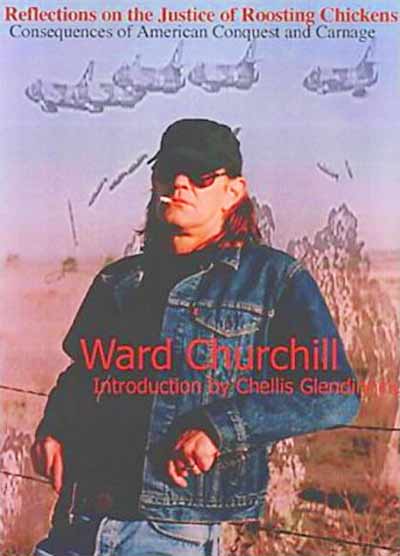
British edition titled Reflections on the Justice of Roosting ChickensHere is Ward Churchill’s notorious 9/11 “Little Eichmanns” essay, published online September 12, 2001, presented here for archival purposes lest critics think they can silence one of our nation’s strongest dissenting voices. Churchill later expanded this piece into a book entitled On the Justice of Roosting Chickens: reflections on the consequences of U.S. imperial arrogance and criminality published by AK Press in 2003.

Some People Push Back: On the Justice of Roosting Chickens
by Ward Churchill

When queried by reporters concerning his views on the assassination of John F. Kennedy in November 1963, Malcolm X famously – and quite charitably, all things considered – replied that it was merely a case of “chickens coming home to roost.”

On the morning of September 11, 2001, a few more chickens – along with some half-million dead Iraqi children – came home to roost in a very big way at the twin towers of New York’s World Trade Center. Well, actually, a few of them seem to have nestled in at the Pentagon as well.

The Iraqi youngsters, all of them under 12, died as a predictable – in fact, widely predicted – result of the 1991 US “surgical” bombing of their country’s water purification and sewage facilities, as well as other “infrastructural” targets upon which Iraq’s civilian population depends for its very survival.

If the nature of the bombing were not already bad enough – and it should be noted that this sort of “aerial warfare” constitutes a Class I Crime Against humanity, entailing myriad gross violations of international law, as well as every conceivable standard of “civilized” behavior – the death toll has been steadily ratcheted up by US-imposed sanctions for a full decade now. Enforced all the while by a massive military presence and periodic bombing raids, the embargo has greatly impaired the victims’ ability to import the nutrients, medicines and other materials necessary to saving the lives of even their toddlers.

All told, Iraq has a population of about 18 million. The 500,000 kids lost to date thus represent something on the order of 25 percent of their age group. Indisputably, the rest have suffered – are still suffering – a combination of physical debilitation and psychological trauma severe enough to prevent their ever fully recovering. In effect, an entire generation has been obliterated.

The reason for this holocaust was/is rather simple, and stated quite straightforwardly by President George Bush, the 41st “freedom-loving” father of the freedom-lover currently filling the Oval Office, George the 43rd: “The world must learn that what we say, goes,” intoned George the Elder to the enthusiastic applause of freedom-loving Americans everywhere. How Old George conveyed his message was certainly no mystery to the US public. One need only recall the 24-hour-per-day dissemination of bombardment videos on every available TV channel, and the exceedingly high ratings of these telecasts, to gain a sense of how much they knew.

In trying to affix a meaning to such things, we would do well to remember the wave of elation that swept America at reports of what was happening along the so-called Highway of Death: perhaps 100,000 “towel-heads” and “camel jockeys” – or was it “sand niggers” that week? – in full retreat, routed and effectively defenseless, many of them conscripted civilian laborers, slaughtered in a single day by jets firing the most hyper-lethal types of ordnance. It was a performance worthy of the nazis during the early months of their drive into Russia. And it should be borne in mind that Good Germans gleefully cheered that butchery, too. Indeed, support for Hitler suffered no serious erosion among Germany’s “innocent civilians” until the defeat at Stalingrad in 1943.

There may be a real utility to reflecting further, this time upon the fact that it was pious Americans who led the way in assigning the onus of collective guilt to the German people as a whole, not for things they as individuals had done, but for what they had allowed – nay, empowered – their leaders and their soldiers to do in their name.

If the principle was valid then, it remains so now, as applicable to Good Americans as it was the Good Germans. And the price exacted from the Germans for the faultiness of their moral fiber was truly ghastly. Returning now to the children, and to the effects of the post-Gulf War embargo – continued bull force by Bush the Elder’s successors in the Clinton administration as a gesture of its “resolve” to finalize what George himself had dubbed the “New World Order” of American military/economic domination – it should be noted that not one but two high United Nations officials attempting to coordinate delivery of humanitarian aid to Iraq resigned in succession as protests against US policy.

One of them, former U.N. Assistant Secretary General Denis Halladay, repeatedly denounced what was happening as “a systematic program . . . of deliberate genocide.” His statements appeared in the New York Times and other papers during the fall of 1998, so it can hardly be contended that the American public was “unaware” of them. Shortly thereafter, Secretary of State Madeline Albright openly confirmed Halladay’s assessment. Asked during the widely-viewed TV program Meet the Press to respond to his “allegations,” she calmly announced that she’d decided it was “worth the price” to see that U.S. objectives were achieved.

The Politics of a Perpetrator Population
As a whole, the American public greeted these revelations with yawns.. There were, after all, far more pressing things than the unrelenting misery/death of a few hundred thousand Iraqi tikes to be concerned with. Getting “Jeremy” and “Ellington” to their weekly soccer game, for instance, or seeing to it that little “Tiffany” and “Ashley” had just the right roll-neck sweaters to go with their new cords. And, to be sure, there was the yuppie holy war against ashtrays – for “our kids,” no less – as an all-absorbing point of political focus.

In fairness, it must be admitted that there was an infinitesimally small segment of the body politic who expressed opposition to what was/is being done to the children of Iraq. It must also be conceded, however, that those involved by-and-large contented themselves with signing petitions and conducting candle-lit prayer vigils, bearing “moral witness” as vast legions of brown-skinned five-year-olds sat shivering in the dark, wide-eyed in horror, whimpering as they expired in the most agonizing ways imaginable.

Be it said as well, and this is really the crux of it, that the “resistance” expended the bulk of its time and energy harnessed to the systemically-useful task of trying to ensure, as “a principle of moral virtue” that nobody went further than waving signs as a means of “challenging” the patently exterminatory pursuit of Pax Americana. So pure of principle were these “dissidents,” in fact, that they began literally to supplant the police in protecting corporations profiting by the carnage against suffering such retaliatory “violence” as having their windows broken by persons less “enlightened” – or perhaps more outraged – than the self-anointed “peacekeepers.”

Property before people, it seems – or at least the equation of property to people – is a value by no means restricted to America’s boardrooms. And the sanctimony with which such putrid sentiments are enunciated turns out to be nauseatingly similar, whether mouthed by the CEO of Standard Oil or any of the swarm of comfort zone “pacifists” queuing up to condemn the black block after it ever so slightly disturbed the functioning of business-as-usual in Seattle.

Small wonder, all-in-all, that people elsewhere in the world – the Mideast, for instance – began to wonder where, exactly, aside from the streets of the US itself, one was to find the peace America’s purportedly oppositional peacekeepers claimed they were keeping.

The answer, surely, was plain enough to anyone unblinded by the kind of delusions engendered by sheer vanity and self-absorption. So, too, were the implications in terms of anything changing, out there, in America’s free-fire zones.

Tellingly, it was at precisely this point – with the genocide in Iraq officially admitted and a public response demonstrating beyond a shadow of a doubt that there were virtually no Americans, including most of those professing otherwise, doing anything tangible to stop it – that the combat teams which eventually commandeered the aircraft used on September 11 began to infiltrate the United States.

Meet the “Terrorists”
Of the men who came, there are a few things demanding to be said in the face of the unending torrent of disinformational drivel unleashed by George Junior and the corporate “news” media immediately following their successful operation on September 11.

They did not, for starters, “initiate” a war with the US, much less commit “the first acts of war of the new millennium.”

A good case could be made that the war in which they were combatants has been waged more-or-less continuously by the “Christian West” – now proudly emblematized by the United States – against the “Islamic East” since the time of the First Crusade, about 1,000 years ago. More recently, one could argue that the war began when Lyndon Johnson first lent significant support to Israel’s dispossession/displacement of Palestinians during the 1960s, or when George the Elder ordered “Desert Shield” in 1990, or at any of several points in between. Any way you slice it, however, if what the combat teams did to the WTC and the Pentagon can be understood as acts of war – and they can – then the same is true of every US “overflight’ of Iraqi territory since day one. The first acts of war during the current millennium thus occurred on its very first day, and were carried out by U.S. aviators acting under orders from their then-commander-in-chief, Bill Clinton. The most that can honestly be said of those involved on September 11 is that they finally responded in kind to some of what this country has dispensed to their people as a matter of course.

That they waited so long to do so is, notwithstanding the 1993 action at the WTC, more than anything a testament to their patience and restraint.

They did not license themselves to “target innocent civilians.”

There is simply no argument to be made that the Pentagon personnel killed on September 11 fill that bill. The building and those inside comprised military targets, pure and simple. As to those in the World Trade Center . . .

Well, really. Let’s get a grip here, shall we? True enough, they were civilians of a sort. But innocent? Gimme a break. They formed a technocratic corps at the very heart of America’s global financial empire – the “mighty engine of profit” to which the military dimension of U.S. policy has always been enslaved – and they did so both willingly and knowingly. Recourse to “ignorance” – a derivative, after all, of the word “ignore” – counts as less than an excuse among this relatively well-educated elite. To the extent that any of them were unaware of the costs and consequences to others of what they were involved in – and in many cases excelling at – it was because of their absolute refusal to see. More likely, it was because they were too busy braying, incessantly and self-importantly, into their cell phones, arranging power lunches and stock transactions, each of which translated, conveniently out of sight, mind and smelling distance, into the starved and rotting flesh of infants. If there was a better, more effective, or in fact any other way of visiting some penalty befitting their participation upon the little Eichmanns inhabiting the sterile sanctuary of the twin towers, I’d really be interested in hearing about it.

The men who flew the missions against the WTC and Pentagon were not “cowards.” That distinction properly belongs to the “firm-jawed lads” who delighted in flying stealth aircraft through the undefended airspace of Baghdad, dropping payload after payload of bombs on anyone unfortunate enough to be below – including tens of thousands of genuinely innocent civilians – while themselves incurring all the risk one might expect during a visit to the local video arcade. Still more, the word describes all those “fighting men and women” who sat at computer consoles aboard ships in the Persian Gulf, enjoying air-conditioned comfort while launching cruise missiles into neighborhoods filled with random human beings. Whatever else can be said of them, the men who struck on September 11 manifested the courage of their convictions, willingly expending their own lives in attaining their objectives.

Nor were they “fanatics” devoted to “Islamic fundamentalism.”

One might rightly describe their actions as “desperate.” Feelings of desperation, however, are a perfectly reasonable – one is tempted to say “normal” – emotional response among persons confronted by the mass murder of their children, particularly when it appears that nobody else really gives a damn (ask a Jewish survivor about this one, or, even more poignantly, for all the attention paid them, a Gypsy).

That desperate circumstances generate desperate responses is no mysterious or irrational principle, of the sort motivating fanatics. Less is it one peculiar to Islam. Indeed, even the FBI’s investigative reports on the combat teams’ activities during the months leading up to September 11 make it clear that the members were not fundamentalist Muslims. Rather, it’s pretty obvious at this point that they were secular activists – soldiers, really – who, while undoubtedly enjoying cordial relations with the clerics of their countries, were motivated far more by the grisly realities of the U.S. war against them than by a set of religious beliefs.

And still less were they/their acts “insane.”

Insanity is a condition readily associable with the very American idea that one – or one’s country – holds what amounts to a “divine right” to commit genocide, and thus to forever do so with impunity. The term might also be reasonably applied to anyone suffering genocide without attempting in some material way to bring the process to a halt. Sanity itself, in this frame of reference, might be defined by a willingness to try and destroy the perpetrators and/or the sources of their ability to commit their crimes. (Shall we now discuss the US “strategic bombing campaign” against Germany during World War II, and the mental health of those involved in it?)

Which takes us to official characterizations of the combat teams as an embodiment of “evil.”

Evil – for those inclined to embrace the banality of such a concept – was perfectly incarnated in that malignant toad known as Madeline Albright, squatting in her studio chair like Jaba the Hutt, blandly spewing the news that she’d imposed a collective death sentence upon the unoffending youth of Iraq. Evil was to be heard in that great American hero “Stormin’ Norman” Schwartzkopf’s utterly dehumanizing dismissal of their systematic torture and annihilation as mere “collateral damage.” Evil, moreover, is a term appropriate to describing the mentality of a public that finds such perspectives and the policies attending them acceptable, or even momentarily tolerable.

Had it not been for these evils, the counterattacks of September 11 would never have occurred. And unless “the world is rid of such evil,” to lift a line from George Junior, September 11 may well end up looking like a lark.

There is no reason, after all, to believe that the teams deployed in the assaults on the WTC and the Pentagon were the only such, that the others are composed of “Arabic-looking individuals” – America’s indiscriminately lethal arrogance and psychotic sense of self-entitlement have long since given the great majority of the world’s peoples ample cause to be at war with it – or that they are in any way dependent upon the seizure of civilian airliners to complete their missions.

To the contrary, there is every reason to expect that there are many other teams in place, tasked to employ altogether different tactics in executing operational plans at least as well-crafted as those evident on September 11, and very well equipped for their jobs. This is to say that, since the assaults on the WTC and Pentagon were act of war – not “terrorist incidents” – they must be understood as components in a much broader strategy designed to achieve specific results. From this, it can only be adduced that there are plenty of other components ready to go, and that they will be used, should this become necessary in the eyes of the strategists. It also seems a safe bet that each component is calibrated to inflict damage at a level incrementally higher than the one before (during the 1960s, the Johnson administration employed a similar policy against Vietnam, referred to as “escalation”).

Since implementation of the overall plan began with the WTC/Pentagon assaults, it takes no rocket scientist to decipher what is likely to happen next, should the U.S. attempt a response of the inexcusable variety to which it has long entitled itself.

About Those Boys (and Girls) in the Bureau
There’s another matter begging for comment at this point. The idea that the FBI’s “counterterrorism task forces” can do a thing to prevent what will happen is yet another dimension of America’s delusional pathology.. The fact is that, for all its publicly-financed “image-building” exercises, the Bureau has never shown the least aptitude for anything of the sort.

Oh, yeah, FBI counterintelligence personnel have proven quite adept at framing anarchists, communists and Black Panthers, sometimes murdering them in their beds or the electric chair. The Bureau’s SWAT units have displayed their ability to combat child abuse in Waco by burning babies alive, and its vaunted Crime Lab has been shown to pad its “crime-fighting’ statistics by fabricating evidence against many an alleged car thief. But actual “heavy-duty bad guys” of the sort at issue now? This isn’t a Bruce Willis/Chuck Norris/Sly Stallone movie, after all.. And J. Edgar Hoover doesn’t get to approve either the script or the casting.

The number of spies, saboteurs and bona fide terrorists apprehended, or even detected by the FBI in the course of its long and slimy history could be counted on one’s fingers and toes. On occasion, its agents have even turned out to be the spies, and, in many instances, the terrorists as well.

To be fair once again, if the Bureau functions as at best a carnival of clowns where its “domestic security responsibilities” are concerned, this is because – regardless of official hype – it has none. It is now, as it’s always been, the national political police force, an instrument created and perfected to ensure that all Americans, not just the consenting mass, are “free” to do exactly as they’re told.

The FBI and “cooperating agencies” can be thus relied upon to set about “protecting freedom” by destroying whatever rights and liberties were left to U.S. citizens before September 11 (in fact, they’ve already received authorization to begin). Sheeplike, the great majority of Americans can also be counted upon to bleat their approval, at least in the short run, believing as they always do that the nasty implications of what they’re doing will pertain only to others.

Oh Yeah, and “The Company,” Too

A possibly even sicker joke is the notion, suddenly in vogue, that the CIA will be able to pinpoint “terrorist threats,” “rooting out their infrastructure” where it exists and/or “terminating” it before it can materialize, if only it’s allowed to beef up its “human intelligence gathering capacity” in an unrestrained manner (including full-bore operations inside the US, of course).

Yeah. Right.

Since America has a collective attention-span of about 15 minutes, a little refresher seems in order: “The Company” had something like a quarter-million people serving as “intelligence assets” by feeding it information in Vietnam in 1968, and it couldn’t even predict the Tet Offensive. God knows how many spies it was fielding against the USSR at the height of Ronald Reagan’s version of the Cold War, and it was still caught flatfooted by the collapse of the Soviet Union. As to destroying “terrorist infrastructures,” one would do well to remember Operation Phoenix, another product of its open season in Vietnam. In that one, the CIA enlisted elite US units like the Navy Seals and Army Special Forces, as well as those of friendly countries – the south Vietnamese Rangers, for example, and Australian SAS – to run around “neutralizing” folks targeted by The Company’s legion of snitches as “guerrillas” (as those now known as “terrorists” were then called).

Sound familiar?

Upwards of 40,000 people – mostly bystanders, as it turns out – were murdered by Phoenix hit teams before the guerrillas, stronger than ever, ran the US and its collaborators out of their country altogether. And these are the guys who are gonna save the day, if unleashed to do their thing in North America?

The net impact of all this “counterterrorism” activity upon the combat teams’ ability to do what they came to do, of course, will be nil.

Instead, it’s likely to make it easier for them to operate (it’s worked that way in places like Northern Ireland). And, since denying Americans the luxury of reaping the benefits of genocide in comfort was self-evidently a key objective of the WTC/Pentagon assaults, it can be stated unequivocally that a more overt display of the police state mentality already pervading this country simply confirms the magnitude of their victory.

On Matters of Proportion and Intent
As things stand, including the 1993 detonation at the WTC, “Arab terrorists” have responded to the massive and sustained American terror bombing of Iraq with a total of four assaults by explosives inside the US. That’s about 1% of the 50,000 bombs the Pentagon announced were rained on Baghdad alone during the Gulf War (add in Oklahoma City and you’ll get something nearer an actual 1%).

They’ve managed in the process to kill about 5,000 Americans, or roughly 1% of the dead Iraqi children (the percentage is far smaller if you factor in the killing of adult Iraqi civilians, not to mention troops butchered as/after they’d surrendered and/or after the “war-ending” ceasefire had been announced).

In terms undoubtedly more meaningful to the property/profit-minded American mainstream, they’ve knocked down a half-dozen buildings – albeit some very well-chosen ones – as opposed to the “strategic devastation” visited upon the whole of Iraq, and punched a $100 billion hole in the earnings outlook of major corporate shareholders, as opposed to the U.S. obliteration of Iraq’s entire economy.

With that, they’ve given Americans a tiny dose of their own medicine.. This might be seen as merely a matter of “vengeance” or “retribution,” and, unquestionably, America has earned it, even if it were to add up only to something so ultimately petty.

The problem is that vengeance is usually framed in terms of “getting even,” a concept which is plainly inapplicable in this instance. As the above data indicate, it would require another 49,996 detonations killing 495,000 more Americans, for the “terrorists” to “break even” for the bombing of Baghdad/extermination of Iraqi children alone. And that’s to achieve “real number” parity. To attain an actual proportional parity of damage – the US is about 15 times as large as Iraq in terms of population, even more in terms of territory – they would, at a minimum, have to blow up about 300,000 more buildings and kill something on the order of 7.5 million people.

Were this the intent of those who’ve entered the US to wage war against it, it would remain no less true that America and Americans were only receiving the bill for what they’d already done. Payback, as they say, can be a real motherfucker (ask the Germans). There is, however, no reason to believe that retributive parity is necessarily an item on the agenda of those who planned the WTC/Pentagon operation. If it were, given the virtual certainty that they possessed the capacity to have inflicted far more damage than they did, there would be a lot more American bodies lying about right now.

Hence, it can be concluded that ravings carried by the “news” media since September 11 have contained at least one grain of truth: The peoples of the Mideast “aren’t like” Americans, not least because they don’t “value life’ in the same way. By this, it should be understood that Middle-Easterners, unlike Americans, have no history of exterminating others purely for profit, or on the basis of racial animus. Thus, we can appreciate the fact that they value life – all lives, not just their own – far more highly than do their U.S. counterparts.

The Makings of a Humanitarian Strategy
In sum one can discern a certain optimism – it might even be call humanitarianism – imbedded in the thinking of those who presided over the very limited actions conducted on September 11.

Their logic seems to have devolved upon the notion that the American people have condoned what has been/is being done in their name – indeed, are to a significant extent actively complicit in it – mainly because they have no idea what it feels like to be on the receiving end.

Now they do.

That was the “medicinal” aspect of the attacks.

To all appearances, the idea is now to give the tonic a little time to take effect, jolting Americans into the realization that the sort of pain they’re now experiencing first-hand is no different from – or the least bit more excruciating than – that which they’ve been so cavalier in causing others, and thus to respond appropriately.

More bluntly, the hope was – and maybe still is – that Americans, stripped of their presumed immunity from incurring any real consequences for their behavior, would comprehend and act upon a formulation as uncomplicated as “stop killing our kids, if you want your own to be safe.”

Either way, it’s a kind of “reality therapy” approach, designed to afford the American people a chance to finally “do the right thing” on their own, without further coaxing.

Were the opportunity acted upon in some reasonably good faith fashion – a sufficiently large number of Americans rising up and doing whatever is necessary to force an immediate lifting of the sanctions on Iraq, for instance, or maybe hanging a few of America’s abundant supply of major war criminals (Henry Kissinger comes quickly to mind, as do Madeline Albright, Colin Powell, Bill Clinton and George the Elder) – there is every reason to expect that military operations against the US on its domestic front would be immediately suspended.

Whether they would remain so would of course be contingent upon follow-up. By that, it may be assumed that American acceptance of onsite inspections by international observers to verify destruction of its weapons of mass destruction (as well as dismantlement of all facilities in which more might be manufactured), Nuremberg-style trials in which a few thousand US military/corporate personnel could be properly adjudicated and punished for their Crimes Against humanity, and payment of reparations to the array of nations/peoples whose assets the US has plundered over the years, would suffice.

Since they’ve shown no sign of being unreasonable or vindictive, it may even be anticipated that, after a suitable period of adjustment and reeducation (mainly to allow them to acquire the skills necessary to living within their means), those restored to control over their own destinies by the gallant sacrifices of the combat teams the WTC and Pentagon will eventually (re)admit Americans to the global circle of civilized societies. Stranger things have happened.

In the Alternative
Unfortunately, noble as they may have been, such humanitarian aspirations were always doomed to remain unfulfilled. For it to have been otherwise, a far higher quality of character and intellect would have to prevail among average Americans than is actually the case. Perhaps the strategists underestimated the impact a couple of generations-worth of media indoctrination can produce in terms of demolishing the capacity of human beings to form coherent thoughts. Maybe they forgot to factor in the mind-numbing effects of the indoctrination passed off as education in the US. Then, again, it’s entirely possible they were aware that a decisive majority of American adults have been reduced by this point to a level much closer to the kind of immediate self-gratification entailed in Pavlovian stimulus/response patterns than anything accessible by appeals to higher logic, and still felt morally obliged to offer the dolts an option to quit while they were ahead.

What the hell? It was worth a try.

But it’s becoming increasingly apparent that the dosage of medicine administered was entirely insufficient to accomplish its purpose.

Although there are undoubtedly exceptions, Americans for the most part still don’t get it.

Already, they’ve desecrated the temporary tomb of those killed in the WTC, staging a veritable pep rally atop the mangled remains of those they profess to honor, treating the whole affair as if it were some bizarre breed of contact sport. And, of course, there are the inevitable pom-poms shaped like American flags, the school colors worn as little red-white-and-blue ribbons affixed to labels, sportscasters in the form of “counterterrorism experts” drooling mindless color commentary during the pregame warm-up.

Refusing the realization that the world has suddenly shifted its axis, and that they are therefore no longer “in charge,” they have by-and-large reverted instantly to type, working themselves into their usual bloodlust on the now obsolete premise that the bloodletting will “naturally” occur elsewhere and to someone else.

“Patriotism,” a wise man once observed, “is the last refuge of scoundrels.”

And the braided, he might of added.

Braided Scoundrel-in-Chief, George Junior, lacking even the sense to be careful what he wished for, has teamed up with a gaggle of fundamentalist Christian clerics like Billy Graham to proclaim a “New Crusade” called “Infinite Justice” aimed at “ridding the world of evil.”

One could easily make light of such rhetoric, remarking upon how unseemly it is for a son to threaten his father in such fashion – or a president to so publicly contemplate the murder/suicide of himself and his cabinet – but the matter is deadly serious.

They are preparing once again to sally forth for the purpose of roasting brown-skinned children by the scores of thousands. Already, the B-1 bombers and the aircraft carriers and the missile frigates are en route, the airborne divisions are gearing up to go.

To where? Afghanistan?

The Sudan?

Iraq, again (or still)?

How about Grenada (that was fun)?

Any of them or all. It doesn’t matter.

The desire to pummel the helpless runs rabid as ever.

Only, this time it’s different.

The time the helpless aren’t, or at least are not so helpless as they were.

This time, somewhere, perhaps in an Afghani mountain cave, possibly in a Brooklyn basement, maybe another local altogether – but somewhere, all the same – there’s a grim-visaged (wo)man wearing a Clint Eastwood smile.

“Go ahead, punks,” s/he’s saying, “Make my day.”

And when they do, when they launch these airstrikes abroad – or may a little later; it will be at a time conforming to the “terrorists”‘ own schedule, and at a place of their choosing – the next more intensive dose of medicine administered here “at home.”

Of what will it consist this time? Anthrax? Mustard gas? Sarin? A tactical nuclear device?

That, too, is their choice to make.

Looking back, it will seem to future generations inexplicable why Americans were unable on their own, and in time to save themselves, to accept a rule of nature so basic that it could be mouthed by an actor, Lawrence Fishburn, in a movie, The Cotton Club.

“You’ve got to learn, ” the line went, “that when you push people around, some people push back.”

As they should.

As they must.

And as they undoubtedly will.

There is justice in such symmetry.

ADDENDUM
The preceding was a “first take” reading, more a stream-of-consciousness interpretive reaction to the September 11 counterattack than a finished piece on the topic. Hence, I’ll readily admit that I’ve been far less than thorough, and quite likely wrong about a number of things.

For instance, it may not have been (only) the ghosts of Iraqi children who made their appearance that day. It could as easily have been some or all of their butchered Palestinian cousins.

Or maybe it was some or all of the at least 3.2 million Indochinese who perished as a result of America’s sustained and genocidal assault on Southeast Asia (1959-1975), not to mention the millions more who’ve died because of the sanctions imposed thereafter.

Perhaps there were a few of the Korean civilians massacred by US troops at places like No Gun Ri during the early ‘50s, or the hundreds of thousands of Japanese civilians ruthlessly incinerated in the ghastly fire raids of World War II (only at Dresden did America bomb Germany in a similar manner).

And, of course, it could have been those vaporized in the militarily pointless nuclear bombings of Hiroshima and Nagasaki.

There are others, as well, a vast and silent queue of faceless victims, stretching from the million-odd Filipinos slaughtered during America’s “Indian War” in their islands at the beginning of the twentieth century, through the real Indians, America’s own, massacred wholesale at places like Horseshoe Bend and the Bad Axe, Sand Creek and Wounded Knee, the Washita, Bear River, and the Marias.

Was it those who expired along the Cherokee Trial of Tears of the Long Walk of the Navajo?

Those murdered by smallpox at Fort Clark in 1836?

Starved to death in the concentration camp at Bosque Redondo during the 1860s?

Maybe those native people claimed for scalp bounty in all 48 of the continental US states? Or the Raritans whose severed heads were kicked for sport along the streets of what was then called New Amsterdam, at the very site where the WTC once stood?

One hears, too, the whispers of those lost on the Middle Passage, and of those whose very flesh was sold in the slave market outside the human kennel from whence Wall Street takes its name. And of coolie laborers, imported by the gross-dozen to lay the tracks of empire across scorching desert sands, none of them allotted “a Chinaman’s chance” of surviving.

The list is too long, too awful to go on.

No matter what its eventual fate, America will have gotten off very, very cheap.

The full measure of its guilt can never be fully balanced or atoned for.

In response to criticism, Churchill issued this press release January 31, 2005:

PRESS RELEASE

In the last few days there has been widespread and grossly inaccurate media coverage concerning my analysis of the September 11, 2001 attacks on the World Trade Center and the Pentagon, coverage that has resulted in defamation of my character and threats against my life. What I actually said has been lost, indeed turned into the opposite of itself, and I hope the following facts will be reported at least to the same extent that the fabrications have been.

* The piece circulating on the internet was developed into a book, On the Justice of Roosting Chickens. Most of the book is a detailed chronology of U.S. military interventions since 1776 and U.S. violations of international law since World War II. My point is that we cannot allow the U.S. government, acting in our name, to engage in massive violations of international law and fundamental human rights and not expect to reap the consequences.

* I am not a “defender”of the September 11 attacks, but simply pointing out that if U.S. foreign policy results in massive death and destruction abroad, we cannot feign innocence when some of that destruction is returned. I have never said that people “should” engage in armed attacks on the United States, but that such attacks are a natural and unavoidable consequence of unlawful U.S. policy. As Martin Luther King, quoting Robert F. Kennedy, said, “Those who make peaceful change impossible make violent change inevitable.”

* This is not to say that I advocate violence; as a U.S. soldier in Vietnam I witnessed and participated in more violence than I ever wish to see. What I am saying is that if we want an end to violence, especially that perpetrated against civilians, we must take the responsibility for halting the slaughter perpetrated by the United States around the world. My feelings are reflected in Dr. King’s April 1967 Riverside speech, where, when asked about the wave of urban rebellions in U.S. cities, he said, “I could never again raise my voice against the violence of the oppressed . . . without having first spoken clearly to the greatest purveyor of violence in the world today — my own government.”

* In 1996 Madeleine Albright, then Ambassador to the UN and soon to be U.S. Secretary of State, did not dispute that 500,000 Iraqi children had died as a result of economic sanctions, but stated on national television that “we” had decided it was “worth the cost.” I mourn the victims of the September 11 attacks, just as I mourn the deaths of those Iraqi children, the more than 3 million people killed in the war in Indochina, those who died in the U.S. invasions of Grenada, Panama and elsewhere in Central America, the victims of the transatlantic slave trade, and the indigenous peoples still subjected to genocidal policies. If we respond with callous disregard to the deaths of others, we can only expect equal callousness to American deaths.

* Finally, I have never characterized all the September 11 victims as “Nazis.” What I said was that the “technocrats of empire” working in the World Trade Center were the equivalent of “little Eichmanns.” Adolf Eichmann was not charged with direct killing but with ensuring the smooth running of the infrastructure that enabled the Nazi genocide. Similarly, German industrialists were legitimately targeted by the Allies.

* It is not disputed that the Pentagon was a military target, or that a CIA office was situated in the World Trade Center. Following the logic by which U.S. Defense Department spokespersons have consistently sought to justify target selection in places like Baghdad, this placement of an element of the American “command and control infrastructure” in an ostensibly civilian facility converted the Trade Center itself into a “legitimate” target. Again following U.S. military doctrine, as announced in briefing after briefing, those who did not work for the CIA but were nonetheless killed in the attack amounted to no more than “collateral damage.” If the U.S. public is prepared to accept these “standards” when the are routinely applied to other people, they should be not be surprised when the same standards are applied to them.

* It should be emphasized that I applied the “little Eichmanns” characterization only to those described as “technicians.” Thus, it was obviously not directed to the children, janitors, food service workers, firemen and random passers-by killed in the 9-1-1 attack. According to Pentagon logic, were simply part of the collateral damage. Ugly? Yes. Hurtful? Yes. And that’s my point. It’s no less ugly, painful or dehumanizing a description when applied to Iraqis, Palestinians, or anyone else. If we ourselves do not want to be treated in this fashion, we must refuse to allow others to be similarly devalued and dehumanized in our name.

* The bottom line of my argument is that the best and perhaps only way to prevent 9-1-1-style attacks on the U.S. is for American citizens to compel their government to comply with the rule of law. The lesson of Nuremberg is that this is not only our right, but our obligation. To the extent we shirk this responsibility, we, like the “Good Germans” of the 1930s and ’40s, are complicit in its actions and have no legitimate basis for complaint when we suffer the consequences. This, of course, includes me, personally, as well as my family, no less than anyone else.

* These points are clearly stated and documented in my book, On the Justice of Roosting Chickens, which recently won Honorary Mention for the Gustavus Myer Human Rights Award. for best writing on human rights. Some people will, of course, disagree with my analysis, but it presents questions that must be addressed in academic and public debate if we are to find a real solution to the violence that pervades today’s world. The gross distortions of what I actually said can only be viewed as an attempt to distract the public from the real issues at hand and to further stifle freedom of speech and academic debate in this country.

Ward Churchill
Boulder, Colorado
January 31, 2005

Costa Rica a prototypical Western Democracy

PUERTO JIMINEZ, CR- Touring Costa Rica has been interesting. Considering the turmoil of Central America, it may be a shining example of a functional Capitalist Democracy. It´s got a healthy middle class and a relatively contented populace. Can it offer a lesson to its strife torn neighbors? Sure. Get rid of the Indios.

Citizens of the “Rich Coast” pride themselves on being light skinned, owing to a Spanish heritage of course. They´re the descendants of settlers, mixed some with labor imports from the Caribbean. But the indigenous people are gone. Which makes for scarce land redistribution demands.

When Columbus first came to Costa Rica, there were 400,000 inhabitants. When they saw that the Spaniards were enslaving whoever they conquered, the tribes hid in the mountains. As a result, Costa wasn´t properly subjugated like elsewhere. The Spanish didn´t want land that didn´t come with ready slave labor. But hiding didn´t save the indians. As the Spanish settled the land, the original population dwindled, to 10%, then 2% within 200 years. They are, as Randy Newman sang it: “Gone, real gone.”

There is an inspiring history to Costa Rica´s present relatively egalitarian government, and I´m going to write more about some of their laudable leaders. But I have to argue that CR smacks of US artifice. And lo, even as I cringe at the camo themed souvenir caps that remind me of the Contras, it turns out Oliver North operated his Contra army and drug smuggling operation out of an airfield in northern Costa Rica. There´s a surfing destination near there called Ollie´s Point, named after the would be filibuster himself. Those apolitical surfer fucks.

(It is hard to surpress disdain for the hard-recreating American asses despoiling CR toilet paper. I cannot bear their vibes of inutile indifference.)

So the Costa Ricans are less Central Americans than good old Americans. And that never meant Native American.

Harold Pinter on drama and US banditry

“What has happened to our moral sensibility? Did we ever have any? What do these words mean? Do they refer to a term very rarely employed these days – conscience? A conscience to do not only with our own acts but to do with our shared responsibility in the acts of others? Is all this dead?”
-Harold Pinter (1930-2008)

I’m reminded of a friend of mine who asked “You know what PTSD is? It’s a bad conscience.”

An outspoken critic of the Iraq War, Harold Pinter died Christmas Eve. Here is the address he prerecorded for his acceptance of the Nobel Prize in 2005, when he had become too infirm to attend in person.

Nobel Lecture: Art, Truth & Politics

In 1958 I wrote the following:

‘There are no hard distinctions between what is real and what is unreal, nor between what is true and what is false. A thing is not necessarily either true or false; it can be both true and false.’

I believe that these assertions still make sense and do still apply to the exploration of reality through art. So as a writer I stand by them but as a citizen I cannot. As a citizen I must ask: What is true? What is false?

Truth in drama is forever elusive. You never quite find it but the search for it is compulsive. The search is clearly what drives the endeavour. The search is your task. More often than not you stumble upon the truth in the dark, colliding with it or just glimpsing an image or a shape which seems to correspond to the truth, often without realising that you have done so. But the real truth is that there never is any such thing as one truth to be found in dramatic art. There are many. These truths challenge each other, recoil from each other, reflect each other, ignore each other, tease each other, are blind to each other. Sometimes you feel you have the truth of a moment in your hand, then it slips through your fingers and is lost.

I have often been asked how my plays come about. I cannot say. Nor can I ever sum up my plays, except to say that this is what happened. That is what they said. That is what they did.

Most of the plays are engendered by a line, a word or an image. The given word is often shortly followed by the image. I shall give two examples of two lines which came right out of the blue into my head, followed by an image, followed by me.

The plays are The Homecoming and Old Times. The first line of The Homecoming is ‘What have you done with the scissors?’ The first line of Old Times is ‘Dark.’

In each case I had no further information.

In the first case someone was obviously looking for a pair of scissors and was demanding their whereabouts of someone else he suspected had probably stolen them. But I somehow knew that the person addressed didn’t give a damn about the scissors or about the questioner either, for that matter.

‘Dark’ I took to be a description of someone’s hair, the hair of a woman, and was the answer to a question. In each case I found myself compelled to pursue the matter. This happened visually, a very slow fade, through shadow into light.

I always start a play by calling the characters A, B and C.

In the play that became The Homecoming I saw a man enter a stark room and ask his question of a younger man sitting on an ugly sofa reading a racing paper. I somehow suspected that A was a father and that B was his son, but I had no proof. This was however confirmed a short time later when B (later to become Lenny) says to A (later to become Max), ‘Dad, do you mind if I change the subject? I want to ask you something. The dinner we had before, what was the name of it? What do you call it? Why don’t you buy a dog? You’re a dog cook. Honest. You think you’re cooking for a lot of dogs.’ So since B calls A ‘Dad’ it seemed to me reasonable to assume that they were father and son. A was also clearly the cook and his cooking did not seem to be held in high regard. Did this mean that there was no mother? I didn’t know. But, as I told myself at the time, our beginnings never know our ends.

‘Dark.’ A large window. Evening sky. A man, A (later to become Deeley), and a woman, B (later to become Kate), sitting with drinks. ‘Fat or thin?’ the man asks. Who are they talking about? But I then see, standing at the window, a woman, C (later to become Anna), in another condition of light, her back to them, her hair dark.

It’s a strange moment, the moment of creating characters who up to that moment have had no existence. What follows is fitful, uncertain, even hallucinatory, although sometimes it can be an unstoppable avalanche. The author’s position is an odd one. In a sense he is not welcomed by the characters. The characters resist him, they are not easy to live with, they are impossible to define. You certainly can’t dictate to them. To a certain extent you play a never-ending game with them, cat and mouse, blind man’s buff, hide and seek. But finally you find that you have people of flesh and blood on your hands, people with will and an individual sensibility of their own, made out of component parts you are unable to change, manipulate or distort.

So language in art remains a highly ambiguous transaction, a quicksand, a trampoline, a frozen pool which might give way under you, the author, at any time.

But as I have said, the search for the truth can never stop. It cannot be adjourned, it cannot be postponed. It has to be faced, right there, on the spot.

Political theatre presents an entirely different set of problems. Sermonising has to be avoided at all cost. Objectivity is essential. The characters must be allowed to breathe their own air. The author cannot confine and constrict them to satisfy his own taste or disposition or prejudice. He must be prepared to approach them from a variety of angles, from a full and uninhibited range of perspectives, take them by surprise, perhaps, occasionally, but nevertheless give them the freedom to go which way they will. This does not always work. And political satire, of course, adheres to none of these precepts, in fact does precisely the opposite, which is its proper function.

In my play The Birthday Party I think I allow a whole range of options to operate in a dense forest of possibility before finally focussing on an act of subjugation.

Mountain Language pretends to no such range of operation. It remains brutal, short and ugly. But the soldiers in the play do get some fun out of it. One sometimes forgets that torturers become easily bored. They need a bit of a laugh to keep their spirits up. This has been confirmed of course by the events at Abu Ghraib in Baghdad. Mountain Language lasts only 20 minutes, but it could go on for hour after hour, on and on and on, the same pattern repeated over and over again, on and on, hour after hour.

Ashes to Ashes, on the other hand, seems to me to be taking place under water. A drowning woman, her hand reaching up through the waves, dropping down out of sight, reaching for others, but finding nobody there, either above or under the water, finding only shadows, reflections, floating; the woman a lost figure in a drowning landscape, a woman unable to escape the doom that seemed to belong only to others.

But as they died, she must die too.

Political language, as used by politicians, does not venture into any of this territory since the majority of politicians, on the evidence available to us, are interested not in truth but in power and in the maintenance of that power. To maintain that power it is essential that people remain in ignorance, that they live in ignorance of the truth, even the truth of their own lives. What surrounds us therefore is a vast tapestry of lies, upon which we feed.

As every single person here knows, the justification for the invasion of Iraq was that Saddam Hussein possessed a highly dangerous body of weapons of mass destruction, some of which could be fired in 45 minutes, bringing about appalling devastation. We were assured that was true. It was not true. We were told that Iraq had a relationship with Al Quaeda and shared responsibility for the atrocity in New York of September 11th 2001. We were assured that this was true. It was not true. We were told that Iraq threatened the security of the world. We were assured it was true. It was not true.

The truth is something entirely different. The truth is to do with how the United States understands its role in the world and how it chooses to embody it.

But before I come back to the present I would like to look at the recent past, by which I mean United States foreign policy since the end of the Second World War. I believe it is obligatory upon us to subject this period to at least some kind of even limited scrutiny, which is all that time will allow here.

Everyone knows what happened in the Soviet Union and throughout Eastern Europe during the post-war period: the systematic brutality, the widespread atrocities, the ruthless suppression of independent thought. All this has been fully documented and verified.

But my contention here is that the US crimes in the same period have only been superficially recorded, let alone documented, let alone acknowledged, let alone recognised as crimes at all. I believe this must be addressed and that the truth has considerable bearing on where the world stands now. Although constrained, to a certain extent, by the existence of the Soviet Union, the United States’ actions throughout the world made it clear that it had concluded it had carte blanche to do what it liked.

Direct invasion of a sovereign state has never in fact been America’s favoured method. In the main, it has preferred what it has described as ‘low intensity conflict’. Low intensity conflict means that thousands of people die but slower than if you dropped a bomb on them in one fell swoop. It means that you infect the heart of the country, that you establish a malignant growth and watch the gangrene bloom. When the populace has been subdued – or beaten to death – the same thing – and your own friends, the military and the great corporations, sit comfortably in power, you go before the camera and say that democracy has prevailed. This was a commonplace in US foreign policy in the years to which I refer.

The tragedy of Nicaragua was a highly significant case. I choose to offer it here as a potent example of America’s view of its role in the world, both then and now.

I was present at a meeting at the US embassy in London in the late 1980s.

The United States Congress was about to decide whether to give more money to the Contras in their campaign against the state of Nicaragua. I was a member of a delegation speaking on behalf of Nicaragua but the most important member of this delegation was a Father John Metcalf. The leader of the US body was Raymond Seitz (then number two to the ambassador, later ambassador himself). Father Metcalf said: ‘Sir, I am in charge of a parish in the north of Nicaragua. My parishioners built a school, a health centre, a cultural centre. We have lived in peace. A few months ago a Contra force attacked the parish. They destroyed everything: the school, the health centre, the cultural centre. They raped nurses and teachers, slaughtered doctors, in the most brutal manner. They behaved like savages. Please demand that the US government withdraw its support from this shocking terrorist activity.’

Raymond Seitz had a very good reputation as a rational, responsible and highly sophisticated man. He was greatly respected in diplomatic circles. He listened, paused and then spoke with some gravity. ‘Father,’ he said, ‘let me tell you something. In war, innocent people always suffer.’ There was a frozen silence. We stared at him. He did not flinch.

Innocent people, indeed, always suffer.

Finally somebody said: ‘But in this case “innocent people” were the victims of a gruesome atrocity subsidised by your government, one among many. If Congress allows the Contras more money further atrocities of this kind will take place. Is this not the case? Is your government not therefore guilty of supporting acts of murder and destruction upon the citizens of a sovereign state?’

Seitz was imperturbable. ‘I don’t agree that the facts as presented support your assertions,’ he said.

As we were leaving the Embassy a US aide told me that he enjoyed my plays. I did not reply.

I should remind you that at the time President Reagan made the following statement: ‘The Contras are the moral equivalent of our Founding Fathers.’

The United States supported the brutal Somoza dictatorship in Nicaragua for over 40 years. The Nicaraguan people, led by the Sandinistas, overthrew this regime in 1979, a breathtaking popular revolution.

The Sandinistas weren’t perfect. They possessed their fair share of arrogance and their political philosophy contained a number of contradictory elements. But they were intelligent, rational and civilised. They set out to establish a stable, decent, pluralistic society. The death penalty was abolished. Hundreds of thousands of poverty-stricken peasants were brought back from the dead. Over 100,000 families were given title to land. Two thousand schools were built. A quite remarkable literacy campaign reduced illiteracy in the country to less than one seventh. Free education was established and a free health service. Infant mortality was reduced by a third. Polio was eradicated.

The United States denounced these achievements as Marxist/Leninist subversion. In the view of the US government, a dangerous example was being set. If Nicaragua was allowed to establish basic norms of social and economic justice, if it was allowed to raise the standards of health care and education and achieve social unity and national self respect, neighbouring countries would ask the same questions and do the same things. There was of course at the time fierce resistance to the status quo in El Salvador.

I spoke earlier about ‘a tapestry of lies’ which surrounds us. President Reagan commonly described Nicaragua as a ‘totalitarian dungeon’. This was taken generally by the media, and certainly by the British government, as accurate and fair comment. But there was in fact no record of death squads under the Sandinista government. There was no record of torture. There was no record of systematic or official military brutality. No priests were ever murdered in Nicaragua. There were in fact three priests in the government, two Jesuits and a Maryknoll missionary. The totalitarian dungeons were actually next door, in El Salvador and Guatemala. The United States had brought down the democratically elected government of Guatemala in 1954 and it is estimated that over 200,000 people had been victims of successive military dictatorships.

Six of the most distinguished Jesuits in the world were viciously murdered at the Central American University in San Salvador in 1989 by a battalion of the Alcatl regiment trained at Fort Benning, Georgia, USA. That extremely brave man Archbishop Romero was assassinated while saying mass. It is estimated that 75,000 people died. Why were they killed? They were killed because they believed a better life was possible and should be achieved. That belief immediately qualified them as communists. They died because they dared to question the status quo, the endless plateau of poverty, disease, degradation and oppression, which had been their birthright.

The United States finally brought down the Sandinista government. It took some years and considerable resistance but relentless economic persecution and 30,000 dead finally undermined the spirit of the Nicaraguan people. They were exhausted and poverty stricken once again. The casinos moved back into the country. Free health and free education were over. Big business returned with a vengeance. ‘Democracy’ had prevailed.

But this ‘policy’ was by no means restricted to Central America. It was conducted throughout the world. It was never-ending. And it is as if it never happened.

The United States supported and in many cases engendered every right wing military dictatorship in the world after the end of the Second World War. I refer to Indonesia, Greece, Uruguay, Brazil, Paraguay, Haiti, Turkey, the Philippines, Guatemala, El Salvador, and, of course, Chile. The horror the United States inflicted upon Chile in 1973 can never be purged and can never be forgiven.

Hundreds of thousands of deaths took place throughout these countries. Did they take place? And are they in all cases attributable to US foreign policy? The answer is yes they did take place and they are attributable to American foreign policy. But you wouldn’t know it.

It never happened. Nothing ever happened. Even while it was happening it wasn’t happening. It didn’t matter. It was of no interest. The crimes of the United States have been systematic, constant, vicious, remorseless, but very few people have actually talked about them. You have to hand it to America. It has exercised a quite clinical manipulation of power worldwide while masquerading as a force for universal good. It’s a brilliant, even witty, highly successful act of hypnosis.

I put to you that the United States is without doubt the greatest show on the road. Brutal, indifferent, scornful and ruthless it may be but it is also very clever. As a salesman it is out on its own and its most saleable commodity is self love. It’s a winner. Listen to all American presidents on television say the words, ‘the American people’, as in the sentence, ‘I say to the American people it is time to pray and to defend the rights of the American people and I ask the American people to trust their president in the action he is about to take on behalf of the American people.’

It’s a scintillating stratagem. Language is actually employed to keep thought at bay. The words ‘the American people’ provide a truly voluptuous cushion of reassurance. You don’t need to think. Just lie back on the cushion. The cushion may be suffocating your intelligence and your critical faculties but it’s very comfortable. This does not apply of course to the 40 million people living below the poverty line and the 2 million men and women imprisoned in the vast gulag of prisons, which extends across the US.

The United States no longer bothers about low intensity conflict. It no longer sees any point in being reticent or even devious. It puts its cards on the table without fear or favour. It quite simply doesn’t give a damn about the United Nations, international law or critical dissent, which it regards as impotent and irrelevant. It also has its own bleating little lamb tagging behind it on a lead, the pathetic and supine Great Britain.

What has happened to our moral sensibility? Did we ever have any? What do these words mean? Do they refer to a term very rarely employed these days – conscience? A conscience to do not only with our own acts but to do with our shared responsibility in the acts of others? Is all this dead? Look at Guantanamo Bay. Hundreds of people detained without charge for over three years, with no legal representation or due process, technically detained forever. This totally illegitimate structure is maintained in defiance of the Geneva Convention. It is not only tolerated but hardly thought about by what’s called the ‘international community’. This criminal outrage is being committed by a country, which declares itself to be ‘the leader of the free world’. Do we think about the inhabitants of Guantanamo Bay? What does the media say about them? They pop up occasionally – a small item on page six. They have been consigned to a no man’s land from which indeed they may never return. At present many are on hunger strike, being force-fed, including British residents. No niceties in these force-feeding procedures. No sedative or anaesthetic. Just a tube stuck up your nose and into your throat. You vomit blood. This is torture. What has the British Foreign Secretary said about this? Nothing. What has the British Prime Minister said about this? Nothing. Why not? Because the United States has said: to criticise our conduct in Guantanamo Bay constitutes an unfriendly act. You’re either with us or against us. So Blair shuts up.

The invasion of Iraq was a bandit act, an act of blatant state terrorism, demonstrating absolute contempt for the concept of international law. The invasion was an arbitrary military action inspired by a series of lies upon lies and gross manipulation of the media and therefore of the public; an act intended to consolidate American military and economic control of the Middle East masquerading – as a last resort – all other justifications having failed to justify themselves – as liberation. A formidable assertion of military force responsible for the death and mutilation of thousands and thousands of innocent people.

We have brought torture, cluster bombs, depleted uranium, innumerable acts of random murder, misery, degradation and death to the Iraqi people and call it ‘bringing freedom and democracy to the Middle East’.

How many people do you have to kill before you qualify to be described as a mass murderer and a war criminal? One hundred thousand? More than enough, I would have thought. Therefore it is just that Bush and Blair be arraigned before the International Criminal Court of Justice. But Bush has been clever. He has not ratified the International Criminal Court of Justice. Therefore if any American soldier or for that matter politician finds himself in the dock Bush has warned that he will send in the marines. But Tony Blair has ratified the Court and is therefore available for prosecution. We can let the Court have his address if they’re interested. It is Number 10, Downing Street, London.

Death in this context is irrelevant. Both Bush and Blair place death well away on the back burner. At least 100,000 Iraqis were killed by American bombs and missiles before the Iraq insurgency began. These people are of no moment. Their deaths don’t exist. They are blank. They are not even recorded as being dead. ‘We don’t do body counts,’ said the American general Tommy Franks.

Early in the invasion there was a photograph published on the front page of British newspapers of Tony Blair kissing the cheek of a little Iraqi boy. ‘A grateful child,’ said the caption. A few days later there was a story and photograph, on an inside page, of another four-year-old boy with no arms. His family had been blown up by a missile. He was the only survivor. ‘When do I get my arms back?’ he asked. The story was dropped. Well, Tony Blair wasn’t holding him in his arms, nor the body of any other mutilated child, nor the body of any bloody corpse. Blood is dirty. It dirties your shirt and tie when you’re making a sincere speech on television.

The 2,000 American dead are an embarrassment. They are transported to their graves in the dark. Funerals are unobtrusive, out of harm’s way. The mutilated rot in their beds, some for the rest of their lives. So the dead and the mutilated both rot, in different kinds of graves.

Here is an extract from a poem by Pablo Neruda, ‘I’m Explaining a Few Things’:

And one morning all that was burning,
one morning the bonfires
leapt out of the earth
devouring human beings
and from then on fire,
gunpowder from then on,
and from then on blood.
Bandits with planes and Moors,
bandits with finger-rings and duchesses,
bandits with black friars spattering blessings
came through the sky to kill children
and the blood of children ran through the streets
without fuss, like children’s blood.

Jackals that the jackals would despise
stones that the dry thistle would bite on and spit out,
vipers that the vipers would abominate.

Face to face with you I have seen the blood
of Spain tower like a tide
to drown you in one wave
of pride and knives.

Treacherous
generals:
see my dead house,
look at broken Spain:
from every house burning metal flows
instead of flowers
from every socket of Spain
Spain emerges
and from every dead child a rifle with eyes
and from every crime bullets are born
which will one day find
the bull’s eye of your hearts.

And you will ask: why doesn’t his poetry
speak of dreams and leaves
and the great volcanoes of his native land.

Come and see the blood in the streets.
Come and see
the blood in the streets.
Come and see the blood
in the streets!

Let me make it quite clear that in quoting from Neruda’s poem I am in no way comparing Republican Spain to Saddam Hussein’s Iraq. I quote Neruda because nowhere in contemporary poetry have I read such a powerful visceral description of the bombing of civilians.

I have said earlier that the United States is now totally frank about putting its cards on the table. That is the case. Its official declared policy is now defined as ‘full spectrum dominance’. That is not my term, it is theirs. ‘Full spectrum dominance’ means control of land, sea, air and space and all attendant resources.

The United States now occupies 702 military installations throughout the world in 132 countries, with the honourable exception of Sweden, of course. We don’t quite know how they got there but they are there all right.

The United States possesses 8,000 active and operational nuclear warheads. Two thousand are on hair trigger alert, ready to be launched with 15 minutes warning. It is developing new systems of nuclear force, known as bunker busters. The British, ever cooperative, are intending to replace their own nuclear missile, Trident. Who, I wonder, are they aiming at? Osama bin Laden? You? Me? Joe Dokes? China? Paris? Who knows? What we do know is that this infantile insanity – the possession and threatened use of nuclear weapons – is at the heart of present American political philosophy. We must remind ourselves that the United States is on a permanent military footing and shows no sign of relaxing it.

Many thousands, if not millions, of people in the United States itself are demonstrably sickened, shamed and angered by their government’s actions, but as things stand they are not a coherent political force – yet. But the anxiety, uncertainty and fear which we can see growing daily in the United States is unlikely to diminish.

I know that President Bush has many extremely competent speech writers but I would like to volunteer for the job myself. I propose the following short address which he can make on television to the nation. I see him grave, hair carefully combed, serious, winning, sincere, often beguiling, sometimes employing a wry smile, curiously attractive, a man’s man.

‘God is good. God is great. God is good. My God is good. Bin Laden’s God is bad. His is a bad God. Saddam’s God was bad, except he didn’t have one. He was a barbarian. We are not barbarians. We don’t chop people’s heads off. We believe in freedom. So does God. I am not a barbarian. I am the democratically elected leader of a freedom-loving democracy. We are a compassionate society. We give compassionate electrocution and compassionate lethal injection. We are a great nation. I am not a dictator. He is. I am not a barbarian. He is. And he is. They all are. I possess moral authority. You see this fist? This is my moral authority. And don’t you forget it.’

A writer’s life is a highly vulnerable, almost naked activity. We don’t have to weep about that. The writer makes his choice and is stuck with it. But it is true to say that you are open to all the winds, some of them icy indeed. You are out on your own, out on a limb. You find no shelter, no protection – unless you lie – in which case of course you have constructed your own protection and, it could be argued, become a politician.

I have referred to death quite a few times this evening. I shall now quote a poem of my own called ‘Death’.

Where was the dead body found?
Who found the dead body?
Was the dead body dead when found?
How was the dead body found?

Who was the dead body?

Who was the father or daughter or brother
Or uncle or sister or mother or son
Of the dead and abandoned body?

Was the body dead when abandoned?
Was the body abandoned?
By whom had it been abandoned?

Was the dead body naked or dressed for a journey?

What made you declare the dead body dead?
Did you declare the dead body dead?
How well did you know the dead body?
How did you know the dead body was dead?

Did you wash the dead body
Did you close both its eyes
Did you bury the body
Did you leave it abandoned
Did you kiss the dead body

When we look into a mirror we think the image that confronts us is accurate. But move a millimetre and the image changes. We are actually looking at a never-ending range of reflections. But sometimes a writer has to smash the mirror – for it is on the other side of that mirror that the truth stares at us.

I believe that despite the enormous odds which exist, unflinching, unswerving, fierce intellectual determination, as citizens, to define the real truth of our lives and our societies is a crucial obligation which devolves upon us all. It is in fact mandatory.

If such a determination is not embodied in our political vision we have no hope of restoring what is so nearly lost to us – the dignity of man.

Mexico’s headless Drug War soldiers

Mexico’s current Right Wing government has been duped into fighting a US ‘war on drugs’ inside Mexico. Actually it has been paid money big time to do so. Mexico also is fighting D.Cs war on immigrants, too, as its own treatment of Central American immigrants entering Mexican territory is abysmal, and yes it too is mainly being paid for by US dollars. The daily casualties in Mexico just yesterday from this war were 33 nationwide, 14 of them in Ciudad Juarez alone, the city right across from El Paso, Texas. And then there were Mexico’s headless Drug War soldiers.

If the US wants to give Mexico a Christmas gift of a different type, it might ought to call off this nonsense, and change the whole way it deals with drugs? If not, we may soon see headless American soldiers from this war, not from the idiotically US government named ‘Global War on Terrorism’. How many wars against shadows can the Right Wing nuts running the US lose at one time? On to Afghanistan, Obama! You’ll be bigger losers than even Cheney and Dubya were when it’s all said and done.

The press doesn’t cover in the US the real results of the US sponsored and run Drug War on Mexico soil. There’s basically nothing about the headless Mexican soldiers this week in the papers here, but instead we get treated to pictures of the photos of the Sinaloa beauty queen busted for supposedly riding in a vehicle full of gang members and guns. The stop was made by Mexican soldiers who still have their heads attached. MESSAGE- The Drug War is effective. REALITY- The Drug War is a ongoing disaster.

US racially motivated murders post Katrina investigated by Nation Magazine

black woman, New OrleansA.C. Thompson at the Nation Magazine has done a fine bit of investigative journalism published this last week titled, Katrina’s Hidden Race War. In it he investigates the murders of Blacks by Whites in that city after Hurricane Katrina hit, and speculates about how nobody at either local, state, or federal governmental levels seems in the least bit interested in investigating the White racist vigilante violence there, which left some untold number of Blacks murdered or severely injured.

This violence was in the first place really fomented by the news media and these same governmental bodies, and now America is basically expected to forget all that? Should we though?

The violence that is reported on here is quite parallel to the violence of hundreds of Mexican and Central American immigrants being murdered by US governmental immigration policies, usually out in the hot deserts of California and Arizona, but often times in Mexico itself. Then we get down to the racial murder of Arabs in Iraq, and the deadly bombings of Pashtun civilians in Pakistan and Afghanistan. Then let’s not forget the racially motivated pogroms against the Somali people. What unfolds to us as we contemplate all this, is just how genocidal the mentality really is up in Washington D.C., take a Cheney or give a Barack as it be. Seems like little changes in the USA through the decades? Oh, and did I mention Gaza?

Ultra-Violent US Drug War creeping back North towards America

getting highThe US ‘Drug War’ is a spectacular international failure, whether it be Afghanistan, Colombia, Central America, or even the US-Mexico Border towns. In fact, the whole country of Mexico is being eaten alive by this so-called Drug War and the US population is hardly aware of what’s going on! How soon will it be before this newest bloodshed and carnage crosses to this side of the Border?

Fear keeps Americans out of Mexican sister city/ Nogales’ tourism-dependent economy paralyzed by gun, drug battles This is much worse than Prohibition ever was, and yet there is hardly a sign of a forthcoming intelligent decision to stop the carnage by stopping the ‘War’ now. Very sad. Will the US soon become a land of common beheadings and dumped bodies, too? Americans thought they had already seen Drug War violence, but what is headed our way soon will be much worse.

“That small nations might be free”… and other Imperial Lies…

This is about, of course, the massive disconnect from reality shown by the “Nationalists” in the Bush Regime.
The title comes from a song called “Foggy foggy dew” about the Easter Rebellion” and is a short representation of the British STATED reason for their rightful (or wrongful) share in starting World War One. “That the right of Small Nations to Self Determination is as valid as that of the Great Powers.”

While at the time they were engaged in one of their more Murderous Cycles of oppression in Ireland.

And continued it even AFTER the Great War.”Great” refers to the SIZE of the war, and the Powers.

After the War the Imperial Powers Who Claimed Not To Be Imperialists (Britain, France, Belgium, the Netherlands, the U.S. …) went on a frenzy of operations to quell rebellions in “their” Vassal States.

Ethiopia and Somalia were carved out as separate states with Eritrea split between them, nations with compound words like Yugoslavia and Czechoslovakia were created with a wave of the (Non) Imperial Scepter… Iran and Iraq, the Hashemite Kingdom of Jordan, the Emirates, the Kingdom of Saudi Arabia… The Shah was propped up as a puppet dictator just like King Faisal of Iraq, just like the Emirates…

Mostly because the British Crown was more comfortable dealing with people who had Titles of Royalty.

And Nationalist Sentiment in the Smallest Nations was tossed aside with the same Contempt and Disdain exhibited (to use another British phrase) by the Turk and Hun, meaning the Ottoman and German and Austro-Hungarian Empires.

Kaiser Wilhelm and Archduke Ferdinand and indeed all of the European Kingdoms involved (Holland, Belgium, Luxembourg, Italy, Spain, Norway, Sweden, Denmark, the Suddenly Late Tsar Nicolas….) could call themselves Cousin and mean it.

Many of them were still part of the Original Triple Lie “Holy” “Roman” and “Empire”

It doesn’t take an exaggerated sense of history to see which Royal Cousins got to keep their rank and titles and which were deemed “unworthy” by the “Democracies”.

And now, the reactions to claims of National Sovereignty by the Iraqis, the Palestinians, the Somalis… a huge long list actually, are being dismissed and pooh-poohed just as arrogantly as the British dismissal of the Irish claims, the Kenyan claims, the French dismissal of the claims of the Vietnamese, the Sudan, the Algerians,… the British “mandate” in Palestine dismissing the claims of both the Jews and the Arabs.

The U.S. dismissing the claims of the Filipino and Hawaiian and Mexican and Central American claims to sovereignty over their own lands.

And it hasn’t stopped.

Innocent Voices

el-mozote-1991-memorialThere have been many effective antiwar movies made through the years, but the most moving antiwar movie about the US wars in Central America that our population funded back in the late ’70s and ’80s is a movie called Innocent Voices. It came out in 2005 and got little notice inside the US although it deserved to win the Academy Award for the best foreign film of that year. However with Bush firmly in power and the US government committing atrocities in Afghanistan and Iraq as elsewhere and as before, the film got downplayed here at home.

The film takes place in El Salvador and examines the lives of the children there during the ’80s. As grim a picture as the film paints, the reality was even worse, as the massacre at El Mozote underlines. I recommend watching this film with children ages 10 and above. They need to know why it is important to protest US war making and why it is relevant to them. as children.

To get a good idea of the themes of this film, be sure to check out all 3 of the clips on the link given above. This is definitely a film worth watching and I only wish that more Americans knew about it.

Farabundo Martí

Agustin Farabundo MartiFarabundo Martí struggled to free his native El Salvador from the US tentacles, but due to the small size of his country, and the gigantic size of the imperialist one, he and his paisanos still have not yet succeeded.
 
Agustin Farabundo Marti is a national hero in El Salvador somewhat equivalent to George Washington. VIVA EL SALVADOR!, a most beautiful country.

Pentagon Airlines carries both cocaine and renditioned prisoners

Cocaine planeThis scandal is being kept pretty much out of the US news. What we are referring to is the Mexico drug plane used for US ‘rendition’ flights: report It really shows the low moral character of the US government torturers. The torturers are connected with cocaine pushing too, though is that really so surprising?

Surprised? You shouldn’t be. Shades of Colombia where the US puppet government is connected with the cocaine crowd, too. And brings back memories of Colonel Ollie North in Central America. There is a long history of Pentagon connections with pushers.

‘USA! USA! USA!’

This is the chant that many of the McCainites responded with to the antiwar protesters as these militarism nuts lined up like sheep to go see their clown during his campaign visit yesterday in Colorado Springs, That got met by simply leading their chant in front of them,

‘USA, USA, USA…. USA Stop Torture of POWs Now!’

Shut the fools up real quick, it did. Try it. The Right Wing no longer even tries to muster up its previous effort to deny the reality of US torture of POWs. They are just pathetic as they try to call others out as being UnAmerican, though it is they themselves who support using torture on innocent US held prisoners. Just pathetic they are… And shameless, too.

Global economic rapists are at it again

G8 protest
Why protest the G8 Summit July 7-9? Those hoodlums always look so determined. Here’s the rationale by the Emergency Exit Collective:

The 2008 G8 on Hokkaido, a Strategic Assessment
Emergency Exit Collective
Bristol, Mayday, 2008

The authors of this document are a collection of activists, scholars, and writers currently based in the United States and Western Europe who have gotten to know and work with each other in the movement against capitalist globalization. We’re writing this at the request of some members of No! G8 Action Japan, who asked us for a broad strategic analysis of the state of struggle as we see it, and particularly, of the role of the G8, what it represents, the dangers and opportunities that may lie hidden in the moment. It is in no sense programmatic. Mainly, it is an attempt to develop tools that we hope will be helpful for organizers, or for anyone engaged in the struggle against global capital.

I
It is our condition as human beings that we produce our lives in common.

II
Let us then try to see the world from the perspective of the planet’s commoners, taking the word in that sense: those whose most essential tradition is cooperation in the making and maintenance of human social life, yet who have had to do so under conditions of suffering and separation; deprived, ignored, devalued, divided into hierarchies, pitted against each other for our very physical survival. In one sense we are all commoners. But it’s equally true that just about everyone, at least in some ways, at some points, plays the role of the rulers—of those who expropriate, devalue and divide—or at the very least benefits from such divisions.

Obviously some do more than others. It is at the peak of this pyramid that we encounter groups like the G8.

III
The G8’s perspective is that of the aristocrats, the rulers: those who command and maintain that global machinery of violence that defends existing borders and lines of separation: whether national borders with their detention camps for migrants, or property regimes, with their prisons for the poor. They live by constantly claiming title to the products of others collective creativity and labour, and in thus doing they create the poor; they create scarcity in the midst of plenty, and divide us on a daily basis; they create financial districts that loot resources from across the world, and in thus doing they turn the spirit of human creativity into a spiritual desert; close or privatize parks, public water taps and libraries, hospitals, youth centers, universities, schools, public swimming pools, and instead endlessly build shopping malls that channels convivial life into a means of commodity circulation; work toward turning global ecological catastrophe into business opportunities.

These are the people who presume to speak in the name of the “international community” even as they hide in their gated communities or meet protected by phalanxes of riot cops. It is critical to bear in mind that the ultimate aim of their policies is never to create community but to introduce and maintain divisions that set common people at each other’s throats. The neoliberal project, which has been their main instrument for doing so for the last three decades, is premised on a constant effort either to uproot or destroy any communal or democratic system whereby ordinary people govern their own affairs or maintain common resources for the common good, or, to reorganize each tiny remaining commons as an isolated node in a market system in which livelihood is never guaranteed, where the gain of one community must necessarily be at the expense of others. Insofar as they are willing to appeal to high-minded principles of common humanity, and encourage global cooperation, only and exactly to the extent that is required to maintain this system of universal competition.

IV
At the present time, the G8—the annual summit of the leaders of “industrial democracies”—is the key coordinative institution charged with the task of maintaining this neoliberal project, or of reforming it, revising it, adapting it to the changing condition of planetary class relations. The role of the G8 has always been to define the broad strategic horizons through which the next wave of planetary capital accumulation can occur. This means that its main task is to answer the question of how 3?4 in the present conditions of multiple crises and struggles 3?4 to subordinate social relations among the producing commoners of the planet to capital’s supreme value: profit.

V
Originally founded as the G7 in 1975 as a means of coordinating financial strategies for dealing with the ‘70s energy crisis, then expanded after the end of the Cold War to include Russia, its currently face a moment of profound impasse in the governance of planetary class relations: the greatest since the ‘70s energy crisis itself.

VI
The ‘70s energy crisis represented the final death-pangs of what might be termed the Cold War settlement, shattered by a quarter century of popular struggle. It’s worth returning briefly to this history.

The geopolitical arrangements put in place after World War II were above all designed to forestall the threat of revolution. In the immediate wake of the war, not only did much of the world lie in ruins, most of world’s population had abandoned any assumption about the inevitability of existing social arrangements. The advent of the Cold War had the effect of boxing movements for social change into a bipolar straightjacket. On the one hand, the former Allied and Axis powers that were later to unite in the G7 (the US, Canada, UK, France, Italy, Germany, Japan)—the “industrialized democracies”, as they like to call themselves—engaged in a massive project of co-optation. Their governments continued the process, begun in the ‘30s, of taking over social welfare institutions that had originally been created by popular movements (from insurance schemes to public libraries), even to expand them, on condition that they now be managed by state-appointed bureaucracies rather than by those who used them, buying off unions and the working classes more generally with policies meant to guarantee high wages, job security and the promise of educational advance—all in exchange for political loyalty, productivity increases and wage divisions within national and planetary working class itself. The Sino-Soviet bloc—which effectively became a kind of junior partner within the overall power structure, and its allies remained to trap revolutionary energies into the task of reproducing similar bureaucracies elsewhere. Both the US and USSR secured their dominance after the war by refusing to demobilize, instead locking the planet in a permanent threat of nuclear annihilation, a terrible vision of absolute cosmic power.

VII
Almost immediately, though, this arrangement was challenged by a series of revolts from those whose work was required to maintain the system, but who were, effectively, left outside the deal: first, peasants and the urban poor in the colonies and former colonies of the Global South, next, disenfranchised minorities in the home countries (in the US, the Civil Rights movement, then Black Power), and finally and most significantly, by the explosion of the women’s movement of the late ‘60s and early ‘70s—the revolt of that majority of humanity whose largely unremunerated labor made the very existence “the economy” possible. This appears to have been the tipping point.

VIII
The problem was that the Cold War settlement was never meant to include everyone. It by definition couldn’t. Once matters reached tipping point, then, the rulers scotched the settlement. All deals were off. The oil shock was first edge of the counter-offensive, breaking the back of existing working class organizations, driving home the message that there was nothing guaranteed about prosperity. Under the aegis of the newly hatched G7, this counter-offensive involved a series of interwoven strategies that were later to give rise to what is known as neoliberalism.

IX
These strategies resulted in what came to be known as “Structural Adjustment” both in the North and in the South, accompanied by trade and financial liberalization. This, in turn, made possible crucial structural changes in our planetary production in common extending the role of the market to discipline our lives and divide us into more and more polarized wage hierarchy. This involved:

· In the immediate wake of ‘70s oil shock, petrodollars were recycled from OPEC into Northern banks that then lent them, at extortionate rates of interest, to developing countries of the Global South. This was the origin of the famous “Third World Debt Crisis.” The existence of this debt allowed institutions like the IMF to impose its monetarist orthodoxy on most of the planet for roughly twenty years, in the process, stripping away most of even those modest social protections that had been won by the world’s poor—large numbers of whom were plunged into a situation of absolute desperation.

· It also opened a period of new enclosures through the capitalist imposition of structural adjustment policies, manipulation of environmental and social catastrophes like war, or for that matter through the authoritarian dictates of “socialist” regimes. Through such means, large sections of the world’s population have over the past thirty years been dispossessed from resources previously held in common, either by dint of long traditions, or as the fruits of past struggles and past settlements.

· Through financial deregulation and trade liberalization, neoliberal capital, which emerged from the G7 strategies to deal with the 1970s crisis aimed thus at turning the “class war” in communities, factories, offices, streets and fields against the engine of competition, into a planetary “civil war”, pitting each community of commoners against every other community of commoners.

· Neoliberal capital has done this by imposing an ethos of “efficiency” and rhetoric of “lowering the costs of production” applied so broadly that mechanisms of competition have come to pervade every sphere of life. In fact these terms are euphemisms, for a more fundamental demand: that capital be exempt from taking any reduction in profit to finance the costs of reproduction of human bodies and their social and natural environments (which it does not count as costs) and which are, effectively, “exernalized” onto communities and nature.

· The enclosure of resources and entitlements won in previous generations of struggles both in the North and the South, in turn, created the conditions for increasing the wage hierarchies (both global and local), by which commoners work for capital—wage hierarchies reproduced economically through pervasive competition, but culturally, through male dominance, xenophobia and racism. These wage gaps, in turn, made it possible to reduce the value of Northern workers’ labour power, by introducing commodities that enter in their wage basket at a fraction of what their cost might otherwise have been. The planetary expansion of sweatshops means that American workers (for example) can buy cargo pants or lawn-mowers made in Cambodia at Walmart, or buy tomatoes grown by undocumented Mexican workers in California, or even, in many cases, hire Jamaican or Filipina nurses to take care of children and aged grandparents at such low prices, that their employers have been able to lower real wages without pushing most of them into penury. In the South, meanwhile, this situation has made it possible to discipline new masses of workers into factories and assembly lines, fields and offices, thus extending enormously capital’s reach in defining the terms—the what, the how, the how much—of social production.

· These different forms of enclosures, both North and South, mean that commoners have become increasingly dependent on the market to reproduce their livelihoods, with less power to resist the violence and arrogance of those whose priorities is only to seek profit, less power to set a limit to the market discipline running their lives, more prone to turn against one another in wars with other commoners who share the same pressures of having to run the same competitive race, but not the same rights and the same access to the wage. All this has meant a generalized state of precarity, where nothing can be taken for granted.

X
In turn, this manipulation of currency and commodity flows constituting neoliberal globalization became the basis for the creation of the planet’s first genuine global bureaucracy.

· This was multi-tiered, with finance capital at the peak, then the ever-expanding trade bureaucracies (IMF, WTO, EU, World Bank, etc), then transnational corporations, and finally, the endless varieties of NGOs that proliferated throughout the period—almost all of which shared the same neoliberal orthodoxy, even as they substituted themselves for social welfare functions once reserved for states.

· The existence of this overarching apparatus, in turn, allowed poorer countries previously under the control of authoritarian regimes beholden to one or another side in the Cold War to adopt “democratic” forms of government. This did allow a restoration of formal civil liberties, but very little that could really merit the name of democracy (the rule of the “demos”, i.e., of the commoners). They were in fact constitutional republics, and the overwhelming trend during the period was to strip legislatures, that branch of government most open to popular pressure, of most of their powers, which were increasingly shifted to the executive and judicial branches, even as these latter, in turn, largely ended up enacting policies developed overseas, by global bureaucrats.

· This entire bureaucratic arrangement was justified, paradoxically enough, by an ideology of extreme individualism. On the level of ideas, neoliberalism relied on a systematic cooptation of the themes of popular struggle of the ‘60s: autonomy, pleasure, personal liberation, the rejection of all forms of bureaucratic control and authority. All these were repackaged as the very essence of capitalism, and the market reframed as a revolutionary force of liberation.

· The entire arrangement, in turn, was made possible by a preemptive attitude towards popular struggle. The breaking of unions and retreat of mass social movements from the late ‘70s onwards was only made possible by a massive shift of state resources into the machinery of violence: armies, prisons and police (secret and otherwise) and an endless variety of private “security services”, all with their attendant propaganda machines, which tended to increase even as other forms of social spending were cut back, among other things absorbing increasing portions of the former proletariat, making the security apparatus an increasingly large proportion of total social spending. This approach has been very successful in holding back mass opposition to capital in much of the world (especially West Europe and North America), and above all, in making it possible to argue there are no viable alternatives. But in doing so, has created strains on the system so profound it threatens to undermine it entirely.

XI
The latter point deserves elaboration. The element of force is, on any number of levels, the weak point of the system. This is not only on the constitutional level, where the question of how to integrate the emerging global bureaucratic apparatus, and existing military arrangements, has never been resolved. It is above all an economic problem. It is quite clear that the maintenance of elaborate security machinery is an absolute imperative of neoliberalism. One need only observe what happened with the collapse of the Soviet bloc in Eastern Europe: where one might have expected the Cold War victors to demand the dismantling of the army, secret police and secret prisons, and to maintain and develop the existing industrial base, in fact, what they did was absolutely the opposite: in fact, the only part of the industrial base that has managed fully to maintain itself has been the parts required to maintained the security apparatus itself! Critical too is the element of preemption: the governing classes in North America, for example, are willing to go to almost unimaginable lengths to ensure social movements never feel they are accomplishing anything. The current Gulf War is an excellent example: US military operations appear to be organized first and foremost to be protest-proof, to ensure that what happened in Vietnam (mass mobilization at home, widespread revolt within the army overseas) could never be repeated. This means above all that US casualties must always be kept to a minimum. The result are rules of engagement, and practices like the use of air power within cities ostensibly already controlled by occupation forces, so obviously guaranteed to maximize the killing of innocents and galvanizing hatred against the occupiers that they ensure the war itself cannot be won. Yet this approach can be taken as the very paradigm for neoliberal security regimes. Consider security arrangements around trade summits, where police are so determined prevent protestors from achieving tactical victories that they are often willing to effectively shut down the summits themselves. So too in overall strategy. In North America, such enormous resources are poured into the apparatus of repression, militarization, and propaganda that class struggle, labor action, mass movements seem to disappear entirely. It is thus possible to claim we have entered a new age where old conflicts are irrelevant. This is tremendously demoralizing of course for opponents of the system; but those running the system seem to find that demoralization so essential they don’t seem to care that the resultant apparatus (police, prisons, military, etc) is, effectively, sinking the entire US economy under its dead weight.

XII
The current crisis is not primarily geopolitical in nature. It is a crisis of neoliberalism itself. But it takes place against the backdrop of profound geopolitical realignments. The decline of North American power, both economic and geopolitical has been accompanied by the rise of Northeast Asia (and to a increasing extent, South Asia as well). While the Northeast Asian region is still divided by painful Cold War cleavages—the fortified lines across the Taiwan straits and at the 38th parallel in Korea…—the sheer realities of economic entanglement can be expected to lead to a gradual easing of tensions and a rise to global hegemony, as the region becomes the new center of gravity of the global economy, of the creation of new science and technology, ultimately, of political and military power. This may, quite likely, be a gradual and lengthy process. But in the meantime, very old patterns are rapidly reemerging: China reestablishing relations with ancient tributary states from Korea to Vietnam, radical Islamists attempting to reestablish their ancient role as the guardians of finance and piety at the in the Central Asian caravan routes and across Indian Ocean, every sort of Medieval trade diaspora reemerging… In the process, old political models remerge as well: the Chinese principle of the state transcending law, the Islamic principle of a legal order transcending any state. Everywhere, we see the revival too of ancient forms of exploitation—feudalism, slavery, debt peonage—often entangled in the newest forms of technology, but still echoing all the worst abuses of the Middle Ages. A scramble for resources has begun, with US occupation of Iraq and saber-rattling throughout the surrounding region clearly meant (at least in part) to place a potential stranglehold the energy supply of China; Chinese attempts to outflank with its own scramble for Africa, with increasing forays into South America and even Eastern Europe. The Chinese invasion into Africa (not as of yet at least a military invasion, but already involving the movement of hundreds of thousands of people), is changing the world in ways that will probably be felt for centuries. Meanwhile, the nations of South America, the first victims of the “Washington consensus” have managed to largely wriggle free from the US colonial orbit, while the US, its forces tied down in the Middle East, has for the moment at least abandoned it, is desperately struggling to keep its grip Mexico, Central America and the Caribbean—its own “near abroad”.

XIII
In another age all this might have led to war—that is, not just colonial occupations, police actions, or proxy wars (which are obviously already taking place), but direct military confrontations between the armies of major powers. It still could; accidents happen; but there is reason to believe that, when it comes to moments of critical decision, the loyalties of the global elites are increasingly to each other, and not to the national entities for whom they claim to speak. There is some compelling evidence for this.

Take for example when the US elites panicked at the prospect of the massive budget surpluses of the late 1990s. As Alan Greenspan, head of the Federal Reserve at the time warned, if these were allowed to stand they would have flooded government coffers with so many trillions of dollars that it could only have lead to some form of creeping socialism, even, he predicted, to the government acquiring “equity stakes” in key US corporations. The more excitable of capitalism’s managers actually began contemplating scenarios where the capitalist system itself would be imperiled. The only possible solution was massive tax cuts; these were duly enacted, and did indeed manage to turn surpluses into enormous deficits, financed by the sale of treasury bonds to Japan and China. Conditions have thus now reached a point where it is beginning to look as if the most likely long term outcome for the US (its technological and industrial base decaying, sinking under the burden of its enormous security spending) will be to end up serve as junior partner and military enforcer for East Asia capital. Its rulers, or at least a significant proportion of them, would prefer to hand global hegemony to the rulers of China (provided the latter abandon Communism) than to return to any sort of New Deal compromise with their “own” working classes.

A second example lies in the origins of what has been called the current “Bretton Woods II” system of currency arrangements, which underline a close working together of some “surplus” and “deficit” countries within global circuits. The macroeconomic manifestation of the planetary restructuring outlined in XIX underlines both the huge US trade deficit that so much seem to worry many commentators, and the possibility to continually generate new debt instruments like the one that has recently resulted in the sub-prime crisis. The ongoing recycling of accumulated surplus of countries exporting to the USA such as China and oil producing countries is what has allowed financiers to create new credit instruments in the USA. Hence, the “deal” offered by the masters in the United States to its commoners has been this: ‘you, give us a relative social peace and accept capitalist markets as the main means through which you reproduce your own livelihoods, and we will give you access to cheaper consumption goods, access to credit for buying cars and homes, and access to education, health, pensions and social security through the speculative means of stock markets and housing prices.’ Similar compromises were reached in all the G8 countries.

Meanwhile, there is the problem of maintaining any sort of social peace with the hundreds of millions of unemployed, underemployed, dispossessed commoners currently swelling the shanty-towns of Asia, Africa, and Latin America as a result of ongoing enclosures (which have speeded up within China and India in particular, even as “structural adjustment policies” in Africa and Latin America have been derailed). Any prospect of maintaining peace in these circumstances would ordinarily require either extremely high rates of economic growth—which globally have not been forthcoming, since outside of China, growth rates in the developing world have been much lower than they were in the ‘50s, ‘60s, or even ‘70s—or extremely high levels of repression, lest matters descend into rebellion or generalized civil war. The latter has of course occurred in many parts of the world currently neglected by capital, but in favored regions, such as the coastal provinces of China, or “free trade” zones of India, Egypt, or Mexico, commoners are being offered a different sort of deal: industrial employment at wages that, while very low by international standards, are still substantially higher than anything currently obtainable in the impoverished countryside; and above all the promise, through the intervention of Western markets and (privatized) knowledge, of gradually improving conditions of living. While over the least few years wages in many such areas seem to be growing, thanks to the intensification of popular struggles, such gains are inherently vulnerable: the effect of recent food inflation has been to cut real wages back dramatically—and threaten millions with starvation.

What we really want to stress here, though, is that the long-term promise being offered to the South is just as untenable as the idea that US or European consumers can indefinitely expand their conditions of life through the use of mortgages and credit cards.

What’s being offered the new dispossessed is a transposition of the American dream. The idea is that the lifestyle and consumption patterns of existing Chinese, Indian, or Brazilian or Zambian urban middle classes (already modeled on Northern ones) will eventually become available to the children of today’s miners, maquila or plantation laborers, until, ultimately, everyone on earth is brought up to roughly the same level of consumption. Put in these terms, the argument is absurd. The idea that all six billion of us can become “middle class” is obviously impossible. First of all there is a simple problem of resources. It doesn’t matter how many bottles we recycle or how energy efficient are the light bulbs we use, there’s just no way the earth’s ecosystem can accommodate six billion people driving in private cars to work in air-conditioned cubicles before periodically flying off to vacation in Acapulco or Tahiti. To maintain the style of living and producing in common we now identify with “middle classness” on a planetary scale would require several additional planets.

This much has been pointed out repeatedly. But the second point is no less important. What this vision of betterment ultimately proposes is that it would be possible to build universal prosperity and human dignity on a system of wage labor. This is fantasy. Historically, wages are always the contractual face for system of command and degradation, and a means of disguising exploitation: expressing value for work only on condition of stealing value without work— and there is no reason to believe they could ever be anything else. This is why, as history has also shown, human beings will always avoid working for wages if they have any other viable option. For a system based on wage labor to come into being, such options must therefore be made unavailable. This in turn means that such systems are always premised on structures of exclusion: on the prior existence of borders and property regimes maintained by violence. Finally, historically, it has always proved impossible to maintain any sizeable class of wage-earners in relative prosperity without basing that prosperity, directly or indirectly, on the unwaged labor of others—on slave-labor, women’s domestic labor, the forced labor of colonial subjects, the work of women and men in peasant communities halfway around the world—by people who are even more systematically exploited, degraded, and immiserated. For that reason, such systems have always depended not only on setting wage-earners against each other by inciting bigotry, prejudice, hostility, resentment, violence, but also by inciting the same between men and women, between the people of different continents (“race”), between the generations.

From the perspective of the whole, then, the dream of universal middle class “betterment” must necessarily be an illusion constructed in between the Scylla of ecological disaster, and the Charybdis of poverty, detritus, and hatred: precisely, the two pillars of today’s strategic impasse faced by the G8.

XIV
How then do we describe the current impasse of capitalist governance?

To a large degree, it is the effect of a sudden and extremely effective upswing of popular resistance—one all the more extraordinary considering the huge resources that had been invested in preventing such movements from breaking out.

On the one hand, the turn of the millennium saw a vast and sudden flowering of new anti-capitalist movements, a veritable planetary uprising against neoliberalism by commoners in Latin America, India, Africa, Asia, across the North Atlantic world’s former colonies and ultimately, within the cities of the former colonial powers themselves. As a result, the neoliberal project lies shattered. What came to be called the “anti-globalization” movement took aim at the trade bureaucracies—the obvious weak link in the emerging institutions of global administration—but it was merely the most visible aspect of this uprising. It was however an extraordinarily successful one. Not only was the WTO halted in its tracks, but all major trade initiatives (MAI, FTAA…) scuttled. The World Bank was hobbled and the power of the IMF over most of the world’s population, effectively, destroyed. The latter, once the terror of the Global South, is now a shattered remnant of its former self, reduced to selling off its gold reserves and desperately searching for a new global mission.

In many ways though spectacular street actions were merely the most visible aspects of much broader changes: the resurgence of labor unions, in certain parts of the world, the flowering of economic and social alternatives on the grassroots levels in every part of the world, from new forms of direct democracy of indigenous communities like El Alto in Bolivia or self-managed factories in Paraguay, to township movements in South Africa, farming cooperatives in India, squatters’ movements in Korea, experiments in permaculture in Europe or “Islamic economics” among the urban poor in the Middle East. We have seen the development of thousands of forms of mutual aid association, most of which have not even made it onto the radar of the global media, often have almost no ideological unity and which may not even be aware of each other’s existence, but nonetheless share a common desire to mark a practical break with capitalism, and which, most importantly, hold out the prospect of creating new forms of planetary commons that can—and in some cases are—beginning to knit together to provide the outlines of genuine alternative vision of what a non-capitalist future might look like.

The reaction of the world’s rulers was predictable. The planetary uprising had occurred during a time when the global security apparatus was beginning to look like it lacked a purpose, when the world threatened to return to a state of peace. The response—aided of course, by the intervention of some of the US’ former Cold War allies, reorganized now under the name of Al Qaeda—was a return to global warfare. But this too failed. The “war on terror”—as an attempt to impose US military power as the ultimate enforcer of the neoliberal model—has collapsed as well in the face of almost universal popular resistance. This is the nature of their “impasse”.

At the same time, the top-heavy, inefficient US model of military capitalism—a model created in large part to prevent the dangers of social movements, but which the US has also sought to export to some degree simply because of its profligacy and inefficiency, to prevent the rest of the world from too rapidly overtaking them—has proved so wasteful of resources that it threatens to plunge the entire planet into ecological and social crisis. Drought, disaster, famines, combine with endless campaigns of enclosure, foreclosure, to cast the very means of survival—food, water, shelter—into question for the bulk of the world’s population.

XV
In the rulers’ language the crisis understood, first and foremost, as a problem of regulating cash flows, of reestablishing, as they like to put it, a new “financial architecture”. Obviously they are aware of the broader problems. Their promotional literature has always been full of it. From the earliest days of the G7, through to the days after the Cold War, when Russia was added as a reward for embracing capitalism, they have always claimed that their chief concerns include

· the reduction of global poverty

· sustainable environmental policies

· sustainable global energy policies

· stable financial institutions governing global trade and currency transactions

If one were to take such claims seriously, it’s hard to see their overall performance as anything but a catastrophic failure. At the present moment, all of these are in crisis mode: there are food riots, global warming, peak oil, and the threat of financial meltdown, bursting of credit bubbles, currency crises, a global credit crunch. [**Failure on this scale however, opens opportunities for the G8 themselves, as summit of the global bureaucracy, to reconfigure the strategic horizon. Therefore, it’s always with the last of these that they are especially concerned. ]The real problem, from the perspective of the G8, is one of reinvestment: particularly, of the profits of the energy sector, but also, now, of emerging industrial powers outside the circle of the G8 itself. The neoliberal solution in the ‘70s had been to recycle OPEC’s petrodollars into banks that would use it much of the world into debt bondage, imposing regimes of fiscal austerity that, for the most part, stopped development (and hence, the emergence potential rivals) in its tracks. By the ‘90s, however, much East Asia in particular had broken free of this regime. Attempts to reimpose IMF-style discipline during the Asian financial crisis of 1997 largely backfired. So a new compromise was found, the so-called Bretton Woods II: to recycle the profits from the rapidly expanding industrial economies of East Asia into US treasury debt, artificially supporting the value of the dollar and allowing a continual stream of cheap exports that, aided by the US housing bubble, kept North Atlantic economies afloat and buy off workers there with cheap oil and even cheaper consumer goods even as real wages shrank. This solution however soon proved a temporary expedient. Bush regime’s attempt to lock it in by the invasion of Iraq, which was meant to lead to the forced privatization of Iraqi oil fields, and, ultimately, of the global oil industry as a whole, collapsed in the face of massive popular resistance (just as Saddam Hussein’s attempt to introduce neoliberal reforms in Iraq had failed when he was still acting as American deputy in the ‘90s). Instead, the simultaneous demand for petroleum for both Chinese manufacturers and American consumers caused a dramatic spike in the price of oil. What’s more, rents from oil and gas production are now being used to pay off the old debts from the ‘80s (especially in Asia and Latin America, which have by now paid back their IMF debts entirely), and—increasingly—to create state-managed Sovereign Wealth Funds that have largely replaced institutions like the IMF as the institutions capable of making long-term strategic investments. The IMF, purposeless, tottering on the brink of insolvency, has been reduced to trying to come up with “best practices” guidelines for fund managers working for governments in Singapore, Seoul, and Abu Dhabi.

There can be no question this time around of freezing out countries like China, India, or even Brazil. The question for capital’s planners, rather, is how to channel these new concentrations of capital in such a way that they reinforce the logic of the system instead of undermining it.

XVI
How can this be done? This is where appeals to universal human values, to common membership in an “international community” come in to play. “We all must pull together for the good of the planet,” we will be told. The money must be reinvested “to save the earth.”

To some degree this was always the G8 line: this is a group has been making an issue of climate change since 1983. Doing so was in one sense a response to the environmental movements of the ‘70s and ‘80s. The resultant emphasis on biofuels and “green energy” was from their point of view, the perfect strategy, seizing on an issue that seemed to transcend class, appropriating ideas and issues that emerged from social movements (and hence coopting and undermining especially their radical wings), and finally, ensuring such initiatives are pursued not through any form of democratic self-organization but “market mechanisms”—to effective make the sense of public interest productive for capitalism.

What we can expect now is a two-pronged attack. On the one hand, they will use the crisis to attempt to reverse the gains of past social movements: to put nuclear energy back on the table to deal with the energy crisis and global warming, or genetically modified foods to deal with the food crisis. Prime Minister Fukuda, the host of the current summit, for example, is already proposing the nuclear power is the “solution” to the global warming crisis, even as the German delegation resists. On the other, and even more insidiously, they will try once again to co-opt the ideas and solutions that have emerged from our struggles as a way of ultimately undermining them. Appropriating such ideas is simply what rulers do: the bosses brain is always under the workers’ hat. But the ultimate aim is to answer the intensification of class struggle, of the danger of new forms of democracy, with another wave of enclosures, to restore a situation where commoners’ attempts to create broader regimes of cooperation are stymied, and people are plunged back into mutual competition.

We can already see the outlines of how this might be done. There are already suggestions that Sovereign Wealth Funds put aside a certain (miniscule) proportion of their money for food aid, but only as tied to a larger project of global financial restructuring. The World Bank, largely bereft of its earlier role organizing dams and pipe-lines across the world, has been funding development in China’s poorer provinces, freeing the Chinese government to carry out similar projects in Southeast Asia, Africa, and even Latin America (where, of course, they cannot effectively be held to any sort of labor or environmental standards). There is the possibility of a new class deal in China itself, whose workers can be allowed higher standards of living if new low wage zones are created elsewhere—for instance, Africa (the continent where struggles over maintaining the commons have been most intense in current decades)—with the help of Chinese infrastructural projects. Above of all, money will be channeled into addressing climate change, into the development of alternative energy, which will require enormous investments, in such a way as to ensure that whatever energy resources do become important in this millennium, they can never be democratized—that the emerging notion of a petroleum commons, that energy resources are to some degree a common patrimony meant primarily to serve the community as a whole, that is beginning to develop in parts of the Middle East and South America—not be reproduced in whatever comes next.

Since this will ultimately have to be backed up by the threat of violence, the G8 will inevitably have to struggle with how to (yet again) rethink enforcement mechanisms. The latest move , now that the US “war on terror” paradigm has obviously failed, would appear to be a return to NATO, part of a reinvention of the “European security architecture” being proposed at the upcoming G8 meetings in Italy in 2009 on the 60th anniversary of NATO’s foundation—but part of a much broader movement of the militarization of social conflict, projecting potential resource wars, demographic upheavals resulting from climate change, and radical social movements as potential military problems to be resolved by military means. Opposition to this new project is already shaping up as the major new European mobilization for the year following the current G-8.

XVII
While the G-8 sit at the pinnacle of a system of violence, their preferred idiom is monetary. Their impulse whenever possible is to translate all problems into money, financial structures, currency flows—a substance whose movements they carefully monitor and control.

Money, on might say, is their poetry—a poetry whose letters are written in our blood. It is their highest and most abstract form of expression, their way of making statements about the ultimate truth of the world, even if it operates in large part by making things disappear. How else could it be possible to argue—no, to assume as a matter of common sense—that the love, care, and concern of a person who tends to the needs of children, teaching, minding, helping them to become decent , thoughtful, human beings, or who grows and prepares food, is worth ten thousand times less than someone who spends the same time designing a brand logo, moving abstract blips across a globe, or denying others health care.

The role of money however has changed profoundly since 1971 when the dollar was delinked from gold. This has created a profound realignment of temporal horizons. Once money could be said to be primarily congealed results of past profit and exploitation. As capital, it was dead labor. Millions of indigenous Americans and Africans had their lives pillaged and destroyed in the gold mines in order to be rendered into value. The logic of finance capital, of credit structures, certainly always existed as well (it is at least as old as industrial capital; possibly older), but in recent decades these logic of financial capital has come to echo and re-echo on every level of our lives. In the UK 97% of money in circulation is debt, in the US, 98%. Governments run on deficit financing, wealthy economies on consumer debt, the poor are enticed with microcredit schemes, debts are packaged and repackaged in complex financial derivatives and traded back and forth. Debt however is simply a promise, the expectation of future profit; capital thus increasingly brings the future into the present—a future that, it insists, must always be the same in nature, even if must also be greater in magnitude, since of course the entire system is premised on continual growth. Where once financiers calculated and traded in the precise measure of our degradation, having taken everything from us and turned it into money, now money has flipped, to become the measure of our future degradation—at the same time as it binds us to endlessly working in the present.

The result is a strange moral paradox. Love, loyalty, honor, commitment—to our families, for example, which means to our shared homes, which means to the payment of monthly mortgage debts—becomes a matter of maintaining loyalty to a system which ultimately tells us that such commitments are not a value in themselves. This organization of imaginative horizons, which ultimately come down to a colonization of the very principle of hope, has come to supplement the traditional evocation of fear (of penury, homelessness, joblessness, disease and death). This colonization paralyzes any thought of opposition to a system that almost everyone ultimately knows is not only an insult to everything they really cherish, but a travesty of genuine hope, since, because no system can really expand forever on a finite planet, everyone is aware on some level that in the final analysis they are dealing with a kind of global pyramid scheme, what we are ultimately buying and selling is the real promise of global social and environmental apocalypse.

XVIII
Finally then we come to the really difficult, strategic questions. Where are the vulnerabilities? Where is hope? Obviously we have no certain answers here. No one could. But perhaps the proceeding analysis opens up some possibilities that anti-capitalist organizers might find useful to explore.

One thing that might be helpful is to rethink our initial terms. Consider communism. We are used to thinking of it as a total system that perhaps existed long ago, and to the desire to bring about an analogous system at some point in the future—usually, at whatever cost. It seems to us that dreams of communist futures were never purely fantasies; they were simply projections of existing forms of cooperation, of commoning, by which we already make the world in the present. Communism in this sense is already the basis of almost everything, what brings people and societies into being, what maintains them, the elemental ground of all human thought and action. There is absolutely nothing utopian here. What is utopian, really, is the notion that any form of social organization, especially capitalism, could ever exist that was not entirely premised on the prior existence of communism. If this is true, the most pressing question is simply how to make that power visible, to burst forth, to become the basis for strategic visions, in the face of a tremendous and antagonistic power committed to destroying it—but at the same time, ensuring that despite the challenge they face, they never again become entangled with forms of violence of their own that make them the basis for yet another tawdry elite. After all, the solidarity we extend to one another, is it not itself a form of communism? And is it not so above because it is not coerced?

Another thing that might be helpful is to rethink our notion of crisis. There was a time when simply describing the fact that capitalism was in a state of crisis, driven by irreconcilable contradictions, was taken to suggest that it was heading for a cliff. By now, it seems abundantly clear that this is not the case. Capitalism is always in a crisis. The crisis never goes away. Financial markets are always producing bubbles of one sort or another; those bubbles always burst, sometimes catastrophically; often entire national economies collapse, sometimes the global markets system itself begins to come apart. But every time the structure is reassembled. Slowly, painfully, dutifully, the pieces always end up being put back together once again.

Perhaps we should be asking: why?

In searching for an answer, it seems to us, we might also do well to put aside another familiar habit of radical thought: the tendency to sort the world into separate levels—material realities, the domain of ideas or “consciousness”, the level of technologies and organizations of violence—treating these as if these were separate domains that each work according to separate logics, and then arguing which “determines” which. In fact they cannot be disentangled. A factory may be a physical thing, but the ownership of a factory is a social relation, a legal fantasy that is based partly on the belief that law exists, and partly on the existence of armies and police. Armies and police on the other hand exist partly because of factories providing them with guns, vehicles, and equipment, but also, because those carrying the guns and riding in the vehicles believe they are working for an abstract entity they call “the government”, which they love, fear, and ultimately, whose existence they take for granted by a kind of faith, since historically, those armed organizations tend to melt away immediately the moment they lose faith that the government actually exists. Obviously exactly the same can be said of money. It’s value is constantly being produced by eminently material practices involving time clocks, bank machines, mints, and transatlantic computer cables, not to mention love, greed, and fear, but at the same time, all this too rests on a kind of faith that all these things will continue to interact in more or less the same way. It is all very material, but it also reflects a certain assumption of eternity: the reason that the machine can always be placed back together is, simply, because everyone assumes it must. This is because they cannot realistically imagine plausible alternatives; they cannot imagine plausible alternatives because of the extraordinarily sophisticated machinery of preemptive violence that ensure any such alternatives are uprooted or contained (even if that violence is itself organized around a fear that itself rests on a similar form of faith.) One cannot even say it’s circular. It’s more a kind of endless, unstable spiral. To subvert the system is then, to intervene in such a way that the whole apparatus begins to spin apart.

XIX
It appears to us that one key element here—one often neglected in revolutionary strategy—is the role of the global middle classes. This is a class that, much though it varies from country (in places like the US and Japan, overwhelming majorities consider themselves middle class; in, say, Cambodia or Zambia, only very small percentages), almost everywhere provides the key constituency of the G8 outside of the ruling elite themselves. It has become a truism, an article of faith in itself in global policy circles, that national middle class is everywhere the necessary basis for democracy. In fact, middle classes are rarely much interested in democracy in any meaningful sense of that word (that is, of the self-organization or self-governance of communities). They tend to be quite suspicious of it. Historically, middle classes have tended to encourage the establishment of constitutional republics with only limited democratic elements (sometimes, none at all). This is because their real passion is for a “betterment”, for the prosperity and advance of conditions of life for their children—and this betterment, since it is as noted above entirely premised on structures of exclusion, requires “security”. Actually the middle classes depend on security on every level: personal security, social security (various forms of government support, which even when it is withdrawn from the poor tends to be maintained for the middle classes), security against any sudden or dramatic changes in the nature of existing institutions. Thus, politically, the middle classes are attached not to democracy (which, especially in its radical forms, might disrupt all this), but to the rule of law. In the political sense, then, being “middle class” means existing outside the notorious “state of exception” to which the majority of the world’s people are relegated. It means being able to see a policeman and feel safer, not even more insecure. This would help explain why within the richest countries, the overwhelming majority of the population will claim to be “middle class” when speaking in the abstract, even if most will also instantly switch back to calling themselves “working class” when talking about their relation to their boss.

That rule of law, in turn, allows them to live in that temporal horizon where the market and other existing institutions (schools, governments, law firms, real estate brokerages…) can be imagined as lasting forever in more or less the same form. The middle classes can thus be defined as those who live in the eternity of capitalism. (The elites don’t; they live in history, they don’t assume things will always be the same. The disenfranchized don’t; they don’t have the luxury; they live in a state of precarity where little or nothing can safely be assumed.) Their entire lives are based on assuming that the institutional forms they are accustomed to will always be the same, for themselves and their grandchildren, and their “betterment” will be proportional to the increase in the level of monetary wealth and consumption. This is why every time global capital enters one of its periodic crises, every time banks collapse, factories close, and markets prove unworkable, or even, when the world collapses in war, the managers and dentists will tend to support any program that guarantees the fragments will be dutifully pieced back together in roughly the same form—even if all are, at the same time, burdened by at least a vague sense that the whole system is unfair and probably heading for catastrophe.

XIX
The strategic question then is, how to shatter this sense of inevitability? History provides one obvious suggestion. The last time the system really neared self-destruction was in the 1930s, when what might have otherwise been an ordinary turn of the boom-bust cycle turned into a depression so profound that it took a world war to pull out of it. What was different? The existence of an alternative: a Soviet economy that, whatever its obvious brutalities, was expanding at breakneck pace at the very moment market systems were undergoing collapse. Alternatives shatter the sense of inevitability, that the system must, necessarily, be patched together in the same form; this is why it becomes an absolute imperative of global governance that even small viable experiments in other ways of organizing communities be wiped out, or, if that is not possible, that no one knows about them.

If nothing else, this explains the extraordinary importance attached to the security services and preemption of popular struggle. Commoning, where it already exists, must be made invisible. Alternatives— Zapatistas in Chiapas, APPO in Oaxaca, worker-managed factories in Argentina or Paraguay, community-run water systems in South Africa or Bolivia, living alternatives of farming or fishing communities in India or Indonesia, or a thousand other examples—must be made to disappear, if not squelched or destroyed, then marginalized to the point they seem irrelevant, ridiculous. If the managers of the global system are so determined to do this they are willing to invest such enormous resources into security apparatus that it threatens to sink the system entirely, it is because they are aware that they are working with a house of cards. That the principle of hope and expectation on which capitalism rests would evaporate instantly if almost any other principle of hope or expectation seemed viable.

The knowledge of alternatives, then, is itself a material force.

Without them, of course, the shattering of any sense of certainty has exactly the opposite effect. It becomes pure precarity, an insecurity so profound that it becomes impossible to project oneself in history in any form, so that the one-time certainties of middle class life itself becomes a kind of utopian horizon, a desperate dream, the only possible principle of hope beyond which one cannot really imagine anything. At the moment, this seems the favorite weapon of neoliberalism: whether promulgated through economic violence, or the more direct, traditional kind.

One form of resistance that might prove quite useful here – and is already being discussed in some quarters – are campaigns against debt itself. Not demands for debt forgiveness, but campaigns of debt resistance.

XX
In this sense the great slogan of the global justice movement, “another world is possible”, represents the ultimate threat to existing power structures. But in another sense we can even say we have already begun to move beyond that. Another world is not merely possible. It is inevitable. On the one hand, as we have pointed out, such a world is already in existence in the innumerable circuits of social cooperation and production in common based on different values than those of profit and accumulation through which we already create our lives, and without which capitalism itself would be impossible. On the other, a different world is inevitable because capitalism—a system based on infinite material expansion—simply cannot continue forever on a finite world. At some point, if humanity is to survive at all, we will be living in a system that is not based on infinite material expansion. That is, something other than capitalism.

The problem is there is no absolute guarantee that ‘something’ will be any better. It’s pretty easy to imagine “other worlds” that would be even worse. We really don’t have any idea what might happen. To what extent will the new world still organized around commoditization of life, profit, and pervasive competition? Or a reemergence of even older forms of hierarchy and degradation? How, if we do overcome capitalism directly, by the building and interweaving of new forms of global commons, do we protect ourselves against the reemergence of new forms of hierarchy and division that we might not now even be able to imagine?

It seems to us that the decisive battles that will decide the contours of this new world will necessarily be battles around values. First and foremost are values of solidarity among commoners. Since after all, every rape of a woman by a man or the racist murder of an African immigrant by a European worker is worth a division in capital’s army.

Similarly, imagining our struggles as value struggles might allow us to see current struggles over global energy policies and over the role of money and finance today as just an opening salvo of an even larger social conflict to come. For instance, there’s no need to demonize petroleum, for example, as a thing in itself. Energy products have always tended to play the role of a “basic good”, in the sense that their production and distribution becomes the physical basis for all other forms of human cooperation, at the same time as its control tends to organize social and even international relations. Forests and wood played such a role from the time of the Magna Carta to the American Revolution, sugar did so during the rise of European colonial empires in the 17th and 18th centuries, fossil fuels do so today. There is nothing intrinsically good or bad about fossil fuel. Oil is simply solar radiation, once processed by living beings, now stored in fossil form. The question is of control and distribution. This is the real flaw in the rhetoric over “peak oil”: the entire argument is premised on the assumption that, for the next century at least, global markets will be the only means of distribution. Otherwise the use of oil would depend on needs, which would be impossible to predict precisely because they depend on the form of production in common we adopt. The question thus should be: how does the anti-capitalist movement peak the oil? How does it become the crisis for a system of unlimited expansion?

It is the view of the authors of this text that the most radical planetary movements that have emerged to challenge the G8 are those that direct us towards exactly these kind of questions. Those which go beyond merely asking how to explode the role money plays in framing our horizons, or even challenging the assumption of the endless expansion of “the economy”, to ask why we assume something called “the economy” even exists, and what other ways we can begin imagining our material relations with one another. The planetary women’s movement, in its many manifestations, has and continues to play perhaps the most important role of all here, in calling for us to reimagine our most basic assumptions about work, to remember that the basic business of human life is not actually the production of communities but the production, the mutual shaping of human beings. The most inspiring of these movements are those that call for us to move beyond a mere challenge to the role of money to reimagine value: to ask ourselves how can we best create a situation where everyone is secure enough in their basic needs to be able to pursue those forms of value they decide are ultimately important to them. To move beyond a mere challenge to the tyranny of debt to ask ourselves what we ultimately owe to one another and to our environment. That recognize that none this needs to invented from whole cloth. It’s all already there, immanent in the way everyone, as commoners, create the world together on a daily basis. And that asking these questions is never, and can never be, an abstract exercise, but is necessarily part of a process by which we are already beginning to knit these forms of commons together into new forms of global commons that will allow entirely new conceptions of our place in history.

It is to those already engaged in such a project that we offer these initial thoughts on our current strategic situation.

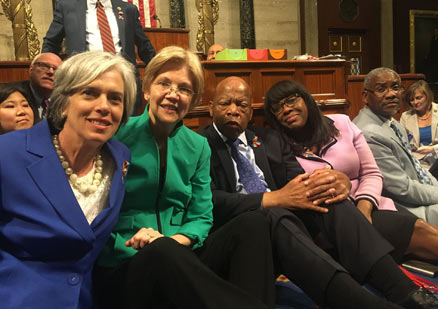
Delinquencia vs Los Evangelicos and those caught in between

I haven’t yet written anything about my Nicaragua trip and I hesitated to do so without giving it some thought. Just what did I see when I was there and how to explain it to my fellow Americans… lol?

This was my second trip to Central America and my first since 1985, when I came across a universe devastated by US-funded armed warfare. What had ensued in the 23 years since?

What I found was a land full of delinquents (common street criminals), hordes of Bible toting Evangelicals (funded from the US), and those trapped in the ‘crossfire’ between these 2 groups of ‘warriors’. Yes, it was almost a daily occurrence to be mugged by those carrying the Holy Book, or to be picked off by panhandlers, beggars, pick pockets, muggers, etc.

In fact, we spent much time with the family of my friend, Rafa. The concerns of his sister, Coco, were about a man who pulls down his pants weekly or so, and shits in th middle of the street in front of the house! I saw on another occasion, a woman bathing herself nude in the median strip of a 4 lane highway! And on 2 separate occasions, saw live power lines fall into the middle of the street amidst children playing. The lines were left that way for a day or so, then duct taped!!! back up to fall once again the next week ahead! Amongst such chaos, come the sale people for Jesus in humble groups of head bowed youth talking it up for God.

So what about all the people in between living in barrios of total neglect? What about the young people who did not want to be forced to choose between the 2 groups of religious fanatics and criminal gangs? The hordes of youth whose parents earn between $2-$7 a day? How to explain their world to you, Fellow American?

I can’t do it, so I have turned to a Nicaraguan group called Grupo Armado This work is called ‘Deeds, Not Words’ and captures the essence of a country sick to death of all the rhetoric of the Right Wing- US allied politicos. I encourage you to explore on youtube other videos of this group titled songs like ‘Racist’ or ‘Nica (Nicaraguan) in Costa Rica’. You can get a feel for the rage the youth have about their prospects in Nicaragua through listening some to this Latin heavy metal group.

I will write more soon about the further impressions I got in my journey with my daughter to Central America, Land of the Volcanoes. But the fear of the rampant crime by ‘delinquents’ runs rampant itself throughout all the countries of Central America. This is a result of US government foreign policy in the region more than any other reason. It has produced poverty and misery which in turn produced hordes of petty criminals that now harass the rest of society in the region.

Cesar Sandino versus the US drug fiends

Sandino official postal sealEmiliano Zapata was assassinated on this day, April 10, 1919.
 
The Poncho Villa or Emiliano Zapata of Central America, who like Zapata gave his name to a rebel movement that would eventually oust American imperialism from its shores, was Augusto Cesar Sandino. Did you know that is where the Sandinistas of Nicaragua (FSLN) got their name?

La soberanía de un pueblo no se discute,
se defiende con el arma en la mano.

Cesar Sandino fought an undeclared war against US Marines, which made him an illegal combatant. When Sandino captured a US aviator, tried him for having bombed innocent civilians, and sentenced him to hang –in American eyes, outside of the law– the US declared Sandino and his fighters to be terrorists and exempt from protection under the Hague Conventions.

Sandino fought the Americans for six years until he was assassinated during a cease-fire in 1933 by the Samoza regime which would rule Nicaragua with America’s backing until 1979. After 1979 Ronald Reagan and his Contras would redouble US persecution of the Nicaraguans.

The above image depicts a Nicaraguan freedom fighter about to decapitate a vanquished US marine. This served as Sandino’s official postal stamp. Sandino was equally eloquent in words:

Come on you pack of drug fiends, come on and murder us on our own land. I am waiting for you on my feet at the head of my patriotic soldiers, and I don’t care how many of you there are. You should know that when this happens, the destruction of your mighty power will make the Capitol shake in Washington, and your blood will redden the white dome that crowns the famous White House where you plot your crimes.

Ancient Costa Rica for sale

Denver-Art-Museum-LibeskindThe kids are still on Christmas break and are starting to show definite signs of cabin fever. To stave off a domestic implosion, we took a trip up to the Denver Art Museum yesterday. The DAM recently opened a spectacular addition designed by Daniel Libeskind, the architect chosen to rebuild the World Trade Center site. But I had an ulterior motive. I’d recently read about the DAMs 16,000-piece assemblage of pre-Columbian and Spanish Colonial art, including one of the world’s largest collections of Costa Rican artifacts, nearly 2,000 items, donated to the museum by Denver businessman, Frederick Mayer, and his wife. I wanted to check it out.

We’re planning a trip to Costa Rica. Although not much is known about pre-Columbian Costa Rica in comparison to the high cultures of Mexico and South America, recent excavations have uncovered numerous artifacts, including jade carvings. Jade is green and pretty and shiny, perfect for an art lover of my caliber, so I wanted to see it for myself. Call it a bit of research before hitting the craft markets in Sarchi!

Sure enough, Eric and I lost ourselves in a huge room filled with thousands of artifacts. Stone, ceramic, textiles, gold and, oh yes, jade. After an hour or so, we’d barely made a dent in the pre-Columbian collection. Vowing a subsequent visit to the Spanish Colonial galleries, we left to collect the kids before their art experience became Night-mare at the Museum.

As always, looking at ancient artifacts leads me into lofty reverie of past worlds and bare-chested warriors. But this time I couldn’t help but wonder about Jan and Frederick Mayer as well. Certainly amazement and appreciation for their commitment to art and to philanthropy. But really, how on earth had one couple managed to collect this much art from a small Central American country? And why aren’t many of the beautiful pieces residing in Costa Rica, teaching and providing inspiration to Costa Ricans? Especially because Costa Rican pre-Columbian history is not nearly as well-documented as that of its neighbors.

Costa Rica has taken significant measures to protect their natural environment from exploitation. Nearly 20% of the land is set aside for preserves, parks or refuges of some sort. But after my trip to the Denver Art Museum, I’m thinking that perhaps Costa Rica should endeavor to protect other national treasures, especially art created by the hands of largely unknown ancestors, from passionate and well-meaning American oilmen.

Jade museum Costa RicaI will visit the museums in San Jose and let you know how they measure up against the breathtaking Denver Art Museum, with its encyclopedic collection of pre-Columbian Costa Rican artifacts–and hopefully return with a few shiny jade replicas of my own!