
Wikileaks Jacob Appelbaum confounds US customs w Bill of Rights thumbdrive

US-based Wikileaks colleague Jacob Appelbaum has a humorous account of his reentry yesterday to the US. Flying into Newark last July his laptop was searched and his cell phones confiscated. This time Appelbaum tweeted ahead that the ACLU would be his welcoming party, among other measures, recounted through Twitter:

Tweets by ioerror

I am not practically able to transport electronic devices. I will be radio silent before, during, and for some time after my flight.

I think that it is unlikely that there will be any serious trouble. With secret courts and sealed orders… the only way to know is to go.

I’m heading to the airport from Reykjavik and expect to be in the US around 16:40 PST Monday afternoon. Perhaps everything will go smoothly.

I am out of the airport and back in Seattle. Nothing more for now, sleep time.

It’s very frustrating that I have to put so much consideration into talking about the kind of harassment that I am subjected to in airports.

I was detained, searched, and CBP did attempt to question me about the nature of my vacation upon landing in Seattle.

The CBP specifically wanted laptops and cell phones and were visibly unhappy when they discovered nothing of the sort.

I did however have a few USB thumb drives with a copy of the Bill of Rights encoded into the block device. They were unable to copy it.

The forensic specialist (who was friendly) explained that EnCase and FTK, with a write-blocker inline were unable to see the Bill of Rights.

I requested access my lawyer and was again denied. They stated I was I wasn’t under arrest and so I was not able to contact my lawyer.

The CBP (U.S. Customs and Border Protection) agent was waiting for me at the exit gate. Remember when it was our family and loved ones?

When I handed over my customs declaration form, the female agent was initially friendly. After pulling my record, she had a sour face.

She attempted to trick me by putting words into my mouth. She marked my card with a large box with the number 1 inside, sent me on my way.

While waiting for my baggage, I noticed the CBP agent watching me and of course after my bag arrived, I was “randomly” selected for search.

Only US customs has a random number generator worse than a mid-2007 Debian random number generator. Random? Hardly.

During the search, I made it quite clear that I had no laptop and no cell phone. Only USB drives with the Bill of Rights.

The CBP agent stated that I had posted on Twitter before my flight and that slip ended the debate about their random selection process.

The CBP agents in Seattle were nicer than ones in Newark. None of them implied I would be raped in prison for the rest of my life this time.

The CBP agent asked if the ACLU was really waiting. I confirmed the ACLU was waiting and they again denied me contact with legal help.

All in all, the detainment was around thirty minutes long. They all seemed quite distressed that I had no computer and no phone.

They were quite surprised to learn that Iceland had computers and that I didn’t have to bring my own.

There were of course the same lies and threats that I received last time. They even complemented me on work done regarding China and Iran.

I think there’s a major disconnect required to do that job and to also complement me on what they consider to be work against police states.

While it’s true that Communist China has never treated me as badly as CBP, I know this isn’t true for everyone who travels to China.

All in all, if you’re going to be detained, search, and harassed at the border in an extra-legal manner, I guess it’s Seattle over Newark.

It tok a great deal of thought before I posted about my experience because it honestly appears to make things worse for me in the future.

Even if it makes things worse for me, I refuse to be silent about state sponsored systematic detainment, searching, and harassment.

In case it is not abundantly clear: I have not ben arrested, nor charged with any crime, nor indicted in any way. Land of the free? Hardly.

I’m only counting from the time that we opened my luggage until it was closed. The airport was basically empty when I left.

It’s funny that the forensics guy uses EnCase. As it, like CBP, apparently couldn’t find a copy of the Bill of Rights I dd’ed into the disk.

The forensics guy apparently enjoyed the photo with my homeboy Knuth and he was really quite kind. The forensics guy in Newark? Not so much.

The CBP agent asked me for data – was I bringing data into the country? Where was all my data from the trip? Names, numbers, receipts, etc.

The mental environment that this creates for traveling is intense. Nothing is assured, nothing is secure, and nothing provides escape.

I resisted the temptation to give them a disk filled with /dev/random because I knew that reading them the Bill of Rights was enough hassle.

I’m flying to Toronto, Canada for work on Sunday and back through Seattle again a few days later. Should be a joy to meet these guys again.

All of this impacts my ability to work and takes a serious emotional toll on me. It’s absolutely unacceptable.

What happens if I take a device they can’t image? They take it. What about the stuff they give back? Back doored? Who knows?

Does it void a warranty if your government inserts a backdoor into your computer or phone? It certainly voids the trust I have in all of it.

I dread US Customs more than I dreaded walking across the border from Turkey to Iraq in 2005. That’s something worth noting.

I will probably never feel safe about traveling internationally with a computer or phones again.

None the less, safe or not, I won’t stop working on Tor. Nor will I cease traveling. I will adapt and I will win. A hard road worth taking.

A solid argument for free software: To check the integrity of your hardware and your software against tampering. No binary (firmware) blobs.

I’d like to think that when I visit my family in Canada this weekend and attend a work conference that Canada won’t hassle me. Am I dreaming?

Will the Canadian government simply act as an arm of the US policy of detaining, searching, and harassing me? Oh Canada! I hope not.

It’s interesting to note that some media initially reported that I had no trouble because I said nothing at all. Irony abounds.

My border experience reminds me of the old monochrome quote: “Land of the Free? Land of the Free Refill!”

Why do we allow US Customs to lie and to threaten people? It’s a crime to lie to them and they do it as their day job. Why the inequality?

Monkeywrench the new world order

The hammer and sickle are not the means of production anymore, as archaic as the monkeywrench and tomahawk of the Earth First logo have become to practicing eco-warriors. How is this for an updated combo? Quick-set epoxy and box-cutters.
A new direct action logo

Box-cutters
Alright, box-cutters are hugely symbolic. They can take down airliners. With or without USAID, the CIA or MOSSAD, commandos armed with nothing but box-cutters took down an empire. On 9/11/2001 King-of-the-Hill America was drawn out of its capitalist fortress to fight guerrilla insurrectionists on their turf. The US can kick ass with a bankroll, but militarily its cogs will mire like all who’ve overreached before.

Beyond the symbolism, box-cutters are a versatile disruptive tool. Where something’s held by a thread, band-aided, jerry-rigged, duct-taped, or held captive in plastic handcuffs, box-cutters liberate. And they cut a minimal profile through metal detectors or when you’re patted down. You can conceal the blade in your shoe, while the plastic reminder looks to density detectors like a brush handle.

Epoxy
By nearly all its definitions, friction is antagonist to function. And there’s no sand in the gears, or sugar in the tank, like glue. Where the capitalism machine depends on surfaces moving together like well oiled gears, a bonding agent is most unwelcome. The most obvious focal points for your little syringe of epoxy would be the locks on doors. Cars, buildings, wherever mundane dastard deeds are done. You can shut that down for a day or half-day while the lock cylinders are removed and replaced.

If you have a productive spree planned, buy your tools with cash, at stores without cameras, best out of town. Houses go burglarized without the police dusting for prints, but interrupt a capitalist enterprise and investigators will be tracing the chemical composition of that glue to trace batch from manufacturer to which hardware store.

Mentally challenged unfit for insurgency

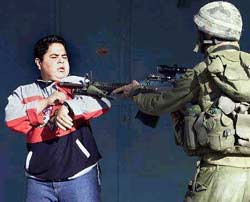
Indignity at the barrel of a gunUS disinformation forces in Iraq pointed recently to an insurgency so in its last throes, that it was desperate enough, and dastardly, sure enough, to press mentally retarded girls into service as suicide bombers. Soon enough our military was forced to recant that report. The young Iraqi women may have been bipolar, or depressed, but they didn’t have Down Syndrome, as cranial deformities caused by the bomb blasts had led the US forensics to conjecture. But the false accusation had its desired effect and there was worldwide condemnation of the Iraqi resistance. This story has irked me in both incarnations.

Namely, why in the name of the Special Olympics is it alright to presume the mentally handicapped could not rise to the challenge faced by their fellow insurgents?

That there would need to be suicide bombers is sad for anyone to contemplate. But a people oppressed by overwhelming military dominance have little recourse. The US drove the Japanese to resort to recruiting Kamikazis. The French pushed the Algerians to the most desperate efforts. The Soviets, the US and Israel have since left Afghans, Iraqis and Palestinians no option but “terrorism.” We don’t label carpet-bombing, detainment or torture as “terrorism,” but freedom fighters and their asymmetrical warfare is enough to terrorize us.

And so, to many Iraqis, maybe especially those orphaned by our invasion and occupation, to be a suicide bomber is to be put to the only strategy which may yet prove effective. Rocks thrown against tanks do nothing. Shots fired against armor-clad troops yield naught but a hail storm of higher caliber bullets. IEDs are now up against heavier mine-resistant vehicles. Civilians without access to artillery or high-tech triggering remotes have no choice but to deliver their angry message in person, guided and detonated by their brave partisan selves prepared to pay the price with their lives.

Of course a mentally disabled person cannot reasonably be considered to have understood enough to make such a profound sacrifice. But I’m surprised the PC crowd wouldn’t allow them the dignity to aspire to contribute to the cause of their fellow Iraqis. I’d venture to ask if their lives could have served a more honorable service. It must suck to be mentally handicapped in Iraq, considering the US has destroyed every semblance of health care service, and refuses to rebuild it. The US is killing the health-needy of Iraq, even as they accuse the insurgency of the exploitation/murder.

And which side cannot deny preying upon the retarded from which to recruit its troops? With casualties on the rise, American motives unmasked, the timetable interminable, and the prospect of surviving intact virtually null, who but the mentally challenged are signing up to “defend freedom” for Uncle Sam?

US is not sniping indiscriminantly 1-2-3

The good news is that US sniper teams may not be shooting at everyone they come across anymore, as has been alleged though seldom reported. After all, the rules of war apply to snipers just as they would ordinary soldiers or paintballers: don’t shoot at someone who’s not a combatant, who’s unarmed, or who’s otherwise surrendering. But under pressure to up their kills, US snipers are defying the Hague Conventions with such innovations as 1) bait/entrapment, 2) getting go-ahead to assassinate, and 3) using fingerprint identification to confirm eligibility for execution.

1. Bait and switch
The Asymmetric Warfare Group issues to US snipers “drop items,” insurgent-type items which may be planted on Iraqis they’ve shot, but much more productively, to use as bait to lure passing Iraqis, tempting empty-handed civilians to become item-wielding insurgents whom you don’t have to get permission to shoot. The Washington Post reports:

“Baiting is putting an object out there that we know they will use, with the intention of destroying the enemy,” Capt. Matthew P. Didier, the leader of an elite sniper scout platoon attached to the 1st Battalion of the 501st Infantry Regiment, said in a sworn statement. “Basically, we would put an item out there and watch it. If someone found the item, picked it up and attempted to leave with the item, we would engage the individual as I saw this as a sign they would use the item against U.S. Forces.”

2. Under suspicion is as good as being condemned
US snipers are executing targets if they can be confirmed as being suspects. With the cross hairs of your sniper scope aimed at your chosen Iraqi or Afghan, you can await authorization to pull the trigger based on learning the person’s identity, whether by informer or a shouted inquiry. Then according to the US rules of engagement you can terminate him. Here’s an example from the International Herald Tribune.

“From his position about 100 yards away, Master Sergeant Troy Anderson had a clear shot of the Afghan man standing outside a residential compound in a small village near the Pakistan border last October. And when Captain Dave Staffel, the Special Forces officer in charge, gave the order to shoot, Anderson fired a single bullet into the man’s head, killing him instantly.

…the shooting, near the village of Hasan Kheyl last October, was a textbook example of a classified mission completed in accordance with the American rules of engagement. The men said such rules allowed them to kill Buntangyar, whom the American military had designated a terrorist cell leader, once they positively identified him.”

3. Coming soon: fingerprint and biometric matching
In early 2008 US snipers will be given a more efficient system for making split decisions about whether their target may be summarily liquidated. Now with the subject in your sights, you can await instructions from an intelligence database about whether your target has a fingerprint, retina scan, or biometric profile in the records as a suspected insurgent. In which case, be he standing idle, detained or captive, you can shoot him. Read this account from the Washington Post about the JEFF:

“…the Joint Expeditionary Forensics Facilities (JEFF) project or “lab in a box,” analyzes biometrics. It will be delivered to Iraq at the beginning of 2008, the Navy said, to help distinguish insurgents from civilians.

…the military has been scanning the irises and taking the fingerprints of Iraqis, feeding a biometrics data base in West Virginia. To date, a few ad hoc labs have processed about 85,000 pieces of evidence taken from weapons caches or roadside devices.

Each collapsible, sand-colored, 20-by-20-foot unit has its own generator and satellite link. If things go as planned, data will beamed to the Biometric Fusion Center to check against more than a million Iraqi fingerprints.

The next stage is to miniaturize, create “a backpack lab,” so that soldiers who encounter a suspect “could find out within minutes” if he’s on a terrorist watch list, [says the JEFF weapon designer] “A war fighter needs to know one of three things: Do I let him go? Keep him? Or shoot him on the spot?”