US, not Assad, drops MOAB Weapon of Mass Destruction on Afghans, same MO used against Philly’s MOVE insurgents.


The US is bragging right now that it’s dropped a GBU-43/B MOAB, aka Massive Ordnance Air Blast Bomb, know in the Chairforce as a “Mother Of All Bombs” bomb, apparently the larger of non-nuclear bombs in its arsenal, on a suspected tunnel in Afghanistan, presumably full of Afghans. Will the UN condemn the US act and support coalition retaliatory airstrikes on the rogue regime which did it? No need for an investigation, we’re on TV admitting to the deed. Note the US war media are adding “in combat” and “on the battlefield” to their headlines although the command and control center allegedly targeted would be Islamic State’s DC.

If the US is going to insist that the MOAB bombing was legal under US rules of engagement, it would be hard to argue that Islamic State Terrorism (see what I did there) could not enjoy a comparable broad latitude.

Normally of course, US spokespeople would deny responsibility, but this bomb was too big. Too big not to break windows five miles away, and too big to smuggle into the hands of covert operatives so that we can say they did it.

A hero does not shoot an unarmed man in the back, then pose for trophy photo.


SORRY, NO. And I’ve seen this composition before. Abu Ghraib. Or any of the trophy shots found on the digital cameras of US soldiers in free fire zones. These officers are holding up for display a critically injured man struggling to breathe. Shortly he’ll be interrogated while still in intensive care, while America pretends this is justice.

Sergeant Jay Cook saw escapee David Sweat running for the dense woods. No, shooting an unarmed man in the back does not fall within rules of engagement, neither for border patrol nor fugitive manhunt. Sergeant Cook was among a posse of thousands, including all variety of aircraft and vehicles. Though Sweat had evaded capture for 21 days, this was the first direct sighting. Cook was too porcine to make chase, but did he think the prisoner could outrun everything else? Shooting Sweat twice in the back was an act of cowardice, like that of snipers or drone pilots. Jay Cook is an American Hero for the Police State.

Because you supported the troops, today we have to f-ck the police


If there’s a chant that unites protesters across America it is “FTP!” No matter the issue, from BLM to GMOs, excessive use of force by police against dissenting citizens is the common grievance. The UN has even condemned US human rights abuses, this time police violence and racial discrimination. Our emergant police state may be the business end of the New World Order, but its troubling conduct is directly traceable to US military rules of engagement. These violent cops are our vets!

Stuck with PTSD, no marketable skills, and a taste for blood, American soldiers are transitioning to law enforcement jobs where they’re already familiar with the militarized equipment and the shoot-to-kill MO. The irony of course is that many of America’s homeless are veterans who could not live with the acts they were made to do in Afghansitan and Iraq and elsewhere. Those that could are the cops beating them!

When American soldiers shot first and asked questions never, overseas, at vehicles or at civilians whose needs they did not understand, you shouted SUPPORT THE TROOPS. Now they’ve brought the war home with lethal force and indescriminate brutality. You asked for it, you got it.

US inhumanity maxed at Azimuth Limit

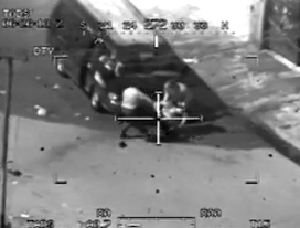
WikiLeaks video combat footage of 2007 collateral murder in Iraq“Light ’em all up. Come on, fire!” Watching the leaked combat footage of the helicopter gunships killing unarmed Iraqi civilians in 2007, I’m troubled by my own desensitized response. When I saw earlier leaked videos of an AH-64 vaporizing Iraqi farmers and a C-130 wreaking mayhem in Afghanistan, I remember my real shock at seeing a human life extinguished. This time not even flinch. “Just fuckin’, once you get on ’em just open ’em up.” Not at the brutality, nor the callousness of the play by play –even as the pilots targeted rescuers trying to help the wounded. I fault the Rules of Engagement that allowed the massacre, not the soldiers’ laughing swagger –as I hope they will not begrudge my unguarded satisfaction when eventually spectators will be treated to leaked footage of American soldiers taking some fire.

If you watched the video, perhaps you too were wishing that July 12, 2007 had recorded a massive setback for US troops in Iraq, at the height of the “surge” where a whole shitload of “dismounts” had been ambushed by IED explosions in a Baghdad square in the aftermath of a civilian massacre. Those who watched the 39-minute extended version I know were hoping to see a resolution like that, instead of an additional war crime of disproportional force and the targeting of civilians, a Hellfire missile attack on a building into which armed and unarmed men had entered, surrounded by passing innocents and rescuers scrambling to help.

There it goes! Look at that bitch go!
Patoosh!
Ah, sweet!
Need a little more room.
Nice missile.
Does it look good?
Sweet!

The Army has declared that no further inquiry will be made into the 2007 killing of the two Reuters journalists. Its FOIA requests long thwarted, even Reuters is not expressing outrage at this footage. Civilians and journalists about to be lit up The corporate media is hoping to let this story fade on the fringe. Does this mean that more pilots and gunners might become emboldened to leak other trophy reels? It doesn’t take Nelson Ratings for news outlets to see that viewers are already clamoring for more combat snuff films.

We could grant amnesty in exchange for those who turn in the most degenerate sequences.

And pretend they’ll remain anonymous. Ultimately friends and relatives will be able to place identities with the radio voices. Speaking on one of the clearest channels is the young voiced HOTEL-26, who reported taking fire from the photographers and ID’d the “RPG” with started the whole engagement. Likewise the gunner on CRAZY HORSE-18 who responded “Alright, hahaha, I hit ’em….” is addressed “God damn it, Kyle.”

And then there’s the poor 30mm gunner in CRAZY HORSE-19 who assessed his work thus:

Oh yeah, look at that. Right through the windshield! Ha ha!

While chomping at the bit to fire upon the improvised ambulance, he was momentarily thwarted by a puzzling “Azimuth Limit” which prevented his shooting.

Bloggers are now abuzz to decode the Azimuth Limit which slowed the turkey shoot when none of the gunners were showing restraint. Azimuth is the angular measurement of an object’s distance clockwise from True North. On rifles it expresses the adjustment of a gunsight to its boresight. On aircraft it apparently has something to do with the angle of relation to the axis of the fuselage. Whatever it is, maybe we can ratchet military Azimuth Limits down flat, if that’s what it will take to stop our soldiers from blowing away civilians, journalists, children and their rescuers alike. The shooters can cuss and salivate all they want so long as their trigger mechanisms respect human life or at least balk at excessive carnage.

What doesn’t come across the audio is what the US soldiers on the ground are saying to themselves as they survey “that big pile of [unarmed] bodies,” in their palaver, the “dead bastards.”

UPDATE — the testimonials begin:

From Iraq war veteran Michael Prysner, co-founder of March Forward!

The harrowing Apache footage released by WikiLeaks gives us a stomach-turning glimpse of war. Seventeen minutes of cold-blooded massacre in a war of more than seven years. A brief clip of one Apache video; a quick look at one part of one mission. Hundreds of those missions take place every day.

The video came to light thanks to military whistleblowers who provided it to WikiLeaks together with supporting documents.  Imagine if we had access to all such videos, the things we would see. Imagine all the Iraqis killed who have no one to uncover the truth about their deaths. Had the death of two Reuters news staffers not generated interest in this video, then the destruction of three families by hellfire missiles fired into an apartment building with no provocation, in a separate engagement also featured in the video, would have never been made public.

This massacre is a drop in a sea of blood. Many other such “incidents” will never be known.

Officers claimed there was “no question” that the pilots were responding to enemy fire; the video shows there is no question that they were not responding to enemy fire. They said that they had “no idea” how the journalists were killed; the video shows that they know very well how those journalists were killed. They were gunned down standing in a crowd of unarmed people.
After the slaughter of that group, the pilots beg for permission to kill the innocent passers-by who had come to the aid of one of the wounded, like any of us would have done if we saw our neighbor dying on the ground as we drove down the street. They kill everyone trying to help the dying journalist, and critically wound two children seen sitting in the front seat.

We see a group of unarmed men mowed down by a machine gun designed to destroy armored vehicles. We see a vanload of good Samaritans obliterated for trying to help a dying victim. We see all this with the soundtrack of the pilots mocking the dead, congratulating each other and laughing about the massacre.

No wonder the U.S. military goes to such great lengths to keep such videos from us. They want us to see Iraq and Afghanistan through their lens, through their embedded reporters, filtered by censorship and restrictions. They know that, once the people of this country see the extreme racism and brutality behind these occupations, they will be repulsed by what their tax dollars are paying for.

The military brass and the White House politicians have tried to justify this senseless atrocity. “Cut the pilots some slack. This was in Baghdad. This was a battle zone”—that’s been their line. The pilots had been indoctrinated with the same colonial mentality. “That’s what they get for bringing their kids into battle,” one pilot says.

The father driving that van was not “bringing his kids into battle.” He was bringing them to school, driving down the street where they live. But the U.S. occupation has made all of Iraq a battle zone. To those pilots, to their commanders over the radio and to the generals in the Pentagon, every single person in Baghdad and in Iraq is “fair game.”

The pilots joked about the people they killed, laughed about U.S. military vehicles running over dead bodies, knowing that their commanders were listening and that they were being recorded. They were not acting out of character. This is the culture of the occupation. This is how these wars are being conducted.

Having seen this, one cannot honestly believe that these atrocities are committed day in and day out for the liberation of the Iraqi people.

The Pentagon’s talking heads and media lackeys are hard at work putting their spin on this story. It’s time to tell the truth. For more than seven years, the U.S. has unleashed criminal, unprovoked aggression against the people of Iraq, and they have been doing the same thing in Afghanistan for more than eight years.

The U.S. military presence in Iraq is a colonial occupation force. The only way forward is a complete, immediate and unconditional withdrawal of all U.S. forces from Iraq and Afghanistan. This government will not do that unless all of us who are outraged by these criminal acts stand up and demand it.

Iraq war veteran Josh Stieber, US Army Specialist, 1st ID, Bravo Company 2-16 in Baghdad (Rustamiyah) 2007-2008. Although he was not present at the scene of the video, he knows those who were involved and is familiar with the environment.

A lot of my friends are in that video. After watching the video, I would definitely say that that is, nine times out of ten, the way things ended up. Killing was following military protocol. It was going along with the rules as they are.

If these videos shock and revolt you, they show the reality of what war is like. If you don’t like what you see in them, it means we should be working harder towards alternatives to war.

?

Errant missile a setback for 12 Afghans

NATO spokesmen are preempting accusations of insensitivity concerning two US rockets which killed twelve Afghan civilians in Marjah, the latest operation against the Taliban. Six of the unintended victims were children. Military brass are expressing worry that such collateral damage will prove a setback to winning the hearts and minds over the latest US antipersonnel maneuvers.

US Marines are complaining that new rules of engagements are making the fighting more arduous and protracted. The stricter rules dictate that US soldiers cannot fire at people unless they commit a hostile act or show intent. This new policy abides by Geneva Conventions, meaning the earlier rules did not.

Before its resurged insurgence, Fallujah was not considered a setback. In other headlines, Secretary of State Clinton declared that Iran is heading toward being a military-led regime, the potential of nuclear weapons posing a terrifying threat. I don’t know about Iran, can we say that about the USA?

Six Days in Fallujah if you missed the fun

Screenshot of Six Days in Fallujah first person shooter by AtomicAs virtual-gaming distributer Konami reconsiders its release of SIX DAYS IN FALLUJAH, gaming pundits ask “Is it too early to role-play the Second Battle of Fallujah?” To non-US-vets it’s known simply as “Fallujah,” as one would denote Lidice or Srebrenica, by name alone. I don’t know, when will it be appropriate to satiate the nostalgic veteran gamer’s appetite to reenact war crime?

The obvious sarcastic question would be to ponder if White Phosphorous is among the player’s arsenal. Likewise, in “free fire zones” where US rules of engagement permitted the shooting of anything that moved, do you accumulate points for killing the civilians or running them over with your tank?

It would be interesting to see how Atomic Games, neighbor of Blackwater, reenacts the raid on the Fallujah hospital, or the strafing of refuges trying to cross the river when US forces had blocked the infamous Blue Bridge. Are key episodes actionable, or do you sit by as the game cycles through the script, where women and very young children were let to pass to safety, but men and boys were forced to back to the city to be dispatched automatically as combatants.

Is there a game version of My Lai? Perhaps the entire manslaughter safari of the Tiger Force Unit in Vietnam. My guess is there would be plenty of takers. How about the Russian destruction of Chechnya, or the assault on the Warsaw Ghetto? Why not?

Until it becomes okay to blend hypothetical roleplay with real human tragedy, gamers will have to be satisfied with fictional scenarios like Grand Theft Auto and Chainsaw Massacre. I wonder if Amazon already has preorders for customers salivating at the first chance to replay the Manson LaBianca-Tate escapades, Ted Bundy’s cross-country trek, or if they’re jonesing over Iraq, the Haditha tea party and barbecue.

Black Pirates meted Southern Justice

US Navy Seals recover captive lifeboat from the USS Maersk Alabama
Dutch NATO forces rescued 20 hostages off the coast of Africa last week without loss of life. They thwarted a pirate attack, confiscated the booty, but must release the captured pirates owing to International Maritime Law. Contrast this with American cowboy rules of engagement.

Several US Navy warships faced a solitary lifeboat on which three teenage Somali pirated held hostage Maersk Alabama captain Richard Phillips. The covered lifeboat remained tethered to the stern of one of the Navy ships while negotiations, we’re told, progressed.

Going into day three, before the American TV audience could lose interest, US Navy Seals rescued the captive Phillips at a cost of a 100% casualty rate to the pirates. Although the DoD did not initially want to reveal its anti-pirate tactics, spokesmen have admitted that the “daring rescue” was in effect three precisely-simultaneous sniper shots to the heads of the three captors. The fourth pirate already having been entrusted to the US ship’s custody for medical care. The captain freed, the wounded pirate’s collateral was thus gone, and his grant of safe-passage was rescinded.

The official story is that US infrared imagery revealed that the American captive’s life was in danger. One of the pirates was holding a gun to his head, and this act prompted the snipers to intervene. Negotiations, apparently, were not proving fruitful. I’m guessing that this account reflects the exact opposite of what happened. The navy snipers had been holding their fire until the moment Captain Phillip was NOT in a pirate’s crosshairs.

Although the Somali pirates were just teens, I bet they knew from brutal experience, what most of us know from violent television, that holding your gun to a hostage’s head is the only way to prevent your rivals from gunning you down. Trapped in a lifeboat, the pirates knew that high powered US weaponry would be trained upon each of their heat silhouettes. The moment their captive was not in the predicted trajectory of the crossfire, nor threatened by a collateral death-spasm squeeze of a trigger, the pirates would be toast.

The rescue operation began with a greater-than-three number of US snipers aiming weapons at the little boat. The more the better, to assure that at every instant, complicated by the rocking and turning of the lifeboat in the waves, at least one sniper could claim one pirate, without the hostage laying vulnerable to leeward bullets. The images in the sniper scopes were wired to a director’s console, where the determination could be made when all three targets were spoken for, and the order could be given to fire. The last hurdle remained for the pirate who held his gun on the hostage to drop his guard for just an instant, lest he squeeze off a round into the hostage. Wanna bet that’s what happened?

Great marksmanship, no question. Plenty of training no doubt. We can take nothing away from the heroism shown in braving responsibility for jeopardizing Captain Phillip’s life. It is probably also a common law enforcement strategy. Although that doesn’t make it legal.

Unless the US Navy releases the targeting footage, we are unlikely to confirm the true sequence of events. But where the pirate’s gun was pointing makes a difference. The Navy is explaining that it acted because Phillips’ life was at stake. Otherwise, shooting people who are not shooting at you is considered underhanded.

The Dutch navy forces bay have bellyached that they had to turn loose their captured pirates, instead of leaving them imprisoned somewhere, but the Dutch had seized them in Somali waters, where the pirates operate as their nation’s only Coast Guard. The Dutch NATO commandos prevented an attack, and liberated the detainees being held by the de-facto Somali border agents, and their directive ended there.

The US on the other hand, executed three “Somali Pirates,” regardless the varying degree of culpability the individuals might have had.

Without a day in court, that’s extra-judicial murder. If you consider these were three African youths, it looks like a lynching.

Let’s take note, by whose account to we know what happened out on the high seas? Do we know even that these were pirates? Says who? I am simply playing devil’s advocate. Do we know these four youth weren’t stowaways? Perhaps they had been Shanghaied and attempted an escape via the Maersk Alabama’s lifeboat. Do we know what happened really? That’s what courts are there to decide.

Everything the American TV audience knows is from the mouths of the US military. What do we know? These youths might have been human-trafficking cargo, en route to or from war zones. They might have broken free, running straight into the Maersk’s convenient cover story that all inconvenient incidences can be labeled pirate attacks. Have we anybody’s word who has not been lying to us about war crimes everywhere, about the use of torture, about the true magnitude of renditions and secret prisons?

These black youths might just as well have been the captive sex slaves of the porky white contractor mercenaries who were planning to kill them while in the act of buggering them, but the damn Negroes slipped free. So the Navy Seals had to come play cleaner to the embarrassing mess. I exaggerate to emphasize: what the fuck do YOU know?!

“This is how the USA handles pirates” was basically our statement. Americans stateside cheered and grabbed their dicks. But overseas, and on the seas, the sentiment is much more wary. The US Navy has escalated the war on piracy. Now the rules of engagement for both sides is going to be shoot first, ask questions later.

Are the Somalis quaking in their pirate boots? When the news hit about what the Navy Seals did, the self-styled privateers of the Somali Coast redoubled their attacks on foreign ship traffic.

A letter from an American Soldier

I received a well written letter yesterday from an American Soldier. It was addressed to me, but I thought I’d post his arguments for general comment.

Mr. Verlo,

I stumbled upon your website by a pure stroke of accidental misfortune while searching for current news on the Fort Carson Installation.. My wife, my son and I are from Colorado, and I am an American Soldier. I am college educated and studied Middle-Eastern history, and I am well versed as it pertains to Mesopotamia, global-terror and global insurgencies.

I have deployed to Iraq twice and Afghanistan once. In 2003-2004 I served in Al-Fallujah and Ar-Ramadi in the Al-Anbar province, and in 2005-2006 in Tal’afar in the western Ninewah province with the 3d Armored Cavalry from Fort Carson (maybe you heard about the letter that Najim Abdullah wrote to George Bush about my unit?).

I spent seven months in Afghanistan training Afghani Security Forces, and would go back again to either country to serve for one reason only: to support my Soldiers. Although I am career-military, I do not now, nor did I ever support the Bush Administration or the pretenses under which we invaded Iraq. But, unfortunately, our elected officials thrust us into this mess, and we (Americans and American Military alike) are essentially left to deal with it. I am writing to you to comment on a few articles that you have authored, and provide my own opinions and citations.

First, in your article titled: “It’s in the Percentages”, you note that “apparently” 30% of Soldiers don’t have a high school education, 30% are returning with PTSD and 25% percent of their children are considered “special needs”. These are very interesting statistics, yet, you provided no citations. You go on to state that (and I quote): “I find it an absolute nightmare to imagine soldiers in positions of authority, making life and death decisions over others, who don’t know right from wrong, history from high stakes poker, or intelligence from drunken stupor. How do you reason with someone whose only motivation is their next beer?” and “It’s a war crime to subject civilian populations to rule by incompetents”. Again, very interesting. Here are some solid statistics for you, as well as citations. I chose to contrast military service members to college students in this case, but the same could be applied to any demographic (i.e., individuals who were recently laid off nation-wide, or illegal immigrants).

– 40% of college students who come from middle to upper class families engage in binge drinking on a regular (weekly) basis, as opposed to 26% of military personnel who have recently returned from combat tours overseas, where they suffered some sort of physical and/or emotional trauma (ABC news poll, 2007/2008). In addition, over 22,000 service members have called suicide hotlines in an attempt to get help (VA poll, 2008).

– 20% of college students engage in heavy drug use, as opposed to less than 5% of military personnel (ABC News Poll, 2007).

Here’s my favorite one:

3% of all college women report sexual assault at some point in their college career. In 2007, there were 2,212 reported cases of sexual assault on military installations by service members. In a military that exceeds roughly 2,000,000 people, that’s less than 1%.

Second, in your article titled: “Turning out to support fewer Troops”, you allude to Soldiers “riding in on a black cloud”. Hmmm, I’m not quite sure I understand that one. Is this a reference to the environmental damage we do with our vehicles, or the perceived “evil” that we bring with us because we are all, in fact, rapists, murderers and psychopaths?

Third, in your article titled: “Colorado Springs Military Community”, you state that (and I quote) “FIVE MAJOR MILITARY INSTALLATIONS ALREADY AND THE CITY AND COUNTY ARE BROKE”. El Paso County is broke? Since when? I would love to see a citation in reference to this one, because I have “Googled” it to no end and have found nothing that would lead me to believe anything but the contrary. The Colorado Springs Economic Development Corporation reports that: “Colorado Springs has a 3.1 million labor force within an hour radius, a Fast track permitting and planning program (30-60 days), 27 Fortune 500 Companies and a quality of life which is 70% the cost of coastal communities” (CSEDC 2008).

Sir, I have read your opinions on the media (many of which I share with you, by the way), so I would presume that you think this is a fabrication. Here’s the bottom line; the military presence in Colorado (the big, scary war-machine that we are) boosts the economy of the area due to its service members buying cars, houses (and paying taxes on their properties), shopping at local businesses, applying for and receiving loans from local banks, etc. There is no doubt in my mind that if the military left Colorado Springs, the city would continue to thrive, but the economy would noticeably decline anywhere that 30,000 people leave, military or not.

Fourth and final, in your article titled: “On Jan 14 let us not expand Fort Carson”, you state that more military in the area would make (and I quote) “Colorado Springs even more dependent on poor paying jobs, predatory businesses, and skyrocketing social problems. Only developers, car-dealers, pawn shops, strip clubs, liquor stores, social workers, jails and mortuaries benefit from a higher soldier population”. Wow, seriously? These are only issues tied to the influx of more military in the area? So, if 3,000 recently released convicted felons chose Colorado Springs as their new home, it would have less of an impact? Or how about 3,000 illegal immigrants, or 3,000 pregnant teenagers?

Well, let’s go ahead and analyze this a bit further. Developers and car-dealers will benefit from ANY new arrivals to the area, not just military. In reference to pawn shops and strip clubs, the owners of these businesses know exactly what they are doing by placing them outside of military installations. Service members are targeted by these establishments. That’s why they are placed where they are in the community. The same can be said for pay-day loan houses and used car dealerships on Powers and Academy blvd. But if you placed strip clubs next to colleges, would it still be the military that held the higher attendance record? It’s all about business strategy my friend, not the assumption that all military service members are sex-crazed, alcoholic lunatics.

Social workers, jails and mortuaries benefit wherever there are people with problems, criminals and people who have died. I suppose that again, it’s only military who fall into these categories. Ah yes, and our children are even more screwed up than we are. The fact that you said (and I quote): “The rest of us suffer increased crime and their children’s behavioral problems in our schools” vividly displays your utter incompetence and lack of any compassionate notion. You realize that less than 30% of military children who have been separated from a parent experience behavioral issues (USA Today poll, 2008)? The percentage of non-military children who experience behavioral issues as a result of a parent’s incarceration, or divorce, or even domestic abuse is almost twice as high.

Sir, I will be the first to admit that military service members are not perfect. But we are human beings, who are susceptible to the same things that civilians are. We are an easy target, because so many of us are returning home from Iraq and Afghanistan with severe problems, after having served in a war that has lost most of it’s public support (and rightly so).

What I have a hard time understanding is why people such as you exercise your freedoms of speech, protest, religion, etc, and then malign the very people who provide, protect and preserve those liberties? I am as anti-Bush as the average American left-wing protestor, but to blame service members for the actions of their elected leadership is immoral. You are essentially grouping us with Nazi’s, which is absolutely ridiculous. The Nazis’ goal was global domination, and they had no clearly defined rule of engagement. They knew that what they were doing was wrong, and did it anyway.

Does the US Military have people who behave in this manner? Absolutely, and they are dealt with within the justice system for their actions. We are in fact “just following orders” with our presence in the Middle-East. As I realize that this was also the defense of Nazi war criminals at Nurnberg, allow me to elaborate. The US military has clearly defined Rules of Engagement, and our greater mission is to stabilize an unstable region, not global control as conspiracy theorists would have everyone believe. Unless you have a solid understanding of counter-terror and counterinsurgency doctrine, you are in no position to presume anything about the US Military in the Middle-East (unless YOU have been there) other than the fact that we invaded Iraq under false pretenses. I’ll give you that one, and take it for myself as well.

Sir, have you ever held a young Iraqi child in your arms, returning him to his parents as they kiss you and your Soldiers’ cheeks, after he had been treated at a US facility because terrorists sodomized him and cut out his tongue? Have you ever looked straight into the eyes of a terrorist, who swore allegiance to Zarqawi and proclaimed himself a “holy warrior”, and seen pure evil? And while your medical personnel treated him for burns (which were sustained when he poured kerosene on a child and his father and attempted to set them on fire publicly, only succeeding to set himself on fire) he spoke perfect English and vowed to remember your name and kill your family? I presume you would view this as our fault, correct?

But here’s the difference between the American Soldier and everyone else: when it is our fault, we acknowledge it, and DO something about it. We help people, good and bad, bottom line. Do bad things happen? Of course. Are all Soldiers and Marines upright citizens? Of course not.. That’s why one Marine out of 30,000 threw a puppy off of a cliff, and four Soldiers out of 121,000 raped a 14-year old girl and killed her family. These actions were inexcusable and tragic, and the individuals in question were/are being dealt with. To generalize every American service member based on these isolated incidents vividly shows your lack of any rational thought.

So in closing, allow me to say that whether you care to acknowledge it or not, it is the MILITARY who grant and preserve liberties and who TRULY make a difference, not politicians, protestors, or half-minded anti-war bloggers. And understand (or don’t) why we are involved in the Global War on Terror, it is because it doesn’t matter whether or not you are white, black, Canadian, American, gay, straight, blind, deaf, or how many anti-Bush websites you manage or protests you attend, there are fundamentalist extremists who want to murder you and your family because you represent western culture.

I want this war to be over so badly that it consumes me at times. I do not want my son to have to see what I have seen as a result of a failed administration. Sir, we are human beings also, and I gladly serve to protect the liberty and freedom of individuals like you who don’t support me at all. So at your next rally, or the next article you write which slanders US service members, take a moment to reflect on your freedoms, and understand who it is that truly grants them. I wish you all continued health and happiness.

Sincerely,

[D.]

Global economic rapists are at it again

G8 protest
Why protest the G8 Summit July 7-9? Those hoodlums always look so determined. Here’s the rationale by the Emergency Exit Collective:

The 2008 G8 on Hokkaido, a Strategic Assessment
Emergency Exit Collective
Bristol, Mayday, 2008

The authors of this document are a collection of activists, scholars, and writers currently based in the United States and Western Europe who have gotten to know and work with each other in the movement against capitalist globalization. We’re writing this at the request of some members of No! G8 Action Japan, who asked us for a broad strategic analysis of the state of struggle as we see it, and particularly, of the role of the G8, what it represents, the dangers and opportunities that may lie hidden in the moment. It is in no sense programmatic. Mainly, it is an attempt to develop tools that we hope will be helpful for organizers, or for anyone engaged in the struggle against global capital.

I
It is our condition as human beings that we produce our lives in common.

II
Let us then try to see the world from the perspective of the planet’s commoners, taking the word in that sense: those whose most essential tradition is cooperation in the making and maintenance of human social life, yet who have had to do so under conditions of suffering and separation; deprived, ignored, devalued, divided into hierarchies, pitted against each other for our very physical survival. In one sense we are all commoners. But it’s equally true that just about everyone, at least in some ways, at some points, plays the role of the rulers—of those who expropriate, devalue and divide—or at the very least benefits from such divisions.

Obviously some do more than others. It is at the peak of this pyramid that we encounter groups like the G8.

III
The G8’s perspective is that of the aristocrats, the rulers: those who command and maintain that global machinery of violence that defends existing borders and lines of separation: whether national borders with their detention camps for migrants, or property regimes, with their prisons for the poor. They live by constantly claiming title to the products of others collective creativity and labour, and in thus doing they create the poor; they create scarcity in the midst of plenty, and divide us on a daily basis; they create financial districts that loot resources from across the world, and in thus doing they turn the spirit of human creativity into a spiritual desert; close or privatize parks, public water taps and libraries, hospitals, youth centers, universities, schools, public swimming pools, and instead endlessly build shopping malls that channels convivial life into a means of commodity circulation; work toward turning global ecological catastrophe into business opportunities.

These are the people who presume to speak in the name of the “international community” even as they hide in their gated communities or meet protected by phalanxes of riot cops. It is critical to bear in mind that the ultimate aim of their policies is never to create community but to introduce and maintain divisions that set common people at each other’s throats. The neoliberal project, which has been their main instrument for doing so for the last three decades, is premised on a constant effort either to uproot or destroy any communal or democratic system whereby ordinary people govern their own affairs or maintain common resources for the common good, or, to reorganize each tiny remaining commons as an isolated node in a market system in which livelihood is never guaranteed, where the gain of one community must necessarily be at the expense of others. Insofar as they are willing to appeal to high-minded principles of common humanity, and encourage global cooperation, only and exactly to the extent that is required to maintain this system of universal competition.

IV
At the present time, the G8—the annual summit of the leaders of “industrial democracies”—is the key coordinative institution charged with the task of maintaining this neoliberal project, or of reforming it, revising it, adapting it to the changing condition of planetary class relations. The role of the G8 has always been to define the broad strategic horizons through which the next wave of planetary capital accumulation can occur. This means that its main task is to answer the question of how 3?4 in the present conditions of multiple crises and struggles 3?4 to subordinate social relations among the producing commoners of the planet to capital’s supreme value: profit.

V
Originally founded as the G7 in 1975 as a means of coordinating financial strategies for dealing with the ‘70s energy crisis, then expanded after the end of the Cold War to include Russia, its currently face a moment of profound impasse in the governance of planetary class relations: the greatest since the ‘70s energy crisis itself.

VI
The ‘70s energy crisis represented the final death-pangs of what might be termed the Cold War settlement, shattered by a quarter century of popular struggle. It’s worth returning briefly to this history.

The geopolitical arrangements put in place after World War II were above all designed to forestall the threat of revolution. In the immediate wake of the war, not only did much of the world lie in ruins, most of world’s population had abandoned any assumption about the inevitability of existing social arrangements. The advent of the Cold War had the effect of boxing movements for social change into a bipolar straightjacket. On the one hand, the former Allied and Axis powers that were later to unite in the G7 (the US, Canada, UK, France, Italy, Germany, Japan)—the “industrialized democracies”, as they like to call themselves—engaged in a massive project of co-optation. Their governments continued the process, begun in the ‘30s, of taking over social welfare institutions that had originally been created by popular movements (from insurance schemes to public libraries), even to expand them, on condition that they now be managed by state-appointed bureaucracies rather than by those who used them, buying off unions and the working classes more generally with policies meant to guarantee high wages, job security and the promise of educational advance—all in exchange for political loyalty, productivity increases and wage divisions within national and planetary working class itself. The Sino-Soviet bloc—which effectively became a kind of junior partner within the overall power structure, and its allies remained to trap revolutionary energies into the task of reproducing similar bureaucracies elsewhere. Both the US and USSR secured their dominance after the war by refusing to demobilize, instead locking the planet in a permanent threat of nuclear annihilation, a terrible vision of absolute cosmic power.

VII
Almost immediately, though, this arrangement was challenged by a series of revolts from those whose work was required to maintain the system, but who were, effectively, left outside the deal: first, peasants and the urban poor in the colonies and former colonies of the Global South, next, disenfranchised minorities in the home countries (in the US, the Civil Rights movement, then Black Power), and finally and most significantly, by the explosion of the women’s movement of the late ‘60s and early ‘70s—the revolt of that majority of humanity whose largely unremunerated labor made the very existence “the economy” possible. This appears to have been the tipping point.

VIII
The problem was that the Cold War settlement was never meant to include everyone. It by definition couldn’t. Once matters reached tipping point, then, the rulers scotched the settlement. All deals were off. The oil shock was first edge of the counter-offensive, breaking the back of existing working class organizations, driving home the message that there was nothing guaranteed about prosperity. Under the aegis of the newly hatched G7, this counter-offensive involved a series of interwoven strategies that were later to give rise to what is known as neoliberalism.

IX
These strategies resulted in what came to be known as “Structural Adjustment” both in the North and in the South, accompanied by trade and financial liberalization. This, in turn, made possible crucial structural changes in our planetary production in common extending the role of the market to discipline our lives and divide us into more and more polarized wage hierarchy. This involved:

· In the immediate wake of ‘70s oil shock, petrodollars were recycled from OPEC into Northern banks that then lent them, at extortionate rates of interest, to developing countries of the Global South. This was the origin of the famous “Third World Debt Crisis.” The existence of this debt allowed institutions like the IMF to impose its monetarist orthodoxy on most of the planet for roughly twenty years, in the process, stripping away most of even those modest social protections that had been won by the world’s poor—large numbers of whom were plunged into a situation of absolute desperation.

· It also opened a period of new enclosures through the capitalist imposition of structural adjustment policies, manipulation of environmental and social catastrophes like war, or for that matter through the authoritarian dictates of “socialist” regimes. Through such means, large sections of the world’s population have over the past thirty years been dispossessed from resources previously held in common, either by dint of long traditions, or as the fruits of past struggles and past settlements.

· Through financial deregulation and trade liberalization, neoliberal capital, which emerged from the G7 strategies to deal with the 1970s crisis aimed thus at turning the “class war” in communities, factories, offices, streets and fields against the engine of competition, into a planetary “civil war”, pitting each community of commoners against every other community of commoners.

· Neoliberal capital has done this by imposing an ethos of “efficiency” and rhetoric of “lowering the costs of production” applied so broadly that mechanisms of competition have come to pervade every sphere of life. In fact these terms are euphemisms, for a more fundamental demand: that capital be exempt from taking any reduction in profit to finance the costs of reproduction of human bodies and their social and natural environments (which it does not count as costs) and which are, effectively, “exernalized” onto communities and nature.

· The enclosure of resources and entitlements won in previous generations of struggles both in the North and the South, in turn, created the conditions for increasing the wage hierarchies (both global and local), by which commoners work for capital—wage hierarchies reproduced economically through pervasive competition, but culturally, through male dominance, xenophobia and racism. These wage gaps, in turn, made it possible to reduce the value of Northern workers’ labour power, by introducing commodities that enter in their wage basket at a fraction of what their cost might otherwise have been. The planetary expansion of sweatshops means that American workers (for example) can buy cargo pants or lawn-mowers made in Cambodia at Walmart, or buy tomatoes grown by undocumented Mexican workers in California, or even, in many cases, hire Jamaican or Filipina nurses to take care of children and aged grandparents at such low prices, that their employers have been able to lower real wages without pushing most of them into penury. In the South, meanwhile, this situation has made it possible to discipline new masses of workers into factories and assembly lines, fields and offices, thus extending enormously capital’s reach in defining the terms—the what, the how, the how much—of social production.

· These different forms of enclosures, both North and South, mean that commoners have become increasingly dependent on the market to reproduce their livelihoods, with less power to resist the violence and arrogance of those whose priorities is only to seek profit, less power to set a limit to the market discipline running their lives, more prone to turn against one another in wars with other commoners who share the same pressures of having to run the same competitive race, but not the same rights and the same access to the wage. All this has meant a generalized state of precarity, where nothing can be taken for granted.

X
In turn, this manipulation of currency and commodity flows constituting neoliberal globalization became the basis for the creation of the planet’s first genuine global bureaucracy.

· This was multi-tiered, with finance capital at the peak, then the ever-expanding trade bureaucracies (IMF, WTO, EU, World Bank, etc), then transnational corporations, and finally, the endless varieties of NGOs that proliferated throughout the period—almost all of which shared the same neoliberal orthodoxy, even as they substituted themselves for social welfare functions once reserved for states.

· The existence of this overarching apparatus, in turn, allowed poorer countries previously under the control of authoritarian regimes beholden to one or another side in the Cold War to adopt “democratic” forms of government. This did allow a restoration of formal civil liberties, but very little that could really merit the name of democracy (the rule of the “demos”, i.e., of the commoners). They were in fact constitutional republics, and the overwhelming trend during the period was to strip legislatures, that branch of government most open to popular pressure, of most of their powers, which were increasingly shifted to the executive and judicial branches, even as these latter, in turn, largely ended up enacting policies developed overseas, by global bureaucrats.

· This entire bureaucratic arrangement was justified, paradoxically enough, by an ideology of extreme individualism. On the level of ideas, neoliberalism relied on a systematic cooptation of the themes of popular struggle of the ‘60s: autonomy, pleasure, personal liberation, the rejection of all forms of bureaucratic control and authority. All these were repackaged as the very essence of capitalism, and the market reframed as a revolutionary force of liberation.

· The entire arrangement, in turn, was made possible by a preemptive attitude towards popular struggle. The breaking of unions and retreat of mass social movements from the late ‘70s onwards was only made possible by a massive shift of state resources into the machinery of violence: armies, prisons and police (secret and otherwise) and an endless variety of private “security services”, all with their attendant propaganda machines, which tended to increase even as other forms of social spending were cut back, among other things absorbing increasing portions of the former proletariat, making the security apparatus an increasingly large proportion of total social spending. This approach has been very successful in holding back mass opposition to capital in much of the world (especially West Europe and North America), and above all, in making it possible to argue there are no viable alternatives. But in doing so, has created strains on the system so profound it threatens to undermine it entirely.

XI
The latter point deserves elaboration. The element of force is, on any number of levels, the weak point of the system. This is not only on the constitutional level, where the question of how to integrate the emerging global bureaucratic apparatus, and existing military arrangements, has never been resolved. It is above all an economic problem. It is quite clear that the maintenance of elaborate security machinery is an absolute imperative of neoliberalism. One need only observe what happened with the collapse of the Soviet bloc in Eastern Europe: where one might have expected the Cold War victors to demand the dismantling of the army, secret police and secret prisons, and to maintain and develop the existing industrial base, in fact, what they did was absolutely the opposite: in fact, the only part of the industrial base that has managed fully to maintain itself has been the parts required to maintained the security apparatus itself! Critical too is the element of preemption: the governing classes in North America, for example, are willing to go to almost unimaginable lengths to ensure social movements never feel they are accomplishing anything. The current Gulf War is an excellent example: US military operations appear to be organized first and foremost to be protest-proof, to ensure that what happened in Vietnam (mass mobilization at home, widespread revolt within the army overseas) could never be repeated. This means above all that US casualties must always be kept to a minimum. The result are rules of engagement, and practices like the use of air power within cities ostensibly already controlled by occupation forces, so obviously guaranteed to maximize the killing of innocents and galvanizing hatred against the occupiers that they ensure the war itself cannot be won. Yet this approach can be taken as the very paradigm for neoliberal security regimes. Consider security arrangements around trade summits, where police are so determined prevent protestors from achieving tactical victories that they are often willing to effectively shut down the summits themselves. So too in overall strategy. In North America, such enormous resources are poured into the apparatus of repression, militarization, and propaganda that class struggle, labor action, mass movements seem to disappear entirely. It is thus possible to claim we have entered a new age where old conflicts are irrelevant. This is tremendously demoralizing of course for opponents of the system; but those running the system seem to find that demoralization so essential they don’t seem to care that the resultant apparatus (police, prisons, military, etc) is, effectively, sinking the entire US economy under its dead weight.

XII
The current crisis is not primarily geopolitical in nature. It is a crisis of neoliberalism itself. But it takes place against the backdrop of profound geopolitical realignments. The decline of North American power, both economic and geopolitical has been accompanied by the rise of Northeast Asia (and to a increasing extent, South Asia as well). While the Northeast Asian region is still divided by painful Cold War cleavages—the fortified lines across the Taiwan straits and at the 38th parallel in Korea…—the sheer realities of economic entanglement can be expected to lead to a gradual easing of tensions and a rise to global hegemony, as the region becomes the new center of gravity of the global economy, of the creation of new science and technology, ultimately, of political and military power. This may, quite likely, be a gradual and lengthy process. But in the meantime, very old patterns are rapidly reemerging: China reestablishing relations with ancient tributary states from Korea to Vietnam, radical Islamists attempting to reestablish their ancient role as the guardians of finance and piety at the in the Central Asian caravan routes and across Indian Ocean, every sort of Medieval trade diaspora reemerging… In the process, old political models remerge as well: the Chinese principle of the state transcending law, the Islamic principle of a legal order transcending any state. Everywhere, we see the revival too of ancient forms of exploitation—feudalism, slavery, debt peonage—often entangled in the newest forms of technology, but still echoing all the worst abuses of the Middle Ages. A scramble for resources has begun, with US occupation of Iraq and saber-rattling throughout the surrounding region clearly meant (at least in part) to place a potential stranglehold the energy supply of China; Chinese attempts to outflank with its own scramble for Africa, with increasing forays into South America and even Eastern Europe. The Chinese invasion into Africa (not as of yet at least a military invasion, but already involving the movement of hundreds of thousands of people), is changing the world in ways that will probably be felt for centuries. Meanwhile, the nations of South America, the first victims of the “Washington consensus” have managed to largely wriggle free from the US colonial orbit, while the US, its forces tied down in the Middle East, has for the moment at least abandoned it, is desperately struggling to keep its grip Mexico, Central America and the Caribbean—its own “near abroad”.

XIII
In another age all this might have led to war—that is, not just colonial occupations, police actions, or proxy wars (which are obviously already taking place), but direct military confrontations between the armies of major powers. It still could; accidents happen; but there is reason to believe that, when it comes to moments of critical decision, the loyalties of the global elites are increasingly to each other, and not to the national entities for whom they claim to speak. There is some compelling evidence for this.

Take for example when the US elites panicked at the prospect of the massive budget surpluses of the late 1990s. As Alan Greenspan, head of the Federal Reserve at the time warned, if these were allowed to stand they would have flooded government coffers with so many trillions of dollars that it could only have lead to some form of creeping socialism, even, he predicted, to the government acquiring “equity stakes” in key US corporations. The more excitable of capitalism’s managers actually began contemplating scenarios where the capitalist system itself would be imperiled. The only possible solution was massive tax cuts; these were duly enacted, and did indeed manage to turn surpluses into enormous deficits, financed by the sale of treasury bonds to Japan and China. Conditions have thus now reached a point where it is beginning to look as if the most likely long term outcome for the US (its technological and industrial base decaying, sinking under the burden of its enormous security spending) will be to end up serve as junior partner and military enforcer for East Asia capital. Its rulers, or at least a significant proportion of them, would prefer to hand global hegemony to the rulers of China (provided the latter abandon Communism) than to return to any sort of New Deal compromise with their “own” working classes.

A second example lies in the origins of what has been called the current “Bretton Woods II” system of currency arrangements, which underline a close working together of some “surplus” and “deficit” countries within global circuits. The macroeconomic manifestation of the planetary restructuring outlined in XIX underlines both the huge US trade deficit that so much seem to worry many commentators, and the possibility to continually generate new debt instruments like the one that has recently resulted in the sub-prime crisis. The ongoing recycling of accumulated surplus of countries exporting to the USA such as China and oil producing countries is what has allowed financiers to create new credit instruments in the USA. Hence, the “deal” offered by the masters in the United States to its commoners has been this: ‘you, give us a relative social peace and accept capitalist markets as the main means through which you reproduce your own livelihoods, and we will give you access to cheaper consumption goods, access to credit for buying cars and homes, and access to education, health, pensions and social security through the speculative means of stock markets and housing prices.’ Similar compromises were reached in all the G8 countries.

Meanwhile, there is the problem of maintaining any sort of social peace with the hundreds of millions of unemployed, underemployed, dispossessed commoners currently swelling the shanty-towns of Asia, Africa, and Latin America as a result of ongoing enclosures (which have speeded up within China and India in particular, even as “structural adjustment policies” in Africa and Latin America have been derailed). Any prospect of maintaining peace in these circumstances would ordinarily require either extremely high rates of economic growth—which globally have not been forthcoming, since outside of China, growth rates in the developing world have been much lower than they were in the ‘50s, ‘60s, or even ‘70s—or extremely high levels of repression, lest matters descend into rebellion or generalized civil war. The latter has of course occurred in many parts of the world currently neglected by capital, but in favored regions, such as the coastal provinces of China, or “free trade” zones of India, Egypt, or Mexico, commoners are being offered a different sort of deal: industrial employment at wages that, while very low by international standards, are still substantially higher than anything currently obtainable in the impoverished countryside; and above all the promise, through the intervention of Western markets and (privatized) knowledge, of gradually improving conditions of living. While over the least few years wages in many such areas seem to be growing, thanks to the intensification of popular struggles, such gains are inherently vulnerable: the effect of recent food inflation has been to cut real wages back dramatically—and threaten millions with starvation.

What we really want to stress here, though, is that the long-term promise being offered to the South is just as untenable as the idea that US or European consumers can indefinitely expand their conditions of life through the use of mortgages and credit cards.

What’s being offered the new dispossessed is a transposition of the American dream. The idea is that the lifestyle and consumption patterns of existing Chinese, Indian, or Brazilian or Zambian urban middle classes (already modeled on Northern ones) will eventually become available to the children of today’s miners, maquila or plantation laborers, until, ultimately, everyone on earth is brought up to roughly the same level of consumption. Put in these terms, the argument is absurd. The idea that all six billion of us can become “middle class” is obviously impossible. First of all there is a simple problem of resources. It doesn’t matter how many bottles we recycle or how energy efficient are the light bulbs we use, there’s just no way the earth’s ecosystem can accommodate six billion people driving in private cars to work in air-conditioned cubicles before periodically flying off to vacation in Acapulco or Tahiti. To maintain the style of living and producing in common we now identify with “middle classness” on a planetary scale would require several additional planets.

This much has been pointed out repeatedly. But the second point is no less important. What this vision of betterment ultimately proposes is that it would be possible to build universal prosperity and human dignity on a system of wage labor. This is fantasy. Historically, wages are always the contractual face for system of command and degradation, and a means of disguising exploitation: expressing value for work only on condition of stealing value without work— and there is no reason to believe they could ever be anything else. This is why, as history has also shown, human beings will always avoid working for wages if they have any other viable option. For a system based on wage labor to come into being, such options must therefore be made unavailable. This in turn means that such systems are always premised on structures of exclusion: on the prior existence of borders and property regimes maintained by violence. Finally, historically, it has always proved impossible to maintain any sizeable class of wage-earners in relative prosperity without basing that prosperity, directly or indirectly, on the unwaged labor of others—on slave-labor, women’s domestic labor, the forced labor of colonial subjects, the work of women and men in peasant communities halfway around the world—by people who are even more systematically exploited, degraded, and immiserated. For that reason, such systems have always depended not only on setting wage-earners against each other by inciting bigotry, prejudice, hostility, resentment, violence, but also by inciting the same between men and women, between the people of different continents (“race”), between the generations.

From the perspective of the whole, then, the dream of universal middle class “betterment” must necessarily be an illusion constructed in between the Scylla of ecological disaster, and the Charybdis of poverty, detritus, and hatred: precisely, the two pillars of today’s strategic impasse faced by the G8.

XIV
How then do we describe the current impasse of capitalist governance?

To a large degree, it is the effect of a sudden and extremely effective upswing of popular resistance—one all the more extraordinary considering the huge resources that had been invested in preventing such movements from breaking out.

On the one hand, the turn of the millennium saw a vast and sudden flowering of new anti-capitalist movements, a veritable planetary uprising against neoliberalism by commoners in Latin America, India, Africa, Asia, across the North Atlantic world’s former colonies and ultimately, within the cities of the former colonial powers themselves. As a result, the neoliberal project lies shattered. What came to be called the “anti-globalization” movement took aim at the trade bureaucracies—the obvious weak link in the emerging institutions of global administration—but it was merely the most visible aspect of this uprising. It was however an extraordinarily successful one. Not only was the WTO halted in its tracks, but all major trade initiatives (MAI, FTAA…) scuttled. The World Bank was hobbled and the power of the IMF over most of the world’s population, effectively, destroyed. The latter, once the terror of the Global South, is now a shattered remnant of its former self, reduced to selling off its gold reserves and desperately searching for a new global mission.

In many ways though spectacular street actions were merely the most visible aspects of much broader changes: the resurgence of labor unions, in certain parts of the world, the flowering of economic and social alternatives on the grassroots levels in every part of the world, from new forms of direct democracy of indigenous communities like El Alto in Bolivia or self-managed factories in Paraguay, to township movements in South Africa, farming cooperatives in India, squatters’ movements in Korea, experiments in permaculture in Europe or “Islamic economics” among the urban poor in the Middle East. We have seen the development of thousands of forms of mutual aid association, most of which have not even made it onto the radar of the global media, often have almost no ideological unity and which may not even be aware of each other’s existence, but nonetheless share a common desire to mark a practical break with capitalism, and which, most importantly, hold out the prospect of creating new forms of planetary commons that can—and in some cases are—beginning to knit together to provide the outlines of genuine alternative vision of what a non-capitalist future might look like.

The reaction of the world’s rulers was predictable. The planetary uprising had occurred during a time when the global security apparatus was beginning to look like it lacked a purpose, when the world threatened to return to a state of peace. The response—aided of course, by the intervention of some of the US’ former Cold War allies, reorganized now under the name of Al Qaeda—was a return to global warfare. But this too failed. The “war on terror”—as an attempt to impose US military power as the ultimate enforcer of the neoliberal model—has collapsed as well in the face of almost universal popular resistance. This is the nature of their “impasse”.

At the same time, the top-heavy, inefficient US model of military capitalism—a model created in large part to prevent the dangers of social movements, but which the US has also sought to export to some degree simply because of its profligacy and inefficiency, to prevent the rest of the world from too rapidly overtaking them—has proved so wasteful of resources that it threatens to plunge the entire planet into ecological and social crisis. Drought, disaster, famines, combine with endless campaigns of enclosure, foreclosure, to cast the very means of survival—food, water, shelter—into question for the bulk of the world’s population.

XV
In the rulers’ language the crisis understood, first and foremost, as a problem of regulating cash flows, of reestablishing, as they like to put it, a new “financial architecture”. Obviously they are aware of the broader problems. Their promotional literature has always been full of it. From the earliest days of the G7, through to the days after the Cold War, when Russia was added as a reward for embracing capitalism, they have always claimed that their chief concerns include

· the reduction of global poverty

· sustainable environmental policies

· sustainable global energy policies

· stable financial institutions governing global trade and currency transactions

If one were to take such claims seriously, it’s hard to see their overall performance as anything but a catastrophic failure. At the present moment, all of these are in crisis mode: there are food riots, global warming, peak oil, and the threat of financial meltdown, bursting of credit bubbles, currency crises, a global credit crunch. [**Failure on this scale however, opens opportunities for the G8 themselves, as summit of the global bureaucracy, to reconfigure the strategic horizon. Therefore, it’s always with the last of these that they are especially concerned. ]The real problem, from the perspective of the G8, is one of reinvestment: particularly, of the profits of the energy sector, but also, now, of emerging industrial powers outside the circle of the G8 itself. The neoliberal solution in the ‘70s had been to recycle OPEC’s petrodollars into banks that would use it much of the world into debt bondage, imposing regimes of fiscal austerity that, for the most part, stopped development (and hence, the emergence potential rivals) in its tracks. By the ‘90s, however, much East Asia in particular had broken free of this regime. Attempts to reimpose IMF-style discipline during the Asian financial crisis of 1997 largely backfired. So a new compromise was found, the so-called Bretton Woods II: to recycle the profits from the rapidly expanding industrial economies of East Asia into US treasury debt, artificially supporting the value of the dollar and allowing a continual stream of cheap exports that, aided by the US housing bubble, kept North Atlantic economies afloat and buy off workers there with cheap oil and even cheaper consumer goods even as real wages shrank. This solution however soon proved a temporary expedient. Bush regime’s attempt to lock it in by the invasion of Iraq, which was meant to lead to the forced privatization of Iraqi oil fields, and, ultimately, of the global oil industry as a whole, collapsed in the face of massive popular resistance (just as Saddam Hussein’s attempt to introduce neoliberal reforms in Iraq had failed when he was still acting as American deputy in the ‘90s). Instead, the simultaneous demand for petroleum for both Chinese manufacturers and American consumers caused a dramatic spike in the price of oil. What’s more, rents from oil and gas production are now being used to pay off the old debts from the ‘80s (especially in Asia and Latin America, which have by now paid back their IMF debts entirely), and—increasingly—to create state-managed Sovereign Wealth Funds that have largely replaced institutions like the IMF as the institutions capable of making long-term strategic investments. The IMF, purposeless, tottering on the brink of insolvency, has been reduced to trying to come up with “best practices” guidelines for fund managers working for governments in Singapore, Seoul, and Abu Dhabi.

There can be no question this time around of freezing out countries like China, India, or even Brazil. The question for capital’s planners, rather, is how to channel these new concentrations of capital in such a way that they reinforce the logic of the system instead of undermining it.

XVI
How can this be done? This is where appeals to universal human values, to common membership in an “international community” come in to play. “We all must pull together for the good of the planet,” we will be told. The money must be reinvested “to save the earth.”

To some degree this was always the G8 line: this is a group has been making an issue of climate change since 1983. Doing so was in one sense a response to the environmental movements of the ‘70s and ‘80s. The resultant emphasis on biofuels and “green energy” was from their point of view, the perfect strategy, seizing on an issue that seemed to transcend class, appropriating ideas and issues that emerged from social movements (and hence coopting and undermining especially their radical wings), and finally, ensuring such initiatives are pursued not through any form of democratic self-organization but “market mechanisms”—to effective make the sense of public interest productive for capitalism.

What we can expect now is a two-pronged attack. On the one hand, they will use the crisis to attempt to reverse the gains of past social movements: to put nuclear energy back on the table to deal with the energy crisis and global warming, or genetically modified foods to deal with the food crisis. Prime Minister Fukuda, the host of the current summit, for example, is already proposing the nuclear power is the “solution” to the global warming crisis, even as the German delegation resists. On the other, and even more insidiously, they will try once again to co-opt the ideas and solutions that have emerged from our struggles as a way of ultimately undermining them. Appropriating such ideas is simply what rulers do: the bosses brain is always under the workers’ hat. But the ultimate aim is to answer the intensification of class struggle, of the danger of new forms of democracy, with another wave of enclosures, to restore a situation where commoners’ attempts to create broader regimes of cooperation are stymied, and people are plunged back into mutual competition.

We can already see the outlines of how this might be done. There are already suggestions that Sovereign Wealth Funds put aside a certain (miniscule) proportion of their money for food aid, but only as tied to a larger project of global financial restructuring. The World Bank, largely bereft of its earlier role organizing dams and pipe-lines across the world, has been funding development in China’s poorer provinces, freeing the Chinese government to carry out similar projects in Southeast Asia, Africa, and even Latin America (where, of course, they cannot effectively be held to any sort of labor or environmental standards). There is the possibility of a new class deal in China itself, whose workers can be allowed higher standards of living if new low wage zones are created elsewhere—for instance, Africa (the continent where struggles over maintaining the commons have been most intense in current decades)—with the help of Chinese infrastructural projects. Above of all, money will be channeled into addressing climate change, into the development of alternative energy, which will require enormous investments, in such a way as to ensure that whatever energy resources do become important in this millennium, they can never be democratized—that the emerging notion of a petroleum commons, that energy resources are to some degree a common patrimony meant primarily to serve the community as a whole, that is beginning to develop in parts of the Middle East and South America—not be reproduced in whatever comes next.

Since this will ultimately have to be backed up by the threat of violence, the G8 will inevitably have to struggle with how to (yet again) rethink enforcement mechanisms. The latest move , now that the US “war on terror” paradigm has obviously failed, would appear to be a return to NATO, part of a reinvention of the “European security architecture” being proposed at the upcoming G8 meetings in Italy in 2009 on the 60th anniversary of NATO’s foundation—but part of a much broader movement of the militarization of social conflict, projecting potential resource wars, demographic upheavals resulting from climate change, and radical social movements as potential military problems to be resolved by military means. Opposition to this new project is already shaping up as the major new European mobilization for the year following the current G-8.

XVII
While the G-8 sit at the pinnacle of a system of violence, their preferred idiom is monetary. Their impulse whenever possible is to translate all problems into money, financial structures, currency flows—a substance whose movements they carefully monitor and control.

Money, on might say, is their poetry—a poetry whose letters are written in our blood. It is their highest and most abstract form of expression, their way of making statements about the ultimate truth of the world, even if it operates in large part by making things disappear. How else could it be possible to argue—no, to assume as a matter of common sense—that the love, care, and concern of a person who tends to the needs of children, teaching, minding, helping them to become decent , thoughtful, human beings, or who grows and prepares food, is worth ten thousand times less than someone who spends the same time designing a brand logo, moving abstract blips across a globe, or denying others health care.

The role of money however has changed profoundly since 1971 when the dollar was delinked from gold. This has created a profound realignment of temporal horizons. Once money could be said to be primarily congealed results of past profit and exploitation. As capital, it was dead labor. Millions of indigenous Americans and Africans had their lives pillaged and destroyed in the gold mines in order to be rendered into value. The logic of finance capital, of credit structures, certainly always existed as well (it is at least as old as industrial capital; possibly older), but in recent decades these logic of financial capital has come to echo and re-echo on every level of our lives. In the UK 97% of money in circulation is debt, in the US, 98%. Governments run on deficit financing, wealthy economies on consumer debt, the poor are enticed with microcredit schemes, debts are packaged and repackaged in complex financial derivatives and traded back and forth. Debt however is simply a promise, the expectation of future profit; capital thus increasingly brings the future into the present—a future that, it insists, must always be the same in nature, even if must also be greater in magnitude, since of course the entire system is premised on continual growth. Where once financiers calculated and traded in the precise measure of our degradation, having taken everything from us and turned it into money, now money has flipped, to become the measure of our future degradation—at the same time as it binds us to endlessly working in the present.

The result is a strange moral paradox. Love, loyalty, honor, commitment—to our families, for example, which means to our shared homes, which means to the payment of monthly mortgage debts—becomes a matter of maintaining loyalty to a system which ultimately tells us that such commitments are not a value in themselves. This organization of imaginative horizons, which ultimately come down to a colonization of the very principle of hope, has come to supplement the traditional evocation of fear (of penury, homelessness, joblessness, disease and death). This colonization paralyzes any thought of opposition to a system that almost everyone ultimately knows is not only an insult to everything they really cherish, but a travesty of genuine hope, since, because no system can really expand forever on a finite planet, everyone is aware on some level that in the final analysis they are dealing with a kind of global pyramid scheme, what we are ultimately buying and selling is the real promise of global social and environmental apocalypse.

XVIII
Finally then we come to the really difficult, strategic questions. Where are the vulnerabilities? Where is hope? Obviously we have no certain answers here. No one could. But perhaps the proceeding analysis opens up some possibilities that anti-capitalist organizers might find useful to explore.

One thing that might be helpful is to rethink our initial terms. Consider communism. We are used to thinking of it as a total system that perhaps existed long ago, and to the desire to bring about an analogous system at some point in the future—usually, at whatever cost. It seems to us that dreams of communist futures were never purely fantasies; they were simply projections of existing forms of cooperation, of commoning, by which we already make the world in the present. Communism in this sense is already the basis of almost everything, what brings people and societies into being, what maintains them, the elemental ground of all human thought and action. There is absolutely nothing utopian here. What is utopian, really, is the notion that any form of social organization, especially capitalism, could ever exist that was not entirely premised on the prior existence of communism. If this is true, the most pressing question is simply how to make that power visible, to burst forth, to become the basis for strategic visions, in the face of a tremendous and antagonistic power committed to destroying it—but at the same time, ensuring that despite the challenge they face, they never again become entangled with forms of violence of their own that make them the basis for yet another tawdry elite. After all, the solidarity we extend to one another, is it not itself a form of communism? And is it not so above because it is not coerced?

Another thing that might be helpful is to rethink our notion of crisis. There was a time when simply describing the fact that capitalism was in a state of crisis, driven by irreconcilable contradictions, was taken to suggest that it was heading for a cliff. By now, it seems abundantly clear that this is not the case. Capitalism is always in a crisis. The crisis never goes away. Financial markets are always producing bubbles of one sort or another; those bubbles always burst, sometimes catastrophically; often entire national economies collapse, sometimes the global markets system itself begins to come apart. But every time the structure is reassembled. Slowly, painfully, dutifully, the pieces always end up being put back together once again.

Perhaps we should be asking: why?

In searching for an answer, it seems to us, we might also do well to put aside another familiar habit of radical thought: the tendency to sort the world into separate levels—material realities, the domain of ideas or “consciousness”, the level of technologies and organizations of violence—treating these as if these were separate domains that each work according to separate logics, and then arguing which “determines” which. In fact they cannot be disentangled. A factory may be a physical thing, but the ownership of a factory is a social relation, a legal fantasy that is based partly on the belief that law exists, and partly on the existence of armies and police. Armies and police on the other hand exist partly because of factories providing them with guns, vehicles, and equipment, but also, because those carrying the guns and riding in the vehicles believe they are working for an abstract entity they call “the government”, which they love, fear, and ultimately, whose existence they take for granted by a kind of faith, since historically, those armed organizations tend to melt away immediately the moment they lose faith that the government actually exists. Obviously exactly the same can be said of money. It’s value is constantly being produced by eminently material practices involving time clocks, bank machines, mints, and transatlantic computer cables, not to mention love, greed, and fear, but at the same time, all this too rests on a kind of faith that all these things will continue to interact in more or less the same way. It is all very material, but it also reflects a certain assumption of eternity: the reason that the machine can always be placed back together is, simply, because everyone assumes it must. This is because they cannot realistically imagine plausible alternatives; they cannot imagine plausible alternatives because of the extraordinarily sophisticated machinery of preemptive violence that ensure any such alternatives are uprooted or contained (even if that violence is itself organized around a fear that itself rests on a similar form of faith.) One cannot even say it’s circular. It’s more a kind of endless, unstable spiral. To subvert the system is then, to intervene in such a way that the whole apparatus begins to spin apart.

XIX
It appears to us that one key element here—one often neglected in revolutionary strategy—is the role of the global middle classes. This is a class that, much though it varies from country (in places like the US and Japan, overwhelming majorities consider themselves middle class; in, say, Cambodia or Zambia, only very small percentages), almost everywhere provides the key constituency of the G8 outside of the ruling elite themselves. It has become a truism, an article of faith in itself in global policy circles, that national middle class is everywhere the necessary basis for democracy. In fact, middle classes are rarely much interested in democracy in any meaningful sense of that word (that is, of the self-organization or self-governance of communities). They tend to be quite suspicious of it. Historically, middle classes have tended to encourage the establishment of constitutional republics with only limited democratic elements (sometimes, none at all). This is because their real passion is for a “betterment”, for the prosperity and advance of conditions of life for their children—and this betterment, since it is as noted above entirely premised on structures of exclusion, requires “security”. Actually the middle classes depend on security on every level: personal security, social security (various forms of government support, which even when it is withdrawn from the poor tends to be maintained for the middle classes), security against any sudden or dramatic changes in the nature of existing institutions. Thus, politically, the middle classes are attached not to democracy (which, especially in its radical forms, might disrupt all this), but to the rule of law. In the political sense, then, being “middle class” means existing outside the notorious “state of exception” to which the majority of the world’s people are relegated. It means being able to see a policeman and feel safer, not even more insecure. This would help explain why within the richest countries, the overwhelming majority of the population will claim to be “middle class” when speaking in the abstract, even if most will also instantly switch back to calling themselves “working class” when talking about their relation to their boss.

That rule of law, in turn, allows them to live in that temporal horizon where the market and other existing institutions (schools, governments, law firms, real estate brokerages…) can be imagined as lasting forever in more or less the same form. The middle classes can thus be defined as those who live in the eternity of capitalism. (The elites don’t; they live in history, they don’t assume things will always be the same. The disenfranchized don’t; they don’t have the luxury; they live in a state of precarity where little or nothing can safely be assumed.) Their entire lives are based on assuming that the institutional forms they are accustomed to will always be the same, for themselves and their grandchildren, and their “betterment” will be proportional to the increase in the level of monetary wealth and consumption. This is why every time global capital enters one of its periodic crises, every time banks collapse, factories close, and markets prove unworkable, or even, when the world collapses in war, the managers and dentists will tend to support any program that guarantees the fragments will be dutifully pieced back together in roughly the same form—even if all are, at the same time, burdened by at least a vague sense that the whole system is unfair and probably heading for catastrophe.

XIX
The strategic question then is, how to shatter this sense of inevitability? History provides one obvious suggestion. The last time the system really neared self-destruction was in the 1930s, when what might have otherwise been an ordinary turn of the boom-bust cycle turned into a depression so profound that it took a world war to pull out of it. What was different? The existence of an alternative: a Soviet economy that, whatever its obvious brutalities, was expanding at breakneck pace at the very moment market systems were undergoing collapse. Alternatives shatter the sense of inevitability, that the system must, necessarily, be patched together in the same form; this is why it becomes an absolute imperative of global governance that even small viable experiments in other ways of organizing communities be wiped out, or, if that is not possible, that no one knows about them.

If nothing else, this explains the extraordinary importance attached to the security services and preemption of popular struggle. Commoning, where it already exists, must be made invisible. Alternatives— Zapatistas in Chiapas, APPO in Oaxaca, worker-managed factories in Argentina or Paraguay, community-run water systems in South Africa or Bolivia, living alternatives of farming or fishing communities in India or Indonesia, or a thousand other examples—must be made to disappear, if not squelched or destroyed, then marginalized to the point they seem irrelevant, ridiculous. If the managers of the global system are so determined to do this they are willing to invest such enormous resources into security apparatus that it threatens to sink the system entirely, it is because they are aware that they are working with a house of cards. That the principle of hope and expectation on which capitalism rests would evaporate instantly if almost any other principle of hope or expectation seemed viable.

The knowledge of alternatives, then, is itself a material force.

Without them, of course, the shattering of any sense of certainty has exactly the opposite effect. It becomes pure precarity, an insecurity so profound that it becomes impossible to project oneself in history in any form, so that the one-time certainties of middle class life itself becomes a kind of utopian horizon, a desperate dream, the only possible principle of hope beyond which one cannot really imagine anything. At the moment, this seems the favorite weapon of neoliberalism: whether promulgated through economic violence, or the more direct, traditional kind.

One form of resistance that might prove quite useful here – and is already being discussed in some quarters – are campaigns against debt itself. Not demands for debt forgiveness, but campaigns of debt resistance.

XX
In this sense the great slogan of the global justice movement, “another world is possible”, represents the ultimate threat to existing power structures. But in another sense we can even say we have already begun to move beyond that. Another world is not merely possible. It is inevitable. On the one hand, as we have pointed out, such a world is already in existence in the innumerable circuits of social cooperation and production in common based on different values than those of profit and accumulation through which we already create our lives, and without which capitalism itself would be impossible. On the other, a different world is inevitable because capitalism—a system based on infinite material expansion—simply cannot continue forever on a finite world. At some point, if humanity is to survive at all, we will be living in a system that is not based on infinite material expansion. That is, something other than capitalism.

The problem is there is no absolute guarantee that ‘something’ will be any better. It’s pretty easy to imagine “other worlds” that would be even worse. We really don’t have any idea what might happen. To what extent will the new world still organized around commoditization of life, profit, and pervasive competition? Or a reemergence of even older forms of hierarchy and degradation? How, if we do overcome capitalism directly, by the building and interweaving of new forms of global commons, do we protect ourselves against the reemergence of new forms of hierarchy and division that we might not now even be able to imagine?

It seems to us that the decisive battles that will decide the contours of this new world will necessarily be battles around values. First and foremost are values of solidarity among commoners. Since after all, every rape of a woman by a man or the racist murder of an African immigrant by a European worker is worth a division in capital’s army.

Similarly, imagining our struggles as value struggles might allow us to see current struggles over global energy policies and over the role of money and finance today as just an opening salvo of an even larger social conflict to come. For instance, there’s no need to demonize petroleum, for example, as a thing in itself. Energy products have always tended to play the role of a “basic good”, in the sense that their production and distribution becomes the physical basis for all other forms of human cooperation, at the same time as its control tends to organize social and even international relations. Forests and wood played such a role from the time of the Magna Carta to the American Revolution, sugar did so during the rise of European colonial empires in the 17th and 18th centuries, fossil fuels do so today. There is nothing intrinsically good or bad about fossil fuel. Oil is simply solar radiation, once processed by living beings, now stored in fossil form. The question is of control and distribution. This is the real flaw in the rhetoric over “peak oil”: the entire argument is premised on the assumption that, for the next century at least, global markets will be the only means of distribution. Otherwise the use of oil would depend on needs, which would be impossible to predict precisely because they depend on the form of production in common we adopt. The question thus should be: how does the anti-capitalist movement peak the oil? How does it become the crisis for a system of unlimited expansion?

It is the view of the authors of this text that the most radical planetary movements that have emerged to challenge the G8 are those that direct us towards exactly these kind of questions. Those which go beyond merely asking how to explode the role money plays in framing our horizons, or even challenging the assumption of the endless expansion of “the economy”, to ask why we assume something called “the economy” even exists, and what other ways we can begin imagining our material relations with one another. The planetary women’s movement, in its many manifestations, has and continues to play perhaps the most important role of all here, in calling for us to reimagine our most basic assumptions about work, to remember that the basic business of human life is not actually the production of communities but the production, the mutual shaping of human beings. The most inspiring of these movements are those that call for us to move beyond a mere challenge to the role of money to reimagine value: to ask ourselves how can we best create a situation where everyone is secure enough in their basic needs to be able to pursue those forms of value they decide are ultimately important to them. To move beyond a mere challenge to the tyranny of debt to ask ourselves what we ultimately owe to one another and to our environment. That recognize that none this needs to invented from whole cloth. It’s all already there, immanent in the way everyone, as commoners, create the world together on a daily basis. And that asking these questions is never, and can never be, an abstract exercise, but is necessarily part of a process by which we are already beginning to knit these forms of commons together into new forms of global commons that will allow entirely new conceptions of our place in history.

It is to those already engaged in such a project that we offer these initial thoughts on our current strategic situation.

Global Patriot thinks she’s a white SUV

Container ship under contract with the US Navy
While negotiating the Suez Canal in Egypt, the ship GLOBAL PATRIOT fired on enterprising Egyptian merchants who’d approached too close, who did not know perhaps, despite its GWOT themed name, that the container ship was under contract with the US Navy. The Egyptian traders may not have predicted the ship was manned by gun totting mercenaries, operating under Iraq privateer rules of engagement, shouting and shooting out the porthole as if everyone outside was an unlucky Iraqi. It’s reported that one Egyptian was killed and others wounded. Global Container Lines explained their people were wary of a USS Cole type attack, the usual contractor justification for preemptively strafing civilians. But US private soldiers aren’t above the law in Egypt.

US is not sniping indiscriminantly 1-2-3

The good news is that US sniper teams may not be shooting at everyone they come across anymore, as has been alleged though seldom reported. After all, the rules of war apply to snipers just as they would ordinary soldiers or paintballers: don’t shoot at someone who’s not a combatant, who’s unarmed, or who’s otherwise surrendering. But under pressure to up their kills, US snipers are defying the Hague Conventions with such innovations as 1) bait/entrapment, 2) getting go-ahead to assassinate, and 3) using fingerprint identification to confirm eligibility for execution.

1. Bait and switch
The Asymmetric Warfare Group issues to US snipers “drop items,” insurgent-type items which may be planted on Iraqis they’ve shot, but much more productively, to use as bait to lure passing Iraqis, tempting empty-handed civilians to become item-wielding insurgents whom you don’t have to get permission to shoot. The Washington Post reports:

“Baiting is putting an object out there that we know they will use, with the intention of destroying the enemy,” Capt. Matthew P. Didier, the leader of an elite sniper scout platoon attached to the 1st Battalion of the 501st Infantry Regiment, said in a sworn statement. “Basically, we would put an item out there and watch it. If someone found the item, picked it up and attempted to leave with the item, we would engage the individual as I saw this as a sign they would use the item against U.S. Forces.”

2. Under suspicion is as good as being condemned
US snipers are executing targets if they can be confirmed as being suspects. With the cross hairs of your sniper scope aimed at your chosen Iraqi or Afghan, you can await authorization to pull the trigger based on learning the person’s identity, whether by informer or a shouted inquiry. Then according to the US rules of engagement you can terminate him. Here’s an example from the International Herald Tribune.

“From his position about 100 yards away, Master Sergeant Troy Anderson had a clear shot of the Afghan man standing outside a residential compound in a small village near the Pakistan border last October. And when Captain Dave Staffel, the Special Forces officer in charge, gave the order to shoot, Anderson fired a single bullet into the man’s head, killing him instantly.

…the shooting, near the village of Hasan Kheyl last October, was a textbook example of a classified mission completed in accordance with the American rules of engagement. The men said such rules allowed them to kill Buntangyar, whom the American military had designated a terrorist cell leader, once they positively identified him.”

3. Coming soon: fingerprint and biometric matching
In early 2008 US snipers will be given a more efficient system for making split decisions about whether their target may be summarily liquidated. Now with the subject in your sights, you can await instructions from an intelligence database about whether your target has a fingerprint, retina scan, or biometric profile in the records as a suspected insurgent. In which case, be he standing idle, detained or captive, you can shoot him. Read this account from the Washington Post about the JEFF:

“…the Joint Expeditionary Forensics Facilities (JEFF) project or “lab in a box,” analyzes biometrics. It will be delivered to Iraq at the beginning of 2008, the Navy said, to help distinguish insurgents from civilians.

…the military has been scanning the irises and taking the fingerprints of Iraqis, feeding a biometrics data base in West Virginia. To date, a few ad hoc labs have processed about 85,000 pieces of evidence taken from weapons caches or roadside devices.

Each collapsible, sand-colored, 20-by-20-foot unit has its own generator and satellite link. If things go as planned, data will beamed to the Biometric Fusion Center to check against more than a million Iraqi fingerprints.

The next stage is to miniaturize, create “a backpack lab,” so that soldiers who encounter a suspect “could find out within minutes” if he’s on a terrorist watch list, [says the JEFF weapon designer] “A war fighter needs to know one of three things: Do I let him go? Keep him? Or shoot him on the spot?”

Gitmo operating manual leaked

Wiki Leaks has obtained an updated copy of the Standard Operating Procedures for CAMP DELTA. They’ve posted both a DOC and PDF version available for download as it is UNCLASSIFIED. Due to the document’s size, the transparency group is inviting everyone to study and comment. Already revealed: certain detainees are hidden from the International Red Cross, the use of psychological torture, both violations of the Geneva Conventions. Below is the table of contents:
 
Camp Delta Standard Operating Procedures
Headquarters, Joint Task Force – Guantanamo (JTF-GTMO)
Guantanamo Bay, Cuba – 1 March 2004

Contents (listed by paragraph and page number), page iv
Camp Delta Rules, page ix
Chapter 1
Introduction
, page 1.1
Purpose ? 1-1, page 1.1
Minor SOP Modifications ? 1-2, page 1.1
References ? 1-3, page 1.1
Explanation of Abbreviations and Terms ? 1-4, page 1.1
JDOG Mission and Commander’s Intent ? 1-5, page 1.1
Responsibilities ? 1-6, page 1.1
U.S. Personnel Standards of Conduct ? 1-7, page 1.2
General Protection Policy ? 1-8, page 1.3

Chapter 2
Command and Control
, page 2.1
Chain of Command ? 2-1, page 2.1
Physical Plant ? 2-2, page 2.1
Camp Delta Operations ? 2-3, page 2.1

Section I – Personnel, page 2.1
Detention Operations Branch ? 2-5, page 2.1
Detention Services Branch ? 2-6, page 2.2

Section II – Functions, page 2.2
Detention Operations Center (DOC) ? 2-7, page 2.2
Record Keeping ? 2-8, page 2.3

Chapter 3
Detainee Reception Operations
, page 3.1
Overview ? 3-1, page 3.1
Infantry Support Operations ? 3-2, page 3.1
Land Movement ? 3-4, page 3.2
In-processing Security ? 3-5, page 3.2
Inbound and Outbound Operations DMO ? 3-6, page 3.4
Linguist Support ? 3-7, page 3.4
Facility Support ? 3-8, page 3.4

Chapter 4
Detainee Processing (Reception/Transfer/Release DMO)
page 4.1
Purpose ? 4-1, page 4.1
Initial Processing ? 4-2, page 4.1
Documents ? 4-3, page 4.1
Preparation for Processing ? 4-4, page 4.1
Personnel Requirements ? 4-5, page 4.1
In-Processing Procedures ? 4-6, page 4.1
MP Escort Responsibilities ? 4-7, page 4.2
Clothing Removal Rome (Station 1) ? 4-8, page 4.2
Shower (Station 2) ? 4-9, page 4.2
Cavity Search (Station 3) ? 4-10, page 4.2
Dressing/Shackle Exchange (Station 4) ? 4-11, page 4.2
DNA Sample (Station 5) ? 4-12, page 4.2
Height And Weight (Station 6) ? 4-13, page 4.2
DRS In-Processing (Station 7) ? 4-14, page 4.3
ID Wristband/Dossier (Station 8 ) ? 4-15, page 4.3
Fingerprint (Station 9) ? 4-16, page 4.3
Camp Rules (Station 10) ? 4-17, page 4.3
Post processing ? 4-18, page 4.3
Reporting ? 4-19, page 4.3
Behavior Management Plan ? 4-20, page 4.3

Chapter 5
Detention Facility Operations
, page 5.1
Section I –
Rules of Engagement (ROE) and Rules for the Use of Force (RUF) ? 5-1, page 5.1
Oleoresin Capsicum (OC) Use ? 5-2, page 5.3
Camp Rules ? 5-3, page 5.2

Section II –
Daily Reports ? 5-4, page 5.1

Incident Reports ? 5-5, page 5.2
SPOT Reports ? 5-6, page 5.2
Serious Incident Reports ? 5-7, page 5.3
Discipline Records ? 5-8, page 5.3

Section III –
Guard Mount ? 5-9, page 5.3
Change of Shift Procedures ? 5-10, page 5.3
Equipment Chit System ? 5-11, page 5.4

Section IV –
DOC Operations ? 5-12, page 5.6 Public Address System ? 5-13, page 5.4
Radio Discipline ? 5-14, page 5.4
Building Maintenance ? 5-15, page 5.6 Video Camera/ Combat Camera ? 5-16, page 5.8

Section V –
Evidence and Contraband Procedures ? 5-17, page 5.4
Investigations ? 5-18, page 5.8
Section VI – Other Agencies

Section VII – Training

Chapter 6
Cell Block Operations
, page 6.1
Section I – Security Procedures
Overview ? 6-1, page 6.1
Headcounts ? 6-2, page 6.1
Searches ? 6-3, page 6.1
Searching the Koran ? 6-4, page 6.1
Keys ? 6-5, page 6.2
Food Tray Slot (“Bean Hole”) Covers ? 6-6, page 6.2
Applying Restraints (“Shackling”) ? 6-7, page 6.2

Section II – Support Operations
Shower and Exercise ? 6-8, page 6.3
Detainee Mess Operations ? 6-9, page 6.3
Laundry / Linen ? 6-10, page 6.4
Barber ? 6-11, page 6.4
Other Personnel ? 6-12, page 6.4
Library Books ? 6-13, page 6.5
Medical Appointments ? 6-14, page 6.5

Section III – Documentation and Reporting
Block Documentation ? 6-15, page 6.5
Passive Collection ? 6-16, page 6.7
Cell Block Report ? 6-17, page 6.7

Section IV – Block Maintenance
Inspections and Inventories ? 6-18, page 6.7
Cleaning ? 6-19, page 6.7
Equipment Maintenance ? 6-20, page 6.7

Section V – Detainees
Detainee Standard of Conduct ? 6-21, page 6.7
Detainee Identification Band ? 6-22, page 6.8
Uniform and Dress Rules ? 6-23, page 6.8
Personal Hygiene and Appearance ? 6-24, page 6.8
Detainee comfort during inclement weather 6-26, page 6-10

Chapter 7
Sally Port Operations
, page 7.1
Sally Ports ? 7-1, page 7.1
Sally Ports 1 And 8 ? 7-2, page 7.1
Sally Ports 3 And 9 ? 7-3, page 7.4
Sally Ports 4 And 10 ? 7-4, page 7.5
Detainee Medical Clinic Gate ? 7-5, page 7.5
Roving Sally ? 7-6, page 7.6
Weapon Boxes ? 7-7, page 7.6
Badge ID Process? 7-8, page 7-6?

Chapter 8
Detainee Behavioral Management
, page 8.1
Purpose ? 8-1, page 8.1
Provision of Basic Needs ? 8-2, page 8.1
Discipline Process ? 8-3, page 8.1
Loss of Exercise ? 8-4, page 8.2
Loss of Hot Meals ? 8-5, page 8.2
Comfort Items ? 8-6, page 8.2
Detainee Classification System ? 8-7, page 8.2
GTMO Form 508-1 ? 8-8, page 8.4
Level 5 (Intel) Blocks ? 8-9, page 8.4
Confiscation of Items ? 8-10, page 8.5
Special Rewards ? 8-11, page 8.7

Chapter 9
Segregation Unit Operations
, page 9.1
Section I – In-Processing
In-processing and Documentation ? 9-1, page 9.1
Placement for Intelligence Purposes ? 9-2, page 9.1
Section II – Operations
Block Operations ? 9-3, page 9.1
Extension Request processing ? 9-4, page 9.2

Chapter 10
NAVSTA Brig Operations
, page 10.1
Purpose ? 10-1, page 10.1
Transport to NAVSTA Brig ? 10-2, page 10.1
Personnel Support Requirements ? 10-3, page 10.1
Medical Support Requirements ? 10-4, page 10.1
Meals ? 10-5, page 10.1
Exercise ? 10-6, page 10.1
Showers and Laundry ? 10-7, page 10.1
Special Orders for Guard Staff ? 10-8, page 10.2
Visitation ? 10-9, page 10.2
Use of the Television ? 10-10, page 10.3

Chapter 11
Escort Operations
, page 11.1
General ? 11-1, page 11.1
Escort Control ? 11-2, page 11.1
Priority of Escorts ? 11-3, page 11.1
Escort Teams ? 11-4, page 11.1
Vehicle Usage ? 11-5, page 11.3
Equipment Maintenance ? 11-6, page 11.4
Communications ? 11-7, page 11.4
Distinguished Visitors ? 11-8, page 11.4
NAVBASE Hospital Escorts ? 11-9, page 11.4

Chapter 12
Detainee Property
, page 12.1
Authorized Personnel ? 12-1, page 12.1
Property handling ? 12-2, page 12.1

Chapter 13
Detainee Mail Operations
, page 13.1
Types of Mail ? 13-1, page 13.1
Incoming Mail ? 13-2, page 13.1
Outgoing Mail ? 13-3, page 13.1
ICRC Mail ? 13-4, page 13.2
Cleared Mail ? 13-5, page 13.3
Redacted Mail ? 13-6, page 13.3
Held Mail ? 13-7, page 13.3
Mail screening ? 13-8, page 13.3
Mail Transmittal Records ? 13-9, page 13.4
Mail for Detainees Held at Locations Other Than GTMO ? 13-10, page 13.4
Mail Sent Directly to Detainees ? 13-11, page 13.4
Incorrectly Addressed Mail ? 13-12, page 13.5
Mail for Released Detainees ? 13-13, page 13.5
Detainees in Special Housing ? 13-14, page 13.5
Detainees with More Than 12 Items of Mail ? 13-15, page 13.5
Detainees Passing Mail between Cells ? 13-16, page 13.5

Chapter 14
Intelligence Operations
, page 14.1
General ? 14-1, page 14.1
Force Protection ? 14-2, page 14.1
Significant Activity Report ? 14-3, page 14.1
Disturbance Matrix ? 14-4, page 14.1
Communication Matrix and Link Diagram ? 14-5, page 14.1
Leadership Matrices ? 14-6, page 14.1
Items of Intelligence Value ? 14-7, page 14.1
Detainee Mail screening ? 14-8, page 14.1
Operational Intelligence ? 14-9, page 14.2
Source Operations and Reports ? 14-10, page 14.2
Duties ? 14-11, page 14.2
JIIF Guard Personnel ? 14-12, page 14.2
SCIF Security ? 14-13, page 14.3

Chapter 15
Linguist Operations
, page 15.1
General ? 15-1, page 15.1
Organization ? 15-2, page 15.1
Roles and Responsibilities ? 15-3, page 15.1
Camp Delta Operations ? 15-4, page 15.1
Detainee In-Processing Operations ? 15-5, page 15.2
Document Exploitation (DOCEX) ? 15-6, page 15.2
DOCEX Translation Guidelines ? 15-7, page 15.3
DOCEX Quality Control ? 15-8, page 15.3
Detainee Library ? 15-9, page 15.3
Passive Collection of CI Information ? 15-10, page 15.5
Intelligence Reference Guide for Linguists ? 15-11, page 15.5
Security Considerations ? 15-12, page 15.5

Chapter 16
Religious Support
, page 16.1
Section I – Accommodation of Religion
Chaplain ? 16-1, page 16.1
Religious Practices ? 16-2, page 16.1
Chaplain Requests ? 16-3, page 16.1
Fasting Requests ? 16-4, page 16.1

Section II – Muslim Detainee Religious Practices
The Muslim Prayer ? 16-5, page 16.2
Friday Prayer Service ? 16-6, page 16.2
Muslim Fasting ? 16-7, page 16.2
Muslim Holiday – Eid ? 16-8, page 16.2
Dietary Practices ? 16-9, page 16.3
Medical Practices ? 16-10, page 16.3
Wear and Appearance of Clothing ? 16-11, page 16.3
Showers and Hygiene ? 16-12, page 16.3
Religious Accommodation ? 16-13, page 16.3

Section III – Islam
Cultural Considerations ? 16-14, page 16.3

Section IV – Christian Detainee Religious Practices
The Christian Prayer ? 16-15, page 16.4
Christian Holidays ? 16-16, page 16.4
Religious Items ? 16-17, page 16.5

Section V – Muslim Funerals
Muslim Funeral and Burial Rites ? 16-18, page 16.5
Washing the Body ? 16-19, page 16.5
Shrouding the Body ? 16-20, page 16.5
Procedures for the Burial ? 16-21, page 16.6

Chapter 17
International Committee of the Red Cross (ICRC)
, page 17.1
Personnel ? 17-1, page 17.1
Operations ? 17-2, page 17.1
ICRC Visitation Rules ? 17-3, page 17.1
Levels of Visitation ? 17-4, page 17.1

Chapter 18
Food Service
, page 18.1
Responsibilities ? 18-1, page 18.1
Operations ? 18-2, page 18.1
Duties ? 18-3, page 18.1

Chapter 19
Medical
, page 19.1
Section I – Procedures
Restraint Procedures ? 19-1, page 19.1
Dispensing of Medications ? 19-2, page 19.1
Sick Call ? 19-4, page 19.2

Section II – Emergencies
Emergency Sick Call ? 19-5, page 19.2
Emergency Condition Responses ? 19-6, page 19.2
Combat Lifesavers ? 19-7, page 19.3

Section III – Medical Problems
Voluntary Total Fasting and Re-feeding ? 19-8, page 19.4
Bodily Fluids ? 19-9, page 19.4
Heat Category Measure ? 19-10, page 19.5

Section IV – Facilities
Detention Hospital ? 19-11, page 19.6

Chapter 20
Repair and Utility
, page 20.1
Work Orders ? 20-1, page 20.1
Tool Accountability ? 20-2, page 20.2

Chapter 21
Force Protection
, page 21.1
Section I – Precautions
Searches ? 21-1, page 21.1
Security Inspections and Vulnerability Assessments ? 21-2, page 21.1
Fire Prevention Precautions ? 21-3, page 21.1

Section II – Measures
Change in FPCON ? 21-4, page 21.1
Alert Roster/Recall Roster ? 21-5, page 21.7
Brevity Codes for Implementation of FPCON Levels ? 21-6, page 21.7

Section III – Alert Systems
Duress Condition ? 21-7, page 21.7
NAVBASE Siren System ? 21-8, page 21.8

Section IV – Weapons
Weapon Conditions ? 21-9, page 21.8
Weapons and Ammunition Storage Facility ? 21-10, page 21.8

Chapter 22
Key Control
, page 22.1
Overview ? 22-1, page 22.1
Key Custodian ? 22-2, page 22.1
Key Control Register ? 22-3, page 22.1
Key Access Roster ? 22-4, page 22.1
Key and Lock Accountability ? 22-5, page 22.1
Key Issue Procedures ? 22-6, page 22.1
Emergency Procedures ? 22-7, page 22.2

Chapter 23
External Security Operations
, page 23.1
Conduct of Infantry Soldiers ? 23-1, page 23.1
Task Organization ? 23-2, page 23.1
Infantry FPCON Actions ? 23-3, page 23.1
Tower Operations ? 23-4, page 23.1
Debrief Format ? 23-5, page 23.2
External Positions ? 23-6, page 23.2
Special Instructions ? 23-7, page 23.3
Mounted Patrols ? 23-8, page 23.4
Listening Posts (LP)/Observation Posts (OP) ? 23-9, page 23.5
Ammunition handling ? 23-10, page 23.5
Worcester TCP ? 23-11, page 23.5
Gardner TCP ? 23-12, page 23.7
Blocker Position (BP) ? 23-13, page 23.8

Chapter 24
Initial Reaction Force (IRF) Operations
, page 24.1
Section I – Preparation
Team Organization ? 24-1, page 24.1
IRF Team Equipment ? 24-2, page 24.1
Additional Equipment ? 24-3, page 24.1
Training ? 24-4, page 24.1
Brevity Code ? 24-5, page 24.2

Section II – Operations
IRF Team Guidelines ? 24-6, page 24.2
IRF Team Use ? 24-7, page 24.2

Section III – Documentation
Verbal Reporting ? 24-8, page 24.3
Written Reporting ? 24-9, page 24.3

Chapter 25
Quick Response Force (QRF) Operations
, page 25.1
Mission ? 25-1, page 25.1
Requirements ? 25-2, page 25.1
Notification Procedures ? 25-3, page 25.1
Ammunition Numbers and Accountability ? 25-4, page 25.1
Uniform ? 25-5, page 25.1

Chapter 26
Military Working Dogs (MWD)
, page 26.1
Responsibilities ? 26-1, page 26.1
Operations ? 26-2, page 26.1
Training ? 26-3, page 26.2
Logistics ? 26-4, page 26.2

Chapter 27
Operational Security (OPSEC) and Deceptive Lighting Plan
, page 27.1
Purpose ? 27-1, page 27.1
Responsibilities ? 27-2, page 27.1
Punitive Action ? 27-3, page 27.1
Essential Elements of Friendly Information (EEFI) ? 27-4, page 27.1
Prohibited Activity ? 27-5, page 27.1
Deceptive Light Plan ? 27-6, page 27.2

Chapter 28
Public Affairs
, page 28.1
Operations ? 28-1, page 28.1
Themes for Global War on Terrorism (GWOT) ? 28-2, page 28.1
Detainee International Public Information Themes ? 28-3, page 28.1

Chapter 29
Transitions
, page 29.1
Section I – To Camp IV
Preparation ? 29-1, page 29.1
Process ? 29-2, page 29.1
Movement to Camp IV ? 29-3, page 29.1

Section II – For Transfers
Preparation ? 29-4, page 29.1
Process ? 29-5, page 29.1
Movement to Camp IV ? 29-6, page 29.2
Standing Orders ? 29-7, page 29.2

Chapter 30
Delta Block Mental Health Facility (MHF)
, page 30.1
Section I – Operations
Overview ? 30-1, page 30.1
Staffing ? 30-2, page 30.1
Watch ? 30-3, page 30.1
Non-Acute Section ? 30-4, page 30.1
Video Monitoring Station ? 30-5, page 30.1
Interview Cells ? 30-6, page 30.1
Delta Acute Section and Self-Harm Precautions ? 30-7, page 30.1

Section II – Operations
Self-Harm Precautions Guidelines ? 30-8, page 30.1
Shower and Exercise ? 30-9, page 30.1
Dispensing of Prescribed Medication and Medical Sick call Procedures ? 30-10, page 30.1
Detainee Behavioral Management Matrix ? 30-11, page 30.1
Oleoresin Capsicum (OC) Use ? 30-12, page 30.1
Medical Records ? 30-13, page 30.1
Crisis/Mass Casualty Response ? 30-14, page 30.1

Section III – Restraint and Seclusion
Purpose ? 30-15, page 30.1
Background ? 30-16, page 30.1
Definitions ? 30-17, page 30.1
Indications ? 30-18, page 30.1
Practice Authority ? 30-19, page 30.1
Critical Elements ? 30-20, page 30.1
Doctor’s Order ? 30-21, page 30.1
Training ? 30-22, page 30.1
Performance Improvement ? 30-23, page 30.1

Section IV – Personnel
Combat Stress Reactions ? 30-24, page 30.1
Interpreters ? 30-25, page 30.1

Chapter 31
Supply Operations
, page 31.1
Waste Disposal ? 31-1, page 31.1
Camp Supply Rooms ? 31-2, page 31.1
Supply Requests ? 31-3, page 31.1
Computer Requests ? 31-4, page 31.1
MRE Sanitization ? 31-5, page 31.1

Chapter 32
Emergency Action Plans (EAPs)
, page 32.1
Attempted/Actual Self Harm ? 32-1, page 32.1-2
Mass Disturbance ? 32-2, page 32.2
Power Outage ? 32-3, page 32.4
Hostage Situation? 32-4, page 32.5
Death ? 32-5, page 32.5
Medical Emergency ? 32-6, page 32.5
Radio Range Ambulance access (emergency) 32.6a page 32.6
Fratricide ? 32-7, page 32.7
Fire ? 32-8, page 32.8
Bomb Threat / Discovery / Explosion ? 32-9, page 32.9
Mass Casualty Incident (MCI) ? 32-10, page 32.10
Evacuation Routes ? 32-11, page 32.14
Destructive Weather ? 32-12, page 32.15
Escape and Apprehension (“Orange Sherbet”) ? 32-16, page 32.17
Camp Coordinated Contraband Search & Seizure (“Clean Sweep”) ?32-16, page 32.17
Intrusion Detection System (IDS) Alarm T-SCIF ? 32-16, page 32-17

Chapter 33 Camp 4 Standard Operating Procedures
Commander’s Intent ? 33-1, page 33.1
Manning Requirements ? 33-2, page 33.1
Leave Policy ? 33-3, page 33.1
Chain of Command (Command and Control) ? 33-4, page 33.1
Service and Support ? 33-5, page 33.1
Personnel Responsibilities ? 33-6, page 33.2
General Rules ? 33-7, page 33.5
Bay Rules ? 33-8, page 33.6
Compound Recreation / Central Recreation Yard Rules ? 33-9, page 33.7
Central Shower/Bath Rules ? 33-10, page 33.8
Mess Yard Rules ? 33-11, page 33.8
Bay Leader Duties and Responsibilities ? 33-12, page 33.9
Laundry/Linen Exchange ? 33-13, page 33.9
Personnel and Detainee cleaning ? 33-14, page 33.10
Radio Call Signs ? 33-15, page 33.10
Fire Evacuation Plan ? 33-16, page 33.11
“OPERATION SNOWBALL” ? 33-17, page 33.11
Gator Maintenance ? 33-18, page 33.12
Logbooks ? 33-19, page 33.13
Radio/Telephone Transmissions ? 33-20, page 33.13
NIPR Account ? 33-21, page 33.13
Break Area ? 33-22, page 33.13
Sally Port Storage Lockers ? 33-23, page 33.13
P.A. Intercom and Announcement System ? 33-24, page 33.13
Detainee Movement from/to Camp 4 ? 33-25, page 33.13
Medical Personnel/Medication Distribution ? 33-26, page 33.14
Assigned Personnel Duty Uniform ? 33-27, page 33/14
Detainee Movement Operations (DMO) ? 33-28, page 33.14
Duress and IRF Codes ? 33-30, page 33.15

Chapter 34
Commissions
, page 34.1
Quick Reaction Force (QRF) Teams ? 34.1, page 34.1
Disturbance in the courtroom ?34.2, page 34.1
Medical Emergency ? 34.3, page 34.2
Fire ?34.4, page 34.2
Bomb Threat ?34.5, page 34.3
React to an Ambush along the convoy route ? 34.6, page 34.3

Information Not Covered By the Camp 4 SOP ? 34-7, page 34.4
Forms Found in Appendix C of the Camp Delta SOP (To Be Added At A Later Date) ? 34-8, pages 34.4

APPENDIXES
A. References
B. Camp Delta Forms

Glossary
Index

The g-factor

sat1.jpg 
 
My courtship with Dave went something like this. “Hi.” “Hi.” “What did you get on the SAT?” “XXX on math. XXX on verbal. You?” “800 on both.” “Combined?” “Ha.”

That conversation, which occurred at Bennigan’s on North Academy in 1984, as I sat at a table holding hands with my cute-but-inferior tennis pro boyfriend, sealed our fate. Dave and I were less than crazy about each other. Our DNA, on the other hand, fell fast and hard. Over the moon in fact. Our double-stranded helices batted amino acids at each other, wanting to intertwine forever in a heart-shaped petri dish. Messenger RNA played Yenta. We were both far more concerned about the g-factor, inherent ability to learn, IQ for you old schoolers, than the g-spot, which I still don’t understand that well or care about that much. Really.

Our top colleges had traditionally drawn from the spawn of the affluent. Students from northeastern prep schools such as Exeter and Andover were the incoming freshman class. Higher education was not for the many, but for the privileged few. Thank goodness that a rebel Rockefeller or Carnegie daughter defied her parents and married a cowboy from Wyoming. The rich began to question the system. “How can I get my dung-covered grandson into Princeton? I know he is far more brilliant than some of these Vermont yahoos. I know! Let’s create a test that shows off the Mayflower genome. Diamonds in the American rough.” Thus the SAT was born.

For many years the SAT served a noble purpose. Intelligent hardworking children from mediocre schools, from up-and-coming western states, from blue collar families, could distinguish themselves as better than their circumstances would normally allow. Stanford, the “Harvard of the West,” helped America meet her Manifest Destiny.

But the rich are not comfortable with a level playing field. Perhaps they fear that too many trophy wives have diluted their genetic purity. I don’t know. But, predictably, they began to climb back up Mount Superior. What was designed to be a test taken after a good night’s sleep, by anyone, became a game to be won. Expensive review courses and other manipulations once again favored the privileged few. Not about to give up flagship universities to the underclass, they changed the rules of engagement.

Educators say that the SAT tells us nothing much. Yes, a certain segment of society has an inherent superior ability to learn, to achieve what they’ve been asked to achieve. No surprise there. But it is a limited quest. A limited vision. And a poor indicator of future success. Superiority for its own sake is a dead end. Our kids can walk around now with pride but not purpose. They can achieve but not accomplish. The SAT has become the measure of a person. Works aside. That’s sad. I feel for my children, being raised in this environment. They want to do well, and achievement is what it takes. I rue the pressure they feel, but I am unable to remove them from the competition.

Abolish the SAT. Abolish the ACT. Abolish the CSAP. Let the measure of a person be what they DO. If they work hard to attain good grades, let us honor that. I think it was Jesus who said, “Pretty is as pretty does.” Or maybe he said, “If they won’t work, let them also not eat.” I made a mistake when I thought that good genes were the loftiest goal. Not so.

War on terror comes full circle

President Bush & Co make much ado about staying the course in Iraq because he’d rather fight them there than fight them at here at home. What remains unclarified is that we are fighting them here already.

Since the advent of the Predator drone, and now the much deadlier Reaper, the US has military personnel, at home, looking into video monitors, controlling the remote robotic killing machines, and pulling the trigger. They are fighting the war from here.

How is that different from NORAD monitoring our missile defenses, or Buckley eavesdropping on everyone? Not much perhaps, except that those are support services and not the front line. It means to me that if Joe Mohammed is under attack by our forces and the soldier looking down the barrel at him is sitting in Indian Springs, Nevada, the only way Mohammed can prevent from being fired upon is to address the machine gun nest in Nevada.

We’ve all seen the movie scene, a squadron is pinned down by a thorny and concealed enemy machine-gunner. A volunteer is sought to sneak up the ridge and lob a grenade into the enemy fortification. The mission is heralded as being sheer suicide, but somebody’s got to do it for our guys to move forward. In reality many posthumous Medals of Honor have been awarded for just that job.

Under international rules of engagement wouldn’t Mohammed’s recourse to target Nevada be justified? Our government certainly justifies doing it all the time from warships. We even justify large civilian casualties as collateral damage to our military imperatives. When they do it, it’ll be in self defense.

The drones fly too high for RPGs, the satellites are of course unreachable, the only link accessible is the control room pillbox, 30 miles outside Las Vegas. How surprising that security reports find that the American homeland is becoming a more likely target for “terrorists.”

George Bush and the US military have placed the American people in the direct line of fire. They have brought the battlefield home, at the same time claiming it’s what they want to prevent.

Time Magazine banality of puff

Dead presidentBagNewsNotes drew my attention to the cover of a recent Time Magazine, a posterized image of Iranian President Mahmmud Ahmadinejad. The photo was manipulated reminiscent of OJ’s mug being darkened for sinister effect.
 
Readers commented on Ahmadinejad being made a cartoon, or a throwback to student movement political posters. I’d put it back further. I think the photo editors at Time are after a tin-type look, suggesting the Islamic Revolution is profoundly backward, belonging to the century before last perhaps.

The composition of the picture, particularly the woodgrainish, oddly insufficient backdrop behind Ahmadinejad’s head, reminds me of the post-mortem photographs of dead outlaws in the American West. Pictures of the outlaws brought to justice, laid out semi-vertically against their wood-box coffins, were circulated in the old west to publicize their successful apprehension. This provided proof for everyone to see with their own eyes that a feared outlaw was dead.

Add to Ahmadinejad’s resemblance the dark hair and beard and I think this Time cover emulates a photograph made iconic in Latin America at least, spread around by our government as a warning to others: the Dead Che Guevara.

How do you suppose the Time editors excuse themselves for their art direction whim? Do they think readers will accept it as fair that one personage be accorded an intimate portrait on the cover of Time, and yet another receives a editorialized visage?

The editors at Time can’t expect their readers to remain naive for much longer. I’m encouraged by the trend in children’s TV cartoons to mock the manipulation toolbag of media artists. The cliche of Bambi Eyes for example is mocked from Spongebob to Jimmy Neutron. They make obvious the deliberate use of caricatured expressions when they are being manipulative. Our children’s media literacy will be greatly enhanced and Time’s techniques will have to become more sophisticated.

Haditha
I had a chance to peruse a copy of this issue at the dentist’s. Further inside is a profile of one of the marines, The Face of Haditha, on trial for a possible war crime in Haditha. Shooting 24 Iraqi civilians, some of them at point blank range. Sargeant Frank Wuterich speaks out, the headline reads, “for the very first time.” The layout features a large picture of Wuterich on the left and a brief bio and interview on the right. Let me cut to the meat of the article, Wuterich is not permitted by his lawyer to say anything about what happened at Haditha except that he believes with incredulity that the actions of he and his comrades were within their legal rules of engagement. Wuterich also ponders innocently why he has not been asked more by the military investigators about what happened at Haditha. Thus, Time Inc has slipped us two items: the suggestion of innocence, and the suggestion that the prosecutors are not after the truth.

Take a look at the photograph. Sargeant Frank Wuterich stands with his arms crossed in frank honesty. He’s got big brown eyes and he’s addressing us squarely, looking like our paperboy come to collect our subscription. He’s young, attractive as American Pie, with big doe eyes. He’s got a partially concealed tattoo on his forearm and in the article we read he has several. One tattoo he was reluctant to show the photographer, we’re told, is of a dagger skewering severed fingers and eyeballs, his wife “doesn’t like that one so much.”

Bloggers
On the issue’s back page is a whimsical article by book reviewer Lev Grossman defending himself against blogger Edward Champion who has been picking on him. Grossman’s piece is an honest rebuttal to a difference of opinion, but he ends it with the usual dismissal columnists use to trump their blogger counterparts, “at least I’m getting paid to write this.”

Paid by whom Mr. Grossman? By a media conglomerate which is distorting the news to an audience of readers less culturally savvy than a common child? Good for you.

Discovery Channel editorial interest

My first brush with the Discovery Channel came when contemplating which cable stations would be considered kid suitable. The Discovery Channel seemed one of the few obvious shoe-ins. Along with Disney…
 
I remember looking over the kids’ shoulders at some of the Discovery programming. Not necessarily for kids, and not necessarily informative. Make-over shows? Decorating? Are they interested in the Discovery of everything? Crown molding?

After Disney’s Corporation’s unwavering support for the yellow GOP Path to 9/11, it became time to question what Disney is doing, and what might they be feeding our kids?

Remember the disquieting implication of Lion King? Monarchy (and monotheism) as the natural order? Now that odd acculturation is not looking very haphazard.

Running opposite Path to 9/11 was Koppel on Discovery: the Price of Security. If absent the anti-Democrat partisanship, its tone was still very pro-establishment. Marvel at the pyrotechnics, question nothing. Discovery (Only four letters of separation from Disney) is corporate media, after all, and like National Geographic and Disney, considered subliminally above reproach.

Then I saw the new Discovery documentary about Waco. Not the city formally known as Waco, the Mount Carmel inferno now known as “Waco.” This time, Discover the truth: Assault on Waco with everything learned post-1993 reclassified. What up Discovery?

As if the media had not sufficiently contained the story while it happened, soon after they fixed it from any further development with the official verson Ambush in Waco.

After Branch Davidian survivors made their individual ways across the university lecture circuit, another side of the story began to emerge. Incredible government lies were exposed in the 1997 award-winning documentary Waco: the Rules of Engagement. Further disturbing revelations emerged in the 1999 Waco, a New Revelation.

Thirteen years later, under a new administration, with a madman of another sort in Waco, under “the shadow of 9/11” and rationalizations being made for an authoritarian federal dictatorship, the folks at Discovery Channel want to exculpate the original feds-gone-wild? Now that we have an executive branch breaking the law, Discovery Channel wants to revisit past transgressions and make them right?
 
What next? Ruby Ridge: ballistic foster-child making? The Philadelphia Move: fiery urban renewal? Vietnam: should we have killed more of them? Elections 2000-04: benevolent despotism in action?
  When citizens still thought the media could be on their side

Rules of engagement for Lebanon peacekeepers

Concerned nations await clear rules of engagement before agreeing to send soldiers to keep peace between Israel and Lebanon. Israel has opposed ceasefire terms because they would inhibit Israel’s opportunity to deal blows to Hisb’Allah. Here are perhaps peacekeeping orders the Israelis could approve:

Do not fire your weapons unless you are fired upon. Shoot Muslims at will.

Shit hits fan writ American War Crime

US servicemen are escaping charges of murder in court because they can claim they were following orders. Actually, their official Rules Of Engagement: “Kill all military age males.”
 
Kill all military age males?! That’s an actual ROE? That’s a war crime!
 
pictureWe’re still trying to bring Serbs to justice for that very crime in Srebrenica. That’s a criminal ROE and all soldiers have an obligation to question such a rule. The Nazis claimed they followed orders. Not good enough. Still a crime.

Say you were a teenage Iraqi, or say you were an innocent bystander, or say you were an insurgent with your hands up, or say even you were an insurgent holding a gun, if you decide to give up and raise your hands in surrender, for your opponent to kill you would be an injustice and a war crime. Don’t you agree?

It’s pretty simple, compassionate and humane. It may feel shitty to a bunch of American soldiers who would like a license to shoot every Hadji in sight, but war is not a license to kill, kill, kill. War is hell, it’s not Half-life.

If you’re an American who just shot up a houseful of children, and you raise your hands in surrender, to shoot you would be a crime too. These days American solders now unfortunate to become captured are facing the wrath of the beleagered Iraqis.
 
We reap what we sow. We must prosecute the bastards sowing war crime.