“Comfort Women” aren’t unique to Japan and Korea. In the US military they’re called service women.

As a South Korean court decides that Japan owes more compensation to the Korean women it abducted during WWII to serve as “Comfort Women” for the Japanese troops, Americans should own up to the reality that all militaries rely on involuntary prostitution and gang rape to motivate their soldiers.

From antiquity through the Napoleonic Wars, through America’s Civil War to its imperial conquests westward and abroad, and until World War One immobilized warfare, “comfort women” were called “camp followers.” US servicemen in Vietnam established a sex industry in Southeast Asia that is fertilized still today by veterans of all nationalities. But while America’s Defense Department outsources more and more of its functions to contractor profiteers, it has moved the sexual services in-house. This shifts the customary impact on victim populations unto another consumable pool of sexual prey called FELLOW SOLDIERS.

In brief the scheme is simple: Recruit young women, let male soldiers to rape them, replenish as needed. Mission Accomplished as they say. Among your female grunts, purge would-be careerists to ensure you are trafficking in only the age of vulnerability suited to your comfort-seekers. That perverse finess is of course the giveaway.

In the US military, 100% of women are sexually harassed or raped. Officials say the figure is 70%, or they discount attacks as cases of harassment and not rape. This allows service women who chose not to report their rapes to save face, and it ameleorates the stigma which otherwise would fall on every woman in uniform. Like the single blank bullet issued to firing squads to ease the conscience of every member allowing them to believe their gun did not chamber a live and fatal bullet. The confidential medical records say the frequency of sexual victimhood is actually 90%, but that suggestes an improbable paucity of unreported cases. In the civilian world, it’s believed that half of all rapes go unreported. Assuming a correlation, how can you have twice as many as 90%?

Besides addressing the rape culture endemic to professioonal soldiering, a remedy suggests itself in at least pretending to care about the well being of female soldiers. For a start, America’s military branches could easily relax the basic training requirements for women. The current standards, which pander to a feminist insistance on a physical equality of the genders, quickly destroy all female recruits. The same backpack weight loads of boot camp, which eventually debilitate men’s backs and knees by the time they’re 40, cripple women before they’re 25. An obscenely high percentage of women have to be med-boarded out of active duty with destroyed backs, ankles and wrists. And the female re-enlistment rate is abysmal. You’d think the army, navy, air force and marines would want to retain trained soldiers. Unless women are more valuable to them young, untrained, and uninitiated.

Comfort Women and Camp followers suffered attrition from the natural consequences of communicable disease and abuse, allowing for a regular turnover of fresh stock. Pretending your soldiers don’t consume comfort women means having to be duplicitous about where you are dumping your bodies.

DPD commander reveals arrest threat is a regular “ploy” to disperse protest

DENVER, COLORADO- We heard on Friday that US judge William Martinez needed more time to craft an opinion on a temporary injunction of DIA’s enforcement of their free speech permit. He commited to a decision early this week, and frankly we don’t know what to expect. From challenges he posed to attorneys at Wednesday’s hearing, the judge appears to think DIA needs some degree of “notice” about potential disruptions. He is unlikely to rule against the permit altogether because he opened the hearing already proclaiming that DIA is a “not a public forum” and thus has discretion about what expression to allow. DIA can limit subject matter, but not viewpoint, and can constrict assemblies. Judge Martinez’s starting point was based on US Supreme Court precedent set at JFK and Dulles airports, ignoring that both of those facilities are decentralized and lack DIA’s literal public square. Ironically, neither JFK or Dulles attempted to quash their Muslim Ban protests as did DIA. I’d like to mention some other details revealed at the preliminary injunction hearing.

For starters, the person in charge of approving permits has a highy subjective attitude about viewpoint. To him, pro-military messages are not oints of view at all, they’re just patriotic. They don’t require permits. Also, his department hasn’t declined to issue permits. They work with applicants to arrive at accommodations suitable to the airport. For example, the American Islamic Society was recently granted a permit, the airport requires they limit their participant numbers to FOUR.

DPD Commander Tony Lopez explained why he needs advance notice of protest actions, to be able to schedule officers without having to pay short-notice overtime. Lopez revealed that his optimal staffing numbers are a one to one ratio with activists. Small wonder he was demoted to DIA from downtown District Six. Lopez also testified that he often threatens to make arrests “as a ploy” to make a crowd disperse. And “it usually works” he said. A next step is to mobilize his officers to appear to be targeting particular activists, to increase the intimidation, without an actual intention of making arrests, or justifying them. His testimony confirmed what I described to the court, of officers often threatening to arrest us, even when they had no legal basis, and telling us we needed a permit when none was required.

From the attitude of the city attorneys and the DIA personnel, one became uneasily aware that administrators don’t even blink at sacrificing civil liberties for the interests of security. If airport surveillance can’t size you up as either a traveller or meetor-greetor, they can’t predict your behavior and you’ve suddenly become a security risk. Airport customs and TSA lines are already areas inhospitable to personal freedoms. Apparently airport managers would like all their hallways and public centers to be as restricted. If cops had their way, public streets and sidewalks would be single-purpose conduits as well.

We await a federal judge’s ruling for now, with optimism in judgement superior to that of petty administrators, city lawyers and police. Seeking protection from the courts is contigent on the premise that if needed, the wisdom of the US Supreme Court could be brought to bear. Of late it’s hard to regard those justices as the brightest minds or uncorrupted. We have the Citizens United decision as an example. To which I would add, the terrible compromise that airports are not public forums.

As President Trump considers a follow-up executive order to replace his first Muslim Ban now stymied by the courts, it’s interesting to note we just marked the anniversary of FDR’s order to put Japanese-Americans, the “others” of his day, into internment camps. The supreme court of his day upheld his order. Technically that legal precedent still stands.

Last Rhodesian Dylann Roof was racist and white supremacist AND mentally ill


When a white racist mass murderer is apprehended, it’s a Western law enforcement tradition not to treat the suspect as cops do suspects of color. Fortunately television audience are now rejecting this inequity, and predictably they call for blood, instead of suggesting that all pre-trial interaction with police be conducted with respect for the presumed innocent. Similarly, white shooters and bombers are not called terrorists or racists but rather loners struggling with mental illness. I think it’s hugely important to call out the racism and xenophobia which breeds antisocial renegades like Dylann Storm Roof, and NOT judge Roof differently than the rare but much abused non-white even un-domestic insurgent. But why dismiss the insanity defense, when it obviously plays a part in more crimes not fewer. Dylann Roof was on psych meds. That’s another nightmare altogether, by which I mean for the pharmaceutical industry, who I think have a perfect record for supplementing white mass shooters. American prisons are filled with mental illness and mental disability and mental shortcomings. The justice system needs to be reformed with respect for mental health challenges, not with calls to get tougher on those with lesser ability to cope in society.

Dylann Roof’s alleged manifesto shows he’s not the brightest bulb either.

I was not raised in a racist home or environment. Living in the South, almost every White person has a small amount of racial awareness, simply because of the numbers of negroes in this part of the country. But it is a superficial awareness. Growing up, in school, the White and black kids would make racial jokes toward each other, but all they were were jokes. Me and White friends would sometimes would watch things that would make us think that “blacks were the real racists” and other elementary thoughts like this, but there was no real understanding behind it.

The event that truly awakened me was the Trayvon Martin case. I kept hearing and seeing his name, and eventually I decided to look him up. I read the Wikipedia article and right away I was unable to understand what the big deal was. It was obvious that Zimmerman was in the right. But more importantly this prompted me to type in the words “black on White crime” into Google, and I have never been the same since that day. The first website I came to was the Council of Conservative Citizens. There were pages upon pages of these brutal black on White murders. I was in disbelief. At this moment I realized that something was very wrong. How could the news be blowing up the Trayvon Martin case while hundreds of these black on White murders got ignored?

From this point I researched deeper and found out what was happening in Europe. I saw that the same things were happening in England and France, and in all the other Western European countries. Again I found myself in disbelief. As an American we are taught to accept living in the melting pot, and black and other minorities have just as much right to be here as we do, since we are all immigrants. But Europe is the homeland of White people, and in many ways the situation is even worse there. From here I found out about the Jewish problem and other issues facing our race, and I can say today that I am completely racially aware.

Blacks

I think it is is fitting to start off with the group I have the most real life experience with, and the group that is the biggest problem for Americans.
Niggers are stupid and violent. At the same time they have the capacity to be very slick. Black people view everything through a racial lens. Thats what racial awareness is, its viewing everything that happens through a racial lens. They are always thinking about the fact that they are black. This is part of the reason they get offended so easily, and think that some thing are intended to be racist towards them, even when a White person wouldn’t be thinking about race. The other reason is the Jewish agitation of the black race.

Black people are racially aware almost from birth, but White people on average don’t think about race in their daily lives. And this is our problem. We need to and have to.

Say you were to witness a dog being beat by a man. You are almost surely going to feel very sorry for that dog. But then say you were to witness a dog biting a man. You will most likely not feel the same pity you felt for the dog for the man. Why? Because dogs are lower than men.

This same analogy applies to black and White relations. Even today, blacks are subconsciously viewed by White people are lower beings. They are held to a lower standard in general. This is why they are able to get away with things like obnoxious behavior in public. Because it is expected of them.

Modern history classes instill a subconscious White superiority complex in Whites and an inferiority complex in blacks. This White superiority complex that comes from learning of how we dominated other peoples is also part of the problem I have just mentioned. But of course I don’t deny that we are in fact superior.

I wish with a passion that niggers were treated terribly throughout history by Whites, that every White person had an ancestor who owned slaves, that segregation was an evil an oppressive institution, and so on. Because if it was all it true, it would make it so much easier for me to accept our current situation. But it isn’t true. None of it is. We are told to accept what is happening to us because of ancestors wrong doing, but it is all based on historical lies, exaggerations and myths. I have tried endlessly to think of reasons we deserve this, and I have only came back more irritated because there are no reasons.

Only a fourth to a third of people in the South owned even one slave. Yet every White person is treated as if they had a slave owning ancestor. This applies to in the states where slavery never existed, as well as people whose families immigrated after slavery was abolished. I have read hundreds of slaves narratives from my state. And almost all of them were positive. One sticks out in my mind where an old ex-slave recounted how the day his mistress died was one of the saddest days of his life. And in many of these narratives the slaves told of how their masters didn’t even allowing whipping on his plantation.

Segregation was not a bad thing. It was a defensive measure. Segregation did not exist to hold back negroes. It existed to protect us from them. And I mean that in multiple ways. Not only did it protect us from having to interact with them, and from being physically harmed by them, but it protected us from being brought down to their level. Integration has done nothing but bring Whites down to level of brute animals. The best example of this is obviously our school system.

Now White parents are forced to move to the suburbs to send their children to “good schools”. But what constitutes a “good school”? The fact is that how good a school is considered directly corresponds to how White it is. I hate with a passion the whole idea of the suburbs. To me it represents nothing but scared White people running. Running because they are too weak, scared, and brainwashed to fight. Why should we have to flee the cities we created for the security of the suburbs? Why are the suburbs secure in the first place? Because they are White. The pathetic part is that these White people don’t even admit to themselves why they are moving. They tell themselves it is for better schools or simply to live in a nicer neighborhood. But it is honestly just a way to escape niggers and other minorities.

But what about the White people that are left behind? What about the White children who, because of school zoning laws, are forced to go to a school that is 90 percent black? Do we really think that that White kid will be able to go one day without being picked on for being White, or called a “white boy”? And who is fighting for him? Who is fighting for these White people forced by economic circumstances to live among negroes? No one, but someone has to.

Here I would also like to touch on the idea of a Northwest Front. I think this idea is beyond stupid. Why should I for example, give up the beauty and history of my state to go to the Northwest? To me the whole idea just parallels the concept of White people running to the suburbs. The whole idea is pathetic and just another way to run from the problem without facing it.

Some people feel as though the South is beyond saving, that we have too many blacks here. To this I say look at history. The South had a higher ratio of blacks when we were holding them as slaves. Look at South Africa, and how such a small minority held the black in apartheid for years and years. Speaking of South Africa, if anyone thinks that think will eventually just change for the better, consider how in South Africa they have affirmative action for the black population that makes up 80 percent of the population.

It is far from being too late for America or Europe. I believe that even if we made up only 30 percent of the population we could take it back completely. But by no means should we wait any longer to take drastic action.

Anyone who thinks that White and black people look as different as we do on the outside, but are somehow magically the same on the inside, is delusional. How could our faces, skin, hair, and body structure all be different, but our brains be exactly the same? This is the nonsense we are led to believe.

Negroes have lower IQs, lower impulse control, and higher testosterone levels in generals. These three things alone are a recipe for violent behavior. If a scientist publishes a paper on the differences between the races in Western Europe or Americans, he can expect to lose his job. There are personality traits within human families, and within different breeds of cats or dogs, so why not within the races?

A horse and a donkey can breed and make a mule, but they are still two completely different animals. Just because we can breed with the other races doesn’t make us the same.

In a modern history class it is always emphasized that, when talking about “bad” things Whites have done in history, they were White. But when we learn about the numerous, almost countless wonderful things Whites have done, it is never pointed out that these people were White. Yet when we learn about anything important done by a black person in history, it is always pointed out repeatedly that they were black. For example when we learn about how George Washington carver was the first nigger smart enough to open a peanut.

On another subject I want to say this. Many White people feel as though they don’t have a unique culture. The reason for this is that White culture is world culture. I don’t mean that our culture is made up of other cultures, I mean that our culture has been adopted by everyone in the world. This makes us feel as though our culture isn’t special or unique. Say for example that every business man in the world wore a kimono, that every skyscraper was in the shape of a pagoda, that every door was a sliding one, and that everyone ate every meal with chopsticks. This would probably make a Japanese man feel as though he had no unique traditional culture.

I have noticed a great disdain for race mixing White women within the White nationalists community, bordering on insanity it. These women are victims, and they can be saved. Stop.

Jews

Unlike many White nationalists, I am of the opinion that the majority of American and European jews are White. In my opinion the issues with jews is not their blood, but their identity. I think that if we could somehow destroy the jewish identity, then they wouldn’t cause much of a problem. The problem is that Jews look White, and in many cases are White, yet they see themselves as minorities. Just like niggers, most jews are always thinking about the fact that they are jewish. The other issue is that they network. If we could somehow turn every jew blue for 24 hours, I think there would be a mass awakening, because people would be able to see plainly what is going on.

I don’t pretend to understand why jews do what they do. They are enigma.

Hispanics

Hispanics are obviously a huge problem for Americans. But there are good hispanics and bad hispanics. I remember while watching hispanic television stations, the shows and even the commercials were more White than our own. They have respect for White beauty, and a good portion of hispanics are White. It is a well known fact that White hispanics make up the elite of most hispanics countries. There is good White blood worth saving in Uruguay, Argentina, Chile and even Brazil.

But they are still our enemies.

East Asians

I have great respect for the East Asian races. Even if we were to go extinct they could carry something on. They are by nature very racist and could be great allies of the White race. I am not opposed at all to allies with the Northeast Asian races.

Patriotism

I hate the sight of the American flag. Modern American patriotism is an absolute joke. People pretending like they have something to be proud while White people are being murdered daily in the streets. Many veterans believe we owe them something for “protecting our way of life” or “protecting our freedom”. But I’m not sure what way of life they are talking about. How about we protect the White race and stop fighting for the jews. I will say this though, I myself would have rather lived in 1940’s American than Nazi Germany, and no this is not ignorance speaking, it is just my opinion. So I don’t blame the veterans of any wars up until after Vietnam, because at least they had an American to be proud of and fight for.

An Explanation

To take a saying from a film, “I see all this stuff going on, and I don’t see anyone doing anything about it. And it pisses me off.” To take a saying from my favorite film, “Even if my life is worth less than a speck of dirt, I want to use it for the good of society.”

I have no choice. I am not in the position to, alone, go into the ghetto and fight. I chose Charleston because it is most historic city in my state, and at one time had the highest ratio of blacks to Whites in the country. We have no skinheads, no real KKK, no one doing anything but talking on the internet. Well someone has to have the bravery to take it to the real world, and I guess that has to be me.

Unfortunately at the time of writing I am in a great hurry and some of my best thoughts, actually many of them have been to be left out and lost forever. But I believe enough great White minds are out there already.

Please forgive any typos, I didn’t have time to check it.

Iwo Jima, the Veterans of Foreign Wars and Memorial Day

There appears to be no more popular symbol of American patriotism and resiliency than the raising of the flag on Iwo Jima. Do Americans think Mount Suribachi overlooked Pearl Harbor? (As if Hawaii in the mid-Pacific was even US manifest destiny). Of the USA’s far flung “possessions” Iwo Jima was not among them. As usual the US Marines were laying claim to lands of others, of the Japanese. It had as much to do with protecting our freedom as Montezuma and Tripoli.

Pearl Harbor wasn’t our first 9/11

Before Pearl Harbor, there was Remember the Maine (Spain’s sneak attack), before that Americans were admonished to never forget the Alamo (Mexico’s sneak attack). After Pearl Harbor, the sneak attack that conscripted US public opinion into WWII, there was the Gulf of Tonkin (Viet Cong sneaks), among countless false flags calculated to mobilize a peaceful population to support retaliations that would otherwise be acts of aggression. The Third Reich had its Reichstag Fire and fabricated depredations on German minorities in Czechoslovakia and Poland to justify launching war. Whatever happened at the World Trade Center on September 11, 2001, immediately branded “Nine Eleven”, launched the West’s overt War on Islam. It’s Yellow Journalism 101, but Americans never seem to learn. A Japanese flotilla traversing the Pacific to launch a suprise attack on the US fleet, unbeknownst to US intelligence, is as improbable as the collapse of the steel WTC towers. That our fleet’s capital ships, the aircraft carriers were off on maneuvers, leaving only aging battleships to be bombed, gives December 7th something of the odor of 9/11’s Building 7. Roosevelt’s legacy was haunted by accusations of “conspiracy”, of having sacrificed the unsuspecting servicemen’s lives to protect corporate oil interests extending beyond the Pacific. In view of the lives expended since, both military and innocent, to preserve the reaches of empire, what’s so hard to believe?

WWII air veterans of Doolittle Raiders celebrate 71 years of bombing civilians

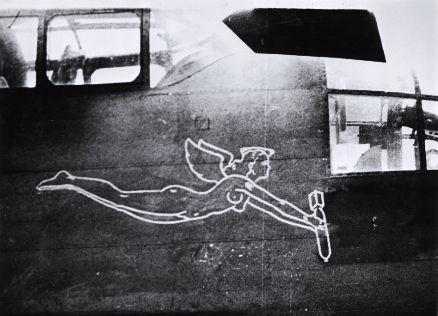
Doolittle nose-art
I read 30 Seconds Over Tokyo when I was still a war-playing kid, before I would understand the mischievous consequences of the Doolittle Raiders B-25 bombers deploying without their bombsights. This was to prevent US war-making advantages falling into enemy hands but it also precluded dropping bombs with accuracy. I’m pretty certain the account for young readers also didn’t explain why over a quarter of the squadron’s bombs were of the incidiary cluster variety. Readers today know what those are for. Doolittle claimed to be targeting military sites in Japan’s capitol, but “invariably” hit civilian areas including four schools and a hospital. Of the American fliers captured, three were tried and executed by the despicable “Japs”, who considered the straffing of civilians to be war crimes. After the war, the US judged the Japanese officers responsible, as if their verdict was a greater injustice against our aviators’ “honest errors”. Today we rationalize our systemic overshoot policy as “collateral damage”.

Every year since WWII, Doolittle’s commandos are feted for their milestone bombing mission. This Veterans Day is to be the last due to their advanced ages. But it is fitting, because isn’t it time Americans faced what we’re celebrating? There’s no denying it took suicidal daring, but the Doolittle Raid inaugurated what became a staple of US warfare, the wholesale terrorizing of civilians from on high, with impunity and indifference. To be fair, the American public has always been kept in the dark. American aircraft have fire-bombed civilians at every diplomatic opportunity since 1942, and a Private Manning sits in the brig for trying to give us a chance to object.

We now know that the Doolittle Raid didn’t turn the tide, nor shake Japanese resolve. It was a retalliation for the attack on Pearl Harbor, intended to boost US morale as if to say, America wasn’t defeated. Kinda like why and how we struck back at Afghanistan after 9/11, just as indiscriminately.

The “Mark Twain” ersatz bombsight
substitute bombsightThe Norden bombsight was a closely guarded US secret weapon. An airstrike without it would today be like lobotomizing so-called smart bombs, and deciding to opt for imprecision bombing. The official army record recounts that a subsitute sighting mechanism was improvised for the raid, dubbed the “Mark Twain” and judged to be effective enough. Now a bad joke. Indochina and Wikileaks-wisened, we know the mendacity of that assessment. The vehemently anti-imperialist, anti-racist Twain would not have been honored.

Twain satirized Western so-called Enlightenment thus: “good to fire villages with, upon occasion”.

Post-postwar hagiographies of the raid have suggested the improvised bombsight was better suited to low-altitude missions than the Norden model. That conclusion is easily dismissed because the device was used only for the Doolittle run and never after. The sight’s designer, mission aviator C. Ross Greening, offered a explanation for why he named the device after Mark Twain in his pothumously published memoir Not As Briefed. He didn’t.

The bombsight is named the “Mark Twain” in reference to the “lead line” depth finder used on the Mississippi River paddle wheelers in bygone days.

Because its design was so simple, we’re left to suppose. Greening’s bombsight was named for the same “mark” which Samuel Langhorne Clemens adopted as his celebrated pen name. I find it disingeneous to pretend to repurpose an archaic expression whose meaning was already eclipsed by the household name of America’s most outspoken anti-imperialist. Who would believe you named your dog “Napoleon” after a French pastry?

We are given another glimpse into Greening’s sense of humor by how he named his plane, the “Hari-Kari-er” ready to deal death by bomb-induced suicide. Greening’s B-25 is the one pictured above, with the angelic tart holding a bomb aloft. Greening’s plane was another that carried only incendiary ordnance.

Much was made of the sight’s two-piece aluminum construction, reportedly costing 20 cents at the time compared to the $10,000 Norden. This provided the jingoist homefront the smug satisfaction perhaps, combining a frugality born of the Depression with the American tradition of racism, that only pennies were expensed and or risked on Japanese lives.

War Crimes
Targeting civilians, taking insufficient care to avoid civilian casualties, using disproportunate force, acts of wanton retaliation, and the use of collective punishment are all prohibited by international convention. They are war crimes for which the US prosecutes adversaries but with which our own military refuses to abide. Americans make much of terrorism, yet remain blind to state terrorism. Doolittle’s historic raid, judged by the objective against which it is celebrated as a success, was an act of deliberate terrorism.

Forcing the Japanese to deploy more of their military assets to protect the mainland sounds like a legitimate strategy, except not by targeting civilians to illustrate the vulnerability, nor by terrorizing the population, one of Doolittle’s stated aims. He called it a “fear complex”.

It was hoped that the damage done would be both material and psychological. Material damage was to be the destruction of specific targets with ensuing confusion and retardation of production. The psychological results, it was hoped, would be the recalling of combat equipment from other theaters for home defense, the development of a fear complex in Japan, improved relationships with our Allies, and a favorable reaction in the American people.

There is no defending Japan’s imperialist expansion in the Pacific, and certainly not its own inhumanity. The Japanese treated fellow Asians with the same racist disregard with which we dispatched Filipinos. While Americans point in horror at how the Japanese retalliated against the Chinese population for the Doolittle Raid, we ignore that Doolittle purposely obscured from where our bombers were launched, leaving China’s coast as the only probably suspect.

To be fair, most of Doolittle’s team was kept in the dark about the mission until they were already deployed. I hardly want to detract from the courage they showed to undertake a project that seemed virtually suicidal. But how long should all of us remain in the dark about the true character of the Doolittle Raid?

Out of deference for the earlier generation of WWII veterans, those in leadership, certain intelligence secrets were kept until thirty years after the war. Unveiled, they paint a very different picture of what transpired. The fact that the US knew the German and Japanese codes from early on revealed an imbalance not previously admitted, as an example.

About the Doolittle Raid, much is already openly documented, if not widely known. The impetus for the raid was public knowledge, the evidence of its intent in full view.

BY DESIGN
In the aftermath of Pearl Harbor, American newspapers were already touting offers of cash rewards for whoever would be the first to strike back at Japan. President Roosevelt expressed a deliberate interest in hitting the Japanese mainland, in particular Tokyo, to retaliate for the Japanese strike against Pearl Harbor, never mind it had been a solely military target.

Plans were made to exploit the Japanese homeland’s vulnerability to fire, as ninety percent of urban structures were made of paper and wood. Writes historian William Bruce Jenson:

In his “confidential” meeting with reporters back in November, Marshall had declared that the US would have no cavil about burning Japan’s paper cities.

For the Doolittle Raid, a bombing strategy was developed to overwhelm the fire department of his target, the Shiba ward.

A former naval attache in Tokyo told Doolittle: “I know that Tokyp fire department very well. Seven big scattered fires would be too much for it to cope with.”

As lead plane, Doolittle’s role was to literally blaze the way. Fellow pilot Richard Joyce told Nebraska History Magazine in 1995:

The lead airplane, which was going to have Doolittle on board as the airplane commander, was going to be loaded with nothing but incendiaries -2.2­ pound thermite incendiaries- in clus­ters. They drop these big clusters and then the straps break and they spray, so they set a whole bunch of fires. He was to be the pathfinder and set a whole bunch of fires in Tokyo for pathfinding purposes.

Doolittle’s report outlined his objective more formally:

one plane was to take off ahead of the others, arrive over Tokyo at dusk and fire the most inflammable part of the city with incendiary bombs. This minimized the overall hazard and assured that the target would be lighted up for following airplanes.

Greening paints the most vivid picture, of burning the Japanese paper houses to light the way:

Doolittle planned to leave a couple of hours early, and in the dark set fire to Tokyo’s Shiba ward … the mission’s basic tactic had been that Doolittle would proceed alone and bomb a flammable section of Tokyo, creating a beacon in the night to help guide following planes to their targets.

Doolittle’s copilot Lt Richard Cole, told this to interviews in 1957:

Since we had a load of incendiaries, our target was the populated areas of the west and northwest parts of Tokyo.

After the bombers had left on their raid, and before news got back about whether or not they accomplished it, the Navy crew on the carrier USS Hornet already sang this song, which went in part:

Little did Hiro think that night
The skies above Tokyo would be alight
With the fires that Jimmy started in Tokyo’s dives
To guide to their targets the B-25s.
When all of a sudden from out of the skies
Came a basket of eggs for the little slant eyes

Incendiaries

Most of the bombers were loaded with three demolition bombs and an incendiary cluster bomb. Some of the planes carried only incendiaries. According to Doolittle’s official report of the raid, here were some of their stated objectives:

Plane no. 40-2270, piloted by Lt. Robert Gray:
thickly populated small factories district. … Fourth scattered incendiary over the correct area

Plane No. 40-2250, Lt. Richard Joyce:
Incendiary cluster dropped over thickly populated and dense industrial residential sector immediately inshore from primary target. (Shiba Ward)

“The third dem. bomb and the incendiary were dropped in the heavy industrial and residential section in the Shiba Ward 1/4 of a mile in shore from the bay and my tat.”

Aircraft 40-2303, Lt Harold Watson:
the congested industrial districts near the railroad station south of the Imperial Palace

AC 40-2283, David Jones:
the congested area Southeast of the Imperial Palace

Even though the planned night raid became a daytime mission, Doolittle did not alter his original role, intended to light the way for the following planes. His target remained the Shiba District of Tokyo. His own plane: “changed course to the southwest and incendiary-bombed highly inflammable section.”

Doolittle’s report included a description of the incendiary bombs:

The Chemical Warfare Service provided special 500 incendiary clusters each containing 128 incendiary bombs. These clusters were developed at the Edgewood Arsenal and test dropped by the Air Corps test group at Aberdeen. Several tests were carried on to assure their proper functioning and to determine the dropping angle and dispersion. Experimental work on and production of these clusters was carried on most efficiently.

As has become an aerial bombardment tradition, crews were let to inscribe messages on the bombs about to be dropped. Accounts made the most of these chestnuts: “You’ll get a BANG out of this.” And “I don’t want to set the world on fire –only Tokyo.”

These details, which reveal the intentions of the raid, were not made known to the public immediately. The Doolittle Raid was planned and executed in secret, with US government and military spokesmen denying knowledge of the operation even in its aftermath. The first word to reach the American public came from the New York Times, citing Japanese sources:

Enemy bombers appeared over Tokyo for the first time in the current war, inflicting damage on schools and hospitals. Invading planes failed to cause and damage on military establishments, although casualties in the schools and hospitals were as yet unknown. This inhuman attack on these cultural establishments and on residential districts is causing widespread indignation among the populace.

This report was dismissed as propaganda. When Japan declared its intention to charge the airman it had taken captive with war crimes, the US protestations redoubled. The accusations were belittled even as our own reports conceded to the possibilities.

Lieutenant Dawson’s Thirty Seconds Over Tokyo was the first published account of the raid. Printed less than a year after the event, wartime-sensitive details such as the phony guns made of broomstick handles poking out the back were left out. Targets were also not specified, but a candor remained, probably intended to be threatening. Lawson described the 500-pound incendiaries as “something like the old Russian Molotov Breadbasket”, and related US naval attache Jurika’s advice:

“If you can start seven good fires in Tokyo, they’ll never put them out,” Jurika promised us. … “I wouldn’t worry too much about setting fires in flimsy-looking sections of Tokyo,” he said. “The Japanese have done an amazing job of spreading out some of their industries, instead of concentrating them in large buildings. There’s probably a small machine shop under half of these fragile-looking roofs.”

“Flimsy” became Lawson’s keyword for the residential areas. Here Lawson described dropping his third and fourth bombs, when he saw their corresponding red light indicators:

The third red light flickered, and, since we were now over a flimsy area in the southern part of the city, the fourth light blinked. That was the incendiary, which I knew would separate as soon as it hit the wind and that dozens of small fire bombs would molt from it.

I was satisfied about the steel-smelter and hoped the other bombs had done as well. There was no way of telling, but I was positive that Tokyo could have been damaged that day with a rock.

Our actual bombing operation, from the time the first one went until the dive, consumed not more than thirty seconds.

Thus: Chance of hitting civilian homes: 50/50.
Charges of Excessive Force could be expected, because
blame the victim for being weaker than: a rock.
Care taken to avoid innocent casualties: 30 seconds.

In a later afterword, Lawson blamed Tokyo for having insufficient bomb shelters.

After the war, US occupation forces recovered Japanese records which documented the losses attributed to the Doolittle Raid: fifty dead, 252 wounded, ninety buildings. Besides military or strategic targets, that number included nine electric power buildings, a garment factory, a food storage warehouse, a gas company, two misc factories, six wards of Nagoya 2nd Temporary Army Hospital, six elementary or secondary schools, and “innumerable nonmilitary residences”.

Strafing
Japan accused the fliers of indescriminate strafing civilians. The US countered that defending fighters were responsible for stray bullets when their gunfire missed the bombers. That’s very likely, except the raiders were candid about their strafing too. Lawson:

I nosed down a railroad track on the outskirts of the city and passed a locomotive close enough to see the surprised face of the engineer. As I went by I could have kicked myself for not giving the locomotive’s boiler a burst of our forward 30-calibre guns, then I remembered that we might have better use for the ammunition.

A big yacht loomed up ahead of us and, figuring it must be armed, I told Thatcher to give it a burst. We went over it, lifted our nose to put the tail down and Thatcher sprayed its deck with our 50-calibre stingers.

Greening’s account of firing on a sailor, raises the moral ambiguity of air warfare with which few airmen grapple. By virtue that technology allows it, combatants become slave to a predetermined outcome:

When we attacked the next patrol boat, a Japanese sailor threw his hands up as if to surrender. I guess he expected us to stop and take him prisoner. We shot him and left this boat smoking too.

The Medals
Friendship Medals exchanged between Japan and the US found themselves requisitioned for Doolittle’s Raid:

Several years prior to the war, medals of friendship and good relationship were awarded to several people of the United States by the Japanese government.  In substance these medals were symbolic of the friendship and cooperation between the nations and were to represent the duration of this attitude.  It was decided by the Secretary of the Navy, Mr. Frank Knox, that the time was appropriate to have these medals returned.  They had been awarded to Mr. Daniel J. Quigley, Mr. John D. Laurey, Mr. H. Vormstein and Lt. Stephen Jurkis.

After arrangements had been made and the medals secured, a ceremony was held on the deck of the Hornet during which the medals were wired to a 500 lb. bomb to be carried by Lt. Ted Lawson and returned to the Japanese government in an appropriate fashion.

Lawson’s plane no 40-2261 dropped that bomb on an “industrial section of Tokyo” omitting to mention that Japan’s industry was still a post-feudal cottage industry.

“The medals were subsequently delivered in small pieces to their donors in Tokyo by Lt. Ted Lawson at about noon, Saturday, April 18, 1942.”

–Mitscher, M.A. Letter Report to Commander Pacific Fleet.

“Through the courtesy of the War Department your Japanese medal and similar medals, turned in for shipment, were returned to His Royal Highness, The Emperor of Japan on April 18, 1942.”

–Knox, F. Letter Report to Mr. H. Vormstein

The guard towers of Camp Amache, CO, Japanese-American internment camp

Visitors to what remains of the WWII-era Granada Relocation Center located on Highway 50 past Lamar, are tempted to conclude that the remote location was isolation enough to restrict the movement of its 7,000 Japanese-American internees. Gone are all 560 buildings except their concrete foundations; the few remaining photographs depict a vast layout of spartan barracks, playing host to ordinary civilian lives, minus the atmosphere of incarceration. Were there cyclone fences and watch towers? The answer should not surprise you. Of course. Camp Amache was ringed by the usual multiple perimeters of prison fences, including six watch towers manned by military police, who were there, it was explained, for the internees’ protection. I think plans to further restore Amache need to begin with the security fortifications. If such blights on American history as these race-based detention centers are memorialized in the hope that our nation not do it again, it dishonors our victims, and blunts the lesson, not to illustrate our heavy hand.

I attended a recent screening of a documentary made of Camp Amache, attended by its producers, who expressed the usual motivation: in remembrance, never again. Special emphasis was placed on the contributions made by Japanese-Americans during the war, and on the magnanimity with which the internees accepted their lot. Survivors were not to receive an official apology until 45 years later, given $20,000 restitution for their livelihoods and families destroyed. It would be safe to say the audience felt well beyond the prejudice that had motivated their parents. Against Japanese-Americans.

Unfortunately both the documentary and the filmmakers’ commentary left the impression that “never again” describes a successful holding pattern. Of course, America has been at it again and as usual, its citizens have been obliviously complicit.

Look at the War on Islam, which has necessitated the internment of Muslim-Americans and Muslims worldwide. Guantanamo is not much different from the Wartime Relocation Authority (WRA) special Isolation Centers such as Dalton Wells, near Moab, where the WRA sent internees profiled as potential insurgency threats.

America has been building a network of fresh detention facilities to house Hispanic-Americans who run afoul of the country’s illegal labor market. Most of the detainees are promptly deported, but many languish while immigration issues and family ties are sorted out. While ICE pretends to protect the American people from the security-threatening unlawfulness of illegal aliens, in reality its detention centers enforce the successful abuse of a Hispanic-American slave labor pool.

You need only visit a traditional prison or jail to see that an overwhelming disproportion of its inmates are African-American and Hispanic-American, far exceeding what can be excused as representative of America’s poor. The American judicial system is still stacked against non-whites, and motivated by the same racist premise of protecting the security of white Americans.

And of course there are the open air prisons which still incarcerate the Native-Americans, the internment camps we call reservations, the original Wartime Relocation Centers.

Wisconsin election close, but no cigar, if there was a cigar

The recall defeat in Wisconsin brings to mind Emma Goldman’s famous adage: “If voting changed anything, they’d make it illegal.”
Now we’ll never know if a Democrat majority in Madison would have behaved any different than a herd of Republicans. I doubt it. Activists are patting themselves on the back for their partial success, saying the effort was worth it, which is the usual consolation for losers, and ignores the fact that many of Wisconsin’s present Democratic Party legislators already betray their constituents. Here’s another quote, by a Japanese engineering professor I had in college who used to say in broken English: “You build bridge. It fall down. No partial credit.” Imagine what he’d have thought of a bridge to nowhere.

Shaken, stirred, totally Fukushima’d

Now Fukushima Daiichi means the same in English as in Japanese. Although now apparently “meltdown” no longer means apocalyptic, “radiation” no longer means toxic, and to “exceed the safety levels” no longer means to pose adverse risk to your health. Curious. Because, I suppose, Japan can’t cry REACTOR FIRE in a crowded metropolis. Instead of blaming a Japanese government for being less than forthcoming about the obvious exponential horrors to come, realize they’re in hospice-caretaker mode, with little recourse but to comfort the imperiled population with big white lies. The Japanese are skeptical, but what are they supposed to do? They can no sooner stop drinking and eating than they can stop breathing. Will Fukushima be only a partial Chernobyl or verse visa? Halfway around the world, is the news being broken gently for our unknowing benefit? From across the Pacific, we can fret about the fallout –a word which now apparently means radioactive particles of no demonstrated significance. At least this president is not advising us to grab for duct-tape and visqueen. Leave the Japanese the stiff upper lip indispensable to island nations sin salida. For your own self-preservation, turn off the telly and heed experts who haven’t jettisoned the original nuclear power glossary. To those talking heads and blog comment trolls still shilling for the nuclear ambitions of the “Clean Power” Green Energy scam. Sayonara.

Behind the screen with Sea Shepherd

Sea Shepherd Conservation Society Captain Pete Bethune takes aim at Japanese whalersYou have to wonder where nonviolence would get activists on the high seas. Whales can be grateful the Sea Shepherd Society heros don’t opt to sacrifice the whales to save them. Captain Paul Watson is visiting Colorado College tomorrow to elaborate, but I have no illusion he’s at liberty to detail his provocative strategies. First off, he can’t spoil the upcoming TV season of Whale Wars and second, doesn’t playing for the media really turn on illusion?

Sea Shepherd’s fight to defend whales scored big when the cameramen began to film their adventures for the Animal Planet network. Even for veteran activists the reality TV format has necessitated they take some stage direction, and meant that the documentary lens presuming to take viewers behind the scenes, created a layer behind that one.

For example, look at the action shot at the top right, where a Sea Shepherd inflatable comes in close to harass a whaling ship. Everyone is helmeted and goggled, except leading man Pete Bethune aiming his stink bomb launcher as the camera focuses in. He doesn’t even have gloves or the bulkier dry-suit of his comrades. Are we to imagine protection from the Japanese water cannons is optional? Obviously adventuring with a script requires taking greater risks to get more drama in the shot. I’m contemplating now about the controversy surrounding the ramming of the Ady Gil. It was certainly dramatic.

When I went to check out one of two Whale Wars DVDs at my public library, I discovered a waiting list fourteen borrowers long. Certainly Sea Shepherd got its money worth from the sinking of the Ady Gil, whether by accident or not. After the collision the whale warriors demanded the Japanese whalers be charged with attempted murder. There could have been casualties, if anyone had been below deck. Skeptics suspect the Ady Gil’s helmsman sneaked his bow into harm’s way. How will we ever know?

By all appearances the Ady Gil was coasting slowly, all hands on deck, when the Japanese ship suddenly turned on her. Unseen might have been a quick lunge to intersect with the whaler’s bow. It’s hard to tell from the footage, taken from just the right angle by the Bob Barker coasting nearby. The Ady Gil was an innovative speed boat designed to pierce waves, not ride them, and could well disguise a last forward thrust.

I don’t think Paul Watson is about to fess up.

The third season of Whale Wars promises to reveal what happened behind the scenes, at Sea Shepherd, because they don’t have cameras following the Japanese fleet. And I think we’re going to see where reality television hits the wall. Whale Wars is not documentary filmmaking, it’s advocacy and drama. I love it, and I’d like to see more of it.

I’m not such a kill-joy to say that fashioning 43-minute long narratives prevents telling the truth. But I suspect filming the whaling renegades is something akin to televised poker, pretending to film behind the dark glasses. After seasons of strategies and bluffs, some inferred, some revealed, Watson and co now have to play close to the chest, and certainly must never been seen by their adversaries to have something up their sleeve.

I already lament the distance which official history keeps in relation to historical truth. What really happened, the story of mankind, is reserved for the student with no whale in the race.

Ignoble WWII bombing of Coventry commemorated with coined slur, ours

Here’s a bit of WWII distortion the History Channel is passing off as, um, history. Did you know that those dirty Krauts leveled the English city of Coventry so completely that they coined a word to celebrate it? Apparently that term was “Coventrated.” Oh, it’s a real verb alright — trouble is, it’s English. The British intelligence office seized upon the conjugated Coventriert to mean: subjected to heavy bombardment, and pretended the Huns were such bastards they commemorated the atrocity by mocking their victims in the Teutonic dictionary.

Also problematic, the barbaric Teutons failed to “coventrate” with equal efficacy anywhere else. But the Allies sure did. By night and by day, the UK and US bombers respectively “coventrated” the German and Hungarian homelands, with all the more ferocity because they were dishing the Nazis, haha, a taste of their own medicine.

The bombing of Coventry was tragedy enough, and might have been ameliorated had Churchill responded to the intelligence forewarning but risk betraying that the Brits were intercepting Germany’s secret ciphers. Allowing Coventry to fall victim was one of the high prices of keeping ULTRA a secret, but Hitler’s choice to bomb the historic city and its famed Cathedral was to provoke much enmity with the English public. Britain’s propaganda ministry was able to compound the resentment against the Germans for the devastation of Coventry by portraying the enemy as not just Philistine, but Bombast.

Of course more German cities suffered under the 24-hour US-UK tag-team bombing raids, many incurring orders of magnitude greater casualties than the 600 dead of Coventry. Notable among the Axis cities was the medieval capital of Dresden which possessed not one legitimate military target. No mention of those victims in the History Channel’s records of military misdeeds, meanwhile propagandist Newscorp property HarperCollins is weaving the coventriert detail for revisionist Dresden-deniers.

The stories of America’s firebombing of Japanese cities have already been suppressed. Apologists have long been at work justifying the use of atomic weapons against civilians in Hiroshima and Nagazaki. Where were the propagandists to conjugate Hiroshima?

America’s other unique bombing method would later be described minus geographical references, as simple carpet bombing.

The History Channel is part of the A&E network, co-owed by warmongers Disney, Hearst and NBC/GE. Their mention of “coventrate” came in a program about Lao Tsu’s Art of War, as his military edicts might have predicted, Nostradamus-like, the outcome of the Viet Nam War. Here’s an example of the program’s perspective:

The Vietcong lost the public support of many Vietnamese when they executed thousands of South Vietnamese under the employ of the US.

Meanwhile the American cause lost its public support when the US public caught sight of photographs of US war casualties.

Sound like a fair comparison? The Vietnamese weren’t demoralized by the millions killed in their midst, while the antiwar movement was not galvanized by the revelations of US atrocities? Right.

For every action there is an equal and opposite media distraction

Life Under the Jolly Roger by Gabriel KuhnInstead of reading reports about how noted academic Gabriel Kuhn was prevented from joining his US book tour because he found himself on the NO FLY LIST for being a scholar of anarchism, you are hearing about 2-FAT-2-FLY cult director Kevin Smith and his weighty issues with Southwest Airlines. Instead of attending DC hearings about gross criminal malfeasance at Blackwater (currently masquerading as licensed-to-kill Xe), the media is giving us smoke-and-mirrors with the Toyota congressional hearing. Although no mere media distraction, the attack on Toyota is an economic-hit-piece if ever there was.

Had accounts escaped you of untold numbers of fatalities of runaway Toyotas? You’d think we were talking overturned Corvairs, or exploding Pintos, awful corporate secrets about the horrendous risks of driving Toyotas. Those pointing the finger at the Japanese car giant are saying the problem is bigger than floor mats and sticky pedals. They hint at electronic problems, without mentioning that like many automobile components, the accelerator mechanisms are manufactured by a third party supplier, whose assembly is not exclusively for Toyota. The same part is supplied to General Motors vehicles as well. No mention of that.

Is this PR attack against Toyota motivated by Japan’s lagging support for the US wars, or simply a grab at their market share by the current administration which finds itself managing the majority of the nation’s automobile industry?

Gabriel Kuhn has been declined permission to enter the US based entirely on the inflammatory nature of his writing. He’s visited American campuses many times before, even under the Bush administration. What’s happened that the US Department of Homeland Security has now determined Kuhn to be a threat to national security? Does this policy presage restrictions we could see applied to internet publishing? We know ideas can be dangerous weapons, are we prepared to be disarmed?

Sea Shepherd ripostes with broadside


This time when the Japanese whalers came abreast their eco-defense adversary to douse them with water cannons, the Sea Shepherd crew surprised them with a torrent of superior caliber! Yes, it sounds like a pissing match, the essence of swashbucklers. This one is worthy of Patrick O’Brian but we’ll have to wait for Whale Wars Season III for the full adventure. Score: Japanese fleet chaperoned now for three days with no breaking free in sight.

Beyond MLK worship: Beyond Vietnam

MLK“A time comes when silence is betrayal. That time has come for us in relation to Vietnam.”
Martin Luther King Beyond Vietnam: Time to Break the Silence
Full text of 1967 speech below.

Riverside Church, New York City, 4 April 1967

I come to this magnificent house of worship tonight because my conscience leaves me no other choice. I join with you in this meeting because I am in deepest agreement with the aims and work of the organization which has brought us together: Clergy and Laymen Concerned about Vietnam. The recent statement of your executive committee are the sentiments of my own heart and I found myself in full accord when I read its opening lines:

“A time comes when silence is betrayal.”

That time has come for us in relation to Vietnam.

The truth of these words is beyond doubt but the mission to which they call us is a most difficult one. Even when pressed by the demands of inner truth, men do not easily assume the task of opposing their government’s policy, especially in time of war. Nor does the human spirit move without great difficulty against all the apathy of conformist thought within one’s own bosom and in the surrounding world. Moreover when the issues at hand seem as perplexed as they often do in the case of this dreadful conflict we are always on the verge of being mesmerized by uncertainty; but we must move on.

Some of us who have already begun to break the silence of the night have found that the calling to speak is often a vocation of agony, but we must speak. We must speak with all the humility that is appropriate to our limited vision, but we must speak. And we must rejoice as well, for surely this is the first time in our nation’s history that a significant number of its religious leaders have chosen to move beyond the prophesying of smooth patriotism to the high grounds of a firm dissent based upon the mandates of conscience and the reading of history. Perhaps a new spirit is rising among us. If it is, let us trace its movement well and pray that our own inner being may be sensitive to its guidance, for we are deeply in need of a new way beyond the darkness that seems so close around us.

Over the past two years, as I have moved to break the betrayal of my own silences and to speak from the burnings of my own heart, as I have called for radical departures from the destruction of Vietnam, many persons have questioned me about the wisdom of my path. At the heart of their concerns this query has often loomed large and loud: Why are you speaking about war, Dr. King? Why are you joining the voices of dissent? Peace and civil rights don’t mix, they say. Aren’t you hurting the cause of your people, they ask? And when I hear them, though I often understand the source of their concern, I am nevertheless greatly saddened, for such questions mean that the inquirers have not really known me, my commitment or my calling. Indeed, their questions suggest that they do not know the world in which they live.

“I wish not to speak with Hanoi and the National Liberation Front, but rather to my fellow Americans who, with me, bear the greatest responsibility in ending a conflict that has exacted a heavy price on both continents.”

In the light of such tragic misunderstandings, I deem it of signal importance to try to state clearly, and I trust concisely, why I believe that the path from Dexter Avenue Baptist Church — the church in Montgomery, Alabama, where I began my pastorate — leads clearly to this sanctuary tonight.

I come to this platform tonight to make a passionate plea to my beloved nation. This speech is not addressed to Hanoi or to the National Liberation Front. It is not addressed to China or to Russia.

Nor is it an attempt to overlook the ambiguity of the total situation and the need for a collective solution to the tragedy of Vietnam. Neither is it an attempt to make North Vietnam or the National Liberation Front paragons of virtue, nor to overlook the role they can play in a successful resolution of the problem. While they both may have justifiable reason to be suspicious of the good faith of the United States, life and history give eloquent testimony to the fact that conflicts are never resolved without trustful give and take on both sides.

Tonight, however, I wish not to speak with Hanoi and the NLF, but rather to my fellow Americans, who, with me, bear the greatest responsibility in ending a conflict that has exacted a heavy price on both continents.

The Importance of Vietnam

Since I am a preacher by trade, I suppose it is not surprising that I have seven major reasons for bringing Vietnam into the field of my moral vision. There is at the outset a very obvious and almost facile connection between the war in Vietnam and the struggle I, and others, have been waging in America. A few years ago there was a shining moment in that struggle. It seemed as if there was a real promise of hope for the poor — both black and white — through the poverty program. There were experiments, hopes, new beginnings. Then came the buildup in Vietnam and I watched the program broken and eviscerated as if it were some idle political plaything of a society gone mad on war, and I knew that America would never invest the necessary funds or energies in rehabilitation of its poor so long as adventures like Vietnam continued to draw men and skills and money like some demonic destructive suction tube. So I was increasingly compelled to see the war as an enemy of the poor and to attack it as such.

“For the sake of those boys,
for the sake of this governent,
for the sake of hundreds of thousands
trembling under our violence,
I cannot be silent.”

Perhaps the more tragic recognition of reality took place when it became clear to me that the war was doing far more than devastating the hopes of the poor at home. It was sending their sons and their brothers and their husbands to fight and to die in extraordinarily high proportions relative to the rest of the population. We were taking the black young men who had been crippled by our society and sending them eight thousand miles away to guarantee liberties in Southeast Asia which they had not found in southwest Georgia and East Harlem. So we have been repeatedly faced with the cruel irony of watching Negro and white boys on TV screens as they kill and die together for a nation that has been unable to seat them together in the same schools. So we watch them in brutal solidarity burning the huts of a poor village, but we realize that they would never live on the same block in Detroit. I could not be silent in the face of such cruel manipulation of the poor.

My third reason moves to an even deeper level of awareness, for it grows out of my experience in the ghettoes of the North over the last three years — especially the last three summers. As I have walked among the desperate, rejected and angry young men I have told them that Molotov cocktails and rifles would not solve their problems. I have tried to offer them my deepest compassion while maintaining my conviction that social change comes most meaningfully through nonviolent action. But they asked — and rightly so — what about Vietnam? They asked if our own nation wasn’t using massive doses of violence to solve its problems, to bring about the changes it wanted. Their questions hit home, and I knew that I could never again raise my voice against the violence of the oppressed in the ghettos without having first spoken clearly to the greatest purveyor of violence in the world today — my own government. For the sake of those boys, for the sake of this government, for the sake of hundreds of thousands trembling under our violence, I cannot be silent.

For those who ask the question, “Aren’t you a civil rights leader?” and thereby mean to exclude me from the movement for peace, I have this further answer. In 1957 when a group of us formed the Southern Christian Leadership Conference, we chose as our motto: “To save the soul of America.” We were convinced that we could not limit our vision to certain rights for black people, but instead affirmed the conviction that America would never be free or saved from itself unless the descendants of its slaves were loosed completely from the shackles they still wear. In a way we were agreeing with Langston Hughes, that black bard of Harlem, who had written earlier:

O, yes,
I say it plain,
America never was America to me,
And yet I swear this oath —
America will be!

Now, it should be incandescently clear that no one who has any concern for the integrity and life of America today can ignore the present war. If America’s soul becomes totally poisoned, part of the autopsy must read Vietnam. It can never be saved so long as it destroys the deepest hopes of men the world over. So it is that those of us who are yet determined that America will be are led down the path of protest and dissent, working for the health of our land.

“Surely we must see
that the men we supported
pressed them to their violence.”

As if the weight of such a commitment to the life and health of America were not enough, another burden of responsibility was placed upon me in 1964; and I cannot forget that the Nobel Prize for Peace was also a commission — a commission to work harder than I had ever worked before for “the brotherhood of man.” This is a calling that takes me beyond national allegiances, but even if it were not present I would yet have to live with the meaning of my commitment to the ministry of Jesus Christ. To me the relationship of this ministry to the making of peace is so obvious that I sometimes marvel at those who ask me why I am speaking against the war. Could it be that they do not know that the good news was meant for all men — for Communist and capitalist, for their children and ours, for black and for white, for revolutionary and conservative? Have they forgotten that my ministry is in obedience to the one who loved his enemies so fully that he died for them? What then can I say to the “Vietcong” or to Castro or to Mao as a faithful minister of this one? Can I threaten them with death or must I not share with them my life?

Finally, as I try to delineate for you and for myself the road that leads from Montgomery to this place I would have offered all that was most valid if I simply said that I must be true to my conviction that I share with all men the calling to be a son of the living God. Beyond the calling of race or nation or creed is this vocation of sonship and brotherhood, and because I believe that the Father is deeply concerned especially for his suffering and helpless and outcast children, I come tonight to speak for them.

This I believe to be the privilege and the burden of all of us who deem ourselves bound by allegiances and loyalties which are broader and deeper than nationalism and which go beyond our nation’s self-defined goals and positions. We are called to speak for the weak, for the voiceless, for victims of our nation and for those it calls enemy, for no document from human hands can make these humans any less our brothers.

Strange Liberators

And as I ponder the madness of Vietnam and search within myself for ways to understand and respond to compassion my mind goes constantly to the people of that peninsula. I speak now not of the soldiers of each side, not of the junta in Saigon, but simply of the people who have been living under the curse of war for almost three continuous decades now. I think of them too because it is clear to me that there will be no meaningful solution there until some attempt is made to know them and hear their broken cries.

“Before long they must know
that their government has sent them
into a struggle among Vietnamese,
and the more sophisticated surely realize
that we are on the side of the wealthy
and the secure
while we create hell for the poor.”

They must see Americans as strange liberators. The Vietnamese people proclaimed their own independence in 1945 after a combined French and Japanese occupation, and before the Communist revolution in China. They were led by Ho Chi Minh. Even though they quoted the American Declaration of Independence in their own document of freedom, we refused to recognize them. Instead, we decided to support France in its re-conquest of her former colony.

Our government felt then that the Vietnamese people were not “ready” for independence, and we again fell victim to the deadly Western arrogance that has poisoned the international atmosphere for so long. With that tragic decision we rejected a revolutionary government seeking self-determination, and a government that had been established not by China (for whom the Vietnamese have no great love) but by clearly indigenous forces that included some Communists. For the peasants this new government meant real land reform, one of the most important needs in their lives.

For nine years following 1945 we denied the people of Vietnam the right of independence. For nine years we vigorously supported the French in their abortive effort to re-colonize Vietnam.

Before the end of the war we were meeting eighty percent of the French war costs. Even before the French were defeated at Dien Bien Phu, they began to despair of the reckless action, but we did not. We encouraged them with our huge financial and military supplies to continue the war even after they had lost the will. Soon we would be paying almost the full costs of this tragic attempt at re-colonization.

After the French were defeated it looked as if independence and land reform would come again through the Geneva agreements. But instead there came the United States, determined that Ho should not unify the temporarily divided nation, and the peasants watched again as we supported one of the most vicious modern dictators — our chosen man, Premier Diem. The peasants watched and cringed as Diem ruthlessly routed out all opposition, supported their extortionist landlords and refused even to discuss reunification with the north. The peasants watched as all this was presided over by U.S. influence and then by increasing numbers of U.S. troops who came to help quell the insurgency that Diem’s methods had aroused. When Diem was overthrown they may have been happy, but the long line of military dictatorships seemed to offer no real change — especially in terms of their need for land and peace.

The only change came from America as we increased our troop commitments in support of governments which were singularly corrupt, inept and without popular support. All the while the people read our leaflets and received regular promises of peace and democracy — and land reform. Now they languish under our bombs and consider us – not their fellow Vietnamese — the real enemy. They move sadly and apathetically as we herd them off the land of their fathers into concentration camps where minimal social needs are rarely met. They know they must move or be destroyed by our bombs. So they go — primarily women and children and the aged.

“Somehow this madness must cease.”

They watch as we poison their water, as we kill a million acres of their crops. They must weep as the bulldozers roar through their areas preparing to destroy the precious trees. They wander into the hospitals, with at least twenty casualties from American firepower for one “Vietcong-inflicted” injury. So far we may have killed a million of them — mostly children. They wander into the towns and see thousands of the children, homeless, without clothes, running in packs on the streets like animals. They see the children, degraded by our soldiers as they beg for food. They see the children selling their sisters to our soldiers, soliciting for their mothers.

What do the peasants think as we ally ourselves with the landlords and as we refuse to put any action into our many words concerning land reform? What do they think as we test our latest weapons on them, just as the Germans tested out new medicine and new tortures in the concentration camps of Europe? Where are the roots of the independent Vietnam we claim to be building? Is it among these voiceless ones?

We have destroyed their two most cherished institutions: the family and the village. We have destroyed their land and their crops. We have cooperated in the crushing of the nation’s only non-Communist revolutionary political force — the Unified Buddhist church. We have supported the enemies of the peasants of Saigon. We have corrupted their women and children and killed their men. What liberators?

Now there is little left to build on — save bitterness. Soon the only solid physical foundations remaining will be found at our military bases and in the concrete of the concentration camps we call fortified hamlets. The peasants may well wonder if we plan to build our new Vietnam on such grounds as these? Could we blame them for such thoughts? We must speak for them and raise the questions they cannot raise. These too are our brothers.

Perhaps the more difficult but no less necessary task is to speak for those who have been designated as our enemies. What of the National Liberation Front — that strangely anonymous group we call VC or Communists? What must they think of us in America when they realize that we permitted the repression and cruelty of Diem which helped to bring them into being as a resistance group in the south? What do they think of our condoning the violence which led to their own taking up of arms? How can they believe in our integrity when now we speak of “aggression from the north” as if there were nothing more essential to the war? How can they trust us when now we charge them with violence after the murderous reign of Diem and charge them with violence while we pour every new weapon of death into their land? Surely we must understand their feelings even if we do not condone their actions. Surely we must see that the men we supported pressed them to their violence. Surely we must see that our own computerized plans of destruction simply dwarf their greatest acts.

“We must continue to raise our voices if our nation persists in its perverse ways in Vietnam.”

How do they judge us when our officials know that their membership is less than twenty-five percent Communist and yet insist on giving them the blanket name? What must they be thinking when they know that we are aware of their control of major sections of Vietnam and yet we appear ready to allow national elections in which this highly organized political parallel government will have no part? They ask how we can speak of free elections when the Saigon press is censored and controlled by the military junta. And they are surely right to wonder what kind of new government we plan to help form without them — the only party in real touch with the peasants. They question our political goals and they deny the reality of a peace settlement from which they will be excluded. Their questions are frighteningly relevant. Is our nation planning to build on political myth again and then shore it up with the power of new violence?

Here is the true meaning and value of compassion and nonviolence when it helps us to see the enemy’s point of view, to hear his questions, to know his assessment of ourselves. For from his view we may indeed see the basic weaknesses of our own condition, and if we are mature, we may learn and grow and profit from the wisdom of the brothers who are called the opposition.

So, too, with Hanoi. In the north, where our bombs now pummel the land, and our mines endanger the waterways, we are met by a deep but understandable mistrust. To speak for them is to explain this lack of confidence in Western words, and especially their distrust of American intentions now. In Hanoi are the men who led the nation to independence against the Japanese and the French, the men who sought membership in the French commonwealth and were betrayed by the weakness of Paris and the willfulness of the colonial armies. It was they who led a second struggle against French domination at tremendous costs, and then were persuaded to give up the land they controlled between the thirteenth and seventeenth parallel as a temporary measure at Geneva. After 1954 they watched us conspire with Diem to prevent elections which would have surely brought Ho Chi Minh to power over a united Vietnam, and they realized they had been betrayed again.

When we ask why they do not leap to negotiate, these things must be remembered. Also it must be clear that the leaders of Hanoi considered the presence of American troops in support of the Diem regime to have been the initial military breach of the Geneva agreements concerning foreign troops, and they remind us that they did not begin to send in any large number of supplies or men until American forces had moved into the tens of thousands.

“When machines and computers,
profit motives and property rights
are considered more important than people,
the giant triplets of
racism,
materialism
and militarism
are incapable of being conquered.”

Hanoi remembers how our leaders refused to tell us the truth about the earlier North Vietnamese overtures for peace, how the president claimed that none existed when they had clearly been made. Ho Chi Minh has watched as America has spoken of peace and built up its forces, and now he has surely heard of the increasing international rumors of American plans for an invasion of the north. He knows the bombing and shelling and mining we are doing are part of traditional pre-invasion strategy. Perhaps only his sense of humor and of irony can save him when he hears the most powerful nation of the world speaking of aggression as it drops thousands of bombs on a poor weak nation more than eight thousand miles away from its shores.

At this point I should make it clear that while I have tried in these last few minutes to give a voice to the voiceless on Vietnam and to understand the arguments of those who are called enemy, I am as deeply concerned about our troops there as anything else. For it occurs to me that what we are submitting them to in Vietnam is not simply the brutalizing process that goes on in any war where armies face each other and seek to destroy. We are adding cynicism to the process of death, for they must know after a short period there that none of the things we claim to be fighting for are really involved. Before long they must know that their government has sent them into a struggle among Vietnamese, and the more sophisticated surely realize that we are on the side of the wealthy and the secure while we create hell for the poor.

This Madness Must Cease

Somehow this madness must cease. We must stop now. I speak as a child of God and brother to the suffering poor of Vietnam. I speak for those whose land is being laid waste, whose homes are being destroyed, whose culture is being subverted. I speak for the poor of America who are paying the double price of smashed hopes at home and death and corruption in Vietnam. I speak as a citizen of the world, for the world as it stands aghast at the path we have taken. I speak as an American to the leaders of my own nation. The great initiative in this war is ours. The initiative to stop it must be ours.

This is the message of the great Buddhist leaders of Vietnam. Recently one of them wrote these words:

“Each day the war goes on the hatred increases in the heart of the Vietnamese and in the hearts of those of humanitarian instinct. The Americans are forcing even their friends into becoming their enemies. It is curious that the Americans, who calculate so carefully on the possibilities of military victory, do not realize that in the process they are incurring deep psychological and political defeat. The image of America will never again be the image of revolution, freedom and democracy, but the image of violence and militarism.”

“A nation that continues
year after year
to spend more money on military defense
than on programs of social uplift
is approaching spiritual death.”

If we continue, there will be no doubt in my mind and in the mind of the world that we have no honorable intentions in Vietnam. It will become clear that our minimal expectation is to occupy it as an American colony and men will not refrain from thinking that our maximum hope is to goad China into a war so that we may bomb her nuclear installations. If we do not stop our war against the people of Vietnam immediately the world will be left with no other alternative than to see this as some horribly clumsy and deadly game we have decided to play.

The world now demands a maturity of America that we may not be able to achieve. It demands that we admit that we have been wrong from the beginning of our adventure in Vietnam, that we have been detrimental to the life of the Vietnamese people. The situation is one in which we must be ready to turn sharply from our present ways.

In order to atone for our sins and errors in Vietnam, we should take the initiative in bringing a halt to this tragic war. I would like to suggest five concrete things that our government should do immediately to begin the long and difficult process of extricating ourselves from this nightmarish conflict:

• End all bombing in North and South Vietnam

• Declare a unilateral cease-fire in the hope that such action will create the atmosphere for negotiation.

• Take immediate steps to prevent other battlegrounds in Southeast Asia by curtailing our military buildup in Thailand and our interference in Laos.

• Realistically accept the fact that the National Liberation Front has substantial support in South Vietnam and must thereby play a role in any meaningful negotiations and in any future Vietnam government.

• Set a date that we will remove all foreign troops from Vietnam in accordance with the 1954 Geneva agreement.

Part of our ongoing commitment might well express itself in an offer to grant asylum to any Vietnamese who fears for his life under a new regime which included the Liberation Front. Then we must make what reparations we can for the damage we have done. We most provide the medical aid that is badly needed, making it available in this country if necessary.

Protesting The War

Meanwhile we in the churches and synagogues have a continuing task while we urge our government to disengage itself from a disgraceful commitment. We must continue to raise our voices if our nation persists in its perverse ways in Vietnam. We must be prepared to match actions with words by seeking out every creative means of protest possible.

As we counsel young men concerning military service we must clarify for them our nation’s role in Vietnam and challenge them with the alternative of conscientious objection. I am pleased to say that this is the path now being chosen by more than seventy students at my own alma mater, Morehouse College, and I recommend it to all who find the American course in Vietnam a dishonorable and unjust one. Moreover I would encourage all ministers of draft age to give up their ministerial exemptions and seek status as conscientious objectors. These are the times for real choices and not false ones. We are at the moment when our lives must be placed on the line if our nation is to survive its own folly. Every man of humane convictions must decide on the protest that best suits his convictions, but we must all protest.

“If we do not act
we shall surely be dragged down
the long and shameful corridors of time
reserved for those who possess
power without compassion,
might without morality,
and strength without sight.”

There is something seductively tempting about stopping there and sending us all off on what in some circles has become a popular crusade against the war in Vietnam. I say we must enter the struggle, but I wish to go on now to say something even more disturbing. The war in Vietnam is but a symptom of a far deeper malady within the American spirit, and if we ignore this sobering reality we will find ourselves organizing clergy-and laymen-concerned committees for the next generation. They will be concerned about Guatemala and Peru. They will be concerned about Thailand and Cambodia. They will be concerned about Mozambique and South Africa. We will be marching for these and a dozen other names and attending rallies without end unless there is a significant and profound change in American life and policy. Such thoughts take us beyond Vietnam, but not beyond our calling as sons of the living God.

In 1957 a sensitive American official overseas said that it seemed to him that our nation was on the wrong side of a world revolution. During the past ten years we have seen emerge a pattern of suppression which now has justified the presence of U.S. military “advisors” in Venezuela. This need to maintain social stability for our investments accounts for the counter-revolutionary action of American forces in Guatemala. It tells why American helicopters are being used against guerrillas in Colombia and why American napalm and green beret forces have already been active against rebels in Peru. It is with such activity in mind that the words of the late John F. Kennedy come back to haunt us. Five years ago he said,

“Those who make peaceful revolution impossible will make violent revolution inevitable.”

Increasingly, by choice or by accident, this is the role our nation has taken — the role of those who make peaceful revolution impossible by refusing to give up the privileges and the pleasures that come from the immense profits of overseas investment.

I am convinced that if we are to get on the right side of the world revolution, we as a nation must undergo a radical revolution of values. We must rapidly begin the shift from a “thing-oriented” society to a “person-oriented” society. When machines and computers, profit motives and property rights are considered more important than people, the giant triplets of racism, materialism, and militarism are incapable of being conquered.

A true revolution of values will soon cause us to question the fairness and justice of many of our past and present policies. On the one hand we are called to play the good Samaritan on life’s roadside; but that will be only an initial act. One day we must come to see that the whole Jericho road must be transformed so that men and women will not be constantly beaten and robbed as they make their journey on life’s highway.

True compassion is more than flinging a coin to a beggar; it is not haphazard and superficial. It comes to see that an edifice which produces beggars needs restructuring. A true revolution of values will soon look uneasily on the glaring contrast of poverty and wealth. With righteous indignation, it will look across the seas and see individual capitalists of the West investing huge sums of money in Asia, Africa and South America, only to take the profits out with no concern for the social betterment of the countries, and say: “This is not just.”

It will look at our alliance with the landed gentry of Latin America and say: “This is not just.”

The Western arrogance of feeling that it has everything to teach others and nothing to learn from them is not just.

A true revolution of values will lay hands on the world order and say of war: “This way of settling differences is not just.”

This business of burning human beings with napalm, of filling our nation’s homes with orphans and widows, of injecting poisonous drugs of hate into veins of people normally humane, of sending men home from dark and bloody battlefields physically handicapped and psychologically deranged, cannot be reconciled with wisdom, justice and love. A nation that continues year after year to spend more money on military defense than on programs of social uplift is approaching spiritual death.

America, the richest and most powerful nation in the world, can well lead the way in this revolution of values. There is nothing, except a tragic death wish, to prevent us from reordering our priorities, so that the pursuit of peace will take precedence over the pursuit of war. There is nothing to keep us from molding a recalcitrant status quo with bruised hands until we have fashioned it into a brotherhood.

This kind of positive revolution of values is our best defense against communism. War is not the answer. Communism will never be defeated by the use of atomic bombs or nuclear weapons. Let us not join those who shout war and through their misguided passions urge the United States to relinquish its participation in the United Nations. These are days which demand wise restraint and calm reasonableness. We must not call everyone a Communist or an appeaser who advocates the seating of Red China in the United Nations and who recognizes that hate and hysteria are not the final answers to the problem of these turbulent days. We must not engage in a negative anti-communism, but rather in a positive thrust for democracy, realizing that our greatest defense against communism is to take offensive action in behalf of justice. We must with positive action seek to remove those conditions of poverty, insecurity and injustice which are the fertile soil in which the seed of communism grows and develops.

The People Are Important

These are revolutionary times. All over the globe men are revolting against old systems of exploitation and oppression and out of the wombs of a frail world new systems of justice and equality are being born. The shirtless and barefoot people of the land are rising up as never before. “The people who sat in darkness have seen a great light.” We in the West must support these revolutions. It is a sad fact that, because of comfort, complacency, a morbid fear of communism, and our proneness to adjust to injustice, the Western nations that initiated so much of the revolutionary spirit of the modern world have now become the arch anti-revolutionaries. This has driven many to feel that only Marxism has the revolutionary spirit. Therefore, communism is a judgment against our failure to make democracy real and follow through on the revolutions we initiated. Our only hope today lies in our ability to recapture the revolutionary spirit and go out into a sometimes hostile world declaring eternal hostility to poverty, racism, and militarism. With this powerful commitment we shall boldly challenge the status quo and unjust mores and thereby speed the day when “every valley shall be exalted, and every mountain and hill shall be made low, and the crooked shall be made straight and the rough places plain.”

A genuine revolution of values means in the final analysis that our loyalties must become ecumenical rather than sectional. Every nation must now develop an overriding loyalty to mankind as a whole in order to preserve the best in their individual societies.

This call for a world-wide fellowship that lifts neighborly concern beyond one’s tribe, race, class and nation is in reality a call for an all-embracing and unconditional love for all men. This oft misunderstood and misinterpreted concept – so readily dismissed by the Nietzsches of the world as a weak and cowardly force – has now become an absolute necessity for the survival of man. When I speak of love I am not speaking of some sentimental and weak response. I am speaking of that force which all of the great religions have seen as the supreme unifying principle of life. Love is somehow the key that unlocks the door which leads to ultimate reality. This Hindu-Moslem-Christian-Jewish-Buddhist belief about ultimate reality is beautifully summed up in the first epistle of Saint John:

Let us love one another; for love is God and everyone that loveth is born of God and knoweth God. He that loveth not knoweth not God; for God is love. If we love one another God dwelleth in us, and his love is perfected in us.

Let us hope that this spirit will become the order of the day. We can no longer afford to worship the god of hate or bow before the altar of retaliation. The oceans of history are made turbulent by the ever-rising tides of hate. History is cluttered with the wreckage of nations and individuals that pursued this self-defeating path of hate. As Arnold Toynbee says :

“Love is the ultimate force that makes for the saving choice of life and good against the damning choice of death and evil. Therefore the first hope in our inventory must be the hope that love is going to have the last word.”

We are now faced with the fact that tomorrow is today. We are confronted with the fierce urgency of now. In this unfolding conundrum of life and history there is such a thing as being too late. Procrastination is still the thief of time. Life often leaves us standing bare, naked and dejected with a lost opportunity. The “tide in the affairs of men” does not remain at the flood; it ebbs. We may cry out desperately for time to pause in her passage, but time is deaf to every plea and rushes on. Over the bleached bones and jumbled residue of numerous civilizations are written the pathetic words: “Too late.”

There is an invisible book of life that faithfully records our vigilance or our neglect. “The moving finger writes, and having writ moves on…” We still have a choice today; nonviolent coexistence or violent co-annihilation.

We must move past indecision to action. We must find new ways to speak for peace in Vietnam and justice throughout the developing world – a world that borders on our doors. If we do not act we shall surely be dragged down the long dark and shameful corridors of time reserved for those who possess power without compassion, might without morality, and strength without sight.

Now let us begin. Now let us rededicate ourselves to the long and bitter – but beautiful – struggle for a new world. This is the calling of the sons of God, and our brothers wait eagerly for our response. Shall we say the odds are too great? Shall we tell them the struggle is too hard? Will our message be that the forces of American life militate against their arrival as full men, and we send our deepest regrets? Or will there be another message, of longing, of hope, of solidarity with their yearnings, of commitment to their cause, whatever the cost? The choice is ours, and though we might prefer it otherwise we must choose in this crucial moment of human history.

As that noble bard of yesterday, James Russell Lowell, eloquently stated:

Once to every man and nation
Comes the moment to decide,
In the strife of truth and falsehood,
For the good or evil side;
Some great cause, God’s new Messiah,
Off’ring each the bloom or blight,
And the choice goes by forever
Twixt that darkness and that light.
Though the cause of evil prosper,
Yet ’tis truth alone is strong;
Though her portion be the scaffold,
And upon the throne be wrong:
Yet that scaffold sways the future,
And behind the dim unknown,
Standeth God within the shadow
Keeping watch above his own.

Japan owes somebody A NEW BOAT!

sea shepherd collision ram bow
The Japanese whaling fleet, whose inhumane hunts pretend to serve the Institute for Cetacean Research, have deliberately rammed the high-tech trimaran Ady Gil, formerly the Earthrace, operated by their arch nemesis the Sea Shepherd Conservation Society. Pseudo-science spokesman Glenn Innwood was quick to declare the footage showed otherwise, saying the accusation “is just not vindicated by the video.” Obviously the Japanese need a cover who speaks better English. It’s a Freudian slip to seek to be not vindicated.

Au contraire for Kiwi Innwood-sen, the videos from both ships show the Ady Gil floating idle to the Shonan Maru’s starboard side before the whaler turns straight for it. The whalers are perhaps counting on not enough people seeing the video. That might have worked before YouTube.

If the Japanese believe “The obstructionist activities of the Sea Shepherd threaten the lives and property of those involved in our research, are very dangerous and cannot be forgiven” then aiming to ram the smaller vessel must constitute attempted murder, however unpremeditated the crime of passion may be.

Whether or not the action is ruled a crime, it’s without any doubt a violation of maritime code. The Ady Gil had right of way both by its position, and by being stationary.

Here’s the collision from the perspective of the whaler Shonan Maru 2, a highly maneuverable harpoon chase ship, as broadcast on Al Jazeera:

And here is the footage released by Paul Watson’s Sea Shepherd Conservation Society:

UPDATE: I’d say this footage clinches it, from the Animal Planet Whale Wars cameraman aboard the Ady Gil. Read a detailed description from NZ.

Avatar: novel push for noble savage

Avatar movie poster based on the novel by SapphireI’d like to contrast the high-profile critical receptions being given two Hollywood films about darker-skinned-ness. Precious is about an African-American girl so dark she absorbs the light, without being about race at all. The movie tells a story of poverty, incest and the cycle of abuse, while tipping the scales with gratuitous stereotypes of Hottentot welfare mamas attendant their usual good-for-trouble black males. Vilifying the subjects it pretends to rescue, Precious has the blessing of the media, a shameless Oprah included. James Cameron’s Avatar on the other hand, opened to depth-charges of faint praise calculated to dim the buzz, perhaps because it packs the most subversive black-is-beautiful message since Muhammad Ali.

Avatar evokes rudimentary indigenous spirituality, peppered with what even elementary-schooled audiences can associate as Native American themes, from which we can infer the concepts are eternal, but idealizes an athletic aesthetic more human than the movie’s live-action characters. The “blue cat people,” as the critics have chosen to describe its Na’vi tribe, are but fantasy-striped, tailed Spartans, computer iterations of the Williams sisters and NBA dream teams. The real humans of Avatar tower in prowess, dignity and luminescence over their modern mensch oppressors.

Where racial equality on film is plotted according to how black figures are granted access to the world of white priviledge, Avatar celebrates the sovereignty of dark skin in its environment, where it’s not a barbershop, rapper’s crib, or street corner in Harlem. And instead of prepping the more palatable light-skinned negro for easier assimilation to the welcome-diversity crowd.

Precious: Based on the Novel “Push” by Sapphire, is an ugly project by and for gentrified American, whose title character is White-America’s usual avatar into their mysterious conception of Black America. I can do it no better justice than this review excerpt published Counterpunch:

A fiction whose “policy message is that welfare recipients are black women who wish to avoid work, who use their time having sex with their daughters, watching television and dining on pig leavings.” Is this a film – or a crime?

A crock and defamation that reinforces white man’s supremist burden.

Under Iran’s culturally repressive Islamic Revolution, the artists have produced a golden age of film. The greatest of these films have had to disguise their social message in analogies surrounding the concerns of children. Avatar takes perhaps a similar tack. Behind diversions of fantasy and special effects, is a profound morality tale. Critics can attack James Cameron for his simplistic storytelling, it’s the price to pay to bring the simplest of viewers along. Perhaps the director can release a final cut for cineastes which omits the redundant exposition. I don’t mind that Cameron uses a highlighter for the Cliftnote set. A survey of online comments shows me that some fans applaud themselves for getting Avatar’s message where they are certain their fellow audience members might not.

Most certainly the alarm most critics are raising has to do with the unpatriotic attitude which Avatar takes toward Capitalist imperialism. In GWOT America where we still “Support Our Troops” and still refrain from labeling our military contractors as mercenaries, this film will rub flag wavers the wrong way. I’d hate to be an active duty US soldier, watching Avatar in my uniform, as the audience roots for good to vanquish evil. It will probably be some time before Americans will want to see Iraqi or Afghan freedom fighters depicted as heroes. We’ve yet to see sympathetic accounts for example of the Vietcong holding down the Ho Chi Min Trail, or for that matter, the real Germans or Japanese beyond the Allied propaganda. But by disguising his story in science fiction, James Cameron has rehabilitated the Vandal and Visigoth, from the shadow of the Roman Empire. The shadow of man’s civilizing drive which grows darker the more it is illuminated.

And best of all, Cameron’s pagans are not whites like the typical Anglo Semites of the Christian holy lands. Cameron’s indigenous humans have the beautiful noses, skin and haunches indigenous to the climates which cradled humankind.

Americanface, ground floor

Youtube Spiders On Drugs creator apeman888
Remember Spiders On Drugs, of the 23 million views on Youtube? Victoria filmmaker Andrew Struthers, aka First Church of Christ, has followed it up with a series called AMERICANFACE, “an epic comedy adventure serial about a pilgrimage I once made to Tibet by mistake.” Struthers is digital age James Burke. Texts are published at The Tyee.

Daily 90 second episodes have been concatenated into weekly portions, hence parts 1-8. Americanface is on hiatus for the holidays.

At Struther’s column on The Tyee, you can see each episode with its accompanying text. Although this great bit of script seems to have been cut from the Schrodinger’s Cat segment:

The health club was in Kawanishi. Strange town. Streets crisscrossed by ditches that ran blue with dye from acres of drying frames, where stretched hundreds of leather hides, like the husks of indigo cows.

The club’s cavernous gymnasium rattled with cries and smashing sticks from a hundred housewives playing kendo. To drown it out, the PA blared techno beats and western pop songs, interrupted by Coppertone ads beseeching Japanese women to get a tan, “Like a healthy gaijin,” because the Geisha whiteface look had become passe.

One song played over and over until it wore out my mind like cheap underpants:

Touch me
Touch me
I want to feel your body
Your heart beat next to mine

Fortunately, in the weight room we had a boom box for tapes. But there was only one tape, and it played the same damn song:

Touch me
Touch me now!

After weeks of torment, I tried to destroy the tape. Turned out the singer was Samantha Fox, Rupert Murdoch’s golden girl. She’d gone from Page Three of the Sun to spokeswoman for the Times to international rock star. I had filed her under bimbo, but it looked like she knew something about Schrodinger’s Cat.

Vaneigem on energy as commodity

NMT’s in-house Situationist has been conceptualizing a way forward well expressed in this May 2009 interview of Raoul Vaneigem:
Situationist“We are being “offered” biofuels on the condition we agree to transgenic rapeseed farming. Eco-tourism will accelerate the plundering of our biosphere. Windmill farms are being built without any advantage to the consumers. Those are the areas where intervention is possible. Natural resources belong to us, they are free, they must be made to serve the freedom of life. It will be up to the communities to secure their own energy and food independence so as to free themselves from the control of the multinationals and their state vassals everywhere. Claiming natural power for our use means reclaiming our own existence first. Only creativity will rid us of work. …

Freeness is the only absolute weapon capable of shattering the mighty self-destruction machine set in motion by consumer society, whose implosion is still releasing, like a deadly gas, bottom-line mentality, cupidity, financial gain, profit, and predation. Museums and culture should be free, for sure, but so should public services, currently prey to the scamming multinationals and states. Free trains, buses, subways, free healthcare, free schools, free water, air, electricity, free power, all through alternative networks to be set up. As freeness spreads, new solidarity networks will eradicate the stranglehold of the commodity. This is because life is a free gift, a continuous creation that the market’s vile profiteering alone deprives us of.”
–Raoul Vaneigem, 2009

Interviewed by Hans Ulrich Obrist, for e-flux, Journal #6. See original article or the copy mirrored below:

In Conversation with Raoul Vaneigem

Hans Ulrich Obrist: I just visited Edouard Glissant and Patrick Chamoiseau, who have written an appeal to Barack Obama. What would your appeal and/or advice be to Obama?

Raoul Vaneigem: I refuse to cultivate any relationship whatsoever with people of power. I agree with the Zapatistas from Chiapas who want nothing to do with either the state or its masters, the multinational mafias. I call for civil disobedience so that local communities can form, coordinate, and begin self-producing natural power, a more natural form of farming, and public services that are finally liberated from the scams of government by the Left or the Right. On the other hand, I welcome the appeal by Chamoiseau, Glissant, and their friends for the creation of an existence in which the poetry of a life rediscovered will put an end to the deadly stranglehold of the commodity.

HUO: Could we talk about your beginnings? How did your participation in situationism begin, and what was your fundamental contribution? At the outset of your relationship with the SI, there was the figure of Henri Lefebvre. What did he mean to you at the time? Why did you decide to send him poetic essays?

RV: I would first like to clarify that situationism is an ideology that the situationists were unanimous in rejecting. The term “situationist” was ever only a token of identification. Its particularity kept us from being mistaken for the throngs of ideologues. I have nothing in common with the spectacular recuperation of a project that, in my case, has remained revolutionary throughout. My participation in a group that has now disappeared was an important moment in my personal evolution, an evolution I have personally pressed on with in the spirit of the situationist project at its most revolutionary. My own radicality absolves me from any label. I grew up in an environment in which our fighting spirit was fueled by working class consciousness and a rather festive conception of existence. I found Lefebvre’s Critique of Everyday Life captivating. When La Somme et le reste [The Sum and the Remainder] was published, I sent him an essay of sorts on “poetry and revolution” that was an attempt to unify radical concepts, Lettrist language, music, and film imagery by crediting them all with the common virtue of making the people’s blood boil. Lefebvre kindly responded by putting me in touch with Guy Debord who immediately invited me to Paris. The two of us had very different temperaments, but we would agree over a period of nearly ten years on the need to bring consumer society to an end and to found a new society on the principle of self-management, where life supersedes survival and the existential angst that it generates.

HUO: Which situationist projects remain unrealized?

RV: Psychogeography, the construction of situations, the superseding of predatory behavior. The radicality, which, notwithstanding some lapses, never ceased to motivate us, remains a source of inspiration to this day. Its effects are just beginning to manifest themselves in the autonomous groups that are now coming to grips with the collapse of financial capitalism.

HUO: The Situationist International defined the situationist as someone who commits her- or himself to the construction of situations. What were those situations for you, concretely? How would you define the situationist project in 2009?

RV: By its very style of living and thinking, our group was already sketching out a situation, like a beachhead active within enemy territory. The military metaphor is questionable, but it does convey our will to liberate daily life from the control and stranglehold of an economy based on the profitable exploitation of man. We formed a “group-at-risk” that was conscious of the hostility of the dominant world, of the need for radical rupture, and of the danger of giving in to the paranoia typical of minds under siege. By showing its limits and its weaknesses, the situationist experience can also be seen as a critical meditation on the new type of society sketched out by the Paris Commune, by the Makhnovist movement and the Republic of Councils wiped out by Lenin and Trotsky, by the libertarian communities in Spain later smashed by the Communist Party. The situationist project is not about what happens once consumer society is rejected and a genuinely human society has emerged. Rather, it illuminates now how lifestyle can supersede survival, predatory behavior, power, trade and the death-reflex.

HUO: You and Guy Debord are the main protagonists of the situationist movement. How do you see Debord’s role and your role?

RV: Not as roles. That is precisely what situationism in its most ridiculous version aims at: reducing us to cardboard cut-outs that it can then set up against one another according to the spectacle’s standard operating procedure. I am simply the spokesman, among others, of a radical consciousness. I just do what I can to see that resistance to market exploitation is transformed into an offensive of life, and that an art of living sweeps away the ruins of oppression.

HUO: What were your reasons for resigning from the group?

RV: Following the occupation movements of May 1968, we knew that some recuperation was afoot. We were familiar with the mechanisms of alienation that would falsify our ideas and fit them neatly into the cultural puzzle. It became clear to us, during the last conference in Venice, that we had failed to shatter those mechanisms, that in fact they were shattering us from the inside. The group was crumbling, the Venice conference was demonstrating its increasing uselessness, and the only answers put forward were commensurate with the self-parody we had fallen into. Dissension intensified to the point of paranoid denunciation: of betrayals of radicality, of breaches of revolutionary spirit, of dereliction of conscience. Those times of catharsis and anathema are now long past, and it might be useful to examine how it is that we sowed the seeds of failure for which the group ended up paying such a heavy price. The shipwreck, however, did not indiscriminately sweep away to the shores of oblivion all of us who participated in the adventure. The group vanished in such a way as to allow the individuals to either consolidate their radicality, disown it, or lapse into the imposture of radicalism. I have attempted to analyze our experimental adventure in Entre le deuil du monde et la joie de vivre [Between Mourning the World and Exuberant Life].

HUO: You have written a lot on life, not survival. What is the difference?

RV: Survival is budgeted life. The system of exploitation of nature and man, starting in the Middle Neolithic with intensive farming, caused an involution in which creativity—a quality specific to humans—was supplanted by work, by the production of a covetous power. Creative life, as had begun to unfold during the Paleolithic, declined and gave way to a brutish struggle for subsistence. From then on, predation, which defines animal behavior, became the generator of all economic mechanisms.

HUO: Today, more than forty years after May ‘68, how do you feel life and society have evolved?

RV: We are witnessing the collapse of financial capitalism. This was easily predictable. Even among economists, where one finds even more idiots than in the political sphere, a number had been sounding the alarm for a decade or so. Our situation is paradoxical: never in Europe have the forces of repression been so weakened, yet never have the exploited masses been so passive. Still, insurrectional consciousness always sleeps with one eye open. The arrogance, incompetence, and powerlessness of the governing classes will eventually rouse it from its slumber, as will the progression in hearts and minds of what was most radical about May 1968.

HUO: Your new book takes us on a trip “between mourning the world and exuberant life.” You revisit May ‘68. What is left of May ‘68? Has it all been appropriated?

RV: Even if we are today seeing recycled ideologies and old religious infirmities being patched up in a hurry and tossed out to feed a general despair, which our ruling wheelers and dealers cash in on, they cannot conceal for long the shift in civilization revealed by May 1968. The break with patriarchal values is final. We are moving toward the end of the exploitation of nature, of work, of trade, of predation, of separation from the self, of sacrifice, of guilt, of the forsaking of happiness, of the fetishizing of money, of power, of hierarchy, of contempt for and fear of women, of the misleading of children, of intellectual dominion, of military and police despotism, of religions, of ideologies, of repression and the deadly resolutions of psychic tensions. This is not a fact I am describing, but an ongoing process that simply requires from us increased vigilance, awareness, and solidarity with life. We have to reground ourselves in order to rebuild—on human foundations—a world that has been ruined by the inhumanity of the cult of the commodity.

HUO: What do you think of the current moment, in 2009? Jean-Pierre Page has just published Penser l’après crise [Thinking the After-Crisis]. For him, everything must be reinvented. He says that a new world is emerging now in which the attempt to establish a US-led globalization has been aborted.

RV: The agrarian economy of the Ancien Régime was a fossilized form that was shattered by the emerging free-trade economy, from the 1789 revolution on. Similarly, the stock-dabbling speculative capitalism whose debacle we now witness is about to give way to a capitalism reenergized by the production of non-polluting natural power, the return to use value, organic farming, a hastily patched-up public sector, and a hypocritical moralization of trade. The future belongs to self-managed communities that produce indispensable goods and services for all (natural power, biodiversity, education, health centers, transport, metal and textile production . . .). The idea is to produce for us, for our own use—that is to say, no longer in order to sell them—goods that we are currently forced to buy at market prices even though they were conceived and manufactured by workers. It is time to break with the laws of a political racketeering that is designing, together with its own bankruptcy, that of our existence.

HUO: Is this a war of a new kind, as Page claims? An economic Third World War?

RV: We are at war, yes, but this is not an economic war. It is a world war against the economy. Against the economy that for thousands of years has been based on the exploitation of nature and man. And against a patched-up capitalism that will try to save its skin by investing in natural power and making us pay the high price for that which—once the new means of production are created—will be free as the wind, the sun, and the energy of plants and soil. If we do not exit economic reality and create a human reality in its place, we will once again allow market barbarism to live on.

HUO: In his book Making Globalization Work, Joseph Stiglitz argues for a reorganization of globalization along the lines of greater justice, in order to shrink global imbalances. What do you think of globalization? How does one get rid of profit as motive and pursue well-being instead? How does one escape from the growth imperative?

RV: The moralization of profit is an illusion and a fraud. There must be a decisive break with an economic system that has consistently spread ruin and destruction while pretending, amidst constant destitution, to deliver a most hypothetical well-being. Human relations must supersede and cancel out commercial relations. Civil disobedience means disregarding the decisions of a government that embezzles from its citizens to support the embezzlements of financial capitalism. Why pay taxes to the bankster-state, taxes vainly used to try to plug the sinkhole of corruption, when we could allocate them instead to the self-management of free power networks in every local community? The direct democracy of self-managed councils has every right to ignore the decrees of corrupt parliamentary democracy. Civil disobedience towards a state that is plundering us is a right. It is up to us to capitalize on this epochal shift to create communities where desire for life overwhelms the tyranny of money and power. We need concern ourselves neither with government debt, which covers up a massive defrauding of the public interest, nor with that contrivance of profit they call “growth.” From now on, the aim of local communities should be to produce for themselves and by themselves all goods of social value, meeting the needs of all—authentic needs, that is, not needs prefabricated by consumerist propaganda.

HUO: Edouard Glissant distinguishes between globality and globalization. Globalization eradicates differences and homogenizes, while globality is a global dialogue that produces differences. What do you think of his notion of globality?

RV: For me, it should mean acting locally and globally through a federation of communities in which our pork-barreling, corrupt parliamentary democracy is made obsolete by direct democracy. Local councils will be set up to take measures in favor of the environment and the daily lives of everyone. The situationists have called this “creating situations that rule out any backtracking.”

HUO: Might the current miscarriages of globalization have the same dangerous effects as the miscarriages of the previous globalization from the ‘30s? You have written that what was already intolerable in ‘68 when the economy was booming is even more intolerable today. Do you think the current economic despair might push the new generations to rebel?

RV: The crisis of the ‘30s was an economic crisis. What we are facing today is an implosion of the economy as a management system. It is the collapse of market civilization and the emergence of human civilization. The current turmoil signals a deep shift: the reference points of the old patriarchal world are vanishing. Percolating instead, still just barely and confusedly, are the early markers of a lifestyle that is genuinely human, an alliance with nature that puts an end to its exploitation, rape, and plundering. The worst would be the unawareness of life, the absence of sentient intelligence, violence without conscience. Nothing is more profitable to the racketeering mafias than chaos, despair, suicidal rebellion, and the nihilism that is spread by mercenary greed, in which money, even devalued in a panic, remains the only value.

HUO: In his book Utopistics, Immanuel Wallerstein claims that our world system is undergoing a structural crisis. He predicts it will take another twenty to fifty years for a more democratic and egalitarian system to replace it. He believes that the future belongs to “demarketized,” free-of-charge institutions (on the model, say, of public libraries). So we must oppose the marketization of water and air.1 What is your view?

RV: I do not know how long the current transformation will take (hopefully not too long, as I would like to witness it). But I have no doubt that this new alliance with the forces of life and nature will disseminate equality and freeness. We must go beyond our natural indignation at profit’s appropriation of our water, air, soil, environment, plants, animals. We must establish collectives that are capable of managing natural resources for the benefit of human interests, not market interests. This process of reappropriation that I foresee has a name: self-management, an experience attempted many times in hostile historical contexts. At this point, given the implosion of consumer society, it appears to be the only solution from both an individual and social point of view.

HUO: In your writing you have described the work imperative as an inhuman, almost animal condition. Do you consider market society to be a regression?

RV: As I mentioned above, evolution in the Paleolithic age meant the development of creativity—the distinctive trait of the human species as it breaks free from its original animality. But during the Neolithic, the osmotic relationship to nature loosened progressively, as intensive agriculture became based on looting and the exploitation of natural resources. It was also then that religion surfaced as an institution, society stratified, the reign of patriarchy began, of contempt for women, and of priests and kings with their stream of wars, destitution, and violence. Creation gave way to work, life to survival, jouissance to the animal predation that the appropriation economy confiscates, transcends, and spiritualizes. In this sense market civilization is indeed a regression in which technical progress supersedes human progress.

HUO: For you, what is a life in progress?

RV: Advancing from survival, the struggle for subsistence and predation to a new art of living, by recreating the world for the benefit of all.

HUO: My interviews often focus on the connections between art and architecture/urbanism, or literature and architecture/urbanism. Could you tell me about the Bureau of Unitary Urbanism?

RV: That was an idea more than a project. It was about the urgency of rebuilding our social fabric, so damaged by the stranglehold of the market. Such a rebuilding effort goes hand in hand with the rebuilding by individuals of their own daily existence. That is what psychogeography is really about: a passionate and critical deciphering of what in our environment needs to be destroyed, subjected to détournement, rebuilt.

HUO: In your view there is no such thing as urbanism?

RV: Urbanism is the ideological gridding and control of individuals and society by an economic system that exploits man and Earth and transforms life into a commodity. The danger in the self-built housing movement that is growing today would be to pay more attention to saving money than to the poetry of a new style of life.

HUO: How do you see cities in the year 2009? What kind of unitary urbanism for the third millennium? How do you envision the future of cities? What is your favorite city? You call Oarystis the city of desire. Oarystis takes its inspiration from the world of childhood and femininity. Nothing is static in Oarystis. John Cage once said that, like nature, “one never reaches a point of shapedness or finishedness. The situation is in constant unpredictable change.”2 Do you agree with Cage?

RV: I love wandering through Venice and Prague. I appreciate Mantua, Rome, Bologna, Barcelona, and certain districts of Paris. I care less about architecture than about how much human warmth its beauty has been capable of sustaining. Even Brussels, so devastated by real estate developers and disgraceful architects (remember that in the dialect of Brussels, “architect” is an insult), has held on to some wonderful bistros. Strolling from one to the next gives Brussels a charm that urbanism has deprived it of altogether. The Oarystis I describe is not an ideal city or a model space (all models are totalitarian). It is a clumsy and naïve rough draft for an experiment I still hope might one day be undertaken—so I agree with John Cage. This is not a diagram, but an experimental proposition that the creation of an environment is one and the same as the creation by individuals of their own future.

HUO: Is Oarystis based on natural power, like the Metabolist cities? Rem Koolhaas and I are working on a book on the Japanese Metabolists. When I read your wonderful text on Oarystis, I was reminded of that movement from the 1960s, especially the floating cities, Kikutake’s water cities. Is Oarystis a Metabolist city?

RV: When Oarystis was published, the architect Philippe Rothier and Diane Hennebert, who ran Brussels’ Architecture Museum at the time, rightly criticized me for ignoring the imaginative projects of a new generation of builders. Now that the old world is collapsing, the fusion of free natural power, self-built housing techniques, and the reinvention of sensual form is going to be decisive. So it is useful to remember that technical inventiveness must stem from the reinvention of individual and collective life. That is to say, what allows for genuine rupture and ecstatic inventiveness is self-management: the management by individuals and councils of their own lives and environment through direct democracy. Let us entrust the boundless freedoms of the imaginary to childhood and the child within us.

HUO: Several years ago I interviewed Constant on New Babylon. What were your dialogues with Constant and how do you see New Babylon today?

RV: I never met Constant, who if I am not mistaken had been expelled before my own association with the SI. New Babylon’s flaw is that it privileges technology over the formation of an individual and collective way of life—the necessary basis of any architectural concept. An architectural project only interests me if it is about the construction of daily life.

HUO: How can the city of the future contribute to biodiversity?

RV: By drawing inspiration from Alphonse Allais, by encouraging the countryside to infiltrate the city. By creating zones of organic farming, gardens, vegetable plots, and farms inside urban space. After all, there are so many bureaucratic and parasitical buildings that can’t wait to give way to fertile, pleasant land that is useful to all. Architects and squatters, build us some hanging gardens where we can go for walks, eat, and live!

HUO: Oarystis is in the form of a maze, but it is also influenced by Venice and its public piazzas. Could you tell us about the form of Oarystis?

RV: Our internal space-time is maze-like. In it, each of us is at once Theseus, Ariadne, and Minotaur. Our dérives would gain in awareness, alertness, harmony, and happiness if only external space-time could offer meanders that could conjure up the possible courses of our futures, as an analogy or echo of sorts—one that favors games of life, and prevents their inversion into games of death.

HUO: Will museums be abolished? Could you discuss the amphitheater of memory? A protestation against oblivion?

RV: The museum suffers from being a closed space in which works waste away. Painting, sculpture, music belong to the street, like the façades that contemplate us and come back to life when we greet them. Like life and love, learning is a continuous flow that enjoys the privilege of irrigating and fertilizing our sentient intelligence. Nothing is more contagious than creation. But the past also carries with it all the dross of our inhumanity. What should we do with it? A museum of horrors, of the barbarism of the past? I attempted to answer the question of the “duty of memory” in Ni pardon, ni talion [Neither Forgiveness Nor Retribution]:

Most of the great men we were brought up to worship were nothing more than cynical or sly murderers. History as taught in schools and peddled by an overflowing and hagiographic literature is a model of falsehood; to borrow a fashionable term, it is negationist. It might not deny the reality of gas chambers, it might no longer erect monuments to the glory of Stalin, Mao or Hitler, but it persists in celebrating the brutish conqueror: Alexander, called the Great—whose mentor was Aristotle, it is proudly intoned—Julius Caesar, Genghis Khan, Tamerlane, Napoleon, the throngs of generals, slaughterers of peoples, petty tyrants of the city or the state, torturer–judges, Javerts of every ilk, conniving diplomats, rapists and killers contracted by religions and ideologies; so much high renown carved from baseness, wickedness, and abjection. I am not suggesting we should unpave the avenues of official history and pave the side alleys instead. We are not in need of a purged history, but of a knowledge that scoops out into broad daylight facts that have been obscured, generation after generation, by the unceasing stratification of prejudice. I am not calling for a tribunal of the mind to begin condemning a bunch of undesirables who have been bizarrely put up on pedestals and celebrated in the motley pantheons of official memory. I just want to see the list of their crimes, the mention of their victims, the recollection of those who confronted them added to the inventory of their unsavory eulogies. I am not suggesting that the name of Francisco Ferrer wipe out that of his murderer, Alfonso XIII, but that at the very least everything be known of both. How dare textbooks still cultivate any respect for Bonaparte, responsible for the death of millions, for Louis XIV, slaughterer of peasants and persecutor of Protestants and freethinkers? For Calvin, murderer of Jacques Gruet and Michel Servet and dictator of Geneva, whose citizens, in tribute to Sébastien Castellion, would one day resolve to destroy the emblems and signs of such an unworthy worship? While Spain has now toppled the effigies of Francoism and rescinded the street names imposed by fascism, we somehow tolerate, towering in the sky of Paris, that Sacré-Coeur whose execrable architecture glorifies the crushing of the Commune. In Belgium there are still avenues and monuments honoring King Leopold II, one of the most cynical criminals of the nineteenth century, whose “red rubber” policy—denounced by Mark Twain, by Roger Casement (who paid for this with his life), by Edward Dene Morel, and more recently by Adam Hochschild—has so far bothered nary a conscience. This is a not a call to blow up his statues or to chisel away the inscriptions that celebrate him. This is a call to Belgian and Congolese citizens to cleanse and disinfect public places of this stain, the stain of one of the worst sponsors of colonial savagery. Paradoxically, I do tend to believe that forgetting can be productive, when it comes to the perpetrators of inhumanity. A forgetting that does not eradicate remembering, that does not blue-pencil memory, that is not an enforceable judgment, but that proceeds rather from a spontaneous feeling of revulsion, like a last-minute pivot to avoid dog droppings on the sidewalk. Once they have been exposed for their inhumanity, I wish for the instigators of past brutalities to be buried in the shroud of their wrongs. Let the memory of the crime obliterate the memory of the criminal.
3

HUO: Learning is deserting schools and going to the streets. Are streets becoming Thinkbelts? Cedric Price’s Potteries Thinkbelt used abandoned railroads for pop-up schools. What and where is learning today?

RV: Learning is permanent for all of us regardless of age. Curiosity feeds the desire to know. The call to teach stems from the pleasure of transmitting life: neither an imposition nor a power relation, it is pure gift, like life, from which it flows. Economic totalitarianism has ripped learning away from life, whose creative conscience it ought to be. We want to disseminate everywhere this poetry of knowledge that gives itself. Against school as a closed-off space (a barrack in the past, a slave market nowadays), we must invent nomadic learning.

HUO: How do you foresee the twenty-first-century university?

RV: The demise of the university: it will be liquidated by the quest for and daily practice of a universal learning of which it has always been but a pale travesty.

HUO: Could you tell me about the freeness principle (I am extremely interested in this; as a curator I have always believed museums should be free—Art for All, as Gilbert and George put it).

RV: Freeness is the only absolute weapon capable of shattering the mighty self-destruction machine set in motion by consumer society, whose implosion is still releasing, like a deadly gas, bottom-line mentality, cupidity, financial gain, profit, and predation. Museums and culture should be free, for sure, but so should public services, currently prey to the scamming multinationals and states. Free trains, buses, subways, free healthcare, free schools, free water, air, electricity, free power, all through alternative networks to be set up. As freeness spreads, new solidarity networks will eradicate the stranglehold of the commodity. This is because life is a free gift, a continuous creation that the market’s vile profiteering alone deprives us of.

HUO: Where is love in Oarystis?

RV: Everywhere. The love affair, as complex as it is simple, will serve as the building block for the new solidarity relations that sooner or later will supersede selfish calculation, competition, competitiveness, and predation, causes of our societies’ dehumanization.

HUO: Where is the city of the dead? In a forest rather than a cemetery?

RV: Yes, a forest, an auditorium in which the voices of the dead will speak amidst the lushness of nature, where life continuously creates itself anew.

HUO: Have you dreamt up other utopian cities apart from Oarystis? Or a concrete utopia in relation to the city?

RV: No, but I have not given up hope that such projects might mushroom and be realized one day, as we begin reconstructing a world devastated by the racketeering mafias.

HUO: In 1991 I founded a Robert Walser museum, a strollological museum, in Switzerland. I have always been fascinated by your notion of the stroll. Could you say something about your urban strolls with and without Debord? What about Walser’s? Have other strollologists inspired you?

RV: I hold Robert Walser in high regard, as many do. His lucidity and sense of dérive enchanted Kafka. I have always been fascinated by the long journey Hölderlin undertook following his break-up with Diotima. I admire Chatwin’s Songlines, in which he somehow manages to turn the most innocuous of walks into an intonation of the paths of fate, as though we were in the heart of the Australian bush. And I appreciate the strolls of Léon-Paul Fargue and the learning of Héron de Villefosse. My psychogeographic dérives with Guy Debord in Paris, Barcelona, Brussels, Beersel, and Antwerp were exceptional moments, combining theoretical speculation, sentient intelligence, the critical analysis of beings and places, and the pleasure of cheerful drinking. Our homeports were pleasant bistros with a warm atmosphere, havens where one was oneself because one felt in the air something of the authentic life, however fragile and short-lived. It was an identical mood that guided our wanderings through the streets, the lanes and the alleys, through the meanderings of a pleasure that our every step helped us gauge in terms of what it might take to expand and refine it just a little further. I have a feeling that the neighborhoods destroyed by the likes of Haussmann, Pompidou, and the real estate barbarians will one day be rebuilt by their inhabitants in the spirit of the joy and the life they once harbored.

HUO: What possibilities do you see for disalienation and détournement in 2009?

RV: This is a time of unprecedented chaos in material and moral conditions. Human values are going to have to compensate for the effects of the only value that has prevailed so far: money. But the implosion of financial totalitarianism means that this currency, which has so tripped us up, is now doomed to devaluation and a loss of all meaning. The absurdity of money is becoming concrete. It will gradually give way to new forms of exchange that will hasten its disappearance and lead to a gift economy.

HUO: What are the conditions for dialogue in 2009? Is there a way out of this system of isolation?

RV: Dialogue with power is neither possible nor desirable. Power has always acted unilaterally, by organizing chaos, by spreading fear, by forcing individuals and communities into selfish and blind withdrawal. As a matter of course, we will invent new solidarity networks and new intervention councils for the well-being of all of us and each of us, overriding the fiats of the state and its mafioso-political hierarchies. The voice of lived poetry will sweep away the last remaining echoes of a discourse in which words are in profit’s pay.

HUO: In your recent books you discuss your existence and temporality. The homogenizing forces of globalization homogenize time, and vice versa. How does one break with this? Could you discuss the temporality of happiness, as a notion?

RV: The productivity- and profit-based economy has implanted into lived human reality a separate reality structured by its ruling mechanisms: predation, competition and competitiveness, acquisitiveness and the struggle for power and subsistence. For thousands of years such denatured human behaviors have been deemed natural. The temporality of draining, erosion, tiredness, and decay is determined by labor, an activity that dominates and corrupts all others. The temporality of desire, love, and creation has a density that fractures the temporality of survival cadenced by work. Replacing the temporality of money will be a temporality of desire, a beyond-the-mirror, an opening to uncharted territories.

HUO: Is life ageless?

RV: I don’t claim that life is ageless. But since survival is nothing but permanent agony relieved by premature death, a renatured life that cultivates its full potential for passion and creation would surely achieve enough vitality to delay its endpoint considerably.

HUO: The Revolution of Everyday Life was a trigger for May ’68, and you have stated in other interviews that it is your key book that you are continually rewriting. Was the book an epiphany? How did it change the course of your work? What had you been doing previously?

RV: The book was prompted by an urgent need I was feeling at the time for a new perspective on the world and on myself, to pull me out of my state of survival, by means other than through suicide. This critical take on a consumer society that was corrupting and destroying life so relentlessly made me aware and conscious of my own life drive. And it became clear to me very quickly that this wasn’t a purely solipsistic project, that many readers were finding their own major concerns echoed there.

HUO: The Revolution of Everyday Life ends on an optimistic note: “We have a world of pleasures to win, and nothing to lose but boredom.”4 Are you still an optimist today?

RV: “Pessimists, what is it you were hoping for?,” Scutenaire wrote. I am neither a pessimist nor an optimist. I try to remain faithful to a principle: desire everything, expect nothing.

HUO: What is the most recent version of the book?

RV: Entre le deuil du monde et la joie de vivre [Between Mourning the World and Exuberant Life].

HUO: What book are you working on at the moment?

RV: I would love to have the resources to complete a Dictionary of Heresies, so as to clarify and correct the historical elements included in The Movement of the Free Spirit and Resistance to Christianity.

HUO: The question of temporality also brings us to Proust and his questionnaire (see inset). What might your definition of happiness be in 2009?

RV: Living ever more intensely and passionately in an ever more intense world. To those who sneer at my ecstatic candor, I reply with a phrase that brings me great comfort: “The desire for an other life is that life already.”5

HUO: Do you have unrealized projects? Unrealized books, unrealized projects in fields other than writing, unrealized architectural projects?

RV: My priority is to live better and better in a world that is more and more human. I would love to build the “urban countryside” of Oarystis, but I’m not just waiting patiently, like Fourier at the Palais Royal, for some billionaire to decide to finance the project only to lose everything to the financial crash a minute later.

HUO: What about your collaborations with other artists, painters, sculptors, designers, filmmakers?

RV: I don’t collaborate with anyone. At times I have offered a few texts to artist friends, not as a commentary on their work but as a counterpoint to it. Art moves me when, in it, I can sense its own overcoming, something that goes beyond it; when it nurtures a trace of life that blossoms as a true aspiration, the intuition of a new art of living.

HUO: Could you tell me about Brussels? What does Brussels mean to you? Where do you write?

RV: I live in the country, facing a garden and woods where the rhythm of the seasons has retained its beauty. Brussels as a city has been destroyed by urbanists and architects who are paid by real estate developers. There are still a few districts suitable for nice walks. I am fond of a good dozen wonderful cafés where one can enjoy excellent artisanal beers.

HUO: Do you agree with Geremek’s view that Europe is the big concern of the twenty-first century?

RV: I am not interested in this Europe ruled by racketeering bureaucracies and corrupt democracies. And regions only interest me once they are stripped of their regionalist ideology and are experiencing self-management and direct democracy. I feel neither Belgian nor European. The only homeland is a humanity that is at long last sovereign.

HUO: You have used a lot of pseudonyms. Je est un autre [I is an other]? How do you find or choose pseudonyms? How many pseudonyms have you used? Is there a complete list?

RV: I don’t keep any kind of score. I leave it up to the inspiration of the moment. There is nothing secret about using a pseudonym. Rather, it is about creating a distance, most often in commissioned work. This allows me to have some fun while alleviating my enduring financial difficulties, which I have always refused to resolve by compromising with the world of the spectacle.

HUO: A book that has been used by many artists and architects has been your Dictionnaire de citations pour servir au divertissement et a l’intelligence du temps [Dictionary of Quotations for the Entertainment and Intelligence of Our Time]. Where did that idea come from?

RV: It was a suggestion from my friend Pierre Drachline, who works for the Cherche Midi publishing house.

HUO: You have often criticized environmental movements who try to replace existing capitalism with capitalism of a different type. What do you think of Joseph Beuys? What non-capitalist project or movement do you support?

RV: We are being “offered” biofuels on the condition we agree to transgenic rapeseed farming. Eco-tourism will accelerate the plundering of our biosphere. Windmill farms are being built without any advantage to the consumers. Those are the areas where intervention is possible. Natural resources belong to us, they are free, they must be made to serve the freedom of life. It will be up to the communities to secure their own energy and food independence so as to free themselves from the control of the multinationals and their state vassals everywhere. Claiming natural power for our use means reclaiming our own existence first. Only creativity will rid us of work.

HUO: Last but not least, Rilke wrote that wonderful little book of advice to a young poet. What would your advice be to a young philosopher-writer in 2009?

RV: To apply to his own life the creativity he displays in his work. To follow the path of the heart, of what is most alive in him.

Translated from the French by Eric Anglès

FDR wanted an Economic Bill of Rights

You think Dwight D. Eisenhower’s farewell address was a zinger, you should see FDR’s. Unearthed by Michael Moore for his new movie, the footage records Roosevelt declaring his intention to pursue a Second Bill of Rights. FDR died before he could make it happen, and you’ll never feel more sorry for yourself. FDR proposed these economic rights because our “political rights proved inadequate to assure us equality in the pursuit of happiness.” They were: equal rights to a job, fair pay, a home, medical care, retirement, and education. All these would have been affordable to the prospering industrial superpower, before the richest 1% took ownership of 90% of America’s wealth.

Curiously, as revealed in the film, FDR’s diplomats sent to rebuild Europe and Japan, did survive the president, and were able to draft new constitutions which guaranteed those rights. As a result, our former enemies, the refashioned Germans, Italians and Japanese, have all these protections. Theirs are now the most prosperous economies on Earth.

FDR in 1944: Read it and weep.

It is our duty now to begin to lay the plans and determine the strategy for the winning of a lasting peace and the establishment of an American standard of living higher than ever before known. We cannot be content, no matter how high that general standard of living may be, if some fraction of our people—whether it be one-third or one-fifth or one-tenth—is ill-fed, ill-clothed, ill-housed, and insecure.

This Republic had its beginning, and grew to its present strength, under the protection of certain inalienable political rights—among them the right of free speech, free press, free worship, trial by jury, freedom from unreasonable searches and seizures. They were our rights to life and liberty.

As our nation has grown in size and stature, however—as our industrial economy expanded—these political rights proved inadequate to assure us equality in the pursuit of happiness.

We have come to a clear realization of the fact that true individual freedom cannot exist without economic security and independence. “Necessitous men are not free men.” People who are hungry and out of a job are the stuff of which dictatorships are made.

In our day these economic truths have become accepted as self-evident. We have accepted, so to speak, a second Bill of Rights under which a new basis of security and prosperity can be established for all—regardless of station, race, or creed.

Among these are:

The right to a useful and remunerative job in the industries or shops or farms or mines of the nation;

The right to earn enough to provide adequate food and clothing and recreation;

The right of every farmer to raise and sell his products at a return which will give him and his family a decent living;

The right of every businessman, large and small, to trade in an atmosphere of freedom from unfair competition and domination by monopolies at home or abroad;

The right of every family to a decent home;

The right to adequate medical care and the opportunity to achieve and enjoy good health;

The right to adequate protection from the economic fears of old age, sickness, accident, and unemployment;

The right to a good education.

All of these rights spell security. And after this war is won we must be prepared to move forward, in the implementation of these rights, to new goals of human happiness and well-being.

America’s own rightful place in the world depends in large part upon how fully these and similar rights have been carried into practice for our citizens.

How to spot a Jap in Afghanistan

how-to-spot-a-jap-us-army-guidebook-china-1944This is an excerpt from the WWII training manual “HOW TO SPOT A JAP.” Can you doubt our military blimpnecks aren’t giving the same xenophobic advice about how American servicemen should be sizing up their robe-clad insurgent adversaries in Iraq and Afghanistan?

Sept 11 – America Reaps What It Sows!

A post-911 perspective by Black Liberation Army prisoner of war Jalil Muntaqim.

U.S. International Warfare Initiates World War III Human Rights During Wartime
By Jalil A. Muntaqim

In the aftermath of the September 11, 2001, attack on the World Trade Center and Pentagon, Americans have displayed their true colors of jingoism, a militaristic spirit of nationalism. Similarly, it was witnessed how the people of Iraq rallied in support of their President, Saddam Hussein, after the U.S. bombed to death 250,000 Iraqis, and continued devastation of that country with collateral damage of 1 million dead women and children. Hence, people rallying in support of their government and representatives is a common phenomenon when a country is attacked by an outsider. The U.S. has been foremost in the world extending foreign policy of free-market economy, to the extent of undermining other countries cultures and ideologies expressed as their way of life. Such conflicts inevitably positions the U.S. as the centerpiece, the bulls-eye for international political dissent, as indicated by demonstrations against the U.S. controlled IMF, WTO and World Bank conferences. The attack on the World Trade Center and Pentagon did not occur in a vacuum. The people that carried out the attacks were not blind followers or robots with an irrational hatred of the U.S. peoples. Rather, this attack was part of an overall blowback to U.S. imperialist policy in support of zionist Israel and opposition to fundamentalist Islam.

There are essentially three primary world ideologies or world views: the capitalist free-market economy/democracy; the socialist production economy; and Islamic theocratic government, of which has been in competition for many decades. However, in the last 20 years the socialist economies has been severely subverted and co-opted by free-market economies, the ideals of American style democracy. This isolated, for the most part, Islamic theocratic ideology and system of government as the principle target of the U.S. in its quest for world hegemony. This reality of competing world views and economies is further complicated due to religious underpinning of beliefs that motivates actions, especially as they are expressed by U.S. and Western European christianity and Israel zionist judaism in opposition to Islam. From the struggles of the Crusades to the present confrontation, the struggle for ideological supremacy reigns, as the faithful continue to proselytize in the name of the Supreme Being.

When geopolitics are combined with religious fervor in the character of nationalist identity and patriotism, rational and logical thinking is shoved aside as matters of the moment takes historical precedents. It has often been said that “Truth Crush to the Earth Will Rise Again”. Since truth is relative to ones belief, can it be safely said that America has reaped what it has sowed? The American truth of capitalist christian democracy and its imperialist hegemonic aspirations has crushed both socialist and Islamic world views. It has extended its avaricious tentacles as the world police and economic harbinger of all that is beneficent, in stark denial of its history as a purveyor of genocides, slavery and colonial violence.

The U.S. was the first to use biological-germ warfare on people when it distributed blankets infected with smallpox to Native Americans; it has refused to apologize for Afrikan slavery acknowledging it engaged in a crime against humanity requiring reparations; it is the first and only country to use the atomic bomb on the people of Hiroshima and Nagasaki and intern thousands of Japanese and Italians in this country; it used carpet bombing and defoliates against the peoples of Vietnam; it has initiated embargoes, coup d’etats and assassinations against those it opposes, while propping-up right-wing military dictators; as well as continued military bombing of Vieques. In essence, the U.S. governments hegemonic goals has created the ire of millions of people throughout the world. While domestically, racial profiling, police killing and mass incarceration of Black and Brown people has eroded patriotic sentiments in opposition to white supremacy.

As America weeps and laments its loss, the public find itself joining the torn ranks of those whose heartaches beat opposing U.S. greed and international profiteering. The American public acquiesce to U.S. international folly has cause them to feel the economic pains of those who live daily in poverty. Indeed, Americans should brace for years of economic uncertainty, where the American ideal of freedom and liberty will resemble plight of those who live under the right-wing dictatorships the U.S. has supported. The tyranny suffered by others in the world as a result of U.S. imperialism, has come full circle to visit this country with the wrath of the U.S. own mechanization. Since the U.S. taught and trained right-wing military dictators in the School of the Americas, including the CIA training of Osama bin Laden in the Afghanistan proxy war against the Russians, it will be this same kind of terrorist activist that will be unleashed on American soil, as El-Hajj Malik Shabazz stated after the assassination of John Kennedy, a matter of the chicken coming home to roost. Therefore, American civil liberties and human rights are being garrotted by the yoke of the right-wing in the name of national security. The legalization of U.S. fascism was initiated with the war against political dissent (Cointelpro); the war against organized crime (RICO laws); the war against illegal drugs (plethora of drug laws) and now culminating in the war against terrorism with the American Joint Anti-Terrorist Taskforce and Office of Home Security, further extending police, FBI and CIA powers to undermine domestic civil liberties and human rights.

The U.S. Secretary of Defense, Donald Rumsfeld, recently stated that the U.S. need to create a new language in defining how to combat terrorism. This Orwellian propaganda in the media espouses the U.S. is venturing in a new type of warfare to defend the American way of life. However, what this double-speak propagates as a long-term and sustained initiative against terrorism is essentially a way of embellishing and enlarging U.S. counter-insurgency activity it has been engaged in since the advent of the Green Berets, Rangers, Delta Force and Navy Seals. The U.S. has been involved in counter-insurgency activity in Afrika, Latin America and Asia for decades. But due to the September 11, 2001, attack on U.S. soil, the government has seized the opportunity to offensively pursue left-wing revolutionaries and Muslim insurgents throughout the world. This U.S. military action extends and substantiates its position as the international police.

Since the establishment of the Trilateral Commission that initiated the process for the development of one world government, the U.S. has broaden its capacity to impose and enforce its will on oppressed peoples globally. The FBI and CIA has been operating in Europe, Afrika, Asia and Latin America establishing the long arm of U.S. law and order. Its bases of operations have conducted surveillance, investigations to arrest, prosecute or neutralize left-wing revolutionaries or Muslim insurgents. As the U.S. consolidates its political and economic influence throughout the world, it will seek to protect its overall hegemonic imperialist goals. After the Gulf War, and the air (bombing) campaign in Yugoslavia, the U.S. has employed its military might to ensure its foreign policy are achieved.

Because NATO has evolved into a European military entity that Russia is seeking to join, today, the U.S. has positioned itself beyond the mission of NATO. The U.S. now concentrates its military might in opposing Islamic countries (Iran, Iraq, Libya, Sudan, Afghanistan, Philippines, etc.) and those the U.S. deem as rogue nations (North Korea, Vietnam, Cuba, etc.). The new military initiatives will be directed to towards Southeast Asia as the secondary target, as it continues to direct the Middle East conflict to preserve its oil investments and zionist interest. As the U.S. expand its imperialist military mission, as seen with committing military troops in Uzbekistan to also protect oil interest in the Caspian Sea, it has sought to redefine itself by targeting what it identify as the terrorist thereat wherever in the world it might exist. Hence, with the employment of conventional warfare combined with counter-insurgency tactical activities, the U.S. has pronounced itself as the military guardian of the world.

Although, the U.S. states its actions are in its self-interest, in terms of what is euphemistically defined as defending the free world, the truth of the matter is this action is a prelude to evolving one world government with the U.S. as its governing authority. Once the Peoples Republic of China becomes a full member of the WTO, and North Korea and Vietnam has been compromised, with Russia becoming an ally of NATO, the U.S. political-military influence in the world will be consolidated. The U.S. geopolitical strategy is not confined to the present crisis in the aftermath of the September 11, 2001, attack and targeting Osama bin Laden as the world’s nemesis. Rather, the U.S. strategy is to preserve its capacity to establish one world government as originally envisioned by the Trilateral Commission.

Nonetheless, there are some serious obstacles to this hegemonic goal, of which the world of fundamentalist Islam has become the principle target. Here, it should be noted that Islam condemns suicide or the mass killings of women, children and non-combatant males. Yet, the U.S., Israel, western Europe, Russia, India and China all view Islam as the enemy. Although, there are over 1.2 billion Muslims in the world, the current alliance of economic interest headed by the U.S., are united to vanquish what they consider the growing menace of fundamentalist Islam. It is with this understanding of U.S. geopolitics one is able to comprehend why the U.S. has redefine its military mission, as opposition to globalization and U.S. imperialism metamorph into a political struggle without borders or territorial imperatives.

The ideological struggle between capitalist free-market economy and Islamic theocratic determinates has exploded into an international conflagration of insurgency with the potential of initiating World War III. The Islamic fundamentalist movements throughout the world has the potential to test the U.S. military, political and economic resolve as the world’s leader and authority of an one world government. With over 1.2 billion adherents, Islam has become a formidable foe to contend with for ideological supremacy in the world’s geopolitics. Even without discussing the religious (moral and ethics) aspects that motivates the geopolitics of Islam in opposition to U.S. imperialist hegemony, the call for Jihad/Holy War against the U.S. presents a serious threat that could precipitate WW-III. Therefore, the U.S. find it necessary to redefine its military mission, develop new language to codify warfare and legitimize its international political and economic purpose. Yet, many of the world’s oppressed peoples’ have already experienced U.S. military counter-insurgency tactics (Ethiopia, Somalia, Nicaragua, Guatemala, Chile, Congo, etc.), including parts of the Islamic world. No matter how or why the U.S. attempts to persuade Americans that it is entering a new type of warfare, in reality it is more of the same, only extending the military arena to further protect its authority to establish one world government.

However, the U.S. is not the homogeneous country that people are deluded into believing exist. Rather, the U.S. has been held together due its ability to exploit the world’s resources and distribute (unequally) the profits amongst its citizens with its culture of conspicuous consumption. But, the recent attack on the U.S., and its aftermath may very well lead to the untangling and unraveling of the U.S. fabric as has been witnessed with the USSR and Yugoslavia. In understanding this true history of U.S. imperialism, outside and within its borders, essentially tells a story of why U.S. imperialism has been and will continue to be attacked.

Ultimately, the U.S. will eventually find itself at war with itself, as the ideology of a free democratic society will be found to be a big lie. This is especially disconcerting as greater restrictions on civil and human rights are made into law eroding the First and Fourth Amendment of the U.S. Constitution. As during the Vietnam conflict, internal contradictions of racism, poverty and inequality will be exacerbated as a result of the U.S. military campaign and domestic undermining of civil and human rights. It is expected that strife in America will eventually become violent dissolving any semblance of the illusion of America the Beautiful. In anticipation of U.S. progressive activist opposing this claimed war against terrorism, the federal government will pass new laws to severely restrict protest, demonstrations and dissent. In the ’60s, U.S. progressive activists evolved the slogan “Bring the War Home!” – the question is what will be the slogan this time, now that the war has been brought home?

Free the Land!!

Atomic’s one handed coders rebrand Fallujah game as Six Hours in My Lai

virtual rapeNMT has obtained screenshots from Atomic Games ‘Six Days in Fallujah,’ traded p2p and remarketed as Six Hours in My Lai. There was no budget to modify the OIF coalition uniforms to resemble the Vietnam GIs, but who’s looking at the clothing? Nostalgic vets will find the rape reenactments unremarkably familar. In reality the mayhem of My Lai and My Khe lasted 28 hours, not six, but industry research indicates that cyber ejaculators rarely have more than a six hour window before a landlady looks in on them.

Gaming studies remain inconclusive about whether virtual sex stimulation augments with cumulative scorekeeping. It will require a scientific leap before computer health levels can fortify a real-world refractory period. Otherwise virtual serial binges cannot build on themselves like the longer pyramid games of Civilization or World Of Warcraft.

okinawa schoolgirl rapeJapanese game publisher Konami, forced by civilian outcry to drop a distribution deal for Atomic’s Fallujah first person shooter, is pleased that the salient gangbang modules will find their way to end-user Marine Corps wannabes. Konami already has a bestselling Raper II title, an Okinawa schoolgirl adventure for American servicemen. Konami’s own one-handed programmers are set to adapt the Atomic code for the Japanese market. The human trafficking of Iraqi orphans into US contractor Army brothels becomes Korean Comfort Women; US combat depravity becomes The Rape of Nanking.

Deprived of being able to cash in on the Fallujah atrocity allure, Atomic Games is looking for sympathy from the Support the Troops crowd. Atomic laid off the soldiers on its staff, issuing this statement:

“We wish to assure the dozens of Marine veterans who have collectively invested hundreds of hours in this project that, while we have been badly wounded, we will fight on. The stories of your brothers’ courage and sacrifice in Fallujah must be shared with the world.”

By historical accounts, are they referring to the virtual sequences between the levels of action which act like silent movie inter-titles to link the running and jumping to a bigger story? Where the plot points are inviolate can be the only teaching moments in an otherwise chose-your-adventure killing spree. Where will there be opportunity for gamers to show courage and sacrifice with only a menu of rape and murder?

Let’s be clear. The Fallujah video game was not about soldiering. It did not mean to replicate the experience of 99.9% of the American soldiers who served in the battle for Fallujah. A first person shooter is not about following orders, falling in, or self-sacrifice. An FPS is about four wheeling a personal path of personal destruction. Atomic’s Six Days in Fallujah was a spring break for Grand Theft Auto sex tourists.

NMT is equally concerned about the lost Fallujah stories which may have been the narrative of the gameplay. The world should hear of the turning back all male refugees, of the White Phosphorous and sniper Free Fire Zones. The lost Fallujah action sequences no doubt exploited the armored vehicles crushing the Iraqi wounded, and the role of the helicopter gunships over the river, Red Bridge and the Fallujah hospital.

August calendar

6- Day of World Solidarity with the Struggle of the Japanese People
18- Day of Solidarity with the Afro-American People
22- Doug Lamborn Health Care Town Hall, Woodland Park, 5pm
25- Doug Lamborn Health Care Town Hall, Canyon City, 4:30pm
27- Doug Lamborn Health Care Town Hall, Valley-High Golf Course, 7pm
29- “Red White and Brave” pro-war parade, Tejon Ave, 10am

Ward Churchill: Some People Push Back

British edition titled Reflections on the Justice of Roosting ChickensHere is Ward Churchill’s notorious 9/11 “Little Eichmanns” essay, published online September 12, 2001, presented here for archival purposes lest critics think they can silence one of our nation’s strongest dissenting voices. Churchill later expanded this piece into a book entitled On the Justice of Roosting Chickens: reflections on the consequences of U.S. imperial arrogance and criminality published by AK Press in 2003.

Some People Push Back: On the Justice of Roosting Chickens
by Ward Churchill

When queried by reporters concerning his views on the assassination of John F. Kennedy in November 1963, Malcolm X famously – and quite charitably, all things considered – replied that it was merely a case of “chickens coming home to roost.”

On the morning of September 11, 2001, a few more chickens – along with some half-million dead Iraqi children – came home to roost in a very big way at the twin towers of New York’s World Trade Center. Well, actually, a few of them seem to have nestled in at the Pentagon as well.

The Iraqi youngsters, all of them under 12, died as a predictable – in fact, widely predicted – result of the 1991 US “surgical” bombing of their country’s water purification and sewage facilities, as well as other “infrastructural” targets upon which Iraq’s civilian population depends for its very survival.

If the nature of the bombing were not already bad enough – and it should be noted that this sort of “aerial warfare” constitutes a Class I Crime Against humanity, entailing myriad gross violations of international law, as well as every conceivable standard of “civilized” behavior – the death toll has been steadily ratcheted up by US-imposed sanctions for a full decade now. Enforced all the while by a massive military presence and periodic bombing raids, the embargo has greatly impaired the victims’ ability to import the nutrients, medicines and other materials necessary to saving the lives of even their toddlers.

All told, Iraq has a population of about 18 million. The 500,000 kids lost to date thus represent something on the order of 25 percent of their age group. Indisputably, the rest have suffered – are still suffering – a combination of physical debilitation and psychological trauma severe enough to prevent their ever fully recovering. In effect, an entire generation has been obliterated.

The reason for this holocaust was/is rather simple, and stated quite straightforwardly by President George Bush, the 41st “freedom-loving” father of the freedom-lover currently filling the Oval Office, George the 43rd: “The world must learn that what we say, goes,” intoned George the Elder to the enthusiastic applause of freedom-loving Americans everywhere. How Old George conveyed his message was certainly no mystery to the US public. One need only recall the 24-hour-per-day dissemination of bombardment videos on every available TV channel, and the exceedingly high ratings of these telecasts, to gain a sense of how much they knew.

In trying to affix a meaning to such things, we would do well to remember the wave of elation that swept America at reports of what was happening along the so-called Highway of Death: perhaps 100,000 “towel-heads” and “camel jockeys” – or was it “sand niggers” that week? – in full retreat, routed and effectively defenseless, many of them conscripted civilian laborers, slaughtered in a single day by jets firing the most hyper-lethal types of ordnance. It was a performance worthy of the nazis during the early months of their drive into Russia. And it should be borne in mind that Good Germans gleefully cheered that butchery, too. Indeed, support for Hitler suffered no serious erosion among Germany’s “innocent civilians” until the defeat at Stalingrad in 1943.

There may be a real utility to reflecting further, this time upon the fact that it was pious Americans who led the way in assigning the onus of collective guilt to the German people as a whole, not for things they as individuals had done, but for what they had allowed – nay, empowered – their leaders and their soldiers to do in their name.

If the principle was valid then, it remains so now, as applicable to Good Americans as it was the Good Germans. And the price exacted from the Germans for the faultiness of their moral fiber was truly ghastly. Returning now to the children, and to the effects of the post-Gulf War embargo – continued bull force by Bush the Elder’s successors in the Clinton administration as a gesture of its “resolve” to finalize what George himself had dubbed the “New World Order” of American military/economic domination – it should be noted that not one but two high United Nations officials attempting to coordinate delivery of humanitarian aid to Iraq resigned in succession as protests against US policy.

One of them, former U.N. Assistant Secretary General Denis Halladay, repeatedly denounced what was happening as “a systematic program . . . of deliberate genocide.” His statements appeared in the New York Times and other papers during the fall of 1998, so it can hardly be contended that the American public was “unaware” of them. Shortly thereafter, Secretary of State Madeline Albright openly confirmed Halladay’s assessment. Asked during the widely-viewed TV program Meet the Press to respond to his “allegations,” she calmly announced that she’d decided it was “worth the price” to see that U.S. objectives were achieved.

The Politics of a Perpetrator Population
As a whole, the American public greeted these revelations with yawns.. There were, after all, far more pressing things than the unrelenting misery/death of a few hundred thousand Iraqi tikes to be concerned with. Getting “Jeremy” and “Ellington” to their weekly soccer game, for instance, or seeing to it that little “Tiffany” and “Ashley” had just the right roll-neck sweaters to go with their new cords. And, to be sure, there was the yuppie holy war against ashtrays – for “our kids,” no less – as an all-absorbing point of political focus.

In fairness, it must be admitted that there was an infinitesimally small segment of the body politic who expressed opposition to what was/is being done to the children of Iraq. It must also be conceded, however, that those involved by-and-large contented themselves with signing petitions and conducting candle-lit prayer vigils, bearing “moral witness” as vast legions of brown-skinned five-year-olds sat shivering in the dark, wide-eyed in horror, whimpering as they expired in the most agonizing ways imaginable.

Be it said as well, and this is really the crux of it, that the “resistance” expended the bulk of its time and energy harnessed to the systemically-useful task of trying to ensure, as “a principle of moral virtue” that nobody went further than waving signs as a means of “challenging” the patently exterminatory pursuit of Pax Americana. So pure of principle were these “dissidents,” in fact, that they began literally to supplant the police in protecting corporations profiting by the carnage against suffering such retaliatory “violence” as having their windows broken by persons less “enlightened” – or perhaps more outraged – than the self-anointed “peacekeepers.”

Property before people, it seems – or at least the equation of property to people – is a value by no means restricted to America’s boardrooms. And the sanctimony with which such putrid sentiments are enunciated turns out to be nauseatingly similar, whether mouthed by the CEO of Standard Oil or any of the swarm of comfort zone “pacifists” queuing up to condemn the black block after it ever so slightly disturbed the functioning of business-as-usual in Seattle.

Small wonder, all-in-all, that people elsewhere in the world – the Mideast, for instance – began to wonder where, exactly, aside from the streets of the US itself, one was to find the peace America’s purportedly oppositional peacekeepers claimed they were keeping.

The answer, surely, was plain enough to anyone unblinded by the kind of delusions engendered by sheer vanity and self-absorption. So, too, were the implications in terms of anything changing, out there, in America’s free-fire zones.

Tellingly, it was at precisely this point – with the genocide in Iraq officially admitted and a public response demonstrating beyond a shadow of a doubt that there were virtually no Americans, including most of those professing otherwise, doing anything tangible to stop it – that the combat teams which eventually commandeered the aircraft used on September 11 began to infiltrate the United States.

Meet the “Terrorists”
Of the men who came, there are a few things demanding to be said in the face of the unending torrent of disinformational drivel unleashed by George Junior and the corporate “news” media immediately following their successful operation on September 11.

They did not, for starters, “initiate” a war with the US, much less commit “the first acts of war of the new millennium.”

A good case could be made that the war in which they were combatants has been waged more-or-less continuously by the “Christian West” – now proudly emblematized by the United States – against the “Islamic East” since the time of the First Crusade, about 1,000 years ago. More recently, one could argue that the war began when Lyndon Johnson first lent significant support to Israel’s dispossession/displacement of Palestinians during the 1960s, or when George the Elder ordered “Desert Shield” in 1990, or at any of several points in between. Any way you slice it, however, if what the combat teams did to the WTC and the Pentagon can be understood as acts of war – and they can – then the same is true of every US “overflight’ of Iraqi territory since day one. The first acts of war during the current millennium thus occurred on its very first day, and were carried out by U.S. aviators acting under orders from their then-commander-in-chief, Bill Clinton. The most that can honestly be said of those involved on September 11 is that they finally responded in kind to some of what this country has dispensed to their people as a matter of course.

That they waited so long to do so is, notwithstanding the 1993 action at the WTC, more than anything a testament to their patience and restraint.

They did not license themselves to “target innocent civilians.”

There is simply no argument to be made that the Pentagon personnel killed on September 11 fill that bill. The building and those inside comprised military targets, pure and simple. As to those in the World Trade Center . . .

Well, really. Let’s get a grip here, shall we? True enough, they were civilians of a sort. But innocent? Gimme a break. They formed a technocratic corps at the very heart of America’s global financial empire – the “mighty engine of profit” to which the military dimension of U.S. policy has always been enslaved – and they did so both willingly and knowingly. Recourse to “ignorance” – a derivative, after all, of the word “ignore” – counts as less than an excuse among this relatively well-educated elite. To the extent that any of them were unaware of the costs and consequences to others of what they were involved in – and in many cases excelling at – it was because of their absolute refusal to see. More likely, it was because they were too busy braying, incessantly and self-importantly, into their cell phones, arranging power lunches and stock transactions, each of which translated, conveniently out of sight, mind and smelling distance, into the starved and rotting flesh of infants. If there was a better, more effective, or in fact any other way of visiting some penalty befitting their participation upon the little Eichmanns inhabiting the sterile sanctuary of the twin towers, I’d really be interested in hearing about it.

The men who flew the missions against the WTC and Pentagon were not “cowards.” That distinction properly belongs to the “firm-jawed lads” who delighted in flying stealth aircraft through the undefended airspace of Baghdad, dropping payload after payload of bombs on anyone unfortunate enough to be below – including tens of thousands of genuinely innocent civilians – while themselves incurring all the risk one might expect during a visit to the local video arcade. Still more, the word describes all those “fighting men and women” who sat at computer consoles aboard ships in the Persian Gulf, enjoying air-conditioned comfort while launching cruise missiles into neighborhoods filled with random human beings. Whatever else can be said of them, the men who struck on September 11 manifested the courage of their convictions, willingly expending their own lives in attaining their objectives.

Nor were they “fanatics” devoted to “Islamic fundamentalism.”

One might rightly describe their actions as “desperate.” Feelings of desperation, however, are a perfectly reasonable – one is tempted to say “normal” – emotional response among persons confronted by the mass murder of their children, particularly when it appears that nobody else really gives a damn (ask a Jewish survivor about this one, or, even more poignantly, for all the attention paid them, a Gypsy).

That desperate circumstances generate desperate responses is no mysterious or irrational principle, of the sort motivating fanatics. Less is it one peculiar to Islam. Indeed, even the FBI’s investigative reports on the combat teams’ activities during the months leading up to September 11 make it clear that the members were not fundamentalist Muslims. Rather, it’s pretty obvious at this point that they were secular activists – soldiers, really – who, while undoubtedly enjoying cordial relations with the clerics of their countries, were motivated far more by the grisly realities of the U.S. war against them than by a set of religious beliefs.

And still less were they/their acts “insane.”

Insanity is a condition readily associable with the very American idea that one – or one’s country – holds what amounts to a “divine right” to commit genocide, and thus to forever do so with impunity. The term might also be reasonably applied to anyone suffering genocide without attempting in some material way to bring the process to a halt. Sanity itself, in this frame of reference, might be defined by a willingness to try and destroy the perpetrators and/or the sources of their ability to commit their crimes. (Shall we now discuss the US “strategic bombing campaign” against Germany during World War II, and the mental health of those involved in it?)

Which takes us to official characterizations of the combat teams as an embodiment of “evil.”

Evil – for those inclined to embrace the banality of such a concept – was perfectly incarnated in that malignant toad known as Madeline Albright, squatting in her studio chair like Jaba the Hutt, blandly spewing the news that she’d imposed a collective death sentence upon the unoffending youth of Iraq. Evil was to be heard in that great American hero “Stormin’ Norman” Schwartzkopf’s utterly dehumanizing dismissal of their systematic torture and annihilation as mere “collateral damage.” Evil, moreover, is a term appropriate to describing the mentality of a public that finds such perspectives and the policies attending them acceptable, or even momentarily tolerable.

Had it not been for these evils, the counterattacks of September 11 would never have occurred. And unless “the world is rid of such evil,” to lift a line from George Junior, September 11 may well end up looking like a lark.

There is no reason, after all, to believe that the teams deployed in the assaults on the WTC and the Pentagon were the only such, that the others are composed of “Arabic-looking individuals” – America’s indiscriminately lethal arrogance and psychotic sense of self-entitlement have long since given the great majority of the world’s peoples ample cause to be at war with it – or that they are in any way dependent upon the seizure of civilian airliners to complete their missions.

To the contrary, there is every reason to expect that there are many other teams in place, tasked to employ altogether different tactics in executing operational plans at least as well-crafted as those evident on September 11, and very well equipped for their jobs. This is to say that, since the assaults on the WTC and Pentagon were act of war – not “terrorist incidents” – they must be understood as components in a much broader strategy designed to achieve specific results. From this, it can only be adduced that there are plenty of other components ready to go, and that they will be used, should this become necessary in the eyes of the strategists. It also seems a safe bet that each component is calibrated to inflict damage at a level incrementally higher than the one before (during the 1960s, the Johnson administration employed a similar policy against Vietnam, referred to as “escalation”).

Since implementation of the overall plan began with the WTC/Pentagon assaults, it takes no rocket scientist to decipher what is likely to happen next, should the U.S. attempt a response of the inexcusable variety to which it has long entitled itself.

About Those Boys (and Girls) in the Bureau
There’s another matter begging for comment at this point. The idea that the FBI’s “counterterrorism task forces” can do a thing to prevent what will happen is yet another dimension of America’s delusional pathology.. The fact is that, for all its publicly-financed “image-building” exercises, the Bureau has never shown the least aptitude for anything of the sort.

Oh, yeah, FBI counterintelligence personnel have proven quite adept at framing anarchists, communists and Black Panthers, sometimes murdering them in their beds or the electric chair. The Bureau’s SWAT units have displayed their ability to combat child abuse in Waco by burning babies alive, and its vaunted Crime Lab has been shown to pad its “crime-fighting’ statistics by fabricating evidence against many an alleged car thief. But actual “heavy-duty bad guys” of the sort at issue now? This isn’t a Bruce Willis/Chuck Norris/Sly Stallone movie, after all.. And J. Edgar Hoover doesn’t get to approve either the script or the casting.

The number of spies, saboteurs and bona fide terrorists apprehended, or even detected by the FBI in the course of its long and slimy history could be counted on one’s fingers and toes. On occasion, its agents have even turned out to be the spies, and, in many instances, the terrorists as well.

To be fair once again, if the Bureau functions as at best a carnival of clowns where its “domestic security responsibilities” are concerned, this is because – regardless of official hype – it has none. It is now, as it’s always been, the national political police force, an instrument created and perfected to ensure that all Americans, not just the consenting mass, are “free” to do exactly as they’re told.

The FBI and “cooperating agencies” can be thus relied upon to set about “protecting freedom” by destroying whatever rights and liberties were left to U.S. citizens before September 11 (in fact, they’ve already received authorization to begin). Sheeplike, the great majority of Americans can also be counted upon to bleat their approval, at least in the short run, believing as they always do that the nasty implications of what they’re doing will pertain only to others.

Oh Yeah, and “The Company,” Too

A possibly even sicker joke is the notion, suddenly in vogue, that the CIA will be able to pinpoint “terrorist threats,” “rooting out their infrastructure” where it exists and/or “terminating” it before it can materialize, if only it’s allowed to beef up its “human intelligence gathering capacity” in an unrestrained manner (including full-bore operations inside the US, of course).

Yeah. Right.

Since America has a collective attention-span of about 15 minutes, a little refresher seems in order: “The Company” had something like a quarter-million people serving as “intelligence assets” by feeding it information in Vietnam in 1968, and it couldn’t even predict the Tet Offensive. God knows how many spies it was fielding against the USSR at the height of Ronald Reagan’s version of the Cold War, and it was still caught flatfooted by the collapse of the Soviet Union. As to destroying “terrorist infrastructures,” one would do well to remember Operation Phoenix, another product of its open season in Vietnam. In that one, the CIA enlisted elite US units like the Navy Seals and Army Special Forces, as well as those of friendly countries – the south Vietnamese Rangers, for example, and Australian SAS – to run around “neutralizing” folks targeted by The Company’s legion of snitches as “guerrillas” (as those now known as “terrorists” were then called).

Sound familiar?

Upwards of 40,000 people – mostly bystanders, as it turns out – were murdered by Phoenix hit teams before the guerrillas, stronger than ever, ran the US and its collaborators out of their country altogether. And these are the guys who are gonna save the day, if unleashed to do their thing in North America?

The net impact of all this “counterterrorism” activity upon the combat teams’ ability to do what they came to do, of course, will be nil.

Instead, it’s likely to make it easier for them to operate (it’s worked that way in places like Northern Ireland). And, since denying Americans the luxury of reaping the benefits of genocide in comfort was self-evidently a key objective of the WTC/Pentagon assaults, it can be stated unequivocally that a more overt display of the police state mentality already pervading this country simply confirms the magnitude of their victory.

On Matters of Proportion and Intent
As things stand, including the 1993 detonation at the WTC, “Arab terrorists” have responded to the massive and sustained American terror bombing of Iraq with a total of four assaults by explosives inside the US. That’s about 1% of the 50,000 bombs the Pentagon announced were rained on Baghdad alone during the Gulf War (add in Oklahoma City and you’ll get something nearer an actual 1%).

They’ve managed in the process to kill about 5,000 Americans, or roughly 1% of the dead Iraqi children (the percentage is far smaller if you factor in the killing of adult Iraqi civilians, not to mention troops butchered as/after they’d surrendered and/or after the “war-ending” ceasefire had been announced).

In terms undoubtedly more meaningful to the property/profit-minded American mainstream, they’ve knocked down a half-dozen buildings – albeit some very well-chosen ones – as opposed to the “strategic devastation” visited upon the whole of Iraq, and punched a $100 billion hole in the earnings outlook of major corporate shareholders, as opposed to the U.S. obliteration of Iraq’s entire economy.

With that, they’ve given Americans a tiny dose of their own medicine.. This might be seen as merely a matter of “vengeance” or “retribution,” and, unquestionably, America has earned it, even if it were to add up only to something so ultimately petty.

The problem is that vengeance is usually framed in terms of “getting even,” a concept which is plainly inapplicable in this instance. As the above data indicate, it would require another 49,996 detonations killing 495,000 more Americans, for the “terrorists” to “break even” for the bombing of Baghdad/extermination of Iraqi children alone. And that’s to achieve “real number” parity. To attain an actual proportional parity of damage – the US is about 15 times as large as Iraq in terms of population, even more in terms of territory – they would, at a minimum, have to blow up about 300,000 more buildings and kill something on the order of 7.5 million people.

Were this the intent of those who’ve entered the US to wage war against it, it would remain no less true that America and Americans were only receiving the bill for what they’d already done. Payback, as they say, can be a real motherfucker (ask the Germans). There is, however, no reason to believe that retributive parity is necessarily an item on the agenda of those who planned the WTC/Pentagon operation. If it were, given the virtual certainty that they possessed the capacity to have inflicted far more damage than they did, there would be a lot more American bodies lying about right now.

Hence, it can be concluded that ravings carried by the “news” media since September 11 have contained at least one grain of truth: The peoples of the Mideast “aren’t like” Americans, not least because they don’t “value life’ in the same way. By this, it should be understood that Middle-Easterners, unlike Americans, have no history of exterminating others purely for profit, or on the basis of racial animus. Thus, we can appreciate the fact that they value life – all lives, not just their own – far more highly than do their U.S. counterparts.

The Makings of a Humanitarian Strategy
In sum one can discern a certain optimism – it might even be call humanitarianism – imbedded in the thinking of those who presided over the very limited actions conducted on September 11.

Their logic seems to have devolved upon the notion that the American people have condoned what has been/is being done in their name – indeed, are to a significant extent actively complicit in it – mainly because they have no idea what it feels like to be on the receiving end.

Now they do.

That was the “medicinal” aspect of the attacks.

To all appearances, the idea is now to give the tonic a little time to take effect, jolting Americans into the realization that the sort of pain they’re now experiencing first-hand is no different from – or the least bit more excruciating than – that which they’ve been so cavalier in causing others, and thus to respond appropriately.

More bluntly, the hope was – and maybe still is – that Americans, stripped of their presumed immunity from incurring any real consequences for their behavior, would comprehend and act upon a formulation as uncomplicated as “stop killing our kids, if you want your own to be safe.”

Either way, it’s a kind of “reality therapy” approach, designed to afford the American people a chance to finally “do the right thing” on their own, without further coaxing.

Were the opportunity acted upon in some reasonably good faith fashion – a sufficiently large number of Americans rising up and doing whatever is necessary to force an immediate lifting of the sanctions on Iraq, for instance, or maybe hanging a few of America’s abundant supply of major war criminals (Henry Kissinger comes quickly to mind, as do Madeline Albright, Colin Powell, Bill Clinton and George the Elder) – there is every reason to expect that military operations against the US on its domestic front would be immediately suspended.

Whether they would remain so would of course be contingent upon follow-up. By that, it may be assumed that American acceptance of onsite inspections by international observers to verify destruction of its weapons of mass destruction (as well as dismantlement of all facilities in which more might be manufactured), Nuremberg-style trials in which a few thousand US military/corporate personnel could be properly adjudicated and punished for their Crimes Against humanity, and payment of reparations to the array of nations/peoples whose assets the US has plundered over the years, would suffice.

Since they’ve shown no sign of being unreasonable or vindictive, it may even be anticipated that, after a suitable period of adjustment and reeducation (mainly to allow them to acquire the skills necessary to living within their means), those restored to control over their own destinies by the gallant sacrifices of the combat teams the WTC and Pentagon will eventually (re)admit Americans to the global circle of civilized societies. Stranger things have happened.

In the Alternative
Unfortunately, noble as they may have been, such humanitarian aspirations were always doomed to remain unfulfilled. For it to have been otherwise, a far higher quality of character and intellect would have to prevail among average Americans than is actually the case. Perhaps the strategists underestimated the impact a couple of generations-worth of media indoctrination can produce in terms of demolishing the capacity of human beings to form coherent thoughts. Maybe they forgot to factor in the mind-numbing effects of the indoctrination passed off as education in the US. Then, again, it’s entirely possible they were aware that a decisive majority of American adults have been reduced by this point to a level much closer to the kind of immediate self-gratification entailed in Pavlovian stimulus/response patterns than anything accessible by appeals to higher logic, and still felt morally obliged to offer the dolts an option to quit while they were ahead.

What the hell? It was worth a try.

But it’s becoming increasingly apparent that the dosage of medicine administered was entirely insufficient to accomplish its purpose.

Although there are undoubtedly exceptions, Americans for the most part still don’t get it.

Already, they’ve desecrated the temporary tomb of those killed in the WTC, staging a veritable pep rally atop the mangled remains of those they profess to honor, treating the whole affair as if it were some bizarre breed of contact sport. And, of course, there are the inevitable pom-poms shaped like American flags, the school colors worn as little red-white-and-blue ribbons affixed to labels, sportscasters in the form of “counterterrorism experts” drooling mindless color commentary during the pregame warm-up.

Refusing the realization that the world has suddenly shifted its axis, and that they are therefore no longer “in charge,” they have by-and-large reverted instantly to type, working themselves into their usual bloodlust on the now obsolete premise that the bloodletting will “naturally” occur elsewhere and to someone else.

“Patriotism,” a wise man once observed, “is the last refuge of scoundrels.”

And the braided, he might of added.

Braided Scoundrel-in-Chief, George Junior, lacking even the sense to be careful what he wished for, has teamed up with a gaggle of fundamentalist Christian clerics like Billy Graham to proclaim a “New Crusade” called “Infinite Justice” aimed at “ridding the world of evil.”

One could easily make light of such rhetoric, remarking upon how unseemly it is for a son to threaten his father in such fashion – or a president to so publicly contemplate the murder/suicide of himself and his cabinet – but the matter is deadly serious.

They are preparing once again to sally forth for the purpose of roasting brown-skinned children by the scores of thousands. Already, the B-1 bombers and the aircraft carriers and the missile frigates are en route, the airborne divisions are gearing up to go.

To where? Afghanistan?

The Sudan?

Iraq, again (or still)?

How about Grenada (that was fun)?

Any of them or all. It doesn’t matter.

The desire to pummel the helpless runs rabid as ever.

Only, this time it’s different.

The time the helpless aren’t, or at least are not so helpless as they were.

This time, somewhere, perhaps in an Afghani mountain cave, possibly in a Brooklyn basement, maybe another local altogether – but somewhere, all the same – there’s a grim-visaged (wo)man wearing a Clint Eastwood smile.

“Go ahead, punks,” s/he’s saying, “Make my day.”

And when they do, when they launch these airstrikes abroad – or may a little later; it will be at a time conforming to the “terrorists”‘ own schedule, and at a place of their choosing – the next more intensive dose of medicine administered here “at home.”

Of what will it consist this time? Anthrax? Mustard gas? Sarin? A tactical nuclear device?

That, too, is their choice to make.

Looking back, it will seem to future generations inexplicable why Americans were unable on their own, and in time to save themselves, to accept a rule of nature so basic that it could be mouthed by an actor, Lawrence Fishburn, in a movie, The Cotton Club.

“You’ve got to learn, ” the line went, “that when you push people around, some people push back.”

As they should.

As they must.

And as they undoubtedly will.

There is justice in such symmetry.

ADDENDUM
The preceding was a “first take” reading, more a stream-of-consciousness interpretive reaction to the September 11 counterattack than a finished piece on the topic. Hence, I’ll readily admit that I’ve been far less than thorough, and quite likely wrong about a number of things.

For instance, it may not have been (only) the ghosts of Iraqi children who made their appearance that day. It could as easily have been some or all of their butchered Palestinian cousins.

Or maybe it was some or all of the at least 3.2 million Indochinese who perished as a result of America’s sustained and genocidal assault on Southeast Asia (1959-1975), not to mention the millions more who’ve died because of the sanctions imposed thereafter.

Perhaps there were a few of the Korean civilians massacred by US troops at places like No Gun Ri during the early ‘50s, or the hundreds of thousands of Japanese civilians ruthlessly incinerated in the ghastly fire raids of World War II (only at Dresden did America bomb Germany in a similar manner).

And, of course, it could have been those vaporized in the militarily pointless nuclear bombings of Hiroshima and Nagasaki.

There are others, as well, a vast and silent queue of faceless victims, stretching from the million-odd Filipinos slaughtered during America’s “Indian War” in their islands at the beginning of the twentieth century, through the real Indians, America’s own, massacred wholesale at places like Horseshoe Bend and the Bad Axe, Sand Creek and Wounded Knee, the Washita, Bear River, and the Marias.

Was it those who expired along the Cherokee Trial of Tears of the Long Walk of the Navajo?

Those murdered by smallpox at Fort Clark in 1836?

Starved to death in the concentration camp at Bosque Redondo during the 1860s?

Maybe those native people claimed for scalp bounty in all 48 of the continental US states? Or the Raritans whose severed heads were kicked for sport along the streets of what was then called New Amsterdam, at the very site where the WTC once stood?

One hears, too, the whispers of those lost on the Middle Passage, and of those whose very flesh was sold in the slave market outside the human kennel from whence Wall Street takes its name. And of coolie laborers, imported by the gross-dozen to lay the tracks of empire across scorching desert sands, none of them allotted “a Chinaman’s chance” of surviving.

The list is too long, too awful to go on.

No matter what its eventual fate, America will have gotten off very, very cheap.

The full measure of its guilt can never be fully balanced or atoned for.

In response to criticism, Churchill issued this press release January 31, 2005:

PRESS RELEASE

In the last few days there has been widespread and grossly inaccurate media coverage concerning my analysis of the September 11, 2001 attacks on the World Trade Center and the Pentagon, coverage that has resulted in defamation of my character and threats against my life. What I actually said has been lost, indeed turned into the opposite of itself, and I hope the following facts will be reported at least to the same extent that the fabrications have been.

* The piece circulating on the internet was developed into a book, On the Justice of Roosting Chickens. Most of the book is a detailed chronology of U.S. military interventions since 1776 and U.S. violations of international law since World War II. My point is that we cannot allow the U.S. government, acting in our name, to engage in massive violations of international law and fundamental human rights and not expect to reap the consequences.

* I am not a “defender”of the September 11 attacks, but simply pointing out that if U.S. foreign policy results in massive death and destruction abroad, we cannot feign innocence when some of that destruction is returned. I have never said that people “should” engage in armed attacks on the United States, but that such attacks are a natural and unavoidable consequence of unlawful U.S. policy. As Martin Luther King, quoting Robert F. Kennedy, said, “Those who make peaceful change impossible make violent change inevitable.”

* This is not to say that I advocate violence; as a U.S. soldier in Vietnam I witnessed and participated in more violence than I ever wish to see. What I am saying is that if we want an end to violence, especially that perpetrated against civilians, we must take the responsibility for halting the slaughter perpetrated by the United States around the world. My feelings are reflected in Dr. King’s April 1967 Riverside speech, where, when asked about the wave of urban rebellions in U.S. cities, he said, “I could never again raise my voice against the violence of the oppressed . . . without having first spoken clearly to the greatest purveyor of violence in the world today — my own government.”

* In 1996 Madeleine Albright, then Ambassador to the UN and soon to be U.S. Secretary of State, did not dispute that 500,000 Iraqi children had died as a result of economic sanctions, but stated on national television that “we” had decided it was “worth the cost.” I mourn the victims of the September 11 attacks, just as I mourn the deaths of those Iraqi children, the more than 3 million people killed in the war in Indochina, those who died in the U.S. invasions of Grenada, Panama and elsewhere in Central America, the victims of the transatlantic slave trade, and the indigenous peoples still subjected to genocidal policies. If we respond with callous disregard to the deaths of others, we can only expect equal callousness to American deaths.

* Finally, I have never characterized all the September 11 victims as “Nazis.” What I said was that the “technocrats of empire” working in the World Trade Center were the equivalent of “little Eichmanns.” Adolf Eichmann was not charged with direct killing but with ensuring the smooth running of the infrastructure that enabled the Nazi genocide. Similarly, German industrialists were legitimately targeted by the Allies.

* It is not disputed that the Pentagon was a military target, or that a CIA office was situated in the World Trade Center. Following the logic by which U.S. Defense Department spokespersons have consistently sought to justify target selection in places like Baghdad, this placement of an element of the American “command and control infrastructure” in an ostensibly civilian facility converted the Trade Center itself into a “legitimate” target. Again following U.S. military doctrine, as announced in briefing after briefing, those who did not work for the CIA but were nonetheless killed in the attack amounted to no more than “collateral damage.” If the U.S. public is prepared to accept these “standards” when the are routinely applied to other people, they should be not be surprised when the same standards are applied to them.

* It should be emphasized that I applied the “little Eichmanns” characterization only to those described as “technicians.” Thus, it was obviously not directed to the children, janitors, food service workers, firemen and random passers-by killed in the 9-1-1 attack. According to Pentagon logic, were simply part of the collateral damage. Ugly? Yes. Hurtful? Yes. And that’s my point. It’s no less ugly, painful or dehumanizing a description when applied to Iraqis, Palestinians, or anyone else. If we ourselves do not want to be treated in this fashion, we must refuse to allow others to be similarly devalued and dehumanized in our name.

* The bottom line of my argument is that the best and perhaps only way to prevent 9-1-1-style attacks on the U.S. is for American citizens to compel their government to comply with the rule of law. The lesson of Nuremberg is that this is not only our right, but our obligation. To the extent we shirk this responsibility, we, like the “Good Germans” of the 1930s and ’40s, are complicit in its actions and have no legitimate basis for complaint when we suffer the consequences. This, of course, includes me, personally, as well as my family, no less than anyone else.

* These points are clearly stated and documented in my book, On the Justice of Roosting Chickens, which recently won Honorary Mention for the Gustavus Myer Human Rights Award. for best writing on human rights. Some people will, of course, disagree with my analysis, but it presents questions that must be addressed in academic and public debate if we are to find a real solution to the violence that pervades today’s world. The gross distortions of what I actually said can only be viewed as an attempt to distract the public from the real issues at hand and to further stifle freedom of speech and academic debate in this country.

Ward Churchill
Boulder, Colorado
January 31, 2005

Is there a sumo in your future?

Mark FidrychThe Bird
I used to avert my imagination on the subject of Sumo Wrestling. Probably I still do, visualization wise. But the bigger than grotesque spectacle has suddenly fascinated me, as a historic predecessor of the wide world of sport of our future.

How odd that a tiny bonsai-grown island people fixate on professional athletes multiple times a normal human size.

It seems so inorganic, to cheer for man-hippos, instead of competitors made from our own image. After all, we cheer for home teams, not cross town rivals.

But sports fans are coming round once again to see their hero athletes for the super humans they need to be, to impress us with their superhuman feats.

Might I suggest that for a brief democratic period, baseball offered more than an illusion, that a neighborhood hero could emerge from the most unassuming physique. Today Americans recognize that professional athletes are no longer improved versions of us. Real winners are crafted by genetics and unimaginable dedication, for their superhuman destinies.

Our insistence that athletes cannot use steroids therefore seems to me awkwardly unreasonable. Doping levels the playing field, for aspirants up against genetics.

That viewers recognize the well demarcated expectations of the differing athlete body types, became no more clear to me than in this year’s Super Bowl, when a Steelers linebacker carried the ball from end zone to end zone, dodging not only his pursuers, but the book maker’s handicap as well.

Even Saturday Night Live parodied the feat, although their urban comedy cannot be said to snub the NFL certainly. Weekend Update portrayed the beleaguered James Harrison as still out of breath, a full week after SB XLIII. It seems even SNL knows that non-sports watchers would recognize that Harrison’s 100 yard triumph was over and above what a non-running football position could be called upon to do.

It could almost have been an ordinary Japanese man facing a Sumo. That would be populist fantasy, but not sport.