The lynching of Preston John Porter Jr. by a mob from Limon and Colo. Springs

A propos of, let’s
say, LYNCHING.
Burned at the stake, at Lake Station Colorado, near LimonColorado
state history records 175+ lynchings, of mostly cattle rustlers and horse thieves. Boosters laud our state’s few (5) racially-motivated lynchings, but in relation to Colorado’s small portion of African- Americans, the incident rate is not insignificant. What’s more, Colorado can tie any state for the worst race lynching ever, when in 1900, along the railroad tracks near Lake Station, black 16-year-old, 130 lb. Preston Porter Jr, innocent and probably mentally feeble, was burned at the stake by a cheering mob numbering over 300.

Lynching describes the physical act of hanging, stringing someone up without inexpedient formalities. In principal lynching means a death sentence without recourse to due justice. And of course, in practice the summary execution is often motivated by racial prejudice. I explain the obvious because today no one appears to acknowledge that US drones over Pakistan, Yemen, et al, are terminating lives based on mere suspicions of being enemies of the state, these are darker skinned lives, with the full enthusiasm of the American TV mob.

Out West, lynchings were rough justice. Everywhere else they were and are hate crimes. Colorado sidesteps having to include the killing of Native Americans as lynchings because those were massacres. One western memoir recounts that “lynch law” was as necessary to keeping peace in the Wild West as were Indian Massacres and shooting wolves.

Preston Porter was a young railroad worker accused of the rape and murder of 12-year-old Louise Frost. After having accused another African-American, three “Mexicans” and a Native American, enraged parties in Limon and Denver settled on Porter. After a week of interrogation, enhanced by trying hypnosis and reading his palm, they coerced a confession.

Next they let the victim’s father decide the manner of death. “Burnt at the stake” was his choice. The mob marched poor Preston to the site of the crime, near what was then Lake Station, and they used a rail for the stake. Preston had no coat but was made to wait for hours in the cold because crowds were delayed getting to the affair by rail from Colorado Springs.

The etching below is reprinted from the Denver Times newspaper article of November 17, 1900. It portrays Porter crying out for the Lord to forgive his tormentors. Don’t think the reporter reflected Porter’s act with sympathy. He wrote: “The great crowd shook with pure enjoyment of the situation.”

Here’s what happened next, as reported by the New York Times:

For an instant the body stood erect, the arms were raised in supplication while burning pieces of clothing dropped from them. The body then fell away from the fire, the head lower than the feet still fastened to the rail.

This was not expected, and for a few minutes those stolid men were disconcerted; they feared that the only remaining chain would give way. If this had occurred the partly burned human being would have dashed among them in his blazing garments. And not many would have cared to capture him again. But the chain held fast.

The body was then in such a position that only the legs were in the fire. The cries of the wretch were redoubled, and he again begged to be shot. Some wanted to throw him over into the fire, others tried to dash oil upon him. Boards were carried, and a large pile made over the prostrate body. They soon were ignited, and the terrible heat and lack of air quickly rendered the victim unconscious, bringing death a few moments later.

All told, the fire took 20 minutes to kill the young black victim.

How was Preston Porter’s ordeal unlike the targets of American aerial assassinations? Americans just heap on the fuel as they burn alive.

EPILOG:
Preston’s executioners left the rail at the site to serve as a warning to other coloreds. Fortunately there wasn’t any trace of it when I made a recent visit. But a docent at the nearby railroad museum knew exactly the incident I was asking about and dismissed me curtly, disgusted with my interest in the matter and refusing to offer any directions to the location. It hadn’t occured to me that Limon’s “native” residents would be related to Preston’s killers. Fortunately another local, not born-and-bred, overherd my inquiry and gave me a lift to a probable starting point.

It wasn’t hard to find. Lake Station was the train stop before the bend at Limon. Before trains, “Lake” was a stage for stagecoaches, providing water to the Butterfield Overland Dispatch heading to Denver. Later it became a “siding” where steam locomotives could take water. After water stops became unnecessary. Lake Station was demolished. Building foundations remain. Its namesake lake dried to wetland long ago.

Victim Louise Frost was returning to her home in Hugo when she was accosted as she drove her surrey across the Big Sandy River where the dry river bed was forded by the old wagon trail. The old trail refers to the famous Smokey Hill Trail which led aspiring prospectors to Colorado gold. Erosion has altered the topography of the dry river but Preston Porter was executed on a rise between the crossing and the railroad tracks.

There is no memorial for the black martyred teen. Nothing marks or commemorates the atrocity. There should and could be. The site of Preston Porter’s death lies adjacent to a protected wetands along the Big Sandy. There’s a nature walk which could easily incorporate a monument. If Limon would own up to the deed.

Lake Station, Colorado, where Lake Creek crosses into the Big Sandy
The Union Pacific Railroad track at Lake Station, looking Southwest toward Pikes Peak.

US Army blankets are generic today

US Army blanketWhen I was assembling my dorm room kit for college, I wanted an army blanket as a bed cover. For reasons I must have understood better then, the heavy duty olive drab wool, emblazoned with a U.S. monogram, was inarguably cool. Its generic quality was iconic, thus it had a caché more authentic than a stack of Izods. I considered my Army blanket to be the No. 2 Pencil of bed linens.

I forgot about that blanket until the Ward Churchill trial in Denver, when the contention arose whether the US army spread small pox to North Dakota Indians by means of infected blankets. Native American oral tradition has been retelling this tale, but the White Man’s narrative is pushing back.

The ignoble suggestion remains a penciled notation in American History texts, except by scholars such as Churchill, because anti-revisionists want to see more proof. Deniers seem to willfully overlook that perpetrators might have cloaked their trail, sooner than document their scurrilous coup. Where are the blankets, or invoices for the blankets? With only songs about the blankets, how is anyone to confirm their provenance? It’s hearsay, the defenders say, bitter, vindictive slander to implicate the US Army for the 1837 small pox epidemic, just because the Red Man’s comprehension could not attribute another cause.

Although the Indian accounts aren’t so pointed. They tell of an Indian chief who stole the blankets from the white soldiers, unwittingly bringing the outbreak back to his camp.

Now I’ll not assert that US Army blankets have always had a “U.S.” stenciled on them, nor even that they were army-colored, as khaki wasn’t on the uniform palette until the turn of the century. But governments have always needed to distinguish government property, to discourage their agents from divesting of their standard issue for personal gain.

I will contend that it is only from the perspective of our contemporary culture of abundance, that we presume a blanket is nondescript without a trademark. In our overloaded consumer economy, it is not unreasonable to believe that an item without its receipt cannot be assumed to have come from a particular store. Indeed we need designer logos to differentiate products when we cannot assess the quality for ourselves. Today, even thread-counters are at pains to tell an Eddie Bauer from a CJ Crew by touch. But not so in the Wild West. The carpet-bagger mercantile purveyors of the West may have ushered in mass-produced dry goods, but I hardly think varieties were indistinguishable. Wanna bet there was quite a difference between blankets woven by Indians, blankets bartered from trading posts, and standard army issue?

Buffalo Bill Lives at Fort Cody Nebraska

fort-cody-trading-postFT CODY, NEBRASKA- On I-80 as you pass North Platte, sits the Fort Cody Trading Post, home of the Free Buffalo Bill Museum Emporium. What had been the Ogallala, Neb, Sioux Trading Post, moved in 1969 to follow the travelers rerouted from Hwy-30 to the new interstate, and changed its focus from the Native American to the Ugly American.

Buffalo Bill Cody earned his moniker by eradicating America’s buffalo herds. Over a million buffalo were killed each year during the 1870s. According to the museum, Mr. Cody labored to feed a sudden East Coast appetite for buffalo tongue, and a fad for buffalo fur coats. The display confessed: “Unfortunately the buffalo carcasses were left to rot on the plains.”

History books had been less forthcoming. They record that Cody was hired by the railroad builders to supply food for their workforce. He and his team were contracted to supply twelve buffalo a day. Does that come a little shy of a million? Accounts also wink at the risk Cody ran of coming against unfriendly Indians while engaged in the task.

When BB Cody wasn’t scouting for the railroad and the US cavalry, he was touring the world to exhibit the red skinned savage. Fort Cody featured a miniature 20,000 piece, hand-carved, animated model of Buffalo Bill’s Wild West Show.

On an opposite wall, among a fantastic collection of western guns, clothing and cowboy gear, was an undated tintype depicting Bill posing with fellow scouts, cradling his favorite rifle which he called “Lucretia Borgia.”

In recent years, government documents have revealed a different story. It turns out the white men leading the charge westward were frustrated that the Plains Indians had what looked like an unlimited food supply. The buffalo kept them clothed and fed, and the nomadic tribes followed the herds like their own moveable orchards. One of the strategies to force the Native Americans from their land was to eliminate their source of food, and basically their livelihood.

Most Americans have been kept oblivious to this version of history. Should we doubt that most of the participants were keenly aware of the strategy, if perhaps indifferent to the fate of the red savage? Does it matter?

Under the pretext of building a security wall in Palestine, Israel is separating the Palestinians from their olive orchards, often by uprooting the orchards outright. American troops in Iraq have destroyed date palm orchards using the excuse of having to clear the populated areas of cover for insurgents. In Vietnam, defoliants were used to despoil large areas, rendering them incapable of yielding food. Troops also poisoned wells. It’s called the scorched earth policy, and by the way, it’s a war crime.

If Americans don’t come to terms with the crimes we committed here, or are committing elsewhere, how can we expect our soldiers to find cause to refuse the orders next time? The public’s consent is always being manipulated by having to hold a certain regard for the soldiers. Out of respect for the memory of its veterans, in current events, to “support the troops.” After a point, we have to lay the blame with both commanders and perpetrators. Vietnam was genocide. Iraq is genocide. Those over there are doing it.

fort-cody

Jamie Leigh Jones is still locked in a box

Jamie Leigh Jones KBR HalliburtonWhen they teach in math class about the square roots of numbers, you invariably encounter the paradox of negative numbers. Since neither two positive factors nor two negatives can produce a negative, you’re told the square root of a negative is “irreducible” and you must leave the equation be. It turns out that this explanation was really a matter of convenience, because later in the year students revisit the square root of -1 and learn it can be called an imaginary number. Now you were expected to solve the equation, and zoom, math took off from there. I remember feeling betrayed that math had become an abstraction, so comfortable was I to be stuck at the simpler impasse.

I use this analogy to contemplate some oversimplifications about law which are being used to temper moral indignation at the machinations of our government. We’re told, for example, that we’ve subverted the rule of law in Iraq, that enemy combatants are not covered by the Geneva Conventions, that Guantanamo Cuba falls neither under Cuban law nor our dominion. We’re told the International Criminal courts do not have jurisdiction over Americans and we’re told our contractor-mercenaries are exempt from anyone’s prosecution. Those legal impediments to justice are not only imaginary, to say it in legalese, they’re balderdash.

My math teacher had a educational reason to maintain that the square root of -1 was unsolvable. Whatever motive does anyone have to keep the American public in the dark about the suspension of human rights?

NBC has just trumpeted the tragic case of Jamie Leigh Jones, but presumes simultaneously to reinforce the aforementioned balderdash. Two years ago Jones was gang raped by KBR coworkers in Iraq and kept in a shipping container until she was able to convince one of her keepers to lend her a cell phone. Her father then called a congressman who called the State Department who sent agents over to KBR’s compound in the Green Zone to set her free. Since that time, the feds have dropped the case, the rape-kit evidence has gone missing, KBR claims it has been ordered to conduct no investigation, and Jones is left with no recourse but to file a civil suit. Now she is being told that an arbitration clause in her contract prevents her from doing even that.

The truths being asserted, as indignant as they might make us feel, are that contractors in Iraq are outside the reach of any law. Specifically Iraqi law, as dictated by Viceroy Bremer’s famous contractor indemnity clause, but by inference, US law, because Iraq is a “sovereign nation,” and International Law, because otherwise our whole country could be held accountable for what it’s perpetrated there.

I’ve even read it asserted that two years marks the expiration of Jone’s right to redress from her attackers. Wherever have you heard of so short a statute of limitation for rape?

Another assumption attempts to bolster the impregnability of arbitration clauses which have become de rigueur in corporate employment contracts. Such clauses may forbid civil litigation, rightfully, but do not preclude responsibility for criminal acts. The supposed ambiguity that Jones’ rape cannot be considered a crime is to build a crock upon a sham. No contract may dictate that a assignee consents to be the victim of a crime. Sorry boys.

Likewise, the concept of Iraq being a lawless state is our Defense Department’s wet dream. We may administrate Iraq like the Wild West, as it may for now be under our screws, but like everywhere else on the globe, Iraq is protected by international law. You might also find lawyers who will argue that any lands under the authority of our government are bound by the US constitution period.

The only thing standing between the KBR miscreants and fair judgment is our government’s determination [not] to apply the law. If the media wanted to report that all Blackwater KBR killer rapists are indemnified exclusively by Bush decree, that would be the truth.

Thank you Miss Jones for pressing on with your accusations and lawsuit. Please don’t let the disinformation discourage you.

Unlawful Combatant Private Contractors

Private contractors illegal enemy combatants
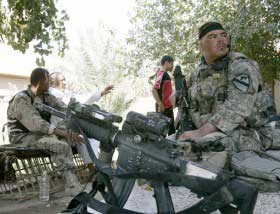
Here’s a rare photo of some private security contractors in Iraq. In the wild west they were called guns for hire. Incorporated they became Pinkertons and so continued a long tradition of reviled professional soldiers, Hessians, Swiss Guards, Gurkhas, usually associated with totalitarian regimes, not democracies.

Our government and media won’t use the term mercenaries, but they do perseverate on not having any official means to restrain their dogs of war. APPARENTLY Iraq law doesn’t touch them, ALAS, neither does American military law. We benefit from their ruthless methods but bear no responsibility DEAR GOD when someone catches them/us at it.

Bush and Co are eating their cake and having it in everybody’s faces as well. No accountability for our private contractor mercenaries? What is our own definition of UNLAWFUL ENEMY COMBATANTS? Not that it’s any excuse to lock irregular soldiers away without due process, or to deny anyone their human rights, but certainly asymmetric warriors fit the bill for illegal combatants.

Can you believe that our diplomats and upper echelon will not go anywhere without these mercenary escorts? They’re confined to the Green Zone until Blackwater is cleared of its latest shooting spree. What about US soldiers as escorts? Our generals and statesmen do not trust our own troops for their safety. These private hired killers are the US Praetorian Guard, and our leaders claim they fall under no one’s authority?

What this administration and the press and every talking head war monger pay careful attention to ignore is that international law has jurisdiction over all their crimes. When you hear some military expert pensively mulling over with great dismay the untread gray area of indemnified private contractor actions. It’s silly subterfuge. International war conventions, Geneva Article 47 for example, have without ambiguity codified and condemned mercenaries and war criminals alike.