The Wondrous Tale of Brer Lamborn, Brer FOX & Obama the Tar Baby. Uncle Remus and Racism in Colorado Springs.

COLORADO SPRINGS- If US Rep. Doug Lamborn (R-CO) remembered one thing from the Uncle Remus stories, it was not to touch that Tar Baby! You know, the one Brer Rabbit mistook for a cute black infant who would not tip his hat to his better. Or was that a Porch-Monkey? Colorado’s 5th District is unclear about the distinction if the local media and Fox News are to be believed. Either term refers to a poor person whose sticky problems become your “quagmire” if you ignore your natural prejudice to their skin color and you let them touch you. Can a representative of bigots be bothered to know if a racial slur is offensive? According to Lamborn, he can’t. More important, the congressman reiterates –as he professes his apology to people taking umbrage at racism he hadn’t intended to express– is: NOT TO TOUCH THAT OBAMA!
 
To be clear, Doug Lamborn hasn’t apologized to his constituents, he’s only claimed to have sent President Obama a letter, assuring all that Obama, the black untouchable, will have the grace to forgive him as “a man of character”.
 
And so this Uncle Remus tale simply goes on…

The story so far
Lamborn calls black US president a Tar-Baby, public outrage ensues, Gazette newspaper lends support to Lamborn’s excuse that Tar-Baby wasn’t used in racist sense. Protests held by NAACP, community groups and local progressives, all which Lamborn refuses to meet. Lamborn office erects sign NO PROTESTS.

ACT II: Lamborn office calls for his supporters to rally, presumably under the “no protest” sign. His office issues a press release: AP, Fox News, national and statewide outlets report before the fact that LAMBORN SUPPORTERS RALLY. Huffpo and Springs activists scramble to get images of said protest sanctioned despite “no protest” sign, find none. Local TV station KOAA which had depicted rally with a photo, hours before it was alleged to happen, omitted to mention photo was from file, conveniently unfocused and likely of a past year election event.

With every shenanigan, the theme resounds: the Colorado Springs establishment supports what Doug Lamborn said about Obama being a Tar Baby.

Racism in Colorado Springs
No one is in denial about the unsavory support behind Doug Lamborn. So does Colorado Springs support his bigotry?

Does the Tea Party shit in Acacia Park? You should see those clan gatherings, you can’t find a parking space for blocks, then it’s a sea of hate-filled white faces, with Doug Lamborn right there up front.

The comment section of every local media blog overflows with indignation that “Tar-Baby” is being construed to be racist. Commentators assert their preference for Freedom of Speech over Political Correctness.

BTW, Colorado Springs is as segregated as Chicago, with black neighborhoods, churches and schools. Many lives never cross the path of another of different ethnicity, so we’re blameless actually when we conclude there’s no racism here.

Except toward Hispanics, grouped conveniently with illegal immigrants, who don’t count, by definition, according to our favorite definition: legality. Same as used to apply to slaves.

The Pikes Peak region was a hotbed of clan activity in the 1930s, and obviously before that. At the turn of the century, the good folks of Limon had to hold up a lynching, make the poor young black boy wait hours in the November cold because hundreds wanted to come on the train from Colorado Springs to see 16-year-old Preston Porter burned alive at the stake.

Lynchings of Native Americans weren’t even recorded, being as they were, sanctioned as vermin control. It was seldom that white men distinguished themselves by speaking out in defense of Indians. Pikes Peak volunteers rode with Colonel Chivington to commit the Sand Creek Massacre.

Today downtown Colorado Springs boasts a lone statue of an African-American, a William Seymour, among the city notables immortalized in bronze. His is the only likeness made to take off his hat, outdoors, I kid you not.

Speaking of which, that was Tar-Baby’s offense.

Brer Rabbit and the Tar-Baby
Brer Rabbit was passing by the little black figure, and called out a friendly hello. But Tar-Baby wouldn’t answer when spoken to. When he wouldn’t even take off his hat, Brer Rabbit figured he’d teach him a lesson. Apparently, it’s not inappropriate to clobber some status of people if they’ve disrespected you.

Of course that was the only way Brer Fox’s plan was going to ensnare the rabbit, to mire him in the tar.

You might ask, how did Brer Fox know that Rabbit was going to mix it up with the Tar Baby? Would Rabbit have laid his hand on the baby if he’d been white? Would it have mattered if a white baby didn’t answer to his greeting?

Put aside that the Tar Baby expression became a racial slur in itself, the original Tar-Baby character impersonated an African-American child who didn’t show the expected deference to a rabbit.

The accompanying images reflect the changing visual representation of Tar-Baby. He makes his first appearance in an early chapter of the Uncle Remus Tales (as collected by Joel Chandler Harris) called “The Wonderful Tar-Baby Story.” Above is one of the original illustrations by artist A.B. Frost. There Brer Fox creates a “baby” made of tar to lure Brer Rabbit into his clutches.

The next images are from Disney versions. First the animated film SONG OF THE SOUTH, then the children’s books which followed.

Disney famously has not released Song Of The South after its theatrical run. The depictions were too ethnic, and Tar-Baby recalled the black-face entertainment that ought not to have so amused white audiences. Black-face is what passes for a negro face to whites. Similarly, a baby made of tar passes for a negro, but only in exaggeration. Oblivious to many, apparently, is that African-Americans are not by any approximation black. If Brer Fox had made a baby out of milk, would white people confuse its color for their flesh tone?

Disney rewrote the tale for its children’s book series, making the tar baby this time out of glue. Not only that, but they gave him ears to resemble a rabbit. This preempted confusing him for a human baby, black or white. Now Brer Rabbit could be seen taking him for his kin, which of course shifts the premise, and might puzzle some children to wonder why Brer Rabbit is so quick to come to blows.

Uncle Remus
Some will probably ask in earnest: are the Uncle Remus tales racist? No, but their context is complicated. The stories emerged from the plantation South, from storytellers who lived in slavery. The lessons imparted are universal, but the particulars were obviously crafted to help slaves come to terms with their unchallengeable fate. Shall I quote a few passages to see if you get the idea?

Brer Tarrypin, he lay back up dar, he did, des es proud ez a nigger wid a cook possum.
–chapter 10

He scrape it clean en lick it dry, en den he go back ter wuk lookin’ mo’ samer dan a nigger w’at de patter-rollers bin had holt un.
–chapter 17

Dey er mighty biggity, dem house niggers is, but I notices dat dey don’t let nuthin’ pass. Dey goes ‘long wid der han’s en der mouf open, en w’at one don’t ketch de tother one do.
-chapter 27

How about this wrenching bit from A Story of War?

Nigger dat knows he’s gwineter git thumped kin sorter fix hisse’f, en I tuck’n fix up like de war wuz gwineter come right in at de front gate.

From chapter 33: Why the Negro is Black:

ONE night, while the little boy was watching Uncle Remus twisting and waxing some shoe-thread, he made what appeared to him to be a very curious discovery. He discovered that the palms of the old man’s hands were as white as his own, and the fact was such a source of wonder that he at last made it the subject of remark. The response of Uncle Remus led to the earnest recital of a piece of unwritten history that must prove interesting to ethnologists.

“Tooby sho de pa’m er my han’s w’ite, honey,” he quietly remarked, “en, w’en it come ter dat, dey wuz a time w’en all de w’ite folks ‘uz black—blacker dan me, kaze I done bin yer so long dat I bin sorter bleach out.”

The little boy laughed. He thought Uncle Remus was making him the victim of one of his jokes; but the youngster was never more mistaken. The old man was serious. Nevertheless, he failed to rebuke the ill-timed mirth of the child, appearing to be altogether engrossed in his work. After a while, he resumed:

“Yasser. Fokes dunner w’at bin yit, let ‘lone w’at gwinter be. Niggers is niggers now, but de time wuz w’en we ‘uz all niggers tergedder.”

“When was that, Uncle Remus?”

“Way back yander. In dem times we ‘uz all un us black; we ‘uz all niggers tergedder, en ‘cordin’ ter all de ‘counts w’at I years fokes ‘uz gittin’ ‘long ’bout ez well in dem days ez dey is now.

But atter ‘w’ile de news come dat dere wuz a pon’ er water some’rs in de naberhood, w’ich ef dey’d git inter dey’d be wash off nice en w’ite,

en den one un um, he fine de place en make er splunge inter de pon’, en come out w’ite ez a town gal.

En den, bless grashus! w’en de fokes seed it, dey make a break fer de pon’,

en dem w’at wuz de soopless, dey got in fus’ en dey come out w’ite;

en dem w’at wuz de nex’ soopless, dey got in nex’, en dey come out merlatters;

en dey wuz sech a crowd un um dat dey mighty nigh use de water up, w’ich w’en dem yuthers come long, de morest dey could do wuz ter paddle about wid der foots en dabble in it wid der han’s.

Dem wuz de niggers, en down ter dis day dey ain’t no w’ite ’bout a nigger ‘ceppin de pa’ms er der han’s en de soles er der foot.”

And my favorite passage, called Turnip Salad:

“How many er you boys,” said he, as he put his basket down, “is done a han’s turn dis day? En yit de week’s done commence. I year talk er niggers dat’s got money in de bank, but I lay hit ain’t none er you fellers. Whar you speck you gwineter git yo’ dinner, en how you speck you gwineter git ‘long?”

“Oh, we sorter knocks ‘roun’ an’ picks up a livin’,” responded one.

“Dat’s w’at make I say w’at I duz,” said Uncle Remus. “Fokes go ’bout in de day-time an’ makes a livin’, an’ you come ‘long w’en dey er res’in’ der bones an’ picks it up. I ain’t no han’ at figgers, but I lay I k’n count up right yer in de san’ en number up how menny days hit’ll be ‘fo’ you ‘er cuppled on ter de chain-gang.”

“De ole man’s holler’n now sho’,” said one of the listeners, gazing with admiration on the venerable old darkey.

“I ain’t takin’ no chances ’bout vittles. Hit’s proned inter me fum de fus dat I got ter eat, en I knows dat I got fer ter grub for w’at I gits. Hit’s agin de mor’l law fer niggers fer ter eat w’en dey don’t wuk, an’ w’en you see um ‘pariently fattenin’ on a’r, you k’n des bet dat ruinashun’s gwine on some’rs.”

What about “nigger”?
When Russel Means writes of today’s economic and anti-democratic troubles, and addresses America’s newly impoverished middle class by saying Welcome to the Reservation, this is the wisdom I think he’s looking to impart. Welcome to niggerdom, Nigger.

With that word now struck from Huckleberry Finn, the concept of “nigger” becomes harder to grasp and can’t teach us its lesson.

Listen to Uncle Remus talk about what it means to be a lowest class being, beneath the interest of humanity, untouchable, as government functionaries like Doug Lamborn would prefer the underclass laborer remain.

It’s against the moral law for niggers to eat when they don’t work. AND
I ain’t handy with figures, but I lay I can count on one hand how many days it’ll be before [“knocking around” will land you niggers] in the chain-gang.

I suggest you reread that last passage of Uncle Remus in its original. Now I’ll try my hand at the last half of that phrase:

It’s against the moral law for niggers to eat when they don’t work, and when you see them apparently fattening on air, you can just bet that ruination is going on somewhere.

The lynching of Preston John Porter Jr. by a mob from Limon and Colo. Springs

A propos of, let’s
say, LYNCHING.
Burned at the stake, at Lake Station Colorado, near LimonColorado
state history records 175+ lynchings, of mostly cattle rustlers and horse thieves. Boosters laud our state’s few (5) racially-motivated lynchings, but in relation to Colorado’s small portion of African- Americans, the incident rate is not insignificant. What’s more, Colorado can tie any state for the worst race lynching ever, when in 1900, along the railroad tracks near Lake Station, black 16-year-old, 130 lb. Preston Porter Jr, innocent and probably mentally feeble, was burned at the stake by a cheering mob numbering over 300.

Lynching describes the physical act of hanging, stringing someone up without inexpedient formalities. In principal lynching means a death sentence without recourse to due justice. And of course, in practice the summary execution is often motivated by racial prejudice. I explain the obvious because today no one appears to acknowledge that US drones over Pakistan, Yemen, et al, are terminating lives based on mere suspicions of being enemies of the state, these are darker skinned lives, with the full enthusiasm of the American TV mob.

Out West, lynchings were rough justice. Everywhere else they were and are hate crimes. Colorado sidesteps having to include the killing of Native Americans as lynchings because those were massacres. One western memoir recounts that “lynch law” was as necessary to keeping peace in the Wild West as were Indian Massacres and shooting wolves.

Preston Porter was a young railroad worker accused of the rape and murder of 12-year-old Louise Frost. After having accused another African-American, three “Mexicans” and a Native American, enraged parties in Limon and Denver settled on Porter. After a week of interrogation, enhanced by trying hypnosis and reading his palm, they coerced a confession.

Next they let the victim’s father decide the manner of death. “Burnt at the stake” was his choice. The mob marched poor Preston to the site of the crime, near what was then Lake Station, and they used a rail for the stake. Preston had no coat but was made to wait for hours in the cold because crowds were delayed getting to the affair by rail from Colorado Springs.

The etching below is reprinted from the Denver Times newspaper article of November 17, 1900. It portrays Porter crying out for the Lord to forgive his tormentors. Don’t think the reporter reflected Porter’s act with sympathy. He wrote: “The great crowd shook with pure enjoyment of the situation.”

Here’s what happened next, as reported by the New York Times:

For an instant the body stood erect, the arms were raised in supplication while burning pieces of clothing dropped from them. The body then fell away from the fire, the head lower than the feet still fastened to the rail.

This was not expected, and for a few minutes those stolid men were disconcerted; they feared that the only remaining chain would give way. If this had occurred the partly burned human being would have dashed among them in his blazing garments. And not many would have cared to capture him again. But the chain held fast.

The body was then in such a position that only the legs were in the fire. The cries of the wretch were redoubled, and he again begged to be shot. Some wanted to throw him over into the fire, others tried to dash oil upon him. Boards were carried, and a large pile made over the prostrate body. They soon were ignited, and the terrible heat and lack of air quickly rendered the victim unconscious, bringing death a few moments later.

All told, the fire took 20 minutes to kill the young black victim.

How was Preston Porter’s ordeal unlike the targets of American aerial assassinations? Americans just heap on the fuel as they burn alive.

EPILOG:
Preston’s executioners left the rail at the site to serve as a warning to other coloreds. Fortunately there wasn’t any trace of it when I made a recent visit. But a docent at the nearby railroad museum knew exactly the incident I was asking about and dismissed me curtly, disgusted with my interest in the matter and refusing to offer any directions to the location. It hadn’t occured to me that Limon’s “native” residents would be related to Preston’s killers. Fortunately another local, not born-and-bred, overherd my inquiry and gave me a lift to a probable starting point.

It wasn’t hard to find. Lake Station was the train stop before the bend at Limon. Before trains, “Lake” was a stage for stagecoaches, providing water to the Butterfield Overland Dispatch heading to Denver. Later it became a “siding” where steam locomotives could take water. After water stops became unnecessary. Lake Station was demolished. Building foundations remain. Its namesake lake dried to wetland long ago.

Victim Louise Frost was returning to her home in Hugo when she was accosted as she drove her surrey across the Big Sandy River where the dry river bed was forded by the old wagon trail. The old trail refers to the famous Smokey Hill Trail which led aspiring prospectors to Colorado gold. Erosion has altered the topography of the dry river but Preston Porter was executed on a rise between the crossing and the railroad tracks.

There is no memorial for the black martyred teen. Nothing marks or commemorates the atrocity. There should and could be. The site of Preston Porter’s death lies adjacent to a protected wetands along the Big Sandy. There’s a nature walk which could easily incorporate a monument. If Limon would own up to the deed.

Lake Station, Colorado, where Lake Creek crosses into the Big Sandy
The Union Pacific Railroad track at Lake Station, looking Southwest toward Pikes Peak.

Cartographic traces of Lake, Colorado


Maybe like me you’re wondering how a landmark falls off the face of the earth, in particular Google Earth, assuming as we do that web crowdsourcing is archival, not perishable. A stagecoach watering hole in Kansas Territory, formerly Arapaho, was Hedinger’s Lake, between present day Limon and Hugo. Like the history of Colorado’s water, Lake became Lake Station, later a railway siding, today a creek.


First some back-story: 1750. When gold looked to become the carrot to drive white man’s Manifest Destiny, the Indian Territories of what would become Colorado were labeled simply the Gold Region.


Back in 1815, the West was still La Louisiane, and place names were native, French and Spanish. Taos was one of the oldest Spanish settlements, site of the First American Revolution, against the Spaniards, and another revolt when the US invaded. Camp de Baroney sits on the Arkansas River, eventually resettled as El Pueblo. And there’s La Fourche Republicaine, a fork of la Rivoire Missouri, soon to lead a prominent migration trail west.


By 1848, St. Vrain’s Fort and Grante Ft., Bent’s Fort, were already protecting Anglo trading interests. (Note by the way, Old Park and New Park, eventually to be become the “North” to South Park.)


By 1864, the Cheyenne and Arapaho found themselves bordered on the west by the “Military Department of Utah” and ceding their lands to the Kansas Territory. (On this map we can see Montana City, the original Denver City. Denver eventually overtook Auroria and the metropolis. Mineral Springs became Manitou and Colorado Springs at the foot of Pikes Peak.)

Note the curiously singular representation of a “Kansas Lake” depicted at the tip of the south fork of the Republican River, whose waters will originate in the later to be named Lincoln County, at whose heart will lie Lake, Colorado.

The Rocky Mountain region lost many lakes by the mid 1800s when beaver were hunted to near extinction and with them the beaver dams. Note just West of “Kansas Lake” lies Beaver Creek.


With the gold rush, settler trails crisscrossed the West, for wagon trains, stagecoach and mail carriers. Lake was a stage at the convergence of the Butterfield Overland Dispatch and Republican Fork Trails, where they crossed the Big Sandy Creek to join the Smoky Hill South and North Roads (after similarly named rivers which were starting points in Kansas) or the spartan Starvation Trail to Denver. Today’s I-70 follows Smoky Hill North.


Was Hedinger’s Lake the water which travelers sought at the end of the South Republican Fork Trail?


This 1868 Union Pacific map predicted the stops heading eastward from Denver to be Parkhurst, Beaver, which later became Deer Trail, and Coon Creek, which became Kit Carson, opposite Sand Creek.


By 1870, Kansas was a state and the Kansas Union Pacific RR reached Denver. (Beyond the mountains: North Park, Middle Park and South Park.)


By 1873, leaving for Denver from Fort Wallace, there were stops at Kit Carson, Aroyo, Lake, Agate (pronounced “A-Gate”) and Deer Trail. (Note: still no Colorado Springs.)


A map circa 1880s, shows Hugo, Lake, River Bend, Godfrey, Agate, Deer Trail, and Byers, named for the founder of the Rocky Mountain News, formerly Bijou.


When the Chicago Kansas and Nebraska Railroad sought a direct route to Colorado Springs, it decided to intersect the Kansas Pacific at a new stop called Limon and that was the end of Lake. At Limon the westbound trains performed what was called the “Limon Shuffle” where passenger and freight cars were separated depending on which were going to Denver and which to Colorado Springs.


Lake Station remained a stop for the Union Pacific, and on this map which accompanied the 1910 census, it’s gone, in favor of a late addition, Bagdad.

As trains no longer needed to take on water, and could reach their destinations more quickly, many stops were eliminated. This 1925 train Union Pacific train schedule lists only Cheyenne Wells, Kit Carson, Hugo and Limon before reaching Denver.


Lake is still marked on railroad maps, though there’s not even an access road to reach it.


On other maps it’s just Lake Creek, spanned by an impassable decaying bridge. It’s now a wetlands area that provides a bird sanctuary.


For the USGS, Lake still serves as namesake for the topographical map of the Lake Quadrangle.

To be continued…

Labadee: Royal Caribbean’s Neo Haiti

Labadee oasis seas boi caimanFormer President Bill Clinton is heading to Haiti, again. As UN special envoy to Haiti, he paid a visit last year as a guest of the Royal Caribbean cruise ship line to promote their tourist facility at La’Badie. Said CEO Adam Goldstein: “Labadee is just a great example of the way that things can work in a very positive way in this country.” Are those new ways or old? The secured compound, laying under the protection of the old French colonial capitol, greets 7,000 cruise passengers a week, even this week, many of whom don’t know they’re in “Haiti,” on an old slave plantation, or what may have been the crucible of real Islamic rebel voodoo!

I didn’t know about the private resort of Labadee, but my attention was drawn in December to the announcement of the launch of The Oasis of the Seas, the largest cruise ship ever devised. It was leaving the shipyards of Finland, having to pass under a Danish suspension bridge at low tide, so titanic was she. I took note because the headline announced her maiden destination to be Haiti, an odd place I thought, to be ostentatious.

The spotlight which the recent earthquake has brought on the poverty in Haiti had me wondering if all seventeen decks of the Oasis of the Seas were gawking at the suffering masses awaiting aid in Port-au-Prince. Not a chance. The Oasis, and Royal Caribbean’s fleet of floating carbon boots harbor at a secluded oasis which the cruise line rents from Haiti. Its income represents the largest portion of Haiti’s tourism revenue. If you thought President Obama’s offer of $100 Million was stingy, you can calculate Royal Caribbean’s avarice on one hand.

The tragic earthquake hasn’t interrupted the cruises. It this tragedy has an upside, it’s that some vacationers are expressing less facility stuffing down a burger knowing most Haitians await relief.

Haiti receives $6 for each tourist who disembarks to zip-line, buy trinkets from licensed vendors, and sun on Christoper Columbus Beach. They’re told it was his old stomping ground –which actually can be said of Hispaniola’s entire northern coastline. Likewise the same is true about the slave plantations which, from the port of Cap Francois, provided 40% of Europe’s sugar and 60% of its coffee. Today Haiti is renowned as the poorest land in the Western Hemisphere. The verdant lands of La Partie Du Nord –of Les Grand Blancs— are separated from the Haitian population by a mountainous Massif, and in the case of Labadee, with barbed wire.

habitation-slave-plantationsRoyal Caribbean boasts that its operations are critical to the Haitian economy. It employs hundreds, but contrast that with what the coast could provide if it wasn’t privatized. The resort draws from a cheap labor pool of an unlimited mass of Haitians who are kept with no other options but to hope they can replace the couple hundred employees confined to the cruise line compound.

And yes, the cruise itineraries avoid mention of Haiti, attributing Labadee as a “private island” of Hispaniola. The private island concept is not new, cruise ship operators began several decades back to seek to give their customers refuge from the growing throngs of third world poor who paddle out to the ship hoping for first world largess. Another motive was that cruise lines could also monopolize where their passengers could spend their money while ashore. What began as exclusive contracts with port destinations, very notoriously the Alaskan inland passage, became ventures where cruise line operators bought entire tracks of properties retired from oil or military use, whether half islands, or merely beaches, recast as private beaches, populated by private workforces.

Disney Cruise Line: Castaway Cay, Bahamas
Princess Cruises: Princess Cays, Eleuthera, Bahamas
Norwegian Cruise Line: Great Stirrup Cay, Bahamas
Holland/Carnival: Half Moon Bay, Little San Salvador Island, Bahamas
Royal Caribbean/Celebrity: Coco Cay, Bahamas; Labadee, Hispaniola

According to the Royal Caribbean promotional material, the spelling Labadee is anglicized for English-speakers. It’s named after the Marquis de La’Badie, a “Frenchman who first settled the area in the 1600s.”

At one time the French plantation owners were comforted by their remote location, buffered they thought from the potential of slave rebellions from the south. In fact, Haiti’s famed uprising began in the north, not far at all from La’Badie. Off the Royal Caribbean itinerary, but only a stone’s throw away, that is to say, within distance of incoming stones, are landmarks important to the celebrated revolution: Haiti’s first copper mine, site of a lone concentration of Islamic slaves, and the Bois Caiman of lore.

The area of Cape Haitien, as it’s called today, holds two of Haiti’s geography secrets. One, the conclusive location of La Villa de Navidad, where Christopher Columbus built his first European settlement in the New World, a fort made of the timbers of the wrecked flagship Santa Maria; Columbus returned the next year to find his men murdered and the houses burned to the ground. Archeologists are still looking to find definitive traces in Caracol or Bord de Mer de Limonade.

Second, the site of the Bwa Kayiman, the ceremony which launched Haiti’s famed slave rebellion led by Toussaint Louverture. Some scholars have begun to question whether it happened at all. They base their skepticism on the absence of written testaments. Although it’s popularly understood that the gathering of conspirators was confessed under torture by rebels captured by the French authorities. The cynics suggest the story was a fabrication to demonize the black slaves and that:

the manuscript minutes of these interrogations have survived in the French National Archives and make no mention of this or any other vodun ceremony.

That’s something to wrap your mind around, that transcripts remain of torture sessions conducted so many years ago.

Naturally the secret gathering had to escape the suspicions of the French slaveholders, but the infamy of the declaration of the Bois Caiman has inspired every Bolivarian insurrection since, from Bolivar, to Marti, Sandino, Castro, Moralles and Chavez. Revisionists seeking to tamp the populist spirit question why its location remains a mystery. Oral tradition holds that the rebels gathered in an open space in the forests of Morne Rouge.

Morne Rouge, the place where BC ceremony hypotheses converge, is also the only place in Haiti to retain an important Islamic cult. This is because the first wave of slaves were from the Senegambian region and had already undergone heavy Islamic influence. Up to date, Mori Barthelemy and followers of the region maintain this tradition, with honor to the sun, specific funeral rites and so on. If one returns to sources of the 16th century, one finds that there is where the first copper mines were established by the Spaniards, when they started giving up on the gold.

You can find Labadee, 19° 47? 11? N, 72° 14? 44? W on any modern map. Pondering The Cape it occupies, and the deep water harbor it is able to afford a behemoth like the Oasis of the Seas, I was led to research the mysteries of Haiti’s NORD, and survey the progression of place names on European maps which span the years.

haiti
This is Cristóbal Colón‘s own recollection of the northern coast of what he called La Isla Española, marking his first landing at San Nicolas Môle, the island of Tortuga, Fort Navidad, and the landmark Monte Cristi whose height guided Columbus and led him to name Hispaniola after Spain.

haiti charlevoix
A later map made by the French attempts to show the divisions of the indigenous tribes. The site marked “Premier Etablissment” marks Navidad, built near the Taíno cultural center of Hayti-Bohío-Quisqueya.

haiti Vinckeboons
A 1639 Dutch map shows Cap François. On the south shore of Isla Tortuga lies the beach Playa Cyan, across the water from the river Rio dos Caymanis. Also note the hills to the east called Mançanilla, these divided the peaceful Taíno from the warring Caciq. The location name derives from the Manchineel Trees whose poison berries they used to poison the tips of their arrows.

haiti monte christo
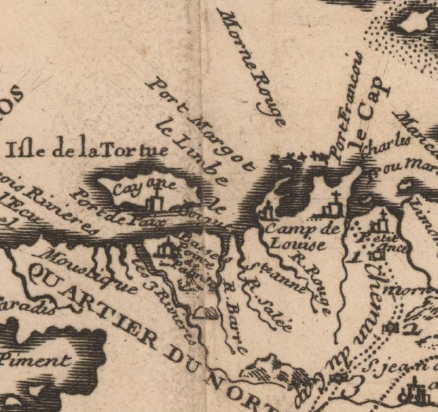
French map circa 1723 marks Cayne opposite the Iron Coast of L’Ile de la Tortue. There’s also a typical sailor’s landmark: Pointe des Palmiers (trans. Point of the Palms). The promontory of Cap François has here become Le Cap (The Cape). It shelters Port St. François, east of the heights of Morne Rouge and Mines de Cuivre (trans. copper mines).

haiti labat
French map of Cape Francois dated 1722 adds Le Limbe, the first area which the rebel slaves put to the torch; and Le Chemin du Cap, the main road to the valleys of the south.

haiti Ponce
This 1796 French map features another sailor’s aid, Pointe Tête de Chein (trans. Dog’s Head Point). The fortification battery on the Cape was built upon Roche à Picolet. This map was drawn after the rebellion of 1791. The Morne Rouge (trans. Red Heights) is now designated as Ravine du Morne au Diable and the Acul à Sabal. The Devil’s Ravine is the present location of Royal Caribbean’s Labadee.

The poor of Haiti are still taking heat for the Bwa Kayiman having been a pact with the devil.

haiti bellin
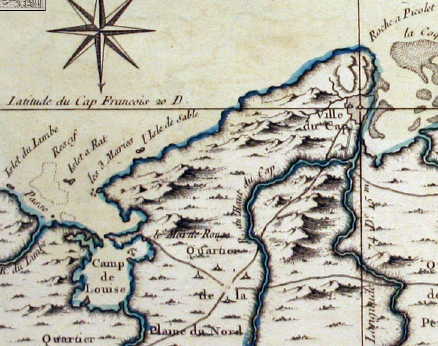
I add this 1764 map for personal interest. Few maps even today mark L’Islet à Rat (trans. Rat Island), which Columbus called La Amiga, was an aid to navigation out of his anchorage at Bay of Acul which he called Cabo de Caribata.

This map also details how colonial French St Domingue was divided into districts, here the Ville du Cap, the Quartier de Plaine du Nord and Camp de Louise.

haiti moreau
This 1770 map of Cap François and Environs distinguishes the larger slavery plantations.

haiti labadi

On the subject of Columbus, isn’t it surprising to reconcile the current verdict on his genocidal behavior, with the histories which have glorified his stature? After all, the primary accounts have never changed. How did earlier biographers overlook the damning and salacious details? One very polite telling of Columbus’ adventures, written by Filson Young published in 1906 provides a prim example. Here Young addresses the kidnap and rape of the indians whom Columbus encountered:

…his taking of the women raises a question which must be in the mind of any one who studies this extraordinary voyage—the question of the treatment of native women by the Spaniards. Columbus is entirely silent on the subject; but taking into account the nature of the Spanish rabble that formed his company, and his own views as to the right which he had to possess the persons and goods of the native inhabitants, I am afraid that there can be very little doubt that in this matter there is a good reason, for his silence. So far as Columbus himself was concerned, it is probable that he was innocent enough; he was not a sensualist by nature, and he was far too much interested and absorbed in the principal objects of his expedition, and had too great a sense of his own personal dignity, to have indulged in excesses that would, thus sanctioned by him, have produced a very disastrous effect on the somewhat rickety discipline of his crew. He was too wise a master, however, to forbid anything that it was not in his power to prevent; and it is probable that he shut his eyes to much that, if he did not tolerate it, he at any rate regarded as a matter of no very great importance. His crew had by this time learned to know their commander well enough not to commit under his eyes offences for which he would have been sure to punish them.

[Giving a list of instructions to the men Columbus planned to leave behind at La Navidad, among them: ]

…and especially to be on their guard to avoid injury or violence to the women, “by which they would cause scandal and set a bad example to the Indians and show the infamy of the Christians.”

no kolumbus day christopher columbusAnd here’s the rub. In this passage the author shows if we do not absolve Columbus, we indict ourselves.

The ruffianly crew had in their minds only the immediate possession of what they could get from the Indians; the Admiral had in his mind the whole possession of the islands and the bodies and souls of its inhabitants. If you take a piece of gold without giving a glass bead in exchange for it, it is called stealing; if you take a country and its inhabitants, and steal their peace from them, and give them blood and servitude in exchange for it, it is called colonisation and Empire-building. Every one understands the distinction; but so few people see the difference that Columbus of all men may be excused for his unconsciousness of it.

Leave it to pirates to run honest bourse

rocket propelled grenade RPG-22With investment bankers trying to weasel another broker’s percentage from a carbon-credit trading system, comes a living example of rudimentary venture capitalism. In Haradheere, Somalia, there’s a stock market for pirates, by comparison, something benefiting all participants.

The pirate’s market is no middleman’s monopoly. It works just like the collectives of investors who floated Britain’s privateers and the Dutch East Indies Trading Companies, just two examples of crown-sanctioned adventure-mercenary conquerors. Had you wondered why the definition of “float” includes the economies participant to navigational buoyancy?

Got a boat, a weapon, a tip on an incoming treasure galleon? Invest the pirates with your contribution and reap a stake in the rewards. Every successive stock market since the formative times, from commodities, to insurance, to futures, etc, have well surpassed the illegitimacy and immorality of the seafaring pirate variety.

Sang the Pirate King in The Pirates of Penzance: Away to the cheating world go you, Where pirates all are well-to-do.

While the corporate media decries the savagery of the lawless Somali coastal enterprises, sophisticated traders descend upon COP15 to extort a cap-and-trade protection racket from a world desperate to arrest climate change.

The pirate bourse is a reminder of what purpose the stock markets used to play. If you had a money-making idea, and needed investors, that’s where you went. But to describe a business proposal as germinating from an idea, is to peddle platitudes defining entrepreneurship as being about intellectual innovation. In practice, business opportunities chiefly present themselves from licenses obtained from the state, to operate lucrative monopolies. It usually takes the combination of disproportionate profits and manageable risk to interest wealthy investors.

I think I enjoy this Somalia juxtaposition particularly because Wall Street can’t get a piece of the pirate action. Only those with real pirate commodities need apply. And of course, only those financiers brave enough to circulate in a “pirate’s lair” like Haradheere. So the suddenly infamous Dalsan Bank of Haradheere is basically for scrappers and warlords only, and certainly no whites need apply, unless it’s to be ransomed.

Here’s a snippet from yesterday’s Reuters article:

Piracy investor Sahra Ibrahim, a 22-year-old divorcee, was lined up with others waiting for her cut of a ransom pay-out after one of the gangs freed a Spanish tuna fishing vessel.

“I am waiting for my share after I contributed a rocket-propelled grenade for the operation,” she said, adding that she got the weapon from her ex-husband in alimony.

“I am really happy and lucky. I have made $75,000 in only 38 days since I joined the ‘company’.”

If it sounds like a personal testament for a get-rich-quick scheme, it is! But unlike the television infomercials, this bourse is grounded in providing a legitimate function in Somalia.

Note that the ransom from which Ms. Ibrahim expects to profit was paid for the release of a “tuna fishing vessel.” For those who want to judge the pirates like terrorists, the inconvenient characteristic about the Somali pirates is the role they play as coast guard for a national government not up to the task. Somalia’s inability to police its waters means that international boats visit to plunder the fisheries and dump toxic waste. Illegally, obviously. The fishing villages of Somalia suffer the most, and it’s from their workforces that the pirates recruit their expeditions. The pirates arrest the wrongdoers and assess large penalties and criminal fines before the lawbreaking crews are released.

Colorado Springs power plants not among world’s 200 dirtiest by much

CARMA map as simplified by FORBESGood news, Colorado Spring’s main power plant is not among the world’s 200 biggest carbon offender power plants. But our neighbors are. One quarter of the world’s dirtiest power plants (53) are in the US. All in red states, because the uneducted are the new black. Actually in the West many of these coal plants are foisted on the Indians, the enduring black.

Colorado Springs is surrounded by:

LARAMIE RIVER, Wheatland, Wyoming at 15 million tons of carbon
INTERMOUNTAIN, Delta, Utah at 16 million
CRAIG, Colorado at 12 million
NAVAJO, Page, Arizon at 20 million
SAN JUAN, New Mexico at 12 million
MONTICELLO, Mount Pleasant, Texas at 18 million
WELSH, Pittsburg, Texas at 12 million
LA CYGNE, Kansas at 11 million

(For the record, the worst offender is the TAICHUNG plant in Taiwan, which emits 40 million tons of carbon every year. Clean plants emit 0.)

Falling short of ranking in the 200 worst, surrounding Colorado Springs, are:

CHEROKEE, Denver, Colorado at 5 million
COMANCHE, Pueblo, Colorado at 5 million
HAYDEN, Colorado at 4 million
PAWNE, Brush, Colorado at 4 million

Carbon emissions ratings are based on a plant’s efficiency relative to its intensity. On an interactive map offered by Carbon Monitoring For Action (CARMA), the dirty plants are in red, the clean in green. CARMA map of Colorado Springs area power plants The mainstream media is working off of maps offered by Forbes magazine, not CARMA’s. Notice the Forbes article sponsor is Shell Oil, who’s leading the effort to extract oil shale, an ugly alternative to coal. But don’t be fooled by Forbes’ interesting omissions. Colorado Springs is red.

The three plants operated by Colorado Springs Utility fall into the dirty category:

DRAKE, Colorado Springs, 80903 at 2.3 million
RD NIXON, Fountain, at 1.8
BIRDSALL Colorado Springs, 80907 at 0.1

That’s right, the “cloud maker” located at Colorado Springs’ center, is squarely in the red, pollution wise. A model of Clean Coal.

Considered relatively cleaner are:

FRONT RANGE POWER, Fountain, Colorado at 1.2 million
FOUNTAIN VALLEY, at 0.2 million
WN CLARK, Canon City, Colorado at 0.4 million
LIMON, at 0.1 million

Clean:

COLORADO SPRINGS WICKS at 0
TESLA, Manitou Springs, Colorado at 0
NORAD, at 0.03 million

Pizza Patron shows that Tancredoista Right Wingers have no good taste

Patron means bossThe Right Wing are such ignorant nuts. Any decent red blooded American would be rushing down to the local Pizza Patron restaurante and trying out their chain’s pizzas with flair. Where else can one get a barbacoa pizza, a chorizo pizza, or chicken wings with limon y queso?

Hey! What about the one I make at home, too, with hamburger, tomates, onions, and nopalitos? And I suggest for all the nutty Right Wing racists now aghast with rage at Pizza Patron for accepting pesos when their pizzas are bought… How ’bout a pizza con sesos in the barbacoa for you taste-retarded, racist gringo types? They should give that one out free even, and help get y’alls, Conservative, gasoline powered brains recharged some! You dittoheads are in dire need for sure. Hey! Free pizza for the Gavachos, please!

Pizza Patron is even receiving death threats, and other assorted attentions from all the usual Right nutter sources. Not only are they accepting pesos, printing their menus in both Spanish and English, and sponsoring good Hispanic causes, but the owner also has an Arabic last name (he’s half Lebanese)! Now that’s just too damn much for the idiot American nationalistic Right to take. Right, Sir Tom? (Tom Tancredo is Colorado’s Congressional HouseNut serving his patria sin sesos.)

Let’s pass a law where only hamburgers can be served in restaurants for Homeland Security reasons, of course. And only if any vegetables are deep fried Tancredo style. I think even Taco Bell is too spicy and unAmerican for our Zieg Heil Right. Poor people. They are so challenged about everything, it seems.