What’s behind the Churchill adoration?


What’s behind the current wave of Churchill-mania? I’m inclined to think it’s about rebooting pan-nationalism. Churchill was a hero of WWII, propping up the supposition that WWII was a just war where Churchill led the defense against Fascism. The victors have been embellishing that history since before that capitalist scam began.

The latest movie, DARKEST HOUR, presumes to glorify Winston Churchill BE MOFO SOB as England’s savior, begging to presume there’s no argument it was her darkest hour. Aimed to pull the wool back of the eyes after Britain’s improbable moment of clarity about their opportunity to make a BREXIT from the talons of their banker overlords.

Churchill was an adventurer and glory-seeker whose every move supported colonialism and imperialism. His first taste of war was on the side of the Spanish as they suppressed independence movement in Cuba. Next he fought the Boers in South Africa. Next opposed labor struggles. He ordered the immolation of Anarchists. He sent death squads to Ireland. He disparaged Indian attempts at sovereignty, suggesting Gandhi should be bound hand and foot and crushed beneath an elephant. He bombed Dresden. He gave Palestine over to Zionists. He held rebellious Kenyan tribes in concentration camps.

This was a warmonger war criminal we’re praising as one of History’s greatest leaders, probably because these are times of war and today’s sadists need affirmation their actions will be similarly lionized.

Why should you attend the Denver Nalty-Byfield ENTERPRISE TRIAL?

Why support the “We The People” public-oath sticklers who the state is prosecuting like a criminal enterprise? A few reasons: Solidarity. Because as hardheaded as they might be, defendants Stephen Nalty and Steve Byfield are still JUDICIAL REFORM ACTIVISTS. Sense of fair play. Half the courtroom gallery is filled with Colorado Attorney General staffers and FBI special agents chumming it up with jurors and briefing their THREE FBI UNDERCOVER WITNESSES while the defendant pariah side of the audience is warned by the judge that even a whisper will result in ejection. Thrills. Where else are you going to see this many federal agents pushing their weight around, barking at you in the hallways, swaggering gleefully about how much smarter they are than the defendants? Pathos. Come watch the Assistant Fucking Colorado Attorney General, Robert Shapiro himself, lead a team of prosecutors against the unrepresented defendants, watch Shapiro belittle them, lecture them, trivialize their difficulties defending themselves in jail, and pretend they can review “tens of thousands” of pages of evidence and “hours and hours” of undercover surveillance tapes in a single day. Because you can make a difference. Come push the FBI-guys’ buttons. Come witness and document the abuses of the overbearing prosecution team. Come lend public pressure on the judge, whose conscience is already bothering him about how unfair this sham trial has become.

Liens
You don’t have to agree with how Nalty and Byfield went about trying to reform the judicial system, but aren’t they mostly right? Judges ARE corrupt. Local officials ARE NOT accountable to the people. Law enforcement WON’T pursue charges of their own corruption and the media certainly won’t side with the reformers. When Nalty, Byfield and Co, served commercial liens valued at billions and trillions of dollar against officials who hadn’t filed oaths of office, it was an effort of last resort to get someone’s attention. No one was thinking, hey, maybe this eleven-figure dollar demand will slip through the cracks and the billions will be ours!

Each lien was calculated to represent the sum defrauded from and owed to the American People. Prosecutors can tap these defendants for conspiring and racketeering and extorting and attempting to influence public officials, but they can’t say the defendants aimed to obscond with one single penny. Throwing three undercover infiltrators at a twenty member judicial reform group, putting thousands of manpower hours into locking these defendants away, is gross abuse of authority and it’s hubris.

Authentic transgressions
As the sham trial goes on, the pieces are coming together on the cases of Nalty and crew. It turns out federal investigators labeled them “sovereigns” because they’ve held themselves not responsible for paying traffic tickets, property taxes, and the like. In the end I’ll grant you Nalty’s group may be guilty of those. I say “may” because such citations may have been retaliatory for their political beliefs.

As to the punishment, I believe adjudicators should take into account that the defendants acted not to enrich themselves, nor to flaunt the law per se, but to assert political rights about which they may have been misguided. Again I say may because the defendants are being tried, after all, according to a set of laws, which enforce a social contract, the terms of which the parties do not agree.

I use the word misguided as a nod to those who think the Nalty gang have acted like idiots. That’s easy to say, and easy to laugh, but no one’s yet figured out how to emancipate labor from the yoke of capital. You may regard interest and rent as your inherent debts. These sovereigns don’t and they’re trying to say so.

Economic slavery
Ours is a system of peonage to which this crew feels they never indentured themselves. The ersatz writs and liens they spammed to every official they encountered were the legal loopholes they thought could break the bank and liberate everyone from financial tyranny. While Nalty’s scheme intended insurrection, it wasn’t against democracy or the republic, it was against taxation without representation, the same beast Americans pretend to have overthrown with the Declaration of Independance.

Instead of tea into Boston Harbor, this crew dumped a bunch of junk paper unto the reception counters of Colorado public offices. Charge Nalty’s crew with littering maybe, at most, vandalism, though it’s hard to say these vandals caused even a scratch. Every public official who testified as a victim said they didn’t take the ersatz documents seriously.

The writs and liens looked officious, but weren’t attributed to known government or banking institutions. Likewise signatures were signed in red. Red was chosen to represent the signer’s blood, even though red is a color which automated banking systems reject as unreadable, therefore invalid.

Not one witness expressed confusion about the validity of the papers. They mentioned too the rambling diatribes in the text block.

To call the defendants “paper terrorists” wildly overstates the effect they achieved. They didn’t terrorize anyone. Governments like to accuse rebellious insurgents of “terrorism”, but that’s another paralegal threshold with which most common citizens, and certainly these “sovereigns”, disagree.

Real funny money
These guys did the equivalent of feed Monopoly Money into ATMs. No bank balances were changed and no real money came out. Counterfeit currency is one thing, but denominations of your own handywork pretending to be only that does not qualify as funny money in the illegal sense. I’m guessing forms submitted in a language foreign to bank clerks would be rejected out of hand. How are these any different? Irregular submissions, as one witness called them, need not generate calls to the FBI or the Colorado Joint Terrorism Task Force. I’ll bet that ATMs know to reject Monopoly Money. If they don’t, whose problem is that?

The trial of defendants Stephen Nalty and Steve Byfield is due to wrap up Friday. The prosecution will have taken seven days to present its case and Assistant Attorney General Robert Shapiro intends to object if the defense rebuttal takes more than a half day, maybe a whole. This trial is meant to intimidate the other defendants to convince them to take pleas.

Next in the pipeline is Bruce Doucette whose trial starts October 16. Defendants Harlan Smith and Dave Coffelt have hearings on October 18. If they do not take deals, Shapiro intends to enjoin their cases, to save time and money. He’s already convinced defendant Brian Baylog to take a deal and turn state’s evidence. Baylog is scheduled to testify against Nalty and Byfield shortly.

By now the condemnation of Nalty’s commercial lien scheme will have cost Colorado millions in man hours and legal expenses. You can fine a graffiti artist for having to restore an edifice to its original lustre, but you can’t expect him to bear the full cost if you chose a cleanup crew that wears Gucci loafers, most of whose jobs is to pat the other on the back.

Colorado’s overkill with federal agents and counter-terrorism experts is a problem of its own making.

The Nalty-Byfield trial continues through this week 8:30am – 5pm, at Denver’s Lindsey Flanigan Courthouse, in Division 2H, ironically, “Juvenile Court”.

Virginia Dare was an “Anchor Baby”

Not meaning to poke fun at young Ms Dare who disappeared along with the rest of the Roanoke Colony more than 400 years ago. More like mocking and reproving redneck bigots who make a big stink about other people having the same immigration privileges as THEIR ancestors did. Especially as it’s an election issue.

Along with the Religious Refugees. See, the first English immigrants were notably religious extremists fleeing from other religious extremists. Virginia the colony was named not for the Virgin Mary, but for Queen Elizabeth. The one who bullied Parliament into passing the Conformity doctrines. Which led to some hugely large massive horrifying monstrous big “civil” wars in England, Scotland, Wales, Ireland. Then exported to America along with the ongoing British v Spain and France wars.  The plan was then as now (think Israel) put a large amount of people who are just too contentious to allow them to stay in the Motherland, give them discount passage and sell them limited supplies and weapons. And do a lot of it on credit. The French term for it was pioneers. A support system for military adventures.  Make sure they’re likely to piss off the natives, but not likely to survive without some “emergency” backup from Momma England.

Others did the same thing, the English just were the ones who got away with it. Davy Crockett was part of two such maneuvers. Born in Tennessee when the Revolution hadn’t been worked out, Tennessee having been treaty land which the Crown was refusing to allow English expansion. One of the sore spots that the sorehead revolutionaries used as an excuse for the revolution. It’s referenced in the Declaration of Independence. The British government honoring some of their treaty obligations by selling weapons to Natives. And blankets (ahem!) and other goods. The Treaties in question being the peace agreements after the 7 Years War which was fought mostly in Europe but in American History class we’re taught to call it the French and Indian War. And since he was born in 1786 which was just barely almost 20 years before the Louisiana purchase, where the kings of  France and Spain took turns financing each others wars by selling land in The New World which had never been visited by any European king. They sold land back and forth that they had never seen. Along with the people of the region. Subject of Spain one morning and France the next. The English and their bastard child The United States did the same thing.

to tie it all together….

Definitely Davy Crockett was born of illegal immigrants on Cherokee land. The Roanoke colony was located in what’s now the Carolinas, named for one of the Kings Charles of England. The Conformity Acts caused such frictions between English Christians that Protestant groups like the Pilgrim Church, Puritans, Presbyterians and of course Catholics were slaughtered and persecuted whenever their factions weren’t persecuting every other faction. And a whole bunch of Christians who just could not conform to other Christian doctrines fled to America to set up shop. And put up shot. There was for instance a running feud which often broke into gunfire between South Carolina and North Carolina about the difference between Presbyterian and Episcopalian and another cross-Potomac same thing because Virginia was mostly Protestant and Maryland was predominately Catholic.  You didn’t have to be across the Catholic Protestant line to piss off the authorities. Just being a Non Conformist protestant would do the trick. I got that from the Oxford World Almanac which interestingly enough is sponsored by the Episcopal Church.

Whatever happened to Ms Dare and the rest of the Roanoke settlers is pure speculation but there sure is a lot of that too. Some have said in my hearing that the Roanoke people assimilated into the Cherokee or other nearby tribes. No documentation of that, all the documentation is on the lines that they Never Were Found Again.   Some of the speculation seems, to me, very cult like.

And a lot of the ones who promote that kind of conspiracy theories are also heavily into the Birther and Minuteman militias. And with ties to the Klan.

But with all these centuries of Christian v Christian slaughter, it’s somehow the fault of Jewish merchants (who say Happy Holidays instead of Merry Christmas)and Muslims. There have already been calls for the opening of internment camps for American Muslims.

Although the Hate Groups keep telling us that Muslims can’t be Americans. Or Native American Church. Or Jews. Or anybody who doesn’t attend Their Church. Ask any of those who proposing a Church State which one is to be the State Church and he’ll probably (eventually) say his own church of course.

Before any of all that comes around, maybe Christians better stop hating each other first. And your fellow Americans regardless of whether you think we’re actually Americans.

City of Denver wins court battle to ignore the homeless, one arrest made


DENVER, COLORADO- The trial of the Tattered Cover Five concluded this week. For three days a municipal court considered whether a complaint made against protesters drumming in front of the downtown Tattered Cover Bookstore should or should not curb the protesters’ freedom of speech. And the jury really didn’t get it. Not only did their verdict uphold the police’s discretion to decide whose speech can be considered to be disturbing the peace, but the jury introduced their own arbitrary enforcement, judging some drummers guilty and some not, even though the complaint which prompted the charges was based on the “loud and unusual noise” generated by the ensemble.

The jury had even heard testimony that defendants were threatened with arrest if we “so much as touched a drum.” How then could this case be about disturbing the peace via loud noise? Defense attorney David Lane knew our acts of defiance were more accurately “disturbing the police.”

More obtuse than the Denver jury was the presiding judge, who resisted every rational objection and motion to insure that blunt authoritarianism always received the benefit of the doubt. I’ll admit our supporters in the audience were glib throughout the trial as our lawyer David Lane could hardly sidestep using the dumb and dumber city attorneys for mops. But the judge always ruled in dumb’s favor. It was as if courtroom 3H was an Affirmative Action program for logical fallacies, and the judge was a rubber-stamp for the rule of bad law.

This was never more clear than in the trial’s final moments, when extra deputies ringed the courtroom and then arrested an audience member.

Just before the jury was to emerge with its verdict, the judge reminded everyone that filming or recording the jury was prohibited. David Lane voiced his objection at the buildup of officers in the courtroom without cause. As usual the judge was dismissive.

Lane emphasized that in all his years this was an uncharacteristic show of force. The judge didn’t care: “Objection noted.” It was her usual refrain.

As the officers moved closer to the audience to make their oppressive presence felt, the activism instinct to raise cell phones at the ready gave the officers their cause. This escalated into a standoff, with the deputies ordering an activist to leave the courtroom. His protestations of innocence were interpreted as resisting so he was led off in handcuffs, prompting of course more impulses to film the arrest.

When more officers began targeting more cellphones, a voice of authority rang out. It wasn’t the judge calling for order in the court. No, she was satisfied to let the deputes maraud through the audience and extract people with physical force without even looking up from her monitor. It was the sonorous voice of David Lane that brought the officers to heel. He said “Nobody can take anyone’s phone.” Lane’s gravitas had never given the judge pause but it stopped the deputes in their tracks.

“The most an officer can ask you to do is to put your phone in your pocket” Lane continued. One activist was holding his phone aloft in a game of keep-away with two deputes. Hesitantly he and the other audience members pocketed their phones.

When the jury members made their entrance they were greeted by a militarized courtroom and an audience numb with shock over the justice system’s indifference to abuse of power. We were in for a worse surprise.

It could be the jury did step up to David Lane’s challenge. He’d told them they would never in their lives wield as much power as they did on this jury, their chance to fashion how First Amendment protections are upheld. Except they didn’t share Lane’s or our concern for holding off a police state. Instead they sided with the prosecution, who urged they preserve “the right to ignore someone else’s opinion.”

Honest to God, our weekly protest at the Tattered Cover was presented to have been about the Urban Camping Ban. The jury understood we were urging people not to ignore the plight of the homeless. The city prosecutor’s words could not have been more ill chosen if one is embarassed by irony.

I was one of the defendants in the Trial of the Tattered Cover Five. One of us escaped charges due to a clerical error, two others were found not guilty for lack of self-incrimination. Tim Calahan and I were convicted of Disturbing the Peace, specifically for having created a loud and unusual noise in violation of a City of Denver ordinance. I got two convictions, community service, court fees, one year’s unsupervised probation, and supervision fees (yes that is a non sequitur), but all of it stayed pending appeal.

David Hughes arrested
So what happened to the courtroom arrestee? I’m free now to say that his name is David Hughes, Denver Occupier and IWW organizer. David wasn’t released until the next day, mostly because neither the city nor county was sure with what to charge him. David was kept in an underground cell between the courthouse and the county jail while the trial went on.

Stunned by our defeat in court, our now un-merry band’s attention was diverted to our imprisoned comrade. David had refused to be excluded from the courtroom and next we learned that, like any good Wobbly, David was refusing to reveal his identity. By chance his wife held his wallet and phone so David was free to complicate his abduction as anyone innocent of charges might. We continued to shout “Free John Doe” outside the courthouse in solidarity late into the night.

Was David guilty of using his phone camera? It’s generally understood that recording devices are not to be used in courtrooms, to respect the privacy of witnesses, the jury, and the accused. In this case the judge had specified not recording the jury which had not yet entered. What had interested David was the disproportionate buildup of sheriffs deputees. How many law enforcement officers can you have in a courtroom before the public feels threatened enough that they need to film the officers for the public’s own protection? What doesn’t get filmed, the cops get away with. The judge certainly wasn’t concerned for our protection.

Reflection
I really can’t understate the disappointment we all felt about the verdict. It was predictable yes, but unsettling to see it happen. We had the best lawyer that money can’t even buy, undone by the steady creep of Fascism. I associate it with our society’s declining education and public engagement, abetted by oppressive law.

For three days, attendees who were not readily recognized as being with the defendants could circulate the halls of the Linsey-Flanigan courthouse and overhear deputees talk about the case. All the deputees were greatly chagrined that The David Lane was representing us. Apparently they all know his reputation. There was no press interest except by KGNU, but lawyers who saw David Lane walk through the hall made a point to stop by our courtroom when they had the chance to watch him work.

And so it was really a blow to the ego to meet with failure. I’ve written before about how police intervention at our Tattered Cover protests ceased entirely after the first arraignment date when David Lane showed up in our stead. We’d been surveilled by a half dozen cruisers every Friday for a half year. After David Lane officially filed our papers that number went to zero. No more visits from officers, no more drivebys with videocameras, for almost a solid year now. It should be interesting to see what happens this Friday. Will the cruisers be back? They still have no cause. No disruptions, no conflicts, no threat of lawbreaking whatsoever.

Before Lane the officers regularly interrupted our assemblies to recite their warnings in spite of our objections. When Tim and I were arrested, we had to sit in a holding cell, shackled to a bench, while Sergeant Stiggler berated us for looking like fools. We were wrong about the camping ban, we were wrong about our rights, bla bla bla bla. We kept our mouths shut to shorten his lecture. After enduring our bullhorn for three months, he’d composed quite a rebuttal. His diatribe contradicted the suggestion that our arrests were about the noise and not our message.

For now unfortunately the sergeant turns out to have been correct about our rights. And looking like fools I guess.

For now Denver’s Disturbing the Peace ordinance does dismantle the First Amendment. For now it does allow what’s called a “heckler’s veto.” That’s a marker of unconstitutionality where one person’s complaint could be used to silence political speech to which they object. It does allow police officers to decide what “time place and manner” limits to place on free speech. Nevermind “Congress shall make no law to abridge” –that’s up to the police. It’s their call!

At our earlier motions hearing David Lane spent two days arguing that Denver’s ordinance was unconstitutional, to deaf ears obviously. At that hearing, DPD officer after officer testified that what qualified as a disturbance was entirely theirs to decide. Lane laid the groundwork to show that Denver police officers aren’t given a clue how to respect free speech. This judge was already satisfied I guess to pass the buck to a higher court.

In the meantime activists can no longer brey with confidence about free speech rights in Denver. We’ll have to engage with police submiting their proposed abridgements. We’ll have to bite our tongues, as they do I’m sure, feeling our hands tied more than we’d like, they longing to beat us. It’s going to be more difficult to recruit newcomers, uneasy with what confidence we can responsibly instill in them. “Am I going to get in trouble” is the first question they ask. Now the more probable answer is not maybe.

Get a job you dirty hippie! Unhelpful advice which activists take personally.

Occupy Wall Street composed a chant to rebut the ageless heckle hurled at protesters: GET A JOB YOU DIRTY HIPPIE! After Zuccotti Park was razed and Occupiers regrouped, they offerd this rejoinder. Remember it?
    “Got a JOB. Took a SHOWER.
    We’re still occupying, speaking truth to power!”

Of course it wasn’t true, or at least whether we did or not was as irrelevant as the original misconception. But street activists come up against misguided advice much more pernicious than the crudely insulting. Consider the constructive advice from journeymen activists who’ve been at this for a long time and know how it’s done. You know the ones, who preach nonviolence or you’ll never get anywhere, as if they have a record of success or fount of experience more illustrative than the old grindstone. False history has even robbed them of the authentic lessons to glean from Gandhi and MLK. Yet even the best-intentioned of our peers caution that movements will never take hold without blablabla. This sacred cow, for instance: community outreach.

A colleague of mine recently asked about my ideas to better reach out to the African American community vis-a-vis the protests which Occupy Denver has been spearheading to show solidarity with the Black Lives Matter uprisings in Baltimore and Ferguson. At face value it’s a reasonable question as Occupy franchizes across the country have been predominantly white. At base however, the distinction is academic and the implication insulting.

In Denver, as probably in many multicultural urban centers since Ferguson, authorities have succeeded in working with community leaders to redirect street protest into the usual back channels. In Denver the spiritual leaders have kept their flocks locked in their churches. When Denver high schoolers began to stage walk-outs, school administrators put the schools on lockdown. Traditional social justice groups fell victim to academics and their identity politics diatribes. White priviledge must “make space”, in effect, step back, whether or not alternative leaders were knocking. In Denver the most significant protest entity impervious to scholatisc impotence or the wiles of religious submission was Occupy Denver. Since 2011 this ad hoc collection of protest-hardened activists could mobilize at the flick of a switch, usually through social media. By definition, Occupy refused to bind themselves to everybody else’s longstanding arrangements of detente.

Of course this persistence is not static and there are ceaseless internal pressures to conform and play for crumbs. Table scraps are sustenance after all, and all mature decisions are compromises. Adults choose lesser evils, safety nets, the bird in the hand, wisdom over altruism. Can dreamers even be sure the burning stove isn’t an adage meant to waylay us from our childish intuition about freedom? From the frying pan into the fire is more probably the forbidden roadmap to revolution.

You want to know the sage advice that burns me up the most? Comrades telling me the struggle will be a long haul. A marathon. Are you kidding me? Revolution is a sprint! We’ve got to light a fire under your ass!

In any case. Community outreach. What’s the problem? My first thought was of the criticism protesters still face everyday: “GET A JOB!” Everyone seems to have their own idea about what other activists are supposed to be doing.

On the subject of Occupy and “outreach” I offer six points:

1. Did Occupy Wall Street reach out to the community of brokers and bankers on Wall Street? It did not. Occupy was about disruption, gathering on the street and uniting activists. Community organizing was another sort of activism. Occupy was not voting, or going around trying to get out the vote, or lobbying legislators, or gathering petition signatures, or fundraising, or taking in cats, or walking in people’s shoes. All of these are perfectly constructive things, but they’re fundamental to what Occupy was not. I know it sounds mature to talk about building community and helping out and being less disruptive but those are tasks that keep conventional social justice groups too busy to occupy.

2. I am reminded of a lesson learned as occupiers coordinated their efforts. If you feel there is a task going undone, you probably should step up to do it. Others have their hands full with what they are doing. If you feel there is a deficiency and it’s important to you, fill it.

3. That said, there is an imperative not to dillute the fundamental mission. If tangential efforts drain the human resources needed for the goal that brought everyone together, then somebody is winning and it’s not Occupy.

4. Denver’s African American community already has their leaders, most of them undisposed to street activism. Occupy Denver’s community is with activists of all colors. We reach them through the message, our actions, and our unending persistance. None of these are based on color lines.

5. Occupy has many black activist allies. On the street we support them EVERY TIME regardless of whether they support us. Even if it’s “their” issue. If they are not able to rally as frequently as we can, it’s not their fault. (That is White middle class privilege.)

6. If you think the African American community is central to addressing the probem of racism, that’s a problem. It should be up to the WHITE AMERICAN COMMUNITY to shout “BLACK LIVES MATTER” the loudest of all.

150 year remembrance of Sand Creek still firmly in grip of master narrative


DENVER, COLORADO- The Denver Art Museum assembled a panel of Native American artists to build collections of recollections of the Sand Creek Massacre on the occasion of its 150 year anniversary. Question: what do the artists think of resting the onus of remembrance of a crime on its survivors? How convenient for the perpetrators of genocide –by a hair we mightn’t have had to remember it at all, the aim of genocide after all. If Westward Expansion had succeeded in wiping out indigenous peoples entirely, a genocidal program which is ongoing, to repeat the obvious, that the great white tribe wouldn’t have to be bothered to remember Sand Creek at all. Wrestling the narrative from the hands of the white fathers isn’t solved by seeking indigenous voices only, many of those by now have assimilated the colonialist temperment, the burden of remembrance must be taken up by the white supremacist if we are ever expected to atone.

Is Facebook censoring NMT headlines like they already do our images?

Who can say what is the cause? But this began in November when suddenly images on the Not My Tribe website would no longer appear alongside the NMT articles being crowd-aggregated by Facebook users. Now a link to our Snooze article failed to resolve into a post headline, instead remaining a raw http link, further reducing NMT’s visibility on the social network. If eventually we are completely blocked you won’t know it. Facebook is the new AOL. Already if a tree falls outside the shopping mall, America doesn’t hear it.

One man’s war hero is another’s snitch. Iraqi informant Jasim Mohammed Ramadon is also an American rapist.

COLORADO SPRINGS, Colo.– Haha. Iraqi “war hero” Jasim Mohammed “Steve-O” Ramadon was granted asylum in the US after snitching on his countrymen, his tribe, and own father, as a youth informer for the US Army. An American soldier brought Ramadon back to Ft. Carson and praised him as a war hero in his memoir. Now Ramadan has been getting himself into trouble for drunk driving and beating women. Recently, he and four other Iraqi expats were arrested for the violent sexual assault of a neighbor, probably the everyday rape M.O. of American soldiers in occupied lands. I’m laughing because while Ramadon betrayed his dad, beat his girlfriend, and now faces charges of rape, local teabag Red White & Blue guy Jim Cross stepped forward as character witness for Ramadon, saying “his heart is in the right place.” Does being a conservative jingoist mean you have to hit every sour note?
 
I was reminded of Cross today because our City Hall fracking protest was interrupted by the stereotypical blimp-neck sticking his smartphone in our faces with lame gotcha questions, beginning with the usual insincere “So what’s this about?” Today’s idiot was no brighter than Cross, and thought he’d caught us up because we protested oil drilling yet drove there burning fossil fuels. These guys are almost worth having cameras turned on them, so dopey are their leading questions and smug oversimplifications. This one seemed too dumb to actually be of interest, but it turns out we could have unmasked a local media bully. I learned only later that our camera-wielding heckler was the Gazette’s editorialist Wayne Laugesen. So now I’ve confirmed my suspicion that Mr. Laugesen’s relentlessly backward editorials must be cribbed verbatim from right-wing PR mills. For all their nauseating inanity, the editorials are too consistent with the corporate talking points to emit from the moron we saw today. Of course, one man’s idiot is a ditto-head’s intellectual. Laugesen trailed us as we walked to lunch, but filmed it like we were running away from his lard ass.

Growth Busters’ all white cast asks dark skinned people not to have kids

COLORADO SPRINGS- Local filmmaker, city council candidate, and critic of urban sprawl, Dave Gardner, screened his new doc GROWTHBUSTERS to a receptive hometown audience last night, on the heels of its world premier in Washington DC. Gardner has long defined his personal mission as questioning the wisdom of “growth”. Finally his unpopular theme is gaining traction. With GrowthBusters Gardner addresses economic growth, rampant consumption, carbon footprints and over-development, building to what he’s decided is the most elephantine challenge in the room, global population growth. Except, I’m sorry, that’s an elephant of another color. I resisted the Q & A, not wanting to pull down the evening’s celebratory curve. A giddy panel of white folk is for me as much a temptation as the easy target Gardner chose. In the privacy of the internet, we at Not My Tribe don’t have bubbles we’re too reluctant to burst.

Dave Gardner’s long unrewarded campaign against our city’s recidivist, graft-driven, and ever tragically unsustainable growth is so damn laudable, and his chopping away at the Capitalist assumptions of neoclassical economists is so urgently pertinent. But by folding both into the Inconvenient Truth of exponential global population rise, does Gardner mean the Colorado Springs audience takeaway to be we must distribute condoms to our Machiavellian land developers?

Let me first applaud Gardner’s critique of our region’s imbecilic growth. It’s ugly and residents are unhappy but powerless to depose the greedy exploitative speculators in charge. A memorable segment describes the Southern Delivery system being built to bring Pueblo water northward to serve El Paso County’s endless eastward developments. The energy to pump that water uphill will require the output of an average coal fired power plant, that much more emissions, pollution and coal ash.

Over the years Gardner has proven to be more than a gadfly battling our land barons. When he challenged Jerry Heimlicher, a pro-growth incumbent for a seat at the city council, the otherwise like-minded progressive adversary beat him, only to resign after his victory to make a sudden move out of town, leaving the position to be chosen by the usual undemocratic powers, looking suspiciously like his campaign had been a desperate measure to keep Gardner’s anti-growth voice off the council. There’s more to applaud about Gardner locally, but first–

I know this is easy to overlook in Colorado Springs, but Dave, the demographic character of the Stargazer Theater audience was what, last night, entirely white? It was, and probably not coincidentally, the dozens of experts you interviewed onscreen were also with one single exception white. Further, I’m sure we can agree the economic class represented was equally homogeneous; let’s call it comfortable. Tell us then, Dave, what does Middle America’s middle class white birthrate add to the worrisome arc of population growth?

Not that I think any socioeconomic group should address itself to out-breeding the next, but an audience with a zero or negative birthrate hardly needs to concentrate on curbing its numbers. Anticipating the challenges of exponential population growth is important, but HOW UNSEEMLY for a white community to plot counter-reproductive measures for the larger masses, specifically the darker-complected Global South, virtually all of its peoples lesser advantaged?

And let me add, how embarrassing that a Grist Magazine editor wants to brag about her lifestyle choice not to have a family, exchanged for the benefit of a “more dynamic schedule” which leaves her more easily free to join three similarly unencumbered friends for coffee.

We’re trading our biological imperative to live a Seinfeld episode?

I am not accusing anyone of deliberate racism, unlike the Sierra Club, who was certain this documentary took aim at Hispanic Americans. This was a detail we learned from the post-screening panel discussion. The local Sierra Club chairperson who sat on the panel last night told us that the national office was alarmed to learn that its Colorado Springs chapter was cosponsoring a documentary which called for curbing population growth. She assured her headquarters that she knew Dave Gardner personally and that GrowthBusters‘s thesis was above reproach. In particular, she explained, it didn’t target illegal immigration, which she presumed was their worry. To clarify, she was thinking: not birthrate but immigration rate, not global population growth but national population growth.

Population growth as it threatens America.

Once again we are reminded of the provincial brain freeze that characterizes our community. Even progressive ideals become distorted by the gravitational pull of our Tea Party tendencies. We support national reformist campaigns, but only to the limit of our stunted conservative comprehension.

Yes, discussing how to limit the birthrate of people of color is racist. It’s White Man’s Burden theology to believe that it is the privilege of the developed white world to decide for our lesser brethren whether they can procreate.

How is rushing to Dave Gardner’s defense, vouching for him that no racist insensitivity was intended, very much different from the excuse given by Congressman Doug Lamborn when he called President Obama a Tar Baby? Lamborn explained that he didn’t know black people were offended by “Tar Baby”. Would it really surprise Gardner that his call for White America to be alarmed about population growth, would threaten the of-color communities whose cultures still encourage having children?

Dave Gardner partnered with strange bedfellows when he took his anti-growth message to what he thought was the next level. The experts he interviewed are well aware their prognostications invite accusations of racism. I found it rather odd that one of them, speaking for the Club of Rome, was not introduced with his organization’s repute fully disclaimed.

If I were to guess, hitting upon the population question is where Gardner’s production finally took wing. Friends were recounting last night how he’d labored on the project for over half a decade, one scene shows Gardner lamenting the lack of financing available for a subject such as his. In the local sequences of GrowthBusters, the subject was about development and sustainability, while all the national interviews concerned population growth. When Gardner described the last year spent immersed in the project, I’m guessing that’s when underwriting for the population meme kicked in. The small cadre of usual suspects advancing today’s equivalent of eugenics theory were probably eager to add a fresh name to their roster. Yesteryear’s infamous population doomsayer Malthus was reviled because people inherently equated dire population projections with depopulation solutions. Malthus’ inheritors are accustomed to the same heat.

It is hard not to wonder if the First World’s cavalier disregard of climate change is because depopulation programs are being readied on the front burner. Peak oil, diminishing resources, declining agricultural yields and higher ecological toxicities cease to threaten human survival with the implementation of depopulation scenarios. Presentations like Gardner’s which reinforce the imperative of reducing the world population, create the popular consent with which population control compliance can be manufactured.

I’d have no problem with population growth engineering if it meant applying in the Third World, the proven method that has subdued the birthrate in the First World. Prosperity. If developed nations could share their abundance and education with the developing world, rendering the wealth of Africa’s natural resources back to Africa’s people for example, they’ll arrive at zero birthrates just like ours.

SPOILER ALERT: Redistribution of resources is not in the cards among the solutions which GrowthBusters suggests. Instead the feel good conclusion of this movie revolves around local applications of sustainability measures. Here I should confess I have a prejudice to corpulent over-eaters lecturing others on sustainability. Austerity measures are danced around, and a suggestion of cutting work hours to twenty one hours a week masks obviously a 50% cut in income.

Just as Gardner celebrates a return to hands-on farming, the oversimplified doubt he casts on the benefit of financial growth ignores the technological progress we all enjoy as its result. Gardner lampoons government planners who look to compensate for trends toward zero birthrates. They’re not “pro-growth”, they mean to fill diminishing labor pools. This is why the US invites its illegal immigrant workers. An increasingly idle population, mostly aging, needs people to service it. The benefit of growth and development was by design at least a rising tide for all.

I say we all, but who is comforted by Gardner’s thesis? How many of us have the savings to invest in a house with land to farm, install an orchard and solar panels to take ourselves off the grid, prepared to barter with our neighbors for the necessities we cannot make ourselves? Few of us live near an American dairy brave enough to defy government regulations against raw milk, I dare say that demographic has shrunk to approximate, no coincidence, the currently proverbial “one percent”. How many of us have access to community shared farms? I’ll hazard a guess you probably can’t afford to buy shares in the farms we have already, Grant Farms or Venetucci.

Let’s be honest about who’s supposed to be cutting back on having babies, and who’s in the position to weather the austere future mankind faces. One of the final scenes of Gardner’s domestic sustainable bliss depicted a model family unit belonging to one of the population growth think tanks. I’d like to think this was an oversight, but in a passing bit of the b-roll footage the audience was let to see that one of the white affluent women was pregnant.

Freedom Flotilla II faces Shayetet13 in showdown at the naval siege of Gaza

Freedom Flotilla II - Stay HumanIt promises to be quite a showdown. Israel has repeated that it will let no ship through to Gaza, the IDF has promised “surprises” for the would-be blockade-runners, while this relief convoy is upping the ante with luminaries political and literary. The US boat is carrying novelist Alice Walker and a who’s who of peace activists, no less than Medea Benjamin, Kathy Kelly, Ray McGovern, and Ann Wright. There will be journalists from CBS, CNN and NPR, so you’d think Israel wouldn’t dare jam their signal and superimpose its own news package like it did with the Mavi Marmara, but maybe it won’t have to.

We’ve seen water hose on Freedom Riders before, only this time the blastees will be activist-squires. You might wonder what kind of sympathy they’ll garner, that is if an audience will see it at all. Will there be an independent media vessel cruising alongside the flotilla, with footage and equipment outside the jurisdiction of an Isreali commando raid? In the past the IDF was able to confiscate every scrap of evidence which could be used against them, at least until their doctored video could shape the official narrative.

Then too, with the absence of the Muslim Brotherhood, and Palestine-champions like Ken O’Keefe, the IDF’s interdiction may meet no resistance at all. Remember the MV Rachel Corrie, surrendering themselves with nary a ripple of media coverage?

Another less provocative strategy adopted by the US boat was not to carry any aid cargo, simply letters of support from American donors. I’m not sure why, except that the IDF cannot accuse them of smuggling anything past the blockade. But what does that make the Audacity of Hope exactly? The Freedom Flotilla is what, if it’s not a relief convoy?

There’s time before the flotilla leaves from Greece, please please please put something aboard to take to Gaza. Break the siege with SOMETHING. You can’t very well assert that Israel wouldn’t otherwise grant entry to all these American activists, many of the Jewish, through the formal border crossings, with or without stacks of correspondence.

I’ll spare further critique for now and wish Team Nonviolence the best success. NotMyTribe has complied a Twitter list of who to follow on the Freedom Flotilla II. Here is an incomplete listing of the passengers on three ships, Ireland’s MV Saoirse, Canada’s Tahrir, and USA’s The Audacity of Hope.

Ireland – MV Saoirse
National Coordinator Fintan Lane, Skipper Shane Dillon, John Hearne, Pat Fitzgerald, Paul Murphy, Hugh Lewis, Rik Walton, Mags O’Brien, Gerard Barron, Jim Roche, Zoe Lawlor, John Mallon, Charlie McMenamin, Philip McCullough, Hussein Hamed, Aine Joyce, Former Fianna Fáil TD Chris Andrews, Senator Mark Daly, Sinn Féin TD Aengus Ó’ Snodaigh, Sinn Féin councilor Gerry MacLochlainn, artist Felim Egan, rugby international Trevor Hogan. Representing the Irish Ship to Gaza campaign, the Free Gaza Movement, Irish Anti-War Movement, and Ireland-Palestine Solidarity Campaign.

Canada – Tahrir
Rifat Audeh, Stéphan Corriveau, Karen DeVito, Bachar Elsolh, David Heap, Miles Howe, Soha Kneen, Irene MacInnes, David Milne, Marie-Eve Rancourt, Jase Tanner, Kevin Neish, Dylan Penner (Independent Jewish Voices Canada), Vivienne Porzsolt (Jews Against Occupation in Australia), Harmeet Singh Sooden, Muhammed Hamou (the London Muslim Mosque), Robert Lovelace (Former Chief of the Ardoch Algonquin First Nation and professor of Indigenous Studies at Queen’s University), Lyn Adamson (Canadian Voice of Women for Peace Co-Chair), Manon Massé (Quebec Solidaire representative), Sue Breeze, Kate Wilson, filmmaker John Greyson, Mary Hughes-Thompson, co-founder of the Free Gaza Movement), Sofia Smith, Amira Haas

US Boat – The Audacity of Hope
Medea Benjamin, Hedy Epstein, Ray McGovern, Kathy Kelly, Ken Mayers, Richard Levy, Henry Norr, Gail Miller, Ridgely Fuller, Robert Naiman, Linda Durham, Brad Taylor, Nic Abramson, Alice Walker, ?Libor Kožnar?, Hagit Borer, Kit Kittredge, G. Kaleo Larson

French
Two boats: Louise Michel & Le Dignité-El Karameh
Julien Bayou (co-founder, Black Thursday), Olivier Besancenot (NPA), Alain Bosc (Cimade), Annick Coupé (porte-parole et déléguée générale de l’Union Syndicale Solidaires), Ismahane Chouder (Participation et Spiritualité Musulmane), Jean-François Courbe (département international de la CGT), Nabil Ennasri (président du Collectif des Musulmans de France), Raymond Fabrègues (Coalition contre Agrexco et Confédération paysanne), Patrice Finel (Parti de Gauche), Georges Gumpel (membre du bureau national de l’UJFP et représentant de l’EJJP), Nicole Kill Nielsen (députée européenne EE-LV), Claude Léostic (vice présidente de l’AFPS), Jean-Paul Lecoq (député du PCF), Catherine Lecoq (Mouvement de la Paix et le Collectif 13 Un bateau pour Gaza), Jo le Guen (navigateur), Yamin Makri (Collectif 69 de soutien au peuple palestinien), Oussama Mouftah (Collectif 59 Palestine), Marie Jo Parbot (auteur de BD), Eugène Riguidel (navigateur), Thomas Sommer (CCIPPP), Henri Stoll (Collectif Palestine 68), Omeyya Seddik

Norway
Torstein Dahle, Stine Renate Haheim, Aksel Hagen, Mina Boldermo Eriksen, Bjørn O. Bjørnsen, Tove Henny Lehre, Bard Vegar Solhjell

Denmark
Gitte Seeberg
John Ekebjaerg-Jakobsen
Adam Qvist

(NOTE: This post will be updated an appended as more information becomes available.)

Wikileaks information freedom fighter granted bail – Swedes appeal what?

Wikileaks founder Julian AssangeAlthough reporting of the CableGate leaks is taking a backseat to Julian Assange’s arrest, the Wikileaks media powertrain has grown into a monster truck. Nothing like a jailed dissident to illuminate tyranny. And of course the oppressiveness of the private sector is unveiling itself, as Assange points out from jail: “We now know that Visa, Mastercard and Paypal are instruments of US foreign policy. It’s not something we knew before.” If not a revelation, it’s confirmation.
 
BREAKING– Unprecendented: British judge allows tweeting from the courtroom. Accruing list includes London Times correspondent Alexi Mostrous, ABC’s Jim Sciutto, transparency author Heather Brooke, at http://twitter.com/notmytribe/assange-trial.

So Julian Assange was granted bail, now he has to raise it. A number of celebrities have pledged contributions, but the total required is 200,000 pounds, but that’s not why Assange remains in custody. The Swedish legal team has declared it will appeal, but refuses as yet to declare when they will file it. Appeal Assange’s release on bail, without having even leveled formal charges against him.

Whose legal team is it exactly, who’s concerned that house arrest in Britain is insufficient custody of the Wikileaks coordinator facing so far merely allegations of charges in Sweden? Assange’s legal team has been expressing objection to their client’s transfer to Sweden based on the risk that Sweden will remand him to the US where a grand jury has been mobilized to conjure charges against Assange based on the 1917 Espionage Act.

QuiBids internet racketeers threaten Not My Tribe with scam legal letter

McAfee and Taft OK Super LawyersGame On QuiBids. We received a letter today from an Oklahoma law firm, on behalf of “QuiBids LLC,” apparently the preeminent of “penny auction site” confidence scams, who took exception to our earlier look-see into their rip-off operation. Frankly, I assumed our cries of foul were latecomers, while someone more responsible was ringing the OK attorney general. As QuiBids has the temerity to threaten “whatever action is necessary,” I’ll make the call personally. As it is I already feel duped for reprinting the letter below, because it reads like typical QuiBids fake advertorials. Name-dropping Better Business Bureau, Chamber of Commerce, yada yada. And of course: “Sadly, the same cannot be said about some of QuiBids’ competitors,” the we’re-not-like-the-other-con-artists routine. The phoniest passage pretends that QuiBids “was forced to file suit against another online penny auction site for its unlawful activities.” HAHAHA. Unlawful activities are prosecuted by the state, you flunkies. As you’ll learn presently.

Actually I am 100% certain that charges are already filed, and this aggressive PR is a smokescreen. I’ll post all ensuing developments.

By the way, consumers can contact BBBs to register complaints, but a business membership does not imply endorsement. Same with the Chamber of Commerce. And WHO considers the chamber any kind of arbiter of ethical business practice? That mindset comes from someone who didn’t stray beyond the business school building. Hohoho. Who does QuiBids take us for? Their marks?

To be clear, QuiBids and the “penny auction” ilk are neither auctions, nor gambling sites. Whether or not they deploy shill bidders or mischievous software, the QuiBids money-for-nothing scheme is fraud.

A penny auction website pretends to offer “dibs” to the last customer who puts money in the pot, and proceeds to collect “bid” payments for a virtually unlimited time span, until the last desperate player decides he’s lost enough.

Whether or not the victim is entitled to purchase the item at full retail price, as a consolation, does not mitigate the fact that they were duped.

Look no further than QuiBids’ own protestations. QuiBids differentiates itself from “the other penny auction sites” which it asserts without a hint of irony, are inherently guilty. Oh do go on, QuiBids, expound for us on the illegality of your competitors…

Add to the fraudulent transaction, the deceptive methods used to promote QuiBids. And now, contriving a legal threat to fain legitimacy. McAfee &Taft appears to be a significant law firm, why does this letter read like a QuiBids promotional blurb? We need to forward this to the partners McAfee and Taft themselves, to show them the sophomore crap being circulated under their letterhead.

At the risk of simply spreading the Quibids PR drivel, here it is.

McAFEE & TAFT
A PROFESSIONAL CORPORATION
10TH FLOOR – TWO LEADERSHIP SQUARE
21 NORTH ROBINSON – OKLAHOMA CITY, OK 73102-7103
(405) 235-9621 – FAX (405) 235-0439
http://www.mcafeetaft.com

Ryan L. Lobato
Attorney at Law

September 3, 2010

VIA EMAIL AND CERTIFIED MAIL RETURN RECEIPT REQUESTED

Eric Verlo
editorial @ notmytribe.com
Not My Tribe
29 E. Bijou, Room 222
Colorado Springs, CO 80903

Re: Trademark Infringement

Mr. Verlo:

We represent QuiBids, L.L.C. (“QuiBids”) in intellectual property and other matters. It has come to our attention that on June 19, 2010, you authored an article on your website titled “Scriptmatix ‘penny auctions’ such as Quibids are less scams than pure fraud.”

QuiBids takes great exception with your article, which calls QuiBids a “scam,” “patently dishonest,” and a “con game.” Your allegations are manifestly untrue. QuiBids presently has a ‘B+’ rating from the Better Business Bureau. The Better Business Bureau rating will improve to an ‘A+’ rating once QuiBids has been in business longer than a year. QuiBids offers its services in a forthright and moral way and works hard to distinguish itself from its less-ethical competition. QuiBids does not use shills or bots to drive up the price or decieve consumers, and QuiBids strives diligently to ensure customers know exactly what is going on at all times, without hidden fees or rigged competitions. Sadly, the same cannot be said about some of QuiBids’ competitors. In fact, QuiBids was recently forced to file suit against another online penny auction site for its unlawful activities such as inducing customer confusion and employing deceptive advertising techniques.

QuiBids’ reputation for being above-board is the driving force behind its success. Within the course of a year, QuiBids has become the largest online penny auction website and it continues to grow. QuiBids closes more than 6000 auctions per day and is a member of the local Chamber of Commerce. QuiBids is, in short, a valued member of the community and is not a “scam” or a “fraud.”

In view of the above, we are writing to ask you to retract your article. Publishing false, malicious and defaming material about a business is against the law. Damages for such conduct include actual and punitive damages, for which you may be held personally liable. It is precisely because QuiBids cares about its good name and reputation that QuiBids will, if need be, take whatever action is necessary to protect it. It is sincerely hoped that such further action will not be required, but instead a speedy and amiable resolution can be reached.

Please let me know within seven (7) days of the date of this letter your intentions with respect to deleting, removing or retracting the above-referenced article. I would be happy to speak to you personally about this matter should you so require.

Sincerely,

Ryan L. Lobato

Consider this certification of our receipt dude. You have my number. All communication will be recorded and forwarded to the appropriate authorities.

Tribal Sovereignty means uh… you’re a sovereign entity, with a US passport.

Remember when George Bush couldn’t define “sovereignty?” Maybe it wasn’t his fault. How would you describe sovereign lands where US extraction and exploitative industries can operate without regulatory oversight, and tribes can issue identification papers unless they mean to travel somewhere. When the original Indian treaties were signed, US destiny was manifested with promises that the former landholders’ sovereignty would be respected. The Iroquois Lacrosse team have just learned tribal sovereignty means carrying the occupier’s passport.

The US State Department at first refused to grant travel permission to the sovereign Iroquois because they didn’t have the newfangled, traceable, trackable, American passport. When congressmen intervened on behalf of the Iroquois who did not wish to submit to United States stinkin’ papers, the government relented, granting a one-time exemption.

How do suppose they mean to explain that? A just-this-once exception on the sovereignty whatsit.

But the lacrosse team’s destination was England, and British bureaucrats held firm on the original argument that the sovereign Native Americans required non-Native American passports. Post 9/11 days are no time apparently to permit international travelers to pass themselves off with rinky dink documents issued by who knows what maize-republics. The USA may foist whatever charade it wants on its captive vanquished aborigines, that doesn’t mean England has to play dumb too.

Maybe the British are mindful not only that the Iroquois were among the inventors of lacrosse, but that they once used the pretext of a game to successfully storm an English fort. Is that among their worries, Post 9/11?

Post 9/11 is no time for the pretense of sovereignty. Whether schoolchildren can grasp its contradictions or not.

Here’s Bush again, doing his best Miss South Carolina:

“Uh, tribal sovereignty means that. It’s sovereign. You’re a, you’ve been given sovereignty and you’re viewed as a sovereign entity. And therefore the relationship between the federal government and tribes is one between sovereign entities.”

Mondovino: globalization and terroir, Robert Parker versus your good taste

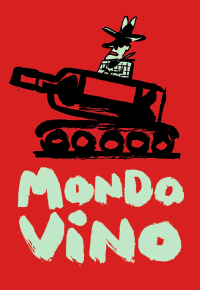
American wine cowboy conquest with tankFor those with a curiosity for how wine terroir is holding up against the onslaught of wine factory farming, the 10-hour miniseries version of MONDOVINO is finally available on DVD. For viewers curious about viniculture globalization under Californian colonial domination, the original feature length documentary delivers, with a long finish. Any time critics accuse a film of being one sided, you know it’s about class war.

I had my first lesson in vineyard terroir when my college-aged aunt visited my family in Alsace and spent a season picking grapes. She informed us to our horreur that everything gets stomped in that barrel, bugs and all. I didn’t drink wine then, so what did I care, but it was easy to decide that such was the artistry that probably made French wines great.

But as I said, Mondovino was about much more than wine, and now I’ll get to the point. We may lament the new commercialization of wine, but historically the occupation has always had its strictly-business types. Vintners were rarely agriculturalists who subsisted, they were wine lovers subsidized. We can wince at the Napa Valley nouveau gauche, but even Bordeaux’s great chateaus, and especially all the Premiers Crus, are owned and have been owned by businessmen money lenders, going back centuries.

The modernization and standardization which is destroying contemporary wines is simply the evolution of production control. At last, technology and the ascent of a gilded age have brought vintners to believe they’ve bested nature. It’s true if you don’t care about wine, if you’re content to bottle a soft drink as opposed to allowing wine the breathing space to develop personality. Basically this documentary demonstrates that these gentlemen hobbyists, now plaintively bourgeois about profit, welcome the new global fascism.

Old World Fascists
Of course it is no stretch to imagine that the Mondovino filmmakers are going to ask, how did your father or grandfather like Fascism under the Nazis? They point the question at an Italian family who date their wealth back 900 years as bankers.

Any European documentary delving into family histories will always ask particularly about the war years. In America it’s what did you do during the war Daddy? In Europe it’s about weathering the occupation. Most working class French want to tell you what they did in the Resistance. Rich people you don’t ask because of course they were collaborateurs.

Mondovino’s subjects are the perpetually wealthy, who don’t even register the affront. Of course their families thrived under Fascism, quelle betise to imagine it would be otherwise. How curious it is we are surprised they embrace it so again.

Such moments are the highlights of Mondovino, rich folk posing in elaborate foyers, plaintively matter of fact about Fascism.

One opulent reception room in Florence is packed with ancient paintings, among them a painting of the very room full of paintings, you imagine if you peered closely enough you would see the infinity of mirrors scheme, a Baroque era black velvet number. The Grande Dame mentions that Prince Charles inquired about that painting at breakfast.

Let me add, critics have held Jonathan Nossiter’s camera work to be unstable. Actually he was very easily distracted by momentously relevant tchotchkes and biographical details few commoners are granted audience to encounter.

Fascists in the New World
Mondovino allowed the Napa Valley entrepreneurs to hang themselves. Open mouth, insert vacuous blather, often racist. These nouveau riches landscaped new vineyard for themselves, praising the terrain like it was classic architecture, their aesthetic tributes could only reference the National Mall. That classic.

Over at Mondavi, talk fixated of expansion and conquest. The film’s main plot addressed the Mondavi’s ongoing acquisition of the world’s most treasured appelations. For the worse of course, because what do they know about wine but that it should all taste the same? Son Mondavi dreams of someday having a vineyard on the moon, for no other reason than he thought of it. Wouldn’t it be exciting, he asks, to be able to say: “hey, let’s open a bottle from the moon,” my paraphrase.

The issue of terroir, English readers, has entirely to do with terre which is French for “earth.” Terre with a capital T is “Earth.” Of course the earthbound distinction was lost on this Californian.

Yes, Mondavi is surely alone in pondering what earth, sun and elements would have feed his moon vines.

Most vile of all the New World vintners was a family outfit in Argentina. They sit on a spacious veranda and explain how every boy in the family is named for founding father, the original title holder. Their wealth goes back to the early Spanish settlers and they express the perennial colonizer’s lament, that Los Indios of the regions have no work ethic. Centuries ago the Spaniard had to devise cruel torments to drive their slave laborers to produce. It was an inefficient system to impose on the indigenous and transplanted tribes, unaccustomed to a hierarchical workforce supporting do-nothings at the top.

Globalization
Key to Mondavi’s quest for wine world domination, is a market that has standardized the consumer’s taste. No longer are customers hopping in their car for a Sunday drive, to stop by a neighboring chateau to sample a vintage take a case home. Today the global consumption of wine has meant having to market it without being able to taste it. For that consumers have come to follow the ratings of critics. It was inevitable of course, but Mondovino reveals how hilariously flawed and phony the system is.

Mondovino focuses on two celebrity tasters who make or break wines. Robert Parker and James Suckling. Let’s dispatch the latter quickly.

James Suckling
James Suckling made a niche for himself nurturing Italian wines and coined the term “Super Tuscan.” I didn’t know that, but Mondovino records Suckling attributing the phenomena to the ether before being made to admit that the meme was his own.

More hilarious was a hypothetical question posed to the critic after confessing in an unguarded moment that he might have been too generous with the rating he gave a friend’s wine. The friend, a wealthy vintner, was letting Suckling a villa, which meant he was also his landlord. Naturally Mondovino asked if a discount on the rent would move Suckling to consider a more favorable rating. Suckling took the bait, laughingly nodding, of course, his friend under his breath suggested in such case he could have the villa for free.

It’s not corruption, merely a gentleman’s game. Can we even assert that the ordinary consumer suffers? Taste is subjective. Suckling’s ultimate rating is of negligible consequence to wine drinkers, except to commerce.

Robert Parker
I’m sorry to be getting around to Parker’s scheme so late in this article, because he plays such a profound part in the homogenizing of world wine production. The mechanism is beyond the pale, but it’s simple. Parker is influential and has a distinctive appetite, he has a best friend who consults with vintners about how to make their wine to Parker’s taste. The result has been devastating. Vines that have for ages had their own distinctive gouts have now been McParkered. The consultant charges a large fee to monitor an increasing stable of wines, for the camera his preoccupation was “micro-oxygenate,” and after it’s bottled parker comes around and bestows the high marks. The more they pay, the higher the score.

Mondovino underscores this plot by filming a Burger King billboard as Parker drives past it, while he sings the praises of uniform quality. The filmmakers notice an FBI cap on Parker’s desk and make sure to keep it in the frame. Parker is quite candid and friendly in Mondovino, probably because he had no inkling they did not share his eagerness to see viniculture’s eccentricities ironed to a uniform flat.

When the film was released and Robert Parker emerged as enterprising accomplice to Mondavi’s villain, Parker was enraged. He wrote rant after rant against the film and its makers. I’m not sure he’s over it yet. I wanted to be sure to document what I thought was Mondovino’s most brilliant assault on the witless benefit the Parker-Mondavi venture think they’re bequeathing with their anschluss of world wine. It’s about the subjectivity of taste. Robert Parker’s.

A recurring motif of Mondovino’s interviews was a fascination with dogs. It’s cute, and often we give ourselves leave to believe we have learned something about the owner by just looking at their dog.

In one memorable scene, we’ve met a quite unassuming South American vintner who has only one hectar, but is none the less generous with his wine, his time and friendship. He has a black dog, and when the filmmaker asks his name, the vintner laughs such that the revelation is self-effacing. “Luther King” is his name, because, he tells us in Spanish, he’s “negro.” Mondovino’s dark hats are so distasteful, it’s important that the heroic characters aren’t too pearly clean.

All the asides with the dogs were entertaining in their own right, but could have served entirely to set up Robert Parker’s scene. We’re invited to Parkers home and immediately discover he has something for bulldogs.

Do you like bulldogs? Taste is of course subjective. Robert Parker and his wife love their bulldogs, two, and their home is festooned with Bulldogephemera, statuettes, paintings, the camera frame’s worth. Imagine a wall covered with watercolors and oil portraits of bulldogs as you consider the subjectivity of taste.

Then just as Parker is prompted to discuss that his nose is ensured for a million dollars, we discover that one of the dogs has become incontinent, and there’s the near unbearable dog flatulence from which not even conversation can escape. Imagine Robert Parker’s nose not ensured against that. The interview concludes with Parker rambling about something as a bulldog sits sneering on the carpet forcing the filmmaker to keep a safe distance, and so he focuses in close capturing the ugly, perhaps infirm, definitely defensive, unlikable mug.

The next time you chose a wine because it has a high Parker score, ask yourself how it integrates an atmosphere of dog.

Success! Afghan trainees mean as US

NPR ran a report praising the Afghan National Army, hoping I suppose to allay US public anticipation that Afghanistan should be conducting its own slaughters and incurring a greater share of soldier casualties. As if not enough ANA are getting caught in the friendly fire of US air strikes. They’re skilled fighters, we’re assured, especially when they have combat experience in other parts of the country, meaning, they are now being deployed outside their tribal regions, meaning, against other tribes. For every accusation of ANA soldiers mistreating civilians, there are reports apparently of them “eagerly taking up the fight.” Those don’t sound like contradictory motivations to me. Where their PR for the unpopular ANA means to ameliorate Afghan outcry, the US military trainers seem to be taking credit for inherent tribal hatred.

Joe Stack’s Piper Cherokee Manifesto

Single Engine AircraftIt’s getting so you can’t fly a plane into a federal office building and hope somebody will finally find your website. Though engineer Joseph Stack left an online statement to explain his last act of desperation against the IRS, it was deleted “in compliance with a request from the FBI.” I guess his web hosts think the 1st Amendment has an FBI exemption. Even Google’s cache was expunged. This has freed Reporters to characterize Stack’s missive as a crazed rant. Nothing threatens the establishment like this conclusion: “Sadly, though I spent my entire life trying to believe it wasn’t so, … violence … is the only answer. The cruel joke is that [those] at the top have known this all along and have been laughing, at … fools like me all along.” I don’t know about you, but when I hear that a self-made engineer-businessman who has his own plane, commits suicide on principles he has articulated in a manifesto, I’m curious to hear him out.

I’m reminded of the sad story of the desperate antiwar activist who set himself on fire as a final protest of the escalating wars in Iraq and Afghanistan. He knew accomplices would only dissuade him, so he chose an isolated spot where he could proceed unmolested and set up a video camera to record the act. Naturally, policemen were the first to encounter his body and thus the footage of dramatic statement are consigned to the obscurity of their files.

single engine airplaneFortunately the internet is still too porous for redaction on the grounds of national security, or whatever reason the FBI contrived to censor Stack’s suicide note/screed/diatribe. The Smoking Gun has the usual non-text scans of what Joseph Stack wrote before he piloted his single-engine Piper PA-28 into the Austin TX IRS office. Here’s the full text of Stack’s manifesto.

If you’re reading this, you’re no doubt asking yourself, “Why did this have to happen?”  The simple truth is that it is complicated and has been coming for a long time.  The writing process, started many months ago, was intended to be therapy in the face of the looming realization that there isn’t enough therapy in the world that can fix what is really broken.  Needless to say, this rant could fill volumes with example after example if I would let it.  I find the process of writing it frustrating, tedious, and probably pointless… especially given my gross inability to gracefully articulate my thoughts in light of the storm raging in my head.  Exactly what is therapeutic about that I’m not sure, but desperate times call for desperate measures.

We are all taught as children that without laws there would be no society, only anarchy.  Sadly, starting at early ages we in this country have been brainwashed to believe that, in return for our dedication and service, our government stands for justice for all.  We are further brainwashed to believe that there is freedom in this place, and that we should be ready to lay our lives down for the noble principles represented by its founding fathers.  Remember? One of these was “no taxation without representation”.  I have spent the total years of my adulthood unlearning that crap from only a few years of my childhood.  These days anyone who really stands up for that principle is promptly labeled a “crackpot”, traitor and worse.

While very few working people would say they haven’t had their fair share of taxes (as can I), in my lifetime I can say with a great degree of certainty that there has never been a politician cast a vote on any matter with the likes of me or my interests in mind.  Nor, for that matter, are they the least bit interested in me or anything I have to say.

Why is it that a handful of thugs and plunderers can commit unthinkable atrocities (and in the case of the GM executives, for scores of years) and when it’s time for their gravy train to crash under the weight of their gluttony and overwhelming stupidity, the force of the full federal government has no difficulty coming to their aid within days if not hours?  Yet at the same time, the joke we call the American medical system, including the drug and insurance companies, are murdering tens of thousands of people a year and stealing from the corpses and victims they cripple, and this country’s leaders don’t see this as important as bailing out a few of their vile, rich cronies.  Yet, the political “representatives” (thieves, liars, and self-serving scumbags is far more accurate) have endless time to sit around for year after year and debate the state of the “terrible health care problem”.  It’s clear they see no crisis as long as the dead people don’t get in the way of their corporate profits rolling in.

And justice? You’ve got to be kidding!

How can any rational individual explain that white elephant conundrum in the middle of our tax system and, indeed, our entire legal system?  Here we have a system that is, by far, too complicated for the brightest of the master scholars to understand.  Yet, it mercilessly “holds accountable” its victims, claiming that they’re responsible for fully complying with laws not even the experts understand.  The law “requires” a signature on the bottom of a tax filing; yet no one can say truthfully that they understand what they are signing; if that’s not “duress” than what is.  If this is not the measure of a totalitarian regime, nothing is.

How did I get here?

My introduction to the real American nightmare starts back in the early ‘80s.  Unfortunately after more than 16 years of school, somewhere along the line I picked up the absurd, pompous notion that I could read and understand plain English.  Some friends introduced me to a group of people who were having ‘tax code’ readings and discussions.  In particular, zeroed in on a section relating to the wonderful “exemptions” that make institutions like the vulgar, corrupt Catholic Church so incredibly wealthy.  We carefully studied the law (with the help of some of the “best”, high-paid, experienced tax lawyers in the business), and then began to do exactly what the “big boys” were doing (except that we weren’t stealing from our congregation or lying to the government about our massive profits in the name of God).  We took a great deal of care to make it all visible, following all of the rules, exactly the way the law said it was to be done.

The intent of this exercise and our efforts was to bring about a much-needed re-evaluation of the laws that allow the monsters of organized religion to make such a mockery of people who earn an honest living.  However, this is where I learned that there are two “interpretations” for every law; one for the very rich, and one for the rest of us… Oh, and the monsters are the very ones making and enforcing the laws; the inquisition is still alive and well today in this country.

That little lesson in patriotism cost me $40,000+, 10 years of my life, and set my retirement plans back to 0.  It made me realize for the first time that I live in a country with an ideology that is based on a total and complete lie.  It also made me realize, not only how naive I had been, but also the incredible stupidity of the American public; that they buy, hook, line, and sinker, the crap about their “freedom”… and that they continue to do so with eyes closed in the face of overwhelming evidence and all that keeps happening in front of them.

Before even having to make a shaky recovery from the sting of the first lesson on what justice really means in this country (around 1984 after making my way through engineering school and still another five years of “paying my dues”), I felt I finally had to take a chance of launching my dream of becoming an independent engineer.

On the subjects of engineers and dreams of independence, I should digress somewhat to say that I’m sure that I inherited the fascination for creative problem solving from my father.  I realized this at a very young age.

The significance of independence, however, came much later during my early years of college; at the age of 18 or 19 when I was living on my own as student in an apartment in Harrisburg, Pennsylvania.  My neighbor was an elderly retired woman (80+ seemed ancient to me at that age) who was the widowed wife of a retired steel worker.  Her husband had worked all his life in the steel mills of central Pennsylvania with promises from big business and the union that, for his 30 years of service, he would have a pension and medical care to look forward to in his retirement.  Instead he was one of the thousands who got nothing because the incompetent mill management and corrupt union (not to mention the government) raided their pension funds and stole their retirement.  All she had was social security to live on.

In retrospect, the situation was laughable because here I was living on peanut butter and bread (or Ritz crackers when I could afford to splurge) for months at a time.  When I got to know this poor figure and heard her story I felt worse for her plight than for my own (I, after all, I thought I had everything to in front of me).  I was genuinely appalled at one point, as we exchanged stories and commiserated with each other over our situations, when she in her grandmotherly fashion tried to convince me that I would be “healthier” eating cat food (like her) rather than trying to get all my substance from peanut butter and bread.  I couldn’t quite go there, but the impression was made.  I decided that I didn’t trust big business to take care of me, and that I would take responsibility for my own future and myself.

Return to the early ‘80s, and here I was off to a terrifying start as a ‘wet-behind-the-ears’ contract software engineer… and two years later, thanks to the fine backroom, midnight effort by the sleazy executives of Arthur Andersen (the very same folks who later brought us Enron and other such calamities) and an equally sleazy New York Senator (Patrick Moynihan), we saw the passage of 1986 tax reform act with its section 1706.

For you who are unfamiliar, here is the core text of the IRS Section 1706, defining the treatment of workers (such as contract engineers) for tax purposes. Visit this link for a conference committee report (http://www.synergistech.com/1706.shtml#ConferenceCommitteeReport) regarding the intended interpretation of Section 1706 and the relevant parts of Section 530, as amended. For information on how these laws affect technical services workers and their clients, read our discussion here (http://www.synergistech.com/ic-taxlaw.shtml).

SEC. 1706. TREATMENT OF CERTAIN TECHNICAL PERSONNEL.

(a) IN GENERAL – Section 530 of the Revenue Act of 1978 is amended by adding at the end thereof the following new subsection:

(d) EXCEPTION. – This section shall not apply in the case of an individual who pursuant to an arrangement between the taxpayer and another person, provides services for such other person as an engineer, designer, drafter, computer programmer, systems analyst, or other similarly skilled worker engaged in a similar line of work.

(b) EFFECTIVE DATE. – The amendment made by this section shall apply to remuneration paid and services rendered after December 31, 1986.

Note:

·      “another person” is the client in the traditional job-shop relationship.

·      “taxpayer” is the recruiter, broker, agency, or job shop.

·      “individual”, “employee”, or “worker” is you.

Admittedly, you need to read the treatment to understand what it is saying but it’s not very complicated.  The bottom line is that they may as well have put my name right in the text of section (d).  Moreover, they could only have been more blunt if they would have came out and directly declared me a criminal and non-citizen slave.  Twenty years later, I still can’t believe my eyes.

During 1987, I spent close to $5000 of my ‘pocket change’, and at least 1000 hours of my time writing, printing, and mailing to any senator, congressman, governor, or slug that might listen; none did, and they universally treated me as if I was wasting their time.  I spent countless hours on the L.A. freeways driving to meetings and any and all of the disorganized professional groups who were attempting to mount a campaign against this atrocity.  This, only to discover that our efforts were being easily derailed by a few moles from the brokers who were just beginning to enjoy the windfall from the new declaration of their “freedom”.  Oh, and don’t forget, for all of the time I was spending on this, I was loosing income that I couldn’t bill clients.

After months of struggling it had clearly gotten to be a futile exercise.  The best we could get for all of our trouble is a pronouncement from an IRS mouthpiece that they weren’t going to enforce that provision (read harass engineers and scientists).  This immediately proved to be a lie, and the mere existence of the regulation began to have its impact on my bottom line; this, of course, was the intended effect.

Again, rewind my retirement plans back to 0 and shift them into idle.  If I had any sense, I clearly should have left abandoned engineering and never looked back.

Instead I got busy working 100-hour workweeks.  Then came the L.A. depression of the early 1990s.  Our leaders decided that they didn’t need the all of those extra Air Force bases they had in Southern California, so they were closed; just like that.  The result was economic devastation in the region that rivaled the widely publicized Texas S&L fiasco.  However, because the government caused it, no one gave a shit about all of the young families who lost their homes or street after street of boarded up houses abandoned to the wealthy loan companies who received government funds to “shore up” their windfall.  Again, I lost my retirement.

Years later, after weathering a divorce and the constant struggle trying to build some momentum with my business, I find myself once again beginning to finally pick up some speed.  Then came the .COM bust and the 911 nightmare.  Our leaders decided that all aircraft were grounded for what seemed like an eternity; and long after that, ‘special’ facilities like San Francisco were on security alert for months.  This made access to my customers prohibitively expensive.  Ironically, after what they had done the Government came to the aid of the airlines with billions of our tax dollars … as usual they left me to rot and die while they bailed out their rich, incompetent cronies WITH MY MONEY!  After these events, there went my business but not quite yet all of my retirement and savings.

By this time, I’m thinking that it might be good for a change.  Bye to California, I’ll try Austin for a while.  So I moved, only to find out that this is a place with a highly inflated sense of self-importance and where damn little real engineering work is done.  I’ve never experienced such a hard time finding work.  The rates are 1/3 of what I was earning before the crash, because pay rates here are fixed by the three or four large companies in the area who are in collusion to drive down prices and wages… and this happens because the justice department is all on the take and doesn’t give a fuck about serving anyone or anything but themselves and their rich buddies.

To survive, I was forced to cannibalize my savings and retirement, the last of which was a small IRA.  This came in a year with mammoth expenses and not a single dollar of income.  I filed no return that year thinking that because I didn’t have any income there was no need.  The sleazy government decided that they disagreed.  But they didn’t notify me in time for me to launch a legal objection so when I attempted to get a protest filed with the court I was told I was no longer entitled to due process because the time to file ran out.  Bend over for another $10,000 helping of justice.

So now we come to the present.  After my experience with the CPA world, following the business crash I swore that I’d never enter another accountant’s office again.  But here I am with a new marriage and a boatload of undocumented income, not to mention an expensive new business asset, a piano, which I had no idea how to handle.  After considerable thought I decided that it would be irresponsible NOT to get professional help; a very big mistake.

When we received the forms back I was very optimistic that they were in order.  I had taken all of the years information to Bill Ross, and he came back with results very similar to what I was expecting.  Except that he had neglected to include the contents of Sheryl’s unreported income; $12,700 worth of it. To make matters worse, Ross knew all along this was missing and I didn’t have a clue until he pointed it out in the middle of the audit.  By that time it had become brutally evident that he was representing himself and not me.

This left me stuck in the middle of this disaster trying to defend transactions that have no relationship to anything tax-related (at least the tax-related transactions were poorly documented).  Things I never knew anything about and things my wife had no clue would ever matter to anyone.  The end result is… well, just look around.

I remember reading about the stock market crash before the “great” depression and how there were wealthy bankers and businessmen jumping out of windows when they realized they screwed up and lost everything.  Isn’t it ironic how far we’ve come in 60 years in this country that they now know how to fix that little economic problem; they just steal from the middle class (who doesn’t have any say in it, elections are a joke) to cover their asses and it’s “business-as-usual”.  Now when the wealthy fuck up, the poor get to die for the mistakes… isn’t that a clever, tidy solution.

As government agencies go, the FAA is often justifiably referred to as a tombstone agency, though they are hardly alone.  The recent presidential puppet GW Bush and his cronies in their eight years certainly reinforced for all of us that this criticism rings equally true for all of the government.  Nothing changes unless there is a body count (unless it is in the interest of the wealthy sows at the government trough).  In a government full of hypocrites from top to bottom, life is as cheap as their lies and their self-serving laws.

I know I’m hardly the first one to decide I have had all I can stand.  It has always been a myth that people have stopped dying for their freedom in this country, and it isn’t limited to the blacks, and poor immigrants.  I know there have been countless before me and there are sure to be as many after.  But I also know that by not adding my body to the count, I ensure nothing will change.  I choose to not keep looking over my shoulder at “big brother” while he strips my carcass, I choose not to ignore what is going on all around me, I choose not to pretend that business as usual won’t continue; I have just had enough.

I can only hope that the numbers quickly get too big to be white-washed and ignored that the American zombies wake up and revolt; it will take nothing less.  I would only hope that by striking a nerve that stimulates the inevitable double standard, knee-jerk government reaction that results in more stupid draconian restrictions people wake up and begin to see the pompous political thugs and their mindless minions for what they are.  Sadly, though I spent my entire life trying to believe it wasn’t so, but violence not only is the answer, it is the only answer.  The cruel joke is that the really big chunks of shit at the top have known this all along and have been laughing, at and using this awareness against, fools like me all along.

I saw it written once that the definition of insanity is repeating the same process over and over and expecting the outcome to suddenly be different.  I am finally ready to stop this insanity.  Well, Mr. Big Brother IRS man, let’s try something different; take my pound of flesh and sleep well.

The communist creed: From each according to his ability, to each according to his need.

The capitalist creed: From each according to his gullibility, to each according to his greed.

Joe Stack (1956-2010)

02/18/2010

Labadee: Royal Caribbean’s Neo Haiti

Labadee oasis seas boi caimanFormer President Bill Clinton is heading to Haiti, again. As UN special envoy to Haiti, he paid a visit last year as a guest of the Royal Caribbean cruise ship line to promote their tourist facility at La’Badie. Said CEO Adam Goldstein: “Labadee is just a great example of the way that things can work in a very positive way in this country.” Are those new ways or old? The secured compound, laying under the protection of the old French colonial capitol, greets 7,000 cruise passengers a week, even this week, many of whom don’t know they’re in “Haiti,” on an old slave plantation, or what may have been the crucible of real Islamic rebel voodoo!

I didn’t know about the private resort of Labadee, but my attention was drawn in December to the announcement of the launch of The Oasis of the Seas, the largest cruise ship ever devised. It was leaving the shipyards of Finland, having to pass under a Danish suspension bridge at low tide, so titanic was she. I took note because the headline announced her maiden destination to be Haiti, an odd place I thought, to be ostentatious.

The spotlight which the recent earthquake has brought on the poverty in Haiti had me wondering if all seventeen decks of the Oasis of the Seas were gawking at the suffering masses awaiting aid in Port-au-Prince. Not a chance. The Oasis, and Royal Caribbean’s fleet of floating carbon boots harbor at a secluded oasis which the cruise line rents from Haiti. Its income represents the largest portion of Haiti’s tourism revenue. If you thought President Obama’s offer of $100 Million was stingy, you can calculate Royal Caribbean’s avarice on one hand.

The tragic earthquake hasn’t interrupted the cruises. It this tragedy has an upside, it’s that some vacationers are expressing less facility stuffing down a burger knowing most Haitians await relief.

Haiti receives $6 for each tourist who disembarks to zip-line, buy trinkets from licensed vendors, and sun on Christoper Columbus Beach. They’re told it was his old stomping ground –which actually can be said of Hispaniola’s entire northern coastline. Likewise the same is true about the slave plantations which, from the port of Cap Francois, provided 40% of Europe’s sugar and 60% of its coffee. Today Haiti is renowned as the poorest land in the Western Hemisphere. The verdant lands of La Partie Du Nord –of Les Grand Blancs— are separated from the Haitian population by a mountainous Massif, and in the case of Labadee, with barbed wire.

habitation-slave-plantationsRoyal Caribbean boasts that its operations are critical to the Haitian economy. It employs hundreds, but contrast that with what the coast could provide if it wasn’t privatized. The resort draws from a cheap labor pool of an unlimited mass of Haitians who are kept with no other options but to hope they can replace the couple hundred employees confined to the cruise line compound.

And yes, the cruise itineraries avoid mention of Haiti, attributing Labadee as a “private island” of Hispaniola. The private island concept is not new, cruise ship operators began several decades back to seek to give their customers refuge from the growing throngs of third world poor who paddle out to the ship hoping for first world largess. Another motive was that cruise lines could also monopolize where their passengers could spend their money while ashore. What began as exclusive contracts with port destinations, very notoriously the Alaskan inland passage, became ventures where cruise line operators bought entire tracks of properties retired from oil or military use, whether half islands, or merely beaches, recast as private beaches, populated by private workforces.

Disney Cruise Line: Castaway Cay, Bahamas
Princess Cruises: Princess Cays, Eleuthera, Bahamas
Norwegian Cruise Line: Great Stirrup Cay, Bahamas
Holland/Carnival: Half Moon Bay, Little San Salvador Island, Bahamas
Royal Caribbean/Celebrity: Coco Cay, Bahamas; Labadee, Hispaniola

According to the Royal Caribbean promotional material, the spelling Labadee is anglicized for English-speakers. It’s named after the Marquis de La’Badie, a “Frenchman who first settled the area in the 1600s.”

At one time the French plantation owners were comforted by their remote location, buffered they thought from the potential of slave rebellions from the south. In fact, Haiti’s famed uprising began in the north, not far at all from La’Badie. Off the Royal Caribbean itinerary, but only a stone’s throw away, that is to say, within distance of incoming stones, are landmarks important to the celebrated revolution: Haiti’s first copper mine, site of a lone concentration of Islamic slaves, and the Bois Caiman of lore.

The area of Cape Haitien, as it’s called today, holds two of Haiti’s geography secrets. One, the conclusive location of La Villa de Navidad, where Christopher Columbus built his first European settlement in the New World, a fort made of the timbers of the wrecked flagship Santa Maria; Columbus returned the next year to find his men murdered and the houses burned to the ground. Archeologists are still looking to find definitive traces in Caracol or Bord de Mer de Limonade.

Second, the site of the Bwa Kayiman, the ceremony which launched Haiti’s famed slave rebellion led by Toussaint Louverture. Some scholars have begun to question whether it happened at all. They base their skepticism on the absence of written testaments. Although it’s popularly understood that the gathering of conspirators was confessed under torture by rebels captured by the French authorities. The cynics suggest the story was a fabrication to demonize the black slaves and that:

the manuscript minutes of these interrogations have survived in the French National Archives and make no mention of this or any other vodun ceremony.

That’s something to wrap your mind around, that transcripts remain of torture sessions conducted so many years ago.

Naturally the secret gathering had to escape the suspicions of the French slaveholders, but the infamy of the declaration of the Bois Caiman has inspired every Bolivarian insurrection since, from Bolivar, to Marti, Sandino, Castro, Moralles and Chavez. Revisionists seeking to tamp the populist spirit question why its location remains a mystery. Oral tradition holds that the rebels gathered in an open space in the forests of Morne Rouge.

Morne Rouge, the place where BC ceremony hypotheses converge, is also the only place in Haiti to retain an important Islamic cult. This is because the first wave of slaves were from the Senegambian region and had already undergone heavy Islamic influence. Up to date, Mori Barthelemy and followers of the region maintain this tradition, with honor to the sun, specific funeral rites and so on. If one returns to sources of the 16th century, one finds that there is where the first copper mines were established by the Spaniards, when they started giving up on the gold.

You can find Labadee, 19° 47? 11? N, 72° 14? 44? W on any modern map. Pondering The Cape it occupies, and the deep water harbor it is able to afford a behemoth like the Oasis of the Seas, I was led to research the mysteries of Haiti’s NORD, and survey the progression of place names on European maps which span the years.

haiti
This is Cristóbal Colón‘s own recollection of the northern coast of what he called La Isla Española, marking his first landing at San Nicolas Môle, the island of Tortuga, Fort Navidad, and the landmark Monte Cristi whose height guided Columbus and led him to name Hispaniola after Spain.

haiti charlevoix
A later map made by the French attempts to show the divisions of the indigenous tribes. The site marked “Premier Etablissment” marks Navidad, built near the Taíno cultural center of Hayti-Bohío-Quisqueya.

haiti Vinckeboons
A 1639 Dutch map shows Cap François. On the south shore of Isla Tortuga lies the beach Playa Cyan, across the water from the river Rio dos Caymanis. Also note the hills to the east called Mançanilla, these divided the peaceful Taíno from the warring Caciq. The location name derives from the Manchineel Trees whose poison berries they used to poison the tips of their arrows.

haiti monte christo
French map circa 1723 marks Cayne opposite the Iron Coast of L’Ile de la Tortue. There’s also a typical sailor’s landmark: Pointe des Palmiers (trans. Point of the Palms). The promontory of Cap François has here become Le Cap (The Cape). It shelters Port St. François, east of the heights of Morne Rouge and Mines de Cuivre (trans. copper mines).

haiti labat
French map of Cape Francois dated 1722 adds Le Limbe, the first area which the rebel slaves put to the torch; and Le Chemin du Cap, the main road to the valleys of the south.

haiti Ponce
This 1796 French map features another sailor’s aid, Pointe Tête de Chein (trans. Dog’s Head Point). The fortification battery on the Cape was built upon Roche à Picolet. This map was drawn after the rebellion of 1791. The Morne Rouge (trans. Red Heights) is now designated as Ravine du Morne au Diable and the Acul à Sabal. The Devil’s Ravine is the present location of Royal Caribbean’s Labadee.

The poor of Haiti are still taking heat for the Bwa Kayiman having been a pact with the devil.

haiti bellin
I add this 1764 map for personal interest. Few maps even today mark L’Islet à Rat (trans. Rat Island), which Columbus called La Amiga, was an aid to navigation out of his anchorage at Bay of Acul which he called Cabo de Caribata.

This map also details how colonial French St Domingue was divided into districts, here the Ville du Cap, the Quartier de Plaine du Nord and Camp de Louise.

haiti moreau
This 1770 map of Cap François and Environs distinguishes the larger slavery plantations.

haiti labadi

On the subject of Columbus, isn’t it surprising to reconcile the current verdict on his genocidal behavior, with the histories which have glorified his stature? After all, the primary accounts have never changed. How did earlier biographers overlook the damning and salacious details? One very polite telling of Columbus’ adventures, written by Filson Young published in 1906 provides a prim example. Here Young addresses the kidnap and rape of the indians whom Columbus encountered:

…his taking of the women raises a question which must be in the mind of any one who studies this extraordinary voyage—the question of the treatment of native women by the Spaniards. Columbus is entirely silent on the subject; but taking into account the nature of the Spanish rabble that formed his company, and his own views as to the right which he had to possess the persons and goods of the native inhabitants, I am afraid that there can be very little doubt that in this matter there is a good reason, for his silence. So far as Columbus himself was concerned, it is probable that he was innocent enough; he was not a sensualist by nature, and he was far too much interested and absorbed in the principal objects of his expedition, and had too great a sense of his own personal dignity, to have indulged in excesses that would, thus sanctioned by him, have produced a very disastrous effect on the somewhat rickety discipline of his crew. He was too wise a master, however, to forbid anything that it was not in his power to prevent; and it is probable that he shut his eyes to much that, if he did not tolerate it, he at any rate regarded as a matter of no very great importance. His crew had by this time learned to know their commander well enough not to commit under his eyes offences for which he would have been sure to punish them.

[Giving a list of instructions to the men Columbus planned to leave behind at La Navidad, among them: ]

…and especially to be on their guard to avoid injury or violence to the women, “by which they would cause scandal and set a bad example to the Indians and show the infamy of the Christians.”

no kolumbus day christopher columbusAnd here’s the rub. In this passage the author shows if we do not absolve Columbus, we indict ourselves.

The ruffianly crew had in their minds only the immediate possession of what they could get from the Indians; the Admiral had in his mind the whole possession of the islands and the bodies and souls of its inhabitants. If you take a piece of gold without giving a glass bead in exchange for it, it is called stealing; if you take a country and its inhabitants, and steal their peace from them, and give them blood and servitude in exchange for it, it is called colonisation and Empire-building. Every one understands the distinction; but so few people see the difference that Columbus of all men may be excused for his unconsciousness of it.

Beyond MLK worship: Beyond Vietnam

MLK“A time comes when silence is betrayal. That time has come for us in relation to Vietnam.”
Martin Luther King Beyond Vietnam: Time to Break the Silence
Full text of 1967 speech below.

Riverside Church, New York City, 4 April 1967

I come to this magnificent house of worship tonight because my conscience leaves me no other choice. I join with you in this meeting because I am in deepest agreement with the aims and work of the organization which has brought us together: Clergy and Laymen Concerned about Vietnam. The recent statement of your executive committee are the sentiments of my own heart and I found myself in full accord when I read its opening lines:

“A time comes when silence is betrayal.”

That time has come for us in relation to Vietnam.

The truth of these words is beyond doubt but the mission to which they call us is a most difficult one. Even when pressed by the demands of inner truth, men do not easily assume the task of opposing their government’s policy, especially in time of war. Nor does the human spirit move without great difficulty against all the apathy of conformist thought within one’s own bosom and in the surrounding world. Moreover when the issues at hand seem as perplexed as they often do in the case of this dreadful conflict we are always on the verge of being mesmerized by uncertainty; but we must move on.

Some of us who have already begun to break the silence of the night have found that the calling to speak is often a vocation of agony, but we must speak. We must speak with all the humility that is appropriate to our limited vision, but we must speak. And we must rejoice as well, for surely this is the first time in our nation’s history that a significant number of its religious leaders have chosen to move beyond the prophesying of smooth patriotism to the high grounds of a firm dissent based upon the mandates of conscience and the reading of history. Perhaps a new spirit is rising among us. If it is, let us trace its movement well and pray that our own inner being may be sensitive to its guidance, for we are deeply in need of a new way beyond the darkness that seems so close around us.

Over the past two years, as I have moved to break the betrayal of my own silences and to speak from the burnings of my own heart, as I have called for radical departures from the destruction of Vietnam, many persons have questioned me about the wisdom of my path. At the heart of their concerns this query has often loomed large and loud: Why are you speaking about war, Dr. King? Why are you joining the voices of dissent? Peace and civil rights don’t mix, they say. Aren’t you hurting the cause of your people, they ask? And when I hear them, though I often understand the source of their concern, I am nevertheless greatly saddened, for such questions mean that the inquirers have not really known me, my commitment or my calling. Indeed, their questions suggest that they do not know the world in which they live.

“I wish not to speak with Hanoi and the National Liberation Front, but rather to my fellow Americans who, with me, bear the greatest responsibility in ending a conflict that has exacted a heavy price on both continents.”

In the light of such tragic misunderstandings, I deem it of signal importance to try to state clearly, and I trust concisely, why I believe that the path from Dexter Avenue Baptist Church — the church in Montgomery, Alabama, where I began my pastorate — leads clearly to this sanctuary tonight.

I come to this platform tonight to make a passionate plea to my beloved nation. This speech is not addressed to Hanoi or to the National Liberation Front. It is not addressed to China or to Russia.

Nor is it an attempt to overlook the ambiguity of the total situation and the need for a collective solution to the tragedy of Vietnam. Neither is it an attempt to make North Vietnam or the National Liberation Front paragons of virtue, nor to overlook the role they can play in a successful resolution of the problem. While they both may have justifiable reason to be suspicious of the good faith of the United States, life and history give eloquent testimony to the fact that conflicts are never resolved without trustful give and take on both sides.

Tonight, however, I wish not to speak with Hanoi and the NLF, but rather to my fellow Americans, who, with me, bear the greatest responsibility in ending a conflict that has exacted a heavy price on both continents.

The Importance of Vietnam

Since I am a preacher by trade, I suppose it is not surprising that I have seven major reasons for bringing Vietnam into the field of my moral vision. There is at the outset a very obvious and almost facile connection between the war in Vietnam and the struggle I, and others, have been waging in America. A few years ago there was a shining moment in that struggle. It seemed as if there was a real promise of hope for the poor — both black and white — through the poverty program. There were experiments, hopes, new beginnings. Then came the buildup in Vietnam and I watched the program broken and eviscerated as if it were some idle political plaything of a society gone mad on war, and I knew that America would never invest the necessary funds or energies in rehabilitation of its poor so long as adventures like Vietnam continued to draw men and skills and money like some demonic destructive suction tube. So I was increasingly compelled to see the war as an enemy of the poor and to attack it as such.

“For the sake of those boys,
for the sake of this governent,
for the sake of hundreds of thousands
trembling under our violence,
I cannot be silent.”

Perhaps the more tragic recognition of reality took place when it became clear to me that the war was doing far more than devastating the hopes of the poor at home. It was sending their sons and their brothers and their husbands to fight and to die in extraordinarily high proportions relative to the rest of the population. We were taking the black young men who had been crippled by our society and sending them eight thousand miles away to guarantee liberties in Southeast Asia which they had not found in southwest Georgia and East Harlem. So we have been repeatedly faced with the cruel irony of watching Negro and white boys on TV screens as they kill and die together for a nation that has been unable to seat them together in the same schools. So we watch them in brutal solidarity burning the huts of a poor village, but we realize that they would never live on the same block in Detroit. I could not be silent in the face of such cruel manipulation of the poor.

My third reason moves to an even deeper level of awareness, for it grows out of my experience in the ghettoes of the North over the last three years — especially the last three summers. As I have walked among the desperate, rejected and angry young men I have told them that Molotov cocktails and rifles would not solve their problems. I have tried to offer them my deepest compassion while maintaining my conviction that social change comes most meaningfully through nonviolent action. But they asked — and rightly so — what about Vietnam? They asked if our own nation wasn’t using massive doses of violence to solve its problems, to bring about the changes it wanted. Their questions hit home, and I knew that I could never again raise my voice against the violence of the oppressed in the ghettos without having first spoken clearly to the greatest purveyor of violence in the world today — my own government. For the sake of those boys, for the sake of this government, for the sake of hundreds of thousands trembling under our violence, I cannot be silent.

For those who ask the question, “Aren’t you a civil rights leader?” and thereby mean to exclude me from the movement for peace, I have this further answer. In 1957 when a group of us formed the Southern Christian Leadership Conference, we chose as our motto: “To save the soul of America.” We were convinced that we could not limit our vision to certain rights for black people, but instead affirmed the conviction that America would never be free or saved from itself unless the descendants of its slaves were loosed completely from the shackles they still wear. In a way we were agreeing with Langston Hughes, that black bard of Harlem, who had written earlier:

O, yes,
I say it plain,
America never was America to me,
And yet I swear this oath —
America will be!

Now, it should be incandescently clear that no one who has any concern for the integrity and life of America today can ignore the present war. If America’s soul becomes totally poisoned, part of the autopsy must read Vietnam. It can never be saved so long as it destroys the deepest hopes of men the world over. So it is that those of us who are yet determined that America will be are led down the path of protest and dissent, working for the health of our land.

“Surely we must see
that the men we supported
pressed them to their violence.”

As if the weight of such a commitment to the life and health of America were not enough, another burden of responsibility was placed upon me in 1964; and I cannot forget that the Nobel Prize for Peace was also a commission — a commission to work harder than I had ever worked before for “the brotherhood of man.” This is a calling that takes me beyond national allegiances, but even if it were not present I would yet have to live with the meaning of my commitment to the ministry of Jesus Christ. To me the relationship of this ministry to the making of peace is so obvious that I sometimes marvel at those who ask me why I am speaking against the war. Could it be that they do not know that the good news was meant for all men — for Communist and capitalist, for their children and ours, for black and for white, for revolutionary and conservative? Have they forgotten that my ministry is in obedience to the one who loved his enemies so fully that he died for them? What then can I say to the “Vietcong” or to Castro or to Mao as a faithful minister of this one? Can I threaten them with death or must I not share with them my life?

Finally, as I try to delineate for you and for myself the road that leads from Montgomery to this place I would have offered all that was most valid if I simply said that I must be true to my conviction that I share with all men the calling to be a son of the living God. Beyond the calling of race or nation or creed is this vocation of sonship and brotherhood, and because I believe that the Father is deeply concerned especially for his suffering and helpless and outcast children, I come tonight to speak for them.

This I believe to be the privilege and the burden of all of us who deem ourselves bound by allegiances and loyalties which are broader and deeper than nationalism and which go beyond our nation’s self-defined goals and positions. We are called to speak for the weak, for the voiceless, for victims of our nation and for those it calls enemy, for no document from human hands can make these humans any less our brothers.

Strange Liberators

And as I ponder the madness of Vietnam and search within myself for ways to understand and respond to compassion my mind goes constantly to the people of that peninsula. I speak now not of the soldiers of each side, not of the junta in Saigon, but simply of the people who have been living under the curse of war for almost three continuous decades now. I think of them too because it is clear to me that there will be no meaningful solution there until some attempt is made to know them and hear their broken cries.

“Before long they must know
that their government has sent them
into a struggle among Vietnamese,
and the more sophisticated surely realize
that we are on the side of the wealthy
and the secure
while we create hell for the poor.”

They must see Americans as strange liberators. The Vietnamese people proclaimed their own independence in 1945 after a combined French and Japanese occupation, and before the Communist revolution in China. They were led by Ho Chi Minh. Even though they quoted the American Declaration of Independence in their own document of freedom, we refused to recognize them. Instead, we decided to support France in its re-conquest of her former colony.

Our government felt then that the Vietnamese people were not “ready” for independence, and we again fell victim to the deadly Western arrogance that has poisoned the international atmosphere for so long. With that tragic decision we rejected a revolutionary government seeking self-determination, and a government that had been established not by China (for whom the Vietnamese have no great love) but by clearly indigenous forces that included some Communists. For the peasants this new government meant real land reform, one of the most important needs in their lives.

For nine years following 1945 we denied the people of Vietnam the right of independence. For nine years we vigorously supported the French in their abortive effort to re-colonize Vietnam.

Before the end of the war we were meeting eighty percent of the French war costs. Even before the French were defeated at Dien Bien Phu, they began to despair of the reckless action, but we did not. We encouraged them with our huge financial and military supplies to continue the war even after they had lost the will. Soon we would be paying almost the full costs of this tragic attempt at re-colonization.

After the French were defeated it looked as if independence and land reform would come again through the Geneva agreements. But instead there came the United States, determined that Ho should not unify the temporarily divided nation, and the peasants watched again as we supported one of the most vicious modern dictators — our chosen man, Premier Diem. The peasants watched and cringed as Diem ruthlessly routed out all opposition, supported their extortionist landlords and refused even to discuss reunification with the north. The peasants watched as all this was presided over by U.S. influence and then by increasing numbers of U.S. troops who came to help quell the insurgency that Diem’s methods had aroused. When Diem was overthrown they may have been happy, but the long line of military dictatorships seemed to offer no real change — especially in terms of their need for land and peace.

The only change came from America as we increased our troop commitments in support of governments which were singularly corrupt, inept and without popular support. All the while the people read our leaflets and received regular promises of peace and democracy — and land reform. Now they languish under our bombs and consider us – not their fellow Vietnamese — the real enemy. They move sadly and apathetically as we herd them off the land of their fathers into concentration camps where minimal social needs are rarely met. They know they must move or be destroyed by our bombs. So they go — primarily women and children and the aged.

“Somehow this madness must cease.”

They watch as we poison their water, as we kill a million acres of their crops. They must weep as the bulldozers roar through their areas preparing to destroy the precious trees. They wander into the hospitals, with at least twenty casualties from American firepower for one “Vietcong-inflicted” injury. So far we may have killed a million of them — mostly children. They wander into the towns and see thousands of the children, homeless, without clothes, running in packs on the streets like animals. They see the children, degraded by our soldiers as they beg for food. They see the children selling their sisters to our soldiers, soliciting for their mothers.

What do the peasants think as we ally ourselves with the landlords and as we refuse to put any action into our many words concerning land reform? What do they think as we test our latest weapons on them, just as the Germans tested out new medicine and new tortures in the concentration camps of Europe? Where are the roots of the independent Vietnam we claim to be building? Is it among these voiceless ones?

We have destroyed their two most cherished institutions: the family and the village. We have destroyed their land and their crops. We have cooperated in the crushing of the nation’s only non-Communist revolutionary political force — the Unified Buddhist church. We have supported the enemies of the peasants of Saigon. We have corrupted their women and children and killed their men. What liberators?

Now there is little left to build on — save bitterness. Soon the only solid physical foundations remaining will be found at our military bases and in the concrete of the concentration camps we call fortified hamlets. The peasants may well wonder if we plan to build our new Vietnam on such grounds as these? Could we blame them for such thoughts? We must speak for them and raise the questions they cannot raise. These too are our brothers.

Perhaps the more difficult but no less necessary task is to speak for those who have been designated as our enemies. What of the National Liberation Front — that strangely anonymous group we call VC or Communists? What must they think of us in America when they realize that we permitted the repression and cruelty of Diem which helped to bring them into being as a resistance group in the south? What do they think of our condoning the violence which led to their own taking up of arms? How can they believe in our integrity when now we speak of “aggression from the north” as if there were nothing more essential to the war? How can they trust us when now we charge them with violence after the murderous reign of Diem and charge them with violence while we pour every new weapon of death into their land? Surely we must understand their feelings even if we do not condone their actions. Surely we must see that the men we supported pressed them to their violence. Surely we must see that our own computerized plans of destruction simply dwarf their greatest acts.

“We must continue to raise our voices if our nation persists in its perverse ways in Vietnam.”

How do they judge us when our officials know that their membership is less than twenty-five percent Communist and yet insist on giving them the blanket name? What must they be thinking when they know that we are aware of their control of major sections of Vietnam and yet we appear ready to allow national elections in which this highly organized political parallel government will have no part? They ask how we can speak of free elections when the Saigon press is censored and controlled by the military junta. And they are surely right to wonder what kind of new government we plan to help form without them — the only party in real touch with the peasants. They question our political goals and they deny the reality of a peace settlement from which they will be excluded. Their questions are frighteningly relevant. Is our nation planning to build on political myth again and then shore it up with the power of new violence?

Here is the true meaning and value of compassion and nonviolence when it helps us to see the enemy’s point of view, to hear his questions, to know his assessment of ourselves. For from his view we may indeed see the basic weaknesses of our own condition, and if we are mature, we may learn and grow and profit from the wisdom of the brothers who are called the opposition.

So, too, with Hanoi. In the north, where our bombs now pummel the land, and our mines endanger the waterways, we are met by a deep but understandable mistrust. To speak for them is to explain this lack of confidence in Western words, and especially their distrust of American intentions now. In Hanoi are the men who led the nation to independence against the Japanese and the French, the men who sought membership in the French commonwealth and were betrayed by the weakness of Paris and the willfulness of the colonial armies. It was they who led a second struggle against French domination at tremendous costs, and then were persuaded to give up the land they controlled between the thirteenth and seventeenth parallel as a temporary measure at Geneva. After 1954 they watched us conspire with Diem to prevent elections which would have surely brought Ho Chi Minh to power over a united Vietnam, and they realized they had been betrayed again.

When we ask why they do not leap to negotiate, these things must be remembered. Also it must be clear that the leaders of Hanoi considered the presence of American troops in support of the Diem regime to have been the initial military breach of the Geneva agreements concerning foreign troops, and they remind us that they did not begin to send in any large number of supplies or men until American forces had moved into the tens of thousands.

“When machines and computers,
profit motives and property rights
are considered more important than people,
the giant triplets of
racism,
materialism
and militarism
are incapable of being conquered.”

Hanoi remembers how our leaders refused to tell us the truth about the earlier North Vietnamese overtures for peace, how the president claimed that none existed when they had clearly been made. Ho Chi Minh has watched as America has spoken of peace and built up its forces, and now he has surely heard of the increasing international rumors of American plans for an invasion of the north. He knows the bombing and shelling and mining we are doing are part of traditional pre-invasion strategy. Perhaps only his sense of humor and of irony can save him when he hears the most powerful nation of the world speaking of aggression as it drops thousands of bombs on a poor weak nation more than eight thousand miles away from its shores.

At this point I should make it clear that while I have tried in these last few minutes to give a voice to the voiceless on Vietnam and to understand the arguments of those who are called enemy, I am as deeply concerned about our troops there as anything else. For it occurs to me that what we are submitting them to in Vietnam is not simply the brutalizing process that goes on in any war where armies face each other and seek to destroy. We are adding cynicism to the process of death, for they must know after a short period there that none of the things we claim to be fighting for are really involved. Before long they must know that their government has sent them into a struggle among Vietnamese, and the more sophisticated surely realize that we are on the side of the wealthy and the secure while we create hell for the poor.

This Madness Must Cease

Somehow this madness must cease. We must stop now. I speak as a child of God and brother to the suffering poor of Vietnam. I speak for those whose land is being laid waste, whose homes are being destroyed, whose culture is being subverted. I speak for the poor of America who are paying the double price of smashed hopes at home and death and corruption in Vietnam. I speak as a citizen of the world, for the world as it stands aghast at the path we have taken. I speak as an American to the leaders of my own nation. The great initiative in this war is ours. The initiative to stop it must be ours.

This is the message of the great Buddhist leaders of Vietnam. Recently one of them wrote these words:

“Each day the war goes on the hatred increases in the heart of the Vietnamese and in the hearts of those of humanitarian instinct. The Americans are forcing even their friends into becoming their enemies. It is curious that the Americans, who calculate so carefully on the possibilities of military victory, do not realize that in the process they are incurring deep psychological and political defeat. The image of America will never again be the image of revolution, freedom and democracy, but the image of violence and militarism.”

“A nation that continues
year after year
to spend more money on military defense
than on programs of social uplift
is approaching spiritual death.”

If we continue, there will be no doubt in my mind and in the mind of the world that we have no honorable intentions in Vietnam. It will become clear that our minimal expectation is to occupy it as an American colony and men will not refrain from thinking that our maximum hope is to goad China into a war so that we may bomb her nuclear installations. If we do not stop our war against the people of Vietnam immediately the world will be left with no other alternative than to see this as some horribly clumsy and deadly game we have decided to play.

The world now demands a maturity of America that we may not be able to achieve. It demands that we admit that we have been wrong from the beginning of our adventure in Vietnam, that we have been detrimental to the life of the Vietnamese people. The situation is one in which we must be ready to turn sharply from our present ways.

In order to atone for our sins and errors in Vietnam, we should take the initiative in bringing a halt to this tragic war. I would like to suggest five concrete things that our government should do immediately to begin the long and difficult process of extricating ourselves from this nightmarish conflict:

• End all bombing in North and South Vietnam

• Declare a unilateral cease-fire in the hope that such action will create the atmosphere for negotiation.

• Take immediate steps to prevent other battlegrounds in Southeast Asia by curtailing our military buildup in Thailand and our interference in Laos.

• Realistically accept the fact that the National Liberation Front has substantial support in South Vietnam and must thereby play a role in any meaningful negotiations and in any future Vietnam government.

• Set a date that we will remove all foreign troops from Vietnam in accordance with the 1954 Geneva agreement.

Part of our ongoing commitment might well express itself in an offer to grant asylum to any Vietnamese who fears for his life under a new regime which included the Liberation Front. Then we must make what reparations we can for the damage we have done. We most provide the medical aid that is badly needed, making it available in this country if necessary.

Protesting The War

Meanwhile we in the churches and synagogues have a continuing task while we urge our government to disengage itself from a disgraceful commitment. We must continue to raise our voices if our nation persists in its perverse ways in Vietnam. We must be prepared to match actions with words by seeking out every creative means of protest possible.

As we counsel young men concerning military service we must clarify for them our nation’s role in Vietnam and challenge them with the alternative of conscientious objection. I am pleased to say that this is the path now being chosen by more than seventy students at my own alma mater, Morehouse College, and I recommend it to all who find the American course in Vietnam a dishonorable and unjust one. Moreover I would encourage all ministers of draft age to give up their ministerial exemptions and seek status as conscientious objectors. These are the times for real choices and not false ones. We are at the moment when our lives must be placed on the line if our nation is to survive its own folly. Every man of humane convictions must decide on the protest that best suits his convictions, but we must all protest.

“If we do not act
we shall surely be dragged down
the long and shameful corridors of time
reserved for those who possess
power without compassion,
might without morality,
and strength without sight.”

There is something seductively tempting about stopping there and sending us all off on what in some circles has become a popular crusade against the war in Vietnam. I say we must enter the struggle, but I wish to go on now to say something even more disturbing. The war in Vietnam is but a symptom of a far deeper malady within the American spirit, and if we ignore this sobering reality we will find ourselves organizing clergy-and laymen-concerned committees for the next generation. They will be concerned about Guatemala and Peru. They will be concerned about Thailand and Cambodia. They will be concerned about Mozambique and South Africa. We will be marching for these and a dozen other names and attending rallies without end unless there is a significant and profound change in American life and policy. Such thoughts take us beyond Vietnam, but not beyond our calling as sons of the living God.

In 1957 a sensitive American official overseas said that it seemed to him that our nation was on the wrong side of a world revolution. During the past ten years we have seen emerge a pattern of suppression which now has justified the presence of U.S. military “advisors” in Venezuela. This need to maintain social stability for our investments accounts for the counter-revolutionary action of American forces in Guatemala. It tells why American helicopters are being used against guerrillas in Colombia and why American napalm and green beret forces have already been active against rebels in Peru. It is with such activity in mind that the words of the late John F. Kennedy come back to haunt us. Five years ago he said,

“Those who make peaceful revolution impossible will make violent revolution inevitable.”

Increasingly, by choice or by accident, this is the role our nation has taken — the role of those who make peaceful revolution impossible by refusing to give up the privileges and the pleasures that come from the immense profits of overseas investment.

I am convinced that if we are to get on the right side of the world revolution, we as a nation must undergo a radical revolution of values. We must rapidly begin the shift from a “thing-oriented” society to a “person-oriented” society. When machines and computers, profit motives and property rights are considered more important than people, the giant triplets of racism, materialism, and militarism are incapable of being conquered.

A true revolution of values will soon cause us to question the fairness and justice of many of our past and present policies. On the one hand we are called to play the good Samaritan on life’s roadside; but that will be only an initial act. One day we must come to see that the whole Jericho road must be transformed so that men and women will not be constantly beaten and robbed as they make their journey on life’s highway.

True compassion is more than flinging a coin to a beggar; it is not haphazard and superficial. It comes to see that an edifice which produces beggars needs restructuring. A true revolution of values will soon look uneasily on the glaring contrast of poverty and wealth. With righteous indignation, it will look across the seas and see individual capitalists of the West investing huge sums of money in Asia, Africa and South America, only to take the profits out with no concern for the social betterment of the countries, and say: “This is not just.”

It will look at our alliance with the landed gentry of Latin America and say: “This is not just.”

The Western arrogance of feeling that it has everything to teach others and nothing to learn from them is not just.

A true revolution of values will lay hands on the world order and say of war: “This way of settling differences is not just.”

This business of burning human beings with napalm, of filling our nation’s homes with orphans and widows, of injecting poisonous drugs of hate into veins of people normally humane, of sending men home from dark and bloody battlefields physically handicapped and psychologically deranged, cannot be reconciled with wisdom, justice and love. A nation that continues year after year to spend more money on military defense than on programs of social uplift is approaching spiritual death.

America, the richest and most powerful nation in the world, can well lead the way in this revolution of values. There is nothing, except a tragic death wish, to prevent us from reordering our priorities, so that the pursuit of peace will take precedence over the pursuit of war. There is nothing to keep us from molding a recalcitrant status quo with bruised hands until we have fashioned it into a brotherhood.

This kind of positive revolution of values is our best defense against communism. War is not the answer. Communism will never be defeated by the use of atomic bombs or nuclear weapons. Let us not join those who shout war and through their misguided passions urge the United States to relinquish its participation in the United Nations. These are days which demand wise restraint and calm reasonableness. We must not call everyone a Communist or an appeaser who advocates the seating of Red China in the United Nations and who recognizes that hate and hysteria are not the final answers to the problem of these turbulent days. We must not engage in a negative anti-communism, but rather in a positive thrust for democracy, realizing that our greatest defense against communism is to take offensive action in behalf of justice. We must with positive action seek to remove those conditions of poverty, insecurity and injustice which are the fertile soil in which the seed of communism grows and develops.

The People Are Important

These are revolutionary times. All over the globe men are revolting against old systems of exploitation and oppression and out of the wombs of a frail world new systems of justice and equality are being born. The shirtless and barefoot people of the land are rising up as never before. “The people who sat in darkness have seen a great light.” We in the West must support these revolutions. It is a sad fact that, because of comfort, complacency, a morbid fear of communism, and our proneness to adjust to injustice, the Western nations that initiated so much of the revolutionary spirit of the modern world have now become the arch anti-revolutionaries. This has driven many to feel that only Marxism has the revolutionary spirit. Therefore, communism is a judgment against our failure to make democracy real and follow through on the revolutions we initiated. Our only hope today lies in our ability to recapture the revolutionary spirit and go out into a sometimes hostile world declaring eternal hostility to poverty, racism, and militarism. With this powerful commitment we shall boldly challenge the status quo and unjust mores and thereby speed the day when “every valley shall be exalted, and every mountain and hill shall be made low, and the crooked shall be made straight and the rough places plain.”

A genuine revolution of values means in the final analysis that our loyalties must become ecumenical rather than sectional. Every nation must now develop an overriding loyalty to mankind as a whole in order to preserve the best in their individual societies.

This call for a world-wide fellowship that lifts neighborly concern beyond one’s tribe, race, class and nation is in reality a call for an all-embracing and unconditional love for all men. This oft misunderstood and misinterpreted concept – so readily dismissed by the Nietzsches of the world as a weak and cowardly force – has now become an absolute necessity for the survival of man. When I speak of love I am not speaking of some sentimental and weak response. I am speaking of that force which all of the great religions have seen as the supreme unifying principle of life. Love is somehow the key that unlocks the door which leads to ultimate reality. This Hindu-Moslem-Christian-Jewish-Buddhist belief about ultimate reality is beautifully summed up in the first epistle of Saint John:

Let us love one another; for love is God and everyone that loveth is born of God and knoweth God. He that loveth not knoweth not God; for God is love. If we love one another God dwelleth in us, and his love is perfected in us.

Let us hope that this spirit will become the order of the day. We can no longer afford to worship the god of hate or bow before the altar of retaliation. The oceans of history are made turbulent by the ever-rising tides of hate. History is cluttered with the wreckage of nations and individuals that pursued this self-defeating path of hate. As Arnold Toynbee says :

“Love is the ultimate force that makes for the saving choice of life and good against the damning choice of death and evil. Therefore the first hope in our inventory must be the hope that love is going to have the last word.”

We are now faced with the fact that tomorrow is today. We are confronted with the fierce urgency of now. In this unfolding conundrum of life and history there is such a thing as being too late. Procrastination is still the thief of time. Life often leaves us standing bare, naked and dejected with a lost opportunity. The “tide in the affairs of men” does not remain at the flood; it ebbs. We may cry out desperately for time to pause in her passage, but time is deaf to every plea and rushes on. Over the bleached bones and jumbled residue of numerous civilizations are written the pathetic words: “Too late.”

There is an invisible book of life that faithfully records our vigilance or our neglect. “The moving finger writes, and having writ moves on…” We still have a choice today; nonviolent coexistence or violent co-annihilation.

We must move past indecision to action. We must find new ways to speak for peace in Vietnam and justice throughout the developing world – a world that borders on our doors. If we do not act we shall surely be dragged down the long dark and shameful corridors of time reserved for those who possess power without compassion, might without morality, and strength without sight.

Now let us begin. Now let us rededicate ourselves to the long and bitter – but beautiful – struggle for a new world. This is the calling of the sons of God, and our brothers wait eagerly for our response. Shall we say the odds are too great? Shall we tell them the struggle is too hard? Will our message be that the forces of American life militate against their arrival as full men, and we send our deepest regrets? Or will there be another message, of longing, of hope, of solidarity with their yearnings, of commitment to their cause, whatever the cost? The choice is ours, and though we might prefer it otherwise we must choose in this crucial moment of human history.

As that noble bard of yesterday, James Russell Lowell, eloquently stated:

Once to every man and nation
Comes the moment to decide,
In the strife of truth and falsehood,
For the good or evil side;
Some great cause, God’s new Messiah,
Off’ring each the bloom or blight,
And the choice goes by forever
Twixt that darkness and that light.
Though the cause of evil prosper,
Yet ’tis truth alone is strong;
Though her portion be the scaffold,
And upon the throne be wrong:
Yet that scaffold sways the future,
And behind the dim unknown,
Standeth God within the shadow
Keeping watch above his own.

Avatar: novel push for noble savage

Avatar movie poster based on the novel by SapphireI’d like to contrast the high-profile critical receptions being given two Hollywood films about darker-skinned-ness. Precious is about an African-American girl so dark she absorbs the light, without being about race at all. The movie tells a story of poverty, incest and the cycle of abuse, while tipping the scales with gratuitous stereotypes of Hottentot welfare mamas attendant their usual good-for-trouble black males. Vilifying the subjects it pretends to rescue, Precious has the blessing of the media, a shameless Oprah included. James Cameron’s Avatar on the other hand, opened to depth-charges of faint praise calculated to dim the buzz, perhaps because it packs the most subversive black-is-beautiful message since Muhammad Ali.

Avatar evokes rudimentary indigenous spirituality, peppered with what even elementary-schooled audiences can associate as Native American themes, from which we can infer the concepts are eternal, but idealizes an athletic aesthetic more human than the movie’s live-action characters. The “blue cat people,” as the critics have chosen to describe its Na’vi tribe, are but fantasy-striped, tailed Spartans, computer iterations of the Williams sisters and NBA dream teams. The real humans of Avatar tower in prowess, dignity and luminescence over their modern mensch oppressors.

Where racial equality on film is plotted according to how black figures are granted access to the world of white priviledge, Avatar celebrates the sovereignty of dark skin in its environment, where it’s not a barbershop, rapper’s crib, or street corner in Harlem. And instead of prepping the more palatable light-skinned negro for easier assimilation to the welcome-diversity crowd.

Precious: Based on the Novel “Push” by Sapphire, is an ugly project by and for gentrified American, whose title character is White-America’s usual avatar into their mysterious conception of Black America. I can do it no better justice than this review excerpt published Counterpunch:

A fiction whose “policy message is that welfare recipients are black women who wish to avoid work, who use their time having sex with their daughters, watching television and dining on pig leavings.” Is this a film – or a crime?

A crock and defamation that reinforces white man’s supremist burden.

Under Iran’s culturally repressive Islamic Revolution, the artists have produced a golden age of film. The greatest of these films have had to disguise their social message in analogies surrounding the concerns of children. Avatar takes perhaps a similar tack. Behind diversions of fantasy and special effects, is a profound morality tale. Critics can attack James Cameron for his simplistic storytelling, it’s the price to pay to bring the simplest of viewers along. Perhaps the director can release a final cut for cineastes which omits the redundant exposition. I don’t mind that Cameron uses a highlighter for the Cliftnote set. A survey of online comments shows me that some fans applaud themselves for getting Avatar’s message where they are certain their fellow audience members might not.

Most certainly the alarm most critics are raising has to do with the unpatriotic attitude which Avatar takes toward Capitalist imperialism. In GWOT America where we still “Support Our Troops” and still refrain from labeling our military contractors as mercenaries, this film will rub flag wavers the wrong way. I’d hate to be an active duty US soldier, watching Avatar in my uniform, as the audience roots for good to vanquish evil. It will probably be some time before Americans will want to see Iraqi or Afghan freedom fighters depicted as heroes. We’ve yet to see sympathetic accounts for example of the Vietcong holding down the Ho Chi Min Trail, or for that matter, the real Germans or Japanese beyond the Allied propaganda. But by disguising his story in science fiction, James Cameron has rehabilitated the Vandal and Visigoth, from the shadow of the Roman Empire. The shadow of man’s civilizing drive which grows darker the more it is illuminated.

And best of all, Cameron’s pagans are not whites like the typical Anglo Semites of the Christian holy lands. Cameron’s indigenous humans have the beautiful noses, skin and haunches indigenous to the climates which cradled humankind.

Original Anti-Zionist jokes in Monty Python’s LIFE OF BRIAN remain cut out of Criterion special edition

monty-python-life-brian-ottoThink you know the saga of the deleted scenes from Monty Python’s LIFE OF BRIAN? Not if you trust Wikipedia. The 1979 comedy didn’t just take the mickey out of Jesus and the feuding Palestinian Liberation fronts, it poked fun at Zionists, as goose-stepping racists led by Eric Idle’s OTTO the NAZIRENE determined to promote Jewish racial purity, carve a Lebensraum from the “traditional Jewish areas of Samaria,” displace the Samaritans into internment camps, and plan an Anschluss of Jordan to “create a great Jewish state that will last a thousand years.” My, my, my. But the defamed parties had the last laugh. They acquired the studio with the rights to the film, obliterated the offending celluloid, reedited the video release, and have rewritten cinematic history.

Maybe you don’t care what Israel has been doing to the Palestinians. Did you know someone is messing with the oeuvre of Monty Python? We had the comedy sketches memorized in college. Who could have imagined the originals would be vulnerable to tampering?

I’m not sure this is an overreaction. Monty Python is not Shakespeare, what is? But it’s not Nicholas Sparks either. For a populist phenom I say Python rivals Swift. This is book burning, is what it is — a sinister effacing of creative work. In a recent British poll, Life of Brian was in contention for England’s greatest film comedy. But for your consideration, instead of a director’s cut, we’ve got a censor’s cut.

Here’s the lowdown in brief: three integral scenes of the theatrical release were removed from the video version. The third scene was recut to make up for the absence of the first two. And a key character was stricken from the credits.

When Criterion later released a collector’s edition, the missing sequences were included in the extras as “deleted scenes.” But these scenes were represented by mangled outtakes of the originals, from which key lines remain excised. Then an official narrative was fabricated to recount how the sequences had been removed from the original version to improve the flow, the crude outtakes testifying to why they didn’t make the cut.

But that’s all bullocks –and the niggling weak spot to this digital book burning is, ironically enough, that BOOKS were published in 1979 to accompany the film’s release: a mass-market paperback of the screenplay, and an oversized Monty Python Scrapbook.

The rewrite runs afoul too of anyone who remembers seeing the film in its first release.

Not My Tribe has suffered its own internal dissension over comparing Israel to the Nazis. Apparently it’s SO not done, not even Monty Python can get away with it.

You may have revisited the video many times, now the DVD, maybe you read about the scandals about the film’s release, maybe you memorized some of the Biggus Dickus dialog; are you curious that you missed the bits about Samaria, Jordan and purified Jewish blood?

When the Catholic church objects to a movie, it declares a boycott. Zionists take a more effective strategy. When pulling funding from the project doesn’t work, they buy the rights and delete the scenes. You’d think a film as celebrated as Life of Brian would be inviolate to culture vandals. And so far the desecration has escaped the legions of Monty Python fans. Wikipedia recounts how Otto’s scenes were deleted from the film, and thankfully resurfaced to be included as outtakes on the 2007 Criterion edition. But the account is untrue.

From restored out-takes we might surmise that Jewish objection were limited to the Star of David embellished as a swastika, but from the un-restored material it seems that the modern censors objected to Zionists depicted as determined to carve their own Lebensraum in Samariaby by means of Anschluss and concentration camps, for the sake of a third Jewish reich. And what have we now happening in the Occupied Territories which Israeli settlers insist on calling their Sumaria and Judea of biblical history, and what of the open air internment of the Palestinians in Gaza. Oh My Goodness.

The Criterion edition of Monty Python’s Life of Brian has some famously restored scenes, alleged to have been cut from the original version. They’re available again, and you can see them on Youtube. But it’s Poppycock. The scenes in question were actually removed from the video release, and “lost” by the studio which took over handmade films. The deleted scenes were actually out-takes of the originals. Fortunately, the screenplay published to accompany the 1979 release has the original lines, which vary quite curiously from what’s being peddled as the restored original. Yes, the deleted scenes have deleted scenes.

If you saw the 1979 film in the theater, you might remember Otto, the Hitleresque Zionist with the curiously non-German accent. Here is the original script made from the final take. The out-take restored as “deleted scenes” stray considerably from these lines. The lines in bold have simply been simply clipped.

BRIAN slips out through the back door and descends some steps into MANDY’S garden where he sits, head in hands.

Suddenly a voice assails him.

life of brian deleted sceneOTTO: Hail, Leader!

BRIAN: What?

OTTO: Oh, I– I’m so sorry. Have you seen the new Leader?

BRIAN: The what?

OTTO: The new Leader. Where is the new leader? I wish to hail him. Hail, Leader. See.

BRIAN: Oh. Who are you?

OTTO: My name. Is. Otto.

BRIAN: Oh.

OTTO: Yes. Otto. It’s time, you know. . .

BRIAN: What?

OTTO: . . . Time that we Jews racially purified ourselves.

BRIAN: Oh.

OTTO: He’s right you know. The new leader. We need more living room. We must move into the traditionally Jewish areas of Samaria.

BRIAN: What about the Samaritans?

OTTO: Well, we can put them in little camps. And after Samaria we must move into Jordan and create a great Jewish state that will last a thousand years.

BRIAN: Yes, I’m not sure, but I . . .

OTTO: Oh, I grow so impatient, you know. To see the Leader that has been promised our people for centuries. The Leader who will save Israel by ridding it of the scum of non-Jewish people, making it pure, no foreigners, no gypsies, no riff-raff.

BRIAN: Shh! Otto!

OTTO: What? The Leader? Hail Leader!

BRIAN: No, no. It’s dangerous.

OTTO: Oh, danger: There’s no danger. (flicks his fingers) Men!

A phalanx of armed, rather sinister, men appear from the shadows and fall in.

OTTO: Impressive, eh?

BRIAN: Yes.

OTTO: Yes, we are a thoroughly trained suicide squad.

BRIAN: Ah-hah.

OTTO: Oh yes, we can commit suicide within twenty seconds.

BRIAN: Twenty seconds?

OTTO: You don’t believe me?

BRIAN: Well . . .Yes . . .

OTTO: I think you question me.

BRIAN: No. No.

OTTO: I can see you do not believe me.

BRIAN: No, no. I do.

OTTO: Enough. I prove it to you. Squad.

SQUAD: Hail Leader.

OTTO: Co-mmit Suicide.

They all pull out their swords with military precision and plunge them into themselves in time, falling in a big heap on the ground. Dead.

OTTO: (with pride) See.

BRIAN: Yes.

OTTO: I think now you believe me. Yes?

BRIAN: Yes.

OTTO: I think now I prove it to you, huh?

BRIAN: Yes, you certainly did.

OTTO: All dead.

BRIAN: Yes.

OTTO: Not one living.

BRIAN: No.

OTTO: You see, they are all of them quite dead. See I kick this one. He’s dead. And this one’s dead, I tread on his head. And he’s dead. And he’s dead. All good Jewish boys, no foreigners. But they died a hero’s death and their names will live forever. Helmut . . . Johnny . . . the little guy . . . er . . . the other fat one . . . their names will be remembered . . . eventually . . . forever. So now I go. Hail Leader.

BRIAN: Wait Otto. You can’t just leave them all here.

OTTO: Why not–they’re all dead.

One oh the ‘corpses’ farts. There is a giggle.

OTTO: Wait a minute. There is somebody here who is not dead. There’s somebody here who is only pretending to be dead. Stand up, you.

One of the bodies stands up sheepishly. As he does so, he stands on someone else who quite clearly says ‘Ow.’

OTTO: Who said ‘ow’? You’re not dead either. Neither are you. Stand up, stand up, all of you. Oh, my heck, is there not even one dead?!

They have all stood up averting their eyes in shame.

HELMUT: No, sir. Not one.

ADOLF: We thought it was a practice, sir.

OTTO: Oh my cock! Tomorrow, as a punishment, you will all eat–pork sausages!

There is a horrified muttering at this suggestion. OTTO turns sharply to BRIAN.

OTTO: OK. Tell the Leader that we are ready to die for him the moment he gives the sign.

BRIAN: What sign?

OTTO: The sign that is the sign, that shall be the sign. Men, forward!

OTTO’S MEN march away singing their exciting song.

OTTO’S MEN’S SONG:
There’s a man we call our Leader.
He’s fine and strong and brave,
And we’ll follow him unquestioning
Towards an early grave. He-e gives us hope of sacrifice
And a chance to die in vain,
And if we’re one of the lucky ones,
We’ll live to die again.

BRIAN: Silly bugger.

A second scene involves Otto and his Nazirenes receiving the sign, as the crucifixion party departs the city gates.

JUDITH now is running through the crowded streets. She reaches some steps and climbs up onto a roof. Quickly, she opens a basket and releases a flock of pigeons.

A very STRANGE MAN is lying on a lonely hilltop. Suddenly he rouses himself, sits up and peers into the distance towards Jerusalem.

A flock of pigeons flies up against the sun.

Seeing this, the STRANGE MAN rouses himself and does an extremely odd but elaborate dance.

Further away, on an even lonelier hilltop, a pile of straw moves to reveal that it is in fact a MAN dressed in straw. He watches the STRANGE MAN’S dance closely.

STRAW LOOK-OUT: It is the sign!

Instantly OTTO appears, with all his men.

OTTO: The sign that is the sign?

LOOK-OUT: Yes!

life of brian deleted scene the signOTTO: Men! Our time has come! Our leader calls! Men forward!

The MEN march into the wall and each other.

OTTO: Oh my cock.

Of course the omission of Otto’s gang created a problem for the film’s final scene, where his men repeat their self-sacrifice beneath the crosses. Here was the original sequence:

Suddenly PARVUS looks up. He has heard something.

OTTO and his MEN appear over the skyline.

BRIAN: Otto! (a new flicker of hope in his eyes)

OTTO: Men, charge!

They charge.

The ROMANS, seeing this formidable army bearing down on them, finger their swords rather nervously and then break and run away back towards the city gate.

BRIAN’S face lights up with renewed hope as he sees OTTO’S army advancing at the double. The army arrives under the cross, swords held aloft. The ROMANS have all run away.

OTTO: (to Brian) Leader! We salute you. Men! Die for your cause!

With immaculate precision they all run themselves through, including OTTO.

OTTO: You see. Every man a hero. They died for their country.

BRIAN: You silly sods.

For the re-edited video and subsequent DVD versions, audio voice-overs were added to explain Otto’s final charge. None of this was in the original.

–[A group of faux oriental-looking warriors come over a hill, led by their leader, King Otto. Care to venture a guess as to who they are? Yes, it’s…]

WORKER
The Judean People’s Front!

PARVUS
The Judean People’s Front!

OTTO
Forward all!

WORKERS
Look out! The Judean People’s Front!

–[The JPF stop in front of Brian’s cross.]

OTTO
Ve are the Judean People’s Front! Crack suicide squad. Suicide Squad! Attack!!!
–[drumroll]
–[They all ceremonially whip out their weapons, open a hatch in their armor, and proceed to kill themselves.]

OTTO
Ungggghhh… that showed ’em, huh?

BRIAN
You silly sods.

11/16
ADDENDUM:

Scan from Monty Python Scrapbook of Brian of Nazareth, (NY: Grosset & Dunlap, 1979) page 5: “Dramatis Personae, in order of appearance” lower ninth tenth of list.

LIFE OF BRIAN cast credits
Note Eric Idle as Otto, the Nazirene, evidently scrubbed from the revised credits too.

Sarah Palin dons lipstick for Dog Dinner

Sarah Palin with lipstick
She’s got a book tour, so what? But Oprah is willing to suffer her for two couch sessions, now Hillary Clinton wants to grant her a beer summit. Foreign leaders can’t get an audience without preconditions. Why is Sarah Palin accorded such stature?

David Letterman protested his contractual obligation to feature reality TV “Survivor” contestants on Late Night. He made them stand at the edge of the stage, at audience level, instead of joining him on the furniture reserved for celebrities and real people lifted from the news. But Letterman’s rejection of the contrived importance of the Survivor casts worked against him. The television audience grown fond of the individual contestants tuned in to see their moment in the spotlight with the king of late night, and felt intimately slighted themselves by Letterman’s haughtiness.

Maybe it’s a lesson the Dem powerbrokers don’t want to relive with John McCain’s last mate from tribe GOP. With the media able to make it all Sarah, all the time, who is the Obama administration to pretend Sarah Palin is just a hockey mom in lipstick –or was it a dog– I’m surprised to have forgotten the distinction.

Actually the distinction is the difference between Sarah Palin being champion idiot at a Dinner Game, or the winner’s date at a Dog Dinner.

I know what they’re doing, and it’s every bit as gruesome as parading the circus freaks. And worse. Those Palin supporters who are also railing at the loss of whatever it was the Constitution meant to them, are going to be proved right.

Of course it depends whether you think Sarah Palin ever had a chance in 2008, or whether she has any viability in 2012. I’m inclined to think not. And I’m pretty sure that’s the consensus of those eagerly pandering to Palin’s political aspirations.

Palin makes an ideal straw candidate. She is who the people want, by “the people” I mean of course, the sans culottes. What’s the new equivalent — the American ill-dressed? Palin appeals to all variety of voters who think politics need a shot of authenticity, whatever. And she hasn’t got a chance, she couldn’t even squeeze a middle school education between now and the start of a 2012 campaign. For the coup de grace, Palin’s character assassins could parade freak two, Levi Johnston, to drop a second shoe.

There’s everything to gain by floating Palin’s balloon, because you prevent opponents from materializing a real one. By all means, inflate Palin’s ego, and let her people’s hopes take flight. Blow, blow, the sky’s the limit.

This is the American two party system at its most efficient. It’s Billie Jean Kings versus Bobby Riggs, all show. Unlike King who only reluctantly agreed to the Battle of the Sexes with the aging baffoon, the Democrats are courting their challenger. The closer she can bring her big mug into camera frame, the bigger the money the Dems can draw from those staking odds.

It’s good for Las Vegas, it’s good for the Dems, it’s good for those who think the Democrats are better then the Repugs, but it’s curtains for democracy.

Subcomandante Marcos on LA OTRA

EZLN Zapatistas Subcomandante MarcosReading more about the Tohono O’odham, I came across this speech by the EZLN’s masked leader Subcomandante Marcos, delivered at a 2006 tribal gathering of SW Native American insurgents. It’s about the other Mexico, in solidarity with the other Americas: “La Otra.”

Compared his words to President Obama today telling the tribal summit in DC: “You will not be forgotten.” Sounds like a eulogy.

Doesn’t it? Or simply another white man’s empty promise. It appears to me that Obama is playing the forked tongue white man to Americans of every color, giving them assurances that they are now in good hands, yet turning his back on them all when the speeches are through. It’s Obama the great equalizer, making sure that all Americans, Red, White, Brown and Black, get treated like they’re black.

EZLN: A Meeting with the O’odham
By Subcomandante Insurgente Marcos

O'odham meetingLa Otra – The Other Mexico
October 26, 2006

Bueno, Compañeras and Compañeros:

First we just want to thank the Monroy family, who is receiving the Sixth Commission and the Karavana’s compañeros, who are giving us lodging here, in… Rancho el Peñasco is it called? Thank you Compañeros and Compañeras. And thank you to all of you who have endured the six hours that we have been here, and I hope you have a little patience for what I am going to say.

We especially want to thank the traditional O’odham authorities. Don José, Doña Ofelia – I don’t see her anymore – Is Doña Ofelia still here? No? Brenda, Doña Brenda? They’re not here either, what a pity. Doña Alicia? Well, that’s what happened to us. The traditional authorities went away and we came to listen to them. No? But Don José is here, as I want to bring a message from the indigenous Zapatista communities to the Tohono O’odham people, and also for the Navajo and Cherokee people.

What the compañero, the Purépecha chief Salvador said, from the National Indigenous Congress, also represents our thinking. The traditional O’odham chief, Doña Ofelia, pointed out something that we already see in the papers. That thing that a few people are promoting here, the National Indigenous Convention, is a lie. It is really directed by someone who was an official under President Vicente Fox, and later was unemployed and is now involved with the National Indigenous Convention, which is really a movement to support López Obrador. The Indian peoples don’t interest them. The documents, which they are presenting, which those people are distributing, make no mention of the San Andrés Accords, which have cost blood and death not just to Zapatistas, but to more than 40 Indian peoples, tribes and nations of Mexico, who are in agreement with that struggle. We are in agreement with what was expressed by Doña Ofelia, the O’odham traditional authority.

“We are Zapatistas. We live in the last corner of this country. We are of Mayan roots. We are people of Tzeltal, Tzotzil, Tojolabal, Chol, Zoque and Mam roots.” And it is our custom at times to speak, when we speak with other Indian peoples, to use a symbolic language with tales and legends – ”sometimes we speak about our history, our goals, with tales, legends and symbolic language, and in this time that we have this message for the O’odham and Navajos and Cherokees, we take this root.” To pass on this message that the Compañeros sent me to tell you, we will use that resource. Our elders, our chiefs, say that the gods made the world, that they made the men and women of corn first. And they specifically put the heart of corn in them. But the corn ran out and some men and women didn’t get a heart. The color of the earth ran out, and they began to look for other colors. Then, the heart of corn touched people who are white, red or yellow. So there are people here who don’t have the dark color of indigenous people, but they have the heart of corn, so they are here with us. Our oldest ones say, our chiefs, that the people who didn’t get a heart, took care of it later, they occupied the empty space with money, and that it doesn’t matter what color those people have, they have a heart that is the green color of money. And our old ones also say that, every once in a while, the land seeks to protect its O’odham Representative Doña Ofeliaand Subcomandante Marcos children, the men and women of corn. And that a time comes – which is when the night is the most difficult – when the land gets tired and needs those men and women to help it live.

They were killing our people with diseases, we were going to disappear, just like the Kiliwa people are disappearing, a few hundred kilometers from here where we are, where there are only 54 families left. And of them, only four speak the Kiliwa language here in Mexico, on this side.

We want to say to the O’odham nation, to the Navajo – I don’t know if Michelle is still here? No, not her either, well, we don’t have any messenger, I hope that someone tapes it… pardon me, Michelle. What happened is that in our land, our chiefs – I am a Subcomandante, because I am not the chief – my chiefs are men and women like Doña Ofelia, like Don José, 100 percent indigenous. And it fell on me – together with other compañeros – to do other work.

We were already dead and we were called upon to become warriors, according to our legend. And as we were dead, we became what we are: shadows. And in a strict sense we are that: “shadow’s warriors or warriors of the shadows.” And January 1, 1994, on the wall of a bank in San Cristóbal de las Casas, appeared a sign that we painted which said: here we are the forever dead, dying again, but now to live. And that was the message that we were giving to the rest of the world: that in this country and on this planet, one had to fight and be willing to die to be able to survive.

In the story that we are telling – or what they ordered us to tell you – the land protected us after the Spanish invasion, and it made us survive and resist the North American invasion, and it made us live. And after the invasion of money or big capital, the land that made us survive is at the point of dying, precisely because of those above. If you think that they are going to conform themselves to seeing us as poor people, without schools, without medicine, you are wrong: they want us to disappear completely.

For entire decades we have been living with diseases, without education, scratching the earth to be able to take some produce from it. Now they also want that land. The Escalera Nautica will mean the total disappearance of the Yoreme, the Mayo, Cucapá and Yaqui peoples from the whole coast of Sinaloa, Sonora, Baja California and Baja Sur, for hotel and tourist businesses. There’s not going to be anything more than deceit from the government, for the Yoreme, the Yaqui, the O’odham, the Cucupá and the Kiliwa.

The governments and those who lead them want that land to convert it into a commodity. If we permit that, this land is going to be destroyed. And that which protected us, that made us survive, is also going to die. And if that land and that world die, there will be no reason to fight, or to live, or to study.

What we are proposing here is that we have to unite as Indian peoples. Land dies the same way in O’odham, Navajo, Cherokee, Tzeltal, Tzotzil, Purépecha and Náhuatl territory, and we must unite, but not only in Mexico, but on the whole continent.

They, those who are up above, have already shown for hundreds of years, for centuries, that the only thing that they have done has been to destroy the earth. No more – “no more that’s enough” – it’s sufficient. Now we have to take the land’s destiny and its defense into our hands. Don’t leave it one minute more in the hands of the rich. We, those who have the color of the earth and hearts of corn, without regard to our skin color – we have to do it, because if we don’t, the whole world is going to disappear.

To the one who has money, what’s happening is not important. O’odham and Navajo territory is now a territory of death. Your fields, where your culture flourishes, is where poor Mexicans are killed, families who try to cross to the other side. The O’odham and Navajo people cannot permit that. You know that they are converting our lands, besides, into their garbage can: we are their garbage dumps. Toxic wastes, nuclear wastes, are not going to the residential zones, not in New York or Washington: they are going to Indian lands. And land is like the human body; one cannot inject poison into one part without affecting the rest. They think that they will only poison O’odham and Navajo land. They are going to poison everything and they are going to destroy it.

As the National Indigenous Congress compañero said: “we came to invite you, not to ask the government, but to get rid of it.” Not to be praying that the North American and Mexican governments respect O’odham territory, which is divided by the borderline. And we know that the borderline crosses through your people’s ceremonial center. We want that border to disappear, so that once again the O’odham, Navajo and Cherokee nations exist, as well as our peoples, because they already demonstrated that they cannot conduct this world and take it to a good end. We have to do it, not just for our Indian peoples, but for all humanity. Therefore, we say that our struggle is for humanity and against neoliberalism.

We wanted to invite you to join this movement, which is called the Other Campaign, so that as Indian peoples, the history of each 100 years is not repeated again. It is going to be repeated, but one part is going to change.

In 1810, we struggled for independence against Spanish power; in 1910, against the landowner’s power. In 2010 – and even before – we will struggle against the power of money. But, differently than the 200 and 100 years before, now the Indian peoples will have to be respected. The same thing will not occur again: that another comes to power and the Indian peoples disappear again, or suffer the same poverty and scorn. Therefore, as Indian peoples, we form separately inside of the Other Campaign, and separately we talk to each other and separately we make agreements.

Those who are up there above, compañeros and compañeras of Sonora – Yaquis, Yoremes, Cucapás, O’odham – are only going to deceive you. They are going to buy off one or two of you, they are going to take them on a trip – like traveling around with those who distributed the paper just now – around the world, but their people are going to disappear. And if you are the leaders, it is certain, they are going to take you to hotels, or to the conventions those that the politicians have, but your people are going to disappear. And photos of your leaders are going to come out in the newspapers, but the garbage dump is going to poison your land.

And there will be many gatherings and declarations, but our poor Mexican men and women are going to continue dying on Navajo land, or on the land of the O’odham. Those things are not going to change if we continue believing in those above.

And that’s what the Sonoran government is going to do, after this meeting you are going to see it. It is going to declare that it will resolve the indigenous problem, it is going to seek you out and it is going to invite you to the big hotels; it’s going to give you good food, and it is going to put papers in front of you to sign. It is going to give you some aid and some credit. But nothing, absolutely nothing, is going to change in your territories.

The San Andrés Accords, which are the ones that represent the agreement of more than 40 peoples, tribes, nations and neighborhoods of the Indian peoples of Mexico, they say one thing that everyone forgets they say: that indigenous territory is indigenous. No one can do anything in indigenous territory if the community doesn’t accept it. Not putting a garbage dump, or a hotel, not even crossing through your territory without permission from the authorities – which is certainly what the compañera Ofelia was complaining about, and about which we also complain.

That is what we are saying wherever we go. And in this case, we were thinking that we were only going to talk with the O’odham people, or with Indian peoples, but how good it is that you arrived from many places. And especially, the people who are struggling on the other side in the United States, also with Indian peoples, and also with this injustice, this war of annihilation there is against the undocumented.

A little while ago when we were coming here, we crossed the border, there in Sonoyta, we crossed over on the other side and later we returned because we had to come here. But the big extension of the desert was seen and I was thinking – I imagined what all the compañeros from the Karavana – what it was going to mean crossing that desert, without food. If the heat or the cold doesn’t kill you, the Minutemen kill you, or the ranchers, or the motorcyclists, or La Migra. And no one was going to take count, not even the university studies. If we, as Indian people, do not unite… We are proposing a continental gathering of all the original peoples of these lands, in October of the coming year, when 515 years of the “discovery” are completed. Now it was good! 500 years are enough to show that they couldn’t.

And if the governments of the United States or Mexico didn’t see us when we were few, we will see if the world doesn’t see us when all the Indian peoples of this continent – from Tierra del Fuego to Alaska – unite and begin to tell of all the injustices and struggles. And that gathering is going to be in Northwest Mexico, near the border – which does not exist for us – in other words near the Oodham, Navajo, Cherokee, Cucapá, Kiliwa, Yoreme, Yaqui land, where we have been all these days. In a few days, we are making agreements with each other and taking votes, perhaps next month this call that we are proposing will come out.

That is more or less what we want to tell you. I hope you can pass the message to the traditional chiefs: Ofelia, Brenda, Alicia – Don José is here – Michelle: I ask a favor that you pass it to the Navajo people, the compañera with the Cherokee people.

We only ask you that, we are going to talk directly among ourselves and make an agreement. The next time that we come my chiefs will come, I will not come, they sent me first to see how it was. I report to them and then they will come, those that command me, because that is our way.

That is what we want to say, compañeros and compañeras. Many thanks, Good Night.

Ward Churchill to speak for O’odham

O'odham rightsAccording to Censored News, Activist and scholar Ward Churchill will speak at the Unitarian Universalist Church of Tucson, 4831 W. 22nd St., on November 13, 2009 at 7:00 p.m. to benefit O’odham VOICE Against the Wall, which since 2003 has organized and advocated for the traditional O’odham leaders and elders of the Tohono O’odham communities in the southern territory of the United States and northern territory of Mexico. Professor Churchill’s talk is part of the “Apartheid in America: Surviving Occupation in O’odham Lands”

O’odham activist Ofelia Rivas will also participate. The event is sponsored by the Dry River Radical Resource Center, the Earth First! Journal, and Voices against the Wall.

Here’s some background on the O’odham struggle:

pamphlet cover illustrationBy J. D. Hendricks, 2004
TIAMAT PUBLICATIONS #5

The People Who Emerged From the Earth

Over two thousand years ago the descendents of the O’odham moved into the southwestern region of the area now claimed by the U.S. as the state of Arizona. 1 The O’odham have had one of the longest histories of contact with the forces of European colonization compared with the rest of the native North American peoples. The O’odham’s first contact with Spanish invaders took place in the mid 16th century; nearly one hundred years before the colonization of the North Atlantic coast and Great Lakes regions were begun by the French and English colonists. As such, the history of the O’odham provides a good context for an investigation of the colonization of Native North America, and more specifically, an investigation of the interplay between, and results of, the varied responses to colonization – that of collaboration, accommodation, and resistance.

Many histories of the O’odham refer to these desert people as the Papago. The term Papago was a name given to the O’odham by the Spanish colonizers, and is likely the result of a Spanish corruption of the O’odham word “papabi” which was the O’odham name for one of their principal bean varieties. Thus, the Spanish colonizers term for the O’odham (Papago) came to mean “the bean eaters.” 2 For the purposes of this study I will refrain from the use of the term Papago and will refer to “the people” 3 by their traditional pre-colonial name. 4

As is often the case, with the name Papago being a good example, European constructs are often imposed upon indigenous peoples by the historians that seek to portray their past. This result can occur when historians seek to glorify European norms and traditions at the expense of indigenous ones, and can also be the result of the subconscious indoctrination of the historian by the dominant culture – in this case that of western style industrial civilization. In other cases it can be the result of a simple uncritical usage of language.

One of the most dominant and reoccurring “civilized” constructs imposed upon indigenous peoples history is the commonly understood notion that the O’odham, or any other indigenous North American culture for that matter, existed as a totality or uniformed mass. This study will seek to use the history of the interaction between the O’odham peoples and the United States, both its government and its peoples, to deconstruct this myth of the totality and provide a history of the O’odham’s varied responses to colonization from an anti-colonial and anti-industrial perspective. By investigating various important case studies in O’odham history, and looking not only at resistance but also accommodation and collaboration, it is hoped that this work will help to provide a more realistic historical picture of the effects of colonization, and the intentions and reactions of both the colonizer and the colonized. Within the previously stated context and theoretical framework, this study will argue that while the O’odham responded to the U.S. invasion of their lands in various ways, the choices to resist, accommodate, or collaborate with the forces of colonization did not affect the overall U.S. policy concerning the O’odham – that policy being the eventual total assimilation of the O’odham into the dominant “civilized” industrial system. 5

This investigation will include a strong focus on O’odham resistance to colonization, as any anti-colonial history should, however it will not discount or ignore the many historical occurrences of accommodation, and in some cases outright collaboration, with the colonizers. It is important to always keep in mind that none of the actions and reactions in any of the case studies looked at are attributable to the O’odham as a “totality,” but rather are attributable only to the various groupings of O’odham, be they incarnated in the form of the individual, the clan, the village, an economic or spiritual grouping, or an established political organization.

A God of Civilization and Coercion Comes to the O’odham

The O’odham’s first encounter with Spanish invaders took place in the mid sixteenth century when a group of conquistadors led by Alvaro Nunez Cabeza de Vaca entered O’odham territory in search of gold. These men did not find the riches they were looking for and left the desert region to return to the Spanish colony. However, soon after word spread of the O’odham villages on the northern periphery of the Spanish colony, missionaries began to travel north to bring God and “civilization” to the native people residing there. By 1686, Catholic missionaries had formed a few small missions in O’odham territory using what they believed to be the influence of their soft power 6 techniques to lure the O’odham into their missions where they were then subjected to a rigorous schedule of cultural indoctrination. Most O’odham historians, including Winston Erickson, 7 and to a lesser extent, Bernard Fontana 8 have, during this time period, focused on the O’odham who chose to reside nearby and within these early missions, thus painting a picture of the O’odham as accepting of Spanish influence and cultural indoctrination.

However a closer look at this time period reveals that mission O’odham were only a small percentage of the total population of O’odham residing in the Sonoran desert 9 and that the ones who were there may not have been so for the reasons that the colonizers believed. San Xavier del Bac, the largest mission in O’odham lands, as well as many other missions, took advantage of the fact that the desert O’odham migrated in the dry winter months to the Northern Piman settlements along the rivers to work the small farm plots for sustenance. 10 The Catholic missions inserted themselves into this traditional pattern. Those O’odham who worked and lived near the missions were, for the most part, seasonal residents, which shows that the missions were viewed merely as being of utilitarian value. Thus, the O’odham as a totality were not necessarily accommodating to or interested in anything the missionaries had to offer per se, and when the missionaries began to employ “hard power” techniques and abuse or overstep the grounds for their welcome it did not go without consequence. 11

Accommodating and ignoring the missionaries was not the only response to colonization practiced by the O’odham during the seventeenth and eighteenth centuries. Although historians such as Erickson feel that “the missions did serve the O’odham well….,” 12 that assertion is contradicted by the fact that there were many large scale rebellions waged against the missions from outside and from within. In 1695, 1751, 1756, and 1776, large scale rebellions occurred in which missionaries were killed and their missions burned to the ground. 13 In some cases these rebellions were the doing of joint O’odham/Apache alliances, which is significant considering that many histories of the O’odham and Apache portray them as immemorial enemies. This may be the result of the fact that by the early nineteenth century the Spanish government initiated a campaign of divide and conquer that was continued later by the Mexican and U.S. governments to turn the O’odham and Apache against one another, thus easing the project of their subjugation.

A Change in the Occupation Government: Washington Enters O’odham Lands

In 1821, Mexican Independence from Spain was achieved and interest in the O’odham dropped away nearly entirely. By 1828, the new and secular Mexican government began the process of shutting down the missions in O’odham territory and by 1842, the last of the missions were closed. Soon after, in 1846, the United Stated initiated a war for territorial expansion against Mexico. This war was not of immediate consequence to the O’odham peoples. Isolated in desert regions, the fighting between the two occupation powers affected them little in the short run. However, the signing of the Treaty of Guadalupe Hidalgo in 1848, which ended the war, would lay the foundations for a series of disastrous events which would affect the O’odham in very negative ways.

Of greatest consequence to the O’odham was the fact that the boundary between the United States and Mexico was not finalized by the treaty of Guadalupe Hidalgo. The boundary was designated by Article Five of the Treaty as being an arbitrary line roughly following the 32nd parallel, an area which runs through the southern part of modern Arizona. To the east, the border was provided by the Rio Grande. The exact boundary line along the 32nd parallel was to be decided at a later date. It is also important to note here that the Treaty also provided that all Mexican citizens absorbed by the United States were to be granted U.S. citizenship, which included all indigenous peoples in the annexed territory since under Mexican law they were considered citizens. In the treaty the United States also assumed the responsibility for preventing cross border raiding into Mexico by the southwestern tribes, specifically the Apache. 14

In the aftermath of the signing of the treaty of Guadalupe Hidalgo, it became quickly apparent that an acceptable border between Mexico and the United States along the 32nd parallel would not be achieved. An official survey expedition was assembled by the United States and Mexico in 1849 to trace out the boundary between the two countries with little success. Various borderlines were agreed to and then abandoned and re-made by the United States, sometimes in a unilateral decision that dismissed the positions of the Mexican government altogether. 15

The principal concern for the United States was to secure title to an area of land in northern Sonora, Mexico that was ideally suited for the construction of a portion of the southern continental railroad whose building was being discussed in the U.S. Congress at the time. One of the main advocates for this southern railroad route was a South Carolina man by the name of Colonel James Gadsden. Gadsden’s history of connections to powerful business, military, and political leaders is very interesting and his appointment by the United States to be Minister to Mexico in 1853 serves as a very informative source to gauge the United States’ intentions towards Native Americans and the O’odham in particular.

James Gadsden was born into an influential southern family and graduated from Yale University. After enlisting and serving in the war of 1812, Gadsden was sent to the Florida territory with Andrew Jackson to aid in the campaign of removal and extermination being waged against the Seminole Indians, which took place from 1816-1818. After this war against the Seminole, Gadsden was appointed by President Monroe as commissioner to oversee the removal of the Seminole Indians to Indian Territory. Like the more famous removal of the Cherokee, the removal of the Seminole, and the high death rate suffered as a result, unarguably constituted genocide. 16 As a reward for a job well done, Gadsden was appointed by Monroe to a seat on the legislative council of the territory of Florida, thus beginning Gadsden’s political career. In 1840, Gadsden was elected President of the Louisville, Charleston, and Cincinnati Railroad. In 1853, the Secretary of War, an ardent white supremacist and slavery defender by the name of Jefferson Davis, appointed Gadsden to be Minister to Mexico. 17 As Minister to Mexico, one of Gadsden’s primary missions was to negotiate a final demarcation of the boundary between the U.S. and Mexico. Although Gadsden was a zealous believer in Manifest Destiny, his ideas concerning racial Anglo-Saxonism 18 caused him to be an opponent of the total annexation of Mexico. Gadsden, like many racist U.S. politicians of that time, felt that the total absorption of Mexico and its non-Anglo population into the United States would pollute the Anglo bloodline too much and thus he sought only to gain enough territory for the United States to build the southern pacific route. 19 Thus, a man who had presided over a war of genocide against the Seminole Indians, was a devout racist, and who had obvious conflicts of interest due to his connections to the railroads, was put into a position to determine the territorial boundary between the United States and Mexico and in the process also determine the boundaries of the O’odham’s land. With its appointment of Gadsden, the intent of the U.S. government could not be clearer. Business interests and territorial expansion were to run roughshod, by any means necessary, over any native peoples who stood in the way.

It is no surprise that when James Gadsden finally successfully negotiated a treaty with Santa Anna to secure what is now the southern portion of Arizona, the O’odham were not consulted. In fact, the Gadsden Treaty, signed into law in 1853, did not contain any mention of the O’odham at all. Considering that the new boundary line put in place by the Gadsden Treaty literally split the traditional O’odham lands in two, it is obvious that the intentions of the United States were in no way benevolent. Here it is also important to point out that the terms of the Gadsden Treaty specifically included the same citizenship provisions which were spelled out in the earlier Treaty of Guadalupe Hidalgo. 20 Although the Gadsden treaty was of great significance for the O’odham, their isolation and the outbreak of the Civil War enabled them to live another decade in relative isolation from Anglo encroachment.

Assimilation, Cultural Destruction, Double Speak and Ordained Genocide

The causes which the Almighty originates, when in their appointed time he wills that one race of men – as in races of lower animals – shall disappear off the face of the earth and give place to another race, and so on, in the great cycle traced out by Himself, which may be seen, but has reasons too deep to be fathomed by us. The races of the mammoths and mastodons, and the great sloths, came and passed away: The red man of America is passing away!
–United States Congress Committee on Indian Affairs report, 1865. 21

No doubt with similar justifications in mind as those of the Committee on Indian Affairs, Anglo settlers began their invasion of O’odham lands less than a year after the conclusion of the Civil War. The Homestead Act had opened up the lands of Southern Arizona to Anglo squatters and in 1866, one of the first of many bills was passed by Congress granting mineral rights to any citizen who claimed them. 22 Every one of these homesteads opened and every resource extraction operation initiated without the express consent of the O’odham represented an illegal action under the Gadsden Treaty. The citizenship provisions of the Gadsden Treaty had granted citizenship to all former Mexican citizens and the O’odham were, by legal definition, included in this formulation. The United States, however, refused to consider “uncivilized” peoples as being worthy of the protections granted to citizens by the fourth amendment of the U.S. Constitution, which prohibits the expropriation of property. This refusal of the United States government to follow its own laws pertaining to Native Americans when those laws happen to stand in the way of U.S. interests has been a common occurrence in United States Indian policy. This land grab was only the first of many illegalities committed against the O’odham people by the United States and its citizens. In this respect the O’odham are in a special position when compared with many other tribes. While the theft of native lands by the United States Government was usually legally justified by treaty stipulations signed between a tribe and the U.S. government, this justification could not and cannot be used in the case of the O’odham since no treaty was ever signed with the O’odham by the United States Government. 23

For the most part, the O’odham did not resist this initial incursion of Anglo settlement, rather the O’odham practiced accommodation and moved farther out into the desert to shield themselves from the new settlers invading their lands. Traditional ways were maintained with the exception of the introduction of cattle ranching. The O’odham territory was well suited for the raising of cattle and a good number of O’odham became cattle ranchers, both for purposes of subsistence as well as for sale to Anglos residing in and around Tucson. In the 1880s, as increasing numbers of Anglo cattle ranchers began to invade and take over their pasture, some O’odham began to resist.

The O’odham resisted by stealing the Anglo cattle herds which were rounded up and driven south to be sold on the Mexican market. The expropriation of Anglo cattle herds was not isolated, and it became a major concern for the settlers and the government. In at least one case, a large cattle outfit was driven out of business. 24 The concern over this outbreak of O’odham theft of Anglo cattle was large enough that newspapers as far away as Los Angeles ran stories about the phenomenon. For the most part these stories seem to have been deliberately used to justify the enclosure of the O’odham into reservations as the government and Anglo cattle ranchers seized the opportunity to gain even more O’odham land by arguing that it was an unfair burden for the Anglo cattle ranchers to have to “support” the O’odham. 25 Here, in previous case study, we have another common attribute of U.S. Indian policy in general, and one which occurs again and again in the history of O’odham contact with the U.S. government and Anglo settlers – blaming the victim.

Another official position of United States Indian policy during this time period was that everything done to the Indians was, in the words of Indian Commissioner J. Q. Smith, in their own “best interests.” 26 Whether this obvious sham was based on a subconscious guilt and delusion or was a cynical example of “double-speak,” it is obvious that Native American’s best interest’s were the last thing on the government’s mind. Nevertheless, with this reasoning as justification, the first official reservation for the O’odham was created by executive order of President Grant on July 1, 1874. This small reservation surrounded the Old Catholic mission at San Xavier del Bac. It is estimated that only about ten percent 27 of the desert O’odham took up residence within this reservation – these were labeled as “civilized” O’odham by U.S. census takers. The vast majority of O’odham were labeled as “wild” and continued to live in the vast desert regions west of San Xavier del Bac. While it is obvious that the desert O’odham were resisting cultural assimilation by avoidance, even the mission O’odham maintained a resistance to European culture as the next example will illustrate.

While visiting the old mission at San Xavier a newspaper columnist from the Los Angeles Times wrote that upon her visit in 1882, she could see “not a single civilized human habitation within miles.” This writer goes on to state that the O’odham’s dwellings were in the form of “conical mud huts.” In the casual racism and Social Darwinist rhetoric of the period she also adds that,

“The Papagos are but little in advance of gophers and prairie dogs in their habitations.” 28

The point is that after more than 200 years of European influence, even the mission O’odham continued to build their traditional shelters. 29

Progressivism and Cultural Genocide: The Dawes Act

In 1887, the General Allotment Act, also known as the Dawes Act, was signed into law. The Dawes Act was the staging point for the forced assimilation of those remnants of Native American groupings which had not been totally decimated by the preceding period of “Indian Wars” and forced relocations. The essential function of the Dawes Act was to disrupt traditional tribal land holding patterns and thus force Native Americans into the Anglo system of private property. The O’odham, like most other Native American cultures, did not have a concept of private property – land was held in common for the benefit of the village group. Communally held land was an essential pre-requisite for their Anarchistic political system and extremely de-centralized tribal structure. 30

The first section of the Dawes Act provides for equal “sections” of land to be parceled out to each “head of family.” This head of family was always understood to be the father of each family when land was allotted. Thus, this first section of the act not only attempted to destroy the communal land system of Native Americans, it also instituted Patriarchy as the basis for social functioning in Native America. 31 In addition, Section Five of the Act also provides that any un-allotted lands be subject to purchase by the United States government. Section Six and Seven provide that all monies paid by the U.S. for un-allotted Native lands be held for each tribe by the U.S. Treasury and “subject to appropriation” by the U.S. government to repay itself for the implementation of allotment as well as to provide for the “civilization” of Native Americans. 32 In less veiled words, these sections are basically stating that Native Americans will be forced to pay for their own cultural annihilation.

This interpretation of the intent of the Dawes Act becomes clearer when one looks at the arguments and debates that took place in Congress and within self described progressive “Indian rights” groups such as the Indian Rights Association. Critics of the Dawes Act in Congress such as Rep. Russell Errett understood that

“the main purpose of this bill is not to help the Indian troubles so much as it is to provide a method for getting at the valuable Indian lands and opening them up for settlement.” 33

And Senator Dawes, the namesake of the final bill, speaking of the land and resources of Native Americans stated that

“civilization has got after these possessions with a greed never before equaled but it is idle to expect to stay it….” 34

As for the progressive Indian Rights Association, they argued that

“the organization of the Indians into tribes is, and has been, one of the most serious hindrances to the advancement of civilization, and that every effort should be made to secure disintegration of all tribal organizations….” 35

And one of their leaders, Reverend L. Abbott, provided justification with the statement:

“Barbarism has no rights which civilization is bound to respect.” 36

So here we have a self-proclaimed progressive Indian Rights organization arguing for cultural genocide and against the notion that Native Americans have any rights that civilized people are bound to respect! This conclusion provides a perfect example of the essence of “progressive” or “civilized” thought.

The Dawes Act had a much less devastating effect for the O’odham than it did for many other Native American tribes. At the time of its passage, the only official reservation for the O’odham was the San Xavier reservation which, as was stated earlier, was only a small 71,090 acre reservation around the old mission San Xavier del Bac. When the allotment agent came to San Xavier in 1890, he allotted out 41,600 acres of land to the 363 O’odham whom he counted in his census as being resident at the time. 37 The vast majority of the O’odham still continued to live west of San Xavier in the expansive desert regions and were little affected by the allotment schemes. Even those O’odham who lived in San Xavier and were allotted land paid little attention to the artificial boundaries drawn on paper which supposedly privatized their land – they continued to farm and graze the land communally. 38 This refusal to abide by the provisions of the Dawes Act is also a form of resistance to cultural assimilation and adds one more example to show that for those O’odham who resisted, the most often employed method of resistance was non-compliance and avoidance. This specific response to colonization was made possible by the isolation and expansiveness of their desert home, which many Anglo’s continued to view as a “hopeless desert.” 39

The Domestication of the “Wild Papago”

The vast majority of the O’odham continued to resist assimilation and maintained a fairly traditional lifestyle – minus the introduction of cattle herding and horse rearing. In the twenty years following the passage of the Dawes Act, a growing effort was made to enclose the “Wild Papago” 40 and forcibly strip them of their traditional culture and instill them with the “civilized” values of the industrial Anglo. As was mentioned previously in the paper, ranchers and the government used O’odham cattle theft from Anglo ranchers as one tool to justify the enclosure of the O’odham within a reservation. During this period, Anglo Cattle ranchers continued to encroach deeper and deeper into O’odham territory and scuffles began to break out.

In another classic example of the “blame the victim” tactic, a pro-enclosure story was printed in the Los Angeles Times, no doubt to build public pressure for the domestication of the “Wild Papago.” The story concerns a group of O’odham who had resisted an Anglo cattleman’s attempts to enclose one of their water sources. When these O’odham continually tore down the fence that this cattleman had built, the rancher filed a report with the local Indian Agency sheriff to have the men arrested. When the sheriff arrived to arrest the O’odham responsible for defending their water source, he was taken hostage. The sheriff was later released unharmed; however, the incident was used to make the argument that such troubles can only be expected to increase if the O’odham were not enclosed on a reservation where they could be more easily controlled and monitored. 41

The tactic of occupying and diverting natural water sources was one of the tools used by the Anglo settlers and government to destroy the self sufficiency of the O’odham and force them into reservations where they would be dependent on the government for their water and would thus be easier to control and monitor. Some of the O’odham clearly understood what was happening, which is evidenced by instances of resistance both to the enclosure of natural water sources as well as resistance to the drilling of wells. One example of the U.S. government using water as a tool of forced cultural assimilation can be found by looking at an event recorded by an O’odham calendar stick 42 keeper. In 1912, the O’odham residing in the village of Santa Rosa, an isolated and traditional village in the western desert region of O’odham territory, were paid a visit by an Anglo Indian Commissioner who wished to drill a well for them. The Chief of the village objected to the drilling of the well on the grounds that it would disturb their culture, their autonomy and their self-sufficiency. The government agent proceeded to have the well drilled anyway. Upon completion of the well, the Chief of the village, according to the calendar stick keeper, stated that

“the well must be left alone and, in order that the Papagos might continue their old life, water must still be carried from the spring in the foothills.” 43

However, the prohibition by the Chief could not be upheld due to the overwhelming convenience of the new well and after a period of abstaining from its usage, the village of Santa Rosa (including the Chief) gave in and thus was assimilated into the industrial system by being made dependent on the Government well. 44 During this same time period, encroaching Anglo farmers engaged in the diversion of O’odham water sources to irrigate their farms. This practice served as another method of forcing the self sufficient O’odham into a relationship of dependence upon the government. In many areas so much water was diverted that the O’odham could no longer grow their traditional summer crops. 45

In 1919, the first incarnation of an O’odham reservation to enclose the nearly two million acres of desert that the “Wild Papago” were residing in was established. The formation of the desert O’odham reservation in 1919 ushered in a period of exponentially increased government interference in O’odham matters, and of course, the various forms of coercive assimilation were multiplied. By 1933, thirty-two unwanted wells were drilled all over the new reservation. 46 The well drilling was often opposed by those who were trying to maintain the O’odham Him’dag – the traditional ways of the desert people.

Resistance and Collaboration: O’odham Responses to Forced Modernization

In contrast to the traditional O’odham who had maintained resistance to cultural assimilation for the past 300 years, there was also a small number of O’odham based in the new reservation that welcomed collaboration with the forces of Anglo modernization and advocated for cultural accommodation and in some instances for total cultural assimilation. These men would later form an organization called the Papago Good Government League, which would serve as the propaganda arm of the Bureau of Indian Affairs and government policy in general. The leadership of this new faction had been taken from their families as youths and placed in Protestant boarding schools to be culturally indoctrinated. The Tucson Presbyterian Training School was one of the indoctrination centers where many future members of the Good Government League had been sent. 47

Religious indoctrination, whether Catholic or Protestant, has always been one of the most powerful tools of colonization and its justification used by European invaders against the indigenous peoples of the Americas. The necessary counterpart to the forced indoctrination of Christian principals and morals has always been the repression of indigenous spiritual practices. The United States government understood the profound power that traditional spiritual practices had in maintaining group solidarity and cohesion and it is for this reason that such spiritual practices were made illegal and repressed historically. In 1883, a Court of Indian Offenses was established by congress at the request of Secretary of Interior Henry M. Teller to eliminate traditional spiritual practices. In a report to the commissioner of Indian Affairs, Teller laid out his goals and his rationale stating that,

“If it is the purpose of the Government to civilize the Indians, they must be compelled to desist from the savage and barbarous practices that are calculated to continue them in savagery….”

Teller went on to associate those who resisted the repression of their spirituality with the “non-progressive” faction of Indians and labeled traditional spiritualism as “debauchery,” “diabolism,” and “savagery.” The overarching argument of his letter is that in order to civilize the Indians and bring them into the industrial system, their traditional spiritualism must be destroyed. As an initial step towards this end, Teller advised that Medicine Men be “compelled” to desist from their practice of “deception.” 48

Although the Court of Indian Offenses advocated that coercion be used to repress and destroy indigenous spiritualism, it failed to succeed in this project even when it used force to try to stop traditional spiritual rituals. According to Historian Edward Spicer, the only thing the Court succeeded in doing was driving traditional spiritual practices underground. In the case of many resistant O’odham, traditional spiritual practices were continued without regard to regulations or prohibitions against them, and in many cases, federal authorities resorted to repression and arrest to try to stop these practices. One traditional spiritual practice of the O’odham which was particularly hated by the Protestant Missionaries and Indian Agents was the Vi-kita ceremony.

The Vi-kita ceremony of the O’odham has been written about and studied by many Anglo historians and anthropologists, the most prominent being Columbia Anthropologist Ruth Underhill. 49 Before going into a short description of the Vi-kita it is important to understand that this ceremony varied depending on who was conducting it and where it was being conducted. Peter Blaine, an influential O’odham man sympathetic to the traditional ways, wrote in his autobiography about Underhill’s methods. Blaine explained the traditional way for the O’odham to tell about their past was to do it

“in a group so that everybody had a chance to talk and tell it their way. Underhill was talking to just one man…Dr. Underhill was wrong all the way in how she got her information.” 50

As scholars from the dominant culture often do, Underhill had applied her own notions of hierarchy, authority and individualism to her work with the O’odham and totally disregarded their traditional methods of conveying information in a communal fashion.

The Vi-kita itself was a yearly rain and fertility festival preformed to initiate and give thanks for the yearly summer rains. The ceremony itself consisted of the communal singing of rain songs, dancing, intimate encounters, and the consumption of Navait (Saguaro wine), an alcoholic drink made by the fermentation of Saguaro Cactus buds. The consumption of this wine was meant to symbolize the connection between the sky and the earth. The intake of the Navait was representative of the earth’s intake of rain. Participants drank Navait until vomiting occurred as this act embodied the clouds issuing forth rain unto the earth. It was a powerful ceremony that bonded the O’odham with the elements of nature.

When Protestant missionaries, and a small number of Protestant O’odham in the Good Government League, backed by U.S. Indian Agents, began their attempts to usurp power on the newly formed western O’odham (Sells) 51 reservation in the early 20th century, one of the first things they attacked was the practice of the Vi-kita ceremony. In the early 1930s, Peter Blaine explained that the traditional O’odham from the San Xavier reservation would travel to the western reservation for the Vi-kita. He states that,

“In the late 1920s the government tried to stop this wine drinking ceremony on the Sells reservation. But no Papago or Agency police could ever stop it.”

In one instance Blaine tells the story of how he helped defend three traditional O’odham Vi-kita ceremony leaders when they were arrested by agents from the Indian Bureau and jailed in Tucson. During the trial, a group of Protestant O’odham men from the Good Government League 52 argued for the repression of the ceremony – one of these men, Richard Hendrix, would continue to plague the traditional O’odham in future encounters. To respond to the collaborationist Good Government League, the resistant traditional O’odham formed the League of Papago Chiefs to counter the attempts of the Protestant Good Government League to usurp control on the reservation. 53

The Indian Reorganization Act and O’odham land rights

On June 18th, 1934, President Roosevelt signed into law the Indian Reorganization Act which finally stopped the forced allotment process initiated by the Dawes Act in 1887. The Indian Reorganization Act was viewed by its proponents as being in the best interests of the Indians. One of the reasons for this view was the fact that the Dawes Act and its forced allotment provisions had resulted in the loss of 90,000,000 acres of tribal lands and it was hoped by some, including then Indian Commissioner John Collier, that the Indian Reorganization Act could be used to regain some of this lost land.

The public was also encouraged to view the Indian Reorganization Act as being beneficial for Native Americans. A large article in the Los Angles Times entitled “The Bill to Return Indian Rights” stated that:

“After a century of graft, plunder and injustice, this bill has the objective of handing their own souls back to the Indians.” 54

However, such optimism and notions of cultural relativism were not held by all. As a precursor to the Indian Reorganization Act, a report was prepared for the Secretary of the Interior in 1928 to lay out the need for a change in Federal Indian Policy. The report stated that the “great majority of Indians are ultimately to merge into the general population” and that it was the government’s responsibility to assimilate Native Americans into “white civilization” because “the hands of the clock cannot be turned backwards.” Sympathetic attempts to help Native Americans retain their culture were stigmatized as attempts to “preserve them as museum specimens.” 55 Indian Commissioner John Collier was one of those who believed that Native Americans should retain their culture and that “the awakening of the racial spirit must be sustained….” 56 However, although the finalized Indian Reorganization Act did contain elements that were meant to “help” Native Americans, many of its articles were still designed to impose “civilized” systems on Native Americans.

It can be argued that the intent of the finalized Indian Reorganization Act was to initiate a new chapter in the push for the total cultural assimilation of the Native American tribes. The argument that there was no qualitative change between the Dawes Act and the Reorganization Act is legitimate. The Indian Reorganization Act provides the examples for the argument. The main tool of assimilation in the Indian Reorganization Act was the provision in Section 17 which allowed for Native American tribes to form their own tribal governments, constitutions and laws which, although it is not specifically stated, were intended to be Anglo in structure and functioning. In the case that these native governments were not sufficiently acceptable to the U.S. government, section 17 also provided that all Tribal Government formations must be “approved by the Secretary of the Interior.” 57 This clearly shows that the intent of the Act was not to allow Native Americans to become fully autonomous, either culturally or politically. For a tribe such as the O’odham, which had a long history of decentralization and consensus decision making, the imposition of western style liberal democracy, with its attendant centralization and majority rule system, was an obvious method of forced cultural indoctrination. Peter Blaine, who was mentioned earlier, was an O’odham man who had sympathy for the traditional, decentralized and communal way of O’odham societal organization. When the collaborationist Papago Good Government League began to maneuver themselves into the position of representing all of the O’odham, Blaine took it upon himself to lead the charge to discredit their assertions to business interests and the Federal Government that they represented the O’odham. Blaine wrote that:

“This so-called council represented only their own church people, but they took it upon themselves to become a council for all Papagos. They had meetings. Nobody attended them but these four guys because most people didn’t recognize them as leaders.” 58

In 1934 Blaine, along with another O’odham from the Gila Bend reservation named Leon Pancho became the first O’odham to travel to Washington D.C. These two men were sent as representatives of the traditional chiefs of the O’odham villages to argue against a recent court order that closed the Sells reservation to outside, Anglo owned, mining. The court order was a result of a lawsuit brought by the members of the Good Government League, including Richard Hendrix, who had teamed up with outside lawyers. These lawyers were to receive as payment a ten percent share of all land reclaimed from the mining companies, or a monetary equivalent. As this entire procedure was done behind the backs of the majority of the O’odham, when it was revealed, there was great resentment towards the Good Government League by many of the O’odham.

While in Washington D.C., Blaine was informed of the pending Indian Reorganization Act, and he became a supporter of the Act due to its provision allowing for the self government of Native Americans, as well as a provision in section Six that allowed the Secretary of Interior to manage mineral, mining, and livestock on the reservation. 59 In the case of the O’odham this meant that the reservation would be re-opened to mining and they would regain an important means of economic sustenance. According to Blaine, the mines were an important economic resource for the O’odham as they provided jobs and a market where beef and other O’odham products could be sold. 60 This is yet another unfortunate example of how the incursion of Anglo industrial technology served to destroy the self-sufficiency of the O’odham by making them dependent on it for survival.

Whether or not the mines were truly in the best interest of the O’odham is a complex topic which cannot be dealt with here. However it should be stated that Blaine and his companions’ trip to Washington D.C. was financed by the Tucson Chamber of Commerce, an organization that functioned in support of the mining interests, not the O’odham. This Tucson Chamber of Commerce was the same organization that had aggressively petitioned President Wilson to rescind his 1916 act forming the Sells reservation because it prevented Anglo agricultural interests from exploiting the area’s “best agricultural and grazing lands.” 61

Resistance to and Collaboration with the “White Man’s War”

Not long after the passage of the Indian Reorganization Act and the formation of the first O’odham Tribal Government, the United States declared war on Japan, thus entering World War II. The participation of Native Americans in World War II has been well publicized, especially the role the Dineh (Navajo) played as code talkers in the South Pacific. The United States government and the mainstream media portrayed Native Americans as being eager to fight for their homeland, and eager to assimilate into “white civilization” once they returned from the war. Nearly 25,000 62 Native Americans served in the United States military during World War II, many of whom were no doubt under the impression that their service would be rewarded with increased “rights” after the war’s end. Instead, as a “reward” for Native Americans participation in World War II the United States government established the Indian Claims commission in 1946 to legalize the U.S. occupation of Native American Lands never granted to the U.S. by treaty, passed House Concurrent Resolution 108 to terminate tribal recognition as separate entities from the Federal Government, and then instituted a plan in 1954 to relocate Native Americans off the reservation and into “Indian Ghettos” in the nation’s large cities. 63 These were the “rewards” for participation in World War II.

Like many other Native American Tribes, some of the O’odham Nations members participated in World War II. Ruth Underhill claims that the O’odham enlisted to serve in World War II “in droves” 64 and it is documented that the O’odham tribal government bought $10,000 in war bonds. 65 However, the extent of this involvement was distorted by the media, academia, and even some of the O’odham leaders in the tribal government. Richard Hendrix, a former member of the collaborationist Good Government League, had risen to prominence in the new O’odham tribal government by this time and was interviewed by the Arizona Archaeological and Historical Society on November 16, 1942. In this interview Hendrix exposed the extent to which he had allowed his mind to be colonized and assimilated into that of the dominant white culture. Speaking of colonization in general and World War II in particular, Hendrix stated that the O’odham had:

Learned to love the American government and they learned to love the Stars and Stripes. And when the war came and the time came for our boys to be registered, there was no exception. They registered just the same as white boys did. And now they are out fighting alongside the white boys, the American boys. They are just as anxious as the white boys to kill as many Japs, to kill as many Germans, and they are very anxious to win this great war so that the Papago people in this desert land may continue to enjoy the freedom of their homes. 66

Hendrix’s internalization of white supremacist racial notions is a heart breaking and shocking example of the extent to which he had accepted the ideology of “white civilization.” In addition, his assertion that every O’odham boy registered for the war with “no exception” is glaringly false.

Aside from the fact that there are always exceptions to everything, there was also a large scale organized resistance to World War II led by an old Chief and medicine man, Pia Machita, and his band of traditional O’odham who resided in an isolated village in the north western area of the Sells Reservation known as the Hickwan district. According to Peter Blaine, the O’odham residing in some of the most isolated villages in the Hickwan district had not seen a white man until the 1930s, and continued to practice the traditional O’odham Him’dag. 67 When Pia Machita was informed of the compulsory registration of young O’odham boys for induction into World War II, he instructed the youth of his village to refuse to sign the registration forms when they were visited by the local Indian Agent. Pia Machita was a very traditional leader who refused cultural assimilation and would not accept the authority of the Bureau of Indian Affairs or the O’odham tribal government. Finally, after all efforts to persuade Pia Machita’s village to register had failed, the tribal chief of police and a gang of Federal Marshals led by U.S. Marshall Ben McKinney invaded the village at two in the morning on October 16th, 1941, with tear gas bombs and guns drawn – when the Marshals attempted to take Pia Machita into custody some of the young men from the village used force to liberate him and severely beat one of the federal marshals. In the face of this resistance, the government agents and their local collaborators retreated to Tucson. When the Attorney General’s Office heard of the resistance on the O’odham reservation, they immediately got involved in the effort to repress this draft resistance movement as quickly as possible to prevent its possible spread to other reservations. By May 17th, 1941, after a period of about six months of trying to track down Pia Machita and his small band of men, Marshall McKinney and O’odham collaborators including Jose Ignacio from the tribal government, surrounded Pia Machita in the village of Stoa Pitk and took him into custody without incident. 68

Peter Blaine was the O’odham tribal chairman during the time that Pia Machita was leading the draft resistance movement. Although he did not believe that Pia Machita and his men were threats in any way, he was annoyed by what he perceived to be their stubbornness and attributed their draft resistance to his belief that they “didn’t really understand what they were doing.” 69 In reality, it was Blaine who did not understand the reasons behind Pia Machita and his men’s resistance to enlistment. Pia Machita and his men understood very well what they were doing – they were resisting giving aid to a government that they understood was their enemy. Given this understanding, and given the dictionary definition of the word “collaboration,” it becomes necessary to label those O’odham who participated in the arrest of Pia Machita as such – collaborators. The understanding that the U.S. government was the enemy of the traditional O’odham of the Hickwan district was based upon a long history of attempts by the U.S. government to force the Traditional O’odham of that area to abandon the Him’dag and embrace elements of Anglo “progress” such as dams, railroads, wells, and the protestant religion. Despite Peter Blaine’s inability to understand why the O’odham in the Hickwan district rejected Anglo-civilization in its totality, he still maintained sympathy for the people there. When Pia Machita and two co-defendants were finally sentenced to serve 18 months in prison at Terminal Island Federal Prison for their roles in leading the resistance movement, Peter Blaine eventually came to their aid and used his connections as tribal chairman to persuade the sentencing Judge to release Pia Machita early and allow him to return to the reservation and his family. 70

Conclusion

The history of the O’odham’s contact with the United States government has been one marked by a persistent current of resistance to cultural assimilation into “white civilization.” This resistance has included a variety of tactics and actions. The favored tactic of resistance to assimilation for many of the O’odham groupings seems to have been that of avoidance and feigned accommodation to Anglo culture when expedient. However, as was evidenced by the O’odham’s early history of contact with the Spanish, they did not refrain from waging armed resistance to colonization when they were pushed into a situation where other tactics might have been ineffectual.

In addition to resistance and accommodation, it has also been shown that some of the O’odham choose to engage in direct collaboration with the Anglo colonization of their lands and minds. As this paper has shown, the levels of collaborative activity amongst the O’odham varied, and so did the effects of such collaboration. When investigating instances of collaboration it is always important to understand the context which produced them and to remember that the ultimate blame for a situation of oppression should always be placed upon the group committing the acts of repression – in this case the United States government and allied business interests. It is important to show such examples of collaboration and to understand that all human cultures who have been the victim of colonization have invariably contained individuals who chose to collaborate for a variety of reasons. The O’odham are no exception to this rule. Making apologies for collaboration or failing to mention the instances where such collaboration did occur creates a historical distortion and does nothing to aid present struggles for liberation.

The O’odham responses to colonization never represented a totality, but a strong current of resistance is evident throughout their history. In regards to the United States government, it can be said, given the primary sources looked at, and the final drafts of laws signed and policies followed, that the intent of the United States government toward all Native American tribes, when it was not outright genocidal, has been the cultural destruction and absorption of remaining Native Americans into the dominant industrial culture of “white civilization.” Regardless of the varying tactics used, and the various lip service about “best interests” and “justice,” it has been shown that there has never been a qualitative change in United States policy toward the O’odham people and Native Americans in general. The O’odham have maintained aspects of their traditional culture despite the best efforts of the government to force assimilation, not as a result of such efforts. A continuing current of struggle between the forces of colonization and resistance has persisted for centuries, in all its various forms, within the minds and bodies of many O’odham and will continue until liberation.

NOTES:

1
This date is based on archeological evidence gathered by E.W. Haury in Ventana Cave. Haury, E.W. The Stratigraphy and Archeology of Ventana Cave Arizona. Tuscon: University of Arizona Press, 1950. Cited from Williams, Thomas R. “The Structure of the Socialization Process in Papago Indian Society.” Social Forces, Vol.36, No.3. p.253.

2
Fontana, Bernard L. Of Earth and Little Rain: The Papago Indians. Tuscon: University of Arizona Press, 1989. pp.37-39.

3
The name “O’odham” is roughly translated as “the people” in the Piman dialect spoken by the various O’odham groupings.

4
In 1986 the tribal government of the Papago reservation officially changed its name to the Tohono O’odham Nation.

5
The term “civilized” is a problematic historical term, and its definition tends to be very subjective. The meaning of the term and its use as a label is heavily influenced by how the author and the reader understand its meaning. For the purposes of this paper, the term “civilized” refers to the totality of the “western” cultural, political, and economic system – and most importantly the belief that technological/industrial progress is inherently beneficial and liberatory. For most, being labeled “civilized” is viewed as a positive and the label of “un-civilized” or “savage” is viewed in the reverse. However, for the purposes of this study it is imperative to understand that this author views “civilization” itself as an inherently oppressive and destructive entity, and this must be kept in mind to correctly understand the arguments and analyses in the paper.

6
The term “soft power” refers to the concept of gaining influence and control over another group by means of the attraction of the dominating group’s cultural attributes and the use of commodification rather than using military might and coercion (“hard power”) to gain that influence. See Joseph S. Nye, Jr. Soft Power: The means to success in world politics. New York: Perseus Books, 2004.

7
Erickson, Winston T. Sharing the Desert: The Tohono O’odham in History. Tucson: University of Arizona Press, 2003.

8
Fontana, Bernard L. Of Earth and Little Rain: The Papago Indians. Tucson: University of Arizona Press, 1989.

9
According to Catholic missionary records, the numbers of mission O’odham during this time period were somewhere around 2,000. However, according to population estimates there were at least 10,000 O’odham peoples living in this area. See Fontana, Bernard L. Of Earth and Little Rain . pp.11,46.

10
Fontana, Bernard L., p.40.

11
It is well documented that many of the Missions resorted to physical abuse, forced confinement and occasional murder to coerce the O’odham into compliance. San Xavier del Bac, the largest and most famous of Catholic missions in O’odham lands was built with forced labor. See Daniel McCool; “Federal Indian Policy and the Sacred Mountains of the Papago Indians.” Journal of Ethnic Studies 9.3 (1981).p59.

12
Erickson, Winston P., p.66.

13
Fontana, Bernard L., pp.61-64.

14
Treaty of Guadalupe Hidalgo, Feb 2nd, 1848. United States Statutes At Large, pp. 922-943

15
For a detailed treatment of this series of events see; Garber, Paul N. The Gadsden Treaty. Glouchester: Peter Smith, 1959.

16
For more information on the removal of the Seminole; Stannard, David E. American Holocaust: The Conquest of the New World. New York: Oxford University Press, 1992. P.124. For additional information about the Seminole Wars see; Churchill, Ward. “A Little Matter Of Genocide: Holocaust and Denial in the Americas 1492 to the Present.” San Francisco: City Lights Books, 1997.

17
All dates for the political appointments of James Gadsden are cited from Paul Garber’s “The Gadsden Treaty.” Pages 74-81.

18
Racial Anglo-Saxonism was a belief popular in the later 19th century which held that Europeans of Anglo-Saxon descent were at the forefront of evolution and were responsible to bring civilization to the world. This ideology was used as a convenient justification for the extermination and removal of Native Americans. For a detailed study of this ideology see: Horsman, Reginald. Race And Manifest Destiny: The Origins of American Racial Anglo-Saxonism. Cambridge: Harvard University Press, 1981.

19
For a detailed investigation of the role that the railroads played in the Gadsden purchase see; Schmidt, Louis B. “Manifest Opportunity and the Gadsden Purchase.” Arizona and the West, vol.3 (autumn 1961).

20
Forbes, Jack D. The Papago-Apache Treaty of 1853: Property Rights and Religious Liberties of the O’odham, Maricopa and Other Native Peoples. Davis: Native American Studies Tecumseh Center, U.C. Davis, 1979. p.1.

21
United States Congress. Joint Special Committee. Condition of The Indian Tribes. Report of the joint special committee, appointed under joint resolution of March 3, 1865. With an appendix. Washington, D.C.: United States Government Printing Office, 1865.

22
Erickson, p.77

23
During this time period many treaties were negotiated with native tribes in the regions west of the Mississippi to gain legal justification for the United States’ theft of their lands. For a detailed list of treaties signed between the United States and Native American tribes, see the compendium edited by Charles J. Kappler. Indian Affairs: Laws and Treaties. 7 volumes. Washington, D.C.: Unites States Government Printing Office, 1903-4.

24
Spicer, Edward H. Cycles of Conquest: The Impact of Spain, Mexico, and the United States on the Indians of the Southwest, 1533-1960. Tucson: The University of Arizona Press, 1962. p.138.

25
“Arizona News; Papago Cattle-thieves Brought to Justice.” Los Angeles Times. Feb 1, 1894. Also see: “Arizona News; Report Showing the Depredations Committed by Papago Indians on Stockmen’s Herds.” Los Angeles Times. June 8, 1895, In addition see; “Arizona News: Papagoes Destroying Cattle in Large Numbers.” Los Angeles Times. Mar 23, 1894.

26
Kehoe, Lawrence. “Our New Indian Policy and Religious Liberty.” Catholic World, vol. 26 (Oct. 1887). P.96.

27
Erickson p.78.

28
“Tucson And Fort Lowell; Notes of a Visitor – The Church of San Xavier.” Los Angeles Times. Nov 18, 1882.

29
The Spanish had brought the adobe style of construction to the O’odham but, although the resources for adobe construction were readily available to the O’odham at San Xavier, they continued to build their traditional grass huts.

30
For a detailed study of traditional O’odham tribal structure and life style see; Underhill, Ruth M. Social Organization of the Papago Indians. Columbia: Columbia University Press, 1939. ________. Papago Woman. New York: Holt, Rinehart and Winston, 1979.

31
For the most part, traditional Native American societies exhibited gender parallelism and were rarely if ever patriarchal by definition. For a detailed study of gender in Native America see: Allen, Paula G. The Sacred Hoop: Recovering the Feminine in American Indian Traditions. Boston: Beacon Press, 1986.

32
All direct quotations from Dawes Act. General Allotment Act (Dawes Act). February 8, 1887. Printed in its totality in: Prucha, Francis, P. ed. Documents of United States Indian Policy. 3rd ed. Lincoln: University of Nebraska Press, 2000.

33
U.S. Congress, House Committee on Indian Affairs, Lands in Severalty to Indians: Report to Accompany H.R. 5038, 46th Cong., 2nd sess., May 28, 1880, H. Rept. 1576, pp.7-10. Reproduced in: Washburn, Wilcomb E. The Assault on Indian Tribalism: The General Allotment Law (Dawes Act) of 1887. Philadelphia: J.B. Lippincott Co., 1975.

34
Letter from Henry L. Dawes to Henry M. Teller (Commissioner of Indian Affairs), September 19, 1882. Dawes Papers, Library of Congress, Washington, D.C. Reproduced in: Washburn, Wilcomb E. The Assault on Indian Tribalism: The General Allotment Law (Dawes Act) of 1887. Philadelphia: J.B. Lippincott Co., 1975.

35
Washburn, Wilcomb E. The Assault on Indian Tribalism: The General Allotment Law (Dawes Act) of 1887. P.12.

36
Washburn, p.16.

37
Fontana, pp. 77-79.

38
Erickson, p. 92.

39
“Baboquivari Peak.” Los Angeles Times. Nov 4, 1894.

40
The term “Wild Papago” was a term used by the government and media to marginalize those O’odham who continued to resist “civilization.”

41
“The Indian War Cloud.” Los Angeles Times. May 22, 1885.

42
The Calendar Stick was a device used by the O’odham as a tool to aid in the remembering of their history. The Calendar Stick itself was a cactus stick on which notches were carved at various intervals which aided the history keeper in the remembrance of events.

43
Fontana, p.54.

44
This example is meant to show the insidious nature of industrial technology and is not intended to place any blame on this specific group of O’odham for their ultimate choice to begin using the well. This example is given to show how industrial technology always comes with strings attached. In this case, once the village becomes dependent on the well they in turn become dependent on the Anglo civilization which is needed to maintain the functioning of such a well, and thus become less able to resist other Anglo incursions. In addition it must be pointed out here that the traditional water gathering procedure talked about was preformed by O’odham women. Due to this fact, some may feel that by resisting the building of the well, the male O’odham are in fact seeking to perpetuate patriarchy. It is true that the O’odham did have a system of gendered roles, but the overall system made room for exceptions and is best characterized as one of gender parallelism, not patriarchy. It is the Anglo industrial system that brought patriarchy to the O’odham. For more information see: Underhill, Ruth. Papago Woman. New York: Holt, Rinehart and Winston, 1979. Also see: Allen, Paula G. The Sacred Hoop: Recovering the Feminine in American Indian Traditions. Boston: Beacon Press, 1986.

45
Forbes, Jack D. The Papago-Apache Treaty of 1853: Property Rights and Religious Liberties of the O’odham, Maricopa and Other Native Peoples. Davis: Native American Studies Tecumseh Center, U.C. Davis, 1979. pp..5-8.

46
Spicer, p. 140.

47
Spicer, p.141.

48
All quotes taken directly from: House Executive Document no.1, 48th Cong., 1st sess., serial 2190, pp.x-xii. Reproduced in; Prucha, Francis, P. ed. Documents of United States Indian Policy. 3rd ed. Lincoln: University of Nebraska Press, 2000.

49
For a detailed account of the Vi-kita see: Davis, Edward H. The Papago Ceremony of Vikita. New York: Museum of The American Indian, 1920. Also see: Underhill, Ruth. Papago Woman. New York: Holt, Rinehart and Winston, 1979.

50
Blaine, Peter. Papagos and Politics. Tucson: The Arizona Historical Society, 1981. p.42.

51
The expansive western O’odham reservation was officially called the Sells reservation. It was named after the first Indian agent in the region, John Sells.

52
The Good Government League was formed by a small group of Protestant O’odham who used the organization to advocate for the assimilation of the O’odham into Anglo civilization as well as to promote general U.S. Indian policy.

53
Blaine, pp.40-50.

54
“Bill To Return Indian Rights ” Los Angeles Times. June 8, 1934.

55
Lewis Meriam et al., The Problem of Indian Administration. Baltimore: Johns Hopkins Press, 1928. Selection printed in: Prucha, Francis, P. ed. Documents of United States Indian Policy. 3rd ed. Lincoln: University of Nebraska Press, 2000.

56
Annual Report of the Secretary of Interior, 1934, pp.78-83. Reprinted in; Prucha, Francis, P. ed. Documents of United States Indian Policy. 3rd ed. Lincoln: University of Nebraska Press, 2000.

57
Wheeler-Howard Act (Indian Reorganization Act) June 18, 1934. U.S. Statutes at Large, 48:984-88. Re-printed in: Prucha, Francis, P. ed. Documents of United States Indian Policy. 3rd ed. Lincoln: University of Nebraska Press, 2000.

58
Blaine, p.50.

59
Wheeler-Howard Act (Indian Reorganization Act) June 18, 1934. U.S. Statutes at Large, 48:984-88. Re-printed in: Prucha, Francis, P. ed. Documents of United States Indian Policy. 3rd ed. Lincoln: University of Nebraska Press, 2000.

60
Blaine, pp.50-53.

61
McCool, Daniel. “Federal Indian Policy and the Sacred Mountains of the Papago Indians.” Journal of Ethnic Studies 9.3 (1981). p.62.

62
Holm, Tom. “Fighting A White Mans War: The Extent and Legacy of American Indian Participation in World War II.” The Journal of Ethnic Studies. 9.2. p.70.

63
For more on this aspect of the Indian Claims Commission, and a discussion about the termination act see: Forbes, Jack D. The Papago-Apache Treaty of 1853: Property Rights and Religious Liberties of the O’odham, Maricopa and Other Native Peoples. Davis: Native American Studies Tecumseh Center, U.C. Davis, 1979.

64
Underhill, Ruth. Papago Woman. New York: Holt, Rinehart and Winston, 1979. P.94.

65
Blaine, p.115.

66
Hendrix, Richard. Talk by Richard Hendricks, Prominent Papago Indian, Given at the Arizona Archaeological and Historical Society, November 16, 1942. The Kiva, vol. 8 (Nov. 1942).

67
Blaine, p.92.

68
Flaccus, Elmer. “Arizona’s Last Great Indian War: The Saga of Pia Machita.” The Journal of Arizona History, vol. 22 (1981).

69
Blaine, p.101.

70
Blain, pp.103-4.

© 2004, REPRODUCTION FOR NON-PROFIT INFORMATIONAL PURPOSES IS ALLOWED

Top 10 secret armies of the CIA

Found this on the web, will try to retrace provenance, worth a read: The United States have a well known history of providing military support to countries in need. But from time to time, the US Government has provided secret forces. While many are successful, there have also been a number of failures. This is a list of the ten top secret armies of the CIA.

1. Ukrainian Partisans
From 1945 to 1952 the CIA trained and aerially supplied Ukranian partisan units which had originally been organised by he Germans to fight the Soviets during WWII. For seven years, the partisans, operating in the Carpathian Mountains, made sporadic attacks. Finally in 1952, a massive Soviet military force wiped them out.

2. Chinese Brigade in Burma
After the Communist victory in China, Nationalist Chinese soldiers fled into northern Burma. During the early 1950s, the CIA used these soldiers to create a 12,000 man brigade which made raids into Red China. However, the Nationalist soldiers found it more profitable to monopolise the local opium trade.

3. Guatemalan Rebel Army
After Guatemalan president Jacobo Arbenz legalised that country’s communist party and expropriated 400,000 acres of United Fruit banana plantations, the CIA decided to overthrow his government. Guatemalan rebels were trained in Honduras and backed up with a CIA air contingent of bombers and fighter planes. This army invaded Guatemala in 1954, promptly toppling Arbenz’s regine.

4. Sumatran Rebels
In an attempt to overthrow Indonesian president Sukarno in 1958, the CIA sent paramilitary experts and radio operators to the island of Sumatra to organise a revolt. With CIA air support, the rebel army attacked but was quickly defeated. The American government denied involvement even after a CIA b-26 was shot down and its CIA pilot, Allen Pope, was captured.

5. Khamba Horsemen
After the 1950 Chinese invasion of Tibet, the CIA began recruiting Khamba horsemen – fierce warriors who supported Tibet’s religious leader, the Dalai Lama – as they escaped into India in 1959. These Khambas were trained in modern warfare at Camp Hale, high in the rocky mountains near Leadville, Colorado. Transported back to Tibet by the CIA operated Air American, the Khambas organised an army number at its peak some 14,000. By the mid-1960s the Khambas had been abandoned by the CIA but they fought on alone until 1970.

6. Bay of Pigs Invasion Force
In 1960, CIA operatives recruited 1,500 Cuban refugees living in Miami and staged a surprise attack on Fidel Castro’s Cuba. Trained at a base in Guatemala, this small army – complete with an air force consisting of B-26 bombers – landed at the Bay of Pigs on April 19, 1961. The ill-conceived, poorly planned operation ended in disaster, since all but 150 men of the force were either killed or captured within three days.

7. L’armee Clandestine
In 1962, CIA agents recruited Meo tribesmen living in the mountains of Laos to fight as guerrillas against Communist Pathet Lao forces. Called l’armee Clandestine, this unit – paid, trained, and supplied by the CIA – grew into a 30,000 man force. By 1975 the Meos – who had numbers a quarter million in 1962 – had been reduced to 10,000 refugees fleeing into Thailand.

8. Nung Mercenaries
A Chinese hill people living in Vietname, the Nungs were hired and organised by the CIA as a mercenary force, during the Vietnam war. Fearsome and brutal fighters, the Nungs were employed throughout Vietnam and along the Ho Chi Minh Trail. The Nungs proved costly since they refused to fight unless constantly supplied with beer and prostitutes.

9. Peruvian Regiment
Unable to quell guerrilla forces in its eastern Amazonian provinces, Peru called on the US for help in the mid-1960s. The CIA responded by establishing a fortified camp in the area and hiring local Peruvians who were trained by Green Beret personnel on loan from the US army. After crushing the guerrillas, the elite unit was disbanded because of fears it might stage a coup against the government.

10. Congo Mercenary Force
In 1964, during the Congolese Civil War, the CIA established an army in the Congo to back pro-Western leaders Cyril Adoula and Joseph Mobutu. The CIA imported European mercenaries and Cuban pilots – exiles from Cuba – to pilot the CIA air force, composed of transports and B-26 Bombers.

11. The Cambodian Coup
For over 15 years, the CIA had tried various unsuccessful means of deposing Cambodia’s left-leaning Prince Norodom Sihanouk, including assassination attempts. However, in March, 1970, a CIA-backed coup finally did the job. Funded by US tax dollars, armed with US weapons, and trained by American Green Berets, anti-Sihanouk forces called Kampuchea Khmer Krom (KKK) overran the capital of Phnom Penh and took control of the government. With the blessing of the CIA and the Nixon administration, control of Cambodia was placed in the hands of Lon Nol, who would later distinguish himself by dispatching soldiers to butcher tens of thousands of civilians.

12. Kurd Rebels
During the early 1970s the CIA moved into eastern Iraq to organize and supply the Kurds of that area, who were rebelling against the pro-Soviet Iraqi government. The real purpose behind this action was to help the shah of Iran settle a border dispute with Iraq favourably. After an Iranian-Iraq settlement was reached, the CIA withdrew its support from the Kurds, who were then crushed by the Iraqi Army.

13. Angola Mercenary Force
In 1975, after years of bloody fighting and civil unrest in Angola, Portugal resolved to relinquish its hold on the last of its African colonies. The transition was to take place on November 11, with control of the country going to whichever political faction controlled the capital city of Luanda on that date. In the months preceding the change, three groups vied for power: the Popular Movement for the Liberation of Angola (MPLA), the National Front for the Liberation of Angola (FNLA) and the National Union for the Total Independence of Angola (UNITA). By July 1975, the Marxist MPLA had ousted the moderate FNLA and UNITA from Luanda, so the CIA decided to intervene covertly. Over $30 million was spent on the Angolan operation, the bulk of the money going to buy arms and pay French and South African mercenaries, who aided the FNLA and UNITA in their fight. Despite overwhelming evidence to the contrary, US officials categorically denied any involvement in the Angolan conflict. In the end, it was a fruitless military adventure, for the MPLA assumed power and controls Angola to this day.

14. Afghan Mujaheedin
Covert support for the groups fighting against the Soviet invasion of Afghanistan began under President Jimmy Carter in 1979, and was stepped up during the administration of Ronald Reagan. The operation succeeded in its initial goal, as the Soviets were forced to begin withdrawing their forces in 1987. Unfortunately, once the Soviets left, the US essentially ignored Afghanistan as it collapsed into a five-year civil war followed by the rise of the ultra-fundamentalist Taliban. The Taliban provided a haven for Osama bin Laden and al-Qaeda, the perpetrators of the 9/11 terrorist attacks in 2001.

15. Salvadoran Death Squads
As far back as 1964, the CIA helped form ORDEN and ANSESAL, two paramilitary intelligence networks that developed into the Salvadoran death squads. The CIA trained ORDEN leaders in the use of automatic weapons and surveillance techniques, and placed several leaders on the CIA payroll. The CIA also provided detailed intelligence on Salvadoran individuals later murdered by the death squads. During the civil war in El Salvador from 1980 to 1992, the death squads were responsible for 40,000 killings. Even after a public outcry forced President Reagan to denounce the death squads in 1984, CIA support continued.

16. Nicaraguan Contras
On November 23, 1981, President Ronald Reagan signed a top secret National Security Directive authorising the CIA to spend $19 million to recruit and support the Contras, opponents of Nicaragua’s Sandinista government. In supporting the Contras, the CIA carried out several acts of sabotage without the Congressional intelligence committees giving consent – or even being informed beforehand. In response, Congress passed the Boland Amendment, prohibiting the CIA from providing aid to the Contras. Attempts to find alternate sources of funds led to the Iran-Contra scandal. It may also have led the CIA and the Contras to become actively involved in drug smuggling. In 1988, the Senate Subcommittee on Narcotics, Terrorism, and International Operations concluded that individuals in the Contra movement engaged in drug trafficking; that known drug traffickers provided assistance to the Contras; and that ‘there are some serious questions as to whether or not US officials involved in Central America failed to address the drug issue for fear of jeopardizing the war effort against Nicaragua’.

17. Haitian Coup
In 1988, the CIA attempted to intervene in Haiti’s elections with a ‘covert action program’ to undermine the campaign of the eventual winner, Jean-Bertrand Aristide. Three years later, Aristide was overthrown in a bloody coup that killed more than 4,000 civilians. Many of the leaders of the coup had been on the CIA payroll since the mid-1980s. For example, Emmanuel ‘Toto’ Constant, the head of FRAPH, a brutal gang of thugs known for murder, torture, and beatings, admitted to being a paid agent of the CIA. Similarly, the CIA-created Haitian National Intelligence Service (NIS), supposedly created to combat drugs, functioned during the coup as a ‘political intimidation and assassination squad.’ In 1994, an American force of 20,000 was sent to Haiti to allow Aristide to return. Ironically, even after this, the CIA continued working with FRAPH and the NIS. In 2004, Aristide was overthrown once again, with Aristide claiming that US forces had kidnapped him.

18. Venezuelan Coup Attempt
On April 11, 2002, Venezuelan military leaders attempted to overthrow the country’s democratically-elected left-wing president, Hugo Chavez. The coup collapsed after two days as hundreds of thousands of people took to the streets and as units of the military joined with the protestors. The administration of George W. Bush was the only democracy in the Western Hemisphere not to condemn the coup attempt. According to intelligence analyst Wayne Madsen, the CIA had actively organised the coup: ‘The CIA provided Special Operations Group personnel, headed by a lieutenant colonel on loan from the US Special Operations Command at Fort Bragg, North Carolina, to help organise the coup against Chavez.

Shari McHugh is a lobbyist to the California State Legislature

NMT has been given a deadline of 5PM MST to inform our readers that California lobbyist Shari McHugh, previously implicated by the savage blogosphere to have shared improper congress with disgraced Calif. Assemblyman Michael Duvall, was wrongly identified as Duvall’s second mistress. In fact, there is no such evidence.

NOT MY TRIBE has been informed by attorney Dale Stern of the law firm of Stern, Van Vleck, and McCarron, LLC, that McHugh, of the “highly regarded Sacramento lobbying firm of McHugh and Associates” is not the “Shar” mentioned in Duvall’s infamously indiscreet bragging. Perfectly fair enough. We regret echoing the false conjecture.

To read the lengthy comment threads on newspaper blogs about the comic fall of Representative Duvall , it’s unsurprising how many readers equate lobbyists with prostitutes. NMT is satisfied then to repeat what we have now verified by the legal notice given us, McHugh is a lobbyist to the California State Legislature.

We have now to ascertain for which special interests her firm of McHugh and Associates lobbied. Consumer advocates, for example, are usually called advocates, not lobbyists. We will then be able to extrapolate how many of our fellow citizens Shari McHugh has screwed.

It’s true, Shari McHugh was tarred with the Michael Duvall scandal on the flimsiest of innuendo. But the charge of being a lobbyist sticks.