Unexpected hagiography of pedophilic sodomy admitted by catholic priests to being “suggestive” instead of noxious.


The pedophile priest theme has been set in stone. A catholic school in Australia commissioned a statue of St Martin de Porres offering a penis sandwich to a child who stands no taller than most convenient. The child’s hands are cupped as if receiving communion. Is the granite statue historically inaccurate? Probably its likeness is timeless. I’m thinking of the resignation to mechanical carnality and the stone cold gaze. De Porres was a Dominican brother in 16th Century Lima, Peru. No doubt the ritual depicted here reflects “Martin the Compassionate” at his least menacing. When he wasn’t molesting children, De Porres was administrating the enslavement of South America’s indigenous people for Spain’s colonial silver mines.

When repulsed parents lambasted the newly installed statue at the Blackfriars Priory School in Adelaide, the priests agreed to cover it up. They conceded that the placement of the loaf of bread -in hand- was “suggestive” of a less palatable offering. While indeed the pose could be said to suggest misconduct, the adjective was paired with another term which only a pederast would be clueless enough to offer: “riské!” Yes, Father, do cover the statue if you suspect your fellow friars will find the little scene titillating. So that’s the Catholic church on pedophilia: it’s set in stone, and kept under wraps.

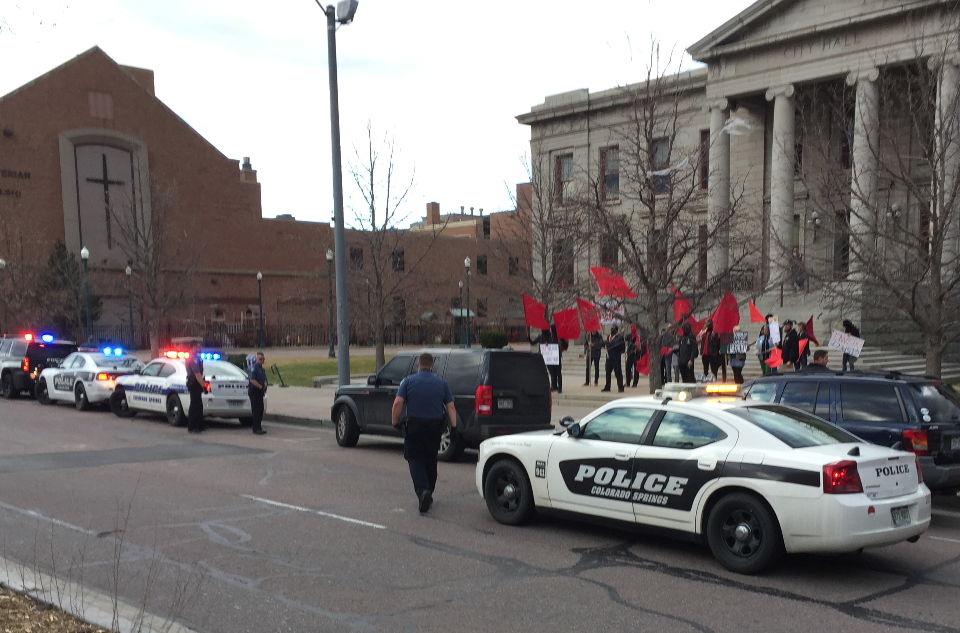
Colo. Springs police disperse March 26 anti-imperialism rally because it was easier than listening to socialists

Colorado Springs Socialists
COLORADO SPRINGS, CO- Local socialists assembled at City Hall on Sunday to “March Against Imperialism”. After a brief march and an half-hour rally while encircled by CSPD, the socialists were informed they were “free to carry on with their assembly” but whoever lingered would be issued a citation for having been in the street. Making no distinction for who had and who hadn’t, the police began handcuffing participants and the couple dozen others quickly dispersed. Five socialists were issued citations for “pedestrian in the highway” and “failure to disperse” while another was arrested and detained for failing to show an ID while filming the police. That person was taken to the downtown police station and held until officers finally informed her of the charges for which she was being cited, after which she identified herself. Throughout her detainment, multiple officers kept up a harassment of questions, refusing her requests that she contact her lawyer. CSPD never issued an order to disperse, a fact that is borne out by witness video. But in effect that is what the officers accomplished. They threatened the legal assembly with citations, for failure to disperse!

CSPD cruiser gunboat diplomacy

It made a funny scene. Around thirty self-declared socialists, blockaded by eight sometimes more CSPD cruisers, in a standoff that lasted until the police lost their patience. Socialists spoke against imperialism, the police officers being their main audience that quiet Sunday downtown. Immediately as the march had ended the police had announced that anyone stepping back into the street would be arrested, and so no one did. But a half-hour of speeches proved too much for the officers to bear and so they interjected again, this time to discuss the problem they had with what had happened earlier. We told those officers they were of course free to discuss such matters individually with whoever they considered a person of interest, BUT AFTERWARD, because they were otherwise interrupting our legal assembly. But the officers persisted in their interruption, deciding after the fact what charges to bring, regardless that they’d forgotten to provide the evidence to back them up. “See you in court” they laughed! We’ve heard that before.

On a serious note. What happened Sunday could have a chilling effect on the nascent kick-ass Colorado Springs Socialists. Unwarranted police attention is an unhappy tradition for socialist organizers, from anarchists to trade unions. Sunday’s denouement confirms all their parents’ worst worries, the folly of declaring yourself to be a socialist in a regressive backwater like Colorado Springs. People were arrested? Handcuffed?! Now you’re on a police watch list! I remember my father’s alarm when he learned his college sophmore had a subscription to Mother Jones Magazine.

Fun as it was, Sunday’s event was essentially uneventful: no altercations, no property damage, not even rhetoric to threaten infrastructure. Minus any media attention, or much of an audience at all on a sleepy Sunday evening, these socialists were determined to parade their dissent where and how those around could see, and reaped more law enforcement than the circumstances required.

While you might say the outcome was predictable, it needn’t have been. Students from the wealthier Colorado College have free range on downtown streets, protesting racism or election outcomes on the street without arrests or citations. Every full moon CC students ride the length of downtown’s main street on bike, skate or skateboard, without even police escort. Sunday’s fledgeling socialist organization is a student club of the UCCS campus. UCCS is more working class, for many a commuter campus, and obviously isn’t shown any deference by city administrators.

Compared to the liberal arts curriculum of Colorado College. UCCS is considered more conservative. UCCS hosts business and military related classes. It even has a Brazil-esque Department of Homeland Security -um- Department. So I think it’s all the more admirable that UCCS has spawned a bonafide socialist group that dwarfs even their school’s Young Republican franchise. I’ve no doubt those socialists I met on Sunday will not be cowed by CSPD’s preemptive aggressions. Hopefully their more timid members will take heart.

Public protests are regularly given use of the streets, which like parks are considered traditional free speech zones. The Tea Party and Occupy took to the streets of Colorado Springs without incurring arrests. More recently people have marched for Black Lives Matter and for solidarity with Native Americans fighting oil pipelines. These have produced zero arrests.

In the meantime it will be important to debrief on what happened and unify the legal strategies. All defendants face the traffic offense of being a pedestrian on the highway [sic] and the misdemeanor of failure to disperse, no doubt tacked on to be a droppable charge as fodder for plea bargains. The recalcitrant videographer faces an added charge of misdemeanor interference for failing to produce her ID. They give her no extra credit for providing a pretext for interrogation because she wouldn’t say zilch without a lawyer present, except to explain where and when they were violating her rights. It used to be that cops had to read us our rights.

Police can issue all the tickets they want when there’s probable cause. They can’t threaten to issue tickets for the solitary purpose of disbanding a legal assembly. In the end, the only socialists who got citations were punished not for being in the street but for standing their ground in front of City Hall.

Pro-immigrant activists with Occupy Denver file suit against DIA and DPD, challenge airport free speech “permit”


DENVER, COLORADO- Civil liberties champion David Lane has filed a complaint in US district court challenging Denver’s office of the city attorney for instituting a permit process at DIA to prevent public protest. Holding signs has become impermissible at the airport, without the issuance of a permit seven days in advnace, although police are not bothering themselves about signs welcoming homecomers or seeking to connect business visitors with their limo service. That selective enforcement is unconstitutional of course, and the lawfirm powerhouse of Kilmer Lane & Newman is filing suit on behalf of two Occupy Denver plaintiffs. last Sunday, January 29, both were threatened with arrest by DIA police. While two earlier attempts to assemble had capitulated to DPD intimidation, the Occupy Denver activists stood their ground. Why did you file your lawsuit? “We know our rights. We want the POLICE to know our rights.”

1. Full text of complaint:

Case 1:17-cv-00332 Document 1
Filed 02/06/17 USDC Colorado Page 1 of 14

Civil Action No.

IN THE UNITED STATES DISTRICT COURT FOR THE DISTRICT OF COLORADO

NAZLI MCDONNELL,
ERIC VERLO,

Plaintiffs, vs.

CITY AND COUNTY OF DENVER,?
DENVER POLICE COMMANDER ANTONIO LOPEZ, in his individual and official capacity,
DENVER POLICE SERGEANT VIRGINIA QUINONES, in her individual and official capacity,

Defendants.

______________________________________________________________________________

COMPLAINT

______________________________________________________________________________

Plaintiffs, by and through their attorneys David A. Lane and Andy McNulty of KILLMER, LANE & NEWMAN, LLP, allege as follows:

INTRODUCTION

1. Plaintiffs Eric Verlo and Nazli McDonnell challenge a regulation of alarming breadth that bans all First Amendment expression at Denver International Airport without a permit.

2. Plaintiffs are concerned citizens who believe that President Donald Trump has overstepped his executive authority by signing the January 27, 2017, Executive Order (hereinafter “Muslim Ban”), which permanently bans Syrian refugees from emigrating to the United States, temporarily bans nationals of seven countries (including permanent legal residents and visa-holders), and suspends all applications to the United States refugee program (even as to vetted entrants currently in transit).

3. Plaintiffs wish to express their disgust with President Trump’s (likely unconstitutional) Muslim Ban. They wish to do so in the same place that hundreds of thousands of Americans across the country have done: standing directly outside of the secure Customs and Border Protection (hereinafter “CBP”) screening area within an airport where immigrants to America enter into the main terminal after clearing customs. Plaintiffs, unlike many citizens across this great nation who have exercised their opposition to the Muslim Ban in airports by chanting, singing, dancing, and praying, simply wish to stand in silent protest, holding signs that express their solidarity with immigrants and the Muslim community.

4. Plaintiffs are banned from doing so by DENVER INTERNATIONAL AIRPORT REGULATION 50 (hereinafter “Regulation 50”).

5. Regulation 50 states: “No person or organization shall leaflet, conduct surveys, display signs, gather signatures, solicit funds, or engage in other speech related activity at Denver International Airport for religious, charitable, or political purposes, or in connection with a labor dispute, except pursuant to, and in compliance with, a permit for such activity issued by the CEO or his or her designee.” DENVER INTERNATIONAL AIRPORT REGULATION 50.03. In order to obtain a permit, an individual must “complete a permit application and submit it during regular business hours, at least seven (7) days prior to the commencement of the activity for which the permit is sought[.]” DENVER INTERNATIONAL AIRPORT REGULATION 50.04-1.

6. Plaintiffs ask that this Court enjoin the enforcement of Regulation 50 and prohibit Defendants from arresting them for their First Amendment-protected activity of standing in peaceful protest within Jeppesen Terminal. Regulation 50 is overbroad in violation of the First Amendment and vague in violation of the Fourteenth Amendment’s Due Process Clause.

7. This is a civil rights action for declaratory and injunctive relief as well as fees and costs arising under 42 U.S.C. §§ 1983, 1988 and 28 U.S.C. Section 2201 et seq. due to Defendants’ current and imminent violations of Plaintiffs’ rights guaranteed by the First and Fourteenth Amendments to the Constitution of the United States.

PARTIES

8. Plaintiff Eric Verlo is a citizen of the United States of America. Mr. Verlo wishes to show his resistance to President Trump’s Muslim Ban, so that others will be inspired to join in the resistance.

9. Plaintiff Nazli McDonnell is a citizen of the United States of America. Ms. McDonnell wishes to show her resistance to President Trump’s Muslim Ban, so that others will be inspired to join in the resistance.

10. Defendant City and County of Denver is a municipal corporation and political subdivision of the State of Colorado. Thus, it is an entity subject to the provisions of § 1983.

11. Defendant Antonio Lopez is a Commander with the Denver Police Department. Commander Lopez is responsible for security at Denver International Airport’s Jeppesen Terminal.

12. Defendant Virginia Quinones is a Sergeant with the Denver Police Department. Sergeant Quinones is responsible for security at Denver International Airport’s Jeppesen Terminal.

JURISDICTION AND VENUE

13. Plaintiffs bring this claim pursuant to 42 U.S.C. § 1983; the First Amendment to the United States Constitution, incorporated as against States and their municipal divisions through the Fourteenth Amendment to the United States Constitution; and the Due Process Clause of the Fourteenth Amendment.

14. This Court has jurisdiction under 28 U.S.C. § 1331 over Plaintiffs’ claims that “arise[] under the Constitution of the United States.”

FACTS

15. On January 27, 2017, President Donald Trump signed an Executive Order, which permanently banned Syrian refugees from emigrating to the United States, temporarily banned nationals of seven countries (including permanent legal residents and visa-holders), and suspended all applications to the United States refugee program (even as to vetted entrants currently in transit). President Trump’s Executive Order has been subsequently referred to as a “Muslim Ban,” because it both mirrors President Trump’s racist, anti-Islam statements made on December 7, 2015, that he was planning to ban all Muslims from entering the United States until our representatives can “figure out what’s going on” and the ban targets countries whose population is predominantly Muslim and seemingly bears little rational relation to each country’s security threat to the United States.

16. Immediately upon the enactment of President Trump’s Muslim Ban there was an outpouring of outrage from a large proportion of the American population and across the spectrum of political affiliation. This outrage led to resistance in the form of protests.

17. On January 28, 2017, and January 29, 2017, protests erupted in nearly every major city in the United States. The protests organically formed in our nation’s airports. Protesters chose to express their disgust with President Trump’s Muslim Ban in airports (and specifically outside of the secure CBP screening area) because individuals affected by the ban who were in transit to the United States were being held and questioned by CBP agents there. Many of these travelers, including lawful United States residents, were forced to sign documents revoking their lawful status within the United States and deported. Still others were simply deported with no explanation. Others still were held for hours as teams of lawyers rushed to prepare habeas petitions for their release.

18. News reports about the protests make clear that they have been peaceful and non- disruptive despite the gathering of, in some cases, thousands of people.

19. Airport staff have told protesters, and would-be protesters, at numerous airports across the nation, including Kansas City International Airport, that there are no restrictions on their speech and that all protesters who wish to participate in actions against the Muslim Ban are allowed. Protests have continued in other cities to this day.

20. On January 28, 2017, there was one such protest at Denver International Airport, within the Jeppesen Terminal. At approximately 5:00 p.m. hundreds gathered in the Jeppesen Terminal’s atrium, near arrivals, to protest and many others gathered to bear witness.

21. Prior to the protest, leaders had applied for a permit. It was denied. The reason for its denial was that the permit was not requested with seven days advance notice of the protest occurring. Regulation 50 requires seven days advance notice.

22. The January 28, 2017, protest began with speeches, chants, songs, and prayers. It was a peaceful gathering of solidarity for immigrants and Muslims. Every person at the January 28, 2017, protest was contained in an area of the Jeppesen Terminal atrium that is designed as a gathering space for people to sit, relax, and converse. No one was standing in the walkways or passageways of the terminal.

23. Soon after the January 28, 2017, protest began, members of the Denver Police Department arrived on-scene. Commander Antonio Lopez engaged the leader of the protest, Amal Kassir, along with State Representative Joe Salazar and representatives from the ACLU of Colorado, and informed them that the protest was unlawful. Commander Lopez told Ms. Kassir that anything that “could be construed as Free Speech” was prohibited at the Denver International Airport, including within the Jeppesen Terminal, without a permit. See Exhibit 1, January 28, 2017 Video.

24. Commander Lopez also stated that all “First Amendment expression” was prohibited at the Denver International Airport, including within the Jeppesen Terminal, without a permit on Regulation 50. Commander Lopez handed Regulation 50 to multiple protesters, including Ms. Kassir. See Exhibit 2, January 28, 2017 Video 2.

25. Regulation 50 states (in pertinent part): “No person or organization shall leaflet, conduct surveys, display signs, gather signatures, solicit funds, or engage in other speech related activity at Denver International Airport for religious, charitable, or political purposes, or in connection with a labor dispute, except pursuant to, and in compliance with, a permit for such activity issued by the CEO or his or her designee.” DENVER INTERNATIONAL AIRPORT REGULATION 50.03. In order to obtain a permit, an individual must “complete a permit application and submit it during regular business hours, at least seven (7) days prior to the commencement of the activity for which the permit is sought[.]” DENVER INTERNATIONAL AIRPORT REGULATION 50.04-1.

26. Commander Lopez, along with members of Denver International Security, told Ms. Kassir that every portion of Denver International Airport property, which has an approximately fifty square mile footprint, is off-limits for First Amendment expression. They suggested that Ms. Kassir move her protest to Tower Road, which is approximately six miles from the Jeppesen Terminal and, like most of the land surrounding Denver International Airport, adjacent to open prairie land with no inhabitants.

27. Commander Lopez threatened Ms. Kassir and numerous other demonstrators with arrest if they didn’t immediately cease any “First Amendment expression.” According to Commander Lopez’s directives, the individuals gathered in the Jeppesen Terminal could not stand holding signs, sing, speak to others about matters of public concern, hold the United States Constitution above their shoulders, or stand silently with their arms interlocked.

28. Ultimately, to avoid arrest, Ms. Kassir and the demonstrators moved outside of the Jeppesen Terminal to the large area on its south side, adjacent to the escalators leading to the commuter rail and under the Westin Hotel. The protest continued peacefully for a little while longer, then disbursed without issue.

29. The next day, January 29, 2017, Plaintiffs Eric Verlo and Nazli McDonnell traveled to Denver International Airport’s Jeppesen Terminal to express their opposition to President Trump’s Muslim Ban.

30. Mr. Verlo and Ms. McDonnell brought with them signs expressing support for immigrants and expressing concern that history was repeating itself with disastrous potential consequences.

31. Mr. Verlo and Ms. McDonnell positioned themselves adjacent to the secure CBP screening area within the Jeppesen Terminal at approximately 1:15 p.m.

32. Adjacent the secure CBP screening area at the Jeppesen Terminal is the only place where Mr. Verlo and Ms. McDonnell can reach their intended audience. Mr. Verlo and Ms. McDonnell wish to communicate with those who could be swayed by their message and, particularly, with immigrants. International travelers are often immigrants and/or lawful United States residents, including green card and other visa holders, other than citizens. Mr. Verlo and Ms. McDonnell wish to express their solidarity with immigrants directly to these individuals. Further, United States citizens who arrive from international locations are also individuals with whom Mr. Verlo and Ms. McDonnell wish to communicate. International travelers have experienced other cultures and are likely to be sympathetic to Mr. Verlo and Ms. McDonell’s message.

33. The secure CBP screening area is also the location where the Muslim Ban has been enforced by DHS, both at Denver International Airport and across the nation. Neither Plaintiff attempted to enter any restricted areas of Denver International Airport.

34. While silently displaying their signs, Mr. Verlo and Ms. McDonnell were in the open plaza near the secure CBP screening area within the Jeppesen Terminal and positioned significantly behind the railing, which demarcates where those waiting for loved ones are permitted to stand. Mr. Verlo and Ms. McDonnell did not impede the right of way of any passengers hustling to catch flights at the last moment. They simply stood with placards showing their distaste for the Executive Order and the man who executed it.

35. Mr. Verlo and Mr. McDonnell also observed another man in the terminal, named Gene Wells, who was expressing views similar to theirs.

36. Mr. Wells was wearing a sign taped to the back of his shirt.

37. Mr. Wells left the Jeppesen Terminal, but subsequently returned to protest. When he did, he was stopped by Denver Police Department officers who told him that he could not walk around the terminal with the slogan he had affixed to his back. Mr. Wells eventually rejoined Mr. Verlo and Mr. McDonnell at the international arrivals doors, but not without trepidation. He feared he might be arrested.

38. While Mr. Verlo and Ms. McDonnell were displaying their signs, Defendant Sergeant Virginia Quinones approached Mr. Verlo and Ms. McDonnell and threatened them with arrest if they did not leave Jeppesen Terminal. See Exhibit 3, January 29, 2017, Video.

39. Sergeant Quinones handed Mr. Verlo and Ms. McDonnell Regulation 50 and cited it as the reason they would be arrested if they did not leave Jeppesen Terminal. Id. Sergeant Quinones told Mr. Verlo and Ms. McDonnell that they would need a permit in order to stand silently, holding signs in opposition of the Muslim Ban and be in compliance with Regulation 50.

40. Had Mr. Verlo and Ms. McDonnell applied for a permit the second President Trump signed the Executive Order implementing the Muslim Ban, they still would have been unable to engage in protest within the Jeppesen Terminal under the terms and conditions of Regulation 50 on January 29, 2017.

41. Mr. Verlo and Ms. McDonnell did not immediately leave the Jeppesen Terminal after being threatened with arrest. However, they were startled by Sergeant Quiones’ threat and feared arrest for the duration of the time they were there.

42. Throughout the time Mr. Verlo and Ms. McDonnell were expressing their views within the Jeppesen Terminal they received numerous shows of support from passersby. Multiple self- proclaimed Muslims expressed heart-felt statements of appreciation to Mr. Verlo, Ms. McDonnell, and others holding signs.

43. Mr. Verlo and Ms. McDonnell ultimately left Jeppesen Terminal.

44. Mr. Verlo and Ms. McDonnell wish to return to Jeppesen Terminal to express solidarity with Muslims and opposition to the Muslim Ban, but are reticent to do so for fear of being arrested.

45. Upon information and belief, no individual has been arrested, or threatened with arrest, for wearing a “Make America Great Again” campaign hat without a permit within the Jeppesen Terminal at Denver International Airport.

46. Upon information and belief, no individual has been arrested, or threatened with arrest, for holding a sign welcoming home a member of our military without a permit within the Jeppesen Terminal at Denver International Airport.

47. Upon information and belief, no individual has been arrested, or threatened with arrest, for holding a sign and soliciting passengers for a limousine without a permit within the Jeppesen Terminal at Denver International Airport.

48. Upon information and belief, no individual has been arrested, or threatened with arrest, for discussing current affairs with another person without a permit within the Jeppesen Terminal at Denver International Airport.

49. At all times relevant to this Complaint, Defendants acted under color of law.

CLAIM I: FIRST AMENDMENT
(§ 1983 violation – all Defendants)

50. Plaintiffs repeat, re-allege, and incorporate by reference the allegations in the foregoing paragraphs of this Complaint as fully set forth herein.

51. Regulation 50 violates the Free Speech Clause of the First Amendment to the Constitution, on its face and as applied, because it impermissibly curtails Plaintiffs’ free-speech rights.

52. Plaintiffs wish to speak on a matter of public concern. 11

53. Denver International Airport’s Jeppesen Terminal is a public forum.

54. Regulation 50 directly infringes upon and chills reasonable persons from engaging in activity that is protected by the First Amendment.

55. Regulation 50 acts as an unconstitutional prior restraint on speech because it (1) requires a permit before allowing individuals to engage in speech, (2) allows for arbitrary and/or discriminatory permit denials, and (3) requires advance notice that is unconstitutionally excessive.

56. Regulation 50 is overbroad.?

57. Regulation 50 is not narrowly tailored to serve a compelling government interest.?

58. Regulation 50 does not further a substantial government interest.?

59. Regulation 50’s restriction on expressive conduct is greater than necessary to further any
government interest.?

60. Defendants’ actions and/or omissions enforcing Regulation 50 caused, directly or
proximately, Plaintiffs to suffer damages.

CLAIM II: FIRST AMENDMENT RETALIATION
(§ 1983 violation – all Defendants)

1. All statements of fact set forth previously are hereby incorporated into this claim as though set forth fully herein. ?

2. Plaintiffs engaged in First Amendment protected speech on a matter of public concern ?while displaying signs opposing President Trump’s Muslim Ban on January 29, 2017.

3. Defendants jointly and on their own accord responded to Plaintiffs’ First Amendment protected speech with retaliation, including but not limited to threatening Plaintiffs with arrest.

4. Defendants retaliatory actions were substantially motivated by Plaintiffs’ exercise of their First Amendment rights.

5. By unlawfully threatening Plaintiffs with arrest, Defendants sought to punish Plaintiffs for exercising their First Amendment rights and to silence their future speech. Defendants’ retaliatory actions would chill a person of ordinary firmness from engaging in such First Amendment protected activity.

6. Defendants’ actions and/or omissions enforcing Regulation 50 caused, directly and proximately, Plaintiffs to suffer damages.

CLAIM III: FOURTEENTH AMENDMENT DUE PROCESS
(§ 1983 violation – all Defendants)

7. All statements of fact set forth previously are hereby incorporated into this claim as though set forth fully herein.

8. The prohibitions of Regulation 50 are vague and not clearly defined. ?

9. Regulation 50 offers no clear and measurable standard by which Plaintiffs and others can ?act lawfully.

10. Regulation 50 does not provide explicit standards for application by law enforcement officers.

11. Regulation 50 fails to provide people of ordinary intelligence a reasonable opportunity to understand what conduct it prohibits, and authorizes or encourages arbitrary and discriminatory enforcement, or both.

12. Defendants’ actions and/or omissions enforcing Regulation 50 caused, directly and proximately, Plaintiffs to suffer damages.

PRAYER FOR RELIEF

WHEREFORE, Plaintiffs respectfully request that this Court enter judgment in their favor and against Defendants, and grant:

(a) Appropriate declaratory and other injunctive and/or equitable relief; 13

(b)  Enter a declaration that Regulation 50 is unconstitutional on its face and enjoin its enforcement; ?

(c)  Compensatory and consequential damages, including damages for emotional distress, loss of reputation, humiliation, loss of enjoyment of life, and other pain and suffering on all claims allowed by law in an amount to be determined at trial; ?

(d)  All economic losses on all claims allowed by law; ?

(e)  Punitive damages on all claims allowed by law and in an amount to be determined ?at trial; ?

(f)  Attorney’s fees and the costs associated with this action, pursuant to 42 U.S.C. § ?1988; ?

(g)  Pre and post-judgment interest at the lawful rate; and ?

(h)  Any further relief that this court deems just and proper, and any other relief as ?allowed by law. ?

Dated this 6th day of February 2017.

KILLMER, LANE & NEWMAN, LLP
s/ Andy McNulty

___________________________________
David A. Lane
?Andy McNulty?
Killmer, Lane & Newman, LLC
1543 Champa Street, Suite 400 Denver, Colorado 80202?
Attorneys for Plaintiff

2. Full text of Feb 6 motion for preliminary injunction:

Case 1:17-cv-00332 Document 2
Filed 02/06/17 USDC Colorado Page 1 of 23

Civil Action No.

IN THE UNITED STATES DISTRICT COURT FOR THE DISTRICT OF COLORADO

NAZLI MCDONNELL,
ERIC VERLO,

Plaintiffs, vs.

CITY AND COUNTY OF DENVER,
DENVER POLICE COMMANDER ANTONIO LOPEZ, in his individual and official capacity,
DENVER POLICE SERGEANT VIRGINIA QUINONES, in her individual and official capacity,

Defendants.

______________________________________________________________________________

MOTION FOR PRELIMINARY INJUNCTION

______________________________________________________________________________

Plaintiffs, by and through their attorneys David A. Lane and Andy McNulty of KILLMER, LANE & NEWMAN, LLP, hereby submit the following Motion for Preliminary Injunction, and in support thereof, states as follows:

1. Introduction

Over the last four days, many Americans have expressed public disapproval of President Donald Trump’s January 27, 2017, Executive Order, which permanently bans Syrian refugees from emigrating to the United States, temporarily bans nationals of seven countries (including permanent legal residents and visa-holders), and suspends all applications to the United States refugee program (even as to vetted entrants currently in transit). Plaintiffs are concerned and alarmed United States citizens who wish to join the growing chorus of voices expressing opposition to the Executive Order. To do so, they wish to stand in silent protest at the Jeppesen Terminal within Denver International Airport.

Plaintiffs did just this on January 29, 2017, standing in silent protest of the Executive Order outside of the secure Customs and Border Protection (hereinafter “CBP”) screening area within Jeppesen Terminal. Almost immediately, Plaintiffs were threatened with arrest by Denver Police Department Sergeant Virginia Quinones for standing silently and holding signs opposing the Executive Order, despite that fact that the Jeppesen Terminal has previously been used for expressive activity (and that protesters at more than ten major airports nationwide have protested peacefully without major disruption or legal restriction). While silently displaying their signs, Plaintiffs were in the plaza within the Jeppesen Terminal and positioned significantly behind the railing, which demarcates where those waiting for loved ones are permitted to stand, in the open plaza outside of the secure CBP screening area at the Jeppesen Terminal. Plaintiffs did not impede the right of way of any passengers hustling to catch flights at the last moment. They simply stood with placards showing their distaste for the Executive Order and the man who executed it.

Even though Plaintiffs were simply engaged in peaceful First Amendment protected expression, they were threatened with arrest. Sergeant Quinones informed Plaintiffs that, in order to stand silently with political signs, they would need a permit. Without a permit, Sergeant Quinones stated, all “First Amendment expression” at the Denver International Airport was banned.

This was not the first time since the enactment of the Executive Order that the Denver Police Department threatened individuals with arrest for engaging in First Amendment protected activity in Jeppesen Terminal. On January 28, 2016, a protest was held in the plaza of Jeppesen Terminal. During the protest, Denver Police Commander Antonio Lopez instructed multiple individuals, including State Representative Joseph Salazar and representatives from the ACLU of Colorado, that all “First Amendment expression” was banned at Denver International Airport without a permit. See Exhibit 1, January 28, 2017, Video 1; Exhibit 2, January 28, 2017, Video 2. The protesters had, in fact, applied for a permit earlier that day. However, it had not been granted because they had not done so seven days in advance of the protest in compliance with Denver International Airport regulations. Although no arrests were ultimately made, protesters were threatened numerous times by Commander Lopez, and other officers, with arrest.

The Denver International Airport regulation that both Sergeant Quinones and Commander Lopez relied upon in instructing Plaintiffs, and others, that Denver International Airport bans all “First Amendment expression” without a permit is DENVER INTERNATIONAL AIRPORT REGULATION 50 (hereinafter “Regulation 50”). Regulation 50 states that “no person or organization shall leaflet, conduct surveys, display signs, gather signatures, solicit funds, or engage in other speech related activity at Denver International Airport for religious, charitable, or political purposes, or in connection with a labor dispute, except pursuant to, and in compliance with, a permit for such activity issued by the CEO or his or her designee.” DENVER INTERNATIONAL AIRPORT REGULATION 50.03. In order to obtain a permit, an individual must “complete a permit application and submit it during regular business hours, at least seven (7) days prior to the commencement of the activity for which the permit is sought[.]” DENVER INTERNATIONAL AIRPORT REGULATION 50.04-1.

Plaintiffs wish to return to Denver International Airport to protest the Executive Order, but are reasonably frightened of arrest and, absent action by this Court, must choose between lawfully exercising their First Amendment right and being subject to arrest and/or prosecution.

Plaintiffs ask that this Court enter an injunction prohibiting their arrest for standing in peaceful protest within Jeppesen Terminal and invalidating Regulation 50 as violative of the First and Fourteenth Amendments to the United States Constitution.

2. Factual Background

All statements of fact set forth in the simultaneously filed Complaint are hereby incorporated into this Brief as though set forth fully herein.

3. Argument

3.1 The standard for issuance of a preliminary injunction.

When seeking a preliminary injunction, a plaintiff must establish that (1) he is likely to succeed on the merits; (2) he is likely to suffer irreparable harm; (3) the balance of equities tips in his favor; and (4) that an injunction is in the public interest. Winter v. Nat. Res. Def. Council, 555 U.S. 7, 20 (2008); see also ACLU v. Johnson, 194 F.3d 1149, 1155 (10th Cir. 1999).

The Tenth Circuit has modified the preliminary injunction test when the moving party demonstrates that the second, third, and fourth factors “tip strongly” in its favor. See Oklahoma ex rel. Okla. Tax Comm’n v. Int’l Registration Plan, Inc., 455 F.3d 1107, 1113 (10th Cir. 2006); see also 820 F.3d 1113, n.5 (10th Cir. 2016). “In such situations, the moving party may meet the requirement for showing success on the merits by showing that questions going to the merits are so serious, substantial, difficult, and doubtful as to make the issue ripe for litigation and deserving of more deliberate investigation.” Id. (internal quotation marks omitted). Moreover, this “fair chance of prevailing” test is appropriate in this case because Plaintiffs are challenging a policy, not a statue or ordinance. See Planned Parenthood Minn, N.D., & S.D. v. Rounds, 530 F.3d 724, 732 (9th Cir. 2008) (“[C]ourts should… apply the familiar ‘fair chance of prevailing’ test where a preliminary injunction is sought to enjoin something other than government action based on presumptively reasoned democratic processes.”).

Under either standard, Plaintiffs are able to demonstrate that the issuance of a preliminary injunction is appropriate in this matter.

3.3 Regulation 50 implicates Plaintiffs’ First Amendment rights. 1

When the government regulates the exercise of First Amendment rights, the burden is on the proponent of the restriction to establish its constitutionality. Phelps-Roper v. Koster, 713 F.3d 942, 949 (8th Cir. 2013). Moreover, when assessing the preliminary injunction factors in First Amendment cases, “the likelihood of success will often be the determinative factor.” Hobby Lobby Stores, Inc. v. Sebelius, 723 F.3d 1114, 1145 (10th Cir. 2013). This is because “the loss of First Amendment freedoms, for even minimal periods of time, unquestionably, constitutes irreparable injury,” Heideman v. Salt Lake City, 348 F.3d 1182, 1190 (10th Cir. 2003), and it is invariably in the public interest to protect an individual’s First Amendment rights. See Homans v. City of Albuquerque, 264 F.3d 1240, 1244 (10th Cir. 2001) (noting that “the public interest is better served” by protecting First Amendment rights).

[NOTE 1. It is important to note that facial challenges to government policies and statutes, when based on First and Fourteenth Amendment grounds, are not disfavored. See United States v. Stevens, 559 U.S. 460, 473 (2010); City of Chicago v. Morales, 527 U.S. 41 (1999).]

3.4 Plaintiffs are likely to succeed on the merits.

Plaintiffs are likely to succeed on the merits because Regulation 50 violates the Free Speech Clause of the First Amendment and the Due Process Clause of the Fourteenth Amendment.

3.4(a) Plaintiffs engaged, and wish to engage, in speech on a matter of public concern.

Plaintiffs’ speech is at the core of the First Amendment’s protection because it deals with a matter of public concern. “Speech deals with matters of public concern when it can be fairly considered as relating to any matter of political, social, or other concern to the community, or when it is a subject of legitimate news interest; that is, a subject of general interest and of value and concern to the public.” Snyder v. Phelps, 562 U.S. 443, 453 (2011) (internal quotation marks and citation omitted). “Speech on matters of public concern is at the heart of the First Amendment’s protection.” Id. at 451-52 (alterations and quotation marks omitted). “The First Amendment reflects ‘a profound national commitment to the principle that debate on public issues should be uninhibited, robust, and wide-open.’” Id. at 452 (quoting New York Times Co. v. Sullivan, 376 U.S. 254, 270 (1964)). Plaintiffs wish to engage in expression about President Donald Trump’s January 27, 2017, Executive Order, a topic that has generated nearly unprecedented debate and dissent. See Adrienne Mahsa Varkiani, Here’s Your List of All the Protests Happening Against the Muslim Ban, THINK PROGRESS (Jan. 28, 2017), https://thinkprogress.org/muslim-ban-protests-344f6e66022e#.ft1oznfv4 (compiling list of direct actions planned in response to President Trump’s January 27, 2017, Executive Order). Thus, Plaintiffs’ speech “‘occupies the highest rung of the hierarchy of First Amendment values, and is entitled to special protection.’” Snyder, 562 U.S. at 452 (quoting Connick v. Myers, 461 U.S. 138, 145 (1983)).

3.4(b) Regulation 50 acts as a prior restraint.

The restriction at issue in this matter is a prior restraint. “The term prior restraint is used ‘to describe administrative and judicial orders forbidding certain communications when issued in advance of the time that such communications are to occur.’” Alexander v. United States, 509 U.S. 544, 550 (1993) (quoting M. Nimmer, Nimmer on Freedom of Speech § 4.03, p. 4–14 (1984)). Regulation 50 is in an administrative order that forbids future communication and bases the ability to communicate in the future on the discretion of an administrative official. See DENVER INTERNATIONAL AIRPORT REGULATION 50.03 (“no person or organization shall leaflet, conduct surveys, display signs, gather signatures, solicit funds, or engage in other speech related activity at Denver International Airport for religious, charitable, or political purposes, or in connection with a labor dispute, except pursuant to, and in compliance with, a permit for such activity issued by the CEO or his or her designee.” (emphasis added)). It is a prior restraint.

The burden of proving a prior restraint is permissible is particularly steep. The Supreme Court has repeatedly held that “[a]ny system of prior restraints of expression comes to this Court bearing a heavy presumption against its constitutional validity.” Bantam Books, Inc. v. Sullivan, 372 U.S. 58, 70 (1963). For the reasons outlined infra, Defendants cannot meet this especially significant burden.

3.4(c) Jeppesen Terminal, outside of the passenger security zones, is a traditional public forum.

The Supreme Court has not definitively decided whether airport terminals, including Jeppesen Terminal, are public forums. In Lee v. International Society for Krishna Consciousness, Inc., 505 U.S. 830 (1992) (hereinafter “Lee I”), issued the same day as International Society for Krishna Consciousness, Inc. v. Lee, 505 U.S. 672 (1992) (hereinafter “Lee II”), the Supreme Court struck down a total ban on distribution of literature in airports. In Lee I, the Court issued a one sentence per curiam opinion, which affirmed the Second Circuit for the reasons expressed by Justice O’Connor, Justice Kennedy, and Justice Souter in Lee II. See Lee I, 505 U.S. at 831. Justice Kennedy and Justice Souter’s opinions in Lee II found that “airport corridors and shopping areas outside of the passenger security zones… are public forums, and speech in those places is entitled to protection against all government regulation inconsistent with public forum principles.” Lee II, 505 U.S. at 693 (Kennedy, J., concurring in the judgment); but see Lee II, 505 U.S. at 683 (“”[W]e think that neither by tradition nor purpose can the terminals be described as satisfying the standards we have previously set out for identifying a public forum.”).

Therefore, Plaintiffs ask this Court to find the area of Jeppesen Terminal outside of the passenger security zones to be a public forum. The historical use of the Jeppesen Terminal’s plazas and other areas outside of the passenger security zones (including the area outside of the secure CBP screening area) for political speech (particularly, the history of welcoming of American military personnel home from service, discussion between passengers of matters of public concern, and display of clothing advocating for political views and ideals) indicates that it is a public forum. See First Unitarian Church of Salt Lake City v. Salt Lake City Corp., 308 F.3d 1114, 1130 (10th Cir. 2002) (“Where courts have considered the traditional use of publicly accessible property for speech, they have refused to attribute legal significance to an historical absence of speech activities where that non-speech history was created by the very restrictions at issue in the case.”). Further, that the Jeppesen Terminal is free and open to the public (outside of the passenger security zones), illustrates that it is a public forum. See, e.g., Ark. Educ. Television Comm’n v. Forbes, 523 U.S. 666, 676 (1998); Cornelius v. NAACP Legal Def. & Educ. Fund, 473 U.S. 788, 800, 805, 809 (1985). Finally, Jeppesen Terminal retains characteristics similar to parks: it has large plazas lined with benches, it is surrounded by businesses which are open to the public, and it has dedicated walkways, similar to sidewalks, indicating that it is a public forum. See e.g., Frisby v. Schultz, 487 U.S. 474, 480-481 (1988); United States v. Grace, 461 U.S. 171, 177 (1983). Further, the Supreme Court has not strictly limited the public forum category to streets, sidewalks, and parks. See, e.g., Se. Promotions, Ltd. v. Conrad, 420 U.S. 546 (1975) (finding leased municipal theater is a public forum); Heffron v. Int’l Society for Krishna Consciousness, Inc., 452 U.S. 640 (1981) (finding state fair is a public forum); Edwards v. South Carolina, 372 U.S. 229 (1963) (finding grounds of state capitol are a traditional public forum). Even if the City claims that it has never intended for Jeppesen Terminal to be a public forum, this is not dispositive. See Lee, 505 U.S. at 830 (government policy prohibiting distribution of literature at airport on property struck down); Cornelius, 473 U.S. at 805 (government’s decision to limit access is not itself dispositive). Plaintiffs’ ask that this Court find Jeppesen Terminal, outside of the passenger security zones, a traditional public forum.

Since Jeppesen Terminal is a traditional public forum, any restriction on Plaintiffs’ speech must be content-neutral and narrowly tailored to a compelling government interest. Regulation 50 fails at both.

3.4(d) Regulation 50 is content-based.

Regulation 50 is a content-based restriction of expression. Although the Supreme Court has long held that content-based restrictions elicit strict scrutiny, see, e.g., Carey v. Brown, 447 U.S. 455 (1980), lower courts diverged on the meaning of “content-based” until Reed v. Town of Gilbert, 135 S. Ct. 2218 (2015). 2 Reed clarified that a restriction is content based simply if it draws distinctions “based on the message a speaker conveys.” 135 S. Ct. at 2227. Reed is clear that even “subtle” distinctions that define regulated expression “by its function or purpose . . . are distinctions based on the message a speaker conveys, and therefore, are subject to strict scrutiny.” Id. This accords with Texas v. Johnson, which held that “the emotive impact of speech on its audience is not a secondary effect unrelated to the content of the expression itself.” 491 U.S. 491 U.S. 297, 412 (1989) (internal quotations omitted).

[NOTE 2. Reed involved a municipal “sign code” that regulated signs differently based on the kind of message they conveyed (such as “ideological,” “political,” or “temporary directional”). 135 S. Ct. at 2224-25. The Court rejected the city’s argument that a law had to discriminate against certain viewpoints in order to be a content-based restriction. Id. at 2229.]

Regulation 50 is content-based on its face. It distinguishes between content and requires that an official determine the content of the speaker’s message when enforcing its proscriptions. Reed, 135 S. Ct. at 2227; see DENVER INTERNATIONAL AIRPORT REGULATION 50.03 (“No person or organization shall leaflet, conduct surveys, display signs, gather signatures, solicit funds, or engage in other speech related activity at Denver International Airport for religious, charitable, or political purposes, or in connection with a labor dispute[.]” (emphasis added)). The distinctions drawn by Regulation 50 make it a facially content-based restriction on expression that must elicit “the most exacting scrutiny.” Johnson, 491 U.S. at 412; Reed, 135 S. Ct. at 2227.

3.4(e) Regulation 50 is not narrowly tailored to serve a compelling government interest.

As a facially content-based restriction of expression at traditional public fora, Regulation 50 is presumptively unconstitutional unless Defendant “prove[s] that the restriction furthers a compelling interest and is narrowly tailored to achieve that interest.” Reed, 135 St. Ct. at 2231; accord Johnson, 491 U.S. at 412.

“A statute is narrowly tailored if it targets and eliminates no more than the exact source of the ‘evil’ it seeks to remedy.” Frisby v. Schultz, 487 U.S. 474, 485 (1988) (citation omitted). Regulation 50 reaches more speech than that which would impair the security of the airport or ensure that passengers are not unduly encumbered. In fact, it completely bans all “First Amendment expression.” “A complete ban can be narrowly tailored, but only if each activity within the proscription’s scope is an appropriately targeted evil.” Id.. Regulation 50 is not such a ban. For instance, Plaintiffs’ expression does nothing to jeopardize security at Denver International Airport or to inhibit the free flow of passengers through the airport.

Further, any argument that Plaintiffs can engage in expressive activity in another location lacks merit, as the Supreme Court has held that the First Amendment is violated when one specific location or audience, when important to the speaker, is foreclosed. See McCullen v. Coakley, 134 S. Ct. 2518, 2536 (2014); Schenck v. Pro-Choice Network, 519 U.S. 357, 377 (1997) (invalidating a “floating” buffer zone around people entering an abortion clinic partly on the ground that it prevented protestors “from communicating a message from a normal conversational distance or handing leaflets to people entering or leaving the clinics who are walking on the public sidewalks”); Schneider v. New Jersey, 308 U.S. 147, 163 (1939) (invalidating anti-handbilling ordinances even though “their operation is limited to streets and alleys and leaves persons free to distribute printed matter in other public places”). Regulation 50 lacks the narrow tailoring necessary to survive First Amendment strict scrutiny analysis.

3.4(f) Regulation 50 violates the First Amendment even if this Court determines Jeppesen Terminal is a nonpublic forum.

Regulation 50 bans all “First Amendment expression” absent a permit; it is unconstitutional even when analyzed under the lower standard of scrutiny applied by courts to First Amendment political speech in a nonpublic forum. In Board of Airport Commissioners of Los Angeles v. Jews for Jesus, Inc., 482 U.S. 569 (1987), the Supreme Court considered whether a resolution restricting free speech in the airport was constitutional. The resolution at issue stated that the airport “is not open for First Amendment activities by any individual and/or entity.” Id. at 574. Although the Court did not explicitly find that the airport was a nonpublic forum, it did hold that the resolution restricting speech in the airport was facially unreasonable, even if the airport was a nonpublic forum. Id. at 573. The Court noted that enforcing the resolution would prohibit “talking and reading, or the wearing of campaign buttons or symbolic clothing.” Id. at 574. The Court also noted, “[m]uch nondisruptive speech–such as the wearing of a T-shirt or button that contains a political message–may not be ‘airport related’ but is still protected speech even in a nonpublic forum.” Id. at 575 (citing Cohen v. California, 403 U.S. 15 (1971) (holding that wearing of jacket with offensive language in a courthouse was a form of nondisruptive expression that was protected by the First Amendment)). Thus, although specific conduct was not at issue in the Jews for Jesus decision, the Court nonetheless implicitly held that non-disruptive speech is protected by the First Amendment in nonpublic fora and that restrictions that encumber non-disruptive expression are unreasonable.

In Lee II, Justice O’Connor set forth the test for determining reasonableness in the context of nonpublic fora. 505 U.S. at 687 (O’Connor, J., concurring). 3 She stated, ”[t]he reasonableness of the Government’s restriction [on speech in a nonpublic forum] must be assessed in light of the purpose of the forum and all the surrounding circumstances.” Id. (O’Connor, J., concurring) (quoting Cornelius, 473 U.S. at 809). However, Justice O’Connor noted that while “[o]rdinarily . . . we have . . . been confronted with cases where the fora at issue were discrete, single-purpose facilities,” airports present a different analysis because they are multipurpose facilities. Id. at 688 (O’Connor, J., concurring) (citations omitted). She determined airports to be multipurpose facilities because

the Port Authority [has] chosen not to limit access to the airports under its control, [and] has created a huge complex open to travelers and nontravelers alike. The airports house restaurants, cafeterias, snack bars, coffee shops, cocktail lounges, post offices, banks, telegraph offices, clothing shops, drug stores, food stores, nurseries, barber shops, currency exchanges, art exhibits, commercial advertising displays, bookstores, newsstands, dental offices and private clubs.

Id. This led to the finding that “[t]he reasonableness inquiry, therefore, is not whether the restrictions on speech are consistent with preserving the property for air travel, but whether they are reasonably related to maintaining the multipurpose environment that the Port Authority has deliberately created.” Id. at 689. A complete ban on First Amendment activity at the Jeppesen Terminal, absent a permit that must be obtained by providing seven days advance notice, is not a reasonable restriction. Regulation 50 does not comport with Justice O’Connor’s conclusion that airports are more than simply places where air travel occurs.

[NOTE 3. It is important to note that Lee involved a plurality opinion, joined by Justice O’Connor. Therefore, Justice O’Connor’s concurrence is the “narrowest grounds” that justify the Court’s result and her concurrence holds substantial precedential weight.]

Moreover, Justice O’Connor distinguished between solicitations (which the Supreme Court found could be reasonably restricted) and distributing leaflets (which the Supreme Court found could not be reasonably restricted) in the airport:

[L]eafleting does not entail the same kinds of problems presented by face-to-face solicitation. Specifically, “one need not ponder the contents of a leaflet or pamphlet in order mechanically to take it out of someone’s hand . . . . The distribution of literature does not require that the recipient stop in order to receive the message the speaker wishes to convey; instead the recipient is free to read the message at a later time.”

Id. at 690 (quoting United States v. Kokinda, 497 U.S. 720, 734 (1990)).

Thus, the Court held in Lee II that prohibiting solicitation in a nonpublic forum is not unreasonable, but that prohibiting the distribution of leaflets and other literature at a nonpublic forum is unreasonable. See also Lee, 505 U.S. at 830 (decided the same day as Lee II and striking down a prohibition on the distribution of leaflets and other literature at La Guardia, John F. Kennedy, and Newark International airports) (per curiam). Circuit courts have also recognized the inherent right to distribute paper and other information in nonpublic fora. Following Lee I and Lee II, two circuit courts have held that airports, as nonpublic fora, could not preclude newspaper publishers from placing newsracks in airport terminals. See Jacobsen v. City of Rapid City, South Dakota, 128 F.3d 660 (8th Cir. 1997); Multimedia Publishing Co. of South Carolina, Inc. v. Greenville-Spartanburg Airport Dist., 991 F.2d 154 (4th Cir. 1993). To the extent that the airports were concerned about safety or the impediment of traffic flow, the courts held that the airport may impose reasonable restrictions, but they could not enforce an outright ban on the newspaper racks. See Jacobsen, 128 F.3d at 660; Multimedia Publishing Co. of South Carolina, Inc., 991 F.2d at 154.

Denver, through Regulation 50, has banned all “First Amendment expression” including leafleting and protests. In fact, Plaintiffs expression is arguably less intrusive and disruptive to air travel than the form of expression, namely leafletting, that the Court held could not be reasonably restricted in the areas of an airport that precede the security screening area. It is clear from Lee I, Lee II, and Jews for Jesus that Denver cannot ban all “First Amendment expression” at the Jeppesen Terminal.

3.4(f)(1) Independently, the viewpoint-based prohibition of Plaintiffs’ speech, based on Regulation 50, violates the First Amendment.

Even if Jeppesen Terminal is a nonpublic forum, “this does not mean the government has unbridled control over speech, . . . for it is axiomatic that ‘the First Amendment forbids the government to regulate speech in ways that favor some viewpoints or ideas at the expense of others.” Summum v. Callaghan, 130 F.3d 906, 916 (10th Cir. 1997) (quoting Lamb’s Chapel v. Center Moriches Union Free School Dist., 508 U.S. 384, 394, (1993)). “Restrictions on speech in nonpublic fora must be viewpoint neutral[.]” Warren v. Fairfax Cty., 196 F.3d 186, 193 (4th Cir. 1999) (citing Cornelius, 473 at 809). Defendants’ restriction of Plaintiffs’ speech, under the guise of Regulation 50, discriminates on the basis of viewpoint. Individuals walk through Denver International Airport with political messages and slogans on their shirts and luggage and discuss politics on a daily basis. Counsel for Plaintiffs has worn political shirts while traveling through Denver International Airport and discussed modern politics with fellow passengers on many occasions. However, no other individual, to Plaintiffs or Plaintiffs’ counsel’s knowledge, has been threatened with arrest for engaging in this political speech. Nor has any individual been arrested for displaying pro-President Trump messages, for example a red hat that reads “Make America Great Again.” Only Plaintiffs’ expressive activity against the President’s Executive Order, and others advocating similarly, has been threatened with arrest. Regulation 50 is being enforced as a clearly view-point based restriction. Defendants’ application of Regulation 50 to Plaintiffs speech is view-point based and violates the First Amendment.

3.4(g) The seven day advance notice requirement for obtaining a permit is not a reasonable restriction.

Notice periods restrict spontaneous free expression and assembly rights safeguarded in the First Amendment. Plaintiffs, like many others throughout history, wish to engage in First Amendment expression in quick response to topical events. While even in such time-sensitive situations, a municipality may require some short period of advance notice so as to allow it time to take measures to provide for necessary traffic control and other aspects of public safety, the period can be no longer than necessary to meet the City’s urgent and essential needs of this type. See American-Arab Anti-Discrimination Comm. v. City of Dearborn, 418 F.3d 600, 605 (6th Cir. 2005) (“Any notice period is a substantial inhibition on speech.”).

Advance notice requirements that have been upheld by courts have most generally been less than a week. See, e.g., A Quaker Action Group v. Morton, 516 F.2d 717, 735 (D.C. Cir. 1975) (two-day advance notice requirement is reasonable for use of National Park areas in District of Columbia for public gatherings); Powe v. Miles, 407 F.2d 73, 84 (2d Cir. 1968) (two-day advance notice requirement for parade is reasonable); Progressive Labor Party v. Lloyd, 487 F. Supp. 1054, 1059 (D. Mass. 1980) (three-day advance filing requirement for parade permit approved in context of broader challenge); Jackson v. Dobbs, 329 F. Supp. 287, 292 (N.D. Ga. 1970) (marchers must obtain permit by 4 p.m. on day before the march), aff’d, 442 F.2d 928 (5th Cir. 1971). Lengthy advance filing requirements for parade permits, such as the seven day advance notice requirement imposed by Regulation 50, have been struck down as violating the First Amendment. See American-Arab Anti-Discrimination Comm., 418 F.3d at 605-07 (holding that provision requiring thirty days’ notice is overbroad and is not saved by an unwritten policy of waiving the provision); NAACP, W. Region v. City of Richmond, 743 F.2d 1346, 1357 (9th Cir. 1984) (“[A]ll available precedent suggests that a 20-day advance notice requirement is overbroad.”). Even an advance filing requirement of five days has been held too long to comport with the First Amendment. See Douglas v. Brownell, 88 F.3d 1511, 1523-24 (8th Cir. 1996) (city’s asserted goals of protecting pedestrian and vehicular traffic and minimizing inconvenience to the public does not justify five-day advance filing requirement for any parade, defined as ten or more persons).

It is clear that, in the case at bar, a permit requirement of seven days advance notice is not a reasonable restriction of Plaintiffs’ First Amendment rights. Plaintiffs wish to engage in timely, direct action against, what they perceive as, a tyrannical and unconstitutional exercise of the executive power. If Plaintiffs were to have applied for a permit at the exact moment President Trump signed the Executive Order, they would still have been prevented from engaging in First Amendment activity on January 29, 2017. In direct action, like in most things, timing is everything. As evidenced by myriad protests that occurred across the nation’s airports, which were accompanied by no violence or destruction of property and did not otherwise jeopardize security, accommodation of protest at the Jeppesen Terminal is reasonable. Such a lengthy approval period, with no exceptions for spontaneous, peaceful protests, violates the First Amendment. See Church of the American Knights of the Ku Klux Klan v. City of Gary, 334 F.3d 676, 682 (7th Cir. 2003) (noting that “the length of the required period of advance notice is critical to its reasonableness; and given … that political demonstrations are often engendered by topical events, a very long period of advance notice with no exception for spontaneous demonstrations unreasonably limits free speech” (emphasis added)).

3.4(h) Regulation 50 is overbroad in violation of the First Amendment.

“[A] law may be invalidated as overbroad if ‘a substantial number of its applications are unconstitutional, judged in relation to the [ordinance]’s plainly legitimate sweep.’” United States v. Stevens, 559 U.S. 460, 473 (2010) (quoting Wash. State Grange v. Wash. State Republican Party, 552 U.S. 442, 449 n.6 (2008)). An overbroad statute may be challenged on its face even though a more narrowly drawn statute would be valid as applied to the party in the case before it. City Council of L.A. v. Taxpayers for Vincent, 466 U.S. 789, 798 (1984) (“[B]roadly written statutes may have such a deterrent effect on free expression that they should be subject to challenge even by a party whose own conduct may be unprotected.”). The Supreme Court “has repeatedly held that a government purpose to control or prevent activities constitutionally subject to state regulation may not be achieved by means which sweep unnecessarily broadly and thereby invade the area of protected freedoms.” NAACP v. Alabama ex rel. Flowers, 377 U.S. 288, 307 (1964); see also Grayned v. City of Rockford, 408 U.S. 109, 114-15 (1972) (“The crucial question, then, is whether the ordinance sweeps within its prohibitions what may not be punished under the First and Fourteenth Amendments.”). Courts have “provided this expansive remedy out of concern that the threat of enforcement of an overbroad law may deter or ‘chill’ constitutionally protected speech—especially when the overbroad statute imposes criminal sanctions.” Virginia v. Hicks, 539 U.S. 113, 119 (2003).

Determining whether a law is substantially overbroad requires a two-step analysis. First, a court must “construe the challenged [law]; it is impossible to determine whether a [law] reaches too far without first knowing what the [law] covers.” United States v. Williams, 553 U.S. 285, 293 (2008). Second, based on the first step, a court must determine whether the law “criminalizes a substantial amount of protected expressive activity.” Id. at 297.

Regulation 50 provides that “no person or organization shall leaflet, conduct surveys, display signs, gather signatures, solicit funds, or engage in other speech related activity at Denver International Airport for religious, charitable, or political purposes, or in connection with a labor dispute, except pursuant to, and in compliance with, a permit for such activity issued by the CEO or his or her designee.” Those tasked with enforcing Regulation 50, have stated that it bans all “First Amendment expression.” See Exhibit 1, January 28, 2017, Video 1; Exhibit 2, January 28, 2017, Video 2.

A complete prohibition on First Amendment expression and related activity proscripts a substantial amount of protected expressive activity. See Jews for Jesus, 482 U.S. at 569; Lee, 505 U.S. at 830. It prohibits face-to-face conversations and wearing clothing intended to convey a message, along with leafleting and other traditional First Amendment activity, all of which protected expression. Regulation 50’s overbreadth is stark and violates the guarantees of the First Amendment.

3.4(i) Regulation 50 is unconstitutionally vague.

“A fundamental principle in our legal system is that laws which regulate persons or entities must give fair notice of conduct that is forbidden or required.” F.C.C. v. Fox Television Stations, Inc., 132 S. Ct. 2307, 2317 (2012). “A law’s failure to provide fair notice of what constitutes a violation is a special concern where laws ‘abut[ ] upon sensitive areas of basic First Amendment freedoms’ because it ‘inhibit[s] the exercise’ of freedom of expression and ‘inevitably lead[s] citizens to steer far wider of the unlawful zone … than if the boundaries of the forbidden areas were clearly marked.’” Stahl v. City of St. Louis, 687 F.3d 1038, 1041 (8th Cir. 2012) (quoting Grayned, 408 U.S. at 109). For this reason, a stringent vagueness test applies to a law that interferes with the right of free speech. Vill. of Hoffman Estates v. Flipside, Hoffman Estates, Inc., 455 U.S. 489, 499 (1982). “Where a statute’s literal scope, unaided by a narrowing state court interpretation, is capable of reaching expression sheltered by the First Amendment, the doctrine demands a greater degree of specificity than in other contexts.” Smith v. Goguen, 415 U.S. 566, 573 (1974).

Regulation 50 is vague, and therefore unconstitutional, for two separate reasons. First, Regulation 50 fails “to provide the kind of notice that will enable ordinary people to understand what conduct it prohibits.” City of Chicago v. Morales, 527 U.S. 41, 56 (1999). A law is unconstitutionally vague where it “does not provide people with fair notice of when their actions are likely to become unlawful.” Stahl, 687 F.3d at 1041. Because violators of Regulation 50 are subject to criminal sanction, the strictest vagueness test applies. See Reno v. ACLU, 521 U.S. 844, 872 (1997) (recognizing criminal sanctions might “cause speakers to remain silent rather than communicate even arguably unlawful words, ideas, and images” which, together with the “‘risk of discriminatory enforcement’ of vague regulations, poses greater First Amendment concerns than those implicated by [a] civil regulation[.]”). Whether expressive activity will be deemed “First Amendment expression” in the Jeppesen Terminal is not predictable. Plaintiffs have reasonably refrained from protected speech for fear that someone might consider their expression to be in violation of the regulation. However, officials have failed to enforce the regulation against many others who are seemingly in violation, including those discussing politics with other passengers, wearing clothing meant to make some social or political statement, limo drivers soliciting passengers, and those welcoming home military veterans. Although there might be times when a speaker knows, or should know, that certain speech will violate the statute, in many situations such an effect is difficult or impossible to predict. See Stahl, 687 F.3d at 1041 (finding vagueness because even “[t]hough there are certainly times when a speaker knows or should know that certain speech or activities likely will cause a traffic problem, in many situations such an effect is difficult or impossible to predict.”). Regulation 50 fails to give fair notice and therefore violates the mandates of the Fourteenth Amendment.

Regulation 50 is also unconstitutionally broad because it “authorize[s] and even encourage[s] arbitrary and discriminatory enforcement.” Morales, 527 U.S. at 56. Regulation 50’s terms allow law enforcement officials wide discretion to decide whether any given speech is prohibited and arrest the speaker. “Such a statute does not provide for government by clearly defined laws, but rather for government by the moment-to-moment opinions of a policeman on his beat.” Cox v. Louisiana, 379 U.S. 536, 579 (1965); see Norton v. Discipline Comm. of E. Tenn. State Univ., 399 U.S. 906, 909 (1970) (“Officials of public universities . . . are no more free than policemen or prosecutors to punish speech because it is rude or disrespectful, or because it causes in them vague apprehensions, or because for any other reason they do not like its content.”).

Officers have been observed enforcing Regulation 50 against those protesting President Trump’s Executive Order, but not against those wearing other political shirts or buttons. Officers have not enforced the regulation against other political expression, including those standing in support of military veterans returning home from combat. Seemingly, the only ones who have been subject to this regulation are those who are specifically speaking against President Trump’s Executive Order. “The most meaningful aspect of the vagueness doctrine is . . . the requirement that a legislature establish minimal guidelines to govern law enforcement.” Smith, 415 U.S. at 574. Because the terms allow a police officer leeway to determine that expressive conduct is lawful, or not, they are vague. Regulation 50 permits “a standardless sweep [that] allows policemen, prosecutors, and juries to pursue their personal predilections.” Kolender v. Lawson, 461 U.S. 352, 358 (1983) (internal citations omitted). It is unconstitutional.

3.5 Absent an injunction, Plaintiffs will suffer irreparable harm.

“The loss of First Amendment freedoms, for even minimal periods of time, unquestionably constitutes irreparable injury.” Elrod v. Burns, 427 U.S. 347, 373 (1976); see also Verlo v. Martinez, 820 F.3d 1113, 1127 (10th Cir. 2016); Awad v. Ziriax, 670 F.3d 1111, 1131 (10th Cir. 2012) (“[W]hen an alleged constitutional right is involved, most courts hold that no further showing of irreparable injury is necessary.”); Verlo v. Martinez, 820 F.3d 1113, 1127 (10th Cir. 2016).

Moreover, Plaintiffs’ expression is a time-sensitive response to a nearly unprecedented action by our federal government. But see C. Norwood, A Twitter Tribute to Holocaust Victims, THE ATLANTIC (January 27, 2017), https://www.theatlantic.com/politics/archive/2017/01/jewish-refugees-in-the-us/514742/ (describing the rebuff of refugees fleeing Nazi Germany in 1939, many of whom would be murdered during the Holocaust); Korematsu v. United States, 323 U.S. 214 (1944). Delaying Plaintiffs’ protest, and discouraging Plaintiffs and others from demonstrating, detracts from its importance and provides a false appearance that Denver is not like other cities of all sizes across the country that have mustered sizeable protests at their airports. Denver has held itself out as a “sanctuary city.” Jon Murray, Mayor Hancock says he welcomes “sanctuary city” title if it means Denver supports immigrants and refugees, The DENVER POST (January 30, 2017), http://www.denverpost.com/2017/01/30/mayor-hancock-welcomes-sanctuary-city-title-denver-supports-immigrants-refugees/. For Colorado’s citizens to seemingly show lackluster support in this time of trial would not only irreparable harm Plaintiffs, and others, but it would go against the public interest.

3.6 The balance of the equities weighs in favor of granting a preliminary injunction.

“The balance of equities… generally favors the constitutionally-protected freedom of expression.” Phelps-Roper v. Nixon, 545 F.3d 685, 690 (8th Cir. 2008) overruled on other grounds by Phelps-Roper v. City of Manchester, Mo., 697 F.3d 678 (8th Cir. 2012). Courts have consistently held that when First Amendment freedoms are threatened, the balance of the equities weighs in the Plaintiffs’ favor. See Verlo, 820 F.3d at 1127; Awad, 670 F.3d at 1132. There is no harm to Defendant, who has no significant interest in the enforcement of Regulation 50 since it is likely unconstitutional.

3.7 A preliminary injunction is in the public interest.

“[I]t is always in the public interest to prevent the violation of a party’s constitutional rights.” Awad, 670 F.3d at 1133 (internal quotation marks omitted); accord Verlo, 820 F.3d at 1127; Pac. Frontier v. Pleasant Grove City, 414 F.3d 1221, 1237 (10th Cir. 2005) (“Vindicating First Amendment freedoms is clearly in the public interest.”); Cate v. Oldham, 707 F.2d 1176, 1190 (10th Cir. 1983) (noting “[t]he strong public interest in protecting First Amendment values”).

4. Conclusion

For the reasons stated, Plaintiffs respectfully request that this Court grant their Motion for a Preliminary Injunction, enjoin enforcement of Regulation 50, and prohibit Defendants from arresting Plaintiffs and all others similarly situated when they engage in First Amendment protected activity within Jeppesen Terminal.

Dated this 6th day of February, 2017

KILLMER, LANE & NEWMAN, LLP
s/ Andy McNulty
__________________________

David Lane
Andy McNulty
1543 Champa Street, Suite 400 Denver, CO 80202
Counsel for Plaintiffs

Dubya Bush sings The Battle Hymn of the Republic like he’s dancing on John Brown’s grave.


“He captured Harper’s Ferry with his nineteen men so true.
He frightened old Virginia till she trembled through and through.
They hung him for a traitor, they themselves the traitor crew.
But his soul goes marching on! — Glory, glory, hallelujah…

It wasn’t the Lord who trampled out slavery. It was abolitionist John Brown. The song which roused Union forces as they marched in the Civil War was JOHN BROWN’S BODY. The lyrics were retooled by Julia Ward Howe as “Mine eyes have seen the glory”, rededicated to God, because Osawatomie John Brown was a domestic terrorist don’t you know.

Former president George W. Bush may have been drunk as he danced on the somber occasion of the memorial to the Dallas police killed by modern avenger Micah Johnson. But Dubya, alone among the traitor crew, let us see the true spirit of mockery that Howe’s makeover propaganda represents. Servicemen gave their lives for an honorable cause while their rulers converted their anthem, an appreciation for a true moral example, into praise for entrenched higher authority.

Today our leaders let fellow unrepentant war criminals bite their thumbs at us fools. The old abolitionist’s unquenched passion should haunt us still, if we weren’t robbed of his memory: “John Brown’s body lies a-mouldering in his grave–”

John Brown’s body lies a-mouldering in his grave.
His soul goes marching on!

Those are the Goddamn lyrics.

The European Union is a banking cartel to impose undemocratic reform & debt.

HURRAH for the British electorate who figured it out! Look at who else is NOT in the EU and you’ll see where the smart money is. Switzerland for one. What does that tell you?! Ironically London is the financial capitol of world usury. Let Londoners complain about BREXIT and the provincial “racism” that drove the UK to seek independance. It’s not xenophobia, it’s local autonomy! It’s what Greece should have done, it’s what Ireland should have done. Breaking with EU is the first step out of debt slavery and the “austerity” squeeze engineered to privatize public wealth. Now the Scotts who didn’t know enough to leave the parasitic UK are griping about being forced from the EU, doubling down on ignorance of their self interest. And Londoners are talking about seceding. The days of landed gentry and bankers carving out tax havens like Luxemburg and Lichtenstein are past. Hopefully the English peasant rebellion we’ve just witnessed will storm London next.
 
Addendum: John Pilger explains the BREXIT triumph nicely. Threats of dire financial consequences for leaving the EU are the work of extortionist. The pain will be real of course because that’s how extortionists rule.

MP Jo Cox was no humanitarian. She was shill for neoliberal banking & war.

At best, murdered Member of Parliament Jo Cox was a humanitarian in the Hollywood celebrity mold. Syria, Darfur, etc. Her concerns for refugees or “pro-democracy” collateral ony promoted neoliberal interventionism. The British MP’s martyrdom while opposing the BREXIT was beautifully parlayed into a character assassination of its proponants. The corporate media was able to paint them as far right extremists, instead of a grassroots groundswell against continued subjugation to Europe’s banker class. MP Cox was a shill for the European Union mechanisms binding regional economies to unelected technocrats not representative governments. While the London establishment is morning the killing of their rising star, Jo Cox was no more than telegenic and young, a new face to sell their old same as the new world order.

The Queen can’t name her own successor, get it right.

One of the few good things coming from the Cromwell Regime civil war in England was the Union Constitution. That’s the “British Empire” as represented by the Union Jack flag. Their constitution was much more liberal than that of the US and a hundred years earlier. My apologies, IS more liberal still.

And one part of it is that the succession is decided in Parliament. But there was another (yet another) gaudy news headline on a gossip “news” paper at the checkout line in King Soopers. Stating that QE2 had chosen Prince William to succeed her on the throne.

By the way, all through the time I spent thinking of this and now writing it, I’ve had this Python routine being an obsessive waking dream… “strange ladies lying in puddles distributing swords is no basis for kingship… true executive authority comes by a mandate from The Masses, not some farcical aquatic ceremony” and you either know the rest of that or you really should buy the DVD of Monty Python and the Holy Grail and just damned learn it. It is worthwhile. What Mrs Saxe-Goetheberg needs to really do is make a big grand gesture, not the one involving the middle finger nor the brit version which is a backward peace sign…

Instruct the Prime Minister to push a bill in Parliament to dissolve the monarchy, have all her heirs executed and abdicate.  Charlie and Camilla almost got their asses dragged out of their limo and street justice would have prevailed, blue blood would have run in the gutters of London etc…

5 years ago more or less. I was impressed that the London Anarchists had found a neat way to block and defeat “kettling” and that the issue at hand was BessTwo planning a royal pain in the ass I mean “Royal Wedding” which cost the people millions of USD (only in euros) while and at the same time the Tory government which licks her feet was demanding austerity measures for the peasants.

But in return of the original thread, even though the most recognized Hereditary Dictator on earth, she is powerless to name her successor in advance. I don’t know if Will and Kate actually are the sweetest people in the world. Wouldn’t matter. Nobody is actually born to serve under or rule over any other person. It’s that simple.

As for the niceness of any of the Royals, their family has trained their bastard get to be nothing like nice for generations. Nature v Nurture but they sure have a lot of the latter. And it’s almost universally bad. The family has Dracula, Jack the Ripper and the Bush family tagged onto them.

Very ugly indeed.


Turkey: where Europe hides its refugee internment concentration camp slums. And this time, Arbeit Nicht Macht Frei.


The European Union has made a deal with Turkey to return escaped Syrian refugees to their cages. The escapees are civilians fleeing the war zones of Syria, where many of them already lived in refugee camps after fleeing Iraq and before that Palestine. So many people are seeking the safety of non-destabilized nations that the EU is full up. Too many refugees have survived the perilous crossing from Turkey to Greece that the EU wants to ship them back. To the internment camps blotting the Syrian boarder, tented slums encircled by razor wire, where huddled masses yearning to be free are concentrated and forbidden to leave. At the same time that the West demonizes Turkey, we’re counting on Turkey to jail the innocents fleeing our wars. One sticking point are the maquiladora sweatshops which exploit the captive cheap labor. EU labor laws protect against such abuse, thus slave labor pools are only profitable outside the EU. In 21st Century camps, Arbeit nicht macht frei, whether your work is weaving rugs for discount superstores or treading the waters of the Aegean.

Confederate flag still flies over Denver

DENVER, COLORADO- All eyes have been on South Carolina, Bree Newsome, and the White Supremacist rallies which have percolated since, but Colorado indignants could note that a Confederate battle flag does still fly over Denver. The historic Riverside Cemetery commemorates Memorial Day, Veterans Day, and notable Civil War anniversaries with flags honoring American soldiers. They don’t fly Old Glory over the Confederate vets and the manager assured me they don’t plan to dishonor the Rebels with a Union flag anytime soon. On the graveyard’s Northwest side, nearest to the Evans crypt there’s a cobblestone patch where the bricks are engraved with the names of Colorado veterans who served the Confederacy. Over the gathering is a flag pole which was dedicated in 2003. It’s a discrete affair visible to only visitors touring the cemetery’s historic tombstones or dog-walkers heading out to the Riverside’s wetland conservation area.

Drop symbols of White Supremacy, but don’t embolden government supremacy

SORRY, I DO HAVE A PROBLEM with government telling me how to think or telling me what I can’t say. Flags mean a lot to me and I CAN imagine MY flag being declared hateful or a public threat. How is anyone to rally like-minded dissenters when a government and its corporate media can declare their rallying symbol non grata? I don’t like the Confederate rebel flag either, it is modern code for unrepentant white racism, but I’m hugely skeptical when Big Brother is driving the bandwagon. How amusing that activists eager to burn Confederate flags find that the major retailers have already banned them. There’s a statement you’re being prevented making.

Scrap White Supremacy but we must cling tightly to the supremacy of individuals over their government.

Could the censors come for your flag too? I’m not big on national flags. However, the flags with which I associate ideologically, let’s be honest, scream regicide.

Imagine if the next mass shooter lunatic leaves selfies with an Anarchist flag or an Anon mask. “Rise up” is hate speech to oligarchs.

Guys, when Walmart, Target, Dixie politicians and the White House are on your side, you’re fantasizing and you’re on the wrong side.

If the vocabulary of racism, such as the word “nigger”, is effaced, how are we to talk about it? We had this argument about Mark Twain’s use of the word in Huckleberry Finn. Literature lost as I remember.

How blessed we would be to forget about slavery, except the same demographic is enslaved today in the prison system, while we white-out the words we need to recognize it.

Let’s be generous for a moment. The “Rebel” Flag, even as it draws racists like flies, is also about rebellion. Did you know the Civil War wears a revisionist title? Until America’s foreign excursions, the Civil War was called the War of Rebellion. Formal documents of the period are still bound as the Union’s record of the War of Rebellion.

Who effected the name change and why? Did it benefit the victor to write the history of the Civil War to cast slavery as its predominant issue? To justify the sacrifice of lives and trampling of state sovereignty?

The American national identity is that of revolutionaries rebelling against authoritarian rule. Was it confusing to let the bad guys usurp the rebel image?

I think it’s a lie to believe the common Southerner fought to preserve slavery. Just as it is to pretend the common German soldier defended the extermination camps. The average Johnny Rebel fought off the Yankee foreigner. Johnny Rebel was racist but no more so than his northern adversary. Lynchings of black men happened in both North and South.

If you want to hold a flag to account for racism, you’ll find a greater offender in the Union Flag, and today’s fifty star equivalent. The Stars and Stripes flew over the slave trade, the genocide of Native Americans, and the conquest and exploitation of indigenous peoples everywhere since.

If you want to fight racism, address its mechanisms. Address its leaders, not its disputable standard. The flag is a distraction. Who are racism’s enforcers? I read that Maryland police just killed another unarmed black man. Eye on that ball.

Judging history as we’ve distilled it, the cause of the Confederacy was unjust, but the Southern soldiers fought the Union as rebels.

I am damn partial to REBELS.

I’m reminded of the lyrics to I’m a Good Old Rebel. These reflect sentiments contemporary to the Reconstruction era, unreconstructed by the abolitionist narrative. Read ’em and weep.

Oh, I’m a good old rebel,?
Now that’s just what I am.?
For this Fair Land of Freedom,
?I do no give a damn.?
I’m glad I fought again’ her,
?I only wish we won.
?I ain’t asked any pardon for anything I’ve done.

I hates the Yankee Nation and everything they do.
?I hates the Declaration of Independence, too.?
I hates the glorious Union, ’tis dripping with our blood.?
I hates the striped banner, and fought it all I could.

I rode with Robert E. Lee,?
For three years, thereabout.?
Got wounded in four places,
?And I starved at Point Lookout.
?I catched the rheumatism
?A campin’ in the snow.?
But I killed a chance of Yankees
?And I’d like to kill some more.

Three hundred thousand Yankees
?Is stiff in southern dust.?
We got three hundred thousand?
Before they conquered us.?
They died of Southern Fever
?And Southern steel and shot.?
I wish there were three million
?Instead of what we got.

?I can’t pick up my musket?
And fight ’em down no more.?
But I ain’t agonna love ’em?
Now that is certain sure.
?And I don’t want no pardon?
For what I was and am.?
I won’t be reconstructed?
And I do not give a damn.

Oh, I’m a good old rebel,
?Now that’s just what I am.?
And for this Yankee Nation,
?I do no give a damn.?
I’m glad I fought again’ her,?
I only wish we won.?
I ain’t asked any pardon for anything I’ve done.?
I ain’t asked any pardon for anything I’ve done.

The frequently cited St Paul Principles had their time and place: ST PAUL


In my circle they’re called “Saint Paul’s Principles” because my colleagues think the edicts are Catholic I guess. The St Paul Principles came from St Paul Minnesota, circa 2008, and were formally adopted by the varied groups organizing to disrupt the Republican National Convention of 2008. They’ve lived on as guiding principles for activists of all ilk. In 2011 many Occupy encampments ratified the StPP as their own code of conduct, indifferent to whether they were applicable or even beneficial. Let’s examine the well intended dogma. Do they apply universally? Are they constructive? And how did they work out for St Paul? The last one is easy. As you may remember, disruption of the 2008 RNC failed spectacularly.

The St. Paul Principles

1. Our solidarity will be based on respect for a diversity of tactics and the plans of other groups.

2. The actions and tactics used will be organized to maintain a separation of time or space.

3. Any debates or criticisms will stay internal to the movement, avoiding any public or media denunciations of fellow activists and events.

4. We oppose any state repression of dissent, including surveillance, infiltration, disruption and violence. We agree not to assist law enforcement actions against activists and others.

It’s hard to argue against this elegant expression of solidarity. With the SPPs, the protest organizers aimed at preempting COINTELPRO style disruption from generating conflict within the movement. The implicit condemnation of violence was of state sponsored violence, not authentic barricade defense. And no snitching. The SPPs addressed the problems which were already scuttling Denver’s 2008 DNC protests. In Denver, “Recreate ’68” planners let the press infer they meant to revive the Chicago riots of 1968, prompting almost every traditional social justice group to circulate a contract which everyone was expected to sign. It was a vow of nonviolence. Organizations who refused to sign were ostracized and could expect the violent police clobbering they invited.

Essentially the SPPs aimed to unite the nonviolent and non-nonviolent activists, to ensure neither denounced the other, and that physically neither wound up caught in each other’s fights or sit-ins. Probably the chief concession was being asked of the nonviolent crowd: Please, as long as we promise not to shroud your family atmosphere and your baby strollers in tear gas, please let the Black Blocs do their thing without your repudiation. Please. We share the same goals.

Can you begin to see where such a strategy might fail to lead?

But the St Paul organizers did share the same goals. Their aim was to disrupt the RNC via a strategy they called “3S” actions. SWARM, SEIZE. STAY. It’s easy to see why three years later Occupy Wall Street was attracted to these directives. “3S” defines Occupy and another three years on, OWS activist followed the 2014 Climate March with an action called “Flood Wall Street” the instructions for which rephrased 3S aquatically.

The “movement” to which the SPPs refer shared a goal, to disrupt the RNC, by means of swarming, seizing, and staying, by whatever tactic each member group wanted. They shared a further agreement, that the city of St Paul was to be partitioned in sectors allowing groups to conduct their actions in isolation, united in time, but separated geographically so that red zone, yellow zone and green zone participants needn’t mix and find themselves out of their respective confort zones.

The groups organizing against the 2008 RNC shared one more thing in common, bound as they were to the St Paul Principles, they were all signatories to the principles.

Do the St Paul Principles apply universally?
It’s easy to see that the 2011 OWS occupations in major cities across the country shared a similar goal. It was, if perhaps more vague than to prevent a party convention, to disrupt the wheels of commerce by means of encampments; the “3S” tactic now reduced to a single verb “Occupy”. Allies such as unions and antiwar organizations, while sympathetic, cannot be said to have shared the same determinaton to disrupt. Even MoveOn with their “99% Spring”, FireDogLake with their merchandizing, and Adbusters had to relent with the revolutionary rhetoric. Eventually OWS spinoffs like Occupy Sandy Relief began to serve functions diametrically opposed to disruption. Did they expand the “movement”? Of course. But did the more inclusive “movement” outgrown the capacity for St Paul Principles to maintain its unity? Are activists bent on disruption expected to respect and support activists determined to prevent disruption?

I know it’s lovely to imagine every social justice effort as anti-authoritarian, and whether nonviolent or indulgent, each comprises a unique wing of a broad anti-government movement. If you are prepared to pretend that everyone’s aims are progressive, we share similar enough goals and we are reformists. But if some aims are revolutionary, explicitely anti-Capitalist for example like Occupy Wall Street, then reformists are counterrevolutionary. If you think reformists aren’t Capitalism’s first line of defense, even as they consider themselves activists, then you don’t know your adversaries from your allies. To imagine that activists shouldn’t address such chasms of understanding in favor of upholding popular delusion is going to get a movement nowhere.

At last year’s Climate March in NYC, the prevailing sentiment was against Capitalism. The organizers didn’t want to mouth it, but a vast number of marchers began to grasp instinctively that Capitalism has no solution for Climate Change. The anti-Capitalist movement can become “the movement” but reformists will have to understand they are obstructionists before they as individuals can be said to share the common goal.

The St Paul RNC Welcoming Committee aimed to disrupt the Republican National Convention for a WEEK. Can activist groups as they grow and transform over years and compete for membership and community resources expect that they shouldn’t be critical of one another’s missteps or aggressions even as their goals diverge?

How scalable are the St Paul Principles? Do they apply to no matter who considers themselves part of a greater “movement”. Do they apply to signatories and non-signatories alike?

Are the St Paul Principles constructive?
I would argue: Hardly. While it seems safer to segregate the Black Bloc from the civil disobedients from the family picnic crowd, you’re not going to reach critical mass with each on its own. With public dischord still in its infancy and while we have nowhere near the numbers to defend against or deter violent repression, perhaps it is only reasonable to program our street protests according to color zones, as if marches were amusement rides for protest tourism.

If you’re satisfied to lead combatants to jail and probation for mere symbolic shows of defiance, and you’re prepared to let nonviolent activists subject themselves to brutality which even when filmed will not awaken the conscience of the sociopathic oligarchs, and you’re resigned to let the masses burn themselves out with boredom given nothing to challenge their apathy, then the St Paul Principles are for you.

Occupy Denver stands with Baltimore, DPD blocks march to Union Station PHOTOS


DENVER, COLORADO- Occupy Denver took to the streets Tuesday night in solidarity with the uprising in Baltimore against a common oppressive police state.


March was blocked at Union Station

If Walmart is going to halt labor unrest with punitive “plumbing problems” its workers could plumb the same depths

CementWalmart has reportedly closed a smattering of its stores across the country citing “plumbing problems”. The mega-retailer’s media cohorts are reporting the mystery but won’t say that the closures coincide with stores which have been hardest hit by labor unrest. It turns out, Walmart has opted to close its doors where employees have most successfully organized “Fight For Fifteen” actions. By suddenly closing the stores Walmart preempted further organizing and punished the upstarts by laying off all the store’s employees with only a few hours notice. Walmart claims the plumbing problems will take a half year to fix. I think what remains of Walmart’s workforce has been given a wonderful opportunity to retaliate in kind. What of these plumbing problems? Are Walmart’s other stores showing signs of plumbing problems too? Might a larger wave of plumbing problems be induced? I think Walmart’s union-busting advisors have loosed a weapon that will prove more consequential for Walmart than its wage-slave victims. Foisted on their own petard, I believe is the expression. Petard in this case is substituted by toilette. Walmart customers can even get in on the act, err, investigation, for free. Come to Walmart empty handed, find a bag of cement in the hardware aisle, proceed to the public bathroom, flush it presto plumbing problem. Citizen plumbers can turn this plumbing mystery into a plumbing thriller.
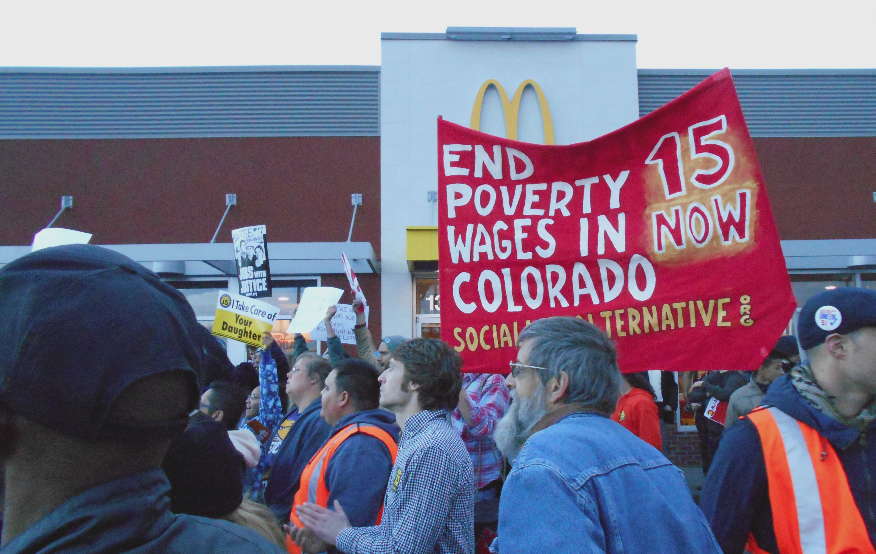
April 15: NYC took a bridge, Chicago & Seattle took the streets, Portland took Town Hall, and Denver took the cake

Photo by Laura Avant
DENVER, COLORADO- Yes, Denver’s FIGHT FOR FIFTEEN march kept to the sidewalks. When ISO members (organizing the local “15 NOW” group) pushed the boundaries, SEIU marshals criticized them not just for agitating, but for pushing their socialist agenda. Occupy Denver activists held a prominent banner which referenced reigning minimum wage champion Socialist Alternative. Most of the attendees were union members whose representatives have obviously failed to credit the SA party or Seattle Councilwoman Kshama Sawant for the nation’s first $15 minimum wage victory. We fielded questions all evening from marchers eager to know if an SA chapter was brewing in Colorado.

TO BE FAIR, Denver’s march did take an adventurous turn, by Denver standards, but the rally began as might be expected from an event dominated by the SEIU and other corporate unions and their immobile nonprofit cohorts. Denver’s 4-15 rally started in the middle of CU-Denver’s Auraria campus, invisible from any street and unseeable to even partipants arriving, until they turned the corner to find it, behind the Tivoli Center.

Then organizers had a lineup of speakers which stretched well past expectations, trimming the crowd by over a third as supporters opted to slip away due to the unexpected cold front. Next participants were admonished to stick to the sidewalk, even on campus grounds, and applaud the police who’d agreed to permit the march. We were heading to a neighboring McDonalds, at least we were taking the scenic route.

Throughout the rally and march, a brass band played, and members of the local band Flobots led chants and songs. This lent a fun energy but it did preclude ordinary marchers speaking out or centering the vocal messaging on anything more than the generic themes of financial discontent. Even as crowds lingered in front of McDonalds, the band played on, when poignant denunciations might have provided a suitable climax.

Fortunately, a “Silver Brigade” had been deployed to patronize the fast food monster beforehand, to prevent managers from being able to lock the doors when the marchers arrived. McDs managers did lock the doors and they discussed a number of interesting defensive tactics under the noses of our operatives, but the managers were ultimately unable to refuse senior citizens demanding they be allowed to exit. This exit was timed to allow the Fight-for-Fifteen procession to march straight up to the counter, demanding a living wage, etc. Their objections heard, the marchers left and eventually crossed the street and dissolved into shortcuts through the Auraria campus.

(Note: My account of our inside job may appear indiscrete, but I include it purposefully. One, because even with advance knowledge it’s a difficult tactic to prevent, and two, because organizers of successive protests of establishments such as McDs need to include this tactic if they don’t want to remain locked out.)

Photo by Laura Avant
The highlight for me was infusing the event theme with the S-word. Desperate as they were today to fight for a living wage, vowing “we’ll be back” or else to “shut it down”, these union adherants will shortly become the usual Democrats, waving the Hillary banners, as if there was no alternative.

Whose fault is it that America’s minimum wage has been allowed to lapse below the poverty level? Is the responsibility not in part that of the unions’? The SEIU is driving the official “Fight for Fifteen” campaign, but only after socialists have led the way, as they did whenever the labor movement made its gains.

President Obama’s “off-script” SOTU rejoinder began with a scripted pause

SORRY FOLKS. If you think President Obama went “Off Script” at tonight’s State of the Union Address, ask yourself why he punctuated “I have no more campaigns to run” with a HANDS-CLASPED PAUSE. In the context of his prepared remarks, that sentence was a lead-in, not a paragraph unto itself. Watch it againt and you’ll see that Obama’s pause was a trap to goad opponents to applaud so that he could “ad-lib” his crowd-pleasing “I know because I won both of them.” Prescripted mishaps are common devices to garner sympathy for embattled performers. Given that White House speechwriters anticipated a hostile reception, you’d think they would otherwise avoid lines that fed the antipathy, especially a throw-away line of exposition. Both setup and punchline added no substance to Obama’s remarks, except to grandstand.

The People’s Climate March will move the United Nations if marchers push it

I heard a dispiriting conceit at yesterday’s 350.ORG whistestop rally at Denver’s Union Station to cheer climate activists bording the Amtrak Zephyr destined for the New York City #S21 People’s Climate March. This young, otherwise energetic and charismatic environmentalist told the crowd that she did not expect anything to come of the hoped-to-be-massive demonstration but would attend anyway. Ironically this was addressed to supporters who’d already decided not to join the march based I’m guessing on the same logic. Yet we cheered, chanted about the imperative to act, and applauded a successive speaker who added that if world leaders ignored this people’s march, there would follow another and another, ever larger. Hmm. I doubt it. Activism is already showing diminishing returns and drawing numbers to unsuccessful actions doesn’t help. I appreciate not wanting to seem to hold foolish expectations, but I’d rather accept defeat having believed it was not inevitable. The antiwar movement laments the election of Barack Obama because he herded the populist anti-Bush groundswell toward supporting the other corporate war party. But I blame Obama for a larger malpractice: innoculating Americans against hope. Extended generations of altruists lost their cherry to the hope-change-artist and while they wise up incrementally, I have yet to see hopefulness normalize the defeatism. This doesn’t mean that hopefuls don’t keep falling for smooth promises, but the promises are smaller, to be believable. Bill McKibben’s 350 march for example doesn’t even want to make demands, yet insists that your personal attendence will be the biggest impact you can make against climate change. And if the march doesn’t move UN leaders, come back and do it again. Until what? Until world leaders are convinced that the public is serious. Why are we not serious? Should McKibben admit that traveling to New York could be distracting activists from where their bodies really need to be, in front of coal plants, blocking pipelines, and organizing communities against fossil fuel extraction? Pressuring the UN is similarly immediate but we have to apply veritable pressure. If a march is meant to impress, even as a gesture, it must be more than a parade.

Ludlow 100 year anniversary feted by social class that committed massacre

Cover of WestwordDENVER, COLO.- I might be sensationalizing a technicality, but in effect it’s what happened: the remembering of Ludlow has been commandeered by the class who perpetrated it. The preliminary series of events commemorating the 100 year anniversary of the Ludlow Massacre (April 20, 1914) concluded tonight at Denver’s History Colorado Museum with a panel discussion featuring only establishment voices. “Is Ludlow relevant?” was the question posed to five participants among them three professors, a soldier, and a union rep. That’s like asking “is global warming real?” The question is loaded with the suggestion that the opposite is equally plausible. I would have preferred to hear HOW is Ludlow relevant. Though the union rep skillfully skirted the issue, no one pushed back at another flawed presumption, that the coal strike was an armed conflict. Yes the massacre provoked the ten day “Coal Field War” during which striking miners retaliated against the mine company employees, but the death toll was still but a fraction of the number of miners killed in the mine accidents which precipitated the Ludlow strike. It took an audience member to address that omission. Alas nobody mentioned the aftermath that found many miners under arrest, others scattered, and no mine owner, operator, guard, strikebreaker, Baldwin-Felts thug, or National Guard save one, was punished for the atrocity. Yes many immigrant miners were veterans of Bulkan wars, but some Colorado soldiers were veterans of the US campaign in the Philippines, where villages were dispatched with flame and machinegun fire. Not mentioned. Instead a Colorado National Guard representative was let to say that burning the tents at Ludlow was not a tactical error -and since the “non-combatant” deaths were unintended, Ludlow was not technically a massacre.

The Putin knock-knock joke is easier to find than his Kremlin speech on Crimea

Putin Obama Knock Knock Joke - Crimea RiverThis graphic circulating on the interwebs is a lot easier to find than Vladimir Putin’s March 18 address to the Kremlin about the referendum in Crimea after the Western coup in Ukraine. Bypassing dubious translations excerpted on Capitalist media sites, here is a transcript of his speech direct from the Kremlin. Putin is no hero, but he threatens US-EU banking hegemony, gives asylum to Edward Snowden, and executes zero people with drones.

QUOTING PRESIDENT OF RUSSIA VLADIMIR PUTIN:
Federation Council members, State Duma deputies, good afternoon. Representatives of the Republic of Crimea and Sevastopol are here among us, citizens of Russia, residents of Crimea and Sevastopol!

Dear friends, we have gathered here today in connection with an issue that is of vital, historic significance to all of us. A referendum was held in Crimea on March 16 in full compliance with democratic procedures and international norms.

More than 82 percent of the electorate took part in the vote. Over 96 percent of them spoke out in favour of reuniting with Russia. These numbers speak for themselves.

To understand the reason behind such a choice it is enough to know the history of Crimea and what Russia and Crimea have always meant for each other.

Everything in Crimea speaks of our shared history and pride. This is the location of ancient Khersones, where Prince Vladimir was baptised. His spiritual feat of adopting Orthodoxy predetermined the overall basis of the culture, civilisation and human values that unite the peoples of Russia, Ukraine and Belarus. The graves of Russian soldiers whose bravery brought Crimea into the Russian empire are also in Crimea. This is also Sevastopol – a legendary city with an outstanding history, a fortress that serves as the birthplace of Russia’s Black Sea Fleet. Crimea is Balaklava and Kerch, Malakhov Kurgan and Sapun Ridge. Each one of these places is dear to our hearts, symbolising Russian military glory and outstanding valour.

Crimea is a unique blend of different peoples’ cultures and traditions. This makes it similar to Russia as a whole, where not a single ethnic group has been lost over the centuries. Russians and Ukrainians, Crimean Tatars and people of other ethnic groups have lived side by side in Crimea, retaining their own identity, traditions, languages and faith.

Incidentally, the total population of the Crimean Peninsula today is 2.2 million people, of whom almost 1.5 million are Russians, 350,000 are Ukrainians who predominantly consider Russian their native language, and about 290,000-300,000 are Crimean Tatars, who, as the referendum has shown, also lean towards Russia.

True, there was a time when Crimean Tatars were treated unfairly, just as a number of other peoples in the USSR. There is only one thing I can say here: millions of people of various ethnicities suffered during those repressions, and primarily Russians.

Crimean Tatars returned to their homeland. I believe we should make all the necessary political and legislative decisions to finalise the rehabilitation of Crimean Tatars, restore them in their rights and clear their good name.

We have great respect for people of all the ethnic groups living in Crimea. This is their common home, their motherland, and it would be right – I know the local population supports this – for Crimea to have three equal national languages: Russian, Ukrainian and Tatar.

Colleagues,

In people’s hearts and minds, Crimea has always been an inseparable part of Russia. This firm conviction is based on truth and justice and was passed from generation to generation, over time, under any circumstances, despite all the dramatic changes our country went through during the entire 20th century.

After the revolution, the Bolsheviks, for a number of reasons – may God judge them – added large sections of the historical South of Russia to the Republic of Ukraine. This was done with no consideration for the ethnic make-up of the population, and today these areas form the southeast of Ukraine. Then, in 1954, a decision was made to transfer Crimean Region to Ukraine, along with Sevastopol, despite the fact that it was a federal city. This was the personal initiative of the Communist Party head Nikita Khrushchev. What stood behind this decision of his – a desire to win the support of the Ukrainian political establishment or to atone for the mass repressions of the 1930’s in Ukraine – is for historians to figure out.

What matters now is that this decision was made in clear violation of the constitutional norms that were in place even then. The decision was made behind the scenes. Naturally, in a totalitarian state nobody bothered to ask the citizens of Crimea and Sevastopol. They were faced with the fact. People, of course, wondered why all of a sudden Crimea became part of Ukraine. But on the whole – and we must state this clearly, we all know it – this decision was treated as a formality of sorts because the territory was transferred within the boundaries of a single state. Back then, it was impossible to imagine that Ukraine and Russia may split up and become two separate states. However, this has happened.

Unfortunately, what seemed impossible became a reality. The USSR fell apart. Things developed so swiftly that few people realised how truly dramatic those events and their consequences would be. Many people both in Russia and in Ukraine, as well as in other republics hoped that the Commonwealth of Independent States that was created at the time would become the new common form of statehood. They were told that there would be a single currency, a single economic space, joint armed forces; however, all this remained empty promises, while the big country was gone. It was only when Crimea ended up as part of a different country that Russia realised that it was not simply robbed, it was plundered.

At the same time, we have to admit that by launching the sovereignty parade Russia itself aided in the collapse of the Soviet Union. And as this collapse was legalised, everyone forgot about Crimea and Sevastopol ­– the main base of the Black Sea Fleet. Millions of people went to bed in one country and awoke in different ones, overnight becoming ethnic minorities in former Union republics, while the Russian nation became one of the biggest, if not the biggest ethnic group in the world to be divided by borders.

Now, many years later, I heard residents of Crimea say that back in 1991 they were handed over like a sack of potatoes. This is hard to disagree with. And what about the Russian state? What about Russia? It humbly accepted the situation. This country was going through such hard times then that realistically it was incapable of protecting its interests. However, the people could not reconcile themselves to this outrageous historical injustice. All these years, citizens and many public figures came back to this issue, saying that Crimea is historically Russian land and Sevastopol is a Russian city. Yes, we all knew this in our hearts and minds, but we had to proceed from the existing reality and build our good-neighbourly relations with independent Ukraine on a new basis. Meanwhile, our relations with Ukraine, with the fraternal Ukrainian people have always been and will remain of foremost importance for us.

Today we can speak about it openly, and I would like to share with you some details of the negotiations that took place in the early 2000s. The then President of Ukraine Mr Kuchma asked me to expedite the process of delimiting the Russian-Ukrainian border. At that time, the process was practically at a standstill. Russia seemed to have recognised Crimea as part of Ukraine, but there were no negotiations on delimiting the borders. Despite the complexity of the situation, I immediately issued instructions to Russian government agencies to speed up their work to document the borders, so that everyone had a clear understanding that by agreeing to delimit the border we admitted de facto and de jure that Crimea was Ukrainian territory, thereby closing the issue.

We accommodated Ukraine not only regarding Crimea, but also on such a complicated matter as the maritime boundary in the Sea of Azov and the Kerch Strait. What we proceeded from back then was that good relations with Ukraine matter most for us and they should not fall hostage to deadlock territorial disputes. However, we expected Ukraine to remain our good neighbour, we hoped that Russian citizens and Russian speakers in Ukraine, especially its southeast and Crimea, would live in a friendly, democratic and civilised state that would protect their rights in line with the norms of international law.

However, this is not how the situation developed. Time and time again attempts were made to deprive Russians of their historical memory, even of their language and to subject them to forced assimilation. Moreover, Russians, just as other citizens of Ukraine are suffering from the constant political and state crisis that has been rocking the country for over 20 years.

I understand why Ukrainian people wanted change. They have had enough of the authorities in power during the years of Ukraine’s independence. Presidents, prime ministers and parliamentarians changed, but their attitude to the country and its people remained the same. They milked the country, fought among themselves for power, assets and cash flows and did not care much about the ordinary people. They did not wonder why it was that millions of Ukrainian citizens saw no prospects at home and went to other countries to work as day labourers. I would like to stress this: it was not some Silicon Valley they fled to, but to become day labourers. Last year alone almost 3 million people found such jobs in Russia. According to some sources, in 2013 their earnings in Russia totalled over $20 billion, which is about 12% of Ukraine’s GDP.

I would like to reiterate that I understand those who came out on Maidan with peaceful slogans against corruption, inefficient state management and poverty. The right to peaceful protest, democratic procedures and elections exist for the sole purpose of replacing the authorities that do not satisfy the people. However, those who stood behind the latest events in Ukraine had a different agenda: they were preparing yet another government takeover; they wanted to seize power and would stop short of nothing. They resorted to terror, murder and riots. Nationalists, neo-Nazis, Russophobes and anti-Semites executed this coup. They continue to set the tone in Ukraine to this day.

The new so-called authorities began by introducing a draft law to revise the language policy, which was a direct infringement on the rights of ethnic minorities. However, they were immediately ‘disciplined’ by the foreign sponsors of these so-called politicians. One has to admit that the mentors of these current authorities are smart and know well what such attempts to build a purely Ukrainian state may lead to. The draft law was set aside, but clearly reserved for the future. Hardly any mention is made of this attempt now, probably on the presumption that people have a short memory. Nevertheless, we can all clearly see the intentions of these ideological heirs of Bandera, Hitler’s accomplice during World War II.

It is also obvious that there is no legitimate executive authority in Ukraine now, nobody to talk to. Many government agencies have been taken over by the impostors, but they do not have any control in the country, while they themselves – and I would like to stress this – are often controlled by radicals. In some cases, you need a special permit from the militants on Maidan to meet with certain ministers of the current government. This is not a joke – this is reality.

Those who opposed the coup were immediately threatened with repression. Naturally, the first in line here was Crimea, the Russian-speaking Crimea. In view of this, the residents of Crimea and Sevastopol turned to Russia for help in defending their rights and lives, in preventing the events that were unfolding and are still underway in Kiev, Donetsk, Kharkov and other Ukrainian cities.

Naturally, we could not leave this plea unheeded; we could not abandon Crimea and its residents in distress. This would have been betrayal on our part.

First, we had to help create conditions so that the residents of Crimea for the first time in history were able to peacefully express their free will regarding their own future. However, what do we hear from our colleagues in Western Europe and North America? They say we are violating norms of international law. Firstly, it’s a good thing that they at least remember that there exists such a thing as international law – better late than never.

Secondly, and most importantly – what exactly are we violating? True, the President of the Russian Federation received permission from the Upper House of Parliament to use the Armed Forces in Ukraine. However, strictly speaking, nobody has acted on this permission yet. Russia’s Armed Forces never entered Crimea; they were there already in line with an international agreement. True, we did enhance our forces there; however – this is something I would like everyone to hear and know – we did not exceed the personnel limit of our Armed Forces in Crimea, which is set at 25,000, because there was no need to do so.

Next. As it declared independence and decided to hold a referendum, the Supreme Council of Crimea referred to the United Nations Charter, which speaks of the right of nations to self-determination. Incidentally, I would like to remind you that when Ukraine seceded from the USSR it did exactly the same thing, almost word for word. Ukraine used this right, yet the residents of Crimea are denied it. Why is that?

Moreover, the Crimean authorities referred to the well-known Kosovo precedent – a precedent our western colleagues created with their own hands in a very similar situation, when they agreed that the unilateral separation of Kosovo from Serbia, exactly what Crimea is doing now, was legitimate and did not require any permission from the country’s central authorities. Pursuant to Article 2, Chapter 1 of the United Nations Charter, the UN International Court agreed with this approach and made the following comment in its ruling of July 22, 2010, and I quote: “No general prohibition may be inferred from the practice of the Security Council with regard to declarations of independence,” and “General international law contains no prohibition on declarations of independence.” Crystal clear, as they say.

I do not like to resort to quotes, but in this case, I cannot help it. Here is a quote from another official document: the Written Statement of the United States America of April 17, 2009, submitted to the same UN International Court in connection with the hearings on Kosovo. Again, I quote: “Declarations of independence may, and often do, violate domestic legislation. However, this does not make them violations of international law.” End of quote. They wrote this, disseminated it all over the world, had everyone agree and now they are outraged. Over what? The actions of Crimean people completely fit in with these instructions, as it were. For some reason, things that Kosovo Albanians (and we have full respect for them) were permitted to do, Russians, Ukrainians and Crimean Tatars in Crimea are not allowed. Again, one wonders why.

We keep hearing from the United States and Western Europe that Kosovo is some special case. What makes it so special in the eyes of our colleagues? It turns out that it is the fact that the conflict in Kosovo resulted in so many human casualties. Is this a legal argument? The ruling of the International Court says nothing about this. This is not even double standards; this is amazing, primitive, blunt cynicism. One should not try so crudely to make everything suit their interests, calling the same thing white today and black tomorrow. According to this logic, we have to make sure every conflict leads to human losses.

I will state clearly – if the Crimean local self-defence units had not taken the situation under control, there could have been casualties as well. Fortunately this did not happen. There was not a single armed confrontation in Crimea and no casualties. Why do you think this was so? The answer is simple: because it is very difficult, practically impossible to fight against the will of the people. Here I would like to thank the Ukrainian military – and this is 22,000 fully armed servicemen. I would like to thank those Ukrainian service members who refrained from bloodshed and did not smear their uniforms in blood.

Other thoughts come to mind in this connection. They keep talking of some Russian intervention in Crimea, some sort of aggression. This is strange to hear. I cannot recall a single case in history of an intervention without a single shot being fired and with no human casualties.

Colleagues,

Like a mirror, the situation in Ukraine reflects what is going on and what has been happening in the world over the past several decades. After the dissolution of bipolarity on the planet, we no longer have stability. Key international institutions are not getting any stronger; on the contrary, in many cases, they are sadly degrading. Our western partners, led by the United States of America, prefer not to be guided by international law in their practical policies, but by the rule of the gun. They have come to believe in their exclusivity and exceptionalism, that they can decide the destinies of the world, that only they can ever be right. They act as they please: here and there, they use force against sovereign states, building coalitions based on the principle “If you are not with us, you are against us.” To make this aggression look legitimate, they force the necessary resolutions from international organisations, and if for some reason this does not work, they simply ignore the UN Security Council and the UN overall.

This happened in Yugoslavia; we remember 1999 very well. It was hard to believe, even seeing it with my own eyes, that at the end of the 20th century, one of Europe’s capitals, Belgrade, was under missile attack for several weeks, and then came the real intervention. Was there a UN Security Council resolution on this matter, allowing for these actions? Nothing of the sort. And then, they hit Afghanistan, Iraq, and frankly violated the UN Security Council resolution on Libya, when instead of imposing the so-called no-fly zone over it they started bombing it too.

There was a whole series of controlled “colour” revolutions. Clearly, the people in those nations, where these events took place, were sick of tyranny and poverty, of their lack of prospects; but these feelings were taken advantage of cynically. Standards were imposed on these nations that did not in any way correspond to their way of life, traditions, or these peoples’ cultures. As a result, instead of democracy and freedom, there was chaos, outbreaks in violence and a series of upheavals. The Arab Spring turned into the Arab Winter.

A similar situation unfolded in Ukraine. In 2004, to push the necessary candidate through at the presidential elections, they thought up some sort of third round that was not stipulated by the law. It was absurd and a mockery of the constitution. And now, they have thrown in an organised and well-equipped army of militants.

We understand what is happening; we understand that these actions were aimed against Ukraine and Russia and against Eurasian integration. And all this while Russia strived to engage in dialogue with our colleagues in the West. We are constantly proposing cooperation on all key issues; we want to strengthen our level of trust and for our relations to be equal, open and fair. But we saw no reciprocal steps.

On the contrary, they have lied to us many times, made decisions behind our backs, placed us before an accomplished fact. This happened with NATO’s expansion to the East, as well as the deployment of military infrastructure at our borders. They kept telling us the same thing: “Well, this does not concern you.” That’s easy to say.

It happened with the deployment of a missile defence system. In spite of all our apprehensions, the project is working and moving forward. It happened with the endless foot-dragging in the talks on visa issues, promises of fair competition and free access to global markets.

Today, we are being threatened with sanctions, but we already experience many limitations, ones that are quite significant for us, our economy and our nation. For example, still during the times of the Cold War, the US and subsequently other nations restricted a large list of technologies and equipment from being sold to the USSR, creating the Coordinating Committee for Multilateral Export Controls list. Today, they have formally been eliminated, but only formally; and in reality, many limitations are still in effect.

In short, we have every reason to assume that the infamous policy of containment, led in the 18th, 19th and 20th centuries, continues today. They are constantly trying to sweep us into a corner because we have an independent position, because we maintain it and because we call things like they are and do not engage in hypocrisy. But there is a limit to everything. And with Ukraine, our western partners have crossed the line, playing the bear and acting irresponsibly and unprofessionally.

After all, they were fully aware that there are millions of Russians living in Ukraine and in Crimea. They must have really lacked political instinct and common sense not to foresee all the consequences of their actions. Russia found itself in a position it could not retreat from. If you compress the spring all the way to its limit, it will snap back hard. You must always remember this.

Today, it is imperative to end this hysteria, to refute the rhetoric of the cold war and to accept the obvious fact: Russia is an independent, active participant in international affairs; like other countries, it has its own national interests that need to be taken into account and respected.

At the same time, we are grateful to all those who understood our actions in Crimea; we are grateful to the people of China, whose leaders have always considered the situation in Ukraine and Crimea taking into account the full historical and political context, and greatly appreciate India’s reserve and objectivity.

Today, I would like to address the people of the United States of America, the people who, since the foundation of their nation and adoption of the Declaration of Independence, have been proud to hold freedom above all else. Isn’t the desire of Crimea’s residents to freely choose their fate such a value? Please understand us.

I believe that the Europeans, first and foremost, the Germans, will also understand me. Let me remind you that in the course of political consultations on the unification of East and West Germany, at the expert, though very high level, some nations that were then and are now Germany’s allies did not support the idea of unification. Our nation, however, unequivocally supported the sincere, unstoppable desire of the Germans for national unity. I am confident that you have not forgotten this, and I expect that the citizens of Germany will also support the aspiration of the Russians, of historical Russia, to restore unity.

I also want to address the people of Ukraine. I sincerely want you to understand us: we do not want to harm you in any way, or to hurt your national feelings. We have always respected the territorial integrity of the Ukrainian state, incidentally, unlike those who sacrificed Ukraine’s unity for their political ambitions. They flaunt slogans about Ukraine’s greatness, but they are the ones who did everything to divide the nation. Today’s civil standoff is entirely on their conscience. I want you to hear me, my dear friends. Do not believe those who want you to fear Russia, shouting that other regions will follow Crimea. We do not want to divide Ukraine; we do not need that. As for Crimea, it was and remains a Russian, Ukrainian, and Crimean-Tatar land.

I repeat, just as it has been for centuries, it will be a home to all the peoples living there. What it will never be and do is follow in Bandera’s footsteps!

Crimea is our common historical legacy and a very important factor in regional stability. And this strategic territory should be part of a strong and stable sovereignty, which today can only be Russian. Otherwise, dear friends (I am addressing both Ukraine and Russia), you and we – the Russians and the Ukrainians – could lose Crimea completely, and that could happen in the near historical perspective. Please think about it.

Let me note too that we have already heard declarations from Kiev about Ukraine soon joining NATO. What would this have meant for Crimea and Sevastopol in the future? It would have meant that NATO’s navy would be right there in this city of Russia’s military glory, and this would create not an illusory but a perfectly real threat to the whole of southern Russia. These are things that could have become reality were it not for the choice the Crimean people made, and I want to say thank you to them for this.

But let me say too that we are not opposed to cooperation with NATO, for this is certainly not the case. For all the internal processes within the organisation, NATO remains a military alliance, and we are against having a military alliance making itself at home right in our backyard or in our historic territory. I simply cannot imagine that we would travel to Sevastopol to visit NATO sailors. Of course, most of them are wonderful guys, but it would be better to have them come and visit us, be our guests, rather than the other way round.

Let me say quite frankly that it pains our hearts to see what is happening in Ukraine at the moment, see the people’s suffering and their uncertainty about how to get through today and what awaits them tomorrow. Our concerns are understandable because we are not simply close neighbours but, as I have said many times already, we are one people. Kiev is the mother of Russian cities. Ancient Rus is our common source and we cannot live without each other.

Let me say one other thing too. Millions of Russians and Russian-speaking people live in Ukraine and will continue to do so. Russia will always defend their interests using political, diplomatic and legal means. But it should be above all in Ukraine’s own interest to ensure that these people’s rights and interests are fully protected. This is the guarantee of Ukraine’s state stability and territorial integrity.

We want to be friends with Ukraine and we want Ukraine to be a strong, sovereign and self-sufficient country. Ukraine is one of our biggest partners after all. We have many joint projects and I believe in their success no matter what the current difficulties. Most importantly, we want peace and harmony to reign in Ukraine, and we are ready to work together with other countries to do everything possible to facilitate and support this. But as I said, only Ukraine’s own people can put their own house in order.

Residents of Crimea and the city of Sevastopol, the whole of Russia admired your courage, dignity and bravery. It was you who decided Crimea’s future. We were closer than ever over these days, supporting each other. These were sincere feelings of solidarity. It is at historic turning points such as these that a nation demonstrates its maturity and strength of spirit. The Russian people showed this maturity and strength through their united support for their compatriots.

Russia’s foreign policy position on this matter drew its firmness from the will of millions of our people, our national unity and the support of our country’s main political and public forces. I want to thank everyone for this patriotic spirit, everyone without exception. Now, we need to continue and maintain this kind of consolidation so as to resolve the tasks our country faces on its road ahead.

Obviously, we will encounter external opposition, but this is a decision that we need to make for ourselves. Are we ready to consistently defend our national interests, or will we forever give in, retreat to who knows where? Some Western politicians are already threatening us with not just sanctions but also the prospect of increasingly serious problems on the domestic front. I would like to know what it is they have in mind exactly: action by a fifth column, this disparate bunch of ‘national traitors’, or are they hoping to put us in a worsening social and economic situation so as to provoke public discontent? We consider such statements irresponsible and clearly aggressive in tone, and we will respond to them accordingly. At the same time, we will never seek confrontation with our partners, whether in the East or the West, but on the contrary, will do everything we can to build civilised and good-neighbourly relations as one is supposed to in the modern world.

Colleagues,

I understand the people of Crimea, who put the question in the clearest possible terms in the referendum: should Crimea be with Ukraine or with Russia? We can be sure in saying that the authorities in Crimea and Sevastopol, the legislative authorities, when they formulated the question, set aside group and political interests and made the people’s fundamental interests alone the cornerstone of their work. The particular historic, population, political and economic circumstances of Crimea would have made any other proposed option – however tempting it could be at the first glance – only temporary and fragile and would have inevitably led to further worsening of the situation there, which would have had disastrous effects on people’s lives. The people of Crimea thus decided to put the question in firm and uncompromising form, with no grey areas. The referendum was fair and transparent, and the people of Crimea clearly and convincingly expressed their will and stated that they want to be with Russia.

Russia will also have to make a difficult decision now, taking into account the various domestic and external considerations. What do people here in Russia think? Here, like in any democratic country, people have different points of view, but I want to make the point that the absolute majority of our people clearly do support what is happening.

The most recent public opinion surveys conducted here in Russia show that 95 percent of people think that Russia should protect the interests of Russians and members of other ethnic groups living in Crimea – 95 percent of our citizens. More than 83 percent think that Russia should do this even if it will complicate our relations with some other countries. A total of 86 percent of our people see Crimea as still being Russian territory and part of our country’s lands. And one particularly important figure, which corresponds exactly with the result in Crimea’s referendum: almost 92 percent of our people support Crimea’s reunification with Russia.

Thus we see that the overwhelming majority of people in Crimea and the absolute majority of the Russian Federation’s people support the reunification of the Republic of Crimea and the city of Sevastopol with Russia.

Now this is a matter for Russia’s own political decision, and any decision here can be based only on the people’s will, because the people is the ultimate source of all authority.

Members of the Federation Council, deputies of the State Duma, citizens of Russia, residents of Crimea and Sevastopol, today, in accordance with the people’s will, I submit to the Federal Assembly a request to consider a Constitutional Law on the creation of two new constituent entities within the Russian Federation: the Republic of Crimea and the city of Sevastopol, and to ratify the treaty on admitting to the Russian Federation Crimea and Sevastopol, which is already ready for signing. I stand assured of your support.

Pueblo museum excises Mine Workers Union from Ludlow Massacre exhibit!


PUEBLO, COLORADO- 2014 marks one hundred years since the Ludlow Massacre of 1914. A variety of commemorations are planned before the formal anniversary on April 20. I attended one such event on Wednesday, a lecture by a CSU professor to footnote the “Children of Ludlow” exhibit at El Pueblo History Museum. I’m always excitied when attention is paid to Ludlow, a subject regularly left out of American schoolbooks, but I was disappointed to find key elements of labor history excised from the museum’s narrative. Literally. The United Mine Workers of America, the organization central to the strike, which supplied the tent city, and which even today maintains the memorial site, was mentioned only once, IN FINE PRINT! The Ludlow miners voted to strike because the mining companies refused to recognize the UMWA. Unmentioned. The horrors of the atrocity were not tempered, in their explicitness perhaps we think them enough, but there was also the apologist suggestion that some culpability belonged to the miners. I questioned one curator who admitted they were at pains to keep the story “balanced” and that the squeakiest wheel thus far has been the National Guard. Apparently the Guard is offended that its role will be misconstrued. What balance do they want, I wondered. Had they lost children in the “battlezone” too?

Children are at the heart of commemorating Ludlow and at the heart of this preversion of the massacre’s memory. Were they recklessly endangered by their parents and union organizers? Were they dragged into a battlezone? The museum seems to suggest as much, highlighting the beligerence of the miners, mischaracterizing the soldiers, and leaving the union actions largely unexplained.

First I’d like to declare how I tire of the objective irrelevance which results when academics seek the approval of government technocrats. I am also disturbed by educators who pretend blindness to subtle inferences which shape a political takeaway. To them, “remembering” Ludlow seems sufficient in itself. I can hardly see the point to remembering Ludlow unless we have discerned its lessons. Until we are remembering the LESSONS OF LUDLOW, our educators’ self-proclaimed raison d’etre will be self-fulfilling: “history will repeat itself.” This Pueblo exhibit suggests no lesson other than the exploitation of tragedy, and leaves me fearful about the Ludlow commemorations to follow. The anti-union, pro-military climate which prevails these hundred years since the massacre will make for a travesty of a remembrance unless someone with a worker’s perspective speaks up.

NOT BROUGHT TO YOU BY…
Let’s start with this exhibit, which alas has already escaped critique since September. Its full title, as evidenced in the photo above: “Black Hills Energy presents: Children of Ludlow, Life in a Battlezone, 1913-1914.”

I’ll bet curators thought it a measure of truth and reconciliation that the Ludlow presentation was sponsored by a local extraction industry business. Black Hills Energy trades not in coal but natural gas. In fact they’re among the frackers tearing up Southeastern Colorado. I think the irony more likely suggests how the UMWA’s starring role was left on the cutting room floor. There are generic mentions of “the union”, as at right, keeping a ledger of which families were assigned tents, but only in the fine print is the UMWA named as owning the ledger.

BATTLEZONES
More troubling is the skewed framing of the museum’s narrative. It begins with the subtitle, “life in a battlezone.” That’s taking a rather curious liberty don’t you think? The event we accept now as “Ludlow” became a battlezone on April 20, and the regional Coal Field War which followed was a battlezone to which both revenge-seekers and militia thronged, but the tent colonies in which 12,000 lived, 9,000 of whom were the children of the title role, were camps full of families. That they were straffed regularly by the guards makes them shooting galleries not battlegrounds.

Calling Ludlow a battlezone is like calling Sand Creek a “collision” or calling the Middle East a “conflict”. All of these mask the role of the aggressor.

I will credit the curators for offering a candid detail of horrific import. In a description of the day before the massacre, when the Greeks among the immigrants were celebrating Greek Easter, mention is made of the mounted National Guards offered this taunt: “You enjoy your roast today; we will have ours tomorrow.” No one should deny today that the events of April 20, which culminated in the torching of the tents and asphyxiation of women and children, was a premeditated act.

THE CHILDREN
Should the miners have put their children in harm’s way by defying the mining companies? How could they not? As immigrants they didn’t have nearby relatives to foster their children away from the random bullets. Also left unsaid by the display: many of the children had already been working in the mines and counted among those on strike. This was before child labor reforms.

Curiously, the exhibit did include a famous photograph of the notorious activist Mother Jones leading a childrens’ march through Trinidad. The caption explained that Jones wasn’t above using real children to advance the cause of Colorado’s coal miners.” Emphasis mine. While technically true in a modern context, it’s probably disingenuous to imply someone is using the children when a key issue of the demonstration is CHILD LABOR.

No really. Mother Jones was leading a march of children, many of them workers of the mines, for the reform of labor practices which abused children. This and subsequent campaigns eventually led to child labor laws. Is saying “Mother Jones wasn’t above using children” in any way an accurate characterization?

Compounding the inference that the Children of Ludlow were jeopardized for the cause, was the implication that the miners were combatants who contributed to the battlezone. As the displays progressed in chronological order, the first weapon on display was a rifle used by the miners. Immediately behind it was an enlarged photograph vividly depicting miners posed with two identical specimens.

Moving along the exhibit chronologically, anticipating the rising violence, the museum goers is apparently supposed to register that the strikers were firing too, if not first. Recent historical accounts have deliberated about who fired first. I think the motive is suspiciously revisionist in view of today’s dogma of nonviolence absolutism: if your protest devolves into violence, you deserve every bit of the beating you get.

Whenever it was that the miners began firing, the single militia and three guard casualties were not recorded until after the massacre took place, belying the narrative that the miners invited the massacre. Witnesses conflict about when the three union leaders were executed. I’ll give the museum credit for defying the National Guard in summarizing that among the casualties, three of the miners were “executed”.

PARITY OF WEAPONS
Students of the Ludlow accounts know that many of the miners were better riflemen than the soldiers. Many were immigrants who’d served in Bulkan wars and outmatched Colorado’s green guardsmen. That is not to suggest that the miners and their harrassers were equally armed, yet…

The only other weapon on display is a rifle of vintage used by the national guard. It shares a case with a uniform and sabre, lending it official authority. Also, the rifle is not presented as having been used at Ludlow, so it doesn’t project an aura of culpability. Missing is the machine gun depicted in the photograph of the machine gun nest which fired down upon the camp. It’s depicted with a caption about the Guard being a welcome presence. Missing too is the armored car dubbed the “Death Special”. Obviously the armor protected its operators from being hit by striking-miner bullets as it drove through the canvas encampment, straffing the tents with its mounted machine gun.

HUMANIZING THE PERP
Right after the photo of armed miners was the display at right, with a very contrived bit of spin catering to today’s military families. Although the photo shows soldiers actively aiming their gun at the camp, the caption assures us that the “Ludlow families feel relief with the arrival of National Guard”. This supposition is based on the fact that when the soldiers first arrived they were serenaded with the “Battle Cry of Freedom” and greeted with American flags. Most of the miners being immigrants, they were eager to show their patriotism, but the conclusion drawn here is a terrible mendacity. The miners and union organizers knew full well the purpose of the National Guard. They knew the strikebreaking role it played in famous strikes of the past. The miners feted the soldiers hoping to sway them from their eventual task. Protesters of all eras hold out this hope every time they face riot police.

A following paragraph suggested that by the time the massacre was committed, most of the soldiers had been mustered out and replaced with militia members and company guards. This is slight of hand. After the official inquiry, which was prompted by the public outcry, twenty National Guard soldiers were court martialed. All were acquitted. Is the Guard wanting us to believe they were acquitted because they weren’t there?

This attempt to put a friendly face on the National Guard, coupled with an abdication of effort to give the union its due, seems engineered to appeal to the average Pueblan of today, many probably related to an active-duty soldier and long since indoctrinated against evil unions. When I asked the lecturer about the omission of the UMWA, she prefaced her answer for the audience, explaining that unions of old were not like those despised today. I told her I thought failing to describe the hows and whys of the strike was a real teaching opportunity missed.

HISTORY COLORADO
It’s probably important to point out that the Ludlow presentation at the History Museum was developed with the assistance of History Colorado, which finally shuttered a contested display: a Sand Creek Massacre exhibit with a similar flavor of whitewash. Like labeling Ludlow a battlezone, History Colorado tried to typify Sand Creek as a “collision.”

Also typical of History Colorado is the propensity to address their exhibits to children. Programming for school bus visits invariably dumbs down what can be presented and I hardly think the compromise is worth it. If children ran the world, maybe Disney versions of history would suffice.

I’d like to have seen it highlighted that the Ludlow miners were mainly immigrants who were looked down upon by the residents of Colorado. If the museum audience were the “Children of Ludlow” in the extended sense, as a few descendants probably were, more of us were the children of the soldiers of Ludlow, or the citizens who cheered them on, or joined the militia or built the armored car at Rockefeller’s Pueblo factory. If we’re going to remember Ludlow, we ought to remember our role in it so we don’t do that again. It’s easy to pretend we were the martyrs. In all probability that’s who we will be if the lessons of Ludlow are discarded.

Can we hope the Ukraine government snipers hit OTPOR & CIA provocateurs egging on the fascist suppremacists?

Protesters are being killed in Kiev, and revolutionaries enthusiasts are buying into the Western Media narrative. Even Democracy Now is parroting the theme, describing the demonstrations as opposing their government’s rejecting closer ties to the European Union. “Closer ties?” Ukraine was rejecting growing indebtedness to EU banks, favoring a bailout from Putin instead. Let’s remember that Senator John McCain jetted to Kiev to rally the uprising, seeing it as part of the rolling “freedom movement” not coincidentally encircling Russia, the former Soviets now no longer foe to Capitalism but rival. Unfortunate developments have led to government snipers firing at the “rebels” many of whom are dupes but many too are supremacist fascists not particularly misguided about US-EU hegemony. Perhaps we can find consolation in the hope that Ukrainian snipers were able to hit the OTPOR and CIA provocateurs coordinating the urban warriors.
 
I support all popular uprisings, but unfortunately US covert ops have picked up on our game. The only way to insulate rebellions against Western provocateurs is to build movements around political ideology they will not embrace. For the onlooker, ideology is also the means to discern destabilitation projects parading as protest. If the offending government is anti-Western-Capitalism, our counterinsurgency ops are there. Of course Socialist, Islamic, or non-World Bank client regimes are not imune to being authoritarian, but hardly more so than the Capitalist empire. Often US adversaries are forced to authoritarian measures by US covert ops working to destabilize them.

State of the Union Address a Pageant of Beltway Cronies, Bullies and Flakes

Media propagandists can’t conceal the state of the union address for what it was, a pageant of creeps, a pandering freakshow, and a flaunting of the celebration that the American constituancy is peopled by idiots on both sides of the aisle.

Prince Harry displays British hypocracy to uneducated Colorado warmongers

Prince HarryWant to know where you can find Prince Harry on his war cheerleading US tour? Half of it is in Colorado. On Friday he’ll be at a UK Consul-General’s reception at the private Sanctuary Golf Course in Sedalia. Between Denver and Castle Rock, that’s the Castle Pines exit off of I-25. He’s staying overnight in Colorado Springs and leads the opening ceremonies of the Warrior Games at the US Olympic Training Center at Union and Uintah. He concludes his Colorado visit on Sunday at the Air Force Academy on Sunday before flying east for a polo match. How unseemly for American media to be fawning over a British royal, and what a slap in the face for Colorado Springs Tea Partiers, if they weren’t so uniformly stupid, to celebrate a monarch for which they claim so much credit for having expelled. Nathan Hale would have hung a second time and a third and forth presumably to have had the chance to show smug twits like Prince Harry the door. Harry pretends to continue the work of his mother Lady Diana, ridding the world of land mines, yet how much credit does he get when he advocates for their root cause, war?

Nobel snubs Bradley Manning, given to banking theocracy EU, after Obama and traditional Western inhumanitarians

The Nobel committee snubbed Bradley Manning and awarded the Nobel Peace Prize to the banking theocracy EUROPEAN UNION. And you thought President Obama was a reach. Actually the feudal ogre EU was the logical choice after a war monger and the traditional Western war criminals and inhumanitarians.

We all hate bad teachers, and so do teachers. Chicago Teachers Strike is about improving education

No one hates bad teachers more than fellow teachers. What a vile media construct to assert the Chicago Teachers Strike wants to force bad teachers on the public school system. The strike is a bid to strengthen the union and public education. Who better to fight privatization, standardized testing and the deliberate mis-education of common students than teachers?

Unions are regularly maligned as parasites bent on destroying their host, but it’s an obvious falsehood which ironically depends on an audience being unschooled in critical thinking, or being unemployed. If you have a job, you know that wishing against the interest of your communal enterprise is not human nature, and also that your job is made more difficult and unpleasant by workers who don’t pull their weight.

A strong union fights for the interests of its members, and what do teachers, the most altruist among us, want? Not just a better work environment, a better education system.

Colorado police brutality retrospective: the 1934 Relief Strike Battle, UP story “Girl Radical Leads Mob in Denver Riot”


If one image captures the “Relief Strike Riot” of October 30, 1934, it’s of Patrolman CV Satt who continues to fire his service revolver after he’s felled by a bottle thrown by a striking picketer. Although Colorado newspapers were anti-union, their accounts vary enough to reveal the escalation of violence for which the DPD was responsible and for which they and the newspapers I’ll bet have never apologized. This article will be the first of a series to unearth the newspaper accounts which documented the events of Oct. 29 through Nov. 3, 1934, mostly because the police tactics and media defamation are remarkably similar today.

(Caption on above photograph: “This remarkable photograph was taken when the rioting between Denver police and “relief strike” picketers was at its height at W. Jewell ave. and the Platte River yesterday. Patrolman C. V. Satt is shown rising after he had been struck over the head with bricks and a shovel. He has his service pistol in his hand, ready to fire at his assailants, but Sergt. Henry Durkop is restraining him.”)

INTRODUCTION: THE BATTLE
As with many “riots”, the confrontation of Oct. 30, 1934 was instigated by the abrupt arrest and detention of a union organizer. What follows is an entertaining eyewitness account which attempts to defame the picketers and laud the police officers for their restraint, although the other reports and photographic record suggested otherwise.


Colorado Springs Evening Telegraph, October 31, 1934, page 1, column 8: GIRL RADICAL LEADS MOB IN DENVER RIOT — FERA Project Pickets Spurred Into Battle by Woman Believed Imported Agitator By DAVIS CAMPBELL, United Press Staff Correspondent

DENVER, Colo, Oct 30 (UP)– A dark haired, attractive girl led demonstrators into hand to hand battle with police here today, as the picketers, under alleged communist leadership, sought to force a strike of Denver FERA workers.

The girl, who was believed by police to have been an imported communist sympathizer, was the spearhead of the rush of demonstrators who attempted to rescue their arrested leader, Gene Corish, 35, of Denver, from the hands of police.

I followed the demonstrators from the time they gathered with the intention of picketing the FERA projects. Police believed they planned to descend on a project at Alameda avenue and Cherry creek. Instead they headed for another at Evans street and the Platte river.

FERA Workers Fight Reds.

There they rushed into a group of FERA workers and sought to take away their tools. The relief workers fought back. But, by the force of superior numbers the demonstrators were winning the spirited battle when police rushed up.

Several picks and shovels had been thrown into the stream.

The police leaped into the midst of the hand to hand fighting. They seized Corish, who appeared to be the leader of the rioters, and dragged him to a patrol wagon.

Instantly the girl leader of the rioters set up a cry of “Don’t let the (here she used an unprintable epithet) have him” and she started toward the patrol wagon swinging a shovel someone had wrenched from a worker.

Others joined the rush. Bricks and clods flew thru the air toward the little band of a dozen husky policemen, outnumbered about 50 to 1 by the rioters.

The patrolmen formed a cordon around the patrol wagon, and retreated slowly toward it, fighting every step of the way, but using only their clubs and fists. They very apparently were seeking to avoid serious injury to anyone.

Officer Felled by Bottle.

Suddenly a beer bottle flew thru the air and struck one of the patrolmen (I learned later he was Carl V. Satt), squarely on the head. Satt dropped like a log.

A rioter stood over him with a shovel in his hands, apparently ready to swing another blow at the unconscious man.

Driven to desperation by this development, police drew their pistols and fired what sounded to me like more than 30 shots.

A rioter dropped, wounded thru the hip. He was Henry Brown, later found to be superficially wounded.

I think Patrolman Marshall Stanton shot him. Stanton told me later he believed this was the case.

I was certain, as I watched from some distance away, that I saw two other rioters drop, but, if others were wounded, they were carried along by their fellows and were not taken to hospitals.

Rapidly the ranks of the demonstrators broke, giving ground before the police fire. Several paused long enough to hurl bricks and rocks such as those which had already injured Sergt. James Pitt and Sergt. Henry Duerkop.

The police made 10 arrests in all.

Thru all the violence, FERA workers sided with police. They appeared determined not to give up their jobs.

INTRO 2: PHOTOGRAPHS
From the Rocky Mountain News, October 31, 1934, page 4


Caption reads: “A group of the “strikers” parading near the Cherry Creek relief project. Only 21 bona fide relief workers in Denver left their jobs yesterday to strike.”


Caption reads: “This view was taken just before police and so-called relief striker started their bloody battle at the Platte River near W. Jewell ave. yesterday. The arrow points to Patrolman C. V. Satt, who was struck in the head by a missile and critically injured. Other patrolmen are shown on duty around the patrol wagon, as one of the picket leaders is being placed inside.”


Caption reads: “During the heat of the battle. This view shows the action in the encounter between police and strike picketers on the Platte River yesterday. Two of the picketers, knocked down by policemen, are shown lying on the ground.”


Caption reads: “After the smoke of battle. This shows the battleground where strikers and police met yesterday just after all the action had ceased. Two strikers are shown down on the ground and beyond them is Patrolman C. V. Satt, who was perhaps fatally injured when struck by missiles of the strikers. He is prone on the ground but has pulled out his revolver.”


Caption reads: “R. W. Rankin, a relief supervisor, shown waiting for the ambulance after he had been struck over the head by a patrolman following a private fight at the strike demonstration held yesterday at Civic Center. He suffered a severe scalp wound.”


Caption reads: Henry W. Brown, who was shot in the hip during the encounter between the demonstrators and police on the Platte River yesterday. He is shown here as he lay on a cot in county jail after his wound had been treated in Colorado General Hospital.”

INTRO 3: NEWS HEADLINES

CS Gazette, (AP) Oct 29, 1934:
Relief Strikers March on Capitol – Governor Refuses to Talk to Crowd When One ‘Red’ Won’t Keep Still

Rocky Mountain News, Oct 30
‘Relief Strikers’ March On Capitol, make Demands – Threaten Violence at Projects Today If Officials Do Not Grant All They Seek
Will Rogers – Says Bread Line Is Encouraged by Deficit of New York Stock Exchange
Young Folk Lambast Older Generation For Getting World Into Present Mess – No Punches Pulled as Boys and Girls Have Their Say

CS Evening Telegraph, Oct 30,
RELIEF RIOTERS BATTLE DENVER POLICE
Agitators Shot and Four Officers Injured as Mob Tries to Foment Strike – Blazing Guns Disperse Communist Led Crowd, Radio Car and Gas Station Burned, Score of Attackers Hurt, FERA Workers Refuse to Walk Out
Girl Radical Leads Mob in Denver Riot – FERA Project Pickets Spurred Into Battle by Woman Believed Imported Agitator

RMN, Oct 31
POLICE ARMY WITH MACHINE GUNS WILL GUARD FERA WORKERS TODAY
Force of 300 Officers Will Use Bullets and Tear Gas If Necessary to Protect Relief Workers From Molestation – Agitators Threaten Violence After Yesterday’s Bloody Clash
Witness Says Police Fired When Driven Back to Car – Gives Graphic Account of Rush by Screaming Men and Women Who Volleyed Rocks at Officers

CS Gazette, Oct 31,
RESUMPTION OF VIOLENCE IN DENVER STRIKE FEARED
City Tense After Bloody Riot on South Platte – Barricade Erected at Table Mountain, to Be Visited Today by Agitators

CS Evening Telegraph, Oct 31,
DENVER QUIET BUT TENSE AFTER RIOTING
Mob Gathers But Fails to Carry Out Threat to March on projects – Police Precautions Against Further Outbreaks Nip New Demonstrations; Report Agitators on Way to Foment Trouble in El Paso County – Mob Gathers in Englewood but Fails to Carry Out Threat to March Against FERA Projects
Don’t Expect Any Agitator Trouble on C. S. Relief Jobs p1, c7
Mountain at Golden Resembles Fortified Castle as Workers Prepare to Resist Strike Mob p1, c7

New York Times, Oct 31
‘Hunger Marchers’ Routed at Albany; Rioting in Denver – Many Injured in Denver – Relief Strikers Attempt to halt Federal Project–One Shot Fighting Police, p1, c1

RMN, Nov 1
Relief Strike Riots Subside as Police Act – Agitators Fail to Start Anything at Various FERA Projects
Pretty Girl From Illinois Finds Denver Police Nice p4, c1

CSET, Nov 1
Roundup Ends Denver Relief Strike Threat – With Agitators Arrested, Leaderless Mob’s Spirit Broken; Plot to Spread Disorder in State Fails
U.C.L.A. Branded Communist Hotbed

RMN, Nov 2
File Charges Today Naming 15 as Rioters – Two of Group Face Fine of $1,000 and Year in Jail If Acts Are Proved, p14
College Students Battle Radicalism – Form Vigilante Committee at Coast School