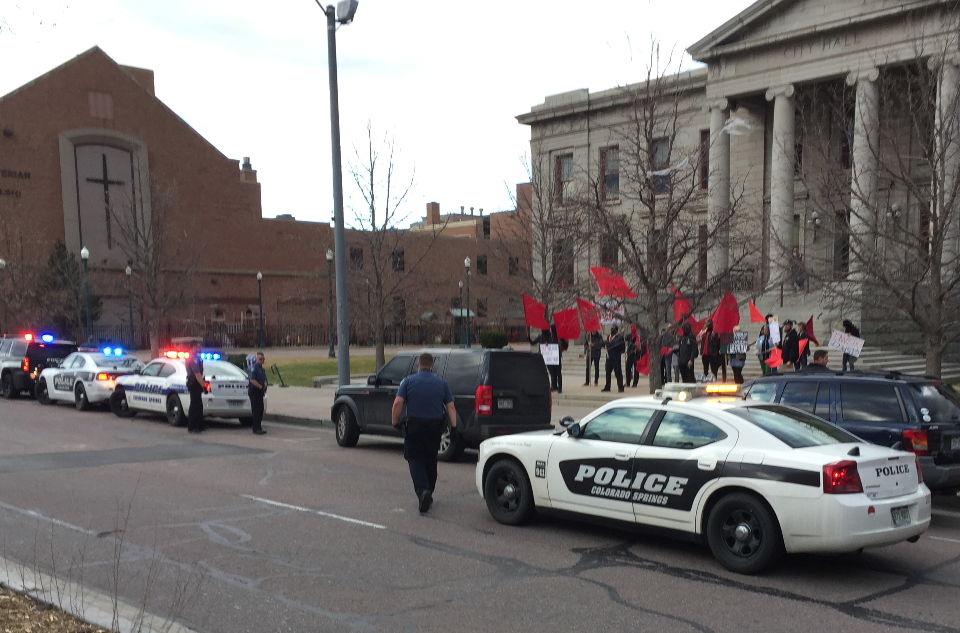
Who is this El Paso Sheriffs undercover infiltrator provocateur? We don’t care!

El Paso County Sheriffs Undercover OperativeCOLO. SPRINGS– Lawyers for the city are fighting defense team efforts to expose who, how, when and why local law enforcement agencies infiltrated a campus political activist group. The 2017 undercover operation was revealed in CSPD bodycam videos, but city courthouse lawyers and judges are preventing the evidence from being made public.

Alerted to the October 17 evidentiary hearing meant to shed light on the bodycam video, journalists and news crews instead witnessed stonewalling by city attorneys but made to look like a disorganized defense. They saw municipal Judge Kristen Hoffecker blame the defendants for not submitting to a sham proceding, when the judge should have confessed that the defense’s subpoenas had not been honored.

Today the city learned that our defense team went around them and served the subpoenas directly, requiring the responsible law agency parties to testify as witnesses at an evidentiary hearing on November 3. Now the city wants to use a November 1 status hearing to quash the subpoenas.

What’s the big deal? The city asserts the confidential identity of its undercovers is a stake. That is of course the least of it.

The city’s own evidence against the defendants, accused of marching in the street on March 26, 2017, documents police officers deciding to issue tickets. What’s clear from the video is that the police issued tickets, not to cite wrongdoers, nor to halt law-breaking, but to 1) “identify everyone”, 2) arrest an undercover agent, and 3) disperse a lawful assembly. It’s all on tape.

When defendants first grasped what they were seeing on the bodycam video, they brought it to the attention of the various municipal court judges who take turns directing the daily court matters. Asked to produce the written reports generated by the officers on the video but missing from the discovery evidence, the judges declined. Asked to subpoena the officers involved, the judges declined. After each defendant’s pro se arguments were rebuffed, one motions hearing after the other, the defendants sought legal help. Actually Judge Hayden Kane II did eventually grant a hearing to look into the video, but he told us he’d already watched it in private and was not inclined to find it relevant, so defendants were not encouraged that his opinion would change.

In the meantime civil rights lawyers were highly interested in the police activity documented by the video. They submitted 20 pages of argument for the dismissal of charges against the defendants, citing outrageous police misconduct in violation of the Code of Federal Regulations, part 23. They requested that the sheriff, the police chief, the commander of CSPD intelligence, and others named and unnamed, be subpoenaed to testify at an evidentiary hearing on October 17. That didn’t happen, as everyone saw. The subpoenas didn’t even go out.

The October 17 hearing misfire was simply the latest of months of attempts by the defendants to bring this story to light.

This time around the city wasn’t given the chance to sit on the subpoenas, they’ve been served directly. On November 1, will Judge Hoffecker invalidate the subpoenas two days before the witnesses are compelled to appear? The question reporters can ask is should she?

The city’s argument will be that the police undercover operation, however illegal, does not have anything to do with the guilt or innocence of the socialists charged with marching in the street. Outrageous police misconduct is a matter for federal court, that’s true. But have a look at the video. Notice that the first marcher fingered for arrest, the only one assigned an arrest team, was the undercover “Mark Jackson.” When the police shouted their warning that all who remained in front of City Hall would be issued citations, their only unequivocable target was Jackson.

Without the motive of arresting Jackson, whether it was to provoke the crowd or to embed their infiltrator, and until the order “LT wants everyone identified”, the police weren’t going to make any arrests. What does that say about the supposed guilt of the accused?

The police had already told the socialists “you’re free to carry on with your rally so long as you don’t step back unto the street.”

What the socialists were doing on March 26 was the essence of protected speech. But senior officers not on the scene had a crime of their own up their sleeves, and they needed an arrest or two to set it into motion.

Should we get to the bottom of this story, or let the city pretend it didn’t happen until the defendants get to turn the tables in federal court?

One presumes that undercover agents are only performing the intelligence function of surveillance, monitoring protest activity for hints of criminal behavior. At worse, we call them agent provocateurs, trying to encourage illegality, and believe that everyday nonviolent activists should know better than to be entrapped into illegal acts.

But undercover officers are much more disruptive than that. Undercovers sow dischord and mistrust among strangers who’ve come together to advocate for a common cause. Infiltrators pit activists against each other and confound organizers with sabotage. They volunteer for responsibilities then drop the ball. They complicate discussions with irrelevant, impractical, or illegal suggestions. When their ideas are rejected they express frustration by demeaning their fellow participants for being unmotivated. When “Mark Jackson” was found out, and it took many weeks for everyone to become convinced he was an undercover, he berated everyone for every personal failing in the book. He accused individuals of paranoia, ineptitude, or lacking courage. “Get back to me when you decide you want to DO SOMETHING” were his parting words.

Police infiltration harms every citizen effort to organize. The Code of Federal Regulations mandates that police agencies have suspicion of real crime before embedding infiltrators.

If CSPD or the El Paso County Sheriff’s Office or the Department of Homeland Security or the Colorado Bureau of Investigation has proof of a crime brewing among the Colorado Springs Socialists, wouldn’t we all benefit to know about it? We would if their motive is truly crime prevention.

The real identities of “Mark Jackson” and his partner “Aimee Walter” doesn’t matter at all. Who they work for is paramount. Are they “with the Sheriffs” or contracted or embedded from another agency? As the video shows, Jackson’s jittery hyperactive behavior while detained in the cruiser doesn’t give one much confidence about who law enforcement is entrusting with a loaded weapon in a crowd they hope to be inciting to riot.

The city’s determination to quash the question of whether or not such evidence exists points to police malfeasance, not the Socialists’.

Justice delayed is justice denied. Colorado Springs police infiltration operations against social justice activism should be brought to heel sooner rather than later.

OCTOBER 27 UPDATE:
According to Judge Hoffecker’s order: November 1st at 2:30pm will be the city’s next chance to quash the subpoenas. If they do not succeed, the evidentiary hearing is scheduled for November 3rd at 8:15am.

Police body cameras reveal Colorado Springs law enforcement used arrests to infiltrate a student socialist group.


COLORADO SPRINGS, COLORADO- Police body worn camera footage accidentally discovered to defendants in the March 26, 2017, protest cases, has revealed a mysterious side story at the Colorado Springs Socialists’ “March Against Imperialism”. At that march, six participants were cited for marching in the street. Meanwhile, a curious seventh was detained, driven off, but not cited. CSPD Officer Krueger’s body-cam recorded what happened and more.

What happened at the March 26 rally, beside the police dispersing a fully legal assembly? This video documents that the CSPD tried to give deeper cover to a team of El Paso County Sheriff’s plainclothes operatives, by giving one of them the credibility of an arrest. In truth, it worked for three weeks and several socialist actions, until the undercover team spooked everyone with their excessively sketchy zeal. As the March 26 evidence was released to defendants, the contradictory police reports began to accrue. Then a file labeled KRUEGER BODY-CAM emerged.

1. Krueger-cam
The first thing you see is the twenty or so protesters, clad in black, waving red flags, rallying on the steps of Colorado Springs City Hall. Speakers are railing against capitalism and imperialism. CSPD Officer Krueger comes upon this scene, among the reinforcements called, because fourteen of the protesters, mostly masked, were observed to have marched on the street.

(Marchers had followed Nevada to Bijou to Tejon to Colorado back to Nevada, trailed by the cruisers of CSPD Officers Mark Keller and Roberto Williamson. Returning to City Hall, participants were told by CSPD Sergeant Clayton Blackwell that they could protest on the sidewalk but would be ticketed if they stepped back into the street.)

As the rally goes on, the officers hear that orders have changed and everyone is going to be ticketed. On camera, Officer Keller relates a possible motive: “LT wants everyone identified.”

(Most of the protesters are masked. Arrests will give police the pretext to register everyone’s identity, whether the person walked in the street or not. By “LT”, Keller may be refering to Lieutenant Webber, who dispatched officers to the scene, or Lieutenant Mark Comte, in charge of CSPD intelligence.)

As officers discuss whether to rush the group or detain two or three protesters at a time, CSPD Sergeant Blackwell discloses to his men: “There’s two UCs in there, and they’ll just take a ticket like everybody else.” Blackwell adds, jokingly: “So hopefully we don’t have to start spraying ‘cause I don’t know which ones they are.”

Officer Keller tells Krueger and Canaan he thinks one of the protesters is concealing a knife. He fingers a masked protester wearing a Carhartt jacket.

CSPD Officer Dustin Canaan knew nothing about the undercover scheme.Though Krueger and his partner, CSPD Officer Dustin Canaan, were informed about undercovers, they don’t know that they are being tasked with arresting one.

Officers Krueger and Canaan are formally instructed that when the move is made to issue citations to the protesters, they are to apprehend “Carhartt”.

In fact, the first planned arrestee of March 26 is “Carhartt”. Aka the sheriff’s undercover.

Officers encircle the rally as Sergeants Ingram and Blackwell tell the socialists that “Everyone is getting a ticket!”

When the officers confront “Carhartt” he loudly abuses them with expletives proclaiming his innocence. He does this to incite fellow protesters to resist the police effort to detain him. Everybody else however is either walking swiftly away or calmly accepting their citations for Pedestrian-in-the-Roadway and Failure-to-Disperse.

City police unknowingly encircle sheriffs undercovers

Officers Krueger and Canaan ask “Carhartt” whether he has a weapon. The suspect responds with a strange command, voiced between clenched teeth: “Pat me down at the car.”

CSPD Office Krueger escorts detainee Mark JacksonThey don’t hear his response and so repeat their question. “Carhartt” sticks to his odd refrain: “Pat me down at the car!”

Krueger and Canaan walk “Carhartt” to their cruiser where he admits he has a weapon, a “M&P Shield 9mm”. He alerts the officers that his gun is tucked into his front waistline, with the safety off. In his pocket the officers find an additional magazine clip.

(Let us reflect for a moment, that only Officer Keller knew about this undercover. Imagine if events had escalated and any of the other dozens of police officers had caught a glimpse of the undercover’s gun. What kind of trigger-happy confrontation could have resulted with the socialist marchers caught in the middle? We might also wonder what Carhartt intended to do with two magazines full of bullets.)

Officer Canaan unloads the 9mm, removes the bullet from the chamber, and places everything on the front seat.

Sheriffs undercover Mark Jackson concealed a loaded 9mm

The officers ask “Carhartt” whether he wants to be cited and released on the spot, or taken to be booked at the station? The detainee responds he wants to go wherever the other arrestees are being processed.

Asked whether he has a concealed carry permit “Carhartt” replies no.

It occurs to the officers that they can’t catch and release someone, however cooperative, if they’ve apprehended you carrying a concealed weapon without a permit.

Officer Krueger leaves to consult his supervisor Sergeant Blackwell about this arrestee who is carrying a gun without a permit.

Blackwell asks Krueger: “Is he one of our UCs?” He explains again: “We have two UCs. Do you recognize him?”

Krueger says no.

Blackwell comes to the cruiser to see for himself.

Sergeant Clayton Blackwell and Officer Dustin Canaan look at their unfamiliar detainee.

Blackwell doesn’t recognize the detainee either.

As Sergeant Blackwell walks away from the cruiser, he tells Krueger the suspect is not one of their UCs, then he ponders: “…unless he’s with the sheriff’s office?”

The suspect gives his name as Mark Jackson, d.o.b. 7/20/75, last digits of SS# 1033, phone number (281) 606-0532. All of which is probably phony.

Undercover Amy Walter speaks with an Eastern European accent.His partner “Amy Walter” has been sitting nearby on the curb. She didn’t flee like the other participants, but oddly, was neither cited nor unmasked like all those who remained.

(“Amy Walter” kept her cover for months after the arrests. She claimed to drive up from Pueblo and only appeared fully bloc’d up. She’s gregarious and eager, and speaks with an Eastern European accent.)

Jackson remains detained in the back seat. After a few minutes CSPD Officer Mark Keller comes to the window to look at the suspect. He walks off camera, probably to tell Sergeant Blackwell that he can confirm the detainee is indeed an undercover.

Blackwell returns shortly to the cruiser to tell Krueger “We’re good.” Lowering his voice, he adds: “He’s UC.”

After some thought, Krueger turns to Jackson and asks in a whisper: ”Are you with the Sheriffs?” The undercover answers in the affirmative.

Krueger turns off his body-cam.

2. Canaan-cam
The body-cam worn by Krueger’s partner, Officer Canaan, has all the while recorded the same sequence of events, but he wasn’t paying attention to the whispers, so his camera continues to record.

Officer Keller walks back to the cruiser, this time to tease the undercover. Keller leans in and jokes about the arrest he arranged by pretending to suspect that Jackson had a knife.

Keller begins: “You really should hang out with a better crowd.”

Mocks Jackson: “I know. ‘Fuck the Police’. Ha ha.”

Keller goes on: “Hey, youse in the street, I figured you should get a ticket like everybody else.”

The undercover then says: “That’s why I yelled ‘COME FUCKING ARREST ME!’”

The two then discuss whether the undercover’s female partner should also be ticketed. Jackson theorizes that one ticket is enough.

Meanwhile an unspoken decision is made not to carry through with Jackson’s citation. This disturbs the undercover. He asks “How will it look when I don’t get a ticket?”


As Officer Mark Keller leaves the conversation at the cruiser, he looks directly at Canaan’s body-cam.

Undercover Jackson then notices that Officer Canaan did not grasp the development. He tells Krueger “You better tell your partner what’s going on.” Canaan turns off the audio on his body-cam.

ANALYSIS
To recap. Sergeant Blackwell revealed that the city had two UCs planted in the Socialist march. Officer Keller knew of the undercover Sheriff’s deputies “Jackson” and “Walter”. An effort was orchestrated to give a citation to “Jackson” but that plan was aborted. Wouldn’t it be interesting to know why?

Jackson’s detainment did not generate officer reports from either Krueger or Canaan, but the alias “Mark Jackson” was listed in three places. 1) on the March 26 police blotter, 2) in the radio log as “Mark Jackson in custody”, and 3) mentioned in passing in the report filed by Officer Roberto Williamson.

For three weeks “Mark Jackson” continued to infiltrate the socialist group, participating in several counterprotests, until everyone gave him the cold shoulder. His partner “Amy Walter” continues to contact group members.

The infiltration operation is extraordinary when you consider that the “Colorado Springs Socialists” essentially comprises the UCCS Socialist Discussion Group, a year-old student club chartered at the school. Though the students sometimes conceal themselves bandanas and hoodies when they attend social justice protests, they’ve committed zero acts of rioting, violence, or property destruction.

Once the video files had been released to the March 26 defendants, city prosecutors fought tooth and nail to quash the defendants’ subpoenas to the officers involved. The judge refused to review the body-cam footage, explaining that the El Paso Sheriffs Office had the discretion to refuse to provide further information.

Defendants insisted the prosecution was obligated to produce all the witnesses it knew to be on the scene of the alleged offenses, whether the witnesses were uniformed police or undercover. But the court won’t concede that the undercover operation merits looking into. The city stresses the importance of detectives being able to remain undercover to monitor ongoing crimes, in this case, jaywalking. The defendants are charged with obstruction and failure to disperse. If those are the crimes worth embedding undercovers, then the officers ought to be summoned to the trial to testify and secure convictions.

The defendants risked just that by insisting that the undercovers come forward as witnesses, but that risk was worth what the defendants were really after. What were those undercovers doing at the rally and at the march? Were they leading marchers into the street? Were undercovers taunting the cops as a demonstration that the protesters heard police orders to get off the street. Most marchers did not hear any orders, nor see police do much other than block traffic for their procession, contrary to the tone set by undercover Mark Jackson’s “COME FUCKING ARREST ME”. To prove the charge of Failure to Disperse” the prosecution has to prove that the accused wilfully defied the police. Jackson’s words seem meant to stand in for that proof.

Likewise, was Jackson’s belligerant response to police trying to arrest him meant to spark more resistance? Very often, riot cops target their own infiltrators who know to act outraged and resistive so that the crowd responds protectively. Jackson was clearly trying to do that.

Most of all, defendants wanted to get to the bottom of CSPD’s complicated operation to set their undercovers up to “take a ticket like everybody else.” How many officer were involved, and why didn’t officers recognize each other? Are the undercovers in fact with the El Paso Sheriffs Office or are they intelligence contractors or government agents? Who was coordinating this infiltration operation and who decided to call off issuing the ticket?

Who above all, thought they needed to insert an armed undercover, or two, possibly four, in the midst of a peaceful anti-imperialism march? Could a socialist group’s reckless co-opting of city streets warrant an undercover team’s reckless endangerment of unsuspecting activists surounded by very likley PTSD-addled police officers?

Jackson’s jittery behavior while detained in the back of the police cruiser hardly gives you confidence that even he should be trusted to wield a gun.

APPENDIX
The Krueger and Canaan body cam videos are circulating online. We’ll link to them as we locate stable copies. Below is an index of the events described above.

On the KRUEGER body-cam:

[0:45] Officer Mark Keller: “L.T. wants everyone identified.”

[3:05] Sergeant Clayton Blackwell: “There’s two UCs in there, and they’ll just take a ticket like everybody else. So hopefully we don’t have to start spraying ‘cause I don’t know which ones they are.”

[3:50] Off-camera officer: “Guy in the Carhartt [jacket] has a knife in his pocket.”

[9:00] Officers Krueger and Canaan discuss orders to arrest “Carhartt” suspected of carrying a knife.

[14:02] Sergeant John Ingram shouts: “Everyone is going to get a ticket!”

[15:20] Krueger and Canaan contact “Carhartt” who responds in a hostile and provocative manner. Unlike the other arrestees who are fully cooperative, he objects with loud profanity and derision.

[18:05] Krueger and Canaan discover “Carhartt” is armed with a 9mm handgun, tucked in his front waistband, and no concealed carry permit.

[20:04] Suspect gives his name as “Mark Jackson, d.o.b. 7/20/75”, and asks: “How do you know I was in the street?” Officer Canaan replies “An officer pointed you out. He’s been watching you the whole time.”

[23:38] Krueger consults Sgt. Blackwell who determines that “Jackson” is not one of their two UCs embedded in the march.

[28:56] Off camera Sgt. Blackwell tells Krueger “He’s U.C.”

[29:20] “Mark Jackson” admits he is with Sheriff’s Office.

[29:50] Krueger turns off body-cam.

On the CANAAN body-cam:

[16:41] Officer Dustin Canaan unloads the detainee’s “M&P Shield 9mm” and places gun, magazines, and extra bullet on front seat.

[22:02] Officer Mark Keller approaches cruiser to take a look at the detainee’s face.

[24:52] Sergeant Blackwell taps on cruiser window, says “We’re good.” Whispers to Krueger (inaudible, but it’s on the Krueger cam where we hear: “He’s UC”)

[25:03] Officer Keller returns to cruiser to joke with “Mark Jackson” about having arranged his fake arrest. Says Keller: “Hey, you’se in the street, I figured you should get a ticket like everybody else.” To which Jackson replies: “That’s why I said ‘Come fucking arrest me!’”

[25:25] Keller discusses with Jackson whether or not to ticket his female partner.

[26:27] Canaan turns off the audio of his body-cam.

Colo. US District Court judge enjoins DIA to limit restriction of free speech (grants our preliminary injunction!)

Plaintiffs Nazli McDonnell and Eric Verlo
DENVER, COLORADO- If your civil liberties have ever been violated by a cop, over your objections, only to have the officer say “See you in court”, this victory is for YOU! On January 29 we were threatened with arrest for protesting the “Muslim Ban” at Denver International Airport. We argued that our conduct was protected speech and that they were violating our rights. They dismissed our complaints with, in essense: “That’s for a court to decide.” And today IT HAS! On Feb 15 we summoned the cops to federal court and this morning, Feb 22, US District Court Judge William Martinez granted our preliminary injunction, severely triming DIA’s protest permit process. In a nutshell: no restrictions on signs, size of assemblies or their location within the main terminal (so long as the airport’s function is not impeded). Permits are still required but with 24 hours advance notice, not seven days. Below is Judge Martinez’ 46-page court order in full:

Document 29 Filed 02/22/17 USDC Colorado

IN THE UNITED STATES DISTRICT COURT
FOR THE DISTRICT OF COLORADO

Judge William J. Martínez

Civil Action No. 17-cv-0332-WJM-MJW

NAZLI MCDONNELL, and
ERIC VERLO,

Plaintiffs,

v.

CITY AND COUNTY OF DENVER,?
DENVER POLICE COMMANDER ANTONIO LOPEZ,
in his individual and official capacity, and?
DENVER POLICE SERGEANT VIRGINIA QUIÑONES,
in her individual and official capacity,

Defendants.

________________________________________________________

ORDER GRANTING PRELIMINARY INJUNCTION IN PART
________________________________________________________

Plaintiffs Nazli McDonnell (“McDonnell”) and Eric Verlo (“Verlo”) (together, “Plaintiffs”) sue the City and County of Denver (“Denver”), Denver Police Commander Antonio Lopez (“Lopez”) and Denver Police Sergeant Virginia Quiñones (“Quiñones”) (collectively, “Defendants”) for allegedly violating Plaintiffs’ First and Fourteenth Amendment rights when they prevented Plaintiffs from protesting without a permit in the Jeppesen Terminal at Denver International Airport (“Airport” or “Denver Airport”). (ECF No. 1.) Currently before the Court is Plaintiffs’ Motion for Preliminary Injunction, which seeks to enjoin Denver from enforcing some of its policies regarding demonstrations and protests at the Airport. (ECF No. 2.) This motion has been fully briefed (see ECF Nos. 2, 20, 21, 23) and the Court held an evidentiary hearing on February 15, 2017 (“Preliminary Injunction Hearing”).

For the reasons explained below, Plaintiffs’ Motion is granted to the following limited extent:

• Defendants must issue an expressive activity permit on twenty-four hours’ notice in circumstances where an applicant, in good faith, seeks a permit for the purpose of communicating topical ideas reasonably relevant to the purposes and mission of the Airport, the immediate importance of which could not have been foreseen seven days or more in advance of the commencement of the activity for which the permit is sought, or when circumstances beyond the control of the permit applicant prevented timely filing of the application; ?

• Defendants must make all reasonable efforts to accommodate the applicant’s preferred demonstration location, whether inside or outside of the Jeppesen Terminal, so long as the location is a place where the unticketed public is normally allowed to be; ?

• Defendants may not enforce Denver Airport Regulation 50.09’s prohibition against “picketing” (as that term is defined in Denver Airport Regulation 50.02-8) within the Jeppesen Terminal; and ?

• Defendants may not restrict the size of a permit applicant’s proposed signage beyond that which may be reasonably required to prevent the impeding of the normal flow of travelers and visitors in and out of Jeppesen Terminal; and specifically, Defendants may not enforce Denver Airport Regulation 50.08-12’s requirement that signs or placards be no larger than one foot by one foot. ??

Any relief Plaintiffs seek beyond the foregoing is denied at this phase of the case. In particular, the Court will not require the Airport to accommodate truly spontaneous demonstrations (although the Airport remains free to do so); the Court will not require the Airport to allow demonstrators to unilaterally determine the location within the Jeppesen Terminal that they wish to demonstrate; and the Court will not strike down the Airport’s usual seven-day notice-and-permit requirement as unconstitutional in all circumstances.

I. FINDINGS OF FACT

Based on the parties’ filings, and on the documentary and testimonial evidence received at the evidentiary hearing, the Court makes the following findings of fact for purposes of resolving Plaintiffs’ Motion.?

A. Regulation 50

Pursuant to Denver Municipal Code § 5-16(a), Denver’s manager of aviation may “adopt rules and regulations for the management, operation and control of [the] Denver Municipal Airport System, and for the use and occupancy, management, control, operation, care, repair and maintenance of all structures and facilities thereon, and all land on which [the] Denver Municipal Airport System is located and operated.” Under that authority, the manager of aviation has adopted “Rules and Regulations for the Management, Operation, Control, and Use of the Denver Municipal Airport System.” See https://www.flydenver.com/about/administration/rules_regulations (last accessed Feb. 16, 2017). Part 50 of those rules and regulations governs picketing, protesting, soliciting, and similar activities at the Airport. See https://www.flydenver.com/sites/default/files/rules/50_leafleting.pdf (last accessed Feb. 16, 2017). The Court will refer to Part 50 collectively as “Regulation 50.”

The following subdivisions of Regulation 50 are relevant to the parties’ current dispute:

Regulation 50.03: “No person or organization shall leaflet, conduct surveys, display signs, gather signatures, solicit funds, or engage in other speech related activity at Denver International Airport for religious, charitable, or political purposes, or in connection with a labor dispute, except pursuant to, and in compliance with, a permit for such activity issued by the CEO [of the Airport] or his or her designee. . . .” ?

Regulation 50.04-1: “Any person or organization desiring to leaflet, display signs, gather signatures, solicit funds, or engage in other speech related activity at Denver International Airport for religious, charitable, or political purposes, or in connection with a labor dispute, shall complete a permit application and submit it during regular business hours, at least seven (7) days prior to the commencement of the activity for which the permit is sought and no earlier than thirty (30) days prior to commencement of the activity. The permit application shall be submitted using the form provided by the Airport. The applicant shall provide the name and address of the person in charge of the activity, the names of the persons engaged in the activity, the nature of the activity, each location at which the activity is proposed to be conducted, the purpose of the activity, the hours during which the activity is proposed to be conducted, and the beginning and end dates of such activity. A labor organization shall also identify the employer who is the target of the proposed activity.”

Regulation 50.04-3: “Upon presentation of a complete permit application ?and all required documentation, the CEO shall issue a permit to the applicant, if there is space available in the Terminal, applying only the limitations and regulations set forth in this Rule and Regulation . . . . Permits shall be issued on a first come-first served basis. No permits shall be issued by the CEO for a period of time in excess of thirty-one (31) days.” ?

Regulation 50.04-5: “In issuing permits or allocating space, the CEO shall not exercise any discretion or judgment regarding the purpose or content of the proposed activity, except as provided in these Rules and Regulations. The issuance of a permit is a strictly ministerial function and does not constitute an endorsement by the City and County of Denver of any organization, cause, religion, political issue, or other matter.” ?

Regulation 50.04-6: “The CEO may move expressive activity from one location to another and/or disperse such activity around the airport upon reasonable notice to each affected person when in the judgment of the CEO such action is necessary for the efficient and effective operation of the transportation function of the airport.” ?

Regulation 50.08-12: “Individuals and organizations engaged in leafleting, solicitation, picketing, or other speech related activity shall not: * * * [w]ear or carry a sign or placard larger than one foot by one foot in size . . . .” (underscoring in original).

Regulation 50.09: “Picketing not related to a labor dispute is prohibited in ?all interior areas of the Terminal and concourses, in the Restricted Area, and on all vehicular roadways, and shall not be conducted by more than two (2) persons at any one location upon the Airport.” ?

Regulation 50.02-8: “Picketing shall mean one or more persons marching or stationing themselves in an area in order to communicate their position on a political, charitable, or religious issue, or a labor dispute, by displaying one or more signs, posters or similar devices” (underscoring in original).

The Airport receives about forty-five permit requests a year. No witness at the Preliminary Injunction Hearing (including Airport administrators who directly or indirectly supervise the permit process) could remember an instance in which a permit had been denied.

?Although there is no formal written, prescribed procedure for requesting expedited treatment of permit requests, the Airport not infrequently processes such requests and issues permits in less than seven days. Last November, less than seven days before Election Day, the Airport received a request from “the International Machinists” 1 to stage a demonstration ahead of the election. The Airport was able to process that request in two days and thereby permit the demonstration before Election Day.
?
——————————
1 Presumably, the International Association of Machinists and Aerospace Workers. ?
———————

B. The Executive Order

On Friday, January 27, 2017, President Trump signed Executive Order 13769 (“Executive Order”). See 82 Fed. Reg. 8977. The Executive Order, among other things, established a 90-day ban on individuals from seven Muslim-majority countries from entering the United States, a 120-day suspension of all refugee admissions, and an indefinite suspension of refugee admissions from Syria. Id. §§ 3(c), 5(a), 5(c). “The impact of the Executive Order was immediate and widespread. It was reported that thousands of visas were immediately canceled, hundreds of travelers with such visas were prevented from boarding airplanes bound for the United States or denied entry on arrival, and some travelers were detained.” Washington v. Trump, ___ F.3d. ___, ___, 2017 WL 526497, at *2 (9th Cir. Feb. 9, 2017). As is well known, demonstrators and attorneys quickly began to assemble at certain American airports, both to protest the Executive Order and potentially to offer assistance to travelers being detained upon arrival.?

C. The January 28 Protest at the Denver Airport

Shortly after 1:00 p.m. on the following day—Saturday, January 28, 2017— Airport public information officer Heath Montgomery e-mailed Defendant Lopez, the police commander responsible for Denver’s police district encompassing the Airport. Lopez was off-duty at the time. Montgomery informed Lopez that he had received media inquiries about a protest being planned for the Airport later that day, and that no Regulation 50 permit had been issued for such a protest.

Not knowing any details about the nature or potential size of the protest, and fearing the possibility of “black bloc” and so-called “anarchist activities,” Lopez coordinated with other Denver Police officials to redeploy Denver Police’s gang unit from their normal assignments to the Airport. Denver Police also took uniformed officers out of each of the various other police districts and redeployed them to the Airport. Lopez called for these reinforcements immediately in light of the Airport’s significant distance from any other police station or normal patrol area. Lopez knew that if an unsafe situation developed, he could not rely on additional officers being able to get to the Airport quickly.

Through his efforts, Lopez was eventually able to assemble a force of about fifty officers over “the footprint of the entire airport,” meaning inclusive of all officers already assigned to the Airport who remained on their normal patrol duties. Lopez himself also came out to the Airport.

In the meantime, Montgomery had somehow learned of an organization known as the Colorado Muslim Connection that was organizing protesters through Facebook. Montgomery reached out to this organization through the Airport’s own Facebook account and informed them of Regulation 50’s permit requirement. (Ex. 32.) One of the Colorado Muslim Connection’s principals, Nadeen Ibrahim, then e-mailed Montgomery “to address the permit.” (Ex. 30.) Ibrahim told Montgomery:

The group of people we have will have a peaceful assembly carrying signs saying welcome here along with a choir and lots of flowers. Our goal is to stand in solidarity with our community members that have been detained at the airports since the signing of the executive order, though they do have active, legal visas/green cards. Additionally, we would like to show our physical welcoming presence for any newly arriving Middle Eastern sisters and brothers with visas. We do not intend to block any access to [the Airport].

(Id.) Montgomery apparently did not construe this e-mail as a permit request, or at least not a properly prepared one, and stated that “Denver Police will not allow a protest at the airport tonight. We are willing to work with you like any other group but there is a formal process for that.” (Id.)

Nonetheless, protesters began to assemble in the late afternoon and early evening in the Airport’s Jeppesen Terminal, specifically in the multi-storied central area known as the “Great Hall.” The Great Hall is a very large, rectangular area that runs north and south. The lower level of the Great Hall (level 5) has an enormous amount of floor space, and is ringed with offices and some retail shops, but the floor space itself is largely taken up by security screening facilities for departing passengers. The only relatively unobstructed area on level 5 is the middle third, which is currently designed primarily as a location for “meeters-and-greeters,” i.e., individuals waiting for passengers arriving from domestic flights who come up from the underground train connecting the Jeppesen Terminal with the various concourses. There is a much smaller meeters-and-greeters waiting area at the north end of level 5, where international arrivals exit from customs screening.

The upper level of the Great Hall (level 6) has much less floor space than level 5 given that it is mostly open to level 5 below. It is ringed with retail shops and restaurants. At its north end is a pedestrian bridge to and from the “A” concourse and its separate security screening area.

Given this design, every arriving and departing passenger at the Airport (i.e., all passengers except those only connecting through Denver), and nearly every other person having business at the airport (including employees, delivery persons, meeters-and-greeters, etc.), must pass through some portion of the Great Hall. In 2016, the Airport served 58.3 million passengers, making it the sixth busiest airport in the United States and the eighteenth busiest in the world. Approximately 36,000 people also work at the airport.

The protesters who arrived on the evening of January 28 largely congregated in the middle third of the Great Hall (the domestic-arrivals meeter-and-greeter area). The protesters engaged in singing, chanting, praying, and holding up signs. At least one of them had a megaphone.

The size of the protest at its height is unclear. The witnesses at the evidentiary hearing gave varying estimates ranging from as low as 150 to as high as 1,000. Most estimates, however, centered in the range of about 200. Lopez, who believed that the protest eventually comprised about 300 individuals, did not believe that his fifty officers throughout the Airport were enough to ensure safety and security for that size of protest, even if he could pull all of his officers away from their normal duties.

Most of the details of the January 28 protest are not relevant for present purposes. Suffice it to say that Lopez eventually approached those who appeared to be the protest organizers and warned them multiple times that they could be arrested if they continued to protest without a permit. Airport administration later agreed to allow the protest to continue on “the plaza,” an area just outside the Jeppesen Terminal to its south, between the Terminal itself and the Westin Hotel. Protesters then moved to that location, and the protest dispersed later in the evening. No one was arrested and no illegal activity stemming from the protest (e.g., property damage) was reported, nor was there any report of disruption to travel operations or any impeding of the normal flow of travelers and visitors in and out of Jeppesen Terminal.

D. The January 29 Protest at the Denver Airport

Plaintiffs disagree strongly with the Executive Order and likewise wished to protest it, but, due to their schedules, were unable to participate in the January 28 protest. They decided instead to go to the Airport on the following day, Sunday, January 29. They came that afternoon and stationed themselves at a physical barrier just outside the international arrival doors at the north end of the Great Hall, level 5. They each held up a sign of roughly poster board size expressing a message of opposition to the Executive Order and solidarity with those affected by it. (See Exs. 2, 4, M.)

Plaintiffs were soon approached by Defendant Quiñones, who warned them that they could be arrested for demonstrating without a permit. Plaintiffs felt threatened, as well as disheartened that they could not freely exercise their First Amendment rights then and there. Plaintiffs felt it was important to be demonstrating both at that particular time, given the broad news coverage of the effects of the Executive Order, and at that particular place (the international arrivals area), given a desire to express solidarity with those arriving directly from international destinations—whom Plaintiffs apparently assumed would be most likely to be affected by the Executive Order in some way.

Plaintiffs left the Airport later that day without being arrested, and without incident. They have never returned to continue their protest, nor have they applied for a permit to do so.

E. Permits Since Issued

The airport has since issued permits to demonstrators opposed to the Executive Order. At least one of these permits includes permission for four people to demonstrate in the international arrivals area, where Plaintiffs demonstrated on January 29.

II. REQUESTED INJUNCTION

Plaintiffs have never proposed specific injunction language. In their Motion, they asked for “an injunction prohibiting their arrest for standing in peaceful protest within Jeppesen Terminal and invalidating Regulation 50 as violative of the First and Fourteenth Amendments to the United States Constitution.” (ECF No. 2 at 4.) At the Preliminary Injunction Hearing, Plaintiffs’ counsel asked the Court to enjoin Defendants (1) “from arresting people for engaging in behavior that the plaintiffs or people similarly situated were engaging in,” (2) from enforcing Regulation 50.09 (which forbids non- labor demonstrators from holding up signs within the Jeppesen Terminal), and (3) from administering Regulation 50 without an “exigent circumstances exception.” Counsel also argued that requiring a permit application seven days ahead of time is unconstitutionally long in any circumstance, exigent or not.

III. LEGAL STANDARD

A. The Various Standards

In a sense, there are at least three preliminary injunction standards. The first, typically-quoted standard requires: (1) a likelihood of success on the merits, (2) a threat of irreparable harm, which (3) outweighs any harm to the non-moving party, and (4) that the injunction would not adversely affect the public interest. See, e.g., Awad v. Ziriax, 670 F.3d 1111, 1125 (10th Cir. 2012).

If, however, the injunction will (1) alter the status quo, (2) mandate action by the defendant, or (3) afford the movant all the relief that it could recover at the conclusion of a full trial on the merits, a second standard comes into play, one in which the movant must meet a heightened burden. See O Centro Espirita Beneficiente Uniao do Vegetal v. Ashcroft, 389 F.3d 973, 975 (10th Cir. 2004) (en banc). Specifically, the proposed injunction “must be more closely scrutinized to assure that the exigencies of the case support the granting of a remedy that is extraordinary even in the normal course” and “a party seeking such an injunction must make a strong showing both with regard to the likelihood of success on the merits and with regard to the balance of harms.” Id.

On the other hand, the Tenth Circuit also approves of a

modified . . . preliminary injunction test when the moving party demonstrates that the [irreparable harm], [balance of harms], and [public interest] factors tip strongly in its favor. In such situations, the moving party may meet the requirement for showing [likelihood of] success on the merits by showing that questions going to the merits are so serious, substantial, difficult, and doubtful as to make the issue ripe for litigation and deserving of more deliberate investigation.

Verlo v. Martinez, 820 F.3d 1113, 1128 n.5 (10th Cir. 2016). This standard, in other words, permits a weaker showing on likelihood of success when the party’s showing on the other factors is strong. It is not clear how this standard would apply if the second standard also applies.

In any event, “a preliminary injunction is an extraordinary remedy,” and therefore “the right to relief must be clear and unequivocal.” Greater Yellowstone Coal. v. Flowers, 321 F.3d 1250, 1256 (10th Cir. 2003).

B. Does Any Modified Standard Apply?

The status quo for preliminary injunction purposes is “the last peaceable uncontested status existing between the parties before the dispute developed.” Schrier v. Univ. of Colo., 427 F.3d 1253, 1260 (10th Cir. 2005) (internal quotation marks omitted). By asking that portions of Regulation 50 be invalidated, Plaintiffs are seeking to change the status quo. Therefore they must make a stronger-than-usual showing on likelihood of success and the balance of harms.

IV. ANALYSIS

A. Irreparable Harm as it Relates to Standing

Under the circumstances, the Court finds it appropriate to begin by discussing the irreparable harm element of the preliminary injunction test as it relates Plaintiffs’ standing to seek an injunction.

Testimony at the Preliminary Injunction Hearing revealed that certain groups wishing to protest the Executive Order have since applied for and obtained permits. Thus, Plaintiffs could get a permit to demonstrate at the airport on seven days’ advance notice—although Regulation 50.09 would still prohibit them from demonstrating by wearing or holding up signs. In addition, as discussed in more detail below (Part IV.B.3.c), Plaintiffs could potentially get a permit to hold a protest parade on public streets in the City and County of Denver with as little as 24 hours’ notice. And as far as the Court is aware, the two Plaintiffs may be able to stand on any public street corner and hold up signs without any prior notice or permit requirement. Thus, Plaintiffs’ alleged irreparable harm must be one or both of the following: (1) the prospect of not being able to demonstrate specifically at the airport on less than seven days’ notice, or (2) the inability to picket in opposition to the government action they oppose—that is, the inability to hold up “signs, posters or similar devices” while engaging in expressive activity at the airport. The Court finds that the second of these options is a fairly traditional allegation of First Amendment injury—even if they do apply for and obtain a permit, by the express terms of Regulation 50.09 Plaintiffs will not be allowed to carry or hold up signs, posters, or the like. The first option, however, requires more extensive discussion and analysis.

The rapidly developing situation that prompted Plaintiffs to go to the Airport on January 29 has since somewhat subsided. The Executive Order remains a newsworthy topic, but a nationwide injunction now prevents its enforcement, see Washington, ___ F.3d at ___, 2017 WL 526497, at *9, and—to the Court’s knowledge—none of the most urgent effects that led to airport-based protests, such as individuals being detained upon arrival, have since repeated themselves. Nonetheless, the circumstances that prompted this lawsuit reveal a number of unassailable truths about “freedom of speech . . . [and] the right of the people peaceably to assemble, and to petition the government for a redress of grievances.” U.S. Const. amend. I.

One indisputable truth is that the location of expressive activity can have singular First Amendment significance, or as the Tenth Circuit has pithily put it: “Location, location, location. It is cherished by property owners and political demonstrators alike.” Pahls v. Thomas, 718 F.3d 1210, 1216 (10th Cir. 2013). The ability to convey a message to a particular person is crucial, and that ability often turns entirely on location.

Thus, location has specifically been at issue in a number of First Amendment decisions. See, e.g., McCullen v. Coakley, 134 S. Ct. 2518, 2535 (2014) (abortion protesters’ ability to approach abortion clinic patrons within a certain distance); Pahls, 718 F.3d at 1216–17 (protesters’ ability to be in a location where the President could see them as his motorcade drove past); Citizens for Peace in Space v. City of Colo. Springs, 477 F.3d 1212, 1218–19 (10th Cir. 2007) (peace activists’ ability to be near a hotel and conference center where a NATO conference was taking place); Tucker v. City of Fairfield, 398 F.3d 457, 460 (6th Cir. 2005) (labor protesters’ ability to demonstrate outside a car dealership); Friends of Animals, Inc. v. City of Bridgeport, 833 F. Supp. 2d 205, 207–08 (D. Conn. 2011) (animal rights protesters’ ability to protest near a circus), aff’d sub nom. Zalaski v. City of Bridgeport Police Dep’t, 475 F. App’x 805 (2d Cir. 2012).

Another paramount truth is that the timing of expressive activity can also have irreplaceable First Amendment value and significance: “simple delay may permanently vitiate the expressive content of a demonstration.” NAACP, W. Region v. City of Richmond, 743 F.2d 1346, 1356 (9th Cir. 1984); see also American-Arab Anti-Discrimination Comm. v. City of Dearborn, 418 F.3d 600, 605 (6th Cir. 2005) (“Any notice period is a substantial inhibition on speech.”); Church of Am. Knights of Ku Klux Klan v. City of Gary, 334 F.3d 676, 682 (7th Cir. 2003) (“given that . . . political demonstrations are often engendered by topical events, a very long period of advance notice with no exception for spontaneous demonstrations unreasonably limits free speech”); Douglas v. Brownell, 88 F.3d 1511, 1524 (8th Cir. 1996) (“The five-day notice requirement restricts a substantial amount of speech that does not interfere with the city’s asserted goals of protecting pedestrian and vehicle traffic, and minimizing inconvenience to the public.”).

This case provides an excellent example of this phenomena given that —whether intentionally or not— the President’s announcement of his Supreme Court nomination on January 31 (four days after signing the Executive Order) permitted the President to shift the media’s attention to a different topic of national significance. Thus, the inability of demonstrators to legally “strike while the iron’s hot” mattered greatly in this instance. Cf. City of Gary, 334 F.3d at 682 (in the context of a 45-day application period for a parade, noting that “[a] group that had wanted to hold a rally to protest the U.S. invasion of Iraq and had applied for a permit from the City of Gary on the first day of the war would have found that the war had ended before the demonstration was authorized”).

These principles are not absolute, however, nor self-applying. The Court must analyze them in the specific context of the Airport. But for present purposes, the Court notes that the Plaintiffs’ alleged harm of being unable to protest at a specific location on short notice states a cognizable First Amendment claim. In addition, by its very nature, this is the sort of claim that is “capable of repetition, yet evading review.” S. Pac. Terminal Co. v. Interstate Commerce Comm’n, 219 U.S. 498, 515 (1911). Here, “the challenged action”—enforcement of the seven-day permit requirement during an event of rapidly developing significance —“was in its duration too short to be fully litigated prior to its cessation or expiration.” Weinstein v. Bradford, 423 U.S. 147, 149 (1975). Further, “there [is] a reasonable expectation that the same complaining party would be subjected to the same action again.” Id. More specifically, the Court credits Plaintiffs’ testimony that they intend to return to the Airport for future protests, and, given continuing comments by the Trump Administration that new immigration and travel- related executive orders are forthcoming, the Court agrees with Plaintiffs that it is reasonably likely a similar situation will recur —i.e., government action rapidly creating consequences relevant specifically to the Airport.

Thus, although the prospect of being unable to demonstrate at the Airport on short notice is not, literally speaking, an “irreparable harm” (because the need for such demonstration may never arise again), it is nonetheless a sufficient harm for purposes of standing and seeking a preliminary injunction.

The Court now turns to the heart of this case—whether Plaintiffs are likely to succeed on the merits of their claims. Following that, the Court will reprise the irreparable harm analysis in the specific context of the likelihood-of-success findings.

B. Likelihood of Success on the Merits

Evaluating likelihood of success requires evaluating the substantive merit of Plaintiffs’ claim that Regulation 50, or any portion of it, violates their First Amendment rights. To answer this question, the Supreme Court prescribes the following analysis:

1. Is the expression at issue protected by the First Amendment? ?

2. If so, is the location at issue a traditional public forum, a designated public ?forum, or a nonpublic forum? ?

3. If the location is a traditional or designated public forum, is the ?government’s speech restriction narrowly tailored to meet a compelling ?state interest? ?

4. If the location is a nonpublic forum, is the government’s speech restriction ? ?reasonable in light of the purpose served by the forum, and viewpoint neutral?

See Cornelius v. NAACP Legal Def. & Educ. Fund, Inc., 473 U.S. 788, 797–806 (1985).

The Court will address these inquiries in turn.

1. Does the First Amendment Protect Plaintiffs’ Expressive Conduct?

The Court “must first decide whether [the speech at issue] is speech protected by the First Amendment, for, if it is not, we need go no further.” Id. at 797. There appears to be no contest that the sorts of activities Plaintiffs attempted to engage in at the Airport (including holding up signs) are expressive endeavors protected by the First Amendment. Accordingly, the Court deems it conceded for preliminary injunction purposes that Plaintiffs are likely to succeed on this element of the Cornelius analysis.

2. Is the Jeppesen Terminal a Public Forum (Traditional or Designated)?

The Court must next decide whether the Jeppesen Terminal is a public forum:

. . . the extent to which the Government can control access [to government property for expressive purposes] depends on the nature of the relevant forum. Because a principal purpose of traditional public fora is the free exchange of ideas, speakers can be excluded from a public forum only when the exclusion is necessary to serve a compelling state interest and the exclusion is narrowly drawn to achieve that interest. Similarly, when the Government has intentionally designated a place or means of communication as a public forum[,] speakers cannot be excluded without a compelling governmental interest. Access to a nonpublic forum, however, can be restricted as long as the restrictions are reasonable and are not an effort to suppress expression merely because public officials oppose the speaker’s view.

Id. at 800 (citations and internal quotation marks omitted; alterations incorporated).

a. Is the Jeppesen Terminal a Traditional Public Forum??

Plaintiffs claim that “[t]he Supreme Court has not definitively decided whether airport terminals . . . are public forums.” (ECF No. 2 at 7.) This is either an intentional misstatement or a difficult-to-understand misreading of the most relevant case (which Plaintiffs repeatedly cite), International Society for Krishna Consciousness, Inc. v. Lee, 505 U.S. 672, 679 (1992) (“Lee”).

The plaintiffs in Lee were disseminating religious literature and soliciting funds at the airports controlled by the Port Authority of New York and New Jersey (JFK, LaGuardia, and Newark). Id. at 674–75. By regulation, however, the Port Authority prohibited “continuous or repetitive” person-to-person solicitation and distribution of literature. Id. at 675–76. The Second Circuit held that the airports were not public fora and that the regulation was reasonable as to solicitation but not as to distribution. Id. at 677. The dispute then went to the Supreme Court, which granted certiorari specifically “to resolve whether airport terminals are public fora,” among other questions. Id.

The Court answered the public forum question in the negative. Relying on the historical use of airport terminals generally, the Court found that “the tradition of airport activity does not demonstrate that airports have historically been made available for speech activity.” Id. at 680. “Nor can we say,” the Court continued, “that these particular terminals, or airport terminals generally, have been intentionally opened by their operators to such activity; the frequent and continuing litigation evidencing the operators’ objections belies any such claim.” Id. at 680–81. Then, invoking the reasonableness test that applies to government regulation of nonpublic fora, the Court affirmed the Second Circuit’s holding that the solicitation ban was reasonable. Id. at 683–85.

Five justices (Rehnquist, White, O’Connor, Scalia, and Thomas) joined all of the major rulings regarding the solicitation ban, including the nonpublic forum status of airport terminals and the reasonableness of the ban. The outcome regarding the distribution ban, however, commanded no majority opinion. Justice O’Connor, applying the reasonableness standard for nonpublic fora, agreed with the Second Circuit that the distribution ban was not reasonable. Id. at 690–93 (opn. of O’Connor, J.). Justice Kennedy, joined in relevant part by Justices Blackmun, Stevens, and Souter, agreed that the Second Circuit’s judgment regarding the distribution ban should be affirmed, but on different grounds, namely, under a strict scrutiny test (because these justices believed that the airport terminals should be deemed a public forum). Id. at 708–10 (opn. of Kennedy, J.). The result was that the Second Circuit’s invalidation of the distribution ban was affirmed without any opinion commanding a majority view.

Regardless of the outcome with respect to the distribution ban, it is beyond debate that five Supreme Court justices in Lee agreed that airport terminals are not public fora. Id. at 680–81. The Tenth Circuit has acknowledged this holding. Mocek v. City of Albuquerque, 813 F.3d 912, 930 (10th Cir. 2015) (“As an initial matter, an airport is a nonpublic forum, where restrictions on expressive activity need only ‘satisfy a requirement of reasonableness.’” (quoting Lee, 505 U.S. at 683)). Notably, Plaintiffs have cited no case in which any court anywhere has deemed an airport to be a public forum.

b. Is the Jeppesen Terminal a Designated Public Forum??

Even though the Jeppesen Terminal is not a traditional public forum, Denver could still designate it as a public forum if Denver “intentionally [opens the Jeppesen Terminal] for public discourse.” Cornelius, 473 U.S. at 802. Denver denies that it has done so, and Plaintiffs’ arguments to the contrary lack merit.

i. Terminal Visitors’ Incidental Expressive Activities

Plaintiffs argue that visitors to the Jeppesen Terminal “engage in First Amendment activity; they wear buttons, shirts, and hats that convey distinct messages to other visitors. They engage in one-on-one conversations.” (ECF No. 21 at 3.) Thus, Plaintiffs say, Denver has designated a public forum within the Jeppesen Terminal.

The Tenth Circuit has already foreclosed this argument. Addressing the public forum status of the Denver Performing Arts Complex, the Court stated the following: “Even if Denver allowed patrons to wear political buttons or shirts with slogans, this would not be sufficient to establish a designated public forum. The First Amendment does not require the government to impose a ‘zone of silence’ on its property to maintain its character as a nonpublic forum.” Hawkins v. City & Cnty. of Denver, 170 F.3d 1281, 1288 (10th Cir. 1999).

Indeed, even if it wanted to, Denver almost certainly could not impose such a “zone of silence,” as illustrated by Board of Airport Commissioners of City of Los Angeles v. Jews for Jesus, Inc., 482 U.S. 569 (1987). There, the Los Angeles airport authority adopted a resolution announcing that “the Central Terminal Area at Los Angeles International Airport [LAX] is not open for First Amendment activities.” Id. at 570–71 (internal quotation marks omitted). The Supreme Court found that this provision did not “merely reach the activity of [the religious proselytizers who challenged it],” but also prohibited

even talking and reading, or the wearing of campaign buttons or symbolic clothing. Under such a sweeping ban, virtually every individual who enters LAX may be found to violate the resolution by engaging in some “First Amendment activit[y].” We think it obvious that such a ban cannot be justified even if LAX were a nonpublic forum because no conceivable governmental interest would justify such an absolute prohibition of speech.

Id. at 574–75. Thus, the evidence at the Preliminary Injunction Hearing established beyond any possible dispute that Denver has shown no intent to designate the Airport as a public forum by allowing speech at that location which it may not disallow in the first instance.

ii. The Effect of Regulation 50 Itself?

Plaintiffs further argue, “Regulation 50 states that free speech activity is proper in the Jeppesen Terminal (pursuant to a restriction). Denver has [thus] designated the Jeppesen Terminal a public forum for leafleting, conducting surveys, displaying signs, gathering signatures, soliciting funds, and other speech related activity for religious, charitable, or political purposes.” (ECF No. 21 at 3–4.) Although clever, this argument cannot be correct. 2

First, the Airport knows from the Supreme Court’s Jews for Jesus decision, just discussed, that it cannot prohibit all behavior that can be characterized as First Amendment-protected expressive activity.

Second, the Airport also knows from the Lee decision that it likely cannot completely ban some forms of intentional First Amendment communication (such as leafleting) given that the Jeppesen T erminal, like the Port Authority terminals at issue in Lee, is a large multipurpose facility that can reasonably accommodate some amount of intentional First Amendment activity. So, again, the Airport’s choice to regulate what it could not prohibit in the first place is not evidence of intent to designate a public forum. See Stanton v. Fort Wayne-Allen Cnty. Airport Auth., 834 F. Supp. 2d 865, 872 (N.D. Ind. 2011) (“[t]he designation of certain free speech zones, along with the permit requirement and limitation of expression to certain times, manners, and places as set forth in the permit, are marks of the Airport Authority’s attempt to restrict public discourse, and are inconsistent with an intent to designate a public forum” (emphasis in original)).

Third, Plaintiffs’ position, if accepted, would likely turn out to chill expressive speech in the long run. If a government will be deemed to have designated a public forum every time it accommodates citizens’ natural desire to engage in expressive activity in a nonpublic forum, governments will likely cut back on such accommodations as far as they are constitutionally allowed. Cf. Perry Educ. Ass’n v. Perry Local Educators’ Ass’n, 460 U.S. 37, 46 (1983) (government may un-designate a designated public forum).

—————
2 Plaintiffs have unsurprisingly cited no decision from any court adopting their reasoning.
————

iii. “Welcome Home” Messages?

Plaintiffs finally argue that “[s]ome individuals (who, importantly, are not airlines passengers) hold signs welcoming home loved ones or those returning from overseas deployment.” (ECF No. 21 at 3.) The Court will address signs welcoming home veterans and active-duty military members in Part IV.B.3.f, below, and for the reasons stated there finds that this practice, to the extent it exists, does not show intent to designate a public forum. As for welcoming home loved ones, the Court sees no greater religious, charitable, political, or labor-related significance in a typical welcome home sign than standing in the meeter-and-greeter area with a pleasant smile.

In any event, to the extent a welcome home sign has greater significance, “[t]he government does not create a public forum by inaction.” Cornelius, 473 U.S. at 802. Thus, simple failure to enforce Regulation 50 against such signholders is not itself sufficient to infer that the Airport intended to designate a public forum. And finally, even if the Court were to find such an intent, the Court would still be required to consider whether the Airport only intended to designate a public forum specifically for, e.g., those wishing to convey welcome home messages: “A public forum may be created for a limited purpose such as use by certain groups, or for the discussion of certain subjects.” Perry, 460 U.S. at 45 n.7 (1983) (citations omitted). Plaintiffs have nowhere addressed this.

For all these reasons, Plaintiffs have failed to demonstrate that the Jeppesen Terminal is a designated public forum. 3

—————
3 Plaintiffs also attack Regulation 50 as a “prior restraint.” (ECF No. 2 at 6–7.) “The term prior restraint is used ‘to describe administrative and judicial orders forbidding certain communications when issued in advance of the time that such communications are to occur.’” Alexander v. United States, 509 U.S. 544, 550 (1993) (quoting M. Nimmer, Nimmer on Freedom of Speech § 4.03, p. 4-14 (1984)) (emphasis in original). Whether or not that definition could fit Regulation 50, it adds nothing to this case because the Supreme Court’s forum analysis provides the governing principles.
————

3. Given that the Jeppesen Terminal Is Not a Public Forum, Is Regulation 50 Reasonable in Light of the Purposes Served by the Airport, and Is It Viewpoint-Neutral?

a. Reasonableness of the Need for a Permit Submitted in Advance, Generally

Reasonableness is a fact-intensive inquiry into the “particular nature of the public expression” at issue and “the extent to which it interferes with the designated purposes” of the nonpublic forum. Hawkins, 170 F.3d at 1290. Justice O’Connor’s concurring opinion in Lee is significant here, both because of its reasoning and because it has reached the somewhat paradoxical status of a “controlling concurrence.” See id. at 1289 (“In actuality, [Justice O’Connor’s reasonableness analysis in Lee] constitutes only Justice O’Connor’s view, who provided the swing vote in the highly-fractured Lee decision, but as the narrowest majority holding, we are bound by it.”).

In Lee, Justice O’Connor noted the Port Authority’s airports were not single-purpose facilities (unlike many other locations where the Supreme Court had previously examined speech restrictions). 505 U.S. at 688. Rather, the airports were “huge complex[es] open to travelers and nontravelers alike,” id. at 688, and had essentially become “shopping mall[s] as well as . . . airport[s],” id. at 689. The question, then, was whether Port Authority’s restrictions were “reasonably related to maintaining the multipurpose environment that the Port Authority has deliberately created.” Id.

Justice O’Connor’s description of the Port Authority Airports aptly describes the Jeppesen Terminal, to an extent. The Great Hall is lined with restaurants and retail establishments, and in that sense is reminiscent of a shopping mall. On the other hand, most of the floor space on level 6 is simply the floor space needed to get from location to location (the equivalent of wide hallways), and most of the floor space on level 5 is dedicated to security screening. The only large area that is usually free of significant obstructions is the central meeter-and-greeter area—and even that area has at times been taken up by art installations or other features. 4

Moreover, despite certain characteristics of the Airport that may resemble a shopping mall, the Airport’s undisputed primary purpose is to facilitate safe and efficient air travel. The need for safety hopefully needs no discussion —for decades, airports and airplanes have been the specific target of terrorists. As for efficiency, the significance of the Great Hall within the Jeppesen Terminal is particularly evident given that it is the node through which every arriving and departing passenger must pass. As noted, the Airport served 58.3 million passengers last year. Even assuming that just 20 million (about a third) were arrivals and departures (the remainder being those who connect through without reaching the Jeppesen Terminal), this still comes to more than 55,000 passengers moving through the Great Hall per day, or about 2,300 per hour. If the Airport could somehow maintain precisely that average over all days and hours of its operation —which of course never happens— it would still be the equivalent of perpetually filling and emptying a large concert hall every hour.

In this light, the Airport’s general purposes for requiring demonstrators to apply for a permit in advance are difficult to question. As stated by the various Airport administrators who testified at the Preliminary Injunction Hearing (Ken Greene, chief operations officer; Patrick Heck, chief commercial officer; and Dave Dalton, assistant director for terminal operations), it is important for the Airport to have advance notice regarding the presence of individuals coming for reasons other than normal airport- related activities, and particularly those who come to the airport intending to attract the attention of passengers and others. The Airport needs an opportunity to determine the appropriate location for a group of the requested size in light of the day(s) and time(s) requested. The permitting requirement also gives the Airport the opportunity to point out Regulation 50’s code of conduct (Regulation 50.08), so that demonstrators know what activities are and are not permissible.

In addition, the Airport fairly desires an opportunity to understand the nature of the expressive activity, which can inform whether additional security is needed. As Lopez’s testimony illustrates, it is not a simple matter to bring additional police officers to the Airport on a moment’s notice. Lopez further pointed out the advantage of understanding the subject matter of the dispute so that he can anticipate whether counter-protesters might arrive and potentially create at least a difficult, if not dangerous, situation.

Importantly, Denver does not need to prove that any particular past event has raised serious congestion or safety concerns: “Although Denver admits that plaintiffs did not cause any congestion problems or major disruption on the particular occasion that they demonstrated . . . , that is not dispositive. ‘[T]he Government need not wait until havoc is wreaked to restrict access to a nonpublic forum.’” Hawkins, 170 F.3d at 1290 (quoting Cornelius, 473 U.S. at 810). Thus, the Airport may reasonably require a permit applied for in advance. The Court does not understand Plaintiffs to be arguing to the contrary, i.e., that the Airport is never justified in requiring an advance permit under any circumstances.

———
4 Plaintiffs’ Exhibit 15, for example, is a photograph of the meeter-and-greeter area in 2008, and shows that a fountain occupied a significant portion of floor space at the time.
———

?b. Reasonableness of the Seven-Day Requirement, Specifically

Plaintiffs do attack Regulation 50.03’s requirement that permit applications be submitted seven days in advance of the desired activity, apparently arguing that this is unconstitutionally unreasonable in all circumstances. Given both Plaintiffs’ testimony at the Preliminary Injunction Hearing, it is not clear that they would be satisfied by a shorter advance-notice period, nor that it would redress their claimed injury —the inability to protest essentially at a moment’s notice on a topical event. But, to the extent Plaintiffs are challenging the seven-day requirement through the overbreadth doctrine (see Part IV.B.4, below), the Court finds that they have not met their higher burden (or even the normal preliminary injunction burden) to show that they are likely to succeed on proving the seven-day requirement unreasonable in all circumstances.

The Airport’s witnesses were not aware of any other airport with a seven-day requirement. The Indiana airport at issue in the Stanton case —which Defendants have relied upon heavily— had a two-day notice requirement, and also a provision by which the airport could accept an application on even shorter notice. 834 F. Supp. 2d at 870. On the other hand, that Airport handled about 40,000 departing and arriving passengers per month, id. at 868, whereas the Denver Airport handles far more than that per day.

The Court’s own research has revealed that airports ahead of the Denver Airport in 2016 passenger statistics have varied requirements:

• O’Hare International Airport (Chicago) — six business days, see Chicago Department of Aviation Amended Rules and Regulations Governing First Amendment Activities at the City of Chicago Airports § 3(A) (Sept. 18, 2015), available at http://www.flychicago.com/SiteCollectionDocuments/ OHare/AboutUs/cdaamendedRulesandRegs.pdf (last accessed Feb. 16, 2017);

• Dallas-Fort Worth International Airport — three business days, see Code of Rules and Regulations of the Dallas-Fort Worth International Airport Board, ch. 3, § 4, art. VI(A) (2006), available at https://www.dfwairport.com/cs/groups/public/documents/webasset/p1_008800.pdf (last accessed Feb. 16, 2017); ?

• John F. Kennedy International Airport (New York City) — twenty-four hours, see Port Authority of New York and New Jersey Airport Rules and Regulations § XV(B)(2)(a) (Aug. 4, 2009), available at http://www.panynj.gov/airports/pdf/Rules_Regs_Revision_8_04_09.pdf (last accessed Feb. 16, 2017). ??

Obviously there is no clear trend. Depending on how these airports define “business day,” some of these time periods may actually be longer than the Denver Airport’s seven-day requirement. ?

In any event, Plaintiffs have never explained how the Airport, in its particular circumstances, cannot reasonably request seven days’ advance notice as a general rule. Indeed, Plaintiffs could not cite to this Court any case holding that any advance notice requirement applicable to a nonpublic forum was unconstitutional in all circumstances. Accordingly, Plaintiffs have not made a strong showing of likelihood of success on this particular theory of relief.

c. Reasonableness of the Regulation 50.03’s Lack of a Formal Process for Handling Permit Application More Quickly in Exigent Circumstances

Plaintiffs would prefer that they be allowed to demonstrate at the Airport without any advance notice in “exigent circumstances.” Given the serious and substantial purposes served by an advance notice requirement, the Court cannot say that Plaintiffs are likely to succeed on this score. Plaintiffs have given the Court no reason to hold that the Airport has a constitutional duty, even in exigent circumstances, to accommodate demonstrators as they show up, without any advance warning whatsoever.

Nonetheless, the Airport’s complete lack of any formal mechanism for at least expediting the permit application process in unusual circumstances raises a substantial and serious question for this Court. As noted in Part IV.A, above, timing and location are cardinal First Amendment considerations, and a number of cases regarding public fora (streets and parks) have held or strongly suggested that an advance notice requirement is unconstitutional if it does not account for the possibility of spontaneous or short-notice demonstrations regarding suddenly relevant issues.

Indeed, as the undersigned pointed out to Defendants’ counsel at the Preliminary Injunction Hearing, Denver itself is willing to accept an application for a street parade on twenty-four hours’ notice (as opposed to its standard requirement of thirty days) “if the proposed parade is for the purpose of spontaneous communication of topical ideas that could not have been foreseen in advance of [the] required application period or when circumstances beyond the control of the applicant prevented timely filing of the application.” Denver Mun. Code § 54-361(d). But again, this governs a public forum (city streets), where time, place, and manner restrictions such as this must satisfy a narrow tailoring analysis and leave open ample alternative channels for communication. See Perry, 460 U.S. at 45. As the above discussion makes clear, under controlling authority the Airport need not satisfy the same legal standards.

The parties have not cited, nor has the Court located, any case specifically discussing the need for a nonpublic forum to accommodate short-notice demonstrations. But the Court likewise has not found any case expressly precluding that consideration when evaluating reasonableness in the context of a nonpublic forum. It is perhaps unsurprising that the specific question has never come up in a nonpublic forum until now. The Court believes it to be an accurate observation that this country has never before experienced a situation in which (a) the motivation to protest developed so rapidly and (b) the most obviously relevant protest locations was a place the Supreme Court had already declared to be a nonpublic forum—the airport terminal.

When evaluating the reasonableness of a First Amendment restriction in a nonpublic forum, the Court concludes that it may appropriately consider the ability to shorten an advance notice requirement in a place like the Airport, given how unique airports are within the category of nonpublic fora. As Justice O’Connor noted in Lee, most of the Supreme Court’s major nonpublic forum cases aside from airport cases have involved

discrete, single-purpose facilities. See, e.g., [United States v.] Kokinda, [497 U.S. 720 (1990)] (dedicated sidewalk between parking lot and post office); Cornelius v. NAACP Legal Defense & Ed. Fund, Inc., 473 U.S. 788 (1985) (literature for charity drive); City Council of Los Angeles v. Taxpayers for Vincent, 466 U.S. 789 (1984) (utility poles); Perry, supra (interschool mail system); Postal Service v. Council of Greenburgh Civic Assns., [453 U.S. 114 (1981)] (household mail boxes); Adderley v. Florida, 385 U.S. 39 (1966) (curtilage of jailhouse).

505 U.S. at 688 (parallel citations omitted). As Justice O’Connor observed, however, many airports have become large, multipurpose facilities, see id. at 688–89, and that describes the Denver Airport well. To be sure, the reason for expanding beyond the bare minimum of infrastructure needed to handle travelers and airplanes is to promote air travel—to make the airport a more convenient and welcoming location specifically (although not exclusively) for travelers—but the reasonableness of First Amendment restrictions must nonetheless be judged according to the “multipurpose environment that [airport authorities] ha[ve] deliberately created.” Id. at 689.

Moreover, modern airports are almost always owned and operated by a political body, as well as secured by government employees. Thus, short-notice demonstrations reasonably relevant to an airport are also reasonably likely to be demonstrations about political or otherwise governmental topics, “an area in which the importance of First Amendment protections is at its zenith.” Meyer v. Grant, 486 U.S. 414, 425 (1988) (internal quotation marks omitted).

Given all this, and in light of the First Amendment interests in location and timing that this very case has made salient, the Court finds it unreasonable for the Airport to have no formal process by which demonstrators can obtain an expedited permit when -to borrow from the Denver parade ordinance— they seek to communicate topical ideas reasonably relevant to the Airport, the immediate importance of which could not have been foreseen in advance of the usual seven-day period, or when circumstances beyond the control of the applicant prevented timely filing of the application. The Court further finds in the particular circumstances of the Airport that reasonableness requires a process by which an applicant who faces such circumstances can request a permit on twenty-four hours’ notice. If this is all the notice Denver needs to prepare for a street parade, the Court can see no reason why more notice is needed (in exigent circumstances) for a substantially more confined environment like the Airport. 5

Accordingly, the Court finds that Plaintiffs are strongly likely to succeed in their challenge to Regulation 50.03 to this limited extent.

———-
5 At the Preliminary Injunction Hearing, Defendants’ counsel argued that preparing for a street parade is actually easier than preparing for demonstrations at the airport. The Court cannot fathom how this could possibly be the case, at least when comparing a typical street parade request to the typical Airport demonstration request. Indeed, the normal street parade request window is thirty days, suggesting just the opposite. Denver Mun. Code § 54-361(d). The challenges may be different, but the Court cannot accept—on this record, at least—that Airport demonstrations on average require more preparation time than do public parades or marches.
——-

d. Reasonableness of the Airport’s Power to Control the Location of Permitted Expressive Activity

At the Preliminary Injunction Hearing, it became clear that Plaintiffs not only wish for a more expansive right to protest in the Jeppesen T erminal, but they also argue for the right to select precisely where in the Terminal they should be allowed to stand. The Court recognizes that, from Plaintiffs’ perspective, their message is diluted if they cannot demonstrate in the international arrivals area, and this is a legitimate concern for all the reasons discussed previously about the power of location when conveying a message. The Court must also account, however, for Airport administrators’ superior knowledge about airport operations, foot traffic patterns, concerns particular to the specific day of the protest, and so forth.

?Regulation 50.04-1 requires permit applicants to specify “each location at which the [expressive] activity is proposed to be conducted,” but nowhere in Regulation 50 is there any limitation on the Airport’s discretion whether to approve the location request. Rather, the only provision addressing this topic is Regulation 50.04-6, which applies to a demonstration already underway: “The CEO may move expressive activity from one location to another and/or disperse such activity around the airport upon reasonable notice to each affected person when in the judgment of the CEO such action is necessary for the efficient and effective operation of the transportation function of the airport.”

There is no evidence that Airport administrators are using their discretion when approving a demonstration’s location to suppress or dilute a particular message, but there is also no logical reason to leave Airport administrators’ discretion essentially unfettered at the permitting stage while restricting it once the demonstration is underway. The Court finds Plaintiffs are likely to succeed at least in proving that Regulation 50.04-1 is unreasonable to the extent the Airport’s discretion is not restrained to the same degree as in Regulation 50.04-6. Defendants will therefore be enjoined to follow the same restraints in both settings.

e. Reasonableness of Regulation 50.09’s Prohibition of Signage Within the Jeppesen Terminal, and Regulation 50.08-12’s Limitation of All Signs to One Square Foot

Regulation 50.09 establishes that “picketing” (defined to include “displaying one or more signs, posters or similar devices,” Regulation 50.02-8) is totally prohibited in the Jeppesen Terminal unless as part of a labor protest. And, under Regulation 50.08-12, any permissible sign may be no larger than “one foot by one foot in size.”

?Any argument that the picketing ban is reasonable in the context of the Airport is foreclosed by Justice O’Connor’s analysis of the leafleting band at issue in Lee. See 505 U.S. at 690–93. Leafleting usually involves an individual moving around, at least within a small area, and actively offering literature to passersby. Signholding is usually less obtrusive, given that the signholder often stays within an even smaller area and conveys his or her message passively to those who walk by and notice the sign. The Court simply cannot discern what legitimate or reasonable Airport purpose is served by a complete ban on “picketing” or signholding among permitted demonstrators in the Jeppesen Terminal.

The Court also finds the one-foot-by-one-foot signage restriction unreasonable. The Airport has a legitimate interest in regulating the size of signs, as well as other aspects of their display (such as whether they will be held in the air, as in traditional picketing), but a one-foot-by-one-foot restriction is barely distinguishable, both legally and as a factual matter, from a complete ban. The point of a sign is to make a message readable from a distance. Few messages of substance are readable from any kind of distance if they must be condensed into one foot square. Reasonableness instead requires the Airport to consider the size of the signs that a permit applicant wishes to display as compared to the needs and limitations of the location where the applicant will demonstrate. Any restriction by the Airport which limits the size of a permit applicant’s signage beyond that which may be reasonably required to prevent the restriction or impeding of the normal flow of travelers and visitors in and out of Jeppesen Terminal will be preliminarily enjoined.

f. Viewpoint Neutrality

?A nonpublic forum is not required to be content-neutral, but it is required to be viewpoint-neutral with respect to the First Amendment activity it permits. Hawkins, 170 F.3d at 1288. Regulation 50, on its face, is viewpoint neutral, and Plaintiffs do not argue otherwise. Rather, they say that “Regulation 50 is being enforced as a clearly view-point-based restriction.” (ECF No. 2 at 14 (emphasis added).) This appears to be an as-applied challenge:

Individuals walk through Denver International Airport with political messages and slogans on their shirts and luggage and discuss politics on a daily basis. Counsel for Plaintiffs has worn political shirts while traveling through Denver International Airport and discussed modern politics with fellow passengers on many occasions. However, no other individual, to Plaintiffs or Plaintiffs’ counsel’s knowledge, has been threatened with arrest for engaging in this political speech. Nor has any individual been arrested for displaying pro-President Trump messages, for example a red hat that reads “Make America Great Again.” Only Plaintiffs’ expressive activity against the President’s Executive Order, and others advocating similarly, has been threatened with arrest.

(Id.) Denver responds:

The permit requirement furthers the nonpublic forum purpose by mitigating disruption at the airport by individuals who choose to be at the airport for non-travel related activities. In Stanton, the [Northern District of Indiana] rejected this exact argument challenging a nearly identical permitting rule of the Fort Wayne-Allen County Airport on an as applied basis by distinguishing between incidental expressive activities by members of the traveling public versus those arriving at the airport solely for purposes of engaging in expressive speech. Any messages a traveler or individual picking up a family member conveys by wearing T-shirts or hats are “incidental to the use of the Airport’s facilities” by persons whose “primary purpose for being present at the Airport is a purpose other than expressing free speech rights,” which is different in kind than individuals arriving at an airport whose primary purpose is expressive speech. Id. at 880–882.

(ECF No. 20 at 11 (emphasis added).)?

This argument obviously relies on a particular interpretation of Regulation 50 (given that the Regulation itself makes no explicit distinction between those who arrive at the airport for travel-related purposes and those who do not). Nonetheless, this is how Airport administrators interpret Regulation 50, as they made clear at the Preliminary Injunction Hearing. They also made clear that they have never sought to enforce Regulation 50 against someone wearing a political shirt, for example, while on airport-related business. Plaintiffs’ own arguments support the sincerity of the Airport administrators’ testimony. By Plaintiffs’ own admission, they are unaware of anyone going about his or her typical airport-related business who has been arrested or even threatened with arrest for wearing a political shirt, discussing politics, etc.

At the Preliminary Injunction Hearing, Plaintiffs attempted to present an as- applied viewpoint discrimination case by showing that the Airport regularly allows individuals to hold rallies, display signs, and so forth, for returning servicemembers and veterans, yet without requiring those individuals to obtain a permit under Regulation 50. The Court agrees that pro-military and pro-veteran messages are political statements, at least to the extent being conveyed by someone not at the Airport to welcome home a relative or loved one (and perhaps even by those persons as well). Thus, it would seem that pro-military messages would fall under Regulation 50. However, Plaintiffs have failed at this stage to show that the Airport’s alleged treatment of pro-military and pro-veteran messages amounts to viewpoint discrimination.

At the outset, Plaintiffs fail to note the subjective element of their claim: “viewpoint discrimination in contravention of the First Amendment requires a plaintiff to show that the defendant acted with a viewpoint-discriminatory purpose.” Pahls, 718 F.3d at 1230. In that light, it is tenuous to suggest that allowing (allegedly) unpermitted pro-military or pro-veteran expression at various times in the past but not allowing these recent unpermitted protests against the Executive Order is evidence of viewpoint discrimination. The question of whether our nation should honor servicemembers and the question of how our nation should treat foreign nationals affected by the Executive Order are not really in the same universe of discourse. To bridge the gap, it takes a number of assumptions about where pro-military attitudes tend to fall in the American political spectrum, and what people with those attitudes might also think about the Executive Order. This would be a fairly tall order of proof even outside the preliminary injunction context.

Moreover, Plaintiffs’ evidence of unpermitted pro-military expression is fairly weak. Plaintiffs’ main example is the activities of the Rocky Mountain Honor Flight, an organization that assists World War II veterans to travel to Washington, D.C., and visit the World War II Memorial, and then welcomes them home with a large and boisterous rally held in the meeter-and-greeter portion of the Great Hall. A former servicemember who helped to organize one of these rallies testified that she inquired of a more-senior organizer whether the Airport required any special procedures, and the answer she received was “no.” However, Airport administrators presented unrebutted testimony that Rocky Mountain Honor Flight rallies are planned far in advance and sponsored by the Airport itself, in connection with TSA and certain airlines. The Airport does not need a Regulation 50 permit for its own expressive activities, and a government entity’s expression about a topic is not a matter of First Amendment concern. See Pleasant Grove City v. Summum, 555 U.S. 460, 467 (2009) (“The Free Speech Clause restricts government regulation of private speech; it does not regulate government speech.”).

Apart from the Rocky Mountain Honor Flight, Plaintiffs’ evidence comprises photos they gleaned from a Getty Images database showing individuals over the last decade or so being greeted at the Airport by persons holding signs. Some of these signs appear to be simple “welcome home” signs directed at specific returning family members. In the obviously servicemember-related photos, American flags are common. The Court finds that these photos, presented out of context, are not sufficient evidence to make a strong showing of likelihood of success regarding viewpoint discrimination, particularly the subjective intent requirement. Thus, the Court finds no reason for an injunction based on alleged viewpoint-discriminatory conduct. 6

————
6 Even if Plaintiffs’ evidence were enough, the Court would find at this stage of this litigation that the only injunctive relief appropriate in light of the balance-of-harms and public interest considerations, below, would be an injunction to enforce Regulation 50 evenhandedly. Such an outcome would not advance Plaintiffs’ interests here.
———

4. Is Regulation 50 Overbroad or Vague?

Plaintiffs bring both overbreadth and vagueness challenges to Regulation 50, which, in this case, are really two sides of the same coin. If a speech regulation’s sweep is unclear and may potentially apply to protected conduct, a court may invalidate the regulation as vague; whereas if the regulation actually applies to unprotected as well as protected speech, an individual who violates the regulation through unprotected speech may nonetheless challenge the entire statute as overbroad. See Grayned v. City of Rockford, 408 U.S. 104, 108–09, 114–15 (1972); 1 Smolla & Nimmer on Freedom of Speech ch. 6 (Oct. 2016 update). Here, Plaintiffs argue either that Regulation 50 is overbroad because it forbids (without a permit) protected conduct such as wearing a political hat while walking to one’s flight (ECF No. 2 at 16–18); or it is vague because it is unclear to what it applies precisely, given that Plaintiffs have seen Regulation 50 enforced against themselves but not against those who wear political hats or buttons, who are welcoming home military veterans, etc., all of whom are “seemingly in violation” of the Regulation (id. at 18–20).

The first task, then, is to determine what Regulation 50 actually encompasses. Again, the Regulation states that “no person or organization shall leaflet, conduct surveys, display signs, gather signatures, solicit funds, or engage in other speech related activity at Denver International Airport for religious, charitable, or political purposes, or in connection with a labor dispute, except pursuant to, and in compliance with, a permit for such activity issued by the CEO or his or her designee.”

The portion about leafleting, conducting surveys, displaying signs, gathering signatures, or soliciting funds is not vague. It does not fail to “give the person of ordinary intelligence a reasonable opportunity to know what is prohibited.” Grayned, 408 U.S. at 108. Nor is it overbroad given that it is not a complete prohibition of leafleting (as in Lee), but simply a prohibition without a permit.

The arguably difficult portion of Regulation 50 is the “or engage in other speech related activity at Denver International Airport for religious, charitable, or political purposes” clause. It is grammatically possible to interpret this passage as extending to any religious, charitable, or political “speech related activity” by anyone at the Airport, including travelers wearing political buttons or sharing their religious beliefs with others.

Denver argues that no person of ordinary intelligence would have such a worry: “a person of ordinary intelligence cannot reasonably claim that they are unable to discern the difference between a traveler walking through the airport with a ‘make America great again’ baseball cap or travelers discussing politics as they walk to their intended destination and a gathering of people who have no purpose for being at the airport other than to march or station themselves in order to communicate their position on a political issue.” (ECF No. 20 at 14.) This argument is slightly inapposite. The question is not whether someone can distinguish between a passenger’s pro-Trump hat and a gathering of anti-Trump protesters. The question is whether Regulation 50 contains such a distinction, and particularly a distinction between the incidental activities of those who come to the airport for airport-related purposes and the intentional activities of those who come to the airport to demonstrate.

However, to the extent Denver means to say that Regulation 50 would not be interpreted by a person of ordinary intelligence to encompass, e.g., a traveler choosing to wear a “Make America Great Again” hat, the Court agrees. Regulation 50 is not, as Plaintiffs suggest, just one paragraph from Regulation 50.03. Regulation 50 comprises sixteen major subdivisions, many of which are themselves subdivided. A person of ordinary intelligence who reads Regulation 50 —all of it— cannot avoid the overwhelming impression that its purpose is to regulate the expressive conduct of those who come to the Airport specifically to engage in expressive conduct. Thus, Regulation 50 is not vague.

As for overbreadth, “[t]he first step in [the] analysis is to construe the challenged statute; it is impossible to determine whether a statute reaches too far without first knowing what the statute covers.” United States v. Williams, 553 U.S. 285, 293 (2008). For the reasons already stated, the Court finds that the only reasonable construction is one that does not extend to an airline passenger wearing a political T-shirt, or anything of that character. Cf. Jews for Jesus, 482 U.S. at 575. This is, moreover, the Airport’s own interpretation, the sincerity of which is borne out by Plaintiffs’ own experience. Thus, Regulation 50 is not overbroad. 7

————
7 Even if Regulation 50 were vague or overbroad, the Court would nonetheless find that an injunction against enforcing Regulation 50 as a whole would be against the public interest. The more appropriate remedy would be an injunction to follow precisely the interpretation that the Airport currently follows, but that would be of no benefit to Plaintiffs.
————

?C. Irreparable Harm

Having found that Plaintiffs are strongly likely to succeed in invalidating a narrow subset of Regulation 50, the Court returns to irreparable harm. Given that Plaintiffs First Amendment rights are at stake in those portions of Regulation 50 that the Court finds to be unreasonable, irreparable harm almost inevitably follows: “the loss of First Amendment freedoms, for even minimal periods of time, unquestionably constitutes irreparable injury.” Heideman v. S. Salt Lake City, 348 F.3d 1182, 1190 (10th Cir. 2003) (internal quotation marks omitted).

?D. Balance of Harms

The injury to a plaintiff deprived of his or her legitimate First Amendment rights almost always outweighs potential harm to the government if the injunction is granted. See Awad v. Ziriax, 670 F.3d 1111, 1131 (10th Cir. 2012); ACLU v. Johnson, 194 F.3d 1149, 1163 (10th Cir. 1999). Thus, the Court finds that the harm to Plaintiffs from the Airport’s continued enforcement of the unreasonable portions of Regulation 50 would be greater than the harm to the Airport in refraining from such enforcement, particularly given that the unreasonable portions are quite limited and most of Regulation 50 will remain unchanged.

?E. Public Interest

Finally, as with irreparable injury and balancing of interests, it is almost always in the public interest to prevent a First Amendment violation. See Awad, 670 F.3d at 1132; Johnson, 194 F.3d at 1163. Moreover, the Court is not striking down Regulation 50 or even altering it in any significant respect. Thus, the public’s interest in safe and efficient Airport operations remains unaffected.?

F. Bond

A party awarded a preliminary injunction normally must “give[] security in an amount that the court considers proper to pay the costs and damages sustained by any party found to have been wrongfully enjoined or restrained.” Fed. R. Civ. P. 65(c). The Tenth Circuit has held, however, that “a trial court may, in the exercise of discretion, determine a bond is unnecessary to secure a preliminary injunction if there is an absence of proof showing a likelihood of harm.” Coquina Oil Corp. v. Transwestern Pipeline Co., 825 F.2d 1461, 1462 (10th Cir. 1987) (internal quotation marks omitted); see also 11A Charles Alan Wright et al., Federal Practice & Procedure § 2954 n.29 (3d ed., Apr. 2016 update) (citing public rights cases where the bond was excused or significantly reduced). Denver has not argued that Plaintiffs should be required to post a bond, and the Court finds that waiver of the bond is appropriate in any event.

V. CONCLUSION

For the reasons set forth above, the Court ORDERS as follows:

1. Plaintiffs’ Motion for Preliminary Injunction (ECF No. 2) is GRANTED to the ?limited extent stated in this order and otherwise DENIED; ?

2. The City and County of Denver (including its respective officers, agents, ?servants, employees, attorneys, and other persons who are in active concert or participation with any of them, and further including without limitation Defendants Lopez and Quiñones) (collectively, “Defendants”) are PRELIMINARILY ENJOINED as follows:

a. Defendants must timely process a permit application under Denver Airport Regulation 50.04-1 that is received less than 7 days but at least 24 hours prior to the commencement of the activity for which the permit is sought, provided that the applicant, in good faith, seeks a permit for the purpose of communicating topical ideas reasonably relevant to the purposes and mission of the Airport, the immediate importance of which could not have been foreseen 7 days or more in advance of the commencement of the activity for which the permit is sought, or when circumstances beyond the control of the applicant prevented timely filing of the application; however, circumstances beyond Defendants’ control may excuse strict compliance with this requirement to the extent those circumstances demonstrably interfere with the expedited permitting process; ?

b. So long as a permit applicant seeks to demonstrate in a location where the unticketed public is normally allowed to be, Defendants must make all reasonable efforts to accommodate the applicant’s preferred location, whether inside or outside of the Jeppesen Terminal;

c. Defendants may not enforce Denver Airport Regulation 50.09’s prohibition against “picketing” (as that term is defined in Regulation 50.02-8) within the Jeppesen Terminal; and

d. Defendants may not restrict the size of a permit applicant’s proposed signage beyond that which may be reasonably required to prevent the impeding of the normal flow of travelers and visitors in and out of Jeppesen Terminal; and specifically, Defendants may not enforce Denver Airport Regulation 50.08-12’s requirement that signs or placards be no larger than one foot by one foot.

3. This Preliminary Injunction is effective immediately upon issuance of this Order, and will remain in force for the duration of this action unless otherwise modified by Order of this Court.

Dated this 22nd day of February, 2017, at 8:05 a.m. Mountain Standard Time. BY THE COURT:

__________________________
William J. Martínez?
United States District Judge

Denver judge rules BEING HOMELESS IS IRRELEVANT to defendants charged with violating city’s urban camping ban

DHOL defendants with attorney Jason Flores-Williams
DENVER, COLORADO- A hearing was held today to review motions submitted before the criminal trial of three homeless activists arrested last November for violating Denver’s Urban Camping Ban. Terese Howard, Jerry Burton, and Randy Russel featured in the infamous 2016 video that showed Denver police officers confiscating their sleeping bags and blankets on the snowy steps of city hall. Through attorney Jason Flores-Williams, fellow Denver Homeless Out Loud (DHOL) activists have filed a civil lawsuit to halt the city’s homeless sweeps. In municipal court DHOL hopes to challenge the ordinance being used to harass, displace and imprison the downtown homeless. Already the city’s case appears to be derailing based on developments at the motions hearing. Denver municipal court judge Kerri Lombardi approved all the city’s motions and none for the defense. Lombardi approved the use of 404B evidence for the city, but simultaneously restricted Res Gestae evidence for the defense. In particular, she refused to qualify two experts on homelessness, precluding the accused from arguing a “necessity defense”. Judge Lombardi stated that being homeless was irrelevant to whether they were violating the urban camping ban. When asked to recuse herself, the judge declined, so attorney Flores-Williams declared his intent to file an interlocutory appeal to bump the case to district court. Meanwhile speedy trial was waived and a new court date was set for April 5th.

DHOL’s 2/17 press release:

Yesterday there was a dispositive motions hearing in the Camping Ban criminal cases where homeless and poor people are being charged with crimes for sleeping on the streets with blankets and shelter in Winter. The hearing was noteworthy for the bias and prejudice shown toward Defendants by the Court.

1) At the start of the hearing, prior to any argument, the Judge looked at Defense counsel and said: “The one thing I don’t want is any drama from you, Mr. Flores-Williams.” Defense counsel had never practiced in this court.

2) Without allowing any substantive legal argument, the Court ruled that it was permissible for theProsecution to file a 34-person witness list eight days after the court’s deadline and only two weeks prior to trial.

3) The Court then Excluded all of Defense’s expert witnesses without hearing or testimony, saying that “Homelessness has nothing to do with this case.”

4) The Court then ordered Defense counsel to limit all arguments so that no argument or line of questioning could be construed at trial as an attempt to persuade the jury that the Camping Ban ordinance is itself unjust.

5) At this juncture, defense counsel cited to Fed R. 37(c)and its CO equivalent concerning the prejudice resulting from late disclosure of witnesses. No court response. Defense counsel then quoted from sections from Chambers v. Mississippi, a landmark 1973 civil rights case concerned with due process in which the overall prejudice to defendants becomes so cumulative and egregious that defendants fair trial rights are eviscerated. No response.

6) The Court then took up a Motion from the prosecution that does not exist. A “Res Gestae/404(b) Motion” that wrongfully conflates two different types of evidentiary concepts and underlying analyses. Res Gestae is concerned with the natural narrative of a case. Example: someone robs a liquor store, the fact that they stopped at two bars and to pick up their weapon on the way to the robbery. 404(b)has to do with a very specific set of factors that a defendant leaves at various crime scenes as identifiers. Not to be rude, but the classic example is when serial killer leaves identifiers at numerous crime scenes showing his m.o. The court conflated these two very different legal concepts and construed the “Res Gestae/404b” motion as allowing the prosecution to offer proof of Defendants’ mental states, but not the fact that defendants were homeless. (If this seems like 2+2=5, Wintston, they are….)(The court also disregarded that the motion was filed late and that it was amended without leave of court.)

7) Defense counsel then objected to the fact that the court had asked the prosecution for their jury instructions without asking defense for their jury instructions, and now was reverse injuring the court’s ruling from the prosecutions jury instructions. Objection overruled.

8) Defense counsel made oral motion for the judge to recuse, i.e. that he Judge take herself off the case for bias against defendants. Denied.

9) Defense counsel cited to several cases concerning due process rights, wrongful exclusion of defense witnesses, and the right to fairly address criminal accusations. No response.

10) Defense requested findings of law and fact – none given.

11) Defense counsel asked for a stay of the proceeding to file an interlocutory appeal regarding the court’s rulings.

12) Court stated that interlocutory orders cannot be appealed from municipal court so that none of the court’s decisions are reviewable.

13) Court ruled that the prosecution’s disclosure of 95 police body cameras three days prior to the hearing was permissible, then scolded defense for not reviewing the 95 videos prior to hearing. Defense counsel, concerned that the court would issue sanctions if he responded, had no comment.

We are now seeking an interlocutory appeal of the Court’s rulings.

The trial is scheduled for April 5th, 2017. Mark your calendar.

Occupy v. Martinez (Plaza Protest Ban) 2015 Order Granting Prelim Injunction


While we await a judge’s response to the complaint and motion for a preliminary injunction against DIA’s free speech permit, I was drawn to reminisce about an earlier federal injunction GRANTED against Denver’s 2nd Judicial District. It was/is (!) also a preliminary injunction curbing police intimidation. This one prevents arrests of Jury Nullification pamphleteers at the Lindsey Flanigan Courthouse in Denver. More broadly, it halts the enforcement of the despotic “Chief Justice Order 1” which attempted to curb free speech in Tully Plaza, between the courthouse and the jail, site of innumerable protest rallies since the facility was erected in 2010. After a protracted legal battle, the case will finally come to trial in April 2017. This case also started with police overreach, then a complaint, a motion, and a hearing. In August 2015, US District Judge William Martinez issued the below court order granting the preliminary injunction.

Document 28 Filed 08/25/15 USDC Colorado

IN THE UNITED STATES DISTRICT COURT
FOR THE DISTRICT OF COLORADO
Judge William J. Martínez

Civil Action No. 15-cv-1775-WJM-MJW

ERIC VERLO,?
JANET MATZEN, and?
FULLY INFORMED JURY ASSOCIATION,

Plaintiffs, v.

THE CITY AND COUNTY OF DENVER, COLORADO, a municipality,?ROBERT C. WHITE, in his official capacity as chief of police for Denver, and CHIEF JUDGE MICHAEL MARTINEZ, in his official capacity as chief judge of the Second Judicial District,

Defendants.

______________________________

ORDER GRANTING MOTION FOR PRELIMINARY INJUNCTION
______________________________

Plaintiffs Eric Verlo, Janet Matzen, and the Fully Informed Jury Association (“FIJA”) (collectively, “Plaintiffs”) bring this lawsuit to establish that they have a First Amendment right to distribute and discuss literature regarding jury nullification in the plaza outside of Denver’s Lindsey-Flanigan Courthouse (“Courthouse Plaza” or “Plaza”). (ECF Nos. 1, 13-1.) The Lindsey-Flanigan Courthouse is where most criminal proceedings take place for Colorado’s Second Judicial District (which is coterminous with the City and County of Denver).

Plaintiffs have sued the City and County of Denver itself and its police chief, Robert C. White, in his official capacity (jointly, “Denver”). Plaintiffs have also sued the Hon. Michael A. Martinez 1 in his official capacity as Chief Judge of the Second Judicial District. Out of recognition that Plaintiffs’ lawsuit does not target Chief Judge Martinez himself but rather a policy promulgated by the Second Judicial District through Chief Judge Martinez, the Court will refer below to Chief Judge Martinez as “the Second Judicial District.”

On the same day Plaintiffs filed their complaint, they also moved for a preliminary injunction to restrain Defendants from taking any action to stop them from distributing certain literature regarding, or advocating for, jury nullification on the Courthouse Plaza (“Motion”). (ECF No. 2.) The Second Judicial District, represented by the Colorado Attorney General’s office, filed a response defending its current policy of limiting expressive activities to certain areas away from the main walkways leading to the Courthouse doors. (ECF No. 24.) Denver, represented by the Denver City Attorney’s office, did not file a response, but instead filed a joint stipulation with Plaintiffs regarding the status of the Plaza. (ECF No. 23.) As discussed further below, Denver (a) has no intent to enforce the Second Judicial District’s policy that would otherwise restrict Plaintiffs’ activities, and (b) agrees with Plaintiffs that they have a First Amendment right to distribute and discuss their literature essentially anywhere on the Courthouse Plaza, including in the areas designated as restricted by the Second Judicial District.

This Court held an evidentiary hearing and heard oral argument on August 21, 2015. Having considered all of the filings, evidence, and arguments submitted to date, the Court grants Plaintiffs’ Motion for the reasons explained below.

—————
1 No relation to the undersigned.?
————

I. LEGAL STANDARD

To prevail on a motion for preliminary injunctive relief, Plaintiffs have the burden of establishing that four equitable factors weigh in their favor: (1) they are substantially likely to succeed on the merits; (2) they will suffer irreparable injury if the injunction is denied; (3) their threatened injury outweighs the injury the opposing party will suffer under the injunction; and (4) the injunction would not be adverse to the public interest. See Westar Energy, Inc. v. Lake, 552 F.3d 1215, 1224 (10th Cir. 2009); Gen. Motors Corp. v. Urban Gorilla, LLC, 500 F.3d 1222, 1226 (10th Cir. 2007). “[B]ecause a preliminary injunction is an extraordinary remedy, the right to relief must be clear and unequivocal.” Greater Yellowstone Coal. v. Flowers, 321 F.3d 1250, 1256 (10th Cir. 2003).

II. BACKGROUND

A. Facts Alleged in the Original Complaint

Plaintiffs’ original complaint recounts the story of two non-parties, Mark Iannicelli and Eric Brandt, who were passing out pamphlets on the Courthouse Plaza on July 27, 2015. (ECF No. 1 ¶ 14.) The pamphlets were titled “Fresh Air for Justice” and “Your Jury Rights: True or False?” (Id. ¶ 15; ECF No. 1-3; ECF No. 1-4.) Both pamphlets contain some history of jury nullification and various general statements about the jury’s role as envisioned by the Framers. (See generally ECF Nos. 1-3, 1-4.) But the pamphlets also contain certain calls to action which could raise concern. “Fresh Air for Justice,” for example, contains the following:

• “Judges say the law is for them to decide. That’s not true. When you are a juror, you have the right to decide both law and fact.” (ECF No. 1-3?at 3.) ?

• “If the law violates any human rights, you must vote no against that law by voting ‘not guilty.’” (Id. (emphasis in original).) ?

“Fresh Air for Justice” also contains the following, which could be interpreted as encouraging prospective jurors to lie during voir dire:

When you are called for jury duty, you will be one of the few people in the courtroom who wants justice rather than to win or to score career points. For you to defend against corrupt politicians and their corrupt laws, you must get on the jury. During the jury selection, prosecutors and judges often work together to remove honest, thinking people from juries. ?

When you’re questioned during jury selection, just say you don’t keep track of political issues. Show an impartial attitude. Don’t let the judge and prosecutor stack the jury by removing all the thinking, honest people!

Instructions and oaths are designed to bully jurors and protect political power. Although it all sounds very official, instructions and oaths are not legally binding, or there would be no need for independent thinking jurors like you.?

?(Id. at 4.)

The other pamphlet, “Your Jury Rights: True or False?”, does not contain language quite as direct as the foregoing, but it does declare, “You cannot be forced to obey a ‘juror’s oath.’” (ECF No. 1-4 at 3.) ?

Iannicelli was arrested on the Plaza that day, and Brandt was arrested on a warrant a few days later. (ECF No. 1 ¶ 18.) Both were charged with jury tampering: “A person commits jury-tampering if, with intent to influence a juror’s vote, opinion, decision, or other action in a case, he attempts directly or indirectly to communicate with a juror other than as a part of the proceedings in the trial of the case.” Colo. Rev. Stat. § 18-8-609(1). The affidavit supporting Brandt’s arrest mentions that he and Iannicelli had been on the Courthouse Plaza at a time that jurors “would be expected to be arriving” for the ongoing death penalty prosecution of Dexter Lewis. (ECF No. 1-2 at 4.) 2

Plaintiff Eric Verlo “wishes to pass out the same literature on the Lindsey-Flannigan [sic; ‘Flanigan’] plaza as Eric Brandt and Mark Iannicelli were passing out which caused them to be arrested.” (ECF No. 1 ¶ 9.) Plaintiff Janet Matzen wishes to do the same. (Id. ¶ 10.) Plaintiff FIJA is

an association, based in Montana, who’s [sic] members passionately believe in the concept of jury nullification. FIJA intends to hold an educational campaign in Denver on September 5, 2015 where its members wish to pass out the same brochures on the Lindsey-Flannigan [sic] plaza as Eric Brandt and Mark Iannicelli . . . .

(Id. ¶ 11.) 3 Plaintiffs say that the arrests of Brandt and Iannicelli have caused them to to fear that they too might be arrested and prosecuted. (Id. ¶ 22.)

——————
2 Lewis was charged with murdering five individuals at a Denver bar in 2012. See, e.g., Jordan Steffen & Matthew Nussbaum, “Denver jury hears opening arguments in five Fero’s bar killings,” Denver Post (July 20, 2015), at http://www.denverpost.com/news/ci_28513519/denver-jury-hears-opening-arguments-five-feros-bar (last accessed Aug. 24, 2015).

3 September 5, 2015, is a Saturday —an unlikely day for a jury nullification advocate to reach his or her target audience at a courthouse. When this was pointed out at the preliminary injunction hearing, counsel for Plaintiffs qualified the date with an “on or about.”
——————

?B. Facts Alleged in the Amended Complaint & Supplemental Filings

Two days after filing suit, Plaintiffs filed an amended complaint to insert allegations regarding a Second Judicial District administrative order recently posted on the Courthouse doors. (ECF No. 13-1 ¶ 2.) The order, designated “CJO 15-1” and dated August 14, 2015, was titled “Chief Judge Order Regarding Expressive Activities at the Lindsey-Flanigan Courthouse.” (ECF No. 24-1.) This order was actually amended on August 21, 2015, hours before the preliminary injunction hearing in this Court, and admitted as Exhibit 1 in that hearing. (See ECF No. 25-1.) The Court will refer to the amended order as the “Plaza Order.” In relevant part, it reads as follows:

The Court has the responsibility and authority to ensure the safe and orderly use of the facilities of the Second Judicial District; to minimize activities which unreasonably disrupt, interrupt, or interfere with the orderly and peaceful conduct of court business in a neutral forum free of actual or perceived partiality, bias, prejudice, or favoritism; to provide for the fair and orderly conduct of hearings and trials; to promote the free flow of pedestrian and vehicular traffic on sidewalks and streets; and to maintain proper judicial decorum. Those having business with the courts must be able to enter and exit the Lindsey-Flanigan Courthouse freely, in a safe and orderly fashion and unhindered by threats, confrontation, interference, or harassment. Accordingly, the Court hereby prohibits certain expressive activities on the grounds of the Courthouse, as depicted in the highlighted areas of the attached map [reproduced below], without regard to the content of any particular message, idea, or form of speech.

Prohibited Activities: The activities listed below shall be prohibited in the following areas: anywhere inside the Lindsey-Flanigan Courthouse, including courtrooms, corridors, hallways, and lobbies; the areas, lawns, walkways, or roadways between the Courthouse and public sidewalks and roads; and any areas, walkways, or roadways that connect public sidewalks and roads to Courthouse entrances or exits. This includes the Courthouse entrance plaza areas on the east and west sides of the Courthouse as depicted in the highlighted areas of the attached map.

1. Demonstrating; picketing; protesting; marching; parading; holding vigils or religious services; proselytizing or preaching; distributing literature or other materials, or engaging in similar conduct that involves the communication or expression of views or grievances; soliciting sales or donations; or engaging in any commercial activity; unless specifically authorized in writing by administration;

2. Obstructing the clear passage, entry, or exit of law enforcement and emergency vehicles and personnel, Courthouse personnel, and other persons having business with the courts through Courthouse parking areas, entrances, and roadways to and from Courthouse and Courthouse grounds; ?

3. Erecting structures or other facilities, whether for a single proceeding or intended to remain in place until the conclusion of a matter; or placing tents, chairs, tables, or similar items on Courthouse grounds; except as specifically authorized in writing by administration; and ?

4. Using sound amplification equipment in a manner that harasses or interferes with persons entering or leaving Courthouse grounds or persons waiting in line to enter the Courthouse. ?

(Id. at 1–2 (formatting in original).) The Court will refer to the Plaza Order’s numbered paragraphs by their number, e.g., “Paragraph 1 of the Plaza Order” (referring to the forms of prohibited expressive activity). In their amended complaint, Plaintiffs allege that the Plaza Order was “apparently” entered in response to Brandt’s and Iannicelli’s actions. (ECF No. 13-1 ¶ 2.)

The “attached map” referenced in the Plaza Order is reproduced on the following page:

(Id. at 3.) This map shows an aerial view of the Courthouse. The top of the map is north. The Courthouse itself is the irregularly shaped, white-roofed building occupying the left half of the map. Immediately to the left (west) of the Courthouse is Fox Street. Immediately to the north is Colfax Avenue. Immediately to the right (east) of the Courthouse grounds is Elati Street, which is closed to traffic other than police vehicles as it runs past the Courthouse. Elati bisects a circular area paved in a tan color. Just to the right (east) of Elati, and not depicted in the map, is Denver’s Van Cise-Simonet Detention Center (“Detention Center”), which houses pretrial detainees. Thus, the area between the Courthouse and Detention Center is a fairly spacious place suitable for public gatherings.

Immediately to the east and west of the Courthouse are areas that the Second Judicial District highlighted in yellow to indicate where expressive activity is restricted (“Restricted Area”). This matter principally concerns the arc-shaped portion of the Restricted Area to the east of the Courthouse (“East Restricted Area”). The East Restricted Area comprises the following:

• planter boxes and public art (collectively, “Landscaping”); ?

• sidewalks, including a narrow sidewalk beginning at the north of the map ?(just below the blue bus stop icon) and following the arc of the planter boxes until it reaches a much wider sidewalk that completes the arc, which itself connects with the awning-covered steps leading to the Courthouse front doors depicted in approximately the center of the map (collectively, “Sidewalks”); and ?

• a gravel passive security feature between the narrow sidewalk and the Courthouse itself (“Gravel Area”). ?

C. Evidence Received at the Preliminary Injunction Hearing

1. Commander Lopez

?Plaintiffs called as a witness Commander Antonio Lopez of the Denver Police Department. Lopez oversees the Denver Police district that encompasses the Courthouse and the Detention Center. Lopez testified that the Courthouse opened in 2010 or 2011. During that time, he has seen “more protests [in the area between the Courthouse and the Detention Center] than [he can] recall. At one point w e were averaging about two or three a week, in that area.” On cross-examination, Lopez clarified that most of those protests were nearer to the Detention Center than the Courthouse. Nonetheless, to Lopez’s knowledge, the Denver Police Department has never restricted or interfered with any peaceful First Amendment activity taking place between the Courthouse and the Detention Center.

2. Mr. Steadman

The Second Judicial District called Steven Steadman, who is the Colorado judicial branch’s security administrator. Steadman was closely involved in the discussions leading up to the Plaza Order. Steadman testified that, during those discussions, he was unaware of Brandt and Iannicelli or the distribution of jury nullification literature, and that the Plaza Order actually arose from very different concerns.

According to Steadman, discussions began with Chief Judge Martinez in early July 2015 because the Dexter Lewis trial was scheduled to overlap with another death penalty trial in Arapahoe County, i.e., the trial of Aurora theater shooter James Holmes. Steadman and Chief Judge Martinez specifically worried about potentially violent protests that might break out if Lewis (who is black) eventually received the death penalty but Holmes (who is white) did not. Proactively seeking to avoid such a problem, Steadman gave Chief Judge Martinez a copy of an order entered by the Hon. Carlos A. Samour, Jr., who presided over the Holmes trial in Arapahoe County. Judge Samour’s order apparently was a model for what the Second Judicial District eventually issued as the Plaza Order.

On cross-examination, Steadman confirmed that the Plaza Order was intended specifically to address the protests that might erupt if Holmes and Lewis were treated differently with respect to the death penalty. Steadman admitted, however, that his office could require several hours’ notice between the announcement that the jury had reached a verdict and the actual reading of the verdict, which would permit a police presence to assemble in anticipation of protests. Steadman also admitted that nothing like the Plaza Order had been in place or enforced prior to August 14, 2015, and that passing out jury nullification literature did not present any security risk beyond what the Second Judicial District has tolerated, without incident, since the Courthouse opened.

III. ANALYSIS

A. Article III Standing

As mentioned previously, Denver has stipulated with Plaintiffs that it will not enforce any prohibition on distributing jury nullification literature on the Courthouse Plaza. Specifically, Denver has stipulated that

Plaintiffs who wish to engage in peacefully passing out jury nullification literature to passersby on the Plaza are entitled to do so and that Denver, through its police or sheriff department, will not arrest or otherwise charge Plaintiffs for handing out literature regarding jury nullification so long as Plaintiffs do not violate Colorado law or Denver’s Revised Municipal Code when they are handing out their literature. The parties stipulate that Plaintiffs’ proposed intent of peacefully handing out jury nullification literature to or discussing jury nullification with passersby at the Plaza, without more, does not violate Colorado law. . .

***

. . . Denver stipulates that it does not intend to enforce the [Plaza] Order as written and will only impose content and viewpoint neutral reasonable time, place and manner restrictions on the use of the Plaza, and/or other exterior areas surrounding the Plaza if Denver determines that a compelling need exists to do so.

(ECF No. 23 ¶¶ 2, 4.)

?Given this stipulation, the Second Judicial District argues that Plaintiffs lack Article III standing to bring this lawsuit because no threat of enforcement is imminent. (ECF No. 24 at 6–8.) See Lujan v. Defenders of Wildlife, 504 U.S. 555, 560 (1992) (“the irreducible constitutional minimum of standing” includes, among other things, an “actual or imminent” “invasion of a legally protected interest”); Dias v. City & Cnty. of Denver, 567 F.3d 1169, 1176 (10th Cir. 2009) (to obtain prospective relief, a plaintiff must show a “credible threat of future prosecution”). As stated at the preliminary injunction hearing, however, the Court rejects this contention.

The Second Judicial District’s standing argument assumes that the only way an individual could run afoul of the Plaza Order is through Denver’s independent enforcement efforts. But Chief Judge Martinez, and perhaps any other judge in the Second Judicial District, could issue a contempt citation for violating the Plaza Order. Cf. Schmidter v. State, 103 So. 3d 263, 265–69 (Fla. Dist. Ct. App. 2012) (distributor of FIJA literature convicted of contempt for violating an administrative order similar to the Plaza Order). The violator would then be required to appear before the issuing judge, and if he or she fails to appear, an arrest warrant can issue. See Colo. R. Civ. P. 107(c). Denver may then be obligated to arrest the violator —not on the authority of the Plaza Order, but on the authority of the judge’s contempt citation. See id. (requiring the sheriff to carry out the arrest). The Court takes judicial notice of the fact that Colorado state law enforcement officers, not subject to Denver’s stipulation, could also effect the arrest of such a hypothetical violator.

Thus, the Court finds that Article III standing still exists, and the Court will move on to the elements Plaintiffs must establish to secure a preliminary injunction. To repeat, those elements are: (1) likelihood of success on the merits; (2) irreparable injury if the injunction is denied; (3) the threatened injury outweighs the injury the opposing party will suffer under the injunction; and (4) the injunction would not be adverse to the public interest. Westar Energy, 552 F.3d at 1224.

?B. Likelihood of Success

Evaluating the likelihood of success requires evaluating the substantive merit of Plaintiffs’ claim that the First Amendment grants them a right to discuss and distribute pamphlets about jury nullification with individuals entering and leaving the Courthouse. To answer this question, the Supreme Court prescribes the following analysis:

1. Is the expression at issue protected by the First Amendment? ?

2. If so, is the location at issue a traditional public forum, a designated public ?forum, or a nonpublic forum? ?

3. If the location is a traditional or designated public forum, is the ?government’s speech restriction narrowly tailored to meet a compelling state interest? ?

?4. If the location is a nonpublic forum, is the government’s speech restriction reasonable in light of the purpose served by the forum, and viewpoint neutral?

See Cornelius v. NAACP Legal Def. & Educ. Fund, Inc., 473 U.S. 788, 797–806 (1985). The Court will address these inquiries in turn.

1. Does the First Amendment Protect Plaintiffs’ Pamphlets and Oral Advocacy of the Message Contained in the Pamphlets?

The Court “must first decide whether [the speech at issue] is speech protected by the First Amendment, for, if it is not, we need go no further.” Id. at 797. There appears to be no contest on this point. The Second Judicial District has raised no argument that any part of the message conveyed by the pamphlets is unprotected by the First Amendment. Accordingly, the Court deems it conceded for preliminary injunction purposes that Plaintiffs are likely to succeed on the question of whether the First Amendment protects their message.

2. Is the Courthouse Plaza a Public Forum?

The Court must next decide whether the Courthouse Plaza—and the Restricted Area specifically—is a public or nonpublic forum:

. . . the extent to which the Government can control access [to government property for expressive purposes] depends on the nature of the relevant forum. Because a principal purpose of traditional public fora is the free exchange of ideas, speakers can be excluded from a public forum only when the exclusion is necessary to serve a compelling state interest and the exclusion is narrowly drawn to achieve that interest. Similarly, when the Government has intentionally designated a place or means of communication as a public forum speakers cannot be excluded without a compelling governmental interest. Access to a nonpublic forum, however, can be restricted as long as the restrictions are reasonable and are not an effort to suppress expression merely because public officials oppose the speaker’s view.

Id. at 800 (citations and internal quotation marks omitted; alterations incorporated).

?The public/nonpublic inquiry presents a unique dilemma in this case. On the one hand, Denver’s stipulation with Plaintiffs includes the following: “The Lindsey-Flanigan plaza . . . which is located between the Van Cise-Simonet Detention Center and the Lindsey-Flanigan courthouse is a public forum and any content-based regulations must be narrowly drawn to effectuate a compelling state interest . . . .” (ECF No. 23 ¶ 1 (emphasis added).) On the other hand, the Second Judicial District strong ly disagrees:

. . . Plaintiffs assert that the courthouse plaza is a traditional public forum, and therefore maintain that Chief Judge Martinez’s administrative order must be strictly scrutinized. As a matter of state law, however, Chief Judge Martinez— and not Denver—is responsible for the oversight of the courthouse and the adjoining grounds. Thus, any concession on this point by Denver binds neither the parties nor this Court.

(ECF No. 24 at 8.) Apparently a minor turf war has erupted between Denver and the Second Judicial District over control of the Courthouse grounds.

When asked at the preliminary injunction hearing regarding the “state law” that gives Chief Judge Martinez “responsib[ility] for the oversight of the courthouse and the adjoining grounds,” counsel for the Second Judicial District directed the Court to Colorado Revised Statutes § 13-3-108(1). That subsection reads: “The board of county commissioners in each county shall continue to have the responsibility of providing and maintaining adequate courtrooms and other court facilities including janitorial service, except as otherwise provided in this section.” Neither this language, nor anything else in § 13-3-108, appears to relate to a chief judge’s authority over courthouse policies or courthouse grounds.

?Counsel for the Second Judicial District also pointed this Court to State ex rel. Norton v. Board of County Commissioners of Mesa County, 897 P.2d 788 (Colo. 1995) (“Mesa County”). In Mesa County, the county commissioners defied an order from the Twenty-First Judicial District’s chief judge requiring additional security measures at the county courthouse. See Mesa County, 897 P.2d at 789. The county commissioners further announced their intent to stop providing support of any kind to the Twenty-First Judicial District, arguably in violation of § 13-3-108(1) (quoted above), Colorado Revised Statutes § 13-1-114(2) (requiring county sheriffs to assist the judiciary when the judiciary perceives a “risk of violence in the court”), and Colorado Revised Statutes § 30-11-104(1) (requiring each county to “provide a suitable courthouse”). See id. The county commissioners believed that Colorado’s constitutional Taxpayers’ Bill of Rights allowed the county to disregard the foregoing statutes because they created an impermissible “subsidy” to the court system. Id. at 789–90. The Colorado Supreme Court rejected the county commissioners’ position and held that counties’ statutory duties toward the court system are not “subsidies” under the Taxpayers’ Bill of Rights. Id. at 791.

The Mesa County decision highlights the relationship between counties and the state courts that sit within them. It emphasizes county sheriffs’ duties to assist judges in preventing “violence in the court.” Colo. Rev. Stat. § 13-1-114(2). It does not support the Second Judicial District’s notion that it controls and can speak for the status of the Courthouse grounds.

Finally, counsel for the Second Judicial District cited this Court to In re Court Facilities for Routt County, 107 P.3d 981 (Colo. App. 2004) (“Routt County”). Routt County held that, under certain circumstances, a state judicial district’s chief judge has inherent authority to order the board of county commissioners to design and pay for a new courthouse. Id. at 984. Quoting Peña v. District Court, 681 P.2d 953, 956 (Colo. 1984), Routt County relied on the notion that “courts necessarily possess certain inherent powers, which . . . consist of ‘all powers reasonably required to enable a court to perform efficiently its judicial functions, to protect its dignity, independence, and integrity, and to make its lawful actions effective.’” Routt County, 107 P.3d at 984.

Both Routt County and Peña specifically address the Colorado judiciary’s inherent authority to order another state or municipal entity to spend money on the judiciary’s behalf. That power is not at issue here. Nonetheless, the inherent authority described in Routt County and Peña could conceivably also extend to entering orders such as the Plaza Order. The ultimate question, however, is whether Denver or the Second Judicial District speaks for the First Amendment status of the Courthouse Plaza. For at least three reasons, the Court concludes that Plaintiffs are likely to prevail against the Second Judicial District on that question.

First, counsel for the Second Judicial District agrees that Denver owns the Courthouse itself and all of its grounds.

Second, counsel for the Second Judicial District further stated that there was no lease agreement of which he was aware between Denver and the Second Judicial District. Rather, the Second Judicial District occupies the Courthouse “as provided by law.”

?Third, it is undisputed that the Second Judicial District is not the Courthouse’s sole occupant. Denver County Court also sits in the Courthouse. Denver County Court is unique among county courts in Colorado because the Colorado Constitution grants Denver the authority to set the “number, manner of selection, qualifications, term of office, tenure, and removal of [its] judges.” Colo. Const. art. VI, § 26. Moreover, a Chief Justice Directive from the chief justice of the Colorado Supreme Court states that “[t]he chief judge of the Second Judicial District shall not have administrative authority over the Denver County Court.” CJD 95-01, Preamble (amended Aug. 17, 2012), available at https://www.courts.state.co.us/Courts/Supreme_Court/Directives/95-01amended8-17-12.pdf. Thus, there are two distinct judicial bodies operating in the Courthouse, and the Second Judicial District apparently cannot speak for both.

For all these reasons, the Court finds that Plaintiffs are likely to prevail in their contention that Denver controls and speaks for the Courthouse Plaza. 4 Because Denver has stipulated that the Courthouse Plaza is a public forum, Plaintiffs are likewise likely to prevail in their claim that the Courthouse Plaza is at least a designated public forum, if not a traditional public forum. See Cornelius, 473 U.S. at 800. 5

Moreover, the Court notes that the Second Judicial District has not specif ically argued for a finding that the Courthouse Plaza is a nonpublic forum. Rather, it says that “resolving [the type of forum at issue] is not necessary for the purposes of this proceeding because [the Plaza Order] would satisfy even the strictest test.” (ECF No. 24 at 9.) Thus, the Court turns to the question of whether the Plaza Order can survive a strict scrutiny analysis. 6

—————
4 Ultimately, a Colorado state court may need to resolve this question. See, e.g., CJD 95-01 ¶ 15 (“Any disputes arising from the exercise of the authority described in this directive shall be resolved by the Chief Justice.”). In this posture, however, the Court need only conclude that Plaintiffs are likely to succeed.

5 If the Courthouse Plaza is indeed a public forum, it would be unique in that respect. The parties have not cited, nor could the Court find, a single case in which courthouse grounds were deemed a public forum. Cf. Huminski v. Corsones, 396 F.3d 53, 90–91 (2d Cir. 2005) (courthouse grounds not a public forum); Sammartano v. First Judicial Dist. Court, 303 F.3d 959, 966 (9th Cir. 2002) (same), abrogated on other grounds by Winter v. NRDC, 555 U.S. 7 (2008); Comfort v. MacLaughlin, 473 F. Supp. 2d 1026, 1028 (C.D. Cal. 2006) (same); Schmidter, 103 So. 3d at 270 (same).

6 The ensuing analysis assumes, of course, that the Second Judicial District may attempt to enforce the Plaza Order through its own contempt power. If such power did not exist, there would likely be no reason to scrutinize the Plaza Order under any constitutional standard given Denver’s control over the Plaza and its stipulation not to interfere with Plaintiffs’ intended activities. (See Part III.A, supra.)
—————

3. Is the Plaza Order Narrowly Tailored to Serve a Significant Government Interest, and Does it Leave Open Ample Alternative Means of Communication?

“In [a] quintessential public forum[], the government may not prohibit all communicative activity.” Perry Educ. Ass’n v. Perry Local Educators’ Ass’n, 460 U.S. 37, 45 (1983); see also id. at 46 (holding that the government may un-designate a designated public forum, but until it does so, “it is bound by the same standards as apply in a traditional public forum”). The state may, however, “enforce regulations of the time, place, and manner of expression which [1] are content-neutral, [2] are narrowly tailored to serve a significant government interest, and [3] leave open ample alternative channels of communication.” Id. The Court will address each element in turn as it applies to the Plaza Order.

a. “Content-Neutral”?

The Plaza Order applies “without regard to the content of any particular message, idea, or form of speech.” (ECF No. 25-1 at 1.) On its face, then, it appears content-neutral. Plaintiffs have not argued otherwise.

b. “Narrowly Tailored to Serve a Significant Government Interest”

The Plaza Order itself asserts several interests:

. . . to minimize activities which unreasonably disrupt, interrupt, or interfere with the orderly and peaceful conduct of court business in a neutral forum free of actual or perceived partiality, bias, prejudice, or favoritism; to provide for the fair and orderly conduct of hearings and trials; to promote the free flow of pedestrian and vehicular traffic on sidewalks and streets; and to maintain proper judicial decorum . . . .

(Id.) However, in response to Plaintiffs’ Motion, the Second Judicial District has only defended the Plaza Order on the bases of preserving “the efficient functioning of the court” (e.g., unhindered ingress and egress to the Courthouse) and “maintain[ing] public safety.” (ECF No. 24 at 12.)

These are potentially “significant” government interests. Legitimate time-place- manner restrictions in a public forum can be motivated by “objectives [such as] public safety, accommodating competing uses of the easement, controlling the level and times of noise, and similar interests.” First Unitarian Church of Salt Lake City v. Salt Lake City Corp., 308 F.3d 1114, 1132 (10th Cir. 2002). But the Court finds on this record that Plaintiffs are likely to succeed in proving that the Plaza Order is not narrowly tailored to these stated objectives. Paragraph 1 of the Plaza Order bans essentially all expressive activity regardless of whether it would affect “the efficient functioning of the court” or threaten “public safety.” Courts look dimly on such “First Amendment Free Zones.” See Bd. of Airport Comm’rs of City of Los Angeles v. Jews for Jesus, Inc., 482 U.S. 569, 574 (1987); First Unitarian, 308 F.3d at 1132.

Moreover, in the Second Judicial District’s briefing (see ECF No. 24 at 12) and at the preliminary injunction hearing, it became clear that the sole motivating concern behind the Plaza Order was potentially violent protests that could follow if Dexter Lewis receives the death penalty. Steadman, the Second Judicial District’s witness, agreed that other measures could address that concern, e.g., he could arrange for additional security well in advance of any verdict announcement. He also agreed that Plaintiffs’ activities posed no greater threat to the Courthouse than it has faced in the last five years, when expressive activities have been unrestricted. Thus, the Court finds that Plaintiffs will likely demonstrate that at least Paragraph 1 of the Plaza Order is not narrowly tailored to serve the interests of maintaining public safety and the efficient functioning of the court.

c. “Leave Open Ample Alternative Channels of Communication”

Given the foregoing finding, inquiry into the alternative channels of communication is unnecessary. 7 The Court accordingly holds that Plaintiffs are likely to succeed in defeating at least Paragraph 1 of the Plaza Order under the strict scrutiny test applied to public forums.

————
7 The Court nonetheless notes Plaintiffs’ argument at the preliminary injunction hearing that their advocacy requires person-to-person contact because the concept of jury nullification is obscure and does not lend itself well to pithy slogans that can easily be chanted or placed on a placard (and therefore understood from a distance). Plaintiffs’ counsel could not cite this Court to any authority holding that those wishing to advocate complicated or lesser understood concepts receive more solicitude than others when it comes to available channels of communication. To the contrary, the case law suggests that the government can more easily restrict person-to-person interaction because of its potential for harassment. See, e.g., Madsen v. Women’s Health Ctr., Inc., 512 U.S. 753, 773–74 (1994). The Court need not resolve the issue at this time, but only raises it as a matter of potential concern as this case progresses.
————

?C. Irreparable Injury

“[T]he loss of First Amendment freedoms, for even minimal periods of time, unquestionably constitutes irreparable injury.” Heideman v. S. Salt Lake City, 348 F.3d 1182, 1190 (10th Cir. 2003) (internal quotation marks omitted). Moreover, the Second Judicial District offers no response to Plaintiffs’ irreparable injury argument. Accordingly, the Court finds that Plaintiffs will be irreparably injured absent a preliminary injunction.
?
D. Balancing of Interests

The injury to a plaintiff deprived of his or her First Amendment rights almost always outweighs potential harm to the government if the injunction is granted. See Awad v. Ziriax, 670 F.3d 1111, 1131 (10th Cir. 2012); ACLU v. Johnson, 194 F.3d 1149, 1163 (10th Cir. 1999). And again, the Second Judicial District offers no response to Plaintiffs’ argument that the balance of interests tips in their favor. Accordingly, the Court finds that the balance indeed tips in Plaintiffs’ favor, although the Court will issue the narrowest injunction possible so that the Second Judicial District is not unduly restrained in its ability to maintain safety and proper judicial functioning. (See Part III.F, infra.)?

E. Public Interest

Finally, as with irreparable injury and balancing of interests, it is almost always in the public interest to prevent a First Amendment violation. See Awad, 670 F.3d at 1132; Johnson, 194 F.3d at 1163. The Second Judicial District does not argue otherwise. The Court therefore finds that a narrowly drawn injunction would be in the public interest.

?F. Scope of Injunctive Relief

The Court will enter a preliminary injunction in favor of Plaintiffs. However, the Court will not grant an injunction as broad as Plaintiffs’ counsel requested at the preliminary injunction hearing. Plaintiffs’ counsel requested an injunction stating that their message and form of advocacy is protected speech, supposedly to protect against any other government agency that might try to silence them. But the Court cannot say (on this record at least) that Plaintiffs’ message and form of advocacy is always protected speech under all circumstances. In addition, an injunction must run against a party—this Court cannot enter an injunction against the world at large. See, e.g., Fed. R. Civ. P. 65(d)(2) (describing persons bound by an injunction). If Plaintiffs believe that a particular government agency is likely to attempt to silence them, they need to join that agency as a party and satisfy the preliminary injunction as against that agency. 8

Further, although Plaintiffs apparently seek to strike down the entire Plaza Order as unconstitutional, the Court will limit its injunction only to certain portions of the Plaza Order. As counsel for the Second Judicial District pointed out at the preliminary injunction hearing, the Plaza Order applies both inside and outside the Courthouse, but Plaintiffs have only challenged its restrictions outside the Courthouse. Accordingly, the Court will not disturb the Plaza Order as it operates inside the Courthouse.

In addition, the Court notes the Landscaping and Gravel Area in the East Restricted Area. Although no party discussed the scope of a potential injunction in these specific areas, the Court assumes for present purposes that Denver did not intend its public forum stipulation to authorize Plaintiffs to tramp through the Landscaping or the Gravel Area, both of which are ultimately designed for the Courthouse’s security. The Court therefore will not enjoin the operation of the Plaza Order as it applies to the Landscaping and Gravel Area.

The Court also notes that Plaintiffs have specifically alleged their intent to distribute and discuss the two pamphlets attached to their original complaint, “Fresh Air for Justice” (ECF No. 1-3) and “Your Jury Rights: True or False?” (ECF No. 1-4). At the preliminary injunction hearing, counsel for Plaintiffs reemphasized that these two pamphlets form the basis of what they wish to discuss. The Court will therefore limit its injunction to distribution of those specific pamphlets and oral advocacy of the message contained in those pamphlets.

Finally, only Paragraph 1 of the Plaza Order is truly at issue here. Plaintiffs have not challenged the Second Judicial District’s authority to prevent obstruction of the entryways (Paragraph 2), to prohibit the erection of structures (Paragraph 3), or to restrict sound amplification equipment (Paragraph 4). Thus, the Court will limit the injunction to Paragraph 1 of the Plaza Order. 9

————
8 Plaintiffs’ counsel expressed some concern that the Denver District Attorney’s office had been involved in the arrest of Brandt and Iannicelli and that the DA’s office might continue to pursue similar prosecutions. But Plaintiffs have not joined the DA’s office as a party, and in any event, in light of Denver’s stipulation with Plaintiffs, it is questionable whether the Denver Police Department would execute any arrest warrant based on Plaintiffs’ activities.

9 A party awarded a preliminary injunction normally must “give[] security in an amount that the court considers proper to pay the costs and damages sustained by any party found to have been wrongfully enjoined or restrained.” Fed. R. Civ. P. 65(c). The Tenth Circuit has held that “a trial court may, in the exercise of discretion, determine a bond is unnecessary to secure a preliminary injunction if there is an absence of proof showing a likelihood of harm.” Coquina Oil Corp. v. Transwestern Pipeline Co., 825 F.2d 1461, 1462 (10th Cir. 1987) (internal quotation marks omitted). The Second Judicial District has not put forth any evidence of a likelihood of harm, nor has it argued that Plaintiffs should be required to post a bond. Having considered the issue sua sponte, the Court determines that a bond is unnecessary in light of the lack of likely harm to the Second Judicial District, and in light of the nature of the case. Cf. 11A Charles Alan Wright et al., Federal Practice & Procedure § 2954 n.29 (3d ed., Apr. 2015 update) (citing public rights cases where the bond was excused or significantly reduced).
————

IV. CONCLUSION

For the reasons set forth above, the Court ORDERS as follows:

1. Plaintiffs’ and Denver’s Stipulation (ECF No. 23) is ACCEPTED and shall be treated as if an order from this Court; ?

2. Plaintiffs’ Motion for Preliminary Injunction (ECF No. 2) is GRANTED; and ?

3. The City and County of Denver, its police chief, Robert C. White, in his official capacity, and the Second Judicial District (including their respective officers, agents, servants, employees, attorneys, and other persons who are in active concert or participation with any of them) (collectively, “Defendants”) are PRELIMINARILY ENJOINED as follows (all capitalized terms bear the respective meanings assigned above): ?

a. Save for any Plaintiff physically located on the Landscaping or Gravel Area, Defendants shall not enforce Paragraph 1 of the Plaza Order against any Plaintiff (including any FIJA member) physically located in the Restricted Area to the extent he or she is otherwise lawfully seeking to distribute and/or orally advocate the message contained in the pamphlets titled “Fresh Air for Justice” and/or “Your Jury Rights: True or False?”

b. To the extent consistent with the foregoing prohibition, Defendants remain free to enforce Paragraphs 2–4 of the Plaza Order.

Dated this 25th day of August, 2015.

BY THE COURT:

William J. Martínez?
United States District Judge

SEAL Team Glossary includes Canoeing, Winkler Hatchets & Bleed Out Videos.

You won’t find these terms in the indexes of the countless books praising SEAL Team 6. But they feature prominently in an Intercept exposé about the war crimes of America’s most famous death squad. “Bleed out” videos are passed among operators, as Special Ops mercenaries are called, featuring their victims bleeding to death as they are taunted by their murderers. “Canoeing” is the act of aiming a final gunshot through the top of the victim’s forehead such that the head splits open to form a V like the bow of a canoe. Canoeing Photos of faces spilling over with brains, such as the proof-of-death pic of Osama bin Laden, are then taken for the official record, including the team’s formal scrapbook. “Devil’s Guard” is an obscure war novel that glamorizes Nazi attrocities including fictional methods of inflicting state terror. Title 50 authority is the so-called license which US Special Ops have to partner with allied commandos to form death squads. Winkler hatchets are tomahawks made by craftsman Daniel Winkler for the SEAL Team 6 Red Squadron, known as the redmen, who are expected to bloody their hatchets as they conduct their raids. Using the hatchets to collect DNA hair-follicle samples for the Redmen means flaying their victims and returning with scalps, fingers and other disfiguring momentos. Another insight revealed by the Intercept: The British aid captive Linda Norgrove, who was killed during a botched rescue attempt, wasn’t killed by her captors, but by a grenade thrown at her by a Seal Team operators, perhaps because the goal of reaching Norgrove was not rescue but exposure control. Linda Norgrove worked for DAI, Development Alternatives Inc, an American NGO, a cover for being an agent for MI-6. The glossary we already knew: Blue Squadron, known as the Pirates; Gold Squadron, known as the Crusaders or Knights; Silver Squadron; and Red Squadron, known as the Redmen.

Hillary 2016 as Rosie the Riveter: like we really need another war-machinist.

Hillary 2016 can keep the war machine going forever
You’ve seen meme: Hillary Clinton’s face superimposed over Rosie the Riveter, the original image used to boost war production during WWII. It became a feminist icon in the 70s as historic proof women could do the job of men. Reprising the theme for Hillary 2016, Democratic party photoshoppers opted to erase the source of the original poster, as if it wasn’t true now more than ever. I restored it. Hillary 2016, brought to you by the WAR PRODUCTION CO-ORDINATING COMMITTEE.

Obama Hiroshima visit not first time US president returns to scene of war crime

We’re told President Obama’s visit to Hiroshima will the first by a sitting US president. Hiroshima being where America demonstrated its first atomic bomb. Ranked by scale of civilian casualties, Hiroshima has multiple sister cities who could share the honor of being sites of the greatest single day attrocity beneath US bombers. Travelogue wise, if there isn’t a sign saying “Washington slept here” obvously everywhere has a first for American presidents, so what makes Hiroshima newsworthy? Let’s agree as the objective of Oppenheimer’s Manhattan Project, Hiroshima was the most calculated. Nagazaki was the reproductive test serving as reprise for the international stage. Obviously President Obama’s next visit should be to Nagazaki as proof that paying tribute via presidential visitation doesn’t amount to an apology, expression of regret, or even recognition of a lesson learned. The gesture may be a nod to self-reflection but it’s not guilt. What Obama is doing is taking a bow. The imperial pageant of unending curtain calls, for an old show called gunboat diplomacy.

Atomic bomb

War criminals occupy a more “special place in Hell” than young women who don’t vote for Hillary


Did you see how Hillary Clinton BEAMED as she accepted Madelyn Albright’s endorsement for president? Albright explained there was a “special place in hell” for young women who didn’t support women candidates. There are endless good reasons to elect women. Does Albright know any good women?

Madelyn Albright is of course a glaring exception to the hypothesis that a world led by woman would end war and injustice. Albright, like Condi Rice, Margaret Thatcher, and Hillary Clinton, is proof that the gender line does not filter for sociopaths. Albright famously declared the death of a half million Iraqi babies to be acceptable collateral damage in the US effort to depose Saddam Hussein. Clinton’s murderous tenure has well surpassed Albright’s. Both act like they haven’t read Dante’s guidebook which describes the special place they’re going.

The Waco Police Massacre and Coverup

The photo of the bikers in Waco is as upsetting to me as it is to many of us. Many years ago I saw a photo of a naked starving child in the Sudan. I was so shocked by this photo that I had to turn away. And there-in lies the power of a photo. The photo that Eric used in his article has the same effect. It’s hard to look at, but we must not forget the message of the article. The photo serves to remind us of the carnage the Waco Police Department is capable of, this is where we need to keep our focus, they need to answer their role and why these men lay dead in that parking lot. We should never let them investigate themselves. We have already heard too many lies from them about this incident ( Premeditated Murder). Our call needs to be for an honest independent  investigation.  At the present there are far too many holes in the stories the police spokesman is putting out. The photo itself is proof of their lies.

The Bikers were getting together to make “Peace”. There was such a large number of them that it scared the shit out of the police. The police used tactics we know all too well, disruption and then blame the victims. I saw an article that police are now calling for all bikers to be removed from the streets. Of course that fits right in with their plans.

What Does Democracy Look Like? Not likely the Old Testament Thank You

I attended Occupy Denver’s forum “What Does Democracy Look Like?” this weekend to hear activist scholars of considerable repute throw in their two cents. The first day was a splendid gathering, except where a curated discussion of intentional community lapsed into theology. Yes, a distillation of mostly white reform literature (Fanon was dismissed as wayward) yielded three steps for The Way Forward: Egypt, Exodus and the Promised Land. Yep.

By which he meant: 1) Recognize your enslavement, 2) have the courage to leave all for an uncertain fate in the desert, and 3) seek/develop/discover your own promised land.

Even as metaphor it’s embarassing. Enlightened salvation from Old Testament mythology? No thank you, and for that matter, up yours! Unfortunately the language I used was less restrained, but his religious offensiveness had been compounding. He’d begun his presentation admonishing listeners that transformation begins with the self and so he’d already unmasked himself as spiritual. Worse, a monotheist.

Egypt: I’ll come back to “systems of oppression” in a moment.

The Exodus: a myth, it didn’t happen, even Hebrew scholars now agree with the historical and archeological records.

As to the Promised Land: that was a real estate scheme to backdate a deed, offered as divinely conceived proof of landlordship. The same title is being waived around to dispossess Palestinians today.

But really, isn’t the exodus-to-promised-land malarkey at the very foundation of Western Civilization’s expansion problem?! Are we really all entitled to virgin land? As if earth hasn’t been continuously and fully inhabited since before agrarian civilization, before monotheism was conceived to impose inequity, and justify slave-wages, interest and rent. The craddle of exploitation, that was Egypt.

But can we run from Egypt? The remedy staring us in the face, from which common men are deliberatly destracted, conspiring to emancipate Egypt, is to rid ourselves of the oppressor sociopaths. In practical terms understood more clearly by the better educated before us, we must strangle Egypt’s kings with the entrails of its priests.

I don’t care how academic your garb, when you tell your flock to reapply themselves to the sacred, and your “sacred” is biblical, supposing to transcend nature, you’re a priest.

Thank you WDDLL organizers but I do not go to church and I resent when devious means are employed to bring it to me. Actually those priests are the worst, they’re missionaries! If we’ve learned one thing as we discuss mankind’s break from his mille millenia of sustainable existance, resist the colonizer. Conquored peoples ourselves, we can only wish that indigenous peoples could have given Western missionaries the reception they deserved, and it’s no less true today: fire.

Alas as a result I heard a number of attendees today praise their faith. To each his own, but unhelpful. If you have to evangelize you’re a liability because nonsense is infectuous, especially as education levels recede. Can others entrust you with the battleplan while you commune with the adversary?

There’s a wonderful scene in AGUIRRE, THE WRATH OF GOD, Werner Herzog’s dramatic depiction of conquistadors wreaking havoc in the Amazon. Following a coup among the greedy Spaniards, the wife of the abruptly deposed leader appeals to the mission’s priest, as her last resort to restore order. The priest, her ally only moments before, turns on her thus: “Her ladyship must know that the church always stands on the side of the strong.”

Lance Armstrong setback for Team America, retroactive, so totally unfair


You can see why Lance Armstrong fans are upset. Even President Obama is satisfied not to look back, why should the sports-doping authority? Lance Armstrong beat their drug tests fair and square, what right have they to retest his blood and urine samples, based on the probable cause of mounting witness testimonies, and now that superior tests can detect his workarounds? IF Team America ever cheated, it was fair and square. All our ducks in a row. If US proof of Saddam Hussein’s Weapons of Mass Destruction turned out to be fabricated, it was fabricated to the standards required by veracity tests of the time. No fair revisiting spilt lives. If Barack Obama took the USADA’s lead, he could rid American politics of all the Neocon cheats who still dominate the airwaves today. If Obama wanted to get lying, cheating, or taking unfair advantage out of the system. But breaking the rules, international law for example, the disproportionate use of force being a cherished national specialty, is the American Way.

War is the neo millennium Jobs Bill

To laud this tragic now banality, Fort Carson has a job fair today, but those most suffering under the neo liberal economy need not apply. To attend the event held on post, potential job applicants for the military industrial sector, need what voter disenfranchisement projects push for election restrictions, a federal or state ID, vehicle registration and proof of insurance, for entry level non-union contractor labor that will barely support that.

Why I Occupy Walmart

MY ENDGAME in occupying Walmart is to rally union members to the Occupy Movement. Union members, not unions. Taking the fight straight to Walmart, one of the most despicable, exploitative despoilers of the world’s people and economy is something the big unions should have been doing thirty years ago. Maybe their members will finally see that they’ve been sold up the river by their supposed representatives. That neither local nor national unions are expressing solidarity with us on the sidewalks of these super centers is proof that the only wages and working conditions they’ve been protecting are their own.

Stage Magick

For Bruce McCluggage
 
Had some words with my friend Bruce yesterday–OK, lots of words. In fact, the Spirit moved me, so I was blasting words all over the place like that guy from the X Men, only with a gag instead of a visor. All the way toward the end of much conversatin’–and yes, Bruce held his end respectably in the face of my torrent–we came to a summation.

The idea is already on the pages here, so it’s important, and needing some flesh, but it’s also very simple. We all know we can’t prove a negative. Any third grade philosopher know this as an unshakable verity, right? So who will step up to prove that? No one, that’s who–we can’t do it, and mind you, I don’t hearsee that term coming from myself often. I’ll beat my kids senseless if I hear them using it. (Hi kids! Molto amore!). Hell the notion is generational. My totally outstanding 95 year old Granddad banned the word from his brood’s vocabulary, and he started his family during the Great Depression. But we can’t, and we know we can’t.

We can’t even prove that we can’t prove that we can’t prove a negative. We can add layers to our investigation to Eternity, and never can we prove a negative. And yet we know that we know that we know (&c.) that we can’t do it. What the Heellll!!? This is why: Reason breaks down at a point between proving and knowing right here for us to examine like a fascinating diamond, cut in some diabolically ingenious fashion to as to hide its facets from us like a tesseract or something. There’s math that explains this pretty succinctly. Look up Kurt Godel’s Incompleteness Theorem, (here’s a good start http://plato.stanford.edu/entries/goedel/). Godel, whose name I’ll be disrespecting til I figure out how to add an umlaut on this thing, wrote a bunch of High Math, way beyond my capacity, that shows us in terms even I can grok, that any closed system can never possibly contain all the tools necessary to fully describe itself. With me so far?

This shows us another Eternal Verity: Truth transcends Proof; and further–our ability to know does the same. Now, Bruce is a philosopher, and kind of a Christian, so this sort of shit doesn’t bother him like it may the Scientific Determinists that may read this. What we are gazing upon, through the lens of our little diamond, is an example of our ability to “jump out of the system”, and view it from outside, in some manner as indescribable as how we can know there’s no proving a negative. (Apologies to Doug Hofstadter for abusing an idea I came across in Godel, Escher, Bach. I’m about to depart from his comfort zone, I think. He did, give him mucho credit, respectably describe the idea within the closed system of those pages). This is an ability we share with God. This, I think, is why some tidbit of western scripture says, “Ye are gods,” (Psalm 82, for you skeptics; read it all and get some context before attempting to argue, please).

This whole line of thought is closely associated with the Ontological Argument as proof of God, if not fully dependent upon it, (http://plato.stanford.edu/entries/ontological-arguments/). For the uninitiated, this is a supremely brilliant bit of philosophical tomfoolery that attemtps to prove the existence of God by reason alone, in an orderly procession of thought utterly divorced from empirical evidence. If anyone would care to take it on, I’d love–no LOVE–to see a genuine debunking. It’s very slippery indeed, and feels for all the world like a stage magician pulling infinite decks of cards from his sleeves. But it’s irrefutable, in my stupid little mind. It jumps the system.

I’ll readdress the crap we’ve mulled over here, but this is good. Put simply–arithmetically, one might say–We can’t prove a negative>We know this>Truth is superior to proof>We are therefore superior to the closed system of All-There-Is>Only god is thus>We are gods. (Yes, I took a leap there at step 6. I only have so much attention span. Roll wit’ it for now, OK? It’s in the Ontological Argument if you feel like getting ahead of me). This is arithmetical, yes, and handily sums up my points from yesterday, Bruce and friends. But, as you’ve seen by now I guess, that doesn’t mean one can’t do a bit of Algebra, Trig, or (Meta)Physics with it.
***
Jeez, I hope you all enjoyed that. Please don’t burn me at the stake yet. There’s more. It’ll take a while to work around the mess of toroidal thinking here. See Bruce–I didn’t forget that part. I’m only human, even if we are all gods. Bear in mind all, that Nothing here is any more valuable than the opinion of one idiot house painter. And any of you who have read the stuff before this will know already: It’s all a bunch of bullshit.

(Reprinted from Hipgnosis)

CSPD Junior Police Explorers learn early to swagger and menace like pros

2011 DIVERSITY FAIR, NOTES, PART 1- What is our police department doing with high school age “explorers?” They’re uniformed and have their own shoulder patch. Exploring what? The limits to which they impose their weight against peoples’ rights? I’m at a civic festival in Confluence Park, across from a canopy whose shade does not conceal a mass of blue uniforms, adult officers bulky with bullet-proof vests and leather, holstering all manner of law enforcement weaponry, and CSPD apprentices, skinnier for lack of the armor and accouterments, but otherwise dressed exactly like police officers, and adopting the swagger which comes of trooping the colors, emboldened by the anonymity of the requisite Ray-Bans.

I don’t know what the CSPD think they’re doing. Community outreach would be far better accomplished in t-shirt and shorts. I can’t help but think that the authority communicated by the uniforms is being abused in this setting. I’m reminded immediately of the menace which fascist youth groups projected over even their parents. These kids are strolling around the event like appointed hall monitors. Patrolling, some of them would you believe, with their thumbs looped on their leather belts. If they had clubs they’d be twirling them.

Of course, they stroll pretending it means assimilation, as if submission to authority is a normal ingredient of any balanced community. I suspect that’s what the early indoctrination “explores.”

Actually, the Explorers get their name because they’re “exploring law enforcement as a career.” Yes any profession would be something an apprentice might want to explore, but police craft is one which requires alerting the public that this uniformed person does not have full-on authority/responsibility over you. Well, responsibility is probably what they’re most concerned about.

No one should doubt the craft of policemanship bears complexities worthy of journeymen, but I’d rather recruits came into law enforcement in the more common manner, after a college education.

Well, this IS the EVERYBODY WELCOME Diversity Fair, so we can’t exclude the Fascists. But do the city’s traditionally marginalized populations really feel welcomed by such an asserted police presence? I’m thinking of the immigration-challenged circles. But in general, how welcome do you suppose Hispanic, African, or Native Americans feel with white kids semi-officially playing cop?

Presumably the Klan was excluded from invitation, like any hate-group, because it offends the hatees. Probably law enforcement should take a backseat too, and not pretend that policing be considered a cultural component of a community.

It’s given me an idea however. Maybe the point could be brought home if we injected the event with worse than these crew-cutted crackers. How about a para-militarized presence?

I’m thinking cops in riot gear, patrolling like it was no big deal. In protest situations it’s become the norm, imagine if the average non-protester were to see the face of the US police state. Would citizens be so comfortable if instead of officer friendly, or junior uniformed friendlies, the event was patrolled by storm troopers. The CSPD knows better than to expose itself like that, but imagine a riotous development to draw them out.

Or, why not assert a pseudo-authoritarian presence for them?

If not riot gear, maybe a paramilitary uniform, American dark blue, with plenty of USA insignia, the American eagle made to look a little Germanic, let’s say. Jack boots, riding pants, leather straps, and black gloves a must.

Technically, the force could pretend to be a secret service, community outreach for the NSA or the plethora of intelligence agencies. The idea would be to present a dark, ominous authority. Handing out small fliers that read “Please take no notice of us, if you’ve done no wrong, you’ve nothing to be afraid of.”

French craft DIGNITY breaks for Gaza, leads Flotilla II until rest allowed to go

French cabin cruiser La Dignite - Al Karama
UPDATED– In a flurry of conflicting tweets, French Flotilla II member DIGNITE AL KARAMA made for the open sea, beyond the reach of Greek authorities currently detaining the AUDACITY OF HOPE, TAHRIR, LOUISE MICHEL, GUERNICA, JULIANO and others. Reporter Quentin Girard has been communicating the DIGNITY’s progress, its eight activists electing last night to complete their run all the way to Gaza.

The French vessel escaped Greece on a technicality, as a pleasure craft, the Dignity is not confined by the regulations being used to block the larger Flotilla participants. Aboard the Dignity with Girard, are Olivier Besancenot, Julien Rivoire, Omeyyaa Sedic, Nicole Kiil-Nielsen, Annick Coupé, Nabil Ennasr. (Both Coupé and Besancenot are registered on Twitter, but neither has communicated yet.)

Girard’s most recent tweets, translated:

July 5, 3:02
All is well thank you 🙂 but we were in an area where reception was bad.

July 5, 3:15
Despite what we can read, the Dignity is still in international waters. It will be there in one hour.

July 5, 7:41
The passengers of the Dignity have finally come to the decision (only now really) to go to Gaza.

July 5, 8:19
TF1 should attempt to rejoin Dignity and embark.

July 5, 8:43
We’re moving again after a “media” pause on the high seas. 15 hours of sea left before I might go silent. Kisses!

July 5, 12:19
Into the night the DIGNITY continues its advance. In the distance, small lights.

July 5, 13:38
Not really enough beds for everyone, so I sleep under the stars on the upper deck. beautiful sky.

In their original French:

05.07 3:02
tout va bien merci 🙂 mais on était dans un endroit où ça captait mal.

05.07 3:15
Malgré ce qu’on peut lire le Dignité n’est pas encore dans les eaux internationales. Il y sera dans une heure.

05.07 7:41
Les passagers du Dignité viennent de prendre enfin (seulement maintenant vraiment) la décision d’aller jusqu’à Gaza

05.07 8:19
TF1 devrait tenter de rejoindre le Dignité et embarquer dessus

05.07 8:43
On bouge à nouveau après une pause “média” en haute mer. C’est parti pour 15h de mer, où je risque d’être silencieux. Des bises.

05.07 12:19
Dans la nuit le dignité avance toujours. Au loin, des petites lumières.

05.07 13:38
Pas vraiment de couchettes pour tout le monde, donc je dors à la belle étoile, sur le pont supérieur. Beau ciel

Below is the Girard’s July 5 article in the LIBERTE.FR (auto-translated, sorry, until I can review it)

En route to Gaza, “Dignity” is appealing to the media

The French ship of the “freedom flotilla” sailing in international waters off the coast of Greece. The crew decided to go to Gaza.

By QUENTIN GIRARD special envoy on the “Dignity”

16 hours in Greece, somewhere in international waters, on Tuesday afternoon. After much discussion, the Dignity passengers finally made their decision. They will go to Gaza. A bit surreal moment where the middle of the sea, tossed by the waves, they set up banners and make an official statement.

When they left the industrial port of Salamina, Monday morning, they did not really know how far they try to go. There, as they finally arrived in international waters a little to 15 hours – after wet night in a small cove – they say they are determined. “We’re going to Gaza. The French and international community officially announced that they supported us regardless of our decision, “enthuses Julien Rivoire, one of the spokesmen of the campaign. “But to get there, we also need the media, as TV join us to show our work and safety issues,” he continues.

In the distance we see no island, not even a few freighters, these little black spots that usually reassuring scattered throughout the year. “We wanted to show that we could block the Greek blockade, says Julien Rivoire. It once was that we wondered what we were doing then. ”

Return to France? Impossible

That same morning, the discussion was intense as ever on the Dignity. What to do? Return to France? Impossible for them. Go to another country such as Tunisia symbolic to wait, to show that it is a stopover? Why not, it’s better, they say. But no. The only viable solution they think is necessary. Go to Gaza. “You have the dignity to the end represents French and international committees,” argues Olivier Besancenot.

“The important thing that determines the political feasibility, technical feasibility, must be as representative as possible and supported,” Nabil Esnari continues, President of the Association of Muslims in France. “We do not want to be seen as Islamic-leftist Khmer-green-act in our corner,” says the MP-Europe Ecology Nicole Kiil-Nielsen.

“My preference would be to go to Gaza without delay,” takes on Olivier Besancenot position as others. “Our protection is proof that we exist, we continue to move forward. We can not afford to become a ghost ship. ”

There remains the question of technical means. The Dignity is a small yacht of 15 meters long, categorized craft. It was originally one of the smaller boats in the fleet. He has no self to go off the ridge to Gaza. It would necessarily need to be refueled and water en route. Hence the difficulty that there will in the coming hours to coordinate the political ambitions and technical means.

A small creek, goats, and … Sea

But they want confident. The twelve passengers (1) are refreshed by their two days at sea after a week of pitfalls in Athens. Although the coup, the Greek landscapes provide a particular coloration to the adventure. In the capital locked up in meeting rooms to multiply the points and plan protests, the mood was serious and solemn. Not even have time to visit the Acropolis.
There hard to escape the Greek islands. On the night of Monday and Tuesday, the Dignity was anchored in a cove of a small island. In the morning, passengers were woken up by goats with bells tinkle merrily. A shepherd ran along the cliff, the whoop, some small white houses with blue shutters, of steep cliffs, the water so beautiful … “In the morning, you go through three stages,” said Olivier Besancenot. “First you wake up, you do not know where you are, then you look around you and you say,” oh yes, it’s beautiful. ” And just after you wonder what’s next meeting, what is the plan that will be put in place. ”

The Plan: Gaza, having embarked with TVs. Maybe he will change in the coming hours. Meanwhile, the Dignity vogue. Engine noise makes deaf. The smell of fuel oil a little drunk. In front, nothing. The sea, just the sea.

(1) On board were three crew members, eight activists – Olivier Besancenot addition there are Nicole Kiil-Nielsen, MP, Europe-ecology, Annick Coupe, spokesman for the union Solidarity trade union, or Nabil Ennasr, President the Collective of Muslims in France – and a journalist, the author of these lines.

The earlier July 4 Liberte.fr article:

On board the “Dignity”, en route to Gaza

A French ship with a few activists on board, including Olivier Besancenot and Annick Coupé, eventually left Athens and headed to Gaza despite the obstacles. The “flotilla to Gaza” is reduced to its simplest expression. The story of our special correspondent on the deck of “Dignity.”

By QUENTIN GIRARD special envoy on the “Dignity”

“The pins in the plastic, it will not be possible,” said Olivier Besancenot, in full session yourself. 11 hours on Monday, in a small Greek port. The Dignity Al Kamara, one of two ships of the French committee for Gaza, left at dawn the creek near the industrial town of Salamina, where he had hidden for three days. In another cove where he made a first step, the passengers – including Besancenot, so – try to install the satellite antenna to communicate with the outside world.

3 o’clock this morning, Julien Rivoire, a member of the NPA and a spokesman for the campaign called “Wake the captain, we’re back.” Between them and the small annex that links with the boat, watchdogs of the port or adjacent businesses. They bark violently at night. They fail to wake the whole neighborhood. Tunisian Omeyyaa Sedic and Julien Rivoire, equipped with the latest load required, can not pass. Latest in a series of tragicomic events that marked the week of the fleet. “We’re not James Bond, it is OSS 117” is trying to be amused Julien Rivoire finally climbing on Dignity.

Plaisance

Sunday evening, the decision was made. It was long in coming, interspersed with calls to Iniohos Hotel where the rest of the delegation. A consensus is emerging: the Dignity attempt to leave no matter what. This small yacht 13 meters long, having left France ten days ago, has a status of “craft” and is theoretically not subject to the same prohibition to start than other boats of the delegation.

On Friday, an American ship tried starting one. Saturday, the captain was imprisoned. It could several years in prison for having left without permission. After several announcements bullies, to show their determination and their will as strong as ever to go to Gaza to bring humanitarian assistance, the committees have defected last one after the other. Masters of Spanish ships and Canada have announced that they did not want to take as many risks as they were sure they could not be more than thirty meters. The former president of Greenpeace France, Alain Connan, captain of the main French ship Louise Michel, after long hesitation, agreed with this position, some attracted by the Greek jails.

He went to ask permission to start at the harbor. Refused of course. The passengers were then organized a demonstration on the deck of Louise Michel. They simulated a departure. They should all file a complaint for obstruction of freedom of movement in the afternoon.

Parano

5 o’clock this morning, the Dignity springs. The sun is not up yet. Some cargo ships moving in the distance. Around him, two or three carcasses that rust for too many years, the ferry may be ready to leave but which seem, at dawn, desperate still. Twelve boats, twenty-two different nationalities and several hundred passengers announced, the fleet is now reduced to three crew members, eight militants – Olivier Besancenot addition there are Nicole Kiil-Nielsen, MP europe-ecology, Annick Coupe, spokesman for the union Solidarity trade union, or Nabil Ennasr, president of the Collective of Muslims in France – and a journalist, the author of these lines.

The Dignity enters the channel. In the distance, lights, shadows indistinct, but no coastguard. Surprise among the passengers. They believed they were identified and a small star suddenly arise between two cargo ships to stop them. For two days, each gull, each fishing boat, each jet-ski with the big guys who spend every man piss in the night under the white lights of the port is an opportunity when paranoid.

To starboard there. A port, nothing. In the distance behind, already, the lights of Athens. The sun appears between two hills. After a week of failure or disruption, and the blows of fate have joined forces to keep them in port, for the first time the French committee actually managed something in Greece. They feel like defeat stress, even if they are tired, even if the tension is palpable at times between them, although discussions and waiting endlessly sometimes not.

Determination

Of course, they know that this little boat is not much. That Israel, obviously, has won the game this time and that the only issue that remains is to show that they have tried everything, it’s not a “fucking failure”, as stated Besancenot. Certainly they know that it is unlikely to go to Gaza, especially alone. Unless a Greek ship to join them. The committee led by Vengelis Pissias announced that they had a new, third, a “surprise” that the authorities do not know. But they have promised so many things since the beginning of last week …

The Dignity vogue. It will reach international waters in a few hours if not arrested by the Coast Guard before. There, passengers will make official statements. They expressed their determination against the blockade of Gaza and denounced the attitude of the international community against them. They then announce the next steps. If there is a sequel.

June 25 Le Monde article:

Gaza flotilla II imminent departure

A year after the arrest of a murderer off the first convoy of Israel, a new international fleet prepares to sail to Gaza to try to break the blockade imposed on the Palestinian enclave. Unlike last year, two French ships involved in the operation.

The first of these ships, the “Louise Michel”, is currently in Greece. The second, “Dignity-Al Karama” sailed this morning from the Ile-Rousse in Corsica. I get on one of them and try to deliver on this blog Monde.fr the story of the expedition.

A campaign launched in October 2010

This project, called “A French boat to Gaza” would not be possible without the 600,000 euros of the money raised during the campaign launched in October under the leadership of the combined platform of French NGOs for Palestine and the National Collective for a just and lasting peace between Israelis and Palestinians.

Nearly 70 organizations (associations, political parties and unions) were involved in mobilization. From Lille to Marseille via Strasbourg, Toulouse or Alencon, speakers and activists around the country. Three-week tour in February. “It was a real success,” testifies Julien Rivoire, a member of the New Anti-Capitalist Party and the coordinating committee of the campaign. “It happened in the markets with a sound truck, banners, leaflets and a bank. In Toulouse, the Mirail, 600 euros were collected in two hours. It was during the Tunisian and Egyptian revolutions. There was a particular climate, people were saying ‘it is possible to make a difference “.

SNOWBALL EFFECT

Driven by this momentum, mobilizing snowballed, quickly exceeding traditional activist circles. Events, exhibitions, film screenings or symbolic release of paper boats … In the end, more than 1,500 events are held across France. Donations tributary. “We never imagined that the movement would take on such a scale,” comments Maxim Guimberteau, communications officer of “A French boat to Gaza.”

“I feel that this campaign has awakened people. A real fervor has replaced the fatalism that had won many former activists involved in the pro-Palestinian,” observes Alain Bosc, and member of the Cimade Coordinating Committee of “A boat to Gaza”. Very relayed in associations, the initiative has been enthusiastically received in poor neighborhoods and in particular “to the French families of Arab origin, sensitive to the Palestinian question and the fate of the inhabitants of the Gaza Strip.”

90% of individual donations

Many structures such as the Christian Catholic Committee against Hunger and for Development (CCFD-Terre Solidarity) or the Christians of the Mediterranean have also mobilized their networks. An appeal, launched at the initiative of the Archbishop of Sens-Auxerre and bishops of Troyes and La Rochelle, was sent to all dioceses to encourage the faithful “to a special place in their personal prayer and a community for the second flotilla of freedom to achieve its objectives in the service of peace. ”

The result of all collected 600 000 euros, 90% of donations come from individuals. According to organizers, “most people participated at 5, 10 or 50 euros.” Added to the contributions of the signatory organizations, grants from several local and payment of the foundation “A world for all.” All support checks were made payable to the Movement against Racism and for Friendship between Peoples (MRAP), which opened a special account to centralize. “Everything was done in a transparent, ensures the collective. We have not accepted money from foreign countries or associations.”

46 PEOPLE IN FRENCH VESSELS

The funds raised were allocated to the purchase of two vessels, the formation of crews, and communications expenses. “Chartering vessels is what has been the most difficult in the end, recognizes Alain Bosc. We’re not owners, there have been some setbacks.”

Finally, 46 people are expected on board. Alongside the militants of the various associations involved in the campaign, carrying several personalities from the political or voluntary, as Olivier Besancenot (NPA), the Communist deputy in Le Havre, Jean-Paul Lecoq, MEP Nicole Kiil-Nielsen (EELV) the Breton sailor Jo Le Guen, or Julien Bayou, the collective “Out of colonialism.”

From June 25 FRANCE3

The “Dignity-Al Karama”, a 19-meter boat flying the French flag, left the waters of the Ile-Rousse to 11:15. It must join in the next ten to twelve days boats that make up the flotilla to Gaza.

“The entire fleet will sail next week from various Mediterranean ports,” Julien Rivoire told AFP a committee member coordinating the French countryside. Ships, including two freighters carrying medical supplies, “should reach the port of Gaza at the end of next week,” he added. Among them, a cargo bought a quarter of France and the rest of Sweden, Norway and France, making the “Dignity” the only boat in the fleet entirely French.

“We hope we can do it so as to breach the blockade,” said Omeyya Seddik, a passenger on the “Dignity”, reached by telephone by the AFP, for whom “joy is the feeling that dominates the time of departure. “This fleet is part of “the natural continuation of the revolution for freedom and democracy,” in Arab countries, said Seddik, of Tunisian origin.

Before taking off, a passenger on the boat at the stern hoisted a Palestinian flag and made the “V” for victory.

Peaceful protest movement infiltrators Mark Kennedy, Lyn Watson, cops Karen Sullivan, Daniela Cardenas unmasked

enlargeSocial justice activists across the US are uniting January 25 to protest the infiltration of peaceful protest groups by law enforcement and intelligence agencies. As European environmental organizations reel from the revelation that high-profile activist “Mark Stone,” really PC Mark Kennedy, served undercover for London’s MET for seven years, the Guardian has confirmed another unnamed infiltrator, identified by activist sources as “Lyn Watson.” A longtime Leeds Common Place volunteer, Watson is reportedly serving at another undercover location. enlargeKennedy is in the US evading the blowback of many EU and UK former comrades. As US lawyers fend off grand jury inquiries against chiefly Palestinian-rights advocacy groups, the Minneapolis based Anti-War Committee has obtained confirmation that FBI agent “Karen Sullivan” had been disrupting from their midst since the 2008 RNC. A “Daniela Cardenas” is considered to be her accomplice.

While accounts vary between MET officer Mark Kennedy “going native” and privatizing his surveillance services, there are reports that Kennedy had been sexually intimate with a number of the activists he had been infiltrating. The role of “Lyn Watson” becomes critical because her reports would reflect that the authorities knew of and did not halt officer Kennedy’s improper conduct.

Green activist are debating the merits of releasing details about the infiltrators. Save Iceland made this excellent statement about Kennedy.

UPDATE UK:
To prevent further details from going public, the comments section has been disabled for the original Guardian article which refuses to name, or unscramble to photograph of Officer A, aka Lyn Watson. A subsequent UK Indymedia article has been deleted together with its thread. Discussion persists at another IMC in Sheffield now suffering under a common ISP hobble of sites designed to serve secure pages through HTTPS, having its certificate called into doubt. As a result visitors are warned by their browser that the site cannot be trusted until they finally desist from clicking through. For the benefit of those timid souls we reprint the comment thread, as of 4PM GMT.

Hold on …
13.01.2011 09:54

It says she disappeared in 2008, but someone is quoted saying “she was present at Drax and Heathrow climate camp actions, against Coryton oil refinery and various anti-capitalist gatherings and protests” … but the Coryton blockade was last year. Or was there some other Coryton action I wasn’t aware of?

Shame the Guardian took representations from the cops and no one else. They’ve even decided against a comments section – maybe in case someone decided to put her name up.

I might be missing some key piece of info or argument here, but I really think people have GOT to post her identity up here – people will want to know what info the state now definitely has on them etc.
proof-reader
Her activist name was…
13.01.2011 10:12

Lyn Watson. Haven’t got a photo though.
Someone
there was a earlier coryton blockade
13.01.2011 10:26

,,, on fossil fools day. yeah, i don’t see a problem in posting her (false) name… though in general i’m not sure what feeding this story is doing for our movement… though i am perfectly aware their is a wider public interest at stake…but it may cost us dear.
old timer
Media Whores
13.01.2011 11:43

Knew it was only a time before Dr Chatterton got his name in print. Seems to be one rule for the oi polloi and one for the careerists.
ACAB
No news here
13.01.2011 12:04

She came under suspicion long before Flash Mark did. When he was confronted, hers was the name put to him and he, apparently, said she was part of the “same unit” as he was, but was otherwise not forthcoming. She was long gone by then.
Stroppyoldgit
She may not have put it about like Shagger Stone…
13.01.2011 12:09

But Lynn certainly wasn’t averse to a roll in the hay.
Sleaze-watch
To say or not to say
13.01.2011 13:07

I can see both sides of the argument about how much to say about these spies.

On the one hand saying what has been going on will get some sympathy. On the other it reveals the spies who have been spotted, which tells the enemy which spies have not been spotted.

I come down slightly on the side of exposing them to the light of day. Circulate their photograph and brief details widely, together with what they were up to. This will allow those involved with them to realise who they are, even if they used a different name. The police and other forces of darkness will suffer more from the truth than we will.

A N Other
Thanks for the pic
13.01.2011 13:52

Many thanks for putting a pic up. Does anyone have a better one though. I’ve been told that I definitely know this woman, but can’t think who she is/was.
Leeds activist
medic?
13.01.2011 14:21

Am I correct in thinking she was involved in our medic collective?
fleabite
Guardian website
13.01.2011 15:12

I have been keeping an eye on the Guardian web site http://www.guardian.co.uk/uk/2011/jan/12/second-undercover-police-officer to see what people had to say.

They opened up coments then suddenly stopped them, including not just saying that some comments had been removed by a moderator but deleting them entirely as if they never were. The entirely deleted comments are the ones that point to Indymedia and this thread in particular.

Possibly after “Officer A” was withdrawn from her unethical activities against campaigners she was pointed towards groups she should have been working against all the time, criminals. Unlike campaigners criminals may not be too kind to her.

If that is the case I have limited sympathy for her. Injury or death is not right, even for a maggot like her, though she deserves any verbal attack she gets for spying on campaigners. Her bosses got her into whatever situation she is now in, they should get her out of it.

Time to make sure information about her is spread widely, so the police can’t attack a single point like Indymedia and suppress the information.

A N Other

James J. Lee, caricature eco-vigilante, assails Discovery Channel offices, puts his money and life where his Malthus

The plus side of eco-vigilante James Lee’s Falling Down routine at the Discovery Channel headquarters is that viewers might be prompted to wonder what’s there to protest. Will the media paint the 43-year-old Lee as a kook, without addressing to what in particular the would- be superhero took offense? Maybe that the cable propagandists purport to inform as they dumb their national audiences to adolescence? No, it turns out Lee’s message is even less palatable, but made to order.

Why did James Lee want to task the Discovery Channel to “save the planet” instead of the major networks? Why Discovery, other than the peculiarity that some of their programs glorify large families, obviously a root cause of overpopulation and thus mankind’s disastrous impact on nature.

So far the reporting has avoided that line of question because it turns out James Lee’s crusade centers on a Malthusian epistemology not off limits to the MSM, in fact it’s right up Bilderberg Alley. Cries Lee:“All human procreation and farming must cease!” as he cites My Ishmael author Daniel Quinn for ideas of how to cut back food production to effect such a strategy.

Quinn’s 1992 “novel” received a one-of-a-kind 1/2 million dollar grant from Ted Turner, for its fearless anti-human prognosis. Which dovetails with the interests of another oligarch eugenicist of the Club of Rome ilk, Bill Gates, proponent of sterilization.

Cutting back on agriculture is no new idea. Genghis Khan had no use for agriculture. It supported city populations which threatened the open range. Modern times have restored the ultra rich who now seek to reestablish hunting grounds void of their subjects. No time like the present to prep the common man on the necessity of sacrificing oneself so that the sustainable few can survive.

What a golden opportunity to have a kook broach the subject, float the balloon so to speak, to set environmental do-gooders on the thought-path of rationalizing having to do themselves in.

The failed hostage-taker left a web page where he explained My Demands. My guess is that James Lee’s exclamation-point-ridden protestations remain unadulterated, a match for his ill-conceived and unpromising armed assault. Instead of elevating the debate, Lee has given America’s security agencies further excuse to demonize environmental activists as “terrorists” under the theme of The Green Scare.

The web page at savetheplanetprotest.com is reprinted below: “the demands and sayings of Lee.”

The Discovery Channel MUST broadcast to the world their commitment to save the planet and to do the following IMMEDIATELY:

1. The Discovery Channel and it’s affiliate channels MUST have daily television programs at prime time slots based on Daniel Quinn’s “My Ishmael” pages 207-212 where solutions to save the planet would be done in the same way as the Industrial Revolution was done, by people building on each other’s inventive ideas. Focus must be given on how people can live WITHOUT giving birth to more filthy human children since those new additions continue pollution and are pollution. A game show format contest would be in order. Perhaps also forums of leading scientists who understand and agree with the Malthus-Darwin science and the problem of human overpopulation. Do both. Do all until something WORKS and the natural world starts improving and human civilization building STOPS and is reversed! MAKE IT INTERESTING SO PEOPLE WATCH AND APPLY SOLUTIONS!!!!

2. All programs on Discovery Health-TLC must stop encouraging the birth of any more parasitic human infants and the false heroics behind those actions. In those programs’ places, programs encouraging human sterilization and infertility must be pushed. All former pro-birth programs must now push in the direction of stopping human birth, not encouraging it.

3. All programs promoting War and the technology behind those must cease. There is no sense in advertising weapons of mass-destruction anymore. Instead, talk about ways to disassemble civilization and concentrate the message in finding SOLUTIONS to solving global military mechanized conflict. Again, solutions solutions instead of just repeating the same old wars with newer weapons. Also, keep out the fraudulent peace movements. They are liars and fakes and had no real intention of ending the wars. ALL OF THEM ARE FAKE! On one hand, they claim they want the wars to end, on the other, they are demanding the human population increase. World War II had 2 Billion humans and after that war, the people decided that tripling the population would assure peace. WTF??? STUPIDITY! MORE HUMANS EQUALS MORE WAR!

4. Civilization must be exposed for the filth it is. That, and all its disgusting religious-cultural roots and greed. Broadcast this message until the pollution in the planet is reversed and the human population goes down! This is your obligation. If you think it isn’t, then get hell off the planet! Breathe Oil! It is the moral obligation of everyone living otherwise what good are they??

5. Immigration: Programs must be developed to find solutions to stopping ALL immigration pollution and the anchor baby filth that follows that. Find solutions to stopping it. Call for people in the world to develop solutions to stop it completely and permanently. Find solutions FOR these countries so they stop sending their breeding populations to the US and the world to seek jobs and therefore breed more unwanted pollution babies. FIND SOLUTIONS FOR THEM TO STOP THEIR HUMAN GROWTH AND THE EXPORTATION OF THAT DISGUSTING FILTH! (The first world is feeding the population growth of the Third World and those human families are going to where the food is! They must stop procreating new humans looking for nonexistant jobs!)

6. Find solutions for Global Warming, Automotive pollution, International Trade, factory pollution, and the whole blasted human economy. Find ways so that people don’t build more housing pollution which destroys the environment to make way for more human filth! Find solutions so that people stop breeding as well as stopping using Oil in order to REVERSE Global warming and the destruction of the planet!

7. Develop shows that mention the Malthusian sciences about how food production leads to the overpopulation of the Human race. Talk about Evolution. Talk about Malthus and Darwin until it sinks into the stupid people’s brains until they get it!!

8. Saving the Planet means saving what’s left of the non-human Wildlife by decreasing the Human population. That means stopping the human race from breeding any more disgusting human babies! You’re the media, you can reach enough people. It’s your resposibility because you reach so many minds!!!

9. Develop shows that will correct and dismantle the dangerous US world economy. Find solutions for their disasterous Ponzi-Casino economy before they take the world to another nuclear war.

10. Stop all shows glorifying human birthing on all your channels and on TLC. Stop Future Weapons shows or replace the dialogue condemning the people behind these developments so that the shows become exposes rather than advertisements of Arms sales and development!

11. You’re also going to find solutions for unemployment and housing. All these unemployed people makes me think the US is headed toward more war.

Humans are the most destructive, filthy, pollutive creatures around and are wrecking what’s left of the planet with their false morals and breeding culture.

For every human born, ACRES of wildlife forests must be turned into farmland in order to feed that new addition over the course of 60 to 100 YEARS of that new human’s lifespan! THIS IS AT THE EXPENSE OF THE FOREST CREATURES!!!! All human procreation and farming must cease!

It is the responsiblity of everyone to preserve the planet they live on by not breeding any more children who will continue their filthy practices. Children represent FUTURE catastrophic pollution whereas their parents are current pollution. NO MORE BABIES! Population growth is a real crisis. Even one child born in the US will use 30 to a thousand times more resources than a Third World child. It’s like a couple are having 30 babies even though it’s just one! If the US goes in this direction maybe other countries will too!

Also, war must be halted. Not because it’s morally wrong, but because of the catastrophic environmental damage modern weapons cause to other creatures. FIND SOLUTIONS JUST LIKE THE BOOK SAYS! Humans are supposed to be inventive. INVENT, DAMN YOU!!

The world needs TV shows that DEVELOP solutions to the problems that humans are causing, not stupify the people into destroying the world. Not encouraging them to breed more environmentally harmful humans.

Saving the environment and the remaning species diversity of the planet is now your mindset. Nothing is more important than saving them. The Lions, Tigers, Giraffes, Elephants, Froggies, Turtles, Apes, Raccoons, Beetles, Ants, Sharks, Bears, and, of course, the Squirrels.

The humans? The planet does not need humans.

You MUST KNOW the human population is behind all the pollution and problems in the world, and YET you encourage the exact opposite instead of discouraging human growth and procreation. Surely you MUST ALREADY KNOW this!

I want Discovery Communications to broadcast on their channels to the world their new program lineup and I want proof they are doing so. I want the new shows started by asking the public for inventive solution ideas to save the planet and the remaining wildlife on it.

These are the demands and sayings of Lee.

Composer Jason Robert Brown wants to protect his unintellectual rights

As a musician and fan of stage musicals, I must proffer this disclaimer about American theater composer Jason Robert Brown: he’s terrible. Brown is a poster child for the music industry’s common mediocrity, of commerce’s habitual triumph over art. Now Brown has appointed himself defender of intellectual property rights, holding that teens should not use the internet to pirate his sheet music. Of course, I can only wish him foolproof success.

American musical theater saw a golden age in the 1940s, with notable glimmers of resurgence since then, in ever infrequent cycles. I don’t think anyone would argue that in-between was constant dreck –to which “show tunes” owe their stigma. Defenders of Andrew Lloyd Webber will find themselves similarly unrestrained enthusiasts for popular music, popular fiction and television. To each his own slop.

I have particular antipathy for contemporary composers of awfulness because they drive the inartistic music publishing industry where it does irreparable harm. School bands and theater departments are influenced to pay royalties for the performance pieces whose rights are most profitably leveraged, at the expense of older works of renown. Instead of seeding young repertoires with melodies and lyrics to enrich their memories, teachers pollute their students with forgettable claptrap, courtesy of bards like Brown.

I have the same prejudice with regard to literature. Why aren’t today’s students reading Stevenson or Poe instead of Blume or Rowling? Of course, composer JR Brown is more on par with author RL Stine, he’s that horrible. But don’t take my word for it, have a listen.

That said, here’s Jason Robert Brown championing not just the exclusive right to sell online what his publishers hawk through their network of scholastic pushers, but he wants the same markup. If ever a commodity could change hands for its true worth, Brown’s entire catalog should be ventilated for free through file sharing. Instead he’s personally joining various trading websites and then emailing each and every member who appears to be trading in his goods.

To paraphrase: Hello, I’m Jason Robert Brown, yes, The Jason Robert Brown, and I’d appreciate it if you stopped illegally sharing my music, since it deprives me of my rightful royalties.

Brown has posted some of the ensuing email exchanges on his blog, without any mention of offering remuneration for their contributions. Most laughable, but consistent with the weakness of his music work, Brown has engaged chiefly teens in his discussion of intellectual rights. He lists one discussion in which he compares his stolen sheet music to a loaned screwdriver, a Xerox’d book, and a copied CD.

Mr. Brown, might I direct you to the innumerable organizations which argue that intellectual property rights are not inalienable. They are restraints to trade, impediments to idea sharing, and diametric to elevating community wealth.

You have every right to contrive a product and sell it by whatever connivance, but your monopoly ends there. Whoever were your customers should have the right to do with their purchases what they will. What right have you to tax the use of your thought fart as it passes from ear to ear? Home Depot can’t charge multiple times for a screwdriver it’s already sold; to use your example.

Consider also that your melody was plucked from the ether of shared cultural experience. Should a rights police attach royalty liens on every whiff of inspiration you borrowed? Better to admit we are all channels of a community expression.

Mr. Brown, please be satisfied to exploit the business advantages you’ve built. Your Tony Award is indication enough of that accomplishment. Insisting that you deserve more only invites scrutiny of your ouevre. Your arguments may find refuge with fans of the “Twilight” caliber, but I am not about to underestimate the sophistication of your own musical taste. If you love Broadway, you know the incredible deficiency of the songs you are peddling. Describing your “music sensibility [which] fuses pop-rock stylings with theatrical lyrics” is faint self-praise enough.

Young stage enthusiasts. To you, JRB may appear a “genius” but what else would we expect of a generation raised on High School Musical. For superior fare, check out the pre maudlin days of Broadway, the shows which see regular revivals. If you want something further afield, look to lesser known works by those same composers. Even their obscure productions eclipse the best efforts of hacks today. Much of this material is freely available, but you’ll find that real showstoppers will have you showing no reluctance to part with your lunch money.

Jason Robert Brown, please stop your indecorous whine about the new leak in your traditional income monopoly. Leave your fans to trade them for their real worth.

Tailgunner Joe: health care not for you

Silly People, Health Care is for SenatorsShould a television cameraman get photo credit for a studio image? Can NBC copyright what represents a national address in a neo-public forum? I think not.

Joe Lieberman reminds me of dogged namesake un-American. What more proof do our fellow citizens need that their US House of Lords/Senators mocks a representative democracy?

Senator Lieberman wants the Dems to drop provisions to expand Medicare to Americans aged 55 and above? Would it be that easy? Then conversely, why not expand it to all Americans, all comers actually, and forgo the pages and pages to which the Republicans object? Are Americans guaranteed the pursuit of happiness, but in ill health?

Where’s the Hulk/Rock SNL Obama when a senator really needs throwing out the window?

The ENOUGH OF LIEBERMAN emails have become as ubiquitous as Viagra spam now. Finally, they beg, give us X dollars and we’ll make sure the Connecticut voters don’t reelect him. Sure.

When Lieberman faced a challenger in the 2006 Connecticut Democratic primary election, who stepped in to support him? A veritable who’s who of incumbents. Some even campaigned for Lieberman when he was forced to run as an independent.

Former President Bill Clinton, campaigned for Lieberman on July 24
CT Senator Chris Dodd
IL Senator Dick Durbin
IL Senator Barack Obama
NY Senator Hillary Clinton
NV Senator /Minority Leader Harry Reid
CA Senator Barbara Boxer, campaigned for Lieberman on July 24
CA Senator Diane Feinstein
CO Senator Ken Salazar, campaigned for Lieberman on July 31
DE Senator Joe Biden, campaigned for Lieberman on July 31
HA Senator Daniel Inouye, campaigned for Lieberman on July 31
IN Senator Evan Bayh
NJ Senator Frank Lautenberg
DE Senator Tom Carper
AR Senator Mark Pryor
OR Senator Ron Wyden
NE Senator Ben Nelson

When it’s a choice between you and Lieberman, they choose Lieberman. Between you and the health insurance industry? They let Lieberman decide.

Can art rehabilitate a parking meter?

Colorado Springs Parking MeterIt’s become another art medium in itself. Like oil, watercolor, and macaroni sprayed gold, we now have painted industrial objects. I’ve seen fiberglass cows, pigs, and elk cast to provide uniform canvases for ensemble-scale kitsch. Colorado Springs is probably not the first municipality to recycle obsolete parking meters as art pieces. The scheme is actually fairly clever: scatter beautified meters around retail areas to collect spare change “for the homeless,” to scoop the tug of panhandlers who may have less responsible designs on charitable donations.

My favorite is a meter painted like a Muslim imam, with the time-expired flag made to be a cry for help showing through his clear forehead.

Of course, I interpret this “help” to be a desperate cry from embattled Islam, a message in a bottle aimed at the English-speaking westerners whose soldiers have the Islamic world besieged. But the artist might just as well have meant to portray this Muslim’s spiritual lobe as less pellucid than vacuous. Imprisoned behind the soundproof uniformity of Sharia grooming and dress might echo a lonely S.O.S. seeking a secular salvation.

After the city’s counter-sidewalk-insurgency fund-raising is through, the painted meters will be auctioned for charity. But would you want one?

As upcycled sculptures go, I’m not big on commemorating parking meters. Of all industrial contraptions, it’s hard to imagine a function less popular. Meter maids must vie with dentists for trying a therapist’s sympathies. For most people, paying for parking is an investment in nothing. Isn’t it inherently objectionable when civil authorities charge tolls on already tax-funded thoroughfares? One of the liberating feelings you experience from taking mass-transportation is not worrying about a ticking parking meter. We most often approach parking meters with great anxiety and at a run, they take our coins like terrible vending machines, returning sometimes not even the incremental reprieve for which we paied, with no one to call for a refund. When we return to find a parking ticket, it’s the meter who ratted us out. What are we supposed to do with one of these at home, but beat it?

The analog charm of these retired meters cannot help but remind us what mercenaries their replacements have become. Newer models have all sorts of digital enhancements. They can tell when the previous vehicle leaves the parking space so as to reset the timer to zero. They can monitor whether you’ve overstayed the posted time limit, preventing you from feeding the meter, although without refunding the excess of your solicitous enticements. And when your permission to park has expired, they can send off a wireless signal to alert a parking enforcement officer posthaste. Can you imagine one day we will be playfully decorating these humorless machines?

A coworker of mine was retiring from the payroll department at around the same time the factory was updating its time clocks. He’d spent virtually his entire career tabulating punch cards collected multiple times a day from the various department clock-in areas. Actually it was our employer’s policy to take a sledgehammer to all obsolete equipment, sooner than risk the liability posed by an uncertain post-operational utility. I suggested we decorate one of the antiquated models like a big hunting trophy to present as a retirement gift. In none too many words my friend was able to articulate his lack of even curiosity for my proposal.

There might be a call for imbuing nostalgic utilitarian items with a creative after-life: toasters and typewriters for example, even drill presses and lathes. But granting immortal persistence to machines whose function it was to measure our labor, or tax our time? I don’t think so.

Three meals away from revolution

Brochure from ready.govThe phrase is oft quoted, but no one knows who originated it –or, even if it’s true. It could just be an old pharah’s wives tale. But Obama buys it: from the people who brought you hope.gov we’ve now come to ready.gov. Where the White House assures you there is no need to fear coming plagues and pestilence so long as you “Prepare. Plan. Stay Informed.” and be sure to have food for three days.

Is it three meals or nine? Is the consequence anarchy or revolution? The “truism” is commonly sited as being an old Russian expression, but it’s so pithy, others guess it has a literary source like Dumas. A contemporary scholar placed it back much further:

The Romans believed that civilization is never more than three meals away from anarchy.

Of course, when Stalin or Trotsky are thought to have said it, the dire consequence for civilization is revolution. Which is where the saying catches the popular imagination. Internet sleuths are eager to credit the wisdom to a BBC situation comedy. “[Arnold] Rimmer said it in Red Dwarf.” Although two decades before, Science Fiction authors Larry Niven and Jerry Pournelle wrote in Lucifer’s Hammer, that civilization is “only three meals removed from savagery.”

Doubtless in earlier times, you ate well if you could rely on one solid meal every day, which no doubt holds true for the majority of the world still. In the developed nations of course, we cannot see ourselves subsisting on less than three.

The makers of the documentary King Corn interviewed Senator Chuck Grassley about America’s food supply, which is where the expression piqued my interest. Grassley explained: “A society is always nine meals away from a revolution. If you have people going without food for three days and there are enough of them out there, they will revolt.”

Like the “300 pound gorilla” which has now become 900lbs, the units have indexed with man’s inflated prosperity, likewise the vicarious sense that salvation from inequity might come by revolution. A better educated Briton is thought to have coined the nine meals abstraction. At the height of last year’s food crisis, it was recalled that Lord Cameron of Dillington, in his capacity of head of the UK’s Countryside Agency, coined version 2.0 “nine meals from anarchy.”

The distinction between anarchy and revolution was noted by Fredick Upham Adams in 1896, unearthed by Wikiquotes, who speculated on the veracity of the concept:

…I realize that the spirit of liberty does not exist in hungry men. People talked about a day coming when the people would become so hungry and desperate that they would rise in a revolution and sweep all before them. Such a day will never come. Hungry men may fight, but it will be for a bone—not for liberty. The perpetuity of liberty rests with those who eat three square meals a day.

Of course, Maslow would later quantify this with his hierarchy of needs, but I think modern man clings to the revolutionary idyll over anarchy because it gives him imaginary elbow room to believe right could prevail over the totalitarian misrule of the state. For the common man, it grants him reprieve from the likelihood that Orwell was correct to imagine that the future of mankind will be a soldier’s foot on your face forever. For the affluent, thoughts of a revolutionary cleansing assuage their guilt.

But Obama’s crew appears to be taking no chances. They’ve unveiled a website at www.ready.gov which expands on George W. Bush’s plastic and duct tape. Actually, the plastic and duct tape are still there, but at the top Obama wants us to be sure to get our three squares, for three days.

Ready
Prepare. Plan. Stay Informed.

EMERGENCY SUPPLY LIST

Recommended Items to Include in a Basic Emergency Supply Kit:

– Water, one gallon of water per person per day for at least three days, for drinking and sanitation
– Food, at least a three-day supply of non-perishable food
– Battery-powered or hand crank radio and a NOAA Weather Radio with tone alert and extra batteries for both
– Flashlight and extra batteries
– First aid kit
– Whistle to signal for help
– Dust mask, to help filter contaminated air and plastic sheeting and duct tape to shelter-in-place
– Moist towelettes, garbage bags and plastic ties for personal sanitation
– Wrench or pliers to turn off utilities
– Can opener for food (if kit contains canned food)
– Local maps
– Cell phone with chargers

Additional Items to Consider Adding to an Emergency Supply Kit:

– Prescription medications and glasses
– Infant formula and diapers
– Pet food and extra water for your pet
– Important family documents such as copies of insurance policies, identification and bank account records in a waterproof, portable container
– Cash or traveler’s checks and change
– Emergency reference material such as a first aid book or information from http://www.ready.gov
– Sleeping bag or warm blanket for each person. Consider additional bedding if you live in a cold-weather climate.
– Complete change of clothing including a long sleeved shirt, long pants and sturdy shoes. Consider additional clothing if you live in a cold-weather climate.
– Household chlorine bleach and medicine dropper – When diluted nine parts water to one part bleach, bleach can be used as a disinfectant. Or in an emergency, you can use it to treat water by using 16 drops of regular household liquid bleach per gallon of water. Do not use scented, color safe or bleaches with added cleaners.
– Fire Extinguisher
– Matches in a waterproof container
– Feminine supplies and personal hygiene items
– Mess kits, paper cups, plates and plastic utensils, paper towels
– Paper and pencil
– Books, games, puzzles or other activities for children

Through its Ready Campaign, the U.S. Department of Homeland Security educates and empowers Americans to take some simple steps to prepare for and respond to potential emergencies, including natural disasters and terrorist attacks. Ready asks individuals to do three key things: get an emergency supply kit, make a family emergency plan, and be informed about the different types of emergencies that could occur and their appropriate responses.

All Americans should have some basic supplies on hand in order to survive for at least three days if an emergency occurs. Following is a listing of some basic items that every emergency supply kit should include. However, it is important that individuals review this list and consider where they live and the unique needs of their family in order to create an emergency supply kit that will meet these needs. Individuals should also consider having at least two emergency supply kits, one full kit at home and smaller portable kits in their workplace, vehicle or other places they spend time.

Picture of Israeli worth 20 Palestinians

Galid Shalit kidnapped by Hamas in 2006At first glance the trade betrayed a racist inequity. This week Israel agreed to release twenty Palestinian women in exchange for one Israeli held captive by Hamas. Not for the release of IDF soldier Gilad Shalit, just for proof that he was still alive.

What is the worth of one Israeli? At first his captors demanded the release of all Palestinian women and girls. Later they asked for the release of 1,000 detainees. But the relative values are reversed. Shalit is the lone POW held by Palestine. Israel incarcerates an estimated 11,000, most detained for obstructing the construction of the Apartheid Wall. Exchanging Shalit would represent a trade of 100% for 9%. Don’t worry, Israel’s occupation forces can always capture more.

Gilad Shalit is the first IDF soldier captured by the Palestinians since 1994. Israel on the other hand, with the collaboration of Fatah, can arrest civilians whenever they choose.

Shalit’s capture is an interesting story. Israel claims to have received warning of the eminent kidnap attempt. The day before, IDF soldiers raided a house belonging to a suspected Hamas militant. They arrested his two sons, a doctor and a lawyer. Their torture allegedly extracted details of a cross-border raid. As a result, technically I suppose you could say, their intelligence officers “received warning.” However Israel was unable to thwart the tank operator’s capture.

Shalit has served as the pretext for many ensuing incursions into Gaza, at a great cost to Palestinian lives. Draw your own conclusions.

Israel propagates this story to assert that Gilad Shalit was “kidnapped,” invoking a litany of international laws which Israel wields against Hamas. With shameless hypocrisy, Israelis protest the inhumanities suffered by Shalit, ignoring the documentation of thousands of imprisoned Palestinian subjected to worse. The irony of Israel’s complaints becomes tedious: lack of International Red Cross access, parental visitation, regular correspondence, information of his exact whereabouts, etc. This in light of Israel’s refusal to permit oversight of its Palestinian detainees, or to denounce its tortures. What gall to decry the fate of one soldier, taken prisoner while on duty, with Israel’s demonstrated eagerness to expend ordnance and harass Palestinian civilians at whim.

Shalit has prompted Israel to launch aerial bombardments, and restrict border checkpoints in the effort to extort his release, or to pit Palestinian sentiments against Hamas, who refuse to release Shalit in spite of the collective punishment meted to its people.

The Israelis had reason to doubt that Gilad Shalit, captured by Hamas in 2006, was not dead. After all, the IDF was confident that their January incursion into Gaza had destroyed all known Hamas hiding places.

Th-Th-Th-Th-That’s all folks, in lipstick

Full text of Alaska Ex-Governor Sarah Palin‘s poetic address, porky pigwherein she explains that her contract with the voters of Alaska has a “lame duck” escape clause, stuff about a God-given right to despoil, some veiled threats to shoot gun-control revenuers, and the protections of both First Amendments.

Sarah Palin, July 26, 2009, Fairbanks AK:

“What an absolutely beautiful day it is,
and it is my honor to speak to all Alaskans,
to our Alaskan family
this last time as your governor.
And it is always great to be in Fairbanks.
The rugged rugged hardy people that live up here
and some of the most patriotic people
whom you will ever know live here,
and one thing that you are known for
is your steadfast support
of our military community up here
and I thank you for that
and thank you United States military
for protecting the greatest nation on Earth.
Together we stand.

And getting up here
I say it is the best road trip in America
soaring through nature’s finest show.
Denali, the great one, soaring
under the midnight sun.

And then the extremes.
In the winter time
it’s the frozen road that is competing
with the view of ice fogged frigid beauty,
the cold though, doesn’t it
split the Cheechakos
from the Sourdoughs?

And then in the summertime
such extreme summertime
about a hundred and fifty degrees hotter
than just some months ago,
than just some months from now,
with fireweed blooming
along the frost heaves
and merciless rivers that are rushing
and carving and reminding us
that here, Mother Nature wins.
It is as throughout all Alaska
that big wild good life
teeming along the road
that is north to the future.

That is what we get to see every day.
Now what the rest of America
gets to see along with us
is in this last frontier
there is hope and opportunity
and there is country pride.

And it is our men and women in uniform securing it,
and we are facing tough challenges in America
with some seeming to just be Hell bent
maybe on tearing down our nation,
perpetuating some pessimism, and suggesting
American apologetics, suggesting perhaps
that our best days were yesterdays.

But as other people have asked,
“How can that pessimism be,
when proof of our greatness, our pride today
is that we produce the great proud volunteers
who sacrifice everything for country?”
Now this week alone, Sean Parnell and I
were on the, um, on Ft. Rich
the base there, the army chapel,
and we heard the last roll call,
and the sounding of Taps
for three very brave, very young Alaskan soldiers
who just gave their all for all of us.
Together we do stand with gratitude
for our troops who protect all of our cherished freedoms,
including our freedom of speech
which, par for the course, I’m going to exercise.

And first, some straight talk
for some, just some in the media
because another right protected for all of us
is freedom of the press,
and you all have such important jobs
reporting facts and informing the electorate,
and exerting power to influence.
You represent what could and should be
a respected honest profession
that could and should be
the cornerstone of our democracy.

Democracy depends on you,
and that is why, that’s why
our troops are willing to die for you.
So, how ’bout in honor of the American soldier,
ya quite makin’ things up?
And don’t underestimate the wisdom of the people,
and one other thing for the media,
our new governor has a very nice family too,
so leave his kids alone.

OK, today is a beautiful day
and today as we swear in Sean Parnell,
no one will be happier than I
to witness by God’s grace
Alaskans with strength of character
advancing our beloved state.
Sean has that.
Craig Campbell has that.
I remember on that December day,
we took the oath to uphold our state constitution,
and it was written right here in Fairbanks
by very wise pioneers.

We shared the vision for government
that they ground in that document.
Our founders wrote “all political power is inherent in the people.
All government originates with the people.
It’s founded upon their will only
and it’s instituted for the good of the people as a whole.”
Their remarkably succinct words
guided us in all of our efforts
in serving you and putting you first,
and we have done our best to fulfill promises
that I made on Alaska Day, 2005,
when I first asked for the honor of serving you.

Remember then, our state so desired
and so deserved ethics reform.
We promised it, and now it is the law.
Ironically, it needs additional reform
to stop blatant abuse from partisan operatives,
and I hope the lawmakers will continue that reform.
We promised that you would finally see
a fair return on your Alaskan owned natural resources
so we build a new oil and gas appraisal system,
an is an equitable formula to usher in
a new era of competition and transparency
and protection for Alaskans and the producers.

ACES incentivizes new exploration
and it’s the exploration that is our future.
It opens up oil basins and it ensures
that the people will never be taken advantage of again.
Don’t forget Alaskans
you are the resource owners per our constitution
and that’s why for instance last year
when oil prices soared and state coffers swelled,
but you were smacked with high energy prices,
we sent you the energy rebate. See,
it’s your money and I’ve always believed
that you know how to better spend it
than government can spend it.

I promised that we would protect this beautiful environment
while safely and ethically developing resources, and we did.
We built the Petroleum Oversight Office
and a sub-cabinet to study climate conditions.
And I promised I’d govern with fiscal restraint,
so to not immorally burden futre generations.
And we did…we slowed the rate of government growth
and I vetoed hundreds of millions of dollars of excess
and wtih lawmakers we saved billions for the future.

I promsed that we’d lead the charge
to forward funding education,
and hold schools accountable,
and improve opportunities for special needs students
and elevate vo-tech training
and we paid down pension debt.

I promised that we would manage our fish and wildlife for abundance,
and that we would defend the constitution, and we have,
though outside special interest groups
they still just don’t get it on this one.
Let me tell you, Alaskans really need to stick together on this
with new leadership in this area especially,
encouraging new leadership…
got to stiffen your spine to do what’s right
for Alaska when the pressure mounts,
because you’re going to see anti-hunting,
anti-second amendment circuses from Hollywood
and here’s how they do it.

They use these delicate, tiny, very talented celebrity starlets,
they use Alaska as a fundraising tool
for their anti-second amendment causes.
Stand strong, and remind them
patriots will protect our guaranteed,
individual right to bear arms,
and by the way, Hollywood needs to know,
we eat, therefore we hunt.

I promised energy solutions and we have,
we have a plan calling for 50% of our electricity
generated by renewable resources
and we can now insist that those who hold the leases
to develop our resources
that they do so now on Alaska’s terms.
So now finally after decades of just talk,
finally we’re seeing oil and gas drilling
up there at Point Thompson.

And I promised that we would get
a natural gas pipeline underway and we did.
Since I was a little kid growing up here,
I remember the discussions,
especially the political discussions
just talking about and hoping for
and dreaming of commercializing
our clean, abundant, needed natural gas.

Our gas line inducement act, AGIA,
that was the game-changer
and this is thanks to our outstanding gas line team,
and the legislature adopting this law, 58-1.
They knew, they know AGIA is the vehicle
to drive this monumental energy project
and bring everyone to the table,
this bipartisan victory,
it came from Alaskans working together
with free market private sector principles,
and now we are on the road
to the largest private-sector energy project
in the history of America.
It is for Alaska’s future,
it is for America’s energy independence
and it will make us a more peaceful,
prosperous and secure nation.

What I promised, we accomplished.
“We” meaning state staff,
amazing commissioners,
great staff assisting them,
and conscientious Alaskans
outside the bureaucracy –
Tom Van Flein, and Meg Stapleton
and Kristan Cole, so many others,
many volunteers who just stepped up
to the challenge as good Alaskans,
but nothing, nothing could have succeeded
without my right-hand man Kris Perry.
She is the sharpest, boldest, hardest-working partner.
Kris is my right-hand man and much success is due to Kris.

So much success, and Alaska
there is much good in store further down the road,
but to reach it we must value
and live the optimistic pioneering spirit
that made this state proud and free,
and we can resist enslavement to big central government
that crushes hope and opportunity.
Be wary of accepting government largess.
It doesn’t come free and often, accepting it
takes away everything that is free,
melting into Washington’s powerful “care-taking” arms
will just suck incentive to work hard
and chart our own course
right out of us,
and that not only contributes to an unstable economy
and dizzying national debt,
but it does make us less free.

I resisted the stimulus package.
I resisted the stimulus package
and we have championed earmark reform,
slashing earmark requests by 85%
to break the cycle of dependency
on a stifling, unsustainable federal agenda,
and other states should follow this
for their and for America’s stability.
We don’t have to feel
that we must beg an allowance from Washington,
except to beg the allowance to be self-determined.
See, to be self-sufficient,
Alaska must be allowed to develop –
to drill and build and climb,
to fulfill statehood’s promise.
At statehood we knew this.

At statehood we knew this,
that we are responsible for ourselves
and our families and our future,
and fifty years later,
please let’s not start believing
that government is the answer.
It can’t make you happy
or healthy or wealthy or wise.
What can? It is the wisdom of the people
and our families and our small businesses,
and industrious individuals,
and it is God’s grace,
helping those who help themselves,
and then this allows that very generous
voluntary hand up that we’re known for,
enthusiastically providing those who need it.

Alaskans will remember that years ago,
remember we sported the old bumper sticker that said,
“Alaska. We Don’t Give a Darn How They Do It Outside?”
Do you remember that? I remember that,
and remember it was because we would be different.
We’d roll up our sleeves,
and we would diligently sow and reap,
and we can still do this
to carve wealth out of the wilderness
and make our living on the water,
with strong hands and innovative minds,
now with smarter technology.

It is what our first people and our parents did.
It worked, because they worked.
We must be prudent and persistent
and press for the people’s right
to responsibly develop God-given resources
for the maximum benefit of the people.

And we have come so far in just 50 years.
We’re no longer a frontier outpost
on the periphery of the world’s greatest nation.
Now, as a contributor and a securer of America,
we can attain our destiny
in the promise of our motto “North to the Future.”
See, the pressing issue of our time,
it’s energy independence,
because there is an inherent link
between energy and security,
and energy and prosperity.
Alaska will lead with energy,
we will prove you can be both
pro-development and pro-environment,
because no one loves their clean air
and their land and their wildlife
and their water more than an Alaskan.
We will protect it.

Yes, America must look north to the future
for security, for energy independence,
for our strategic location on the globe.
Alaska is the gate-keeper of the continent.

So, we are here today at a changing of the guard.
Now, people who know me,
and they know how much I love this state,
some still are choosing not to hear
why I made the decision
to chart a new course to advance the state.
And it should be so obvious to you. (indicating heckler)
It is because I love Alaska this much, sir (at heckler)
that I feel it is my duty to avoid
the unproductive, typical, politics as usual,
lame duck session in one’s last year in office.
How does that benefit you?
No, with this decision now,
I will be able to fight even harder for you,
for what is right, for truth.
And I have never felt
like you need a title to do that.

So, as we all move forward together,
let’s vow to keep championing Alaska,
to advocate responsible development,
and smaller government, and freedom,
and when I took the oath to serve you,
I promised… remember I promised
to steadfastly and doggedly guard
the interests of this great state
like that grizzly guards her cubs,
as a mother naturally guards her own.

And I will keep that vow
wherever the road may lead.
Todd and I, and Track, Bristol,
Tripp, Willow, Piper, Trig…I think I got ’em all.
We will forever be so grateful
for the honor of our lifetime to have served you.
Our whole big diverse full and fun family,
we all thank you and I am very very blessed
to have had their support all along,
for Todd’s support. I am thankful too.
I have been blessed
to have been raised in this last frontier.
Thank you for our home, Mom and Dad,
because in Alaska
it is not an easy living,
but it is a good living,
and here it is impossible to lose your way.
Wherever the road may lead you,
we have that steadying great north star to guide us home.

So let’s all enjoy the ride, and I thank you Alaska,
and God bless Alaska and God bless America.”