Election 2020 was a Corporate Media Coup

WHO stole the 2020 presidential election? I think the evidence was in our faces every day on the telly. And the perpetrators pulled it off fair and square, just as the kleptocrats among our founding fathers intended. The corporate media pundits were unanimous about who Americans should vote for and enough of the country believed them. In the final stretch they even blacked out a story that would have been widely damaging to the Biden plunderbund and blocked the president’s Tweets, deciding for themselves which news was “real” and which “fake”. Which is their prerogative of course, as costodians of a universally false narrative. Early in his term Trump declared the media to be the American People’s most dangerous enemy. But only the MAGA crowd believed him. Blue America is still making fun of red but who are the bigger fools really?

FBI undercover rats on sovereign pals, says they planned to seize small county jails, except he was their lone soldier.


DENVER, COLORADO- Very interesting testimony Friday at the trial of sovereigns Stephen Nalty and Steve Byfield. The prosecution’s latest witness was FBI INFORMER Marshall Ringer. Not a sovereign citizen type turned by government agents, Ringer is a disgraced police officer hired by the FBI and inserted into the so-called “enterprise” to report its activities and propose courses of action conducive to arrests. Ringer calls himself a “self-employed security expert.” His handler FBI Special Agent Ryan English calls him an “embedded confidencial human source”. His targets gave him the title “Continental U.S. Marshall”. They hoped he would recruit like-minded sovereigns to the cause of correcting what they saw as a corrupt judicial system. Ringer’s FBI codename was “Earp”.

The accusations corruption hinged on the understanding that according to Article VI of the US Constitution, positions of public authority must take an oath secured by a bond. The “enterprise” had discovered that many Colorado judges and prosecutors and sheriffs and other elected officials didn’t have oaths or bonds on file. If this expectation was indeed a misconception, and Article VI is inapplicable, you’d think the remedy might be to tell the would-be reformers, “no, that is not a requirement, here’s why, etc.” Strangely that was never done. Neither to their person, in a handout, or to reporters looking into this sad case. An undercover would present an excellent opportunity to huddle with the enterprise and say “hey guys, I was looking into this oath stuff and discovered that according to such and such law, or ruling or whatnot, oaths and bonds are no longer mandatory, end of story!”

But “Earp” didn’t. Nobody did. Nobody has yet to spell it out, even in this courtroom. When the defendants have tried to put Article VI into the trial record, they’ve been refused. So the issue is certainly a curious one.

Instead of using an undercover to diffuse the oath-seekers by presenting the incontrovertible truth of their error, the FBI and the state prosecutors instead gathered evidence to ridicule their character. We’re told they met in trailerhomes, they struggled to cobble enough money together to give their marshall a pair of handcuffs. They dreamed of putting together a network of De Jure judges to replace the corrupt ones currently alas De Facto.

Tapes
You might think the taped conversations of the sovereigns would be damning. The defendants certainly seem to be embarassed by them, but they’re less incriminating than disarming. When “Earp” asked what was he to do with the officials he arrested, he was told, nothing, for now. Do not take any action on your own. Wait for instructions from the People’s Grand Jury. Every time “Earp” goaded his colleagues about what he could do, they’d tell him to wait until matters could be addressed democratically and judicially.

The most interesting information to come from the undercover testimony was about how the FBI wires up its informants. Colorado law requires that at least on person in a conversation consents to being recorded. As a result, every recording presented to the court begins with the person wearing the wire dictating this preamble: “This is confidential human source X, on such and such date, etc” before that informant gets out of his car or enters a meeting area.

This offers potential targets a remedy for how to avoid intrusive surveillance by authoritarian law enforcement agencies IN COLORADO. Before every meeting, have everyone say out loud: “I do not consent to being recorded.” In unison is fine. Then a leader can then ask: “Was that everyone?” To which everyone can answer in unison: “Yes.” Provided that everyone said it, that meeting cannot be recorded. Such a method not only invalidates a recording being used as evidence later, it makes the recording a crime and the agency undertaking it and in possession of it, cupabe. If an undercover continues with the recording, he’s committing a crime.

In the case of te sovereigns, and likely your scenario as well, the government’s criminal act will far exceed in severity what they thought they were recording you doing.

We’ve yet to learn how, but apparently this undercover was discovered by the defendants early in 2017. They outed him by accusing him of making recordings and giving them to the FBI. That’s when he extracted himself and the indictments and arrests happened immediately thereafter.

The Enterprise
However you may feel about these perhaps misguided judicial reformers, their adversaries are behaving every bit the corrupt villains they pretend not to be.

The accused called themselves the People’s Grand Jury, the Indestructible People’s Trust, The Colorado Supreme Court, the Continental US Marshalls, the De Jure whatnot, or simply We The People. There seems to be no end to the permutations but they never called themselves “The Enterprise”. Yet that is what their accusers call them. In fact, for the duration of the prosecution’s case, a posterboard has been left in the center of the courtroom, beneath the judge’s dias, from which the jury cannot look away, it’s titled The Enterprise, with photos of ten member now-defendants, like employees of the month, except with mugshots, ranked in order of their title or prominence. Another ten members didn’t warrant photos or arrest, yet are listed as culpable parties, guilty by association and without the chance to . You wonder if that is legal. It certainly is prejudicial. Never mind if the witness testimonies don’t add up, there is The Enterprise, like it’s a thing instead of a characterization fashioned by frame-up artists.

MONDAY UPDATE:
On Monday defendants were given one day’s recess to review the evidence for their defense, which being incarcerated has impeded. So FBI informer Marshall Springs will resume his testimony tomorrow. But the courtroom also heard that the prosecution plans to bring TWO MORE UNDERCOVERS to testify, plus two cooperative witnesses, one of whom is a co-defendant who’s taken a plea to turn STATE’S EVIDENCE.

So that makes THREE undercover officers infiltrating “the enterprise” of not much more than a dozen conspirators, two of whom have become so intimidated they’ve changed their minds about what they were trying to achieve.

The next few days should prove enlightening and heartbreaking because although prosecutors have been documenting what the defendants did, they haven’t demonstrated the acts were crimes,. As much as defendants conspired, organized and racketeered, they didn’t aim to make one cent profit, illicit or otherwise. To what offenses did the cooperative witnesses plead guilty and what accusations do they make toward their friends?

So Nalty and Byfield have the rest of the day to study the evidence against them. The jail has not provided the paper and pencils ordered by the judge. The jail hasn’t afforded the defendants access to the case evidence either. Nalty indicated today that he’d spent a sum total of 45 minutes with the electronic files. He asked for a break of four days to prepare for the rest of the trial.

Both are in Denver jail, though their legal papers were not transferred with them when the defendants are on loan from Adams and Arapahoe Counties respectively. All the defendants being charged with conspiracy are being detained in different jails to prevent them talking to each other. But the problem is they don’t have their case papers or filings, and are in Denver’s customary 22 hour lockdown in their cells, which inhibits using the jail computers which are confined to the jail law library.

Prosecutor Shapiro responded to the defendant’s complaints of the jail not providing paper and pencils by cavalierly handing them writing pads, which they grasped with handcuffed hands, with polite thankyous. Though Shapiro no doubt know they won’t be allowed to take these into the jail. Then he condescendingly bragged that he’d resolved that complaint by providing “brand new” pads to each defendant. Defendant Byfield’s pad had a couple sheets missing, so he immediately pointed out that his pad wasn’t new. I couldn’t help but burst out with a laugh.

The judge thought there was merit to Nalty’s complaint Both defendants have scant access to the jail computers necessary to see the evidence. By the prosecutor’s own admission, the “tens of thousands of pages” would have been prohibitive to provide on paper, and the “hours and hours of taped testimony” likewise can only be provided electronically.

Prosecutor Shapiro acquiesced to allowing the defendants one day to catch up, though it sounds like he is well aware that analyzing tens of thousands of pages and hours and hours of evidence would take longer than that. Shapiro told the judge he calculated the state had wiggle room to allow a one day delay and still finish with the case by Friday. Here’s what he calculated: The state figures to rest its case by Thursday afternoon. That should leave a day and a half, less closing arguments and jury instructions and jury deliberations, to finish the trial on Friday. The prosecutors’s case will have taken six and a half days, but Shapiro thought the extra day needed to look over the evidence could come out of the defense’s day planned for defense.

To help the defendants prepare, Shapiro volunteered a preview of the witnesses to expect to testify to close out their case. Coming up we have four Gilpin County administrators, but we have also two more government undercovers, and the two cooperating witnesses. One of them co-defendant Bryan Baylog.

Denver magistrate separates mother from breastfeeding infant. Jail refuses pump, as they do common decency.


DENVER, COLORADO- A heartbreaking scene unfolded yesterday when Denver Magistrate Kate Boland decided to impose a $10,000 bond on a domestic violence detainee, against the recommendations of the husband (victim), the public defender, and even the city prosecutor, who all wanted the 35-yr-old mother of five released on personal recognizance. Most critical, no consideration was paid to the family’s month-old infant who is breastfeeding. Neither by Boland, nor the downtown detention center, known for its systemic disrespect for the rights and needs of its inmates.

You might not care how poorly criminals or their children are treated, but the inmates of jails are suspects, not convicts. They are unconvicted detainees held on some officer’s probable cause. They’re suspected of a crime, but have a right to a fair trial (under the 6th Amendment) and a right not to be punished before conviction (under the 14th). Depending on who calls 911, they could be YOU.

For those reasons (and the Golden Rule and the social contract), jails have to show a semblance of concern for the still innocent lives disrupted in their care. Denver’s Van Cise-Simonet Detention Center has a famously outlandish record in that regard. Marvin Booker and Michael Marshall are two well known extremes to which Denver sheriffs deputies have disrespected inmates’ lives. A rare survivor, Jamal Hunter, was awarded $3.25 million for beatings he received there. Unfortunately his settlement was contingent on burying the evidence of broader misconduct, thanks Jamal.

Those cases have generated reviews and reforms, but abuses persist. Isn’t it amazing that after repeated court-ordered overhauls, the public could still be told “the detention cenver has no protocols for breastfeeding mothers.”

Magistrate Boland made no allowance for the accused mother to maintain her feedings. After the morning hearing, friends learned the jail didn’t care to accomodate the mother either. That afternoon Baby Thomas became ill and began vomiting, so the father brought the baby to the visitor’s lobby hoping emergency visits could be arranged. The jail said no, though after some persuading, a sergeant agreed to convey a breastpump to the mother if one was supplied. A device was purchased and submitted, but the jail recinded their offer. This time a charge nurse named “Monica” explained she was under no obligation to comply, that she’d called her boss at Denver General who confirmed it. Without a court order, she said, the jail had no further responsibility.

By now activists with Denver Court Support were agitating online about the plight of Baby Thomas. The jail was innundated with telephone calls. The sheriffs cleared the public lobby, cancelled visitations, and put the facility in lockdown in anticipation of a rally.

Nevermind feeding Baby Thomas, release his mother immediately. Activists had raised the monies needed to hire a bondsman to post the bond. The jail was urged to expedite the mother’s release once bond was posted.

Shouldn’t inmates be release when they’ve paid to have their freedom? This is where the Van Cise-Simonet’s disrespect is arbitrary, punitive, and universal. Time to process inmates, either intake or release, takes forever, or just feels like it. Denver’s Van Cise-Simonet Detention Center likes to take a MINIMUM of 11 HOURS for these proceedures.

The pretext for the first delay is “for fingerprints to clear”. Enough time for INTERPOL in Timbuktu to review your prints and give the all clear, because they can’t be expected to be standing at the fax machine at all hours of the day, the jailers explain.

That step is required before a bond can be posted. Once a bond is paid, an inmate’s release requires a second computer delay. Also commonly at least eleven hours. The jailers attribute that wait to “that’s how long the system takes.”

On occasion we’ve seen public pressure result in a shortening of the release time. The upshot is the the release time appears to be at the jail’s whim. In the case of our breastfeeding mother the jail wouldn’t budge.

Worse for Baby Thomas’ mother, someone new to the bonding desk re-initiated the print clearing process instead of terminating it. She had to wait another interminable cycle.

The mother was taken into custody on Monday, her prints cleared by Tuesday morning. After the hearing in Room 2300, where the $10,000 bond was set, the bondsman tried to pay but learned he had to wait. The aforementioned administrative error meant it wouldn’t be before WEDNESDAY morning when her bond could be posted. Everyone is awaiting her release STILL.

As it stands, the mother is supposed to be fitted with an ankle bracelet by 8pm today. That will make it more than 48 hours that she’ll have been in custody. Mothers under stress withheld from feeding infants can stop lactating in less than that time.

The specifics of this domestic violence case are few. A neighbor called the police because the mother was seen holding a knife. The police chose to charge the mother and take her into custody. Who knows what the whole story is. The Denver Court Support activists didn’t get involved to solve the couple’s problems. Because that’s beside the point.

A child shouldn’t have to be harmed while authorities sort this out. An infant deprived of breastmilk suffers a calculable detriment which this magistrate and this jail could minimize, if they cared.

It’s hard to imagine anyone cares at Van Cise-Simonet. The jail is notorious for inedible food and poor health standards. The 23-hour lockdown is standard in all pods. Right now we hear that inmates are sleeping three to four in a cell which has only bunks for two. The one or two extra sleep on the concrete floor. This of course in addition to the litigated sadism of the Denver jailers.

Last night, outside the door of the jail, the Denver sheriffs deputies eventually re-admitted visitors into the lobby at 8pm, but kept the activists outside. Then deputies lined up and started warning the father’s friends to “calm down”. That warning and the posture of the deputies was recognizable to activists –and to many African Americans– as the precursor to the use of tasers. The only option was to leave.

UPDATE: The mother wasn’t able to rejoin her children until 10PM Wednesday. The baby is okay, although no doubt impacted by the interrupted feedings. At a public meeting the next evening to address law enforcement accountability to the community, activists told officials about what happened. They were told by the Denver Sheriff Patrick Firman that the jail DOES HAVE A POLICY to handle breastfeeding and that he was very sorry his employees didn’t know to tell the complainant.

As homeless defendants face camping charges, Denver courts lie to jurors.


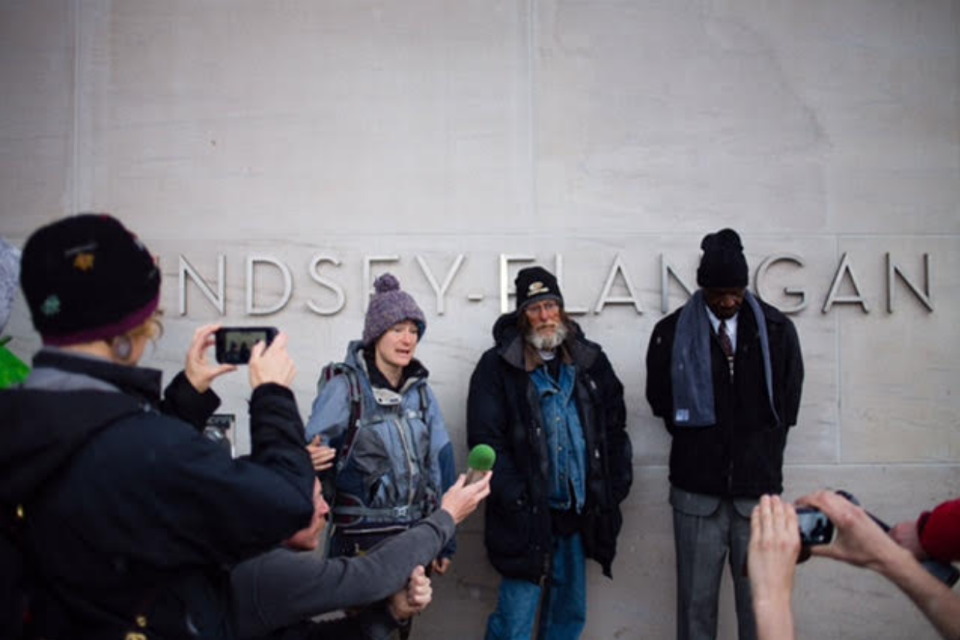
DENVER, COLORADO- Trial began yesterday for three homeless activists charged with violating Denver’s Unauthorized Camping Law. An ordinance enacted in 2012 partly as a coordinated response to Occupy Wall Street encampments across the country, partly to smooth the city’s gentrification plans. Though six years old, the ordinance has escaped judicial scrutiny by DPD’s careful avoidance of citing only homeless victims in no position to fight the charges in court. Deliberate civil disobedience attempts have been thwarted by the city bringing other charges in lieu of the “Urban Camping Ban” for which police threatened arrests. Thus Denver Homeless Out Loud’s coup of at last dragging this sham into the Lindsey Flanigan Courthouse has generated plenty of interest. I counted four print reporters and three municipal court judges in the audience! From a jury pool of forty, city prosecutors were able to reject the many who stated outright they could not condemn the homeless defendants for the mere act of trying to survive. At one point the jury selection process was stymied for an hour trying to fill one remaining alternate seat because each successive candidate would not “check their social values at the door.” One potential juror, a hairdresser, became alarmed that all the sympathetic candidates would be purged and so she refused to say how she felt about the homeless. She was removed and they were. As usual jurors were told it was not their place to decide against enforcing bad law. Only those who agreed were allowed to stay. And of course that’s a lie. The only way bad laws are struck down, besides an act of congress, a please reflect how that near impossibility has spawned its own idiom, is when good jurors search their conscience and stand up for defendants.

For those who might have wanted to get out of jury duty, it was an easy day. Show some humanity, provoke authentic laughter of agreement by declaring “Ain’t no way I’m convicting people for camping.” The jury pool heard that Denver’s definition of camping is “to dwell in place with ANY FORM OF SHELTER” which could be a tent, sleeping bag, blanket, even newspaper.

Several jury candidates stated they had relatives who were homeless. Another suggested it would be an injustice to press charges such as these.

“So this isn’t a case for you” the city lawyer asked.

“This isn’t a case for anyone” the prospective juror exclaimed, to a wave of enthusiam from the jury pool and audience.

Another prospect said she didn’t think this case should be prosecuted. The city attorney then asked, “so you couldn’t be fair?”

“I am being fair” she answered. All of these juror prospects were eliminated.

What remained of the jury pool were citizens who swear to uphold whatever law, however vile. One juror that remained even said she gives the benefit of the doubt to police officers. Not removed.

But there is hope because they couldn’t remove everyone. Of the six that remain, one juror agreed to follow the law, even if it was a law which he knew was wrong. That juror works in the legal cannabis industry. He admits he breaks federal law every day. That law is worng he says, but if he has to, he’ll abide by this one.

He admitted, “I can find them guilty. But I’ll have to live with that guilt for the rest of my life.” Ha. Technically the city had to live with that answer.

Another juror recognized that this case was about more than the three homeless defendants. “This case affects not just these three, but the countless homeless outside” gesturing to the whole of downtown Denver.

4/5 UPDATE:
In closing arguments the city lawyers reminded the jury that they swore to uphold the law. No they didn’t, but we’ll see what verdict emerges. After only a couple minutes from beginning deliberations, a juror emerged with this question: if the defendants are found guilty, can the juror pay their fine?

EPILOG:
Well the City of Denver breathes a sign of relief tonight. By which I mean, Denver’s injustice system, Denver’s cops, Denver’s gentrifiers and ordinary residents who are uncomfortable with sharing their streets with the city’s homeless. Today’s offenders were CONVICTED of violating the ordinance that criminalizes the poor for merely trying to shelter from the elements. Today the police and prosecutors and judge and jury acted as one to deliver a message to Denver homeless: no matter the hour, no matter how cold, pick up your things and move along.

This time it wasn’t a jury of yuppy realtors and business consultants that wiped their feet on homeless defendants. It was a cross section of a jury pool that yesterday looked promising.

Today when the jury entered with their verdict the courtroom audience was able to see which juror had been appointed the jury foreman. The revelation wasn’t comforting. Though not the typically dominating white male, this foreman was a female Air Force officer who had declared during voir dire that she had no greater loyalty than law and order. As the jury pool overflowed that first day with professions of sympathy for the homeless, it was the Air Force office, Juror Number Two, who grabbed the microphone to assert that rule of law must always prevail.

Yes, in the interest of optimism I had glossed over those lesser interesting juror statements, in hope that they were only playing to what prosecutors wanted to hear. Left on the jury was a domineering older woman who had said she gives police officers the benefit of the doubt.

An older man, an organist, whose father had been the CEO of a major Fortune 500 company, actually thought that homeless people should be arrested.

I’ll admit now that everyone’s hopes had been pinned on the pot guy who swore he’d have to live with his guilt forever. And so now it’s come to pass.

When those very small people of the jury go home tonight, and eventually read what they’ve done, upheld Denver’s odious, UN-condemned anti-homeless law, they’re going to figure out that they were made to administer the system’s final blow. And Denver couldn’t have done it without them.

The prosecutor had told the jury in her closing statement, that despite the tragic circumstances, everyone was doing their job, the police, the city attorneys, and the judge, and now the jury was expected to do its job. Except that was another lie. It wasn’t the jury’s “job”. They didn’t enlist and they weren’t paid to be executors of the city’s inhuman injustice machine. Whether by ignorance, poor education, or the courtroom team’s duplicity, this jury chose to do it.

But the ignorance runs deep. Judge Lombardi, in her closing remarks to the defendants, reiterated that all the elements had been proved and that justice was served. She praised the jury’s verdict and explained that the only way they could have found otherwise was through “jury nullification”. She said those words after the jury had been dismissed, but she said them on the record, two words that lawyers and defendants are forbidden to utter. In full Judge Lombardi added “and juries are not allowed to do jury nullification.” As if we all can be misled by that lie.

Colo. Springs police disperse March 26 anti-imperialism rally because it was easier than listening to socialists

Colorado Springs Socialists
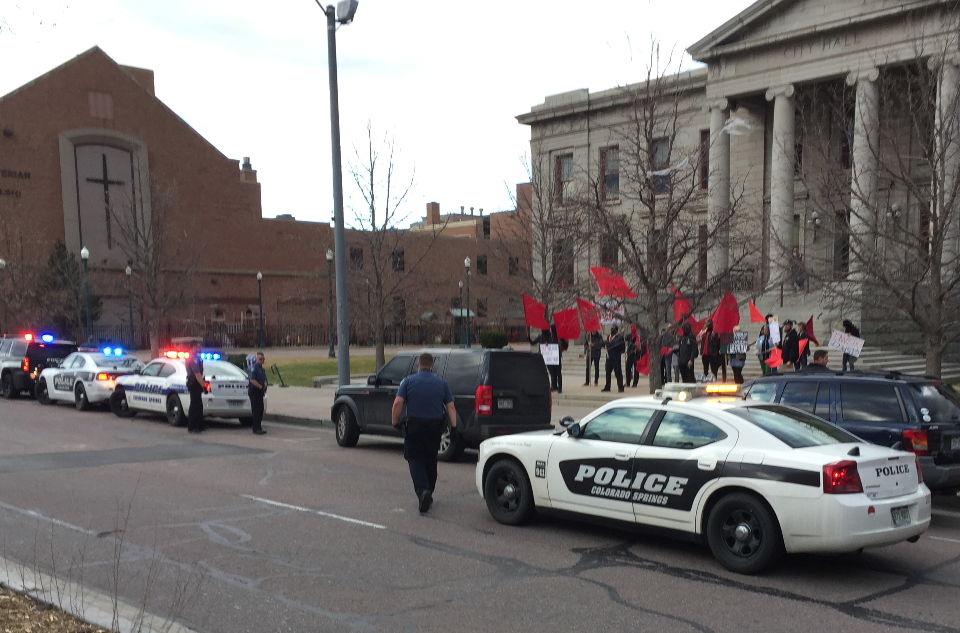
COLORADO SPRINGS, CO- Local socialists assembled at City Hall on Sunday to “March Against Imperialism”. After a brief march and an half-hour rally while encircled by CSPD, the socialists were informed they were “free to carry on with their assembly” but whoever lingered would be issued a citation for having been in the street. Making no distinction for who had and who hadn’t, the police began handcuffing participants and the couple dozen others quickly dispersed. Five socialists were issued citations for “pedestrian in the highway” and “failure to disperse” while another was arrested and detained for failing to show an ID while filming the police. That person was taken to the downtown police station and held until officers finally informed her of the charges for which she was being cited, after which she identified herself. Throughout her detainment, multiple officers kept up a harassment of questions, refusing her requests that she contact her lawyer. CSPD never issued an order to disperse, a fact that is borne out by witness video. But in effect that is what the officers accomplished. They threatened the legal assembly with citations, for failure to disperse!

CSPD cruiser gunboat diplomacy

It made a funny scene. Around thirty self-declared socialists, blockaded by eight sometimes more CSPD cruisers, in a standoff that lasted until the police lost their patience. Socialists spoke against imperialism, the police officers being their main audience that quiet Sunday downtown. Immediately as the march had ended the police had announced that anyone stepping back into the street would be arrested, and so no one did. But a half-hour of speeches proved too much for the officers to bear and so they interjected again, this time to discuss the problem they had with what had happened earlier. We told those officers they were of course free to discuss such matters individually with whoever they considered a person of interest, BUT AFTERWARD, because they were otherwise interrupting our legal assembly. But the officers persisted in their interruption, deciding after the fact what charges to bring, regardless that they’d forgotten to provide the evidence to back them up. “See you in court” they laughed! We’ve heard that before.

On a serious note. What happened Sunday could have a chilling effect on the nascent kick-ass Colorado Springs Socialists. Unwarranted police attention is an unhappy tradition for socialist organizers, from anarchists to trade unions. Sunday’s denouement confirms all their parents’ worst worries, the folly of declaring yourself to be a socialist in a regressive backwater like Colorado Springs. People were arrested? Handcuffed?! Now you’re on a police watch list! I remember my father’s alarm when he learned his college sophmore had a subscription to Mother Jones Magazine.

Fun as it was, Sunday’s event was essentially uneventful: no altercations, no property damage, not even rhetoric to threaten infrastructure. Minus any media attention, or much of an audience at all on a sleepy Sunday evening, these socialists were determined to parade their dissent where and how those around could see, and reaped more law enforcement than the circumstances required.

While you might say the outcome was predictable, it needn’t have been. Students from the wealthier Colorado College have free range on downtown streets, protesting racism or election outcomes on the street without arrests or citations. Every full moon CC students ride the length of downtown’s main street on bike, skate or skateboard, without even police escort. Sunday’s fledgeling socialist organization is a student club of the UCCS campus. UCCS is more working class, for many a commuter campus, and obviously isn’t shown any deference by city administrators.

Compared to the liberal arts curriculum of Colorado College. UCCS is considered more conservative. UCCS hosts business and military related classes. It even has a Brazil-esque Department of Homeland Security -um- Department. So I think it’s all the more admirable that UCCS has spawned a bonafide socialist group that dwarfs even their school’s Young Republican franchise. I’ve no doubt those socialists I met on Sunday will not be cowed by CSPD’s preemptive aggressions. Hopefully their more timid members will take heart.

Public protests are regularly given use of the streets, which like parks are considered traditional free speech zones. The Tea Party and Occupy took to the streets of Colorado Springs without incurring arrests. More recently people have marched for Black Lives Matter and for solidarity with Native Americans fighting oil pipelines. These have produced zero arrests.

In the meantime it will be important to debrief on what happened and unify the legal strategies. All defendants face the traffic offense of being a pedestrian on the highway [sic] and the misdemeanor of failure to disperse, no doubt tacked on to be a droppable charge as fodder for plea bargains. The recalcitrant videographer faces an added charge of misdemeanor interference for failing to produce her ID. They give her no extra credit for providing a pretext for interrogation because she wouldn’t say zilch without a lawyer present, except to explain where and when they were violating her rights. It used to be that cops had to read us our rights.

Police can issue all the tickets they want when there’s probable cause. They can’t threaten to issue tickets for the solitary purpose of disbanding a legal assembly. In the end, the only socialists who got citations were punished not for being in the street but for standing their ground in front of City Hall.

Last cruise of pirate chasers Juergen Kantner and Sabine Merz, a geography

Lapu-Lapu beats Magellan
There’s something fishy about the story of German sailor Juergen Gustav Kantner, whose beheading video was just released by Abu Sayyaf rebels (ASG). Apparently Kantner, 70, had been kidnapped by Somali pirates before this. What are the chances, considering all the gin joints and circumnavigators these days? In a further coincidence, the umpteen sensational articles are all short on details, including the dead woman found on Kantner’s boat, her identity discarded by even the media. Why? Her name was Sabine Isne Merz, 59, sometimes cited as Sabina Wetch. She and husband Kantner were ransomed in Somalia in August 2008 after 52 days in captivity. This time Merz’s body was found aboard the Bermuda-rigged “Rockall”, but a whole Sulu Sea away from where the couple was allegedly captured.

I’d like to lay out the geography of what’s been revealed so far, so emerging facts will more easily shake themselves out online.

According to the ASG, the Germans were seized in November 2016 while sailing on Tanjong Luok Pisuk (spelled Luuk in media reports), an inlet on the Northwest coast of Borneo, in the state of Sabah, Malaysia. Then, halfway down Sabah, Merz was purportedly killed in a shootout with her captors off Tawi-Tawi Isand in the Pangutaran province of Western Mindanao, the Philippines. Her body was found beside a shotgun on the Rockall, abandoned off Laparan Island in Sulu province. Some reports say the sailboat was moored, some say adrift. Though Tawi-Tawi and Sulu belong to the Philippines, they are governed by the Autonomous Region of Muslim Mindanao (ARMM), from which today’s gruesome video is thought to originate.

Juergen Kantner met his end at the edge of a curved blade wielded by Muslim rebels in the Philippines’ long contested province of Mindanao. A nearby indigenous resistance in Cebu, under the leadership of Lapu-Lapu five hundred years ago, stopped explorer Ferdinand Magellan halfway round the circumnavigation for which he’s given credit because on a previous trip he’d come around from the other direction to “discover” the Malay Archipelago. By coincidence, Kanter and Merz almost bridged the gap.

How I nearly got arrested for holding a sign at Denver International Airport


DIA, COLORADO- Last weekend I joined thousands across the country protesting Trump’s executive order restricting entry visas from seven predominantly Muslim countries. Spontaneous demonstrations had erupted at international airports nationwide on Saturday January 27. Denver’s airport was no exception but the lively gathering of sign holders was ultimately persuaded by police to leave the premises. Supposedly a permit was required to hold signs. Demonstrators the next day were quickly ushered outside, to rally instead between the terminal and adjacent lightrail station, where only a tiny fraction of travelers would see them. This much we knew as we monitored events online while we reconnoitered DIA from the short-term parking garage. We made our way swiftly to the International Arrivals doors at the north end of the main terminal WITH OUR SIGNS.

International Arrivals
The point was to reach immigrants, right? We walked to our intended protest spot unhindered and inconspicuous, because of course signs are not an unusual sight at an airport. Travelers who’ve been a long time away, in particular soldiers returning from deployment, are frequently greeted by family members holding signs. Often limo drivers have to page their corporate clients. We carried our placards with their message facing inward hoping they’d be mistaken for everyday signs. When we raised them above our heads we attracted immediate attention. They read “#NO MUSLIM BAN #NO REGISTRY, END WHITE PATRIARCHY” and “FIRST THEY CAME FOR THE MUSLIMS AND WE SAID: NOT TODAY MOTHERFUCKER.” Immediately a man with a “DIA Operations” cap informed us that we weren’t allowed to hold signs. We assured him the opposite was true. He called for backup.

We weren’t alone in front of International Arrivals. In addition to the families awaiting loved ones, there were a couple dozen law firm employees holding signs which read “Pro Bono Immigration Legal Services”. We surmised that their presence might have already been negotiated with DIA. Soon a couple of those lawyers approached us to announce loudly that the public protest was outside the building and that we could continue there unmolested. We thanked them for their assistance but urged that they also clarify publicly that we were within our rights to stay inside as well. I was upset that their gravitas, as lawyers, was seen as supportive of the authorities telling us to stop.

Police officers arrived in short order, a first one filming us with a digital point-and-shoot, then a second filming with a cell phone, both surely streaming to a command center. After six officers assembled, a sergeant approached us flanked by two DIA employees. She gave us our formal warnings. We were given instructions to “cease and desist” while we countered that we knew our rights. After a second warning we were assured that a third would mean our immediate arrest. We held our signs higher, all the while asserting their order was unlawful. The immigration lawyers huddled as far away from us as they could. Sgt. Virginia Quinones then got on her phone to consult somebody.

I recount this scene like it was a nail-biter, but of course we’ve held this standoff many, many times before. For activists with Occupy Denver, it’s become the routine. I was wearing an OD hoodie on this visit to DIA and I suspected whoever was on the line with Sgt Quinones had likely dealt with OD before. To be honest, this standoff too often does lead to arrest, so we were not proceeding without trepidation. Denver jail is an excreble experience. But it’s an unlawful arrest and that’s where we have to push back. As the sergeant kept talking, she and her entourage retreated. We stood our ground smiling and winked to each other. For onlookers however, the tension lingered. Several lawyers approached us to offer their cards, in case of arrest.

Intimidation
Though we were confident about asserting our rights, the six officers standing at the ready made it near impossible to entice other sign holders to join us. Our encourgements would be followed by the DIA operatives offering their advice to the newcomers. Nearly every newcomer opted to go outside. Only after hours of detente, with officers projecting a more relaxed inattentiveness, did we succeed in building a consensus of demonstrators.

In the meantime DIA operatives installed queue barriers to keep us from intermingling with the lawyers and family members waiting for international travelers. This strategy might also have meant to force us into the flow of passengers entering the nearby security check. We stood clear and even as our numbers grew, no obstruction occured.

One interesting fellow, a Mr. Gene Wells, wore a jacket with a message taped on its back. It read:

“D. TRUMP
IS A SMALL MAN
WHO CONTINUES
TO SHRINK
AS A PERSON”

with the letters diminishing in size every line. He was warned by DIA personnel that he could only wear his jacket outside. DIA operatives wouldn’t leave his side as he walked through the terminal, but abandoned their effort to intimidate him as he rejoined us at the arrivals door.

A couple of travelers joined in before they had to catch a flight, they held signs they’d printed that morning at their AirBnB. We were joined by Quakers and even a former Denver Occupier. At most we numbered eight, compared to the hundred outside.

The protest outside
The protest outside was seen only by those travelers arriving or leaving by light-rail. And potentially by only half of those departing DIA through the B and C terminals, whose security check queue necessitated passing the windows facing the south. Perhaps. Most travelers approaching security aren’t lingering to take in the sights. The other half of passengers departing DIA go through the north security check, or over the walkway to Terminal A.

All arriving passengers, on the other hand, enter the main terminal from the north or using the underground train. They pass through the center of the main terminal before exiting at the baggage claims to the east and west. International arrivals enter the terminal from the north and proceed directly to parking or ground transport. If they are met by family they are very UNlikely to be riding the light-rail to downtown Denver.

While the protest outside did garner local television coverage, it was prevented from reaching immigrants or those awaiting arrivals, to convey the solidarity which those who opposed the Muslim Ban wished to express.

Inside our signs prompted a constant stream of public support. Passing travelers gave us thumbs up, high fives and thank yous. Muslims shook our hands and offered their heartfelt thanks. A couple gentlemen made speeches expressing their pubic appreciation of what we and the lawyers were doing.

Permits
The DIA operatives kept explaining that protesters need only apply for permits. The catch was that they required seven days advance notice. And of course activist do not expect permits to be granted.

One of the Quakers who joined us expressed confidence that her group would be granted a permit to protest at DIA. She explained to me that she was personal friends with the new Denver DA.

I told her applying for permits set a bad precedent. Asking for permission implies those rights are not already protected by the First Amendment. Permits also restrict others to the code of conduct agreed by those who signed permit agreements. Often permits are used to exclude public participation on public grounds temporarily reserved for the use of the permit holder.

Worse, the police can intervene when “others” aren’t abiding by the permit agreement, when they aren’t complying with police intrusion, or aren’t acquiescing to the authority of the permit holder.

Never the less, this Quaker wanted to inform me that as the anticipated holder of the permit at DIA, she wished to invite me to participate with her group. However, she anticipated that her church colleagues would be made most uncomfortable by my sign (which ended with the word “motherfucker”). So if I did choose to join, she was expressing her preference that I not bring my sign.

I am being prevented from defending myself in Denver Municipal Court

What I filed today in Denver Municipal Court, as my jury trial is about to begin…

DEFENDANT’S ASSERTIONS, NOTICES, OBJECTIONS AND SUPPLEMENTAL RECORD
The Defendant, Eric Patrick Brandt – sui juris and pro se, having been ordered silenced by the judge from making any record of objections, arguments, or any other statement in retaliation for challenging the validity of the judges authority and needing to ensure sufficient record of defendant’s concerns and objections, do hereby enter into the record numerous documents anticipated will be essential should he need to appeal a conviction following trial.

Broadly, the Defendant broadly alleges the judicial bias is so intense that a fair trial is not just unlikely but in fact unintended. He has been treated to conditions and rulings uniquely applied where quick and inexpensive convictions with immediate long jail sentencing is the justice the City desires above the Defendant’s rights.

Besides vindictive actions of police, prosecution and the judge, the Defendant continues to suffer from counsel that is unresponsive, unzealous, and ineffective. The entire situation is a stream of apathy, incompetence, corruption and conspiracy bearing no resemblance to the liberty and justice of a free people protected by constitution.

This is, sadly, a concerted effort to silence a prominent, harsh, and very tenacious critic of government abuses against the people. The Defendant objects to the entire proceedings of the cases listed above and preserves for appellate review any issue, currently known or unknown, which might exist or be thought to exist whether raised specifically during the proceedings or not. The Defendant expressly preserves for appellate review the issues raised in this supplemental record.

[The 2015 Protest]
This case is one of about a dozen cases brought against this defendant and others stemming from a group of activists two-month long non-stop 24/7 protest against police brutality, unjust prosecutions and ordinances and practices abusive to the homeless as well as advocating for jury nullification and human rights. This action was in direct response to the felony arrests of the defendant and one Mark Iannicelli alleging the distribution of jury nullification literature constituted jury tampering which resulted in a federal civil rights lawsuit and the issuance by the federal court of an injunction barring Denver Police from arresting those who would share jury nullification messages and a finding that the courthouse plaza was a traditional free speech zone 24/7.

Denver Police responded in massive forces immediately within hours the first day activists returned to the plaza confiscating materials and property and issuing arrests for practically anything BUT jury nullification.

During the next 56 days, the City evolved ever novel tactics clearly attempting to drive the activists away from the courthouse. Responses with militarized riot police numbering sometimes near 100 regularly stormed the group any hour of the day or night.

[Arrests]
There were arrests for Obstructing Public Passageways for the existence of small tents, carts, and various other personal property and property was booked into evidence, taken for storage, or immediately discarded as trash almost every day.

DPD conspired with the City Attorney’s office and Public Works, at a minimum, first attempting to criminalize activists having any property, claiming obstruction of a public passage. Immediately the police misapplied codes regarding ENCUMBRANCES and issued almost daily unlawful orders, making arrests for failure to obey those unlawful orders. Specifically, the City asserted a criminal consequence under color of a complex civil question expressly under the authority of Public Works; Denver Police in fact have no authority regarding encumbrances.

The City Attorney’s office ordered signs be erected asserting 49-246 D.R.M.C. criminally applied to any thing what so ever on the plaza. This unlawfully legislated policy by the judicial and executive bodies defied the separation of powers and the activists defied their unlawful policy despite repeated arrests for nearly 30 days.

Then the City Attorney’s Office called Public Works and ordered 36 signs to be erected at various city building plazas instituting an overnight curfew subject to arrest for trespassing which was successful, immediately forcing the activists to move across the street at night instantly quashing the effectiveness of the activists speech to almost nothing; the group could not recover from this curfew action and dwindled over three weeks until the Police delivered a fatal blow confiscating everything the activists owned during a cold rain storm.

Again circumventing the safeguards of the separation of powers, the very entities being most directly impacted by the activists message – the city attorneys for unjust prosecutions and jury nullification and the police for abuses, beatings, killings, and other misconduct – took deliberate actions and conspired to establish a city-wide curfew policy without the approval of the legislative body, lacking any significant and legitimate government interest, and in direct retaliation for protected speech with the intent and indeed result of silencing that voice.

[The Prosecutions]
In excess of 20 criminal prosecutions followed in the wake of that intense 56 days. The vast majority of defendants either prevailed, appealed, or received sentences much lighter than prosecution desired. This defendant was subjected to the most cases filed and prosecutors were not achieving their goals with him either.

Furthermore, defendants enjoyed large numbers of activists showing court support which effectively brought anti-police and anti-prosecution messages directly into the courthouse. Discovery issues, overloaded ADC, witness issues, and unexpected family death with ADC lead to the Defendant’s cases being repeatedly continued out for over a year.

During this time the Defendant aggressively investigated the conspiracy between the various departments and the unlawful institution of the encumbrance and curfew policies. The City was tight-lipped about the subjects and concrete evidence eluded discovery. Scant pieces of evidence painted a circumstantial picture but the evidence was insufficient to compel the Courts to grant subpoenas or permit use at trial to show motive and attack credibility. Despite nexus of this concerted plan through almost every case, each case was handled as it’s own unique package.

[A Special Judge]
Ultimately this defendant was assigned a hand-picked judge – Frederick Rodgers – and assigned entirely to his own courtroom – the unused 4B. The details of the assignment are unclear except that it appears Judge Teresa Spahn likely requested the special treatment, and Rodgers has made comments on the record indicating he was assigned to move the defendant’s cases along and that it was desired to get these cases out of the general sessions dockets. The Defendant alleges this was a deliberate act to further isolate the activists from the people in the general sessions corridor and to a courtroom that was essentially vacant.

Rodgers issued a very bizarre order concerning conduct on August 24th, 2016 which was unknown to the Defendant until the night before his September 7th trial setting. Attached with this filing – because oddly enough the clerks cannot find the order filed in any of the defendant’s case files but furnished a copy from an email they found – the strange order, which published the Defendant’s other acts as well as his associates acts along with a claim these associates create serious disruptions, was published loud and clear to the prospective jurors waiting to enter the courtroom and to the actual jurors during breaks.

It is undoubtedly this 3-page document directed against alleged disruptions coupled with the constant presence of up to a dozen armed sheriff’s deputies throughout the proceedings that caused the jurors in that trial to ask the court to assign extra law enforcement to escort them to their vehicles. It was this first Rodgers trial where the Defense council withdrew for ineffectiveness after being unable to meet with the Defendant on the case or go over discovery, then the Defendant was denied new council, forced to proceed pro se, denied discovery, and even denied the right to subpoena witnesses essential to his defense. Withdrawn Council was ordered under his express objections to remain as assistance of council – a claim the judge denied in another strange order entered after the trial.

The Court then denied the entry of evidence clearly defining the terms ENCUMBRANCE and OBSTRUCTION which was essential to the police were unlawfully applying a criminal penalty to a civil code.

The inevitable conclusion of course was a conviction rendered by six terrified jurors followed by immediate sentencing and remand to custody. The remand was thwarted when a very clearly irritated judge was forced to research and agree with the Defendant that a stay of execution was MANDATORY under Rule 37f and a very clearly irritated judge.

[The Missing Oath]
From the very beginning, the Defendant objected to Rodger’s authority and has repeatedly challenged his jurisdiction and demanded a showing in the record he was lawfully empowered to preside over his cases. The defendant was already aware of issues Rodgers had with his qualification. Rodgers was already on a watch list of bad judges. As such, the Defendant had already attempted to obtain a copy of his Oath of Office from the Clerk and Recorder’s office.

Constitution, statute and code obligate a Denver Municipal Court Judge SUBSCRIBE AND FILE WITH THE CLERK AND RECORDER’S OFFICE AN OATH OF OFFICE BEFORE ACTING AS A JUDGE. The consequences for neglecting to accomplish this requirement is that the person has no authority, their office is IPSO FACTO VACANT and all findings, Judgments, orders etc are NULL AND VOID.

Frederick Barker Rodgers did not file an oath of office as required and there have been numerous attempts by the defendant and others in the past year to obtain it. The De Jure Peoples Grand Jury indicted Rodgers for oath problems while he was in Gilpin County and complete copies of that indictment were entered into the record on all three of my then pending cases. I advised Rodgers in court to put his house in order before peering into mine.

I then demanded records showing his appointment as a retired judge. The presiding judge’s clerk responded with a letter stating there are no such records and she offered a copy of his oath of office – signatures redacted for privacy. That oath of office was dated July 27, 2011! I demanded a non-redacted oath and demanded it to be the one filed with the clerk and recorder’s office as required by law. She responded with a redacted signature copy of a copy copy showing a received stamp dated 2015DEC02!

In court next, Rodgers proudly displayed that original oath of office in a gold frame on the bench. It bears no received stamp. At the same time Stephen Nalty obtained a certified copy of the oath from the clerk and recorders office. This time the oath existed where it had not several times before. This oath copy was not redacted and most disturbingly did not bear the received stamp which was passed off to me on the copy claimed to have been filed. Clearly hanky panky is going on.

To date the City has failed to show Rodgers has any lawful appointment. He is 76 years old, has no contract, has no valid oath of office, has no official bond, and he was assigned to my cases “to move things along” which I allege means get me convicted and in jail.

OBJECTION TO ORDER OF SILENCE
After filing his indictment into the record, Rodgers issued an order of silence and removed me to a secret room when I objected. This is in retaliation for the indictment and oath demand as I have never created a disruption before in his court. He also beefed up security and has me under armed guard of 4 to 6 deputies all the time. I object to not being allowed to address the court and I object to being treated like a criminal under guard.

NOTICE OF INEFFECTIVE LEGAL COUNCIL
My attorney has had a constant history of not responding to me and not doing the research I require in my case. The email record is repeat with my objections to her lack of commitment to my cases.

OBJECTION TO UNIQUE / UNEQUAL ENVIRONMENT
I was removed from the 3rd floor and given my own special courtroom with my own special (imposter) judge because Judge Theresa Spahn was mad at me for my free speech critical of her performance WHILE OUTSIDE ANY CASES SHE WAS CONDUCTING. She was mad because our group is helpful to other defendants and our assistance to them has resulted in them achieving success in their cases. The city is upset they are losing our cases left and right and they want to separate us from the masses and get us convicted. Ho better than Rodgers – who doesn’t let good law and reason stand in the way of lousy rulings and judgments.

NOTICE OF PRESERVATION OF APPEAL ISSUES
Because I have been silenced and my lawyer is ineffective I hereby reserve the right to raise ANY issue on appeal regardless of it having been preserved on the record.

OBJECTION TO DENIAL OF NEW EVIDENCE
There is new evidence revealed which demonstrates without a doubt there was conspiracy to silence our protest through the misapplication of a civil code. That evidence is being denied despite clearly speaking to prosecutorial motives and credibility of officer’s statements.

CHALLENGE TO ORDINANCE CONSTITUTIONALITY
My lawyer failed to challenge the pedestrian in a roadway ordinance as overbroad as I demanded. I object and preserve for appeal.

ASSERTION CONDUCT PROTECTED FIRST AMENDMENT EXPRESSION
My lawyer failed to file a motion to dismiss as protected expression my actions leading to these charges. I object and preserve for appeal.

CHALLENGE TO JUDICIAL AUTHORITY OF FREDERICK BARKER RODGERS
Rodgers has REFUSED to enter into the record any authority he has to preside over my cases. He is essentially an unauthorized permanent judge with no contract, a 6-year old expired oath of office (which was never properly filed anyway) who is apparently exempt from the 72 year mandatory retirement age and exempt from the people having opportunity to vote him out of office. He has absolutely no authority and apparently perfect immunity to do what ever the city wants him to do. I REJECT FREDERICK RODGERS AND EVERY THIING HE HAS DONE OR WILL DO IS NULL AND VOID. HE IS OPERATING IN AN IPSO FACTO VACANT OFFICE. I OBJECT AND PRESERVE FOR APPEAL.

DIY legal strategies for defendants to give their lawyers a running start

If you’ve been arrested at a protest action you’ve got more legal options than paying the fine or taking a plea deal. Whether or not your act was constitutionally protected, or should be, or whether it was civil disobedience and was meant not to be, there are a couple good reasons to fight your charges in court. First, to draw further attention to your issue, and second, to give your prosecutors more incentive to offer a better plea deal. They might even drop your charges altogether.

Let’s assume you have the time to attend multiple court dates and that your low income means you qualify for a public defender.

Don’t have the time?
If you don’t have the time, make it. Every court appearance is a chance for a press release. Example: City Prosecutes Activists Instead of Indicting Killer Cops. Not only are you forfeiting the opportunity for more publicity, you are resigning yourself to a stiffer plea offer. Probation, or deferred judgement, or deferred prosecution for a probationary period, will take a larger chunk of your time from activism than a few court dates.

If you are eventually planing to hire a private lawyer, the same initial strategy applies. Your inconvenience is nothing compared to the wrench you’re throwing into the city’s injustice machine, by merely fighting your case.

Let’s assume also that you have bonded out of jail. Your first court appearance will be a BOND RETURN DATE. If you did not bond out and remain in custody, your first court appearance will usually be the morning after your booking and will be called an ARRAIGNMENT. Both are supervised by a magistrate before whom you will be expected to plead guilty or not guilty.

You are going to do neither.

That said, if you are still in custody, your first objective would be to hasten your release, hopefully on a PR bond. In such case, the following steps need not be uncompromising.

City Attorneys
If your event is a bond return date, you will first be called out of the courtroom by a city attorney to discuss a plea deal. Here’s where most people think they can candidly argue their case in hope that the prosecutors will decide to drop the charges. Those defendants are only giving the city more cards to deal against them. Your first move will be to DECLINE TO SPEAK TO CITY ATTORNEYS. You can ask what deal they are offering, but you say nothing about your case and admit to nothing. You are better off not even sitting down. Tell them from the hall that you have nothing to discuss, have them please bring your case before the magistrate.

The Magistrate
When the magistrate calls you up, tell him or her that you DO NOT CONSENT TO A MAGISTRATE adjudicating your case, you want the judge to which you are entitled. The magistrate will have to reschedule your court date before a judge, in the division to which your case was assigned. This might be one or two weeks later.

Bond Return Date, Round Two
Your second date, this time titled an “Arraignment” will be another chance for the city attorneys to pretend they have a right to interview you. Again you brush them off. When you’re finally called before the judge, he or she will ask you what you plead. Say that you CANNOT PLEAD BEFORE CONSULTING AN ATTORNEY. Asked if you have an attorney, say no, you require a public defender.

The judge will tell you a public defender will only be assigned after you’ve entered a not-guilty plea. Stand your ground, ask how are you supposed to make a legal decision without the advice of the public defender? The judge will decide to enter a not-guilty plea on your behalf, to which you will OBJECT.

A plea made over your objection will be a potential element of a future appeal. Likewise was the attempt by city attorneys to pretend they had authority to discuss your case without your having an attorney present. These will be two factors that will give you leverage in negotiating a better plea offer.

The judge will ask if you want a jury trial, to which you will answer YES. You’ll be assigned a pretrial conference date, or reset date, and a trial date. Your next task will be to apply for a public defender.

Representation
If you make too much money to qualify for a public defender, you might want to hire a lawyer, or find one who is sympathetic to your cause who can represent you Pro Bono. If you are smart enough on your feet, you can represent yourself PRO SE.

One possible advantage to proceeding Pro Se is that the city might eventually drop the charges, calculating that if you couldn’t find an attorney to defend your criminal case, you are unlikely to find one to bring a civil suit against the city for false arrest. They risk little to drop your case instead of spending an awkward day in court trouncing a DIY defendant in front of a sympathetic jury of his peers.

If your application for a public defender is accepted, they’ll also waive the $25 jury fee. If you can’t apply for the public defender within 30 days of your forced not-guilty plea, you should file the jury trial request yourself and pay for it.

No not under any circumstance elect a trial by judge. Denfense lawyers call that a “slow motion guilty plea.” You’ll soon learn that judges work for the same side as the prosecutors. So do the public defenders, but they can serve your purpose for the time being.

In a future article I’ll discuss what to do with public defenders.

The Hillary Clinton War Machine banner seen by everyone at 2016 DNC but you.


PHILADELPHIA, PA- The second day of protest of the 2016 DNC was expected to dwarf Sunday’s impressive turnout, so we hit the Monday rally determined to repeat our photo-op coup of the day before. This time our banner read “HILLARY CLINTON IS THE CANDIDATE OF THE WAR MACHINE” which we knew would ruffle more feathers. We wore costumes, me as American Cowboy Capitalist, my teammate as war victim, in a black burqa, Muslims being both targets and scapegoats of the US War on Islam. Shutters clicked wherever we went, whether our banner was unfurled or not. Professional photographers recorded our names and fellow activists gave us thumbs up and maneuvered to record us on their phones. Some posed beside us, asking companions or strangers to take their selfies. We gave interviews to Time Magazine, the New Yorker, several newspapers, and multiple foreign news outlets. We spoke about the undemocratic character of our party conventions and about Hillary being the establishment warmonger. Having drenched our clothes in Philly’s 95 degree weather, we consoled ourselves that we had absolutely nailed the message.

We’d learned the day before that getting a visual out before a march began was the most fruitful in reaching the media audience. Unless you’re storming the Bastille, protest visuals are not for drawing people to the street. Visual messaging is for the benefit of local television viewers first, who can rush to join in, and news readers second, to give substance to the coverage.

At first we found scant footage of our banner in the Sunday march, but our early morning bannering, meant be a beacon toward which people could gather, garnered a headline photo by the AP. That picture ran on AP articles across the globe, and dominatd images of “DNC protests” before the convention had even begun.

We knew that press coverage would be best before the convention got started, when protests wouldn’t compete with the choreographed performances inside. But we were confident that the first day’s march, as the biggest and most anticipated, would float our antiwar message to the top. Our war-machine slogan appealed to Bernie supporters, to the Greens, and to the antiwar groups.

We went out early and wherever we went we drew thumbs up, applause, fingers pointed our way, cellphones and cameras. Organizers of a Bernie-delegates press conference asked us to be their backdrop. So imagine our surprise when the day’s news images did not include our banner!

Instead media photo editors chose images of Bernie Sanders supporters despondent about his betrayal. In reality, most protesters on Monday were not apprised of Bernie’s formal capitulation. Protesters were upbeat and enthousiastic. The thousands of Berners who marched that day were exuberant about the prospects of their delegates prevailing in the convention. Press photogs must have known something about what their editors wanted, or the heat and exhaustion produced the compositions they needed. News stories of Monday’s start of the DNC ran with images of solitary protesters, looking isolated and resigned.

For our part, we’re certain the photos of our banner will resurface from the files when Hillary’s presidency is in the bag and the war machine is no longer an embargoed issue.

Erdogan fakes coup in Turkey, purges army and supreme court, shuts down US air base to force extradition of rival


The military coup in Istanbul was not what the Turkish President’s tightly reined media, nor the West’s fascist controlled media, say it was. It was not a coup, it was a Reichtag Fire. Now Recep Erdogan is rounding up the “plotters”, most of them supreme court judges, who were the last checks and balances on his authoritarian ambitions. We’re supposed to believe jurists plotted with foot soldiers? Imagine you get a ransom note from kidnappers, but the person they say they’ve kidnapped is on Facetime with CNN assuring you he’s free! Imagine you’re the kidnapper and you see that! But you’re only a soldier, doing your compulsory military service, following orders to prevent rioters from storming a bridge, and you’re not watching television as your president calls citizens to take to the streets and attack the disloyal “rebels.” Meanwhile the officers ordered to give you the orders hop a helicopter to Greece because they know they are going to be the scapegoats. And get this: jet pilots who precision bomb Kurds and ISIS for lunch, can only lob lunchbox bombs upon the parliament and sundry official buildings. Now US pundits, speaking as former CIA officers, resting their laurels on having been advisors to countless military coups, are claiming the coup was “bungled”. Yeah? Do you think Turkish soldiers don’t know their capitol is in Ankara, not Istanbul? Former CIA director James Woolsey is among the pundits. Woolsey, we learn, has been in Turkey for the last six months. What is HE doing in Turkey? Now Erdogan has closed US use of Incirlik Air Base and he’s asking President Obama to extradite Fethullah Gülen, the Turkish expat whose is seen as Erdogan’s main political rival.

The History of Violent Protest in Colorado Springs, in a Nutshell.

JesusGET THIS. I heard a reverend-person yesterday lecturing newish activists about their need for nonviolence training, which she was volunteering to lead. She was also offering rubber wristbands for her graduates to wear at demonstrations, so that police could differentiate between protesters. She told us she’d ask officers to scrutinize those not wearing bands as being the potential troublemakers. This, she assured everyone, would make it more difficult for outside groups to waylay the action. I kid you not. And she’s a church leader praised locally as something of an activist! HA! That’s a RAT!

I recognized the Springs “outsider” buggaboo so I thought I’d relate where it came from in a little piece I’ll call The History of Violent Protest in Colorado Springs. Ready? It won’t take long.

So what violence have I seen in my fairly full-time participation over a dozen years, multiple wars and as many elections? ZERO. That’s right. I’ve seen a lot of brutal handling by police, but by the hands of protesters? Nothing.

Yep. The History of Violent Protest in Colorado Springs. The End.

For as much as local church leaders harp on nonviolence training, which includes, by the way, nonviolence bounderies that forbid even confrontational speech, you’d think they’d seen a need for it. They haven’t. For EVERY preacher and or disciple regurgitating nonviolence edicts, I’ve never seen ONE counterpart advocate for, nor commit, violence. It’s almost a laugh, if the practice wasn’t so damaging to public demonstrations. Colorado Springs street protests have been defanged to nothing, police needn’t bother to show up and they don’t. As a result, neither do protesters.

And it isn’t just that nonviolence dogma declaws the public beast. Religifying activism alienates intellectuals and atheists who woud prefer not to suffer the foolish god-justified claptrap. Monotheism is the engine which has always perpetuated privilege, enslavement, colonization and capitalism. Wtf.

Not satisfied to deputize citizens with the equivalent of TSA pre-boarding approval, clergy want to deprive their charges of the element of surprise. The Springs antiwar community keeps direct contact with law enforcement. I’m guessing protestations, if any, are now simply phoned in.

I JUST WANT TO PUNCH these nonviolence religion freaks for mutilating the impetus of budding activists. A newcomer’s anger is what drew them to protest in the first place. Of course as ministers that is their function. Social injustice is job security to church employees. They are about as likely to remedy inequity as the Pope. Sermons aim to temper their sheep’s natural anger at injustice. But enough about those assholes.

No matter the issue, antiwar, the environment, racism, homelessness, in Colorado Springs I’ve seen absolutely no public demonstration escalate to violence. Why then the ready queue of spiritual nuts so eager to innoculate every next wave of concerned citizen before they can even take to the street? It goes back to something that happened at an antiwar demonstration in 2003, although the lesson being drawn is not based on what really happened. That’s the bugaboo.

Palmer Park, 2003
In 2003 George W. Bush was about to initiate an illegal war against Iraq and public demonstrations were coordinated across the globe. In Colorado Springs nearly 2,000 people assembled in Palmer Park along Academy Boulevard. The Springs rally looked to eclipse the antiwar events planned in Denver, so some people came from Denver, or so it’s believed. In reality, the Springs antiwar community had an average age of 75 and hadn’t seen new faces for decades. The sight of younger participants led many to believe they were from elsewhere. Plus some of the younger protesters wore black, so word spread they were Anarchists. Scary.

For the usual reasons, the CSPD decided to close Academy Boulevard. When rally-goers realized their protest wasn’t being seen because motorists were no longer driving by, some decided to lead the crowds southward toward an intersection where traffic was still passing. Being that Academy Boulevard was cleared of cars, the most obvious route was on the street. There was no sidewalk and the park was congested with the parked cars of the attendees. No matter. The police formed a line and ordered the marchers back.

The police began to spray tear gas as the protesters retreated. Clouds of gas enveloped the crowds as they dispersed and struggled to get in their cars. The cars were gased with families and small children inside them, unable to drive away.

Across the globe that day, only two cities used tear gas against their antiwar protests: Athens and Colorado Springs. That’s how old timers like to tell the story. They’ll add that the police crackdown was prompted by unruly outsiders being violent with police. By which they mean, refusing to get off the street. Being assertive of one’s rights somehow became translated to mean impermissively violent.

Had these Emily Posts ever seen the footage of Selma?! These nonviolence sticklers are MLK idolators, yet just like Selma’s whites, they blame the victim.


Palmer Park, 2003

Protests in Colorado Springs immediately diminished in popularity and never again drew large numbers. Apparently when organizers called their members the apprehension was always “will it be safe?”

And so from that day, nuns and other clergy met regularly with Colorado Springs police to talk to them about protest plans, lest CSPD be surprised and overreact. That hasn’t stopped police from dragging us across streets or assaulting us in parking lots or on sidewalks. Oh to have merited it even once!

NOTE: I have omitted a couple of insider details about the 2003 rally because I wanted to relate the experience of the average participant. Yes, the event was advertized statewide and drew opponents of Bush’s war from along the Front Range. And yes, there was a strategy among frontline protesters to try to block an intersection. Most attendees didn’t know either of these facts. The local peace community was so insular that all new faces were looked upon as interlopers. But my point remains, there was no violence. Our freedom to assemble, wherever two thousand people need to go, is not abriged by congress nor by traffic laws. Rebuffing law enforcement’s attempt to disrespect civil liberties by standing, walking, sitting, or shouting, is not violence.

St Patricks Day, 2007

Nonviolently submitting to state violence is supposed to move onlookers to empathy. In 2007, was the Colorado Springs public moved by the police brutalization of nonviolent 70-yr-old Elizabeth Fineron, who later died of complications of her injuries? No, they cheered the police.

Sacrificing yourself may work in democracies with an empowered populace, but against fascism, as against the Mongols or Manifest Destiny, it’s abrogation of responsibility and suicide.

Nonviolence
Incorporating the dogma of “nonviolence” into what would otherwise be straightforward protest becomes problematic when nonviolence folks want to differentiate themselves. Those who are “othered” are then presumed to be planning violence. That’s a very serious charge. Inciting a riot is a crime. Plotting to overthrow a democracy is sedition.

Non-nonviolence does not equal intending-violence. For example, I do not advocate violence, I advocate solidarity.

I do not oppose people asking for NV training, or undertaking it, though I would prefer that nonviolence wasn’t marketed to newcomers who wouldn’t have thought to have needed it.

Why should “nonviolence” even have to come up, for example, at a discussion about a SIT-IN? Agreeing to sit is already a gesture which has capitulated the option to resist. A crowd can’t charge from the seated position. You can’t even defend yourself. The nonviolence is inherent.

Religious NV training is really about nonviolent communication, a whole other can of rotten worms. There is no evidence that Gandhi, MLK or the Flint factory sit-ins practiced that aberration.

If the challenge is to show public opposition to the sit-lie ordinance because it further oppresses the homeless, public energies need not be exhausted by habitually passive religious leaders and their idea of what direct action needs to be.

Yes, the anticipation of the supremacy of nonviolence over state violence is a religious expectation. Against fascism you’re asking for a miracle.

If preachers were activists they would lead their flocks into the street. Circulating among activists, those church leaders are opportunistic missionaries, looking for recruits among the disenchanted.

To be earnestly inclusive of faiths and non-faiths, leave you diety at home. Show respect for the “others” who don’t need the voodoo rationalizations you require to muster moral courage.

Denver pro-war rally gets Code Pinked!


DENVER, COLORADO- The No-Peace-For-Iran rally hosted by Zionist front group Americans Against Terrorism (AAT) on the capitol steps on Sunday was outnumbered by pro-Palestinian activists shouting from below. While one racist warmonger told the crowd “pay no attention to the kebabs on the sidewalk”, a Code Pink activist was able to hold up a banner right in front of the podium.

Her banner read: “STOP THE NEXT WAR NOW! WARMONGERS BEGET TERRORISTS!” but it took the audience a minute to register that her message clashed with theirs. Then she was grabbed and pulled forcibly away.

The AAT rally was much smaller than the year previous. Enthusiasm for Christian Zionist end-time-ism, Islamophobia, anti-Iran sentiment, and Standing-with-Israel, appears to be expiring.

Another measure of the success of the counterprotest was AAT deciding to take down a large Israeli flag which they’d draped on the capitol as a backdrop when antiwar activists arrived with a similarly blue-striped banner reading “Israel is a terrorist state”. Along with Code Pink and Occupy Denver, counterprotest included many Jewish peace activists, even a couple who were Israeli.

David Anderson, who took the photograph above and who insisted the pro-war goons unhand their unwelcome guest, described the scene thus:

It should be noted that when Republicans and Israel call their group “Americans Against Terrorism”. They mean the opposite, They want to bomb and terrorize Iran just as they have done in Palestine for years. This is a tired old trick that the citizens are catching on to.

The AAT would not exist, were it not for the funds from Israel. Another smoke screen by Israel is to call their group “Americans”. This is called; whip your friends into a frenzy, then get them to fight your battle for you.

And there you have the reason this one small woman with a message of truth strikes fear into the hearts of liars and hypocrites.

Videos of police behavior will only change things if the public sees them

 
Many people who watch the Sandusky traffic stop video will claim it’s only an isolated incident and is not representative of their local law enforcement. They are very naive and believe the propaganda their police departments have subjected them to for years. Incidents like the one in this video are happening all across America, thousands of times daily. It has been with the growing popularity of the cell phone camera that the citizen are beginning to see  and be exposed to the true conditions of their local law enforcement. These conditions are very similar to that of the Gestapo in Germany prior to the second world war. 

I personally, and a group here in Denver, have witness hundreds of theses very same incidents in actions with the Denver Police Department. There is a growing number of citizen calling for all police to be equipped with body cameras. To put it simply; the camera needs to be in the hands of the citizens, not the police.

If you go back and watch the video again and still believe those cops would allow that video to see the light of day, then you are living in an “Alice in Wonderland” world. That is akin to believing that a bank robber would turn over to the prosecutor a video of his crime.

I will cite only two of many incidents here in Denver of the police crimes; One  Caryn Sodaro was arrested in April for filming Denver police officers physically tormenting a citizen. She is now set for trial in late July, her only crime was in filming the police criminal behavior. Two, Jessica Hernandez, a 17 year old young woman was murdered by the Denver Police Department.

The crime of murder by the Denver Police was captured on video by a citizen, to this day the video has remained hidden by the police and the main stream media. Denver DA Mitch Morissey recently gave the Denver police a big thumbs up for their crime.

Below the Free Thought Project Video, I read the comments, there was a great deal of anger and frustration with the crimes the police are committing under the banner of “Protect and Serve”.

I understand that anger, but anger alone will not solve the problem. We must turn that anger into action.

Seek out local groups who are in the streets taking action, contact local media by phone, email, put pressure on local judges who are allowing this practice of “Protecting The Police”. Continue to make comments, but couple your comments with action. To do anything less would be un-American. You can make a difference, believe in your power as an individual and change will follow.

Osama bin Laden’s books. They could do you more good than they did him.

Last week the CIA decided
Crossing the Rubicon, The New Pearl Harbor, Imperial Hubris, Obama's Wars, The Best Democracy Money Can Buy... to declassify the list of books found in Osama bin Laden’s last hideout when Seal Team Six made their raid. There were 39 titles, which the press has categorized as heavy on conspiracy theory. That’s true, untrue, and unsurprising if you consider the official White House line is that the US does not support illegal coups. These authors beg to differ, including the unimpeachable Noam Chomski. Other investigative standouts include William Blum, Greg Palast, John Perkins. The list did not include publication dates or editions, just author and title. A closer inspection of the list is revealing.
 
(This is part one of a continuing series.)

It would be more accurate to describe Osama bin Laden’s bookshelf as history, mostly contemporary with notable exceptions. For example, bin Laden’s reference on Christianity and Islam in Spain 756-1031 was published in 1889 with the full title “The Relations and Mutual Influences of Christianity and Mohammedanism During the Khalifate of Cordova.” In 1889 European perspectives on the Moorish occupation appear dramatically antisemitic.

The history of The US and Vietnam 1787-1941 begins with Thomas Jefferson’s first interests in trading for rice with “Cochinchina”. Written by a former ambassador, it was published in 1990 by the National Defense University Press. The Best Enemy Money Can Buy is about the symbiotic relationship between the US military industrial complex and Russia’s.

Some of bin Laden’s “books” such as Michael O’Hanlon’s Unfinished Business were staple-bound publications from US policy think tanks. I’ll review those and the various intelligence agency exposés in subsequent posts.

Here are the 39 titles listed alphabetically:
The 2030 Spike by Colin Mason; A Brief Guide to Understanding Islam by I. A. Ibrahim; America’s Strategic Blunders by Willard Matthias; America’s ‘War on Terrorism’ by Michel Chossudovsky; Al-Qaeda’s Online Media Strategies: From Abu Reuter to Irhabi 007 by Hanna Rogan; The Best Democracy Money Can Buy by Greg Palast; The Best Enemy Money Can Buy by Anthony Sutton; Black Box Voting: Ballot Tampering in the 21st Century by Bev Harris; Bloodlines of the Illuminati by Fritz Springmeier; Bounding the Global War on Terror by Jeffrey Record; Checking Iran’s Nuclear Ambitions by Henry Sokolski and Patrick Clawson; Christianity and Islam in Spain 756-1031 A.D. by C. R. Haines; Civil Democratic Islam: Partners, Resources, and Strategies by Cheryl Benard; Confessions of an Economic Hit Man by John Perkins; Conspirators’ Hierarchy: The Committee of 300 by John Coleman; Crossing the Rubicon by Michael Ruppert; Fortifying Pakistan: The Role of U.S. Internal Security Assistance (only the book’s introduction) by C. Christine Fair and Peter Chalk; Guerrilla Air Defense: Antiaircraft Weapons and Techniques for Guerrilla Forces by James Crabtree; Handbook of International Law by Anthony Aust; Hegemony or Survival: America’s Quest for Global Dominance by Noam Chomsky; Imperial Hubris by Michael Scheuer; In Pursuit of Allah’s Pleasure by Asim Abdul Maajid, Esaam-ud-Deen and Dr. Naahah Ibrahim; International Relations Theory and the Asia-Pacific by John Ikenberry and Michael Mastandano; Killing Hope: U.S. Military and CIA Interventions since World War II by William Blum; Military Intelligence Blunders by John Hughes-Wilson; Project MKULTRA, the CIA’s program of research in behavioral modification. Joint hearing before the Select Committee on Intelligence and the Subcommittee on Health and Scientific Research of the Committee on Human Resources, United States Senate, Ninety-fifth Congress, first session, August 3, 1977. United States Congress Senate Select Committee on Intelligence; Necessary Illusions: Thought Control in Democratic Societies by Noam Chomsky; New Pearl Harbor: Disturbing Questions about the Bush Administration and 9/11 by David Ray Griffin; New Political Religions, or Analysis of Modern Terrorism by Barry Cooper; Obama’s Wars by Bob Woodward; Oxford History of Modern War by Charles Townsend; The Rise and Fall of the Great Powers by Paul Kennedy; Rogue State: A Guide to the World’s Only Superpower by William Blum; The Secret Teachings of All Ages by Manly Hall (1928); Secrets of the Federal Reserve by Eustace Mullins; The Taking of America 1-2-3 by Richard Sprague; Unfinished Business: U.S. Overseas Military Presence in the 21stCentury by Michael O’Hanlon; The U.S. and Vietnam 1787-1941 by Robert Hopkins Miller; “Website Claims Steve Jackson Games Foretold 9/11,” article posted on ICV2.com.

Corporate coup leaders foil TPP protest by faking Democrat defeat of fast-track


NOW WHAT? Years of agitating for the media to EXPOSE THE TPP, culminating in last week’s call-your-senator call-your-senator call-your-senator full court press, yielded what looked like Congress finally standing up against the trade pact corporate coup. Activists were ecstatic to see Democrats in the Senate unite to block to the fast-tracking of the secretive Trans-Pacific Partnership, only to learn a day later that Dem objections had been placated and TPP approval would follow. Not only had the conversation been diverted from “what’s the TPP” to “what’s fast-track”, demonstrations converted to celebrations, and now a pubic response would be too confused and short-noticed. Give the corporations credit for being in full control of their media, their puppets, and what’s left of the skeptics among their subjects.

Don’t Throw Me in the Briar Patch

Only a couple years ago we made a video, after seeing an email from the private prison people asking for a guarantee from the state for 90% occupancy. Think about that for a minute, then watch our video from the Media Action Network. How can the state save money when they have to guarantee to the corporation they will keep the prisons full? The taxpayers need to get in touch with their reps and tell them we’ve had enought of this BS from the private prisons group.
 

Video by AJ Oscarson and Jason Lee.

Arrests reach seven at weekly protest of two-faced Denver bookstore

Tattered Cover arrests
DENVER, COLORADO- Occupy Denver’s Tim Calahan and I were arrested and jailed at last Friday’s boycott action against the Tattered Cover Bookstore. This marked Tim’s third citation for drumming, my second, and Janet Matzen’s first. For drumming. Disturbing the peace is what the DPD charges. We maintain the DPD are curbing our free speech. SO NOW I want to tell you the story of how famed civil rights attorney David Lane came to represent us.

The story begins Thursday before the Anonymous “Every5th” march. A couple friends and I were feeling trepidatious about the Anonymous march because the previous month’s Every5th had been abruptly curtailed by riot police. Several Anons were arrested and a number more pepper-sprayed, and so we wondered if we couldn’t get legal advice about how to assert our First Amendment rights without surrendering ourselves to jail. Also on our minds were the past two fridays at the Tattered Cover where citations had been handed out, drums confiscated, and warnings given that if we drummed again, the next arrestees would be jailed. So we went to the celebrated lawyer’s office and tried our luck with the receptionist.

I told her we were activists who were having a rough time with police, we thought they were violating our civil liberties, could David Lane be of any help? She looked at us increduously. We couldn’t just walk in she said, we had to take a card, we had to call in, we could leave a message, they’d call back if they were interested, they might not call back at all, it certainly wouldn’t be right away.

We told her time was rather of the essence, these arrests were as predictable as they were egregious, we didn’t know where to turn and these arrests seemed to present the kind of case in which David Lane specialized. The receptionist repeated her instructions in a tone that reflected she was not sure I wasn’t simply a lunatic.

After making more prolonged and embarassing enteaties, I finally submitted to following her instructions but I insisted too on leaving a written note which gave me further time to expound on our DPD versus the people predicament.

Turning to make our exit, I explained that we would be leaving her office to join a protest at which chances were pretty good we were going to be arrested, but that the next night at the Tattered Cover, we were most definitely going to be arrested. The receptionist made the oddest face as she search my eyes for some sign that I spoke her language. “Wait just a minute please” she told us as she beat a hasty retreat. Within that minute she returned to say “David Lane will meet you in the conference room.”

We spent the next half hour relating the details of our past arrests, how each had been captured on video, in front of witnesses, and how we’d been warned arrests would continue. We offered too that the police were also videotaping assiduously and that their accounts would match ours. David Lane assured us if we were conducting ourselves as we presented and if arrests endured, he would represent us and anyone else who stepped up to the plate. If exercising our freedom of speech became a risk where it was supposed to be right, standing up for us was the least he could do.

That night we hit the streets with a renewed sense of confidence, and the following evening at the Tattered Cover was an empowering experience like no other. As you can see in the photo above, we couldn’t keep our eyes off the half dozen cruisers keeping watch on us. Would they swoop in? When would they descend on us? The anticipation was frustrating. Who should film, who should take whose keys and phone, who did or didn’t want to beat the drum. We were ready for jail, we were ready to tell the officers, as we had the weeks before, that they couldn’t do what they were doing, we knew our rights. This time we could assure our DPD captors that they were asking for trouble in messing with Occupy. Stay tuned!

The Putin knock-knock joke is easier to find than his Kremlin speech on Crimea

Putin Obama Knock Knock Joke - Crimea RiverThis graphic circulating on the interwebs is a lot easier to find than Vladimir Putin’s March 18 address to the Kremlin about the referendum in Crimea after the Western coup in Ukraine. Bypassing dubious translations excerpted on Capitalist media sites, here is a transcript of his speech direct from the Kremlin. Putin is no hero, but he threatens US-EU banking hegemony, gives asylum to Edward Snowden, and executes zero people with drones.

QUOTING PRESIDENT OF RUSSIA VLADIMIR PUTIN:
Federation Council members, State Duma deputies, good afternoon. Representatives of the Republic of Crimea and Sevastopol are here among us, citizens of Russia, residents of Crimea and Sevastopol!

Dear friends, we have gathered here today in connection with an issue that is of vital, historic significance to all of us. A referendum was held in Crimea on March 16 in full compliance with democratic procedures and international norms.

More than 82 percent of the electorate took part in the vote. Over 96 percent of them spoke out in favour of reuniting with Russia. These numbers speak for themselves.

To understand the reason behind such a choice it is enough to know the history of Crimea and what Russia and Crimea have always meant for each other.

Everything in Crimea speaks of our shared history and pride. This is the location of ancient Khersones, where Prince Vladimir was baptised. His spiritual feat of adopting Orthodoxy predetermined the overall basis of the culture, civilisation and human values that unite the peoples of Russia, Ukraine and Belarus. The graves of Russian soldiers whose bravery brought Crimea into the Russian empire are also in Crimea. This is also Sevastopol – a legendary city with an outstanding history, a fortress that serves as the birthplace of Russia’s Black Sea Fleet. Crimea is Balaklava and Kerch, Malakhov Kurgan and Sapun Ridge. Each one of these places is dear to our hearts, symbolising Russian military glory and outstanding valour.

Crimea is a unique blend of different peoples’ cultures and traditions. This makes it similar to Russia as a whole, where not a single ethnic group has been lost over the centuries. Russians and Ukrainians, Crimean Tatars and people of other ethnic groups have lived side by side in Crimea, retaining their own identity, traditions, languages and faith.

Incidentally, the total population of the Crimean Peninsula today is 2.2 million people, of whom almost 1.5 million are Russians, 350,000 are Ukrainians who predominantly consider Russian their native language, and about 290,000-300,000 are Crimean Tatars, who, as the referendum has shown, also lean towards Russia.

True, there was a time when Crimean Tatars were treated unfairly, just as a number of other peoples in the USSR. There is only one thing I can say here: millions of people of various ethnicities suffered during those repressions, and primarily Russians.

Crimean Tatars returned to their homeland. I believe we should make all the necessary political and legislative decisions to finalise the rehabilitation of Crimean Tatars, restore them in their rights and clear their good name.

We have great respect for people of all the ethnic groups living in Crimea. This is their common home, their motherland, and it would be right – I know the local population supports this – for Crimea to have three equal national languages: Russian, Ukrainian and Tatar.

Colleagues,

In people’s hearts and minds, Crimea has always been an inseparable part of Russia. This firm conviction is based on truth and justice and was passed from generation to generation, over time, under any circumstances, despite all the dramatic changes our country went through during the entire 20th century.

After the revolution, the Bolsheviks, for a number of reasons – may God judge them – added large sections of the historical South of Russia to the Republic of Ukraine. This was done with no consideration for the ethnic make-up of the population, and today these areas form the southeast of Ukraine. Then, in 1954, a decision was made to transfer Crimean Region to Ukraine, along with Sevastopol, despite the fact that it was a federal city. This was the personal initiative of the Communist Party head Nikita Khrushchev. What stood behind this decision of his – a desire to win the support of the Ukrainian political establishment or to atone for the mass repressions of the 1930’s in Ukraine – is for historians to figure out.

What matters now is that this decision was made in clear violation of the constitutional norms that were in place even then. The decision was made behind the scenes. Naturally, in a totalitarian state nobody bothered to ask the citizens of Crimea and Sevastopol. They were faced with the fact. People, of course, wondered why all of a sudden Crimea became part of Ukraine. But on the whole – and we must state this clearly, we all know it – this decision was treated as a formality of sorts because the territory was transferred within the boundaries of a single state. Back then, it was impossible to imagine that Ukraine and Russia may split up and become two separate states. However, this has happened.

Unfortunately, what seemed impossible became a reality. The USSR fell apart. Things developed so swiftly that few people realised how truly dramatic those events and their consequences would be. Many people both in Russia and in Ukraine, as well as in other republics hoped that the Commonwealth of Independent States that was created at the time would become the new common form of statehood. They were told that there would be a single currency, a single economic space, joint armed forces; however, all this remained empty promises, while the big country was gone. It was only when Crimea ended up as part of a different country that Russia realised that it was not simply robbed, it was plundered.

At the same time, we have to admit that by launching the sovereignty parade Russia itself aided in the collapse of the Soviet Union. And as this collapse was legalised, everyone forgot about Crimea and Sevastopol ­– the main base of the Black Sea Fleet. Millions of people went to bed in one country and awoke in different ones, overnight becoming ethnic minorities in former Union republics, while the Russian nation became one of the biggest, if not the biggest ethnic group in the world to be divided by borders.

Now, many years later, I heard residents of Crimea say that back in 1991 they were handed over like a sack of potatoes. This is hard to disagree with. And what about the Russian state? What about Russia? It humbly accepted the situation. This country was going through such hard times then that realistically it was incapable of protecting its interests. However, the people could not reconcile themselves to this outrageous historical injustice. All these years, citizens and many public figures came back to this issue, saying that Crimea is historically Russian land and Sevastopol is a Russian city. Yes, we all knew this in our hearts and minds, but we had to proceed from the existing reality and build our good-neighbourly relations with independent Ukraine on a new basis. Meanwhile, our relations with Ukraine, with the fraternal Ukrainian people have always been and will remain of foremost importance for us.

Today we can speak about it openly, and I would like to share with you some details of the negotiations that took place in the early 2000s. The then President of Ukraine Mr Kuchma asked me to expedite the process of delimiting the Russian-Ukrainian border. At that time, the process was practically at a standstill. Russia seemed to have recognised Crimea as part of Ukraine, but there were no negotiations on delimiting the borders. Despite the complexity of the situation, I immediately issued instructions to Russian government agencies to speed up their work to document the borders, so that everyone had a clear understanding that by agreeing to delimit the border we admitted de facto and de jure that Crimea was Ukrainian territory, thereby closing the issue.

We accommodated Ukraine not only regarding Crimea, but also on such a complicated matter as the maritime boundary in the Sea of Azov and the Kerch Strait. What we proceeded from back then was that good relations with Ukraine matter most for us and they should not fall hostage to deadlock territorial disputes. However, we expected Ukraine to remain our good neighbour, we hoped that Russian citizens and Russian speakers in Ukraine, especially its southeast and Crimea, would live in a friendly, democratic and civilised state that would protect their rights in line with the norms of international law.

However, this is not how the situation developed. Time and time again attempts were made to deprive Russians of their historical memory, even of their language and to subject them to forced assimilation. Moreover, Russians, just as other citizens of Ukraine are suffering from the constant political and state crisis that has been rocking the country for over 20 years.

I understand why Ukrainian people wanted change. They have had enough of the authorities in power during the years of Ukraine’s independence. Presidents, prime ministers and parliamentarians changed, but their attitude to the country and its people remained the same. They milked the country, fought among themselves for power, assets and cash flows and did not care much about the ordinary people. They did not wonder why it was that millions of Ukrainian citizens saw no prospects at home and went to other countries to work as day labourers. I would like to stress this: it was not some Silicon Valley they fled to, but to become day labourers. Last year alone almost 3 million people found such jobs in Russia. According to some sources, in 2013 their earnings in Russia totalled over $20 billion, which is about 12% of Ukraine’s GDP.

I would like to reiterate that I understand those who came out on Maidan with peaceful slogans against corruption, inefficient state management and poverty. The right to peaceful protest, democratic procedures and elections exist for the sole purpose of replacing the authorities that do not satisfy the people. However, those who stood behind the latest events in Ukraine had a different agenda: they were preparing yet another government takeover; they wanted to seize power and would stop short of nothing. They resorted to terror, murder and riots. Nationalists, neo-Nazis, Russophobes and anti-Semites executed this coup. They continue to set the tone in Ukraine to this day.

The new so-called authorities began by introducing a draft law to revise the language policy, which was a direct infringement on the rights of ethnic minorities. However, they were immediately ‘disciplined’ by the foreign sponsors of these so-called politicians. One has to admit that the mentors of these current authorities are smart and know well what such attempts to build a purely Ukrainian state may lead to. The draft law was set aside, but clearly reserved for the future. Hardly any mention is made of this attempt now, probably on the presumption that people have a short memory. Nevertheless, we can all clearly see the intentions of these ideological heirs of Bandera, Hitler’s accomplice during World War II.

It is also obvious that there is no legitimate executive authority in Ukraine now, nobody to talk to. Many government agencies have been taken over by the impostors, but they do not have any control in the country, while they themselves – and I would like to stress this – are often controlled by radicals. In some cases, you need a special permit from the militants on Maidan to meet with certain ministers of the current government. This is not a joke – this is reality.

Those who opposed the coup were immediately threatened with repression. Naturally, the first in line here was Crimea, the Russian-speaking Crimea. In view of this, the residents of Crimea and Sevastopol turned to Russia for help in defending their rights and lives, in preventing the events that were unfolding and are still underway in Kiev, Donetsk, Kharkov and other Ukrainian cities.

Naturally, we could not leave this plea unheeded; we could not abandon Crimea and its residents in distress. This would have been betrayal on our part.

First, we had to help create conditions so that the residents of Crimea for the first time in history were able to peacefully express their free will regarding their own future. However, what do we hear from our colleagues in Western Europe and North America? They say we are violating norms of international law. Firstly, it’s a good thing that they at least remember that there exists such a thing as international law – better late than never.

Secondly, and most importantly – what exactly are we violating? True, the President of the Russian Federation received permission from the Upper House of Parliament to use the Armed Forces in Ukraine. However, strictly speaking, nobody has acted on this permission yet. Russia’s Armed Forces never entered Crimea; they were there already in line with an international agreement. True, we did enhance our forces there; however – this is something I would like everyone to hear and know – we did not exceed the personnel limit of our Armed Forces in Crimea, which is set at 25,000, because there was no need to do so.

Next. As it declared independence and decided to hold a referendum, the Supreme Council of Crimea referred to the United Nations Charter, which speaks of the right of nations to self-determination. Incidentally, I would like to remind you that when Ukraine seceded from the USSR it did exactly the same thing, almost word for word. Ukraine used this right, yet the residents of Crimea are denied it. Why is that?

Moreover, the Crimean authorities referred to the well-known Kosovo precedent – a precedent our western colleagues created with their own hands in a very similar situation, when they agreed that the unilateral separation of Kosovo from Serbia, exactly what Crimea is doing now, was legitimate and did not require any permission from the country’s central authorities. Pursuant to Article 2, Chapter 1 of the United Nations Charter, the UN International Court agreed with this approach and made the following comment in its ruling of July 22, 2010, and I quote: “No general prohibition may be inferred from the practice of the Security Council with regard to declarations of independence,” and “General international law contains no prohibition on declarations of independence.” Crystal clear, as they say.

I do not like to resort to quotes, but in this case, I cannot help it. Here is a quote from another official document: the Written Statement of the United States America of April 17, 2009, submitted to the same UN International Court in connection with the hearings on Kosovo. Again, I quote: “Declarations of independence may, and often do, violate domestic legislation. However, this does not make them violations of international law.” End of quote. They wrote this, disseminated it all over the world, had everyone agree and now they are outraged. Over what? The actions of Crimean people completely fit in with these instructions, as it were. For some reason, things that Kosovo Albanians (and we have full respect for them) were permitted to do, Russians, Ukrainians and Crimean Tatars in Crimea are not allowed. Again, one wonders why.

We keep hearing from the United States and Western Europe that Kosovo is some special case. What makes it so special in the eyes of our colleagues? It turns out that it is the fact that the conflict in Kosovo resulted in so many human casualties. Is this a legal argument? The ruling of the International Court says nothing about this. This is not even double standards; this is amazing, primitive, blunt cynicism. One should not try so crudely to make everything suit their interests, calling the same thing white today and black tomorrow. According to this logic, we have to make sure every conflict leads to human losses.

I will state clearly – if the Crimean local self-defence units had not taken the situation under control, there could have been casualties as well. Fortunately this did not happen. There was not a single armed confrontation in Crimea and no casualties. Why do you think this was so? The answer is simple: because it is very difficult, practically impossible to fight against the will of the people. Here I would like to thank the Ukrainian military – and this is 22,000 fully armed servicemen. I would like to thank those Ukrainian service members who refrained from bloodshed and did not smear their uniforms in blood.

Other thoughts come to mind in this connection. They keep talking of some Russian intervention in Crimea, some sort of aggression. This is strange to hear. I cannot recall a single case in history of an intervention without a single shot being fired and with no human casualties.

Colleagues,

Like a mirror, the situation in Ukraine reflects what is going on and what has been happening in the world over the past several decades. After the dissolution of bipolarity on the planet, we no longer have stability. Key international institutions are not getting any stronger; on the contrary, in many cases, they are sadly degrading. Our western partners, led by the United States of America, prefer not to be guided by international law in their practical policies, but by the rule of the gun. They have come to believe in their exclusivity and exceptionalism, that they can decide the destinies of the world, that only they can ever be right. They act as they please: here and there, they use force against sovereign states, building coalitions based on the principle “If you are not with us, you are against us.” To make this aggression look legitimate, they force the necessary resolutions from international organisations, and if for some reason this does not work, they simply ignore the UN Security Council and the UN overall.

This happened in Yugoslavia; we remember 1999 very well. It was hard to believe, even seeing it with my own eyes, that at the end of the 20th century, one of Europe’s capitals, Belgrade, was under missile attack for several weeks, and then came the real intervention. Was there a UN Security Council resolution on this matter, allowing for these actions? Nothing of the sort. And then, they hit Afghanistan, Iraq, and frankly violated the UN Security Council resolution on Libya, when instead of imposing the so-called no-fly zone over it they started bombing it too.

There was a whole series of controlled “colour” revolutions. Clearly, the people in those nations, where these events took place, were sick of tyranny and poverty, of their lack of prospects; but these feelings were taken advantage of cynically. Standards were imposed on these nations that did not in any way correspond to their way of life, traditions, or these peoples’ cultures. As a result, instead of democracy and freedom, there was chaos, outbreaks in violence and a series of upheavals. The Arab Spring turned into the Arab Winter.

A similar situation unfolded in Ukraine. In 2004, to push the necessary candidate through at the presidential elections, they thought up some sort of third round that was not stipulated by the law. It was absurd and a mockery of the constitution. And now, they have thrown in an organised and well-equipped army of militants.

We understand what is happening; we understand that these actions were aimed against Ukraine and Russia and against Eurasian integration. And all this while Russia strived to engage in dialogue with our colleagues in the West. We are constantly proposing cooperation on all key issues; we want to strengthen our level of trust and for our relations to be equal, open and fair. But we saw no reciprocal steps.

On the contrary, they have lied to us many times, made decisions behind our backs, placed us before an accomplished fact. This happened with NATO’s expansion to the East, as well as the deployment of military infrastructure at our borders. They kept telling us the same thing: “Well, this does not concern you.” That’s easy to say.

It happened with the deployment of a missile defence system. In spite of all our apprehensions, the project is working and moving forward. It happened with the endless foot-dragging in the talks on visa issues, promises of fair competition and free access to global markets.

Today, we are being threatened with sanctions, but we already experience many limitations, ones that are quite significant for us, our economy and our nation. For example, still during the times of the Cold War, the US and subsequently other nations restricted a large list of technologies and equipment from being sold to the USSR, creating the Coordinating Committee for Multilateral Export Controls list. Today, they have formally been eliminated, but only formally; and in reality, many limitations are still in effect.

In short, we have every reason to assume that the infamous policy of containment, led in the 18th, 19th and 20th centuries, continues today. They are constantly trying to sweep us into a corner because we have an independent position, because we maintain it and because we call things like they are and do not engage in hypocrisy. But there is a limit to everything. And with Ukraine, our western partners have crossed the line, playing the bear and acting irresponsibly and unprofessionally.

After all, they were fully aware that there are millions of Russians living in Ukraine and in Crimea. They must have really lacked political instinct and common sense not to foresee all the consequences of their actions. Russia found itself in a position it could not retreat from. If you compress the spring all the way to its limit, it will snap back hard. You must always remember this.

Today, it is imperative to end this hysteria, to refute the rhetoric of the cold war and to accept the obvious fact: Russia is an independent, active participant in international affairs; like other countries, it has its own national interests that need to be taken into account and respected.

At the same time, we are grateful to all those who understood our actions in Crimea; we are grateful to the people of China, whose leaders have always considered the situation in Ukraine and Crimea taking into account the full historical and political context, and greatly appreciate India’s reserve and objectivity.

Today, I would like to address the people of the United States of America, the people who, since the foundation of their nation and adoption of the Declaration of Independence, have been proud to hold freedom above all else. Isn’t the desire of Crimea’s residents to freely choose their fate such a value? Please understand us.

I believe that the Europeans, first and foremost, the Germans, will also understand me. Let me remind you that in the course of political consultations on the unification of East and West Germany, at the expert, though very high level, some nations that were then and are now Germany’s allies did not support the idea of unification. Our nation, however, unequivocally supported the sincere, unstoppable desire of the Germans for national unity. I am confident that you have not forgotten this, and I expect that the citizens of Germany will also support the aspiration of the Russians, of historical Russia, to restore unity.

I also want to address the people of Ukraine. I sincerely want you to understand us: we do not want to harm you in any way, or to hurt your national feelings. We have always respected the territorial integrity of the Ukrainian state, incidentally, unlike those who sacrificed Ukraine’s unity for their political ambitions. They flaunt slogans about Ukraine’s greatness, but they are the ones who did everything to divide the nation. Today’s civil standoff is entirely on their conscience. I want you to hear me, my dear friends. Do not believe those who want you to fear Russia, shouting that other regions will follow Crimea. We do not want to divide Ukraine; we do not need that. As for Crimea, it was and remains a Russian, Ukrainian, and Crimean-Tatar land.

I repeat, just as it has been for centuries, it will be a home to all the peoples living there. What it will never be and do is follow in Bandera’s footsteps!

Crimea is our common historical legacy and a very important factor in regional stability. And this strategic territory should be part of a strong and stable sovereignty, which today can only be Russian. Otherwise, dear friends (I am addressing both Ukraine and Russia), you and we – the Russians and the Ukrainians – could lose Crimea completely, and that could happen in the near historical perspective. Please think about it.

Let me note too that we have already heard declarations from Kiev about Ukraine soon joining NATO. What would this have meant for Crimea and Sevastopol in the future? It would have meant that NATO’s navy would be right there in this city of Russia’s military glory, and this would create not an illusory but a perfectly real threat to the whole of southern Russia. These are things that could have become reality were it not for the choice the Crimean people made, and I want to say thank you to them for this.

But let me say too that we are not opposed to cooperation with NATO, for this is certainly not the case. For all the internal processes within the organisation, NATO remains a military alliance, and we are against having a military alliance making itself at home right in our backyard or in our historic territory. I simply cannot imagine that we would travel to Sevastopol to visit NATO sailors. Of course, most of them are wonderful guys, but it would be better to have them come and visit us, be our guests, rather than the other way round.

Let me say quite frankly that it pains our hearts to see what is happening in Ukraine at the moment, see the people’s suffering and their uncertainty about how to get through today and what awaits them tomorrow. Our concerns are understandable because we are not simply close neighbours but, as I have said many times already, we are one people. Kiev is the mother of Russian cities. Ancient Rus is our common source and we cannot live without each other.

Let me say one other thing too. Millions of Russians and Russian-speaking people live in Ukraine and will continue to do so. Russia will always defend their interests using political, diplomatic and legal means. But it should be above all in Ukraine’s own interest to ensure that these people’s rights and interests are fully protected. This is the guarantee of Ukraine’s state stability and territorial integrity.

We want to be friends with Ukraine and we want Ukraine to be a strong, sovereign and self-sufficient country. Ukraine is one of our biggest partners after all. We have many joint projects and I believe in their success no matter what the current difficulties. Most importantly, we want peace and harmony to reign in Ukraine, and we are ready to work together with other countries to do everything possible to facilitate and support this. But as I said, only Ukraine’s own people can put their own house in order.

Residents of Crimea and the city of Sevastopol, the whole of Russia admired your courage, dignity and bravery. It was you who decided Crimea’s future. We were closer than ever over these days, supporting each other. These were sincere feelings of solidarity. It is at historic turning points such as these that a nation demonstrates its maturity and strength of spirit. The Russian people showed this maturity and strength through their united support for their compatriots.

Russia’s foreign policy position on this matter drew its firmness from the will of millions of our people, our national unity and the support of our country’s main political and public forces. I want to thank everyone for this patriotic spirit, everyone without exception. Now, we need to continue and maintain this kind of consolidation so as to resolve the tasks our country faces on its road ahead.

Obviously, we will encounter external opposition, but this is a decision that we need to make for ourselves. Are we ready to consistently defend our national interests, or will we forever give in, retreat to who knows where? Some Western politicians are already threatening us with not just sanctions but also the prospect of increasingly serious problems on the domestic front. I would like to know what it is they have in mind exactly: action by a fifth column, this disparate bunch of ‘national traitors’, or are they hoping to put us in a worsening social and economic situation so as to provoke public discontent? We consider such statements irresponsible and clearly aggressive in tone, and we will respond to them accordingly. At the same time, we will never seek confrontation with our partners, whether in the East or the West, but on the contrary, will do everything we can to build civilised and good-neighbourly relations as one is supposed to in the modern world.

Colleagues,

I understand the people of Crimea, who put the question in the clearest possible terms in the referendum: should Crimea be with Ukraine or with Russia? We can be sure in saying that the authorities in Crimea and Sevastopol, the legislative authorities, when they formulated the question, set aside group and political interests and made the people’s fundamental interests alone the cornerstone of their work. The particular historic, population, political and economic circumstances of Crimea would have made any other proposed option – however tempting it could be at the first glance – only temporary and fragile and would have inevitably led to further worsening of the situation there, which would have had disastrous effects on people’s lives. The people of Crimea thus decided to put the question in firm and uncompromising form, with no grey areas. The referendum was fair and transparent, and the people of Crimea clearly and convincingly expressed their will and stated that they want to be with Russia.

Russia will also have to make a difficult decision now, taking into account the various domestic and external considerations. What do people here in Russia think? Here, like in any democratic country, people have different points of view, but I want to make the point that the absolute majority of our people clearly do support what is happening.

The most recent public opinion surveys conducted here in Russia show that 95 percent of people think that Russia should protect the interests of Russians and members of other ethnic groups living in Crimea – 95 percent of our citizens. More than 83 percent think that Russia should do this even if it will complicate our relations with some other countries. A total of 86 percent of our people see Crimea as still being Russian territory and part of our country’s lands. And one particularly important figure, which corresponds exactly with the result in Crimea’s referendum: almost 92 percent of our people support Crimea’s reunification with Russia.

Thus we see that the overwhelming majority of people in Crimea and the absolute majority of the Russian Federation’s people support the reunification of the Republic of Crimea and the city of Sevastopol with Russia.

Now this is a matter for Russia’s own political decision, and any decision here can be based only on the people’s will, because the people is the ultimate source of all authority.

Members of the Federation Council, deputies of the State Duma, citizens of Russia, residents of Crimea and Sevastopol, today, in accordance with the people’s will, I submit to the Federal Assembly a request to consider a Constitutional Law on the creation of two new constituent entities within the Russian Federation: the Republic of Crimea and the city of Sevastopol, and to ratify the treaty on admitting to the Russian Federation Crimea and Sevastopol, which is already ready for signing. I stand assured of your support.

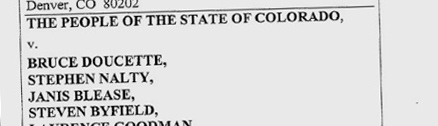
Pueblo museum excises Mine Workers Union from Ludlow Massacre exhibit!


PUEBLO, COLORADO- 2014 marks one hundred years since the Ludlow Massacre of 1914. A variety of commemorations are planned before the formal anniversary on April 20. I attended one such event on Wednesday, a lecture by a CSU professor to footnote the “Children of Ludlow” exhibit at El Pueblo History Museum. I’m always excitied when attention is paid to Ludlow, a subject regularly left out of American schoolbooks, but I was disappointed to find key elements of labor history excised from the museum’s narrative. Literally. The United Mine Workers of America, the organization central to the strike, which supplied the tent city, and which even today maintains the memorial site, was mentioned only once, IN FINE PRINT! The Ludlow miners voted to strike because the mining companies refused to recognize the UMWA. Unmentioned. The horrors of the atrocity were not tempered, in their explicitness perhaps we think them enough, but there was also the apologist suggestion that some culpability belonged to the miners. I questioned one curator who admitted they were at pains to keep the story “balanced” and that the squeakiest wheel thus far has been the National Guard. Apparently the Guard is offended that its role will be misconstrued. What balance do they want, I wondered. Had they lost children in the “battlezone” too?

Children are at the heart of commemorating Ludlow and at the heart of this preversion of the massacre’s memory. Were they recklessly endangered by their parents and union organizers? Were they dragged into a battlezone? The museum seems to suggest as much, highlighting the beligerence of the miners, mischaracterizing the soldiers, and leaving the union actions largely unexplained.

First I’d like to declare how I tire of the objective irrelevance which results when academics seek the approval of government technocrats. I am also disturbed by educators who pretend blindness to subtle inferences which shape a political takeaway. To them, “remembering” Ludlow seems sufficient in itself. I can hardly see the point to remembering Ludlow unless we have discerned its lessons. Until we are remembering the LESSONS OF LUDLOW, our educators’ self-proclaimed raison d’etre will be self-fulfilling: “history will repeat itself.” This Pueblo exhibit suggests no lesson other than the exploitation of tragedy, and leaves me fearful about the Ludlow commemorations to follow. The anti-union, pro-military climate which prevails these hundred years since the massacre will make for a travesty of a remembrance unless someone with a worker’s perspective speaks up.

NOT BROUGHT TO YOU BY…
Let’s start with this exhibit, which alas has already escaped critique since September. Its full title, as evidenced in the photo above: “Black Hills Energy presents: Children of Ludlow, Life in a Battlezone, 1913-1914.”

I’ll bet curators thought it a measure of truth and reconciliation that the Ludlow presentation was sponsored by a local extraction industry business. Black Hills Energy trades not in coal but natural gas. In fact they’re among the frackers tearing up Southeastern Colorado. I think the irony more likely suggests how the UMWA’s starring role was left on the cutting room floor. There are generic mentions of “the union”, as at right, keeping a ledger of which families were assigned tents, but only in the fine print is the UMWA named as owning the ledger.

BATTLEZONES
More troubling is the skewed framing of the museum’s narrative. It begins with the subtitle, “life in a battlezone.” That’s taking a rather curious liberty don’t you think? The event we accept now as “Ludlow” became a battlezone on April 20, and the regional Coal Field War which followed was a battlezone to which both revenge-seekers and militia thronged, but the tent colonies in which 12,000 lived, 9,000 of whom were the children of the title role, were camps full of families. That they were straffed regularly by the guards makes them shooting galleries not battlegrounds.

Calling Ludlow a battlezone is like calling Sand Creek a “collision” or calling the Middle East a “conflict”. All of these mask the role of the aggressor.

I will credit the curators for offering a candid detail of horrific import. In a description of the day before the massacre, when the Greeks among the immigrants were celebrating Greek Easter, mention is made of the mounted National Guards offered this taunt: “You enjoy your roast today; we will have ours tomorrow.” No one should deny today that the events of April 20, which culminated in the torching of the tents and asphyxiation of women and children, was a premeditated act.

THE CHILDREN
Should the miners have put their children in harm’s way by defying the mining companies? How could they not? As immigrants they didn’t have nearby relatives to foster their children away from the random bullets. Also left unsaid by the display: many of the children had already been working in the mines and counted among those on strike. This was before child labor reforms.

Curiously, the exhibit did include a famous photograph of the notorious activist Mother Jones leading a childrens’ march through Trinidad. The caption explained that Jones wasn’t above using real children to advance the cause of Colorado’s coal miners.” Emphasis mine. While technically true in a modern context, it’s probably disingenuous to imply someone is using the children when a key issue of the demonstration is CHILD LABOR.

No really. Mother Jones was leading a march of children, many of them workers of the mines, for the reform of labor practices which abused children. This and subsequent campaigns eventually led to child labor laws. Is saying “Mother Jones wasn’t above using children” in any way an accurate characterization?

Compounding the inference that the Children of Ludlow were jeopardized for the cause, was the implication that the miners were combatants who contributed to the battlezone. As the displays progressed in chronological order, the first weapon on display was a rifle used by the miners. Immediately behind it was an enlarged photograph vividly depicting miners posed with two identical specimens.

Moving along the exhibit chronologically, anticipating the rising violence, the museum goers is apparently supposed to register that the strikers were firing too, if not first. Recent historical accounts have deliberated about who fired first. I think the motive is suspiciously revisionist in view of today’s dogma of nonviolence absolutism: if your protest devolves into violence, you deserve every bit of the beating you get.

Whenever it was that the miners began firing, the single militia and three guard casualties were not recorded until after the massacre took place, belying the narrative that the miners invited the massacre. Witnesses conflict about when the three union leaders were executed. I’ll give the museum credit for defying the National Guard in summarizing that among the casualties, three of the miners were “executed”.

PARITY OF WEAPONS
Students of the Ludlow accounts know that many of the miners were better riflemen than the soldiers. Many were immigrants who’d served in Bulkan wars and outmatched Colorado’s green guardsmen. That is not to suggest that the miners and their harrassers were equally armed, yet…

The only other weapon on display is a rifle of vintage used by the national guard. It shares a case with a uniform and sabre, lending it official authority. Also, the rifle is not presented as having been used at Ludlow, so it doesn’t project an aura of culpability. Missing is the machine gun depicted in the photograph of the machine gun nest which fired down upon the camp. It’s depicted with a caption about the Guard being a welcome presence. Missing too is the armored car dubbed the “Death Special”. Obviously the armor protected its operators from being hit by striking-miner bullets as it drove through the canvas encampment, straffing the tents with its mounted machine gun.

HUMANIZING THE PERP
Right after the photo of armed miners was the display at right, with a very contrived bit of spin catering to today’s military families. Although the photo shows soldiers actively aiming their gun at the camp, the caption assures us that the “Ludlow families feel relief with the arrival of National Guard”. This supposition is based on the fact that when the soldiers first arrived they were serenaded with the “Battle Cry of Freedom” and greeted with American flags. Most of the miners being immigrants, they were eager to show their patriotism, but the conclusion drawn here is a terrible mendacity. The miners and union organizers knew full well the purpose of the National Guard. They knew the strikebreaking role it played in famous strikes of the past. The miners feted the soldiers hoping to sway them from their eventual task. Protesters of all eras hold out this hope every time they face riot police.

A following paragraph suggested that by the time the massacre was committed, most of the soldiers had been mustered out and replaced with militia members and company guards. This is slight of hand. After the official inquiry, which was prompted by the public outcry, twenty National Guard soldiers were court martialed. All were acquitted. Is the Guard wanting us to believe they were acquitted because they weren’t there?

This attempt to put a friendly face on the National Guard, coupled with an abdication of effort to give the union its due, seems engineered to appeal to the average Pueblan of today, many probably related to an active-duty soldier and long since indoctrinated against evil unions. When I asked the lecturer about the omission of the UMWA, she prefaced her answer for the audience, explaining that unions of old were not like those despised today. I told her I thought failing to describe the hows and whys of the strike was a real teaching opportunity missed.

HISTORY COLORADO
It’s probably important to point out that the Ludlow presentation at the History Museum was developed with the assistance of History Colorado, which finally shuttered a contested display: a Sand Creek Massacre exhibit with a similar flavor of whitewash. Like labeling Ludlow a battlezone, History Colorado tried to typify Sand Creek as a “collision.”

Also typical of History Colorado is the propensity to address their exhibits to children. Programming for school bus visits invariably dumbs down what can be presented and I hardly think the compromise is worth it. If children ran the world, maybe Disney versions of history would suffice.

I’d like to have seen it highlighted that the Ludlow miners were mainly immigrants who were looked down upon by the residents of Colorado. If the museum audience were the “Children of Ludlow” in the extended sense, as a few descendants probably were, more of us were the children of the soldiers of Ludlow, or the citizens who cheered them on, or joined the militia or built the armored car at Rockefeller’s Pueblo factory. If we’re going to remember Ludlow, we ought to remember our role in it so we don’t do that again. It’s easy to pretend we were the martyrs. In all probability that’s who we will be if the lessons of Ludlow are discarded.

WWII air veterans of Doolittle Raiders celebrate 71 years of bombing civilians

Doolittle nose-art
I read 30 Seconds Over Tokyo when I was still a war-playing kid, before I would understand the mischievous consequences of the Doolittle Raiders B-25 bombers deploying without their bombsights. This was to prevent US war-making advantages falling into enemy hands but it also precluded dropping bombs with accuracy. I’m pretty certain the account for young readers also didn’t explain why over a quarter of the squadron’s bombs were of the incidiary cluster variety. Readers today know what those are for. Doolittle claimed to be targeting military sites in Japan’s capitol, but “invariably” hit civilian areas including four schools and a hospital. Of the American fliers captured, three were tried and executed by the despicable “Japs”, who considered the straffing of civilians to be war crimes. After the war, the US judged the Japanese officers responsible, as if their verdict was a greater injustice against our aviators’ “honest errors”. Today we rationalize our systemic overshoot policy as “collateral damage”.

Every year since WWII, Doolittle’s commandos are feted for their milestone bombing mission. This Veterans Day is to be the last due to their advanced ages. But it is fitting, because isn’t it time Americans faced what we’re celebrating? There’s no denying it took suicidal daring, but the Doolittle Raid inaugurated what became a staple of US warfare, the wholesale terrorizing of civilians from on high, with impunity and indifference. To be fair, the American public has always been kept in the dark. American aircraft have fire-bombed civilians at every diplomatic opportunity since 1942, and a Private Manning sits in the brig for trying to give us a chance to object.

We now know that the Doolittle Raid didn’t turn the tide, nor shake Japanese resolve. It was a retalliation for the attack on Pearl Harbor, intended to boost US morale as if to say, America wasn’t defeated. Kinda like why and how we struck back at Afghanistan after 9/11, just as indiscriminately.

The “Mark Twain” ersatz bombsight
substitute bombsightThe Norden bombsight was a closely guarded US secret weapon. An airstrike without it would today be like lobotomizing so-called smart bombs, and deciding to opt for imprecision bombing. The official army record recounts that a subsitute sighting mechanism was improvised for the raid, dubbed the “Mark Twain” and judged to be effective enough. Now a bad joke. Indochina and Wikileaks-wisened, we know the mendacity of that assessment. The vehemently anti-imperialist, anti-racist Twain would not have been honored.
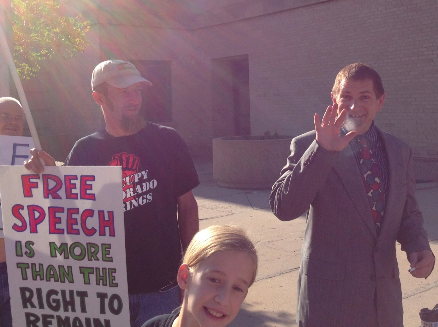
Twain satirized Western so-called Enlightenment thus: “good to fire villages with, upon occasion”.

Post-postwar hagiographies of the raid have suggested the improvised bombsight was better suited to low-altitude missions than the Norden model. That conclusion is easily dismissed because the device was used only for the Doolittle run and never after. The sight’s designer, mission aviator C. Ross Greening, offered a explanation for why he named the device after Mark Twain in his pothumously published memoir Not As Briefed. He didn’t.

The bombsight is named the “Mark Twain” in reference to the “lead line” depth finder used on the Mississippi River paddle wheelers in bygone days.

Because its design was so simple, we’re left to suppose. Greening’s bombsight was named for the same “mark” which Samuel Langhorne Clemens adopted as his celebrated pen name. I find it disingeneous to pretend to repurpose an archaic expression whose meaning was already eclipsed by the household name of America’s most outspoken anti-imperialist. Who would believe you named your dog “Napoleon” after a French pastry?

We are given another glimpse into Greening’s sense of humor by how he named his plane, the “Hari-Kari-er” ready to deal death by bomb-induced suicide. Greening’s B-25 is the one pictured above, with the angelic tart holding a bomb aloft. Greening’s plane was another that carried only incendiary ordnance.

Much was made of the sight’s two-piece aluminum construction, reportedly costing 20 cents at the time compared to the $10,000 Norden. This provided the jingoist homefront the smug satisfaction perhaps, combining a frugality born of the Depression with the American tradition of racism, that only pennies were expensed and or risked on Japanese lives.

War Crimes
Targeting civilians, taking insufficient care to avoid civilian casualties, using disproportunate force, acts of wanton retaliation, and the use of collective punishment are all prohibited by international convention. They are war crimes for which the US prosecutes adversaries but with which our own military refuses to abide. Americans make much of terrorism, yet remain blind to state terrorism. Doolittle’s historic raid, judged by the objective against which it is celebrated as a success, was an act of deliberate terrorism.

Forcing the Japanese to deploy more of their military assets to protect the mainland sounds like a legitimate strategy, except not by targeting civilians to illustrate the vulnerability, nor by terrorizing the population, one of Doolittle’s stated aims. He called it a “fear complex”.

It was hoped that the damage done would be both material and psychological. Material damage was to be the destruction of specific targets with ensuing confusion and retardation of production. The psychological results, it was hoped, would be the recalling of combat equipment from other theaters for home defense, the development of a fear complex in Japan, improved relationships with our Allies, and a favorable reaction in the American people.

There is no defending Japan’s imperialist expansion in the Pacific, and certainly not its own inhumanity. The Japanese treated fellow Asians with the same racist disregard with which we dispatched Filipinos. While Americans point in horror at how the Japanese retalliated against the Chinese population for the Doolittle Raid, we ignore that Doolittle purposely obscured from where our bombers were launched, leaving China’s coast as the only probably suspect.

To be fair, most of Doolittle’s team was kept in the dark about the mission until they were already deployed. I hardly want to detract from the courage they showed to undertake a project that seemed virtually suicidal. But how long should all of us remain in the dark about the true character of the Doolittle Raid?

Out of deference for the earlier generation of WWII veterans, those in leadership, certain intelligence secrets were kept until thirty years after the war. Unveiled, they paint a very different picture of what transpired. The fact that the US knew the German and Japanese codes from early on revealed an imbalance not previously admitted, as an example.

About the Doolittle Raid, much is already openly documented, if not widely known. The impetus for the raid was public knowledge, the evidence of its intent in full view.

BY DESIGN
In the aftermath of Pearl Harbor, American newspapers were already touting offers of cash rewards for whoever would be the first to strike back at Japan. President Roosevelt expressed a deliberate interest in hitting the Japanese mainland, in particular Tokyo, to retaliate for the Japanese strike against Pearl Harbor, never mind it had been a solely military target.

Plans were made to exploit the Japanese homeland’s vulnerability to fire, as ninety percent of urban structures were made of paper and wood. Writes historian William Bruce Jenson:

In his “confidential” meeting with reporters back in November, Marshall had declared that the US would have no cavil about burning Japan’s paper cities.

For the Doolittle Raid, a bombing strategy was developed to overwhelm the fire department of his target, the Shiba ward.

A former naval attache in Tokyo told Doolittle: “I know that Tokyp fire department very well. Seven big scattered fires would be too much for it to cope with.”

As lead plane, Doolittle’s role was to literally blaze the way. Fellow pilot Richard Joyce told Nebraska History Magazine in 1995:

The lead airplane, which was going to have Doolittle on board as the airplane commander, was going to be loaded with nothing but incendiaries -2.2­ pound thermite incendiaries- in clus­ters. They drop these big clusters and then the straps break and they spray, so they set a whole bunch of fires. He was to be the pathfinder and set a whole bunch of fires in Tokyo for pathfinding purposes.

Doolittle’s report outlined his objective more formally:

one plane was to take off ahead of the others, arrive over Tokyo at dusk and fire the most inflammable part of the city with incendiary bombs. This minimized the overall hazard and assured that the target would be lighted up for following airplanes.

Greening paints the most vivid picture, of burning the Japanese paper houses to light the way:

Doolittle planned to leave a couple of hours early, and in the dark set fire to Tokyo’s Shiba ward … the mission’s basic tactic had been that Doolittle would proceed alone and bomb a flammable section of Tokyo, creating a beacon in the night to help guide following planes to their targets.

Doolittle’s copilot Lt Richard Cole, told this to interviews in 1957:

Since we had a load of incendiaries, our target was the populated areas of the west and northwest parts of Tokyo.

After the bombers had left on their raid, and before news got back about whether or not they accomplished it, the Navy crew on the carrier USS Hornet already sang this song, which went in part:

Little did Hiro think that night
The skies above Tokyo would be alight
With the fires that Jimmy started in Tokyo’s dives
To guide to their targets the B-25s.
When all of a sudden from out of the skies
Came a basket of eggs for the little slant eyes

Incendiaries

Most of the bombers were loaded with three demolition bombs and an incendiary cluster bomb. Some of the planes carried only incendiaries. According to Doolittle’s official report of the raid, here were some of their stated objectives:

Plane no. 40-2270, piloted by Lt. Robert Gray:
thickly populated small factories district. … Fourth scattered incendiary over the correct area

Plane No. 40-2250, Lt. Richard Joyce:
Incendiary cluster dropped over thickly populated and dense industrial residential sector immediately inshore from primary target. (Shiba Ward)

“The third dem. bomb and the incendiary were dropped in the heavy industrial and residential section in the Shiba Ward 1/4 of a mile in shore from the bay and my tat.”

Aircraft 40-2303, Lt Harold Watson:
the congested industrial districts near the railroad station south of the Imperial Palace

AC 40-2283, David Jones:
the congested area Southeast of the Imperial Palace

Even though the planned night raid became a daytime mission, Doolittle did not alter his original role, intended to light the way for the following planes. His target remained the Shiba District of Tokyo. His own plane: “changed course to the southwest and incendiary-bombed highly inflammable section.”

Doolittle’s report included a description of the incendiary bombs:

The Chemical Warfare Service provided special 500 incendiary clusters each containing 128 incendiary bombs. These clusters were developed at the Edgewood Arsenal and test dropped by the Air Corps test group at Aberdeen. Several tests were carried on to assure their proper functioning and to determine the dropping angle and dispersion. Experimental work on and production of these clusters was carried on most efficiently.

As has become an aerial bombardment tradition, crews were let to inscribe messages on the bombs about to be dropped. Accounts made the most of these chestnuts: “You’ll get a BANG out of this.” And “I don’t want to set the world on fire –only Tokyo.”

These details, which reveal the intentions of the raid, were not made known to the public immediately. The Doolittle Raid was planned and executed in secret, with US government and military spokesmen denying knowledge of the operation even in its aftermath. The first word to reach the American public came from the New York Times, citing Japanese sources:

Enemy bombers appeared over Tokyo for the first time in the current war, inflicting damage on schools and hospitals. Invading planes failed to cause and damage on military establishments, although casualties in the schools and hospitals were as yet unknown. This inhuman attack on these cultural establishments and on residential districts is causing widespread indignation among the populace.

This report was dismissed as propaganda. When Japan declared its intention to charge the airman it had taken captive with war crimes, the US protestations redoubled. The accusations were belittled even as our own reports conceded to the possibilities.

Lieutenant Dawson’s Thirty Seconds Over Tokyo was the first published account of the raid. Printed less than a year after the event, wartime-sensitive details such as the phony guns made of broomstick handles poking out the back were left out. Targets were also not specified, but a candor remained, probably intended to be threatening. Lawson described the 500-pound incendiaries as “something like the old Russian Molotov Breadbasket”, and related US naval attache Jurika’s advice:

“If you can start seven good fires in Tokyo, they’ll never put them out,” Jurika promised us. … “I wouldn’t worry too much about setting fires in flimsy-looking sections of Tokyo,” he said. “The Japanese have done an amazing job of spreading out some of their industries, instead of concentrating them in large buildings. There’s probably a small machine shop under half of these fragile-looking roofs.”

“Flimsy” became Lawson’s keyword for the residential areas. Here Lawson described dropping his third and fourth bombs, when he saw their corresponding red light indicators:

The third red light flickered, and, since we were now over a flimsy area in the southern part of the city, the fourth light blinked. That was the incendiary, which I knew would separate as soon as it hit the wind and that dozens of small fire bombs would molt from it.

I was satisfied about the steel-smelter and hoped the other bombs had done as well. There was no way of telling, but I was positive that Tokyo could have been damaged that day with a rock.

Our actual bombing operation, from the time the first one went until the dive, consumed not more than thirty seconds.

Thus: Chance of hitting civilian homes: 50/50.
Charges of Excessive Force could be expected, because
blame the victim for being weaker than: a rock.
Care taken to avoid innocent casualties: 30 seconds.

In a later afterword, Lawson blamed Tokyo for having insufficient bomb shelters.

After the war, US occupation forces recovered Japanese records which documented the losses attributed to the Doolittle Raid: fifty dead, 252 wounded, ninety buildings. Besides military or strategic targets, that number included nine electric power buildings, a garment factory, a food storage warehouse, a gas company, two misc factories, six wards of Nagoya 2nd Temporary Army Hospital, six elementary or secondary schools, and “innumerable nonmilitary residences”.

Strafing
Japan accused the fliers of indescriminate strafing civilians. The US countered that defending fighters were responsible for stray bullets when their gunfire missed the bombers. That’s very likely, except the raiders were candid about their strafing too. Lawson:

I nosed down a railroad track on the outskirts of the city and passed a locomotive close enough to see the surprised face of the engineer. As I went by I could have kicked myself for not giving the locomotive’s boiler a burst of our forward 30-calibre guns, then I remembered that we might have better use for the ammunition.

A big yacht loomed up ahead of us and, figuring it must be armed, I told Thatcher to give it a burst. We went over it, lifted our nose to put the tail down and Thatcher sprayed its deck with our 50-calibre stingers.

Greening’s account of firing on a sailor, raises the moral ambiguity of air warfare with which few airmen grapple. By virtue that technology allows it, combatants become slave to a predetermined outcome:

When we attacked the next patrol boat, a Japanese sailor threw his hands up as if to surrender. I guess he expected us to stop and take him prisoner. We shot him and left this boat smoking too.

The Medals
Friendship Medals exchanged between Japan and the US found themselves requisitioned for Doolittle’s Raid:

Several years prior to the war, medals of friendship and good relationship were awarded to several people of the United States by the Japanese government.  In substance these medals were symbolic of the friendship and cooperation between the nations and were to represent the duration of this attitude.  It was decided by the Secretary of the Navy, Mr. Frank Knox, that the time was appropriate to have these medals returned.  They had been awarded to Mr. Daniel J. Quigley, Mr. John D. Laurey, Mr. H. Vormstein and Lt. Stephen Jurkis.

After arrangements had been made and the medals secured, a ceremony was held on the deck of the Hornet during which the medals were wired to a 500 lb. bomb to be carried by Lt. Ted Lawson and returned to the Japanese government in an appropriate fashion.

Lawson’s plane no 40-2261 dropped that bomb on an “industrial section of Tokyo” omitting to mention that Japan’s industry was still a post-feudal cottage industry.

“The medals were subsequently delivered in small pieces to their donors in Tokyo by Lt. Ted Lawson at about noon, Saturday, April 18, 1942.”

–Mitscher, M.A. Letter Report to Commander Pacific Fleet.

“Through the courtesy of the War Department your Japanese medal and similar medals, turned in for shipment, were returned to His Royal Highness, The Emperor of Japan on April 18, 1942.”

–Knox, F. Letter Report to Mr. H. Vormstein

What Does Democracy Look Like? Not likely the Old Testament Thank You

I attended Occupy Denver’s forum “What Does Democracy Look Like?” this weekend to hear activist scholars of considerable repute throw in their two cents. The first day was a splendid gathering, except where a curated discussion of intentional community lapsed into theology. Yes, a distillation of mostly white reform literature (Fanon was dismissed as wayward) yielded three steps for The Way Forward: Egypt, Exodus and the Promised Land. Yep.

By which he meant: 1) Recognize your enslavement, 2) have the courage to leave all for an uncertain fate in the desert, and 3) seek/develop/discover your own promised land.

Even as metaphor it’s embarassing. Enlightened salvation from Old Testament mythology? No thank you, and for that matter, up yours! Unfortunately the language I used was less restrained, but his religious offensiveness had been compounding. He’d begun his presentation admonishing listeners that transformation begins with the self and so he’d already unmasked himself as spiritual. Worse, a monotheist.

Egypt: I’ll come back to “systems of oppression” in a moment.

The Exodus: a myth, it didn’t happen, even Hebrew scholars now agree with the historical and archeological records.

As to the Promised Land: that was a real estate scheme to backdate a deed, offered as divinely conceived proof of landlordship. The same title is being waived around to dispossess Palestinians today.

But really, isn’t the exodus-to-promised-land malarkey at the very foundation of Western Civilization’s expansion problem?! Are we really all entitled to virgin land? As if earth hasn’t been continuously and fully inhabited since before agrarian civilization, before monotheism was conceived to impose inequity, and justify slave-wages, interest and rent. The craddle of exploitation, that was Egypt.

But can we run from Egypt? The remedy staring us in the face, from which common men are deliberatly destracted, conspiring to emancipate Egypt, is to rid ourselves of the oppressor sociopaths. In practical terms understood more clearly by the better educated before us, we must strangle Egypt’s kings with the entrails of its priests.

I don’t care how academic your garb, when you tell your flock to reapply themselves to the sacred, and your “sacred” is biblical, supposing to transcend nature, you’re a priest.

Thank you WDDLL organizers but I do not go to church and I resent when devious means are employed to bring it to me. Actually those priests are the worst, they’re missionaries! If we’ve learned one thing as we discuss mankind’s break from his mille millenia of sustainable existance, resist the colonizer. Conquored peoples ourselves, we can only wish that indigenous peoples could have given Western missionaries the reception they deserved, and it’s no less true today: fire.

Alas as a result I heard a number of attendees today praise their faith. To each his own, but unhelpful. If you have to evangelize you’re a liability because nonsense is infectuous, especially as education levels recede. Can others entrust you with the battleplan while you commune with the adversary?

There’s a wonderful scene in AGUIRRE, THE WRATH OF GOD, Werner Herzog’s dramatic depiction of conquistadors wreaking havoc in the Amazon. Following a coup among the greedy Spaniards, the wife of the abruptly deposed leader appeals to the mission’s priest, as her last resort to restore order. The priest, her ally only moments before, turns on her thus: “Her ladyship must know that the church always stands on the side of the strong.”

Israel attacks Syria! Surely Syria will be accorded the right to defend itself

It’s the pretext Israel uses whenever it strikes Gaza or Lebanon or European cafes or US ships: the right to defend itself. In fact the right to do it preemptively is how Israel justifies bombing Iran or assassinating Iranian scientists. So where do the rights of others begin? Has not Syria a right to defend her lands and people against this unprovoked attack? Is Israel so cynical to pretend it doesn’t have to declare war on its neighbors because it shares “most belligerent status” with all of them? –even, let’s add, with half its citizens. Of course the US stands with Israel, they share a foreign policy of illegal, preemptive, and/or covert war. No doubt Israel has already calculated that Syria is in no position to retaliate. All Western powers knwo enough to only strike the defenseless. Apparently Israel has grown impatient with the Western-backed attempted overthrow of strongman Assad and fears the astroturf public support will wane before regime change is achieved. Assassination, covert coups, wars of aggression, used to be illegal.

Bail denied for political dissenters who didn’t want to relenquish their children

The news headlines should read “Bail denied for couple who kidnapped THEIR OWN CHILDREN.” Let the public wrap its libertarian-leanings around that one. We presume a custody battle has its he-said she-said, the merits of which a family must work out. But the case of the mother and father who reclaimed their own small boys and vainly sought refuge in Cuba, is about a custody battle with grandparents who got court protection for their grandchildren based on judging the parents unfit –because they were attending activist rallies! I know absolutely nothing about the political leanings in question, the parents might have been gun-toting teabags and perhaps in private details irredeemable, but the press certainly isn’t elaborating, and evidence might suggest the contrary. Piloting a small day-sailer 300 miles along the Florida coast then navigating to Cuba is not for simpletons. In essence, the children were confiscated based on political beliefs and now the “kidnappers” face criminal charges for trying to save their own kids.

Steve Bass found guilty of camping not occupying, but could jury have ruled otherwise without hearing his defense?


COLORADO SPRINGS, Colo.– You may have underestimated the importance of today’s Camping Ban trial. The local media, social justice community and rights watchdogs missed it. But judging from the police force on hand and the elaborate lock-downs placed on the jury pools, it was evident the City of Colorado Springs thought a lot was at stake. I’ve written already about the draconian motions to prevent defendant Steve Bass from explaining his motives, including a ban of the word “Occupy.” Today the court made audience members remove their “Occupy Colorado Springs” t-shirts, but let the cat out of the bag by the palpable gravitas with which the court officials and police handled jury selection. Except for the absence of TV crews outside, you’d have thought Steve Bass was Hannibal Lector tripped up by an urban camping ordinance at “what happened last year in October at a park downtown.”

Yeah, even mention of “Acacia Park” was giving away too much, the prosecuting attorney preferred to call it “115 W. Platte Ave.” Every so often a prospective juror would stand up and say “I presume you’re referring to OCCUPY WALL STREET?” like he was solving a riddle, but instead of the door prize that volunteer would be dismissed from the pool for knowing too much.

After a trial that lasted one third the length of the jury selection, Steve Bass was found guilty. He offered no testimony, his lawyer, the very capable Patty Perelo, made no closing statement, because what defense could be made? Steve and his council elected not to have him testify, because to begin with, he’d have to swear to tell the whole truth, and if he explained he could only tell part of the truth, he’d be slapped with Contempt of Court.

We thought the jurors might have been curious, after seeing the city’s 8×10 glossy pictures with the circles and arrows telling what each one was and hearing not a peep from Bass, but they didn’t express it, and left after giving their verdict. This is Colorado Springs.

One of the prosecution’s witnesses, the arresting officer, nearly spilled the beans when he identified the defendant as someone he couldn’t have confused for someone else, because he’d said he’d encountered Bass many times in the park and shared many conversations.

“Oh?” the defense attorney Perelo perked her ears and asked, “and WHAT did you talk about?”

“Um… homeless policy, mostly.” That’s all HE could say. He couldn’t explain why he’d encountered the defendant so many times, or what the defendant was doing. Attorney Perelo couldn’t push it, because that would be leading him into forbidden territory. His testimony for the prosecutor was delivered straight from his notes.

There were two police witnesses, a map and several photographs, showing the tent and another showing just the poles. Was this necessary for a conviction? Because it necessitated explaining to the jury that said poles were in their “unerected state”. Not to be confused with the tent which was “fully erected”, which the judge pronounced like expressions which tripped off the tongue in cases of serious crime.

A photo of two sleeping bags required the officer to say he found the defendant sleeping “in the bags in the tent in the park” to prove all the elements of a violation of the camping ban.

The prosecuting attorney summarized it thus: “there was a tent, there was a sleeping bag, looks like camping to me.”

Not according to a dictionary definition of course. But that too had been motioned inadmissible. If you look it up, camping is variously defined as to “Live for a time in a camp, tent, or camper, as when on vacation.” Or as when destitute? Dictionaries don’t go there. That’s more like sheltering.

A couple of other examples: Soldiers sleep in tents. They’re not camping. Mountaineers overnighting on the side of a mountain aren’t camping. Refugees of war and natural disasters stay in refuge camps, but aren’t said to be camping. Anyway.

Steve Bass didn’t get his day in court. Everything he wanted to say he couldn’t. His attorney’s strategy today was to prepare for an appeal, on the grounds that the judge deprived Bass of the ability to defend himself.

Did Bass violate the camping ban as the jury decided? The prosecutor explained that nobody, not the judge, nor police officers or herself or the jury was in the position to decide the law. So Steve Bass has to take his case to someone who can.

Jury Selection
Over four hours were spent on choosing a jury, by far the most interesting part of the day. It took three sets of 25 potential jurors to pick six and one alternate. As the process approached lunch hour, the court was eager to buy pizza for seven instead of twenty five, but they didn’t make it.

As I mentioned, usually a juror familiar with “Occupy Wall Street” was dismissed, whether their opinions were favorable or unfavorable. I saw one juror dismissed because delving further would have meant discussing Occupy too much and would expose the other jurors to more occupy talk than the judge or prosecutor wanted.

On the other hand, many jurors had direct relatives in law enforcement, one juror considered a CSPD officer her “knight in shining armor,” so that was another cause for eliminations.

During the second batch, another juror stood up to say he was a former corrections officer, who wasn’t sure if he might have met Steve Bass “in the course of his duties” which poisoned the entire group by suggesting Steve had spent time in prison. That batch was dismissed. In actuality, Steve recognized him, because they both frequented the Dulcimer Shop.

Though Judge Williams maintained a convivial air of impartiality, he betrayed an awful prejudice. Whenever a juror expressed knowing something of what was in the news in October 2011, the judge would asked them if they could refrain from judging Bass based on the misbehavior of others. If jurors who knew about the protests were let to remain in the running, the assumption the judge offered was that “Occupy” was a taint that the defendant hoped they would overcome.

I don’t doubt that this slant extends well beyond Occupy, because municipal courts are notorious for being rubber stamps of a city’s citation process.

For example, in Judge Williams’ instructions to the jury, he read the sample guilty verdict first, in all its solemnity. When he read the not-guilty sample, he broke character to explain that he was not going to repeat the redundant stuff, etc, etc, and then he told the jury they shouldn’t be swayed by the order in which the two samples were read. The dramatic guilty versus the blah blah not-guilty.

Occupy harassment
Knowing about the prohibition against Steve mentioning Occupy, we thought we’d exercise our right not to be gagged. Could it matter? Should it? How preposterous that Steve was being tried and not permitted to say what he was doing. As if some precedent would be set that a defendant might convince a jury that forbidding a person shelter was a bad law.

So we came to court with t-shirts that read OCCUPY COLORADO SPRINGS. Immediately when we sat down, the judge called the lawyers up and decided we’d have to remove our shirts. We were given a chance to explain who we were, but the choice was invert the shirts, put on new ones, or leave. So we walked out.

I had an extra shirt outside with a peace symbol on it. Admittedly a politically-charged shirt, somewhat iconic locally, because it recalled an event in 2007 when peaceful protesters were forcibly removed from a city parade, one of them dragged across the pavement, an elderly woman who subsequently died of complications. So I knew I might be pushing it.

The point being to give Defendant Bass some context. He’s an activist. Alone without a voice he was a perp. With an audience of protestors he becomes a man of mystery. Every accused person in court is sized up in part based on his relations sitting behind him. Why shouldn’t Steve be allowed to show who his friends are?

As I reemerged from my car, already a police supervisor was yelling across the street to tell me I wouldn’t be allowed to wear that shirt. “Are you kidding?” I asked. I had a bag full of them, prepared for this eventuality if other spectators wanted to show solidarity. He was crossing the street to preempt my bringing the confrontation to the steps of the courthouse.

“Eric, you know the judge won’t let you wear that shirt.”

“I know no such thing. He only forbid things that say Occupy.” I knew this to be true, technically.

But they weren’t budging, they claimed a jury pool was already in the courtroom and they didn’t want to take any chances. Oddly, the officer blocking my way, beside the supervisor, was Good Old Officer Paladino who’d brutalized my friends and me in 2007. So he knew the t-shirt too well. Actually Officer Irwin Paladino’s history of abusing protesters goes back to 2003. I decided to dispense with plan B and invert my black t-shirt so I could go back in.

Did the CSPD make the smart call forbidding my t-shirt? I’ll be the first to admit the CSPD have outwitted the local social justice movement at every turn in Colorado Springs. They’re clever and competent, but they’re in the wrong. The CSPD are stepping on our rights, and overstepping their authority to do it. While it may have been superior gamesmanship, it was wrong.

Have I mentioned that they followed us everywhere? As if we were the accused in need of escort. On the officers’ radios we could hear them narrating our movements throughout the building. When Patrick went to the bathroom, an officer followed him inside and made small talk as Patrick peed. Did they think we were going to Mike Check the men’s room?

At one point we were able to see from a window on the second floor hall that CSPD were conferring with a parking enforcement officer around our cars. She was examining the license plates, getting on her phone, standing by the cars, as if waiting for something. The cars were legally parked, the meters fed, and well within the four hour limit. But who wants to argue with an impound lot? I assure you this intimidation tactic worked very well to send us out of the courthouse to rescue our vehicles.

Meanwhile, another friend came into the courthouse and overheard officers discussing whether to deny us entry again, and by what pretext, but I’m getting ahead of myself.

While watching the jury selection, it was the batch that was being dismissed in full, the court bailiff suddenly bolted from behind where we were sitting and told the judge she’d overheard us whispering about inappropriate subjects, specifically using profanity. This accusation was based on a dear Occupier’s habit of muttering colorful asides. Okay this was true, but in his defense, it was after the jury being spoiled, about the jury being spoiled, but inappropriate none-the-less and he apologized. But to tie all together in the misbehavior was a fabrication. The prosecutor tried to have us evicted, and Officer Paladino chimed in about the confrontation I instigated at the door. That’s when my friend told the judge she’d overheard CSPD officers discussing plans to keep us out, so the bailiff’s actions began to appear a little contrived.

This complaint was finally settled with the judge’s warning that one peep out of us would get us 90 days in jail for Contempt of Court. At this point we knew the pieces of duct tape we’d brought in to use to protest Steve’s gagging were definitely OUT.

Just before lunch recess I was able to clarify with Judge Williams whether the peace t-shirt I had wanted to wear was acceptable to the court. Receiving no objection from the prosecutor, the judge told me it would be okay, and then assured me he’d inform CSPD.

Returning from lunch, once again with the peace shirt, the security screeners nearly didn’t let me pass, but I barreled past with the confidence of someone who knows his rights. This time Officer Paladino came upon me at the courtroom door, swaggering right into my face assuring me he was not going to let me pass. FORTUNATELY before he could wrestle my arms behind my back, another supervisor arrived who’d heard the judge, and I was allowed to proceed. Boring story I know. But the pattern was unsettling.

Then Steve was found guilty, you could feel the city’s giddiness as they discussed sentencing. We’re only talking community service, but Colorado Springs has only one contractor for that, the odious Keep Colorado Springs Beautiful, whose hi profile task is to clean up after the CSPD Homeless Outreach Team scoops up the homeless and puts them in shelters very much in the model of correctional facilities. Steve was able to negotiate a less anti-homeless agency, and that’s the story so far.