This American Life caves to Apple Corp, swaps Mike Daisey Chinese factory horror story for Marketplace puff spin

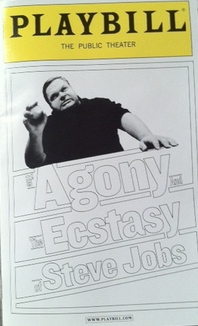
PlaybillThis American Life host Ira Glass tried to pull an Oprah on playwright Mike Daisey, to dress him down on creative license Daisey took with an excerpt of a monolog aired on TAL titled Mr. Daisey and the Apple Factory. The debunking came courtesy of American Public Media’s laughable “Marketplace” Wall Street PR engine, which Glass pretended were reliable experts on the subject of China’s apparently resolved labor abuses. That’s not even funny. This “retraction” reeks even upwind, and Apple’s having become the most highly valued corporation probably explains Glass’s uncharacteristically virulent condemnation. Shameful is what it was, and I hold it unforgivable, for the pretend-affable Glass, so-called folk archivist, to scuttle someone else’s too successful artistic quest for fundamental truth.

Let’s be clear. Mike Daisey was “debunked” based on his Chinese translator contradicting his version of events, and Marketplace finding Hong Kong based activists ready to give Chinese labor problems the all-clear signal. Both sources no longer protected by anonymity are under duress in China, and it’s not mentioned under whose employ they are now.

The Apple Factory story was the first best thing TAL had aired since pioneering post-sardonic navel gazing, but this week Glass issued a full retraction, removed the episode from the archive, and aired a blistering character assassination complete with manipulatively edited confrontations with Daisey, loaded with the expectation he’d buckle like fictional-confession memoir author James Frey. Except Frey’s lies unraveled because they contrived to propagate untruth. Daisey’s truths were undisputed, but the liberties he took to weave a personal narrative were “debunked” to cast doubt on his every word. It was a shameful moment for This American Life, and I’m hoping this time Glass has overestimated the vapidity of his listeners.

For example, when Mike Daisey explained his rationale for not wanting to “unpack the complexity” of his narrative, Ira Glass responded that he didn’t know what that meant. To what kind of reporter, editor, producer, or storyteller would that concept be foreign?

APM’s Marketplace
This was not the first collaboration between Marketplace and TAL. As the Occupy Wall Street protests grew, Ira Glass commissioned folksy research pieces from a Marketplace team to explain world banking and derivatives trading in terms sufficiently lazy to not disturb the usual NPR stupor. It was bunk coiffed in TAL’s typical carefree je ne care pas.

So this time, Marketplace’s man in China was consulted to fact-check Mike Daisey’s account. ACTUALLY, Glass reveals that he was approached by Marketplace AFTER they’d looked into Daisey’s sources. Glass thanked Marketplace for offering the story to TAL, instead of exploiting the exposé themselves. That’s Glass pretending he doesn’t know PR is about getting someone else to say it for you. Absolving Apple required more than one media property criticizing another. Somebody probably wanted a full retraction.

To foul Mike Daisey’s story required one phone call to the translator and guide he’d used in China, whose contact information he tried hide from Glass and co. No mention that this might have been to protect her from angry Chinese authorities, or from Apple and its supplier Foxconn and the inevitable underworld that rides herd on its victim laborers.

Marketplace’s feat consisted of tracking down his translator, breaking her cover, and putting her on the spot for the harsh criticisms which Daisey laid on Apple, Foxconn and their Chinese hosts. Especially as the popularity of Mike Daisey’s performance piece grew, and after its airing on TAL and his many media interviews, the anonymity of his Chinese translator would remain of paramount concern, but once exposed by Marketplace, what choice might she have had but to denounce Daisey’s heresies?

Could Apple’s being the world’s most high valued company have had anything to do with this kill-the-messenger hit piece? Apple has scheduled a press conference Monday morning to announce what it plans to do with its now famous $100 Billion cash holdings.

Storytelling
Isn’t it rich that TAL suddenly wants to hold its stories to journalistic standards? Imagine if someone had called them on the Christmas elven adventures of David Sedaris. Was that fact-checked? Or what of the elementary Christmas play Sedaris so gloriously skewered? IF YOU Criticize TAL for its too-often neglect of difficult subjects and you’re scolded that the show is about culture and storytelling.

Mike Daisey’s TAL recording is now offline, although the transcript remains. In it you’ll find an indictment that Ira Glass perhaps lacks the temerity to redact as well. It’s his introduction to the segment, and I’ll reprint it here, because Glass praises exactly Daisey’s storytelling technique, separate from the facts he recounts.

A couple weeks ago I saw this one-man show where this guy did something on stage I thought was really kind of amazing. He took this fact that we all already know, right, this fact that our stuff is made overseas in maybe not the greatest working conditions, and he made the audience actually feel something about that fact. Which is really quite a trick. You really have to know how to tell a story to be able to pull something like that off.

In his own words, Glass concedes what his show’s retraction is all about. He’s not retracting the facts, these “we all already know”. Glass and Apple are trying to retract Mike Daisey’s effect, that “he made the audience actually feel something about that fact.”

TO BE CONTINUED

The Famous Oprah Video punks who?

Oprah famous video black eyed peas good day
You find it by searching for FAMOUS + OPRAH + VIDEO. Because hyperbole arcs the hyperlink. Allegedly, the viral clip is being removed as fast as websites are putting it up. I’ll bet the reason would have more to do with James Frey and Augusten Burroughs baldfaced disingenuity than copyright infringement or Oprah being embarrassed by pedestrian plagiarism. The performance by the Black Eyed Peas, taped live in downtown Chicago for the 24th season of Oprah’s talk show, purports to ignite a spontaneous dance, to Oprah’s joyful astonishment. While the video may be a crowd-pleaser, it certifies corporate music’s lack of originality, and the American TV tube’s despicable boobness.

The jubilant TODAY’S GONNA BE A GOOD DAY scenario borrows of course from the T-mobile commercial featuring a dance production taped at a Liverpool train station, set to a medley of powerhouse dance numbers. At first fellow commuters are surprised. By the end we realize the entirety has been choreographed. Youtube viewers would recognize the contrivance from the Belgian train station scene, where ordinary commuters begin dancing to a favorite song from The Sound of Music, until the whole crowd is participating.

Is dance so highly infectious? There’s something people really love about seeing that theme play out. It gives viewers warm fuzzy feelings having to do with belonging to community. There’s nothing wrong with the Black Eyed Peas wanting to reap that same enthusiasm for their pretend live video. Who holds it against pop to imitate from anything?

Their job of commercial entertainment is to popularize, and an Antwerp central station is hardly a setting familiar to Americans. Better a live concert audience, youthful, outside, wearing the usual panoply of Disney colors, living in the moment, attached to no context of exterior lives, a high school musical on a sunny day, reality TV on vivid.

Both predecessors feature onlookers who stare transfixed, some calling friends on their cellphones, others recording what they see. In both sequences, often those standing on the periphery turn out also to be participants, eventually joining in the dance.

In Oprah’s version, she is the lone spectator, watching incredulous from onstage. Like the train station commuters, she holds a cellphone aloft, eager to record the dance epidemic as it spreads throughout her “audience.” Apparently, it’s not enough today to drop your jaw to show surprise, you have to pull out your camera to show how you know when seeing defies believing. What, is Oprah going to Youtube it? Would her television audience worry that the impromptu dance was going to pass without someone recording it for posterity?

Oprah’s spontaneous wonder may have passed for genuine before a television audience who didn’t see the dance coming, but on the instant replay, how will Oprah’s act play? Are we to believe she didn’t know about the Christo scale choreographed event? If the stunt had been planned as a surprise, do you suppose Oprah wouldn’t have noticed her audience was suddenly uniformly younger and more fit, wearing uniformly bright colors evenly distributed across the monitor screens. Failing that, do you imagine someone as skilled as Oprah at communicating with peoples en masse, wouldn’t detect that this audience had something up its sleeve? It’s probably no false flattery to brag that Chicago is not big enough for Oprah and a surprise party of thousands, without invitations coming across her desk.

The Black Eyed Peas dance bomb may have made wonderful television, and it might have been even better if Oprah had winked instead of gasped. Because now the scene is simply contrived. To watch it in hindsight, as has become the norm for television in the Youtube age, there’s Oprah punking us all.

CNN did it with Balloon Boy, FOX does it for politics, and the rest do it for the war: false concern, contrived conclusions. American media nourishes with falsity. Musicians lip-sinc, Yo-Yo Ma faked his performance at the inauguration, as we learned all instrumentalists do in cold weather.

Augusten Burroughs is so self-amused

Augusten Burroughs author of Running with ScissorsI was recently subjected to a road trip audio book disgorged from an auteur who shares the eminent surname of Burroughs. But unlike Wyeth the younger who had the advantage of genes, this literal-bastard is of no relations and has to defraud us with a bone through his gilded celebrity cage. It gives me the willies to consider that admirers of Running With Scissors think it’s a creative bone.

I can’t remember now which episode of Possible Side Effects finally drove me to seek the solitude of my own headphones. Had it something to do with a dog? Alcohol? Airline travel? It will come to me, although I’ll be better off hoping it doesn’t. Burroughs’ insipid presumption that not a single footstep will be uninteresting to his readers, reminds me of the Power Rangers school of storytelling. What happens, the end.

There’s an absolute pattern to scribes who emerge as recovered substance abusers, one day at a time. Every day brings the agonist to an end, whether a story happened or not. It’s enough that Burroughs emerged sober, Go bless him. Well-wishers cheer his recovery on, but that doesn’t make his daily travails units of a serial.

Most of the scenarios it seemed revolved around Augusten Burroughs being recognized from his author’s photograph on the back cover of his book. He’s so famous! It does rile me when an obvious twit has a following who hold his twiticisms aloft where he can then point to them and journal again about that.

Of course the hives I felt were vindicated when I learned that like memorist-entrepreneur and twelve-step-denier James Frey, Augusten Burroughs was caught recounting lies. In burroughs’ case, by his own psychiatrist! And had to redefine Running With Scissors as not a memoir after all.

Actually I have no doubt that what Burroughs writes is memoir, he tweets as many times as he pulls open the refrigerator door. Queer Eye For The Bored Guy presumes readers can’t decorate their imagination.

Actual Holocaust revisionists unmasked

ANGEL AT THE FENCE HOAX by Herman Rosenblat
In the face of escalated Israeli atrocities and war crimes against the inhabitants of Gaza this week, is the Zionist Holocaust Remembrance juggernaut losing its nerve? A major publisher has canceled plans to distribute a WWII concentration camp memoir when it was discovered that key elements of the tale were untrue. But that never stopped Holocaust Rememberers before.

Herman Rosenblat had been peddling the fictional details for a decade, details which made his particular Holocaust experience unique. But historians questioned the very premise of his title, Angel at the Fence, and Rosenblat confessed his wife’s part was fabricated. Taking a cue from James Frey, Rosenblat is hoping the film can be distributed as fiction.

This example is not as bad as Belgian author Monique De Wael, writing under the pen name Misha Defonseca, who had to confess that her memoir of escaping the camps to live with wolves was fictional, and that she wasn’t Jewish, but “felt Jewish.”

The original key witness account by Eli Wiesel, the leading patriarch of Holocaust Remembrance, turned out to be inaccurate enough that the memoir Night had to be reclassified as a novel. Despite the inventions, Wiesel’s book remains in the canon of Holocaust literature.

Bolstered by François Mauriac who wrote that Night is “…a book to which no other could be compared.” Wrote A. Alverez, it was “almost unbearably painful, and certainly beyond criticism.”

Eli Wiesel made this pitch in 1955:

“…ten years or so ago, I have seen children, hundreds of Jewish children, who suffered more than Jesus did on his cross and we do not speak about it.”

James Frey wrong guy

Liar
I’m crossing my fingers that this James Frey guy gets what’s coming to him. James Frey has written a best-selling memoir called A MILLION LITTLE PIECES and thanks entirely to Oprah’s shrewd endorsement, has become an inspiration for a suburban nation in the grip of a drug addiction epidemic. The trouble is that Mr. Frey’s memoir has been largely invented. THE SMOKING GUN went looking for Frey’s police records, as is their thing, and found Vanilla Ice basically.

Oprah holds that her man Frey is still a beacon of light of a bad boy redeemed. I would maintain he is not.

Frey may have thought that he’d covered his bases. He killed off every co-conspirator in his book, he had his real police records, or lack thereof, expunged, and he’s claiming artistic license for whatever discrepancy may be left. Now in spite of what TSG has brought to light, Frey continues to defend his criminal street cred. This is not someone who has redeemed himself.

I don’t have any trouble with the fact that he has slandered real people. While Frey was in reality let off lightly for a drinking offense, he maintains those cops beat him mercilessly à la King, and later one of the cops contracted Frey’s cell mate to deliver a further beating. (Frey was never jailed.)

I don’t care if he’s traded on the memory of a small Michigan town’s high profile teenager-train-wreck tragedy, insinuating himself non-grata into several parents’ recollections of painful loss.

I don’t care that he’s taken a vacuous manuscript, rejected 18 times in its previous incarnation as a novel, and parleyed it into a small fortune and himself into a prominent role as recovery guru.

I don’t care that Jame Frey wasn’t the bad-ass he claimed to be, or thinks he remembers.

Except as it relates to Mr. Frey’s recovery from drug addiction.

The detail to which I attach a great deal of significance is Frey’s recovery, which may or may not be true. He says he did it without Alcoholics Anonymous. In fact he belittles them.

Plenty of addicts recover without the assistance of AA or NA, but the greater majority by far need the help of fellow addicts. And tragically, the chief hurdle to bringing addicts into recovery is every last addict’s misconception that they can do it themselves.

So here you have a Mr. Frey who wants to paint himself as the baddest dealer ever, as the most reprobate junkie ever, who hit bottom like no parent should ever hope to see their child hit bottom, and who then got clean, all by his own self, won Oprah’s book club lottery, the end.

If that’s true, congratulations to him. If it’s not true, what kind of hope is James Frey offering the millions of suffering parents and addicts? That they should count on such unlikely odds as winning the lottery?

NA is not for everyone, but it’s nothing to avoid in any case. Every day millions of Americans get together in ad hoc meetings to fight and claw their way out of addiction. Some need the comfort of believing in a “higher power,” some don’t. Whatever. There’s no administrative cost, there’s no hidden agenda, there’s no proselytizing. The meetings are just people who share a common problem, helping each other to overcome.

Middle America is being overtaken by the drug problems that have long plagued the urban poor. Oprah’s handlers may have been urging her to find a way to address the addiction epidemic and help her audience to navigate the dangerous waters. I hope she has the wisdom to admit she may have chosen the wrong guide.