Je Suis a Goddamn Neoliberal Meme… Je Suis Charlie, Neda, Kony, Save Dafur

40 world leaders march for Charlie Hebdo
A million people mobilized in Paris, including 40 WORLD LEADERS!? How long have their limousines been queued? I usually brag that our corporate foes can’t manufacture consent in the streets, except when they do.

I AM NEDA, KONY 2012, SAVE DARFUR, now JE SUIS CHARLIE are purely neoliberal consolidations of public support. They’re televised Nurenburg rallies masked as spontaneous demonstrations. Add “I AM ___” to “______ Spring” and colored revolutions as dead giveaways of psy-op inspired counterrevolution.

With NYPD turning their backs on their mayor and Westboro Baptists making the protest of soldiers look unreasonable, the choices are narrowing for activists who want to define their struggle with tactics not splooged upon by the lumpen knee jerk Fascists.

A woman approached me yesterday at an anti police brutality demonstration in solidarity with Ferguson. She agreed with the cause, but wanted to know why we weren’t also speaking out for abused children, for example those thrown off bridges by deranged parents. While child abuse has its systemic causes, the answer highlights what differentiates insurgent demonstrations from the false. People take to the streets to challenge power, not to gang up with power to further its oppressive agendas.

Duh. Except the lure of popular causes seems to be irresistable to social justice types normally starved for public support. I saw the “Save Darfur” project twist and fracture my local peace community. Obama Lincoln 2008 had the same effect, another socially engineered bandwagon.

I’m not galled by the hypocracy of world leaders “marching” in Paris, pretending to stand for press freedoms. I’m upset my the millions of Frenchmen duped into attending their photo-op. Those millions of Frenchmen in the same street should have trampled the World Bank kapos underfoot, instead of pretending the corporate cabal were people too.


(Remember when I AM NEDA protests failed to tie a viral snuff vid to false accusations of election fraud in Iran?)

John Kerry tells Africa its greatest resource was & will always be slavery

With the developed empire still wildly exploiting Africa’s vast natural resources and pillaging the wealth of its peoples, US Secretary of State John Kerry had the temerity to pretend that the dark continent’s most precious resource is its untapped labor. Globalization means Western Civ doesn’t have to ship slaves to labor intensive ventures across oceans. Now debt slaves can serve world bank masters in sweatshops and maquiadores and plantations situated in their own prison states.

Yay! Ukrainians win austerity measures and right to go in debt to World Bank!

We can keep arguing about who the Ukrainian opposition/protesters were, but the aftermath of the celebrated uprising has wrought this: the new leadership is being courted by the EU and the IMF so long as they agree to club requirements. Make austerity reforms, aka the privatization of public assets, and saddle their economy with debt to the World Bank. Meanwhile Russia is being warned to keep its military out. That should confirm who won in Ukraine.

Can we hope the Ukraine government snipers hit OTPOR & CIA provocateurs egging on the fascist suppremacists?

Protesters are being killed in Kiev, and revolutionaries enthusiasts are buying into the Western Media narrative. Even Democracy Now is parroting the theme, describing the demonstrations as opposing their government’s rejecting closer ties to the European Union. “Closer ties?” Ukraine was rejecting growing indebtedness to EU banks, favoring a bailout from Putin instead. Let’s remember that Senator John McCain jetted to Kiev to rally the uprising, seeing it as part of the rolling “freedom movement” not coincidentally encircling Russia, the former Soviets now no longer foe to Capitalism but rival. Unfortunate developments have led to government snipers firing at the “rebels” many of whom are dupes but many too are supremacist fascists not particularly misguided about US-EU hegemony. Perhaps we can find consolation in the hope that Ukrainian snipers were able to hit the OTPOR and CIA provocateurs coordinating the urban warriors.
 
I support all popular uprisings, but unfortunately US covert ops have picked up on our game. The only way to insulate rebellions against Western provocateurs is to build movements around political ideology they will not embrace. For the onlooker, ideology is also the means to discern destabilitation projects parading as protest. If the offending government is anti-Western-Capitalism, our counterinsurgency ops are there. Of course Socialist, Islamic, or non-World Bank client regimes are not imune to being authoritarian, but hardly more so than the Capitalist empire. Often US adversaries are forced to authoritarian measures by US covert ops working to destabilize them.

World Press Freedom Day is cover for US sponsored voices of destabilization

Remember the jokes-on-them cautionary tale about admen trying to sell the Chevy NOVA in Latin America, oblivious that “no va” means “doesn’t go?” in Spanish. You’d think Capitalism’s missionaries would know their “freedom” brand has already been unmasked. Translated it means “World Bank Compliant Fascist State” whose media is embed only. How ironic that capitalism in democracy’s clothing is heralding World Press Freedom Day. I suppose Russia and Iran are held as examples where the press isn’t free, although RT and PRESSTV are by far more reliable sources of news than anything in the “free” world. I most appreciated WPFD for the light it brought on its international supporters, bloggers who I might not have immediately known were sock puppets for western tentacles. Here’s someone in Colombia who depends “in great part on international co-operation” to fund her work.

This American Life caves to Apple Corp, swaps Mike Daisey Chinese factory horror story for Marketplace puff spin

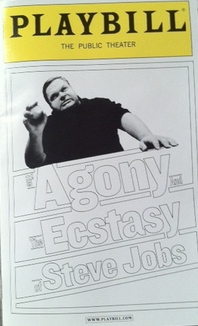
PlaybillThis American Life host Ira Glass tried to pull an Oprah on playwright Mike Daisey, to dress him down on creative license Daisey took with an excerpt of a monolog aired on TAL titled Mr. Daisey and the Apple Factory. The debunking came courtesy of American Public Media’s laughable “Marketplace” Wall Street PR engine, which Glass pretended were reliable experts on the subject of China’s apparently resolved labor abuses. That’s not even funny. This “retraction” reeks even upwind, and Apple’s having become the most highly valued corporation probably explains Glass’s uncharacteristically virulent condemnation. Shameful is what it was, and I hold it unforgivable, for the pretend-affable Glass, so-called folk archivist, to scuttle someone else’s too successful artistic quest for fundamental truth.

Let’s be clear. Mike Daisey was “debunked” based on his Chinese translator contradicting his version of events, and Marketplace finding Hong Kong based activists ready to give Chinese labor problems the all-clear signal. Both sources no longer protected by anonymity are under duress in China, and it’s not mentioned under whose employ they are now.

The Apple Factory story was the first best thing TAL had aired since pioneering post-sardonic navel gazing, but this week Glass issued a full retraction, removed the episode from the archive, and aired a blistering character assassination complete with manipulatively edited confrontations with Daisey, loaded with the expectation he’d buckle like fictional-confession memoir author James Frey. Except Frey’s lies unraveled because they contrived to propagate untruth. Daisey’s truths were undisputed, but the liberties he took to weave a personal narrative were “debunked” to cast doubt on his every word. It was a shameful moment for This American Life, and I’m hoping this time Glass has overestimated the vapidity of his listeners.

For example, when Mike Daisey explained his rationale for not wanting to “unpack the complexity” of his narrative, Ira Glass responded that he didn’t know what that meant. To what kind of reporter, editor, producer, or storyteller would that concept be foreign?

APM’s Marketplace
This was not the first collaboration between Marketplace and TAL. As the Occupy Wall Street protests grew, Ira Glass commissioned folksy research pieces from a Marketplace team to explain world banking and derivatives trading in terms sufficiently lazy to not disturb the usual NPR stupor. It was bunk coiffed in TAL’s typical carefree je ne care pas.

So this time, Marketplace’s man in China was consulted to fact-check Mike Daisey’s account. ACTUALLY, Glass reveals that he was approached by Marketplace AFTER they’d looked into Daisey’s sources. Glass thanked Marketplace for offering the story to TAL, instead of exploiting the exposé themselves. That’s Glass pretending he doesn’t know PR is about getting someone else to say it for you. Absolving Apple required more than one media property criticizing another. Somebody probably wanted a full retraction.

To foul Mike Daisey’s story required one phone call to the translator and guide he’d used in China, whose contact information he tried hide from Glass and co. No mention that this might have been to protect her from angry Chinese authorities, or from Apple and its supplier Foxconn and the inevitable underworld that rides herd on its victim laborers.

Marketplace’s feat consisted of tracking down his translator, breaking her cover, and putting her on the spot for the harsh criticisms which Daisey laid on Apple, Foxconn and their Chinese hosts. Especially as the popularity of Mike Daisey’s performance piece grew, and after its airing on TAL and his many media interviews, the anonymity of his Chinese translator would remain of paramount concern, but once exposed by Marketplace, what choice might she have had but to denounce Daisey’s heresies?

Could Apple’s being the world’s most high valued company have had anything to do with this kill-the-messenger hit piece? Apple has scheduled a press conference Monday morning to announce what it plans to do with its now famous $100 Billion cash holdings.

Storytelling
Isn’t it rich that TAL suddenly wants to hold its stories to journalistic standards? Imagine if someone had called them on the Christmas elven adventures of David Sedaris. Was that fact-checked? Or what of the elementary Christmas play Sedaris so gloriously skewered? IF YOU Criticize TAL for its too-often neglect of difficult subjects and you’re scolded that the show is about culture and storytelling.

Mike Daisey’s TAL recording is now offline, although the transcript remains. In it you’ll find an indictment that Ira Glass perhaps lacks the temerity to redact as well. It’s his introduction to the segment, and I’ll reprint it here, because Glass praises exactly Daisey’s storytelling technique, separate from the facts he recounts.

A couple weeks ago I saw this one-man show where this guy did something on stage I thought was really kind of amazing. He took this fact that we all already know, right, this fact that our stuff is made overseas in maybe not the greatest working conditions, and he made the audience actually feel something about that fact. Which is really quite a trick. You really have to know how to tell a story to be able to pull something like that off.

In his own words, Glass concedes what his show’s retraction is all about. He’s not retracting the facts, these “we all already know”. Glass and Apple are trying to retract Mike Daisey’s effect, that “he made the audience actually feel something about that fact.”

TO BE CONTINUED

Occupying an empty house

My friend Maureen gets frustrated with me because i keep slinging all this outlandish stuff at her, and as one might expect, she has a hard time getting it sometimes, and an even harder time imagining that any of it might be true or practical. I keep telling her that money is over, she keeps telling me that people use money for good things. I start hanging around Occupy Wall St. and its attendant movement and she feels alienated because she lives largely from Stock Exchange investments. Maureen is not the only one with this issue; a man appeared at our GA in CSpgs last week deeply troubled by the fact that we “haters” were trying to force his grandma to eat cat food because as he noted, “Wall Street”, that is, the package of various stock offerings available there, is owned diffusely by grandmas and retirees, penny-pinchers and wheeler-dealers all over the world. My friend and this guy are both put off by the extremely jarring nature of the realizations at hand that have precipitated huge crowds of traffic-clotting protesters into the streets. (Actually that stranger stayed for the GA and came around, while Maureen has an injury preventing her attendance, so this is kinda for her, as well as everyone else).

The issue with the money that’s causing problems is closely associated with the Global nature of Occupy! and because of that, its fragmented nature. Both issues are rendered all the more discordant to many by their perceived urgency among occupiers. We want things to change right now, not after the next bullshit election cycle, but rather before we all die when the food chain collapses. Many within the movement at hand will object to what i posit here, but there really is no way around it in my own mind, so i have no choice but to put it out there. The FED, the IMF, World Bank, Bank of England, Royal Dutch, Al Rajhi, etc, etc, and their intertwined financial/military/industrial destruction machine already exist as a very solid Global beast with utterly uncontrollable and ravenous hungers. We humans are equally as Global, and Occupy! is the same. The destructive elements in this conflict as well as the creative are out of the hands of nationalistic players, and our old notions of money and its production will not save us in time. Once again, if it were gonna, it woulda.

I’ve put this educational chart up before, and if you have no motivation to look any further then i hope you’ll just go get another beer and stay out of the way. The World as we know it is a disaster, and we made it so. Don’t give me that crap about global warming is caused by dinosaur farts. We’ve dumped more toxic shit into the ecosystem in the last century than can be said to have even existed, anywhere. If Humanity can’t effect the world, like one hears on Rush, of some of those other insane programs where are all the American Bison? Passenger Pigeons? Pennsylvanians drinking tap water? Live, healthy corals? Why are so many of us completely, stubbornly ignorant of these obvious and urgent facts. It’s the Fear, of course, and it’s actually propagated deliberately by some, who fail in turn to recognize that they are trapped by it themselves. we’ll move on to the business of the Fear another time.

Plenty of accusations fly around about who caused the money crisis, the environmental crisis, and any other crisis at hand. It really doesn’t matter, and even though some players have obviously been behaving recklessly, some in succession with conspiratorial characters of some pedigree, we absolutely must give up the hatred and sort out solutions, if we want to live. There are a few links at the bottom to articles, (and one video–don’t like ’em myself), on financial and economic collapse. There are plenty more. The point is to assure you all that our monetary system, the means we’ve “developed” through haphazard mutual throat-slitting for trade and interaction among ourselves, is fucked. We can’t fix it. The “money” we’ve been passing around isn’t reflective of anything real. The “price” we pay for things has utterly nothing to do with their intrinsic worth or their scarcity in the world. This is our collective fault, not simply the fault of a couple Rothschilds and Morgans. We all scrabbled to keep up appearances and grubbed around to buy stupid shit we never needed, or even used. The numbers involved down at the FED are so unrealistic they’re meaningless, and trade imbalances and the like merely amount to spiffy terms for describing exported slavery, a kracken which is quickly coming home to roost for Westerners intent on prolonging the petro-economy for the sake of the god damn Fear. There is no money. Its value has been pilfered away by milquetoast pirates one Stewie Griffin party at a time.

The ends of the Dollar and the Euro represent terrific opportunity. Not for making more money, you dumb-ass! That’s the thinking that’s got us in this state in the first place. Some reasoned arguments exist that attempt to exonerate the financiers held up by many Occupiers as responsible for this mess. It really doesn’t matter. The people playing this game, which are all of us, have all been working at competition together ever since we began to establish societies. We didn’t know any better at the time. Now it’s apparent that the approach we’ve been taking isn’t working. If you are trapped in a mindset that insists on claiming a bigger slice of pie, or plaintively keens of the potential virtue of money if only it flows through the right hands, i’m sorry for you. Because when this all really hits the fan, you will be completely lost. We own nothing, except stuff that’s really not worth much, if you figure it in money. At some future point it may be necessary to argue these points at a higher level, because financiers are fond of obfuscation and bullshit in the literature, and hate to admit to themselves or anyone else how evilly they’ve been behaving, but soon enough the thing will collapse beyond the need to parse words.

So follow. The Earth is in the balance, because of the natural behavior of human beings when set loose to compete. Humans also have an innate drive to form societies and cooperate. The mechanisms of the old competitive game are worn, and the game is pretty much decided. We’ve already abandoned borders within the confines or the Game, only keeping nationalisms and “racial” distinctions in place when convenient to some other aspect of the Game, like the continued propagation of slavery, or the demonization of controllers of certain resources. Pull back and look a little. It’s 100% game players causing all the wars in the world, all the food shortages, all the misery. Do we really give a shit what color or religion a thirsty guy in the desert may be? Am i really worried about Iraqi invaders pouring over the horizon? Please! Even if all the current unrest and destabilization isn’t manipulated by people who thought George Orwell was writing textbooks, none of this is necessary. We don’t need petroleum, (look it up yourself fer cryin’ out loud). We don’t need to hate a bunch of desert nomads just because our shitheads set them up in business as a part of a grand scam. We don’t need to compete.

Cooperative living is so much easier and less troublesome you naysayers will be feeling really silly before this is over. It’s OK, though. It’s not so easy to see, at least for now. If it takes too long to avoid the pain you’ll see soon enough. Come see us then. What we have isn’t worth money but i am rich, rich rich! And this Manse won’t collapse, with or without money. Stay with us….

http://economiccrisis.us/
http://www.naturalnews.com/032999_financial_collapse_Euro.html
http://www.globalresearch.ca/index.php?context=va&aid=26756
http://www.uctv.tv/search-details.aspx?showID=16225
http://129.81.170.14/~dupre/SEEDS.pdf

Angela Merkel il culone intrombabile

But Silvio Berlusconi might alternatively have used “strutto culo inchiavabile” to describe any other Euro usury kapo, like himself, or his mates Nicolas Sarkozy and David Cameron who paid a surprise visit to Tripoli yesterday to herald the victory of Neoliberal World Bank “Democracy” over Libyan sovereignty –or was it to say thanks in advance for the oil? News of Berlusconi’s wiretapped indiscretion via Twitter offered what online translators would not reveal, how to say “unf*ckable” in the languages of your upstream: infollable, onneukbare… his choice of words remain as yet censored in the German press. Wouldn’t it be curious to learn which cultures have no word for the concept? I’d have thought that would be American.

IMF pick Christine Lagarde-Obamette updates beau mot Cherchez La Femme

One of the boys, literally
IMF DSK replacement Christine Lagarde assumes leadership of the International Monetary Fund today, the world’s most powerful woman. Will she be the spoonful of sweetness to make austerity cuts go down? How’s your blood-sugar crashing on Obama? My guess is this fairy grandmother gambit will go down in Europe like an Obama Smurfette. To further my sexist analogy, imagine Lagarde the stereotypical bank loan officer, absolutely immovable. But Lagarde is personable, kindly, and maternal, and she’s willing to extend your loan, on the condition that you forfeit your house and all your possessions, and rent them from her. In the end you have nothing, but you don’t starve. By the way, the sheriff outside work for her. The IMF and the paramilitary riot police -that’s whose army. It’s a contract re-up you can’t refuse. That’s “austerity,” larceny with the improbably-legitimated veneer of usury, and it’s her last best offer.

Cherchez la femme or “get the woman”, used to be an investigative phrase meaning, find the extra-marital affair behind the political intrigue. The effect of this strategy was so absolute that it came to mean looking for the obvious. And so, isn’t the appointment of the silver-coiffed woman to front the severely PR-challenged, greed-saturated IMF, the obvious choice for a facelift?

Look at the IMF, an old boys network rivaled perhaps only by the World Bank. The solitary Lagarde is the next best thing to the superior exotic, one black man. They didn’t have one, and that novelty might be playing itself out already across the pond.

Augustin Carstens Fat BastardSpeaking of the New World, with Lagarde, the IMF avoided the challenger touted as the champion of emerging nations, Bank of Mexico nomineee and corpulence personified, Augustin Carstens. You might remember Carstens as the obesity-suited Fat Bastard from Austin Powers, who kept begging to be given Mini-Me for a snack.

What an unfortunately apt personification of the banking system Augusten Carstens would have been. Try to find a single photograph that wouldn’t have made the IMF aims plain: the bankers are licking their chops not only for your last penny, they want your ribs.

Mexicans have to brave illegal status in the United States to flee the economic policies enforced by their Fat Bastard.

Revolution in Egypt: cue the jackals

The struggle in Egypt between spontaneous uprising and desperate measures taken by Mubarak has become complicated by covert intelligence action. Looters have been unmasked as security agents, the police withdrew from the streets only to reappear as thugs unleashed on the vulnerable public. As the popular revolution appears irreversible, world bankers and investors are threatening to destabilize Egypt with the usual market sanctions.

Vulcanic and biomass eco-terrorism?

EarthWhat of suspicions that the BP Macondo Well blowout was an act of ECO TERRORISM? What curious timing that Iceland is dealt full weight of world banking crime and retaliates with a natural resources blowout! Well, where Eyjafjallajokull blew its top could be coincidental, but these calamities of escalating proportion may not be Acts of God. Perhaps this is veritable wanton destruction wrought by an environmental zealot speaking with the gravity of an enraged planet. Doom and gloomers can foretell of oceans polluted beyond recognition and skies rendered opaque and impassible; I’m with BP defender who say this denoument was inevitable; Earth daring us to stare into our eleventh hour, Mother of all Jihadists.

BDS movement should target USA too, for complicity in Israeli Apartheid

Israeli travel brochure for white colonist Apartheid tourismAs the US continues to subsidize the Israeli occupation, including the recent commitment to fund an anti-missile system, plus failure to demand a halt to Jewish settlements, termed “impediments to peace” and not “illegal,” it’s time the BDS movement against Israel recognized the US for its integral part in upholding Apartheid. It may be too much for nascent BDS efforts in the US, but international organizers should certainly add American products, businesses and institutions to the list of BDS targets. As our politicians reaffirm that US-Israeli interests are indivisible, so should we expect to hang together.

As if the world didn’t have enough excuse to sanction the US, for Iraq, for Afghanistan, for Pakistan, for the IMF, World Bank and United Nations. For its warmongering and provocations, for its covert crimes meant to destabilize populist resurgence against its imperial grasp. Israel and Apartheid, should be just the start.

Israel is not a tough sell in the growing international BDS movement. Adding the US is no great stretch, the two already regarded as partners in crime, I can’t think that proponents of BDS in the United States would be averse to calling out our own nation as accomplice. The same principles of social justice drive solidarity for Palestine as those against war and imperialism.

Maybe an international shift to group the US with Isreal will find more support because it is more intellectually honest. The effort will still be attacked as anti-Semitic, but perhaps the argument can be deflected by the enlarged focus. Israeli Apartheid, American racism, drive the same globalist anti-everybody-else policy.

Jokenhagen, the COP15 that wasn’t

You heard about the Yes Men successfully pulling off another stunt in Copenhagen? The delegates were fooled, even the media, and so unsurprisingly, the substance of their theatrics is being glossed over. While the reporters track the footprints to sort truth from facade, they are wiping all traces behind them. Url-shortening conduit bit.ly warns for example that clicking through might endanger your browser. The Yes Men prank Canada is as far as most news stories go. Why Canada — is the more to the story.
climate debt agents good cop15

First the substance: Canada is a wealthy-nation holdout on the climate talks. Its conservative government is offering to curb carbon emissions by a mere 3% etc. So the Yes Men thought they’d lead by example, role-playing Canada stepping up as all industrialized powers must. Their special announcement was called AGENDA 2020, wherein Canada pledged a 40% cut in emissions by 2020, to reach a 80% cut by 2050. Plus they vowed a “climate debt mechanism” comprising 1% of Canada’s GDP, climbing to 5% by 2030, to go toward emissions reduction and clean energy projects in Africa.

Drastic cuts, and huge payments of “climate debt” are what scientists project will be necessary to reach the environmental 350ppm line in the sand. A COP15 without such figures will be a failure. It’s small wonder the media is describing this “prank” without mentioning what was said.

Some Canadian outlets are providing reasonable detail of the commotion which was provoked. Check out the Globe and Mail, then the Toronto Star for good overviews.

The operation as it unfurled: preparations and execution were a collaboration between YM and the red-jacketed Climate Debt Agents (CDA).

0. YM begin tweeting as Canadian envoy PM Jim Prentice
(example: “My staff have notified me of a fake account pretending to represent me. It is @JimPrentice hope we can get it removed shortly. 5:31 AM Dec 14th from web” )

1. YM botch amusing anti-CocaCola prank

2. YM as Prentice tweets special announcement of a bold step forward.

3. YM (enviro-canada.com) offers Environment Canada press release

4. CDA fakes press conference outlining AGENDA 2020

5. Another CDA press conference features the envoy from Uganda, applauding Canada

6. Phony YM Wall Street Journal European Edition picks up story

7. YM (as ec-gc.ca) Environment Canadia press release pretending to denounce fraudulent prank

8. And the obligatory CDA press conference.

9. The real Canadian delegates provide the hijinks from there.

Championing minor pranks here and there as they toured for the release of their new movie The Yes Men Save the World, a reputation no doubt preceded them to the Climate Conference. The Yes Men anti-CocaCola prank earlier this week was stopped after just 20 seconds, but may have been a ruse to resolve expectations that they were obviously in Copenhagen to do something.

The CBC covers the moves of the Canadian and US delegates to get a handle on their PR. Interesting too were the frantic efforts to unmask the deception. While web sleuths followed the internet clues, a CBC reader comments that so far we’ve heard nothing yet of detective work in pursuit of whoever “hacked” the Climategate emails.

The press conferences are available on Youtube COP15DK, although their credibility is enhanced by the websites constructed around them.

AGENDA 2020

UGANDA RESPONDS

CANADA RETRACTS

CLIMATE DEBT AGENTS TAKE RESPONSIBILITY

Of course the Yes Men released their own article to tell the story:

Copenhagen spoof shames Canada; Climate Debt No Joke

by The Yes Men

African, Danish and Canadian youth join the Yes Men to demand climate justice and skewer Canadian climate policy.

COPENHAGEN, Denmark – “Canada is ‘red-faced’!” (Globe and Mail) “Copenhagen spoof shames Canada!” (Guardian) “Hoax slices through Canadian spin on warming!” (The Toronto Star) “A childish prank!” (Stephen Harper, Prime Minister of Canada)

What at first looked like the flip-flop of the century has been revealed as a sophisticated ruse by a coalition of African, North American, and European activists. The purpose: to highlight the most powerful nations’ obstruction of meaningful progress in Copenhagen, to push for just climate debt reparations, and to call out Canada in particular for its terrible climate policy.

The elaborate intercontinental operation was spearheaded by a group of concerned Canadian citizens, the “Climate Debt Agents” from ActionAid, and The Yes Men. It involved the creation of a best-case scenario in which Canadian government representatives unleashed a bold new initiative to curb emissions and spearhead a “Climate Debt Mechanism” for the developing world.

The ruse started at 2:00 PM Monday, when journalists around the world were surprised to receive a press release from “Environment Canada” (enviro-canada.com, a copy of ec.gc.ca) that claimed Canada was reversing its position on climate change.

In the release, Canada’s Environment Minister, Jim Prentice, waxed lyrical. “Canada is taking the long view on the world economy,” said Prentice. “Nobody benefits from a world in peril. Contributing to the development of other nations and taking full responsibilities for our emissions is simple Canadian good sense.”

Thirty minutes later, the same “Environment Canada” sent out another press release, congratulating itself on Uganda’s excited response to the earlier fake announcement. A video featuring an impassioned response by “Margaret Matembe,” supposedly a COP15 delegate from Uganda, was embedded in a fake COP15 website. “Canada, until now you have blocked climate negotiations and refused to reduce emissions,” said “Matembe.” “Of course, you do sit on the world’s second-largest oil reserve. But for us it isn’t a mere economic issue – it’s about drought, famine, and disease.”

(The video was shot in a replica of the Bella Center’s briefing room, at Frederiksholms Kanal 4, in the center of Copenhagen. Matembe was actually Kodili Chandia, a “Climate Debt Agent” from ActionAid, a collective of activists that push for rich countries to help those most affected by climate change for adaptation and mitigation projects. The “Climate Debt Agents,” with their signature bright red suits, have been a ubiquitous presence in Copenhagen during the climate summit.)

Then it was time for Canada to react. One hour later, another “Environment Canada” (this one at ec-gc.ca) released a bombastic response to the original release. This one quot ed Jim Prentice, Canada’s Minister for the Environment, decrying the original announcement: “It is the height of cruelty, hypocrisy, and immorality to infuse with false hopes the spirit of people who are already, and will additionally, bear the brunt of climate change’s terrible human effects. Canada deplores this moral misfire.”

Because almost none of the resulting news coverage even mentioned Uganda or “Matembe’s” response, a fourth release was sent from the second website (ec-gc.ca).

Meanwhile, in the real world

The real Canadian government’s reactions were almost as strange as the fake ones in the release. Dimitri Soudas, a spokesperson for the Canadian Prime Minister, emailed reporters and blamed Steven Guilbeault, cofounder of Quebec-based Equiterre. “More time should be dedicated to playing a constructive role instead of childish pranks,” said Soudas in a first email, while misspelling Guilbeault’s name.

Guilbeault demanded an apology. “A better way to use his time would probably be to advise the Canadian government to change its deeply flawed position on climate,” said Guilbeault.

Soudas and Guilbeault were seen exchanging angry words in the hallway outside of Canada’s 3:30pm press conference, which did not start until 4:30pm, and at which the Canadians refused to answer any questions about the flurry of false releases.

More raised voices were heard when Stephen Chu, the US Secretary of Energy, refused to pose for a photo with his Canadian counterpart, Jim Prentice. After Steve Kelly, Prentice’s chief of staff, begged for 10 minutes, the US guy finally asked why a photo was so important. Kelly replied that “we were carpetbagged this morning by [environmental non-governmental organizations] with a false press release. I gotta change the story.”

Why Blame Canada?

The only country in the world to have abandoned the Kyoto Protocol’s emissions and climate debt targets, Canada also has the most energy-intensive, destructive and polluting oil reserves in the world. The Alberta tar sands, according to The Economist, are in fact the world’s biggest single industrial source of carbon emissions.

“By not agreeing to emissions reductions, Canada is holding a loaded gun to our heads, and seems ready to pull the trigger on millions of us around the globe, ” said Margaret Matembe aka Kodili Chandia of the “Climate Debt Agents.” “They leave us no choice but to see them as criminal.”

At last year’s climate summit in Poznan, Poland, over 400 civil society organizations voted Canada worst of all nations in blocking progress towards a binding climate treaty. Will Canada take the dubious prize again this year in Copenhagen?

“The Canadian government is not listening to its citizens,” says Sarah Ramsey, a resident of Alberta who has seen the destruction of the tar sands firsthand. Ramsey traveled to Copenhagen to give voice to a generation of young Canadians. “We are discouraged and demoralized by our government’s position on climate change. We decided to lend our government a hand, and show them what good leadership looks like.”

In solidarity with the delegates from the G77 Bloc of nations, today’s intervention was also meant to highlight an issue at the heart of the ongoing talks-the issue of climate justice, and the climate debt that the developed world owes the developing world. Seventy-five percent of the historical emissions that created the climate crisis came from 20% of the world’s population in developed countries, according to the UN, yet up to 80% of the impacts of the climate crisis are experienced in the developing world, according to the World Bank.

“I meant every word I said,” says Kodili Chandia, a spokesperson for the Climate Debt Agents, who spoke out as a member of the Ugandan delegation. “This debate isn’t just about facts and figures and abstract concepts of fairness-the drought we are seeing right now in East Africa is directly threatening the lives of millions of people, including farmers in my own family. We have not created this problem but we are living with the consequences. That’s why I still say: It’s time for rich countries to pay their climate debt.”

– 30 –

There will be a press conference today at the “good” Bella Center used to shoot the fake announcement videos: 1pm, Frederiksholms Kanal 4, Copenhgaen.

More dream announcements coming soon! Come make your own or stay tuned at good-cop15.org.

FOR IMMEDIATE RELEASE
Tuesday, December 15, 2009

Black Tuesday, Dec 1, eclipse of hope

obama yes we canChalk up another gloomy portent. Hope is dead. After months of pretending to be a progressive mole in the White House, Barack Obama at West Point confirmed his actual dark nature. More troops not fewer, war not peace. Today those who’ve read Obama’s books can no longer pretend he is undertaking measured change. Others who think he cannot overreach without facing certain assassination must ask themselves what benefit is such a figurehead alive or dead?

President Obama’s escalation in Afghanistan doesn’t mark anything more than the death of the Democratic Party. The conservatives already have their party. Who needs a second? The two parties have always been one, but today the change voter received delivery confirmation on where their vote went.

Tuesday marked the heartbreak of millions of Americans who bought into the electoral process and voted themselves a hero. No sir, they elected a fraud –not in the incarnation of village idiot this time, but of the visiting Peace Corps community organizer who is actually a CIA/USAID operative for the World Bankers. For all his slick talk, the incongruous side of Barack Obama’s personality which can’t quit cigarettes and which rose through Chicago’s corrupt political machine has come abruptly into focus. He’s a vainglorious, cold-blooded hit man, every bit as calculated and premeditated as George Bush.

I want Obama to win a JUSTICE prize

Bush-to-Hague-international-criminal-courtThen our Nobel Laureate can restore Habeas Corpus, stop rendition and torture, repeal the Patriot Act, confess to illegal wars, war crimes and crimes against humanity, end all occupations, smash the weapons trade, pursue antitrust action against banks and multinational monopolies, abolish the Fed, IMF, World Bank and WTO, renounce globalism and free trade neoliberalism, own up to climate change and third world plunder, initiate restitution for US misrule, and #prosecutebushnowgoddamnit!

Sept 11 – America Reaps What It Sows!

A post-911 perspective by Black Liberation Army prisoner of war Jalil Muntaqim.

U.S. International Warfare Initiates World War III Human Rights During Wartime
By Jalil A. Muntaqim

In the aftermath of the September 11, 2001, attack on the World Trade Center and Pentagon, Americans have displayed their true colors of jingoism, a militaristic spirit of nationalism. Similarly, it was witnessed how the people of Iraq rallied in support of their President, Saddam Hussein, after the U.S. bombed to death 250,000 Iraqis, and continued devastation of that country with collateral damage of 1 million dead women and children. Hence, people rallying in support of their government and representatives is a common phenomenon when a country is attacked by an outsider. The U.S. has been foremost in the world extending foreign policy of free-market economy, to the extent of undermining other countries cultures and ideologies expressed as their way of life. Such conflicts inevitably positions the U.S. as the centerpiece, the bulls-eye for international political dissent, as indicated by demonstrations against the U.S. controlled IMF, WTO and World Bank conferences. The attack on the World Trade Center and Pentagon did not occur in a vacuum. The people that carried out the attacks were not blind followers or robots with an irrational hatred of the U.S. peoples. Rather, this attack was part of an overall blowback to U.S. imperialist policy in support of zionist Israel and opposition to fundamentalist Islam.

There are essentially three primary world ideologies or world views: the capitalist free-market economy/democracy; the socialist production economy; and Islamic theocratic government, of which has been in competition for many decades. However, in the last 20 years the socialist economies has been severely subverted and co-opted by free-market economies, the ideals of American style democracy. This isolated, for the most part, Islamic theocratic ideology and system of government as the principle target of the U.S. in its quest for world hegemony. This reality of competing world views and economies is further complicated due to religious underpinning of beliefs that motivates actions, especially as they are expressed by U.S. and Western European christianity and Israel zionist judaism in opposition to Islam. From the struggles of the Crusades to the present confrontation, the struggle for ideological supremacy reigns, as the faithful continue to proselytize in the name of the Supreme Being.

When geopolitics are combined with religious fervor in the character of nationalist identity and patriotism, rational and logical thinking is shoved aside as matters of the moment takes historical precedents. It has often been said that “Truth Crush to the Earth Will Rise Again”. Since truth is relative to ones belief, can it be safely said that America has reaped what it has sowed? The American truth of capitalist christian democracy and its imperialist hegemonic aspirations has crushed both socialist and Islamic world views. It has extended its avaricious tentacles as the world police and economic harbinger of all that is beneficent, in stark denial of its history as a purveyor of genocides, slavery and colonial violence.

The U.S. was the first to use biological-germ warfare on people when it distributed blankets infected with smallpox to Native Americans; it has refused to apologize for Afrikan slavery acknowledging it engaged in a crime against humanity requiring reparations; it is the first and only country to use the atomic bomb on the people of Hiroshima and Nagasaki and intern thousands of Japanese and Italians in this country; it used carpet bombing and defoliates against the peoples of Vietnam; it has initiated embargoes, coup d’etats and assassinations against those it opposes, while propping-up right-wing military dictators; as well as continued military bombing of Vieques. In essence, the U.S. governments hegemonic goals has created the ire of millions of people throughout the world. While domestically, racial profiling, police killing and mass incarceration of Black and Brown people has eroded patriotic sentiments in opposition to white supremacy.

As America weeps and laments its loss, the public find itself joining the torn ranks of those whose heartaches beat opposing U.S. greed and international profiteering. The American public acquiesce to U.S. international folly has cause them to feel the economic pains of those who live daily in poverty. Indeed, Americans should brace for years of economic uncertainty, where the American ideal of freedom and liberty will resemble plight of those who live under the right-wing dictatorships the U.S. has supported. The tyranny suffered by others in the world as a result of U.S. imperialism, has come full circle to visit this country with the wrath of the U.S. own mechanization. Since the U.S. taught and trained right-wing military dictators in the School of the Americas, including the CIA training of Osama bin Laden in the Afghanistan proxy war against the Russians, it will be this same kind of terrorist activist that will be unleashed on American soil, as El-Hajj Malik Shabazz stated after the assassination of John Kennedy, a matter of the chicken coming home to roost. Therefore, American civil liberties and human rights are being garrotted by the yoke of the right-wing in the name of national security. The legalization of U.S. fascism was initiated with the war against political dissent (Cointelpro); the war against organized crime (RICO laws); the war against illegal drugs (plethora of drug laws) and now culminating in the war against terrorism with the American Joint Anti-Terrorist Taskforce and Office of Home Security, further extending police, FBI and CIA powers to undermine domestic civil liberties and human rights.

The U.S. Secretary of Defense, Donald Rumsfeld, recently stated that the U.S. need to create a new language in defining how to combat terrorism. This Orwellian propaganda in the media espouses the U.S. is venturing in a new type of warfare to defend the American way of life. However, what this double-speak propagates as a long-term and sustained initiative against terrorism is essentially a way of embellishing and enlarging U.S. counter-insurgency activity it has been engaged in since the advent of the Green Berets, Rangers, Delta Force and Navy Seals. The U.S. has been involved in counter-insurgency activity in Afrika, Latin America and Asia for decades. But due to the September 11, 2001, attack on U.S. soil, the government has seized the opportunity to offensively pursue left-wing revolutionaries and Muslim insurgents throughout the world. This U.S. military action extends and substantiates its position as the international police.

Since the establishment of the Trilateral Commission that initiated the process for the development of one world government, the U.S. has broaden its capacity to impose and enforce its will on oppressed peoples globally. The FBI and CIA has been operating in Europe, Afrika, Asia and Latin America establishing the long arm of U.S. law and order. Its bases of operations have conducted surveillance, investigations to arrest, prosecute or neutralize left-wing revolutionaries or Muslim insurgents. As the U.S. consolidates its political and economic influence throughout the world, it will seek to protect its overall hegemonic imperialist goals. After the Gulf War, and the air (bombing) campaign in Yugoslavia, the U.S. has employed its military might to ensure its foreign policy are achieved.

Because NATO has evolved into a European military entity that Russia is seeking to join, today, the U.S. has positioned itself beyond the mission of NATO. The U.S. now concentrates its military might in opposing Islamic countries (Iran, Iraq, Libya, Sudan, Afghanistan, Philippines, etc.) and those the U.S. deem as rogue nations (North Korea, Vietnam, Cuba, etc.). The new military initiatives will be directed to towards Southeast Asia as the secondary target, as it continues to direct the Middle East conflict to preserve its oil investments and zionist interest. As the U.S. expand its imperialist military mission, as seen with committing military troops in Uzbekistan to also protect oil interest in the Caspian Sea, it has sought to redefine itself by targeting what it identify as the terrorist thereat wherever in the world it might exist. Hence, with the employment of conventional warfare combined with counter-insurgency tactical activities, the U.S. has pronounced itself as the military guardian of the world.

Although, the U.S. states its actions are in its self-interest, in terms of what is euphemistically defined as defending the free world, the truth of the matter is this action is a prelude to evolving one world government with the U.S. as its governing authority. Once the Peoples Republic of China becomes a full member of the WTO, and North Korea and Vietnam has been compromised, with Russia becoming an ally of NATO, the U.S. political-military influence in the world will be consolidated. The U.S. geopolitical strategy is not confined to the present crisis in the aftermath of the September 11, 2001, attack and targeting Osama bin Laden as the world’s nemesis. Rather, the U.S. strategy is to preserve its capacity to establish one world government as originally envisioned by the Trilateral Commission.

Nonetheless, there are some serious obstacles to this hegemonic goal, of which the world of fundamentalist Islam has become the principle target. Here, it should be noted that Islam condemns suicide or the mass killings of women, children and non-combatant males. Yet, the U.S., Israel, western Europe, Russia, India and China all view Islam as the enemy. Although, there are over 1.2 billion Muslims in the world, the current alliance of economic interest headed by the U.S., are united to vanquish what they consider the growing menace of fundamentalist Islam. It is with this understanding of U.S. geopolitics one is able to comprehend why the U.S. has redefine its military mission, as opposition to globalization and U.S. imperialism metamorph into a political struggle without borders or territorial imperatives.

The ideological struggle between capitalist free-market economy and Islamic theocratic determinates has exploded into an international conflagration of insurgency with the potential of initiating World War III. The Islamic fundamentalist movements throughout the world has the potential to test the U.S. military, political and economic resolve as the world’s leader and authority of an one world government. With over 1.2 billion adherents, Islam has become a formidable foe to contend with for ideological supremacy in the world’s geopolitics. Even without discussing the religious (moral and ethics) aspects that motivates the geopolitics of Islam in opposition to U.S. imperialist hegemony, the call for Jihad/Holy War against the U.S. presents a serious threat that could precipitate WW-III. Therefore, the U.S. find it necessary to redefine its military mission, develop new language to codify warfare and legitimize its international political and economic purpose. Yet, many of the world’s oppressed peoples’ have already experienced U.S. military counter-insurgency tactics (Ethiopia, Somalia, Nicaragua, Guatemala, Chile, Congo, etc.), including parts of the Islamic world. No matter how or why the U.S. attempts to persuade Americans that it is entering a new type of warfare, in reality it is more of the same, only extending the military arena to further protect its authority to establish one world government.

However, the U.S. is not the homogeneous country that people are deluded into believing exist. Rather, the U.S. has been held together due its ability to exploit the world’s resources and distribute (unequally) the profits amongst its citizens with its culture of conspicuous consumption. But, the recent attack on the U.S., and its aftermath may very well lead to the untangling and unraveling of the U.S. fabric as has been witnessed with the USSR and Yugoslavia. In understanding this true history of U.S. imperialism, outside and within its borders, essentially tells a story of why U.S. imperialism has been and will continue to be attacked.

Ultimately, the U.S. will eventually find itself at war with itself, as the ideology of a free democratic society will be found to be a big lie. This is especially disconcerting as greater restrictions on civil and human rights are made into law eroding the First and Fourth Amendment of the U.S. Constitution. As during the Vietnam conflict, internal contradictions of racism, poverty and inequality will be exacerbated as a result of the U.S. military campaign and domestic undermining of civil and human rights. It is expected that strife in America will eventually become violent dissolving any semblance of the illusion of America the Beautiful. In anticipation of U.S. progressive activist opposing this claimed war against terrorism, the federal government will pass new laws to severely restrict protest, demonstrations and dissent. In the ’60s, U.S. progressive activists evolved the slogan “Bring the War Home!” – the question is what will be the slogan this time, now that the war has been brought home?

Free the Land!!

Cuba declines OAS offer of Trojan Horse

Over US objections, the Organization of American States (OAS, OEA) voted to invite Cuba back into the fold, from which it had been expelled in 1962 for hanging with Communists. Cuba’s reply? No thanks! Although Cuba’s acceptance by fellow nations was hailed a victory, Fidel Castro wrote: “It is naive to think that the good intentions of one president justifies the existence of a body that… supported… neoliberalism, drug trafficking, military bases and economic crises.”

In an essay published the day before Cuba’s official repudiation of the offer to recommit to the OAS, Fidel Castro recalled a lesson from the siege of Troy. Castro was reported widely as having called the OAS a “U.S. Trojan horse.” In reality, Castro blamed the OAS for having “opened the gates” to the Trojan horse of US post-colonial despotism.

The Trojan horse

RAFAEL Correa, president of Ecuador, currently visiting Honduras, stated the day before the OAS meeting: “I believe that the OAS has lost its raison d’être, maybe it never had a raison d’être.” The news, circulated by ANSA, adds that Correa, “prophesized ‘the demise’ of that organization given the many errors it has committed.”

He affirmed “that the countries of the American continent, given their geographic conditions, cannot all be put ‘in the same basket.’ And for that reason Ecuador proposed some months back the creation of the Organization of Latin American States.

“’It is not possible for the region’s problems to be discussed in Washington; let us construct something of our own, without countries alien to our culture, our values, and obviously including countries that were inexplicably separated from the inter-American system, and I am referring to the concrete case of Cuba… that was a tremendous shame and demonstrates the double standards that exist in international relations.’” On his arrival in Honduras, both President Zelaya and Correa stated that “The OAS must be reformed and reincorporate Cuba; if not, it will have to disappear.”

Another cable from the DPA news agency affirms:

“Cuba’s reintegration in the Organization of American States (OAS) has moved from being an issue per se of the organization’s General Assembly in Honduran San Pedro Sula, to once again being turned into an excuse for a struggle of interests that goes much further than the limits of the Caribbean island and could (once again) call hemispheric relations into question.

“The president of Venezuela, Hugo Chávez, made that very clear on describing the hemispheric meeting that begins this Tuesday in Honduras in quasi military terms.

“It will be,” he said, an ‘interesting battle’ in which if it is demonstrated that the OAS ‘continues being a ministry of the colonies’ that is not transformed in order ‘to subordinate itself to the will of the governments comprising it,’ it will be necessary to propose ‘leaving’ the organization and creating an alternative.”

“’Latin American countries are making Cuba the litmus test for the quality of the Obama administration’s approach to Latin America,” Julia E. Sweig, a Cuba scholar at the Council on Foreign Relations, told The Washington Post on the eve of the Honduran meeting.”

In resisting the aggressions of the most powerful empire ever to have existed, our people fought for the other sister peoples of this continent. The OAS was an accomplice of all the crimes committed against Cuba.

At one moment or another, the totality of the countries of Latin America were victims of interventions and political and economic aggression. There is not one single one that can deny that. It is naive to believe that the good intentions of a president of the United States can justify the existence of that institution that opened the gates to the Trojan horse that backed the Summits of the Americas, neoliberalism, drug trafficking, military bases and economic crises. Ignorance, underdevelopment, economic dependence, poverty, the forced return of those who emigrate in search of work, the brain drain, and even the sophisticated weapons of organized crime were the consequences of interventions and plundering proceeding from the North. Cuba, a little country, has demonstrated that it can resist the blockade and advance in many fields, and even cooperate with other countries.

Today’s speech by the president of Honduras, Manuel Zelaya, at the OAS General Assembly, contains principles that could go down in history. He said admirable things of his own country. I will confine myself to what he stated on Cuba.

“…In the Assembly of the Organization of American States that begins today in San Pedro Sula, Honduras, we must initiate the process of wise rectifications of old errors committed.

“We, the Latin Americans who were recently here, a couple of weeks or months ago, had a grand summit within the Rio Group in Salvador de Bahía, Brazil. There we made a commitment. The commitment, which was taken down in writing and unanimously by all of Latin America, is that in this San Pedro assembly, by majority vote or consensus, that old and worn error committed in 1962 of expelling the Cuban people from this organization would have to be amended.

“We must not go from this assembly, my dear dignitaries, without repealing the decree of that 8th meeting which sanctioned an entire people for having proclaimed socialist ideas and principles, principles now practiced in all parts of the world, including the United States and Europe (Applause). Today, principles of seeking different development alternatives are evident precisely in the change that there has been in the United States with the election of President Barack Obama…

“We cannot go from this assembly without making amends for that error and that infamy because, on the basis of this Organization of American States resolution, in existence for more than four decades, an unjust and useless blockade has been maintained against this sister people of Cuba, precisely because none of its aims have been achieved, but what it has demonstrated is that here, a few kilometers from our country, on a little island, there is a people prepared to resist and to make sacrifices for their independence and sovereignty.

“… not doing so would make us accomplices of a 1962 resolution to expel a state from the Organization of American States simple because it has other ideas, other thoughts, and proclaims principles of a different democracy. And we are not going to be accomplices of that.

“…We cannot go from this assembly without repealing what was enacted in that epoch.

“An exceptional Honduran, called in our country – and one of our national heroes – José Cecilio del Valle, the sage Valle, stated on April 17, 1826, in his famous article ‘Sovereignty and non-intervention’ – we had just proclaimed our independence from the Spanish kingdom – “’The nations of the world are independent and sovereign. Whatever its territorial extension or number of inhabitants might have been, a nation must treat others with the same treatment that it desires to receive from these. A nation does not have the right to intervene in the internal affairs of another nation.’”

With those words of Cecilio del Valle and the mention of Mahatma Gandhi, Jesus Christ, Martin Luther King, Abraham Lincoln, Morazán, Martí, Sandino and Bolívar, he concluded his speech.

A few minutes later, at the press conference after the opening of the Assembly, he responded to questions and reiterated principles. Then he gave the floor to Daniel Ortega, who was the author of one of the most profound and well-argued papers at the OAS Assembly. At Zelaya’s invitation, Fernando Lugo, president of Paraguay, and Rigoberto Menchú also spoke, expressing themselves in terms similar to Zelaya and Daniel.

The Assembly has been debating for hours. As I am concluding this Reflection, almost at nightfall, there is still no news of the decision. It is known that Zelaya’s speech was influential. Chávez is talking with [Venezuelan Foreign Minister] Maduro and urging him to firmly maintain that no resolution can be admitted that conditions the repeal of the unjust sanction against Cuba. Never has such rebellion been seen. Without any doubt, the battle is a hard one. Many countries are dependent on the index finger of one hand of the government of the United States pointing at the Monetary Fund, the World Bank, the InterAmerican Development Bank or in any other direction for punishing rebelliousness. Having waged it is already a feat in itself on the part of the most rebellious. June 2, 2009 will be recalled by future generations.

Cuba is not an enemy of peace, nor reluctant to interchange or cooperation among countries of distinct political systems, but has been and always will be intransigent in the defense of its principles.

Fidel Castro signature

Fidel Castro Ruz – June 2, 2009

Obama delivers Bush 3rd inaugural address

Ft Carson GWOT Fallen Soldiers MemorialWhat did Barack Obama say at this morning’s inauguration that Bush hasn’t said in shorter mouthfuls?

Obama brought up the Goddamn War On Terror, without labeling it “so-called,” and aimed at the usual suspect evildoers. And he’s embraced Neoliberal Globalization like it’s cod liver oil.

Not only that, apparently America is unrepentant. Also, bring it on.

“Our nation is at war, against a far-reaching network of violence and hatred. …

“We will not apologize for our way of life, nor will we waver in its defense, and for those who seek to advance their aims by inducing terror and slaughtering innocents, we say to you now that our spirit is stronger and cannot be broken; you cannot outlast us, and we will defeat you.”

On the subject of our economy, Obama wants to sidestep the rampant corruption and lay the blame on the American people’s resistance to globalization:

“Our economy is badly weakened, a consequence of greed and irresponsibility on the part of some, but also our collective failure to make hard choices and prepare the nation for a new age.”

Then he wants to pick fights with the Third World which dares criticize the legacy of colonialism and ongoing oppression of globalism. Pitting their meager voices against the resources of world banking:

To those leaders around the globe who seek to sow conflict, or blame their society’s ills on the West – know that your people will judge you on what you can build, not what you destroy.

Elaborating on what help the West offers:

To the people of poor nations, we pledge to work alongside you to make your farms flourish and let clean waters flow;

Can that be anything other than a plug for big agra, and the international privatization of water?

But mostly Barack Obama’s theme was Kennedy’s and Bush’s, ask not what your country can do for you, yada yada.

How dare he? Millions of us contribute our efforts, our dollars, which they are still soliciting, to put Obama in office, and he has the nerve, in his inaugural address to call upon the American people for sacrifice. It’s up to them, us, to bring change.

He’s got a paycheck now, his friends and colleagues have jobs, it’s time for them to snap to. They’ve been sent to Washington, not to tell us they’re going to be stymied, that they’ve got to compromise with the corporate right, but to say Yes We Can. And they better Goddamn do it. There is no consensus to reach on health care, or the environment, or war. Compromise with immorality is like cheating a little, or stealing a little.

What I wanted to hear from Obama, is “yes I can, yes I will, thank you America, now I’m going to deliver for you.”

Global economic rapists are at it again

G8 protest
Why protest the G8 Summit July 7-9? Those hoodlums always look so determined. Here’s the rationale by the Emergency Exit Collective:

The 2008 G8 on Hokkaido, a Strategic Assessment
Emergency Exit Collective
Bristol, Mayday, 2008

The authors of this document are a collection of activists, scholars, and writers currently based in the United States and Western Europe who have gotten to know and work with each other in the movement against capitalist globalization. We’re writing this at the request of some members of No! G8 Action Japan, who asked us for a broad strategic analysis of the state of struggle as we see it, and particularly, of the role of the G8, what it represents, the dangers and opportunities that may lie hidden in the moment. It is in no sense programmatic. Mainly, it is an attempt to develop tools that we hope will be helpful for organizers, or for anyone engaged in the struggle against global capital.

I
It is our condition as human beings that we produce our lives in common.

II
Let us then try to see the world from the perspective of the planet’s commoners, taking the word in that sense: those whose most essential tradition is cooperation in the making and maintenance of human social life, yet who have had to do so under conditions of suffering and separation; deprived, ignored, devalued, divided into hierarchies, pitted against each other for our very physical survival. In one sense we are all commoners. But it’s equally true that just about everyone, at least in some ways, at some points, plays the role of the rulers—of those who expropriate, devalue and divide—or at the very least benefits from such divisions.

Obviously some do more than others. It is at the peak of this pyramid that we encounter groups like the G8.

III
The G8’s perspective is that of the aristocrats, the rulers: those who command and maintain that global machinery of violence that defends existing borders and lines of separation: whether national borders with their detention camps for migrants, or property regimes, with their prisons for the poor. They live by constantly claiming title to the products of others collective creativity and labour, and in thus doing they create the poor; they create scarcity in the midst of plenty, and divide us on a daily basis; they create financial districts that loot resources from across the world, and in thus doing they turn the spirit of human creativity into a spiritual desert; close or privatize parks, public water taps and libraries, hospitals, youth centers, universities, schools, public swimming pools, and instead endlessly build shopping malls that channels convivial life into a means of commodity circulation; work toward turning global ecological catastrophe into business opportunities.

These are the people who presume to speak in the name of the “international community” even as they hide in their gated communities or meet protected by phalanxes of riot cops. It is critical to bear in mind that the ultimate aim of their policies is never to create community but to introduce and maintain divisions that set common people at each other’s throats. The neoliberal project, which has been their main instrument for doing so for the last three decades, is premised on a constant effort either to uproot or destroy any communal or democratic system whereby ordinary people govern their own affairs or maintain common resources for the common good, or, to reorganize each tiny remaining commons as an isolated node in a market system in which livelihood is never guaranteed, where the gain of one community must necessarily be at the expense of others. Insofar as they are willing to appeal to high-minded principles of common humanity, and encourage global cooperation, only and exactly to the extent that is required to maintain this system of universal competition.

IV
At the present time, the G8—the annual summit of the leaders of “industrial democracies”—is the key coordinative institution charged with the task of maintaining this neoliberal project, or of reforming it, revising it, adapting it to the changing condition of planetary class relations. The role of the G8 has always been to define the broad strategic horizons through which the next wave of planetary capital accumulation can occur. This means that its main task is to answer the question of how 3?4 in the present conditions of multiple crises and struggles 3?4 to subordinate social relations among the producing commoners of the planet to capital’s supreme value: profit.

V
Originally founded as the G7 in 1975 as a means of coordinating financial strategies for dealing with the ‘70s energy crisis, then expanded after the end of the Cold War to include Russia, its currently face a moment of profound impasse in the governance of planetary class relations: the greatest since the ‘70s energy crisis itself.

VI
The ‘70s energy crisis represented the final death-pangs of what might be termed the Cold War settlement, shattered by a quarter century of popular struggle. It’s worth returning briefly to this history.

The geopolitical arrangements put in place after World War II were above all designed to forestall the threat of revolution. In the immediate wake of the war, not only did much of the world lie in ruins, most of world’s population had abandoned any assumption about the inevitability of existing social arrangements. The advent of the Cold War had the effect of boxing movements for social change into a bipolar straightjacket. On the one hand, the former Allied and Axis powers that were later to unite in the G7 (the US, Canada, UK, France, Italy, Germany, Japan)—the “industrialized democracies”, as they like to call themselves—engaged in a massive project of co-optation. Their governments continued the process, begun in the ‘30s, of taking over social welfare institutions that had originally been created by popular movements (from insurance schemes to public libraries), even to expand them, on condition that they now be managed by state-appointed bureaucracies rather than by those who used them, buying off unions and the working classes more generally with policies meant to guarantee high wages, job security and the promise of educational advance—all in exchange for political loyalty, productivity increases and wage divisions within national and planetary working class itself. The Sino-Soviet bloc—which effectively became a kind of junior partner within the overall power structure, and its allies remained to trap revolutionary energies into the task of reproducing similar bureaucracies elsewhere. Both the US and USSR secured their dominance after the war by refusing to demobilize, instead locking the planet in a permanent threat of nuclear annihilation, a terrible vision of absolute cosmic power.

VII
Almost immediately, though, this arrangement was challenged by a series of revolts from those whose work was required to maintain the system, but who were, effectively, left outside the deal: first, peasants and the urban poor in the colonies and former colonies of the Global South, next, disenfranchised minorities in the home countries (in the US, the Civil Rights movement, then Black Power), and finally and most significantly, by the explosion of the women’s movement of the late ‘60s and early ‘70s—the revolt of that majority of humanity whose largely unremunerated labor made the very existence “the economy” possible. This appears to have been the tipping point.

VIII
The problem was that the Cold War settlement was never meant to include everyone. It by definition couldn’t. Once matters reached tipping point, then, the rulers scotched the settlement. All deals were off. The oil shock was first edge of the counter-offensive, breaking the back of existing working class organizations, driving home the message that there was nothing guaranteed about prosperity. Under the aegis of the newly hatched G7, this counter-offensive involved a series of interwoven strategies that were later to give rise to what is known as neoliberalism.

IX
These strategies resulted in what came to be known as “Structural Adjustment” both in the North and in the South, accompanied by trade and financial liberalization. This, in turn, made possible crucial structural changes in our planetary production in common extending the role of the market to discipline our lives and divide us into more and more polarized wage hierarchy. This involved:

· In the immediate wake of ‘70s oil shock, petrodollars were recycled from OPEC into Northern banks that then lent them, at extortionate rates of interest, to developing countries of the Global South. This was the origin of the famous “Third World Debt Crisis.” The existence of this debt allowed institutions like the IMF to impose its monetarist orthodoxy on most of the planet for roughly twenty years, in the process, stripping away most of even those modest social protections that had been won by the world’s poor—large numbers of whom were plunged into a situation of absolute desperation.

· It also opened a period of new enclosures through the capitalist imposition of structural adjustment policies, manipulation of environmental and social catastrophes like war, or for that matter through the authoritarian dictates of “socialist” regimes. Through such means, large sections of the world’s population have over the past thirty years been dispossessed from resources previously held in common, either by dint of long traditions, or as the fruits of past struggles and past settlements.

· Through financial deregulation and trade liberalization, neoliberal capital, which emerged from the G7 strategies to deal with the 1970s crisis aimed thus at turning the “class war” in communities, factories, offices, streets and fields against the engine of competition, into a planetary “civil war”, pitting each community of commoners against every other community of commoners.

· Neoliberal capital has done this by imposing an ethos of “efficiency” and rhetoric of “lowering the costs of production” applied so broadly that mechanisms of competition have come to pervade every sphere of life. In fact these terms are euphemisms, for a more fundamental demand: that capital be exempt from taking any reduction in profit to finance the costs of reproduction of human bodies and their social and natural environments (which it does not count as costs) and which are, effectively, “exernalized” onto communities and nature.

· The enclosure of resources and entitlements won in previous generations of struggles both in the North and the South, in turn, created the conditions for increasing the wage hierarchies (both global and local), by which commoners work for capital—wage hierarchies reproduced economically through pervasive competition, but culturally, through male dominance, xenophobia and racism. These wage gaps, in turn, made it possible to reduce the value of Northern workers’ labour power, by introducing commodities that enter in their wage basket at a fraction of what their cost might otherwise have been. The planetary expansion of sweatshops means that American workers (for example) can buy cargo pants or lawn-mowers made in Cambodia at Walmart, or buy tomatoes grown by undocumented Mexican workers in California, or even, in many cases, hire Jamaican or Filipina nurses to take care of children and aged grandparents at such low prices, that their employers have been able to lower real wages without pushing most of them into penury. In the South, meanwhile, this situation has made it possible to discipline new masses of workers into factories and assembly lines, fields and offices, thus extending enormously capital’s reach in defining the terms—the what, the how, the how much—of social production.

· These different forms of enclosures, both North and South, mean that commoners have become increasingly dependent on the market to reproduce their livelihoods, with less power to resist the violence and arrogance of those whose priorities is only to seek profit, less power to set a limit to the market discipline running their lives, more prone to turn against one another in wars with other commoners who share the same pressures of having to run the same competitive race, but not the same rights and the same access to the wage. All this has meant a generalized state of precarity, where nothing can be taken for granted.

X
In turn, this manipulation of currency and commodity flows constituting neoliberal globalization became the basis for the creation of the planet’s first genuine global bureaucracy.

· This was multi-tiered, with finance capital at the peak, then the ever-expanding trade bureaucracies (IMF, WTO, EU, World Bank, etc), then transnational corporations, and finally, the endless varieties of NGOs that proliferated throughout the period—almost all of which shared the same neoliberal orthodoxy, even as they substituted themselves for social welfare functions once reserved for states.

· The existence of this overarching apparatus, in turn, allowed poorer countries previously under the control of authoritarian regimes beholden to one or another side in the Cold War to adopt “democratic” forms of government. This did allow a restoration of formal civil liberties, but very little that could really merit the name of democracy (the rule of the “demos”, i.e., of the commoners). They were in fact constitutional republics, and the overwhelming trend during the period was to strip legislatures, that branch of government most open to popular pressure, of most of their powers, which were increasingly shifted to the executive and judicial branches, even as these latter, in turn, largely ended up enacting policies developed overseas, by global bureaucrats.

· This entire bureaucratic arrangement was justified, paradoxically enough, by an ideology of extreme individualism. On the level of ideas, neoliberalism relied on a systematic cooptation of the themes of popular struggle of the ‘60s: autonomy, pleasure, personal liberation, the rejection of all forms of bureaucratic control and authority. All these were repackaged as the very essence of capitalism, and the market reframed as a revolutionary force of liberation.

· The entire arrangement, in turn, was made possible by a preemptive attitude towards popular struggle. The breaking of unions and retreat of mass social movements from the late ‘70s onwards was only made possible by a massive shift of state resources into the machinery of violence: armies, prisons and police (secret and otherwise) and an endless variety of private “security services”, all with their attendant propaganda machines, which tended to increase even as other forms of social spending were cut back, among other things absorbing increasing portions of the former proletariat, making the security apparatus an increasingly large proportion of total social spending. This approach has been very successful in holding back mass opposition to capital in much of the world (especially West Europe and North America), and above all, in making it possible to argue there are no viable alternatives. But in doing so, has created strains on the system so profound it threatens to undermine it entirely.

XI
The latter point deserves elaboration. The element of force is, on any number of levels, the weak point of the system. This is not only on the constitutional level, where the question of how to integrate the emerging global bureaucratic apparatus, and existing military arrangements, has never been resolved. It is above all an economic problem. It is quite clear that the maintenance of elaborate security machinery is an absolute imperative of neoliberalism. One need only observe what happened with the collapse of the Soviet bloc in Eastern Europe: where one might have expected the Cold War victors to demand the dismantling of the army, secret police and secret prisons, and to maintain and develop the existing industrial base, in fact, what they did was absolutely the opposite: in fact, the only part of the industrial base that has managed fully to maintain itself has been the parts required to maintained the security apparatus itself! Critical too is the element of preemption: the governing classes in North America, for example, are willing to go to almost unimaginable lengths to ensure social movements never feel they are accomplishing anything. The current Gulf War is an excellent example: US military operations appear to be organized first and foremost to be protest-proof, to ensure that what happened in Vietnam (mass mobilization at home, widespread revolt within the army overseas) could never be repeated. This means above all that US casualties must always be kept to a minimum. The result are rules of engagement, and practices like the use of air power within cities ostensibly already controlled by occupation forces, so obviously guaranteed to maximize the killing of innocents and galvanizing hatred against the occupiers that they ensure the war itself cannot be won. Yet this approach can be taken as the very paradigm for neoliberal security regimes. Consider security arrangements around trade summits, where police are so determined prevent protestors from achieving tactical victories that they are often willing to effectively shut down the summits themselves. So too in overall strategy. In North America, such enormous resources are poured into the apparatus of repression, militarization, and propaganda that class struggle, labor action, mass movements seem to disappear entirely. It is thus possible to claim we have entered a new age where old conflicts are irrelevant. This is tremendously demoralizing of course for opponents of the system; but those running the system seem to find that demoralization so essential they don’t seem to care that the resultant apparatus (police, prisons, military, etc) is, effectively, sinking the entire US economy under its dead weight.

XII
The current crisis is not primarily geopolitical in nature. It is a crisis of neoliberalism itself. But it takes place against the backdrop of profound geopolitical realignments. The decline of North American power, both economic and geopolitical has been accompanied by the rise of Northeast Asia (and to a increasing extent, South Asia as well). While the Northeast Asian region is still divided by painful Cold War cleavages—the fortified lines across the Taiwan straits and at the 38th parallel in Korea…—the sheer realities of economic entanglement can be expected to lead to a gradual easing of tensions and a rise to global hegemony, as the region becomes the new center of gravity of the global economy, of the creation of new science and technology, ultimately, of political and military power. This may, quite likely, be a gradual and lengthy process. But in the meantime, very old patterns are rapidly reemerging: China reestablishing relations with ancient tributary states from Korea to Vietnam, radical Islamists attempting to reestablish their ancient role as the guardians of finance and piety at the in the Central Asian caravan routes and across Indian Ocean, every sort of Medieval trade diaspora reemerging… In the process, old political models remerge as well: the Chinese principle of the state transcending law, the Islamic principle of a legal order transcending any state. Everywhere, we see the revival too of ancient forms of exploitation—feudalism, slavery, debt peonage—often entangled in the newest forms of technology, but still echoing all the worst abuses of the Middle Ages. A scramble for resources has begun, with US occupation of Iraq and saber-rattling throughout the surrounding region clearly meant (at least in part) to place a potential stranglehold the energy supply of China; Chinese attempts to outflank with its own scramble for Africa, with increasing forays into South America and even Eastern Europe. The Chinese invasion into Africa (not as of yet at least a military invasion, but already involving the movement of hundreds of thousands of people), is changing the world in ways that will probably be felt for centuries. Meanwhile, the nations of South America, the first victims of the “Washington consensus” have managed to largely wriggle free from the US colonial orbit, while the US, its forces tied down in the Middle East, has for the moment at least abandoned it, is desperately struggling to keep its grip Mexico, Central America and the Caribbean—its own “near abroad”.

XIII
In another age all this might have led to war—that is, not just colonial occupations, police actions, or proxy wars (which are obviously already taking place), but direct military confrontations between the armies of major powers. It still could; accidents happen; but there is reason to believe that, when it comes to moments of critical decision, the loyalties of the global elites are increasingly to each other, and not to the national entities for whom they claim to speak. There is some compelling evidence for this.

Take for example when the US elites panicked at the prospect of the massive budget surpluses of the late 1990s. As Alan Greenspan, head of the Federal Reserve at the time warned, if these were allowed to stand they would have flooded government coffers with so many trillions of dollars that it could only have lead to some form of creeping socialism, even, he predicted, to the government acquiring “equity stakes” in key US corporations. The more excitable of capitalism’s managers actually began contemplating scenarios where the capitalist system itself would be imperiled. The only possible solution was massive tax cuts; these were duly enacted, and did indeed manage to turn surpluses into enormous deficits, financed by the sale of treasury bonds to Japan and China. Conditions have thus now reached a point where it is beginning to look as if the most likely long term outcome for the US (its technological and industrial base decaying, sinking under the burden of its enormous security spending) will be to end up serve as junior partner and military enforcer for East Asia capital. Its rulers, or at least a significant proportion of them, would prefer to hand global hegemony to the rulers of China (provided the latter abandon Communism) than to return to any sort of New Deal compromise with their “own” working classes.

A second example lies in the origins of what has been called the current “Bretton Woods II” system of currency arrangements, which underline a close working together of some “surplus” and “deficit” countries within global circuits. The macroeconomic manifestation of the planetary restructuring outlined in XIX underlines both the huge US trade deficit that so much seem to worry many commentators, and the possibility to continually generate new debt instruments like the one that has recently resulted in the sub-prime crisis. The ongoing recycling of accumulated surplus of countries exporting to the USA such as China and oil producing countries is what has allowed financiers to create new credit instruments in the USA. Hence, the “deal” offered by the masters in the United States to its commoners has been this: ‘you, give us a relative social peace and accept capitalist markets as the main means through which you reproduce your own livelihoods, and we will give you access to cheaper consumption goods, access to credit for buying cars and homes, and access to education, health, pensions and social security through the speculative means of stock markets and housing prices.’ Similar compromises were reached in all the G8 countries.

Meanwhile, there is the problem of maintaining any sort of social peace with the hundreds of millions of unemployed, underemployed, dispossessed commoners currently swelling the shanty-towns of Asia, Africa, and Latin America as a result of ongoing enclosures (which have speeded up within China and India in particular, even as “structural adjustment policies” in Africa and Latin America have been derailed). Any prospect of maintaining peace in these circumstances would ordinarily require either extremely high rates of economic growth—which globally have not been forthcoming, since outside of China, growth rates in the developing world have been much lower than they were in the ‘50s, ‘60s, or even ‘70s—or extremely high levels of repression, lest matters descend into rebellion or generalized civil war. The latter has of course occurred in many parts of the world currently neglected by capital, but in favored regions, such as the coastal provinces of China, or “free trade” zones of India, Egypt, or Mexico, commoners are being offered a different sort of deal: industrial employment at wages that, while very low by international standards, are still substantially higher than anything currently obtainable in the impoverished countryside; and above all the promise, through the intervention of Western markets and (privatized) knowledge, of gradually improving conditions of living. While over the least few years wages in many such areas seem to be growing, thanks to the intensification of popular struggles, such gains are inherently vulnerable: the effect of recent food inflation has been to cut real wages back dramatically—and threaten millions with starvation.

What we really want to stress here, though, is that the long-term promise being offered to the South is just as untenable as the idea that US or European consumers can indefinitely expand their conditions of life through the use of mortgages and credit cards.

What’s being offered the new dispossessed is a transposition of the American dream. The idea is that the lifestyle and consumption patterns of existing Chinese, Indian, or Brazilian or Zambian urban middle classes (already modeled on Northern ones) will eventually become available to the children of today’s miners, maquila or plantation laborers, until, ultimately, everyone on earth is brought up to roughly the same level of consumption. Put in these terms, the argument is absurd. The idea that all six billion of us can become “middle class” is obviously impossible. First of all there is a simple problem of resources. It doesn’t matter how many bottles we recycle or how energy efficient are the light bulbs we use, there’s just no way the earth’s ecosystem can accommodate six billion people driving in private cars to work in air-conditioned cubicles before periodically flying off to vacation in Acapulco or Tahiti. To maintain the style of living and producing in common we now identify with “middle classness” on a planetary scale would require several additional planets.

This much has been pointed out repeatedly. But the second point is no less important. What this vision of betterment ultimately proposes is that it would be possible to build universal prosperity and human dignity on a system of wage labor. This is fantasy. Historically, wages are always the contractual face for system of command and degradation, and a means of disguising exploitation: expressing value for work only on condition of stealing value without work— and there is no reason to believe they could ever be anything else. This is why, as history has also shown, human beings will always avoid working for wages if they have any other viable option. For a system based on wage labor to come into being, such options must therefore be made unavailable. This in turn means that such systems are always premised on structures of exclusion: on the prior existence of borders and property regimes maintained by violence. Finally, historically, it has always proved impossible to maintain any sizeable class of wage-earners in relative prosperity without basing that prosperity, directly or indirectly, on the unwaged labor of others—on slave-labor, women’s domestic labor, the forced labor of colonial subjects, the work of women and men in peasant communities halfway around the world—by people who are even more systematically exploited, degraded, and immiserated. For that reason, such systems have always depended not only on setting wage-earners against each other by inciting bigotry, prejudice, hostility, resentment, violence, but also by inciting the same between men and women, between the people of different continents (“race”), between the generations.

From the perspective of the whole, then, the dream of universal middle class “betterment” must necessarily be an illusion constructed in between the Scylla of ecological disaster, and the Charybdis of poverty, detritus, and hatred: precisely, the two pillars of today’s strategic impasse faced by the G8.

XIV
How then do we describe the current impasse of capitalist governance?

To a large degree, it is the effect of a sudden and extremely effective upswing of popular resistance—one all the more extraordinary considering the huge resources that had been invested in preventing such movements from breaking out.

On the one hand, the turn of the millennium saw a vast and sudden flowering of new anti-capitalist movements, a veritable planetary uprising against neoliberalism by commoners in Latin America, India, Africa, Asia, across the North Atlantic world’s former colonies and ultimately, within the cities of the former colonial powers themselves. As a result, the neoliberal project lies shattered. What came to be called the “anti-globalization” movement took aim at the trade bureaucracies—the obvious weak link in the emerging institutions of global administration—but it was merely the most visible aspect of this uprising. It was however an extraordinarily successful one. Not only was the WTO halted in its tracks, but all major trade initiatives (MAI, FTAA…) scuttled. The World Bank was hobbled and the power of the IMF over most of the world’s population, effectively, destroyed. The latter, once the terror of the Global South, is now a shattered remnant of its former self, reduced to selling off its gold reserves and desperately searching for a new global mission.

In many ways though spectacular street actions were merely the most visible aspects of much broader changes: the resurgence of labor unions, in certain parts of the world, the flowering of economic and social alternatives on the grassroots levels in every part of the world, from new forms of direct democracy of indigenous communities like El Alto in Bolivia or self-managed factories in Paraguay, to township movements in South Africa, farming cooperatives in India, squatters’ movements in Korea, experiments in permaculture in Europe or “Islamic economics” among the urban poor in the Middle East. We have seen the development of thousands of forms of mutual aid association, most of which have not even made it onto the radar of the global media, often have almost no ideological unity and which may not even be aware of each other’s existence, but nonetheless share a common desire to mark a practical break with capitalism, and which, most importantly, hold out the prospect of creating new forms of planetary commons that can—and in some cases are—beginning to knit together to provide the outlines of genuine alternative vision of what a non-capitalist future might look like.

The reaction of the world’s rulers was predictable. The planetary uprising had occurred during a time when the global security apparatus was beginning to look like it lacked a purpose, when the world threatened to return to a state of peace. The response—aided of course, by the intervention of some of the US’ former Cold War allies, reorganized now under the name of Al Qaeda—was a return to global warfare. But this too failed. The “war on terror”—as an attempt to impose US military power as the ultimate enforcer of the neoliberal model—has collapsed as well in the face of almost universal popular resistance. This is the nature of their “impasse”.

At the same time, the top-heavy, inefficient US model of military capitalism—a model created in large part to prevent the dangers of social movements, but which the US has also sought to export to some degree simply because of its profligacy and inefficiency, to prevent the rest of the world from too rapidly overtaking them—has proved so wasteful of resources that it threatens to plunge the entire planet into ecological and social crisis. Drought, disaster, famines, combine with endless campaigns of enclosure, foreclosure, to cast the very means of survival—food, water, shelter—into question for the bulk of the world’s population.

XV
In the rulers’ language the crisis understood, first and foremost, as a problem of regulating cash flows, of reestablishing, as they like to put it, a new “financial architecture”. Obviously they are aware of the broader problems. Their promotional literature has always been full of it. From the earliest days of the G7, through to the days after the Cold War, when Russia was added as a reward for embracing capitalism, they have always claimed that their chief concerns include

· the reduction of global poverty

· sustainable environmental policies

· sustainable global energy policies

· stable financial institutions governing global trade and currency transactions

If one were to take such claims seriously, it’s hard to see their overall performance as anything but a catastrophic failure. At the present moment, all of these are in crisis mode: there are food riots, global warming, peak oil, and the threat of financial meltdown, bursting of credit bubbles, currency crises, a global credit crunch. [**Failure on this scale however, opens opportunities for the G8 themselves, as summit of the global bureaucracy, to reconfigure the strategic horizon. Therefore, it’s always with the last of these that they are especially concerned. ]The real problem, from the perspective of the G8, is one of reinvestment: particularly, of the profits of the energy sector, but also, now, of emerging industrial powers outside the circle of the G8 itself. The neoliberal solution in the ‘70s had been to recycle OPEC’s petrodollars into banks that would use it much of the world into debt bondage, imposing regimes of fiscal austerity that, for the most part, stopped development (and hence, the emergence potential rivals) in its tracks. By the ‘90s, however, much East Asia in particular had broken free of this regime. Attempts to reimpose IMF-style discipline during the Asian financial crisis of 1997 largely backfired. So a new compromise was found, the so-called Bretton Woods II: to recycle the profits from the rapidly expanding industrial economies of East Asia into US treasury debt, artificially supporting the value of the dollar and allowing a continual stream of cheap exports that, aided by the US housing bubble, kept North Atlantic economies afloat and buy off workers there with cheap oil and even cheaper consumer goods even as real wages shrank. This solution however soon proved a temporary expedient. Bush regime’s attempt to lock it in by the invasion of Iraq, which was meant to lead to the forced privatization of Iraqi oil fields, and, ultimately, of the global oil industry as a whole, collapsed in the face of massive popular resistance (just as Saddam Hussein’s attempt to introduce neoliberal reforms in Iraq had failed when he was still acting as American deputy in the ‘90s). Instead, the simultaneous demand for petroleum for both Chinese manufacturers and American consumers caused a dramatic spike in the price of oil. What’s more, rents from oil and gas production are now being used to pay off the old debts from the ‘80s (especially in Asia and Latin America, which have by now paid back their IMF debts entirely), and—increasingly—to create state-managed Sovereign Wealth Funds that have largely replaced institutions like the IMF as the institutions capable of making long-term strategic investments. The IMF, purposeless, tottering on the brink of insolvency, has been reduced to trying to come up with “best practices” guidelines for fund managers working for governments in Singapore, Seoul, and Abu Dhabi.

There can be no question this time around of freezing out countries like China, India, or even Brazil. The question for capital’s planners, rather, is how to channel these new concentrations of capital in such a way that they reinforce the logic of the system instead of undermining it.

XVI
How can this be done? This is where appeals to universal human values, to common membership in an “international community” come in to play. “We all must pull together for the good of the planet,” we will be told. The money must be reinvested “to save the earth.”

To some degree this was always the G8 line: this is a group has been making an issue of climate change since 1983. Doing so was in one sense a response to the environmental movements of the ‘70s and ‘80s. The resultant emphasis on biofuels and “green energy” was from their point of view, the perfect strategy, seizing on an issue that seemed to transcend class, appropriating ideas and issues that emerged from social movements (and hence coopting and undermining especially their radical wings), and finally, ensuring such initiatives are pursued not through any form of democratic self-organization but “market mechanisms”—to effective make the sense of public interest productive for capitalism.

What we can expect now is a two-pronged attack. On the one hand, they will use the crisis to attempt to reverse the gains of past social movements: to put nuclear energy back on the table to deal with the energy crisis and global warming, or genetically modified foods to deal with the food crisis. Prime Minister Fukuda, the host of the current summit, for example, is already proposing the nuclear power is the “solution” to the global warming crisis, even as the German delegation resists. On the other, and even more insidiously, they will try once again to co-opt the ideas and solutions that have emerged from our struggles as a way of ultimately undermining them. Appropriating such ideas is simply what rulers do: the bosses brain is always under the workers’ hat. But the ultimate aim is to answer the intensification of class struggle, of the danger of new forms of democracy, with another wave of enclosures, to restore a situation where commoners’ attempts to create broader regimes of cooperation are stymied, and people are plunged back into mutual competition.

We can already see the outlines of how this might be done. There are already suggestions that Sovereign Wealth Funds put aside a certain (miniscule) proportion of their money for food aid, but only as tied to a larger project of global financial restructuring. The World Bank, largely bereft of its earlier role organizing dams and pipe-lines across the world, has been funding development in China’s poorer provinces, freeing the Chinese government to carry out similar projects in Southeast Asia, Africa, and even Latin America (where, of course, they cannot effectively be held to any sort of labor or environmental standards). There is the possibility of a new class deal in China itself, whose workers can be allowed higher standards of living if new low wage zones are created elsewhere—for instance, Africa (the continent where struggles over maintaining the commons have been most intense in current decades)—with the help of Chinese infrastructural projects. Above of all, money will be channeled into addressing climate change, into the development of alternative energy, which will require enormous investments, in such a way as to ensure that whatever energy resources do become important in this millennium, they can never be democratized—that the emerging notion of a petroleum commons, that energy resources are to some degree a common patrimony meant primarily to serve the community as a whole, that is beginning to develop in parts of the Middle East and South America—not be reproduced in whatever comes next.

Since this will ultimately have to be backed up by the threat of violence, the G8 will inevitably have to struggle with how to (yet again) rethink enforcement mechanisms. The latest move , now that the US “war on terror” paradigm has obviously failed, would appear to be a return to NATO, part of a reinvention of the “European security architecture” being proposed at the upcoming G8 meetings in Italy in 2009 on the 60th anniversary of NATO’s foundation—but part of a much broader movement of the militarization of social conflict, projecting potential resource wars, demographic upheavals resulting from climate change, and radical social movements as potential military problems to be resolved by military means. Opposition to this new project is already shaping up as the major new European mobilization for the year following the current G-8.

XVII
While the G-8 sit at the pinnacle of a system of violence, their preferred idiom is monetary. Their impulse whenever possible is to translate all problems into money, financial structures, currency flows—a substance whose movements they carefully monitor and control.

Money, on might say, is their poetry—a poetry whose letters are written in our blood. It is their highest and most abstract form of expression, their way of making statements about the ultimate truth of the world, even if it operates in large part by making things disappear. How else could it be possible to argue—no, to assume as a matter of common sense—that the love, care, and concern of a person who tends to the needs of children, teaching, minding, helping them to become decent , thoughtful, human beings, or who grows and prepares food, is worth ten thousand times less than someone who spends the same time designing a brand logo, moving abstract blips across a globe, or denying others health care.

The role of money however has changed profoundly since 1971 when the dollar was delinked from gold. This has created a profound realignment of temporal horizons. Once money could be said to be primarily congealed results of past profit and exploitation. As capital, it was dead labor. Millions of indigenous Americans and Africans had their lives pillaged and destroyed in the gold mines in order to be rendered into value. The logic of finance capital, of credit structures, certainly always existed as well (it is at least as old as industrial capital; possibly older), but in recent decades these logic of financial capital has come to echo and re-echo on every level of our lives. In the UK 97% of money in circulation is debt, in the US, 98%. Governments run on deficit financing, wealthy economies on consumer debt, the poor are enticed with microcredit schemes, debts are packaged and repackaged in complex financial derivatives and traded back and forth. Debt however is simply a promise, the expectation of future profit; capital thus increasingly brings the future into the present—a future that, it insists, must always be the same in nature, even if must also be greater in magnitude, since of course the entire system is premised on continual growth. Where once financiers calculated and traded in the precise measure of our degradation, having taken everything from us and turned it into money, now money has flipped, to become the measure of our future degradation—at the same time as it binds us to endlessly working in the present.

The result is a strange moral paradox. Love, loyalty, honor, commitment—to our families, for example, which means to our shared homes, which means to the payment of monthly mortgage debts—becomes a matter of maintaining loyalty to a system which ultimately tells us that such commitments are not a value in themselves. This organization of imaginative horizons, which ultimately come down to a colonization of the very principle of hope, has come to supplement the traditional evocation of fear (of penury, homelessness, joblessness, disease and death). This colonization paralyzes any thought of opposition to a system that almost everyone ultimately knows is not only an insult to everything they really cherish, but a travesty of genuine hope, since, because no system can really expand forever on a finite planet, everyone is aware on some level that in the final analysis they are dealing with a kind of global pyramid scheme, what we are ultimately buying and selling is the real promise of global social and environmental apocalypse.

XVIII
Finally then we come to the really difficult, strategic questions. Where are the vulnerabilities? Where is hope? Obviously we have no certain answers here. No one could. But perhaps the proceeding analysis opens up some possibilities that anti-capitalist organizers might find useful to explore.

One thing that might be helpful is to rethink our initial terms. Consider communism. We are used to thinking of it as a total system that perhaps existed long ago, and to the desire to bring about an analogous system at some point in the future—usually, at whatever cost. It seems to us that dreams of communist futures were never purely fantasies; they were simply projections of existing forms of cooperation, of commoning, by which we already make the world in the present. Communism in this sense is already the basis of almost everything, what brings people and societies into being, what maintains them, the elemental ground of all human thought and action. There is absolutely nothing utopian here. What is utopian, really, is the notion that any form of social organization, especially capitalism, could ever exist that was not entirely premised on the prior existence of communism. If this is true, the most pressing question is simply how to make that power visible, to burst forth, to become the basis for strategic visions, in the face of a tremendous and antagonistic power committed to destroying it—but at the same time, ensuring that despite the challenge they face, they never again become entangled with forms of violence of their own that make them the basis for yet another tawdry elite. After all, the solidarity we extend to one another, is it not itself a form of communism? And is it not so above because it is not coerced?

Another thing that might be helpful is to rethink our notion of crisis. There was a time when simply describing the fact that capitalism was in a state of crisis, driven by irreconcilable contradictions, was taken to suggest that it was heading for a cliff. By now, it seems abundantly clear that this is not the case. Capitalism is always in a crisis. The crisis never goes away. Financial markets are always producing bubbles of one sort or another; those bubbles always burst, sometimes catastrophically; often entire national economies collapse, sometimes the global markets system itself begins to come apart. But every time the structure is reassembled. Slowly, painfully, dutifully, the pieces always end up being put back together once again.

Perhaps we should be asking: why?

In searching for an answer, it seems to us, we might also do well to put aside another familiar habit of radical thought: the tendency to sort the world into separate levels—material realities, the domain of ideas or “consciousness”, the level of technologies and organizations of violence—treating these as if these were separate domains that each work according to separate logics, and then arguing which “determines” which. In fact they cannot be disentangled. A factory may be a physical thing, but the ownership of a factory is a social relation, a legal fantasy that is based partly on the belief that law exists, and partly on the existence of armies and police. Armies and police on the other hand exist partly because of factories providing them with guns, vehicles, and equipment, but also, because those carrying the guns and riding in the vehicles believe they are working for an abstract entity they call “the government”, which they love, fear, and ultimately, whose existence they take for granted by a kind of faith, since historically, those armed organizations tend to melt away immediately the moment they lose faith that the government actually exists. Obviously exactly the same can be said of money. It’s value is constantly being produced by eminently material practices involving time clocks, bank machines, mints, and transatlantic computer cables, not to mention love, greed, and fear, but at the same time, all this too rests on a kind of faith that all these things will continue to interact in more or less the same way. It is all very material, but it also reflects a certain assumption of eternity: the reason that the machine can always be placed back together is, simply, because everyone assumes it must. This is because they cannot realistically imagine plausible alternatives; they cannot imagine plausible alternatives because of the extraordinarily sophisticated machinery of preemptive violence that ensure any such alternatives are uprooted or contained (even if that violence is itself organized around a fear that itself rests on a similar form of faith.) One cannot even say it’s circular. It’s more a kind of endless, unstable spiral. To subvert the system is then, to intervene in such a way that the whole apparatus begins to spin apart.

XIX
It appears to us that one key element here—one often neglected in revolutionary strategy—is the role of the global middle classes. This is a class that, much though it varies from country (in places like the US and Japan, overwhelming majorities consider themselves middle class; in, say, Cambodia or Zambia, only very small percentages), almost everywhere provides the key constituency of the G8 outside of the ruling elite themselves. It has become a truism, an article of faith in itself in global policy circles, that national middle class is everywhere the necessary basis for democracy. In fact, middle classes are rarely much interested in democracy in any meaningful sense of that word (that is, of the self-organization or self-governance of communities). They tend to be quite suspicious of it. Historically, middle classes have tended to encourage the establishment of constitutional republics with only limited democratic elements (sometimes, none at all). This is because their real passion is for a “betterment”, for the prosperity and advance of conditions of life for their children—and this betterment, since it is as noted above entirely premised on structures of exclusion, requires “security”. Actually the middle classes depend on security on every level: personal security, social security (various forms of government support, which even when it is withdrawn from the poor tends to be maintained for the middle classes), security against any sudden or dramatic changes in the nature of existing institutions. Thus, politically, the middle classes are attached not to democracy (which, especially in its radical forms, might disrupt all this), but to the rule of law. In the political sense, then, being “middle class” means existing outside the notorious “state of exception” to which the majority of the world’s people are relegated. It means being able to see a policeman and feel safer, not even more insecure. This would help explain why within the richest countries, the overwhelming majority of the population will claim to be “middle class” when speaking in the abstract, even if most will also instantly switch back to calling themselves “working class” when talking about their relation to their boss.

That rule of law, in turn, allows them to live in that temporal horizon where the market and other existing institutions (schools, governments, law firms, real estate brokerages…) can be imagined as lasting forever in more or less the same form. The middle classes can thus be defined as those who live in the eternity of capitalism. (The elites don’t; they live in history, they don’t assume things will always be the same. The disenfranchized don’t; they don’t have the luxury; they live in a state of precarity where little or nothing can safely be assumed.) Their entire lives are based on assuming that the institutional forms they are accustomed to will always be the same, for themselves and their grandchildren, and their “betterment” will be proportional to the increase in the level of monetary wealth and consumption. This is why every time global capital enters one of its periodic crises, every time banks collapse, factories close, and markets prove unworkable, or even, when the world collapses in war, the managers and dentists will tend to support any program that guarantees the fragments will be dutifully pieced back together in roughly the same form—even if all are, at the same time, burdened by at least a vague sense that the whole system is unfair and probably heading for catastrophe.

XIX
The strategic question then is, how to shatter this sense of inevitability? History provides one obvious suggestion. The last time the system really neared self-destruction was in the 1930s, when what might have otherwise been an ordinary turn of the boom-bust cycle turned into a depression so profound that it took a world war to pull out of it. What was different? The existence of an alternative: a Soviet economy that, whatever its obvious brutalities, was expanding at breakneck pace at the very moment market systems were undergoing collapse. Alternatives shatter the sense of inevitability, that the system must, necessarily, be patched together in the same form; this is why it becomes an absolute imperative of global governance that even small viable experiments in other ways of organizing communities be wiped out, or, if that is not possible, that no one knows about them.

If nothing else, this explains the extraordinary importance attached to the security services and preemption of popular struggle. Commoning, where it already exists, must be made invisible. Alternatives— Zapatistas in Chiapas, APPO in Oaxaca, worker-managed factories in Argentina or Paraguay, community-run water systems in South Africa or Bolivia, living alternatives of farming or fishing communities in India or Indonesia, or a thousand other examples—must be made to disappear, if not squelched or destroyed, then marginalized to the point they seem irrelevant, ridiculous. If the managers of the global system are so determined to do this they are willing to invest such enormous resources into security apparatus that it threatens to sink the system entirely, it is because they are aware that they are working with a house of cards. That the principle of hope and expectation on which capitalism rests would evaporate instantly if almost any other principle of hope or expectation seemed viable.

The knowledge of alternatives, then, is itself a material force.

Without them, of course, the shattering of any sense of certainty has exactly the opposite effect. It becomes pure precarity, an insecurity so profound that it becomes impossible to project oneself in history in any form, so that the one-time certainties of middle class life itself becomes a kind of utopian horizon, a desperate dream, the only possible principle of hope beyond which one cannot really imagine anything. At the moment, this seems the favorite weapon of neoliberalism: whether promulgated through economic violence, or the more direct, traditional kind.

One form of resistance that might prove quite useful here – and is already being discussed in some quarters – are campaigns against debt itself. Not demands for debt forgiveness, but campaigns of debt resistance.

XX
In this sense the great slogan of the global justice movement, “another world is possible”, represents the ultimate threat to existing power structures. But in another sense we can even say we have already begun to move beyond that. Another world is not merely possible. It is inevitable. On the one hand, as we have pointed out, such a world is already in existence in the innumerable circuits of social cooperation and production in common based on different values than those of profit and accumulation through which we already create our lives, and without which capitalism itself would be impossible. On the other, a different world is inevitable because capitalism—a system based on infinite material expansion—simply cannot continue forever on a finite world. At some point, if humanity is to survive at all, we will be living in a system that is not based on infinite material expansion. That is, something other than capitalism.

The problem is there is no absolute guarantee that ‘something’ will be any better. It’s pretty easy to imagine “other worlds” that would be even worse. We really don’t have any idea what might happen. To what extent will the new world still organized around commoditization of life, profit, and pervasive competition? Or a reemergence of even older forms of hierarchy and degradation? How, if we do overcome capitalism directly, by the building and interweaving of new forms of global commons, do we protect ourselves against the reemergence of new forms of hierarchy and division that we might not now even be able to imagine?

It seems to us that the decisive battles that will decide the contours of this new world will necessarily be battles around values. First and foremost are values of solidarity among commoners. Since after all, every rape of a woman by a man or the racist murder of an African immigrant by a European worker is worth a division in capital’s army.

Similarly, imagining our struggles as value struggles might allow us to see current struggles over global energy policies and over the role of money and finance today as just an opening salvo of an even larger social conflict to come. For instance, there’s no need to demonize petroleum, for example, as a thing in itself. Energy products have always tended to play the role of a “basic good”, in the sense that their production and distribution becomes the physical basis for all other forms of human cooperation, at the same time as its control tends to organize social and even international relations. Forests and wood played such a role from the time of the Magna Carta to the American Revolution, sugar did so during the rise of European colonial empires in the 17th and 18th centuries, fossil fuels do so today. There is nothing intrinsically good or bad about fossil fuel. Oil is simply solar radiation, once processed by living beings, now stored in fossil form. The question is of control and distribution. This is the real flaw in the rhetoric over “peak oil”: the entire argument is premised on the assumption that, for the next century at least, global markets will be the only means of distribution. Otherwise the use of oil would depend on needs, which would be impossible to predict precisely because they depend on the form of production in common we adopt. The question thus should be: how does the anti-capitalist movement peak the oil? How does it become the crisis for a system of unlimited expansion?

It is the view of the authors of this text that the most radical planetary movements that have emerged to challenge the G8 are those that direct us towards exactly these kind of questions. Those which go beyond merely asking how to explode the role money plays in framing our horizons, or even challenging the assumption of the endless expansion of “the economy”, to ask why we assume something called “the economy” even exists, and what other ways we can begin imagining our material relations with one another. The planetary women’s movement, in its many manifestations, has and continues to play perhaps the most important role of all here, in calling for us to reimagine our most basic assumptions about work, to remember that the basic business of human life is not actually the production of communities but the production, the mutual shaping of human beings. The most inspiring of these movements are those that call for us to move beyond a mere challenge to the role of money to reimagine value: to ask ourselves how can we best create a situation where everyone is secure enough in their basic needs to be able to pursue those forms of value they decide are ultimately important to them. To move beyond a mere challenge to the tyranny of debt to ask ourselves what we ultimately owe to one another and to our environment. That recognize that none this needs to invented from whole cloth. It’s all already there, immanent in the way everyone, as commoners, create the world together on a daily basis. And that asking these questions is never, and can never be, an abstract exercise, but is necessarily part of a process by which we are already beginning to knit these forms of commons together into new forms of global commons that will allow entirely new conceptions of our place in history.

It is to those already engaged in such a project that we offer these initial thoughts on our current strategic situation.

Chomsky: the US public is irrelevant

Al Jazeera’s INSIDE USA has a recent interview with Noam Chomsky. Chomsky: US public irrelevant. The partial transcript is mirrored below, as is the 2-part video: part 1 and part 2.

Part 2 of the interview:

Partial transcript:

AVI LEWSI: I’d like to start by talking about the US presidential campaign. In writing about the last election in 2004, you called America’s system a “fake democracy” in which the public is hardly more than an irrelevant onlooker, and you’ve been arguing in your work in the last year or so that the candidates this time around are considerably to the right of public opinion on all major issues.

So, the question is, do Americans have any legitimate hope of change this time around? And what is the difference in dynamic between America’s presidential “cup” in 2008 compared to 2004 and 2000?

NOAM CHOMSKY: There’s some differences, and the differences are quite enlightening. I should say, however, that I’m expressing a very conventional thought – 80 per cent of the population thinks, if you read the words of the polls, that the government is run by a few big interests looking out for themselves not for the population [and] 95 per cent of the public thinks that the government ought to pay attention to public opinion but it doesn’t.

As far as the elections are concerned, I forget the exact figure but by about three to one people wish that the elections were about issues, not about marginal character qualities and so on. So I’m right in the mainstream.

There’s some interesting differences between 2004 and 2008 and they’re very revealing, it’s kind of striking that the commentators don’t pick that up because it’s so transparent.

The main domestic issue for years … is the health system – which is understandable as it’s a total disaster.

The last election debate in 2004 was on domestic issues … and the New York Times the next day had an accurate description of it. It said that [former Democratic presidential candidate John] Kerry did not bring up any hint of government involvement in healthcare because it has so little political support, just [the support of] the large majority of the population.

But what he meant was it was not supported by the pharmaceutical industry and wasn’t supported by the financial institutions and so on.

In this election the Democratic candidates all have [health] programmes that are not what the public are asking for but are approaching it and could even turn into it, so what happened between 2004 and 2008?

It’s not a shift in public opinion – that’s the same as before, what happened is a big segment of US corporate power is being so harmed by the healthcare system that they want it changed, namely the manufacturing industry.

So, for example, [car manufacturer] General Motors says that it costs them maybe $1,500 more to produce a car in Detroit then across the border in Windsor, Canada, just because they have a more sensible healthcare system there.

Well, when a big segment of corporate America shifts its position, then it becomes politically possible and has political support. So, therefore, you can begin to talk about it.

AL: But those aren’t changes coming from pressure from below?

CHOMSKY: No, the public is the same, it’s been saying the same for decades, but the public is irrelevant, is understood to be irrelevant. What matters is a few big interests looking after themselves and that’s exactly what the public sees.

AL: And yet, you can see people agitating against the official story, even within the electoral process. There is definitely a new mood in the US, a restlessness among populations who are going to political rallies in unprecedented numbers.

What do you make of this well branded phenomenon of hope – which is obviously part marketing – but is it not also part something else?

CHOMSKY: Well that’s Barack Obama. He has his way, he presents himself – or the way his handlers present him – as basically a kind of blank slate on which you can write whatever you like and there are a few slogans: Hope, unity …

AL: Change?

CHOMSKY: Understandable that Obama is generating “enthusiasm” [Reuters]
For most people in the US the past 30 years have been pretty grim. Now, it’s a rich country, so it’s not like living in southern Africa, but for the majority of the population real wages have stagnated or declined for the past 30 years, there’s been growth but it’s going to the wealthy and into very few pockets, benefits which were never really great have declined, work hours have greatly increased and there isn’t really much to show for it other than staying afloat.

And there is tremendous dissatisfaction with institutions, there’s a lot of talk about Bush’s very low poll ratings, which is correct, but people sometimes overlook the fact that congress’s poll ratings are even lower.

In fact all institutions are just not trusted but disliked, there’s a sense that everything is going wrong.

So when somebody says “hope, change and unity” and kind of talks eloquently and is a nice looking guy and so on then, fine.

AL: If the elite strategy for managing the electorate is to ignore the will of the people as you interpret it through polling data essentially, what is an actual progressive vision of changing the US electoral system? Is it election finance, is it third party activism?

CHOMSKY: We have models right in front of us. Like pick, say, Bolivia, the poorest county in South America. They had a democratic election a couple of years ago that you can’t even dream about in the US. It’s kind of interesting it’s not discussed; it’s a real democratic election.

A large majority of the population became organised and active for the first time in history and elected someone from their own ranks on crucial issues that everyone knew about – control of resource, cultural rights, issues of justice, you know, really serious issues.

And, furthermore, they didn’t just do it on election day by pushing a button, they’ve been struggling about these things for years.

A couple of years before this they managed to drive Bechtel and the World Bank out of the country when they were trying to privatise the war. It was a pretty harsh struggle and a lot of people were killed.

Well, they reached a point where they finally could manifest this through the electoral system – they didn’t have to change the electoral laws, they had to change the way the public acts. And that’s the poorest country in South America.

Actually if we look at the poorest country in the hemisphere – Haiti – the same thing happened in 1990. You know, if peasants in Bolivia and Haiti can do this, it’s ridiculous to say we can’t.

AL: The Democrats in this election campaign have been talking a lot, maybe less so more recently, about withdrawing from Iraq.

What are the chances that a new president will significantly change course on the occupation and might there be any change for the people of Iraq as a result of the electoral moment in the US?

CHOMSKY: Well, one of the few journalists who really covers Iraq intimately from inside is Nir Rosen, who speaks Arabic and passes for Arab, gets through society, has been there for five or six years and has done wonderful reporting. His conclusion, recently published, as he puts it, is there are no solutions.

This has been worse than the Mongol invasions of the 13th century – you can only look for the least bad solution but the country is destroyed.

The war on Iraq has been a catastrophe, Chomsky says [AFP]
And it has in fact been catastrophic. The Democrats are now silenced because of the supposed success of the surge which itself is interesting, it reflects the fact that there’s no principled criticism of the war – so if it turns out that your gaining your goals, well, then it was OK.

We didn’t act that way when the Russians invaded Chechnya and, as it happens, they’re doing much better than the US in Iraq.

In fact what’s actually happening in Iraq is kind of ironic. The Iraqi government, the al-Maliki government, is the sector of Iraqi society most supported by Iran, the so-called army – just another militia – is largely based on the Badr brigade which is trained in Iran, fought on the Iranian side during the Iran-Iraq war, was part of the hated Revolutionary Guard, it didn’t intervene when Saddam was massacring Shiites with US approval after the first Gulf war, that’s the core of the army.

The figure who is most disliked by the Iranians is of course Muqtada al-Sadr, for the same reason he’s disliked by the Americans – he’s independent.

If you read the American press, you’d think his first name was renegade or something, it’s always the “renegade cleric” or the “radical cleric” or something – that’s the phrase that means he’s independent, he has popular support and he doesn’t favour occupation.

Well, the Iranian government doesn’t like him for the same reason. So, they [Iran] are perfectly happy to see the US institute a government that’s receptive to their influence and for the Iraqi people it’s a disaster.

And it’ll become a worse disaster once the effects of the warlordism and tribalism and sectarianism sink in more deeply.

Advice for next DC Madam

All sex worker administrators working in financial capitals DC or NY or London may want to take note, when affairs go awry, you are entangled with the vice squad, and you are hailed as that episode’s “DC Madam,” consider making your client list known far and wide, instead of hoping to parlay it for reduced charges. Whether convicted or not, you will shortly be found dead, by your hand, without a sign of foul play. A suicide, like journalists, aids, and other compromised folk before you.

Did Deborah Palfrey have any chance, like her colleague Brandy Britton three months before her? Both met with suicide before their tales could really go viral. The Pamela Martin & Associates agency catered to the most powerful mobsters in the world. Including but bigger than US Senators, Vitter or his ilk, including but bigger than government agency or military heads. The now dead girls were in bed with the World Bank and the International Monetary Fund and USAID. Can you name badder johns? Putin’s KGB gang, serviced by the Russian gymnastics team, comes in a distant minor league.

Will the Obama speech trump tribalism?

The press misleads us about the war, the economy, the environment, our health, even our food. Would you care to proffer one topic for which they do not present a perspective skewed by corporate interest? I can’t. Our national media cannot still broach the suggestion that our president is an imbecilic jackass. And now they’re fawning over Obama.

Oh the usual Fox buffoons are raising their objections, but I suspect it’s their turn as good cop bad cop, further building this perfect storm of electoral excitement. Everywhere I go, I hear friends talking about Obama’s speech. Oh it was some speech. Historic? Momentous? But are those their words? To compare it to JFK means to eclipse MLK like he was unsliced bread. Have you heard the speech? Is this buzz generating from you?

As a theatrical chorus setting the tone, the media is showing a wildly selective memory in rationalizing their adulation. Did we/they mean to skip over Reagan? He gave good speech. Many actors have made memorable speeches. And politicians. I favor James Galloway’s speech before the Senate, before that, I remember Oliver North’s.

Men of substance can make great speeches. Literary heros come to mind. What would happen if Americans held the presidential candidates to those standards? Czechoslovakia did. Couldn’t the most powerful elected office in the world command a higher wisdom quotient?

Barack Obama is certainly quick witted and persuasive. Has he persuaded you with the intelligence he’s displayed as a legislator? Going to war, the Patriot Act, Torture, Impeachment? Has he voiced concerns for health care reform, for example? You think Obama isn’t at liberty to be candid about those problems NOW?

Back to the media: who do you suppose our corporations, Wall Street, the World Bank, and the Military Industrial Complex want to see in our highest office? Bush is term limited, so who’s the next “best man for the job?”

I can see Americans voting for a woman, half the population are women, one hundred percent of everybody’s mothers are women. We’ve always entrusted teaching and nursing to women. More and more of our professors, judges, mayors, and governors are women. Hillary Clinton not only has political experience, she’s had a close personal brush with the top job. And to assuage any chauvinists, Hillary will have a male presidential chaperone, the traditional spouse and mentor, himself a role model to chauvinists. Is this woman electable? You have only to look beyond the media defamation to see a fully competent “bitch”.

Barack Obama’s speech may have addressed the issue of race in America with a finesse to make you swoon. So did he resolve it, put it to bed, as the media would like our own excited buzzings to conclude? Racism is in our hands, isn’t it?

I’d like to ask you, if you’ll turn off the telly for a mo, in your heart of hearts, will American voters, 90% of them who are white and can get into the polls unobstructed, will they vote for a black man? Visualize the red state voters who returned Bush to office for a second term. Visualize the ugly operatives, Christians and Blacks among them, who conspire to uphold Neo-conservative power, will they acquiesce to a black challenger?

I too would like to hope, but I’d like to hope Americans wake up to the difficult, self-critical rhetoric it’s going to take to reclaim our democracy. God Damn the anti-democratic corporate mouthpieces for offering us a calculated false hope. When Obama looses, they’ll shame us for not showing faith enough in hope.