Occupy Denver’s new one finger salute

HILARIOUS! Thanks to “What Happened in Bailey”, as FBI agents have put it, Occupy Denver has a new gesture with which to salute police when their cruisers make frequent passes during OD actions. Instead of raising the middle finger, high and defiant, to flip off the cops –NOW what’s done is to POINT your index finger, thumb upward, and PUMP, tracking the officers as they pass! DPD had become nonchalant about being disrespected, responding to the bird with “have a nice day”. They don’t know what to do when protesters mock their deaths under the gunsight of home defender Martin Wirth. As they say: Live by the disproportionate use of force, die by disproportionate use of force.

Corporate coup leaders foil TPP protest by faking Democrat defeat of fast-track


NOW WHAT? Years of agitating for the media to EXPOSE THE TPP, culminating in last week’s call-your-senator call-your-senator call-your-senator full court press, yielded what looked like Congress finally standing up against the trade pact corporate coup. Activists were ecstatic to see Democrats in the Senate unite to block to the fast-tracking of the secretive Trans-Pacific Partnership, only to learn a day later that Dem objections had been placated and TPP approval would follow. Not only had the conversation been diverted from “what’s the TPP” to “what’s fast-track”, demonstrations converted to celebrations, and now a pubic response would be too confused and short-noticed. Give the corporations credit for being in full control of their media, their puppets, and what’s left of the skeptics among their subjects.

This American Life caves to Apple Corp, swaps Mike Daisey Chinese factory horror story for Marketplace puff spin

PlaybillThis American Life host Ira Glass tried to pull an Oprah on playwright Mike Daisey, to dress him down on creative license Daisey took with an excerpt of a monolog aired on TAL titled Mr. Daisey and the Apple Factory. The debunking came courtesy of American Public Media’s laughable “Marketplace” Wall Street PR engine, which Glass pretended were reliable experts on the subject of China’s apparently resolved labor abuses. That’s not even funny. This “retraction” reeks even upwind, and Apple’s having become the most highly valued corporation probably explains Glass’s uncharacteristically virulent condemnation. Shameful is what it was, and I hold it unforgivable, for the pretend-affable Glass, so-called folk archivist, to scuttle someone else’s too successful artistic quest for fundamental truth.

Let’s be clear. Mike Daisey was “debunked” based on his Chinese translator contradicting his version of events, and Marketplace finding Hong Kong based activists ready to give Chinese labor problems the all-clear signal. Both sources no longer protected by anonymity are under duress in China, and it’s not mentioned under whose employ they are now.

The Apple Factory story was the first best thing TAL had aired since pioneering post-sardonic navel gazing, but this week Glass issued a full retraction, removed the episode from the archive, and aired a blistering character assassination complete with manipulatively edited confrontations with Daisey, loaded with the expectation he’d buckle like fictional-confession memoir author James Frey. Except Frey’s lies unraveled because they contrived to propagate untruth. Daisey’s truths were undisputed, but the liberties he took to weave a personal narrative were “debunked” to cast doubt on his every word. It was a shameful moment for This American Life, and I’m hoping this time Glass has overestimated the vapidity of his listeners.

For example, when Mike Daisey explained his rationale for not wanting to “unpack the complexity” of his narrative, Ira Glass responded that he didn’t know what that meant. To what kind of reporter, editor, producer, or storyteller would that concept be foreign?

APM’s Marketplace
This was not the first collaboration between Marketplace and TAL. As the Occupy Wall Street protests grew, Ira Glass commissioned folksy research pieces from a Marketplace team to explain world banking and derivatives trading in terms sufficiently lazy to not disturb the usual NPR stupor. It was bunk coiffed in TAL’s typical carefree je ne care pas.

So this time, Marketplace’s man in China was consulted to fact-check Mike Daisey’s account. ACTUALLY, Glass reveals that he was approached by Marketplace AFTER they’d looked into Daisey’s sources. Glass thanked Marketplace for offering the story to TAL, instead of exploiting the exposé themselves. That’s Glass pretending he doesn’t know PR is about getting someone else to say it for you. Absolving Apple required more than one media property criticizing another. Somebody probably wanted a full retraction.

To foul Mike Daisey’s story required one phone call to the translator and guide he’d used in China, whose contact information he tried hide from Glass and co. No mention that this might have been to protect her from angry Chinese authorities, or from Apple and its supplier Foxconn and the inevitable underworld that rides herd on its victim laborers.

Marketplace’s feat consisted of tracking down his translator, breaking her cover, and putting her on the spot for the harsh criticisms which Daisey laid on Apple, Foxconn and their Chinese hosts. Especially as the popularity of Mike Daisey’s performance piece grew, and after its airing on TAL and his many media interviews, the anonymity of his Chinese translator would remain of paramount concern, but once exposed by Marketplace, what choice might she have had but to denounce Daisey’s heresies?

Could Apple’s being the world’s most high valued company have had anything to do with this kill-the-messenger hit piece? Apple has scheduled a press conference Monday morning to announce what it plans to do with its now famous $100 Billion cash holdings.

Storytelling
Isn’t it rich that TAL suddenly wants to hold its stories to journalistic standards? Imagine if someone had called them on the Christmas elven adventures of David Sedaris. Was that fact-checked? Or what of the elementary Christmas play Sedaris so gloriously skewered? IF YOU Criticize TAL for its too-often neglect of difficult subjects and you’re scolded that the show is about culture and storytelling.

Mike Daisey’s TAL recording is now offline, although the transcript remains. In it you’ll find an indictment that Ira Glass perhaps lacks the temerity to redact as well. It’s his introduction to the segment, and I’ll reprint it here, because Glass praises exactly Daisey’s storytelling technique, separate from the facts he recounts.

A couple weeks ago I saw this one-man show where this guy did something on stage I thought was really kind of amazing. He took this fact that we all already know, right, this fact that our stuff is made overseas in maybe not the greatest working conditions, and he made the audience actually feel something about that fact. Which is really quite a trick. You really have to know how to tell a story to be able to pull something like that off.

In his own words, Glass concedes what his show’s retraction is all about. He’s not retracting the facts, these “we all already know”. Glass and Apple are trying to retract Mike Daisey’s effect, that “he made the audience actually feel something about that fact.”

TO BE CONTINUED

Debunked, the birthers are still right


Documents can be faked, witnesses coached, others disappeared, if it really is all important that a president prove he’s home-born enough to rule the land of immigrants. It’s trivial isn’t it? An old law, fashioned to exclude one particular 18th century foreign-born candidate; a mere technicality, but just the kind of rules-are-rules mechanism sacrosanct to courts, banks, insurers and creditors. What the birthers smell in Barack Obama is a phony president, elected on extraordinarily false, felonious pretenses. And what a pejorative term the corporate media is using to trivialize the may-be-unconstitutional-foreign-birth accusers: birthers. Yes the scent they’ve picked up is irrelevant, and likely false. It’s also incredibly racist. But most fundamentally, it’s true. They are tracking a fugitive of justice, a charlatan and fraud, and for certain, a murdering, torturing, technocrat. Let’s press the White House to conjure a Long Form to disprove that.

Animal Liberation Lone Wolf betrayed by ATF informant, literature and tattoo

Animal Rights Activist and VeganPardon the delay, but when an activist is arrested for the literature he’s carrying, I’ve got to find that material. 34-year-old Walter Edmund Bond was arraigned today for setting the Denver Sheepskin Factory fire in May. ATF agents report that in his knapsack was a tract entitled Declaration of War: Killing People to Save the animals and the Environment The ATF alleges his copy was subtitled: Strike a Match, Light a Fuse, We Only Have the Earth to Lose. Bond was arrested after an informant taped him confessing to being the “Lone Wolf” who took credit on an Animal Liberation Front website. In the meantime, media outlets have linked Bond to a 1977 conviction for arson, failing to note he would have served the time as a toddler. (Turns out “1977” was a typo.)

This story makes me sad, because as much as direct action now requires a culture of secrecy, and as renegade as “Lone Wolf” may have been, if it was Bond, what happened reminds us that wolves are in fact a social animal like we, and every ideologically driven person needs to seek out like-minded comrades.

While it was probably a foregone conclusion that the Sheepskin Factory fire was set to make a statement about animal rights, today’s media requires that someone take the credit. Lone Wolf’s online post performed that protocol, and that should have been that. Doubtless it’s hard to recruit allies for future projects without wanting to claim a resume of past deeds. And what’s to stop everyone from pretending to have been there?

The certainty with which the ATF ties Walter Bond to the fire is built on his bragging to a friend. His choice of reading material, or tattoos, corroborates the subject of his interest, equally likely what he would brag about, and not his actual culpability.

The Smoking Gun has obtained the full affidavit submitted by ATF Special Agents Rennie Mora, which details a call received by fellow agent Christopher Forkner. Someone who hadn’t talked to Walter Bond since the suspect was 22, called the ATF to relate a phone call he/she received from Bond in late June. Asked what he’d been up to lately, Bond referred “Informant CI-01” to the website voice of the voiceless and directed her/him to scroll down to the “Denver Sheepskin fire.” There “ALF Lone Wolf” had posted an explanation for why he’d targeted the business. Concluded the informant: “that’s what he had been up to.”

The informant then called the authorities, the ATF claims, because of fears firefighters might be endangered by future fires the suspect might light.

The affidavit also mentions that the informant passed on photographs of Bond to the ATF.

At the direction of the ATF, Informant CI-01 contacted Bond in Utah. Though Bond had called initially from “a phone at a Salt Lake City public library,” the affidavit offers no details about how the informant reached Bond. The informant suggested Bond travel to Denver and meet at a Ramada Inn on East Colfax, where their conversation was then recorded.

Had the ATF been tracking Bond since his arson conviction in 1997, or at activist gatherings since? There are no ready explanations for what motivated or enabled Informant CI-01 to ensnare her friend of twelve years before. It should be interesting to learn from Bond how he recounts the past weeks’ events and whether if was indeed a friend he last spoke with during his first stint in prison. The informant could have been a prison relation worried about violating parole, or a full-fledged undercover agent.

It appears Bond was short on friends. He was apprehended in the yard of friend Billie Jo Riley who described Bond as an “unlikable drifter.” She made a point to ridicule Bond for accepting two hamburgers in spite of the tattoo on his throat which reads “vegan.” The reporter from Denver’s 9News prodded her incredulously. “Did he know they were real hamburgers?” 9NEWS asked, as if anyone doesn’t recognize meat fat by just its smell. “Yeah” Riley complied, adding again “He ate two of them, two of them.”

The evidence which the ATF asserts corroborates Bond’s taped admission is his “VEGAN” tattoo and the aforementioned “propaganda.”

Which it very well may be. The 1991 screed is attributed to one “Screaming Wolf” and its publishers claim it came by floppy-disk, by mail, its postmark undecipherable. The text is available at Animal Liberation Front, archived under Philosophy/Legal. I’ll reformat it here for legibility, and of course, for curiosity only.

A DECLARATION OF WAR

?Killing People To Save Animals And The Environment ?

This book is dedicated to the animals who have been killed by human greed, selfishness, and bloodlust. In their names, and in the names of current and future generations of innocent beings who will suffer and die as a result of human brutality, the liberators are striking back. Our fellow creatures who have been mutilated, slaughtered, burned, poisoned, strangled, gassed, shot, electrocuted, microwaved, run over, skinned, eaten, enslaved, and domesticated are now being defended. Humans, beware!

?– Screaming Wolf –

Table Of Contents

A MESSAGE FROM THE UNDERGROUND

MAJOR DISCLAIMER BY SCREAMING WOLF

CHAPTER 1: THE LIBERATORS

CHAPTER 2: THIS WORLD IS MEANT FOR ALL BEINGS

CHAPTER 3: HOMO DESTRUCTUS

CHAPTER 4: THE EVERYDAY HOLOCAUST

CHAPTER 5: THE MYTH OF NON-VIOLENCE

CHAPTER 6: A TIME FOR WAR

CHAPTER 7: FINDING PEACE IN TIMES OF WAR
?

A MESSAGE FROM THE UNDERGROUND
(Preface from the original editors)

My husband and I are animal rights activists. For the past ten years we have been in trenches fighting for the animals. But we have always fought legally. We have used the system to its fullest, coordinating various educational, legislative, and litigious campaigns.

If you would have asked us how we felt about our work, we would have told you that our struggle for animal rights and a more humane world was finally becoming mainstream and acceptable. We really believed that our message was beginning to be heard.

However, on the morning of January 18, 1991, our lives were turned upside down.

Included in our mail was a small package with no return address. Inside was a computer disk. There was no explanation of what this disk was for, or who had sent it to us. We looked at the postmark on the envelope, but it was faint and illegible. With no clues as to its contents, we decided to put it in our computer and see what was on it.

The  disk  had  one  file on  it  called, A Declaration  of  War. We opened the file, and the following message appeared.

    “This manuscript explains the philosophy of a group of individuals throughout the world who call themselves, ‘Liberators’. They believe in a revolution to liberate animals and, if necessary, to kill their oppressors. They say such extreme action is needed to stop the horrible human caused suffering of animals and the destruction of the world. They believe that nothing short of a total overthrow of this system will free our brothers and sisters. Please see that this ‘Declaration of War’ is published for the world to read and understand.

Signed – Screaming Wolf”

?

Our curiosity kept us glued to the computer for the next four hours, as we read this bold manuscript. When we finished, we were extremely disturbed. What kind of person could be responsible for this, we wondered. At first, we couldn’t understand why we were chosen as the recipients of this ‘Declaration of War’. After thinking it through, we assumed it was because of some similarities in our personal philosophies. We, too, see humans as the destructive force in the world. We feel that this planet was not put here for humans to exploit, and that nature and other animals, not humans, are at the center of our moral thinking. ?

But what was this talk of killing oppressors? We never promoted or defended violence. Why did Screaming Wolf decide to contact us? The answer to that question is still a mystery, But the reason for our selection is a moot point. We have been selected and must now deal with this terrifying manuscript. ?

Screaming Wolf explains the reason why ‘Liberators’ feel that they must declare war on society. We expect that many activists in the animal rights and environmental movements agree with much of what the ‘Liberators’ have to say, but would seldom admit these deep and frightening thoughts, even to themselves. Feelings of frustration, feelings of alienation, feelings of love and hate and anger and fear, all of these, and more, are common to all of us working within the system for change. ?

However, the ‘Liberators’ go beyond these feelings, and describe real or proposed actions: actions which the public will immediately decry as terrorism, actions which the ‘Liberators’ defend as heroism. According to Screaming Wolf, who apparently is a spokesperson for these ‘Liberators’, these terrorists are a branch of the A.L.F. (Animal Liberation Front). This group has claimed responsibility for breaking into laboratories and factory farms, rescuing animals and damaging equipment. However, the A.L.F. has maintained a commitment of nonviolence towards all living beings, including humans. Liberators, according to Screaming Wolf, have decided to end their commitment of non-violence towards human life. These people actually feel that violence against humans is the only way to make a real difference for the animals. ?

After reading this manuscript, our anxiety and fear almost prompted us to toss it in trash. We were looking for any excuse to forget what we had just read. However, we concluded that Screaming Wolf’s message is too important to simply dismiss. People must know what ‘Liberator’ believe, and can come to their own conclusions about what it means, how they feel about it, and what they want to do about it. ?

We know that publishing a book like this is risky, despite the alleged First Amendment rights of freedom of press. People in this country are allowed to purchase and bear arms, but not to announce a call to arms. We expect some people to construe our publication of this book as an endorsement of violence, despite our disclaimers to the contrary. We looked into the laws regarding publication of literature concerning terrorism and realized at once that the risk in publishing this book is real. We expect to be slapped with dozens of lawsuits, and probably death threats as well. As one lawyer put it, our publishing this book may be totally legally defensible, but we will most likely have to repeatedly prove that fact over the next decade, costing us a fortune in legal fees, and draining our energy and time as we deal with the legal system. ?

The situation, as we see it, is that we have been the recipients of a manuscript that describes a terrorist group of people declaring war on humans to save animals and the environment. If we ignore the manuscript, the public will not know of this threat to its safety. People need to know that ‘Liberators’ exist. We also feel that everyone who believes in working within the system needs to engage in open and honest dialogue about all ways of seeing a problem and its possible solutions, including the solution offered by the ‘Liberators’. This applies to activists and those invested in the status quo. The message of ‘Liberators’ affects all of these people. ?

We concluded, therefore, that we must accept the responsibility of publishing this manuscript. In the name of truth and honesty, people must hear this message of the ‘Liberators’. ?

In an attempt to protect ourselves from criminal prosecution, we, the publishers, would like to make the following direct disclaimer. We do not endorse or support any of the illegal, terrorist activities described by Screaming Wolf or the ‘Liberators’. We present this book for informational purposes only. ?

The entire manuscript of Screaming Wolf could have been printed with quotation marks from the first word to the last, since all that follows this preface are the words of that individual and his or her presentation of the ‘Liberator’ position. We have excluded such quotation marks for the purpose of clarity. ?

This is a glimpse into the world of animal liberation terrorism. We suspect that the life and message of a ‘Liberator’ will be a difficult one for most people to understand. But we feel that the public has a right to have this information. After all, if the ‘Liberators’ continue to carry out their tactics, it may be a matter of life and death.

The Publishers ?
February, 1991.   ?

Read the entire manuscript in our archives: A Declaration of War.

FBI manhunt ends for Barefoot Bandit breaking & entering, petty crime spree

After a continent-wide manhunt, US and Bahama authorities have finally nabbed the “Barefoot Bandit,” interrupting 19-year-old Colton Harris-Moore’s two-year joyride with other people’s planes, boats and summer homes, proving that when it comes to the hierarchy of crime, law enforcement packs the big guns to protect PROPERTY. Don’t have a plane? Yeah, it’s not your property they’re worried about.

Police tracking the Barefoot Bandit admit that most of the time he wore shoes. Appropriately, in custody, the fugitive teen was supplied chains and who knows what else, but not footwear. Serial borrower and Facebook hero Harris-Moore lowers his head when paraded past the press, dispelling a notion he might be grandstanding, and walks with the hesitation of a tenderfoot on the tarmac. Curious bit of stage managing.

With Daniel Pearl Act, US warns others to respect press freedoms, of WSJ only

President Obama signed off on the Daniel Pearl Freedom of Press Act, surrounded by friends and colleagues of the former WSJ reporter who was slain in pursuit of al-Qaeda, while infiltrating Pakistan as if working for one of America’s loudest War-on-Islam propaganda drummers wasn’t pushing it. Taking the theme of don’t-kill-journalists at face value however, are there provisions in the act to exclude the US and its allies?

Because our forces have intimidated or outright killed I think what amounts to the high score of journalists in our war zones. If we’re concerned exclusively with reporters who’ve been decapitated, I’m sure those victims of our high caliber overkill outnumber Daniel Pearl too.

No, I suppose we’re only talking about protecting our journalists, the embeds, the only ones of which we approve. What have embeds proven to be but the new Army Press Corps? This is the same indemnity we claim for our soldiers. Try to shoot one of those and we obliterate entire clans based on rumors of who did it. If we capture someone alive, we put them on trial for combating us illegally. We dismiss laws of war that spell out that belligerents may only shoot at opponents shooting back. If they’re unarmed, or surrendering, or leaving the battle unarmed, or eating dinner with their family, they are not fair game. But we do it, and when journalists try to document our crimes we kill them.

Daniel Pearl worked for the WSJ. It’s the leading Neocon pro-war mouthpiece, only just ahead of the NY Times and the Washington Post, among newspapers with authority. If Pearl’s tracking of al-Qaeda didn’t help US intelligence outright, his reports were certainly serving the war propaganda machine.

When the Jewish community highlights the plot line that Pearl was killed because he was a Jew, it unveils a purposeful vaguarity the Israeli lobby likes to pretend is a distinction between American Jews and Zionists. The argument has it that all Jews may or may not support Israel, and yet critics of Zionism are accused of being anti-Semitic. Because, I’ll assert, AIPAC, the ADL and Simon Wiesenthal are determined to behave as if they have everyone’s support. Was Daniel Pearl a Zionist, he worked for it, and aimed to assail its declared arch-enemy under the pretext of journalist objectivity.

You can’t make the same accusation of the independent journalists being silenced wherever our military is operating. In our own country America is even keeping its own photo-journalists from being able to document the oil spill in the gulf.

The Daniel Pearl Act mandates that reports of inhibitions to journalists, especially if they are suspected of being systemic, be investigated and condemned with all the ensuing world police bells and whistles. I think that language smacks of the mandate to label “genocide” only where the US sees it.

Darfur, for example. Or the Balkans. Examples with which few fellow nations agree. To justify our interviention. Never Afghanistan, Iraq, Palestine, and of course I could go on.

This ACT is a political weapon of semantics to pretend right is on our side, Orwellian doublespeak to ordain preemptive drone attacks.

If President Obama had meant this legislation to address freedom of the press sincerely, he would have appended the names of all the journalists who we’ve killed, ourselves or by proxy. The list would have run into the footnotes, and it would have meant investigating ourselves. Not going to happen.

Better to cloak SSID? Google won’t say

WirelessWiFi users who opt for the convenience of broadcasting their SSIDs, versus cloaking their wireless networks, based on the security strategy that a privacy measure calls attention to itself, were shocked last week to learn that Google’s Street view vehicles were mapping neighborhoods, logging their open WiFi signals, including the data flowing across the networks.

Google was quick to explain and apologize, but further revelations suggest the extent of the data mining went beyond even tracking computer MAC addresses on the networks. Google appended its mea culpa / won’t-do-it-again to detail the network activity it may have recorded, and now between the lines netizens familiar with sniffing technology can surmise the privacy stalker was taking in quite a bit more.

Here is how Google explained the initial anomaly when news emerged from a German Government probe of their alarming information sweep:

In 2006 an engineer working on an experimental WiFi project wrote a piece of code that sampled all categories of publicly broadcast WiFi data. A year later, when our mobile team started a project to collect basic WiFi network data like SSID information and MAC addresses using Google’s Street View cars, they included that code in their software—although the project leaders did not want, and had no intention of using, payload data.

Who is to say what is “publicly broadcast data?” Users could presume it means unencrypted transmissions, but not necessarily. The real revelation was the suggestion of “payload data.”

Google had to follow up their FAQs when their customers fielded some tougher questions:

…it’s now clear that we have been mistakenly collecting samples of payload data from open (i.e. non-password-protected) WiFi networks, even though we never used that data in any Google products.

We’re getting over the shock of Google ads targeted at us based on where we’ve surfed, subjects about which we’ve emailed, and social network conversations. Get ready for profiling based on file and folder names on our desktop.

Freedom Flotilla flagship off to Gaza

Free Gaza Freedom Flotilla crew member FaichreThe rechristened MV Rachel Corrie sails today from Dundalk, Ireland, to join the Freedom Flotilla intent on running the blockade of Gaza. Israel is already warning Cyprus against allowing the humanitarian convoy to shelter in its ports, rehearsing plans to intercept, and Turkish supporters are rebuffing Israeli threats to bomb relief ships which attempt to reach Palestine. In other news, the Organization for Economic Cooperation and Development has accepted Israel’s membership, cementing First World culpability for Israeli growth from conquest. Critics had urged Israel’s disqualification because its capitalization has been owed to the occupation and illegal appropriation of Palestinian resources, but could the OECD ultimately disown the US-European joint colonial venture?

What a coincidence that today’s date in 1949 marked the end of the siege of Berlin, when an international effort was mounted by world governments to fly relief convoys of supplies to the besieged population of Berlin. Today western governments won’t abide the expressed will of their citizens and so the people themselves are having to save the Palestinians abandoned in Gaza.

The MV Rachel Corrie has been repainted with a giant Irish flag on its side, and the words “FREE GAZA” along its top. The cargo ship retains its original IMO 6715281 for communications and tracking. Bloggers and journalists will be charting the flotilla’s progress online.

Among the participants on the Free Gaza project are Ken Fleming, Nobel Peace Prize winner; Mairead Maguire, Nobel Peace Prize winner; Denis Halliday, UN Humanitarian Coordinator in Iraq; Matthias Chang, Perdana Global Peace Organizer; Aengus.O’Snodaigh, Sinn Fein; Chris Andrews; Free Gaza Movement co-founder Greta Berlin, Caoimhe Butterly, Ewa Jasiewicz, Fintan Lane, and Niamh Moloughney.

Money laundering record set in fine art

Giacometti sculpture sets art auction recordCuriously, you and I can’t transfer $250.– without the requisite agencies being notified, but an oligarch can spend $104.3 Million on Alberto Giacometti’s Walking Man I and maintain anonymity. (For an iconic sculpture of a figure divested of possessions.) We can’t take shampoo into the airport, but foreign intelligence operatives can cross borders and assassinate it-doesn’t-matter-who without leaving a trace. Exactly whom is INTERPOL tracking or not tracking? For us there’s a no-fly list. For the 007s and 000,000,007s there’s a can-fly-with-impunity first class lounge.

Identity of CIA bomb victims spill forth

khost victim of CIA bomberUS forces in Afghanistan suffered an unprecedented setback this weekend when a suicide bomber was able to blow to smithereens a gathering of CIA operatives in an outpost in Khost Province. Seven agents were killed and six injured, and a great tragedy is that these covert deaths, like that of the security contractor killed with them, are not counted as official casualties of war, to weigh against the public conscience for us to wonder, was it worth it? These were professional killers and torturers whose names are now withheld to protect their families.

But some Americans –God bless them– will not be denied the deification of their downed warriors, and so some families have gone public about the loss of their mercenary kin. Thus we have names, and Facebook memorials, to the men and women who commit the clandestine crimes for which the rest of the world holds us accountable. But first, a word about what they were doing.

Forward Operating Base Chapman caught my attention because that’s the kind of military post which protects the celebrated school building projects of Greg Mortenson, and Khost Province is one of his territories. It turns out that the US Army is also busy [re]-building schools, and boasts 53 in Khost. Also, for reasons of deteriorating security, FOB Chapman was no longer housing US military, but instead was strictly for private firms contracted to the reconstruction, except now journalists are at liberty to say that the camp was always known to be “not regular” — code for CIA.

“Although Chapman was officially a camp for civilians involved in reconstruction, it was well-known locally as a CIA base. Over the past couple of years, it focused on gathering information on so-called high-value targets for drone attacks, the unmanned missile planes that have played a growing role in taking out suspected terrorists since President Barack Obama took office. The Haqqanis were their principal target.

” ‘That far forward they were almost certainly from the CIA’s paramilitary rather than analysts,’ said one agent.”

So FOB Chapman was used for a drone command post. Not controlling drones, but gathering intelligence about where to target their missiles. I’d be curious that what had been an “underground gym” for US soldiers, where the dozen CIA officers were meeting their informant/surprise-bomber, wasn’t being put to an altogether more menacing function by the CIA. Obviously on this particular occasion it was a briefing room/wake.

It’s conjectured that the CIA at FOB Chapman was targeted because the local Taliban had suffered one too many CIA drone attacks. Other accusations emerge that the CIA had recently killed Afghan detainees while in custody, in their effort to break the Haqqani network. One reporter’s source phrased it: “Those guys have recently been on a big Haqqani binge.”

The CIA is not releasing the name of the bomber, reportedly an informant “candidate,” but strangely his name is being reported in the Arabic press. He was a Jordanian doctor named Khalil Abu Hammam Mellal Al-Balawi, of the Beer Al-Saba’a family, codenamed “Abu Dajana Al-Kharasani,” a supervisor on the Al-Hisba internet forums, where so-called official al-Qaeda communications are regularly transmitted. His identity might explain how a visit with this “informant” warranted the attendance of a dozen agents, including a high ranking officer from Kabul and the Khost station chief.

The station chief was reported to have been an agent in Afghanistan for 14 years, since the days of the so-called Alec Station which was tasked with tracking the whereabouts of Osama bin Laden. She was a loving mother of three, so it’s possible her identity is being concealed until her family can be extracted from the region.

The first agent to be identified publicly was Harold Brown Jr., 37, of Bolton, Mass., whose father thought he worked for the State Department. Before the “State Department,” Brown worked for Science Applications International Corp.

The next to be identified was Scott Michael Roberson, 39, of Akron, Ohio. He was a policeman when he wasn’t a CIA security officer. Robertson co-founded the Metro Atlanta Police Emerald Society and was a member of the Iron Pigs, a national motorcycle club for police and firefighters.

Another of the CIA agents wasn’t American at all, but a member of the Jordanian royal family. The body of Capitan As-Sharif Ali bin Zeid Al Awn has been returned to Jordan with much pomp and ceremony, without an official report of the incidence of his death, the family unable to explain what he was doing in Afghanistan, except to deny accusations that he was employed by the CIA.

The lone non-CIA victim was security contractor and former Navy SEAL, Jeremy Jason Wise, 35, of Virginia Beach. Wrote the WSJ: “Today, the CIA and President Obama acknowledged that seven of those killed were CIA agents. No one would say who employed the eighth American.”

(Except he was really the seventh American, because one of the dead was a Jordanian.)

UPDATE: It’s now revealed that Jeremy Wise was employed by Xe/Blackwater, who admit now that two of the CIA victims were Blackwater.

With suicide bombers all over the news, from the successful to the pantywaist, as blogs spill over with nuke-em-all comments which reveal Americans seem perfectly comfortable with the idea that peoples are collectively accountable for the deeds of criminals among them.

Or the deeds of insurgents aka freedom fighters, about whom you or I might disagree.

US Blackwater goons for example, have been let off the hook for the Nisour Square atrocity in Iraq. According to our neoliberal world order, Iraq should be able to track miscreants with drones, and since we refuse to bring them to justice, lay waste entire American neighborhoods and schools if informants report they are nearby.

I’ve certainly always argued that Americans are all of us responsible for the crimes our government is committing. Even with our combatant criminals killed in battle, I’m not sure that the people who cheered them on don’t still owe their victims responsibility.

McKibben denounces COP15 as sham

Are talks in Copenhagen stalled? Did Hillary’s offer of US aid ford the turbulance in time for an Obama second coming? The Guardian has obtained a COP15 internal note which reveals that negotiators know their stated goals do not add up. Poor nations want a temperature rise limited at 1.5°C, rich nations are offering measures to max at 2°C, but know confidentially their best offer will produce a disastrous 3°C. Bill McKibben of 350.ORG declares conference an elaborate sham.
Confidential preliminary assessment-internal-note-secretariat

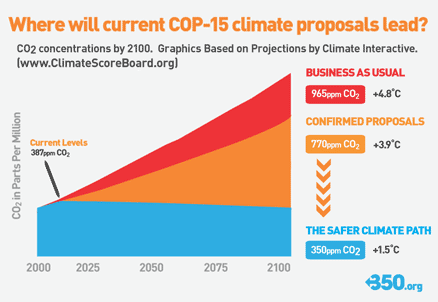
Forget yelling at the First World Annex I delegates. They know. Forget too, the goal of 350 PPM. While government representatives pretend their best efforts will cap atmosphere carbon levels at 550 parts per million, their own calculations predict we’ll reach 770.

The developing nations (the non-Annex I Parties) who will suffer the most by climate change want the damage limited to 1.5°C and they need pledges of countermeasures and disaster relief commensurate to those expectations. But the First World negotiators are offering half the money needed to address a rise of 2°C, knowing warming will get as bad as 3°C.

Here’s the document’s conclusion (highlighting mine):

VI. Conclusions

The pledges made by a number of Annex I Parties for emissions reductions below base year levels and announcements made by a number of non-Annex I Parties for voluntary actions to address emissions in the lead-up to the COP in Copenhagen could bring significant emission reductions and help to reduce the gap between the current reference emission levels in 2020 and the required level of global emissions of 44 Gt in the same year which is estimated at around 10.5 Gt. Even if Parties agreed to deliver in accordance with the upper range of their pledge, this will leave a gap of around 1.9 to 4.2 Gt.

Unless the remaining gap of around 1.9 to 4.2 Gt is closed and Parties commit themselves to strong action prior and after 2020, global emissions will peak later than 2020 and remain on an unsustainable pathway that could lead to concentrations equal or above 550 ppm with the related temperature raise around 3°C. equal or above 550 ppm. This in turn will reduce significantly the probability to stay within a temperature increase of 2°C.

If you’re tracking Treehugger or Grist for the lowdown on Copenhagen, grab a yardstick from 350.org. Bill McKibben, by the way, wrote The End of Nature in 1989, one of the earliest books to address global warming for a general audience. The American Museum of Natural History’s Nature Defense Fund published Global Warming: Understanding the Forecast in 1992. Columbia professor Wallace Broecker coined the phrase in the 1970s –for deniers who thought the conspiracy was a recent one.

By the way, COP15 is not named like the G8 or G20, for 15 key players meeting, by coincidence in Copenhagen. COP15 stand for the 15th international gathering of the Conference Of the Parties. The parties, non-Annex I and Annex I, we know now as the plaintiffs and the liars.

cop15-graph-350org-climatescoreboard

And from the Climate Score Board:

Vaneigem on energy as commodity

NMT’s in-house Situationist has been conceptualizing a way forward well expressed in this May 2009 interview of Raoul Vaneigem:
Situationist“We are being “offered” biofuels on the condition we agree to transgenic rapeseed farming. Eco-tourism will accelerate the plundering of our biosphere. Windmill farms are being built without any advantage to the consumers. Those are the areas where intervention is possible. Natural resources belong to us, they are free, they must be made to serve the freedom of life. It will be up to the communities to secure their own energy and food independence so as to free themselves from the control of the multinationals and their state vassals everywhere. Claiming natural power for our use means reclaiming our own existence first. Only creativity will rid us of work. …

Freeness is the only absolute weapon capable of shattering the mighty self-destruction machine set in motion by consumer society, whose implosion is still releasing, like a deadly gas, bottom-line mentality, cupidity, financial gain, profit, and predation. Museums and culture should be free, for sure, but so should public services, currently prey to the scamming multinationals and states. Free trains, buses, subways, free healthcare, free schools, free water, air, electricity, free power, all through alternative networks to be set up. As freeness spreads, new solidarity networks will eradicate the stranglehold of the commodity. This is because life is a free gift, a continuous creation that the market’s vile profiteering alone deprives us of.”
–Raoul Vaneigem, 2009

Interviewed by Hans Ulrich Obrist, for e-flux, Journal #6. See original article or the copy mirrored below:

In Conversation with Raoul Vaneigem

Hans Ulrich Obrist: I just visited Edouard Glissant and Patrick Chamoiseau, who have written an appeal to Barack Obama. What would your appeal and/or advice be to Obama?

Raoul Vaneigem: I refuse to cultivate any relationship whatsoever with people of power. I agree with the Zapatistas from Chiapas who want nothing to do with either the state or its masters, the multinational mafias. I call for civil disobedience so that local communities can form, coordinate, and begin self-producing natural power, a more natural form of farming, and public services that are finally liberated from the scams of government by the Left or the Right. On the other hand, I welcome the appeal by Chamoiseau, Glissant, and their friends for the creation of an existence in which the poetry of a life rediscovered will put an end to the deadly stranglehold of the commodity.

HUO: Could we talk about your beginnings? How did your participation in situationism begin, and what was your fundamental contribution? At the outset of your relationship with the SI, there was the figure of Henri Lefebvre. What did he mean to you at the time? Why did you decide to send him poetic essays?

RV: I would first like to clarify that situationism is an ideology that the situationists were unanimous in rejecting. The term “situationist” was ever only a token of identification. Its particularity kept us from being mistaken for the throngs of ideologues. I have nothing in common with the spectacular recuperation of a project that, in my case, has remained revolutionary throughout. My participation in a group that has now disappeared was an important moment in my personal evolution, an evolution I have personally pressed on with in the spirit of the situationist project at its most revolutionary. My own radicality absolves me from any label. I grew up in an environment in which our fighting spirit was fueled by working class consciousness and a rather festive conception of existence. I found Lefebvre’s Critique of Everyday Life captivating. When La Somme et le reste [The Sum and the Remainder] was published, I sent him an essay of sorts on “poetry and revolution” that was an attempt to unify radical concepts, Lettrist language, music, and film imagery by crediting them all with the common virtue of making the people’s blood boil. Lefebvre kindly responded by putting me in touch with Guy Debord who immediately invited me to Paris. The two of us had very different temperaments, but we would agree over a period of nearly ten years on the need to bring consumer society to an end and to found a new society on the principle of self-management, where life supersedes survival and the existential angst that it generates.

HUO: Which situationist projects remain unrealized?

RV: Psychogeography, the construction of situations, the superseding of predatory behavior. The radicality, which, notwithstanding some lapses, never ceased to motivate us, remains a source of inspiration to this day. Its effects are just beginning to manifest themselves in the autonomous groups that are now coming to grips with the collapse of financial capitalism.

HUO: The Situationist International defined the situationist as someone who commits her- or himself to the construction of situations. What were those situations for you, concretely? How would you define the situationist project in 2009?

RV: By its very style of living and thinking, our group was already sketching out a situation, like a beachhead active within enemy territory. The military metaphor is questionable, but it does convey our will to liberate daily life from the control and stranglehold of an economy based on the profitable exploitation of man. We formed a “group-at-risk” that was conscious of the hostility of the dominant world, of the need for radical rupture, and of the danger of giving in to the paranoia typical of minds under siege. By showing its limits and its weaknesses, the situationist experience can also be seen as a critical meditation on the new type of society sketched out by the Paris Commune, by the Makhnovist movement and the Republic of Councils wiped out by Lenin and Trotsky, by the libertarian communities in Spain later smashed by the Communist Party. The situationist project is not about what happens once consumer society is rejected and a genuinely human society has emerged. Rather, it illuminates now how lifestyle can supersede survival, predatory behavior, power, trade and the death-reflex.

HUO: You and Guy Debord are the main protagonists of the situationist movement. How do you see Debord’s role and your role?

RV: Not as roles. That is precisely what situationism in its most ridiculous version aims at: reducing us to cardboard cut-outs that it can then set up against one another according to the spectacle’s standard operating procedure. I am simply the spokesman, among others, of a radical consciousness. I just do what I can to see that resistance to market exploitation is transformed into an offensive of life, and that an art of living sweeps away the ruins of oppression.

HUO: What were your reasons for resigning from the group?

RV: Following the occupation movements of May 1968, we knew that some recuperation was afoot. We were familiar with the mechanisms of alienation that would falsify our ideas and fit them neatly into the cultural puzzle. It became clear to us, during the last conference in Venice, that we had failed to shatter those mechanisms, that in fact they were shattering us from the inside. The group was crumbling, the Venice conference was demonstrating its increasing uselessness, and the only answers put forward were commensurate with the self-parody we had fallen into. Dissension intensified to the point of paranoid denunciation: of betrayals of radicality, of breaches of revolutionary spirit, of dereliction of conscience. Those times of catharsis and anathema are now long past, and it might be useful to examine how it is that we sowed the seeds of failure for which the group ended up paying such a heavy price. The shipwreck, however, did not indiscriminately sweep away to the shores of oblivion all of us who participated in the adventure. The group vanished in such a way as to allow the individuals to either consolidate their radicality, disown it, or lapse into the imposture of radicalism. I have attempted to analyze our experimental adventure in Entre le deuil du monde et la joie de vivre [Between Mourning the World and Exuberant Life].

HUO: You have written a lot on life, not survival. What is the difference?

RV: Survival is budgeted life. The system of exploitation of nature and man, starting in the Middle Neolithic with intensive farming, caused an involution in which creativity—a quality specific to humans—was supplanted by work, by the production of a covetous power. Creative life, as had begun to unfold during the Paleolithic, declined and gave way to a brutish struggle for subsistence. From then on, predation, which defines animal behavior, became the generator of all economic mechanisms.

HUO: Today, more than forty years after May ‘68, how do you feel life and society have evolved?

RV: We are witnessing the collapse of financial capitalism. This was easily predictable. Even among economists, where one finds even more idiots than in the political sphere, a number had been sounding the alarm for a decade or so. Our situation is paradoxical: never in Europe have the forces of repression been so weakened, yet never have the exploited masses been so passive. Still, insurrectional consciousness always sleeps with one eye open. The arrogance, incompetence, and powerlessness of the governing classes will eventually rouse it from its slumber, as will the progression in hearts and minds of what was most radical about May 1968.

HUO: Your new book takes us on a trip “between mourning the world and exuberant life.” You revisit May ‘68. What is left of May ‘68? Has it all been appropriated?

RV: Even if we are today seeing recycled ideologies and old religious infirmities being patched up in a hurry and tossed out to feed a general despair, which our ruling wheelers and dealers cash in on, they cannot conceal for long the shift in civilization revealed by May 1968. The break with patriarchal values is final. We are moving toward the end of the exploitation of nature, of work, of trade, of predation, of separation from the self, of sacrifice, of guilt, of the forsaking of happiness, of the fetishizing of money, of power, of hierarchy, of contempt for and fear of women, of the misleading of children, of intellectual dominion, of military and police despotism, of religions, of ideologies, of repression and the deadly resolutions of psychic tensions. This is not a fact I am describing, but an ongoing process that simply requires from us increased vigilance, awareness, and solidarity with life. We have to reground ourselves in order to rebuild—on human foundations—a world that has been ruined by the inhumanity of the cult of the commodity.

HUO: What do you think of the current moment, in 2009? Jean-Pierre Page has just published Penser l’après crise [Thinking the After-Crisis]. For him, everything must be reinvented. He says that a new world is emerging now in which the attempt to establish a US-led globalization has been aborted.

RV: The agrarian economy of the Ancien Régime was a fossilized form that was shattered by the emerging free-trade economy, from the 1789 revolution on. Similarly, the stock-dabbling speculative capitalism whose debacle we now witness is about to give way to a capitalism reenergized by the production of non-polluting natural power, the return to use value, organic farming, a hastily patched-up public sector, and a hypocritical moralization of trade. The future belongs to self-managed communities that produce indispensable goods and services for all (natural power, biodiversity, education, health centers, transport, metal and textile production . . .). The idea is to produce for us, for our own use—that is to say, no longer in order to sell them—goods that we are currently forced to buy at market prices even though they were conceived and manufactured by workers. It is time to break with the laws of a political racketeering that is designing, together with its own bankruptcy, that of our existence.

HUO: Is this a war of a new kind, as Page claims? An economic Third World War?

RV: We are at war, yes, but this is not an economic war. It is a world war against the economy. Against the economy that for thousands of years has been based on the exploitation of nature and man. And against a patched-up capitalism that will try to save its skin by investing in natural power and making us pay the high price for that which—once the new means of production are created—will be free as the wind, the sun, and the energy of plants and soil. If we do not exit economic reality and create a human reality in its place, we will once again allow market barbarism to live on.

HUO: In his book Making Globalization Work, Joseph Stiglitz argues for a reorganization of globalization along the lines of greater justice, in order to shrink global imbalances. What do you think of globalization? How does one get rid of profit as motive and pursue well-being instead? How does one escape from the growth imperative?

RV: The moralization of profit is an illusion and a fraud. There must be a decisive break with an economic system that has consistently spread ruin and destruction while pretending, amidst constant destitution, to deliver a most hypothetical well-being. Human relations must supersede and cancel out commercial relations. Civil disobedience means disregarding the decisions of a government that embezzles from its citizens to support the embezzlements of financial capitalism. Why pay taxes to the bankster-state, taxes vainly used to try to plug the sinkhole of corruption, when we could allocate them instead to the self-management of free power networks in every local community? The direct democracy of self-managed councils has every right to ignore the decrees of corrupt parliamentary democracy. Civil disobedience towards a state that is plundering us is a right. It is up to us to capitalize on this epochal shift to create communities where desire for life overwhelms the tyranny of money and power. We need concern ourselves neither with government debt, which covers up a massive defrauding of the public interest, nor with that contrivance of profit they call “growth.” From now on, the aim of local communities should be to produce for themselves and by themselves all goods of social value, meeting the needs of all—authentic needs, that is, not needs prefabricated by consumerist propaganda.

HUO: Edouard Glissant distinguishes between globality and globalization. Globalization eradicates differences and homogenizes, while globality is a global dialogue that produces differences. What do you think of his notion of globality?

RV: For me, it should mean acting locally and globally through a federation of communities in which our pork-barreling, corrupt parliamentary democracy is made obsolete by direct democracy. Local councils will be set up to take measures in favor of the environment and the daily lives of everyone. The situationists have called this “creating situations that rule out any backtracking.”

HUO: Might the current miscarriages of globalization have the same dangerous effects as the miscarriages of the previous globalization from the ‘30s? You have written that what was already intolerable in ‘68 when the economy was booming is even more intolerable today. Do you think the current economic despair might push the new generations to rebel?

RV: The crisis of the ‘30s was an economic crisis. What we are facing today is an implosion of the economy as a management system. It is the collapse of market civilization and the emergence of human civilization. The current turmoil signals a deep shift: the reference points of the old patriarchal world are vanishing. Percolating instead, still just barely and confusedly, are the early markers of a lifestyle that is genuinely human, an alliance with nature that puts an end to its exploitation, rape, and plundering. The worst would be the unawareness of life, the absence of sentient intelligence, violence without conscience. Nothing is more profitable to the racketeering mafias than chaos, despair, suicidal rebellion, and the nihilism that is spread by mercenary greed, in which money, even devalued in a panic, remains the only value.

HUO: In his book Utopistics, Immanuel Wallerstein claims that our world system is undergoing a structural crisis. He predicts it will take another twenty to fifty years for a more democratic and egalitarian system to replace it. He believes that the future belongs to “demarketized,” free-of-charge institutions (on the model, say, of public libraries). So we must oppose the marketization of water and air.1 What is your view?

RV: I do not know how long the current transformation will take (hopefully not too long, as I would like to witness it). But I have no doubt that this new alliance with the forces of life and nature will disseminate equality and freeness. We must go beyond our natural indignation at profit’s appropriation of our water, air, soil, environment, plants, animals. We must establish collectives that are capable of managing natural resources for the benefit of human interests, not market interests. This process of reappropriation that I foresee has a name: self-management, an experience attempted many times in hostile historical contexts. At this point, given the implosion of consumer society, it appears to be the only solution from both an individual and social point of view.

HUO: In your writing you have described the work imperative as an inhuman, almost animal condition. Do you consider market society to be a regression?

RV: As I mentioned above, evolution in the Paleolithic age meant the development of creativity—the distinctive trait of the human species as it breaks free from its original animality. But during the Neolithic, the osmotic relationship to nature loosened progressively, as intensive agriculture became based on looting and the exploitation of natural resources. It was also then that religion surfaced as an institution, society stratified, the reign of patriarchy began, of contempt for women, and of priests and kings with their stream of wars, destitution, and violence. Creation gave way to work, life to survival, jouissance to the animal predation that the appropriation economy confiscates, transcends, and spiritualizes. In this sense market civilization is indeed a regression in which technical progress supersedes human progress.

HUO: For you, what is a life in progress?

RV: Advancing from survival, the struggle for subsistence and predation to a new art of living, by recreating the world for the benefit of all.

HUO: My interviews often focus on the connections between art and architecture/urbanism, or literature and architecture/urbanism. Could you tell me about the Bureau of Unitary Urbanism?

RV: That was an idea more than a project. It was about the urgency of rebuilding our social fabric, so damaged by the stranglehold of the market. Such a rebuilding effort goes hand in hand with the rebuilding by individuals of their own daily existence. That is what psychogeography is really about: a passionate and critical deciphering of what in our environment needs to be destroyed, subjected to détournement, rebuilt.

HUO: In your view there is no such thing as urbanism?

RV: Urbanism is the ideological gridding and control of individuals and society by an economic system that exploits man and Earth and transforms life into a commodity. The danger in the self-built housing movement that is growing today would be to pay more attention to saving money than to the poetry of a new style of life.

HUO: How do you see cities in the year 2009? What kind of unitary urbanism for the third millennium? How do you envision the future of cities? What is your favorite city? You call Oarystis the city of desire. Oarystis takes its inspiration from the world of childhood and femininity. Nothing is static in Oarystis. John Cage once said that, like nature, “one never reaches a point of shapedness or finishedness. The situation is in constant unpredictable change.”2 Do you agree with Cage?

RV: I love wandering through Venice and Prague. I appreciate Mantua, Rome, Bologna, Barcelona, and certain districts of Paris. I care less about architecture than about how much human warmth its beauty has been capable of sustaining. Even Brussels, so devastated by real estate developers and disgraceful architects (remember that in the dialect of Brussels, “architect” is an insult), has held on to some wonderful bistros. Strolling from one to the next gives Brussels a charm that urbanism has deprived it of altogether. The Oarystis I describe is not an ideal city or a model space (all models are totalitarian). It is a clumsy and naïve rough draft for an experiment I still hope might one day be undertaken—so I agree with John Cage. This is not a diagram, but an experimental proposition that the creation of an environment is one and the same as the creation by individuals of their own future.

HUO: Is Oarystis based on natural power, like the Metabolist cities? Rem Koolhaas and I are working on a book on the Japanese Metabolists. When I read your wonderful text on Oarystis, I was reminded of that movement from the 1960s, especially the floating cities, Kikutake’s water cities. Is Oarystis a Metabolist city?

RV: When Oarystis was published, the architect Philippe Rothier and Diane Hennebert, who ran Brussels’ Architecture Museum at the time, rightly criticized me for ignoring the imaginative projects of a new generation of builders. Now that the old world is collapsing, the fusion of free natural power, self-built housing techniques, and the reinvention of sensual form is going to be decisive. So it is useful to remember that technical inventiveness must stem from the reinvention of individual and collective life. That is to say, what allows for genuine rupture and ecstatic inventiveness is self-management: the management by individuals and councils of their own lives and environment through direct democracy. Let us entrust the boundless freedoms of the imaginary to childhood and the child within us.

HUO: Several years ago I interviewed Constant on New Babylon. What were your dialogues with Constant and how do you see New Babylon today?

RV: I never met Constant, who if I am not mistaken had been expelled before my own association with the SI. New Babylon’s flaw is that it privileges technology over the formation of an individual and collective way of life—the necessary basis of any architectural concept. An architectural project only interests me if it is about the construction of daily life.

HUO: How can the city of the future contribute to biodiversity?

RV: By drawing inspiration from Alphonse Allais, by encouraging the countryside to infiltrate the city. By creating zones of organic farming, gardens, vegetable plots, and farms inside urban space. After all, there are so many bureaucratic and parasitical buildings that can’t wait to give way to fertile, pleasant land that is useful to all. Architects and squatters, build us some hanging gardens where we can go for walks, eat, and live!

HUO: Oarystis is in the form of a maze, but it is also influenced by Venice and its public piazzas. Could you tell us about the form of Oarystis?

RV: Our internal space-time is maze-like. In it, each of us is at once Theseus, Ariadne, and Minotaur. Our dérives would gain in awareness, alertness, harmony, and happiness if only external space-time could offer meanders that could conjure up the possible courses of our futures, as an analogy or echo of sorts—one that favors games of life, and prevents their inversion into games of death.

HUO: Will museums be abolished? Could you discuss the amphitheater of memory? A protestation against oblivion?

RV: The museum suffers from being a closed space in which works waste away. Painting, sculpture, music belong to the street, like the façades that contemplate us and come back to life when we greet them. Like life and love, learning is a continuous flow that enjoys the privilege of irrigating and fertilizing our sentient intelligence. Nothing is more contagious than creation. But the past also carries with it all the dross of our inhumanity. What should we do with it? A museum of horrors, of the barbarism of the past? I attempted to answer the question of the “duty of memory” in Ni pardon, ni talion [Neither Forgiveness Nor Retribution]:

Most of the great men we were brought up to worship were nothing more than cynical or sly murderers. History as taught in schools and peddled by an overflowing and hagiographic literature is a model of falsehood; to borrow a fashionable term, it is negationist. It might not deny the reality of gas chambers, it might no longer erect monuments to the glory of Stalin, Mao or Hitler, but it persists in celebrating the brutish conqueror: Alexander, called the Great—whose mentor was Aristotle, it is proudly intoned—Julius Caesar, Genghis Khan, Tamerlane, Napoleon, the throngs of generals, slaughterers of peoples, petty tyrants of the city or the state, torturer–judges, Javerts of every ilk, conniving diplomats, rapists and killers contracted by religions and ideologies; so much high renown carved from baseness, wickedness, and abjection. I am not suggesting we should unpave the avenues of official history and pave the side alleys instead. We are not in need of a purged history, but of a knowledge that scoops out into broad daylight facts that have been obscured, generation after generation, by the unceasing stratification of prejudice. I am not calling for a tribunal of the mind to begin condemning a bunch of undesirables who have been bizarrely put up on pedestals and celebrated in the motley pantheons of official memory. I just want to see the list of their crimes, the mention of their victims, the recollection of those who confronted them added to the inventory of their unsavory eulogies. I am not suggesting that the name of Francisco Ferrer wipe out that of his murderer, Alfonso XIII, but that at the very least everything be known of both. How dare textbooks still cultivate any respect for Bonaparte, responsible for the death of millions, for Louis XIV, slaughterer of peasants and persecutor of Protestants and freethinkers? For Calvin, murderer of Jacques Gruet and Michel Servet and dictator of Geneva, whose citizens, in tribute to Sébastien Castellion, would one day resolve to destroy the emblems and signs of such an unworthy worship? While Spain has now toppled the effigies of Francoism and rescinded the street names imposed by fascism, we somehow tolerate, towering in the sky of Paris, that Sacré-Coeur whose execrable architecture glorifies the crushing of the Commune. In Belgium there are still avenues and monuments honoring King Leopold II, one of the most cynical criminals of the nineteenth century, whose “red rubber” policy—denounced by Mark Twain, by Roger Casement (who paid for this with his life), by Edward Dene Morel, and more recently by Adam Hochschild—has so far bothered nary a conscience. This is a not a call to blow up his statues or to chisel away the inscriptions that celebrate him. This is a call to Belgian and Congolese citizens to cleanse and disinfect public places of this stain, the stain of one of the worst sponsors of colonial savagery. Paradoxically, I do tend to believe that forgetting can be productive, when it comes to the perpetrators of inhumanity. A forgetting that does not eradicate remembering, that does not blue-pencil memory, that is not an enforceable judgment, but that proceeds rather from a spontaneous feeling of revulsion, like a last-minute pivot to avoid dog droppings on the sidewalk. Once they have been exposed for their inhumanity, I wish for the instigators of past brutalities to be buried in the shroud of their wrongs. Let the memory of the crime obliterate the memory of the criminal.
3

HUO: Learning is deserting schools and going to the streets. Are streets becoming Thinkbelts? Cedric Price’s Potteries Thinkbelt used abandoned railroads for pop-up schools. What and where is learning today?

RV: Learning is permanent for all of us regardless of age. Curiosity feeds the desire to know. The call to teach stems from the pleasure of transmitting life: neither an imposition nor a power relation, it is pure gift, like life, from which it flows. Economic totalitarianism has ripped learning away from life, whose creative conscience it ought to be. We want to disseminate everywhere this poetry of knowledge that gives itself. Against school as a closed-off space (a barrack in the past, a slave market nowadays), we must invent nomadic learning.

HUO: How do you foresee the twenty-first-century university?

RV: The demise of the university: it will be liquidated by the quest for and daily practice of a universal learning of which it has always been but a pale travesty.

HUO: Could you tell me about the freeness principle (I am extremely interested in this; as a curator I have always believed museums should be free—Art for All, as Gilbert and George put it).

RV: Freeness is the only absolute weapon capable of shattering the mighty self-destruction machine set in motion by consumer society, whose implosion is still releasing, like a deadly gas, bottom-line mentality, cupidity, financial gain, profit, and predation. Museums and culture should be free, for sure, but so should public services, currently prey to the scamming multinationals and states. Free trains, buses, subways, free healthcare, free schools, free water, air, electricity, free power, all through alternative networks to be set up. As freeness spreads, new solidarity networks will eradicate the stranglehold of the commodity. This is because life is a free gift, a continuous creation that the market’s vile profiteering alone deprives us of.

HUO: Where is love in Oarystis?

RV: Everywhere. The love affair, as complex as it is simple, will serve as the building block for the new solidarity relations that sooner or later will supersede selfish calculation, competition, competitiveness, and predation, causes of our societies’ dehumanization.

HUO: Where is the city of the dead? In a forest rather than a cemetery?

RV: Yes, a forest, an auditorium in which the voices of the dead will speak amidst the lushness of nature, where life continuously creates itself anew.

HUO: Have you dreamt up other utopian cities apart from Oarystis? Or a concrete utopia in relation to the city?

RV: No, but I have not given up hope that such projects might mushroom and be realized one day, as we begin reconstructing a world devastated by the racketeering mafias.

HUO: In 1991 I founded a Robert Walser museum, a strollological museum, in Switzerland. I have always been fascinated by your notion of the stroll. Could you say something about your urban strolls with and without Debord? What about Walser’s? Have other strollologists inspired you?

RV: I hold Robert Walser in high regard, as many do. His lucidity and sense of dérive enchanted Kafka. I have always been fascinated by the long journey Hölderlin undertook following his break-up with Diotima. I admire Chatwin’s Songlines, in which he somehow manages to turn the most innocuous of walks into an intonation of the paths of fate, as though we were in the heart of the Australian bush. And I appreciate the strolls of Léon-Paul Fargue and the learning of Héron de Villefosse. My psychogeographic dérives with Guy Debord in Paris, Barcelona, Brussels, Beersel, and Antwerp were exceptional moments, combining theoretical speculation, sentient intelligence, the critical analysis of beings and places, and the pleasure of cheerful drinking. Our homeports were pleasant bistros with a warm atmosphere, havens where one was oneself because one felt in the air something of the authentic life, however fragile and short-lived. It was an identical mood that guided our wanderings through the streets, the lanes and the alleys, through the meanderings of a pleasure that our every step helped us gauge in terms of what it might take to expand and refine it just a little further. I have a feeling that the neighborhoods destroyed by the likes of Haussmann, Pompidou, and the real estate barbarians will one day be rebuilt by their inhabitants in the spirit of the joy and the life they once harbored.

HUO: What possibilities do you see for disalienation and détournement in 2009?

RV: This is a time of unprecedented chaos in material and moral conditions. Human values are going to have to compensate for the effects of the only value that has prevailed so far: money. But the implosion of financial totalitarianism means that this currency, which has so tripped us up, is now doomed to devaluation and a loss of all meaning. The absurdity of money is becoming concrete. It will gradually give way to new forms of exchange that will hasten its disappearance and lead to a gift economy.

HUO: What are the conditions for dialogue in 2009? Is there a way out of this system of isolation?

RV: Dialogue with power is neither possible nor desirable. Power has always acted unilaterally, by organizing chaos, by spreading fear, by forcing individuals and communities into selfish and blind withdrawal. As a matter of course, we will invent new solidarity networks and new intervention councils for the well-being of all of us and each of us, overriding the fiats of the state and its mafioso-political hierarchies. The voice of lived poetry will sweep away the last remaining echoes of a discourse in which words are in profit’s pay.

HUO: In your recent books you discuss your existence and temporality. The homogenizing forces of globalization homogenize time, and vice versa. How does one break with this? Could you discuss the temporality of happiness, as a notion?

RV: The productivity- and profit-based economy has implanted into lived human reality a separate reality structured by its ruling mechanisms: predation, competition and competitiveness, acquisitiveness and the struggle for power and subsistence. For thousands of years such denatured human behaviors have been deemed natural. The temporality of draining, erosion, tiredness, and decay is determined by labor, an activity that dominates and corrupts all others. The temporality of desire, love, and creation has a density that fractures the temporality of survival cadenced by work. Replacing the temporality of money will be a temporality of desire, a beyond-the-mirror, an opening to uncharted territories.

HUO: Is life ageless?

RV: I don’t claim that life is ageless. But since survival is nothing but permanent agony relieved by premature death, a renatured life that cultivates its full potential for passion and creation would surely achieve enough vitality to delay its endpoint considerably.

HUO: The Revolution of Everyday Life was a trigger for May ’68, and you have stated in other interviews that it is your key book that you are continually rewriting. Was the book an epiphany? How did it change the course of your work? What had you been doing previously?

RV: The book was prompted by an urgent need I was feeling at the time for a new perspective on the world and on myself, to pull me out of my state of survival, by means other than through suicide. This critical take on a consumer society that was corrupting and destroying life so relentlessly made me aware and conscious of my own life drive. And it became clear to me very quickly that this wasn’t a purely solipsistic project, that many readers were finding their own major concerns echoed there.

HUO: The Revolution of Everyday Life ends on an optimistic note: “We have a world of pleasures to win, and nothing to lose but boredom.”4 Are you still an optimist today?

RV: “Pessimists, what is it you were hoping for?,” Scutenaire wrote. I am neither a pessimist nor an optimist. I try to remain faithful to a principle: desire everything, expect nothing.

HUO: What is the most recent version of the book?

RV: Entre le deuil du monde et la joie de vivre [Between Mourning the World and Exuberant Life].

HUO: What book are you working on at the moment?

RV: I would love to have the resources to complete a Dictionary of Heresies, so as to clarify and correct the historical elements included in The Movement of the Free Spirit and Resistance to Christianity.

HUO: The question of temporality also brings us to Proust and his questionnaire (see inset). What might your definition of happiness be in 2009?

RV: Living ever more intensely and passionately in an ever more intense world. To those who sneer at my ecstatic candor, I reply with a phrase that brings me great comfort: “The desire for an other life is that life already.”5

HUO: Do you have unrealized projects? Unrealized books, unrealized projects in fields other than writing, unrealized architectural projects?

RV: My priority is to live better and better in a world that is more and more human. I would love to build the “urban countryside” of Oarystis, but I’m not just waiting patiently, like Fourier at the Palais Royal, for some billionaire to decide to finance the project only to lose everything to the financial crash a minute later.

HUO: What about your collaborations with other artists, painters, sculptors, designers, filmmakers?

RV: I don’t collaborate with anyone. At times I have offered a few texts to artist friends, not as a commentary on their work but as a counterpoint to it. Art moves me when, in it, I can sense its own overcoming, something that goes beyond it; when it nurtures a trace of life that blossoms as a true aspiration, the intuition of a new art of living.

HUO: Could you tell me about Brussels? What does Brussels mean to you? Where do you write?

RV: I live in the country, facing a garden and woods where the rhythm of the seasons has retained its beauty. Brussels as a city has been destroyed by urbanists and architects who are paid by real estate developers. There are still a few districts suitable for nice walks. I am fond of a good dozen wonderful cafés where one can enjoy excellent artisanal beers.

HUO: Do you agree with Geremek’s view that Europe is the big concern of the twenty-first century?

RV: I am not interested in this Europe ruled by racketeering bureaucracies and corrupt democracies. And regions only interest me once they are stripped of their regionalist ideology and are experiencing self-management and direct democracy. I feel neither Belgian nor European. The only homeland is a humanity that is at long last sovereign.

HUO: You have used a lot of pseudonyms. Je est un autre [I is an other]? How do you find or choose pseudonyms? How many pseudonyms have you used? Is there a complete list?

RV: I don’t keep any kind of score. I leave it up to the inspiration of the moment. There is nothing secret about using a pseudonym. Rather, it is about creating a distance, most often in commissioned work. This allows me to have some fun while alleviating my enduring financial difficulties, which I have always refused to resolve by compromising with the world of the spectacle.

HUO: A book that has been used by many artists and architects has been your Dictionnaire de citations pour servir au divertissement et a l’intelligence du temps [Dictionary of Quotations for the Entertainment and Intelligence of Our Time]. Where did that idea come from?

RV: It was a suggestion from my friend Pierre Drachline, who works for the Cherche Midi publishing house.

HUO: You have often criticized environmental movements who try to replace existing capitalism with capitalism of a different type. What do you think of Joseph Beuys? What non-capitalist project or movement do you support?

RV: We are being “offered” biofuels on the condition we agree to transgenic rapeseed farming. Eco-tourism will accelerate the plundering of our biosphere. Windmill farms are being built without any advantage to the consumers. Those are the areas where intervention is possible. Natural resources belong to us, they are free, they must be made to serve the freedom of life. It will be up to the communities to secure their own energy and food independence so as to free themselves from the control of the multinationals and their state vassals everywhere. Claiming natural power for our use means reclaiming our own existence first. Only creativity will rid us of work.

HUO: Last but not least, Rilke wrote that wonderful little book of advice to a young poet. What would your advice be to a young philosopher-writer in 2009?

RV: To apply to his own life the creativity he displays in his work. To follow the path of the heart, of what is most alive in him.

Translated from the French by Eric Anglès

Is the Museum of Nature and Science gathering health data for insurers?

dmns expedition health
DENVER- At the Denver Museum of Nature and Science the most popular exhibit this summer is called “Expedition Health” and features high-tech diagnostic kiosks where visitors can gauge the general state of their health. Judging by the long lines, you’d think these people haven’t visited a doctor lately. I suspect that unless the medical insurance underwriters of the exhibit can be trusted, many of the DMNS-goers won’t get to see a doctor again.

My hypothesis– that “Expedition Health” is surreptitiously collecting personal medical data on every visitor who comes through their doors, to add actionable factors to insurance customer files. If this is happening or not, it easily could. And the DMNS is not offering any assurance that it is not.

Basically, everybody who goes through the Expedition Health exhibit is surrendering personal health data, which in the hands of insurers could be critical in their decision about whether or not to offer them medical coverage. Museum staff insist that the personal information is purged every night, although with a simple internet link this explanation is disproved. Staff explain that attendee magnetic cards are erased, perhaps innocently ignorant of where the information actually accrues as the public circulate from one kiosk to the next.

expedition health peak passAt pharmacies you can measure your blood pressure without a personalized magnetic card. But at the DMNS health exhibit, sponsored by Met Life, Kaiser Permanente, et al, you have to tell the machines who you are before you can learn your heart rate, your vital statistics, results of a stress test, a measure of your “stride,” digital imagery of your body at rest and in motion, scans of your fingers and palm, and a 3-D imaging of your face.

A telling detail, to my mind, is that the DMNS offers no printed assurance that the health information of its attendees is not being harvested by data merchants. Is it? Do I have any proof? I will offer you the clues, and you can be the judge. I think there are enough signs of subterfuge to suspect that “Expedition Health” is not serving your health.

Here’s how it looks to the average exhibit visitor: the attendee is given a magnetic card to use at the electronic kiosks, at the culmination of which a “Peak Pass” card will be generated to reflect the user’s health results. In the process the attendee learns about positive and negative factors which govern human health. Attendee are free to initiate the card with whatever fictitious ID data they wish, depending on how helpfully relevant they want their results to be.

The impression of anonymity is bolstered by several insincerities. I will illuminate a few.

A. The ruse of an aliased identity

Part one, the ID. Before museum-goers can attend “Expedition Health,” they must obtain an admission ticket marked with the time they can be scheduled to enter. This is done ostensibly to ease congestion through the exhibit hall.

denver museum peak passIn purchasing their museum passes, or submitting their DMNS membership cards, the visitors are of course revealing their verifiable identities. If they are not already members in the museum’s database, their admission purchase via credit card or personal check and driver’s license confirms who they are. Under the pretense of museum security, driver’s IDs can be inspected all of their own. Who would begrudge the museum knowing who is visiting? And if you had the foresight to worry about your anonymity, what would it matter if the museum recorded too, when you would be presenting yourself at the start of the health exhibit?

Part two: the unclean slate. At the exhibit door attendees submit their tickets and are admitted entrance and given a blank magnetic card. The staffer who collects the tickets is not the same person who immediately hands out the magnetic cards, thus reinforcing the sensation of a severed paper trail. But in actuality, there is no discontinuity because the card-holder immediately queues for a kiosk to personalize the card.

Although the user can chose to conjure personal information entirel fictitious, the impression is given that the card’s data goes no further than the exhibit’s exit door. When I asked, a staff member earnestly assured me that all the cards are erased every night. Which could be true, but irrelevant. The cards serve like a patient wristband at the hospital. The wristband confirms the identity of the patient at the various checkup points, as the medial records accumulate in remote files.

Part three, a false sense of anonymity. The museum patients are free to initiate their magnetic cards with whatever manner of fictitious name and birthday. Especially if it does not matter to them that the final printout will bear false facts. My companion felt he had to turn around to explain to me that he always lies about his birthday, by one day, to shake off the data spooks,. He volunteered this in case I thought he didn’t remember his own birth date. My sense is that most people give their true identity, if only so the kiosks will address them by their given names, the exchanges being in full view of friends and relatives waiting in line.

If the attendee hopes to glean some helpful health advice from the “Expedition Health” experience, they are inclined not to falsify the three remaining details: sex, age, and which “buddy,” among a statistical sampling of lifestyle types, they might identify themselves with.

Tell me that the last three profile items are not enough to provide a match to the hard data from the museum entrance receipts or membership database. Remember, the samples to compare are linked by the window of time the museum alloted to your ticket.

The choice of your “buddy” is the clincher. It might appear to be the most innocuous of indiscretions, but your surrogate patient type relays reliable biographical data about you, and doesn’t add anything to the health exhibit narrative except to use as a third person example, when the patient-specific explanation would reveal the alarming degree to which the diagnostics had taken your measure.

Which, to be fair, would create a liability risk for the museum, to complicate matters with pseudo diagnoses, easily misinterpreted by laymen.

The DMNS “Expedition Health” curators thus know quite definitively who you are, as you pass through their kiosks, putting yourself through a fairly extensive check up, the results of which are explained only generally to you, but to a medical administrator say enough to narrow many odds about your health prospects.

B. Diversionary misapplication of magnetic cards

Several of the Kiosks at “Expedition Health” are not interactive, and do not require the magnetic card. Of course, to assure that your “Peak Pass Personal Profile” data card will be filled print out with your EKG, Resting Heart Rate, Target Heart Rate, whether you reached your heart rate; your Arm Span, Height, Energy Score, Stride Length and Speed, a silhouette of your walking profile and another of your outreached Leonardo DaVinci pose; you’d have to have scanned your magnetic card at those machines.

By the way, the data summarized on the personal profile card was far more rudimentary in comparison to the information shown on the screens, and doubtless neither reflect the sophistication of the diagnostic electronics employed. The optics, for example, are capable of far better than inch-high cameos of your body. The lengths of time for which you have to pose for the scans betray the resolution the graphics engines are really processing.

Here’s the information being gathered at the various stops:

Taking your measure
The station which measures your arm span and height requires you to stand, arms outstretched, shoes off, for a full body digital picture, which records an uncommonly revealing photographic record of the subject’s body fat ratio.

Another station measures your stride length and speed, from which an “energy” score is awarded. To do this, a full motion video records you as you take over a half dozen steps, perhaps pushing yourself purposefully to boost your “energy score.” This video must be invaluable in what it reveals about a person’s vitality or physical challenges.

While the cardio-vascular stress tests might appear to offer mere stationary bicycling experiences, a subject’s entire session can be recorded, offering telltale clues to heart condition and lung stamina. Probably we’d all be more comfortable studying these results with the peace of mind that we have health insurance, as opposed to considering that our results might be grounds used to deny us health insurance coverage.

Diet
Several kiosks would seem to have no need for a card. For example, one featured an interactive script about nutrition. Mostly children sit at this station, to pick among menus of food, the mission being to fortify a climber for an ascent of a peak. Their choice of nutrients determines how far the animated climber will get, before tumbling after from hunger. You plug in your card to begin, and as a result the climbing figure features a Tanqueray-head-type of your chosen buddy. If this kiosk is gleaning a sense of your diet preferences, it’s not revealed on the exhibition debriefing printout.

Identification Marks
Another kiosk teaches you about wind chill. You stick your hand into a plexiglass chamber where lasers measure the change in your skin temperature over the course of several minutes. Curiously, you have to insert the magnetic card at this stop. Why? And you cannot proffer your elbow, your fist, or the back of your hand. Is it possible that the lasers reading your hand are actually scanning the prints of your palm and fingers? I know too little about medicine to conjecture what use the medical industry might have for such information, but the data is certainly marketable to security firms.

Confessions
While on this tangent, there’s another kiosk, the most popular in fact, which DOES NOT REQUIRE A CARD. At this station you get to see your face as it’s projected to age over the course of your life. The line is the longest at this station, while subjects pose, their face held immobile, framed in a stainless steel ring, for an interminable several seconds. I witnessed one person complain that the light into which he had to stare hurt his eyes. Eventually the scan yields only an oddly primitive, cellphone-quality facsimile of the subject’s face, projected on an adjacent flat screen. Next, the subject is asked which among three factors might influence how he’s expected to age. Please check which apply: UV damage, Obesity, and/or Smoker.

By law, none of these behaviors would have to be confessed to a doctor, or an insurance agent, in particular if such was a vice already put well behind. But the aging machine draws out the truth. Because the interrogator machina does not ask for your ID, it creates the semblance that you are being asked anonymously. Who doesn’t fully comprehend by now that sun exposure, obesity and smoking are very tragic predictors of our future health problems?

The pseudo age-disfigured face is disappointing. The transformation is just a transparency of age spots, wrinkles and discoloration overlaid on an initial low-rez photograph. If you are not recording the age-progression with your own camera, the ephemeral image passes, with no trace of what the long facial scan had actually recorded. You’d think since the lines of visitors here are always so long, that the aging image is what visitors might like to take with them as a memento. Alas, there’s no slot on this kiosk into which to insert your magnetic card to “record” it. But the sovereignty of this station is illusory.

Biometrics
If a webcam, a PC, and a common internet connection can transmit video in real-time video, why would this DMNS workstation be laboring for so long over your face? Can I hazard a guess? A 3-dimensional study of your face, and something just short perhaps of a retinal scan? If medical administrators are not looking at symptoms deep in your eyes, or in the translucence of your skin, perhaps this kiosk is for the security interests tabulating your biometrics.

If nothing else, the biometric configuration of your face can be matched to a digital image of your whole body from a previous kiosk, thus confirming your identity, BECAUSE AT THIS KIOSK YOU ENJOYED ANONYMITY. But now your smoker/obesity concession can be deftly noted alongside the other red flags being added to your health profile.

C. The Parting Shot
The last kiosk, in my opinion, gives the game away. If you insert your magnetic card, you can record a video message, a propo anything at all. I saw many takers offering calm Youtube soliloquies, as if composing a greeting to send into space. And AHA –instead of pretending that your video would be encoded on your card, instructions beside the screen offered the internet URL at which you can go see it.

First, this directive gives truth to the lie, the DMNS staffers’ incurious conclusion, that individual records are purged everyday. Your profile lives on on the internet, see it for yourself. Give your six-digit pass-code to a friend and they can see it too. And of course, you’re not the only one with the pass-code.

Second, you might well ask yourself, what does a videogram have to do with apprising me about my health? Unless it’s a time-capsule snapshot of you before you lost your insurance coverage. Because the video has everything to do with breached personal privacy. There you are, in your unguarded candor, sitting not upright like you would for a job interview, nor slouched like you might for Social Security, and you’re providing a recording for voice pattern recognition, for further data triangulation.

Third, you’ll have noticed, if you tried the Peak Pass link to the DMNS website, you get no further with your personal code than an invitation to “extend your experience” by installing Microsoft Silverlight. I hadn’t mentioned that the Gates Foundation was another big sponsor of “Expedition Health.” Beside the security vulnerabilities of client-side code, managing what is supposed to be confidential information, what usual back doors is Microsoft leaving in its pseudo-Flash, offering untold windows into our personal medical records?

The DMNS
I do not believe the museum staff have any idea what becomes of the data, nor the extent of the data, logged as museum visitors recreate through “Expedition Health.” The multiple employees, including a manager to whom I spoke, believed all data was erased daily. I’m not sure why they were untroubled by the internet database that obviously refutes their understanding of the process.

However the IT programmers who wired up the displays, and information managers handling the data, would most certainly know the full extent of this nefarious harvest.

Judging from the recent performance of the CEOs of the top medical insurers before Congress, expressing no remorse about their disreputable practice of rescinding coverage for customers upon their being diagnosed with expensive health problems, I do not think it is alarmist in the least to suspect that projects like “Expedition Health” and other similar museum “exhibits” around the country, are being used to further screen the prospectively less-than healthy.

DNA
Readers who’ve already visited “Expedition Health” will note that I ‘ve omitted mention of a significant corner of the experience, the hands-on, let’s play pathologist portion where visitors don lab-coats and, with the assistance of similarly lab-coated docent/lab-technicians, draw and observe their own DNA samples.

Where I inquired, I saw no magnetic-stripped cards changing hands, so I cannot say, on the hot topic of DNA, that the sky is falling. This holds with my inclination to believe that the museum volunteers are not party to the privacy improprieties of the sponsors running the machines. But what hands-on scientific observations are being conducted on digital equipment, as distinguished from analog microscopes, might be kept in the records, and it would only require just one lab-coated coordinator to monitor which sample came from whom. And wouldn’t that be the whole ball of wax?

CRYING WOLF?
If all this seems implausible, consider what is happening at Buckley AFB, by coincidence only a few miles away in Denver. Although US security agencies refuse to comment, respected intelligence experts have determined that at Buckley reside the data storage units upon which are the recordings of every single cellphone conversation that’s been transmitted via satellite. Every last one, for the past several years. Current technology does not afford agents the capability to monitor all those calls, but the processors are quickly catching up. The spooks can project that the eventual capacity to parse the information is inevitable. So why not begin logging the information now? The public has learned about Buckley from former employees, this is not mere idle speculation. Meanwhile the telecom companies who’ve been complicit in the data collection, have been very adamant about receiving immunity from prosecution for what constitute gross violations of American law.

AND NOW?
The information tracking mechanisms are there, the DMNS staff do not presume to vouch for machines, only for the harmless cards. Meanwhile the DMNS has no written pledge that their visitors’ confidentiality is being respected. Harvesting test data is not illegal after all, and with the pretense of anonymity, it’s even laudable, in the name of Science and Nature. I am awaiting a written response from the “Expedition Health” curator, and I intend to solicit an informed and verifiable refutation of these charges. I’ll keep you posted.

The “Expedition Health” installation went up in April, but it’s not coming down. It’s the most recent PERMANENT EXHIBIT to be added to the DMNS offerings. Add the trajectory of time to the information the diagnostics will be able to assemble about you.

And so, what do you think of a museum of Nature and Science, adding a whole wing about FREE HEALTH TESTING? Is that the dominion of museums, usually public repositories of the archives of knowledge? Or can you imagine a more appropriate setting for equipment and staff to perform medical checkups?

Somalia seizes Pentagon pirate ship

MaerkMore is coming in about the pirate ship just seized by Somalia off their shores. See Pirate Maersk Inc.

The ocean surveillance ships (of Pirate Maersk Inc) – USNS Effective, USNS Impeccable, USNS Loyal and USNS Victorious – work directly with the Navy fleets to listen for undersea threats. The range instrumentation ships – USNS Invincible and USNS Observation Island – support the U.S. Air Force by serving as seaborne platforms for radar systems. As part of MSC’s Special Mission Program, the noncombatant, government-owned ships will be crewed by U.S. commercial mariners.

Special mission ships provide operating platforms and services for unique U.S. military and federal government missions. These specialized services include oceanographic and hydrographic surveys, underwater surveillance, missile flight data collection and tracking, acoustic survey and submarine support.

In addition to performing special missions, MSC operates more than 110 noncombatant, civilian-crewed ships that replenish U.S. Navy ships, strategically preposition combat cargo at sea around the world and move 95 percent of military equipment and supplies used by deployed U.S. forces.

from Seafarers International Union, aiding Pentagon Pirates everywhere!

Weathermen for a Democratic Society

Bernadine Dohrn addresses S.D.S. in ChicagoIn 1969, the Radical Youth Movement (RYM) within Students for a Democratic Society (SDS) expelled the passive participants to reconfigure the SDS to Bring the War Home. At left, Bernardine Dohrn uninvites the Progressive Labor Party (PL) and the Worker Student Alliance (WSA) from the Chicago conference. Below is the founding document after which the RYM was renamed.

You Don’t Need A Weatherman
To Know Which Way The Wind Blows

June 18, 1969

Submitted by Karin Asbley, Bill Ayers, Bernardine Dohrn, John Jacobs, Jeff Jones, Gerry Long, Home Machtinger, Jim Mellen, Terry Robbins, Mark Rudd and Steve Tappis.

I. International Revolution

The contradiction between the revolutionary peoples of Asia, Africa and Latin America and the imperialists headed by the United States is the principal contradiction in the contemporary world. The development of this contradiction is promoting the struggle of the people of the whole world against US imperialism and its lackeys.

Lin Piao, Long Live the Victory of People’s War!

People ask, what is the nature of the revolution that we talk about- Who will it be made by, and for, and what are its goals and strategy-

The overriding consideration in answering these questions is that the main struggle going on in the world today is between US imperialism and the national liberation struggles against it. This is essential in defining political matters in the whole world: because it is by far the most powerful, every other empire and petty dictator is in the long run dependent on US imperialism, which has unified, allied with, and defended all of the reactionary forces of the whole world. Thus, in considering every other force or phenomenon, from Soviet imperialism or Israeli imperialism to “workers struggle” in France or Czechoslovakia, we determine who are our friends and who are our enemies according to whether they help US imperialism or fight to defeat it.

So the very first question people in this country must ask in considering the question of revolution is where they stand in relation to the United States as an oppressor nation, and where they stand in relation to the masses of people throughout the world whom US imperialism is oppressing.

The primary task of revolutionary struggle is to solve this principal contradiction on the side of the people of the world. It is the oppressed peoples of the world who have created the wealth of this empire and it is to them that it belongs; the goal of the revolutionary struggle must be the control and use of this wealth in the interests of the oppressed peoples of the world.

It is in this context that we must examine the revolutionary struggles in the United States. We are within the heartland of a worldwide monster, a country so rich from its worldwide plunder that even the crumbs doled out to the enslaved masses within its borders provide for material existence very much above the conditions of the masses of people of the world. The US empire, as a worldwide system, channels wealth, based upon the labor and resources of the rest of the world, into the United States. The relative affluence existing in the United States is directly dependent upon the labor and natural resources of the Vietnamese, the Angolans, the Bolivians and the rest of the peoples of the Third World. All of the United Airlines Astrojets, all of the Holiday Inns, all of Hertz’s automobiles, your television set, car and wardrobe already belong, to a large degree to the people of the rest of the world.

Therefore, any conception of “socialist revolution” simply in terms of the working people of the United States, failing to recognize the full scope of interests of the most oppressed peoples of the world, is a conception of a fight for a particular privileged interest, and is a very dangerous ideology. While the control and use of the wealth of the Empire for the people of the whole world is also in the interests of the vast majority of the people in this country, if the goal is not clear from the start we will further the preservation of class society, oppression, war, genocide, and the complete emiseration of everyone, including the people of the US.

The goal is the destruction of US imperialism and the achievement of a classless world: world communism. Winning state power in the US will occur as a result of the military forces of the US overextending themselves around the world and being defeated piecemeal; struggle within the US will be a vital part of this process, but when the revolution triumphs in the US it will have been made by the people of the whole world. For socialism to be defined in national terms within so extreme and historical an oppressor nation as this is only imperialist national chauvinism on the part of the “movement.”

II. What Is The Black Colony-

Not every colony of people oppressed by imperialism lies outside the boundaries of the US. Black people within North America, brought here 400 years ago as slaves and whose labor, as slaves, built this country, are an internal colony within the confines of the oppressor nation. What this means is that black people are oppressed as a whole people, in the institutions and social relations of the country, apart from simply the consideration of their class position, income, skill, etc., as individuals- What does this colony look like- What is the basis for its common oppression and why is it important-

One historically important position has been that the black colony only consists of the black belt nation in the South, whose fight for national liberation is based on a common land, culture, history and economic life. The corollary of this position is that black people in the rest of the country are a national minority but not actually part of the colony themselves; so the struggle for national liberation is for the black belt, and not all blacks; black people in the north, not actually part of the colony, are part of the working class of the white oppressor nation. In this formulation northern black workers have a “dual role”—one an interest in supporting the struggle in the South, and opposing racism, as members of the national minority; and as northern “white nation” workers whose class interest is in integrated socialism in the north. The consistent version of this line actually calls for integrated organizing of black and white workers in the north along what it calls “class” lines.

This position is wrong; in reality, the black colony does not exist simply as the “black belt nation,” but exists in the country as a whole. The common oppression of black people and the common culture growing out of that history are not based historically or currently on their relation to the territory of the black belt, even though that has been a place of population concentration and has some very different characteristics than the north, particularly around the land question.

Rather, the common features of oppression, history and culture which unify black people as a colony (although originating historically in a common territory apart from the colonizers, i.e., Africa, not the South) have been based historically on their common position as slaves, which since the nominal abolition of slavery has taken the form of caste oppression, and oppression of black people as a people everywhere that they exist. A new black nation, different from the nations of Africa from which it came, has been forged by the common historical experience of importation and slavery and caste oppression; to claim that to be a nation it must of necessity now be based on a common national territory apart from the colonizing nation is a mechanical application of criteria which were and are applicable to different situations.

What is specifically meant by the term caste is that all black people, on the basis of their common slave history, common culture and skin color are systematically denied access to particular job categories (or positions within job categories), social position, etc., regardless of individual skills, talents, money or education. Within the working class, they are the most oppressed section; in the petit bourgeoisie, they are even more strictly confined to the lowest levels. Token exceptions aside, the specific content of this caste oppression is to maintain black people in the most exploitative and oppressive jobs and conditions. Therefore, since the lowest class is the working class, the black caste is almost entirely a caste of the working class, or [holds] positions as oppressed as the lower working-class positions (poor black petit bourgeoisie and farmers); it is a colonial labor caste,, a colony whose common national character itself is defined by their common class position.

Thus, northern blacks do not have a “dual interest”—as blacks on the one hand and “US-nation workers” on the other. They have a single class interest, along with all other black people in the US, as members of the Black Proletarian Colony.

III. The Struggle For Socialist Self-Determination

The struggle of black people—as a colony—is for self-determination, freedom, and liberation from US imperialism. Because blacks have been oppressed and held in an inferior social position as a people, they have a right to decide, organize and act on their common destiny as a people apart from white interference. Black self-determination does not simply apply to determination of their collective political destiny at some future time. It is directly tied to the fact that because all blacks experience oppression in a form that no whites do, no whites are in a position to fully understand and test from their own practice the real situation black people face and the necessary response to it. This is why it is necessary for black people to organize separately and determine their actions separately at each stage of the struggle.

It is important to understand the implications of this. It is not legitimate for whites to organizationally intervene in differences among revolutionary black nationalists. It would be arrogant for us to attack any black organization that defends black people and opposes imperialism in practice. But it is necessary to develop a correct understanding of the Black Liberation struggle within our own organization, where an incorrect one will further racist practice in our relations with the black movement.

In the history of some external colonies, such as China and Vietnam, the struggle for self-determination has had two stages: (1) a united front against imperialism and for New Democracy (which is a joint dictatorship of anti-colonial classes led by the proletariat, the content of which is a compromise between the interests of the proletariat and nationalist peasants, petit bourgeoisie and national bourgeoisie); and (2) developing out of the new democratic stage, socialism.

However, the black liberation struggle in this country will have only one “stage”; the struggle for self-determination will embody within it the struggle for socialism.

As Huey P. Newton has said, “In order to be a revolutionary nationalist, you would of necessity have to be a socialist.” This is because—given the caste quality of oppression-as-a-people-through-a-common-degree-of-exploitation—self-determination requires being free from white capitalist exploitation in the form of inferior (lower caste) jobs, housing, schools, hospitals, prices. In addition, only what was or became in practice a socialist program for self-determination—one which addressed itself to reversing this exploitation—could win the necessary active mass support in the “proletarian colony.”

The program of a united front for new democracy, on the other hand, would not be as thorough, and so would not win as active and determined support from the black masses. The only reason for having such a front would be where the independent petit bourgeois forces which it would bring in would add enough strength to balance the weakening of proletarian backing. This is not the case: first, because much of the black petit bourgeoisie is actually a “comprador” petit bourgeoisie (like so-called black capitalists who are promoted by the power structure to seem independent but are really agents of white monopoly capital), who would never fight as a class for any real self-determination; and secondly, because many black petit bourgeoisie, perhaps most, while not having a class interest in socialist self-determination, are close enough to the black masses in the oppression and limitations on their conditions that they will support many kinds of self-determination issues, and, especially when the movement is winning, can be won to support full (socialist) self-determination. For the black movement to work to maximize this support from the petit bourgeoisie is correct; but it is in no way a united front where it is clear that the Black Liberation Movement should not and does not modify the revolutionary socialist content of its stand to win that support.

From /New Left Notes/, June 18, 1969

IV. Black Liberation Means Revolution

What is the relationship of the struggle for black self-determination to the whole worldwide revolution to defeat US imperialism and internationalize its resources toward the goal of creating a classless world-

No black self-determination could be won which would not result in a victory for the international revolution as a whole. The black proletarian colony, being dispersed as such a large and exploited section of the work force, is essential to the survival of imperialism. Thus, even if the black liberation movement chose to try to attain self-determination in the form of a separate country (a legitimate part of the right to self-determination), existing side by side with the US, imperialism could not survive if they won it—and so would never give up without being defeated. Thus, a revolutionary nationalist movement could not win without destroying the state power of the imperialists; and it is for this reason that the black liberation movement, as a revolutionary nationalist movement for self-determination, is automatically in and of itself an inseparable part of the whole revolutionary struggle against US imperialism and for international socialism.

However, the fact that black liberation depends on winning the whole revolution does not mean that it depends on waiting for and joining with a mass white movement to do it. The genocidal oppression of black people must be ended, and does not allow any leisure time to wait; if necessary, black people could win self-determination, abolishing the whole imperialist system and seizing state power to do it, without this white movement, although the cost among whites and blacks both would be high.

Blacks could do it alone if necessary because of their centralness to the system, economically and geo-militarily, and because of the level of unity, commitment, and initiative which will be developed in waging a people’s war for survival and national liberation. However, we do not expect that they will have to do it alone, not only because of the international situation, but also because the real interests of masses of oppressed whites in this country lie with the Black Liberation struggle, and the conditions for understanding and fighting for these interests grow with the deepening of the crises. Already, the black liberation movement has carried with it an upsurge of revolutionary consciousness among white youth; and while there are no guarantees, we can expect that this will extend and deepen among all oppressed whites.

To put aside the possibility of blacks winning alone leads to the racist position that blacks should wait for whites and are dependent on whites acting for them to win. Yet the possibility of blacks winning alone cannot in the least be a justification for whites failing to shoulder the burden of developing a revolutionary movement among whites. If the first error is racism by holding back black liberation, this would be equally racist by leaving blacks isolated to take on the whole fight—and the whole cost—for everyone.

It is necessary to defeat both racist tendencies: (1) that blacks shouldn’t go ahead with making the revolution, and (2) that blacks should go ahead alone with making it. The only third path is to build a white movement which will support the blacks in moving as fast as they have to and are able to, and still itself keep up with that black movement enough so that white revolutionaries share the cost and the blacks don’t have to do the whole thing alone. Any white who does not follow this third path is objectively following one of the other two (or both) and is objectively racist.

V. Anti-Imperialist Revolution And The United Front

Since the strategy for defeating imperialism in semi-feudal colonies has two stages, the new democratic stage of a united front to throw out imperialism and then the socialist stage, some people suggest two stages for the US too—one to stop imperialism, the anti-imperialist stage, and another to achieve the dictatorship of the proletariat, the socialist stage. It is no accident that even the proponents of this idea can’t tell you what it means. In reality, imperialism is a predatory international stage of capitalism. Defeating imperialism within the US couldn’t possibly have the content, which it could in a semi-feudal country, of replacing imperialism with capitalism or new democracy; when imperialism is defeated in the US, it will be replaced by socialism—nothing else. One revolution, one replacement process, one seizure of state power—the anti-imperialist revolution and the socialist revolution, one and the same stage. To talk of this as two separate stages, the struggle to overthrow imperialism and the struggle for socialist revolution, is as crazy as if Marx had talked about the proletarian socialist revolution as a revolution of two stages, one the overthrow of capitalist state power, and second the establishment of socialist state power.

Along with no two stages, there is no united front with the petit bourgeoisie, because its interests as a class aren’t for replacing imperialism with socialism. As far as people within this country are concerned, the international war against imperialism is the same task as the socialist revolution, for one overthrow of power here. There is no “united front” for socialism here.

One reason people have considered the “united front” idea is the fear that if we were talking about a one-stage socialist revolution we would fail to organize maximum possible support among people, like some petit bourgeoisie, who would fight imperialism on a particular issue, but weren’t for revolution. When the petit bourgeoisie’s interest is for fighting imperialism on a particular issue, but not for overthrowing it and replacing it with socialism, it is still contributing to revolution to that extent—not to some intermediate thing which is not imperialism and not socialism. Someone not for revolution is not for actually defeating imperialism either, but we still can and should unite with them on particular issues. But this is not a united front (and we should not put forth some joint “united front” line with them to the exclusion of our own politics), because their class position isn’t against imperialism as a system. In China, or Vietnam, the petit bourgeoisie’s class interests could be for actually winning against imperialism; this was because their task was driving it out, not overthrowing its whole existence. For us here, “throwing it out” means not from one colony, but all of them, throwing it out of the world, the same thing as overthrowing it.

VI. International Strategy

What is the strategy of this international revolutionary movement- What are the strategic weaknesses of the imperialists which make it possible for us to win- Revolutionaries around the world are in general agreement on the answer, which Lin Piao describes in the following way:

US imperialism is stronger, but also more vulnerable, than any imperialism of the past. It sets itself against the people of the whole world, including the people of the United States. Its human, military, material and financial resources are far from sufficient for the realization of its ambition of domination over the whole world. US imperialism has further weakened itself by occupying so many places in the world, overreaching itself, stretching its fingers out wide and dispersing its strength, with its rear so far away and its supply lines so long.

—/Long Live the Victory of People’s War/

The strategy which flows from this is what Ché called “creating two, three, many Vietnams”—to mobilize the struggle so sharply in so many places that the imperialists cannot possibly deal with it all. Since it is essential to their interests, they will try to deal with it all, and will be defeated and destroyed in the process.

In defining and implementing this strategy, it is clear that the vanguard (that is, the section of the people who are in the forefront of the struggle and whose class interests and needs define the terms and tasks of the revolution) of the “American Revolution” is the workers and oppressed peoples of the colonies of Asia, Africa and Latin America. Because of the level of special oppression of black people as a colony, they reflect the interests of the oppressed people of the world from within the borders of the United States; they are part of the Third World and part of the international revolutionary vanguard.

The vanguard role of the Vietnamese and other Third World countries in defeating US imperialism has been clear to our movement for some time. What has not been so clear is the vanguard role black people have played, and continue to play, in the development of revolutionary consciousness and struggle within the United States. Criticisms of the black liberation struggle as being “reactionary” or of black organizations on campus as being conservative or “racist” very often express this lack of understanding. These ideas are incorrect and must be defeated if a revolutionary movement is going to be built among whites.

The black colony, due to its particular nature as a slave colony, never adopted a chauvinist identification with America as an imperialist power, either politically or culturally. Moreover, the history of black people in America has consistently been one of the greatest overall repudiations of and struggle against the state. From the slave ships from Africa to the slave revolts, the Civil War, etc., black people have been waging a struggle for survival and liberation. In the history of our own movement this has also been the case: the civil rights struggles, initiated and led by blacks in the South; the rebellions beginning with Harlem in 1964 and Watts in 1965 through Detroit and Newark in 1967; the campus struggles at all-black schools in the South and struggles led by blacks on campuses all across the country. As it is the blacks—along with the Vietnamese and other Third World people—who are most oppressed by US imperialism, their class interests are most solidly and resolutely committed to waging revolutionary struggle through to its completion. Therefore it is no surprise that time and again, in both political content and level of consciousness and militancy, it has been the black liberation movement which has upped the ante and defined the terms of the struggle.

What is the relationship of this “black vanguard” to the “many Vietnams” around the world- Obviously this is an example of our strategy that different fronts reinforce each other. The fact that the Vietnamese are winning weakens the enemy, advancing the possibilities for the black struggle, etc. But it is important for us to understand that the interrelationship is more than this. Black people do not simply “choose” to intensify their struggle because they want to help the Vietnamese, or because they see that Vietnam heightens the possibilities for struggle here. The existence of any one Vietnam, especially a winning one, spurs on others not only through consciousness and choice, but through need, because it is a political and economic, as well as military, weakening of capitalism, and this means that to compensate, the imperialists are forced to intensify their oppression of other people.

Thus the loss of China and Cuba and the loss now of Vietnam not only encourages other oppressed peoples (such as the blacks) by showing what the alternative is and that it can be won, but also costs the imperialists billions of dollars which they then have to take out of the oppression of these other peoples. Within this country increased oppression falls heavier on the most oppressed sections of the population, so that the condition of all workers is worsened through rising taxes, inflation and the fall of real wages, and speedup. But this increased oppression falls heaviest on the most oppressed, such as poor white workers and, especially, the blacks, for example through the collapse of state services like schools, hospitals and welfare, which naturally hits the hardest at those most dependent on them.

This deterioration pushes people to fight harder to even try to maintain their present level. The more the ruling class is hurt in Vietnam, the harder people will be pushed to rebel and to fight for reforms. Because there exist successful models of revolution in Cuba, Vietnam, etc., these reform struggles will provide a continually larger and stronger base for revolutionary ideas. Because it needs to maximize profits by denying the reforms, and is aware that these conditions and reform struggles will therefore lead to revolutionary consciousness, the ruling class will see it more and more necessary to come down on any motion at all, even where it is not yet highly organized or conscious. It will come down faster on black people, because their oppression is increasing fastest, and this makes their rebellion most thorough and most dangerous, and fastest growing. It is because of this that the vanguard character and role of the black liberation struggle will be increased and intensified, rather than being increasingly equal to and merged into the situation and rebellion of oppressed white working people and youth. The crises of imperialism (the existence of Vietnam and especially that it’s winning) will therefore create a “Black Vietnam” within the US.

Given that black self-determination would mean fully crushing the power of the imperialists, this “Vietnam” has certain different characteristics than the external colonial wars. The imperialists will never “get out of the US” until their total strength and every resource they can bring to bear has been smashed; so the Black Vietnam cannot win without bringing the whole thing down and winning for everyone. This means that this war of liberation will be the most protracted and hardest fought of all.

It is in this context that the question of the South must be dealt with again, not as a question of whether or not the black nation, black colony, exists there, as opposed to in the North as well, but rather as a practical question of strategy and tactics: Can the black liberation struggle—the struggle of all blacks in the country—gain advantage in the actual war of liberation by concentrating on building base areas in the South in territory with a concentration of black population-

This is very clearly a different question than that of “where the colony is,” and to this question the “yes” answer is an important possibility. If the best potential for struggle in the South were realized, it is fully conceivable and legitimate that the struggle there could take on the character of a fight for separation; and any victories won in that direction would be important gains for the national liberation of the colony as a whole. However, because the colony is dispersed over the whole country, and not just located in the black belt, winning still means the power and liberation of blacks in the whole country.

Thus, even the winning of separate independence in the South would still be one step toward self-determination, and not equivalent to winning it; which, because of the economic position of the colony as a whole, would still require overthrowing the state power of the imperialists, taking over production and the whole economy and power, etc.

VII. The Revolutionary Youth Movement: Class Analysis

The revolutionary youth movement program was hailed as a transition strategy, which explained a lot of our past work and pointed to new directions for our movement. But as a transition to what- What was our overall strategy- Was the youth movement strategy just an organizational strategy because SDS is an organization of youth and we can move best with other young people-

We have pointed to the vanguard nature of the black struggle in this country as part of the international struggle against American imperialism, and the impossibility of anything but an international strategy for winning. Any attempt to put forth a strategy which, despite internationalist rhetoric, assumes a purely internal development to the class struggle in this country, is incorrect. The Vietnamese (and the Uruguayans and the Rhodesians) and the blacks and Third World peoples in this country will continue to set the terms for class struggle in America.

In this context, why an emphasis on youth- Why should young people be willing to fight on the side of Third World peoples- Before dealing with this question about youth, however, there follows a brief sketch of the main class categories in the white mother country which we think are important, and [which] indicate our present estimation of their respective class interests (bearing in mind that the potential for various sections to understand and fight for the revolution will vary according to more than just their real class interests).

Most of the population is of the working class, by which we mean not simply industrial or production workers, nor those who are actually working, but the whole section of the population which doesn’t own productive property and so lives off of the sale of its labor power. This is not a metaphysical category either in terms of its interests, the role it plays, or even who is in it, which very often is difficult to determine.

As a whole, the long-range interests of the non-colonial sections of the working class lie with overthrowing imperialism, with supporting self-determination for the oppressed nations (including the black colony), with supporting and fighting for international socialism. However, virtually all of the white working class also has short-range privileges from imperialism, which are not false privileges but very real ones which give them an edge of vested interest and tie them to a certain extent to the imperialists, especially when the latter are in a relatively prosperous phase. When the imperialists are losing their empire, on the other hand, these short-range privileged interests are seen to be temporary (even though the privileges may be relatively greater over the faster-increasing emiseration of the oppressed peoples). The long-range interests of workers in siding with the oppressed peoples are seen more clearly in the light of imperialism’s impending defeat. Within the whole working class, the balance of anti-imperialist class interests with white mother country short-term privilege varies greatly.

First, the most oppressed sections of the mother country working class have interests most clearly and strongly anti-imperialist. Who are the most oppressed sections of the working class- Millions of whites who have as oppressive material conditions as the blacks, or almost so: especially poor southern white workers; the unemployed or semi-employed, or those employed at very low wages for long hours and bad conditions, who are non-unionized or have weak unions; and extending up to include much of unionized labor which has it a little better off but still is heavily oppressed and exploited. This category covers a wide range and includes the most oppressed sections not only of production and service workers but also some secretaries, clerks, etc. Much of this category gets some relative privileges (i.e. benefits) from imperialism, which constitute some material basis for being racist or pro-imperialist; but overall it is itself directly and heavily oppressed, so that in addition to its long-range class interest on the side of the people of the world, its immediate situation also constitutes a strong basis for sharpening the struggle against the state and fighting through to revolution.

Secondly, there is the upper strata of the working class. This is also an extremely broad category, including the upper strata of unionized skilled workers and also most of the “new working class” of proletarianized or semi-proletarianized “intellect workers.” There is no clearly marked dividing line between the previous section and this one; our conclusions in dealing with “questionable” strata will in any event have to come from more thorough analysis of particular situations. The long-range class interests of this strata, like the previous section of more oppressed workers, are for the revolution and against imperialism. However, it is characterized by a higher level of privilege relative to the oppressed colonies, including the blacks, and relative to more oppressed workers in the mother country; so that there is a strong material basis for racism and loyalty to the system. In a revolutionary situation, where the people’s forces were on the offensive and the ruling class was clearly losing, most of this upper strata of the working class will be winnable to the revolution, while at least some sections of it will probably identify their interests with imperialism till the end and oppose the revolution (which parts do which will have to do with more variables than just the particular level of privilege). The further development of the situation will clarify where this section will go, although it is clear that either way we do not put any emphasis on reaching older employed workers from this strata at this time. The exception is where they are important to the black liberation struggle, the Third World, or the youth movement in particular situations, such as with teachers, hospital technicians, etc., in which cases we must fight particularly hard to organize them around a revolutionary line of full support for black liberation and the international revolution against US imperialism. This is crucial because the privilege of this section of the working class has provided and will provide a strong material basis for national chauvinist and social democratic ideology within the movement, such as anti-internationalist concepts of “student power” and “workers control.” Another consideration in understanding the interests of this segment is that, because of the way it developed and how its skills and its privileges were “earned over time,” the differential between the position of youth and older workers is in many ways greater for this section than any other in the population. We should continue to see it as important to build the revolutionary youth movement among the youth of this strata.

Thirdly, there are “middle strata” who are not petit bourgeoisie, who may even technically be upper working class, but who are so privileged and tightly tied to imperialism through their job roles that they are agents of imperialism. This section includes management personnel, corporate lawyers, higher civil servants, and other government agents, army officers, etc. Because their job categories require and promote a close identification with the interests of the ruling class, these strata are enemies of the revolution.

Fourthly, and last among the categories we’re going to deal with, is the petit bourgeoisie. This class is different from the middle level described above in that it has the independent class interest which is opposed to both monopoly power and to socialism. The petit bourgeoisie consists of small capital—both business and farms—and self-employed tradesmen and professionals (many professionals work for monopoly capital, and are either the upper level of the working class or in the dent class interests-anti-monopoly capital, but for capitalism rather than socialism—gives it a political character of some opposition to “big government,” like its increased spending and taxes and its totalitarian extension of its control into every aspect of life, and to “big labor,” which is at this time itself part of the monopoly capitalist power structure. The direction which this opposition takes can be reactionary or reformist. At this time the reformist side of it is very much mitigated by the extent to which the independence of the petit bourgeoisie is being undermined. Increasingly, small businesses are becoming extensions of big ones, while professionals and self-employed tradesmen less and less sell their skills on their own terms and become regular employees of big firms. This tendency does not mean that the reformist aspect is not still present; it is, and there are various issues, like withdrawing from a losing imperialist war, where we could get support from them. On the question of imperialism as a system, however, their class interests are generally more for it than for overthrowing it, and it will be the deserters from their class who stay with us.

VIII. Why A Revolutionary Youth Movement-

In terms of the above analysis, most young people in the US are part of the working class. Although not yet employed, young people whose parents sell their labor power for wages, and more important who themselves expect to do the same in the future—or go into the army or be unemployed—are undeniably members of the working class. Most kids are well aware of what class they are in, even though they may not be very scientific about it. So our analysis assumes from the beginning that youth struggles are, by and large, working-class struggles. But why the focus now on the struggles of working-class youth rather than on the working class as a whole-

The potential for revolutionary consciousness does not always correspond to ultimate class interest, particularly when imperialism is relatively prosperous and the movement is in an early stage. At this stage, we see working-class youth as those most open to a revolutionary movement which sides with the struggles of Third World people; the following is an attempt to explain a strategic focus on youth for SDS.

In general, young people have less stake in a society (no family, fewer debts, etc.), are more open to new ideas (they have not been brainwashed for so long or so well), and are therefore more able and willing to move in a revolutionary direction. Specifically in America, young people have grown up experiencing the crises in imperialism. They have grown up along with a developing black liberation movement, with the liberation of Cuba, the fights for independence in Africa and the war in Vietnam. Older people grew up during the fight against fascism, during the Cold War, the smashing of the trade unions, McCarthy, and a period during which real wages consistently rose—since 1965 disposable real income has decreased slightly, particularly in urban areas where inflation and increased taxation have bitten heavily into wages. This crisis in imperialism affects all parts of the society. America has had to militarize to protect and expand its empire; hence the high draft calls and the creation of a standing army of three and a half million, an army which still has been unable to win in Vietnam. Further, the huge defense expenditures—required for the defense of the empire and at the same time a way of making increasing profits for the defense industries—have gone hand in hand with the urban crisis around welfare, the hospitals, the schools, housing, air and water pollution. The State cannot provide the services it has been forced to assume responsibility for, and needs to increase taxes and to pay its growing debts while it cuts services and uses the pigs to repress protest. The private sector of the economy can’t provide jobs, particularly unskilled jobs. The expansion of the defense and education industries by the State since World War II is in part an attempt to pick up the slack, though the inability to provide decent wages and working conditions for “public” jobs is more and more a problem.

As imperialism struggles to hold together this decaying social fabric, it inevitably resorts to brute force and authoritarian ideology. People, especially young people, more and more find themselves in the iron grip of authoritarian institutions. Reaction against the pigs or teachers in the schools, welfare pigs or the army, is generalizable and extends beyond the particular repressive institution to the society and the State as a whole. The legitimacy of the State is called into question for the first time in at least 30 years, and the anti-authoritarianism which characterizes the youth rebellion turns into rejection of the State, a refusal to be socialized into American society. Kids used to try to beat the system from inside the army or from inside the schools; now they desert from the army and burn down the schools.

The crisis in imperialism has brought about a breakdown in bourgeois social forms, culture and ideology. The family falls apart, kids leave home, women begin to break out of traditional “female” and “mother” roles. There develops a “generation gap” and a “youth problem.” Our heroes are no longer struggling businessmen, and we also begin to reject the ideal career of the professional and look to Mao, Chef, the Panthers, the Third World, for our models, for motion. We reject the elitist, technocratic bullshit that tells us only experts can rule, and look instead to leadership from the people’s war of the Vietnamese. Chuck Berry, Elvis, the Temptations brought us closer to the “people’s culture” of Black America. The racist response to the civil rights movement revealed the depth of racism in America, as well as the impossibility of real change through American institutions. And the war against Vietnam is not “the heroic war against the Nazis”; it’s the big lie, with napalm burning through everything we had heard this country stood for. Kids begin to ask questions: Where is the Free World- And who do the pigs protect at home-

The breakdown in bourgeois culture and concomitant anti-authoritarianism is fed by the crisis in imperialism, but also in turn feeds that crisis, exacerbates it so that people no longer merely want the plastic ’50s restored, but glimpse an alternative (like inside the Columbia buildings) and begin to fight for it. We don’t want teachers to be more kindly cops; we want to smash cops, and build a new life.

The contradictions of decaying imperialism fall hardest on youth in four distinct areas—the schools, jobs, the draft and the army, and the pigs and the courts. (A) In jail-like schools, kids are fed a mish-mash of racist, male chauvinist, anti-working class, anti-communist lies while being channeled into job and career paths set up according to the priorities of monopoly capital. At the same time, the State is becoming increasingly incapable of providing enough money to keep the schools going at all. (B) Youth unemployment is three times average unemployment. As more jobs are threatened by automation or the collapse of specific industries, unions act to secure jobs for those already employed. New people in the labor market can’t find jobs, job stability is undermined (also because of increasing speed-up and more intolerable safety conditions) and people are less and less going to work in the same shop for 40 years. And, of course, when they do find jobs, young people get the worst ones and have the least seniority. (C) There are now two and a half million soldiers under thirty who are forced to police the world, kill and be killed in wars of imperialist domination. And (D) as a “youth problem” develops out of all this, the pigs and courts enforce curfews, set up pot busts, keep people off the streets, and repress any youth motion whatsoever.

In all of this, it is not that life in America is toughest for youth or that they are the most oppressed. Rather, it is that young people are hurt directly—and severely—by imperialism. And, in being less tightly tied to the system, they are more “pushed” to join the black liberation struggle against US imperialism. Among young people there is less of a material base for racism—they have no seniority, have not spent 20 years securing a skilled job (the white monopoly of which is increasingly challenged by the black liberation movement), and aren’t just about to pay off a 25-year mortgage on a house which is valuable because it’s located in a white neighborhood.

While these contradictions of imperialism fall hard on all youth, they fall hardest on the youth of the most oppressed (least privileged) sections of the working class. Clearly these youth have the greatest material base for struggle. They are the ones who most often get drafted, who get the worst jobs if they get any, who are most abused by the various institutions of social control, from the army to decaying schools, to the pigs and the courts. And their day-to-day existence indicates a potential for militancy and toughness. They are the people whom we can reach who at this stage are most ready to engage in militant revolutionary struggle.

The point of the revolutionary youth movement strategy is to move from a predominant student elite base to more oppressed (less privileged) working-class youth as a way of deepening and expanding the revolutionary youth movement—not of giving up what we have gained, not giving up our old car for a new Dodge. This is part of a strategy to reach the entire working class to engage in struggle against imperialism; moving from more privileged sections of white working-class youth to more oppressed sections to the entire working class as a whole, including importantly what has classically been called the industrial proletariat. But this should not be taken to mean that there is a magic moment, after we reach a certain percentage of the working class, when all of a sudden we become a working-class movement. We are already that if we put forward internationalist proletarian politics. We also don’t have to wait to become a revolutionary force. We must be a self-conscious revolutionary force from the beginning, not be a movement which takes issues to some mystical group—”THE PEOPLE”—who will make the revolution. We must be a revolutionary movement of people understanding the necessity to reach more people, all working people, as we make the revolution.

The above arguments make it clear that it is both important and possible to reach young people wherever they are—not only in the shops, but also in the schools, in the army and in the streets—so as to recruit them to fight on the side of the oppressed peoples of the world. Young people will be part of the International Liberation Army. The necessity to build this International Liberation Army in America leads to certain priorities in practice for the revolutionary youth movement which we should begin to apply this summer. …

IX. Imperialism Is The Issue

The Communists are distinguished from the other working-class parties by this only: 1. In the national struggles of the proletariat of different countries, they point out and bring to the front the common interests of the entire proletariat, independently of all nationality. 2. In the various stages of development which the struggle of the working-class against the bourgeoisie has to pass through, they always and everywhere represent the interests of the movement as a whole.”

—Communist Manifesto

How do we reach youth; what kinds of struggles do we build; how do we make a revolution- What we have tried to lay out so far is the political content of the consciousness which we want to extend and develop as a mass consciousness: the necessity to build our power as part of the whole international revolution to smash the state power of the imperialists and build socialism. Besides consciousness of this task, we must involve masses of people in accomplishing it. Yet we are faced with a situation in which almost all of the people whose interests are served by these goals, and who should be, or even are, sympathetic to revolution, neither understand the specific tasks involved in making a revolution nor participate in accomplishing them. On the whole, people don’t join revolutions just because revolutionaries tell them to. The oppression of the system affects people in particular ways, and the development of political consciousness and participation begins with particular problems, which turn into issues and struggles. We must transform people’s everyday problems, and the issues and struggles growing out of them, into revolutionary consciousness, active and conscious opposition to racism and imperialism.

This is directly counterposed to assuming that struggles around immediate issues will lead naturally over time to struggle against imperialism. It has been argued that since people’s oppression is due to imperialism and racism, then any struggle against immediate oppression is “objectively anti-imperialist,” and the development of the fight against imperialism is a succession of fights for reforms. This error is classical economism.

A variant of this argument admits that this position is often wrong, but suggests that since imperialism is collapsing at this time, fights for reforms become “objectively anti-imperialist.” At this stage of imperialism there obviously will be more and more struggles for the improvement of material conditions, but that is no guarantee of increasing internationalist proletarian consciousness.

On the one hand, if we, as revolutionaries, are capable of understanding the necessity to smash imperialism and build socialism, then the masses of people who we want to fight along with us are capable of that understanding. On the other hand, people are brainwashed and at present don’t understand it; if revolution is not raised at every opportunity, then how can we expect people to see it in their interests, or to undertake the burdens of revolution- We need to make it clear from the very beginning that we are about revolution. But if we are so careful to avoid the dangers of reformism, how do we relate to particular reform struggles- We have to develop some sense of how to relate each particular issue to the revolution.

In every case, our aim is to raise anti-imperialist and anti-racist consciousness and tie the struggles of working-class youth (and all working people) to the struggles of Third World people, rather than merely joining fights to improve material conditions, even though these fights are certainly justified. This is not to say that we don’t take immediate fights seriously, or fight hard in them, but that we are always up front with our politics, knowing that people in the course of struggle are open to a class line, ready to move beyond narrow self-interest.

It is in this sense that we point out that the particular issue is not the issue, is important insofar as it points to imperialism as an enemy that has to be destroyed. Imperialism is always the issue. Obviously, the issue cannot be a good illustration, or a powerful symbol, if it is not real to people, if it doesn’t relate to the concrete oppression that imperialism causes. People have to be (and are being) hurt in some material way to understand the evils of imperialism, but what we must stress is the systematic nature of oppression and the way in which a single manifestation of imperialism makes clear its fundamental nature. At Columbia it was not the gym, in particular, which was important in the struggle, but the way in which the gym represented, to the people of Harlem and Columbia, Columbia’s imperialist invasion of the black colony. Or at Berkeley, though people no doubt needed a park (as much, however, as many other things-), what made the struggle so important was that people, at all levels of militancy, consciously saw themselves attacking private property and the power of the State. And the Richmond Oil Strike was exciting because the militant fight for improvement of material conditions was part and parcel of an attack on international monopoly capital. The numbers and militancy of people mobilized for these struggles has consistently surprised the left, and pointed to the potential power of a class-conscious mass movement.

The masses will fight for socialism when they understand that reform fights, fights for improvement of material conditions, cannot be won under imperialism. With this understanding, revolutionaries should never put forth a line which fosters the illusion that imperialism will grant significant reforms. We must engage in struggles forthrightly as revolutionaries, so that it will be clear to anyone we help to win gains that the revolution rather than imperialism is responsible for them. This is one of the strengths of the Black Panther Party Breakfast for Children Program. It is “socialism in practice” by revolutionaries with the “practice” of armed self-defense and a “line” which stresses the necessity of overthrowing imperialism and seizing state power. Probably the American Friends Service Committee serves more children breakfast, but it is the symbolic value of the program in demonstrating what socialism will do for people which makes the Black Panther Program worthwhile.

What does it mean to organize around racism and imperialism in specific struggles- In the high schools (and colleges) at this time, it means putting forth a mass line to close down the schools, rather than to reform them, so that they can serve the people. The reason for this line is not that under capitalism the schools cannot serve the people, and therefore it is silly or illusory to demand that. Rather, it is that kids are ready for the full scope of militant struggle, and already demonstrate a consciousness of imperialism, such that struggles for a people-serving school would not raise the level of their struggle to its highest possible point. Thus, to tell a kid in New York that imperialism tracks him and thereby oppresses him is often small potatoes compared to his consciousness that imperialism oppresses him by jailing him, pigs and all, and the only thing to do is break out and tear up the jail. And even where high school kids are not yet engaged in such sharp struggle, it is crucial not to build consciousness only around specific issues such as tracking or ROTC or racist teachers, but to use these issues to build toward the general consciousness that the schools should be shut down. It may be important to present a conception of what schools should or could be like (this would include the abolition of the distinction between mental and physical work), but not offer this total conception as really possible to fight for in any way but through revolution.

A mass line to close down the schools or colleges does not contradict demands for open admissions to college or any other good reform demand. Agitational demands for impossible, but reasonable, reforms are a good way to make a revolutionary point. The demand for open admissions by asserting the alternative to the present (school) system exposes its fundamental nature—that it is racist, class-based, and closed—pointing to the only possible solution to the present situation: “Shut it down!” The impossibility of real open admissions—all black and brown people admitted, no flunk-out, full scholarship, under present conditions—is the best reason (that the schools show no possibility for real reform) to shut the schools down. We should not throw away the pieces of victories we gain from these struggles, for any kind of more open admissions means that the school is closer to closing down (it costs the schools more, there are more militant blacks and browns making more and more fundamental demands on the schools, and so on). Thus our line in the schools, in terms of pushing any good reforms, should be, Open them up and shut them down!”

The spread of black caucuses in the shops and other workplaces throughout the country is an extension of the black liberation struggle. These groups have raised and will continue to raise anti-racist issues to white workers in a sharper fashion than any whites ever have or could raise them. Blacks leading struggles against racism made the issue unavoidable, as the black student movement leadership did for white students. At the same time these black groups have led fights which traditional trade-union leaders have consistently refused to lead—fights against speed-up and for safety (issues which have become considerably more serious in the last few years), forcing white workers, particularly the more oppressed, to choose in another way between allegiance to the white mother country and black leadership. As white mother country radicals we should try to be in shops, hospitals, and companies where there are black caucuses, perhaps organizing solidarity groups, but at any rate pushing the importance of the black liberation struggle to whites, handing out Free Huey literature, bringing guys out to Panther rallies, and so on. Just one white guy could play a crucial role in countering UAW counter-insurgency.

We also need to relate to workplaces where there is no black motion but where there are still many young white workers. In the shops the crisis in imperialism has come down around speed-up, safety, and wage squeeze—due to higher taxes and increased inflation, with the possibility of wage-price controls being instituted.

We must relate this exploitation back to imperialism. The best way to do this is probably not caucuses in the shops, but to take guys to citywide demonstrations, Newsreels, even the latest administration building, to make the Movement concrete to them and involve them in it. Further, we can effect consciousness and pick up people through agitational work at plants, train stops, etc., selling Movements, handing out leaflets about the war, the Panthers, the companies’ holdings overseas or relations to defense industry, etc.

After the Richmond strike, people leafleted about demonstrations in support of the Curaçao Oil workers, Free Huey May Day, and People’s Park.

SDS has not dealt in any adequate way with the women question; the resolution passed at Ann Arbor did not lead to much practice, nor has the need to fight male supremacy been given any programmatic direction within the RYM. As a result, we have a very limited understanding of the tie-up between imperialism and the women question, although we know that since World War II the differential between men’s and women’s wages has increased, and guess that the breakdown of the family is crucial to the woman question. How do we organize women against racism and imperialism without submerging the principled revolutionary question of women’s liberation- We have no real answer, but we recognize the real reactionary danger of women’s groups that are not self-consciously revolutionary and anti-imperialist.

To become more relevant to the growing women’s movement, SDS women should begin to see as a primary responsibility the self-conscious organizing of women. We will not be able to organize women unless we speak directly to their own oppression. This will become more and more critical as we work with more oppressed women. Women who are working and women who have families face male supremacy continuously in their day-to-day lives; that will have to be the starting point in their politicization. Women will never be able to undertake a full revolutionary role unless they break out of their woman’s role. So a crucial task for revolutionaries is the creation of forms of organization in which women will be able to take on new and independent roles. Women’s self-defense groups will be a step toward these organizational forms, as an effort to overcome women’s isolation and build revolutionary self-reliance.

The cultural revolt of women against their “role” in imperialism (which is just beginning to happen in a mass way) should have the same sort of revolutionary potential that the RYM claimed for “youth culture.” The role of the “wife-mother” is reactionary in most modern societies, and the disintegration of that role under imperialism should make women more sympathetic to revolution.

In all of our work we should try to formulate demands that not only reach out to more oppressed women, but ones which tie us to other ongoing struggles, in the way that a daycare center at U of C [University of Chicago] enabled us to tie the women’s liberation struggle to the Black Liberation struggle.

There must be a strong revolutionary women’s movement, for without one it will be impossible for women’s liberation to be an important part of the revolution. Revolutionaries must be made to understand the full scope of women’s oppression, and the necessity to smash male supremacy.

X. Neighborhood-Based Citywide Youth Movement

One way to make clear the nature of the system and our tasks working off of separate struggles is to tie them together with each other: to show that we’re one “multi-issue” movement, not an alliance of high school and college students, or students and GIs, or youth and workers, or students and the black community. The way to do this is to build organic regional or sub-regional and citywide movements, by regularly bringing people in one institution or area to fights going on on other fronts.

This works on two levels. Within a neighborhood, by bringing kids to different fights and relating these fights to each other—high school stuff, colleges, housing, welfare, shops—we begin to build one neighborhood-based multi-issue movement off of them. Besides actions and demonstrations, we also pull different people together in day-to-day film showings, rallies, for speakers and study groups, etc. On a second level, we combine neighborhood “bases” into a citywide or region-wide movement by doing the same kind of thing; concentrating our forces at whatever important struggles are going on and building more ongoing interrelationships off of that.

The importance of specifically neighborhood-based organizing is illustrated by our greatest failing in RYM practice so far—high school organizing. In most cities we don’t know the kids who have been tearing up and burning down the schools. Our approach has been elitist, relating to often baseless citywide groups by bringing them our line, or picking up kids with a false understanding of “politics” rather than those whose practice demonstrates their concrete anti-imperialist consciousness that schools are prisons. We’ve been unwilling to work continuously with high school kids as we did in building up college chapters. We will only reach the high school kids who are in motion by being in the schoolyards, hangouts and on the streets on an everyday basis. From a neighborhood base, high school kids could be effectively tied in to struggles around other institutions and issues, and to the anti-imperialist movement as a whole.

We will try to involve neighborhood kids who aren’t in high schools too; take them to anti-war or anti-racism fights, stuff in the schools, etc.; and at the same time reach out more broadly through newspapers, films, storefronts. Activists and cadres who are recruited in this work will help expand and deepen the Movement in new neighborhoods and high schools. Mostly we will still be tied in to the college-based movement in the same area, be influencing its direction away from campus-oriented provincialism, be recruiting high school kids into it where it is real enough and be recruiting organizers out of it. In its most developed form, this neighborhood-based movement would be a kind of sub-region. In places where the Movement wasn’t so strong, this would be an important form for being close to kids in a day-to-day way and yet be relating heavily to a lot of issues and political fronts which the same kids are involved with.

The second level is combining these neighborhoods into citywide and regional movements. This would mean doing the same thing—bringing people to other fights going on—only on a larger scale, relating to various blow-ups and regional mobilizations. An example is how a lot of people from different places went to San Francisco State, the Richmond Oil Strike, and now Berkeley. The existence of this kind of cross-motion makes ongoing organizing in other places go faster and stronger, first by creating a pervasive politicization, and second by relating everything to the most militant and advanced struggles going on so that they influence and set the pace for a lot more people. Further, cities are a basic unit of organization of the whole society in a way that neighborhoods aren’t. For example, one front where we should be doing stuff is the courts; they are mostly organized citywide, not by smaller areas. The same for the city government itself. Schools where kids go are in different neighborhoods from where they live, especially colleges; the same for hospitals people go to, and where they work. As a practical question of staying with people we pick up, the need for a citywide or area-wide kind of orientation is already felt in our movement.

Another failure of this year was making clear what the RYM meant for chapter members and students who weren’t organizers about to leave their campus for a community college, high school, GI organizing, shops or neighborhoods. One thing it means for them is relating heavily to off-campus activities and struggles, as part of the citywide motion. Not leaving the campus movement like people did for ERAP [Education Research Action Project] stuff; rather, people still organized on the campus in off-campus struggles, the way they have in the past for national actions. Like the national actions, the citywide ones will build the on-campus movement, not compete with it.

Because the Movement will be defining itself in relation to many issues and groups, not just schools (and the war and racism as they hit at the schools), it will create a political context that non-students can relate to better, and be more useful to organizing among high school students, neighborhood kids, the mass of people. In the process, it will change the consciousness of the students too; if the issues are right and the Movement fights them, people will develop a commitment to the struggle as a whole, and an understanding of the need to be revolutionaries rather than a “student movement.” Building a revolutionary youth movement will depend on organizing in a lot of places where we haven’t been, and just tying the student movement to other issues and struggles isn’t a substitute for that. But given our limited resources we must also lead the on-campus motion into a RYM direction, and we can make great gains toward citywide youth movements by doing it.

Three principles underlie this multi-issue, “cross-institutional” movement, on the neighborhood and citywide levels, as to why it creates greater revolutionary consciousness and active participation in the revolution:

(1) Mixing different issues, struggles and groups demonstrates our analysis to people in a material way. We claim there is one system and so all these different problems have the same solution, revolution. If they are the same struggle in the end, we should make that clear from the beginning. On this basis we must aggressively smash the notion that there can be outside agitators on a question pertaining to the imperialists.

(2) “Relating to Motion”: the struggle activity, the action, of the Movement demonstrates our existence and strength to people in a material way. Seeing it happen, people give it more weight in their thinking. For the participants, involvement in struggle is the best education about the Movement, the enemy and the class struggle. In a neighborhood or whole city the existence of some struggle is a catalyst for other struggles—it pushes people to see the Movement as more important and urgent, and as an example and precedent makes it easier for them to follow. If the participants in a struggle are based in different institutions or parts of the city, these effects are multiplied. Varied participation helps the Movement be seen as political (wholly subversive) rather than as separate grievance fights. As people in one section of the Movement fight beside and identify closer with other sections, the mutual catalytic effect of their struggles will be greater.

(3) We must build a Movement oriented toward power. Revolution is a power struggle, and we must develop that understanding among people from the beginning. Pooling our resources area-wide and citywide really does increase our power in particular fights, as-well as push a mutual-aid-in-struggle consciousness.

XI. The RYM And The Pigs

A major focus in our neighborhood and citywide work is the pigs, because they tie together the various struggles around the State as the enemy, and thus point to the need for a Movement oriented toward power to defeat it.

The pigs are the capitalist state, and as such define the limits of all political struggles; to the extent that a revolutionary struggle shows signs of success, they come in and mark the point it can’t go beyond. In the early stages of struggle, the ruling class lets parents come down on high school kids, or jocks attack college chapters. When the struggle escalates the pigs come in; at Columbia, the left was afraid its struggle would be co-opted to anti-police brutality, cops off campus, and said pigs weren’t the issue. But pigs really are the issue and people will understand this, one way or another. They can have a liberal understanding that pigs are sweaty working-class barbarians who over-react and commit “police brutality” and so shouldn’t be on campus. Or they can understand pigs as the repressive imperialist State doing its job. Our job is not to avoid the issue of the pigs as “diverting” from anti-imperialist struggle, but to emphasize that they are our real enemy if we fight that struggle to win.

Even when there is no organized political struggle, the pigs come down on people in everyday life in enforcing capitalist property relations, bourgeois laws and bourgeois morality; they guard stores and factories and the rich and enforce credit and rent against the poor. The overwhelming majority of arrests in America are for crimes against property. The pigs will be coming down on the kids we’re working with in the schools, on the streets, around dope; we should focus on them, point them out all the time, like the Panthers do. We should relate the daily oppression by the pig to their role in political repression, and develop a class understanding of political power and armed force among the kids we’re with.

As we develop a base these two aspects of the pig role increasingly come together. In the schools, pig is part of daily oppression—keeping order in halls and lunch rooms, controlling smoking—while at the same time pigs prevent kids from handing out leaflets, and bust “outside agitators.” The presence of youth, or youth with long hair, becomes defined as organized political struggle and the pigs react to it as such. More and more everyday activity is politically threatening, so pigs are suddenly more in evidence; this in turn generates political organization and opposition, and so on. Our task will be to catalyze this development, pushing out the conflict with the pig so as to define every struggle—schools (pigs out, pig institutes out), welfare (invading pig-protected office), the streets (curfew and turf fights)—as a struggle against the needs of capitalism and the force of the State.

Pigs don’t represent State power as an abstract principle; they are a power that we will have to overcome in the course of struggle or become irrelevant, revisionist, or dead. We must prepare concretely to meet their power because our job is to defeat the pigs and the army, and organize on that basis. Our beginnings should stress self-defense—building defense groups around karate classes, learning how to move on the street and around the neighborhood, medical training, popularizing and moving toward (according to necessity) armed self-defense, all the time honoring and putting forth the principle that “political power comes out of the barrel of a gun.” These self-defense groups would initiate pig surveillance patrols, visits to the pig station and courts when someone is busted, etc.

Obviously the issues around the pig will not come down by neighborhood alone; it will take at least citywide groups able to coordinate activities against a unified enemy—in the early stages, for legal and bail resources and turning people out for demonstrations, adding the power of the citywide movement to what may be initially only a tenuous base in a neighborhood. Struggles in one part of the city will not only provide lessons for but [will] materially aid similar motion in the rest of it.

Thus the pigs are ultimately the glue—the necessity—that holds the neighborhood-based and citywide movement together; all of our concrete needs lead to pushing the pigs to the fore as a political focus:

(1) making institutionally oriented reform struggles deal with State power, by pushing our struggle till either winning or getting pigged;

(2) using the citywide inter-relation of fights to raise the level of struggle and further large-scale anti-pig movement-power consciousness;

(3) developing spontaneous anti-pig consciousness in our neighborhoods to an understanding of imperialism, class struggle and the State;

(4) and using the citywide movement as a platform for reinforcing and extending this politicization work, like by talking about getting together a citywide neighborhood-based mutual aid anti-pig self-defense network.

All of this can be done through citywide agitation and propaganda and picking certain issues—to have as the central regional focus for the whole Movement.

XII. Repression And Revolution

As institutional fights and anti-pig self-defense off of them intensify, so will the ruling class’s repression. Their escalation of repression will inevitably continue according to how threatening the Movement is to their power. Our task is not to avoid or end repression; that can always be done by pulling back, so we’re not dangerous enough to require crushing. Sometimes it is correct to do that as a tactical retreat, to survive to fight again.

To defeat repression, however, is not to stop it but to go on building the Movement to be more dangerous to them; in which case, defeated at one level, repression will escalate even more. To succeed in defending the Movement, and not just ourselves at its expense, we will have to successively meet and overcome these greater and greater levels of repression.

To be winning will thus necessarily, as imperialism’s lesser efforts fail, bring about a phase of all-out military repression. To survive and grow in the face of that will require more than a larger base of supporters; it will require the invincible strength of a mass base at a high level of active participation and consciousness, and can only come from mobilizing the self-conscious creativity, will and determination of the people.

Each new escalation of the struggle in response to new levels of repression, each protracted struggle around self-defense which becomes a material fighting force, is part of the international strategy of solidarity with Vietnam and the blacks, through opening up other fronts. They are anti-war, anti-imperialist and pro-black liberation. If they involve fighting the enemy, then these struggles are part of the revolution.

Therefore, clearly the organization and active, conscious, participating mass base needed to survive repression are also the same needed for winning the revolution. The Revolutionary Youth Movement speaks to the need for this kind of active mass-based Movement by tying citywide motion back to community youth bases, because this brings us close enough to kids in their day-to-day lives to organize their “maximum active participation” around enough different kinds of fights to push the “highest level of consciousness” about imperialism, the black vanguard, the State and the need for armed struggle.

III. The Need For A Revolutionary Party

The RYM must also lead to the effective organization needed to survive and to create another battlefield of the revolution. A revolution is a war; when the Movement in this country can defend itself militarily against total repression it will be part of the revolutionary war.

This will require a cadre organization, effective secrecy, self-reliance among the cadres, and an integrated relationship with the active mass-based Movement. To win a war with an enemy as highly organized and centralized as the imperialists will require a (clandestine) organization of revolutionaries, having also a unified “general staff”; that is, combined at some point with discipline under one centralized leadership. Because war is political, political tasks—the international communist revolution—must guide it. Therefore the centralized organization of revolutionaries must be a political organization as well as military, what is generally called a “Marxist-Leninist” party.

How will we accomplish the building of this kind of organization- It is clear that we couldn’t somehow form such a party at this time, because the conditions for it do not exist in this country outside the Black nation. What are these conditions-

One is that to have a unified centralized organization it is necessary to have a common revolutionary theory which explains, at least generally, the nature of our revolutionary tasks and how to accomplish them. It must be a set of ideas which have been tested and developed in the practice of resolving the important contradictions in our work.

A second condition is the existence of revolutionary leadership tested in practice. To have a centralized party under illegal and repressive conditions requires a centralized leadership, specific individuals with the understanding and the ability to unify and guide the Movement in the face of new problems and be right most of the time.

Thirdly, and most important, there must be the same revolutionary mass base mentioned earlier, or (better) revolutionary mass movement. It is clear that without this there can’t be the practical experience to know whether or not a theory, or a leader, is any good at all. Without practical revolutionary activity on a mass scale the party could not test and develop new ideas and draw conclusions with enough surety behind them to consistently base its survival on them. Especially, no revolutionary party could possibly survive Without relying on the active support and participation of masses of people.

These conditions for the development of a revolutionary party in this country are the main “conditions” for winning. There are two kinds of tasks for us.

One is the organization of revolutionary collectives within the Movement. Our theory must come from practice, but it can’t be developed in isolation. Only a collective pooling of our experiences can develop a thorough understanding of the complex conditions in this country. In the same way, only our collective efforts toward a common plan can adequately test the ideas we develop. The development of revolutionary Marxist-Leninist-Maoist collective formations which undertake this concrete evaluation and application of the lessons of our work is not just the task of specialists or leaders, but the responsibility of every revolutionary. Just as a collective is necessary to sum up experiences and apply them locally, equally the collective interrelationship of groups all over the country is necessary to get an accurate view of the whole movement and to apply that in the whole country. Over time, those collectives which prove themselves in practice to have the correct understanding (by the results they get) will contribute toward the creation of a unified revolutionary party.

The most important task for us toward making the revolution, and the work our collectives should engage in, is the creation of a mass revolutionary movement, without which a clandestine revolutionary party will be impossible. A revolutionary mass movement is different from the traditional revisionist mass base of “sympathizers.” Rather it is akin to the Red Guard in China, based on the full participation and involvement of masses of people in the practice of making revolution; a movement with a full willingness to participate in the violent and illegal struggle. It is a movement diametrically opposed to the elitist idea that only leaders are smart enough or interested enough to accept full revolutionary conclusions. It is a movement built on the basis of faith in the masses of people.

The task of collectives is to create this kind of movement. (The party is not a substitute for it. and in fact is totally dependent on it.) This will be done at this stage principally among youth, through implementing the Revolutionary Youth Movement strategy discussed in this paper. It is practice at this, and not political “teachings” in the abstract, which will determine the relevance of the political collectives which are formed.

The strategy of the RYM for developing an active mass base, tying the citywide fights to community and citywide anti-pig movement, and for building a party eventually out of this motion, fits with the world strategy for winning the revolution, builds a movement oriented toward power, and will become one division of the International Liberation Army, while its battlefields are added to the many Vietnams which will dismember and dispose of US imperialism. Long Live the Victory of People’s War!

Police Liaison is double-edged handcuff

Large demonstrations such as planned at the DNC invite a basic need for crowd management. From any standpoint there is an inherent requirement to involve officer friendly. Pardon my sophomoric wonder about how this can be done with sufficient prudence.

The term Police Liaison is self-explanatory. In the context of an organized public demonstration, police liaisons channel communication between organizers and law enforcement commanders. If crowd behavior diverts from what was permitted, liaisons are the last chance for diplomacy before an escalation of violence.

This can serve both sides. A crowd could be steered away from trouble, in particular if someone has been tasked with the responsibility for their actions. As well, police over-reaction can be countermanded if police leaders are alerted to their subordinates’ misbehavior.

In a perfect scenario, liaisons facilitate a smooth, legal public action. But what if events develop imperfectly? i wonder what vulnerabilities are created by having named liaisons.

At minimum, liaisons have been personally introduced to police and vice versa. They are given the police commander’s telephone number, and likewise the police are able to contact the liaisons. But in what further ways does having the liaison telephone numbers benefit the police?

It’s not hard to imagine that a police department could justify getting permission to conduct surveillance on those contact numbers. The liaisons are self-avowed protest organizers, aiming only to conduct fully legal activities, activities which they’ll fully admit however are often out of their control. They should have no objections to serving as extra eyes for law enforcement, whose expressed interest is providing a safe secure environment for all. A FISA court would be hard pressed to oppose such preventive oversight. The liaisons have as much as volunteered. Surveillance could consist of monitoring phone calls, passive bugging of all activities within earshot of the discretely activated phone units, or of course, GPS tracking of liaison movements. Why not? It’s for the security of all concerned.

Alternately, and let’s presume the police department would only do this if crowd actions were heading south, the police could elect to round up the liaisons in a preemptory arrest, to severe what they perceive to be the leadership from the crowd of followers. Such a preemptive move could also be decided merely from early plan-making overheard from the eavesdropping.

It could be presumed that law enforcement is already monitoring the phones of activists whom they consider to be persons of interest. But those activists who volunteer to be police liaisons in effect offer up their responsibility for their compatriots’ actions. They represent themselves as authority sufficient to try to steer protests from trouble. Liaisons as much as formalize their participation in the outcomes that eventually develop.

Should some terrible illegal act be committed, be it real or a frame-up, have the liaisons bound themselves to subsequent conspiracy charges that an investigation would trace in order to declare guilty parties? Imagine if such acts were terrible enough to warrant calling the organizing body a terrorist entity. Would the formalized police liaisons be considered its de facto signatories? Whoever would imagine that peaceful protesters exercising their right to assemble to petition their government for redress of their grievances should fall under the scrutiny of the Department of Homeland Security?

Ossetia South doesn’t want to be West

Ossetia dividedSOUTH OSSETIA? You might very well ask, where’s NORTH Ossetia? The Republic of North Ossetia-Alania is in the Russian Federation. So the minority enclave of South Ossetia wants to break from Georgia? They’ve watched developments in the increasingly US-controlled Georgian leadership and they don’t want to be pawns of the West. South Vietnam? South Korea anyone?

Bruce Gagnon sent more this morning:

Some old sage once said we learn world geography by tracking American wars – or in this case American proxy wars. I am as certain as I can be that this is a proxy war. The U.S. and Israel have been arming Georgia heavily in recent years. The U.S. and Israel have been sending military advisers to Georgia. There is no doubt in my mind that the U.S. has been, at the very least, “encouraging” Georgia to make a grab for the independent territories of South Ossetia and Abkhazia knowing that by doing so they would very well provoke Russia to respond. I am convinced the U.S. wants to confront Russia militarily and if they can get someone else to do it then why not. It’s the cold war strategy come back to life.

The corporate media in the U.S. is having a field day promoting Russian aggression against Goergia. One very interesting CNN-TV story detailed Russian destruction of the Georgian city of Gori but then the camera man who took the footage said the film he took was actually of Georgian destruction of Russian peacekeeper forces in Tskhinvali, the capital of South Ossetia. You can see why the American people are so often confused and misinformed. We are being led with rings in our noses into a new protracted war.

A distant cousin of mine who lives in Massachusetts wrote me saying that when she went to work yesterday the folks there were convinced that Russia had bombed the American state of Georgia. “Why do we bother?” she asked.

Bruce also suggested this article:

Marching through Georgia
By Patrick Schoenfelder

Maybe everyone is already up to speed on this, but if you are depending on the usual drumbeat of warlike bluster from the mainstream media (in the words of Paul Krugman, “real mean don’t think things through”) you are missing most of the news.

Therefore, a brief memo:

South Ossetia and Abkhazia are small areas on the border between Georgia and Russia where the majority of residents belong to ethnic groups other than Georgian. During the Soviet era, both of them were semi-autonomous areas under Soviet control.

In 1990, after Georgia became independent, Georgia claimed both areas as part of Georgia.

Russia opposed this claim as did residents of the areas, and Russia forced Georgia at gunpoint to allow autonomy to both regions in 1992, and both regions have been acting as de facto independent countries since then.

Peacekeepers from Russia commissioned by the Organization for Security and Cooperation in Europe have been stationed in both countries since then.

After the so-called Rose Revolution and the overthrow of Edward Shevardnadze in 2003 it became a policy of the Georgian government to repudiate the independence of both regions and to work for re-establishment of Georgian control.

In 2006, a referendum was held under OSCE supervision with 34 observers from Poland, Germany, Austria, and Sweden. The referendum drew a 95% turnout and voted 99% in favor of full independence.

Georgia rejected the results, claiming that ethnic Georgians were intimidated out of voting, and arguing that the Russian peacekeepers actually were supporting the Ossetians.

Meanwhile, Georgia developed a close relationship with the Bush administration and cultivated a relationship with the EU, beginning application for membership in both the EU and in NATO. Georgia has the third largest number of troops in Iraq, after the US and Britain. The US has supplied the Georgian army with a large amount of war material.

In mid-July of this year, the US military held a joint war games training exercise in Georgia with the Georgian military.

The US left a number of “military advisers” in Georgia after the exercise.

On August 7, the Georgian army invaded South Ossetia in force, advancing rapidly across the area and killing both Ossetian soldiers and Russian peacekeepers.

On August 8, the Russians moved a large force into South Ossetia, including use of airpower for bombing and support. The Georgian army was rapidly crushed and began to retreat into Georgia. The Russians continued to pursue them into Georgia and used artillery and planes to bombard both military and civilian targets in Georgia as they advanced. They also declared that Georgian troops stationed in Abkhazia must leave or surrender, and sent troops into Abkhazia as well.

The Russians at this point seem to be determined to remove the Georgian leadership and establish independence for South Ossetia and Abkhazia. The extent to which they will occupy or establish control in Georgia proper, and for how long, is not clear.

The Georgians, after starting the war, probably partly at the urging of the US, are now screaming for peace.

The US and the Europeans, while expressing dismay (“I am shocked, shocked I say!”) have exactly zero ability to do anything about the situation, since the area is well within Russian sphere of influence and away from any means of support (think of a US military action in Mexico.) They are hanging the Georgians out to dry (think of the Kurds under Reagan and Bush the elder.)

The Russians have been pointing out the similarity with Kosovo and US activity there. They have also pointed out that the US is in no position to complain about superpower military intervention or occupation of any place, given their record over the last eight years.

The possibility of any meaningful economic or other sanctions against the Russians is slight, since Russia is the number one supplier of oil and natural gas to Europe and an important trading partner, and the Russian bloc has the second largest oil reserve in the world (perhaps even the first, depending on the results of exploration in the Caspian region) and is a huge supplier of mineral resources from metals to diamonds.

IMPORTANT BLOOD FOR OIL FOOTNOTE: The largest pipeline between the Black Sea and Caspian oil fields and Europe and the only one not completely under Russian control is the 1 million barrel a day capacity BP line that passes through Georgia and parts of Abkhazia. Both the Russians and the Georgians would benefit hugely from ability to control this pipeline. Some observers suggest that war efforts on both sides are related partly to the issue of this pipeline.

Want a public psychological profile?

Scantron Psych EvaluationI’m not one to shy from self-expression online, but I draw the line at providing survey-question data, particularly psychological tests. They may plow up interesting stuff, but online, associating my IP and cookies, for harvesting by profile aggregators, I don’t think so. I’ve done the 6-question Which Book Are You, but I won’t do the List Your Favorite Books and I certainly won’t do a Myers-Briggs type analysis. For whom?

Scantron multiple choice formWhat could an online profiler deduce from such results? I’ve no idea. But that’s my lack of imagination. I’m not in the business of trading social profiles and profiting by it.

I do know that psychoanalysis is still a crap shoot, likewise so is literary interp. But carbon pencil marks on a multiple choice form can be tabulated by number crunchers which size up everyone with tables and graphs. Heavy machinery can then make informed decisions about you based simply on how the numbers come together. It’s punch card technology. You prefer Tiramisu over Creme Brule, Boggle over Scrabble? The survey says: we need two times the security deposit from you, sorry dude.

Multiple choices with no.2 pencilHandling internet sales at the Bookman, we use a rudimentary fashion of account profiling. Its efficacy is something we’ve wised up to over the years. Here’s how it works: if someone makes an inquiry about shipping details before they place an order, we reject their order. Period. They may be earnest, even upstanding, but our experience shows they’ll be trouble. Our actuarial table says basically, this customer is so likely to be a bother, let them go. So we pass.

It seems a shame, but it’s the only bureaucratic edge Bookman has, and why not take it? Shipping books is a business after all, for profit. Who needs the aggravation of someone figuring they can get their money back AND keep the book. The odds they won’t? Not good enough.

That’s the way profiling works in business applications. If you’re a client falsely cast, you’ve no recourse. The semi-literate customer service rep on the phone has no discretion to treat you differently. And why should they? The designers of the business model know where to fish for profit and when to cut bait. The statistical overlay supersedes any argument you can make. What are you going to say? I’ll be an exception, I promise!? Insurance companies didn’t grow such tall impressive buildings with unreliable actuarial tables.

The You Make My Day Award chain letter

You Make My Day AwardSo begins each post: “My friend so-and-so surprised me with a You Make My Day Award. Thank you! (You should really check out their wonderful blog!) I’m to post this with the following proviso,” etc, etc.

Nothing wrong with a little guerrilla marketing, in this case lighting a back fire up the social network where blogroll links and reciprocal courtesy comments were just not keeping everyone’s interest. Internet blogging has set into motion a real-time one hundred monkeys experiment, but of course someone has to address the task of monitoring the output. We won’t know if even a blogosphere of monkeys typing away can produce Shakespeare unless somebody is diligently evaluating the gibberish.

It didn’t take long tracing the roots of the You-Make-My-Day-Award givers to find someone who explained the rules as: “You have to pass this on to ten people” etc. And there it is. The YMMDA is a chain letter. And like so many viral emails, its driving force is a smile over coffee, pass it on.

Chain emails, whether they promise warm and fuzzies or anticipation that Bill Gates will personally pay you a quarter of a million dollars, are disseminated to chart social networks, yours. They plot connections between people, particularly the veracity of those connections measured by the speed and frequency with which you give your friends priority. Such information is valuable to anyone wanting a bead on you. Use your imagination.

So the You-Make-My-Day-Award is netting bloggers, internet users who may have moved on from circulating those clever email chain letters. I’m perhaps most disappointed that people using their blogs as creative outlets, can’t be creative enough to praise each other on their own initiative. They have to borrow a concept, a graphic and a blurb, and admonish each other to keep it up. These monkeys are getting tired.

Operation Able Danger the movie

Graffiti along expressway says 911 WAS AN INSIDE JOB
For my 9-11 research friends, there’s a new movie to watch for on dvd. Operation Able Danger was tracking the 9-11 hijackers around the country beginning in 1999. The Pentagon destroyed 2.4 terabytes of information, much of it classified, illegally. And would not allow whistle blowers Lt. Col Schaffer and others to testify to congress. Exposing Able Danger would completely eviscerate the entire official story of this supposed “out of the blue” 9-11 event. Cooperative Research has THE best news time line of Operation Able Danger.

Who’s your daddy?

It is the mainstay of both standard American law and the afternoon talk show and TV judge programs. It is the sad and sick concentration on tracking down the biological dad and making him pay…. literally.

It is the cornerstone of a society that takes no real responsibility itself in taking care of its own children…’ Who’s the daddy? You’re going to have to pay!’

I wonder always at how sick we have become as a group when watching these sick shows that concentrate so much on opening the envelope with the official DNA analysis results of who’s the daddy? Men start to clap when the tests clear them, and women weep, too, if they have not succeeded in putting some man or other into officially sanctioned financial bondage.

And to listen to the sanctimonious talk show host, TV judge, or real judge dispensing that moral condemnation at the fingered ‘dead beat’. It’s sick to think of children being raised in such demented sickness passed off as being justice. Rich dad, rich kid. Poor dad, poor kid. Government demanding that the wallet be grabbed, even as the government itself takes about ZERO responsibility in doing what it should be doing for kids.

So little love going around… so much… ‘Who’s your daddy?’ Pity the children. Don’t they deserve not having The State doing this to their dads. Dads that have to be forced to pay are certainly not going to be happy and loving dads. Especially when there is no other involvement in the kids lives due to often times the government mandating that there be little or no involvement.

‘Who’s your daddy?’ asks the government. We need to get the government to stop forcing kids into poverty and to stop haranguing dads. We need a government that makes cities safe for children and that funds real education and not just the pretense of it. We need a government that covers all children with full health care benefits. We need a government that stops stealing from the kids to fund police, soldiers, and the industries that profit off war and excessive prisons. We need a government that cares for the people, children included, and that doesn’t just steal off them.

‘Who’s their daddies?’ I don’t care who they biologically are. I care about them all and it makes me sick to see a government treat the kids, sick, and elderly as bad as ours is doing and plans to continue doing. ‘Who’s the biological dad? You should be ashamed for wanting to know. It makes no difference, Uncle Sam.

Being seen unseemly

A PEW survey has revealed that self-googles are up, that is the number of people searching for a glimpse of their reflection online. Apparently earlier studies indicated a reluctance on everyone’s part to admit they googled themselves. I’d be inclined to think a narcissist’s curiosity is like nose-picking, we don’t expect our noses to rat us out.

Search engines, internet service providers and browsing software companies are of course in a position to know who searches for what. Isn’t it startling to consider they know when it’s YOU? How closely would you peer into a mirror if you knew so many internet middlemen with clipboards were staring intently back at you?

So your internet connection has a unique Internet Protocol (IP) address (here’s as far as the public can trace yours) and your computer has its own Media Access Control (MAC) address, how do they know it’s YOU?

Cookies and certificates stored by your browser facilitate tracking your online activities. They link the visits and search queries to your computer. Product registrations and credit card payment information link the computer to you.

The pattern of your browsing establishes a profile by which somebody can reliably deduce when your behavior betrays your identity. Suppose for example, atypically, you are playing at Webkins. It could be surmised that one of your cohabitants -likely already documented- was at the keyboard.

Ho!Ho!Ho! NORAD tracks Santa and the media lets you jolly well know!

The Spy and Bomb crew located under our local Colorado Springs mountains and over the woods to Santa’s House at Peterson Air Force Base on the plains is tracking the fat socialist known as Santa Claws. You can find out about this vermin and his nefarious plans thanks to the trillions spent on National Insecurity and their back up crowd from the corporate media and sales teams located world wide.

Want the data on this commie? Then go to Santa’s Home Page and track on to this derelict courtesy of NORAD’s Santa Tracker prominently displayed. Maybe they plan to taser this guy and then waterboard him for more info about his Jihad and the terrorist elves that infect consumerist society with good ill?

Our world wide surveillance system and nuclear bomb coordinating system is run in a jolly good manner! Thank you, Federal Government! Thank you, Pentagon! We are safe from Martians, elves, and Arabs for now…

Immigrants are our friends, not our enemies

Immigrant workers are our allies, not our enemies is a talk given by Garrett Brown of the Maquiladora Health and Safety Network that packs a lot of facts in it. One fact he mentions is that more than 1/2 of Mexicans are living on $3 or less a day income.

Do you really want to have the government tracking these immigrants down like they were mere dogs, and not human beings like you and your family are?

Also of note, is that 1 hour south of Douglas, Arizona, an American owned mine is out once again trying to destroy the miner’s union located there in a small Mexican town. The town where the mine is located is called Cananea, Sonora.

Below is some info about this, and once can also check out the film called Cananea, too, for some historical reference and background to this union struggle.
…………………………………
From: Garrett Brown (received today)

Dear Colleagues:
I am writing to see if anyone is, or knows of any, Spanish-speaking
occupational physician, occupational nurse or industrial hygienist who
would be available for a 4-day trip to Cananea, Mexico (just south of
the Arizona border) over the Columbus Day weekend (Oct. 5-8, 2007).

We are trying to put together a volunteer team, all expenses paid but
no fees, to conduct limited medical screenings and IH-related
interviews of some of the 1,300 copper miners who have been on strike
for 7 weeks against the giant Grupo Mexico conglomerate at the
historic Cananea mine where the 1910 Mexican Revolution began.

The key demands of the strike are over workplace health and safety,
and the decision of Grupo Mexico to close the miners company-paid
health clinic. Grupo Mexico has vowed to break the union in Cananea —
which would be a historic defeat — as well as impose its demands on
the workers. The strike is being strongly supported by the United
Steel Workers (USW) union in the United States in a heartening display
of international solidarity.

The goal of the US team, which will partner with Mexican health
workers in Cananea, will be document as thoroughly as possible in a
short time the health problems experienced by both retired and active
miners; and to collect information on the working conditions in the
Cananea facility. The medical team will conduct the medical
evaluations and the IH team will conduct interviews with the workers.

A report will be issued following the visit to provide information to
the public in both Mexico and the United States about the working
conditions that provoked the strike and the needs of the miners.

Further details of the timing (not completely confirmed at this
writing) will be available in the next several days.

If you — or anyone you know — are potentially available for this
emergency, short-term but very important project, please contact
Garrett Brown at gdbrown@igc.org

In solidarity,
Garrett Brown
Coordinator, Maquiladora Health & Safety Support Network