Happy (International) Labor Day

Because the official one will be (a) months away and (b) it’s going to be a party for office workers more than laborers. All the bars and restaurants and stores will be open. THEIR employees ain’t going to have the day off.

But since this is also a Communist holiday, and of course in Northern Europe an ancient celebration of spring, well, I can’t really write about it without being called a commie. Too bad.

It doesn’t bother me any. Communism as an economic structure has been continuously practiced for more than a century and has proved more stable than Capital. In just my lifetime we’ve been subjected to recession after recession or as the Wall Street Elitists (not the same thing as being elite, just thinking that they are) “market corrections” more times than I have kept count thereof.

the “corrections” actually put more control of resources into fewer pockets/hands/bank accounts and especially if there’s massive bail outs. The ones who engineer these “corrections” know full well what they do. Nice for them, but for those who have been repeatedly impoverished by the same scam being perpetrated over and over and over… shit, we don’t even have to participate in the scam to be steamrollered.  Although Steam Rollers are kind of outdated, the name lives on as a verb.


And as the first sentences said, the Corporates have taken Labor Day and are selling us a shadow of what it is supposedly the meaning of actually celebrating Labor and our contributions to the world.

Try to have a good time anyway. Sometimes it actually works.


So Jon Stewart decides when an act of malice is too egregious to joke about? It’s called pandering, people.


Jon Stewart’s monologue last night was a moving response to the racist murders committed in Charleston on Wednesday. Dylann Storm Roof’s shooting of nine African Americans was hate crime and racism pure and simple. I cheered along as Stewart declared a comic intervention: America needed to sober up to the reality of its self-perpetuating racist crimes. I’m not sure Stewart could have reacted any differently, but his comedic turn was also a reminder for me of the manipulative tool the Daily Show has always been. World events are always filled with tragedy, which Stewart highlights and lampoons, so why is the Charleston church shooting more egregious than the mosques Americans bomb every day? Is Roof’s racism any more “home-grown” than our government’s? Does Jon Stewart decide for you when the laughter starts or stops?

I applaud Stewart calling for Americans to stop laughing about racism. #BlackLivesMatter #GodDammit! #GodFuckingDammit! Now I hope in his last shows Stewart can ask his audience to stop laughing at court jesters who provide escape valves for the horrors of systemic state-sponsored injustice.

Stewart followed up his Andy Kaufmanesque cold-open with an interview of Nobel laureate Malala Yousafzai, the compelling child star of Pakistan, as balm for his being overwhelmed by the day’s trauma. Malala of course, the poster child for the machinations of the neoliberal globalists who need to enslave Third World young women to fill their free trade zone factories with Western-education-trafficked slave laborers. So if Stewart delivers the neoliberal agenda on a silver platter, who ordered the show-stopper?

Our collective lockdown mentality, lest a siren call lure us to freedom

LOCKDOWN. The term has become ubiquitous, though lifted easily out of context, being self-explanatory. Its predecessor “batten down the hatches” used to be too. Before the advent of recreational sailing it came from a work environment synonymous with incarceration, in the days of debtors prison for penury, before which were slave galleys. As an idiom, batten the hatches still means to fasten things down, brace for difficult weather. “Lockdown” was used this week to describe the city of Boston, as its neighborhood of Watertown was swarmed by militarized police, the residents commanded to “shelter in place”, officers barking at them to stay in your houses, under penalty of being shot, by accident we like to suppose, for their own safety is the implication, or be arrested for obstructing justice. We’ve come to know what lock-down means. It’s a prison term for everyone stuck in their cell, until further notice, sometimes indefinitely. Colorado’s Supermax prison operates in a permanent state of lock-down. Of course in this age of school shootings –another self-defining expression, like “going postal”– lock-downs have become an educational tradition, and isn’t likening schools to prisons forcing an interesting slip into Freudian reality?

Students have always inferred they were inmates. Without looking it up, I’m now certain the expression “matriculation” was abandoned for its unfortunate implication of being compulsory. Before the middle class, vocational training was worse than mandatory, it was an inevitability. If of course a luxury –how far we’ve come. But our labor saving inventions weren’t meant to save our labor, that profit went to the hoarders of what we produced: produce, became grain, now money. With the means of production owned by the land owner, the rest of us are laborers once again. Underemployed, idled, in the lull of post industrialism, we’re put into lockdown.

And we accept it. Now we’re speaking of building walls to control immigration which means a macro lockdown. We’re prisoners of nation states and we’re breeding children in captivity who can never live Born Free outside zoos.

Boston accepted its lockdown. The media is reporting Bostonians are now catching their breath as if the restriction was some collective girdle. How long would the lockdown have seemed justified? I was rather hoping if the lockdown had extended, that Occupy Boston would have rallied to march on Watertown, to reject the premise that a manhunt for a solitary teen of dubious menace would justify unqualified home invasions without search warrants. I’m rather confident, had Watertown been a submunicipality of Denver, that the infamous cop-baiters of Occupy Denver would have flown their colors in the officers’ faces.

The police were hunting a fugitive teen accused of planting a crude bomb at the Boston Marathon. He’d fled a firefight with police after a car chase said to have involved pipe bombs and grenades, but whose? The suspect was armed and dangerous, but was he? The police also warned that he’d be booby-trapping the neighborhood. They searched houses not just to locate the fugitive, but to check that he hadn’t rigged unsuspecting houses. When he was finally caught there was no mention of his being armed. Perhaps that’s why they couldn’t immolate him like the usual felon, because his hiding place was fiberglass and the imaging devices gave away the fact that he was absolutely defenseless. What may have saved Dzhokhar Tsarnaev was perhaps less the virtual Cop Watch of oversight on police scanners broadcast over the internet, but that the young man sought refuge in a boat.

You might quarrel with my nautical analogy, there are perhaps less archaic idioms than “batten down the hatches”, but specifically it means to seal the hull, batten in this case being a verb referring to a tool for reefing the sail, and see, none of this translates anymore. As we lose the middle class, we lose our sailing terms, just as the working class has lost its fisheries. Hatch is still relevant to aircraft and spaceships, which the common urchin might still know virtually, but for how long prison ship Spaceship Earth?

Odysseus had his men lash (See?) him to the mast so he could resist the Sirens’ call that lured sailors to their doom. Literally battening him in lockdown, because beyond here lie dragons, sea monster mermaids who would waylay the course of Western Civilization, which now seems the better idea.

This American Life caves to Apple Corp, swaps Mike Daisey Chinese factory horror story for Marketplace puff spin

PlaybillThis American Life host Ira Glass tried to pull an Oprah on playwright Mike Daisey, to dress him down on creative license Daisey took with an excerpt of a monolog aired on TAL titled Mr. Daisey and the Apple Factory. The debunking came courtesy of American Public Media’s laughable “Marketplace” Wall Street PR engine, which Glass pretended were reliable experts on the subject of China’s apparently resolved labor abuses. That’s not even funny. This “retraction” reeks even upwind, and Apple’s having become the most highly valued corporation probably explains Glass’s uncharacteristically virulent condemnation. Shameful is what it was, and I hold it unforgivable, for the pretend-affable Glass, so-called folk archivist, to scuttle someone else’s too successful artistic quest for fundamental truth.

Let’s be clear. Mike Daisey was “debunked” based on his Chinese translator contradicting his version of events, and Marketplace finding Hong Kong based activists ready to give Chinese labor problems the all-clear signal. Both sources no longer protected by anonymity are under duress in China, and it’s not mentioned under whose employ they are now.

The Apple Factory story was the first best thing TAL had aired since pioneering post-sardonic navel gazing, but this week Glass issued a full retraction, removed the episode from the archive, and aired a blistering character assassination complete with manipulatively edited confrontations with Daisey, loaded with the expectation he’d buckle like fictional-confession memoir author James Frey. Except Frey’s lies unraveled because they contrived to propagate untruth. Daisey’s truths were undisputed, but the liberties he took to weave a personal narrative were “debunked” to cast doubt on his every word. It was a shameful moment for This American Life, and I’m hoping this time Glass has overestimated the vapidity of his listeners.

For example, when Mike Daisey explained his rationale for not wanting to “unpack the complexity” of his narrative, Ira Glass responded that he didn’t know what that meant. To what kind of reporter, editor, producer, or storyteller would that concept be foreign?

APM’s Marketplace
This was not the first collaboration between Marketplace and TAL. As the Occupy Wall Street protests grew, Ira Glass commissioned folksy research pieces from a Marketplace team to explain world banking and derivatives trading in terms sufficiently lazy to not disturb the usual NPR stupor. It was bunk coiffed in TAL’s typical carefree je ne care pas.

So this time, Marketplace’s man in China was consulted to fact-check Mike Daisey’s account. ACTUALLY, Glass reveals that he was approached by Marketplace AFTER they’d looked into Daisey’s sources. Glass thanked Marketplace for offering the story to TAL, instead of exploiting the exposé themselves. That’s Glass pretending he doesn’t know PR is about getting someone else to say it for you. Absolving Apple required more than one media property criticizing another. Somebody probably wanted a full retraction.

To foul Mike Daisey’s story required one phone call to the translator and guide he’d used in China, whose contact information he tried hide from Glass and co. No mention that this might have been to protect her from angry Chinese authorities, or from Apple and its supplier Foxconn and the inevitable underworld that rides herd on its victim laborers.

Marketplace’s feat consisted of tracking down his translator, breaking her cover, and putting her on the spot for the harsh criticisms which Daisey laid on Apple, Foxconn and their Chinese hosts. Especially as the popularity of Mike Daisey’s performance piece grew, and after its airing on TAL and his many media interviews, the anonymity of his Chinese translator would remain of paramount concern, but once exposed by Marketplace, what choice might she have had but to denounce Daisey’s heresies?

Could Apple’s being the world’s most high valued company have had anything to do with this kill-the-messenger hit piece? Apple has scheduled a press conference Monday morning to announce what it plans to do with its now famous $100 Billion cash holdings.

Storytelling
Isn’t it rich that TAL suddenly wants to hold its stories to journalistic standards? Imagine if someone had called them on the Christmas elven adventures of David Sedaris. Was that fact-checked? Or what of the elementary Christmas play Sedaris so gloriously skewered? IF YOU Criticize TAL for its too-often neglect of difficult subjects and you’re scolded that the show is about culture and storytelling.

Mike Daisey’s TAL recording is now offline, although the transcript remains. In it you’ll find an indictment that Ira Glass perhaps lacks the temerity to redact as well. It’s his introduction to the segment, and I’ll reprint it here, because Glass praises exactly Daisey’s storytelling technique, separate from the facts he recounts.

A couple weeks ago I saw this one-man show where this guy did something on stage I thought was really kind of amazing. He took this fact that we all already know, right, this fact that our stuff is made overseas in maybe not the greatest working conditions, and he made the audience actually feel something about that fact. Which is really quite a trick. You really have to know how to tell a story to be able to pull something like that off.

In his own words, Glass concedes what his show’s retraction is all about. He’s not retracting the facts, these “we all already know”. Glass and Apple are trying to retract Mike Daisey’s effect, that “he made the audience actually feel something about that fact.”

TO BE CONTINUED

City Hall of Mirrors

As cities around the US bully Occupy groups around on park verges and college campuses, we here in Colorado Springs have not remained unscathed. Monday morning saw our friendly neighborhood “Homeless Outreach Team,” (HOT), and a much less friendly contingent from the city’s code enforcement office dismantle the previously permitted Occupy site at Acacia Park in downtown Colorado Springs. A surprisingly good-sized group materialized after midnight to vocally express displeasure at the actions of the city as rendered by the police and what appeared to be a rather callous batch of contracted laborers hired to accomplish the actual dismantling. No one got beat up or gassed. The permit surrounding which had developed controversy in our little microcosm is gone and we will now be required to redefine, restructure, and proceed without it. Personally, i feel it to be a good riddance even though we here in Colorado Springs seem to be experiencing a bit of disorientation as a result.

Dan and M.J. of the HOT team, (a redundancy, i know, but common parlance), were present for the dismantling of the tents that had been a fixture at our protest site. Some 50 or so protesters managed to flood the scene, even at the late hour of the event. Despite the relative peace between authorities and Occupiers here, the police present were fully prepared to inflict harm if we protesters had engaged in any form other than the sometimes obnoxious yelling. The whole scene, not unlike other aspects of our unusual local manifestation of the Movement, produced and continues to produce a sense of extreme ambiguity in my own psyche. I like to think of Dan and M.J. as friends, at least in a provisional sense, but i have no choice but to acknowledge that none of my closest friends would ever even think of putting me in jail or beating me up, even if i piss them off.

Tuesday a fairly large group of Occupiers attended a City Council meeting with a previously established agenda, none of which was to address Occupy directly, though it would be difficult to conjure a government meeting with an agenda that pertained to no issue encompassed by Occupy at this juncture. My own experience at the council meeting felt very much like an exercise in futility. A gentleman preceded us Occupiers with a request to restore city funding to his non-profit that helps supply transportation to disabled city residents. As the council and mayor did with our objections next, they seemed to tolerate the man’s speech and then perfunctorily ignore it. No indication of interest or intention to act was in evidence. Aimee Cox, serving as some sort of city liaison, distributed a few sheets describing the city’s appeal process in a few sentences. The remainder of the council meeting involved investment strategy and plans to extract additional money from residents in the form of utility rate hikes.

The minutiae to all this wrangling is just about as pointless to describe as anything i can picture. The clearest vision afforded by the whole scene is still one of a struggle to get things from those that control them on the one hand, while struggling to keep people from getting things on the other. There remains a sense of entitlement held both by those with little, and by those generally smug players with much. I remain convinced that the current state of affairs is fully unsustainable. The global takeover of industry and commerce by factions that appear fully unconcerned by any consideration other than personal enrichment has led to a scenario in which those at the winning end of that paradigm are in as much trouble as anyone else. Sure, if our supply of food, energy, shelter, and so on becomes insufficient those with more clout in hand may well be able to hold out rather longer than those otherwise equipped. A few survivalists will likely outlast inner city dope fiends; but what’s the point? Is the object of human interaction to feel smugger than the next guy? Who gets to feel the smuggest?

Directly attacking the intractable problems of human interaction seems as futile as ever. No amount of negotiation seems effective enough to overcome the entrenched cultural aversion to cooperation and insistence on coming out on top that has produced such a three ring circus of a society. Observe that Colorado Springs’s Mayor Bach is in office after a campaign financed largely by real estate and development interests. Really, now, do we need more buildings around here, or aren’t these activities really just the outcome of individual efforts to scrabble up money? Think about that a moment. How much human activity is nothing more than bullshit make-work designed not to be productive, but to shift money around? How much useless crap does Madison Avenue convince us we need for no better reason than to supply income to its players. I’m suggesting that most of the stupid jobs we Occupiers hear we should get so often are self-destructive bullshit. That the great majority of laws and regulations we have allowed to overwhelm our hard-won liberty, spawning the parasitic legal industry, the real estate industry, the huge regulatory bureaucracies of governments all around, and in fact most of the “work” we humans do is utterly pointless. I’m suggesting that we humans will, in fact, need to rethink our entire interaction with one another if we are to survive our own more ridiculous tendencies.

I’m hardly the first person to posit this notion. Jeremy Rifkin, for one, discussed the ideas i merely hint at above in rather more depth in his 1995 book, The End of Work. Of course, suspicious religious folk have raised an uproar at the mere mention of Rifkin for decades now, claiming him to be a Devil-worshiper, among other things. The sad truth seems to be that fundamentalists in this country and others, of Christian orientation and others, seem content to allow their Creator’s handiwork to burn to ash rather than to work together with anyone else to resolve the problems we humans have cobbled together to our own collective detriment. As little as i relish the sort of fight that generally ensues from arguing about spiritual matters, i’ll be finding it necessary to head in that direction in upcoming posts. Hold on tight, and please feel free to engage….

Navy Seals Death Squids

It does seem unfair to conclude, after the US special forces operation to hunt and kill Osama bin Laden, that all Navy SEAL teams are death squads, but is it a logical fallacy? No one is now pretending there was any other objective but to kill the al-Qaeda leader and everyone who stood in our path, preferably unarmed. Now the latest revelation is that a duplicate assault team was kept at the ready. That’s how many executioners ready? The question becomes, are all Navy Seals trained to kill in cold blood? The answer could lay with the instructors at Fort Benning, the notorious “School of the Americas” where it used to be understood the death squads of South American dictators learned their trade, although now torture is taught at military camps and private contractor schools literally coast to coast, so isn’t that the problem? Torture being among other unsavory practices we say we do not do, while simultaneously forbidding revelations to come from Wikileaks.

When the Germans set their minds to liquidate civilians as their Operation Barbarossa drove toward Russia, they dedicated “special forces” called the “Einsatzgruppen” to do the deed. One because the task detracted from the forward advance, and two, because executing unarmed civilians proved a demoralizing task for the ordinary soldier. On the other hand, gathering noncombatants and shooting them in the back of the head didn’t require combat skills either, so the Einsatzgruppen were recruited from the police force of German cities like Hamburg, where the principle skill was exerting authority and pulling the trigger where others might flinch.

The Einsatzgruppen present vexing evidence for Holocaust deniers. Skeptics can point to inconsistencies about the function of gas chambers in the concentration camps, to suggest that the Nazis might have managed to work their prison laborers to death, but never intended to exterminate them. That argument fails when considering the role of the Einsatzgruppen, to hunt down Jewish civilians, take them to where no one is looking and shoot them. Prisoners of war, yes, and Slavs too, but by primary directive, the Jews.

When partisan acts of sabotage necessitated disciplinary retribution, the Germans had other squads to raze entire villages, these soldiers were chosen from the military brig or from convicts offered a military probation from civilian prison.

In either case the German Wehrmacht chose to match the criminal mindset to the crime. Though overwhelming in its savagery, WWII predated the “Free Fire Zone” where civilians are pretended to be adversaries and/or dismissed as collateral damage.

That’s not to say that today’s soldiers are all bad, many of them I’m sure are earnest peacekeepers determined to win hearts to Pax Americana. I’m sure your average Navy SEAL has rescued his share of kittens from trees.

So which is it, do the Navy SEALs train every member not to shy from shooting defenseless people at point-blank range, or are there designated specialists? Are those chosen based on excellence of performance, as the PR has it, or from among the sailors with disciplinary troubles? Because it’s looking like the bin Laden raid was not out of the ordinary, and no one’s defending it as such.

Bin Laden’s assassination offered a curious ray of hope for me when President Obama’s mission accomplished message was “justice has been served.” Might I dream that bankers and the world’s biggest criminals could feel a draft of discomfort at the idea that no one is untouchable, and the Commander in Chief’s idea of serving justice means a hail of bullets to whomever’s home he chooses.

Don’t worry, there are unspecial forces enough to go around. When Wikileaks released the video of unarmed Iraqis being gunned down by relentless, trigger-giddy helicopter crews, most soldiers acknowledged that such events were commonplace. In the US military, you don’t even have to be a specially rated soldier to rank as Einsatzgruppen.

In my 20-year experience with local policemen, owning two retail stores, soliciting their help with shoplifters, vandals, and whatever disturbances, I can honestly report that all were professional, competent, and very pleasant. That’s 100% of them, very nice people. I can also say that in my experiences protesting, those police-persons who arrested me were unwavering bastards. Also 100%. Not in any particular case the same officers, but statistically, if you compare the two absolute groups, they’re the same people.

Film: Maafa 21, Black Genocide in 21st Century America, a white anti-abortion shockumentary of execrable mendacity

Martin Luther King Jr. was an advocate of birth control, it remains a key tool to escape poverty, but that didn’t stop organizers of MLK tribute festivities at Colorado College from ending today’s program with a screening of MAAFA 21: Black Genocide in 21st Century America, a completely contrived shockumentary attempting to incite African American anger toward reproductive rights activists. Both UCCS and Colorado College fell for the propaganda, even though the pseudo-documentary by Life Dynamics Incorporated, a virulent Christian anti-abortion project, has been thoroughly debunked since its debut in 2009. Add Colorado Springs’ higher educators to duped churches nationwide who are diverting the black struggle against the legacy of slavery, economic oppression, racist yahoos like the makers of Maafa, and endemic racism, into animosity for the social workers of Planned Parenthood and their eugenic agenda of genocide via abortion. While the black community, like its indigenous brothers, does face a real genocidal program of forced poverty and violence, these agitators invoke race baiting to divide class war allies, MLK be damned. CC’s clueless invitation read: This movie has been called “stunning,” “breathtaking,” and “jaw-dropping.” You have only to watch the opening minutes on Youtube to add –execrable, mendacious and absurd. You can be against legal abortion without conniving to blame the Black Holocaust on those who disagree with you.

To argue the “facts” offered up in this “documentary” is to give them credence they don’t deserve. And the issue of abortion is so polarizing, there really is no discussing it. Throw in slanderous accusations and you’re arguing with fools. Imagine decrying that the abolitionists were racists because they would deprive the slaves their free lunch. Well okay then.

My solitary concern here is that this video has escaped the bounds of the dogma-skulled religious extremists unto the screens of higher education campuses. By presenting this video in the context of a celebration of Martin Luther King, reveals the absence of a skeptical eye. Of course academics will recognize the logic-dissonance self-evident in Maafa, but a TV-type audience will eat it up like every other hate-mongering offering. Giving the Maafa screening the appearance of a college endorsement is unforgivable. But Colorado College of course has not been shy about promoting similar quacks, neoclassical economists, climate change deniers, Zionists, pro-war imperialists, and free-trade globalists. That’s what you get when you appoint politicians as deans, politicized pro-establishment education.

The video begins with a premise almost too corny to believe: once the slaves were emancipated, America’s ruling elite needed to get rid of them. This might sound like a plausible motive for a Bond villain, but it ignores the demands juggled by real-life capitalist villains who need a steady workforce to exploit. The slaves were freed, but someone still had to shoulder the work. The fields of the South and the industrial centers of the North still needed its laborers. The obscenity of Maafa’s lie is that abusers of labor have always been against birth control because it threatens to shrink their supply of impoverished, desperate people. And we can trace back to ancient times the role religion has always played in keeping the laborers in line.

Again, you can be against abortion, but don’t pretend your interests don’t dovetail with those who want to perpetuate poverty and human suffering. If you are safely in the middle class, by all means discourage your children from limiting your progeny through birth control, but don’t force that choice on those who can’t afford it.

The sad reality of racism is that a disproportion of African Americans are poor. It’s no coincidence that poor black women account for a greater share of abortions. To attribute that reality to creepy, long-shunned writings of eugenicists of a century ago is dishonest.

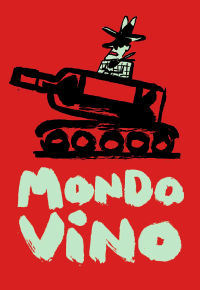
Mondovino: globalization and terroir, Robert Parker versus your good taste

American wine cowboy conquest with tankFor those with a curiosity for how wine terroir is holding up against the onslaught of wine factory farming, the 10-hour miniseries version of MONDOVINO is finally available on DVD. For viewers curious about viniculture globalization under Californian colonial domination, the original feature length documentary delivers, with a long finish. Any time critics accuse a film of being one sided, you know it’s about class war.

I had my first lesson in vineyard terroir when my college-aged aunt visited my family in Alsace and spent a season picking grapes. She informed us to our horreur that everything gets stomped in that barrel, bugs and all. I didn’t drink wine then, so what did I care, but it was easy to decide that such was the artistry that probably made French wines great.

But as I said, Mondovino was about much more than wine, and now I’ll get to the point. We may lament the new commercialization of wine, but historically the occupation has always had its strictly-business types. Vintners were rarely agriculturalists who subsisted, they were wine lovers subsidized. We can wince at the Napa Valley nouveau gauche, but even Bordeaux’s great chateaus, and especially all the Premiers Crus, are owned and have been owned by businessmen money lenders, going back centuries.

The modernization and standardization which is destroying contemporary wines is simply the evolution of production control. At last, technology and the ascent of a gilded age have brought vintners to believe they’ve bested nature. It’s true if you don’t care about wine, if you’re content to bottle a soft drink as opposed to allowing wine the breathing space to develop personality. Basically this documentary demonstrates that these gentlemen hobbyists, now plaintively bourgeois about profit, welcome the new global fascism.

Old World Fascists
Of course it is no stretch to imagine that the Mondovino filmmakers are going to ask, how did your father or grandfather like Fascism under the Nazis? They point the question at an Italian family who date their wealth back 900 years as bankers.

Any European documentary delving into family histories will always ask particularly about the war years. In America it’s what did you do during the war Daddy? In Europe it’s about weathering the occupation. Most working class French want to tell you what they did in the Resistance. Rich people you don’t ask because of course they were collaborateurs.

Mondovino’s subjects are the perpetually wealthy, who don’t even register the affront. Of course their families thrived under Fascism, quelle betise to imagine it would be otherwise. How curious it is we are surprised they embrace it so again.

Such moments are the highlights of Mondovino, rich folk posing in elaborate foyers, plaintively matter of fact about Fascism.

One opulent reception room in Florence is packed with ancient paintings, among them a painting of the very room full of paintings, you imagine if you peered closely enough you would see the infinity of mirrors scheme, a Baroque era black velvet number. The Grande Dame mentions that Prince Charles inquired about that painting at breakfast.

Let me add, critics have held Jonathan Nossiter’s camera work to be unstable. Actually he was very easily distracted by momentously relevant tchotchkes and biographical details few commoners are granted audience to encounter.

Fascists in the New World
Mondovino allowed the Napa Valley entrepreneurs to hang themselves. Open mouth, insert vacuous blather, often racist. These nouveau riches landscaped new vineyard for themselves, praising the terrain like it was classic architecture, their aesthetic tributes could only reference the National Mall. That classic.

Over at Mondavi, talk fixated of expansion and conquest. The film’s main plot addressed the Mondavi’s ongoing acquisition of the world’s most treasured appelations. For the worse of course, because what do they know about wine but that it should all taste the same? Son Mondavi dreams of someday having a vineyard on the moon, for no other reason than he thought of it. Wouldn’t it be exciting, he asks, to be able to say: “hey, let’s open a bottle from the moon,” my paraphrase.

The issue of terroir, English readers, has entirely to do with terre which is French for “earth.” Terre with a capital T is “Earth.” Of course the earthbound distinction was lost on this Californian.

Yes, Mondavi is surely alone in pondering what earth, sun and elements would have feed his moon vines.

Most vile of all the New World vintners was a family outfit in Argentina. They sit on a spacious veranda and explain how every boy in the family is named for founding father, the original title holder. Their wealth goes back to the early Spanish settlers and they express the perennial colonizer’s lament, that Los Indios of the regions have no work ethic. Centuries ago the Spaniard had to devise cruel torments to drive their slave laborers to produce. It was an inefficient system to impose on the indigenous and transplanted tribes, unaccustomed to a hierarchical workforce supporting do-nothings at the top.

Globalization
Key to Mondavi’s quest for wine world domination, is a market that has standardized the consumer’s taste. No longer are customers hopping in their car for a Sunday drive, to stop by a neighboring chateau to sample a vintage take a case home. Today the global consumption of wine has meant having to market it without being able to taste it. For that consumers have come to follow the ratings of critics. It was inevitable of course, but Mondovino reveals how hilariously flawed and phony the system is.

Mondovino focuses on two celebrity tasters who make or break wines. Robert Parker and James Suckling. Let’s dispatch the latter quickly.

James Suckling
James Suckling made a niche for himself nurturing Italian wines and coined the term “Super Tuscan.” I didn’t know that, but Mondovino records Suckling attributing the phenomena to the ether before being made to admit that the meme was his own.

More hilarious was a hypothetical question posed to the critic after confessing in an unguarded moment that he might have been too generous with the rating he gave a friend’s wine. The friend, a wealthy vintner, was letting Suckling a villa, which meant he was also his landlord. Naturally Mondovino asked if a discount on the rent would move Suckling to consider a more favorable rating. Suckling took the bait, laughingly nodding, of course, his friend under his breath suggested in such case he could have the villa for free.

It’s not corruption, merely a gentleman’s game. Can we even assert that the ordinary consumer suffers? Taste is subjective. Suckling’s ultimate rating is of negligible consequence to wine drinkers, except to commerce.

Robert Parker
I’m sorry to be getting around to Parker’s scheme so late in this article, because he plays such a profound part in the homogenizing of world wine production. The mechanism is beyond the pale, but it’s simple. Parker is influential and has a distinctive appetite, he has a best friend who consults with vintners about how to make their wine to Parker’s taste. The result has been devastating. Vines that have for ages had their own distinctive gouts have now been McParkered. The consultant charges a large fee to monitor an increasing stable of wines, for the camera his preoccupation was “micro-oxygenate,” and after it’s bottled parker comes around and bestows the high marks. The more they pay, the higher the score.

Mondovino underscores this plot by filming a Burger King billboard as Parker drives past it, while he sings the praises of uniform quality. The filmmakers notice an FBI cap on Parker’s desk and make sure to keep it in the frame. Parker is quite candid and friendly in Mondovino, probably because he had no inkling they did not share his eagerness to see viniculture’s eccentricities ironed to a uniform flat.

When the film was released and Robert Parker emerged as enterprising accomplice to Mondavi’s villain, Parker was enraged. He wrote rant after rant against the film and its makers. I’m not sure he’s over it yet. I wanted to be sure to document what I thought was Mondovino’s most brilliant assault on the witless benefit the Parker-Mondavi venture think they’re bequeathing with their anschluss of world wine. It’s about the subjectivity of taste. Robert Parker’s.

A recurring motif of Mondovino’s interviews was a fascination with dogs. It’s cute, and often we give ourselves leave to believe we have learned something about the owner by just looking at their dog.

In one memorable scene, we’ve met a quite unassuming South American vintner who has only one hectar, but is none the less generous with his wine, his time and friendship. He has a black dog, and when the filmmaker asks his name, the vintner laughs such that the revelation is self-effacing. “Luther King” is his name, because, he tells us in Spanish, he’s “negro.” Mondovino’s dark hats are so distasteful, it’s important that the heroic characters aren’t too pearly clean.

All the asides with the dogs were entertaining in their own right, but could have served entirely to set up Robert Parker’s scene. We’re invited to Parkers home and immediately discover he has something for bulldogs.

Do you like bulldogs? Taste is of course subjective. Robert Parker and his wife love their bulldogs, two, and their home is festooned with Bulldogephemera, statuettes, paintings, the camera frame’s worth. Imagine a wall covered with watercolors and oil portraits of bulldogs as you consider the subjectivity of taste.

Then just as Parker is prompted to discuss that his nose is ensured for a million dollars, we discover that one of the dogs has become incontinent, and there’s the near unbearable dog flatulence from which not even conversation can escape. Imagine Robert Parker’s nose not ensured against that. The interview concludes with Parker rambling about something as a bulldog sits sneering on the carpet forcing the filmmaker to keep a safe distance, and so he focuses in close capturing the ugly, perhaps infirm, definitely defensive, unlikable mug.

The next time you chose a wine because it has a high Parker score, ask yourself how it integrates an atmosphere of dog.

Teabonics parlee-voo

Tea Party anti-Immigrant rally
While we’ve been fussing about whether to dub them TEABAGGERS or just TEABAGS, someone’s honed in on the pejorative that binds them, TEABONICS –with apologies to African Americans whose variant dialect reflects cultural influence not lack of education or intelligence. Irony of course flies IQ levels above Tea Partygoers, as central to their anti-immigrant anglo-centrism is the insistence that real Americans know English. Here’s a Flickr collection of proclamations in Teabonic.

Tea Party Anti-Immigrant RallyMy favorite is at right. Today’s US exploitation of undocumented workers is a disingenuous equivalent of slavery. Our American economy depends on low wage laborers who can be deported as “illegal” when we want to change them out with cheaper ones. Those tea party faces are the same who opposed abolition and blocked the Civil Rights marchers in Selma.

Our prejudice against tent-dwellers

Great Depression Okies living in tents
What do home-enabled Coloradans have against disadvantaged people forced to live in tents? The Great Depression saw migrant workers having to subsist under canvas, striking miners have been forced from their homes and into camps in Ludlow and before that Cripple Creek. And of course the first Colorado tent-dwellers to get everyone’s panties in a knot were the Native Americans who held original claim to the territory.

The above photograph is from Dorothea Lange’s historic series which documented the lives of migrant workers as they fled the Dust Bowl for the fertile agricultural plantations of California. The woman at right is the iconic “Migrant Mother” known for a more famous closeup. I chose this shot because it makes clear that she and her seven children were living in a tent.

Colorado was one of the states which the Okies had to cross in search of work in California. As depicted in Grapes of Wrath, Colorado and Arizona only begrudgingly tolerated the vagabonds, making sure they didn’t linger and kept on their way.

Do we fear the poor because they threaten our own sense of prosperity? There but for the grace of God, go ourselves? We shoo them along lest their itinerant ways tax our charity, or they take the righting of economic inequity into their own hands. The Europeans have always shunned the ever-homeless gypsies. Landless people can’t be trusted, they’re in the opposite position of what we look for in businesses, reliable to the extreme of being “bonded.” People unattached to assets don’t have capital to bond them with responsibility.

Depression era photograph by Dorothea LangeBefore Coloradans were chasing off out-of-state migrant workers, yesterday’s illegal immigrants, they were offended by earlier indigent encampments. When miners struck in Colorado’s southern coal fields, the mine owners evicted them from the company-owned houses. The unions were left to build a tent city in Ludlow to put pressure on the industry to accept some labor demands. The standoff was spun as a standoff between the ungrateful miners, most of them recent immigrants, and a nation’s critical source of heating fuel. The Colorado population was roused to man a militia and beat the miners into submission. As much as consumers feared an interrupted coal supply in the record cold of the winter of 1914, imagine the miners enduring in their tents. In the end, we all know the result: the Ludlow Massacre and the unions were defeated.

The gold miners fared slightly better in their 1894 strike to preserve the eight hour day. When they closed down the mines and camped on site to keep them shut, the folks of Colorado Springs were rallied to form a near 2000-strong army to go attack the ingrates. Fortunately the miners escaped a battle, but the common population’s prejudice against the laborers in their tents was the same.

Could these have been related to the sentiments which inflamed Colorado Territory settlers in 1864, enough to go after the few remnants of Native Americans encamped along Sand Creek?

The Pikes Peak region plays an ignoble role in all of these examples. Men from Colorado Springs and Colorado City formed the population from which participants were drawn for Chivington’s raid against the Cheyenne, the private army which marched against the Cripple Creek gold strike, and the militia which Rockefeller mobilized to torment the tent city of Ludlow. Colorado Springs was a hotbed of Klu Klux Klan activity in the 1930s, epitomizing local xenophobia.

When Colorado Springs city councilman speak of fielding calls from constituents angry about the growing homeless encampments, I cannot help but think of our legacy of intolerance of people deemed lesser than us. Colorado Springs has always been ripe for bigotry and hatred.

Not so long ago our city was the crucible for Amendment Two which sought to deprive homosexuals of protection from discrimination. More recently fear-mongering about immigration from Mexico made Colorado Springs fertile for recruiting gunmen for the Minutemen, to make pilgrimages to the Mexican border with the promise of getting to shoot Mexicans pell-mell. Since the election of President Obama, we’ve seen a phenomenal growth of Tea Party enthusiasts, white bigots determined not to have their taxes spent by a nigger.

What a sorry racist lot we’ve been, anti-labor, anti-progressive and anti-poor. Somewhere in the past there must have been city leaders who defied the simple-minded xenophobia of our historic population, otherwise all our statues of municipal heroes would be wearing clan gowns. Hopefully with the current bloodlust to run off the victims of our current depression, city politicians will lead my setting a higher moral example.

Ward Churchill: Some People Push Back

British edition titled Reflections on the Justice of Roosting ChickensHere is Ward Churchill’s notorious 9/11 “Little Eichmanns” essay, published online September 12, 2001, presented here for archival purposes lest critics think they can silence one of our nation’s strongest dissenting voices. Churchill later expanded this piece into a book entitled On the Justice of Roosting Chickens: reflections on the consequences of U.S. imperial arrogance and criminality published by AK Press in 2003.

Some People Push Back: On the Justice of Roosting Chickens
by Ward Churchill

When queried by reporters concerning his views on the assassination of John F. Kennedy in November 1963, Malcolm X famously – and quite charitably, all things considered – replied that it was merely a case of “chickens coming home to roost.”

On the morning of September 11, 2001, a few more chickens – along with some half-million dead Iraqi children – came home to roost in a very big way at the twin towers of New York’s World Trade Center. Well, actually, a few of them seem to have nestled in at the Pentagon as well.

The Iraqi youngsters, all of them under 12, died as a predictable – in fact, widely predicted – result of the 1991 US “surgical” bombing of their country’s water purification and sewage facilities, as well as other “infrastructural” targets upon which Iraq’s civilian population depends for its very survival.

If the nature of the bombing were not already bad enough – and it should be noted that this sort of “aerial warfare” constitutes a Class I Crime Against humanity, entailing myriad gross violations of international law, as well as every conceivable standard of “civilized” behavior – the death toll has been steadily ratcheted up by US-imposed sanctions for a full decade now. Enforced all the while by a massive military presence and periodic bombing raids, the embargo has greatly impaired the victims’ ability to import the nutrients, medicines and other materials necessary to saving the lives of even their toddlers.

All told, Iraq has a population of about 18 million. The 500,000 kids lost to date thus represent something on the order of 25 percent of their age group. Indisputably, the rest have suffered – are still suffering – a combination of physical debilitation and psychological trauma severe enough to prevent their ever fully recovering. In effect, an entire generation has been obliterated.

The reason for this holocaust was/is rather simple, and stated quite straightforwardly by President George Bush, the 41st “freedom-loving” father of the freedom-lover currently filling the Oval Office, George the 43rd: “The world must learn that what we say, goes,” intoned George the Elder to the enthusiastic applause of freedom-loving Americans everywhere. How Old George conveyed his message was certainly no mystery to the US public. One need only recall the 24-hour-per-day dissemination of bombardment videos on every available TV channel, and the exceedingly high ratings of these telecasts, to gain a sense of how much they knew.

In trying to affix a meaning to such things, we would do well to remember the wave of elation that swept America at reports of what was happening along the so-called Highway of Death: perhaps 100,000 “towel-heads” and “camel jockeys” – or was it “sand niggers” that week? – in full retreat, routed and effectively defenseless, many of them conscripted civilian laborers, slaughtered in a single day by jets firing the most hyper-lethal types of ordnance. It was a performance worthy of the nazis during the early months of their drive into Russia. And it should be borne in mind that Good Germans gleefully cheered that butchery, too. Indeed, support for Hitler suffered no serious erosion among Germany’s “innocent civilians” until the defeat at Stalingrad in 1943.

There may be a real utility to reflecting further, this time upon the fact that it was pious Americans who led the way in assigning the onus of collective guilt to the German people as a whole, not for things they as individuals had done, but for what they had allowed – nay, empowered – their leaders and their soldiers to do in their name.

If the principle was valid then, it remains so now, as applicable to Good Americans as it was the Good Germans. And the price exacted from the Germans for the faultiness of their moral fiber was truly ghastly. Returning now to the children, and to the effects of the post-Gulf War embargo – continued bull force by Bush the Elder’s successors in the Clinton administration as a gesture of its “resolve” to finalize what George himself had dubbed the “New World Order” of American military/economic domination – it should be noted that not one but two high United Nations officials attempting to coordinate delivery of humanitarian aid to Iraq resigned in succession as protests against US policy.

One of them, former U.N. Assistant Secretary General Denis Halladay, repeatedly denounced what was happening as “a systematic program . . . of deliberate genocide.” His statements appeared in the New York Times and other papers during the fall of 1998, so it can hardly be contended that the American public was “unaware” of them. Shortly thereafter, Secretary of State Madeline Albright openly confirmed Halladay’s assessment. Asked during the widely-viewed TV program Meet the Press to respond to his “allegations,” she calmly announced that she’d decided it was “worth the price” to see that U.S. objectives were achieved.

The Politics of a Perpetrator Population
As a whole, the American public greeted these revelations with yawns.. There were, after all, far more pressing things than the unrelenting misery/death of a few hundred thousand Iraqi tikes to be concerned with. Getting “Jeremy” and “Ellington” to their weekly soccer game, for instance, or seeing to it that little “Tiffany” and “Ashley” had just the right roll-neck sweaters to go with their new cords. And, to be sure, there was the yuppie holy war against ashtrays – for “our kids,” no less – as an all-absorbing point of political focus.

In fairness, it must be admitted that there was an infinitesimally small segment of the body politic who expressed opposition to what was/is being done to the children of Iraq. It must also be conceded, however, that those involved by-and-large contented themselves with signing petitions and conducting candle-lit prayer vigils, bearing “moral witness” as vast legions of brown-skinned five-year-olds sat shivering in the dark, wide-eyed in horror, whimpering as they expired in the most agonizing ways imaginable.

Be it said as well, and this is really the crux of it, that the “resistance” expended the bulk of its time and energy harnessed to the systemically-useful task of trying to ensure, as “a principle of moral virtue” that nobody went further than waving signs as a means of “challenging” the patently exterminatory pursuit of Pax Americana. So pure of principle were these “dissidents,” in fact, that they began literally to supplant the police in protecting corporations profiting by the carnage against suffering such retaliatory “violence” as having their windows broken by persons less “enlightened” – or perhaps more outraged – than the self-anointed “peacekeepers.”

Property before people, it seems – or at least the equation of property to people – is a value by no means restricted to America’s boardrooms. And the sanctimony with which such putrid sentiments are enunciated turns out to be nauseatingly similar, whether mouthed by the CEO of Standard Oil or any of the swarm of comfort zone “pacifists” queuing up to condemn the black block after it ever so slightly disturbed the functioning of business-as-usual in Seattle.

Small wonder, all-in-all, that people elsewhere in the world – the Mideast, for instance – began to wonder where, exactly, aside from the streets of the US itself, one was to find the peace America’s purportedly oppositional peacekeepers claimed they were keeping.

The answer, surely, was plain enough to anyone unblinded by the kind of delusions engendered by sheer vanity and self-absorption. So, too, were the implications in terms of anything changing, out there, in America’s free-fire zones.

Tellingly, it was at precisely this point – with the genocide in Iraq officially admitted and a public response demonstrating beyond a shadow of a doubt that there were virtually no Americans, including most of those professing otherwise, doing anything tangible to stop it – that the combat teams which eventually commandeered the aircraft used on September 11 began to infiltrate the United States.

Meet the “Terrorists”
Of the men who came, there are a few things demanding to be said in the face of the unending torrent of disinformational drivel unleashed by George Junior and the corporate “news” media immediately following their successful operation on September 11.

They did not, for starters, “initiate” a war with the US, much less commit “the first acts of war of the new millennium.”

A good case could be made that the war in which they were combatants has been waged more-or-less continuously by the “Christian West” – now proudly emblematized by the United States – against the “Islamic East” since the time of the First Crusade, about 1,000 years ago. More recently, one could argue that the war began when Lyndon Johnson first lent significant support to Israel’s dispossession/displacement of Palestinians during the 1960s, or when George the Elder ordered “Desert Shield” in 1990, or at any of several points in between. Any way you slice it, however, if what the combat teams did to the WTC and the Pentagon can be understood as acts of war – and they can – then the same is true of every US “overflight’ of Iraqi territory since day one. The first acts of war during the current millennium thus occurred on its very first day, and were carried out by U.S. aviators acting under orders from their then-commander-in-chief, Bill Clinton. The most that can honestly be said of those involved on September 11 is that they finally responded in kind to some of what this country has dispensed to their people as a matter of course.

That they waited so long to do so is, notwithstanding the 1993 action at the WTC, more than anything a testament to their patience and restraint.

They did not license themselves to “target innocent civilians.”

There is simply no argument to be made that the Pentagon personnel killed on September 11 fill that bill. The building and those inside comprised military targets, pure and simple. As to those in the World Trade Center . . .

Well, really. Let’s get a grip here, shall we? True enough, they were civilians of a sort. But innocent? Gimme a break. They formed a technocratic corps at the very heart of America’s global financial empire – the “mighty engine of profit” to which the military dimension of U.S. policy has always been enslaved – and they did so both willingly and knowingly. Recourse to “ignorance” – a derivative, after all, of the word “ignore” – counts as less than an excuse among this relatively well-educated elite. To the extent that any of them were unaware of the costs and consequences to others of what they were involved in – and in many cases excelling at – it was because of their absolute refusal to see. More likely, it was because they were too busy braying, incessantly and self-importantly, into their cell phones, arranging power lunches and stock transactions, each of which translated, conveniently out of sight, mind and smelling distance, into the starved and rotting flesh of infants. If there was a better, more effective, or in fact any other way of visiting some penalty befitting their participation upon the little Eichmanns inhabiting the sterile sanctuary of the twin towers, I’d really be interested in hearing about it.

The men who flew the missions against the WTC and Pentagon were not “cowards.” That distinction properly belongs to the “firm-jawed lads” who delighted in flying stealth aircraft through the undefended airspace of Baghdad, dropping payload after payload of bombs on anyone unfortunate enough to be below – including tens of thousands of genuinely innocent civilians – while themselves incurring all the risk one might expect during a visit to the local video arcade. Still more, the word describes all those “fighting men and women” who sat at computer consoles aboard ships in the Persian Gulf, enjoying air-conditioned comfort while launching cruise missiles into neighborhoods filled with random human beings. Whatever else can be said of them, the men who struck on September 11 manifested the courage of their convictions, willingly expending their own lives in attaining their objectives.

Nor were they “fanatics” devoted to “Islamic fundamentalism.”

One might rightly describe their actions as “desperate.” Feelings of desperation, however, are a perfectly reasonable – one is tempted to say “normal” – emotional response among persons confronted by the mass murder of their children, particularly when it appears that nobody else really gives a damn (ask a Jewish survivor about this one, or, even more poignantly, for all the attention paid them, a Gypsy).

That desperate circumstances generate desperate responses is no mysterious or irrational principle, of the sort motivating fanatics. Less is it one peculiar to Islam. Indeed, even the FBI’s investigative reports on the combat teams’ activities during the months leading up to September 11 make it clear that the members were not fundamentalist Muslims. Rather, it’s pretty obvious at this point that they were secular activists – soldiers, really – who, while undoubtedly enjoying cordial relations with the clerics of their countries, were motivated far more by the grisly realities of the U.S. war against them than by a set of religious beliefs.

And still less were they/their acts “insane.”

Insanity is a condition readily associable with the very American idea that one – or one’s country – holds what amounts to a “divine right” to commit genocide, and thus to forever do so with impunity. The term might also be reasonably applied to anyone suffering genocide without attempting in some material way to bring the process to a halt. Sanity itself, in this frame of reference, might be defined by a willingness to try and destroy the perpetrators and/or the sources of their ability to commit their crimes. (Shall we now discuss the US “strategic bombing campaign” against Germany during World War II, and the mental health of those involved in it?)

Which takes us to official characterizations of the combat teams as an embodiment of “evil.”

Evil – for those inclined to embrace the banality of such a concept – was perfectly incarnated in that malignant toad known as Madeline Albright, squatting in her studio chair like Jaba the Hutt, blandly spewing the news that she’d imposed a collective death sentence upon the unoffending youth of Iraq. Evil was to be heard in that great American hero “Stormin’ Norman” Schwartzkopf’s utterly dehumanizing dismissal of their systematic torture and annihilation as mere “collateral damage.” Evil, moreover, is a term appropriate to describing the mentality of a public that finds such perspectives and the policies attending them acceptable, or even momentarily tolerable.

Had it not been for these evils, the counterattacks of September 11 would never have occurred. And unless “the world is rid of such evil,” to lift a line from George Junior, September 11 may well end up looking like a lark.

There is no reason, after all, to believe that the teams deployed in the assaults on the WTC and the Pentagon were the only such, that the others are composed of “Arabic-looking individuals” – America’s indiscriminately lethal arrogance and psychotic sense of self-entitlement have long since given the great majority of the world’s peoples ample cause to be at war with it – or that they are in any way dependent upon the seizure of civilian airliners to complete their missions.

To the contrary, there is every reason to expect that there are many other teams in place, tasked to employ altogether different tactics in executing operational plans at least as well-crafted as those evident on September 11, and very well equipped for their jobs. This is to say that, since the assaults on the WTC and Pentagon were act of war – not “terrorist incidents” – they must be understood as components in a much broader strategy designed to achieve specific results. From this, it can only be adduced that there are plenty of other components ready to go, and that they will be used, should this become necessary in the eyes of the strategists. It also seems a safe bet that each component is calibrated to inflict damage at a level incrementally higher than the one before (during the 1960s, the Johnson administration employed a similar policy against Vietnam, referred to as “escalation”).

Since implementation of the overall plan began with the WTC/Pentagon assaults, it takes no rocket scientist to decipher what is likely to happen next, should the U.S. attempt a response of the inexcusable variety to which it has long entitled itself.

About Those Boys (and Girls) in the Bureau
There’s another matter begging for comment at this point. The idea that the FBI’s “counterterrorism task forces” can do a thing to prevent what will happen is yet another dimension of America’s delusional pathology.. The fact is that, for all its publicly-financed “image-building” exercises, the Bureau has never shown the least aptitude for anything of the sort.

Oh, yeah, FBI counterintelligence personnel have proven quite adept at framing anarchists, communists and Black Panthers, sometimes murdering them in their beds or the electric chair. The Bureau’s SWAT units have displayed their ability to combat child abuse in Waco by burning babies alive, and its vaunted Crime Lab has been shown to pad its “crime-fighting’ statistics by fabricating evidence against many an alleged car thief. But actual “heavy-duty bad guys” of the sort at issue now? This isn’t a Bruce Willis/Chuck Norris/Sly Stallone movie, after all.. And J. Edgar Hoover doesn’t get to approve either the script or the casting.

The number of spies, saboteurs and bona fide terrorists apprehended, or even detected by the FBI in the course of its long and slimy history could be counted on one’s fingers and toes. On occasion, its agents have even turned out to be the spies, and, in many instances, the terrorists as well.

To be fair once again, if the Bureau functions as at best a carnival of clowns where its “domestic security responsibilities” are concerned, this is because – regardless of official hype – it has none. It is now, as it’s always been, the national political police force, an instrument created and perfected to ensure that all Americans, not just the consenting mass, are “free” to do exactly as they’re told.

The FBI and “cooperating agencies” can be thus relied upon to set about “protecting freedom” by destroying whatever rights and liberties were left to U.S. citizens before September 11 (in fact, they’ve already received authorization to begin). Sheeplike, the great majority of Americans can also be counted upon to bleat their approval, at least in the short run, believing as they always do that the nasty implications of what they’re doing will pertain only to others.

Oh Yeah, and “The Company,” Too

A possibly even sicker joke is the notion, suddenly in vogue, that the CIA will be able to pinpoint “terrorist threats,” “rooting out their infrastructure” where it exists and/or “terminating” it before it can materialize, if only it’s allowed to beef up its “human intelligence gathering capacity” in an unrestrained manner (including full-bore operations inside the US, of course).

Yeah. Right.

Since America has a collective attention-span of about 15 minutes, a little refresher seems in order: “The Company” had something like a quarter-million people serving as “intelligence assets” by feeding it information in Vietnam in 1968, and it couldn’t even predict the Tet Offensive. God knows how many spies it was fielding against the USSR at the height of Ronald Reagan’s version of the Cold War, and it was still caught flatfooted by the collapse of the Soviet Union. As to destroying “terrorist infrastructures,” one would do well to remember Operation Phoenix, another product of its open season in Vietnam. In that one, the CIA enlisted elite US units like the Navy Seals and Army Special Forces, as well as those of friendly countries – the south Vietnamese Rangers, for example, and Australian SAS – to run around “neutralizing” folks targeted by The Company’s legion of snitches as “guerrillas” (as those now known as “terrorists” were then called).

Sound familiar?

Upwards of 40,000 people – mostly bystanders, as it turns out – were murdered by Phoenix hit teams before the guerrillas, stronger than ever, ran the US and its collaborators out of their country altogether. And these are the guys who are gonna save the day, if unleashed to do their thing in North America?

The net impact of all this “counterterrorism” activity upon the combat teams’ ability to do what they came to do, of course, will be nil.

Instead, it’s likely to make it easier for them to operate (it’s worked that way in places like Northern Ireland). And, since denying Americans the luxury of reaping the benefits of genocide in comfort was self-evidently a key objective of the WTC/Pentagon assaults, it can be stated unequivocally that a more overt display of the police state mentality already pervading this country simply confirms the magnitude of their victory.

On Matters of Proportion and Intent
As things stand, including the 1993 detonation at the WTC, “Arab terrorists” have responded to the massive and sustained American terror bombing of Iraq with a total of four assaults by explosives inside the US. That’s about 1% of the 50,000 bombs the Pentagon announced were rained on Baghdad alone during the Gulf War (add in Oklahoma City and you’ll get something nearer an actual 1%).

They’ve managed in the process to kill about 5,000 Americans, or roughly 1% of the dead Iraqi children (the percentage is far smaller if you factor in the killing of adult Iraqi civilians, not to mention troops butchered as/after they’d surrendered and/or after the “war-ending” ceasefire had been announced).

In terms undoubtedly more meaningful to the property/profit-minded American mainstream, they’ve knocked down a half-dozen buildings – albeit some very well-chosen ones – as opposed to the “strategic devastation” visited upon the whole of Iraq, and punched a $100 billion hole in the earnings outlook of major corporate shareholders, as opposed to the U.S. obliteration of Iraq’s entire economy.

With that, they’ve given Americans a tiny dose of their own medicine.. This might be seen as merely a matter of “vengeance” or “retribution,” and, unquestionably, America has earned it, even if it were to add up only to something so ultimately petty.

The problem is that vengeance is usually framed in terms of “getting even,” a concept which is plainly inapplicable in this instance. As the above data indicate, it would require another 49,996 detonations killing 495,000 more Americans, for the “terrorists” to “break even” for the bombing of Baghdad/extermination of Iraqi children alone. And that’s to achieve “real number” parity. To attain an actual proportional parity of damage – the US is about 15 times as large as Iraq in terms of population, even more in terms of territory – they would, at a minimum, have to blow up about 300,000 more buildings and kill something on the order of 7.5 million people.

Were this the intent of those who’ve entered the US to wage war against it, it would remain no less true that America and Americans were only receiving the bill for what they’d already done. Payback, as they say, can be a real motherfucker (ask the Germans). There is, however, no reason to believe that retributive parity is necessarily an item on the agenda of those who planned the WTC/Pentagon operation. If it were, given the virtual certainty that they possessed the capacity to have inflicted far more damage than they did, there would be a lot more American bodies lying about right now.

Hence, it can be concluded that ravings carried by the “news” media since September 11 have contained at least one grain of truth: The peoples of the Mideast “aren’t like” Americans, not least because they don’t “value life’ in the same way. By this, it should be understood that Middle-Easterners, unlike Americans, have no history of exterminating others purely for profit, or on the basis of racial animus. Thus, we can appreciate the fact that they value life – all lives, not just their own – far more highly than do their U.S. counterparts.

The Makings of a Humanitarian Strategy
In sum one can discern a certain optimism – it might even be call humanitarianism – imbedded in the thinking of those who presided over the very limited actions conducted on September 11.

Their logic seems to have devolved upon the notion that the American people have condoned what has been/is being done in their name – indeed, are to a significant extent actively complicit in it – mainly because they have no idea what it feels like to be on the receiving end.

Now they do.

That was the “medicinal” aspect of the attacks.

To all appearances, the idea is now to give the tonic a little time to take effect, jolting Americans into the realization that the sort of pain they’re now experiencing first-hand is no different from – or the least bit more excruciating than – that which they’ve been so cavalier in causing others, and thus to respond appropriately.

More bluntly, the hope was – and maybe still is – that Americans, stripped of their presumed immunity from incurring any real consequences for their behavior, would comprehend and act upon a formulation as uncomplicated as “stop killing our kids, if you want your own to be safe.”

Either way, it’s a kind of “reality therapy” approach, designed to afford the American people a chance to finally “do the right thing” on their own, without further coaxing.

Were the opportunity acted upon in some reasonably good faith fashion – a sufficiently large number of Americans rising up and doing whatever is necessary to force an immediate lifting of the sanctions on Iraq, for instance, or maybe hanging a few of America’s abundant supply of major war criminals (Henry Kissinger comes quickly to mind, as do Madeline Albright, Colin Powell, Bill Clinton and George the Elder) – there is every reason to expect that military operations against the US on its domestic front would be immediately suspended.

Whether they would remain so would of course be contingent upon follow-up. By that, it may be assumed that American acceptance of onsite inspections by international observers to verify destruction of its weapons of mass destruction (as well as dismantlement of all facilities in which more might be manufactured), Nuremberg-style trials in which a few thousand US military/corporate personnel could be properly adjudicated and punished for their Crimes Against humanity, and payment of reparations to the array of nations/peoples whose assets the US has plundered over the years, would suffice.

Since they’ve shown no sign of being unreasonable or vindictive, it may even be anticipated that, after a suitable period of adjustment and reeducation (mainly to allow them to acquire the skills necessary to living within their means), those restored to control over their own destinies by the gallant sacrifices of the combat teams the WTC and Pentagon will eventually (re)admit Americans to the global circle of civilized societies. Stranger things have happened.

In the Alternative
Unfortunately, noble as they may have been, such humanitarian aspirations were always doomed to remain unfulfilled. For it to have been otherwise, a far higher quality of character and intellect would have to prevail among average Americans than is actually the case. Perhaps the strategists underestimated the impact a couple of generations-worth of media indoctrination can produce in terms of demolishing the capacity of human beings to form coherent thoughts. Maybe they forgot to factor in the mind-numbing effects of the indoctrination passed off as education in the US. Then, again, it’s entirely possible they were aware that a decisive majority of American adults have been reduced by this point to a level much closer to the kind of immediate self-gratification entailed in Pavlovian stimulus/response patterns than anything accessible by appeals to higher logic, and still felt morally obliged to offer the dolts an option to quit while they were ahead.

What the hell? It was worth a try.

But it’s becoming increasingly apparent that the dosage of medicine administered was entirely insufficient to accomplish its purpose.

Although there are undoubtedly exceptions, Americans for the most part still don’t get it.

Already, they’ve desecrated the temporary tomb of those killed in the WTC, staging a veritable pep rally atop the mangled remains of those they profess to honor, treating the whole affair as if it were some bizarre breed of contact sport. And, of course, there are the inevitable pom-poms shaped like American flags, the school colors worn as little red-white-and-blue ribbons affixed to labels, sportscasters in the form of “counterterrorism experts” drooling mindless color commentary during the pregame warm-up.

Refusing the realization that the world has suddenly shifted its axis, and that they are therefore no longer “in charge,” they have by-and-large reverted instantly to type, working themselves into their usual bloodlust on the now obsolete premise that the bloodletting will “naturally” occur elsewhere and to someone else.

“Patriotism,” a wise man once observed, “is the last refuge of scoundrels.”

And the braided, he might of added.

Braided Scoundrel-in-Chief, George Junior, lacking even the sense to be careful what he wished for, has teamed up with a gaggle of fundamentalist Christian clerics like Billy Graham to proclaim a “New Crusade” called “Infinite Justice” aimed at “ridding the world of evil.”

One could easily make light of such rhetoric, remarking upon how unseemly it is for a son to threaten his father in such fashion – or a president to so publicly contemplate the murder/suicide of himself and his cabinet – but the matter is deadly serious.

They are preparing once again to sally forth for the purpose of roasting brown-skinned children by the scores of thousands. Already, the B-1 bombers and the aircraft carriers and the missile frigates are en route, the airborne divisions are gearing up to go.

To where? Afghanistan?

The Sudan?

Iraq, again (or still)?

How about Grenada (that was fun)?

Any of them or all. It doesn’t matter.

The desire to pummel the helpless runs rabid as ever.

Only, this time it’s different.

The time the helpless aren’t, or at least are not so helpless as they were.

This time, somewhere, perhaps in an Afghani mountain cave, possibly in a Brooklyn basement, maybe another local altogether – but somewhere, all the same – there’s a grim-visaged (wo)man wearing a Clint Eastwood smile.

“Go ahead, punks,” s/he’s saying, “Make my day.”

And when they do, when they launch these airstrikes abroad – or may a little later; it will be at a time conforming to the “terrorists”‘ own schedule, and at a place of their choosing – the next more intensive dose of medicine administered here “at home.”

Of what will it consist this time? Anthrax? Mustard gas? Sarin? A tactical nuclear device?

That, too, is their choice to make.

Looking back, it will seem to future generations inexplicable why Americans were unable on their own, and in time to save themselves, to accept a rule of nature so basic that it could be mouthed by an actor, Lawrence Fishburn, in a movie, The Cotton Club.

“You’ve got to learn, ” the line went, “that when you push people around, some people push back.”

As they should.

As they must.

And as they undoubtedly will.

There is justice in such symmetry.

ADDENDUM
The preceding was a “first take” reading, more a stream-of-consciousness interpretive reaction to the September 11 counterattack than a finished piece on the topic. Hence, I’ll readily admit that I’ve been far less than thorough, and quite likely wrong about a number of things.

For instance, it may not have been (only) the ghosts of Iraqi children who made their appearance that day. It could as easily have been some or all of their butchered Palestinian cousins.

Or maybe it was some or all of the at least 3.2 million Indochinese who perished as a result of America’s sustained and genocidal assault on Southeast Asia (1959-1975), not to mention the millions more who’ve died because of the sanctions imposed thereafter.

Perhaps there were a few of the Korean civilians massacred by US troops at places like No Gun Ri during the early ‘50s, or the hundreds of thousands of Japanese civilians ruthlessly incinerated in the ghastly fire raids of World War II (only at Dresden did America bomb Germany in a similar manner).

And, of course, it could have been those vaporized in the militarily pointless nuclear bombings of Hiroshima and Nagasaki.

There are others, as well, a vast and silent queue of faceless victims, stretching from the million-odd Filipinos slaughtered during America’s “Indian War” in their islands at the beginning of the twentieth century, through the real Indians, America’s own, massacred wholesale at places like Horseshoe Bend and the Bad Axe, Sand Creek and Wounded Knee, the Washita, Bear River, and the Marias.

Was it those who expired along the Cherokee Trial of Tears of the Long Walk of the Navajo?

Those murdered by smallpox at Fort Clark in 1836?

Starved to death in the concentration camp at Bosque Redondo during the 1860s?

Maybe those native people claimed for scalp bounty in all 48 of the continental US states? Or the Raritans whose severed heads were kicked for sport along the streets of what was then called New Amsterdam, at the very site where the WTC once stood?

One hears, too, the whispers of those lost on the Middle Passage, and of those whose very flesh was sold in the slave market outside the human kennel from whence Wall Street takes its name. And of coolie laborers, imported by the gross-dozen to lay the tracks of empire across scorching desert sands, none of them allotted “a Chinaman’s chance” of surviving.

The list is too long, too awful to go on.

No matter what its eventual fate, America will have gotten off very, very cheap.

The full measure of its guilt can never be fully balanced or atoned for.

In response to criticism, Churchill issued this press release January 31, 2005:

PRESS RELEASE

In the last few days there has been widespread and grossly inaccurate media coverage concerning my analysis of the September 11, 2001 attacks on the World Trade Center and the Pentagon, coverage that has resulted in defamation of my character and threats against my life. What I actually said has been lost, indeed turned into the opposite of itself, and I hope the following facts will be reported at least to the same extent that the fabrications have been.

* The piece circulating on the internet was developed into a book, On the Justice of Roosting Chickens. Most of the book is a detailed chronology of U.S. military interventions since 1776 and U.S. violations of international law since World War II. My point is that we cannot allow the U.S. government, acting in our name, to engage in massive violations of international law and fundamental human rights and not expect to reap the consequences.

* I am not a “defender”of the September 11 attacks, but simply pointing out that if U.S. foreign policy results in massive death and destruction abroad, we cannot feign innocence when some of that destruction is returned. I have never said that people “should” engage in armed attacks on the United States, but that such attacks are a natural and unavoidable consequence of unlawful U.S. policy. As Martin Luther King, quoting Robert F. Kennedy, said, “Those who make peaceful change impossible make violent change inevitable.”

* This is not to say that I advocate violence; as a U.S. soldier in Vietnam I witnessed and participated in more violence than I ever wish to see. What I am saying is that if we want an end to violence, especially that perpetrated against civilians, we must take the responsibility for halting the slaughter perpetrated by the United States around the world. My feelings are reflected in Dr. King’s April 1967 Riverside speech, where, when asked about the wave of urban rebellions in U.S. cities, he said, “I could never again raise my voice against the violence of the oppressed . . . without having first spoken clearly to the greatest purveyor of violence in the world today — my own government.”

* In 1996 Madeleine Albright, then Ambassador to the UN and soon to be U.S. Secretary of State, did not dispute that 500,000 Iraqi children had died as a result of economic sanctions, but stated on national television that “we” had decided it was “worth the cost.” I mourn the victims of the September 11 attacks, just as I mourn the deaths of those Iraqi children, the more than 3 million people killed in the war in Indochina, those who died in the U.S. invasions of Grenada, Panama and elsewhere in Central America, the victims of the transatlantic slave trade, and the indigenous peoples still subjected to genocidal policies. If we respond with callous disregard to the deaths of others, we can only expect equal callousness to American deaths.

* Finally, I have never characterized all the September 11 victims as “Nazis.” What I said was that the “technocrats of empire” working in the World Trade Center were the equivalent of “little Eichmanns.” Adolf Eichmann was not charged with direct killing but with ensuring the smooth running of the infrastructure that enabled the Nazi genocide. Similarly, German industrialists were legitimately targeted by the Allies.

* It is not disputed that the Pentagon was a military target, or that a CIA office was situated in the World Trade Center. Following the logic by which U.S. Defense Department spokespersons have consistently sought to justify target selection in places like Baghdad, this placement of an element of the American “command and control infrastructure” in an ostensibly civilian facility converted the Trade Center itself into a “legitimate” target. Again following U.S. military doctrine, as announced in briefing after briefing, those who did not work for the CIA but were nonetheless killed in the attack amounted to no more than “collateral damage.” If the U.S. public is prepared to accept these “standards” when the are routinely applied to other people, they should be not be surprised when the same standards are applied to them.

* It should be emphasized that I applied the “little Eichmanns” characterization only to those described as “technicians.” Thus, it was obviously not directed to the children, janitors, food service workers, firemen and random passers-by killed in the 9-1-1 attack. According to Pentagon logic, were simply part of the collateral damage. Ugly? Yes. Hurtful? Yes. And that’s my point. It’s no less ugly, painful or dehumanizing a description when applied to Iraqis, Palestinians, or anyone else. If we ourselves do not want to be treated in this fashion, we must refuse to allow others to be similarly devalued and dehumanized in our name.

* The bottom line of my argument is that the best and perhaps only way to prevent 9-1-1-style attacks on the U.S. is for American citizens to compel their government to comply with the rule of law. The lesson of Nuremberg is that this is not only our right, but our obligation. To the extent we shirk this responsibility, we, like the “Good Germans” of the 1930s and ’40s, are complicit in its actions and have no legitimate basis for complaint when we suffer the consequences. This, of course, includes me, personally, as well as my family, no less than anyone else.

* These points are clearly stated and documented in my book, On the Justice of Roosting Chickens, which recently won Honorary Mention for the Gustavus Myer Human Rights Award. for best writing on human rights. Some people will, of course, disagree with my analysis, but it presents questions that must be addressed in academic and public debate if we are to find a real solution to the violence that pervades today’s world. The gross distortions of what I actually said can only be viewed as an attempt to distract the public from the real issues at hand and to further stifle freedom of speech and academic debate in this country.

Ward Churchill
Boulder, Colorado
January 31, 2005

Don’t eat at Chipotle Grill- it’s not food with integrity

Attack of the Killer TomatoesEat ‘food with integrity’ rather than at a McDonald’s spinoff fast food chain that serves bad Mexican food and products picked by exploited laborers. No integrity there. 2008 Chipocrisy Tour …Don’t eat at Chipotle Grill until they change their ways.

Send Postcards to Chipotle
Pre-printed postcards to Chipotle are available from Interfaith Action, the Immokalee-based group that coordinates religious support for the CIW and is supported by the PC(USA). Just contact Brigitte Gynther by email or phone (239) 986-0688 to request the amounts you need.

Write Your Own Letters to Chipotle
We encourage you to write letters to the CEO of Chipotle, urging him to work with the CIW now.

Mr. Steve Ells, Founder and CEO
Chipotle Mexican Grill
1543 Wazee Street, Suite 200
Denver, CO 80202-1443

See more about this campaign at Campaign for Fair Food

Israeli fury seals a Single State Solution

Israeli Defense ForceIsrael’s relentless and unrepentant program to exterminate the Palestinians of Gaza, will yield but a single outcome. And it would certainly please the Palestinians, if they live to see it. First, if Palestine is deprived of viability as an independent state, Israel is left with only a single state solution. Second, with Israel convinced that its security from rocket fire depends on every last Arab neighbor being interned or interred, there is no other choice but cloistered Apartheid. Will the international community long tolerate a feudal theocracy constantly inflaming the resentment of its indigenous laborers?

I was being facetious to suggest that Palestinians will not live to see Israel vanquished.

Much as Israel might try, the Palestinians won’t be killed off like North America’s original natives. Neither Gaza nor the West Bank will succumb to genocide, alcoholism or uranium poisoning, nor vanish like an eclipsed civilization. They can be driven off, and dispersed among the neighbors, but the Palestinian diaspora will hang interminable with a much fresher claim to the lands of their fathers than ever had the Zionists.

But on the ground, the captive Palestinians will never reconstitute even a client state, so long as Israel pens them in like Soweto. Lands allotted to Palestinians will be work camps, and prison camps, with every un-free man’s right to rebel against the yoke of occupation. Israel will dodge rockets until the last slave is shackled.

And I guess the world will sit by and let them do that. However blatant they want to be about it.

Knowing that after Lebanon and Gaza, Israel has disciplinary actions aimed at Syria and Iran, what are the prospects for cohabitation in the Middle East? Does Israel expect that its “right to exist” grants it a swath of no-man’s zone, extended beyond the borders of all its neighbors? Israel’s wrathful attack on Gaza, as retaliation for Hamas’ motley rockets, the disproportionality of the air strikes, and the IDF’s disregard for innocent civilian casualties, betrays Israel’s racist ambivalence about the fate of non-Jews. Without a humanitarian regard for others, how can Israel expect to be asked to the adult’s table?

So Israel has sealed its own fate. Obliterate the Palestinians or drive them off, ostracize the neighbors until you are all alone. Israel will be a solitary state, inhabited by the white elite, separated by a state religion forbidden to their darker working castes. The untouchables will live behind apartheid walls until delivered by an Arab Mandela. Then international pressure, hopefully too a domestic conscience, will bring Democracy, and then, as current opponents of a single-state-solution fear, a popular vote will eradicate the oppression of religious rule.

Say goodbye to Israel, the Jewish State. It will “be wiped off the map” of the Middle East, and left for Jews and Palestinians to inhabit with equality. So long as particular Palestinians do not survive who have claims to properties appropriated by the Zionists, or so long as some compensation is offered to buy off the Palestinian’s right of return, the rich Jewish enclaves will coexist with the have-nots, like the gated communities of any other third world nation.

Or Israelis could choose the single state solution right now.

Putin once again to the US and Europe- ‘Fuck you, you are not going to turn Russia into a Third World rape victim!’

university-being-bombed-in-gaza Russia-Ukraine gas talks collapse –like when the US tried to pull off its little con game using Georgia to bomb South Ossetia. Vladimir Putin has responded to the US and its Klan of Western European allies, that Russia will not be dragged further into the Third World by capitalist imperialism. That’s what it’s all about, too, as both the former Chinese and Russian ‘socialist’ bureaucrats were promised full partnerships in the imperialist capitalist world if only they would tag along quietly behind the US and its world allies. Instead, the Pentagon has been trying to push both countries backwards and not forwards. The USA government has been having its own way for the last three decades doing it, too.

Colonialism 101 is something that the former ‘Marxist-Leninist buffoons running China and the Soviet Union back then never learned for themselves, let alone taught to others in their pantomime of playing ‘Great Helmsmen’ cartoon roles for the world public. Both Russia and China drifted away from internationalism and solidarity with the oppressed of the poorer and exploited Third World masses of destitute laborers, and instead began to ape assholes like Margaret Thatcher and Ronald Reagan in their politics. They wanted their places on the big table alongside their capitalist associates of Great Britain and the US, Germany, France, and Japan. The dummies were conned, and Putin is quite aware of that by now. Further, he understands Peak Oil is a reality, as well as Peak Gas.

In his words, ‘Cheap Energy’ is over for you guys, and now we’re not just going to sit by and let you pillage everything from our country, Russia. Sadly, our own US ‘leaders’, from Obama to Clinton to Bush to all of the schmucks up there are nothing but criminal robbers and murderers, and world war is soon in the cards if the common folk don’t begin to wise up in the US and Britain, Germany, France, and Japan quite soon. Not to mention the utter ecological destruction of our planet in the cards for all of us quite soon, too, if we continue to fail to act.

That picture is of the university in Gaza being bombed by the US… Oh, I meant Israel. Sorry….

Happy New Year.

Opening ceremonies of Beijing Olympics star humanity in his own flea circus

Metropolis science fiction horror
Can you remember an Olympic Games opening ceremony that was not spectacular? Suffice it to say Beijing was the biggest, befitting the world’s most populous nation. “Awesome” provides perfectly qualified praise. I have to say this spectacle invoked colossal horror as it drew a full-color digital smiley face over Fritz Lang’s Metropolis.

Automatons
I thought the drumming performance was the most impressive. Two thousand (and eight) drummers beating their hands on antique-style drums set in mobile tables. The bare skinned drummers beat hard, seemingly to illuminate the square table surfaces, like fireflies assigned coordinates in an array, or a spider’s web.

We’ve admired marching ceremonies before, and synchronized flags. We marvel at the precision ensembles of Rockettes, Busby Berkley choreography, and, for want of an example further afield, the Chinese circus. What made the Bird Nest Stadium extreme so horrific was the miniaturization of man’s role. If it had been a Seurat painting, one man, one dot, we might have been comforted to see ourselves woven into a tapestry which created an artistic expression. Instead, long shots showed the full effect to be an LED board, each pixel either on or off, flickering based on whether that person was activated or not. Man as electron, charged or uncharged.

I wondered what was the stadium perspective. Did the audience of 91,000 see the large electronic panel or the matrix of individuals sweating to power it? An aerial view gave the TV audience the full effect, while other cameras zoomed in as if to provide a microscopic perspective of the human termites working frenetically in the machine.

Putting people in the role of insect automatons would seem to me a phobia of a humanitarian society. But the mechanized human component of the 2008 opening ceremonies was not disharmonious with the way we already see China. Everywhere performers were tethered, playing tiny roles in gargantuan schemes. Some provided the piston power to undulating cubes. They revealed themselves only at the end, and emerged only partially, free but to give a smile and wave. These giant light-board shows were switched by computers, their human components alerted by electric signal, be it light, or tone, or sensor, to synchronize their positions. A TV commentator who remarked about the amazing lack of wires, would be overlooking how his personal computing devices communicate these days.

Human labor
The human element was required for the spectacle, otherwise we’ve seen more complex LEDs on old ballpark scoreboards. Technically the chain-link of humans was superfluous, but doesn’t it represent China, where labor costs are negligible?

And so we cheered the 2008 drummers, who worked drums mounted into tables that could pass for work desks. Indeed the drummers were bent over them like bent people, galley slaves exerting themselves to the rhythm of the whip. It was a sea of modern slaves, the sweatshop laborers. Actually, two thousand and eight impressed the crowd, but that number is probably small for a factory workforce. Probably there are scenes like this many times as big in daily Chinese work life.

Food processing

Later the performance took on a Disneyesque quality as dancers opened umbrellas illuminated with large smiling faces of children. Is that a touch-stone theme for pseudo international-harmony? The promise of children? I wondered after seeing the drummers harnessed to their sewing tables, coordinated by an electronic whip-master, if the faces of children represented the child workforce. In traditional cultures childhood idleness ends when a child can carry water or sweep the floor. The idealized child is a Western facade and here China appears eager to celebrate the ruse. Mankind’s aspiration should emulate the innocuous, non-threatening smile of a child.

Gladiators
Never before have I gotten a clearer sense of the Olympics as gladiator games. The audience are the privileged few, who do not bring politics to the games except the rivalry of nationalism, a preference for their athletes, rooting for a win to enhance their prestige. Ninety dignitaries were in attendance in Beijing. And what a celebration of harmony. Regardless the turmoil between nations outside, between world leaders, harmony. Because they’re going nowhere. Only rebels and coups threaten the ruling class. Did you know an IOC rule forbids the display of flags of entities not competing in the games?

Politics don’t enter the minds of the athlete class because they’ve got a singular focus, their performance. Some strive for financial rewards, others are focused on the physical achievement. All are vying to please the emperor, to live to compete again.

Even as the techno pageantry dazzled, by the end I was still shocked to see a human being reduced to flintlock to carry the flame to the gigantic torch, a blazing industrial altar.

The colossal fireworks show looked to be outside the view of the stadium audience, but I saw no throngs outdoors to witness it. The pyrotechnics reminded me of Shock and Awe the first night in Baghdad, cameras well recessed to take it all in. It turns out a chunk of the fireworks was CGI for the TV spectacular.

In hindsight for me the highlight of the evening was seeing President Bush sitting next to Vladimir Putin, each saluting their athletes in turn, neither turning toward each other, at least on camera, while in Georgia US backed forces battled Russian soldiers in all out war. An example of a tangible measure to which politics are kept out of the Olympic Games.

Photos:
Drummer pool

Umbrella children

Global economic rapists are at it again

G8 protest
Why protest the G8 Summit July 7-9? Those hoodlums always look so determined. Here’s the rationale by the Emergency Exit Collective:

The 2008 G8 on Hokkaido, a Strategic Assessment
Emergency Exit Collective
Bristol, Mayday, 2008

The authors of this document are a collection of activists, scholars, and writers currently based in the United States and Western Europe who have gotten to know and work with each other in the movement against capitalist globalization. We’re writing this at the request of some members of No! G8 Action Japan, who asked us for a broad strategic analysis of the state of struggle as we see it, and particularly, of the role of the G8, what it represents, the dangers and opportunities that may lie hidden in the moment. It is in no sense programmatic. Mainly, it is an attempt to develop tools that we hope will be helpful for organizers, or for anyone engaged in the struggle against global capital.

I
It is our condition as human beings that we produce our lives in common.

II
Let us then try to see the world from the perspective of the planet’s commoners, taking the word in that sense: those whose most essential tradition is cooperation in the making and maintenance of human social life, yet who have had to do so under conditions of suffering and separation; deprived, ignored, devalued, divided into hierarchies, pitted against each other for our very physical survival. In one sense we are all commoners. But it’s equally true that just about everyone, at least in some ways, at some points, plays the role of the rulers—of those who expropriate, devalue and divide—or at the very least benefits from such divisions.

Obviously some do more than others. It is at the peak of this pyramid that we encounter groups like the G8.

III
The G8’s perspective is that of the aristocrats, the rulers: those who command and maintain that global machinery of violence that defends existing borders and lines of separation: whether national borders with their detention camps for migrants, or property regimes, with their prisons for the poor. They live by constantly claiming title to the products of others collective creativity and labour, and in thus doing they create the poor; they create scarcity in the midst of plenty, and divide us on a daily basis; they create financial districts that loot resources from across the world, and in thus doing they turn the spirit of human creativity into a spiritual desert; close or privatize parks, public water taps and libraries, hospitals, youth centers, universities, schools, public swimming pools, and instead endlessly build shopping malls that channels convivial life into a means of commodity circulation; work toward turning global ecological catastrophe into business opportunities.

These are the people who presume to speak in the name of the “international community” even as they hide in their gated communities or meet protected by phalanxes of riot cops. It is critical to bear in mind that the ultimate aim of their policies is never to create community but to introduce and maintain divisions that set common people at each other’s throats. The neoliberal project, which has been their main instrument for doing so for the last three decades, is premised on a constant effort either to uproot or destroy any communal or democratic system whereby ordinary people govern their own affairs or maintain common resources for the common good, or, to reorganize each tiny remaining commons as an isolated node in a market system in which livelihood is never guaranteed, where the gain of one community must necessarily be at the expense of others. Insofar as they are willing to appeal to high-minded principles of common humanity, and encourage global cooperation, only and exactly to the extent that is required to maintain this system of universal competition.

IV
At the present time, the G8—the annual summit of the leaders of “industrial democracies”—is the key coordinative institution charged with the task of maintaining this neoliberal project, or of reforming it, revising it, adapting it to the changing condition of planetary class relations. The role of the G8 has always been to define the broad strategic horizons through which the next wave of planetary capital accumulation can occur. This means that its main task is to answer the question of how 3?4 in the present conditions of multiple crises and struggles 3?4 to subordinate social relations among the producing commoners of the planet to capital’s supreme value: profit.

V
Originally founded as the G7 in 1975 as a means of coordinating financial strategies for dealing with the ‘70s energy crisis, then expanded after the end of the Cold War to include Russia, its currently face a moment of profound impasse in the governance of planetary class relations: the greatest since the ‘70s energy crisis itself.

VI
The ‘70s energy crisis represented the final death-pangs of what might be termed the Cold War settlement, shattered by a quarter century of popular struggle. It’s worth returning briefly to this history.

The geopolitical arrangements put in place after World War II were above all designed to forestall the threat of revolution. In the immediate wake of the war, not only did much of the world lie in ruins, most of world’s population had abandoned any assumption about the inevitability of existing social arrangements. The advent of the Cold War had the effect of boxing movements for social change into a bipolar straightjacket. On the one hand, the former Allied and Axis powers that were later to unite in the G7 (the US, Canada, UK, France, Italy, Germany, Japan)—the “industrialized democracies”, as they like to call themselves—engaged in a massive project of co-optation. Their governments continued the process, begun in the ‘30s, of taking over social welfare institutions that had originally been created by popular movements (from insurance schemes to public libraries), even to expand them, on condition that they now be managed by state-appointed bureaucracies rather than by those who used them, buying off unions and the working classes more generally with policies meant to guarantee high wages, job security and the promise of educational advance—all in exchange for political loyalty, productivity increases and wage divisions within national and planetary working class itself. The Sino-Soviet bloc—which effectively became a kind of junior partner within the overall power structure, and its allies remained to trap revolutionary energies into the task of reproducing similar bureaucracies elsewhere. Both the US and USSR secured their dominance after the war by refusing to demobilize, instead locking the planet in a permanent threat of nuclear annihilation, a terrible vision of absolute cosmic power.

VII
Almost immediately, though, this arrangement was challenged by a series of revolts from those whose work was required to maintain the system, but who were, effectively, left outside the deal: first, peasants and the urban poor in the colonies and former colonies of the Global South, next, disenfranchised minorities in the home countries (in the US, the Civil Rights movement, then Black Power), and finally and most significantly, by the explosion of the women’s movement of the late ‘60s and early ‘70s—the revolt of that majority of humanity whose largely unremunerated labor made the very existence “the economy” possible. This appears to have been the tipping point.

VIII
The problem was that the Cold War settlement was never meant to include everyone. It by definition couldn’t. Once matters reached tipping point, then, the rulers scotched the settlement. All deals were off. The oil shock was first edge of the counter-offensive, breaking the back of existing working class organizations, driving home the message that there was nothing guaranteed about prosperity. Under the aegis of the newly hatched G7, this counter-offensive involved a series of interwoven strategies that were later to give rise to what is known as neoliberalism.

IX
These strategies resulted in what came to be known as “Structural Adjustment” both in the North and in the South, accompanied by trade and financial liberalization. This, in turn, made possible crucial structural changes in our planetary production in common extending the role of the market to discipline our lives and divide us into more and more polarized wage hierarchy. This involved:

· In the immediate wake of ‘70s oil shock, petrodollars were recycled from OPEC into Northern banks that then lent them, at extortionate rates of interest, to developing countries of the Global South. This was the origin of the famous “Third World Debt Crisis.” The existence of this debt allowed institutions like the IMF to impose its monetarist orthodoxy on most of the planet for roughly twenty years, in the process, stripping away most of even those modest social protections that had been won by the world’s poor—large numbers of whom were plunged into a situation of absolute desperation.

· It also opened a period of new enclosures through the capitalist imposition of structural adjustment policies, manipulation of environmental and social catastrophes like war, or for that matter through the authoritarian dictates of “socialist” regimes. Through such means, large sections of the world’s population have over the past thirty years been dispossessed from resources previously held in common, either by dint of long traditions, or as the fruits of past struggles and past settlements.

· Through financial deregulation and trade liberalization, neoliberal capital, which emerged from the G7 strategies to deal with the 1970s crisis aimed thus at turning the “class war” in communities, factories, offices, streets and fields against the engine of competition, into a planetary “civil war”, pitting each community of commoners against every other community of commoners.

· Neoliberal capital has done this by imposing an ethos of “efficiency” and rhetoric of “lowering the costs of production” applied so broadly that mechanisms of competition have come to pervade every sphere of life. In fact these terms are euphemisms, for a more fundamental demand: that capital be exempt from taking any reduction in profit to finance the costs of reproduction of human bodies and their social and natural environments (which it does not count as costs) and which are, effectively, “exernalized” onto communities and nature.

· The enclosure of resources and entitlements won in previous generations of struggles both in the North and the South, in turn, created the conditions for increasing the wage hierarchies (both global and local), by which commoners work for capital—wage hierarchies reproduced economically through pervasive competition, but culturally, through male dominance, xenophobia and racism. These wage gaps, in turn, made it possible to reduce the value of Northern workers’ labour power, by introducing commodities that enter in their wage basket at a fraction of what their cost might otherwise have been. The planetary expansion of sweatshops means that American workers (for example) can buy cargo pants or lawn-mowers made in Cambodia at Walmart, or buy tomatoes grown by undocumented Mexican workers in California, or even, in many cases, hire Jamaican or Filipina nurses to take care of children and aged grandparents at such low prices, that their employers have been able to lower real wages without pushing most of them into penury. In the South, meanwhile, this situation has made it possible to discipline new masses of workers into factories and assembly lines, fields and offices, thus extending enormously capital’s reach in defining the terms—the what, the how, the how much—of social production.

· These different forms of enclosures, both North and South, mean that commoners have become increasingly dependent on the market to reproduce their livelihoods, with less power to resist the violence and arrogance of those whose priorities is only to seek profit, less power to set a limit to the market discipline running their lives, more prone to turn against one another in wars with other commoners who share the same pressures of having to run the same competitive race, but not the same rights and the same access to the wage. All this has meant a generalized state of precarity, where nothing can be taken for granted.

X
In turn, this manipulation of currency and commodity flows constituting neoliberal globalization became the basis for the creation of the planet’s first genuine global bureaucracy.

· This was multi-tiered, with finance capital at the peak, then the ever-expanding trade bureaucracies (IMF, WTO, EU, World Bank, etc), then transnational corporations, and finally, the endless varieties of NGOs that proliferated throughout the period—almost all of which shared the same neoliberal orthodoxy, even as they substituted themselves for social welfare functions once reserved for states.

· The existence of this overarching apparatus, in turn, allowed poorer countries previously under the control of authoritarian regimes beholden to one or another side in the Cold War to adopt “democratic” forms of government. This did allow a restoration of formal civil liberties, but very little that could really merit the name of democracy (the rule of the “demos”, i.e., of the commoners). They were in fact constitutional republics, and the overwhelming trend during the period was to strip legislatures, that branch of government most open to popular pressure, of most of their powers, which were increasingly shifted to the executive and judicial branches, even as these latter, in turn, largely ended up enacting policies developed overseas, by global bureaucrats.

· This entire bureaucratic arrangement was justified, paradoxically enough, by an ideology of extreme individualism. On the level of ideas, neoliberalism relied on a systematic cooptation of the themes of popular struggle of the ‘60s: autonomy, pleasure, personal liberation, the rejection of all forms of bureaucratic control and authority. All these were repackaged as the very essence of capitalism, and the market reframed as a revolutionary force of liberation.

· The entire arrangement, in turn, was made possible by a preemptive attitude towards popular struggle. The breaking of unions and retreat of mass social movements from the late ‘70s onwards was only made possible by a massive shift of state resources into the machinery of violence: armies, prisons and police (secret and otherwise) and an endless variety of private “security services”, all with their attendant propaganda machines, which tended to increase even as other forms of social spending were cut back, among other things absorbing increasing portions of the former proletariat, making the security apparatus an increasingly large proportion of total social spending. This approach has been very successful in holding back mass opposition to capital in much of the world (especially West Europe and North America), and above all, in making it possible to argue there are no viable alternatives. But in doing so, has created strains on the system so profound it threatens to undermine it entirely.

XI
The latter point deserves elaboration. The element of force is, on any number of levels, the weak point of the system. This is not only on the constitutional level, where the question of how to integrate the emerging global bureaucratic apparatus, and existing military arrangements, has never been resolved. It is above all an economic problem. It is quite clear that the maintenance of elaborate security machinery is an absolute imperative of neoliberalism. One need only observe what happened with the collapse of the Soviet bloc in Eastern Europe: where one might have expected the Cold War victors to demand the dismantling of the army, secret police and secret prisons, and to maintain and develop the existing industrial base, in fact, what they did was absolutely the opposite: in fact, the only part of the industrial base that has managed fully to maintain itself has been the parts required to maintained the security apparatus itself! Critical too is the element of preemption: the governing classes in North America, for example, are willing to go to almost unimaginable lengths to ensure social movements never feel they are accomplishing anything. The current Gulf War is an excellent example: US military operations appear to be organized first and foremost to be protest-proof, to ensure that what happened in Vietnam (mass mobilization at home, widespread revolt within the army overseas) could never be repeated. This means above all that US casualties must always be kept to a minimum. The result are rules of engagement, and practices like the use of air power within cities ostensibly already controlled by occupation forces, so obviously guaranteed to maximize the killing of innocents and galvanizing hatred against the occupiers that they ensure the war itself cannot be won. Yet this approach can be taken as the very paradigm for neoliberal security regimes. Consider security arrangements around trade summits, where police are so determined prevent protestors from achieving tactical victories that they are often willing to effectively shut down the summits themselves. So too in overall strategy. In North America, such enormous resources are poured into the apparatus of repression, militarization, and propaganda that class struggle, labor action, mass movements seem to disappear entirely. It is thus possible to claim we have entered a new age where old conflicts are irrelevant. This is tremendously demoralizing of course for opponents of the system; but those running the system seem to find that demoralization so essential they don’t seem to care that the resultant apparatus (police, prisons, military, etc) is, effectively, sinking the entire US economy under its dead weight.

XII
The current crisis is not primarily geopolitical in nature. It is a crisis of neoliberalism itself. But it takes place against the backdrop of profound geopolitical realignments. The decline of North American power, both economic and geopolitical has been accompanied by the rise of Northeast Asia (and to a increasing extent, South Asia as well). While the Northeast Asian region is still divided by painful Cold War cleavages—the fortified lines across the Taiwan straits and at the 38th parallel in Korea…—the sheer realities of economic entanglement can be expected to lead to a gradual easing of tensions and a rise to global hegemony, as the region becomes the new center of gravity of the global economy, of the creation of new science and technology, ultimately, of political and military power. This may, quite likely, be a gradual and lengthy process. But in the meantime, very old patterns are rapidly reemerging: China reestablishing relations with ancient tributary states from Korea to Vietnam, radical Islamists attempting to reestablish their ancient role as the guardians of finance and piety at the in the Central Asian caravan routes and across Indian Ocean, every sort of Medieval trade diaspora reemerging… In the process, old political models remerge as well: the Chinese principle of the state transcending law, the Islamic principle of a legal order transcending any state. Everywhere, we see the revival too of ancient forms of exploitation—feudalism, slavery, debt peonage—often entangled in the newest forms of technology, but still echoing all the worst abuses of the Middle Ages. A scramble for resources has begun, with US occupation of Iraq and saber-rattling throughout the surrounding region clearly meant (at least in part) to place a potential stranglehold the energy supply of China; Chinese attempts to outflank with its own scramble for Africa, with increasing forays into South America and even Eastern Europe. The Chinese invasion into Africa (not as of yet at least a military invasion, but already involving the movement of hundreds of thousands of people), is changing the world in ways that will probably be felt for centuries. Meanwhile, the nations of South America, the first victims of the “Washington consensus” have managed to largely wriggle free from the US colonial orbit, while the US, its forces tied down in the Middle East, has for the moment at least abandoned it, is desperately struggling to keep its grip Mexico, Central America and the Caribbean—its own “near abroad”.

XIII
In another age all this might have led to war—that is, not just colonial occupations, police actions, or proxy wars (which are obviously already taking place), but direct military confrontations between the armies of major powers. It still could; accidents happen; but there is reason to believe that, when it comes to moments of critical decision, the loyalties of the global elites are increasingly to each other, and not to the national entities for whom they claim to speak. There is some compelling evidence for this.

Take for example when the US elites panicked at the prospect of the massive budget surpluses of the late 1990s. As Alan Greenspan, head of the Federal Reserve at the time warned, if these were allowed to stand they would have flooded government coffers with so many trillions of dollars that it could only have lead to some form of creeping socialism, even, he predicted, to the government acquiring “equity stakes” in key US corporations. The more excitable of capitalism’s managers actually began contemplating scenarios where the capitalist system itself would be imperiled. The only possible solution was massive tax cuts; these were duly enacted, and did indeed manage to turn surpluses into enormous deficits, financed by the sale of treasury bonds to Japan and China. Conditions have thus now reached a point where it is beginning to look as if the most likely long term outcome for the US (its technological and industrial base decaying, sinking under the burden of its enormous security spending) will be to end up serve as junior partner and military enforcer for East Asia capital. Its rulers, or at least a significant proportion of them, would prefer to hand global hegemony to the rulers of China (provided the latter abandon Communism) than to return to any sort of New Deal compromise with their “own” working classes.

A second example lies in the origins of what has been called the current “Bretton Woods II” system of currency arrangements, which underline a close working together of some “surplus” and “deficit” countries within global circuits. The macroeconomic manifestation of the planetary restructuring outlined in XIX underlines both the huge US trade deficit that so much seem to worry many commentators, and the possibility to continually generate new debt instruments like the one that has recently resulted in the sub-prime crisis. The ongoing recycling of accumulated surplus of countries exporting to the USA such as China and oil producing countries is what has allowed financiers to create new credit instruments in the USA. Hence, the “deal” offered by the masters in the United States to its commoners has been this: ‘you, give us a relative social peace and accept capitalist markets as the main means through which you reproduce your own livelihoods, and we will give you access to cheaper consumption goods, access to credit for buying cars and homes, and access to education, health, pensions and social security through the speculative means of stock markets and housing prices.’ Similar compromises were reached in all the G8 countries.

Meanwhile, there is the problem of maintaining any sort of social peace with the hundreds of millions of unemployed, underemployed, dispossessed commoners currently swelling the shanty-towns of Asia, Africa, and Latin America as a result of ongoing enclosures (which have speeded up within China and India in particular, even as “structural adjustment policies” in Africa and Latin America have been derailed). Any prospect of maintaining peace in these circumstances would ordinarily require either extremely high rates of economic growth—which globally have not been forthcoming, since outside of China, growth rates in the developing world have been much lower than they were in the ‘50s, ‘60s, or even ‘70s—or extremely high levels of repression, lest matters descend into rebellion or generalized civil war. The latter has of course occurred in many parts of the world currently neglected by capital, but in favored regions, such as the coastal provinces of China, or “free trade” zones of India, Egypt, or Mexico, commoners are being offered a different sort of deal: industrial employment at wages that, while very low by international standards, are still substantially higher than anything currently obtainable in the impoverished countryside; and above all the promise, through the intervention of Western markets and (privatized) knowledge, of gradually improving conditions of living. While over the least few years wages in many such areas seem to be growing, thanks to the intensification of popular struggles, such gains are inherently vulnerable: the effect of recent food inflation has been to cut real wages back dramatically—and threaten millions with starvation.

What we really want to stress here, though, is that the long-term promise being offered to the South is just as untenable as the idea that US or European consumers can indefinitely expand their conditions of life through the use of mortgages and credit cards.

What’s being offered the new dispossessed is a transposition of the American dream. The idea is that the lifestyle and consumption patterns of existing Chinese, Indian, or Brazilian or Zambian urban middle classes (already modeled on Northern ones) will eventually become available to the children of today’s miners, maquila or plantation laborers, until, ultimately, everyone on earth is brought up to roughly the same level of consumption. Put in these terms, the argument is absurd. The idea that all six billion of us can become “middle class” is obviously impossible. First of all there is a simple problem of resources. It doesn’t matter how many bottles we recycle or how energy efficient are the light bulbs we use, there’s just no way the earth’s ecosystem can accommodate six billion people driving in private cars to work in air-conditioned cubicles before periodically flying off to vacation in Acapulco or Tahiti. To maintain the style of living and producing in common we now identify with “middle classness” on a planetary scale would require several additional planets.

This much has been pointed out repeatedly. But the second point is no less important. What this vision of betterment ultimately proposes is that it would be possible to build universal prosperity and human dignity on a system of wage labor. This is fantasy. Historically, wages are always the contractual face for system of command and degradation, and a means of disguising exploitation: expressing value for work only on condition of stealing value without work— and there is no reason to believe they could ever be anything else. This is why, as history has also shown, human beings will always avoid working for wages if they have any other viable option. For a system based on wage labor to come into being, such options must therefore be made unavailable. This in turn means that such systems are always premised on structures of exclusion: on the prior existence of borders and property regimes maintained by violence. Finally, historically, it has always proved impossible to maintain any sizeable class of wage-earners in relative prosperity without basing that prosperity, directly or indirectly, on the unwaged labor of others—on slave-labor, women’s domestic labor, the forced labor of colonial subjects, the work of women and men in peasant communities halfway around the world—by people who are even more systematically exploited, degraded, and immiserated. For that reason, such systems have always depended not only on setting wage-earners against each other by inciting bigotry, prejudice, hostility, resentment, violence, but also by inciting the same between men and women, between the people of different continents (“race”), between the generations.

From the perspective of the whole, then, the dream of universal middle class “betterment” must necessarily be an illusion constructed in between the Scylla of ecological disaster, and the Charybdis of poverty, detritus, and hatred: precisely, the two pillars of today’s strategic impasse faced by the G8.

XIV
How then do we describe the current impasse of capitalist governance?

To a large degree, it is the effect of a sudden and extremely effective upswing of popular resistance—one all the more extraordinary considering the huge resources that had been invested in preventing such movements from breaking out.

On the one hand, the turn of the millennium saw a vast and sudden flowering of new anti-capitalist movements, a veritable planetary uprising against neoliberalism by commoners in Latin America, India, Africa, Asia, across the North Atlantic world’s former colonies and ultimately, within the cities of the former colonial powers themselves. As a result, the neoliberal project lies shattered. What came to be called the “anti-globalization” movement took aim at the trade bureaucracies—the obvious weak link in the emerging institutions of global administration—but it was merely the most visible aspect of this uprising. It was however an extraordinarily successful one. Not only was the WTO halted in its tracks, but all major trade initiatives (MAI, FTAA…) scuttled. The World Bank was hobbled and the power of the IMF over most of the world’s population, effectively, destroyed. The latter, once the terror of the Global South, is now a shattered remnant of its former self, reduced to selling off its gold reserves and desperately searching for a new global mission.

In many ways though spectacular street actions were merely the most visible aspects of much broader changes: the resurgence of labor unions, in certain parts of the world, the flowering of economic and social alternatives on the grassroots levels in every part of the world, from new forms of direct democracy of indigenous communities like El Alto in Bolivia or self-managed factories in Paraguay, to township movements in South Africa, farming cooperatives in India, squatters’ movements in Korea, experiments in permaculture in Europe or “Islamic economics” among the urban poor in the Middle East. We have seen the development of thousands of forms of mutual aid association, most of which have not even made it onto the radar of the global media, often have almost no ideological unity and which may not even be aware of each other’s existence, but nonetheless share a common desire to mark a practical break with capitalism, and which, most importantly, hold out the prospect of creating new forms of planetary commons that can—and in some cases are—beginning to knit together to provide the outlines of genuine alternative vision of what a non-capitalist future might look like.

The reaction of the world’s rulers was predictable. The planetary uprising had occurred during a time when the global security apparatus was beginning to look like it lacked a purpose, when the world threatened to return to a state of peace. The response—aided of course, by the intervention of some of the US’ former Cold War allies, reorganized now under the name of Al Qaeda—was a return to global warfare. But this too failed. The “war on terror”—as an attempt to impose US military power as the ultimate enforcer of the neoliberal model—has collapsed as well in the face of almost universal popular resistance. This is the nature of their “impasse”.

At the same time, the top-heavy, inefficient US model of military capitalism—a model created in large part to prevent the dangers of social movements, but which the US has also sought to export to some degree simply because of its profligacy and inefficiency, to prevent the rest of the world from too rapidly overtaking them—has proved so wasteful of resources that it threatens to plunge the entire planet into ecological and social crisis. Drought, disaster, famines, combine with endless campaigns of enclosure, foreclosure, to cast the very means of survival—food, water, shelter—into question for the bulk of the world’s population.

XV
In the rulers’ language the crisis understood, first and foremost, as a problem of regulating cash flows, of reestablishing, as they like to put it, a new “financial architecture”. Obviously they are aware of the broader problems. Their promotional literature has always been full of it. From the earliest days of the G7, through to the days after the Cold War, when Russia was added as a reward for embracing capitalism, they have always claimed that their chief concerns include

· the reduction of global poverty

· sustainable environmental policies

· sustainable global energy policies

· stable financial institutions governing global trade and currency transactions

If one were to take such claims seriously, it’s hard to see their overall performance as anything but a catastrophic failure. At the present moment, all of these are in crisis mode: there are food riots, global warming, peak oil, and the threat of financial meltdown, bursting of credit bubbles, currency crises, a global credit crunch. [**Failure on this scale however, opens opportunities for the G8 themselves, as summit of the global bureaucracy, to reconfigure the strategic horizon. Therefore, it’s always with the last of these that they are especially concerned. ]The real problem, from the perspective of the G8, is one of reinvestment: particularly, of the profits of the energy sector, but also, now, of emerging industrial powers outside the circle of the G8 itself. The neoliberal solution in the ‘70s had been to recycle OPEC’s petrodollars into banks that would use it much of the world into debt bondage, imposing regimes of fiscal austerity that, for the most part, stopped development (and hence, the emergence potential rivals) in its tracks. By the ‘90s, however, much East Asia in particular had broken free of this regime. Attempts to reimpose IMF-style discipline during the Asian financial crisis of 1997 largely backfired. So a new compromise was found, the so-called Bretton Woods II: to recycle the profits from the rapidly expanding industrial economies of East Asia into US treasury debt, artificially supporting the value of the dollar and allowing a continual stream of cheap exports that, aided by the US housing bubble, kept North Atlantic economies afloat and buy off workers there with cheap oil and even cheaper consumer goods even as real wages shrank. This solution however soon proved a temporary expedient. Bush regime’s attempt to lock it in by the invasion of Iraq, which was meant to lead to the forced privatization of Iraqi oil fields, and, ultimately, of the global oil industry as a whole, collapsed in the face of massive popular resistance (just as Saddam Hussein’s attempt to introduce neoliberal reforms in Iraq had failed when he was still acting as American deputy in the ‘90s). Instead, the simultaneous demand for petroleum for both Chinese manufacturers and American consumers caused a dramatic spike in the price of oil. What’s more, rents from oil and gas production are now being used to pay off the old debts from the ‘80s (especially in Asia and Latin America, which have by now paid back their IMF debts entirely), and—increasingly—to create state-managed Sovereign Wealth Funds that have largely replaced institutions like the IMF as the institutions capable of making long-term strategic investments. The IMF, purposeless, tottering on the brink of insolvency, has been reduced to trying to come up with “best practices” guidelines for fund managers working for governments in Singapore, Seoul, and Abu Dhabi.

There can be no question this time around of freezing out countries like China, India, or even Brazil. The question for capital’s planners, rather, is how to channel these new concentrations of capital in such a way that they reinforce the logic of the system instead of undermining it.

XVI
How can this be done? This is where appeals to universal human values, to common membership in an “international community” come in to play. “We all must pull together for the good of the planet,” we will be told. The money must be reinvested “to save the earth.”

To some degree this was always the G8 line: this is a group has been making an issue of climate change since 1983. Doing so was in one sense a response to the environmental movements of the ‘70s and ‘80s. The resultant emphasis on biofuels and “green energy” was from their point of view, the perfect strategy, seizing on an issue that seemed to transcend class, appropriating ideas and issues that emerged from social movements (and hence coopting and undermining especially their radical wings), and finally, ensuring such initiatives are pursued not through any form of democratic self-organization but “market mechanisms”—to effective make the sense of public interest productive for capitalism.

What we can expect now is a two-pronged attack. On the one hand, they will use the crisis to attempt to reverse the gains of past social movements: to put nuclear energy back on the table to deal with the energy crisis and global warming, or genetically modified foods to deal with the food crisis. Prime Minister Fukuda, the host of the current summit, for example, is already proposing the nuclear power is the “solution” to the global warming crisis, even as the German delegation resists. On the other, and even more insidiously, they will try once again to co-opt the ideas and solutions that have emerged from our struggles as a way of ultimately undermining them. Appropriating such ideas is simply what rulers do: the bosses brain is always under the workers’ hat. But the ultimate aim is to answer the intensification of class struggle, of the danger of new forms of democracy, with another wave of enclosures, to restore a situation where commoners’ attempts to create broader regimes of cooperation are stymied, and people are plunged back into mutual competition.

We can already see the outlines of how this might be done. There are already suggestions that Sovereign Wealth Funds put aside a certain (miniscule) proportion of their money for food aid, but only as tied to a larger project of global financial restructuring. The World Bank, largely bereft of its earlier role organizing dams and pipe-lines across the world, has been funding development in China’s poorer provinces, freeing the Chinese government to carry out similar projects in Southeast Asia, Africa, and even Latin America (where, of course, they cannot effectively be held to any sort of labor or environmental standards). There is the possibility of a new class deal in China itself, whose workers can be allowed higher standards of living if new low wage zones are created elsewhere—for instance, Africa (the continent where struggles over maintaining the commons have been most intense in current decades)—with the help of Chinese infrastructural projects. Above of all, money will be channeled into addressing climate change, into the development of alternative energy, which will require enormous investments, in such a way as to ensure that whatever energy resources do become important in this millennium, they can never be democratized—that the emerging notion of a petroleum commons, that energy resources are to some degree a common patrimony meant primarily to serve the community as a whole, that is beginning to develop in parts of the Middle East and South America—not be reproduced in whatever comes next.

Since this will ultimately have to be backed up by the threat of violence, the G8 will inevitably have to struggle with how to (yet again) rethink enforcement mechanisms. The latest move , now that the US “war on terror” paradigm has obviously failed, would appear to be a return to NATO, part of a reinvention of the “European security architecture” being proposed at the upcoming G8 meetings in Italy in 2009 on the 60th anniversary of NATO’s foundation—but part of a much broader movement of the militarization of social conflict, projecting potential resource wars, demographic upheavals resulting from climate change, and radical social movements as potential military problems to be resolved by military means. Opposition to this new project is already shaping up as the major new European mobilization for the year following the current G-8.

XVII
While the G-8 sit at the pinnacle of a system of violence, their preferred idiom is monetary. Their impulse whenever possible is to translate all problems into money, financial structures, currency flows—a substance whose movements they carefully monitor and control.

Money, on might say, is their poetry—a poetry whose letters are written in our blood. It is their highest and most abstract form of expression, their way of making statements about the ultimate truth of the world, even if it operates in large part by making things disappear. How else could it be possible to argue—no, to assume as a matter of common sense—that the love, care, and concern of a person who tends to the needs of children, teaching, minding, helping them to become decent , thoughtful, human beings, or who grows and prepares food, is worth ten thousand times less than someone who spends the same time designing a brand logo, moving abstract blips across a globe, or denying others health care.

The role of money however has changed profoundly since 1971 when the dollar was delinked from gold. This has created a profound realignment of temporal horizons. Once money could be said to be primarily congealed results of past profit and exploitation. As capital, it was dead labor. Millions of indigenous Americans and Africans had their lives pillaged and destroyed in the gold mines in order to be rendered into value. The logic of finance capital, of credit structures, certainly always existed as well (it is at least as old as industrial capital; possibly older), but in recent decades these logic of financial capital has come to echo and re-echo on every level of our lives. In the UK 97% of money in circulation is debt, in the US, 98%. Governments run on deficit financing, wealthy economies on consumer debt, the poor are enticed with microcredit schemes, debts are packaged and repackaged in complex financial derivatives and traded back and forth. Debt however is simply a promise, the expectation of future profit; capital thus increasingly brings the future into the present—a future that, it insists, must always be the same in nature, even if must also be greater in magnitude, since of course the entire system is premised on continual growth. Where once financiers calculated and traded in the precise measure of our degradation, having taken everything from us and turned it into money, now money has flipped, to become the measure of our future degradation—at the same time as it binds us to endlessly working in the present.

The result is a strange moral paradox. Love, loyalty, honor, commitment—to our families, for example, which means to our shared homes, which means to the payment of monthly mortgage debts—becomes a matter of maintaining loyalty to a system which ultimately tells us that such commitments are not a value in themselves. This organization of imaginative horizons, which ultimately come down to a colonization of the very principle of hope, has come to supplement the traditional evocation of fear (of penury, homelessness, joblessness, disease and death). This colonization paralyzes any thought of opposition to a system that almost everyone ultimately knows is not only an insult to everything they really cherish, but a travesty of genuine hope, since, because no system can really expand forever on a finite planet, everyone is aware on some level that in the final analysis they are dealing with a kind of global pyramid scheme, what we are ultimately buying and selling is the real promise of global social and environmental apocalypse.

XVIII
Finally then we come to the really difficult, strategic questions. Where are the vulnerabilities? Where is hope? Obviously we have no certain answers here. No one could. But perhaps the proceeding analysis opens up some possibilities that anti-capitalist organizers might find useful to explore.

One thing that might be helpful is to rethink our initial terms. Consider communism. We are used to thinking of it as a total system that perhaps existed long ago, and to the desire to bring about an analogous system at some point in the future—usually, at whatever cost. It seems to us that dreams of communist futures were never purely fantasies; they were simply projections of existing forms of cooperation, of commoning, by which we already make the world in the present. Communism in this sense is already the basis of almost everything, what brings people and societies into being, what maintains them, the elemental ground of all human thought and action. There is absolutely nothing utopian here. What is utopian, really, is the notion that any form of social organization, especially capitalism, could ever exist that was not entirely premised on the prior existence of communism. If this is true, the most pressing question is simply how to make that power visible, to burst forth, to become the basis for strategic visions, in the face of a tremendous and antagonistic power committed to destroying it—but at the same time, ensuring that despite the challenge they face, they never again become entangled with forms of violence of their own that make them the basis for yet another tawdry elite. After all, the solidarity we extend to one another, is it not itself a form of communism? And is it not so above because it is not coerced?

Another thing that might be helpful is to rethink our notion of crisis. There was a time when simply describing the fact that capitalism was in a state of crisis, driven by irreconcilable contradictions, was taken to suggest that it was heading for a cliff. By now, it seems abundantly clear that this is not the case. Capitalism is always in a crisis. The crisis never goes away. Financial markets are always producing bubbles of one sort or another; those bubbles always burst, sometimes catastrophically; often entire national economies collapse, sometimes the global markets system itself begins to come apart. But every time the structure is reassembled. Slowly, painfully, dutifully, the pieces always end up being put back together once again.

Perhaps we should be asking: why?

In searching for an answer, it seems to us, we might also do well to put aside another familiar habit of radical thought: the tendency to sort the world into separate levels—material realities, the domain of ideas or “consciousness”, the level of technologies and organizations of violence—treating these as if these were separate domains that each work according to separate logics, and then arguing which “determines” which. In fact they cannot be disentangled. A factory may be a physical thing, but the ownership of a factory is a social relation, a legal fantasy that is based partly on the belief that law exists, and partly on the existence of armies and police. Armies and police on the other hand exist partly because of factories providing them with guns, vehicles, and equipment, but also, because those carrying the guns and riding in the vehicles believe they are working for an abstract entity they call “the government”, which they love, fear, and ultimately, whose existence they take for granted by a kind of faith, since historically, those armed organizations tend to melt away immediately the moment they lose faith that the government actually exists. Obviously exactly the same can be said of money. It’s value is constantly being produced by eminently material practices involving time clocks, bank machines, mints, and transatlantic computer cables, not to mention love, greed, and fear, but at the same time, all this too rests on a kind of faith that all these things will continue to interact in more or less the same way. It is all very material, but it also reflects a certain assumption of eternity: the reason that the machine can always be placed back together is, simply, because everyone assumes it must. This is because they cannot realistically imagine plausible alternatives; they cannot imagine plausible alternatives because of the extraordinarily sophisticated machinery of preemptive violence that ensure any such alternatives are uprooted or contained (even if that violence is itself organized around a fear that itself rests on a similar form of faith.) One cannot even say it’s circular. It’s more a kind of endless, unstable spiral. To subvert the system is then, to intervene in such a way that the whole apparatus begins to spin apart.

XIX
It appears to us that one key element here—one often neglected in revolutionary strategy—is the role of the global middle classes. This is a class that, much though it varies from country (in places like the US and Japan, overwhelming majorities consider themselves middle class; in, say, Cambodia or Zambia, only very small percentages), almost everywhere provides the key constituency of the G8 outside of the ruling elite themselves. It has become a truism, an article of faith in itself in global policy circles, that national middle class is everywhere the necessary basis for democracy. In fact, middle classes are rarely much interested in democracy in any meaningful sense of that word (that is, of the self-organization or self-governance of communities). They tend to be quite suspicious of it. Historically, middle classes have tended to encourage the establishment of constitutional republics with only limited democratic elements (sometimes, none at all). This is because their real passion is for a “betterment”, for the prosperity and advance of conditions of life for their children—and this betterment, since it is as noted above entirely premised on structures of exclusion, requires “security”. Actually the middle classes depend on security on every level: personal security, social security (various forms of government support, which even when it is withdrawn from the poor tends to be maintained for the middle classes), security against any sudden or dramatic changes in the nature of existing institutions. Thus, politically, the middle classes are attached not to democracy (which, especially in its radical forms, might disrupt all this), but to the rule of law. In the political sense, then, being “middle class” means existing outside the notorious “state of exception” to which the majority of the world’s people are relegated. It means being able to see a policeman and feel safer, not even more insecure. This would help explain why within the richest countries, the overwhelming majority of the population will claim to be “middle class” when speaking in the abstract, even if most will also instantly switch back to calling themselves “working class” when talking about their relation to their boss.

That rule of law, in turn, allows them to live in that temporal horizon where the market and other existing institutions (schools, governments, law firms, real estate brokerages…) can be imagined as lasting forever in more or less the same form. The middle classes can thus be defined as those who live in the eternity of capitalism. (The elites don’t; they live in history, they don’t assume things will always be the same. The disenfranchized don’t; they don’t have the luxury; they live in a state of precarity where little or nothing can safely be assumed.) Their entire lives are based on assuming that the institutional forms they are accustomed to will always be the same, for themselves and their grandchildren, and their “betterment” will be proportional to the increase in the level of monetary wealth and consumption. This is why every time global capital enters one of its periodic crises, every time banks collapse, factories close, and markets prove unworkable, or even, when the world collapses in war, the managers and dentists will tend to support any program that guarantees the fragments will be dutifully pieced back together in roughly the same form—even if all are, at the same time, burdened by at least a vague sense that the whole system is unfair and probably heading for catastrophe.

XIX
The strategic question then is, how to shatter this sense of inevitability? History provides one obvious suggestion. The last time the system really neared self-destruction was in the 1930s, when what might have otherwise been an ordinary turn of the boom-bust cycle turned into a depression so profound that it took a world war to pull out of it. What was different? The existence of an alternative: a Soviet economy that, whatever its obvious brutalities, was expanding at breakneck pace at the very moment market systems were undergoing collapse. Alternatives shatter the sense of inevitability, that the system must, necessarily, be patched together in the same form; this is why it becomes an absolute imperative of global governance that even small viable experiments in other ways of organizing communities be wiped out, or, if that is not possible, that no one knows about them.

If nothing else, this explains the extraordinary importance attached to the security services and preemption of popular struggle. Commoning, where it already exists, must be made invisible. Alternatives— Zapatistas in Chiapas, APPO in Oaxaca, worker-managed factories in Argentina or Paraguay, community-run water systems in South Africa or Bolivia, living alternatives of farming or fishing communities in India or Indonesia, or a thousand other examples—must be made to disappear, if not squelched or destroyed, then marginalized to the point they seem irrelevant, ridiculous. If the managers of the global system are so determined to do this they are willing to invest such enormous resources into security apparatus that it threatens to sink the system entirely, it is because they are aware that they are working with a house of cards. That the principle of hope and expectation on which capitalism rests would evaporate instantly if almost any other principle of hope or expectation seemed viable.

The knowledge of alternatives, then, is itself a material force.

Without them, of course, the shattering of any sense of certainty has exactly the opposite effect. It becomes pure precarity, an insecurity so profound that it becomes impossible to project oneself in history in any form, so that the one-time certainties of middle class life itself becomes a kind of utopian horizon, a desperate dream, the only possible principle of hope beyond which one cannot really imagine anything. At the moment, this seems the favorite weapon of neoliberalism: whether promulgated through economic violence, or the more direct, traditional kind.

One form of resistance that might prove quite useful here – and is already being discussed in some quarters – are campaigns against debt itself. Not demands for debt forgiveness, but campaigns of debt resistance.

XX
In this sense the great slogan of the global justice movement, “another world is possible”, represents the ultimate threat to existing power structures. But in another sense we can even say we have already begun to move beyond that. Another world is not merely possible. It is inevitable. On the one hand, as we have pointed out, such a world is already in existence in the innumerable circuits of social cooperation and production in common based on different values than those of profit and accumulation through which we already create our lives, and without which capitalism itself would be impossible. On the other, a different world is inevitable because capitalism—a system based on infinite material expansion—simply cannot continue forever on a finite world. At some point, if humanity is to survive at all, we will be living in a system that is not based on infinite material expansion. That is, something other than capitalism.

The problem is there is no absolute guarantee that ‘something’ will be any better. It’s pretty easy to imagine “other worlds” that would be even worse. We really don’t have any idea what might happen. To what extent will the new world still organized around commoditization of life, profit, and pervasive competition? Or a reemergence of even older forms of hierarchy and degradation? How, if we do overcome capitalism directly, by the building and interweaving of new forms of global commons, do we protect ourselves against the reemergence of new forms of hierarchy and division that we might not now even be able to imagine?

It seems to us that the decisive battles that will decide the contours of this new world will necessarily be battles around values. First and foremost are values of solidarity among commoners. Since after all, every rape of a woman by a man or the racist murder of an African immigrant by a European worker is worth a division in capital’s army.

Similarly, imagining our struggles as value struggles might allow us to see current struggles over global energy policies and over the role of money and finance today as just an opening salvo of an even larger social conflict to come. For instance, there’s no need to demonize petroleum, for example, as a thing in itself. Energy products have always tended to play the role of a “basic good”, in the sense that their production and distribution becomes the physical basis for all other forms of human cooperation, at the same time as its control tends to organize social and even international relations. Forests and wood played such a role from the time of the Magna Carta to the American Revolution, sugar did so during the rise of European colonial empires in the 17th and 18th centuries, fossil fuels do so today. There is nothing intrinsically good or bad about fossil fuel. Oil is simply solar radiation, once processed by living beings, now stored in fossil form. The question is of control and distribution. This is the real flaw in the rhetoric over “peak oil”: the entire argument is premised on the assumption that, for the next century at least, global markets will be the only means of distribution. Otherwise the use of oil would depend on needs, which would be impossible to predict precisely because they depend on the form of production in common we adopt. The question thus should be: how does the anti-capitalist movement peak the oil? How does it become the crisis for a system of unlimited expansion?

It is the view of the authors of this text that the most radical planetary movements that have emerged to challenge the G8 are those that direct us towards exactly these kind of questions. Those which go beyond merely asking how to explode the role money plays in framing our horizons, or even challenging the assumption of the endless expansion of “the economy”, to ask why we assume something called “the economy” even exists, and what other ways we can begin imagining our material relations with one another. The planetary women’s movement, in its many manifestations, has and continues to play perhaps the most important role of all here, in calling for us to reimagine our most basic assumptions about work, to remember that the basic business of human life is not actually the production of communities but the production, the mutual shaping of human beings. The most inspiring of these movements are those that call for us to move beyond a mere challenge to the role of money to reimagine value: to ask ourselves how can we best create a situation where everyone is secure enough in their basic needs to be able to pursue those forms of value they decide are ultimately important to them. To move beyond a mere challenge to the tyranny of debt to ask ourselves what we ultimately owe to one another and to our environment. That recognize that none this needs to invented from whole cloth. It’s all already there, immanent in the way everyone, as commoners, create the world together on a daily basis. And that asking these questions is never, and can never be, an abstract exercise, but is necessarily part of a process by which we are already beginning to knit these forms of commons together into new forms of global commons that will allow entirely new conceptions of our place in history.

It is to those already engaged in such a project that we offer these initial thoughts on our current strategic situation.

The community service chain gang

Support your local sheriff
Involuntary roadside workers may not be as conspicuous as when they wore the stripes of yore, but they’re there. You thought those bright orange vests belonged to Parks and Rec personnel? Often they are citizens repaying a debt to society. More specifically, a sweat equity forfeiture to the sheriff.

Municipal courts and prosecutors levy community service hours as a penalty for misdemeanors. While we might envision “community service,” as lauded recently by Barack Obama, as helping a charity for example, or doing social work, in reality it’s whatever the local government needs done on the cheap. They pay the private agency which validates your hours, you work for free.

While municipal courts, and the traffic tickets that drive them, serve chiefly as cash registers for the local administrators, one can easily imagine the growing incentive to harvest unpaid labor for services that require work. These are jobs that could be going to union laborers, or landscaper contractors. Instead the burden is being put on the common citizen, usually the ones least able to fend off the arbitrary enforcement of law.

In the age of electronic ankle bracelets, work-release programs, and house arrest, there’s no need for striped coveralls and chains. Bring your own leather gloves and sunscreen and put your shoulder to the facade of our healthy looking community. It’s becoming a prison planet without us really seeing it. Wages are shrinking, the cost of living rises, the pursuit of happiness dissipates, and you’re throwing your back and your dignity into tasks that once upon a time you would have proclaimed were why we all pay taxes.

In praise of Pope Benedict and his boys

Get out of jail free monopolyThe Vatican has updated the list of the seven deadly sins! We are no longer to be concerned only with gluttony, lust, greed, sloth, wrath, envy, and pride. As if these weren’t more than enough! Oh, woe is I.

The new cardinal sins (those that require absolution from a priest to be forgiven — otherwise you’re lookin’ at a stint in Purgatory) are pollution, mind-damaging drug use, and genetic experimentation. Monsignor Gianfranco Girotti, the head of the Apostolic Penitentiary, also made mention of the ever-widening gap between the haves and have-nots. “The poor are always becoming poorer and the rich ever more rich, feeding unsustainable social injustice….If yesterday sin had a rather individualistic dimension, today it has a weight, a resonance, that’s especially social, rather than individual.”

The church seems to be walking the walk here, at least where the Earth’s fate is concerned. During Pope Benedict’s papacy, Vatican engineers have developed plans for some Holy See buildings to use solar energy, including photovoltaic cells on the roof of the auditorium for pilgrims’ audiences with the pontiff.

As for fighting social injustice, one needs only visit the Vatican to sense that perhaps the church has a way to go on this one. I’ve heard suggestions in the past that the church sell some of its astounding collection of artwork to help the poor. The reply is that the art should be considered public wealth, equally available for all to see. A reasonable argument, especially if one has the resources to make it to the Vatican.

As for the billions in real estate owned by the church, reference is usually made to Jesus’ obvious love for the temple in Jerusalem as justification. The big beautiful churches, after all, were not built at great monetary cost, but through the dedication of thousands of laborers and through the prayers of the faithful. Again, a reasonable position. The Vatican, the artwork, and the great churches of Europe are part of human history and probably shouldn’t be sold off to collectors and developers for fast cash.

It’s not often that I find myself in agreement with the Catholic church. But I have to say, I think they are on the right track here.

All your women are belong to us

AYBABTU variant: All Your Babes Are Belong To Us. In ancient days when kingdoms conquered each other, the winners would slaughter the vanquished males and keep the females for themselves, to augment their own number. Warring cannibals still do the same when they raid rival villages. They kill the men, eat them to acquire their power, and take the girls for brides or for slave labor.

It would seem tribal prejudices aren’t entrenched when it comes to another culture’s women. Is this because foreign females are less threatening, or because coveting another’s spouse transcends bigotry? Westerners fantasize that Native Americans raided the pioneer settlements to take captive the white women on account of their white beauty. I doubt it. Women are smaller than men and can be dominated, wives and laborers being more or less the same thing.

Western society seems preoccupied to fetishistic extremes with the safety of its white women, while negligent about the fate of those of darker skin. But does that mean we are not interested in non-white women? Of course not. The recent focus on trying to introduce western education into Islamic cultures is strategically targeting young Muslim girls. It seems altruistic, but follows the usual pattern of male-mankind’s predatory nature.

Naturally the benefits of separating girls from their communities serves the need of human traffickers, for the sex trade but to a much bigger degree, all industrial applications.

Look at the Maquiladoras on the Mexican border, where US manufacturers have relocated to exploit cheap Mexican labor without having to ship products too much further to reach American consumers. Look into those factories, they are full of women.

Look at the sweat shops in our port cities, where non-citizens labor undocumented -or falsely documented- they’re women.

The work camps set up in the US territories to skirt our labor laws and duck import tariffs are also full of women. Indeed clothing mills and electronics factories across the globe are staffed predominantly with women. Men are left with the construction, transportation and extraction industries, the labor issues of which affect the industrialist bottom line not the least.

We may guard our white women closely, feigning paternal self-interest, but we’re after all women, for the traditional role of indentured servitude.

Ugly Dolls more than skin deep

Handcrafted to look sloppyDo you remember several years ago, when Ugly Dolls crawled out of the Cabbage Patch like that season’s Troll Doll? We have an obsession with fugly. Except they were trendy, hand sewn in someone’s attic and sold at exclusive boutiques, but had the aesthetic sophistication of sock monkeys, sharing 98% of their DNA.

Uglydolls were the must-have gift for those whose taste was thread-bare chic. These eclectic one-of-a-kind one-offs were, it appeared, sewn by a single hand, or at most by several one-handed cottage industrialists. The design called for single flat panels stitched together without too much care, with scraps fastened cockeye to form the features. Of course the price you paid for such deliberate off-the-wall on-the-mark anti-production-value plush toys reflected where you could get them. Melrose Avenue haute-suture or Ebay.

I found an Uglydoll display at a local boutique and saw the burgeoning cast of character-actors and side-kicks the collection has become. Plus now, to spare the mythical not-so-nimble seamstresses behind the first batch, these new generation Uglies herald from China. There is no good reason I suppose to deny the mass market access to the fruit of playful creative ninnies. But lo, the price tags are still show-off high! Is there no consumer benefit to derive from 55¢/hr wages?

Running shoes which are priced $150 at retail cost less than $2 to make. But we know Nike has to recoup an incredible amount for R&D. They’ve got us running on air for goodness sake, that technological leap had to be expensive. Plus someone’s got to pony up for the clever ads. Nike CEO Phil Knight doesn’t advertise just for the sake of his vanity.

The only engineering required with ugly plush toys is how to inject into the factory process the “slight variations which enhances [sic] their appearance of uniqueness.” Can you picture Chinese overseers enforcing deliberately sloppy -but fastidious- handiwork?

So why would the prices be kept so high? Even if sold only through specialty stores which require a 100% Keystone markup, there would still be leeway.

Can you do the math? Probably the labor expended to make one plush toy would remain constant over the varying production scenarios. Let’s compare the options: Manufacturing wages in the US have declined sharply, but at $12/hour, for how much did they have to sell the original Ugly? If we were considering a sweatshop in Los Angeles, the wage would be $4-$6/hour. So now we’ve half-ed it. Contracting a factory in Saipan or Guam, among the US possessions, would mean half again as much, $2-$3/hour and we’d still get to say MADE IN AMERICA. Moving the production to Mainland China means a prison wage of $0.55/hour. That’s less than 1/20th of the original cost.

Unless we hear news reports of Chinese laborers landing dream jobs sewing Ugly Dolls from straw to gold, somebody is making quite a grotesque, not even fugly, mark-up.

The Pottery Barn community service rule

What is going to happen when this war unravels? Do Americans have any notion of the consequences of losing a war? US bad guyNo one made us apologize for Vietnam. We don’t know! Imagine when we have to make up to everyone for Iraq and Afghanistan. It’s going to mean paying war reparations with a debilitating effect on our economy. And can it mean worse?

It’s the urban-mythologized-product-placement “Pottery Barn Rule,” you break it, you buy it, and the don’t-have-enough-money-to-pay-for-dinner victim restitution principle, where you have to wash the dishes.

At the end of WWII, Russia quietly rounded up all the German ex-soldiers and shipped them off in nighttime trains to Siberian work camps where they remained as captive laborers for as long as a decade after the war. Have our weekend reservists considered that eventuality in their future? Sorry dudes. We’ll be supporting you troops ten years from now, sending off care packages to the Middle East to secret reconstruction camps, location unknown.

Lampwick and the original Lost Boys

Trouble my friends right here in River CityWas Lampwick the archetypical dilettante? You know, dapper, cultured, erudite, jaded, amusing, but nihilist? The boys in Pinocchio who cut school to smoke, drink and play pool were turned into donkeys in the Land of Boobies. Sound like a fitting analogy for an effete lounge-oisie? Internet blogs can amuse us with cynical antics, they often feel to me like small plexiglass window-seats looking on protracted personal train wrecks in upholstered stalls.

 
I got quite preachy a day ago in a local salon maudit, a favorite site I should also say. I’ll reprint my lecture here because the question I asked in earnest, albeit tucked inside some name-calling, remains unanswered.

This discussion has illuminated for me the challenge of how to activate the hands in pockets crowd. You make light of self-righteous do-gooders who take themselves too seriously. I do wish my indignation was less serious. It’s not that left-leaners have arbitrary spiritual beliefs which are being offended, it’s that our common sense of humanity is being trivialized. Bankrupted farmers, child slaves, indentured laborers, you tire of hearing about such horrors, but still you drink your Starbucks, buy your chocolate, and plug into your iPods with a yawn. What tone do you expect from activists beside scolding?

I ask that question seriously. What tone would cause you to say to Coca Cola: we’re not going to tolerate you killing Columbian union leaders or stealing India’s water? If consumers don’t withhold their consent, they are as guilty as Coke. I’m sorry fun-lovers but life comes with responsibility. Your pursuit of happiness may have to wait a bit, the rest of mankind begs your assistance.

The social justice movement isn’t about enlivening your water-cooler conversation, it’s about prompting change. We’re trying to organize a bucket brigade to help our neighbors stuck in a fire. And we have to stop those among us who are starting those fires. If you are standing idle, making light of the message we are trying to spread as quickly as possible, in chorus with the establishment voices already demeaning us, I’d just as soon walk over you.

Quite seriously, what would light a fire under your gay asses?

Privatizing the loo

John out-house rip offPrivatization is nothing but a scam to lower wages and pocket the difference.
 
A few years ago our city Republicans decided to pull a porta-potty switcheroo. First they convinced the citizens it was too expensive to maintain public facilities in the city parks. To save money they leased portable outhouses from Republican businessmen. Thus the city workers who normally cleaned the bathrooms lost those jobs, union jobs of course. The contractors who supply the Port-a-lets hire day laborers to hose the plastic units down, making for a tremendous savings in labor cost. Every dollar that would have gone for a living wage, benefits, retirement, etc, goes right into stinky Mr. Port-a-let’s pocket.

Might I add there’s a stretch of Highway 24 on the west side of Colorado Springs where, if you have your window rolled down, you can smell a back yard where they service Port-a-lets.

Meanwhile city park patrons are left with the plastic Port-a-let experience, instead of the brick facilities they once paid for thirty or so years ago, unveiled at a ribbon cutting ceremony, when local politicians were not so visionary with their greed.

The land developer loan default racket

Did you read about the developer who had to default on a 5.3 million dollar loan for a project in Denver? What of that? Poor guy has to give back his $5.3M play toy if he can’t pay for it, is that what you’re thinking? He bit off more than he could chew maybe? Hardly.

Particular real estate schemes vary in their complexity, but here’s what happens in a nutshell. Developer sets up a Limited Liability Corporation to shield himself and his colleagues from financial risk. This entity receives financing from the banks and passes the money on to the participants, the brokers, builders, and management. This pays for the land, the labor and the overhead, being the developer’s cut. Whom the developer chooses as participants might also be considered his cut, since the money goes to who he says.

The point is, the money goes. By the time the project is defaulted to the tune of $5.3M, the money is already spent. By that I mean the money is already earned/gleaned/pocketed. It’s not like defaulting on an auto loan and having your car repo’d. Sure the banks get to repossess the project, but the profit’s already been squeezed from it. The bank will put the property on the market, sell it for a fraction of what it’s worth, and take a loss. Their loss is applied against the bank’s income, so in essence since they pay less in taxes, the taxpayers pay for that deficit. The national deficit grows by an amount that the developer and his friends have pocketed. Some of it went for laborers and materials and local fees, certainly, but the management percentage, that’s theirs. And whoever provided the labor, or sold the materials, or received the fees won too.

And who buys the project from the bank? The next developer, who gets to do another number on us all.

I’ve seen developers at city meetings, tanned, one hand in their pocket of some loose fitting slacks, soft leather loafers, big smile, they’re the top of the food chain and they know it. But I don’t think there’s any harm in looking closer at how they prey on our economy, on you and I. And if you should chance upon one of them standing on some open space conversing with a partner holding blueprints, and he has to cross the road to get to back to his LX, I’d say give him a scare at least. He may know how to beat the system, but has he got your number?

Welcome to the working class

Working Class. What does that mean to you? Bruce Springsteen? Blue Collar? Manual Laborers? It’s easier than that. Those who work for a living. The American Dream has always promised an escape from the tedium of labor. The Bourgeois had long before broken from the laborers, setting themselves apart from those who possessed no property or education. But Bourgeois are still workers. So are white collar workers and professionals. The middle class, the upper middle class and frequenly beyond. Who is not working class? The Leisure Class.

Why make the distinction? Because of the increasing gap between the rich and poor. The haves gather more and the have-nots less. Less money yes, and less leisure. The famed middle class aspirations of education and pursuit of personaly fulfillment will be soon be out of reach. A great bubble of self-delusion keeps the American populace from fully embracing their peers. A belief that a little hard work, or good fortune, entitlement, will elevate them above their station, above the problems of their neighbors and co-workers.

Paris Hilton, heir to what could have been an aimless life of leisure, decided to work. Bill Gates works. As do the Bushes.