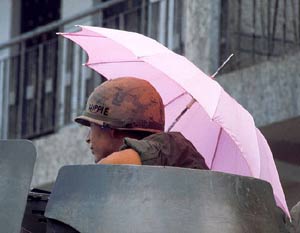
Of course it was the 7th cavalry at Nogun Ri

Even the rightest wing-est extremist in Texas don’t hold a candle to Some Colorado Wingnuts, the ones who call Natives “prairie niggers” or “wagon burners”, especially when any negative reviews of the Seventh Cavalry massacres. Like Wounded knee, a vengeance quest for Custer and a bunch of his homicidal lunatic troopers got their own asses sent to Hell. And before that, at the Little Ouachita, murdering men, women and children at a mostly Cheyenne winter encampment. Must not criticize heroic asswipes like Custer. Oh, that song they adopted, Garryowen, that’s about a really rowdy  custom (performed by the lads of Garryowen, a town in Ireland) of getting drunk and beating up on cops. Anyhoo, I got this from Wiki because it’s easy. Sue me. It’s about another massacre and why the people of Korea aren’t as enthusiastic about the U.S. Big Brother as the South Korean Government. Hint: it’s because the corrupt U.S. Government pays the S. Korean Puppet Government to pretend to like us.

The No Gun Ri massacre (Hangul??? ??? ?? ??; Hanja?????????; RRNogeun-ri minganin haksal sageon) occurred on July 26–29, 1950, early in the Korean War, when an undetermined number of South Korean refugees were killed in a U.S. air attack and by small- and heavy-weapons fire of the 7th U.S. Cavalry at a railroad bridge near the village of Nogeun-ri (Korean: ???), 100 miles (160 km) southeast of Seoul. In 2005, a South Korean government inquest certified the names of 163 dead or missing and 55 wounded, and added that many other victims’ names were not reported. The South Korean government-funded No Gun Ri Peace Foundation estimated in 2011 that 250–300 were killed, mostly women and children.

The incident was little-known outside Korea until publication of an Associated Press (AP) story in 1999 in which 7th Cavalry veterans corroborated survivors’ accounts. The AP also uncovered declassified U.S. Army orders to fire on approaching civilians because of reports of North Korean infiltration of refugee groups. Some details were disputed, but the massacre account was found to be essentially correct. In 2001, the U.S. Army conducted an investigation and, after previously rejecting survivors’ claims, acknowledged the killings, but described the three-day event as “an unfortunate tragedy inherent to war and not a deliberate killing”. The army rejected survivors’ demands for an apology and compensation. United States President Bill Clinton issued a statement of regret, adding the next day that “things happened which were wrong”.

South Korean investigators disagreed with the U.S. report, saying that they believed that 7th Cavalry troops were ordered to fire on the refugees. The survivors’ group called the U.S. report a “whitewash”. The AP later discovered additional archival documents showing that U.S. commanders ordered troops to “shoot” and “fire on” civilians at the war front during this period; these declassified documents had been found but not disclosed by the Pentagon investigators. American historian Sahr Conway-Lanz reported that among the undisclosed documents was a letter from the U.S. ambassador in South Korea stating that the U.S. military had adopted a theater-wide policy of firing on approaching refugee groups. Despite demands, the U.S. investigation was not reopened.

Prompted by the exposure of No Gun Ri, survivors of similar alleged incidents from 1950–51 filed reports with the Seoul government. In 2008, an investigative commission said more than 200 cases of alleged large-scale killings by the U.S. military had been registered, mostly air attacks

If you’re a vet from that arena, and was above the rank of captain at the time, I won’t give two thirds of a sex act about your damn feelings.

Pro-immigrant activists with Occupy Denver file suit against DIA and DPD, challenge airport free speech “permit”


DENVER, COLORADO- Civil liberties champion David Lane has filed a complaint in US district court challenging Denver’s office of the city attorney for instituting a permit process at DIA to prevent public protest. Holding signs has become impermissible at the airport, without the issuance of a permit seven days in advnace, although police are not bothering themselves about signs welcoming homecomers or seeking to connect business visitors with their limo service. That selective enforcement is unconstitutional of course, and the lawfirm powerhouse of Kilmer Lane & Newman is filing suit on behalf of two Occupy Denver plaintiffs. last Sunday, January 29, both were threatened with arrest by DIA police. While two earlier attempts to assemble had capitulated to DPD intimidation, the Occupy Denver activists stood their ground. Why did you file your lawsuit? “We know our rights. We want the POLICE to know our rights.”

1. Full text of complaint:

Case 1:17-cv-00332 Document 1
Filed 02/06/17 USDC Colorado Page 1 of 14

Civil Action No.

IN THE UNITED STATES DISTRICT COURT FOR THE DISTRICT OF COLORADO

NAZLI MCDONNELL,
ERIC VERLO,

Plaintiffs, vs.

CITY AND COUNTY OF DENVER,?
DENVER POLICE COMMANDER ANTONIO LOPEZ, in his individual and official capacity,
DENVER POLICE SERGEANT VIRGINIA QUINONES, in her individual and official capacity,

Defendants.

______________________________________________________________________________

COMPLAINT

______________________________________________________________________________

Plaintiffs, by and through their attorneys David A. Lane and Andy McNulty of KILLMER, LANE & NEWMAN, LLP, allege as follows:

INTRODUCTION

1. Plaintiffs Eric Verlo and Nazli McDonnell challenge a regulation of alarming breadth that bans all First Amendment expression at Denver International Airport without a permit.

2. Plaintiffs are concerned citizens who believe that President Donald Trump has overstepped his executive authority by signing the January 27, 2017, Executive Order (hereinafter “Muslim Ban”), which permanently bans Syrian refugees from emigrating to the United States, temporarily bans nationals of seven countries (including permanent legal residents and visa-holders), and suspends all applications to the United States refugee program (even as to vetted entrants currently in transit).

3. Plaintiffs wish to express their disgust with President Trump’s (likely unconstitutional) Muslim Ban. They wish to do so in the same place that hundreds of thousands of Americans across the country have done: standing directly outside of the secure Customs and Border Protection (hereinafter “CBP”) screening area within an airport where immigrants to America enter into the main terminal after clearing customs. Plaintiffs, unlike many citizens across this great nation who have exercised their opposition to the Muslim Ban in airports by chanting, singing, dancing, and praying, simply wish to stand in silent protest, holding signs that express their solidarity with immigrants and the Muslim community.

4. Plaintiffs are banned from doing so by DENVER INTERNATIONAL AIRPORT REGULATION 50 (hereinafter “Regulation 50”).

5. Regulation 50 states: “No person or organization shall leaflet, conduct surveys, display signs, gather signatures, solicit funds, or engage in other speech related activity at Denver International Airport for religious, charitable, or political purposes, or in connection with a labor dispute, except pursuant to, and in compliance with, a permit for such activity issued by the CEO or his or her designee.” DENVER INTERNATIONAL AIRPORT REGULATION 50.03. In order to obtain a permit, an individual must “complete a permit application and submit it during regular business hours, at least seven (7) days prior to the commencement of the activity for which the permit is sought[.]” DENVER INTERNATIONAL AIRPORT REGULATION 50.04-1.

6. Plaintiffs ask that this Court enjoin the enforcement of Regulation 50 and prohibit Defendants from arresting them for their First Amendment-protected activity of standing in peaceful protest within Jeppesen Terminal. Regulation 50 is overbroad in violation of the First Amendment and vague in violation of the Fourteenth Amendment’s Due Process Clause.

7. This is a civil rights action for declaratory and injunctive relief as well as fees and costs arising under 42 U.S.C. §§ 1983, 1988 and 28 U.S.C. Section 2201 et seq. due to Defendants’ current and imminent violations of Plaintiffs’ rights guaranteed by the First and Fourteenth Amendments to the Constitution of the United States.

PARTIES

8. Plaintiff Eric Verlo is a citizen of the United States of America. Mr. Verlo wishes to show his resistance to President Trump’s Muslim Ban, so that others will be inspired to join in the resistance.

9. Plaintiff Nazli McDonnell is a citizen of the United States of America. Ms. McDonnell wishes to show her resistance to President Trump’s Muslim Ban, so that others will be inspired to join in the resistance.

10. Defendant City and County of Denver is a municipal corporation and political subdivision of the State of Colorado. Thus, it is an entity subject to the provisions of § 1983.

11. Defendant Antonio Lopez is a Commander with the Denver Police Department. Commander Lopez is responsible for security at Denver International Airport’s Jeppesen Terminal.

12. Defendant Virginia Quinones is a Sergeant with the Denver Police Department. Sergeant Quinones is responsible for security at Denver International Airport’s Jeppesen Terminal.

JURISDICTION AND VENUE

13. Plaintiffs bring this claim pursuant to 42 U.S.C. § 1983; the First Amendment to the United States Constitution, incorporated as against States and their municipal divisions through the Fourteenth Amendment to the United States Constitution; and the Due Process Clause of the Fourteenth Amendment.

14. This Court has jurisdiction under 28 U.S.C. § 1331 over Plaintiffs’ claims that “arise[] under the Constitution of the United States.”

FACTS

15. On January 27, 2017, President Donald Trump signed an Executive Order, which permanently banned Syrian refugees from emigrating to the United States, temporarily banned nationals of seven countries (including permanent legal residents and visa-holders), and suspended all applications to the United States refugee program (even as to vetted entrants currently in transit). President Trump’s Executive Order has been subsequently referred to as a “Muslim Ban,” because it both mirrors President Trump’s racist, anti-Islam statements made on December 7, 2015, that he was planning to ban all Muslims from entering the United States until our representatives can “figure out what’s going on” and the ban targets countries whose population is predominantly Muslim and seemingly bears little rational relation to each country’s security threat to the United States.

16. Immediately upon the enactment of President Trump’s Muslim Ban there was an outpouring of outrage from a large proportion of the American population and across the spectrum of political affiliation. This outrage led to resistance in the form of protests.

17. On January 28, 2017, and January 29, 2017, protests erupted in nearly every major city in the United States. The protests organically formed in our nation’s airports. Protesters chose to express their disgust with President Trump’s Muslim Ban in airports (and specifically outside of the secure CBP screening area) because individuals affected by the ban who were in transit to the United States were being held and questioned by CBP agents there. Many of these travelers, including lawful United States residents, were forced to sign documents revoking their lawful status within the United States and deported. Still others were simply deported with no explanation. Others still were held for hours as teams of lawyers rushed to prepare habeas petitions for their release.

18. News reports about the protests make clear that they have been peaceful and non- disruptive despite the gathering of, in some cases, thousands of people.

19. Airport staff have told protesters, and would-be protesters, at numerous airports across the nation, including Kansas City International Airport, that there are no restrictions on their speech and that all protesters who wish to participate in actions against the Muslim Ban are allowed. Protests have continued in other cities to this day.

20. On January 28, 2017, there was one such protest at Denver International Airport, within the Jeppesen Terminal. At approximately 5:00 p.m. hundreds gathered in the Jeppesen Terminal’s atrium, near arrivals, to protest and many others gathered to bear witness.

21. Prior to the protest, leaders had applied for a permit. It was denied. The reason for its denial was that the permit was not requested with seven days advance notice of the protest occurring. Regulation 50 requires seven days advance notice.

22. The January 28, 2017, protest began with speeches, chants, songs, and prayers. It was a peaceful gathering of solidarity for immigrants and Muslims. Every person at the January 28, 2017, protest was contained in an area of the Jeppesen Terminal atrium that is designed as a gathering space for people to sit, relax, and converse. No one was standing in the walkways or passageways of the terminal.

23. Soon after the January 28, 2017, protest began, members of the Denver Police Department arrived on-scene. Commander Antonio Lopez engaged the leader of the protest, Amal Kassir, along with State Representative Joe Salazar and representatives from the ACLU of Colorado, and informed them that the protest was unlawful. Commander Lopez told Ms. Kassir that anything that “could be construed as Free Speech” was prohibited at the Denver International Airport, including within the Jeppesen Terminal, without a permit. See Exhibit 1, January 28, 2017 Video.

24. Commander Lopez also stated that all “First Amendment expression” was prohibited at the Denver International Airport, including within the Jeppesen Terminal, without a permit on Regulation 50. Commander Lopez handed Regulation 50 to multiple protesters, including Ms. Kassir. See Exhibit 2, January 28, 2017 Video 2.

25. Regulation 50 states (in pertinent part): “No person or organization shall leaflet, conduct surveys, display signs, gather signatures, solicit funds, or engage in other speech related activity at Denver International Airport for religious, charitable, or political purposes, or in connection with a labor dispute, except pursuant to, and in compliance with, a permit for such activity issued by the CEO or his or her designee.” DENVER INTERNATIONAL AIRPORT REGULATION 50.03. In order to obtain a permit, an individual must “complete a permit application and submit it during regular business hours, at least seven (7) days prior to the commencement of the activity for which the permit is sought[.]” DENVER INTERNATIONAL AIRPORT REGULATION 50.04-1.

26. Commander Lopez, along with members of Denver International Security, told Ms. Kassir that every portion of Denver International Airport property, which has an approximately fifty square mile footprint, is off-limits for First Amendment expression. They suggested that Ms. Kassir move her protest to Tower Road, which is approximately six miles from the Jeppesen Terminal and, like most of the land surrounding Denver International Airport, adjacent to open prairie land with no inhabitants.

27. Commander Lopez threatened Ms. Kassir and numerous other demonstrators with arrest if they didn’t immediately cease any “First Amendment expression.” According to Commander Lopez’s directives, the individuals gathered in the Jeppesen Terminal could not stand holding signs, sing, speak to others about matters of public concern, hold the United States Constitution above their shoulders, or stand silently with their arms interlocked.

28. Ultimately, to avoid arrest, Ms. Kassir and the demonstrators moved outside of the Jeppesen Terminal to the large area on its south side, adjacent to the escalators leading to the commuter rail and under the Westin Hotel. The protest continued peacefully for a little while longer, then disbursed without issue.

29. The next day, January 29, 2017, Plaintiffs Eric Verlo and Nazli McDonnell traveled to Denver International Airport’s Jeppesen Terminal to express their opposition to President Trump’s Muslim Ban.

30. Mr. Verlo and Ms. McDonnell brought with them signs expressing support for immigrants and expressing concern that history was repeating itself with disastrous potential consequences.

31. Mr. Verlo and Ms. McDonnell positioned themselves adjacent to the secure CBP screening area within the Jeppesen Terminal at approximately 1:15 p.m.

32. Adjacent the secure CBP screening area at the Jeppesen Terminal is the only place where Mr. Verlo and Ms. McDonnell can reach their intended audience. Mr. Verlo and Ms. McDonnell wish to communicate with those who could be swayed by their message and, particularly, with immigrants. International travelers are often immigrants and/or lawful United States residents, including green card and other visa holders, other than citizens. Mr. Verlo and Ms. McDonnell wish to express their solidarity with immigrants directly to these individuals. Further, United States citizens who arrive from international locations are also individuals with whom Mr. Verlo and Ms. McDonnell wish to communicate. International travelers have experienced other cultures and are likely to be sympathetic to Mr. Verlo and Ms. McDonell’s message.

33. The secure CBP screening area is also the location where the Muslim Ban has been enforced by DHS, both at Denver International Airport and across the nation. Neither Plaintiff attempted to enter any restricted areas of Denver International Airport.

34. While silently displaying their signs, Mr. Verlo and Ms. McDonnell were in the open plaza near the secure CBP screening area within the Jeppesen Terminal and positioned significantly behind the railing, which demarcates where those waiting for loved ones are permitted to stand. Mr. Verlo and Ms. McDonnell did not impede the right of way of any passengers hustling to catch flights at the last moment. They simply stood with placards showing their distaste for the Executive Order and the man who executed it.

35. Mr. Verlo and Mr. McDonnell also observed another man in the terminal, named Gene Wells, who was expressing views similar to theirs.

36. Mr. Wells was wearing a sign taped to the back of his shirt.

37. Mr. Wells left the Jeppesen Terminal, but subsequently returned to protest. When he did, he was stopped by Denver Police Department officers who told him that he could not walk around the terminal with the slogan he had affixed to his back. Mr. Wells eventually rejoined Mr. Verlo and Mr. McDonnell at the international arrivals doors, but not without trepidation. He feared he might be arrested.

38. While Mr. Verlo and Ms. McDonnell were displaying their signs, Defendant Sergeant Virginia Quinones approached Mr. Verlo and Ms. McDonnell and threatened them with arrest if they did not leave Jeppesen Terminal. See Exhibit 3, January 29, 2017, Video.

39. Sergeant Quinones handed Mr. Verlo and Ms. McDonnell Regulation 50 and cited it as the reason they would be arrested if they did not leave Jeppesen Terminal. Id. Sergeant Quinones told Mr. Verlo and Ms. McDonnell that they would need a permit in order to stand silently, holding signs in opposition of the Muslim Ban and be in compliance with Regulation 50.

40. Had Mr. Verlo and Ms. McDonnell applied for a permit the second President Trump signed the Executive Order implementing the Muslim Ban, they still would have been unable to engage in protest within the Jeppesen Terminal under the terms and conditions of Regulation 50 on January 29, 2017.

41. Mr. Verlo and Ms. McDonnell did not immediately leave the Jeppesen Terminal after being threatened with arrest. However, they were startled by Sergeant Quiones’ threat and feared arrest for the duration of the time they were there.

42. Throughout the time Mr. Verlo and Ms. McDonnell were expressing their views within the Jeppesen Terminal they received numerous shows of support from passersby. Multiple self- proclaimed Muslims expressed heart-felt statements of appreciation to Mr. Verlo, Ms. McDonnell, and others holding signs.

43. Mr. Verlo and Ms. McDonnell ultimately left Jeppesen Terminal.

44. Mr. Verlo and Ms. McDonnell wish to return to Jeppesen Terminal to express solidarity with Muslims and opposition to the Muslim Ban, but are reticent to do so for fear of being arrested.

45. Upon information and belief, no individual has been arrested, or threatened with arrest, for wearing a “Make America Great Again” campaign hat without a permit within the Jeppesen Terminal at Denver International Airport.

46. Upon information and belief, no individual has been arrested, or threatened with arrest, for holding a sign welcoming home a member of our military without a permit within the Jeppesen Terminal at Denver International Airport.

47. Upon information and belief, no individual has been arrested, or threatened with arrest, for holding a sign and soliciting passengers for a limousine without a permit within the Jeppesen Terminal at Denver International Airport.

48. Upon information and belief, no individual has been arrested, or threatened with arrest, for discussing current affairs with another person without a permit within the Jeppesen Terminal at Denver International Airport.

49. At all times relevant to this Complaint, Defendants acted under color of law.

CLAIM I: FIRST AMENDMENT
(§ 1983 violation – all Defendants)

50. Plaintiffs repeat, re-allege, and incorporate by reference the allegations in the foregoing paragraphs of this Complaint as fully set forth herein.

51. Regulation 50 violates the Free Speech Clause of the First Amendment to the Constitution, on its face and as applied, because it impermissibly curtails Plaintiffs’ free-speech rights.

52. Plaintiffs wish to speak on a matter of public concern. 11

53. Denver International Airport’s Jeppesen Terminal is a public forum.

54. Regulation 50 directly infringes upon and chills reasonable persons from engaging in activity that is protected by the First Amendment.

55. Regulation 50 acts as an unconstitutional prior restraint on speech because it (1) requires a permit before allowing individuals to engage in speech, (2) allows for arbitrary and/or discriminatory permit denials, and (3) requires advance notice that is unconstitutionally excessive.

56. Regulation 50 is overbroad.?

57. Regulation 50 is not narrowly tailored to serve a compelling government interest.?

58. Regulation 50 does not further a substantial government interest.?

59. Regulation 50’s restriction on expressive conduct is greater than necessary to further any
government interest.?

60. Defendants’ actions and/or omissions enforcing Regulation 50 caused, directly or
proximately, Plaintiffs to suffer damages.

CLAIM II: FIRST AMENDMENT RETALIATION
(§ 1983 violation – all Defendants)

1. All statements of fact set forth previously are hereby incorporated into this claim as though set forth fully herein. ?

2. Plaintiffs engaged in First Amendment protected speech on a matter of public concern ?while displaying signs opposing President Trump’s Muslim Ban on January 29, 2017.

3. Defendants jointly and on their own accord responded to Plaintiffs’ First Amendment protected speech with retaliation, including but not limited to threatening Plaintiffs with arrest.

4. Defendants retaliatory actions were substantially motivated by Plaintiffs’ exercise of their First Amendment rights.

5. By unlawfully threatening Plaintiffs with arrest, Defendants sought to punish Plaintiffs for exercising their First Amendment rights and to silence their future speech. Defendants’ retaliatory actions would chill a person of ordinary firmness from engaging in such First Amendment protected activity.

6. Defendants’ actions and/or omissions enforcing Regulation 50 caused, directly and proximately, Plaintiffs to suffer damages.

CLAIM III: FOURTEENTH AMENDMENT DUE PROCESS
(§ 1983 violation – all Defendants)

7. All statements of fact set forth previously are hereby incorporated into this claim as though set forth fully herein.

8. The prohibitions of Regulation 50 are vague and not clearly defined. ?

9. Regulation 50 offers no clear and measurable standard by which Plaintiffs and others can ?act lawfully.

10. Regulation 50 does not provide explicit standards for application by law enforcement officers.

11. Regulation 50 fails to provide people of ordinary intelligence a reasonable opportunity to understand what conduct it prohibits, and authorizes or encourages arbitrary and discriminatory enforcement, or both.

12. Defendants’ actions and/or omissions enforcing Regulation 50 caused, directly and proximately, Plaintiffs to suffer damages.

PRAYER FOR RELIEF

WHEREFORE, Plaintiffs respectfully request that this Court enter judgment in their favor and against Defendants, and grant:

(a) Appropriate declaratory and other injunctive and/or equitable relief; 13

(b)  Enter a declaration that Regulation 50 is unconstitutional on its face and enjoin its enforcement; ?

(c)  Compensatory and consequential damages, including damages for emotional distress, loss of reputation, humiliation, loss of enjoyment of life, and other pain and suffering on all claims allowed by law in an amount to be determined at trial; ?

(d)  All economic losses on all claims allowed by law; ?

(e)  Punitive damages on all claims allowed by law and in an amount to be determined ?at trial; ?

(f)  Attorney’s fees and the costs associated with this action, pursuant to 42 U.S.C. § ?1988; ?

(g)  Pre and post-judgment interest at the lawful rate; and ?

(h)  Any further relief that this court deems just and proper, and any other relief as ?allowed by law. ?

Dated this 6th day of February 2017.

KILLMER, LANE & NEWMAN, LLP
s/ Andy McNulty

___________________________________
David A. Lane
?Andy McNulty?
Killmer, Lane & Newman, LLC
1543 Champa Street, Suite 400 Denver, Colorado 80202?
Attorneys for Plaintiff

2. Full text of Feb 6 motion for preliminary injunction:

Case 1:17-cv-00332 Document 2
Filed 02/06/17 USDC Colorado Page 1 of 23

Civil Action No.

IN THE UNITED STATES DISTRICT COURT FOR THE DISTRICT OF COLORADO

NAZLI MCDONNELL,
ERIC VERLO,

Plaintiffs, vs.

CITY AND COUNTY OF DENVER,
DENVER POLICE COMMANDER ANTONIO LOPEZ, in his individual and official capacity,
DENVER POLICE SERGEANT VIRGINIA QUINONES, in her individual and official capacity,

Defendants.

______________________________________________________________________________

MOTION FOR PRELIMINARY INJUNCTION

______________________________________________________________________________

Plaintiffs, by and through their attorneys David A. Lane and Andy McNulty of KILLMER, LANE & NEWMAN, LLP, hereby submit the following Motion for Preliminary Injunction, and in support thereof, states as follows:

1. Introduction

Over the last four days, many Americans have expressed public disapproval of President Donald Trump’s January 27, 2017, Executive Order, which permanently bans Syrian refugees from emigrating to the United States, temporarily bans nationals of seven countries (including permanent legal residents and visa-holders), and suspends all applications to the United States refugee program (even as to vetted entrants currently in transit). Plaintiffs are concerned and alarmed United States citizens who wish to join the growing chorus of voices expressing opposition to the Executive Order. To do so, they wish to stand in silent protest at the Jeppesen Terminal within Denver International Airport.

Plaintiffs did just this on January 29, 2017, standing in silent protest of the Executive Order outside of the secure Customs and Border Protection (hereinafter “CBP”) screening area within Jeppesen Terminal. Almost immediately, Plaintiffs were threatened with arrest by Denver Police Department Sergeant Virginia Quinones for standing silently and holding signs opposing the Executive Order, despite that fact that the Jeppesen Terminal has previously been used for expressive activity (and that protesters at more than ten major airports nationwide have protested peacefully without major disruption or legal restriction). While silently displaying their signs, Plaintiffs were in the plaza within the Jeppesen Terminal and positioned significantly behind the railing, which demarcates where those waiting for loved ones are permitted to stand, in the open plaza outside of the secure CBP screening area at the Jeppesen Terminal. Plaintiffs did not impede the right of way of any passengers hustling to catch flights at the last moment. They simply stood with placards showing their distaste for the Executive Order and the man who executed it.

Even though Plaintiffs were simply engaged in peaceful First Amendment protected expression, they were threatened with arrest. Sergeant Quinones informed Plaintiffs that, in order to stand silently with political signs, they would need a permit. Without a permit, Sergeant Quinones stated, all “First Amendment expression” at the Denver International Airport was banned.

This was not the first time since the enactment of the Executive Order that the Denver Police Department threatened individuals with arrest for engaging in First Amendment protected activity in Jeppesen Terminal. On January 28, 2016, a protest was held in the plaza of Jeppesen Terminal. During the protest, Denver Police Commander Antonio Lopez instructed multiple individuals, including State Representative Joseph Salazar and representatives from the ACLU of Colorado, that all “First Amendment expression” was banned at Denver International Airport without a permit. See Exhibit 1, January 28, 2017, Video 1; Exhibit 2, January 28, 2017, Video 2. The protesters had, in fact, applied for a permit earlier that day. However, it had not been granted because they had not done so seven days in advance of the protest in compliance with Denver International Airport regulations. Although no arrests were ultimately made, protesters were threatened numerous times by Commander Lopez, and other officers, with arrest.

The Denver International Airport regulation that both Sergeant Quinones and Commander Lopez relied upon in instructing Plaintiffs, and others, that Denver International Airport bans all “First Amendment expression” without a permit is DENVER INTERNATIONAL AIRPORT REGULATION 50 (hereinafter “Regulation 50”). Regulation 50 states that “no person or organization shall leaflet, conduct surveys, display signs, gather signatures, solicit funds, or engage in other speech related activity at Denver International Airport for religious, charitable, or political purposes, or in connection with a labor dispute, except pursuant to, and in compliance with, a permit for such activity issued by the CEO or his or her designee.” DENVER INTERNATIONAL AIRPORT REGULATION 50.03. In order to obtain a permit, an individual must “complete a permit application and submit it during regular business hours, at least seven (7) days prior to the commencement of the activity for which the permit is sought[.]” DENVER INTERNATIONAL AIRPORT REGULATION 50.04-1.

Plaintiffs wish to return to Denver International Airport to protest the Executive Order, but are reasonably frightened of arrest and, absent action by this Court, must choose between lawfully exercising their First Amendment right and being subject to arrest and/or prosecution.

Plaintiffs ask that this Court enter an injunction prohibiting their arrest for standing in peaceful protest within Jeppesen Terminal and invalidating Regulation 50 as violative of the First and Fourteenth Amendments to the United States Constitution.

2. Factual Background

All statements of fact set forth in the simultaneously filed Complaint are hereby incorporated into this Brief as though set forth fully herein.

3. Argument

3.1 The standard for issuance of a preliminary injunction.

When seeking a preliminary injunction, a plaintiff must establish that (1) he is likely to succeed on the merits; (2) he is likely to suffer irreparable harm; (3) the balance of equities tips in his favor; and (4) that an injunction is in the public interest. Winter v. Nat. Res. Def. Council, 555 U.S. 7, 20 (2008); see also ACLU v. Johnson, 194 F.3d 1149, 1155 (10th Cir. 1999).

The Tenth Circuit has modified the preliminary injunction test when the moving party demonstrates that the second, third, and fourth factors “tip strongly” in its favor. See Oklahoma ex rel. Okla. Tax Comm’n v. Int’l Registration Plan, Inc., 455 F.3d 1107, 1113 (10th Cir. 2006); see also 820 F.3d 1113, n.5 (10th Cir. 2016). “In such situations, the moving party may meet the requirement for showing success on the merits by showing that questions going to the merits are so serious, substantial, difficult, and doubtful as to make the issue ripe for litigation and deserving of more deliberate investigation.” Id. (internal quotation marks omitted). Moreover, this “fair chance of prevailing” test is appropriate in this case because Plaintiffs are challenging a policy, not a statue or ordinance. See Planned Parenthood Minn, N.D., & S.D. v. Rounds, 530 F.3d 724, 732 (9th Cir. 2008) (“[C]ourts should… apply the familiar ‘fair chance of prevailing’ test where a preliminary injunction is sought to enjoin something other than government action based on presumptively reasoned democratic processes.”).

Under either standard, Plaintiffs are able to demonstrate that the issuance of a preliminary injunction is appropriate in this matter.

3.3 Regulation 50 implicates Plaintiffs’ First Amendment rights. 1

When the government regulates the exercise of First Amendment rights, the burden is on the proponent of the restriction to establish its constitutionality. Phelps-Roper v. Koster, 713 F.3d 942, 949 (8th Cir. 2013). Moreover, when assessing the preliminary injunction factors in First Amendment cases, “the likelihood of success will often be the determinative factor.” Hobby Lobby Stores, Inc. v. Sebelius, 723 F.3d 1114, 1145 (10th Cir. 2013). This is because “the loss of First Amendment freedoms, for even minimal periods of time, unquestionably, constitutes irreparable injury,” Heideman v. Salt Lake City, 348 F.3d 1182, 1190 (10th Cir. 2003), and it is invariably in the public interest to protect an individual’s First Amendment rights. See Homans v. City of Albuquerque, 264 F.3d 1240, 1244 (10th Cir. 2001) (noting that “the public interest is better served” by protecting First Amendment rights).

[NOTE 1. It is important to note that facial challenges to government policies and statutes, when based on First and Fourteenth Amendment grounds, are not disfavored. See United States v. Stevens, 559 U.S. 460, 473 (2010); City of Chicago v. Morales, 527 U.S. 41 (1999).]

3.4 Plaintiffs are likely to succeed on the merits.

Plaintiffs are likely to succeed on the merits because Regulation 50 violates the Free Speech Clause of the First Amendment and the Due Process Clause of the Fourteenth Amendment.

3.4(a) Plaintiffs engaged, and wish to engage, in speech on a matter of public concern.

Plaintiffs’ speech is at the core of the First Amendment’s protection because it deals with a matter of public concern. “Speech deals with matters of public concern when it can be fairly considered as relating to any matter of political, social, or other concern to the community, or when it is a subject of legitimate news interest; that is, a subject of general interest and of value and concern to the public.” Snyder v. Phelps, 562 U.S. 443, 453 (2011) (internal quotation marks and citation omitted). “Speech on matters of public concern is at the heart of the First Amendment’s protection.” Id. at 451-52 (alterations and quotation marks omitted). “The First Amendment reflects ‘a profound national commitment to the principle that debate on public issues should be uninhibited, robust, and wide-open.’” Id. at 452 (quoting New York Times Co. v. Sullivan, 376 U.S. 254, 270 (1964)). Plaintiffs wish to engage in expression about President Donald Trump’s January 27, 2017, Executive Order, a topic that has generated nearly unprecedented debate and dissent. See Adrienne Mahsa Varkiani, Here’s Your List of All the Protests Happening Against the Muslim Ban, THINK PROGRESS (Jan. 28, 2017), https://thinkprogress.org/muslim-ban-protests-344f6e66022e#.ft1oznfv4 (compiling list of direct actions planned in response to President Trump’s January 27, 2017, Executive Order). Thus, Plaintiffs’ speech “‘occupies the highest rung of the hierarchy of First Amendment values, and is entitled to special protection.’” Snyder, 562 U.S. at 452 (quoting Connick v. Myers, 461 U.S. 138, 145 (1983)).

3.4(b) Regulation 50 acts as a prior restraint.

The restriction at issue in this matter is a prior restraint. “The term prior restraint is used ‘to describe administrative and judicial orders forbidding certain communications when issued in advance of the time that such communications are to occur.’” Alexander v. United States, 509 U.S. 544, 550 (1993) (quoting M. Nimmer, Nimmer on Freedom of Speech § 4.03, p. 4–14 (1984)). Regulation 50 is in an administrative order that forbids future communication and bases the ability to communicate in the future on the discretion of an administrative official. See DENVER INTERNATIONAL AIRPORT REGULATION 50.03 (“no person or organization shall leaflet, conduct surveys, display signs, gather signatures, solicit funds, or engage in other speech related activity at Denver International Airport for religious, charitable, or political purposes, or in connection with a labor dispute, except pursuant to, and in compliance with, a permit for such activity issued by the CEO or his or her designee.” (emphasis added)). It is a prior restraint.

The burden of proving a prior restraint is permissible is particularly steep. The Supreme Court has repeatedly held that “[a]ny system of prior restraints of expression comes to this Court bearing a heavy presumption against its constitutional validity.” Bantam Books, Inc. v. Sullivan, 372 U.S. 58, 70 (1963). For the reasons outlined infra, Defendants cannot meet this especially significant burden.

3.4(c) Jeppesen Terminal, outside of the passenger security zones, is a traditional public forum.

The Supreme Court has not definitively decided whether airport terminals, including Jeppesen Terminal, are public forums. In Lee v. International Society for Krishna Consciousness, Inc., 505 U.S. 830 (1992) (hereinafter “Lee I”), issued the same day as International Society for Krishna Consciousness, Inc. v. Lee, 505 U.S. 672 (1992) (hereinafter “Lee II”), the Supreme Court struck down a total ban on distribution of literature in airports. In Lee I, the Court issued a one sentence per curiam opinion, which affirmed the Second Circuit for the reasons expressed by Justice O’Connor, Justice Kennedy, and Justice Souter in Lee II. See Lee I, 505 U.S. at 831. Justice Kennedy and Justice Souter’s opinions in Lee II found that “airport corridors and shopping areas outside of the passenger security zones… are public forums, and speech in those places is entitled to protection against all government regulation inconsistent with public forum principles.” Lee II, 505 U.S. at 693 (Kennedy, J., concurring in the judgment); but see Lee II, 505 U.S. at 683 (“”[W]e think that neither by tradition nor purpose can the terminals be described as satisfying the standards we have previously set out for identifying a public forum.”).

Therefore, Plaintiffs ask this Court to find the area of Jeppesen Terminal outside of the passenger security zones to be a public forum. The historical use of the Jeppesen Terminal’s plazas and other areas outside of the passenger security zones (including the area outside of the secure CBP screening area) for political speech (particularly, the history of welcoming of American military personnel home from service, discussion between passengers of matters of public concern, and display of clothing advocating for political views and ideals) indicates that it is a public forum. See First Unitarian Church of Salt Lake City v. Salt Lake City Corp., 308 F.3d 1114, 1130 (10th Cir. 2002) (“Where courts have considered the traditional use of publicly accessible property for speech, they have refused to attribute legal significance to an historical absence of speech activities where that non-speech history was created by the very restrictions at issue in the case.”). Further, that the Jeppesen Terminal is free and open to the public (outside of the passenger security zones), illustrates that it is a public forum. See, e.g., Ark. Educ. Television Comm’n v. Forbes, 523 U.S. 666, 676 (1998); Cornelius v. NAACP Legal Def. & Educ. Fund, 473 U.S. 788, 800, 805, 809 (1985). Finally, Jeppesen Terminal retains characteristics similar to parks: it has large plazas lined with benches, it is surrounded by businesses which are open to the public, and it has dedicated walkways, similar to sidewalks, indicating that it is a public forum. See e.g., Frisby v. Schultz, 487 U.S. 474, 480-481 (1988); United States v. Grace, 461 U.S. 171, 177 (1983). Further, the Supreme Court has not strictly limited the public forum category to streets, sidewalks, and parks. See, e.g., Se. Promotions, Ltd. v. Conrad, 420 U.S. 546 (1975) (finding leased municipal theater is a public forum); Heffron v. Int’l Society for Krishna Consciousness, Inc., 452 U.S. 640 (1981) (finding state fair is a public forum); Edwards v. South Carolina, 372 U.S. 229 (1963) (finding grounds of state capitol are a traditional public forum). Even if the City claims that it has never intended for Jeppesen Terminal to be a public forum, this is not dispositive. See Lee, 505 U.S. at 830 (government policy prohibiting distribution of literature at airport on property struck down); Cornelius, 473 U.S. at 805 (government’s decision to limit access is not itself dispositive). Plaintiffs’ ask that this Court find Jeppesen Terminal, outside of the passenger security zones, a traditional public forum.

Since Jeppesen Terminal is a traditional public forum, any restriction on Plaintiffs’ speech must be content-neutral and narrowly tailored to a compelling government interest. Regulation 50 fails at both.

3.4(d) Regulation 50 is content-based.

Regulation 50 is a content-based restriction of expression. Although the Supreme Court has long held that content-based restrictions elicit strict scrutiny, see, e.g., Carey v. Brown, 447 U.S. 455 (1980), lower courts diverged on the meaning of “content-based” until Reed v. Town of Gilbert, 135 S. Ct. 2218 (2015). 2 Reed clarified that a restriction is content based simply if it draws distinctions “based on the message a speaker conveys.” 135 S. Ct. at 2227. Reed is clear that even “subtle” distinctions that define regulated expression “by its function or purpose . . . are distinctions based on the message a speaker conveys, and therefore, are subject to strict scrutiny.” Id. This accords with Texas v. Johnson, which held that “the emotive impact of speech on its audience is not a secondary effect unrelated to the content of the expression itself.” 491 U.S. 491 U.S. 297, 412 (1989) (internal quotations omitted).

[NOTE 2. Reed involved a municipal “sign code” that regulated signs differently based on the kind of message they conveyed (such as “ideological,” “political,” or “temporary directional”). 135 S. Ct. at 2224-25. The Court rejected the city’s argument that a law had to discriminate against certain viewpoints in order to be a content-based restriction. Id. at 2229.]

Regulation 50 is content-based on its face. It distinguishes between content and requires that an official determine the content of the speaker’s message when enforcing its proscriptions. Reed, 135 S. Ct. at 2227; see DENVER INTERNATIONAL AIRPORT REGULATION 50.03 (“No person or organization shall leaflet, conduct surveys, display signs, gather signatures, solicit funds, or engage in other speech related activity at Denver International Airport for religious, charitable, or political purposes, or in connection with a labor dispute[.]” (emphasis added)). The distinctions drawn by Regulation 50 make it a facially content-based restriction on expression that must elicit “the most exacting scrutiny.” Johnson, 491 U.S. at 412; Reed, 135 S. Ct. at 2227.

3.4(e) Regulation 50 is not narrowly tailored to serve a compelling government interest.

As a facially content-based restriction of expression at traditional public fora, Regulation 50 is presumptively unconstitutional unless Defendant “prove[s] that the restriction furthers a compelling interest and is narrowly tailored to achieve that interest.” Reed, 135 St. Ct. at 2231; accord Johnson, 491 U.S. at 412.

“A statute is narrowly tailored if it targets and eliminates no more than the exact source of the ‘evil’ it seeks to remedy.” Frisby v. Schultz, 487 U.S. 474, 485 (1988) (citation omitted). Regulation 50 reaches more speech than that which would impair the security of the airport or ensure that passengers are not unduly encumbered. In fact, it completely bans all “First Amendment expression.” “A complete ban can be narrowly tailored, but only if each activity within the proscription’s scope is an appropriately targeted evil.” Id.. Regulation 50 is not such a ban. For instance, Plaintiffs’ expression does nothing to jeopardize security at Denver International Airport or to inhibit the free flow of passengers through the airport.

Further, any argument that Plaintiffs can engage in expressive activity in another location lacks merit, as the Supreme Court has held that the First Amendment is violated when one specific location or audience, when important to the speaker, is foreclosed. See McCullen v. Coakley, 134 S. Ct. 2518, 2536 (2014); Schenck v. Pro-Choice Network, 519 U.S. 357, 377 (1997) (invalidating a “floating” buffer zone around people entering an abortion clinic partly on the ground that it prevented protestors “from communicating a message from a normal conversational distance or handing leaflets to people entering or leaving the clinics who are walking on the public sidewalks”); Schneider v. New Jersey, 308 U.S. 147, 163 (1939) (invalidating anti-handbilling ordinances even though “their operation is limited to streets and alleys and leaves persons free to distribute printed matter in other public places”). Regulation 50 lacks the narrow tailoring necessary to survive First Amendment strict scrutiny analysis.

3.4(f) Regulation 50 violates the First Amendment even if this Court determines Jeppesen Terminal is a nonpublic forum.

Regulation 50 bans all “First Amendment expression” absent a permit; it is unconstitutional even when analyzed under the lower standard of scrutiny applied by courts to First Amendment political speech in a nonpublic forum. In Board of Airport Commissioners of Los Angeles v. Jews for Jesus, Inc., 482 U.S. 569 (1987), the Supreme Court considered whether a resolution restricting free speech in the airport was constitutional. The resolution at issue stated that the airport “is not open for First Amendment activities by any individual and/or entity.” Id. at 574. Although the Court did not explicitly find that the airport was a nonpublic forum, it did hold that the resolution restricting speech in the airport was facially unreasonable, even if the airport was a nonpublic forum. Id. at 573. The Court noted that enforcing the resolution would prohibit “talking and reading, or the wearing of campaign buttons or symbolic clothing.” Id. at 574. The Court also noted, “[m]uch nondisruptive speech–such as the wearing of a T-shirt or button that contains a political message–may not be ‘airport related’ but is still protected speech even in a nonpublic forum.” Id. at 575 (citing Cohen v. California, 403 U.S. 15 (1971) (holding that wearing of jacket with offensive language in a courthouse was a form of nondisruptive expression that was protected by the First Amendment)). Thus, although specific conduct was not at issue in the Jews for Jesus decision, the Court nonetheless implicitly held that non-disruptive speech is protected by the First Amendment in nonpublic fora and that restrictions that encumber non-disruptive expression are unreasonable.

In Lee II, Justice O’Connor set forth the test for determining reasonableness in the context of nonpublic fora. 505 U.S. at 687 (O’Connor, J., concurring). 3 She stated, ”[t]he reasonableness of the Government’s restriction [on speech in a nonpublic forum] must be assessed in light of the purpose of the forum and all the surrounding circumstances.” Id. (O’Connor, J., concurring) (quoting Cornelius, 473 U.S. at 809). However, Justice O’Connor noted that while “[o]rdinarily . . . we have . . . been confronted with cases where the fora at issue were discrete, single-purpose facilities,” airports present a different analysis because they are multipurpose facilities. Id. at 688 (O’Connor, J., concurring) (citations omitted). She determined airports to be multipurpose facilities because

the Port Authority [has] chosen not to limit access to the airports under its control, [and] has created a huge complex open to travelers and nontravelers alike. The airports house restaurants, cafeterias, snack bars, coffee shops, cocktail lounges, post offices, banks, telegraph offices, clothing shops, drug stores, food stores, nurseries, barber shops, currency exchanges, art exhibits, commercial advertising displays, bookstores, newsstands, dental offices and private clubs.

Id. This led to the finding that “[t]he reasonableness inquiry, therefore, is not whether the restrictions on speech are consistent with preserving the property for air travel, but whether they are reasonably related to maintaining the multipurpose environment that the Port Authority has deliberately created.” Id. at 689. A complete ban on First Amendment activity at the Jeppesen Terminal, absent a permit that must be obtained by providing seven days advance notice, is not a reasonable restriction. Regulation 50 does not comport with Justice O’Connor’s conclusion that airports are more than simply places where air travel occurs.

[NOTE 3. It is important to note that Lee involved a plurality opinion, joined by Justice O’Connor. Therefore, Justice O’Connor’s concurrence is the “narrowest grounds” that justify the Court’s result and her concurrence holds substantial precedential weight.]

Moreover, Justice O’Connor distinguished between solicitations (which the Supreme Court found could be reasonably restricted) and distributing leaflets (which the Supreme Court found could not be reasonably restricted) in the airport:

[L]eafleting does not entail the same kinds of problems presented by face-to-face solicitation. Specifically, “one need not ponder the contents of a leaflet or pamphlet in order mechanically to take it out of someone’s hand . . . . The distribution of literature does not require that the recipient stop in order to receive the message the speaker wishes to convey; instead the recipient is free to read the message at a later time.”

Id. at 690 (quoting United States v. Kokinda, 497 U.S. 720, 734 (1990)).

Thus, the Court held in Lee II that prohibiting solicitation in a nonpublic forum is not unreasonable, but that prohibiting the distribution of leaflets and other literature at a nonpublic forum is unreasonable. See also Lee, 505 U.S. at 830 (decided the same day as Lee II and striking down a prohibition on the distribution of leaflets and other literature at La Guardia, John F. Kennedy, and Newark International airports) (per curiam). Circuit courts have also recognized the inherent right to distribute paper and other information in nonpublic fora. Following Lee I and Lee II, two circuit courts have held that airports, as nonpublic fora, could not preclude newspaper publishers from placing newsracks in airport terminals. See Jacobsen v. City of Rapid City, South Dakota, 128 F.3d 660 (8th Cir. 1997); Multimedia Publishing Co. of South Carolina, Inc. v. Greenville-Spartanburg Airport Dist., 991 F.2d 154 (4th Cir. 1993). To the extent that the airports were concerned about safety or the impediment of traffic flow, the courts held that the airport may impose reasonable restrictions, but they could not enforce an outright ban on the newspaper racks. See Jacobsen, 128 F.3d at 660; Multimedia Publishing Co. of South Carolina, Inc., 991 F.2d at 154.

Denver, through Regulation 50, has banned all “First Amendment expression” including leafleting and protests. In fact, Plaintiffs expression is arguably less intrusive and disruptive to air travel than the form of expression, namely leafletting, that the Court held could not be reasonably restricted in the areas of an airport that precede the security screening area. It is clear from Lee I, Lee II, and Jews for Jesus that Denver cannot ban all “First Amendment expression” at the Jeppesen Terminal.

3.4(f)(1) Independently, the viewpoint-based prohibition of Plaintiffs’ speech, based on Regulation 50, violates the First Amendment.

Even if Jeppesen Terminal is a nonpublic forum, “this does not mean the government has unbridled control over speech, . . . for it is axiomatic that ‘the First Amendment forbids the government to regulate speech in ways that favor some viewpoints or ideas at the expense of others.” Summum v. Callaghan, 130 F.3d 906, 916 (10th Cir. 1997) (quoting Lamb’s Chapel v. Center Moriches Union Free School Dist., 508 U.S. 384, 394, (1993)). “Restrictions on speech in nonpublic fora must be viewpoint neutral[.]” Warren v. Fairfax Cty., 196 F.3d 186, 193 (4th Cir. 1999) (citing Cornelius, 473 at 809). Defendants’ restriction of Plaintiffs’ speech, under the guise of Regulation 50, discriminates on the basis of viewpoint. Individuals walk through Denver International Airport with political messages and slogans on their shirts and luggage and discuss politics on a daily basis. Counsel for Plaintiffs has worn political shirts while traveling through Denver International Airport and discussed modern politics with fellow passengers on many occasions. However, no other individual, to Plaintiffs or Plaintiffs’ counsel’s knowledge, has been threatened with arrest for engaging in this political speech. Nor has any individual been arrested for displaying pro-President Trump messages, for example a red hat that reads “Make America Great Again.” Only Plaintiffs’ expressive activity against the President’s Executive Order, and others advocating similarly, has been threatened with arrest. Regulation 50 is being enforced as a clearly view-point based restriction. Defendants’ application of Regulation 50 to Plaintiffs speech is view-point based and violates the First Amendment.

3.4(g) The seven day advance notice requirement for obtaining a permit is not a reasonable restriction.

Notice periods restrict spontaneous free expression and assembly rights safeguarded in the First Amendment. Plaintiffs, like many others throughout history, wish to engage in First Amendment expression in quick response to topical events. While even in such time-sensitive situations, a municipality may require some short period of advance notice so as to allow it time to take measures to provide for necessary traffic control and other aspects of public safety, the period can be no longer than necessary to meet the City’s urgent and essential needs of this type. See American-Arab Anti-Discrimination Comm. v. City of Dearborn, 418 F.3d 600, 605 (6th Cir. 2005) (“Any notice period is a substantial inhibition on speech.”).

Advance notice requirements that have been upheld by courts have most generally been less than a week. See, e.g., A Quaker Action Group v. Morton, 516 F.2d 717, 735 (D.C. Cir. 1975) (two-day advance notice requirement is reasonable for use of National Park areas in District of Columbia for public gatherings); Powe v. Miles, 407 F.2d 73, 84 (2d Cir. 1968) (two-day advance notice requirement for parade is reasonable); Progressive Labor Party v. Lloyd, 487 F. Supp. 1054, 1059 (D. Mass. 1980) (three-day advance filing requirement for parade permit approved in context of broader challenge); Jackson v. Dobbs, 329 F. Supp. 287, 292 (N.D. Ga. 1970) (marchers must obtain permit by 4 p.m. on day before the march), aff’d, 442 F.2d 928 (5th Cir. 1971). Lengthy advance filing requirements for parade permits, such as the seven day advance notice requirement imposed by Regulation 50, have been struck down as violating the First Amendment. See American-Arab Anti-Discrimination Comm., 418 F.3d at 605-07 (holding that provision requiring thirty days’ notice is overbroad and is not saved by an unwritten policy of waiving the provision); NAACP, W. Region v. City of Richmond, 743 F.2d 1346, 1357 (9th Cir. 1984) (“[A]ll available precedent suggests that a 20-day advance notice requirement is overbroad.”). Even an advance filing requirement of five days has been held too long to comport with the First Amendment. See Douglas v. Brownell, 88 F.3d 1511, 1523-24 (8th Cir. 1996) (city’s asserted goals of protecting pedestrian and vehicular traffic and minimizing inconvenience to the public does not justify five-day advance filing requirement for any parade, defined as ten or more persons).

It is clear that, in the case at bar, a permit requirement of seven days advance notice is not a reasonable restriction of Plaintiffs’ First Amendment rights. Plaintiffs wish to engage in timely, direct action against, what they perceive as, a tyrannical and unconstitutional exercise of the executive power. If Plaintiffs were to have applied for a permit at the exact moment President Trump signed the Executive Order, they would still have been prevented from engaging in First Amendment activity on January 29, 2017. In direct action, like in most things, timing is everything. As evidenced by myriad protests that occurred across the nation’s airports, which were accompanied by no violence or destruction of property and did not otherwise jeopardize security, accommodation of protest at the Jeppesen Terminal is reasonable. Such a lengthy approval period, with no exceptions for spontaneous, peaceful protests, violates the First Amendment. See Church of the American Knights of the Ku Klux Klan v. City of Gary, 334 F.3d 676, 682 (7th Cir. 2003) (noting that “the length of the required period of advance notice is critical to its reasonableness; and given … that political demonstrations are often engendered by topical events, a very long period of advance notice with no exception for spontaneous demonstrations unreasonably limits free speech” (emphasis added)).

3.4(h) Regulation 50 is overbroad in violation of the First Amendment.

“[A] law may be invalidated as overbroad if ‘a substantial number of its applications are unconstitutional, judged in relation to the [ordinance]’s plainly legitimate sweep.’” United States v. Stevens, 559 U.S. 460, 473 (2010) (quoting Wash. State Grange v. Wash. State Republican Party, 552 U.S. 442, 449 n.6 (2008)). An overbroad statute may be challenged on its face even though a more narrowly drawn statute would be valid as applied to the party in the case before it. City Council of L.A. v. Taxpayers for Vincent, 466 U.S. 789, 798 (1984) (“[B]roadly written statutes may have such a deterrent effect on free expression that they should be subject to challenge even by a party whose own conduct may be unprotected.”). The Supreme Court “has repeatedly held that a government purpose to control or prevent activities constitutionally subject to state regulation may not be achieved by means which sweep unnecessarily broadly and thereby invade the area of protected freedoms.” NAACP v. Alabama ex rel. Flowers, 377 U.S. 288, 307 (1964); see also Grayned v. City of Rockford, 408 U.S. 109, 114-15 (1972) (“The crucial question, then, is whether the ordinance sweeps within its prohibitions what may not be punished under the First and Fourteenth Amendments.”). Courts have “provided this expansive remedy out of concern that the threat of enforcement of an overbroad law may deter or ‘chill’ constitutionally protected speech—especially when the overbroad statute imposes criminal sanctions.” Virginia v. Hicks, 539 U.S. 113, 119 (2003).

Determining whether a law is substantially overbroad requires a two-step analysis. First, a court must “construe the challenged [law]; it is impossible to determine whether a [law] reaches too far without first knowing what the [law] covers.” United States v. Williams, 553 U.S. 285, 293 (2008). Second, based on the first step, a court must determine whether the law “criminalizes a substantial amount of protected expressive activity.” Id. at 297.

Regulation 50 provides that “no person or organization shall leaflet, conduct surveys, display signs, gather signatures, solicit funds, or engage in other speech related activity at Denver International Airport for religious, charitable, or political purposes, or in connection with a labor dispute, except pursuant to, and in compliance with, a permit for such activity issued by the CEO or his or her designee.” Those tasked with enforcing Regulation 50, have stated that it bans all “First Amendment expression.” See Exhibit 1, January 28, 2017, Video 1; Exhibit 2, January 28, 2017, Video 2.

A complete prohibition on First Amendment expression and related activity proscripts a substantial amount of protected expressive activity. See Jews for Jesus, 482 U.S. at 569; Lee, 505 U.S. at 830. It prohibits face-to-face conversations and wearing clothing intended to convey a message, along with leafleting and other traditional First Amendment activity, all of which protected expression. Regulation 50’s overbreadth is stark and violates the guarantees of the First Amendment.

3.4(i) Regulation 50 is unconstitutionally vague.

“A fundamental principle in our legal system is that laws which regulate persons or entities must give fair notice of conduct that is forbidden or required.” F.C.C. v. Fox Television Stations, Inc., 132 S. Ct. 2307, 2317 (2012). “A law’s failure to provide fair notice of what constitutes a violation is a special concern where laws ‘abut[ ] upon sensitive areas of basic First Amendment freedoms’ because it ‘inhibit[s] the exercise’ of freedom of expression and ‘inevitably lead[s] citizens to steer far wider of the unlawful zone … than if the boundaries of the forbidden areas were clearly marked.’” Stahl v. City of St. Louis, 687 F.3d 1038, 1041 (8th Cir. 2012) (quoting Grayned, 408 U.S. at 109). For this reason, a stringent vagueness test applies to a law that interferes with the right of free speech. Vill. of Hoffman Estates v. Flipside, Hoffman Estates, Inc., 455 U.S. 489, 499 (1982). “Where a statute’s literal scope, unaided by a narrowing state court interpretation, is capable of reaching expression sheltered by the First Amendment, the doctrine demands a greater degree of specificity than in other contexts.” Smith v. Goguen, 415 U.S. 566, 573 (1974).

Regulation 50 is vague, and therefore unconstitutional, for two separate reasons. First, Regulation 50 fails “to provide the kind of notice that will enable ordinary people to understand what conduct it prohibits.” City of Chicago v. Morales, 527 U.S. 41, 56 (1999). A law is unconstitutionally vague where it “does not provide people with fair notice of when their actions are likely to become unlawful.” Stahl, 687 F.3d at 1041. Because violators of Regulation 50 are subject to criminal sanction, the strictest vagueness test applies. See Reno v. ACLU, 521 U.S. 844, 872 (1997) (recognizing criminal sanctions might “cause speakers to remain silent rather than communicate even arguably unlawful words, ideas, and images” which, together with the “‘risk of discriminatory enforcement’ of vague regulations, poses greater First Amendment concerns than those implicated by [a] civil regulation[.]”). Whether expressive activity will be deemed “First Amendment expression” in the Jeppesen Terminal is not predictable. Plaintiffs have reasonably refrained from protected speech for fear that someone might consider their expression to be in violation of the regulation. However, officials have failed to enforce the regulation against many others who are seemingly in violation, including those discussing politics with other passengers, wearing clothing meant to make some social or political statement, limo drivers soliciting passengers, and those welcoming home military veterans. Although there might be times when a speaker knows, or should know, that certain speech will violate the statute, in many situations such an effect is difficult or impossible to predict. See Stahl, 687 F.3d at 1041 (finding vagueness because even “[t]hough there are certainly times when a speaker knows or should know that certain speech or activities likely will cause a traffic problem, in many situations such an effect is difficult or impossible to predict.”). Regulation 50 fails to give fair notice and therefore violates the mandates of the Fourteenth Amendment.

Regulation 50 is also unconstitutionally broad because it “authorize[s] and even encourage[s] arbitrary and discriminatory enforcement.” Morales, 527 U.S. at 56. Regulation 50’s terms allow law enforcement officials wide discretion to decide whether any given speech is prohibited and arrest the speaker. “Such a statute does not provide for government by clearly defined laws, but rather for government by the moment-to-moment opinions of a policeman on his beat.” Cox v. Louisiana, 379 U.S. 536, 579 (1965); see Norton v. Discipline Comm. of E. Tenn. State Univ., 399 U.S. 906, 909 (1970) (“Officials of public universities . . . are no more free than policemen or prosecutors to punish speech because it is rude or disrespectful, or because it causes in them vague apprehensions, or because for any other reason they do not like its content.”).

Officers have been observed enforcing Regulation 50 against those protesting President Trump’s Executive Order, but not against those wearing other political shirts or buttons. Officers have not enforced the regulation against other political expression, including those standing in support of military veterans returning home from combat. Seemingly, the only ones who have been subject to this regulation are those who are specifically speaking against President Trump’s Executive Order. “The most meaningful aspect of the vagueness doctrine is . . . the requirement that a legislature establish minimal guidelines to govern law enforcement.” Smith, 415 U.S. at 574. Because the terms allow a police officer leeway to determine that expressive conduct is lawful, or not, they are vague. Regulation 50 permits “a standardless sweep [that] allows policemen, prosecutors, and juries to pursue their personal predilections.” Kolender v. Lawson, 461 U.S. 352, 358 (1983) (internal citations omitted). It is unconstitutional.

3.5 Absent an injunction, Plaintiffs will suffer irreparable harm.

“The loss of First Amendment freedoms, for even minimal periods of time, unquestionably constitutes irreparable injury.” Elrod v. Burns, 427 U.S. 347, 373 (1976); see also Verlo v. Martinez, 820 F.3d 1113, 1127 (10th Cir. 2016); Awad v. Ziriax, 670 F.3d 1111, 1131 (10th Cir. 2012) (“[W]hen an alleged constitutional right is involved, most courts hold that no further showing of irreparable injury is necessary.”); Verlo v. Martinez, 820 F.3d 1113, 1127 (10th Cir. 2016).

Moreover, Plaintiffs’ expression is a time-sensitive response to a nearly unprecedented action by our federal government. But see C. Norwood, A Twitter Tribute to Holocaust Victims, THE ATLANTIC (January 27, 2017), https://www.theatlantic.com/politics/archive/2017/01/jewish-refugees-in-the-us/514742/ (describing the rebuff of refugees fleeing Nazi Germany in 1939, many of whom would be murdered during the Holocaust); Korematsu v. United States, 323 U.S. 214 (1944). Delaying Plaintiffs’ protest, and discouraging Plaintiffs and others from demonstrating, detracts from its importance and provides a false appearance that Denver is not like other cities of all sizes across the country that have mustered sizeable protests at their airports. Denver has held itself out as a “sanctuary city.” Jon Murray, Mayor Hancock says he welcomes “sanctuary city” title if it means Denver supports immigrants and refugees, The DENVER POST (January 30, 2017), http://www.denverpost.com/2017/01/30/mayor-hancock-welcomes-sanctuary-city-title-denver-supports-immigrants-refugees/. For Colorado’s citizens to seemingly show lackluster support in this time of trial would not only irreparable harm Plaintiffs, and others, but it would go against the public interest.

3.6 The balance of the equities weighs in favor of granting a preliminary injunction.

“The balance of equities… generally favors the constitutionally-protected freedom of expression.” Phelps-Roper v. Nixon, 545 F.3d 685, 690 (8th Cir. 2008) overruled on other grounds by Phelps-Roper v. City of Manchester, Mo., 697 F.3d 678 (8th Cir. 2012). Courts have consistently held that when First Amendment freedoms are threatened, the balance of the equities weighs in the Plaintiffs’ favor. See Verlo, 820 F.3d at 1127; Awad, 670 F.3d at 1132. There is no harm to Defendant, who has no significant interest in the enforcement of Regulation 50 since it is likely unconstitutional.

3.7 A preliminary injunction is in the public interest.

“[I]t is always in the public interest to prevent the violation of a party’s constitutional rights.” Awad, 670 F.3d at 1133 (internal quotation marks omitted); accord Verlo, 820 F.3d at 1127; Pac. Frontier v. Pleasant Grove City, 414 F.3d 1221, 1237 (10th Cir. 2005) (“Vindicating First Amendment freedoms is clearly in the public interest.”); Cate v. Oldham, 707 F.2d 1176, 1190 (10th Cir. 1983) (noting “[t]he strong public interest in protecting First Amendment values”).

4. Conclusion

For the reasons stated, Plaintiffs respectfully request that this Court grant their Motion for a Preliminary Injunction, enjoin enforcement of Regulation 50, and prohibit Defendants from arresting Plaintiffs and all others similarly situated when they engage in First Amendment protected activity within Jeppesen Terminal.

Dated this 6th day of February, 2017

KILLMER, LANE & NEWMAN, LLP
s/ Andy McNulty
__________________________

David Lane
Andy McNulty
1543 Champa Street, Suite 400 Denver, CO 80202
Counsel for Plaintiffs

FBI says Hillary Clinton was “careless” with classified secrets, not treasonous for evading public record.

Pundits are decrying the unfair scrutiny on the presumptive successor-in-chief, pointing out that Condoleeza Rice and Colin Powell were never called out for using private servers. Other miscreants too, who should have been hauled before the justice department, tarred and feathered and pilloried. Carl Rove and Dubya Bush purged email records. Are they the new role models for what behavior is acceptable?!
 
And all that is missing the point. Hillary’s use of a private server for state department emails was more than a security breach, it was an avoidance of keeping a public record. It was evasion of accountability. It was treasonable. Richard Nixon was in touble for erasing 18 minutes of taped conversation in the White House. Hillary has deleted millions of records in flagrant violation of rules of transparency meant to check government corruption. Fortunately Wikileaks snagged a bunch of them, and presumedly the NSA has archived them all, with the entirety of everyone’s public and private record. Funny no one is reopening that can of worms.

Shit in a Sack

?Cell House Three with 'Dog Cages' on the second floor, left.
From the front page of the Pueblo Star-Journal and Sunday Chieftain?, Dated Sunday November 6, 1977. The banner headline on the front page cried out in large bold lettering: NEWSMEN TOUR PRISON AND VIEW “LIVING HELL” By Bill Gagnon.

Canon City- A three-man reporter-photographer team from The Pueblo Chieftain and Pueblo Star-Journal stepped out of the bright and warm summerlike weather here last week and into a medieval chamber of horror- Cellhouse 3 at the Colorado State Penitentiary.

?Once inside the grim building, they were stunned by the sight of humans caged in filthy cells and living under the most wretched conditions imaginable, denied even the most simple and basic necessities of life – soap, towels, soaks, clean clothing, blankets and sheets. Yes , they even are denied the necessary materials to scrub and clean their steel hovels.

?For 24 hours a day, seven days a week, these unfortunate creatures are kept locked in their filth-covered cages with nothing to do except learn to hate an indifferent and unthinking society that keeps them there.

?Treated and looked upon as subhuman beings, even medical and dental services available to them are mediocre and to the point they are almost nil. And letters sent to them by loved ones outside the high, gray walls sometimes is delayed for weeks at the prison before being delivered to them.

?While these conditions observed first hand by the Pueblo news team in the prison’s so called “punitive segregation” section made a grown man ill, they were compounded by those seen in the narrow and darkened steel barred isolation cells in the solitary confinement wing. There, faceless and silent occupants huddle and cringe in the darkness amid the pungent stench of filth within the close confines of these cesspools like cubicles, almost concealed from those outside.

?Those confined to this living hell in the infamous Cellhouse 3 are stripped of all human dignity and respect. An aura of frustration and despair hands heavy throughout this living example of man’s inhumanity to man.

?Yet, despite such barbaric treatment, some find an inner strength which turns to outrage and they cry out to the world; “You can’t do this to me; I am a man!” But few outside the walls hear, or want to hear them.

?But the voice of one of these tortured men, David Anderson, in the form of a letter sent to the editors of these newspapers describing the deplorable conditions in maximum security, was heard. And it resulted in the assignment of this news team to investigate the shocking allegations.

?Note: the article also contained several photos of the conditions, and covered two full pages of the newspaper.

While I was confined there, Gerald Hayes, one of the prisoners, sat down in his cell, with an old razor blade, cut off his index finger.

With blood dripping from his hand, he scrawled a message on the wall of his cell “God! Help us, Convicts are people too.”

Gather round children, I’m about to tell you a true story. ?It happened nearly 40 years ago in the Colorado State Penitentiary. It happened in cell house three.

?Cell house three was isolated from the rest of the prison, it was built to house death row prisoners and other prisoners deemed problem prisoners.

?If you caused problems in cell house three, they would then send you to a special tier called the “Dog Cages” This was their jail within a jail within a prison. The “Dog Cages” was a 24/7 lock down in your cell. The only exception was when you were let out of your cell for an hour to take a shower. Some men lost their minds under those conditions. It was quite easy for a prisoner to become so confused after months, that he could not distinguish one day of the week from another.?

Many of the prisoners there committed self mutilation or suicide. In my efforts not to end up hanging from a dirty bed sheet as so many others, I chose humor as a means to hold on to my sanity.

?This is the story of one of those efforts.?

Since the beginning of time when we first started locking men in prisons, the prisoners have made knives for self protection. These homemade knives were called a “Shiv” or a “Shank” and over the years the prisoners found ingenious ways of hiding their “Shank” from the prison guards who were continually searching for the “Shank”.?

For many guards, finding a prisoners hidden contraband, made their day. And for some guards, finding a “Shank” was as near a sexual experience as they could get. They became ecstatic.?

With the hidden “Shank” and the prison guards lustful hunger to find it, I began to set up my plan.?

The chief “Shank” hunter of cell house three was well known; he was Lieutenant D. A. Davis, who was in charge of cell house three on the swing shift. Lt. D. A. Davis loved his job and the power he held over the prisoners lives, he never missed an opportunity to torment the prisoner with late delivery of their mail or medication, the two most important things to a prisoners.?

D. A. had on several occasions during the cold winter months, set the steam heater on the “Dog Cages” at the lowest setting, the control for the heaters were off tier in the control cage, there were many windows on the tier broken and snow would often blow onto the tier. Another little trick that seemed to give D.A. a lot of pleasure; when the food cart came to the cell house from the main dining room, he would let it set until the food was cold. He took joy in making the prisoners suffer, making sure to remind them he was in charge of every aspect of their lives’. ?

D.A. could also be cruel to the other prison guards. He was a Canon City hometown boy, who thought of the prison as their cottage industry, if a guard was from another city or another race ( D.A. was white) D.A. would made them also feel his wrath. guard Rodriquez had two strikes against him; he was Spanish from Pueblo.?D.A. was one of those spit and polish guards, sharp creases in his shirt and trousers, Lieutenant bars sparkling, I think he was afraid to sit down while in uniform for fear of wrinkling his trousers. He was an overweight heavy jowl bully with shifty eyes that seemed always searching as if his deeds would catch up with him.?

While Rodriquez was a complete opposite of D. A. in manner and dress.?

Rodriquez was a small quiet man, his uniform was always a little rumpled, in the several years I knew him, I never once saw Rodriquez mistreat a prisoner. He once confided to me that he thought being locked in a prison cell 24 hours a day was punishment enough and that he was not going to add to it. The empathy for the prisoners in his face was easy to see. He said that he had taken the job as a prison guard as a last resort only to take care of his family, after failing to gain employment in other areas. All the prisoners respected him for the kindness he showed them. Because of the way D.A. treated Rodriquez it could be said that he suffered as much abuse from D.A. as the prisoners did. ?

Rodriquez seemed always to have a slight smile whenever I made D.A. the brunt of one of my schemes, but he never said so with words. I think the enemy of our enemy can become our friend, it was Rodriquez who tossed the newspaper clipping ( Living Hell ) on my bunk one day, the news article was consider contraband and unavailable to the prisoners until I received that copy.

The Plan:
Timing was needed for my plan to be successful; It needed to happen just after D.A came on duty for the 3:00 swing shift, and there would need for one of the prisoners to be out of his cell for a shower. When a prisoner is out of his cell for showering, is the only time he would have access to the exterior windows you see in the photo above.?

I had acquired a small 8 inch by 12 inch plastic bag, in the bottom of this bag I place a 8 inch wooden stick and then took a nice big healthy shit in the bag, adding a smidgen of water so as to make the mixture runny. I rolled up the bag tightly and then wrapped it again in an old newspaper so that the contents were not visible. When you felt this concoction of stick, plastic and paper it felt like there could be a “Shank” hidden within. ?

The Hide:
I tied a short string in the center of this concoction and had the prisoner out for his shower lower it out the exterior window so that it hung between the second floor and the first floor. The time was about 3:15 and D.A. had just came on duty. The guard tower just yards away from the cell house had a clear view of the exterior of the cell house and I was sure what his reaction would be when he spotted it hanging there outside the window.?The prisoner out for his shower waited until the tower guard was on the back side of the tower before he lowered the bag out the window and tied it off on the bars.?

And just as I had planned; The tower guard spotted the bag hanging there a few minutes later, the Tower guard took out his binoculars for a closer inspection of the bag. Ah Ha! what are those convicts up to now? and then the next step, the guard picked up his phone to call the cell house and alert them to the mysterious bag hanging out the window on the “Dog Cage” tier. I heard the cell house phone ring.?
The Jig is up! D.A. the “Shank Hunter” was on the job.?

D.A. hollered out Lock-Up! meaning for the prisoner out for his shower to go to his cell. The cell block door slid open and D.A. came walking in as if he were doing a head count of the prisoners. He walked casually to the end of the tier, not looking at the widow where the bag was tied, on his return trip his demeanor was much different as he excitedly jumped to the window and pulled the bag up, ripping the sting from the bars. Glancing around he darted for the tier door with his prize in hand….of course, I hollered out “D.A. Come Back Here With My Shit!?

The prisoners all locked in their cells exploded in laughter.

?D.A. was still not sure of his prize as Rodriquez later told me of what happen when D.A. entered the cage. He feverishly began ripping opening the bag and discovered the sack of shit, he threw the bag on the floor and it splattered up on his pants. His face turned beet red with embarrassment as he remarked to Rodriquez he didn’t want to hear any talk of this incident. D.A. began to wretch and struggled to keep from vomiting. Of course we prisoners knew that we would have some new punishments coming from D.A., but hearing the laughter was so therapeutic, there are those moments when suffering and punishment reach a point that we don’t care what happen to us. ?

D.A. took a short leave to go home and change his pants.?

When Rodriquez came on the tier, he walked right up to my cell with the biggest smile I had ever seen on his face, and said I know you did it David and it was beautiful! my reply was “What are you talking about?”

The Moral of the story; When Shit Happens… make sure you’re not the one holding the sack.

Denver march against police brutality interrupted by a DPD demonstration

DENVER, COLO.- Saturday’s “Every 5th” Anonymous march didn’t get two blocks along the 16th Street Mall before Denver police officers advanced into the compact procession to extract what looked to be targeted activists. Said one Anon: “One minute we were chanting ‘FUCK THE POLICE’ and the next they were fucking themselves! Our demonstration AGAINST police brutality was in solidarity with the New Mexico action #OpAlbuquerque, but became a demonstration OF police brutality. Thank you DPD!” Hundreds of downtown shoppers were drawn to the shit show, to see four dozen masked protesters menaced by a paramilitary force three times the size, ostensibly for jaywalking.

Local news outlets reported that the marchers were diverted from the pedestrian mall when their path was blocked by a dense row of police. Officers made five quick arrests, spraying pepper spray into the faces of marchers who weren’t accommodating their unprovoked, seemingly arbitrary snatch and grab maneuver.

ftp-nmt-dpd-arrestee-groundA few minutes later, with tension waning, the DPD made an odd sixth arrest, tackling an unrelated passerby who suddenly bolted from between their ranks. Whether opportune or calculated, the officers piled on this small man which provoked the crowd to close in on the action and boo. This resembled an attempt to incite obstruction, to provide a pretext for a police escalation, because the little man’s curious entrance coincided with a squad of riot cops already dismounting from the sideboards of their SUVs, in formation to march but without a situtation to warrant it. Let’s also add that the mystery arrestee was cop-shaped and was led off in a different direction than the other detainees.

There was plenty of shouting “FUCK THE DPD” but protesters didn’t take the bait, hardly resembling the riotous mob the DPD pretended them to be. Instead Denver citizens were treated to a front row DPD command performance of “SHOW ME WHAT A POLICE STATE LOOKS LIKE.”

For me, the FTP message resonates on more levels than the delightfully juvenile. The DPD show of force makes a regular cameo at every political demonstration. Often the military equipment is kept around the corner, but the oppressive presence is made felt. After DPD brutally squashed the Occupy demonstrations of 2011, even activists are deterred from joining protests in large numbers because of the eminent threat of police violence. The ever present police escorts which tail protest marches also taint demonstrators with the implication that their legal assembly verges on illegality. No matter what your issue, the police are going to stand in your way.

Though unpopular with the nonviolence zealots who consider it more effective to be non-confrontational, the FTP theme has become universal across activist disciplines, even with those one might presume were uninitiated. Obviously police violence extends well beyond the curtailment of civil liberties. Earlier on Saturday a group of Colorado Springs Anons stood before the CSPD HQ with a sign than read only “FTP”. It was complemented with posters that tempered the message for the city’s more conservative population, such as “Free the Prisons” and “Failed the People”. Yet countless passing motorists responded by rolling down their windows and pumping their fists shouting “Fuck the Police!”

More photos from Denver Anon and photog Stuart Sipkin.

Here’s the official 4/5 press release, reproduced from Pastebin:

Anonymous Police Brutality Protest/#Every5th/@AnarchoAnon

MEDIA ALERT
FOR IMMEDIATE RELEASE

Contact: anarchoanon@riseup.net / @AnarchoAnon

Denver 4/5—Police in Denver violently attacked a protest march against police brutality on the Downtown 16th street mall a few minutes after it began at 5:30 pm. 6 arrests took place, with police violently tackling individuals in the crowd and spraying pepper spray at protesters and bystanders. A witness said that several of those arrested were passers-by who were not involved in the protest. This protest, called by the informal net-based group known as “Anonymous,” was part of the “Every 5th” event series, in which protesters have gathered downtown on the 5th of every month to protest various issues since November 5, 2013. This particular march was planned in solidarity with protests over a recent police murder of a homeless man in Albuquerque, New Mexico, with an eye to similar ongoing police brutality issues in Denver.

“The Albuquerque Police Department has come under federal scrutiny for being involved in 37 shootings since 2010, 23 of them fatal.” (Democracy Now)

One participant said: “There were about 50 of us at the march. We peacefully marched from Civic Center Park to the 16th st mall, our usual march route. As soon as we turned off the mall, police officers violently tackled individuals, swung clubs at others, and sprayed clouds of pepper spray at the crowd. They then formed a line and took out rubber bullet guns, and continued to try to antagonize the crowd. The crowd grew larger as pedestrians became alarmed by the aggressive behavior of the Denver Police Department. There were also numerous military-style vehicles present with SWAT officers riding on the outside. This seems to be a deliberately intimidating response in which DPD is trying to send a strong message to the citizens of their city that the police will not tolerate people speaking out against police brutality. Despite the police violence, our march continued successfully for several hours, snaking through city streets, denouncing police brutality with chants and fliers. This sort of behavior by the police really only serves to promote our protest, and as we saw today, it actually encourages people to join us.”

UPDATE:

All 6 who were wrongfully arrested have plead not guilty and have been released on bond/PR and reported back the following:

Police kept insisting the protestors’ water bottles in their backpacks were “molotov cocktails” even after smelling the water. Repeatedly.

They were taken to what appeared to be a mass arrest area that had been set up in advance. There was a table piled with sandwiches and frosted cupcakes. When asked by one of the protesters if the cupcakes had been made especially for the occasion. A cop responded “Yes, there are cupcakes. And they aren’t for you!”

One Denver Sheriff was heard bragging in the jail to another sheriff about how he had just said to one of the cuffed arrestees “I can beat the shit out of you and won’t even lose my job. Nothing will happen to me.”

Multiple photos of direct police interaction during the protest were deleted off of one of the arrestee’s cameras.

When one bystander tried to ask a question about the protest, he was called homophobic and sexist slurs by the police as he was being arrested.

Regardless of arguments about reforming the police versus abolishing them altogether one thing the protesters are in agreement about is that DPD acts like a gang of terrorists who aren’t accountable in any way to the people they purport to “Protect and Serve.

Archived livestream footage clips from march: http://www.ustream.tv/channel/anarcho-anon

Twitter handles with details from the event: @anarchoanon @standupdenver @mcsole @occupydenver @internerve

Bear Creek Massacre, January 29, 1863


The year 2014 will mark the 150th anniversary of the Sand Creek Massacre, on November 29, two days after Thanksgiving. But on this day, January 29 of the year before, a Shoshone village suffered an identical fate. The Bear Creek Massacre was also once called the Battle of Bear Creek, but the only grounds which western military history buffs have to argue that such engagements were “battles” not massacres, is that was how the US cavalry waged its fights against the hostiles, its only victories were raids upon unsuspecting villages.

Here is the official contemporary report of Colonel Connor’s attack. First the cover letter which sets the scene. From the Official Records of the War of Rebellion (what the Civil War was called then), series 1, volume 50, part 1:

HEADQUARTERS DEPARTMENT OF THE PACIFIC,
San Francisco, February 20, 1863.
Adjt. General L. THOMAS, U. S. Army,
Washington, D. C.:
SIR: I have the honor to inclose herewith the report of Colonel P. E. Connor, Third Infantry California Volunteers of the battle fought on the 29th of January, on Bear River, Utah, Ter., between U. S. troops and hostile Indians. Our victory was complete; 224 of the enemy left dead on the field. Colonel Connor’s loss was heavy. Out of 200 men engaged 14 were killed on the field and 4 officers and 49 men wounded; 1 officer and 5 of the men wounded have since died. Colonel Connor’s report of the suffering of his troops on the march and the gallant and heroic conduct of both officers and men in that terrible combat will commend the Column from California and its brave commander to the favorable notice of the General-in-Chief and War Department.
Very respectfully, your obedient servant,
G. WRIGHT,
Brigadier-General, U. S. Army, Commanding.

I’ll parse those totals for you. Cowboy casualties: 20 dead, 47 wounded. Indians: 224 dead, 0 wounded.

Here are the more relevant passages of Connor’s report. Notice he puts plenty of emphasis on the fight he encountered, even suggesting that the Shoshones initiated the attack. Connor sheds much less light on the aftermath. (I’ve bolded some parts of import:)

Report of Colonel P. Edward Connor, Third California Infantry, commanding District of Utah. (Excerpt)

As daylight was approaching I was apprehensive that the Indians would discover the strength of my force and make their escape. I therefore made a rapid march with the cavalry and reached the bank of the river shortly after daylight in full view of the Indian encampment and about one mile distant. I immediately ordered Major McGarry to advance with the cavalry and surround before attacking them, while I remained a few minutes in the rear to give orders to the infantry and artillery.

On my arrival on the field I found that Major Mcgarry had dismounted the cavalry and was engaged with the Indians who had sallied out of their hiding places on foot and horseback, and with fiendish malignity waved the scalps of white women and challenged the troops to battle, at the same time attacking them. Finding it impossible to surround them in consequence of the nature of the ground, he accepted their challenge.

The “scalps of white women” was a common motif used in justifying ensuing slaughters. Colonel Chivington cited the presence of same at the Sand Creek camp, although none were ever produced.

The position of the Indians was one of strong natural defenses, and almost inaccessible to the troops, being in a deep, dry ravine from six to twelve feet deep and from thirty to forty feet wide, banks and running across level table-land, along which they had constructed steps from which they could deliver their fire without being themselves exposed. Under the embankments they had constructed artificial covers of willows thickly woven together, from being which they could fire without being observed.

After being engaged about twenty minutes I found it was impossible to dislodge them without great sacrifice of life. I accordingly ordered Major McGarry with twenty men to turn their left flank, which was in the ravine where it entered the mountains. Shortly afterward Captain Hoyt reached the ford three-quarters of a mile distant, but found it impossible to cross footmen. Some of them tried it, however, rushing into the river, but, finding it deep and rapid, retired. I immediately ordered a detachment of cavalry with led horses to cross the infantry, which was done accordingly and upon their arrival upon the field I ordered them to the support of Major McGarry’s flanking party, who shortly afterward succeeded in turning the enemy’s flank.

Up to this time, in consequence of being exposed on a level and open plain while the Indians were under cover, they had every advantage of us, fighting with the ferocity of demons. My men fell fast and thick around me, but after flanking them we had the advantage and made good use of it. I ordered the flanking party to advance down the ravine on either side, which gave us the advantage of an enfilading fire and caused some of the Indians to give way and run toward the north of the ravine.

At this point I had a company stationed, who shot them as they ran out. I also ordered a detachment of cavalry across the ravine to cut off the retreat of any fugitives who might escape the company at the mouth of the ravine. But few tried to escape, however, but continued fighting with unyielding obstinacy, frequently engaging hand to hand with the troops until killed in their hiding places.

The most of those who did escape from the ravine were afterward shot in attempting to swim the river, or killed while desperately fighting under cover of the dense willow thicket which lined the river-banks.

Most were shot, but Connor skimps on the detail. The wounded Shoshones and those feigning injury were prodded with bayonettes then shot, violated sometimes before, sometimes after. Few escaped this fate. Like any population of civilians, the village was at least seventyfive percent women and children.

I have also to report to the general commanding that previous to my departure Chief Justice Kinney, of Great Salt Lake City, made a requisition for troops for the purpose of arresting the Indian chiefs Bear Hunter, San Pitch, and Sagwich. I informed the marshal that my arrangements for our expedition against the Indians were made, and that it was not my intention to take any prisoners, but that he could accompany me. Marshal Gibbs accordingly accompanied me and rendered efficient aid in caring for the wounded.

Of the good conduct and bravery of both officers and men California has reason to be proud. We found 224 bodies on the field, among which were those of the chiefs Bear Hunter, Sagwich, and Leight. How many more were killed than stated I am unable to say, as the condition of the wounded rendered their immediate removal a necessity. I was unable to examine the field. I captured 175 horses, some arms, destroyed over seventy lodges, a large quantity of wheat and other provisions, which had been furnished them by the Mormons; left a small quantity of wheat for the sustenance of 16 and children, whom I left on the field.

MIT drives Aaron Swartz to suicide, guards JSTOR for ivory tower and intel analysts only

RSS pioneer, Reddit cofounder and information activist Aaron Swartz, was found hanged this week. He was 26. Swartz was facing 35 years for hacking, aka liberating MIT research archives buried behind a pay-wall, often to the frustration of their own authors. You might think schools of higher learning are in favor of disseminating knowledge instead of confining studies in repositories. Aaron Swartz did. Swartz advocated for uninhibited access to information over the internet, in particular with scholarship often bought, paid for, and then buried by academic institutions. Swartz was charged with hacking into MIT’s JSTOR archives, in September 2011. They might have considered his motives, but instead pursued charges. MIT’s response to Swartz’s suicide was to direct anyone affected by his death to “Mental Health Services”.

Louisiana Lockdown – What is Angola Prison doing on Animal Planet TV?

Good ol’ boys probably think it’s mighty funny parading Angola’s black prisoners across the teevee, at the whim of an all-white Reality TV corrections officer caste. Inmates are portrayed like the channel’s animal kingdom predators, dangerous and unpredictable, but what misconduct is feared, the program doesn’t dare tell. For being menacing recidivists, Angola’s felons lead the life of choirboys apparently, no mention of the sexual slavery reported in a notorious memoir. What’s the HIV transmission rate in Angola? No one’s talking about racism. Was “Angola” named for its African population? We’ve already learned “The Farm” is an immense rural labor camp with a famous gladiatorial rodeo. Hopefully “Louisiana Lockdown” will disclose the reality side of its genre. Until then, the watchdog group most familiar with the mistreatment of Angola’s inmates is the humane society.

This American Life caves to Apple Corp, swaps Mike Daisey Chinese factory horror story for Marketplace puff spin

PlaybillThis American Life host Ira Glass tried to pull an Oprah on playwright Mike Daisey, to dress him down on creative license Daisey took with an excerpt of a monolog aired on TAL titled Mr. Daisey and the Apple Factory. The debunking came courtesy of American Public Media’s laughable “Marketplace” Wall Street PR engine, which Glass pretended were reliable experts on the subject of China’s apparently resolved labor abuses. That’s not even funny. This “retraction” reeks even upwind, and Apple’s having become the most highly valued corporation probably explains Glass’s uncharacteristically virulent condemnation. Shameful is what it was, and I hold it unforgivable, for the pretend-affable Glass, so-called folk archivist, to scuttle someone else’s too successful artistic quest for fundamental truth.

Let’s be clear. Mike Daisey was “debunked” based on his Chinese translator contradicting his version of events, and Marketplace finding Hong Kong based activists ready to give Chinese labor problems the all-clear signal. Both sources no longer protected by anonymity are under duress in China, and it’s not mentioned under whose employ they are now.

The Apple Factory story was the first best thing TAL had aired since pioneering post-sardonic navel gazing, but this week Glass issued a full retraction, removed the episode from the archive, and aired a blistering character assassination complete with manipulatively edited confrontations with Daisey, loaded with the expectation he’d buckle like fictional-confession memoir author James Frey. Except Frey’s lies unraveled because they contrived to propagate untruth. Daisey’s truths were undisputed, but the liberties he took to weave a personal narrative were “debunked” to cast doubt on his every word. It was a shameful moment for This American Life, and I’m hoping this time Glass has overestimated the vapidity of his listeners.

For example, when Mike Daisey explained his rationale for not wanting to “unpack the complexity” of his narrative, Ira Glass responded that he didn’t know what that meant. To what kind of reporter, editor, producer, or storyteller would that concept be foreign?

APM’s Marketplace
This was not the first collaboration between Marketplace and TAL. As the Occupy Wall Street protests grew, Ira Glass commissioned folksy research pieces from a Marketplace team to explain world banking and derivatives trading in terms sufficiently lazy to not disturb the usual NPR stupor. It was bunk coiffed in TAL’s typical carefree je ne care pas.

So this time, Marketplace’s man in China was consulted to fact-check Mike Daisey’s account. ACTUALLY, Glass reveals that he was approached by Marketplace AFTER they’d looked into Daisey’s sources. Glass thanked Marketplace for offering the story to TAL, instead of exploiting the exposé themselves. That’s Glass pretending he doesn’t know PR is about getting someone else to say it for you. Absolving Apple required more than one media property criticizing another. Somebody probably wanted a full retraction.

To foul Mike Daisey’s story required one phone call to the translator and guide he’d used in China, whose contact information he tried hide from Glass and co. No mention that this might have been to protect her from angry Chinese authorities, or from Apple and its supplier Foxconn and the inevitable underworld that rides herd on its victim laborers.

Marketplace’s feat consisted of tracking down his translator, breaking her cover, and putting her on the spot for the harsh criticisms which Daisey laid on Apple, Foxconn and their Chinese hosts. Especially as the popularity of Mike Daisey’s performance piece grew, and after its airing on TAL and his many media interviews, the anonymity of his Chinese translator would remain of paramount concern, but once exposed by Marketplace, what choice might she have had but to denounce Daisey’s heresies?

Could Apple’s being the world’s most high valued company have had anything to do with this kill-the-messenger hit piece? Apple has scheduled a press conference Monday morning to announce what it plans to do with its now famous $100 Billion cash holdings.

Storytelling
Isn’t it rich that TAL suddenly wants to hold its stories to journalistic standards? Imagine if someone had called them on the Christmas elven adventures of David Sedaris. Was that fact-checked? Or what of the elementary Christmas play Sedaris so gloriously skewered? IF YOU Criticize TAL for its too-often neglect of difficult subjects and you’re scolded that the show is about culture and storytelling.

Mike Daisey’s TAL recording is now offline, although the transcript remains. In it you’ll find an indictment that Ira Glass perhaps lacks the temerity to redact as well. It’s his introduction to the segment, and I’ll reprint it here, because Glass praises exactly Daisey’s storytelling technique, separate from the facts he recounts.

A couple weeks ago I saw this one-man show where this guy did something on stage I thought was really kind of amazing. He took this fact that we all already know, right, this fact that our stuff is made overseas in maybe not the greatest working conditions, and he made the audience actually feel something about that fact. Which is really quite a trick. You really have to know how to tell a story to be able to pull something like that off.

In his own words, Glass concedes what his show’s retraction is all about. He’s not retracting the facts, these “we all already know”. Glass and Apple are trying to retract Mike Daisey’s effect, that “he made the audience actually feel something about that fact.”

TO BE CONTINUED

Silly honeybee, High Fructose Corn Syrup is for kids, American humans, fat

If you’d like one reason to despise corporate honey producers, how’s this? Humans come by honey because of the largess of bees. Beekeepers harvest the surplus as honeybees go about –what we’ve learned is their more critical responsibility for human interests– pollinating our crops. Unfortunately it’s become more profitable to milk the hives of more of the honey and leave sugar water or High Fructose Corn Syrup for the hardworking honeybees. Yes it’s killing them.

Never mind it’s suspected as the leading cause of why American honeybees are dying off, it’s crude and parasitic. There might have been a time we’d say it was un-American.

HFCS-induced obesity and diabetes is too gentle a fate for greedy beekeepers. Likewise for cattle farmers who sell the milk, leaving their calves to nurse on a concocted dilution containing cow’s blood and other dairy substitutes — care to wager HFCS is not among them?

You can avoid Big Agra honey, and no doubt any processed foods which market themselves as containing honey. Although, you might check the label, most often the corporate nutritionists have already swapped out your honey for HFCS.

The Wondrous Tale of Brer Lamborn, Brer FOX & Obama the Tar Baby. Uncle Remus and Racism in Colorado Springs.

COLORADO SPRINGS- If US Rep. Doug Lamborn (R-CO) remembered one thing from the Uncle Remus stories, it was not to touch that Tar Baby! You know, the one Brer Rabbit mistook for a cute black infant who would not tip his hat to his better. Or was that a Porch-Monkey? Colorado’s 5th District is unclear about the distinction if the local media and Fox News are to be believed. Either term refers to a poor person whose sticky problems become your “quagmire” if you ignore your natural prejudice to their skin color and you let them touch you. Can a representative of bigots be bothered to know if a racial slur is offensive? According to Lamborn, he can’t. More important, the congressman reiterates –as he professes his apology to people taking umbrage at racism he hadn’t intended to express– is: NOT TO TOUCH THAT OBAMA!
 
To be clear, Doug Lamborn hasn’t apologized to his constituents, he’s only claimed to have sent President Obama a letter, assuring all that Obama, the black untouchable, will have the grace to forgive him as “a man of character”.
 
And so this Uncle Remus tale simply goes on…

The story so far
Lamborn calls black US president a Tar-Baby, public outrage ensues, Gazette newspaper lends support to Lamborn’s excuse that Tar-Baby wasn’t used in racist sense. Protests held by NAACP, community groups and local progressives, all which Lamborn refuses to meet. Lamborn office erects sign NO PROTESTS.

ACT II: Lamborn office calls for his supporters to rally, presumably under the “no protest” sign. His office issues a press release: AP, Fox News, national and statewide outlets report before the fact that LAMBORN SUPPORTERS RALLY. Huffpo and Springs activists scramble to get images of said protest sanctioned despite “no protest” sign, find none. Local TV station KOAA which had depicted rally with a photo, hours before it was alleged to happen, omitted to mention photo was from file, conveniently unfocused and likely of a past year election event.

With every shenanigan, the theme resounds: the Colorado Springs establishment supports what Doug Lamborn said about Obama being a Tar Baby.

Racism in Colorado Springs
No one is in denial about the unsavory support behind Doug Lamborn. So does Colorado Springs support his bigotry?

Does the Tea Party shit in Acacia Park? You should see those clan gatherings, you can’t find a parking space for blocks, then it’s a sea of hate-filled white faces, with Doug Lamborn right there up front.

The comment section of every local media blog overflows with indignation that “Tar-Baby” is being construed to be racist. Commentators assert their preference for Freedom of Speech over Political Correctness.

BTW, Colorado Springs is as segregated as Chicago, with black neighborhoods, churches and schools. Many lives never cross the path of another of different ethnicity, so we’re blameless actually when we conclude there’s no racism here.

Except toward Hispanics, grouped conveniently with illegal immigrants, who don’t count, by definition, according to our favorite definition: legality. Same as used to apply to slaves.

The Pikes Peak region was a hotbed of clan activity in the 1930s, and obviously before that. At the turn of the century, the good folks of Limon had to hold up a lynching, make the poor young black boy wait hours in the November cold because hundreds wanted to come on the train from Colorado Springs to see 16-year-old Preston Porter burned alive at the stake.

Lynchings of Native Americans weren’t even recorded, being as they were, sanctioned as vermin control. It was seldom that white men distinguished themselves by speaking out in defense of Indians. Pikes Peak volunteers rode with Colonel Chivington to commit the Sand Creek Massacre.

Today downtown Colorado Springs boasts a lone statue of an African-American, a William Seymour, among the city notables immortalized in bronze. His is the only likeness made to take off his hat, outdoors, I kid you not.

Speaking of which, that was Tar-Baby’s offense.

Brer Rabbit and the Tar-Baby
Brer Rabbit was passing by the little black figure, and called out a friendly hello. But Tar-Baby wouldn’t answer when spoken to. When he wouldn’t even take off his hat, Brer Rabbit figured he’d teach him a lesson. Apparently, it’s not inappropriate to clobber some status of people if they’ve disrespected you.

Of course that was the only way Brer Fox’s plan was going to ensnare the rabbit, to mire him in the tar.

You might ask, how did Brer Fox know that Rabbit was going to mix it up with the Tar Baby? Would Rabbit have laid his hand on the baby if he’d been white? Would it have mattered if a white baby didn’t answer to his greeting?

Put aside that the Tar Baby expression became a racial slur in itself, the original Tar-Baby character impersonated an African-American child who didn’t show the expected deference to a rabbit.

The accompanying images reflect the changing visual representation of Tar-Baby. He makes his first appearance in an early chapter of the Uncle Remus Tales (as collected by Joel Chandler Harris) called “The Wonderful Tar-Baby Story.” Above is one of the original illustrations by artist A.B. Frost. There Brer Fox creates a “baby” made of tar to lure Brer Rabbit into his clutches.

The next images are from Disney versions. First the animated film SONG OF THE SOUTH, then the children’s books which followed.

Disney famously has not released Song Of The South after its theatrical run. The depictions were too ethnic, and Tar-Baby recalled the black-face entertainment that ought not to have so amused white audiences. Black-face is what passes for a negro face to whites. Similarly, a baby made of tar passes for a negro, but only in exaggeration. Oblivious to many, apparently, is that African-Americans are not by any approximation black. If Brer Fox had made a baby out of milk, would white people confuse its color for their flesh tone?

Disney rewrote the tale for its children’s book series, making the tar baby this time out of glue. Not only that, but they gave him ears to resemble a rabbit. This preempted confusing him for a human baby, black or white. Now Brer Rabbit could be seen taking him for his kin, which of course shifts the premise, and might puzzle some children to wonder why Brer Rabbit is so quick to come to blows.
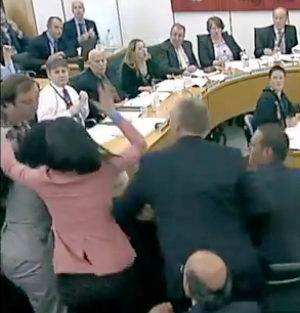
Uncle Remus
Some will probably ask in earnest: are the Uncle Remus tales racist? No, but their context is complicated. The stories emerged from the plantation South, from storytellers who lived in slavery. The lessons imparted are universal, but the particulars were obviously crafted to help slaves come to terms with their unchallengeable fate. Shall I quote a few passages to see if you get the idea?

Brer Tarrypin, he lay back up dar, he did, des es proud ez a nigger wid a cook possum.
–chapter 10

He scrape it clean en lick it dry, en den he go back ter wuk lookin’ mo’ samer dan a nigger w’at de patter-rollers bin had holt un.
–chapter 17

Dey er mighty biggity, dem house niggers is, but I notices dat dey don’t let nuthin’ pass. Dey goes ‘long wid der han’s en der mouf open, en w’at one don’t ketch de tother one do.
-chapter 27

How about this wrenching bit from A Story of War?

Nigger dat knows he’s gwineter git thumped kin sorter fix hisse’f, en I tuck’n fix up like de war wuz gwineter come right in at de front gate.

From chapter 33: Why the Negro is Black:

ONE night, while the little boy was watching Uncle Remus twisting and waxing some shoe-thread, he made what appeared to him to be a very curious discovery. He discovered that the palms of the old man’s hands were as white as his own, and the fact was such a source of wonder that he at last made it the subject of remark. The response of Uncle Remus led to the earnest recital of a piece of unwritten history that must prove interesting to ethnologists.

“Tooby sho de pa’m er my han’s w’ite, honey,” he quietly remarked, “en, w’en it come ter dat, dey wuz a time w’en all de w’ite folks ‘uz black—blacker dan me, kaze I done bin yer so long dat I bin sorter bleach out.”

The little boy laughed. He thought Uncle Remus was making him the victim of one of his jokes; but the youngster was never more mistaken. The old man was serious. Nevertheless, he failed to rebuke the ill-timed mirth of the child, appearing to be altogether engrossed in his work. After a while, he resumed:

“Yasser. Fokes dunner w’at bin yit, let ‘lone w’at gwinter be. Niggers is niggers now, but de time wuz w’en we ‘uz all niggers tergedder.”

“When was that, Uncle Remus?”

“Way back yander. In dem times we ‘uz all un us black; we ‘uz all niggers tergedder, en ‘cordin’ ter all de ‘counts w’at I years fokes ‘uz gittin’ ‘long ’bout ez well in dem days ez dey is now.

But atter ‘w’ile de news come dat dere wuz a pon’ er water some’rs in de naberhood, w’ich ef dey’d git inter dey’d be wash off nice en w’ite,

en den one un um, he fine de place en make er splunge inter de pon’, en come out w’ite ez a town gal.

En den, bless grashus! w’en de fokes seed it, dey make a break fer de pon’,

en dem w’at wuz de soopless, dey got in fus’ en dey come out w’ite;

en dem w’at wuz de nex’ soopless, dey got in nex’, en dey come out merlatters;

en dey wuz sech a crowd un um dat dey mighty nigh use de water up, w’ich w’en dem yuthers come long, de morest dey could do wuz ter paddle about wid der foots en dabble in it wid der han’s.

Dem wuz de niggers, en down ter dis day dey ain’t no w’ite ’bout a nigger ‘ceppin de pa’ms er der han’s en de soles er der foot.”

And my favorite passage, called Turnip Salad:

“How many er you boys,” said he, as he put his basket down, “is done a han’s turn dis day? En yit de week’s done commence. I year talk er niggers dat’s got money in de bank, but I lay hit ain’t none er you fellers. Whar you speck you gwineter git yo’ dinner, en how you speck you gwineter git ‘long?”

“Oh, we sorter knocks ‘roun’ an’ picks up a livin’,” responded one.

“Dat’s w’at make I say w’at I duz,” said Uncle Remus. “Fokes go ’bout in de day-time an’ makes a livin’, an’ you come ‘long w’en dey er res’in’ der bones an’ picks it up. I ain’t no han’ at figgers, but I lay I k’n count up right yer in de san’ en number up how menny days hit’ll be ‘fo’ you ‘er cuppled on ter de chain-gang.”

“De ole man’s holler’n now sho’,” said one of the listeners, gazing with admiration on the venerable old darkey.

“I ain’t takin’ no chances ’bout vittles. Hit’s proned inter me fum de fus dat I got ter eat, en I knows dat I got fer ter grub for w’at I gits. Hit’s agin de mor’l law fer niggers fer ter eat w’en dey don’t wuk, an’ w’en you see um ‘pariently fattenin’ on a’r, you k’n des bet dat ruinashun’s gwine on some’rs.”

What about “nigger”?
When Russel Means writes of today’s economic and anti-democratic troubles, and addresses America’s newly impoverished middle class by saying Welcome to the Reservation, this is the wisdom I think he’s looking to impart. Welcome to niggerdom, Nigger.

With that word now struck from Huckleberry Finn, the concept of “nigger” becomes harder to grasp and can’t teach us its lesson.

Listen to Uncle Remus talk about what it means to be a lowest class being, beneath the interest of humanity, untouchable, as government functionaries like Doug Lamborn would prefer the underclass laborer remain.

It’s against the moral law for niggers to eat when they don’t work. AND
I ain’t handy with figures, but I lay I can count on one hand how many days it’ll be before [“knocking around” will land you niggers] in the chain-gang.

I suggest you reread that last passage of Uncle Remus in its original. Now I’ll try my hand at the last half of that phrase:

It’s against the moral law for niggers to eat when they don’t work, and when you see them apparently fattening on air, you can just bet that ruination is going on somewhere.

Rupert Murdoch mistaken for Mr. Burns and pied by Jonnie “Marbles” Marbles

Unseen, Rupert Murdoch Sr. receiving shaving cream pie to the face.“It is a far better thing that I do now than I have ever done before #splat
    –tweeted by activist/comedian Jonnie Marbles, immediately before pie-ing News Corp godfather Rupert Murdoch at UK parliamentary hearing. Murdoch’s wife Wendi Deng reached over their bodyguard to strike Mr. Marbles, and curiously, hearing room cameras cut all direct images of the spectacle. Watching Murdoch deny knowledge or curiosity about NOTW wrongdoings, you wonder how word even reached him that his presence was requested at this parliamentary inquiry.

I’m thinking the PR coaching the Murdochs received is being overrated. Pretend to be a hands-off boss so not to expose your wrists to be slapped in cuffs? No one was buying Murdoch the Elder’s senility schtick, until the media began its spin, and wasn’t it amazing to gaze upon the breadth of media fealty shown to Rupert? Everyone wanted to distance themselves from Braveheart Marbles, because he purportedly threw audience sympathy to Murdoch. Right. The only ones fooled are those shills pretending. The world TV audience saw Murdoch for what they know he is, a blackmailer of world leaders, pursuing the ugliest of neoliberal war-making agendas.

Of course Rupert’s media was going to praise the Missus for her flying-clawing attack of the pie-wielding Marbles. It wasn’t intervention mind you, but retaliatory. I hope he can sue her. He’d already done the pie and was being subdued, she leaped over security to have at him.

Did Marbles spoil the show? Nonsense. He waited until the last of the softball questions, and took his turn. The parliamentarians may have been setting technical legal snares to trap the Murdochs at a later date, but certainly they could also have been asking, for example, did Murdoch wonder how the NOTW obtained confidential information, and was any ever withheld because it would lead others to question its illegal source. Also, did Murdoch ever use the threat of releasing confidential information to leverage government policy in his favor?

The big story for me was how the camera feed cleverly cut away from Marbles’ stunt. Ostensibly to capture the action suddenly coming from off-camera, but ultimately censoring the main scene. Where were the multitude of stills from that moment, of Elder Murdoch’s face filled with pie? Images abound now of the pie-wielder, caught effectively with egg-white on his face, but of Murdoch, not even a smudge, his splattered jacket whisked out of view before the frontal camera feed was let to resume.

How that sequence was managed for Murdoch tells a lot I think about the power he wields. Similar to the aftermath of the murdered girl’s violated voicemail. As the story broke, it wasn’t just messages erased, but internet caches of the early evidence, effaced even from hacktivists who know how to rescue unarchived data. Tracks of NOTW malfeasance erased by malfeasance at a much higher pay grade.

But I celebrate Jonnie Marbles, aka Jonathan May-Bowles, for daring something even the most powerful men in the world dare not, to humiliate Rupert Murdoch, on live TV with a world audience no less. It was a feat worthy of the shoe thrower, and no less deserved. I only hope the price Marples may have to pay, isn’t the fate of Sean Hoare, an earlier source of ire for Murdoch Elder.

I celebrate Jonnie Marbles’ last tweets before his deed:

I’m actually in this committee and can confirm: Murdoch is Mr. Burns.

RT @RachelvsPublic: Have you ever wondered what a verbal sudoku would be like to solve? This is it. #Hackgate #Yates

One gets the sense that they haven’t really done the required reading ahead of their presentation. Think they may fail this module #hackgate

It might be quicker if Baby Murdoch simply listed all of the things that he does know #hackgate

It is a far better thing that I do now than I have ever done before #splat

UPDATE: The Guardian gave Jonnie Marbles a chance to explain his stunt. He’s taking a beating in the comments, but here’s my favorite:

At last we have someone in this whole sorry mess who can own up and take responsibility for their own actions.

If the Murdochs had thrown a pie at Johnnie the article would read :

I never threw that pie. I was not in the position at the time to throw that pie.?

I don’t remember that pie, I throw 56,000 pies every day, how I am supposed to remember one individual pie??

If a pie was thrown, then someone I trusted must have thrown that pie.?

With hindsight I never threw the pie but if I had thrown the pie it was a mistake and I will apologise once all the facts are known about the pie and if I really threw it or not.?

This is the most humble pie day of my life.

Cheer up Johnnie.

The future of photography is time

I know little about fine art photography, darkroom craft or print collecting, but I will foolishly assert this: the future of the two dimensional print is the time-dimensional print. It’s only with the evolution of high definition that I dare say it, video. THE FUTURE OF 2D IS NOT 3D IT’S 4D. (Actually 3-D is a tech injected myopia, by 4D I mean two dimensions plus time plus sound) I do know that photo technology for everyman has breached the fourth dimension, mounted paper prints are a throwback for older generations like mine, who think of the past in terms of stills. Before us it was black and white. Moving picture snap shots are no gimmick. Purists can mourn losing the split-second frozen in time, but who can argue that elapsed time does not add an infinity of fractions more? Yes color film lost the contrast of monochrome, just as paint left the shading of charcoal. Movies have long since eclipsed slide shows and now it’s time that single-frame photographers step up to digital video, same fixed shot, same composition, time exposure set to however long will hold the viewer’s gaze. Soon online videos will embed as smoothly as static images, and two dimension visuals will be lifeless.

And like its archival predecessors, devoid of the information we already want to glean from the past.

I offer two examples for this argument. If modern galleries can break the silence barrier, the visual arts would also benefit by retaining the dimension of sound too.

Michael Deppisch’s montage of the 2010 Nashville flood.

Hector Thunderstorm Project by Murray Fredericks

Hector Thunderstorm Project from Murray Fredericks on Vimeo.

Cartographic traces of Lake, Colorado


Maybe like me you’re wondering how a landmark falls off the face of the earth, in particular Google Earth, assuming as we do that web crowdsourcing is archival, not perishable. A stagecoach watering hole in Kansas Territory, formerly Arapaho, was Hedinger’s Lake, between present day Limon and Hugo. Like the history of Colorado’s water, Lake became Lake Station, later a railway siding, today a creek.


First some back-story: 1750. When gold looked to become the carrot to drive white man’s Manifest Destiny, the Indian Territories of what would become Colorado were labeled simply the Gold Region.


Back in 1815, the West was still La Louisiane, and place names were native, French and Spanish. Taos was one of the oldest Spanish settlements, site of the First American Revolution, against the Spaniards, and another revolt when the US invaded. Camp de Baroney sits on the Arkansas River, eventually resettled as El Pueblo. And there’s La Fourche Republicaine, a fork of la Rivoire Missouri, soon to lead a prominent migration trail west.


By 1848, St. Vrain’s Fort and Grante Ft., Bent’s Fort, were already protecting Anglo trading interests. (Note by the way, Old Park and New Park, eventually to be become the “North” to South Park.)


By 1864, the Cheyenne and Arapaho found themselves bordered on the west by the “Military Department of Utah” and ceding their lands to the Kansas Territory. (On this map we can see Montana City, the original Denver City. Denver eventually overtook Auroria and the metropolis. Mineral Springs became Manitou and Colorado Springs at the foot of Pikes Peak.)

Note the curiously singular representation of a “Kansas Lake” depicted at the tip of the south fork of the Republican River, whose waters will originate in the later to be named Lincoln County, at whose heart will lie Lake, Colorado.

The Rocky Mountain region lost many lakes by the mid 1800s when beaver were hunted to near extinction and with them the beaver dams. Note just West of “Kansas Lake” lies Beaver Creek.


With the gold rush, settler trails crisscrossed the West, for wagon trains, stagecoach and mail carriers. Lake was a stage at the convergence of the Butterfield Overland Dispatch and Republican Fork Trails, where they crossed the Big Sandy Creek to join the Smoky Hill South and North Roads (after similarly named rivers which were starting points in Kansas) or the spartan Starvation Trail to Denver. Today’s I-70 follows Smoky Hill North.


Was Hedinger’s Lake the water which travelers sought at the end of the South Republican Fork Trail?


This 1868 Union Pacific map predicted the stops heading eastward from Denver to be Parkhurst, Beaver, which later became Deer Trail, and Coon Creek, which became Kit Carson, opposite Sand Creek.


By 1870, Kansas was a state and the Kansas Union Pacific RR reached Denver. (Beyond the mountains: North Park, Middle Park and South Park.)


By 1873, leaving for Denver from Fort Wallace, there were stops at Kit Carson, Aroyo, Lake, Agate (pronounced “A-Gate”) and Deer Trail. (Note: still no Colorado Springs.)


A map circa 1880s, shows Hugo, Lake, River Bend, Godfrey, Agate, Deer Trail, and Byers, named for the founder of the Rocky Mountain News, formerly Bijou.


When the Chicago Kansas and Nebraska Railroad sought a direct route to Colorado Springs, it decided to intersect the Kansas Pacific at a new stop called Limon and that was the end of Lake. At Limon the westbound trains performed what was called the “Limon Shuffle” where passenger and freight cars were separated depending on which were going to Denver and which to Colorado Springs.


Lake Station remained a stop for the Union Pacific, and on this map which accompanied the 1910 census, it’s gone, in favor of a late addition, Bagdad.

As trains no longer needed to take on water, and could reach their destinations more quickly, many stops were eliminated. This 1925 train Union Pacific train schedule lists only Cheyenne Wells, Kit Carson, Hugo and Limon before reaching Denver.


Lake is still marked on railroad maps, though there’s not even an access road to reach it.


On other maps it’s just Lake Creek, spanned by an impassable decaying bridge. It’s now a wetlands area that provides a bird sanctuary.


For the USGS, Lake still serves as namesake for the topographical map of the Lake Quadrangle.

To be continued…

Banned books: the subversive dystopia

Eugene Zamiatin, We; Jack London, The Iron Heel; Ambrose Bierce, Can Such Things Be?; Aldous Huxley, Brave New World; Ayn Rand, Anthem; Sinclair Lewis, It Can't Happen Here; George Orwell, Nineteen Eighty-Four; Norbert Weiner, The Human Use of Human Beings: Cybernetics and Society; David Karp, One; Frederick Pohl and C. M. Kornbluth, The Space Merchants; Kurt Vonnegut, Jr, Player Piano; Ray Bradbury, Fahrenheit 451; Anthony Burgess, A Clockwork Orange; Harlan Ellison, The Glass Teat; Margaret Atwood, The Handmaid's Tale.Banned Books, p.2–
I put a lot of faith in an internet resilient enough to remain an unrestricted archive of crowd-sourced human knowledge, even more I hope public data will eventually permeate the proprietary, but continued access to subversive literature I have little doubt will meet the full brunt of digital book burners. If there’s any text not to download unto your Kindle, as an easily vaporized or expurgate-able file, it’s one of these classic oft-censored, perpetually-offense-giving titles. These are the dystopian novels and science fictions which paint a bleak picture of the society we are engineering.

As pictured, here are some notoriously subversive dystopian novels, (as differentiated from commercial drivel which reinforces mainstream dogma, such as Lord of the Flies, or Hunger Games)

Atwood, Margaret, THE HANDMAID’S TALE
Bierce, Ambrose, CAN SUCH THINGS BE?
Bradbury, Ray, FAHRENHEIT 451
Burgess, Anthony, A CLOCKWORK ORANGE
Ellison, Harlan, THE GLASS TEAT
Huxley, Aldous, BRAVE NEW WORLD
Karp, David, ONE
Lewis, Sinclair, IT CAN’T HAPPEN HERE
London, Jack, THE IRON HEEL
Orwell, George, NINETEEN EIGHTY FOUR
Pohl, Frederick, & C.M. Kornbluth, THE SPACE MERCHANTS
Rand, Ayn, ANTHEM
Vonnegut, Kurt, PLAYER PIANO
Wiener, Norbert, THE HUMAN USE OF OTHER BEINGS
Zamiatin, Eugene, WE

Haven’t heard of many of these? Curious, don’t you think?

Your father’s Lili Marlene, specifically

On the subject of historical misconceptions, you might say I’m hugely sentimental. So the tale of Lili Marlene catches me up like a honey trap. What does the name conjure for you? A Nazi Mata Hari? A fictional musical persona beloved by soldiers on both sides of the Good War? While even antiwar sentiments wax nostalgic about its universal love-conquers-all popularity, the WWII melody evokes romantic memories fueled by dueling propagandas. And when a victorious meme writes the history, it can erase its footprints, leading from what was effectively a literary rape.

A recent folk reference for example, an otherwise impeccably adroit Lili Marlene Walks Away, about Marlene the streetwalker, leaves me just sick in the heart.

The historical narrative has it that Lili Marlene was actually Lili and Marleen, two girlfriends for whom German soldier Hans Liep pined from the trenches of WWI. With unchivalrous poetic license Liep conflated the two and penned a love poem as it might have been written to him, “signed, Lili Marleen.” Two decades later a German composer set the words to music and then came the outbreak of the next war. The original recording by Lale Anderson was a flop until broadcasts to the front lines over Radio Belgrade captivated homesick Wehrmacht soldiers and eventually the lovelorn battling on both sides. Lili Marlene emerged the most popular song of all time, translated in as many languages as fought in the war. Was this owed to a universal empathy toward the pangs of love, or was it the appeal of a truly catchy melody and lyrics carefully crafted to suit the moment? And how did Lili’s character become redefined?

For the German audience, the character of Lili Marlene did not change. For some the song lost its sheen for having been co-opted by the Third Reich war machine. But even as the singer’s living embodiment of “Lili Marleen” became tarnished by her Faustian-won fame, the title role of “Lili” remained the non-fictional love interest with whom her soldier lover spent every furtive off-duty moment, revisited in memory and in anticipation. Concurrent translations across the European continent stuck to the same essential theme, owing no doubt to listeners being in the main multilingual. They understood enough of the original German not to be sold another Lili Marlene. English was another story, but the Allies didn’t start it.

Nazi propaganda minister Joseph Goebbels at first banned the song because he saw it as demoralizing to soldiers enduring the deprivations of war. He referred to Lili Marlene as “The tearjerker with the death-dance smell” until its popularity reached a critical mass even he couldn’t stop. When opposing forces seemed also to succumb to the song’s wiles, Goebbels sought to intensify the poison’s venom.

The original German lyric was written in an ambiguous voice, either that of the soldier or his faithful girl, revisiting their every last moment together and the promise of more. Even as the imagery may have been accepted as a soldier’s fantasies, the singer’s female gender was consistent with the voice of his lover’s reassurances. As a result, the original singer came to personify the character Lili Marleen. For soldiers of every side the voice they heard was that of “Lili Marlene.”

The popular account goes that when Allied soldiers were observed singing along to Radio Belgrade, an English lyric was ordered post haste lest American GIs and British Tommies be singing in German. Rarely mentioned is that the seduction interrupted had been in English.

A recent compilation of nearly 200 different renditions of Lili Marlene gives an unprecedented look into the WWII propaganda battle waged over control of the Lili Marlene narrative. Many of the key recordings have reached Youtube.

When the Germans surmised that Allied soldiers wanted to do more than whistle along, a lyric was devised for them which changed the ambiguity of the narrator to the first person. YOUR Lili Marleen became MY Lili Marlene. And oddly, but for reasons un-mysterious obviously, the vocalist remained a woman. The English version was supposed to be a translation after all, and no one was under any illusion that the song’s original appeal with soldiers was not owed to the enchantment of the chanteuse.

The plodding, dripping sentimentality of the melody also lent well to marches. Lili Marleen, in English, Marlene, was an ideal tonic for a war long on effort and deprivation.

An American GI today could still be forgiven for hearing Lili Marlene and saying: those aren’t the lyrics I remember. Late and post war USO tours effaced the earlier Nazi radio broadcasts. There was a German English version before the British and American after that, when Lili of the home front became the seductress became the whore.

If the song conjures an American image at all, it’s Marlene Dietrich, who subsequently claimed the song for her own, perhaps why it’s named Marlene and not Marleen, I don’t know. But her vampy rendition colors interpretations to this day. An American film star from the 30s, Dietrich is still mistakenly remembered as a reformed German double agent, possibly the Axis Sally propagandist who originated her namesake song. To my mind, familiarity would be the only reason to favor Dietrich’s rendition of Lili Marlene. The original 1938 German and its first English incarnation in 1942 were both by Lale Andersen, easily the most moving. But Marlene Dietrich wasn’t selling love, or was, to be more precise.

The lyric to the original German recording translates thus:

In front of the barracks, in front of the main gate,
Stood a lamppost, if it stands there still,
So will we see each other there again,
By the lamppost we’ll stand,
As before, Lili Marleen. As before, Lili Marleen.

Our two shadows looked like one.
That we were so much in love, at a glance anyone could see.
And everyone will see it,
When we stand by the lamppost,
As before, Lili Marleen. As before, Lili Marleen.

(The motif of female narrator was conceded by a 1943 BBC propaganda rerecording made for broadcast back to Germany. Instead of a love song, the lyric became a war-weary rant where a hoarse-throated middle-aged “Lili” calls for an uprising against Hitler. Loosely translated it went:

Maybe you’ll die in Russia, maybe you’ll die in Africa,
You will die somewhere, that’s what your Führer wants.
But if you see us again, where will this lamppost be?
In another Germany.
Your Lili Marleen.

The Führer is a oppressor, that’s what we all see,
Making every child an orphan, every woman a widow,
It’s all his fault, I want to see? him at the lamppost,
Hang him up at the lamppost.
Your Lili Marleen.

)

The German propagandists were more insidious with their subversion of Andersen’s 1942 recording, sticking closely to the original setting, shifting the narrator squarely to the male, relegating Lili not just to the third person but to the past, and interjecting heaping doses of sentimentality:

Underneath the lantern, by the barrack gate,
There I met Marleen every night at eight.
That was a time in early Spring,
When birds all sing, then love was king
Of my heart and Marleen’s, of my heart and Marleen’s.

The next verse begins with a cringe-worthy overstep of a military put-down, perhaps however to divert critical faculties from the real manipulation. Even though the song is now in English, the soldiers expect it serves German propaganda. Disarmed by the amateurish mocking of “retreat,” the listener is vulnerable as the rest of the lyric preys on a soldier’s insecurity about his sweetheart’s fidelity, the longer the war years become interminable. The subject is the usual propaganda leaflet fare, but animated with the potency of music. Faithful “as before” became “time would part” Marlene.

Waiting for the drumbeat, signaling retreat,
Walking in the shadows, where all lovers meet.
Yes those were days of long ago,
I loved her so, I couldn’t know
That time would part Marleen, that time would part Marleen.

The pace leadens to deliver the fatal pronouncement, again the anticipation of reunion becomes perseveration and lament:

When I heard the bugle, calling me away,
By the gate I kissed her, kissed her tears away.
And by the flick’ring lantern’s light,
I held her tight, t’was our last night,
My last night with Marleen, my last night with Marleen.

The last verse repeats the first, which I omitted earlier. It’s a call to action, obviously absent the original, “Now is the time-” meaning desertion into the aforementioned shadows, “to meet your-” and I must admit to be unsure of a transcription. From Andersen’s accent to the unclear recording quality of her backup chorus, it’s difficult to determine whom Lili wants the soldier to meet. “Your girl” and two other words which rhyme with girl, the first begins with P, the last with S.

Still I hear the bugle, hear its silv’ry call,
Carried by the night air, telling one and all:
Now is the time to meet your pearl,
To meet your girl, to meet your soul,
As once I met Marleen, my sweet Lili Marleen.

Your girl, not Lili Marleen. She’s gone, a love lost to regret. In their German-accented affected English, the male chorus appeared to provide a mocking echo “Now is the time to meet your death.”

Needless to say it was imperative that while Radio Belgrade reached the English and American soldiers in North Africa and Italy, the Allies had to record an antidote. A first version by a Brit kept with the romantic original:

In the dark of evening, where you stand and wait,
Hangs a lantern gleaming by the barrack gate.
We’ll meet again by lantern shine
As we did once upon a time.
We two Lili Marlene, we two Lili Marlene.

Our shadows once stood facing, a tall one and a small.
They mingled in embracing, upon the lighted wall.
And passers by could see and tell
Who kissed my shadow there so well:
My girl Lili Marlene, my girl Lili Marlene.

But that didn’t address the problem of demoralization, Goebbels’ original concern shared by military commanders no matter which side: soldiers overtaken by depression.

Plus the Allies needed less a song about the girl back home than one about the German lass awaiting the Yankee conqueror. Who are we kidding? Lili Marlene’s German voice did not invoke thoughts of home so much as a foreign woman taunting, however innocent, from behind enemy lines. Eventually those lands would be overrun, her lover to die in their defense, Lili to await the last man standing. How many soldiers listened to Radio Belgrade and did not fantasize about cuckolding their adversary with his beloved Lili Marlene? The Allied troops needed a Lili of not-unfaithful character, but one available to them. It was no big leap for an American lyricist to transform Fritz’s Lili, faithfully waiting for him under the lamppost, to “Lili of the Lamplight,” the only type of German woman with whom American GIs would be able to get near, a prostitute.

Underneath the lantern by the barrack gate,
Darling I remember the way you used to wait.
Twas there that you whispered tenderly
That you loved me, you’d always be
My Lili of the lamplight, my own Lili Marlene.

You’ll always be mine? My love? No, my lover by the lamplight. In the new scheme, the mentions of love and tears become sublimated by kisses, caresses, whispers of tender nothings and feet waiting in the street. Sung to the Allied troops as they marched unto Berlin by a husky voiced vamp. That’s your Lili Marlene.

Animal Liberation Lone Wolf betrayed by ATF informant, literature and tattoo

Animal Rights Activist and VeganPardon the delay, but when an activist is arrested for the literature he’s carrying, I’ve got to find that material. 34-year-old Walter Edmund Bond was arraigned today for setting the Denver Sheepskin Factory fire in May. ATF agents report that in his knapsack was a tract entitled Declaration of War: Killing People to Save the animals and the Environment The ATF alleges his copy was subtitled: Strike a Match, Light a Fuse, We Only Have the Earth to Lose. Bond was arrested after an informant taped him confessing to being the “Lone Wolf” who took credit on an Animal Liberation Front website. In the meantime, media outlets have linked Bond to a 1977 conviction for arson, failing to note he would have served the time as a toddler. (Turns out “1977” was a typo.)

This story makes me sad, because as much as direct action now requires a culture of secrecy, and as renegade as “Lone Wolf” may have been, if it was Bond, what happened reminds us that wolves are in fact a social animal like we, and every ideologically driven person needs to seek out like-minded comrades.

While it was probably a foregone conclusion that the Sheepskin Factory fire was set to make a statement about animal rights, today’s media requires that someone take the credit. Lone Wolf’s online post performed that protocol, and that should have been that. Doubtless it’s hard to recruit allies for future projects without wanting to claim a resume of past deeds. And what’s to stop everyone from pretending to have been there?

The certainty with which the ATF ties Walter Bond to the fire is built on his bragging to a friend. His choice of reading material, or tattoos, corroborates the subject of his interest, equally likely what he would brag about, and not his actual culpability.

The Smoking Gun has obtained the full affidavit submitted by ATF Special Agents Rennie Mora, which details a call received by fellow agent Christopher Forkner. Someone who hadn’t talked to Walter Bond since the suspect was 22, called the ATF to relate a phone call he/she received from Bond in late June. Asked what he’d been up to lately, Bond referred “Informant CI-01” to the website voice of the voiceless and directed her/him to scroll down to the “Denver Sheepskin fire.” There “ALF Lone Wolf” had posted an explanation for why he’d targeted the business. Concluded the informant: “that’s what he had been up to.”

The informant then called the authorities, the ATF claims, because of fears firefighters might be endangered by future fires the suspect might light.

The affidavit also mentions that the informant passed on photographs of Bond to the ATF.

At the direction of the ATF, Informant CI-01 contacted Bond in Utah. Though Bond had called initially from “a phone at a Salt Lake City public library,” the affidavit offers no details about how the informant reached Bond. The informant suggested Bond travel to Denver and meet at a Ramada Inn on East Colfax, where their conversation was then recorded.

Had the ATF been tracking Bond since his arson conviction in 1997, or at activist gatherings since? There are no ready explanations for what motivated or enabled Informant CI-01 to ensnare her friend of twelve years before. It should be interesting to learn from Bond how he recounts the past weeks’ events and whether if was indeed a friend he last spoke with during his first stint in prison. The informant could have been a prison relation worried about violating parole, or a full-fledged undercover agent.

It appears Bond was short on friends. He was apprehended in the yard of friend Billie Jo Riley who described Bond as an “unlikable drifter.” She made a point to ridicule Bond for accepting two hamburgers in spite of the tattoo on his throat which reads “vegan.” The reporter from Denver’s 9News prodded her incredulously. “Did he know they were real hamburgers?” 9NEWS asked, as if anyone doesn’t recognize meat fat by just its smell. “Yeah” Riley complied, adding again “He ate two of them, two of them.”

The evidence which the ATF asserts corroborates Bond’s taped admission is his “VEGAN” tattoo and the aforementioned “propaganda.”

Which it very well may be. The 1991 screed is attributed to one “Screaming Wolf” and its publishers claim it came by floppy-disk, by mail, its postmark undecipherable. The text is available at Animal Liberation Front, archived under Philosophy/Legal. I’ll reformat it here for legibility, and of course, for curiosity only.

A DECLARATION OF WAR

?Killing People To Save Animals And The Environment ?

This book is dedicated to the animals who have been killed by human greed, selfishness, and bloodlust. In their names, and in the names of current and future generations of innocent beings who will suffer and die as a result of human brutality, the liberators are striking back. Our fellow creatures who have been mutilated, slaughtered, burned, poisoned, strangled, gassed, shot, electrocuted, microwaved, run over, skinned, eaten, enslaved, and domesticated are now being defended. Humans, beware!

?– Screaming Wolf –

Table Of Contents

A MESSAGE FROM THE UNDERGROUND

MAJOR DISCLAIMER BY SCREAMING WOLF

CHAPTER 1: THE LIBERATORS

CHAPTER 2: THIS WORLD IS MEANT FOR ALL BEINGS

CHAPTER 3: HOMO DESTRUCTUS

CHAPTER 4: THE EVERYDAY HOLOCAUST

CHAPTER 5: THE MYTH OF NON-VIOLENCE

CHAPTER 6: A TIME FOR WAR

CHAPTER 7: FINDING PEACE IN TIMES OF WAR
?

A MESSAGE FROM THE UNDERGROUND
(Preface from the original editors)

My husband and I are animal rights activists. For the past ten years we have been in trenches fighting for the animals. But we have always fought legally. We have used the system to its fullest, coordinating various educational, legislative, and litigious campaigns.

If you would have asked us how we felt about our work, we would have told you that our struggle for animal rights and a more humane world was finally becoming mainstream and acceptable. We really believed that our message was beginning to be heard.

However, on the morning of January 18, 1991, our lives were turned upside down.

Included in our mail was a small package with no return address. Inside was a computer disk. There was no explanation of what this disk was for, or who had sent it to us. We looked at the postmark on the envelope, but it was faint and illegible. With no clues as to its contents, we decided to put it in our computer and see what was on it.

The  disk  had  one  file on  it  called, A Declaration  of  War. We opened the file, and the following message appeared.

    “This manuscript explains the philosophy of a group of individuals throughout the world who call themselves, ‘Liberators’. They believe in a revolution to liberate animals and, if necessary, to kill their oppressors. They say such extreme action is needed to stop the horrible human caused suffering of animals and the destruction of the world. They believe that nothing short of a total overthrow of this system will free our brothers and sisters. Please see that this ‘Declaration of War’ is published for the world to read and understand.

Signed – Screaming Wolf”

?

Our curiosity kept us glued to the computer for the next four hours, as we read this bold manuscript. When we finished, we were extremely disturbed. What kind of person could be responsible for this, we wondered. At first, we couldn’t understand why we were chosen as the recipients of this ‘Declaration of War’. After thinking it through, we assumed it was because of some similarities in our personal philosophies. We, too, see humans as the destructive force in the world. We feel that this planet was not put here for humans to exploit, and that nature and other animals, not humans, are at the center of our moral thinking. ?

But what was this talk of killing oppressors? We never promoted or defended violence. Why did Screaming Wolf decide to contact us? The answer to that question is still a mystery, But the reason for our selection is a moot point. We have been selected and must now deal with this terrifying manuscript. ?

Screaming Wolf explains the reason why ‘Liberators’ feel that they must declare war on society. We expect that many activists in the animal rights and environmental movements agree with much of what the ‘Liberators’ have to say, but would seldom admit these deep and frightening thoughts, even to themselves. Feelings of frustration, feelings of alienation, feelings of love and hate and anger and fear, all of these, and more, are common to all of us working within the system for change. ?

However, the ‘Liberators’ go beyond these feelings, and describe real or proposed actions: actions which the public will immediately decry as terrorism, actions which the ‘Liberators’ defend as heroism. According to Screaming Wolf, who apparently is a spokesperson for these ‘Liberators’, these terrorists are a branch of the A.L.F. (Animal Liberation Front). This group has claimed responsibility for breaking into laboratories and factory farms, rescuing animals and damaging equipment. However, the A.L.F. has maintained a commitment of nonviolence towards all living beings, including humans. Liberators, according to Screaming Wolf, have decided to end their commitment of non-violence towards human life. These people actually feel that violence against humans is the only way to make a real difference for the animals. ?

After reading this manuscript, our anxiety and fear almost prompted us to toss it in trash. We were looking for any excuse to forget what we had just read. However, we concluded that Screaming Wolf’s message is too important to simply dismiss. People must know what ‘Liberator’ believe, and can come to their own conclusions about what it means, how they feel about it, and what they want to do about it. ?

We know that publishing a book like this is risky, despite the alleged First Amendment rights of freedom of press. People in this country are allowed to purchase and bear arms, but not to announce a call to arms. We expect some people to construe our publication of this book as an endorsement of violence, despite our disclaimers to the contrary. We looked into the laws regarding publication of literature concerning terrorism and realized at once that the risk in publishing this book is real. We expect to be slapped with dozens of lawsuits, and probably death threats as well. As one lawyer put it, our publishing this book may be totally legally defensible, but we will most likely have to repeatedly prove that fact over the next decade, costing us a fortune in legal fees, and draining our energy and time as we deal with the legal system. ?

The situation, as we see it, is that we have been the recipients of a manuscript that describes a terrorist group of people declaring war on humans to save animals and the environment. If we ignore the manuscript, the public will not know of this threat to its safety. People need to know that ‘Liberators’ exist. We also feel that everyone who believes in working within the system needs to engage in open and honest dialogue about all ways of seeing a problem and its possible solutions, including the solution offered by the ‘Liberators’. This applies to activists and those invested in the status quo. The message of ‘Liberators’ affects all of these people. ?

We concluded, therefore, that we must accept the responsibility of publishing this manuscript. In the name of truth and honesty, people must hear this message of the ‘Liberators’. ?

In an attempt to protect ourselves from criminal prosecution, we, the publishers, would like to make the following direct disclaimer. We do not endorse or support any of the illegal, terrorist activities described by Screaming Wolf or the ‘Liberators’. We present this book for informational purposes only. ?

The entire manuscript of Screaming Wolf could have been printed with quotation marks from the first word to the last, since all that follows this preface are the words of that individual and his or her presentation of the ‘Liberator’ position. We have excluded such quotation marks for the purpose of clarity. ?

This is a glimpse into the world of animal liberation terrorism. We suspect that the life and message of a ‘Liberator’ will be a difficult one for most people to understand. But we feel that the public has a right to have this information. After all, if the ‘Liberators’ continue to carry out their tactics, it may be a matter of life and death.

The Publishers ?
February, 1991.   ?

Read the entire manuscript in our archives: A Declaration of War.

Our prejudice against tent-dwellers

Great Depression Okies living in tents
What do home-enabled Coloradans have against disadvantaged people forced to live in tents? The Great Depression saw migrant workers having to subsist under canvas, striking miners have been forced from their homes and into camps in Ludlow and before that Cripple Creek. And of course the first Colorado tent-dwellers to get everyone’s panties in a knot were the Native Americans who held original claim to the territory.

The above photograph is from Dorothea Lange’s historic series which documented the lives of migrant workers as they fled the Dust Bowl for the fertile agricultural plantations of California. The woman at right is the iconic “Migrant Mother” known for a more famous closeup. I chose this shot because it makes clear that she and her seven children were living in a tent.

Colorado was one of the states which the Okies had to cross in search of work in California. As depicted in Grapes of Wrath, Colorado and Arizona only begrudgingly tolerated the vagabonds, making sure they didn’t linger and kept on their way.

Do we fear the poor because they threaten our own sense of prosperity? There but for the grace of God, go ourselves? We shoo them along lest their itinerant ways tax our charity, or they take the righting of economic inequity into their own hands. The Europeans have always shunned the ever-homeless gypsies. Landless people can’t be trusted, they’re in the opposite position of what we look for in businesses, reliable to the extreme of being “bonded.” People unattached to assets don’t have capital to bond them with responsibility.

Depression era photograph by Dorothea LangeBefore Coloradans were chasing off out-of-state migrant workers, yesterday’s illegal immigrants, they were offended by earlier indigent encampments. When miners struck in Colorado’s southern coal fields, the mine owners evicted them from the company-owned houses. The unions were left to build a tent city in Ludlow to put pressure on the industry to accept some labor demands. The standoff was spun as a standoff between the ungrateful miners, most of them recent immigrants, and a nation’s critical source of heating fuel. The Colorado population was roused to man a militia and beat the miners into submission. As much as consumers feared an interrupted coal supply in the record cold of the winter of 1914, imagine the miners enduring in their tents. In the end, we all know the result: the Ludlow Massacre and the unions were defeated.

The gold miners fared slightly better in their 1894 strike to preserve the eight hour day. When they closed down the mines and camped on site to keep them shut, the folks of Colorado Springs were rallied to form a near 2000-strong army to go attack the ingrates. Fortunately the miners escaped a battle, but the common population’s prejudice against the laborers in their tents was the same.

Could these have been related to the sentiments which inflamed Colorado Territory settlers in 1864, enough to go after the few remnants of Native Americans encamped along Sand Creek?

The Pikes Peak region plays an ignoble role in all of these examples. Men from Colorado Springs and Colorado City formed the population from which participants were drawn for Chivington’s raid against the Cheyenne, the private army which marched against the Cripple Creek gold strike, and the militia which Rockefeller mobilized to torment the tent city of Ludlow. Colorado Springs was a hotbed of Klu Klux Klan activity in the 1930s, epitomizing local xenophobia.

When Colorado Springs city councilman speak of fielding calls from constituents angry about the growing homeless encampments, I cannot help but think of our legacy of intolerance of people deemed lesser than us. Colorado Springs has always been ripe for bigotry and hatred.

Not so long ago our city was the crucible for Amendment Two which sought to deprive homosexuals of protection from discrimination. More recently fear-mongering about immigration from Mexico made Colorado Springs fertile for recruiting gunmen for the Minutemen, to make pilgrimages to the Mexican border with the promise of getting to shoot Mexicans pell-mell. Since the election of President Obama, we’ve seen a phenomenal growth of Tea Party enthusiasts, white bigots determined not to have their taxes spent by a nigger.

What a sorry racist lot we’ve been, anti-labor, anti-progressive and anti-poor. Somewhere in the past there must have been city leaders who defied the simple-minded xenophobia of our historic population, otherwise all our statues of municipal heroes would be wearing clan gowns. Hopefully with the current bloodlust to run off the victims of our current depression, city politicians will lead my setting a higher moral example.

Labadee: Royal Caribbean’s Neo Haiti

Labadee oasis seas boi caimanFormer President Bill Clinton is heading to Haiti, again. As UN special envoy to Haiti, he paid a visit last year as a guest of the Royal Caribbean cruise ship line to promote their tourist facility at La’Badie. Said CEO Adam Goldstein: “Labadee is just a great example of the way that things can work in a very positive way in this country.” Are those new ways or old? The secured compound, laying under the protection of the old French colonial capitol, greets 7,000 cruise passengers a week, even this week, many of whom don’t know they’re in “Haiti,” on an old slave plantation, or what may have been the crucible of real Islamic rebel voodoo!

I didn’t know about the private resort of Labadee, but my attention was drawn in December to the announcement of the launch of The Oasis of the Seas, the largest cruise ship ever devised. It was leaving the shipyards of Finland, having to pass under a Danish suspension bridge at low tide, so titanic was she. I took note because the headline announced her maiden destination to be Haiti, an odd place I thought, to be ostentatious.

The spotlight which the recent earthquake has brought on the poverty in Haiti had me wondering if all seventeen decks of the Oasis of the Seas were gawking at the suffering masses awaiting aid in Port-au-Prince. Not a chance. The Oasis, and Royal Caribbean’s fleet of floating carbon boots harbor at a secluded oasis which the cruise line rents from Haiti. Its income represents the largest portion of Haiti’s tourism revenue. If you thought President Obama’s offer of $100 Million was stingy, you can calculate Royal Caribbean’s avarice on one hand.

The tragic earthquake hasn’t interrupted the cruises. It this tragedy has an upside, it’s that some vacationers are expressing less facility stuffing down a burger knowing most Haitians await relief.

Haiti receives $6 for each tourist who disembarks to zip-line, buy trinkets from licensed vendors, and sun on Christoper Columbus Beach. They’re told it was his old stomping ground –which actually can be said of Hispaniola’s entire northern coastline. Likewise the same is true about the slave plantations which, from the port of Cap Francois, provided 40% of Europe’s sugar and 60% of its coffee. Today Haiti is renowned as the poorest land in the Western Hemisphere. The verdant lands of La Partie Du Nord –of Les Grand Blancs— are separated from the Haitian population by a mountainous Massif, and in the case of Labadee, with barbed wire.

habitation-slave-plantationsRoyal Caribbean boasts that its operations are critical to the Haitian economy. It employs hundreds, but contrast that with what the coast could provide if it wasn’t privatized. The resort draws from a cheap labor pool of an unlimited mass of Haitians who are kept with no other options but to hope they can replace the couple hundred employees confined to the cruise line compound.

And yes, the cruise itineraries avoid mention of Haiti, attributing Labadee as a “private island” of Hispaniola. The private island concept is not new, cruise ship operators began several decades back to seek to give their customers refuge from the growing throngs of third world poor who paddle out to the ship hoping for first world largess. Another motive was that cruise lines could also monopolize where their passengers could spend their money while ashore. What began as exclusive contracts with port destinations, very notoriously the Alaskan inland passage, became ventures where cruise line operators bought entire tracks of properties retired from oil or military use, whether half islands, or merely beaches, recast as private beaches, populated by private workforces.

Disney Cruise Line: Castaway Cay, Bahamas
Princess Cruises: Princess Cays, Eleuthera, Bahamas
Norwegian Cruise Line: Great Stirrup Cay, Bahamas
Holland/Carnival: Half Moon Bay, Little San Salvador Island, Bahamas
Royal Caribbean/Celebrity: Coco Cay, Bahamas; Labadee, Hispaniola

According to the Royal Caribbean promotional material, the spelling Labadee is anglicized for English-speakers. It’s named after the Marquis de La’Badie, a “Frenchman who first settled the area in the 1600s.”

At one time the French plantation owners were comforted by their remote location, buffered they thought from the potential of slave rebellions from the south. In fact, Haiti’s famed uprising began in the north, not far at all from La’Badie. Off the Royal Caribbean itinerary, but only a stone’s throw away, that is to say, within distance of incoming stones, are landmarks important to the celebrated revolution: Haiti’s first copper mine, site of a lone concentration of Islamic slaves, and the Bois Caiman of lore.

The area of Cape Haitien, as it’s called today, holds two of Haiti’s geography secrets. One, the conclusive location of La Villa de Navidad, where Christopher Columbus built his first European settlement in the New World, a fort made of the timbers of the wrecked flagship Santa Maria; Columbus returned the next year to find his men murdered and the houses burned to the ground. Archeologists are still looking to find definitive traces in Caracol or Bord de Mer de Limonade.

Second, the site of the Bwa Kayiman, the ceremony which launched Haiti’s famed slave rebellion led by Toussaint Louverture. Some scholars have begun to question whether it happened at all. They base their skepticism on the absence of written testaments. Although it’s popularly understood that the gathering of conspirators was confessed under torture by rebels captured by the French authorities. The cynics suggest the story was a fabrication to demonize the black slaves and that:

the manuscript minutes of these interrogations have survived in the French National Archives and make no mention of this or any other vodun ceremony.

That’s something to wrap your mind around, that transcripts remain of torture sessions conducted so many years ago.

Naturally the secret gathering had to escape the suspicions of the French slaveholders, but the infamy of the declaration of the Bois Caiman has inspired every Bolivarian insurrection since, from Bolivar, to Marti, Sandino, Castro, Moralles and Chavez. Revisionists seeking to tamp the populist spirit question why its location remains a mystery. Oral tradition holds that the rebels gathered in an open space in the forests of Morne Rouge.

Morne Rouge, the place where BC ceremony hypotheses converge, is also the only place in Haiti to retain an important Islamic cult. This is because the first wave of slaves were from the Senegambian region and had already undergone heavy Islamic influence. Up to date, Mori Barthelemy and followers of the region maintain this tradition, with honor to the sun, specific funeral rites and so on. If one returns to sources of the 16th century, one finds that there is where the first copper mines were established by the Spaniards, when they started giving up on the gold.

You can find Labadee, 19° 47? 11? N, 72° 14? 44? W on any modern map. Pondering The Cape it occupies, and the deep water harbor it is able to afford a behemoth like the Oasis of the Seas, I was led to research the mysteries of Haiti’s NORD, and survey the progression of place names on European maps which span the years.

haiti
This is Cristóbal Colón‘s own recollection of the northern coast of what he called La Isla Española, marking his first landing at San Nicolas Môle, the island of Tortuga, Fort Navidad, and the landmark Monte Cristi whose height guided Columbus and led him to name Hispaniola after Spain.

haiti charlevoix
A later map made by the French attempts to show the divisions of the indigenous tribes. The site marked “Premier Etablissment” marks Navidad, built near the Taíno cultural center of Hayti-Bohío-Quisqueya.

haiti Vinckeboons
A 1639 Dutch map shows Cap François. On the south shore of Isla Tortuga lies the beach Playa Cyan, across the water from the river Rio dos Caymanis. Also note the hills to the east called Mançanilla, these divided the peaceful Taíno from the warring Caciq. The location name derives from the Manchineel Trees whose poison berries they used to poison the tips of their arrows.

haiti monte christo
French map circa 1723 marks Cayne opposite the Iron Coast of L’Ile de la Tortue. There’s also a typical sailor’s landmark: Pointe des Palmiers (trans. Point of the Palms). The promontory of Cap François has here become Le Cap (The Cape). It shelters Port St. François, east of the heights of Morne Rouge and Mines de Cuivre (trans. copper mines).

haiti labat
French map of Cape Francois dated 1722 adds Le Limbe, the first area which the rebel slaves put to the torch; and Le Chemin du Cap, the main road to the valleys of the south.

haiti Ponce
This 1796 French map features another sailor’s aid, Pointe Tête de Chein (trans. Dog’s Head Point). The fortification battery on the Cape was built upon Roche à Picolet. This map was drawn after the rebellion of 1791. The Morne Rouge (trans. Red Heights) is now designated as Ravine du Morne au Diable and the Acul à Sabal. The Devil’s Ravine is the present location of Royal Caribbean’s Labadee.

The poor of Haiti are still taking heat for the Bwa Kayiman having been a pact with the devil.

haiti bellin
I add this 1764 map for personal interest. Few maps even today mark L’Islet à Rat (trans. Rat Island), which Columbus called La Amiga, was an aid to navigation out of his anchorage at Bay of Acul which he called Cabo de Caribata.

This map also details how colonial French St Domingue was divided into districts, here the Ville du Cap, the Quartier de Plaine du Nord and Camp de Louise.

haiti moreau
This 1770 map of Cap François and Environs distinguishes the larger slavery plantations.

haiti labadi

On the subject of Columbus, isn’t it surprising to reconcile the current verdict on his genocidal behavior, with the histories which have glorified his stature? After all, the primary accounts have never changed. How did earlier biographers overlook the damning and salacious details? One very polite telling of Columbus’ adventures, written by Filson Young published in 1906 provides a prim example. Here Young addresses the kidnap and rape of the indians whom Columbus encountered:

…his taking of the women raises a question which must be in the mind of any one who studies this extraordinary voyage—the question of the treatment of native women by the Spaniards. Columbus is entirely silent on the subject; but taking into account the nature of the Spanish rabble that formed his company, and his own views as to the right which he had to possess the persons and goods of the native inhabitants, I am afraid that there can be very little doubt that in this matter there is a good reason, for his silence. So far as Columbus himself was concerned, it is probable that he was innocent enough; he was not a sensualist by nature, and he was far too much interested and absorbed in the principal objects of his expedition, and had too great a sense of his own personal dignity, to have indulged in excesses that would, thus sanctioned by him, have produced a very disastrous effect on the somewhat rickety discipline of his crew. He was too wise a master, however, to forbid anything that it was not in his power to prevent; and it is probable that he shut his eyes to much that, if he did not tolerate it, he at any rate regarded as a matter of no very great importance. His crew had by this time learned to know their commander well enough not to commit under his eyes offences for which he would have been sure to punish them.

[Giving a list of instructions to the men Columbus planned to leave behind at La Navidad, among them: ]

…and especially to be on their guard to avoid injury or violence to the women, “by which they would cause scandal and set a bad example to the Indians and show the infamy of the Christians.”

no kolumbus day christopher columbusAnd here’s the rub. In this passage the author shows if we do not absolve Columbus, we indict ourselves.
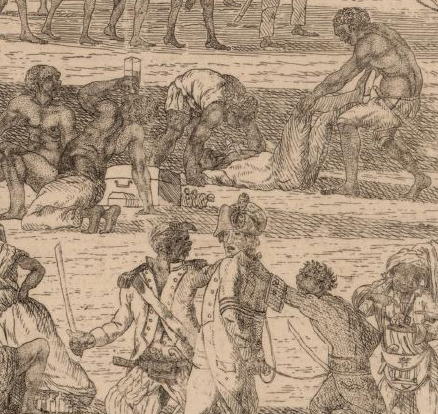
The ruffianly crew had in their minds only the immediate possession of what they could get from the Indians; the Admiral had in his mind the whole possession of the islands and the bodies and souls of its inhabitants. If you take a piece of gold without giving a glass bead in exchange for it, it is called stealing; if you take a country and its inhabitants, and steal their peace from them, and give them blood and servitude in exchange for it, it is called colonisation and Empire-building. Every one understands the distinction; but so few people see the difference that Columbus of all men may be excused for his unconsciousness of it.

Haiti public menace is old stereotype

Once again NMT scoops the corporate media desperate for images of menacing Haitians on the verge of violence. These 1793 engravings aimed to anger the French public against the savagery of the Haitians rising against their masters in then Colonial French St. Domingue.
haiti-pillage-de-cap-francais-2

A detail from The Pillage of Cap François, 1793, from Brown University Archives.

haiti-pillage-de-cap-francois-1793
Another detail of the murder of French colonists. These are extracts from a tableau which depicts the eleven days of mayhem before the arrival of military reinforcements. These inflammatory scenes show whites being victimized by grotesque pig-nosed blacks, looking absurd in stolen clothing, gorging themselves with the food and drink of their masters.

haiti-incendie-cap-francois
The same event, this is titled the Burning of Cap Français.

Vandana Shiva visits Boulder, Oct 18

Vandana Shiva will speak at Boulder’s Unity Church on Sunday, October 18 at 7pm. Dr. Shiva’s speaking tour coincides with World Food Day, October 16. The internationally celebrated physicist and activist is a leading proponent of SLOW FOOD. Among her books, are STOLEN HARVEST and EARTH DEMOCRACY. This event is a fundraiser for KGNU Community Radio. Unity Church is located at 2855 Folsom.

Pink goes to war

VietnamThe color pink seems incongruous juxtaposed with war. Code Pink banks on the contrast being inherently diametric. But just as pink can be enlisted to oppose war, it can serve to humanize, even glamorize it.

Remember the Afghanistan theater photo snapped of a US soldier wearing pink boxers and flip-flops while he stood guard on a rampart? Disarming wasn’t it? Here’s its antecedent from the Vietnam conflict. We’re searching antiwar archives for tools to fight this war, our bastard adversaries are already there.

Army Specialist Zachary Boyd was worried when his picture made the front page of the New York Times. Boyd thought he’d be in trouble for being shown out of uniform.

“I can assure you that Specialist Boyd’s job is very safe indeed,” said Defense Secretary Robert Gates, who instead praised the soldier for making American bravery look so nonchalant. “What an incredible innovation in psychological warfare,” said Gates.

Pam “Heil Hitler” Pilger gets it all wrong

Christian Zionist anti-health care conservative Pam PigglerMuch is being made of the irony that the anti-health teabagger who shouted “HEIL HITLER” at a Jewish man who spoke in favor of universal health care, was herself wearing an ISRAELI DEFENSE FORCES t-shirt.
Irony? I think the association originates from more than “irony.”

Thanks to having been interviewed earlier in the evening by a local TV reporter, the nutjob has been identified as Pamela Pilger of Las Vegas, Nevada. Online sleuths record that she and her husband are Sarah Palin supporters, etc, oink oink. Her telephone and address are available online, and I’m not terribly conflicted about disseminating that info. *

From Mrs. Pilger’s interview we learn she is a conservative, who believes in Christian values, excepting charity obviously.

Pilger is likely a Christian Zionist, explained by her cross earings and IDF t-shirt. How could a politically charged t-shirt worn to a political event, be but chosen on purpose? And a Christian Zionist who mocks Jews, really no surprise there.

What interests me about Mrs. Pilger and the t-shirt which seems at odds with her dimly-improvised retorts, is how she represents the American idiot: completely wrong. Pilger doesn’t know enough to keep from making contradictory outbursts, but she does know: health care NO, Israel PRO.

How is it that opponents of health care reform, for example, are wrong-headed about every issue on the table? Environment, war, labor, human rights, civil liberties, immigration, etc; and in Pilger’s case, anti-health care and pro-Israel. These are not uniformly “conservative” values. They do not comprise an idiot’s manifesto.

Yet in practice, these disparate dictum flock inseparably.

How can idiots be so consistent? If their antics reflected real grass roots idiocy, they’d be all over the board. What does an American idiot know of the Middle East, pro-Palestinian or con?

Wouldn’t an idiot xenophobe bigot most likely be anti-Semitic? Aka Pam Pilger? Whose idea, the IDF allegiance? Whose very consistent guidance are the idiots following? There’s nothing idiotic about the neoliberal, exploitive agenda behind the ideological idiots. Are they such idiots that they cannot see that?

Wingbat Pilger’s t-shirt and her opposition to health care reform –in spite of confessing that her husband lacks insurance– betrays that her idiotic fervor is not even her own.

* (Even as idiot pawns, shouldn’t they take responsibility for the Astroturf populist propaganda they are helping to lay? I hope an archive is being kept of their profoundly insensitive rantings. In the future, when these crackers Google themselves, the first thing they should see is their 15-minutes of infamy, yelling about how they don’t want illegal immigrants stealing their tax-dollars, etc. Hold the bastards accountable for reflecting so poorly the average American.

The idiots may never come around, but maybe their neighbors or associates will better be able to size them up. One day, perhaps their grandchild, improved by a marriage outside the family, will see the footage and marvel- Oh my goodness, my Grandma was not a very kind lady.

More practically, imagine trying to eulogize Pamela Pilger one day, with her video performance for all to see!)

Augusten Burroughs is so self-amused

Augusten Burroughs author of Running with ScissorsI was recently subjected to a road trip audio book disgorged from an auteur who shares the eminent surname of Burroughs. But unlike Wyeth the younger who had the advantage of genes, this literal-bastard is of no relations and has to defraud us with a bone through his gilded celebrity cage. It gives me the willies to consider that admirers of Running With Scissors think it’s a creative bone.

I can’t remember now which episode of Possible Side Effects finally drove me to seek the solitude of my own headphones. Had it something to do with a dog? Alcohol? Airline travel? It will come to me, although I’ll be better off hoping it doesn’t. Burroughs’ insipid presumption that not a single footstep will be uninteresting to his readers, reminds me of the Power Rangers school of storytelling. What happens, the end.

There’s an absolute pattern to scribes who emerge as recovered substance abusers, one day at a time. Every day brings the agonist to an end, whether a story happened or not. It’s enough that Burroughs emerged sober, Go bless him. Well-wishers cheer his recovery on, but that doesn’t make his daily travails units of a serial.

Most of the scenarios it seemed revolved around Augusten Burroughs being recognized from his author’s photograph on the back cover of his book. He’s so famous! It does rile me when an obvious twit has a following who hold his twiticisms aloft where he can then point to them and journal again about that.

Of course the hives I felt were vindicated when I learned that like memorist-entrepreneur and twelve-step-denier James Frey, Augusten Burroughs was caught recounting lies. In burroughs’ case, by his own psychiatrist! And had to redefine Running With Scissors as not a memoir after all.

Actually I have no doubt that what Burroughs writes is memoir, he tweets as many times as he pulls open the refrigerator door. Queer Eye For The Bored Guy presumes readers can’t decorate their imagination.

Edmund Burke and the prevalent evil

Everyone wants to quote Edmund Burke: “All that is necessary for evil to prevail is for good men to do nothing.” I just heard it evoked by NPR, raising the alarm about a rash of albino murders in Tanzania, ostensibly for body parts considered to have medicinal value. Albinism has carried a stigma for every one person among 100,000, more in some parts of Africa. I’m sure we’re agreed it must stop. And what of HIV deaths, post-colonial greed-bred strife, slavery, or the dire environmental consequences of our industrial myopia? I offer a revision: “All that is necessary for evil to prevail, is for bad men to harp on the specter of manageable evils so that you don’t face up to the prevalent one.”