
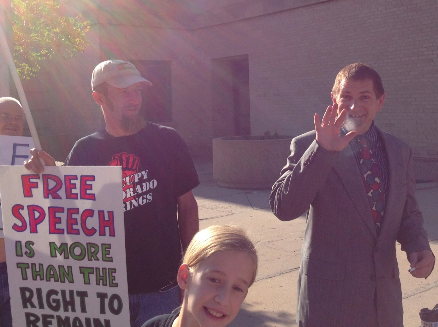
Steve Bass found guilty of camping not occupying, but could jury have ruled otherwise without hearing his defense?


COLORADO SPRINGS, Colo.– You may have underestimated the importance of today’s Camping Ban trial. The local media, social justice community and rights watchdogs missed it. But judging from the police force on hand and the elaborate lock-downs placed on the jury pools, it was evident the City of Colorado Springs thought a lot was at stake. I’ve written already about the draconian motions to prevent defendant Steve Bass from explaining his motives, including a ban of the word “Occupy.” Today the court made audience members remove their “Occupy Colorado Springs” t-shirts, but let the cat out of the bag by the palpable gravitas with which the court officials and police handled jury selection. Except for the absence of TV crews outside, you’d have thought Steve Bass was Hannibal Lector tripped up by an urban camping ordinance at “what happened last year in October at a park downtown.”

Yeah, even mention of “Acacia Park” was giving away too much, the prosecuting attorney preferred to call it “115 W. Platte Ave.” Every so often a prospective juror would stand up and say “I presume you’re referring to OCCUPY WALL STREET?” like he was solving a riddle, but instead of the door prize that volunteer would be dismissed from the pool for knowing too much.

After a trial that lasted one third the length of the jury selection, Steve Bass was found guilty. He offered no testimony, his lawyer, the very capable Patty Perelo, made no closing statement, because what defense could be made? Steve and his council elected not to have him testify, because to begin with, he’d have to swear to tell the whole truth, and if he explained he could only tell part of the truth, he’d be slapped with Contempt of Court.

We thought the jurors might have been curious, after seeing the city’s 8×10 glossy pictures with the circles and arrows telling what each one was and hearing not a peep from Bass, but they didn’t express it, and left after giving their verdict. This is Colorado Springs.

One of the prosecution’s witnesses, the arresting officer, nearly spilled the beans when he identified the defendant as someone he couldn’t have confused for someone else, because he’d said he’d encountered Bass many times in the park and shared many conversations.

“Oh?” the defense attorney Perelo perked her ears and asked, “and WHAT did you talk about?”

“Um… homeless policy, mostly.” That’s all HE could say. He couldn’t explain why he’d encountered the defendant so many times, or what the defendant was doing. Attorney Perelo couldn’t push it, because that would be leading him into forbidden territory. His testimony for the prosecutor was delivered straight from his notes.

There were two police witnesses, a map and several photographs, showing the tent and another showing just the poles. Was this necessary for a conviction? Because it necessitated explaining to the jury that said poles were in their “unerected state”. Not to be confused with the tent which was “fully erected”, which the judge pronounced like expressions which tripped off the tongue in cases of serious crime.

A photo of two sleeping bags required the officer to say he found the defendant sleeping “in the bags in the tent in the park” to prove all the elements of a violation of the camping ban.

The prosecuting attorney summarized it thus: “there was a tent, there was a sleeping bag, looks like camping to me.”

Not according to a dictionary definition of course. But that too had been motioned inadmissible. If you look it up, camping is variously defined as to “Live for a time in a camp, tent, or camper, as when on vacation.” Or as when destitute? Dictionaries don’t go there. That’s more like sheltering.

A couple of other examples: Soldiers sleep in tents. They’re not camping. Mountaineers overnighting on the side of a mountain aren’t camping. Refugees of war and natural disasters stay in refuge camps, but aren’t said to be camping. Anyway.

Steve Bass didn’t get his day in court. Everything he wanted to say he couldn’t. His attorney’s strategy today was to prepare for an appeal, on the grounds that the judge deprived Bass of the ability to defend himself.

Did Bass violate the camping ban as the jury decided? The prosecutor explained that nobody, not the judge, nor police officers or herself or the jury was in the position to decide the law. So Steve Bass has to take his case to someone who can.

Jury Selection
Over four hours were spent on choosing a jury, by far the most interesting part of the day. It took three sets of 25 potential jurors to pick six and one alternate. As the process approached lunch hour, the court was eager to buy pizza for seven instead of twenty five, but they didn’t make it.

As I mentioned, usually a juror familiar with “Occupy Wall Street” was dismissed, whether their opinions were favorable or unfavorable. I saw one juror dismissed because delving further would have meant discussing Occupy too much and would expose the other jurors to more occupy talk than the judge or prosecutor wanted.

On the other hand, many jurors had direct relatives in law enforcement, one juror considered a CSPD officer her “knight in shining armor,” so that was another cause for eliminations.

During the second batch, another juror stood up to say he was a former corrections officer, who wasn’t sure if he might have met Steve Bass “in the course of his duties” which poisoned the entire group by suggesting Steve had spent time in prison. That batch was dismissed. In actuality, Steve recognized him, because they both frequented the Dulcimer Shop.

Though Judge Williams maintained a convivial air of impartiality, he betrayed an awful prejudice. Whenever a juror expressed knowing something of what was in the news in October 2011, the judge would asked them if they could refrain from judging Bass based on the misbehavior of others. If jurors who knew about the protests were let to remain in the running, the assumption the judge offered was that “Occupy” was a taint that the defendant hoped they would overcome.

I don’t doubt that this slant extends well beyond Occupy, because municipal courts are notorious for being rubber stamps of a city’s citation process.

For example, in Judge Williams’ instructions to the jury, he read the sample guilty verdict first, in all its solemnity. When he read the not-guilty sample, he broke character to explain that he was not going to repeat the redundant stuff, etc, etc, and then he told the jury they shouldn’t be swayed by the order in which the two samples were read. The dramatic guilty versus the blah blah not-guilty.

Occupy harassment
Knowing about the prohibition against Steve mentioning Occupy, we thought we’d exercise our right not to be gagged. Could it matter? Should it? How preposterous that Steve was being tried and not permitted to say what he was doing. As if some precedent would be set that a defendant might convince a jury that forbidding a person shelter was a bad law.

So we came to court with t-shirts that read OCCUPY COLORADO SPRINGS. Immediately when we sat down, the judge called the lawyers up and decided we’d have to remove our shirts. We were given a chance to explain who we were, but the choice was invert the shirts, put on new ones, or leave. So we walked out.

I had an extra shirt outside with a peace symbol on it. Admittedly a politically-charged shirt, somewhat iconic locally, because it recalled an event in 2007 when peaceful protesters were forcibly removed from a city parade, one of them dragged across the pavement, an elderly woman who subsequently died of complications. So I knew I might be pushing it.

The point being to give Defendant Bass some context. He’s an activist. Alone without a voice he was a perp. With an audience of protestors he becomes a man of mystery. Every accused person in court is sized up in part based on his relations sitting behind him. Why shouldn’t Steve be allowed to show who his friends are?

As I reemerged from my car, already a police supervisor was yelling across the street to tell me I wouldn’t be allowed to wear that shirt. “Are you kidding?” I asked. I had a bag full of them, prepared for this eventuality if other spectators wanted to show solidarity. He was crossing the street to preempt my bringing the confrontation to the steps of the courthouse.

“Eric, you know the judge won’t let you wear that shirt.”

“I know no such thing. He only forbid things that say Occupy.” I knew this to be true, technically.

But they weren’t budging, they claimed a jury pool was already in the courtroom and they didn’t want to take any chances. Oddly, the officer blocking my way, beside the supervisor, was Good Old Officer Paladino who’d brutalized my friends and me in 2007. So he knew the t-shirt too well. Actually Officer Irwin Paladino’s history of abusing protesters goes back to 2003. I decided to dispense with plan B and invert my black t-shirt so I could go back in.

Did the CSPD make the smart call forbidding my t-shirt? I’ll be the first to admit the CSPD have outwitted the local social justice movement at every turn in Colorado Springs. They’re clever and competent, but they’re in the wrong. The CSPD are stepping on our rights, and overstepping their authority to do it. While it may have been superior gamesmanship, it was wrong.

Have I mentioned that they followed us everywhere? As if we were the accused in need of escort. On the officers’ radios we could hear them narrating our movements throughout the building. When Patrick went to the bathroom, an officer followed him inside and made small talk as Patrick peed. Did they think we were going to Mike Check the men’s room?

At one point we were able to see from a window on the second floor hall that CSPD were conferring with a parking enforcement officer around our cars. She was examining the license plates, getting on her phone, standing by the cars, as if waiting for something. The cars were legally parked, the meters fed, and well within the four hour limit. But who wants to argue with an impound lot? I assure you this intimidation tactic worked very well to send us out of the courthouse to rescue our vehicles.

Meanwhile, another friend came into the courthouse and overheard officers discussing whether to deny us entry again, and by what pretext, but I’m getting ahead of myself.

While watching the jury selection, it was the batch that was being dismissed in full, the court bailiff suddenly bolted from behind where we were sitting and told the judge she’d overheard us whispering about inappropriate subjects, specifically using profanity. This accusation was based on a dear Occupier’s habit of muttering colorful asides. Okay this was true, but in his defense, it was after the jury being spoiled, about the jury being spoiled, but inappropriate none-the-less and he apologized. But to tie all together in the misbehavior was a fabrication. The prosecutor tried to have us evicted, and Officer Paladino chimed in about the confrontation I instigated at the door. That’s when my friend told the judge she’d overheard CSPD officers discussing plans to keep us out, so the bailiff’s actions began to appear a little contrived.

This complaint was finally settled with the judge’s warning that one peep out of us would get us 90 days in jail for Contempt of Court. At this point we knew the pieces of duct tape we’d brought in to use to protest Steve’s gagging were definitely OUT.

Just before lunch recess I was able to clarify with Judge Williams whether the peace t-shirt I had wanted to wear was acceptable to the court. Receiving no objection from the prosecutor, the judge told me it would be okay, and then assured me he’d inform CSPD.

Returning from lunch, once again with the peace shirt, the security screeners nearly didn’t let me pass, but I barreled past with the confidence of someone who knows his rights. This time Officer Paladino came upon me at the courtroom door, swaggering right into my face assuring me he was not going to let me pass. FORTUNATELY before he could wrestle my arms behind my back, another supervisor arrived who’d heard the judge, and I was allowed to proceed. Boring story I know. But the pattern was unsettling.

Then Steve was found guilty, you could feel the city’s giddiness as they discussed sentencing. We’re only talking community service, but Colorado Springs has only one contractor for that, the odious Keep Colorado Springs Beautiful, whose hi profile task is to clean up after the CSPD Homeless Outreach Team scoops up the homeless and puts them in shelters very much in the model of correctional facilities. Steve was able to negotiate a less anti-homeless agency, and that’s the story so far.

Steve Bass to get his day in court, but he can’t say what he was doing or why, & above all he can’t mention “Occupy”


COLORADO SPRINGS, Colo.– Municipal Court Judge Spottswood W. F. Williams heard a final motion today before the AUGUST 10 trial of Occupier Steve Bass, charged with violating the city’s camping ban. The prosecution motioned to forbid from trial, “discussion of political, economic, or religious beliefs or ideology as a purported justification for the alleged acts”, and even “arguments related to the belief that the defendant’s conduct was constitutionally protected”, and in true Colorado Springs fashion, the judge GRANTED the city’s motion! YES THAT’S RIGHT, now if Bass wanted to say he wasn’t “camping,” he can’t say what else you would call it! In effect, Defendant Bass is prevented from explaining WHY he was occupying, or even THAT he was occupying, because saying “OCCUPY” is expressly forbidden. The judge will play it by ear whether to make an exception for himself during “voir dire” if selecting impartial jurors might require asking their opinion of “Occupy”. That’s IF BASS GETS A JURY AT ALL, because next, Judge Williams prompted the city prosecutor to research whether Bass was entitled to a jury of his peers for the infraction of camping…

The issue had already been resolved in an earlier hearing. Unable to find definitive wording on whether a camping ban violation invoked the right to a jury trial, the court ruled to proceed as if it did. But at today’s hearing Judge Williams related that in the interim over a casual dinner conversation, another judge informed him that the law read otherwise. So he put the question again to the prosecution. And again the citations came up inconclusive. This time however, with the clerk advised to continue the search, the decision stands at “pending”.

If Judge Williams opts to eliminate the jury, the forbidding of political or constitutional discussion is a moot point, actually two. There won’t be a jury to confuse, nor a judge either, because Judge Williams decided, by allowing the city’s motion, that the defendant has no arguments to make. Case closed. If the judge gets his way.

The point of today’s hearing was to hear not a judge’s motion but the city’s, a “motion in limine” used to reach agreement about what arguments can be excluded from the trial, often a defendant’s prior convictions which might prejudice a jury.

The core of the city’s motion was this:

…that the Defendant be ordered to refrain from raising the following issues at the Jury Trial…

1. Discussion of political, economic, or religious beliefs or ideology as a purported justification for the alleged acts, or as an issue to be evaluated by the jury;

2. Presentation of facts or arguments related to the belief that the defendant’s conduct was constitutionally protected expressive conduct;

3. Presentation of facts or arguments with the primary purpose or effect of proselytizing for the occupy movement, or otherwise using the Courtroom as a public forum;

4. Any reference to settlement negotiations with the Defendant prior to trial;

The city is guessing that because defendant Bass has passed on all opportunities to dismiss his case on technicalities, or plead for a deferred sentence, that he’s hanging on to get “his day in court.” Whatever that’s going to look like, the city doesn’t like it.

Points three and four were conceded by the defendant. No proselytizing was intended, and of course plea deals are confidential. But the discussion of #3 was amusing, because the city expanded it to mean absolutely NO MENTION of “Occupy.” Even though the defendant was cited in ACACIA PARK, in OCTOBER, under 24/7 media coverage, the prosecutor argued that mentioning OCCUPY “would be unfairly prejudicial to the City.” Further:

To admit evidence related to any political, economic, and religious debate concerning the “Occupy Movement” at trial in this matter would result in prejudice, confusion, and a waste of Court time. By allowing such testimony, the jury would be misled as to the elements of the charged offense which would result in confusion during jury deliberations. Furthermore, the prosecution would suffer unfair prejudice if the jury were allowed to consider the defendant’s private ideology…

Not only did the city fear it would lose a popularity contest with “Occupy”, it worried that the courtroom would be abused by public debate. The point was ceded by the defense because the “primary purpose” would always have been to present defending arguments, not proselytize.

The City’s request is that the Court be treated as a forum for resolving criminal disputes and not as a public forum for debate. Political, economic and religious debate should be restricted to appropriate public forums.

The prosecutor raises an incongruous irony: Steve Bass is on trial because the city doesn’t consider Acacia Park to be an appropriate forum either.

Naturally the defense objected to points one and two, though on the three particular defense strategies the city wanted to preempt, “Choice of Evils Defense”, “Defense of Others”, and “Duress”, the defense ceded as irrelevant. Judge Williams then granted points one and two with the proviso that Steve Bass be permitted to draft his own defense argument, to be presented to the court no later than the Wednesday before trial. Did you know that a defendant must have his arguments approved by his accusers before he’s allowed to make them in court?

I’m not sure it’s accurate to say that Steve Bass is going to get his day in court if he’s going to spend it gagged.

Was Steve Bass arrested for “camping” or was the city trying to curtail “Occupy”? Let’s remember that Jack Semple and Amber Hagan were arrested for taping themselves to a tent, and Nic Galetka was arrested for setting his things on the ground.

But Steve Bass won’t be allowed to mention those details.

———-
FOR REFERENCE: The city’s full motion is reprinted below:

MUNICIPAL COURT, CITY OF COLORADO SPRINGS, COLORADO

PEOPLE OF THE CITY OF COLORADO SPRINGS, Plaintiff
v.
Steven Bass, Defendant

Case Number: 11M32022

MOTION IN LIMINE

COMES NOW the Office of the City Attorney, by and through Jamie V. Smith, Prosecuting Attorney, and submits this “Motion in Limine,” moving that the Defendant be ordered to refrain from raising the following issues at the Jury Trial in the above-captioned matter:

1. Discussion of political, economic, or religious beliefs or ideology as a purported justification for the alleged acts, or as an issue to be evaluated by the jury;

2. Presentation of facts or arguments related to the belief that the defendant’s conduct was constitutionally protected expressive conduct;

3. Presentation of facts or arguments with the primary purpose or effect of proselytizing for the occupy movement, or otherwise using the Courtroom as a public forum;

4. Any reference to settlement negotiations with the Defendant prior to trial;

ARGUMENTS IN SUPPORT OF MOTION

1. Discussion of political, economic, or religious beliefs or ideology as a purported justification for the alleged acts, or as an issue to be evaluated by the jury.

The Defendant is charges with violating Section 9.6.110 of the Code of the City of Colorado Springs, 2001, as amended (“the City Code”), entitled “Camping on Public Property.” Political, economic, or religious beliefs or ideology are not relevant to any of the elements of an alleged violation of City Code Section 9.6.110, nor are they relevant to any potential defense to that City Code Section.

City Code Section 9.6.110 makes it “unlawful for any person to camp on public property, except as may be specifically authorized by the appropriate governmental authority.” Testimony or arguments irrelevant to the elements contained in that language should be exclude from trial. C.R.E. Rule 401 defines relevant evidence as “evidence having any tendency to make the existence of any fact that is of consequence to the determination of the action more probable or less probably than it would be without the evidence.” Evidence and argument regarding political, economic or religious beliefs of ideology have no bearing on the offense charged and do not meet the definition of relevant evidence.

Even if some discussion of these issues could be found to be of limited relevance, such discussion would only serve to confuse the issues and waste the court’s and jurors’ time, and would be unfairly prejudicial to the City. C.R.E. Rule 403 allows relevant evidence to be excluded when its admission would cause prejudice, confusion, or waste of time. To admit evidence related to any political, economic, and religious debate concerning the “Occupy Movement” at trial in this matter would result in prejudice, confusion, and a waste of Court time. By allowing such testimony, the jury would be misled as to the elements of the charged offense which would result in confusion during jury deliberations. Furthermore, the prosecution would suffer unfair prejudice if the jury were allowed to consider the defendant’s private ideology, as it is not an element that the prosecution must prove. Time and resources of the Court would also be wasted by allowing such testimony.

Furthermore, this Court denied the defendant’s “Motion to Dismiss-First Amendment,” on June 7, 2012, holding that City Code Section 9.6.110 is content-neutral, and that the defendant did not have a Constitutionally protected right to express his views in the manner that he chose on the date of the violation. Therefore, the sole issue before the jury is whether or not Mr. bass was camping on public property without appropriate governmental authority. Any evidence concerning political, economic or religious views that he was attempting to express through his conduct has no relevance whatsoever to any of the elements of the offense.

Discussion of the “Occupy Movement” as a political, economic or religious issue is also irrelevant to any potential defense which could be raised in this matter. Economic, political and religious beliefs or ideology are irrelevant to the following defenses that the Defendant might attempt to raise:

a. Choice of Evils Defense. C.R.S. Section 18-1-702(1) provides, in pertinent part, that “conduct which would otherwise constitute an offense is justifiable and not criminal when it is necessary as an emergency measure to avoid an imminent public or private injury which is about to occur… .” The statute goes on the state in subsection (2) that “the necessity and justifiability of conduct under subsection (1) of this section shall not rest upon considerations pertaining only to the morality and advisability of the statute, either in its general application or with respect to its application to a particular class of cases arising thereunder.” (Emphasis added.) Subsection (2) also states that:

[w]hen evidence relating to the defense of justification under this section is offered by the defendant, before it is submitted for the consideration of the jury, the court shall first rule as a matter of law whether the claimed facts and circumstances would, if established, constitute a justification.

The choose of evils defense “does not arise from a ‘choice’ of several courses of action, but rather is based on a real emergency involving specific and imminent grave injury that presents the defendant with no alternatives other that the one take.” People v. Strock, 623 P.2d 42, 44 (Colo.1981). in order to invoke the “choice of evils” defense, the Defendant must show that his conduct was necessitated by a specific and imminent threat of public or private injury under circumstances which left him no reasonable and viable alternative other than the violation of law for which he stand charged. Andrews v. People, 800 P.2d 607 (Colo. 1990).

There has been no allegation by the defense, and no facts in the police reports previously submitted to this Court, that allege a specific and imminent public or private injury would occur if Mr. Bass had not erected a tent on public property. Furthermore, reasonable and potentially viable alternatives were available to Mr. Bass to achieve his goal, such as picketing and handing out literature, on the date of violation. This was accepted as true and ruled upon by this Court at the motions hearing on June 7, 2012. it should also be noted that no state “has enacted legislation that makes the choice of evils defense available as a justification for behavior that attempts to bring about social and political change outside the democratic governmental process.” Id. at 609; see also United States v. Dorrell, 758 F.2d 427, 431 (9th Cir. 1985) (mere impatience with the political process does not constitute necessity).

b. Defense of Others. C.R.S. Section 18-1-704 describes the circumstance under which the use of physical force in defense of a person constitutes a justification for a criminal offense. Subsection (1) of that statute states, in part, that “a person is justified in using physical force upon another person in order to defend himself or a third person from what he reasonably believes to be the use or imminent use of unlawful physical force by that other person…”. The defense does not apply considering the allegation in this case. There is no allegation that the Defendant was using physical force to protect himself from unlawful force by another at any time during the violation. Furthermore, no unlawful force was used or imminently threatened against any third party that would allow the Defendant to raise the defense.

c. Duress. C.R.S. Section 18-1-708 defines duress as conduct in which a defendant engages in at the direction of another person because use or threatened use of unlawful force upon him or another person. Duress does not apply in this case. There is no evidence that anyone was using or threatening to use unlawful force against Defendant or any third party to cause the Defendant to commit a violation.

2. Presentation of facts or arguments related to the belief that the defendant’s conduct was constitutionally protected expressive conduct.

Any claim by the Defendant that his conduct was protected by the First Amendment of the United States Constitution is not a proper issue to be raised before the jury in this case. This is a constitutional defense that was already raised by the Defendant in his “motion to Dismiss-First Amendment,” and which was denied by this Court on June 7, 2012. The Court ruled as a matter of law that the Defendant’s alleged conduct was not a constitutionally protected form of expression.

3. Presentation of facts or arguments with the primary purpose or effect of proselytizing for the occupy movement, or otherwise using the Courtroom as a public forum.

It is anticipated that the Defendant will attempt to use this trial as a public forum to assert his political, economic, and religious views on the “Occupy Movement.” Courtrooms are not public forums. People v. Aleem, 149 P.3d 765 (Colo. 2007). This Court has the authority to restrict political speech within the courtroom and preserve its purpose as a forum for adjudication of criminal disputes,m so long as the restriction is reasonable and viewpoint neutral. Id. The restriction requested by the City is both reasonable and viewpoint neutral. The purpose of this Motion is to limit the evidence presented in this matter to the offense charged and potential defenses thereto. The Motion is also viewpoint neutral as the City is not taking a stance on political, economic, or religious issues and would not request that the Court do so either. The City’s request is that the Court be treated as a forum for resolving criminal disputes and not as a public forum for debate. Political, economic and religious debate should be restricted to appropriate public forums. To allow Defendant to raise thee issues would be contrary to legal precedent and the rules of evidence.

4. Any reference to settlement negotiations with the Defendant prior to trial.

C.R.E. 408 excludes from permissible evidence compromise or offers to compromise. Plea negotiations fall under this rule and may not be discussed in the presence of the Judge or Jury.

#Occupy Colo. Springs Municipal Court

Occupy Colorado Springs arrestees
OCCUPIED COLORADO SPRINGS- Attention local media, if you’re looking for authentic spokespeople for Occupy Colorado Springs, you need look no further than today’s front row. Holding the big sign is first arrestee Steve Bass, to his right: three times arrestee Iraq vet Jack Semple, arrestee Amber Hagen, arrestee Raven Martinez, and arrestee Thomas G.

Also pictured, former Colorado Congressman Dennis Apuan, Occupy founding member Jon Martinez and Socialist activist Patrick Jay. Not pictured, Joel Aigner and Hossein Forouzandeh who were speaking at a UCCS occupy teach-in.


Here’s a video of the Saturday arrests of veteran of Fallujah Timothy “Jack” Semple and Amber Hagen of the 7-11 incident. Worth the watch. ROCKSTARS!

Mark your calendars, upcoming arraignments are scheduled November 21, 29 and 30.

Raven addressed the Colorado Springs City Council today on the unconstitutionality of the no-camping ordinance being enforced to curb the Occupy protest. Here’s what she said:

As a citizen of the United States, one has a given right to life, liberty, & property. These rights are protected by both the 5th & 14th Amendments to the Constitution.

In Bolling v Sharpe, The Supreme Court interpreted the 5th Amendment’s due process clause to include an equal protection element.

The 14th Amendment states:

“No State shall make or enforce any law which shall abridge the privileges or immunities of the citizens of the United States; nor shall any state deprive any person of LIFE, LIBERTY, or PROPERTY, without due process of law; nor deny to any person within its jurisdiction the equal protection of the laws.”

Knowing that sleep is a necessity of Life, every American citizen has a right to sleep, regardless of status.

“HOMELESSNESS” is considered a status.

The camping ordinance ultimately denies one the right to sleep, therefore the right to live, based on their status. How many people have been arrested for setting up a canopy, with blankets & food, to take a nap or have a picnic on public property.

Now if a homeless person sets up a canopy, has blankets and food with them, will they be told to take down their canopy under the current camping ordinance? If so, then the ordinance is based on status, therefore unconstitutional.

If not, then it leaves too much discretion in the hands of the individual law enforcement officer, making the ordinance over-broad and unconstitutionally vague.

When one is homeless, where can that person sleep? If they set up to sleep on Public property they would be violating the current city ordinance, they will be told to leave and told of a shelter to go to, being their only alternative. This amounts to incarceration in the shelter without a violation of law having been committed. This also violates ones right to due process in that it allows for arbitrary enforcement.

When you criminalize a non-criminal act of necessity, you greatly increase the possibility of that person committing other crimes, as well as decrease that persons ability to obtain employment.

State v Folks, No. 96-19569 MM found that a city ordinance which punished innocent conduct, such as sleeping/camping on public property, violated the defendant’s right to be free from cruel and unusual punishment, which is protected under the 8th Amendment.

I ask you to look at the constitutionality as well as the long term effects of such an ordinance, it starts a domino effect that negatively impacts an already hurting economy.

How much does it cost in tax payers money to pursue such a case?

We have to have change! If we want a better economy and overall society, then the government, Federal, State, & Local, must change the way they conduct business. Criminalizing acts of necessity is business, not a way to protect our American citizens.

“Definition of Insanity: Doing the same thing over & over again and expecting different results.” -Albert Einstein

Pass a new ordinance to repeal the current one.

Legalismo

This is a direct copy of the email i sent earlier today and then copied and pasted some before it dawned on me it would be much easier and more effective to post it here. Collins is a law professor at the University of Colorado, Boulder. His referenced comment appeared in the Colorado Springs Gazette on 18 Oct, after my arrest but before the paper got the news to rectify a time-frame misconception i tossed around earlier. The version of that story is dated 17 Oct, but the paper version came out the following morning.

I remain without legal representation and will accept any offer to confer, but no tapdancers to take the case. I’m not so stupid as to imagine i can learn the Byzantine procedure of Our shameful legal system before the 8th of November well enough to get the point across if i represent myself, but neither will i accept representation from someone who will not take my approach.

Professor Collins:

I am the guy arrested for camping in Colorado Springs.

Although the perfectly certain fact has yet to sink in amongst many of my cohorts here in Colorado Springs, i am well aware that the point you made for the CSpgs Gazette the other day is entirely true. No-camping ordinances are by no means unconstitutional. This fact highlights the argument against the amendment of that original document by many of our founders fearful that the enumeration of some rights would expose others to attack. Current events managed to plop a soapbox and peculiarly focused bullhorn directly in my lap. I intend to plead not guilty on grounds that no-camping laws violate the pre-constitutional right to “life, liberty, and the pursuit of happiness,” and that this case is exemplar of the general and drastic erosion of human rights in the U.S., and across the entire globe. I am not particularly concerned as to the outcome of the case, but extraordinarily pleased at the opportunity to publicly state a few sentiments i believe by observation to be both common and woefully unarticulated.

I remain unbacked by any legal practitioner and i’d love your input, discussion, advice, council, suggestions, or connection, in any “and/or” configuration that suits your fancy.

Warmest Regards,

Steve Bass

“Be yourself. Everyone else is already taken.” –Oscar Wilde

(Reprinted from Hipgnosis)

Should homeless camping ban apply to Occupy Colorado Springs protest? Homelessness is often also protest.

COLORADO SPRINGS- Activist Steve Bass was arrested last night for overstaying his welcome in the city’s Acacia Park, violating the ordinance against pitching a tent in a public park. While the city is asserting that the anti-homeless no-camping ordinance ban applies to overnight free speech and assembly, and the OCCUPY COLORADO SPRINGS protesters argue that protest should be differentiated from the homeless issue, Steve reminds us that for many on the street, homelessness is their protest.

Bass has longtime experience administrating the Sunday morning soup kitchen at CC’s Shove Chapel. According to Bass, it’s not a matter of “To be or not to be” but the unalienable right to be or be somewhere else. Here’s an excerpt from his statement:

A point is advanced during the meeting [Occupy Colorado Springs negotiations with City officials] that separates homeless campers from active political occupiers. As a matter of personal opinion, though there are some real differences in context, the camping ordinance is bad law as yet untested in courts. However, having been involved with the free food biz in Colorado Springs for decades I am confident in stating that many homeless campers are in their position by choice, having opted out of a political system found onerous. I see no legitimate difference between this lifestyle of protest and the pointed expressions of protest embraced by Occupy Colorado Springs.

Other homeless campers are thus because of uncontrolled habits, some of which fall under the label of “diseased” behavior by authoritative bodies in the U.S. or because of circumstances external to their control. There are only two varieties of property in the entirety of the U.S.–public or private. If the continuously burgeoning population of homeless campers is barred from sleeping on public property, and have no means by which to acquire access to private property, they have no option at all. Others are then required by default to put them up, thus far manifest here in conditions both unsanitary and unsavory as demonstrable by the bed-bug ridden Express Inn or the Aztec Motel, or else the Salvation Army–court ordered church. Otherwise, our only other option is to incarcerate them. I maintain that an unmentioned and “unalienable” right of all human beings is simply to be, wherever that being may take place.

Pseu Pseu Pseudo-Do-Dah-Day

For Rob. Thanks buddy! Say hi to yer Mom.
 
We’ve been toying with some pretty weird bits of thinking here, and it’s already getting hard to follow. Lemme try and tie a few things together. Also, if you’re still with me, now’s a good time to point out that this humble site is best read in conjunction with the discussions on my Facebook, (Steve Bass), and for this bit, especially within the PPCC Philosophy Club page linked from my Wall or wherever it is.

Remember my mention of Pseudo-statements back at Willie’s story? Elsewhere, in Stage Magick and around about, notably at the PPCC Philosopy Club linked off my Facebook, I put up the business of our inability to prove a negative. The assertion that “This statement does not belong in the set of all true statements,” is a nice example. The statement is internally self-defeating, negated by paradox; it’s internally inconsistent, self-contradictory, neither true, nor false– a pseudo-statement. The “set of all true statements” statement is a tidy example in that attempting an answer produces a nonsense response awfully reminiscent, at least to me, of the sort of thing that happens to those hapless physicists when they try to crunch their numbers beyond the event horizon and into the heart of the Singularity. Lots of PHDs get real pissy if you try and take their numbers and drag them into the “real” world here. Like most of us, abstractions are fine for them. Hanging flesh on the ephemeral turns it into a monster for some. I, on the other hand, have no such qualm. If matter isn’t made of matter, as some rather esoteric physics appears to indicate, that most assuredly effects us, sez me.

The problem of proving a negative is stickier than the “True Statements” statement, because we can somehow tell the essence of the genuinely self-defeating pseudo-statement is True. Something about the very idea is akin to the business of the Singularity–we can’t seem to get there, or even define the nature of that There, but we know there has to be Something, OK? And thinking about it produces notions that resonate in our world.

We’ve also talked some about politics, and here’s the clincher. Our whole system, our World, maybe even our very Selves combine to make a big ol’ Pseudo-statement, overburdened by internal paradox and contradiction, and decorated with infinite concentric, overlapping circles and waves of Pseudo-reality.

The “Doctrine of the Many,” claimed by Zoroastrians, Jains, some Gostics, among others, avers that we humans are compound beings. Some scientists at the fringe have claimed this as well, but let me keep this as political as I can for a moment. The concept surfaces in Western thinking when we speak of “talking to ourselves,” which we all know can be quite an argument at times, and in notions like multiple personality. Most U.S. citizens will agree that we are a “Christian” nation in spite of that pesky 1st Amendment. We’ll acknowledge “diversity” in religious matters, but obviously those other guys are wrong and belong in Hell where they won’t fuck up our Christian Zen, see? The foundational Christian documents upon which the edifice of the world’s biggest group of religions includes a whole lot of admonitions about Love. Yet it is hardly necessary to provide examples of the embarrassing fact that a whole lot of Christians are rabid, violence-loving haters dribbling foam from their chins as the rail about how, “God hates fags,” or whatever. Don’t feel so smug if you’re a Buddhist or an Agnostic or < insert your favorite dogmatic crap here> and you still get that rush of glee when you see Saddam dangling from a rope or hear about the supposed demise of Osama. I may argue that a thing can be both A and non-A at the same time, but you’ll have a hard time convincing me that killin’ a motherfuckah is the same as turning the other cheek. Where is the Love in this set of systems/politicals/religions/nationalisms? It’s in there, but only in the sense that it sets the whole business up as a sort of cosmic, (and often comic), Pseudo-statement.

I spoke a bit with my homeless friend Rob yesterday and he told me about a guy he knows with some brilliant talent–musical, I think–that lives outside. Rob had burned himself accidentally and the topic brought to light his friend’s plight; the guy is a multiple, and periodically his alter will emerge and industriously destroy his life. The fellow named his alter Jack, I think, and knows of his existence from observing the destruction “Jack” leaves in his wake, but the two never interact. The guy blacks out and has no recollection of moving about in the world while Jack is in control. Once Jack put his feet in a campfire til the shared body required a lengthy hospital stay. One day Jack just may kill the both of him.

I’m saying Christendom is just like Jack and his host, and so is American society. So is the whole freakin’ society of the whole freakin’ world. Only we suffer from a far more advanced stage of the condition and our legs are buried in hot coals. Our hair is on fire. Those homeless dudes don’t worry about a house, but we’ve been building a huge edifice on a foundation of shit for so long we think we can’t backtrack, but backtrack we must. This house is collapsing upon us right now, as we speak, so to speak, and we need to get the fuck out, tear down the M.C. Esher thing we’ve been trying to build, and start the fuck over or we’re all going to be buried. Our society, societies, lives, and now even the solid earth is/are collapsing under the weight of internal contradictions of our own making.

Most who’ve read so far won’t need me to explain the function of a keystone–the stone at the top of an arch that concentrates the force and thereby holds the arch in place. When the capstone at the top of an arch at, say, a Medieval cathedral erodes, the arch collapses. The capstone of the Christian faith is supposed to be Love, right? Isn’t that key to a great many doctrines? It seems hard to find a player in all the world that will openly advocate for a doctrine of Hatred. Even the nastiest Devil-worshiping headbanger seeks Love, if only amongst his own within the particular bit of the Chaotic waveform in which he finds himself. Whatever. Our shit is missing its capstone. And its foundation is shit, too.

Don’t you dare get all dogmatically ideological and ignore the fact that I’ve NOT preached Jesus here, or any other tributary. We–and I mean all of us, including those of us clutching the notions of enmity so close to our hearts, and those addicted to power–need to stand back, tear the whole house down, and rebuild something with a thoughtfully drawn blueprint. We need to build an edifice on a foundation of Love, designed toward the capstone of Love. When we do that–oh, what a mansion we’ll have!

What did that one dude John say? “God is Love.” Right? Can I get a witness?

Right. Thus sayeth the housepainter.

http://samaelgnosis.us/books/html/revolutionary_psychology/chapter_12.htm

http://www.adherents.com/Religions_By_Adherents.html

(Reprinted from Hipgnosis)