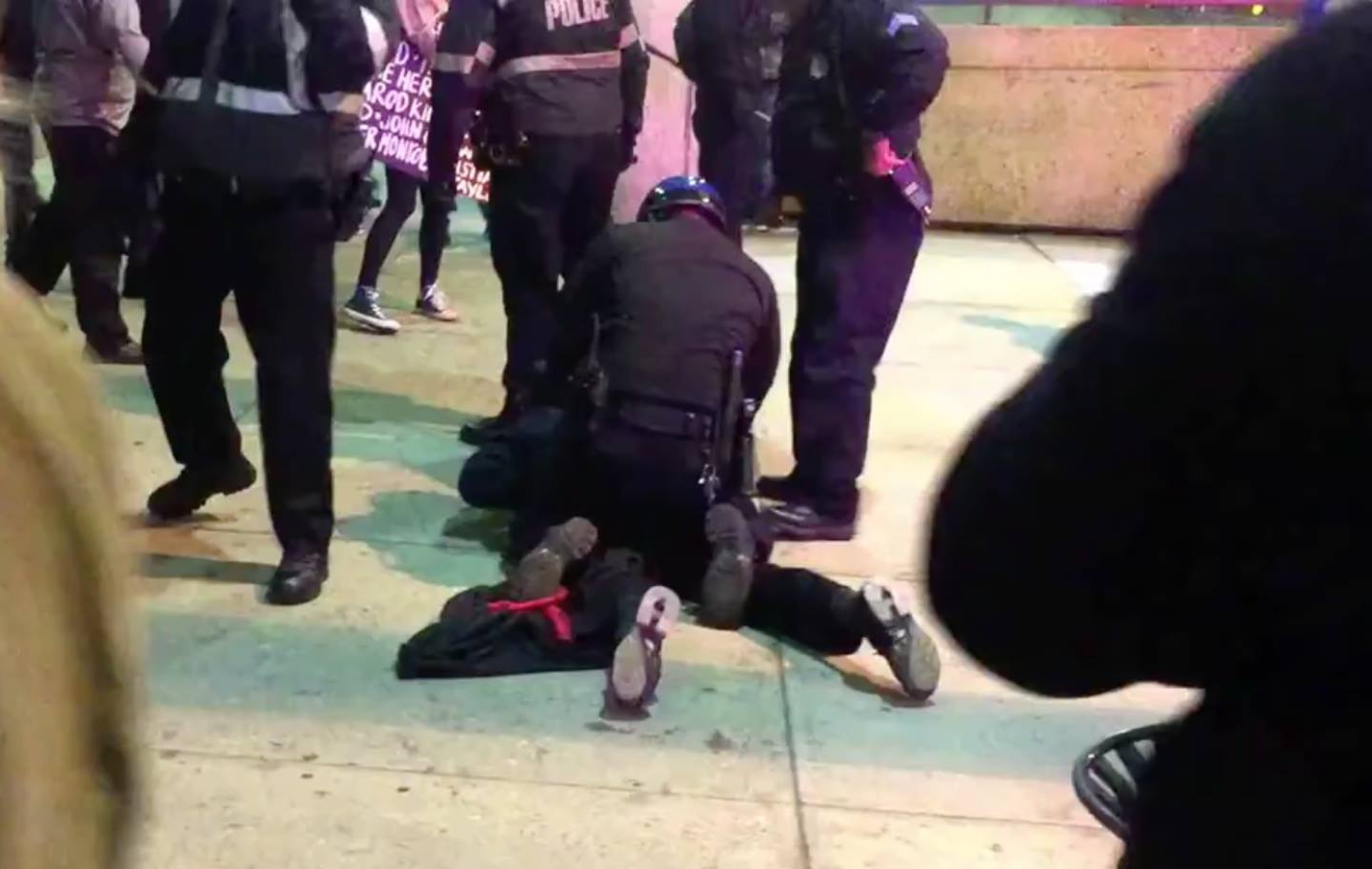
D’ya think ANTIFA might be a trap?

Black Bloc
By all means shout down the fascists. Shout down white supremicists. Bash the alt-right. Do it in black bloc, if you must (and yes we must). March on, against, and over, capitalism. Declare yourself anti-fascist. Express solidarity with ANTIFA protests and counterprotests across the country. I would rethink, however, opening an Antifa franchise without knowing who elsewhere can now act IN YOUR NAME.

No one owns the ANTIFA brand. Like “black bloc”, it’s a tactic, not a movement. Except as this moment’s zeitgeist, the brand has indeed become a movement. The imperative to repudiate emboldened Nazis lacks for neither urgency nor legitimacy.

Antifa is horizontal like Occupy, no leaders. Its membership is fully self-nominated. Except where Occupy Wall Street offshoots offered local casts of characters, Antifa participants remain undercover. The problem becomes whose undercovers.

I fully support confronting fascists. I might quibble about picking fights with inarticulate Nazi cosplayers. Our corporations, the media, and the police who protect both are the full grown, authoritarian fascists.

I likewise support black bloc as an essential strategy for effective protest actions. I encourage picking fights with dogmatic nonviolence passivists who continuously thwart the potential of public demonstrations.

I support Antifa as I do Earth First, as I do ELF, or ALF the Animal Liberation Front, or Hezbollah, Hamas, and the Intifada if you’re begining to catch my drift. I stand with them without wearing a mask because my expression of support is my political right. I do not act as them, wearing a mask.

Antifa may be serving the establishment just fine by diverting youthful rebellion from directing its energy at STATE fascism. It may be suiting populist urges just fine too by allowing discontents to vent our disgust against punchable twits instead of the impregnable powers that be. Ideally those inclined to resist fascism will catch on to who really needs the pounding.

When that begins to happen however, some Antifa chapter (the media will call it a “cell”) in Reseda or Des Moines or Stuyvesant is going to commit an outrage of domestic terrorism and the Antifa brand will be blown. It may be government black ops conducting a false flag, or three percenters shy of a full load hoping to ignite a race war, or misguided revolutionaries jumping the gun. It won’t matter. “Antifa” will be declared a terrorist organization. Pardon the pun, that will be trump.

And while we know Antifa is not an organization, intelligence records will have mapped out who were the ringleaders and daredevils of concern to national security. Authorities may or may not round up suspected co-conspirators and charge them with racketeering. That’s not even my worry. Once discredited and forced underground, Antifa enthousiasts will recede into the woodwork. All the organizing, educating and networking will have come to naught.

I anticipate that my thoughts here are not going to find favor with my many friends currently marching behind the Antifa banner. But I know a number of idiots among them too, and worse, suspected moles bent on disrupting productive insurgencies.

Though Antifa in its character employs security culture stratagems, by design it’s one big back door. I know some comrades see that as essential to escalating a revolutionary force. I see the absence of a binding ideology to be its undoing.

How about we think outside the box too calculatedly provided to us by our anti-fa social engineers? That box is pre-addresed and postage due.

If you are anti-fascism or anti-capitalism, WHAT ARE YOU FOR?

BE THAT.

You can fly the Antifa banner but do it as an allied organization you are meanwhile building.

You can punch the same Nazis and blockade the same racists, and you can sell the establishment killer app for which you control the code.

Black Bloc

DIA issues protest permit under court order, but limits crowd size to, wait for it, FOUR! Then court stays injunction.


DENVER, COLORADO- Abiding by the injunction in McDonnell v Denver, DIA administrators granted us a free speech permit within 24-hours on Thursday, but they insisted that the terminal location desired could only accommodate FOUR PEOPLE. You heard right. Four. There’s irony here too because there were FIVE people named on the permit application! Thus the permit was actually 20% denied, and in reality 92% denied given that we sought a permit for 50 people, a number easily lower than the DIA International Arrivals area can handle.
 
MEANWHILE, in the 10th Circuit Court, the city of Denver appealed the DIA injunction and asked for a stay. This is not usually granted in First Amendment cases, but on Thursday it was. The 10th Circuit stayed the injunction and wants to hear arguments on March 17. So at DIA for now we’re back to the impermissive permit process that precludes accomodating public expression at the Denver airport. And the signing of President Trump’s new improved Muslim Ban looms…

THAT’S the more significant development in the case for free speech at DIA. But let’s get back to our story, to how poorly DIA administrators complied during the small window when our court injunction was in force and DIA was enjoined to be accomodating to the public’s right to expression.

Getting the permit process started was not easy. There are instructions on the DIA website but no application. A call to DIA was routed to a person who insisted we read instructions online. We said we did. She replied that if we had, we’d know what to do. We reiterated that there was no application there, and that we needed an application. She took our names and vowed to have someone call us back. This was at 11:30am.

After an hour we called back, explaining that time was of the essence, as was for them as well in responding to our request. We were given the same instruction, to consult the rules online. We explained that we’d READ the rules, STUDIED THEM in fact, and had them reviewed by a FEDERAL COURT. We exlained there was now a federal injunction to which DIA was bound and we required our permit request to be considered promptly, the first step of which, we presumed to be, the submission of an application! Our call was forwarded to a person who eventually emailed an application blank at approximately 4pm.

We filed the application immediately and here’s the correspondence that resulted:

Mr. Dalton
Please find attached a request for permit to protest at DIA at outside of international arrivals. We are requesting this in an expedited fashion  pursuant to judge Martinez’s decision of a preliminary injunction re: Civil Action No 17-cv-0332-W JM-MJW. A new executive order is anticipated to be announced regarding the “Muslim ban” in the next day or two and we are requesting that the permit be processed within 24 hours to allow for a timely protest. We do not intend to obstruct airport operations. I will send you a copy of the judge’s order in a separate email.

Please note that I contacted the airport to request this permit by telephone at 11:35 am today.
Thank you
Nazli McDonnell

The attached application detailed our request to accomodate up to 50 protesters in the area where people await international arrivals. We received this response at 10:40am the next day:

Nazli McDonnell,

Your request for a permit to protest has been received, and it will be processed as quickly as possible.  Some additional information will help us best respond to your request and will help ensure the safe and efficient flow of passengers while allowing your organization to communicate your message.

.    What times do you expect individuals associated with your organization to be at the airport protesting?  

.    Due to the very limited space for meeters and greeters between the international arrivals exit and the entrance to the north screening checkpoint, we will not be able to approve more than four (4) people with your organization at that location.  All additional protestors, up to 50, would need to assemble on the Plaza between the Terminal and the Westin Hotel.  How does this affect the intent of your protest?

Please respond at your earliest convenience, and feel free to call at the office number list below if you have any questions.

Sincerely,
DAVE DALTON, C.M.
ASSISTANT DIRECTOR – TERMINAL OPERATIONS
Denver International Airport
Airport Operations

To which we replied:

Mr Dalton
We expect to be present at the airport during times that international flights would be arriving and expect to be there a few hours at a time. We do not intend a day long presence at the airport.

If only 4 of us can be accommodated at international arrivals (which seems VERY unreasonable since there are no limit as to how many friends or family members can greet a single passenger) why would the rest of us have to be located outside of the terminal building as opposed to the great hall area which can accommodate many more people and we can reach more people with our message? The intended audience for our message are the travelling public not the hotel guests. This restriction you intend to impose does not seem consistent with Judge Martinez’s recent federal injunction. I am copying our legal counsel to this email. We do not plan to cause congestion, obstruction or disruption at international arrivals or great hall and we can make sure safe passage space is available for travelers and employees at all times.

I hope that a reasonable permit that will allow the intended protest can be processed promptly in accordance with the court ruling.

A permit was issued at end of day Feb 23:

February 23, 2017

TO: ATN — Nazli McDonnell, Citizen

FROM: Department of Aviation, City and County of Denver

RE: Permit Request – 2/22/2017

In accordance with Part 50 Rule 50.04 of the Denver Municipal Airport System’s Rules and Regulations (DEN Rules), the City and County of Denver, by and through its Department of Aviation (City), grants the multiple citizens associated with organization representative, Nazli McDonnell, to hold signs and protest the Executive Orders restricting refugees and Muslim visitors entering the U.S. (Speech Related Activities) at Denver International Airport (DEN). The City grants permission based on the following:

— Unless otherwise exempted herein, Speech Related Activities are conducted in accordance with Rule 50; and

— No more than four (4) people conduct Speech Related Activities at the approved location “A” (see attachment, Terminal map); and

— No more than fifty (50) people conduct Speech Related Activity at the approved location “B” (see attachment, Terminal map); and

— Speech Related Activities at the approved location “A” are conducted outside of the Federal Inspection Services (FIS) facility on level 5 of the DEN Terminal, as depicted on the attached Terminal map; and

— Speech Related Activities are conducted during flight banks with international passenger arrivals.

— Speech Related Activities are conducted from February 23, 2017, thru March 23, 2017.

An on-site representative from your organization must have a copy of this letter, the attached permit application, and attached Terminal map showing approved locations at all times. The City grants an exemption to Part 50, Rule 50.10, requiring all participants to wear and display the permit. Please ensure that the approved activities do not interfere with the safe and efficient movement of persons to and from the FIS facility and throughout Denver International Airport.

Very respectfully,

Dave Dalton
Assistant Director — Terminal Operations

cc. DEN Terminal Operations file

Occupy v. Martinez (Plaza Protest Ban) 2016 US 10th Circuit Court of Appeals Decision AFFIRMING Prelim Injunction


Yesterday I published the federal judge’s order to grant the 2015 preliminary injunction against the Lindsey Flanigan Courthouse. Since that time the city motioned to dismiss, there were show cause hearings, and depositions, and an appeal to the 10th Circuit Court of Appeals. On April 8, 2016 the appeals court AFFIRMED the preliminary injunction. As a result this legal action is on the road to becoming a permanent injunction, to be decided at trial this April. The prospects look promising, based on how the appelate judges schooled our First Amendment adversaries. I’m reprinting their full decision below.

In particular you might enjoy Judge McHugh’s citing of US Supreme Court Justice Owen Roberts, writing in 1939 for the majority, in a decision to uphold public first amendment rights in Hague v. [AFL-]CIO. Robert affirmed that streets were traditional free speech areas:

“Wherever the title of streets and parks may rest, they have immemorially been held in trust for the use of the public and, time out of mind, have been used for purposes of assembly, communicating thoughts between citizens, and discussing public questions. Such use of the streets and public places has, from ancient times, been a part of the privileges, immunities, rights, and liberties of citizens. The privilege of a citizen of the United States to use the streets and parks for communication of views on national questions may be regulated in the interest of all; it is not absolute, but relative, and must be exercised in subordination to the general comfort and convenience, and in consonance with peace and good order; but it must not, in the guise of regulation, be abridged or denied.”

Here’s the full 2016 opinion rejecting Denver’s appeal of our federal injunction:

Document: 01019599889 Date Filed: 04/08/2016

UNITED STATES COURT OF APPEALS
FOR THE TENTH CIRCUIT

_________________________________

ERIC VERLO; JANET MATZEN; and FULLY INFORMED JURY ASSOCIATION,

Plaintiffs – Appellees,

v.

THE HONORABLE MICHAEL MARTINEZ, in his official capacity as Chief Judge of the Second Judicial District,

Defendant – Appellant,

v.

THE CITY AND COUNTY OF DENVER, COLORADO, a municipality; ROBERT C. WHITE, in his official capacity as Denver Chief of Police,
Defendants – Appellees.

_______________

FILED ?United States Court of Appeals Tenth Circuit

April 8, 2016

Elisabeth A. Shumaker Clerk of Court

No. 15-1319

_________________________________

Appeal from the United States District Court for the District of Colorado ?(D.C. No. 1:15-CV-01775-WJM-MJW)
_________________________________

Stephanie Lindquist Scoville, Senior Assistant Attorney General, Office of the Attorney General for the State of Colorado, Denver, Colorado (Cynthia H. Coffman, Attorney General; Frederick R. Yarger, Solicitor General; Matthew D. Grove, Assistant Solicitor General; Ralph L. Carr, Colorado Judicial Center, Denver, Colorado, with her on the briefs) for Defendant – Appellant.

David A. Lane, Killmer, Lane & Newman, LLP, Denver, Colorado, for Plaintiffs – Appellees.

Wendy J. Shea, Assistant City Attorney; Geoffrey C. Klingsporn, Assistant City Attorney; Evan P. Lee, Assistant City Attorney; Cristina Peña Helm, Assistant City Attorney, Denver City Attorney’s Office, Denver, Colorado, filed a brief on behalf of Defendants – Appellees.
_________________________________

Before BRISCOE, McKAY, and McHUGH, Circuit Judges.
_________________________________

McHUGH, Circuit Judge.
_________________________________

This is an interlocutory appeal challenging the district court’s grant of a preliminary injunction, enjoining in part the enforcement of an administrative order (Order) issued by Defendant-Appellant Judge Michael Martinez, acting in his official capacity as Chief Judge of the Second Judicial District of Colorado (Judicial District). The Order prohibits all expressive activities within an area immediately surrounding the Lindsey-Flanigan Courthouse in Denver (Courthouse). Plaintiffs-Appellees Eric Verlo, Janet Matzen, and the Fully Informed Jury Association (collectively, Plaintiffs) sought the preliminary injunction to stop enforcement of the Order against their expressive activities. Following an evidentiary hearing, the district court enjoined enforcement of a portion of the Order as against Plaintiffs. The Judicial District now appeals.

Based on the arguments made and evidence presented at the preliminary injunction hearing, we hold the district court did not abuse its discretion in granting Plaintiffs’ motion in part. Although we affirm the district court’s order granting a limited preliminary injunction, we express no opinion as to whether a permanent injunction should issue. Instead, we provide guidance to the district court and the parties regarding the factual inquiry and the applicable legal standard relevant to that question on remand.

I. BACKGROUND

The genesis of this case is an incident involving nonparties. On July 27, 2015, two men were distributing pamphlets on the plaza outside the Courthouse (Plaza). The pamphlets contained information about jury nullification, a practice in which a jury refuses to convict a defendant despite legal evidence of guilt because the jury members believe the law at issue is immoral. 1 Both men were arrested and charged with jury tampering in violation of Colorado law. See Colo. Rev. Stat. § 18-8-609(1) (“A person commits jury-tampering if, with intent to influence a jury’s vote, opinion, decision, or other action in a case, he attempts directly or indirectly to communicate with a juror other than as a part of the proceedings in the trial of the case.”).

———
1 Jury nullification has been defined as “[a] jury’s knowing and deliberate rejection of the evidence or refusal to apply the law either because the jury wants to send a message about some social issue that is larger than the case itself or because the result dictated by law is contrary to the jury’s sense of justice, morality, or fairness.” Jury Nullification, Black’s Law Dictionary (10th ed. 2014).
———

Plaintiffs, like the men who were arrested, wish to distribute literature relating to and advocating for jury nullification to individuals approaching the Courthouse who might be prospective jurors. Fearing they too would be subject to arrest, Plaintiffs brought suit against the City and County of Denver and Robert C. White, Denver’s police chief, in his official capacity (collectively, Denver) to establish their First Amendment right to engage in this activity. On the same day they filed suit, Plaintiffs also moved for a preliminary injunction, seeking to restrain Defendants from taking action to prevent Plaintiffs from distributing jury nullification literature on the Plaza. Two days later, Plaintiffs amended their complaint to also challenge the Order issued by the Judicial District.

That Order, entitled Chief Judge Order Regarding Expressive Activities at the Lindsey-Flanigan Courthouse, states in relevant part:

The Court has the responsibility and authority to ensure the safe and orderly use of the facilities of the Second Judicial District; to minimize activities which unreasonably disrupt, interrupt, or interfere with the orderly and peaceful conduct of court business in a neutral forum free of actual or perceived partiality, bias, prejudice, or favoritism; to provide for the fair and orderly conduct of hearings and trials; to promote the free flow of pedestrian and vehicular traffic on sidewalks and streets; and to maintain proper judicial decorum. Those having business with the courts must be able to enter and exit the Lindsey-Flanigan Courthouse freely, in a safe and orderly fashion and unhindered by threats, confrontation, interference, or harassment. Accordingly, the Court hereby prohibits certain expressive activities on the grounds of the Courthouse, without regard to the content of any particular message, idea, or form of speech.

Prohibited Activities: The activities listed below shall be prohibited in the following areas: anywhere inside the Lindsey-Flanigan Courthouse, including courtrooms, corridors, hallways, and lobbies; the areas, lawns, walkways, or roadways between the Courthouse and public sidewalks and roads; and any areas, walkways, or roadways that connect public sidewalks and roads to Courthouse entrances or exits. This includes, but is not limited to, the Courthouse entrance plaza areas on the east and west sides of the Courthouse as depicted in the highlighted areas of the attached map.

1. Demonstrating; picketing; protesting; marching; parading; holding vigils or religious services; proselytizing or preaching; distributing literature or other materials, or engaging in similar conduct that involves the communication or expression of views or grievances; soliciting sales or donations; or engaging in any commercial activity; unless specifically authorized in writing by administration; ?

2. Obstructing the clear passage, entry, or exit of law enforcement and emergency vehicles and personnel, Courthouse personnel, and other persons having business with the courts through Courthouse parking areas, entrances, and roadways to and from Courthouse and Courthouse grounds;

3. Erecting structures or other facilities, whether for a single proceeding or intended to remain in place until the conclusion of a matter; or placing tents, chairs, tables, or similar items on Courthouse grounds; except as specifically authorized in writing by administration; and ?

4. Using sound amplification equipment in a manner that harasses or interferes with persons entering or leaving Courthouse grounds or persons waiting in line to enter the Courthouse. ?

The Order was accompanied by an image depicting an aerial view of the Courthouse and its grounds, with the areas in which the Order prohibited expressive activity highlighted in yellow (Restricted Areas).

The Courthouse is bordered on its north side by Colfax Avenue and on its west side by Fox Street. Both Colfax Avenue and Fox Street have public sidewalks running along the perimeter of the Courthouse. Immediately to the east of the Courthouse lies the Plaza. The Plaza is bisected by Elati Street, which is closed to traffic other than police vehicles. Elati Street runs through a large circular area (Main Plaza) between the Courthouse and the Van Cise-Simonet Detention Center (Detention Center), which houses pretrial detainees. The Main Plaza contains planters, benches, public artwork, sidewalks, and gravel areas and is suitable for public gatherings.

Of relevance to this appeal are the Restricted Areas, which include an arc-shaped walkway and planter area immediately to the east of the Courthouse. The arced walkway runs from the corner of Elati Street and Colfax Avenue in a curved path across the front of the Courthouse and ends where it intersects with an open area in front of the Courthouse containing planters and benches (the Patio), which also forms part of the Restricted Areas. The Patio provides access to the main entrance on the east side of the Courthouse. Thus, the Restricted Areas encompass only the portions of the Plaza closest to the Courthouse.

The Judicial District opposed Plaintiffs’ motion for a preliminary injunction and, in doing so, defended the Order. In contrast, Denver entered into a joint stipulation (the Stipulation) with Plaintiffs. The Stipulation asserted that the entire Plaza between the Courthouse and the Detention Center—specifically including the Restricted Areas—was “a public forum and any content-based regulations must be narrowly drawn to effectuate a compelling state interest and reasonable time, place and manner regulations.” It further acknowledged that Plaintiffs were entitled to distribute jury nullification literature on the Plaza and pledged that Denver would not “arrest or otherwise charge Plaintiffs for handing out literature regarding jury nullification so long as Plaintiffs do not violate Colorado law or Denver’s Revised Municipal Code when they are handing out their literature.” The Stipulation specifically referenced the Judicial District’s Order, indicating Denver did not “intend to enforce [the Order] as written and will only impose content and viewpoint neutral reasonable time, place and manner restrictions on the use of the Plaza, and/or other exterior areas surrounding the Plaza if Denver determines that a compelling need exists to do so.”

At the preliminary injunction hearing, the parties called only two witnesses. Plaintiffs called Commander Antonio Lopez of the Denver Police Department. Commander Lopez described the Plaza as a public “open space” much like the city’s various parks. He testified that in the five years since the Courthouse opened he has witnessed “more First Amendment activity take place in [the Plaza] than [he] can recall.” Specifically, Commander Lopez described a variety of protest activities “at one point . . . averaging about two or three a week” in the Plaza. He further testified that the Denver Police Department had never taken steps to stop protest activity in the Plaza, other than intervening if protesters became violent or otherwise broke the law. Relevant to this appeal, Commander Lopez testified that in his experience, the entire Plaza—including the Restricted Areas—has traditionally been used for First Amendment protest activities. On cross-examination, Commander Lopez acknowledged that the “majority” of the protests in the Plaza occurred closer to the Detention Center, but that he had also seen protests directed at the Courthouse.

The Judicial District called Steven Steadman, administrator of judicial security for Colorado. Mr. Steadman testified that the Order was motivated by concern about anticipated protests of a verdict in a death penalty case being tried at the Courthouse.?Mr. Steadman explained that he met with Chief Judge Martinez to discuss security concerns relating to that verdict and recommended the Judicial District adopt a policy similar to one recently implemented in Arapahoe County during another high-profile capital trial.

Mr. Steadman also testified about the design of the Plaza, including the Restricted Areas. He indicated that the planters, gravel areas, and sidewalks were intentionally designed to “signal to the average user how to find their way, and where you should go and what the main travel ways are.” Mr. Steadman explained that the Patio and arced walkway’s “sole purpose is to allow people, the public, to enter and exit the [Courthouse] without being interfered with.” But Mr. Steadman also stated that, prior to imposition of the Order, protestors—including pamphleteers—were allowed to protest immediately in front of the doors to the Courthouse, provided they did not interfere with ingress or egress from the Courthouse. He explained that the “general response” of protestors was to cease their activities when requested by Courthouse security not to interfere with public access to the Courthouse. Mr. Steadman further testified that no person had ever been arrested for blocking ingress or egress from the Courthouse since it opened in 2010. Important to this appeal, Mr. Steadman acknowledged that Plaintiffs’ activities of passing out jury nullification literature did not present “any security risk” beyond what had previously been tolerated without incident throughout the time the Courthouse had been open.

The district court also accepted a proffer of Plaintiffs’ testimony, indicating that their intent was to approach people entering the Courthouse to discuss quietly the concept of jury nullification and to distribute their literature. Plaintiffs asserted that proximity to the front door of the Courthouse was key to their message because otherwise their intended audience—“people who are going to serve or are in fact serving on juries”—will “very frequently just bypass them” in the designated free speech zone by “walking on one of the sidewalks that is part of the [Restricted Areas].” By contrast, positioning themselves near the front door would allow Plaintiffs “to pass out literature to anyone who wants it” and “if people want to stop and talk about [it], they can then explain to them what the concept of jury nullification is.” Thus, according to Plaintiffs, the Order effectively prevented them from reaching their target audience. Finally, the district court accepted the parties’ jointly stipulated exhibits, which consisted of a series of images of the Plaza and Restricted Areas, as well as a copy of the Order.

Following the evidentiary hearing, the district court granted Plaintiffs’ request for a preliminary injunction. In doing so, the district court relied on Denver’s Stipulation that the Plaza was a public forum and the Judicial District’s position that resolving the forum status was not necessary because the Order “would satisfy even the strictest test.” The district court concluded Plaintiffs had demonstrated a likelihood of success on the merits because, treating the Restricted Areas as public fora, the Order’s complete ban on expressive activity was not narrowly tailored to accomplish a significant government interest.

Accordingly, the district court entered a carefully circumscribed preliminary injunction in favor of Plaintiffs. Specifically, the district court enjoined enforcement of Paragraph 1 of the Order against Plaintiffs “to the extent he or she is otherwise lawfully seeking to distribute and/or orally advocate the message contained in [Plaintiffs’ pamphlets]” in the Restricted Areas. But the district court expressly left the remainder of the Order in place.

Following entry of the preliminary injunction, the Judicial District moved to stay the injunction pending appeal pursuant to Rule 62(c) of the Federal Rules of Civil Procedure. In its motion to stay, the Judicial District introduced evidence that— subsequent to entry of the preliminary injunction—protesters had “descended on the Courthouse Plaza” and engaged in a pattern of disruptive and inappropriate behavior, including erecting canopies, harassing citizens seeking to enter the Courthouse, damaging the Courthouse landscaping, yelling and taunting court personnel, and posting signs in the planters and on the flagpoles in the Plaza. The Judicial District argued that a stay of the injunction was appropriate because protesters had been “emboldened” by the injunction to violate even the portions of the Order not subject to the injunction, thereby irreparably harming the Judicial District. The district court declined to stay the injunction, finding the Judicial District had not demonstrated a likelihood of success on appeal because the harm identified was not caused by the injunction. The district court reasoned the Judicial District and Denver were free to enforce the Order against the parties engaging in the complained-of disruptive behavior because such behavior was unlawful and not protected by the narrow injunction issued by the court with respect to Plaintiffs’ activities only.

The Judicial District now appeals. Exercising jurisdiction pursuant to 28 U.S.C. § 1292(a)(1), we affirm.

II. DISCUSSION

On appeal, the Judicial District raises two arguments. First, it asserts the district court erred when it concluded the Plaintiffs had demonstrated a likelihood of success in establishing the Restricted Areas are public fora. Second, the Judicial District argues the district court incorrectly applied strict scrutiny when evaluating the Order. As a result, the Judicial District asks this court to reverse the district court’s entry of the preliminary injunction and remand for further proceedings.

We review the district court’s grant of a preliminary injunction for abuse of discretion. Planned Parenthood of Kan. & Mid-Mo. v. Moser, 747 F.3d 814, 822 (10th Cir. 2014). “A district court abuses its discretion when it commits an error of law or makes clearly erroneous factual findings.” Id.

A. Scope of Review

Before addressing the merits of the parties’ arguments, we pause to clarify the scope of our review. The district court granted a narrow preliminary injunction drafted to address Plaintiffs’ First Amendment concerns related to their specific expressive activities. Although Plaintiffs asked the district court to prohibit enforcement of the entire Order, the court enjoined only the first paragraph, which imposes a complete ban on First Amendment activities—picketing, pamphleteering, protesting—within the Restricted Areas. The district court left in place the rest of the Order, including the prohibitions against obstructing Courthouse entrances, erecting structures, and using sound amplification equipment in the Restricted Areas.

The district court further limited the scope of the preliminary injunction by enjoining the first paragraph of the Order only as to Plaintiffs’ specific pamphleteering activities. In fact, the court enjoined enforcement of the Order only as to Plaintiffs’ distribution and discussion of two specifically identified pamphlets. The Judicial District remains free to enforce the first paragraph of the Order—even against Plaintiffs—for all other First Amendment activities within the Restricted Areas.

Finally, the district court limited the geographic scope of the injunction. Although the Order prohibits First Amendment activity both inside and outside the Courthouse, the district court enjoined enforcement of Paragraph 1 as to Plaintiffs only outside the Courthouse, leaving the entirety of the Order intact within the Courthouse. And the district court did not enjoin enforcement of any part of the Order within those portions of the Restricted Areas dedicated to Courthouse landscaping and security features. Thus, the Order continues to prohibit all expressive activity in the planter boxes or other landscaping and in the gravel security areas. Accordingly, the features of the Restricted Area to which the preliminary injunction applies are limited to (1) the arced walkway running south from Colfax Avenue between the gravel security area (to the west of the walkway) and a raised planter (to the east of the walkway) and ending at the Patio area at the main entrance on the east side of the Courthouse; 2 and (2) the Patio area at the main entrance. 3

————–
2 As discussed, the Order’s prohibition on expressive activities in the planter and gravel security areas were not enjoined by the district court.

3 The evidence presented about the geographic layout and physical features of the Restricted Area consisted primarily of approximately fifteen photographs. Because the record contains little testimony about the photographs, we rely on our own review of them to describe the Restricted Areas. In particular, it is unclear whether and to what extent the Restricted Areas include the sidewalk running along Fox Street on the west side of the Courthouse. The exhibit appears to highlight some areas of the sidewalk, but counsel for the Judicial District conceded at oral argument that it would be “constitutionally questionable” to prevent speech on a public sidewalk, and then indicated “[t]hat is precisely why the order here does not extend that far.” Therefore, we do not treat the Fox Street sidewalk as part of the Restricted Areas for purposes of our analysis.
——————

Our task in this appeal is to determine whether the district court abused its discretion when, based on the record before it at the preliminary injunction hearing, it issued this narrow, targeted injunction. But the Judicial District asks us to consider events occurring after the preliminary injunction hearing to determine whether the district court abused its discretion in issuing the preliminary injunction. Specifically, the Judicial District points to evidence introduced during the Rule 62(c) hearing on the motion to stay the injunction pending appeal, which indicated that following the injunction, protestors had engaged in a series of inappropriate and disruptive behaviors. Some of these behaviors included harassing court personnel seeking to enter the Courthouse, erecting canopies and signs, and trampling Courthouse landscaping. According to the Judicial District, these post-injunction events demonstrate the “concrete concerns” motivating the creation of the Restricted Areas and therefore should have been considered by the district court.

Although we share the Judicial District’s concern about the disruptions created by some protestors following issuance of the injunction, these post-injunction events are not relevant to our resolution of this interlocutory appeal for two reasons. First, this evidence relates to events occurring after the preliminary injunction issued, and therefore none of it was presented to the district court at the hearing. We will not hold that the district court abused its discretion based on evidence not before it when it ruled. See Adler v. Wal-Mart Stores, Inc., 144 F.3d 664, 671 (10th Cir. 1998) (noting the general principle, in the context of de novo review of a summary judgment disposition, that we conduct our review “from the perspective of the district court at the time it made its ruling, ordinarily limiting our review to the materials adequately brought to the attention of the district court by the parties”); Theriot v. Par. of Jefferson, 185 F.3d 477, 491 n.26 (5th Cir. 1999) (“An appellate court may not consider . . . facts which were not before the district court at the time of the challenged ruling.”). Cf. Ambus v. Granite Bd. of Educ., 975 F.2d 1555, 1569 (10th Cir. 1992) (“[W]e will not reverse the grant of summary judgment . . . based on evidence not before the district court.”). Accordingly, our review is limited to the evidence before the district court at the time of the preliminary injunction hearing, and we will not consider post-injunction events.

Second, even if we were to consider the post-decision evidence, it would not alter our analysis. The evidence the Judicial District relies on to demonstrate the negative effects of the preliminary injunction, in fact, does not implicate the injunction at all. As discussed, the preliminary injunction enjoins enforcement of Paragraph 1 of the Order specifically against Plaintiffs’ pamphleteering activities in certain parts of the Restricted Areas. The district court expressly allowed the Judicial District to continue enforcing the entire Order as to all other parties and all other First Amendment activities in the Restricted Areas. Importantly, the preliminary injunction does not affect the Judicial District’s ability to enforce the Order against any protestors, including the Plaintiffs, who engage in disruptive behaviors. For example, the injunction does not prohibit the Judicial District from taking action against protestors who obstruct Courthouse entrances, damage the Courthouse landscaping, or erect structures. All of this behavior remained prohibited by the Order after issuance of the injunction. In short, nothing in the preliminary injunction before us on appeal interferes with the Judicial District’s or Denver’s ability to enforce the Order against anyone, including Plaintiffs, engaging in such behavior.

The evidence of post-injunction bad behavior of some protestors may be relevant on remand to a motion to modify the injunction4 or to the district court’s ultimate decision on whether to issue a permanent injunction. But for the purposes of this appeal, we limit our review to the evidence before the district court at the time it issued the preliminary injunction.

—————
4 As the district court noted, the Judicial District did not move to modify the preliminary injunction based on changed circumstances. See Fed. R. Civ. P. 60(b)(5) (allowing a party to obtain relief from a judgment or order when “applying [the judgment or order] prospectively is no longer equitable”); Horne v. Flores, 557 U.S. 433, 447 (2009) (noting that under Rule 60(b)(5) “[t]he party seeking relief bears the burden of establishing that changed circumstances warrant relief”).
—————

B. Abuse of Discretion

We now turn our attention to the question of whether the district court abused its discretion when it issued the preliminary injunction.

To obtain a preliminary injunction the moving party must demonstrate: (1) a likelihood of success on the merits; (2) a likelihood that the moving party will suffer irreparable harm if the injunction is not granted; (3) the balance of equities is in the moving party’s favor; and (4) the preliminary injunction is in the public interest.

Republican Party of N.M. v. King, 741 F.3d 1089, 1092 (10th Cir. 2013). In the First Amendment context, “the likelihood of success on the merits will often be the determinative factor” because of the seminal importance of the interests at stake. Hobby Lobby Stores, Inc. v. Sebelius, 723 F.3d 1114, 1145 (10th Cir. 2013) (internal quotation marks omitted); see also Heideman v. S. Salt Lake City, 348 F.3d 1182, 1190 (10th Cir. 2003) (“[T]he loss of First Amendment freedoms, for even minimal periods of time, unquestionably constitutes irreparable injury.”).

1. The district court did not abuse its discretion in finding the second, third, and fourth factors weighed in Plaintiffs’ favor.

Here, the district court found the second (irreparable harm), third (balance of equities), and fourth (public interest) factors weighed in Plaintiffs’ favor in light of the important First Amendment interests at stake. As an initial matter, the Judicial District has not challenged the district court’s determination as to these factors beyond a single footnote in its opening brief stating it had challenged them before the district court. A party’s offhand reference to an issue in a footnote, without citation to legal authority or reasoned argument, is insufficient to present the issue for our consideration. See San Juan Citizens All. v. Stiles, 654 F.3d 1038, 1055–56 (10th Cir. 2011). Accordingly, the Judicial District has waived any challenge to the district court’s findings related to the elements of irreparable harm, the balance of equities, and the public interest. But even if the Judicial District had properly challenged these factors on appeal, we would nevertheless affirm the district court’s conclusion that they weigh in Plaintiffs’ favor.

The Supreme Court has instructed that “[t]he loss of First Amendment freedoms, for even minimal periods of time, unquestionably constitutes irreparable injury.” Elrod v. Burns, 427 U.S. 347, 373 (1976); see also Awad v. Ziriax, 670 F.3d 1111, 1131 (10th Cir. 2012) (“[W]hen an alleged constitutional right is involved, most courts hold that no further showing of irreparable injury is necessary.”). There is no dispute that Plaintiffs’ pamphleteering constitutes First Amendment activity. See McCullen v. Coakley, 134 S. Ct. 2518, 2536 (2014) (recognizing that one-on-one communication and leafletting are First Amendment-protected activities). And the Judicial District does not dispute that the Order would bar Plaintiffs from engaging in their pamphleteering in the Restricted Areas. Accordingly, the district court did not abuse its discretion in finding that the factor of irreparable harm weighs in Plaintiffs’ favor.

The third factor—balance of equities—also tips in Plaintiffs’ favor. Before the district court, Plaintiffs proffered testimony that the Order would substantially impair their ability to convey their intended message to their target audience because it would prevent Plaintiffs from approaching potential jurors and engaging in a meaningful discussion of jury nullification. The district court also heard testimony from Mr. Steadman that Plaintiffs’ distribution of jury nullification literature and one-on-one discussions with potential jurors did not present a security risk. And the Judicial District presented no evidence that Plaintiffs’ activities otherwise interfered with Courthouse functions. On this record, the district court did not abuse its discretion in finding the balance of equities weighed in favor of Plaintiffs. See Awad, 670 F.3d at 1132 (“Delayed implementation of a [governmental] measure that does not appear to address any immediate problem will generally not cause material harm, even if the measure were eventually found to be constitutional and enforceable.”).

As to whether the preliminary injunction is in the public interest, we agree with the district court that “it is always in the public interest to prevent the violation of a party’s constitutional rights.” Id. (internal quotation marks omitted); Pac. Frontier v. Pleasant Grove City, 414 F.3d 1221, 1237 (10th Cir. 2005) (“Vindicating First Amendment freedoms is clearly in the public interest.”). The district court did not abuse its discretion in finding the public interest was served by issuing the preliminary injunction to prevent the violation of Plaintiffs’ First Amendment rights.

Thus, we agree the second, third, and fourth factors weigh in Plaintiffs’ favor. The only remaining question, then, is whether the district court abused its discretion in finding Plaintiffs demonstrated a likelihood of success on the merits. 5 Specifically, we must determine whether the Order violated Plaintiffs’ First Amendment right to distribute jury nullification pamphlets and engage in one-on-one conversations with individuals entering and leaving the Courthouse.

————
5 The Tenth Circuit has modified the preliminary injunction test when the moving party demonstrates that the second, third, and fourth factors “tip strongly” in its favor. See Oklahoma ex rel. Okla. Tax Comm’n v. Int’l Registration Plan, Inc., 455 F.3d 1107, 1113 (10th Cir. 2006). “In such situations, the moving party may meet the requirement for showing success on the merits by showing that questions going to the merits are so serious, substantial, difficult, and doubtful as to make the issue ripe for litigation and deserving of more deliberate investigation.” Id. (internal quotation marks omitted). But because we conclude the district court did not abuse its discretion in finding Plaintiffs demonstrated a likelihood of success on the merits, we need not decide whether this more lenient test applies.
—–

2. On this record, the district court did not abuse its discretion in finding Plaintiffs demonstrated a likelihood of success on the merits.

To demonstrate a violation of their First Amendment rights, Plaintiffs must first establish that their activities are protected by the First Amendment. See Cornelius v. NAACP Legal Def. & Educ. Fund, Inc., 473 U.S. 788, 797 (1985). If so, a court must identify whether the challenged restrictions impact a public or nonpublic forum, because that determination dictates the extent to which the government can restrict First Amendment activities within the forum. See id. Finally, courts must determine whether the proffered justifications for prohibiting speech in the forum satisfy the requisite standard of review. Id. We address each element in turn.

a. Plaintiffs’ activities are protected by the First Amendment

The Supreme Court recently reaffirmed that pamphleteering and one-on-one communications are First-Amendment-protected activities. See McCullen, 134 S. Ct. at 2536. The Court “observed that one-on-one communication is the most effective, fundamental, and perhaps economical avenue of political discourse” and that “no form of speech is entitled to greater constitutional protection” than leafletting. Id. (internal quotation marks and alteration omitted). The Court went on to state, “[w]hen the government makes it more difficult to engage in these modes of communication, it imposes an especially significant First Amendment burden.” Id. Thus, Plaintiffs’ activities are protected by the First Amendment.

b. The district court did not abuse its discretion by assuming for purposes of analysis that the Restricted Areas are public fora

To properly place the district court’s decision in context, we begin with a brief discussion of the significance of forum status to the protection afforded under the First Amendment to public speech on government property. We then review the argument presented by the Judicial District to the district court regarding the forum status of the Restricted Areas here. Because the Judicial District either made a strategic decision to forgo any argument that the Restricted Areas are nonpublic fora, or inadequately presented that argument to the district court, we conclude the argument is waived. As a result, the district court did not abuse its discretion by scrutinizing the Order under public forum analysis for purposes of the preliminary injunction motion.

Turning now to the constitutional restrictions on speech, our analysis is guided by Plaintiffs’ wish to engage in First Amendment-protected activity on government property. “Nothing in the Constitution requires the Government freely to grant access to all who wish to exercise their right to free speech on every type of Government property without regard to the nature of the property or to the disruption that might be caused by the speaker’s activities.” Cornelius, 473 U.S. at 799–800. But in some instances, the public may have acquired by tradition or prior permission the right to use government property for expressive purposes. See id. at 802. To determine when and to what extent the Government may properly limit expressive activity on its property, the Supreme Court has adopted a range of constitutional protections that varies depending on the nature of the government property, or forum. Id. at 800.

The Court has identified three types of speech fora: the traditional public forum, the designated public forum, and the nonpublic forum. Id. at 802. Traditional public fora are places that by long tradition have been open to public assembly and debate. See id.; Perry Educ. Ass’n v. Perry Local Educators’ Ass’n, 460 U.S. 37, 45 (1983) (“At one end of the spectrum are streets and parks which ‘have immemorially been held in trust for the use of the public and, time out of mind, have been used for purposes of assembly, communicating thoughts between citizens, and discussing public questions.’” (quoting Hague v. Comm. for Indus. Org., 307 U.S. 496, 515 (1939))). In these traditional public fora, the government’s right to “limit expressive activity [is] sharply circumscribed.” Id. A designated public forum is public property, not constituting a traditional public forum, which the government has intentionally opened to the public for expressive activity. Id. The government is not required to retain the open character of the property indefinitely, but “as long as it does so, it is bound by the same standards as apply in a traditional public forum.” Id. at 46. If the property is not a traditional public forum and it has not been designated as a public forum, it is a nonpublic forum. “Access to a nonpublic forum . . . can be restricted as long as the restrictions are ‘reasonable and are not an effort to suppress expression merely because public officials oppose the speaker’s view.’” 6 Cornelius, 473 U.S. at 800 (brackets omitted) (quoting Perry Educ., 460 U.S. at 46).

————
6 Not relevant to this appeal, the Supreme Court has also recognized that the government can create a “limited public forum” by allowing “selective access to some speakers or some types of speech in a nonpublic forum,” while not opening “the property sufficiently to become a designated public forum.” Summum v. Callaghan, 130 F.3d 906, 916 (10th Cir. 1997) (citing Rosenberger v. Rector & Visitors of the Univ. of Va., 515 U.S. 819, 829–30 (1995)).
—————

Because the nature of the forum dictates the standard of scrutiny with which restrictions on speech are reviewed, courts typically begin the analysis of a challenge to restrictions on speech involving government property by identifying the nature of the forum involved. See, e.g., Doe v. City of Albuquerque, 667 F.3d 1111, 1128 (10th Cir. 2012). But the procedural posture of this appeal restricts the scope of our inquiry. That is, we need not determine whether the Restricted Areas are, in fact, public or nonpublic fora to resolve this interlocutory appeal. Rather, our task is to determine whether the district court abused its discretion when it found, based on the evidence and arguments presented, that Plaintiffs had demonstrated a likelihood of success on the merits. See Atchison, Topeka & Santa Fe Ry. Co. v. Lennen, 640 F.2d 255, 261 (10th Cir. 1981) (“It is only necessary that plaintiffs establish a reasonable probability of success, and not an ‘overwhelming’ likelihood of success, in order for a preliminary injunction to issue.”). Because the Judicial District waived any argument that the Restricted Areas are nonpublic fora, we conclude the district court did not abuse its discretion by evaluating the Plaintiffs’ likelihood of success under the scrutiny applicable to public fora.

To explain our rationale for this conclusion, we track the evolution of the Judicial District’s arguments in the district court regarding the forum status of the Restricted Areas. Plaintiffs argued in their motion for preliminary injunction that the entire Plaza, including the Restricted Areas, constitutes a traditional public forum. Denver also stipulated with Plaintiffs that the Plaza is a public forum.

In response to the motion for preliminary injunction, the Judicial District claimed Plaintiffs were unlikely to prevail on the merits of their First Amendment claim because “[i]rrespective of Denver’s view of the courthouse plaza, it is not a traditional public forum. And even if it were, the [Order] comes nowhere near banning all expressive activity in that area. To the contrary, it is a reasonable time, place, and manner restriction.” But the Judicial District did not then provide any support for its assertion that the Plaza is not a public forum. Rather, it first claimed that Plaintiffs lacked standing to challenge the Order and then continued its argument under the heading, “This Court need not decide whether the plaza is a traditional public forum for the purposes of this proceeding.” Under that heading, the Judicial District asserted that the Stipulation between the Plaintiffs and Denver did not bind the Judicial District or the district court and that therefore “[t]he status of the plaza is an open question.” But, again, rather than present argument on the correct forum status of the Plaza or ask the district court to reach a contrary conclusion, the Judicial District stated the district court need not identify the precise forum status of the Restricted Areas “because [the Order] would satisfy even the strictest test.” That is, the Judicial District claimed that “[e]ven if Plaintiffs were correct that the entire plaza is a traditional public forum,” and thus subject to a higher standard of review, the Order was constitutional as a reasonable time, place, and manner restriction. The Judicial District maintained this tactical approach through oral argument on the motion for a preliminary injunction.

After the close of evidence at the hearing on Plaintiffs’ motion for a preliminary injunction, the district court attempted to clarify the Judicial District’s position:

THE COURT: In your briefing the Attorney General took the position that it doesn’t matter whether the area in question is a public forum or a non-public forum area, because the Attorney General believes that you can establish the grounds necessary under the standards to apply in either case.

JUDICIAL DIST.: To be clear, our position is that this is not a public forum. However, that is a factually intensive question that I don’t think the Court has been presented with sufficient evidence to decide today.

THE COURT: Well, I have a stipulation from the owner of the property that it is a public forum area.

JUDICIAL DIST.: I understand that. I don’t think that binds either [the Judicial District] or this Court.

THE COURT: Well, that’s something I need to decide, right?

JUDICIAL DIST.: Not necessarily.

THE COURT: Okay. But here’s what I am getting at. Your position is, whether it’s public or non-public, you believe that the . . . Plaza Order . . . is sufficiently narrowly tailored to meet the concerns of ingress and egress to the courthouse and threat to the public safety. Is that your position?

JUDICIAL DIST.: Yes. Our position is that the order satisfies time, place, and manner requirements. . . .

The discussion then proceeded under the assumption that the Order impacted a public forum and therefore had to be narrowly tailored. Recall that the government has broad discretion to restrict expressive activity in a nonpublic forum, irrespective of whether the restrictions are narrowly tailored. Perry Educ., 460 U.S. at 46. But, as will be discussed in more detail below, even content-neutral restrictions on speech in a public forum—whether a traditional public forum or a designated public forum—must be narrowly tailored to advance a significant government interest. See id. at 45–46.

Consistent with its acquiescence to the district court’s application of a public forum analysis at the preliminary injunction stage, the Judicial District limited its oral argument on the motion for preliminary injunction to the proper definition of “narrowly- tailored.” Tellingly, the Judicial District provided no argument relevant to whether the Restricted Area was, in fact, a public forum, or that the restrictions did not have to be narrowly tailored at all because they impacted only nonpublic fora. Instead, the Judicial District conceded that the evidence was insufficient to allow the district court to determine the forum status of the Restricted Areas. But it claimed the district court could proceed to the merits under a public forum analysis nevertheless, because the result would be the same whether the Restricted Areas were public or nonpublic fora. That is, the Judicial District argued the district court could assume for purposes of analysis that the Restricted Areas are public fora. And the district court did as suggested in its Order Granting Motion for Preliminary Injunction.

In the Preliminary Injunction Order’s discussion of the likelihood that Plaintiffs will succeed on the merits, the district court discussed forum in a section titled, “Is the Courthouse Plaza a Public Forum?” In this section, the district court considered the significance of the nature of the forum, the disagreement between Denver and the Judicial District on that issue, and the Stipulation between Denver and Plaintiffs that the Restricted Areas are public fora. Relying in part on the Stipulation, the district court concluded Plaintiffs are “likely to prevail in their claim that the Courthouse Plaza is at least a designated public forum, if not a traditional public forum.” But the district court also notes “the Second Judicial District has not specifically argued for a finding that the Courthouse Plaza is a nonpublic forum. Rather, it says that ‘resolving [the type of forum at issue] is not necessary for the purposes of this proceeding because the [Plaza Order] would satisfy even the strictest test.’”

Our review of the record is consistent with the district court’s assessment of the Judicial District’s argument. During the briefing and argument to the district court in opposition to Plaintiffs’ motion for preliminary injunction, the Judicial District never provided legal argument supporting its conclusory statement that the Restricted Areas are nonpublic fora. As noted, it instead indicated the forum status of the Plaza was an open question the district court need not decide, and further conceded it was a question the district court could not decide based on the evidence presented. In sum, the Judicial District made the strategic decision to accept Plaintiffs’ characterization of the Restricted Areas as a public forum for purposes of analysis and to present only an argument that the Order is constitutional under the scrutiny applicable to restrictions of speech in public fora. And the Judicial District maintained that position throughout the district court proceedings.

The Judicial District filed a motion in the district court to stay the injunction pending appeal, in which it stated “courthouse plazas are not traditional public fora,” and cited, without further analysis, Hodge v. Talkin, 799 F.3d 1145 (D.C. Cir. 2015), a new decision at the time holding the plaza of the Supreme Court building is not a public forum. But again, the Judicial District did not seek a ruling that the Restricted Areas are nonpublic fora or provide reasoned analysis to support such a claim. Consistent with its earlier strategy, the Judicial District argued that “even if the [Courthouse Plaza] were a traditional public forum,” the district court applied the wrong level of scrutiny. Significantly, the Judicial District never claimed it could bar or reasonably restrict speech in the Restricted Areas because they were nonpublic fora; it argued the district court had erred because “[s]trict scrutiny applies only to content-based restrictions on speech in a public forum.”

For the first time on appeal, the Judicial District provides substantive argument for the claim that the Restricted Areas are nonpublic fora and, therefore, the district court should have considered only whether the content-neutral restrictions contained in the Order were reasonable. When a party pursues a new legal theory for the first time on appeal, we usually refuse to consider it. See Richison v. Ernest Grp., Inc., 634 F.3d 1123, 1127–28 (10th Cir. 2011); Lone Star Steel Co. v. United Mine Workers of Am., 851 F.2d 1239, 1243 (10th Cir. 1988) (“Ordinarily, a party may not lose in the district court on one theory of the case, and then prevail on appeal on a different theory.”).

As noted, the Judicial District was aware of the “open question” with respect to the forum status of the Restricted Areas but made the strategic decision to forgo presenting meaningful argument on this point. In its response brief to Plaintiffs’ motion for preliminary injunction filed with the district court, the Judicial District cited three cases in support of its statement that the forum question remains open. But it provided no argument incorporating those decisions into a cogent legal analysis of the Restricted Areas as nonpublic fora. See United States v. Wooten, 377 F.3d 1134, 1145 (10th Cir. 2004) (“The court will not consider such issues adverted to in a perfunctory manner, unaccompanied by some effort at developed argumentation.” (internal quotation marks omitted)). And although forum status is a fact-intensive inquiry, the Judicial District failed to explain how the particular facts here color that analysis. Cf. Fed. R. App. P. 28(a)(8)(A) (providing that appellant’s opening brief must contain an argument section that includes “appellant’s contentions and the reasons for them, with citations to the authorities and parts of the record on which the appellant relies”).

Thus, the Judicial District has waived this issue, at least for purposes of our review of the preliminary injunction order. Richison, 634 F.3d at 1127 (explaining that if a party intentionally chooses not to pursue an argument before the district court, “we usually deem it waived and refuse to consider it”). 7 And the forum status issue is not properly before us even if we generously conclude the Judicial District presented alternative arguments to the district court that (1) the Restricted Areas are not public fora; or (2) even if the Restricted Areas are public fora, the Order can survive the applicable level of scrutiny. Although the Judicial District presented cogent legal argument on the second issue, it failed to present reasoned argument on the first to the district court. See Ark Initiative v. U.S. Forest Serv., 660 F.3d 1256, 1263 (10th Cir. 2011) (holding that the “scant discussion” of an issue in the district court “appear[ed] as an afterthought, and [did] not meet the standard for preserving an issue for review”).

—————
7 Even if this argument had been merely forfeited, it would nevertheless be an inappropriate basis for reversal because the Judicial District has not argued plain error. See Richison v. Ernest Grp., Inc., 634 F.3d 1123, 1131 (10th Cir. 2011) (“And the failure to do so —the failure to argue for plain error and its application on appeal— surely marks the end of the road for an argument for reversal not first presented to the district court.”). Nor are we inclined to exercise our discretion to consider the forum status issue despite the failure to raise it to the district court because we agree with the Judicial District that the preliminary injunction record is inadequate for that purpose. Cf. Cox v. Glanz, 800 F.3d 1231, 1244–45 (10th Cir. 2015) (exercising discretion to consider forfeited argument on “clearly established” prong of qualified immunity).
———————

Our conclusion that the Judicial District failed to adequately present this issue to the district court is further supported by the district court’s view that “the Second Judicial District ha[d] not specifically argued for a finding that the Courthouse Plaza is a nonpublic forum.” Id. (“Not surprisingly, the district court never addressed” the issue.). Accordingly, the argument that the Restricted Areas are nonpublic fora was waived either by the Judicial District’s strategic decision not to present it, or by the Judicial District’s failure to adequately brief the issue. As such, the district court’s application of a public forum analysis is not a legitimate ground on which to reverse the preliminary injunction order.

We now address the only other challenge the Judicial District makes to the preliminary injunction: that the district court abused its discretion by applying the wrong test, even if the Restricted Areas are public fora.

c. The district court did not apply the wrong standard to the content-neutral restrictions imposed by the Order

Having determined the district court did not abuse its discretion by treating the Restricted Areas as public fora for purposes of analysis, we next consider whether the district court abused its discretion when it found Plaintiffs had demonstrated a likelihood of success on the question of whether the Order violated their constitutional rights under the relevant First Amendment standards. 8 In a public forum, the government cannot ban all expressive activity. Perry Educ., 460 U.S. at 45. But even in a public forum, the government can restrict speech through “content-neutral time, place, and manner restrictions that: (a) serve a significant government interest; (b) are narrowly tailored to advance that interest; and (c) leave open ample alternative channels of communication.” Doe, 667 F.3d at 1130–31. Content-based restrictions, however, “must satisfy strict scrutiny, that is, the restriction must be narrowly tailored to serve a compelling government interest.” Summum, 555 U.S. at 469.

The Judicial District argues the district court abused its discretion by applying an incorrect legal standard. Specifically, the Judicial District contends the district court applied the stringent strict scrutiny analysis reserved for content-based restrictions. And because the Order imposes only content-neutral restrictions, the Judicial District claims this was an abuse of discretion. Although we agree the restrictions are content-neutral, we are not convinced the district court applied the more stringent standard applicable to content-based restrictions.

The district court explained that under the relevant standard, “[t]he state may . . . enforce regulations of the time, place, and manner of expression which [1] are content- neutral, [2] are narrowly tailored to serve a significant government interest, and [3] leave open ample alternative channels of communication.” On its face, then, the district court appears to have invoked the correct legal standard. Cf. Doe, 667 F.3d at 1130–31 (same). Nevertheless, the Judicial District argues that in considering whether the restrictions are “narrowly tailored,” the district court inappropriately applied the more demanding standard applicable to content-based regulations.

————
8 “Government restrictions on speech in a designated public forum are subject to the same strict scrutiny as restrictions in a traditional public forum.” Pleasant Grove City v. Summum, 555 U.S. 460, 470 (2009). Thus, our analysis does not turn on whether the Restricted Areas are considered traditional or designated public fora.
——————

The term “narrowly tailored” appears in the tests for both content-based and content-neutral regulations on speech. See Doe, 667 F.3d at 1130–31 (indicating a content-neutral regulation must be “narrowly tailored” to advance a significant government interest); Pleasant Grove, 555 U.S. at 469 (stating that content-based restrictions “must be narrowly tailored to serve a compelling government interest”) (emphasis added)). And, as the Judicial District correctly notes, there are subtle differences in the way courts apply the concept of narrow tailoring in the two contexts. For the purposes of a content-neutral regulation, “the requirement of narrow tailoring is satisfied so long as the regulation promotes a substantial government interest that would be achieved less effectively absent the regulation, and does not burden substantially more speech than is necessary to further the government’s legitimate interests.” Wells v. City & Cty. of Denver, 257 F.3d 1132, 1148 (10th Cir. 2001) (ellipsis and internal quotation marks omitted). In contrast, a content-based restriction is narrowly tailored only if it is the least restrictive means of achieving the government’s compelling objective. See Ashcroft v. ACLU, 542 U.S. 656, 666 (2004); United States v. Playboy Entm’t Grp., Inc., 529 U.S. 803, 813 (2000).

According to the Judicial District, the district court considered alternatives to the Order that might have been employed to achieve the Judicial District’s objectives, and such consideration proves the district court applied the “least restrictive means” standard. In the Judicial District’s view, any inquiry into alternative means of achieving the government objective is inappropriate where, like here, the restrictions are content-neutral, rather than content-based, and thus not subject to the least restrictive alternative form of narrow tailoring. We disagree.

The Supreme Court has not discouraged courts from considering alternative approaches to achieving the government’s goals when determining whether a content- neutral regulation is narrowly tailored to advance a significant government interest. Although the Court has held that a content-neutral regulation “need not be the least restrictive or least intrusive means of serving the government’s interests,” it has also explained that “the government still may not regulate expression in such a manner that a substantial portion of the burden on speech does not serve to advance its goals.” McCullen, 134 S. Ct. at 2535 (internal quotation marks omitted). And when considering content-neutral regulations, the Court itself has examined possible alternative approaches to achieving the government’s objective to determine whether the government’s chosen approach burdens substantially more speech than necessary. Id. at 2537–39. That is, the government may not “forgo[] options that could serve its interests just as well,” if those options would avoid “substantially burdening the kind of speech in which [Plaintiffs’] wish to engage.” Id. at 2537; id. at 2539 (“The point is not that [the government] must enact all or even any of the proposed [alternative approaches]. The point is instead that the [government] has available to it a variety of approaches that appear capable of serving its interests, without excluding individuals from areas historically open for speech and debate.”). Thus, “[t]o meet the requirement of narrow tailoring [in the context of content-neutral regulations], the government must demonstrate that alternative measures that burden substantially less speech would fail to achieve the government’s interests, not simply that the chosen route is easier.” Id. at 2540.

As a result, we cannot conclude the district court applied the wrong legal standard merely because it considered whether the Judicial District had options other than the complete ban on speech contained in Paragraph 1 of the Order that would equally serve its interests. We now turn our attention to whether, under the standard applicable to content-neutral regulations in a public forum, the district court abused its discretion when it found Plaintiffs had demonstrated a likelihood of success on the question of whether the Order survives constitutional scrutiny.

d. The district court did not abuse its discretion by concluding that Plaintiffs were likely to succeed on the merits

As discussed, for purposes of the preliminary injunction analysis, the Judicial District acquiesced in the district court’s acceptance of Plaintiffs’ characterization, and Denver’s Stipulation, that the Restricted Areas are public fora. Under that assumption, we can easily conclude the district court did not abuse its discretion in finding Plaintiffs were likely to succeed on their claim that a complete ban of their expressive activities violates the First Amendment. Our resolution of this issue is informed by the Supreme Court’s recent decision in McCullen, which is highly analogous.

In McCullen, the Supreme Court considered the constitutionality of a state law creating thirty-five-foot buffer zones around the entrances of facilities where abortions are performed. Id. at 2525. The McCullen plaintiffs wished to approach and talk to women outside such facilities —to engage in “sidewalk counseling”— in an attempt to dissuade the women from obtaining abortions. Id. at 2527. The buffer zones forced the McCullen plaintiffs away from their preferred positions outside the clinics’ entrances, thereby hampering their sidewalk counseling efforts. Id. at 2527–28. The McCullen plaintiffs brought suit, arguing the buffer zones restricted their First Amendment rights and seeking to enjoin enforcement of the statute creating the buffer zones. Id. at 2528. After the First Circuit upheld the statute as a reasonable content-neutral time, place, and manner restriction, the Supreme Court granted certiorari. Id.

The Court began its analysis by recognizing that the buffer-zone statute operated to restrict speech in traditional public fora: streets and sidewalks. Id. at 2529. It then held the buffer-zone statute was a content-neutral restriction because violations of the act depended not on what the plaintiffs said, but on where they said it. Id. at 2531 (“Indeed, petitioners can violate the Act merely by standing in a buffer zone, without displaying a sign or uttering a word.”). The Court then proceeded to apply the test for content-neutral restrictions in a public forum, assessing whether the buffer-zone statute was “narrowly tailored to serve a significant governmental interest.” Id. at 2534. Because the plaintiffs had not challenged the significance of the government’s asserted interests, the Court’s analysis largely focused on the question of whether the statute was narrowly tailored to serve that interest.

The Court noted the buffer zones placed serious burdens on the plaintiffs’ speech activities. Id. at 2535. Specifically, by preventing the plaintiffs from engaging in quiet, one-on-one conversations about abortion and distributing literature, the buffer zones “operate[d] to deprive petitioners of their two primary methods of communicating with patients.” Id. at 2536. Although the First Amendment does not guarantee a right to any particular form of speech, the Supreme Court explained that some forms of speech -one-on-one conversation and leafletting on public sidewalks— “have historically been more closely associated with the transmission of ideas than others.” Id. The Court held that “[w]hen the government makes it more difficult to engage in [one-on-one communication and leafletting], it imposes an especially significant First Amendment burden.” Id.

The Court also rejected the idea that the buffer zones were constitutional because they left ample alternative channels for communication. Id. at 2536–37. In McCullen, the size of the buffer zone made it difficult to distinguish persons headed to the clinic from passersby “in time to initiate a conversation before they enter[ed] the buffer zone.” Id. at 2535. As a result, the plaintiffs were often forced to raise their voices from outside the buffer zone once they identified the clinic patients, thereby forcing a mode of communication contrary to their compassionate message and preventing them from distributing pamphlets. Id. at 2535-36. Where the plaintiffs wished to engage in quiet conversations with women seeking abortions and not in noisy protest speech, the Court held it was “no answer to say that petitioners can still be ‘seen and heard’ by women within the buffer zones.” Id. at 2537. Instead, the Supreme Court concluded the thirty-five foot buffer zones had “effectively stifled petitioners’ message” by prohibiting the plaintiffs’ chosen means of communication. Id.

Finally, the Court held the buffer zones burdened substantially more speech than necessary to achieve the state’s asserted interests in public safety, preventing harassment of women and clinic staff seeking entrance to clinics, and preventing deliberate obstruction of clinic entrances. Id. Although the Court acknowledged the importance of these interests, it determined the state’s chosen method of achieving them —categorically excluding most individuals from the buffer zones— was not narrowly tailored. Id. at 2537–41. That is, the Court held the government had not demonstrated “that alternative measures that burden substantially less speech would fail to achieve the government’s interests.” Id. at 2540. In so doing, the Court expressly rejected the argument that the government could choose a particular means of achieving its interests merely because that method was easier to administer. Id.

Here, the Order imposes substantially similar restrictions on Plaintiffs’ First Amendment activities as the buffer-zone statute did in McCullen. Specifically, the Order imposes a categorical ban on First Amendment activity within the Restricted Areas. This ban effectively destroys Plaintiffs’ ability to engage in one-on-one communication and leafletting within the Restricted Areas. And the record is silent on whether Plaintiff could adequately identify and thereby engage in their preferred method of communication before the public entered the Restricted Areas. Where the district court’s preliminary injunction analysis was based on a public forum analysis and the record does not contain facts to distinguish McCullen, we cannot conclude that the district court abused its discretion in finding that the Plaintiffs are likely to succeed on the merits of their First Amendment claim.

Moreover, the Judicial District’s asserted interests in banning First Amendment activity in the Restricted Areas are largely identical to the government interests asserted in McCullen: unhindered ingress and egress and public safety. See id. We agree these interests are legitimate. But on this record at least, the district court did not abuse its discretion in concluding the means chosen to achieve those interests —a total ban on expressive activity— is not narrowly tailored, as even content-neutral regulations in a public forum must be. 9

————–
9 This is not to say that the Judicial District cannot impose content-neutral time, place, and manner restrictions that are narrowly-tailored to advance the significant interests it identifies. Indeed, several of the provisions contained in the Order were not enjoined by the district court. As one example, paragraph 4 of the Order prohibits the use of sound amplification equipment. This type of content-neutral restriction has long been upheld. See Ward v. Rock Against Racism, 491 U.S. 781, 796–97 (1989).
——————

In summary, the district court did not abuse its discretion by analyzing the issues at the preliminary injunction stage as if the Restricted Areas were public fora, or by considering alternative means of achieving the governmental interests in determining whether the Order is narrowly tailored to serve a significant government interest. Similarly, the district court did not abuse its discretion by finding Plaintiffs were likely to prevail on their claim that the complete prohibition of Plaintiffs’ plans to distribute pamphlets to people in a public forum is unconstitutional. See United States v. Apel, __ U.S. __, 134 S. Ct. 1144, 1154–55 (2014) (Ginsburg, J., concurring) (“When the Government permits the public onto part of its property, in either a traditional or designated public forum, its ‘ability to permissibly restrict expressive conduct is very limited.’” (quoting United States v. Grace, 461 U.S. 171, 177 (1983)).

Nevertheless, because the question of the forum status of the Restricted Areas will remain central to the district court’s permanent injunction analysis on remand, we now address principles relevant to the resolution of this issue. See Cook v. Rockwell Int’l Corp., 618 F.3d 1127, 1142 n.15 (10th Cir. 2010) (“[I]t is proper to . . . decide questions of law raised in this appeal that are certain to arise again . . . in order to guide the district court on remand.”). In doing so, we express no opinion as to the merits of that question.

C. Issues on Remand

To determine whether a permanent injunction should be granted, the district court must reach a final decision on the First Amendment issues in this case. Because the relevant First Amendment test varies according to the nature of the forum involved and because the Judicial District will presumably contest Plaintiffs’ characterization of the Restricted Areas as public fora, the district court is required to first determine the forum status of the Restricted Areas. In resolving this question, the parties must present evidence, and the district court must enter factual findings supporting its conclusion, that each of the Restricted Areas constitutes a traditional public forum, a designated public forum, or a nonpublic forum. See, e.g., Huminski v. Corsones, 396 F.3d 53, 90–92 (2d Cir. 2004) (separately considering the forum status of state courthouses, court lands/grounds, and parking lots); Sammartano v. First Judicial Dist. Ct., 303 F.3d 959, 966–68 (9th Cir. 2002) (concluding plaintiffs were likely to succeed on First Amendment challenge to rule restricting expressive clothing in municipal complex, including courtrooms, because the rule “does not differentiate between courtrooms and other public areas”), abrogated on other grounds by Winter v. Nat. Res. Def. Council, Inc., 555 U.S. 7 (2008); United States v. Gilbert, 920 F.2d 878, 884 (11th Cir. 1991) (Gilbert I) (holding portions of courthouse grounds were designated public fora, while other parts of the grounds were nonpublic fora). We summarize the relevant precedent on these issues now in an attempt to aid the district court and the parties in this task on remand. In addition, we provide some limited guidance to the district court and the parties on the tension between the Judicial District and Denver over the appropriate use of the Restricted Areas.

1. Traditional Public Fora

The Supreme Court has long recognized “that public places historically associated with the free exercise of expressive activities, such as streets, sidewalks, and parks, are considered, without more, to be public forums.” United States v. Grace, 461 U.S. 171, 177 (1983) (internal quotation marks omitted); see also Perry Educ. Ass’n v. Perry Local Educators’ Ass’n, 460 U.S. 37, 45 (1983) (identifying as “quintessential” public fora those spaces that “time out of mind[] have been used for purposes of assembly, communicating thoughts between citizens, and discussing public questions”). Here, the Restricted Areas include the arced walkway that runs from the corner of Elati Street and Colfax Avenue in a curved path across the front of the Courthouse to the Patio in front of the main entrance to the Courthouse. The inclusion of this area raises at least a question concerning its status as traditional a public forum.

The Supreme Court has also cautioned, however, that not all streets and sidewalks are traditional public fora. See United States v. Kokinda, 497 U.S. 720, 727 (1990) (discussing a postal sidewalk “constructed solely to provide for the passage of individuals engaged in postal business” from the parking area to the post office door); Greer v. Spock, 424 U.S. 828, 835–37 (1976) (speech restrictions on a military reservation that contained streets and sidewalks). Instead, the particular characteristics of a sidewalk are highly relevant to the inquiry. See Grace, 461 U.S. at 179–80. “The mere physical characteristics of the property cannot dictate” the outcome of the forum analysis. Kokinda, 497 U.S. at 727. Rather, “the location and purpose of a publicly owned sidewalk is critical to determining whether such a sidewalk constitutes a public forum.” Id. at 728–29.

The Supreme Court’s discussion in Grace is likely to be of particular relevance on remand. In Grace, the Court considered whether a federal statute prohibiting expressive activities on the Supreme Court’s grounds could be constitutionally applied to the adjacent public sidewalks. 461 U.S. at 172–73. The Court found the public sidewalks along the perimeter of the grounds were physically indistinguishable from other public sidewalks in Washington, D.C. Id. at 179. “There is no separation, no fence, and no indication whatever to persons stepping from the street to the curb and sidewalks that serve as the perimeter of the Court grounds that they have entered some special type of enclave.” Id. at 180. See also Int’l Soc’y for Krishna Consciousness, Inc. v. Lee, 505 U.S. 672, 680 (1992) (“[W]e have recognized that the location of property also has a bearing [on whether it is a traditional public forum] because separation from acknowledged public areas may serve to indicate that the separated property is a special enclave, subject to greater restriction.”). In the absence of some physical distinction between typical public sidewalks and the sidewalks making up the perimeter of the Court grounds, the Court in Grace held the perimeter sidewalks were traditional public fora, subject only to those restrictions normally allowed in such spaces. 461 U.S. at 180. Thus, on remand here, the district court must determine whether the evidence supports a finding that the arced walkway is physically distinguishable from other public sidewalks.

But the physical similarity to public sidewalks is not alone determinative of these sidewalks’ forum status. In Kokinda, the Supreme Court held that a sidewalk owned by and in front of a United States Post Office was not a traditional public forum, despite the fact that it was physically identical to a public sidewalk across the parking lot from the post office entrance. 497 U.S. at 727. The Court reasoned the post office sidewalk did not share the characteristics of a sidewalk open to the public at large. Although the public sidewalk formed a public passageway that served as a general thoroughfare, in contrast, “the postal sidewalk was constructed solely to provide for the passage of individuals engaged in postal business.” Id. As a result, the Court held the postal sidewalk was not a traditional public forum. Id. at 729–30. Accordingly, the evidence and findings of fact on remand should be focused on the physical characteristics and the intended and actual use of any sidewalks included in the Restricted Areas.

Importantly, the mere fact a sidewalk abuts a courthouse or its grounds is not determinative of the forum status of the sidewalk. 10 The Grace Court expressly rejected the idea that a traditional public forum could be transformed into a nonpublic forum merely because of its physical proximity to government property. 461 U.S. at 180. The Court stated

[t]raditional public forum property occupies a special position in terms of First Amendment protection and will not lose its historically recognized character for the reason that it abuts government property that has been dedicated to a use other than as a forum for public expression. Nor may the government transform the character of the property by the expedient of including it within the statutory definition of what might be considered a non-public forum parcel of property.

Id.; see also Rodney A. Smolla, 1 Smolla & Nimmer on Freedom of Speech § 8:32 (“With the development of modern public forum doctrine, courts increasingly have come to recognize that they are not immune from the rules set down for other public property.”). In Grace, the Supreme Court concluded, “[w]e are convinced . . . that the [statute], which totally bans the specified communicative activity on the public sidewalks around the Court grounds, cannot be justified as a reasonable place restriction primarily because it has an insufficient nexus with any of the public interests [asserted].” 461 U.S. at 181. Similarly, the fact that the arced walkway abuts the Courthouse here is not determinative alone of its forum status.

——————
10 The cases relied on by the Judicial District do not support the blanket proposition that all courthouse grounds are automatically nonpublic fora merely because they physically abut a courthouse. Rather, these cases first conclude the grounds are not a traditional public forum and then carefully consider the physical characteristics of the government property, as well as the prior use of that property for expressive activities, to determine its forum status. See Huminski v. Corsones, 396 F.3d 53, 90–92 (2d Cir. 2004) (holding courthouses were nonpublic fora where buildings housing the courts had not been traditionally open to the public for expressive activities and such activities inside the courthouse would likely be incompatible with the purposes the courthouse serves); Sammartano v. First Judicial Dist. Ct., 303 F.3d 959, 966 (9th Cir. 2002) (holding civil complex, including courts and public offices had not “by long tradition or by government fiat” been open to public expression and agreeing with parties that it was a nonpublic forum), abrogated on other grounds by Winter v. Nat. Res. Def. Council, Inc., 555 U.S. 7 (2008). See also United States v. Gilbert (Gilbert I), 920 F.2d 878, 884–85 (11th Cir. 1991) (considering prior expressive activities on different areas of court grounds and holding some portions had been designated as public fora, while other parts of the grounds were nonpublic fora).
——————

The district court will also be required to decide the forum status of the Patio before it can apply the proper standard to restrictions on expressive activity in that Restricted Area. The D.C. Circuit recently applied the Court’s forum analysis in Grace to the question of whether the plaza in front of the Supreme Court was a traditional public forum. See Hodge v. Talkin, 799 F.3d 1145, 1158 (D.C. Cir. 2015), petition for cert. filed, 84 U.S.L.W. 3388 (U.S. Jan. 4, 2016) (No. 15-863). The court’s analysis focused on the plaza’s physical characteristics, emphasizing the architectural integration of the plaza with the Supreme Court building itself, as well as the physical separation between the plaza and the perimeter sidewalks. Id. at 1158–59. In particular, the D.C. Circuit relied on evidence that the Supreme Court plaza is elevated from the public sidewalk by a set of marble steps that contrast with the public sidewalk, but match the steps leading to the entrance of the Supreme Court building. It also relied on evidence that the plaza is surrounded by a low wall that matches the wall surrounding the Supreme Court building. Id. at 1158. According to the court, a visitor would be on notice that the pathway to the Supreme Court begins on the plaza. Id. Because the physical characteristics of the plaza indicated an intentional separation from the surrounding sidewalks and because the plaza had not traditionally been a space open for expressive activities, the D.C. Circuit held the Supreme Court plaza was a nonpublic forum. Id. at 1159–60.

Here, the parties should present evidence and the district court should make findings about the physical characteristics of the arced walkway and Patio, with attention to the ways in which each is distinguished from public sidewalks and the public areas of the Plaza. Specifically, the district court should consider whether it would be apparent to a visitor that by entering the Patio he is entering an enclave connected with the Courthouse and whether the use of the arced walkway is limited to courthouse ingress and egress.

?2. Designated Public Fora

If the district court finds that one or more of the Restricted Areas is not a traditional public forum, it must next consider whether the Restricted Area has been nevertheless designated as public fora. The Supreme Court has explained that “a government entity may create ‘a designated public forum’ if government property that has not traditionally been regarded as a public forum is intentionally opened up for that purpose.” Pleasant Grove City v. Summum, 555 U.S. 460, 469 (2009) (holding that placement of certain privately donated permanent monuments in public park while rejecting others constituted government, not public, speech). To create a designated public forum, “the government must make an affirmative choice to open up its property for use as a public forum.” United States v. Am. Library Ass’n, Inc., 539 U.S. 194, 206 (2003) (holding that library’s provision of internet access did not open a designated public forum, but was offered as a technological extension of its book collection). The Court has further cautioned that “[t]he government does not create a public forum by inaction or by permitting limited discourse, but only by intentionally opening a nontraditional forum for public discourse.” Cornelius v. NAACP Legal Def. & Educ. Fund, 473 U.S. 788, 802 (1985). See also Walker v. Tex. Div., Sons of Confederate Veterans, Inc., ___ U.S. ___, 135 S. Ct. 2239, 2249–50 (2015) (holding that Texas did not intentionally open its license plates to public discourse). Thus, the government’s intent is the focus of this inquiry. See Cornelius, 473 U.S. at 802; see also Gen. Media Commc’ns, Inc. v. Cohen, 131 F.3d 273, 279 (2d Cir. 1997) (“Governmental intent is said to be the ‘touchstone’ of forum analysis.”), as corrected and reported at 1997 U.S. App. LEXIS 40571, *15 (March 25, 1998).

The Supreme Court has further instructed that it “will not find that a public forum has been created in the face of clear evidence of a contrary intent, nor will [it] infer that the government intended to create a public forum when the nature of the property is inconsistent with expressive activity.” Cornelius, 473 U.S. at 803. If the “principal function of the property would be disrupted by expressive activity,” the Supreme Court is “particularly reluctant” to conclude the government designated it as a public forum. Id. at 804. Consequently, prohibitions on speech within a courthouse have been routinely upheld. 11 See, e.g., Hodge, 799 F.3d at 1158 (upholding statute banning expressive activities within Supreme Court building); Mezibov v. Allen, 411 F.3d 712, 718 (6th Cir. 2005) (“The courtroom is a nonpublic forum.”); Huminski, 396 F.3d at 91 (collecting cases and holding that the interior of a courthouse is not a public forum); Sefick v. Gardner, 164 F.3d 370, 372 (7th Cir. 1998) (“The lobby of the courthouse is not a traditional public forum or a designated public forum, not a place open to the public for the presentation of views. No one can hold a political rally in the lobby of a federal courthouse.”); Berner v. Delahanty, 129 F.3d 20, 26 (1st Cir. 1997) (holding that courtroom is a nonpublic forum).

———–
11 The preliminary injunction here does not enjoin the Order’s restrictions on speech within the Courthouse.
—————

Under facts similar to those here, the Seventh Circuit held the plaintiffs had no First Amendment right to distribute jury nullification pamphlets in the lobby of the county courthouse. Braun v. Baldwin, 346 F.3d 761, 764 (7th Cir. 2003) (“[Plaintiffs] have no greater right than a criminal defendant’s lawyer to tell jurors in the courthouse to disobey the judge’s instructions.” (emphasis added)). See also United States v. Ogle, 613 F.2d 233 (10th Cir. 1979) (upholding conviction for jury tampering where the defendant, who did not raise a First Amendment defense, attempted to have jury nullification literature delivered to a juror in a pending case).

Although there is little doubt the interior of a courthouse is a nonpublic forum, the forum status of a courthouse’s exterior is dependent upon the unique facts involved. Compare Grace, 461 U.S. at 182 (acknowledging “necessity to protect persons and property or to maintain proper order and decorum within the Supreme Court grounds,” but striking as unconstitutional a ban on expressive activities on abutting sidewalks), with Cox v. Louisiana, 379 U.S. 559, 562–64, 572–74 (1965) (upholding statute prohibiting demonstration outside a courthouse intended to affect the outcome of pending criminal charges, but reversing defendant’s conviction pursuant to the statute under the circumstances). In determining whether the government “intended to designate a place not traditionally open to assembly and debate as a public forum,” the Supreme Court “has looked to the policy and practice of the government and to the nature of the property and its compatibility with expressive activity.” Walker, 135 S. Ct. at 2250 (internal quotation marks omitted).

Applying these principles, the Eleventh Circuit reached contrary conclusions regarding different portions of the grounds of a federal building housing a federal district court and federal agencies. Gilbert I, 902 F.2d at 884. In Gilbert I, the plaintiff challenged an injunction prohibiting him from using the federal building as his home and from engaging in certain expressive activities in and around the building. The ground level of the federal building included an interior lobby and, outside the lobby doors, a covered portico leading to an uncovered plaza. Id. at 880–81. Because demonstrations had occurred frequently on the uncovered plaza, the Eleventh Circuit held the uncovered plaza had been designated as a public forum. In contrast, it determined the covered portico area was not a public forum. In reaching that conclusion, the court relied in part on the district court’s finding that the Government Services Agency (GSA) had an unwritten policy of excluding demonstrators from the covered portico. Although there was evidence demonstrators had occasionally used the portico during protest activities, the Eleventh Circuit relied on the district court’s finding that these were “isolated instances of undiscovered violations” of the GSA policy and not the intentional “opening of a nontraditional forum for public discourse.” 12 Id. at 884–85.

———————
12 After the Eleventh Circuit issued this decision, an unrelated security issue caused the GSA to place a row of planters across the uncovered plaza and to issue a statement limiting the public forum to the area between the planters and the public street. Mr. Gilbert again sued and the circuit court upheld the district court’s ruling that the GSA had effectively withdrawn the area between the planters and the building previously designated as a public forum. See United States v. Gilbert (Gilbert III), 130 F.3d 1458, 1461 (11th Cir. 1997) (“The government is not required to retain indefinitely the open character of a facility.”). Between Gilbert I and Gilbert III, the Eleventh Circuit upheld Mr. Gilbert’s conviction for obstructing the entrance to the federal building. United States v. Gilbert (Gilbert II), 47 F.3d 1116, 1117 (11th Cir. 1995).
————————————

As the decision in Gilbert I demonstrates, the issue of whether an area associated with a courthouse has been designated as a public or nonpublic forum is highly dependent on the evidence of the government’s intent to open the area to public speech. That intent can be established by the government’s policy statements, 13 affirmative actions by the government to designate the area as a public forum, 14 stipulation, 15 the compatibility of expressive activity with the principal function of the property, 16 and whether and the frequency with which public speech has been permitted in the forum. 17 To avoid post hoc justification for a desire to suppress a particular message, courts have considered the government’s statement of policy in light of the government’s actual practice. Air Line Pilots Ass’n, Int’l v. Dep’t of Aviation of City of Chi., 45 F.3d 1144, 1153–54 (7th Cir. 1995) (“[A] court must examine the actual policy —as gleaned from the consistent practice with regard to various speakers— to determine whether a state intended to create a designated public forum.”); Hays Cty. Guardian v. Supple, 969 F.2d 111, 117–18 (5th Cir. 1992) (“[T]he government’s policy is indicated by its consistent practice, not each exceptional regulation that departs from the consistent practice.”). Accordingly, forum status is an inherently factual inquiry about the government’s intent and the surrounding circumstances that requires the district court to make detailed factual findings. See Stewart v. D. C. Armory Bd., 863 F.2d 1013, 1018 (D.C. Cir. 1988) (holding that “identifying the government’s intent . . . raises inherently factual issues that cannot be resolved on a Rule 12(b)(6) motion”); Air Line Pilots, 45 F.3d at 1154 (same). And the ultimate question is whether the facts indicate the government intended to open a nontraditional forum to expressive activity. See Cornelius, 473 U.S. at 802 (“The government does not create a public forum by inaction or by permitting limited discourse, but only by intentionally opening a nontraditional forum for public discourse.”).

——————————
13 Church on the Rock v. City of Albuquerque, 84 F.3d 1273, 1276-77 (10th Cir. 1996) (relying on senior citizen center policies to determine forum status of senior centers); Paulsen v. County of Nassau, 925 F.2d 65, 69 (2d Cir. 1991) (relying on county charter and local law as indicia of county’s intent to dedicate coliseum to a broad array of public and expressive purposes); Gilbert I, 920 F.2d at 884 (relying on unwritten GSA policy banning demonstrations from the covered portico).

14 Church on the Rock, 84 F.3d at 1278 (holding that senior centers were designated as public fora because the city had “permitted lectures and classes on a broad range of subjects by both members and non-members”); Huminski, 396 F.3d at 91 (holding courthouse parking lot is not a public forum because there was no evidence the government did anything to designate it as such).

15 Grider v. Abramson, 180 F.3d 739, 748 n.11 (6th Cir. 1999) (relying on stipulation of the parties that courthouse steps are a public forum).

16 Paulsen, 925 F.3d at 70 (holding that coliseum grounds are a public forum, in part, because the property can accommodate a wide variety of expressive activity without threatening the government function of the facility); Greer v. Spock, 424 U.S. 828, 835– 37 (1976) (holding military reservation is not a public forum); Adderley v. Florida, 385 U.S. 39, 47 (1966) (same as to jailhouse).

17 Widmar v. Vincent, 454 U.S. 263, 267-68 (1981) (holding university’s policy of accommodating student meetings created a forum generally open for student use); Paulsen, 925 F.3d at 70 (“The grounds of the Coliseum have been used for parades, political rallies and speeches, religious weddings and circuses. . . . Routinely, banners have been displayed by patrons . . . . Significantly, . . . many groups, including war veterans, the Christian Joy Fellowship and the Salvation Army, were regularly permitted to solicit contributions or distribute literature.”); Gilbert I, 920 F.2d at 884 (holding that unenclosed plaza of a federal building that houses courtrooms has been opened by the government as a public forum because “[d]emonstrations occur there on a frequent basis,” but holding covered portico was not opened as a public forum because occasional demonstrations there were undetected violations of GSA policy).
—————————————————

3. Disagreement Over Opening the Restricted Areas as Public Fora

Here, the issue of the government’s intent is complicated by the disagreement between Denver and the Judicial District about the forum status of the Restricted Areas.

According to Denver, it intended to and did open all areas of the Plaza, including those within the Restricted Areas, to the public for expressive activity. In fact, Denver (one of the Defendants) entered into a Stipulation to this effect with Plaintiffs. Cf. Grider v. Abramson, 180 F.3d 739, 748 n.11 (6th Cir. 1999) (noting that parties had stipulated that courthouse steps are a public forum). In contrast, the Judicial District argues Denver’s Stipulation that the entire Plaza is a public forum cannot control the status of the Restricted Areas because Colorado law vests the judicial branch with inherent authority to regulate state courthouses. As such, the Judicial District asserts that its intent —not Denver’s— should control the forum status of the Restricted Areas.

This argument between Defendants raises difficult and novel questions about the intersection between a government property owner’s power to designate its property as a public forum and the rights of the occupant of the government property —in this case another governmental entity— to use that property without interference. The parties have not directed us to any authority addressing the question of whose intent controls when two governmental entities disagree about the status of the same forum, and our own research has not revealed any decision precisely on point. But a review of the evolution of the Supreme Court’s doctrine on speech forums reveals some fundamental principles that may guide resolution of this difficult question.

The Supreme Court has not always recognized a First Amendment right of the public to use publicly owned property for expressive purposes. Indeed, the Court’s early jurisprudence recognized the absolute right of the government to exclude the public from using its property. See Davis v. Massachusetts, 167 U.S. 43, 46–47 (1897); see also Geoffrey R. Stone, Fora Americana: Speech in Public Places, 1974 Sup. Ct. Rev. 233, 236–37 (discussing the Supreme Court’s early forum jurisprudence). In Davis, the Court considered a First Amendment challenge to a Boston city ordinance forbidding “any public address” on public property “except in accordance with a permit from the mayor.” 167 U.S. at 44. The Supreme Judicial Court of Massachusetts had affirmed a preacher’s conviction for violating the ordinance by preaching on Boston Common without first obtaining a permit from the mayor, stating “[f]or the Legislature absolutely or conditionally to forbid public speaking in a highway or public park is no more an infringement of the rights of a member of the public than for the owner of a private house to forbid it in his house.” Id. at 47 (quoting Commonwealth v. Davis, 39 N.E. 113, 113 (Mass. 1895) (Holmes, J.)). The Supreme Court unanimously affirmed, concluding that “[t]he right to absolutely exclude all right to use necessarily includes the authority to determine under what circumstances such use may be availed of, as the greater power contains the lesser.” Id. at 48. Under the Supreme Court’s jurisprudence at the time, the government —as the owner of public property— retained an absolute right to exclude the public from that property, just as any private property owner would have the right to exclude others. See Stone, supra, at 237 (“[T]he state possessed the power absolutely to prohibit the exercise of First Amendment rights of speech on public property simply by asserting the prerogatives traditionally associated with the private ownership of land. The complex and difficult problem of the public forum had been ‘solved’ by resort to common law concepts of private property.”).

Later, the Supreme Court revisited the question of the public’s use of government property for expressive purposes and again relied on traditional notions of private property ownership. See Hague v. Comm. for Indus. Org., 307 U.S. 496 (1939). In Hague, the Court considered the constitutionality of city ordinances prohibiting all public meetings and leafletting in streets and other public places without a permit. Id. at 501–03. Departing from its analysis in Davis, Justice Roberts, writing for a plurality of the Court, stated:

Wherever the title of streets and parks may rest, they have immemorially been held in trust for the use of the public and, time out of mind, have been used for purposes of assembly, communicating thoughts between citizens, and discussing public questions. Such use of the streets and public places has, from ancient times, been a part of the privileges, immunities, rights, and liberties of citizens. The privilege of a citizen of the United States to use the streets and parks for communication of views on national questions may be regulated in the interest of all; it is not absolute, but relative, and must be exercised in subordination to the general comfort and convenience, and in consonance with peace and good order; but it must not, in the guise of regulation, be abridged or denied.

Id. at 515–16. Justice Roberts’s position accepted the underlying premise of Davis —that the owner of government property enjoyed the same prerogatives as any private property owner— but then extended that premise to predicate a “public forum right upon established common law notions of adverse possession and public trust.” Stone, supra, at 238. See also Harry Kalven, Jr., The Concept of the Public Forum: Cox v. Louisiana, 1965 Sup. Ct. Rev. 1, 13 (describing Justice Roberts’s analysis in Hague as establishing “a kind of First-Amendment easement” in which the public, through long use and tradition, has acquired a right to use certain types of public property for First Amendment purposes).

Although Justice Roberts spoke only for a plurality of the Hague Court, his formulation has since been accepted by the Supreme Court as the prevailing rationale underlying the concept of traditional public fora. See, e.g., Perry Educ., 460 U.S. at 45 (defining traditional public fora by adopting Justice Roberts’s “time out of mind” description). Even in the context of a traditional public forum in which the government property owner’s power to exclude and curtail use is sharply circumscribed, the underlying rationale is premised on traditional notions of private property ownership. Indeed, the government’s power to control speech in a traditional public forum is circumscribed precisely because the public has, through the extent and nature of its use of these types of government property, acquired, in effect, a “speech easement” that the government property owner must now honor.

The Supreme Court has continued to rely on traditional notions of property ownership to describe the government’s ability to control the use of its property. For example, the Supreme Court has recognized that the government, “no less than a private owner of property, has power to preserve the property under its control for the use to which it is lawfully dedicated.” Greer, 424 U.S. at 836 (emphasis added). This includes the ability to designate portions of government property for expressive purposes. See Perry Educ., 460 U.S. at 45. But the underlying rationale of a designated public forum is that the governmental entity with control over the property can decide whether and to what extent to open nontraditional fora to public speech. See Christian Legal Soc’y Chapter of the Univ. of Cal., Hastings Coll. of Law v. Martinez, 561 U.S. 661, 679 (2010) (“[I]n a progression of cases, this Court has employed forum analysis to determine when a governmental entity, in regulating property in its charge, may place limitations on speech.”) (emphasis added)).

In this case, the record before the district court at the preliminary injunction hearing indicated that Denver is the owner of the Courthouse and its surrounding grounds. It was also undisputed that there is no lease agreement between Denver and the Judicial District that could have transferred some of Denver’s property interests to the Judicial District. And the Judicial District is not the only occupant of the building; the county also has courtrooms in the building. As a result, Denver’s intent will be particularly relevant to a determination of whether the Restricted Areas were designated as a public forum.

Nevertheless, the Judicial District argues Denver may not unilaterally designate the Restricted Areas as public fora because, under Colorado law, the state judicial branch is endowed with inherent authority as an independent and co-equal branch of government to regulate state courthouses. The first problem with this argument is that it ignores the limits of that inherent authority. Although Colorado permits its courts to do all that is “reasonably required to enable a court to perform efficiently its judicial functions, to protect its dignity, independence, and integrity, and to make its lawful actions effective,” the Colorado Supreme Court has recognized that this inherent authority is not without its limitations. Bd. of Cty. Comm’rs of Weld Cty. v. Nineteenth Judicial Dist., 895 P.2d 545, 547–48 (Colo. 1995) (quoting Pena v. District Ct., 681 P.2d 953, 956 (Colo.1984)). Specifically, the “court’s inherent authority terminates when its ability to carry out its constitutional duty to administer justice is no longer threatened.” Id. at 549.

On the existing record, the Judicial District has not demonstrated that Plaintiffs’ First Amendment activities interfered with the ability of the Judicial District to carry out its essential functions. Mr. Steadman testified that Plaintiffs’ pamphleteering presented no security risk to the Courthouse. And the Judicial District presented no evidence indicating that the narrow preliminary injunction issued by the district court would interfere with its judicial functions. On the record before us, therefore, the Judicial District has not demonstrated that the preliminary injunction issued by the district court implicates the court’s inherent authority.

But it is also true that Denver’s statement of its intent is only one factor to be considered by the district court in determining whether a permanent injunction should issue. Recall that the government’s statement of policy should be weighed against the evidence of its actual practice to avoid post hoc justifications. See Air Line Pilots, 45 F.3d at 1153; Hays Cty. Guardian, 969 F.2d at 117–18. Denver’s concession in the Stipulation and its expressions of past intent could be motivated by fiscal or other considerations that are inconsistent with its actual practice.

For example, although the evidence indicated that some expressive activity has occurred in the Restricted Areas, those occasions may have been “isolated incidents of undiscovered violations,” rather than evidence of affirmative acts to open the Restricted Areas as public fora. Gilbert I, 920 F.2d at 885. And a contrary intent might be gleaned from the design of the Restricted Areas and the extent to which public and private areas are clearly separated. See Grace, 461 U.S. at 179–80. Also of importance in assessing whether the Restricted Areas have been designated as public fora is the extent to which doing so is incompatible with the primary use of the Courthouse. See Cornelius, 473 U.S. at 803. That is, it would be strong evidence that Denver did not intend to designate all of the Restricted Areas as public fora if to do so would destroy the primary function of the Courthouse. Or in different terms, the district court must assess whether it is credible that a governmental owner would construct a courthouse and install state and county judicial operations within it, only to designate public fora so intrusively that the essential function of the courthouse is thwarted. Thus, although the Stipulation provides some evidence on the question of whether the Restricted Areas have been designated as public fora, it is not alone determinative of that question.

III. CONCLUSION

Based on the record before it, the district court did not abuse its discretion in granting Plaintiffs’ request for a preliminary injunction. We therefore AFFIRM the order entering a limited preliminary injunction in favor of Plaintiffs, and REMAND for further proceedings consistent with this decision.

Occupy v. Martinez (Plaza Protest Ban) 2015 Order Granting Prelim Injunction


While we await a judge’s response to the complaint and motion for a preliminary injunction against DIA’s free speech permit, I was drawn to reminisce about an earlier federal injunction GRANTED against Denver’s 2nd Judicial District. It was/is (!) also a preliminary injunction curbing police intimidation. This one prevents arrests of Jury Nullification pamphleteers at the Lindsey Flanigan Courthouse in Denver. More broadly, it halts the enforcement of the despotic “Chief Justice Order 1” which attempted to curb free speech in Tully Plaza, between the courthouse and the jail, site of innumerable protest rallies since the facility was erected in 2010. After a protracted legal battle, the case will finally come to trial in April 2017. This case also started with police overreach, then a complaint, a motion, and a hearing. In August 2015, US District Judge William Martinez issued the below court order granting the preliminary injunction.

Document 28 Filed 08/25/15 USDC Colorado

IN THE UNITED STATES DISTRICT COURT
FOR THE DISTRICT OF COLORADO
Judge William J. Martínez

Civil Action No. 15-cv-1775-WJM-MJW

ERIC VERLO,?
JANET MATZEN, and?
FULLY INFORMED JURY ASSOCIATION,

Plaintiffs, v.

THE CITY AND COUNTY OF DENVER, COLORADO, a municipality,?ROBERT C. WHITE, in his official capacity as chief of police for Denver, and CHIEF JUDGE MICHAEL MARTINEZ, in his official capacity as chief judge of the Second Judicial District,

Defendants.

______________________________

ORDER GRANTING MOTION FOR PRELIMINARY INJUNCTION
______________________________

Plaintiffs Eric Verlo, Janet Matzen, and the Fully Informed Jury Association (“FIJA”) (collectively, “Plaintiffs”) bring this lawsuit to establish that they have a First Amendment right to distribute and discuss literature regarding jury nullification in the plaza outside of Denver’s Lindsey-Flanigan Courthouse (“Courthouse Plaza” or “Plaza”). (ECF Nos. 1, 13-1.) The Lindsey-Flanigan Courthouse is where most criminal proceedings take place for Colorado’s Second Judicial District (which is coterminous with the City and County of Denver).

Plaintiffs have sued the City and County of Denver itself and its police chief, Robert C. White, in his official capacity (jointly, “Denver”). Plaintiffs have also sued the Hon. Michael A. Martinez 1 in his official capacity as Chief Judge of the Second Judicial District. Out of recognition that Plaintiffs’ lawsuit does not target Chief Judge Martinez himself but rather a policy promulgated by the Second Judicial District through Chief Judge Martinez, the Court will refer below to Chief Judge Martinez as “the Second Judicial District.”

On the same day Plaintiffs filed their complaint, they also moved for a preliminary injunction to restrain Defendants from taking any action to stop them from distributing certain literature regarding, or advocating for, jury nullification on the Courthouse Plaza (“Motion”). (ECF No. 2.) The Second Judicial District, represented by the Colorado Attorney General’s office, filed a response defending its current policy of limiting expressive activities to certain areas away from the main walkways leading to the Courthouse doors. (ECF No. 24.) Denver, represented by the Denver City Attorney’s office, did not file a response, but instead filed a joint stipulation with Plaintiffs regarding the status of the Plaza. (ECF No. 23.) As discussed further below, Denver (a) has no intent to enforce the Second Judicial District’s policy that would otherwise restrict Plaintiffs’ activities, and (b) agrees with Plaintiffs that they have a First Amendment right to distribute and discuss their literature essentially anywhere on the Courthouse Plaza, including in the areas designated as restricted by the Second Judicial District.

This Court held an evidentiary hearing and heard oral argument on August 21, 2015. Having considered all of the filings, evidence, and arguments submitted to date, the Court grants Plaintiffs’ Motion for the reasons explained below.

—————
1 No relation to the undersigned.?
————

I. LEGAL STANDARD

To prevail on a motion for preliminary injunctive relief, Plaintiffs have the burden of establishing that four equitable factors weigh in their favor: (1) they are substantially likely to succeed on the merits; (2) they will suffer irreparable injury if the injunction is denied; (3) their threatened injury outweighs the injury the opposing party will suffer under the injunction; and (4) the injunction would not be adverse to the public interest. See Westar Energy, Inc. v. Lake, 552 F.3d 1215, 1224 (10th Cir. 2009); Gen. Motors Corp. v. Urban Gorilla, LLC, 500 F.3d 1222, 1226 (10th Cir. 2007). “[B]ecause a preliminary injunction is an extraordinary remedy, the right to relief must be clear and unequivocal.” Greater Yellowstone Coal. v. Flowers, 321 F.3d 1250, 1256 (10th Cir. 2003).

II. BACKGROUND

A. Facts Alleged in the Original Complaint

Plaintiffs’ original complaint recounts the story of two non-parties, Mark Iannicelli and Eric Brandt, who were passing out pamphlets on the Courthouse Plaza on July 27, 2015. (ECF No. 1 ¶ 14.) The pamphlets were titled “Fresh Air for Justice” and “Your Jury Rights: True or False?” (Id. ¶ 15; ECF No. 1-3; ECF No. 1-4.) Both pamphlets contain some history of jury nullification and various general statements about the jury’s role as envisioned by the Framers. (See generally ECF Nos. 1-3, 1-4.) But the pamphlets also contain certain calls to action which could raise concern. “Fresh Air for Justice,” for example, contains the following:

• “Judges say the law is for them to decide. That’s not true. When you are a juror, you have the right to decide both law and fact.” (ECF No. 1-3?at 3.) ?

• “If the law violates any human rights, you must vote no against that law by voting ‘not guilty.’” (Id. (emphasis in original).) ?

“Fresh Air for Justice” also contains the following, which could be interpreted as encouraging prospective jurors to lie during voir dire:

When you are called for jury duty, you will be one of the few people in the courtroom who wants justice rather than to win or to score career points. For you to defend against corrupt politicians and their corrupt laws, you must get on the jury. During the jury selection, prosecutors and judges often work together to remove honest, thinking people from juries. ?

When you’re questioned during jury selection, just say you don’t keep track of political issues. Show an impartial attitude. Don’t let the judge and prosecutor stack the jury by removing all the thinking, honest people!

Instructions and oaths are designed to bully jurors and protect political power. Although it all sounds very official, instructions and oaths are not legally binding, or there would be no need for independent thinking jurors like you.?

?(Id. at 4.)

The other pamphlet, “Your Jury Rights: True or False?”, does not contain language quite as direct as the foregoing, but it does declare, “You cannot be forced to obey a ‘juror’s oath.’” (ECF No. 1-4 at 3.) ?

Iannicelli was arrested on the Plaza that day, and Brandt was arrested on a warrant a few days later. (ECF No. 1 ¶ 18.) Both were charged with jury tampering: “A person commits jury-tampering if, with intent to influence a juror’s vote, opinion, decision, or other action in a case, he attempts directly or indirectly to communicate with a juror other than as a part of the proceedings in the trial of the case.” Colo. Rev. Stat. § 18-8-609(1). The affidavit supporting Brandt’s arrest mentions that he and Iannicelli had been on the Courthouse Plaza at a time that jurors “would be expected to be arriving” for the ongoing death penalty prosecution of Dexter Lewis. (ECF No. 1-2 at 4.) 2

Plaintiff Eric Verlo “wishes to pass out the same literature on the Lindsey-Flannigan [sic; ‘Flanigan’] plaza as Eric Brandt and Mark Iannicelli were passing out which caused them to be arrested.” (ECF No. 1 ¶ 9.) Plaintiff Janet Matzen wishes to do the same. (Id. ¶ 10.) Plaintiff FIJA is

an association, based in Montana, who’s [sic] members passionately believe in the concept of jury nullification. FIJA intends to hold an educational campaign in Denver on September 5, 2015 where its members wish to pass out the same brochures on the Lindsey-Flannigan [sic] plaza as Eric Brandt and Mark Iannicelli . . . .

(Id. ¶ 11.) 3 Plaintiffs say that the arrests of Brandt and Iannicelli have caused them to to fear that they too might be arrested and prosecuted. (Id. ¶ 22.)

——————
2 Lewis was charged with murdering five individuals at a Denver bar in 2012. See, e.g., Jordan Steffen & Matthew Nussbaum, “Denver jury hears opening arguments in five Fero’s bar killings,” Denver Post (July 20, 2015), at http://www.denverpost.com/news/ci_28513519/denver-jury-hears-opening-arguments-five-feros-bar (last accessed Aug. 24, 2015).

3 September 5, 2015, is a Saturday —an unlikely day for a jury nullification advocate to reach his or her target audience at a courthouse. When this was pointed out at the preliminary injunction hearing, counsel for Plaintiffs qualified the date with an “on or about.”
——————

?B. Facts Alleged in the Amended Complaint & Supplemental Filings

Two days after filing suit, Plaintiffs filed an amended complaint to insert allegations regarding a Second Judicial District administrative order recently posted on the Courthouse doors. (ECF No. 13-1 ¶ 2.) The order, designated “CJO 15-1” and dated August 14, 2015, was titled “Chief Judge Order Regarding Expressive Activities at the Lindsey-Flanigan Courthouse.” (ECF No. 24-1.) This order was actually amended on August 21, 2015, hours before the preliminary injunction hearing in this Court, and admitted as Exhibit 1 in that hearing. (See ECF No. 25-1.) The Court will refer to the amended order as the “Plaza Order.” In relevant part, it reads as follows:

The Court has the responsibility and authority to ensure the safe and orderly use of the facilities of the Second Judicial District; to minimize activities which unreasonably disrupt, interrupt, or interfere with the orderly and peaceful conduct of court business in a neutral forum free of actual or perceived partiality, bias, prejudice, or favoritism; to provide for the fair and orderly conduct of hearings and trials; to promote the free flow of pedestrian and vehicular traffic on sidewalks and streets; and to maintain proper judicial decorum. Those having business with the courts must be able to enter and exit the Lindsey-Flanigan Courthouse freely, in a safe and orderly fashion and unhindered by threats, confrontation, interference, or harassment. Accordingly, the Court hereby prohibits certain expressive activities on the grounds of the Courthouse, as depicted in the highlighted areas of the attached map [reproduced below], without regard to the content of any particular message, idea, or form of speech.

Prohibited Activities: The activities listed below shall be prohibited in the following areas: anywhere inside the Lindsey-Flanigan Courthouse, including courtrooms, corridors, hallways, and lobbies; the areas, lawns, walkways, or roadways between the Courthouse and public sidewalks and roads; and any areas, walkways, or roadways that connect public sidewalks and roads to Courthouse entrances or exits. This includes the Courthouse entrance plaza areas on the east and west sides of the Courthouse as depicted in the highlighted areas of the attached map.

1. Demonstrating; picketing; protesting; marching; parading; holding vigils or religious services; proselytizing or preaching; distributing literature or other materials, or engaging in similar conduct that involves the communication or expression of views or grievances; soliciting sales or donations; or engaging in any commercial activity; unless specifically authorized in writing by administration;

2. Obstructing the clear passage, entry, or exit of law enforcement and emergency vehicles and personnel, Courthouse personnel, and other persons having business with the courts through Courthouse parking areas, entrances, and roadways to and from Courthouse and Courthouse grounds; ?

3. Erecting structures or other facilities, whether for a single proceeding or intended to remain in place until the conclusion of a matter; or placing tents, chairs, tables, or similar items on Courthouse grounds; except as specifically authorized in writing by administration; and ?

4. Using sound amplification equipment in a manner that harasses or interferes with persons entering or leaving Courthouse grounds or persons waiting in line to enter the Courthouse. ?

(Id. at 1–2 (formatting in original).) The Court will refer to the Plaza Order’s numbered paragraphs by their number, e.g., “Paragraph 1 of the Plaza Order” (referring to the forms of prohibited expressive activity). In their amended complaint, Plaintiffs allege that the Plaza Order was “apparently” entered in response to Brandt’s and Iannicelli’s actions. (ECF No. 13-1 ¶ 2.)

The “attached map” referenced in the Plaza Order is reproduced on the following page:

(Id. at 3.) This map shows an aerial view of the Courthouse. The top of the map is north. The Courthouse itself is the irregularly shaped, white-roofed building occupying the left half of the map. Immediately to the left (west) of the Courthouse is Fox Street. Immediately to the north is Colfax Avenue. Immediately to the right (east) of the Courthouse grounds is Elati Street, which is closed to traffic other than police vehicles as it runs past the Courthouse. Elati bisects a circular area paved in a tan color. Just to the right (east) of Elati, and not depicted in the map, is Denver’s Van Cise-Simonet Detention Center (“Detention Center”), which houses pretrial detainees. Thus, the area between the Courthouse and Detention Center is a fairly spacious place suitable for public gatherings.

Immediately to the east and west of the Courthouse are areas that the Second Judicial District highlighted in yellow to indicate where expressive activity is restricted (“Restricted Area”). This matter principally concerns the arc-shaped portion of the Restricted Area to the east of the Courthouse (“East Restricted Area”). The East Restricted Area comprises the following:

• planter boxes and public art (collectively, “Landscaping”); ?

• sidewalks, including a narrow sidewalk beginning at the north of the map ?(just below the blue bus stop icon) and following the arc of the planter boxes until it reaches a much wider sidewalk that completes the arc, which itself connects with the awning-covered steps leading to the Courthouse front doors depicted in approximately the center of the map (collectively, “Sidewalks”); and ?

• a gravel passive security feature between the narrow sidewalk and the Courthouse itself (“Gravel Area”). ?

C. Evidence Received at the Preliminary Injunction Hearing

1. Commander Lopez

?Plaintiffs called as a witness Commander Antonio Lopez of the Denver Police Department. Lopez oversees the Denver Police district that encompasses the Courthouse and the Detention Center. Lopez testified that the Courthouse opened in 2010 or 2011. During that time, he has seen “more protests [in the area between the Courthouse and the Detention Center] than [he can] recall. At one point w e were averaging about two or three a week, in that area.” On cross-examination, Lopez clarified that most of those protests were nearer to the Detention Center than the Courthouse. Nonetheless, to Lopez’s knowledge, the Denver Police Department has never restricted or interfered with any peaceful First Amendment activity taking place between the Courthouse and the Detention Center.

2. Mr. Steadman

The Second Judicial District called Steven Steadman, who is the Colorado judicial branch’s security administrator. Steadman was closely involved in the discussions leading up to the Plaza Order. Steadman testified that, during those discussions, he was unaware of Brandt and Iannicelli or the distribution of jury nullification literature, and that the Plaza Order actually arose from very different concerns.

According to Steadman, discussions began with Chief Judge Martinez in early July 2015 because the Dexter Lewis trial was scheduled to overlap with another death penalty trial in Arapahoe County, i.e., the trial of Aurora theater shooter James Holmes. Steadman and Chief Judge Martinez specifically worried about potentially violent protests that might break out if Lewis (who is black) eventually received the death penalty but Holmes (who is white) did not. Proactively seeking to avoid such a problem, Steadman gave Chief Judge Martinez a copy of an order entered by the Hon. Carlos A. Samour, Jr., who presided over the Holmes trial in Arapahoe County. Judge Samour’s order apparently was a model for what the Second Judicial District eventually issued as the Plaza Order.

On cross-examination, Steadman confirmed that the Plaza Order was intended specifically to address the protests that might erupt if Holmes and Lewis were treated differently with respect to the death penalty. Steadman admitted, however, that his office could require several hours’ notice between the announcement that the jury had reached a verdict and the actual reading of the verdict, which would permit a police presence to assemble in anticipation of protests. Steadman also admitted that nothing like the Plaza Order had been in place or enforced prior to August 14, 2015, and that passing out jury nullification literature did not present any security risk beyond what the Second Judicial District has tolerated, without incident, since the Courthouse opened.

III. ANALYSIS

A. Article III Standing

As mentioned previously, Denver has stipulated with Plaintiffs that it will not enforce any prohibition on distributing jury nullification literature on the Courthouse Plaza. Specifically, Denver has stipulated that

Plaintiffs who wish to engage in peacefully passing out jury nullification literature to passersby on the Plaza are entitled to do so and that Denver, through its police or sheriff department, will not arrest or otherwise charge Plaintiffs for handing out literature regarding jury nullification so long as Plaintiffs do not violate Colorado law or Denver’s Revised Municipal Code when they are handing out their literature. The parties stipulate that Plaintiffs’ proposed intent of peacefully handing out jury nullification literature to or discussing jury nullification with passersby at the Plaza, without more, does not violate Colorado law. . .

***

. . . Denver stipulates that it does not intend to enforce the [Plaza] Order as written and will only impose content and viewpoint neutral reasonable time, place and manner restrictions on the use of the Plaza, and/or other exterior areas surrounding the Plaza if Denver determines that a compelling need exists to do so.

(ECF No. 23 ¶¶ 2, 4.)

?Given this stipulation, the Second Judicial District argues that Plaintiffs lack Article III standing to bring this lawsuit because no threat of enforcement is imminent. (ECF No. 24 at 6–8.) See Lujan v. Defenders of Wildlife, 504 U.S. 555, 560 (1992) (“the irreducible constitutional minimum of standing” includes, among other things, an “actual or imminent” “invasion of a legally protected interest”); Dias v. City & Cnty. of Denver, 567 F.3d 1169, 1176 (10th Cir. 2009) (to obtain prospective relief, a plaintiff must show a “credible threat of future prosecution”). As stated at the preliminary injunction hearing, however, the Court rejects this contention.

The Second Judicial District’s standing argument assumes that the only way an individual could run afoul of the Plaza Order is through Denver’s independent enforcement efforts. But Chief Judge Martinez, and perhaps any other judge in the Second Judicial District, could issue a contempt citation for violating the Plaza Order. Cf. Schmidter v. State, 103 So. 3d 263, 265–69 (Fla. Dist. Ct. App. 2012) (distributor of FIJA literature convicted of contempt for violating an administrative order similar to the Plaza Order). The violator would then be required to appear before the issuing judge, and if he or she fails to appear, an arrest warrant can issue. See Colo. R. Civ. P. 107(c). Denver may then be obligated to arrest the violator —not on the authority of the Plaza Order, but on the authority of the judge’s contempt citation. See id. (requiring the sheriff to carry out the arrest). The Court takes judicial notice of the fact that Colorado state law enforcement officers, not subject to Denver’s stipulation, could also effect the arrest of such a hypothetical violator.

Thus, the Court finds that Article III standing still exists, and the Court will move on to the elements Plaintiffs must establish to secure a preliminary injunction. To repeat, those elements are: (1) likelihood of success on the merits; (2) irreparable injury if the injunction is denied; (3) the threatened injury outweighs the injury the opposing party will suffer under the injunction; and (4) the injunction would not be adverse to the public interest. Westar Energy, 552 F.3d at 1224.

?B. Likelihood of Success

Evaluating the likelihood of success requires evaluating the substantive merit of Plaintiffs’ claim that the First Amendment grants them a right to discuss and distribute pamphlets about jury nullification with individuals entering and leaving the Courthouse. To answer this question, the Supreme Court prescribes the following analysis:

1. Is the expression at issue protected by the First Amendment? ?

2. If so, is the location at issue a traditional public forum, a designated public ?forum, or a nonpublic forum? ?

3. If the location is a traditional or designated public forum, is the ?government’s speech restriction narrowly tailored to meet a compelling state interest? ?

?4. If the location is a nonpublic forum, is the government’s speech restriction reasonable in light of the purpose served by the forum, and viewpoint neutral?

See Cornelius v. NAACP Legal Def. & Educ. Fund, Inc., 473 U.S. 788, 797–806 (1985). The Court will address these inquiries in turn.

1. Does the First Amendment Protect Plaintiffs’ Pamphlets and Oral Advocacy of the Message Contained in the Pamphlets?

The Court “must first decide whether [the speech at issue] is speech protected by the First Amendment, for, if it is not, we need go no further.” Id. at 797. There appears to be no contest on this point. The Second Judicial District has raised no argument that any part of the message conveyed by the pamphlets is unprotected by the First Amendment. Accordingly, the Court deems it conceded for preliminary injunction purposes that Plaintiffs are likely to succeed on the question of whether the First Amendment protects their message.

2. Is the Courthouse Plaza a Public Forum?

The Court must next decide whether the Courthouse Plaza—and the Restricted Area specifically—is a public or nonpublic forum:

. . . the extent to which the Government can control access [to government property for expressive purposes] depends on the nature of the relevant forum. Because a principal purpose of traditional public fora is the free exchange of ideas, speakers can be excluded from a public forum only when the exclusion is necessary to serve a compelling state interest and the exclusion is narrowly drawn to achieve that interest. Similarly, when the Government has intentionally designated a place or means of communication as a public forum speakers cannot be excluded without a compelling governmental interest. Access to a nonpublic forum, however, can be restricted as long as the restrictions are reasonable and are not an effort to suppress expression merely because public officials oppose the speaker’s view.

Id. at 800 (citations and internal quotation marks omitted; alterations incorporated).

?The public/nonpublic inquiry presents a unique dilemma in this case. On the one hand, Denver’s stipulation with Plaintiffs includes the following: “The Lindsey-Flanigan plaza . . . which is located between the Van Cise-Simonet Detention Center and the Lindsey-Flanigan courthouse is a public forum and any content-based regulations must be narrowly drawn to effectuate a compelling state interest . . . .” (ECF No. 23 ¶ 1 (emphasis added).) On the other hand, the Second Judicial District strong ly disagrees:

. . . Plaintiffs assert that the courthouse plaza is a traditional public forum, and therefore maintain that Chief Judge Martinez’s administrative order must be strictly scrutinized. As a matter of state law, however, Chief Judge Martinez— and not Denver—is responsible for the oversight of the courthouse and the adjoining grounds. Thus, any concession on this point by Denver binds neither the parties nor this Court.

(ECF No. 24 at 8.) Apparently a minor turf war has erupted between Denver and the Second Judicial District over control of the Courthouse grounds.

When asked at the preliminary injunction hearing regarding the “state law” that gives Chief Judge Martinez “responsib[ility] for the oversight of the courthouse and the adjoining grounds,” counsel for the Second Judicial District directed the Court to Colorado Revised Statutes § 13-3-108(1). That subsection reads: “The board of county commissioners in each county shall continue to have the responsibility of providing and maintaining adequate courtrooms and other court facilities including janitorial service, except as otherwise provided in this section.” Neither this language, nor anything else in § 13-3-108, appears to relate to a chief judge’s authority over courthouse policies or courthouse grounds.

?Counsel for the Second Judicial District also pointed this Court to State ex rel. Norton v. Board of County Commissioners of Mesa County, 897 P.2d 788 (Colo. 1995) (“Mesa County”). In Mesa County, the county commissioners defied an order from the Twenty-First Judicial District’s chief judge requiring additional security measures at the county courthouse. See Mesa County, 897 P.2d at 789. The county commissioners further announced their intent to stop providing support of any kind to the Twenty-First Judicial District, arguably in violation of § 13-3-108(1) (quoted above), Colorado Revised Statutes § 13-1-114(2) (requiring county sheriffs to assist the judiciary when the judiciary perceives a “risk of violence in the court”), and Colorado Revised Statutes § 30-11-104(1) (requiring each county to “provide a suitable courthouse”). See id. The county commissioners believed that Colorado’s constitutional Taxpayers’ Bill of Rights allowed the county to disregard the foregoing statutes because they created an impermissible “subsidy” to the court system. Id. at 789–90. The Colorado Supreme Court rejected the county commissioners’ position and held that counties’ statutory duties toward the court system are not “subsidies” under the Taxpayers’ Bill of Rights. Id. at 791.

The Mesa County decision highlights the relationship between counties and the state courts that sit within them. It emphasizes county sheriffs’ duties to assist judges in preventing “violence in the court.” Colo. Rev. Stat. § 13-1-114(2). It does not support the Second Judicial District’s notion that it controls and can speak for the status of the Courthouse grounds.

Finally, counsel for the Second Judicial District cited this Court to In re Court Facilities for Routt County, 107 P.3d 981 (Colo. App. 2004) (“Routt County”). Routt County held that, under certain circumstances, a state judicial district’s chief judge has inherent authority to order the board of county commissioners to design and pay for a new courthouse. Id. at 984. Quoting Peña v. District Court, 681 P.2d 953, 956 (Colo. 1984), Routt County relied on the notion that “courts necessarily possess certain inherent powers, which . . . consist of ‘all powers reasonably required to enable a court to perform efficiently its judicial functions, to protect its dignity, independence, and integrity, and to make its lawful actions effective.’” Routt County, 107 P.3d at 984.

Both Routt County and Peña specifically address the Colorado judiciary’s inherent authority to order another state or municipal entity to spend money on the judiciary’s behalf. That power is not at issue here. Nonetheless, the inherent authority described in Routt County and Peña could conceivably also extend to entering orders such as the Plaza Order. The ultimate question, however, is whether Denver or the Second Judicial District speaks for the First Amendment status of the Courthouse Plaza. For at least three reasons, the Court concludes that Plaintiffs are likely to prevail against the Second Judicial District on that question.

First, counsel for the Second Judicial District agrees that Denver owns the Courthouse itself and all of its grounds.

Second, counsel for the Second Judicial District further stated that there was no lease agreement of which he was aware between Denver and the Second Judicial District. Rather, the Second Judicial District occupies the Courthouse “as provided by law.”

?Third, it is undisputed that the Second Judicial District is not the Courthouse’s sole occupant. Denver County Court also sits in the Courthouse. Denver County Court is unique among county courts in Colorado because the Colorado Constitution grants Denver the authority to set the “number, manner of selection, qualifications, term of office, tenure, and removal of [its] judges.” Colo. Const. art. VI, § 26. Moreover, a Chief Justice Directive from the chief justice of the Colorado Supreme Court states that “[t]he chief judge of the Second Judicial District shall not have administrative authority over the Denver County Court.” CJD 95-01, Preamble (amended Aug. 17, 2012), available at https://www.courts.state.co.us/Courts/Supreme_Court/Directives/95-01amended8-17-12.pdf. Thus, there are two distinct judicial bodies operating in the Courthouse, and the Second Judicial District apparently cannot speak for both.

For all these reasons, the Court finds that Plaintiffs are likely to prevail in their contention that Denver controls and speaks for the Courthouse Plaza. 4 Because Denver has stipulated that the Courthouse Plaza is a public forum, Plaintiffs are likewise likely to prevail in their claim that the Courthouse Plaza is at least a designated public forum, if not a traditional public forum. See Cornelius, 473 U.S. at 800. 5

Moreover, the Court notes that the Second Judicial District has not specif ically argued for a finding that the Courthouse Plaza is a nonpublic forum. Rather, it says that “resolving [the type of forum at issue] is not necessary for the purposes of this proceeding because [the Plaza Order] would satisfy even the strictest test.” (ECF No. 24 at 9.) Thus, the Court turns to the question of whether the Plaza Order can survive a strict scrutiny analysis. 6

—————
4 Ultimately, a Colorado state court may need to resolve this question. See, e.g., CJD 95-01 ¶ 15 (“Any disputes arising from the exercise of the authority described in this directive shall be resolved by the Chief Justice.”). In this posture, however, the Court need only conclude that Plaintiffs are likely to succeed.

5 If the Courthouse Plaza is indeed a public forum, it would be unique in that respect. The parties have not cited, nor could the Court find, a single case in which courthouse grounds were deemed a public forum. Cf. Huminski v. Corsones, 396 F.3d 53, 90–91 (2d Cir. 2005) (courthouse grounds not a public forum); Sammartano v. First Judicial Dist. Court, 303 F.3d 959, 966 (9th Cir. 2002) (same), abrogated on other grounds by Winter v. NRDC, 555 U.S. 7 (2008); Comfort v. MacLaughlin, 473 F. Supp. 2d 1026, 1028 (C.D. Cal. 2006) (same); Schmidter, 103 So. 3d at 270 (same).

6 The ensuing analysis assumes, of course, that the Second Judicial District may attempt to enforce the Plaza Order through its own contempt power. If such power did not exist, there would likely be no reason to scrutinize the Plaza Order under any constitutional standard given Denver’s control over the Plaza and its stipulation not to interfere with Plaintiffs’ intended activities. (See Part III.A, supra.)
—————

3. Is the Plaza Order Narrowly Tailored to Serve a Significant Government Interest, and Does it Leave Open Ample Alternative Means of Communication?

“In [a] quintessential public forum[], the government may not prohibit all communicative activity.” Perry Educ. Ass’n v. Perry Local Educators’ Ass’n, 460 U.S. 37, 45 (1983); see also id. at 46 (holding that the government may un-designate a designated public forum, but until it does so, “it is bound by the same standards as apply in a traditional public forum”). The state may, however, “enforce regulations of the time, place, and manner of expression which [1] are content-neutral, [2] are narrowly tailored to serve a significant government interest, and [3] leave open ample alternative channels of communication.” Id. The Court will address each element in turn as it applies to the Plaza Order.

a. “Content-Neutral”?

The Plaza Order applies “without regard to the content of any particular message, idea, or form of speech.” (ECF No. 25-1 at 1.) On its face, then, it appears content-neutral. Plaintiffs have not argued otherwise.

b. “Narrowly Tailored to Serve a Significant Government Interest”

The Plaza Order itself asserts several interests:

. . . to minimize activities which unreasonably disrupt, interrupt, or interfere with the orderly and peaceful conduct of court business in a neutral forum free of actual or perceived partiality, bias, prejudice, or favoritism; to provide for the fair and orderly conduct of hearings and trials; to promote the free flow of pedestrian and vehicular traffic on sidewalks and streets; and to maintain proper judicial decorum . . . .

(Id.) However, in response to Plaintiffs’ Motion, the Second Judicial District has only defended the Plaza Order on the bases of preserving “the efficient functioning of the court” (e.g., unhindered ingress and egress to the Courthouse) and “maintain[ing] public safety.” (ECF No. 24 at 12.)

These are potentially “significant” government interests. Legitimate time-place- manner restrictions in a public forum can be motivated by “objectives [such as] public safety, accommodating competing uses of the easement, controlling the level and times of noise, and similar interests.” First Unitarian Church of Salt Lake City v. Salt Lake City Corp., 308 F.3d 1114, 1132 (10th Cir. 2002). But the Court finds on this record that Plaintiffs are likely to succeed in proving that the Plaza Order is not narrowly tailored to these stated objectives. Paragraph 1 of the Plaza Order bans essentially all expressive activity regardless of whether it would affect “the efficient functioning of the court” or threaten “public safety.” Courts look dimly on such “First Amendment Free Zones.” See Bd. of Airport Comm’rs of City of Los Angeles v. Jews for Jesus, Inc., 482 U.S. 569, 574 (1987); First Unitarian, 308 F.3d at 1132.

Moreover, in the Second Judicial District’s briefing (see ECF No. 24 at 12) and at the preliminary injunction hearing, it became clear that the sole motivating concern behind the Plaza Order was potentially violent protests that could follow if Dexter Lewis receives the death penalty. Steadman, the Second Judicial District’s witness, agreed that other measures could address that concern, e.g., he could arrange for additional security well in advance of any verdict announcement. He also agreed that Plaintiffs’ activities posed no greater threat to the Courthouse than it has faced in the last five years, when expressive activities have been unrestricted. Thus, the Court finds that Plaintiffs will likely demonstrate that at least Paragraph 1 of the Plaza Order is not narrowly tailored to serve the interests of maintaining public safety and the efficient functioning of the court.

c. “Leave Open Ample Alternative Channels of Communication”

Given the foregoing finding, inquiry into the alternative channels of communication is unnecessary. 7 The Court accordingly holds that Plaintiffs are likely to succeed in defeating at least Paragraph 1 of the Plaza Order under the strict scrutiny test applied to public forums.

————
7 The Court nonetheless notes Plaintiffs’ argument at the preliminary injunction hearing that their advocacy requires person-to-person contact because the concept of jury nullification is obscure and does not lend itself well to pithy slogans that can easily be chanted or placed on a placard (and therefore understood from a distance). Plaintiffs’ counsel could not cite this Court to any authority holding that those wishing to advocate complicated or lesser understood concepts receive more solicitude than others when it comes to available channels of communication. To the contrary, the case law suggests that the government can more easily restrict person-to-person interaction because of its potential for harassment. See, e.g., Madsen v. Women’s Health Ctr., Inc., 512 U.S. 753, 773–74 (1994). The Court need not resolve the issue at this time, but only raises it as a matter of potential concern as this case progresses.
————

?C. Irreparable Injury

“[T]he loss of First Amendment freedoms, for even minimal periods of time, unquestionably constitutes irreparable injury.” Heideman v. S. Salt Lake City, 348 F.3d 1182, 1190 (10th Cir. 2003) (internal quotation marks omitted). Moreover, the Second Judicial District offers no response to Plaintiffs’ irreparable injury argument. Accordingly, the Court finds that Plaintiffs will be irreparably injured absent a preliminary injunction.
?
D. Balancing of Interests

The injury to a plaintiff deprived of his or her First Amendment rights almost always outweighs potential harm to the government if the injunction is granted. See Awad v. Ziriax, 670 F.3d 1111, 1131 (10th Cir. 2012); ACLU v. Johnson, 194 F.3d 1149, 1163 (10th Cir. 1999). And again, the Second Judicial District offers no response to Plaintiffs’ argument that the balance of interests tips in their favor. Accordingly, the Court finds that the balance indeed tips in Plaintiffs’ favor, although the Court will issue the narrowest injunction possible so that the Second Judicial District is not unduly restrained in its ability to maintain safety and proper judicial functioning. (See Part III.F, infra.)?

E. Public Interest

Finally, as with irreparable injury and balancing of interests, it is almost always in the public interest to prevent a First Amendment violation. See Awad, 670 F.3d at 1132; Johnson, 194 F.3d at 1163. The Second Judicial District does not argue otherwise. The Court therefore finds that a narrowly drawn injunction would be in the public interest.

?F. Scope of Injunctive Relief

The Court will enter a preliminary injunction in favor of Plaintiffs. However, the Court will not grant an injunction as broad as Plaintiffs’ counsel requested at the preliminary injunction hearing. Plaintiffs’ counsel requested an injunction stating that their message and form of advocacy is protected speech, supposedly to protect against any other government agency that might try to silence them. But the Court cannot say (on this record at least) that Plaintiffs’ message and form of advocacy is always protected speech under all circumstances. In addition, an injunction must run against a party—this Court cannot enter an injunction against the world at large. See, e.g., Fed. R. Civ. P. 65(d)(2) (describing persons bound by an injunction). If Plaintiffs believe that a particular government agency is likely to attempt to silence them, they need to join that agency as a party and satisfy the preliminary injunction as against that agency. 8

Further, although Plaintiffs apparently seek to strike down the entire Plaza Order as unconstitutional, the Court will limit its injunction only to certain portions of the Plaza Order. As counsel for the Second Judicial District pointed out at the preliminary injunction hearing, the Plaza Order applies both inside and outside the Courthouse, but Plaintiffs have only challenged its restrictions outside the Courthouse. Accordingly, the Court will not disturb the Plaza Order as it operates inside the Courthouse.

In addition, the Court notes the Landscaping and Gravel Area in the East Restricted Area. Although no party discussed the scope of a potential injunction in these specific areas, the Court assumes for present purposes that Denver did not intend its public forum stipulation to authorize Plaintiffs to tramp through the Landscaping or the Gravel Area, both of which are ultimately designed for the Courthouse’s security. The Court therefore will not enjoin the operation of the Plaza Order as it applies to the Landscaping and Gravel Area.

The Court also notes that Plaintiffs have specifically alleged their intent to distribute and discuss the two pamphlets attached to their original complaint, “Fresh Air for Justice” (ECF No. 1-3) and “Your Jury Rights: True or False?” (ECF No. 1-4). At the preliminary injunction hearing, counsel for Plaintiffs reemphasized that these two pamphlets form the basis of what they wish to discuss. The Court will therefore limit its injunction to distribution of those specific pamphlets and oral advocacy of the message contained in those pamphlets.

Finally, only Paragraph 1 of the Plaza Order is truly at issue here. Plaintiffs have not challenged the Second Judicial District’s authority to prevent obstruction of the entryways (Paragraph 2), to prohibit the erection of structures (Paragraph 3), or to restrict sound amplification equipment (Paragraph 4). Thus, the Court will limit the injunction to Paragraph 1 of the Plaza Order. 9

————
8 Plaintiffs’ counsel expressed some concern that the Denver District Attorney’s office had been involved in the arrest of Brandt and Iannicelli and that the DA’s office might continue to pursue similar prosecutions. But Plaintiffs have not joined the DA’s office as a party, and in any event, in light of Denver’s stipulation with Plaintiffs, it is questionable whether the Denver Police Department would execute any arrest warrant based on Plaintiffs’ activities.

9 A party awarded a preliminary injunction normally must “give[] security in an amount that the court considers proper to pay the costs and damages sustained by any party found to have been wrongfully enjoined or restrained.” Fed. R. Civ. P. 65(c). The Tenth Circuit has held that “a trial court may, in the exercise of discretion, determine a bond is unnecessary to secure a preliminary injunction if there is an absence of proof showing a likelihood of harm.” Coquina Oil Corp. v. Transwestern Pipeline Co., 825 F.2d 1461, 1462 (10th Cir. 1987) (internal quotation marks omitted). The Second Judicial District has not put forth any evidence of a likelihood of harm, nor has it argued that Plaintiffs should be required to post a bond. Having considered the issue sua sponte, the Court determines that a bond is unnecessary in light of the lack of likely harm to the Second Judicial District, and in light of the nature of the case. Cf. 11A Charles Alan Wright et al., Federal Practice & Procedure § 2954 n.29 (3d ed., Apr. 2015 update) (citing public rights cases where the bond was excused or significantly reduced).
————

IV. CONCLUSION

For the reasons set forth above, the Court ORDERS as follows:

1. Plaintiffs’ and Denver’s Stipulation (ECF No. 23) is ACCEPTED and shall be treated as if an order from this Court; ?

2. Plaintiffs’ Motion for Preliminary Injunction (ECF No. 2) is GRANTED; and ?

3. The City and County of Denver, its police chief, Robert C. White, in his official capacity, and the Second Judicial District (including their respective officers, agents, servants, employees, attorneys, and other persons who are in active concert or participation with any of them) (collectively, “Defendants”) are PRELIMINARILY ENJOINED as follows (all capitalized terms bear the respective meanings assigned above): ?

a. Save for any Plaintiff physically located on the Landscaping or Gravel Area, Defendants shall not enforce Paragraph 1 of the Plaza Order against any Plaintiff (including any FIJA member) physically located in the Restricted Area to the extent he or she is otherwise lawfully seeking to distribute and/or orally advocate the message contained in the pamphlets titled “Fresh Air for Justice” and/or “Your Jury Rights: True or False?”

b. To the extent consistent with the foregoing prohibition, Defendants remain free to enforce Paragraphs 2–4 of the Plaza Order.

Dated this 25th day of August, 2015.

BY THE COURT:

William J. Martínez?
United States District Judge

Mistakenly released DPD After Action Report reveals 27 officers on “shadow operations” at Denver 100 Mask March


DENVER, COLORADO- Hidden deep in the evidence against one of nine protesters arrested at last year’s Guy Fawkes’ Day march in Denver, was an “AFTER ACTION REPORT” never encountered before in discovery evidence available to previous Denver activism defendants. This report has provided the first public mention of “Shadow Teams” deployed on “Shadow Operations” against peaceful demonstrators. Most remarkable was that 27 officers were mobilized for shadow operations, among a total of 169, clocking a total of 1379 man hours, against a rally and march that numbered “around 100” at its peak, to quote the report.

The report was presented to Denver municipal judge Beth Faragher on Monday before the trial of one of the Anonymous arrestees. The judge was asked why discovery evidence didn’t include reports from the “Shadow Teams” detailing, for example, what their shadow operations were. Judge Faragher agreed to continue the trial until September to allow city attorneys to come up with some answers.

One defendant’s lawyer was also provided the Denver Police Department’s Crowd Management Manual, an earlier edition of which was leaked last year by Denver’s Unicorn Riot. The current manual does not differ on this subject and defines Shadow Team as: “A team of officers assigned to identify Persons of Interest as being involved in possible criminal activity based on Reasonable Suspicion.”

There is no disagreement that shadow operations involve undercover officers following targeted activists. The question is what were they doing to maintain their cover? You can’t surveil moving marches from under storefront awnings or hotel windows. To mingle with protesters who have to march with them. To ingratiate yourself with hosts you have to participate. To impress leaders you have to delegate. So what actions were the shadow offices mimicking?

The title “Million Mask March” means to aggregate all the actions across the world demonstrating on Guy Fawkes’ Day, every 5th of November. Individual marches are ridiculed for being mere fractions of a million, in Denver for example, marshalling only a hundred or so. Now, even more humiliating for Denver may be the revelation that up to a quarter of the marchers were undercover cops.

Denver activists are accustomed to infiltrators, such have been photographed and outed regularly, but 27 officers operating in “shadow teams” is news. It may rewrite the last several years of arrest incidents. Arrests of Denver protesters have appeared sporatic and haphazard. Now it seems the targeting may have been restricted to actual protesters, because their shadow companions were not arrestible, by virtue of being cops.

Although Shadow Teams are mentioned in the DPD manual, this After Action Report is the first to itemize their deployment.

Here’s the command structure which list the names of three officers whom lawyers may be able to depose: a Commander Fountain, Lieutenant Mitchell, and Lieutenant Jimenez. Defense lawyers are now considering deposing these officers to learn more about what their operations entail.

Unfortunately the narrative provided in the 4-page after action report does not detail the “shadow” activity. It does however mention the number of anonymous activists which Denver was mobilizing against. From 20 building up to 100 tops. Here’s the full narrative:

Denver Police Department AFTER ACTION REPORT

NARRATIVE OF INCIDENT (Chronological log, if applicable, to be attached)

On 11-05-2015 members of the Denver Police Department were assigned to various locations throughout downtown Denver to monitor the Million Mask March. Response personnel consisted primarily of District SCAT teams, DMU, Metro/Swat and Gang Bureau officers. The MAP Team was staged at 14th and Delaware to facilitate arrest processing. On-duty traffic resources and DPD special units assisted as well. District Six Commander Tony Lopez acted as the Operations Chief and managed activity in the field. The Command Post was maintained at the Denver Crime Lab with representatives from RTD, DSD, DFD, CSP and DHPD.

By 1130 hours about 10 protestors gathered in the 1400 block of Lincoln on the west side of the Capitol. The participants were primarily dressed in black clothing and many were wearing masks. By 1245 hours the crowd grew to over 40 people. They demonstrated peacefully by holding signs and banners. On November 4th the protest group announced a planned march between the hours of 4 – 5 pm. The morning crowds and noon marches that took place in 2013 and 2014 did not occur this year.

Afternoon March

At 1420 hours some group members were observed making signs with spray paint. By 1545 the crowd grew to around 60. At 1640 hours Sergeant Cervera 680 contacted security at the World Trade Center (1625-1675 Broadway) in anticipation of protest activity there (Ben Buthe 720-499-2292 or CP 303-595-7049). DPD was advised that the WTC Plaza closes at 1800 hours.

At approximately 1650 hours officers contacted occupants of a suspicious dark truck NY GMY4295 parked on the elevated lot just east of DPD HQ (1400 blk of Cherokee). The incident checked clear.

At 1700 hours, two individuals wearing Guy Fawkes masks were observed walking southbound in the 1300 block of Delaware and then eastbound on W. 13th Avenue past the south side of DPD HQ.

At 1704 hours the group left northbound on Lincoln from the Capitol. They turned left on the 16th Street Mall but appeared to stay on the east sidewalk. The group turned south on Court Place but quickly crossed the street and walked back toward the Mall. At 1714 hours, some members walked in the street upon being encouraged by an individual with a bullhorn. This action interrupted the RTD Shuttle Service. The entire group then continued their march by walking down the center of the Mall. The Federal Reserve Security office was notified.

At 1725 hours the group rallied a short time at Stout Street and then turned around to march back toward Broadway. They turned west on California and walked toward 15th Street, where they remained on the sidewalk. The group turned right on 15th Street and started an unpermitted march in the street shortly thereafter. DMU officers responded to encourage the protestors back on the sidewalk. Verbal orders were given as well.

The group turned east on Stout and then north on the 16th Street Mall. They rallied for a short time at the Federal Reserve Building at 16th and Arapahoe and then continued northbound on the Mall. The group appeared to number around 100 at this time.

At 1750 hours the demonstrators turned right on Lawrence and marched primarily on the sidewalk toward 17th Street. They stopped momentarily midblock in front of the Westin Hotel then continued outbound on Lawrence. The group turned south on 18th Street where some of the members walked in the street. At 1757 hours, most of the crowd began an unpermitted march in the street 1700 block of Arapahoe. Demonstrators were advised to get out of the street and back on the sidewalk. After refusals to comply, four parties were arrested for the continued violations. Traffic officers diverted vehicular traffic at 18th Street for safety and opened the street at 1805 hours. At 1803 hours a female victim contacted 724A Officer Gates and stated she was assaulted by one of the protestors. District 6 officers were dispatched for the report and an ambulance was called.

The demonstrators continued their march on the sidewalk on Arapahoe toward 16th Street, then turned left on the Mall. They turned west on Curtis and marched across 15th to 14th Street. At 1817 hours an individual wearing a grey backpack with a metal baton attached to the back appeared to be trying to incite a disturbance. The group turned south on 14th and walked toward Champa where they stopped and blocked traffic. At 1820 hours a white male wearing all black with a military-type vest and carrying a backpack with white lettering was advised by police to get out of the street at 14th and Champa.

At 1825 hours the group continued to march south on 14th Street. They crossed California, Welton and Glenarm and then turned east on Tremont. At 1835 hours some members attempted to march in the streets again at 15th and Tremont. DMU officers once again responded to order and marshal the violators back on the sidewalk. The group continued south on 15th Street toward Colfax Avenue. The group marched unpermitted in the streets again on Colfax Avenue eastbound toward Broadway.

At 1844 hours a protestor pushed over DPD Lieutenant Mike Wyatt and bicycle officer Tab Davis at Colfax and Broadway. The suspect was arrested shortly thereafter. A second arrest was made after an individual attempted to “unarrest” the first suspect. At 1858 hours Sergeant Horton reported a felony drug arrest. Once again, traffic and DMU personnel assisted with traffic control in order to maintain a safe environment. Two additional protestors were arrested for disobedience. The protestors ultimately gathered back at the State Capitol and dissipated by around 1930 hours.

Throughout the afternoon and evening, multiple announcements were made by police for the demonstrators to get out of the street. Three Use of Force reports were completed in association with the arrests and three officers suffered injuries. One of the three officers (Cash) was transported to DHMC with a knee injury related to an arrest. Except for those officers involved in an arrest, all units were released by 2000 hours.

December 19 the Billion People March


http://www.billionpeoplemarch.org/

Denver
https://www.facebook.com/events/1630747410519445/

New York FB
http://unify.org/peacemap/web/events/2765?affiliate=1000019

LA Macarthur Park
http://unify.org/peacemap/web/events/2775

Minneapois
http://unify.org/peacemap/web/events/2767

Vancouver FB
http://unify.org/peacemap/web/events/2768

Buenos Ayres
http://unify.org/peacemap/web/events/2773

Oslo FB
http://unify.org/peacemap/web/events/2781

Istanbul, Taksim Square FB
http://unify.org/peacemap/web/events/2771

Get a job you dirty hippie! Unhelpful advice which activists take personally.

Occupy Wall Street composed a chant to rebut the ageless heckle hurled at protesters: GET A JOB YOU DIRTY HIPPIE! After Zuccotti Park was razed and Occupiers regrouped, they offerd this rejoinder. Remember it?
    “Got a JOB. Took a SHOWER.
    We’re still occupying, speaking truth to power!”

Of course it wasn’t true, or at least whether we did or not was as irrelevant as the original misconception. But street activists come up against misguided advice much more pernicious than the crudely insulting. Consider the constructive advice from journeymen activists who’ve been at this for a long time and know how it’s done. You know the ones, who preach nonviolence or you’ll never get anywhere, as if they have a record of success or fount of experience more illustrative than the old grindstone. False history has even robbed them of the authentic lessons to glean from Gandhi and MLK. Yet even the best-intentioned of our peers caution that movements will never take hold without blablabla. This sacred cow, for instance: community outreach.
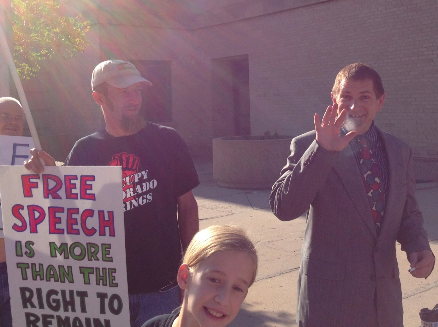
A colleague of mine recently asked about my ideas to better reach out to the African American community vis-a-vis the protests which Occupy Denver has been spearheading to show solidarity with the Black Lives Matter uprisings in Baltimore and Ferguson. At face value it’s a reasonable question as Occupy franchizes across the country have been predominantly white. At base however, the distinction is academic and the implication insulting.

In Denver, as probably in many multicultural urban centers since Ferguson, authorities have succeeded in working with community leaders to redirect street protest into the usual back channels. In Denver the spiritual leaders have kept their flocks locked in their churches. When Denver high schoolers began to stage walk-outs, school administrators put the schools on lockdown. Traditional social justice groups fell victim to academics and their identity politics diatribes. White priviledge must “make space”, in effect, step back, whether or not alternative leaders were knocking. In Denver the most significant protest entity impervious to scholatisc impotence or the wiles of religious submission was Occupy Denver. Since 2011 this ad hoc collection of protest-hardened activists could mobilize at the flick of a switch, usually through social media. By definition, Occupy refused to bind themselves to everybody else’s longstanding arrangements of detente.

Of course this persistence is not static and there are ceaseless internal pressures to conform and play for crumbs. Table scraps are sustenance after all, and all mature decisions are compromises. Adults choose lesser evils, safety nets, the bird in the hand, wisdom over altruism. Can dreamers even be sure the burning stove isn’t an adage meant to waylay us from our childish intuition about freedom? From the frying pan into the fire is more probably the forbidden roadmap to revolution.

You want to know the sage advice that burns me up the most? Comrades telling me the struggle will be a long haul. A marathon. Are you kidding me? Revolution is a sprint! We’ve got to light a fire under your ass!

In any case. Community outreach. What’s the problem? My first thought was of the criticism protesters still face everyday: “GET A JOB!” Everyone seems to have their own idea about what other activists are supposed to be doing.

On the subject of Occupy and “outreach” I offer six points:

1. Did Occupy Wall Street reach out to the community of brokers and bankers on Wall Street? It did not. Occupy was about disruption, gathering on the street and uniting activists. Community organizing was another sort of activism. Occupy was not voting, or going around trying to get out the vote, or lobbying legislators, or gathering petition signatures, or fundraising, or taking in cats, or walking in people’s shoes. All of these are perfectly constructive things, but they’re fundamental to what Occupy was not. I know it sounds mature to talk about building community and helping out and being less disruptive but those are tasks that keep conventional social justice groups too busy to occupy.

2. I am reminded of a lesson learned as occupiers coordinated their efforts. If you feel there is a task going undone, you probably should step up to do it. Others have their hands full with what they are doing. If you feel there is a deficiency and it’s important to you, fill it.

3. That said, there is an imperative not to dillute the fundamental mission. If tangential efforts drain the human resources needed for the goal that brought everyone together, then somebody is winning and it’s not Occupy.

4. Denver’s African American community already has their leaders, most of them undisposed to street activism. Occupy Denver’s community is with activists of all colors. We reach them through the message, our actions, and our unending persistance. None of these are based on color lines.

5. Occupy has many black activist allies. On the street we support them EVERY TIME regardless of whether they support us. Even if it’s “their” issue. If they are not able to rally as frequently as we can, it’s not their fault. (That is White middle class privilege.)

6. If you think the African American community is central to addressing the probem of racism, that’s a problem. It should be up to the WHITE AMERICAN COMMUNITY to shout “BLACK LIVES MATTER” the loudest of all.

Where does the Drake coal emissions plume go when you’re not watching?

Martin Drake Coal-fired Power Plant
COLORADO SPRINGS, CO- We’ve seen the mapping of areas most vulnerable to the toxic emissions of Drake, our downtown coal plant. In particular we’ve learned that freezing temperatures mean that emissions aren’t dispersed according to best laid plans but instead linger in the neighborhoods to the southwest. What does that look like? Recent cold temps have afforded a glimpse. That mist in the morning in Ivywild and the Broadmoor hills is setting a mood which affects your mental health more than you know.

Israel wouldn’t know a “historic mistake” if it looked in the mirror

International diplomats have secured an agreement with Iran which appears to diffuse current tensions. Hurray! Crippling economic sanctions will be relaxed in exchange for limiting Iran’s capability to produce atomic weapons. Everybody is breathing easier except Israel. Why? Is the Israeli regime worried that critics who want its Apartheid theocracy “wiped from the map” (actually, from the road map to peace) need a bomb to do it? Israel’s racist and inhumane policies are bringing it down all of its own. Are Israelis worried there’s now a precedent to ask Israel to disarm its own nuclear arsenal or face sanctions? The problem is more likely that a less scary Iran will be much harder to warmonger around. Who needs a pretend democracy in the Middle East if there’s no Islamic boogeyman threatening the hegemony of the dollar and calling into question the inherent immorality of banking debt-perpetuated penury?
 
What’s rich is Israel, and its captive US press, declaring the agreement with Iran a “historic mistake”. Because verbatim, HISTORIC MISTAKE is growing to be the consensus among historians, in answer to the question what-is-Israel? Google it. Israel: the misguided UN decision in 1948 to colonize the Middle East by dispossessing Palestinians to create a Jewish state necessitating a “peace process” which has proven to be just the opposite.

Little bully Colorado Springs tries to incite war with North Korea

Belligerent pip-squeak Colorado Springs is doing all it can to rouse our nation to attack North Korea. First our ignoble congressman Doug “Tar Baby” Lamborn leaks a Defense Department document that announces North Korea has nuclear capability enough to strike the continental US, which most of the intelligence community denies, then it’s announced that four US cities are being targeted, among them COLORADO SPRINGS, and get this, they point out, it’s marked in the wrong place on the map. North Korea doesn’t even know where Colorado Springs is, these warmongers laugh, as if anyone in the world, least of all North Korea, cared.

Steve Bass found guilty of camping not occupying, but could jury have ruled otherwise without hearing his defense?


COLORADO SPRINGS, Colo.– You may have underestimated the importance of today’s Camping Ban trial. The local media, social justice community and rights watchdogs missed it. But judging from the police force on hand and the elaborate lock-downs placed on the jury pools, it was evident the City of Colorado Springs thought a lot was at stake. I’ve written already about the draconian motions to prevent defendant Steve Bass from explaining his motives, including a ban of the word “Occupy.” Today the court made audience members remove their “Occupy Colorado Springs” t-shirts, but let the cat out of the bag by the palpable gravitas with which the court officials and police handled jury selection. Except for the absence of TV crews outside, you’d have thought Steve Bass was Hannibal Lector tripped up by an urban camping ordinance at “what happened last year in October at a park downtown.”

Yeah, even mention of “Acacia Park” was giving away too much, the prosecuting attorney preferred to call it “115 W. Platte Ave.” Every so often a prospective juror would stand up and say “I presume you’re referring to OCCUPY WALL STREET?” like he was solving a riddle, but instead of the door prize that volunteer would be dismissed from the pool for knowing too much.

After a trial that lasted one third the length of the jury selection, Steve Bass was found guilty. He offered no testimony, his lawyer, the very capable Patty Perelo, made no closing statement, because what defense could be made? Steve and his council elected not to have him testify, because to begin with, he’d have to swear to tell the whole truth, and if he explained he could only tell part of the truth, he’d be slapped with Contempt of Court.

We thought the jurors might have been curious, after seeing the city’s 8×10 glossy pictures with the circles and arrows telling what each one was and hearing not a peep from Bass, but they didn’t express it, and left after giving their verdict. This is Colorado Springs.

One of the prosecution’s witnesses, the arresting officer, nearly spilled the beans when he identified the defendant as someone he couldn’t have confused for someone else, because he’d said he’d encountered Bass many times in the park and shared many conversations.

“Oh?” the defense attorney Perelo perked her ears and asked, “and WHAT did you talk about?”

“Um… homeless policy, mostly.” That’s all HE could say. He couldn’t explain why he’d encountered the defendant so many times, or what the defendant was doing. Attorney Perelo couldn’t push it, because that would be leading him into forbidden territory. His testimony for the prosecutor was delivered straight from his notes.

There were two police witnesses, a map and several photographs, showing the tent and another showing just the poles. Was this necessary for a conviction? Because it necessitated explaining to the jury that said poles were in their “unerected state”. Not to be confused with the tent which was “fully erected”, which the judge pronounced like expressions which tripped off the tongue in cases of serious crime.

A photo of two sleeping bags required the officer to say he found the defendant sleeping “in the bags in the tent in the park” to prove all the elements of a violation of the camping ban.

The prosecuting attorney summarized it thus: “there was a tent, there was a sleeping bag, looks like camping to me.”

Not according to a dictionary definition of course. But that too had been motioned inadmissible. If you look it up, camping is variously defined as to “Live for a time in a camp, tent, or camper, as when on vacation.” Or as when destitute? Dictionaries don’t go there. That’s more like sheltering.

A couple of other examples: Soldiers sleep in tents. They’re not camping. Mountaineers overnighting on the side of a mountain aren’t camping. Refugees of war and natural disasters stay in refuge camps, but aren’t said to be camping. Anyway.

Steve Bass didn’t get his day in court. Everything he wanted to say he couldn’t. His attorney’s strategy today was to prepare for an appeal, on the grounds that the judge deprived Bass of the ability to defend himself.

Did Bass violate the camping ban as the jury decided? The prosecutor explained that nobody, not the judge, nor police officers or herself or the jury was in the position to decide the law. So Steve Bass has to take his case to someone who can.

Jury Selection
Over four hours were spent on choosing a jury, by far the most interesting part of the day. It took three sets of 25 potential jurors to pick six and one alternate. As the process approached lunch hour, the court was eager to buy pizza for seven instead of twenty five, but they didn’t make it.

As I mentioned, usually a juror familiar with “Occupy Wall Street” was dismissed, whether their opinions were favorable or unfavorable. I saw one juror dismissed because delving further would have meant discussing Occupy too much and would expose the other jurors to more occupy talk than the judge or prosecutor wanted.

On the other hand, many jurors had direct relatives in law enforcement, one juror considered a CSPD officer her “knight in shining armor,” so that was another cause for eliminations.

During the second batch, another juror stood up to say he was a former corrections officer, who wasn’t sure if he might have met Steve Bass “in the course of his duties” which poisoned the entire group by suggesting Steve had spent time in prison. That batch was dismissed. In actuality, Steve recognized him, because they both frequented the Dulcimer Shop.

Though Judge Williams maintained a convivial air of impartiality, he betrayed an awful prejudice. Whenever a juror expressed knowing something of what was in the news in October 2011, the judge would asked them if they could refrain from judging Bass based on the misbehavior of others. If jurors who knew about the protests were let to remain in the running, the assumption the judge offered was that “Occupy” was a taint that the defendant hoped they would overcome.

I don’t doubt that this slant extends well beyond Occupy, because municipal courts are notorious for being rubber stamps of a city’s citation process.

For example, in Judge Williams’ instructions to the jury, he read the sample guilty verdict first, in all its solemnity. When he read the not-guilty sample, he broke character to explain that he was not going to repeat the redundant stuff, etc, etc, and then he told the jury they shouldn’t be swayed by the order in which the two samples were read. The dramatic guilty versus the blah blah not-guilty.

Occupy harassment
Knowing about the prohibition against Steve mentioning Occupy, we thought we’d exercise our right not to be gagged. Could it matter? Should it? How preposterous that Steve was being tried and not permitted to say what he was doing. As if some precedent would be set that a defendant might convince a jury that forbidding a person shelter was a bad law.

So we came to court with t-shirts that read OCCUPY COLORADO SPRINGS. Immediately when we sat down, the judge called the lawyers up and decided we’d have to remove our shirts. We were given a chance to explain who we were, but the choice was invert the shirts, put on new ones, or leave. So we walked out.

I had an extra shirt outside with a peace symbol on it. Admittedly a politically-charged shirt, somewhat iconic locally, because it recalled an event in 2007 when peaceful protesters were forcibly removed from a city parade, one of them dragged across the pavement, an elderly woman who subsequently died of complications. So I knew I might be pushing it.

The point being to give Defendant Bass some context. He’s an activist. Alone without a voice he was a perp. With an audience of protestors he becomes a man of mystery. Every accused person in court is sized up in part based on his relations sitting behind him. Why shouldn’t Steve be allowed to show who his friends are?

As I reemerged from my car, already a police supervisor was yelling across the street to tell me I wouldn’t be allowed to wear that shirt. “Are you kidding?” I asked. I had a bag full of them, prepared for this eventuality if other spectators wanted to show solidarity. He was crossing the street to preempt my bringing the confrontation to the steps of the courthouse.

“Eric, you know the judge won’t let you wear that shirt.”

“I know no such thing. He only forbid things that say Occupy.” I knew this to be true, technically.

But they weren’t budging, they claimed a jury pool was already in the courtroom and they didn’t want to take any chances. Oddly, the officer blocking my way, beside the supervisor, was Good Old Officer Paladino who’d brutalized my friends and me in 2007. So he knew the t-shirt too well. Actually Officer Irwin Paladino’s history of abusing protesters goes back to 2003. I decided to dispense with plan B and invert my black t-shirt so I could go back in.

Did the CSPD make the smart call forbidding my t-shirt? I’ll be the first to admit the CSPD have outwitted the local social justice movement at every turn in Colorado Springs. They’re clever and competent, but they’re in the wrong. The CSPD are stepping on our rights, and overstepping their authority to do it. While it may have been superior gamesmanship, it was wrong.

Have I mentioned that they followed us everywhere? As if we were the accused in need of escort. On the officers’ radios we could hear them narrating our movements throughout the building. When Patrick went to the bathroom, an officer followed him inside and made small talk as Patrick peed. Did they think we were going to Mike Check the men’s room?

At one point we were able to see from a window on the second floor hall that CSPD were conferring with a parking enforcement officer around our cars. She was examining the license plates, getting on her phone, standing by the cars, as if waiting for something. The cars were legally parked, the meters fed, and well within the four hour limit. But who wants to argue with an impound lot? I assure you this intimidation tactic worked very well to send us out of the courthouse to rescue our vehicles.

Meanwhile, another friend came into the courthouse and overheard officers discussing whether to deny us entry again, and by what pretext, but I’m getting ahead of myself.

While watching the jury selection, it was the batch that was being dismissed in full, the court bailiff suddenly bolted from behind where we were sitting and told the judge she’d overheard us whispering about inappropriate subjects, specifically using profanity. This accusation was based on a dear Occupier’s habit of muttering colorful asides. Okay this was true, but in his defense, it was after the jury being spoiled, about the jury being spoiled, but inappropriate none-the-less and he apologized. But to tie all together in the misbehavior was a fabrication. The prosecutor tried to have us evicted, and Officer Paladino chimed in about the confrontation I instigated at the door. That’s when my friend told the judge she’d overheard CSPD officers discussing plans to keep us out, so the bailiff’s actions began to appear a little contrived.

This complaint was finally settled with the judge’s warning that one peep out of us would get us 90 days in jail for Contempt of Court. At this point we knew the pieces of duct tape we’d brought in to use to protest Steve’s gagging were definitely OUT.

Just before lunch recess I was able to clarify with Judge Williams whether the peace t-shirt I had wanted to wear was acceptable to the court. Receiving no objection from the prosecutor, the judge told me it would be okay, and then assured me he’d inform CSPD.

Returning from lunch, once again with the peace shirt, the security screeners nearly didn’t let me pass, but I barreled past with the confidence of someone who knows his rights. This time Officer Paladino came upon me at the courtroom door, swaggering right into my face assuring me he was not going to let me pass. FORTUNATELY before he could wrestle my arms behind my back, another supervisor arrived who’d heard the judge, and I was allowed to proceed. Boring story I know. But the pattern was unsettling.

Then Steve was found guilty, you could feel the city’s giddiness as they discussed sentencing. We’re only talking community service, but Colorado Springs has only one contractor for that, the odious Keep Colorado Springs Beautiful, whose hi profile task is to clean up after the CSPD Homeless Outreach Team scoops up the homeless and puts them in shelters very much in the model of correctional facilities. Steve was able to negotiate a less anti-homeless agency, and that’s the story so far.

Do you Facebook? You’re a Yahoo

What is Facebook worth? To whom does it belong? Reigning property right schemes aren’t reciprocal to Facebook’s actual content providers. Maybe an outrageous IPO will prompt a user’s bill of rights and a new intellectual rights paradigm, monetizing the net to flow outward instead of inward to the cyber 1%. Facebook is the whole world in a filing cabinet, but they’re your files, and you’re the volunteer file clerk. Facebook is Yahoo outsourced basically, because Google is too complicated for thought-overwhelmed people. Yahoo mapped the known internet, Google rationalized the database, but the social networking outfits calculated that interests could be predicted along personal ties. We’re sheep after all, and we only want to follow where the flock is going. While Twitter’s cues comes at you like Space Invaders, Facebook provided the blinders and rear view mirrors to coax the reluctant along, and resurrected the virtual community of the World Wide Web’s first internment camp, AOL. This time when everyone is comfortably corralled, it will be interesting to see what becomes of the web’s open range.

Willie and Waylon and Some Other Dude: A story about weed, marriage, and Texas tall tales, Part 2

For you, Willie. God bless the Hell out of ya! Alright, so this is all the same thought and I’m just thinkering around with it some for y’all. And it’s all bullshit.
 
I bet some of y’all forgot this was in the offing. I didn’t, and it really is all one thought. It’s about more than lost weekends or divorce fodder, too. It’s about God and country, life, liberty, and the pursuit of revolution in the fast lane. Let’s hope no one gets hurt, because it’s not me in the fast lane. And you thought I was going to tell you something torrid, din’cha!? Wait–maybe I am!

A lot of the guys that started this country–the U.S.A., where I live–were church folk. They tried real hard, ya have to grant, but they were church folk after all, so they had blinders on just like lots of church folk always have, and still do today. Get to lookin’ too closely at the periphery of things and it’s scary, don’t we all know….
They came over here in the first place on the run from some other church folk, that wanted to kill the Hell out of them. So, naturally they immediately set about establishing a domicile, ( in someone else’s back yard, mind you), where they could kill the shit out of everyone else, instead. After a while that arrangement started to smell a little funny–on account of the bullshit, see–and a few got together to to try and straighten things out. Besides, the Grand Game wasn’t working out quite right and the game pieces kept getting scattered.

The Occupiers read St. Thomas’s Declaration at Acacia Park the other day, ( I call him St. Thomas just to mess with him–he was just as scrambled as the rest of us, if ya didn’t know). It was a beautiful thing. It was beautiful when Kyle read it with his shredded voice. It was beautiful when Jefferson wrote it, and beautiful when they read it in the Boston Common. It’s all the more applicable today if you crunch a few names and change a few numbers, and Jefferson would certainly be needing to restrain Patrick Henry from swinging blows by now if those guys lived now, and had let it all slide as far.

Jefferson wrote the Declaration, , but he had nothing to do with the Bill o’ Rights. He was out of town when they threw that stuff together, which they did ’cause they knew he hated the idea. In fact, he may have ditched town because he knew they were gonna just have to write it and he just couldn’t stand it. He figured it best to leave well enough alone, for fear of a thing developing like we’ve heard, “Everything not forbidden is mandatory.” Now would be the moment to mention that this is an axiom in–wait for it… Quantum Physics, stolen from literature fair and square by a fellow named Gell-Mann and named the “Totalitarian Principle”. That’s right–physicists see the poetry and the downright ridiculous humor in all this, too, sometimes.

The Bill o’ Rights contains stuff designed to keep government unobtrusive. No one could figure out a way to make it go away completely back in the day, but those guys had eaten enough shit to realize they didn’t want a buncha power to inhere in the Halls of Power. Even the church guys had had enough–my mom’s family came over to escape religious persecution real early on, (my aunt Leslie paid someone a boatload of money to tell her we came over with a boatload. Surely it’s not bullshit). So that’s what they were thinking about when they put together the addenda to the Constitution. How could Jefferson and the rest have guessed that it didn’t matter about the enumeration? We were bound to fuck it up, anyhow.

Willie, still onea my heroes, used to let his freak flag fly without regard for whom it may have snapped when the wind caught it. No doubt being out in the weather like that has worn his flag out some, so I hope I can spiff it up some for him–add some color, if you will. That weed-rag interview that set me off about all this was sad as a dirge, to me, simply ’cause I still idolize Mr. Nelson. I still hope he gets to be POTUS. If he does I wanna do some bongs in the Oval Office! But when I read his carryings on about medical marijuana, and how we ought to tax and regulate it and all that Republican, party-line shyte, I wanted to spend the rest of the week wearing a black arm-band, even though I know most of the”patients” at the weed stores here in Colorado just want to get stoned.

The decision to alter one’s consciousness, which each and every human being makes every single day as soon as the notion to open his eyes in the morning passes across the surface of his frontal lobes, is absolutely private, to be rendered with the final consultation of no one but the individual in question, and his or her God, (or absence of god, if such a thing were really possible). I promised I wouldn’t use that clunky English, but it’s important to be sure no one feels left out of this. Maybe I should say “his and her” now, to be sure I don’t miss any hermaphrodites, drag queens, or Chas Bono. The fact that this is a strictly spiritual decision relieves the government, and everyfuckin’body else of responsibility for my decisions, or anyone else’s decisions other than their very own. It also renders it illegal for them to regulate or tax. “Sin” tax, right? Ooooh– I can smell the smoke coming form y’alls ears from here, though I know not all those brain cells are heating up for the same reasons.

I promised to squeeze marriage into this, right? Still think I can’t do it? Watch this….

We have spent an awful lot of effort in this country worrying about whether or not queers ought to be allowed, allowed, to marry each other. Who is it gonna do the allowing? We the people? Aren’t we talking about the government? Isn’t marriage at its very most basic essence an spiritual agreement between some people and whatever god or non-god they deign to invoke? So what the fuck is a secular government doing in the marriage business at all??? If your church doesn’t like queers, don’t have any. If your church doesn’t like straights, get the pastor to put on lots of makeup and a Dolly Parton wig–that ought to scare them off well enough. But if those perverts in Washington start foisting their own crap on us then–oh, wait–they have, and the shit is totally screwed now!

St. Thomas said the government should do no more than to prevent folks from harming one another. (He got that idea from J.S. Mill, who likely got it by Divine Inspiration, if you ask me). So, a bit of tastefully rendered social contract law wouldn’t hurt, but licensing marriage is utterly unconstitutional, and maybe straight from the Devil, or the Balrog, or something. Just like prohibition laws of any stripe. You just can’t write one in stripes that are recognizably red, white, and blue. Maybe Willie’s flag is too faded for it to remind him of that, but I know the damn thing is still flying. I have to believe it. ‘Cause Willie’s a hero, an icon of the War from back before he was born.

And when we get together next summer we’re gonna laaaugh–’cause he gets it, ya know….

I lied about it bein’ part two, though. It’s all been the same story–all of it. I lied about the bullshit, too –it’s all fuckin’ True!!!

(Reprinted from Hipgnosis)

Revolution at 2112 RPM

For Tom, the guys at Occupy Colorado Springs, and everyone else:

So, if I sit here and carry on about how we can get out of this grief under which so many of us find ourselves buried by living cooperatively, and no one plays along, it’s like division by zero, an operation that produces no definable solution and the thought of which is so troublesome it caused philosopher George Berkeley to suspect all mathematicians could be devil-worshipers on the side. Seriously. A new friend I met at Acacia Park yesterday asked where the little hullabaloo about banks and bailouts and revolution and such was happening in Colorado Springs was asking the general milieu of rabble rousers where their revolution could be expected to go. (Hi, Tom). Some of the guys there, as one might expect, were so fed up with the obviously unsupportable state of current affairs that they were almost gleefully anticipating violence and war–civil war–right here in the U.S.A.. (Hi, Pat). I certainly can’t blame anyone for thinking that way, given that I hoped fervently for exactly the same outcome from around the 3rd grade til only recently, really.

I’ve already mentioned my opinion of the futility of standard issue revolutions. We’ve tried that. It doesn’t work. We’ve tried Monarchies, ordinary dictatorships, “working-class dictatorships”, Capitalism, Communism, Socialism, Ism after Ism–none of what we’ve tried to do has worked, neither for the oppressed nor the oppressors. We’ve been dividing by zero all the while. You should look that operation in the eye some, so you know what I’m saying. It’s the same as proving a negative, or trying to work out the math of the Singularity, and if you find it difficult, one glance at a graph will turn the lights on a little for you. When I was a schoolboy, I always thought it was supremely bogus to respond to any questions about division by zero, (or other imponderables, for that matter), by asserting the answers to be “undefined” just because a conventional answer might be unsatisfactory. I was a weird kid, OK? Look at the link or find something more techie, (a little help, Kathryn?), and then extrapolate the idea to the business of social revolutions and you’ll find my point, or at least one “quantum” facet of it. You could have a look at a representation of the Ouroborus and get the same notion to materialize in your head, maybe.

The shit we’ve been doing has not worked, is not working, and will not work. The answers we’re after will not derive from the operation we’ve been attempting to apply, no matter what.

We compete. That’s just what we do. We compete against one another, against Nature, and maybe against God, though it’s not by any means compulsory for you to think of it in any sort of Divine sense, or wrestle with religious aversions for the thing to work out the same, here. That’s just me. The competition we’ve been so avid to pursue all these generations hasn’t worked any better for the atheists or the religious. If we pursue yet another bloody revolution, we’ll wind up bathing in another absurdly predictable vat of blood, and maybe you super-rich can stretch your inane Grand Game out for a few more years in your bunkers after some of us useless eaters are dispatched and used as semi-organic fertilizer. The snake will still have a mouthful of tail caught up in its throat, if it lives through this one.

Tom was serious about finding a solution when he came by our little protestation yesterday. Pat was just as serious about the blood, I’m afraid. I’ve had enough of blood, so here’s what I’m doing. See what you think. (Here comes the part that might curdle Mom’s blood a bit, but maybe not…maybe not.) I have completely abandoned ordinary reality. It’s never worked so well for me anyhow, and I was already kinda screwed when I came to this notion, so you are welcome to hold on to your own personal misery and think of me as just another hopeless crackpot, if you want–another useless eater. After all, I’m seriously just an 9th grade dropout and unemployed housepainter with bad joints and a broken back, a tragic character out of a Steinbeck novel if you will. Except I don’t feel tragic at all; I’m the happiest guy I know. No shit.

What does it mean to have abandoned ordinary reality? There are lots of angles to that so I apologize up front for the doglegs I’ll be working as I attempt to answer the question. First, I’ve given up looking for a “job”, or the hope of ownership of anything at all, including money. That doesn’t mean I’ve decided to laze around on someone’s sofa til I die of entropic dissipation; I’ve been incredibly busy since this paradigm shift, with no horizon in sight, really. There are millions of people in the shape I was in over last summer, wells running dry and bankruptcy looming while the whole time work to do abounds. I’ve just given up the game those $game pieces$ track, like a chess player laying down his king. Those guys won. It’s OK–it’s only a game, after all. I was never so good at it–never really gave a damn.

Now I find myself in a brand-new and rather sketchily mapped territory where I’m the president of my own head and nothing else, a monarch of abrogation and apostasy. So when Tom asked about a plan, I had to think about it some before I could even say as much as I am right here, right now. The two biggest differences I can define between this new approach and the other are cooperation and good ol’ hippie-dippie, Jesus freak style love and self-abandonment. And not just on my end, see. I don’t own anything, won’t own anything at least so long as I go down this path, and can’t pay for anything or support myself, or anyone else. Well then. WTF?

I’ve always given. Always. I loved Robin Hood as a kid, and I used to do things like stashing random campfire-scented homeless dudes in the back of my room at night, in hope that Mom wouldn’t discover them and put them out in the snow or, even worse, send them packing to jail. (Neither Mom nor Dad ever discovered any of them. Hi, Mom. Hey, Dad ;)) I give away food for…well that’s a fine question. When asked why I spend so much of my time on things like the Colorado College Community Kitchen, the best I’ve been able to come up with in response is that it’s just in me to do. I think it’s been some sort of psychic trade-off for the ethical compromises and outright violations to which I’ve succumbed in my lackluster prosecution of the game of property collection, which I’ve always vaguely known to be a sort of theft, just like the Marxists say. Follow me, though–the Marxists haven’t show me anything not-dysfunctional, either. (Sorry, Michele, Jon).

This new thing is about giving and receiving, and about a different way of seeing the whole picture, like when one of those optical illusions with the hidden horse and rider amongst the trees suddenly becomes apparent. Nothing changes; it’s just revealed–revelatory. I live at someone else’s house. I bring around food for everyone to eat that I never owned. I smoke tobacco that a gracious host brought to me, and hope my phone and broadband will still be operational next week. You’re welcome to pay it for me while I try to figure out how to do this with no game pieces at all. Message me; I won’t be paying for it. I’m living on a prayer, as the song goes, living on Love. You can too, I swear. Quit your shitty job at Wal-Mart’s haircutting kiosk and cut your neighbor’s hair for free. Don’t worry about game pieces. Come down to CC on Sunday and help us give away someone else’s food. Have some! Bring some pizzas from your shop to the protesters. Retire your jersey if you’re a big winner and forget about the conspicuous displays of wealth. We get it. You won! Yay for you! Now put a few families up in your east wing. Love them. Be tender. Let their hapless lost patriarchs know it’s unnecessary to numb the pain with whiskey, or whatever. It’s OK–we won’t call you a wuss, or anything.

Right now there’s Revolution in the wind. I like to read kind of a lot. It seems the handiest way to find out about shit, and I’ve read about a lot of Revolutions. It can make my head spin. If we pursue Revolution we’ll be running in circles. We’ll be eating our tails. The Earth herself is done with our bullshit, and there’s really not any more tail left to eat. Let’s get off the turntable. We’ll be dizzy for a while, but I think we can walk in a straight line if we get our bearings. Get hold of me. I’ve got these words for you all, for free. This is not a trade. I can paint your house, too, or build you a deck or something. If you want to give me something, or give something to my family, or give something to someone I don’t know and will never meet, then maybe you get it. I won’t take it as payment. I’m not in that game.

I hope this works. I’ve had enough tail. How ’bout you?

http://en.wikipedia.org/wiki/Division_by_zero

(Reprinted from Hipgnosis)

Someone should tell Obama that Troy Davis was a white banker. He’ll freak.

On the day after the state murder of Troy Davis, you’ve got to feel sorry for the Obamapologists who must have a lot more in a knot than their panties. How do you explain why President Obama couldn’t intercede to save the life of accused off-duty-cop-killer Troy Davis? Because it would have been unseemly for a black president, the first, to intervene in the sanctioned lynching of another black man, whose number is lost among the countless. It would have been a formidable first, but Obama took the highroad, out of Dodge. Was it a matter of not stepping on states’ rights? Because preventing an injustice would not have been worth it? To save a human life?

American caesars who want to cross the Rubicon with a Rubicon need a map

I just came across one of these in a parking lot yesterday, apparently the Jeep Rubicon has been out for a few years. This uber-alles thrillcraft sort of defines America’s sorry state of cultural illiteracy, wouldn’t you say? Julius Caesar didn’t violate Rome’s Posse Comitatus prohibition riding IN A Rubicon. Bad-ass as you wanna be, if your Rubicon is like the average off-road vehicle, it will never leave the pavement. Your Rubicon logo is just to remind one and all that you could cross it, if you knew where it was. The sorrier irony is that Caesar’s defiant act militarized the empire’s civil society and curtailed its democracy.

Map of Israel is the map of Palestine

Need a map of PALESTINE? As Palestinians push for a recognition of statehood, and Israelis pretend there’s no such thing as historic “Palestine” and won’t agree on any borders, you might be excused from wondering what a Palestinian nation would look like. Have you seen the proposed 1947 partition? It cut Palestinian leftovers in half, with the non-Jewish pieces (A) intended to be annexed by Arab neighbors or (B) leaving refugee routes for the further attrition of indigenous populations, with no intention of leaving a viable second state. Now Israel wants to settle the whole thing, and won’t even let Google Earth map the region or the “Occupied Territories” for fear a bird’s eye view of the Israeli settler encroachments would be too damning. But it’s all Zionist occupied territory isn’t it? If Israel can claim a right to exist on another’s land, why shouldn’t Palestine? Let Israel exist as an Apartheid enclave in Palestine, until their consciences get the better of them. Meanwhile, a true democracy in a one state solution.

AIPAC speechmeister Barack Obama may not be such a good liar after all

In his speech to AIPAC this year, President Obama described the foes of Zionism as determined to “wipe Israel off the map,” the last word quickly retracted and replaced with “Earth.” A quick glance at the prepared text shows this wasn’t a slip of the tongue, it was an official concession that Obama is familiar with the un-spun translation of Ahmadinejad’s words. But Obama’s reflexive on-the-fly edit reveals how literal the Zionists are about their myth-building, and how little leeway Obama has to break with the US Israel agenda. The war drumming against a nuclear-powered Iran invokes the specter of an annihilation of the Jews based on s supposed threat to “wipe Israel off the face of the Earth.” I think today’s vocab malfunction suggests that Obama knows the rest of the authentic translation reads: “to wipe the Zionist regime off the map.” With the advent of the Arab Spring, the term has become the Illegal Zionist Entity formerly know as Israel. Throw in the Apartheid qualifier and Ahmadinejad’s threat is an objective to which a greater and greater number agree.

Cartographic traces of Lake, Colorado


Maybe like me you’re wondering how a landmark falls off the face of the earth, in particular Google Earth, assuming as we do that web crowdsourcing is archival, not perishable. A stagecoach watering hole in Kansas Territory, formerly Arapaho, was Hedinger’s Lake, between present day Limon and Hugo. Like the history of Colorado’s water, Lake became Lake Station, later a railway siding, today a creek.


First some back-story: 1750. When gold looked to become the carrot to drive white man’s Manifest Destiny, the Indian Territories of what would become Colorado were labeled simply the Gold Region.


Back in 1815, the West was still La Louisiane, and place names were native, French and Spanish. Taos was one of the oldest Spanish settlements, site of the First American Revolution, against the Spaniards, and another revolt when the US invaded. Camp de Baroney sits on the Arkansas River, eventually resettled as El Pueblo. And there’s La Fourche Republicaine, a fork of la Rivoire Missouri, soon to lead a prominent migration trail west.


By 1848, St. Vrain’s Fort and Grante Ft., Bent’s Fort, were already protecting Anglo trading interests. (Note by the way, Old Park and New Park, eventually to be become the “North” to South Park.)


By 1864, the Cheyenne and Arapaho found themselves bordered on the west by the “Military Department of Utah” and ceding their lands to the Kansas Territory. (On this map we can see Montana City, the original Denver City. Denver eventually overtook Auroria and the metropolis. Mineral Springs became Manitou and Colorado Springs at the foot of Pikes Peak.)

Note the curiously singular representation of a “Kansas Lake” depicted at the tip of the south fork of the Republican River, whose waters will originate in the later to be named Lincoln County, at whose heart will lie Lake, Colorado.

The Rocky Mountain region lost many lakes by the mid 1800s when beaver were hunted to near extinction and with them the beaver dams. Note just West of “Kansas Lake” lies Beaver Creek.


With the gold rush, settler trails crisscrossed the West, for wagon trains, stagecoach and mail carriers. Lake was a stage at the convergence of the Butterfield Overland Dispatch and Republican Fork Trails, where they crossed the Big Sandy Creek to join the Smoky Hill South and North Roads (after similarly named rivers which were starting points in Kansas) or the spartan Starvation Trail to Denver. Today’s I-70 follows Smoky Hill North.


Was Hedinger’s Lake the water which travelers sought at the end of the South Republican Fork Trail?


This 1868 Union Pacific map predicted the stops heading eastward from Denver to be Parkhurst, Beaver, which later became Deer Trail, and Coon Creek, which became Kit Carson, opposite Sand Creek.


By 1870, Kansas was a state and the Kansas Union Pacific RR reached Denver. (Beyond the mountains: North Park, Middle Park and South Park.)


By 1873, leaving for Denver from Fort Wallace, there were stops at Kit Carson, Aroyo, Lake, Agate (pronounced “A-Gate”) and Deer Trail. (Note: still no Colorado Springs.)


A map circa 1880s, shows Hugo, Lake, River Bend, Godfrey, Agate, Deer Trail, and Byers, named for the founder of the Rocky Mountain News, formerly Bijou.


When the Chicago Kansas and Nebraska Railroad sought a direct route to Colorado Springs, it decided to intersect the Kansas Pacific at a new stop called Limon and that was the end of Lake. At Limon the westbound trains performed what was called the “Limon Shuffle” where passenger and freight cars were separated depending on which were going to Denver and which to Colorado Springs.


Lake Station remained a stop for the Union Pacific, and on this map which accompanied the 1910 census, it’s gone, in favor of a late addition, Bagdad.

As trains no longer needed to take on water, and could reach their destinations more quickly, many stops were eliminated. This 1925 train Union Pacific train schedule lists only Cheyenne Wells, Kit Carson, Hugo and Limon before reaching Denver.


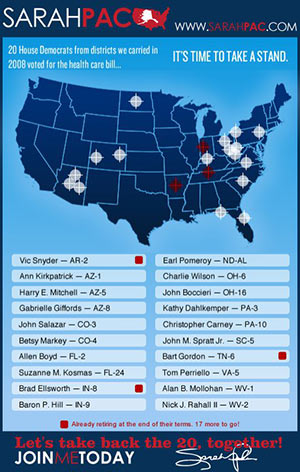
Lake is still marked on railroad maps, though there’s not even an access road to reach it.


On other maps it’s just Lake Creek, spanned by an impassable decaying bridge. It’s now a wetlands area that provides a bird sanctuary.


For the USGS, Lake still serves as namesake for the topographical map of the Lake Quadrangle.

To be continued…

If you have to ask for whom the fat lady sings, it is not for Tahrir Square.

–And to really mix my malaprops, she sings for them that bought her. If there was one variable which got away from the underdogs of Egypt’s Jan25 Revolution, it was who would referee the endgame. While Hosni Mubarak’s stunning defiance Thursday night looked like a Hail Mary pass hoping to provoke the protesters to mayhem, as a defensive strategy he was moving the goalposts. Anticipating a capitulation, the Tahrir Square demonstrators made clear it was the entire regime which needed ousting, no Suleiman, no Emergency Law, an inviolate list of demands. Mubarak’s insulting buffoonery focused the great beast’s wrath like a rodeo clown. When the announcement came he was stepping down, who could not help but raise a cheer, drowning out the earlier precautions. Mubarak played Egypt like a fiddle, as he burned it, while the fat lady of state media called the game over.

It’s not over until the fat lady sings
So opera advises American football, in reality a game governed strictly by elapsed time. The expression describes the mutual sense that every competition has a natural denouement. Actually another false notion, as this feeling is not often shared by the side fallen behind at the final score.

I’ve convoluted ask not for whom the bell tolls– and if you have to ask how much it costs–, Hemingway and Bugatti I believe, to stress the obvious, that Wagnerian sopranos are kept in furs by the wealthiest of patrons. As epic as might be your struggle, unless you transcend the stage to torch the theater, the status quo raises and lowers the curtain. Without seizing the state media, if even that had been possible, and without staging a narrative to compete with Mubarak’s Greekest of tragic high dives, the Tahrir Square revolutionaries became mere players to please the king.

How could we have missed the grand theatricality of Mubarak’s televised last stands, lighting and makeup dialed to Bela Lugosi? Anyone who knows to dramatize a campfire tale by holding a flashlight under his chin also knows they don’t do that for their profile pic.

In all three of his televised responses to the Jan25 reformers, Mubarak could be paraphrased to have said “over my dead body.” It was a road map his adversaries probably should have heeded. Where is Mubarak now? He’s not gone, he hasn’t even left Egypt. We are informed Mubarak has stepped down by the same henchmen who told protesters “all your demands will be met,” then meeting none.

We learn now that Egypt’s Supreme Council of the Military is trying to clear Tahrir Square. It’s outlawing those who would cause chaos and disorder, and forbidding labor unions to assemble or strike. It’s refusing to end Egypt’s emergency law, or to release the unknown thousand detained during the protests. What of Suleiman and the regime’s other cronies? We have only Mubarak’s doppelganger in an army cap. Field Marshall “Happy” Tantawi, takes to the microphone with no other agenda it appears than to restore Egypt its accustomed sonorous normalcy. If Tibetan throat-singing has an antecedent we can wager now it was Pharaoh throat-talking.

Dance with the one who brought you
A mantra worth cursing out, when Americans wonder why their elected representatives answer only to their biggest campaign donors. So why would Egypt’s Jan25 upstarts have banked on winning the cooperation of the army? I almost said “their” army, but it’s bought and paid for by Mubarak, actually by the same interests who buy US politicians. Deciding not to challenge the army spared lives, but it’s left the military regime in place. Regime unchanged.

There’s a problem when you harness the protection of the military without knowing the intentions of its leaders. You can win a nonviolent revolution against the schoolyard bully if you’ve got the deterrence of “My Bodyguard,” but when the army does that on a national scale it’s called a “bloodless coup.” I’d be curious to know if nonviolence cultists rank bloodless coups among behaviors they condone.

Egypt’s April 6 Youth Movement, chief instigators of the Jan25 uprising, attribute much of their organizing skill to training with OTPOR, the famously successful Serbian youth rebellion which ousted a Balkan despot. OTPOR is now a “pro-Democracy” consultant group that tours the world to awaken nascent freedom-seeking insurgents aspiring to popular uprisings. OTPOR refutes insinuations rising from the disclosure that it has accepted CIA funding, but curiously OTPOR is more often by happenstance advising malcontents in Venezuela, Bolivia, Equador, Iran, the usual outspoken rivals to US hegemony. What are they doing in Egypt? Had Hosni Mubarak gone rogue and we didn’t know it?

When pan-Arabists think of events in Tunisia and Egypt igniting popular uprisings across North Africa and the Middle East, there’s a line to draw between the common dictators and those more hostile to the West, whose rule is autocratic by necessity of having to defend against CIA and Mossad activities designed to foment instability.

Whether against anti-US foes or pro, it might be safe to say that OTPOR talks a good game, without having yet had a victory. They too deposed a dictator, but not his regime. The problem with OTPOR’s advice has to do with the end game.

I sat in on an OTPOR seminar once. They make a yearly visit to Colorado College to lecture for the nonviolence program. At the conclusion of one lecture I witnessed a tremendously telling aside, which emerged during the Q&A, and definitely wasn’t in the nonviolence syllabus. I wonder if the A6YM got the memo.

This presenter, a veteran of the student uprising that deposed Slobodan Milosevic in 2000, contended that after this victory for Democracy, etc, etc, after the attention span of the media had moved on, the same Milosevic cronies who’d been driven to the shadows, assassinated the opposition leaders and crept right back to power. His lesson, a mere thesis, which I paraphrase to reflect his muted emphasis: we should maybe have taken it one step further and made sure to kill the fuckers.

A6YM is still gambling they can separate the lower ranks of the army from the brass. If Robert Fisk’s report that Egyptian tank commanders refused January 30 orders to make a Tiananmen Square out of Tahrir, there may still be hope in such a strategy. But it certainly won’t work if no one will announce that it has worked. If a tyrant falls in the forest and no one hears, his rule doesn’t fall. The funeral cortege of Genghis Khan killed everyone in its path to keep word of his death from spreading across the empire until his successor could consolidate power. If you’re not going to push him off the cliff literally, perhaps Slavoj Zizek is right to say you’ve got to create a Tom and Jerry moment where despots like Mubarak see that there is no longer any foundation beneath him, where visualizing his own demise brings it upon himself. But can that be done without having director’s cut over the narrative?

What kind of farce are we perpetuating to pretend that Hosni Mubarak must be granted a dignified exit? What dignity commanded firing on unarmed protesters? Are we to pretend men who torture to retain their power can be cajoled to release it?

Instead, the Egyptian rebels find themselves with no ground beneath their feet, their “victorious revolution” now a meme being used to rally dissenters against America’s chief adversary Iran.

Palin signed off on Giffords shooting, grizzly lipstick plot to direct gunmen

Assassination checklist for Tea Party political opponentsAZ representative Gabrielle Giffords was one of twenty crosshairs on Sarah Palin’s checklist directing political assassinations.
 
Whether Jared Lee Loughner was a lone gunman, or in a TP or al-Qaeda cell, shouldn’t the DOJ investigate the grizzly mastermind who is inciting these acts? While they’re at it, Vice President Biden for illegally targeting Wikileaks’ Julian Assange, and Boss Obama who commands extrajudicial assassinations via military/CIA drones. If this was a GPS map of Pakistan the “unhinged shooters” would be Predator Drone operators.

Michael Moore tweeted these interesting links:

Dem Rep Giffords shot in head in Az. Sarah Palin had put CROSSHAIRS/ BULLSEYE on Giffords on her website! OUTRAGE!

When Rep Giffords voted in favor of health care bill, her office in Tucson was attacked & vandalized.

Palin “set gun sights on 20 Dems (including Giffords).” Palin site now seems 2 b 2 taking down crosshairs map!

In 2009, another gun nut showed up where Rep Giffords was speaking (at another Safeway) & dropped his gun

Giffords opponent held June event 2 “Shoot a Fully Automatic M16” to “Get on Target” & “Remove Gabrielle Giffords”

When Palin put crosshairs on a map w/ Rep. Giffords & 19 other Dem congressmen/women, she urged followers to “reload” & “aim” for Democrats.

Stunning admission by Tucson sheriff: Arizona “a mecca” of hate & bigotry which unhinges the unbalanced Wow.

Christina Green was the 9yr old killed. She was born on 9/11. Was on student council & only girl on baseball team.

If a Detroit Muslim put a map on the web w/crosshairs on 20 pols, then 1 of them got shot, where would he b sitting right now? Just asking.

In Tennessee, ACLU = Terrorists

The Memphis Homeland Security fusion center has a map listing the Tennessee ACLU as a “Terrorist Event.” Compound that with what a ranking senator (R-AL) has called the “ACLU DNA.” It goes beyond semantics when the label of terrorist means by executive order suspects can be detained without charges, indefinitely and without an enforceable standard of human rights. Think twice about those giving credence to Vice President Biden’s categorization of Wikileaks as more terrorism than journalism. On the lighter dark side, the CIA has set up a Wikileaks Task Force (WTF), prompting comedian Andy Borowitz to suggest the more apt Stop Terrorists From Uniting (STFU).

Wikileaks reveals inventory of US possessions critical to corporations

To complain that a wikileaked list of off-US-soil “critical infrastructure and key resources” provides a checklist of targets for aspiring terrorists is to pretend that opponents of the US empire are as simple minded as American television viewers. The importance of most of the so-called Critical Foreign Dependencies is self-evident, more curious is how the US deems these proprietary interests, to what extent it will protect them, and for whom. Sole manufacturers of vaccines might be vital to public health, but what of communications cables, international ports, supplies of industrial metals and suppliers of components to US weapons systems? Those are critical only to bottom lines. The 2008 report in the State Department cable leaked yesterday reveals infrastructure critical to multinational corporations, whether US or not.

While American airwaves are full of denunciations of Wikileaks and Julian Assange for endangering the US, the Western press is ignoring incendiary cables making their rounds in the Middle East, in which the Lebanese Defence Minister Elias El-Murr asks his American liaison to assure Israel that a next invasion, restricted to rooting out Hezbollah, would not be opposed by Lebanese forces.

Amazon, Paypal and EveryDNS have thrown in with those that would censor Wikileaks, likely also Google and Twitter. Try to find the El-Murr story through Google News or Twitter.

Here’s the text of the 2009 cable:

2008 Critical Foreign Dependencies Initiative (CFDI)
critical infrastructure and key resources (CI/KR)

AFRICA

Congo
(Kinshasa): Cobalt (Mine and Plant)

Gabon:
Manganese – Battery grade, natural; battery grade, synthetic; chemical grade; ferro; metallurgical grade

Guinea:
Bauxite (Mine)

South Africa:
BAE Land System OMC, Benoni, South Africa
Brown David Gear Industries LTD, Benoni, South Africa
Bushveld Complex (chromite mine) Ferrochromium Manganese – Battery grade, natural; battery grade, synthetic; chemical grade; ferro; metallurgical grade
Palladium Mine and
Plant Platinum Mines Rhodium

EAST ASIA AND THE PACIFIC

Australia:
Southern Cross undersea cable landing, Brookvale, Australia
Southern Cross undersea cable landing, Sydney, Australia
Manganese – Battery grade, natural; battery grade, synthetic; chemical grade; ferro; metallurgical grade
Nickel Mines Maybe Faulding Mulgrave Victoria, Australia:
Manufacturing facility for Midazolam injection. Mayne Pharma (fill/finish), Melbourne, Australia: Sole suppliers of Crotalid Polyvalent Antivenin (CroFab).

China:
C2C Cable Network undersea cable landing, Chom Hom Kok, Hong Kong
C2C Cable Network undersea cable landing Shanghai, China
China-US undersea cable landing, Chongming, China
China-US undersea cable landing Shantou, China
EAC undersea cable landing Tseung Kwan O, Hong Kong
FLAG/REACH North Asia Loop undersea cable landing Tong Fuk, Hong Kong
Hydroelectric Dam Turbines and Generators Fluorspar (Mine)
Germanium Mine
Graphite Mine
Rare Earth Minerals/Elements Tin Mine and Plant Tungsten – Mine and Plant Polypropylene Filter Material for N-95 Masks
Shanghai Port
Guangzhou Port
Hong Kong Port
Ningbo Port
Tianjin Port

Fiji:
Southern Cross undersea cable landing, Suva, Fiji

Indonesia:
Tin Mine and Plant Straits of Malacca

Japan:
C2C Cable Network undersea cable landing, Chikura, Japan
C2C Cable Network undersea cable landing, Shima, Japan
China-US undersea cable, Okinawa, Japan
EAC undersea cable landing Ajigaura, Japan
EAC undersea cable landing Shima, Japan
FLAG/REACH North Asia Loop undersea cable landing Wada, Japan
Japan-US undersea cable landing, Maruyama, Japan
Japan-US undersea cable landing Kitaibaraki, Japan
KJCN undersea cable landing Fukuoka, Japan
KJCN undersea cable landing Kita-Kyushu, Japan
Pacific Crossing-1 (PC-1) undersea cable landing Ajigaura, Japan
Pacific Crossing-1 (PC-1) undersea cable landing Shima, Japan
Tyco Transpacific undersea cable landing, Toyohashi, Japan
Tyco Transpacific undersea cable landing Emi, Japan
Hitachi, Hydroelectric Dam Turbines and Generators
Port of Chiba
Port of Kobe
Port of Nagoya
Port of Yokohama
Iodine Mine
Metal Fabrication Machines Titanium Metal (Processed) Biken, Kanonji City, Japan
Hitachi Electrical Power Generators and Components Large AC Generators above 40 MVA

Malaysia:
Straits of Malacca

New Zealand:
Southern Cross undersea cable landing, Whenuapai, New Zealand
Southern Cross undersea cable landing, Takapuna, New Zealand

Philippines:
C2C Cable Network undersea cable landing, Batangas, Philippines
EAC undersea cable landing Cavite, Philippines

Republic of Korea:
C2C Cable Network undersea cable landing, Pusan, Republic of Korea.
EAC undersea cable landing Shindu-Ri, Republic of Korea
FLAG/REACH North Asia Loop undersea cable landing Pusan, Republic of Korea
KJCN undersea cable landing Pusan, Republic of Korea
Hitachi Large Electric Power Transformers 230 – 500 kV
Busan Port

Singapore:
C2C Cable Network undersea cable landing, Changi, Singapore
EAC undersea cable landing Changi North, Singapore
Port of Singapore
Straits of Malacca

Taiwan:
C2C Cable Network undersea cable landing, Fangshan, Taiwan
C2C Cable Network undersea cable landing, Tanshui, Taiwan
China-US undersea cable landing Fangshan, Taiwan
EAC undersea cable landing Pa Li, Taiwan
FLAG/REACH North Asia Loop undersea cable landing Toucheng, Taiwan
Kaohsiung Port

EUROPE AND EURASIA

Europe

(Unspecified):
Metal Fabrication Machines: Small number of Turkish companies (Durma, Baykal, Ermaksan)

Austria:
Baxter AG, Vienna, Austria: Immune Globulin Intravenous (IGIV)
Octapharma Pharmazeutika, Vienna, Austria: Immune Globulin Intravenous (IGIV)

Azerbaijan:
Sangachal Terminal
Baku-Tbilisi-Ceyhan Pipeline

Belarus:
Druzhba Oil Pipeline

Belgium:
Germanium Mine
Baxter SA, Lessines, Belgium: Immune Globulin Intravenous (IGIV)
Glaxo Smith Kline, Rixensart, Belgium: Acellular Pertussis Vaccine Component
GlaxoSmithKline Biologicals SA, Wavre, Belgium: Acellular Pertussis Vaccine Component
Port of Antwerp

Denmark:
TAT-14 undersea cable landing, Blaabjerg, Denmark
Bavarian Nordic (BN), Hejreskovvej, Kvistgard, Denmark: Smallpox Vaccine
Novo Nordisk Pharmaceuticals, Inc. Bagsvaerd, Denmark: Numerous formulations of insulin
Novo Nordisk Insulin Manufacturer: Global insulin supplies
Statens Serum Institut, Copenhagen, Denmark: DTaP (including D and T components) pediatric version

France:
APOLLO undersea cable, Lannion, France
FA-1 undersea cable, Plerin, France
TAT-14 undersea cable landing St. Valery, France
Sanofi-Aventis Insulin Manufacturer: Global insulin supplies Foot and Mouth Disease Vaccine finishing
Alstrom, Hydroelectric Dam Turbines and Generators
Alstrom Electrical Power Generators and Components
EMD Pharms Semoy, France: Cyanokit Injection
GlaxoSmithKline, Inc. Evreux, France: Influenza neurominidase inhibitor
RELENZA (Zanamivir) Diagast, Cedex, France: Olympus (impacts blood typing ability)
Genzyme Polyclonals SAS (bulk), Lyon, France: Thymoglobulin
Sanofi Pasteur SA, Lyon, France: Rabies virus vaccine

Georgia:
Baku-Tbilisi-Ceyhan Pipeline

Germany:
TAT-14 undersea cable landing, Nodren, Germany.
Atlantic Crossing-1 (AC-1) undersea cable landing Sylt, Germany
BASF Ludwigshafen: World’s largest integrated chemical complex
Siemens Erlangen: Essentially irreplaceable production of key chemicals
Siemens, GE, Hydroelectric Dam Turbines and Generators
Draeger Safety AG & Co., Luebeck, Germany: Critical to gas detection capability
Junghans Fienwerktechnik Schramberg, Germany: Critical to the production of mortars
TDW-Gasellschaft Wirksysteme, Schroebenhausen, Germany: Critical to the production of the Patriot Advanced Capability Lethality Enhancement Assembly
Siemens, Large Electric Power Transformers 230 – 500 kV
Siemens, GE Electrical Power Generators and Components
Druzhba Oil Pipeline Sanofi Aventis Frankfurt am Main, Germany: Lantus Injection (insulin)
Heyl Chemish-pharmazeutische Fabrik GmbH: Radiogardase (Prussian blue)
Hameln Pharmaceuticals, Hameln, Germany: Pentetate Calcium Trisodium (Ca DTPA) and Pentetate Zinc Trisodium (Zn DTPA) for contamination with plutonium, americium, and curium IDT
Biologika GmbH, Dessau Rossiau, Germany: BN Small Pox Vaccine.
Biotest AG, Dreiech, Germany: Supplier for TANGO (impacts automated blood typing ability) CSL
Behring GmbH, Marburg, Germany: Antihemophilic factor/von Willebrand factor
Novartis Vaccines and Diagnostics GmbH, Marburg, Germany: Rabies virus vaccine
Vetter Pharma Fertigung GmbH & Co KG, Ravensburg, Germany (filling): Rho(D) IGIV
Port of Hamburg

Ireland:
Hibernia Atlantic undersea cable landing, Dublin Ireland
Genzyme Ireland Ltd. (filling), Waterford, Ireland: Thymoglobulin

Italy:
Glaxo Smith Kline SpA (fill/finish), Parma, Italy: Digibind (used to treat snake bites)
Trans-Med gas pipeline

Netherlands:
Atlantic Crossing-1 (AC-1) undersea cable landing Beverwijk, Netherlands
TAT-14 undersea cable landing, Katwijk, Netherlands
Rotterdam Port

Norway:
Cobalt Nickel Mine

Poland:
Druzhba Oil Pipeline

Russia:
Novorossiysk Export Terminal
Primorsk Export Terminal.
Nadym Gas Pipeline Junction: The most critical gas facility in the world
Uranium Nickel Mine: Used in certain types of stainless steel and superalloys
Palladium Mine and Plant Rhodium

Spain:
Strait of Gibraltar
Instituto Grifols, SA, Barcelona, Spain: Immune Globulin Intravenous (IGIV)
Maghreb-Europe (GME) gas pipeline, Algeria

Sweden:
Recip AB Sweden: Thyrosafe (potassium iodine)

Switzerland:
Hoffman-LaRoche, Inc. Basel, Switzerland: Tamiflu (oseltamivir)
Berna Biotech, Berne, Switzerland: Typhoid vaccine CSL
Behring AG, Berne, Switzerland: Immune Globulin Intravenous (IGIV)

Turkey:
Metal Fabrication Machines: Small number of Turkish companies (Durma, Baykal, Ermaksan)
Bosporus Strait
Baku-Tbilisi-Ceyhan Pipeline

Ukraine:
Manganese – Battery grade, natural; battery grade, synthetic; chemical grade; ferro; metallurgical grade

United Kingdom:
Goonhilly Teleport, Goonhilly Downs, United Kingdom
Madley Teleport, Stone Street, Madley, United Kingdom
Martelsham Teleport, Ipswich, United Kingdom
APOLLO undersea cable landing Bude, Cornwall Station, United Kingdom
Atlantic Crossing-1 (AC-1) undersea cable landing Whitesands Bay
FA-1 undersea cable landing Skewjack, Cornwall Station
Hibernia Atlantic undersea cable landing, Southport, United Kingdom
TAT-14 undersea cable landing Bude, Cornwall Station, United Kingdom
Tyco Transatlantic undersea cable landing, Highbridge, United Kingdom
Tyco Transatlantic undersea cable landing, Pottington, United Kingdom.
Yellow/Atlantic Crossing-2 (AC-2) undersea cable landing Bude, United Kingdom
Foot and Mouth Disease Vaccine finishing
BAE Systems (Operations) Ltd., Presont, Lancashire, United Kingdom: Critical to the F-35 Joint Strike Fighter
BAE Systems Operations Ltd., Southway, Plymouth Devon, United Kingdom: Critical to extended range guided munitions
BAE Systems RO Defense, Chorley, United Kingdom: Critical to the Joint Standoff Weapon (JSOW) AGM-154C (Unitary Variant)
MacTaggart Scott, Loanhead, Edinburgh, Lothian, Scotland, United Kingdom: Critical to the Ship Submersible Nuclear (SSN)

NEAR/MIDDLE EAST
Djibouti:
Bab al-Mendeb: Shipping lane is a critical supply chain node

Egypt:
‘Ayn Sukhnah-SuMEd Receiving Import Terminal
‘Sidi Kurayr-SuMed Offloading Export Terminal
Suez Canal

Iran:
Strait of Hormuz
Khark (Kharg) Island
Sea Island Export Terminal
Khark Island T-Jetty

Iraq:
Al-Basrah Oil Terminal

Israel:
Rafael Ordnance Systems Division, Haifa, Israel: Critical to Sensor Fused Weapons (SFW), Wind Corrected Munitions Dispensers (WCMD), Tail Kits, and batteries

Kuwait:
Mina’ al Ahmadi Export Terminal

Morocco:
Strait of Gibraltar
Maghreb-Europe (GME) gas pipeline, Morocco

Oman:
Strait of Hormuz

Qatar:
Ras Laffan Industrial Center: By 2012 Qatar will be the largest source of imported LNG to U.S.

Saudi Arabia:
Abqaiq Processing Center: Largest crude oil processing and stabilization plant in the world
Al Ju’aymah Export Terminal: Part of the Ras Tanura complex
As Saffaniyah Processing Center
Qatif Pipeline Junction
Ras at Tanaqib Processing Center
Ras Tanura Export Terminal
Shaybah Central Gas-oil Separation Plant

Tunisia:
Trans-Med Gas Pipeline

United Arab Emirates (UAE):
Das Island Export Terminal
Jabal Zannah Export Terminal
Strait of Hormuz

Yemen:
Bab al-Mendeb: Shipping lane is a critical supply chain node

SOUTH AND CENTRAL ASIA

Kazakhstan:
Ferrochromium Khromtau Complex, Kempersai, (Chromite Mine)

India:
Orissa (chromite mines) and Karnataka (chromite mines)
Generamedix Gujurat, India: Chemotherapy agents, including florouracil and methotrexate

WESTERN HEMISPHERE

Argentina:
Foot and Mouth Disease Vaccine finishing

Bermuda:
GlobeNet (formerly Bermuda US-1 (BUS-1) undersea cable landing Devonshire, Bermuda

Brazil:
Americas-II undersea cable landing Fortaleza, Brazil
GlobeNet undersea cable landing Fortaleza, Brazil
GlobeNet undersea cable landing Rio de Janeiro, Brazil
Iron Ore from Rio Tinto Mine Manganese – Battery grade, natural; battery grade, synthetic; chemical grade; ferro; metallurgical grade Niobium (Columbium), Araxa,
Minas Gerais State (mine)
Ouvidor and Catalao I,
Goias State: Niobium

Chile:
Iodine Mine

Canada:
Hibernia Atlantic undersea cable landing Halifax , Nova Scotia, Canada
James Bay Power Project, Quebec: monumental hydroelectric power development
Mica Dam, British Columbia: Failure would impact the Columbia River Basin.
Hydro Quebec, Quebec: Critical irreplaceable source of power to portions of Northeast U. S.
Robert Moses/Robert H. Saunders Power, Ontario: Part of the St. Lawrence Power Project, between Barnhart Island, New York, and Cornwall, Ontario
Seven Mile Dam, British Columbia: Concrete gravity dam between two other hydropower dams along the Pend d’Oreille River
Pickering Nuclear Power Plant, Ontario, Canada
Chalk River Nuclear Facility, Ontario: Largest supplier of medical radioisotopes in the world
Hydrofluoric Acid Production Facility, Allied Signal, Amherstburg, Ontario
Enbridge Pipeline Alliance Pipeline: Natural gas transmission from Canada
Maritime and Northeast Pipeline: Natural gas transmission from Canada
Transcanada Gas: Natural gas transmission from Canada
Alexandria Bay POE, Ontario: Northern border crossing
Ambassador Bridge POE, Ontario: Northern border crossing
Blaine POE, British Columbia: Northern border crossing
Blaine Washington Rail Crossing, British Columbia
Blue Water Bridge POE, Ontario: Northern border crossing
Champlain POE, Quebec: Northern border crossing
CPR Tunnel Rail Crossing, Ontario (Michigan Central Rail Crossing)
International Bridge Rail Crossing, Ontario
International Railway Bridge Rail Crossing
Lewiston-Queenstown POE, Ontario: Northern border crossing
Peace Bridge POE, Ontario: Northern border crossing
Pembina POE, Manitoba: Northern border crossing
North Portal Rail Crossing, Saskatchewan
St. Claire Tunnel Rail Crossing, Ontario
Waneta Dam, British Columbia: Earthfill/concrete hydropower dam
Darlington Nuclear Power Plant, Ontario, Canada.
E-ONE Moli Energy, Maple Ridge, Canada: Critical to production of various military application electronics
General Dynamics Land Systems – Canada, London Ontario, Canada: Critical to the production of the Stryker/USMC LAV Vehicle Integration
Raytheon Systems Canada Ltd.
ELCAN Optical Technologies Division, Midland, Ontario, Canada: Critical to the production of the AGM-130 Missile
Thales Optronique Canada, Inc., Montreal, Quebec: Critical optical systems for ground combat vehicles
Germanium Mine Graphite Mine
Iron Ore Mine
Nickel Mine
Niobec Mine, Quebec, Canada: Niobium Cangene, Winnipeg, Manitoba:
Plasma Sanofi Pasteur Ltd., Toronto, Canada: Polio virus vaccine
GlaxoSmithKile Biologicals, North America, Quebec, Canada: Pre-pandemic influenza vaccines

French Guiana:
Americas-II undersea cable landing Cayenne, French Guiana

Martinique:
Americas-II undersea cable landing Le Lamentin, Martinique

Mexico:
FLAG/REACH North Asia Loop undersea cable landing Tijuana, Mexico
Pan-American Crossing (PAC) undersea cable landing Mazatlan, Mexico
Amistad International Dam: On the Rio Grande near Del Rio, Texas and Ciudad Acuna, Coahuila, Mexico
Anzalduas Dam: Diversion dam south of Mission, Texas, operated jointly by the U.S. and Mexico for flood control Falcon International Dam: Upstream of Roma, Texas and Miguel Aleman, Tamaulipas, Mexico
Retamal Dam: Diversion dam south of Weslaco, Texas, operated jointly by the U.S. and Mexico for flood control
GE Hydroelectric Dam Turbines and Generators: Main source for a large portion of larger components
Bridge of the Americas: Southern border crossing
Brownsville POE: Southern border crossing
Calexico East POE: Southern border crossing
Columbia Solidarity Bridge: Southern border crossing
Kansas City Southern de Mexico (KCSM) Rail Line, (Mexico)
Nogales POE: Southern border crossing
Laredo Rail Crossing
Eagle Pass Rail Crossing
Otay Mesa Crossing: Southern border crossing
Pharr International Bridge: Southern border crossing
World Trade Bridge: Southern border crossing
Ysleta Zaragosa Bridge: Southern border crossing
Hydrofluoric Acid Production Facility
Graphite Mine
GE Electrical Power Generators and Components
General Electric, Large Electric Power Transformers 230 – 500 kV

Netherlands Antilles:
Americas-II undersea cable landing Willemstad, Netherlands Antilles.

Panama:
FLAG/REACH North Asia Loop undersea cable landing Fort Amador, Panama
Panama Canal

Peru:
Tin Mine and Plant

Trinidad and Tobago:
Americas-II undersea cable landing
Port of Spain
Atlantic LNG: Provides 70% of U.S. natural gas import needs

Venezuela:
Americas-II undersea cable landing Camuri, Venezuela
GlobeNet undersea cable landing, Punta Gorda, Venezuela
GlobeNet undersea cable landing Catia La Mar, Venezuela
GlobeNet undersea cable landing Manonga, Venezuela

US House Resolution 1553 offers go-ahead for Israel to attack Iran

House Republicans have crafted a resolution to offer US approval for Israel to use “all means necessary” to confront Iran, reviving Holocaust fears and misquoting Mahmoud Ahmadinejad, where “wipe from the map” conflating the “Zionist Regime” with the Jews. Below is the full text of the resolution, supported by Republican congress members including Colorado’s Doug Lamborn.

111TH CONGRESS
2D SESSION

H. RES. 1553

Expressing support for the State of Israel’s right to defend Israeli sovereignty, to protect the lives and safety of the Israeli people, and to use all means necessary to confront and eliminate nuclear threats posed by the Islamic Republic of Iran, including the use of military force if no other peaceful solution can be found within reasonable time to protect against such an immediate and existential threat to the State of Israel.

IN THE HOUSE OF REPRESENTATIVES

JULY 22, 2010

Mr. GOHMERT (for himself, Mr. AKIN, Mrs. BACHMANN, Mr. BARTLETT, Mr. BISHOP of Utah, Mrs. BLACKBURN, Mr. BONNER, Mr. BROUN of Georgia, Mr. BURTON of Indiana, Mr. CAMPBELL, Mr. CHAFFETZ, Mr. CONAWAY, Mr. CULBERSON, Ms. FALLIN, Mr. FLEMING, Mr. FRANKS of Arizona, Mr. GINGREY of Georgia, Ms. GRANGER, Mr. GRIFFITH, Mr. HENSARLING, Mr. HERGER, Mr. KING of Iowa, Mr. LAMBORN, Mr. LATTA, Mr. LOBIONDO, Mrs. LUMMIS, Mr. MARCHANT, Mr. NEUGEBAUER, Mr. PENCE, Mr. PITTS, Mr. POSEY, Mr. PRICE of Georgia, Mr. OLSON, Mr. ROONEY, Mrs. SCHMIDT, Mr. SHADEGG, Mr. SMITH of Texas, Mr. WESTMORELAND, Mr. ROSKAM, Mr. MCCOTTER, Mr. BROWN of South Carolina, Mr. RYAN of Wisconsin, Mr. MCCLINTOCK, Mr. JORDAN of Ohio, Mr. BARTON of Texas, Mr. KINGSTON, and Mr. CARTER) submitted the following resolution; which was referred to the Committee on Foreign Affairs

RESOLUTION

Expressing support for the State of Israel’s right to defend Israeli sovereignty, to protect the lives and safety of the Israeli people, and to use all means necessary to confront and eliminate nuclear threats posed by the Islamic Republic of Iran, including the use of military force if no other peaceful solution can be found within reasonable time to protect against such an immediate and existential threat to the State of Israel.

Whereas with the dawn of modern Zionism, the national liberation movement of the Jewish people, some 150 years ago, the Jewish people determined to return to their homeland in the Land of Israel from the lands of their dispersion;

Whereas in 1922, the League of Nations mandated that the Jewish people were the legal sovereigns over the Land of Israel and that legal mandate has never been superseded;

Whereas in the aftermath of the Nazi-led Holocaust from 1933 to 1945, in which the Germans and their collaborators murdered 6,000,000 Jewish people in a premeditated act of genocide, the international community recognized that the Jewish state, built by Jewish pioneers must gain its independence from Great Britain;

Whereas the United States was the first nation to recognize Israel’s independence in 1948, and the State of Israel has since proven herself to be a faithful ally of the United States in the Middle East;

Whereas the United States and Israel have a special friendship based on shared values, and together share the common goal of peace and security in the Middle East;

Whereas, on October 20, 2009, President Barack Obama rightly noted that the United States–Israel relationship is a ‘‘bond that is much more than a strategic alliance.’’;

Whereas the national security of the United States, Israel, and allies in the Middle East face a clear and present danger from the Government of the Islamic Republic of Iran seeking nuclear weapons and the ballistic missile capability to deliver them;

Whereas Israel would face an existential threat from a nuclear weapons-armed Iran;

Whereas President Barack Obama has been firm and clear in declaring United States opposition to a nuclear-armed Iran, stating on November 7, 2008, ‘‘Let me state—repeat what I stated during the course of the campaign. Iran’s development of a nuclear weapon I believe is unacceptable.’’;

Whereas, on October 26, 2005, at a conference in Tehran called ‘‘World Without Zionism’’, Iranian President Mahmoud Ahmadinejad stated, ‘‘God willing, with the force of God behind it, we shall soon experience a world without the United States and Zionism’’;

Whereas the New York Times reported that during his October 26, 2005, speech, President Ahmadinejad called for ‘‘this occupying regime [Israel] to be wiped off the map’’;

Whereas, on April 14, 2006, Iranian President Ahmadinejad said, ‘‘Like it or not, the Zionist regime [Israel] is heading toward annihilation’’;

Whereas, on June 2, 2008, Iranian President Ahmadinejad said, ‘‘I must announce that the Zionist regime [Israel], with a 60-year record of genocide, plunder, invasion, and betrayal is about to die and will soon be erased from the geographical scene’’;

Whereas, on June 2, 2008, Iranian President Ahmadinejad said, ‘‘Today, the time for the fall of the satanic power of the United States has come, and the countdown to the annihilation of the emperor of power and wealth has started’’;

Whereas, on May 20, 2009, Iran successfully tested a surface-to-surface long range missile with an approximate range of 1,200 miles;

Whereas Iran continues its pursuit of nuclear weapons;

Whereas Iran has been caught building three secret nuclear facilities since 2002;

Whereas Iran continues its support of international terrorism, has ordered its proxy Hizbullah to carry out catastrophic acts of international terrorism such as the bombing of the Jewish AMIA Center in Buenos Aires, Argentina, in 1994, and could give a nuclear weapon to a terrorist organization in the future;

Whereas Iran has refused to provide the International Atomic Energy Agency with full transparency and access to its nuclear program;

Whereas United Nations Security Council Resolution 1803 states that according to the International Atomic Energy Agency, ‘‘Iran has not established full and sustained suspension of all enrichment related and reprocessing activities and heavy-water-related projects as set out in resolution 1696 (2006), 1737 (2006) and 1747 (2007) nor resumed its cooperation with the IAEA under the Additional Protocol, nor taken the other steps required by the IAEA Board of Governors, nor complied with the provisions of Security Council resolution 1696 (2006), 1737 (2006) and 1747 (2007) . . .’’;

Whereas at July 2009’s G-8 Summit in Italy, Iran was given a September 2009 deadline to start negotiations over its nuclear programs and Iran offered a five-page document lamenting the ‘‘ungodly ways of thinking prevailing in global relations’’ and included various subjects, but left out any mention of Iran’s own nuclear program which was the true issue in question;

Whereas the United States has been fully committed to finding a peaceful resolution to the Iranian nuclear threat, and has made boundless efforts seeking such a resolution and to determine if such a resolution is even possible; and

Whereas the United States does not want or seek war with Iran, but it will continue to keep all options open to prevent Iran from obtaining nuclear weapons: Now, therefore, be it

Resolved, That the House of Representatives—

(1) condemns the Government of the Islamic Republic of Iran for its threats of ‘‘annihilating’’ the United States and the State of Israel, for its continued support of international terrorism, and for its incitement of genocide of the Israeli people;

(2) supports using all means of persuading the Government of Iran to stop building and acquiring nuclear weapons;

(3) reaffirms the United States bond with Israel and pledges to continue to work with the Government of Israel and the people of Israel to ensure that their sovereign nation continues to receive critical economic and military assistance, including missile defense capabilities, needed to address the threat of Iran; and

(4) expresses support for Israel’s right to use all means necessary to confront and eliminate nuclear threats posed by Iran, defend Israeli sovereignty, and protect the lives and safety of the Israeli people, including the use of military force if no other peaceful solution can be found within a reasonable time.

S. Africa wipes Apartheid from the map

A unique subtext of the pre-game coverage of the 2010 World Cup is that South Africa was once banned from soccer competition because of its policy of Apartheid. Reporters ask how the host nation is faring post BDS. In the wake of Apartheid, South Africa has been trying to revert its place names to aboriginal origins, some buried by centuries of colonial heritage, to efface Apartheid’s dark legacy. Those hopeful about Israel’s sooner-than-later repudiation of its racism can take heart that for original place names of a re-christened Palestine, one need look no further than a 1947 map.