Who is this El Paso Sheriffs undercover infiltrator provocateur? We don’t care!

El Paso County Sheriffs Undercover OperativeCOLO. SPRINGS– Lawyers for the city are fighting defense team efforts to expose who, how, when and why local law enforcement agencies infiltrated a campus political activist group. The 2017 undercover operation was revealed in CSPD bodycam videos, but city courthouse lawyers and judges are preventing the evidence from being made public.

Alerted to the October 17 evidentiary hearing meant to shed light on the bodycam video, journalists and news crews instead witnessed stonewalling by city attorneys but made to look like a disorganized defense. They saw municipal Judge Kristen Hoffecker blame the defendants for not submitting to a sham proceding, when the judge should have confessed that the defense’s subpoenas had not been honored.

Today the city learned that our defense team went around them and served the subpoenas directly, requiring the responsible law agency parties to testify as witnesses at an evidentiary hearing on November 3. Now the city wants to use a November 1 status hearing to quash the subpoenas.

What’s the big deal? The city asserts the confidential identity of its undercovers is a stake. That is of course the least of it.

The city’s own evidence against the defendants, accused of marching in the street on March 26, 2017, documents police officers deciding to issue tickets. What’s clear from the video is that the police issued tickets, not to cite wrongdoers, nor to halt law-breaking, but to 1) “identify everyone”, 2) arrest an undercover agent, and 3) disperse a lawful assembly. It’s all on tape.

When defendants first grasped what they were seeing on the bodycam video, they brought it to the attention of the various municipal court judges who take turns directing the daily court matters. Asked to produce the written reports generated by the officers on the video but missing from the discovery evidence, the judges declined. Asked to subpoena the officers involved, the judges declined. After each defendant’s pro se arguments were rebuffed, one motions hearing after the other, the defendants sought legal help. Actually Judge Hayden Kane II did eventually grant a hearing to look into the video, but he told us he’d already watched it in private and was not inclined to find it relevant, so defendants were not encouraged that his opinion would change.

In the meantime civil rights lawyers were highly interested in the police activity documented by the video. They submitted 20 pages of argument for the dismissal of charges against the defendants, citing outrageous police misconduct in violation of the Code of Federal Regulations, part 23. They requested that the sheriff, the police chief, the commander of CSPD intelligence, and others named and unnamed, be subpoenaed to testify at an evidentiary hearing on October 17. That didn’t happen, as everyone saw. The subpoenas didn’t even go out.

The October 17 hearing misfire was simply the latest of months of attempts by the defendants to bring this story to light.

This time around the city wasn’t given the chance to sit on the subpoenas, they’ve been served directly. On November 1, will Judge Hoffecker invalidate the subpoenas two days before the witnesses are compelled to appear? The question reporters can ask is should she?

The city’s argument will be that the police undercover operation, however illegal, does not have anything to do with the guilt or innocence of the socialists charged with marching in the street. Outrageous police misconduct is a matter for federal court, that’s true. But have a look at the video. Notice that the first marcher fingered for arrest, the only one assigned an arrest team, was the undercover “Mark Jackson.” When the police shouted their warning that all who remained in front of City Hall would be issued citations, their only unequivocable target was Jackson.

Without the motive of arresting Jackson, whether it was to provoke the crowd or to embed their infiltrator, and until the order “LT wants everyone identified”, the police weren’t going to make any arrests. What does that say about the supposed guilt of the accused?

The police had already told the socialists “you’re free to carry on with your rally so long as you don’t step back unto the street.”

What the socialists were doing on March 26 was the essence of protected speech. But senior officers not on the scene had a crime of their own up their sleeves, and they needed an arrest or two to set it into motion.

Should we get to the bottom of this story, or let the city pretend it didn’t happen until the defendants get to turn the tables in federal court?

One presumes that undercover agents are only performing the intelligence function of surveillance, monitoring protest activity for hints of criminal behavior. At worse, we call them agent provocateurs, trying to encourage illegality, and believe that everyday nonviolent activists should know better than to be entrapped into illegal acts.

But undercover officers are much more disruptive than that. Undercovers sow dischord and mistrust among strangers who’ve come together to advocate for a common cause. Infiltrators pit activists against each other and confound organizers with sabotage. They volunteer for responsibilities then drop the ball. They complicate discussions with irrelevant, impractical, or illegal suggestions. When their ideas are rejected they express frustration by demeaning their fellow participants for being unmotivated. When “Mark Jackson” was found out, and it took many weeks for everyone to become convinced he was an undercover, he berated everyone for every personal failing in the book. He accused individuals of paranoia, ineptitude, or lacking courage. “Get back to me when you decide you want to DO SOMETHING” were his parting words.

Police infiltration harms every citizen effort to organize. The Code of Federal Regulations mandates that police agencies have suspicion of real crime before embedding infiltrators.

If CSPD or the El Paso County Sheriff’s Office or the Department of Homeland Security or the Colorado Bureau of Investigation has proof of a crime brewing among the Colorado Springs Socialists, wouldn’t we all benefit to know about it? We would if their motive is truly crime prevention.

The real identities of “Mark Jackson” and his partner “Aimee Walter” doesn’t matter at all. Who they work for is paramount. Are they “with the Sheriffs” or contracted or embedded from another agency? As the video shows, Jackson’s jittery hyperactive behavior while detained in the cruiser doesn’t give one much confidence about who law enforcement is entrusting with a loaded weapon in a crowd they hope to be inciting to riot.

The city’s determination to quash the question of whether or not such evidence exists points to police malfeasance, not the Socialists’.

Justice delayed is justice denied. Colorado Springs police infiltration operations against social justice activism should be brought to heel sooner rather than later.

OCTOBER 27 UPDATE:
According to Judge Hoffecker’s order: November 1st at 2:30pm will be the city’s next chance to quash the subpoenas. If they do not succeed, the evidentiary hearing is scheduled for November 3rd at 8:15am.

Police body cameras reveal Colorado Springs law enforcement used arrests to infiltrate a student socialist group.


COLORADO SPRINGS, COLORADO- Police body worn camera footage accidentally discovered to defendants in the March 26, 2017, protest cases, has revealed a mysterious side story at the Colorado Springs Socialists’ “March Against Imperialism”. At that march, six participants were cited for marching in the street. Meanwhile, a curious seventh was detained, driven off, but not cited. CSPD Officer Krueger’s body-cam recorded what happened and more.

What happened at the March 26 rally, beside the police dispersing a fully legal assembly? This video documents that the CSPD tried to give deeper cover to a team of El Paso County Sheriff’s plainclothes operatives, by giving one of them the credibility of an arrest. In truth, it worked for three weeks and several socialist actions, until the undercover team spooked everyone with their excessively sketchy zeal. As the March 26 evidence was released to defendants, the contradictory police reports began to accrue. Then a file labeled KRUEGER BODY-CAM emerged.

1. Krueger-cam
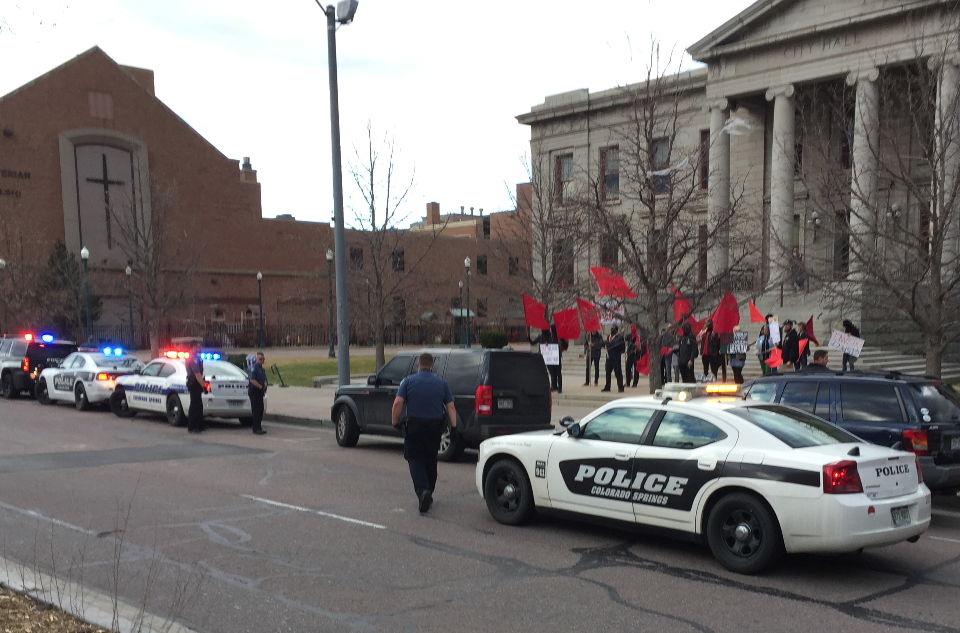
The first thing you see is the twenty or so protesters, clad in black, waving red flags, rallying on the steps of Colorado Springs City Hall. Speakers are railing against capitalism and imperialism. CSPD Officer Krueger comes upon this scene, among the reinforcements called, because fourteen of the protesters, mostly masked, were observed to have marched on the street.

(Marchers had followed Nevada to Bijou to Tejon to Colorado back to Nevada, trailed by the cruisers of CSPD Officers Mark Keller and Roberto Williamson. Returning to City Hall, participants were told by CSPD Sergeant Clayton Blackwell that they could protest on the sidewalk but would be ticketed if they stepped back into the street.)

As the rally goes on, the officers hear that orders have changed and everyone is going to be ticketed. On camera, Officer Keller relates a possible motive: “LT wants everyone identified.”

(Most of the protesters are masked. Arrests will give police the pretext to register everyone’s identity, whether the person walked in the street or not. By “LT”, Keller may be refering to Lieutenant Webber, who dispatched officers to the scene, or Lieutenant Mark Comte, in charge of CSPD intelligence.)

As officers discuss whether to rush the group or detain two or three protesters at a time, CSPD Sergeant Blackwell discloses to his men: “There’s two UCs in there, and they’ll just take a ticket like everybody else.” Blackwell adds, jokingly: “So hopefully we don’t have to start spraying ‘cause I don’t know which ones they are.”

Officer Keller tells Krueger and Canaan he thinks one of the protesters is concealing a knife. He fingers a masked protester wearing a Carhartt jacket.

CSPD Officer Dustin Canaan knew nothing about the undercover scheme.Though Krueger and his partner, CSPD Officer Dustin Canaan, were informed about undercovers, they don’t know that they are being tasked with arresting one.

Officers Krueger and Canaan are formally instructed that when the move is made to issue citations to the protesters, they are to apprehend “Carhartt”.

In fact, the first planned arrestee of March 26 is “Carhartt”. Aka the sheriff’s undercover.

Officers encircle the rally as Sergeants Ingram and Blackwell tell the socialists that “Everyone is getting a ticket!”

When the officers confront “Carhartt” he loudly abuses them with expletives proclaiming his innocence. He does this to incite fellow protesters to resist the police effort to detain him. Everybody else however is either walking swiftly away or calmly accepting their citations for Pedestrian-in-the-Roadway and Failure-to-Disperse.

City police unknowingly encircle sheriffs undercovers

Officers Krueger and Canaan ask “Carhartt” whether he has a weapon. The suspect responds with a strange command, voiced between clenched teeth: “Pat me down at the car.”

CSPD Office Krueger escorts detainee Mark JacksonThey don’t hear his response and so repeat their question. “Carhartt” sticks to his odd refrain: “Pat me down at the car!”

Krueger and Canaan walk “Carhartt” to their cruiser where he admits he has a weapon, a “M&P Shield 9mm”. He alerts the officers that his gun is tucked into his front waistline, with the safety off. In his pocket the officers find an additional magazine clip.

(Let us reflect for a moment, that only Officer Keller knew about this undercover. Imagine if events had escalated and any of the other dozens of police officers had caught a glimpse of the undercover’s gun. What kind of trigger-happy confrontation could have resulted with the socialist marchers caught in the middle? We might also wonder what Carhartt intended to do with two magazines full of bullets.)

Officer Canaan unloads the 9mm, removes the bullet from the chamber, and places everything on the front seat.

Sheriffs undercover Mark Jackson concealed a loaded 9mm

The officers ask “Carhartt” whether he wants to be cited and released on the spot, or taken to be booked at the station? The detainee responds he wants to go wherever the other arrestees are being processed.

Asked whether he has a concealed carry permit “Carhartt” replies no.

It occurs to the officers that they can’t catch and release someone, however cooperative, if they’ve apprehended you carrying a concealed weapon without a permit.

Officer Krueger leaves to consult his supervisor Sergeant Blackwell about this arrestee who is carrying a gun without a permit.

Blackwell asks Krueger: “Is he one of our UCs?” He explains again: “We have two UCs. Do you recognize him?”

Krueger says no.

Blackwell comes to the cruiser to see for himself.

Sergeant Clayton Blackwell and Officer Dustin Canaan look at their unfamiliar detainee.

Blackwell doesn’t recognize the detainee either.

As Sergeant Blackwell walks away from the cruiser, he tells Krueger the suspect is not one of their UCs, then he ponders: “…unless he’s with the sheriff’s office?”

The suspect gives his name as Mark Jackson, d.o.b. 7/20/75, last digits of SS# 1033, phone number (281) 606-0532. All of which is probably phony.

Undercover Amy Walter speaks with an Eastern European accent.His partner “Amy Walter” has been sitting nearby on the curb. She didn’t flee like the other participants, but oddly, was neither cited nor unmasked like all those who remained.

(“Amy Walter” kept her cover for months after the arrests. She claimed to drive up from Pueblo and only appeared fully bloc’d up. She’s gregarious and eager, and speaks with an Eastern European accent.)

Jackson remains detained in the back seat. After a few minutes CSPD Officer Mark Keller comes to the window to look at the suspect. He walks off camera, probably to tell Sergeant Blackwell that he can confirm the detainee is indeed an undercover.

Blackwell returns shortly to the cruiser to tell Krueger “We’re good.” Lowering his voice, he adds: “He’s UC.”

After some thought, Krueger turns to Jackson and asks in a whisper: ”Are you with the Sheriffs?” The undercover answers in the affirmative.

Krueger turns off his body-cam.

2. Canaan-cam
The body-cam worn by Krueger’s partner, Officer Canaan, has all the while recorded the same sequence of events, but he wasn’t paying attention to the whispers, so his camera continues to record.

Officer Keller walks back to the cruiser, this time to tease the undercover. Keller leans in and jokes about the arrest he arranged by pretending to suspect that Jackson had a knife.

Keller begins: “You really should hang out with a better crowd.”

Mocks Jackson: “I know. ‘Fuck the Police’. Ha ha.”

Keller goes on: “Hey, youse in the street, I figured you should get a ticket like everybody else.”

The undercover then says: “That’s why I yelled ‘COME FUCKING ARREST ME!’”

The two then discuss whether the undercover’s female partner should also be ticketed. Jackson theorizes that one ticket is enough.

Meanwhile an unspoken decision is made not to carry through with Jackson’s citation. This disturbs the undercover. He asks “How will it look when I don’t get a ticket?”


As Officer Mark Keller leaves the conversation at the cruiser, he looks directly at Canaan’s body-cam.

Undercover Jackson then notices that Officer Canaan did not grasp the development. He tells Krueger “You better tell your partner what’s going on.” Canaan turns off the audio on his body-cam.

ANALYSIS
To recap. Sergeant Blackwell revealed that the city had two UCs planted in the Socialist march. Officer Keller knew of the undercover Sheriff’s deputies “Jackson” and “Walter”. An effort was orchestrated to give a citation to “Jackson” but that plan was aborted. Wouldn’t it be interesting to know why?

Jackson’s detainment did not generate officer reports from either Krueger or Canaan, but the alias “Mark Jackson” was listed in three places. 1) on the March 26 police blotter, 2) in the radio log as “Mark Jackson in custody”, and 3) mentioned in passing in the report filed by Officer Roberto Williamson.

For three weeks “Mark Jackson” continued to infiltrate the socialist group, participating in several counterprotests, until everyone gave him the cold shoulder. His partner “Amy Walter” continues to contact group members.

The infiltration operation is extraordinary when you consider that the “Colorado Springs Socialists” essentially comprises the UCCS Socialist Discussion Group, a year-old student club chartered at the school. Though the students sometimes conceal themselves bandanas and hoodies when they attend social justice protests, they’ve committed zero acts of rioting, violence, or property destruction.

Once the video files had been released to the March 26 defendants, city prosecutors fought tooth and nail to quash the defendants’ subpoenas to the officers involved. The judge refused to review the body-cam footage, explaining that the El Paso Sheriffs Office had the discretion to refuse to provide further information.

Defendants insisted the prosecution was obligated to produce all the witnesses it knew to be on the scene of the alleged offenses, whether the witnesses were uniformed police or undercover. But the court won’t concede that the undercover operation merits looking into. The city stresses the importance of detectives being able to remain undercover to monitor ongoing crimes, in this case, jaywalking. The defendants are charged with obstruction and failure to disperse. If those are the crimes worth embedding undercovers, then the officers ought to be summoned to the trial to testify and secure convictions.

The defendants risked just that by insisting that the undercovers come forward as witnesses, but that risk was worth what the defendants were really after. What were those undercovers doing at the rally and at the march? Were they leading marchers into the street? Were undercovers taunting the cops as a demonstration that the protesters heard police orders to get off the street. Most marchers did not hear any orders, nor see police do much other than block traffic for their procession, contrary to the tone set by undercover Mark Jackson’s “COME FUCKING ARREST ME”. To prove the charge of Failure to Disperse” the prosecution has to prove that the accused wilfully defied the police. Jackson’s words seem meant to stand in for that proof.

Likewise, was Jackson’s belligerant response to police trying to arrest him meant to spark more resistance? Very often, riot cops target their own infiltrators who know to act outraged and resistive so that the crowd responds protectively. Jackson was clearly trying to do that.

Most of all, defendants wanted to get to the bottom of CSPD’s complicated operation to set their undercovers up to “take a ticket like everybody else.” How many officer were involved, and why didn’t officers recognize each other? Are the undercovers in fact with the El Paso Sheriffs Office or are they intelligence contractors or government agents? Who was coordinating this infiltration operation and who decided to call off issuing the ticket?

Who above all, thought they needed to insert an armed undercover, or two, possibly four, in the midst of a peaceful anti-imperialism march? Could a socialist group’s reckless co-opting of city streets warrant an undercover team’s reckless endangerment of unsuspecting activists surounded by very likley PTSD-addled police officers?

Jackson’s jittery behavior while detained in the back of the police cruiser hardly gives you confidence that even he should be trusted to wield a gun.

APPENDIX
The Krueger and Canaan body cam videos are circulating online. We’ll link to them as we locate stable copies. Below is an index of the events described above.

On the KRUEGER body-cam:

[0:45] Officer Mark Keller: “L.T. wants everyone identified.”

[3:05] Sergeant Clayton Blackwell: “There’s two UCs in there, and they’ll just take a ticket like everybody else. So hopefully we don’t have to start spraying ‘cause I don’t know which ones they are.”

[3:50] Off-camera officer: “Guy in the Carhartt [jacket] has a knife in his pocket.”

[9:00] Officers Krueger and Canaan discuss orders to arrest “Carhartt” suspected of carrying a knife.

[14:02] Sergeant John Ingram shouts: “Everyone is going to get a ticket!”

[15:20] Krueger and Canaan contact “Carhartt” who responds in a hostile and provocative manner. Unlike the other arrestees who are fully cooperative, he objects with loud profanity and derision.

[18:05] Krueger and Canaan discover “Carhartt” is armed with a 9mm handgun, tucked in his front waistband, and no concealed carry permit.

[20:04] Suspect gives his name as “Mark Jackson, d.o.b. 7/20/75”, and asks: “How do you know I was in the street?” Officer Canaan replies “An officer pointed you out. He’s been watching you the whole time.”

[23:38] Krueger consults Sgt. Blackwell who determines that “Jackson” is not one of their two UCs embedded in the march.

[28:56] Off camera Sgt. Blackwell tells Krueger “He’s U.C.”

[29:20] “Mark Jackson” admits he is with Sheriff’s Office.

[29:50] Krueger turns off body-cam.

On the CANAAN body-cam:

[16:41] Officer Dustin Canaan unloads the detainee’s “M&P Shield 9mm” and places gun, magazines, and extra bullet on front seat.

[22:02] Officer Mark Keller approaches cruiser to take a look at the detainee’s face.

[24:52] Sergeant Blackwell taps on cruiser window, says “We’re good.” Whispers to Krueger (inaudible, but it’s on the Krueger cam where we hear: “He’s UC”)

[25:03] Officer Keller returns to cruiser to joke with “Mark Jackson” about having arranged his fake arrest. Says Keller: “Hey, you’se in the street, I figured you should get a ticket like everybody else.” To which Jackson replies: “That’s why I said ‘Come fucking arrest me!’”

[25:25] Keller discusses with Jackson whether or not to ticket his female partner.

[26:27] Canaan turns off the audio of his body-cam.

Colo. Springs police disperse March 26 anti-imperialism rally because it was easier than listening to socialists

Colorado Springs Socialists
COLORADO SPRINGS, CO- Local socialists assembled at City Hall on Sunday to “March Against Imperialism”. After a brief march and an half-hour rally while encircled by CSPD, the socialists were informed they were “free to carry on with their assembly” but whoever lingered would be issued a citation for having been in the street. Making no distinction for who had and who hadn’t, the police began handcuffing participants and the couple dozen others quickly dispersed. Five socialists were issued citations for “pedestrian in the highway” and “failure to disperse” while another was arrested and detained for failing to show an ID while filming the police. That person was taken to the downtown police station and held until officers finally informed her of the charges for which she was being cited, after which she identified herself. Throughout her detainment, multiple officers kept up a harassment of questions, refusing her requests that she contact her lawyer. CSPD never issued an order to disperse, a fact that is borne out by witness video. But in effect that is what the officers accomplished. They threatened the legal assembly with citations, for failure to disperse!

CSPD cruiser gunboat diplomacy

It made a funny scene. Around thirty self-declared socialists, blockaded by eight sometimes more CSPD cruisers, in a standoff that lasted until the police lost their patience. Socialists spoke against imperialism, the police officers being their main audience that quiet Sunday downtown. Immediately as the march had ended the police had announced that anyone stepping back into the street would be arrested, and so no one did. But a half-hour of speeches proved too much for the officers to bear and so they interjected again, this time to discuss the problem they had with what had happened earlier. We told those officers they were of course free to discuss such matters individually with whoever they considered a person of interest, BUT AFTERWARD, because they were otherwise interrupting our legal assembly. But the officers persisted in their interruption, deciding after the fact what charges to bring, regardless that they’d forgotten to provide the evidence to back them up. “See you in court” they laughed! We’ve heard that before.

On a serious note. What happened Sunday could have a chilling effect on the nascent kick-ass Colorado Springs Socialists. Unwarranted police attention is an unhappy tradition for socialist organizers, from anarchists to trade unions. Sunday’s denouement confirms all their parents’ worst worries, the folly of declaring yourself to be a socialist in a regressive backwater like Colorado Springs. People were arrested? Handcuffed?! Now you’re on a police watch list! I remember my father’s alarm when he learned his college sophmore had a subscription to Mother Jones Magazine.

Fun as it was, Sunday’s event was essentially uneventful: no altercations, no property damage, not even rhetoric to threaten infrastructure. Minus any media attention, or much of an audience at all on a sleepy Sunday evening, these socialists were determined to parade their dissent where and how those around could see, and reaped more law enforcement than the circumstances required.

While you might say the outcome was predictable, it needn’t have been. Students from the wealthier Colorado College have free range on downtown streets, protesting racism or election outcomes on the street without arrests or citations. Every full moon CC students ride the length of downtown’s main street on bike, skate or skateboard, without even police escort. Sunday’s fledgeling socialist organization is a student club of the UCCS campus. UCCS is more working class, for many a commuter campus, and obviously isn’t shown any deference by city administrators.

Compared to the liberal arts curriculum of Colorado College. UCCS is considered more conservative. UCCS hosts business and military related classes. It even has a Brazil-esque Department of Homeland Security -um- Department. So I think it’s all the more admirable that UCCS has spawned a bonafide socialist group that dwarfs even their school’s Young Republican franchise. I’ve no doubt those socialists I met on Sunday will not be cowed by CSPD’s preemptive aggressions. Hopefully their more timid members will take heart.

Public protests are regularly given use of the streets, which like parks are considered traditional free speech zones. The Tea Party and Occupy took to the streets of Colorado Springs without incurring arrests. More recently people have marched for Black Lives Matter and for solidarity with Native Americans fighting oil pipelines. These have produced zero arrests.

In the meantime it will be important to debrief on what happened and unify the legal strategies. All defendants face the traffic offense of being a pedestrian on the highway [sic] and the misdemeanor of failure to disperse, no doubt tacked on to be a droppable charge as fodder for plea bargains. The recalcitrant videographer faces an added charge of misdemeanor interference for failing to produce her ID. They give her no extra credit for providing a pretext for interrogation because she wouldn’t say zilch without a lawyer present, except to explain where and when they were violating her rights. It used to be that cops had to read us our rights.

Police can issue all the tickets they want when there’s probable cause. They can’t threaten to issue tickets for the solitary purpose of disbanding a legal assembly. In the end, the only socialists who got citations were punished not for being in the street but for standing their ground in front of City Hall.

Colo. US District Court judge enjoins DIA to limit restriction of free speech (grants our preliminary injunction!)

Plaintiffs Nazli McDonnell and Eric Verlo
DENVER, COLORADO- If your civil liberties have ever been violated by a cop, over your objections, only to have the officer say “See you in court”, this victory is for YOU! On January 29 we were threatened with arrest for protesting the “Muslim Ban” at Denver International Airport. We argued that our conduct was protected speech and that they were violating our rights. They dismissed our complaints with, in essense: “That’s for a court to decide.” And today IT HAS! On Feb 15 we summoned the cops to federal court and this morning, Feb 22, US District Court Judge William Martinez granted our preliminary injunction, severely triming DIA’s protest permit process. In a nutshell: no restrictions on signs, size of assemblies or their location within the main terminal (so long as the airport’s function is not impeded). Permits are still required but with 24 hours advance notice, not seven days. Below is Judge Martinez’ 46-page court order in full:

Document 29 Filed 02/22/17 USDC Colorado

IN THE UNITED STATES DISTRICT COURT
FOR THE DISTRICT OF COLORADO

Judge William J. Martínez

Civil Action No. 17-cv-0332-WJM-MJW

NAZLI MCDONNELL, and
ERIC VERLO,

Plaintiffs,

v.

CITY AND COUNTY OF DENVER,?
DENVER POLICE COMMANDER ANTONIO LOPEZ,
in his individual and official capacity, and?
DENVER POLICE SERGEANT VIRGINIA QUIÑONES,
in her individual and official capacity,

Defendants.

________________________________________________________

ORDER GRANTING PRELIMINARY INJUNCTION IN PART
________________________________________________________

Plaintiffs Nazli McDonnell (“McDonnell”) and Eric Verlo (“Verlo”) (together, “Plaintiffs”) sue the City and County of Denver (“Denver”), Denver Police Commander Antonio Lopez (“Lopez”) and Denver Police Sergeant Virginia Quiñones (“Quiñones”) (collectively, “Defendants”) for allegedly violating Plaintiffs’ First and Fourteenth Amendment rights when they prevented Plaintiffs from protesting without a permit in the Jeppesen Terminal at Denver International Airport (“Airport” or “Denver Airport”). (ECF No. 1.) Currently before the Court is Plaintiffs’ Motion for Preliminary Injunction, which seeks to enjoin Denver from enforcing some of its policies regarding demonstrations and protests at the Airport. (ECF No. 2.) This motion has been fully briefed (see ECF Nos. 2, 20, 21, 23) and the Court held an evidentiary hearing on February 15, 2017 (“Preliminary Injunction Hearing”).

For the reasons explained below, Plaintiffs’ Motion is granted to the following limited extent:

• Defendants must issue an expressive activity permit on twenty-four hours’ notice in circumstances where an applicant, in good faith, seeks a permit for the purpose of communicating topical ideas reasonably relevant to the purposes and mission of the Airport, the immediate importance of which could not have been foreseen seven days or more in advance of the commencement of the activity for which the permit is sought, or when circumstances beyond the control of the permit applicant prevented timely filing of the application; ?

• Defendants must make all reasonable efforts to accommodate the applicant’s preferred demonstration location, whether inside or outside of the Jeppesen Terminal, so long as the location is a place where the unticketed public is normally allowed to be; ?

• Defendants may not enforce Denver Airport Regulation 50.09’s prohibition against “picketing” (as that term is defined in Denver Airport Regulation 50.02-8) within the Jeppesen Terminal; and ?

• Defendants may not restrict the size of a permit applicant’s proposed signage beyond that which may be reasonably required to prevent the impeding of the normal flow of travelers and visitors in and out of Jeppesen Terminal; and specifically, Defendants may not enforce Denver Airport Regulation 50.08-12’s requirement that signs or placards be no larger than one foot by one foot. ??

Any relief Plaintiffs seek beyond the foregoing is denied at this phase of the case. In particular, the Court will not require the Airport to accommodate truly spontaneous demonstrations (although the Airport remains free to do so); the Court will not require the Airport to allow demonstrators to unilaterally determine the location within the Jeppesen Terminal that they wish to demonstrate; and the Court will not strike down the Airport’s usual seven-day notice-and-permit requirement as unconstitutional in all circumstances.

I. FINDINGS OF FACT

Based on the parties’ filings, and on the documentary and testimonial evidence received at the evidentiary hearing, the Court makes the following findings of fact for purposes of resolving Plaintiffs’ Motion.?

A. Regulation 50

Pursuant to Denver Municipal Code § 5-16(a), Denver’s manager of aviation may “adopt rules and regulations for the management, operation and control of [the] Denver Municipal Airport System, and for the use and occupancy, management, control, operation, care, repair and maintenance of all structures and facilities thereon, and all land on which [the] Denver Municipal Airport System is located and operated.” Under that authority, the manager of aviation has adopted “Rules and Regulations for the Management, Operation, Control, and Use of the Denver Municipal Airport System.” See https://www.flydenver.com/about/administration/rules_regulations (last accessed Feb. 16, 2017). Part 50 of those rules and regulations governs picketing, protesting, soliciting, and similar activities at the Airport. See https://www.flydenver.com/sites/default/files/rules/50_leafleting.pdf (last accessed Feb. 16, 2017). The Court will refer to Part 50 collectively as “Regulation 50.”

The following subdivisions of Regulation 50 are relevant to the parties’ current dispute:

Regulation 50.03: “No person or organization shall leaflet, conduct surveys, display signs, gather signatures, solicit funds, or engage in other speech related activity at Denver International Airport for religious, charitable, or political purposes, or in connection with a labor dispute, except pursuant to, and in compliance with, a permit for such activity issued by the CEO [of the Airport] or his or her designee. . . .” ?

Regulation 50.04-1: “Any person or organization desiring to leaflet, display signs, gather signatures, solicit funds, or engage in other speech related activity at Denver International Airport for religious, charitable, or political purposes, or in connection with a labor dispute, shall complete a permit application and submit it during regular business hours, at least seven (7) days prior to the commencement of the activity for which the permit is sought and no earlier than thirty (30) days prior to commencement of the activity. The permit application shall be submitted using the form provided by the Airport. The applicant shall provide the name and address of the person in charge of the activity, the names of the persons engaged in the activity, the nature of the activity, each location at which the activity is proposed to be conducted, the purpose of the activity, the hours during which the activity is proposed to be conducted, and the beginning and end dates of such activity. A labor organization shall also identify the employer who is the target of the proposed activity.”

Regulation 50.04-3: “Upon presentation of a complete permit application ?and all required documentation, the CEO shall issue a permit to the applicant, if there is space available in the Terminal, applying only the limitations and regulations set forth in this Rule and Regulation . . . . Permits shall be issued on a first come-first served basis. No permits shall be issued by the CEO for a period of time in excess of thirty-one (31) days.” ?

Regulation 50.04-5: “In issuing permits or allocating space, the CEO shall not exercise any discretion or judgment regarding the purpose or content of the proposed activity, except as provided in these Rules and Regulations. The issuance of a permit is a strictly ministerial function and does not constitute an endorsement by the City and County of Denver of any organization, cause, religion, political issue, or other matter.” ?

Regulation 50.04-6: “The CEO may move expressive activity from one location to another and/or disperse such activity around the airport upon reasonable notice to each affected person when in the judgment of the CEO such action is necessary for the efficient and effective operation of the transportation function of the airport.” ?

Regulation 50.08-12: “Individuals and organizations engaged in leafleting, solicitation, picketing, or other speech related activity shall not: * * * [w]ear or carry a sign or placard larger than one foot by one foot in size . . . .” (underscoring in original).

Regulation 50.09: “Picketing not related to a labor dispute is prohibited in ?all interior areas of the Terminal and concourses, in the Restricted Area, and on all vehicular roadways, and shall not be conducted by more than two (2) persons at any one location upon the Airport.” ?

Regulation 50.02-8: “Picketing shall mean one or more persons marching or stationing themselves in an area in order to communicate their position on a political, charitable, or religious issue, or a labor dispute, by displaying one or more signs, posters or similar devices” (underscoring in original).

The Airport receives about forty-five permit requests a year. No witness at the Preliminary Injunction Hearing (including Airport administrators who directly or indirectly supervise the permit process) could remember an instance in which a permit had been denied.

?Although there is no formal written, prescribed procedure for requesting expedited treatment of permit requests, the Airport not infrequently processes such requests and issues permits in less than seven days. Last November, less than seven days before Election Day, the Airport received a request from “the International Machinists” 1 to stage a demonstration ahead of the election. The Airport was able to process that request in two days and thereby permit the demonstration before Election Day.
?
——————————
1 Presumably, the International Association of Machinists and Aerospace Workers. ?
———————

B. The Executive Order

On Friday, January 27, 2017, President Trump signed Executive Order 13769 (“Executive Order”). See 82 Fed. Reg. 8977. The Executive Order, among other things, established a 90-day ban on individuals from seven Muslim-majority countries from entering the United States, a 120-day suspension of all refugee admissions, and an indefinite suspension of refugee admissions from Syria. Id. §§ 3(c), 5(a), 5(c). “The impact of the Executive Order was immediate and widespread. It was reported that thousands of visas were immediately canceled, hundreds of travelers with such visas were prevented from boarding airplanes bound for the United States or denied entry on arrival, and some travelers were detained.” Washington v. Trump, ___ F.3d. ___, ___, 2017 WL 526497, at *2 (9th Cir. Feb. 9, 2017). As is well known, demonstrators and attorneys quickly began to assemble at certain American airports, both to protest the Executive Order and potentially to offer assistance to travelers being detained upon arrival.?

C. The January 28 Protest at the Denver Airport

Shortly after 1:00 p.m. on the following day—Saturday, January 28, 2017— Airport public information officer Heath Montgomery e-mailed Defendant Lopez, the police commander responsible for Denver’s police district encompassing the Airport. Lopez was off-duty at the time. Montgomery informed Lopez that he had received media inquiries about a protest being planned for the Airport later that day, and that no Regulation 50 permit had been issued for such a protest.

Not knowing any details about the nature or potential size of the protest, and fearing the possibility of “black bloc” and so-called “anarchist activities,” Lopez coordinated with other Denver Police officials to redeploy Denver Police’s gang unit from their normal assignments to the Airport. Denver Police also took uniformed officers out of each of the various other police districts and redeployed them to the Airport. Lopez called for these reinforcements immediately in light of the Airport’s significant distance from any other police station or normal patrol area. Lopez knew that if an unsafe situation developed, he could not rely on additional officers being able to get to the Airport quickly.

Through his efforts, Lopez was eventually able to assemble a force of about fifty officers over “the footprint of the entire airport,” meaning inclusive of all officers already assigned to the Airport who remained on their normal patrol duties. Lopez himself also came out to the Airport.

In the meantime, Montgomery had somehow learned of an organization known as the Colorado Muslim Connection that was organizing protesters through Facebook. Montgomery reached out to this organization through the Airport’s own Facebook account and informed them of Regulation 50’s permit requirement. (Ex. 32.) One of the Colorado Muslim Connection’s principals, Nadeen Ibrahim, then e-mailed Montgomery “to address the permit.” (Ex. 30.) Ibrahim told Montgomery:

The group of people we have will have a peaceful assembly carrying signs saying welcome here along with a choir and lots of flowers. Our goal is to stand in solidarity with our community members that have been detained at the airports since the signing of the executive order, though they do have active, legal visas/green cards. Additionally, we would like to show our physical welcoming presence for any newly arriving Middle Eastern sisters and brothers with visas. We do not intend to block any access to [the Airport].

(Id.) Montgomery apparently did not construe this e-mail as a permit request, or at least not a properly prepared one, and stated that “Denver Police will not allow a protest at the airport tonight. We are willing to work with you like any other group but there is a formal process for that.” (Id.)

Nonetheless, protesters began to assemble in the late afternoon and early evening in the Airport’s Jeppesen Terminal, specifically in the multi-storied central area known as the “Great Hall.” The Great Hall is a very large, rectangular area that runs north and south. The lower level of the Great Hall (level 5) has an enormous amount of floor space, and is ringed with offices and some retail shops, but the floor space itself is largely taken up by security screening facilities for departing passengers. The only relatively unobstructed area on level 5 is the middle third, which is currently designed primarily as a location for “meeters-and-greeters,” i.e., individuals waiting for passengers arriving from domestic flights who come up from the underground train connecting the Jeppesen Terminal with the various concourses. There is a much smaller meeters-and-greeters waiting area at the north end of level 5, where international arrivals exit from customs screening.

The upper level of the Great Hall (level 6) has much less floor space than level 5 given that it is mostly open to level 5 below. It is ringed with retail shops and restaurants. At its north end is a pedestrian bridge to and from the “A” concourse and its separate security screening area.

Given this design, every arriving and departing passenger at the Airport (i.e., all passengers except those only connecting through Denver), and nearly every other person having business at the airport (including employees, delivery persons, meeters-and-greeters, etc.), must pass through some portion of the Great Hall. In 2016, the Airport served 58.3 million passengers, making it the sixth busiest airport in the United States and the eighteenth busiest in the world. Approximately 36,000 people also work at the airport.

The protesters who arrived on the evening of January 28 largely congregated in the middle third of the Great Hall (the domestic-arrivals meeter-and-greeter area). The protesters engaged in singing, chanting, praying, and holding up signs. At least one of them had a megaphone.

The size of the protest at its height is unclear. The witnesses at the evidentiary hearing gave varying estimates ranging from as low as 150 to as high as 1,000. Most estimates, however, centered in the range of about 200. Lopez, who believed that the protest eventually comprised about 300 individuals, did not believe that his fifty officers throughout the Airport were enough to ensure safety and security for that size of protest, even if he could pull all of his officers away from their normal duties.

Most of the details of the January 28 protest are not relevant for present purposes. Suffice it to say that Lopez eventually approached those who appeared to be the protest organizers and warned them multiple times that they could be arrested if they continued to protest without a permit. Airport administration later agreed to allow the protest to continue on “the plaza,” an area just outside the Jeppesen Terminal to its south, between the Terminal itself and the Westin Hotel. Protesters then moved to that location, and the protest dispersed later in the evening. No one was arrested and no illegal activity stemming from the protest (e.g., property damage) was reported, nor was there any report of disruption to travel operations or any impeding of the normal flow of travelers and visitors in and out of Jeppesen Terminal.

D. The January 29 Protest at the Denver Airport

Plaintiffs disagree strongly with the Executive Order and likewise wished to protest it, but, due to their schedules, were unable to participate in the January 28 protest. They decided instead to go to the Airport on the following day, Sunday, January 29. They came that afternoon and stationed themselves at a physical barrier just outside the international arrival doors at the north end of the Great Hall, level 5. They each held up a sign of roughly poster board size expressing a message of opposition to the Executive Order and solidarity with those affected by it. (See Exs. 2, 4, M.)

Plaintiffs were soon approached by Defendant Quiñones, who warned them that they could be arrested for demonstrating without a permit. Plaintiffs felt threatened, as well as disheartened that they could not freely exercise their First Amendment rights then and there. Plaintiffs felt it was important to be demonstrating both at that particular time, given the broad news coverage of the effects of the Executive Order, and at that particular place (the international arrivals area), given a desire to express solidarity with those arriving directly from international destinations—whom Plaintiffs apparently assumed would be most likely to be affected by the Executive Order in some way.

Plaintiffs left the Airport later that day without being arrested, and without incident. They have never returned to continue their protest, nor have they applied for a permit to do so.

E. Permits Since Issued

The airport has since issued permits to demonstrators opposed to the Executive Order. At least one of these permits includes permission for four people to demonstrate in the international arrivals area, where Plaintiffs demonstrated on January 29.

II. REQUESTED INJUNCTION

Plaintiffs have never proposed specific injunction language. In their Motion, they asked for “an injunction prohibiting their arrest for standing in peaceful protest within Jeppesen Terminal and invalidating Regulation 50 as violative of the First and Fourteenth Amendments to the United States Constitution.” (ECF No. 2 at 4.) At the Preliminary Injunction Hearing, Plaintiffs’ counsel asked the Court to enjoin Defendants (1) “from arresting people for engaging in behavior that the plaintiffs or people similarly situated were engaging in,” (2) from enforcing Regulation 50.09 (which forbids non- labor demonstrators from holding up signs within the Jeppesen Terminal), and (3) from administering Regulation 50 without an “exigent circumstances exception.” Counsel also argued that requiring a permit application seven days ahead of time is unconstitutionally long in any circumstance, exigent or not.

III. LEGAL STANDARD

A. The Various Standards

In a sense, there are at least three preliminary injunction standards. The first, typically-quoted standard requires: (1) a likelihood of success on the merits, (2) a threat of irreparable harm, which (3) outweighs any harm to the non-moving party, and (4) that the injunction would not adversely affect the public interest. See, e.g., Awad v. Ziriax, 670 F.3d 1111, 1125 (10th Cir. 2012).

If, however, the injunction will (1) alter the status quo, (2) mandate action by the defendant, or (3) afford the movant all the relief that it could recover at the conclusion of a full trial on the merits, a second standard comes into play, one in which the movant must meet a heightened burden. See O Centro Espirita Beneficiente Uniao do Vegetal v. Ashcroft, 389 F.3d 973, 975 (10th Cir. 2004) (en banc). Specifically, the proposed injunction “must be more closely scrutinized to assure that the exigencies of the case support the granting of a remedy that is extraordinary even in the normal course” and “a party seeking such an injunction must make a strong showing both with regard to the likelihood of success on the merits and with regard to the balance of harms.” Id.

On the other hand, the Tenth Circuit also approves of a

modified . . . preliminary injunction test when the moving party demonstrates that the [irreparable harm], [balance of harms], and [public interest] factors tip strongly in its favor. In such situations, the moving party may meet the requirement for showing [likelihood of] success on the merits by showing that questions going to the merits are so serious, substantial, difficult, and doubtful as to make the issue ripe for litigation and deserving of more deliberate investigation.

Verlo v. Martinez, 820 F.3d 1113, 1128 n.5 (10th Cir. 2016). This standard, in other words, permits a weaker showing on likelihood of success when the party’s showing on the other factors is strong. It is not clear how this standard would apply if the second standard also applies.

In any event, “a preliminary injunction is an extraordinary remedy,” and therefore “the right to relief must be clear and unequivocal.” Greater Yellowstone Coal. v. Flowers, 321 F.3d 1250, 1256 (10th Cir. 2003).

B. Does Any Modified Standard Apply?

The status quo for preliminary injunction purposes is “the last peaceable uncontested status existing between the parties before the dispute developed.” Schrier v. Univ. of Colo., 427 F.3d 1253, 1260 (10th Cir. 2005) (internal quotation marks omitted). By asking that portions of Regulation 50 be invalidated, Plaintiffs are seeking to change the status quo. Therefore they must make a stronger-than-usual showing on likelihood of success and the balance of harms.

IV. ANALYSIS

A. Irreparable Harm as it Relates to Standing

Under the circumstances, the Court finds it appropriate to begin by discussing the irreparable harm element of the preliminary injunction test as it relates Plaintiffs’ standing to seek an injunction.

Testimony at the Preliminary Injunction Hearing revealed that certain groups wishing to protest the Executive Order have since applied for and obtained permits. Thus, Plaintiffs could get a permit to demonstrate at the airport on seven days’ advance notice—although Regulation 50.09 would still prohibit them from demonstrating by wearing or holding up signs. In addition, as discussed in more detail below (Part IV.B.3.c), Plaintiffs could potentially get a permit to hold a protest parade on public streets in the City and County of Denver with as little as 24 hours’ notice. And as far as the Court is aware, the two Plaintiffs may be able to stand on any public street corner and hold up signs without any prior notice or permit requirement. Thus, Plaintiffs’ alleged irreparable harm must be one or both of the following: (1) the prospect of not being able to demonstrate specifically at the airport on less than seven days’ notice, or (2) the inability to picket in opposition to the government action they oppose—that is, the inability to hold up “signs, posters or similar devices” while engaging in expressive activity at the airport. The Court finds that the second of these options is a fairly traditional allegation of First Amendment injury—even if they do apply for and obtain a permit, by the express terms of Regulation 50.09 Plaintiffs will not be allowed to carry or hold up signs, posters, or the like. The first option, however, requires more extensive discussion and analysis.

The rapidly developing situation that prompted Plaintiffs to go to the Airport on January 29 has since somewhat subsided. The Executive Order remains a newsworthy topic, but a nationwide injunction now prevents its enforcement, see Washington, ___ F.3d at ___, 2017 WL 526497, at *9, and—to the Court’s knowledge—none of the most urgent effects that led to airport-based protests, such as individuals being detained upon arrival, have since repeated themselves. Nonetheless, the circumstances that prompted this lawsuit reveal a number of unassailable truths about “freedom of speech . . . [and] the right of the people peaceably to assemble, and to petition the government for a redress of grievances.” U.S. Const. amend. I.

One indisputable truth is that the location of expressive activity can have singular First Amendment significance, or as the Tenth Circuit has pithily put it: “Location, location, location. It is cherished by property owners and political demonstrators alike.” Pahls v. Thomas, 718 F.3d 1210, 1216 (10th Cir. 2013). The ability to convey a message to a particular person is crucial, and that ability often turns entirely on location.

Thus, location has specifically been at issue in a number of First Amendment decisions. See, e.g., McCullen v. Coakley, 134 S. Ct. 2518, 2535 (2014) (abortion protesters’ ability to approach abortion clinic patrons within a certain distance); Pahls, 718 F.3d at 1216–17 (protesters’ ability to be in a location where the President could see them as his motorcade drove past); Citizens for Peace in Space v. City of Colo. Springs, 477 F.3d 1212, 1218–19 (10th Cir. 2007) (peace activists’ ability to be near a hotel and conference center where a NATO conference was taking place); Tucker v. City of Fairfield, 398 F.3d 457, 460 (6th Cir. 2005) (labor protesters’ ability to demonstrate outside a car dealership); Friends of Animals, Inc. v. City of Bridgeport, 833 F. Supp. 2d 205, 207–08 (D. Conn. 2011) (animal rights protesters’ ability to protest near a circus), aff’d sub nom. Zalaski v. City of Bridgeport Police Dep’t, 475 F. App’x 805 (2d Cir. 2012).

Another paramount truth is that the timing of expressive activity can also have irreplaceable First Amendment value and significance: “simple delay may permanently vitiate the expressive content of a demonstration.” NAACP, W. Region v. City of Richmond, 743 F.2d 1346, 1356 (9th Cir. 1984); see also American-Arab Anti-Discrimination Comm. v. City of Dearborn, 418 F.3d 600, 605 (6th Cir. 2005) (“Any notice period is a substantial inhibition on speech.”); Church of Am. Knights of Ku Klux Klan v. City of Gary, 334 F.3d 676, 682 (7th Cir. 2003) (“given that . . . political demonstrations are often engendered by topical events, a very long period of advance notice with no exception for spontaneous demonstrations unreasonably limits free speech”); Douglas v. Brownell, 88 F.3d 1511, 1524 (8th Cir. 1996) (“The five-day notice requirement restricts a substantial amount of speech that does not interfere with the city’s asserted goals of protecting pedestrian and vehicle traffic, and minimizing inconvenience to the public.”).

This case provides an excellent example of this phenomena given that —whether intentionally or not— the President’s announcement of his Supreme Court nomination on January 31 (four days after signing the Executive Order) permitted the President to shift the media’s attention to a different topic of national significance. Thus, the inability of demonstrators to legally “strike while the iron’s hot” mattered greatly in this instance. Cf. City of Gary, 334 F.3d at 682 (in the context of a 45-day application period for a parade, noting that “[a] group that had wanted to hold a rally to protest the U.S. invasion of Iraq and had applied for a permit from the City of Gary on the first day of the war would have found that the war had ended before the demonstration was authorized”).

These principles are not absolute, however, nor self-applying. The Court must analyze them in the specific context of the Airport. But for present purposes, the Court notes that the Plaintiffs’ alleged harm of being unable to protest at a specific location on short notice states a cognizable First Amendment claim. In addition, by its very nature, this is the sort of claim that is “capable of repetition, yet evading review.” S. Pac. Terminal Co. v. Interstate Commerce Comm’n, 219 U.S. 498, 515 (1911). Here, “the challenged action”—enforcement of the seven-day permit requirement during an event of rapidly developing significance —“was in its duration too short to be fully litigated prior to its cessation or expiration.” Weinstein v. Bradford, 423 U.S. 147, 149 (1975). Further, “there [is] a reasonable expectation that the same complaining party would be subjected to the same action again.” Id. More specifically, the Court credits Plaintiffs’ testimony that they intend to return to the Airport for future protests, and, given continuing comments by the Trump Administration that new immigration and travel- related executive orders are forthcoming, the Court agrees with Plaintiffs that it is reasonably likely a similar situation will recur —i.e., government action rapidly creating consequences relevant specifically to the Airport.

Thus, although the prospect of being unable to demonstrate at the Airport on short notice is not, literally speaking, an “irreparable harm” (because the need for such demonstration may never arise again), it is nonetheless a sufficient harm for purposes of standing and seeking a preliminary injunction.

The Court now turns to the heart of this case—whether Plaintiffs are likely to succeed on the merits of their claims. Following that, the Court will reprise the irreparable harm analysis in the specific context of the likelihood-of-success findings.

B. Likelihood of Success on the Merits

Evaluating likelihood of success requires evaluating the substantive merit of Plaintiffs’ claim that Regulation 50, or any portion of it, violates their First Amendment rights. To answer this question, the Supreme Court prescribes the following analysis:

1. Is the expression at issue protected by the First Amendment? ?

2. If so, is the location at issue a traditional public forum, a designated public ?forum, or a nonpublic forum? ?

3. If the location is a traditional or designated public forum, is the ?government’s speech restriction narrowly tailored to meet a compelling ?state interest? ?

4. If the location is a nonpublic forum, is the government’s speech restriction ? ?reasonable in light of the purpose served by the forum, and viewpoint neutral?

See Cornelius v. NAACP Legal Def. & Educ. Fund, Inc., 473 U.S. 788, 797–806 (1985).

The Court will address these inquiries in turn.

1. Does the First Amendment Protect Plaintiffs’ Expressive Conduct?

The Court “must first decide whether [the speech at issue] is speech protected by the First Amendment, for, if it is not, we need go no further.” Id. at 797. There appears to be no contest that the sorts of activities Plaintiffs attempted to engage in at the Airport (including holding up signs) are expressive endeavors protected by the First Amendment. Accordingly, the Court deems it conceded for preliminary injunction purposes that Plaintiffs are likely to succeed on this element of the Cornelius analysis.

2. Is the Jeppesen Terminal a Public Forum (Traditional or Designated)?

The Court must next decide whether the Jeppesen Terminal is a public forum:

. . . the extent to which the Government can control access [to government property for expressive purposes] depends on the nature of the relevant forum. Because a principal purpose of traditional public fora is the free exchange of ideas, speakers can be excluded from a public forum only when the exclusion is necessary to serve a compelling state interest and the exclusion is narrowly drawn to achieve that interest. Similarly, when the Government has intentionally designated a place or means of communication as a public forum[,] speakers cannot be excluded without a compelling governmental interest. Access to a nonpublic forum, however, can be restricted as long as the restrictions are reasonable and are not an effort to suppress expression merely because public officials oppose the speaker’s view.

Id. at 800 (citations and internal quotation marks omitted; alterations incorporated).

a. Is the Jeppesen Terminal a Traditional Public Forum??

Plaintiffs claim that “[t]he Supreme Court has not definitively decided whether airport terminals . . . are public forums.” (ECF No. 2 at 7.) This is either an intentional misstatement or a difficult-to-understand misreading of the most relevant case (which Plaintiffs repeatedly cite), International Society for Krishna Consciousness, Inc. v. Lee, 505 U.S. 672, 679 (1992) (“Lee”).

The plaintiffs in Lee were disseminating religious literature and soliciting funds at the airports controlled by the Port Authority of New York and New Jersey (JFK, LaGuardia, and Newark). Id. at 674–75. By regulation, however, the Port Authority prohibited “continuous or repetitive” person-to-person solicitation and distribution of literature. Id. at 675–76. The Second Circuit held that the airports were not public fora and that the regulation was reasonable as to solicitation but not as to distribution. Id. at 677. The dispute then went to the Supreme Court, which granted certiorari specifically “to resolve whether airport terminals are public fora,” among other questions. Id.

The Court answered the public forum question in the negative. Relying on the historical use of airport terminals generally, the Court found that “the tradition of airport activity does not demonstrate that airports have historically been made available for speech activity.” Id. at 680. “Nor can we say,” the Court continued, “that these particular terminals, or airport terminals generally, have been intentionally opened by their operators to such activity; the frequent and continuing litigation evidencing the operators’ objections belies any such claim.” Id. at 680–81. Then, invoking the reasonableness test that applies to government regulation of nonpublic fora, the Court affirmed the Second Circuit’s holding that the solicitation ban was reasonable. Id. at 683–85.

Five justices (Rehnquist, White, O’Connor, Scalia, and Thomas) joined all of the major rulings regarding the solicitation ban, including the nonpublic forum status of airport terminals and the reasonableness of the ban. The outcome regarding the distribution ban, however, commanded no majority opinion. Justice O’Connor, applying the reasonableness standard for nonpublic fora, agreed with the Second Circuit that the distribution ban was not reasonable. Id. at 690–93 (opn. of O’Connor, J.). Justice Kennedy, joined in relevant part by Justices Blackmun, Stevens, and Souter, agreed that the Second Circuit’s judgment regarding the distribution ban should be affirmed, but on different grounds, namely, under a strict scrutiny test (because these justices believed that the airport terminals should be deemed a public forum). Id. at 708–10 (opn. of Kennedy, J.). The result was that the Second Circuit’s invalidation of the distribution ban was affirmed without any opinion commanding a majority view.

Regardless of the outcome with respect to the distribution ban, it is beyond debate that five Supreme Court justices in Lee agreed that airport terminals are not public fora. Id. at 680–81. The Tenth Circuit has acknowledged this holding. Mocek v. City of Albuquerque, 813 F.3d 912, 930 (10th Cir. 2015) (“As an initial matter, an airport is a nonpublic forum, where restrictions on expressive activity need only ‘satisfy a requirement of reasonableness.’” (quoting Lee, 505 U.S. at 683)). Notably, Plaintiffs have cited no case in which any court anywhere has deemed an airport to be a public forum.

b. Is the Jeppesen Terminal a Designated Public Forum??

Even though the Jeppesen Terminal is not a traditional public forum, Denver could still designate it as a public forum if Denver “intentionally [opens the Jeppesen Terminal] for public discourse.” Cornelius, 473 U.S. at 802. Denver denies that it has done so, and Plaintiffs’ arguments to the contrary lack merit.

i. Terminal Visitors’ Incidental Expressive Activities

Plaintiffs argue that visitors to the Jeppesen Terminal “engage in First Amendment activity; they wear buttons, shirts, and hats that convey distinct messages to other visitors. They engage in one-on-one conversations.” (ECF No. 21 at 3.) Thus, Plaintiffs say, Denver has designated a public forum within the Jeppesen Terminal.

The Tenth Circuit has already foreclosed this argument. Addressing the public forum status of the Denver Performing Arts Complex, the Court stated the following: “Even if Denver allowed patrons to wear political buttons or shirts with slogans, this would not be sufficient to establish a designated public forum. The First Amendment does not require the government to impose a ‘zone of silence’ on its property to maintain its character as a nonpublic forum.” Hawkins v. City & Cnty. of Denver, 170 F.3d 1281, 1288 (10th Cir. 1999).

Indeed, even if it wanted to, Denver almost certainly could not impose such a “zone of silence,” as illustrated by Board of Airport Commissioners of City of Los Angeles v. Jews for Jesus, Inc., 482 U.S. 569 (1987). There, the Los Angeles airport authority adopted a resolution announcing that “the Central Terminal Area at Los Angeles International Airport [LAX] is not open for First Amendment activities.” Id. at 570–71 (internal quotation marks omitted). The Supreme Court found that this provision did not “merely reach the activity of [the religious proselytizers who challenged it],” but also prohibited

even talking and reading, or the wearing of campaign buttons or symbolic clothing. Under such a sweeping ban, virtually every individual who enters LAX may be found to violate the resolution by engaging in some “First Amendment activit[y].” We think it obvious that such a ban cannot be justified even if LAX were a nonpublic forum because no conceivable governmental interest would justify such an absolute prohibition of speech.

Id. at 574–75. Thus, the evidence at the Preliminary Injunction Hearing established beyond any possible dispute that Denver has shown no intent to designate the Airport as a public forum by allowing speech at that location which it may not disallow in the first instance.

ii. The Effect of Regulation 50 Itself?

Plaintiffs further argue, “Regulation 50 states that free speech activity is proper in the Jeppesen Terminal (pursuant to a restriction). Denver has [thus] designated the Jeppesen Terminal a public forum for leafleting, conducting surveys, displaying signs, gathering signatures, soliciting funds, and other speech related activity for religious, charitable, or political purposes.” (ECF No. 21 at 3–4.) Although clever, this argument cannot be correct. 2

First, the Airport knows from the Supreme Court’s Jews for Jesus decision, just discussed, that it cannot prohibit all behavior that can be characterized as First Amendment-protected expressive activity.

Second, the Airport also knows from the Lee decision that it likely cannot completely ban some forms of intentional First Amendment communication (such as leafleting) given that the Jeppesen T erminal, like the Port Authority terminals at issue in Lee, is a large multipurpose facility that can reasonably accommodate some amount of intentional First Amendment activity. So, again, the Airport’s choice to regulate what it could not prohibit in the first place is not evidence of intent to designate a public forum. See Stanton v. Fort Wayne-Allen Cnty. Airport Auth., 834 F. Supp. 2d 865, 872 (N.D. Ind. 2011) (“[t]he designation of certain free speech zones, along with the permit requirement and limitation of expression to certain times, manners, and places as set forth in the permit, are marks of the Airport Authority’s attempt to restrict public discourse, and are inconsistent with an intent to designate a public forum” (emphasis in original)).

Third, Plaintiffs’ position, if accepted, would likely turn out to chill expressive speech in the long run. If a government will be deemed to have designated a public forum every time it accommodates citizens’ natural desire to engage in expressive activity in a nonpublic forum, governments will likely cut back on such accommodations as far as they are constitutionally allowed. Cf. Perry Educ. Ass’n v. Perry Local Educators’ Ass’n, 460 U.S. 37, 46 (1983) (government may un-designate a designated public forum).

—————
2 Plaintiffs have unsurprisingly cited no decision from any court adopting their reasoning.
————

iii. “Welcome Home” Messages?

Plaintiffs finally argue that “[s]ome individuals (who, importantly, are not airlines passengers) hold signs welcoming home loved ones or those returning from overseas deployment.” (ECF No. 21 at 3.) The Court will address signs welcoming home veterans and active-duty military members in Part IV.B.3.f, below, and for the reasons stated there finds that this practice, to the extent it exists, does not show intent to designate a public forum. As for welcoming home loved ones, the Court sees no greater religious, charitable, political, or labor-related significance in a typical welcome home sign than standing in the meeter-and-greeter area with a pleasant smile.

In any event, to the extent a welcome home sign has greater significance, “[t]he government does not create a public forum by inaction.” Cornelius, 473 U.S. at 802. Thus, simple failure to enforce Regulation 50 against such signholders is not itself sufficient to infer that the Airport intended to designate a public forum. And finally, even if the Court were to find such an intent, the Court would still be required to consider whether the Airport only intended to designate a public forum specifically for, e.g., those wishing to convey welcome home messages: “A public forum may be created for a limited purpose such as use by certain groups, or for the discussion of certain subjects.” Perry, 460 U.S. at 45 n.7 (1983) (citations omitted). Plaintiffs have nowhere addressed this.

For all these reasons, Plaintiffs have failed to demonstrate that the Jeppesen Terminal is a designated public forum. 3

—————
3 Plaintiffs also attack Regulation 50 as a “prior restraint.” (ECF No. 2 at 6–7.) “The term prior restraint is used ‘to describe administrative and judicial orders forbidding certain communications when issued in advance of the time that such communications are to occur.’” Alexander v. United States, 509 U.S. 544, 550 (1993) (quoting M. Nimmer, Nimmer on Freedom of Speech § 4.03, p. 4-14 (1984)) (emphasis in original). Whether or not that definition could fit Regulation 50, it adds nothing to this case because the Supreme Court’s forum analysis provides the governing principles.
————

3. Given that the Jeppesen Terminal Is Not a Public Forum, Is Regulation 50 Reasonable in Light of the Purposes Served by the Airport, and Is It Viewpoint-Neutral?

a. Reasonableness of the Need for a Permit Submitted in Advance, Generally

Reasonableness is a fact-intensive inquiry into the “particular nature of the public expression” at issue and “the extent to which it interferes with the designated purposes” of the nonpublic forum. Hawkins, 170 F.3d at 1290. Justice O’Connor’s concurring opinion in Lee is significant here, both because of its reasoning and because it has reached the somewhat paradoxical status of a “controlling concurrence.” See id. at 1289 (“In actuality, [Justice O’Connor’s reasonableness analysis in Lee] constitutes only Justice O’Connor’s view, who provided the swing vote in the highly-fractured Lee decision, but as the narrowest majority holding, we are bound by it.”).

In Lee, Justice O’Connor noted the Port Authority’s airports were not single-purpose facilities (unlike many other locations where the Supreme Court had previously examined speech restrictions). 505 U.S. at 688. Rather, the airports were “huge complex[es] open to travelers and nontravelers alike,” id. at 688, and had essentially become “shopping mall[s] as well as . . . airport[s],” id. at 689. The question, then, was whether Port Authority’s restrictions were “reasonably related to maintaining the multipurpose environment that the Port Authority has deliberately created.” Id.

Justice O’Connor’s description of the Port Authority Airports aptly describes the Jeppesen Terminal, to an extent. The Great Hall is lined with restaurants and retail establishments, and in that sense is reminiscent of a shopping mall. On the other hand, most of the floor space on level 6 is simply the floor space needed to get from location to location (the equivalent of wide hallways), and most of the floor space on level 5 is dedicated to security screening. The only large area that is usually free of significant obstructions is the central meeter-and-greeter area—and even that area has at times been taken up by art installations or other features. 4

Moreover, despite certain characteristics of the Airport that may resemble a shopping mall, the Airport’s undisputed primary purpose is to facilitate safe and efficient air travel. The need for safety hopefully needs no discussion —for decades, airports and airplanes have been the specific target of terrorists. As for efficiency, the significance of the Great Hall within the Jeppesen Terminal is particularly evident given that it is the node through which every arriving and departing passenger must pass. As noted, the Airport served 58.3 million passengers last year. Even assuming that just 20 million (about a third) were arrivals and departures (the remainder being those who connect through without reaching the Jeppesen Terminal), this still comes to more than 55,000 passengers moving through the Great Hall per day, or about 2,300 per hour. If the Airport could somehow maintain precisely that average over all days and hours of its operation —which of course never happens— it would still be the equivalent of perpetually filling and emptying a large concert hall every hour.

In this light, the Airport’s general purposes for requiring demonstrators to apply for a permit in advance are difficult to question. As stated by the various Airport administrators who testified at the Preliminary Injunction Hearing (Ken Greene, chief operations officer; Patrick Heck, chief commercial officer; and Dave Dalton, assistant director for terminal operations), it is important for the Airport to have advance notice regarding the presence of individuals coming for reasons other than normal airport- related activities, and particularly those who come to the airport intending to attract the attention of passengers and others. The Airport needs an opportunity to determine the appropriate location for a group of the requested size in light of the day(s) and time(s) requested. The permitting requirement also gives the Airport the opportunity to point out Regulation 50’s code of conduct (Regulation 50.08), so that demonstrators know what activities are and are not permissible.

In addition, the Airport fairly desires an opportunity to understand the nature of the expressive activity, which can inform whether additional security is needed. As Lopez’s testimony illustrates, it is not a simple matter to bring additional police officers to the Airport on a moment’s notice. Lopez further pointed out the advantage of understanding the subject matter of the dispute so that he can anticipate whether counter-protesters might arrive and potentially create at least a difficult, if not dangerous, situation.

Importantly, Denver does not need to prove that any particular past event has raised serious congestion or safety concerns: “Although Denver admits that plaintiffs did not cause any congestion problems or major disruption on the particular occasion that they demonstrated . . . , that is not dispositive. ‘[T]he Government need not wait until havoc is wreaked to restrict access to a nonpublic forum.’” Hawkins, 170 F.3d at 1290 (quoting Cornelius, 473 U.S. at 810). Thus, the Airport may reasonably require a permit applied for in advance. The Court does not understand Plaintiffs to be arguing to the contrary, i.e., that the Airport is never justified in requiring an advance permit under any circumstances.

———
4 Plaintiffs’ Exhibit 15, for example, is a photograph of the meeter-and-greeter area in 2008, and shows that a fountain occupied a significant portion of floor space at the time.
———

?b. Reasonableness of the Seven-Day Requirement, Specifically

Plaintiffs do attack Regulation 50.03’s requirement that permit applications be submitted seven days in advance of the desired activity, apparently arguing that this is unconstitutionally unreasonable in all circumstances. Given both Plaintiffs’ testimony at the Preliminary Injunction Hearing, it is not clear that they would be satisfied by a shorter advance-notice period, nor that it would redress their claimed injury —the inability to protest essentially at a moment’s notice on a topical event. But, to the extent Plaintiffs are challenging the seven-day requirement through the overbreadth doctrine (see Part IV.B.4, below), the Court finds that they have not met their higher burden (or even the normal preliminary injunction burden) to show that they are likely to succeed on proving the seven-day requirement unreasonable in all circumstances.

The Airport’s witnesses were not aware of any other airport with a seven-day requirement. The Indiana airport at issue in the Stanton case —which Defendants have relied upon heavily— had a two-day notice requirement, and also a provision by which the airport could accept an application on even shorter notice. 834 F. Supp. 2d at 870. On the other hand, that Airport handled about 40,000 departing and arriving passengers per month, id. at 868, whereas the Denver Airport handles far more than that per day.

The Court’s own research has revealed that airports ahead of the Denver Airport in 2016 passenger statistics have varied requirements:

• O’Hare International Airport (Chicago) — six business days, see Chicago Department of Aviation Amended Rules and Regulations Governing First Amendment Activities at the City of Chicago Airports § 3(A) (Sept. 18, 2015), available at http://www.flychicago.com/SiteCollectionDocuments/ OHare/AboutUs/cdaamendedRulesandRegs.pdf (last accessed Feb. 16, 2017);

• Dallas-Fort Worth International Airport — three business days, see Code of Rules and Regulations of the Dallas-Fort Worth International Airport Board, ch. 3, § 4, art. VI(A) (2006), available at https://www.dfwairport.com/cs/groups/public/documents/webasset/p1_008800.pdf (last accessed Feb. 16, 2017); ?

• John F. Kennedy International Airport (New York City) — twenty-four hours, see Port Authority of New York and New Jersey Airport Rules and Regulations § XV(B)(2)(a) (Aug. 4, 2009), available at http://www.panynj.gov/airports/pdf/Rules_Regs_Revision_8_04_09.pdf (last accessed Feb. 16, 2017). ??

Obviously there is no clear trend. Depending on how these airports define “business day,” some of these time periods may actually be longer than the Denver Airport’s seven-day requirement. ?

In any event, Plaintiffs have never explained how the Airport, in its particular circumstances, cannot reasonably request seven days’ advance notice as a general rule. Indeed, Plaintiffs could not cite to this Court any case holding that any advance notice requirement applicable to a nonpublic forum was unconstitutional in all circumstances. Accordingly, Plaintiffs have not made a strong showing of likelihood of success on this particular theory of relief.

c. Reasonableness of the Regulation 50.03’s Lack of a Formal Process for Handling Permit Application More Quickly in Exigent Circumstances

Plaintiffs would prefer that they be allowed to demonstrate at the Airport without any advance notice in “exigent circumstances.” Given the serious and substantial purposes served by an advance notice requirement, the Court cannot say that Plaintiffs are likely to succeed on this score. Plaintiffs have given the Court no reason to hold that the Airport has a constitutional duty, even in exigent circumstances, to accommodate demonstrators as they show up, without any advance warning whatsoever.

Nonetheless, the Airport’s complete lack of any formal mechanism for at least expediting the permit application process in unusual circumstances raises a substantial and serious question for this Court. As noted in Part IV.A, above, timing and location are cardinal First Amendment considerations, and a number of cases regarding public fora (streets and parks) have held or strongly suggested that an advance notice requirement is unconstitutional if it does not account for the possibility of spontaneous or short-notice demonstrations regarding suddenly relevant issues.

Indeed, as the undersigned pointed out to Defendants’ counsel at the Preliminary Injunction Hearing, Denver itself is willing to accept an application for a street parade on twenty-four hours’ notice (as opposed to its standard requirement of thirty days) “if the proposed parade is for the purpose of spontaneous communication of topical ideas that could not have been foreseen in advance of [the] required application period or when circumstances beyond the control of the applicant prevented timely filing of the application.” Denver Mun. Code § 54-361(d). But again, this governs a public forum (city streets), where time, place, and manner restrictions such as this must satisfy a narrow tailoring analysis and leave open ample alternative channels for communication. See Perry, 460 U.S. at 45. As the above discussion makes clear, under controlling authority the Airport need not satisfy the same legal standards.

The parties have not cited, nor has the Court located, any case specifically discussing the need for a nonpublic forum to accommodate short-notice demonstrations. But the Court likewise has not found any case expressly precluding that consideration when evaluating reasonableness in the context of a nonpublic forum. It is perhaps unsurprising that the specific question has never come up in a nonpublic forum until now. The Court believes it to be an accurate observation that this country has never before experienced a situation in which (a) the motivation to protest developed so rapidly and (b) the most obviously relevant protest locations was a place the Supreme Court had already declared to be a nonpublic forum—the airport terminal.

When evaluating the reasonableness of a First Amendment restriction in a nonpublic forum, the Court concludes that it may appropriately consider the ability to shorten an advance notice requirement in a place like the Airport, given how unique airports are within the category of nonpublic fora. As Justice O’Connor noted in Lee, most of the Supreme Court’s major nonpublic forum cases aside from airport cases have involved

discrete, single-purpose facilities. See, e.g., [United States v.] Kokinda, [497 U.S. 720 (1990)] (dedicated sidewalk between parking lot and post office); Cornelius v. NAACP Legal Defense & Ed. Fund, Inc., 473 U.S. 788 (1985) (literature for charity drive); City Council of Los Angeles v. Taxpayers for Vincent, 466 U.S. 789 (1984) (utility poles); Perry, supra (interschool mail system); Postal Service v. Council of Greenburgh Civic Assns., [453 U.S. 114 (1981)] (household mail boxes); Adderley v. Florida, 385 U.S. 39 (1966) (curtilage of jailhouse).

505 U.S. at 688 (parallel citations omitted). As Justice O’Connor observed, however, many airports have become large, multipurpose facilities, see id. at 688–89, and that describes the Denver Airport well. To be sure, the reason for expanding beyond the bare minimum of infrastructure needed to handle travelers and airplanes is to promote air travel—to make the airport a more convenient and welcoming location specifically (although not exclusively) for travelers—but the reasonableness of First Amendment restrictions must nonetheless be judged according to the “multipurpose environment that [airport authorities] ha[ve] deliberately created.” Id. at 689.

Moreover, modern airports are almost always owned and operated by a political body, as well as secured by government employees. Thus, short-notice demonstrations reasonably relevant to an airport are also reasonably likely to be demonstrations about political or otherwise governmental topics, “an area in which the importance of First Amendment protections is at its zenith.” Meyer v. Grant, 486 U.S. 414, 425 (1988) (internal quotation marks omitted).

Given all this, and in light of the First Amendment interests in location and timing that this very case has made salient, the Court finds it unreasonable for the Airport to have no formal process by which demonstrators can obtain an expedited permit when -to borrow from the Denver parade ordinance— they seek to communicate topical ideas reasonably relevant to the Airport, the immediate importance of which could not have been foreseen in advance of the usual seven-day period, or when circumstances beyond the control of the applicant prevented timely filing of the application. The Court further finds in the particular circumstances of the Airport that reasonableness requires a process by which an applicant who faces such circumstances can request a permit on twenty-four hours’ notice. If this is all the notice Denver needs to prepare for a street parade, the Court can see no reason why more notice is needed (in exigent circumstances) for a substantially more confined environment like the Airport. 5

Accordingly, the Court finds that Plaintiffs are strongly likely to succeed in their challenge to Regulation 50.03 to this limited extent.

———-
5 At the Preliminary Injunction Hearing, Defendants’ counsel argued that preparing for a street parade is actually easier than preparing for demonstrations at the airport. The Court cannot fathom how this could possibly be the case, at least when comparing a typical street parade request to the typical Airport demonstration request. Indeed, the normal street parade request window is thirty days, suggesting just the opposite. Denver Mun. Code § 54-361(d). The challenges may be different, but the Court cannot accept—on this record, at least—that Airport demonstrations on average require more preparation time than do public parades or marches.
——-

d. Reasonableness of the Airport’s Power to Control the Location of Permitted Expressive Activity

At the Preliminary Injunction Hearing, it became clear that Plaintiffs not only wish for a more expansive right to protest in the Jeppesen T erminal, but they also argue for the right to select precisely where in the Terminal they should be allowed to stand. The Court recognizes that, from Plaintiffs’ perspective, their message is diluted if they cannot demonstrate in the international arrivals area, and this is a legitimate concern for all the reasons discussed previously about the power of location when conveying a message. The Court must also account, however, for Airport administrators’ superior knowledge about airport operations, foot traffic patterns, concerns particular to the specific day of the protest, and so forth.

?Regulation 50.04-1 requires permit applicants to specify “each location at which the [expressive] activity is proposed to be conducted,” but nowhere in Regulation 50 is there any limitation on the Airport’s discretion whether to approve the location request. Rather, the only provision addressing this topic is Regulation 50.04-6, which applies to a demonstration already underway: “The CEO may move expressive activity from one location to another and/or disperse such activity around the airport upon reasonable notice to each affected person when in the judgment of the CEO such action is necessary for the efficient and effective operation of the transportation function of the airport.”

There is no evidence that Airport administrators are using their discretion when approving a demonstration’s location to suppress or dilute a particular message, but there is also no logical reason to leave Airport administrators’ discretion essentially unfettered at the permitting stage while restricting it once the demonstration is underway. The Court finds Plaintiffs are likely to succeed at least in proving that Regulation 50.04-1 is unreasonable to the extent the Airport’s discretion is not restrained to the same degree as in Regulation 50.04-6. Defendants will therefore be enjoined to follow the same restraints in both settings.

e. Reasonableness of Regulation 50.09’s Prohibition of Signage Within the Jeppesen Terminal, and Regulation 50.08-12’s Limitation of All Signs to One Square Foot

Regulation 50.09 establishes that “picketing” (defined to include “displaying one or more signs, posters or similar devices,” Regulation 50.02-8) is totally prohibited in the Jeppesen Terminal unless as part of a labor protest. And, under Regulation 50.08-12, any permissible sign may be no larger than “one foot by one foot in size.”

?Any argument that the picketing ban is reasonable in the context of the Airport is foreclosed by Justice O’Connor’s analysis of the leafleting band at issue in Lee. See 505 U.S. at 690–93. Leafleting usually involves an individual moving around, at least within a small area, and actively offering literature to passersby. Signholding is usually less obtrusive, given that the signholder often stays within an even smaller area and conveys his or her message passively to those who walk by and notice the sign. The Court simply cannot discern what legitimate or reasonable Airport purpose is served by a complete ban on “picketing” or signholding among permitted demonstrators in the Jeppesen Terminal.

The Court also finds the one-foot-by-one-foot signage restriction unreasonable. The Airport has a legitimate interest in regulating the size of signs, as well as other aspects of their display (such as whether they will be held in the air, as in traditional picketing), but a one-foot-by-one-foot restriction is barely distinguishable, both legally and as a factual matter, from a complete ban. The point of a sign is to make a message readable from a distance. Few messages of substance are readable from any kind of distance if they must be condensed into one foot square. Reasonableness instead requires the Airport to consider the size of the signs that a permit applicant wishes to display as compared to the needs and limitations of the location where the applicant will demonstrate. Any restriction by the Airport which limits the size of a permit applicant’s signage beyond that which may be reasonably required to prevent the restriction or impeding of the normal flow of travelers and visitors in and out of Jeppesen Terminal will be preliminarily enjoined.

f. Viewpoint Neutrality

?A nonpublic forum is not required to be content-neutral, but it is required to be viewpoint-neutral with respect to the First Amendment activity it permits. Hawkins, 170 F.3d at 1288. Regulation 50, on its face, is viewpoint neutral, and Plaintiffs do not argue otherwise. Rather, they say that “Regulation 50 is being enforced as a clearly view-point-based restriction.” (ECF No. 2 at 14 (emphasis added).) This appears to be an as-applied challenge:

Individuals walk through Denver International Airport with political messages and slogans on their shirts and luggage and discuss politics on a daily basis. Counsel for Plaintiffs has worn political shirts while traveling through Denver International Airport and discussed modern politics with fellow passengers on many occasions. However, no other individual, to Plaintiffs or Plaintiffs’ counsel’s knowledge, has been threatened with arrest for engaging in this political speech. Nor has any individual been arrested for displaying pro-President Trump messages, for example a red hat that reads “Make America Great Again.” Only Plaintiffs’ expressive activity against the President’s Executive Order, and others advocating similarly, has been threatened with arrest.

(Id.) Denver responds:

The permit requirement furthers the nonpublic forum purpose by mitigating disruption at the airport by individuals who choose to be at the airport for non-travel related activities. In Stanton, the [Northern District of Indiana] rejected this exact argument challenging a nearly identical permitting rule of the Fort Wayne-Allen County Airport on an as applied basis by distinguishing between incidental expressive activities by members of the traveling public versus those arriving at the airport solely for purposes of engaging in expressive speech. Any messages a traveler or individual picking up a family member conveys by wearing T-shirts or hats are “incidental to the use of the Airport’s facilities” by persons whose “primary purpose for being present at the Airport is a purpose other than expressing free speech rights,” which is different in kind than individuals arriving at an airport whose primary purpose is expressive speech. Id. at 880–882.

(ECF No. 20 at 11 (emphasis added).)?

This argument obviously relies on a particular interpretation of Regulation 50 (given that the Regulation itself makes no explicit distinction between those who arrive at the airport for travel-related purposes and those who do not). Nonetheless, this is how Airport administrators interpret Regulation 50, as they made clear at the Preliminary Injunction Hearing. They also made clear that they have never sought to enforce Regulation 50 against someone wearing a political shirt, for example, while on airport-related business. Plaintiffs’ own arguments support the sincerity of the Airport administrators’ testimony. By Plaintiffs’ own admission, they are unaware of anyone going about his or her typical airport-related business who has been arrested or even threatened with arrest for wearing a political shirt, discussing politics, etc.

At the Preliminary Injunction Hearing, Plaintiffs attempted to present an as- applied viewpoint discrimination case by showing that the Airport regularly allows individuals to hold rallies, display signs, and so forth, for returning servicemembers and veterans, yet without requiring those individuals to obtain a permit under Regulation 50. The Court agrees that pro-military and pro-veteran messages are political statements, at least to the extent being conveyed by someone not at the Airport to welcome home a relative or loved one (and perhaps even by those persons as well). Thus, it would seem that pro-military messages would fall under Regulation 50. However, Plaintiffs have failed at this stage to show that the Airport’s alleged treatment of pro-military and pro-veteran messages amounts to viewpoint discrimination.

At the outset, Plaintiffs fail to note the subjective element of their claim: “viewpoint discrimination in contravention of the First Amendment requires a plaintiff to show that the defendant acted with a viewpoint-discriminatory purpose.” Pahls, 718 F.3d at 1230. In that light, it is tenuous to suggest that allowing (allegedly) unpermitted pro-military or pro-veteran expression at various times in the past but not allowing these recent unpermitted protests against the Executive Order is evidence of viewpoint discrimination. The question of whether our nation should honor servicemembers and the question of how our nation should treat foreign nationals affected by the Executive Order are not really in the same universe of discourse. To bridge the gap, it takes a number of assumptions about where pro-military attitudes tend to fall in the American political spectrum, and what people with those attitudes might also think about the Executive Order. This would be a fairly tall order of proof even outside the preliminary injunction context.

Moreover, Plaintiffs’ evidence of unpermitted pro-military expression is fairly weak. Plaintiffs’ main example is the activities of the Rocky Mountain Honor Flight, an organization that assists World War II veterans to travel to Washington, D.C., and visit the World War II Memorial, and then welcomes them home with a large and boisterous rally held in the meeter-and-greeter portion of the Great Hall. A former servicemember who helped to organize one of these rallies testified that she inquired of a more-senior organizer whether the Airport required any special procedures, and the answer she received was “no.” However, Airport administrators presented unrebutted testimony that Rocky Mountain Honor Flight rallies are planned far in advance and sponsored by the Airport itself, in connection with TSA and certain airlines. The Airport does not need a Regulation 50 permit for its own expressive activities, and a government entity’s expression about a topic is not a matter of First Amendment concern. See Pleasant Grove City v. Summum, 555 U.S. 460, 467 (2009) (“The Free Speech Clause restricts government regulation of private speech; it does not regulate government speech.”).

Apart from the Rocky Mountain Honor Flight, Plaintiffs’ evidence comprises photos they gleaned from a Getty Images database showing individuals over the last decade or so being greeted at the Airport by persons holding signs. Some of these signs appear to be simple “welcome home” signs directed at specific returning family members. In the obviously servicemember-related photos, American flags are common. The Court finds that these photos, presented out of context, are not sufficient evidence to make a strong showing of likelihood of success regarding viewpoint discrimination, particularly the subjective intent requirement. Thus, the Court finds no reason for an injunction based on alleged viewpoint-discriminatory conduct. 6

————
6 Even if Plaintiffs’ evidence were enough, the Court would find at this stage of this litigation that the only injunctive relief appropriate in light of the balance-of-harms and public interest considerations, below, would be an injunction to enforce Regulation 50 evenhandedly. Such an outcome would not advance Plaintiffs’ interests here.
———

4. Is Regulation 50 Overbroad or Vague?

Plaintiffs bring both overbreadth and vagueness challenges to Regulation 50, which, in this case, are really two sides of the same coin. If a speech regulation’s sweep is unclear and may potentially apply to protected conduct, a court may invalidate the regulation as vague; whereas if the regulation actually applies to unprotected as well as protected speech, an individual who violates the regulation through unprotected speech may nonetheless challenge the entire statute as overbroad. See Grayned v. City of Rockford, 408 U.S. 104, 108–09, 114–15 (1972); 1 Smolla & Nimmer on Freedom of Speech ch. 6 (Oct. 2016 update). Here, Plaintiffs argue either that Regulation 50 is overbroad because it forbids (without a permit) protected conduct such as wearing a political hat while walking to one’s flight (ECF No. 2 at 16–18); or it is vague because it is unclear to what it applies precisely, given that Plaintiffs have seen Regulation 50 enforced against themselves but not against those who wear political hats or buttons, who are welcoming home military veterans, etc., all of whom are “seemingly in violation” of the Regulation (id. at 18–20).

The first task, then, is to determine what Regulation 50 actually encompasses. Again, the Regulation states that “no person or organization shall leaflet, conduct surveys, display signs, gather signatures, solicit funds, or engage in other speech related activity at Denver International Airport for religious, charitable, or political purposes, or in connection with a labor dispute, except pursuant to, and in compliance with, a permit for such activity issued by the CEO or his or her designee.”

The portion about leafleting, conducting surveys, displaying signs, gathering signatures, or soliciting funds is not vague. It does not fail to “give the person of ordinary intelligence a reasonable opportunity to know what is prohibited.” Grayned, 408 U.S. at 108. Nor is it overbroad given that it is not a complete prohibition of leafleting (as in Lee), but simply a prohibition without a permit.

The arguably difficult portion of Regulation 50 is the “or engage in other speech related activity at Denver International Airport for religious, charitable, or political purposes” clause. It is grammatically possible to interpret this passage as extending to any religious, charitable, or political “speech related activity” by anyone at the Airport, including travelers wearing political buttons or sharing their religious beliefs with others.

Denver argues that no person of ordinary intelligence would have such a worry: “a person of ordinary intelligence cannot reasonably claim that they are unable to discern the difference between a traveler walking through the airport with a ‘make America great again’ baseball cap or travelers discussing politics as they walk to their intended destination and a gathering of people who have no purpose for being at the airport other than to march or station themselves in order to communicate their position on a political issue.” (ECF No. 20 at 14.) This argument is slightly inapposite. The question is not whether someone can distinguish between a passenger’s pro-Trump hat and a gathering of anti-Trump protesters. The question is whether Regulation 50 contains such a distinction, and particularly a distinction between the incidental activities of those who come to the airport for airport-related purposes and the intentional activities of those who come to the airport to demonstrate.

However, to the extent Denver means to say that Regulation 50 would not be interpreted by a person of ordinary intelligence to encompass, e.g., a traveler choosing to wear a “Make America Great Again” hat, the Court agrees. Regulation 50 is not, as Plaintiffs suggest, just one paragraph from Regulation 50.03. Regulation 50 comprises sixteen major subdivisions, many of which are themselves subdivided. A person of ordinary intelligence who reads Regulation 50 —all of it— cannot avoid the overwhelming impression that its purpose is to regulate the expressive conduct of those who come to the Airport specifically to engage in expressive conduct. Thus, Regulation 50 is not vague.

As for overbreadth, “[t]he first step in [the] analysis is to construe the challenged statute; it is impossible to determine whether a statute reaches too far without first knowing what the statute covers.” United States v. Williams, 553 U.S. 285, 293 (2008). For the reasons already stated, the Court finds that the only reasonable construction is one that does not extend to an airline passenger wearing a political T-shirt, or anything of that character. Cf. Jews for Jesus, 482 U.S. at 575. This is, moreover, the Airport’s own interpretation, the sincerity of which is borne out by Plaintiffs’ own experience. Thus, Regulation 50 is not overbroad. 7

————
7 Even if Regulation 50 were vague or overbroad, the Court would nonetheless find that an injunction against enforcing Regulation 50 as a whole would be against the public interest. The more appropriate remedy would be an injunction to follow precisely the interpretation that the Airport currently follows, but that would be of no benefit to Plaintiffs.
————

?C. Irreparable Harm

Having found that Plaintiffs are strongly likely to succeed in invalidating a narrow subset of Regulation 50, the Court returns to irreparable harm. Given that Plaintiffs First Amendment rights are at stake in those portions of Regulation 50 that the Court finds to be unreasonable, irreparable harm almost inevitably follows: “the loss of First Amendment freedoms, for even minimal periods of time, unquestionably constitutes irreparable injury.” Heideman v. S. Salt Lake City, 348 F.3d 1182, 1190 (10th Cir. 2003) (internal quotation marks omitted).

?D. Balance of Harms

The injury to a plaintiff deprived of his or her legitimate First Amendment rights almost always outweighs potential harm to the government if the injunction is granted. See Awad v. Ziriax, 670 F.3d 1111, 1131 (10th Cir. 2012); ACLU v. Johnson, 194 F.3d 1149, 1163 (10th Cir. 1999). Thus, the Court finds that the harm to Plaintiffs from the Airport’s continued enforcement of the unreasonable portions of Regulation 50 would be greater than the harm to the Airport in refraining from such enforcement, particularly given that the unreasonable portions are quite limited and most of Regulation 50 will remain unchanged.

?E. Public Interest

Finally, as with irreparable injury and balancing of interests, it is almost always in the public interest to prevent a First Amendment violation. See Awad, 670 F.3d at 1132; Johnson, 194 F.3d at 1163. Moreover, the Court is not striking down Regulation 50 or even altering it in any significant respect. Thus, the public’s interest in safe and efficient Airport operations remains unaffected.?

F. Bond

A party awarded a preliminary injunction normally must “give[] security in an amount that the court considers proper to pay the costs and damages sustained by any party found to have been wrongfully enjoined or restrained.” Fed. R. Civ. P. 65(c). The Tenth Circuit has held, however, that “a trial court may, in the exercise of discretion, determine a bond is unnecessary to secure a preliminary injunction if there is an absence of proof showing a likelihood of harm.” Coquina Oil Corp. v. Transwestern Pipeline Co., 825 F.2d 1461, 1462 (10th Cir. 1987) (internal quotation marks omitted); see also 11A Charles Alan Wright et al., Federal Practice & Procedure § 2954 n.29 (3d ed., Apr. 2016 update) (citing public rights cases where the bond was excused or significantly reduced). Denver has not argued that Plaintiffs should be required to post a bond, and the Court finds that waiver of the bond is appropriate in any event.

V. CONCLUSION

For the reasons set forth above, the Court ORDERS as follows:

1. Plaintiffs’ Motion for Preliminary Injunction (ECF No. 2) is GRANTED to the ?limited extent stated in this order and otherwise DENIED; ?

2. The City and County of Denver (including its respective officers, agents, ?servants, employees, attorneys, and other persons who are in active concert or participation with any of them, and further including without limitation Defendants Lopez and Quiñones) (collectively, “Defendants”) are PRELIMINARILY ENJOINED as follows:

a. Defendants must timely process a permit application under Denver Airport Regulation 50.04-1 that is received less than 7 days but at least 24 hours prior to the commencement of the activity for which the permit is sought, provided that the applicant, in good faith, seeks a permit for the purpose of communicating topical ideas reasonably relevant to the purposes and mission of the Airport, the immediate importance of which could not have been foreseen 7 days or more in advance of the commencement of the activity for which the permit is sought, or when circumstances beyond the control of the applicant prevented timely filing of the application; however, circumstances beyond Defendants’ control may excuse strict compliance with this requirement to the extent those circumstances demonstrably interfere with the expedited permitting process; ?

b. So long as a permit applicant seeks to demonstrate in a location where the unticketed public is normally allowed to be, Defendants must make all reasonable efforts to accommodate the applicant’s preferred location, whether inside or outside of the Jeppesen Terminal;

c. Defendants may not enforce Denver Airport Regulation 50.09’s prohibition against “picketing” (as that term is defined in Regulation 50.02-8) within the Jeppesen Terminal; and

d. Defendants may not restrict the size of a permit applicant’s proposed signage beyond that which may be reasonably required to prevent the impeding of the normal flow of travelers and visitors in and out of Jeppesen Terminal; and specifically, Defendants may not enforce Denver Airport Regulation 50.08-12’s requirement that signs or placards be no larger than one foot by one foot.

3. This Preliminary Injunction is effective immediately upon issuance of this Order, and will remain in force for the duration of this action unless otherwise modified by Order of this Court.

Dated this 22nd day of February, 2017, at 8:05 a.m. Mountain Standard Time. BY THE COURT:

__________________________
William J. Martínez?
United States District Judge

Occupy allstar Caryn Sodaro breaches bank doors, allows water protectors to ask Denver Wells Fargo to defund DAPL

Glenn Morris, Caryn Sodaro
DENVER, COLORADO- At the behest of the beseiged Standing Rock encampment currently blocking the Dakota Access Pipeline, Denver water protectors held an unannounced rally on the capitol steps Friday morning and marched prompty to the Wells Fargo building several blocks north. Led by the American Indian Movement, and joined by allies, the predominantly Native American assembly intended to deliver a message to the major banking entity underwriting the Energy Transfer pipeline project. The action Friday was prompted by President Trump’s recent executive order to bypass legal restrictions holding up the drilling. Arriving at the bank, the hundred fifty marchers found all doors locked.

After a few minutes of rallying outside, a door suddenly opened and everyone rushed inside the atrium. That everyone included drummers, dancers, leaders, and television crews.

After a long rally and a round dance were held in the Wells Fargo atrium, another door leading to the bankteller counters miraculously opened and the group was able to rush in to the bank. Behind these miracles was veteran Occupy Denver activist Caryn Sodaro.

The security guards and police were unable to reach the open door in time, so within a minute the lobby was filled with water protectors making loud their demands. Eventually all the banners were gathered inside and multiple television cameras and reporters covered it all.

Occupy Denver has breached the Wells Fargo Building before, in 2011, for an allied action against the predatory bank. The original feat resulted in an arrest.

In the bank lobby, the water protectors chanted and walked in circles as leaders asked to speak to bank representatives. None appeared, and eventually DPD took to a megaphone and gave the gathering three minutes to leave. That was the cue for AIM leader Glenn Morris to spend well over three minutes telling the bank and the police that the water protectors would be back.

Caryn Sodaro
Caryn Sodaro urges water protectors to raise their voices so that bank officials can hear them from the upper floors.

Caryn’s feat on Friday was unheralded even as participants celebrated their victory. But that’s par for the course for the unsung agitator. Maybe it’s unwise to brag about it here. Nonesense. Activists deserve mythbuilding all the more when the adversarial media and moderate reformists refuse to credit radical actions. I’ve purposefully obfuscated the details of Caryn’s breach so that they remain Occupy Denver trade secrets. But let’s here give Caryn Sodaro her due. If the DPD can glean one lesson from their unsuccessful blockaid of marchers on Friday, it can be this: next time keep better eyes on Caryn!

Occupy v. Martinez (Plaza Protest Ban) 2016 US 10th Circuit Court of Appeals Decision AFFIRMING Prelim Injunction


Yesterday I published the federal judge’s order to grant the 2015 preliminary injunction against the Lindsey Flanigan Courthouse. Since that time the city motioned to dismiss, there were show cause hearings, and depositions, and an appeal to the 10th Circuit Court of Appeals. On April 8, 2016 the appeals court AFFIRMED the preliminary injunction. As a result this legal action is on the road to becoming a permanent injunction, to be decided at trial this April. The prospects look promising, based on how the appelate judges schooled our First Amendment adversaries. I’m reprinting their full decision below.

In particular you might enjoy Judge McHugh’s citing of US Supreme Court Justice Owen Roberts, writing in 1939 for the majority, in a decision to uphold public first amendment rights in Hague v. [AFL-]CIO. Robert affirmed that streets were traditional free speech areas:

“Wherever the title of streets and parks may rest, they have immemorially been held in trust for the use of the public and, time out of mind, have been used for purposes of assembly, communicating thoughts between citizens, and discussing public questions. Such use of the streets and public places has, from ancient times, been a part of the privileges, immunities, rights, and liberties of citizens. The privilege of a citizen of the United States to use the streets and parks for communication of views on national questions may be regulated in the interest of all; it is not absolute, but relative, and must be exercised in subordination to the general comfort and convenience, and in consonance with peace and good order; but it must not, in the guise of regulation, be abridged or denied.”

Here’s the full 2016 opinion rejecting Denver’s appeal of our federal injunction:

Document: 01019599889 Date Filed: 04/08/2016

UNITED STATES COURT OF APPEALS
FOR THE TENTH CIRCUIT

_________________________________

ERIC VERLO; JANET MATZEN; and FULLY INFORMED JURY ASSOCIATION,

Plaintiffs – Appellees,

v.

THE HONORABLE MICHAEL MARTINEZ, in his official capacity as Chief Judge of the Second Judicial District,

Defendant – Appellant,

v.

THE CITY AND COUNTY OF DENVER, COLORADO, a municipality; ROBERT C. WHITE, in his official capacity as Denver Chief of Police,
Defendants – Appellees.

_______________

FILED ?United States Court of Appeals Tenth Circuit

April 8, 2016

Elisabeth A. Shumaker Clerk of Court

No. 15-1319

_________________________________

Appeal from the United States District Court for the District of Colorado ?(D.C. No. 1:15-CV-01775-WJM-MJW)
_________________________________

Stephanie Lindquist Scoville, Senior Assistant Attorney General, Office of the Attorney General for the State of Colorado, Denver, Colorado (Cynthia H. Coffman, Attorney General; Frederick R. Yarger, Solicitor General; Matthew D. Grove, Assistant Solicitor General; Ralph L. Carr, Colorado Judicial Center, Denver, Colorado, with her on the briefs) for Defendant – Appellant.

David A. Lane, Killmer, Lane & Newman, LLP, Denver, Colorado, for Plaintiffs – Appellees.

Wendy J. Shea, Assistant City Attorney; Geoffrey C. Klingsporn, Assistant City Attorney; Evan P. Lee, Assistant City Attorney; Cristina Peña Helm, Assistant City Attorney, Denver City Attorney’s Office, Denver, Colorado, filed a brief on behalf of Defendants – Appellees.
_________________________________

Before BRISCOE, McKAY, and McHUGH, Circuit Judges.
_________________________________

McHUGH, Circuit Judge.
_________________________________

This is an interlocutory appeal challenging the district court’s grant of a preliminary injunction, enjoining in part the enforcement of an administrative order (Order) issued by Defendant-Appellant Judge Michael Martinez, acting in his official capacity as Chief Judge of the Second Judicial District of Colorado (Judicial District). The Order prohibits all expressive activities within an area immediately surrounding the Lindsey-Flanigan Courthouse in Denver (Courthouse). Plaintiffs-Appellees Eric Verlo, Janet Matzen, and the Fully Informed Jury Association (collectively, Plaintiffs) sought the preliminary injunction to stop enforcement of the Order against their expressive activities. Following an evidentiary hearing, the district court enjoined enforcement of a portion of the Order as against Plaintiffs. The Judicial District now appeals.

Based on the arguments made and evidence presented at the preliminary injunction hearing, we hold the district court did not abuse its discretion in granting Plaintiffs’ motion in part. Although we affirm the district court’s order granting a limited preliminary injunction, we express no opinion as to whether a permanent injunction should issue. Instead, we provide guidance to the district court and the parties regarding the factual inquiry and the applicable legal standard relevant to that question on remand.

I. BACKGROUND

The genesis of this case is an incident involving nonparties. On July 27, 2015, two men were distributing pamphlets on the plaza outside the Courthouse (Plaza). The pamphlets contained information about jury nullification, a practice in which a jury refuses to convict a defendant despite legal evidence of guilt because the jury members believe the law at issue is immoral. 1 Both men were arrested and charged with jury tampering in violation of Colorado law. See Colo. Rev. Stat. § 18-8-609(1) (“A person commits jury-tampering if, with intent to influence a jury’s vote, opinion, decision, or other action in a case, he attempts directly or indirectly to communicate with a juror other than as a part of the proceedings in the trial of the case.”).

———
1 Jury nullification has been defined as “[a] jury’s knowing and deliberate rejection of the evidence or refusal to apply the law either because the jury wants to send a message about some social issue that is larger than the case itself or because the result dictated by law is contrary to the jury’s sense of justice, morality, or fairness.” Jury Nullification, Black’s Law Dictionary (10th ed. 2014).
———

Plaintiffs, like the men who were arrested, wish to distribute literature relating to and advocating for jury nullification to individuals approaching the Courthouse who might be prospective jurors. Fearing they too would be subject to arrest, Plaintiffs brought suit against the City and County of Denver and Robert C. White, Denver’s police chief, in his official capacity (collectively, Denver) to establish their First Amendment right to engage in this activity. On the same day they filed suit, Plaintiffs also moved for a preliminary injunction, seeking to restrain Defendants from taking action to prevent Plaintiffs from distributing jury nullification literature on the Plaza. Two days later, Plaintiffs amended their complaint to also challenge the Order issued by the Judicial District.

That Order, entitled Chief Judge Order Regarding Expressive Activities at the Lindsey-Flanigan Courthouse, states in relevant part:

The Court has the responsibility and authority to ensure the safe and orderly use of the facilities of the Second Judicial District; to minimize activities which unreasonably disrupt, interrupt, or interfere with the orderly and peaceful conduct of court business in a neutral forum free of actual or perceived partiality, bias, prejudice, or favoritism; to provide for the fair and orderly conduct of hearings and trials; to promote the free flow of pedestrian and vehicular traffic on sidewalks and streets; and to maintain proper judicial decorum. Those having business with the courts must be able to enter and exit the Lindsey-Flanigan Courthouse freely, in a safe and orderly fashion and unhindered by threats, confrontation, interference, or harassment. Accordingly, the Court hereby prohibits certain expressive activities on the grounds of the Courthouse, without regard to the content of any particular message, idea, or form of speech.

Prohibited Activities: The activities listed below shall be prohibited in the following areas: anywhere inside the Lindsey-Flanigan Courthouse, including courtrooms, corridors, hallways, and lobbies; the areas, lawns, walkways, or roadways between the Courthouse and public sidewalks and roads; and any areas, walkways, or roadways that connect public sidewalks and roads to Courthouse entrances or exits. This includes, but is not limited to, the Courthouse entrance plaza areas on the east and west sides of the Courthouse as depicted in the highlighted areas of the attached map.

1. Demonstrating; picketing; protesting; marching; parading; holding vigils or religious services; proselytizing or preaching; distributing literature or other materials, or engaging in similar conduct that involves the communication or expression of views or grievances; soliciting sales or donations; or engaging in any commercial activity; unless specifically authorized in writing by administration; ?

2. Obstructing the clear passage, entry, or exit of law enforcement and emergency vehicles and personnel, Courthouse personnel, and other persons having business with the courts through Courthouse parking areas, entrances, and roadways to and from Courthouse and Courthouse grounds;

3. Erecting structures or other facilities, whether for a single proceeding or intended to remain in place until the conclusion of a matter; or placing tents, chairs, tables, or similar items on Courthouse grounds; except as specifically authorized in writing by administration; and ?

4. Using sound amplification equipment in a manner that harasses or interferes with persons entering or leaving Courthouse grounds or persons waiting in line to enter the Courthouse. ?

The Order was accompanied by an image depicting an aerial view of the Courthouse and its grounds, with the areas in which the Order prohibited expressive activity highlighted in yellow (Restricted Areas).

The Courthouse is bordered on its north side by Colfax Avenue and on its west side by Fox Street. Both Colfax Avenue and Fox Street have public sidewalks running along the perimeter of the Courthouse. Immediately to the east of the Courthouse lies the Plaza. The Plaza is bisected by Elati Street, which is closed to traffic other than police vehicles. Elati Street runs through a large circular area (Main Plaza) between the Courthouse and the Van Cise-Simonet Detention Center (Detention Center), which houses pretrial detainees. The Main Plaza contains planters, benches, public artwork, sidewalks, and gravel areas and is suitable for public gatherings.

Of relevance to this appeal are the Restricted Areas, which include an arc-shaped walkway and planter area immediately to the east of the Courthouse. The arced walkway runs from the corner of Elati Street and Colfax Avenue in a curved path across the front of the Courthouse and ends where it intersects with an open area in front of the Courthouse containing planters and benches (the Patio), which also forms part of the Restricted Areas. The Patio provides access to the main entrance on the east side of the Courthouse. Thus, the Restricted Areas encompass only the portions of the Plaza closest to the Courthouse.

The Judicial District opposed Plaintiffs’ motion for a preliminary injunction and, in doing so, defended the Order. In contrast, Denver entered into a joint stipulation (the Stipulation) with Plaintiffs. The Stipulation asserted that the entire Plaza between the Courthouse and the Detention Center—specifically including the Restricted Areas—was “a public forum and any content-based regulations must be narrowly drawn to effectuate a compelling state interest and reasonable time, place and manner regulations.” It further acknowledged that Plaintiffs were entitled to distribute jury nullification literature on the Plaza and pledged that Denver would not “arrest or otherwise charge Plaintiffs for handing out literature regarding jury nullification so long as Plaintiffs do not violate Colorado law or Denver’s Revised Municipal Code when they are handing out their literature.” The Stipulation specifically referenced the Judicial District’s Order, indicating Denver did not “intend to enforce [the Order] as written and will only impose content and viewpoint neutral reasonable time, place and manner restrictions on the use of the Plaza, and/or other exterior areas surrounding the Plaza if Denver determines that a compelling need exists to do so.”

At the preliminary injunction hearing, the parties called only two witnesses. Plaintiffs called Commander Antonio Lopez of the Denver Police Department. Commander Lopez described the Plaza as a public “open space” much like the city’s various parks. He testified that in the five years since the Courthouse opened he has witnessed “more First Amendment activity take place in [the Plaza] than [he] can recall.” Specifically, Commander Lopez described a variety of protest activities “at one point . . . averaging about two or three a week” in the Plaza. He further testified that the Denver Police Department had never taken steps to stop protest activity in the Plaza, other than intervening if protesters became violent or otherwise broke the law. Relevant to this appeal, Commander Lopez testified that in his experience, the entire Plaza—including the Restricted Areas—has traditionally been used for First Amendment protest activities. On cross-examination, Commander Lopez acknowledged that the “majority” of the protests in the Plaza occurred closer to the Detention Center, but that he had also seen protests directed at the Courthouse.

The Judicial District called Steven Steadman, administrator of judicial security for Colorado. Mr. Steadman testified that the Order was motivated by concern about anticipated protests of a verdict in a death penalty case being tried at the Courthouse.?Mr. Steadman explained that he met with Chief Judge Martinez to discuss security concerns relating to that verdict and recommended the Judicial District adopt a policy similar to one recently implemented in Arapahoe County during another high-profile capital trial.

Mr. Steadman also testified about the design of the Plaza, including the Restricted Areas. He indicated that the planters, gravel areas, and sidewalks were intentionally designed to “signal to the average user how to find their way, and where you should go and what the main travel ways are.” Mr. Steadman explained that the Patio and arced walkway’s “sole purpose is to allow people, the public, to enter and exit the [Courthouse] without being interfered with.” But Mr. Steadman also stated that, prior to imposition of the Order, protestors—including pamphleteers—were allowed to protest immediately in front of the doors to the Courthouse, provided they did not interfere with ingress or egress from the Courthouse. He explained that the “general response” of protestors was to cease their activities when requested by Courthouse security not to interfere with public access to the Courthouse. Mr. Steadman further testified that no person had ever been arrested for blocking ingress or egress from the Courthouse since it opened in 2010. Important to this appeal, Mr. Steadman acknowledged that Plaintiffs’ activities of passing out jury nullification literature did not present “any security risk” beyond what had previously been tolerated without incident throughout the time the Courthouse had been open.

The district court also accepted a proffer of Plaintiffs’ testimony, indicating that their intent was to approach people entering the Courthouse to discuss quietly the concept of jury nullification and to distribute their literature. Plaintiffs asserted that proximity to the front door of the Courthouse was key to their message because otherwise their intended audience—“people who are going to serve or are in fact serving on juries”—will “very frequently just bypass them” in the designated free speech zone by “walking on one of the sidewalks that is part of the [Restricted Areas].” By contrast, positioning themselves near the front door would allow Plaintiffs “to pass out literature to anyone who wants it” and “if people want to stop and talk about [it], they can then explain to them what the concept of jury nullification is.” Thus, according to Plaintiffs, the Order effectively prevented them from reaching their target audience. Finally, the district court accepted the parties’ jointly stipulated exhibits, which consisted of a series of images of the Plaza and Restricted Areas, as well as a copy of the Order.

Following the evidentiary hearing, the district court granted Plaintiffs’ request for a preliminary injunction. In doing so, the district court relied on Denver’s Stipulation that the Plaza was a public forum and the Judicial District’s position that resolving the forum status was not necessary because the Order “would satisfy even the strictest test.” The district court concluded Plaintiffs had demonstrated a likelihood of success on the merits because, treating the Restricted Areas as public fora, the Order’s complete ban on expressive activity was not narrowly tailored to accomplish a significant government interest.

Accordingly, the district court entered a carefully circumscribed preliminary injunction in favor of Plaintiffs. Specifically, the district court enjoined enforcement of Paragraph 1 of the Order against Plaintiffs “to the extent he or she is otherwise lawfully seeking to distribute and/or orally advocate the message contained in [Plaintiffs’ pamphlets]” in the Restricted Areas. But the district court expressly left the remainder of the Order in place.

Following entry of the preliminary injunction, the Judicial District moved to stay the injunction pending appeal pursuant to Rule 62(c) of the Federal Rules of Civil Procedure. In its motion to stay, the Judicial District introduced evidence that— subsequent to entry of the preliminary injunction—protesters had “descended on the Courthouse Plaza” and engaged in a pattern of disruptive and inappropriate behavior, including erecting canopies, harassing citizens seeking to enter the Courthouse, damaging the Courthouse landscaping, yelling and taunting court personnel, and posting signs in the planters and on the flagpoles in the Plaza. The Judicial District argued that a stay of the injunction was appropriate because protesters had been “emboldened” by the injunction to violate even the portions of the Order not subject to the injunction, thereby irreparably harming the Judicial District. The district court declined to stay the injunction, finding the Judicial District had not demonstrated a likelihood of success on appeal because the harm identified was not caused by the injunction. The district court reasoned the Judicial District and Denver were free to enforce the Order against the parties engaging in the complained-of disruptive behavior because such behavior was unlawful and not protected by the narrow injunction issued by the court with respect to Plaintiffs’ activities only.

The Judicial District now appeals. Exercising jurisdiction pursuant to 28 U.S.C. § 1292(a)(1), we affirm.

II. DISCUSSION

On appeal, the Judicial District raises two arguments. First, it asserts the district court erred when it concluded the Plaintiffs had demonstrated a likelihood of success in establishing the Restricted Areas are public fora. Second, the Judicial District argues the district court incorrectly applied strict scrutiny when evaluating the Order. As a result, the Judicial District asks this court to reverse the district court’s entry of the preliminary injunction and remand for further proceedings.

We review the district court’s grant of a preliminary injunction for abuse of discretion. Planned Parenthood of Kan. & Mid-Mo. v. Moser, 747 F.3d 814, 822 (10th Cir. 2014). “A district court abuses its discretion when it commits an error of law or makes clearly erroneous factual findings.” Id.

A. Scope of Review

Before addressing the merits of the parties’ arguments, we pause to clarify the scope of our review. The district court granted a narrow preliminary injunction drafted to address Plaintiffs’ First Amendment concerns related to their specific expressive activities. Although Plaintiffs asked the district court to prohibit enforcement of the entire Order, the court enjoined only the first paragraph, which imposes a complete ban on First Amendment activities—picketing, pamphleteering, protesting—within the Restricted Areas. The district court left in place the rest of the Order, including the prohibitions against obstructing Courthouse entrances, erecting structures, and using sound amplification equipment in the Restricted Areas.

The district court further limited the scope of the preliminary injunction by enjoining the first paragraph of the Order only as to Plaintiffs’ specific pamphleteering activities. In fact, the court enjoined enforcement of the Order only as to Plaintiffs’ distribution and discussion of two specifically identified pamphlets. The Judicial District remains free to enforce the first paragraph of the Order—even against Plaintiffs—for all other First Amendment activities within the Restricted Areas.

Finally, the district court limited the geographic scope of the injunction. Although the Order prohibits First Amendment activity both inside and outside the Courthouse, the district court enjoined enforcement of Paragraph 1 as to Plaintiffs only outside the Courthouse, leaving the entirety of the Order intact within the Courthouse. And the district court did not enjoin enforcement of any part of the Order within those portions of the Restricted Areas dedicated to Courthouse landscaping and security features. Thus, the Order continues to prohibit all expressive activity in the planter boxes or other landscaping and in the gravel security areas. Accordingly, the features of the Restricted Area to which the preliminary injunction applies are limited to (1) the arced walkway running south from Colfax Avenue between the gravel security area (to the west of the walkway) and a raised planter (to the east of the walkway) and ending at the Patio area at the main entrance on the east side of the Courthouse; 2 and (2) the Patio area at the main entrance. 3

————–
2 As discussed, the Order’s prohibition on expressive activities in the planter and gravel security areas were not enjoined by the district court.

3 The evidence presented about the geographic layout and physical features of the Restricted Area consisted primarily of approximately fifteen photographs. Because the record contains little testimony about the photographs, we rely on our own review of them to describe the Restricted Areas. In particular, it is unclear whether and to what extent the Restricted Areas include the sidewalk running along Fox Street on the west side of the Courthouse. The exhibit appears to highlight some areas of the sidewalk, but counsel for the Judicial District conceded at oral argument that it would be “constitutionally questionable” to prevent speech on a public sidewalk, and then indicated “[t]hat is precisely why the order here does not extend that far.” Therefore, we do not treat the Fox Street sidewalk as part of the Restricted Areas for purposes of our analysis.
——————

Our task in this appeal is to determine whether the district court abused its discretion when, based on the record before it at the preliminary injunction hearing, it issued this narrow, targeted injunction. But the Judicial District asks us to consider events occurring after the preliminary injunction hearing to determine whether the district court abused its discretion in issuing the preliminary injunction. Specifically, the Judicial District points to evidence introduced during the Rule 62(c) hearing on the motion to stay the injunction pending appeal, which indicated that following the injunction, protestors had engaged in a series of inappropriate and disruptive behaviors. Some of these behaviors included harassing court personnel seeking to enter the Courthouse, erecting canopies and signs, and trampling Courthouse landscaping. According to the Judicial District, these post-injunction events demonstrate the “concrete concerns” motivating the creation of the Restricted Areas and therefore should have been considered by the district court.

Although we share the Judicial District’s concern about the disruptions created by some protestors following issuance of the injunction, these post-injunction events are not relevant to our resolution of this interlocutory appeal for two reasons. First, this evidence relates to events occurring after the preliminary injunction issued, and therefore none of it was presented to the district court at the hearing. We will not hold that the district court abused its discretion based on evidence not before it when it ruled. See Adler v. Wal-Mart Stores, Inc., 144 F.3d 664, 671 (10th Cir. 1998) (noting the general principle, in the context of de novo review of a summary judgment disposition, that we conduct our review “from the perspective of the district court at the time it made its ruling, ordinarily limiting our review to the materials adequately brought to the attention of the district court by the parties”); Theriot v. Par. of Jefferson, 185 F.3d 477, 491 n.26 (5th Cir. 1999) (“An appellate court may not consider . . . facts which were not before the district court at the time of the challenged ruling.”). Cf. Ambus v. Granite Bd. of Educ., 975 F.2d 1555, 1569 (10th Cir. 1992) (“[W]e will not reverse the grant of summary judgment . . . based on evidence not before the district court.”). Accordingly, our review is limited to the evidence before the district court at the time of the preliminary injunction hearing, and we will not consider post-injunction events.

Second, even if we were to consider the post-decision evidence, it would not alter our analysis. The evidence the Judicial District relies on to demonstrate the negative effects of the preliminary injunction, in fact, does not implicate the injunction at all. As discussed, the preliminary injunction enjoins enforcement of Paragraph 1 of the Order specifically against Plaintiffs’ pamphleteering activities in certain parts of the Restricted Areas. The district court expressly allowed the Judicial District to continue enforcing the entire Order as to all other parties and all other First Amendment activities in the Restricted Areas. Importantly, the preliminary injunction does not affect the Judicial District’s ability to enforce the Order against any protestors, including the Plaintiffs, who engage in disruptive behaviors. For example, the injunction does not prohibit the Judicial District from taking action against protestors who obstruct Courthouse entrances, damage the Courthouse landscaping, or erect structures. All of this behavior remained prohibited by the Order after issuance of the injunction. In short, nothing in the preliminary injunction before us on appeal interferes with the Judicial District’s or Denver’s ability to enforce the Order against anyone, including Plaintiffs, engaging in such behavior.

The evidence of post-injunction bad behavior of some protestors may be relevant on remand to a motion to modify the injunction4 or to the district court’s ultimate decision on whether to issue a permanent injunction. But for the purposes of this appeal, we limit our review to the evidence before the district court at the time it issued the preliminary injunction.

—————
4 As the district court noted, the Judicial District did not move to modify the preliminary injunction based on changed circumstances. See Fed. R. Civ. P. 60(b)(5) (allowing a party to obtain relief from a judgment or order when “applying [the judgment or order] prospectively is no longer equitable”); Horne v. Flores, 557 U.S. 433, 447 (2009) (noting that under Rule 60(b)(5) “[t]he party seeking relief bears the burden of establishing that changed circumstances warrant relief”).
—————

B. Abuse of Discretion

We now turn our attention to the question of whether the district court abused its discretion when it issued the preliminary injunction.

To obtain a preliminary injunction the moving party must demonstrate: (1) a likelihood of success on the merits; (2) a likelihood that the moving party will suffer irreparable harm if the injunction is not granted; (3) the balance of equities is in the moving party’s favor; and (4) the preliminary injunction is in the public interest.

Republican Party of N.M. v. King, 741 F.3d 1089, 1092 (10th Cir. 2013). In the First Amendment context, “the likelihood of success on the merits will often be the determinative factor” because of the seminal importance of the interests at stake. Hobby Lobby Stores, Inc. v. Sebelius, 723 F.3d 1114, 1145 (10th Cir. 2013) (internal quotation marks omitted); see also Heideman v. S. Salt Lake City, 348 F.3d 1182, 1190 (10th Cir. 2003) (“[T]he loss of First Amendment freedoms, for even minimal periods of time, unquestionably constitutes irreparable injury.”).

1. The district court did not abuse its discretion in finding the second, third, and fourth factors weighed in Plaintiffs’ favor.

Here, the district court found the second (irreparable harm), third (balance of equities), and fourth (public interest) factors weighed in Plaintiffs’ favor in light of the important First Amendment interests at stake. As an initial matter, the Judicial District has not challenged the district court’s determination as to these factors beyond a single footnote in its opening brief stating it had challenged them before the district court. A party’s offhand reference to an issue in a footnote, without citation to legal authority or reasoned argument, is insufficient to present the issue for our consideration. See San Juan Citizens All. v. Stiles, 654 F.3d 1038, 1055–56 (10th Cir. 2011). Accordingly, the Judicial District has waived any challenge to the district court’s findings related to the elements of irreparable harm, the balance of equities, and the public interest. But even if the Judicial District had properly challenged these factors on appeal, we would nevertheless affirm the district court’s conclusion that they weigh in Plaintiffs’ favor.

The Supreme Court has instructed that “[t]he loss of First Amendment freedoms, for even minimal periods of time, unquestionably constitutes irreparable injury.” Elrod v. Burns, 427 U.S. 347, 373 (1976); see also Awad v. Ziriax, 670 F.3d 1111, 1131 (10th Cir. 2012) (“[W]hen an alleged constitutional right is involved, most courts hold that no further showing of irreparable injury is necessary.”). There is no dispute that Plaintiffs’ pamphleteering constitutes First Amendment activity. See McCullen v. Coakley, 134 S. Ct. 2518, 2536 (2014) (recognizing that one-on-one communication and leafletting are First Amendment-protected activities). And the Judicial District does not dispute that the Order would bar Plaintiffs from engaging in their pamphleteering in the Restricted Areas. Accordingly, the district court did not abuse its discretion in finding that the factor of irreparable harm weighs in Plaintiffs’ favor.

The third factor—balance of equities—also tips in Plaintiffs’ favor. Before the district court, Plaintiffs proffered testimony that the Order would substantially impair their ability to convey their intended message to their target audience because it would prevent Plaintiffs from approaching potential jurors and engaging in a meaningful discussion of jury nullification. The district court also heard testimony from Mr. Steadman that Plaintiffs’ distribution of jury nullification literature and one-on-one discussions with potential jurors did not present a security risk. And the Judicial District presented no evidence that Plaintiffs’ activities otherwise interfered with Courthouse functions. On this record, the district court did not abuse its discretion in finding the balance of equities weighed in favor of Plaintiffs. See Awad, 670 F.3d at 1132 (“Delayed implementation of a [governmental] measure that does not appear to address any immediate problem will generally not cause material harm, even if the measure were eventually found to be constitutional and enforceable.”).

As to whether the preliminary injunction is in the public interest, we agree with the district court that “it is always in the public interest to prevent the violation of a party’s constitutional rights.” Id. (internal quotation marks omitted); Pac. Frontier v. Pleasant Grove City, 414 F.3d 1221, 1237 (10th Cir. 2005) (“Vindicating First Amendment freedoms is clearly in the public interest.”). The district court did not abuse its discretion in finding the public interest was served by issuing the preliminary injunction to prevent the violation of Plaintiffs’ First Amendment rights.

Thus, we agree the second, third, and fourth factors weigh in Plaintiffs’ favor. The only remaining question, then, is whether the district court abused its discretion in finding Plaintiffs demonstrated a likelihood of success on the merits. 5 Specifically, we must determine whether the Order violated Plaintiffs’ First Amendment right to distribute jury nullification pamphlets and engage in one-on-one conversations with individuals entering and leaving the Courthouse.

————
5 The Tenth Circuit has modified the preliminary injunction test when the moving party demonstrates that the second, third, and fourth factors “tip strongly” in its favor. See Oklahoma ex rel. Okla. Tax Comm’n v. Int’l Registration Plan, Inc., 455 F.3d 1107, 1113 (10th Cir. 2006). “In such situations, the moving party may meet the requirement for showing success on the merits by showing that questions going to the merits are so serious, substantial, difficult, and doubtful as to make the issue ripe for litigation and deserving of more deliberate investigation.” Id. (internal quotation marks omitted). But because we conclude the district court did not abuse its discretion in finding Plaintiffs demonstrated a likelihood of success on the merits, we need not decide whether this more lenient test applies.
—–

2. On this record, the district court did not abuse its discretion in finding Plaintiffs demonstrated a likelihood of success on the merits.

To demonstrate a violation of their First Amendment rights, Plaintiffs must first establish that their activities are protected by the First Amendment. See Cornelius v. NAACP Legal Def. & Educ. Fund, Inc., 473 U.S. 788, 797 (1985). If so, a court must identify whether the challenged restrictions impact a public or nonpublic forum, because that determination dictates the extent to which the government can restrict First Amendment activities within the forum. See id. Finally, courts must determine whether the proffered justifications for prohibiting speech in the forum satisfy the requisite standard of review. Id. We address each element in turn.

a. Plaintiffs’ activities are protected by the First Amendment

The Supreme Court recently reaffirmed that pamphleteering and one-on-one communications are First-Amendment-protected activities. See McCullen, 134 S. Ct. at 2536. The Court “observed that one-on-one communication is the most effective, fundamental, and perhaps economical avenue of political discourse” and that “no form of speech is entitled to greater constitutional protection” than leafletting. Id. (internal quotation marks and alteration omitted). The Court went on to state, “[w]hen the government makes it more difficult to engage in these modes of communication, it imposes an especially significant First Amendment burden.” Id. Thus, Plaintiffs’ activities are protected by the First Amendment.

b. The district court did not abuse its discretion by assuming for purposes of analysis that the Restricted Areas are public fora

To properly place the district court’s decision in context, we begin with a brief discussion of the significance of forum status to the protection afforded under the First Amendment to public speech on government property. We then review the argument presented by the Judicial District to the district court regarding the forum status of the Restricted Areas here. Because the Judicial District either made a strategic decision to forgo any argument that the Restricted Areas are nonpublic fora, or inadequately presented that argument to the district court, we conclude the argument is waived. As a result, the district court did not abuse its discretion by scrutinizing the Order under public forum analysis for purposes of the preliminary injunction motion.

Turning now to the constitutional restrictions on speech, our analysis is guided by Plaintiffs’ wish to engage in First Amendment-protected activity on government property. “Nothing in the Constitution requires the Government freely to grant access to all who wish to exercise their right to free speech on every type of Government property without regard to the nature of the property or to the disruption that might be caused by the speaker’s activities.” Cornelius, 473 U.S. at 799–800. But in some instances, the public may have acquired by tradition or prior permission the right to use government property for expressive purposes. See id. at 802. To determine when and to what extent the Government may properly limit expressive activity on its property, the Supreme Court has adopted a range of constitutional protections that varies depending on the nature of the government property, or forum. Id. at 800.

The Court has identified three types of speech fora: the traditional public forum, the designated public forum, and the nonpublic forum. Id. at 802. Traditional public fora are places that by long tradition have been open to public assembly and debate. See id.; Perry Educ. Ass’n v. Perry Local Educators’ Ass’n, 460 U.S. 37, 45 (1983) (“At one end of the spectrum are streets and parks which ‘have immemorially been held in trust for the use of the public and, time out of mind, have been used for purposes of assembly, communicating thoughts between citizens, and discussing public questions.’” (quoting Hague v. Comm. for Indus. Org., 307 U.S. 496, 515 (1939))). In these traditional public fora, the government’s right to “limit expressive activity [is] sharply circumscribed.” Id. A designated public forum is public property, not constituting a traditional public forum, which the government has intentionally opened to the public for expressive activity. Id. The government is not required to retain the open character of the property indefinitely, but “as long as it does so, it is bound by the same standards as apply in a traditional public forum.” Id. at 46. If the property is not a traditional public forum and it has not been designated as a public forum, it is a nonpublic forum. “Access to a nonpublic forum . . . can be restricted as long as the restrictions are ‘reasonable and are not an effort to suppress expression merely because public officials oppose the speaker’s view.’” 6 Cornelius, 473 U.S. at 800 (brackets omitted) (quoting Perry Educ., 460 U.S. at 46).

————
6 Not relevant to this appeal, the Supreme Court has also recognized that the government can create a “limited public forum” by allowing “selective access to some speakers or some types of speech in a nonpublic forum,” while not opening “the property sufficiently to become a designated public forum.” Summum v. Callaghan, 130 F.3d 906, 916 (10th Cir. 1997) (citing Rosenberger v. Rector & Visitors of the Univ. of Va., 515 U.S. 819, 829–30 (1995)).
—————

Because the nature of the forum dictates the standard of scrutiny with which restrictions on speech are reviewed, courts typically begin the analysis of a challenge to restrictions on speech involving government property by identifying the nature of the forum involved. See, e.g., Doe v. City of Albuquerque, 667 F.3d 1111, 1128 (10th Cir. 2012). But the procedural posture of this appeal restricts the scope of our inquiry. That is, we need not determine whether the Restricted Areas are, in fact, public or nonpublic fora to resolve this interlocutory appeal. Rather, our task is to determine whether the district court abused its discretion when it found, based on the evidence and arguments presented, that Plaintiffs had demonstrated a likelihood of success on the merits. See Atchison, Topeka & Santa Fe Ry. Co. v. Lennen, 640 F.2d 255, 261 (10th Cir. 1981) (“It is only necessary that plaintiffs establish a reasonable probability of success, and not an ‘overwhelming’ likelihood of success, in order for a preliminary injunction to issue.”). Because the Judicial District waived any argument that the Restricted Areas are nonpublic fora, we conclude the district court did not abuse its discretion by evaluating the Plaintiffs’ likelihood of success under the scrutiny applicable to public fora.

To explain our rationale for this conclusion, we track the evolution of the Judicial District’s arguments in the district court regarding the forum status of the Restricted Areas. Plaintiffs argued in their motion for preliminary injunction that the entire Plaza, including the Restricted Areas, constitutes a traditional public forum. Denver also stipulated with Plaintiffs that the Plaza is a public forum.

In response to the motion for preliminary injunction, the Judicial District claimed Plaintiffs were unlikely to prevail on the merits of their First Amendment claim because “[i]rrespective of Denver’s view of the courthouse plaza, it is not a traditional public forum. And even if it were, the [Order] comes nowhere near banning all expressive activity in that area. To the contrary, it is a reasonable time, place, and manner restriction.” But the Judicial District did not then provide any support for its assertion that the Plaza is not a public forum. Rather, it first claimed that Plaintiffs lacked standing to challenge the Order and then continued its argument under the heading, “This Court need not decide whether the plaza is a traditional public forum for the purposes of this proceeding.” Under that heading, the Judicial District asserted that the Stipulation between the Plaintiffs and Denver did not bind the Judicial District or the district court and that therefore “[t]he status of the plaza is an open question.” But, again, rather than present argument on the correct forum status of the Plaza or ask the district court to reach a contrary conclusion, the Judicial District stated the district court need not identify the precise forum status of the Restricted Areas “because [the Order] would satisfy even the strictest test.” That is, the Judicial District claimed that “[e]ven if Plaintiffs were correct that the entire plaza is a traditional public forum,” and thus subject to a higher standard of review, the Order was constitutional as a reasonable time, place, and manner restriction. The Judicial District maintained this tactical approach through oral argument on the motion for a preliminary injunction.

After the close of evidence at the hearing on Plaintiffs’ motion for a preliminary injunction, the district court attempted to clarify the Judicial District’s position:

THE COURT: In your briefing the Attorney General took the position that it doesn’t matter whether the area in question is a public forum or a non-public forum area, because the Attorney General believes that you can establish the grounds necessary under the standards to apply in either case.

JUDICIAL DIST.: To be clear, our position is that this is not a public forum. However, that is a factually intensive question that I don’t think the Court has been presented with sufficient evidence to decide today.

THE COURT: Well, I have a stipulation from the owner of the property that it is a public forum area.

JUDICIAL DIST.: I understand that. I don’t think that binds either [the Judicial District] or this Court.

THE COURT: Well, that’s something I need to decide, right?

JUDICIAL DIST.: Not necessarily.

THE COURT: Okay. But here’s what I am getting at. Your position is, whether it’s public or non-public, you believe that the . . . Plaza Order . . . is sufficiently narrowly tailored to meet the concerns of ingress and egress to the courthouse and threat to the public safety. Is that your position?

JUDICIAL DIST.: Yes. Our position is that the order satisfies time, place, and manner requirements. . . .

The discussion then proceeded under the assumption that the Order impacted a public forum and therefore had to be narrowly tailored. Recall that the government has broad discretion to restrict expressive activity in a nonpublic forum, irrespective of whether the restrictions are narrowly tailored. Perry Educ., 460 U.S. at 46. But, as will be discussed in more detail below, even content-neutral restrictions on speech in a public forum—whether a traditional public forum or a designated public forum—must be narrowly tailored to advance a significant government interest. See id. at 45–46.

Consistent with its acquiescence to the district court’s application of a public forum analysis at the preliminary injunction stage, the Judicial District limited its oral argument on the motion for preliminary injunction to the proper definition of “narrowly- tailored.” Tellingly, the Judicial District provided no argument relevant to whether the Restricted Area was, in fact, a public forum, or that the restrictions did not have to be narrowly tailored at all because they impacted only nonpublic fora. Instead, the Judicial District conceded that the evidence was insufficient to allow the district court to determine the forum status of the Restricted Areas. But it claimed the district court could proceed to the merits under a public forum analysis nevertheless, because the result would be the same whether the Restricted Areas were public or nonpublic fora. That is, the Judicial District argued the district court could assume for purposes of analysis that the Restricted Areas are public fora. And the district court did as suggested in its Order Granting Motion for Preliminary Injunction.

In the Preliminary Injunction Order’s discussion of the likelihood that Plaintiffs will succeed on the merits, the district court discussed forum in a section titled, “Is the Courthouse Plaza a Public Forum?” In this section, the district court considered the significance of the nature of the forum, the disagreement between Denver and the Judicial District on that issue, and the Stipulation between Denver and Plaintiffs that the Restricted Areas are public fora. Relying in part on the Stipulation, the district court concluded Plaintiffs are “likely to prevail in their claim that the Courthouse Plaza is at least a designated public forum, if not a traditional public forum.” But the district court also notes “the Second Judicial District has not specifically argued for a finding that the Courthouse Plaza is a nonpublic forum. Rather, it says that ‘resolving [the type of forum at issue] is not necessary for the purposes of this proceeding because the [Plaza Order] would satisfy even the strictest test.’”

Our review of the record is consistent with the district court’s assessment of the Judicial District’s argument. During the briefing and argument to the district court in opposition to Plaintiffs’ motion for preliminary injunction, the Judicial District never provided legal argument supporting its conclusory statement that the Restricted Areas are nonpublic fora. As noted, it instead indicated the forum status of the Plaza was an open question the district court need not decide, and further conceded it was a question the district court could not decide based on the evidence presented. In sum, the Judicial District made the strategic decision to accept Plaintiffs’ characterization of the Restricted Areas as a public forum for purposes of analysis and to present only an argument that the Order is constitutional under the scrutiny applicable to restrictions of speech in public fora. And the Judicial District maintained that position throughout the district court proceedings.

The Judicial District filed a motion in the district court to stay the injunction pending appeal, in which it stated “courthouse plazas are not traditional public fora,” and cited, without further analysis, Hodge v. Talkin, 799 F.3d 1145 (D.C. Cir. 2015), a new decision at the time holding the plaza of the Supreme Court building is not a public forum. But again, the Judicial District did not seek a ruling that the Restricted Areas are nonpublic fora or provide reasoned analysis to support such a claim. Consistent with its earlier strategy, the Judicial District argued that “even if the [Courthouse Plaza] were a traditional public forum,” the district court applied the wrong level of scrutiny. Significantly, the Judicial District never claimed it could bar or reasonably restrict speech in the Restricted Areas because they were nonpublic fora; it argued the district court had erred because “[s]trict scrutiny applies only to content-based restrictions on speech in a public forum.”

For the first time on appeal, the Judicial District provides substantive argument for the claim that the Restricted Areas are nonpublic fora and, therefore, the district court should have considered only whether the content-neutral restrictions contained in the Order were reasonable. When a party pursues a new legal theory for the first time on appeal, we usually refuse to consider it. See Richison v. Ernest Grp., Inc., 634 F.3d 1123, 1127–28 (10th Cir. 2011); Lone Star Steel Co. v. United Mine Workers of Am., 851 F.2d 1239, 1243 (10th Cir. 1988) (“Ordinarily, a party may not lose in the district court on one theory of the case, and then prevail on appeal on a different theory.”).

As noted, the Judicial District was aware of the “open question” with respect to the forum status of the Restricted Areas but made the strategic decision to forgo presenting meaningful argument on this point. In its response brief to Plaintiffs’ motion for preliminary injunction filed with the district court, the Judicial District cited three cases in support of its statement that the forum question remains open. But it provided no argument incorporating those decisions into a cogent legal analysis of the Restricted Areas as nonpublic fora. See United States v. Wooten, 377 F.3d 1134, 1145 (10th Cir. 2004) (“The court will not consider such issues adverted to in a perfunctory manner, unaccompanied by some effort at developed argumentation.” (internal quotation marks omitted)). And although forum status is a fact-intensive inquiry, the Judicial District failed to explain how the particular facts here color that analysis. Cf. Fed. R. App. P. 28(a)(8)(A) (providing that appellant’s opening brief must contain an argument section that includes “appellant’s contentions and the reasons for them, with citations to the authorities and parts of the record on which the appellant relies”).

Thus, the Judicial District has waived this issue, at least for purposes of our review of the preliminary injunction order. Richison, 634 F.3d at 1127 (explaining that if a party intentionally chooses not to pursue an argument before the district court, “we usually deem it waived and refuse to consider it”). 7 And the forum status issue is not properly before us even if we generously conclude the Judicial District presented alternative arguments to the district court that (1) the Restricted Areas are not public fora; or (2) even if the Restricted Areas are public fora, the Order can survive the applicable level of scrutiny. Although the Judicial District presented cogent legal argument on the second issue, it failed to present reasoned argument on the first to the district court. See Ark Initiative v. U.S. Forest Serv., 660 F.3d 1256, 1263 (10th Cir. 2011) (holding that the “scant discussion” of an issue in the district court “appear[ed] as an afterthought, and [did] not meet the standard for preserving an issue for review”).

—————
7 Even if this argument had been merely forfeited, it would nevertheless be an inappropriate basis for reversal because the Judicial District has not argued plain error. See Richison v. Ernest Grp., Inc., 634 F.3d 1123, 1131 (10th Cir. 2011) (“And the failure to do so —the failure to argue for plain error and its application on appeal— surely marks the end of the road for an argument for reversal not first presented to the district court.”). Nor are we inclined to exercise our discretion to consider the forum status issue despite the failure to raise it to the district court because we agree with the Judicial District that the preliminary injunction record is inadequate for that purpose. Cf. Cox v. Glanz, 800 F.3d 1231, 1244–45 (10th Cir. 2015) (exercising discretion to consider forfeited argument on “clearly established” prong of qualified immunity).
———————

Our conclusion that the Judicial District failed to adequately present this issue to the district court is further supported by the district court’s view that “the Second Judicial District ha[d] not specifically argued for a finding that the Courthouse Plaza is a nonpublic forum.” Id. (“Not surprisingly, the district court never addressed” the issue.). Accordingly, the argument that the Restricted Areas are nonpublic fora was waived either by the Judicial District’s strategic decision not to present it, or by the Judicial District’s failure to adequately brief the issue. As such, the district court’s application of a public forum analysis is not a legitimate ground on which to reverse the preliminary injunction order.

We now address the only other challenge the Judicial District makes to the preliminary injunction: that the district court abused its discretion by applying the wrong test, even if the Restricted Areas are public fora.

c. The district court did not apply the wrong standard to the content-neutral restrictions imposed by the Order

Having determined the district court did not abuse its discretion by treating the Restricted Areas as public fora for purposes of analysis, we next consider whether the district court abused its discretion when it found Plaintiffs had demonstrated a likelihood of success on the question of whether the Order violated their constitutional rights under the relevant First Amendment standards. 8 In a public forum, the government cannot ban all expressive activity. Perry Educ., 460 U.S. at 45. But even in a public forum, the government can restrict speech through “content-neutral time, place, and manner restrictions that: (a) serve a significant government interest; (b) are narrowly tailored to advance that interest; and (c) leave open ample alternative channels of communication.” Doe, 667 F.3d at 1130–31. Content-based restrictions, however, “must satisfy strict scrutiny, that is, the restriction must be narrowly tailored to serve a compelling government interest.” Summum, 555 U.S. at 469.

The Judicial District argues the district court abused its discretion by applying an incorrect legal standard. Specifically, the Judicial District contends the district court applied the stringent strict scrutiny analysis reserved for content-based restrictions. And because the Order imposes only content-neutral restrictions, the Judicial District claims this was an abuse of discretion. Although we agree the restrictions are content-neutral, we are not convinced the district court applied the more stringent standard applicable to content-based restrictions.

The district court explained that under the relevant standard, “[t]he state may . . . enforce regulations of the time, place, and manner of expression which [1] are content- neutral, [2] are narrowly tailored to serve a significant government interest, and [3] leave open ample alternative channels of communication.” On its face, then, the district court appears to have invoked the correct legal standard. Cf. Doe, 667 F.3d at 1130–31 (same). Nevertheless, the Judicial District argues that in considering whether the restrictions are “narrowly tailored,” the district court inappropriately applied the more demanding standard applicable to content-based regulations.

————
8 “Government restrictions on speech in a designated public forum are subject to the same strict scrutiny as restrictions in a traditional public forum.” Pleasant Grove City v. Summum, 555 U.S. 460, 470 (2009). Thus, our analysis does not turn on whether the Restricted Areas are considered traditional or designated public fora.
——————

The term “narrowly tailored” appears in the tests for both content-based and content-neutral regulations on speech. See Doe, 667 F.3d at 1130–31 (indicating a content-neutral regulation must be “narrowly tailored” to advance a significant government interest); Pleasant Grove, 555 U.S. at 469 (stating that content-based restrictions “must be narrowly tailored to serve a compelling government interest”) (emphasis added)). And, as the Judicial District correctly notes, there are subtle differences in the way courts apply the concept of narrow tailoring in the two contexts. For the purposes of a content-neutral regulation, “the requirement of narrow tailoring is satisfied so long as the regulation promotes a substantial government interest that would be achieved less effectively absent the regulation, and does not burden substantially more speech than is necessary to further the government’s legitimate interests.” Wells v. City & Cty. of Denver, 257 F.3d 1132, 1148 (10th Cir. 2001) (ellipsis and internal quotation marks omitted). In contrast, a content-based restriction is narrowly tailored only if it is the least restrictive means of achieving the government’s compelling objective. See Ashcroft v. ACLU, 542 U.S. 656, 666 (2004); United States v. Playboy Entm’t Grp., Inc., 529 U.S. 803, 813 (2000).

According to the Judicial District, the district court considered alternatives to the Order that might have been employed to achieve the Judicial District’s objectives, and such consideration proves the district court applied the “least restrictive means” standard. In the Judicial District’s view, any inquiry into alternative means of achieving the government objective is inappropriate where, like here, the restrictions are content-neutral, rather than content-based, and thus not subject to the least restrictive alternative form of narrow tailoring. We disagree.

The Supreme Court has not discouraged courts from considering alternative approaches to achieving the government’s goals when determining whether a content- neutral regulation is narrowly tailored to advance a significant government interest. Although the Court has held that a content-neutral regulation “need not be the least restrictive or least intrusive means of serving the government’s interests,” it has also explained that “the government still may not regulate expression in such a manner that a substantial portion of the burden on speech does not serve to advance its goals.” McCullen, 134 S. Ct. at 2535 (internal quotation marks omitted). And when considering content-neutral regulations, the Court itself has examined possible alternative approaches to achieving the government’s objective to determine whether the government’s chosen approach burdens substantially more speech than necessary. Id. at 2537–39. That is, the government may not “forgo[] options that could serve its interests just as well,” if those options would avoid “substantially burdening the kind of speech in which [Plaintiffs’] wish to engage.” Id. at 2537; id. at 2539 (“The point is not that [the government] must enact all or even any of the proposed [alternative approaches]. The point is instead that the [government] has available to it a variety of approaches that appear capable of serving its interests, without excluding individuals from areas historically open for speech and debate.”). Thus, “[t]o meet the requirement of narrow tailoring [in the context of content-neutral regulations], the government must demonstrate that alternative measures that burden substantially less speech would fail to achieve the government’s interests, not simply that the chosen route is easier.” Id. at 2540.

As a result, we cannot conclude the district court applied the wrong legal standard merely because it considered whether the Judicial District had options other than the complete ban on speech contained in Paragraph 1 of the Order that would equally serve its interests. We now turn our attention to whether, under the standard applicable to content-neutral regulations in a public forum, the district court abused its discretion when it found Plaintiffs had demonstrated a likelihood of success on the question of whether the Order survives constitutional scrutiny.

d. The district court did not abuse its discretion by concluding that Plaintiffs were likely to succeed on the merits

As discussed, for purposes of the preliminary injunction analysis, the Judicial District acquiesced in the district court’s acceptance of Plaintiffs’ characterization, and Denver’s Stipulation, that the Restricted Areas are public fora. Under that assumption, we can easily conclude the district court did not abuse its discretion in finding Plaintiffs were likely to succeed on their claim that a complete ban of their expressive activities violates the First Amendment. Our resolution of this issue is informed by the Supreme Court’s recent decision in McCullen, which is highly analogous.

In McCullen, the Supreme Court considered the constitutionality of a state law creating thirty-five-foot buffer zones around the entrances of facilities where abortions are performed. Id. at 2525. The McCullen plaintiffs wished to approach and talk to women outside such facilities —to engage in “sidewalk counseling”— in an attempt to dissuade the women from obtaining abortions. Id. at 2527. The buffer zones forced the McCullen plaintiffs away from their preferred positions outside the clinics’ entrances, thereby hampering their sidewalk counseling efforts. Id. at 2527–28. The McCullen plaintiffs brought suit, arguing the buffer zones restricted their First Amendment rights and seeking to enjoin enforcement of the statute creating the buffer zones. Id. at 2528. After the First Circuit upheld the statute as a reasonable content-neutral time, place, and manner restriction, the Supreme Court granted certiorari. Id.

The Court began its analysis by recognizing that the buffer-zone statute operated to restrict speech in traditional public fora: streets and sidewalks. Id. at 2529. It then held the buffer-zone statute was a content-neutral restriction because violations of the act depended not on what the plaintiffs said, but on where they said it. Id. at 2531 (“Indeed, petitioners can violate the Act merely by standing in a buffer zone, without displaying a sign or uttering a word.”). The Court then proceeded to apply the test for content-neutral restrictions in a public forum, assessing whether the buffer-zone statute was “narrowly tailored to serve a significant governmental interest.” Id. at 2534. Because the plaintiffs had not challenged the significance of the government’s asserted interests, the Court’s analysis largely focused on the question of whether the statute was narrowly tailored to serve that interest.

The Court noted the buffer zones placed serious burdens on the plaintiffs’ speech activities. Id. at 2535. Specifically, by preventing the plaintiffs from engaging in quiet, one-on-one conversations about abortion and distributing literature, the buffer zones “operate[d] to deprive petitioners of their two primary methods of communicating with patients.” Id. at 2536. Although the First Amendment does not guarantee a right to any particular form of speech, the Supreme Court explained that some forms of speech -one-on-one conversation and leafletting on public sidewalks— “have historically been more closely associated with the transmission of ideas than others.” Id. The Court held that “[w]hen the government makes it more difficult to engage in [one-on-one communication and leafletting], it imposes an especially significant First Amendment burden.” Id.

The Court also rejected the idea that the buffer zones were constitutional because they left ample alternative channels for communication. Id. at 2536–37. In McCullen, the size of the buffer zone made it difficult to distinguish persons headed to the clinic from passersby “in time to initiate a conversation before they enter[ed] the buffer zone.” Id. at 2535. As a result, the plaintiffs were often forced to raise their voices from outside the buffer zone once they identified the clinic patients, thereby forcing a mode of communication contrary to their compassionate message and preventing them from distributing pamphlets. Id. at 2535-36. Where the plaintiffs wished to engage in quiet conversations with women seeking abortions and not in noisy protest speech, the Court held it was “no answer to say that petitioners can still be ‘seen and heard’ by women within the buffer zones.” Id. at 2537. Instead, the Supreme Court concluded the thirty-five foot buffer zones had “effectively stifled petitioners’ message” by prohibiting the plaintiffs’ chosen means of communication. Id.

Finally, the Court held the buffer zones burdened substantially more speech than necessary to achieve the state’s asserted interests in public safety, preventing harassment of women and clinic staff seeking entrance to clinics, and preventing deliberate obstruction of clinic entrances. Id. Although the Court acknowledged the importance of these interests, it determined the state’s chosen method of achieving them —categorically excluding most individuals from the buffer zones— was not narrowly tailored. Id. at 2537–41. That is, the Court held the government had not demonstrated “that alternative measures that burden substantially less speech would fail to achieve the government’s interests.” Id. at 2540. In so doing, the Court expressly rejected the argument that the government could choose a particular means of achieving its interests merely because that method was easier to administer. Id.

Here, the Order imposes substantially similar restrictions on Plaintiffs’ First Amendment activities as the buffer-zone statute did in McCullen. Specifically, the Order imposes a categorical ban on First Amendment activity within the Restricted Areas. This ban effectively destroys Plaintiffs’ ability to engage in one-on-one communication and leafletting within the Restricted Areas. And the record is silent on whether Plaintiff could adequately identify and thereby engage in their preferred method of communication before the public entered the Restricted Areas. Where the district court’s preliminary injunction analysis was based on a public forum analysis and the record does not contain facts to distinguish McCullen, we cannot conclude that the district court abused its discretion in finding that the Plaintiffs are likely to succeed on the merits of their First Amendment claim.

Moreover, the Judicial District’s asserted interests in banning First Amendment activity in the Restricted Areas are largely identical to the government interests asserted in McCullen: unhindered ingress and egress and public safety. See id. We agree these interests are legitimate. But on this record at least, the district court did not abuse its discretion in concluding the means chosen to achieve those interests —a total ban on expressive activity— is not narrowly tailored, as even content-neutral regulations in a public forum must be. 9

————–
9 This is not to say that the Judicial District cannot impose content-neutral time, place, and manner restrictions that are narrowly-tailored to advance the significant interests it identifies. Indeed, several of the provisions contained in the Order were not enjoined by the district court. As one example, paragraph 4 of the Order prohibits the use of sound amplification equipment. This type of content-neutral restriction has long been upheld. See Ward v. Rock Against Racism, 491 U.S. 781, 796–97 (1989).
——————

In summary, the district court did not abuse its discretion by analyzing the issues at the preliminary injunction stage as if the Restricted Areas were public fora, or by considering alternative means of achieving the governmental interests in determining whether the Order is narrowly tailored to serve a significant government interest. Similarly, the district court did not abuse its discretion by finding Plaintiffs were likely to prevail on their claim that the complete prohibition of Plaintiffs’ plans to distribute pamphlets to people in a public forum is unconstitutional. See United States v. Apel, __ U.S. __, 134 S. Ct. 1144, 1154–55 (2014) (Ginsburg, J., concurring) (“When the Government permits the public onto part of its property, in either a traditional or designated public forum, its ‘ability to permissibly restrict expressive conduct is very limited.’” (quoting United States v. Grace, 461 U.S. 171, 177 (1983)).

Nevertheless, because the question of the forum status of the Restricted Areas will remain central to the district court’s permanent injunction analysis on remand, we now address principles relevant to the resolution of this issue. See Cook v. Rockwell Int’l Corp., 618 F.3d 1127, 1142 n.15 (10th Cir. 2010) (“[I]t is proper to . . . decide questions of law raised in this appeal that are certain to arise again . . . in order to guide the district court on remand.”). In doing so, we express no opinion as to the merits of that question.

C. Issues on Remand

To determine whether a permanent injunction should be granted, the district court must reach a final decision on the First Amendment issues in this case. Because the relevant First Amendment test varies according to the nature of the forum involved and because the Judicial District will presumably contest Plaintiffs’ characterization of the Restricted Areas as public fora, the district court is required to first determine the forum status of the Restricted Areas. In resolving this question, the parties must present evidence, and the district court must enter factual findings supporting its conclusion, that each of the Restricted Areas constitutes a traditional public forum, a designated public forum, or a nonpublic forum. See, e.g., Huminski v. Corsones, 396 F.3d 53, 90–92 (2d Cir. 2004) (separately considering the forum status of state courthouses, court lands/grounds, and parking lots); Sammartano v. First Judicial Dist. Ct., 303 F.3d 959, 966–68 (9th Cir. 2002) (concluding plaintiffs were likely to succeed on First Amendment challenge to rule restricting expressive clothing in municipal complex, including courtrooms, because the rule “does not differentiate between courtrooms and other public areas”), abrogated on other grounds by Winter v. Nat. Res. Def. Council, Inc., 555 U.S. 7 (2008); United States v. Gilbert, 920 F.2d 878, 884 (11th Cir. 1991) (Gilbert I) (holding portions of courthouse grounds were designated public fora, while other parts of the grounds were nonpublic fora). We summarize the relevant precedent on these issues now in an attempt to aid the district court and the parties in this task on remand. In addition, we provide some limited guidance to the district court and the parties on the tension between the Judicial District and Denver over the appropriate use of the Restricted Areas.

1. Traditional Public Fora

The Supreme Court has long recognized “that public places historically associated with the free exercise of expressive activities, such as streets, sidewalks, and parks, are considered, without more, to be public forums.” United States v. Grace, 461 U.S. 171, 177 (1983) (internal quotation marks omitted); see also Perry Educ. Ass’n v. Perry Local Educators’ Ass’n, 460 U.S. 37, 45 (1983) (identifying as “quintessential” public fora those spaces that “time out of mind[] have been used for purposes of assembly, communicating thoughts between citizens, and discussing public questions”). Here, the Restricted Areas include the arced walkway that runs from the corner of Elati Street and Colfax Avenue in a curved path across the front of the Courthouse to the Patio in front of the main entrance to the Courthouse. The inclusion of this area raises at least a question concerning its status as traditional a public forum.

The Supreme Court has also cautioned, however, that not all streets and sidewalks are traditional public fora. See United States v. Kokinda, 497 U.S. 720, 727 (1990) (discussing a postal sidewalk “constructed solely to provide for the passage of individuals engaged in postal business” from the parking area to the post office door); Greer v. Spock, 424 U.S. 828, 835–37 (1976) (speech restrictions on a military reservation that contained streets and sidewalks). Instead, the particular characteristics of a sidewalk are highly relevant to the inquiry. See Grace, 461 U.S. at 179–80. “The mere physical characteristics of the property cannot dictate” the outcome of the forum analysis. Kokinda, 497 U.S. at 727. Rather, “the location and purpose of a publicly owned sidewalk is critical to determining whether such a sidewalk constitutes a public forum.” Id. at 728–29.

The Supreme Court’s discussion in Grace is likely to be of particular relevance on remand. In Grace, the Court considered whether a federal statute prohibiting expressive activities on the Supreme Court’s grounds could be constitutionally applied to the adjacent public sidewalks. 461 U.S. at 172–73. The Court found the public sidewalks along the perimeter of the grounds were physically indistinguishable from other public sidewalks in Washington, D.C. Id. at 179. “There is no separation, no fence, and no indication whatever to persons stepping from the street to the curb and sidewalks that serve as the perimeter of the Court grounds that they have entered some special type of enclave.” Id. at 180. See also Int’l Soc’y for Krishna Consciousness, Inc. v. Lee, 505 U.S. 672, 680 (1992) (“[W]e have recognized that the location of property also has a bearing [on whether it is a traditional public forum] because separation from acknowledged public areas may serve to indicate that the separated property is a special enclave, subject to greater restriction.”). In the absence of some physical distinction between typical public sidewalks and the sidewalks making up the perimeter of the Court grounds, the Court in Grace held the perimeter sidewalks were traditional public fora, subject only to those restrictions normally allowed in such spaces. 461 U.S. at 180. Thus, on remand here, the district court must determine whether the evidence supports a finding that the arced walkway is physically distinguishable from other public sidewalks.

But the physical similarity to public sidewalks is not alone determinative of these sidewalks’ forum status. In Kokinda, the Supreme Court held that a sidewalk owned by and in front of a United States Post Office was not a traditional public forum, despite the fact that it was physically identical to a public sidewalk across the parking lot from the post office entrance. 497 U.S. at 727. The Court reasoned the post office sidewalk did not share the characteristics of a sidewalk open to the public at large. Although the public sidewalk formed a public passageway that served as a general thoroughfare, in contrast, “the postal sidewalk was constructed solely to provide for the passage of individuals engaged in postal business.” Id. As a result, the Court held the postal sidewalk was not a traditional public forum. Id. at 729–30. Accordingly, the evidence and findings of fact on remand should be focused on the physical characteristics and the intended and actual use of any sidewalks included in the Restricted Areas.

Importantly, the mere fact a sidewalk abuts a courthouse or its grounds is not determinative of the forum status of the sidewalk. 10 The Grace Court expressly rejected the idea that a traditional public forum could be transformed into a nonpublic forum merely because of its physical proximity to government property. 461 U.S. at 180. The Court stated

[t]raditional public forum property occupies a special position in terms of First Amendment protection and will not lose its historically recognized character for the reason that it abuts government property that has been dedicated to a use other than as a forum for public expression. Nor may the government transform the character of the property by the expedient of including it within the statutory definition of what might be considered a non-public forum parcel of property.

Id.; see also Rodney A. Smolla, 1 Smolla & Nimmer on Freedom of Speech § 8:32 (“With the development of modern public forum doctrine, courts increasingly have come to recognize that they are not immune from the rules set down for other public property.”). In Grace, the Supreme Court concluded, “[w]e are convinced . . . that the [statute], which totally bans the specified communicative activity on the public sidewalks around the Court grounds, cannot be justified as a reasonable place restriction primarily because it has an insufficient nexus with any of the public interests [asserted].” 461 U.S. at 181. Similarly, the fact that the arced walkway abuts the Courthouse here is not determinative alone of its forum status.

——————
10 The cases relied on by the Judicial District do not support the blanket proposition that all courthouse grounds are automatically nonpublic fora merely because they physically abut a courthouse. Rather, these cases first conclude the grounds are not a traditional public forum and then carefully consider the physical characteristics of the government property, as well as the prior use of that property for expressive activities, to determine its forum status. See Huminski v. Corsones, 396 F.3d 53, 90–92 (2d Cir. 2004) (holding courthouses were nonpublic fora where buildings housing the courts had not been traditionally open to the public for expressive activities and such activities inside the courthouse would likely be incompatible with the purposes the courthouse serves); Sammartano v. First Judicial Dist. Ct., 303 F.3d 959, 966 (9th Cir. 2002) (holding civil complex, including courts and public offices had not “by long tradition or by government fiat” been open to public expression and agreeing with parties that it was a nonpublic forum), abrogated on other grounds by Winter v. Nat. Res. Def. Council, Inc., 555 U.S. 7 (2008). See also United States v. Gilbert (Gilbert I), 920 F.2d 878, 884–85 (11th Cir. 1991) (considering prior expressive activities on different areas of court grounds and holding some portions had been designated as public fora, while other parts of the grounds were nonpublic fora).
——————

The district court will also be required to decide the forum status of the Patio before it can apply the proper standard to restrictions on expressive activity in that Restricted Area. The D.C. Circuit recently applied the Court’s forum analysis in Grace to the question of whether the plaza in front of the Supreme Court was a traditional public forum. See Hodge v. Talkin, 799 F.3d 1145, 1158 (D.C. Cir. 2015), petition for cert. filed, 84 U.S.L.W. 3388 (U.S. Jan. 4, 2016) (No. 15-863). The court’s analysis focused on the plaza’s physical characteristics, emphasizing the architectural integration of the plaza with the Supreme Court building itself, as well as the physical separation between the plaza and the perimeter sidewalks. Id. at 1158–59. In particular, the D.C. Circuit relied on evidence that the Supreme Court plaza is elevated from the public sidewalk by a set of marble steps that contrast with the public sidewalk, but match the steps leading to the entrance of the Supreme Court building. It also relied on evidence that the plaza is surrounded by a low wall that matches the wall surrounding the Supreme Court building. Id. at 1158. According to the court, a visitor would be on notice that the pathway to the Supreme Court begins on the plaza. Id. Because the physical characteristics of the plaza indicated an intentional separation from the surrounding sidewalks and because the plaza had not traditionally been a space open for expressive activities, the D.C. Circuit held the Supreme Court plaza was a nonpublic forum. Id. at 1159–60.

Here, the parties should present evidence and the district court should make findings about the physical characteristics of the arced walkway and Patio, with attention to the ways in which each is distinguished from public sidewalks and the public areas of the Plaza. Specifically, the district court should consider whether it would be apparent to a visitor that by entering the Patio he is entering an enclave connected with the Courthouse and whether the use of the arced walkway is limited to courthouse ingress and egress.

?2. Designated Public Fora

If the district court finds that one or more of the Restricted Areas is not a traditional public forum, it must next consider whether the Restricted Area has been nevertheless designated as public fora. The Supreme Court has explained that “a government entity may create ‘a designated public forum’ if government property that has not traditionally been regarded as a public forum is intentionally opened up for that purpose.” Pleasant Grove City v. Summum, 555 U.S. 460, 469 (2009) (holding that placement of certain privately donated permanent monuments in public park while rejecting others constituted government, not public, speech). To create a designated public forum, “the government must make an affirmative choice to open up its property for use as a public forum.” United States v. Am. Library Ass’n, Inc., 539 U.S. 194, 206 (2003) (holding that library’s provision of internet access did not open a designated public forum, but was offered as a technological extension of its book collection). The Court has further cautioned that “[t]he government does not create a public forum by inaction or by permitting limited discourse, but only by intentionally opening a nontraditional forum for public discourse.” Cornelius v. NAACP Legal Def. & Educ. Fund, 473 U.S. 788, 802 (1985). See also Walker v. Tex. Div., Sons of Confederate Veterans, Inc., ___ U.S. ___, 135 S. Ct. 2239, 2249–50 (2015) (holding that Texas did not intentionally open its license plates to public discourse). Thus, the government’s intent is the focus of this inquiry. See Cornelius, 473 U.S. at 802; see also Gen. Media Commc’ns, Inc. v. Cohen, 131 F.3d 273, 279 (2d Cir. 1997) (“Governmental intent is said to be the ‘touchstone’ of forum analysis.”), as corrected and reported at 1997 U.S. App. LEXIS 40571, *15 (March 25, 1998).

The Supreme Court has further instructed that it “will not find that a public forum has been created in the face of clear evidence of a contrary intent, nor will [it] infer that the government intended to create a public forum when the nature of the property is inconsistent with expressive activity.” Cornelius, 473 U.S. at 803. If the “principal function of the property would be disrupted by expressive activity,” the Supreme Court is “particularly reluctant” to conclude the government designated it as a public forum. Id. at 804. Consequently, prohibitions on speech within a courthouse have been routinely upheld. 11 See, e.g., Hodge, 799 F.3d at 1158 (upholding statute banning expressive activities within Supreme Court building); Mezibov v. Allen, 411 F.3d 712, 718 (6th Cir. 2005) (“The courtroom is a nonpublic forum.”); Huminski, 396 F.3d at 91 (collecting cases and holding that the interior of a courthouse is not a public forum); Sefick v. Gardner, 164 F.3d 370, 372 (7th Cir. 1998) (“The lobby of the courthouse is not a traditional public forum or a designated public forum, not a place open to the public for the presentation of views. No one can hold a political rally in the lobby of a federal courthouse.”); Berner v. Delahanty, 129 F.3d 20, 26 (1st Cir. 1997) (holding that courtroom is a nonpublic forum).

———–
11 The preliminary injunction here does not enjoin the Order’s restrictions on speech within the Courthouse.
—————

Under facts similar to those here, the Seventh Circuit held the plaintiffs had no First Amendment right to distribute jury nullification pamphlets in the lobby of the county courthouse. Braun v. Baldwin, 346 F.3d 761, 764 (7th Cir. 2003) (“[Plaintiffs] have no greater right than a criminal defendant’s lawyer to tell jurors in the courthouse to disobey the judge’s instructions.” (emphasis added)). See also United States v. Ogle, 613 F.2d 233 (10th Cir. 1979) (upholding conviction for jury tampering where the defendant, who did not raise a First Amendment defense, attempted to have jury nullification literature delivered to a juror in a pending case).

Although there is little doubt the interior of a courthouse is a nonpublic forum, the forum status of a courthouse’s exterior is dependent upon the unique facts involved. Compare Grace, 461 U.S. at 182 (acknowledging “necessity to protect persons and property or to maintain proper order and decorum within the Supreme Court grounds,” but striking as unconstitutional a ban on expressive activities on abutting sidewalks), with Cox v. Louisiana, 379 U.S. 559, 562–64, 572–74 (1965) (upholding statute prohibiting demonstration outside a courthouse intended to affect the outcome of pending criminal charges, but reversing defendant’s conviction pursuant to the statute under the circumstances). In determining whether the government “intended to designate a place not traditionally open to assembly and debate as a public forum,” the Supreme Court “has looked to the policy and practice of the government and to the nature of the property and its compatibility with expressive activity.” Walker, 135 S. Ct. at 2250 (internal quotation marks omitted).

Applying these principles, the Eleventh Circuit reached contrary conclusions regarding different portions of the grounds of a federal building housing a federal district court and federal agencies. Gilbert I, 902 F.2d at 884. In Gilbert I, the plaintiff challenged an injunction prohibiting him from using the federal building as his home and from engaging in certain expressive activities in and around the building. The ground level of the federal building included an interior lobby and, outside the lobby doors, a covered portico leading to an uncovered plaza. Id. at 880–81. Because demonstrations had occurred frequently on the uncovered plaza, the Eleventh Circuit held the uncovered plaza had been designated as a public forum. In contrast, it determined the covered portico area was not a public forum. In reaching that conclusion, the court relied in part on the district court’s finding that the Government Services Agency (GSA) had an unwritten policy of excluding demonstrators from the covered portico. Although there was evidence demonstrators had occasionally used the portico during protest activities, the Eleventh Circuit relied on the district court’s finding that these were “isolated instances of undiscovered violations” of the GSA policy and not the intentional “opening of a nontraditional forum for public discourse.” 12 Id. at 884–85.

———————
12 After the Eleventh Circuit issued this decision, an unrelated security issue caused the GSA to place a row of planters across the uncovered plaza and to issue a statement limiting the public forum to the area between the planters and the public street. Mr. Gilbert again sued and the circuit court upheld the district court’s ruling that the GSA had effectively withdrawn the area between the planters and the building previously designated as a public forum. See United States v. Gilbert (Gilbert III), 130 F.3d 1458, 1461 (11th Cir. 1997) (“The government is not required to retain indefinitely the open character of a facility.”). Between Gilbert I and Gilbert III, the Eleventh Circuit upheld Mr. Gilbert’s conviction for obstructing the entrance to the federal building. United States v. Gilbert (Gilbert II), 47 F.3d 1116, 1117 (11th Cir. 1995).
————————————

As the decision in Gilbert I demonstrates, the issue of whether an area associated with a courthouse has been designated as a public or nonpublic forum is highly dependent on the evidence of the government’s intent to open the area to public speech. That intent can be established by the government’s policy statements, 13 affirmative actions by the government to designate the area as a public forum, 14 stipulation, 15 the compatibility of expressive activity with the principal function of the property, 16 and whether and the frequency with which public speech has been permitted in the forum. 17 To avoid post hoc justification for a desire to suppress a particular message, courts have considered the government’s statement of policy in light of the government’s actual practice. Air Line Pilots Ass’n, Int’l v. Dep’t of Aviation of City of Chi., 45 F.3d 1144, 1153–54 (7th Cir. 1995) (“[A] court must examine the actual policy —as gleaned from the consistent practice with regard to various speakers— to determine whether a state intended to create a designated public forum.”); Hays Cty. Guardian v. Supple, 969 F.2d 111, 117–18 (5th Cir. 1992) (“[T]he government’s policy is indicated by its consistent practice, not each exceptional regulation that departs from the consistent practice.”). Accordingly, forum status is an inherently factual inquiry about the government’s intent and the surrounding circumstances that requires the district court to make detailed factual findings. See Stewart v. D. C. Armory Bd., 863 F.2d 1013, 1018 (D.C. Cir. 1988) (holding that “identifying the government’s intent . . . raises inherently factual issues that cannot be resolved on a Rule 12(b)(6) motion”); Air Line Pilots, 45 F.3d at 1154 (same). And the ultimate question is whether the facts indicate the government intended to open a nontraditional forum to expressive activity. See Cornelius, 473 U.S. at 802 (“The government does not create a public forum by inaction or by permitting limited discourse, but only by intentionally opening a nontraditional forum for public discourse.”).

——————————
13 Church on the Rock v. City of Albuquerque, 84 F.3d 1273, 1276-77 (10th Cir. 1996) (relying on senior citizen center policies to determine forum status of senior centers); Paulsen v. County of Nassau, 925 F.2d 65, 69 (2d Cir. 1991) (relying on county charter and local law as indicia of county’s intent to dedicate coliseum to a broad array of public and expressive purposes); Gilbert I, 920 F.2d at 884 (relying on unwritten GSA policy banning demonstrations from the covered portico).

14 Church on the Rock, 84 F.3d at 1278 (holding that senior centers were designated as public fora because the city had “permitted lectures and classes on a broad range of subjects by both members and non-members”); Huminski, 396 F.3d at 91 (holding courthouse parking lot is not a public forum because there was no evidence the government did anything to designate it as such).

15 Grider v. Abramson, 180 F.3d 739, 748 n.11 (6th Cir. 1999) (relying on stipulation of the parties that courthouse steps are a public forum).

16 Paulsen, 925 F.3d at 70 (holding that coliseum grounds are a public forum, in part, because the property can accommodate a wide variety of expressive activity without threatening the government function of the facility); Greer v. Spock, 424 U.S. 828, 835– 37 (1976) (holding military reservation is not a public forum); Adderley v. Florida, 385 U.S. 39, 47 (1966) (same as to jailhouse).

17 Widmar v. Vincent, 454 U.S. 263, 267-68 (1981) (holding university’s policy of accommodating student meetings created a forum generally open for student use); Paulsen, 925 F.3d at 70 (“The grounds of the Coliseum have been used for parades, political rallies and speeches, religious weddings and circuses. . . . Routinely, banners have been displayed by patrons . . . . Significantly, . . . many groups, including war veterans, the Christian Joy Fellowship and the Salvation Army, were regularly permitted to solicit contributions or distribute literature.”); Gilbert I, 920 F.2d at 884 (holding that unenclosed plaza of a federal building that houses courtrooms has been opened by the government as a public forum because “[d]emonstrations occur there on a frequent basis,” but holding covered portico was not opened as a public forum because occasional demonstrations there were undetected violations of GSA policy).
—————————————————

3. Disagreement Over Opening the Restricted Areas as Public Fora

Here, the issue of the government’s intent is complicated by the disagreement between Denver and the Judicial District about the forum status of the Restricted Areas.

According to Denver, it intended to and did open all areas of the Plaza, including those within the Restricted Areas, to the public for expressive activity. In fact, Denver (one of the Defendants) entered into a Stipulation to this effect with Plaintiffs. Cf. Grider v. Abramson, 180 F.3d 739, 748 n.11 (6th Cir. 1999) (noting that parties had stipulated that courthouse steps are a public forum). In contrast, the Judicial District argues Denver’s Stipulation that the entire Plaza is a public forum cannot control the status of the Restricted Areas because Colorado law vests the judicial branch with inherent authority to regulate state courthouses. As such, the Judicial District asserts that its intent —not Denver’s— should control the forum status of the Restricted Areas.

This argument between Defendants raises difficult and novel questions about the intersection between a government property owner’s power to designate its property as a public forum and the rights of the occupant of the government property —in this case another governmental entity— to use that property without interference. The parties have not directed us to any authority addressing the question of whose intent controls when two governmental entities disagree about the status of the same forum, and our own research has not revealed any decision precisely on point. But a review of the evolution of the Supreme Court’s doctrine on speech forums reveals some fundamental principles that may guide resolution of this difficult question.

The Supreme Court has not always recognized a First Amendment right of the public to use publicly owned property for expressive purposes. Indeed, the Court’s early jurisprudence recognized the absolute right of the government to exclude the public from using its property. See Davis v. Massachusetts, 167 U.S. 43, 46–47 (1897); see also Geoffrey R. Stone, Fora Americana: Speech in Public Places, 1974 Sup. Ct. Rev. 233, 236–37 (discussing the Supreme Court’s early forum jurisprudence). In Davis, the Court considered a First Amendment challenge to a Boston city ordinance forbidding “any public address” on public property “except in accordance with a permit from the mayor.” 167 U.S. at 44. The Supreme Judicial Court of Massachusetts had affirmed a preacher’s conviction for violating the ordinance by preaching on Boston Common without first obtaining a permit from the mayor, stating “[f]or the Legislature absolutely or conditionally to forbid public speaking in a highway or public park is no more an infringement of the rights of a member of the public than for the owner of a private house to forbid it in his house.” Id. at 47 (quoting Commonwealth v. Davis, 39 N.E. 113, 113 (Mass. 1895) (Holmes, J.)). The Supreme Court unanimously affirmed, concluding that “[t]he right to absolutely exclude all right to use necessarily includes the authority to determine under what circumstances such use may be availed of, as the greater power contains the lesser.” Id. at 48. Under the Supreme Court’s jurisprudence at the time, the government —as the owner of public property— retained an absolute right to exclude the public from that property, just as any private property owner would have the right to exclude others. See Stone, supra, at 237 (“[T]he state possessed the power absolutely to prohibit the exercise of First Amendment rights of speech on public property simply by asserting the prerogatives traditionally associated with the private ownership of land. The complex and difficult problem of the public forum had been ‘solved’ by resort to common law concepts of private property.”).

Later, the Supreme Court revisited the question of the public’s use of government property for expressive purposes and again relied on traditional notions of private property ownership. See Hague v. Comm. for Indus. Org., 307 U.S. 496 (1939). In Hague, the Court considered the constitutionality of city ordinances prohibiting all public meetings and leafletting in streets and other public places without a permit. Id. at 501–03. Departing from its analysis in Davis, Justice Roberts, writing for a plurality of the Court, stated:

Wherever the title of streets and parks may rest, they have immemorially been held in trust for the use of the public and, time out of mind, have been used for purposes of assembly, communicating thoughts between citizens, and discussing public questions. Such use of the streets and public places has, from ancient times, been a part of the privileges, immunities, rights, and liberties of citizens. The privilege of a citizen of the United States to use the streets and parks for communication of views on national questions may be regulated in the interest of all; it is not absolute, but relative, and must be exercised in subordination to the general comfort and convenience, and in consonance with peace and good order; but it must not, in the guise of regulation, be abridged or denied.

Id. at 515–16. Justice Roberts’s position accepted the underlying premise of Davis —that the owner of government property enjoyed the same prerogatives as any private property owner— but then extended that premise to predicate a “public forum right upon established common law notions of adverse possession and public trust.” Stone, supra, at 238. See also Harry Kalven, Jr., The Concept of the Public Forum: Cox v. Louisiana, 1965 Sup. Ct. Rev. 1, 13 (describing Justice Roberts’s analysis in Hague as establishing “a kind of First-Amendment easement” in which the public, through long use and tradition, has acquired a right to use certain types of public property for First Amendment purposes).

Although Justice Roberts spoke only for a plurality of the Hague Court, his formulation has since been accepted by the Supreme Court as the prevailing rationale underlying the concept of traditional public fora. See, e.g., Perry Educ., 460 U.S. at 45 (defining traditional public fora by adopting Justice Roberts’s “time out of mind” description). Even in the context of a traditional public forum in which the government property owner’s power to exclude and curtail use is sharply circumscribed, the underlying rationale is premised on traditional notions of private property ownership. Indeed, the government’s power to control speech in a traditional public forum is circumscribed precisely because the public has, through the extent and nature of its use of these types of government property, acquired, in effect, a “speech easement” that the government property owner must now honor.

The Supreme Court has continued to rely on traditional notions of property ownership to describe the government’s ability to control the use of its property. For example, the Supreme Court has recognized that the government, “no less than a private owner of property, has power to preserve the property under its control for the use to which it is lawfully dedicated.” Greer, 424 U.S. at 836 (emphasis added). This includes the ability to designate portions of government property for expressive purposes. See Perry Educ., 460 U.S. at 45. But the underlying rationale of a designated public forum is that the governmental entity with control over the property can decide whether and to what extent to open nontraditional fora to public speech. See Christian Legal Soc’y Chapter of the Univ. of Cal., Hastings Coll. of Law v. Martinez, 561 U.S. 661, 679 (2010) (“[I]n a progression of cases, this Court has employed forum analysis to determine when a governmental entity, in regulating property in its charge, may place limitations on speech.”) (emphasis added)).

In this case, the record before the district court at the preliminary injunction hearing indicated that Denver is the owner of the Courthouse and its surrounding grounds. It was also undisputed that there is no lease agreement between Denver and the Judicial District that could have transferred some of Denver’s property interests to the Judicial District. And the Judicial District is not the only occupant of the building; the county also has courtrooms in the building. As a result, Denver’s intent will be particularly relevant to a determination of whether the Restricted Areas were designated as a public forum.

Nevertheless, the Judicial District argues Denver may not unilaterally designate the Restricted Areas as public fora because, under Colorado law, the state judicial branch is endowed with inherent authority as an independent and co-equal branch of government to regulate state courthouses. The first problem with this argument is that it ignores the limits of that inherent authority. Although Colorado permits its courts to do all that is “reasonably required to enable a court to perform efficiently its judicial functions, to protect its dignity, independence, and integrity, and to make its lawful actions effective,” the Colorado Supreme Court has recognized that this inherent authority is not without its limitations. Bd. of Cty. Comm’rs of Weld Cty. v. Nineteenth Judicial Dist., 895 P.2d 545, 547–48 (Colo. 1995) (quoting Pena v. District Ct., 681 P.2d 953, 956 (Colo.1984)). Specifically, the “court’s inherent authority terminates when its ability to carry out its constitutional duty to administer justice is no longer threatened.” Id. at 549.

On the existing record, the Judicial District has not demonstrated that Plaintiffs’ First Amendment activities interfered with the ability of the Judicial District to carry out its essential functions. Mr. Steadman testified that Plaintiffs’ pamphleteering presented no security risk to the Courthouse. And the Judicial District presented no evidence indicating that the narrow preliminary injunction issued by the district court would interfere with its judicial functions. On the record before us, therefore, the Judicial District has not demonstrated that the preliminary injunction issued by the district court implicates the court’s inherent authority.

But it is also true that Denver’s statement of its intent is only one factor to be considered by the district court in determining whether a permanent injunction should issue. Recall that the government’s statement of policy should be weighed against the evidence of its actual practice to avoid post hoc justifications. See Air Line Pilots, 45 F.3d at 1153; Hays Cty. Guardian, 969 F.2d at 117–18. Denver’s concession in the Stipulation and its expressions of past intent could be motivated by fiscal or other considerations that are inconsistent with its actual practice.

For example, although the evidence indicated that some expressive activity has occurred in the Restricted Areas, those occasions may have been “isolated incidents of undiscovered violations,” rather than evidence of affirmative acts to open the Restricted Areas as public fora. Gilbert I, 920 F.2d at 885. And a contrary intent might be gleaned from the design of the Restricted Areas and the extent to which public and private areas are clearly separated. See Grace, 461 U.S. at 179–80. Also of importance in assessing whether the Restricted Areas have been designated as public fora is the extent to which doing so is incompatible with the primary use of the Courthouse. See Cornelius, 473 U.S. at 803. That is, it would be strong evidence that Denver did not intend to designate all of the Restricted Areas as public fora if to do so would destroy the primary function of the Courthouse. Or in different terms, the district court must assess whether it is credible that a governmental owner would construct a courthouse and install state and county judicial operations within it, only to designate public fora so intrusively that the essential function of the courthouse is thwarted. Thus, although the Stipulation provides some evidence on the question of whether the Restricted Areas have been designated as public fora, it is not alone determinative of that question.

III. CONCLUSION

Based on the record before it, the district court did not abuse its discretion in granting Plaintiffs’ request for a preliminary injunction. We therefore AFFIRM the order entering a limited preliminary injunction in favor of Plaintiffs, and REMAND for further proceedings consistent with this decision.

Pro-immigrant activists with Occupy Denver file suit against DIA and DPD, challenge airport free speech “permit”


DENVER, COLORADO- Civil liberties champion David Lane has filed a complaint in US district court challenging Denver’s office of the city attorney for instituting a permit process at DIA to prevent public protest. Holding signs has become impermissible at the airport, without the issuance of a permit seven days in advnace, although police are not bothering themselves about signs welcoming homecomers or seeking to connect business visitors with their limo service. That selective enforcement is unconstitutional of course, and the lawfirm powerhouse of Kilmer Lane & Newman is filing suit on behalf of two Occupy Denver plaintiffs. last Sunday, January 29, both were threatened with arrest by DIA police. While two earlier attempts to assemble had capitulated to DPD intimidation, the Occupy Denver activists stood their ground. Why did you file your lawsuit? “We know our rights. We want the POLICE to know our rights.”

1. Full text of complaint:

Case 1:17-cv-00332 Document 1
Filed 02/06/17 USDC Colorado Page 1 of 14

Civil Action No.

IN THE UNITED STATES DISTRICT COURT FOR THE DISTRICT OF COLORADO

NAZLI MCDONNELL,
ERIC VERLO,

Plaintiffs, vs.

CITY AND COUNTY OF DENVER,?
DENVER POLICE COMMANDER ANTONIO LOPEZ, in his individual and official capacity,
DENVER POLICE SERGEANT VIRGINIA QUINONES, in her individual and official capacity,

Defendants.

______________________________________________________________________________

COMPLAINT

______________________________________________________________________________

Plaintiffs, by and through their attorneys David A. Lane and Andy McNulty of KILLMER, LANE & NEWMAN, LLP, allege as follows:

INTRODUCTION

1. Plaintiffs Eric Verlo and Nazli McDonnell challenge a regulation of alarming breadth that bans all First Amendment expression at Denver International Airport without a permit.

2. Plaintiffs are concerned citizens who believe that President Donald Trump has overstepped his executive authority by signing the January 27, 2017, Executive Order (hereinafter “Muslim Ban”), which permanently bans Syrian refugees from emigrating to the United States, temporarily bans nationals of seven countries (including permanent legal residents and visa-holders), and suspends all applications to the United States refugee program (even as to vetted entrants currently in transit).

3. Plaintiffs wish to express their disgust with President Trump’s (likely unconstitutional) Muslim Ban. They wish to do so in the same place that hundreds of thousands of Americans across the country have done: standing directly outside of the secure Customs and Border Protection (hereinafter “CBP”) screening area within an airport where immigrants to America enter into the main terminal after clearing customs. Plaintiffs, unlike many citizens across this great nation who have exercised their opposition to the Muslim Ban in airports by chanting, singing, dancing, and praying, simply wish to stand in silent protest, holding signs that express their solidarity with immigrants and the Muslim community.

4. Plaintiffs are banned from doing so by DENVER INTERNATIONAL AIRPORT REGULATION 50 (hereinafter “Regulation 50”).

5. Regulation 50 states: “No person or organization shall leaflet, conduct surveys, display signs, gather signatures, solicit funds, or engage in other speech related activity at Denver International Airport for religious, charitable, or political purposes, or in connection with a labor dispute, except pursuant to, and in compliance with, a permit for such activity issued by the CEO or his or her designee.” DENVER INTERNATIONAL AIRPORT REGULATION 50.03. In order to obtain a permit, an individual must “complete a permit application and submit it during regular business hours, at least seven (7) days prior to the commencement of the activity for which the permit is sought[.]” DENVER INTERNATIONAL AIRPORT REGULATION 50.04-1.

6. Plaintiffs ask that this Court enjoin the enforcement of Regulation 50 and prohibit Defendants from arresting them for their First Amendment-protected activity of standing in peaceful protest within Jeppesen Terminal. Regulation 50 is overbroad in violation of the First Amendment and vague in violation of the Fourteenth Amendment’s Due Process Clause.

7. This is a civil rights action for declaratory and injunctive relief as well as fees and costs arising under 42 U.S.C. §§ 1983, 1988 and 28 U.S.C. Section 2201 et seq. due to Defendants’ current and imminent violations of Plaintiffs’ rights guaranteed by the First and Fourteenth Amendments to the Constitution of the United States.

PARTIES

8. Plaintiff Eric Verlo is a citizen of the United States of America. Mr. Verlo wishes to show his resistance to President Trump’s Muslim Ban, so that others will be inspired to join in the resistance.

9. Plaintiff Nazli McDonnell is a citizen of the United States of America. Ms. McDonnell wishes to show her resistance to President Trump’s Muslim Ban, so that others will be inspired to join in the resistance.

10. Defendant City and County of Denver is a municipal corporation and political subdivision of the State of Colorado. Thus, it is an entity subject to the provisions of § 1983.

11. Defendant Antonio Lopez is a Commander with the Denver Police Department. Commander Lopez is responsible for security at Denver International Airport’s Jeppesen Terminal.

12. Defendant Virginia Quinones is a Sergeant with the Denver Police Department. Sergeant Quinones is responsible for security at Denver International Airport’s Jeppesen Terminal.

JURISDICTION AND VENUE

13. Plaintiffs bring this claim pursuant to 42 U.S.C. § 1983; the First Amendment to the United States Constitution, incorporated as against States and their municipal divisions through the Fourteenth Amendment to the United States Constitution; and the Due Process Clause of the Fourteenth Amendment.

14. This Court has jurisdiction under 28 U.S.C. § 1331 over Plaintiffs’ claims that “arise[] under the Constitution of the United States.”

FACTS

15. On January 27, 2017, President Donald Trump signed an Executive Order, which permanently banned Syrian refugees from emigrating to the United States, temporarily banned nationals of seven countries (including permanent legal residents and visa-holders), and suspended all applications to the United States refugee program (even as to vetted entrants currently in transit). President Trump’s Executive Order has been subsequently referred to as a “Muslim Ban,” because it both mirrors President Trump’s racist, anti-Islam statements made on December 7, 2015, that he was planning to ban all Muslims from entering the United States until our representatives can “figure out what’s going on” and the ban targets countries whose population is predominantly Muslim and seemingly bears little rational relation to each country’s security threat to the United States.

16. Immediately upon the enactment of President Trump’s Muslim Ban there was an outpouring of outrage from a large proportion of the American population and across the spectrum of political affiliation. This outrage led to resistance in the form of protests.

17. On January 28, 2017, and January 29, 2017, protests erupted in nearly every major city in the United States. The protests organically formed in our nation’s airports. Protesters chose to express their disgust with President Trump’s Muslim Ban in airports (and specifically outside of the secure CBP screening area) because individuals affected by the ban who were in transit to the United States were being held and questioned by CBP agents there. Many of these travelers, including lawful United States residents, were forced to sign documents revoking their lawful status within the United States and deported. Still others were simply deported with no explanation. Others still were held for hours as teams of lawyers rushed to prepare habeas petitions for their release.

18. News reports about the protests make clear that they have been peaceful and non- disruptive despite the gathering of, in some cases, thousands of people.

19. Airport staff have told protesters, and would-be protesters, at numerous airports across the nation, including Kansas City International Airport, that there are no restrictions on their speech and that all protesters who wish to participate in actions against the Muslim Ban are allowed. Protests have continued in other cities to this day.

20. On January 28, 2017, there was one such protest at Denver International Airport, within the Jeppesen Terminal. At approximately 5:00 p.m. hundreds gathered in the Jeppesen Terminal’s atrium, near arrivals, to protest and many others gathered to bear witness.

21. Prior to the protest, leaders had applied for a permit. It was denied. The reason for its denial was that the permit was not requested with seven days advance notice of the protest occurring. Regulation 50 requires seven days advance notice.

22. The January 28, 2017, protest began with speeches, chants, songs, and prayers. It was a peaceful gathering of solidarity for immigrants and Muslims. Every person at the January 28, 2017, protest was contained in an area of the Jeppesen Terminal atrium that is designed as a gathering space for people to sit, relax, and converse. No one was standing in the walkways or passageways of the terminal.

23. Soon after the January 28, 2017, protest began, members of the Denver Police Department arrived on-scene. Commander Antonio Lopez engaged the leader of the protest, Amal Kassir, along with State Representative Joe Salazar and representatives from the ACLU of Colorado, and informed them that the protest was unlawful. Commander Lopez told Ms. Kassir that anything that “could be construed as Free Speech” was prohibited at the Denver International Airport, including within the Jeppesen Terminal, without a permit. See Exhibit 1, January 28, 2017 Video.

24. Commander Lopez also stated that all “First Amendment expression” was prohibited at the Denver International Airport, including within the Jeppesen Terminal, without a permit on Regulation 50. Commander Lopez handed Regulation 50 to multiple protesters, including Ms. Kassir. See Exhibit 2, January 28, 2017 Video 2.

25. Regulation 50 states (in pertinent part): “No person or organization shall leaflet, conduct surveys, display signs, gather signatures, solicit funds, or engage in other speech related activity at Denver International Airport for religious, charitable, or political purposes, or in connection with a labor dispute, except pursuant to, and in compliance with, a permit for such activity issued by the CEO or his or her designee.” DENVER INTERNATIONAL AIRPORT REGULATION 50.03. In order to obtain a permit, an individual must “complete a permit application and submit it during regular business hours, at least seven (7) days prior to the commencement of the activity for which the permit is sought[.]” DENVER INTERNATIONAL AIRPORT REGULATION 50.04-1.

26. Commander Lopez, along with members of Denver International Security, told Ms. Kassir that every portion of Denver International Airport property, which has an approximately fifty square mile footprint, is off-limits for First Amendment expression. They suggested that Ms. Kassir move her protest to Tower Road, which is approximately six miles from the Jeppesen Terminal and, like most of the land surrounding Denver International Airport, adjacent to open prairie land with no inhabitants.

27. Commander Lopez threatened Ms. Kassir and numerous other demonstrators with arrest if they didn’t immediately cease any “First Amendment expression.” According to Commander Lopez’s directives, the individuals gathered in the Jeppesen Terminal could not stand holding signs, sing, speak to others about matters of public concern, hold the United States Constitution above their shoulders, or stand silently with their arms interlocked.

28. Ultimately, to avoid arrest, Ms. Kassir and the demonstrators moved outside of the Jeppesen Terminal to the large area on its south side, adjacent to the escalators leading to the commuter rail and under the Westin Hotel. The protest continued peacefully for a little while longer, then disbursed without issue.

29. The next day, January 29, 2017, Plaintiffs Eric Verlo and Nazli McDonnell traveled to Denver International Airport’s Jeppesen Terminal to express their opposition to President Trump’s Muslim Ban.

30. Mr. Verlo and Ms. McDonnell brought with them signs expressing support for immigrants and expressing concern that history was repeating itself with disastrous potential consequences.

31. Mr. Verlo and Ms. McDonnell positioned themselves adjacent to the secure CBP screening area within the Jeppesen Terminal at approximately 1:15 p.m.

32. Adjacent the secure CBP screening area at the Jeppesen Terminal is the only place where Mr. Verlo and Ms. McDonnell can reach their intended audience. Mr. Verlo and Ms. McDonnell wish to communicate with those who could be swayed by their message and, particularly, with immigrants. International travelers are often immigrants and/or lawful United States residents, including green card and other visa holders, other than citizens. Mr. Verlo and Ms. McDonnell wish to express their solidarity with immigrants directly to these individuals. Further, United States citizens who arrive from international locations are also individuals with whom Mr. Verlo and Ms. McDonnell wish to communicate. International travelers have experienced other cultures and are likely to be sympathetic to Mr. Verlo and Ms. McDonell’s message.

33. The secure CBP screening area is also the location where the Muslim Ban has been enforced by DHS, both at Denver International Airport and across the nation. Neither Plaintiff attempted to enter any restricted areas of Denver International Airport.

34. While silently displaying their signs, Mr. Verlo and Ms. McDonnell were in the open plaza near the secure CBP screening area within the Jeppesen Terminal and positioned significantly behind the railing, which demarcates where those waiting for loved ones are permitted to stand. Mr. Verlo and Ms. McDonnell did not impede the right of way of any passengers hustling to catch flights at the last moment. They simply stood with placards showing their distaste for the Executive Order and the man who executed it.

35. Mr. Verlo and Mr. McDonnell also observed another man in the terminal, named Gene Wells, who was expressing views similar to theirs.

36. Mr. Wells was wearing a sign taped to the back of his shirt.

37. Mr. Wells left the Jeppesen Terminal, but subsequently returned to protest. When he did, he was stopped by Denver Police Department officers who told him that he could not walk around the terminal with the slogan he had affixed to his back. Mr. Wells eventually rejoined Mr. Verlo and Mr. McDonnell at the international arrivals doors, but not without trepidation. He feared he might be arrested.

38. While Mr. Verlo and Ms. McDonnell were displaying their signs, Defendant Sergeant Virginia Quinones approached Mr. Verlo and Ms. McDonnell and threatened them with arrest if they did not leave Jeppesen Terminal. See Exhibit 3, January 29, 2017, Video.

39. Sergeant Quinones handed Mr. Verlo and Ms. McDonnell Regulation 50 and cited it as the reason they would be arrested if they did not leave Jeppesen Terminal. Id. Sergeant Quinones told Mr. Verlo and Ms. McDonnell that they would need a permit in order to stand silently, holding signs in opposition of the Muslim Ban and be in compliance with Regulation 50.

40. Had Mr. Verlo and Ms. McDonnell applied for a permit the second President Trump signed the Executive Order implementing the Muslim Ban, they still would have been unable to engage in protest within the Jeppesen Terminal under the terms and conditions of Regulation 50 on January 29, 2017.

41. Mr. Verlo and Ms. McDonnell did not immediately leave the Jeppesen Terminal after being threatened with arrest. However, they were startled by Sergeant Quiones’ threat and feared arrest for the duration of the time they were there.

42. Throughout the time Mr. Verlo and Ms. McDonnell were expressing their views within the Jeppesen Terminal they received numerous shows of support from passersby. Multiple self- proclaimed Muslims expressed heart-felt statements of appreciation to Mr. Verlo, Ms. McDonnell, and others holding signs.

43. Mr. Verlo and Ms. McDonnell ultimately left Jeppesen Terminal.

44. Mr. Verlo and Ms. McDonnell wish to return to Jeppesen Terminal to express solidarity with Muslims and opposition to the Muslim Ban, but are reticent to do so for fear of being arrested.

45. Upon information and belief, no individual has been arrested, or threatened with arrest, for wearing a “Make America Great Again” campaign hat without a permit within the Jeppesen Terminal at Denver International Airport.

46. Upon information and belief, no individual has been arrested, or threatened with arrest, for holding a sign welcoming home a member of our military without a permit within the Jeppesen Terminal at Denver International Airport.

47. Upon information and belief, no individual has been arrested, or threatened with arrest, for holding a sign and soliciting passengers for a limousine without a permit within the Jeppesen Terminal at Denver International Airport.

48. Upon information and belief, no individual has been arrested, or threatened with arrest, for discussing current affairs with another person without a permit within the Jeppesen Terminal at Denver International Airport.

49. At all times relevant to this Complaint, Defendants acted under color of law.

CLAIM I: FIRST AMENDMENT
(§ 1983 violation – all Defendants)

50. Plaintiffs repeat, re-allege, and incorporate by reference the allegations in the foregoing paragraphs of this Complaint as fully set forth herein.

51. Regulation 50 violates the Free Speech Clause of the First Amendment to the Constitution, on its face and as applied, because it impermissibly curtails Plaintiffs’ free-speech rights.

52. Plaintiffs wish to speak on a matter of public concern. 11

53. Denver International Airport’s Jeppesen Terminal is a public forum.

54. Regulation 50 directly infringes upon and chills reasonable persons from engaging in activity that is protected by the First Amendment.

55. Regulation 50 acts as an unconstitutional prior restraint on speech because it (1) requires a permit before allowing individuals to engage in speech, (2) allows for arbitrary and/or discriminatory permit denials, and (3) requires advance notice that is unconstitutionally excessive.

56. Regulation 50 is overbroad.?

57. Regulation 50 is not narrowly tailored to serve a compelling government interest.?

58. Regulation 50 does not further a substantial government interest.?

59. Regulation 50’s restriction on expressive conduct is greater than necessary to further any
government interest.?

60. Defendants’ actions and/or omissions enforcing Regulation 50 caused, directly or
proximately, Plaintiffs to suffer damages.

CLAIM II: FIRST AMENDMENT RETALIATION
(§ 1983 violation – all Defendants)

1. All statements of fact set forth previously are hereby incorporated into this claim as though set forth fully herein. ?

2. Plaintiffs engaged in First Amendment protected speech on a matter of public concern ?while displaying signs opposing President Trump’s Muslim Ban on January 29, 2017.

3. Defendants jointly and on their own accord responded to Plaintiffs’ First Amendment protected speech with retaliation, including but not limited to threatening Plaintiffs with arrest.

4. Defendants retaliatory actions were substantially motivated by Plaintiffs’ exercise of their First Amendment rights.

5. By unlawfully threatening Plaintiffs with arrest, Defendants sought to punish Plaintiffs for exercising their First Amendment rights and to silence their future speech. Defendants’ retaliatory actions would chill a person of ordinary firmness from engaging in such First Amendment protected activity.

6. Defendants’ actions and/or omissions enforcing Regulation 50 caused, directly and proximately, Plaintiffs to suffer damages.

CLAIM III: FOURTEENTH AMENDMENT DUE PROCESS
(§ 1983 violation – all Defendants)

7. All statements of fact set forth previously are hereby incorporated into this claim as though set forth fully herein.

8. The prohibitions of Regulation 50 are vague and not clearly defined. ?

9. Regulation 50 offers no clear and measurable standard by which Plaintiffs and others can ?act lawfully.

10. Regulation 50 does not provide explicit standards for application by law enforcement officers.

11. Regulation 50 fails to provide people of ordinary intelligence a reasonable opportunity to understand what conduct it prohibits, and authorizes or encourages arbitrary and discriminatory enforcement, or both.

12. Defendants’ actions and/or omissions enforcing Regulation 50 caused, directly and proximately, Plaintiffs to suffer damages.

PRAYER FOR RELIEF

WHEREFORE, Plaintiffs respectfully request that this Court enter judgment in their favor and against Defendants, and grant:

(a) Appropriate declaratory and other injunctive and/or equitable relief; 13

(b)  Enter a declaration that Regulation 50 is unconstitutional on its face and enjoin its enforcement; ?

(c)  Compensatory and consequential damages, including damages for emotional distress, loss of reputation, humiliation, loss of enjoyment of life, and other pain and suffering on all claims allowed by law in an amount to be determined at trial; ?

(d)  All economic losses on all claims allowed by law; ?

(e)  Punitive damages on all claims allowed by law and in an amount to be determined ?at trial; ?

(f)  Attorney’s fees and the costs associated with this action, pursuant to 42 U.S.C. § ?1988; ?

(g)  Pre and post-judgment interest at the lawful rate; and ?

(h)  Any further relief that this court deems just and proper, and any other relief as ?allowed by law. ?

Dated this 6th day of February 2017.

KILLMER, LANE & NEWMAN, LLP
s/ Andy McNulty

___________________________________
David A. Lane
?Andy McNulty?
Killmer, Lane & Newman, LLC
1543 Champa Street, Suite 400 Denver, Colorado 80202?
Attorneys for Plaintiff

2. Full text of Feb 6 motion for preliminary injunction:

Case 1:17-cv-00332 Document 2
Filed 02/06/17 USDC Colorado Page 1 of 23

Civil Action No.

IN THE UNITED STATES DISTRICT COURT FOR THE DISTRICT OF COLORADO

NAZLI MCDONNELL,
ERIC VERLO,

Plaintiffs, vs.

CITY AND COUNTY OF DENVER,
DENVER POLICE COMMANDER ANTONIO LOPEZ, in his individual and official capacity,
DENVER POLICE SERGEANT VIRGINIA QUINONES, in her individual and official capacity,

Defendants.

______________________________________________________________________________

MOTION FOR PRELIMINARY INJUNCTION

______________________________________________________________________________

Plaintiffs, by and through their attorneys David A. Lane and Andy McNulty of KILLMER, LANE & NEWMAN, LLP, hereby submit the following Motion for Preliminary Injunction, and in support thereof, states as follows:

1. Introduction

Over the last four days, many Americans have expressed public disapproval of President Donald Trump’s January 27, 2017, Executive Order, which permanently bans Syrian refugees from emigrating to the United States, temporarily bans nationals of seven countries (including permanent legal residents and visa-holders), and suspends all applications to the United States refugee program (even as to vetted entrants currently in transit). Plaintiffs are concerned and alarmed United States citizens who wish to join the growing chorus of voices expressing opposition to the Executive Order. To do so, they wish to stand in silent protest at the Jeppesen Terminal within Denver International Airport.

Plaintiffs did just this on January 29, 2017, standing in silent protest of the Executive Order outside of the secure Customs and Border Protection (hereinafter “CBP”) screening area within Jeppesen Terminal. Almost immediately, Plaintiffs were threatened with arrest by Denver Police Department Sergeant Virginia Quinones for standing silently and holding signs opposing the Executive Order, despite that fact that the Jeppesen Terminal has previously been used for expressive activity (and that protesters at more than ten major airports nationwide have protested peacefully without major disruption or legal restriction). While silently displaying their signs, Plaintiffs were in the plaza within the Jeppesen Terminal and positioned significantly behind the railing, which demarcates where those waiting for loved ones are permitted to stand, in the open plaza outside of the secure CBP screening area at the Jeppesen Terminal. Plaintiffs did not impede the right of way of any passengers hustling to catch flights at the last moment. They simply stood with placards showing their distaste for the Executive Order and the man who executed it.

Even though Plaintiffs were simply engaged in peaceful First Amendment protected expression, they were threatened with arrest. Sergeant Quinones informed Plaintiffs that, in order to stand silently with political signs, they would need a permit. Without a permit, Sergeant Quinones stated, all “First Amendment expression” at the Denver International Airport was banned.

This was not the first time since the enactment of the Executive Order that the Denver Police Department threatened individuals with arrest for engaging in First Amendment protected activity in Jeppesen Terminal. On January 28, 2016, a protest was held in the plaza of Jeppesen Terminal. During the protest, Denver Police Commander Antonio Lopez instructed multiple individuals, including State Representative Joseph Salazar and representatives from the ACLU of Colorado, that all “First Amendment expression” was banned at Denver International Airport without a permit. See Exhibit 1, January 28, 2017, Video 1; Exhibit 2, January 28, 2017, Video 2. The protesters had, in fact, applied for a permit earlier that day. However, it had not been granted because they had not done so seven days in advance of the protest in compliance with Denver International Airport regulations. Although no arrests were ultimately made, protesters were threatened numerous times by Commander Lopez, and other officers, with arrest.

The Denver International Airport regulation that both Sergeant Quinones and Commander Lopez relied upon in instructing Plaintiffs, and others, that Denver International Airport bans all “First Amendment expression” without a permit is DENVER INTERNATIONAL AIRPORT REGULATION 50 (hereinafter “Regulation 50”). Regulation 50 states that “no person or organization shall leaflet, conduct surveys, display signs, gather signatures, solicit funds, or engage in other speech related activity at Denver International Airport for religious, charitable, or political purposes, or in connection with a labor dispute, except pursuant to, and in compliance with, a permit for such activity issued by the CEO or his or her designee.” DENVER INTERNATIONAL AIRPORT REGULATION 50.03. In order to obtain a permit, an individual must “complete a permit application and submit it during regular business hours, at least seven (7) days prior to the commencement of the activity for which the permit is sought[.]” DENVER INTERNATIONAL AIRPORT REGULATION 50.04-1.

Plaintiffs wish to return to Denver International Airport to protest the Executive Order, but are reasonably frightened of arrest and, absent action by this Court, must choose between lawfully exercising their First Amendment right and being subject to arrest and/or prosecution.

Plaintiffs ask that this Court enter an injunction prohibiting their arrest for standing in peaceful protest within Jeppesen Terminal and invalidating Regulation 50 as violative of the First and Fourteenth Amendments to the United States Constitution.

2. Factual Background

All statements of fact set forth in the simultaneously filed Complaint are hereby incorporated into this Brief as though set forth fully herein.

3. Argument

3.1 The standard for issuance of a preliminary injunction.

When seeking a preliminary injunction, a plaintiff must establish that (1) he is likely to succeed on the merits; (2) he is likely to suffer irreparable harm; (3) the balance of equities tips in his favor; and (4) that an injunction is in the public interest. Winter v. Nat. Res. Def. Council, 555 U.S. 7, 20 (2008); see also ACLU v. Johnson, 194 F.3d 1149, 1155 (10th Cir. 1999).

The Tenth Circuit has modified the preliminary injunction test when the moving party demonstrates that the second, third, and fourth factors “tip strongly” in its favor. See Oklahoma ex rel. Okla. Tax Comm’n v. Int’l Registration Plan, Inc., 455 F.3d 1107, 1113 (10th Cir. 2006); see also 820 F.3d 1113, n.5 (10th Cir. 2016). “In such situations, the moving party may meet the requirement for showing success on the merits by showing that questions going to the merits are so serious, substantial, difficult, and doubtful as to make the issue ripe for litigation and deserving of more deliberate investigation.” Id. (internal quotation marks omitted). Moreover, this “fair chance of prevailing” test is appropriate in this case because Plaintiffs are challenging a policy, not a statue or ordinance. See Planned Parenthood Minn, N.D., & S.D. v. Rounds, 530 F.3d 724, 732 (9th Cir. 2008) (“[C]ourts should… apply the familiar ‘fair chance of prevailing’ test where a preliminary injunction is sought to enjoin something other than government action based on presumptively reasoned democratic processes.”).

Under either standard, Plaintiffs are able to demonstrate that the issuance of a preliminary injunction is appropriate in this matter.

3.3 Regulation 50 implicates Plaintiffs’ First Amendment rights. 1

When the government regulates the exercise of First Amendment rights, the burden is on the proponent of the restriction to establish its constitutionality. Phelps-Roper v. Koster, 713 F.3d 942, 949 (8th Cir. 2013). Moreover, when assessing the preliminary injunction factors in First Amendment cases, “the likelihood of success will often be the determinative factor.” Hobby Lobby Stores, Inc. v. Sebelius, 723 F.3d 1114, 1145 (10th Cir. 2013). This is because “the loss of First Amendment freedoms, for even minimal periods of time, unquestionably, constitutes irreparable injury,” Heideman v. Salt Lake City, 348 F.3d 1182, 1190 (10th Cir. 2003), and it is invariably in the public interest to protect an individual’s First Amendment rights. See Homans v. City of Albuquerque, 264 F.3d 1240, 1244 (10th Cir. 2001) (noting that “the public interest is better served” by protecting First Amendment rights).

[NOTE 1. It is important to note that facial challenges to government policies and statutes, when based on First and Fourteenth Amendment grounds, are not disfavored. See United States v. Stevens, 559 U.S. 460, 473 (2010); City of Chicago v. Morales, 527 U.S. 41 (1999).]

3.4 Plaintiffs are likely to succeed on the merits.

Plaintiffs are likely to succeed on the merits because Regulation 50 violates the Free Speech Clause of the First Amendment and the Due Process Clause of the Fourteenth Amendment.

3.4(a) Plaintiffs engaged, and wish to engage, in speech on a matter of public concern.

Plaintiffs’ speech is at the core of the First Amendment’s protection because it deals with a matter of public concern. “Speech deals with matters of public concern when it can be fairly considered as relating to any matter of political, social, or other concern to the community, or when it is a subject of legitimate news interest; that is, a subject of general interest and of value and concern to the public.” Snyder v. Phelps, 562 U.S. 443, 453 (2011) (internal quotation marks and citation omitted). “Speech on matters of public concern is at the heart of the First Amendment’s protection.” Id. at 451-52 (alterations and quotation marks omitted). “The First Amendment reflects ‘a profound national commitment to the principle that debate on public issues should be uninhibited, robust, and wide-open.’” Id. at 452 (quoting New York Times Co. v. Sullivan, 376 U.S. 254, 270 (1964)). Plaintiffs wish to engage in expression about President Donald Trump’s January 27, 2017, Executive Order, a topic that has generated nearly unprecedented debate and dissent. See Adrienne Mahsa Varkiani, Here’s Your List of All the Protests Happening Against the Muslim Ban, THINK PROGRESS (Jan. 28, 2017), https://thinkprogress.org/muslim-ban-protests-344f6e66022e#.ft1oznfv4 (compiling list of direct actions planned in response to President Trump’s January 27, 2017, Executive Order). Thus, Plaintiffs’ speech “‘occupies the highest rung of the hierarchy of First Amendment values, and is entitled to special protection.’” Snyder, 562 U.S. at 452 (quoting Connick v. Myers, 461 U.S. 138, 145 (1983)).

3.4(b) Regulation 50 acts as a prior restraint.

The restriction at issue in this matter is a prior restraint. “The term prior restraint is used ‘to describe administrative and judicial orders forbidding certain communications when issued in advance of the time that such communications are to occur.’” Alexander v. United States, 509 U.S. 544, 550 (1993) (quoting M. Nimmer, Nimmer on Freedom of Speech § 4.03, p. 4–14 (1984)). Regulation 50 is in an administrative order that forbids future communication and bases the ability to communicate in the future on the discretion of an administrative official. See DENVER INTERNATIONAL AIRPORT REGULATION 50.03 (“no person or organization shall leaflet, conduct surveys, display signs, gather signatures, solicit funds, or engage in other speech related activity at Denver International Airport for religious, charitable, or political purposes, or in connection with a labor dispute, except pursuant to, and in compliance with, a permit for such activity issued by the CEO or his or her designee.” (emphasis added)). It is a prior restraint.

The burden of proving a prior restraint is permissible is particularly steep. The Supreme Court has repeatedly held that “[a]ny system of prior restraints of expression comes to this Court bearing a heavy presumption against its constitutional validity.” Bantam Books, Inc. v. Sullivan, 372 U.S. 58, 70 (1963). For the reasons outlined infra, Defendants cannot meet this especially significant burden.

3.4(c) Jeppesen Terminal, outside of the passenger security zones, is a traditional public forum.

The Supreme Court has not definitively decided whether airport terminals, including Jeppesen Terminal, are public forums. In Lee v. International Society for Krishna Consciousness, Inc., 505 U.S. 830 (1992) (hereinafter “Lee I”), issued the same day as International Society for Krishna Consciousness, Inc. v. Lee, 505 U.S. 672 (1992) (hereinafter “Lee II”), the Supreme Court struck down a total ban on distribution of literature in airports. In Lee I, the Court issued a one sentence per curiam opinion, which affirmed the Second Circuit for the reasons expressed by Justice O’Connor, Justice Kennedy, and Justice Souter in Lee II. See Lee I, 505 U.S. at 831. Justice Kennedy and Justice Souter’s opinions in Lee II found that “airport corridors and shopping areas outside of the passenger security zones… are public forums, and speech in those places is entitled to protection against all government regulation inconsistent with public forum principles.” Lee II, 505 U.S. at 693 (Kennedy, J., concurring in the judgment); but see Lee II, 505 U.S. at 683 (“”[W]e think that neither by tradition nor purpose can the terminals be described as satisfying the standards we have previously set out for identifying a public forum.”).

Therefore, Plaintiffs ask this Court to find the area of Jeppesen Terminal outside of the passenger security zones to be a public forum. The historical use of the Jeppesen Terminal’s plazas and other areas outside of the passenger security zones (including the area outside of the secure CBP screening area) for political speech (particularly, the history of welcoming of American military personnel home from service, discussion between passengers of matters of public concern, and display of clothing advocating for political views and ideals) indicates that it is a public forum. See First Unitarian Church of Salt Lake City v. Salt Lake City Corp., 308 F.3d 1114, 1130 (10th Cir. 2002) (“Where courts have considered the traditional use of publicly accessible property for speech, they have refused to attribute legal significance to an historical absence of speech activities where that non-speech history was created by the very restrictions at issue in the case.”). Further, that the Jeppesen Terminal is free and open to the public (outside of the passenger security zones), illustrates that it is a public forum. See, e.g., Ark. Educ. Television Comm’n v. Forbes, 523 U.S. 666, 676 (1998); Cornelius v. NAACP Legal Def. & Educ. Fund, 473 U.S. 788, 800, 805, 809 (1985). Finally, Jeppesen Terminal retains characteristics similar to parks: it has large plazas lined with benches, it is surrounded by businesses which are open to the public, and it has dedicated walkways, similar to sidewalks, indicating that it is a public forum. See e.g., Frisby v. Schultz, 487 U.S. 474, 480-481 (1988); United States v. Grace, 461 U.S. 171, 177 (1983). Further, the Supreme Court has not strictly limited the public forum category to streets, sidewalks, and parks. See, e.g., Se. Promotions, Ltd. v. Conrad, 420 U.S. 546 (1975) (finding leased municipal theater is a public forum); Heffron v. Int’l Society for Krishna Consciousness, Inc., 452 U.S. 640 (1981) (finding state fair is a public forum); Edwards v. South Carolina, 372 U.S. 229 (1963) (finding grounds of state capitol are a traditional public forum). Even if the City claims that it has never intended for Jeppesen Terminal to be a public forum, this is not dispositive. See Lee, 505 U.S. at 830 (government policy prohibiting distribution of literature at airport on property struck down); Cornelius, 473 U.S. at 805 (government’s decision to limit access is not itself dispositive). Plaintiffs’ ask that this Court find Jeppesen Terminal, outside of the passenger security zones, a traditional public forum.

Since Jeppesen Terminal is a traditional public forum, any restriction on Plaintiffs’ speech must be content-neutral and narrowly tailored to a compelling government interest. Regulation 50 fails at both.

3.4(d) Regulation 50 is content-based.

Regulation 50 is a content-based restriction of expression. Although the Supreme Court has long held that content-based restrictions elicit strict scrutiny, see, e.g., Carey v. Brown, 447 U.S. 455 (1980), lower courts diverged on the meaning of “content-based” until Reed v. Town of Gilbert, 135 S. Ct. 2218 (2015). 2 Reed clarified that a restriction is content based simply if it draws distinctions “based on the message a speaker conveys.” 135 S. Ct. at 2227. Reed is clear that even “subtle” distinctions that define regulated expression “by its function or purpose . . . are distinctions based on the message a speaker conveys, and therefore, are subject to strict scrutiny.” Id. This accords with Texas v. Johnson, which held that “the emotive impact of speech on its audience is not a secondary effect unrelated to the content of the expression itself.” 491 U.S. 491 U.S. 297, 412 (1989) (internal quotations omitted).

[NOTE 2. Reed involved a municipal “sign code” that regulated signs differently based on the kind of message they conveyed (such as “ideological,” “political,” or “temporary directional”). 135 S. Ct. at 2224-25. The Court rejected the city’s argument that a law had to discriminate against certain viewpoints in order to be a content-based restriction. Id. at 2229.]

Regulation 50 is content-based on its face. It distinguishes between content and requires that an official determine the content of the speaker’s message when enforcing its proscriptions. Reed, 135 S. Ct. at 2227; see DENVER INTERNATIONAL AIRPORT REGULATION 50.03 (“No person or organization shall leaflet, conduct surveys, display signs, gather signatures, solicit funds, or engage in other speech related activity at Denver International Airport for religious, charitable, or political purposes, or in connection with a labor dispute[.]” (emphasis added)). The distinctions drawn by Regulation 50 make it a facially content-based restriction on expression that must elicit “the most exacting scrutiny.” Johnson, 491 U.S. at 412; Reed, 135 S. Ct. at 2227.

3.4(e) Regulation 50 is not narrowly tailored to serve a compelling government interest.

As a facially content-based restriction of expression at traditional public fora, Regulation 50 is presumptively unconstitutional unless Defendant “prove[s] that the restriction furthers a compelling interest and is narrowly tailored to achieve that interest.” Reed, 135 St. Ct. at 2231; accord Johnson, 491 U.S. at 412.

“A statute is narrowly tailored if it targets and eliminates no more than the exact source of the ‘evil’ it seeks to remedy.” Frisby v. Schultz, 487 U.S. 474, 485 (1988) (citation omitted). Regulation 50 reaches more speech than that which would impair the security of the airport or ensure that passengers are not unduly encumbered. In fact, it completely bans all “First Amendment expression.” “A complete ban can be narrowly tailored, but only if each activity within the proscription’s scope is an appropriately targeted evil.” Id.. Regulation 50 is not such a ban. For instance, Plaintiffs’ expression does nothing to jeopardize security at Denver International Airport or to inhibit the free flow of passengers through the airport.

Further, any argument that Plaintiffs can engage in expressive activity in another location lacks merit, as the Supreme Court has held that the First Amendment is violated when one specific location or audience, when important to the speaker, is foreclosed. See McCullen v. Coakley, 134 S. Ct. 2518, 2536 (2014); Schenck v. Pro-Choice Network, 519 U.S. 357, 377 (1997) (invalidating a “floating” buffer zone around people entering an abortion clinic partly on the ground that it prevented protestors “from communicating a message from a normal conversational distance or handing leaflets to people entering or leaving the clinics who are walking on the public sidewalks”); Schneider v. New Jersey, 308 U.S. 147, 163 (1939) (invalidating anti-handbilling ordinances even though “their operation is limited to streets and alleys and leaves persons free to distribute printed matter in other public places”). Regulation 50 lacks the narrow tailoring necessary to survive First Amendment strict scrutiny analysis.

3.4(f) Regulation 50 violates the First Amendment even if this Court determines Jeppesen Terminal is a nonpublic forum.

Regulation 50 bans all “First Amendment expression” absent a permit; it is unconstitutional even when analyzed under the lower standard of scrutiny applied by courts to First Amendment political speech in a nonpublic forum. In Board of Airport Commissioners of Los Angeles v. Jews for Jesus, Inc., 482 U.S. 569 (1987), the Supreme Court considered whether a resolution restricting free speech in the airport was constitutional. The resolution at issue stated that the airport “is not open for First Amendment activities by any individual and/or entity.” Id. at 574. Although the Court did not explicitly find that the airport was a nonpublic forum, it did hold that the resolution restricting speech in the airport was facially unreasonable, even if the airport was a nonpublic forum. Id. at 573. The Court noted that enforcing the resolution would prohibit “talking and reading, or the wearing of campaign buttons or symbolic clothing.” Id. at 574. The Court also noted, “[m]uch nondisruptive speech–such as the wearing of a T-shirt or button that contains a political message–may not be ‘airport related’ but is still protected speech even in a nonpublic forum.” Id. at 575 (citing Cohen v. California, 403 U.S. 15 (1971) (holding that wearing of jacket with offensive language in a courthouse was a form of nondisruptive expression that was protected by the First Amendment)). Thus, although specific conduct was not at issue in the Jews for Jesus decision, the Court nonetheless implicitly held that non-disruptive speech is protected by the First Amendment in nonpublic fora and that restrictions that encumber non-disruptive expression are unreasonable.

In Lee II, Justice O’Connor set forth the test for determining reasonableness in the context of nonpublic fora. 505 U.S. at 687 (O’Connor, J., concurring). 3 She stated, ”[t]he reasonableness of the Government’s restriction [on speech in a nonpublic forum] must be assessed in light of the purpose of the forum and all the surrounding circumstances.” Id. (O’Connor, J., concurring) (quoting Cornelius, 473 U.S. at 809). However, Justice O’Connor noted that while “[o]rdinarily . . . we have . . . been confronted with cases where the fora at issue were discrete, single-purpose facilities,” airports present a different analysis because they are multipurpose facilities. Id. at 688 (O’Connor, J., concurring) (citations omitted). She determined airports to be multipurpose facilities because

the Port Authority [has] chosen not to limit access to the airports under its control, [and] has created a huge complex open to travelers and nontravelers alike. The airports house restaurants, cafeterias, snack bars, coffee shops, cocktail lounges, post offices, banks, telegraph offices, clothing shops, drug stores, food stores, nurseries, barber shops, currency exchanges, art exhibits, commercial advertising displays, bookstores, newsstands, dental offices and private clubs.

Id. This led to the finding that “[t]he reasonableness inquiry, therefore, is not whether the restrictions on speech are consistent with preserving the property for air travel, but whether they are reasonably related to maintaining the multipurpose environment that the Port Authority has deliberately created.” Id. at 689. A complete ban on First Amendment activity at the Jeppesen Terminal, absent a permit that must be obtained by providing seven days advance notice, is not a reasonable restriction. Regulation 50 does not comport with Justice O’Connor’s conclusion that airports are more than simply places where air travel occurs.

[NOTE 3. It is important to note that Lee involved a plurality opinion, joined by Justice O’Connor. Therefore, Justice O’Connor’s concurrence is the “narrowest grounds” that justify the Court’s result and her concurrence holds substantial precedential weight.]

Moreover, Justice O’Connor distinguished between solicitations (which the Supreme Court found could be reasonably restricted) and distributing leaflets (which the Supreme Court found could not be reasonably restricted) in the airport:

[L]eafleting does not entail the same kinds of problems presented by face-to-face solicitation. Specifically, “one need not ponder the contents of a leaflet or pamphlet in order mechanically to take it out of someone’s hand . . . . The distribution of literature does not require that the recipient stop in order to receive the message the speaker wishes to convey; instead the recipient is free to read the message at a later time.”

Id. at 690 (quoting United States v. Kokinda, 497 U.S. 720, 734 (1990)).

Thus, the Court held in Lee II that prohibiting solicitation in a nonpublic forum is not unreasonable, but that prohibiting the distribution of leaflets and other literature at a nonpublic forum is unreasonable. See also Lee, 505 U.S. at 830 (decided the same day as Lee II and striking down a prohibition on the distribution of leaflets and other literature at La Guardia, John F. Kennedy, and Newark International airports) (per curiam). Circuit courts have also recognized the inherent right to distribute paper and other information in nonpublic fora. Following Lee I and Lee II, two circuit courts have held that airports, as nonpublic fora, could not preclude newspaper publishers from placing newsracks in airport terminals. See Jacobsen v. City of Rapid City, South Dakota, 128 F.3d 660 (8th Cir. 1997); Multimedia Publishing Co. of South Carolina, Inc. v. Greenville-Spartanburg Airport Dist., 991 F.2d 154 (4th Cir. 1993). To the extent that the airports were concerned about safety or the impediment of traffic flow, the courts held that the airport may impose reasonable restrictions, but they could not enforce an outright ban on the newspaper racks. See Jacobsen, 128 F.3d at 660; Multimedia Publishing Co. of South Carolina, Inc., 991 F.2d at 154.

Denver, through Regulation 50, has banned all “First Amendment expression” including leafleting and protests. In fact, Plaintiffs expression is arguably less intrusive and disruptive to air travel than the form of expression, namely leafletting, that the Court held could not be reasonably restricted in the areas of an airport that precede the security screening area. It is clear from Lee I, Lee II, and Jews for Jesus that Denver cannot ban all “First Amendment expression” at the Jeppesen Terminal.

3.4(f)(1) Independently, the viewpoint-based prohibition of Plaintiffs’ speech, based on Regulation 50, violates the First Amendment.

Even if Jeppesen Terminal is a nonpublic forum, “this does not mean the government has unbridled control over speech, . . . for it is axiomatic that ‘the First Amendment forbids the government to regulate speech in ways that favor some viewpoints or ideas at the expense of others.” Summum v. Callaghan, 130 F.3d 906, 916 (10th Cir. 1997) (quoting Lamb’s Chapel v. Center Moriches Union Free School Dist., 508 U.S. 384, 394, (1993)). “Restrictions on speech in nonpublic fora must be viewpoint neutral[.]” Warren v. Fairfax Cty., 196 F.3d 186, 193 (4th Cir. 1999) (citing Cornelius, 473 at 809). Defendants’ restriction of Plaintiffs’ speech, under the guise of Regulation 50, discriminates on the basis of viewpoint. Individuals walk through Denver International Airport with political messages and slogans on their shirts and luggage and discuss politics on a daily basis. Counsel for Plaintiffs has worn political shirts while traveling through Denver International Airport and discussed modern politics with fellow passengers on many occasions. However, no other individual, to Plaintiffs or Plaintiffs’ counsel’s knowledge, has been threatened with arrest for engaging in this political speech. Nor has any individual been arrested for displaying pro-President Trump messages, for example a red hat that reads “Make America Great Again.” Only Plaintiffs’ expressive activity against the President’s Executive Order, and others advocating similarly, has been threatened with arrest. Regulation 50 is being enforced as a clearly view-point based restriction. Defendants’ application of Regulation 50 to Plaintiffs speech is view-point based and violates the First Amendment.

3.4(g) The seven day advance notice requirement for obtaining a permit is not a reasonable restriction.

Notice periods restrict spontaneous free expression and assembly rights safeguarded in the First Amendment. Plaintiffs, like many others throughout history, wish to engage in First Amendment expression in quick response to topical events. While even in such time-sensitive situations, a municipality may require some short period of advance notice so as to allow it time to take measures to provide for necessary traffic control and other aspects of public safety, the period can be no longer than necessary to meet the City’s urgent and essential needs of this type. See American-Arab Anti-Discrimination Comm. v. City of Dearborn, 418 F.3d 600, 605 (6th Cir. 2005) (“Any notice period is a substantial inhibition on speech.”).

Advance notice requirements that have been upheld by courts have most generally been less than a week. See, e.g., A Quaker Action Group v. Morton, 516 F.2d 717, 735 (D.C. Cir. 1975) (two-day advance notice requirement is reasonable for use of National Park areas in District of Columbia for public gatherings); Powe v. Miles, 407 F.2d 73, 84 (2d Cir. 1968) (two-day advance notice requirement for parade is reasonable); Progressive Labor Party v. Lloyd, 487 F. Supp. 1054, 1059 (D. Mass. 1980) (three-day advance filing requirement for parade permit approved in context of broader challenge); Jackson v. Dobbs, 329 F. Supp. 287, 292 (N.D. Ga. 1970) (marchers must obtain permit by 4 p.m. on day before the march), aff’d, 442 F.2d 928 (5th Cir. 1971). Lengthy advance filing requirements for parade permits, such as the seven day advance notice requirement imposed by Regulation 50, have been struck down as violating the First Amendment. See American-Arab Anti-Discrimination Comm., 418 F.3d at 605-07 (holding that provision requiring thirty days’ notice is overbroad and is not saved by an unwritten policy of waiving the provision); NAACP, W. Region v. City of Richmond, 743 F.2d 1346, 1357 (9th Cir. 1984) (“[A]ll available precedent suggests that a 20-day advance notice requirement is overbroad.”). Even an advance filing requirement of five days has been held too long to comport with the First Amendment. See Douglas v. Brownell, 88 F.3d 1511, 1523-24 (8th Cir. 1996) (city’s asserted goals of protecting pedestrian and vehicular traffic and minimizing inconvenience to the public does not justify five-day advance filing requirement for any parade, defined as ten or more persons).

It is clear that, in the case at bar, a permit requirement of seven days advance notice is not a reasonable restriction of Plaintiffs’ First Amendment rights. Plaintiffs wish to engage in timely, direct action against, what they perceive as, a tyrannical and unconstitutional exercise of the executive power. If Plaintiffs were to have applied for a permit at the exact moment President Trump signed the Executive Order, they would still have been prevented from engaging in First Amendment activity on January 29, 2017. In direct action, like in most things, timing is everything. As evidenced by myriad protests that occurred across the nation’s airports, which were accompanied by no violence or destruction of property and did not otherwise jeopardize security, accommodation of protest at the Jeppesen Terminal is reasonable. Such a lengthy approval period, with no exceptions for spontaneous, peaceful protests, violates the First Amendment. See Church of the American Knights of the Ku Klux Klan v. City of Gary, 334 F.3d 676, 682 (7th Cir. 2003) (noting that “the length of the required period of advance notice is critical to its reasonableness; and given … that political demonstrations are often engendered by topical events, a very long period of advance notice with no exception for spontaneous demonstrations unreasonably limits free speech” (emphasis added)).

3.4(h) Regulation 50 is overbroad in violation of the First Amendment.

“[A] law may be invalidated as overbroad if ‘a substantial number of its applications are unconstitutional, judged in relation to the [ordinance]’s plainly legitimate sweep.’” United States v. Stevens, 559 U.S. 460, 473 (2010) (quoting Wash. State Grange v. Wash. State Republican Party, 552 U.S. 442, 449 n.6 (2008)). An overbroad statute may be challenged on its face even though a more narrowly drawn statute would be valid as applied to the party in the case before it. City Council of L.A. v. Taxpayers for Vincent, 466 U.S. 789, 798 (1984) (“[B]roadly written statutes may have such a deterrent effect on free expression that they should be subject to challenge even by a party whose own conduct may be unprotected.”). The Supreme Court “has repeatedly held that a government purpose to control or prevent activities constitutionally subject to state regulation may not be achieved by means which sweep unnecessarily broadly and thereby invade the area of protected freedoms.” NAACP v. Alabama ex rel. Flowers, 377 U.S. 288, 307 (1964); see also Grayned v. City of Rockford, 408 U.S. 109, 114-15 (1972) (“The crucial question, then, is whether the ordinance sweeps within its prohibitions what may not be punished under the First and Fourteenth Amendments.”). Courts have “provided this expansive remedy out of concern that the threat of enforcement of an overbroad law may deter or ‘chill’ constitutionally protected speech—especially when the overbroad statute imposes criminal sanctions.” Virginia v. Hicks, 539 U.S. 113, 119 (2003).

Determining whether a law is substantially overbroad requires a two-step analysis. First, a court must “construe the challenged [law]; it is impossible to determine whether a [law] reaches too far without first knowing what the [law] covers.” United States v. Williams, 553 U.S. 285, 293 (2008). Second, based on the first step, a court must determine whether the law “criminalizes a substantial amount of protected expressive activity.” Id. at 297.

Regulation 50 provides that “no person or organization shall leaflet, conduct surveys, display signs, gather signatures, solicit funds, or engage in other speech related activity at Denver International Airport for religious, charitable, or political purposes, or in connection with a labor dispute, except pursuant to, and in compliance with, a permit for such activity issued by the CEO or his or her designee.” Those tasked with enforcing Regulation 50, have stated that it bans all “First Amendment expression.” See Exhibit 1, January 28, 2017, Video 1; Exhibit 2, January 28, 2017, Video 2.

A complete prohibition on First Amendment expression and related activity proscripts a substantial amount of protected expressive activity. See Jews for Jesus, 482 U.S. at 569; Lee, 505 U.S. at 830. It prohibits face-to-face conversations and wearing clothing intended to convey a message, along with leafleting and other traditional First Amendment activity, all of which protected expression. Regulation 50’s overbreadth is stark and violates the guarantees of the First Amendment.

3.4(i) Regulation 50 is unconstitutionally vague.

“A fundamental principle in our legal system is that laws which regulate persons or entities must give fair notice of conduct that is forbidden or required.” F.C.C. v. Fox Television Stations, Inc., 132 S. Ct. 2307, 2317 (2012). “A law’s failure to provide fair notice of what constitutes a violation is a special concern where laws ‘abut[ ] upon sensitive areas of basic First Amendment freedoms’ because it ‘inhibit[s] the exercise’ of freedom of expression and ‘inevitably lead[s] citizens to steer far wider of the unlawful zone … than if the boundaries of the forbidden areas were clearly marked.’” Stahl v. City of St. Louis, 687 F.3d 1038, 1041 (8th Cir. 2012) (quoting Grayned, 408 U.S. at 109). For this reason, a stringent vagueness test applies to a law that interferes with the right of free speech. Vill. of Hoffman Estates v. Flipside, Hoffman Estates, Inc., 455 U.S. 489, 499 (1982). “Where a statute’s literal scope, unaided by a narrowing state court interpretation, is capable of reaching expression sheltered by the First Amendment, the doctrine demands a greater degree of specificity than in other contexts.” Smith v. Goguen, 415 U.S. 566, 573 (1974).

Regulation 50 is vague, and therefore unconstitutional, for two separate reasons. First, Regulation 50 fails “to provide the kind of notice that will enable ordinary people to understand what conduct it prohibits.” City of Chicago v. Morales, 527 U.S. 41, 56 (1999). A law is unconstitutionally vague where it “does not provide people with fair notice of when their actions are likely to become unlawful.” Stahl, 687 F.3d at 1041. Because violators of Regulation 50 are subject to criminal sanction, the strictest vagueness test applies. See Reno v. ACLU, 521 U.S. 844, 872 (1997) (recognizing criminal sanctions might “cause speakers to remain silent rather than communicate even arguably unlawful words, ideas, and images” which, together with the “‘risk of discriminatory enforcement’ of vague regulations, poses greater First Amendment concerns than those implicated by [a] civil regulation[.]”). Whether expressive activity will be deemed “First Amendment expression” in the Jeppesen Terminal is not predictable. Plaintiffs have reasonably refrained from protected speech for fear that someone might consider their expression to be in violation of the regulation. However, officials have failed to enforce the regulation against many others who are seemingly in violation, including those discussing politics with other passengers, wearing clothing meant to make some social or political statement, limo drivers soliciting passengers, and those welcoming home military veterans. Although there might be times when a speaker knows, or should know, that certain speech will violate the statute, in many situations such an effect is difficult or impossible to predict. See Stahl, 687 F.3d at 1041 (finding vagueness because even “[t]hough there are certainly times when a speaker knows or should know that certain speech or activities likely will cause a traffic problem, in many situations such an effect is difficult or impossible to predict.”). Regulation 50 fails to give fair notice and therefore violates the mandates of the Fourteenth Amendment.

Regulation 50 is also unconstitutionally broad because it “authorize[s] and even encourage[s] arbitrary and discriminatory enforcement.” Morales, 527 U.S. at 56. Regulation 50’s terms allow law enforcement officials wide discretion to decide whether any given speech is prohibited and arrest the speaker. “Such a statute does not provide for government by clearly defined laws, but rather for government by the moment-to-moment opinions of a policeman on his beat.” Cox v. Louisiana, 379 U.S. 536, 579 (1965); see Norton v. Discipline Comm. of E. Tenn. State Univ., 399 U.S. 906, 909 (1970) (“Officials of public universities . . . are no more free than policemen or prosecutors to punish speech because it is rude or disrespectful, or because it causes in them vague apprehensions, or because for any other reason they do not like its content.”).

Officers have been observed enforcing Regulation 50 against those protesting President Trump’s Executive Order, but not against those wearing other political shirts or buttons. Officers have not enforced the regulation against other political expression, including those standing in support of military veterans returning home from combat. Seemingly, the only ones who have been subject to this regulation are those who are specifically speaking against President Trump’s Executive Order. “The most meaningful aspect of the vagueness doctrine is . . . the requirement that a legislature establish minimal guidelines to govern law enforcement.” Smith, 415 U.S. at 574. Because the terms allow a police officer leeway to determine that expressive conduct is lawful, or not, they are vague. Regulation 50 permits “a standardless sweep [that] allows policemen, prosecutors, and juries to pursue their personal predilections.” Kolender v. Lawson, 461 U.S. 352, 358 (1983) (internal citations omitted). It is unconstitutional.

3.5 Absent an injunction, Plaintiffs will suffer irreparable harm.

“The loss of First Amendment freedoms, for even minimal periods of time, unquestionably constitutes irreparable injury.” Elrod v. Burns, 427 U.S. 347, 373 (1976); see also Verlo v. Martinez, 820 F.3d 1113, 1127 (10th Cir. 2016); Awad v. Ziriax, 670 F.3d 1111, 1131 (10th Cir. 2012) (“[W]hen an alleged constitutional right is involved, most courts hold that no further showing of irreparable injury is necessary.”); Verlo v. Martinez, 820 F.3d 1113, 1127 (10th Cir. 2016).

Moreover, Plaintiffs’ expression is a time-sensitive response to a nearly unprecedented action by our federal government. But see C. Norwood, A Twitter Tribute to Holocaust Victims, THE ATLANTIC (January 27, 2017), https://www.theatlantic.com/politics/archive/2017/01/jewish-refugees-in-the-us/514742/ (describing the rebuff of refugees fleeing Nazi Germany in 1939, many of whom would be murdered during the Holocaust); Korematsu v. United States, 323 U.S. 214 (1944). Delaying Plaintiffs’ protest, and discouraging Plaintiffs and others from demonstrating, detracts from its importance and provides a false appearance that Denver is not like other cities of all sizes across the country that have mustered sizeable protests at their airports. Denver has held itself out as a “sanctuary city.” Jon Murray, Mayor Hancock says he welcomes “sanctuary city” title if it means Denver supports immigrants and refugees, The DENVER POST (January 30, 2017), http://www.denverpost.com/2017/01/30/mayor-hancock-welcomes-sanctuary-city-title-denver-supports-immigrants-refugees/. For Colorado’s citizens to seemingly show lackluster support in this time of trial would not only irreparable harm Plaintiffs, and others, but it would go against the public interest.

3.6 The balance of the equities weighs in favor of granting a preliminary injunction.

“The balance of equities… generally favors the constitutionally-protected freedom of expression.” Phelps-Roper v. Nixon, 545 F.3d 685, 690 (8th Cir. 2008) overruled on other grounds by Phelps-Roper v. City of Manchester, Mo., 697 F.3d 678 (8th Cir. 2012). Courts have consistently held that when First Amendment freedoms are threatened, the balance of the equities weighs in the Plaintiffs’ favor. See Verlo, 820 F.3d at 1127; Awad, 670 F.3d at 1132. There is no harm to Defendant, who has no significant interest in the enforcement of Regulation 50 since it is likely unconstitutional.

3.7 A preliminary injunction is in the public interest.

“[I]t is always in the public interest to prevent the violation of a party’s constitutional rights.” Awad, 670 F.3d at 1133 (internal quotation marks omitted); accord Verlo, 820 F.3d at 1127; Pac. Frontier v. Pleasant Grove City, 414 F.3d 1221, 1237 (10th Cir. 2005) (“Vindicating First Amendment freedoms is clearly in the public interest.”); Cate v. Oldham, 707 F.2d 1176, 1190 (10th Cir. 1983) (noting “[t]he strong public interest in protecting First Amendment values”).

4. Conclusion

For the reasons stated, Plaintiffs respectfully request that this Court grant their Motion for a Preliminary Injunction, enjoin enforcement of Regulation 50, and prohibit Defendants from arresting Plaintiffs and all others similarly situated when they engage in First Amendment protected activity within Jeppesen Terminal.

Dated this 6th day of February, 2017

KILLMER, LANE & NEWMAN, LLP
s/ Andy McNulty
__________________________

David Lane
Andy McNulty
1543 Champa Street, Suite 400 Denver, CO 80202
Counsel for Plaintiffs

The Lindsey Flanigan Courthouse Plaza protest timeline (July 2015 – present)


UPDATED: This is a timeline of the legal battle which began in July 2015 over activists’s right to protest in the Lindsey Flanigan Courthouse Plaza. It explains why activists with Occupy Denver did not believe they were being given lawful orders when commanded to stop and why activists still believe the DPD were wrong to make their arrests. The city’s charges of “encumbrance” and “obstruction” appeared calculated to circumvent a federal injunction protecting the public’s First Amendment rights.

July 27, 2015
Mark Iannicelli and Eric Brandt distribute jury nullification literature at Lindsey Flanigan Courthouse (LFC) plaza. Mark Iannicelli is arrested and jailed for two days, charged with seven felony counts of jury tampering. #15CR03981 (charges dismissed 12/16 by Judge Plotz).

Aug 7
Warrant is issued for arrest of Eric Brandt for same incident, same charges. Eric Brandt is arrested and jailed #15CR04212 (charges dismissed 12/16).

Aug 14
Colorado 2nd Judicial District Chief Judge Michael A. Martinez issues order CJO-1 barring protest, including structures, in LFC plaza. (The Chief Judge later explained that his motivation was to preempt racial unrest on occasion of potential death sentence being given to African American Dexter Lewis, so soon after Aurora Theater Shooter James Holmes, who is white, had been spared the death penalty.)

Aug 17
Through attorney David Lane of Kilmer, Lane & Newman, plaintiffs Eric Verlo, Janet Matzen & Fully Informed Jury Association file complaint for federal injunction protection against continued arrest of jury nullification pamphleteers in LFC plaza

Aug 19
Having become apprized of CJO-1 posted at courthouse, Verlo et al file amended complaint to include a challenge of the “plaza order”. US District Court Judge William J. Martinez grants an injunction hearing for August 21.

Aug 21
1. An AMENDED CJO-1 is posted to courthouse entrance. Colorado Chief Judge Martinez amends PLAZA ORDER prohibitions to apply only to “highlighted area”, not entire plaza.

2. US Judge Martinez hears oral arguments on federal injunction. LFC plaza is stipulated to be not just a “designated” free speech zone but a “traditional” free speech zone.

Aug 25
US District Judge William Martinez grants preliminary injunction, strikes first paragraph from amended plaza order. He rules the prohibitions in the highlighted area cannot limit non-amplified speech, the accosting of passersby, or the distribution of literature.

Aug 26   FOUR ARRESTS
8am: New REDACTED amended CJO-1 [Plaza Order] is posted on glass door of Lindsey Flanigan Courthouse. Occupy Denver activists initiate an all-day protest to distribute FIJA fliers.

10am: Protesters erect a popup canopy which is immediately confiscated by DPD citing activist lack of permit. Other materials confiscated include table, chairs, drums, banners, signs and jury nullification brochures. However there are no arrests or citations.

1pm: City Attorney Wendy Shea agrees to have DPD return confiscated property. DPD equivocates (for two days), citing lack of a specific person to whom property should be released.

3pm: Plaintiffs Verlo et al file motion to hold DPD in contempt of federal injunction for the confiscations. (DPD was later found not to be in contempt because evidence was not conclusive that literature had been confiscated.)

9pm: Occupy Denver erects three tents. DPD and SWAT seize the tents. Four protesters arrested for “obstruction”: William Hall #15GS012195 (took a plea deal: probation and area restriction), Adrian Brown #15GS012196 (trial 3/8, not guilty obstruction & failure to obey, guilty interference, 20 days jail, on appeal), Fred Hendrich #15GS012197 (case dismissed 6/13), Eric Verlo #15GS012198 (trial 1/11, guilty obstruction & interference, 20 days jail, on appeal)

10pm: Remaining protesters stay overnight in sleeping bags awaiting release of arrestees. (Thus begins a 24-hour protest which continues for 56 days.)

Aug 28     ONE CITATION, TWO ARRESTS
4pm: After further calls to city attorney, the canopy is reclaimed from DPD property, and is erected immediately. DPD confiscates it as “encumbrance”. Citation is issued for dog off-leash to Caryn Sorado #15GV552914 (dismissed 11/24 via plea deal)

7pm: Immediately after his delayed release from jail, Adrian “Monk” Brown erects a tent. Within half hour, while walking his dog at South end of plaza, Brown is arrested by DPD and tent is confiscated. #15GS012303 (trial 11/16 w Rodarte, jury finds Brown NOT GUILTY)

8pm: Eric Brandt protests Brown’s arrest, chases DPD Commander Lopez car, arrested. #15GS012304 (trial 8/24 w Spahn)

Sept 1
8am: Hearing before US judge Martinez to hold DPD in contempt. Paying a visit to the Denver Department of Pubic Works, activist learn that there is no permit required for “free speech activity” and furthermore the department does not have jurisdiction over the Lindsey Flanigan Courthouse plaza.

4pm: Activists erect three empty tents marked with bold letters “JURY NULLIFICATION TENTS”. At 6pm, DPD arrives in force to confiscate the three tents, and pass out paper notices [Encumbrance Notice] which read:

“!!Notice!! It is illegal to place ANY encumbrance on the public right of way. An encumbrance is defined as “any article, vehicle or thing whatsoever” which is on “any street, alley, sidewalk, parkway or other public way or place.” D.R.M.C. § 49-246 et. seq. The manager of Public Works may order all encumbrances in the public right-of-way to be removed. The failure to remove items so ordered is a criminal offense; the maximum possible penalty for which is up to one year in the county jail and/or up to $999 fine. PLEASE REMOVE ALL PERSONAL ITEMS FROM THIS AREA. If personal items are not removed immediately, you may be subject to an order of removal at which time all items will be subject to removal by the Denver Police Department. Agency – Denver Police Department”

The Denver ordinance cited above reads:

“§ 49-246. The manager of public works or the manager’s designee (hereinafter in this article, “manager”) is authorized to remove or to order the removal of any article, vehicle or thing whatsoever encumbering any street, alley, sidewalk, parkway or other public way or place (any such thing hereinafter in this article to be called an “encumbrance”). The manager may prescribe appropriate methods, specifications, placement and materials for encumbrances in the public right-of-way.”

Sept 3
US District Court Judge William Martinez rules DPD is not in contempt because evidence was not conclusive that literature had been confiscated. (Note: plaintiff’s order to show cause was filed on 8/26 before that evening’s arrests.)

Sept 7
In the LFC Plaza, city workers install steel signs in center of plaza which read: “NOTICE In reference to DRMC Sec. 49-246 this plaza must remain free from all encumbrances/obstructions – Denver Public Works”

Sept 8
4:30pm: DPD conducts sixth raid on protest, confiscating everything that can’t be gathered and held by activists.

Sept 11
Night raid, to avoid arrest everyone must stand and gather personal items as if to leave.

Sept 12
DPD Night raid. Everyone made to stand, no arrests.

plaza-handcuffs-timothy-campbell-nmt

Sept 13
Night raid, stop and frisk of Timothy Campbell because he “looked threatening” to an HSS security guard. Campbell is handcuffed but released. Michael Moore is issued a citation for having his dog Lizzie off leash #15GS013171 (1/5 plea deal, six month probation).

Sept 14
DPD confiscates “encumbrances”: chairs, flags, banners, toilet paper

Sept 15
While Michael Moore is loudly protesting at doors of jail about delayed release of Eric Brandt, jail deputies assault Moore and attempt to take him into custody. DPD arrives and delivers Moore to Detox. No arrests.

Sept 16   ONE ARREST
Surveillance operator observes Jose “Pedro” Trejo urinating in public. DPD force arrives, Pedro arrested #15GS013298 (Plea deal, time served, $50 fine).

Sept 17
1am night raid makes 12th raid. DPD threaten arrest for “violation of urban camping ban”

Sept 18   FOUR ARRESTS
While activists are celebrating 4th anniversary of Occupy Wall Street, DPD evict assembly citing encumbrances, arrest Eric Brandt #15GS013512 (trial 8/29 w Spahn) and confiscate majority of protest equipment and personal property, warn others to leave and face arrest upon return. Activists return and DPD arrest three more: Adrian Brown #15GS013537 (dismissed 3/18), Jay Maxwell #15GS013517 (plea deal, year probation), and Timothy Campbell who is tackled and charged with assault #15CR05088 (jailed 4 days, charges dropped 9/22).

Via their attorney, plaintiffs Verlo et al receive Spoliation Letter to preserve all correspondence, media, eg. evidence of activities in plaza, from August 2015 onward.

Sept 19   ONE ARREST
2:38am: Later that night, Mark Iannicelli is arrested for not removing his chair from plaza #15GS013527 (District court considering motion to dismiss)

Sept 24   THREE ARRESTS
Possible police agent sent into camp to provoke fight. Arrest of Adrian Brown #15M08835 (charges dropped) and Matthew Lentz #15CR05197 (jailed 5 days, charges dropped 9/28). Brandt arrested for interference #15GS013823 (6/13 trial ended in hung jury. Retrial is 8/1 w Faragher).

Sept 25
Adrian Brown files motion for expanded discovery on 8/26 tent arrest case (#15GS012196). Sept 25 is before the 30 day period after which HALO camera footage is regularly overwritten. (Other 8/26 defendants will be told their discovery motions were filed too late to prevent destruction of HALO surveillance video. Although all motions were similarly worded and requested the identical evening’s footage at Brown.)

City challenges temporary injunction with US Court of Appeals.

4pm: CURFEW notice posted by City workers who install eight steel signs on periphery of plaza declaring a curfew. Signs read:

“NOTICE The grounds of the Lindsey-Flanigan Courthouse and the Denver Detention Center are closed to the public from 8:30PM until 7:30AM. Except to conduct official business within tne facilities. Violators are subject to citation or arrest pursuant to D.R.M.C 38-115”

7:25pm: Activist are driven off the plaza by DPD. Protest continues overnight on sidewalk along Colfax Ave. DPD conduct night raid forcing everyone to stand and gather sleeping bags as usual.

Sept 26
Protest relocates across Colfax Ave to triangle shaped park on Northwest corner of Tremont and Colfax.

Sept 28?
After an activist discussion of an alternative fallback location being the plaza in front of the Wellington Webb Building, we discover curfew signs have now been posted there too.

Sep 30
City of Denver files motion to dismiss injunction.

Oct 6   ONE ARREST
Possible infiltrator disrupts camp by stealing property. She is ousted by Caryn Sodaro but later files a complaint in municipal court seeking a protection order against Sodaro. Warrant is issued for Sodaro’s arrest #15GS014734 (11/18 plea deal, 150 days jail).

Oct 9
Plaintiff files response to motion to dismiss.

Oct 16
Reply brief by plaintiffs

Oct 21   ONE ARREST
On first day of rain since plaza protest began, DPD effects full eviction of COLFAX CAMP. Confiscates personal property and protest materials. Hauls much of it in a garbage truck. Eric Brandt is arrested for obstruction and interference #15GS015407 (trial 9/7 w Spahn)

Oct 26
Reply from plaintiffs.

Nov 12
Reply in support of defense

Nov 16
Jury finds Monk Brown no guilty of 8/28 obstruction. Judge Nicole Rodarte in 3G. Deputy city attorney prosecuted the case.

Nov 17
Oral arguments to court of appeals, courtroom III

Dec 16
Denver District Court Judge Kenneth Plotz dismisses Jury Tampering charges against Mark Iannicelli and Eric Brandt (city does not appeal).

Jan 11
8/26 tent arrestee Eric Verlo found guilty of obstruction and interference, 20 days jail. Represented by public defender. On appeal based on ineffective assistance of counsel.

Jan 13
City makes first request for plaintiffs to show documents to defendants, as per spoliation letter. (Meanwhile activist defendants have received discovery motion responses that surveillance video is overwritten and all of city correspondence is privileged.)

Feb 1
Plaintiffs Verlo et al are informed that US District Judge William Martinez wishes to hold a full trial to consider a permanent injunction. Depositions will be recorded on Feb 12.

March 8
8/26 tent arrestee Monk Brown found not guilty of obstruction and failure to obey, but guilty on interference, sentenced to 20 days jail, on appeal based in inconsistent verdict.

March 16
Mark Iannicelli arrested again distributing JN fliers #16GS003320. He’s detained and cited for harassment and violation of CJO-1. Released within hours, charges dropped are 3/18.

May 2
Verlo et al file motion to show cause why former Denver defendants should not be held in contempt of court for the March 16 arrest of Mark Iannicelli. Filing was delayed because city refused to produce discovery evidence. Plaintiffs had to file a CORA request to learn facts of Iannicelli’s arrest.

May 11
Deposition of Chief Justice Michael Martinez

May 31
Order received from Federal Judge William Martinez:

ORDER: Before the Court is Plaintiffs’ Motion for Order to Show Cause Why Former Denver Defendants Should Not Be Held in Contempt of Court [108]. Per D.C.COLO.LCivR 7.1(d) and Federal Rule of Civil Procedure 6(d), the Denver Defendants’ deadline to respond was May 26, 2016. Denver filed nothing on that date, and has since filed nothing. Accordingly, the Court could deem the motion confessed. Solely in the interests of justice, however, Denver is ORDERED to file a response on or before June 3, 2016. No reply will be accepted without prior order or leave of Court. SO ORDERED by Judge William J. Martinez on 05/31/2016.

June 1
Motion to dismiss 8/28 chair arrest of Mark Iannicelli moves case to district court. Dismissal expected.

June 3
City responds to motion to show cause.

June 13
Fred Henrich 8/26 tent case dismissed.

June 20
Federal judge William Martinez responds:

ORDER: Before the Court is Plaintiffs’ Motion for Order to Show Cause Why Former Denver Defendants Should Not Be Held in Contempt of Court [108]. Given the nature of the alleged violation of this Court’s preliminary injunction, and given the lack of evidence that the alleged violation presents an ongoing problem, the Court sees no pressing reason to address potential contempt at this time. Plaintiffs are therefore DIRECTED to file a notice, no later than June 24, 2016, explaining why the Court should give priority to their motion. Otherwise, the Court intends to set this matter for a hearing immediately following the bench trial scheduled to begin on April 17, 2017 between Plaintiffs and the Second Judicial District. SO ORDERED by Judge William J. Martinez on 06/20/2016.

June 22
Jury trial for Eric Brandt’s 9/24 interference arrest results in hung jury. Retrial scheduled for 8/1 w Judge Faragher.

—-

NOTES:
A. List of 2015-16 plaza arrests (20) & citations (2)

No. Name: Date: Offense: Result:
1. Mark Iannicelli 7/27 (jury tampering) DISMISSED 12/16
2. Eric Brandt 7/27 (jury tampering) DISMISSED 12/16
3. William “Reno” Hall 8/26 TENT (obstr.) PLEA, prob., area restriction
4. Adrian “Monk” Brown 8/26 TENT (obstruction) NOT GUILTY obstruct & failure, GUILTY interference
5. Fred Hendrich 8/26 TENT (obstruction, interference, failure to obey) DISMISSED 6/13
6. Eric Verlo 8/26 TENT (obstruction, interference) GUILTY, 20 days jail, on appeal
7. Caryn Sodaro 8/28 (DOG citation) PLEA deal
8. Adrian “Monk” Brown 8/28 TENT (obstruction) NOT GUILTY 11/17
9. Eric Brandt 8/28 (failure to obey) ***trial 8/24
10. Michael Moore 9/13 (DOG citation) PLEA deal
11. Jose “Pedro” Trejo 9/16 (urinating in public) PLEA deal
12. Eric Brandt 9/18 TARP (obstruction) ***trial 8/29
13. Jay Maxwell 9/18 HANDCART (obstruction) PLEA deal
14. Adrian “Monk” Brown 9/18 A COOLER (obstr) DISMISSED 3/8
15. Tim Campbell 9/18 (assault/resisting) DROPPED
16. Mark Iannicelli 9/19 CHAIR (obstruction) to be dismissed
17. Matthew Lentz 9/24 (assault) DROPPED
18. Adrian “Monk” Brown 9/24 (assault) DROPPED
19. Eric Brandt 9/24 (interference) ***hung jury, retrial 8/1
20. Caryn Sodaro 10/6 (disturb, threats) PLEA deal, 150 days concurrent
21. Eric Brandt 10/21 WET PILE (obstruction) ***trial 9/7
22. Mark Iannicelli 3/16/2016 (harassment, violation of CJO-1) DISMISSED

B. Running tally:
Cases dropped or dismissed: 9
Not guilty verdict, obstruction: 2
Guilty verdict, interference: 1
Guilty verdict, obstruction & interference: 1
Plea deals: 6
Cases outstanding: 4

3. Trials still scheduled:
August 1, Eric Brandt (9/24 interloper interference), RETRIAL, LFC 3H
August 24, Eric Brandt (8/28 Lopez failure to obey), jury trial, LFC 3F
August 29, Eric Brandt (9/18 tarp obstruction), jury trial, LFC 3F
September 7, Eric Brandt (10/21 Tremont obstruct.), jury trial, LFC 3F
April 17-19, 2017, Verlo v Martinez, permanent injunction, Araj Federal Courthouse Rm A801

HOW TO GET OUT OF JURY DUTY

[Disclaimer: Jury duty is a service we owe our fellow citizens. It is a critical community responsibility. That said. If you really absolutely can’t. This instructional allows you to make an alternative civic contribution.]

Here’s how to get out of jury duty. GUARANTEED to work. I just did it and you can too, without getting into trouble, without feeling like you’re not being a responsible member of society, and while providing a laudable service to other prospective jurors in the courtroom, not least of all to the defendant.

Please note: This doesn’t work for civil trials. To get yourself out of adjudicating a civil dispute you need a pressing previous engagement. For criminal cases, this single spoken line will make defense attorneys love you but more to the point, city prosecutors will immediately wipe you from the list and hope you never show up to pee in their jury pool again.

I’m talking about being an apostle for “jury nullification”. That’s two words, and they’re fully legal. But please, please, do explain them or you really will be copping out. You have a constitutionally guaranteed right to talk about jury nullification. And where better than in front of prospective jurors about to take responsibility for a defendant’s fate?

Here’s how it works. Every jury selection involves “voir dire”, where attorneys question potential jurors to weed out difficult ones. During every voir dire the prosecution will ask “Is there anyone here who cannot follow what the judge instructs you to do?”

Take a deep breath, raise your hand, that’s your cue.

The prosecutor will likely elaborate, to pretend you may have misheard. “Does anyone think they don’t have to reach a verdict based on the judge’s expert instructions?”

The prosecutor may have already explained that jurors are often surprised to find their own interpretation of the law at odds with that of the judge. Regardless of personal feelings, the prosecutor will insist, jurors must weigh the evidence according to the law AS INSTRUCTED.

Your hand is still raised. You answer:

“Not really. The legal principle of jury nullification holds that it’s a citizen’s responsibility to consider their conscience in whether or not a law is applied or how it is applied.”

A foolish prosecutor will ask you to explain, and you can.

“Jury Nullification is the only way that people have changed repressive laws in this country. The decision to discard unfair or abusive laws is made by juries who refuse to enforce them. Jurors, for example, who came to feel that maybe it shouldn’t be illegal for slaves to run away from slave owners.”

At this point you are essentially contaminating the jury with a very subversive idea. Though you’ll be eliminated, the concept will hang in the back of the other jurors’ heads. If the prosecutor wants to hear more, or wants to debate, let them have it.

“The constitution guarantees us all the right to a trial by a jury of our peers. Not a jury composed of judges. Of peers. That’s us. Common citizens, like the defendant. A jury of peers are meant to provide parity against an abusive justice system or government.”

Very likely the jury orientation video or presentation in the jury assembly room will have mentioned that Thomas Jefferson considered the right to be a juror more valuable than the right to vote. You can invoke their own propaganda.

“If Thomas Jefferson valued the individual power of a juror over the power to vote in elections, you can bet he was talking about more than just walking into a jury box, doing what the judge told you, and walking out.”

At this point a prosecuting attorney might try to ostracize you by asking “does anyone else agree with this person?” Most will submissively shake their heads and frown, but quick thinking prospects will raise their hands too. If they do, and if they have grasped what you are saying, they too will be excused. You have essentially offered everyone the chance to escape this jury if they want to.

At worse, the slower thinkers will revisit your words as they spend the next hours and days getting to know the defendant. Very likely the prosecutor will be up at the bench, motioning for a fresh pool of jurors.

There is of course more you can say. You need only respond to what is asked, so as not to look like you’re being deliberate. Relax, the defense team will have their turn and they are CERTAIN to revisit the subject you’ve raised. The judge might prevent them from letting you ramble on, but make the most of it until that happens.

“Pot laws had to be relaxed when juries stopped convicting smokers of what they considered to be victimless crimes. Judges didn’t do that. Juries did.”

“And think about it: should poor people really be prosecuted if they have to shoplift food to feed themselves? Shouldn’t that be for a jury of poor people to decide?”

“And what if you realize that our prisons and jails are too full, and certainly too full of a disproportionate number of people of color? If police and judges are going to keep targeting certain people for convictions, how will we ever empty the jails? Thoughtful jurors can do it!”

“And the joy if it is, it only takes one juror on the jury to stand up for the defendant. Guilty verdicts require a unanimous vote. Just one juror can deprive the state of a conviction. That one juror who saves the defendant’s neck can be YOU!”

Don’t feel bad if the defense attorney doesn’t exploit you as much as you’d like. Keep in mind the defense attorney is incurring the wrath of the judge the longer you go on.

All US lawyers are forbidden to talk about jury nullification unless the subject comes up. Of course a defense attorney cannot ask a jury to disregard the law, but once you’ve brought up the legal concept, it’s their golden opportunity to kick the idea around.

Sorry Rage, Trump Ain’t the Machine

Immortan DonaldThere’s news from Cleveland, about to host the 2016 RNC Republican National Convention. Rage Against the Machine is planning a reprise of the show they PUT ON for DNC 2008 where they harnessed teen angst against America’s dystopian future (thus against its corporate party conventions) but FOR Barack Obama.

In 2008 the House of Bush was already falling. Now it’s 2016 and this time Immortan Joe is the ascendant Donald Trump apparently. Because Trump is a thought-criminal and troll racist, it seems that all pop, sub, and call-out culture agents agree that the next US president must not be Trump. I find it not in the least ironic that the machine thinks so too.

Rage Against the Machine’s Tom Morello is scheduling an encore performance of Denver’s DNC 2008, another counter-subversive star turn for the Democratic Party. In 2008 Rage quelled unrest to smooth the reception for Change Double-Agent Barack Obama. The corporate TM Rebels want to do the same for Hillary, this time directing their indignation at social injustice provocateur Donald Trump.


In 2008, Rage harnessed teen and counterculture angst and hitched it tightly to a stake in the mosh pit, a political assembly agitated but meant to go nowhere. Rage threw a free performance which drew thousands from the streets, as if a Rage concert memory would match the excitement of a protested convention. Of course those who were waylaid will never know. Even seasoned activists fell for the lure because Rage promised afterward to lead their stadium audience straight to the Pepsi Center to confront Obama and the DNC.


Not what happened. RAGE appointed Iraq Veterans Against the War as their favored antiwar agitants, whose MO has always been commemorative not rebellious, crowd participation encouraged only under a strict chain of cammand. With the IVAW, Rage members led the audience on stations of the cross “march” across downtown Denver exhausting protest energy and converting participants into spectators. It looks like Morello intends to do the same thing for Cleveland.

And I have no doubt they’ll succeed. Already social justice movements are feeding the trolls as if Donald Trump wasn’t merely another Westboro blowhard. Radicals from Antifas to Zapatistas think Trump is the face of US Fascism and must be stopped. Trump does spout ignorance and racism, though he hasn’t bombed or executed anyone. Does Trump embolden American racists and zenophobes or is that the machine’s framing?

Must Trump’s idiocies be rebutted? Must, for example, the Westboro Baptist Church be counterprotested? Normally everyone gets the wisdom of not feeding the trolls.

Je suis a manipulated photo, like statue of Saddam toppled by fake Iraqi crowd


HEY! Where are the Parisian masses supposed to have been marching behind the World Leaders?! Media images were cropped to suggest the Euro cabal headed the populist march, but a long shot establishes the illusion to have been a lie. It turns out the forty figureheads held their own parade for Charlie Hebdo in a vast no man’s land of high security. Video footage shows the leaders surrounded by only media, beckened to move hither and forth to simulate an advance, marching in place more or less like a chorus line of marionettes.

The photo-op is disgracefully contrived, the subjects looking cluelessly right and left at imaginary onlookers, waving occasionally at what are probably only government snipers on the rooftop. An audio track records applause generated by a small number of determined clappers, while stage managers bark cadences to prompt the line forward, repeating “Vite, vite, vite” and “Ein, Zwei, Drei.”

The complicity of the international press recalls the iconic toppling of Saddam Hussein’s statue by US marines, flanked by an entourage of Iraqi collaborators made to look like jubulant masses by means of judiciously cropped camera angles, unmasked in the alternative press by under-populated far shots. Even if the leaders’ isolation is dismissed as pragmatic, what does a complicit media tell you about whose agenda is rolling out the JE SUIS CHARLIE offensive?

The impromptu summit had media waxing that Paris at that moment was the “Capitol of the World.” An Anglo-Capitalist Putsch, yes. The march in Paris was a self-congratulatory televised re-declaration of the War On Islam. President Obama’s non-attendance is a red herring, and points to another missed opportunity. Had Obama been any kind of people’s hero he could have sent a drone in his stead to dispatch this Islamophobic assembly like just another Afgan wedding party.

Denver march against police brutality interrupted by a DPD demonstration

DENVER, COLO.- Saturday’s “Every 5th” Anonymous march didn’t get two blocks along the 16th Street Mall before Denver police officers advanced into the compact procession to extract what looked to be targeted activists. Said one Anon: “One minute we were chanting ‘FUCK THE POLICE’ and the next they were fucking themselves! Our demonstration AGAINST police brutality was in solidarity with the New Mexico action #OpAlbuquerque, but became a demonstration OF police brutality. Thank you DPD!” Hundreds of downtown shoppers were drawn to the shit show, to see four dozen masked protesters menaced by a paramilitary force three times the size, ostensibly for jaywalking.

Local news outlets reported that the marchers were diverted from the pedestrian mall when their path was blocked by a dense row of police. Officers made five quick arrests, spraying pepper spray into the faces of marchers who weren’t accommodating their unprovoked, seemingly arbitrary snatch and grab maneuver.

ftp-nmt-dpd-arrestee-groundA few minutes later, with tension waning, the DPD made an odd sixth arrest, tackling an unrelated passerby who suddenly bolted from between their ranks. Whether opportune or calculated, the officers piled on this small man which provoked the crowd to close in on the action and boo. This resembled an attempt to incite obstruction, to provide a pretext for a police escalation, because the little man’s curious entrance coincided with a squad of riot cops already dismounting from the sideboards of their SUVs, in formation to march but without a situtation to warrant it. Let’s also add that the mystery arrestee was cop-shaped and was led off in a different direction than the other detainees.

There was plenty of shouting “FUCK THE DPD” but protesters didn’t take the bait, hardly resembling the riotous mob the DPD pretended them to be. Instead Denver citizens were treated to a front row DPD command performance of “SHOW ME WHAT A POLICE STATE LOOKS LIKE.”

For me, the FTP message resonates on more levels than the delightfully juvenile. The DPD show of force makes a regular cameo at every political demonstration. Often the military equipment is kept around the corner, but the oppressive presence is made felt. After DPD brutally squashed the Occupy demonstrations of 2011, even activists are deterred from joining protests in large numbers because of the eminent threat of police violence. The ever present police escorts which tail protest marches also taint demonstrators with the implication that their legal assembly verges on illegality. No matter what your issue, the police are going to stand in your way.

Though unpopular with the nonviolence zealots who consider it more effective to be non-confrontational, the FTP theme has become universal across activist disciplines, even with those one might presume were uninitiated. Obviously police violence extends well beyond the curtailment of civil liberties. Earlier on Saturday a group of Colorado Springs Anons stood before the CSPD HQ with a sign than read only “FTP”. It was complemented with posters that tempered the message for the city’s more conservative population, such as “Free the Prisons” and “Failed the People”. Yet countless passing motorists responded by rolling down their windows and pumping their fists shouting “Fuck the Police!”

More photos from Denver Anon and photog Stuart Sipkin.

Here’s the official 4/5 press release, reproduced from Pastebin:

Anonymous Police Brutality Protest/#Every5th/@AnarchoAnon

MEDIA ALERT
FOR IMMEDIATE RELEASE

Contact: anarchoanon@riseup.net / @AnarchoAnon

Denver 4/5—Police in Denver violently attacked a protest march against police brutality on the Downtown 16th street mall a few minutes after it began at 5:30 pm. 6 arrests took place, with police violently tackling individuals in the crowd and spraying pepper spray at protesters and bystanders. A witness said that several of those arrested were passers-by who were not involved in the protest. This protest, called by the informal net-based group known as “Anonymous,” was part of the “Every 5th” event series, in which protesters have gathered downtown on the 5th of every month to protest various issues since November 5, 2013. This particular march was planned in solidarity with protests over a recent police murder of a homeless man in Albuquerque, New Mexico, with an eye to similar ongoing police brutality issues in Denver.

“The Albuquerque Police Department has come under federal scrutiny for being involved in 37 shootings since 2010, 23 of them fatal.” (Democracy Now)

One participant said: “There were about 50 of us at the march. We peacefully marched from Civic Center Park to the 16th st mall, our usual march route. As soon as we turned off the mall, police officers violently tackled individuals, swung clubs at others, and sprayed clouds of pepper spray at the crowd. They then formed a line and took out rubber bullet guns, and continued to try to antagonize the crowd. The crowd grew larger as pedestrians became alarmed by the aggressive behavior of the Denver Police Department. There were also numerous military-style vehicles present with SWAT officers riding on the outside. This seems to be a deliberately intimidating response in which DPD is trying to send a strong message to the citizens of their city that the police will not tolerate people speaking out against police brutality. Despite the police violence, our march continued successfully for several hours, snaking through city streets, denouncing police brutality with chants and fliers. This sort of behavior by the police really only serves to promote our protest, and as we saw today, it actually encourages people to join us.”

UPDATE:

All 6 who were wrongfully arrested have plead not guilty and have been released on bond/PR and reported back the following:

Police kept insisting the protestors’ water bottles in their backpacks were “molotov cocktails” even after smelling the water. Repeatedly.

They were taken to what appeared to be a mass arrest area that had been set up in advance. There was a table piled with sandwiches and frosted cupcakes. When asked by one of the protesters if the cupcakes had been made especially for the occasion. A cop responded “Yes, there are cupcakes. And they aren’t for you!”

One Denver Sheriff was heard bragging in the jail to another sheriff about how he had just said to one of the cuffed arrestees “I can beat the shit out of you and won’t even lose my job. Nothing will happen to me.”

Multiple photos of direct police interaction during the protest were deleted off of one of the arrestee’s cameras.

When one bystander tried to ask a question about the protest, he was called homophobic and sexist slurs by the police as he was being arrested.

Regardless of arguments about reforming the police versus abolishing them altogether one thing the protesters are in agreement about is that DPD acts like a gang of terrorists who aren’t accountable in any way to the people they purport to “Protect and Serve.

Archived livestream footage clips from march: http://www.ustream.tv/channel/anarcho-anon

Twitter handles with details from the event: @anarchoanon @standupdenver @mcsole @occupydenver @internerve

The Putin knock-knock joke is easier to find than his Kremlin speech on Crimea

Putin Obama Knock Knock Joke - Crimea RiverThis graphic circulating on the interwebs is a lot easier to find than Vladimir Putin’s March 18 address to the Kremlin about the referendum in Crimea after the Western coup in Ukraine. Bypassing dubious translations excerpted on Capitalist media sites, here is a transcript of his speech direct from the Kremlin. Putin is no hero, but he threatens US-EU banking hegemony, gives asylum to Edward Snowden, and executes zero people with drones.

QUOTING PRESIDENT OF RUSSIA VLADIMIR PUTIN:
Federation Council members, State Duma deputies, good afternoon. Representatives of the Republic of Crimea and Sevastopol are here among us, citizens of Russia, residents of Crimea and Sevastopol!

Dear friends, we have gathered here today in connection with an issue that is of vital, historic significance to all of us. A referendum was held in Crimea on March 16 in full compliance with democratic procedures and international norms.

More than 82 percent of the electorate took part in the vote. Over 96 percent of them spoke out in favour of reuniting with Russia. These numbers speak for themselves.

To understand the reason behind such a choice it is enough to know the history of Crimea and what Russia and Crimea have always meant for each other.

Everything in Crimea speaks of our shared history and pride. This is the location of ancient Khersones, where Prince Vladimir was baptised. His spiritual feat of adopting Orthodoxy predetermined the overall basis of the culture, civilisation and human values that unite the peoples of Russia, Ukraine and Belarus. The graves of Russian soldiers whose bravery brought Crimea into the Russian empire are also in Crimea. This is also Sevastopol – a legendary city with an outstanding history, a fortress that serves as the birthplace of Russia’s Black Sea Fleet. Crimea is Balaklava and Kerch, Malakhov Kurgan and Sapun Ridge. Each one of these places is dear to our hearts, symbolising Russian military glory and outstanding valour.

Crimea is a unique blend of different peoples’ cultures and traditions. This makes it similar to Russia as a whole, where not a single ethnic group has been lost over the centuries. Russians and Ukrainians, Crimean Tatars and people of other ethnic groups have lived side by side in Crimea, retaining their own identity, traditions, languages and faith.

Incidentally, the total population of the Crimean Peninsula today is 2.2 million people, of whom almost 1.5 million are Russians, 350,000 are Ukrainians who predominantly consider Russian their native language, and about 290,000-300,000 are Crimean Tatars, who, as the referendum has shown, also lean towards Russia.

True, there was a time when Crimean Tatars were treated unfairly, just as a number of other peoples in the USSR. There is only one thing I can say here: millions of people of various ethnicities suffered during those repressions, and primarily Russians.

Crimean Tatars returned to their homeland. I believe we should make all the necessary political and legislative decisions to finalise the rehabilitation of Crimean Tatars, restore them in their rights and clear their good name.

We have great respect for people of all the ethnic groups living in Crimea. This is their common home, their motherland, and it would be right – I know the local population supports this – for Crimea to have three equal national languages: Russian, Ukrainian and Tatar.

Colleagues,

In people’s hearts and minds, Crimea has always been an inseparable part of Russia. This firm conviction is based on truth and justice and was passed from generation to generation, over time, under any circumstances, despite all the dramatic changes our country went through during the entire 20th century.

After the revolution, the Bolsheviks, for a number of reasons – may God judge them – added large sections of the historical South of Russia to the Republic of Ukraine. This was done with no consideration for the ethnic make-up of the population, and today these areas form the southeast of Ukraine. Then, in 1954, a decision was made to transfer Crimean Region to Ukraine, along with Sevastopol, despite the fact that it was a federal city. This was the personal initiative of the Communist Party head Nikita Khrushchev. What stood behind this decision of his – a desire to win the support of the Ukrainian political establishment or to atone for the mass repressions of the 1930’s in Ukraine – is for historians to figure out.

What matters now is that this decision was made in clear violation of the constitutional norms that were in place even then. The decision was made behind the scenes. Naturally, in a totalitarian state nobody bothered to ask the citizens of Crimea and Sevastopol. They were faced with the fact. People, of course, wondered why all of a sudden Crimea became part of Ukraine. But on the whole – and we must state this clearly, we all know it – this decision was treated as a formality of sorts because the territory was transferred within the boundaries of a single state. Back then, it was impossible to imagine that Ukraine and Russia may split up and become two separate states. However, this has happened.

Unfortunately, what seemed impossible became a reality. The USSR fell apart. Things developed so swiftly that few people realised how truly dramatic those events and their consequences would be. Many people both in Russia and in Ukraine, as well as in other republics hoped that the Commonwealth of Independent States that was created at the time would become the new common form of statehood. They were told that there would be a single currency, a single economic space, joint armed forces; however, all this remained empty promises, while the big country was gone. It was only when Crimea ended up as part of a different country that Russia realised that it was not simply robbed, it was plundered.

At the same time, we have to admit that by launching the sovereignty parade Russia itself aided in the collapse of the Soviet Union. And as this collapse was legalised, everyone forgot about Crimea and Sevastopol ­– the main base of the Black Sea Fleet. Millions of people went to bed in one country and awoke in different ones, overnight becoming ethnic minorities in former Union republics, while the Russian nation became one of the biggest, if not the biggest ethnic group in the world to be divided by borders.

Now, many years later, I heard residents of Crimea say that back in 1991 they were handed over like a sack of potatoes. This is hard to disagree with. And what about the Russian state? What about Russia? It humbly accepted the situation. This country was going through such hard times then that realistically it was incapable of protecting its interests. However, the people could not reconcile themselves to this outrageous historical injustice. All these years, citizens and many public figures came back to this issue, saying that Crimea is historically Russian land and Sevastopol is a Russian city. Yes, we all knew this in our hearts and minds, but we had to proceed from the existing reality and build our good-neighbourly relations with independent Ukraine on a new basis. Meanwhile, our relations with Ukraine, with the fraternal Ukrainian people have always been and will remain of foremost importance for us.

Today we can speak about it openly, and I would like to share with you some details of the negotiations that took place in the early 2000s. The then President of Ukraine Mr Kuchma asked me to expedite the process of delimiting the Russian-Ukrainian border. At that time, the process was practically at a standstill. Russia seemed to have recognised Crimea as part of Ukraine, but there were no negotiations on delimiting the borders. Despite the complexity of the situation, I immediately issued instructions to Russian government agencies to speed up their work to document the borders, so that everyone had a clear understanding that by agreeing to delimit the border we admitted de facto and de jure that Crimea was Ukrainian territory, thereby closing the issue.

We accommodated Ukraine not only regarding Crimea, but also on such a complicated matter as the maritime boundary in the Sea of Azov and the Kerch Strait. What we proceeded from back then was that good relations with Ukraine matter most for us and they should not fall hostage to deadlock territorial disputes. However, we expected Ukraine to remain our good neighbour, we hoped that Russian citizens and Russian speakers in Ukraine, especially its southeast and Crimea, would live in a friendly, democratic and civilised state that would protect their rights in line with the norms of international law.

However, this is not how the situation developed. Time and time again attempts were made to deprive Russians of their historical memory, even of their language and to subject them to forced assimilation. Moreover, Russians, just as other citizens of Ukraine are suffering from the constant political and state crisis that has been rocking the country for over 20 years.

I understand why Ukrainian people wanted change. They have had enough of the authorities in power during the years of Ukraine’s independence. Presidents, prime ministers and parliamentarians changed, but their attitude to the country and its people remained the same. They milked the country, fought among themselves for power, assets and cash flows and did not care much about the ordinary people. They did not wonder why it was that millions of Ukrainian citizens saw no prospects at home and went to other countries to work as day labourers. I would like to stress this: it was not some Silicon Valley they fled to, but to become day labourers. Last year alone almost 3 million people found such jobs in Russia. According to some sources, in 2013 their earnings in Russia totalled over $20 billion, which is about 12% of Ukraine’s GDP.

I would like to reiterate that I understand those who came out on Maidan with peaceful slogans against corruption, inefficient state management and poverty. The right to peaceful protest, democratic procedures and elections exist for the sole purpose of replacing the authorities that do not satisfy the people. However, those who stood behind the latest events in Ukraine had a different agenda: they were preparing yet another government takeover; they wanted to seize power and would stop short of nothing. They resorted to terror, murder and riots. Nationalists, neo-Nazis, Russophobes and anti-Semites executed this coup. They continue to set the tone in Ukraine to this day.

The new so-called authorities began by introducing a draft law to revise the language policy, which was a direct infringement on the rights of ethnic minorities. However, they were immediately ‘disciplined’ by the foreign sponsors of these so-called politicians. One has to admit that the mentors of these current authorities are smart and know well what such attempts to build a purely Ukrainian state may lead to. The draft law was set aside, but clearly reserved for the future. Hardly any mention is made of this attempt now, probably on the presumption that people have a short memory. Nevertheless, we can all clearly see the intentions of these ideological heirs of Bandera, Hitler’s accomplice during World War II.

It is also obvious that there is no legitimate executive authority in Ukraine now, nobody to talk to. Many government agencies have been taken over by the impostors, but they do not have any control in the country, while they themselves – and I would like to stress this – are often controlled by radicals. In some cases, you need a special permit from the militants on Maidan to meet with certain ministers of the current government. This is not a joke – this is reality.

Those who opposed the coup were immediately threatened with repression. Naturally, the first in line here was Crimea, the Russian-speaking Crimea. In view of this, the residents of Crimea and Sevastopol turned to Russia for help in defending their rights and lives, in preventing the events that were unfolding and are still underway in Kiev, Donetsk, Kharkov and other Ukrainian cities.

Naturally, we could not leave this plea unheeded; we could not abandon Crimea and its residents in distress. This would have been betrayal on our part.

First, we had to help create conditions so that the residents of Crimea for the first time in history were able to peacefully express their free will regarding their own future. However, what do we hear from our colleagues in Western Europe and North America? They say we are violating norms of international law. Firstly, it’s a good thing that they at least remember that there exists such a thing as international law – better late than never.

Secondly, and most importantly – what exactly are we violating? True, the President of the Russian Federation received permission from the Upper House of Parliament to use the Armed Forces in Ukraine. However, strictly speaking, nobody has acted on this permission yet. Russia’s Armed Forces never entered Crimea; they were there already in line with an international agreement. True, we did enhance our forces there; however – this is something I would like everyone to hear and know – we did not exceed the personnel limit of our Armed Forces in Crimea, which is set at 25,000, because there was no need to do so.

Next. As it declared independence and decided to hold a referendum, the Supreme Council of Crimea referred to the United Nations Charter, which speaks of the right of nations to self-determination. Incidentally, I would like to remind you that when Ukraine seceded from the USSR it did exactly the same thing, almost word for word. Ukraine used this right, yet the residents of Crimea are denied it. Why is that?

Moreover, the Crimean authorities referred to the well-known Kosovo precedent – a precedent our western colleagues created with their own hands in a very similar situation, when they agreed that the unilateral separation of Kosovo from Serbia, exactly what Crimea is doing now, was legitimate and did not require any permission from the country’s central authorities. Pursuant to Article 2, Chapter 1 of the United Nations Charter, the UN International Court agreed with this approach and made the following comment in its ruling of July 22, 2010, and I quote: “No general prohibition may be inferred from the practice of the Security Council with regard to declarations of independence,” and “General international law contains no prohibition on declarations of independence.” Crystal clear, as they say.

I do not like to resort to quotes, but in this case, I cannot help it. Here is a quote from another official document: the Written Statement of the United States America of April 17, 2009, submitted to the same UN International Court in connection with the hearings on Kosovo. Again, I quote: “Declarations of independence may, and often do, violate domestic legislation. However, this does not make them violations of international law.” End of quote. They wrote this, disseminated it all over the world, had everyone agree and now they are outraged. Over what? The actions of Crimean people completely fit in with these instructions, as it were. For some reason, things that Kosovo Albanians (and we have full respect for them) were permitted to do, Russians, Ukrainians and Crimean Tatars in Crimea are not allowed. Again, one wonders why.

We keep hearing from the United States and Western Europe that Kosovo is some special case. What makes it so special in the eyes of our colleagues? It turns out that it is the fact that the conflict in Kosovo resulted in so many human casualties. Is this a legal argument? The ruling of the International Court says nothing about this. This is not even double standards; this is amazing, primitive, blunt cynicism. One should not try so crudely to make everything suit their interests, calling the same thing white today and black tomorrow. According to this logic, we have to make sure every conflict leads to human losses.

I will state clearly – if the Crimean local self-defence units had not taken the situation under control, there could have been casualties as well. Fortunately this did not happen. There was not a single armed confrontation in Crimea and no casualties. Why do you think this was so? The answer is simple: because it is very difficult, practically impossible to fight against the will of the people. Here I would like to thank the Ukrainian military – and this is 22,000 fully armed servicemen. I would like to thank those Ukrainian service members who refrained from bloodshed and did not smear their uniforms in blood.

Other thoughts come to mind in this connection. They keep talking of some Russian intervention in Crimea, some sort of aggression. This is strange to hear. I cannot recall a single case in history of an intervention without a single shot being fired and with no human casualties.

Colleagues,

Like a mirror, the situation in Ukraine reflects what is going on and what has been happening in the world over the past several decades. After the dissolution of bipolarity on the planet, we no longer have stability. Key international institutions are not getting any stronger; on the contrary, in many cases, they are sadly degrading. Our western partners, led by the United States of America, prefer not to be guided by international law in their practical policies, but by the rule of the gun. They have come to believe in their exclusivity and exceptionalism, that they can decide the destinies of the world, that only they can ever be right. They act as they please: here and there, they use force against sovereign states, building coalitions based on the principle “If you are not with us, you are against us.” To make this aggression look legitimate, they force the necessary resolutions from international organisations, and if for some reason this does not work, they simply ignore the UN Security Council and the UN overall.

This happened in Yugoslavia; we remember 1999 very well. It was hard to believe, even seeing it with my own eyes, that at the end of the 20th century, one of Europe’s capitals, Belgrade, was under missile attack for several weeks, and then came the real intervention. Was there a UN Security Council resolution on this matter, allowing for these actions? Nothing of the sort. And then, they hit Afghanistan, Iraq, and frankly violated the UN Security Council resolution on Libya, when instead of imposing the so-called no-fly zone over it they started bombing it too.

There was a whole series of controlled “colour” revolutions. Clearly, the people in those nations, where these events took place, were sick of tyranny and poverty, of their lack of prospects; but these feelings were taken advantage of cynically. Standards were imposed on these nations that did not in any way correspond to their way of life, traditions, or these peoples’ cultures. As a result, instead of democracy and freedom, there was chaos, outbreaks in violence and a series of upheavals. The Arab Spring turned into the Arab Winter.

A similar situation unfolded in Ukraine. In 2004, to push the necessary candidate through at the presidential elections, they thought up some sort of third round that was not stipulated by the law. It was absurd and a mockery of the constitution. And now, they have thrown in an organised and well-equipped army of militants.

We understand what is happening; we understand that these actions were aimed against Ukraine and Russia and against Eurasian integration. And all this while Russia strived to engage in dialogue with our colleagues in the West. We are constantly proposing cooperation on all key issues; we want to strengthen our level of trust and for our relations to be equal, open and fair. But we saw no reciprocal steps.

On the contrary, they have lied to us many times, made decisions behind our backs, placed us before an accomplished fact. This happened with NATO’s expansion to the East, as well as the deployment of military infrastructure at our borders. They kept telling us the same thing: “Well, this does not concern you.” That’s easy to say.

It happened with the deployment of a missile defence system. In spite of all our apprehensions, the project is working and moving forward. It happened with the endless foot-dragging in the talks on visa issues, promises of fair competition and free access to global markets.

Today, we are being threatened with sanctions, but we already experience many limitations, ones that are quite significant for us, our economy and our nation. For example, still during the times of the Cold War, the US and subsequently other nations restricted a large list of technologies and equipment from being sold to the USSR, creating the Coordinating Committee for Multilateral Export Controls list. Today, they have formally been eliminated, but only formally; and in reality, many limitations are still in effect.

In short, we have every reason to assume that the infamous policy of containment, led in the 18th, 19th and 20th centuries, continues today. They are constantly trying to sweep us into a corner because we have an independent position, because we maintain it and because we call things like they are and do not engage in hypocrisy. But there is a limit to everything. And with Ukraine, our western partners have crossed the line, playing the bear and acting irresponsibly and unprofessionally.

After all, they were fully aware that there are millions of Russians living in Ukraine and in Crimea. They must have really lacked political instinct and common sense not to foresee all the consequences of their actions. Russia found itself in a position it could not retreat from. If you compress the spring all the way to its limit, it will snap back hard. You must always remember this.

Today, it is imperative to end this hysteria, to refute the rhetoric of the cold war and to accept the obvious fact: Russia is an independent, active participant in international affairs; like other countries, it has its own national interests that need to be taken into account and respected.

At the same time, we are grateful to all those who understood our actions in Crimea; we are grateful to the people of China, whose leaders have always considered the situation in Ukraine and Crimea taking into account the full historical and political context, and greatly appreciate India’s reserve and objectivity.

Today, I would like to address the people of the United States of America, the people who, since the foundation of their nation and adoption of the Declaration of Independence, have been proud to hold freedom above all else. Isn’t the desire of Crimea’s residents to freely choose their fate such a value? Please understand us.

I believe that the Europeans, first and foremost, the Germans, will also understand me. Let me remind you that in the course of political consultations on the unification of East and West Germany, at the expert, though very high level, some nations that were then and are now Germany’s allies did not support the idea of unification. Our nation, however, unequivocally supported the sincere, unstoppable desire of the Germans for national unity. I am confident that you have not forgotten this, and I expect that the citizens of Germany will also support the aspiration of the Russians, of historical Russia, to restore unity.

I also want to address the people of Ukraine. I sincerely want you to understand us: we do not want to harm you in any way, or to hurt your national feelings. We have always respected the territorial integrity of the Ukrainian state, incidentally, unlike those who sacrificed Ukraine’s unity for their political ambitions. They flaunt slogans about Ukraine’s greatness, but they are the ones who did everything to divide the nation. Today’s civil standoff is entirely on their conscience. I want you to hear me, my dear friends. Do not believe those who want you to fear Russia, shouting that other regions will follow Crimea. We do not want to divide Ukraine; we do not need that. As for Crimea, it was and remains a Russian, Ukrainian, and Crimean-Tatar land.

I repeat, just as it has been for centuries, it will be a home to all the peoples living there. What it will never be and do is follow in Bandera’s footsteps!

Crimea is our common historical legacy and a very important factor in regional stability. And this strategic territory should be part of a strong and stable sovereignty, which today can only be Russian. Otherwise, dear friends (I am addressing both Ukraine and Russia), you and we – the Russians and the Ukrainians – could lose Crimea completely, and that could happen in the near historical perspective. Please think about it.

Let me note too that we have already heard declarations from Kiev about Ukraine soon joining NATO. What would this have meant for Crimea and Sevastopol in the future? It would have meant that NATO’s navy would be right there in this city of Russia’s military glory, and this would create not an illusory but a perfectly real threat to the whole of southern Russia. These are things that could have become reality were it not for the choice the Crimean people made, and I want to say thank you to them for this.

But let me say too that we are not opposed to cooperation with NATO, for this is certainly not the case. For all the internal processes within the organisation, NATO remains a military alliance, and we are against having a military alliance making itself at home right in our backyard or in our historic territory. I simply cannot imagine that we would travel to Sevastopol to visit NATO sailors. Of course, most of them are wonderful guys, but it would be better to have them come and visit us, be our guests, rather than the other way round.

Let me say quite frankly that it pains our hearts to see what is happening in Ukraine at the moment, see the people’s suffering and their uncertainty about how to get through today and what awaits them tomorrow. Our concerns are understandable because we are not simply close neighbours but, as I have said many times already, we are one people. Kiev is the mother of Russian cities. Ancient Rus is our common source and we cannot live without each other.

Let me say one other thing too. Millions of Russians and Russian-speaking people live in Ukraine and will continue to do so. Russia will always defend their interests using political, diplomatic and legal means. But it should be above all in Ukraine’s own interest to ensure that these people’s rights and interests are fully protected. This is the guarantee of Ukraine’s state stability and territorial integrity.

We want to be friends with Ukraine and we want Ukraine to be a strong, sovereign and self-sufficient country. Ukraine is one of our biggest partners after all. We have many joint projects and I believe in their success no matter what the current difficulties. Most importantly, we want peace and harmony to reign in Ukraine, and we are ready to work together with other countries to do everything possible to facilitate and support this. But as I said, only Ukraine’s own people can put their own house in order.

Residents of Crimea and the city of Sevastopol, the whole of Russia admired your courage, dignity and bravery. It was you who decided Crimea’s future. We were closer than ever over these days, supporting each other. These were sincere feelings of solidarity. It is at historic turning points such as these that a nation demonstrates its maturity and strength of spirit. The Russian people showed this maturity and strength through their united support for their compatriots.

Russia’s foreign policy position on this matter drew its firmness from the will of millions of our people, our national unity and the support of our country’s main political and public forces. I want to thank everyone for this patriotic spirit, everyone without exception. Now, we need to continue and maintain this kind of consolidation so as to resolve the tasks our country faces on its road ahead.

Obviously, we will encounter external opposition, but this is a decision that we need to make for ourselves. Are we ready to consistently defend our national interests, or will we forever give in, retreat to who knows where? Some Western politicians are already threatening us with not just sanctions but also the prospect of increasingly serious problems on the domestic front. I would like to know what it is they have in mind exactly: action by a fifth column, this disparate bunch of ‘national traitors’, or are they hoping to put us in a worsening social and economic situation so as to provoke public discontent? We consider such statements irresponsible and clearly aggressive in tone, and we will respond to them accordingly. At the same time, we will never seek confrontation with our partners, whether in the East or the West, but on the contrary, will do everything we can to build civilised and good-neighbourly relations as one is supposed to in the modern world.

Colleagues,

I understand the people of Crimea, who put the question in the clearest possible terms in the referendum: should Crimea be with Ukraine or with Russia? We can be sure in saying that the authorities in Crimea and Sevastopol, the legislative authorities, when they formulated the question, set aside group and political interests and made the people’s fundamental interests alone the cornerstone of their work. The particular historic, population, political and economic circumstances of Crimea would have made any other proposed option – however tempting it could be at the first glance – only temporary and fragile and would have inevitably led to further worsening of the situation there, which would have had disastrous effects on people’s lives. The people of Crimea thus decided to put the question in firm and uncompromising form, with no grey areas. The referendum was fair and transparent, and the people of Crimea clearly and convincingly expressed their will and stated that they want to be with Russia.

Russia will also have to make a difficult decision now, taking into account the various domestic and external considerations. What do people here in Russia think? Here, like in any democratic country, people have different points of view, but I want to make the point that the absolute majority of our people clearly do support what is happening.

The most recent public opinion surveys conducted here in Russia show that 95 percent of people think that Russia should protect the interests of Russians and members of other ethnic groups living in Crimea – 95 percent of our citizens. More than 83 percent think that Russia should do this even if it will complicate our relations with some other countries. A total of 86 percent of our people see Crimea as still being Russian territory and part of our country’s lands. And one particularly important figure, which corresponds exactly with the result in Crimea’s referendum: almost 92 percent of our people support Crimea’s reunification with Russia.

Thus we see that the overwhelming majority of people in Crimea and the absolute majority of the Russian Federation’s people support the reunification of the Republic of Crimea and the city of Sevastopol with Russia.

Now this is a matter for Russia’s own political decision, and any decision here can be based only on the people’s will, because the people is the ultimate source of all authority.

Members of the Federation Council, deputies of the State Duma, citizens of Russia, residents of Crimea and Sevastopol, today, in accordance with the people’s will, I submit to the Federal Assembly a request to consider a Constitutional Law on the creation of two new constituent entities within the Russian Federation: the Republic of Crimea and the city of Sevastopol, and to ratify the treaty on admitting to the Russian Federation Crimea and Sevastopol, which is already ready for signing. I stand assured of your support.

Did Kyle Lawrence represent Occupy CS, as its attention-hangers-on assert?

Kyle LawrenceCOLO. SPRINGS– Poor Kyle. Not only is the newly suspected-arsonist in a hospital burn unit with third degree burns, but his until-recent colleagues are now laughing at his clumsiness and are belittling his motives. “What did his vandalism accomplish?” –his advice-givers ask, as if sensing a teaching-moment for their Youtube viewers. Well, if Kyle Lawrence INTENDED to burn down a civic justice building, as his cohort alleges, he accomplished THAT. You can’t take that away from him, you polemically-challenged pedants!

But my ire has more to do with why you attention-divas rushed out with public musings at all, drawing the media’s attention to Kyle’s participation with the early Occupy gathering in Acacia Park. Kyle Lawrence, age 22, passed through what became Occupy Colorado Springs like many a disaffected outcast. He carried no responsibility as founder, organizer or strategist, and as it turned out, bore most resemblance to the many itinerants with criminal records that abound in homeless populations. Not that there’s anything wrong with that, but of course the local media are going to revel in associating lawbreakers with OCS. Why be the direct conduit?

Would the local media have made the Kyle Lawrence connection on its own? Maybe. But certainly not, I’ll allege, with the bells and whistles provided by people pretending to have the inside dirt on Occupy. You’ve insinuated that other occupiers harbor felonious intentions, pretending that you left OCS as a result. What self-aggrandizing poppycock! Can you be both insiders and outsiders? Begone then, you cretinous sound-backbiters!

Presuming you thought your were stepping up to some moral obligation, I’ll ask this: Do spokespeople for OCS need to make a public statement repudiating Kyle Lawrence’s arson? That’s certainly a local strain of the nonviolence pedagogical virus. In my opinion, absolutely not. The act Kyle committed was a crime — what’s that got to do with Occupy? OCS doesn’t condone crime. To address it implies that crime bears some relation to OCS actions. It doesn’t. Who is held to be in favor of rape, robbery or murder just because they don’t publicly repudiate it? That’s nonsense.

Repudiating anti-societal behavior is a trap, actually, to extract the menace from protest movements. Get a disgruntled populace to repudiate all forms of self defense and they’ll police themselves. To ineffectualness, ideally. Mass demonstrations aren’t met by riot police in order to prevent riots, the deployment of police is meant as a deterrent to the people’s will to assemble. Our freedom of assembly is guaranteed by right because our landlords will constantly scheme to ensure we not practice it. Demonstrations large enough, and giving off an air of sufficient stamina, are what it takes to effect government policy. Toothless crowds, not at all.

This differential is quite obviously seen in the abundant effort to keep occupiers from using tents. Daily protests don’t gather steam. Occupations threaten to give them momentum.

Oh, famously –I think mythically– toothless determination can combat segregation, but it’s never produced regime change or any reform having to do with money, especially at the top. What was desegregation but a privilege which one lower class was forced to relinquish to another? Unfortunately the MLK mythology has been used very successfully to inoculate modern activism. Popular protest has been getting nowhere ever since MLK. Coincidence?

So no repudiation of Kyle Lawrence, on principle. OCS is law abiding and like anyone, presumed innocent until proven guilty. OCS has never advocated violence or lawbreaking, end of story. From an effective activism standpoint, it’s important to remember the St Paul Principles, which advise activists not to criticize the tactics chosen by others. It’s obvious to see why nonviolence zealots condemn the St Paul Principles.

Should Kyle’s actions be addressed? Not as yet, they’re alleged, first of all, and second, it’s hearsay. But if we are to believe Kyle’s accomplice, and before accounting for drunkenness, apparently the act of burning the Green Mountain Falls city building was a deliberate act of protest, misguided whatever, yada yada, but it wasn’t teenage vandalism, burglary or insurance fraud.

If Kyle and his accomplice are found guilty, as the crime so far is understood, it was a politically motivated crime and they will be political prisoners. A menace to society, yes, candidates for incarceration and rehabilitation, lamentably yes, but moral degenerates? Hardly. Make fun of them if you want, but their crime was idealism.

Kind words to share with riot police: Dude, this video will be on the internet forever, where your children will see it.

OCCUPIED DENVER- I heard a lot of taunts aimed at the imposing armored police officers who were crashing our peaceful assembly. Curses, ridicule, warnings, pleas. The best was this admonition:
Dude, this video will go on the internet. Your children will see it.

DPD violence against Occupy Denver on Oct 29, filmed at gunpoint, shows first raid was deliberate provocation


OCCUPIED DENVER- Patrick shot this video in the thick of the action of October 29, which covers the initial arrests at Civic Center Park. It unmasks first DPD raid as a deliberate provocation, sent aimlessly into thick of crowd to make arbitrary arrests. Footage begins from early moments of protesters asking police not to bring weapons into peaceful assembly, without success.

Is Occupy movement about issues, not tents? Denver learns, it’s ABOUT TENTS


DENVER- Hundreds of police in riot gear were deployed against the Occupy campers today. Not for the peaceful march, nor the slogans they voiced, nor even activist demands to climb the capitol steps. No, the hundreds arrived with gas masks, and new batons literally out of the box, to roust a dozen protest tents adorned with Occupy Wall Street slogans. To the peaceful assembly, the sudden arms buildup could have been none other than a show of force.

Occupy Colorado Springs occupier Frankie Roper was among the first arrests. A DPD motorcycle cop drove into the grass and over Roper’s foot. He pushed the bike off, tipping it. Roper was struck by multiple pepper pellets as he ran quickly away. After being tackled by police, Roper required a stretcher and was taken to a Denver hospital.


Denver police chief discusses his strategy with Colorado Congressman Ed Permutter who circulated among the front line protesters being a condescending dick. Similar MO to unidentified cowboy at left let to roam behind police lines.


Speculation about why the state needed to clear original OccupyDenver camp from state grounds, because they needed it for a police parking lot.

Good coverage in Westword, page 4.

Should homeless camping ban apply to Occupy Colorado Springs protest? Homelessness is often also protest.

COLORADO SPRINGS- Activist Steve Bass was arrested last night for overstaying his welcome in the city’s Acacia Park, violating the ordinance against pitching a tent in a public park. While the city is asserting that the anti-homeless no-camping ordinance ban applies to overnight free speech and assembly, and the OCCUPY COLORADO SPRINGS protesters argue that protest should be differentiated from the homeless issue, Steve reminds us that for many on the street, homelessness is their protest.

Bass has longtime experience administrating the Sunday morning soup kitchen at CC’s Shove Chapel. According to Bass, it’s not a matter of “To be or not to be” but the unalienable right to be or be somewhere else. Here’s an excerpt from his statement:

A point is advanced during the meeting [Occupy Colorado Springs negotiations with City officials] that separates homeless campers from active political occupiers. As a matter of personal opinion, though there are some real differences in context, the camping ordinance is bad law as yet untested in courts. However, having been involved with the free food biz in Colorado Springs for decades I am confident in stating that many homeless campers are in their position by choice, having opted out of a political system found onerous. I see no legitimate difference between this lifestyle of protest and the pointed expressions of protest embraced by Occupy Colorado Springs.

Other homeless campers are thus because of uncontrolled habits, some of which fall under the label of “diseased” behavior by authoritative bodies in the U.S. or because of circumstances external to their control. There are only two varieties of property in the entirety of the U.S.–public or private. If the continuously burgeoning population of homeless campers is barred from sleeping on public property, and have no means by which to acquire access to private property, they have no option at all. Others are then required by default to put them up, thus far manifest here in conditions both unsanitary and unsavory as demonstrable by the bed-bug ridden Express Inn or the Aztec Motel, or else the Salvation Army–court ordered church. Otherwise, our only other option is to incarcerate them. I maintain that an unmentioned and “unalienable” right of all human beings is simply to be, wherever that being may take place.

DPD used riot gear in dead of night to arrest camp singing national anthem


DENVER- When Occupy Denver threatens to make a difference is when authorities have to shut it down. The sweep tonight is a good sign.
I’m not worried about Occupy Denver. I have a tent booked for this weekend, the police attack tonight will just raise occupancy rate is all. Now I’ll have to move up my check-in date to be assured a space. Colorado Police have already lost this engagement. The mere threat of arrest tonight only enlarged the protest, it didn’t frighten it off. Middle of the night arrests and tent-clearing are of little consequence. At height of the crowd strength, the police backed down. Tents will go up everywhere tomorrow. There’s not enough riot gear in the US to occupy the multitude of protest occupations. Denver state capitol here we come!

Gov Hickenlooper’s use of State Troopers to clear the capitol lawn in the middle of night probably preempted actions by other Occupy camps to draw police resources away. Next time how can they distract the popo legally? Follow Occupy Denver’s lead. Apparently peaceful, nonviolent free speech is enough to bring clampdown.

GA earlier in evening reaffirmed that movement is not about having messages heard, to be ignored per usual, but SHUTTING DOWN THE SYSTEM. It’s is not about speaking truth to power. Power already knows the truth. What it doesn’t know is extent of peoples’ determination. Denver GA wasn’t won over by voices content to keep occupation as daily sidewalk protests, lasting into winter, to usual no effect. You want protracted Wall Street protest? Antiwar vigils have been ongoing for 10 years…

Tents ARE key issue for all Occupy protests. What is your right to peaceably assemble if you can’t protect yourself from cold? Does 1st Amendment only apply in summer, during the day, and when authorities aren’t too bothered by your dissent? Thinking this movement is about getting your issues heard is to pretend #OccupyWallStreet means “Voice Off to Wall Street.” Nope. Tents are needed in Denver, Wall Street and everywhere because this movement needs to stop the system, not hector it until we lose energy & body temp.

The Denver Post doesn’t have a live camera from their building which overlooks the capitol and Occupy camp. They’re not press, they’re criminals. What they have is nominal, the view above actually, but a low rez surveillance webcam is poor excuse for a media outlet.

Those who think Occupy Denver should have decamped and gone home, are not thinking of the homeless -the fullest victims of Wall Street. Hopefully Occupy members who were praising the Denver Police so warmly in earlier GAs will stick around on sidelines at least to get lesson in police state. Of course all the members who chose to flee DPD intimidation will be welcomed back tomorrow. But voicing their next 2-cents worth? Not so much.

Police are people too, but they have a job to do. By coincidence it’s to stop you from stopping Wall Street. Yep it’s a dilemma. It’s probably no surprise that pro-fracking, pro-coal, pro-war, anti-immigrant, anti-union gov of Colorado would be against Occupy Denver. Issuing a warning of arrests to be made between 11-5am is extortion, threatening unlawful arrest is police state terrorism. Do we accept police raids tonight on Denver and Seattle camps? Protest is civil right, shelter is human right. Police state is fascist wrong.

Something to thing about: Whole crowds can be subdued by one tyrant with a gun, if they remain nonviolent. Numerical superiority counts where people have courage to act. When people say there’s strength in numbers, it’s not if you’re queued obediently to have your eye put out, or shot, or for rigged elections.

Colo. State Troopers are wearing riot gear to face Denver protesters, because post-curfew peaceful campers equals RIOT in Fascist police state.

Iraq & Afghanistan should have thought to require US to withdraw occupation every night. Military bases must violate some vagrancy law.

Cops sympathetic to 99% could have shown their mettle if they’d occupy their sick leave, occupy off-duty, occupy right to refuse unlawful orders. Otherwise state troopers are dumbasses and do not represent Colorado or 99%. I know by regulation cop IQ has max limit, didn’t know cowardice was also requisite.

Occupy Denver was won Oct 14 at 11:01PM, regardless what happens now. Threat of arrest enlarged crowd, didn’t shrink it. The movement’s momentum is proved.

Mid-night raid won’t matter. Cops wouldn’t face crowd at its largest, the Occupy protests have been emboldened past critical mass.

The 40 minute warning given to the protesters is actually the police giving themselves 40 minutes to shit their pants. The OWS juggernaut is on the move and the popo have chosen to side against 99%. Denver officers, you’re marching against the 99%. Occupy Denver will forgive you and blame your bosses. But you’ve probably heard of Anonymous’ motto.

Riot gear worn by Colorado police concedes conceit that Occupy Denver issue is illegal camping. OWS protest camp is free speech and assembly.

Occupy Denver recognizes Colo. AIM, mixes metaphor to Unoccupy America!

This weekend the General Assembly of Occupy Denver recognized that its intended occupation was actually a re-occupation, of lands to which original inhabitants lay claim. On Sunday the GA consensus voiced its solidarity with the American Indian Movement of Colorado who submitted a statement for ratification. It’s reprinted below via The Sole Reader:

COLORADO AIM’S CHALLENGE TO #OCCUPYDENVER

An Indigenous Platform Proposal for “Occupy Denver”

“Now we put our minds together to see what kind of world we can create for the seventh generation yet to come.”

John Mohawk (1944-2006), Seneca Nation

As indigenous peoples, we welcome the awakening of those who are relatively new to our homeland. We are thankful, and rejoice, for the emergence of a movement that is mindful of its place in the environment, that seeks economic and social justice, that strives for an end to oppression in all its forms, that demands an adequate standard of food, employment, shelter and health care for all, and that calls for envisioning a new, respectful and honorable society. We have been waiting for 519 years for such a movement, ever since that fateful day in October, 1492 when a different worldview arrived – one of greed, hierarchy, destruction and genocide.

In observing the “Occupy Together” expansion, we are reminded that the territories of our indigenous nations have been “under occupation” for decades, if not centuries. We remind the occupants of this encampment in Denver that they are on the territories of the Cheyenne, Arapaho and Ute peoples. In the U.S., indigenous nations were the first targets of corporate/government oppression. The landmark case of Johnson v. McIntosh (1823), which institutionalized the “doctrine of discovery” in U.S. law, and which justified the theft of 2 billion acres of indigenous territory, established a framework of corrupt political/legal/corporate collusion that continues throughout indigenous America, to the present.

If this movement is serious about confronting the foundational assumptions of the current U.S. system, then it must begin by addressing the original crimes of the U.S. colonizing system against indigenous nations. Without addressing justice for indigenous peoples, there can never be a genuine movement for justice and equality in the United States. Toward that end, we challenge Occupy Denver to take the lead, and to be the first “Occupy” city to integrate into its philosophy, a set of values that respects the rights of indigenous peoples, and that recognizes the importance of employing indigenous visions and models in restoring environmental, social, cultural, economic and political health to our homeland.

We call on Occupy Denver to adopt, as a starting point, the following:

1. To repudiate the Doctrine of Christian Discovery, to endorse the repeal of the papal bull Inter Caetera (1493) to work for the reversal of the U.S. Supreme Court case of Johnson v. M’Intosh 1823), and call for a repeal of the Columbus Day holiday as a Colorado and United States holiday.

2. To endorse the right of all indigenous peoples to the international right of self-determination, by virtue of which they freely determine their political status, and freely pursue their economic, social and cultural futures.

3. To demand the recognition, observance and enforcement of all treaties and agreements freely entered into `between indigenous nations and the United States. Treaties should be recognized as binding international instruments. Disputes should be recognized as a proper concern of international law, and should be arbitrated by impartial international bodies.

4. To insist that Indigenous people shall never be forcibly relocated from their lands or territories.

5. To acknowledge that Indigenous peoples have the right to practice and teach their spiritual and religious traditions customs and ceremonies, including in institutions of the State, e.g. prisons, jails and hospitals„ and to have access in privacy their religious and cultural sites, and the right to the repatriation of their human remains and funeral objects.

6. To recognize that Indigenous peoples and nations are entitled to the permanent control and enjoyment of their aboriginal-ancestral territories. This includes surface and subsurface rights, inland and coastal waters, renewable and non-renewable resources, and the economies based on these resources. In advancement of this position, to stand in solidarity with the Cree nations, whose territories are located in occupied northern Alberta, Canada, in their opposition to the Tar Sands development, the largest industrial project on earth. Further, to demand that President Barack Obama deny the permit for the Keystone XL Pipeline, proposed to run from the tar sands in Canada into the United States, and that the United States prohibit the use or transportation of Tar Sands oil in the United States.

7. To assert that Indigenous peoples have the right to maintain, control, protect and develop their cultural heritage, traditional knowledge and traditional cultural expressions. They have the right to maintain, control, protect and develop their intellectual property over such cultural heritage, traditional knowledge, and traditional cultural expressions. Further, indigenous peoples have the right to the ownership and protection of their human biological and genetic materials, samples, and stewardship of non-human biological and genetic materials found in indigenous territories.

8. To recognize that the settler state boundaries in the Americas are colonial fabrications that should not limit or restrict the ability of indigenous peoples to travel freely, without inhibition or restriction, throughout the Americas. This is especially true for indigenous nations whose people and territories have been separated by the acts of settler states that established international borders without the free, prior and informed consent of the indigenous peoples affected.

9. To demand that the United States shall take no adverse action regarding the territories, lands, resources or people of indigenous nations without the free, prior and informed consent of the indigenous peoples affected.

10. To demand the immediate release of American Indian political prisoner, Leonard Peltier, U.S. Prisoner #89637-132, from U.S. federal custody.

Finally, we also remind Occupy Denver that indigenous histories, political, cultural, environmental, medical, spiritual and economic traditions provide rich examples for frameworks that can offer concrete models of alternatives to the current crises facing the United States. We request that Occupy Denver actively utilize and integrate indigenous perspectives, teachers, and voices in its deliberations and decision-making processes.

Submitted 8 October 2011

American Indian Movement of Colorado

P.O. Box 292, Sedalia, CO 80135

Today’s Tom Sawyer

It’s 4am here and this occurred to me strongly enough just now to have me say it just now. For Vic, Ken and the rest of my Christian friends, as well as Michele, Kathryn, and others who get twitchy when I bring up the Bible.
 
I had breakfast with my friend Vic a little while ago and we had some of this conversation–I mean this conversation. The one we’ve been having if you’ve read any of this stuff around here, or if you’ve been to see me at my Facebook, or on the sidewalk or whatever. Vic is a Christian, and about as solid a practitioner as I’ve ever met. He “works” as a prayer director for one of the internationally influential untaxed Christian pseudo-businesses one might easily enough find scattered around town here in Colorado Springs. Years ago I lived in Lindale, Texas and I used to say Lindale was the buckle of the Bible Belt. Now that some of the big organizations down in Lindale have disappeared due to fraud and embezzlement and the like and some of the people I knew down in East Texas have moved to this very town I sometimes say America’s waistline has risen with age and the buckle has found a home in Colorado Springs.

Anyhow, Vic is an affable guy and a good friend and we had a good time over our platesful of arterial lubrication such as we Americans like to do at breakfast. He said he had read some here on these e-pages–I aaalmost cringed because of a certain propensity of mine. Then I remembered one of the axiomatic rules I’ve taught my kids since they started picking up English: “There’s no such thing as a bad word, only bad timing.” It’s time for this.

Vic said he found some of the thoughts he’d come across here, “interesting,” and mused that I had a bone to pick with “organized religion,” which is true, but hasn’t really come up at hipgnosis just yet, I don’t think. I cringed a bit at having utilized terms like “motherfuckah” while discussing a Bible tidbit known as the Beatitudes from a longer passage known as the Sermon on the Mount. It’s one of those axiomatic rules for lots of Christians, and for many who’ve never set foot in a Christian edifice as well. One finds the passage, (from the book of Matthew, chapter 5, in the Bible, if you’re interested), hanging on wooden plaques and the like in people’s living rooms and over their toilets and chapel entrances all over the world, and I suppose in every tongue still in print. I felt a twinge of embarrassment at the time that I get now and then from writing strongly about such grand subject matter knowing well that I’m no saint myself. So I brushed my way by that one at the time, and we went on with breakfast, and with other portions of the Conversation. That’s why this is for Vic at the top of the page, not ’cause I mean to point him out as a prime exemplar or anything.

I have lots of Christian friends, and I often claim that very appellation amongst them, (though not so often amongst the “Romans”); some of them may now think of me as shooting my own foot as I continue. I also have friends that are occultist dope fiends. They’ll find this bit rather more amusing, I expect, but I’ll implicate myself with them too, when I get a round tuit. This is not about organized religion–it’s personal, you see, and directed at people I know, among others including myself where it applies, by which I mean, “where it applies.” Not, “where it applies unless it’s uncomfortable to apply it there like Mercurochrome or something.”

Christians are full of shit as a defining point–the idea of Christian full-of-shitness is all over the New Testament. Many if not most of them have not the merest clue about their own doctrine and those that do spend hours and hours at intricately complex and totally reducible discussions about irreducible complexity and such while ignoring the business of Love so central to their own foundations. (Recall my comments about pseudo-statements now, if you will). One of the so-called Ten Commandments reads, “Thou shalt not take the name of the LORD thy God in vain; for the LORD will not hold him guiltless that taketh his name in vain,” in that poetic old Frank Bacon English I love so much, (Exodus 20:7, if you give a damn). I’m not gonna dig out a Hebrew lexicon to make this point, and some translations say “misuse” or something instead of “take…in vain”. Whatever. You Christians quit tapdancing and think about this.

Just about any Christian will get at least a little uncomfortable if you say, “God damn it.” There are injunctions in their doctrine warning them away from curses, as well as oaths, unpiloted tongues, and “coarse language”. They don’t so often know the difference and figure this sort of thing for “taking the LORD’s name in vain.” Think about this: When a woman marries a man in most contemporary societies, she takes his name, though this is no longer so mandatory as it had been given the slow and incremental abandonment of the notion of women as property in vogue these days. If a woman, say, marries some patriarchal dude and then goes to work for some pimp on the side, she’s taken Dude’s name in vain. So when Christians do their little tapdancing around points in their own bedrock supposedly established by Gawd Himself and endorsed by His Only Begotten where they’ve not-quite-deliberately, (that’s a dance move called an NQD in the studios, BTW), failed even to drill for pylons, they join the Golden Calf Party, and according to their own lore will be consumed in the fires as they fall through the very fissure in that bedrock I describe here now.

This is the same sort of thing going on when a guy zips up his fly after reading about turning the other cheek and steps out to shoot his quota of Afghans for the day. Or votes a “hawk” into office at his 8-year-old’s school assembly room. Or works up a smokin’ hot head of steam about the crackhead that broke into his garage to feed a real live demon that lives in any crackhead’s pocket and gets real hungry and cranky, (snicker), when its belly is empty. And practicing the sort of bullshit Christianity that allows for this sort of Gene Kelly move is like sailing down the mighty Mississip’ on a flat Tom Sawyer raft made of the concrete that you ought to have been using to build your foundation instead. You’re already at the bottom of the river and the Water of Life is flowing right by your drowned bones.

I’ll be danged…the Sun is coming up over a fine Colorado Sunday morning and I’ve just come to wrapping up a genuine sermon, complete with brimstone. Who’da thunk it?

Pay attention Christian: The World doesn’t hate you because you bring Jesus up all the time. It hates you because you sully a beautiful thing. It hates you because you’re an abject hypocrite, the worst variety of an asshole! And they can smell it, even if they can’t articulate the thought. And none of this is wrong; the fact that it’s coarse is a separate matter. I may have blown my disguise for some…it’s ok, I’m still pretty clear with my own notion of where I stand, and this is for you at least as much as it’s for my own amusement. To paraphrase Gandhi, “I’d be a Christian if it weren’t for the God damn Christians.” That nor any of the above has nothing at all to do with whether I’m actually a Christian or not, nor does it have to do with “religion”, organized or otherwise. It’s about that personal relationship you guys keep talking about. It’s dysfunctional, Yo, and it’s up to you to straighten yours out while I worry about my own.

(Reprinted from Hipgnosis)

#OccupyDenver gains speed in spite of counterrevolutionaries hitting brakes

You can point the finger at the angry Anarchists, or at the nonviolence biddies who refuse to mingle, but in the end the Occupy Denver General Assembly emerged unscathed. At issue was the third of the St Paul principles, that activists will not condemn each other over divergent tactics. Of course condemnation provokes… condemnation, so the disruptors succeeded with their divisive interjections, until participants concluded that violence versus nonviolence was a non issue. No one wants or plans violence, why pretend it requires sanction or prohibition? For my part I wonder who says youthful exuberance has anything to learn from voices of experience, experienced at failure? Occupy Together is the common goal. The Denver occupation on the capitol steps is now encamped 24/7 and has organized a permitted demonstration on Saturday Oct 1. Local unions have signed on to march, which mirrors the interest labor is now paying in several dozen cities worldwide, just as Occupy Wall Street garners more and more celebrity and media attention.

The Wall Street protest needs PIZZA!

The #OCCUPYWALLSTREET protesters are pulling their second overnight, anticipating a showdown when traders and bankster return to the financial district on Monday, and especially as international delegates arrive for the UN General Assembly. So you’re not there, what can you do? Remember in the thick of the Madison confab, when pizzas arrived courtesy of Egyptians in Tahrir Square? Do that! USDOR Tweets are favoring Liberato’s Pizza, who’ve restocked for fresh orders, but the more eateries who receive calls, the broader will be the demonstration’s support. Here’s a list of nearby pizzerias, but chose whatever food YOU would like, and don’t look for solidarity from corporate chains.

Liberato’s Pizza (via Seamless)
17 Cedar Street, New York – 212.344.3464

Adrienne’s Pizzabar
54 Stone Street New York – 212.248.3838

Underground Pizzeria
3 Hanover Square, New York  – 212.425.4442

Caruso’s Pizza & Pasta
140 Fulton Street, New York – 212.267.2927

Masterpiece Pizzeria
2 Rector Street, New York – 212.349.4500

Harry’s Italian Pizza Bar
2 Gold Street, New York – 212.747.0797

Cucina Bene Pizza
41 Exchange Place, New York – 212.635.0345

Cordato’s New York
94 1/2 Greenwich St, New York – 212.233.1573

Majestic Pizza
8 Cortlandt Street, New York  – 212.349.4046

Rosella Pizzeria
164 William Street, New York  – 212.619.826

Zeytuna
59 Maiden Lane, New York – 212.742.2436 

Big Al’s Chicago Style Pizza
9 Thames Street, New York – 212.964.3269 

Grotto Pizzeria & Restaurant
69 New Street, New York – 212.809.6990

Springs congressman Doug Lamborn tells citizens he answers to private propertied constituents not to public

Congressman Doug Lamborn's office at 1272 Kelly Johnson Way doesn't permit protesting
COLORADO SPRINGS- Local citizens have had plenty to protest with Congressman Doug “Obama is a Tar-Baby” Lamborn, so now the Tea Party bigot has put up a sign, NO PROTESTING. Lamborn declined to meet with community leaders from the NAACP on Monday, or Move-On organizers on Wednesday. Are you in Colorado Congressional District Five? Well, you may neither SOLICIT a meeting with your government representative, nor LOITER hoping to wait him out. Politicians like Lamborn who want to shove undemocratic corrupt legislation down people’s throats, and spout deeply offensive racist rhetoric out of sheer stupidity, have to hide where constituents can’t reach them.

Congressman Lamborn office park with AECom and other weapons industry swine
Situating your office where your constituents can’t reach you reminds me of former Senator Allard’s office in the Plaza of the Rockies, where security guards forbid entry to anyone who didn’t look investment-banker friendly.

The plaza complex is now the Booz Allen Hamilton building, the world’s largest weapons industry firms, chaired by James Woolsey and his wife, one of the Colorado College trustees. You’ll note that one of Lamborn’s neighbors is AECOM, another giant war profiteer.

At least Allard chose an office which was centrally located, only a block from Congressman Hefley. Doug Lamborn’s office is situated in an industrial office park where no one can hear you scream.

So is isolating yourself from you constituents now standard MO for legislative office-holders? Not really. Representative government is hardly where you want to take a stand against a public’s right to freedom of speech and freedom of assembly. Especially someone espousing to be a patriot for the Tea Party.

Actually, if Lamborn wants to assert that his corporate representation gig is “private property,” I’d say the crafty bugger is right.

Congressman Lamborn says NO SOLICITING, NO PROTESTING, NO LOITERING
No shirt, no shoes? No representation.

Are you there God? it’s me Anders. The impersonal diary of Oslo Bomber and Mass murderer Anders Behring Breivik.

De Laude Novae Militiae, Pauperes commilitones Christi Templique SolomoniciSo there’s a Mexican vigilante drug ring declared itself a law-keeping fraternity of the Knights Templar, now the Oslo gunman/bomber claims accreditation. The “2083” manifesto which Anders Behring Breivik released through a carefully harvested email list includes a curious diary/progress log, including this passage after a technical setback on day 42:
“I prayed for the first time in a very long time today. I explained to God that unless he wanted the Marxist-Islamic alliance and the certain Islamic takeover of Europe to completely annihilate European Christendom within the next hundred years he must ensure that the warriors fighting for the preservation of European Christendom prevail.”
 
That’s about as much as God, spirituality, or conscience make an appearance. Breivik’s candid musings share the desensitized voice of his favorite TV show. And he may be the first real serial killer to use emoticons.


I think that Breivik’s affable, sometimes self-deprecating, mostly aggrandizing voice comes straight out of DEXTER, obviously not by chance his favorite show. Though the television character means to depict a loner, there’s a discordant charm which Breivik, probably like a typical Dexter fan, doesn’t have any idea is a horribly ironic incongruity.

Most relevant perhaps is that Breivik is a veteran of the occupation of Iraq. You wonder if Norway will now think hard about its role in the continuing occupation. Maybe sending its mercenary-mentality personalities to sow their oats in a war zone contaminates more than their young men’s consciences.


Breivik’s favorite computer game, a first person shooter, involves racially-variated combatants.

What the media is calling Breivik’s “manifesto” is mostly copy-and-pasted information he gathered from the net: the history of the Knights Templar and lots of how-to for aspiring allies. We’ve bypassed the explosives how-to to present the account of his day to day travails, including this gem, Day 70:

it is hard work for one person and I am really beginning to understand why Mr. McVeigh limited his manufacturing to 600kg. He probably encountered much of the issues I did and he probably had to learn everything the hard way just as I have done.

However psychologists will choose to describe him, Breivik isn’t stupid, or religious. We’ve annotated this excerpt by highlighting some of the cultural supplements with which Breivik was augmenting his diet, with intentional consequences and perhaps not.

De Laude Novae Militiae, Pauperes commilitones Christi Templique SolomoniciApril – 2011
On April 6th I leased a car (short term lease), from AVIS; a silver grey Fiat Doblo van with 735kg of carrying capacity. They would charge my credit card with 810 euro per month. I needed this car as I had an introduction meeting with a farm owner the next day. I removed all the AVIS insignias so the car would pass as my own.

I had previously made initial contact with the owner of an appropriate farm through an online real estate forum for farms etc. At this point in time I had regularly searched for farms with 30-100 decare of farmland the past 6 months and had around 10 potential leads, all within 4.5 hours driving from the capitol [Oslo].

I had an introduction meeting with the owner, Petter and his girlfriend Tonje, around April 7th. They were around 37 years old and it turned out Petter was renting out the farm for the next 2.5 years due to the fact that he was going to jail for the specified period. He was reluctant to state exactly what he was being incarcerated for but he mentioned something about renting the place to someone who had used it as a marijuana farm. So I assumed that he was somehow implicated. I presented myself in an optimal way and it paid off; the couple seemed to love me, considering me to be the ideal candidate. It is times like these that your acquired experience/competence in sales will pay off. A good salesperson is also a very talented psycho-analyst. So it’s all about identifying the persons pains/problems/worries and saying what the individual wants to hear.

I wanted to move in as fast as possible, for example from April 1st, but as he was scheduled to leave for prison on April 19th and Tonje wanted to live there until May 1st, this wasn’t a possibility. Petter came to Oslo on April 10th and we signed the contract. I was now significantly closer to initiating the manufacturing phase…!

At this point in time I lived with my mom, in order to conserve as much of my funds as possible.

On April 9th, I was inflicted with a virus by my mother and I came down with something that later appeared to be a very resilient throat infection. FFS, this is what happens when you live with people hanging out with hypochondriacs…! It was the third time she had infected me the last two years and I was very pissed off and frustrated. The manufacturing phase was SO close, in only 20 days and now I’m potentially neutralized for the next three weeks… I decided to ride the illness out as I thought it would pass within the week, but it proved to be very resilient. My energy levels dropped by more than 50% and I eventually ended up with an antibiotics treatment.

Video game, first person shooterIt was now April 25th and I was finally back to normal. I had spent the past couple of weeks playing through Dragon Age II and a couple of other newly released games. Awesome! The good news was also that I would be practically immune to any bacterias and viruses for the next 3 months, in the most critical of all phases, as my immunity system had been boosted and rejuvenated significantly by the virus. My training regime had suffered and I had lost a couple of kilograms of muscle mass but most if not all other practical things were now in place for the manufacturing phase.

On April 27th I made the order for the fertilizer which were to be delivered a week later. Prior to making this order I had officially registered my company as an agricultural entity, with emphasis on the growing of specific crops, and I had gotten my official production number (a farming number) allowing me to make orders from the national farming supplier. If they were to screen me they would see that my company was linked to a farm that had 90 decares of fertile land so all was well.

The last week in the capital I spent a lot of time with friends, partying and attending various social events. I knew that it would be the last chance, for a very long time, I would enjoy their presence.

I had somewhat of a liquidity problem though, as I had to transfer a deposit equivalent to three months rent – 3,750 euro in addition to the rent for May; 1,250 euro.

This payment ate up a great deal of my remaining liquidity so I would shortly solely rely on my 10 credit cards with a total of 29,000 credit… As the weekly cap on all credit cards are capped at around 800 euro, I started withdrawal of funds from 3 cards.

Events on the farm from May 2nd 2011 to June 23rd 2011

This log contains a lot of what can appear as “wining” but it serves to reflect my mental state during the stay, a relatively detailed log of events and how I overcame the obstacles that arose. It can also serve as an educational guide or a blueprint for which the goal is to create a more efficient time budget. Learning from other people’s mistakes is always preferable to making them all yourself. It should be possible to drastically reduce the time spent on preparation, assembly and manufacturing based on the experiences shared in this log.
Silver commercial cargo vehicle 

Monday May 2 – Day 1:
I drove up to the farm (2-2.5 hours from the capitol) with my newly leased Fiat Doblo with all the equipment and gear/clothing I needed. I spent most of the day moving and getting my equipment and gear into place.

Tuesday May 3 – Day 2:
I built the fume hood from the PVC plates and screws that was enclosed in the box. It was like an IKEA set and after a few hours I had completed it. Despite of the suppliers assurances they had forgotten to include the 10 cm diameter plastic fume hood tube so I wasn’t able to plug in the dust collector fan. I placed the hood on a regular 50 cm wooden living room table. I placed the 25kg heavy fan on a 1.5 meter high shoe shelf that I just flipped over. I placed it next to one of the living room windows so that I could cut out a plastic sheet using the same measurements as the window. I opened up one of the windows and taped the plastic sheet with duct tape on the window frame and cut a 10cm diameter hole where the tube was supposed to come out. This is the optimal way of doing it as you won’t have to cut in the wall or other surfaces.I would have to pick up a bendable vent tube tomorrow. I also covered the rest of the windows with curtains to block anyone trying to peek through. The fume hood was a very simple construction so if I had more time I would probably just build one myself and save 500 euro in the process.

Wednesday May 4 – Day 3:
Finished creating the metal skeletons for the blast devices and completing other practical issues relating to gear and equipment.

Thursday May 5 – Day 4:
I started to grind the aspirin tablets today, at first using a mortar and pestle. After a few hours my hands hurt and I realized this method wasn’t going to work out for this quantity. I decided I wanted to try an untraditional method by pouring the tabs on a large plastic sheet on the floor, using gravity to crush them with my 20kg dumbbell. This method worked excellently and I was done in about 4 hours. Tonje, the owners girlfriend, called me that evening. Apparently she was taking a 2 week vacation to Gabon and she was leaving this Monday. What a blessing! She said she would come and pick up some equipment from their storage room in the barn once she came back. I reckon I can manage to complete everything within the next two weeks, providing I work hard and efficient!

Friday May 6 – Day 5:
Started to synthesize acetylsalicylic acid from aspirin. Failed badly and ended up with converting the acetylsalicylic acid to worthless salicylic acid goo (at this point in time I didn’t know it was salicylic acid but It seemed very difficult to dry the substance). The guide I was using was significantly lacking. I realized I didn’t have any other contingency plan and I began to somewhat panic. As I was unable to find any solution online the next two hours I began to lose heart. As I had discarded my digital library of explosives guides I tried to locate guides, searching online with anonymizer software, for a completely different booster compound. As I realized that this task could take a week or maybe two my motivation and morale at plummeted. If I couldn’t even synthesize the first phase of the easiest booster how on earth would I manage to synthesize DDNP?! My world crashed that day and I tried to develop an alternative plan. violent tv series I went to a restaurant in the northern town that evening and enjoyed a three course meal. I later watched a few episodes of “the Shield”.

Saturday May 7 – Day 6:
The only rational approach to this problem is to search online until I find a proper guide to synthesize aspirin powder into pure acetylsalicylic acid. After several hours of research my findings were extremely discouraging. All the guides I had found; mainly university level chemistry projects, required a suction filter pump and a chemistry air dryer. The even more discouraging news was that even with this equipment none of the university students managed to get a better yield than 30%! Omfg, this would mean that even with the equipment I would never acquire, my total yield would not surpass 30% which would severely cripple the overall plan… I went to another restaurant that evening (I find it an effective method for getting my morale up) to create a new plan. In any case; I appear to be fundamentally fucked If I cannot manage to find a solution soon.

Sunday May 8 – Day 7:
Failure is not an option for me. I continued my search on methods for the purification of salicylic acid online. After many hours of searching the net, using various search phrases, I managed to locate a single YouTube clip, with very few hits, which explained in detail an unconventional method for synthesizing acetylsalicylic acid from aspirin. However, the guy was using a suction filter pump and a laboratory air dryer but I figured I could bypass this requirement by using more funnel filters and by using an air drying method. According to the guy on the movie, he managed to achieve a 70-80% yield! This method seemed to be viable and I would try to create a batch the next day.

Monday May 9 – Day 8:
I tried the unconventional method for synthesizing acetylsalicylic acid with a promising result. I couldn’t actually confirm that the product I had was in fact purified acetylsalicylic acid so should I take a chance and manufacture it all using this method? Considering the fact that I had wasted so much time, I decided that I had no other choice than to initiate mass production even though I risked ruining all my aspirin. Because if I were to wait for a small batch, It would simply take too long, so I had no other choice than to take this calculated risk.

Tuesday May 10 – Day 9:
Considering the fact that I had wasted so many days and literally been at a standstill I felt a sudden need to create an evacuation plan as I didn’t have any. What would I do if the owner’s wife caught me, or the neighbor or anyone else? I needed to work out a plan for this potential scenario. The evacuation plan involved a 10 minute evacuation. I would have to pack my largest backpack with survival gear and related equipment, including survival rations, 10L of water, weapons, ammo and suitable clothing. I started to prepare the above.

Wednesday May 11 – Day 10:
I completed packing an evacuation kit. I felt a lot more safe and prepared for any emergency once I was done. When I returned from the southern town later that day, I saw two military 12 man teams, armed to the teeth, just 2,000m south of my farm. The largest military base in the country is located just a few kilometers north-east of my farm and their territory extends almost all the way down to my property. They have notified all their neighbors, me included, that they are conducting a large military training session as to prepare a new division of soldiers for the war against the Taliban and al-Qaida in Afghanistan. It’s quite ironic being situated practically on top of the largest military base in the country. It would have saved me a lot of hassle if I could just “borrow” a cup of sugar and 3kg of C4 from my dear neighbor 🙂

Thursday May 12 – Day 11:
As the acetylsalicylic acid purification and the rest of the picric acid production required a substantial amount of mineral and distilled ice cubes I spent the whole day converting water to ice cubes; a total of 50L converted whereas 20% of it was from mineral water. I ended up completely filling up a very large freezer with ice-cube-plastic-pocket-sheets.

Friday May 13 – Day 12:
As the acid manufacturing went too slow I bought more funnels at the local store, to up the production rate. I continued to synthesize acetylsalicylic acid from aspirin that day.

Saturday May 14 – Day 13:
I continued to synthesize acetylsalicylic acid from aspirin.

It’s the Eurovision finale today. I just love Eurovision…! 🙂 It’s a lot of crap music but I think it’s a great show all in all. I’ve seen all the semi finals and will take the time of to watch it later today, online. My country has a crap, politically correct contribution as always. An asylum seeker from Kenya, performing a bongo song, very representative of Europe and my country… In any case; I hope Germany wins!

Sunday May 15 – Day 14:
At the last batch of preparing pure acetylsalicylic acid my hot plate stirrer broke down. The magnetic mechanism stopped working. Fuck, Chinese piece of shit equipment, I should have rather paid more to get good European quality machinery…! What should I do now? Creating picric acid and DDNP without a magnetic hotplate stirrer would be very labor intensive and difficult and ordering a new product from a national supplier would take at least two weeks… I really don’t have much choice in the matter. I’m ordering a new plate today and I can focus on the non-chemistry tasks until I receive it.

I managed to completed to synthesize the last batch of acetylsalicylic acid from aspirin without my hot plate stirrer. I now had to dry it. After scraping out all the content from the filter papers I spread the content evenly on several plastic boards. At first I put the boards in normal room temperature, but as this proved to be a very slow method I ended up placing the boards in a small room with a oven at maximum temperature (around 30ªC). In retrospect I realize I would have saved several days by just drying the purified acetylsalicylic acid in a Pyrex dish in the oven at 50-70ªC, but even now I am not sure what effect heat above 30ªC would have on the acid. I am 70% certain it would be the optimal method though as this oven method works (confirmed) on drying both PA and DDNP.

Monday May 16 – Day 15:
Mixing up and further drying all the acetylsalicylic acid on the plastic boards.

Tuesday May 17 – Day 16:
Since I cannot continue on the chemistry phase, due to the lack of a hot plate stirrer, I started boiling my sulfuric acid outside. I initially bought 3 specialty induction plates (flat porcelain) but they didn’t function as my 2L beakers didn’t cover the minimum diameter required for the induction plates to function. I began with one hot plate and created boiling stones by crushing a few small lab beakers. The boiling stones only made the boiling more difficult and complicated so ended up without the use of boiling stones.

Wednesday May 18 – Day 17:
Continued boiling, now with three regular plates for maximum efficiency. Boiled after dark as the smoke generated as the acid surpassed 70% was so thick and compact that it would surely alert neighbors even several miles away.

Thursday May 19 – Day 18:
Wanted to set on a plate, boiling sulfuric acid, while I did some shopping in the northern town. I noticed someone lurking outside the door and saw the neighbor. There was a BMW in the upper barn area he was going to fix up for the owner. As I was about to go outside in full protective suit, he almost saw me before I saw him. I helped him push out the car and gave him the gasoline required to drive it to his place. I’m going to stick to nighttime boiling from now on to reduce my exposure to any unwanted surprises. I was very lucky today, something I cannot take for granted in the future.

It’s essential to create as much goodwill you can from the neighbors. Use any opportunity to generate goodwill from them. This goodwill will be returned indirectly by them not probing and investigating. If you get a visit from neighbors, be polite and friendly, offer them sandwiches and coffee, unless it will jeopardize the operation. The goodwill generated is likely to be to your benefit later on.

Friday May 20 – Day 19:
Finished boiling sulfuric acid

Saturday May 21 – Day 20:
Went to the capital to pick up a few parcels; 5 large packages of micro balloons and 50 more liters of distilled water. I also purchased a 50kg weight dumbbell set for fertilizer grinding, costing 700 euro, as it would most likely be the best way to crush the fertilizer prills using this method.

On my way home to the farm I noticed what I believed to be a civilian police vehicle south of the southern town (30km from the farm). At this point in time I remembered I had forgotten to turn on the lights on the car since I tested out my blue LED lights the day before. Hmm, they should have stopped me for this violation. Very weird. As I came closer to the farm I noticed what I believed to be another civilian police car. Damn, I got a really bad feeling about this and my instincts told me I was about to be apprehended. Too many red flags were lit. I stopped 500 meters before the farm entrance and had a smoke, preparing mentally for a potential welcoming party at the farm. What should I do if I was about to be SWAT raped by a 6 or 12 man team? I didn’t have any weapons available as they were all inside the main house. Should I make a run for it, if so, where would I go? Would I have time to fetch my evacuation kit, and should I try to get it and shoot my way out?

After the break I approached the farm, and turned on the fog lights on the car so that I could have an advantage should they approach me from the front. I stopped 50 meters north of the main house and I was shocked at the sight that awaited me…! The barn door was wide open!!! Someone was here! They were probably circling me right now or waiting for me inside the main house! I waited 20 minutes with the fog light aimed straight at the direction I expected them to come from. Perhaps they are not here, maybe they just installed monitoring equipment like they often do? I entered the house, pistol picked up the glock and searched the house and the barn. Nothing. I began searching for monitoring equipment, nothing…

Paranoia can be a good thing, or it can be a curse. The barn door had probably been opened by the wind. I decided then and there that I would not allow paranoia to get the best of me again. If they were to come for me one day, there was really nothing I could do about it, so it would not be constructive to worry about it.

Sunday May 22 – Day 21:
Started relocation of fertilizer. Broke down a 600kg bag into 13-14 x 50kg bags, loaded in the truck, drove 100 meters and carried them with a “carry trolley” into the barn. Did a full 600kg bag. Was exhausted.

Monday May 23 – Day 22:
Initiated the fertilizer grinding phase. I was unsure whether I had to pulverize the fertilizer or not. Most guides said it was a positive thing as some fertilizer prills are coated with an anti-absorbing layer. I crushing a small batch, placed it in a plastic bag and soaking it in diesel, I also prepared another small bag of prills and soaked that in fuel to see whether it would absorb any liquid. Updated log

Tuesday May 24 – Day 23:
The prills had not absorbed any diesel at all, during the last 24 hours, so I concluded that the only approach is to pulverize the 5 x 600 bags of 27-0-0 AN fertilizer. I cleaned the concrete floor in the barn thoroughly and poured 50kg of fertilizer prills on it, spreading it evenly so that I could roll the 50kg dumbbell back and forth to crush it, and then use a broom and spade to gather up the pulverized AN before it had absorbed a lot of moisture from the air. I was sure that this method would work as I managed to semi-crush the prills with my 20kg dumbbell. If a 20kg dumbbell almost could do it, then surely, a 50kg dumbbell would ensure excellent grinding. I estimated that I could grind 50kg within 20 minutes, 3 times faster than any other method I had heard of.

To my great disappointment, crushing the prills with the dumbbell failed miserably. The prills were only partially crushed and rolling the dumbbell proved to be an especially labor intensive experience. Also, the crushed prills absorbed moisture much faster than anticipated so the time required for me to crush 50kg (2 hours) would result in more or less AN powder fully saturated with water moisture… Fuck, why can’t anything go as planned???? And the dumbbell set cost me a total of 750 euro and now it has proven to be worthless… What do I do now?

Wednesday May 25 – Day 24:
As this was a big setback, I decided to seek comfort and attempting to erect my morale, which was currently in the toilet, at the restaurant in the northern town, ordering a three course meal while readjusting the plan. I had previously heard of a Marxist terrorist traitor in the early 70s. I believe he was called Baader or could it have been Meinhof, terror prostitutes for the Soviets and loyal dhimmi whores of the Islamic Ummah. Anyway; I remember reading about him using electrical mixers to crush AN prills in his apartment. Apparently, he had purchases several crates of these mixers and used several simultaneously for efficiency. I’m going to test this out shortly. If electrical mixers/blenders from the 70s could do it then surely; new modern blenders can!

Thursday May 26 – Day 25:
Shopping for blenders. Bought around 12 – stationary and handheld, different brands for testing.

Friday May 27 – Day 26:
heavy duty mixerStarted crushing fert prills, testing out the various blenders. More than half of them where completely useless as the shape of the container prevented proper circulation of the prills after crushing them. A suitable blender will ensure flawless circulation and result in a fully crushed batch within a reasonable time frame. Found a perfect blender; Electrolux. which was able to fully crush 95% of the prills, in portions of 0.5-0.7kg within 20-35 seconds.

Saturday May 28 – Day 27:
They had the Electrolux stationary blender in limited supply so I had to drive all day to purchase 6 from three different cities.

Sunday May 29 – Day 28:
Continued relocation of the fertilizer. Did another 600kg bag.

Monday May 30 – Day 29:
Completed the third 600kg bag. I could hardly move my fingers and I was certain that I had damaged them permanently. I decided to limit the process to three bags as the work required to process 5 bags (3000kg) would simply be too exhausting for one person…

Tuesday May 31 – Day 30:
I had to rest the whole day as I was completely exhausted…

Wednesday June 1 – Day 31:
Updating log

Thursday June 2 – Day 32:
I saw a car driving through the property while I was surfing the net. As I went to greet him I noticed he was taking pictures of the farm. He, around 50-60, said he was a tourist wanting to take landscape pictures. His actions and body language indicated however that he was lying. My instinct told me that he was a police officer. I offered him coffee and suggested he should go down to the river bank as it was the optimal place for taking photos. I noticed that he continued to take pictures of the farm. When he approached the house I chatted with him again. From what I understood, reading his body language and between the lines, he worked for the police and he was following up on the “marijuana farm” case. He disclosed that his daughter was a drug-sniffer-dog trainer. He was probably taking pictures in relation to this case. I told him that some people had set up a marijuana farm here a few years back. He seemed surprise, although he probably knew that already. This encounter was a concern for me for a few days, but I decided to just forget it as it wasn’t anything to do about it if he was to return. I’m just glad I gave him a good impression.

I decided to begin crushing the fertilizer using four Electrolux blenders simultaneously. However, it made a lot of noise so I decided to do this work from 23:00 to 07:00. I managed to complete 5 x 50kg bags, mixing in diesel 4 times per bag to distribute it evenly, then closing both the inner and outer bags properly using 5 individual pieces of duct tape. It is essential to hurry to place the crushed AN into the bag as it will begin to draw moisture from the air immediately after it is crushed, even while being inside the blender container.

Friday June 3 – Day 33:
Continued crushing prills and mixing with diesel. I got into a good routine and managed to complete 10 bags. Very exhausting. I spent around 1 hour for each of the first few bags the day before, but managed to increase efficiency so that I completed 1 bag every 40 minutes (optimal achievement was 1 bag per 32 minutes). 20 bags to go… 2 of the blenders broke after processing 12 bags, even though I used it on the lowest power alternative. Replaced them with new ones.

Saturday June 4 – Day 34:
Completed 6 bags.

Sunday June 5 – Day 35:
Completed 4 bags. 2 more blenders broke down. I have to buy a couple of new ones tomorrow.

Monday June 6 – Day 36:
Bought two more blenders. Completed crushing 1,600kg of fertilizer prills and mixing with diesel. I’m going to save the last 200kg and possibly use it as an “inner charge” mixed with purified RC fuel (nitro methane). I will most likely only have enough nitro for 1 x inner charge though. After completion of the grinding, it was prills and AN dust all over the place :)) My green AN-crushing clothing were now grey… Surely, I’m going to die from cancer within 12 months as I must have gotten a lot of this crap into my lungs even though I used a 3M mask… It took a while to clean it all up to prepare for the next phase.

Watching “The Shield”, a couple of episodes each day on average. I downloaded all 7 seasons in the start of May.

Tuesday June 7 – Day 37:
Went to the capitol and picked up the new hot plate stirrer that had arrived.

Wednesday June 8 – Day 38:
Started synthesizing picric acid, completed 1 out of 10 batches.

Thursday June 9 – Day 39:
I heard someone parking their car outside the house today. It was one of the neighbors wanting to buy the current crop as animal food. As I hadn’t had the time to plant a crop of my own, the current one was primarily timotei [Timothy Grass] and clover – used for food to cows and sheep. We discussed the issue for a while and I explained my situation to him. We agreed that he could harvest the current crop. He would return within 14 days to initiate the harvesting. I offered him a good price. As we strolled down to the field I was somewhat concerned that he would notice the fume hood fan pipe sticking out of the living room window…

Continued synthesizing 2 and 3 of 10 batches of picric acid and placing the finished compound to dry. It took a long time to complete the nitration of the acid due to the fact that I only had 1 hot plate stirrer. If I had 3 I would be able to complete all the PA within 2-3 days. Damn, something went wrong with these two batches. The solution was red and it failed to nitrate properly. I concluded that I must have used a bottle containing 37% sulfuric acid, instead of the required 90% +…

Friday June 10 – Day 40:
Continued synthesizing 4 and 5 of 10 batches picric acid and placing the finished compound to dry. I placed 50g of my best batch in the oven to prepare for testing and to use it for DDNP manufacturing. Potent PA should burn when lit with flame.

To my great disappointment, nothing happened when I did the fire test…! What the hell, how is that possible, it was completely dry and that particular batch was manufactured perfectly according to specifications!? I did everything according to specifications… Could the compound I have manufactured be inert???? Unfortunate circumstances rams cock in arse once again…! I started to have serious doubts and my morale and motivation started to shatter…

I concluded that given the recent events, I would now have to move forward with operation B, at least continue to complete all preparations for this as the primary operation seemed to wither away.

Saturday June 11 – Day 41:
As I was doing research on the net, a thunder storm approached, but it was still very far away. I have never had any problems with electrical overcharges the last 15 years because I always use specialty electrical outputs with gas cylinder electrical overcharge protection. Suddenly my PC made a relatively large bang, and the electricity went out. Once electricity was back on I noticed that my PC was dead. FFS, not again… As it was in the evening, I couldn’t fix it until Monday…

I prayed for the first time in a very long time today. I explained to God that unless he wanted the Marxist-Islamic alliance and the certain Islamic takeover of Europe to completely annihilate European Christendom within the next hundred years he must ensure that the warriors fighting for the preservation of European Christendom prevail. He must ensure that I succeed with my mission and as such; contribute to inspire thousands of other revolutionary conservatives/nationalists; anti- Communists and anti-Islamists throughout the European world.

Sunday June 12 – Day 42:
Although highly demoralized, I decided to do one last test of the PA compound. I decided to create a batch of DDNP using my best batch of picric acid. This was to be my last attempt to move ahead with operation A. I didn’t have much faith in creating such a difficult compound as DDNP when I couldn’t even manage to create a decent batch of PA… I spent most of the day preparing that batch of DDNP, then drying it in the oven for 4 hours.

Monday June 13 – Day 43:
I prepared a test device today and drove off to a very isolated site. The test bomb was composed of a 3g DDNP primary and a 30g PA secondary. If this test would fail, I would abandon operation A and move forward with the non-spectacular operation B.

I lit the fuse, went out of range and waited. It was probably the longest 10 seconds I have ever endured…

BOOM! The detonation was successful!!! 🙂 I quickly drove away to avoid any potential unwanted attention, from people in the vicinity. I would have to come back a few hours later to investigate the blast hole, to see if both compounds had detonated.

A few hours later, after returning from a restaurant in the southern town to celebrate this success, I went back to the blast site to evaluate the detonation. The DDNP primary detonated successfully but the dry picric acid booster did not detonate at all. So I confirmed that the PA was not inert, just of a very low purity grade. This could be sorted as I would now move forward with purification after completion of the last PA batches. Today was a very good day as I really needed this success.

Tuesday June 14 – Day 44:
Continued synthesizing picric acid and placing the finished compound to dry.

Wednesday June 15 – Day 45:
Continued synthesizing picric acid and placing the finished compound to dry.

Thursday June 16 – Day 46:
Began purification of the PA compound.

Friday June 17 – Day 47:
At this point in time, considering that this project has taken much longer than anticipated, I was in a serious liquidity squeeze. The fertilizer invoice on 4,500 euro should have been paid on May 19th. I had called to the company and asked for an increase grace period and they said it was ok as long as I paid before June 8th. This was almost 10 days ago and I received a follow up notice today stating that they would forward the invoice to the credit collection company on June 22nd. In addition to this; the farm rent for July, 1,250 euro, was due on June 25th and the invoice for the fume hood, the hot plate stirrer and my secondary fan, which I wasn’t even going to use, 2,800 euro, was due on June 26th. This would mean that I would officially default on the payment and receive a credit warning, which would basically blacklist me and thus preventing me from renting a car, as the car rental companies always perform a credit check. Needless to say; this problem could sabotage the whole operation and I needed to sort this out asap or the operation would be over before it had even started… I needed to acquire 8,550 euro within a week! As I had 1,500 in cash and in my primary account, I decided my only choice was to aggressively withdraw funds from all my 10 credit cards but even that wouldn’t be enough because of the weekly capacity limit. I called the farming supplier and made an agreement where I would pay half the amount now and the rest in July. They agreed. After aggressive cash withdrawal I managed to acquire the necessary funds, which allowed me to keep my head above the water until mid July.

At first, I thought I would manage to create enough picric acid booster material (1.5kg in total) to disregard the addition of AL powder. But considering the fact that I would only manage to produce aprox 200-300g of booster I had no choice than to continue to prepare my 150kg of aluminium powder for addition in the ANFO.

The 150kg of AL came in 4 hermetically sealed drums each containing around 37kg of AL. After reading the “security precautions”, however, I was completely freaked out. The drum openings where wielded with a soft metallic substance so it would be difficult to open them without taking extreme risk. The warnings stated; contact with oxygen will risk detonation of the AL powder, contact with metal, concrete and even plastic will significantly increase the chance of static electricity which can cause a detonation. Friction and shock can also cause detonation. Close proximity of oxidizers (gas, diesel) or close proximity to electrical outputs etc. can cause detonation.

I first planned on creating an outdoor mechanism that allowed me to thrust a steel spear like object, by using gravity, creating a 3 cm hole in the top of the drum. However, I ended up taking a regular knife and starting to file down the wielded enclosement, even if it involved high risk. At this point in time I was very concerned for a potential detonation. If the barrel of AL powder was to detonate and I somehow survived, I would probably lose both arms instantly severely. The blast wave/flame would probably cauterize my wounds resulting in an extended and extremely painful death. The most pragmatical approach to solving this potential problem was to place my loaded glock 34 close to the work area. And if I survived a detonation, losing both my arms, I could still fire a round to my head, in order to prevent un-necessary suffering using my toe to trigger.

Eventually, I manage to file open the enclosement. I then considered putting the drum upside down in one of my empty fertilizer bags to prevent the presence of high levels of oxygen.

This method proved to be too exhausting since I had to hold up the 37kg drum with my hands. I ended up with putting a large 3 x 4m plastic sheet on the concrete floor and carefully pouring the AL powder out of the opening. Small clouds of dust began to generate but nothing happened. I carefully continued until the drum was empty rolling the side of the drum in a circular pattern from the center of the AL powder already poured out, until the drum was empty. There were small clouds of AL powder generated but the biggest one was aprox 20 cm in diameter, which settled down after a while. I continued after the small clouds had settled. It’s also worth noting that I had closed all the windows of the cellar basement so the humidity was relatively high, while oxygen level was below average.

In any case, this method worked well and I had gathered all the AL powder on the sheet, and thus preparing it for the addition to the ANFO.

Since I had solved the AL problem, I continued the purification of the PA.

Saturday June 18 – Day 48:
I woke up at 11:00 and checked my phone. There was an SMS sent 09:30 from Tonje, the owners girlfriend. She said she was ON HER WAY UP to pick up some equipment from the barn!!! Omfg; considering the fact that it’s a 2-2.5 hour’s drive from the capitol she would be here in about half an hour!!! I’m so fucked! She has a large storage room in the back of the barn and she would need to pass all my ANFO bags to get there. I would need 12 hours minimum to relocate the 1.2 tons of ANFO, not to mention de-construct my chemistry rig, fume hood, fan and clean up all the beakers etc spread all around. And the living room is full of yellow stains. It seems I will be left no choice than to use my glock and initiate the evacuation plan!

I called her up. Luckily she hadn’t left yet. Thank God! I fed her a story which resulted in us agreeing that she would come on Monday around 20:00. That was a real close one… I spent the rest of the day on purifying another batch of picric acid and relocating 1.2 tons of ANFO bags, storing them in the storage area between the corn silo and another room. I refer to this area as the spider cave or the spider room as there is no lighting there and it is spider webs all over the place. It is a lot of old junk in this room covered with spider webs.

Sunday June 19 – Day 49:
I spent much of the day relocating equipment and storing them in the second floor of the house. I covered all the stains on the floor with a rug and covered the living room table with a blanket.

Monday June 20 – Day 50:
I spent the day purifying a batch of PA and cleaning all the beakers for storage. I went all over the property to ensure that it would be presentable for today’s visit. There was a 37kg pile of aluminium powder on plastic sheet I was unable to move so I covered it up as best as I could. There was also a lot of stains on the work bench in the barn I was unable to do anything about. Then there was the 1.8 tons of ANFO bags and equipment stashed in the spider cave. I covered it up properly but she would easily notice the diesel smell from the bags and uncover it if she went in there… The fate of the whole operation relies on her not noticing. She came to the farm around 20:30. We talked for a while and she said she wanted to stay the night, sleeping in one of the outhouses. It was late in the evening so she wanted to spend the next day getting things from her storage room. I said it was fine and I fed her a story about me having to salvage much of the fertilizer for long term storage, seeing that I would not be able to sow the planned crop (sugar beets) due to too much rocks in the soil. I needed her to be prepared in case she went into the spider room. I just hope she would let me know if she got suspicious the next day so I could take necessary action…

Tuesday June 21 – Day 51:
I woke up earlier that day to ensure that she didn’t start sniffing around in the house without me being there. At this point in time I figured it was a 50% chance she would get suspicious enough to contact the authorities. I made her some sandwiches and coffee later that day and we chatted for a couple of hours in the living room of the main house. It would seem as she hadn’t noticed anything, at least this is how I interpreted her tone, body language and judging from the topics we discussed. She went off later that day, and I figured that I would very shortly get a visit from the authorities if she forwarded her potential suspicions. In any case; there was nothing I could do if it came down to that…

Wednesday June 22 – Day 52:
I reinstalled Windows 7 on my PC hoping that it would solve my network problems. It didn’t work and I figured it had to be the network card or the phone line itself. I drove to the PC-repair guy in the local town and delivered it. It should be ready by tomorrow. I continued to prepare the chemistry equipment for getting ready to manufacture all DDNP batches. When I was done I completed the last purification batch of the unpurified picric acid and ended up with several liters of PA liquid that had to be chilled. I then drove to the local town and bought three portions of Chinese takeaway. Beef with noodles and fried rice, yummy!. I took an early night as I didn’t have any PC.

Thursday June 23 – Day 53:
I went to the PC-repair guy in the local town today and he brought very good news. Apparently, it was only the network card that had short circuited so he had replaced it with a new one and I should now finally be able to get online. Once back at the farm I got online and paid the outstanding on the remaining of my 9 credit cards so I wouldn’t default on any of the outstanding amounts. When I was about to log into the site of the 10th and last credit card provider my PC went poof and the power went down in the house! Seconds later I heard a large thunder. What the hell, not again!!! And it isn’t even raining ffs. I was able to get the PC running again without problems but my DSL-modem short circuited from the lightning strike as an electrical surge went through the phone line again. How is it possible to be this unlucky?! Only two hours after I’ve had my PC fixed nature comes and rapes me again… Thank god it was only my DSL-modem was destroyed as I have two extra DSL-modems left… ;P Nevertheless, my morale took a small dent and I decided to get it back up by watching two episodes of Rome and enjoying nice Chinese takeaway. Later that day set up the fume hood and fan, carrying it down from the second floor, carried down the PA liquid in all the beakers down to the cold cellar, awaiting further chilling in the refrigerator. I then prepared for the first large batch of DDNP, halfway completing it before putting the semi finished product in the fridge.

Friday June 24 – Day 54:
I continued on the second stage of the first large DDNP batch today, relocated some of the containers with PA liquid from the cellar to the fridge and updated the log. I couldn’t start another badge due to the fact that I only have two 2 liter beakers, very annoying. The worst part about synthesizing formulas with a lacking amount of equipment is the downtime due to waiting for natural heating or chilling of compounds. The whole house is stinking of chems now. DDNP liquid smells like fresh egg fart… <3 And I had to close all the windows to contribute for the liquid to reach room temp faster. All these chemical fumes can't possible be very healthy... I would have probably died from cancer within the next 12 months ;P Saturday June 25 – Day 55:
Finished first large batch of the DDNP today. The result, after drying should be approximately 5-12g after purification. As the first half of the PA liquid had been chilled in the fridge for 18 hours I went ahead and funnel filtered out the crystals. As this was supposed to be the best batch of PA I was extremely disappointed to see that there had been minimal precipitation of crystals in the liquid. It should have been 15g of crystals for each liter but it turned out to be 2g per liter. The only rational explanation is that the purification method I am using is significantly flawed. However, considering the fact that I tried putting ice in the beakers and even putting them in the freezer with poor results, I really do not know what has gone wrong. The only alternative reason would be that I used a flawed manufacturing method of PA or that I should have purified the acetylsalicylic acid prior to initiating the PA manufacturing. As I can’t really do anything at this point regardless, I would like to think it’s the purification method and not the manufacturing method.

After I had scraped out the yellow PA crystals and the brown DDNP crystals putting them in plastic boxes and placing them in the cold cellar I went to do some shopping in the northern town. There is a festival and there was a lot of things happening, a fair, various food stands, concerts etc. Since this town has a limited variety of fast food I decided to drive down to the southern town, eat and pick up some Chinese takeaway. There was a relatively hot girl on the restaurant today checking me out. Refined individuals like myself is a rare commodity here so I notice I do get a lot of attention in both the southern and the northern town. It’s the way I dress and look. There are mostly unrefined/un-cultivated people living here. I wear mostly the best pieces from my former life, which consists of very expensive brand clothing, LaCoste sweaters, piques etc. People can see from a mile away that I’m not from around here.

Later that day I initiated a new batch of DDNP. As I completed the first phase I noticed one of my two 2L beakers had a large crack in the bottom and drops of liquid was coming out. I was very lucky the beaker hadn’t completely cracked open as it would have destroyed my hot plate stirrer for sure. I remember there was a tiny crack that appeared during sulfuric acid purification when I was boiling as a madman outside. Now the beaker is ruined. To be honest; I’m surprised this hasn’t happened earlier as I’ve abused these two beakers excessively. I made a mistake by buying only two 2L beakers instead of 4-5. That mistake has cost me at least 3-4 days in total. The loss of this beaker poses a significant problem as I relied on these two beakers to take me through the whole manufacturing process. If I go down a size and use the last 1L beaker I have left (I managed to break one during washing after boiling all the sulfuric acid outside. it will take me an extra day to complete the DDNP manufacturing. I’ll see what I’ll do later today.

While waiting for the liquid to reach 4ªC in the fridge I went to train for the second time since I came to the farm. I used two backpacks, one in front and one on the back, with a total weight of 27kg. In addition I filled a container with 5L of liquid and held it with my left and then right arm partly stretched out in front of me. I took a 20 minute walk with these weights and it was a great exercise. As always I take protein powder + creatine before and after the exercise to maximize the outcome. I’m almost out of my steroid/winstrol tabs now as this project has taken significantly longer than expected. I only have a few days left worth of tabs so I have to sort this out in the coming days. I was thinking of traveling back to the capitol and restock after I complete the DDNP production. Damn, the most annoying thing about synthesizing DDNP is that you have to wait 12 hours for the liquid to reach 4ªC in the fridge, later on you have to wait 3-5 hours for the compound to chill from boiling to room temperature and at the last phase you need to wait 12-18 hours for the liquid to go from 4ªC to room temperature. In other words, one batch of DDNP takes approximately 40 hours. If I had 6 x 2L beakers instead of 2, it would allow me to complete 3 batches in less than 2 days (45 hours), instead of having to spend more than 5 days (120 hours) due to lack equipment…

Sunday June 26 – Day 56:
Completed the second and third phase of the second batch of DDNP. I moved the last batch of PA liquid from the cellar to the fridge. Updating log.

I am noticing increased pressure from my friends and family to come visit me at the farm. I am countering by saying I will be done with this seasons work within x weeks, and that they are more than welcome to visit me then. This has worked for 2 months now, but this pressure will increase progressively as I delay.

Monday June 27 – Day 57:
Filtered out the pure PA crystals from the last batch of PA water after chilling it in the fridge for 12+ hours. Cleaned out all the beakers. Completed the last stage of the second batch of DDNP. Initiated the first stage of the last batch of DDNP. As I have now re-initiated my training I did a workout later that evening.

Tuesday June 28 – Day 58:
Continued on the last DDNP batch. Went to the northern town to do some errands. Updating log. Later when searching online for efficient DDNP purification methods; I just learned that when acidifying the sodium picramate solution during DDNP manufacture, H2S and SO2 is released, which is potentially deadly. Crap, and I’ve been inhaling that diarrhea gas for three days now! I didn’t even bother turning on the fan in the fume hood on a couple of occasions during that stage…

Wednesday June 29 – Day 59:
television seriesCompleted last batch of DDNP. I was now facing the task of purifying it, but was uncertain how to approach this. Was it necessary to purify it at all? How much would the VOD (velocity of detonation) suffer from not purifying it? Would it cut the VOD in half? My whole operation depended on the VOD from my primary being able to detonate the secondary explosive. After a few hours of research online I found that mixing the unpurified DDNP in acetone, then filtering it to another beaker with a lab filter or alternatively two coffee filters and then boiling the acetone away over a hot water bath, would be the optimal approach as the precipitation method with ice cold water method apparently didn’t work for those that tried it. The problem now was that I only had one conical flask and one porcelain boiling dish (100ml) suitable for this type of purification method. I feared that this method would take a very long time with the lack of equipment. As I didn’t have much choice I began the purification process. I managed to purify 1/3 of a batch (I had three batches) in 3 hours. As I got the hang of it I managed to reduce the time spent to 2 hours. Watching Spartacus – Blood & Sand, a brilliant series :-). It’s my favorite one, in addition to Rome, Battlestar Galactica, Caprica and Stargate Universe! <3. television series The Shield, Dexter, Sleeper Cell, Vampire Diaries and True Blood are good as well. All the series adhere to the multiculti ideology but such is life for the time being.

Thursday June 30 – Day 60:
This house is infested with beetles. Just now I was about to reach for a chocolate in my goodie bag and a beetle had crawled in, ffs. And an hour ago, when I was putting on my nitril gloves to do another DDNP purification cycle, something was crawling in one of the fingers 🙁 Needless to say, I freaked out… After that I started killing every little insect in view. And I’m up to 18 just in the last hour… Parts of this house is from 1750 so it’s probably several bug colonies in the walls.

I haven’t slept at all since yesterday, trying to complete the last DDNP purification. That will complete the chemistry phase and I can move on to the last ANFO –>ANALFO phase. Addition of aluminium and micro balloons to the 1.8 tons of ANFO. But before I start the last phase, I need to travel to the capitol for resupply.

When I went inside the barn yesterday, a window had loosened and laid smashed on the floor. There are several signs of noticeable wear outside as well. Three large trees has blown down and two panels on the side of the barn has blown off. Anyone seeing this must think I don’t give a damn… I haven’t had the time or energy to sort that out yet. Perhaps when I’m done with the chemistry phase…

As I’ve now completed the purification process of 25g of DDNP (I will save an additional batch of unpurified 12g as backup), it’s time for me to wrap up the chemistry phase. I do have 50L of impure nitro methane (30% RC fuel) in the barn but it’s a bit tricky to purify it. I will see what I can do about it tonight. If I can’t find an appropriate purification method I’ll just skip the NM altogether. In any case; I can now dismantle the lab, again…

I talked to my friend, Peter, after missing one of his inc. calls earlier. He is visiting his girlfriend in a nearby town and wanted to stop by the farm… I fed him a story about me going to the capitol and it worked, for now… However, it would not be suitable to receive visitors here as anyone stopping by would eventually understand that things are not what they seemed. I have to be careful not to answer his calls while he is so close to the farm. Manipulation and deceit can quickly turn around and act in your disfavor, if you are not careful. I guess I have been somewhat reckless in regards to maintaining my social network. Choosing complete isolation and asocial behavior, in phases like these, would probably be a more pragmatical approach for ensuring secrecy. However, complete isolation and asocial behavior can also defeat the whole purpose if you end up losing the love for the people you have sworn to protect. Because, why would you bless your people with the ultimate gift of love if every single person hates you?

Friday July 1 – Day 61:
Ok, I have now completely dismantled the lab and stored all the equipment in boxes on the second floor. Removed all the glass from the broken window near the work bench in the barn and fastened a plastic sheet with duct tape.

It is now 8 days since I was forced to drastically reduce my winstrol intake and 2 days since I ran out of both winstrol and DBOL tabs. I’m noticing slight symptoms of withdrawal resulting in loss of muscle mass (down 3kg from my peak at 96kg). I’m also low on no-Xplode and protein powder. I need to restock in the capitol. Damn, Peter is visiting his girlfriends sister in central Norway and Marius is unavailable due to work.

Saturday July 2 – Day 62:
Going over the travel route for both plan A and B for the upcoming event, familiarizing myself with the driving routes and plotting in destinations in my Garmin GPS. I went to the gym and did a really hard workout. I was surprised I managed to lift as more or less as much as I could when I was at my best, in late April. However, I had to cancel the program half way because I was getting dizzy. Damn, just too long since I properly worked out.

Nice, I have enough winstrol for 20 more days (10mg x 100 tabs). I should have ended this cycle after 6-7 weeks though and I am now on my 9th week… Not healthy at all and I’m concerned about my liver values.

I took my mom out to dinner this evening, then hooked up with Axel for a coffee afterwards, discussing politics. Oh, how I missed these discussions… 🙂 Went back to the farm late in the evening.

Sunday July 3 – Day 63:
Raining again… I planned to extract the armor cache today (the Pelican 1620 case I buried July 2010) or initiate evaporation purification of my 50ish liters of nitro methane, RC fuel. But I will have to wait for the first sunny day. Will have to begin the final phase shortly, the mixing of AL and micro balloons in the ANFO. I think I’ll take a day off prior to the upcoming phase shift and just download some new trance tunes. Lange feat. Sarah Howells (amazing voice) has three songs I haven’t yet downloaded;

Lange Ft. Sarah Howells – Fireworks (Club Mix),
Lange Ft. Sarah Howells – Out of the Sky (Original Mix) and
Lange feat. Sarah Howells “Let It All Out” (Lange)

Noticing that the testo withdrawal is contributing to increased aggressiveness. As I’m now continuing with 50mg it will most likely pass. I wish it would be possible to somehow manipulate this effect to my advantage later on when it is needed. Because the state seems to very efficiently suppress fear. I wonder if it is possible to acquire specialized “aggressiveness” pills on the market. It would probably be extremely useful in select military operations, especially when combined with steroids and ECA stack…! It would turn you into a superhuman one-man-army for 2 hours! <3 storage caseMonday July 4 – Day 64:
Updated log for a few hours. I then began the preparations for a trip to extract the armor cache, I had dug down a year ago in July 2010. I am really concerned that someone has somehow found the cache. It would be a significant setback if that was to be the case. Or what if moisture had somehow penetrated the pelican case I used. It would be possible considering the fact that the area where the cache is located has permafrost during winter.

I did not look forward to this extraction trip as I had nightmarish memories from digging down the case in the first place, 12 months ago. The location is in a mosquito infested area and combined with the labor intensive nature of this sub mission, I remember it as a painfully exhausting and dreadful experience.

After packing the necessary supplies for the trip, I went by a hunting store and purchased upgraded ammunition (200 SP rounds, costing 300 euro) for my .223 Ruger Mini 14.

Semi-automatic assault rifle he called Gungnir

After a few hours driving I reached the destination. It took me around 30 minutes to locate the grave as I had camouflaged the dig sight very thoroughly, covering it with tree stumps etc. As expected, there was a big welcoming party waiting for me… Oh my, apparently, due to their great feast a year ago the mosquito population had seemed to triple for that particular spot… To counter this, I wore a raincoat which served to protect me from insect bites. However, laboring intensively in an air tight raincoat is extremely painful, even dangerous. I generated at least 2L of sweat by the time I was done so I had to constantly hydrate from my camel back. After two and a half painful hours I had extracted the armor crate and its content. Considering the fact that I do not have a secondary pistol, I disregarded filling up the crate with survival gear which was the original plan.

As for the content of the crate, it was in perfect condition. Not a single drop of liquid had penetrated the crate and no moisture had entered the rubber seal whatsoever. This means that one can bury electronic devices as well without it being affected at all!!! 🙂 These Pelican cases are simply amazing for this purpose. I’m sure you can bury it for several years, even below permafrost, perhaps up to 10 years, before the rubber seal rots away. I’m very impressed!

I arrived at the farm late in the evening. My neighbor had started harvesting my crops, as was the agreement made earlier.

Tuesday July 5 – Day 65:
Spent a few hours on ammunition administration. Replaced most of the .223 HP (hollow point) rounds with SP rounds. According to my research; HP rounds for .223 tend, 80-90% of the time, to not mushroom as intended, which defeats much of their purpose. SP (soft point) on the other hand, at least for the .223 caliber, are more suitable for the purpose of inflicting maximum damage to vermin. I did other practical tasks this day including coloring some of my equipment black with permanent markers of various sizes. Emptied the armor case. Lol, I forgot I had put a batch of DBOL, winstrol and ECA stack in the case :-). Nice, now I don’t have to make more ECA stack tabs from scratch.

I realize that if I am apprehended with all this equipment I will have serious problems trying to explain its intended usage…

Wednesday July 6 – Day 66:
Changed the tertiary charge setup, and planned the last manufacturing phase accordingly in regards to ANALFO mixing. I will be creating 19 x 50kg bags containing 43kg of ANFO, 6.45kg of AL (15%) and 1.2kg of micro balloons (2.7%). After that I will create 13 x 50kg bags containing 46kg of ANFO, 2.3kg of AL (5%) and 1.2kg of MB (2-3%). Re-located most of the ANFO from the spider cave to the processing bench.

Thursday July 7 – Day 67:
Re-distributed the micro balloons from the 16kg bags into 13 individual plastic bags each containing 1.2kg. Prepared 35 such bags – equivalent to 2.5% of the 50kg fertilizer bags. Started to do the same with the aluminium powder, re-distributing them from the 36kg metal drums to individual plastic bags each containing 6kg. Finished 6 such bags, but after further consideration I will use 5kg instead of 6. I realize now that many of the warnings concerning aluminum powder is nothing more than scare mongering, probably to limit the legal liability of the producer. It is much safer to handle than people might expect, even in the micro fine 400 mesh (63 microns) powder I have. I have generated multiple clouds of aluminium and nothing has gone wrong. Just be very careful and you’ll be fine.

As I was working on weighing the micro balloons on my gram weight, using my 3M full face mask, I noticed an itch on my nose. That’s when I saw a large black beetle on the inside of the mask…FFS. Freaked me out. I usually check for insects every time I wear gloves or the mask, but I must have missed it this time.

The neighbor is still harvesting my field outside. He originally told me it would only take 6 hours total but it’s the third day now… As long as he is lurking around on my property he is going to slow me down significantly as I have to take extra security precautions. Not to mention I have to delay the nitro methane evaporation outside until he’s done. I could probably have done it inside, but considering the fact that methane forms potentially explosive/flammable vapors I’m not readily keen on evaporating the RC fuel inside.

Friday July 8 – Day 68:
I opened the remaining two aluminium drums and re-distributed the content in plastic bags (regular shopping bags). I then completed to weigh the content of the bags on a gram weight resulting in 18 bags a 5kg (10-12%), 10 bags a 2.35kg (5-6%) and finally two bags a 6.5 kg for the inner drum charge.

Saturday July 9 – Day 69:
I started mixing the ANFO with the micro balloons and the aluminium powder. I completed 2 bags a 50kg. It was very labor intensive, much more than I imagined as I had to first open the ANFO bags, then distribute 12.5kg of the content into a plastic 50L masonry bucket. I then poured the content into a plastic 100L masonry bucket. As much of the ANFO was packed into hard lumps I had to crush them with a rubber hammer. I then started to crush the smaller lumps with my hands until the ANFO was powdered. I then poured 25% of the micro balloon bag inside the bucket and mixed it (it will create clouds of micro balloon dust as you mix it), following by doing the same with the aluminium powder. Clouds of aluminum powder will be generated and the whole area will be covered in AL dust including your clothing, your hair, and every item you might have in a 5m radius. This is problematic as you end up spread AL dust everywhere as you walk around. I ended up assigning “mixing clothing and shoes” which I took off every time I left the room. It’s the only thing you can do to prevent spreading it somewhat but you will still get stained by AL. I considered using a hazmat suit or my different kind of lightweight dust suit but the problem is that it gets too hot when combined with intensive labor like mixing.

As the ANALFO mix was complete I then poured the mix into an empty 50kg fertilizer bag. This took 30 minutes so processing a full 50kg bag of ANFO creating ANALFO took 2 hours. After I had prepared 2.5 bags of ANALFO I was exhausted and decided to take a break. Mixing ANALFO is very messy and it’s especially annoying that you get aluminium dust everywhere.

Later that day while I was enjoying a meal, the neighbor stopped by. As I had just completed the mixing session I still had AL stains in my face and powder in my hair. I tried the best I could to quickly wash it off but my hair still had a silver tone and it looked very weird. The neighbor asked if he could fertilize my fields and remove some rocks as this would increase the yield of animal fodder by 100% (the current crop). As this meant that he would get several people to work on my property for a week’s time I declined telling him that I had plans of my own.

Later that day, while I was watching an episode of True Blood, I saw a large van driving by the house and parking next to my car. There were at least 4 people inside. Nice, I thought; it’s probably a SWAT team coming to skull-fuck me. The farmer must have tipped them off… Thank God, it was only 4 Polacks looking for worked and I sent them on their way. It would have been tempting to hire them to mix my ANALFO… <3, hadn't it been for the fact that they would have understood what was up :-) Later that evening I put a large plastic container box with 8L of 30% nitro methane/18% oil/52% methanol outside to test the evaporation method. Theoretically; the methanol should evaporate before the nitromethane starts to evaporate. As such; you just let the mix evaporate down from 8L to aproximately 4L. This should leave you with aprox 60% nitro and 36% oil which is, according to my sources, 100% more efficient as an oxidizer as diesel when mixed with ANFO or ANALFO. According to my source; 25-40% nitro is as efficient as diesel, so anything higher purity is better. Sunday July 10 – Day 70:
I mixed one more bag of ANALFO manually. There must be a better way than this… One single bag in 2 hours!? I will try to use my electrical concrete mixer instead. I bought it second hand for 150 euro. I am just very worried about three things when using a concrete mixer; the friction caused by the electrical stirrer, ANALFO/ANFO/AL in direct contact with metal, a spark from the electrical system. As these three factors can cause a detonation, I will keep my glock 34 close by in case I somehow survive an explosion… I feel I don’t have a choice as mixing manually is just too fatiguing and time consuming. I need a method that allows me to mix at least 1 x 50kg bag every hour or faster. In any case; let me die another day…

The use of my electrical concrete mixer to blend the ANALFO went without much complication. As usual, I worry too much about safety… <3 I poured in 46kg of ANFO and activated the mixer. The large and small lumps would not be crushed so I had to crush them with my hands manually. I then went on to mixing in the 1.2 kg of micro balloons and the 5kg of aluminium powder (400 mesh/63 microns, leafed). It generated significant AL dust clouds and it didn't mix optimally. However, I was able to complete one bag of ANALFO in 90 minutes so I was able to improve my blending per bag by 30 minutes compared to the manual method. Also, using the concrete mixer is much less fatiguing. Perhaps with time, I will be able to reduce this to 60 minutes per bag. In any case; it is hard work for one person and I am really beginning to understand why Mr. McVeigh limited his manufacturing to 600kg. He probably encountered much of the issues I did and he probably had to learn everything the hard way just as I have done. My RC fuel (30% nitro methane, 18% oil, 52% methanol) has been allowed to evaporate for 26 hours now (average 20-25C daytime, 10-15C nighttime) and the mix has now reduced its mass by 50%, from 7.8 liters to 3.9 liters. I poured the liquid into a 4L container. I noticed that the evaporation took considerable longer during the night. I'm a bit concerned regarding the exothermic nature of methanol. Methanol absorbs moisture from the air and the water it absorbs has the same evaporation temperature as nitro methane. I have been unable to research exactly how much the absorption ratio is compared to the evaporation ratio as little information is found online regarding this purification method. If my assumptions are grossly incorrect, and the research I found was false, I will end up with an inert goo which will ruin the detonation completely. If I'm right, however, the oxidizer I will end up with will be more than twice as powerful than diesel and will reduce the need for a booster to detonate the ANFO/ANALFO. The inner charge I will end up with will be 50kg of ANALNM (Ammonium Nitrate ALuminium Nitro Methane). Regarding the purification of RC fuel; I did however find dozens of distillation methods from advanced to less advanced but the problem is that you need a decent distillation rig and even if you have the equipment, it is quite complicated and very dangerous to isolate the nitro methane that way. According to my overall research regarding nitro methane purification the most pragmatical approach, given my limited resources, is to just do an evaporation purification. I have a total of 72 liters of RC fuel with an average nitro methane percentage of 28%. In any case; I feel I've been really slacking the last week and I really need to step up the pace now. At least now, everything is set so I don't have to research any more techniques and methods. Monday July 11 – Day 71:
Mixing 3 bags (alr done 4)

I reserved a rental car today, from AVIS, the same company I’m already renting my primary car from. There was not enough credit on the card for a deposit so I had to go to the northern town and transfer 2000 euro to it.

energy drinkConsidering the fact that I am currently working on the most dreadful task, I bought a lot of exquisite food and candy today. I really need to recharge my batteries and increase my morale before initiating the ANALFO mixing. Good food and candy is a central aspect of my reward system which keeps me going. It has proven efficient so far. Occasionally, if I’m really not keen on doing a specific sub task, I take a red bull, a shake of noXplode or an ECA stack – to get a jump start before jumping into something I’m not looking forward to – f example extremely lame or labor intensive tasks or tasks involving great risk of injury or death.

I continued to purify, through evaporation, the RC fuel today, pouring 32L into four different plastic containers. I had marked the containers with a permanent marker for 2L, 4L and 8L which allows me to see how many percent it has evaporated. I put one in the outhouse, to test whether inside evap would be better, and three outside. I placed them all in the outhouse before I went to bed to prevent the batches from being ruined in case of rain during the night. I noticed the batch I left in the outhouse (at around 15C) had only evaporated by 1L, in comparison to the others (20-25C) which had evaporated by 3L, which indicates that outside evap is preferable.

The mixing of AL powder and micro balloons with the ANFO is a truly dreadful task. Not only is it extremely messy; it is very labor intensive as well, not to mention that you have to work using the 3M gas mask. I hate this task. It’s the most dreadful job I’ve encountered during the whole operation… However, I’ve finally managed to find a good mixing routine for the ANALFO. Basically; considering the fact that the whole process with mixing is extremely messy, I could not take any smoking breaks or leave the work bench area at all. As soon as I initiate the mixing I literally turn into the tin man…, with a layer of AL dust all over me. As it is really difficult to remove this dust from the surfaces it touches, I end up smearing the stuff on my face (it gets on the inside of my mask when it touches the rubber straps) and on my fingers etc. To keep an acceptable pace I am therefore forced to work without a break for 5 hours (or until I complete 4 x 50kg bags). I’ve managed to reduce the work needed to complete one bag from 1.5 hours to 1.2 hours. The most time consuming aspect are all the ANFO lumps I have to crush manually with my fingers. The electrical cement mixer is really helpful though, and not dangerous to use at all, and will reduce the amount of time spent on each bag by 40 minutes (from 2 hours manually, to 1.2 hours with a cement mixer). I realize this is a vulnerable phase though, as it will be hard to conceal AL dust and hard to clean surfaces with AL smearing.

Tuesday July 12 – Day 72:
Evaporated RC fuel outside and mixed 4 bags (200kg) of ANALFO.

Found a good method to determine nitromethane vs. methanol content:

The boiling point of methanol is aprox 63ªC while the BP of nitromethane is aprox 100ªC. However, there is an even easier way to determine NM content. Just weigh it! Methanol is extremely light and nitromethane extremely heavy.

Methanol = 800g per liter
Motor oil = 875g per liter (might be wrong)
Nitromethane = 1195g per liter
(Water = 1000g per liter)

A gallon of Methanol = 3.78L * 800 = 3024g
A gallon of Motor Oil = 3.78L * 875 = 3307.5g
A gallon of Nitromethane = 3.78L * 1195 = 4517g
(A gallon of water = 3.78L * 1000 = 3780g)

I added water just in case due to the exothermic nature of methanol (it absorbs water/moisture from the air). In any case; it will now be easier to figure out which of my completed 8 batches of purified RC fuel has the highest NM content, simply by using a gram weight.

Wednesday July 13 – Day 73:
I cleaned my 3M gas mask today. It was full of AL powder/smearing and the multifilter were full of AL dust. Unfortunately; these are my last multifilters (particle and vapor filter combined) so I can’t replace them. I do have a couple of sets of particle filters but I believe they won’t be of much use to filter the diesel fumes when mixing ANALFO.

Continued to evaporate RC fuel outside and mixed 2 bags of ANALFO. After mixing the second bag I began to experience dizziness, blood pressure elevation and nausea, classical symptoms of excessive short-term exposure of diesel. Diesel is a vicious substance as it is absorbed even through most glove material. Nitrile gloves are best, neoprene somewhat good but vinyl gloves provide little or no protection. At this point in time, the clothing I am using to mix ANALFO are more or less soaked in diesel and I knew it was not healthy. But the problem is that using a hazmat suit for mixing is problematic as it will be very hard to labor while wearing it. I have another chemical suit that are more comfortable than the hazmat suit so I will try using that for the last batch. Diesel poisoning isn’t lethal, but will weaken your body over time. However, excessive exposure over a long period of time can shut down your kidneys, which will obviously be lethal. To somewhat counter all the crap I’ve been exposed to the last two months I’m using anti-toxin tabs (herbal supplements strengthening the liver and kidneys), protein supplements, creatine and a multitude of mineral/vitamin supplements.

Thursday July 14 – Day 74:
I’m not feeling so hot today. I’m in a weakened state atm. most likely due to diesel poisoning. It shouldn’t take more than 24 hours before my immune system has defeated the negative effects of this exposure. I hope I haven’t been overexposed as it may lead to acute kidney shutdown. Needless to say; I’m going to use my protective suit to mix the last 4 bags today. Finished the last 4 bags. Using the protective suit (fertilizer sprayer suit, used by farmers) proved to be better than expected, except the fact that I completely soaked my t-shirt and boxer with sweat by the time I was done.

Rental vanPlanning a train trip to the capitol tomorrow. I have to get up at around 06:00 tomorrow. Will do some errands while I’m there including picking up a van from AVIS car rental company (carrying cap 1340kg).

Damn, I was hoping the last 4 batches of RC fuel would be finished before the trip tomorrow.

Total weight of ANALFO, 18 bags = 900kg + 50kg ANALNM (inner charge) + 130kg (1 person + gear) + 80kg (mini MC) = 1160kg. The max carrying capacity of Volkswagen Crafter is 1340kg but it’s safer to leave a certain safety margin, just in case.

Friday July 15 – Day 75:
I took the train to the capitol today to pick up the car I had reserved. Took a taxi from the train station to the car rental company. Came back to the farm late in the evening.

Saturday July 16 – Day 76:
Took a taxi to the train station in the northern town to pick up the car. Did some errands and went back to the farm. Started removing the car rental sticker with the rubber-eraser-drill-bit. I had bought 4 of these specialty drill erasers which are designed to remove decor from cars. I used one and a half bit before I was done but there were significant traces left on the car. I treated the surface with a spray on de-greasing chemical three times but there were still some quite noticeable traces left. Will try a couple of more times tomorrow. Finished the last evaporation-purification of the RC fuel.

Sunday July 17 – Day 77:
Continued removing traces of the decor on the rental car. Washed twice with acetone then another round of degreasing. There are still significant traces but at this point I do not have time to take additional measures.

An unknown car drove in to the front yard today. As I went out to greet them I noticed it was just two women who had taken a wrong turn.

The neighbor started collecting the animal-fodder-balls from the field today. His activities delayed my work for several hours.

I weighed the 9 batches of purified RC fuel. I have a lot more than I need so I will just use two of the best batches.

Weighing 1.8L in a 2L beaker on a gram weight:

Batches 1-4 were evaporated from: 25% nitro, 12% oil, 63% methanol from 7.8L to 3L

Batches 5-9 were evaporated from 30% nitro, 18% oil, 52% methanol, from 7.8L to 3.9L

All the batches have an unknown water content (exothermic properties of methanol ftl.)

Batch 1: 1759g
Batch 2: 1753g
Batch 3: 1738g
Batch 4: 1730g
Batch 5: 1786g
Batch 6: 1779g
Batch 7: 1784g
Batch 8: 1771g
Batch 9: 1770g

Weight tests were somewhat inconclusive so decided to do an additional fire test, taking 20ml from the best batches and using a stop watch to see how long the flame burns.

Batch 1: 1:49 min Batch 5: 1:53 min

Fire test proved somewhat inconclusive but my gut feeling tells me that I should go for batch 5 and batch 7. It should be more than 50% nitromethane in the two batches.

Will create secondary detonator to be detonated from ANALFO, without booster in addition to the detonator with booster from the ANALNM inner charges). Will add a delay fuse of +30 sec for the secondary detonator. I feel this is the safest option if somehow the ANALNM mix proves to be a disaster.

Needless to say, I’m really not sure about the potency of the RC nitro oxidizer. My calculations indicate that the nitro content can be as low as 30% but I cannot confirm this as my weight estimate for the oil might be incorrect. In addition; I cannot verify the water content of the mix.

In any case; for the ANALNM material I will go for:

38kg AN 6L RC/nitro oxidizer 6kg AL 1.2kg MB

Total: 51.2kg of material

Monday July 18 – Day 78:
I completed the inner charge. However, the drum only had enough space for approximately 40kg of ANALNM. I poured the finished product into 2 x double plastic bags, the inner bags of the 50kg fertilizer bags. There were no problems at all mixing everything together in the concrete mixer. However, since I only made one inner charge I wish I had purchased pure AN (98%) from ice packs as it would be more potent than the 27-0-0 (85%ish) – farmer (C)AN.

Will have less time to update log from now on…

That night, after dark, I loaded in everything in the van. Still need to strap it properly in place though.

Tested gear.

Exhausted!!! Good workout though. I’m drinking 4 x protein shakes per day now to maximize muscle generation. At this point in time I should be fearful, but I’m just too exhausted to think much about it.

Placed PA to dry during the night.

Tuesday July 19 – Day 79:
Dried 1 out of 4 batches of PA/DDNP in the oven at 50-70ª C. First batch took 9 hours, wtf!! This is going to delay everything… Created anti-friction/shock stuffing by cutting up a madras and placing it in three layers in a card board box. I’ll use these to transport the booster and detonators separate from the main cargo.

Started packing down gear, filled diesel/gasoline on cars and mini-MC. Tested mini-MC. Treaded a fuse inside a surgical tube and tested it. There were 75 cm of fuse so it should burn for 75 seconds.

Due to the lack of oxygen in the tube it burnt in less than 2 sec!! Damn, I’m glad I checked this beforehand… No surgical tube then…

ephedrineWent to a higher quality restaurant in the southern town and feasted. Yummy! Ive been working extremely hard the last few days and I’m completely exhausted. I have been using ECA stack to help keep this pace. Looks like I will have to take one more today…

Currently drying batch 2 out of 4. Hopefully I will complete it before I go to bed.

Dry PA etc. Test PA. Pack and load gear during day, Go to sleep at 22:00

06:30 – drive 1 Small, there 10:00 train back (11:00), there 14:00, taxi, there 14:30 drive 2. (there 17:00) Check area. Go to bed 18:30

Wednesday July 20 – Day 80:
Wake up at 02:30. Start downloading movie at 02:30, 05:30 Eat + pack, start seeding at 06:00. Done 08:30. Leave 08:30 Drive 1, Back 09:30 Drive 2 There 10:00 Leave There 10:45

Thursday July 21 – Day 81:
Drive 11 hours straight to Kautokeino, sort out cheap hotel

Friday July 22 – Day 82:
Initiate blasting sequences at pre-determined sites. Test dirt for gram of gold per kg. Have enough material for at least 20 blasts. Start capitalization of project as soon as I have results. Time is running out, liquidity squeeze inc. Call/email all my investor contacts with updated online prospectus/pdf.

This is going to be an all-or-nothing scenario. If I fail to generate acceptable precious metals yields, in combination with swift initiation of the capitalization for securing the areas I will be heavily indebted. I must complete capitalization of the mineral extraction project within August at latest! When I have the required seed capital I will have enough funds to employ the services of professional blasting engineers.

If all fails, I will initiate my career with a private security firm in conflict zones to acquire maximum funds in the shortest period of time to repay the debts.

First coming costume party this autumn, dress up as a police officer. Arrive with insignias 🙂 Will be awesome as people will be very astonished 🙂

Side note; imagine if law enforcement would visit me the next days. They would probably get the wrong idea and think I was a terrorist, lol :o)

Optimal time budget, one person –
ANFO: 3 x 600kg, PA: 3 x 0,5kg, DDNP: 3 x 10g

If I had known then, what I know today, by following this guide, I would have managed to complete the operation within 30 days instead of using almost 80 days. By following my guide, anyone can create the foundation for a spectacular operation with only 1 person in less than a month even if adding 2 “resting” days! 🙂

Day 1: Moving and getting your equipment and gear into place.
Day 2: Installing all equipment – fume hood, fan etc.
Day 3: Finishing the metal skeletons/cylinders for the blast devices and completing other practical issues relating to gear and equipment.
Day 4: Creating an evacuation/emergency strategy, packing an evacuation kit (survival gear etc.)
Day 5: Grinding 2.5kg of aspirin: 30 minutes with blender, manufacture of acetylsalicylic acid from aspirin (4 hours) + drying in oven (4 hours per batch x 3)
Day 6: Manufacture of acetylsalicylic acid from aspirin (4 hours) + drying in oven (4 hours per batch x 3)
Day 7: Boiling sulfuric acid using 4 cooking plates outside, from 23:00-07:00, 15-18L->5L of 90% +
Day 8: Boiling sulfuric acid using 4 cooking plates outside, from 23:00-07:00, 15-18L->5L of 90% +
Day 9: Creating Picric Acid (6 out of 12 batches using 3 x hot plate stirrers)
Day 10: Creating Picric Acid (12 out of 12 batches using 3 x hot plate stirrers). Completed
Day 11: Purification of Picric Acid
Day 12: Purification of Picric Acid
Day 13: Purification of Picric Acid. Completed
Day 14: Creating DDNP
Day 15: Creating DDNP. Completed
Day 16: Relocation of 27-0-0 fertilizer. Break down a 600kg bag into 13-14 x 50kg bags, load in the truck, drive to location where you are going to crush them if needed.
Day 17: Relocation of fertilizer. Break down another 600kg bag into 13-14 x 50kg bags.
Day 18: Relocation of fertilizer. Break down the last 600kg bag into 13-14 x 50kg bags.
Day 19: Initiate fertilizer grinding phase using 4 stationary blenders simultaneously. It will take aprox. 30-40 minutes to complete a full 50kg bag of ANFO, including the addition of the diesel and sealing the inner and outer bag with pieces of duct tape. It should be done nighttime between 23:00-07:00 as it’s quite noisy. The task also includes filling 20L plastic containers with diesel, and then breaking each 20L container down to 4L containers (empty distilled water containers) Complete 9 x 50kg bags of ANFO.
Day 20: Complete 9 x 50kg bags of ANFO.
Day 21: Complete 9 x 50kg bags of ANFO.
Day 22: Complete 9 x 50kg bags of ANFO. Completed.
Day 23: Mix in 2.5% (by weight) micro balloons and 10-15% (by weight) aluminium powder into the now hardened ANFO.
Day 24: Mix in 2.5% micro balloons and 10-15% aluminium powder into the now hardened ANFO.
Day 25: Mix in 2.5% micro balloons and 10-15% aluminium powder into the now hardened ANFO.
Day 26: Prepare trucks for transportation.
Day 27: Prepare trucks for transportation.
Day 28: Prepare trucks for transportation.
Day 29: Completed

The following chart illustrates labor required vs. risk of apprehension for individuals who are NOT already on any watch list.

Risk vs. Labor Time required to complete Risk of apprehension
1 person 30 days 30%
2 person 20 days 60%
3 person 16 days 80%
4 person 13 days 90%
5 person 12 days 90-95%


The old saying; “if you want something done, then do it yourself” is as relevant now as it was then. More than one “chef” does not mean that you will do tasks twice as fast. In many cases; you could do it all yourself, it will just take a little more time. AND, without taking unacceptable risks. The conclusion is undeniable.

I believe this will be my last entry. It is now Fri July 22nd, 12:51.

Sincere regards,

Andrew Berwick
Justiciar Knight Commander
Knights Templar Europe
Knights Templar Norway

In another section, Breivik anticipated the aftermath of his deed:

I have been thinking about my post-operational situation, in case I survive a successful mission and live to stand a multiculturalist trial. When I wake up at the hospital, after surviving the gunshot wounds inflicted on me, I realize at least for me personally, I will be waking up to a world of shit, a living nightmare. Not only will all my friends and family detest me and call me a monster; the united global multiculturalist media will have their hands full figuring out multiple ways to character assassinate, vilify and demonize. They will possibly do everything they can to distort the truth about me, KT and our true objectives, and attempt to make even revolutionary conservatives detest me. They will label me as a racist, fascist, Nazi-monster as they usually do with everyone who opposesmulticulturalism/cultural Marxism. However, since I manifest their worst nightmare (systematical and organized executions of multiculturalist traitors), they will probably just give me the full propaganda rape package and propagate the following accusations: pedophile, engaged in incest activities, homosexual, psycho, ADHD, thief, non-educated, inbred, maniac, insane, monster etc. I will be labeled as the biggest (Nazi-)monster ever witnessed since WW2.

I have an extremely strong psyche (stronger than anyone I have ever known) but I am seriously contemplating that it is perhaps biologically impossible to survive the mental, perhaps coupled with physical torture, I will be facing without completely breaking down on a psychological level. I guess I will have to wait and find out.