FDR wanted an Economic Bill of Rights

You think Dwight D. Eisenhower’s farewell address was a zinger, you should see FDR’s. Unearthed by Michael Moore for his new movie, the footage records Roosevelt declaring his intention to pursue a Second Bill of Rights. FDR died before he could make it happen, and you’ll never feel more sorry for yourself. FDR proposed these economic rights because our “political rights proved inadequate to assure us equality in the pursuit of happiness.” They were: equal rights to a job, fair pay, a home, medical care, retirement, and education. All these would have been affordable to the prospering industrial superpower, before the richest 1% took ownership of 90% of America’s wealth.

Curiously, as revealed in the film, FDR’s diplomats sent to rebuild Europe and Japan, did survive the president, and were able to draft new constitutions which guaranteed those rights. As a result, our former enemies, the refashioned Germans, Italians and Japanese, have all these protections. Theirs are now the most prosperous economies on Earth.

FDR in 1944: Read it and weep.

It is our duty now to begin to lay the plans and determine the strategy for the winning of a lasting peace and the establishment of an American standard of living higher than ever before known. We cannot be content, no matter how high that general standard of living may be, if some fraction of our people—whether it be one-third or one-fifth or one-tenth—is ill-fed, ill-clothed, ill-housed, and insecure.

This Republic had its beginning, and grew to its present strength, under the protection of certain inalienable political rights—among them the right of free speech, free press, free worship, trial by jury, freedom from unreasonable searches and seizures. They were our rights to life and liberty.

As our nation has grown in size and stature, however—as our industrial economy expanded—these political rights proved inadequate to assure us equality in the pursuit of happiness.

We have come to a clear realization of the fact that true individual freedom cannot exist without economic security and independence. “Necessitous men are not free men.” People who are hungry and out of a job are the stuff of which dictatorships are made.

In our day these economic truths have become accepted as self-evident. We have accepted, so to speak, a second Bill of Rights under which a new basis of security and prosperity can be established for all—regardless of station, race, or creed.

Among these are:

The right to a useful and remunerative job in the industries or shops or farms or mines of the nation;

The right to earn enough to provide adequate food and clothing and recreation;

The right of every farmer to raise and sell his products at a return which will give him and his family a decent living;

The right of every businessman, large and small, to trade in an atmosphere of freedom from unfair competition and domination by monopolies at home or abroad;

The right of every family to a decent home;

The right to adequate medical care and the opportunity to achieve and enjoy good health;

The right to adequate protection from the economic fears of old age, sickness, accident, and unemployment;

The right to a good education.

All of these rights spell security. And after this war is won we must be prepared to move forward, in the implementation of these rights, to new goals of human happiness and well-being.

America’s own rightful place in the world depends in large part upon how fully these and similar rights have been carried into practice for our citizens.

Next to the White House

While visiting Washington DC in March, I found it interesting to note the edifices closest to the White House.
The Executive Office Building

EAST, WEST
The neighbor to the immediate East of the Obama’s White House is the Department of the Treasury. Is that any surprise? Of course not, but how bourgeois! I could imagine Scrooge McDuck sneaking across the White House garden twice a day to check his reserves. To the West is what we now call the Dwight D. Eisenhower Executive Office Building. It’s the site of the suspicious office fires which may or may not have masked a recent vice-president’s misdeeds. The edifice looks straight out of A Series of Unfortunate Events, and check out the plaque which commemorates what the building used to be called:

State War and Navy Departments

Probably that should be no surprise as well: the White house sandwiched between Treasury and War. “State, War and Navy.” How so much less duplicitous than the “Department of Defense.”

SOUTHWEST
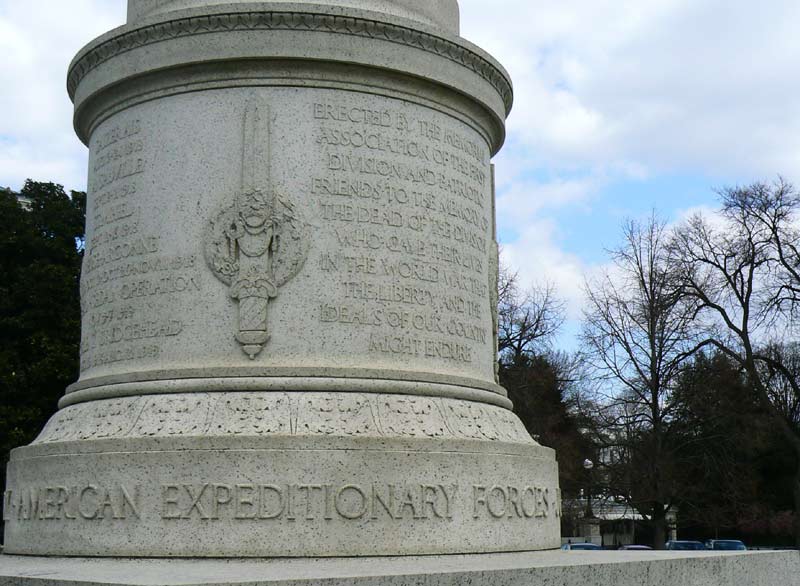
Behind the former War offices, to the Southwest of the White House, lies the war memorial to end all war memorials. It’s the WWI Memorial, of considerably diminutive size compared to those commemorations of subsequent wars which have spilled unto the Mall, but its form followed the convention of the typical Great War monuments erected throughout Europe among the nations who had participated.

WWI monument to US Army Expeditionary Force

Except the American version is dedicated to the “Expeditionary Forces” which I just love. That’s what WWI was about for the US. The trenches of Europe were no place Americans needed to defend their freedom. The troops we sent, to relieve France and England, represented a foreign expedition, exactly that. More precisely, our troops were an R&D expedition for our blustering capitalists.

(This may be no time or place to note that history books do not link America’s WWI experience with the Influenza outbreak of 1917-18, which began in the barracks of US soldiers being mobilized for war. American soldiers took their flu to Europe and ultimately killed 50 million people. Those were not the days before we knew better to stay home to prevent infecting others.)

The US entry into WWI was bitterly opposed by a peace movement which the war-opportunist-profiteers maligned as isolationist. Selfish globalization-denying isolationism has been the slander ever since, used against anyone who tries to block military interventions in all their guises.

Ultimately WWI was no affair of ours, had the Huns emerged victorious, American foreign affairs would hardly have changed. Our foreign trading partners would have numbered more Germans, that’s all. But it’s useless to compare alternative outcomes of WWI, all things staying constant, because America participated and profited wildly.

If American investors had not jumped in Over There, the greatest business opportunities of blossoming industrialism would have been missed. The opportunities offered by the Europeans fighting amongst themselves, proved to have been momentous.

And here was the monument to those lost American lives, sacrificed so that American industrial might, in particular the new banking monopolists, could seize the European spheres of influence throughout the world. Of course the lost lives of the American Expeditionary Force were remembered thus:

“…WHO GAVE THEIR LIVES IN THE WORLD WAR THAT LIBERTY AND THE IDEALS OF OUR COUNTRY MIGHT ENDURE”

It would take another World War for the US to appropriate the colonies and oil fields by means of contracts and loans, with the leverage of coming to their aid again, this time armed with lend-lease bills.

SOUTHEAST
To the Southeast of the White House, across the back lawn, lies the monument antecedent to the Great War. It’s the Civil War Memorial, atop which rides the triumphant General William Tecumseh Sherman. (Who, to be fair, presided over the War Department for a long stretch after the Civil War, actually this nation’s longest peacetime period.)

Sherman monumentCurious that I chose to crop his personage from my pictures, but my eyes were drawn to the lesser figures around the base of the monument, in particular, a half naked woman.

The memorial seemed to include various uniformed Civil War participants. How egalitarian to include a woman. But this woman was no French Revolutionary with breast bared oblivious as she rallied her comrades to victory. This delicate woman was unarmed and stripped to the waist, her children in tattered rags at her feet.

Could this statue be offering another conceit to the reality of war, to Sherman’s March to the sea, to the burning of Atlanta, to the shameful destruction he visited on the secessionist South? Was this a nod to the real role given to Women in war, their sons and husbands taken from them, a non-combatant left helpless to defend her children or herself. Did the shirt torn from her body confess to the woman’s rape?

More probably the feminine likeness personified man’s attraction to war, a soldier’s predilection for her beauty. How many war monuments memorialize as they also beacon?

Much of the terrain around the White House grounds is blocked off by secondary and tertiary security perimeters. But for the arrival of bus unloadng its visitors to see it, the Civil War Monument is normally cordoned off. When I had passed it earlier, a balaclava-clad guard was blocking the only entrance.

SOUTH
The grassy expanse immediately South of the White House, permitting the First Family an uninterrupted view of the National Mall, has actually been given over to parking permits. The loop of asphalt across the lawn, with cars strewn diagonally along the edges, gives the unfortunate impression of overflow event parking. In any other neighborhood, the crowd of cars would be a dead giveaway that someone on the block was having a party.

Space Symposium protest 2006 part 3

Tennis courts in the shadow of golf balls
Day 3: Wednesday
Was it because I hadn’t had any non-violence training? Is that why everyone jumped in to enforce a stand down from my assailant?

Our protest was just getting started, I was holding half of a banner in one hand and passing out fliers with the other when a very angry man zeroed right in. Maybe it was the bright green peace sign. He was jogging along Lake Circle and he had not even passed us. He shouted “I know people who died for you” and before I could answer, though I must not have looked sufficiently repentent, he repeated himself while leaping to clutch my collar and push against me to I don’t know where. I had time only to ask him if he knew that he was committing assault before the Police officers peeled him off and led him away for a discussion.

I regret not having requested that he be allowed to state his piece, minus the physical aggression, but instead we simply instructed the officers that there would be no need to press charges. I didn’t see it but eventually he must have jogged off. Our banner read BEWARE THE MILITARY INDUSTRIAL COMPLEX, Dwight D. Eisenhower’s famous warning.

I am a non-violent person, even a pacifist, though perhaps I am not much of a verbal pacifist. I had no intention of matching this guy’s blows, but I had every intention to stand up to being pushed.

I would have liked to call him on his much mistaken, sentimentalist, flag-hugging, bullying world view. Jogging in the Broadmoor area, this red-shorted, military-coifed assailant had probably commanded some soldiers who had been killed. I do mourn their loss. But it sounds like he should have thrown his life into the ring instead of beating his breast about the sacrifice made by others. Who knows how voluntarily their lives were offered? It always amazes me to hear military commanders brag about the casualty rate faced by their units. When ships sink, we expect captains to go down with the ship. Why? Because we expect them to save the men for which they were responsible or die trying.

Am I being harsh? I didn’t try to knock him down. That’s what we’re protesting: people who are knocking others down, and calling it “defending our freedom.”

Day 4: Thursday.
The Broadmoor had the police explain that we would not be permitted to walk in the bicycle path as we had tried two days before. So this time we brought bikes. I got to the protest late, at nine am instead of eight, just as several of our participants had to be shuttled to the airport. So I was left to peddle my bike up and down Lake Circle alone. If ever I have felt like a big dweeb, this was it. And it got on the news.

There was too much wind to trail a banner. I had selected WILL YOUR CHILDREN SURVIVE YOUR WORK? Instead I waved a large peace pirate flag. The peace sign with crossbones beneath it. A peace sign Jolly Roger. Or symbol for poison. Either way it’s a message the war makers do not want to hear. If there was a symbol for what sunshine represents to vampires, maybe that would be appropriate too.

Our protest of the SPACE SYMPOSIUM had everything to do with the fact that space is being militarized out of sight of the American public. How can there be oversight in a democracy if the citizens aren’t told what is going on?

Each day we would see schoolbus-loads of kids parading through the symposium. The event is billed as something much more benign. But did we see any scientists? I doubt it. We only saw men with military haircuts, in uniform and out. I should say that I did see the odd Brit, and they often gave us a closely held thumbs up!

The flag I waved today was to demonstrate that the message of peace has been relegated to renegades. What a perfect example at the Broadmoor! The hotel had closed its sidewalks to keep our protest from being seen from the Convention Center windows. We had to use the bike paths in order to give our message visibility.

So I pedaled up the designated bike lane on one side and down the bike lane on the other. I had to navigate past hotel employees and delegates who were sometimes skirting the security cordons themselves. I had to steer around the security chief’s pickup as he alternated between following me around, or parking and calling out to me each time I would pass. He was counting my laps, starting at zero arbitrarily. At one point, having reached to ten, he held both hands out the window as if to signal to someone that he’d counted ten. I looked but couldn’t see who was supposed to be watching him. Every so often policemen would appear to loiter near to where I would pass, but they would only nod in greeting.

I stayed until past the lunch hour surge out of the center. A friend has informed me that the bicycle act was on the local KKTV news. “Broadmoor protester nearly arrested,” but I didn’t see their camera. Perhaps they were filming through a window in the center. I was busy catching the eye of the conventiongoers on the street. There were smiles and thumbs up, but mostly the attendees rushed past. There was also a “enjoy your freedom there buddy.” As if these very-well-paid guys in suits want to be paid credit for our freedom too. “Freedom can be hard work, actually” I told them.

Space Symposium protest 2006 part 2

N-8 silo revisited
Day 1: Monday
On Monday we stood, nearly two dozen of us at the corner of Lake and Lake Circle, we sang our song to an Oscar Meyer melody, we held banners, we blew our whistles and we handed out our baloney sanwiches. And nearly got arrested.

The Broadmoor had cordoned off the majority of the sidewalk in front of their new Convention Center. Our protest was relegated to only the corner. True, it was a very visible corner, and we could offer flyers to nearly everyone walking to the Convention Center from the Broadmoor Hotel. But we thought we could accomplish a little more if we paraded our banners more visibly.

Dave Therault noted that all the Harris security personel were bunched up around us. Dave proposed a plan to excercise their legs a little. He suggested that he and I parade a banner along Lake Circle, walking in the marked bike lane adjacent to where the Broadmoor had blocked off our pedestrian sidewalk. Our banner would then be seen by the attendees inside the center, not just those milling about the entrance. Our banner read STAR WARS RESEARCH: A WELFARE SYSTEM FOR TECHNOLOGY.

Sure enough, as soon as we began we heard the security radios squalk. “Stop them” was the gist of the messages. A nearby guard told us to stop but we looked at him and asked why, while still moving forward. He responded with a smile. Each time we passed somebody with a radio, we could hear the supervisor ask why they were not containing us.

When we returned from our first pass, we added another person to our parade and another banner. It was a Henry Ford quote: TAKE THE PROFIT OUT OF WAR & WE’LL HAVE PEACE TOMORROW. This time more security officers joined us. When we returned we noted that they were now quite spread out.

On our third pass, the head of security came down himself. He approached us from the street, simply to tell us, in no uncertain terms and not calmly or with civility, to get back to where they were permitting us to stand. We answered that we didn’t work for him, actually and would proceed how we pleased. He repeated his command and threatened to call the cops and have us taken away. Certainly everything accelerated from there.

Suddenly we were surrounded by a half dozen policemen. They listened and interjected in calm terms that we were on Broadmoor property and had to do what the man said. We argued public thoroughfare, pedestrian right-of-way, to no avail. Dave diffused the confrontation, I assumed my role as hothead.

I wonder, I know why we are so vociferous in our condemnation of the military complex. What is it that drives their enthousiasm to stop us? We’re holding banners. They are killing babies, ruining lives and subjugating unsuspecting masses. We’re holding banners. Who should be the more indignant?

2.
On the way out, walking into the Broadmoor neighborhood to retrieve one of our cars, I encountered a soldier walking the other way. He’d just parked his car perhaps and we crossed paths on this tree lined street. He wore a full dress uniform, lots of medals and a beret, and he carried himself with informal dignity. I was wearing a bright green t-shirt enblazoned with a large peace sign and my Camp Casey cap. I was carrying several rolled banners over my shoulder and walked like I was returning from the front line.

The soldier and I nodded to each other and smiled. I couldn’t help but feel we had communicated a solidarity. He has been doing his job, I have been doing mine, both on the periphery of those making the decisions. The war mongers aren’t the soldiers. The war mongers are the guys in suits, sporting golf tans. Our common adversaries. And boy are there a lot of them. Three more symposium days to go.

Day 2: Tuesday
In conjunction with the Space Symposium protest at the Broadmoor, CITIZENS FOR PEACE IN SPACE held a screening on Monday night in the WES room at Colorado College. We watched the new documentary CONVICTION, about the three Dominican sisters who served almost four years in Federal Prison for protesting at a Minuteman missile silo in 2002. It had screened the day before in Denver to an audience of 350. The director and producer were on hand to answer questions, as were sisters Ardeth, Carol and Jackie. On Tueday night CONVICTION was scheduled to screen again in Greeley, so CPIS decided to make a day trip out of the event and provide an entourage for the sisters.

On the way of course Bill scheduled protest actions at Lockeed Martin, Raytheon, Northrop Grumman, Buckley AFB and Minuteman silo N-8, the site of the sisters’ 2002 Plowshare action.

Noteworthy perhaps was the degree to which preparations were made in advance of our arrival. Even Aurora Community College, where we planned to park and disperse ourselves to three of the defense contractors in Aurora, was ready for us. Bill had mentioned receiving several telephone inquiries from the various police departments, they had been checking CSAction for details of our plans. When we arrived at each location, we found barriers had been installed at the entrance of every parking lot with a minimum of a half dozen security personel standing about. I cannot say they were there to greet us, because they were not. They stood off to the side, or backed up when we approached. They were keeping a healthy no-man zone between us. At Raytheon there were even people posted on the roof to watch us.

At Buckley Airforce Base we were read a letter of greeting from the security officer that sounded like our Miranda rights, although it was full of cautionary advisories should we consider trying to force our way past the security booth. Our only intentions had been to conduct a rally and listen to what several experts could tell us about the activities conducted at Buckley, particularly having to do with those huge golf balls. I wondered if the security detail which contained us had sufficient clearance to be hearing such information.

Here is perhaps why protesters have to expect NSA surveillance. Because we learn too damn much. If the military doesn’t trust its own officers with classified information, they certainly don’t trust us to keep it secret. And we’re willing to let anyone overhear us, maybe that could be a genuine national security risk. In this case, we spoke about NSA/Defense Department complicity in the presence of Buckley AFB part-time security guard contractors.

The highlight of the day was of course Minuteman silo N-8, where the sisters held a press conference to reporters from Denver and Greeley. It was an emotional event and hard to describe. Many of us had never stood so near to a weapon of mass destruction. In this case, mass-mass-destruction, many-many times more powerful than the bombs unleashed upon Hiroshima and Nagasaki. This missile carries payloads for thirty separate destinations. In light of the fall of the Soviet Union, the Minuteman missile’s purpose is obsolete. Strategically it can now serve only an offensive purpose. Technically its existence violates the non-proliferation treaties to which our nation is signatory. N-8 presents a very, very grave danger to humankind’s survival. It is not a toy.

We drove Northeast from Greely to reach N-8. We probably could have found a nearer missile if we wanted. There are 49 missile sites in Colorado, out of 500 sites nation-wide.

While we conducted our action, wrapping the gate with CRIME SCENE tape, marking the site with a poster designating it as a WEAPON OF MASS DESTRUCTION, and an EVICTION NOTICE, a black helicopter circled. Apparently within just minutes of our leaving, several matte black SUVs arrived and removed our decorations.

Tennis courts in the shadow of golf balls
Day 3: Wednesday
Was it because I hadn’t had any non-violence training? Is that why everyone jumped in to enforce a stand down from my assailant?

Our protest was just getting started, I was holding half of a banner in one hand and passing out fliers with the other when a very angry man zeroed right in. Maybe it was the bright green peace sign. He was jogging along Lake Circle and he had not even passed us. He shouted “I know people who died for you” and before I could answer, though I must not have looked sufficiently repentent, he repeated himself while leaping to clutch my collar and push against me to I don’t know where. I had time only to ask him if he knew that he was committing assault before the Police officers peeled him off and led him away for a discussion.

I regret not having requested that he be allowed to state his piece, minus the physical aggression, but instead we simply instructed the officers that there would be no need to press charges. I didn’t see it but eventually he must have jogged off. Our banner read BEWARE THE MILITARY INDUSTRIAL COMPLEX, Dwight D. Eisenhower’s famous warning.

I am a non-violent person, even a pacifist, though perhaps I am not much of a verbal pacifist. I had no intention of matching this guy’s blows, but I had every intention to stand up to being pushed.

I would have liked to call him on his much mistaken, sentimentalist, flag-hugging, bullying world view. Jogging in the Broadmoor area, this red-shorted, military-coifed assailant had probably commanded some soldiers who had been killed. I do mourn their loss. But it sounds like he should have thrown his life into the ring instead of beating his breast about the sacrifice made by others. Who knows how voluntarily their lives were offered? It always amazes me to hear military commanders brag about the casualty rate faced by their units. When ships sink, we expect captains to go down with the ship. Why? Because we expect them to save the men for which they were responsible or die trying.

Am I being harsh? I didn’t try to knock him down. That’s what we’re protesting: people who are knocking others down, and calling it “defending our freedom.”

Day 4: Thursday.
The Broadmoor had the police explain that we would not be permitted to walk in the bicycle path as we had tried two days before. So this time we brought bikes. I got to the protest late, at nine am instead of eight, just as several of our participants had to be shuttled to the airport. So I was left to peddle my bike up and down Lake Circle alone. If ever I have felt like a big dweeb, this was it. And it got on the news.

There was too much wind to trail a banner. I had selected WILL YOUR CHILDREN SURVIVE YOUR WORK? Instead I waved a large peace pirate flag. The peace sign with crossbones beneath it. A peace sign Jolly Roger. Or symbol for poison. Either way it’s a message the war makers do not want to hear. If there was a symbol for what sunshine represents to vampires, maybe that would be appropriate too.

Our protest of the SPACE SYMPOSIUM had everything to do with the fact that space is being militarized out of sight of the American public. How can there be oversight in a democracy if the citizens aren’t told what is going on?

Each day we would see schoolbus-loads of kids parading through the symposium. The event is billed as something much more benign. But did we see any scientists? I doubt it. We only saw men with military haircuts, in uniform and out. I should say that I did see the odd Brit, and they often gave us a closely held thumbs up!

The flag I waved today was to demonstrate that the message of peace has been relegated to renegades. What a perfect example at the Broadmoor! The hotel had closed its sidewalks to keep our protest from being seen from the Convention Center windows. We had to use the bike paths in order to give our message visibility.

So I pedaled up the designated bike lane on one side and down the bike lane on the other. I had to navigate past hotel employees and delegates who were sometimes skirting the security cordons themselves. I had to steer around the security chief’s pickup as he alternated between following me around, or parking and calling out to me each time I would pass. He was counting my laps, starting at zero arbitrarily. At one point, having reached to ten, he held both hands out the window as if to signal to someone that he’d counted ten. I looked but couldn’t see who was supposed to be watching him. Every so often policemen would appear to loiter near to where I would pass, but they would only nod in greeting.

I stayed until past the lunch hour surge out of the center. A friend has informed me that the bicycle act was on the local KKTV news. “Broadmoor protester nearly arrested,” but I didn’t see their camera. Perhaps they were filming through a window in the center. I was busy catching the eye of the conventiongoers on the street. There were smiles and thumbs up, but mostly the attendees rushed past. There was also a “enjoy your freedom there buddy.” As if these very-well-paid guys in suits want to be paid credit for our freedom too. “Freedom can be hard work, actually” I told them.