John Kerry tells Africa its greatest resource was & will always be slavery

With the developed empire still wildly exploiting Africa’s vast natural resources and pillaging the wealth of its peoples, US Secretary of State John Kerry had the temerity to pretend that the dark continent’s most precious resource is its untapped labor. Globalization means Western Civ doesn’t have to ship slaves to labor intensive ventures across oceans. Now debt slaves can serve world bank masters in sweatshops and maquiadores and plantations situated in their own prison states.

Do the 2012 London Olympics need extra security forces to protect Israeli athletes or to arrest them?

Organizers are worried about inadequate security for the Olympic Games set to begin next month in London. What security threat are they anticipating exactly? It’s true the Olympics have become a bullseye for globalization critics. More and more, both athletes and groupies represent the jet set. But other than past indigenous protests in the Commonwealth territories, which amounted to no more than nonviolent blockades, what does the UK need paramilitary forces to defend against this time? Another 1972 Munich massacre? At the summer Olympics in Munich, the Israeli wrestling team was murdered by PLO terrorists called the “Black September Brigade”, but the official narrative leaves off that the Israeli athletes were targeted because they were IDF soldiers who’d participated in the counter-insurgent near-complete rout of the PLO, known as Black September. So that raises an interesting question. Is London expecting to host Israeli athletes who were veterans of Operation Cast Lead or the attack on the Mavi Marmara, whose assassinations someone might want to avenge? British authorities could address that most handily with preemption, because this time the IDF campaign against Gaza was widely regarded to have violated international law. Warn Team Israel that any such veteran setting foot in England would face prosecution for war crimes. While London is at it, issue the same warning to Team USA. Yeah, and Team UK, and Team Germany, et cetera, for Afghanistan, Libya, now Syria. It’s become the 2012 NATO War Criminals Olympics, gone professional, no amateur status terrorists need apply.

Occupiers can learn from Anarchists

Here’s one of the more popular pamphlets distributed at Occupy Colorado Springs, courtesy of the DABC. DEAR OCCUPIERS: A LETTER FROM ANARCHISTS
 
Support and solidarity! We’re inspired by the occupations on Wall Street and elsewhere around the country. Finally, people are taking to the streets again! The momentum around these actions has the potential to reinvigorate protest and resistance in this country. We hope these occupations will increase both in numbers and in substance, and we’ll do our best to contribute to that.
 
Why should you listen to us? In short, because we’ve been at this a long time already. We’ve spent decades struggling against capitalism, organizing occupations, and making decisions by consensus. If this new movement doesn’t learn from the mistakes of previous ones, we run the risk of repeating them. We’ve summarized some of our hard-won lessons here.

Occupation is nothing new. The land we stand on is already occupied territory. The United States was founded upon the extermination of indigenous peoples and the colonization of their land, not to mention centuries of slavery and exploitation. For a counter-occupation to be meaningful, it has to begin from this history. Better yet, it should embrace the history of resistance extending from indigenous self-defense and slave revolts through the various workers’ and anti-war movements right up to the recent anti-globalization movement.

The “99%” is not one social body, but many. Some occupiers have presented a narrative in which the “99%” is characterized as a homogenous mass. The faces intended to represent “ordinary people” often look suspiciously like the predominantly white, law-abiding middle-class citizens we’re used to seeing on television programs, even though such people make up a minority of the general population.

It’s a mistake to whitewash over our diversity. Not everyone is waking up to the injustices of capitalism for the first time now; some populations have been targeted by the power structure for years or generations. Middle-class workers who are just now losing their social standing can learn a lot from those who have been on the receiving end of injustice for much longer.

The problem isn’t just a few “bad apples.” The crisis is not the result of the selfishness of a few investment bankers; it is the inevitable consequence of an economic system that rewards cutthroat competition at every level of society. Capitalism is not a static way of life but a dynamic process that consumes everything, transforming the world into profit and wreckage. Now that everything has been fed into the fire, the system is collapsing, leaving even its former beneficiaries out in the cold. The answer is not to revert to some earlier stage of capitalism—to go back to the gold standard, for example; not only is that impossible, those earlier stages didn’t benefit the “99%” either. To get out of this mess, we’ll have to rediscover other ways of relating to each other and the world around us.

Police can’t be trusted. They may be “ordinary workers,” but their job is to protect the interests of the ruling class. As long as they remain employed as police, we can’t count on them, however friendly they might act. Occupiers who don’t know this already will learn it firsthand as soon as they threaten the imbalances of wealth and power our society is based on. Anyone who insists that the police exist to protect and serve the common people has probably lived a privileged life, and an obedient one.

Don’t fetishize obedience to the law. Laws serve to protect the privileges of the wealthy and powerful; obeying them is not necessarily morally right—it may even be immoral. Slavery was legal. The Nazis had laws too. We have to develop the strength of conscience to do what we know is best, regardless of the laws.

To have a diversity of participants, a movement must make space for a diversity of tactics. It’s controlling and self-important to think you know how everyone should act in pursuit of a better world. Denouncing others only equips the authorities to delegitimize, divide, and destroy the movement as a whole. Criticism and debate propel a movement forward, but power grabs cripple it. The goal should not be to compel everyone to adopt one set of tactics, but to discover how different approaches can be mutually beneficial.

Don’t assume those who break the law or confront police are agents provocateurs. A lot of people have good reason to be angry. Not everyone is resigned to legalistic pacifism; some people still remember how to stand up for themselves. Police violence isn’t just meant to provoke us, it’s meant to hurt and scare us into inaction. In this context, self-defense is essential.

Assuming that those at the front of clashes with the authorities are somehow in league with the authorities is not only illogical—it delegitimizes the spirit it takes to challenge the status quo, and dismisses the courage of those who are prepared to do so. This allegation is typical of privileged people who have been taught to trust the authorities and fear everyone who disobeys them.

No government—that is to say, no centralized power—will ever willingly put the needs of common people before the needs of the powerful. It’s naïve to hope for this. The center of gravity in this movement has to be our freedom and autonomy, and the mutual aid that can sustain those—not the desire for an “accountable” centralized power. No such thing has ever existed; even in 1789, the revolutionaries presided over a “democracy” with slaves, not to mention rich and poor.

That means the important thing is not just to make demands upon our rulers, but to build up the power to realize our demands ourselves. If we do this effectively, the powerful will have to take our demands seriously, if only in order to try to keep our attention and allegiance. We attain leverage by developing our own strength.

Likewise, countless past movements learned the hard way that establishing their own bureaucracy, however “democratic,” only undermined their original goals. We shouldn’t invest new leaders with authority, nor even new decision-making structures; we should find ways to defend and extend our freedom, while abolishing the inequalities that have been forced on us.

The occupations will thrive on the actions we take. We’re not just here to “speak truth to power”—when we only speak, the powerful turn a deaf ear to us. Let’s make space for autonomous initiatives and organize direct action that confronts the source of social inequalities and injustices.

Thanks for reading and scheming and acting.

May your every dream come true.

Chicago G8 protest planners offer city guarantees of usual ineffectual actions

Organizers meeting today to plan against next year’s G8 summit in Chicago hit the ground running –backward. On Friday a spokesperson for one of the coalition partners offered this assurance to the Chicago Tribune: “Our goal is a legal, permitted, family friendly march where people can come and have their voices heard in a safe environment.” Interesting. The objective of successful past anti-globalization protests has been no less than to shut the undemocratic summits down.

Nine months out, it appears activism’s old guard is determined to blunt all real resistance welling in American youth. The Tribune found another normalizing voice from UNAC which disavowed any recourse but nonviolence. WTF? It’s one thing not to encourage violence, another to promise to “back off from any violence.”

Hello? Activists with broken spirits need to STFD and STFU. Let younger, hotter heads give you a lesson in courage and purpose. If you are over thirty, hold yourselves among the fucks responsible for this mess. Who are you to deny the young their righteous rage?

As elder activists, precisely what wisdom is it you think you can impart? Have you stopped one war? Slowed imperialism? Ended nukes? Saved the whales? Halted global warming? Attended to anything but the erosion of democracy, the social safety net and the environment? Your exalted nonviolence neither delivered India from class exploitation nor ended racism in America. Stick with fundraising, educating, inspiring others, drawing your peers into social networking; lead, but not by edict, and not by a consensus dominated by your peers. Put your dogma aside for the young leaders, let them make their own mistakes. I hope you will at least admit they can’t fail more miserably than you.

At Sunday’s meeting, the United National Antiwar Committee spokesman acquitted himself when confronted by a young gentleman representing an anarchist entity. Committee member Ashley Smith’s full quote had been: “We will not be the ones to initiate or perpetrate any violence.” And: “We will back off from any violence.” But when pressed at the meeting, he explained that organizers hoped the event would be safe for families, but that younger militants could exercise their freedoms like anybody else. I paraphrase.

I’ll qualify my criticism by pointing out that a number of the organizers were personal victims of recent FBI home invasions, so they are fully justified in having to distance themselves from being interpreted as advocating violence. An additional challenge is presented by an adversarial corporate press determined to squeeze whatever soundbite it wants to discredit or hobble protest.

Of course I’d prefer activists recused themselves from addressing the subject of violence/nonviolence, instead of alienating potential allies by being deliberately exclusionary. And by potential allies, I mean the only allies that will get the movement anywhere, the NEXT GENERATION, because who else are you expecting?

Futbol or Football, it’s all about us

Americans already have a “football” and so come into conflict with a majority of the world when our television broadcasters have to say “soccer” and assuage the confusion of US viewers when confronted by everyone else’s “football.” And ironic too, the sportscasters like to explain, compounding their error, because it’s about the foot and the ball, unlike domestic football which is about using your hands to carry an un-spherical bladder. But this humor presumes another American overreach: “Futbol” incorporates “foot” and “ball” only if you speak English.

In a preponderance of languages, futbol defines neither foot nor ball, and mimics simply the phonetic term used by the British, whose colonial representatives were responsible for spreading the game across the world. As long time English speakers, the Brits have no difficulty with differentiating football from American Football. But Americans didn’t come by the term “soccer” on its own, which brings to light the other side to the complexity of FIFA’s hope to standardize the World Cup experience. Americans are not alone in resisting globalization’s attack on their cultural identity. A great deal of the world doesn’t call it FOOTBALL either.

To survey just the languages which share our Arabic alphabet, here’s how others refer to what we call soccer: Sokker (Afrikaans), Fodbold (Danish), Voetbal (Dutch), Jalgpall (Estonian), Jalkapallo (Finnish), Labdarúgás (Hungarian), Calcio (Italian), Sepak bola (Indonesian), Putbol (Filipino), Peil (Irish), Pêl-droed (Welsh), Pi?ka no?na (Polish), and Nogomet (Croatian).

What freedom means to me: not what it used to

As the next ships are mobilized to challenge the siege of Gaza, NYC supporters of Israel paraded a “True Freedom Flotilla” around the harbor. This point may already be moot, “Freedom” doesn’t mean what it used to. Operation Iraqi Freedom and Enduring Freedom are exercises in duplicity, and “Freedom of Speech” is hollow. The Oslo Freedom Forum was packed with globalization ringers. Freedom Fries were just embarrassing. The Smithsonian exhibit about America’s wars is entitled “The Price of Freedom.”

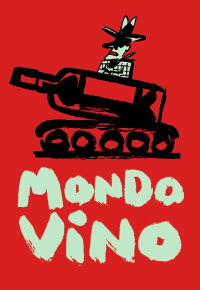
Mondovino: globalization and terroir, Robert Parker versus your good taste

American wine cowboy conquest with tankFor those with a curiosity for how wine terroir is holding up against the onslaught of wine factory farming, the 10-hour miniseries version of MONDOVINO is finally available on DVD. For viewers curious about viniculture globalization under Californian colonial domination, the original feature length documentary delivers, with a long finish. Any time critics accuse a film of being one sided, you know it’s about class war.

I had my first lesson in vineyard terroir when my college-aged aunt visited my family in Alsace and spent a season picking grapes. She informed us to our horreur that everything gets stomped in that barrel, bugs and all. I didn’t drink wine then, so what did I care, but it was easy to decide that such was the artistry that probably made French wines great.

But as I said, Mondovino was about much more than wine, and now I’ll get to the point. We may lament the new commercialization of wine, but historically the occupation has always had its strictly-business types. Vintners were rarely agriculturalists who subsisted, they were wine lovers subsidized. We can wince at the Napa Valley nouveau gauche, but even Bordeaux’s great chateaus, and especially all the Premiers Crus, are owned and have been owned by businessmen money lenders, going back centuries.

The modernization and standardization which is destroying contemporary wines is simply the evolution of production control. At last, technology and the ascent of a gilded age have brought vintners to believe they’ve bested nature. It’s true if you don’t care about wine, if you’re content to bottle a soft drink as opposed to allowing wine the breathing space to develop personality. Basically this documentary demonstrates that these gentlemen hobbyists, now plaintively bourgeois about profit, welcome the new global fascism.

Old World Fascists
Of course it is no stretch to imagine that the Mondovino filmmakers are going to ask, how did your father or grandfather like Fascism under the Nazis? They point the question at an Italian family who date their wealth back 900 years as bankers.

Any European documentary delving into family histories will always ask particularly about the war years. In America it’s what did you do during the war Daddy? In Europe it’s about weathering the occupation. Most working class French want to tell you what they did in the Resistance. Rich people you don’t ask because of course they were collaborateurs.

Mondovino’s subjects are the perpetually wealthy, who don’t even register the affront. Of course their families thrived under Fascism, quelle betise to imagine it would be otherwise. How curious it is we are surprised they embrace it so again.

Such moments are the highlights of Mondovino, rich folk posing in elaborate foyers, plaintively matter of fact about Fascism.

One opulent reception room in Florence is packed with ancient paintings, among them a painting of the very room full of paintings, you imagine if you peered closely enough you would see the infinity of mirrors scheme, a Baroque era black velvet number. The Grande Dame mentions that Prince Charles inquired about that painting at breakfast.

Let me add, critics have held Jonathan Nossiter’s camera work to be unstable. Actually he was very easily distracted by momentously relevant tchotchkes and biographical details few commoners are granted audience to encounter.

Fascists in the New World
Mondovino allowed the Napa Valley entrepreneurs to hang themselves. Open mouth, insert vacuous blather, often racist. These nouveau riches landscaped new vineyard for themselves, praising the terrain like it was classic architecture, their aesthetic tributes could only reference the National Mall. That classic.

Over at Mondavi, talk fixated of expansion and conquest. The film’s main plot addressed the Mondavi’s ongoing acquisition of the world’s most treasured appelations. For the worse of course, because what do they know about wine but that it should all taste the same? Son Mondavi dreams of someday having a vineyard on the moon, for no other reason than he thought of it. Wouldn’t it be exciting, he asks, to be able to say: “hey, let’s open a bottle from the moon,” my paraphrase.

The issue of terroir, English readers, has entirely to do with terre which is French for “earth.” Terre with a capital T is “Earth.” Of course the earthbound distinction was lost on this Californian.

Yes, Mondavi is surely alone in pondering what earth, sun and elements would have feed his moon vines.

Most vile of all the New World vintners was a family outfit in Argentina. They sit on a spacious veranda and explain how every boy in the family is named for founding father, the original title holder. Their wealth goes back to the early Spanish settlers and they express the perennial colonizer’s lament, that Los Indios of the regions have no work ethic. Centuries ago the Spaniard had to devise cruel torments to drive their slave laborers to produce. It was an inefficient system to impose on the indigenous and transplanted tribes, unaccustomed to a hierarchical workforce supporting do-nothings at the top.

Globalization
Key to Mondavi’s quest for wine world domination, is a market that has standardized the consumer’s taste. No longer are customers hopping in their car for a Sunday drive, to stop by a neighboring chateau to sample a vintage take a case home. Today the global consumption of wine has meant having to market it without being able to taste it. For that consumers have come to follow the ratings of critics. It was inevitable of course, but Mondovino reveals how hilariously flawed and phony the system is.

Mondovino focuses on two celebrity tasters who make or break wines. Robert Parker and James Suckling. Let’s dispatch the latter quickly.

James Suckling
James Suckling made a niche for himself nurturing Italian wines and coined the term “Super Tuscan.” I didn’t know that, but Mondovino records Suckling attributing the phenomena to the ether before being made to admit that the meme was his own.

More hilarious was a hypothetical question posed to the critic after confessing in an unguarded moment that he might have been too generous with the rating he gave a friend’s wine. The friend, a wealthy vintner, was letting Suckling a villa, which meant he was also his landlord. Naturally Mondovino asked if a discount on the rent would move Suckling to consider a more favorable rating. Suckling took the bait, laughingly nodding, of course, his friend under his breath suggested in such case he could have the villa for free.

It’s not corruption, merely a gentleman’s game. Can we even assert that the ordinary consumer suffers? Taste is subjective. Suckling’s ultimate rating is of negligible consequence to wine drinkers, except to commerce.

Robert Parker
I’m sorry to be getting around to Parker’s scheme so late in this article, because he plays such a profound part in the homogenizing of world wine production. The mechanism is beyond the pale, but it’s simple. Parker is influential and has a distinctive appetite, he has a best friend who consults with vintners about how to make their wine to Parker’s taste. The result has been devastating. Vines that have for ages had their own distinctive gouts have now been McParkered. The consultant charges a large fee to monitor an increasing stable of wines, for the camera his preoccupation was “micro-oxygenate,” and after it’s bottled parker comes around and bestows the high marks. The more they pay, the higher the score.

Mondovino underscores this plot by filming a Burger King billboard as Parker drives past it, while he sings the praises of uniform quality. The filmmakers notice an FBI cap on Parker’s desk and make sure to keep it in the frame. Parker is quite candid and friendly in Mondovino, probably because he had no inkling they did not share his eagerness to see viniculture’s eccentricities ironed to a uniform flat.

When the film was released and Robert Parker emerged as enterprising accomplice to Mondavi’s villain, Parker was enraged. He wrote rant after rant against the film and its makers. I’m not sure he’s over it yet. I wanted to be sure to document what I thought was Mondovino’s most brilliant assault on the witless benefit the Parker-Mondavi venture think they’re bequeathing with their anschluss of world wine. It’s about the subjectivity of taste. Robert Parker’s.

A recurring motif of Mondovino’s interviews was a fascination with dogs. It’s cute, and often we give ourselves leave to believe we have learned something about the owner by just looking at their dog.

In one memorable scene, we’ve met a quite unassuming South American vintner who has only one hectar, but is none the less generous with his wine, his time and friendship. He has a black dog, and when the filmmaker asks his name, the vintner laughs such that the revelation is self-effacing. “Luther King” is his name, because, he tells us in Spanish, he’s “negro.” Mondovino’s dark hats are so distasteful, it’s important that the heroic characters aren’t too pearly clean.

All the asides with the dogs were entertaining in their own right, but could have served entirely to set up Robert Parker’s scene. We’re invited to Parkers home and immediately discover he has something for bulldogs.

Do you like bulldogs? Taste is of course subjective. Robert Parker and his wife love their bulldogs, two, and their home is festooned with Bulldogephemera, statuettes, paintings, the camera frame’s worth. Imagine a wall covered with watercolors and oil portraits of bulldogs as you consider the subjectivity of taste.

Then just as Parker is prompted to discuss that his nose is ensured for a million dollars, we discover that one of the dogs has become incontinent, and there’s the near unbearable dog flatulence from which not even conversation can escape. Imagine Robert Parker’s nose not ensured against that. The interview concludes with Parker rambling about something as a bulldog sits sneering on the carpet forcing the filmmaker to keep a safe distance, and so he focuses in close capturing the ugly, perhaps infirm, definitely defensive, unlikable mug.

The next time you chose a wine because it has a high Parker score, ask yourself how it integrates an atmosphere of dog.

Simon Wiesenthal Center makes best case against Israel colonial legitimacy

Give Israel credit for answering their critics head on, but that is the Zionist hubris. Simon Wiesenthal is propagating the latest Hasbara crib sheet to counter the ten most threatening lies about Israel. We couldn’t have summarized the arguments better ourselves. One man’s “lies” are his victim’s desperate appeals to confound systemic myopic denial. Here it is in their own nutshell:
 
Israel was created by European guilt over the Nazi Holocaust. Why should Palestinians pay the price? … Had Israel withdrawn to its June 1967 borders, peace would have come long ago. … Israel is the main stumbling block to achieving a two-state solution. … Nuclear Israel, not Iran, is the greatest threat to peace and stability. … Israel is an apartheid state deserving of international boycott, divestment and sanctions campaigns. … Plans to build 1,600 more homes in East Jerusalem prove Israel is “Judaizing” the Holy City. … Israeli policies endanger U.S. troops in Afghanistan and Iraq. … Israeli policies are the cause of worldwide anti-Semitism. … Israel, not Hamas, is responsible for the “humanitarian catastrophe” in Gaza. … Goldstone was right when he charged that Israel was guilty of war crimes against civilians. … The only hope for peace is a single, binational state eliminating the Jewish State of Israel.

Even dissembled, the case weighs hard against Zionist mendacity.

OK, a tad capricious
To Wiesenthal’s credit, the arguments are loaded with a laudable reserve of disingenuity:

5,500 MORE HOMES have been zoned for East Jerusalem, not 1,600, (and yes, Jerusalem’s mayor has set quotas, a Jewish to non-Jewish target ratio to counter a higher Arab birthrate).

Israeli policies are the cause of [PROLIFERATION] of worldwide anti-Semitism,

The Gaza “humanitarian catastrophe” soft-pedals the critics’ real accusation: MASSACRE. Imagine referring to the Holocaust as befalling its victims with the ambivalence of a tsunami.

JUDGE Goldstone isn’t the only accuser who’s documented the criminality the world witnessed WITH ITS OWN EYES.

Apartheid legitimizers blink
Further demonstrating the disintegrating global support for a Jewish haven-state, the Simon Wiesenthal Center has all but dropped its cover as Holocaust-remembrance-sledgehammer to directly shore up the supposed public grant of legitimacy to Zionist colonialism.

Trying to turn the argument on Israel’s “de-ligitimizers” couldn’t be more out of touch.

While the US fights in expanding but downward spirals against the entropy of Pax Americana, Western public support for empire-building erodes for even the pretext of “globalization.” White Man’s Burden has smartened to Carbon Debt, missionary zeal evolved to indigenous and environmental protectionism. Religious crusades haven’t held water for centuries, but what an Auld Testament to Zionism’s xenophobic tenacity to posit the Jewish People as “chosen” to revive God-manifested destiny.

What part of “Apartheid is for Neanderthals” do Palestine’s neo- Afrikaners fail to understand? Even an 18th Century South African settler categorization gives the mid-twentieth century European transplants in Zion too much credit for pretended genealogical roots in the Middle East.

Only State Solution
Not very well concealed in Wiesenthal’s framing of the “Top Ten Lies” is a specious conceit formed by straw arguments three and ten, which presume the desirability of a “two-state solution” and/or a misguided hope for an inevitable “binational state.” Only in Wiesenthal’s rebuttal is there utterance of Israel’s true taboo –unmentionable because it will be self-fulfilling. The single state solution is dismissed with cavalier aplomb as “a non-starter.”

They desperately wish. On what basis do Zionists imbue themselves authority to trump international consensus? Hopefully it is not their nuclear arsenal. No other religious ideology, armed with nukes or without, asserts any permutation of divine refugee-status provenance to an autonomous “homeland.” Not even Tibet.

I expect sooner than the Zionists like –but then the self-defeatist arrogance may bely my presumption– the Simon Wiesenthal Center will be scrambling to bolster rationalizations against the only peaceful solution already on everyone’s mind and taxing our humanitarian patience: the single-state multi-theist modern egalitarian democracy.

Hasbara desperation
We reprint a near-complete representation of the SWC brochure below for our readers, if also to facilitate the identification of pro-Israel internet trolls by the tracts they are presently copy-and-pasting all over blog discussions. Who would have suspected that the resurgent wave of Zionist troll tripe was so transparently linked to official AIPAC and Wiesenthal Center press releases. We give the IDF Hasbara budget too much credit.

A recent IDF-merc commenter goaded us to “envy Israeli intellectual superiority.” I will admit it, I am in awe. Eagerly too. I know where it got Icarus.

Israel goes Titanic. Gotta love a good spectacle.

Appendix
Here then, courtesy of the Simon Wiesenthal Center, the 2010 Top Ten Anti-Israel Lies, enjoy!

2010 TOP TEN
ANTI-ISRAEL LIES

Israel is under assault!
Here’s what you need to know.
Act now…

Lie No. 1: Israel was created by European guilt over the Nazi Holocaust. Why should Palestinians pay the price?

Three thousand years before the Holocaust, before there was a Roman Empire, Israel’s kings and prophets walked the streets of Jerusalem. The whole world knows that Isaiah did not speak his prophesies from Portugal, nor Jeremiah his lamentations from France. Revered by its people, Jerusalem is mentioned in the Hebrew Scriptures 600 times, but not once in the Koran. Throughout the 2,000-year exile of the Jews, there was a continuous Jewish presence in the Holy Land.

Lie No. 2: Had Israel withdrawn to its June 1967 borders, peace would have come long ago.

Since 1967, Israel repeatedly has conceded “land for peace.” Following Egyptian President Sadat’s historic 1977 visit to Jerusalem, Israel withdrew from the vast Sinai Peninsula and has been at peace with Egypt ever since. But the Palestinian Authority has never fulfilled its promise to end propaganda attacks nor drop the Palestinian National Charter’s call for Israel’s destruction. In 2000, Prime Minister Barak offered Yasser Arafat full sovereignty more than 97 percent of the West Bank, a corridor to Gaza, and a capital in the Arab section of Jerusalem. Arafat said no.

Lie No. 3: Israel is the main stumbling block to achieving a two-state solution.

The Palestinians themselves are the only stumbling block to achieving a two-state solution. With whom should Israel negotiate? With President Abbas, who for four years has been barred by Hamas from visiting 1.5 million constituents in Gaza? With his Palestinian Authority, which continues to glorify terrorists and preaches hate in its educational system and the media? With Hamas, whose Iranian-backed leaders deny the Holocaust and use fanatical Jihadist rhetoric to call for Israel’s destruction?

Lie No. 4: Nuclear Israel, not Iran, is the greatest threat to peace and stability.

The United States and Europe can afford to wait to see what the Iranian regime does with its nuclear ambitions, but Israel cannot. Israel is on the front lines and remembers every day the price the Jewish people paid for not taking Hitler at his word. Israel is not prepared to sacrifice another 6 million Jews on the altar of the world’s indifference.

Lie No. 5: Israel is an apartheid state deserving of international boycott, divestment and sanctions campaigns.

In fact, Israel is a democratic state. Its 20 percent Arab minority enjoys all the political, economic and religious rights and freedoms of citizenship, including electing members of their choice to the Knesset (Parliament).

Lie No. 6: Plans to build 1,600 more homes in East Jerusalem prove Israel is “Judaizing” the Holy City.

Ramat Shlomo was not about Arab neighborhoods in East Jerusalem but about a long established, heavily populated Jewish neighborhood in northern Jerusalem, where 250,000 Jews live (about the size of Newark, N.J.) — an area that will never be relinquished by Israel.

Lie No. 7: Israeli policies endanger U.S. troops in Afghanistan and Iraq.

A resolution of the Palestinian-Israeli conflict would benefit everyone, including the United States. But an imposed return to what Abba Eban called “1967 Auschwitz borders” would endanger Israel’s survival and ultimately be disastrous for American interests and credibility in the world.

Lie No. 8: Israeli policies are the cause of worldwide anti-Semitism.

From the Inquisition to the pogroms, to the 6 million Jews murdered by the Nazis, history proves that Jew hatred existed on a global scale before the creation of the State of Israel. It would still exist in 2010 even if Israel had never been created. For example, one poll indicates that 40 percent of Europeans blame the recent global economic crisis on “Jews having too much economic power” — a canard that has nothing to do with Israel.

Lie No. 9: Israel, not Hamas, is responsible for the “humanitarian catastrophe” in Gaza. Goldstone was right when he charged that Israel was guilty of war crimes against civilians.

The United Nations Human Rights Council is obsessed with false anti-Israel resolutions. It refuses to address grievous human rights abuses in Iran, North Korea, Sudan, Saudi Arabia, Cuba and beyond. Faced with similar attacks, every U.N. member-state, including the United States and Canada, surely would have acted more aggressively than the Israel Defense Forces did in Gaza.

Lie No. 10: The only hope for peace is a single, binational state eliminating the Jewish State of Israel.

The one-state solution is a non-starter because it would eliminate the Jewish homeland. However, the current pressures on Israel are equally dangerous. In effect, the world is demanding that Israel, the size of New Jersey, shrink further by accepting a three-state solution: a P.A. state on the West Bank and a Hamas terrorist one in Gaza. All this as Hezbollah, Iran’s proxy in Lebanon, stockpiles 50,000 rockets, threatening northern and central Israel’s main population centers. Current polls show that while most Israelis favor a two-state solution, most Palestinians continue to oppose it.

Vaneigem on energy as commodity

NMT’s in-house Situationist has been conceptualizing a way forward well expressed in this May 2009 interview of Raoul Vaneigem:
Situationist“We are being “offered” biofuels on the condition we agree to transgenic rapeseed farming. Eco-tourism will accelerate the plundering of our biosphere. Windmill farms are being built without any advantage to the consumers. Those are the areas where intervention is possible. Natural resources belong to us, they are free, they must be made to serve the freedom of life. It will be up to the communities to secure their own energy and food independence so as to free themselves from the control of the multinationals and their state vassals everywhere. Claiming natural power for our use means reclaiming our own existence first. Only creativity will rid us of work. …

Freeness is the only absolute weapon capable of shattering the mighty self-destruction machine set in motion by consumer society, whose implosion is still releasing, like a deadly gas, bottom-line mentality, cupidity, financial gain, profit, and predation. Museums and culture should be free, for sure, but so should public services, currently prey to the scamming multinationals and states. Free trains, buses, subways, free healthcare, free schools, free water, air, electricity, free power, all through alternative networks to be set up. As freeness spreads, new solidarity networks will eradicate the stranglehold of the commodity. This is because life is a free gift, a continuous creation that the market’s vile profiteering alone deprives us of.”
–Raoul Vaneigem, 2009

Interviewed by Hans Ulrich Obrist, for e-flux, Journal #6. See original article or the copy mirrored below:

In Conversation with Raoul Vaneigem

Hans Ulrich Obrist: I just visited Edouard Glissant and Patrick Chamoiseau, who have written an appeal to Barack Obama. What would your appeal and/or advice be to Obama?

Raoul Vaneigem: I refuse to cultivate any relationship whatsoever with people of power. I agree with the Zapatistas from Chiapas who want nothing to do with either the state or its masters, the multinational mafias. I call for civil disobedience so that local communities can form, coordinate, and begin self-producing natural power, a more natural form of farming, and public services that are finally liberated from the scams of government by the Left or the Right. On the other hand, I welcome the appeal by Chamoiseau, Glissant, and their friends for the creation of an existence in which the poetry of a life rediscovered will put an end to the deadly stranglehold of the commodity.

HUO: Could we talk about your beginnings? How did your participation in situationism begin, and what was your fundamental contribution? At the outset of your relationship with the SI, there was the figure of Henri Lefebvre. What did he mean to you at the time? Why did you decide to send him poetic essays?

RV: I would first like to clarify that situationism is an ideology that the situationists were unanimous in rejecting. The term “situationist” was ever only a token of identification. Its particularity kept us from being mistaken for the throngs of ideologues. I have nothing in common with the spectacular recuperation of a project that, in my case, has remained revolutionary throughout. My participation in a group that has now disappeared was an important moment in my personal evolution, an evolution I have personally pressed on with in the spirit of the situationist project at its most revolutionary. My own radicality absolves me from any label. I grew up in an environment in which our fighting spirit was fueled by working class consciousness and a rather festive conception of existence. I found Lefebvre’s Critique of Everyday Life captivating. When La Somme et le reste [The Sum and the Remainder] was published, I sent him an essay of sorts on “poetry and revolution” that was an attempt to unify radical concepts, Lettrist language, music, and film imagery by crediting them all with the common virtue of making the people’s blood boil. Lefebvre kindly responded by putting me in touch with Guy Debord who immediately invited me to Paris. The two of us had very different temperaments, but we would agree over a period of nearly ten years on the need to bring consumer society to an end and to found a new society on the principle of self-management, where life supersedes survival and the existential angst that it generates.

HUO: Which situationist projects remain unrealized?

RV: Psychogeography, the construction of situations, the superseding of predatory behavior. The radicality, which, notwithstanding some lapses, never ceased to motivate us, remains a source of inspiration to this day. Its effects are just beginning to manifest themselves in the autonomous groups that are now coming to grips with the collapse of financial capitalism.

HUO: The Situationist International defined the situationist as someone who commits her- or himself to the construction of situations. What were those situations for you, concretely? How would you define the situationist project in 2009?

RV: By its very style of living and thinking, our group was already sketching out a situation, like a beachhead active within enemy territory. The military metaphor is questionable, but it does convey our will to liberate daily life from the control and stranglehold of an economy based on the profitable exploitation of man. We formed a “group-at-risk” that was conscious of the hostility of the dominant world, of the need for radical rupture, and of the danger of giving in to the paranoia typical of minds under siege. By showing its limits and its weaknesses, the situationist experience can also be seen as a critical meditation on the new type of society sketched out by the Paris Commune, by the Makhnovist movement and the Republic of Councils wiped out by Lenin and Trotsky, by the libertarian communities in Spain later smashed by the Communist Party. The situationist project is not about what happens once consumer society is rejected and a genuinely human society has emerged. Rather, it illuminates now how lifestyle can supersede survival, predatory behavior, power, trade and the death-reflex.

HUO: You and Guy Debord are the main protagonists of the situationist movement. How do you see Debord’s role and your role?

RV: Not as roles. That is precisely what situationism in its most ridiculous version aims at: reducing us to cardboard cut-outs that it can then set up against one another according to the spectacle’s standard operating procedure. I am simply the spokesman, among others, of a radical consciousness. I just do what I can to see that resistance to market exploitation is transformed into an offensive of life, and that an art of living sweeps away the ruins of oppression.

HUO: What were your reasons for resigning from the group?

RV: Following the occupation movements of May 1968, we knew that some recuperation was afoot. We were familiar with the mechanisms of alienation that would falsify our ideas and fit them neatly into the cultural puzzle. It became clear to us, during the last conference in Venice, that we had failed to shatter those mechanisms, that in fact they were shattering us from the inside. The group was crumbling, the Venice conference was demonstrating its increasing uselessness, and the only answers put forward were commensurate with the self-parody we had fallen into. Dissension intensified to the point of paranoid denunciation: of betrayals of radicality, of breaches of revolutionary spirit, of dereliction of conscience. Those times of catharsis and anathema are now long past, and it might be useful to examine how it is that we sowed the seeds of failure for which the group ended up paying such a heavy price. The shipwreck, however, did not indiscriminately sweep away to the shores of oblivion all of us who participated in the adventure. The group vanished in such a way as to allow the individuals to either consolidate their radicality, disown it, or lapse into the imposture of radicalism. I have attempted to analyze our experimental adventure in Entre le deuil du monde et la joie de vivre [Between Mourning the World and Exuberant Life].

HUO: You have written a lot on life, not survival. What is the difference?

RV: Survival is budgeted life. The system of exploitation of nature and man, starting in the Middle Neolithic with intensive farming, caused an involution in which creativity—a quality specific to humans—was supplanted by work, by the production of a covetous power. Creative life, as had begun to unfold during the Paleolithic, declined and gave way to a brutish struggle for subsistence. From then on, predation, which defines animal behavior, became the generator of all economic mechanisms.

HUO: Today, more than forty years after May ‘68, how do you feel life and society have evolved?

RV: We are witnessing the collapse of financial capitalism. This was easily predictable. Even among economists, where one finds even more idiots than in the political sphere, a number had been sounding the alarm for a decade or so. Our situation is paradoxical: never in Europe have the forces of repression been so weakened, yet never have the exploited masses been so passive. Still, insurrectional consciousness always sleeps with one eye open. The arrogance, incompetence, and powerlessness of the governing classes will eventually rouse it from its slumber, as will the progression in hearts and minds of what was most radical about May 1968.

HUO: Your new book takes us on a trip “between mourning the world and exuberant life.” You revisit May ‘68. What is left of May ‘68? Has it all been appropriated?

RV: Even if we are today seeing recycled ideologies and old religious infirmities being patched up in a hurry and tossed out to feed a general despair, which our ruling wheelers and dealers cash in on, they cannot conceal for long the shift in civilization revealed by May 1968. The break with patriarchal values is final. We are moving toward the end of the exploitation of nature, of work, of trade, of predation, of separation from the self, of sacrifice, of guilt, of the forsaking of happiness, of the fetishizing of money, of power, of hierarchy, of contempt for and fear of women, of the misleading of children, of intellectual dominion, of military and police despotism, of religions, of ideologies, of repression and the deadly resolutions of psychic tensions. This is not a fact I am describing, but an ongoing process that simply requires from us increased vigilance, awareness, and solidarity with life. We have to reground ourselves in order to rebuild—on human foundations—a world that has been ruined by the inhumanity of the cult of the commodity.

HUO: What do you think of the current moment, in 2009? Jean-Pierre Page has just published Penser l’après crise [Thinking the After-Crisis]. For him, everything must be reinvented. He says that a new world is emerging now in which the attempt to establish a US-led globalization has been aborted.

RV: The agrarian economy of the Ancien Régime was a fossilized form that was shattered by the emerging free-trade economy, from the 1789 revolution on. Similarly, the stock-dabbling speculative capitalism whose debacle we now witness is about to give way to a capitalism reenergized by the production of non-polluting natural power, the return to use value, organic farming, a hastily patched-up public sector, and a hypocritical moralization of trade. The future belongs to self-managed communities that produce indispensable goods and services for all (natural power, biodiversity, education, health centers, transport, metal and textile production . . .). The idea is to produce for us, for our own use—that is to say, no longer in order to sell them—goods that we are currently forced to buy at market prices even though they were conceived and manufactured by workers. It is time to break with the laws of a political racketeering that is designing, together with its own bankruptcy, that of our existence.

HUO: Is this a war of a new kind, as Page claims? An economic Third World War?

RV: We are at war, yes, but this is not an economic war. It is a world war against the economy. Against the economy that for thousands of years has been based on the exploitation of nature and man. And against a patched-up capitalism that will try to save its skin by investing in natural power and making us pay the high price for that which—once the new means of production are created—will be free as the wind, the sun, and the energy of plants and soil. If we do not exit economic reality and create a human reality in its place, we will once again allow market barbarism to live on.

HUO: In his book Making Globalization Work, Joseph Stiglitz argues for a reorganization of globalization along the lines of greater justice, in order to shrink global imbalances. What do you think of globalization? How does one get rid of profit as motive and pursue well-being instead? How does one escape from the growth imperative?

RV: The moralization of profit is an illusion and a fraud. There must be a decisive break with an economic system that has consistently spread ruin and destruction while pretending, amidst constant destitution, to deliver a most hypothetical well-being. Human relations must supersede and cancel out commercial relations. Civil disobedience means disregarding the decisions of a government that embezzles from its citizens to support the embezzlements of financial capitalism. Why pay taxes to the bankster-state, taxes vainly used to try to plug the sinkhole of corruption, when we could allocate them instead to the self-management of free power networks in every local community? The direct democracy of self-managed councils has every right to ignore the decrees of corrupt parliamentary democracy. Civil disobedience towards a state that is plundering us is a right. It is up to us to capitalize on this epochal shift to create communities where desire for life overwhelms the tyranny of money and power. We need concern ourselves neither with government debt, which covers up a massive defrauding of the public interest, nor with that contrivance of profit they call “growth.” From now on, the aim of local communities should be to produce for themselves and by themselves all goods of social value, meeting the needs of all—authentic needs, that is, not needs prefabricated by consumerist propaganda.

HUO: Edouard Glissant distinguishes between globality and globalization. Globalization eradicates differences and homogenizes, while globality is a global dialogue that produces differences. What do you think of his notion of globality?

RV: For me, it should mean acting locally and globally through a federation of communities in which our pork-barreling, corrupt parliamentary democracy is made obsolete by direct democracy. Local councils will be set up to take measures in favor of the environment and the daily lives of everyone. The situationists have called this “creating situations that rule out any backtracking.”

HUO: Might the current miscarriages of globalization have the same dangerous effects as the miscarriages of the previous globalization from the ‘30s? You have written that what was already intolerable in ‘68 when the economy was booming is even more intolerable today. Do you think the current economic despair might push the new generations to rebel?

RV: The crisis of the ‘30s was an economic crisis. What we are facing today is an implosion of the economy as a management system. It is the collapse of market civilization and the emergence of human civilization. The current turmoil signals a deep shift: the reference points of the old patriarchal world are vanishing. Percolating instead, still just barely and confusedly, are the early markers of a lifestyle that is genuinely human, an alliance with nature that puts an end to its exploitation, rape, and plundering. The worst would be the unawareness of life, the absence of sentient intelligence, violence without conscience. Nothing is more profitable to the racketeering mafias than chaos, despair, suicidal rebellion, and the nihilism that is spread by mercenary greed, in which money, even devalued in a panic, remains the only value.

HUO: In his book Utopistics, Immanuel Wallerstein claims that our world system is undergoing a structural crisis. He predicts it will take another twenty to fifty years for a more democratic and egalitarian system to replace it. He believes that the future belongs to “demarketized,” free-of-charge institutions (on the model, say, of public libraries). So we must oppose the marketization of water and air.1 What is your view?

RV: I do not know how long the current transformation will take (hopefully not too long, as I would like to witness it). But I have no doubt that this new alliance with the forces of life and nature will disseminate equality and freeness. We must go beyond our natural indignation at profit’s appropriation of our water, air, soil, environment, plants, animals. We must establish collectives that are capable of managing natural resources for the benefit of human interests, not market interests. This process of reappropriation that I foresee has a name: self-management, an experience attempted many times in hostile historical contexts. At this point, given the implosion of consumer society, it appears to be the only solution from both an individual and social point of view.

HUO: In your writing you have described the work imperative as an inhuman, almost animal condition. Do you consider market society to be a regression?

RV: As I mentioned above, evolution in the Paleolithic age meant the development of creativity—the distinctive trait of the human species as it breaks free from its original animality. But during the Neolithic, the osmotic relationship to nature loosened progressively, as intensive agriculture became based on looting and the exploitation of natural resources. It was also then that religion surfaced as an institution, society stratified, the reign of patriarchy began, of contempt for women, and of priests and kings with their stream of wars, destitution, and violence. Creation gave way to work, life to survival, jouissance to the animal predation that the appropriation economy confiscates, transcends, and spiritualizes. In this sense market civilization is indeed a regression in which technical progress supersedes human progress.

HUO: For you, what is a life in progress?

RV: Advancing from survival, the struggle for subsistence and predation to a new art of living, by recreating the world for the benefit of all.

HUO: My interviews often focus on the connections between art and architecture/urbanism, or literature and architecture/urbanism. Could you tell me about the Bureau of Unitary Urbanism?

RV: That was an idea more than a project. It was about the urgency of rebuilding our social fabric, so damaged by the stranglehold of the market. Such a rebuilding effort goes hand in hand with the rebuilding by individuals of their own daily existence. That is what psychogeography is really about: a passionate and critical deciphering of what in our environment needs to be destroyed, subjected to détournement, rebuilt.

HUO: In your view there is no such thing as urbanism?

RV: Urbanism is the ideological gridding and control of individuals and society by an economic system that exploits man and Earth and transforms life into a commodity. The danger in the self-built housing movement that is growing today would be to pay more attention to saving money than to the poetry of a new style of life.

HUO: How do you see cities in the year 2009? What kind of unitary urbanism for the third millennium? How do you envision the future of cities? What is your favorite city? You call Oarystis the city of desire. Oarystis takes its inspiration from the world of childhood and femininity. Nothing is static in Oarystis. John Cage once said that, like nature, “one never reaches a point of shapedness or finishedness. The situation is in constant unpredictable change.”2 Do you agree with Cage?

RV: I love wandering through Venice and Prague. I appreciate Mantua, Rome, Bologna, Barcelona, and certain districts of Paris. I care less about architecture than about how much human warmth its beauty has been capable of sustaining. Even Brussels, so devastated by real estate developers and disgraceful architects (remember that in the dialect of Brussels, “architect” is an insult), has held on to some wonderful bistros. Strolling from one to the next gives Brussels a charm that urbanism has deprived it of altogether. The Oarystis I describe is not an ideal city or a model space (all models are totalitarian). It is a clumsy and naïve rough draft for an experiment I still hope might one day be undertaken—so I agree with John Cage. This is not a diagram, but an experimental proposition that the creation of an environment is one and the same as the creation by individuals of their own future.

HUO: Is Oarystis based on natural power, like the Metabolist cities? Rem Koolhaas and I are working on a book on the Japanese Metabolists. When I read your wonderful text on Oarystis, I was reminded of that movement from the 1960s, especially the floating cities, Kikutake’s water cities. Is Oarystis a Metabolist city?

RV: When Oarystis was published, the architect Philippe Rothier and Diane Hennebert, who ran Brussels’ Architecture Museum at the time, rightly criticized me for ignoring the imaginative projects of a new generation of builders. Now that the old world is collapsing, the fusion of free natural power, self-built housing techniques, and the reinvention of sensual form is going to be decisive. So it is useful to remember that technical inventiveness must stem from the reinvention of individual and collective life. That is to say, what allows for genuine rupture and ecstatic inventiveness is self-management: the management by individuals and councils of their own lives and environment through direct democracy. Let us entrust the boundless freedoms of the imaginary to childhood and the child within us.

HUO: Several years ago I interviewed Constant on New Babylon. What were your dialogues with Constant and how do you see New Babylon today?

RV: I never met Constant, who if I am not mistaken had been expelled before my own association with the SI. New Babylon’s flaw is that it privileges technology over the formation of an individual and collective way of life—the necessary basis of any architectural concept. An architectural project only interests me if it is about the construction of daily life.

HUO: How can the city of the future contribute to biodiversity?

RV: By drawing inspiration from Alphonse Allais, by encouraging the countryside to infiltrate the city. By creating zones of organic farming, gardens, vegetable plots, and farms inside urban space. After all, there are so many bureaucratic and parasitical buildings that can’t wait to give way to fertile, pleasant land that is useful to all. Architects and squatters, build us some hanging gardens where we can go for walks, eat, and live!

HUO: Oarystis is in the form of a maze, but it is also influenced by Venice and its public piazzas. Could you tell us about the form of Oarystis?

RV: Our internal space-time is maze-like. In it, each of us is at once Theseus, Ariadne, and Minotaur. Our dérives would gain in awareness, alertness, harmony, and happiness if only external space-time could offer meanders that could conjure up the possible courses of our futures, as an analogy or echo of sorts—one that favors games of life, and prevents their inversion into games of death.

HUO: Will museums be abolished? Could you discuss the amphitheater of memory? A protestation against oblivion?

RV: The museum suffers from being a closed space in which works waste away. Painting, sculpture, music belong to the street, like the façades that contemplate us and come back to life when we greet them. Like life and love, learning is a continuous flow that enjoys the privilege of irrigating and fertilizing our sentient intelligence. Nothing is more contagious than creation. But the past also carries with it all the dross of our inhumanity. What should we do with it? A museum of horrors, of the barbarism of the past? I attempted to answer the question of the “duty of memory” in Ni pardon, ni talion [Neither Forgiveness Nor Retribution]:

Most of the great men we were brought up to worship were nothing more than cynical or sly murderers. History as taught in schools and peddled by an overflowing and hagiographic literature is a model of falsehood; to borrow a fashionable term, it is negationist. It might not deny the reality of gas chambers, it might no longer erect monuments to the glory of Stalin, Mao or Hitler, but it persists in celebrating the brutish conqueror: Alexander, called the Great—whose mentor was Aristotle, it is proudly intoned—Julius Caesar, Genghis Khan, Tamerlane, Napoleon, the throngs of generals, slaughterers of peoples, petty tyrants of the city or the state, torturer–judges, Javerts of every ilk, conniving diplomats, rapists and killers contracted by religions and ideologies; so much high renown carved from baseness, wickedness, and abjection. I am not suggesting we should unpave the avenues of official history and pave the side alleys instead. We are not in need of a purged history, but of a knowledge that scoops out into broad daylight facts that have been obscured, generation after generation, by the unceasing stratification of prejudice. I am not calling for a tribunal of the mind to begin condemning a bunch of undesirables who have been bizarrely put up on pedestals and celebrated in the motley pantheons of official memory. I just want to see the list of their crimes, the mention of their victims, the recollection of those who confronted them added to the inventory of their unsavory eulogies. I am not suggesting that the name of Francisco Ferrer wipe out that of his murderer, Alfonso XIII, but that at the very least everything be known of both. How dare textbooks still cultivate any respect for Bonaparte, responsible for the death of millions, for Louis XIV, slaughterer of peasants and persecutor of Protestants and freethinkers? For Calvin, murderer of Jacques Gruet and Michel Servet and dictator of Geneva, whose citizens, in tribute to Sébastien Castellion, would one day resolve to destroy the emblems and signs of such an unworthy worship? While Spain has now toppled the effigies of Francoism and rescinded the street names imposed by fascism, we somehow tolerate, towering in the sky of Paris, that Sacré-Coeur whose execrable architecture glorifies the crushing of the Commune. In Belgium there are still avenues and monuments honoring King Leopold II, one of the most cynical criminals of the nineteenth century, whose “red rubber” policy—denounced by Mark Twain, by Roger Casement (who paid for this with his life), by Edward Dene Morel, and more recently by Adam Hochschild—has so far bothered nary a conscience. This is a not a call to blow up his statues or to chisel away the inscriptions that celebrate him. This is a call to Belgian and Congolese citizens to cleanse and disinfect public places of this stain, the stain of one of the worst sponsors of colonial savagery. Paradoxically, I do tend to believe that forgetting can be productive, when it comes to the perpetrators of inhumanity. A forgetting that does not eradicate remembering, that does not blue-pencil memory, that is not an enforceable judgment, but that proceeds rather from a spontaneous feeling of revulsion, like a last-minute pivot to avoid dog droppings on the sidewalk. Once they have been exposed for their inhumanity, I wish for the instigators of past brutalities to be buried in the shroud of their wrongs. Let the memory of the crime obliterate the memory of the criminal.
3

HUO: Learning is deserting schools and going to the streets. Are streets becoming Thinkbelts? Cedric Price’s Potteries Thinkbelt used abandoned railroads for pop-up schools. What and where is learning today?

RV: Learning is permanent for all of us regardless of age. Curiosity feeds the desire to know. The call to teach stems from the pleasure of transmitting life: neither an imposition nor a power relation, it is pure gift, like life, from which it flows. Economic totalitarianism has ripped learning away from life, whose creative conscience it ought to be. We want to disseminate everywhere this poetry of knowledge that gives itself. Against school as a closed-off space (a barrack in the past, a slave market nowadays), we must invent nomadic learning.

HUO: How do you foresee the twenty-first-century university?

RV: The demise of the university: it will be liquidated by the quest for and daily practice of a universal learning of which it has always been but a pale travesty.

HUO: Could you tell me about the freeness principle (I am extremely interested in this; as a curator I have always believed museums should be free—Art for All, as Gilbert and George put it).

RV: Freeness is the only absolute weapon capable of shattering the mighty self-destruction machine set in motion by consumer society, whose implosion is still releasing, like a deadly gas, bottom-line mentality, cupidity, financial gain, profit, and predation. Museums and culture should be free, for sure, but so should public services, currently prey to the scamming multinationals and states. Free trains, buses, subways, free healthcare, free schools, free water, air, electricity, free power, all through alternative networks to be set up. As freeness spreads, new solidarity networks will eradicate the stranglehold of the commodity. This is because life is a free gift, a continuous creation that the market’s vile profiteering alone deprives us of.

HUO: Where is love in Oarystis?

RV: Everywhere. The love affair, as complex as it is simple, will serve as the building block for the new solidarity relations that sooner or later will supersede selfish calculation, competition, competitiveness, and predation, causes of our societies’ dehumanization.

HUO: Where is the city of the dead? In a forest rather than a cemetery?

RV: Yes, a forest, an auditorium in which the voices of the dead will speak amidst the lushness of nature, where life continuously creates itself anew.

HUO: Have you dreamt up other utopian cities apart from Oarystis? Or a concrete utopia in relation to the city?

RV: No, but I have not given up hope that such projects might mushroom and be realized one day, as we begin reconstructing a world devastated by the racketeering mafias.

HUO: In 1991 I founded a Robert Walser museum, a strollological museum, in Switzerland. I have always been fascinated by your notion of the stroll. Could you say something about your urban strolls with and without Debord? What about Walser’s? Have other strollologists inspired you?

RV: I hold Robert Walser in high regard, as many do. His lucidity and sense of dérive enchanted Kafka. I have always been fascinated by the long journey Hölderlin undertook following his break-up with Diotima. I admire Chatwin’s Songlines, in which he somehow manages to turn the most innocuous of walks into an intonation of the paths of fate, as though we were in the heart of the Australian bush. And I appreciate the strolls of Léon-Paul Fargue and the learning of Héron de Villefosse. My psychogeographic dérives with Guy Debord in Paris, Barcelona, Brussels, Beersel, and Antwerp were exceptional moments, combining theoretical speculation, sentient intelligence, the critical analysis of beings and places, and the pleasure of cheerful drinking. Our homeports were pleasant bistros with a warm atmosphere, havens where one was oneself because one felt in the air something of the authentic life, however fragile and short-lived. It was an identical mood that guided our wanderings through the streets, the lanes and the alleys, through the meanderings of a pleasure that our every step helped us gauge in terms of what it might take to expand and refine it just a little further. I have a feeling that the neighborhoods destroyed by the likes of Haussmann, Pompidou, and the real estate barbarians will one day be rebuilt by their inhabitants in the spirit of the joy and the life they once harbored.

HUO: What possibilities do you see for disalienation and détournement in 2009?

RV: This is a time of unprecedented chaos in material and moral conditions. Human values are going to have to compensate for the effects of the only value that has prevailed so far: money. But the implosion of financial totalitarianism means that this currency, which has so tripped us up, is now doomed to devaluation and a loss of all meaning. The absurdity of money is becoming concrete. It will gradually give way to new forms of exchange that will hasten its disappearance and lead to a gift economy.

HUO: What are the conditions for dialogue in 2009? Is there a way out of this system of isolation?

RV: Dialogue with power is neither possible nor desirable. Power has always acted unilaterally, by organizing chaos, by spreading fear, by forcing individuals and communities into selfish and blind withdrawal. As a matter of course, we will invent new solidarity networks and new intervention councils for the well-being of all of us and each of us, overriding the fiats of the state and its mafioso-political hierarchies. The voice of lived poetry will sweep away the last remaining echoes of a discourse in which words are in profit’s pay.

HUO: In your recent books you discuss your existence and temporality. The homogenizing forces of globalization homogenize time, and vice versa. How does one break with this? Could you discuss the temporality of happiness, as a notion?

RV: The productivity- and profit-based economy has implanted into lived human reality a separate reality structured by its ruling mechanisms: predation, competition and competitiveness, acquisitiveness and the struggle for power and subsistence. For thousands of years such denatured human behaviors have been deemed natural. The temporality of draining, erosion, tiredness, and decay is determined by labor, an activity that dominates and corrupts all others. The temporality of desire, love, and creation has a density that fractures the temporality of survival cadenced by work. Replacing the temporality of money will be a temporality of desire, a beyond-the-mirror, an opening to uncharted territories.

HUO: Is life ageless?

RV: I don’t claim that life is ageless. But since survival is nothing but permanent agony relieved by premature death, a renatured life that cultivates its full potential for passion and creation would surely achieve enough vitality to delay its endpoint considerably.

HUO: The Revolution of Everyday Life was a trigger for May ’68, and you have stated in other interviews that it is your key book that you are continually rewriting. Was the book an epiphany? How did it change the course of your work? What had you been doing previously?

RV: The book was prompted by an urgent need I was feeling at the time for a new perspective on the world and on myself, to pull me out of my state of survival, by means other than through suicide. This critical take on a consumer society that was corrupting and destroying life so relentlessly made me aware and conscious of my own life drive. And it became clear to me very quickly that this wasn’t a purely solipsistic project, that many readers were finding their own major concerns echoed there.

HUO: The Revolution of Everyday Life ends on an optimistic note: “We have a world of pleasures to win, and nothing to lose but boredom.”4 Are you still an optimist today?

RV: “Pessimists, what is it you were hoping for?,” Scutenaire wrote. I am neither a pessimist nor an optimist. I try to remain faithful to a principle: desire everything, expect nothing.

HUO: What is the most recent version of the book?

RV: Entre le deuil du monde et la joie de vivre [Between Mourning the World and Exuberant Life].

HUO: What book are you working on at the moment?

RV: I would love to have the resources to complete a Dictionary of Heresies, so as to clarify and correct the historical elements included in The Movement of the Free Spirit and Resistance to Christianity.

HUO: The question of temporality also brings us to Proust and his questionnaire (see inset). What might your definition of happiness be in 2009?

RV: Living ever more intensely and passionately in an ever more intense world. To those who sneer at my ecstatic candor, I reply with a phrase that brings me great comfort: “The desire for an other life is that life already.”5

HUO: Do you have unrealized projects? Unrealized books, unrealized projects in fields other than writing, unrealized architectural projects?

RV: My priority is to live better and better in a world that is more and more human. I would love to build the “urban countryside” of Oarystis, but I’m not just waiting patiently, like Fourier at the Palais Royal, for some billionaire to decide to finance the project only to lose everything to the financial crash a minute later.

HUO: What about your collaborations with other artists, painters, sculptors, designers, filmmakers?

RV: I don’t collaborate with anyone. At times I have offered a few texts to artist friends, not as a commentary on their work but as a counterpoint to it. Art moves me when, in it, I can sense its own overcoming, something that goes beyond it; when it nurtures a trace of life that blossoms as a true aspiration, the intuition of a new art of living.

HUO: Could you tell me about Brussels? What does Brussels mean to you? Where do you write?

RV: I live in the country, facing a garden and woods where the rhythm of the seasons has retained its beauty. Brussels as a city has been destroyed by urbanists and architects who are paid by real estate developers. There are still a few districts suitable for nice walks. I am fond of a good dozen wonderful cafés where one can enjoy excellent artisanal beers.

HUO: Do you agree with Geremek’s view that Europe is the big concern of the twenty-first century?

RV: I am not interested in this Europe ruled by racketeering bureaucracies and corrupt democracies. And regions only interest me once they are stripped of their regionalist ideology and are experiencing self-management and direct democracy. I feel neither Belgian nor European. The only homeland is a humanity that is at long last sovereign.

HUO: You have used a lot of pseudonyms. Je est un autre [I is an other]? How do you find or choose pseudonyms? How many pseudonyms have you used? Is there a complete list?

RV: I don’t keep any kind of score. I leave it up to the inspiration of the moment. There is nothing secret about using a pseudonym. Rather, it is about creating a distance, most often in commissioned work. This allows me to have some fun while alleviating my enduring financial difficulties, which I have always refused to resolve by compromising with the world of the spectacle.

HUO: A book that has been used by many artists and architects has been your Dictionnaire de citations pour servir au divertissement et a l’intelligence du temps [Dictionary of Quotations for the Entertainment and Intelligence of Our Time]. Where did that idea come from?

RV: It was a suggestion from my friend Pierre Drachline, who works for the Cherche Midi publishing house.

HUO: You have often criticized environmental movements who try to replace existing capitalism with capitalism of a different type. What do you think of Joseph Beuys? What non-capitalist project or movement do you support?

RV: We are being “offered” biofuels on the condition we agree to transgenic rapeseed farming. Eco-tourism will accelerate the plundering of our biosphere. Windmill farms are being built without any advantage to the consumers. Those are the areas where intervention is possible. Natural resources belong to us, they are free, they must be made to serve the freedom of life. It will be up to the communities to secure their own energy and food independence so as to free themselves from the control of the multinationals and their state vassals everywhere. Claiming natural power for our use means reclaiming our own existence first. Only creativity will rid us of work.

HUO: Last but not least, Rilke wrote that wonderful little book of advice to a young poet. What would your advice be to a young philosopher-writer in 2009?

RV: To apply to his own life the creativity he displays in his work. To follow the path of the heart, of what is most alive in him.

Translated from the French by Eric Anglès

Sept 11 – America Reaps What It Sows!

A post-911 perspective by Black Liberation Army prisoner of war Jalil Muntaqim.

U.S. International Warfare Initiates World War III Human Rights During Wartime
By Jalil A. Muntaqim

In the aftermath of the September 11, 2001, attack on the World Trade Center and Pentagon, Americans have displayed their true colors of jingoism, a militaristic spirit of nationalism. Similarly, it was witnessed how the people of Iraq rallied in support of their President, Saddam Hussein, after the U.S. bombed to death 250,000 Iraqis, and continued devastation of that country with collateral damage of 1 million dead women and children. Hence, people rallying in support of their government and representatives is a common phenomenon when a country is attacked by an outsider. The U.S. has been foremost in the world extending foreign policy of free-market economy, to the extent of undermining other countries cultures and ideologies expressed as their way of life. Such conflicts inevitably positions the U.S. as the centerpiece, the bulls-eye for international political dissent, as indicated by demonstrations against the U.S. controlled IMF, WTO and World Bank conferences. The attack on the World Trade Center and Pentagon did not occur in a vacuum. The people that carried out the attacks were not blind followers or robots with an irrational hatred of the U.S. peoples. Rather, this attack was part of an overall blowback to U.S. imperialist policy in support of zionist Israel and opposition to fundamentalist Islam.

There are essentially three primary world ideologies or world views: the capitalist free-market economy/democracy; the socialist production economy; and Islamic theocratic government, of which has been in competition for many decades. However, in the last 20 years the socialist economies has been severely subverted and co-opted by free-market economies, the ideals of American style democracy. This isolated, for the most part, Islamic theocratic ideology and system of government as the principle target of the U.S. in its quest for world hegemony. This reality of competing world views and economies is further complicated due to religious underpinning of beliefs that motivates actions, especially as they are expressed by U.S. and Western European christianity and Israel zionist judaism in opposition to Islam. From the struggles of the Crusades to the present confrontation, the struggle for ideological supremacy reigns, as the faithful continue to proselytize in the name of the Supreme Being.

When geopolitics are combined with religious fervor in the character of nationalist identity and patriotism, rational and logical thinking is shoved aside as matters of the moment takes historical precedents. It has often been said that “Truth Crush to the Earth Will Rise Again”. Since truth is relative to ones belief, can it be safely said that America has reaped what it has sowed? The American truth of capitalist christian democracy and its imperialist hegemonic aspirations has crushed both socialist and Islamic world views. It has extended its avaricious tentacles as the world police and economic harbinger of all that is beneficent, in stark denial of its history as a purveyor of genocides, slavery and colonial violence.

The U.S. was the first to use biological-germ warfare on people when it distributed blankets infected with smallpox to Native Americans; it has refused to apologize for Afrikan slavery acknowledging it engaged in a crime against humanity requiring reparations; it is the first and only country to use the atomic bomb on the people of Hiroshima and Nagasaki and intern thousands of Japanese and Italians in this country; it used carpet bombing and defoliates against the peoples of Vietnam; it has initiated embargoes, coup d’etats and assassinations against those it opposes, while propping-up right-wing military dictators; as well as continued military bombing of Vieques. In essence, the U.S. governments hegemonic goals has created the ire of millions of people throughout the world. While domestically, racial profiling, police killing and mass incarceration of Black and Brown people has eroded patriotic sentiments in opposition to white supremacy.

As America weeps and laments its loss, the public find itself joining the torn ranks of those whose heartaches beat opposing U.S. greed and international profiteering. The American public acquiesce to U.S. international folly has cause them to feel the economic pains of those who live daily in poverty. Indeed, Americans should brace for years of economic uncertainty, where the American ideal of freedom and liberty will resemble plight of those who live under the right-wing dictatorships the U.S. has supported. The tyranny suffered by others in the world as a result of U.S. imperialism, has come full circle to visit this country with the wrath of the U.S. own mechanization. Since the U.S. taught and trained right-wing military dictators in the School of the Americas, including the CIA training of Osama bin Laden in the Afghanistan proxy war against the Russians, it will be this same kind of terrorist activist that will be unleashed on American soil, as El-Hajj Malik Shabazz stated after the assassination of John Kennedy, a matter of the chicken coming home to roost. Therefore, American civil liberties and human rights are being garrotted by the yoke of the right-wing in the name of national security. The legalization of U.S. fascism was initiated with the war against political dissent (Cointelpro); the war against organized crime (RICO laws); the war against illegal drugs (plethora of drug laws) and now culminating in the war against terrorism with the American Joint Anti-Terrorist Taskforce and Office of Home Security, further extending police, FBI and CIA powers to undermine domestic civil liberties and human rights.

The U.S. Secretary of Defense, Donald Rumsfeld, recently stated that the U.S. need to create a new language in defining how to combat terrorism. This Orwellian propaganda in the media espouses the U.S. is venturing in a new type of warfare to defend the American way of life. However, what this double-speak propagates as a long-term and sustained initiative against terrorism is essentially a way of embellishing and enlarging U.S. counter-insurgency activity it has been engaged in since the advent of the Green Berets, Rangers, Delta Force and Navy Seals. The U.S. has been involved in counter-insurgency activity in Afrika, Latin America and Asia for decades. But due to the September 11, 2001, attack on U.S. soil, the government has seized the opportunity to offensively pursue left-wing revolutionaries and Muslim insurgents throughout the world. This U.S. military action extends and substantiates its position as the international police.

Since the establishment of the Trilateral Commission that initiated the process for the development of one world government, the U.S. has broaden its capacity to impose and enforce its will on oppressed peoples globally. The FBI and CIA has been operating in Europe, Afrika, Asia and Latin America establishing the long arm of U.S. law and order. Its bases of operations have conducted surveillance, investigations to arrest, prosecute or neutralize left-wing revolutionaries or Muslim insurgents. As the U.S. consolidates its political and economic influence throughout the world, it will seek to protect its overall hegemonic imperialist goals. After the Gulf War, and the air (bombing) campaign in Yugoslavia, the U.S. has employed its military might to ensure its foreign policy are achieved.

Because NATO has evolved into a European military entity that Russia is seeking to join, today, the U.S. has positioned itself beyond the mission of NATO. The U.S. now concentrates its military might in opposing Islamic countries (Iran, Iraq, Libya, Sudan, Afghanistan, Philippines, etc.) and those the U.S. deem as rogue nations (North Korea, Vietnam, Cuba, etc.). The new military initiatives will be directed to towards Southeast Asia as the secondary target, as it continues to direct the Middle East conflict to preserve its oil investments and zionist interest. As the U.S. expand its imperialist military mission, as seen with committing military troops in Uzbekistan to also protect oil interest in the Caspian Sea, it has sought to redefine itself by targeting what it identify as the terrorist thereat wherever in the world it might exist. Hence, with the employment of conventional warfare combined with counter-insurgency tactical activities, the U.S. has pronounced itself as the military guardian of the world.

Although, the U.S. states its actions are in its self-interest, in terms of what is euphemistically defined as defending the free world, the truth of the matter is this action is a prelude to evolving one world government with the U.S. as its governing authority. Once the Peoples Republic of China becomes a full member of the WTO, and North Korea and Vietnam has been compromised, with Russia becoming an ally of NATO, the U.S. political-military influence in the world will be consolidated. The U.S. geopolitical strategy is not confined to the present crisis in the aftermath of the September 11, 2001, attack and targeting Osama bin Laden as the world’s nemesis. Rather, the U.S. strategy is to preserve its capacity to establish one world government as originally envisioned by the Trilateral Commission.

Nonetheless, there are some serious obstacles to this hegemonic goal, of which the world of fundamentalist Islam has become the principle target. Here, it should be noted that Islam condemns suicide or the mass killings of women, children and non-combatant males. Yet, the U.S., Israel, western Europe, Russia, India and China all view Islam as the enemy. Although, there are over 1.2 billion Muslims in the world, the current alliance of economic interest headed by the U.S., are united to vanquish what they consider the growing menace of fundamentalist Islam. It is with this understanding of U.S. geopolitics one is able to comprehend why the U.S. has redefine its military mission, as opposition to globalization and U.S. imperialism metamorph into a political struggle without borders or territorial imperatives.

The ideological struggle between capitalist free-market economy and Islamic theocratic determinates has exploded into an international conflagration of insurgency with the potential of initiating World War III. The Islamic fundamentalist movements throughout the world has the potential to test the U.S. military, political and economic resolve as the world’s leader and authority of an one world government. With over 1.2 billion adherents, Islam has become a formidable foe to contend with for ideological supremacy in the world’s geopolitics. Even without discussing the religious (moral and ethics) aspects that motivates the geopolitics of Islam in opposition to U.S. imperialist hegemony, the call for Jihad/Holy War against the U.S. presents a serious threat that could precipitate WW-III. Therefore, the U.S. find it necessary to redefine its military mission, develop new language to codify warfare and legitimize its international political and economic purpose. Yet, many of the world’s oppressed peoples’ have already experienced U.S. military counter-insurgency tactics (Ethiopia, Somalia, Nicaragua, Guatemala, Chile, Congo, etc.), including parts of the Islamic world. No matter how or why the U.S. attempts to persuade Americans that it is entering a new type of warfare, in reality it is more of the same, only extending the military arena to further protect its authority to establish one world government.

However, the U.S. is not the homogeneous country that people are deluded into believing exist. Rather, the U.S. has been held together due its ability to exploit the world’s resources and distribute (unequally) the profits amongst its citizens with its culture of conspicuous consumption. But, the recent attack on the U.S., and its aftermath may very well lead to the untangling and unraveling of the U.S. fabric as has been witnessed with the USSR and Yugoslavia. In understanding this true history of U.S. imperialism, outside and within its borders, essentially tells a story of why U.S. imperialism has been and will continue to be attacked.

Ultimately, the U.S. will eventually find itself at war with itself, as the ideology of a free democratic society will be found to be a big lie. This is especially disconcerting as greater restrictions on civil and human rights are made into law eroding the First and Fourth Amendment of the U.S. Constitution. As during the Vietnam conflict, internal contradictions of racism, poverty and inequality will be exacerbated as a result of the U.S. military campaign and domestic undermining of civil and human rights. It is expected that strife in America will eventually become violent dissolving any semblance of the illusion of America the Beautiful. In anticipation of U.S. progressive activist opposing this claimed war against terrorism, the federal government will pass new laws to severely restrict protest, demonstrations and dissent. In the ’60s, U.S. progressive activists evolved the slogan “Bring the War Home!” – the question is what will be the slogan this time, now that the war has been brought home?

Free the Land!!

Speak 2 x 4 to power, just do it.

Nike inspired assault on WTCFound this brilliant submission in the Start-Propaganda collection. The Reichtag Fire false- flag attack will have nothing on the debris of the WTC. For your 8th commemoration of the enigmatic event which is still used to justify the occupation of Afghanistan, check out the Italian documentary ZERO. My favorite segment is George Bush on the perpetrators of 9/11: “It’s hard for Americans to imagine how evil the people are who are doing this.” Less and less so.

In keeping the anniversary of 9/11, we also revisited the sentimental documentary by the Naudet brothers, whose video had captured the impact of the first plane, and the ensuing action of the firefighters inside Building One. Excised from the final cut were the firehouse discussions of other explosions they’d heard and their observations that the collapses resembled demolitions. Those clips are accessible online, and now you’ll recognize the individual firemen. Perhaps those details were deemed inappropriate for the CBS audience in 2004.

It’s also sad to look upon these interviews of men who later worked ceaselessly at Ground Zero, often without masks, and wonder how many are now dead, or dying of respiratory ailments, victims of the government fraud about the safety of the environment in the aftermath of the disaster.

Watching the doomed firemen ascend into the WTC without a thought that the towers might collapse, and being shown the buildings vaporize, narrated by uncritical newspeople, we cannot wonder now but did they take American viewers for idiots?

Among the many documentaries which question the official version of events, Italian Telemaco’s ZERO: an Investigation into 9-11 takes the least sensational approach. Italian celebrities, a laughing physicist (and Nobel laureate), and Gore Vidal shrug off the sheer pretense of the USA narrative.

Watching the original 911 exposés like 911 Loose Change and 911 Conspiracy – In Plane Sight gets old doesn’t it? Not because their presentation is shrill, but because unanswered, what can they do but repeat themselves?

The mainstream response has only been to dismiss the 911 Truth movement as Conspiracy Theory. Throw Alex Jones’ Prison Planet TV into the mix with his 9/11 The Road To Tyranny and alternative versions of September 11th, 2001, begin to look paranoid.

For a fresh perspective from the UK, check out 911 and the British Broadcasting Conspiracy.

Remember, the mainstream media which dismisses 9/11 truth seekers as conspiracy theorists, is the same media which is now telling us that the American public does not want universal health care.

The same media which has been “questioning” Global Warming now puts the onus for change on whether an American public will believe Global Warming.

The same corporate media is owned, and speaks for, big agra, big pharma, big oil, and the arms industry.

Is there a Monsanto/Cargill/Archer-Daniels-Midland conspiracy to monopolize the food supply? Is there a military industrial conspiracy to foment war and instability? Is there a globalization conspiracy to harness developing world resources while enslaving all peoples?

Who is the corporate media to defend the 911 myth against accusations of conspiracy?

What the impregnability of the accepted 9/11 story means to me, is that the 911 Truth Movement clings to an outdated notion that what the population knows matters. In a post-democratic world it doesn’t. The people can believe their feudal overlords to be ogres, so long as it isn’t uttered with intent to dethrone. Then it’s heresy.

Who killed Neda Agha-Soltan?

neda soltaniThe video footage is shocking. An attractive young woman watching the demonstrations in Tehran is struck by a sniper’s bullet and dies before several video cameras. The tragedy is projected unto Facebook and Youtube, with advocates hoping it will galvanize (American) public support for the brave reform movement in Iran. News accounts blame “Basij snipers” on the rooftops. Other protesters have been killed in confrontations with Iranian riot police, without the benefit of video witnesses, much like two million Iraqis, Afghans, Pakistanis et al. Poor 27-year-old bystander Neda Soltani stood at the quite improbable convergence of bullet and camera –correction– cameras. I don’t have to suggest the scene was staged; whether or not the triggerman was an American is immaterial.

Think about just the improbability of your seeing this video. When was the last time the mainstream press has circulated a snuff film? The average person is embarrassed to watch a person die. It’s exploitive. Even when America was fixated on beheaded hostages, our television gatekeepers refused to broadcast the footage. Many horrific war killing moments have found their way unto Youtube, which antiwar activists could only hope would find wider distribution, if only to bring home the inhumanity of our soldiers’ deeds. It never happens.

The western press is running with this story because it demonizes the apparently naked inhumanity of Islam. Muslims stone women, hang gays, look: the bastards shoot their own people arbitrarily. Curiously our media doesn’t make hay with the hapless victims of US snipers.

neda salehi agha soltanThe Neda Soltani snuff footage hit internet shores prepackaged with a smiling mug, and a name that translated means “the voice.” Could a casting director have picked a better title character to represent Iran’s repressed? The western press is even poised to outdo the Muslims in indignant piety, already lauding Neda as a martyr, whom we are informed should launch a thousand Shiite funeral processions. Western pundits compare Neda to the first Shiite martyr, the grandson of Mohammed himself.

Of course, also showing excessive Islamic sensitivity, western reporters readily dismiss the vanishing of Neda’s body, to the Muslim tradition of hasty burials. For the record, in case you missed it, Neda dies onscreen from an apparent gunshot. We do not see the bullet strike, nor now can anyone habeas corpus.

If the scenario was acted entirely, given the success with which the girl’s face is being made into an icon, young Neda’s life is probably as utterly expendable now as already depicted. You think you’re mourning Neda now, imagine her fate if this is a hoax.

OR the gunman could just as well have been a US black-op hit-man who had his eye on the videographers approaching innocent Neda. The US military has long admitted that special forces are already operating in Iran. If the Iranian forces are shooting civilian protesters, what’s the harm of helping them out where there’s a camera ready?

When we’re not meant to see it, the soldiers shoot the cameramen too.

It could be the work of Moussavi henchmen, who are our henchmen.

The Green Revolution, or TwitterTM Revolution, rebranded a “Social Media Revolution,” is a fabrication of the US pro-democracy agents working to destabilize Iran. They are hard at work in Cuba, in Venezuela, in Bolivia, and everywhere regimes threaten US globalization by enslavement. Remember the Orange Revolution? Any movement that is color-coded is the work of organizers reading US how-to manuals or attending OTPOR training seminars.

Where are the international voices decrying election fraud in Iran? No one other than the US and its stooges is asserting that populist leader Ahmadinejad did not win by a landslide. Only Iran’s urban middle class has taken to the streets of Tehran. And to protest what? Their minority standing in Iran?

The reformists in Iran are protesting democracy, not the failure of democracy. They are protesting Mahmoud Ahmadinejad’s hard line against irreligious western economic and colonial policies which traditionally benefit the secular urban elite. “Pro-Democracy” is neoliberal for pro-capitalist plunder.

See: Shah’s Son Backs Iranian Protesters.

Like the “dissidents” of Cuba, the Green greenback-seekers are marching on the CIA’s dime, and being meted the fate of foreign provocateurs. I have no doubt the majority are idealists and are well-intended, but like the Kurds who rose against Saddam Hussein, the US has set them up for slaughter, the sooner to motivate western support for military aggression against their evil regime.

Our media pundits point out that the protest banners are written in English, a sign that the Iranians are desperate to appeal to American viewers. They dismiss Iranian accusations of the demonstrations being US-backed as pure paranoia, and ignore the most simple explanation behind the English slogans, and the websites and networks amplifying the message to English speakers: these materials are being crafted by USAID advisers. This is a propaganda campaign aimed at Western ears, to call for regime change in Iran.

Neda’s Theme is tried and true: Jessica Lynch, Roxana Saberi, Euna Lee and Laura Ling, Neda Salehi Agha Soltan. Onward Christian Soldiers.

Neda Agha Soltan iranian martyr victim of US sniperThe American public won’t believe another fiction about Kuwaiti babies dumped from incubators, or of Belgian children impaled on the bayonets of the evil Hun. So Madison Avenue has upped the amperage. Today’s television armchair adjudicators have to see innocent young women snuffed on film before our eyes. Provided to us by a press too otherwise prurient to show us the mass of death we deal everyday.

The Iranians in the streets, and poor pretty Neda, are being sacrificed by heartless US strategists. I doubt even an errant Iranian bullet can match the American military for cruelty.

High Country Earth First Denver Meeting

Earth First roadshowHigh Country Earth First is hosting the EF! ROADSHOW, in DENVER, May 25-26: Monday 2pm in Cheesman Park, and Tuesday 6pm at the Gypsy House.
 
Four ongoing EF! projects in Colorado: DENVER: Stop I-70 Expansion through North Denver; SAN LUIS VALLEY: Halt gas drilling in Baca National Wildlife Refuge: and WESTERN SLOPE: Red Cliff mine campaign and Feral Futures (May 24 – June 7).

From “Rockslide,” High Country Earth First!

The need for resistance in solidarity with the wild has never been louder or clearer than it is today; the EF! roadshow is a great tool for growing that resistance. There are countless examples to draw from in the story of radical movements before us: militant labor organizing tours, anti-fascist resistance recruitment and international speaking tours to build cross-border solidarity. The origin of Earth First! itself is credited to a few roadshows that kicked it all off in the early 1980s. We are building on this tradition; akin to a fellowship crossing Middle Earth to amass insurgents to face Mordor head-on.

List-serves and websites aren’t enough
This Roadshow’s primary intention is to strengthen our radical grassroots ecological network. For almost 30 years, we have been an organized voice bridging conservation biology with grassroots community organizing, road blockading and eco-sabotage. In the past 5 years we have seen numbers and experience-level in the EF! movement decline drastically. Yet, our place has never been more urgent. New groups are popping up across the country, but they are detached from many of the groups, history, and skills that came before them. We can’t afford to stumble and make the same mistakes over again.

We are at the tail end of a decade where corporate globalization rooted itself in the US and spread across the planet like a plague. And now that the reality of climate change is finally sinking into the mainstream consciousness, the same superpowers that pushed so-called ‘free trade’ policies to exploit wild nature more efficiently are promoting carbon trading in attempt to make a profitable industry out of the disasters they’ve created. The spineless Big Green environmental NGOs are scrambling for crumbs and cutting deals with the industry for shallow public relations victories. Earth First! must rise and recognize that it’s presence is a strong component of making the broader environmental movement truly effective. We are its spine, or as an EF! co-founder, Howie Wolke, has put it, we are the lions of a movement ‘ecosystem’. Our niche is critical, and its presence (or absence) is felt deeply by our surroundings.

We need to reconnect the multi-generational aspect of Earth First! that has fallen by the wayside in recent years. We need to broaden our network’s base—from radical rural grandparents to revolutionary urban youth. We need re-establish lost relationships with scholars and scientists who resonate with us. We need to re-inspire musicians and artists to contribute their passion to our battles.

When it comes down to it, solid movements are based on strong personal relationships; and real relationships don’t go very far over the internet. We need face-to-face interaction to build trust with—and support for—each other.

From EF! Here is a glimpse of ongoing local and national campaigns and projects related to EF!. They could all use your support in a variety of ways—from fundraising to showing up in person. Please contact the organizing groups directly to find out what they need most:

Northern California Redwood Defense
Since the fall of Maxxam/Pacific Lumber, forest defenders in the Redwoods have been directing attention on another logging empire: Green Diamond Resource Company (formerly Simpson). In the last 10 years they have clear-cut 52,000 acres of Northern California forests. They are killing off endangered Spotted Owls and have aspirations to sell off thousands of acres in Humboldt County for Salmon killing suburban development. We have set up multiple treesit villages to oppose the destruction, and we need your help TODAY.
www.efhumboldt.org

Appalachian Anti-Mountain Top Removal
The presence of coal plants are threats to the lives within both the human community and the mountain ecosystem. One of the most biologically flourishing areas of the world is being environmentally and socially impoverished by companies practicing mountain top removal. Mountain top removal clogs streams, destroys forests, threatens biodiversity and forces coalfield residents into the unjust choice between income and well-being.
www.blueridgeef.com

Stop I-69 in Indiana
I-69 is a NAFTA superhighway, already constructed from Canada to Indianapolis and projected to extend down into Mexico. This highway is intended for the mass transportation of goods and resources, to further exploit workers and the land, and to lessen companies’ accountability in terms of human and environmental rights. In 2008, they began construction of this road through southwestern Indiana, which will evict hundreds of rural families, destroy hundreds of acres of land, and devastate the habitats of countless species of animals, including the endangered Indiana Bat. www.stopi69.wordpress.com

Fight Development in the North Woods of Maine
The largest piece of undeveloped land east of the Mississippi is under attack. Plum Creek, the nation’s largest corporate landowner, is in the process of rezoning 20,000 acres of the Moosehead Lake region in Maine for luxury house and resorts, while trying to balance it off with a fraudulent conservation easement plan. This plan would still allow timber harvesting, commercial water extraction and the building of new infrastructure, among many other ecologically devastating practices. www.maineearthfirst.wordpress.com

Defend the Last Free-Roaming Wild Buffalo in Montana
The Buffalo Field Campaign (BFC) is the only group working in the field, everyday, to stop the slaughter and harassment of Yellowstone’s wild buffalo. Volunteers from around the world defend buffalo on their traditional winter habitat and advocate for their protection. Our daily patrols stand with the buffalo on the ground they choose to be on, and document every move made against them. Tactics range from video documentation to nonviolent civil disobedience. www.buffalofieldcampaign.org

Fight new Copper Mines and Roads in the Deserts of Arizona
Chuk’shon Earth First! is fighting the proposed Rosemont Copper Mine in the Santa Rita Mountains, which is greenwashing itself by claiming a need for increased copper extraction for the solar panel industry. The group is also opposing the expansion of I-10, part of the Department of Transportation’s “Corridors of the Future” program to increase capacity of global industrial commerce. The proposed I-10 Bypass would bisect wild/rural lands and facilitate more sprawl between Tucson and Phoenix. www.chukshonef.wordpress.com

Blue Mountain Biodiversity Project in eastern Oregon
Blue Mountains Biodiversity Project (BMBP) formed in 1991 to increase regional and national awareness of the Blue Mountains ecosystems, to ensure the protection for and reintroduction of diverse native wildlife species, to promote ecologically sound restoration and address the root causes of ecological and community instability. They have trained countless EF!ers is forest monitoring. They are one of the country’s premier grassroots ‘paper-wrenchers’, filing legal challenges that help make our blockades successful. They can be reached at 541-385-9167

Stop Florida Power & Light from trashing the Everglades
Everglades Earth First! (EEF!) have been battling FPL’s plans to build the country’s largest fossil fuel power plant in the Loxahatchee Basin; a headwaters to the remaining Everglades ecosystem. EEF! Is also challenging over 500 miles of new gas pipelines and 2 new Liquified Natural Gas (LNG) facilities. Get more details: www.evergladesearthfirst.org

Stop Gas Drilling in Western New York
There is a proposal on the table to begin one of the largest fossil fuel exploration projects in the country. This project would result hundreds of millions of tons of CO2 emissions, along with the impacts of pipelines, power plants, and new LNG storage facilities. Get in touch with Shale Shock: www.shaleshock.org

Bank of America, Stop Funding Coal!
A national campaign is well underway to stop Bank of America (BoA), who is the largest investor to Mountain Top Removal coal mining. The company recently offered lip-service to address their support for the coal industry, but have made no real steps towards cutting ties with King Coal. With BoA locations in cities across the U.S., this campaign can easily be supported in a decentralized fashion. Give ‘em hell! For more info: www.ran.org

No 2010 Olympics
The Native Youth Movement and other First Nations groups in occupied Canada have called for full-scale resistance to the Winter Olympics proposed in British Colombia. The Olympics proposal includes a mess of development, ski-resorts and infrastructure on indigenous land. Learn more at: www.no2010.com

Root Force
This project is a research database and strategic think tank for direct action intended to target corporate/colonial infrastructure, such as: roads, dams, power plants, and mines. Their website offers background information on transnational companies, government agencies and their local affiliations across the United States. www.rootforce.org

Next to the White House

While visiting Washington DC in March, I found it interesting to note the edifices closest to the White House.
The Executive Office Building

EAST, WEST
The neighbor to the immediate East of the Obama’s White House is the Department of the Treasury. Is that any surprise? Of course not, but how bourgeois! I could imagine Scrooge McDuck sneaking across the White House garden twice a day to check his reserves. To the West is what we now call the Dwight D. Eisenhower Executive Office Building. It’s the site of the suspicious office fires which may or may not have masked a recent vice-president’s misdeeds. The edifice looks straight out of A Series of Unfortunate Events, and check out the plaque which commemorates what the building used to be called:

State War and Navy Departments

Probably that should be no surprise as well: the White house sandwiched between Treasury and War. “State, War and Navy.” How so much less duplicitous than the “Department of Defense.”

SOUTHWEST
Behind the former War offices, to the Southwest of the White House, lies the war memorial to end all war memorials. It’s the WWI Memorial, of considerably diminutive size compared to those commemorations of subsequent wars which have spilled unto the Mall, but its form followed the convention of the typical Great War monuments erected throughout Europe among the nations who had participated.

WWI monument to US Army Expeditionary Force

Except the American version is dedicated to the “Expeditionary Forces” which I just love. That’s what WWI was about for the US. The trenches of Europe were no place Americans needed to defend their freedom. The troops we sent, to relieve France and England, represented a foreign expedition, exactly that. More precisely, our troops were an R&D expedition for our blustering capitalists.

(This may be no time or place to note that history books do not link America’s WWI experience with the Influenza outbreak of 1917-18, which began in the barracks of US soldiers being mobilized for war. American soldiers took their flu to Europe and ultimately killed 50 million people. Those were not the days before we knew better to stay home to prevent infecting others.)

The US entry into WWI was bitterly opposed by a peace movement which the war-opportunist-profiteers maligned as isolationist. Selfish globalization-denying isolationism has been the slander ever since, used against anyone who tries to block military interventions in all their guises.

Ultimately WWI was no affair of ours, had the Huns emerged victorious, American foreign affairs would hardly have changed. Our foreign trading partners would have numbered more Germans, that’s all. But it’s useless to compare alternative outcomes of WWI, all things staying constant, because America participated and profited wildly.

If American investors had not jumped in Over There, the greatest business opportunities of blossoming industrialism would have been missed. The opportunities offered by the Europeans fighting amongst themselves, proved to have been momentous.

And here was the monument to those lost American lives, sacrificed so that American industrial might, in particular the new banking monopolists, could seize the European spheres of influence throughout the world. Of course the lost lives of the American Expeditionary Force were remembered thus:

“…WHO GAVE THEIR LIVES IN THE WORLD WAR THAT LIBERTY AND THE IDEALS OF OUR COUNTRY MIGHT ENDURE”

It would take another World War for the US to appropriate the colonies and oil fields by means of contracts and loans, with the leverage of coming to their aid again, this time armed with lend-lease bills.

SOUTHEAST
To the Southeast of the White House, across the back lawn, lies the monument antecedent to the Great War. It’s the Civil War Memorial, atop which rides the triumphant General William Tecumseh Sherman. (Who, to be fair, presided over the War Department for a long stretch after the Civil War, actually this nation’s longest peacetime period.)

Sherman monumentCurious that I chose to crop his personage from my pictures, but my eyes were drawn to the lesser figures around the base of the monument, in particular, a half naked woman.

The memorial seemed to include various uniformed Civil War participants. How egalitarian to include a woman. But this woman was no French Revolutionary with breast bared oblivious as she rallied her comrades to victory. This delicate woman was unarmed and stripped to the waist, her children in tattered rags at her feet.

Could this statue be offering another conceit to the reality of war, to Sherman’s March to the sea, to the burning of Atlanta, to the shameful destruction he visited on the secessionist South? Was this a nod to the real role given to Women in war, their sons and husbands taken from them, a non-combatant left helpless to defend her children or herself. Did the shirt torn from her body confess to the woman’s rape?

More probably the feminine likeness personified man’s attraction to war, a soldier’s predilection for her beauty. How many war monuments memorialize as they also beacon?

Much of the terrain around the White House grounds is blocked off by secondary and tertiary security perimeters. But for the arrival of bus unloadng its visitors to see it, the Civil War Monument is normally cordoned off. When I had passed it earlier, a balaclava-clad guard was blocking the only entrance.

SOUTH
The grassy expanse immediately South of the White House, permitting the First Family an uninterrupted view of the National Mall, has actually been given over to parking permits. The loop of asphalt across the lawn, with cars strewn diagonally along the edges, gives the unfortunate impression of overflow event parking. In any other neighborhood, the crowd of cars would be a dead giveaway that someone on the block was having a party.

UCSB Hillel students Rebecca Joseph, Tova Hausman highlight poor education

Charges against Professor William RobinsonToday’s university campuses have to deal with College Republicans, ACTA and NeoMcCarthyists. The latest uneducable creeps shopped their leftist-professor- horror-story to the Anti-Defamation League, to brand their teacher’s criticism of Israel as “anti-Semitic.” UCSB senior Rebecca Joseph and junior Tova Hausman both took exception to Professor William Robinson’s Sociology Listserv email comparing Israel’s mop up operation in Gaza to the Warsaw Ghetto. Below are the words they cut and pasted together to accuse Robinson.

The literacy level of these two students is probably on par for Twilight fans, but definitely unbecoming for the University of California system. The first letter is reputedly from a college senior. Rebecca Joseph‘s opening argument was plagiarized from the internet, but she continues to scold Professor Robinson for straying from her idea of what makes a university professor. The second complaint from UCSB junior Tova Hausman copies the first letter’s form, but adds the accusation of sexual misconduct for leaving her feeling raped.

Is it unfair to put simple college students under national scrutiny like this? From their own words they show themselves to be rather helpless. But what to do when students, or some unscrupulous backers, are taking aim at a respected tenured professor? It’s serious business. Organizations like ACTA and Hillel are out to enforce a veritable Right Wing PC rectitude. As if it’s politically incorrect to make fun of uneducated on campus!

Keeping educators silenced was easier during the Bush administration, but the dampers are still on Academic Freedom. Ward Churchill may have won his case in court against the University of Colorado, but opinionated faculty are still few and far between. The latest attack against William Robinson attempts to reinforce more of the same.

UCSB senior Rebecca JosephProbably by now Hillel is wishing they’d coaxed a better educated pair of students to face off against Robinson. The administrators who received the complaint letters should have earmarked the girls for a remedial English refresher in anticipation of their graduation. But let’s look beyond the cheap shots.

The accusations inarticulated here are scurrilous where they are not outright illogical. You be the judge.

First Student Complaint
Here’s the first complaint received by UCSB, from Rebecca Joseph, Vice-president of the Santa Barbara campus Orthodox Jewish Chabad. Interestingly, UCSB has a number of pro-Israel action groups: Hillel, Jewish Awareness Movement on Campus, American Students for Israel, Stand With Us, AIPAC and the Israeli Palestinian Film Festival (which judging by the lineup runs films only by un-self-critical Israelis and sympathetic Palestinians).

Here is Rebecca Joseph’s complaint, uncorrected.

To Whom It May Concern:

On Monday, january 19, at 1:02 pm, I received an email from Professor Robinson for the course Sociology of Globalization (Soc 130SG). The subject of the email was “Parallel images of Nazis and Israelis.” This email compared the aggression of the Nazis to the Jews in Germany, to that which is going on between Palestine and Israel today. Professor Robinson wrote the first three paragraphs including the following: “Gaza is Israel’s Warsaw…” In addition to his few words, he attached an email describing the comparison which goes on to another attachment showing pictures to prove his point.

This email shocked me; before I did anything I gave him the benefit of the doubt and emailed him back asking, “I just wanted to know what this information was for? Is it for some assignment or just information that you put out there for us?” His response was “Rebecca, just for your interest….. I should have clarified.”

At this point I felt nauseous that a professor could use his power to send this email with his views attached, to each student in his class. To me this overstepped the boundaries of a professor and his conduct in a system of higher education. Due to this horrific email I had to drop the course. being a senior and needing any classes I could get, this left me in need of more classes which added more stress.

Two weeks later I saw a friend that was in the course with me and I asked him if it was ever brought up in class or discussed even for a brief minute or two, he responded by telling me that he never even mentioned it in class and that he too would have dropped the course, but he needed it to graduate on time.

Anti Semitism is considered to be hatred toward Jews –individually and as a group– that can be attributed to the Jewish religion and/or ethnicity. An important issue is the distinction between legitimate criticism of policies and practices of the State of Israel, and commentary that assumes an anti-Semitic character. The demonization of Israel, or vilification of Israeli leaders, sometimes through comparisons with Nazi leaders, and through the use of Nazi symbols to caricature them, indicates an anti-Semitic bias rather than a valid criticism of policy.

I found these parallel images intimidating, disgusting, and beyond a teacher role as an educator in the university system. I feel that something must be done so other students don’t have to go through the same intimidating, disgust I went through. I was asked to speak to him and get him to apologize but I feel that it will not make a difference for future students of his.

Whatever the outcome may be, I am hoping for some apology from Robinson, for not only my self and but for my peers in the class as well. In addition I would like to see more happen then just an apology because he has breached the University’s Code of Conduct for Professors and that this issue must be dealt with immediately.

In the Faculty Code of Conduct in Part II, Professional Responsibilities, Ethical Principles, and Unacceptable Faculty conduct, in Section A, Teaching and Students, it states that “The integrity of the faculty-student relationship is the foundation of the University’s educational mission. This relationship vests considerable trust in the faculty member, who, in turn, bears authority and accountability as mentor, educator, and evaluator.”

However Professor Robinson has turned away from his professional responsibilities through his “significant intrusion of material unrelated to the course.” (Part II, Section A, Number 1, b). He has also violated the universities policy by “participating in or deliberately abetting disruption, interference, or intimidation in the classroom,” (Part II, Section A, Number 5). Robinson has done so through this intimidating email which had pushed me to withdraw from this course and take another one.

In the University System professors above all, are to be “effective teachers and scholars,” Robinson has gone against his rights as a professor at the university through his, “unauthorized use of University resources or facilities on a significant scale for personal, commercial, political, or religious purposes,” (Section II, Section C, Number 3). Robinson used his university resources, to email each student in this course to get his view across, in doing so; he became a representation of the faculty members of the University of California Santa Barbara. The code of conduct state that, “faculty members have the same rights and obligations as all citizens. They are as free as other citizens to express their views and to participate in the political process of the community. When they act or speak in their personal and private capacities, they should avoid deliberately creating the impression that they represent the University.” By Robinson using his university email account he attaches his thoughts with that of the university and they become a single entity sharing the same ideas.

Thank you very much for your time and consideration of this matter and I am hoping to here [sic] back in the near future.

Thank you,

Rebecca Joseph

Junior Tova Hausman accused UCSB professor William Robinson of being anti-SemiticSecond student complaint
The second letter, which cribs from the first obviously, was sent by UCSB junior Tova Hausman. At least she credits the US State Dept as the source of her definition of “anti-Semitism.” But Hausman adds the accusation of sexual impropriety, taking a page it seems from David Mamet’s Oleanna.

February 19, 2009

To whom it may concern,

My name is Tova Hausman, and I was enrolled in Professor William Robinson’s Sociology 130 SG course this Winter 2009. The course was called Social Globalization. Our class received an email in the second week of class, from the professor, called “Parallel images of Nazis and Israelis.” It discussed the parallel acts and images between Nazi Germany during World War II and the present day Israelis. He claims that what the Nazis did to the Jews during the war is parallel to what Israel is doing to Palestine right now. Professor Robinson clearly stated his anti Semitic political views in this email that were unjust and unsolicited. The department of states 2004 definition of anti-Semitism: Anti Semitism is considered to be hatred toward Jews –individually and as a group– that can be attributed to the Jewish religion and/or ethnicity. An important issue is the distinction between legitimate criticism of policies and practices of the State of Israel, and commentary that assumes an anti-Semitic character. The demonization of Israel, or vilification of Israeli leaders, sometimes through comparisons with Nazi leaders, and through the use of Nazi symbols to caricature them, indicates an anti-Semitic bias rather than a valid criticism of policy……

In all the years of schooling and higher education I have never experienced an abuse of an educator position. Taking the opportunity to disseminate personal political views through obtaining email addresses of the class roster that are only for academic use, show betrayal and complete abuse of powers by the professor. To hide behind a computer and send this provocative email shows poor judgment and perhaps a warped personality. The classroom and the forum of which higher education is presented needs to be safe and guarded so the rights of individuals are respected. handle

To express one’s political views is not necessarily wrong but here it was not relevant to the subject matter. How could one continue to participate in this professor’s class? The fact that the professor attached his views to the depiction of what my great grandparents and family experienced shows lack of sensitivity and awareness. What he did was criminal because he took my trust and invaded something that is very personal. I felt as if I have been violated by this professor. Yes I am aware of Anti-Semites, but to abuse this position in an environment of higher education where I always thought it to be safe, until now, is intimidating.

This professor should be stopped immediately from continuing to disseminate this information and be punished because his damage is irreversible. He abused his privilege to teach, to lead, and to mentor.

Bellow is a list of the faculty code of conduct in which I believe Professor Robinson violated:

Part I — Professional Rights of Faculty
2. the right to present controversial material relevant to a course of instruction.

Part II — Professional Responsibilities, Ethical Principles, and Unacceptable Faculty Conduct
A. Teaching and Student

The integrity of the faculty-student relationship is the foundation of the University’s educational mission. This relationship vests considerable trust in the faculty member, who, in turn, bears authority and accountability as mentor, educator, and evaluator. The unequal institutional power inherent in this relationship heighten the vulnerability of the student and the potential for coercion. The pedagogical relationship between faculty member and student must be protected from influences or activities that can interfere with learning consistent with the goals and ideals of the University. Whenever a faculty member is responsible for academic supervision of a student, a personal relationship between them of a romantic or sexual nature, even if consensual, is inappropriate. Any such relationship jeopardizes the integrity of the educational process.

1. Failure to meet the responsibilities of instruction, including:
(b) significant intrusion of material unrelated to the course;

2. Discrimination, including harassment, against a student on political grounds, or for reasons of race, religion, sex, sexual orientation, ethnic origin, national origin, ancestry, marital status, medical condition, status as a covered veteran, or, within the limits imposed by law or University regulation, because of age or citizenship or for other arbitrary or personal reasons.

5. Participating in or deliberately abetting disruption, interference, or intimidation in the classroom.

Types of unacceptable conduct:

B. Scholarship
Violation of canons of intellectual honesty, such as research misconduct and/or intentional misappropriation of the writings, research, and findings of others.

C. University
3. Unauthorized use of University resources or facilities on a significant scale for personal, commercial, political, or religious purposes.

E. The Community Ethical Principles.
“Faculty members have the same rights and obligations as all citizens. They are as free as other citizens to express their views and to participate in the political processes of the community. When they act or speak in their personal and private capacities, they should avoid deliberately creating the impression that they represent the University.” (U.C. Academic Council Statement, 1971)

I expect this matter to be looked into and wish to be contacted soon.

Thank you,

Tova Hausman

Well let’s make a point to contact this McCarthy wannabe. These are crummy students fancying themselves campus sanitizers for Israel. What contemptible innuendo and vacuous indignation! The two students reportedly approached the Simon Wiesenthal Center, where they were advised to work through the Jewish Anti-Defamation League.

Abraham FoxmanLetter sent from the ADL
Pressure then came from Anti-Defamation League National Director Abraham Foxman who visited the campus in a covert meeting to recommend the immediate reprimand of Professor Robinson. (Foxman even had these words for the Gaza analysis offered by Bill Moyers.)

February 9, 2009

William I. Robinson
Professor of Sociology
Global and international Studies
Latin American and Iberian Studies
University of California – Santa Barbara
Santa Barbara, CA 93106

Dear Professor Robinson:

We have received complaints that on January 19, 2009, you sent an email to a number of your student entitled “parallel images of Nazis and Israelis.” If this allegation is true, ADL strongly condemns the views expressed in your email and urges you to unequivocally repudiate them.

While your writings are protected by the First Amendment and academic freedom, we rely upon our own rights to say that your comparisons of Nazis and Israelis were offensive, a historical and have crossed the line well beyond legitimate criticism of Israel.

In our view, no accurate comparison can be made between the complex Israeli-Palestinian conflict and the atrocities committed by the Nazis against the Jews. Nor can Israeli actions or policies be fairly characterized as acts of ethnic cleansing or genocide. Unlike the Holocaust (and to more recent examples of genocide and ethnic cleansing in Darfur, Rwanda and Kosovo), there is no Israeli ideology, policy or plan to persecute, exterminate or expel the Palestinian population — nor has there ever been. In direct contrast, the Nazis’ “final solution” to the “Jewish problem” was the deliberate, systematic and mechanized extermination of European Jewry. Hitler’s “final Solution” led to the calculated, premeditated murder of six million Jews and the destruction of thriving Jewish communities across Europe.

We also think it is important to note that the tone and extreme views presented in your email were intimidating to students and likely chilled thoughtful discussion on the Israeli-Palestinian conflict. Clearly, that is antithetical to the very purpose of the academy. Finally, using your university email address to send out material that appears unrelated to your Globalization of Sociology course likely violates numerous parts of the University of Santa Barbara Faculty Code of Conduct (see, for example, Part I, 2; Part II, A, 1, b; Part II, C, 3; Part II, E, 1).

Again, ADL strongly condemns the views expressed in the January 19, 2009 email and we urge you to unequivocally repudiate them.

Sincerely,

Cynthia Silverman
Santa Barbara Regional Director
Anti-Defamation League

Cc:
Department Chair, Verta Dean
Chancellor, Henry T. Yang
President, Mark G. Yudof

Martin Scharlemann, University of California at Santa BarbaraEmail from UCSB Charges Officer:
Instead of dismissing the dubious accusations, the school is convening an investigation. But not without impropriety on the part of the Charges Officer Martin Scharlemann. Prof. Scharlemann insisted that Robinson produce a written refutation BEFORE he would reveal the formal accusations leveled by the two students. Read the formidable exchanges at the website mounted by the UCSB students and faculty rallying to Robinson’s defense.

Charges Officer E-mail Re: Charges

Professor Robinson,

Responding to your memo of 3 April, here is a summary of the allegations:

* You, as professor of an academic course, sent to each student enrolled in that course a highly partisan email accompanied by lurid
photographs.

* The email was unexpected and without educational context.

* You offered no explanation of how the material related to the content of the course.

* You offered no avenue to discuss, nor encouraged any response, to the opinions and photographs included in the email.

* You directly told a student who inquired that the email was not connected to the course.

* As a result, two enrolled students were too distraught to continue with the course.

* The constellation of allegations listed above, if substantially true, may violate the Faculty Code of Conduct.

In the (”not exhaustive”) list of examples included with that Faculty Code of Conduct, the most proximate are part II, A. 1. b and A. 4.

On the other matters you raise, while my conversation with the students was confidential, I can tell you that I did not advise them to seek an “apology” from you. And yes, I did offer you an opportunity “if you wish” to provide a written response to the complaint before I met with the Charges Advisory Committee, which is solely vested with the authority to dismiss a complaint as frivolous and unfounded.

-Martin Scharlemann

Dan ChinitzAnd from the internets…
And let’s not overlook the attempts to initiate an email campaign to bring public pressure on UCSB to reprimand Professor Robinson. A commenter to this blog linked to a website advocating a form email to convey (our) universal indignation over the anti-Semitism at UCSB. The form letter is suggested by “anonymous” (possibly Alvin Black aka Dr. Mike) and he recommended signing it “Name withheld to protect privacy.” We reprint the opening and closing here:

Dear Chancellor Yang,

As I am sure you know, several months ago, Professor William I. Robinson, a self described “scholar -activist” and professor of Sociology and Global Studies at your university, forwarded an email to his students condemning Israel. The email contained images of Nazi atrocities along with images from Israel’s defensive campaign against Hamas’s terror. This comparison is considered by both the US State Dept and the European Union, in their working paper on anti-Semitism, to cross the line into anti-Semitism. This email was so disturbing to at least two students that they felt compelled to drop his class. Because of the nature of the emails, the Anti-Defamation League, as well as the UCSB Academic Senate’s Charges Committee have become involved.

[…etc…]

And thus the Arab world’s war against Israel becomes a nation-wide campus war against Jews.

Professor Robinson seems to have chosen to join the ranks of these “erstwhile defenders.”

I most sincerely urge you, therefore, to draw a line in the sand. The university should not be a promoter of Jew-hatred, nor an inciter of violence.

Sincerely yours,

Name withheld to protect privacy

Anonymity
Isn’t that what this post is about actually? We’ve aggregated the criticisms flying against Professor Robinson, but most notably this article seeks to expose the UCSB students who led the faceless attack against Professor Robinson.

Until the Los Angeles Times revealed their names today, the identities of both Joseph and Hausman had been concealed. Even the specific complaints they brought against Robinson were kept secret from the accused himself. Now, what kind of people insist on slandering others from the shadows?

At NMT, we make ourselves known, while many of our detractors do not. We could not care less, but if apologists for Israel’s crimes consider themselves in the right, why do they hide behind aliases?

If you support Israel’s “right to defend itself” by breaking international conventions and committing war crimes, stand up and say it. If you think Israel has every right to take the land of the Palestinians and keep it, Goddamn it come out from behind your creepy disguises and say it. If you’re going to impugn others for whatever false transgression, without the courage to reveal yourself, do you expect anyone to accord you credibility?

If you are going to condemn the Palestinians of Gaza for exercising their basic human right to resist an illegal foreign invasion and occupation of their land, you better have the nerve to say it publicly. Cowards.

Obama delivers Bush 3rd inaugural address

Ft Carson GWOT Fallen Soldiers MemorialWhat did Barack Obama say at this morning’s inauguration that Bush hasn’t said in shorter mouthfuls?

Obama brought up the Goddamn War On Terror, without labeling it “so-called,” and aimed at the usual suspect evildoers. And he’s embraced Neoliberal Globalization like it’s cod liver oil.

Not only that, apparently America is unrepentant. Also, bring it on.

“Our nation is at war, against a far-reaching network of violence and hatred. …

“We will not apologize for our way of life, nor will we waver in its defense, and for those who seek to advance their aims by inducing terror and slaughtering innocents, we say to you now that our spirit is stronger and cannot be broken; you cannot outlast us, and we will defeat you.”

On the subject of our economy, Obama wants to sidestep the rampant corruption and lay the blame on the American people’s resistance to globalization:

“Our economy is badly weakened, a consequence of greed and irresponsibility on the part of some, but also our collective failure to make hard choices and prepare the nation for a new age.”

Then he wants to pick fights with the Third World which dares criticize the legacy of colonialism and ongoing oppression of globalism. Pitting their meager voices against the resources of world banking:

To those leaders around the globe who seek to sow conflict, or blame their society’s ills on the West – know that your people will judge you on what you can build, not what you destroy.

Elaborating on what help the West offers:

To the people of poor nations, we pledge to work alongside you to make your farms flourish and let clean waters flow;

Can that be anything other than a plug for big agra, and the international privatization of water?

But mostly Barack Obama’s theme was Kennedy’s and Bush’s, ask not what your country can do for you, yada yada.

How dare he? Millions of us contribute our efforts, our dollars, which they are still soliciting, to put Obama in office, and he has the nerve, in his inaugural address to call upon the American people for sacrifice. It’s up to them, us, to bring change.

He’s got a paycheck now, his friends and colleagues have jobs, it’s time for them to snap to. They’ve been sent to Washington, not to tell us they’re going to be stymied, that they’ve got to compromise with the corporate right, but to say Yes We Can. And they better Goddamn do it. There is no consensus to reach on health care, or the environment, or war. Compromise with immorality is like cheating a little, or stealing a little.

What I wanted to hear from Obama, is “yes I can, yes I will, thank you America, now I’m going to deliver for you.”

Barack Obama and the globalization of American racism

Clinton blackface
Barack Obama is about to be put into the White House to try to save America’s business community from its own rampant incompetence and greed. The American ruling class has turned to a Black man to play the role of their modern Super Man, so does that mean that racism has been overcome in the US at long last?

First all, Barack Obama is not a new phenomena at all. American racism has become globalized and that has allowed many Latinos and Blacks to become integrated parts of The System here in our country. We have Condi Rice, Clarence Thomas, Colin Powel, and Ricardo Sanchez as examples of that process, among many others. Before we saw, too, the thorough integration of the Jewish community into US elites, but that did not necessarily mean the end of American racism or even the weakening of it. America’s racism has been merely transformed into a racism based on hating foreigners of color instead of so much hating the traditional internal victims of America’s White fetish with its own self congratulatory idea of racial-cultural purity.

Here in Colorado, our little school kids are taught all about ‘Colorado Indians’, they are lectured about MLK, and here Cesar Chavez repeated to them over and over. The mantra is not to hate others of color that have US citizenship. The real message has morphed into hating others of color outside our national boundaries instead. They haven’t been Americanized, you see? You wouldn’t want them to be seen over at the food court or other stores at the local Mall, now would you? So we now have a new type of globalized racism that is now much more acceptable in High Society for White racial hatred to concentrate on, rather than concentrating on the internal ‘Darkies’ amongst our clean and sweet and superior White society.

Look to Barack Obama’s team to try to get away with world wide image renewal of American capitalism, as well as national ‘Black face’ to be applied further on racist imperialist America, even as the racism gets even further globalized through the Pentagon. Gooks to ragheads to the backward followers of pedophile Muhammad, the Pentagon always leads the way in this globalization of American White racial hatred of the others. Barack will keep that going for sure! Indians, Niggers, and Spicks have become a big NO! No! No! now. We can’t think of ourselves this way any more. We have become an enlightened society through our globalization of hatred. It has been removed to the outside of our gated American borders! Don’t you feel better now? Electing Barack Obama will make us all feel so much more civilized!

The trouble with all this supported (by the racial and economic elites) narrative is that it is merely a con to cover up the game…. the American elite game plan to rule over ‘the others’ worldwide. The trouble is that their is no sincerity to the pretended denouement of racial prejudice, but merely a way to pass our own US internal racial atrocities to other places… places such as Iraq, Afghanistan, and Somalia, where millions die to make White America feel great and superior. American racism has become globalized and outsourced. How sick! The fact that the great Gook Killer, John McCain will not be at the head of this Empire is small consolation at all, as the White Empire sails on through Barack Obama at the helm.

The Shock Doctrine at Colorado College

The Shock Doctrine by Naomi KleinCOLORADO COLLEGE- If you catch Democracy Now on KRCC, you are already up to speed on Naomi Klein‘s SHOCK DOCTRINE: THE RISE OF DISASTER CAPITALISM. Otherwise you can hear the author of No Logo and Fences and Windows: Dispatches from the Front Lines of the Globalization Debate at 7:30pm tonight at Armstrong Hall; an uncharacteristically critical voice among CC’s usual lineup of neoliberal panderers.

Obama said The Ukraine not Ukraine tsk

Old map of Empire Russe with Russia and the UkraineOn the subject of spinning the debates…

Did you hear about Barack Obama’s horrible gaffe in the first debate?! According to public radio, Obama referred to “The Ukraine” instead of the less diminutive “Ukraine” sans-the. PRI’s The World trotted out tsk-tsks from a Ukrainian-accented expert who derided Obama for his un-PC insensitivity to her country’s post-Soviet independence.

Self-respecting nations don’t require “the” to distinguish them apparently. “The” is only for provinces or regions, the expert explained. The Balkins, the Riviera –I can’t remember her examples. Certainly you wouldn’t say The France, unless you were referring to the ocean liner. How undiplomatic for Obama to malign poor proud “Ukrayina.” The would-be statesman [in evident need of more experience] should come visit, suggested the expert. But the report revealed [Instead] Obama was campaigning in Ohio.

Shall we look into what the Ukrainian expert didn’t explain: why English speakers unconsciously need to add “the” before Ukraine? Is it simply because we used to, when Ukraine was a part of Russia, and then a member of the USSR. But we didn’t say the Georgia, or the Belorusse…

Unless we meant THE Republic of Belarus. But that rule applies to every formal title. Then also we say the United States, we say the UK, and we say the People’s Republic of China. We say the Netherlands, but not the Finland, nor the Afghanistan. We do not add THE to any of the -stan states, which was a Russian suffix meaning “land.” Perhaps as we don’t use THE for nations ending in -land either.

We say the Philippines. We say the the Maldives. There seems to be a pattern related to territories in the plural. So it’s nothing to do with client states but rather collected lands.

As usual, I’ve entertained myself before doing the research.

1. The Ukraine
Is the Ukraine (I can’t help but say it that way) a reference to plural regions? Or is there some other idiomatic pattern which governs usage for English-speakers? The answer turned out to be the former.

Apparentely, Ukrayina is named after the Old East Slavic for “border region.” The Territories of Ukraine were the old Russian empire’s western edge. Perhaps this suggests why Ukrainians want to be considered their own land, and not part of someone else’s.

There, the expert is right. A historically geographical name does not suggest a sovereign nation. The Transvaal, the Yukon, the Sahara, the Midlands on England’s border to Scotland. I think it’s interesting that no US state needs a “the,” compared to their previous incarnations as the Dakota Territories, the Louisiana Purchase, etc.

But to complicate the matter, in the Ukrainian language the word means “country.” Doesn’t it go against their own tongue to eliminate the definite article? To refer to either concept, country or border, requires “the.” At least I know it is so in English. Which is my point here.

Since their independence from the USSR the Ukraine has asserted an identity minus “the.” The distinction is for diplomatic papers. So I’m not sure that international conventions govern how foreign languages bend to suit another’s domestic decree. Germany for example is known by as many names as it has neighbors, and none of them is Deutschland.

How appropriate is it to try to mock Obama for speaking the King’s English, aka English?

Isn’t your interest piqued about other places to which a “the” wants to cling to an earlier vestige? The Ivory Coast would seem to have become an effortless Ivory Coast, maybe because the plurality of “coast” is ambiguous.

2. The Sudan
What about the Sudan versus Sudan? We know it through the English colonials as “the Sudan,” but now the post-colonial English-speaking diplomatic class asserts it’s just Sudan. I can’t help but wonder if there’s some Globalization edict for nation-state nomenclature compliance. Is it for the sake of easier alphabetization?

That reminds me of how China lined up the Olympic participants in the 2008 Opening Ceremonies. Nations were ranked based on how many strokes were required in their Chinese character. American commentators thought viewers would probably consider the order nonsensical. How much sense does it make to require state names to conform to an anglo-file system?

As an aside, is the French “Sud” for South, related to the Arabic “Sudan” for “Blacks?” Both that direction from the then-known world. Not so further aside, the French say “Le Sud” in the same way we use “the” to differentiate the destination from the direction.

In any event, in Arabic, the language of the population of Sudan, the country calls itself “al-Sudan.” Post-9/11 westerners know “al” translates to “the.” That would be Sudan with the “the.”

Olympic audience cheers for Americans will be canned and jeers will be caned

Oh my goodness, I know why the 2008 Olympics are being hosted in China! If Beijing was decided in July 2001, the globalization overseers were certainly showing their forward thinking, knowing the imperial oil wars they were about to unleash, and acknowledging that American villainy was about to drop its humanitarian pretense in exchange for unapologetic carpet bombing of uncooperative peoples. Had the deciders previsioned Americans becoming so unpopular in the world that international audiences would boo US athletes at every chance? Of course the bid applications for hosting the Olympics would have been prepared long before I’d be comfortable to predict the Bush/CIA coup plan was hatched. Anyway, booing is easily masked for American TV viewers by interposing prerecorded cheers. It worked in Athens.

Although in Athens, the hatred of Americans wasn’t yet a rolling boil.

In 2004 the American public was still seen as a victim itself of the Florida coup. In August 2004 we had yet to RE-ELECT George the War Criminal. Later in November Americans showed the world our doofus mettle, proving to be a mass of reckless morons worse than Bush. The world could see Bush stole the 2004 election too, but to their horror the American public did not object, nor intervene to prevent US imperial aggressions from continuing unabated.

At the Athens Olympics there was also a greatly reduced turnout of international attendees. The terrorism threat had been amplified so that fewer travelers showed up. Olympic organizers had to discount the tickets and open the doors to the locals in an effort to fill the stadiums. TV cameras kept their shots closely cropped to avoid featuring the empty bleachers.

But really, how fortuitous that America’s Olympic athletes will be facing a predominantly Chinese audience. The Chinese are no friends of ours, certainly, but they will be the most gracious of hosts. How face-saving for us that the Chinese are the only thoroughly polite/subservient population one could entrust not to heckle the American team to tears. Westerners sitting among them will be those affluent enough to travel to China, putting them among the multinational profiteer class who knows on which side its bread is bloodied. If there are any regular sports fans in the crowd we’ll have a bedlam of jeers, but stateside who’ll know, because our television soundtrack will echo only the cheers.

US athletes know it already when they tour outside the homeland. The Stars and Stripes are reviled. The American team need only get possession of the ball and crowds boo. In this New American Century of US military supremacy, it’s all onlookers can do.

The next Olympic venues are safely scheduled within the empire’s anti-immigrant walls, London 2012 and Chicago 2016. By 2020 we will parade our athletes safely in Uzbekistan, where our regents there will boil hecklers in oil.

In the meantime the Chinese will play supplicant hosts, their polite culture several millennium ahead of the west in valuing saving face. Bush can keep politics out of the Olympics, where sweatshop gulags await Chinese dissenters.

Global economic rapists are at it again

G8 protest
Why protest the G8 Summit July 7-9? Those hoodlums always look so determined. Here’s the rationale by the Emergency Exit Collective:

The 2008 G8 on Hokkaido, a Strategic Assessment
Emergency Exit Collective
Bristol, Mayday, 2008

The authors of this document are a collection of activists, scholars, and writers currently based in the United States and Western Europe who have gotten to know and work with each other in the movement against capitalist globalization. We’re writing this at the request of some members of No! G8 Action Japan, who asked us for a broad strategic analysis of the state of struggle as we see it, and particularly, of the role of the G8, what it represents, the dangers and opportunities that may lie hidden in the moment. It is in no sense programmatic. Mainly, it is an attempt to develop tools that we hope will be helpful for organizers, or for anyone engaged in the struggle against global capital.

I
It is our condition as human beings that we produce our lives in common.

II
Let us then try to see the world from the perspective of the planet’s commoners, taking the word in that sense: those whose most essential tradition is cooperation in the making and maintenance of human social life, yet who have had to do so under conditions of suffering and separation; deprived, ignored, devalued, divided into hierarchies, pitted against each other for our very physical survival. In one sense we are all commoners. But it’s equally true that just about everyone, at least in some ways, at some points, plays the role of the rulers—of those who expropriate, devalue and divide—or at the very least benefits from such divisions.

Obviously some do more than others. It is at the peak of this pyramid that we encounter groups like the G8.

III
The G8’s perspective is that of the aristocrats, the rulers: those who command and maintain that global machinery of violence that defends existing borders and lines of separation: whether national borders with their detention camps for migrants, or property regimes, with their prisons for the poor. They live by constantly claiming title to the products of others collective creativity and labour, and in thus doing they create the poor; they create scarcity in the midst of plenty, and divide us on a daily basis; they create financial districts that loot resources from across the world, and in thus doing they turn the spirit of human creativity into a spiritual desert; close or privatize parks, public water taps and libraries, hospitals, youth centers, universities, schools, public swimming pools, and instead endlessly build shopping malls that channels convivial life into a means of commodity circulation; work toward turning global ecological catastrophe into business opportunities.

These are the people who presume to speak in the name of the “international community” even as they hide in their gated communities or meet protected by phalanxes of riot cops. It is critical to bear in mind that the ultimate aim of their policies is never to create community but to introduce and maintain divisions that set common people at each other’s throats. The neoliberal project, which has been their main instrument for doing so for the last three decades, is premised on a constant effort either to uproot or destroy any communal or democratic system whereby ordinary people govern their own affairs or maintain common resources for the common good, or, to reorganize each tiny remaining commons as an isolated node in a market system in which livelihood is never guaranteed, where the gain of one community must necessarily be at the expense of others. Insofar as they are willing to appeal to high-minded principles of common humanity, and encourage global cooperation, only and exactly to the extent that is required to maintain this system of universal competition.

IV
At the present time, the G8—the annual summit of the leaders of “industrial democracies”—is the key coordinative institution charged with the task of maintaining this neoliberal project, or of reforming it, revising it, adapting it to the changing condition of planetary class relations. The role of the G8 has always been to define the broad strategic horizons through which the next wave of planetary capital accumulation can occur. This means that its main task is to answer the question of how 3?4 in the present conditions of multiple crises and struggles 3?4 to subordinate social relations among the producing commoners of the planet to capital’s supreme value: profit.

V
Originally founded as the G7 in 1975 as a means of coordinating financial strategies for dealing with the ‘70s energy crisis, then expanded after the end of the Cold War to include Russia, its currently face a moment of profound impasse in the governance of planetary class relations: the greatest since the ‘70s energy crisis itself.

VI
The ‘70s energy crisis represented the final death-pangs of what might be termed the Cold War settlement, shattered by a quarter century of popular struggle. It’s worth returning briefly to this history.

The geopolitical arrangements put in place after World War II were above all designed to forestall the threat of revolution. In the immediate wake of the war, not only did much of the world lie in ruins, most of world’s population had abandoned any assumption about the inevitability of existing social arrangements. The advent of the Cold War had the effect of boxing movements for social change into a bipolar straightjacket. On the one hand, the former Allied and Axis powers that were later to unite in the G7 (the US, Canada, UK, France, Italy, Germany, Japan)—the “industrialized democracies”, as they like to call themselves—engaged in a massive project of co-optation. Their governments continued the process, begun in the ‘30s, of taking over social welfare institutions that had originally been created by popular movements (from insurance schemes to public libraries), even to expand them, on condition that they now be managed by state-appointed bureaucracies rather than by those who used them, buying off unions and the working classes more generally with policies meant to guarantee high wages, job security and the promise of educational advance—all in exchange for political loyalty, productivity increases and wage divisions within national and planetary working class itself. The Sino-Soviet bloc—which effectively became a kind of junior partner within the overall power structure, and its allies remained to trap revolutionary energies into the task of reproducing similar bureaucracies elsewhere. Both the US and USSR secured their dominance after the war by refusing to demobilize, instead locking the planet in a permanent threat of nuclear annihilation, a terrible vision of absolute cosmic power.

VII
Almost immediately, though, this arrangement was challenged by a series of revolts from those whose work was required to maintain the system, but who were, effectively, left outside the deal: first, peasants and the urban poor in the colonies and former colonies of the Global South, next, disenfranchised minorities in the home countries (in the US, the Civil Rights movement, then Black Power), and finally and most significantly, by the explosion of the women’s movement of the late ‘60s and early ‘70s—the revolt of that majority of humanity whose largely unremunerated labor made the very existence “the economy” possible. This appears to have been the tipping point.

VIII
The problem was that the Cold War settlement was never meant to include everyone. It by definition couldn’t. Once matters reached tipping point, then, the rulers scotched the settlement. All deals were off. The oil shock was first edge of the counter-offensive, breaking the back of existing working class organizations, driving home the message that there was nothing guaranteed about prosperity. Under the aegis of the newly hatched G7, this counter-offensive involved a series of interwoven strategies that were later to give rise to what is known as neoliberalism.

IX
These strategies resulted in what came to be known as “Structural Adjustment” both in the North and in the South, accompanied by trade and financial liberalization. This, in turn, made possible crucial structural changes in our planetary production in common extending the role of the market to discipline our lives and divide us into more and more polarized wage hierarchy. This involved:

· In the immediate wake of ‘70s oil shock, petrodollars were recycled from OPEC into Northern banks that then lent them, at extortionate rates of interest, to developing countries of the Global South. This was the origin of the famous “Third World Debt Crisis.” The existence of this debt allowed institutions like the IMF to impose its monetarist orthodoxy on most of the planet for roughly twenty years, in the process, stripping away most of even those modest social protections that had been won by the world’s poor—large numbers of whom were plunged into a situation of absolute desperation.

· It also opened a period of new enclosures through the capitalist imposition of structural adjustment policies, manipulation of environmental and social catastrophes like war, or for that matter through the authoritarian dictates of “socialist” regimes. Through such means, large sections of the world’s population have over the past thirty years been dispossessed from resources previously held in common, either by dint of long traditions, or as the fruits of past struggles and past settlements.

· Through financial deregulation and trade liberalization, neoliberal capital, which emerged from the G7 strategies to deal with the 1970s crisis aimed thus at turning the “class war” in communities, factories, offices, streets and fields against the engine of competition, into a planetary “civil war”, pitting each community of commoners against every other community of commoners.

· Neoliberal capital has done this by imposing an ethos of “efficiency” and rhetoric of “lowering the costs of production” applied so broadly that mechanisms of competition have come to pervade every sphere of life. In fact these terms are euphemisms, for a more fundamental demand: that capital be exempt from taking any reduction in profit to finance the costs of reproduction of human bodies and their social and natural environments (which it does not count as costs) and which are, effectively, “exernalized” onto communities and nature.

· The enclosure of resources and entitlements won in previous generations of struggles both in the North and the South, in turn, created the conditions for increasing the wage hierarchies (both global and local), by which commoners work for capital—wage hierarchies reproduced economically through pervasive competition, but culturally, through male dominance, xenophobia and racism. These wage gaps, in turn, made it possible to reduce the value of Northern workers’ labour power, by introducing commodities that enter in their wage basket at a fraction of what their cost might otherwise have been. The planetary expansion of sweatshops means that American workers (for example) can buy cargo pants or lawn-mowers made in Cambodia at Walmart, or buy tomatoes grown by undocumented Mexican workers in California, or even, in many cases, hire Jamaican or Filipina nurses to take care of children and aged grandparents at such low prices, that their employers have been able to lower real wages without pushing most of them into penury. In the South, meanwhile, this situation has made it possible to discipline new masses of workers into factories and assembly lines, fields and offices, thus extending enormously capital’s reach in defining the terms—the what, the how, the how much—of social production.

· These different forms of enclosures, both North and South, mean that commoners have become increasingly dependent on the market to reproduce their livelihoods, with less power to resist the violence and arrogance of those whose priorities is only to seek profit, less power to set a limit to the market discipline running their lives, more prone to turn against one another in wars with other commoners who share the same pressures of having to run the same competitive race, but not the same rights and the same access to the wage. All this has meant a generalized state of precarity, where nothing can be taken for granted.

X
In turn, this manipulation of currency and commodity flows constituting neoliberal globalization became the basis for the creation of the planet’s first genuine global bureaucracy.

· This was multi-tiered, with finance capital at the peak, then the ever-expanding trade bureaucracies (IMF, WTO, EU, World Bank, etc), then transnational corporations, and finally, the endless varieties of NGOs that proliferated throughout the period—almost all of which shared the same neoliberal orthodoxy, even as they substituted themselves for social welfare functions once reserved for states.

· The existence of this overarching apparatus, in turn, allowed poorer countries previously under the control of authoritarian regimes beholden to one or another side in the Cold War to adopt “democratic” forms of government. This did allow a restoration of formal civil liberties, but very little that could really merit the name of democracy (the rule of the “demos”, i.e., of the commoners). They were in fact constitutional republics, and the overwhelming trend during the period was to strip legislatures, that branch of government most open to popular pressure, of most of their powers, which were increasingly shifted to the executive and judicial branches, even as these latter, in turn, largely ended up enacting policies developed overseas, by global bureaucrats.

· This entire bureaucratic arrangement was justified, paradoxically enough, by an ideology of extreme individualism. On the level of ideas, neoliberalism relied on a systematic cooptation of the themes of popular struggle of the ‘60s: autonomy, pleasure, personal liberation, the rejection of all forms of bureaucratic control and authority. All these were repackaged as the very essence of capitalism, and the market reframed as a revolutionary force of liberation.

· The entire arrangement, in turn, was made possible by a preemptive attitude towards popular struggle. The breaking of unions and retreat of mass social movements from the late ‘70s onwards was only made possible by a massive shift of state resources into the machinery of violence: armies, prisons and police (secret and otherwise) and an endless variety of private “security services”, all with their attendant propaganda machines, which tended to increase even as other forms of social spending were cut back, among other things absorbing increasing portions of the former proletariat, making the security apparatus an increasingly large proportion of total social spending. This approach has been very successful in holding back mass opposition to capital in much of the world (especially West Europe and North America), and above all, in making it possible to argue there are no viable alternatives. But in doing so, has created strains on the system so profound it threatens to undermine it entirely.

XI
The latter point deserves elaboration. The element of force is, on any number of levels, the weak point of the system. This is not only on the constitutional level, where the question of how to integrate the emerging global bureaucratic apparatus, and existing military arrangements, has never been resolved. It is above all an economic problem. It is quite clear that the maintenance of elaborate security machinery is an absolute imperative of neoliberalism. One need only observe what happened with the collapse of the Soviet bloc in Eastern Europe: where one might have expected the Cold War victors to demand the dismantling of the army, secret police and secret prisons, and to maintain and develop the existing industrial base, in fact, what they did was absolutely the opposite: in fact, the only part of the industrial base that has managed fully to maintain itself has been the parts required to maintained the security apparatus itself! Critical too is the element of preemption: the governing classes in North America, for example, are willing to go to almost unimaginable lengths to ensure social movements never feel they are accomplishing anything. The current Gulf War is an excellent example: US military operations appear to be organized first and foremost to be protest-proof, to ensure that what happened in Vietnam (mass mobilization at home, widespread revolt within the army overseas) could never be repeated. This means above all that US casualties must always be kept to a minimum. The result are rules of engagement, and practices like the use of air power within cities ostensibly already controlled by occupation forces, so obviously guaranteed to maximize the killing of innocents and galvanizing hatred against the occupiers that they ensure the war itself cannot be won. Yet this approach can be taken as the very paradigm for neoliberal security regimes. Consider security arrangements around trade summits, where police are so determined prevent protestors from achieving tactical victories that they are often willing to effectively shut down the summits themselves. So too in overall strategy. In North America, such enormous resources are poured into the apparatus of repression, militarization, and propaganda that class struggle, labor action, mass movements seem to disappear entirely. It is thus possible to claim we have entered a new age where old conflicts are irrelevant. This is tremendously demoralizing of course for opponents of the system; but those running the system seem to find that demoralization so essential they don’t seem to care that the resultant apparatus (police, prisons, military, etc) is, effectively, sinking the entire US economy under its dead weight.

XII
The current crisis is not primarily geopolitical in nature. It is a crisis of neoliberalism itself. But it takes place against the backdrop of profound geopolitical realignments. The decline of North American power, both economic and geopolitical has been accompanied by the rise of Northeast Asia (and to a increasing extent, South Asia as well). While the Northeast Asian region is still divided by painful Cold War cleavages—the fortified lines across the Taiwan straits and at the 38th parallel in Korea…—the sheer realities of economic entanglement can be expected to lead to a gradual easing of tensions and a rise to global hegemony, as the region becomes the new center of gravity of the global economy, of the creation of new science and technology, ultimately, of political and military power. This may, quite likely, be a gradual and lengthy process. But in the meantime, very old patterns are rapidly reemerging: China reestablishing relations with ancient tributary states from Korea to Vietnam, radical Islamists attempting to reestablish their ancient role as the guardians of finance and piety at the in the Central Asian caravan routes and across Indian Ocean, every sort of Medieval trade diaspora reemerging… In the process, old political models remerge as well: the Chinese principle of the state transcending law, the Islamic principle of a legal order transcending any state. Everywhere, we see the revival too of ancient forms of exploitation—feudalism, slavery, debt peonage—often entangled in the newest forms of technology, but still echoing all the worst abuses of the Middle Ages. A scramble for resources has begun, with US occupation of Iraq and saber-rattling throughout the surrounding region clearly meant (at least in part) to place a potential stranglehold the energy supply of China; Chinese attempts to outflank with its own scramble for Africa, with increasing forays into South America and even Eastern Europe. The Chinese invasion into Africa (not as of yet at least a military invasion, but already involving the movement of hundreds of thousands of people), is changing the world in ways that will probably be felt for centuries. Meanwhile, the nations of South America, the first victims of the “Washington consensus” have managed to largely wriggle free from the US colonial orbit, while the US, its forces tied down in the Middle East, has for the moment at least abandoned it, is desperately struggling to keep its grip Mexico, Central America and the Caribbean—its own “near abroad”.

XIII
In another age all this might have led to war—that is, not just colonial occupations, police actions, or proxy wars (which are obviously already taking place), but direct military confrontations between the armies of major powers. It still could; accidents happen; but there is reason to believe that, when it comes to moments of critical decision, the loyalties of the global elites are increasingly to each other, and not to the national entities for whom they claim to speak. There is some compelling evidence for this.

Take for example when the US elites panicked at the prospect of the massive budget surpluses of the late 1990s. As Alan Greenspan, head of the Federal Reserve at the time warned, if these were allowed to stand they would have flooded government coffers with so many trillions of dollars that it could only have lead to some form of creeping socialism, even, he predicted, to the government acquiring “equity stakes” in key US corporations. The more excitable of capitalism’s managers actually began contemplating scenarios where the capitalist system itself would be imperiled. The only possible solution was massive tax cuts; these were duly enacted, and did indeed manage to turn surpluses into enormous deficits, financed by the sale of treasury bonds to Japan and China. Conditions have thus now reached a point where it is beginning to look as if the most likely long term outcome for the US (its technological and industrial base decaying, sinking under the burden of its enormous security spending) will be to end up serve as junior partner and military enforcer for East Asia capital. Its rulers, or at least a significant proportion of them, would prefer to hand global hegemony to the rulers of China (provided the latter abandon Communism) than to return to any sort of New Deal compromise with their “own” working classes.

A second example lies in the origins of what has been called the current “Bretton Woods II” system of currency arrangements, which underline a close working together of some “surplus” and “deficit” countries within global circuits. The macroeconomic manifestation of the planetary restructuring outlined in XIX underlines both the huge US trade deficit that so much seem to worry many commentators, and the possibility to continually generate new debt instruments like the one that has recently resulted in the sub-prime crisis. The ongoing recycling of accumulated surplus of countries exporting to the USA such as China and oil producing countries is what has allowed financiers to create new credit instruments in the USA. Hence, the “deal” offered by the masters in the United States to its commoners has been this: ‘you, give us a relative social peace and accept capitalist markets as the main means through which you reproduce your own livelihoods, and we will give you access to cheaper consumption goods, access to credit for buying cars and homes, and access to education, health, pensions and social security through the speculative means of stock markets and housing prices.’ Similar compromises were reached in all the G8 countries.

Meanwhile, there is the problem of maintaining any sort of social peace with the hundreds of millions of unemployed, underemployed, dispossessed commoners currently swelling the shanty-towns of Asia, Africa, and Latin America as a result of ongoing enclosures (which have speeded up within China and India in particular, even as “structural adjustment policies” in Africa and Latin America have been derailed). Any prospect of maintaining peace in these circumstances would ordinarily require either extremely high rates of economic growth—which globally have not been forthcoming, since outside of China, growth rates in the developing world have been much lower than they were in the ‘50s, ‘60s, or even ‘70s—or extremely high levels of repression, lest matters descend into rebellion or generalized civil war. The latter has of course occurred in many parts of the world currently neglected by capital, but in favored regions, such as the coastal provinces of China, or “free trade” zones of India, Egypt, or Mexico, commoners are being offered a different sort of deal: industrial employment at wages that, while very low by international standards, are still substantially higher than anything currently obtainable in the impoverished countryside; and above all the promise, through the intervention of Western markets and (privatized) knowledge, of gradually improving conditions of living. While over the least few years wages in many such areas seem to be growing, thanks to the intensification of popular struggles, such gains are inherently vulnerable: the effect of recent food inflation has been to cut real wages back dramatically—and threaten millions with starvation.

What we really want to stress here, though, is that the long-term promise being offered to the South is just as untenable as the idea that US or European consumers can indefinitely expand their conditions of life through the use of mortgages and credit cards.

What’s being offered the new dispossessed is a transposition of the American dream. The idea is that the lifestyle and consumption patterns of existing Chinese, Indian, or Brazilian or Zambian urban middle classes (already modeled on Northern ones) will eventually become available to the children of today’s miners, maquila or plantation laborers, until, ultimately, everyone on earth is brought up to roughly the same level of consumption. Put in these terms, the argument is absurd. The idea that all six billion of us can become “middle class” is obviously impossible. First of all there is a simple problem of resources. It doesn’t matter how many bottles we recycle or how energy efficient are the light bulbs we use, there’s just no way the earth’s ecosystem can accommodate six billion people driving in private cars to work in air-conditioned cubicles before periodically flying off to vacation in Acapulco or Tahiti. To maintain the style of living and producing in common we now identify with “middle classness” on a planetary scale would require several additional planets.

This much has been pointed out repeatedly. But the second point is no less important. What this vision of betterment ultimately proposes is that it would be possible to build universal prosperity and human dignity on a system of wage labor. This is fantasy. Historically, wages are always the contractual face for system of command and degradation, and a means of disguising exploitation: expressing value for work only on condition of stealing value without work— and there is no reason to believe they could ever be anything else. This is why, as history has also shown, human beings will always avoid working for wages if they have any other viable option. For a system based on wage labor to come into being, such options must therefore be made unavailable. This in turn means that such systems are always premised on structures of exclusion: on the prior existence of borders and property regimes maintained by violence. Finally, historically, it has always proved impossible to maintain any sizeable class of wage-earners in relative prosperity without basing that prosperity, directly or indirectly, on the unwaged labor of others—on slave-labor, women’s domestic labor, the forced labor of colonial subjects, the work of women and men in peasant communities halfway around the world—by people who are even more systematically exploited, degraded, and immiserated. For that reason, such systems have always depended not only on setting wage-earners against each other by inciting bigotry, prejudice, hostility, resentment, violence, but also by inciting the same between men and women, between the people of different continents (“race”), between the generations.

From the perspective of the whole, then, the dream of universal middle class “betterment” must necessarily be an illusion constructed in between the Scylla of ecological disaster, and the Charybdis of poverty, detritus, and hatred: precisely, the two pillars of today’s strategic impasse faced by the G8.

XIV
How then do we describe the current impasse of capitalist governance?

To a large degree, it is the effect of a sudden and extremely effective upswing of popular resistance—one all the more extraordinary considering the huge resources that had been invested in preventing such movements from breaking out.

On the one hand, the turn of the millennium saw a vast and sudden flowering of new anti-capitalist movements, a veritable planetary uprising against neoliberalism by commoners in Latin America, India, Africa, Asia, across the North Atlantic world’s former colonies and ultimately, within the cities of the former colonial powers themselves. As a result, the neoliberal project lies shattered. What came to be called the “anti-globalization” movement took aim at the trade bureaucracies—the obvious weak link in the emerging institutions of global administration—but it was merely the most visible aspect of this uprising. It was however an extraordinarily successful one. Not only was the WTO halted in its tracks, but all major trade initiatives (MAI, FTAA…) scuttled. The World Bank was hobbled and the power of the IMF over most of the world’s population, effectively, destroyed. The latter, once the terror of the Global South, is now a shattered remnant of its former self, reduced to selling off its gold reserves and desperately searching for a new global mission.

In many ways though spectacular street actions were merely the most visible aspects of much broader changes: the resurgence of labor unions, in certain parts of the world, the flowering of economic and social alternatives on the grassroots levels in every part of the world, from new forms of direct democracy of indigenous communities like El Alto in Bolivia or self-managed factories in Paraguay, to township movements in South Africa, farming cooperatives in India, squatters’ movements in Korea, experiments in permaculture in Europe or “Islamic economics” among the urban poor in the Middle East. We have seen the development of thousands of forms of mutual aid association, most of which have not even made it onto the radar of the global media, often have almost no ideological unity and which may not even be aware of each other’s existence, but nonetheless share a common desire to mark a practical break with capitalism, and which, most importantly, hold out the prospect of creating new forms of planetary commons that can—and in some cases are—beginning to knit together to provide the outlines of genuine alternative vision of what a non-capitalist future might look like.

The reaction of the world’s rulers was predictable. The planetary uprising had occurred during a time when the global security apparatus was beginning to look like it lacked a purpose, when the world threatened to return to a state of peace. The response—aided of course, by the intervention of some of the US’ former Cold War allies, reorganized now under the name of Al Qaeda—was a return to global warfare. But this too failed. The “war on terror”—as an attempt to impose US military power as the ultimate enforcer of the neoliberal model—has collapsed as well in the face of almost universal popular resistance. This is the nature of their “impasse”.

At the same time, the top-heavy, inefficient US model of military capitalism—a model created in large part to prevent the dangers of social movements, but which the US has also sought to export to some degree simply because of its profligacy and inefficiency, to prevent the rest of the world from too rapidly overtaking them—has proved so wasteful of resources that it threatens to plunge the entire planet into ecological and social crisis. Drought, disaster, famines, combine with endless campaigns of enclosure, foreclosure, to cast the very means of survival—food, water, shelter—into question for the bulk of the world’s population.

XV
In the rulers’ language the crisis understood, first and foremost, as a problem of regulating cash flows, of reestablishing, as they like to put it, a new “financial architecture”. Obviously they are aware of the broader problems. Their promotional literature has always been full of it. From the earliest days of the G7, through to the days after the Cold War, when Russia was added as a reward for embracing capitalism, they have always claimed that their chief concerns include

· the reduction of global poverty

· sustainable environmental policies

· sustainable global energy policies

· stable financial institutions governing global trade and currency transactions

If one were to take such claims seriously, it’s hard to see their overall performance as anything but a catastrophic failure. At the present moment, all of these are in crisis mode: there are food riots, global warming, peak oil, and the threat of financial meltdown, bursting of credit bubbles, currency crises, a global credit crunch. [**Failure on this scale however, opens opportunities for the G8 themselves, as summit of the global bureaucracy, to reconfigure the strategic horizon. Therefore, it’s always with the last of these that they are especially concerned. ]The real problem, from the perspective of the G8, is one of reinvestment: particularly, of the profits of the energy sector, but also, now, of emerging industrial powers outside the circle of the G8 itself. The neoliberal solution in the ‘70s had been to recycle OPEC’s petrodollars into banks that would use it much of the world into debt bondage, imposing regimes of fiscal austerity that, for the most part, stopped development (and hence, the emergence potential rivals) in its tracks. By the ‘90s, however, much East Asia in particular had broken free of this regime. Attempts to reimpose IMF-style discipline during the Asian financial crisis of 1997 largely backfired. So a new compromise was found, the so-called Bretton Woods II: to recycle the profits from the rapidly expanding industrial economies of East Asia into US treasury debt, artificially supporting the value of the dollar and allowing a continual stream of cheap exports that, aided by the US housing bubble, kept North Atlantic economies afloat and buy off workers there with cheap oil and even cheaper consumer goods even as real wages shrank. This solution however soon proved a temporary expedient. Bush regime’s attempt to lock it in by the invasion of Iraq, which was meant to lead to the forced privatization of Iraqi oil fields, and, ultimately, of the global oil industry as a whole, collapsed in the face of massive popular resistance (just as Saddam Hussein’s attempt to introduce neoliberal reforms in Iraq had failed when he was still acting as American deputy in the ‘90s). Instead, the simultaneous demand for petroleum for both Chinese manufacturers and American consumers caused a dramatic spike in the price of oil. What’s more, rents from oil and gas production are now being used to pay off the old debts from the ‘80s (especially in Asia and Latin America, which have by now paid back their IMF debts entirely), and—increasingly—to create state-managed Sovereign Wealth Funds that have largely replaced institutions like the IMF as the institutions capable of making long-term strategic investments. The IMF, purposeless, tottering on the brink of insolvency, has been reduced to trying to come up with “best practices” guidelines for fund managers working for governments in Singapore, Seoul, and Abu Dhabi.

There can be no question this time around of freezing out countries like China, India, or even Brazil. The question for capital’s planners, rather, is how to channel these new concentrations of capital in such a way that they reinforce the logic of the system instead of undermining it.

XVI
How can this be done? This is where appeals to universal human values, to common membership in an “international community” come in to play. “We all must pull together for the good of the planet,” we will be told. The money must be reinvested “to save the earth.”

To some degree this was always the G8 line: this is a group has been making an issue of climate change since 1983. Doing so was in one sense a response to the environmental movements of the ‘70s and ‘80s. The resultant emphasis on biofuels and “green energy” was from their point of view, the perfect strategy, seizing on an issue that seemed to transcend class, appropriating ideas and issues that emerged from social movements (and hence coopting and undermining especially their radical wings), and finally, ensuring such initiatives are pursued not through any form of democratic self-organization but “market mechanisms”—to effective make the sense of public interest productive for capitalism.

What we can expect now is a two-pronged attack. On the one hand, they will use the crisis to attempt to reverse the gains of past social movements: to put nuclear energy back on the table to deal with the energy crisis and global warming, or genetically modified foods to deal with the food crisis. Prime Minister Fukuda, the host of the current summit, for example, is already proposing the nuclear power is the “solution” to the global warming crisis, even as the German delegation resists. On the other, and even more insidiously, they will try once again to co-opt the ideas and solutions that have emerged from our struggles as a way of ultimately undermining them. Appropriating such ideas is simply what rulers do: the bosses brain is always under the workers’ hat. But the ultimate aim is to answer the intensification of class struggle, of the danger of new forms of democracy, with another wave of enclosures, to restore a situation where commoners’ attempts to create broader regimes of cooperation are stymied, and people are plunged back into mutual competition.

We can already see the outlines of how this might be done. There are already suggestions that Sovereign Wealth Funds put aside a certain (miniscule) proportion of their money for food aid, but only as tied to a larger project of global financial restructuring. The World Bank, largely bereft of its earlier role organizing dams and pipe-lines across the world, has been funding development in China’s poorer provinces, freeing the Chinese government to carry out similar projects in Southeast Asia, Africa, and even Latin America (where, of course, they cannot effectively be held to any sort of labor or environmental standards). There is the possibility of a new class deal in China itself, whose workers can be allowed higher standards of living if new low wage zones are created elsewhere—for instance, Africa (the continent where struggles over maintaining the commons have been most intense in current decades)—with the help of Chinese infrastructural projects. Above of all, money will be channeled into addressing climate change, into the development of alternative energy, which will require enormous investments, in such a way as to ensure that whatever energy resources do become important in this millennium, they can never be democratized—that the emerging notion of a petroleum commons, that energy resources are to some degree a common patrimony meant primarily to serve the community as a whole, that is beginning to develop in parts of the Middle East and South America—not be reproduced in whatever comes next.

Since this will ultimately have to be backed up by the threat of violence, the G8 will inevitably have to struggle with how to (yet again) rethink enforcement mechanisms. The latest move , now that the US “war on terror” paradigm has obviously failed, would appear to be a return to NATO, part of a reinvention of the “European security architecture” being proposed at the upcoming G8 meetings in Italy in 2009 on the 60th anniversary of NATO’s foundation—but part of a much broader movement of the militarization of social conflict, projecting potential resource wars, demographic upheavals resulting from climate change, and radical social movements as potential military problems to be resolved by military means. Opposition to this new project is already shaping up as the major new European mobilization for the year following the current G-8.

XVII
While the G-8 sit at the pinnacle of a system of violence, their preferred idiom is monetary. Their impulse whenever possible is to translate all problems into money, financial structures, currency flows—a substance whose movements they carefully monitor and control.

Money, on might say, is their poetry—a poetry whose letters are written in our blood. It is their highest and most abstract form of expression, their way of making statements about the ultimate truth of the world, even if it operates in large part by making things disappear. How else could it be possible to argue—no, to assume as a matter of common sense—that the love, care, and concern of a person who tends to the needs of children, teaching, minding, helping them to become decent , thoughtful, human beings, or who grows and prepares food, is worth ten thousand times less than someone who spends the same time designing a brand logo, moving abstract blips across a globe, or denying others health care.

The role of money however has changed profoundly since 1971 when the dollar was delinked from gold. This has created a profound realignment of temporal horizons. Once money could be said to be primarily congealed results of past profit and exploitation. As capital, it was dead labor. Millions of indigenous Americans and Africans had their lives pillaged and destroyed in the gold mines in order to be rendered into value. The logic of finance capital, of credit structures, certainly always existed as well (it is at least as old as industrial capital; possibly older), but in recent decades these logic of financial capital has come to echo and re-echo on every level of our lives. In the UK 97% of money in circulation is debt, in the US, 98%. Governments run on deficit financing, wealthy economies on consumer debt, the poor are enticed with microcredit schemes, debts are packaged and repackaged in complex financial derivatives and traded back and forth. Debt however is simply a promise, the expectation of future profit; capital thus increasingly brings the future into the present—a future that, it insists, must always be the same in nature, even if must also be greater in magnitude, since of course the entire system is premised on continual growth. Where once financiers calculated and traded in the precise measure of our degradation, having taken everything from us and turned it into money, now money has flipped, to become the measure of our future degradation—at the same time as it binds us to endlessly working in the present.

The result is a strange moral paradox. Love, loyalty, honor, commitment—to our families, for example, which means to our shared homes, which means to the payment of monthly mortgage debts—becomes a matter of maintaining loyalty to a system which ultimately tells us that such commitments are not a value in themselves. This organization of imaginative horizons, which ultimately come down to a colonization of the very principle of hope, has come to supplement the traditional evocation of fear (of penury, homelessness, joblessness, disease and death). This colonization paralyzes any thought of opposition to a system that almost everyone ultimately knows is not only an insult to everything they really cherish, but a travesty of genuine hope, since, because no system can really expand forever on a finite planet, everyone is aware on some level that in the final analysis they are dealing with a kind of global pyramid scheme, what we are ultimately buying and selling is the real promise of global social and environmental apocalypse.

XVIII
Finally then we come to the really difficult, strategic questions. Where are the vulnerabilities? Where is hope? Obviously we have no certain answers here. No one could. But perhaps the proceeding analysis opens up some possibilities that anti-capitalist organizers might find useful to explore.

One thing that might be helpful is to rethink our initial terms. Consider communism. We are used to thinking of it as a total system that perhaps existed long ago, and to the desire to bring about an analogous system at some point in the future—usually, at whatever cost. It seems to us that dreams of communist futures were never purely fantasies; they were simply projections of existing forms of cooperation, of commoning, by which we already make the world in the present. Communism in this sense is already the basis of almost everything, what brings people and societies into being, what maintains them, the elemental ground of all human thought and action. There is absolutely nothing utopian here. What is utopian, really, is the notion that any form of social organization, especially capitalism, could ever exist that was not entirely premised on the prior existence of communism. If this is true, the most pressing question is simply how to make that power visible, to burst forth, to become the basis for strategic visions, in the face of a tremendous and antagonistic power committed to destroying it—but at the same time, ensuring that despite the challenge they face, they never again become entangled with forms of violence of their own that make them the basis for yet another tawdry elite. After all, the solidarity we extend to one another, is it not itself a form of communism? And is it not so above because it is not coerced?

Another thing that might be helpful is to rethink our notion of crisis. There was a time when simply describing the fact that capitalism was in a state of crisis, driven by irreconcilable contradictions, was taken to suggest that it was heading for a cliff. By now, it seems abundantly clear that this is not the case. Capitalism is always in a crisis. The crisis never goes away. Financial markets are always producing bubbles of one sort or another; those bubbles always burst, sometimes catastrophically; often entire national economies collapse, sometimes the global markets system itself begins to come apart. But every time the structure is reassembled. Slowly, painfully, dutifully, the pieces always end up being put back together once again.

Perhaps we should be asking: why?

In searching for an answer, it seems to us, we might also do well to put aside another familiar habit of radical thought: the tendency to sort the world into separate levels—material realities, the domain of ideas or “consciousness”, the level of technologies and organizations of violence—treating these as if these were separate domains that each work according to separate logics, and then arguing which “determines” which. In fact they cannot be disentangled. A factory may be a physical thing, but the ownership of a factory is a social relation, a legal fantasy that is based partly on the belief that law exists, and partly on the existence of armies and police. Armies and police on the other hand exist partly because of factories providing them with guns, vehicles, and equipment, but also, because those carrying the guns and riding in the vehicles believe they are working for an abstract entity they call “the government”, which they love, fear, and ultimately, whose existence they take for granted by a kind of faith, since historically, those armed organizations tend to melt away immediately the moment they lose faith that the government actually exists. Obviously exactly the same can be said of money. It’s value is constantly being produced by eminently material practices involving time clocks, bank machines, mints, and transatlantic computer cables, not to mention love, greed, and fear, but at the same time, all this too rests on a kind of faith that all these things will continue to interact in more or less the same way. It is all very material, but it also reflects a certain assumption of eternity: the reason that the machine can always be placed back together is, simply, because everyone assumes it must. This is because they cannot realistically imagine plausible alternatives; they cannot imagine plausible alternatives because of the extraordinarily sophisticated machinery of preemptive violence that ensure any such alternatives are uprooted or contained (even if that violence is itself organized around a fear that itself rests on a similar form of faith.) One cannot even say it’s circular. It’s more a kind of endless, unstable spiral. To subvert the system is then, to intervene in such a way that the whole apparatus begins to spin apart.

XIX
It appears to us that one key element here—one often neglected in revolutionary strategy—is the role of the global middle classes. This is a class that, much though it varies from country (in places like the US and Japan, overwhelming majorities consider themselves middle class; in, say, Cambodia or Zambia, only very small percentages), almost everywhere provides the key constituency of the G8 outside of the ruling elite themselves. It has become a truism, an article of faith in itself in global policy circles, that national middle class is everywhere the necessary basis for democracy. In fact, middle classes are rarely much interested in democracy in any meaningful sense of that word (that is, of the self-organization or self-governance of communities). They tend to be quite suspicious of it. Historically, middle classes have tended to encourage the establishment of constitutional republics with only limited democratic elements (sometimes, none at all). This is because their real passion is for a “betterment”, for the prosperity and advance of conditions of life for their children—and this betterment, since it is as noted above entirely premised on structures of exclusion, requires “security”. Actually the middle classes depend on security on every level: personal security, social security (various forms of government support, which even when it is withdrawn from the poor tends to be maintained for the middle classes), security against any sudden or dramatic changes in the nature of existing institutions. Thus, politically, the middle classes are attached not to democracy (which, especially in its radical forms, might disrupt all this), but to the rule of law. In the political sense, then, being “middle class” means existing outside the notorious “state of exception” to which the majority of the world’s people are relegated. It means being able to see a policeman and feel safer, not even more insecure. This would help explain why within the richest countries, the overwhelming majority of the population will claim to be “middle class” when speaking in the abstract, even if most will also instantly switch back to calling themselves “working class” when talking about their relation to their boss.

That rule of law, in turn, allows them to live in that temporal horizon where the market and other existing institutions (schools, governments, law firms, real estate brokerages…) can be imagined as lasting forever in more or less the same form. The middle classes can thus be defined as those who live in the eternity of capitalism. (The elites don’t; they live in history, they don’t assume things will always be the same. The disenfranchized don’t; they don’t have the luxury; they live in a state of precarity where little or nothing can safely be assumed.) Their entire lives are based on assuming that the institutional forms they are accustomed to will always be the same, for themselves and their grandchildren, and their “betterment” will be proportional to the increase in the level of monetary wealth and consumption. This is why every time global capital enters one of its periodic crises, every time banks collapse, factories close, and markets prove unworkable, or even, when the world collapses in war, the managers and dentists will tend to support any program that guarantees the fragments will be dutifully pieced back together in roughly the same form—even if all are, at the same time, burdened by at least a vague sense that the whole system is unfair and probably heading for catastrophe.

XIX
The strategic question then is, how to shatter this sense of inevitability? History provides one obvious suggestion. The last time the system really neared self-destruction was in the 1930s, when what might have otherwise been an ordinary turn of the boom-bust cycle turned into a depression so profound that it took a world war to pull out of it. What was different? The existence of an alternative: a Soviet economy that, whatever its obvious brutalities, was expanding at breakneck pace at the very moment market systems were undergoing collapse. Alternatives shatter the sense of inevitability, that the system must, necessarily, be patched together in the same form; this is why it becomes an absolute imperative of global governance that even small viable experiments in other ways of organizing communities be wiped out, or, if that is not possible, that no one knows about them.

If nothing else, this explains the extraordinary importance attached to the security services and preemption of popular struggle. Commoning, where it already exists, must be made invisible. Alternatives— Zapatistas in Chiapas, APPO in Oaxaca, worker-managed factories in Argentina or Paraguay, community-run water systems in South Africa or Bolivia, living alternatives of farming or fishing communities in India or Indonesia, or a thousand other examples—must be made to disappear, if not squelched or destroyed, then marginalized to the point they seem irrelevant, ridiculous. If the managers of the global system are so determined to do this they are willing to invest such enormous resources into security apparatus that it threatens to sink the system entirely, it is because they are aware that they are working with a house of cards. That the principle of hope and expectation on which capitalism rests would evaporate instantly if almost any other principle of hope or expectation seemed viable.

The knowledge of alternatives, then, is itself a material force.

Without them, of course, the shattering of any sense of certainty has exactly the opposite effect. It becomes pure precarity, an insecurity so profound that it becomes impossible to project oneself in history in any form, so that the one-time certainties of middle class life itself becomes a kind of utopian horizon, a desperate dream, the only possible principle of hope beyond which one cannot really imagine anything. At the moment, this seems the favorite weapon of neoliberalism: whether promulgated through economic violence, or the more direct, traditional kind.

One form of resistance that might prove quite useful here – and is already being discussed in some quarters – are campaigns against debt itself. Not demands for debt forgiveness, but campaigns of debt resistance.

XX
In this sense the great slogan of the global justice movement, “another world is possible”, represents the ultimate threat to existing power structures. But in another sense we can even say we have already begun to move beyond that. Another world is not merely possible. It is inevitable. On the one hand, as we have pointed out, such a world is already in existence in the innumerable circuits of social cooperation and production in common based on different values than those of profit and accumulation through which we already create our lives, and without which capitalism itself would be impossible. On the other, a different world is inevitable because capitalism—a system based on infinite material expansion—simply cannot continue forever on a finite world. At some point, if humanity is to survive at all, we will be living in a system that is not based on infinite material expansion. That is, something other than capitalism.

The problem is there is no absolute guarantee that ‘something’ will be any better. It’s pretty easy to imagine “other worlds” that would be even worse. We really don’t have any idea what might happen. To what extent will the new world still organized around commoditization of life, profit, and pervasive competition? Or a reemergence of even older forms of hierarchy and degradation? How, if we do overcome capitalism directly, by the building and interweaving of new forms of global commons, do we protect ourselves against the reemergence of new forms of hierarchy and division that we might not now even be able to imagine?

It seems to us that the decisive battles that will decide the contours of this new world will necessarily be battles around values. First and foremost are values of solidarity among commoners. Since after all, every rape of a woman by a man or the racist murder of an African immigrant by a European worker is worth a division in capital’s army.

Similarly, imagining our struggles as value struggles might allow us to see current struggles over global energy policies and over the role of money and finance today as just an opening salvo of an even larger social conflict to come. For instance, there’s no need to demonize petroleum, for example, as a thing in itself. Energy products have always tended to play the role of a “basic good”, in the sense that their production and distribution becomes the physical basis for all other forms of human cooperation, at the same time as its control tends to organize social and even international relations. Forests and wood played such a role from the time of the Magna Carta to the American Revolution, sugar did so during the rise of European colonial empires in the 17th and 18th centuries, fossil fuels do so today. There is nothing intrinsically good or bad about fossil fuel. Oil is simply solar radiation, once processed by living beings, now stored in fossil form. The question is of control and distribution. This is the real flaw in the rhetoric over “peak oil”: the entire argument is premised on the assumption that, for the next century at least, global markets will be the only means of distribution. Otherwise the use of oil would depend on needs, which would be impossible to predict precisely because they depend on the form of production in common we adopt. The question thus should be: how does the anti-capitalist movement peak the oil? How does it become the crisis for a system of unlimited expansion?

It is the view of the authors of this text that the most radical planetary movements that have emerged to challenge the G8 are those that direct us towards exactly these kind of questions. Those which go beyond merely asking how to explode the role money plays in framing our horizons, or even challenging the assumption of the endless expansion of “the economy”, to ask why we assume something called “the economy” even exists, and what other ways we can begin imagining our material relations with one another. The planetary women’s movement, in its many manifestations, has and continues to play perhaps the most important role of all here, in calling for us to reimagine our most basic assumptions about work, to remember that the basic business of human life is not actually the production of communities but the production, the mutual shaping of human beings. The most inspiring of these movements are those that call for us to move beyond a mere challenge to the role of money to reimagine value: to ask ourselves how can we best create a situation where everyone is secure enough in their basic needs to be able to pursue those forms of value they decide are ultimately important to them. To move beyond a mere challenge to the tyranny of debt to ask ourselves what we ultimately owe to one another and to our environment. That recognize that none this needs to invented from whole cloth. It’s all already there, immanent in the way everyone, as commoners, create the world together on a daily basis. And that asking these questions is never, and can never be, an abstract exercise, but is necessarily part of a process by which we are already beginning to knit these forms of commons together into new forms of global commons that will allow entirely new conceptions of our place in history.

It is to those already engaged in such a project that we offer these initial thoughts on our current strategic situation.

Nobel Prize impostor to speak at CC

Thomas Schelling to speak at Colorado CollegeColorado College, our evolving Neo-Liberal Arts school, has been inviting a slew of globalization advocates to intone on patriarchal economics. The latest, game theory “Cold Warrior” Thomas Schelling, will speak on Thursday, Feb. 21st. Schelling is being lauded as a “Nobel Laureate of Economics.” Except there is no such thing as a Nobel prize for economics.

The “Bank of Sweden Prize in Economic Sciences in memory of Alfred Nobel” is to the Nobel prize, what air hockey is to hockey. If air hockey was played by chiseling cardsharps.

The would-be Nobel ruse is exposed with regularity, but without traction in the mainstream press. Every year the impostor recipients steadfastly don the stripes and hit the lecture circuit as “laureates.”

The current issue of Adbusters revisits the scheme, and this time even recommends rescinding a number of the fraudulent awards. The most egregious it suggests, which have harmed mankind by encouraging wrong-headed laissez-fair policy, went to Milton Friedman in 1976, Robert Solow in 1987, and Gary Becker in 1992. “Further recalls may be necessary.”

We can only hope Thomas Schelling and his “junk economics,” lobbying as he has against the Kyoto Treaty and for the Copenhagen Consensus, will be next.

Presumably to make amends for inventing dynamite, Alfred Nobel endowed a peace prize in 1907 to be awarded each year in the areas of physics, chemistry, medicine, literature, and peace, where such work contributed to the well being of mankind. Nobel made zero provisions for offering an award to economists.

In the late sixties, a cabal of economists contrived to make their own prize, through the Bank of Sweden, “in honor of Alfred Nobel,” presuming to correct Nobel’s shortsightedness, in defiance of his apparent farsightedness. And indeed the only economists which they have honored have been the malevolent World Bank booster variety.

i have no tribe dot com slash lineage

iHaveNoTribe.com is a stateside effort for ex-pat Kenyans to renounce their tribal ties, or give it the old college try, to set an example for their friends and family (and tribe!) back home. The new refrain being: I am a Kenyan. Valiant, but what does it mean? At NMT we know something about tribe.

It sounds good, doesn’t it? To cast off old-fashioned family ties, vestiges of biology, the roots certainly of bigotry and xenophobia. But blood ties are the only bonds we can know without being taught them. Familial bonds are part of our inherent biological imperative, to procreate, to protect the prospects of our progeny, their interests being synonymous with ours. It goes without saying, doesn’t it? We look after our own.

As our bloodlines spread over greater numbers, we have to be reminded who to consider our own. Higher ideals, often religion, would have us see all of mankind as our own. Subsets of race feed our need to recognize ourselves in others. Further subsets collect nationalities. National feelings of fraternity become patriotism. But is that natural at all?

Where we are led to believe to think about others as ourselves, usually requiring sacrifice of the individual, is for the collective good. A collection of someone’s.

In the case of Kenya, the subjugation of tribes would benefit the larger group, the collected population of the state. It’s become civilized tradition, precursor to globalization, to put country before traditional division. But what is a country? In Africa in particular it’s a colonial apportionment of land based on what territories the western explorers were able to conquer and hold together. Or it can be the subsequent holdings of whoever was the last ambitious chieftain. In either case, they are combinations of majority peoples interwoven with minorities, tribes on the rise landlording over those on the wane.

The directive to ignore tribal differences would seem to serve mainly dominant bloodlines. Having reached beyond its own dominions, an expanding tribe needs to fold the minority neighbors into its ranks to populate and work the extended lands. The common good being as a matter of fact the leadership’s prosperity.

Tribes were the original sustainable paradigm for land stewardship before societies needed a system of ownership to support non-productive hierarchies. Tribal claim to land was determined by who could hold it, usually directly related to how much of its resources you needed. Native Americans tribes protected their territories based on their number. Civilizations brought the fat cats who drew more than their share. These included the priests, and thus the need to explain that the administrators of peoples were your extended tribe.

Scotland used to be divided into clans, large extended families which inhabited the moors and highlands. Land wasn’t owned, clans grew or shrank based on the aptitudes of their chiefs, and borders adjusted accordingly. When the English invaded, they divided the lands and introduced ownership. Clans were rendered obsolete when the English landlords discovered they didn’t need farming labor. They discovered that raising sheep netted a bigger profit than farming, with fewer workers to feed, prompting the exodus to the industrialized cities.

Tribes that might have stood up for their indigenous rights to land and heritage folded for the greater good of Scotland, owned by people who were not by any measure of their tribe.

How far should man relinquish his nature? I have no tribe is a repudiation of lineage and ancestry. Will I have no mother be next?

Why not divide Kenya into states based on tribal boundaries? Redraw Africa into tribal regions instead of the remnants of colonies. The difficulty comes from convincing the tribes at present accustomed to living off the fat, with few remaining ties to real land. Elsewhere these are like the Sunni of Iraq, and the Tutsi of Rwanda.