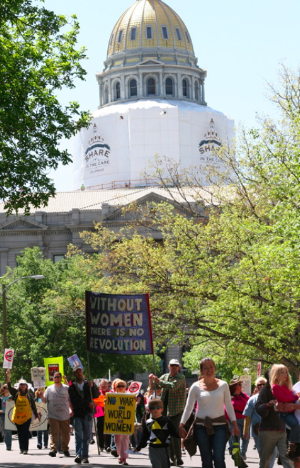
Spotted in DC at the J21 Women’s March. Advocates are marching for a museum to highlight the history of the oppression of women, as a tool to relegate oppression to the past, instead of where Trump’s inauguration wants to take it.
Tag Archives: National Mall
March on DC with your own protest message, not one dictated by NGOs. Yes, you’ll need a banner and poles.
Organizers of the post-inaugural WOMEN’S MARCH in Washington DC this weekend are telling participants not to bring poles for signs or flags, or even knapsacks. Ha ha ha. As you travel across the country to march, remember who’s making the real sacrifice. The march coordinators are paid. You are spending the time and expense because you have something to express. Bring it. The only reason organizers want you unequipped is so your [rogue] message won’t stray from theirs. Does that sound democratic? They also have a different goal than you. Their mission is to pull off a smooth event. Yours is to make history.
As a veteran of countless protest marches, national, regional and international, I encourage newcomers to stick to their nonconformist inclinations. Independent critical thinking is what led you to take action in the first place.
To begin, THIS IS YOUR MARCH.
Washington DC belongs to you. Inauguration Day and its aftermath belong to you. Just because someone squats a Facebook event on a day conducive to public gathering doesn’t give them dibs to call the shots. A stand-alone call to arms, such as MLK’s Million Man March or CodePink’s A Billion Rising, is another matter. Spontaneous uprisings against historic events are no one organization’s to control or temper. Especially if they begin with capitulations to the state.
Here’s the usual pattern. After a FB event goes viral, nonprofit activist groups jump in to offer their expertise, resources and manpower. The nonprofits thus dominate the details and the event originators have little ground to object. Thrilled to see “their” event succeed, these new-to-the-spotlight activists don’t know that street protest is anathema to nonprofits whose existential foundation is not to disrupt politics as usual. Falling into the trap of coordinating ineffective demonstrations is often blamed on newbie error, but in Washington DC, newbies making the newbie mistakes are employees of nonprofits seeded to pretend the event had a grassroots origin. What the NGOs are really doing is setting a prescribed burn, or backfire.
Backfire: a fire set intentionally to arrest the progress of an approaching fire by creating a burned area in its path, thus depriving the fire of fuel.
Bastards! Fortunately backfire has a further meaning, probably not unrelated to the sketchy forestry strategem.
Backfire: rebound adversely on the originator; have the opposite effect to what was intended.
Just as DC lobbyists monopolize your representatives, professional activists have staked out the capitol and squatted on what is the public’s only access to speak to power. Accept their invitation to come to DC. Thank them for their legal support, their logistics and water bottles, but you’ll handle your messaging thank you.
NOTES FOR NEXT TIME
(If you’d prefer not to dwell on criticism, please skip to the section on RULES. For me, these counterproductive “mistakes” set us back every time we give them a pass.)
1. Telling participants they can’t bring stuff like food or chairs! The event’s duration is being throttled to what can be endured between meals, without a pause for rest. Do you go to meetings without chairs? In the cold outdoors one can’t even sit on the ground.
2. Hiring private security contractors, “some identifiable, some undercover”. WTF? DC’s cops, National Guard, Secret Service, and “Shadow Teams” aren’t enough?
3. Coordinating with police. What? What?! To whom Black Lives Can’t Even Matter? Sorry no.
4. Stifling expression with limits on how to carry signs. Without sticks. “Flags but without poles.” Restricting marchers to signs reinforced with only cardboard tubing. Viewed from a perspective to show the numbers, the march will bear no legible message at all.
5. Telling marchers they must handcarry small bags. You’d think they don’t want marchers’ hands free to carry signs at all.
6. Stooping to a permit, as an excuse to self-police and make participants feel honor bound to unecessary concessions (the permit terms). You don’t need a permit for First Amendment activities. NGOs use permits to effectively reserve public areas and restrict their concurrent use by others. It’s a means to control public space.
7. Scheduling the march on the day after the main event, in time to disrupt nothing. Diluting the inherent outcry, expending from everyone’s discretionary resources to converge on DC. As a result we’ll have two mobilizations. Both massive, hopefully, intead of one which could have TIPPED THE SCALE.
RULES ARE
Meant to be broken. Permit holders can enforce rules within the confines of their event area, with the assistance of authorities if needed, but not outside it. Organizer “rules” can’t be enforced on Metro, or on public streets, or along march route. DC police may pretend they have that authority but they don’t. Cops lie. Know your rights.
To hold a sign where it’s visible in a march, and big enough to where it can be seen among multitudes, you need poles.
BRING POLES.
There is no safety reason whatsoever, in Washington DC, for forbidding the use of sign poles. We’ve seen pole restrictions attempted at national conventions, in close-in urban areas with vulnerable storefront windows, but Washington’s boulevards and setbacked facades evolved with political marches. Demonstrations, parades and motorcades are everyday for DC. Your sign poles pose zero threat and you don’t have to relinquish them. Not Post-911, nor in the Age of Trump. If an NGO-deputized cop won’t allow your entry to their rally, their privatized-park, have someone wait with the contraband outside its bounds. Banners are best seen on the edges of rallies anyway. When attendance numbers reach overload, you’re golden. Move with the numbers. Otherwise wait and join in as the march departs from the rally.
What’s best for poles? Lengths of bamboo from garden nurseries. Bamboo is stiff, light, and utterly non-threatening. Eight footers will hold a banner above marchers’ heads while still allowing you to rest the poles on the ground when the march lags. Six foot lengths give you adequate leverage to keep the banner taut but are more work. Either are cheap and expendable. Bring extra. Bamboo are thin enough to hold reserve pieces bundled. You can grasp a bundle of three as readily as a single pole. Those extra poles can be allocated as you see other marchers in need.
Let’s rule out pipe, lumber and dowels for being too heavy. Broom handles are expensive. Wooden stakes are uncomfortable and too short, and apparently, too “pointy”.
Various widths of PVC are rigid enough to about eight feet. Steel electrical conduit can give you ten feet. Both are cheaply available at neighborhood hardware stores. The baggage holds of charter buses can’t accommodate pieces over eight feet.
Alternatives to fixed lengths poles would be telescoping poles such as hiking sticks or monopods. Usually these do not extend beyond five feet. Longer telescoping tool handles used for painting for example extend but won’t contract to shorter than five feet or so.
Sectional poles such as geodesic tent poles can be folded to different length permutations. Depending on the weight of your banner material, multiple tent poles may be required to provide sufficient stiffness.
The benefit of collapsible poles is that you can conceal them until you are ready. Provided you have a BAG.
BRING A BAG
There are plenty of ordinary reasons to need a bag. Lunch. Extra layers of clothing. Hat, sunglasses, bandana. Extra gloves, hand warmers, snacks, literature to share, stuff handed you at the rally.
As a banner holder you’ll need supplies like duct tape, markers and string to fix signs, and those aforementioned extra tent poles. Maybe a backup banner or gag props for an alternative photo op.
We bring bags to work, school and play. Who expects that a day traversing DC doesn’t call for a bag?
Don’t be fooled into believing that for safety reasons all bags must be clear plastic. DC surveillance can spot the excess heft of dangerous materials such as explosives or weapons, without having to see them. What they’re really looking for are items like ropes, carabiners, harnesses, goggles, which activists can use for nonviolent fun, to mix things up and entertain, provide media moments and get attention.
Besides which, clear bags will make for unsightly messy photos. Neither does your bag need to be restricted in size. Bring a backpack or knapsack. Leave your hands free to carry that sign!
The best reason for you to shoulder an ordinary opaque knapsack is to give cover for others to bring bags with necessities you overlooked. Cameras, accessories, extra socks, bullhorns, batteries, umbrellas etc.
There’s nothing so heartbreaking as a mass of people who’ve come from across the country to participate in a march that goes nowhere. An uneventful demonstration garners no press, wins no recruits, and only burns out those who thought they came to DC to effect change.
I watched half a million hispanic Americans assemble on the National Mall for Immigrant Rights. Many of those half million took a great risk marching in DC. It’s possible many as a result were deported. They could only follow the rules of course, received no media coverage, and accomplished fuck-all.
BRING CHAIRS
Come to DC with a demand, but bring more than the leverage of numbers. Carry with you the potential that you might LINGER. That’s the pressure the media can’t ignore.
Chairs, umbrellas, canopies, tents, enhance your stamina and protect you from the elements. The longer your protest runs, the more time there will be for latecomers to join in. That’s the momentum the state is worried about. Project that.
“Power concedes nothing without a demand. It never did and it never will.” – Frederick Douglass
Douglass also said: “If there is no struggle, there is no progress.” Your march organizers have promised their DC colleagues a toothless beast. It’s not what they tell their donors, nor how they phrased their invitation to you. You brought your physical body to DC to support the cause. Is it theirs to squander?
Will occupying the streets Sept 17, Oct 6 and 15 precipitate an American Fall?
“American Fall” would be a pun, yes. A pan-Arabian-like Spring causing the US anti-democracy to tumble, being the objective. The English riots have put a dark spin on what might be Middle America’s reception to popular uprising, but mark the dates, because the brass ring nears whether you have the courage or not, and you won’t have the stomach for the alternative.
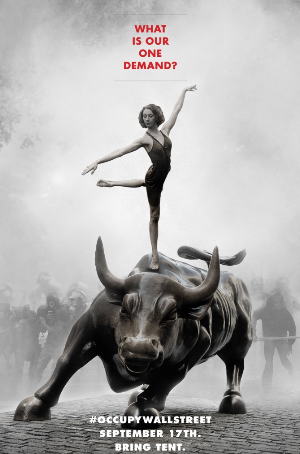
You’ve probably already sensed the buzz about #SEPT17, campus groups across the country have been bypassing the conventional chaperones to coordinate OCCUPY WALL STREET. Can they do it? Not without your help, and that doesn’t mean switching your phone service or knocking on doors to Get Out The Vote.
Donate, organize or help with the logistics. If you’ve the temerity, attend in person. At the very least, you’ll have your expenses reimbursed when the city settles your civil suit against them for false arrest. New York City already budgeted for the insurance policy that will pay the legal settlements for the probably now textbook law enforcement practice of kettling inconvenient protests. Or, thinking positively, you may just witness history. To make history you have to make it. Don’t leave it up to the Little Red Hen if you want a piece.
Next up is #OCT6, although the day varies regionally. The date marks the 10th anniversary of the Afghan invasion, but social justice groups of all stripes are throwing their sundry complaints unto one banner and have organized marches nationwide. Of course the nationals aims to SEIZE DC, where activists will converge on Freedom Square, English for “Tahrir Square”, with plans to camp there until the people’s voice is heard. DC has passed ordinances against overnight protests, but Freedom Square may be cut some slack for being off the National Mall. It’s a smaller public space which lies on the diagonal between the White House and the Capitol Building, abreast of General Tecumseh Sherman’s horse actually.
The determination to reclaim American Democracy with an action in DC hopes to recreate Madison Wisconsin on the Potomac, with the same grassroots support for a broad set of issues to which both parties have shown themselves unresponsive.
A successful DC foothold will get real traction being closely followed by an international call for a worldwide uprising. #OCT15 is being spearheaded by Spain’s movement for GLOBAL DEMOCRACY. Will it dilute regional efforts to have actions running concurrently, or will synchronized demonstrations overwhelm our transnational overseers? We can wait and see, or we can give it our best shot.
Here are more graphics in support of the kickoff September 17. Borrowing from Tunisia and Egypt, and before that Chicago 1968, it’s US Days of Rage.
In the course of a single spring we’ve seen massive demonstrations which provoked governments to interrupt cellphone service, shut down internet access, and answer protestors with direct gunfire. To what extreme will the USG be driven? What rights remain inviolate in the US? Not communication. Activist cellphones were blocked on the BART in San Francisco to thwart protests against police brutality.

Mondovino: globalization and terroir, Robert Parker versus your good taste
For those with a curiosity for how wine terroir is holding up against the onslaught of wine factory farming, the 10-hour miniseries version of MONDOVINO is finally available on DVD. For viewers curious about viniculture globalization under Californian colonial domination, the original feature length documentary delivers, with a long finish. Any time critics accuse a film of being one sided, you know it’s about class war.
I had my first lesson in vineyard terroir when my college-aged aunt visited my family in Alsace and spent a season picking grapes. She informed us to our horreur that everything gets stomped in that barrel, bugs and all. I didn’t drink wine then, so what did I care, but it was easy to decide that such was the artistry that probably made French wines great.
But as I said, Mondovino was about much more than wine, and now I’ll get to the point. We may lament the new commercialization of wine, but historically the occupation has always had its strictly-business types. Vintners were rarely agriculturalists who subsisted, they were wine lovers subsidized. We can wince at the Napa Valley nouveau gauche, but even Bordeaux’s great chateaus, and especially all the Premiers Crus, are owned and have been owned by businessmen money lenders, going back centuries.
The modernization and standardization which is destroying contemporary wines is simply the evolution of production control. At last, technology and the ascent of a gilded age have brought vintners to believe they’ve bested nature. It’s true if you don’t care about wine, if you’re content to bottle a soft drink as opposed to allowing wine the breathing space to develop personality. Basically this documentary demonstrates that these gentlemen hobbyists, now plaintively bourgeois about profit, welcome the new global fascism.
Old World Fascists
Of course it is no stretch to imagine that the Mondovino filmmakers are going to ask, how did your father or grandfather like Fascism under the Nazis? They point the question at an Italian family who date their wealth back 900 years as bankers.
Any European documentary delving into family histories will always ask particularly about the war years. In America it’s what did you do during the war Daddy? In Europe it’s about weathering the occupation. Most working class French want to tell you what they did in the Resistance. Rich people you don’t ask because of course they were collaborateurs.
Mondovino’s subjects are the perpetually wealthy, who don’t even register the affront. Of course their families thrived under Fascism, quelle betise to imagine it would be otherwise. How curious it is we are surprised they embrace it so again.
Such moments are the highlights of Mondovino, rich folk posing in elaborate foyers, plaintively matter of fact about Fascism.
One opulent reception room in Florence is packed with ancient paintings, among them a painting of the very room full of paintings, you imagine if you peered closely enough you would see the infinity of mirrors scheme, a Baroque era black velvet number. The Grande Dame mentions that Prince Charles inquired about that painting at breakfast.
Let me add, critics have held Jonathan Nossiter’s camera work to be unstable. Actually he was very easily distracted by momentously relevant tchotchkes and biographical details few commoners are granted audience to encounter.
Fascists in the New World
Mondovino allowed the Napa Valley entrepreneurs to hang themselves. Open mouth, insert vacuous blather, often racist. These nouveau riches landscaped new vineyard for themselves, praising the terrain like it was classic architecture, their aesthetic tributes could only reference the National Mall. That classic.
Over at Mondavi, talk fixated of expansion and conquest. The film’s main plot addressed the Mondavi’s ongoing acquisition of the world’s most treasured appelations. For the worse of course, because what do they know about wine but that it should all taste the same? Son Mondavi dreams of someday having a vineyard on the moon, for no other reason than he thought of it. Wouldn’t it be exciting, he asks, to be able to say: “hey, let’s open a bottle from the moon,” my paraphrase.
The issue of terroir, English readers, has entirely to do with terre which is French for “earth.” Terre with a capital T is “Earth.” Of course the earthbound distinction was lost on this Californian.
Yes, Mondavi is surely alone in pondering what earth, sun and elements would have feed his moon vines.
Most vile of all the New World vintners was a family outfit in Argentina. They sit on a spacious veranda and explain how every boy in the family is named for founding father, the original title holder. Their wealth goes back to the early Spanish settlers and they express the perennial colonizer’s lament, that Los Indios of the regions have no work ethic. Centuries ago the Spaniard had to devise cruel torments to drive their slave laborers to produce. It was an inefficient system to impose on the indigenous and transplanted tribes, unaccustomed to a hierarchical workforce supporting do-nothings at the top.
Globalization
Key to Mondavi’s quest for wine world domination, is a market that has standardized the consumer’s taste. No longer are customers hopping in their car for a Sunday drive, to stop by a neighboring chateau to sample a vintage take a case home. Today the global consumption of wine has meant having to market it without being able to taste it. For that consumers have come to follow the ratings of critics. It was inevitable of course, but Mondovino reveals how hilariously flawed and phony the system is.
Mondovino focuses on two celebrity tasters who make or break wines. Robert Parker and James Suckling. Let’s dispatch the latter quickly.
James Suckling
James Suckling made a niche for himself nurturing Italian wines and coined the term “Super Tuscan.” I didn’t know that, but Mondovino records Suckling attributing the phenomena to the ether before being made to admit that the meme was his own.
More hilarious was a hypothetical question posed to the critic after confessing in an unguarded moment that he might have been too generous with the rating he gave a friend’s wine. The friend, a wealthy vintner, was letting Suckling a villa, which meant he was also his landlord. Naturally Mondovino asked if a discount on the rent would move Suckling to consider a more favorable rating. Suckling took the bait, laughingly nodding, of course, his friend under his breath suggested in such case he could have the villa for free.
It’s not corruption, merely a gentleman’s game. Can we even assert that the ordinary consumer suffers? Taste is subjective. Suckling’s ultimate rating is of negligible consequence to wine drinkers, except to commerce.
Robert Parker
I’m sorry to be getting around to Parker’s scheme so late in this article, because he plays such a profound part in the homogenizing of world wine production. The mechanism is beyond the pale, but it’s simple. Parker is influential and has a distinctive appetite, he has a best friend who consults with vintners about how to make their wine to Parker’s taste. The result has been devastating. Vines that have for ages had their own distinctive gouts have now been McParkered. The consultant charges a large fee to monitor an increasing stable of wines, for the camera his preoccupation was “micro-oxygenate,” and after it’s bottled parker comes around and bestows the high marks. The more they pay, the higher the score.
Mondovino underscores this plot by filming a Burger King billboard as Parker drives past it, while he sings the praises of uniform quality. The filmmakers notice an FBI cap on Parker’s desk and make sure to keep it in the frame. Parker is quite candid and friendly in Mondovino, probably because he had no inkling they did not share his eagerness to see viniculture’s eccentricities ironed to a uniform flat.
When the film was released and Robert Parker emerged as enterprising accomplice to Mondavi’s villain, Parker was enraged. He wrote rant after rant against the film and its makers. I’m not sure he’s over it yet. I wanted to be sure to document what I thought was Mondovino’s most brilliant assault on the witless benefit the Parker-Mondavi venture think they’re bequeathing with their anschluss of world wine. It’s about the subjectivity of taste. Robert Parker’s.
A recurring motif of Mondovino’s interviews was a fascination with dogs. It’s cute, and often we give ourselves leave to believe we have learned something about the owner by just looking at their dog.
In one memorable scene, we’ve met a quite unassuming South American vintner who has only one hectar, but is none the less generous with his wine, his time and friendship. He has a black dog, and when the filmmaker asks his name, the vintner laughs such that the revelation is self-effacing. “Luther King” is his name, because, he tells us in Spanish, he’s “negro.” Mondovino’s dark hats are so distasteful, it’s important that the heroic characters aren’t too pearly clean.
All the asides with the dogs were entertaining in their own right, but could have served entirely to set up Robert Parker’s scene. We’re invited to Parkers home and immediately discover he has something for bulldogs.
Do you like bulldogs? Taste is of course subjective. Robert Parker and his wife love their bulldogs, two, and their home is festooned with Bulldogephemera, statuettes, paintings, the camera frame’s worth. Imagine a wall covered with watercolors and oil portraits of bulldogs as you consider the subjectivity of taste.
Then just as Parker is prompted to discuss that his nose is ensured for a million dollars, we discover that one of the dogs has become incontinent, and there’s the near unbearable dog flatulence from which not even conversation can escape. Imagine Robert Parker’s nose not ensured against that. The interview concludes with Parker rambling about something as a bulldog sits sneering on the carpet forcing the filmmaker to keep a safe distance, and so he focuses in close capturing the ugly, perhaps infirm, definitely defensive, unlikable mug.
The next time you chose a wine because it has a high Parker score, ask yourself how it integrates an atmosphere of dog.
Photos from DC antiwar actions

WASHINGTON DC- First citation issued to Camp Out Now, unloading Funk The War sound gear on northwest quadrangle of National Mall.

My PEACE NOW design for the SDS Funk The War BAD ROMANCE march on Friday.

Conclusion of Saturday A.N.S.W.E.R. march on the White House, before the eight arrests. Cindy Sheehan’s account here.
More pictures on Facebook.
Camp OUT NOW delayed for St Pats
PEACE OF THE ACTION and Cindy Sheehan had to delay their March 13 start by two days, to accommodate the Washington DC’s St. Patrick’s Day. Parade organizers objected to sharing the National Mall with an antiwar protest encampment. Deja vu? Camp OUT NOW will raise their tents on March 15 on the lawns between the White House and the Washington Monument, to protest America’s ceaseless war-making. Sheehan and co will direct civil disruptions of DC activities and don’t plan to strike the tents until troops -and drones- are OUT. Join them!
Next to the White House
While visiting Washington DC in March, I found it interesting to note the edifices closest to the White House.

EAST, WEST
The neighbor to the immediate East of the Obama’s White House is the Department of the Treasury. Is that any surprise? Of course not, but how bourgeois! I could imagine Scrooge McDuck sneaking across the White House garden twice a day to check his reserves. To the West is what we now call the Dwight D. Eisenhower Executive Office Building. It’s the site of the suspicious office fires which may or may not have masked a recent vice-president’s misdeeds. The edifice looks straight out of A Series of Unfortunate Events, and check out the plaque which commemorates what the building used to be called:

Probably that should be no surprise as well: the White house sandwiched between Treasury and War. “State, War and Navy.” How so much less duplicitous than the “Department of Defense.”
SOUTHWEST
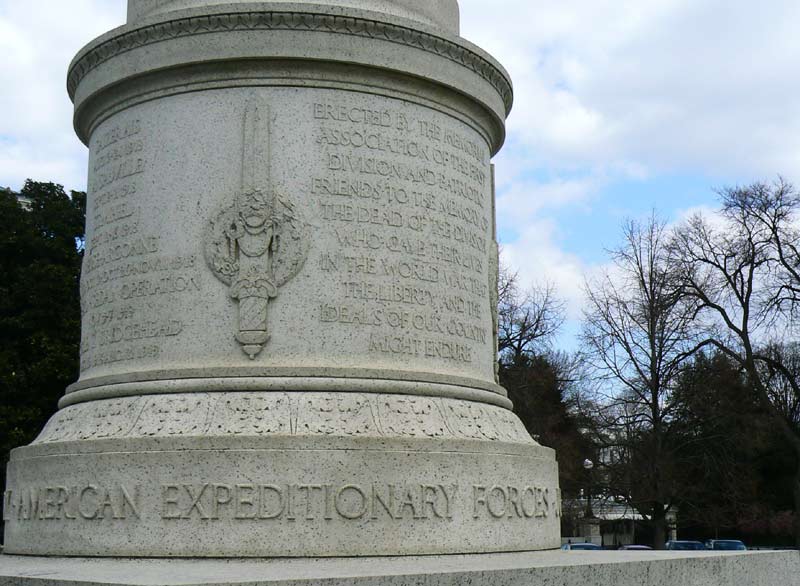
Behind the former War offices, to the Southwest of the White House, lies the war memorial to end all war memorials. It’s the WWI Memorial, of considerably diminutive size compared to those commemorations of subsequent wars which have spilled unto the Mall, but its form followed the convention of the typical Great War monuments erected throughout Europe among the nations who had participated.
Except the American version is dedicated to the “Expeditionary Forces” which I just love. That’s what WWI was about for the US. The trenches of Europe were no place Americans needed to defend their freedom. The troops we sent, to relieve France and England, represented a foreign expedition, exactly that. More precisely, our troops were an R&D expedition for our blustering capitalists.
(This may be no time or place to note that history books do not link America’s WWI experience with the Influenza outbreak of 1917-18, which began in the barracks of US soldiers being mobilized for war. American soldiers took their flu to Europe and ultimately killed 50 million people. Those were not the days before we knew better to stay home to prevent infecting others.)
The US entry into WWI was bitterly opposed by a peace movement which the war-opportunist-profiteers maligned as isolationist. Selfish globalization-denying isolationism has been the slander ever since, used against anyone who tries to block military interventions in all their guises.
Ultimately WWI was no affair of ours, had the Huns emerged victorious, American foreign affairs would hardly have changed. Our foreign trading partners would have numbered more Germans, that’s all. But it’s useless to compare alternative outcomes of WWI, all things staying constant, because America participated and profited wildly.
If American investors had not jumped in Over There, the greatest business opportunities of blossoming industrialism would have been missed. The opportunities offered by the Europeans fighting amongst themselves, proved to have been momentous.
And here was the monument to those lost American lives, sacrificed so that American industrial might, in particular the new banking monopolists, could seize the European spheres of influence throughout the world. Of course the lost lives of the American Expeditionary Force were remembered thus:
“…WHO GAVE THEIR LIVES IN THE WORLD WAR THAT LIBERTY AND THE IDEALS OF OUR COUNTRY MIGHT ENDURE”
It would take another World War for the US to appropriate the colonies and oil fields by means of contracts and loans, with the leverage of coming to their aid again, this time armed with lend-lease bills.
SOUTHEAST
To the Southeast of the White House, across the back lawn, lies the monument antecedent to the Great War. It’s the Civil War Memorial, atop which rides the triumphant General William Tecumseh Sherman. (Who, to be fair, presided over the War Department for a long stretch after the Civil War, actually this nation’s longest peacetime period.)
Curious that I chose to crop his personage from my pictures, but my eyes were drawn to the lesser figures around the base of the monument, in particular, a half naked woman.
The memorial seemed to include various uniformed Civil War participants. How egalitarian to include a woman. But this woman was no French Revolutionary with breast bared oblivious as she rallied her comrades to victory. This delicate woman was unarmed and stripped to the waist, her children in tattered rags at her feet.
Could this statue be offering another conceit to the reality of war, to Sherman’s March to the sea, to the burning of Atlanta, to the shameful destruction he visited on the secessionist South? Was this a nod to the real role given to Women in war, their sons and husbands taken from them, a non-combatant left helpless to defend her children or herself. Did the shirt torn from her body confess to the woman’s rape?
More probably the feminine likeness personified man’s attraction to war, a soldier’s predilection for her beauty. How many war monuments memorialize as they also beacon?
Much of the terrain around the White House grounds is blocked off by secondary and tertiary security perimeters. But for the arrival of bus unloadng its visitors to see it, the Civil War Monument is normally cordoned off. When I had passed it earlier, a balaclava-clad guard was blocking the only entrance.
SOUTH
The grassy expanse immediately South of the White House, permitting the First Family an uninterrupted view of the National Mall, has actually been given over to parking permits. The loop of asphalt across the lawn, with cars strewn diagonally along the edges, gives the unfortunate impression of overflow event parking. In any other neighborhood, the crowd of cars would be a dead giveaway that someone on the block was having a party.
Peace flows from the end of a gunboat

WASHINGTON DC- It’s not the “Department of Peace,” to contrast with the Department of Defense, although some detractors point out that we have the State Department for that, but visitors to DC will find in the NW corner of the National Mall, the US Navy has conceded a portion of its real estate adjacent the Lincoln Memorial for a US Institute of Peace. Dot org, not dot gov. And what do they mean by “Public Education Center?” It’s Pax Americana they’re institutionalizing, aka peacekeeping in the gunboat diplomacy sense of the word.
And sure enough, according to its website:
USIP has been operating on the ground in Iraq since 2004, working with Iraqis to reduce interethnic and interreligious violence, speed up stabilization and democratization, and reduce the need for a U.S. presence in Iraq.
The Decembrists & The Bagman’s Gambit
I ran across an atrocious attempt to do Godard, post-Weekend. It was a David Spade infomercial for the pitiful AXE campaign, parading as an indie contest to make The Dirtiest Film in the World. Spade played a Salvador Dali impressario with the contrived posture of a Tanqueray ad.
In any case, then on the radio I chanced to hear a musical piece with all the film imagery, sans images, with the melodious nakedness of Major Tom Coming Home. It’s by the Decemberists, (where have I been?) and the song is called The Bagman’s Gambit. The lyrics are below, but you’ve got to hear it.
The Bagman’s Gambit
On the lam from the law
On the steps of the capitol
You shot a plainclothes cop on the ten o’clock.
And I saw momentarily,
They flashed a photograph, it couldn’t be you.
You’d been abused so horribly
But you were there in some anonymous room.
And I recall that Fall
I was working for the government.
And in a bathroom stall off the National Mall
How we kissed so sweetly.
How could I refuse a favor or two?
For a tryst in the greenery
I gave you documents and microfilm too.
And from my ten floor tenement
Where once our bodies lay,
How I long to hear you say
No, they’ll never catch me now
No, they’ll never catch me
No, they cannot catch me now
We will escape somehow
Somehow.
It was late one night
I was awoken by the telephone
I heard a strangled cry on the end of the line.
Purloined in Petrograd
They were suspicious of where your loyalties lay
So I paid off a bureaucrat
To convince your captors they’re to secret you away.
And at the gate of the embassy
Our hands met through the bars
As your whisper stilled my heart
No, they’ll never catch me now
No, they’ll never catch me
No, they cannot catch me now
We will escape somehow
Somehow.
And I dreamt one night
You were there in fours
Head held high
In uniform.
It was ten years on
When you resurfaced in a motorcar.
With the wave of an arm
You were there and gone.