Nas Daily is Borat for dumb millennials. Israeli Hasbara with pseudo goy knave.

Mondoweiss has the goods on Nas Daily, but they’re wise enough to let readers connect the dots. Let’s do it shall we? Nas Daily is a viral sensation on Youtube. It presumes to trot the globe presenting a sixty second travelogue for a new location everyday, minus the travel time, location scouting, casting, shooting, editing, seeking permissions, and marketing. Admittedly the inanity of the content must write itself.

At best, Nas segments are compilations of travel agency footage, woven with drone-shot videos of the 25-yr-old “Nas” spazzing out with troops of multiracial peri-pubertals around whatever tourist attraction or cultural distinction Nas thinks will blow your mind. The high production costs, the innocuous feel-good themes, and the obvious PR services, leave no doubt the “viral” load is engineered. But by whom?

Nas, aka Nuseir Yassin, is also dishonest because he’s not globe-hopping with abandon, as the videos suggest. That part is already in the can. While viewers think they’re supporting his search for new exotic destinations, he’s home binging on Taurine and Final Cut Pro.

Nas Daily doesn’t warrant mention, actually, until the interspersed episodes seeking to depoliticize the Israeli-Palestinian conflict. Then Nuseir’s being a Muslim Palestinian Israeli, happy genocide denier, makes it absolutely clear who is behind these videos. This is Hasbara product focused on legitimizing the Israel colonial project. No wonder Nas doesn’t like BDS.

Borat was Zionist blackface slapstick which smeared Islamic stereotypes with excrement. This collaborator Borat may be an authentic Muslim, promoting tolerance for all cultural differences, but his secular apolitical whitewash is equally vile.

Why should you attend the Denver Nalty-Byfield ENTERPRISE TRIAL?

Why support the “We The People” public-oath sticklers who the state is prosecuting like a criminal enterprise? A few reasons: Solidarity. Because as hardheaded as they might be, defendants Stephen Nalty and Steve Byfield are still JUDICIAL REFORM ACTIVISTS. Sense of fair play. Half the courtroom gallery is filled with Colorado Attorney General staffers and FBI special agents chumming it up with jurors and briefing their THREE FBI UNDERCOVER WITNESSES while the defendant pariah side of the audience is warned by the judge that even a whisper will result in ejection. Thrills. Where else are you going to see this many federal agents pushing their weight around, barking at you in the hallways, swaggering gleefully about how much smarter they are than the defendants? Pathos. Come watch the Assistant Fucking Colorado Attorney General, Robert Shapiro himself, lead a team of prosecutors against the unrepresented defendants, watch Shapiro belittle them, lecture them, trivialize their difficulties defending themselves in jail, and pretend they can review “tens of thousands” of pages of evidence and “hours and hours” of undercover surveillance tapes in a single day. Because you can make a difference. Come push the FBI-guys’ buttons. Come witness and document the abuses of the overbearing prosecution team. Come lend public pressure on the judge, whose conscience is already bothering him about how unfair this sham trial has become.

Liens
You don’t have to agree with how Nalty and Byfield went about trying to reform the judicial system, but aren’t they mostly right? Judges ARE corrupt. Local officials ARE NOT accountable to the people. Law enforcement WON’T pursue charges of their own corruption and the media certainly won’t side with the reformers. When Nalty, Byfield and Co, served commercial liens valued at billions and trillions of dollar against officials who hadn’t filed oaths of office, it was an effort of last resort to get someone’s attention. No one was thinking, hey, maybe this eleven-figure dollar demand will slip through the cracks and the billions will be ours!

Each lien was calculated to represent the sum defrauded from and owed to the American People. Prosecutors can tap these defendants for conspiring and racketeering and extorting and attempting to influence public officials, but they can’t say the defendants aimed to obscond with one single penny. Throwing three undercover infiltrators at a twenty member judicial reform group, putting thousands of manpower hours into locking these defendants away, is gross abuse of authority and it’s hubris.

Authentic transgressions
As the sham trial goes on, the pieces are coming together on the cases of Nalty and crew. It turns out federal investigators labeled them “sovereigns” because they’ve held themselves not responsible for paying traffic tickets, property taxes, and the like. In the end I’ll grant you Nalty’s group may be guilty of those. I say “may” because such citations may have been retaliatory for their political beliefs.

As to the punishment, I believe adjudicators should take into account that the defendants acted not to enrich themselves, nor to flaunt the law per se, but to assert political rights about which they may have been misguided. Again I say may because the defendants are being tried, after all, according to a set of laws, which enforce a social contract, the terms of which the parties do not agree.

I use the word misguided as a nod to those who think the Nalty gang have acted like idiots. That’s easy to say, and easy to laugh, but no one’s yet figured out how to emancipate labor from the yoke of capital. You may regard interest and rent as your inherent debts. These sovereigns don’t and they’re trying to say so.

Economic slavery
Ours is a system of peonage to which this crew feels they never indentured themselves. The ersatz writs and liens they spammed to every official they encountered were the legal loopholes they thought could break the bank and liberate everyone from financial tyranny. While Nalty’s scheme intended insurrection, it wasn’t against democracy or the republic, it was against taxation without representation, the same beast Americans pretend to have overthrown with the Declaration of Independance.

Instead of tea into Boston Harbor, this crew dumped a bunch of junk paper unto the reception counters of Colorado public offices. Charge Nalty’s crew with littering maybe, at most, vandalism, though it’s hard to say these vandals caused even a scratch. Every public official who testified as a victim said they didn’t take the ersatz documents seriously.

The writs and liens looked officious, but weren’t attributed to known government or banking institutions. Likewise signatures were signed in red. Red was chosen to represent the signer’s blood, even though red is a color which automated banking systems reject as unreadable, therefore invalid.

Not one witness expressed confusion about the validity of the papers. They mentioned too the rambling diatribes in the text block.

To call the defendants “paper terrorists” wildly overstates the effect they achieved. They didn’t terrorize anyone. Governments like to accuse rebellious insurgents of “terrorism”, but that’s another paralegal threshold with which most common citizens, and certainly these “sovereigns”, disagree.

Real funny money
These guys did the equivalent of feed Monopoly Money into ATMs. No bank balances were changed and no real money came out. Counterfeit currency is one thing, but denominations of your own handywork pretending to be only that does not qualify as funny money in the illegal sense. I’m guessing forms submitted in a language foreign to bank clerks would be rejected out of hand. How are these any different? Irregular submissions, as one witness called them, need not generate calls to the FBI or the Colorado Joint Terrorism Task Force. I’ll bet that ATMs know to reject Monopoly Money. If they don’t, whose problem is that?

The trial of defendants Stephen Nalty and Steve Byfield is due to wrap up Friday. The prosecution will have taken seven days to present its case and Assistant Attorney General Robert Shapiro intends to object if the defense rebuttal takes more than a half day, maybe a whole. This trial is meant to intimidate the other defendants to convince them to take pleas.

Next in the pipeline is Bruce Doucette whose trial starts October 16. Defendants Harlan Smith and Dave Coffelt have hearings on October 18. If they do not take deals, Shapiro intends to enjoin their cases, to save time and money. He’s already convinced defendant Brian Baylog to take a deal and turn state’s evidence. Baylog is scheduled to testify against Nalty and Byfield shortly.

By now the condemnation of Nalty’s commercial lien scheme will have cost Colorado millions in man hours and legal expenses. You can fine a graffiti artist for having to restore an edifice to its original lustre, but you can’t expect him to bear the full cost if you chose a cleanup crew that wears Gucci loafers, most of whose jobs is to pat the other on the back.

Colorado’s overkill with federal agents and counter-terrorism experts is a problem of its own making.

The Nalty-Byfield trial continues through this week 8:30am – 5pm, at Denver’s Lindsey Flanigan Courthouse, in Division 2H, ironically, “Juvenile Court”.

Radiolab episode on jury nullification is less bothered by state abuse of power than public desperation to fight back.

It should come as no surprise that public radio’s RADIOLAB would take government’s side against the growing grassroots effort to awaken citizens to the repressed potential of jury nullification. Any attention to the subject helps inform ordinary jurors of the power they have to stand up to the regular abuses of our judicial system. The benefit is tempered of course when liberal gatekeepers lean in with theatrics to fearmonger about anarchistic challenges to law and order and security. That’s exactly what Radiolab achieved though given plenty of material with which to have taken a more honest tack. Their program “Null and Void” aired May 12 and painted nullifiers as irrational extremists, giving a pass to the judges who purge juries and break the law by having nullifiers arrested.

I had high hopes when contacted by a producer for Radiolab in March. Our federal injunction protecting Denver jury nullification outreach efforts against an order by the Second Judicial District’s Chief Judge Michael Martinez was coming to trial in April. I imagined reporters would be sympathetic to our predicted success making our injunction permanent and the similar likeliness of our prevailing on contempt charges in a hearing which was to follow. I faciliated Radiolab’s access to Mark Iannicelli, who Denver arrested in violation of our injunction, and whose dismissed charges of felony tampering continue to be appealed by our legal adversaries. Thus far it’s a simple story of hoisting a chief justice on his own petard, using the justice system against itself, in defense of the people’s historical power as jurors.

Heicklen
But Radiolab had an alternate narrative in mind. Their story would center on a jury nullification champion who they could characterize as coming off the rails, the celebrated frequent arrestee Julian Heicklen. Septegenarian Heicklen became tired of judges warning him of arrest, despite his continued legal victories. By November 2016, Heicklen issued a manifesto of sorts, asking for armed backup to preempt a judge from making good on his renewed threat to arrest him. Heicklen posted this warning online and called it to everyone’s attention. Presumably it’s what drew Radiolab’s attention. Heicklen had put it out there, hoping to spark a John Brown-esque conflagration, I’d call it a bluff, meant to curtail the court’s continued abuse of power. It’s obvious from Heicklan’s hyperbole. I attach the significant excerpt in the notes below.

Radiolab didn’t reference this tract, nor mention their and the court’s foreknowledge of it. As they interviewed Heicklen, they asked him about his cause and even brought him to tears as he explained his distress about the injustice of the system, which continues to reinforce inequity and deny jurors their prerogative to step in its way. Then Radiolab prodded Heicklen to explain what he anticipated would happen when he showed up at the courthouse in defiance of the judge’s threat. On cue, Heicklen repeated his entreaty that supporters show up with guns to enforce his right to pass out fliers and avert the judge’s illegal threat to arrest him.

Many of us might share the elderly activist’s frustration with being habitually arrested then exhonerated, each time without apparent progress being made. Radiolab’s pretend reaction was to cue ominous silence, let the pin drop, cue indignant alarm, ostracize Heicklen, cue a spontaneous meting of Radiolab minds to elect to call the cops on Heicklen lest law enforcement personnel be shot.

Radiolab didn’t call the Chief Judge Frederick J. Lauten to question the irregularity of his repeating an illegal threat. How absolutely insane for a judge, already proven to be in the wrong, to keep asserting his authority to have a citizen falsely arrested?

When Heicklen showed up to the courthouse, with a friend, both without weapons of any kind, and without the backup support of “Tyranny Fighters” he’d hoped to mobilize, Heicklen was arrested for the more serious charges involving threats.

Radiolab may or may to have exacerbated Heicklen’s arrest. They certainly took credit for it, which is the least they could do for having exploited Heicklen as their straw man extremist.

Because Radiolab makes little effort to conceal their liberal bourgeois elitism. FIJA, the Fully Informed Jury Association was founded, according to Radiolab, in a Montana “bunghole”, which they qualify, they are entitled to call Helena, the capitol of Montana, because one of the show’s producers is from Montana.

Wolverine
You might ask, what’s Wolverine got to do with this? Anyone who’s read Ariel Dorfman knows better than to bring superheroes into political discourse. Radiolab didn’t know how better to distinguish between a citizen’s right, as proscribed by the Bill of Rights, and a power, something grown from common law. Whatever, they’re wrong. Juries are guaranteed by the sixth amendment, now commonly understood to be “a jury of your peers.”

Radiolab never uses that phrase, it’s too everyman. But they do riff ad nauseum on Wolverine, who’s a superhero with superpowers, namely CLAWS, which for Radiolab described this aberrant power that jury nullification advocates are promoting. The public as beast, and mutant power threatening elitists like a werewolf’s claws. Someone adds, as a further irrelevance, that Wolverine’s real superpower is regenerative, the power to heal but nevermind. They say that, and it’s the only trivia that actually does apply to jury nullification. Radiolab autistic savants.

They recorded Mark Iannicelli in front of the Denver courthouse, that was our single consolation!

It’s no surprise that Radiolab takes the government’s side against the public’s growing inclination to “burn it down.” Radiolab got great quotes from Mark, but chose to demonize other jury nullification pamphleteers who were so frustrated with being arrested that wanted to deter future arrests with guns.

By the show’s end, the white privileged NPR broadcasters feel more comfortable with the law in the hands of “unelected, white” judges over inexpert jurors described as “twelve random jerk-offs from the street.” They’re taking about your constitutionally protected jury of your peers.

Hopefully listeners will glean the great information offered by this piece and nullify Radiolabs’s privileged condescension.

NOTES:
1. Julian Heicklen’s post of November 24:

Hi Tyranny Fighters:

Orlando Courthouse: I plan to be at the Orange County Courthouse in Orlando, FL distributing Fully Informed Jury information from 10:30 am – 1:30 pm, unless arrested earlier, on Monday-Wednesday, December 5-8, 2016. All of you are invited (urged) to join me. Bring your guns. I have requested protection from the Florida Militia, the Department of Homeland Security, and the Governor of Florida. None of them responded to my requests. Copies of the letters to the Department of Homeland Security and the governor were sent to the Clerk of the Orange County Court and to you in my previous report.

I have not received replies from any of these people. However I have received a letter from Frederick J. Lauten, Chief Judge, Ninth Judicial Cicuit of Georgia. Here is his letter:

Dear Mr. Heicklen:

A copy of your letter to Rick Scott dated October 13, 2016, was given to me. In your letter, you stateit is your intent to “distribute flyers regarding the duties of jurors and witnesses at criminal trials” at the Orange County Courthouse during th first week of December.” This letter is a reminder that such conduct continues to be proscribed on courthouse grounds under Administrative Order 2011-03 which governs expressive conduct taward summoned jurors. Enclosed is a copy of Adminiustrative Order 2011-03 for your perusal.

As you know, this Administrative Order is constituional as the Fifth District Court of appeal had “no difficulry upholding Administrative Order No. 2011–03 as reasonable, viewpoint neutral regulation….” Schmidter & Heicklen v. State, 103 So. 3d 2663,270 (Fla. 5th DCA 2012)(a copy of which is enclosed). This Court, as well as the Orange Cpounty Sheriff, qill enforce the provisions of Admionistrative Order No. 2011-03 to ensure the fair and orderly conduct of jury trials and to prevent dissruptions or interference with that basic right.

Based on the Administrative Order’s continuing validity, you may wish to reconsider your intended course of action and find alternative means in which to disseminate your message. If you intend on distributing materials to jurors, you will be issued a trespass notice and if you then remain on courthouse grounds, you could be arrested for trespass.

Sincerely,

Frederick J. Lauten

Chief Judge

____________________________________

Unfortunately there seems to be a disagreement between the Florida court and the United States Federal Court. I was one of the appellants in the Florida case. The decision was based on lies and incorrect information introduced by the state attorneys. The judges should have know this, since I carefully pointed out the errors, but they did not care. They had made up their minds before hearing the case.

Previously I was arrested 5 times for distributing this literature at the the U. S. District Court in Manhattan, NY. I was arrested and charged with jury tampering. After 17 months of trial, Judge Kimba Wood declared that distributing this literature was not jury tampering because I did not discuss any case with a juror sitting on that trial. She dismissed my case. Her decision is at: http://constitution.org/jury/pj/10-cr-01154-KMW_order.pdf This decision was published in many journals. The NY Times publication is at: http://www.nytimes.com/2012/04/20/nyregion/indictment-against-julian-heicklen-jury-nullification-advocate-is-dismissed.html

Other publications can be found at: http://search.myway.com/search/GGmain.jhtml?p2=%5EC73%5Exdm007%5ETTAB02%5Eus&ptb=304CD70B-562C-491B-9E0F-EEEA96D81532&n=782b17fd&ind=&tpr=hpsb&trs=wtt&cn=us&ln=en&si=CJSjz-LK7s4CFdgQgQodEmkJvA&brwsid=343148da-648b-46c2-8171-a9e312ac5776&searchfor=Jury%20nullification%20case%20of%20Julian%20Heicklen&st=tab

I was invited to Harvard University Law School to give a lecture on my case. Also I have been informed that my case is being taught to all students at Yale Law School. Presumably it is being taught elsewhere as well.

Currently I distribute the same flyers at both state and federal courthouses around the country. None of them arrest me. Three of these courthouses are state courthouses. They are in Fort Lauderdale, Fl; Pittsburgh, PA (last week); and Newark, NJ. The federal courthouses this year have been in Fort Lauderdale, FL; Newark, NJ; Manhattan, NY; Palo Alto, CA; Pittsburgh, PA (last week) and San Jose, CA; The state courthouses do not approach me. The federal courthouse Homeland Security officers at federal courts all threatened to arrest me until I told them to check it with a judge. They did, and none of them made an arrest.

December 5, 2016 will be a critical day in the history of the United States. I will appear at the Orange County Courthouse, 425 N. Orange Avenue, Orlando, FL and distribute “Nullification by Jury” flyers on the public sidewalk leading from the parking lot to the courthouse. I am asking all Tyranny fighters and anyone else to join me armed with loaded guns to shoot any courthouse employee or officer of the court (i.e. guards, Orlando police, State police, Sheriffs, or lawyers) that approach within 15 feet of me. One of 4 things can happen:

Neither the court personnel, the Tyranny Fighters, nor the press will appear. That will be the smoothest, but dullest, situation.

The Court officers only will appear and arrest me.

The Tyranny Fighters only will appear and protect me.

Both the Court officers and the Tyranny Fighters will appear. The gun battle for the return of a free country with a democratic republic will occur.

I am irrelevant. The future of the United States will be determined by the others or by you. Either we will continue the route to the gas chambers as described in the attached document, or we shall backtrack to a democratic republic. In either case I will have died by then.

The choice is yours—Julian

Passing Syrian gas attack story by Occam’s Razor: who smelt it, dealt it.

When you’re looking for who perpetrated the latest “gas attack” in Syria, you might first ask, who has stockpiles of the stuff? Bashar al-Assad has suspected quantities of chemical weapons, but the US has known riches of the banned material. The same people who keep pointing the finger at Assad are the same cretins who’ve been trying to ignite a covert war in Syria for decades, who’ve been unmasked hiring fake lesbian or small-child bloggers to spread propaganda in the Baghdad Blogger mold, long before their phony Arab Spring roll-out, the same agency that spawned al-Qaeda now Isis, the same agents who coordinate arms trades to all parties, the same meatheads who urge a renewed cold war with Russia because Putin nearly brought the Syria conflict to a dead calm, and the same warmongers who’ve now succeeded with a full-on US deployment! We’re supposed to trust the US intelligence crime family about who is using gas against Syrian civilians? Next they’ll try to pin US drone victims on Assad. Those numbers are much higher, concealed no doubt in Bashar Assad’s stockpiles of budgeted tolerance levels of collateral damage.
 
The complicit war media is now decreeing unanimous outrage, Russia’s attempts to shift blame (how’s that for loading the question) rejected (by accusers), this atrocity demands a US response! Like Afghanistan, Iraq, Lybia. Like a bunch of kids declaring candy to be universally healthy! Doctors’ lies rejected (by children), checkout counter impulse buy must not be thwarted by parent.

Denver judge rules BEING HOMELESS IS IRRELEVANT to defendants charged with violating city’s urban camping ban

DHOL defendants with attorney Jason Flores-Williams
DENVER, COLORADO- A hearing was held today to review motions submitted before the criminal trial of three homeless activists arrested last November for violating Denver’s Urban Camping Ban. Terese Howard, Jerry Burton, and Randy Russel featured in the infamous 2016 video that showed Denver police officers confiscating their sleeping bags and blankets on the snowy steps of city hall. Through attorney Jason Flores-Williams, fellow Denver Homeless Out Loud (DHOL) activists have filed a civil lawsuit to halt the city’s homeless sweeps. In municipal court DHOL hopes to challenge the ordinance being used to harass, displace and imprison the downtown homeless. Already the city’s case appears to be derailing based on developments at the motions hearing. Denver municipal court judge Kerri Lombardi approved all the city’s motions and none for the defense. Lombardi approved the use of 404B evidence for the city, but simultaneously restricted Res Gestae evidence for the defense. In particular, she refused to qualify two experts on homelessness, precluding the accused from arguing a “necessity defense”. Judge Lombardi stated that being homeless was irrelevant to whether they were violating the urban camping ban. When asked to recuse herself, the judge declined, so attorney Flores-Williams declared his intent to file an interlocutory appeal to bump the case to district court. Meanwhile speedy trial was waived and a new court date was set for April 5th.

DHOL’s 2/17 press release:

Yesterday there was a dispositive motions hearing in the Camping Ban criminal cases where homeless and poor people are being charged with crimes for sleeping on the streets with blankets and shelter in Winter. The hearing was noteworthy for the bias and prejudice shown toward Defendants by the Court.

1) At the start of the hearing, prior to any argument, the Judge looked at Defense counsel and said: “The one thing I don’t want is any drama from you, Mr. Flores-Williams.” Defense counsel had never practiced in this court.

2) Without allowing any substantive legal argument, the Court ruled that it was permissible for theProsecution to file a 34-person witness list eight days after the court’s deadline and only two weeks prior to trial.

3) The Court then Excluded all of Defense’s expert witnesses without hearing or testimony, saying that “Homelessness has nothing to do with this case.”

4) The Court then ordered Defense counsel to limit all arguments so that no argument or line of questioning could be construed at trial as an attempt to persuade the jury that the Camping Ban ordinance is itself unjust.

5) At this juncture, defense counsel cited to Fed R. 37(c)and its CO equivalent concerning the prejudice resulting from late disclosure of witnesses. No court response. Defense counsel then quoted from sections from Chambers v. Mississippi, a landmark 1973 civil rights case concerned with due process in which the overall prejudice to defendants becomes so cumulative and egregious that defendants fair trial rights are eviscerated. No response.

6) The Court then took up a Motion from the prosecution that does not exist. A “Res Gestae/404(b) Motion” that wrongfully conflates two different types of evidentiary concepts and underlying analyses. Res Gestae is concerned with the natural narrative of a case. Example: someone robs a liquor store, the fact that they stopped at two bars and to pick up their weapon on the way to the robbery. 404(b)has to do with a very specific set of factors that a defendant leaves at various crime scenes as identifiers. Not to be rude, but the classic example is when serial killer leaves identifiers at numerous crime scenes showing his m.o. The court conflated these two very different legal concepts and construed the “Res Gestae/404b” motion as allowing the prosecution to offer proof of Defendants’ mental states, but not the fact that defendants were homeless. (If this seems like 2+2=5, Wintston, they are….)(The court also disregarded that the motion was filed late and that it was amended without leave of court.)

7) Defense counsel then objected to the fact that the court had asked the prosecution for their jury instructions without asking defense for their jury instructions, and now was reverse injuring the court’s ruling from the prosecutions jury instructions. Objection overruled.

8) Defense counsel made oral motion for the judge to recuse, i.e. that he Judge take herself off the case for bias against defendants. Denied.

9) Defense counsel cited to several cases concerning due process rights, wrongful exclusion of defense witnesses, and the right to fairly address criminal accusations. No response.

10) Defense requested findings of law and fact – none given.

11) Defense counsel asked for a stay of the proceeding to file an interlocutory appeal regarding the court’s rulings.

12) Court stated that interlocutory orders cannot be appealed from municipal court so that none of the court’s decisions are reviewable.

13) Court ruled that the prosecution’s disclosure of 95 police body cameras three days prior to the hearing was permissible, then scolded defense for not reviewing the 95 videos prior to hearing. Defense counsel, concerned that the court would issue sanctions if he responded, had no comment.

We are now seeking an interlocutory appeal of the Court’s rulings.

The trial is scheduled for April 5th, 2017. Mark your calendar.

Occupy v. Martinez (Plaza Protest Ban) 2016 US 10th Circuit Court of Appeals Decision AFFIRMING Prelim Injunction


Yesterday I published the federal judge’s order to grant the 2015 preliminary injunction against the Lindsey Flanigan Courthouse. Since that time the city motioned to dismiss, there were show cause hearings, and depositions, and an appeal to the 10th Circuit Court of Appeals. On April 8, 2016 the appeals court AFFIRMED the preliminary injunction. As a result this legal action is on the road to becoming a permanent injunction, to be decided at trial this April. The prospects look promising, based on how the appelate judges schooled our First Amendment adversaries. I’m reprinting their full decision below.

In particular you might enjoy Judge McHugh’s citing of US Supreme Court Justice Owen Roberts, writing in 1939 for the majority, in a decision to uphold public first amendment rights in Hague v. [AFL-]CIO. Robert affirmed that streets were traditional free speech areas:

“Wherever the title of streets and parks may rest, they have immemorially been held in trust for the use of the public and, time out of mind, have been used for purposes of assembly, communicating thoughts between citizens, and discussing public questions. Such use of the streets and public places has, from ancient times, been a part of the privileges, immunities, rights, and liberties of citizens. The privilege of a citizen of the United States to use the streets and parks for communication of views on national questions may be regulated in the interest of all; it is not absolute, but relative, and must be exercised in subordination to the general comfort and convenience, and in consonance with peace and good order; but it must not, in the guise of regulation, be abridged or denied.”

Here’s the full 2016 opinion rejecting Denver’s appeal of our federal injunction:

Document: 01019599889 Date Filed: 04/08/2016

UNITED STATES COURT OF APPEALS
FOR THE TENTH CIRCUIT

_________________________________

ERIC VERLO; JANET MATZEN; and FULLY INFORMED JURY ASSOCIATION,

Plaintiffs – Appellees,

v.

THE HONORABLE MICHAEL MARTINEZ, in his official capacity as Chief Judge of the Second Judicial District,

Defendant – Appellant,

v.

THE CITY AND COUNTY OF DENVER, COLORADO, a municipality; ROBERT C. WHITE, in his official capacity as Denver Chief of Police,
Defendants – Appellees.

_______________

FILED ?United States Court of Appeals Tenth Circuit

April 8, 2016

Elisabeth A. Shumaker Clerk of Court

No. 15-1319

_________________________________

Appeal from the United States District Court for the District of Colorado ?(D.C. No. 1:15-CV-01775-WJM-MJW)
_________________________________

Stephanie Lindquist Scoville, Senior Assistant Attorney General, Office of the Attorney General for the State of Colorado, Denver, Colorado (Cynthia H. Coffman, Attorney General; Frederick R. Yarger, Solicitor General; Matthew D. Grove, Assistant Solicitor General; Ralph L. Carr, Colorado Judicial Center, Denver, Colorado, with her on the briefs) for Defendant – Appellant.

David A. Lane, Killmer, Lane & Newman, LLP, Denver, Colorado, for Plaintiffs – Appellees.

Wendy J. Shea, Assistant City Attorney; Geoffrey C. Klingsporn, Assistant City Attorney; Evan P. Lee, Assistant City Attorney; Cristina Peña Helm, Assistant City Attorney, Denver City Attorney’s Office, Denver, Colorado, filed a brief on behalf of Defendants – Appellees.
_________________________________

Before BRISCOE, McKAY, and McHUGH, Circuit Judges.
_________________________________

McHUGH, Circuit Judge.
_________________________________

This is an interlocutory appeal challenging the district court’s grant of a preliminary injunction, enjoining in part the enforcement of an administrative order (Order) issued by Defendant-Appellant Judge Michael Martinez, acting in his official capacity as Chief Judge of the Second Judicial District of Colorado (Judicial District). The Order prohibits all expressive activities within an area immediately surrounding the Lindsey-Flanigan Courthouse in Denver (Courthouse). Plaintiffs-Appellees Eric Verlo, Janet Matzen, and the Fully Informed Jury Association (collectively, Plaintiffs) sought the preliminary injunction to stop enforcement of the Order against their expressive activities. Following an evidentiary hearing, the district court enjoined enforcement of a portion of the Order as against Plaintiffs. The Judicial District now appeals.

Based on the arguments made and evidence presented at the preliminary injunction hearing, we hold the district court did not abuse its discretion in granting Plaintiffs’ motion in part. Although we affirm the district court’s order granting a limited preliminary injunction, we express no opinion as to whether a permanent injunction should issue. Instead, we provide guidance to the district court and the parties regarding the factual inquiry and the applicable legal standard relevant to that question on remand.

I. BACKGROUND

The genesis of this case is an incident involving nonparties. On July 27, 2015, two men were distributing pamphlets on the plaza outside the Courthouse (Plaza). The pamphlets contained information about jury nullification, a practice in which a jury refuses to convict a defendant despite legal evidence of guilt because the jury members believe the law at issue is immoral. 1 Both men were arrested and charged with jury tampering in violation of Colorado law. See Colo. Rev. Stat. § 18-8-609(1) (“A person commits jury-tampering if, with intent to influence a jury’s vote, opinion, decision, or other action in a case, he attempts directly or indirectly to communicate with a juror other than as a part of the proceedings in the trial of the case.”).

———
1 Jury nullification has been defined as “[a] jury’s knowing and deliberate rejection of the evidence or refusal to apply the law either because the jury wants to send a message about some social issue that is larger than the case itself or because the result dictated by law is contrary to the jury’s sense of justice, morality, or fairness.” Jury Nullification, Black’s Law Dictionary (10th ed. 2014).
———

Plaintiffs, like the men who were arrested, wish to distribute literature relating to and advocating for jury nullification to individuals approaching the Courthouse who might be prospective jurors. Fearing they too would be subject to arrest, Plaintiffs brought suit against the City and County of Denver and Robert C. White, Denver’s police chief, in his official capacity (collectively, Denver) to establish their First Amendment right to engage in this activity. On the same day they filed suit, Plaintiffs also moved for a preliminary injunction, seeking to restrain Defendants from taking action to prevent Plaintiffs from distributing jury nullification literature on the Plaza. Two days later, Plaintiffs amended their complaint to also challenge the Order issued by the Judicial District.

That Order, entitled Chief Judge Order Regarding Expressive Activities at the Lindsey-Flanigan Courthouse, states in relevant part:

The Court has the responsibility and authority to ensure the safe and orderly use of the facilities of the Second Judicial District; to minimize activities which unreasonably disrupt, interrupt, or interfere with the orderly and peaceful conduct of court business in a neutral forum free of actual or perceived partiality, bias, prejudice, or favoritism; to provide for the fair and orderly conduct of hearings and trials; to promote the free flow of pedestrian and vehicular traffic on sidewalks and streets; and to maintain proper judicial decorum. Those having business with the courts must be able to enter and exit the Lindsey-Flanigan Courthouse freely, in a safe and orderly fashion and unhindered by threats, confrontation, interference, or harassment. Accordingly, the Court hereby prohibits certain expressive activities on the grounds of the Courthouse, without regard to the content of any particular message, idea, or form of speech.

Prohibited Activities: The activities listed below shall be prohibited in the following areas: anywhere inside the Lindsey-Flanigan Courthouse, including courtrooms, corridors, hallways, and lobbies; the areas, lawns, walkways, or roadways between the Courthouse and public sidewalks and roads; and any areas, walkways, or roadways that connect public sidewalks and roads to Courthouse entrances or exits. This includes, but is not limited to, the Courthouse entrance plaza areas on the east and west sides of the Courthouse as depicted in the highlighted areas of the attached map.

1. Demonstrating; picketing; protesting; marching; parading; holding vigils or religious services; proselytizing or preaching; distributing literature or other materials, or engaging in similar conduct that involves the communication or expression of views or grievances; soliciting sales or donations; or engaging in any commercial activity; unless specifically authorized in writing by administration; ?

2. Obstructing the clear passage, entry, or exit of law enforcement and emergency vehicles and personnel, Courthouse personnel, and other persons having business with the courts through Courthouse parking areas, entrances, and roadways to and from Courthouse and Courthouse grounds;

3. Erecting structures or other facilities, whether for a single proceeding or intended to remain in place until the conclusion of a matter; or placing tents, chairs, tables, or similar items on Courthouse grounds; except as specifically authorized in writing by administration; and ?

4. Using sound amplification equipment in a manner that harasses or interferes with persons entering or leaving Courthouse grounds or persons waiting in line to enter the Courthouse. ?

The Order was accompanied by an image depicting an aerial view of the Courthouse and its grounds, with the areas in which the Order prohibited expressive activity highlighted in yellow (Restricted Areas).

The Courthouse is bordered on its north side by Colfax Avenue and on its west side by Fox Street. Both Colfax Avenue and Fox Street have public sidewalks running along the perimeter of the Courthouse. Immediately to the east of the Courthouse lies the Plaza. The Plaza is bisected by Elati Street, which is closed to traffic other than police vehicles. Elati Street runs through a large circular area (Main Plaza) between the Courthouse and the Van Cise-Simonet Detention Center (Detention Center), which houses pretrial detainees. The Main Plaza contains planters, benches, public artwork, sidewalks, and gravel areas and is suitable for public gatherings.

Of relevance to this appeal are the Restricted Areas, which include an arc-shaped walkway and planter area immediately to the east of the Courthouse. The arced walkway runs from the corner of Elati Street and Colfax Avenue in a curved path across the front of the Courthouse and ends where it intersects with an open area in front of the Courthouse containing planters and benches (the Patio), which also forms part of the Restricted Areas. The Patio provides access to the main entrance on the east side of the Courthouse. Thus, the Restricted Areas encompass only the portions of the Plaza closest to the Courthouse.

The Judicial District opposed Plaintiffs’ motion for a preliminary injunction and, in doing so, defended the Order. In contrast, Denver entered into a joint stipulation (the Stipulation) with Plaintiffs. The Stipulation asserted that the entire Plaza between the Courthouse and the Detention Center—specifically including the Restricted Areas—was “a public forum and any content-based regulations must be narrowly drawn to effectuate a compelling state interest and reasonable time, place and manner regulations.” It further acknowledged that Plaintiffs were entitled to distribute jury nullification literature on the Plaza and pledged that Denver would not “arrest or otherwise charge Plaintiffs for handing out literature regarding jury nullification so long as Plaintiffs do not violate Colorado law or Denver’s Revised Municipal Code when they are handing out their literature.” The Stipulation specifically referenced the Judicial District’s Order, indicating Denver did not “intend to enforce [the Order] as written and will only impose content and viewpoint neutral reasonable time, place and manner restrictions on the use of the Plaza, and/or other exterior areas surrounding the Plaza if Denver determines that a compelling need exists to do so.”

At the preliminary injunction hearing, the parties called only two witnesses. Plaintiffs called Commander Antonio Lopez of the Denver Police Department. Commander Lopez described the Plaza as a public “open space” much like the city’s various parks. He testified that in the five years since the Courthouse opened he has witnessed “more First Amendment activity take place in [the Plaza] than [he] can recall.” Specifically, Commander Lopez described a variety of protest activities “at one point . . . averaging about two or three a week” in the Plaza. He further testified that the Denver Police Department had never taken steps to stop protest activity in the Plaza, other than intervening if protesters became violent or otherwise broke the law. Relevant to this appeal, Commander Lopez testified that in his experience, the entire Plaza—including the Restricted Areas—has traditionally been used for First Amendment protest activities. On cross-examination, Commander Lopez acknowledged that the “majority” of the protests in the Plaza occurred closer to the Detention Center, but that he had also seen protests directed at the Courthouse.

The Judicial District called Steven Steadman, administrator of judicial security for Colorado. Mr. Steadman testified that the Order was motivated by concern about anticipated protests of a verdict in a death penalty case being tried at the Courthouse.?Mr. Steadman explained that he met with Chief Judge Martinez to discuss security concerns relating to that verdict and recommended the Judicial District adopt a policy similar to one recently implemented in Arapahoe County during another high-profile capital trial.

Mr. Steadman also testified about the design of the Plaza, including the Restricted Areas. He indicated that the planters, gravel areas, and sidewalks were intentionally designed to “signal to the average user how to find their way, and where you should go and what the main travel ways are.” Mr. Steadman explained that the Patio and arced walkway’s “sole purpose is to allow people, the public, to enter and exit the [Courthouse] without being interfered with.” But Mr. Steadman also stated that, prior to imposition of the Order, protestors—including pamphleteers—were allowed to protest immediately in front of the doors to the Courthouse, provided they did not interfere with ingress or egress from the Courthouse. He explained that the “general response” of protestors was to cease their activities when requested by Courthouse security not to interfere with public access to the Courthouse. Mr. Steadman further testified that no person had ever been arrested for blocking ingress or egress from the Courthouse since it opened in 2010. Important to this appeal, Mr. Steadman acknowledged that Plaintiffs’ activities of passing out jury nullification literature did not present “any security risk” beyond what had previously been tolerated without incident throughout the time the Courthouse had been open.

The district court also accepted a proffer of Plaintiffs’ testimony, indicating that their intent was to approach people entering the Courthouse to discuss quietly the concept of jury nullification and to distribute their literature. Plaintiffs asserted that proximity to the front door of the Courthouse was key to their message because otherwise their intended audience—“people who are going to serve or are in fact serving on juries”—will “very frequently just bypass them” in the designated free speech zone by “walking on one of the sidewalks that is part of the [Restricted Areas].” By contrast, positioning themselves near the front door would allow Plaintiffs “to pass out literature to anyone who wants it” and “if people want to stop and talk about [it], they can then explain to them what the concept of jury nullification is.” Thus, according to Plaintiffs, the Order effectively prevented them from reaching their target audience. Finally, the district court accepted the parties’ jointly stipulated exhibits, which consisted of a series of images of the Plaza and Restricted Areas, as well as a copy of the Order.

Following the evidentiary hearing, the district court granted Plaintiffs’ request for a preliminary injunction. In doing so, the district court relied on Denver’s Stipulation that the Plaza was a public forum and the Judicial District’s position that resolving the forum status was not necessary because the Order “would satisfy even the strictest test.” The district court concluded Plaintiffs had demonstrated a likelihood of success on the merits because, treating the Restricted Areas as public fora, the Order’s complete ban on expressive activity was not narrowly tailored to accomplish a significant government interest.

Accordingly, the district court entered a carefully circumscribed preliminary injunction in favor of Plaintiffs. Specifically, the district court enjoined enforcement of Paragraph 1 of the Order against Plaintiffs “to the extent he or she is otherwise lawfully seeking to distribute and/or orally advocate the message contained in [Plaintiffs’ pamphlets]” in the Restricted Areas. But the district court expressly left the remainder of the Order in place.

Following entry of the preliminary injunction, the Judicial District moved to stay the injunction pending appeal pursuant to Rule 62(c) of the Federal Rules of Civil Procedure. In its motion to stay, the Judicial District introduced evidence that— subsequent to entry of the preliminary injunction—protesters had “descended on the Courthouse Plaza” and engaged in a pattern of disruptive and inappropriate behavior, including erecting canopies, harassing citizens seeking to enter the Courthouse, damaging the Courthouse landscaping, yelling and taunting court personnel, and posting signs in the planters and on the flagpoles in the Plaza. The Judicial District argued that a stay of the injunction was appropriate because protesters had been “emboldened” by the injunction to violate even the portions of the Order not subject to the injunction, thereby irreparably harming the Judicial District. The district court declined to stay the injunction, finding the Judicial District had not demonstrated a likelihood of success on appeal because the harm identified was not caused by the injunction. The district court reasoned the Judicial District and Denver were free to enforce the Order against the parties engaging in the complained-of disruptive behavior because such behavior was unlawful and not protected by the narrow injunction issued by the court with respect to Plaintiffs’ activities only.

The Judicial District now appeals. Exercising jurisdiction pursuant to 28 U.S.C. § 1292(a)(1), we affirm.

II. DISCUSSION

On appeal, the Judicial District raises two arguments. First, it asserts the district court erred when it concluded the Plaintiffs had demonstrated a likelihood of success in establishing the Restricted Areas are public fora. Second, the Judicial District argues the district court incorrectly applied strict scrutiny when evaluating the Order. As a result, the Judicial District asks this court to reverse the district court’s entry of the preliminary injunction and remand for further proceedings.

We review the district court’s grant of a preliminary injunction for abuse of discretion. Planned Parenthood of Kan. & Mid-Mo. v. Moser, 747 F.3d 814, 822 (10th Cir. 2014). “A district court abuses its discretion when it commits an error of law or makes clearly erroneous factual findings.” Id.

A. Scope of Review

Before addressing the merits of the parties’ arguments, we pause to clarify the scope of our review. The district court granted a narrow preliminary injunction drafted to address Plaintiffs’ First Amendment concerns related to their specific expressive activities. Although Plaintiffs asked the district court to prohibit enforcement of the entire Order, the court enjoined only the first paragraph, which imposes a complete ban on First Amendment activities—picketing, pamphleteering, protesting—within the Restricted Areas. The district court left in place the rest of the Order, including the prohibitions against obstructing Courthouse entrances, erecting structures, and using sound amplification equipment in the Restricted Areas.

The district court further limited the scope of the preliminary injunction by enjoining the first paragraph of the Order only as to Plaintiffs’ specific pamphleteering activities. In fact, the court enjoined enforcement of the Order only as to Plaintiffs’ distribution and discussion of two specifically identified pamphlets. The Judicial District remains free to enforce the first paragraph of the Order—even against Plaintiffs—for all other First Amendment activities within the Restricted Areas.

Finally, the district court limited the geographic scope of the injunction. Although the Order prohibits First Amendment activity both inside and outside the Courthouse, the district court enjoined enforcement of Paragraph 1 as to Plaintiffs only outside the Courthouse, leaving the entirety of the Order intact within the Courthouse. And the district court did not enjoin enforcement of any part of the Order within those portions of the Restricted Areas dedicated to Courthouse landscaping and security features. Thus, the Order continues to prohibit all expressive activity in the planter boxes or other landscaping and in the gravel security areas. Accordingly, the features of the Restricted Area to which the preliminary injunction applies are limited to (1) the arced walkway running south from Colfax Avenue between the gravel security area (to the west of the walkway) and a raised planter (to the east of the walkway) and ending at the Patio area at the main entrance on the east side of the Courthouse; 2 and (2) the Patio area at the main entrance. 3

————–
2 As discussed, the Order’s prohibition on expressive activities in the planter and gravel security areas were not enjoined by the district court.

3 The evidence presented about the geographic layout and physical features of the Restricted Area consisted primarily of approximately fifteen photographs. Because the record contains little testimony about the photographs, we rely on our own review of them to describe the Restricted Areas. In particular, it is unclear whether and to what extent the Restricted Areas include the sidewalk running along Fox Street on the west side of the Courthouse. The exhibit appears to highlight some areas of the sidewalk, but counsel for the Judicial District conceded at oral argument that it would be “constitutionally questionable” to prevent speech on a public sidewalk, and then indicated “[t]hat is precisely why the order here does not extend that far.” Therefore, we do not treat the Fox Street sidewalk as part of the Restricted Areas for purposes of our analysis.
——————

Our task in this appeal is to determine whether the district court abused its discretion when, based on the record before it at the preliminary injunction hearing, it issued this narrow, targeted injunction. But the Judicial District asks us to consider events occurring after the preliminary injunction hearing to determine whether the district court abused its discretion in issuing the preliminary injunction. Specifically, the Judicial District points to evidence introduced during the Rule 62(c) hearing on the motion to stay the injunction pending appeal, which indicated that following the injunction, protestors had engaged in a series of inappropriate and disruptive behaviors. Some of these behaviors included harassing court personnel seeking to enter the Courthouse, erecting canopies and signs, and trampling Courthouse landscaping. According to the Judicial District, these post-injunction events demonstrate the “concrete concerns” motivating the creation of the Restricted Areas and therefore should have been considered by the district court.

Although we share the Judicial District’s concern about the disruptions created by some protestors following issuance of the injunction, these post-injunction events are not relevant to our resolution of this interlocutory appeal for two reasons. First, this evidence relates to events occurring after the preliminary injunction issued, and therefore none of it was presented to the district court at the hearing. We will not hold that the district court abused its discretion based on evidence not before it when it ruled. See Adler v. Wal-Mart Stores, Inc., 144 F.3d 664, 671 (10th Cir. 1998) (noting the general principle, in the context of de novo review of a summary judgment disposition, that we conduct our review “from the perspective of the district court at the time it made its ruling, ordinarily limiting our review to the materials adequately brought to the attention of the district court by the parties”); Theriot v. Par. of Jefferson, 185 F.3d 477, 491 n.26 (5th Cir. 1999) (“An appellate court may not consider . . . facts which were not before the district court at the time of the challenged ruling.”). Cf. Ambus v. Granite Bd. of Educ., 975 F.2d 1555, 1569 (10th Cir. 1992) (“[W]e will not reverse the grant of summary judgment . . . based on evidence not before the district court.”). Accordingly, our review is limited to the evidence before the district court at the time of the preliminary injunction hearing, and we will not consider post-injunction events.

Second, even if we were to consider the post-decision evidence, it would not alter our analysis. The evidence the Judicial District relies on to demonstrate the negative effects of the preliminary injunction, in fact, does not implicate the injunction at all. As discussed, the preliminary injunction enjoins enforcement of Paragraph 1 of the Order specifically against Plaintiffs’ pamphleteering activities in certain parts of the Restricted Areas. The district court expressly allowed the Judicial District to continue enforcing the entire Order as to all other parties and all other First Amendment activities in the Restricted Areas. Importantly, the preliminary injunction does not affect the Judicial District’s ability to enforce the Order against any protestors, including the Plaintiffs, who engage in disruptive behaviors. For example, the injunction does not prohibit the Judicial District from taking action against protestors who obstruct Courthouse entrances, damage the Courthouse landscaping, or erect structures. All of this behavior remained prohibited by the Order after issuance of the injunction. In short, nothing in the preliminary injunction before us on appeal interferes with the Judicial District’s or Denver’s ability to enforce the Order against anyone, including Plaintiffs, engaging in such behavior.

The evidence of post-injunction bad behavior of some protestors may be relevant on remand to a motion to modify the injunction4 or to the district court’s ultimate decision on whether to issue a permanent injunction. But for the purposes of this appeal, we limit our review to the evidence before the district court at the time it issued the preliminary injunction.

—————
4 As the district court noted, the Judicial District did not move to modify the preliminary injunction based on changed circumstances. See Fed. R. Civ. P. 60(b)(5) (allowing a party to obtain relief from a judgment or order when “applying [the judgment or order] prospectively is no longer equitable”); Horne v. Flores, 557 U.S. 433, 447 (2009) (noting that under Rule 60(b)(5) “[t]he party seeking relief bears the burden of establishing that changed circumstances warrant relief”).
—————

B. Abuse of Discretion

We now turn our attention to the question of whether the district court abused its discretion when it issued the preliminary injunction.

To obtain a preliminary injunction the moving party must demonstrate: (1) a likelihood of success on the merits; (2) a likelihood that the moving party will suffer irreparable harm if the injunction is not granted; (3) the balance of equities is in the moving party’s favor; and (4) the preliminary injunction is in the public interest.

Republican Party of N.M. v. King, 741 F.3d 1089, 1092 (10th Cir. 2013). In the First Amendment context, “the likelihood of success on the merits will often be the determinative factor” because of the seminal importance of the interests at stake. Hobby Lobby Stores, Inc. v. Sebelius, 723 F.3d 1114, 1145 (10th Cir. 2013) (internal quotation marks omitted); see also Heideman v. S. Salt Lake City, 348 F.3d 1182, 1190 (10th Cir. 2003) (“[T]he loss of First Amendment freedoms, for even minimal periods of time, unquestionably constitutes irreparable injury.”).

1. The district court did not abuse its discretion in finding the second, third, and fourth factors weighed in Plaintiffs’ favor.

Here, the district court found the second (irreparable harm), third (balance of equities), and fourth (public interest) factors weighed in Plaintiffs’ favor in light of the important First Amendment interests at stake. As an initial matter, the Judicial District has not challenged the district court’s determination as to these factors beyond a single footnote in its opening brief stating it had challenged them before the district court. A party’s offhand reference to an issue in a footnote, without citation to legal authority or reasoned argument, is insufficient to present the issue for our consideration. See San Juan Citizens All. v. Stiles, 654 F.3d 1038, 1055–56 (10th Cir. 2011). Accordingly, the Judicial District has waived any challenge to the district court’s findings related to the elements of irreparable harm, the balance of equities, and the public interest. But even if the Judicial District had properly challenged these factors on appeal, we would nevertheless affirm the district court’s conclusion that they weigh in Plaintiffs’ favor.

The Supreme Court has instructed that “[t]he loss of First Amendment freedoms, for even minimal periods of time, unquestionably constitutes irreparable injury.” Elrod v. Burns, 427 U.S. 347, 373 (1976); see also Awad v. Ziriax, 670 F.3d 1111, 1131 (10th Cir. 2012) (“[W]hen an alleged constitutional right is involved, most courts hold that no further showing of irreparable injury is necessary.”). There is no dispute that Plaintiffs’ pamphleteering constitutes First Amendment activity. See McCullen v. Coakley, 134 S. Ct. 2518, 2536 (2014) (recognizing that one-on-one communication and leafletting are First Amendment-protected activities). And the Judicial District does not dispute that the Order would bar Plaintiffs from engaging in their pamphleteering in the Restricted Areas. Accordingly, the district court did not abuse its discretion in finding that the factor of irreparable harm weighs in Plaintiffs’ favor.

The third factor—balance of equities—also tips in Plaintiffs’ favor. Before the district court, Plaintiffs proffered testimony that the Order would substantially impair their ability to convey their intended message to their target audience because it would prevent Plaintiffs from approaching potential jurors and engaging in a meaningful discussion of jury nullification. The district court also heard testimony from Mr. Steadman that Plaintiffs’ distribution of jury nullification literature and one-on-one discussions with potential jurors did not present a security risk. And the Judicial District presented no evidence that Plaintiffs’ activities otherwise interfered with Courthouse functions. On this record, the district court did not abuse its discretion in finding the balance of equities weighed in favor of Plaintiffs. See Awad, 670 F.3d at 1132 (“Delayed implementation of a [governmental] measure that does not appear to address any immediate problem will generally not cause material harm, even if the measure were eventually found to be constitutional and enforceable.”).

As to whether the preliminary injunction is in the public interest, we agree with the district court that “it is always in the public interest to prevent the violation of a party’s constitutional rights.” Id. (internal quotation marks omitted); Pac. Frontier v. Pleasant Grove City, 414 F.3d 1221, 1237 (10th Cir. 2005) (“Vindicating First Amendment freedoms is clearly in the public interest.”). The district court did not abuse its discretion in finding the public interest was served by issuing the preliminary injunction to prevent the violation of Plaintiffs’ First Amendment rights.

Thus, we agree the second, third, and fourth factors weigh in Plaintiffs’ favor. The only remaining question, then, is whether the district court abused its discretion in finding Plaintiffs demonstrated a likelihood of success on the merits. 5 Specifically, we must determine whether the Order violated Plaintiffs’ First Amendment right to distribute jury nullification pamphlets and engage in one-on-one conversations with individuals entering and leaving the Courthouse.

————
5 The Tenth Circuit has modified the preliminary injunction test when the moving party demonstrates that the second, third, and fourth factors “tip strongly” in its favor. See Oklahoma ex rel. Okla. Tax Comm’n v. Int’l Registration Plan, Inc., 455 F.3d 1107, 1113 (10th Cir. 2006). “In such situations, the moving party may meet the requirement for showing success on the merits by showing that questions going to the merits are so serious, substantial, difficult, and doubtful as to make the issue ripe for litigation and deserving of more deliberate investigation.” Id. (internal quotation marks omitted). But because we conclude the district court did not abuse its discretion in finding Plaintiffs demonstrated a likelihood of success on the merits, we need not decide whether this more lenient test applies.
—–

2. On this record, the district court did not abuse its discretion in finding Plaintiffs demonstrated a likelihood of success on the merits.

To demonstrate a violation of their First Amendment rights, Plaintiffs must first establish that their activities are protected by the First Amendment. See Cornelius v. NAACP Legal Def. & Educ. Fund, Inc., 473 U.S. 788, 797 (1985). If so, a court must identify whether the challenged restrictions impact a public or nonpublic forum, because that determination dictates the extent to which the government can restrict First Amendment activities within the forum. See id. Finally, courts must determine whether the proffered justifications for prohibiting speech in the forum satisfy the requisite standard of review. Id. We address each element in turn.

a. Plaintiffs’ activities are protected by the First Amendment

The Supreme Court recently reaffirmed that pamphleteering and one-on-one communications are First-Amendment-protected activities. See McCullen, 134 S. Ct. at 2536. The Court “observed that one-on-one communication is the most effective, fundamental, and perhaps economical avenue of political discourse” and that “no form of speech is entitled to greater constitutional protection” than leafletting. Id. (internal quotation marks and alteration omitted). The Court went on to state, “[w]hen the government makes it more difficult to engage in these modes of communication, it imposes an especially significant First Amendment burden.” Id. Thus, Plaintiffs’ activities are protected by the First Amendment.

b. The district court did not abuse its discretion by assuming for purposes of analysis that the Restricted Areas are public fora

To properly place the district court’s decision in context, we begin with a brief discussion of the significance of forum status to the protection afforded under the First Amendment to public speech on government property. We then review the argument presented by the Judicial District to the district court regarding the forum status of the Restricted Areas here. Because the Judicial District either made a strategic decision to forgo any argument that the Restricted Areas are nonpublic fora, or inadequately presented that argument to the district court, we conclude the argument is waived. As a result, the district court did not abuse its discretion by scrutinizing the Order under public forum analysis for purposes of the preliminary injunction motion.

Turning now to the constitutional restrictions on speech, our analysis is guided by Plaintiffs’ wish to engage in First Amendment-protected activity on government property. “Nothing in the Constitution requires the Government freely to grant access to all who wish to exercise their right to free speech on every type of Government property without regard to the nature of the property or to the disruption that might be caused by the speaker’s activities.” Cornelius, 473 U.S. at 799–800. But in some instances, the public may have acquired by tradition or prior permission the right to use government property for expressive purposes. See id. at 802. To determine when and to what extent the Government may properly limit expressive activity on its property, the Supreme Court has adopted a range of constitutional protections that varies depending on the nature of the government property, or forum. Id. at 800.

The Court has identified three types of speech fora: the traditional public forum, the designated public forum, and the nonpublic forum. Id. at 802. Traditional public fora are places that by long tradition have been open to public assembly and debate. See id.; Perry Educ. Ass’n v. Perry Local Educators’ Ass’n, 460 U.S. 37, 45 (1983) (“At one end of the spectrum are streets and parks which ‘have immemorially been held in trust for the use of the public and, time out of mind, have been used for purposes of assembly, communicating thoughts between citizens, and discussing public questions.’” (quoting Hague v. Comm. for Indus. Org., 307 U.S. 496, 515 (1939))). In these traditional public fora, the government’s right to “limit expressive activity [is] sharply circumscribed.” Id. A designated public forum is public property, not constituting a traditional public forum, which the government has intentionally opened to the public for expressive activity. Id. The government is not required to retain the open character of the property indefinitely, but “as long as it does so, it is bound by the same standards as apply in a traditional public forum.” Id. at 46. If the property is not a traditional public forum and it has not been designated as a public forum, it is a nonpublic forum. “Access to a nonpublic forum . . . can be restricted as long as the restrictions are ‘reasonable and are not an effort to suppress expression merely because public officials oppose the speaker’s view.’” 6 Cornelius, 473 U.S. at 800 (brackets omitted) (quoting Perry Educ., 460 U.S. at 46).

————
6 Not relevant to this appeal, the Supreme Court has also recognized that the government can create a “limited public forum” by allowing “selective access to some speakers or some types of speech in a nonpublic forum,” while not opening “the property sufficiently to become a designated public forum.” Summum v. Callaghan, 130 F.3d 906, 916 (10th Cir. 1997) (citing Rosenberger v. Rector & Visitors of the Univ. of Va., 515 U.S. 819, 829–30 (1995)).
—————

Because the nature of the forum dictates the standard of scrutiny with which restrictions on speech are reviewed, courts typically begin the analysis of a challenge to restrictions on speech involving government property by identifying the nature of the forum involved. See, e.g., Doe v. City of Albuquerque, 667 F.3d 1111, 1128 (10th Cir. 2012). But the procedural posture of this appeal restricts the scope of our inquiry. That is, we need not determine whether the Restricted Areas are, in fact, public or nonpublic fora to resolve this interlocutory appeal. Rather, our task is to determine whether the district court abused its discretion when it found, based on the evidence and arguments presented, that Plaintiffs had demonstrated a likelihood of success on the merits. See Atchison, Topeka & Santa Fe Ry. Co. v. Lennen, 640 F.2d 255, 261 (10th Cir. 1981) (“It is only necessary that plaintiffs establish a reasonable probability of success, and not an ‘overwhelming’ likelihood of success, in order for a preliminary injunction to issue.”). Because the Judicial District waived any argument that the Restricted Areas are nonpublic fora, we conclude the district court did not abuse its discretion by evaluating the Plaintiffs’ likelihood of success under the scrutiny applicable to public fora.

To explain our rationale for this conclusion, we track the evolution of the Judicial District’s arguments in the district court regarding the forum status of the Restricted Areas. Plaintiffs argued in their motion for preliminary injunction that the entire Plaza, including the Restricted Areas, constitutes a traditional public forum. Denver also stipulated with Plaintiffs that the Plaza is a public forum.

In response to the motion for preliminary injunction, the Judicial District claimed Plaintiffs were unlikely to prevail on the merits of their First Amendment claim because “[i]rrespective of Denver’s view of the courthouse plaza, it is not a traditional public forum. And even if it were, the [Order] comes nowhere near banning all expressive activity in that area. To the contrary, it is a reasonable time, place, and manner restriction.” But the Judicial District did not then provide any support for its assertion that the Plaza is not a public forum. Rather, it first claimed that Plaintiffs lacked standing to challenge the Order and then continued its argument under the heading, “This Court need not decide whether the plaza is a traditional public forum for the purposes of this proceeding.” Under that heading, the Judicial District asserted that the Stipulation between the Plaintiffs and Denver did not bind the Judicial District or the district court and that therefore “[t]he status of the plaza is an open question.” But, again, rather than present argument on the correct forum status of the Plaza or ask the district court to reach a contrary conclusion, the Judicial District stated the district court need not identify the precise forum status of the Restricted Areas “because [the Order] would satisfy even the strictest test.” That is, the Judicial District claimed that “[e]ven if Plaintiffs were correct that the entire plaza is a traditional public forum,” and thus subject to a higher standard of review, the Order was constitutional as a reasonable time, place, and manner restriction. The Judicial District maintained this tactical approach through oral argument on the motion for a preliminary injunction.

After the close of evidence at the hearing on Plaintiffs’ motion for a preliminary injunction, the district court attempted to clarify the Judicial District’s position:

THE COURT: In your briefing the Attorney General took the position that it doesn’t matter whether the area in question is a public forum or a non-public forum area, because the Attorney General believes that you can establish the grounds necessary under the standards to apply in either case.

JUDICIAL DIST.: To be clear, our position is that this is not a public forum. However, that is a factually intensive question that I don’t think the Court has been presented with sufficient evidence to decide today.

THE COURT: Well, I have a stipulation from the owner of the property that it is a public forum area.

JUDICIAL DIST.: I understand that. I don’t think that binds either [the Judicial District] or this Court.

THE COURT: Well, that’s something I need to decide, right?

JUDICIAL DIST.: Not necessarily.

THE COURT: Okay. But here’s what I am getting at. Your position is, whether it’s public or non-public, you believe that the . . . Plaza Order . . . is sufficiently narrowly tailored to meet the concerns of ingress and egress to the courthouse and threat to the public safety. Is that your position?

JUDICIAL DIST.: Yes. Our position is that the order satisfies time, place, and manner requirements. . . .

The discussion then proceeded under the assumption that the Order impacted a public forum and therefore had to be narrowly tailored. Recall that the government has broad discretion to restrict expressive activity in a nonpublic forum, irrespective of whether the restrictions are narrowly tailored. Perry Educ., 460 U.S. at 46. But, as will be discussed in more detail below, even content-neutral restrictions on speech in a public forum—whether a traditional public forum or a designated public forum—must be narrowly tailored to advance a significant government interest. See id. at 45–46.

Consistent with its acquiescence to the district court’s application of a public forum analysis at the preliminary injunction stage, the Judicial District limited its oral argument on the motion for preliminary injunction to the proper definition of “narrowly- tailored.” Tellingly, the Judicial District provided no argument relevant to whether the Restricted Area was, in fact, a public forum, or that the restrictions did not have to be narrowly tailored at all because they impacted only nonpublic fora. Instead, the Judicial District conceded that the evidence was insufficient to allow the district court to determine the forum status of the Restricted Areas. But it claimed the district court could proceed to the merits under a public forum analysis nevertheless, because the result would be the same whether the Restricted Areas were public or nonpublic fora. That is, the Judicial District argued the district court could assume for purposes of analysis that the Restricted Areas are public fora. And the district court did as suggested in its Order Granting Motion for Preliminary Injunction.

In the Preliminary Injunction Order’s discussion of the likelihood that Plaintiffs will succeed on the merits, the district court discussed forum in a section titled, “Is the Courthouse Plaza a Public Forum?” In this section, the district court considered the significance of the nature of the forum, the disagreement between Denver and the Judicial District on that issue, and the Stipulation between Denver and Plaintiffs that the Restricted Areas are public fora. Relying in part on the Stipulation, the district court concluded Plaintiffs are “likely to prevail in their claim that the Courthouse Plaza is at least a designated public forum, if not a traditional public forum.” But the district court also notes “the Second Judicial District has not specifically argued for a finding that the Courthouse Plaza is a nonpublic forum. Rather, it says that ‘resolving [the type of forum at issue] is not necessary for the purposes of this proceeding because the [Plaza Order] would satisfy even the strictest test.’”

Our review of the record is consistent with the district court’s assessment of the Judicial District’s argument. During the briefing and argument to the district court in opposition to Plaintiffs’ motion for preliminary injunction, the Judicial District never provided legal argument supporting its conclusory statement that the Restricted Areas are nonpublic fora. As noted, it instead indicated the forum status of the Plaza was an open question the district court need not decide, and further conceded it was a question the district court could not decide based on the evidence presented. In sum, the Judicial District made the strategic decision to accept Plaintiffs’ characterization of the Restricted Areas as a public forum for purposes of analysis and to present only an argument that the Order is constitutional under the scrutiny applicable to restrictions of speech in public fora. And the Judicial District maintained that position throughout the district court proceedings.

The Judicial District filed a motion in the district court to stay the injunction pending appeal, in which it stated “courthouse plazas are not traditional public fora,” and cited, without further analysis, Hodge v. Talkin, 799 F.3d 1145 (D.C. Cir. 2015), a new decision at the time holding the plaza of the Supreme Court building is not a public forum. But again, the Judicial District did not seek a ruling that the Restricted Areas are nonpublic fora or provide reasoned analysis to support such a claim. Consistent with its earlier strategy, the Judicial District argued that “even if the [Courthouse Plaza] were a traditional public forum,” the district court applied the wrong level of scrutiny. Significantly, the Judicial District never claimed it could bar or reasonably restrict speech in the Restricted Areas because they were nonpublic fora; it argued the district court had erred because “[s]trict scrutiny applies only to content-based restrictions on speech in a public forum.”

For the first time on appeal, the Judicial District provides substantive argument for the claim that the Restricted Areas are nonpublic fora and, therefore, the district court should have considered only whether the content-neutral restrictions contained in the Order were reasonable. When a party pursues a new legal theory for the first time on appeal, we usually refuse to consider it. See Richison v. Ernest Grp., Inc., 634 F.3d 1123, 1127–28 (10th Cir. 2011); Lone Star Steel Co. v. United Mine Workers of Am., 851 F.2d 1239, 1243 (10th Cir. 1988) (“Ordinarily, a party may not lose in the district court on one theory of the case, and then prevail on appeal on a different theory.”).

As noted, the Judicial District was aware of the “open question” with respect to the forum status of the Restricted Areas but made the strategic decision to forgo presenting meaningful argument on this point. In its response brief to Plaintiffs’ motion for preliminary injunction filed with the district court, the Judicial District cited three cases in support of its statement that the forum question remains open. But it provided no argument incorporating those decisions into a cogent legal analysis of the Restricted Areas as nonpublic fora. See United States v. Wooten, 377 F.3d 1134, 1145 (10th Cir. 2004) (“The court will not consider such issues adverted to in a perfunctory manner, unaccompanied by some effort at developed argumentation.” (internal quotation marks omitted)). And although forum status is a fact-intensive inquiry, the Judicial District failed to explain how the particular facts here color that analysis. Cf. Fed. R. App. P. 28(a)(8)(A) (providing that appellant’s opening brief must contain an argument section that includes “appellant’s contentions and the reasons for them, with citations to the authorities and parts of the record on which the appellant relies”).

Thus, the Judicial District has waived this issue, at least for purposes of our review of the preliminary injunction order. Richison, 634 F.3d at 1127 (explaining that if a party intentionally chooses not to pursue an argument before the district court, “we usually deem it waived and refuse to consider it”). 7 And the forum status issue is not properly before us even if we generously conclude the Judicial District presented alternative arguments to the district court that (1) the Restricted Areas are not public fora; or (2) even if the Restricted Areas are public fora, the Order can survive the applicable level of scrutiny. Although the Judicial District presented cogent legal argument on the second issue, it failed to present reasoned argument on the first to the district court. See Ark Initiative v. U.S. Forest Serv., 660 F.3d 1256, 1263 (10th Cir. 2011) (holding that the “scant discussion” of an issue in the district court “appear[ed] as an afterthought, and [did] not meet the standard for preserving an issue for review”).

—————
7 Even if this argument had been merely forfeited, it would nevertheless be an inappropriate basis for reversal because the Judicial District has not argued plain error. See Richison v. Ernest Grp., Inc., 634 F.3d 1123, 1131 (10th Cir. 2011) (“And the failure to do so —the failure to argue for plain error and its application on appeal— surely marks the end of the road for an argument for reversal not first presented to the district court.”). Nor are we inclined to exercise our discretion to consider the forum status issue despite the failure to raise it to the district court because we agree with the Judicial District that the preliminary injunction record is inadequate for that purpose. Cf. Cox v. Glanz, 800 F.3d 1231, 1244–45 (10th Cir. 2015) (exercising discretion to consider forfeited argument on “clearly established” prong of qualified immunity).
———————

Our conclusion that the Judicial District failed to adequately present this issue to the district court is further supported by the district court’s view that “the Second Judicial District ha[d] not specifically argued for a finding that the Courthouse Plaza is a nonpublic forum.” Id. (“Not surprisingly, the district court never addressed” the issue.). Accordingly, the argument that the Restricted Areas are nonpublic fora was waived either by the Judicial District’s strategic decision not to present it, or by the Judicial District’s failure to adequately brief the issue. As such, the district court’s application of a public forum analysis is not a legitimate ground on which to reverse the preliminary injunction order.

We now address the only other challenge the Judicial District makes to the preliminary injunction: that the district court abused its discretion by applying the wrong test, even if the Restricted Areas are public fora.

c. The district court did not apply the wrong standard to the content-neutral restrictions imposed by the Order

Having determined the district court did not abuse its discretion by treating the Restricted Areas as public fora for purposes of analysis, we next consider whether the district court abused its discretion when it found Plaintiffs had demonstrated a likelihood of success on the question of whether the Order violated their constitutional rights under the relevant First Amendment standards. 8 In a public forum, the government cannot ban all expressive activity. Perry Educ., 460 U.S. at 45. But even in a public forum, the government can restrict speech through “content-neutral time, place, and manner restrictions that: (a) serve a significant government interest; (b) are narrowly tailored to advance that interest; and (c) leave open ample alternative channels of communication.” Doe, 667 F.3d at 1130–31. Content-based restrictions, however, “must satisfy strict scrutiny, that is, the restriction must be narrowly tailored to serve a compelling government interest.” Summum, 555 U.S. at 469.

The Judicial District argues the district court abused its discretion by applying an incorrect legal standard. Specifically, the Judicial District contends the district court applied the stringent strict scrutiny analysis reserved for content-based restrictions. And because the Order imposes only content-neutral restrictions, the Judicial District claims this was an abuse of discretion. Although we agree the restrictions are content-neutral, we are not convinced the district court applied the more stringent standard applicable to content-based restrictions.

The district court explained that under the relevant standard, “[t]he state may . . . enforce regulations of the time, place, and manner of expression which [1] are content- neutral, [2] are narrowly tailored to serve a significant government interest, and [3] leave open ample alternative channels of communication.” On its face, then, the district court appears to have invoked the correct legal standard. Cf. Doe, 667 F.3d at 1130–31 (same). Nevertheless, the Judicial District argues that in considering whether the restrictions are “narrowly tailored,” the district court inappropriately applied the more demanding standard applicable to content-based regulations.

————
8 “Government restrictions on speech in a designated public forum are subject to the same strict scrutiny as restrictions in a traditional public forum.” Pleasant Grove City v. Summum, 555 U.S. 460, 470 (2009). Thus, our analysis does not turn on whether the Restricted Areas are considered traditional or designated public fora.
——————

The term “narrowly tailored” appears in the tests for both content-based and content-neutral regulations on speech. See Doe, 667 F.3d at 1130–31 (indicating a content-neutral regulation must be “narrowly tailored” to advance a significant government interest); Pleasant Grove, 555 U.S. at 469 (stating that content-based restrictions “must be narrowly tailored to serve a compelling government interest”) (emphasis added)). And, as the Judicial District correctly notes, there are subtle differences in the way courts apply the concept of narrow tailoring in the two contexts. For the purposes of a content-neutral regulation, “the requirement of narrow tailoring is satisfied so long as the regulation promotes a substantial government interest that would be achieved less effectively absent the regulation, and does not burden substantially more speech than is necessary to further the government’s legitimate interests.” Wells v. City & Cty. of Denver, 257 F.3d 1132, 1148 (10th Cir. 2001) (ellipsis and internal quotation marks omitted). In contrast, a content-based restriction is narrowly tailored only if it is the least restrictive means of achieving the government’s compelling objective. See Ashcroft v. ACLU, 542 U.S. 656, 666 (2004); United States v. Playboy Entm’t Grp., Inc., 529 U.S. 803, 813 (2000).

According to the Judicial District, the district court considered alternatives to the Order that might have been employed to achieve the Judicial District’s objectives, and such consideration proves the district court applied the “least restrictive means” standard. In the Judicial District’s view, any inquiry into alternative means of achieving the government objective is inappropriate where, like here, the restrictions are content-neutral, rather than content-based, and thus not subject to the least restrictive alternative form of narrow tailoring. We disagree.

The Supreme Court has not discouraged courts from considering alternative approaches to achieving the government’s goals when determining whether a content- neutral regulation is narrowly tailored to advance a significant government interest. Although the Court has held that a content-neutral regulation “need not be the least restrictive or least intrusive means of serving the government’s interests,” it has also explained that “the government still may not regulate expression in such a manner that a substantial portion of the burden on speech does not serve to advance its goals.” McCullen, 134 S. Ct. at 2535 (internal quotation marks omitted). And when considering content-neutral regulations, the Court itself has examined possible alternative approaches to achieving the government’s objective to determine whether the government’s chosen approach burdens substantially more speech than necessary. Id. at 2537–39. That is, the government may not “forgo[] options that could serve its interests just as well,” if those options would avoid “substantially burdening the kind of speech in which [Plaintiffs’] wish to engage.” Id. at 2537; id. at 2539 (“The point is not that [the government] must enact all or even any of the proposed [alternative approaches]. The point is instead that the [government] has available to it a variety of approaches that appear capable of serving its interests, without excluding individuals from areas historically open for speech and debate.”). Thus, “[t]o meet the requirement of narrow tailoring [in the context of content-neutral regulations], the government must demonstrate that alternative measures that burden substantially less speech would fail to achieve the government’s interests, not simply that the chosen route is easier.” Id. at 2540.

As a result, we cannot conclude the district court applied the wrong legal standard merely because it considered whether the Judicial District had options other than the complete ban on speech contained in Paragraph 1 of the Order that would equally serve its interests. We now turn our attention to whether, under the standard applicable to content-neutral regulations in a public forum, the district court abused its discretion when it found Plaintiffs had demonstrated a likelihood of success on the question of whether the Order survives constitutional scrutiny.

d. The district court did not abuse its discretion by concluding that Plaintiffs were likely to succeed on the merits

As discussed, for purposes of the preliminary injunction analysis, the Judicial District acquiesced in the district court’s acceptance of Plaintiffs’ characterization, and Denver’s Stipulation, that the Restricted Areas are public fora. Under that assumption, we can easily conclude the district court did not abuse its discretion in finding Plaintiffs were likely to succeed on their claim that a complete ban of their expressive activities violates the First Amendment. Our resolution of this issue is informed by the Supreme Court’s recent decision in McCullen, which is highly analogous.

In McCullen, the Supreme Court considered the constitutionality of a state law creating thirty-five-foot buffer zones around the entrances of facilities where abortions are performed. Id. at 2525. The McCullen plaintiffs wished to approach and talk to women outside such facilities —to engage in “sidewalk counseling”— in an attempt to dissuade the women from obtaining abortions. Id. at 2527. The buffer zones forced the McCullen plaintiffs away from their preferred positions outside the clinics’ entrances, thereby hampering their sidewalk counseling efforts. Id. at 2527–28. The McCullen plaintiffs brought suit, arguing the buffer zones restricted their First Amendment rights and seeking to enjoin enforcement of the statute creating the buffer zones. Id. at 2528. After the First Circuit upheld the statute as a reasonable content-neutral time, place, and manner restriction, the Supreme Court granted certiorari. Id.

The Court began its analysis by recognizing that the buffer-zone statute operated to restrict speech in traditional public fora: streets and sidewalks. Id. at 2529. It then held the buffer-zone statute was a content-neutral restriction because violations of the act depended not on what the plaintiffs said, but on where they said it. Id. at 2531 (“Indeed, petitioners can violate the Act merely by standing in a buffer zone, without displaying a sign or uttering a word.”). The Court then proceeded to apply the test for content-neutral restrictions in a public forum, assessing whether the buffer-zone statute was “narrowly tailored to serve a significant governmental interest.” Id. at 2534. Because the plaintiffs had not challenged the significance of the government’s asserted interests, the Court’s analysis largely focused on the question of whether the statute was narrowly tailored to serve that interest.

The Court noted the buffer zones placed serious burdens on the plaintiffs’ speech activities. Id. at 2535. Specifically, by preventing the plaintiffs from engaging in quiet, one-on-one conversations about abortion and distributing literature, the buffer zones “operate[d] to deprive petitioners of their two primary methods of communicating with patients.” Id. at 2536. Although the First Amendment does not guarantee a right to any particular form of speech, the Supreme Court explained that some forms of speech -one-on-one conversation and leafletting on public sidewalks— “have historically been more closely associated with the transmission of ideas than others.” Id. The Court held that “[w]hen the government makes it more difficult to engage in [one-on-one communication and leafletting], it imposes an especially significant First Amendment burden.” Id.

The Court also rejected the idea that the buffer zones were constitutional because they left ample alternative channels for communication. Id. at 2536–37. In McCullen, the size of the buffer zone made it difficult to distinguish persons headed to the clinic from passersby “in time to initiate a conversation before they enter[ed] the buffer zone.” Id. at 2535. As a result, the plaintiffs were often forced to raise their voices from outside the buffer zone once they identified the clinic patients, thereby forcing a mode of communication contrary to their compassionate message and preventing them from distributing pamphlets. Id. at 2535-36. Where the plaintiffs wished to engage in quiet conversations with women seeking abortions and not in noisy protest speech, the Court held it was “no answer to say that petitioners can still be ‘seen and heard’ by women within the buffer zones.” Id. at 2537. Instead, the Supreme Court concluded the thirty-five foot buffer zones had “effectively stifled petitioners’ message” by prohibiting the plaintiffs’ chosen means of communication. Id.

Finally, the Court held the buffer zones burdened substantially more speech than necessary to achieve the state’s asserted interests in public safety, preventing harassment of women and clinic staff seeking entrance to clinics, and preventing deliberate obstruction of clinic entrances. Id. Although the Court acknowledged the importance of these interests, it determined the state’s chosen method of achieving them —categorically excluding most individuals from the buffer zones— was not narrowly tailored. Id. at 2537–41. That is, the Court held the government had not demonstrated “that alternative measures that burden substantially less speech would fail to achieve the government’s interests.” Id. at 2540. In so doing, the Court expressly rejected the argument that the government could choose a particular means of achieving its interests merely because that method was easier to administer. Id.

Here, the Order imposes substantially similar restrictions on Plaintiffs’ First Amendment activities as the buffer-zone statute did in McCullen. Specifically, the Order imposes a categorical ban on First Amendment activity within the Restricted Areas. This ban effectively destroys Plaintiffs’ ability to engage in one-on-one communication and leafletting within the Restricted Areas. And the record is silent on whether Plaintiff could adequately identify and thereby engage in their preferred method of communication before the public entered the Restricted Areas. Where the district court’s preliminary injunction analysis was based on a public forum analysis and the record does not contain facts to distinguish McCullen, we cannot conclude that the district court abused its discretion in finding that the Plaintiffs are likely to succeed on the merits of their First Amendment claim.

Moreover, the Judicial District’s asserted interests in banning First Amendment activity in the Restricted Areas are largely identical to the government interests asserted in McCullen: unhindered ingress and egress and public safety. See id. We agree these interests are legitimate. But on this record at least, the district court did not abuse its discretion in concluding the means chosen to achieve those interests —a total ban on expressive activity— is not narrowly tailored, as even content-neutral regulations in a public forum must be. 9

————–
9 This is not to say that the Judicial District cannot impose content-neutral time, place, and manner restrictions that are narrowly-tailored to advance the significant interests it identifies. Indeed, several of the provisions contained in the Order were not enjoined by the district court. As one example, paragraph 4 of the Order prohibits the use of sound amplification equipment. This type of content-neutral restriction has long been upheld. See Ward v. Rock Against Racism, 491 U.S. 781, 796–97 (1989).
——————

In summary, the district court did not abuse its discretion by analyzing the issues at the preliminary injunction stage as if the Restricted Areas were public fora, or by considering alternative means of achieving the governmental interests in determining whether the Order is narrowly tailored to serve a significant government interest. Similarly, the district court did not abuse its discretion by finding Plaintiffs were likely to prevail on their claim that the complete prohibition of Plaintiffs’ plans to distribute pamphlets to people in a public forum is unconstitutional. See United States v. Apel, __ U.S. __, 134 S. Ct. 1144, 1154–55 (2014) (Ginsburg, J., concurring) (“When the Government permits the public onto part of its property, in either a traditional or designated public forum, its ‘ability to permissibly restrict expressive conduct is very limited.’” (quoting United States v. Grace, 461 U.S. 171, 177 (1983)).

Nevertheless, because the question of the forum status of the Restricted Areas will remain central to the district court’s permanent injunction analysis on remand, we now address principles relevant to the resolution of this issue. See Cook v. Rockwell Int’l Corp., 618 F.3d 1127, 1142 n.15 (10th Cir. 2010) (“[I]t is proper to . . . decide questions of law raised in this appeal that are certain to arise again . . . in order to guide the district court on remand.”). In doing so, we express no opinion as to the merits of that question.

C. Issues on Remand

To determine whether a permanent injunction should be granted, the district court must reach a final decision on the First Amendment issues in this case. Because the relevant First Amendment test varies according to the nature of the forum involved and because the Judicial District will presumably contest Plaintiffs’ characterization of the Restricted Areas as public fora, the district court is required to first determine the forum status of the Restricted Areas. In resolving this question, the parties must present evidence, and the district court must enter factual findings supporting its conclusion, that each of the Restricted Areas constitutes a traditional public forum, a designated public forum, or a nonpublic forum. See, e.g., Huminski v. Corsones, 396 F.3d 53, 90–92 (2d Cir. 2004) (separately considering the forum status of state courthouses, court lands/grounds, and parking lots); Sammartano v. First Judicial Dist. Ct., 303 F.3d 959, 966–68 (9th Cir. 2002) (concluding plaintiffs were likely to succeed on First Amendment challenge to rule restricting expressive clothing in municipal complex, including courtrooms, because the rule “does not differentiate between courtrooms and other public areas”), abrogated on other grounds by Winter v. Nat. Res. Def. Council, Inc., 555 U.S. 7 (2008); United States v. Gilbert, 920 F.2d 878, 884 (11th Cir. 1991) (Gilbert I) (holding portions of courthouse grounds were designated public fora, while other parts of the grounds were nonpublic fora). We summarize the relevant precedent on these issues now in an attempt to aid the district court and the parties in this task on remand. In addition, we provide some limited guidance to the district court and the parties on the tension between the Judicial District and Denver over the appropriate use of the Restricted Areas.

1. Traditional Public Fora

The Supreme Court has long recognized “that public places historically associated with the free exercise of expressive activities, such as streets, sidewalks, and parks, are considered, without more, to be public forums.” United States v. Grace, 461 U.S. 171, 177 (1983) (internal quotation marks omitted); see also Perry Educ. Ass’n v. Perry Local Educators’ Ass’n, 460 U.S. 37, 45 (1983) (identifying as “quintessential” public fora those spaces that “time out of mind[] have been used for purposes of assembly, communicating thoughts between citizens, and discussing public questions”). Here, the Restricted Areas include the arced walkway that runs from the corner of Elati Street and Colfax Avenue in a curved path across the front of the Courthouse to the Patio in front of the main entrance to the Courthouse. The inclusion of this area raises at least a question concerning its status as traditional a public forum.

The Supreme Court has also cautioned, however, that not all streets and sidewalks are traditional public fora. See United States v. Kokinda, 497 U.S. 720, 727 (1990) (discussing a postal sidewalk “constructed solely to provide for the passage of individuals engaged in postal business” from the parking area to the post office door); Greer v. Spock, 424 U.S. 828, 835–37 (1976) (speech restrictions on a military reservation that contained streets and sidewalks). Instead, the particular characteristics of a sidewalk are highly relevant to the inquiry. See Grace, 461 U.S. at 179–80. “The mere physical characteristics of the property cannot dictate” the outcome of the forum analysis. Kokinda, 497 U.S. at 727. Rather, “the location and purpose of a publicly owned sidewalk is critical to determining whether such a sidewalk constitutes a public forum.” Id. at 728–29.

The Supreme Court’s discussion in Grace is likely to be of particular relevance on remand. In Grace, the Court considered whether a federal statute prohibiting expressive activities on the Supreme Court’s grounds could be constitutionally applied to the adjacent public sidewalks. 461 U.S. at 172–73. The Court found the public sidewalks along the perimeter of the grounds were physically indistinguishable from other public sidewalks in Washington, D.C. Id. at 179. “There is no separation, no fence, and no indication whatever to persons stepping from the street to the curb and sidewalks that serve as the perimeter of the Court grounds that they have entered some special type of enclave.” Id. at 180. See also Int’l Soc’y for Krishna Consciousness, Inc. v. Lee, 505 U.S. 672, 680 (1992) (“[W]e have recognized that the location of property also has a bearing [on whether it is a traditional public forum] because separation from acknowledged public areas may serve to indicate that the separated property is a special enclave, subject to greater restriction.”). In the absence of some physical distinction between typical public sidewalks and the sidewalks making up the perimeter of the Court grounds, the Court in Grace held the perimeter sidewalks were traditional public fora, subject only to those restrictions normally allowed in such spaces. 461 U.S. at 180. Thus, on remand here, the district court must determine whether the evidence supports a finding that the arced walkway is physically distinguishable from other public sidewalks.

But the physical similarity to public sidewalks is not alone determinative of these sidewalks’ forum status. In Kokinda, the Supreme Court held that a sidewalk owned by and in front of a United States Post Office was not a traditional public forum, despite the fact that it was physically identical to a public sidewalk across the parking lot from the post office entrance. 497 U.S. at 727. The Court reasoned the post office sidewalk did not share the characteristics of a sidewalk open to the public at large. Although the public sidewalk formed a public passageway that served as a general thoroughfare, in contrast, “the postal sidewalk was constructed solely to provide for the passage of individuals engaged in postal business.” Id. As a result, the Court held the postal sidewalk was not a traditional public forum. Id. at 729–30. Accordingly, the evidence and findings of fact on remand should be focused on the physical characteristics and the intended and actual use of any sidewalks included in the Restricted Areas.

Importantly, the mere fact a sidewalk abuts a courthouse or its grounds is not determinative of the forum status of the sidewalk. 10 The Grace Court expressly rejected the idea that a traditional public forum could be transformed into a nonpublic forum merely because of its physical proximity to government property. 461 U.S. at 180. The Court stated

[t]raditional public forum property occupies a special position in terms of First Amendment protection and will not lose its historically recognized character for the reason that it abuts government property that has been dedicated to a use other than as a forum for public expression. Nor may the government transform the character of the property by the expedient of including it within the statutory definition of what might be considered a non-public forum parcel of property.

Id.; see also Rodney A. Smolla, 1 Smolla & Nimmer on Freedom of Speech § 8:32 (“With the development of modern public forum doctrine, courts increasingly have come to recognize that they are not immune from the rules set down for other public property.”). In Grace, the Supreme Court concluded, “[w]e are convinced . . . that the [statute], which totally bans the specified communicative activity on the public sidewalks around the Court grounds, cannot be justified as a reasonable place restriction primarily because it has an insufficient nexus with any of the public interests [asserted].” 461 U.S. at 181. Similarly, the fact that the arced walkway abuts the Courthouse here is not determinative alone of its forum status.

——————
10 The cases relied on by the Judicial District do not support the blanket proposition that all courthouse grounds are automatically nonpublic fora merely because they physically abut a courthouse. Rather, these cases first conclude the grounds are not a traditional public forum and then carefully consider the physical characteristics of the government property, as well as the prior use of that property for expressive activities, to determine its forum status. See Huminski v. Corsones, 396 F.3d 53, 90–92 (2d Cir. 2004) (holding courthouses were nonpublic fora where buildings housing the courts had not been traditionally open to the public for expressive activities and such activities inside the courthouse would likely be incompatible with the purposes the courthouse serves); Sammartano v. First Judicial Dist. Ct., 303 F.3d 959, 966 (9th Cir. 2002) (holding civil complex, including courts and public offices had not “by long tradition or by government fiat” been open to public expression and agreeing with parties that it was a nonpublic forum), abrogated on other grounds by Winter v. Nat. Res. Def. Council, Inc., 555 U.S. 7 (2008). See also United States v. Gilbert (Gilbert I), 920 F.2d 878, 884–85 (11th Cir. 1991) (considering prior expressive activities on different areas of court grounds and holding some portions had been designated as public fora, while other parts of the grounds were nonpublic fora).
——————

The district court will also be required to decide the forum status of the Patio before it can apply the proper standard to restrictions on expressive activity in that Restricted Area. The D.C. Circuit recently applied the Court’s forum analysis in Grace to the question of whether the plaza in front of the Supreme Court was a traditional public forum. See Hodge v. Talkin, 799 F.3d 1145, 1158 (D.C. Cir. 2015), petition for cert. filed, 84 U.S.L.W. 3388 (U.S. Jan. 4, 2016) (No. 15-863). The court’s analysis focused on the plaza’s physical characteristics, emphasizing the architectural integration of the plaza with the Supreme Court building itself, as well as the physical separation between the plaza and the perimeter sidewalks. Id. at 1158–59. In particular, the D.C. Circuit relied on evidence that the Supreme Court plaza is elevated from the public sidewalk by a set of marble steps that contrast with the public sidewalk, but match the steps leading to the entrance of the Supreme Court building. It also relied on evidence that the plaza is surrounded by a low wall that matches the wall surrounding the Supreme Court building. Id. at 1158. According to the court, a visitor would be on notice that the pathway to the Supreme Court begins on the plaza. Id. Because the physical characteristics of the plaza indicated an intentional separation from the surrounding sidewalks and because the plaza had not traditionally been a space open for expressive activities, the D.C. Circuit held the Supreme Court plaza was a nonpublic forum. Id. at 1159–60.

Here, the parties should present evidence and the district court should make findings about the physical characteristics of the arced walkway and Patio, with attention to the ways in which each is distinguished from public sidewalks and the public areas of the Plaza. Specifically, the district court should consider whether it would be apparent to a visitor that by entering the Patio he is entering an enclave connected with the Courthouse and whether the use of the arced walkway is limited to courthouse ingress and egress.

?2. Designated Public Fora

If the district court finds that one or more of the Restricted Areas is not a traditional public forum, it must next consider whether the Restricted Area has been nevertheless designated as public fora. The Supreme Court has explained that “a government entity may create ‘a designated public forum’ if government property that has not traditionally been regarded as a public forum is intentionally opened up for that purpose.” Pleasant Grove City v. Summum, 555 U.S. 460, 469 (2009) (holding that placement of certain privately donated permanent monuments in public park while rejecting others constituted government, not public, speech). To create a designated public forum, “the government must make an affirmative choice to open up its property for use as a public forum.” United States v. Am. Library Ass’n, Inc., 539 U.S. 194, 206 (2003) (holding that library’s provision of internet access did not open a designated public forum, but was offered as a technological extension of its book collection). The Court has further cautioned that “[t]he government does not create a public forum by inaction or by permitting limited discourse, but only by intentionally opening a nontraditional forum for public discourse.” Cornelius v. NAACP Legal Def. & Educ. Fund, 473 U.S. 788, 802 (1985). See also Walker v. Tex. Div., Sons of Confederate Veterans, Inc., ___ U.S. ___, 135 S. Ct. 2239, 2249–50 (2015) (holding that Texas did not intentionally open its license plates to public discourse). Thus, the government’s intent is the focus of this inquiry. See Cornelius, 473 U.S. at 802; see also Gen. Media Commc’ns, Inc. v. Cohen, 131 F.3d 273, 279 (2d Cir. 1997) (“Governmental intent is said to be the ‘touchstone’ of forum analysis.”), as corrected and reported at 1997 U.S. App. LEXIS 40571, *15 (March 25, 1998).

The Supreme Court has further instructed that it “will not find that a public forum has been created in the face of clear evidence of a contrary intent, nor will [it] infer that the government intended to create a public forum when the nature of the property is inconsistent with expressive activity.” Cornelius, 473 U.S. at 803. If the “principal function of the property would be disrupted by expressive activity,” the Supreme Court is “particularly reluctant” to conclude the government designated it as a public forum. Id. at 804. Consequently, prohibitions on speech within a courthouse have been routinely upheld. 11 See, e.g., Hodge, 799 F.3d at 1158 (upholding statute banning expressive activities within Supreme Court building); Mezibov v. Allen, 411 F.3d 712, 718 (6th Cir. 2005) (“The courtroom is a nonpublic forum.”); Huminski, 396 F.3d at 91 (collecting cases and holding that the interior of a courthouse is not a public forum); Sefick v. Gardner, 164 F.3d 370, 372 (7th Cir. 1998) (“The lobby of the courthouse is not a traditional public forum or a designated public forum, not a place open to the public for the presentation of views. No one can hold a political rally in the lobby of a federal courthouse.”); Berner v. Delahanty, 129 F.3d 20, 26 (1st Cir. 1997) (holding that courtroom is a nonpublic forum).

———–
11 The preliminary injunction here does not enjoin the Order’s restrictions on speech within the Courthouse.
—————

Under facts similar to those here, the Seventh Circuit held the plaintiffs had no First Amendment right to distribute jury nullification pamphlets in the lobby of the county courthouse. Braun v. Baldwin, 346 F.3d 761, 764 (7th Cir. 2003) (“[Plaintiffs] have no greater right than a criminal defendant’s lawyer to tell jurors in the courthouse to disobey the judge’s instructions.” (emphasis added)). See also United States v. Ogle, 613 F.2d 233 (10th Cir. 1979) (upholding conviction for jury tampering where the defendant, who did not raise a First Amendment defense, attempted to have jury nullification literature delivered to a juror in a pending case).

Although there is little doubt the interior of a courthouse is a nonpublic forum, the forum status of a courthouse’s exterior is dependent upon the unique facts involved. Compare Grace, 461 U.S. at 182 (acknowledging “necessity to protect persons and property or to maintain proper order and decorum within the Supreme Court grounds,” but striking as unconstitutional a ban on expressive activities on abutting sidewalks), with Cox v. Louisiana, 379 U.S. 559, 562–64, 572–74 (1965) (upholding statute prohibiting demonstration outside a courthouse intended to affect the outcome of pending criminal charges, but reversing defendant’s conviction pursuant to the statute under the circumstances). In determining whether the government “intended to designate a place not traditionally open to assembly and debate as a public forum,” the Supreme Court “has looked to the policy and practice of the government and to the nature of the property and its compatibility with expressive activity.” Walker, 135 S. Ct. at 2250 (internal quotation marks omitted).

Applying these principles, the Eleventh Circuit reached contrary conclusions regarding different portions of the grounds of a federal building housing a federal district court and federal agencies. Gilbert I, 902 F.2d at 884. In Gilbert I, the plaintiff challenged an injunction prohibiting him from using the federal building as his home and from engaging in certain expressive activities in and around the building. The ground level of the federal building included an interior lobby and, outside the lobby doors, a covered portico leading to an uncovered plaza. Id. at 880–81. Because demonstrations had occurred frequently on the uncovered plaza, the Eleventh Circuit held the uncovered plaza had been designated as a public forum. In contrast, it determined the covered portico area was not a public forum. In reaching that conclusion, the court relied in part on the district court’s finding that the Government Services Agency (GSA) had an unwritten policy of excluding demonstrators from the covered portico. Although there was evidence demonstrators had occasionally used the portico during protest activities, the Eleventh Circuit relied on the district court’s finding that these were “isolated instances of undiscovered violations” of the GSA policy and not the intentional “opening of a nontraditional forum for public discourse.” 12 Id. at 884–85.

———————
12 After the Eleventh Circuit issued this decision, an unrelated security issue caused the GSA to place a row of planters across the uncovered plaza and to issue a statement limiting the public forum to the area between the planters and the public street. Mr. Gilbert again sued and the circuit court upheld the district court’s ruling that the GSA had effectively withdrawn the area between the planters and the building previously designated as a public forum. See United States v. Gilbert (Gilbert III), 130 F.3d 1458, 1461 (11th Cir. 1997) (“The government is not required to retain indefinitely the open character of a facility.”). Between Gilbert I and Gilbert III, the Eleventh Circuit upheld Mr. Gilbert’s conviction for obstructing the entrance to the federal building. United States v. Gilbert (Gilbert II), 47 F.3d 1116, 1117 (11th Cir. 1995).
————————————

As the decision in Gilbert I demonstrates, the issue of whether an area associated with a courthouse has been designated as a public or nonpublic forum is highly dependent on the evidence of the government’s intent to open the area to public speech. That intent can be established by the government’s policy statements, 13 affirmative actions by the government to designate the area as a public forum, 14 stipulation, 15 the compatibility of expressive activity with the principal function of the property, 16 and whether and the frequency with which public speech has been permitted in the forum. 17 To avoid post hoc justification for a desire to suppress a particular message, courts have considered the government’s statement of policy in light of the government’s actual practice. Air Line Pilots Ass’n, Int’l v. Dep’t of Aviation of City of Chi., 45 F.3d 1144, 1153–54 (7th Cir. 1995) (“[A] court must examine the actual policy —as gleaned from the consistent practice with regard to various speakers— to determine whether a state intended to create a designated public forum.”); Hays Cty. Guardian v. Supple, 969 F.2d 111, 117–18 (5th Cir. 1992) (“[T]he government’s policy is indicated by its consistent practice, not each exceptional regulation that departs from the consistent practice.”). Accordingly, forum status is an inherently factual inquiry about the government’s intent and the surrounding circumstances that requires the district court to make detailed factual findings. See Stewart v. D. C. Armory Bd., 863 F.2d 1013, 1018 (D.C. Cir. 1988) (holding that “identifying the government’s intent . . . raises inherently factual issues that cannot be resolved on a Rule 12(b)(6) motion”); Air Line Pilots, 45 F.3d at 1154 (same). And the ultimate question is whether the facts indicate the government intended to open a nontraditional forum to expressive activity. See Cornelius, 473 U.S. at 802 (“The government does not create a public forum by inaction or by permitting limited discourse, but only by intentionally opening a nontraditional forum for public discourse.”).

——————————
13 Church on the Rock v. City of Albuquerque, 84 F.3d 1273, 1276-77 (10th Cir. 1996) (relying on senior citizen center policies to determine forum status of senior centers); Paulsen v. County of Nassau, 925 F.2d 65, 69 (2d Cir. 1991) (relying on county charter and local law as indicia of county’s intent to dedicate coliseum to a broad array of public and expressive purposes); Gilbert I, 920 F.2d at 884 (relying on unwritten GSA policy banning demonstrations from the covered portico).

14 Church on the Rock, 84 F.3d at 1278 (holding that senior centers were designated as public fora because the city had “permitted lectures and classes on a broad range of subjects by both members and non-members”); Huminski, 396 F.3d at 91 (holding courthouse parking lot is not a public forum because there was no evidence the government did anything to designate it as such).

15 Grider v. Abramson, 180 F.3d 739, 748 n.11 (6th Cir. 1999) (relying on stipulation of the parties that courthouse steps are a public forum).

16 Paulsen, 925 F.3d at 70 (holding that coliseum grounds are a public forum, in part, because the property can accommodate a wide variety of expressive activity without threatening the government function of the facility); Greer v. Spock, 424 U.S. 828, 835– 37 (1976) (holding military reservation is not a public forum); Adderley v. Florida, 385 U.S. 39, 47 (1966) (same as to jailhouse).

17 Widmar v. Vincent, 454 U.S. 263, 267-68 (1981) (holding university’s policy of accommodating student meetings created a forum generally open for student use); Paulsen, 925 F.3d at 70 (“The grounds of the Coliseum have been used for parades, political rallies and speeches, religious weddings and circuses. . . . Routinely, banners have been displayed by patrons . . . . Significantly, . . . many groups, including war veterans, the Christian Joy Fellowship and the Salvation Army, were regularly permitted to solicit contributions or distribute literature.”); Gilbert I, 920 F.2d at 884 (holding that unenclosed plaza of a federal building that houses courtrooms has been opened by the government as a public forum because “[d]emonstrations occur there on a frequent basis,” but holding covered portico was not opened as a public forum because occasional demonstrations there were undetected violations of GSA policy).
—————————————————

3. Disagreement Over Opening the Restricted Areas as Public Fora

Here, the issue of the government’s intent is complicated by the disagreement between Denver and the Judicial District about the forum status of the Restricted Areas.

According to Denver, it intended to and did open all areas of the Plaza, including those within the Restricted Areas, to the public for expressive activity. In fact, Denver (one of the Defendants) entered into a Stipulation to this effect with Plaintiffs. Cf. Grider v. Abramson, 180 F.3d 739, 748 n.11 (6th Cir. 1999) (noting that parties had stipulated that courthouse steps are a public forum). In contrast, the Judicial District argues Denver’s Stipulation that the entire Plaza is a public forum cannot control the status of the Restricted Areas because Colorado law vests the judicial branch with inherent authority to regulate state courthouses. As such, the Judicial District asserts that its intent —not Denver’s— should control the forum status of the Restricted Areas.

This argument between Defendants raises difficult and novel questions about the intersection between a government property owner’s power to designate its property as a public forum and the rights of the occupant of the government property —in this case another governmental entity— to use that property without interference. The parties have not directed us to any authority addressing the question of whose intent controls when two governmental entities disagree about the status of the same forum, and our own research has not revealed any decision precisely on point. But a review of the evolution of the Supreme Court’s doctrine on speech forums reveals some fundamental principles that may guide resolution of this difficult question.

The Supreme Court has not always recognized a First Amendment right of the public to use publicly owned property for expressive purposes. Indeed, the Court’s early jurisprudence recognized the absolute right of the government to exclude the public from using its property. See Davis v. Massachusetts, 167 U.S. 43, 46–47 (1897); see also Geoffrey R. Stone, Fora Americana: Speech in Public Places, 1974 Sup. Ct. Rev. 233, 236–37 (discussing the Supreme Court’s early forum jurisprudence). In Davis, the Court considered a First Amendment challenge to a Boston city ordinance forbidding “any public address” on public property “except in accordance with a permit from the mayor.” 167 U.S. at 44. The Supreme Judicial Court of Massachusetts had affirmed a preacher’s conviction for violating the ordinance by preaching on Boston Common without first obtaining a permit from the mayor, stating “[f]or the Legislature absolutely or conditionally to forbid public speaking in a highway or public park is no more an infringement of the rights of a member of the public than for the owner of a private house to forbid it in his house.” Id. at 47 (quoting Commonwealth v. Davis, 39 N.E. 113, 113 (Mass. 1895) (Holmes, J.)). The Supreme Court unanimously affirmed, concluding that “[t]he right to absolutely exclude all right to use necessarily includes the authority to determine under what circumstances such use may be availed of, as the greater power contains the lesser.” Id. at 48. Under the Supreme Court’s jurisprudence at the time, the government —as the owner of public property— retained an absolute right to exclude the public from that property, just as any private property owner would have the right to exclude others. See Stone, supra, at 237 (“[T]he state possessed the power absolutely to prohibit the exercise of First Amendment rights of speech on public property simply by asserting the prerogatives traditionally associated with the private ownership of land. The complex and difficult problem of the public forum had been ‘solved’ by resort to common law concepts of private property.”).

Later, the Supreme Court revisited the question of the public’s use of government property for expressive purposes and again relied on traditional notions of private property ownership. See Hague v. Comm. for Indus. Org., 307 U.S. 496 (1939). In Hague, the Court considered the constitutionality of city ordinances prohibiting all public meetings and leafletting in streets and other public places without a permit. Id. at 501–03. Departing from its analysis in Davis, Justice Roberts, writing for a plurality of the Court, stated:

Wherever the title of streets and parks may rest, they have immemorially been held in trust for the use of the public and, time out of mind, have been used for purposes of assembly, communicating thoughts between citizens, and discussing public questions. Such use of the streets and public places has, from ancient times, been a part of the privileges, immunities, rights, and liberties of citizens. The privilege of a citizen of the United States to use the streets and parks for communication of views on national questions may be regulated in the interest of all; it is not absolute, but relative, and must be exercised in subordination to the general comfort and convenience, and in consonance with peace and good order; but it must not, in the guise of regulation, be abridged or denied.

Id. at 515–16. Justice Roberts’s position accepted the underlying premise of Davis —that the owner of government property enjoyed the same prerogatives as any private property owner— but then extended that premise to predicate a “public forum right upon established common law notions of adverse possession and public trust.” Stone, supra, at 238. See also Harry Kalven, Jr., The Concept of the Public Forum: Cox v. Louisiana, 1965 Sup. Ct. Rev. 1, 13 (describing Justice Roberts’s analysis in Hague as establishing “a kind of First-Amendment easement” in which the public, through long use and tradition, has acquired a right to use certain types of public property for First Amendment purposes).

Although Justice Roberts spoke only for a plurality of the Hague Court, his formulation has since been accepted by the Supreme Court as the prevailing rationale underlying the concept of traditional public fora. See, e.g., Perry Educ., 460 U.S. at 45 (defining traditional public fora by adopting Justice Roberts’s “time out of mind” description). Even in the context of a traditional public forum in which the government property owner’s power to exclude and curtail use is sharply circumscribed, the underlying rationale is premised on traditional notions of private property ownership. Indeed, the government’s power to control speech in a traditional public forum is circumscribed precisely because the public has, through the extent and nature of its use of these types of government property, acquired, in effect, a “speech easement” that the government property owner must now honor.

The Supreme Court has continued to rely on traditional notions of property ownership to describe the government’s ability to control the use of its property. For example, the Supreme Court has recognized that the government, “no less than a private owner of property, has power to preserve the property under its control for the use to which it is lawfully dedicated.” Greer, 424 U.S. at 836 (emphasis added). This includes the ability to designate portions of government property for expressive purposes. See Perry Educ., 460 U.S. at 45. But the underlying rationale of a designated public forum is that the governmental entity with control over the property can decide whether and to what extent to open nontraditional fora to public speech. See Christian Legal Soc’y Chapter of the Univ. of Cal., Hastings Coll. of Law v. Martinez, 561 U.S. 661, 679 (2010) (“[I]n a progression of cases, this Court has employed forum analysis to determine when a governmental entity, in regulating property in its charge, may place limitations on speech.”) (emphasis added)).

In this case, the record before the district court at the preliminary injunction hearing indicated that Denver is the owner of the Courthouse and its surrounding grounds. It was also undisputed that there is no lease agreement between Denver and the Judicial District that could have transferred some of Denver’s property interests to the Judicial District. And the Judicial District is not the only occupant of the building; the county also has courtrooms in the building. As a result, Denver’s intent will be particularly relevant to a determination of whether the Restricted Areas were designated as a public forum.

Nevertheless, the Judicial District argues Denver may not unilaterally designate the Restricted Areas as public fora because, under Colorado law, the state judicial branch is endowed with inherent authority as an independent and co-equal branch of government to regulate state courthouses. The first problem with this argument is that it ignores the limits of that inherent authority. Although Colorado permits its courts to do all that is “reasonably required to enable a court to perform efficiently its judicial functions, to protect its dignity, independence, and integrity, and to make its lawful actions effective,” the Colorado Supreme Court has recognized that this inherent authority is not without its limitations. Bd. of Cty. Comm’rs of Weld Cty. v. Nineteenth Judicial Dist., 895 P.2d 545, 547–48 (Colo. 1995) (quoting Pena v. District Ct., 681 P.2d 953, 956 (Colo.1984)). Specifically, the “court’s inherent authority terminates when its ability to carry out its constitutional duty to administer justice is no longer threatened.” Id. at 549.

On the existing record, the Judicial District has not demonstrated that Plaintiffs’ First Amendment activities interfered with the ability of the Judicial District to carry out its essential functions. Mr. Steadman testified that Plaintiffs’ pamphleteering presented no security risk to the Courthouse. And the Judicial District presented no evidence indicating that the narrow preliminary injunction issued by the district court would interfere with its judicial functions. On the record before us, therefore, the Judicial District has not demonstrated that the preliminary injunction issued by the district court implicates the court’s inherent authority.

But it is also true that Denver’s statement of its intent is only one factor to be considered by the district court in determining whether a permanent injunction should issue. Recall that the government’s statement of policy should be weighed against the evidence of its actual practice to avoid post hoc justifications. See Air Line Pilots, 45 F.3d at 1153; Hays Cty. Guardian, 969 F.2d at 117–18. Denver’s concession in the Stipulation and its expressions of past intent could be motivated by fiscal or other considerations that are inconsistent with its actual practice.

For example, although the evidence indicated that some expressive activity has occurred in the Restricted Areas, those occasions may have been “isolated incidents of undiscovered violations,” rather than evidence of affirmative acts to open the Restricted Areas as public fora. Gilbert I, 920 F.2d at 885. And a contrary intent might be gleaned from the design of the Restricted Areas and the extent to which public and private areas are clearly separated. See Grace, 461 U.S. at 179–80. Also of importance in assessing whether the Restricted Areas have been designated as public fora is the extent to which doing so is incompatible with the primary use of the Courthouse. See Cornelius, 473 U.S. at 803. That is, it would be strong evidence that Denver did not intend to designate all of the Restricted Areas as public fora if to do so would destroy the primary function of the Courthouse. Or in different terms, the district court must assess whether it is credible that a governmental owner would construct a courthouse and install state and county judicial operations within it, only to designate public fora so intrusively that the essential function of the courthouse is thwarted. Thus, although the Stipulation provides some evidence on the question of whether the Restricted Areas have been designated as public fora, it is not alone determinative of that question.

III. CONCLUSION

Based on the record before it, the district court did not abuse its discretion in granting Plaintiffs’ request for a preliminary injunction. We therefore AFFIRM the order entering a limited preliminary injunction in favor of Plaintiffs, and REMAND for further proceedings consistent with this decision.

Occupy v. Martinez (Plaza Protest Ban) 2015 Order Granting Prelim Injunction


While we await a judge’s response to the complaint and motion for a preliminary injunction against DIA’s free speech permit, I was drawn to reminisce about an earlier federal injunction GRANTED against Denver’s 2nd Judicial District. It was/is (!) also a preliminary injunction curbing police intimidation. This one prevents arrests of Jury Nullification pamphleteers at the Lindsey Flanigan Courthouse in Denver. More broadly, it halts the enforcement of the despotic “Chief Justice Order 1” which attempted to curb free speech in Tully Plaza, between the courthouse and the jail, site of innumerable protest rallies since the facility was erected in 2010. After a protracted legal battle, the case will finally come to trial in April 2017. This case also started with police overreach, then a complaint, a motion, and a hearing. In August 2015, US District Judge William Martinez issued the below court order granting the preliminary injunction.

Document 28 Filed 08/25/15 USDC Colorado

IN THE UNITED STATES DISTRICT COURT
FOR THE DISTRICT OF COLORADO
Judge William J. Martínez

Civil Action No. 15-cv-1775-WJM-MJW

ERIC VERLO,?
JANET MATZEN, and?
FULLY INFORMED JURY ASSOCIATION,

Plaintiffs, v.

THE CITY AND COUNTY OF DENVER, COLORADO, a municipality,?ROBERT C. WHITE, in his official capacity as chief of police for Denver, and CHIEF JUDGE MICHAEL MARTINEZ, in his official capacity as chief judge of the Second Judicial District,

Defendants.

______________________________

ORDER GRANTING MOTION FOR PRELIMINARY INJUNCTION
______________________________

Plaintiffs Eric Verlo, Janet Matzen, and the Fully Informed Jury Association (“FIJA”) (collectively, “Plaintiffs”) bring this lawsuit to establish that they have a First Amendment right to distribute and discuss literature regarding jury nullification in the plaza outside of Denver’s Lindsey-Flanigan Courthouse (“Courthouse Plaza” or “Plaza”). (ECF Nos. 1, 13-1.) The Lindsey-Flanigan Courthouse is where most criminal proceedings take place for Colorado’s Second Judicial District (which is coterminous with the City and County of Denver).

Plaintiffs have sued the City and County of Denver itself and its police chief, Robert C. White, in his official capacity (jointly, “Denver”). Plaintiffs have also sued the Hon. Michael A. Martinez 1 in his official capacity as Chief Judge of the Second Judicial District. Out of recognition that Plaintiffs’ lawsuit does not target Chief Judge Martinez himself but rather a policy promulgated by the Second Judicial District through Chief Judge Martinez, the Court will refer below to Chief Judge Martinez as “the Second Judicial District.”

On the same day Plaintiffs filed their complaint, they also moved for a preliminary injunction to restrain Defendants from taking any action to stop them from distributing certain literature regarding, or advocating for, jury nullification on the Courthouse Plaza (“Motion”). (ECF No. 2.) The Second Judicial District, represented by the Colorado Attorney General’s office, filed a response defending its current policy of limiting expressive activities to certain areas away from the main walkways leading to the Courthouse doors. (ECF No. 24.) Denver, represented by the Denver City Attorney’s office, did not file a response, but instead filed a joint stipulation with Plaintiffs regarding the status of the Plaza. (ECF No. 23.) As discussed further below, Denver (a) has no intent to enforce the Second Judicial District’s policy that would otherwise restrict Plaintiffs’ activities, and (b) agrees with Plaintiffs that they have a First Amendment right to distribute and discuss their literature essentially anywhere on the Courthouse Plaza, including in the areas designated as restricted by the Second Judicial District.

This Court held an evidentiary hearing and heard oral argument on August 21, 2015. Having considered all of the filings, evidence, and arguments submitted to date, the Court grants Plaintiffs’ Motion for the reasons explained below.

—————
1 No relation to the undersigned.?
————

I. LEGAL STANDARD

To prevail on a motion for preliminary injunctive relief, Plaintiffs have the burden of establishing that four equitable factors weigh in their favor: (1) they are substantially likely to succeed on the merits; (2) they will suffer irreparable injury if the injunction is denied; (3) their threatened injury outweighs the injury the opposing party will suffer under the injunction; and (4) the injunction would not be adverse to the public interest. See Westar Energy, Inc. v. Lake, 552 F.3d 1215, 1224 (10th Cir. 2009); Gen. Motors Corp. v. Urban Gorilla, LLC, 500 F.3d 1222, 1226 (10th Cir. 2007). “[B]ecause a preliminary injunction is an extraordinary remedy, the right to relief must be clear and unequivocal.” Greater Yellowstone Coal. v. Flowers, 321 F.3d 1250, 1256 (10th Cir. 2003).

II. BACKGROUND

A. Facts Alleged in the Original Complaint

Plaintiffs’ original complaint recounts the story of two non-parties, Mark Iannicelli and Eric Brandt, who were passing out pamphlets on the Courthouse Plaza on July 27, 2015. (ECF No. 1 ¶ 14.) The pamphlets were titled “Fresh Air for Justice” and “Your Jury Rights: True or False?” (Id. ¶ 15; ECF No. 1-3; ECF No. 1-4.) Both pamphlets contain some history of jury nullification and various general statements about the jury’s role as envisioned by the Framers. (See generally ECF Nos. 1-3, 1-4.) But the pamphlets also contain certain calls to action which could raise concern. “Fresh Air for Justice,” for example, contains the following:

• “Judges say the law is for them to decide. That’s not true. When you are a juror, you have the right to decide both law and fact.” (ECF No. 1-3?at 3.) ?

• “If the law violates any human rights, you must vote no against that law by voting ‘not guilty.’” (Id. (emphasis in original).) ?

“Fresh Air for Justice” also contains the following, which could be interpreted as encouraging prospective jurors to lie during voir dire:

When you are called for jury duty, you will be one of the few people in the courtroom who wants justice rather than to win or to score career points. For you to defend against corrupt politicians and their corrupt laws, you must get on the jury. During the jury selection, prosecutors and judges often work together to remove honest, thinking people from juries. ?

When you’re questioned during jury selection, just say you don’t keep track of political issues. Show an impartial attitude. Don’t let the judge and prosecutor stack the jury by removing all the thinking, honest people!

Instructions and oaths are designed to bully jurors and protect political power. Although it all sounds very official, instructions and oaths are not legally binding, or there would be no need for independent thinking jurors like you.?

?(Id. at 4.)

The other pamphlet, “Your Jury Rights: True or False?”, does not contain language quite as direct as the foregoing, but it does declare, “You cannot be forced to obey a ‘juror’s oath.’” (ECF No. 1-4 at 3.) ?

Iannicelli was arrested on the Plaza that day, and Brandt was arrested on a warrant a few days later. (ECF No. 1 ¶ 18.) Both were charged with jury tampering: “A person commits jury-tampering if, with intent to influence a juror’s vote, opinion, decision, or other action in a case, he attempts directly or indirectly to communicate with a juror other than as a part of the proceedings in the trial of the case.” Colo. Rev. Stat. § 18-8-609(1). The affidavit supporting Brandt’s arrest mentions that he and Iannicelli had been on the Courthouse Plaza at a time that jurors “would be expected to be arriving” for the ongoing death penalty prosecution of Dexter Lewis. (ECF No. 1-2 at 4.) 2

Plaintiff Eric Verlo “wishes to pass out the same literature on the Lindsey-Flannigan [sic; ‘Flanigan’] plaza as Eric Brandt and Mark Iannicelli were passing out which caused them to be arrested.” (ECF No. 1 ¶ 9.) Plaintiff Janet Matzen wishes to do the same. (Id. ¶ 10.) Plaintiff FIJA is

an association, based in Montana, who’s [sic] members passionately believe in the concept of jury nullification. FIJA intends to hold an educational campaign in Denver on September 5, 2015 where its members wish to pass out the same brochures on the Lindsey-Flannigan [sic] plaza as Eric Brandt and Mark Iannicelli . . . .

(Id. ¶ 11.) 3 Plaintiffs say that the arrests of Brandt and Iannicelli have caused them to to fear that they too might be arrested and prosecuted. (Id. ¶ 22.)

——————
2 Lewis was charged with murdering five individuals at a Denver bar in 2012. See, e.g., Jordan Steffen & Matthew Nussbaum, “Denver jury hears opening arguments in five Fero’s bar killings,” Denver Post (July 20, 2015), at http://www.denverpost.com/news/ci_28513519/denver-jury-hears-opening-arguments-five-feros-bar (last accessed Aug. 24, 2015).

3 September 5, 2015, is a Saturday —an unlikely day for a jury nullification advocate to reach his or her target audience at a courthouse. When this was pointed out at the preliminary injunction hearing, counsel for Plaintiffs qualified the date with an “on or about.”
——————

?B. Facts Alleged in the Amended Complaint & Supplemental Filings

Two days after filing suit, Plaintiffs filed an amended complaint to insert allegations regarding a Second Judicial District administrative order recently posted on the Courthouse doors. (ECF No. 13-1 ¶ 2.) The order, designated “CJO 15-1” and dated August 14, 2015, was titled “Chief Judge Order Regarding Expressive Activities at the Lindsey-Flanigan Courthouse.” (ECF No. 24-1.) This order was actually amended on August 21, 2015, hours before the preliminary injunction hearing in this Court, and admitted as Exhibit 1 in that hearing. (See ECF No. 25-1.) The Court will refer to the amended order as the “Plaza Order.” In relevant part, it reads as follows:

The Court has the responsibility and authority to ensure the safe and orderly use of the facilities of the Second Judicial District; to minimize activities which unreasonably disrupt, interrupt, or interfere with the orderly and peaceful conduct of court business in a neutral forum free of actual or perceived partiality, bias, prejudice, or favoritism; to provide for the fair and orderly conduct of hearings and trials; to promote the free flow of pedestrian and vehicular traffic on sidewalks and streets; and to maintain proper judicial decorum. Those having business with the courts must be able to enter and exit the Lindsey-Flanigan Courthouse freely, in a safe and orderly fashion and unhindered by threats, confrontation, interference, or harassment. Accordingly, the Court hereby prohibits certain expressive activities on the grounds of the Courthouse, as depicted in the highlighted areas of the attached map [reproduced below], without regard to the content of any particular message, idea, or form of speech.

Prohibited Activities: The activities listed below shall be prohibited in the following areas: anywhere inside the Lindsey-Flanigan Courthouse, including courtrooms, corridors, hallways, and lobbies; the areas, lawns, walkways, or roadways between the Courthouse and public sidewalks and roads; and any areas, walkways, or roadways that connect public sidewalks and roads to Courthouse entrances or exits. This includes the Courthouse entrance plaza areas on the east and west sides of the Courthouse as depicted in the highlighted areas of the attached map.

1. Demonstrating; picketing; protesting; marching; parading; holding vigils or religious services; proselytizing or preaching; distributing literature or other materials, or engaging in similar conduct that involves the communication or expression of views or grievances; soliciting sales or donations; or engaging in any commercial activity; unless specifically authorized in writing by administration;

2. Obstructing the clear passage, entry, or exit of law enforcement and emergency vehicles and personnel, Courthouse personnel, and other persons having business with the courts through Courthouse parking areas, entrances, and roadways to and from Courthouse and Courthouse grounds; ?

3. Erecting structures or other facilities, whether for a single proceeding or intended to remain in place until the conclusion of a matter; or placing tents, chairs, tables, or similar items on Courthouse grounds; except as specifically authorized in writing by administration; and ?

4. Using sound amplification equipment in a manner that harasses or interferes with persons entering or leaving Courthouse grounds or persons waiting in line to enter the Courthouse. ?

(Id. at 1–2 (formatting in original).) The Court will refer to the Plaza Order’s numbered paragraphs by their number, e.g., “Paragraph 1 of the Plaza Order” (referring to the forms of prohibited expressive activity). In their amended complaint, Plaintiffs allege that the Plaza Order was “apparently” entered in response to Brandt’s and Iannicelli’s actions. (ECF No. 13-1 ¶ 2.)

The “attached map” referenced in the Plaza Order is reproduced on the following page:

(Id. at 3.) This map shows an aerial view of the Courthouse. The top of the map is north. The Courthouse itself is the irregularly shaped, white-roofed building occupying the left half of the map. Immediately to the left (west) of the Courthouse is Fox Street. Immediately to the north is Colfax Avenue. Immediately to the right (east) of the Courthouse grounds is Elati Street, which is closed to traffic other than police vehicles as it runs past the Courthouse. Elati bisects a circular area paved in a tan color. Just to the right (east) of Elati, and not depicted in the map, is Denver’s Van Cise-Simonet Detention Center (“Detention Center”), which houses pretrial detainees. Thus, the area between the Courthouse and Detention Center is a fairly spacious place suitable for public gatherings.

Immediately to the east and west of the Courthouse are areas that the Second Judicial District highlighted in yellow to indicate where expressive activity is restricted (“Restricted Area”). This matter principally concerns the arc-shaped portion of the Restricted Area to the east of the Courthouse (“East Restricted Area”). The East Restricted Area comprises the following:

• planter boxes and public art (collectively, “Landscaping”); ?

• sidewalks, including a narrow sidewalk beginning at the north of the map ?(just below the blue bus stop icon) and following the arc of the planter boxes until it reaches a much wider sidewalk that completes the arc, which itself connects with the awning-covered steps leading to the Courthouse front doors depicted in approximately the center of the map (collectively, “Sidewalks”); and ?

• a gravel passive security feature between the narrow sidewalk and the Courthouse itself (“Gravel Area”). ?

C. Evidence Received at the Preliminary Injunction Hearing

1. Commander Lopez

?Plaintiffs called as a witness Commander Antonio Lopez of the Denver Police Department. Lopez oversees the Denver Police district that encompasses the Courthouse and the Detention Center. Lopez testified that the Courthouse opened in 2010 or 2011. During that time, he has seen “more protests [in the area between the Courthouse and the Detention Center] than [he can] recall. At one point w e were averaging about two or three a week, in that area.” On cross-examination, Lopez clarified that most of those protests were nearer to the Detention Center than the Courthouse. Nonetheless, to Lopez’s knowledge, the Denver Police Department has never restricted or interfered with any peaceful First Amendment activity taking place between the Courthouse and the Detention Center.

2. Mr. Steadman

The Second Judicial District called Steven Steadman, who is the Colorado judicial branch’s security administrator. Steadman was closely involved in the discussions leading up to the Plaza Order. Steadman testified that, during those discussions, he was unaware of Brandt and Iannicelli or the distribution of jury nullification literature, and that the Plaza Order actually arose from very different concerns.

According to Steadman, discussions began with Chief Judge Martinez in early July 2015 because the Dexter Lewis trial was scheduled to overlap with another death penalty trial in Arapahoe County, i.e., the trial of Aurora theater shooter James Holmes. Steadman and Chief Judge Martinez specifically worried about potentially violent protests that might break out if Lewis (who is black) eventually received the death penalty but Holmes (who is white) did not. Proactively seeking to avoid such a problem, Steadman gave Chief Judge Martinez a copy of an order entered by the Hon. Carlos A. Samour, Jr., who presided over the Holmes trial in Arapahoe County. Judge Samour’s order apparently was a model for what the Second Judicial District eventually issued as the Plaza Order.

On cross-examination, Steadman confirmed that the Plaza Order was intended specifically to address the protests that might erupt if Holmes and Lewis were treated differently with respect to the death penalty. Steadman admitted, however, that his office could require several hours’ notice between the announcement that the jury had reached a verdict and the actual reading of the verdict, which would permit a police presence to assemble in anticipation of protests. Steadman also admitted that nothing like the Plaza Order had been in place or enforced prior to August 14, 2015, and that passing out jury nullification literature did not present any security risk beyond what the Second Judicial District has tolerated, without incident, since the Courthouse opened.

III. ANALYSIS

A. Article III Standing

As mentioned previously, Denver has stipulated with Plaintiffs that it will not enforce any prohibition on distributing jury nullification literature on the Courthouse Plaza. Specifically, Denver has stipulated that

Plaintiffs who wish to engage in peacefully passing out jury nullification literature to passersby on the Plaza are entitled to do so and that Denver, through its police or sheriff department, will not arrest or otherwise charge Plaintiffs for handing out literature regarding jury nullification so long as Plaintiffs do not violate Colorado law or Denver’s Revised Municipal Code when they are handing out their literature. The parties stipulate that Plaintiffs’ proposed intent of peacefully handing out jury nullification literature to or discussing jury nullification with passersby at the Plaza, without more, does not violate Colorado law. . .

***

. . . Denver stipulates that it does not intend to enforce the [Plaza] Order as written and will only impose content and viewpoint neutral reasonable time, place and manner restrictions on the use of the Plaza, and/or other exterior areas surrounding the Plaza if Denver determines that a compelling need exists to do so.

(ECF No. 23 ¶¶ 2, 4.)

?Given this stipulation, the Second Judicial District argues that Plaintiffs lack Article III standing to bring this lawsuit because no threat of enforcement is imminent. (ECF No. 24 at 6–8.) See Lujan v. Defenders of Wildlife, 504 U.S. 555, 560 (1992) (“the irreducible constitutional minimum of standing” includes, among other things, an “actual or imminent” “invasion of a legally protected interest”); Dias v. City & Cnty. of Denver, 567 F.3d 1169, 1176 (10th Cir. 2009) (to obtain prospective relief, a plaintiff must show a “credible threat of future prosecution”). As stated at the preliminary injunction hearing, however, the Court rejects this contention.

The Second Judicial District’s standing argument assumes that the only way an individual could run afoul of the Plaza Order is through Denver’s independent enforcement efforts. But Chief Judge Martinez, and perhaps any other judge in the Second Judicial District, could issue a contempt citation for violating the Plaza Order. Cf. Schmidter v. State, 103 So. 3d 263, 265–69 (Fla. Dist. Ct. App. 2012) (distributor of FIJA literature convicted of contempt for violating an administrative order similar to the Plaza Order). The violator would then be required to appear before the issuing judge, and if he or she fails to appear, an arrest warrant can issue. See Colo. R. Civ. P. 107(c). Denver may then be obligated to arrest the violator —not on the authority of the Plaza Order, but on the authority of the judge’s contempt citation. See id. (requiring the sheriff to carry out the arrest). The Court takes judicial notice of the fact that Colorado state law enforcement officers, not subject to Denver’s stipulation, could also effect the arrest of such a hypothetical violator.

Thus, the Court finds that Article III standing still exists, and the Court will move on to the elements Plaintiffs must establish to secure a preliminary injunction. To repeat, those elements are: (1) likelihood of success on the merits; (2) irreparable injury if the injunction is denied; (3) the threatened injury outweighs the injury the opposing party will suffer under the injunction; and (4) the injunction would not be adverse to the public interest. Westar Energy, 552 F.3d at 1224.

?B. Likelihood of Success

Evaluating the likelihood of success requires evaluating the substantive merit of Plaintiffs’ claim that the First Amendment grants them a right to discuss and distribute pamphlets about jury nullification with individuals entering and leaving the Courthouse. To answer this question, the Supreme Court prescribes the following analysis:

1. Is the expression at issue protected by the First Amendment? ?

2. If so, is the location at issue a traditional public forum, a designated public ?forum, or a nonpublic forum? ?

3. If the location is a traditional or designated public forum, is the ?government’s speech restriction narrowly tailored to meet a compelling state interest? ?

?4. If the location is a nonpublic forum, is the government’s speech restriction reasonable in light of the purpose served by the forum, and viewpoint neutral?

See Cornelius v. NAACP Legal Def. & Educ. Fund, Inc., 473 U.S. 788, 797–806 (1985). The Court will address these inquiries in turn.

1. Does the First Amendment Protect Plaintiffs’ Pamphlets and Oral Advocacy of the Message Contained in the Pamphlets?

The Court “must first decide whether [the speech at issue] is speech protected by the First Amendment, for, if it is not, we need go no further.” Id. at 797. There appears to be no contest on this point. The Second Judicial District has raised no argument that any part of the message conveyed by the pamphlets is unprotected by the First Amendment. Accordingly, the Court deems it conceded for preliminary injunction purposes that Plaintiffs are likely to succeed on the question of whether the First Amendment protects their message.

2. Is the Courthouse Plaza a Public Forum?

The Court must next decide whether the Courthouse Plaza—and the Restricted Area specifically—is a public or nonpublic forum:

. . . the extent to which the Government can control access [to government property for expressive purposes] depends on the nature of the relevant forum. Because a principal purpose of traditional public fora is the free exchange of ideas, speakers can be excluded from a public forum only when the exclusion is necessary to serve a compelling state interest and the exclusion is narrowly drawn to achieve that interest. Similarly, when the Government has intentionally designated a place or means of communication as a public forum speakers cannot be excluded without a compelling governmental interest. Access to a nonpublic forum, however, can be restricted as long as the restrictions are reasonable and are not an effort to suppress expression merely because public officials oppose the speaker’s view.

Id. at 800 (citations and internal quotation marks omitted; alterations incorporated).

?The public/nonpublic inquiry presents a unique dilemma in this case. On the one hand, Denver’s stipulation with Plaintiffs includes the following: “The Lindsey-Flanigan plaza . . . which is located between the Van Cise-Simonet Detention Center and the Lindsey-Flanigan courthouse is a public forum and any content-based regulations must be narrowly drawn to effectuate a compelling state interest . . . .” (ECF No. 23 ¶ 1 (emphasis added).) On the other hand, the Second Judicial District strong ly disagrees:

. . . Plaintiffs assert that the courthouse plaza is a traditional public forum, and therefore maintain that Chief Judge Martinez’s administrative order must be strictly scrutinized. As a matter of state law, however, Chief Judge Martinez— and not Denver—is responsible for the oversight of the courthouse and the adjoining grounds. Thus, any concession on this point by Denver binds neither the parties nor this Court.

(ECF No. 24 at 8.) Apparently a minor turf war has erupted between Denver and the Second Judicial District over control of the Courthouse grounds.

When asked at the preliminary injunction hearing regarding the “state law” that gives Chief Judge Martinez “responsib[ility] for the oversight of the courthouse and the adjoining grounds,” counsel for the Second Judicial District directed the Court to Colorado Revised Statutes § 13-3-108(1). That subsection reads: “The board of county commissioners in each county shall continue to have the responsibility of providing and maintaining adequate courtrooms and other court facilities including janitorial service, except as otherwise provided in this section.” Neither this language, nor anything else in § 13-3-108, appears to relate to a chief judge’s authority over courthouse policies or courthouse grounds.

?Counsel for the Second Judicial District also pointed this Court to State ex rel. Norton v. Board of County Commissioners of Mesa County, 897 P.2d 788 (Colo. 1995) (“Mesa County”). In Mesa County, the county commissioners defied an order from the Twenty-First Judicial District’s chief judge requiring additional security measures at the county courthouse. See Mesa County, 897 P.2d at 789. The county commissioners further announced their intent to stop providing support of any kind to the Twenty-First Judicial District, arguably in violation of § 13-3-108(1) (quoted above), Colorado Revised Statutes § 13-1-114(2) (requiring county sheriffs to assist the judiciary when the judiciary perceives a “risk of violence in the court”), and Colorado Revised Statutes § 30-11-104(1) (requiring each county to “provide a suitable courthouse”). See id. The county commissioners believed that Colorado’s constitutional Taxpayers’ Bill of Rights allowed the county to disregard the foregoing statutes because they created an impermissible “subsidy” to the court system. Id. at 789–90. The Colorado Supreme Court rejected the county commissioners’ position and held that counties’ statutory duties toward the court system are not “subsidies” under the Taxpayers’ Bill of Rights. Id. at 791.

The Mesa County decision highlights the relationship between counties and the state courts that sit within them. It emphasizes county sheriffs’ duties to assist judges in preventing “violence in the court.” Colo. Rev. Stat. § 13-1-114(2). It does not support the Second Judicial District’s notion that it controls and can speak for the status of the Courthouse grounds.

Finally, counsel for the Second Judicial District cited this Court to In re Court Facilities for Routt County, 107 P.3d 981 (Colo. App. 2004) (“Routt County”). Routt County held that, under certain circumstances, a state judicial district’s chief judge has inherent authority to order the board of county commissioners to design and pay for a new courthouse. Id. at 984. Quoting Peña v. District Court, 681 P.2d 953, 956 (Colo. 1984), Routt County relied on the notion that “courts necessarily possess certain inherent powers, which . . . consist of ‘all powers reasonably required to enable a court to perform efficiently its judicial functions, to protect its dignity, independence, and integrity, and to make its lawful actions effective.’” Routt County, 107 P.3d at 984.

Both Routt County and Peña specifically address the Colorado judiciary’s inherent authority to order another state or municipal entity to spend money on the judiciary’s behalf. That power is not at issue here. Nonetheless, the inherent authority described in Routt County and Peña could conceivably also extend to entering orders such as the Plaza Order. The ultimate question, however, is whether Denver or the Second Judicial District speaks for the First Amendment status of the Courthouse Plaza. For at least three reasons, the Court concludes that Plaintiffs are likely to prevail against the Second Judicial District on that question.

First, counsel for the Second Judicial District agrees that Denver owns the Courthouse itself and all of its grounds.

Second, counsel for the Second Judicial District further stated that there was no lease agreement of which he was aware between Denver and the Second Judicial District. Rather, the Second Judicial District occupies the Courthouse “as provided by law.”

?Third, it is undisputed that the Second Judicial District is not the Courthouse’s sole occupant. Denver County Court also sits in the Courthouse. Denver County Court is unique among county courts in Colorado because the Colorado Constitution grants Denver the authority to set the “number, manner of selection, qualifications, term of office, tenure, and removal of [its] judges.” Colo. Const. art. VI, § 26. Moreover, a Chief Justice Directive from the chief justice of the Colorado Supreme Court states that “[t]he chief judge of the Second Judicial District shall not have administrative authority over the Denver County Court.” CJD 95-01, Preamble (amended Aug. 17, 2012), available at https://www.courts.state.co.us/Courts/Supreme_Court/Directives/95-01amended8-17-12.pdf. Thus, there are two distinct judicial bodies operating in the Courthouse, and the Second Judicial District apparently cannot speak for both.

For all these reasons, the Court finds that Plaintiffs are likely to prevail in their contention that Denver controls and speaks for the Courthouse Plaza. 4 Because Denver has stipulated that the Courthouse Plaza is a public forum, Plaintiffs are likewise likely to prevail in their claim that the Courthouse Plaza is at least a designated public forum, if not a traditional public forum. See Cornelius, 473 U.S. at 800. 5

Moreover, the Court notes that the Second Judicial District has not specif ically argued for a finding that the Courthouse Plaza is a nonpublic forum. Rather, it says that “resolving [the type of forum at issue] is not necessary for the purposes of this proceeding because [the Plaza Order] would satisfy even the strictest test.” (ECF No. 24 at 9.) Thus, the Court turns to the question of whether the Plaza Order can survive a strict scrutiny analysis. 6

—————
4 Ultimately, a Colorado state court may need to resolve this question. See, e.g., CJD 95-01 ¶ 15 (“Any disputes arising from the exercise of the authority described in this directive shall be resolved by the Chief Justice.”). In this posture, however, the Court need only conclude that Plaintiffs are likely to succeed.

5 If the Courthouse Plaza is indeed a public forum, it would be unique in that respect. The parties have not cited, nor could the Court find, a single case in which courthouse grounds were deemed a public forum. Cf. Huminski v. Corsones, 396 F.3d 53, 90–91 (2d Cir. 2005) (courthouse grounds not a public forum); Sammartano v. First Judicial Dist. Court, 303 F.3d 959, 966 (9th Cir. 2002) (same), abrogated on other grounds by Winter v. NRDC, 555 U.S. 7 (2008); Comfort v. MacLaughlin, 473 F. Supp. 2d 1026, 1028 (C.D. Cal. 2006) (same); Schmidter, 103 So. 3d at 270 (same).

6 The ensuing analysis assumes, of course, that the Second Judicial District may attempt to enforce the Plaza Order through its own contempt power. If such power did not exist, there would likely be no reason to scrutinize the Plaza Order under any constitutional standard given Denver’s control over the Plaza and its stipulation not to interfere with Plaintiffs’ intended activities. (See Part III.A, supra.)
—————

3. Is the Plaza Order Narrowly Tailored to Serve a Significant Government Interest, and Does it Leave Open Ample Alternative Means of Communication?

“In [a] quintessential public forum[], the government may not prohibit all communicative activity.” Perry Educ. Ass’n v. Perry Local Educators’ Ass’n, 460 U.S. 37, 45 (1983); see also id. at 46 (holding that the government may un-designate a designated public forum, but until it does so, “it is bound by the same standards as apply in a traditional public forum”). The state may, however, “enforce regulations of the time, place, and manner of expression which [1] are content-neutral, [2] are narrowly tailored to serve a significant government interest, and [3] leave open ample alternative channels of communication.” Id. The Court will address each element in turn as it applies to the Plaza Order.

a. “Content-Neutral”?

The Plaza Order applies “without regard to the content of any particular message, idea, or form of speech.” (ECF No. 25-1 at 1.) On its face, then, it appears content-neutral. Plaintiffs have not argued otherwise.

b. “Narrowly Tailored to Serve a Significant Government Interest”

The Plaza Order itself asserts several interests:

. . . to minimize activities which unreasonably disrupt, interrupt, or interfere with the orderly and peaceful conduct of court business in a neutral forum free of actual or perceived partiality, bias, prejudice, or favoritism; to provide for the fair and orderly conduct of hearings and trials; to promote the free flow of pedestrian and vehicular traffic on sidewalks and streets; and to maintain proper judicial decorum . . . .

(Id.) However, in response to Plaintiffs’ Motion, the Second Judicial District has only defended the Plaza Order on the bases of preserving “the efficient functioning of the court” (e.g., unhindered ingress and egress to the Courthouse) and “maintain[ing] public safety.” (ECF No. 24 at 12.)

These are potentially “significant” government interests. Legitimate time-place- manner restrictions in a public forum can be motivated by “objectives [such as] public safety, accommodating competing uses of the easement, controlling the level and times of noise, and similar interests.” First Unitarian Church of Salt Lake City v. Salt Lake City Corp., 308 F.3d 1114, 1132 (10th Cir. 2002). But the Court finds on this record that Plaintiffs are likely to succeed in proving that the Plaza Order is not narrowly tailored to these stated objectives. Paragraph 1 of the Plaza Order bans essentially all expressive activity regardless of whether it would affect “the efficient functioning of the court” or threaten “public safety.” Courts look dimly on such “First Amendment Free Zones.” See Bd. of Airport Comm’rs of City of Los Angeles v. Jews for Jesus, Inc., 482 U.S. 569, 574 (1987); First Unitarian, 308 F.3d at 1132.

Moreover, in the Second Judicial District’s briefing (see ECF No. 24 at 12) and at the preliminary injunction hearing, it became clear that the sole motivating concern behind the Plaza Order was potentially violent protests that could follow if Dexter Lewis receives the death penalty. Steadman, the Second Judicial District’s witness, agreed that other measures could address that concern, e.g., he could arrange for additional security well in advance of any verdict announcement. He also agreed that Plaintiffs’ activities posed no greater threat to the Courthouse than it has faced in the last five years, when expressive activities have been unrestricted. Thus, the Court finds that Plaintiffs will likely demonstrate that at least Paragraph 1 of the Plaza Order is not narrowly tailored to serve the interests of maintaining public safety and the efficient functioning of the court.

c. “Leave Open Ample Alternative Channels of Communication”

Given the foregoing finding, inquiry into the alternative channels of communication is unnecessary. 7 The Court accordingly holds that Plaintiffs are likely to succeed in defeating at least Paragraph 1 of the Plaza Order under the strict scrutiny test applied to public forums.

————
7 The Court nonetheless notes Plaintiffs’ argument at the preliminary injunction hearing that their advocacy requires person-to-person contact because the concept of jury nullification is obscure and does not lend itself well to pithy slogans that can easily be chanted or placed on a placard (and therefore understood from a distance). Plaintiffs’ counsel could not cite this Court to any authority holding that those wishing to advocate complicated or lesser understood concepts receive more solicitude than others when it comes to available channels of communication. To the contrary, the case law suggests that the government can more easily restrict person-to-person interaction because of its potential for harassment. See, e.g., Madsen v. Women’s Health Ctr., Inc., 512 U.S. 753, 773–74 (1994). The Court need not resolve the issue at this time, but only raises it as a matter of potential concern as this case progresses.
————

?C. Irreparable Injury

“[T]he loss of First Amendment freedoms, for even minimal periods of time, unquestionably constitutes irreparable injury.” Heideman v. S. Salt Lake City, 348 F.3d 1182, 1190 (10th Cir. 2003) (internal quotation marks omitted). Moreover, the Second Judicial District offers no response to Plaintiffs’ irreparable injury argument. Accordingly, the Court finds that Plaintiffs will be irreparably injured absent a preliminary injunction.
?
D. Balancing of Interests

The injury to a plaintiff deprived of his or her First Amendment rights almost always outweighs potential harm to the government if the injunction is granted. See Awad v. Ziriax, 670 F.3d 1111, 1131 (10th Cir. 2012); ACLU v. Johnson, 194 F.3d 1149, 1163 (10th Cir. 1999). And again, the Second Judicial District offers no response to Plaintiffs’ argument that the balance of interests tips in their favor. Accordingly, the Court finds that the balance indeed tips in Plaintiffs’ favor, although the Court will issue the narrowest injunction possible so that the Second Judicial District is not unduly restrained in its ability to maintain safety and proper judicial functioning. (See Part III.F, infra.)?

E. Public Interest

Finally, as with irreparable injury and balancing of interests, it is almost always in the public interest to prevent a First Amendment violation. See Awad, 670 F.3d at 1132; Johnson, 194 F.3d at 1163. The Second Judicial District does not argue otherwise. The Court therefore finds that a narrowly drawn injunction would be in the public interest.

?F. Scope of Injunctive Relief

The Court will enter a preliminary injunction in favor of Plaintiffs. However, the Court will not grant an injunction as broad as Plaintiffs’ counsel requested at the preliminary injunction hearing. Plaintiffs’ counsel requested an injunction stating that their message and form of advocacy is protected speech, supposedly to protect against any other government agency that might try to silence them. But the Court cannot say (on this record at least) that Plaintiffs’ message and form of advocacy is always protected speech under all circumstances. In addition, an injunction must run against a party—this Court cannot enter an injunction against the world at large. See, e.g., Fed. R. Civ. P. 65(d)(2) (describing persons bound by an injunction). If Plaintiffs believe that a particular government agency is likely to attempt to silence them, they need to join that agency as a party and satisfy the preliminary injunction as against that agency. 8

Further, although Plaintiffs apparently seek to strike down the entire Plaza Order as unconstitutional, the Court will limit its injunction only to certain portions of the Plaza Order. As counsel for the Second Judicial District pointed out at the preliminary injunction hearing, the Plaza Order applies both inside and outside the Courthouse, but Plaintiffs have only challenged its restrictions outside the Courthouse. Accordingly, the Court will not disturb the Plaza Order as it operates inside the Courthouse.

In addition, the Court notes the Landscaping and Gravel Area in the East Restricted Area. Although no party discussed the scope of a potential injunction in these specific areas, the Court assumes for present purposes that Denver did not intend its public forum stipulation to authorize Plaintiffs to tramp through the Landscaping or the Gravel Area, both of which are ultimately designed for the Courthouse’s security. The Court therefore will not enjoin the operation of the Plaza Order as it applies to the Landscaping and Gravel Area.

The Court also notes that Plaintiffs have specifically alleged their intent to distribute and discuss the two pamphlets attached to their original complaint, “Fresh Air for Justice” (ECF No. 1-3) and “Your Jury Rights: True or False?” (ECF No. 1-4). At the preliminary injunction hearing, counsel for Plaintiffs reemphasized that these two pamphlets form the basis of what they wish to discuss. The Court will therefore limit its injunction to distribution of those specific pamphlets and oral advocacy of the message contained in those pamphlets.

Finally, only Paragraph 1 of the Plaza Order is truly at issue here. Plaintiffs have not challenged the Second Judicial District’s authority to prevent obstruction of the entryways (Paragraph 2), to prohibit the erection of structures (Paragraph 3), or to restrict sound amplification equipment (Paragraph 4). Thus, the Court will limit the injunction to Paragraph 1 of the Plaza Order. 9

————
8 Plaintiffs’ counsel expressed some concern that the Denver District Attorney’s office had been involved in the arrest of Brandt and Iannicelli and that the DA’s office might continue to pursue similar prosecutions. But Plaintiffs have not joined the DA’s office as a party, and in any event, in light of Denver’s stipulation with Plaintiffs, it is questionable whether the Denver Police Department would execute any arrest warrant based on Plaintiffs’ activities.

9 A party awarded a preliminary injunction normally must “give[] security in an amount that the court considers proper to pay the costs and damages sustained by any party found to have been wrongfully enjoined or restrained.” Fed. R. Civ. P. 65(c). The Tenth Circuit has held that “a trial court may, in the exercise of discretion, determine a bond is unnecessary to secure a preliminary injunction if there is an absence of proof showing a likelihood of harm.” Coquina Oil Corp. v. Transwestern Pipeline Co., 825 F.2d 1461, 1462 (10th Cir. 1987) (internal quotation marks omitted). The Second Judicial District has not put forth any evidence of a likelihood of harm, nor has it argued that Plaintiffs should be required to post a bond. Having considered the issue sua sponte, the Court determines that a bond is unnecessary in light of the lack of likely harm to the Second Judicial District, and in light of the nature of the case. Cf. 11A Charles Alan Wright et al., Federal Practice & Procedure § 2954 n.29 (3d ed., Apr. 2015 update) (citing public rights cases where the bond was excused or significantly reduced).
————

IV. CONCLUSION

For the reasons set forth above, the Court ORDERS as follows:

1. Plaintiffs’ and Denver’s Stipulation (ECF No. 23) is ACCEPTED and shall be treated as if an order from this Court; ?

2. Plaintiffs’ Motion for Preliminary Injunction (ECF No. 2) is GRANTED; and ?

3. The City and County of Denver, its police chief, Robert C. White, in his official capacity, and the Second Judicial District (including their respective officers, agents, servants, employees, attorneys, and other persons who are in active concert or participation with any of them) (collectively, “Defendants”) are PRELIMINARILY ENJOINED as follows (all capitalized terms bear the respective meanings assigned above): ?

a. Save for any Plaintiff physically located on the Landscaping or Gravel Area, Defendants shall not enforce Paragraph 1 of the Plaza Order against any Plaintiff (including any FIJA member) physically located in the Restricted Area to the extent he or she is otherwise lawfully seeking to distribute and/or orally advocate the message contained in the pamphlets titled “Fresh Air for Justice” and/or “Your Jury Rights: True or False?”

b. To the extent consistent with the foregoing prohibition, Defendants remain free to enforce Paragraphs 2–4 of the Plaza Order.

Dated this 25th day of August, 2015.

BY THE COURT:

William J. Martínez?
United States District Judge

SEAL Team Glossary includes Canoeing, Winkler Hatchets & Bleed Out Videos.

You won’t find these terms in the indexes of the countless books praising SEAL Team 6. But they feature prominently in an Intercept exposé about the war crimes of America’s most famous death squad. “Bleed out” videos are passed among operators, as Special Ops mercenaries are called, featuring their victims bleeding to death as they are taunted by their murderers. “Canoeing” is the act of aiming a final gunshot through the top of the victim’s forehead such that the head splits open to form a V like the bow of a canoe. Canoeing Photos of faces spilling over with brains, such as the proof-of-death pic of Osama bin Laden, are then taken for the official record, including the team’s formal scrapbook. “Devil’s Guard” is an obscure war novel that glamorizes Nazi attrocities including fictional methods of inflicting state terror. Title 50 authority is the so-called license which US Special Ops have to partner with allied commandos to form death squads. Winkler hatchets are tomahawks made by craftsman Daniel Winkler for the SEAL Team 6 Red Squadron, known as the redmen, who are expected to bloody their hatchets as they conduct their raids. Using the hatchets to collect DNA hair-follicle samples for the Redmen means flaying their victims and returning with scalps, fingers and other disfiguring momentos. Another insight revealed by the Intercept: The British aid captive Linda Norgrove, who was killed during a botched rescue attempt, wasn’t killed by her captors, but by a grenade thrown at her by a Seal Team operators, perhaps because the goal of reaching Norgrove was not rescue but exposure control. Linda Norgrove worked for DAI, Development Alternatives Inc, an American NGO, a cover for being an agent for MI-6. The glossary we already knew: Blue Squadron, known as the Pirates; Gold Squadron, known as the Crusaders or Knights; Silver Squadron; and Red Squadron, known as the Redmen.

Modern Nat Turner insures Dallas cops cannot assail Black lives with impunity

Chris DornerWas ANYBODY going to stop the unfettered lynching of people of color in America? Did President Obama ever deliver anything more than a eulogy? Few police officers are being convicted or even indicted. Videotaped killings of black men by lawmen have become so common, those disseminating the videos are being accused of harboring fetishes. People expressing offense online are being shamed for being clicktivists, though clearly the only fuels firing public outrage are the videos. Meanwhile Black Lives Matter spokespeople have become so jaded they ridicule the efficacy of street protests. And now everyone is condemning the lone direct action taker.
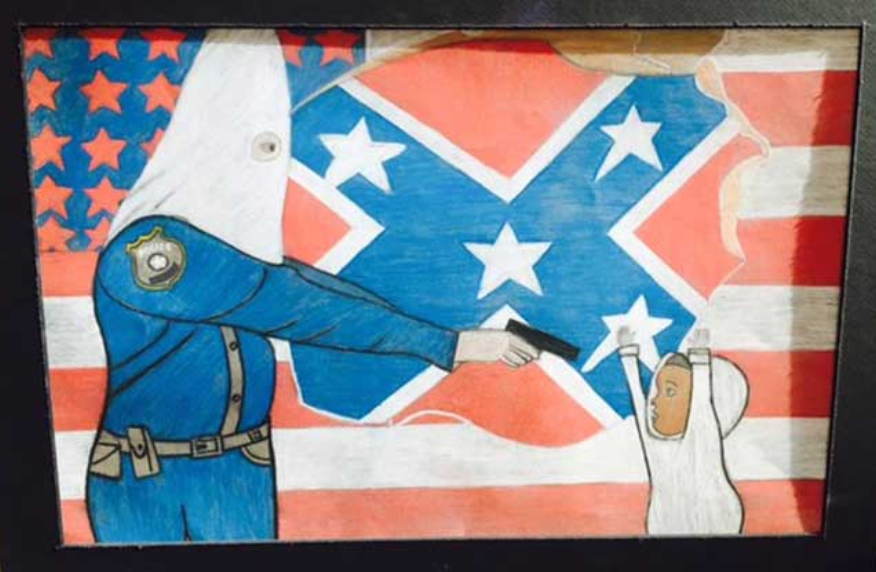
The killing of any human being is terrible, but the retaliatory killings of police in Dallas could have been prevented. Not by expecting minority communities to stomach further and unending extrajudicial assassinations, but by having police curb their racism and use of lethal force. Or of course by disbanding militarized police departments. Public officials can’t even broach that conversation. Do we expect the police state to dismantle itself?

Self-styled black revolutionary Micah Xavier Johnson, a typical PTSD-hardened Afghan vet, put “suicide by cop” to the service of his embattled community and avenged the deaths of Alton Sterling and Philando Castile. He didn’t shoot their actual killers, but he didn’t hit innocents either. Johnson targeted America’s systemic enforcers of inequity, hitting twelve police officers, five of whom have now died.

Let’s note those cops weren’t “protecting the first amendment rights” of a spontaneous protest of the Sterling and Castile murders, but were harassing and detering demonstrations. The officers could have chosen not to, and hopefully, their comrades in other cities, molesting other legal assemblies, may now choose to stand down, because now authoritarian bullying has come in the line of fire.

There is poetic justice for those who would decry “Blue Lives Matter”. If they’re going to pretend it, let them feel the oppressive threat of violence which black lives bear. For one evening, in a small corner of Dallas, Texas, police brutality faced a comeuppance.

For now Johnson’s act is being condemned as an atrocity, as a massacre even, though obviously his victims 1) met every standard of belligerent adversary, 2) were armed, and 3) outnumbered him. Let’s concede that Johnson is a credit to his military training. He confirms how our soldiers could so murderously rapage through our war zones against lesser equipped combatants. Johnson’s motive echoes that which provoked US atrocities overseas, seeking revenge against civilians, exacting collective punishment for deadly IEDs.

If we acknowledge the violence with which African Americans are oppressed, and the mendacity of its apologists and enablers, can we condemn violent resistance? International law accords oppressed peoples the human right to resist.

Slave rebellion leader Nat Turner is recognized today as a hero, but was exhaustively vilified in his day because he killed slave owners, indescriminate of old or young. Whites retaliated and killed many more blacks. More violence follwed from abolitionsists and Jayhawkers, all of it lamentable. But slavery didn’t end because we willed it.

Because this era’s history is written with erasers, our victors’ primary tool, Micah Johnson will probably never be praised for heroism.

Johnson will join fellow effaced cop-killer Christopher Dorner. A previous African American reservist vet who was immolated alive, killed instead of being apprehended, lest an investigation benefit from his testimony about why he could no longer bear LAPD corruption in 2013.

From Dorner’s “manifesto”, before Michael Brown, Ferguson and Baltimore:

“Those Caucasian officers who join South Bureau divisions (77th,SW,SE, an Harbor) with the sole intent to victimize minorities who are uneducated, and unaware of criminal law, civil law, and civil rights. You prefer the South bureau because a use of force/deadly force is likely and the individual you use UOF on will likely not report it. You are a high value target.

“Those Black officers in supervisory ranks and pay grades who stay in south bureau (even though you live in the valley or OC) for the sole intent of getting retribution toward subordinate caucasian officers for the pain and hostile work environment their elders inflicted on you as probationers (P-1?s) and novice P-2’s. You are a high value target.

You perpetuated the cycle of racism in the department as well. You breed a new generation of bigoted caucasian officer when you belittle them and treat them unfairly.

Mikah Johnson’s last words we only know through the spin of Dallas police, the same people who decided not to wait him out, nor to smoke him or gas him out from hiding in a public parking garage, but instead to send a robot with a bomb and M.O.V.E. his ass like every other black nationalist revolutionary.

No, you murdurous assholes, Johnson didn’t “want to kill all white people.” He wanted to kill white cops. Just like Dorner, he wasn’t a threat to the public, he was a threat to the police state. You cops ensured Mikah Johnson didn’t live to dictate “confessions” and you even obliterated his body like Osama bin Laden. Drawn and quartered essentially, to preclude memorializers being able to center on an idol to build a resistance.

You and I may grapple with what to think of Johnson’s personal rampage, but the state knew immediately his was the selfless heroism they fear most. As with bin Laden, they knew his apprehension must be terminal.

Lest I be misunderstood, I do not promote armed insurrection, sedition or murder. I cannot. But I will not condemn Micah Johnson.

I need not agrandize him either. Taken without his revolutionary ideology, Johnson was an ordinary mentally wounded veteran like many others. Homicidal vets with PTSD are at the core of our epidemic of police brutality. Our law enforcement teams are full of OIF and OEF soldiers who got their start shooting up cars at checkpoints and acting out racist genocide to their heart’s content.

It’s not a new problem, the US has always had active warzones feeding veterans into homelessness for those who couldn’t cope and filling government jobs for those who thrived. Beside policemanship, a very common job for discharged soldiers has always been the post office. Rembember the rampaging gunman problem we used to call “going postal?”

America’s racism problem may be transcended by a succession of church services, but class struggle is not a hearts and minds operation. Fascist rule and its army of the rich are not going to be wished away by militant nonviolence. That’s as likely as counting on the tooth fairy.

Worrying that acts like Johnson’s will provoke increased authoritarian repression is an expression of privilege provided by someone aclimated to a tolerable status quo, clearly a white perspective for whom black lives matter not enough.

Until all of us share the plight of the average Syrian refugee, trapped in our capitalist frontier war zones, none of us are shouldering an equitable burden of the police state.

That’s why it is more than black lives that matter. The middle class greivances of Occupy Wall Street are only a class removed from Black America’s suffering. We’re still talking about privileged Americans who support a grander racism that drives our global exploitation of all peoples.

I don’t have any faith that an arc of history bends toward justice in this corporate dark age. For my own sense of what’s right, it’s important to recognize Micah Johnson and Christopher Dorner for who they were, flawed, maybe very minor, aspiring Nat Turners, who wanted to strike against today’s slave masters and their brutal blue foremen.

Mass shootings prompt calls for gun control, government massacres less so.

Does it downplay the tragedy in Orlando to point out that America’s worst mass shooting, as many have called it, falls well short of the headcounts of shooting massacres which the US perpetrated upon Native Americans? Is it critical to differentiate lone gunmen from state sanctioned crimes against humanity? The first describes renegade racist lunacy, the second systemic. I find the conflation entirely useful. The atrocities of solo shooters spark petition drives to promote gun control. The tyrannical acts of our government against its subjects are reminders why the people fought for and won the right to bear arms.

Once more the Hippie Bard takes keyboard in hand..

Some might be asking themselves (as I often do) “Self, just what in Hell is Brother Jonah thinking, ragging on obscure moments in American and British history and raggin’ on the Queen?” Hmmm…

Perhaps it has much ado about something. Like the partitioning of Arabia which has taken an uncounted (by me) number of wars to keep in about the same political and religious boundaries.

Here I should interject the very much related wars on the ol’ Pipeline Grid such as VietNam, Thailand, (they host U.S. Air Farce Bases) (so do about two thirds of the countries around) India in all its manifestations, Ceylon which is now Sri Lanka as per the wishes of the people there, same with Mumbai, Bangladesh, Afghanistan, the new yet strangely ancient British and American policies to keep China as a client state rather than a superpower (way too late, fellas, way too late) by encircling them militarily and economically… but let’s start with the partitioning of Arabia. The Saudi, Jordanian, Yemeni, defunct Syrian and Iraqi, Kuwaiti etc Royal Houses have been placed on their thrones not by genuine common consent of the people the Kings and Emirs but by the Armed Forces and on behalf by the British and American 1% oil (and every other marketable commodity) cartels.

By the way Iran is not an Arabic nation. They’re Persian and the muddled inclusion in the Arabian bloc by people who say stupid shit like “well, they’re all alike” just pisses off some people.

While the Queen doesn’t have full political power in England or her royal former colonial empire, she IS a major shareholder in British Petroleum. The ones who screwed up the Gulf of Mexico and told the American/Mexican/Cuban and all other nations to mind our own business, they would take care of everything and we should just run along and play somewhere.

Economic concerns fuel military affairs. In the case oil, fueling is the correct word.

AND.. the 3 leading Protestant churches in America, Methodist, Baptist and AOG, are offspring of the Episcopal Church. And there’s movements in these churches to re-start the Crusades. Taking ISIS and al Qaeda as the excuse.

I have witnessed the Colorado prison and jail system allowing and encouraging volunteer Religious Leaders who spread the Gospel of Hate and exclude as many dissenters to that perverted gospel as possible. I’ll assume here that it’s a nationwide deal. Radicalizing American prisoners, many of whom are actually habitual violent criminals, to continue a war inflamed by the actions in behalf of the 1%.

And insisting all along that every “Ay-rab” meaning every Muslim in the entire world (it hurts my brain to translate Standard English into Standard Redneck) is born with a bomb in his or her hand.

maybe not that extreme, but hyperbole spawns hyperbole.  It doesn’t matter who gets in the way of the bullets or shrapnel, not to the bigpigs at least.

You might remember this…

“Charlie asd Camilla almost got their asses dragged out of their limo and street just would have prevailed, blue blood would have flowed in the gutters of London etc… (sic) the London Anarchists found a neat way to defeat kettling”

Maybe the rich bitch establishment ought to really worry about reprisals.Their gated communities can be kettled and turned into ghettoes in the most real definition of the term.

By volunteers who probably wouldn’t ask a dime in pay, merely a just society for their children.

One in which their kids or siblings or parents won’t be shot down in the street by the cops. Or shot in their own homes. I hadn’t been up here a red hot two months when the Denver cops shot a man to death in his bed, said they saw him “reaching for something” and the evidence at their automatic acquittal hearing was their word against that of a dead man. Then they charged the victim’s nephew for the killing because he wasn’t home when they went in to serve a warrant on him but shot his uncle instead. True Story, from the summer of ’04.

They obviously want war, or think they do. Or at least their masters believe they’ll come out on top.

But their social doctrine is entwined and mirrored in Capitalism. Which is a pyramid scheme, can’t last forever and when it falls, and their social doctrine goes down with the supply of non-existent money, based on resources they don’t actually have… too bad, right? Only we’ll have the privilege of joining them in their misery.

Human rights for even Anders Breivik

In retrospect, awarding the newly elected Barack Obama a Nobel Peace Prize was about as smartly ambitious as it gets. Everyone knows humanitarians don’t do it for the reward. A Nobel Prize is wasted if there’s not some eligible sociopath who might be influenced with the pressure to behave themselves. President Obama’s Nobel medal was an experiment in paying it forward. Who knows how much more bloodthirsty Obama might have gotten with his drones had not the Nobel committee tried to extort him with its higher expectations? The Nobel award givers took a lot of ribbing for their foolishness from those of us who weren’t idealist enough. AND SO IT COMES AS NO SURPRISE when Norway’s mass murdering overachiever Anders Breivik sued his jailers for abusing his human rights because he wasn’t getting sufficient visitors in his cushy prison suite, that the Norwegian supreme court would rule Breivik was right.

Of course they did. If you’re not going to give a death sentence to a crazed bigot who guns down 76 children, if you’re not going to throw him in a hole but instead give him a spacious accommodation, if instead of a life sentence you let him pursue university studies and limit his incarceration to twenty some years, then you don’t want to isolate your prisoner from human contact if it might appear even as a semblance of solitary confinement. Because lesser cultures do that.

Lesser capitalist flagship states isolate, execute and torture. I so appreciate that Norway wants to set a high bar, but I despair that the land of Guantanamo and waterboarding and indefinite detention and ILLEGAL detention and rendition and extrajudicial assassination and no habeus corpus can’t even see this bar to reach it.

Denver art student informs Tale of Two Hoodies with Goya’s Third of May 1808. This KKK cop executes the black child.

A Tale of Two Hoodies
DENVER, COLORADO- Here’s what the Denver Post article didn’t explain about the Denver high school art student who was pressured to remove her controversial piece from public display. Where was it being shown? At the Wellington Webb Building. That’s not irrelevant because it’s where viewers became offended. You could go inquire about the incident, if you knew where to ask, or where to protest the work’s removal. The WELLINGTON WEBB BUILDING downtown on Colfax. What’s so controversial, the scene is real isn’t it? There’s more.

The student’s drawing is essentially a reproduction of Michael D’Antuono’s 2014 piece “A Tale of Two Hoodies” which still sparks outrage. Missing in this version is the bag of Skittles which the black child offers the cop, locking the two figures in a standoff. Or obviously a mugging. The Skittles of course recalls Trayvon Martin and we know how that ended. The hands in the air references “Hands Up Don’t Shoot” and Michael Brown who shared the same fate.

Original 2014 workAll else about the Denver student’s contextualization of D’Antuono’s work is the same, the confederate flag uncovered from beneath the wallpaper of Old Glory. In the student’s piece the American flag appears worn through. In D’Ontuono’s original the racist flag has bursted through. The cop and hood are the same, except in the original the cop was maybe more fat.

What’s also missing in the DenPo whitewash is the context of the unamed student’s assignment. She was tasked with contextualizing TWO works. The influence of the second piece is not as apparent as the first. The boy’s hands-up wasn’t merely recalling the mantra of the Black Lives Matter movement, it was evoking the student’s other chosen influence, Goya’s famous “The Third of May 1808.” In that iconic work, a firing squad is executing a rebel with outstretched arms.

KNOWING THIS, you can see the student’s policeman has drawn his gun for an EXECUTION, not an arrest. The boy is not following an order or raising his hands in surrender. If even in resignation, this boy’s upheld arms communicate a plea. How does that inform you about this young Denver student’s understanding of “Hands Up Don’t Shoot” or “I Can’t Breathe”?

The officer’s Klan hood certifies that this shooting is a lynching. Many lynchings in the traditional sense were perpetrated by deputized citizens.

Denver Chief of Police Robert White said of the student’s work: “I’m greatly concerned about how this painting portrays the police.” Well sure, and Chief White didn’t know the half of it.

Should you go complain at the Wellington Webb Building? The Denpo article mentions Chief White intends to “have a conversation with the student and her parents.” You may want to caution that the Office of the Independent Monitor be invited attend that conversation, as a ride-along so to speak, to assure it isn’t the one-sided transaction to which we are becoming accostomed and inured.

Does Chief White think that racially enhanced officer involved extrajudicial executions should not be a student’s concern? He needs to look past what offended him and try to understand the art piece before he forces a conversation. Or what kind of conversation will it be. The student has already made her statement.

FOOTNOTE:
Here’s what Michael D’Antuono had to say about his original work. I’ve updated the original broken links:

This painting, created during the Trayvon Martin case, symbolizes the travesty of racism in the criminal justice system. It has been the object of much controversy and censorship. In 2014, I was Incensed that George Zimmerman was trying to profit from his notoriety for killing an unarmed teenager by auctioning his painting on eBay. In response, I put this piece on eBay with half of the proceeds going to the Trayvon Martin Foundation. The very same day Zimmerman sold his painting for $100,000, and as soon as it became evident that my piece was on par to pass Zimmerman’s mark, eBay shut mine down for violating their strict policy of not selling anything on their site glorifying hate groups or showing anything symbolic of the Klu Klux Klan. The hypocrisy of eBay was that at the time they killed my auction, they were selling over 1500 other items related to the KKK. Misrepresenting it’s meaning, a hate group co-opted the piece in 2015, passing out flyers in Southfield, Michigan. In 2016, a high school teacher in Nevada, was suspended for using the painting to inspire critical though.

U.S. SOLDIERS ARE READYING FOR A MASSIVE DEPLOYMENT

COLORADO SPRINGS, COLORADO- You thank them for their service. You support them, they’re only following orders. You know they’re not at liberty to divulge everything they do or WHERE. As their supporters you are complicit, but whatever. Now your soldiers are keeping a HUGE secret from you. They’re GOING TO WAR. You’d think that would be too controversial to be a state secret.

If you leave in a military town, near a base, fort or camp, you need only ask around. Pawn shops and car dealerships seem to have their finger on the pulse of troop movements for some reason. In Colorado Springs, everybody knows. Friends and neighbors have already deployed overseas to establish contractor services. Others in readiness training.

Of course the big secret for awhile has been Africa. American soldiers have been involved in covert operations across Africa which none are still allowed to talk about. Those aren’t undeclared wars, just police actions. This time, again, it’s Iraq. Going back. I shall return.

Are they waiting on Spring? Summer weather? The election? Commander in Chief Clinton? Likely.

It used to be soldiers didn’t talk about mobilization. “Loose lips sink ships” etc. Of course in those days the public knew the nation was at war. War had been declared on us, or a fascist belligerent attacked. Today when the US launches offensive wars, illegal wars they’re called in the Hague, its troop movements have to be extra covert. Or not, actually, when mobilization is prelude to Shock and Awe.

Troop sneakiness seems to be all about sneaking past the American pulbic. Sneaking past us to unknown conflict zones in Africa and Asia, sneaking past us to redeploy to Iraq. At some point those soldiers have to understand what they’re doing is not only unpopular, it’s likely wrong.

Osama bin Laden’s books. They could do you more good than they did him.

Last week the CIA decided
Crossing the Rubicon, The New Pearl Harbor, Imperial Hubris, Obama's Wars, The Best Democracy Money Can Buy... to declassify the list of books found in Osama bin Laden’s last hideout when Seal Team Six made their raid. There were 39 titles, which the press has categorized as heavy on conspiracy theory. That’s true, untrue, and unsurprising if you consider the official White House line is that the US does not support illegal coups. These authors beg to differ, including the unimpeachable Noam Chomski. Other investigative standouts include William Blum, Greg Palast, John Perkins. The list did not include publication dates or editions, just author and title. A closer inspection of the list is revealing.
 
(This is part one of a continuing series.)

It would be more accurate to describe Osama bin Laden’s bookshelf as history, mostly contemporary with notable exceptions. For example, bin Laden’s reference on Christianity and Islam in Spain 756-1031 was published in 1889 with the full title “The Relations and Mutual Influences of Christianity and Mohammedanism During the Khalifate of Cordova.” In 1889 European perspectives on the Moorish occupation appear dramatically antisemitic.

The history of The US and Vietnam 1787-1941 begins with Thomas Jefferson’s first interests in trading for rice with “Cochinchina”. Written by a former ambassador, it was published in 1990 by the National Defense University Press. The Best Enemy Money Can Buy is about the symbiotic relationship between the US military industrial complex and Russia’s.

Some of bin Laden’s “books” such as Michael O’Hanlon’s Unfinished Business were staple-bound publications from US policy think tanks. I’ll review those and the various intelligence agency exposés in subsequent posts.

Here are the 39 titles listed alphabetically:
The 2030 Spike by Colin Mason; A Brief Guide to Understanding Islam by I. A. Ibrahim; America’s Strategic Blunders by Willard Matthias; America’s ‘War on Terrorism’ by Michel Chossudovsky; Al-Qaeda’s Online Media Strategies: From Abu Reuter to Irhabi 007 by Hanna Rogan; The Best Democracy Money Can Buy by Greg Palast; The Best Enemy Money Can Buy by Anthony Sutton; Black Box Voting: Ballot Tampering in the 21st Century by Bev Harris; Bloodlines of the Illuminati by Fritz Springmeier; Bounding the Global War on Terror by Jeffrey Record; Checking Iran’s Nuclear Ambitions by Henry Sokolski and Patrick Clawson; Christianity and Islam in Spain 756-1031 A.D. by C. R. Haines; Civil Democratic Islam: Partners, Resources, and Strategies by Cheryl Benard; Confessions of an Economic Hit Man by John Perkins; Conspirators’ Hierarchy: The Committee of 300 by John Coleman; Crossing the Rubicon by Michael Ruppert; Fortifying Pakistan: The Role of U.S. Internal Security Assistance (only the book’s introduction) by C. Christine Fair and Peter Chalk; Guerrilla Air Defense: Antiaircraft Weapons and Techniques for Guerrilla Forces by James Crabtree; Handbook of International Law by Anthony Aust; Hegemony or Survival: America’s Quest for Global Dominance by Noam Chomsky; Imperial Hubris by Michael Scheuer; In Pursuit of Allah’s Pleasure by Asim Abdul Maajid, Esaam-ud-Deen and Dr. Naahah Ibrahim; International Relations Theory and the Asia-Pacific by John Ikenberry and Michael Mastandano; Killing Hope: U.S. Military and CIA Interventions since World War II by William Blum; Military Intelligence Blunders by John Hughes-Wilson; Project MKULTRA, the CIA’s program of research in behavioral modification. Joint hearing before the Select Committee on Intelligence and the Subcommittee on Health and Scientific Research of the Committee on Human Resources, United States Senate, Ninety-fifth Congress, first session, August 3, 1977. United States Congress Senate Select Committee on Intelligence; Necessary Illusions: Thought Control in Democratic Societies by Noam Chomsky; New Pearl Harbor: Disturbing Questions about the Bush Administration and 9/11 by David Ray Griffin; New Political Religions, or Analysis of Modern Terrorism by Barry Cooper; Obama’s Wars by Bob Woodward; Oxford History of Modern War by Charles Townsend; The Rise and Fall of the Great Powers by Paul Kennedy; Rogue State: A Guide to the World’s Only Superpower by William Blum; The Secret Teachings of All Ages by Manly Hall (1928); Secrets of the Federal Reserve by Eustace Mullins; The Taking of America 1-2-3 by Richard Sprague; Unfinished Business: U.S. Overseas Military Presence in the 21stCentury by Michael O’Hanlon; The U.S. and Vietnam 1787-1941 by Robert Hopkins Miller; “Website Claims Steve Jackson Games Foretold 9/11,” article posted on ICV2.com.

Occupy rally for DPD teen victim Jessie Hernandez rained out, Denver cops deploy anyway. #justiceforjessie

May 20 protest at Wellington Webb Building in Denver
DENVER, COLORADO- Rain kept numbers down at the event yesterday calling for Denver officials to investigate the brutal police murder of Latina teen Jessica Hernandez. Even as the crowd influx never surged beyond steady, over the course of two hours the police force arrayed against Occupy Denver and their allies never wavered from the usual: disproportionate and overwhelming. The DPD is obviously taking no chances with the potential firestorm the teen’s killing could ignite in the Denver community. Excellent. Humbled as we may feel that it takes so few activists to threaten the system, we feed off that fear. Individual police officers can denigrate protesters all they want, obviously the protests have their respect.

Is Dzhokhar Tsarnaev guilty of a worse crime than US forces commit overseas?

Dzhokhar TsarnaevDoes the “Boston Marathon Bomber” look like he deserves the death penalty? Funny, you don’t even know what he looks like. US authorities have been meticulous about controlling images of Dzhokhar Tsarnaev since the manhunt for the teen and his older brother ended in extrajudicial firing squads which teen Dzhokhar survived. He’s been in custody since then and the only more recent image his captors released was of Dzhokhar giving the finger to a jail cell surveillance camera. This to influence the jury to give the death penalty. Why the embargo on images? Are authorities afraid the public will feel sympathy for the disfigurement Dzhokhar suffered from his fusillade? Where defense attorneys not permitted to submit images of Dzhokhar smiling? Is the image ban in effect a media blackout? Remember how Saddam Hussein’s trial was broadcast without sound? Now US dumb justice has become literally blind, all Star Chambers and spectral evidence.
 
Is Dzhokhar Tsarnaev guilty of a worse crime than US forces commit overseas? If an American sniper turned in the Tsarnaev brothers headcount, he’d be handed a potato peeler and punished with kitchen duty. Dzhokhar Tsarnaev is a small fry. US drone pilots eat massacres like the Boston Marathon for breakfast.

“Ex Machina” heralds creation of life, but Doctor Geekenstein’s blueprint imitates pornography

ex-machina-tits-ass-mouth
“WHY DID YOU GIVE HER SEXUALITY!?” asks the geek tasked with debugging the anthropomorphic robot. Except they didn’t. Unless by sexuality you mean just the “female” bits and transluscent circuits where her belly and cranium should be.

These filmmakers gave Ms. Machina just the tangibles to titillate pre-sexuals: tits, ass, and a face for, um, facials. Their ideal is basically a blowup doll, upgraded to show off CGI; the Bionic Woman pared of nonessentials for viewers fixated on orifices; imagine the Six Million Dollar Man a cyborg whose flesh parts are lips and phallus. For male heterosexual tastes, a nubile female would have a womb. Otherwise the bare midriff would not be a thing. Nor belly dancing. But no mate of any age can lack a cranium. And a soulmate needs a soul. I think we can say the soul lives in the heart, but I’m pretty sure we manifest its presence under the cranium. A sexual mate, even as a sexual object, must be “all there” in the head, or is that just me?

The film “Her” pared the romantic partner down to a disembodied voice, this film preserves the body but disembowels her.

Presumably the filmmakers screen-tested their heroine on a focus group. If the results decided which virtues a virtual sex object requires for allure and which could be dispensed to skimp on parametric objects, I’m not impressed. Is hair no longer an asset to attractiveness? Ex Machina takes our depilation fetish to its nadir.

Spoiler: I haven’t seen the rest of Ex Machina. Does she have toes? Why or why not? How could she not have toes?

And what about “chemistry”? By chemistry I mean whatever electricity or scents we exude to guide ships in the night. Okay, no doubt biomechanical robots can be modelled to emit pheromones, but I’m sorry that’s about as romantic as boutique soap.

Whatever social commentary we are to make of this “high concept” thought experiment, I’m reminded of attending a lecture given by a geek who Time Magazine listed among the world’s most influencial people. He had coined the term “virtual reality” or some such and had shaped what the internet has become. I wondered why we entrust social engineering to antisocial engineers, then look to them as philosophers endowed with clarevoyance. With arrested adolescents for our gurus, of course “the internet is for porn.”

City of Denver wins court battle to ignore the homeless, one arrest made


DENVER, COLORADO- The trial of the Tattered Cover Five concluded this week. For three days a municipal court considered whether a complaint made against protesters drumming in front of the downtown Tattered Cover Bookstore should or should not curb the protesters’ freedom of speech. And the jury really didn’t get it. Not only did their verdict uphold the police’s discretion to decide whose speech can be considered to be disturbing the peace, but the jury introduced their own arbitrary enforcement, judging some drummers guilty and some not, even though the complaint which prompted the charges was based on the “loud and unusual noise” generated by the ensemble.

The jury had even heard testimony that defendants were threatened with arrest if we “so much as touched a drum.” How then could this case be about disturbing the peace via loud noise? Defense attorney David Lane knew our acts of defiance were more accurately “disturbing the police.”

More obtuse than the Denver jury was the presiding judge, who resisted every rational objection and motion to insure that blunt authoritarianism always received the benefit of the doubt. I’ll admit our supporters in the audience were glib throughout the trial as our lawyer David Lane could hardly sidestep using the dumb and dumber city attorneys for mops. But the judge always ruled in dumb’s favor. It was as if courtroom 3H was an Affirmative Action program for logical fallacies, and the judge was a rubber-stamp for the rule of bad law.

This was never more clear than in the trial’s final moments, when extra deputies ringed the courtroom and then arrested an audience member.

Just before the jury was to emerge with its verdict, the judge reminded everyone that filming or recording the jury was prohibited. David Lane voiced his objection at the buildup of officers in the courtroom without cause. As usual the judge was dismissive.

Lane emphasized that in all his years this was an uncharacteristic show of force. The judge didn’t care: “Objection noted.” It was her usual refrain.

As the officers moved closer to the audience to make their oppressive presence felt, the activism instinct to raise cell phones at the ready gave the officers their cause. This escalated into a standoff, with the deputies ordering an activist to leave the courtroom. His protestations of innocence were interpreted as resisting so he was led off in handcuffs, prompting of course more impulses to film the arrest.

When more officers began targeting more cellphones, a voice of authority rang out. It wasn’t the judge calling for order in the court. No, she was satisfied to let the deputes maraud through the audience and extract people with physical force without even looking up from her monitor. It was the sonorous voice of David Lane that brought the officers to heel. He said “Nobody can take anyone’s phone.” Lane’s gravitas had never given the judge pause but it stopped the deputes in their tracks.

“The most an officer can ask you to do is to put your phone in your pocket” Lane continued. One activist was holding his phone aloft in a game of keep-away with two deputes. Hesitantly he and the other audience members pocketed their phones.

When the jury members made their entrance they were greeted by a militarized courtroom and an audience numb with shock over the justice system’s indifference to abuse of power. We were in for a worse surprise.

It could be the jury did step up to David Lane’s challenge. He’d told them they would never in their lives wield as much power as they did on this jury, their chance to fashion how First Amendment protections are upheld. Except they didn’t share Lane’s or our concern for holding off a police state. Instead they sided with the prosecution, who urged they preserve “the right to ignore someone else’s opinion.”

Honest to God, our weekly protest at the Tattered Cover was presented to have been about the Urban Camping Ban. The jury understood we were urging people not to ignore the plight of the homeless. The city prosecutor’s words could not have been more ill chosen if one is embarassed by irony.

I was one of the defendants in the Trial of the Tattered Cover Five. One of us escaped charges due to a clerical error, two others were found not guilty for lack of self-incrimination. Tim Calahan and I were convicted of Disturbing the Peace, specifically for having created a loud and unusual noise in violation of a City of Denver ordinance. I got two convictions, community service, court fees, one year’s unsupervised probation, and supervision fees (yes that is a non sequitur), but all of it stayed pending appeal.

David Hughes arrested
So what happened to the courtroom arrestee? I’m free now to say that his name is David Hughes, Denver Occupier and IWW organizer. David wasn’t released until the next day, mostly because neither the city nor county was sure with what to charge him. David was kept in an underground cell between the courthouse and the county jail while the trial went on.

Stunned by our defeat in court, our now un-merry band’s attention was diverted to our imprisoned comrade. David had refused to be excluded from the courtroom and next we learned that, like any good Wobbly, David was refusing to reveal his identity. By chance his wife held his wallet and phone so David was free to complicate his abduction as anyone innocent of charges might. We continued to shout “Free John Doe” outside the courthouse in solidarity late into the night.

Was David guilty of using his phone camera? It’s generally understood that recording devices are not to be used in courtrooms, to respect the privacy of witnesses, the jury, and the accused. In this case the judge had specified not recording the jury which had not yet entered. What had interested David was the disproportionate buildup of sheriffs deputees. How many law enforcement officers can you have in a courtroom before the public feels threatened enough that they need to film the officers for the public’s own protection? What doesn’t get filmed, the cops get away with. The judge certainly wasn’t concerned for our protection.

Reflection
I really can’t understate the disappointment we all felt about the verdict. It was predictable yes, but unsettling to see it happen. We had the best lawyer that money can’t even buy, undone by the steady creep of Fascism. I associate it with our society’s declining education and public engagement, abetted by oppressive law.

For three days, attendees who were not readily recognized as being with the defendants could circulate the halls of the Linsey-Flanigan courthouse and overhear deputees talk about the case. All the deputees were greatly chagrined that The David Lane was representing us. Apparently they all know his reputation. There was no press interest except by KGNU, but lawyers who saw David Lane walk through the hall made a point to stop by our courtroom when they had the chance to watch him work.

And so it was really a blow to the ego to meet with failure. I’ve written before about how police intervention at our Tattered Cover protests ceased entirely after the first arraignment date when David Lane showed up in our stead. We’d been surveilled by a half dozen cruisers every Friday for a half year. After David Lane officially filed our papers that number went to zero. No more visits from officers, no more drivebys with videocameras, for almost a solid year now. It should be interesting to see what happens this Friday. Will the cruisers be back? They still have no cause. No disruptions, no conflicts, no threat of lawbreaking whatsoever.

Before Lane the officers regularly interrupted our assemblies to recite their warnings in spite of our objections. When Tim and I were arrested, we had to sit in a holding cell, shackled to a bench, while Sergeant Stiggler berated us for looking like fools. We were wrong about the camping ban, we were wrong about our rights, bla bla bla bla. We kept our mouths shut to shorten his lecture. After enduring our bullhorn for three months, he’d composed quite a rebuttal. His diatribe contradicted the suggestion that our arrests were about the noise and not our message.

For now unfortunately the sergeant turns out to have been correct about our rights. And looking like fools I guess.

For now Denver’s Disturbing the Peace ordinance does dismantle the First Amendment. For now it does allow what’s called a “heckler’s veto.” That’s a marker of unconstitutionality where one person’s complaint could be used to silence political speech to which they object. It does allow police officers to decide what “time place and manner” limits to place on free speech. Nevermind “Congress shall make no law to abridge” –that’s up to the police. It’s their call!

At our earlier motions hearing David Lane spent two days arguing that Denver’s ordinance was unconstitutional, to deaf ears obviously. At that hearing, DPD officer after officer testified that what qualified as a disturbance was entirely theirs to decide. Lane laid the groundwork to show that Denver police officers aren’t given a clue how to respect free speech. This judge was already satisfied I guess to pass the buck to a higher court.

In the meantime activists can no longer brey with confidence about free speech rights in Denver. We’ll have to engage with police submiting their proposed abridgements. We’ll have to bite our tongues, as they do I’m sure, feeling our hands tied more than we’d like, they longing to beat us. It’s going to be more difficult to recruit newcomers, uneasy with what confidence we can responsibly instill in them. “Am I going to get in trouble” is the first question they ask. Now the more probable answer is not maybe.

The frequently cited St Paul Principles had their time and place: ST PAUL


In my circle they’re called “Saint Paul’s Principles” because my colleagues think the edicts are Catholic I guess. The St Paul Principles came from St Paul Minnesota, circa 2008, and were formally adopted by the varied groups organizing to disrupt the Republican National Convention of 2008. They’ve lived on as guiding principles for activists of all ilk. In 2011 many Occupy encampments ratified the StPP as their own code of conduct, indifferent to whether they were applicable or even beneficial. Let’s examine the well intended dogma. Do they apply universally? Are they constructive? And how did they work out for St Paul? The last one is easy. As you may remember, disruption of the 2008 RNC failed spectacularly.

The St. Paul Principles

1. Our solidarity will be based on respect for a diversity of tactics and the plans of other groups.

2. The actions and tactics used will be organized to maintain a separation of time or space.

3. Any debates or criticisms will stay internal to the movement, avoiding any public or media denunciations of fellow activists and events.

4. We oppose any state repression of dissent, including surveillance, infiltration, disruption and violence. We agree not to assist law enforcement actions against activists and others.

It’s hard to argue against this elegant expression of solidarity. With the SPPs, the protest organizers aimed at preempting COINTELPRO style disruption from generating conflict within the movement. The implicit condemnation of violence was of state sponsored violence, not authentic barricade defense. And no snitching. The SPPs addressed the problems which were already scuttling Denver’s 2008 DNC protests. In Denver, “Recreate ’68” planners let the press infer they meant to revive the Chicago riots of 1968, prompting almost every traditional social justice group to circulate a contract which everyone was expected to sign. It was a vow of nonviolence. Organizations who refused to sign were ostracized and could expect the violent police clobbering they invited.

Essentially the SPPs aimed to unite the nonviolent and non-nonviolent activists, to ensure neither denounced the other, and that physically neither wound up caught in each other’s fights or sit-ins. Probably the chief concession was being asked of the nonviolent crowd: Please, as long as we promise not to shroud your family atmosphere and your baby strollers in tear gas, please let the Black Blocs do their thing without your repudiation. Please. We share the same goals.

Can you begin to see where such a strategy might fail to lead?

But the St Paul organizers did share the same goals. Their aim was to disrupt the RNC via a strategy they called “3S” actions. SWARM, SEIZE. STAY. It’s easy to see why three years later Occupy Wall Street was attracted to these directives. “3S” defines Occupy and another three years on, OWS activist followed the 2014 Climate March with an action called “Flood Wall Street” the instructions for which rephrased 3S aquatically.

The “movement” to which the SPPs refer shared a goal, to disrupt the RNC, by means of swarming, seizing, and staying, by whatever tactic each member group wanted. They shared a further agreement, that the city of St Paul was to be partitioned in sectors allowing groups to conduct their actions in isolation, united in time, but separated geographically so that red zone, yellow zone and green zone participants needn’t mix and find themselves out of their respective confort zones.

The groups organizing against the 2008 RNC shared one more thing in common, bound as they were to the St Paul Principles, they were all signatories to the principles.

Do the St Paul Principles apply universally?
It’s easy to see that the 2011 OWS occupations in major cities across the country shared a similar goal. It was, if perhaps more vague than to prevent a party convention, to disrupt the wheels of commerce by means of encampments; the “3S” tactic now reduced to a single verb “Occupy”. Allies such as unions and antiwar organizations, while sympathetic, cannot be said to have shared the same determinaton to disrupt. Even MoveOn with their “99% Spring”, FireDogLake with their merchandizing, and Adbusters had to relent with the revolutionary rhetoric. Eventually OWS spinoffs like Occupy Sandy Relief began to serve functions diametrically opposed to disruption. Did they expand the “movement”? Of course. But did the more inclusive “movement” outgrown the capacity for St Paul Principles to maintain its unity? Are activists bent on disruption expected to respect and support activists determined to prevent disruption?

I know it’s lovely to imagine every social justice effort as anti-authoritarian, and whether nonviolent or indulgent, each comprises a unique wing of a broad anti-government movement. If you are prepared to pretend that everyone’s aims are progressive, we share similar enough goals and we are reformists. But if some aims are revolutionary, explicitely anti-Capitalist for example like Occupy Wall Street, then reformists are counterrevolutionary. If you think reformists aren’t Capitalism’s first line of defense, even as they consider themselves activists, then you don’t know your adversaries from your allies. To imagine that activists shouldn’t address such chasms of understanding in favor of upholding popular delusion is going to get a movement nowhere.

At last year’s Climate March in NYC, the prevailing sentiment was against Capitalism. The organizers didn’t want to mouth it, but a vast number of marchers began to grasp instinctively that Capitalism has no solution for Climate Change. The anti-Capitalist movement can become “the movement” but reformists will have to understand they are obstructionists before they as individuals can be said to share the common goal.

The St Paul RNC Welcoming Committee aimed to disrupt the Republican National Convention for a WEEK. Can activist groups as they grow and transform over years and compete for membership and community resources expect that they shouldn’t be critical of one another’s missteps or aggressions even as their goals diverge?

How scalable are the St Paul Principles? Do they apply to no matter who considers themselves part of a greater “movement”. Do they apply to signatories and non-signatories alike?

Are the St Paul Principles constructive?
I would argue: Hardly. While it seems safer to segregate the Black Bloc from the civil disobedients from the family picnic crowd, you’re not going to reach critical mass with each on its own. With public dischord still in its infancy and while we have nowhere near the numbers to defend against or deter violent repression, perhaps it is only reasonable to program our street protests according to color zones, as if marches were amusement rides for protest tourism.

If you’re satisfied to lead combatants to jail and probation for mere symbolic shows of defiance, and you’re prepared to let nonviolent activists subject themselves to brutality which even when filmed will not awaken the conscience of the sociopathic oligarchs, and you’re resigned to let the masses burn themselves out with boredom given nothing to challenge their apathy, then the St Paul Principles are for you.

NE Patriots are serial cheaters, so are their namesakes. The unfair advantage is an essential of Capitalism.

First the New England Patriots got caught spying on their adversaries, now they’ve been tweaking the air-pressure of their game balls to sneak a ballistic handling advantage. Rules be damned, Patriot quarterback Tom Brady prefers his ordnance two pounds psi shy, hollow-points –if you will– which are also against regulation. For how long have the Patriots been manipulating advantages? And how else? They weren’t satisfied with the home field advantage on Sunday. Maybe officials should bring protractors to investigate the Boston gridiron. A level playing field doesn’t likely suit the Patriots either.

OF COURSE it doesn’t. Who expects sportsmanship from “patriots?!” Patriotism is the antisocial insistance on your own cultural superiority. American exceptionalism is an endorsement of tactical superiority, covert war, disproportionate force, drones, extrajudicial assassination, death squads, snipers, collateral damage, and torture. Formal US policy is to FLAUNT international law. American materialism profits from insider trading, extortion, usury, and corporate hegemony uber alles! Why would our surrogate Sunday warriors pretend there is honor among thieves?

Of course America underinflates footballs to best our opponents. We also diligently deploy inspectors to ensure our intended defeatees can’t recallibrate theirs. Meanwhile our leaders dissemble when plausible deniability stretches thin.

Of course NFL officials are not discussing a Super Bowl disqualification for the recidivist Patriots. Instead they’re weighing minor penalties, no doubt manageable, if not tax deductible. If America’s best cheaters don’t advance to the Super Bowl, the outcome would be hypocritical. Go Team! America Fuck Yeah!

I’m kidding of course. Sack the quarterback, disqualify the Patriots, send whoever else to the Super Bowl, then march the entire US defense and offense departments to the Hague.

UPDATE 1/23:
While fans and media try to belittle the scandal (ie. “Deflate-gate” and “Ballghazi”), statisticians have noted a damning anomaly relating to the advantage gained from underinflated footballs. After the rules were changed to allow offensive teams to use their own footballs –Brady was among the quarterbacks lobbying for the change– New England’s ball handling superiority grew beyond the realm of probability.

Probably all teams know that well-inflated footballs fly further but underinflated balls are easier to grab. Maybe the purpose of making a personalized array of game balls available is so offensive teams can exploit alternate characteristics as needed. Maybe the NFL understood this when they granted the rule change. Maybe the Patriots just couldn’t pass up every opportunity to cheat, until the statistics made plain their greed. Whether by hubris or head-injury numbskulledness, Tom Brady and his receivers thought they coud break PT Barnum’s rule too.

The American Dream hinges on equality of opportunity and fair play, but of course Capitalism idealizes the unfair advantage.

Btw I abhor the theatre of corporate sports, but when it exposes the reek of America’s national character, I like to make sure to smell it.

Michael Brown’s killers felt mocked by St Louis Rams “Hands Up, Don’t Shoot”

St Louis Rams
Maybe St. Louis police were offended by the NFL Rams’ “HANDS UP, DON’T SHOOT” salute because police would never consider brutalizing wealthy black football players. I doubt it, but this could suggest that police abuse of power is about CLASS more than race. That St. Louis police feel it is their place to tell African American players how to act would confirm this is about RACE.
 
In other Ferguson news, African American church leaders tell Ferguson protesters to go to hell. While students and solidarity activists organize protests nationwide, spiritual “community leaders” have been gathering in churches in a coordinated effort to ease police-community relations. Some of these are even religious ceremonies which feature law enforcement commanders as honored guests. “Make Change Not Noise” read a local program. The fence-sitters are forgetting that President Obama already got the CHANGE thing covered.

September 11 marks 13th anniversary of a pinnacle of American ignorance

9/11- Could Joseph Goebbels have conceived a more preposterous lie? Modern skyscrapers felled by aluminum aircraft, steel structures melted by mere jet fuel, hijacked planes not intercepted, black boxes vanished, at the Pentagon an entire plane not only vaporized but invisible to surveillance footage, a third WTC building was demolished by no impact at all, conflicting testimony from the authorities involved, air traffic control evidence destroyed, the official investigation foreshortened, and media gatekeepers ensuring that skeptical viewers are marginalized as “truthers.” Does it take an engineer or scientist to understand that the Twin Towers fell to demolition charges and not airliners? Apparently under-educated Americans think so and are willing to outsource all heavy thinking. I don’t subscribe to the theory that “if Americans only knew” our empire could change its stripes, but I do believe that unmasking “9/11” as a false-flag propaganda event in the mold of the Reichstag Fire could shed light on the fascism behind our Kabuki democracy.

Ludlow 100 year anniversary feted by social class that committed massacre

Cover of WestwordDENVER, COLO.- I might be sensationalizing a technicality, but in effect it’s what happened: the remembering of Ludlow has been commandeered by the class who perpetrated it. The preliminary series of events commemorating the 100 year anniversary of the Ludlow Massacre (April 20, 1914) concluded tonight at Denver’s History Colorado Museum with a panel discussion featuring only establishment voices. “Is Ludlow relevant?” was the question posed to five participants among them three professors, a soldier, and a union rep. That’s like asking “is global warming real?” The question is loaded with the suggestion that the opposite is equally plausible. I would have preferred to hear HOW is Ludlow relevant. Though the union rep skillfully skirted the issue, no one pushed back at another flawed presumption, that the coal strike was an armed conflict. Yes the massacre provoked the ten day “Coal Field War” during which striking miners retaliated against the mine company employees, but the death toll was still but a fraction of the number of miners killed in the mine accidents which precipitated the Ludlow strike. It took an audience member to address that omission. Alas nobody mentioned the aftermath that found many miners under arrest, others scattered, and no mine owner, operator, guard, strikebreaker, Baldwin-Felts thug, or National Guard save one, was punished for the atrocity. Yes many immigrant miners were veterans of Bulkan wars, but some Colorado soldiers were veterans of the US campaign in the Philippines, where villages were dispatched with flame and machinegun fire. Not mentioned. Instead a Colorado National Guard representative was let to say that burning the tents at Ludlow was not a tactical error -and since the “non-combatant” deaths were unintended, Ludlow was not technically a massacre.

The Putin knock-knock joke is easier to find than his Kremlin speech on Crimea

Putin Obama Knock Knock Joke - Crimea RiverThis graphic circulating on the interwebs is a lot easier to find than Vladimir Putin’s March 18 address to the Kremlin about the referendum in Crimea after the Western coup in Ukraine. Bypassing dubious translations excerpted on Capitalist media sites, here is a transcript of his speech direct from the Kremlin. Putin is no hero, but he threatens US-EU banking hegemony, gives asylum to Edward Snowden, and executes zero people with drones.

QUOTING PRESIDENT OF RUSSIA VLADIMIR PUTIN:
Federation Council members, State Duma deputies, good afternoon. Representatives of the Republic of Crimea and Sevastopol are here among us, citizens of Russia, residents of Crimea and Sevastopol!

Dear friends, we have gathered here today in connection with an issue that is of vital, historic significance to all of us. A referendum was held in Crimea on March 16 in full compliance with democratic procedures and international norms.

More than 82 percent of the electorate took part in the vote. Over 96 percent of them spoke out in favour of reuniting with Russia. These numbers speak for themselves.

To understand the reason behind such a choice it is enough to know the history of Crimea and what Russia and Crimea have always meant for each other.

Everything in Crimea speaks of our shared history and pride. This is the location of ancient Khersones, where Prince Vladimir was baptised. His spiritual feat of adopting Orthodoxy predetermined the overall basis of the culture, civilisation and human values that unite the peoples of Russia, Ukraine and Belarus. The graves of Russian soldiers whose bravery brought Crimea into the Russian empire are also in Crimea. This is also Sevastopol – a legendary city with an outstanding history, a fortress that serves as the birthplace of Russia’s Black Sea Fleet. Crimea is Balaklava and Kerch, Malakhov Kurgan and Sapun Ridge. Each one of these places is dear to our hearts, symbolising Russian military glory and outstanding valour.

Crimea is a unique blend of different peoples’ cultures and traditions. This makes it similar to Russia as a whole, where not a single ethnic group has been lost over the centuries. Russians and Ukrainians, Crimean Tatars and people of other ethnic groups have lived side by side in Crimea, retaining their own identity, traditions, languages and faith.

Incidentally, the total population of the Crimean Peninsula today is 2.2 million people, of whom almost 1.5 million are Russians, 350,000 are Ukrainians who predominantly consider Russian their native language, and about 290,000-300,000 are Crimean Tatars, who, as the referendum has shown, also lean towards Russia.

True, there was a time when Crimean Tatars were treated unfairly, just as a number of other peoples in the USSR. There is only one thing I can say here: millions of people of various ethnicities suffered during those repressions, and primarily Russians.

Crimean Tatars returned to their homeland. I believe we should make all the necessary political and legislative decisions to finalise the rehabilitation of Crimean Tatars, restore them in their rights and clear their good name.

We have great respect for people of all the ethnic groups living in Crimea. This is their common home, their motherland, and it would be right – I know the local population supports this – for Crimea to have three equal national languages: Russian, Ukrainian and Tatar.

Colleagues,

In people’s hearts and minds, Crimea has always been an inseparable part of Russia. This firm conviction is based on truth and justice and was passed from generation to generation, over time, under any circumstances, despite all the dramatic changes our country went through during the entire 20th century.

After the revolution, the Bolsheviks, for a number of reasons – may God judge them – added large sections of the historical South of Russia to the Republic of Ukraine. This was done with no consideration for the ethnic make-up of the population, and today these areas form the southeast of Ukraine. Then, in 1954, a decision was made to transfer Crimean Region to Ukraine, along with Sevastopol, despite the fact that it was a federal city. This was the personal initiative of the Communist Party head Nikita Khrushchev. What stood behind this decision of his – a desire to win the support of the Ukrainian political establishment or to atone for the mass repressions of the 1930’s in Ukraine – is for historians to figure out.

What matters now is that this decision was made in clear violation of the constitutional norms that were in place even then. The decision was made behind the scenes. Naturally, in a totalitarian state nobody bothered to ask the citizens of Crimea and Sevastopol. They were faced with the fact. People, of course, wondered why all of a sudden Crimea became part of Ukraine. But on the whole – and we must state this clearly, we all know it – this decision was treated as a formality of sorts because the territory was transferred within the boundaries of a single state. Back then, it was impossible to imagine that Ukraine and Russia may split up and become two separate states. However, this has happened.

Unfortunately, what seemed impossible became a reality. The USSR fell apart. Things developed so swiftly that few people realised how truly dramatic those events and their consequences would be. Many people both in Russia and in Ukraine, as well as in other republics hoped that the Commonwealth of Independent States that was created at the time would become the new common form of statehood. They were told that there would be a single currency, a single economic space, joint armed forces; however, all this remained empty promises, while the big country was gone. It was only when Crimea ended up as part of a different country that Russia realised that it was not simply robbed, it was plundered.

At the same time, we have to admit that by launching the sovereignty parade Russia itself aided in the collapse of the Soviet Union. And as this collapse was legalised, everyone forgot about Crimea and Sevastopol ­– the main base of the Black Sea Fleet. Millions of people went to bed in one country and awoke in different ones, overnight becoming ethnic minorities in former Union republics, while the Russian nation became one of the biggest, if not the biggest ethnic group in the world to be divided by borders.

Now, many years later, I heard residents of Crimea say that back in 1991 they were handed over like a sack of potatoes. This is hard to disagree with. And what about the Russian state? What about Russia? It humbly accepted the situation. This country was going through such hard times then that realistically it was incapable of protecting its interests. However, the people could not reconcile themselves to this outrageous historical injustice. All these years, citizens and many public figures came back to this issue, saying that Crimea is historically Russian land and Sevastopol is a Russian city. Yes, we all knew this in our hearts and minds, but we had to proceed from the existing reality and build our good-neighbourly relations with independent Ukraine on a new basis. Meanwhile, our relations with Ukraine, with the fraternal Ukrainian people have always been and will remain of foremost importance for us.

Today we can speak about it openly, and I would like to share with you some details of the negotiations that took place in the early 2000s. The then President of Ukraine Mr Kuchma asked me to expedite the process of delimiting the Russian-Ukrainian border. At that time, the process was practically at a standstill. Russia seemed to have recognised Crimea as part of Ukraine, but there were no negotiations on delimiting the borders. Despite the complexity of the situation, I immediately issued instructions to Russian government agencies to speed up their work to document the borders, so that everyone had a clear understanding that by agreeing to delimit the border we admitted de facto and de jure that Crimea was Ukrainian territory, thereby closing the issue.

We accommodated Ukraine not only regarding Crimea, but also on such a complicated matter as the maritime boundary in the Sea of Azov and the Kerch Strait. What we proceeded from back then was that good relations with Ukraine matter most for us and they should not fall hostage to deadlock territorial disputes. However, we expected Ukraine to remain our good neighbour, we hoped that Russian citizens and Russian speakers in Ukraine, especially its southeast and Crimea, would live in a friendly, democratic and civilised state that would protect their rights in line with the norms of international law.

However, this is not how the situation developed. Time and time again attempts were made to deprive Russians of their historical memory, even of their language and to subject them to forced assimilation. Moreover, Russians, just as other citizens of Ukraine are suffering from the constant political and state crisis that has been rocking the country for over 20 years.

I understand why Ukrainian people wanted change. They have had enough of the authorities in power during the years of Ukraine’s independence. Presidents, prime ministers and parliamentarians changed, but their attitude to the country and its people remained the same. They milked the country, fought among themselves for power, assets and cash flows and did not care much about the ordinary people. They did not wonder why it was that millions of Ukrainian citizens saw no prospects at home and went to other countries to work as day labourers. I would like to stress this: it was not some Silicon Valley they fled to, but to become day labourers. Last year alone almost 3 million people found such jobs in Russia. According to some sources, in 2013 their earnings in Russia totalled over $20 billion, which is about 12% of Ukraine’s GDP.

I would like to reiterate that I understand those who came out on Maidan with peaceful slogans against corruption, inefficient state management and poverty. The right to peaceful protest, democratic procedures and elections exist for the sole purpose of replacing the authorities that do not satisfy the people. However, those who stood behind the latest events in Ukraine had a different agenda: they were preparing yet another government takeover; they wanted to seize power and would stop short of nothing. They resorted to terror, murder and riots. Nationalists, neo-Nazis, Russophobes and anti-Semites executed this coup. They continue to set the tone in Ukraine to this day.

The new so-called authorities began by introducing a draft law to revise the language policy, which was a direct infringement on the rights of ethnic minorities. However, they were immediately ‘disciplined’ by the foreign sponsors of these so-called politicians. One has to admit that the mentors of these current authorities are smart and know well what such attempts to build a purely Ukrainian state may lead to. The draft law was set aside, but clearly reserved for the future. Hardly any mention is made of this attempt now, probably on the presumption that people have a short memory. Nevertheless, we can all clearly see the intentions of these ideological heirs of Bandera, Hitler’s accomplice during World War II.

It is also obvious that there is no legitimate executive authority in Ukraine now, nobody to talk to. Many government agencies have been taken over by the impostors, but they do not have any control in the country, while they themselves – and I would like to stress this – are often controlled by radicals. In some cases, you need a special permit from the militants on Maidan to meet with certain ministers of the current government. This is not a joke – this is reality.

Those who opposed the coup were immediately threatened with repression. Naturally, the first in line here was Crimea, the Russian-speaking Crimea. In view of this, the residents of Crimea and Sevastopol turned to Russia for help in defending their rights and lives, in preventing the events that were unfolding and are still underway in Kiev, Donetsk, Kharkov and other Ukrainian cities.

Naturally, we could not leave this plea unheeded; we could not abandon Crimea and its residents in distress. This would have been betrayal on our part.

First, we had to help create conditions so that the residents of Crimea for the first time in history were able to peacefully express their free will regarding their own future. However, what do we hear from our colleagues in Western Europe and North America? They say we are violating norms of international law. Firstly, it’s a good thing that they at least remember that there exists such a thing as international law – better late than never.

Secondly, and most importantly – what exactly are we violating? True, the President of the Russian Federation received permission from the Upper House of Parliament to use the Armed Forces in Ukraine. However, strictly speaking, nobody has acted on this permission yet. Russia’s Armed Forces never entered Crimea; they were there already in line with an international agreement. True, we did enhance our forces there; however – this is something I would like everyone to hear and know – we did not exceed the personnel limit of our Armed Forces in Crimea, which is set at 25,000, because there was no need to do so.

Next. As it declared independence and decided to hold a referendum, the Supreme Council of Crimea referred to the United Nations Charter, which speaks of the right of nations to self-determination. Incidentally, I would like to remind you that when Ukraine seceded from the USSR it did exactly the same thing, almost word for word. Ukraine used this right, yet the residents of Crimea are denied it. Why is that?

Moreover, the Crimean authorities referred to the well-known Kosovo precedent – a precedent our western colleagues created with their own hands in a very similar situation, when they agreed that the unilateral separation of Kosovo from Serbia, exactly what Crimea is doing now, was legitimate and did not require any permission from the country’s central authorities. Pursuant to Article 2, Chapter 1 of the United Nations Charter, the UN International Court agreed with this approach and made the following comment in its ruling of July 22, 2010, and I quote: “No general prohibition may be inferred from the practice of the Security Council with regard to declarations of independence,” and “General international law contains no prohibition on declarations of independence.” Crystal clear, as they say.

I do not like to resort to quotes, but in this case, I cannot help it. Here is a quote from another official document: the Written Statement of the United States America of April 17, 2009, submitted to the same UN International Court in connection with the hearings on Kosovo. Again, I quote: “Declarations of independence may, and often do, violate domestic legislation. However, this does not make them violations of international law.” End of quote. They wrote this, disseminated it all over the world, had everyone agree and now they are outraged. Over what? The actions of Crimean people completely fit in with these instructions, as it were. For some reason, things that Kosovo Albanians (and we have full respect for them) were permitted to do, Russians, Ukrainians and Crimean Tatars in Crimea are not allowed. Again, one wonders why.

We keep hearing from the United States and Western Europe that Kosovo is some special case. What makes it so special in the eyes of our colleagues? It turns out that it is the fact that the conflict in Kosovo resulted in so many human casualties. Is this a legal argument? The ruling of the International Court says nothing about this. This is not even double standards; this is amazing, primitive, blunt cynicism. One should not try so crudely to make everything suit their interests, calling the same thing white today and black tomorrow. According to this logic, we have to make sure every conflict leads to human losses.

I will state clearly – if the Crimean local self-defence units had not taken the situation under control, there could have been casualties as well. Fortunately this did not happen. There was not a single armed confrontation in Crimea and no casualties. Why do you think this was so? The answer is simple: because it is very difficult, practically impossible to fight against the will of the people. Here I would like to thank the Ukrainian military – and this is 22,000 fully armed servicemen. I would like to thank those Ukrainian service members who refrained from bloodshed and did not smear their uniforms in blood.

Other thoughts come to mind in this connection. They keep talking of some Russian intervention in Crimea, some sort of aggression. This is strange to hear. I cannot recall a single case in history of an intervention without a single shot being fired and with no human casualties.

Colleagues,

Like a mirror, the situation in Ukraine reflects what is going on and what has been happening in the world over the past several decades. After the dissolution of bipolarity on the planet, we no longer have stability. Key international institutions are not getting any stronger; on the contrary, in many cases, they are sadly degrading. Our western partners, led by the United States of America, prefer not to be guided by international law in their practical policies, but by the rule of the gun. They have come to believe in their exclusivity and exceptionalism, that they can decide the destinies of the world, that only they can ever be right. They act as they please: here and there, they use force against sovereign states, building coalitions based on the principle “If you are not with us, you are against us.” To make this aggression look legitimate, they force the necessary resolutions from international organisations, and if for some reason this does not work, they simply ignore the UN Security Council and the UN overall.

This happened in Yugoslavia; we remember 1999 very well. It was hard to believe, even seeing it with my own eyes, that at the end of the 20th century, one of Europe’s capitals, Belgrade, was under missile attack for several weeks, and then came the real intervention. Was there a UN Security Council resolution on this matter, allowing for these actions? Nothing of the sort. And then, they hit Afghanistan, Iraq, and frankly violated the UN Security Council resolution on Libya, when instead of imposing the so-called no-fly zone over it they started bombing it too.

There was a whole series of controlled “colour” revolutions. Clearly, the people in those nations, where these events took place, were sick of tyranny and poverty, of their lack of prospects; but these feelings were taken advantage of cynically. Standards were imposed on these nations that did not in any way correspond to their way of life, traditions, or these peoples’ cultures. As a result, instead of democracy and freedom, there was chaos, outbreaks in violence and a series of upheavals. The Arab Spring turned into the Arab Winter.

A similar situation unfolded in Ukraine. In 2004, to push the necessary candidate through at the presidential elections, they thought up some sort of third round that was not stipulated by the law. It was absurd and a mockery of the constitution. And now, they have thrown in an organised and well-equipped army of militants.

We understand what is happening; we understand that these actions were aimed against Ukraine and Russia and against Eurasian integration. And all this while Russia strived to engage in dialogue with our colleagues in the West. We are constantly proposing cooperation on all key issues; we want to strengthen our level of trust and for our relations to be equal, open and fair. But we saw no reciprocal steps.

On the contrary, they have lied to us many times, made decisions behind our backs, placed us before an accomplished fact. This happened with NATO’s expansion to the East, as well as the deployment of military infrastructure at our borders. They kept telling us the same thing: “Well, this does not concern you.” That’s easy to say.

It happened with the deployment of a missile defence system. In spite of all our apprehensions, the project is working and moving forward. It happened with the endless foot-dragging in the talks on visa issues, promises of fair competition and free access to global markets.

Today, we are being threatened with sanctions, but we already experience many limitations, ones that are quite significant for us, our economy and our nation. For example, still during the times of the Cold War, the US and subsequently other nations restricted a large list of technologies and equipment from being sold to the USSR, creating the Coordinating Committee for Multilateral Export Controls list. Today, they have formally been eliminated, but only formally; and in reality, many limitations are still in effect.

In short, we have every reason to assume that the infamous policy of containment, led in the 18th, 19th and 20th centuries, continues today. They are constantly trying to sweep us into a corner because we have an independent position, because we maintain it and because we call things like they are and do not engage in hypocrisy. But there is a limit to everything. And with Ukraine, our western partners have crossed the line, playing the bear and acting irresponsibly and unprofessionally.

After all, they were fully aware that there are millions of Russians living in Ukraine and in Crimea. They must have really lacked political instinct and common sense not to foresee all the consequences of their actions. Russia found itself in a position it could not retreat from. If you compress the spring all the way to its limit, it will snap back hard. You must always remember this.

Today, it is imperative to end this hysteria, to refute the rhetoric of the cold war and to accept the obvious fact: Russia is an independent, active participant in international affairs; like other countries, it has its own national interests that need to be taken into account and respected.

At the same time, we are grateful to all those who understood our actions in Crimea; we are grateful to the people of China, whose leaders have always considered the situation in Ukraine and Crimea taking into account the full historical and political context, and greatly appreciate India’s reserve and objectivity.

Today, I would like to address the people of the United States of America, the people who, since the foundation of their nation and adoption of the Declaration of Independence, have been proud to hold freedom above all else. Isn’t the desire of Crimea’s residents to freely choose their fate such a value? Please understand us.

I believe that the Europeans, first and foremost, the Germans, will also understand me. Let me remind you that in the course of political consultations on the unification of East and West Germany, at the expert, though very high level, some nations that were then and are now Germany’s allies did not support the idea of unification. Our nation, however, unequivocally supported the sincere, unstoppable desire of the Germans for national unity. I am confident that you have not forgotten this, and I expect that the citizens of Germany will also support the aspiration of the Russians, of historical Russia, to restore unity.

I also want to address the people of Ukraine. I sincerely want you to understand us: we do not want to harm you in any way, or to hurt your national feelings. We have always respected the territorial integrity of the Ukrainian state, incidentally, unlike those who sacrificed Ukraine’s unity for their political ambitions. They flaunt slogans about Ukraine’s greatness, but they are the ones who did everything to divide the nation. Today’s civil standoff is entirely on their conscience. I want you to hear me, my dear friends. Do not believe those who want you to fear Russia, shouting that other regions will follow Crimea. We do not want to divide Ukraine; we do not need that. As for Crimea, it was and remains a Russian, Ukrainian, and Crimean-Tatar land.

I repeat, just as it has been for centuries, it will be a home to all the peoples living there. What it will never be and do is follow in Bandera’s footsteps!

Crimea is our common historical legacy and a very important factor in regional stability. And this strategic territory should be part of a strong and stable sovereignty, which today can only be Russian. Otherwise, dear friends (I am addressing both Ukraine and Russia), you and we – the Russians and the Ukrainians – could lose Crimea completely, and that could happen in the near historical perspective. Please think about it.

Let me note too that we have already heard declarations from Kiev about Ukraine soon joining NATO. What would this have meant for Crimea and Sevastopol in the future? It would have meant that NATO’s navy would be right there in this city of Russia’s military glory, and this would create not an illusory but a perfectly real threat to the whole of southern Russia. These are things that could have become reality were it not for the choice the Crimean people made, and I want to say thank you to them for this.

But let me say too that we are not opposed to cooperation with NATO, for this is certainly not the case. For all the internal processes within the organisation, NATO remains a military alliance, and we are against having a military alliance making itself at home right in our backyard or in our historic territory. I simply cannot imagine that we would travel to Sevastopol to visit NATO sailors. Of course, most of them are wonderful guys, but it would be better to have them come and visit us, be our guests, rather than the other way round.

Let me say quite frankly that it pains our hearts to see what is happening in Ukraine at the moment, see the people’s suffering and their uncertainty about how to get through today and what awaits them tomorrow. Our concerns are understandable because we are not simply close neighbours but, as I have said many times already, we are one people. Kiev is the mother of Russian cities. Ancient Rus is our common source and we cannot live without each other.

Let me say one other thing too. Millions of Russians and Russian-speaking people live in Ukraine and will continue to do so. Russia will always defend their interests using political, diplomatic and legal means. But it should be above all in Ukraine’s own interest to ensure that these people’s rights and interests are fully protected. This is the guarantee of Ukraine’s state stability and territorial integrity.

We want to be friends with Ukraine and we want Ukraine to be a strong, sovereign and self-sufficient country. Ukraine is one of our biggest partners after all. We have many joint projects and I believe in their success no matter what the current difficulties. Most importantly, we want peace and harmony to reign in Ukraine, and we are ready to work together with other countries to do everything possible to facilitate and support this. But as I said, only Ukraine’s own people can put their own house in order.

Residents of Crimea and the city of Sevastopol, the whole of Russia admired your courage, dignity and bravery. It was you who decided Crimea’s future. We were closer than ever over these days, supporting each other. These were sincere feelings of solidarity. It is at historic turning points such as these that a nation demonstrates its maturity and strength of spirit. The Russian people showed this maturity and strength through their united support for their compatriots.

Russia’s foreign policy position on this matter drew its firmness from the will of millions of our people, our national unity and the support of our country’s main political and public forces. I want to thank everyone for this patriotic spirit, everyone without exception. Now, we need to continue and maintain this kind of consolidation so as to resolve the tasks our country faces on its road ahead.

Obviously, we will encounter external opposition, but this is a decision that we need to make for ourselves. Are we ready to consistently defend our national interests, or will we forever give in, retreat to who knows where? Some Western politicians are already threatening us with not just sanctions but also the prospect of increasingly serious problems on the domestic front. I would like to know what it is they have in mind exactly: action by a fifth column, this disparate bunch of ‘national traitors’, or are they hoping to put us in a worsening social and economic situation so as to provoke public discontent? We consider such statements irresponsible and clearly aggressive in tone, and we will respond to them accordingly. At the same time, we will never seek confrontation with our partners, whether in the East or the West, but on the contrary, will do everything we can to build civilised and good-neighbourly relations as one is supposed to in the modern world.

Colleagues,

I understand the people of Crimea, who put the question in the clearest possible terms in the referendum: should Crimea be with Ukraine or with Russia? We can be sure in saying that the authorities in Crimea and Sevastopol, the legislative authorities, when they formulated the question, set aside group and political interests and made the people’s fundamental interests alone the cornerstone of their work. The particular historic, population, political and economic circumstances of Crimea would have made any other proposed option – however tempting it could be at the first glance – only temporary and fragile and would have inevitably led to further worsening of the situation there, which would have had disastrous effects on people’s lives. The people of Crimea thus decided to put the question in firm and uncompromising form, with no grey areas. The referendum was fair and transparent, and the people of Crimea clearly and convincingly expressed their will and stated that they want to be with Russia.

Russia will also have to make a difficult decision now, taking into account the various domestic and external considerations. What do people here in Russia think? Here, like in any democratic country, people have different points of view, but I want to make the point that the absolute majority of our people clearly do support what is happening.

The most recent public opinion surveys conducted here in Russia show that 95 percent of people think that Russia should protect the interests of Russians and members of other ethnic groups living in Crimea – 95 percent of our citizens. More than 83 percent think that Russia should do this even if it will complicate our relations with some other countries. A total of 86 percent of our people see Crimea as still being Russian territory and part of our country’s lands. And one particularly important figure, which corresponds exactly with the result in Crimea’s referendum: almost 92 percent of our people support Crimea’s reunification with Russia.

Thus we see that the overwhelming majority of people in Crimea and the absolute majority of the Russian Federation’s people support the reunification of the Republic of Crimea and the city of Sevastopol with Russia.

Now this is a matter for Russia’s own political decision, and any decision here can be based only on the people’s will, because the people is the ultimate source of all authority.

Members of the Federation Council, deputies of the State Duma, citizens of Russia, residents of Crimea and Sevastopol, today, in accordance with the people’s will, I submit to the Federal Assembly a request to consider a Constitutional Law on the creation of two new constituent entities within the Russian Federation: the Republic of Crimea and the city of Sevastopol, and to ratify the treaty on admitting to the Russian Federation Crimea and Sevastopol, which is already ready for signing. I stand assured of your support.