 COLORADO SPRINGS- If US Rep. Doug Lamborn (R-CO) remembered one thing from the Uncle Remus stories, it was not to touch that Tar Baby! You know, the one Brer Rabbit mistook for a cute black infant who would not tip his hat to his better. Or was that a Porch-Monkey? Colorado’s 5th District is unclear about the distinction if the local media and Fox News are to be believed. Either term refers to a poor person whose sticky problems become your “quagmire” if you ignore your natural prejudice to their skin color and you let them touch you. Can a representative of bigots be bothered to know if a racial slur is offensive? According to Lamborn, he can’t. More important, the congressman reiterates –as he professes his apology to people taking umbrage at racism he hadn’t intended to express– is: NOT TO TOUCH THAT OBAMA!
To be clear, Doug Lamborn hasn’t apologized to his constituents, he’s only claimed to have sent President Obama a letter, assuring all that Obama, the black untouchable, will have the grace to forgive him as “a man of character”.
And so this Uncle Remus tale simply goes on…
The story so far
Lamborn calls black US president a Tar-Baby, public outrage ensues, Gazette newspaper lends support to Lamborn’s excuse that Tar-Baby wasn’t used in racist sense. Protests held by NAACP, community groups and local progressives, all which Lamborn refuses to meet. Lamborn office erects sign NO PROTESTS.
ACT II: Lamborn office calls for his supporters to rally, presumably under the “no protest” sign. His office issues a press release: AP, Fox News, national and statewide outlets report before the fact that LAMBORN SUPPORTERS RALLY. Huffpo and Springs activists scramble to get images of said protest sanctioned despite “no protest” sign, find none. Local TV station KOAA which had depicted rally with a photo, hours before it was alleged to happen, omitted to mention photo was from file, conveniently unfocused and likely of a past year election event.
With every shenanigan, the theme resounds: the Colorado Springs establishment supports what Doug Lamborn said about Obama being a Tar Baby.
Racism in Colorado Springs
No one is in denial about the unsavory support behind Doug Lamborn. So does Colorado Springs support his bigotry?
Does the Tea Party shit in Acacia Park? You should see those clan gatherings, you can’t find a parking space for blocks, then it’s a sea of hate-filled white faces, with Doug Lamborn right there up front.
The comment section of every local media blog overflows with indignation that “Tar-Baby” is being construed to be racist. Commentators assert their preference for Freedom of Speech over Political Correctness.
BTW, Colorado Springs is as segregated as Chicago, with black neighborhoods, churches and schools. Many lives never cross the path of another of different ethnicity, so we’re blameless actually when we conclude there’s no racism here.
Except toward Hispanics, grouped conveniently with illegal immigrants, who don’t count, by definition, according to our favorite definition: legality. Same as used to apply to slaves.
The Pikes Peak region was a hotbed of clan activity in the 1930s, and obviously before that. At the turn of the century, the good folks of Limon had to hold up a lynching, make the poor young black boy wait hours in the November cold because hundreds wanted to come on the train from Colorado Springs to see 16-year-old Preston Porter burned alive at the stake.
Lynchings of Native Americans weren’t even recorded, being as they were, sanctioned as vermin control. It was seldom that white men distinguished themselves by speaking out in defense of Indians. Pikes Peak volunteers rode with Colonel Chivington to commit the Sand Creek Massacre.
Today downtown Colorado Springs boasts a lone statue of an African-American, a William Seymour, among the city notables immortalized in bronze. His is the only likeness made to take off his hat, outdoors, I kid you not.
Speaking of which, that was Tar-Baby’s offense.
Brer Rabbit and the Tar-Baby
Brer Rabbit was passing by the little black figure, and called out a friendly hello. But Tar-Baby wouldn’t answer when spoken to. When he wouldn’t even take off his hat, Brer Rabbit figured he’d teach him a lesson. Apparently, it’s not inappropriate to clobber some status of people if they’ve disrespected you.
Of course that was the only way Brer Fox’s plan was going to ensnare the rabbit, to mire him in the tar.
 You might ask, how did Brer Fox know that Rabbit was going to mix it up with the Tar Baby? Would Rabbit have laid his hand on the baby if he’d been white? Would it have mattered if a white baby didn’t answer to his greeting?
Put aside that the Tar Baby expression became a racial slur in itself, the original Tar-Baby character impersonated an African-American child who didn’t show the expected deference to a rabbit.
 The accompanying images reflect the changing visual representation of Tar-Baby. He makes his first appearance in an early chapter of the Uncle Remus Tales (as collected by Joel Chandler Harris) called “The Wonderful Tar-Baby Story.” Above is one of the original illustrations by artist A.B. Frost. There Brer Fox creates a “baby” made of tar to lure Brer Rabbit into his clutches.
 The next images are from Disney versions. First the animated film SONG OF THE SOUTH, then the children’s books which followed.
Disney famously has not released Song Of The South after its theatrical run. The depictions were too ethnic, and Tar-Baby recalled the black-face entertainment that ought not to have so amused white audiences. Black-face is what passes for a negro face to whites. Similarly, a baby made of tar passes for a negro, but only in exaggeration. Oblivious to many, apparently, is that African-Americans are not by any approximation black. If Brer Fox had made a baby out of milk, would white people confuse its color for their flesh tone?
 Disney rewrote the tale for its children’s book series, making the tar baby this time out of glue. Not only that, but they gave him ears to resemble a rabbit. This preempted confusing him for a human baby, black or white. Now Brer Rabbit could be seen taking him for his kin, which of course shifts the premise, and might puzzle some children to wonder why Brer Rabbit is so quick to come to blows.
Uncle Remus
Some will probably ask in earnest: are the Uncle Remus tales racist? No, but their context is complicated. The stories emerged from the plantation South, from storytellers who lived in slavery. The lessons imparted are universal, but the particulars were obviously crafted to help slaves come to terms with their unchallengeable fate. Shall I quote a few passages to see if you get the idea?
Brer Tarrypin, he lay back up dar, he did, des es proud ez a nigger wid a cook possum.
–chapter 10
He scrape it clean en lick it dry, en den he go back ter wuk lookin’ mo’ samer dan a nigger w’at de patter-rollers bin had holt un.
–chapter 17
Dey er mighty biggity, dem house niggers is, but I notices dat dey don’t let nuthin’ pass. Dey goes ‘long wid der han’s en der mouf open, en w’at one don’t ketch de tother one do.
-chapter 27
How about this wrenching bit from A Story of War?
Nigger dat knows he’s gwineter git thumped kin sorter fix hisse’f, en I tuck’n fix up like de war wuz gwineter come right in at de front gate.
From chapter 33: Why the Negro is Black:
ONE night, while the little boy was watching Uncle Remus twisting and waxing some shoe-thread, he made what appeared to him to be a very curious discovery. He discovered that the palms of the old man’s hands were as white as his own, and the fact was such a source of wonder that he at last made it the subject of remark. The response of Uncle Remus led to the earnest recital of a piece of unwritten history that must prove interesting to ethnologists.
“Tooby sho de pa’m er my han’s w’ite, honey,” he quietly remarked, “en, w’en it come ter dat, dey wuz a time w’en all de w’ite folks ‘uz black—blacker dan me, kaze I done bin yer so long dat I bin sorter bleach out.”
The little boy laughed. He thought Uncle Remus was making him the victim of one of his jokes; but the youngster was never more mistaken. The old man was serious. Nevertheless, he failed to rebuke the ill-timed mirth of the child, appearing to be altogether engrossed in his work. After a while, he resumed:
“Yasser. Fokes dunner w’at bin yit, let ‘lone w’at gwinter be. Niggers is niggers now, but de time wuz w’en we ‘uz all niggers tergedder.”
“When was that, Uncle Remus?”
“Way back yander. In dem times we ‘uz all un us black; we ‘uz all niggers tergedder, en ‘cordin’ ter all de ‘counts w’at I years fokes ‘uz gittin’ ‘long ’bout ez well in dem days ez dey is now.
But atter ‘w’ile de news come dat dere wuz a pon’ er water some’rs in de naberhood, w’ich ef dey’d git inter dey’d be wash off nice en w’ite,
en den one un um, he fine de place en make er splunge inter de pon’, en come out w’ite ez a town gal.
En den, bless grashus! w’en de fokes seed it, dey make a break fer de pon’,
en dem w’at wuz de soopless, dey got in fus’ en dey come out w’ite;
en dem w’at wuz de nex’ soopless, dey got in nex’, en dey come out merlatters;
en dey wuz sech a crowd un um dat dey mighty nigh use de water up, w’ich w’en dem yuthers come long, de morest dey could do wuz ter paddle about wid der foots en dabble in it wid der han’s.
Dem wuz de niggers, en down ter dis day dey ain’t no w’ite ’bout a nigger ‘ceppin de pa’ms er der han’s en de soles er der foot.”
And my favorite passage, called Turnip Salad:
“How many er you boys,” said he, as he put his basket down, “is done a han’s turn dis day? En yit de week’s done commence. I year talk er niggers dat’s got money in de bank, but I lay hit ain’t none er you fellers. Whar you speck you gwineter git yo’ dinner, en how you speck you gwineter git ‘long?”
“Oh, we sorter knocks ‘roun’ an’ picks up a livin’,” responded one.
“Dat’s w’at make I say w’at I duz,” said Uncle Remus. “Fokes go ’bout in de day-time an’ makes a livin’, an’ you come ‘long w’en dey er res’in’ der bones an’ picks it up. I ain’t no han’ at figgers, but I lay I k’n count up right yer in de san’ en number up how menny days hit’ll be ‘fo’ you ‘er cuppled on ter de chain-gang.”
“De ole man’s holler’n now sho’,” said one of the listeners, gazing with admiration on the venerable old darkey.
“I ain’t takin’ no chances ’bout vittles. Hit’s proned inter me fum de fus dat I got ter eat, en I knows dat I got fer ter grub for w’at I gits. Hit’s agin de mor’l law fer niggers fer ter eat w’en dey don’t wuk, an’ w’en you see um ‘pariently fattenin’ on a’r, you k’n des bet dat ruinashun’s gwine on some’rs.”
What about “nigger”?
When Russel Means writes of today’s economic and anti-democratic troubles, and addresses America’s newly impoverished middle class by saying Welcome to the Reservation, this is the wisdom I think he’s looking to impart. Welcome to niggerdom, Nigger.
With that word now struck from Huckleberry Finn, the concept of “nigger” becomes harder to grasp and can’t teach us its lesson.
Listen to Uncle Remus talk about what it means to be a lowest class being, beneath the interest of humanity, untouchable, as government functionaries like Doug Lamborn would prefer the underclass laborer remain.
It’s against the moral law for niggers to eat when they don’t work. AND
I ain’t handy with figures, but I lay I can count on one hand how many days it’ll be before [“knocking around” will land you niggers] in the chain-gang.
I suggest you reread that last passage of Uncle Remus in its original. Now I’ll try my hand at the last half of that phrase:
It’s against the moral law for niggers to eat when they don’t work, and when you see them apparently fattening on air, you can just bet that ruination is going on somewhere.

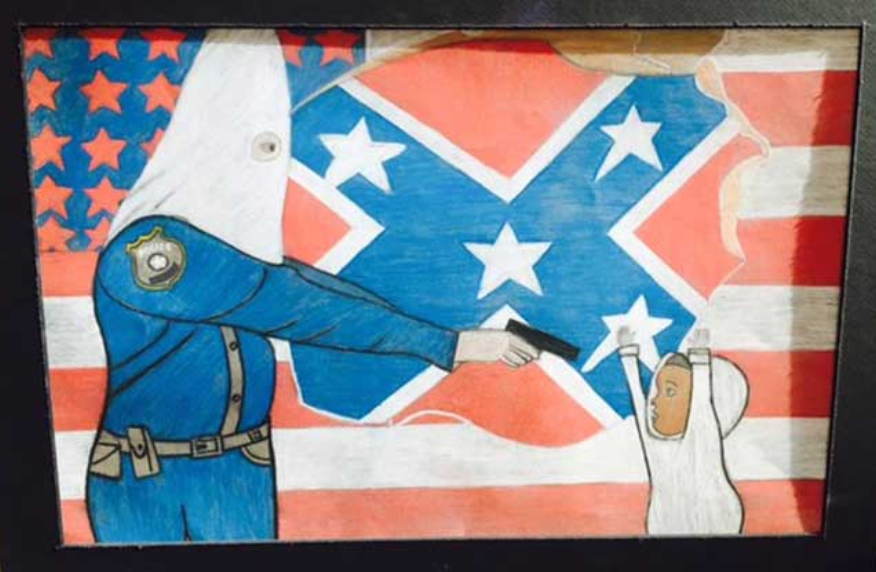
 All else about the Denver student’s contextualization of D’Antuono’s work is the same, the confederate flag uncovered from beneath the wallpaper of Old Glory. In the student’s piece the American flag appears worn through. In D’Ontuono’s original the racist flag has bursted through. The cop and hood are the same, except in the original the cop was maybe more fat.
 What’s also missing in the DenPo whitewash is the context of the unamed student’s assignment. She was tasked with contextualizing TWO works. The influence of the second piece is not as apparent as the first. The boy’s hands-up wasn’t merely recalling the mantra of the Black Lives Matter movement, it was evoking the student’s other chosen influence, Goya’s famous “The Third of May 1808.” In that iconic work, a firing squad is executing a rebel with outstretched arms.
 Before Coloradans were chasing off out-of-state migrant workers, yesterday’s illegal immigrants, they were offended by earlier indigent encampments. When miners struck in Colorado’s southern coal fields, the mine owners evicted them from the company-owned houses. The unions were left to build a tent city in Ludlow to put pressure on the industry to accept some labor demands. The standoff was spun as a standoff between the ungrateful miners, most of them recent immigrants, and a nation’s critical source of heating fuel. The Colorado population was roused to man a militia and beat the miners into submission. As much as consumers feared an interrupted coal supply in the record cold of the winter of 1914, imagine the miners enduring in their tents. In the end, we all know the result: the Ludlow Massacre and the unions were defeated.