DENVER, COLORADO- The Denver Art Museum assembled a panel of Native American artists to build collections of recollections of the Sand Creek Massacre on the occasion of its 150 year anniversary. Question: what do the artists think of resting the onus of remembrance of a crime on its survivors? How convenient for the perpetrators of genocide –by a hair we mightn’t have had to remember it at all, the aim of genocide after all. If Westward Expansion had succeeded in wiping out indigenous peoples entirely, a genocidal program which is ongoing, to repeat the obvious, that the great white tribe wouldn’t have to be bothered to remember Sand Creek at all. Wrestling the narrative from the hands of the white fathers isn’t solved by seeking indigenous voices only, many of those by now have assimilated the colonialist temperment, the burden of remembrance must be taken up by the white supremacist if we are ever expected to atone.
Tag Archives: Sand Creek Massacre
Pueblo museum excises Mine Workers Union from Ludlow Massacre exhibit!

PUEBLO, COLORADO- 2014 marks one hundred years since the Ludlow Massacre of 1914. A variety of commemorations are planned before the formal anniversary on April 20. I attended one such event on Wednesday, a lecture by a CSU professor to footnote the “Children of Ludlow” exhibit at El Pueblo History Museum. I’m always excitied when attention is paid to Ludlow, a subject regularly left out of American schoolbooks, but I was disappointed to find key elements of labor history excised from the museum’s narrative. Literally. The United Mine Workers of America, the organization central to the strike, which supplied the tent city, and which even today maintains the memorial site, was mentioned only once, IN FINE PRINT! The Ludlow miners voted to strike because the mining companies refused to recognize the UMWA. Unmentioned. The horrors of the atrocity were not tempered, in their explicitness perhaps we think them enough, but there was also the apologist suggestion that some culpability belonged to the miners. I questioned one curator who admitted they were at pains to keep the story “balanced” and that the squeakiest wheel thus far has been the National Guard. Apparently the Guard is offended that its role will be misconstrued. What balance do they want, I wondered. Had they lost children in the “battlezone” too?
Children are at the heart of commemorating Ludlow and at the heart of this preversion of the massacre’s memory. Were they recklessly endangered by their parents and union organizers? Were they dragged into a battlezone? The museum seems to suggest as much, highlighting the beligerence of the miners, mischaracterizing the soldiers, and leaving the union actions largely unexplained.
First I’d like to declare how I tire of the objective irrelevance which results when academics seek the approval of government technocrats. I am also disturbed by educators who pretend blindness to subtle inferences which shape a political takeaway. To them, “remembering” Ludlow seems sufficient in itself. I can hardly see the point to remembering Ludlow unless we have discerned its lessons. Until we are remembering the LESSONS OF LUDLOW, our educators’ self-proclaimed raison d’etre will be self-fulfilling: “history will repeat itself.” This Pueblo exhibit suggests no lesson other than the exploitation of tragedy, and leaves me fearful about the Ludlow commemorations to follow. The anti-union, pro-military climate which prevails these hundred years since the massacre will make for a travesty of a remembrance unless someone with a worker’s perspective speaks up.
NOT BROUGHT TO YOU BY…
Let’s start with this exhibit, which alas has already escaped critique since September. Its full title, as evidenced in the photo above: “Black Hills Energy presents: Children of Ludlow, Life in a Battlezone, 1913-1914.”
I’ll bet curators thought it a measure of truth and reconciliation that the Ludlow presentation was sponsored by a local extraction industry business. Black Hills Energy trades not in coal but natural gas. In fact they’re among the frackers tearing up Southeastern Colorado. I think the irony more likely suggests how the UMWA’s starring role was left on the cutting room floor. There are generic mentions of “the union”, as at right, keeping a ledger of which families were assigned tents, but only in the fine print is the UMWA named as owning the ledger.
BATTLEZONES
More troubling is the skewed framing of the museum’s narrative. It begins with the subtitle, “life in a battlezone.” That’s taking a rather curious liberty don’t you think? The event we accept now as “Ludlow” became a battlezone on April 20, and the regional Coal Field War which followed was a battlezone to which both revenge-seekers and militia thronged, but the tent colonies in which 12,000 lived, 9,000 of whom were the children of the title role, were camps full of families. That they were straffed regularly by the guards makes them shooting galleries not battlegrounds.
Calling Ludlow a battlezone is like calling Sand Creek a “collision” or calling the Middle East a “conflict”. All of these mask the role of the aggressor.
I will credit the curators for offering a candid detail of horrific import. In a description of the day before the massacre, when the Greeks among the immigrants were celebrating Greek Easter, mention is made of the mounted National Guards offered this taunt: “You enjoy your roast today; we will have ours tomorrow.” No one should deny today that the events of April 20, which culminated in the torching of the tents and asphyxiation of women and children, was a premeditated act.
THE CHILDREN
Should the miners have put their children in harm’s way by defying the mining companies? How could they not? As immigrants they didn’t have nearby relatives to foster their children away from the random bullets. Also left unsaid by the display: many of the children had already been working in the mines and counted among those on strike. This was before child labor reforms.
Curiously, the exhibit did include a famous photograph of the notorious activist Mother Jones leading a childrens’ march through Trinidad. The caption explained that Jones “wasn’t above using real children to advance the cause of Colorado’s coal miners.” Emphasis mine. While technically true in a modern context, it’s probably disingenuous to imply someone is using the children when a key issue of the demonstration is CHILD LABOR.
No really. Mother Jones was leading a march of children, many of them workers of the mines, for the reform of labor practices which abused children. This and subsequent campaigns eventually led to child labor laws. Is saying “Mother Jones wasn’t above using children” in any way an accurate characterization?
Compounding the inference that the Children of Ludlow were jeopardized for the cause, was the implication that the miners were combatants who contributed to the battlezone. As the displays progressed in chronological order, the first weapon on display was a rifle used by the miners. Immediately behind it was an enlarged photograph vividly depicting miners posed with two identical specimens.
Moving along the exhibit chronologically, anticipating the rising violence, the museum goers is apparently supposed to register that the strikers were firing too, if not first. Recent historical accounts have deliberated about who fired first. I think the motive is suspiciously revisionist in view of today’s dogma of nonviolence absolutism: if your protest devolves into violence, you deserve every bit of the beating you get.
Whenever it was that the miners began firing, the single militia and three guard casualties were not recorded until after the massacre took place, belying the narrative that the miners invited the massacre. Witnesses conflict about when the three union leaders were executed. I’ll give the museum credit for defying the National Guard in summarizing that among the casualties, three of the miners were “executed”.
PARITY OF WEAPONS
Students of the Ludlow accounts know that many of the miners were better riflemen than the soldiers. Many were immigrants who’d served in Bulkan wars and outmatched Colorado’s green guardsmen. That is not to suggest that the miners and their harrassers were equally armed, yet…
The only other weapon on display is a rifle of vintage used by the national guard. It shares a case with a uniform and sabre, lending it official authority. Also, the rifle is not presented as having been used at Ludlow, so it doesn’t project an aura of culpability. Missing is the machine gun depicted in the photograph of the machine gun nest which fired down upon the camp. It’s depicted with a caption about the Guard being a welcome presence. Missing too is the armored car dubbed the “Death Special”. Obviously the armor protected its operators from being hit by striking-miner bullets as it drove through the canvas encampment, straffing the tents with its mounted machine gun.
HUMANIZING THE PERP
Right after the photo of armed miners was the display at right, with a very contrived bit of spin catering to today’s military families. Although the photo shows soldiers actively aiming their gun at the camp, the caption assures us that the “Ludlow families feel relief with the arrival of National Guard”. This supposition is based on the fact that when the soldiers first arrived they were serenaded with the “Battle Cry of Freedom” and greeted with American flags. Most of the miners being immigrants, they were eager to show their patriotism, but the conclusion drawn here is a terrible mendacity. The miners and union organizers knew full well the purpose of the National Guard. They knew the strikebreaking role it played in famous strikes of the past. The miners feted the soldiers hoping to sway them from their eventual task. Protesters of all eras hold out this hope every time they face riot police.
A following paragraph suggested that by the time the massacre was committed, most of the soldiers had been mustered out and replaced with militia members and company guards. This is slight of hand. After the official inquiry, which was prompted by the public outcry, twenty National Guard soldiers were court martialed. All were acquitted. Is the Guard wanting us to believe they were acquitted because they weren’t there?
This attempt to put a friendly face on the National Guard, coupled with an abdication of effort to give the union its due, seems engineered to appeal to the average Pueblan of today, many probably related to an active-duty soldier and long since indoctrinated against evil unions. When I asked the lecturer about the omission of the UMWA, she prefaced her answer for the audience, explaining that unions of old were not like those despised today. I told her I thought failing to describe the hows and whys of the strike was a real teaching opportunity missed.
HISTORY COLORADO
It’s probably important to point out that the Ludlow presentation at the History Museum was developed with the assistance of History Colorado, which finally shuttered a contested display: a Sand Creek Massacre exhibit with a similar flavor of whitewash. Like labeling Ludlow a battlezone, History Colorado tried to typify Sand Creek as a “collision.”
Also typical of History Colorado is the propensity to address their exhibits to children. Programming for school bus visits invariably dumbs down what can be presented and I hardly think the compromise is worth it. If children ran the world, maybe Disney versions of history would suffice.
I’d like to have seen it highlighted that the Ludlow miners were mainly immigrants who were looked down upon by the residents of Colorado. If the museum audience were the “Children of Ludlow” in the extended sense, as a few descendants probably were, more of us were the children of the soldiers of Ludlow, or the citizens who cheered them on, or joined the militia or built the armored car at Rockefeller’s Pueblo factory. If we’re going to remember Ludlow, we ought to remember our role in it so we don’t do that again. It’s easy to pretend we were the martyrs. In all probability that’s who we will be if the lessons of Ludlow are discarded.
Bear Creek Massacre, January 29, 1863

The year 2014 will mark the 150th anniversary of the Sand Creek Massacre, on November 29, two days after Thanksgiving. But on this day, January 29 of the year before, a Shoshone village suffered an identical fate. The Bear Creek Massacre was also once called the Battle of Bear Creek, but the only grounds which western military history buffs have to argue that such engagements were “battles” not massacres, is that was how the US cavalry waged its fights against the hostiles, its only victories were raids upon unsuspecting villages.
Here is the official contemporary report of Colonel Connor’s attack. First the cover letter which sets the scene. From the Official Records of the War of Rebellion (what the Civil War was called then), series 1, volume 50, part 1:
HEADQUARTERS DEPARTMENT OF THE PACIFIC,
San Francisco, February 20, 1863.
Adjt. General L. THOMAS, U. S. Army,
Washington, D. C.:
SIR: I have the honor to inclose herewith the report of Colonel P. E. Connor, Third Infantry California Volunteers of the battle fought on the 29th of January, on Bear River, Utah, Ter., between U. S. troops and hostile Indians. Our victory was complete; 224 of the enemy left dead on the field. Colonel Connor’s loss was heavy. Out of 200 men engaged 14 were killed on the field and 4 officers and 49 men wounded; 1 officer and 5 of the men wounded have since died. Colonel Connor’s report of the suffering of his troops on the march and the gallant and heroic conduct of both officers and men in that terrible combat will commend the Column from California and its brave commander to the favorable notice of the General-in-Chief and War Department.
Very respectfully, your obedient servant,
G. WRIGHT,
Brigadier-General, U. S. Army, Commanding.
I’ll parse those totals for you. Cowboy casualties: 20 dead, 47 wounded. Indians: 224 dead, 0 wounded.
Here are the more relevant passages of Connor’s report. Notice he puts plenty of emphasis on the fight he encountered, even suggesting that the Shoshones initiated the attack. Connor sheds much less light on the aftermath. (I’ve bolded some parts of import:)
Report of Colonel P. Edward Connor, Third California Infantry, commanding District of Utah. (Excerpt)
As daylight was approaching I was apprehensive that the Indians would discover the strength of my force and make their escape. I therefore made a rapid march with the cavalry and reached the bank of the river shortly after daylight in full view of the Indian encampment and about one mile distant. I immediately ordered Major McGarry to advance with the cavalry and surround before attacking them, while I remained a few minutes in the rear to give orders to the infantry and artillery.
On my arrival on the field I found that Major Mcgarry had dismounted the cavalry and was engaged with the Indians who had sallied out of their hiding places on foot and horseback, and with fiendish malignity waved the scalps of white women and challenged the troops to battle, at the same time attacking them. Finding it impossible to surround them in consequence of the nature of the ground, he accepted their challenge.
The “scalps of white women” was a common motif used in justifying ensuing slaughters. Colonel Chivington cited the presence of same at the Sand Creek camp, although none were ever produced.
The position of the Indians was one of strong natural defenses, and almost inaccessible to the troops, being in a deep, dry ravine from six to twelve feet deep and from thirty to forty feet wide, banks and running across level table-land, along which they had constructed steps from which they could deliver their fire without being themselves exposed. Under the embankments they had constructed artificial covers of willows thickly woven together, from being which they could fire without being observed.
After being engaged about twenty minutes I found it was impossible to dislodge them without great sacrifice of life. I accordingly ordered Major McGarry with twenty men to turn their left flank, which was in the ravine where it entered the mountains. Shortly afterward Captain Hoyt reached the ford three-quarters of a mile distant, but found it impossible to cross footmen. Some of them tried it, however, rushing into the river, but, finding it deep and rapid, retired. I immediately ordered a detachment of cavalry with led horses to cross the infantry, which was done accordingly and upon their arrival upon the field I ordered them to the support of Major McGarry’s flanking party, who shortly afterward succeeded in turning the enemy’s flank.
Up to this time, in consequence of being exposed on a level and open plain while the Indians were under cover, they had every advantage of us, fighting with the ferocity of demons. My men fell fast and thick around me, but after flanking them we had the advantage and made good use of it. I ordered the flanking party to advance down the ravine on either side, which gave us the advantage of an enfilading fire and caused some of the Indians to give way and run toward the north of the ravine.
At this point I had a company stationed, who shot them as they ran out. I also ordered a detachment of cavalry across the ravine to cut off the retreat of any fugitives who might escape the company at the mouth of the ravine. But few tried to escape, however, but continued fighting with unyielding obstinacy, frequently engaging hand to hand with the troops until killed in their hiding places.
The most of those who did escape from the ravine were afterward shot in attempting to swim the river, or killed while desperately fighting under cover of the dense willow thicket which lined the river-banks.
Most were shot, but Connor skimps on the detail. The wounded Shoshones and those feigning injury were prodded with bayonettes then shot, violated sometimes before, sometimes after. Few escaped this fate. Like any population of civilians, the village was at least seventyfive percent women and children.
I have also to report to the general commanding that previous to my departure Chief Justice Kinney, of Great Salt Lake City, made a requisition for troops for the purpose of arresting the Indian chiefs Bear Hunter, San Pitch, and Sagwich. I informed the marshal that my arrangements for our expedition against the Indians were made, and that it was not my intention to take any prisoners, but that he could accompany me. Marshal Gibbs accordingly accompanied me and rendered efficient aid in caring for the wounded.
…
Of the good conduct and bravery of both officers and men California has reason to be proud. We found 224 bodies on the field, among which were those of the chiefs Bear Hunter, Sagwich, and Leight. How many more were killed than stated I am unable to say, as the condition of the wounded rendered their immediate removal a necessity. I was unable to examine the field. I captured 175 horses, some arms, destroyed over seventy lodges, a large quantity of wheat and other provisions, which had been furnished them by the Mormons; left a small quantity of wheat for the sustenance of 16 and children, whom I left on the field.
The Wondrous Tale of Brer Lamborn, Brer FOX & Obama the Tar Baby. Uncle Remus and Racism in Colorado Springs.
COLORADO SPRINGS- If US Rep. Doug Lamborn (R-CO) remembered one thing from the Uncle Remus stories, it was not to touch that Tar Baby! You know, the one Brer Rabbit mistook for a cute black infant who would not tip his hat to his better. Or was that a Porch-Monkey? Colorado’s 5th District is unclear about the distinction if the local media and Fox News are to be believed. Either term refers to a poor person whose sticky problems become your “quagmire” if you ignore your natural prejudice to their skin color and you let them touch you. Can a representative of bigots be bothered to know if a racial slur is offensive? According to Lamborn, he can’t. More important, the congressman reiterates –as he professes his apology to people taking umbrage at racism he hadn’t intended to express– is: NOT TO TOUCH THAT OBAMA!
To be clear, Doug Lamborn hasn’t apologized to his constituents, he’s only claimed to have sent President Obama a letter, assuring all that Obama, the black untouchable, will have the grace to forgive him as “a man of character”.
And so this Uncle Remus tale simply goes on…
The story so far
Lamborn calls black US president a Tar-Baby, public outrage ensues, Gazette newspaper lends support to Lamborn’s excuse that Tar-Baby wasn’t used in racist sense. Protests held by NAACP, community groups and local progressives, all which Lamborn refuses to meet. Lamborn office erects sign NO PROTESTS.
ACT II: Lamborn office calls for his supporters to rally, presumably under the “no protest” sign. His office issues a press release: AP, Fox News, national and statewide outlets report before the fact that LAMBORN SUPPORTERS RALLY. Huffpo and Springs activists scramble to get images of said protest sanctioned despite “no protest” sign, find none. Local TV station KOAA which had depicted rally with a photo, hours before it was alleged to happen, omitted to mention photo was from file, conveniently unfocused and likely of a past year election event.
With every shenanigan, the theme resounds: the Colorado Springs establishment supports what Doug Lamborn said about Obama being a Tar Baby.
Racism in Colorado Springs
No one is in denial about the unsavory support behind Doug Lamborn. So does Colorado Springs support his bigotry?
Does the Tea Party shit in Acacia Park? You should see those clan gatherings, you can’t find a parking space for blocks, then it’s a sea of hate-filled white faces, with Doug Lamborn right there up front.
The comment section of every local media blog overflows with indignation that “Tar-Baby” is being construed to be racist. Commentators assert their preference for Freedom of Speech over Political Correctness.
BTW, Colorado Springs is as segregated as Chicago, with black neighborhoods, churches and schools. Many lives never cross the path of another of different ethnicity, so we’re blameless actually when we conclude there’s no racism here.
Except toward Hispanics, grouped conveniently with illegal immigrants, who don’t count, by definition, according to our favorite definition: legality. Same as used to apply to slaves.
The Pikes Peak region was a hotbed of clan activity in the 1930s, and obviously before that. At the turn of the century, the good folks of Limon had to hold up a lynching, make the poor young black boy wait hours in the November cold because hundreds wanted to come on the train from Colorado Springs to see 16-year-old Preston Porter burned alive at the stake.
Lynchings of Native Americans weren’t even recorded, being as they were, sanctioned as vermin control. It was seldom that white men distinguished themselves by speaking out in defense of Indians. Pikes Peak volunteers rode with Colonel Chivington to commit the Sand Creek Massacre.
Today downtown Colorado Springs boasts a lone statue of an African-American, a William Seymour, among the city notables immortalized in bronze. His is the only likeness made to take off his hat, outdoors, I kid you not.
Speaking of which, that was Tar-Baby’s offense.
Brer Rabbit and the Tar-Baby
Brer Rabbit was passing by the little black figure, and called out a friendly hello. But Tar-Baby wouldn’t answer when spoken to. When he wouldn’t even take off his hat, Brer Rabbit figured he’d teach him a lesson. Apparently, it’s not inappropriate to clobber some status of people if they’ve disrespected you.
Of course that was the only way Brer Fox’s plan was going to ensnare the rabbit, to mire him in the tar.
You might ask, how did Brer Fox know that Rabbit was going to mix it up with the Tar Baby? Would Rabbit have laid his hand on the baby if he’d been white? Would it have mattered if a white baby didn’t answer to his greeting?
Put aside that the Tar Baby expression became a racial slur in itself, the original Tar-Baby character impersonated an African-American child who didn’t show the expected deference to a rabbit.
The accompanying images reflect the changing visual representation of Tar-Baby. He makes his first appearance in an early chapter of the Uncle Remus Tales (as collected by Joel Chandler Harris) called “The Wonderful Tar-Baby Story.” Above is one of the original illustrations by artist A.B. Frost. There Brer Fox creates a “baby” made of tar to lure Brer Rabbit into his clutches.
The next images are from Disney versions. First the animated film SONG OF THE SOUTH, then the children’s books which followed.
Disney famously has not released Song Of The South after its theatrical run. The depictions were too ethnic, and Tar-Baby recalled the black-face entertainment that ought not to have so amused white audiences. Black-face is what passes for a negro face to whites. Similarly, a baby made of tar passes for a negro, but only in exaggeration. Oblivious to many, apparently, is that African-Americans are not by any approximation black. If Brer Fox had made a baby out of milk, would white people confuse its color for their flesh tone?
Disney rewrote the tale for its children’s book series, making the tar baby this time out of glue. Not only that, but they gave him ears to resemble a rabbit. This preempted confusing him for a human baby, black or white. Now Brer Rabbit could be seen taking him for his kin, which of course shifts the premise, and might puzzle some children to wonder why Brer Rabbit is so quick to come to blows.
Uncle Remus
Some will probably ask in earnest: are the Uncle Remus tales racist? No, but their context is complicated. The stories emerged from the plantation South, from storytellers who lived in slavery. The lessons imparted are universal, but the particulars were obviously crafted to help slaves come to terms with their unchallengeable fate. Shall I quote a few passages to see if you get the idea?
Brer Tarrypin, he lay back up dar, he did, des es proud ez a nigger wid a cook possum.
–chapter 10
He scrape it clean en lick it dry, en den he go back ter wuk lookin’ mo’ samer dan a nigger w’at de patter-rollers bin had holt un.
–chapter 17
Dey er mighty biggity, dem house niggers is, but I notices dat dey don’t let nuthin’ pass. Dey goes ‘long wid der han’s en der mouf open, en w’at one don’t ketch de tother one do.
-chapter 27
How about this wrenching bit from A Story of War?
Nigger dat knows he’s gwineter git thumped kin sorter fix hisse’f, en I tuck’n fix up like de war wuz gwineter come right in at de front gate.
From chapter 33: Why the Negro is Black:
ONE night, while the little boy was watching Uncle Remus twisting and waxing some shoe-thread, he made what appeared to him to be a very curious discovery. He discovered that the palms of the old man’s hands were as white as his own, and the fact was such a source of wonder that he at last made it the subject of remark. The response of Uncle Remus led to the earnest recital of a piece of unwritten history that must prove interesting to ethnologists.
“Tooby sho de pa’m er my han’s w’ite, honey,” he quietly remarked, “en, w’en it come ter dat, dey wuz a time w’en all de w’ite folks ‘uz black—blacker dan me, kaze I done bin yer so long dat I bin sorter bleach out.”
The little boy laughed. He thought Uncle Remus was making him the victim of one of his jokes; but the youngster was never more mistaken. The old man was serious. Nevertheless, he failed to rebuke the ill-timed mirth of the child, appearing to be altogether engrossed in his work. After a while, he resumed:
“Yasser. Fokes dunner w’at bin yit, let ‘lone w’at gwinter be. Niggers is niggers now, but de time wuz w’en we ‘uz all niggers tergedder.”
“When was that, Uncle Remus?”
“Way back yander. In dem times we ‘uz all un us black; we ‘uz all niggers tergedder, en ‘cordin’ ter all de ‘counts w’at I years fokes ‘uz gittin’ ‘long ’bout ez well in dem days ez dey is now.
But atter ‘w’ile de news come dat dere wuz a pon’ er water some’rs in de naberhood, w’ich ef dey’d git inter dey’d be wash off nice en w’ite,
en den one un um, he fine de place en make er splunge inter de pon’, en come out w’ite ez a town gal.
En den, bless grashus! w’en de fokes seed it, dey make a break fer de pon’,
en dem w’at wuz de soopless, dey got in fus’ en dey come out w’ite;
en dem w’at wuz de nex’ soopless, dey got in nex’, en dey come out merlatters;
en dey wuz sech a crowd un um dat dey mighty nigh use de water up, w’ich w’en dem yuthers come long, de morest dey could do wuz ter paddle about wid der foots en dabble in it wid der han’s.
Dem wuz de niggers, en down ter dis day dey ain’t no w’ite ’bout a nigger ‘ceppin de pa’ms er der han’s en de soles er der foot.”
And my favorite passage, called Turnip Salad:
“How many er you boys,” said he, as he put his basket down, “is done a han’s turn dis day? En yit de week’s done commence. I year talk er niggers dat’s got money in de bank, but I lay hit ain’t none er you fellers. Whar you speck you gwineter git yo’ dinner, en how you speck you gwineter git ‘long?”
“Oh, we sorter knocks ‘roun’ an’ picks up a livin’,” responded one.
“Dat’s w’at make I say w’at I duz,” said Uncle Remus. “Fokes go ’bout in de day-time an’ makes a livin’, an’ you come ‘long w’en dey er res’in’ der bones an’ picks it up. I ain’t no han’ at figgers, but I lay I k’n count up right yer in de san’ en number up how menny days hit’ll be ‘fo’ you ‘er cuppled on ter de chain-gang.”
“De ole man’s holler’n now sho’,” said one of the listeners, gazing with admiration on the venerable old darkey.
“I ain’t takin’ no chances ’bout vittles. Hit’s proned inter me fum de fus dat I got ter eat, en I knows dat I got fer ter grub for w’at I gits. Hit’s agin de mor’l law fer niggers fer ter eat w’en dey don’t wuk, an’ w’en you see um ‘pariently fattenin’ on a’r, you k’n des bet dat ruinashun’s gwine on some’rs.”
What about “nigger”?
When Russel Means writes of today’s economic and anti-democratic troubles, and addresses America’s newly impoverished middle class by saying Welcome to the Reservation, this is the wisdom I think he’s looking to impart. Welcome to niggerdom, Nigger.
With that word now struck from Huckleberry Finn, the concept of “nigger” becomes harder to grasp and can’t teach us its lesson.
Listen to Uncle Remus talk about what it means to be a lowest class being, beneath the interest of humanity, untouchable, as government functionaries like Doug Lamborn would prefer the underclass laborer remain.
It’s against the moral law for niggers to eat when they don’t work. AND
I ain’t handy with figures, but I lay I can count on one hand how many days it’ll be before [“knocking around” will land you niggers] in the chain-gang.
I suggest you reread that last passage of Uncle Remus in its original. Now I’ll try my hand at the last half of that phrase:
It’s against the moral law for niggers to eat when they don’t work, and when you see them apparently fattening on air, you can just bet that ruination is going on somewhere.

Ludlow Massacre or unhappy incident?

COLORADO COLLEGE- CC is holding a symposium on the 1914 Ludlow Massacre. Actually, it’s only called the Ludlow Symposium. True to Colorado Springs form, several among the audience want to call it an “incidence,” instead of a “massacre.” One of the participants, author Scott Martelle, is willing to oblige, explaining that if the militia hadn’t known that women and children were taking shelter beneath the tents which they were putting to the torch, then the soldiers were guilty only of criminally negligent homicide.
(*Note 4/12/09: this article has been revised in light of helpful comments offered by symposium participants. Also: Differences of opinion aside, I am remiss if I do not praise the scholars who were very generous with their time and encyclopedic memories to enrich this symposium.
1. CC’s own Professor David Mason authored an evocative narrative of lives caught up in the 1914 events, written in verse, entitled Ludlow.
2. Journalist Scott Thomas researched the most recent definitive account to date, the 2007 Blood Passion: the Ludlow Massacre and Class War in the American West.
3. Thomas Andrews, Associate Professor at CU Denver, enlarged the context in 2008 with his award winning Killing For Coal: America’s Deadliest Labor War.
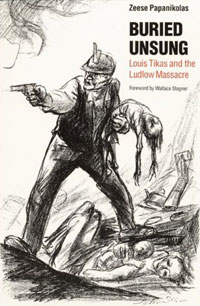
4. Zeese Papanikolas represented his authorative Buried Unsung: Louis Tikas and the Ludlow Massacre, written in 1984.)
Does it matter what it’s called, or with what certainty? The symposium is filled with public school system educators looking for an angle with which to approach Ludlow with their kids. One of them expresses her doubt about teaching about Mother Jones, having just heard from the panelists a probably too-nuanced assessment of the labor hero’s tactics. The political climate of our age can’t find any purchase with moral nuance.
I’m stuck thinking that in recording social history, scholars cannot avoid writing the victor’s narrative. In particular as regards the history of labor, because neither academics nor even middle class hobbyists in the symposium’s audience can look at the events from the perspective of the working class.
Even the scholar’s objectivity is middle class. The opinion was expressed by the panel that the Ludlow aftermath was one of the few occasions when the story was spun to the benefit of labor interests. But this does not account for why authors and educators find themselves having to resurrect the tale of Ludlow these many years later. When it occurred, Americans may have swallowed the hyperbole, but since that time they’ve internalized its internment, effaced by a corporate culture so as to have disappeared from even our school textbooks.
I think this may have been something of the question posed by symposium organizer Jaime Stevensen to the panel, when she asked how the authors insulated themselves from the fictions woven into their own perspectives of history. She didn’t get any takers.
The very concept that history adds up to only so much trivial pursuit, is inherently a view from the ivory tower.
Do the Ludlow scholars not recognize that common people today face the same foes as did the miners of Ludlow? With the added impediment of a corporate PR system erasing its malevolent deeds. Have not American unions been maligned to the point of extinction? Yet at the same time, capitalists have thoroughly reprised their Machiavellian ways. History can be a tool, not only for statecraft, but for the common American to protect his hard-fought democratic gains.
The United Mine Workers of America having successfully spun the deaths of the striking miner families as a “massacre” may have made an unmerited impact on the public’s sympathies, but likewise, deciding to call Ludlow “not a massacre” will be falsely charged as well. Is there a valuable lesson in unlearning that unbridled corporate greed can be unthinkably inhumane?
Historians can fancy themselves objective to ambivalence, but is that a luxury their readers and in particular the schoolchildren can afford? As we witness today the gloves coming off of the globalisation taskmasters?
How I prefer the emotional truth of earlier chroniclers like Barron Beshoar, author of OUT OF THE DEPTHS, a 1942 account of Ludlow, whose preface included this gem:
“If the mine guards and detectives, the mercenaries who served as the Gestapo and the coal districts appear to be scoundrels who sold themselves and their fellowmen for a few corporation dollars, the author will consider them adequately presented.”
At Colorado College the consensus of contemporary historical synthesis, embodied by CU Denver’s Thomas Andrews‘ excellent book KILLING FOR COAL, seems to conclude about Ludlow, “we may never know exactly what happened.” This may reflect the Factual Truth, but it does so at the expense of unrecorded oral accounts, by depreciating their traditional path to us through of folklore.
Another author made pains to debunk the lyrics “Sixteen tons, and what do you get, another day older and deeper in debt,” a cultural indictment of the “company store,” which was one of the grievances of the Ludlow strikers. He postulated that modern readers could be prone to let folklore color a predisposition against the company store. Perhaps a company store was in fact a convenience, derided because it was an arbitrary restriction against which human nature bucked. Trying to be helpful, another panelist suggested: “Imagine if the company store was 7-11, and you were told you could only shop there.” I believe both of these gentlemen are overlooking the much grosser complaint which the miners were protesting, that of insurmountable debt, systematically forced on them by their employers. That’s a phenomena on the rise today, if maybe not among college professors. Around the world, indentured servitude has never abated.
In our ivory tower we can debate which side, the union or the militia, fired the first shots on April 20. Who was at fault, seemed to be what that question would decide. At least panelist Anne Hyde had the presence of mind to lay some of the responsibility on the mine owners, who weren’t there of course, but whose stubborn greed played a not unsubstantial part in what the other panelists were attributing to “macho intransigence.”
That expression was in vogue to describe Cowboy presidencies. What an effete put down of militant activism. Are we to blame the striking miners for holding firm to their demands?
Thank goodness someone in the audience brought up recent efforts to deny the Sand Creek Massacre, which two panelists quickly weighed in to say “that was a real massacre,” discrediting Ludlow, obviously, and failing to grasp her point that indeed some Colorado Springs locals are rewriting Sand Creek as a battle, and not a massacre.
Another isolationist luxury has become to judge every action as it compares to a nonviolent ideal. It was noted that UMWA union leader John Lawson always recused himself from violent tactics. During the symposium’s opening reception, someone performed a song dedicated to the Ludlow martyr Louis Tikas, which lauded him for choosing to fight with words not guns, as if guns would discredit him.
I’ll play devil’s advocate and suggest that the miners fired the first shots. They saw Louis Tikas bludgeoned in the back of the head and then executed as he lay on the ground unconscious, they saw the National Guard move a machine gun into position above their tent city, and they probably began to fire at the soldiers lest a rain of bullets descend on miners’ wives and children before they had a chance to flee the camp.
The miners were asking that their union be recognized, that the Colorado eight hour work day be enforced, that the scales which determined their pay be verified, that their full hours be compensated, etc. The mine owners clung to their profits, and ordered the miners’ tent city, their only shelter and all their worldly possessions burned to the ground. Women and children were hiding in underground pits dug to escape the sniper fire which the mine guards sporadically aimed at the tents. The guards drove an armored car around the perimeter of the union camp, at all hours, for that purpose.
Ultimately this climate erupted into the violent clash on April 20, 1914, in which the miners battled with the far better equipped soldiers. The casualties were 25 to 1. I call that a massacre.
ADDENDUM: Photographs from visit to the Ludlow Memorial.

LUDLOW MEMORIAL, COLORADO- Day three of the Colorado College Ludlow Symposium featured a bus ride to the site of the 1914 Ludlow Massacre, then on to Trinidad to the grave of Union leader Louis Tikas. A reporter for Colorado Public Radio interviewed the symposium panelists at the U.M.W.A. memorial grounds.

David Mason is interviewed by a freelance reporter for Colorado Public Radio.

Scott Martelle and Thomas Andrews are interviewed above the fatal cellar.
TRINIDAD, COLORADO- Masonic Cemetary.


Zeese Papanikolas spoke about his protagonist’s gravestone and its reference to Tikas as a “Patriot.”

Denver Columbus Day Parade wants to kick indigenous ass
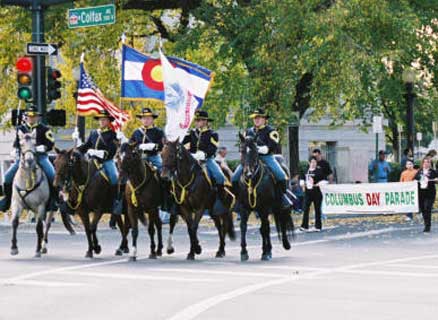
DENVER- Does it look like the COLUMBUS DAY PARADE organizers are practically begging for a comeuppance? Here comes the US cavalry of the American Indian Wars to finish the job Columbus began.

On Columbus Day, the anniversary which has now become a teaching moment about revisiting the Columbus myth, about the holocaust unleashed by the European discovery, conquest and enslavement of North America, isn’t it rather odd to CALL IN THE CALVARY?

I MEAN, a celebration of Italian Americans is one thing. Is Christopher Columbus the only hero they can muster? Why not the Pope? I’m all for diverting Americans from the stereotype of the Sicilian American Sopranos legacy. But make it about pizza, not the frigging conquest of the American West. Columbus’ own diaries confess his exploitive inhumane designs in Hispaniola. White man western expansion was no less genocidal. Who should be celebrating that?
This squad looks like they’re reenacting Colonel Chivington and his raiders freshly back from the Sand Creek Massacre. Perhaps they are retracing the victory lap the soldiers rode in Denver, festooned with the body parts of their victims, women and children, they exhibited as trophies of their victorious raid on the Indian encampment at Sand Creek.
How fitting that for the modern day route, the western revelers drive Hummers. The glorification of the military is not coincidental, nor perhaps is the celebration of the uneducated. 
Do YOU, for example, count Winston Churchill’s WWII England among your ancestors? Here is the invitation to the 2008 parade:

“On Saturday October 11, 2008, at 10:00AM, we will celebrate the American National Holiday which commemorates Columbus’ contribution to the formation of this great nation. It will also remind each one of us of the blood, sweat and tears our ancestors shed so that we might live and enjoy our lives in the land of the free.”
These are the Denver organizers’ own photos of the 2007 parade. In the next you can catch an unedited glimpse of a protester. And what other can that be but a reactionary scowl?


Here’s what those opposed to the Columbus commemoration are putting together.
1. RACE, RESISTANCE AND THE COLUMBIAN LEGACY
Join nationally-known activist Glenn Spagnuolo, co-founder of Re-create 68, for a night of education and dialogue about race in America and resistance to the Columbian Legacy!
When: 5pm Thursday, October 9, 2008
Where: CU Boulder Campus, Hale Hall Room 2402. Columbus Day Resistance March and Rally
The annual protest of the Columbus Day Holiday and the racism that it embodies will begin with a march from Four Winds that ends at the Capitol Building followed by a rally for a better future.
When: March starts at 8 am, Rally at 9am, Saturday, October 11
Where: Start of March is at Four Winds at 5th and Bannock in Denver3. People’s Council
Following the Columbus Day resistance, people will be gathering to organize a new alliance locally that can act as a national vehicle for radicals. Bring your thoughts and cooperative energy. Please come and represent R68.
When: 1pm, Saturday, October 11
Where: The Great Hall at the Iliff School of Theology just past Evans on University Blvd, Denver.4. Student Walk-out on Racism
Whether you are a student or not, join the students of Iliff, CU Denver, CU Boulder and DU as the educate the public about Denver’s hidden racial past on the 101st Anniversary of the Columbus Holiday. There will be a student walk-out, a short rally, followed by a march to locations with a racial history that will end at Civic Center Park.
When: 12 Noon, Monday, October 13
Where: CU Denver’s Auraria Campus, The Plaza Building Lawn
Sand Creek No Gun Ri
This morning will be the dedication of the Sand Creek Massacre National Historic Site. The headline of today’s Gazette? “One man’s battle” about whether the 1864 slaughter was a massacre or a battle, and reporting the re-release of a 1925 first hand account written by Irving Howbert who, 61 years after the fact, did not recall the atrocities ascribed to his unit. Whatever kind of near sesquicentenial slap in the face is this? Do you think the prominent placement of this insult could have something to do with blurring America’s vision about current military massacres?
Normally respected Old Colorado City historian Dave Hughes is republishing the book, and wants to repaint the Sand Creek Massacre as, well, not a massacre at all. A quick recap: One early morning in 1864, 700 cavalry volunteers swooped into a village of 500 Arapaho and Cheyenne refugees, killing nearly 200 (the Gazette says 150) committing unmentionable atrocities, following the command “Kill or scalp all, big and little; nits become lice!”
I first heard Dave Hughes talk about the glories of war at, of all places, the traveling Vietnam War Memorial. It reflected a myopic immoral tide change I would never have been cynical enough to foresee, and it presaged our national sanction of the US war of aggression against Iraq and acceptable collateral damage. In the shadow of the traveling wall, remembering the 58,000 American dead, where not often enough did someone mention the millions of Vietnamese dead, Dave spoke of his immense pride of commanding his men, suffering the terrible casualties they did in Korea. The heavier the toll, the deeper his pride, the blustery commander was volunteering, if it weren’t for old-age, to do it again. I kid you not. Though he lost half his men to the battle, he would bravely venture more.
Downplaying massacres seems to be Hughes’ game. If you Google No Gun Ri, the now admitted deliberate massacre of hundreds of Korean refugees in 1950, here’s what do you’ll get: Dave Hughes on record standing up for the actions of American machine gunners. Here too, he wasn’t there, and relies on the recollection of soldiers who might have reasons to be blanking out on those parts. For shame. I know and like Dave Hughes, but he’s got a moral screw loose. And as we’ve seen in this town, that’s catching.
Elsewhere in the news, a play opens in London which retells the tragedy of Fallujah, in the actual words of participants on both sides. Authorities note 70 breaches of international conventions by the US forces. Soldiers like Dave Hughes can explain to themselves the necessity of sniping, gassing and obliterating hundreds of civilians in the regular conduct of war. Luckily wiser soldiers and statesmen before them have already addressed man’s bloodlust and agreed there are crimes that must never be rationalized.