Whose racism are you protesting exactly?

SO “WOKE” America is protesting the racist brutality of capitalism’s hired thugs. What are the cops supposed to stop doing exactly? Are they supposed to let poor blacks breathe? Or stop killing poor blacks in such vivid disproportion? What an aimless message these riots bring! Of course the mainstream media is on board. Their theme is domestic unrest with an eye on regime change. It’s what they incite everywhere else. I’m surprised they haven’t labeled this a “color” revolution –except the color is already chosen and it’s their least favorite.

The only result of the visibility which the Black Lives Matter movement has brought to police lynchings is that now you hear regret that poor white criminals aren’t dished out the beatings reserved for blacks. Do we want more police brutality so long as it is equally distributed? Cops aren’t going to stop beating people. It’s their job. In an unequal, predatory economic system, cruelty is a cop’s function.

I also laugh at the celebrity blow-back at unfortunate white protesters who take up the chant “All Lives Matter” usually in earnest because their marches, reflecting their local populations, are mainly white. Their chants don’t negate “Black Lives Matter,” they broaden it. Face it, the BLM slogan is pedantic. Of course Black Lives Matter. The protesters are not illiterate and neither are the police, the supposed audience.

And BLM is such an inarticulate ask. Try “Drone Victims Matter!” Uh, agreed, but the US drone terror program is not going to stand down.

And “hands up” and “taking a knee” are demonstrations of submission. Ugh.

If the issue is in-the-line-of-duty lynchings, I’m sorry but there are unfortunates a rung below African Americans. Per capita, Native Americans die more often at the hand of law enforcement, and below them, the homeless. Constables have been “rolling” poor bums since antiquity. Vulnerable homeless are killed, white and black, in dark alleys, without witnesses sober enough to record it with charged cell phones and Youtube accounts at home. And without faith leaders to rouse their congregations, or order churchgoers to heel once the fundraising was done.

If the George Floyd protests are made to be about discrimination against African Americans in general, and not Floyd’s tragic death-by-cop, then who is co-opting the message really?

Fortunately these riots will prove a difficult genie to ride. Images of civil discord make Trump look bad, but the more violent they become, the more activated will be the middle Americans who cheer for order to be restored.

That same white middle class wants their landscapers and household help to be hispanic who won’t expect to be treated as equals. Immigrant labor is preferred for the same reason. The upper class don’t have to discriminate by skin color. If you are underclass, YOU Do Not Matter.

Supposedly all of America is expected to suppress its racism. That’ll happen when you cease showing deference to family members over strangers, or when you quit disabusing sports fans for rooting against your home team. Clans, schools, ethnicity, and nationality are natural constructs where people feel communal bonds. They are also the only instinctive means by which people find their strength in numbers. Strange we’re all being told to disavow those instincts.

Meanwhile ethnocentrism relating to religious affiliation, if you’ve got one, is still encouraged. Nationalism, when it comes to kicking other religious ass overseas is still applauded. What of that racism?

When cops start beating bank chairmen, when the international brotherhood of man includes the bosses who deploy the cops and not simply the dupes more easily oppressed with racist state terrorism, then we can consider integrating the role of police into our vision of a desirable community. In other words, it ain’t going to happen. Calls to disband or defund the police are great, but until people wield the political power to do it, the calls will be easily refused.

Focusing on race doesn’t unite people, and it doesn’t only divide black and white, it attempts to efface everyone’s chief means to draw individuals together in united fronts against their common foe. Once we’re all free we can talk about equality.

Now addressing the systemic repression of blacks is another matter. African Americans were not immigrants. They alone came to these shores without the promise of the American dream of making a better life for themselves. REPARATIONS and affirmative action, that’s the only recourse to attempt to redress such inequality of footing.

Join the protests if you want, but know they’re serving only the corporate agenda of international liberalism. If you’re all about that, do your best to pull the demonstrations toward the peaceful, lest our president benefit from the gesture of saving middle America from anarchy. But know that team .gov holds all the cards when it comes to inciting and even instigating the violence. They are both ANTI and FA.

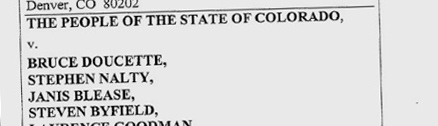
Sovereign constitutional oath activist Stephen Nalty sentenced to 36 years!


DENVER, COLORADO- Judge Michael Spear came down hard on judicial reform activists Stephen Nalty and Steve Byfield, who prosecutor Robert Shapiro insisted “can’t be rehabilitated.” The quiet Byfield received 22 YEARS, and this afternoon, so-called ringleader Nalty was given a sentence of 36 YEARS. For insisting that holders of public office file oaths secured by bonds as required by the US and Colorado constitutions. Their victims, judges and officials who were exposed for having sworn no oaths, testified about now having nightmares about the public coming to get them with torches and pitchforks. Which is of course what ought to happen, now that the bastards have retaliated against critics who were only trying to bring them into compliance.

The most severe remedy proposed by WE THE PEOPLE, the sovereign citizens organized to confront fraudulent office holders, was in fact resignation, or if necessary, banishment. Even so, the reformers were targeted by the FBI and its Colorado affiliates. A join anti-terrorism task force was deployed to infiltrate and entrap the “paper terrorists” who were then charged with criminal enterprise and racketeering, then held on quarter million dollar bonds. Now the two were given prison terms to exceed their lifetimes, ensuring both will die in jail. Because our system will not abide free men.

FBI undercover rats on sovereign pals, says they planned to seize small county jails, except he was their lone soldier.


DENVER, COLORADO- Very interesting testimony Friday at the trial of sovereigns Stephen Nalty and Steve Byfield. The prosecution’s latest witness was FBI INFORMER Marshall Ringer. Not a sovereign citizen type turned by government agents, Ringer is a disgraced police officer hired by the FBI and inserted into the so-called “enterprise” to report its activities and propose courses of action conducive to arrests. Ringer calls himself a “self-employed security expert.” His handler FBI Special Agent Ryan English calls him an “embedded confidencial human source”. His targets gave him the title “Continental U.S. Marshall”. They hoped he would recruit like-minded sovereigns to the cause of correcting what they saw as a corrupt judicial system. Ringer’s FBI codename was “Earp”.

The accusations corruption hinged on the understanding that according to Article VI of the US Constitution, positions of public authority must take an oath secured by a bond. The “enterprise” had discovered that many Colorado judges and prosecutors and sheriffs and other elected officials didn’t have oaths or bonds on file. If this expectation was indeed a misconception, and Article VI is inapplicable, you’d think the remedy might be to tell the would-be reformers, “no, that is not a requirement, here’s why, etc.” Strangely that was never done. Neither to their person, in a handout, or to reporters looking into this sad case. An undercover would present an excellent opportunity to huddle with the enterprise and say “hey guys, I was looking into this oath stuff and discovered that according to such and such law, or ruling or whatnot, oaths and bonds are no longer mandatory, end of story!”

But “Earp” didn’t. Nobody did. Nobody has yet to spell it out, even in this courtroom. When the defendants have tried to put Article VI into the trial record, they’ve been refused. So the issue is certainly a curious one.

Instead of using an undercover to diffuse the oath-seekers by presenting the incontrovertible truth of their error, the FBI and the state prosecutors instead gathered evidence to ridicule their character. We’re told they met in trailerhomes, they struggled to cobble enough money together to give their marshall a pair of handcuffs. They dreamed of putting together a network of De Jure judges to replace the corrupt ones currently alas De Facto.

Tapes
You might think the taped conversations of the sovereigns would be damning. The defendants certainly seem to be embarassed by them, but they’re less incriminating than disarming. When “Earp” asked what was he to do with the officials he arrested, he was told, nothing, for now. Do not take any action on your own. Wait for instructions from the People’s Grand Jury. Every time “Earp” goaded his colleagues about what he could do, they’d tell him to wait until matters could be addressed democratically and judicially.

The most interesting information to come from the undercover testimony was about how the FBI wires up its informants. Colorado law requires that at least on person in a conversation consents to being recorded. As a result, every recording presented to the court begins with the person wearing the wire dictating this preamble: “This is confidential human source X, on such and such date, etc” before that informant gets out of his car or enters a meeting area.

This offers potential targets a remedy for how to avoid intrusive surveillance by authoritarian law enforcement agencies IN COLORADO. Before every meeting, have everyone say out loud: “I do not consent to being recorded.” In unison is fine. Then a leader can then ask: “Was that everyone?” To which everyone can answer in unison: “Yes.” Provided that everyone said it, that meeting cannot be recorded. Such a method not only invalidates a recording being used as evidence later, it makes the recording a crime and the agency undertaking it and in possession of it, cupabe. If an undercover continues with the recording, he’s committing a crime.

In the case of te sovereigns, and likely your scenario as well, the government’s criminal act will far exceed in severity what they thought they were recording you doing.

We’ve yet to learn how, but apparently this undercover was discovered by the defendants early in 2017. They outed him by accusing him of making recordings and giving them to the FBI. That’s when he extracted himself and the indictments and arrests happened immediately thereafter.

The Enterprise
However you may feel about these perhaps misguided judicial reformers, their adversaries are behaving every bit the corrupt villains they pretend not to be.

The accused called themselves the People’s Grand Jury, the Indestructible People’s Trust, The Colorado Supreme Court, the Continental US Marshalls, the De Jure whatnot, or simply We The People. There seems to be no end to the permutations but they never called themselves “The Enterprise”. Yet that is what their accusers call them. In fact, for the duration of the prosecution’s case, a posterboard has been left in the center of the courtroom, beneath the judge’s dias, from which the jury cannot look away, it’s titled The Enterprise, with photos of ten member now-defendants, like employees of the month, except with mugshots, ranked in order of their title or prominence. Another ten members didn’t warrant photos or arrest, yet are listed as culpable parties, guilty by association and without the chance to . You wonder if that is legal. It certainly is prejudicial. Never mind if the witness testimonies don’t add up, there is The Enterprise, like it’s a thing instead of a characterization fashioned by frame-up artists.

MONDAY UPDATE:
On Monday defendants were given one day’s recess to review the evidence for their defense, which being incarcerated has impeded. So FBI informer Marshall Springs will resume his testimony tomorrow. But the courtroom also heard that the prosecution plans to bring TWO MORE UNDERCOVERS to testify, plus two cooperative witnesses, one of whom is a co-defendant who’s taken a plea to turn STATE’S EVIDENCE.

So that makes THREE undercover officers infiltrating “the enterprise” of not much more than a dozen conspirators, two of whom have become so intimidated they’ve changed their minds about what they were trying to achieve.

The next few days should prove enlightening and heartbreaking because although prosecutors have been documenting what the defendants did, they haven’t demonstrated the acts were crimes,. As much as defendants conspired, organized and racketeered, they didn’t aim to make one cent profit, illicit or otherwise. To what offenses did the cooperative witnesses plead guilty and what accusations do they make toward their friends?

So Nalty and Byfield have the rest of the day to study the evidence against them. The jail has not provided the paper and pencils ordered by the judge. The jail hasn’t afforded the defendants access to the case evidence either. Nalty indicated today that he’d spent a sum total of 45 minutes with the electronic files. He asked for a break of four days to prepare for the rest of the trial.

Both are in Denver jail, though their legal papers were not transferred with them when the defendants are on loan from Adams and Arapahoe Counties respectively. All the defendants being charged with conspiracy are being detained in different jails to prevent them talking to each other. But the problem is they don’t have their case papers or filings, and are in Denver’s customary 22 hour lockdown in their cells, which inhibits using the jail computers which are confined to the jail law library.

Prosecutor Shapiro responded to the defendant’s complaints of the jail not providing paper and pencils by cavalierly handing them writing pads, which they grasped with handcuffed hands, with polite thankyous. Though Shapiro no doubt know they won’t be allowed to take these into the jail. Then he condescendingly bragged that he’d resolved that complaint by providing “brand new” pads to each defendant. Defendant Byfield’s pad had a couple sheets missing, so he immediately pointed out that his pad wasn’t new. I couldn’t help but burst out with a laugh.

The judge thought there was merit to Nalty’s complaint Both defendants have scant access to the jail computers necessary to see the evidence. By the prosecutor’s own admission, the “tens of thousands of pages” would have been prohibitive to provide on paper, and the “hours and hours of taped testimony” likewise can only be provided electronically.

Prosecutor Shapiro acquiesced to allowing the defendants one day to catch up, though it sounds like he is well aware that analyzing tens of thousands of pages and hours and hours of evidence would take longer than that. Shapiro told the judge he calculated the state had wiggle room to allow a one day delay and still finish with the case by Friday. Here’s what he calculated: The state figures to rest its case by Thursday afternoon. That should leave a day and a half, less closing arguments and jury instructions and jury deliberations, to finish the trial on Friday. The prosecutors’s case will have taken six and a half days, but Shapiro thought the extra day needed to look over the evidence could come out of the defense’s day planned for defense.

To help the defendants prepare, Shapiro volunteered a preview of the witnesses to expect to testify to close out their case. Coming up we have four Gilpin County administrators, but we have also two more government undercovers, and the two cooperating witnesses. One of them co-defendant Bryan Baylog.

Not The People v. Stephen Nalty and Steven Byfield. Right to an Unfair Trial.

Paper Terrorists Tried in Juvenile CourtDENVER, COLORADO– The trial of accused “Paper Terrorists” Stephen Nalty and Steve Byfield began Monday in courtroom 2H of Denver district court. The two face 28 odd charges, from conspiracy, criminal enterprise, to racketeering, brought by the Colorado Attorney General and the FBI.

And they’re defending themselves. In handcuffs.

Don’t worry, they’re holding their own. But already it’s day one and authorities are piling on every disadvantage. On Monday the defendants were cheated of being able to prevent the state from stacking the jury (and the defendants don’t even know it because they weren’t in the courtroom to see it done).

Watching the court clerks and lawyers prepare for the trial, you cannot but admire their civil spirit. In every hearing Nalty and Byfield have declined advisements and refused to recognize the authority of their adjudicators. The two sound like broken records about “oaths” and sovereign stuff, yet the judicial mechanism inches forward. It should of course, because the defendants have been jailed since MARCH.

For six months Nalty and Byfield have been held on $350,000 bonds. Neither of them can afford even the interest on those sums. Of course their indictment and prosecution is a travesty and a misappropriation of public resources, but how else could the state stop their criminal enterprise except to admit wrongdoing itself?

Nalty and Byfield are being railroaded and they’re sure a jury will conclude the same.

The People’s Grand Jury
For the last few years, among a team of eight “sovereign citizen” types, Nalty and Byfield have been serving judges and other public officials with legal papers and liens which achieved no response. Until Colorado’s attorney general enlisted the FBI to squash the “criminal enterprise.” The sovereigns face 28 charges of all the racketeering and conspiracy lingo, essentially for questioning why their local magistrates and officials had no oaths or bonds on file. When the sovereigns got no response, they formed a “People’s Grand Jury” to indict the violators with their ad hoc public courts. Then they’d file commercial liens against those accused for defrauding the public in violation of Article 6 of the US constitution.

When confronted from podiums, judges and lawmen dismiss the oath requirement out of hand, but it’s interesting that none spell out exactly what law supersedes the US Constitution. News articles about the Paper Terrorists list the litany of criminal charges the defendants face, but have yet to mention the asserted law-breaking which is the Paper Terrorists’ only complaint.

It is hard to get a handle on what the “People’s Grand Jury” really wants. In their dreams, they assert that the lack of filing of oaths should mean that all affected legal judgements should be overturned, and that all salaries drawn by government employees who did not file oaths or bonds should be returned to taxpayers, with interest. They calculate the total sum owed to the American people is in the multi trillions. So there’s that.

Some of the public officials targeted by the People’s Grand Jury began to suffer strikes against their credit records when they didn’t contest liens filed against them. You’d think the credit monitoring algorythms would flag multi billion dollar liens. You’d think someone could suggest a method to filter such paralegal filings.

Instead the state chose to hit back hard. Last March, the eight troublemakers were indicted for two dozen paper crimes. The state imposed bonds averaging a quarter million each. It hasn’t stopped the crew, as their wives and friends keep serving more notices and liens. So now the state intends to make them examples and imprison them for life.

Jury Selection, Only For the Prosecution
Here’s what happened Monday during jury selection, when both sides are meant to parse a jury pool to pick an impartial jury. You know, a defendant’s right to a jury of their peers?

Nalty and Byfield still don’t know what hit them. The prosecution was given the jurors’ details, the defendants learned none. They blindly accepted jurors whom the prosecutors had already carefully weeded. The defendants never knew it and the court was not “on the record” when this happened because it was before the judge entered the courtroom. But audience members saw the whole thing.

Actually, once he was presiding over the entrance of the jury pool, the judge was in a position to observe the prosecution desk already progressing well through the jury questionnaires while the defendants sat idle. Perhaps the judge didn’t know his court clerk had provided no instruction to the defendants. Ultimately whose responsibility would that be?

Monday for jury selection, the court decided it needed a jury pool of SIXTY from which to choose twelve jurors plus two alternates. To save time, the court had prospective jurors fill out 4-page questionnaires instead of having them deliver the customary recitation of their biographical details. The court assigned four digit non-sequential numbers to each candidate. Copies of these forms were made for all parties, stacked according to the seating order of the jury pool. They were put on the desks before sheriffs had brought in the defendants. The team of four prosecutors began pouring over the questionnaires and were warned by the court clerk not to get them out of order as it corresponded to how the jury pool would be admitted.

Team leader, Assistant AG Shapiro noticed that the forms bore the jurors’ signatures, which he instructed should be blacked out from the copies provided to the defendants. Two clerks set themselves to redacting the stacks for defendants Nalty and Byfield. Meanwhile the prosecution studied the forms, made their notes, and drew each other’s attention to details. This information included the applicants’ names and signatures. Trial lawyers do not discount surnames and autographs as irrelevant to evaluating a juror.

When the clerks finished their redactions there were still other courtroom delays and by the time the defendants were finally brought back from their holding cell, the prosecution had a full half hour head start studying the questionnaires, and of course twice the pairs of eyes.

The defendants were not told what the stacks were, nor that they were in any order. The defendants had barely been seated before the judge made his entrance and the jury pool was paraded into the courtroom. The defendants thus got no time to examine the questionnaires. They looked at the stacks dumbly, not knowing what they were supposed to do with them, or how, with their wrists in handcuffs. Defendant Byfield tried to shuffle through some of forms while the judge advised the jury pool. With shackles on he couldn’t manage the stack, much less keep it in order, even if he knew that would matter. Forget managing pen and paper, in addition to taking notes.

You’d hope that jurors will wonder why these “paper terrorists” are kept shackled. Who has ever asserted they pose a threat of violence to anyone?

On the other hand, if you doubt that the failure to file a public oath should earn a prosecutor the accusation of fraud, if you doubt it means they’re untrustworthy, the unfairness they eagerly exploited on the first day of trial would give you pause. They behaved every bit as corrupt and mendatious as Nalty and Byfield have been saying. How unfortunate the jury didn’t see it.

Denver magistrate separates mother from breastfeeding infant. Jail refuses pump, as they do common decency.


DENVER, COLORADO- A heartbreaking scene unfolded yesterday when Denver Magistrate Kate Boland decided to impose a $10,000 bond on a domestic violence detainee, against the recommendations of the husband (victim), the public defender, and even the city prosecutor, who all wanted the 35-yr-old mother of five released on personal recognizance. Most critical, no consideration was paid to the family’s month-old infant who is breastfeeding. Neither by Boland, nor the downtown detention center, known for its systemic disrespect for the rights and needs of its inmates.

You might not care how poorly criminals or their children are treated, but the inmates of jails are suspects, not convicts. They are unconvicted detainees held on some officer’s probable cause. They’re suspected of a crime, but have a right to a fair trial (under the 6th Amendment) and a right not to be punished before conviction (under the 14th). Depending on who calls 911, they could be YOU.

For those reasons (and the Golden Rule and the social contract), jails have to show a semblance of concern for the still innocent lives disrupted in their care. Denver’s Van Cise-Simonet Detention Center has a famously outlandish record in that regard. Marvin Booker and Michael Marshall are two well known extremes to which Denver sheriffs deputies have disrespected inmates’ lives. A rare survivor, Jamal Hunter, was awarded $3.25 million for beatings he received there. Unfortunately his settlement was contingent on burying the evidence of broader misconduct, thanks Jamal.

Those cases have generated reviews and reforms, but abuses persist. Isn’t it amazing that after repeated court-ordered overhauls, the public could still be told “the detention cenver has no protocols for breastfeeding mothers.”

Magistrate Boland made no allowance for the accused mother to maintain her feedings. After the morning hearing, friends learned the jail didn’t care to accomodate the mother either. That afternoon Baby Thomas became ill and began vomiting, so the father brought the baby to the visitor’s lobby hoping emergency visits could be arranged. The jail said no, though after some persuading, a sergeant agreed to convey a breastpump to the mother if one was supplied. A device was purchased and submitted, but the jail recinded their offer. This time a charge nurse named “Monica” explained she was under no obligation to comply, that she’d called her boss at Denver General who confirmed it. Without a court order, she said, the jail had no further responsibility.

By now activists with Denver Court Support were agitating online about the plight of Baby Thomas. The jail was innundated with telephone calls. The sheriffs cleared the public lobby, cancelled visitations, and put the facility in lockdown in anticipation of a rally.

Nevermind feeding Baby Thomas, release his mother immediately. Activists had raised the monies needed to hire a bondsman to post the bond. The jail was urged to expedite the mother’s release once bond was posted.

Shouldn’t inmates be release when they’ve paid to have their freedom? This is where the Van Cise-Simonet’s disrespect is arbitrary, punitive, and universal. Time to process inmates, either intake or release, takes forever, or just feels like it. Denver’s Van Cise-Simonet Detention Center likes to take a MINIMUM of 11 HOURS for these proceedures.

The pretext for the first delay is “for fingerprints to clear”. Enough time for INTERPOL in Timbuktu to review your prints and give the all clear, because they can’t be expected to be standing at the fax machine at all hours of the day, the jailers explain.

That step is required before a bond can be posted. Once a bond is paid, an inmate’s release requires a second computer delay. Also commonly at least eleven hours. The jailers attribute that wait to “that’s how long the system takes.”

On occasion we’ve seen public pressure result in a shortening of the release time. The upshot is the the release time appears to be at the jail’s whim. In the case of our breastfeeding mother the jail wouldn’t budge.

Worse for Baby Thomas’ mother, someone new to the bonding desk re-initiated the print clearing process instead of terminating it. She had to wait another interminable cycle.

The mother was taken into custody on Monday, her prints cleared by Tuesday morning. After the hearing in Room 2300, where the $10,000 bond was set, the bondsman tried to pay but learned he had to wait. The aforementioned administrative error meant it wouldn’t be before WEDNESDAY morning when her bond could be posted. Everyone is awaiting her release STILL.

As it stands, the mother is supposed to be fitted with an ankle bracelet by 8pm today. That will make it more than 48 hours that she’ll have been in custody. Mothers under stress withheld from feeding infants can stop lactating in less than that time.

The specifics of this domestic violence case are few. A neighbor called the police because the mother was seen holding a knife. The police chose to charge the mother and take her into custody. Who knows what the whole story is. The Denver Court Support activists didn’t get involved to solve the couple’s problems. Because that’s beside the point.

A child shouldn’t have to be harmed while authorities sort this out. An infant deprived of breastmilk suffers a calculable detriment which this magistrate and this jail could minimize, if they cared.

It’s hard to imagine anyone cares at Van Cise-Simonet. The jail is notorious for inedible food and poor health standards. The 23-hour lockdown is standard in all pods. Right now we hear that inmates are sleeping three to four in a cell which has only bunks for two. The one or two extra sleep on the concrete floor. This of course in addition to the litigated sadism of the Denver jailers.

Last night, outside the door of the jail, the Denver sheriffs deputies eventually re-admitted visitors into the lobby at 8pm, but kept the activists outside. Then deputies lined up and started warning the father’s friends to “calm down”. That warning and the posture of the deputies was recognizable to activists –and to many African Americans– as the precursor to the use of tasers. The only option was to leave.

UPDATE: The mother wasn’t able to rejoin her children until 10PM Wednesday. The baby is okay, although no doubt impacted by the interrupted feedings. At a public meeting the next evening to address law enforcement accountability to the community, activists told officials about what happened. They were told by the Denver Sheriff Patrick Firman that the jail DOES HAVE A POLICY to handle breastfeeding and that he was very sorry his employees didn’t know to tell the complainant.

Third Guy Fawkes Day case dismissed as Denver continues to arrest marchers

DENVER, COLO.- Last night Denver police mobbed a demonstration protesting the officer-involved execution of unarmed suspect Dion Avila Damon in front of his wife and child. At the end of Tuesday’s march, Robin Hamm and Nathan Stickel were arrested for obstruction, failure to obey, and destruction of private property. They were still in custody when fellow activist, Joaquin dela Torre-McNeil, arrested at an identically uneventful march last November, showed up for his court date today only to hear the city motion to dismiss his case. Joaquin was charged with interference and resisting arrest, both accusations without merit. This morning the city admitted as much.

This marks the third of nine arrests made November 5, 2015 which have been dismissed. Peter Lewis, 31, was snagged as an obstructee, then detained on a possessions charge until all charges were dropped November 20. Brandon Deaton, 24, was charged with obstruction. He was represented by attorney Frank Ingham and his case was dismissed March 23.

Joaquin’s dismissal bodes well for the remaining six cases, which are equally unfounded.

Four are charged with interference and obstruction, plus the odd sundry misdemeanor: David Croisant, 29, is represented by attorney Birk Baumgardner; Selayna Bechtold, 19, is represented by Venkatesh Iyer; Mark Iannicelli, 58, is represented by Katayoun Donnelly; and Justin Berding, 25, is represented by Cheri Deatsch.

Two are charged with felonies: Damian Stasek, 25, represented by attorney Lon Heymann; and Jake Pauly, 25. Both are charged with assault of a peace officer, which happens whenever physical contact is not initiated by the police, although in both cases this was a technicality.

Bumping into police officers is going to happen if they get in your way, especially when they have no right to get in your way, given that your first amendment right was the reason they were supposed to stay out of your way. If there’s no obstruction, there’s no interference, and your collision with their obstruction of your civil liberties is not assault.

The November 5th march was uneventful except for the arrests. There was neither property damaged, traffic impeded, nor lives endangered. The police acted purely to intimidate and squelch protest. They succeeded but now the courts are not supporting their actions. As charges fall, the accusations lose veracity. Certainly the crowd’s anger at their demonstration being curtailed with such heavy-handedness is being shown to having been legitimate. You can’t arrest people for objecting to your unlawful conduct.

But DPD hasn’t been taught that lesson yet. Last night’s march for DPD victim Dion Avila Damon was equally harmless. Arrests were made for the usual show of force. Two activists remain in custody. The bureaucratic delay is now excused as a 24-hour processing requirement for fingerprints to clear the system. Only then will bonds be calculated and allowed to be posted. Detainees will then wait a minimum of five further hours to be released. When last night’s charges are dismissed, Denver will have to account for two more wrongful imprisonment cases.

Delayed Habeas Corpus for Eric Brandt, then two Westminster kangaroo courts, despite $3,500 bond being paid.


WESTMINSTER, COLORADO- It was quite a day for Eric “Fuck Cops” Brandt, in custody at the Denver County Jail since Monday August 10, as usual for exercising his First Amendment rights. Even by Wednesday the jail wouldn’t allow Eric visitors or bail. Next they delayed his court appearance almost two hours. Then the judge wouldn’t grant a PR bond, choosing to require the homeless veteran to raise $3,500 for bail. Then the clerk insisted the entire docket be completed before the bond paperwork would be available. Eventually Eric’s bond was covered by a benefactor, but before Eric could be processed for release, the City of Westminster transferred him to their municipal court for a full afternoon of hearings.

In Westminster, Associate Judge Paul Basso refused Eric’s motion for a jury trial then immediately declared court to be in recess and walked out as Eric’s attorney David lane tried to voice his objections. Funny story: though Basso had declined the motion, he misspoke and declared that Eric was to have a jury trial, so Basso had to reenter the courtroom to reiterate for the record: there was to be no jury trial. This time Lane offered to put Brandt’s former public defender on the stand, he was there waiting, to attest that Brandt had never declined his right to a jury. Judge Basso refused and again walked out.

Next up, Presiding Judge John Stipech declined motions to dismiss, to recuse, or to appoint a special prosecutor for Brandt’s cases. Stipech declined to hear witnesses present and ready to testify that Westminster staffers were overheard plotting to incarcerate Brandt no matter what. No hearing, set all the trial dates up like bowling pins.

Next on the agenda, Judge Stipech ordered Eric to remove documents he’d posted to “his Facebook”: confidential police internal affairs reports sloppily surrendered during discovery and now published in Westword. Eric was supposed to comply whether in custody or homeless, or be found in contempt.

Brandt was put back en route to Denver while attorneys were asked to set the upcoming court dates. Suddenly Eric’s transport was ordered to return so that the Westminster prosecutor could motion to revoke Eric’s multiple bonds on account of his new felony charges in Denver. Fortunately the bond revocation hearing was set for Sept 2 to allow David Lane time to subpoena witnesses. This date will also follow the Aug 31 hearing in Denver where Lane has subpoenaed the Denver DA to account for the unconstitutional train wreck.

Now back at Denver Jail, Eric is being kept overnight with the excuse that the pretrial services office was closed and doesn’t reopen until 8AM. Eric Brandt has been incarcerated since Monday afternoon, his bond met, his tattoo assuring he can’t be confused for anyone else. He’s front and center today on the Denver Post and Westword, but the city’s top law enforcers can still pretend to delay his release on technicalities. They spent eighteen hours “running his fingerprints” when everyone in downtown Denver can recognize Eric Brandt a block away, three, when he’s got his sign.

Are escapees Richard Matt and David Sweat hardened criminals? Maybe, but they’re only dangerous if you’re a cop.

david sweat and richard matt
New York State authorities are warning the pubic that prison escapees David Sweat, 34, and Richard Matt, 48, are hardened criminals and extremely dangerous. However, they didn’t kill anyone while making their escape from a maximum security prison, and unless you are Matt’s former boss, who he killed, or a Sheriff’s deputy who stood in their way, such as Sweat plead guilty to co-killing, there’s no past record to suggest the pair mean you any harm. Having the police tell everyone “if you see something, say something” does make everyone the fugitives encounter a potential snitch. NY law enforcement should be held accountable for what the pair might be forced to do as a result. Freedom for prisoners. Abolish all prisons.
 
Now we need homeless vagabonds to head to New York state in pairs to assist the manhunt.

Deadliest motorcycle “gang” in Waco shoot-out was not Bandidos, Cossacks, Scimitars, or Vaqueros. It was police.

Bandidos, Cossacks, Scimitars, Vaqueros Motorcycle Clubs
Was the Waco Shoot-out a gunfight between rival gangs or an ambush laid by law enforcement? Police are monopolizing the testimony but the evidence suggests a barroom brawl became a pretext to kill or arrest club officers, essentially grassroots organizers, now charged with “organized crime”. Investigators can litter the crime scene with brass-knuckles, knives and wallet chains, but the shell casings are going to be police issue. Motorcycle headlights were on, indicating club members were trying to leave. Police claim that the brawlers redirected their fire toward officers, but did that happen while the bikers were trying to ride off? Because riding requires both hands. This gangland “shoot-out” was a St Valentine’s Day Massacre executed by cops.
 
[5/20 Update: HA! The nine casualties died of gunshot wounds, sustained outside the restaurant. No shell casings were found around the bodies. Eight of the nine were Cossacks. The eighteen wounded are not expected to be charged. So much for the narrative that gangs were fighting each other, or that Bandidos were the aggressors.]

It’s described as being a gang shoot-out, but what happened in Waco is still shrouded in the fog of the official POV. Did motorcycle club members shoot at each other? They’re unavailable for interviews, locked up on million dollar bonds. The Twin Peaks restaurant claims the shooting started outside. The only witnesses reaching reporters are the sergeant giving the press briefing and undercover cops purporting to describe the tensions between the “gangs”. By my reading, informant provocateurs incited trouble by “rocking” patches which claimed the territory of “Texas” for the Cossacks Motorcycle Club.

Something like three dozen undercover officers were monitoring the usually uneventful bi-monthly meeting of the Confederation of Clubs and Independents, in anticipation that the “Texas” patch would offend the Bandidos MC. They were able to respond within 45 seconds of the alleged altercation. What might have been an unremarkable barroom brawl, if even that was not contrived, turned into an ambush that killed nine and wounded eighteen. Zero officers were hit and I will bet every bullet was theirs.

Let’s say the melee happened as the police and media describe. Why the blackout on the club affiliations? Why are the 170 arrestees being detained on a million dollar bond each? Why aren’t reporters challenging the police narrative? Witnesses assert that at least four of the dead were killed by police. How long before we learn how many undercover officers had fired their guns?

The media is making much of the anticipation that fellow gang members are converging on Texas to avenge their comrades. I think the police know that it’s themselves who are the targets of the bikers’ vengeance.

No doubt one can say the bikers were not boy scouts, but have you seen the photos? These “gangs” wore their colors, in this case patches, like boy scout badges. And everyone in uniform creased jeans and leather vests as tidy as bowling shirts. Did you see the mugshots? If you look past the long hair and tattoos you’ll note everyone is clean shaven. This was a Sunday outing. These are family men and women, not gang members. The Cossacks are a “Harleys Only” motorcycle club for God’s sake!

Police aren’t naming the “gangs” involved in what’s being called the “Waco Shoot-out”. Because they are motorcycle clubs, for one, and because the only gang deserving of the notoriety is really the police.

NOTES 5/20:
Names of 9 dead. All killed by gunshot wounds, all outside the restaurant: COSSACKS MC ROAD CAPTAIN Daniel Raymond Boyett, 44, of Waco TX; COSSACKS MC ROAD CAPTAIN Wayne Lee Campbell, 43, of Arlington TX; COSSACKS MC SERGEANT AT ARMS Richard Vincent Kirschner Jr., 47, of Kylie TX; COSSACKS MC Matthew Mark Smith, 27, of Keller TX, formerly of Scimitars; COSSACKS MC Charles Wayne Russell, 46, of Tyler TX; COSSACKS MC Jacob Lee Rhyne, 39, of Ranger TX; Jesus Delgado Rodriguez, 65, of New Braunfels TX; Richard Matthew Jordan II, 31, of Pasadena, TX; and BANDIDOS MC Manuel Isaac Rodriguez, 40, of Allen TX.

Names of the 170 booked and charged with organized criminal activity: Martin Lewis, 62, retired San Antonio PD detective; Marcus Pilkington, 37; Michael Kenes, 57; Michael Woods, 49; Julie Perkins, 52; Nate Farish, 30; Ronald Warren (wounded), 55; Morgan English, 30; Ryan Craft, 22; Rolando Reyes, 40; Jonathan Lopez, 27; Richard Benavides, 60; Michael Baxley, 57; Aaron Carpenter, 33; Jarrod Lehman, 30; Ricky Wycough, 56; Royce Vanvleck, 25; Ester Weaver, 46; Ryan Harper, 28; Timothy Bayless, 53; Michael Chaney, 53; Mitchell Bradford, 29; Nathan Champeau, 34; Noe Adame, 34; Owen Bartlett, 34; Rene Cavazos, 46; Berton Bergman, 47; Greg Corrales, 47; John Wiley, 32; Jeff Battey, 50; Kenneth Carlisle, 36; John Craft, 47; Lindell Copeland, 63; Matthew Clendennen, 30; Michael Thomas, 59; Narciso Luna, 54; Owen Reeves, 43; Richard Donias, 46; Robert Robertson, 36; Reginald Weathers, 43; Richard Dauley, 47; Rudy Mercado, 49; Seth Smith, 25; Steven Walker, 50; Thomas Landers, 58; Valdemar Guajardo, 37; Walter Weaver, 54; William English, 33; Marco Dejong, 37; Melvin Pattenaude, 51; Jarron Hernandez, 21; Jason Moreno, 30; Jeremy King, 32; John Martinez, 30; Jeremy Ojeda, 37; John Guerrero, 44; John Moya, 26; Jose Valle, 43; Joseph Ortiz, 34; John Vensel, 62; John Wilson, 52; Jorge Salinas, 24; Justin Garcia, 23; Justin Waddington, 37; Lance Geneva, 37; Lawrence Kemp, 40; Lawrence Garcia, 51; Josh Martin, 25; Eliodoro Munguia, 49; Lawrence Yager, 65; James Rosas, 47; James Stalling, 56; James Venable, 47; Gage Yarborough, 22; Gilbert Zamora, 60; Gregory Salazar, 42; George Wingo, 51; James Eney, 43; Edward Keller, 47; Christopher Eaton, 46; Christopher Stainton, 42; Daniel Johnson, 44; Daniel Pesina, 21; Don Fowler, 51; Doss Murphy, 44; Drew King, 31; Brian Eickenhorst, 28; Edgar Kelleher, 50; Andrew Sandoval, 30; Andrew Stroer, 49; Arley Harris, 32; Bobby Samford, 35; George Rogers, 52; Jacob Reese, 29; Joseph Matthews, 41; Juventino Montellano, 46; Mark White, 41; Bradley Terwilliger, 27; Ares Phoinix, 36; Benjamin Matcek, 27; Craig Rodahl, 29; Daryle Walker, 39; David Martinez, 45; David Rasor, 37; Christopher Rogers, 33; Andres Ramirez, 41; Robert Nichols, 32; Seth Smith, 28; Theron Rhoten, 35; Timothy Satterwhite, 47; Anthony Palmer, 40; Terry Martin, 48; Wesley McAlister, 32; William Redding, 35; Matthew Yocum, 25; Phillip Sampson, 43; Phillip Smith, 37; Jason Dillard, 39; Jacob Wilson, 28; Dustin McCann, 22; Billy Mcree, 38; Kevin Rash, 42; John Arnold, 43; Kristoffer Rhyne, 26; Raymond Hawes, 29; Richard Kreder, 33; Robert Bucy, 36; Ronald Atterbury, 45; William Aikin, 24; Trey Short, 27; Christian Valencia, 26; Michael Moore, 42; Jason Cavazos, 40; Roy Covey, 27; Brian Logan, 38; Colter Bajovich, 28; Ronnie Bishop, 28; Nathan Grindstaff, 37; James Gray, 61; Jimmy Pond, 43; Clayton Reed, 29; Tommy Jennings, 56; Ray Allen, 45; James Devoll, 33; Blake Taylor, 24; Matthew Folse, 31; Sandra Lynch, 54; Marshall Mitchell, 61; Mario Gonzalez, 36; Larry Pina, 50; Richard Luther, 58; Salvador Campos, 27; Michael Lynch, 31; Michael Herring, 36; Richard Cantu, 30; Tom Mendez, 40; Sergio Reyes, 44; Bohar Crump, 46; Jerry Pollard, 27; Eleazar Martinez, 41; Jim Harris, 27; Christopher Carrizal, 33; Diego Obledo, 40; David Cepeda, 43; Brian Brincks, 23; Dusty O’Ehlert, 33; Juan Garcia, 40, engineer for Austin water dept; Kyle Smith, 48; and Jimmy Spencer, 23.

Ye Aulde Memoir

Another old piece. These stories are distorted by romanticized memory, at times, and others likely remember them differently. I by no means intend to insult any of the real persons that lived through this stuff with a cavalier treatment of tender recollections, or harsh description of personalities or actions. Each of us always did exactly what seemed to be exactly the right things to do at the time. And there survives much, much love, which has grown and developed like it always does, in ways we never see coming.

I’m not putting these old ones up because i’m too lazy to write new. I’ll have one of those next–but some of this old stuff fits. Hope you like it.

11 May 2009

One day during the summer of 1980 my brother David was in the hospital at Case Western Reserve University for yet another open-heart surgery. The scene that day was dramatic I suppose, but for our family at the time, it was in many ways just another day. The state of the relationships between us had come to the condition that existed then because each and every incident that had occurred in the history of the Universe had added to that cumulative point. The way it came together then could have been viewed as tragic, I suppose, but we never noticed.

I don’t even remember how I got the news that this particular episode was approaching. David’s surgery that year was one of many—so many, in fact, that by now surgeons and academics had written papers on his congenital condition, and even given it a polysyllabic title. His lead surgeon, a Dr. Ankeny as I recall, had once claimed that he had “learned more from David Bass than fourteen years of medical school.” We four siblings had in effect grown up in the hospital, with the constant potential for death in attendance on a daily basis. Many years would pass between that summer and the moment I decided any of this was applicable to self-reflection, and the sweltering summer afternoon was as present and imminently experiential as any other I lived through during that period.
Our family seemed done that year. I had been out of the picture for over a year. Dad had left soon after, leaving a sour tinge in the air with those remaining, though I never blamed him. When David queued up for one more death-defying, experimental, split-chest open-heart surgery, Dad came back to Cleveland from Florida to put in an obligatory appearance.

Here was a meeting that defied conventional description. Dave, the least guilty of all our immediate family, had been deeply affected by Dad’s exit from the filial stage earlier that year. I hadn’t seen, or even spoken to Dad for well over a year, nor could our interactions prior to then be described as warm and supportive. Outnumbered by angry or indifferent family members, and perhaps less acclimated to hospitals as the rest of us, Dad was way out of his simpler, down-to-earth element.

I showed up unannounced, with glorious southern tart Candy Stone from Mobile, Alabama in tow, she in dirty bare feet, nearly illegal shorts, one of those dangerous eighties tube-tops, and very red eyes. I don’t think Dad spoke more than a half dozen words to me. His eyes told the whole story of uncertainty, pain, and failure. Dave, fresh from surgery, quite literally green, with a repulsive grey crust around his lips and appending to the tubes and what not projecting from several of his orifices, refused to see Dad. Refused to allow him in the room. Dad left unrequited to return to his exile in Florida. I didn’t see him again for many years.

Once, David, following the Dead tour in our Mom’s old family van showing all the effects of the Rust Belt, with his underage Russian girlfriend, his fiddle, and a patchouli oil manufacturing operation, got pulled over in Alabama, for sport. By this time, David was unkempt, smelly, and obviously committing some crime or another. The cops shook him down pretty good, but of course he had no contraband. He has a vice or two, but the heart thing keeps him from excess. He had that young Russian girlfriend, though, and Alabama’s finest figured they could really hang him out to dry, (dang hippie). But she and Dave convince the alpha cop to let them call her mom in New York to confirm that permission had been granted for the road trip and no heinous kidnapping was going on. The mother spoke zero English, but somehow the girlfriend convinced the cop to allow her to translate for her mother. Mother and daughter held a five minute conversation about the mental acuity of Alabama cops, duly translated as an expression of permission, and the travelers were on their way. David drawls this story on stage in his hillbilly persona, fiddle in hand. It’s hilarious.

It seemed to me for a long time that David was the only one of us to escape that little bubble of anti-reality that made up our family life while we siblings were young. Maybe he somehow managed to avoid being trapped in it in the first place, residing only temporarily, with some sort of metaphysical pass associated with potential imminent death. I don’t know, but years later, during one of the high points of my own endeavor, Renaissance Paint and Remodeling, I remember feeling jealous of David. This was a recurring sentiment, and all the more abberant for the fact that my strongest memory of it falls during a visit to Dave’s place in North Carolina that amounted to a just-in-case kind of deal before a heart transplant. Whatever the rationality or fairness of my little envy, (not real envy, mind you, but one of those little personality spikes that one notes and passes through), David is the one of us that got away the least damaged, and has lived his idiosyncratic dream out in full, down to the fine print, with joy.

Mom tells a story about my first day at school. Or maybe the second. I had asked some question that Miss Gardner couldn’t answer, and after day two, came home grousing about how those people were ignorant, and furthermore lazy, since no one had even bothered to look up a response. Mom likes to carry on about how smart her offspring are. She doesn’t usually bring up in public how warped we can be.

Mom, we brothers agree, bequeathed us a legacy of somewhat dubious mental processes. She’s nuts. We all know it. She knows it. Dad knows it. The rest of her family knows it well, and most of them recognize a common bond of familial, brand-name insanity that we all seem to share. I expect this is a more or less common thing among families, but I remain convinced that we are a bit stranger than most, at least in part because of the unique circumstances we lived through.

Back in the day, Mom’s thing was what they call control issues. The dynamic of her issues was so complex I can’t imagine I’ll ever figure it out. Some of her personality came to her by heredity from her mother, whom we call Mo. Much of it developed in that crucible of stress Dave kept heated by his repeated, continuous flirtation with death. Mom, responding to my over-the-top reaction to a pubescent hormonal tsunami, became madly obsessive with minutiae, dividing her time among us brothers and badgering us constantly in a fashion no one can really get unless they have their own experience to compare. I think she and I trapped ourselves in a sort of feedback loop that could have ended no other way.

I was out of the house for good, by the age of fifteen, for all purposes off to lead a life of crime, I suppose. For some years, I lived out my interpretation of the old Kerouac/Kesey/Abbie Hoffman mythos, on the road, in the street, an utterly directionless rebel. A good five or six years passed without more that a word or two passing between Mom and me.

I was nineteen when I came to Colorado Springs. The vague and unformulated manifesto for global revolution I had worked out in my head was on hold, kept in place by a twelve-pack of cheap beer. I had a job as an electrician, and didn’t see any reason to change that, but we actually didn’t do much of anything but work and drink beer that year.

One day Mom called to say Mike, another brother, got himself in trouble again and she expected him to “run away.” I told her to give him my number and I’d let her know when he called. He did just a few days later, and can I come pick him up over on south Circle.

Mike and I spent a couple years engaging in the sort of insanity to which we had become habituated in Cleveland. The reader will require imagination to add flesh to the story here. The statute of limitations may prevent backlash, but I don’t mean to poke at a bees’ nest, and it seems unlikely you might imagine anything more extreme than what actually took place. We weren’t stupid, though, and the business of working for wages, or relying on illicit behavior for advancement just wasn’t good enough, so we formed a construction company and went to work. That proved to be a trap. Maybe an extension of the weird, family trap that all of us have discussed so deeply, without resolution.

Mike and I had it in our minds that the working man’s habit of grousing over how management acts is crap and that if we were going to grouse, we ought to just take the reins ourselves. It turned out we were pretty good, too, in a lot of ways. We worked together for the best part of twenty years, and reached moments of national prominence in our little niche. The whole period was characterized by more bone-crushing stress and absurd, super-human feats. We had little breaks from the madness when we’d crash the business, which we did three times. We were great at getting shit done, but lousy at administration in the final analysis.

Hiring employees in the construction business kept me exposed to the street element to which I had become accustomed. I involved myself in various efforts to assist folks in their low-budget struggles, imagining still that I could somehow change the world. In fact, contrary to Mike’s primary obsession with business success, I figured the whole pursuit as a means to some vague end involving social revolution. For a while a religious experience had me involved with a church effort to “reach out” to the hoodlums that used to cruise Nevada Avenue on Friday and Saturday nights. I even managed to glean an ordination from the Baptists, though now I suspect they’d regret bequeathing me with it. My identification with street folks and the urge to help them rise above conditions has never left me. Actually I’ve worked up the notion that we could all stand to rise above conditions.

Dad. I went even longer without speaking with him than I did with Mom. He dealt with our family’s teen-aged fulguration by folding his hand and striking out on his own. Offered a transfer by his employer, the story goes, he told Mom, “I’d like you to come to Florida with me, but I don’t think I can love you anymore.” No woman in her right mind would go for that deal, and Mom didn’t fall for it either. Dad packed his company car and struck out, leaving his all-important nest egg, and everything else, behind. When David was in the hospital again that summer, that’s where Dad came from to visit him.

I had been away, and I don’t recall blaming Dad for his poor dealings with the family. He had been raised in a very old-school, European style, and he simply couldn’t handle our ways. To this day, in spite of Dad’s expression of a taste for “philosophy,” our conversations are often guarded, pregnant with unspoken truths. I still don’t know his philosophy.

Last summer Dad, my youngest brother, and I went to Montana to camp and fish, riding an outfitter’s horses into some of the most pristine wilderness left in the lower forty-eight. I had genuinely hoped to break the communication barrier that stands between us, but we had to settle for hugs and meaningful silences, for the most part. Dad still plays with his cards pressed tightly to his chest, flashing a look of panic if the conversational waters begin to threaten him with submersion. I guess he can’t swim.

Dad’s experience, it seems to me has also been different from the norm, though I’m uncertain that any human being matches that mythical standard. His family, unlike Mom’s, which fought in the Revolution, was barely American. They were proud American citizens, but their traditions came from old Europe, and they still lived communally on the old Bass farm as they had done for a thousand years.

During my childhood, whenever David was out of the hospital, we’d spend weekends at the farm with the scene looking very much like something from an era that had long since passed in this country, all Dad’s siblings and extended family eating together, playing cards, children roaming the grounds like Huck Finn. It was all rather idyllic, truly, and the moment Grandma Bass died and the farm disappeared under a layer of vulgar office towers marked the shift from one childhood to another.

Dad’s life since then became an effort to recreate those years. His brother and sister had never left the farm. Even when his brother Paul married and had a child, he stayed there on Rockside, as the place was known. I think that scene served as an anchor for my Dad, and when he retired, impressively early despite having suffered huge financial setbacks, he bought his own farm, secluded and sylvan, and moved his socially inept brother and sister in with him.

Paul was a very strange dude. Throughout his lifetime he suffered from some sort of condition that caused him to wobble quite a bit and to mumble when he spoke, like a cartoon character. I still have no idea what the actual condition was–it was never discussed in medical terms, and Paul worked, loved, laughed, and lived in a fashion perfectly suited to him. He represented another unusual facet of our lives that never seemed unusual to us, simply because it just had always been what it was. During his declining years, Paul became more and more difficult to live with, his condition developing into a matter that caused him to actually require care, rather than merely one engendering bemusement. He became cantankerous, incontinent, and dangerous to himself, given his refusal to use a cane. Dad actively cared for him, there on the new farm, forty-five minutes from a paved road, until he died a few years ago.

I couldn’t make the funeral, but I spoke to Dad on the phone as he was back in the city making arrangements. I told him I thought his dealings with Paul were among the most impressive and moving things I had ever seen. I still see it that way. The conversation, which lasted no more than ten minutes I guess, may have been the deepest we’ve ever shared.

For the past eight or nine years every Sunday, so long as I’m in town, I give away food we cook up to whomever we can get to come up to the Colorado College campus and sample our fare. Often our guests are homeless or dirt poor, but we’re not so much stipulating low economic clout as a qualifier. We’ll feed anyone. Dick Celeste, the former governor of my home state, Ohio, and once ambassador to India, comes now and then. He’s a friend, and I visit him at his home, during party season at CC. Arlo Guthrie came down to our basement kitchen once–I put him to work washing dishes. Many of the crowd I see every week are chronic though, plagued by demons I surmise to have been born in conditions similar to mine as a youth. I’ve occasionally contemplated the accusation of “enabling” bad behavior that people toss my way once in a while, but many of our regulars, some of whom I’ve known for twenty-five years, are simply never going to approach any sort of productivity. They are simply too extraordinarily damaged, and as the proverb goes, there, but for the grace of God, go I.

The Christian experience I mentioned earlier was a reflection, or maybe an extension, of spiritual drives I always apprehended. I pursued it heartily for a time, beginning my adult involvement with the sort of hands-on charity our Sunday kitchen represents in a Christian context. The Church always felt skewed to me though, and a couple years’ studying of the questions involved convinced me to adopt thinking anathema to most of my Christian friends. The exclusionary thinking shared by many church folk, in turn, began to seem anathema to me.

Something about my family and its ability to weather long, rending forces, becoming over time a stronger entity for all its roiling turbulence, seems to me akin to the aspect of the human condition that produces the wrecked lives that bring folks to visit me on Sunday afternoons. Further spiritual thinking–some would say metaphysical thinking–concerning Chaos and Oneness has encouraged me to feel like the separation between me and the crowd I serve is illusory in some indefinable fashion. When members of our family passed through periods during which we found it necessary to step back from one another, the bonds that hold us together never broke, and the etheric bonds between my soup kitchen crowd and me, and ambassadors or presidents, don’t seem breakable either. We all seem to share certain common struggles, differences arising simply from disparate approaches, variant perspectives. Our family, it turns out was never what we imagined it ought to be, but perhaps something greater, and more viable, after all.

Part of my mission in ditching the construction business for more cerebral and perhaps less lucrative pursuits at an age when many of my peers in the building industry are thinking of golf courses and retirement comes from a belief that the differences in individuals are reconcilable. Feeding people is necessary, but falls short of bridging the apparent expanse between souls. I still want to change the world, even though I understand the futility of such a grandiose notion. Utopians always fail. But I expect that each time some failure becomes apparent, we can learn a little something, and maybe the next day we can fail a little better.

No account of self-examination is ever going to be complete. I won’t be asserting anything about how I’ve come full circle. Our family will never return to the conditions of my childhood. Nor is the new generation my brothers and cousins and I have brought into the world a retread of old lives. I haven’t even touched on my own experiences as head of a new family, but my children live lives vastly different from their forbears, and even though I rather hope they can avoid some of my mistakes, I suspect they’ll be making many of their own. It seems to be in their genes to require hard lessons. But, like my tortured friends in line at CC on Sunday mornings, or those in my circle equally tortured but accustomed to fine linens, whatever they may suffer holds its own value.

We all learn what we must learn. Life is perfectly safe. Its lessons are self-taught, but deep. I genuinely plan to write a real memoir and a family history, for my kids’ sake, but by the time we come full circle, it’s too late to write about it.

Emma Goldman on Direct Action

Yes it was Emma Goldman who said “If voting changed anything, they’d make it illegal.”
It was no mere quip. The turn of the last century activist was a fierce advocate of every social reform and was ultimately exiled to Europe for challenging forced conscription. Do you wonder what else Goldman had to say, about political violence, prisons, patriotism, puritanism, the traffic of women, suffrage, poverty, birth control, and the struggle of minorities? Far from being a cynic, Goldman offered an alternative to the false hope of the ballot box.

What does the history of parliamentarism show? Nothing but failure and defeat, not even a single reform to ameliorate the economic and social stress of the people. Laws have been passed and enactments made for the improvement and protection of labor. Thus it was proven only last year that Illinois, with the most rigid laws for mine protection, had the greatest mine disasters. In States where child labor laws prevail, child exploitation is at its highest, and though with us the workers enjoy full political opportunities, capitalism has reached the most brazen zenith.

It may be claimed that men of integrity would not become corrupt in the political grinding mill. Perhaps not; but such men would be absolutely helpless to exert the slightest influence in behalf of labor, as indeed has been shown in numerous instances. The State is the economic master of its servants. Good men, if such there be, would either remain true to their political faith and lose their economic support, or they would cling to their economic master and be utterly unable to do the slightest good. The political arena leaves one no alternative, one must either be a dunce or a rogue.

The political superstition is still holding sway over the hearts and minds of the masses, but the true lovers of liberty will have no more to do with it. Instead, they believe with Stirner that man has as much liberty as he is willing to take.

Universal suffrage itself owes its existence to direct action. If not for the spirit of rebellion, of the defiance on the part of the American revolutionary fathers, their posterity would still wear the King’s coat. If not for the direct action of a John Brown and his comrades, America would still trade in the flesh of the black man. True, the trade in white flesh is still going on; but that, too, will have to be abolished by direct action. Trade-unionism, the economic arena of the modern gladiator, owes its existence to direct action. It is but recently that law and government have attempted to crush the trade-union movement, and condemned the exponents of man’s right to organize to prison as conspirators. Had they sought to assert their cause through begging, pleading, and compromise, trade-unionism would today be a negligible quantity. In France, in Spain, in Italy, in Russia, nay even in England (witness the growing rebellion of English labor unions), direct, revolutionary, economic action has become so strong a force in the battle for industrial liberty as to make the world realize the tremendous importance of labor’s power. The General Strike, the supreme expression of the economic consciousness of the workers, was ridiculed in America but a short time ago. Today every great strike, in order to win, must realize the importance of the solidaric general protest.

Direct action, having proven effective along economic lines, is equally potent in the environment of the individual. There a hundred forces encroach upon his being, and only persistent resistance to them will finally set him free. Direct action against the authority in the shop, direct action against the authority of the law, direct action against the invasive, meddlesome authority of our moral code, is the logical, consistent method of Anarchism.

Will it not lead to a revolution? Indeed, it will. No real social change has ever come about without a revolution. People are either not familiar with their history, or they have not yet learned that revolution is but thought carried into action.

Here’s the full essay from which the above was excerpted, where Goldman cites Emerson, Wilde, Burroughs, Thoreau and GBS to laud the promise of anarchism and direct action.

ANARCHISM: WHAT IT REALLY STANDS FOR

ANARCHY.??

Ever reviled, accursed, ne’er understood,?
Thou art the grisly terror of our age.?
“Wreck of all order,” cry the multitude,?
“Art thou, and war and murder’s endless rage.
“?O, let them cry. To them that ne’er have striven?
The truth that lies behind a word to find,?
To them the word’s right meaning was not given.?
They shall continue blind among the blind.?
But thou, O word, so clear, so strong, so pure,
?Thou sayest all which I for goal have taken.?
I give thee to the future! Thine secure
?When each at least unto himself shall waken.?
Comes it in sunshine? In the tempest’s thrill??
I cannot tell–but it the earth shall see!
?I am an Anarchist! Wherefore I will
?Not rule, and also ruled I will not be!?
?
JOHN HENRY MACKAY.

THE history of human growth and development is at the same time the history of the terrible struggle of every new idea heralding the approach of a brighter dawn. In its tenacious hold on tradition, the Old has never hesitated to make use of the foulest and cruelest means to stay the advent of the New, in whatever form or period the latter may have asserted itself. Nor need we retrace our steps into the distant past to realize the enormity of opposition, difficulties, and hardships placed in the path of every progressive idea. The rack, the thumbscrew, and the knout are still with us; so are the convict’s garb and the social wrath, all conspiring against the spirit that is serenely marching on.

Anarchism could not hope to escape the fate of all other ideas of innovation. Indeed, as the most revolutionary and uncompromising innovator, Anarchism must needs meet with the combined ignorance and venom of the world it aims to reconstruct.

To deal even remotely with all that is being said and done against Anarchism would necessitate the writing of a whole volume. I shall therefore meet only two of the principal objections. In so doing, I shall attempt to elucidate what Anarchism really stands for.

The strange phenomenon of the opposition to Anarchism is that it brings to light the relation between so-called intelligence and ignorance. And yet this is not so very strange when we consider the relativity of all things. The ignorant mass has in its favor that it makes no pretense of knowledge or tolerance. Acting, as it always does, by mere impulse, its reasons are like those of a child. “Why?” “Because.” Yet the opposition of the uneducated to Anarchism deserves the same consideration as that of the intelligent man.

What, then, are the objections? First, Anarchism is impractical, though a beautiful ideal. Second, Anarchism stands for violence and destruction, hence it must be repudiated as vile and dangerous. Both the intelligent man and the ignorant mass judge not from a thorough knowledge of the subject, but either from hearsay or false interpretation.

A practical scheme, says Oscar Wilde, is either one already in existence, or a scheme that could be carried out under the existing conditions; but it is exactly the existing conditions that one objects to, and any scheme that could accept these conditions is wrong and foolish. The true criterion of the practical, therefore, is not whether the latter can keep intact the wrong or foolish; rather is it whether the scheme has vitality enough to leave the stagnant waters of the old, and build, as well as sustain, new life. In the light of this conception, Anarchism is indeed practical. More than any other idea, it is helping to do away with the wrong and foolish; more than any other idea, it is building and sustaining new life.

The emotions of the ignorant man are continuously kept at a pitch by the most blood-curdling stories about Anarchism. Not a thing too outrageous to be employed against this philosophy and its exponents. Therefore Anarchism represents to the unthinking what the proverbial bad man does to the child,–a black monster bent on swallowing everything; in short, destruction and violence.

Destruction and violence! How is the ordinary man to know that the most violent element in society is ignorance; that its power of destruction is the very thing Anarchism is combating? Nor is he aware that Anarchism, whose roots, as it were, are part of nature’s forces, destroys, not healthful tissue, but parasitic growths that feed on the life’s essence of society. It is merely clearing the soil from weeds and sagebrush, that it may eventually bear healthy fruit.

Someone has said that it requires less mental effort to condemn than to think. The widespread mental indolence, so prevalent in society, proves this to be only too true. Rather than to go to the bottom of any given idea, to examine into its origin and meaning, most people will either condemn it altogether, or rely on some superficial or prejudicial definition of non-essentials.

Anarchism urges man to think, to investigate, to analyze every proposition; but that the brain capacity of the average reader be not taxed too much, I also shall begin with a definition, and then elaborate on the latter.

ANARCHISM: –The philosophy of a new social order based on liberty unrestricted by man-made law; the theory that all forms of government rest on violence, and are therefore wrong and harmful, as well as unnecessary.

The new social order rests, of course, on the materialistic basis of life; but while all Anarchists agree that the main evil today is an economic one, they maintain that the solution of that evil can be brought about only through the consideration of every phase of life,–individual, as well as the collective; the internal, as well as the external phases.

A thorough perusal of the history of human development will disclose two elements in bitter conflict with each other; elements that are only now beginning to be understood, not as foreign to each other, but as closely related and truly harmonious, if only placed in proper environment: the individual and social instincts. The individual and society have waged a relentless and bloody battle for ages, each striving for supremacy, because each was blind to the value and importance of the other. The individual and social instincts,–the one a most potent factor for individual endeavor, for growth, aspiration, self-realization; the other an equally potent factor for mutual helpfulness and social well-being.

The explanation of the storm raging within the individual, and between him and his surroundings, is not far to seek. The primitive man, unable to understand his being, much less the unity of all life, felt himself absolutely dependent on blind, hidden forces ever ready to mock and taunt him. Out of that attitude grew the religious concepts of man as a mere speck of dust dependent on superior powers on high, who can only be appeased by complete surrender. All the early sagas rest on that idea, which continues to be the Leitmotiv of the biblical tales dealing with the relation of man to God, to the State, to society. Again and again the same motif, man is nothing, the powers are everything. Thus Jehovah would only endure man on condition of complete surrender. Man can have all the glories of the earth, but he must not become conscious of himself. The State, society, and moral laws all sing the same refrain: Man can have all the glories of the earth, but he must not become conscious of himself.

Anarchism is the only philosophy which brings to man the consciousness of himself; which maintains that God, the State, and society are non-existent, that their promises are null and void, since they can be fulfilled only through man’s subordination. Anarchism is therefore the teacher of the unity of life; not merely in nature, but in man. There is no conflict between the individual and the social instincts, any more than there is between the heart and the lungs: the one the receptacle of a precious life essence, the other the repository of the element that keeps the essence pure and strong. The individual is the heart of society, conserving the essence of social life; society is the lungs which are distributing the element to keep the life essence–that is, the individual–pure and strong.

“The one thing of value in the world,” says Emerson, “is the active soul; this every man contains within him. The soul active sees absolute truth and utters truth and creates.” In other words, the individual instinct is the thing of value in the world. It is the true soul that sees and creates the truth alive, out of which is to come a still greater truth, the re-born social soul.

Anarchism is the great liberator of man from the phantoms that have held him captive; it is the arbiter and pacifier of the two forces for individual and social harmony. To accomplish that unity, Anarchism has declared war on the pernicious influences which have so far prevented the harmonious blending of individual and social instincts, the individual and society.

Religion, the dominion of the human mind; Property, the dominion of human needs; and Government, the dominion of human conduct, represent the stronghold of man’s enslavement and all the horrors it entails. Religion! How it dominates man’s mind, how it humiliates and degrades his soul. God is everything, man is nothing, says religion. But out of that nothing God has created a kingdom so despotic, so tyrannical, so cruel, so terribly exacting that naught but gloom and tears and blood have ruled the world since gods began. Anarchism rouses man to rebellion against this black monster. Break your mental fetters, says Anarchism to man, for not until you think and judge for yourself will you get rid of the dominion of darkness, the greatest obstacle to all progress.

Property, the dominion of man’s needs, the denial of the right to satisfy his needs. Time was when property claimed a divine right, when it came to man with the same refrain, even as religion, “Sacrifice! Abnegate! Submit!” The spirit of Anarchism has lifted man from his prostrate position. He now stands erect, with his face toward the light. He has learned to see the insatiable, devouring, devastating nature of property, and he is preparing to strike the monster dead.

“Property is robbery,” said the great French Anarchist Proudhon. Yes, but without risk and danger to the robber. Monopolizing the accumulated efforts of man, property has robbed him of his birthright, and has turned him loose a pauper and an outcast. Property has not even the time-worn excuse that man does not create enough to satisfy all needs. The A B C student of economics knows that the productivity of labor within the last few decades far exceeds normal demand. But what are normal demands to an abnormal institution? The only demand that property recognizes is its own gluttonous appetite for greater wealth, because wealth means power; the power to subdue, to crush, to exploit, the power to enslave, to outrage, to degrade. America is particularly boastful of her great power, her enormous national wealth. Poor America, of what avail is all her wealth, if the individuals comprising the nation are wretchedly poor? If they live in squalor, in filth, in crime, with hope and joy gone, a homeless, soilless army of human prey.

It is generally conceded that unless the returns of any business venture exceed the cost, bankruptcy is inevitable. But those engaged in the business of producing wealth have not yet learned even this simple lesson. Every year the cost of production in human life is growing larger (50,000 killed, 100,000 wounded in America last year); the returns to the masses, who help to create wealth, are ever getting smaller. Yet America continues to be blind to the inevitable bankruptcy of our business of production. Nor is this the only crime of the latter. Still more fatal is the crime of turning the producer into a mere particle of a machine, with less will and decision than his master of steel and iron. Man is being robbed not merely of the products of his labor, but of the power of free initiative, of originality, and the interest in, or desire for, the things he is making.

Real wealth consists in things of utility and beauty, in things that help to create strong, beautiful bodies and surroundings inspiring to live in. But if man is doomed to wind cotton around a spool, or dig coal, or build roads for thirty years of his life, there can be no talk of wealth. What he gives to the world is only gray and hideous things, reflecting a dull and hideous existence,–too weak to live, too cowardly to die. Strange to say, there are people who extol this deadening method of centralized production as the proudest achievement of our age. They fail utterly to realize that if we are to continue in machine subserviency, our slavery is more complete than was our bondage to the King. They do not want to know that centralization is not only the death-knell of liberty, but also of health and beauty, of art and science, all these being impossible in a clock-like, mechanical atmosphere.

Anarchism cannot but repudiate such a method of production: its goal is the freest possible expression of all the latent powers of the individual. Oscar Wilde defines a perfect personality as “one who develops under perfect conditions, who is not wounded, maimed, or in danger.” A perfect personality, then, is only possible in a state of society where man is free to choose the mode of work, the conditions of work, and the freedom to work. One to whom the making of a table, the building of a house, or the tilling of the soil, is what the painting is to the artist and the discovery to the scientist,–the result of inspiration, of intense longing, and deep interest in work as a creative force. That being the ideal of Anarchism, its economic arrangements must consist of voluntary productive and distributive associations, gradually developing into free communism, as the best means of producing with the least waste of human energy. Anarchism, however, also recognizes the right of the individual, or numbers of individuals, to arrange at all times for other forms of work, in harmony with their tastes and desires.

Such free display of human energy being possible only under complete individual and social freedom, Anarchism directs its forces against the third and greatest foe of all social equality; namely, the State, organized authority, or statutory law,–the dominion of human conduct.

Just as religion has fettered the human mind, and as property, or the monopoly of things, has subdued and stifled man’s needs, so has the State enslaved his spirit, dictating every phase of conduct. “All government in essence,” says Emerson, “is tyranny.” It matters not whether it is government by divine right or majority rule. In every instance its aim is the absolute subordination of the individual.

Referring to the American government, the greatest American Anarchist, David Thoreau, said:

“Government, what is it but a tradition, though a recent one, endeavoring to transmit itself unimpaired to posterity, but each instance losing its integrity; it has not the vitality and force of a single living man. Law never made man a whit more just; and by means of their respect for it, even the well disposed are daily made agents of injustice.”

Indeed, the keynote of government is injustice. With the arrogance and self-sufficiency of the King who could do no wrong, governments ordain, judge, condemn, and punish the most insignificant offenses, while maintaining themselves by the greatest of all offenses, the annihilation of individual liberty. Thus Ouida is right when she maintains that

“the State only aims at instilling those qualities in its public by which its demands are obeyed, and its exchequer is filled. Its highest attainment is the reduction of mankind to clockwork. In its atmosphere all those finer and more delicate liberties, which require treatment and spacious expansion, inevitably dry up and perish. The State requires a taxpaying machine in which there is no hitch, an exchequer in which there is never a deficit, and a public, monotonous, obedient, colorless, spiritless, moving humbly like a flock of sheep along a straight high road between two walls.”

Yet even a flock of sheep would resist the chicanery of the State, if it were not for the corruptive, tyrannical, and oppressive methods it employs to serve its purposes. Therefore Bakunin repudiates the State as synonymous with the surrender of the liberty of the individual or small minorities,–the destruction of social relationship, the curtailment, or complete denial even, of life itself, for its own aggrandizement. The State is the altar of political freedom and, like the religious altar, it is maintained for the purpose of human sacrifice.

In fact, there is hardly a modern thinker who does not agree that government, organized authority, or the State, is necessary only to maintain or protect property and monopoly. It has proven efficient in that function only.

Even George Bernard Shaw, who hopes for the miraculous from the State under Fabianism, nevertheless admits that “it is at present a huge machine for robbing and slave-driving of the poor by brute force.” This being the case, it is hard to see why the clever prefacer wishes to uphold the State after poverty shall have ceased to exist.

Unfortunately, there are still a number of people who continue in the fatal belief that government rests on natural laws, that it maintains social order and harmony, that it diminishes crime, and that it prevents the lazy man from fleecing his fellows. I shall therefore examine these contentions.

A natural law is that factor in man which asserts itself freely and spontaneously without any external force, in harmony with the requirements of nature. For instance, the demand for nutrition, for sex gratification, for light, air, and exercise, is a natural law. But its expression needs not the machinery of government, needs not the club, the gun, the handcuff, or the prison. To obey such laws, if we may call it obedience, requires only spontaneity and free opportunity. That governments do not maintain themselves through such harmonious factors is proven by the terrible array of violence, force, and coercion all governments use in order to live. Thus Blackstone is right when he says, “Human laws are invalid, because they are contrary to the laws of nature.”

Unless it be the order of Warsaw after the slaughter of thousands of people, it is difficult to ascribe to governments any capacity for order or social harmony. Order derived through submission and maintained by terror is not much of a safe guaranty; yet that is the only “order” that governments have ever maintained. True social harmony grows naturally out of solidarity of interests. In a society where those who always work never have anything, while those who never work enjoy everything, solidarity of interests is non-existent; hence social harmony is but a myth. The only way organized authority meets this grave situation is by extending still greater privileges to those who have already monopolized the earth, and by still further enslaving the disinherited masses. Thus the entire arsenal of government–laws, police, soldiers, the courts, legislatures, prisons,–is strenuously engaged in “harmonizing” the most antagonistic elements in society.

The most absurd apology for authority and law is that they serve to diminish crime. Aside from the fact that the State is itself the greatest criminal, breaking every written and natural law, stealing in the form of taxes, killing in the form of war and capital punishment, it has come to an absolute standstill in coping with crime. It has failed utterly to destroy or even minimize the horrible scourge of its own creation.

Crime is naught but misdirected energy. So long as every institution of today, economic, political, social, and moral, conspires to misdirect human energy into wrong channels; so long as most people are out of place doing the things they hate to do, living a life they loathe to live, crime will be inevitable, and all the laws on the statutes can only increase, but never do away with, crime. What does society, as it exists today, know of the process of despair, the poverty, the horrors, the fearful struggle the human soul must pass on its way to crime and degradation. Who that knows this terrible process can fail to see the truth in these words of Peter Kropotkin:

“Those who will hold the balance between the benefits thus attributed to law and punishment and the degrading effect of the latter on humanity; those who will estimate the torrent of depravity poured abroad in human society by the informer, favored by the Judge even, and paid for in clinking cash by governments, under the pretext of aiding to unmask crime; those who will go within prison walls and there see what human beings become when deprived of liberty, when subjected to the care of brutal keepers, to coarse, cruel words, to a thousand stinging, piercing humiliations, will agree with us that the entire apparatus of prison and punishment is an abomination which ought to be brought to an end.”

The deterrent influence of law on the lazy man is too absurd to merit consideration. If society were only relieved of the waste and expense of keeping a lazy class, and the equally great expense of the paraphernalia of protection this lazy class requires, the social tables would contain an abundance for all, including even the occasional lazy individual. Besides, it is well to consider that laziness results either from special privileges, or physical and mental abnormalities. Our present insane system of production fosters both, and the most astounding phenomenon is that people should want to work at all now. Anarchism aims to strip labor of its deadening, dulling aspect, of its gloom and compulsion. It aims to make work an instrument of joy, of strength, of color, of real harmony, so that the poorest sort of a man should find in work both recreation and hope.

To achieve such an arrangement of life, government, with its unjust, arbitrary, repressive measures, must be done away with. At best it has but imposed one single mode of life upon all, without regard to individual and social variations and needs. In destroying government and statutory laws, Anarchism proposes to rescue the self-respect and independence of the individual from all restraint and invasion by authority. Only in freedom can man grow to his full stature. Only in freedom will he learn to think and move, and give the very best in him. Only in freedom will he realize the true force of the social bonds which knit men together, and which are the true foundation of a normal social life.

But what about human nature? Can it be changed? And if not, will it endure under Anarchism?

Poor human nature, what horrible crimes have been committed in thy name! Every fool, from king to policeman, from the flatheaded parson to the visionless dabbler in science, presumes to speak authoritatively of human nature. The greater the mental charlatan, the more definite his insistence on the wickedness and weaknesses of human nature. Yet, how can any one speak of it today, with every soul in a prison, with every heart fettered, wounded, and maimed?

John Burroughs has stated that experimental study of animals in captivity is absolutely useless. Their character, their habits, their appetites undergo a complete transformation when torn from their soil in field and forest. With human nature caged in a narrow space, whipped daily into submission, how can we speak of its potentialities?

Freedom, expansion, opportunity, and, above all, peace and repose, alone can teach us the real dominant factors of human nature and all its wonderful possibilities.

Anarchism, then, really stands for the liberation of the human mind from the dominion of religion; the liberation of the human body from the dominion of property; liberation from the shackles and restraint of government. Anarchism stands for a social order based on the free grouping of individuals for the purpose of producing real social wealth; an order that will guarantee to every human being free access to the earth and full enjoyment of the necessities of life, according to individual desires, tastes, and inclinations.

This is not a wild fancy or an aberration of the mind. It is the conclusion arrived at by hosts of intellectual men and women the world over; a conclusion resulting from the close and studious observation of the tendencies of modern society: individual liberty and economic equality, the twin forces for the birth of what is fine and true in man.

As to methods. Anarchism is not, as some may suppose, a theory of the future to be realized through divine inspiration. It is a living force in the affairs of our life, constantly creating new conditions. The methods of Anarchism therefore do not comprise an iron-clad program to be carried out under all circumstances. Methods must grow out of the economic needs of each place and clime, and of the intellectual and temperamental requirements of the individual. The serene, calm character of a Tolstoy will wish different methods for social reconstruction than the intense, overflowing personality of a Michael Bakunin or a Peter Kropotkin. Equally so it must be apparent that the economic and political needs of Russia will dictate more drastic measures than would England or America. Anarchism does not stand for military drill and uniformity; it does, however, stand for the spirit of revolt, in whatever form, against everything that hinders human growth. All Anarchists agree in that, as they also agree in their opposition to the political machinery as a means of bringing about the great social change.

“All voting,” says Thoreau, “is a sort of gaming, like checkers, or backgammon, a playing with right and wrong; its obligation never exceeds that of expediency. Even voting for the right thing is doing nothing for it. A wise man will not leave the right to the mercy of chance, nor wish it to prevail through the power of the majority.” A close examination of the machinery of politics and its achievements will bear out the logic of Thoreau.

What does the history of parliamentarism show? Nothing but failure and defeat, not even a single reform to ameliorate the economic and social stress of the people. Laws have been passed and enactments made for the improvement and protection of labor. Thus it was proven only last year that Illinois, with the most rigid laws for mine protection, had the greatest mine disasters. In States where child labor laws prevail, child exploitation is at its highest, and though with us the workers enjoy full political opportunities, capitalism has reached the most brazen zenith.

Even were the workers able to have their own representatives, for which our good Socialist politicians are clamoring, what chances are there for their honesty and good faith? One has but to bear in mind the process of politics to realize that its path of good intentions is full of pitfalls: wire-pulling, intriguing, flattering, lying, cheating; in fact, chicanery of every description, whereby the political aspirant can achieve success. Added to that is a complete demoralization of character and conviction, until nothing is left that would make one hope for anything from such a human derelict. Time and time again the people were foolish enough to trust, believe, and support with their last farthing aspiring politicians, only to find themselves betrayed and cheated.

It may be claimed that men of integrity would not become corrupt in the political grinding mill. Perhaps not; but such men would be absolutely helpless to exert the slightest influence in behalf of labor, as indeed has been shown in numerous instances. The State is the economic master of its servants. Good men, if such there be, would either remain true to their political faith and lose their economic support, or they would cling to their economic master and be utterly unable to do the slightest good. The political arena leaves one no alternative, one must either be a dunce or a rogue.

The political superstition is still holding sway over the hearts and minds of the masses, but the true lovers of liberty will have no more to do with it. Instead, they believe with Stirner that man has as much liberty as he is willing to take. Anarchism therefore stands for direct action, the open defiance of, and resistance to, all laws and restrictions, economic, social, and moral. But defiance and resistance are illegal. Therein lies the salvation of man. Everything illegal necessitates integrity, self-reliance, and courage. In short, it calls for free, independent spirits, for “men who are men, and who have a bone in their backs which you cannot pass your hand through.”

Universal suffrage itself owes its existence to direct action. If not for the spirit of rebellion, of the defiance on the part of the American revolutionary fathers, their posterity would still wear the King’s coat. If not for the direct action of a John Brown and his comrades, America would still trade in the flesh of the black man. True, the trade in white flesh is still going on; but that, too, will have to be abolished by direct action. Trade-unionism, the economic arena of the modern gladiator, owes its existence to direct action. It is but recently that law and government have attempted to crush the trade-union movement, and condemned the exponents of man’s right to organize to prison as conspirators. Had they sought to assert their cause through begging, pleading, and compromise, trade-unionism would today be a negligible quantity. In France, in Spain, in Italy, in Russia, nay even in England (witness the growing rebellion of English labor unions), direct, revolutionary, economic action has become so strong a force in the battle for industrial liberty as to make the world realize the tremendous importance of labor’s power. The General Strike, the supreme expression of the economic consciousness of the workers, was ridiculed in America but a short time ago. Today every great strike, in order to win, must realize the importance of the solidaric general protest.

Direct action, having proven effective along economic lines, is equally potent in the environment of the individual. There a hundred forces encroach upon his being, and only persistent resistance to them will finally set him free. Direct action against the authority in the shop, direct action against the authority of the law, direct action against the invasive, meddlesome authority of our moral code, is the logical, consistent method of Anarchism.

Will it not lead to a revolution? Indeed, it will. No real social change has ever come about without a revolution. People are either not familiar with their history, or they have not yet learned that revolution is but thought carried into action.

Anarchism, the great leaven of thought, is today permeating every phase of human endeavor. Science, art, literature, the drama, the effort for economic betterment, in fact every individual and social opposition to the existing disorder of things, is illumined by the spiritual light of Anarchism. It is the philosophy of the sovereignty of the individual. It is the theory of social harmony. It is the great, surging, living truth that is reconstructing the world, and that will usher in the Dawn.

Wikileaks spills “Afganistan War Logs” detail Task Force 373, US death squad

7th Special Forces AirborneYou thought death squads were only for banana republics? Meet covert US Task Force 373 which circulates in Afghanistan with a 2,058 name “Kill or Capture List” killing all witnesses, even policemen, who get in their way. The sudden transparency is due the AFGHANISTAN WAR LOGS, courtesy at last from Wikileaks. While dodging US DHS agents, Wikileak’s Julian Assange was able to coordinate a clever self-checking joint release of the documents via the Guardian UK, Der Spiegel, and the New York Times. The events reported aren’t accusations, they’re the soldiers’ own records.

This leak of over 90,000 files represents the US military’s account of the Afghanistan conflict virtually in its entirety. The news outlets have attempted the present the data in manageable articles, while also providing the raw material for download. The Guardian even offers a tutorial.

The coordinated release ensures that no one can alter the information, and Assange’s choice of outlets was also clever: all three of them are/were pro-war.

There will be lots of revelations from these leaked document, including underestimates of civilian casualties, and acknowledgment of casualties not admitted to the media, CIA hits, and another Black Ops SF squad called Scorpion 26, but let’s get back to the death squad.

We don’t have to allege that TF 373 is an extrajudicial, fully-illegal assassination team, we have their own logs. Who they killed, tried to kill, killed instead, killed trying to get there, killed covering their tracks. Men, women and children. The logs cover up to November 2009, but we have no reason to think they’re not killing still.

Task Force 373 operates out of Kabul, Kandahar and Khost, comprised of soldiers of the 7th Special Forces Group of Eglin Air Force Base, Florida. They are transported by Chinook and Cobra helicopters flown by 160th Special Operations Aviation Regiment, of Hunter Army Airfield, Georgia. Special Forces Airborne death squads.

Or is America inured by our armed drones which assassinate from up high. Whether the trigger man wears a mask in Afghanistan, or sits at a console in Nevada, the hit is a war crime. Outside of a field of battle, it’s simply murder.

And lookey here, the 7th Special Forces have a patch for their record in El Salvador in 1984…

Addressed by their commander in 2001: “From Fort Bragg to Colombia to Venezuela to Peru to Ecuador to Bolivia to Nicaragua to Argentina, you have been instrumental in forging deeper bonds with the democracies of Latin America,”

So before I let the banana republic slur go. Let’s recall that Latin American death squads were often trained at the US School of the Americas, when they or their governments weren’t being directed by Americans outright. Or the 7th, the “Devil’s Brigade.”

Our prejudice against tent-dwellers

Great Depression Okies living in tents
What do home-enabled Coloradans have against disadvantaged people forced to live in tents? The Great Depression saw migrant workers having to subsist under canvas, striking miners have been forced from their homes and into camps in Ludlow and before that Cripple Creek. And of course the first Colorado tent-dwellers to get everyone’s panties in a knot were the Native Americans who held original claim to the territory.

The above photograph is from Dorothea Lange’s historic series which documented the lives of migrant workers as they fled the Dust Bowl for the fertile agricultural plantations of California. The woman at right is the iconic “Migrant Mother” known for a more famous closeup. I chose this shot because it makes clear that she and her seven children were living in a tent.

Colorado was one of the states which the Okies had to cross in search of work in California. As depicted in Grapes of Wrath, Colorado and Arizona only begrudgingly tolerated the vagabonds, making sure they didn’t linger and kept on their way.

Do we fear the poor because they threaten our own sense of prosperity? There but for the grace of God, go ourselves? We shoo them along lest their itinerant ways tax our charity, or they take the righting of economic inequity into their own hands. The Europeans have always shunned the ever-homeless gypsies. Landless people can’t be trusted, they’re in the opposite position of what we look for in businesses, reliable to the extreme of being “bonded.” People unattached to assets don’t have capital to bond them with responsibility.

Depression era photograph by Dorothea LangeBefore Coloradans were chasing off out-of-state migrant workers, yesterday’s illegal immigrants, they were offended by earlier indigent encampments. When miners struck in Colorado’s southern coal fields, the mine owners evicted them from the company-owned houses. The unions were left to build a tent city in Ludlow to put pressure on the industry to accept some labor demands. The standoff was spun as a standoff between the ungrateful miners, most of them recent immigrants, and a nation’s critical source of heating fuel. The Colorado population was roused to man a militia and beat the miners into submission. As much as consumers feared an interrupted coal supply in the record cold of the winter of 1914, imagine the miners enduring in their tents. In the end, we all know the result: the Ludlow Massacre and the unions were defeated.

The gold miners fared slightly better in their 1894 strike to preserve the eight hour day. When they closed down the mines and camped on site to keep them shut, the folks of Colorado Springs were rallied to form a near 2000-strong army to go attack the ingrates. Fortunately the miners escaped a battle, but the common population’s prejudice against the laborers in their tents was the same.

Could these have been related to the sentiments which inflamed Colorado Territory settlers in 1864, enough to go after the few remnants of Native Americans encamped along Sand Creek?

The Pikes Peak region plays an ignoble role in all of these examples. Men from Colorado Springs and Colorado City formed the population from which participants were drawn for Chivington’s raid against the Cheyenne, the private army which marched against the Cripple Creek gold strike, and the militia which Rockefeller mobilized to torment the tent city of Ludlow. Colorado Springs was a hotbed of Klu Klux Klan activity in the 1930s, epitomizing local xenophobia.

When Colorado Springs city councilman speak of fielding calls from constituents angry about the growing homeless encampments, I cannot help but think of our legacy of intolerance of people deemed lesser than us. Colorado Springs has always been ripe for bigotry and hatred.

Not so long ago our city was the crucible for Amendment Two which sought to deprive homosexuals of protection from discrimination. More recently fear-mongering about immigration from Mexico made Colorado Springs fertile for recruiting gunmen for the Minutemen, to make pilgrimages to the Mexican border with the promise of getting to shoot Mexicans pell-mell. Since the election of President Obama, we’ve seen a phenomenal growth of Tea Party enthusiasts, white bigots determined not to have their taxes spent by a nigger.

What a sorry racist lot we’ve been, anti-labor, anti-progressive and anti-poor. Somewhere in the past there must have been city leaders who defied the simple-minded xenophobia of our historic population, otherwise all our statues of municipal heroes would be wearing clan gowns. Hopefully with the current bloodlust to run off the victims of our current depression, city politicians will lead my setting a higher moral example.

Ward Churchill to speak for O’odham

O'odham rightsAccording to Censored News, Activist and scholar Ward Churchill will speak at the Unitarian Universalist Church of Tucson, 4831 W. 22nd St., on November 13, 2009 at 7:00 p.m. to benefit O’odham VOICE Against the Wall, which since 2003 has organized and advocated for the traditional O’odham leaders and elders of the Tohono O’odham communities in the southern territory of the United States and northern territory of Mexico. Professor Churchill’s talk is part of the “Apartheid in America: Surviving Occupation in O’odham Lands”

O’odham activist Ofelia Rivas will also participate. The event is sponsored by the Dry River Radical Resource Center, the Earth First! Journal, and Voices against the Wall.

Here’s some background on the O’odham struggle:

pamphlet cover illustrationBy J. D. Hendricks, 2004
TIAMAT PUBLICATIONS #5

The People Who Emerged From the Earth

Over two thousand years ago the descendents of the O’odham moved into the southwestern region of the area now claimed by the U.S. as the state of Arizona. 1 The O’odham have had one of the longest histories of contact with the forces of European colonization compared with the rest of the native North American peoples. The O’odham’s first contact with Spanish invaders took place in the mid 16th century; nearly one hundred years before the colonization of the North Atlantic coast and Great Lakes regions were begun by the French and English colonists. As such, the history of the O’odham provides a good context for an investigation of the colonization of Native North America, and more specifically, an investigation of the interplay between, and results of, the varied responses to colonization – that of collaboration, accommodation, and resistance.

Many histories of the O’odham refer to these desert people as the Papago. The term Papago was a name given to the O’odham by the Spanish colonizers, and is likely the result of a Spanish corruption of the O’odham word “papabi” which was the O’odham name for one of their principal bean varieties. Thus, the Spanish colonizers term for the O’odham (Papago) came to mean “the bean eaters.” 2 For the purposes of this study I will refrain from the use of the term Papago and will refer to “the people” 3 by their traditional pre-colonial name. 4

As is often the case, with the name Papago being a good example, European constructs are often imposed upon indigenous peoples by the historians that seek to portray their past. This result can occur when historians seek to glorify European norms and traditions at the expense of indigenous ones, and can also be the result of the subconscious indoctrination of the historian by the dominant culture – in this case that of western style industrial civilization. In other cases it can be the result of a simple uncritical usage of language.

One of the most dominant and reoccurring “civilized” constructs imposed upon indigenous peoples history is the commonly understood notion that the O’odham, or any other indigenous North American culture for that matter, existed as a totality or uniformed mass. This study will seek to use the history of the interaction between the O’odham peoples and the United States, both its government and its peoples, to deconstruct this myth of the totality and provide a history of the O’odham’s varied responses to colonization from an anti-colonial and anti-industrial perspective. By investigating various important case studies in O’odham history, and looking not only at resistance but also accommodation and collaboration, it is hoped that this work will help to provide a more realistic historical picture of the effects of colonization, and the intentions and reactions of both the colonizer and the colonized. Within the previously stated context and theoretical framework, this study will argue that while the O’odham responded to the U.S. invasion of their lands in various ways, the choices to resist, accommodate, or collaborate with the forces of colonization did not affect the overall U.S. policy concerning the O’odham – that policy being the eventual total assimilation of the O’odham into the dominant “civilized” industrial system. 5

This investigation will include a strong focus on O’odham resistance to colonization, as any anti-colonial history should, however it will not discount or ignore the many historical occurrences of accommodation, and in some cases outright collaboration, with the colonizers. It is important to always keep in mind that none of the actions and reactions in any of the case studies looked at are attributable to the O’odham as a “totality,” but rather are attributable only to the various groupings of O’odham, be they incarnated in the form of the individual, the clan, the village, an economic or spiritual grouping, or an established political organization.

A God of Civilization and Coercion Comes to the O’odham

The O’odham’s first encounter with Spanish invaders took place in the mid sixteenth century when a group of conquistadors led by Alvaro Nunez Cabeza de Vaca entered O’odham territory in search of gold. These men did not find the riches they were looking for and left the desert region to return to the Spanish colony. However, soon after word spread of the O’odham villages on the northern periphery of the Spanish colony, missionaries began to travel north to bring God and “civilization” to the native people residing there. By 1686, Catholic missionaries had formed a few small missions in O’odham territory using what they believed to be the influence of their soft power 6 techniques to lure the O’odham into their missions where they were then subjected to a rigorous schedule of cultural indoctrination. Most O’odham historians, including Winston Erickson, 7 and to a lesser extent, Bernard Fontana 8 have, during this time period, focused on the O’odham who chose to reside nearby and within these early missions, thus painting a picture of the O’odham as accepting of Spanish influence and cultural indoctrination.

However a closer look at this time period reveals that mission O’odham were only a small percentage of the total population of O’odham residing in the Sonoran desert 9 and that the ones who were there may not have been so for the reasons that the colonizers believed. San Xavier del Bac, the largest mission in O’odham lands, as well as many other missions, took advantage of the fact that the desert O’odham migrated in the dry winter months to the Northern Piman settlements along the rivers to work the small farm plots for sustenance. 10 The Catholic missions inserted themselves into this traditional pattern. Those O’odham who worked and lived near the missions were, for the most part, seasonal residents, which shows that the missions were viewed merely as being of utilitarian value. Thus, the O’odham as a totality were not necessarily accommodating to or interested in anything the missionaries had to offer per se, and when the missionaries began to employ “hard power” techniques and abuse or overstep the grounds for their welcome it did not go without consequence. 11

Accommodating and ignoring the missionaries was not the only response to colonization practiced by the O’odham during the seventeenth and eighteenth centuries. Although historians such as Erickson feel that “the missions did serve the O’odham well….,” 12 that assertion is contradicted by the fact that there were many large scale rebellions waged against the missions from outside and from within. In 1695, 1751, 1756, and 1776, large scale rebellions occurred in which missionaries were killed and their missions burned to the ground. 13 In some cases these rebellions were the doing of joint O’odham/Apache alliances, which is significant considering that many histories of the O’odham and Apache portray them as immemorial enemies. This may be the result of the fact that by the early nineteenth century the Spanish government initiated a campaign of divide and conquer that was continued later by the Mexican and U.S. governments to turn the O’odham and Apache against one another, thus easing the project of their subjugation.

A Change in the Occupation Government: Washington Enters O’odham Lands

In 1821, Mexican Independence from Spain was achieved and interest in the O’odham dropped away nearly entirely. By 1828, the new and secular Mexican government began the process of shutting down the missions in O’odham territory and by 1842, the last of the missions were closed. Soon after, in 1846, the United Stated initiated a war for territorial expansion against Mexico. This war was not of immediate consequence to the O’odham peoples. Isolated in desert regions, the fighting between the two occupation powers affected them little in the short run. However, the signing of the Treaty of Guadalupe Hidalgo in 1848, which ended the war, would lay the foundations for a series of disastrous events which would affect the O’odham in very negative ways.

Of greatest consequence to the O’odham was the fact that the boundary between the United States and Mexico was not finalized by the treaty of Guadalupe Hidalgo. The boundary was designated by Article Five of the Treaty as being an arbitrary line roughly following the 32nd parallel, an area which runs through the southern part of modern Arizona. To the east, the border was provided by the Rio Grande. The exact boundary line along the 32nd parallel was to be decided at a later date. It is also important to note here that the Treaty also provided that all Mexican citizens absorbed by the United States were to be granted U.S. citizenship, which included all indigenous peoples in the annexed territory since under Mexican law they were considered citizens. In the treaty the United States also assumed the responsibility for preventing cross border raiding into Mexico by the southwestern tribes, specifically the Apache. 14

In the aftermath of the signing of the treaty of Guadalupe Hidalgo, it became quickly apparent that an acceptable border between Mexico and the United States along the 32nd parallel would not be achieved. An official survey expedition was assembled by the United States and Mexico in 1849 to trace out the boundary between the two countries with little success. Various borderlines were agreed to and then abandoned and re-made by the United States, sometimes in a unilateral decision that dismissed the positions of the Mexican government altogether. 15

The principal concern for the United States was to secure title to an area of land in northern Sonora, Mexico that was ideally suited for the construction of a portion of the southern continental railroad whose building was being discussed in the U.S. Congress at the time. One of the main advocates for this southern railroad route was a South Carolina man by the name of Colonel James Gadsden. Gadsden’s history of connections to powerful business, military, and political leaders is very interesting and his appointment by the United States to be Minister to Mexico in 1853 serves as a very informative source to gauge the United States’ intentions towards Native Americans and the O’odham in particular.

James Gadsden was born into an influential southern family and graduated from Yale University. After enlisting and serving in the war of 1812, Gadsden was sent to the Florida territory with Andrew Jackson to aid in the campaign of removal and extermination being waged against the Seminole Indians, which took place from 1816-1818. After this war against the Seminole, Gadsden was appointed by President Monroe as commissioner to oversee the removal of the Seminole Indians to Indian Territory. Like the more famous removal of the Cherokee, the removal of the Seminole, and the high death rate suffered as a result, unarguably constituted genocide. 16 As a reward for a job well done, Gadsden was appointed by Monroe to a seat on the legislative council of the territory of Florida, thus beginning Gadsden’s political career. In 1840, Gadsden was elected President of the Louisville, Charleston, and Cincinnati Railroad. In 1853, the Secretary of War, an ardent white supremacist and slavery defender by the name of Jefferson Davis, appointed Gadsden to be Minister to Mexico. 17 As Minister to Mexico, one of Gadsden’s primary missions was to negotiate a final demarcation of the boundary between the U.S. and Mexico. Although Gadsden was a zealous believer in Manifest Destiny, his ideas concerning racial Anglo-Saxonism 18 caused him to be an opponent of the total annexation of Mexico. Gadsden, like many racist U.S. politicians of that time, felt that the total absorption of Mexico and its non-Anglo population into the United States would pollute the Anglo bloodline too much and thus he sought only to gain enough territory for the United States to build the southern pacific route. 19 Thus, a man who had presided over a war of genocide against the Seminole Indians, was a devout racist, and who had obvious conflicts of interest due to his connections to the railroads, was put into a position to determine the territorial boundary between the United States and Mexico and in the process also determine the boundaries of the O’odham’s land. With its appointment of Gadsden, the intent of the U.S. government could not be clearer. Business interests and territorial expansion were to run roughshod, by any means necessary, over any native peoples who stood in the way.

It is no surprise that when James Gadsden finally successfully negotiated a treaty with Santa Anna to secure what is now the southern portion of Arizona, the O’odham were not consulted. In fact, the Gadsden Treaty, signed into law in 1853, did not contain any mention of the O’odham at all. Considering that the new boundary line put in place by the Gadsden Treaty literally split the traditional O’odham lands in two, it is obvious that the intentions of the United States were in no way benevolent. Here it is also important to point out that the terms of the Gadsden Treaty specifically included the same citizenship provisions which were spelled out in the earlier Treaty of Guadalupe Hidalgo. 20 Although the Gadsden treaty was of great significance for the O’odham, their isolation and the outbreak of the Civil War enabled them to live another decade in relative isolation from Anglo encroachment.

Assimilation, Cultural Destruction, Double Speak and Ordained Genocide

The causes which the Almighty originates, when in their appointed time he wills that one race of men – as in races of lower animals – shall disappear off the face of the earth and give place to another race, and so on, in the great cycle traced out by Himself, which may be seen, but has reasons too deep to be fathomed by us. The races of the mammoths and mastodons, and the great sloths, came and passed away: The red man of America is passing away!
–United States Congress Committee on Indian Affairs report, 1865. 21

No doubt with similar justifications in mind as those of the Committee on Indian Affairs, Anglo settlers began their invasion of O’odham lands less than a year after the conclusion of the Civil War. The Homestead Act had opened up the lands of Southern Arizona to Anglo squatters and in 1866, one of the first of many bills was passed by Congress granting mineral rights to any citizen who claimed them. 22 Every one of these homesteads opened and every resource extraction operation initiated without the express consent of the O’odham represented an illegal action under the Gadsden Treaty. The citizenship provisions of the Gadsden Treaty had granted citizenship to all former Mexican citizens and the O’odham were, by legal definition, included in this formulation. The United States, however, refused to consider “uncivilized” peoples as being worthy of the protections granted to citizens by the fourth amendment of the U.S. Constitution, which prohibits the expropriation of property. This refusal of the United States government to follow its own laws pertaining to Native Americans when those laws happen to stand in the way of U.S. interests has been a common occurrence in United States Indian policy. This land grab was only the first of many illegalities committed against the O’odham people by the United States and its citizens. In this respect the O’odham are in a special position when compared with many other tribes. While the theft of native lands by the United States Government was usually legally justified by treaty stipulations signed between a tribe and the U.S. government, this justification could not and cannot be used in the case of the O’odham since no treaty was ever signed with the O’odham by the United States Government. 23

For the most part, the O’odham did not resist this initial incursion of Anglo settlement, rather the O’odham practiced accommodation and moved farther out into the desert to shield themselves from the new settlers invading their lands. Traditional ways were maintained with the exception of the introduction of cattle ranching. The O’odham territory was well suited for the raising of cattle and a good number of O’odham became cattle ranchers, both for purposes of subsistence as well as for sale to Anglos residing in and around Tucson. In the 1880s, as increasing numbers of Anglo cattle ranchers began to invade and take over their pasture, some O’odham began to resist.

The O’odham resisted by stealing the Anglo cattle herds which were rounded up and driven south to be sold on the Mexican market. The expropriation of Anglo cattle herds was not isolated, and it became a major concern for the settlers and the government. In at least one case, a large cattle outfit was driven out of business. 24 The concern over this outbreak of O’odham theft of Anglo cattle was large enough that newspapers as far away as Los Angeles ran stories about the phenomenon. For the most part these stories seem to have been deliberately used to justify the enclosure of the O’odham into reservations as the government and Anglo cattle ranchers seized the opportunity to gain even more O’odham land by arguing that it was an unfair burden for the Anglo cattle ranchers to have to “support” the O’odham. 25 Here, in previous case study, we have another common attribute of U.S. Indian policy in general, and one which occurs again and again in the history of O’odham contact with the U.S. government and Anglo settlers – blaming the victim.

Another official position of United States Indian policy during this time period was that everything done to the Indians was, in the words of Indian Commissioner J. Q. Smith, in their own “best interests.” 26 Whether this obvious sham was based on a subconscious guilt and delusion or was a cynical example of “double-speak,” it is obvious that Native American’s best interest’s were the last thing on the government’s mind. Nevertheless, with this reasoning as justification, the first official reservation for the O’odham was created by executive order of President Grant on July 1, 1874. This small reservation surrounded the Old Catholic mission at San Xavier del Bac. It is estimated that only about ten percent 27 of the desert O’odham took up residence within this reservation – these were labeled as “civilized” O’odham by U.S. census takers. The vast majority of O’odham were labeled as “wild” and continued to live in the vast desert regions west of San Xavier del Bac. While it is obvious that the desert O’odham were resisting cultural assimilation by avoidance, even the mission O’odham maintained a resistance to European culture as the next example will illustrate.

While visiting the old mission at San Xavier a newspaper columnist from the Los Angeles Times wrote that upon her visit in 1882, she could see “not a single civilized human habitation within miles.” This writer goes on to state that the O’odham’s dwellings were in the form of “conical mud huts.” In the casual racism and Social Darwinist rhetoric of the period she also adds that,

“The Papagos are but little in advance of gophers and prairie dogs in their habitations.” 28

The point is that after more than 200 years of European influence, even the mission O’odham continued to build their traditional shelters. 29

Progressivism and Cultural Genocide: The Dawes Act

In 1887, the General Allotment Act, also known as the Dawes Act, was signed into law. The Dawes Act was the staging point for the forced assimilation of those remnants of Native American groupings which had not been totally decimated by the preceding period of “Indian Wars” and forced relocations. The essential function of the Dawes Act was to disrupt traditional tribal land holding patterns and thus force Native Americans into the Anglo system of private property. The O’odham, like most other Native American cultures, did not have a concept of private property – land was held in common for the benefit of the village group. Communally held land was an essential pre-requisite for their Anarchistic political system and extremely de-centralized tribal structure. 30

The first section of the Dawes Act provides for equal “sections” of land to be parceled out to each “head of family.” This head of family was always understood to be the father of each family when land was allotted. Thus, this first section of the act not only attempted to destroy the communal land system of Native Americans, it also instituted Patriarchy as the basis for social functioning in Native America. 31 In addition, Section Five of the Act also provides that any un-allotted lands be subject to purchase by the United States government. Section Six and Seven provide that all monies paid by the U.S. for un-allotted Native lands be held for each tribe by the U.S. Treasury and “subject to appropriation” by the U.S. government to repay itself for the implementation of allotment as well as to provide for the “civilization” of Native Americans. 32 In less veiled words, these sections are basically stating that Native Americans will be forced to pay for their own cultural annihilation.

This interpretation of the intent of the Dawes Act becomes clearer when one looks at the arguments and debates that took place in Congress and within self described progressive “Indian rights” groups such as the Indian Rights Association. Critics of the Dawes Act in Congress such as Rep. Russell Errett understood that

“the main purpose of this bill is not to help the Indian troubles so much as it is to provide a method for getting at the valuable Indian lands and opening them up for settlement.” 33

And Senator Dawes, the namesake of the final bill, speaking of the land and resources of Native Americans stated that

“civilization has got after these possessions with a greed never before equaled but it is idle to expect to stay it….” 34

As for the progressive Indian Rights Association, they argued that

“the organization of the Indians into tribes is, and has been, one of the most serious hindrances to the advancement of civilization, and that every effort should be made to secure disintegration of all tribal organizations….” 35

And one of their leaders, Reverend L. Abbott, provided justification with the statement:

“Barbarism has no rights which civilization is bound to respect.” 36

So here we have a self-proclaimed progressive Indian Rights organization arguing for cultural genocide and against the notion that Native Americans have any rights that civilized people are bound to respect! This conclusion provides a perfect example of the essence of “progressive” or “civilized” thought.

The Dawes Act had a much less devastating effect for the O’odham than it did for many other Native American tribes. At the time of its passage, the only official reservation for the O’odham was the San Xavier reservation which, as was stated earlier, was only a small 71,090 acre reservation around the old mission San Xavier del Bac. When the allotment agent came to San Xavier in 1890, he allotted out 41,600 acres of land to the 363 O’odham whom he counted in his census as being resident at the time. 37 The vast majority of the O’odham still continued to live west of San Xavier in the expansive desert regions and were little affected by the allotment schemes. Even those O’odham who lived in San Xavier and were allotted land paid little attention to the artificial boundaries drawn on paper which supposedly privatized their land – they continued to farm and graze the land communally. 38 This refusal to abide by the provisions of the Dawes Act is also a form of resistance to cultural assimilation and adds one more example to show that for those O’odham who resisted, the most often employed method of resistance was non-compliance and avoidance. This specific response to colonization was made possible by the isolation and expansiveness of their desert home, which many Anglo’s continued to view as a “hopeless desert.” 39

The Domestication of the “Wild Papago”

The vast majority of the O’odham continued to resist assimilation and maintained a fairly traditional lifestyle – minus the introduction of cattle herding and horse rearing. In the twenty years following the passage of the Dawes Act, a growing effort was made to enclose the “Wild Papago” 40 and forcibly strip them of their traditional culture and instill them with the “civilized” values of the industrial Anglo. As was mentioned previously in the paper, ranchers and the government used O’odham cattle theft from Anglo ranchers as one tool to justify the enclosure of the O’odham within a reservation. During this period, Anglo Cattle ranchers continued to encroach deeper and deeper into O’odham territory and scuffles began to break out.

In another classic example of the “blame the victim” tactic, a pro-enclosure story was printed in the Los Angeles Times, no doubt to build public pressure for the domestication of the “Wild Papago.” The story concerns a group of O’odham who had resisted an Anglo cattleman’s attempts to enclose one of their water sources. When these O’odham continually tore down the fence that this cattleman had built, the rancher filed a report with the local Indian Agency sheriff to have the men arrested. When the sheriff arrived to arrest the O’odham responsible for defending their water source, he was taken hostage. The sheriff was later released unharmed; however, the incident was used to make the argument that such troubles can only be expected to increase if the O’odham were not enclosed on a reservation where they could be more easily controlled and monitored. 41

The tactic of occupying and diverting natural water sources was one of the tools used by the Anglo settlers and government to destroy the self sufficiency of the O’odham and force them into reservations where they would be dependent on the government for their water and would thus be easier to control and monitor. Some of the O’odham clearly understood what was happening, which is evidenced by instances of resistance both to the enclosure of natural water sources as well as resistance to the drilling of wells. One example of the U.S. government using water as a tool of forced cultural assimilation can be found by looking at an event recorded by an O’odham calendar stick 42 keeper. In 1912, the O’odham residing in the village of Santa Rosa, an isolated and traditional village in the western desert region of O’odham territory, were paid a visit by an Anglo Indian Commissioner who wished to drill a well for them. The Chief of the village objected to the drilling of the well on the grounds that it would disturb their culture, their autonomy and their self-sufficiency. The government agent proceeded to have the well drilled anyway. Upon completion of the well, the Chief of the village, according to the calendar stick keeper, stated that

“the well must be left alone and, in order that the Papagos might continue their old life, water must still be carried from the spring in the foothills.” 43

However, the prohibition by the Chief could not be upheld due to the overwhelming convenience of the new well and after a period of abstaining from its usage, the village of Santa Rosa (including the Chief) gave in and thus was assimilated into the industrial system by being made dependent on the Government well. 44 During this same time period, encroaching Anglo farmers engaged in the diversion of O’odham water sources to irrigate their farms. This practice served as another method of forcing the self sufficient O’odham into a relationship of dependence upon the government. In many areas so much water was diverted that the O’odham could no longer grow their traditional summer crops. 45

In 1919, the first incarnation of an O’odham reservation to enclose the nearly two million acres of desert that the “Wild Papago” were residing in was established. The formation of the desert O’odham reservation in 1919 ushered in a period of exponentially increased government interference in O’odham matters, and of course, the various forms of coercive assimilation were multiplied. By 1933, thirty-two unwanted wells were drilled all over the new reservation. 46 The well drilling was often opposed by those who were trying to maintain the O’odham Him’dag – the traditional ways of the desert people.

Resistance and Collaboration: O’odham Responses to Forced Modernization

In contrast to the traditional O’odham who had maintained resistance to cultural assimilation for the past 300 years, there was also a small number of O’odham based in the new reservation that welcomed collaboration with the forces of Anglo modernization and advocated for cultural accommodation and in some instances for total cultural assimilation. These men would later form an organization called the Papago Good Government League, which would serve as the propaganda arm of the Bureau of Indian Affairs and government policy in general. The leadership of this new faction had been taken from their families as youths and placed in Protestant boarding schools to be culturally indoctrinated. The Tucson Presbyterian Training School was one of the indoctrination centers where many future members of the Good Government League had been sent. 47

Religious indoctrination, whether Catholic or Protestant, has always been one of the most powerful tools of colonization and its justification used by European invaders against the indigenous peoples of the Americas. The necessary counterpart to the forced indoctrination of Christian principals and morals has always been the repression of indigenous spiritual practices. The United States government understood the profound power that traditional spiritual practices had in maintaining group solidarity and cohesion and it is for this reason that such spiritual practices were made illegal and repressed historically. In 1883, a Court of Indian Offenses was established by congress at the request of Secretary of Interior Henry M. Teller to eliminate traditional spiritual practices. In a report to the commissioner of Indian Affairs, Teller laid out his goals and his rationale stating that,

“If it is the purpose of the Government to civilize the Indians, they must be compelled to desist from the savage and barbarous practices that are calculated to continue them in savagery….”

Teller went on to associate those who resisted the repression of their spirituality with the “non-progressive” faction of Indians and labeled traditional spiritualism as “debauchery,” “diabolism,” and “savagery.” The overarching argument of his letter is that in order to civilize the Indians and bring them into the industrial system, their traditional spiritualism must be destroyed. As an initial step towards this end, Teller advised that Medicine Men be “compelled” to desist from their practice of “deception.” 48

Although the Court of Indian Offenses advocated that coercion be used to repress and destroy indigenous spiritualism, it failed to succeed in this project even when it used force to try to stop traditional spiritual rituals. According to Historian Edward Spicer, the only thing the Court succeeded in doing was driving traditional spiritual practices underground. In the case of many resistant O’odham, traditional spiritual practices were continued without regard to regulations or prohibitions against them, and in many cases, federal authorities resorted to repression and arrest to try to stop these practices. One traditional spiritual practice of the O’odham which was particularly hated by the Protestant Missionaries and Indian Agents was the Vi-kita ceremony.

The Vi-kita ceremony of the O’odham has been written about and studied by many Anglo historians and anthropologists, the most prominent being Columbia Anthropologist Ruth Underhill. 49 Before going into a short description of the Vi-kita it is important to understand that this ceremony varied depending on who was conducting it and where it was being conducted. Peter Blaine, an influential O’odham man sympathetic to the traditional ways, wrote in his autobiography about Underhill’s methods. Blaine explained the traditional way for the O’odham to tell about their past was to do it

“in a group so that everybody had a chance to talk and tell it their way. Underhill was talking to just one man…Dr. Underhill was wrong all the way in how she got her information.” 50

As scholars from the dominant culture often do, Underhill had applied her own notions of hierarchy, authority and individualism to her work with the O’odham and totally disregarded their traditional methods of conveying information in a communal fashion.

The Vi-kita itself was a yearly rain and fertility festival preformed to initiate and give thanks for the yearly summer rains. The ceremony itself consisted of the communal singing of rain songs, dancing, intimate encounters, and the consumption of Navait (Saguaro wine), an alcoholic drink made by the fermentation of Saguaro Cactus buds. The consumption of this wine was meant to symbolize the connection between the sky and the earth. The intake of the Navait was representative of the earth’s intake of rain. Participants drank Navait until vomiting occurred as this act embodied the clouds issuing forth rain unto the earth. It was a powerful ceremony that bonded the O’odham with the elements of nature.

When Protestant missionaries, and a small number of Protestant O’odham in the Good Government League, backed by U.S. Indian Agents, began their attempts to usurp power on the newly formed western O’odham (Sells) 51 reservation in the early 20th century, one of the first things they attacked was the practice of the Vi-kita ceremony. In the early 1930s, Peter Blaine explained that the traditional O’odham from the San Xavier reservation would travel to the western reservation for the Vi-kita. He states that,

“In the late 1920s the government tried to stop this wine drinking ceremony on the Sells reservation. But no Papago or Agency police could ever stop it.”

In one instance Blaine tells the story of how he helped defend three traditional O’odham Vi-kita ceremony leaders when they were arrested by agents from the Indian Bureau and jailed in Tucson. During the trial, a group of Protestant O’odham men from the Good Government League 52 argued for the repression of the ceremony – one of these men, Richard Hendrix, would continue to plague the traditional O’odham in future encounters. To respond to the collaborationist Good Government League, the resistant traditional O’odham formed the League of Papago Chiefs to counter the attempts of the Protestant Good Government League to usurp control on the reservation. 53

The Indian Reorganization Act and O’odham land rights

On June 18th, 1934, President Roosevelt signed into law the Indian Reorganization Act which finally stopped the forced allotment process initiated by the Dawes Act in 1887. The Indian Reorganization Act was viewed by its proponents as being in the best interests of the Indians. One of the reasons for this view was the fact that the Dawes Act and its forced allotment provisions had resulted in the loss of 90,000,000 acres of tribal lands and it was hoped by some, including then Indian Commissioner John Collier, that the Indian Reorganization Act could be used to regain some of this lost land.

The public was also encouraged to view the Indian Reorganization Act as being beneficial for Native Americans. A large article in the Los Angles Times entitled “The Bill to Return Indian Rights” stated that:

“After a century of graft, plunder and injustice, this bill has the objective of handing their own souls back to the Indians.” 54

However, such optimism and notions of cultural relativism were not held by all. As a precursor to the Indian Reorganization Act, a report was prepared for the Secretary of the Interior in 1928 to lay out the need for a change in Federal Indian Policy. The report stated that the “great majority of Indians are ultimately to merge into the general population” and that it was the government’s responsibility to assimilate Native Americans into “white civilization” because “the hands of the clock cannot be turned backwards.” Sympathetic attempts to help Native Americans retain their culture were stigmatized as attempts to “preserve them as museum specimens.” 55 Indian Commissioner John Collier was one of those who believed that Native Americans should retain their culture and that “the awakening of the racial spirit must be sustained….” 56 However, although the finalized Indian Reorganization Act did contain elements that were meant to “help” Native Americans, many of its articles were still designed to impose “civilized” systems on Native Americans.

It can be argued that the intent of the finalized Indian Reorganization Act was to initiate a new chapter in the push for the total cultural assimilation of the Native American tribes. The argument that there was no qualitative change between the Dawes Act and the Reorganization Act is legitimate. The Indian Reorganization Act provides the examples for the argument. The main tool of assimilation in the Indian Reorganization Act was the provision in Section 17 which allowed for Native American tribes to form their own tribal governments, constitutions and laws which, although it is not specifically stated, were intended to be Anglo in structure and functioning. In the case that these native governments were not sufficiently acceptable to the U.S. government, section 17 also provided that all Tribal Government formations must be “approved by the Secretary of the Interior.” 57 This clearly shows that the intent of the Act was not to allow Native Americans to become fully autonomous, either culturally or politically. For a tribe such as the O’odham, which had a long history of decentralization and consensus decision making, the imposition of western style liberal democracy, with its attendant centralization and majority rule system, was an obvious method of forced cultural indoctrination. Peter Blaine, who was mentioned earlier, was an O’odham man who had sympathy for the traditional, decentralized and communal way of O’odham societal organization. When the collaborationist Papago Good Government League began to maneuver themselves into the position of representing all of the O’odham, Blaine took it upon himself to lead the charge to discredit their assertions to business interests and the Federal Government that they represented the O’odham. Blaine wrote that:

“This so-called council represented only their own church people, but they took it upon themselves to become a council for all Papagos. They had meetings. Nobody attended them but these four guys because most people didn’t recognize them as leaders.” 58

In 1934 Blaine, along with another O’odham from the Gila Bend reservation named Leon Pancho became the first O’odham to travel to Washington D.C. These two men were sent as representatives of the traditional chiefs of the O’odham villages to argue against a recent court order that closed the Sells reservation to outside, Anglo owned, mining. The court order was a result of a lawsuit brought by the members of the Good Government League, including Richard Hendrix, who had teamed up with outside lawyers. These lawyers were to receive as payment a ten percent share of all land reclaimed from the mining companies, or a monetary equivalent. As this entire procedure was done behind the backs of the majority of the O’odham, when it was revealed, there was great resentment towards the Good Government League by many of the O’odham.

While in Washington D.C., Blaine was informed of the pending Indian Reorganization Act, and he became a supporter of the Act due to its provision allowing for the self government of Native Americans, as well as a provision in section Six that allowed the Secretary of Interior to manage mineral, mining, and livestock on the reservation. 59 In the case of the O’odham this meant that the reservation would be re-opened to mining and they would regain an important means of economic sustenance. According to Blaine, the mines were an important economic resource for the O’odham as they provided jobs and a market where beef and other O’odham products could be sold. 60 This is yet another unfortunate example of how the incursion of Anglo industrial technology served to destroy the self-sufficiency of the O’odham by making them dependent on it for survival.

Whether or not the mines were truly in the best interest of the O’odham is a complex topic which cannot be dealt with here. However it should be stated that Blaine and his companions’ trip to Washington D.C. was financed by the Tucson Chamber of Commerce, an organization that functioned in support of the mining interests, not the O’odham. This Tucson Chamber of Commerce was the same organization that had aggressively petitioned President Wilson to rescind his 1916 act forming the Sells reservation because it prevented Anglo agricultural interests from exploiting the area’s “best agricultural and grazing lands.” 61

Resistance to and Collaboration with the “White Man’s War”

Not long after the passage of the Indian Reorganization Act and the formation of the first O’odham Tribal Government, the United States declared war on Japan, thus entering World War II. The participation of Native Americans in World War II has been well publicized, especially the role the Dineh (Navajo) played as code talkers in the South Pacific. The United States government and the mainstream media portrayed Native Americans as being eager to fight for their homeland, and eager to assimilate into “white civilization” once they returned from the war. Nearly 25,000 62 Native Americans served in the United States military during World War II, many of whom were no doubt under the impression that their service would be rewarded with increased “rights” after the war’s end. Instead, as a “reward” for Native Americans participation in World War II the United States government established the Indian Claims commission in 1946 to legalize the U.S. occupation of Native American Lands never granted to the U.S. by treaty, passed House Concurrent Resolution 108 to terminate tribal recognition as separate entities from the Federal Government, and then instituted a plan in 1954 to relocate Native Americans off the reservation and into “Indian Ghettos” in the nation’s large cities. 63 These were the “rewards” for participation in World War II.

Like many other Native American Tribes, some of the O’odham Nations members participated in World War II. Ruth Underhill claims that the O’odham enlisted to serve in World War II “in droves” 64 and it is documented that the O’odham tribal government bought $10,000 in war bonds. 65 However, the extent of this involvement was distorted by the media, academia, and even some of the O’odham leaders in the tribal government. Richard Hendrix, a former member of the collaborationist Good Government League, had risen to prominence in the new O’odham tribal government by this time and was interviewed by the Arizona Archaeological and Historical Society on November 16, 1942. In this interview Hendrix exposed the extent to which he had allowed his mind to be colonized and assimilated into that of the dominant white culture. Speaking of colonization in general and World War II in particular, Hendrix stated that the O’odham had:

Learned to love the American government and they learned to love the Stars and Stripes. And when the war came and the time came for our boys to be registered, there was no exception. They registered just the same as white boys did. And now they are out fighting alongside the white boys, the American boys. They are just as anxious as the white boys to kill as many Japs, to kill as many Germans, and they are very anxious to win this great war so that the Papago people in this desert land may continue to enjoy the freedom of their homes. 66

Hendrix’s internalization of white supremacist racial notions is a heart breaking and shocking example of the extent to which he had accepted the ideology of “white civilization.” In addition, his assertion that every O’odham boy registered for the war with “no exception” is glaringly false.

Aside from the fact that there are always exceptions to everything, there was also a large scale organized resistance to World War II led by an old Chief and medicine man, Pia Machita, and his band of traditional O’odham who resided in an isolated village in the north western area of the Sells Reservation known as the Hickwan district. According to Peter Blaine, the O’odham residing in some of the most isolated villages in the Hickwan district had not seen a white man until the 1930s, and continued to practice the traditional O’odham Him’dag. 67 When Pia Machita was informed of the compulsory registration of young O’odham boys for induction into World War II, he instructed the youth of his village to refuse to sign the registration forms when they were visited by the local Indian Agent. Pia Machita was a very traditional leader who refused cultural assimilation and would not accept the authority of the Bureau of Indian Affairs or the O’odham tribal government. Finally, after all efforts to persuade Pia Machita’s village to register had failed, the tribal chief of police and a gang of Federal Marshals led by U.S. Marshall Ben McKinney invaded the village at two in the morning on October 16th, 1941, with tear gas bombs and guns drawn – when the Marshals attempted to take Pia Machita into custody some of the young men from the village used force to liberate him and severely beat one of the federal marshals. In the face of this resistance, the government agents and their local collaborators retreated to Tucson. When the Attorney General’s Office heard of the resistance on the O’odham reservation, they immediately got involved in the effort to repress this draft resistance movement as quickly as possible to prevent its possible spread to other reservations. By May 17th, 1941, after a period of about six months of trying to track down Pia Machita and his small band of men, Marshall McKinney and O’odham collaborators including Jose Ignacio from the tribal government, surrounded Pia Machita in the village of Stoa Pitk and took him into custody without incident. 68

Peter Blaine was the O’odham tribal chairman during the time that Pia Machita was leading the draft resistance movement. Although he did not believe that Pia Machita and his men were threats in any way, he was annoyed by what he perceived to be their stubbornness and attributed their draft resistance to his belief that they “didn’t really understand what they were doing.” 69 In reality, it was Blaine who did not understand the reasons behind Pia Machita and his men’s resistance to enlistment. Pia Machita and his men understood very well what they were doing – they were resisting giving aid to a government that they understood was their enemy. Given this understanding, and given the dictionary definition of the word “collaboration,” it becomes necessary to label those O’odham who participated in the arrest of Pia Machita as such – collaborators. The understanding that the U.S. government was the enemy of the traditional O’odham of the Hickwan district was based upon a long history of attempts by the U.S. government to force the Traditional O’odham of that area to abandon the Him’dag and embrace elements of Anglo “progress” such as dams, railroads, wells, and the protestant religion. Despite Peter Blaine’s inability to understand why the O’odham in the Hickwan district rejected Anglo-civilization in its totality, he still maintained sympathy for the people there. When Pia Machita and two co-defendants were finally sentenced to serve 18 months in prison at Terminal Island Federal Prison for their roles in leading the resistance movement, Peter Blaine eventually came to their aid and used his connections as tribal chairman to persuade the sentencing Judge to release Pia Machita early and allow him to return to the reservation and his family. 70

Conclusion

The history of the O’odham’s contact with the United States government has been one marked by a persistent current of resistance to cultural assimilation into “white civilization.” This resistance has included a variety of tactics and actions. The favored tactic of resistance to assimilation for many of the O’odham groupings seems to have been that of avoidance and feigned accommodation to Anglo culture when expedient. However, as was evidenced by the O’odham’s early history of contact with the Spanish, they did not refrain from waging armed resistance to colonization when they were pushed into a situation where other tactics might have been ineffectual.

In addition to resistance and accommodation, it has also been shown that some of the O’odham choose to engage in direct collaboration with the Anglo colonization of their lands and minds. As this paper has shown, the levels of collaborative activity amongst the O’odham varied, and so did the effects of such collaboration. When investigating instances of collaboration it is always important to understand the context which produced them and to remember that the ultimate blame for a situation of oppression should always be placed upon the group committing the acts of repression – in this case the United States government and allied business interests. It is important to show such examples of collaboration and to understand that all human cultures who have been the victim of colonization have invariably contained individuals who chose to collaborate for a variety of reasons. The O’odham are no exception to this rule. Making apologies for collaboration or failing to mention the instances where such collaboration did occur creates a historical distortion and does nothing to aid present struggles for liberation.

The O’odham responses to colonization never represented a totality, but a strong current of resistance is evident throughout their history. In regards to the United States government, it can be said, given the primary sources looked at, and the final drafts of laws signed and policies followed, that the intent of the United States government toward all Native American tribes, when it was not outright genocidal, has been the cultural destruction and absorption of remaining Native Americans into the dominant industrial culture of “white civilization.” Regardless of the varying tactics used, and the various lip service about “best interests” and “justice,” it has been shown that there has never been a qualitative change in United States policy toward the O’odham people and Native Americans in general. The O’odham have maintained aspects of their traditional culture despite the best efforts of the government to force assimilation, not as a result of such efforts. A continuing current of struggle between the forces of colonization and resistance has persisted for centuries, in all its various forms, within the minds and bodies of many O’odham and will continue until liberation.

NOTES:

1
This date is based on archeological evidence gathered by E.W. Haury in Ventana Cave. Haury, E.W. The Stratigraphy and Archeology of Ventana Cave Arizona. Tuscon: University of Arizona Press, 1950. Cited from Williams, Thomas R. “The Structure of the Socialization Process in Papago Indian Society.” Social Forces, Vol.36, No.3. p.253.

2
Fontana, Bernard L. Of Earth and Little Rain: The Papago Indians. Tuscon: University of Arizona Press, 1989. pp.37-39.

3
The name “O’odham” is roughly translated as “the people” in the Piman dialect spoken by the various O’odham groupings.

4
In 1986 the tribal government of the Papago reservation officially changed its name to the Tohono O’odham Nation.

5
The term “civilized” is a problematic historical term, and its definition tends to be very subjective. The meaning of the term and its use as a label is heavily influenced by how the author and the reader understand its meaning. For the purposes of this paper, the term “civilized” refers to the totality of the “western” cultural, political, and economic system – and most importantly the belief that technological/industrial progress is inherently beneficial and liberatory. For most, being labeled “civilized” is viewed as a positive and the label of “un-civilized” or “savage” is viewed in the reverse. However, for the purposes of this study it is imperative to understand that this author views “civilization” itself as an inherently oppressive and destructive entity, and this must be kept in mind to correctly understand the arguments and analyses in the paper.

6
The term “soft power” refers to the concept of gaining influence and control over another group by means of the attraction of the dominating group’s cultural attributes and the use of commodification rather than using military might and coercion (“hard power”) to gain that influence. See Joseph S. Nye, Jr. Soft Power: The means to success in world politics. New York: Perseus Books, 2004.

7
Erickson, Winston T. Sharing the Desert: The Tohono O’odham in History. Tucson: University of Arizona Press, 2003.

8
Fontana, Bernard L. Of Earth and Little Rain: The Papago Indians. Tucson: University of Arizona Press, 1989.

9
According to Catholic missionary records, the numbers of mission O’odham during this time period were somewhere around 2,000. However, according to population estimates there were at least 10,000 O’odham peoples living in this area. See Fontana, Bernard L. Of Earth and Little Rain . pp.11,46.

10
Fontana, Bernard L., p.40.

11
It is well documented that many of the Missions resorted to physical abuse, forced confinement and occasional murder to coerce the O’odham into compliance. San Xavier del Bac, the largest and most famous of Catholic missions in O’odham lands was built with forced labor. See Daniel McCool; “Federal Indian Policy and the Sacred Mountains of the Papago Indians.” Journal of Ethnic Studies 9.3 (1981).p59.

12
Erickson, Winston P., p.66.

13
Fontana, Bernard L., pp.61-64.

14
Treaty of Guadalupe Hidalgo, Feb 2nd, 1848. United States Statutes At Large, pp. 922-943

15
For a detailed treatment of this series of events see; Garber, Paul N. The Gadsden Treaty. Glouchester: Peter Smith, 1959.

16
For more information on the removal of the Seminole; Stannard, David E. American Holocaust: The Conquest of the New World. New York: Oxford University Press, 1992. P.124. For additional information about the Seminole Wars see; Churchill, Ward. “A Little Matter Of Genocide: Holocaust and Denial in the Americas 1492 to the Present.” San Francisco: City Lights Books, 1997.

17
All dates for the political appointments of James Gadsden are cited from Paul Garber’s “The Gadsden Treaty.” Pages 74-81.

18
Racial Anglo-Saxonism was a belief popular in the later 19th century which held that Europeans of Anglo-Saxon descent were at the forefront of evolution and were responsible to bring civilization to the world. This ideology was used as a convenient justification for the extermination and removal of Native Americans. For a detailed study of this ideology see: Horsman, Reginald. Race And Manifest Destiny: The Origins of American Racial Anglo-Saxonism. Cambridge: Harvard University Press, 1981.

19
For a detailed investigation of the role that the railroads played in the Gadsden purchase see; Schmidt, Louis B. “Manifest Opportunity and the Gadsden Purchase.” Arizona and the West, vol.3 (autumn 1961).

20
Forbes, Jack D. The Papago-Apache Treaty of 1853: Property Rights and Religious Liberties of the O’odham, Maricopa and Other Native Peoples. Davis: Native American Studies Tecumseh Center, U.C. Davis, 1979. p.1.

21
United States Congress. Joint Special Committee. Condition of The Indian Tribes. Report of the joint special committee, appointed under joint resolution of March 3, 1865. With an appendix. Washington, D.C.: United States Government Printing Office, 1865.

22
Erickson, p.77

23
During this time period many treaties were negotiated with native tribes in the regions west of the Mississippi to gain legal justification for the United States’ theft of their lands. For a detailed list of treaties signed between the United States and Native American tribes, see the compendium edited by Charles J. Kappler. Indian Affairs: Laws and Treaties. 7 volumes. Washington, D.C.: Unites States Government Printing Office, 1903-4.

24
Spicer, Edward H. Cycles of Conquest: The Impact of Spain, Mexico, and the United States on the Indians of the Southwest, 1533-1960. Tucson: The University of Arizona Press, 1962. p.138.

25
“Arizona News; Papago Cattle-thieves Brought to Justice.” Los Angeles Times. Feb 1, 1894. Also see: “Arizona News; Report Showing the Depredations Committed by Papago Indians on Stockmen’s Herds.” Los Angeles Times. June 8, 1895, In addition see; “Arizona News: Papagoes Destroying Cattle in Large Numbers.” Los Angeles Times. Mar 23, 1894.

26
Kehoe, Lawrence. “Our New Indian Policy and Religious Liberty.” Catholic World, vol. 26 (Oct. 1887). P.96.

27
Erickson p.78.

28
“Tucson And Fort Lowell; Notes of a Visitor – The Church of San Xavier.” Los Angeles Times. Nov 18, 1882.

29
The Spanish had brought the adobe style of construction to the O’odham but, although the resources for adobe construction were readily available to the O’odham at San Xavier, they continued to build their traditional grass huts.

30
For a detailed study of traditional O’odham tribal structure and life style see; Underhill, Ruth M. Social Organization of the Papago Indians. Columbia: Columbia University Press, 1939. ________. Papago Woman. New York: Holt, Rinehart and Winston, 1979.

31
For the most part, traditional Native American societies exhibited gender parallelism and were rarely if ever patriarchal by definition. For a detailed study of gender in Native America see: Allen, Paula G. The Sacred Hoop: Recovering the Feminine in American Indian Traditions. Boston: Beacon Press, 1986.

32
All direct quotations from Dawes Act. General Allotment Act (Dawes Act). February 8, 1887. Printed in its totality in: Prucha, Francis, P. ed. Documents of United States Indian Policy. 3rd ed. Lincoln: University of Nebraska Press, 2000.

33
U.S. Congress, House Committee on Indian Affairs, Lands in Severalty to Indians: Report to Accompany H.R. 5038, 46th Cong., 2nd sess., May 28, 1880, H. Rept. 1576, pp.7-10. Reproduced in: Washburn, Wilcomb E. The Assault on Indian Tribalism: The General Allotment Law (Dawes Act) of 1887. Philadelphia: J.B. Lippincott Co., 1975.

34
Letter from Henry L. Dawes to Henry M. Teller (Commissioner of Indian Affairs), September 19, 1882. Dawes Papers, Library of Congress, Washington, D.C. Reproduced in: Washburn, Wilcomb E. The Assault on Indian Tribalism: The General Allotment Law (Dawes Act) of 1887. Philadelphia: J.B. Lippincott Co., 1975.

35
Washburn, Wilcomb E. The Assault on Indian Tribalism: The General Allotment Law (Dawes Act) of 1887. P.12.

36
Washburn, p.16.

37
Fontana, pp. 77-79.

38
Erickson, p. 92.

39
“Baboquivari Peak.” Los Angeles Times. Nov 4, 1894.

40
The term “Wild Papago” was a term used by the government and media to marginalize those O’odham who continued to resist “civilization.”

41
“The Indian War Cloud.” Los Angeles Times. May 22, 1885.

42
The Calendar Stick was a device used by the O’odham as a tool to aid in the remembering of their history. The Calendar Stick itself was a cactus stick on which notches were carved at various intervals which aided the history keeper in the remembrance of events.

43
Fontana, p.54.

44
This example is meant to show the insidious nature of industrial technology and is not intended to place any blame on this specific group of O’odham for their ultimate choice to begin using the well. This example is given to show how industrial technology always comes with strings attached. In this case, once the village becomes dependent on the well they in turn become dependent on the Anglo civilization which is needed to maintain the functioning of such a well, and thus become less able to resist other Anglo incursions. In addition it must be pointed out here that the traditional water gathering procedure talked about was preformed by O’odham women. Due to this fact, some may feel that by resisting the building of the well, the male O’odham are in fact seeking to perpetuate patriarchy. It is true that the O’odham did have a system of gendered roles, but the overall system made room for exceptions and is best characterized as one of gender parallelism, not patriarchy. It is the Anglo industrial system that brought patriarchy to the O’odham. For more information see: Underhill, Ruth. Papago Woman. New York: Holt, Rinehart and Winston, 1979. Also see: Allen, Paula G. The Sacred Hoop: Recovering the Feminine in American Indian Traditions. Boston: Beacon Press, 1986.

45
Forbes, Jack D. The Papago-Apache Treaty of 1853: Property Rights and Religious Liberties of the O’odham, Maricopa and Other Native Peoples. Davis: Native American Studies Tecumseh Center, U.C. Davis, 1979. pp..5-8.

46
Spicer, p. 140.

47
Spicer, p.141.

48
All quotes taken directly from: House Executive Document no.1, 48th Cong., 1st sess., serial 2190, pp.x-xii. Reproduced in; Prucha, Francis, P. ed. Documents of United States Indian Policy. 3rd ed. Lincoln: University of Nebraska Press, 2000.

49
For a detailed account of the Vi-kita see: Davis, Edward H. The Papago Ceremony of Vikita. New York: Museum of The American Indian, 1920. Also see: Underhill, Ruth. Papago Woman. New York: Holt, Rinehart and Winston, 1979.

50
Blaine, Peter. Papagos and Politics. Tucson: The Arizona Historical Society, 1981. p.42.

51
The expansive western O’odham reservation was officially called the Sells reservation. It was named after the first Indian agent in the region, John Sells.

52
The Good Government League was formed by a small group of Protestant O’odham who used the organization to advocate for the assimilation of the O’odham into Anglo civilization as well as to promote general U.S. Indian policy.

53
Blaine, pp.40-50.

54
“Bill To Return Indian Rights ” Los Angeles Times. June 8, 1934.

55
Lewis Meriam et al., The Problem of Indian Administration. Baltimore: Johns Hopkins Press, 1928. Selection printed in: Prucha, Francis, P. ed. Documents of United States Indian Policy. 3rd ed. Lincoln: University of Nebraska Press, 2000.

56
Annual Report of the Secretary of Interior, 1934, pp.78-83. Reprinted in; Prucha, Francis, P. ed. Documents of United States Indian Policy. 3rd ed. Lincoln: University of Nebraska Press, 2000.

57
Wheeler-Howard Act (Indian Reorganization Act) June 18, 1934. U.S. Statutes at Large, 48:984-88. Re-printed in: Prucha, Francis, P. ed. Documents of United States Indian Policy. 3rd ed. Lincoln: University of Nebraska Press, 2000.

58
Blaine, p.50.

59
Wheeler-Howard Act (Indian Reorganization Act) June 18, 1934. U.S. Statutes at Large, 48:984-88. Re-printed in: Prucha, Francis, P. ed. Documents of United States Indian Policy. 3rd ed. Lincoln: University of Nebraska Press, 2000.

60
Blaine, pp.50-53.

61
McCool, Daniel. “Federal Indian Policy and the Sacred Mountains of the Papago Indians.” Journal of Ethnic Studies 9.3 (1981). p.62.

62
Holm, Tom. “Fighting A White Mans War: The Extent and Legacy of American Indian Participation in World War II.” The Journal of Ethnic Studies. 9.2. p.70.

63
For more on this aspect of the Indian Claims Commission, and a discussion about the termination act see: Forbes, Jack D. The Papago-Apache Treaty of 1853: Property Rights and Religious Liberties of the O’odham, Maricopa and Other Native Peoples. Davis: Native American Studies Tecumseh Center, U.C. Davis, 1979.

64
Underhill, Ruth. Papago Woman. New York: Holt, Rinehart and Winston, 1979. P.94.

65
Blaine, p.115.

66
Hendrix, Richard. Talk by Richard Hendricks, Prominent Papago Indian, Given at the Arizona Archaeological and Historical Society, November 16, 1942. The Kiva, vol. 8 (Nov. 1942).

67
Blaine, p.92.

68
Flaccus, Elmer. “Arizona’s Last Great Indian War: The Saga of Pia Machita.” The Journal of Arizona History, vol. 22 (1981).

69
Blaine, p.101.

70
Blain, pp.103-4.

© 2004, REPRODUCTION FOR NON-PROFIT INFORMATIONAL PURPOSES IS ALLOWED

Michael Moore CAPITALISM postscript

From Michael Moore: “15 Things Every American Can Do Right Now:”
> Friends, It’s the #1 question I’m constantly asked after people see my movie: “OK — so NOW what can I DO?!” You want something to do? Well, you’ve come to the right place! ‘Cause I got 15 things you and I can do right now to fight back and try to fix this very broken system. Here they are:

FIVE THINGS WE DEMAND THE PRESIDENT AND CONGRESS DO IMMEDIATELY:

1. Declare a moratorium on all home evictions. Not one more family should be thrown out of their home. The banks must adjust their monthly mortgage payments to be in line with what people’s homes are now truly worth — and what they can afford. Also, it must be stated by law: If you lose your job, you cannot be tossed out of your home.

2. Congress must join the civilized world and expand Medicare For All Americans. A single, nonprofit source must run a universal health care system that covers everyone. Medical bills are now the #1 cause of bankruptcies and evictions in this country. Medicare For All will end this misery. The bill to make this happen is called H.R. 3200. You must call AND write your members of Congress and demand its passage, no compromises allowed.

3. Demand publicly-funded elections and a prohibition on elected officials leaving office and becoming lobbyists. Yes, those very members of Congress who solicit and receive millions of dollars from wealthy interests must vote to remove ALL money from our electoral and legislative process. Tell your members of Congress they must support campaign finance bill H.R.1826.

4. Each of the 50 states must create a state-owned public bank like they have in North Dakota. Then congress MUST reinstate all the strict pre-Reagan regulations on all commercial banks, investment firms, insurance companies — and all the other industries that have been savaged by deregulation: Airlines, the food industry, pharmaceutical companies — you name it. If a company’s primary motive to exist is to make a profit, then it needs a set of stringent rules to live by — and the first rule is “Do no harm.” The second rule: The question must always be asked — “Is this for the common good?” (Click here for some info about the state-owned Bank of North Dakota.)

5. Save this fragile planet and declare that all the energy resources above and beneath the ground are owned collectively by all of us. Just like they do it in Sarah Palin’s socialist Alaska. We only have a few decades of oil left. The public must be the owners and landlords of the natural resources and energy that exists within our borders or we will descend further into corporate anarchy. And when it comes to burning fossil fuels to transport ourselves, we must cease using the internal combustion engine and instruct our auto/transportation companies to rehire our skilled workforce and build mass transit (clean buses, light rail, subways, bullet trains, etc.) and new cars that don’t contribute to climate change. (For more on this, here’s a proposal I wrote in December.) Demand that General Motors’ de facto chairman, Barack Obama, issue a JFK man-on-the-moon-style challenge to turn our country into a nation of trains and buses and subways. For Pete’s sake, people, we were the ones who invented (or perfected) these damn things in the first place!!

FIVE THINGS WE CAN DO TO MAKE CONGRESS AND THE PRESIDENT LISTEN TO US:

1. Each of us must get into the daily habit of taking 5 minutes to make four brief calls: One to the President (202-456-1414), one to your Congressperson (202-224-3121) and one to each of your two Senators (202-224-3121). To find out who represents you, click here. Take just one minute on each of these calls to let them know how you expect them to vote on a particular issue. Let them know you will have no hesitation voting for a primary opponent — or even a candidate from another party — if they don’t do our bidding. Trust me, they will listen. If you have another five minutes, click here to send them each an email. And if you really want to drop an anvil on them, send them a snail mail letter!

2. Take over your local Democratic Party. Remember how much fun you had with all those friends and neighbors working together to get Barack Obama elected? YOU DID THE IMPOSSIBLE. It’s time to re-up! Get everyone back together and go to the monthly meeting of your town or county Democratic Party — and become the majority that runs it! There will not be many in attendance and they will either be happy or in shock that you and the Obama Revolution have entered the room looking like you mean business. President Obama’s agenda will never happen without mass grass roots action — and he won’t feel encouraged to do the right thing if no one has his back, whether it’s to stand with him, or push him in the right direction. When you all become the local Democratic Party, send me a photo of the group and I’ll post it on my website.

3. Recruit someone to run for office who can win in your local elections next year — or, better yet, consider running for office yourself! You don’t have to settle for the incumbent who always expects to win. You can be our next representative! Don’t believe it can happen? Check out these examples of regular citizens who got elected: State Senator Deb Simpson, California State Assemblyman Isadore Hall, Tempe, Arizona City Councilman Corey Woods, Wisconsin State Assemblyman Chris Danou, and Washington State Representative Larry Seaquist. The list goes on and on — and you should be on it!

4. Show up. Picket the local branch of a big bank that took the bailout money. Hold vigils and marches. Consider civil disobedience. Those town hall meetings are open to you, too (and there’s more of us than there are of them!). Make some noise, have some fun, get on the local news. Place “Capitalism Did This” signs on empty foreclosed homes, closed down businesses, crumbling schools and infrastructure. (You can download them from my website.)

5. Start your own media. You. Just you (or you and a couple friends). The mainstream media is owned by corporate America and, with few exceptions, it will never tell the whole truth — so you have to do it! Start a blog! Start a website of real local news (here’s an example: The Michigan Messenger). Tweet your friends and use Facebook to let them know what they need to do politically. The daily papers are dying. If you don’t fill that void, who will?

FIVE THINGS WE SHOULD DO TO PROTECT OURSELVES AND OUR LOVED ONES UNTIL WE GET THROUGH THIS MESS:

1. Take your money out of your bank if it took bailout money and place it in a locally-owned bank or, preferably, a credit union.

2. Get rid of all your credit cards but one — the kind where you have to pay up at the end of the month or you lose your card.

3. Do not invest in the stock market. If you have any extra cash, put it away in a savings account or, if you can, pay down on your mortgage so you can own your home as soon as possible. You can also buy very safe government savings bonds or T-bills. Or just buy your mother some flowers.

4. Unionize your workplace so that you and your coworkers have a say in how your business is run. Here’s how to do it (more info here). Nothing is more American than democracy, and democracy shouldn’t be checked at the door when you enter your workplace. Another way to Americanize your workplace is to turn your business into a worker-owned cooperative. You are not a wage slave. You are a free person, and you giving up eight hours of your life every day to someone else is to be properly compensated and respected.

5. Take care of yourself and your family. Sorry to go all Oprah on you, but she’s right: Find a place of peace in your life and make the choice to be around people who are not full of negativity and cynicism. Look for those who nurture and love. Turn off the TV and the Blackberry and go for a 30-minute walk every day. Eat fruits and vegetables and cut down on anything that has sugar, high fructose corn syrup, white flour or too much sodium (salt) in it (and, as Michael Pollan says, “Eat (real) food, not too much, mostly plants”). Get seven hours of sleep each night and take the time to read a book a month. I know this sounds like I’ve turned into your grandma, but, dammit, take a good hard look at Granny — she’s fit, she’s rested and she knows the names of both of her U.S. Senators without having to Google them. We might do well to listen to her. If we don’t put our own “oxygen mask” on first (as they say on the airplane), we will be of no use to the rest of the nation in enacting any of this action plan!

I’m sure there are many other ideas you can come up with on how we can build this movement. Get creative. Think outside the politics-as-usual box. BE SUBVERSIVE! Think of that local action no one else has tried. Behave as if your life depended on it. Be bold! Try doing something with reckless abandon. It may just liberate you and your community and your nation.

Ground Zero for The Empire’s Collapse- Depository Trust & Clearing Corporation?

DTCCThe Depository Trust & Clearing Corporation or DTCC is possibly Ground Zero for the US Empire’s potential coming economic collapse, because it is the primary and dominant insuring company that guarantees pay outs for those who hold junk stocks, if they go belly up.

‘DTCC’s DTC depository provides custody and asset servicing for 3.5 million securities issues, comprised mostly of stocks and bonds, from the United States and 110 other countries and territories, valued at $40 trillion, more than any other depository in the world. In 2007, DTCC settled the vast majority of securities transactions in the United States, more than $1.86 quadrillion in value.’ Taken from wikipedia’s DTCC entry

Looking to see who is in charge at DTCC? Nice group of pics, right? Nice people I’m sure… lol… Good patriotic Americans and what all.

The DTCC history show 2 events that pushed this corporate outfit to the head. One was Bill Clinton’s deregulation of securities signed into law in 2000 at the end of his presidency, and the other was 9/11.

9/11 effectively was the death blow to paper securities, and DTCC was right there offering electronic securities instead. Here at DTCC’s site one finds this brief explanation of No More Paper: The Problems with Paper …see below

Q. I have heard that many securities were lost on 9/11. Is that true?

A. Yes, although they were eventually all replaced. Some $16 billion worth of certificates disappeared in the collapse of the World Trade Center towers on 9/11, and it took many months and nearly $300 million in industry costs to replace them. During this period, electronic records were used to ensure the owners of the securities could be identified. Meanwhile, shares held electronically were not harmed at all on 9/11.

OK, that’s nice…. And here, written in 1999 about the Clinton Administration’s proposed financial deregulation of that year that then later allowed the rise of even more speculative securities and the eventual domination of DTCC over the securities market, is the following…

***Threat to financial stability***

The proposed deregulation will increase the degree of monopolization in finance and worsen the position of consumers in relation to creditors. Even more significant is its impact on the overall stability of US and world capitalism. The bill ties the banking system and the insurance industry even more directly to the volatile US stock market, virtually guaranteeing that any significant plunge on Wall Street will have an immediate and catastrophic impact throughout the US financial system.

The Glass-Steagall Act of 1933, which the deregulation bill would repeal, was not adopted to protect consumers, although one of its most celebrated provisions was the establishment of the Federal Deposit Insurance Corporation, which guarantees bank deposits of up to $100,000. The law was enacted during the first 100 days of the Roosevelt administration to rescue a banking system which had collapsed, wiping out the life savings of millions of working people, and threatening to bring the profit system to a complete standstill.

As a recent history of that era notes: “The more than five thousand bank failures between the Crash and the New Deal’s rescue operation in March 1933 wiped out some $7 billion in depositors’ money. Accelerating foreclosures on defaulted home mortgages—150,000 homeowners lost their property in 1930, 200,000 in 1931, 250,000 in 1932—stripped millions of people of both shelter and life savings at a single stroke and menaced the balance sheets of thousands of surviving banks” (David Kennedy, Freedom from Fear, Oxford University Press, 1999, pp. 162-63).

The separation of banking and the stock exchange was ordered in response to revelations of the gross corruption and manipulation of the market by giant banking houses, above all the House of Morgan, which organized huge corporate mergers for its own profit and awarded preferential access to share issues to favored politicians and businessmen. Such insider trading played a major role in the speculative boom which preceded the 1929 crash.

Over the past 20 years the restrictions imposed by Glass-Steagall have been gradually relaxed under pressure from the banks, which sought more profitable outlets for their capital, especially in the booming stock market, and which complained that foreign competitors suffered no such limitations to their financial operations. In 1990 the Federal Reserve Board first permitted a bank (J.P. Morgan) to sell stock through a subsidiary, although stock market operations were limited to 10 percent of the company’s total revenue. In 1996 this ceiling was lifted to 25 percent. Now it will be abolished.

The Wall Street Journal celebrated the agreement to end such restrictions with an editorial declaring that the banks had been unfairly scapegoated for the Great Depression. The headline of one Journal article detailing the impact of the proposed law declared, “Finally, 1929 Begins to Fade.”

This comment underscores the greatest irony in the banking deregulation bill. Legislation first adopted to save American capitalism from the consequences of the 1929 Wall Street Crash is being abolished just at the point where the conditions are emerging for an even greater speculative financial collapse. The enormous volatility in the stock exchange in recent months has been accompanied by repeated warnings that stocks are grossly overvalued, with some computer and Internet stocks selling at prices 100 times earnings or even greater.

And there is a much more recent experience than 1929 to serve as a cautionary tale. A financial deregulation bill was passed in the early 1980s under the Reagan administration, lifting many restrictions on the activities of savings and loan associations, which had previously been limited primarily to the home-loan market. The result was an orgy of speculation, profiteering and outright plundering of assets, culminating in collapse and the biggest financial bailout in US history, costing the federal government more than $500 billion. The repetition of such events in the much larger banking and securities markets would be beyond the scope of any federal bailout.

The complete article published back in 1999 at Clinton, Republicans agree to deregulation of US financial system Almost a totally prophetic article, as it turns out. So now we wait and see if all the government money thrown at these financial pirates…YES, financial pirates…’works’? Will it be capable of floating all this junk held insured by DTCC?

More on the Dow-Monsanto-Daddy Warbucks connection…

on another forum the point was raised that acknowledging their guilt and paying for the blood they shed wouldn’t be practical in todays economy.

BUT

It’s not government money being discussed.

In fact, although Monsanto and Dow got huge sums of (Billions of) WarBux off the Taxpayer, they also got every tax break imaginable.

Capital gains tax? weeeelllll now, we got us some fancy-nancy accountants that’ll prove beyond any doubt that Capital Gains isn’t actual income, even though it does put more money in our bank accounts…

Of course the Tax Rebellion people will chime in with how it would be Stealing to have the Daddy Warbucks types pay back a proportionate amount to what they steal from the people with their War-mongering.

They make money off the Deaths of Americans and whoever the Enemy-du-jour is.

It’s about the sickest possible relationship there is.

They get the money, our “class” gets lined up and mown down like grass…

Bleeding screaming grass…

Every now and then I have to refresh the memory of what the whole schtick with Little Orphan Annie was.

“Daddy” Warbucks got his surname because he was one of the Profiteers from World War One.

Like the ones who made 5 helmets for every doughboy.

7 pairs of boots bought for each soldier.

Then the Punks bought back all the shit they sold to the Army, at pennies on the dollar, and resold it for another profit as scrap.

Some of it, the Army paid them to haul away.

They literally forced the Soldiers to take half their pay in War Bonds and then shamed them into buying more War Bonds.

Then in the Inter-Bellum the War Bonds tanked, the Daddy Warbucks “people” bought them off the suddenly destitute ex-soldiers at 72 cents on the dollar of their face value, then sold them back to the government at 110%, in a deal much like the Bush Bailout.

See, this is the kind of stuff you learn at the VFW.

VFW and American Legion got a huge kick-start when they had protest marches in Washing Tundy Sea, on the issue of bonuses they were promised when they were sent off to France to be Cannon Fodder.

Until they were fired on by… their fellow American Soldiers.

The Tax Warriors like to whine about the “raw deal” Herbert Hoover was cut by history.

Screw that. The man ordered American soldiers to fire on American Soldiers.

MacArthur gladly obliged.

No heroes anywhere in that pair of Jacks.

But they both died rich with Some Really Foolish People worshiping them as though they were heroes.

Daddy Warbucks of cartoon fame semi-adopted a 10 year old orphan girl with big empty eyes.

It doesn’t take much to see a really sick relationship there.

Making money off death, what other moral depravity even comes close?

They were the ones screaming, like the Tax Warriors of today, about “Redistribution of Wealth” and “Class Warfare” when Roosevelt made them pay PART of what they really owed.

They cheerfully redistributed the Wealth of the Nation to their own nasty slop-trough… and they gladly made war on the Lower Class.

It’s not hard to see which way the rifles were pointed in the “Class Warfare”, not then and not now.

I found this looking for something else. (About Mayor Rivera)

I couldn’t embed it but here’s the link to the video.
 
I was looking for something that came up in the inevitable angry political discussion on the City Bus yesterday.

Actually, nobody was angry with or against each other.

We’re all just a little teensy tiny itty bitty small bit P.O.’d about the “Lower Class” being bought and sold like so many hummm… what’s that Minor Piece in a chess game, you know, the ones that always get sacrificed to save or capture a Chessman of higher rank, oh yeah… Pawns…

But it seems Our Illustrious Mayor has once again applied his own foot to his own mouth…

On the subject of cutting bus routes.

The bus in question is to one of the medical districts.

Which is getting a large percentage of Budgetary axe.

The other parties to the conversation were a retired lady and a lady who makes her living as a Teacher.

The Mayor, allegedly (but, for some strange reason, I believe every syllable of it) His Dis-Honor has made what he thought was an unrecorded remark that he doesn’t really care what bus passengers think because “The only people who ride the bus are bums and alcoholics”

This was supposed to be posted to YouTube after having been caught on a cell-phone camera.

I haven’t found it, YET.

Strangely, I have a lot of confidence that I will, and I don’t doubt for a moment that His Dis-Honor said that, simply because he has a long and rich history of making disparaging remarks about the Lower Classes, who, unlike himself, actually do the Labor that provides the wealth of Our Nation and more directly, his own Portfolio.

AND, about the soldiers who came back with pieces missing, both of body and mind, from the War of Conquest which benefits, directly, His Stock Portfolio.

One of the ladies, the schoolteacher, is blind. I had located the information she wanted on the Bus Route and schedule changes she had tried to ask the bus driver about.

The bus is the one she and the other lady use to go between their homes and, well, Everywhere Else.

I, as usual, was going to a doctor’s appointment.

One of the other bus Route Cancellation, 3 of them in fact, involve getting within a half-mile of Peak Vista Health Care, the El Paso County Health Department, and a Memorial Health Systems facility across Parkside Drive from Peak Vista.

In other words, facilities that serve the Disabled and Poor.

It’s not really a coincidence that those two groups merge at several points.

Also, in an entry into Jonah’s Museum of Spectacularly Bad Ideas, it seems the budget crunch was made an order of magnitude Worse by the reversal of the usual order of the Financial Universe,

Instead of issuing Municipal Bonds and having OTHER PEOPLE invest in the City, the City has been using Our Tax Money to GAMBLE errr… “invest” in the Stock Market, under the tutelage of Our Own Resident Pre-Chimpanzee Douglas Bruce.

The one who makes Les Freres Bush et menages look like Intellectual Giants by comparison.

I wonders, yes I does, if these Parasite Class Heroes bought, with our money, a whole bunch of those Mortgage Notes?

They could sue me for “Definition of Character” and if they win they would get everything I own.

At a net loss of the vast majority of the costs of hauling it away.

I guess they’re used to losing investments anyway.

There is much grumbling among the Working Class to the tune of a Recall Election to unseat these vermin.

As usual, Jonah speaks only for Jonah, but I think we should take that idea and run with it.

Israel, Judah, Moab, Edom, Samaria, Palestine…

And why it all counts.

Since the whole Israel Right-Of-Return is a huge part of any Any ANY issue involving the modern state of Israel.

It’s not just Religious Talk, so if you’re offended by Biblical references then toughie-poo.
The Bible just happens to be one of the premier sources for Israeli history.

AND.. Arab History

AND Palestinian history.

This is really oversimplifying things, but to most Americans Judah and Israel are equivalent and Palestinian and Arab are interchangeable terms.

To those no-doubt Highly Paid Lobbyists For the Israeli “DEFENSE” Force who insist on calling us liars or ignorant or hate-mongers or whatever, this will be Kindergarten stuff, …

ASSUMING OF COURSE THAT THEY ACTUALLY ARE JEWISH and/or BIBLICAL SCHOLARS or SERIOUSLY AS EXPERT ON THE POLITICAL AND SOCIAL ASPECTS OF THE REGION THEY CLAIM THEMSELVES TO BE (and of course, as they claim we cannot possibly be…)

After the reign of Solomon, just to start, in the middle where a beginning properly belongs, Just Ask Steven Spielberg…

After the Reign of Solomon Israel and Judah were two separate Kingdoms.

Israel, and Judah.

Remember that because it is important and there will be a quiz later, which will count for 57.3% of your total grade.

After the kingdom of Israel got their collective head knuckled by Assyria (Remember Jonah?) but not Judah, and then a short while (historically speaking) later Nebuchadnezzar conquered BOTH and carried away into captivity… NOT EVEN MOST of Israel or Judah, Because They Left The Poor People Behind… (Remember Jeremiah? Of course you do…)

At this point the remnants of the Philistines aka Phoenicia aka Lebanon… a Greek culture…
And the remnants of Moab, descendants of one of the sons/slash/Grandsons of Lot (by his two daughters,)

( you know, Moses wasn’t very Kind or Gentle when he described the doings of his relatives, but he cut Lot a “lot” of slack, claiming he was too drunk to recognize his own daughters)

And the remnants of Edom, descended from Esau, the brother of Jacob aka Israel…

and various tribes of actual Arabs, descendants of Abraham’s first son Ishmael

And even the descendants of the recently (relatively) Dismantled Hittite and Assyrian Empires…

And throw in Ethiopians, Egyptians and Nubians who were stranded in the back and forth conquests over several centuries.

THESE were the people who lived in Israel and Judah at the time.

When people babble much about the Lost Tribes of Israel they’re refering to the Kingdom of Israel which consisted of the vast majority of the tribes of Israel save for Judah and Levi.

And They’re Not “lost” in the sense that they up and disappeared either, it’s “lost” like in the RELIGIOUS context.

More on that…

Remember how I said that Moses was NOT overly kind to the memory of his ancestors and relatives?

Of course you do.

Some of the highest ranking members of the Knesset and Mossad were quoted/slash/interviewed by a Religious Scholar from Colorado Springs and it gets routinely broadcast on TBS.

Who popped off with the Really Racist viewpoint, seconded and aided by the Israelis, that since many (but not all) of the Palestinians are descended from Esau, aka Edom, and their country called Idumea by the Romans, and they considered Esau to be a vagabond and lazy, shiftless and ignorant….

They consider ALL Palestinians to be Lazy Shiftless and Ignorant Vagabonds.

The term “morally dissolute” was thrown in as well, and the notion that ALL the descendants were morally dissolute Because Of Their Ancestry.

Not Racist? I can easily see that it IS… Extremely Racist.

Moses said that Jacob, ISRAEL, cheated Esau out of his birthright, his possessions and even the blessings of their father Isaac.

Stole, and Lied to do it.

That’s two of G_d’s Top Ten on His personal Hit Parade.

When Joseph, 11th son of Israel and first son of his favorite wife Rachel, was sold into slavery by his 10 elder brothers, according to Moses and generally recognized by both Muslim and Jew (the religious groupings) as being accurate, JUDAH wanted to have Joseph killed.

Here Moses plea bargains for his own ancestor Levi, (he wasn’t Ethnically a Jew, although he was Israelite, and Hebrew, but… the Edomites are ALSO Hebrew…

According to Moses, Levi prevented his brothers and especially JUDAH from Killing Their Brother, and was allegedly somehow not aware that a Passing Band of Arabs (Ishmaelites) was so close to their camp, as in “right in the middle of their encampment” that they managed to buy Joseph without Levi knowing about it until much later.

Moses was a Prophet but he was first a Man, and people don’t go out of their way to disrespect Grampa.

Judah also married his own daughter-in-law, OK so she was actually the widow of two of her sons, but here Moses tries not to be nasty about his kinfolk… Judah thought she was a prostitute, “went in unto her” and knocked her up, before marrying her… and without of course consulting his wife.

But, hey, it’s the EDOMITES who are “morally dissolute” right?

Racist? Hell yeah that’s racist.

Let’s flash forward again, this time to Right After The Babylonian Captivity.

The King of Persia (Iran) allowed the priesthood and as many of the Judean (Jews) Captives to return to Israel and Judah.

There they found that the poor who were left to tend the lands in Israel and Judah and Edom and Moab and Lebanon had intermarried.

Oh, NO!

Say it ain’t so, Jonah!

Jewish people intermingling with the Goyim? Gasp! Oh the Horrors!

Ezra and Nehemiah, the two Levite Priests who led the Return to the Land… Thanked the Israelite and Moabite and JEWISH peasants for keeping the land as well as could be expected, then condemned them for Not Maintaining Racial Purity.

And kicked them off the Rich Folks’ lands which they had been tending for more than 70 years.

“Thank you for all your time and labor, now Get Off My Property You Smelly Racially Impure Peasants YOU!”

These then are the “Lost Tribes” of Israel.

Where did they go? They didn’t. They’re still there.

In the New Testament they’re called “Samaritans”.

The parable of the “Good Samaritan” must have raised quite a few Elitist Pharisaic Eyebrows because the Pharisees and Sadducees considered anybody not Wealthy and Elite like themselves to be Ignorant Peasant Scum…

Plus they weren’t Racially Pure.

The Romans didn’t carry off ALL of the people in the region as slaves, not even all of the Jews.

Same way the Assyrians, Babylonians, Hittites and Alexander the Great didn’t.

Evidence, you say?

I mean, evidence aside from that already accepted by “Israel” and their FAMILY who are also Children of Israel the Palestinians?

Boy, you sure drive a hard bargain, but OK, here’s Evidence.

Olive Groves and Vineyards.

Sure Olive trees and grape vines grow wild in the region, but we’re talking Massive Cultivation of them.

Olive Groves and Vineyards that are older than the Roman Empire.

On land where if they were to survive at all they had to be Irrigated.

Anybody who has ever done Farming (And here I’ll excuse the Intellectual Elites like Don and Grace and Mary and David Haddad, who might all be the Same Person with different names)

I’ll excuse you because I don’t believe you’ve ever put hand to shovel or hoe or axe.

BUT I HAVE.

Maintaining an agricultural enterprise of any sort requires Hard Work.

In modern times there are machines which take up most of the Hard Work but they’ve only existed about a century and a half.

For 20 times as long these Groves and Vineyards have been tended by hand.

Irrigation ditches mean Water… and Dirt… Combined.

You have to clear the weeds out of the irrigation ditches at least 5 times a year just to keep the water running.

And if you’re using shovel, axe and hoe to do it it’s one hell of a lot of hard work.

If you’re doing it in Palestine Israel it’s one Hell of a lot of Hard Work under a Relentless Merciless Blazing Sun.

Olive Trees that were planted 60 years ago wouldn’t be producing yet.

They DO take that long.

You plant an Olive Grove not in the hopes that YOU, yourself, will ever eat the fruit thereof, because you most likely WON’T, but instead for your grandchildren.

A Vineyard will start producing within a decade, but it takes centuries to get one going full blast.

“Israeli” Wine and Olives? And in only 60 years?

Sir No Sir!

Those vineyards and groves were tended, by hand, for centuries and even millenia by those “Lazy Shiftless Morally Dissolute” Arabs, Edomites, Moabites and ISRAELITES who make up the Palestinian Nation.

Right to Return? What about the Right To Remain?

Those ARE Israel and have been for thousands of years.

Acknowledged as such by the scriptures that you as Jews and I as a Christian and the Muslims to be the Truth.

If you want to pop off with the “Right Of Return” and quote Scripture to justify your actions you have to Be Judged By Scripture as well.

That’s the Essence of the Law of Moses.

“Behold, I set a stumbling block in Zion”.

Oh, and speaking of Moses, that bit about “Thou Shalt Not Kill”?

#6 on G-d’s Top Ten List… yeah, THAT one…

You know, G_D meant what He said.

That’s why they’re called the Ten Commandments and not “a bunch of Meaningless Suggestions”.

In order to judge someone to Death you have to be Pure yourself.

That means, (and of course, as David Haddad said in his many personalities, I’m “ignorant” and don’t know a Damned thing)

That means You Must Have NEVER committed any of the sins punished by Death according to the Law of Moses.

Even if you were redeemed of the penalty of your sins, “Redeemed” simply means that the debt was paid, not that it never existed.

When you don’t pay ‘war taxes,’ is it ‘peaceful nonviolence’ or more like smug self-righteous religious complacency?

Pontius Pilate chief tax manMonday night I got asked out of the clear blue sky at a meeting of self described ‘Peace’ advocates if I paid taxes? I was kind of drowsy from shift work I had just finished doing, and didn’t really consider the fact that Jesus was asked just about the same question in his time, but by those he considered to be spies of the Roman Empire. I was being asked the question though from a self righteous and complacent ‘Quaker’ woman who was in the process of giving me her idea of a litmus test, for whether I would be allowed by her and her husband to be in one local antiwar grouplet here in Colorado Springs called the PPJPC?

I failed her test when I answered that I did indeed pay taxes (too much so IMO), and my statement that it was so was soon followed by a self righteous and complacent harangue about her opinion that the woman and her ‘leader’ husband did not pay ‘war’ taxes and that that was that and why did I not do as they do? The implication was that I should just shut up and let them run things in the group and keep my mouth shut up for good. Why? Well because I pay my taxes!

Further I was told at the meeting by the Pikes Peak Justice and Peace Commission that I was not ever going to be considered a member of the group, no matter what. I was told that I gave neither time nor money to the group!, and that I was out of it in their eyes because I had written previously in the local press about how the leader of the group had called the cops on us for trying to hold a meeting to plan antiwar activities outside the locked doors of the group’s offices.

“All those bad things you said about us of the PPJPC!”

Locked out, because as members of the group we wanted some democracy inside an organization that has but one pretend membership meeting per year and is run by salaried office folk who want to be small business adminstrators instead of anything much else!

I have been told too that I must sign onto some sort of ‘adherence’ statement to the ‘non-violence’ aim of the group. Further the religious pacifists running the show have stated to the press that I and others, too, do not adhere to their Christian motivated ‘nonviolence’, implying to the police and press that we are time bombs about to go off! Meanwhile, they continually invite representatives of the police to ‘meetings’ with themselves so that they can supposedly make their events more ‘nonviolent’, I guess? A hug here, a handshake there, and let us know what you want us to do, Peace Officers?

So back to the question of whether it is peaceful nonviolence’ or self righteous complacency when one does pay taxes at this time of the year? Let us go to The War Resisters League and examine their understated list of the Consequences of War Tax Resistance some. What can happen if you just opt out and tell IRS to shove it? Here, these Christians tell you that you can go to jail but not to worry about it because almost nobody does (in the US). Go figure? To the feds it is more trouble to jail these few religious ‘resistoes’ than to just harass them in other ways. Why shoot down a gnat with an elephant gun?

However there are other consequences, including your right to travel freely outside the US terminated (one of local pacifist families has been confronting just such a restriction imposed most recently, as they were barred from visiting relatives in Canada). You can lose your income through a restriction coming about on licensing in the line of work you do. You can lose your property, much more of it than if you had actually paid those taxes to the government. That happens a lot per the War Resisters League, but they assure us that it all looks good on their own balance sheet of pros and cons! Well not on mine. Nor on Jesus’s balance sheet either! He was resurrected but I don’t know really whether that would happen to me if IRS decided to crucify?

But back to the case of the Quaker woman and her ‘leader’ husband who don’t pay taxes as they assured me that was the case. Her husband actually was in the military and supposedly gets some special pension for that, that I guess I am stupidly paying taxes for them to then lecture me about what a supposedly moral cretin I must be? Kind of a weird situation, ay?

But then again, let’s say that I’m wrong about that, and that these 2 Quakers get no income for that military ‘service’ at all? Where do they get their money from then? Stocks and bonds? Social Security? God? Plus, how can you draw a line between taxes for the military and taxes for other things, since Quakers do most often pay taxes for ‘other things’ and actually most just subtract some percent away (43%) from the taxes they in fact do pay to the government? Does that make it all Kosher then???

It really does not do anything at all from an individual angle, since the government just ‘garnishes’ the wages with interest added on directly from the salaries of religious protesters. However, non religious tax ‘protesters’ are often time not even given such benign treatment at all, since the government has codified well the idea that all ‘conscientious objection’ comes mainly about because ‘God forbids Believers to do something or other?’

No belief in God? Then you got no ‘Right’ to state morality coming from God as motivation, and no Right to really object, you damn atheists!

Does erecting this artificial accounting wall between supposedly taxes for good purposes and taxes for bad purposes help grind the War Machine down and then out? The AFSC (Quakers/ Friends) thinks it does, and is pushing to have 2 tax barrels put into Federal Law, where their religion’s membership can deposit funds into a ‘Peace’ Barrel, while the other religious folk can get the War Barrel! Is this really all that ‘peaceful non-violence’ comes down to in the concrete? Like it makes some dimes bit of difference to the government to separate ‘war taxes’ from a ‘Peace tax’?

Let’s say though, that you do not pay a cent to the government and some how keep them from garnishing your income with interest added in on top? That’s nice, and some few actually do just that and get away with it without being jailed. That is about as effective a route to fighting war as doing nothing though. To stop the war mass action is necessary, and not just becoming the one or two individuals here and there who sneak by the IRS.

So where does this Quaker couple now get their income from? Due to a successful career perhaps from stocks, and not a dime from military pensions or social security, they’re living off corporate dividends and previous savings not garnished by the government for ‘nonpayment’ of taxes? I can only speculate, however, I don’t think they have accomplished much at all, other than to make themselves smug in their religious complacency, as they drape themselves in flag and ‘peaceful’ Christian mantle for cops and other agents of the Roman Empire.

There are ways of resisting the War Machine but I do not think that trying to withhold tax monies is one of them? Neither did Jesus from what I gather from rather unreliable documentation, but he did try to evade the question of whether one should pay taxes with tricky ‘sayings.’ Ultimately that cleverness and not paying the tax are maybe the issues that got him the death penalty? I wasn’t there so I cannot really say.

Slave Corporations in Murderous Action

Florida bean patch
I gotta tell you, before inputting all this, it is NOT pretty and is potentially very embarrassing for any investors in any industry for which Texas Correctional Industries, Texas Department of Criminal Justice, and Corrections Corporation of America provide Labor.

You might not want the kiddies to know where your family money is coming from. It’s called “Slavery,” the buying and selling of human beings and human lives.

Too bad. I hope to hell if you put the ol’ Parental Censorship on them, their little friends at school will show them this, so they can know what kind of satanic Bastards their Mommies and Daddies are.

I for a while couldn’t find a picture of the Texas chain gang, I know they exist but the guards will forbid cameras anywhere near their operation, if you pass by on a road and try to take a picture they’ll swarm you.

But it looks straight out of a woodcut for Uncle Tom’s Cabin, they make sure the fellows know what their Slave Status is.

Seeing it during cotton picking time is especially disturbing.

But that’s the publicity photo they publish.

But field labor is punishment detail, they make HUGE amounts from things like the Sign Shop, printing everything from license plates to Highway signs to every street-name sign in Texas, they HAVE to buy them from TCI, state law, the inmates get paid exactly $0.00 per hour/day/week/month/year/lifetime.

Data Entry, they used to provide the training for E.D.S. AND had the Data Entry contracts for everybody from every Texas state agency, some federal agencies and private insurance agencies. That one is HUGE.

They also have a print-shop on the same unit, Beto 1 (there’s three Beto units) that prints up car titles, state bonds, get this: Birth and Death Certificates.

The State agencies pay Texas Correctional Industries, the State provides the housing, the facilities for production, and the labor force.

Which they don’t pay.

You might have heard about the Coffield Unit seven years ago, the outside temperature was 120 F.

Only, Coffield Unit is built with panes of glass for the exterior walls.

Not something that, you know, blocks the rays from Mr Sun.

In East Texas in the spring, summer and fall, Mr Sun is NOT your Friend.

The temperatures inside are typically 20 to 30 degrees hotter than outside.

Like a greenhouse.

And, there’s no Air Conditioning. No cold water either. Ice is contraband.

Where that comes in, when the outside temperature was 120, there were a LOT of guys inside their un-ventilated cells 24-7, on Punitive Segregation, for such “crimes” as refusing to be Slaves.

7 years ago the TDCJ *Reported * that 9 inmates died of heat exhaustion while in these cells.

That means, knowing the way the System LIES, the number was a lot more. The guys who never got any visitors and never sent or received mail, they didn’t have any reason whatsoever to tell their families so they simply Didn’t Tell Them.

The Life of a Slave is cheap.

To make it worse, in the Texas system, you can PURCHASE a small electric fan from Commissary, provided you have family or friends on the outside who will put money on your account.

Like I said, they get paid NOTHING for their labor. Texas Correctional Industries and their Greed-head No-Conscience Slave-holder investors, however, DO.

Those inmates who have no money, have no fan.

The ones who are being punished for the “crime” of refusing to work as slaves, had their fans taken away from them… in temperatures estimated to be as high as 150 F.

That means, for any readers who are interested in defending their own profits as shareholders of TCI, the Shareholders are guilty of MURDERING those men for refusing to be slaves.

Any readers who want to make a stink about THAT charge, ok, YOU tell your children and grandchildren where the family funds came from, YOU defend your position, but, hey, have a little bit of Honor and Dignity about yourselves, eh? Show them the Evidence I just presented. Every word of it, including this,

I bet, kids, that Mommy and Daddy and Grandpa and Grandma try to tell you that I’m a liar and must have some kind of Evil Agenda for writing this.

They’re probably telling you I must be a CRIMINAL because I don’t join in to their Celebration of Murderous Greed.

Because I pointed out that Human Bondage is evil.

Wall Street fleecing goes into hyperdrive

wall street stick-up
The Great American Swindle. $1T Bail out plan for Wall St. would give absolute power to Treasury Secretary Paulson, his decisions on how to spend the money would not be reviewable by Congress, or any court of law. This, after they included a provision in the $85B AIG bailout that lets financial firms use customer assets to insure solvency — which means they can borrow your stocks, bonds, CDs, money market acct., etc. — without your permission — and if they go under, you are just another creditor in bankruptcy court.

The GOP Disease. The “Party of Responsibility” morphed under Regan deregulation into Capitalist Anarchists, “failures are just the market regulating itself.” But now that that the financial institutions are failing (which the regulations were designed to prevent) they suddenly become Socialists — but only for the filthy rich. The other 95% of us are left on our own.

The bailouts of Wall St. brings to mind Republican president Ronald Reagan’s comments about “welfare queens driving Cadillacs,” but today’s welfare queens have private jets, enormous mansions, and multi-million dollar incomes. And that’s just fine with the GOP.

McCain declares war on the New York Times, for revealing his campaign manager was behind the deregulation that brought on Wall St. collapse.

Conservative George Will goes after McCain.

McCain lies. He said he supported Northern Ireland peace process, but he opposed it.

McCain opposes MidEast peace process.

Why is John McCain so afraid of Rachel Maddow?

Top Alaskan Republican, Senator Lyda Green says “Palin isn’t prepared to be governor. How can she be prepared to be vice president or president? Look at what she’s done to this state. What would she do to the nation?”

McCain’s chief of staff outed as gay. Suppose Sarah Palin will demand he be burned at the stake? Or will she just shoot him and mount him on the wall of her den?

Rush Limbaugh says Obama isn’t black, he’s Arab.

Fool us once … we won’t get fooled again. Polls: “by a two-to-one margin Americans blame Republicans for the current financial crisis.” 82% say the economy is getting worse (0% say it is getting better), and only 28% support the bailouts. Not that the politicians, bought and paid for by Wall St., give a damn what we think. Oh, and 54% say the US is losing the “war on terror.”

Excerpts from Thomas McCullock’s Sept 23 notes, thomasmc.com.

Global economic rapists are at it again

G8 protest
Why protest the G8 Summit July 7-9? Those hoodlums always look so determined. Here’s the rationale by the Emergency Exit Collective:

The 2008 G8 on Hokkaido, a Strategic Assessment
Emergency Exit Collective
Bristol, Mayday, 2008

The authors of this document are a collection of activists, scholars, and writers currently based in the United States and Western Europe who have gotten to know and work with each other in the movement against capitalist globalization. We’re writing this at the request of some members of No! G8 Action Japan, who asked us for a broad strategic analysis of the state of struggle as we see it, and particularly, of the role of the G8, what it represents, the dangers and opportunities that may lie hidden in the moment. It is in no sense programmatic. Mainly, it is an attempt to develop tools that we hope will be helpful for organizers, or for anyone engaged in the struggle against global capital.

I
It is our condition as human beings that we produce our lives in common.

II
Let us then try to see the world from the perspective of the planet’s commoners, taking the word in that sense: those whose most essential tradition is cooperation in the making and maintenance of human social life, yet who have had to do so under conditions of suffering and separation; deprived, ignored, devalued, divided into hierarchies, pitted against each other for our very physical survival. In one sense we are all commoners. But it’s equally true that just about everyone, at least in some ways, at some points, plays the role of the rulers—of those who expropriate, devalue and divide—or at the very least benefits from such divisions.

Obviously some do more than others. It is at the peak of this pyramid that we encounter groups like the G8.

III
The G8’s perspective is that of the aristocrats, the rulers: those who command and maintain that global machinery of violence that defends existing borders and lines of separation: whether national borders with their detention camps for migrants, or property regimes, with their prisons for the poor. They live by constantly claiming title to the products of others collective creativity and labour, and in thus doing they create the poor; they create scarcity in the midst of plenty, and divide us on a daily basis; they create financial districts that loot resources from across the world, and in thus doing they turn the spirit of human creativity into a spiritual desert; close or privatize parks, public water taps and libraries, hospitals, youth centers, universities, schools, public swimming pools, and instead endlessly build shopping malls that channels convivial life into a means of commodity circulation; work toward turning global ecological catastrophe into business opportunities.

These are the people who presume to speak in the name of the “international community” even as they hide in their gated communities or meet protected by phalanxes of riot cops. It is critical to bear in mind that the ultimate aim of their policies is never to create community but to introduce and maintain divisions that set common people at each other’s throats. The neoliberal project, which has been their main instrument for doing so for the last three decades, is premised on a constant effort either to uproot or destroy any communal or democratic system whereby ordinary people govern their own affairs or maintain common resources for the common good, or, to reorganize each tiny remaining commons as an isolated node in a market system in which livelihood is never guaranteed, where the gain of one community must necessarily be at the expense of others. Insofar as they are willing to appeal to high-minded principles of common humanity, and encourage global cooperation, only and exactly to the extent that is required to maintain this system of universal competition.

IV
At the present time, the G8—the annual summit of the leaders of “industrial democracies”—is the key coordinative institution charged with the task of maintaining this neoliberal project, or of reforming it, revising it, adapting it to the changing condition of planetary class relations. The role of the G8 has always been to define the broad strategic horizons through which the next wave of planetary capital accumulation can occur. This means that its main task is to answer the question of how 3?4 in the present conditions of multiple crises and struggles 3?4 to subordinate social relations among the producing commoners of the planet to capital’s supreme value: profit.

V
Originally founded as the G7 in 1975 as a means of coordinating financial strategies for dealing with the ‘70s energy crisis, then expanded after the end of the Cold War to include Russia, its currently face a moment of profound impasse in the governance of planetary class relations: the greatest since the ‘70s energy crisis itself.

VI
The ‘70s energy crisis represented the final death-pangs of what might be termed the Cold War settlement, shattered by a quarter century of popular struggle. It’s worth returning briefly to this history.

The geopolitical arrangements put in place after World War II were above all designed to forestall the threat of revolution. In the immediate wake of the war, not only did much of the world lie in ruins, most of world’s population had abandoned any assumption about the inevitability of existing social arrangements. The advent of the Cold War had the effect of boxing movements for social change into a bipolar straightjacket. On the one hand, the former Allied and Axis powers that were later to unite in the G7 (the US, Canada, UK, France, Italy, Germany, Japan)—the “industrialized democracies”, as they like to call themselves—engaged in a massive project of co-optation. Their governments continued the process, begun in the ‘30s, of taking over social welfare institutions that had originally been created by popular movements (from insurance schemes to public libraries), even to expand them, on condition that they now be managed by state-appointed bureaucracies rather than by those who used them, buying off unions and the working classes more generally with policies meant to guarantee high wages, job security and the promise of educational advance—all in exchange for political loyalty, productivity increases and wage divisions within national and planetary working class itself. The Sino-Soviet bloc—which effectively became a kind of junior partner within the overall power structure, and its allies remained to trap revolutionary energies into the task of reproducing similar bureaucracies elsewhere. Both the US and USSR secured their dominance after the war by refusing to demobilize, instead locking the planet in a permanent threat of nuclear annihilation, a terrible vision of absolute cosmic power.

VII
Almost immediately, though, this arrangement was challenged by a series of revolts from those whose work was required to maintain the system, but who were, effectively, left outside the deal: first, peasants and the urban poor in the colonies and former colonies of the Global South, next, disenfranchised minorities in the home countries (in the US, the Civil Rights movement, then Black Power), and finally and most significantly, by the explosion of the women’s movement of the late ‘60s and early ‘70s—the revolt of that majority of humanity whose largely unremunerated labor made the very existence “the economy” possible. This appears to have been the tipping point.

VIII
The problem was that the Cold War settlement was never meant to include everyone. It by definition couldn’t. Once matters reached tipping point, then, the rulers scotched the settlement. All deals were off. The oil shock was first edge of the counter-offensive, breaking the back of existing working class organizations, driving home the message that there was nothing guaranteed about prosperity. Under the aegis of the newly hatched G7, this counter-offensive involved a series of interwoven strategies that were later to give rise to what is known as neoliberalism.

IX
These strategies resulted in what came to be known as “Structural Adjustment” both in the North and in the South, accompanied by trade and financial liberalization. This, in turn, made possible crucial structural changes in our planetary production in common extending the role of the market to discipline our lives and divide us into more and more polarized wage hierarchy. This involved:

· In the immediate wake of ‘70s oil shock, petrodollars were recycled from OPEC into Northern banks that then lent them, at extortionate rates of interest, to developing countries of the Global South. This was the origin of the famous “Third World Debt Crisis.” The existence of this debt allowed institutions like the IMF to impose its monetarist orthodoxy on most of the planet for roughly twenty years, in the process, stripping away most of even those modest social protections that had been won by the world’s poor—large numbers of whom were plunged into a situation of absolute desperation.

· It also opened a period of new enclosures through the capitalist imposition of structural adjustment policies, manipulation of environmental and social catastrophes like war, or for that matter through the authoritarian dictates of “socialist” regimes. Through such means, large sections of the world’s population have over the past thirty years been dispossessed from resources previously held in common, either by dint of long traditions, or as the fruits of past struggles and past settlements.

· Through financial deregulation and trade liberalization, neoliberal capital, which emerged from the G7 strategies to deal with the 1970s crisis aimed thus at turning the “class war” in communities, factories, offices, streets and fields against the engine of competition, into a planetary “civil war”, pitting each community of commoners against every other community of commoners.

· Neoliberal capital has done this by imposing an ethos of “efficiency” and rhetoric of “lowering the costs of production” applied so broadly that mechanisms of competition have come to pervade every sphere of life. In fact these terms are euphemisms, for a more fundamental demand: that capital be exempt from taking any reduction in profit to finance the costs of reproduction of human bodies and their social and natural environments (which it does not count as costs) and which are, effectively, “exernalized” onto communities and nature.

· The enclosure of resources and entitlements won in previous generations of struggles both in the North and the South, in turn, created the conditions for increasing the wage hierarchies (both global and local), by which commoners work for capital—wage hierarchies reproduced economically through pervasive competition, but culturally, through male dominance, xenophobia and racism. These wage gaps, in turn, made it possible to reduce the value of Northern workers’ labour power, by introducing commodities that enter in their wage basket at a fraction of what their cost might otherwise have been. The planetary expansion of sweatshops means that American workers (for example) can buy cargo pants or lawn-mowers made in Cambodia at Walmart, or buy tomatoes grown by undocumented Mexican workers in California, or even, in many cases, hire Jamaican or Filipina nurses to take care of children and aged grandparents at such low prices, that their employers have been able to lower real wages without pushing most of them into penury. In the South, meanwhile, this situation has made it possible to discipline new masses of workers into factories and assembly lines, fields and offices, thus extending enormously capital’s reach in defining the terms—the what, the how, the how much—of social production.

· These different forms of enclosures, both North and South, mean that commoners have become increasingly dependent on the market to reproduce their livelihoods, with less power to resist the violence and arrogance of those whose priorities is only to seek profit, less power to set a limit to the market discipline running their lives, more prone to turn against one another in wars with other commoners who share the same pressures of having to run the same competitive race, but not the same rights and the same access to the wage. All this has meant a generalized state of precarity, where nothing can be taken for granted.

X
In turn, this manipulation of currency and commodity flows constituting neoliberal globalization became the basis for the creation of the planet’s first genuine global bureaucracy.

· This was multi-tiered, with finance capital at the peak, then the ever-expanding trade bureaucracies (IMF, WTO, EU, World Bank, etc), then transnational corporations, and finally, the endless varieties of NGOs that proliferated throughout the period—almost all of which shared the same neoliberal orthodoxy, even as they substituted themselves for social welfare functions once reserved for states.

· The existence of this overarching apparatus, in turn, allowed poorer countries previously under the control of authoritarian regimes beholden to one or another side in the Cold War to adopt “democratic” forms of government. This did allow a restoration of formal civil liberties, but very little that could really merit the name of democracy (the rule of the “demos”, i.e., of the commoners). They were in fact constitutional republics, and the overwhelming trend during the period was to strip legislatures, that branch of government most open to popular pressure, of most of their powers, which were increasingly shifted to the executive and judicial branches, even as these latter, in turn, largely ended up enacting policies developed overseas, by global bureaucrats.

· This entire bureaucratic arrangement was justified, paradoxically enough, by an ideology of extreme individualism. On the level of ideas, neoliberalism relied on a systematic cooptation of the themes of popular struggle of the ‘60s: autonomy, pleasure, personal liberation, the rejection of all forms of bureaucratic control and authority. All these were repackaged as the very essence of capitalism, and the market reframed as a revolutionary force of liberation.

· The entire arrangement, in turn, was made possible by a preemptive attitude towards popular struggle. The breaking of unions and retreat of mass social movements from the late ‘70s onwards was only made possible by a massive shift of state resources into the machinery of violence: armies, prisons and police (secret and otherwise) and an endless variety of private “security services”, all with their attendant propaganda machines, which tended to increase even as other forms of social spending were cut back, among other things absorbing increasing portions of the former proletariat, making the security apparatus an increasingly large proportion of total social spending. This approach has been very successful in holding back mass opposition to capital in much of the world (especially West Europe and North America), and above all, in making it possible to argue there are no viable alternatives. But in doing so, has created strains on the system so profound it threatens to undermine it entirely.

XI
The latter point deserves elaboration. The element of force is, on any number of levels, the weak point of the system. This is not only on the constitutional level, where the question of how to integrate the emerging global bureaucratic apparatus, and existing military arrangements, has never been resolved. It is above all an economic problem. It is quite clear that the maintenance of elaborate security machinery is an absolute imperative of neoliberalism. One need only observe what happened with the collapse of the Soviet bloc in Eastern Europe: where one might have expected the Cold War victors to demand the dismantling of the army, secret police and secret prisons, and to maintain and develop the existing industrial base, in fact, what they did was absolutely the opposite: in fact, the only part of the industrial base that has managed fully to maintain itself has been the parts required to maintained the security apparatus itself! Critical too is the element of preemption: the governing classes in North America, for example, are willing to go to almost unimaginable lengths to ensure social movements never feel they are accomplishing anything. The current Gulf War is an excellent example: US military operations appear to be organized first and foremost to be protest-proof, to ensure that what happened in Vietnam (mass mobilization at home, widespread revolt within the army overseas) could never be repeated. This means above all that US casualties must always be kept to a minimum. The result are rules of engagement, and practices like the use of air power within cities ostensibly already controlled by occupation forces, so obviously guaranteed to maximize the killing of innocents and galvanizing hatred against the occupiers that they ensure the war itself cannot be won. Yet this approach can be taken as the very paradigm for neoliberal security regimes. Consider security arrangements around trade summits, where police are so determined prevent protestors from achieving tactical victories that they are often willing to effectively shut down the summits themselves. So too in overall strategy. In North America, such enormous resources are poured into the apparatus of repression, militarization, and propaganda that class struggle, labor action, mass movements seem to disappear entirely. It is thus possible to claim we have entered a new age where old conflicts are irrelevant. This is tremendously demoralizing of course for opponents of the system; but those running the system seem to find that demoralization so essential they don’t seem to care that the resultant apparatus (police, prisons, military, etc) is, effectively, sinking the entire US economy under its dead weight.

XII
The current crisis is not primarily geopolitical in nature. It is a crisis of neoliberalism itself. But it takes place against the backdrop of profound geopolitical realignments. The decline of North American power, both economic and geopolitical has been accompanied by the rise of Northeast Asia (and to a increasing extent, South Asia as well). While the Northeast Asian region is still divided by painful Cold War cleavages—the fortified lines across the Taiwan straits and at the 38th parallel in Korea…—the sheer realities of economic entanglement can be expected to lead to a gradual easing of tensions and a rise to global hegemony, as the region becomes the new center of gravity of the global economy, of the creation of new science and technology, ultimately, of political and military power. This may, quite likely, be a gradual and lengthy process. But in the meantime, very old patterns are rapidly reemerging: China reestablishing relations with ancient tributary states from Korea to Vietnam, radical Islamists attempting to reestablish their ancient role as the guardians of finance and piety at the in the Central Asian caravan routes and across Indian Ocean, every sort of Medieval trade diaspora reemerging… In the process, old political models remerge as well: the Chinese principle of the state transcending law, the Islamic principle of a legal order transcending any state. Everywhere, we see the revival too of ancient forms of exploitation—feudalism, slavery, debt peonage—often entangled in the newest forms of technology, but still echoing all the worst abuses of the Middle Ages. A scramble for resources has begun, with US occupation of Iraq and saber-rattling throughout the surrounding region clearly meant (at least in part) to place a potential stranglehold the energy supply of China; Chinese attempts to outflank with its own scramble for Africa, with increasing forays into South America and even Eastern Europe. The Chinese invasion into Africa (not as of yet at least a military invasion, but already involving the movement of hundreds of thousands of people), is changing the world in ways that will probably be felt for centuries. Meanwhile, the nations of South America, the first victims of the “Washington consensus” have managed to largely wriggle free from the US colonial orbit, while the US, its forces tied down in the Middle East, has for the moment at least abandoned it, is desperately struggling to keep its grip Mexico, Central America and the Caribbean—its own “near abroad”.

XIII
In another age all this might have led to war—that is, not just colonial occupations, police actions, or proxy wars (which are obviously already taking place), but direct military confrontations between the armies of major powers. It still could; accidents happen; but there is reason to believe that, when it comes to moments of critical decision, the loyalties of the global elites are increasingly to each other, and not to the national entities for whom they claim to speak. There is some compelling evidence for this.

Take for example when the US elites panicked at the prospect of the massive budget surpluses of the late 1990s. As Alan Greenspan, head of the Federal Reserve at the time warned, if these were allowed to stand they would have flooded government coffers with so many trillions of dollars that it could only have lead to some form of creeping socialism, even, he predicted, to the government acquiring “equity stakes” in key US corporations. The more excitable of capitalism’s managers actually began contemplating scenarios where the capitalist system itself would be imperiled. The only possible solution was massive tax cuts; these were duly enacted, and did indeed manage to turn surpluses into enormous deficits, financed by the sale of treasury bonds to Japan and China. Conditions have thus now reached a point where it is beginning to look as if the most likely long term outcome for the US (its technological and industrial base decaying, sinking under the burden of its enormous security spending) will be to end up serve as junior partner and military enforcer for East Asia capital. Its rulers, or at least a significant proportion of them, would prefer to hand global hegemony to the rulers of China (provided the latter abandon Communism) than to return to any sort of New Deal compromise with their “own” working classes.

A second example lies in the origins of what has been called the current “Bretton Woods II” system of currency arrangements, which underline a close working together of some “surplus” and “deficit” countries within global circuits. The macroeconomic manifestation of the planetary restructuring outlined in XIX underlines both the huge US trade deficit that so much seem to worry many commentators, and the possibility to continually generate new debt instruments like the one that has recently resulted in the sub-prime crisis. The ongoing recycling of accumulated surplus of countries exporting to the USA such as China and oil producing countries is what has allowed financiers to create new credit instruments in the USA. Hence, the “deal” offered by the masters in the United States to its commoners has been this: ‘you, give us a relative social peace and accept capitalist markets as the main means through which you reproduce your own livelihoods, and we will give you access to cheaper consumption goods, access to credit for buying cars and homes, and access to education, health, pensions and social security through the speculative means of stock markets and housing prices.’ Similar compromises were reached in all the G8 countries.

Meanwhile, there is the problem of maintaining any sort of social peace with the hundreds of millions of unemployed, underemployed, dispossessed commoners currently swelling the shanty-towns of Asia, Africa, and Latin America as a result of ongoing enclosures (which have speeded up within China and India in particular, even as “structural adjustment policies” in Africa and Latin America have been derailed). Any prospect of maintaining peace in these circumstances would ordinarily require either extremely high rates of economic growth—which globally have not been forthcoming, since outside of China, growth rates in the developing world have been much lower than they were in the ‘50s, ‘60s, or even ‘70s—or extremely high levels of repression, lest matters descend into rebellion or generalized civil war. The latter has of course occurred in many parts of the world currently neglected by capital, but in favored regions, such as the coastal provinces of China, or “free trade” zones of India, Egypt, or Mexico, commoners are being offered a different sort of deal: industrial employment at wages that, while very low by international standards, are still substantially higher than anything currently obtainable in the impoverished countryside; and above all the promise, through the intervention of Western markets and (privatized) knowledge, of gradually improving conditions of living. While over the least few years wages in many such areas seem to be growing, thanks to the intensification of popular struggles, such gains are inherently vulnerable: the effect of recent food inflation has been to cut real wages back dramatically—and threaten millions with starvation.

What we really want to stress here, though, is that the long-term promise being offered to the South is just as untenable as the idea that US or European consumers can indefinitely expand their conditions of life through the use of mortgages and credit cards.

What’s being offered the new dispossessed is a transposition of the American dream. The idea is that the lifestyle and consumption patterns of existing Chinese, Indian, or Brazilian or Zambian urban middle classes (already modeled on Northern ones) will eventually become available to the children of today’s miners, maquila or plantation laborers, until, ultimately, everyone on earth is brought up to roughly the same level of consumption. Put in these terms, the argument is absurd. The idea that all six billion of us can become “middle class” is obviously impossible. First of all there is a simple problem of resources. It doesn’t matter how many bottles we recycle or how energy efficient are the light bulbs we use, there’s just no way the earth’s ecosystem can accommodate six billion people driving in private cars to work in air-conditioned cubicles before periodically flying off to vacation in Acapulco or Tahiti. To maintain the style of living and producing in common we now identify with “middle classness” on a planetary scale would require several additional planets.

This much has been pointed out repeatedly. But the second point is no less important. What this vision of betterment ultimately proposes is that it would be possible to build universal prosperity and human dignity on a system of wage labor. This is fantasy. Historically, wages are always the contractual face for system of command and degradation, and a means of disguising exploitation: expressing value for work only on condition of stealing value without work— and there is no reason to believe they could ever be anything else. This is why, as history has also shown, human beings will always avoid working for wages if they have any other viable option. For a system based on wage labor to come into being, such options must therefore be made unavailable. This in turn means that such systems are always premised on structures of exclusion: on the prior existence of borders and property regimes maintained by violence. Finally, historically, it has always proved impossible to maintain any sizeable class of wage-earners in relative prosperity without basing that prosperity, directly or indirectly, on the unwaged labor of others—on slave-labor, women’s domestic labor, the forced labor of colonial subjects, the work of women and men in peasant communities halfway around the world—by people who are even more systematically exploited, degraded, and immiserated. For that reason, such systems have always depended not only on setting wage-earners against each other by inciting bigotry, prejudice, hostility, resentment, violence, but also by inciting the same between men and women, between the people of different continents (“race”), between the generations.

From the perspective of the whole, then, the dream of universal middle class “betterment” must necessarily be an illusion constructed in between the Scylla of ecological disaster, and the Charybdis of poverty, detritus, and hatred: precisely, the two pillars of today’s strategic impasse faced by the G8.

XIV
How then do we describe the current impasse of capitalist governance?

To a large degree, it is the effect of a sudden and extremely effective upswing of popular resistance—one all the more extraordinary considering the huge resources that had been invested in preventing such movements from breaking out.

On the one hand, the turn of the millennium saw a vast and sudden flowering of new anti-capitalist movements, a veritable planetary uprising against neoliberalism by commoners in Latin America, India, Africa, Asia, across the North Atlantic world’s former colonies and ultimately, within the cities of the former colonial powers themselves. As a result, the neoliberal project lies shattered. What came to be called the “anti-globalization” movement took aim at the trade bureaucracies—the obvious weak link in the emerging institutions of global administration—but it was merely the most visible aspect of this uprising. It was however an extraordinarily successful one. Not only was the WTO halted in its tracks, but all major trade initiatives (MAI, FTAA…) scuttled. The World Bank was hobbled and the power of the IMF over most of the world’s population, effectively, destroyed. The latter, once the terror of the Global South, is now a shattered remnant of its former self, reduced to selling off its gold reserves and desperately searching for a new global mission.

In many ways though spectacular street actions were merely the most visible aspects of much broader changes: the resurgence of labor unions, in certain parts of the world, the flowering of economic and social alternatives on the grassroots levels in every part of the world, from new forms of direct democracy of indigenous communities like El Alto in Bolivia or self-managed factories in Paraguay, to township movements in South Africa, farming cooperatives in India, squatters’ movements in Korea, experiments in permaculture in Europe or “Islamic economics” among the urban poor in the Middle East. We have seen the development of thousands of forms of mutual aid association, most of which have not even made it onto the radar of the global media, often have almost no ideological unity and which may not even be aware of each other’s existence, but nonetheless share a common desire to mark a practical break with capitalism, and which, most importantly, hold out the prospect of creating new forms of planetary commons that can—and in some cases are—beginning to knit together to provide the outlines of genuine alternative vision of what a non-capitalist future might look like.

The reaction of the world’s rulers was predictable. The planetary uprising had occurred during a time when the global security apparatus was beginning to look like it lacked a purpose, when the world threatened to return to a state of peace. The response—aided of course, by the intervention of some of the US’ former Cold War allies, reorganized now under the name of Al Qaeda—was a return to global warfare. But this too failed. The “war on terror”—as an attempt to impose US military power as the ultimate enforcer of the neoliberal model—has collapsed as well in the face of almost universal popular resistance. This is the nature of their “impasse”.

At the same time, the top-heavy, inefficient US model of military capitalism—a model created in large part to prevent the dangers of social movements, but which the US has also sought to export to some degree simply because of its profligacy and inefficiency, to prevent the rest of the world from too rapidly overtaking them—has proved so wasteful of resources that it threatens to plunge the entire planet into ecological and social crisis. Drought, disaster, famines, combine with endless campaigns of enclosure, foreclosure, to cast the very means of survival—food, water, shelter—into question for the bulk of the world’s population.

XV
In the rulers’ language the crisis understood, first and foremost, as a problem of regulating cash flows, of reestablishing, as they like to put it, a new “financial architecture”. Obviously they are aware of the broader problems. Their promotional literature has always been full of it. From the earliest days of the G7, through to the days after the Cold War, when Russia was added as a reward for embracing capitalism, they have always claimed that their chief concerns include

· the reduction of global poverty

· sustainable environmental policies

· sustainable global energy policies

· stable financial institutions governing global trade and currency transactions

If one were to take such claims seriously, it’s hard to see their overall performance as anything but a catastrophic failure. At the present moment, all of these are in crisis mode: there are food riots, global warming, peak oil, and the threat of financial meltdown, bursting of credit bubbles, currency crises, a global credit crunch. [**Failure on this scale however, opens opportunities for the G8 themselves, as summit of the global bureaucracy, to reconfigure the strategic horizon. Therefore, it’s always with the last of these that they are especially concerned. ]The real problem, from the perspective of the G8, is one of reinvestment: particularly, of the profits of the energy sector, but also, now, of emerging industrial powers outside the circle of the G8 itself. The neoliberal solution in the ‘70s had been to recycle OPEC’s petrodollars into banks that would use it much of the world into debt bondage, imposing regimes of fiscal austerity that, for the most part, stopped development (and hence, the emergence potential rivals) in its tracks. By the ‘90s, however, much East Asia in particular had broken free of this regime. Attempts to reimpose IMF-style discipline during the Asian financial crisis of 1997 largely backfired. So a new compromise was found, the so-called Bretton Woods II: to recycle the profits from the rapidly expanding industrial economies of East Asia into US treasury debt, artificially supporting the value of the dollar and allowing a continual stream of cheap exports that, aided by the US housing bubble, kept North Atlantic economies afloat and buy off workers there with cheap oil and even cheaper consumer goods even as real wages shrank. This solution however soon proved a temporary expedient. Bush regime’s attempt to lock it in by the invasion of Iraq, which was meant to lead to the forced privatization of Iraqi oil fields, and, ultimately, of the global oil industry as a whole, collapsed in the face of massive popular resistance (just as Saddam Hussein’s attempt to introduce neoliberal reforms in Iraq had failed when he was still acting as American deputy in the ‘90s). Instead, the simultaneous demand for petroleum for both Chinese manufacturers and American consumers caused a dramatic spike in the price of oil. What’s more, rents from oil and gas production are now being used to pay off the old debts from the ‘80s (especially in Asia and Latin America, which have by now paid back their IMF debts entirely), and—increasingly—to create state-managed Sovereign Wealth Funds that have largely replaced institutions like the IMF as the institutions capable of making long-term strategic investments. The IMF, purposeless, tottering on the brink of insolvency, has been reduced to trying to come up with “best practices” guidelines for fund managers working for governments in Singapore, Seoul, and Abu Dhabi.

There can be no question this time around of freezing out countries like China, India, or even Brazil. The question for capital’s planners, rather, is how to channel these new concentrations of capital in such a way that they reinforce the logic of the system instead of undermining it.

XVI
How can this be done? This is where appeals to universal human values, to common membership in an “international community” come in to play. “We all must pull together for the good of the planet,” we will be told. The money must be reinvested “to save the earth.”

To some degree this was always the G8 line: this is a group has been making an issue of climate change since 1983. Doing so was in one sense a response to the environmental movements of the ‘70s and ‘80s. The resultant emphasis on biofuels and “green energy” was from their point of view, the perfect strategy, seizing on an issue that seemed to transcend class, appropriating ideas and issues that emerged from social movements (and hence coopting and undermining especially their radical wings), and finally, ensuring such initiatives are pursued not through any form of democratic self-organization but “market mechanisms”—to effective make the sense of public interest productive for capitalism.

What we can expect now is a two-pronged attack. On the one hand, they will use the crisis to attempt to reverse the gains of past social movements: to put nuclear energy back on the table to deal with the energy crisis and global warming, or genetically modified foods to deal with the food crisis. Prime Minister Fukuda, the host of the current summit, for example, is already proposing the nuclear power is the “solution” to the global warming crisis, even as the German delegation resists. On the other, and even more insidiously, they will try once again to co-opt the ideas and solutions that have emerged from our struggles as a way of ultimately undermining them. Appropriating such ideas is simply what rulers do: the bosses brain is always under the workers’ hat. But the ultimate aim is to answer the intensification of class struggle, of the danger of new forms of democracy, with another wave of enclosures, to restore a situation where commoners’ attempts to create broader regimes of cooperation are stymied, and people are plunged back into mutual competition.

We can already see the outlines of how this might be done. There are already suggestions that Sovereign Wealth Funds put aside a certain (miniscule) proportion of their money for food aid, but only as tied to a larger project of global financial restructuring. The World Bank, largely bereft of its earlier role organizing dams and pipe-lines across the world, has been funding development in China’s poorer provinces, freeing the Chinese government to carry out similar projects in Southeast Asia, Africa, and even Latin America (where, of course, they cannot effectively be held to any sort of labor or environmental standards). There is the possibility of a new class deal in China itself, whose workers can be allowed higher standards of living if new low wage zones are created elsewhere—for instance, Africa (the continent where struggles over maintaining the commons have been most intense in current decades)—with the help of Chinese infrastructural projects. Above of all, money will be channeled into addressing climate change, into the development of alternative energy, which will require enormous investments, in such a way as to ensure that whatever energy resources do become important in this millennium, they can never be democratized—that the emerging notion of a petroleum commons, that energy resources are to some degree a common patrimony meant primarily to serve the community as a whole, that is beginning to develop in parts of the Middle East and South America—not be reproduced in whatever comes next.

Since this will ultimately have to be backed up by the threat of violence, the G8 will inevitably have to struggle with how to (yet again) rethink enforcement mechanisms. The latest move , now that the US “war on terror” paradigm has obviously failed, would appear to be a return to NATO, part of a reinvention of the “European security architecture” being proposed at the upcoming G8 meetings in Italy in 2009 on the 60th anniversary of NATO’s foundation—but part of a much broader movement of the militarization of social conflict, projecting potential resource wars, demographic upheavals resulting from climate change, and radical social movements as potential military problems to be resolved by military means. Opposition to this new project is already shaping up as the major new European mobilization for the year following the current G-8.

XVII
While the G-8 sit at the pinnacle of a system of violence, their preferred idiom is monetary. Their impulse whenever possible is to translate all problems into money, financial structures, currency flows—a substance whose movements they carefully monitor and control.

Money, on might say, is their poetry—a poetry whose letters are written in our blood. It is their highest and most abstract form of expression, their way of making statements about the ultimate truth of the world, even if it operates in large part by making things disappear. How else could it be possible to argue—no, to assume as a matter of common sense—that the love, care, and concern of a person who tends to the needs of children, teaching, minding, helping them to become decent , thoughtful, human beings, or who grows and prepares food, is worth ten thousand times less than someone who spends the same time designing a brand logo, moving abstract blips across a globe, or denying others health care.

The role of money however has changed profoundly since 1971 when the dollar was delinked from gold. This has created a profound realignment of temporal horizons. Once money could be said to be primarily congealed results of past profit and exploitation. As capital, it was dead labor. Millions of indigenous Americans and Africans had their lives pillaged and destroyed in the gold mines in order to be rendered into value. The logic of finance capital, of credit structures, certainly always existed as well (it is at least as old as industrial capital; possibly older), but in recent decades these logic of financial capital has come to echo and re-echo on every level of our lives. In the UK 97% of money in circulation is debt, in the US, 98%. Governments run on deficit financing, wealthy economies on consumer debt, the poor are enticed with microcredit schemes, debts are packaged and repackaged in complex financial derivatives and traded back and forth. Debt however is simply a promise, the expectation of future profit; capital thus increasingly brings the future into the present—a future that, it insists, must always be the same in nature, even if must also be greater in magnitude, since of course the entire system is premised on continual growth. Where once financiers calculated and traded in the precise measure of our degradation, having taken everything from us and turned it into money, now money has flipped, to become the measure of our future degradation—at the same time as it binds us to endlessly working in the present.

The result is a strange moral paradox. Love, loyalty, honor, commitment—to our families, for example, which means to our shared homes, which means to the payment of monthly mortgage debts—becomes a matter of maintaining loyalty to a system which ultimately tells us that such commitments are not a value in themselves. This organization of imaginative horizons, which ultimately come down to a colonization of the very principle of hope, has come to supplement the traditional evocation of fear (of penury, homelessness, joblessness, disease and death). This colonization paralyzes any thought of opposition to a system that almost everyone ultimately knows is not only an insult to everything they really cherish, but a travesty of genuine hope, since, because no system can really expand forever on a finite planet, everyone is aware on some level that in the final analysis they are dealing with a kind of global pyramid scheme, what we are ultimately buying and selling is the real promise of global social and environmental apocalypse.

XVIII
Finally then we come to the really difficult, strategic questions. Where are the vulnerabilities? Where is hope? Obviously we have no certain answers here. No one could. But perhaps the proceeding analysis opens up some possibilities that anti-capitalist organizers might find useful to explore.

One thing that might be helpful is to rethink our initial terms. Consider communism. We are used to thinking of it as a total system that perhaps existed long ago, and to the desire to bring about an analogous system at some point in the future—usually, at whatever cost. It seems to us that dreams of communist futures were never purely fantasies; they were simply projections of existing forms of cooperation, of commoning, by which we already make the world in the present. Communism in this sense is already the basis of almost everything, what brings people and societies into being, what maintains them, the elemental ground of all human thought and action. There is absolutely nothing utopian here. What is utopian, really, is the notion that any form of social organization, especially capitalism, could ever exist that was not entirely premised on the prior existence of communism. If this is true, the most pressing question is simply how to make that power visible, to burst forth, to become the basis for strategic visions, in the face of a tremendous and antagonistic power committed to destroying it—but at the same time, ensuring that despite the challenge they face, they never again become entangled with forms of violence of their own that make them the basis for yet another tawdry elite. After all, the solidarity we extend to one another, is it not itself a form of communism? And is it not so above because it is not coerced?

Another thing that might be helpful is to rethink our notion of crisis. There was a time when simply describing the fact that capitalism was in a state of crisis, driven by irreconcilable contradictions, was taken to suggest that it was heading for a cliff. By now, it seems abundantly clear that this is not the case. Capitalism is always in a crisis. The crisis never goes away. Financial markets are always producing bubbles of one sort or another; those bubbles always burst, sometimes catastrophically; often entire national economies collapse, sometimes the global markets system itself begins to come apart. But every time the structure is reassembled. Slowly, painfully, dutifully, the pieces always end up being put back together once again.

Perhaps we should be asking: why?

In searching for an answer, it seems to us, we might also do well to put aside another familiar habit of radical thought: the tendency to sort the world into separate levels—material realities, the domain of ideas or “consciousness”, the level of technologies and organizations of violence—treating these as if these were separate domains that each work according to separate logics, and then arguing which “determines” which. In fact they cannot be disentangled. A factory may be a physical thing, but the ownership of a factory is a social relation, a legal fantasy that is based partly on the belief that law exists, and partly on the existence of armies and police. Armies and police on the other hand exist partly because of factories providing them with guns, vehicles, and equipment, but also, because those carrying the guns and riding in the vehicles believe they are working for an abstract entity they call “the government”, which they love, fear, and ultimately, whose existence they take for granted by a kind of faith, since historically, those armed organizations tend to melt away immediately the moment they lose faith that the government actually exists. Obviously exactly the same can be said of money. It’s value is constantly being produced by eminently material practices involving time clocks, bank machines, mints, and transatlantic computer cables, not to mention love, greed, and fear, but at the same time, all this too rests on a kind of faith that all these things will continue to interact in more or less the same way. It is all very material, but it also reflects a certain assumption of eternity: the reason that the machine can always be placed back together is, simply, because everyone assumes it must. This is because they cannot realistically imagine plausible alternatives; they cannot imagine plausible alternatives because of the extraordinarily sophisticated machinery of preemptive violence that ensure any such alternatives are uprooted or contained (even if that violence is itself organized around a fear that itself rests on a similar form of faith.) One cannot even say it’s circular. It’s more a kind of endless, unstable spiral. To subvert the system is then, to intervene in such a way that the whole apparatus begins to spin apart.

XIX
It appears to us that one key element here—one often neglected in revolutionary strategy—is the role of the global middle classes. This is a class that, much though it varies from country (in places like the US and Japan, overwhelming majorities consider themselves middle class; in, say, Cambodia or Zambia, only very small percentages), almost everywhere provides the key constituency of the G8 outside of the ruling elite themselves. It has become a truism, an article of faith in itself in global policy circles, that national middle class is everywhere the necessary basis for democracy. In fact, middle classes are rarely much interested in democracy in any meaningful sense of that word (that is, of the self-organization or self-governance of communities). They tend to be quite suspicious of it. Historically, middle classes have tended to encourage the establishment of constitutional republics with only limited democratic elements (sometimes, none at all). This is because their real passion is for a “betterment”, for the prosperity and advance of conditions of life for their children—and this betterment, since it is as noted above entirely premised on structures of exclusion, requires “security”. Actually the middle classes depend on security on every level: personal security, social security (various forms of government support, which even when it is withdrawn from the poor tends to be maintained for the middle classes), security against any sudden or dramatic changes in the nature of existing institutions. Thus, politically, the middle classes are attached not to democracy (which, especially in its radical forms, might disrupt all this), but to the rule of law. In the political sense, then, being “middle class” means existing outside the notorious “state of exception” to which the majority of the world’s people are relegated. It means being able to see a policeman and feel safer, not even more insecure. This would help explain why within the richest countries, the overwhelming majority of the population will claim to be “middle class” when speaking in the abstract, even if most will also instantly switch back to calling themselves “working class” when talking about their relation to their boss.

That rule of law, in turn, allows them to live in that temporal horizon where the market and other existing institutions (schools, governments, law firms, real estate brokerages…) can be imagined as lasting forever in more or less the same form. The middle classes can thus be defined as those who live in the eternity of capitalism. (The elites don’t; they live in history, they don’t assume things will always be the same. The disenfranchized don’t; they don’t have the luxury; they live in a state of precarity where little or nothing can safely be assumed.) Their entire lives are based on assuming that the institutional forms they are accustomed to will always be the same, for themselves and their grandchildren, and their “betterment” will be proportional to the increase in the level of monetary wealth and consumption. This is why every time global capital enters one of its periodic crises, every time banks collapse, factories close, and markets prove unworkable, or even, when the world collapses in war, the managers and dentists will tend to support any program that guarantees the fragments will be dutifully pieced back together in roughly the same form—even if all are, at the same time, burdened by at least a vague sense that the whole system is unfair and probably heading for catastrophe.

XIX
The strategic question then is, how to shatter this sense of inevitability? History provides one obvious suggestion. The last time the system really neared self-destruction was in the 1930s, when what might have otherwise been an ordinary turn of the boom-bust cycle turned into a depression so profound that it took a world war to pull out of it. What was different? The existence of an alternative: a Soviet economy that, whatever its obvious brutalities, was expanding at breakneck pace at the very moment market systems were undergoing collapse. Alternatives shatter the sense of inevitability, that the system must, necessarily, be patched together in the same form; this is why it becomes an absolute imperative of global governance that even small viable experiments in other ways of organizing communities be wiped out, or, if that is not possible, that no one knows about them.

If nothing else, this explains the extraordinary importance attached to the security services and preemption of popular struggle. Commoning, where it already exists, must be made invisible. Alternatives— Zapatistas in Chiapas, APPO in Oaxaca, worker-managed factories in Argentina or Paraguay, community-run water systems in South Africa or Bolivia, living alternatives of farming or fishing communities in India or Indonesia, or a thousand other examples—must be made to disappear, if not squelched or destroyed, then marginalized to the point they seem irrelevant, ridiculous. If the managers of the global system are so determined to do this they are willing to invest such enormous resources into security apparatus that it threatens to sink the system entirely, it is because they are aware that they are working with a house of cards. That the principle of hope and expectation on which capitalism rests would evaporate instantly if almost any other principle of hope or expectation seemed viable.

The knowledge of alternatives, then, is itself a material force.

Without them, of course, the shattering of any sense of certainty has exactly the opposite effect. It becomes pure precarity, an insecurity so profound that it becomes impossible to project oneself in history in any form, so that the one-time certainties of middle class life itself becomes a kind of utopian horizon, a desperate dream, the only possible principle of hope beyond which one cannot really imagine anything. At the moment, this seems the favorite weapon of neoliberalism: whether promulgated through economic violence, or the more direct, traditional kind.

One form of resistance that might prove quite useful here – and is already being discussed in some quarters – are campaigns against debt itself. Not demands for debt forgiveness, but campaigns of debt resistance.

XX
In this sense the great slogan of the global justice movement, “another world is possible”, represents the ultimate threat to existing power structures. But in another sense we can even say we have already begun to move beyond that. Another world is not merely possible. It is inevitable. On the one hand, as we have pointed out, such a world is already in existence in the innumerable circuits of social cooperation and production in common based on different values than those of profit and accumulation through which we already create our lives, and without which capitalism itself would be impossible. On the other, a different world is inevitable because capitalism—a system based on infinite material expansion—simply cannot continue forever on a finite world. At some point, if humanity is to survive at all, we will be living in a system that is not based on infinite material expansion. That is, something other than capitalism.

The problem is there is no absolute guarantee that ‘something’ will be any better. It’s pretty easy to imagine “other worlds” that would be even worse. We really don’t have any idea what might happen. To what extent will the new world still organized around commoditization of life, profit, and pervasive competition? Or a reemergence of even older forms of hierarchy and degradation? How, if we do overcome capitalism directly, by the building and interweaving of new forms of global commons, do we protect ourselves against the reemergence of new forms of hierarchy and division that we might not now even be able to imagine?

It seems to us that the decisive battles that will decide the contours of this new world will necessarily be battles around values. First and foremost are values of solidarity among commoners. Since after all, every rape of a woman by a man or the racist murder of an African immigrant by a European worker is worth a division in capital’s army.

Similarly, imagining our struggles as value struggles might allow us to see current struggles over global energy policies and over the role of money and finance today as just an opening salvo of an even larger social conflict to come. For instance, there’s no need to demonize petroleum, for example, as a thing in itself. Energy products have always tended to play the role of a “basic good”, in the sense that their production and distribution becomes the physical basis for all other forms of human cooperation, at the same time as its control tends to organize social and even international relations. Forests and wood played such a role from the time of the Magna Carta to the American Revolution, sugar did so during the rise of European colonial empires in the 17th and 18th centuries, fossil fuels do so today. There is nothing intrinsically good or bad about fossil fuel. Oil is simply solar radiation, once processed by living beings, now stored in fossil form. The question is of control and distribution. This is the real flaw in the rhetoric over “peak oil”: the entire argument is premised on the assumption that, for the next century at least, global markets will be the only means of distribution. Otherwise the use of oil would depend on needs, which would be impossible to predict precisely because they depend on the form of production in common we adopt. The question thus should be: how does the anti-capitalist movement peak the oil? How does it become the crisis for a system of unlimited expansion?

It is the view of the authors of this text that the most radical planetary movements that have emerged to challenge the G8 are those that direct us towards exactly these kind of questions. Those which go beyond merely asking how to explode the role money plays in framing our horizons, or even challenging the assumption of the endless expansion of “the economy”, to ask why we assume something called “the economy” even exists, and what other ways we can begin imagining our material relations with one another. The planetary women’s movement, in its many manifestations, has and continues to play perhaps the most important role of all here, in calling for us to reimagine our most basic assumptions about work, to remember that the basic business of human life is not actually the production of communities but the production, the mutual shaping of human beings. The most inspiring of these movements are those that call for us to move beyond a mere challenge to the role of money to reimagine value: to ask ourselves how can we best create a situation where everyone is secure enough in their basic needs to be able to pursue those forms of value they decide are ultimately important to them. To move beyond a mere challenge to the tyranny of debt to ask ourselves what we ultimately owe to one another and to our environment. That recognize that none this needs to invented from whole cloth. It’s all already there, immanent in the way everyone, as commoners, create the world together on a daily basis. And that asking these questions is never, and can never be, an abstract exercise, but is necessarily part of a process by which we are already beginning to knit these forms of commons together into new forms of global commons that will allow entirely new conceptions of our place in history.

It is to those already engaged in such a project that we offer these initial thoughts on our current strategic situation.

Support Our Homeless Troops

COLORADO SPRINGS- I watched yesterday as a group of homeless men disbanded beneath an underpass. I remarked how their yet unbent frames and close-shaved heads made them appear more menacing than usual. Then I noticed one had a graphite prosthetic calf, and I thought about our vets who disappear themselves into being vagabonds. Homelessness is elective you could say, like despondency or suicide. If one in four of America’s homeless are veterans, why not tell us what that fraction amounts to? They must know.

Americans were just leaked the number of suicides among our soldiers and veterans. It’s more even than have died in the Iraq war. We hear about the seemingly haphazard suicides, self-destructive acts and reckless endangerments, but who puts it together? Did you imagine the tally as a result of the war would be so high?

Probably the incidence of PTSD, they say now 30%, is equally under-documented. Who will contravene with the VA, the DoD and the State Department to give us the real totals?

Americans recently honored the 4,000th US casualty in Iraq. What was THAT milestone for? The American Friends Service Committee had been circulating a collection of army boots –Eyes Wide Open, before the number became unmanageable– to correspond to the official US losses. It didn’t occur to me how some military families might feel left out by that count. What about the non-combat deaths, or the wounded who expire stateside? What about the suicides, or the brain-dead? What about the broken bodies who would be over-represented by a pair of boots, who would need a single boot, or none at all?

What is the real figure so far, of US lives sacrificed to the war? What fraction of a Vietnam wall memorial are they setting aside for the true casualty count? Enough for ten thousand? Is our tally of wasted-lives several times that?

I want to know where are the yokels who make a big deal about supporting the troops? Where are they while homeless vets look for heat and food? Where is the support for young men haunted to the point of committing suicide? Is that yellow sticker on your car the furthest extent to which you support the troops? Do you hope your sticker remains obscured in the garage until the homeless vets pass?

I hope the yellow ribbon Support the Troops sticker comes to mean you’re good for a meal, a ride, a place to sleep, or spare change for a drink. I didn’t support the troops, what they did and still do, or the trouble they find themselves in now that their killing duty is served. You encouraged them, you’re still welcoming them home and cheering their continued deployment. You broke these young men, now support them.

Death spiral economy

The fascist business model in full view, unapologetic. Unaccountable. The Democrats have no intention of changing it. They have to protect their major donors. Obama is fully backed by Wall Street capitalists. He talks the talk of reform but he cannot and won’t walk the walk. He won’t tell you the real problem is the FED who created this mess. He’s just another black face in a high place. Powerless. Selling the illusion of hope. No substance.

USB bank today declaring more massive losses/write-offs. Muni-bonds and huge retirement funds will soon be reporting major losses. Member of PERA? Watch out! And of course when states start hurting bad, the taxes on these criminals who created this won’t be raised, nor fees increased on the oil companies who’ve raked in massive profits over the last 5 years… rather services and state education funding will be cut dramatically. Adding to the death spiral. Don’t you just love American capitalism? It’s a war/service cheap imports, low wages race to the bottom economy. And the vultures are coming out picking the bones of the unemployed and devalued real estate. Predators and scavengers. That’s the real U.S. economy.

We’ve lost all the gains from our productivity, we could have enjoyed, to these corporations and bankers/financial firms and war arms mfgrs. in their increased profits and paper schemes. Then by job loss, then poverty, our few possessions are lost-sold to the bottom feeders and other desperate folk.

A new American Socialism is needed that will stop war, take back the control of the currency from the Fed, abolish the IRS, abolish the corporate structure, abolish Wall Street and its speculators and commodities traders, and make the banks use social credit with low or no interest loans. Only low admin fees allowed. Then fully fund education through college, provide a national dividend to all citizens, fund a natl. health insurance program and return the means and ownership of production to the workers so that no non-productive parasitical outsider (stockholder) can make a profit from that company. Then turn our economy inward to the benefit of our people first with few exceptions in limited import and exports. And a radical energy transformation to zero point sources and hydrogen. Of course non of this will ever happen. As a famous autistic said: “I’m not a stupid person… Jenny.”

“Not surprisingly, neither in Paulson’s remarks nor in the 214 pages of the plan he released is there any suggestion that Wall Street firms or their top executives be called to account and held legally culpable for the economic and social disaster that has resulted from their reckless and often deceptive, if not outright illegal, policies and actions. US Treasury plan shields Wall Street speculators” -wsws.org

April Fools: The Fox To Guard The Banking Henhouse
– by Dr. Ellen Brown – 2008-03-31

U.S. Treasury Regulatory Reform Proposals: Hapless, Helpless, Hopeless
– by Richard C. Cook – 2008-03-31

New World Order. A Planned World Economy
Mankind at the Turning Point Part 3
– by Brent Jessop – 2008-03-31

Republicans and “Free Market” Zealots Bring Death to America
– by Paul Craig Roberts – 2008-03-30

Economic Cycles and Political Trends in the United States
Part I – by Prof. Rodrigue Tremblay – 2008-03-28

Is an International Financial Conspiracy Driving World Events?
Bankers now control national monetary systems in their entirety.
– by Richard C. Cook – 2008-03-27

The Fed’s Bailout: Whose Money Is It?
– by Richard C. Cook – 2008-03-23

Speculative Onslaught. Crisis of the World Financial System: The Financial Predators had a Ball
Danger of a domino collapse of banks akin to that in Europe in 1931?
– by F. William Engdahl – 2008-02-23

Derivatives – A Potential Financial Tsunami?
– by Daniel Apple, Rick Baugnon -2008-03-21

A New President Should Seize Control of the U.S. Monetary System
– by Richard C. Cook – 2008-03-20