
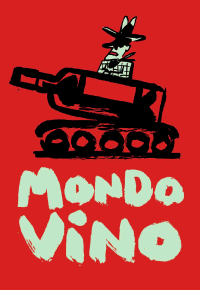
Mondovino: globalization and terroir, Robert Parker versus your good taste

American wine cowboy conquest with tankFor those with a curiosity for how wine terroir is holding up against the onslaught of wine factory farming, the 10-hour miniseries version of MONDOVINO is finally available on DVD. For viewers curious about viniculture globalization under Californian colonial domination, the original feature length documentary delivers, with a long finish. Any time critics accuse a film of being one sided, you know it’s about class war.

I had my first lesson in vineyard terroir when my college-aged aunt visited my family in Alsace and spent a season picking grapes. She informed us to our horreur that everything gets stomped in that barrel, bugs and all. I didn’t drink wine then, so what did I care, but it was easy to decide that such was the artistry that probably made French wines great.

But as I said, Mondovino was about much more than wine, and now I’ll get to the point. We may lament the new commercialization of wine, but historically the occupation has always had its strictly-business types. Vintners were rarely agriculturalists who subsisted, they were wine lovers subsidized. We can wince at the Napa Valley nouveau gauche, but even Bordeaux’s great chateaus, and especially all the Premiers Crus, are owned and have been owned by businessmen money lenders, going back centuries.

The modernization and standardization which is destroying contemporary wines is simply the evolution of production control. At last, technology and the ascent of a gilded age have brought vintners to believe they’ve bested nature. It’s true if you don’t care about wine, if you’re content to bottle a soft drink as opposed to allowing wine the breathing space to develop personality. Basically this documentary demonstrates that these gentlemen hobbyists, now plaintively bourgeois about profit, welcome the new global fascism.

Old World Fascists
Of course it is no stretch to imagine that the Mondovino filmmakers are going to ask, how did your father or grandfather like Fascism under the Nazis? They point the question at an Italian family who date their wealth back 900 years as bankers.

Any European documentary delving into family histories will always ask particularly about the war years. In America it’s what did you do during the war Daddy? In Europe it’s about weathering the occupation. Most working class French want to tell you what they did in the Resistance. Rich people you don’t ask because of course they were collaborateurs.

Mondovino’s subjects are the perpetually wealthy, who don’t even register the affront. Of course their families thrived under Fascism, quelle betise to imagine it would be otherwise. How curious it is we are surprised they embrace it so again.

Such moments are the highlights of Mondovino, rich folk posing in elaborate foyers, plaintively matter of fact about Fascism.

One opulent reception room in Florence is packed with ancient paintings, among them a painting of the very room full of paintings, you imagine if you peered closely enough you would see the infinity of mirrors scheme, a Baroque era black velvet number. The Grande Dame mentions that Prince Charles inquired about that painting at breakfast.

Let me add, critics have held Jonathan Nossiter’s camera work to be unstable. Actually he was very easily distracted by momentously relevant tchotchkes and biographical details few commoners are granted audience to encounter.

Fascists in the New World
Mondovino allowed the Napa Valley entrepreneurs to hang themselves. Open mouth, insert vacuous blather, often racist. These nouveau riches landscaped new vineyard for themselves, praising the terrain like it was classic architecture, their aesthetic tributes could only reference the National Mall. That classic.

Over at Mondavi, talk fixated of expansion and conquest. The film’s main plot addressed the Mondavi’s ongoing acquisition of the world’s most treasured appelations. For the worse of course, because what do they know about wine but that it should all taste the same? Son Mondavi dreams of someday having a vineyard on the moon, for no other reason than he thought of it. Wouldn’t it be exciting, he asks, to be able to say: “hey, let’s open a bottle from the moon,” my paraphrase.

The issue of terroir, English readers, has entirely to do with terre which is French for “earth.” Terre with a capital T is “Earth.” Of course the earthbound distinction was lost on this Californian.

Yes, Mondavi is surely alone in pondering what earth, sun and elements would have feed his moon vines.

Most vile of all the New World vintners was a family outfit in Argentina. They sit on a spacious veranda and explain how every boy in the family is named for founding father, the original title holder. Their wealth goes back to the early Spanish settlers and they express the perennial colonizer’s lament, that Los Indios of the regions have no work ethic. Centuries ago the Spaniard had to devise cruel torments to drive their slave laborers to produce. It was an inefficient system to impose on the indigenous and transplanted tribes, unaccustomed to a hierarchical workforce supporting do-nothings at the top.

Globalization
Key to Mondavi’s quest for wine world domination, is a market that has standardized the consumer’s taste. No longer are customers hopping in their car for a Sunday drive, to stop by a neighboring chateau to sample a vintage take a case home. Today the global consumption of wine has meant having to market it without being able to taste it. For that consumers have come to follow the ratings of critics. It was inevitable of course, but Mondovino reveals how hilariously flawed and phony the system is.

Mondovino focuses on two celebrity tasters who make or break wines. Robert Parker and James Suckling. Let’s dispatch the latter quickly.

James Suckling
James Suckling made a niche for himself nurturing Italian wines and coined the term “Super Tuscan.” I didn’t know that, but Mondovino records Suckling attributing the phenomena to the ether before being made to admit that the meme was his own.

More hilarious was a hypothetical question posed to the critic after confessing in an unguarded moment that he might have been too generous with the rating he gave a friend’s wine. The friend, a wealthy vintner, was letting Suckling a villa, which meant he was also his landlord. Naturally Mondovino asked if a discount on the rent would move Suckling to consider a more favorable rating. Suckling took the bait, laughingly nodding, of course, his friend under his breath suggested in such case he could have the villa for free.

It’s not corruption, merely a gentleman’s game. Can we even assert that the ordinary consumer suffers? Taste is subjective. Suckling’s ultimate rating is of negligible consequence to wine drinkers, except to commerce.

Robert Parker
I’m sorry to be getting around to Parker’s scheme so late in this article, because he plays such a profound part in the homogenizing of world wine production. The mechanism is beyond the pale, but it’s simple. Parker is influential and has a distinctive appetite, he has a best friend who consults with vintners about how to make their wine to Parker’s taste. The result has been devastating. Vines that have for ages had their own distinctive gouts have now been McParkered. The consultant charges a large fee to monitor an increasing stable of wines, for the camera his preoccupation was “micro-oxygenate,” and after it’s bottled parker comes around and bestows the high marks. The more they pay, the higher the score.

Mondovino underscores this plot by filming a Burger King billboard as Parker drives past it, while he sings the praises of uniform quality. The filmmakers notice an FBI cap on Parker’s desk and make sure to keep it in the frame. Parker is quite candid and friendly in Mondovino, probably because he had no inkling they did not share his eagerness to see viniculture’s eccentricities ironed to a uniform flat.

When the film was released and Robert Parker emerged as enterprising accomplice to Mondavi’s villain, Parker was enraged. He wrote rant after rant against the film and its makers. I’m not sure he’s over it yet. I wanted to be sure to document what I thought was Mondovino’s most brilliant assault on the witless benefit the Parker-Mondavi venture think they’re bequeathing with their anschluss of world wine. It’s about the subjectivity of taste. Robert Parker’s.

A recurring motif of Mondovino’s interviews was a fascination with dogs. It’s cute, and often we give ourselves leave to believe we have learned something about the owner by just looking at their dog.

In one memorable scene, we’ve met a quite unassuming South American vintner who has only one hectar, but is none the less generous with his wine, his time and friendship. He has a black dog, and when the filmmaker asks his name, the vintner laughs such that the revelation is self-effacing. “Luther King” is his name, because, he tells us in Spanish, he’s “negro.” Mondovino’s dark hats are so distasteful, it’s important that the heroic characters aren’t too pearly clean.

All the asides with the dogs were entertaining in their own right, but could have served entirely to set up Robert Parker’s scene. We’re invited to Parkers home and immediately discover he has something for bulldogs.

Do you like bulldogs? Taste is of course subjective. Robert Parker and his wife love their bulldogs, two, and their home is festooned with Bulldogephemera, statuettes, paintings, the camera frame’s worth. Imagine a wall covered with watercolors and oil portraits of bulldogs as you consider the subjectivity of taste.

Then just as Parker is prompted to discuss that his nose is ensured for a million dollars, we discover that one of the dogs has become incontinent, and there’s the near unbearable dog flatulence from which not even conversation can escape. Imagine Robert Parker’s nose not ensured against that. The interview concludes with Parker rambling about something as a bulldog sits sneering on the carpet forcing the filmmaker to keep a safe distance, and so he focuses in close capturing the ugly, perhaps infirm, definitely defensive, unlikable mug.

The next time you chose a wine because it has a high Parker score, ask yourself how it integrates an atmosphere of dog.

Last veteran of the War to End All Wars

UK veteran harry patch
IS THAT RICH? UK’s oldest living veteran of the Great War died this weekend at age 111. Machine-gunner Harry Patch who survived Ypres and nearly not Passchendaele, was eulogized by Queen Elizabeth and Prince Charles who explained “The Great War is a chapter in our history we must never forget.” Prime Minister Gordon Brown added: “The noblest of all the generations has left us, but they will never be forgotten.” What did Soldier Patch think of the war for which he was held in patriotic regard? “It wasn’t worth it.”

Patch had been adamant that the senseless slaughter of WWI was not justified, for neither Queen nor Country. The joke is on us hopeful pacifists however, because the old soldier WAITED UNTIL HE WAS 100 TO SAY IT.

Do antiwar activists ask too much of our soldiers, to bear the brutalization of war, and return to be strong enough to speak against it? The state portrays their shell-shocked silence as stoic heroism, the veterans are far too broken to object. And the recruiting cycle repeats itself. The swiftboaters outnumber the conscientious objectors.

We will probably wait forever for the veteran to end all veterans.

Mugabe and the British move to regain control over Zimbabwe

The world corporate press has been going non stop against 2 African governments the last couple of years. The targets have been the governments of Sudan and Zimbabwe. Why such attention given to these 2 African governments out of a continent full entirely of unsavory governments and dictators? Is it that the US and Western European elites have suddenly become a group of benevolent saints, only concerned with the welfare of the poor Black populations of their ‘Dark Continent’? One can’t really think so.

So let us take a brief historical look at Zimbabwe now, and see why the corporate press is so hot for regime change? One does not have to be in love with the 82 year old Mugabe, current head of the Zimbabwe state, to question why our attention is focused by others in his direction. Has this attention about ‘human rights’ been consistent, coming from the European and US governments and their servile press? Yeah, right…

Let us ask several questions, then… Has the corporate press informed the world public about the economic warfare being waged by the colonialists against their former colony, Zimbabwe? Well, why not? Zimbabwe is an economic basket case today, but the US and Europeans have made it so, as well as Mugabe himself, but that’s not what the corporate press wants the public to know. They are campaigning for regime change and not the welfare of Zimbabweans. The governments and their press want to gain back direct control over Zimbabwe, not save the people living there. Look for the likes of O’Reily and the other media whores at the Fox ‘News’ stable to be shedding crocodile tears on behalf of that population though, as the Murdoch press in England routinely does, too.

Another question, too? A lot of press has been given to the dangers of an anthrax terrorist attack on the US. Has any of the pro-military/ police state press ever informed the public that the largest case of anthrax terrorism directed against people happened in Rhodesia (the white racist Apartheid state ruling over Zimbabwe) just a while back? That’s right, the Whites of Rhodesia-Zimbabwe that were intimately connected with Great Britain, used anthrax against the Blacks of that country. It was the largest such biological warfare use of anthrax in world military history.

As somebody around back then, I don’t really remember the press ever giving much a shit about the affairs of Zimbabwe back then. Now, they can’t do anything else other than blab on and on about Zimbabwe, same as they do about the Darfur in Sudan. The British, French and US governments want control back over these 2 regions of Africa. And they want the general public to think that they are being good people if they help cheer lead for that effort. Go figure? I blame our pathetic educational system here for people being so naive and gullible. How ’bout you?

Click here to read more about the anthrax biological warfare of European colonialists against their Black neighbors in Africa. This info actually was writtten by a White Rhidesian racist, too.

Princess Diana and the end of civility

Princess Diana on Dodi Fayed's yacht a week before her deathThe Queen is the first film to be made about the woman who has presided over England for half a century. The story deals with the days following Princess Di’s fatal crash in 1997 and the personal challenge her death might have posed for the monarchy’s public relations. The same period saw Prime Minister Tony Blair’s ascendancy to power. The story gives Blair credit, where the queen appeared to faulter, for recognizing Diana as being the “People’s Princess.” And then some.

Asked about his fawning depiction of Tony Blair as man of the hour, director Stephen Frears thought it “a mark of my incredible maturity” to cast Blair in the light of his glory days, this at a time when Blair and his government have fallen irrecoverably, adding that “it’s preposterous that he’s not in jail.” In the interview Frears also makes light of whether Queen Elizabeth II is possibly really as bright as her character portrayed by Hellen Mirren. The Queen celebrates the resolve of royal blood facing a crisis. Elizabeth is both humanized and lionized, by sticking to the stiff upper lip “the world expects of us.” Frears interweaves real news footage of celebrities and the flowers flooding the Buckingham Palace gates, counting the days from Lady Di’s death to the climax when the queen finally makes her long delayed statement.

That’s when Frears lies. He lays the behind the scenes personal anguish which might have explained the dishonor the royals paid to Diana, leading to the Queen’s famous address, but then rewrites the ending. As if Mighty Casey, his vainglorious ambitions thwarted in the minor leagues, stays true to his character that day in Mudville, and now because we can all feel a little sympathy for the self-centered fella, he swings and DOES NOT strike out!!

We all were there when Queen Elizabeth took to the microphone, and no close-ups of a fictional Tony Blair’s tearing eyes, proud of his stalwart sovereign, are going to recast the disgraceful blue-blooded reaction for what it was.

And what of lingering accusations of the royal family being behind Diana’s death? What of the rape tape which Diana posited with a servant for safe-keeping which tells, it’s conjectured because the British press are forbidden to tell us, of Prince Charles interrupted sodomizing a valet. What of Lady Diana being, not even arguably, by the power of her personality, the most powerful woman in the world? But unlike Oprah or Martha Stewart, Diana was a loose cannon championing the cause of AIDs in Africa, and the fight to ban land mines, both subjects the powers that be, certainly in America, did/do not want highlighted.

The Queen‘s smartest character, Tony Blair’s advisor who supposedly coins the term People’s Princess is let to murmur early on, “It wasn’t the press that killed her.” But the subject is dropped there. Instead Blair and his crew seize upon Diana’s death like Mayor Giuliani to 9/11, being seen offering bedside comfort to a traumatized populace, and reaping the accolades. Except director Frears offers nothing behind such scenes. Blair is shown as the earnest surrogate, standing in for his monarch until she can regrasp the helm.

With the ensuing years having shown us Blair’s true colors, what do you think was the more likely scenario? A self-effacing Danny Kaye Pauper Prince or a Rudy Giuliani? I find Frears’ characterization of Blair even more disingenuous, showing Tony living in a modest flat strewn with children’s messes, taking the dinner plates to do the “washing up,” and keeping watch on world events on a television with a Nintendo game atop it. This coming from a “labor” minister who was leading the conservative counter-revolution to restructure the British economy for the elites. Perhaps Frears’ adopted class.

The Queen owes its entire first act to Michael Moore’s Fahrenheit 911, the music, the build, the black out of the familiar awful moment, and the protracted montage we needed to absorb the tragedy and understand how it’s changed us.

The great disservice that Stephen Frears does to history, and to all of us because we are still living it, is amplified by the fact that he did get Diana’s death right. Princess Di’s sudden death did change the world, perhaps more than did 9/11. The World Trade Center on September 11, 2001 was a comeuppance. If the American people did not see it coming, the world did. That such a terrorist act was bound to happen was attested to the fact that the same people had already tried it and at the very same location.

But Diana’s death marked the end of civility, and people felt it. The third world may have been fit to burst under the weight of its post-colonial oppressors, but a great English civility had prevailed since the days of Ghandi. This was a sense that disagreement could be visceral, but apart from the brutality of the unwashed French or the uncouth Americans, a British sense of decency would rule out. Britain, not long ago the Empire, was where we got the rule of law, our rights, and everyone’s concept of a representational parliament.

The circumstances around Diana’s death would present an incredibly interesting lesson in power usurped from the people; Tony Blair’s arrangement with Rupert Murdoch for starters, instead of showing Blair reacting to the newspapers and coaxing his old queen along. The Queen is a marvelous story of two people facing adversity introspectively. Fine, except those personages were at the center of the unification of global corporate power and could not have been idle participants. As if Frears had made a film about the Titanic and chose to focus on the captain’s preoccupation with feng shui.

The 1990s saw a decline in every aspect of benevolent leadership, and I believe the premature death of Lady Diana was the curtain. It was hard those days after her death to imagine a world without her, and indeed events have proved that we were to face the worst. The turn of the century marked the ascendency of the Neocons, the political face of the globalization overlords. It meant corporate overseers with gloves off, Zionist zealotry unabashed, banks with no limits on their usury, and the world media watchdogs in the hands of the wolves.

The ruling few have their hands bloody in genocides the world over, endless wars, massacres, slavery, epidemics, poverty, famine and reckless abandonment. Before Diana’s death at least I believe they would have been concerned to wash the blood off.

Prince Harry isn’t free

Scion of fascist overclass.   Prince Harry in uniform.
 
In usual dress

It says a lot about the state of freedom in the modern world when even the heir to the throne of England can’t express himself freely.

There was a time when dressing like a Nazi was not only irreverent but immaturely insensitive to the memory of the Holocaust. At present however, the Nazi reference calls one’s attention to the fascism omnipresent in today’s governing bodies.

Perhaps Prince Harry wasn’t saying: look at me, I’m the camp commander of Treblinka. Perhaps Prince Harry was saying, if I may put words in his mouth, this:

Look at me, I’m a scion of the ruling family, of a government which has taken its country to war against the wishes of its people, which has invaded a defenseless country, which has curtailed human rights for its own population, which has imprisoned some of its subjects in defiance of rights granted since 400 years, which engages in torture, and is for all intents and purposes, as fascist as the Nazis. Short only the extermination camps. But we do not perhaps yet know about these.

But Harry wasn’t permitted to make this statement. He was treated like only a spoiled kid. Prince Charles treated his son’s act like that of a kid who didn’t know he was triffling with the horrors of Auswitch. But Charles is only protecting the wolf in sheep’s clothing of his protectors, the international corporatocracy which pulls his strings. Who’s the spoiled child really?