Columbus fall from grace not predicted by Mayan Long Count Calendar

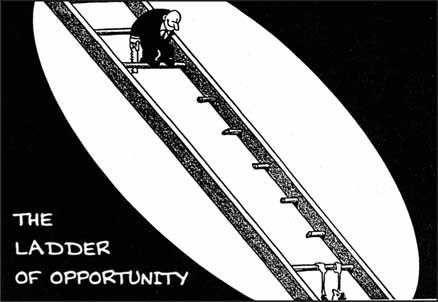
1977 Playboy cartoonFor centuries, we’ve had only engravings to depict the Christopher Columbus discovery of the New World. With the moving pictures of today (a growing number in color according to IMdB), you’d think by now one or two would have caught the real Admiral Cristóbal Colón in blood-red technicolor, terrorizing his new minions with cruel Spanish steel.

Today is still celebrated by the US as Columbus Day. Elsewhere, October 10 is designated International Indigenous Peoples Day.

Accounts in Mexico say the Maya predicted the European invasion which was to plunge the Americas into eternal darkness. They foretold when, 1492 and how, bearded white men delivering uncompromising savagery. Based on the accuracy of this prediction, supposedly, many now have begun to scrutinize another pre-Columbian calculation, the end of the world in the year 2012. It’s odd we accept an unflattering characterization of our scourge, without embracing our inheritance and ongoing role. The villains were our ancestors. We are our fathers.

It’s not just the Italian Americans who cling to the heroic myth of Christopher Columbus. Every white immigrant, and let’s be fair, the hispanic are white too, has an interest in soft-pedalling over the Columbus genocides. The European program of enslavement and pillage continues on these continents today, even as the North American colony serves as platform for the exploitation of all the developing worlds. Every Anglo-Iberian is complicit in extorting indigenous peoples of their well-being and heritage. It would probably be no exaggeration to say that the modern equivalent is not far removed from forcing native populations to slave for gold on pain of dismemberment. Columbus’s men grilled the Indians slowly over spits, or cut off both hands so victims couldn’t staunch their own bleeding. Today’s conquistadors on Capitalism’s wild frontiers use much the same methods.

To re-frame Spain’s discovery with a genocidal agenda is to understand how the competing French and English enterprises redoubled the brutality. Western expansion was invasion. Manifest Destiny was promised land rationalization. Settlements were occupation, and are occupation. To see Columbus in his true horror is to see today’s Indian reservations for what they are, concentration camps for the last embers of the American insurgency. We Anglos and Iberians are inheritors of stolen destinies. Lives stolen 500 years ago and futures we are stealing still.

Meanwhile, Westerners distract their consciences with THE END IS NIGH prophesies. Has there been a lifetime since creation when mankind didn’t fear the end of the world? In recent decades it wasn’t the Rapture, it wasn’t Y2K, so now it’s the end of the Mayan Calendar, whose schedule of events ends in 2012. New Age astrologists have pinpointed a specific date, December 21, 2012. Really. To me that date bears a suspicious resemblance to the symmetric time events which thrill digital watch wearers. December 21 is of course the Day After the end of time, the unknowable vacuum which follows the end: 12-20-2012. On a metric calendar, that’s 20.12.2012. Spooky.

Rock Creek Free Press available in COS

The Rock Creek Free Press is available online, but if you want it in print, the DC monthly is available in Colorado Springs at the Bookman, 3163 W. Colorado. The September issue features a speech given by legendary Australian journalist John Pilger on July 4th in San Francisco.

Here’s the RCFP transcript:

Two years ago I spoke at “Socialism in Chicago” about an invisible government which is a term used by Edward Bernays, one the founders of modern propaganda. It was Bernays, who in the 1920s invented public relations as a euphemism for propaganda. And it was Bernays, deploying the ideas of his uncle Sigmund Freud, who campaigned on behalf of the tobacco industry for women to take up smoking as an act of feminist liberation calling cigarettes “tortures of freedom”. At the same time he was involved in the disinformation which was critical in overthrowing the Arbenz government in Guatemala. So you have the association of cigarettes and regime change. The invisible government that Bernays had in mind brought together all media: PR, the press, broadcasting, advertising and their power of branding and image making. In other words, disinformation.

And I suppose I would like to talk today about this invisible government’s most recent achievement, the rise of Barrack Obama and the silencing of much of the left. But all of this has a history, of course and I’d like to go back, take you back some forty years to a sultry and, for me, very memorable day in Viet Nam.

I was a young war correspondent who had just arrived in a village in the Central Highlands called Tuylon. My assignment was to write about a unit of US Marines who had been sent to the village to win hearts and minds. “My orders,” said the Marine Sergeant, “are to sell the American way of liberty, as stated in the Pacification Handbook, this is designed to win the hearts and minds of folks as stated on page 86.” Now, page 86 was headed in capital letters: WHAM (winning hearts and minds). The Marine Unit was a combined action company which explained the Sergeant, meant, “We attack these folks on Mondays and we win their hearts and minds on Tuesdays.” He was joking, of course, but not quite.

The Sergeant, who didn’t speak Vietnamese, had arrived in the village, stood up on a Jeep and said through a bullhorn: “Come on out everybody we’ve got rice and candies and toothbrushes to give you.” This was greeted by silence. “Now listen, either you gooks come on out or we’re going to come right in there and get you!” Now the people of Tuylon finally came out and they stood in line to receive packets of Uncle Ben’s Miracle Rice, Hershey Bars, party balloons, and several thousand toothbrushes. Three portable, battery operated, yellow, flush lavatories were held back for the arrival of the colonel.

And when the colonel arrived that evening, the district chief was summoned and the yellow, flush lavatories unveiled. The colonel cleared his throat and took out a handwritten speech,

“Mr. District Chief and all you nice people,” said the colonel, “what these gifts represent is more than the sum of their parts, they carry the spirit of America. Ladies and gentlemen there’s no place on Earth like America, it’s the land where miracles happen, it’s a guiding light for me and for you. In America, you see, we count ourselves as real lucky as having the greatest democracy the world has ever known and we want you nice people to share in our good fortune.”

Thomas Jefferson, George Washington, even John Winthrope sitting upon a hill got a mention. All that was missing was the Star Bangled Banner playing softly in the background. Of course the villagers had no idea what the colonel was talking about, but when the Marines clapped, they clapped. And when the colonel waved, the children waved. And when he departed the colonel shook the Sergeant’s hand and said: “We’ve got plenty of hearts and minds here, carry on Sergeant.” “Yes Sir.” In Viet Nam I witnessed many scenes like that.

I’d grown up in faraway Australia on a cinematic diet of John Wayne, Randolph Scott, Walt Disney, and Ronald Reagan. The American way of liberty they portrayed might well have been lifted from the WHAM handbook. I’d learned that the United States had won World War II on its own and now led the free world as the chosen society. It was only later when I read Walter Lippmann’s book, Public Opinion, a manual of the invisible government, that I began to understand the power of emotions attached to false ideas and bad histories on a grand scale.

Now, historians call this exceptionalism, the notion that the United States has a divine right to bring what it calls “liberty” to the rest of humanity. Of course this is a very old refrain. The French and British created and celebrated their own civilizing missions while imposing colonial regimes that denied basic civil liberties. However, the power of the American message was, and remains, different. Whereas the Europeans were proud imperialists, Americans are trained to deny their imperialism. As Mexico was conquered and the Marines sent to Nicaragua, American textbooks referred to an Age of Innocence. American motives were always well meaning, moral, exceptional, as the colonel said, “There was no ideology” and that’s still the case.

Americanism is an ideology that is unique because its main feature is its denial that it is an ideology. It’s both conservative and it’s liberal. And it’s right and it’s left. And Barack Obama is its embodiment. Since Obama was elected leading liberals have talked about America returning to its true status as, “a nation of moral ideals”. Those are the words of Paul Krugman, the liberal columnist of The New York Times. In the San Francisco Chronicle, columnist Mark Morford wrote,

“Spiritually advanced people regard the new president as a light worker who can help usher in a new way of being on the planet.”

Tell that to an Afghan child whose family has been blown away by Obama’s bombs. Or a Pakistani child whose house has been visited by one of Obama’s drones. Or a Palestinian child surveying the carnage in Gaza caused by American “smart” weapons, which, disclosed Seymour Hersh, were re-supplied to Israel for use in the slaughter, and I quote; “Only after the Obama team let if be known, it would not object.” The man who stayed silent on Gaza is the man who now condemns Iran.

In a sense, Obama is the myth that is America’s last taboo. His most consistent theme was never “change”, it was power. “The United States,” he said, “leads the world in battling immediate evils and promoting the ultimate good. We must lead by building a 21st century military to ensure the security of our people and advance the security of all people.” And there is this remarkable statement, “At moments of great peril in the past century our leaders ensured that America, by deed and by example, led and lifted the world; that we stood and fought for the freedoms sought by billions of people beyond our borders.” Words like these remind me of the colonel in the village in Viet Nam, as he spun much the same nonsense.

Since 1945, by deed and by example, to use Obama’s words, America has overthrown 50 governments, including democracies, and crushed some 30 liberation movements and bombed countless men, women, and children to death. I’m grateful to Bill Blum for his cataloging of that. And yet, here is the 45th (sic) president of the United States having stacked his government with war mongers and corporate fraudsters and polluters from the Bush and Clinton eras, promising, not only more of the same, but a whole new war in Pakistan. Justified by the murderous clichés of Hilary Clinton, clichés like, “high value targets”. Within three days of his inauguration, Obama was ordering the death of people in faraway countries: Pakistan and Afghanistan. And yet, the peace movement, it seems, is prepared to look the other way and believe that the cool Obama will restore, as Krugman wrote, “the nation of moral ideals.”

Not long ago, I visited the American Museum of History in the celebrated Smithsonian Institute in Washington. One of the most popular exhibitions was called “The Price of Freedom: Americans at War”. It was holiday time and lines of happy people, including many children, shuffled through a Santa’s grotto of war and conquest. When messages about their nation’s great mission were lit up; these included tributes to the; “…exceptional Americans who saved a million lives…” in Viet Nam; where they were, “…determined to stop Communist expansion.” In Iraq other brave Americans, “employed air-strikes of unprecedented precision.” What was shocking was not so much the revisionism of two of the epic crimes of modern times, but the shear scale of omission.

Like all US presidents, Bush and Obama have very much in common. The wars of both presidents and the wars of Clinton and Reagan, Carter and Ford, Nixon and Kennedy are justified by the enduring myth of exceptional America. A myth the late Harold Pinter described as, “a brilliant, witty, highly successful act of hypnosis.”

The clever young man who recently made it to the White House is a very fine hypnotist; partly because it is indeed extraordinary to see an African American at the pinnacle of power in the land of slavery. However, this is the 21st century and race together with gender, and even class, can be very seductive tools of propaganda. For what is so often overlooked and what matters, I believe above all, is the class one serves. George Bush’s inner circle from the State Department to the Supreme Court was perhaps the most multi-racial in presidential history. It was PC par excellence. Think Condoleezza Rice, Colin Powell. It was also the most reactionary. Obama’s very presence in the White House appears to reaffirm the moral nation. He’s a marketing dream. But like Calvin Klein or Benetton, he’s a brand that promises something special, something exciting, almost risqué. As if he might be radical. As if he might enact change. He makes people feel good; he’s a post-modern man with no political baggage. And all that’s fake.

In his book, Dreams From My Father, Obama refers to the job he took after he graduated from Columbia in 1983; he describes his employer as, “…a consulting house to multi-national corporations.” For some reason he doesn’t say who his employer was or what he did there. The employer was Business International Corporation; which has a long history of providing cover for the CIA with covert action and infiltrating unions from the left. I know this because it was especially active in my own country, Australia. Obama doesn’t say what he did at Business International and they may be absolutely nothing sinister. But it seems worthy of inquiry, and debate, as a clue to, perhaps, who the man is.

During his brief period in the senate, Obama voted to continue the wars in Iraq and Afghanistan. He voted for the Patriot Act. He refused to support a bill for single payer health care. He supported the death penalty. As a presidential candidate he received more corporate backing than John McCain. He promised to close Guantanamo as a priority, but instead he has excused torture, reinstated military commissions, kept the Bush gulag intact, and opposed habeas corpus.

Daniel Ellsberg, the great whistleblower, was right, I believe, when he said, that under Bush a military coup had taken place in the United States giving the Pentagon unprecedented powers. These powers have been reinforced by the presence of Robert Gates – a Bush family crony and George W. Bush’s powerful Secretary of Defense. And by all the Bush Pentagon officials and generals who have kept their jobs under Obama.

In the middle of a recession, with millions of Americans losing their jobs and homes, Obama has increased the military budget. In Colombia he is planning to spend 46 million dollars on a new military base that will support a regime backed by death squads and further the tragic history of Washington’s intervention in that region.

In a pseudo-event in Prague, Obama promised a world without nuclear weapons to a global audience, mostly unaware that America is building new tactical nuclear weapons designed to blur the distinction between nuclear and conventional war. Like George Bush, he used the absurdity of Europe threatened by Iran to justify building a missile system aimed at Russia and China. In another pseudo-event, at the Annapolis Naval Academy, decked with flags and uniforms, Obama lied that America had gone to Iraq to bring freedom to that country. He announced that the troops were coming home. This was another deception. The head of the army, General George Casey says, with some authority, that America will be in Iraq for up to a decade. Other generals say fifteen years.

Chris Hedges, the very fine author of Empire of Illusion, puts it very well; “President Obama,” he wrote, “does one thing and brand Obama gets you to believe another.” This is the essence of successful advertising. You buy or do what the advertiser wants because of how they make you feel. And so you are kept in a perpetual state of childishness. He calls this “junk politics”.

But I think the real tragedy is that Obama, the brand, appears to have crippled or absorbed much of the anti-war movement – the peace movement. Out of 256 Democrats in Congress; 30, just 30, are willing to stand up against Obama’s and Nancy Pelosi’s war party. On June the 16th they voted for 106 billion dollars for more war.

The “Out of Iraq” caucus is out of action. Its member can’t even come up with a form of words of why they are silent. On March the 21st, a demonstration at the Pentagon by the once mighty United for Peace and Justice drew only a few thousand. The out-going president of UFPJ, Lesley Kagen, says her people aren’t turning up because, “It’s enough for many of them that Obama has a plan to end the war and that things are moving in the right direction.” And where is the mighty Move On, these days? Where is its campaign against the wars in Iraq and Afghanistan? And what, exactly, was said when Move On’s executive director, Jason Ruben, met Barack Obama at the White House in February?

Yes, a lot of good people mobilized for Obama. But what did they demand of him? Working to elect the Democratic presidential candidate may seem like activism, but it isn’t. Activism doesn’t give up. Activism doesn’t fall silent. Activism doesn’t rely on the opiate of hope. Woody Allen once said, “I felt a lot better when I gave up hope.” Real activism has little time for identity politics which like exceptionalism, can be fake. These are distractions that confuse and sucker good people. And not only in the United States, I can assure you.

I write for the Italian socialist newspaper, Il Manifesto, or rather I used to write for it. In February I sent the editor an article which raised questions about Obama as a progressive force. The article was rejected. Why, I asked? “For the moment,” wrote the editor, “we prefer to maintain a more positive approach to the novelty presented by Obama. We will take on specific issues, but we would not like to say that he will make no difference.” In other words, an American president drafted to promote the most rapacious system in history, is ordained and depoliticized by important sections of the left. It’s a remarkable situation. Remarkable, because those on the, so called, Radical Left have never been more aware, more conscious of the inequities of power. The Green Movement, for example, has raised the consciousness of millions, so that almost every child knows something about global warming. And yet, there seems to be a resistance, within the Green Movement, to the notion of power as a military force, a military project. And perhaps similar observations can also be made about sections of the Feminist Movement and the Gay Movement and certainly the Union Movement.

One of my favorite quotations is from Milan Kundera,

“The struggle of people against power is [the] struggle of memory against forgetting.”

We should never forget that the primary goal of great power is to distract and limit our natural desire for social justice and equity and real democracy.

Long ago Edward Bernays’ invisible government of propaganda elevated big business from its unpopular status as a kind of mafia to that of a patriotic driving force. The “American way of life” began as an advertising slogan. The modern image of Santa Claus was an invention of Coca Cola.

Today we are presented with an extraordinary opportunity. Thanks to the crash of Wall Street and the revelation, for many ordinary people, that the free market has nothing to do with freedom. The opportunity, within our grasp, is to recognize that something is stirring in America that is unfamiliar, perhaps, to many of us on the left, but is related to a great popular movement that’s growing all over the world. Look down at Latin America, less than twenty years ago there was the usual despair, the usual divisions of poverty and freedom, the usual thugs in uniforms running unspeakable regimes. Today for the first time perhaps in 500 years there’s a people’s movement based on the revival of indigenous cultures and language, a genuine populism. The recent amazing achievements in Bolivia, Ecuador, Venezuela, El Salvador, Argentina, Brazil, and Paraguay represent a struggle for community and political rights that is truly historic, with implications for all of us. The successes in Latin America are expressed perversely in the recent overthrow of the government of Honduras, because the smaller the country, the greater is the threat of a good example that the disease of emancipation will spread.

Indeed, right across the world social movements and grass roots organization have emerged to fight free market dogma. They’ve educated governments in the south that food for export is a problem, rather than a solution to global poverty. They’ve politicized ordinary people to stand up for their rights, as in the Philippines and South Africa. Look at the remarkable boycott, disinvestment and sanctions campaign, BDS, for short, aimed at Israel that’s sweeping the world. Israeli ships have been turned away from South Africa and Western Australia. A French company has been forced to abandon plans to build a railway connecting Jerusalem with illegal Israeli settlements. Israeli sporting bodies find themselves isolated. Universities in the United Kingdom have begun to sever ties with Israel. This is how apartheid South Africa was defeated. And this is how the great wind of the 1960s began to blow. And this is how every gain has been won: the end of slavery, universal suffrage, workers rights, civil rights, environmental protection, the list goes on and on.

And that brings us back, here, to the United States, because I believe something is stirring in this country. Are we aware, that in the last eight months millions of angry e-mails, sent by ordinary Americans, have flooded Washington. And I mean millions. People are outright outraged that their lives are attacked; they bear no resemblance to the passive mass presented by the media. Look at the polls; more than 2/3 of Americans say the government should care for those who cannot care for themselves, sixty-four percent would pay higher taxes to guarantee health care for everyone, sixty percent are favorable towards Unions, seventy percent want nuclear disarmament, seventy-two percent want the US completely out of Iraq and so on and so on. But where is much of the left? Where is the social justice movement? Where is the peace movement? Where is the civil rights movement? Ordinary Americans, for too long, have been misrepresented by stereotypes that are contemptuous. James Madison referred to his compatriots in the public as ignorant and meddlesome outsiders. And this contempt is probably as strong today, among the elite, as it was back then. That’s why the progressive attitudes of the public are seldom reported in the media, because they’re not ignorant, they’re subversive, they’re informed and they’re even anti-American. I once asked a friend, the great American war correspondent and humanitarian, Martha Gellhorn, to explain the term “anti-American” to me. “I’ll tell you what anti-American is,” she said in her forceful way, “its what governments and their vested interests call those who honor America by objecting to war and the theft of resources and believing in all of humanity. There are millions of these anti-Americans in the United States, they are ordinary people who belong to no elite and who judge their government in moral terms though they would call it common decency. They are not vain; they are the people with a waitful conscience, the best of America’s citizens. Sure, they disappear from view now and then, but they are like seeds beneath the snow. I would say they are truly exceptional.” Truly exceptional, I like that.

My own guess is that a populism is growing, once again in America evoking a powerful force beneath the surface which has a proud history. From such authentic grass roots Americanism came women suffrage, the eight hour day, graduated income tax, public ownership of railways and communications, the breaking of the power of corporate lobbyists and much more. In other words, real democracy. The American populists were far from perfect, but they often spoke for ordinary people and they were betrayed by leaders who urged them to compromise and merge with the Democratic Party. That was long ago, but how familiar it sounds. My guess is that something is coming again. The signs are there. Noam Chomsky is right when he says that, “Mere sparks can ignite a popular movement that may seem dormant.” No one predicted 1968, no one predicted the fall of apartheid, or the Berlin Wall, or the civil rights movement, or the great Latino rising of a few years ago.

I suggest that we take Woody Allen’s advice and give up on hope and listen, instead, to voices from below. What Obama and the bankers and the generals and the IMF and the CIA and CNN and BBC fear, is ordinary people coming together and acting together. It’s a fear as old as democracy, a fear that suddenly people convert their anger to action as they’ve done so often throughout history.

“At a time of universal deceit,” wrote George Orwell, “telling the truth is a revolutionary act.”

Thank you.

The Coming Insurrection

by The Invisible Committee

Translated from the French, 2007

From whatever angle you approach it, the present offers no way out. This is not the least of its virtues. From those who seek hope above all, it tears away every firm ground. Those who claim to have solutions are contradicted almost immediately. Everyone agrees that things can only get worse. “The future has no future” is the wisdom of an age that, for all its appearance of perfect normalcy, has reached the level of consciousness of the first punks.

The sphere of political representation has come to a close. From left to right, it’s the same nothingness striking the pose of an emperor or a savior, the same sales assistants adjusting their discourse according to the findings of the latest surveys. Those who still vote seem to have no other intention than to desecrate the ballot box by voting as a pure act of protest. We’re beginning to suspect that it’s only against voting itself that people continue to vote. Nothing we’re being shown is adequate to the situation, not by far. In its very silence, the populace seems infinitely more mature than all these puppets bickering amongst themselves about how to govern it. The ramblings of any Belleville chibani contain more wisdom than all the declarations of our so-called leaders. The lid on the social kettle is shut triple-tight, and the pressure inside continues to build. From out of Argentina, the specter of Que Se Vayan Todos is beginning to seriously haunt the ruling class.

The flames of November 2005 still flicker in everyone’s minds. Those first joyous fires were the baptism of a decade full of promise. The media fable of “banlieue vs. the Republic” may work, but what it gains in effectiveness it loses in truth. Fires were lit in the city centers, but this news was methodically suppressed. Whole streets in Barcelona burned in solidarity, but no one knew about it apart from the people living there. And it’s not even true that the country has stopped burning. Many different profiles can be found among the arrested, with little that unites them besides a hatred for existing society – not class, race, or even neighborhood. What was new wasn’t the “banlieue revolt,” since that was already going on in the 80s, but the break with its established forms. These assailants no longer listen to anybody, neither to their Big Brothers and Big Sisters, nor to the community organizations charged with overseeing the return to normal. No “SOS Racism” could sink its cancerous roots into this event, whose apparent conclusion can be credited only to fatigue, falsification and the media omertà. This whole series of nocturnal vandalisms and anonymous attacks, this wordless destruction, has widened the breach between politics and the political. No one can honestly deny the obvious: this was an assault that made no demands, a threat without a message, and it had nothing to do with “politics.” One would have to be oblivious to the autonomous youth movements of the last 30 years not to see the purely political character of this resolute negation of politics. Like lost children we trashed the prized trinkets of a society that deserves no more respect than the monuments of Paris at the end of the Bloody Week- and knows it.

There will be no social solution to the present situation. First, because the vague aggregate of social milieus, institutions, and individualized bubbles that is called, with a touch of antiphrasis, “society,” has no consistency. Second, because there’s no longer any language for common experience. And we cannot share wealth if we do not share a language. It took half a century of struggle around the Enlightenment to make the French Revolution possible, and a century of struggle around work to give birth to the fearsome “welfare state.” Struggles create the language in which a new order expresses itself. But there is nothing like that today. Europe is now a continent gone broke that shops secretly at discount stores and has to fly budget airlines if it wants to travel at all. No “problems” framed in social terms admit of a solution. The questions of “pensions,” of “job security,” of “young people” and their “violence” can only be held in suspense while the situation these words serve to cover up is continually policed for signs of further unrest. Nothing can make it an attractive prospect to wipe the asses of pensioners for minimum wage. Those who have found less humiliation and more advantage in a life of crime than in sweeping floors will not turn in their weapons, and prison won’t teach them to love society. Cuts to their monthly pensions will undermine the desperate pleasure-seeking of hordes of retirees, making them stew and splutter about the refusal to work among an ever larger section of youth. And finally, no guaranteed income granted the day after a quasi-uprising will be able to lay the foundation of a new New Deal, a new pact, a new peace. The social feeling has already evaporated too much for that.

As an attempted solution, the pressure to ensure that nothing happens, together with police surveillance of the territory, will only intensify. The unmanned drone that flew over Seine-Saint-Denis last July 14th – as the police later confirmed – presents a much more vivid image of the future than all the fuzzy humanistic projections. That they were careful to assure us that the drone was unarmed gives us a clear indication of the road we’re headed down. The territory will be partitioned into ever more restricted zones. Highways built around the borders of “problem neighborhoods” already form invisible walls closing off those areas off from the middle-class subdivisions. Whatever defenders of the Republic may think, the control of neighborhoods “by the community” is manifestly the most effective means available. The purely metropolitan sections of the country, the main city centers, will go about their opulent lives in an ever more crafty, ever more sophisticated, ever more shimmering deconstruction. They will illuminate the whole planet with their glaring neon lights, as the patrols of the BAC and private security companies (i.e. paramilitary units) proliferate under the umbrella of an increasingly shameless judicial protection.

The impasse of the present, everywhere in evidence, is everywhere denied. There will be no end of psychologists, sociologists, and literary hacks applying themselves to the case, each with a specialized jargon from which the conclusions are especially absent. It’s enough to listen to the songs of the times – the asinine “alt-folk” where the petty bourgeoisie dissects the state of its soul, next to declarations of war from Mafia K’1 Fry – to know that a certain coexistence will end soon, that a decision is near.

This book is signed in the name of an imaginary collective. Its editors are not its authors. They were content merely to introduce a little order into the common-places of our time, collecting some of the murmurings around barroom tables and behind closed bedroom doors. They’ve done nothing more than lay down a few necessary truths, whose universal repression fills psychiatric hospitals with patients, and eyes with pain. They’ve made themselves scribes of the situation. It’s the privileged feature of radical circumstances that a rigorous application of logic leads to revolution. It’s enough just to say what is before our eyes and not to shrink from the conclusions.

First Circle

“I AM WHAT I AM”

“I AM WHAT I AM.” This is marketing’s latest offering to the world, the final stage in the development of advertising, far beyond all the exhortations to be different, to be oneself and drink Pepsi. Decades of concepts in order to get where we are, to arrive at pure tautology. I = I. He’s running on a treadmill in front of the mirror in his gym. She’s coming back from work, behind the wheel of her Smart car. Will they meet?

“I AM WHAT I AM.” My body belongs to me. I am me, you are you, and something’s wrong. Mass personalization. Individualization of all conditions – life, work and misery. Diffuse schizophrenia. Rampant depression. Atomization into fine paranoiac particles. Hysterization of contact. The more I want to be me, the more I feel an emptiness. The more I express myself, the more I am drained. The more I run after myself, the more tired I get. We cling to our self like a coveted job title. We’ve become our own representatives in a strange commerce, guarantors of a personalization that feels, in the end, a lot more like an amputation. We insure our selves to the point of bankruptcy, with a more or less disguised clumsiness.

Meanwhile, I manage. The quest for a self, my blog, my apartment, the latest fashionable crap, relationship dramas, who’s fucking who… whatever prosthesis it takes to hold onto an “I”! If “society” hadn’t become such a definitive abstraction, then it would denote all the existential crutches that allow me to keep dragging on, the ensemble of dependencies I’ve contracted as the price of my identity. The handicapped person is the model citizen of tomorrow. It’s not without foresight that the associations exploiting them today demand that they be granted a “subsistence income.”

The injunction, everywhere, to “be someone” maintains the pathological state that makes this society necessary. The injunction to be strong produces the very weakness by which it maintains itself, so that everything seems to take on a therapeutic character, even working, even love. All those “how’s it goings?” that we exchange give the impression of a society composed of patients taking each other’s temperatures. Sociability is now made up of a thousand little niches, a thousand little refuges where you can take shelter. Where it’s always better than the bitter cold outside. Where everything’s false, since it’s all just a pretext for getting warmed up. Where nothing can happen since we’re all too busy shivering silently together. Soon this society will only be held together by the mere tension of all the social atoms straining towards an illusory cure. It’s a power plant that runs its turbines on a gigantic reservoir of unwept tears, always on the verge of spilling over.

“I AM WHAT I AM.” Never has domination found such an innocent-sounding slogan. The maintenance of the self in a permanent state of deterioration, in a chronic state of near-collapse, is the best-kept secret of the present order of things. The weak, depressed, self-critical, virtual self is essentially that endlessly adaptable subject required by the ceaseless innovation of production, the accelerated obsolescence of technologies, the constant overturning of social norms, and generalized flexibility. It is at the same time the most voracious consumer and, paradoxically, the most productive self, the one that will most eagerly and energetically throw itself into the slightest project, only to return later to its original larval state.

“WHAT AM I,” then? Since childhood, I’ve passed through a flow of milk, smells, stories, sounds, emotions, nursery rhymes, substances, gestures, ideas, impressions, gazes, songs, and foods. What am I? Tied in every way to places, sufferings, ancestors, friends, loves, events, languages, memories, to all kinds of things that obviously are not me. Everything that attaches me to the world, all the links that constitute me, all the forces that compose me don’t form an identity, a thing displayable on cue, but a singular, shared, living existence, from which emerges – at certain times and places – that being which says “I.” Our feeling of inconsistency is simply the consequence of this foolish belief in the permanence of the self and of the little care we give to what makes us what we are.

It’s dizzying to see Reebok’s “I AM WHAT I AM” enthroned atop a Shanghai skyscraper. The West everywhere rolls out its favorite Trojan horse: the exasperating antimony between the self and the world, the individual and the group, between attachment and freedom. Freedom isn’t the act of shedding our attachments, but the practical capacity to work on them, to move around in their space, to form or dissolve them. The family only exists as a family, that is, as a hell, for those who’ve quit trying to alter its debilitating mechanisms, or don’t know how to. The freedom to uproot oneself has always been a phantasmic freedom. We can’t rid ourselves of what binds us without at the same time losing the very thing to which our forces would be applied.

“I AM WHAT I AM,” then, is not simply a lie, a simple advertising campaign, but a military campaign, a war cry directed against everything that exists between beings, against everything that circulates indistinctly, everything that invisibly links them, everything that prevents complete desolation, against everything that makes us exist, and ensures that the whole world doesn’t everywhere have the look and feel of a highway, an amusement park or a new town: pure boredom, passionless but well-ordered, empty, frozen space, where nothing moves apart from registered bodies, molecular automobiles, and ideal commodities.

France wouldn’t be the land of anxiety pills that it’s become, the paradise of anti-depressants, the Mecca of neurosis, if it weren’t also the European champion of hourly productivity. Sickness, fatigue, depression, can be seen as the individual symptoms of what needs to be cured. They contribute to the maintenance of the existing order, to my docile adjustment to idiotic norms, and to the modernization of my crutches. They specify the selection of my opportune, compliant, and productive tendencies, as well as those that must be gently discarded. “It’s never too late to change, you know.” But taken as facts, my failings can also lead to the dismantling of the hypothesis of the self. They then become acts of resistance in the current war. They become a rebellion and a force against everything that conspires to normalize us, to amputate us. The self is not some thing within us that is in a state of crisis; it is the form they mean to stamp upon us. They want to make our self something sharply defined, separate, assessable in terms of qualities, controllable, when in fact we are creatures among creatures, singularities among similars, living flesh weaving the flesh of the world. Contrary to what has been repeated to us since childhood, intelligence doesn’t mean knowing how to adapt – or if that is a kind of intelligence, it’s the intelligence of slaves. Our inadaptability, our fatigue, are only problems from the standpoint of what aims to subjugate us. They indicate rather a departure point, a meeting point, for new complicities. They reveal a landscape more damaged, but infinitely more sharable than all the fantasy lands this society maintains for its purposes.

We are not depressed; we’re on strike. For those who refuse to manage themselves, “depression” is not a state but a passage, a bowing out, a sidestep towards a political disaffiliation. From then on medication and the police are the only possible forms of conciliation. This is why the present society doesn’t hesitate to impose Ritalin on its over-active children, or to strap people into life-long dependence on pharmaceuticals, and why it claims to be able to detect “behavioral disorders” at age three. Because everywhere the hypothesis of the self is beginning to crack.

Second Circle

“Entertainment is a vital need”

A government that declares a state of emergency against fifteen-year-old kids. A country that takes refuge in the arms of a football team. A cop in a hospital bed, complaining about being the victim of “violence.” A city councilwoman issuing a decree against the building of tree houses. Two ten year olds, in Chelles, charged with burning down a video game arcade. This era excels in a certain situation of the grotesque that seems to escape it every time. The truth is that the plaintive, indignant tones of the news media are unable to stifle the burst of laughter that welcomes these headlines.

A burst of laughter is the only appropriate response to all the serious “questions” posed by news analysts. To take the most banal: there is no “immigration question.” Who still grows up where they were born? Who lives where they grew up? Who works where they live? Who lives where their ancestors did? And to whom do the children of this era belong, to television or their parents? The truth is that we have been completely torn from any belonging, we are no longer from anywhere, and the result, in addition to a new disposition to tourism, is an undeniable suffering. Our history is one of colonizations, of migrations, of wars, of exiles, of the destruction of all roots. It’s the story of everything that has made us foreigners in this world, guests in our own family. We have been expropriated from our own language by education, from our songs by reality TV contests, from our flesh by mass pornography, from our city by the police, and from our friends by wage-labor. To this we should add, in France, the ferocious and secular work of individualization by the power of the state, that classifies, compares, disciplines and separates its subjects starting from a very young age, that instinctively grinds down any solidarities that escape it until nothing remains except citizenship – a pure, phantasmic sense of belonging to the Republic. The Frenchman, more than anyone else, is the embodiment of the dispossessed, the destitute. His hatred of foreigners is based on his hatred of himself as a foreigner. The mixture of jealousy and fear he feels toward the “cités“ expresses nothing but his resentment for all he has lost. He can’t help envying these so-called “problem” neighborhoods where there still persists a bit of communal life, a few links between beings, some solidarities not controlled by the state, an informal economy, an organization that is not yet detached from those who organize. We have arrived at a point of privation where the only way to feel French is to curse the immigrants and those who are more visibly foreign. In this country, the immigrants assume a curious position of sovereignty: if they weren’t here, the French might stop existing.

France is a product of its schools, and not the inverse. We live in an excessively scholastic country, where one remembers passing an exam as a sort of life passage. Where retired people still tell you about their failure, forty years earlier, in such and such an exam, and how it screwed up their whole career, their whole life. For a century and a half, the national school system has been producing a type of state subjectivity that stands out amongst all others. People who accept competition on the condition that the playing field is level. Who expect in life that each person be rewarded as in a contest, according to their merit. Who always ask permission before taking. Who silently respect culture, the rules, and those with the best grades. Even their attachment to their great, critical intellectuals and their rejection of capitalism are branded by this love of school. It’s this construction of subjectivities by the state that is breaking down, every day a little more, with the decline of the scholarly institutions. The reappearance, over the past twenty years, of a school and a culture of the street, in competition with the school of the republic and its cardboard culture, is the most profound trauma that French universalism is presently undergoing. On this point, the extreme right is already reconciled with the most virulent left. However, the name Jules Ferry – Minister of Thiers during the crushing of the Commune and theoretician of colonization – should itself be enough to render this institution suspect.

When we see teachers from some “citizens’ vigilance committee” come on the evening news to whine about someone burning down their school, we remember how many times, as children, we dreamed of doing exactly this. When we hear a leftist intellectual blabbering about the barbarism of groups of kids harassing passersby in the street, shoplifting, burning cars, and playing cat and mouse with riot police, we remember what they said about the greasers in the 50s or, better, the apaches in the “Belle Époque”: “The generic name apaches,” writes a judge at the Seine tribunal in 1907, “has for the past few years been a way of designating all dangerous individuals, enemies of society, without nation or family, deserters of all duties, ready for the most audacious confrontations, and for any sort of attack on persons and properties.” These gangs who flee work, who adopt the names of their neighborhoods, and confront the police are the nightmare of the good, individualized French citizen: they embody everything he has renounced, all the possible joy he will never experience. There is something impertinent about existing in a country where a child singing as she pleases is inevitably silenced with a “stop, you’re going to stir things up,” where scholastic castration unleashes floods of policed employees. The aura that persists around Mesrine has less to do with his uprightness and his audacity than with the fact that he took it upon himself to enact vengeance on what we should all avenge. Or rather, of what we should avenge directly, when instead we continue to hesitate and defer endlessly. Because there is no doubt that in a thousand imperceptible and undercover ways, in all sorts of slanderous remarks, in every spiteful little expression and venomous politeness, the Frenchman continues to avenge, permanently and against everyone, the fact that he’s resigned himself to being trampled over. It was about time that fuck the police! replaced yes sir, officer! In this sense, the un-nuanced hostility of certain gangs only expresses, in a slightly less muffled way, the poisonous atmosphere, the rotten spirit, the desire for a salvational destruction in which the country is completely consumed.

To call this population of strangers in the midst of which we live “society” is such an usurpation that even sociologists dream of renouncing a concept that was, for a century, their bread and butter. Now they prefer the metaphor of a network to describe the connection of cybernetic solitudes, the intermeshing of weak interactions under names like “colleague,” “contact,” “buddy,” “acquaintance,” or “date.” Such networks sometimes condense into a milieu, where nothing is shared but codes, and where nothing is played out except the incessant recomposition of identity.

It would be a waste of time to detail all that which is agonizing in existing social relations. They say the family is coming back, that the couple is coming back. But the family that’s coming back is not the same one that went away. Its return is nothing but a deepening of the reigning separation that it serves to mask, becoming what it is through this masquerade. Everyone can testify to the rations of sadness condensed from year to year in family gatherings, the forced smiles, the awkwardness of seeing everyone pretending in vain, the feeling that a corpse is lying there on the table, and everyone acting as though it were nothing. From flirtation to divorce, from cohabitation to stepfamilies, everyone feels the inanity of the sad family nucleus, but most seem to believe that it would be sadder still to renounce it. The family is no longer so much the suffocation of maternal control or the patriarchy of beatings as it is this infantile abandon to a fuzzy dependency, where everything is familiar, this carefree moment in the face of a world that nobody can deny is breaking down, a world where “becoming self-sufficient” is a euphemism for “having found a boss.” They want to use the “familiarity” of the biological family as an excuse to eat away at anything that burns passionately within us and, under the pretext that they raised us, make us renounce the possibility of growing up, as well as everything that is serious in childhood. It is necessary to preserve oneself from such corrosion.

The couple is like the final stage of the great social debacle. It’s the oasis in the middle of the human desert. Under the auspices of “intimacy,” we come to it looking for everything that has so obviously deserted contemporary social relations: warmth, simplicity, truth, a life without theater or spectator. But once the romantic high has passed, “intimacy” strips itself bare: it is itself a social invention, it speaks the language of glamour magazines and psychology; like everything else, it is bolstered with so many strategies to the point of nausea. There is no more truth here than elsewhere; here too lies and the laws of estrangement dominate. And when, by good fortune, one discovers this truth, it demands a sharing that belies the very form of the couple. What allows beings to love each other is also what makes them lovable, and ruins the utopia of autism-for-two.

In reality, the decomposition of all social forms is a blessing. It is for us the ideal condition for a wild, massive experimentation with new arrangements, new fidelities. The famous “parental resignation” has imposed on us a confrontation with the world that demands a precocious lucidity, and foreshadows lovely revolts to come. In the death of the couple, we see the birth of troubling forms of collective affectivity, now that sex is all used up and masculinity and femininity parade around in such moth-eaten clothes, now that three decades of non-stop pornographic innovation have exhausted all the allure of transgression and liberation. We count on making that which is unconditional in relationships the armor of a political solidarity as impenetrable to state interference as a gypsy camp. There is no reason that the interminable subsidies that numerous relatives are compelled to offload onto their proletarianized progeny can’t become a form of patronage in favor of social subversion. “Becoming autonomous,” could just as easily mean learning to fight in the street, to occupy empty houses, to cease working, to love each other madly, and to shoplift.

Third Circle

“Life, health and love are precarious – why should work be an exception?”

No question is more confused, in France, than the question of work. No relation is more disfigured than the one between the French and work. Go to Andalusia, to Algeria, to Naples. They despise work, profoundly. Go to Germany, to the United States, to Japan. They revere work. Things are changing, it’s true. There are plenty of otaku in Japan, frohe Arbeitslose in Germany and workaholics in Andalusia. But for the time being these are only curiosities. In France, we get down on all fours to climb the ladders of hierarchy, but privately flatter ourselves that we don’t really give a shit. We stay at work until ten o’clock in the evening when we’re swamped, but we’ve never had any scruples about stealing office supplies here and there, or carting off the inventory in order to resell it later. We hate bosses, but we want to be employed at any cost. To have a job is an honor, yet working is a sign of servility. In short: the perfect clinical illustration of hysteria. We love while hating, we hate while loving. And we all know the stupor and confusion that strike the hysteric when he loses his victim – his master. Most of the time he never recovers.

This neurosis is the foundation upon which successive governments could declare war on joblessness, pretending to wage a “battle on unemployment” while ex-managers camped with their cell phones in Red Cross shelters along the banks of the Seine. While the Department of Labor was massively manipulating its statistics in order to bring unemployment numbers below two million. While welfare checks and drug dealing were the only guarantees, as the French state has recognized, against the possibility of social unrest at each and every moment. It’s the psychic economy of the French as much as the political stability of the country that is at stake in the maintenance of the workerist fiction.

Excuse us if we don’t give a fuck.

We belong to a generation that lives very well in this fiction. That has never counted on either a pension or the right to work, let alone rights at work. That isn’t even “precarious,” as the most advanced factions of the militant left like to theorize, because to be precarious is still to define oneself in relation to the sphere of work, that is, to its decomposition. We accept the necessity of finding money, by whatever means, because it is currently impossible to do without it, but we reject the necessity of working. Besides, we don’t work anymore: we do our time. Business is not a place where we exist, it’s a place we pass through. We aren’t cynical, we are just reluctant to be deceived. All these discourses on motivation, quality and personal investment pass us by, to the great dismay of human resources managers. They say we are disappointed by business, that it failed to honor our parents’ loyalty, that it let them go too quickly. They are lying. To be disappointed, one must have hoped for something. And we have never hoped for anything from business: we see it for what it is and for what it has always been, a fool’s game of varying degrees of comfort. On behalf of our parents, our only regret is that they fell into the trap, at least the ones who believed.

The sentimental confusion that surrounds the question of work can be explained thus: the notion of work has always included two contradictory dimensions: a dimension of exploitation and a dimension of participation. Exploitation of individual and collective labor power through the private or social appropriation of surplus value; participation in a common effort through the relations linking those who cooperate at the heart of the universe of production. These two dimensions are perversely confused in the notion of work, which explains workers’ indifference, at the end of the day, to both Marxist rhetoric – which denies the dimension of participation – and managerial rhetoric – which denies the dimension of exploitation. Hence the ambivalence of the relation of work, which is shameful insofar as it makes us strangers to what we are doing, and – at the same time – adored, insofar as a part of ourselves is brought into play. The disaster has already occurred: it resides in everything that had to be destroyed, in all those who had to be uprooted, in order for work to end up as the only way of existing. The horror of work is less in the work itself than in the methodical ravaging, for centuries, of all that isn’t work: the familiarities of one’s neighborhood and trade, of one’s village, of struggle, of kinship, our attachment to places, to beings, to the seasons, to ways of doing and speaking.

Here lies the present paradox: work has totally triumphed over all other ways of existing, at the very moment when workers have become superfluous. Gains in productivity, outsourcing, mechanization, automated and digital production have so progressed that they have almost reduced to zero the quantity of living labor necessary in the manufacture of any product. We are living the paradox of a society of workers without work, where entertainment, consumption and leisure only underscore the lack from which they are supposed to distract us. The mine in Carmaux, famous for a century of violent strikes, has now been reconverted into Cape Discovery. It’s an entertainment “multiplex” for skateboarding and biking, distinguished by a “Mining Museum” in which methane blasts are simulated for vacationers.

In corporations, work is divided in an increasingly visible way into highly skilled positions of research, conception, control, coordination and communication which deploy all the knowledge necessary for the new, cybernetic production process, and unskilled positions for the maintenance and surveillance of this process. The first are few in number, very well paid and thus so coveted that the minority who occupy these positions will do anything to avoid losing them. They and their work are effectively bound in one anguished embrace. Managers, scientists, lobbyists, researchers, programmers, developers, consultants and engineers, literally never stop working. Even their sex lives serve to augment productivity. A Human Resources philosopher writes,

“[t]he most creative businesses are the ones with the greatest number of intimate relations.” “Business associates,” a Daimler-Benz Human Resources Manager confirms, “are an important part of the business’s capital […] Their motivation, their know-how, their capacity to innovate and their attention to clients’ desires constitute the raw material of innovative services […] Their behavior, their social and emotional competence, are a growing factor in the evaluation of their work […] This will no longer be evaluated in terms of number of hours on the job, but on the basis of objectives attained and quality of results. They are entrepreneurs.”

The series of tasks that can’t be delegated to automation form a nebulous cluster of jobs that, because they cannot be occupied by machines, are occupied by any old human – warehousemen, stock people, assembly line workers, seasonal workers, etc. This flexible, undifferentiated workforce that moves from one task to the next and never stays long in a business can no longer even consolidate itself as a force, being outside the center of the production process and employed to plug the holes of what has not yet been mechanized, as if pulverized in a multitude of interstices. The temp is the figure of the worker who is no longer a worker, who no longer has a trade – but only abilities that he sells where he can – and whose very availability is also a kind of work.

On the margins of this workforce that is effective and necessary for the functioning of the machine, is a growing majority that has become superfluous, that is certainly useful to the flow of production but not much else, which introduces the risk that, in its idleness, it will set about sabotaging the machine. The menace of a general demobilization is the specter that haunts the present system of production. Not everybody responds to the question “why work?” in the same way as this ex-welfare recipient: “for my well-being. I have to keep myself busy.” There is a serious risk that we will end up finding a job in our very idleness. This floating population must somehow be kept occupied. But to this day they have not found a better disciplinary method than wages. It’s therefore necessary to pursue the dismantling of “social gains” so that the most restless ones, those who will only surrender when faced with the alternative between dying of hunger or stagnating in jail, are lured back to the bosom of wage-labor. The burgeoning slave trade in “personal services” must continue: cleaning, catering, massage, domestic nursing, prostitution, tutoring, therapy, psychological aid, etc. This is accompanied by a continual raising of the standards of security, hygiene, control, and culture, and by an accelerated recycling of fashions, all of which establish the need for such services. In Rouen, we now have “human parking meters:” someone who waits around on the street and delivers you your parking slip, and, if it’s raining, will even rent you an umbrella.

The order of work was the order of a world. The evidence of its ruin is paralyzing to those who dread what will come after. Today work is tied less to the economic necessity of producing goods than to the political necessity of producing producers and consumers, and of preserving by any means necessary the order of work. Producing oneself is becoming the dominant occupation of a society where production no longer has an object: like a carpenter who’s been evicted from his shop and in desperation sets about hammering and sawing himself. All these young people smiling for their job interviews, who have their teeth whitened to give them an edge, who go to nightclubs to boost the company spirit, who learn English to advance their careers, who get divorced or married to move up the ladder, who take courses in leadership or practice “self-improvement” in order to better “manage conflicts” – “the most intimate ’self-improvement’”, says one guru, “will lead to increased emotional stability, to smoother and more open relationships, to sharper intellectual focus, and therefore to a better economic performance.” This swarming little crowd that waits impatiently to be hired while doing whatever it can to seem natural is the result of an attempt to rescue the order of work through an ethos of mobility. To be mobilized is to relate to work not as an activity but as a possibility. If the unemployed person removes his piercings, goes to the barber and keeps himself busy with “projects,” if he really works on his “employability,” as they say, it’s because this is how he demonstrates his mobility. Mobility is this slight detachment from the self, this minimal disconnection from what constitutes us, this condition of strangeness whereby the self can now be taken up as an object of work, and it now becomes possible to sell oneself rather than one’s labor power, to be remunerated not for what one does but for what one is, for our exquisite mastery of social codes, for our relational talents, for our smile and our way of presenting ourselves. This is the new standard of socialization. Mobility brings about a fusion of the two contradictory poles of work: here we participate in our own exploitation, and all participation is exploited. Ideally, you are yourself a little business, your own boss, your own product. Whether one is working or not, it’s a question of generating contacts, abilities, networking, in short: “human capital.” The planetary injunction to mobilize at the slightest pretext – cancer, “terrorism,” an earthquake, the homeless – sums up the reigning powers’ determination to maintain the reign of work beyond its physical disappearance.

The present production apparatus is therefore, on the one hand, a gigantic machine for psychic and physical mobilization, for sucking the energy of humans that have become superfluous, and, on the other hand, it is a sorting machine that allocates survival to conformed subjectivities and rejects all “problem individuals,” all those who embody another use of life and, in this way, resist it. On the one hand, ghosts are brought to life, and on the other, the living are left to die. This is the properly political function of the contemporary production apparatus.

To organize beyond and against work, to collectively desert the regime of mobility, to demonstrate the existence of a vitality and a discipline precisely in demobilization, is a crime for which a civilization on its knees is not about to forgive us. In fact, it’s the only way to survive it.

Fourth Circle

“More simple, more fun, more mobile, more secure!”

We’ve heard enough about the “city” and the “country,” and particularly about the supposed ancient opposition between the two. From up close or from afar, what surrounds us looks nothing like that: it is one single urban cloth, without form or order, a bleak zone, endless and undefined, a global continuum of museum-like city centers and natural parks, of enormous suburban housing developments and massive agricultural projects, industrial zones and subdivisions, country inns and trendy bars: the metropolis. Certainly the ancient city existed, as did the cities of medieval and modern times. But there is no such thing as a metropolitan city. All territory is synthesized within the metropolis. Everything occupies the same space, if not geographically then through the intermeshing of its networks.

It’s because the city has finally disappeared that it has now become fetishized, as history. The factory buildings of Lille become concert halls. The rebuilt concrete core of Le Havre is now a UNESCO World Heritage sire. In Beijing, the hutongs surrounding the Forbidden City were demolished, replaced by fake versions, placed a little farther out, on display for sightseers. In Troyes they paste half-timber facades onto cinderblock buildings, a type of pastiche that resembles the Victorian shops at Disneyland Paris more than anything else. The old historic centers, once hotbeds of revolutionary sedition, are now wisely integrated into the organizational diagram of the metropolis. They’ve been given over to tourism and conspicuous consumption. They are the fairy-tale commodity islands, propped up by their expos and decorations, and by force if necessary. The oppressive sentimentality of every “Christmas Village” is offset by ever more security guards and city patrols. Control has a wonderful way of integrating itself into the commodity landscape, showing its authoritarian face to anyone who wants to see it. It’s an age of fusions, of muzak, telescoping police batons and cotton candy. Equal parts police surveillance and enchantement!

This taste for the “authentic,” and for the control that goes with it, is carried by the petty bourgeoisie through their colonizing drives into working class neighborhoods. Pushed out of the city centers, they find on the frontiers the kind of “neighborhood feeling” they missed in the prefab houses of suburbia. In chasing out the poor people, the cars, and the immigrants, in making it tidy, in getting rid of all the germs, the petty bourgeoisie pulverizes the very thing it came looking for. A police officer and a garbage man shake hands in a picture on a town billboard, and the slogan reads: “Montauban – Clean City.”

The same sense of decency that obliges urbanists to stop speaking of the “city” (which they destroyed) and instead to talk of the “urban,” should compel them also to drop “country” (since it no longer exists). The uprooted and stressed-out masses are instead shown a countryside, a vision of the past that’s easy to stage now that the country folk have been so depleted. It is a marketing campaign deployed on a “territory” in which everything must be valorized or reconstituted as national heritage. Everywhere it’s the same chilling void, reaching into even the most remote and rustic corners.

The metropolis is this simultaneous death of city and country. It is the crossroads where all the petty bourgeois come together, in the middle of this middle class that stretches out indefinitely, as much a result of rural flight as of urban sprawl. To cover the planet with glass would fit perfectly the cynicism of contemporary architecture. A school, a hospital, or a media center are all variations on the same theme: transparency, neutrality, uniformity. These massive, fluid buildings are conceived without any need to know what they will house. They could be here as much as anywhere else. What to do with all the office towers at La Défense in Paris, the apartment blocks of Lyon’s La Part Dieu, or the shopping complexes of EuraLille? The expression “flambant neuf” perfectly captures their destiny. A Scottish traveler testifies to the unique attraction of the power of fire, speaking after rebels had burned the Hôtel de Ville in Paris in May, 1871:

“Never could I have imagined anything so beautiful. It’s superb. I won’t deny that the people of the Commune are frightful rogues. But what artists! And they were not even aware of their own masterpiece! […] I have seen the ruins of Amalfi bathed in the azure swells of the Mediterranean, and the ruins of the Tung-hoor temples in Punjab. I’ve seen Rome and many other things. But nothing can compare to what I have seen here tonight before my very eyes.”

There still remain some fragments of the city and some traces of the country caught up in the metropolitan mesh. But vitality has taken up quarters in the so-called “problem” neighborhoods. It’s a paradox that the places thought to be the most uninhabitable turn out to be the only ones still in some way inhabited. An old squatted shack still feels more lived in than the so-called luxury apartments where it is only possible to set down the furniture and get the décor just right while waiting for the next move. Within many of today’s megalopolises, the shantytowns are the last living and livable areas, and also, of course, the most deadly. They are the flip-side of the electronic décor of the global metropolis. The dormitory towers in the suburbs north of Paris, abandoned by a petty bourgeoisie that went off hunting for swimming pools, have been brought back to life by mass unemployment and now radiate more energy than the Latin Quarter. In words as much as fire.

The conflagration of November 2005 was not a result of extreme dispossession, as it is often portrayed. It was, on the contrary, a complete possession of a territory. People can burn cars because they are pissed off, but to keep the riots going for a month, while keeping the police in check – to do that you have to know how to organize, you have to establish complicities, you have to know the terrain perfectly, and share a common language and a common enemy. Mile after mile and week after week, the fire spread. New blazes responded to the original ones, appearing where they were least expected. Rumors can’t be wiretapped.

The metropolis is a terrain of constant low-intensity conflict, in which the taking of Basra, Mogadishu, or Nablus mark points of culmination. For a long time, the city was a place for the military to avoid, or if anything, to besiege; but the metropolis is perfectly compatible with war. Armed conflict is only a moment in its constant reconfiguration. The battles led by the great powers resemble a kind of never-ending police work in the black holes of the metropolis, “whether in Burkina Faso, in the South Bronx, in Kamagasaki, in Chiapas, or in La Courneuve.” No longer undertaken in view of victory or peace, or even the re-establishment of order, such “interventions” continue a security operation that is always already at work. War is no longer a distinct event in time, but instead diffracts into a series of micro-operations, by both military and police, to ensure security.

The police and the army are evolving in parallel and in lock-step. A criminologist requests that the national riot police reorganize itself into small, professionalized, mobile units. The military academy, cradle of disciplinary methods, is rethinking its own hierarchical organization. For his infantry battalion a NATO officer employs a

“participatory method that involves everyone in the analysis, preparation, execution, and evaluation of an action. The plan is considered and reconsidered for days, right through the training phase and according to the latest intelligence […] There is nothing like group planning for building team cohesion and morale.”

The armed forces don’t simply adapt themselves to the metropolis, they produce it. Thus, since the battle of Nablus, Israeli soldiers have become interior designers. Forced by Palestinian guerrillas to abandon the streets, which had become too dangerous, they learned to advance vertically and horizontally into the heart of the urban architecture, poking holes in walls and ceilings in order to move through them. An officer in the Israel Defense Forces, and a graduate in philosophy, explains: “the enemy interprets space in a traditional, classical manner, and I do not want to obey this interpretation and fall into his traps. […] I want to surprise him! This is the essence of war. I need to win […] This is why that we opted for the methodology of moving through walls […] Like a worm that eats its way forward.” Urban space is more than just the theater of confrontation, it is also the means. This echoes the advice of Blanqui who recommended (in this case for the party of insurrection) that the future insurgents of Paris take over the houses on the barricaded streets to protect their positions, that they should bore holes in the walls to allow passage between houses, break down the ground floor stairwells and poke holes in the ceilings to defend themselves against potential attackers, rip out the doors and use them to barricade the windows, and turn each floor into a gun turret.

The metropolis is not just this urban pile-up, this final collision between city and country. It is also a flow of beings and things, a current that runs through fiber-optic networks, through high-speed train lines, satellites, and video surveillance cameras, making sure that this world never stops running straight to its ruin. It is a current that would like to drag everything along in its hopeless mobility, to mobilize each and every one of us. Where information pummels us like some kind of hostile force. Where the only thing left to do is run. Where it becomes hard to wait, even for the umpteenth subway train.

With the proliferation of means of movement and communication, and with the lure of always being elsewhere, we are continuously torn from the here and now. Hop on an intercity or commuter train, pick up a telephone – in order to be already gone. Such mobility only ever means uprootedness, isolation, exile. It would be insufferable if it weren’t always the mobility of a private space, of a portable interior. The private bubble doesn’t burst, it floats around. The process of cocooning is not going away, it is merely being put into motion. From a train station, to an office park, to a commercial bank, from one hotel to another, there is everywhere a foreignness, a feeling so banal and so habitual it becomes the last form of familiarity. Metropolitan excess is this capricious mixing of definite moods, indefinitely recombined. The city centers of the metropolis are not clones of themselves, but offer instead their own auras; we glide from one to the next, selecting this one and rejecting that one, to the tune of a kind of existential shopping trip among different styles of bars, people, designs, or playlists. “With my mp3 player, I’m the master of my world.” To cope with the uniformity that surrounds us, our only option is to constantly renovate our own interior world, like a child who constructs the same little house over and over again, or like Robinson Crusoe reproducing his shopkeeper’s universe on a desert island – yet our desert island is civilization itself, and there are billions of us continually washing up on it.

It is precisely due to this architecture of flows that the metropolis is one of the most vulnerable human arrangements that has ever existed. Supple, subtle, but vulnerable. A brutal shutting down of borders to fend off a raging epidemic, a sudden interruption of supply lines, organized blockades of the axes of communication – and the whole facade crumbles, a facade that can no longer mask the scenes of carnage haunting it from morning to night. The world would not be moving so fast if it didn’t have to constantly outrun its own collapse.

The metropolis aims to shelter itself from inevitable malfunction via its network structure, via its entire technological infrastructure of nodes and connections, its decentralized architecture. The internet is supposed to survive a nuclear attack. Permanent control of the flow of information, people and products makes the mobility of the metropolis secure, while its’ tracking systems ensure that no shipping containers get lost, that not a single dollar is stolen in any transaction, and that no terrorist ends up on an airplane. All thanks to an RFID chip, a biometric passport, a DNA profile.

But the metropolis also produces the means of its own destruction. An American security expert explains the defeat in Iraq as a result of the guerrillas’ ability to take advantage of new ways of communicating. The US invasion didn’t so much import democracy to Iraq as it did cybernetic networks. They brought with them one of the weapons of their own defeat. The proliferation of mobile phones and internet access points gave the guerrillas newfound ways to self-organize, and allowed them to become such elusive targets.

Every network has its weak points, the nodes that must be undone in order to interrupt circulation, to unwind the web. The last great European electrical blackout proved it: a single incident with a high-tension wire and a decent part of the continent was plunged into darkness. In order for something to rise up in the midst of the metropolis and open up other possibilities, the first act must be to interrupt its perpetuum mobile. That is what the Thai rebels understood when they knocked out electrical stations. That is what the French anti-CPE protestors understood in 2006 when they shut down the universities with a view toward shutting down the entire economy. That is what the American longshoremen understood when they struck in October, 2002 in support of three hundred jobs, blocking the main ports on the West Coast for ten days. The American economy is so dependent on goods coming from Asia that the cost of the blockade was over a billion dollars per day. With ten thousand people, the largest economic power in the world can be brought to its knees. According to certain “experts,” if the action had lasted another month, it would have produced “a recession in the United States and an economic nightmare in Southeast Asia.”

Fifth Circle

“Less possessions, more connections!”

Thirty years of “crisis,” mass unemployment and flagging growth, and they still want us to believe in the economy. Thirty years punctuated, it is true, by delusionary interludes: the interlude of 1981-83, when we were deluded into thinking a government of the left might make people better off; the “easy money” interlude of 1986-89, when we were all supposed to be playing the market and getting rich; the internet interlude of 1998-2001, when everyone was going to get a virtual career through being well-connected, when a diverse but united France, cultured and multicultural, would bring home every World Cup. But here we are, we’ve drained our supply of delusions, we’ve hit rock bottom and are totally broke, or buried in debt.

We have to see that the economy is not “in” crisis, the economy is itself the crisis. It’s not that there’s not enough work, it’s that there is too much of it. All things considered, it’s not the crisis that depresses us, it’s growth. We must admit that the litany of stock market prices moves us about as much as a Latin mass. Luckily for us, there are quite a few of us who have come to this conclusion. We’re not talking about those who live off various scams, who deal in this or that, or who have been on welfare for the last ten years. Or of all those who no longer find their identity in their jobs and live for their time off. Nor are we talking about those who’ve been swept under the rug, the hidden ones who make do with the least, and yet outnumber the rest. All those struck by this strange mass detachment, adding to the ranks of retirees and the cynically overexploited flexible labor force. We’re not talking about them, although they too should, in one way or another, arrive at a similar conclusion.

We are talking about all of the countries, indeed entire continents, that have lost faith in the economy, either because they’ve seen the IMF come and go amid crashes and enormous losses, or because they’ve gotten a taste of the World Bank. The soft crisis of vocation that the West is now experiencing is completely absent in these places. What is happening in Guinea, Russia, Argentina and Bolivia is a violent and long-lasting debunking of this religion and its clergy. “What do you call a thousand IMF economists lying at the bottom of the sea?” went the joke at the World Bank, – “a good start.” A Russian joke: “Two economists meet. One asks the other: ‘You understand what’s happening?’ The other responds: ‘Wait, I’ll explain it to you.’ ‘No, no,’ says the first, ‘explaining is no problem, I’m an economist, too. What I’m asking is: do you understand?” Entire sections of this clergy pretend to be dissidents and to critique this religion’s dogma. The latest attempt to revive the so-called “science of the economy” – a current that straight-facedly refers to itself as “post autistic economics” – makes a living from dismantling the usurpations, sleights of hand and cooked books of a science whose only tangible function is to rattle the monstrance during the vociferations of the chiefs, giving their demands for submission a bit of ceremony, and ultimately doing what religions have always done: providing explanations. For total misery becomes intolerable the moment it is shown for what it is, without cause or reason.

Nobody respects money anymore, neither those who have it nor those who don’t. When asked what they want to be some day, twenty percent of young Germans answer “artist.” Work is no longer endured as a given of the human condition. The accounting departments of corporations confess that they have no idea where value comes from. The market’s bad reputation would have done it in a decade ago if not for the bluster and fury, not to mention the deep pockets, of its apologists. It is common sense now to see progress as synonymous with disaster. In the world of the economic, everything is in flight, just like in the USSR under Andropov. Anyone who has spent a little time analyzing the final years of the USSR knows very well that the pleas for goodwill coming from our rulers, all of their fantasies about some future that has disappeared without a trace, all of their professions of faith in “reforming” this and that, are just the first fissures in the structure of the wall. The collapse of the socialist bloc was in no way victory of capitalism; it was merely the bankrupting of one of the forms capitalism takes. Besides, the demise of the USSR did not come about because a people revolted, but because the nomenclature was undergoing a process of reconversion. When it proclaimed the end of socialism, a small fraction of the ruling class emancipated itself from the anachronistic duties that still bound it to the people. It took private control of what it already controlled in the name of “everyone.” In the factories, the joke went: “we pretend to work, they pretend to pay us.” The oligarchy replied, “there’s no point, let’s stop pretending!” They ended up with the raw materials, industrial infrastructures, the military-industrial complex, the banks and the nightclubs. Everyone else got poverty or emigration. Just as no one in Andropov’s time believed in the USSR, no one in the meeting halls, workshops and offices believes in France today. “There’s no point,” respond the bosses and political leaders, who no longer even bother to file the edges off the “iron laws of the economy.” They strip factories in the middle of the night and announce the shutdown early next morning. They no longer hesitate to send in anti-terrorism units to shut down a strike, like with the ferries and the occupied recycling center in Rennes. The brutal activity of power today consists both in administering this ruin while, at the same time, establishing the framework for a “new economy.”

And yet there is no doubt that we are cut out for the economy. For generations we were disciplined, pacified and made into subjects, productive by nature and content to consume. And suddenly everything that we were compelled to forget is revealed: that the economy is political. And that this politics is, today, a politics of discrimination within a humanity that has, as a whole, become superfluous. From Colbert to de Gaulle, by way of Napoleon III, the state has always treated the economic as political, as have the bourgeoisie (who profit from it) and the proletariat (who confront it). All that’s left is this strange, middling part of the population, the curious and powerless aggregate of those who take no sides: the petty bourgeoisie. They have always pretended to believe that the economy is a reality-because their neutrality is safe there. Small business owners, small bosses, minor bureaucrats, managers, professors, journalists, middlemen of every sort make up this non-class in France, this social gelatin composed of the mass of all those who just want to live their little private lives at a distance from history and its tumults. This swamp is predisposed to be the champion of false consciousness, half-asleep and always ready to close its eyes on the war that rages all around it. Each clarification of a front in this war is thus accompanied in France by the invention of some new fad. For the past ten years, it was ATTAC and its improbable Tobin tax -a tax whose implementation would require nothing less than a global government-with its sympathy for the “real economy” as opposed to the financial markets, not to mention its touching nostalgia for the state. The comedy lasts only so long before turning into a sham. And then another fad replaces it. So now we have “degrowth“. Whereas ATTAC tried to save economics as a science with its popular education courses, degrowth preserves the economic as a morality. There is only one alternative to the coming apocalypse: reduce growth. Consume and produce less. Become joyously frugal. Eat organic, ride your bike, stop smoking, and pay close attention to the products you buy. Be content with what’s strictly necessary. Voluntary simplicity. “Rediscover true wealth in the blossoming of convivial social relations in a healthy world.” “Don’t use up our natural capital.” Work toward a “healthy economy.” “No regulation through chaos.” “Avoid a social crisis that would threaten democracy and humanism.” Simply put: become economical. Go back to daddy’s economy, to the golden age of the petty bourgeoisie: the 1950s. “When an individual is frugal, property serves its function perfectly, which is to allow the individual to enjoy his or her own life sheltered from public existence, in the private sanctuary of his or her life.”

A graphic designer wearing a handmade sweater is drinking a fruity cocktail with some friends on the terrace of an “ethnic” café. They’re chatty and cordial, they joke around a bit, they make sure not to be too loud or too quiet, they smile at each other, a little blissfully: we are so civilized. Afterwards, some of them will go work in the neighborhood community garden, while others will dabble in pottery, some Zen Buddhism, or in the making of an animated film. They find communion in the smug feeling that they constitute a new humanity, wiser and more refined than the previous one. And they are right. There is a curious agreement between Apple and the degrowth movement about the civilization of the future. Some people’s idea of returning to the economy of yesteryear offers others the convenient screen behind which a great technological leap forward can be launched. For in history there is no going back. Any exhortation to return to the past is only the expression of one form of consciousness of the present, and rarely the least modern. It is not by chance that degrowth is the banner of the dissident advertisers of the magazine Casseurs de Pub. The inventors of zero growth-the Club of Rome in 1972-were themselves a group of industrialists and bureaucrats who relied on a research paper written by cyberneticians at MIT.

This convergence is hardly a coincidence. It is part of the forced march towards a modernized economy. Capitalism got as much as it could from undoing all the old social ties, and it is now in the process of remaking itself by rebuilding these same ties on its own terms. Contemporary metropolitan social life is its incubator. In the same way, it ravaged the natural world and is driven by the fantasy that it can now be reconstituted as so many controlled environments, furnished with all the necessary sensors. This new humanity requires a new economy that would no longer be a separate sphere of existence but, on the contrary, its very tissue, the raw material of human relations; it requires a new definition of work as work on oneself, a new definition of capital as human capital, a new idea of production as the production of relations, and consumption as the consumption of situations; and above all a new idea of value that would encompass all of the qualities of beings. This burgeoning “bioeconomy” conceives the planet as a closed system to be managed and claims to establish the foundations for a science that would integrate all the parameters of life. Such a science threatens to make us miss the good old days when unreliable indices like GDP growth were supposed to measure the well-being of a people-for at least no one believed in them.

“Revalorize the non-economic aspects of life” is the slogan shared by the degrowth movement and by capital’s reform program. Eco-villages, video-surveillance cameras, spirituality, biotechnologies and sociability all belong to the same “civilizational paradigm” now taking shape, that of a total economy rebuilt from the ground up. Its intellectual matrix is none other than cybernetics, the science of systems-that is, the science of their control. In the 17th century it was necessary, in order to completely impose the force of economy and its ethos of work and greed, to confine and eliminate the whole seamy mass of layabouts, liars, witches, madmen, scoundrels and all the other vagrant poor, a whole humanity whose very existence gave the lie to the order of interest and continence. The new economy cannot be established without a similar screening of subjects and zones singled out for transformation. The chaos that we constantly hear about will either provide the opportunity for this screening, or for our victory over this odious project.

Sixth Circle

“The environment is an industrial challenge.”

Ecology is the discovery of the decade. For the last thirty years we’ve left it up to the environmentalists, joking about it on Sunday so that we can act concerned again on Monday. And now it’s caught up to us, invading the airwaves like a hit song in summertime, because it’s 68 degrees in December.

One quarter of the fish species have disappeared from the ocean. The rest won’t last much longer.

Bird flu alert: we are given assurances that hundreds of thousands of migrating birds will be shot from the sky.

Mercury levels in human breast milk are ten times higher than the legal level for cows. And these lips which swell up after I bite the apple – but it came from the farmer’s market. The simplest gestures have become toxic. One dies at the age of 35 from “a prolonged illness” that’s to be managed just like one manages everything else. We should’ve seen it coming before we got to this place, to pavilion B of the palliative care center.

You have to admit: this whole “catastrophe,” which they so noisily inform us about, it doesn’t really touch us. At least not until we are hit by one of its foreseeable consequences. It may concern us, but it doesn’t touch us. And that is the real catastrophe.

There is no “environmental catastrophe.” The catastrophe is the environment itself. The environment is what’s left to man after he’s lost everything. Those who live in a neighborhood, a street, a valley, a war zone, a workshop – they don’t have an “environment;” they move through a world peopled by presences, dangers, friends, enemies, moments of life and death, all kinds of beings. Such a world has its own consistency, which varies according to the intensity and quality of the ties attaching us to all of these beings, to all of these places. It’s only us, the children of the final dispossession, exiles of the final hour – the ones who come into the world in concrete cubes, pick our fruits at the supermarket, and watch for an echo of the world on television – only we get to have an environment. And there’s no one but us to witness our own annihilation, as if it were just a simple change of scenery, to get indignant about the latest progress of the disaster, to patiently compile its encyclopedia.

What has congealed as an environment is a relationship to the world based on management, which is to say, on estrangement. A relationship to the world wherein we’re not made up just as much of the rustling trees, the smell of frying oil in the building, running water, the hubbub of schoolrooms, the mugginess of summer evenings. A relationship to the world where there is me and then my environment, surrounding me but never really constituting me. We have become neighbors in a planetary co-op owners’ board meeting. It’s difficult to imagine a more complete hell.

No material habitat has ever deserved the name “environment,” except perhaps the metropolis of today. The digitized voices making announcements, tramways with such a 21st century whistle, bluish streetlamps shaped like giant matchsticks, pedestrians done up like failed fashion models, the silent rotation of a video surveillance camera, the lucid clicking of the subway turnstyles supermarket checkouts, office time-clocks, the electronic ambiance of the cyber café, the profusion of plasma screens, express lanes and latex. Never has a setting been so able to do without the souls traversing it. Never has a surrounding been more automatic. Never has a context been so indifferent, and demanded in return – as the price of survival – such equal indifference from us. Ultimately the environment is nothing more than the relationship to the world that is proper to the metropolis, and that projects itself onto everything that would escape it.

It goes like this: they hired our parents to destroy this world, now they’d like to put us to work rebuilding it, and – to top it all off – at a profit. The morbid excitement that animates journalists and advertisers these days as they report each new proof of global warming reveals the steely smile of the new green capitalism, in the making since the 70s, which we waited for at the turn of the century but which never came. Well, here it is! It’s sustainability! Alternative solutions, that’s it too! The health of the planet demands it! No doubt about it anymore, it’s a green scene; the environment will be the crux of the political economy of the 21st century. A new volley of “industrial solutions” comes with each new catastrophic possibility.

The inventor of the H-bomb, Edward Teller, proposes shooting millions of tons of metallic dust into the stratosphere to stop global warming. NASA, frustrated at having to shelve its idea of an anti-missile shield in the museum of cold war horrors, suggests installing a gigantic mirror beyond the moon’s orbit to protect us from the sun’s now-fatal rays. Another vision of the future: a motorized humanity, driving on bio-ethanol from Sao Paulo to Stockholm; the dream of cereal growers the world over, for it only means converting all of the planet’s arable lands into soy and sugar beet fields. Eco-friendly cars, clean energy, and environmental consulting coexist painlessly with the latest Chanel ad in the pages of glossy magazines.

We are told that the environment has the incomparable merit of being the first truly global problem presented to humanity. A global problem, which is to say a problem that only those who are organized on a global level will be able to solve. And we know who they are. These are the very same groups that for close to a century have been the vanguard of disaster, and certainly intend to remain as such, for the small price of a change of logo. That EDF had the impudence to bring back its nuclear program as the new solution to the global energy crisis says plenty about how much the new solutions resemble the old problems.

From Secretaries of State to the back rooms of alternative cafés, concerns are always expressed in the same words, the same as they’ve always been. We have to get mobilized. This time it’s not to rebuild the country like in the post-war era, not for the Ethiopians like in the 1980s, not for employment like in the 1990s. No, this time it’s for the environment. It will thank you for it. Al Gore and degrowth movement stand side by side with the eternal great souls of the Republic to do their part in resuscitating the little people of the Left and the well-known idealism of youth. Voluntary austerity writ large on their banner, they work benevolently to make us compliant with the “coming ecological state of emergency.” The round and sticky mass of their guilt lands on our tired shoulders, coddling us to cultivate our garden, sort out our trash, and eco-compost the leftovers of this macabre feast.

Managing the phasing out of nuclear power, excess CO2 in the atmosphere, melting glaciers, hurricanes, epidemics, global over-population, erosion of the soil, mass extinction of living species… this will be our burden. They tell us, “everyone must do their part,” if we want to save our beautiful model of civilization. We have to consume a little less in order to be able to keep consuming. We have to produce organically in order to keep producing. We have to control ourselves in order to go on controlling. This is the logic of a world straining to maintain itself whilst giving itself an air of historical rupture. This is how they would like to convince us to participate in the great industrial challenges of this century. And in our bewilderment we’re ready to leap into the arms of the very same ones who presided over the devastation, in the hope that they will get us out of it.

Ecology isn’t simply the logic of a total economy; it’s the new morality of capital. The system’s internal state of crisis and the rigorous screening that’s underway demand a new criterion in the name of which this screening and selection will be carried out. From one era to the next, the idea of virtue has never been anything but an invention of vice. Without ecology, how could we justify the existence of two different food regimes, one “healthy and organic” for the rich and their children, and the other notoriously toxic for the plebes, whose offspring are damned to obesity. The planetary hyper-bourgeoisie wouldn’t be able to make their normal lifestyle seem respectable if its latest caprices weren’t so scrupulously “respectful of the environment.” Without ecology, nothing would have enough authority to gag any and all objections to the exorbitant progress of control.

Tracking, transparency, certification, eco-taxes, environmental excellence, and the policing of water, all give us an idea of the coming state of ecological emergency. Everything is permitted to a power structure that bases its authority in Nature, in health and in well-being.

“Once the new economic and behavioral culture has become common practice, coercive measures will doubtless fall into disuse of their own accord.” You’d have to have all the ridiculous aplomb of a TV crusader to maintain such a frozen perspective and in the same breath incite us to feel sufficiently “sorry for the planet” to get mobilized, whilst remaining anesthetized enough to watch the whole thing with restraint and civility. The new green-asceticism is precisely the self-control that is required of us all in order to negotiate a rescue operation where the system has taken itself hostage. From now on, it’s in the name of environmentalism that we must all tighten our belts, just as we did yesterday in the name of the economy. The roads could certainly be transformed into bicycle paths, we ourselves could perhaps, to a certain degree, be grateful one day for a guaranteed income, but only at the price of an entirely therapeutic existence. Those who claim that generalized self-control will spare us from an environmental dictatorship are lying: the one will prepare the way for the other, and we’ll end up with both.

As long as there is Man and Environment, the police will be there between them.

Everything about the environmentalist’s discourse must be turned upside-down. Where they talk of “catastrophes” to label the present system’s mismanagement of beings and things, we only see the catastrophe of its all too perfect operation. The greatest wave of famine ever known in the tropics (1876-1879) coincided with a global drought, but more significantly, it also coincided with the apogee of colonization. The destruction of the peasant’s world and of local alimentary practices meant the disappearance of the means for dealing with scarcity. More than the lack of water, it was the effect of the rapidly expanding colonial economy that littered the Tropics with millions of emaciated corpses. What presents itself everywhere as an ecological catastrophe has never stopped being, above all, the manifestation of a disastrous relationship to the world. Inhabiting a nowhere makes us vulnerable to the slightest jolt in the system, to the slightest climactic risk. As the latest tsunami approached and the tourists continued to frolic in the waves, the islands’ hunter-gatherers hastened to flee the coast, following the birds. Environmentalism’s present paradox is that under the pretext of saving the planet from desolation it merely saves the causes of its desolation.

The normal functioning of the world usually serves to hide our state of truly catastrophic dispossession. What is called “catastrophe” is no more than the forced suspension of this state, one of those rare moments when we regain some sort of presence in the world. Let the petroleum reserves run out earlier than expected; let the international flows that regulate the tempo of the metropolis be interrupted, let us suffer some great social disruption and some great “return to savagery of the population,” a “planetary threat,” the “end of civilization!” Either way, any loss of control would be preferable to all the crisis management scenarios they envision. When this comes, the specialists in sustainable development won’t be the ones with the best advice. It’s within the malfunction and short-circuits of the system that we find the elements of a response whose logic would be to abolish the problems themselves. Among the signatory nations to the Kyoto Protocol, the only countries that have fulfilled their commitments, in spite of themselves, are the Ukraine and Romania. Guess why. The most advanced experimentation with “organic” agriculture on a global level has taken place since 1989 on the island of Cuba. Guess why. And it’s along the African highways, and nowhere else, that auto mechanics has been elevated to a form of popular art. Guess how.

What makes the crisis desirable is that in the crisis the environment ceases to be the environment. We are forced to reestablish contact, albeit a potentially fatal one, with what’s there, to rediscover the rhythms of reality. What surrounds us is no longer a landscape, a panorama, a theater, but something to inhabit, something we need to come to terms with, something we can learn from. We won’t let ourselves be led astray by the one’s who’ve brought about the contents of the “catastrophe.” Where the managers platonically discuss among themselves how they might decrease emissions “without breaking the bank,” the only realistic option we can see is to “break the bank” as soon as possible and, in the meantime, take advantage of every collapse in the system to increase our own strength.

New Orleans, a few days after Hurricane Katrina. In this apocalyptic atmosphere, here and there, life is reorganizing itself. In the face of the inaction of the public authorities, who were too busy cleaning up the tourist areas of the French Quarter and protecting shops to help the poorer city dwellers, forgotten forms are reborn. In spite of occasionally strong-armed attempts to evacuate the area, in spite of white supremacist lynch mobs, a lot of people refused to leave the terrain. For the latter, who refused to be deported like “environmental refugees” all over the country, and for those who came from all around to join them in solidarity, responding to a call from a former Black Panther, self-organization came back to the fore. In a few weeks time, the Common Ground Clinic was set up. From the very first days, this veritable “country hospital” provided free and effective treatment to those who needed it, thanks to the constant influx of volunteers. For more than a year now, the clinic is still the base of a daily resistance to the clean-sweep operation of government bulldozers, which are trying to turn that part of the city into a pasture for property developers. Popular kitchens, supplies, street medicine, illegal takeovers, the construction of emergency housing, all this practical knowledge accumulated here and there in the course of a life, has now found a space where it can be deployed. Far from the uniforms and sirens.

Whoever knew the penniless joy of these New Orleans neighborhoods before the catastrophe, their defiance towards the state and the widespread practice of making do with what’s available wouldn’t be at all surprised by what became possible there. On the other hand, anyone trapped in the anemic and atomized everyday routine of our residential deserts might doubt that such determination could be found anywhere anymore. Reconnecting with such gestures, buried under years of normalized life, is the only practicable means of not sinking down with the world. The time will come when we take these up once more.

Seventh Circle

“We are building a civilized space here”

The first global slaughter, which from 1914 to 1918 did away with a large portion of the urban and rural proletariat, was waged in the name of freedom, democracy, and civilization. For the past five years, the so-called “war on terror” with its special operations and targeted assassinations has been pursued in the name of these same values. Yet the resemblance stops there: at the level of appearances. The value of civilization is no longer so obvious that it can brought to the natives without further ado. Freedom is no longer a name scrawled on walls, for today it is always followed, as if by its shadow, with the word “security.” And it is well known that democracy can be dissolved in pure and simple “emergency” edicts – for example, in the official reinstitution of torture in the US, or in France’s Perben II law.

In a single century, freedom, democracy and civilization have reverted to the state of hypotheses. Our leaders’ work from here on out will consist in shaping the material and moral as well as symbolic and social conditions in which these hypotheses can be more or less validated, in configuring spaces where they can seem to function. All means to these ends are acceptable, even the least democratic, the least civilized, the most repressive. This is a century in which democracy regularly presided over the birth of fascist regimes, civilization constantly rhymed – to the tune of Wagner or Iron Maiden – with extermination, and in which, one day in 1929, freedom- showed its two faces: a banker throwing himself from a window and a family of workers dying of hunger. Since then – let’s say, since 1945 – it’s taken for granted that manipulating the masses, secret service operations, the restriction of public liberties, and the complete sovereignty of a wide array of police forces were appropriate ways to ensure democracy, freedom and civilization. At the final stage of this evolution, we see the first socialist mayor of Paris putting the finishing touches on urban pacification with a new police protocol for a poor neighborhood, announced with the following carefully chosen words: “We’re building a civilized space here.” There’s nothing more to say, everything has to be destroyed.

Though it seems general in nature, the question of civilization is not at all a philosophical one. A civilization is not an abstraction hovering over life. It is what rules, takes possession of, colonizes the most banal, personal, daily existence. It’s what holds together that which is most intimate and most general. In France, civilization is inseparable from the state. The older and more powerful the state, the less it is a superstructure or exoskeleton of a society and the more it constitutes the subjectivities that people it. The French state is the very texture of French subjectivities, the form assumed by the centuries-old castration of its subjects. Thus it should come as no surprise that in their deliriums psychiatric patients are always confusing themselves with political figures, that we agree that our leaders are the root of all our ills, that we like to grumble so much about them and that this grumbling is the consecration that crowns them as our masters. Here, politics is not considered something outside of us but as part of ourselves. The life we invest in these figures is the same life that’s taken from us.

If there is a French exception, this is why. Everything, even the global influence of French literature, is a result of this amputation. In France, literature is the prescribed space for the amusement of the castrated. It is the formal freedom conceded to those who cannot accommodate themselves to the nothingness of their real freedom. That’s what gives rise to all the obscene winks exchanged, for centuries now, between the statesmen and men of letters in this country, as each gladly dons the other’s costume. That’s also why intellectuals here tend to talk so loud when they’re so meek, and why they always fail at the decisive moment, the only moment that would’ve given meaning to their existence, but that also would’ve had them banished from their profession.

There exists a credible thesis that modern literature was born with Baudelaire, Heine, and Flaubert as a repercussion of the state massacre of June 1848. It’s in the blood of the Parisian insurgents, against the silence surrounding the slaughter, that modern literary forms were born – spleen, ambivalence, fetishism of form, and morbid detachment. The neurotic affection that the French pledge to their Republic – in the name of which every smudge of ink assumes an air of dignity, and any pathetic hack is honored – underwrites the perpetual repression of its originary sacrifices. The June days of 1848 – 1,500 dead in combat, thousands of summary executions of prisoners, and the Assembly welcoming the surrender of the last barricade with cries of “Long Live the Republic!” – and the Bloody Week of 1871 are birthmarks no surgery can hide.

In 1945, Kojeve wrote:

“The “official” political ideal of France and of the French is today still that of the nation-State, of the ‘one and indivisible Republic.’ On the other hand, in the depths of its soul, the country understands the inadequacy of this ideal, of the political anachronism of the strictly “national” idea. This feeling has admittedly not yet reached the level of a clear and distinct idea: The country cannot, and still does not want to, express it openly. Moreover, for the very reason of the unparalleled brilliance of its national past, it is particularly difficult for France to recognize clearly and to accept frankly the fact of the end of the ‘national’ period of History and to understand all of its consequences. It is hard for a country which created, out of nothing, the ideological framework of nationalism and which exported it to the whole world to recognize that all that remains of it now is a document to be filed in the historical archives.”

This question of the nation-state and its mourning is at the heart of what for the past half-century can only be called the French malaise. We politely give the name of “alternation” to this twitchy indecision, this pendulum-like oscillation from left to right, then right to left; like a manic phase after a depressive one that is then followed by another, or like the way a completely rhetorical critique of individualism uneasily co-exists with the most ferocious cynicism, or the most grandiose generosity with an aversion to crowds. Since 1945, this malaise, which seems to have dissipated only during the insurrectionary fervor of May 68, has continually worsened. The era of states, nations and republics is coming to an end; this country that sacrificed all its life to these forms is still dumbfounded. The firestorm caused by Jospin’s simple sentence “the state can’t do everything” allowed us to glimpse the one that will ignite when it becomes clear that the state can no longer do anything at all. The feeling that we’ve been tricked is like a wound that is becoming increasingly infected. It’s the source of the latent rage that just about anything will set off these days. The fact that in this country the obituary of the age of nations has yet to be written is the key to the French anachronism, and to the revolutionary possibilities France still has in store.

Whatever their outcome may be, the role of the next presidential elections will be to signal the end of French illusions and the bursting of the historical bubble in which we are living – and which makes possible events like the anti-CPE movement, which was puzzled over by other countries as if it were some bad dream that escaped the 1970s. That’s why, deep down, no one wants these elections. France is indeed the red lantern of the western zone.

Today the West is the GI who dashes into Fallujah on an M1 Abrams tank, listening to heavy metal at top volume. It’s the tourist lost on the Mongolian plains, mocked by all, who clutches his credit card as his only lifeline. It’s the CEO who swears by the game Go. It’s the young girlchchases who chases happiness in clothes, guys, and moisturizing creams. It’s the Swiss human rights activist who travels to the four corners of the earth to show solidarity with all the world’s rebels – provided they’ve been defeated. It’s the Spaniard who couldn’t care less about political freedom once he’s been granted sexual freedom. It’s the art lover who wants us to be awestruck before the “modern genius” of a century of artists, from surrealism to Viennese actionism, all competing to see who could best spit in the face of civilization. It’s the cyberneticist who’s found a realistic theory of consciousness in Buddhism and the quantum physicist who’s hoping that dabbling in Hindu metaphysics will inspire new scientific discoveries.

The West is a civilization that has survived all the prophecies of its collapse with a singular stratagem. Just as the bourgeoisie had to deny itself as a class in order to permit the bourgeoisification of society as a whole, from the worker to the baron; just as capital had to sacrifice itself as a wage relation in order to impose itself as a social relation – becoming cultural capital and health capital in addition to finance capital; just as Christianity had to sacrifice itself as a religion in order to survive as an affective structure – as a vague injunction to humility, compassion, and weakness; so the West has sacrificed itself as a particular civilization in order to impose itself as a universal culture. The operation can be summarized like this: an entity in its death throws sacrifices itself as a content in order to survive as a form.

The fragmented individual survives as a form thanks to the “spiritual” technologies of counseling. Patriarchy survives by attributing to women all the worst attributes of men: willfulness, self-control, insensitivity. A disintegrated society survives by propagating an epidemic of sociability and entertainment. So it goes with all the great, outmoded fictions of the West maintaining themselves through artifices that contradict these fictions point by point.

There is no “clash of civilizations.” There is a clinically dead civilization kept alive by all sorts of life-support machines that spread a peculiar plague into the planet’s atmosphere. At this point it can no longer believe in a single one of its own “values”, and any affirmation of them is considered an impudent act, a provocation that should and must be taken apart, deconstructed, and returned to a state of doubt. Today Western imperialism is the imperialism of relativism, of the “it all depends on your point of view”; it’s the eye-rolling or the wounded indignation at anyone who’s stupid, primitive, or presumptuous enough to still believe in something, to affirm anything at all. You can see the dogmatism of constant questioning give its complicit wink of the eye everywhere in the universities and among the literary intelligentsias. No critique is too radical among postmodernist thinkers, as long as it maintains this total absence of certitude. A century ago, scandal was identified with any particularly unruly and raucous negation, while today it’s found in any affirmation that fails to tremble.

No social order can securely found itself on the principle that nothing is true. Yet it must be made secure. Applying the concept of “security” to everything these days is the expression of a project to securely fasten onto places, behaviors, and even people themselves, an ideal order to which they are no longer ready to submit. Saying “nothing is true” says nothing about the world but everything about the Western concept of truth. For the West, truth is not an attribute of beings or things, but of their representation. A representation that conforms to experience is held to be true. Science is, in the last analysis, this empire of universal verification. Since all human behavior, from the most ordinary to the most learned, is based on a foundation of unevenly formulated presuppositions, and since all practices start from a point where things and their representations can no longer be distinguished, a dose of truth that the Western concept knows nothing about enters into every life. We talk in the West about “real people,” but only in order to mock these simpletons. This is why Westerners have always been thought of as liars and hypocrites by the people they’ve colonized. This is why they’re envied for what they have, for their technological development, but never for what they are, for which they are rightly held in contempt. Sade, Nietzsche and Artaud wouldn’t be taught in schools if the kind of truth mentioned above was not discredited in advance. Containing all affirmations and deactivating all certainties as they irresistibly come to light-such is the long labor of the Western intellect. The police and philosophy are two convergent, if formally distinct, means to this end.

Of course, this imperialism of the relative finds a suitable enemy in every empty dogmatism, in whatever form of Marxist-Leninism, Salifism, or Neo-Nazism: anyone who, like Westerners, mistakes provocation for affirmation.

At this juncture, any strictly social contestation that refuses to see that what we’re faced with is not the crisis of a society but the extinction of a civilization becomes an accomplice in its perpetuation. It’s even become a contemporary strategy to critique this society in the vain hope of saving this civilization.

So we have a corpse on our backs, but we won’t be able to rid ourselves of it just like that. Nothing is to be expected from the end of civilization, from its clinical death. In and of itself, it can only be of interest to historians. It’s a fact, and it must be translated into a decision. Facts can be conjured away, but decision is political. To decide on the death of civilization, then to work out how it will happen: only decision will rid us of the corpse.

GET GOING!

We can no longer even see how an insurrection might begin. Sixty years of pacification and containment of historical upheavals, sixty years of democratic anesthesia and the management of events, have dulled our perception of the real, our sense of the war in progress. We need to start by recovering this perception.

It’s useless to get indignant about openly unconstitutional laws such as Perben II. It’s futile to legally protest the complete implosion of the legal framework. We have to get organized.

It’s useless to get involved in this or that citizens’ group, in this or that dead-end of the far left, or in the latest “community effort.” Every organization that claims to contest the present order mimics the form, mores and language of miniature states. Thus far, every impulse to “do politics differently” has only contributed to the indefinite spread of the state’s tentacles.

It’s useless to react to the news of the day; instead we should understand each report as a maneuver in a hostile field of strategies to be decoded, operations designed to provoke a specific reaction. It’s these operations themselves that should be taken as the real information contained in these pieces of news.

It’s useless to wait-for a breakthrough, for the revolution, the nuclear apocalypse or a social movement. To go on waiting is madness. The catastrophe is not coming, it is here. We are already situated within the collapse of a civilization. It is within this reality that we must choose sides.

To no longer wait is, in one way or another, to enter into the logic of insurrection. It is to once again hear the slight but always present trembling of terror in the voices of our leaders. Because governing has never been anything other than postponing by a thousand subterfuges the moment when the crowd will string you up, and every act of government is nothing but a way of not losing control of the population.

We’re setting out from a point of extreme isolation, of extreme weakness. An insurrectional process must be built from the ground up. Nothing appears less likely than an insurrection, but nothing is more necessary.

FIND EACH OTHER

Attach yourself to what you feel to be true.

Begin there.

An encounter, a discovery, a vast wave of strikes, an earthquake: every event produces truth by changing our way of being in the world. Conversely, any observation that leaves us indifferent, doesn’t affect us, doesn’t commit us to anything, no longer deserves the name truth. There’s a truth beneath every gesture, every practice, every relationship, and every situation. We usually just avoid it, manage it, which produces the madness of so many in our era. In reality, everything involves everything else. The feeling that one is living a lie is still a truth. It is a matter of not letting it go, of starting from there. A truth isn’t a view on the world but what binds us to it in an irreducible way. A truth isn’t something we hold but something that carries us. It makes and unmakes me, constitutes and undoes me as an individual; it distances me from many and brings me closer to those who also experience it. An isolated being who holds fast to a truth will inevitably meet others like her. In fact, every insurrectional process starts from a truth that we refuse to give up. During the 1980s in Hamburg, a few inhabitants of a squatted house decided that from then on they would only be evicted over their dead bodies. A neighborhood was besieged by tanks and helicopters, with days of street battles, huge demonstrations – and a mayor who, finally, capitulated. In 1940, Georges Guingouin, the “first French resistance fighter,” started with nothing other than the certainty of his refusal of the Nazi occupation. At that time, to the Communist Party, he was nothing but a “madman living in the woods,” until there were 20,000 madmen living in the woods, and Limoges was liberated.

Don’t back away from what is political in friendship

We’ve been given a neutral idea of friendship, understood as a pure affection with no consequences. But all affinity is affinity within a common truth. Every encounter is an encounter within a common affirmation, even the affirmation of destruction. No bonds are innocent in an age when holding onto something and refusing to let go usually leads to unemployment, where you have to lie to work, and you have to keep on working in order to continue lying. People who swear by quantum physics and pursue its consequences in all domains are no less bound politically than comrades fighting against a multinational agribusiness. They will all be led, sooner or later, to defection and to combat.

The pioneers of the workers’ movement were able to find each other in the workshop, then in the factory. They had the strike to show their numbers and unmask the scabs. They had the wage relation, pitting the party of capital against the party of labor, on which they could draw the lines of solidarity and of battle on a global scale. We have the whole of social space in which to find each other. We have everyday insubordination for showing our numbers and unmasking cowards. We have our hostility to this civilization for drawing lines of solidarity and of battle on a global scale.

Expect nothing from organizations.

Beware of all existing social milieus,

and above all, don’t become one.

It’s not uncommon, in the course of a significant breaking of the social bond, to cross paths with organizations – political, labor, humanitarian, community associations, etc. Among their members, one may even find individuals who are sincere – if a little desperate – who are enthusiastic – if a little conniving. Organizations are attractive due to their apparent consistency – they have a history, a head office, a name, resources, a leader, a strategy and a discourse. They are nonetheless empty structures, which, in spite of their grand origins, can never be filled. In all their affairs, at every level, these organizations are concerned above all with their own survival as organizations, and little else. Their repeated betrayals have often alienated the commitment of their own rank and file. And this is why you can, on occasion, run into worthy beings within them. But the promise of the encounter can only be realized outside the organization and, unavoidably, at odds with it.

Far more dreadful are social milieus, with their supple texture, their gossip, and their informal hierarchies. Flee all milieus. Each and every milieu is orientated towards the neutralization of some truth. Literary circles exist to smother the clarity of writing. Anarchist milieus to blunt the directness of direct action. Scientific milieus to withhold the implications of their research from the majority of people today. Sport milieus to contain in their gyms the various forms of life they should create. Particularly to be avoided are the cultural and activist circles. They are the old people’s homes where all revolutionary desires traditionally go to die. The task of cultural circles is to spot nascent intensities and to explain away the sense of whatever it is you’re doing, while the task of activist circles is to sap your energy for doing it. Activist milieus spread their diffuse web throughout the French territory, and are encountered on the path of every revolutionary development. They offer nothing but the story of their many defeats and the bitterness these have produced. Their exhaustion has made them incapable of seizing the possibilities of the present. Besides, to nurture their wretched passivity they talk far too much and this makes them unreliable when it comes to the police. Just as it’s useless to expect anything from them, it’s stupid to be disappointed by their sclerosis. It’s best to just abandon this dead weight.

All milieus are counter-revolutionary because they are only concerned with the preservation of their sad comfort.

Form communes

Communes come into being when people find each other, get on with each other, and decide on a common path. The commune is perhaps what gets decided at the very moment when we would normally part ways. It’s the joy of an encounter that survives its expected end. It’s what makes us say “we,” and makes that an event. What’s strange isn’t that people who are attuned to each other form communes, but that they remain separated. Why shouldn’t communes proliferate everywhere? In every factory, every street, every village, every school. At long last, the reign of the base committees! Communes that accept being what they are, where they are. And if possible, a multiplicity of communes that will displace the institutions of society: family, school, union, sports club, etc. Communes that aren’t afraid, beyond their specifically political activities, to organize themselves for the material and moral survival of each of their members and of all those around them who remain adrift. Communes that would not define themselves – as collectives tend to do – by what’s inside and what’s outside them, but by the density of the ties at their core. Not by their membership, but by the spirit that animates them.

A commune forms every time a few people, freed of their individual straitjackets, decide to rely only on themselves and measure their strength against reality. Every wildcat strike is a commune; every building occupied collectively and on a clear basis is a commune, the action committees of 1968 were communes, as were the slave maroons in the United States, or Radio Alice in Bologna in 1977. Every commune seeks to be its own base. It seeks to dissolve the question of needs. It seeks to break all economic dependency and all political subjugation; it degenerates into a milieu the moment it loses contact with the truths on which it is founded. There are all kinds of communes that wait neither for the numbers nor the means to get organized, and even less for the “right moment” – which never arrives.

GET ORGANIZED

Get organized in order to no longer have to work

We know that individuals are possessed of so little life that they have to earn a living, to sell their time in exchange for a modicum of social existence. Personal time for social existence: such is work, such is the market. From the outset, the time of the commune eludes work, it doesn’t function according to that scheme – it prefers others. Groups of Argentine piqueteros collectively extort a sort of local welfare conditioned by a few hours of work; they don’t clock their hours, they put their benefits in common and acquire clothing workshops, a bakery, putting in place the gardens that they need.

The commune needs money, but not because we need to earn a living. All communes have their black markets. There are plenty of hustles. Aside from welfare, there are various benefits, disability money, accumulated student aid, subsidies drawn off fictitious childbirths, all kinds of trafficking, and so many other means that arise with every mutation of control. It’s not for us to defend them, or to install ourselves in these temporary shelters or to preserve them as a privilege for those in the know. The important thing is to cultivate and spread this necessary disposition towards fraud, and to share its innovations. For communes, the question of work is only posed in relation to other already existing incomes. And we shouldn’t forget all the useful knowledge that can be acquired through certain trades, professions and well-positioned jobs.

The exigency of the commune is to free up the most time for the most people. And we’re not just talking about the number of hours free of any wage-labor exploitation. Liberated time doesn’t mean a vacation. Vacant time, dead time, the time of emptiness and the fear of emptiness – this is the time of work. There will be no more time to fill, but a liberation of energy that no “time” contains; lines that take shape, that accentuate each other, that we can follow at our leisure, to their ends, until we see them cross with others.

Plunder, cultivate, fabricate

Some former MetalEurop employees become bank robbers rather prison guards. Some EDF employees show friends and family how to rig the electricity meters. Commodities that “fell off the back of a truck” are sold left and right. A world that so openly proclaims its cynicism can’t expect much loyalty from proletarians.

On the one hand, a commune can’t bank on the “welfare state” being around forever, and on the other, it can’t count on living for long off shoplifting, nighttime dumpster diving at supermarkets or in the warehouses of the industrial zones, misdirecting government subsidies, ripping off insurance companies and other frauds, in a word: plunder. So it has to consider how to continually increase the level and scope of its self-organization. Nothing would be more logical than using the lathes, milling machines, and photocopiers sold at a discount after a factory closure to support a conspiracy against commodity society.

The feeling of imminent collapse is everywhere so strong these days that it would be hard to enumerate all of the current experiments in matters of construction, energy, materials, illegality or agriculture. There’s a whole set of skills and techniques just waiting to be plundered and ripped from their humanistic, street-culture, or eco-friendly trappings. Yet this group of experiments is but one part of all of the intuitions, the know-how, and the ingenuity found in slums that will have to be deployed if we intend to repopulate the metropolitan desert and ensure the viability of an insurrection beyond its first stages.

How will we communicate and move about during a total interruption of the flows? How will we restore food production in rural areas to the point where they can once again support the population density that they had sixty years ago? How will we transform concrete spaces into urban vegetable gardens, as Cuba has done in order to withstand both the American embargo and the liquidation of the USSR?

Training and learning

What are we left with, having used up most of the leisure authorized by market democracy? What was it that made us go jogging on a Sunday morning? What keeps all these karate fanatics, these DIY, fishing, or mycology freaks going? What, if not the need to fill up some totally idle time, to reconstitute their labor power or “health capital”? Most recreational activities could easily be stripped of their absurdity and become something else. Boxing has not always been limited to the staging of spectacular matches. At the beginning of the 20th century, as China was carved up by hordes of colonists and starved by long droughts, hundreds of thousands of its poor peasants organized themselves into countless open-air boxing clubs, in order to take back what the colonists and the rich had taken from them. This was the Boxer Rebellion. It’s never too early to learn and practice what less pacified, less predictable times might require of us. Our dependence on the metropolis – on its medicine, its agriculture, its police – is so great at present that we can’t attack it without putting ourselves in danger. An unspoken awareness of this vulnerability accounts for the spontaneous self-limitation of today’s social movements, and explains our fear of crises and our desire for “security.” It’s for this reason that strikes have usually traded the prospect of revolution for a return to normalcy. Escaping this fate calls for a long and consistent process of apprenticeship, and for multiple, massive experiments. It’s a question of knowing how to fight, to pick locks, to set broken bones and treat sicknesses; how to build a pirate radio transmitter; how to set up street kitchens; how to aim straight; how to gather together scattered knowledge and set up wartime agronomics; understand plankton biology; soil composition; study the way plants interact; get to know possible uses for and connections with our immediate environment as well as the limits we can’t go beyond without exhausting it. We must start today, in preparation for the days when we’ll need more than just a symbolic portion of our nourishment and care.

Create territories. Multiply zones of opacity

More and more reformists today agree that with “the approach of peak oil,” and in order to “reduce greenhouse gas emissions,” we will need to “relocalize the economy,” encourage regional supply lines, small distribution circuits, renounce easy access to imports from faraway, etc. What they forget is that what characterizes everything that’s done in a local economy is that it’s done under the table, in an “informal” way; that this simple ecological measure of relocalizing the economy implies nothing less than total freedom from state control. Or else total submission to it.

Today’s territory is the product of many centuries of police operations. People have been pushed out of their fields, then their streets, then their neighborhoods, and finally from the hallways of their buildings, in the demented hope of containing all life between the four sweating walls of privacy. The territorial question isn’t the same for us as it is for the state. For us it’s not about possessing territory. Rather, it’s a matter of increasing the density of the communes, of circulation, and of solidarities to the point that the territory becomes unreadable, opaque to all authority. We don’t want to occupy the territory, we want to be the territory.

Every practice brings a territory into existence – a dealing territory, or a hunting territory; a territory of child’s play, of lovers, of a riot; a territory of farmers, ornithologists, or flaneurs. The rule is simple: the more territories there are superimposed on a given zone, the more circulation there is between them, the harder it will be for power to get a handle on them. Bistros, print shops, sports facilities, wastelands, second-hand book stalls, building rooftops, improvised street markets, kebab shops and garages can all easily be used for purposes other than their official ones if enough complicities come together in them. Local self-organization superimposes its own geography over the state cartography, scrambling and blurring it: it produces its own secession.

Travel. Open our own lines of communication.

The principle of communes is not to counter the metropolis and its mobility with local slowness and rootedness. The expansive movement of commune formation should surreptitiously overtake the movement of the metropolis. We don’t have to reject the possibilities of travel and communication that the commercial infrastructure offers; we just have to know their limits. We just have to be prudent, innocuous. Visits in person are more secure, leave no trace, and forge much more consistent connections than any list of contacts on the internet. The privilege many of us enjoy of being able to “circulate freely” from one end of the continent to the other, and even across the world without too much trouble, is not a negligible asset when it comes to communication between pockets of conspiracy. One of the charms of the metropolis is that it allows Americans, Greeks, Mexicans, and Germans to meet furtively in Paris for the time it takes to discuss strategy.

Constant movement between friendly communes is one of the things that keeps them from drying up and from the inevitability of abandonment. Welcoming comrades, keeping abreast of their initiatives, reflecting on their experiences and making use of new techniques they’ve developed does more good for a commune than sterile self-examinations behind closed doors. It would be a mistake to underestimate how much can be decisively worked out over the course of evenings spent comparing views on the war in progress.

Remove all obstacles, one by one

It’s well known that the streets teem with incivilities. Between what they are and what they should be stands the centripetal force of the police, doing their best to restore order to them; and on the other side there’s us, the opposite centrifugal movement. We can’t help but delight in the fits of anger and disorder wherever they erupt. It’s not surprising that these national festivals that aren’t really celebrating anything anymore are now systematically going bad. Whether sparkling or dilapidated, the urban fixtures – but where do they begin? where do they end? – embody our common dispossession. Persevering in their nothingness, they ask for nothing more than to return to that state for good. Take a look at what surrounds us: all this will have its final hour. The metropolis suddenly takes on an air of nostalgia, like a field of ruins.

All the incivilities of the streets should become methodical and systematic, converging in a diffuse, effective guerrilla war that restores us to our ungovernability, our primordial unruliness. It’s disconcerting to some that this same lack of discipline figures so prominently among the recognized military virtues of resistance fighters. In fact though, rage and politics should never have been separated. Without the first, the second is lost in discourse; without the second the first exhausts itself in howls. When words like “enragés” and “exaltés” resurface in politics they’re always greeted with warning shots.

As for methods, let’s adopt the following principle from sabotage: a minimum of risk in taking the action, a minimum of time, and maximum damage. As for strategy, we will remember that an obstacle that has been cleared away, leaving a liberated but uninhabited space, is easily replaced by another obstacle, one that offers more resistance and is harder to attack.

No need to dwell too long on the three types of workers’ sabotage: reducing the speed of work, from “easy does it” pacing to the “work-to-rule” strike; breaking the machines, or hindering their function; and divulging company secrets. Broadened to the dimensions of the whole social factory, the principles of sabotage can be applied to both production and circulation. The technical infrastructure of the metropolis is vulnerable. Its flows amount to more than the transportation of people and commodities. Information and energy circulates via wire networks, fibers and channels, and these can be attacked. Nowadays sabotaging the social machine with any real effect involves reappropriating and reinventing the ways of interrupting its networks. How can a TGV line or an electrical network be rendered useless? How does one find the weak points in computer networks, or scramble radio waves and fill screens with white noise?

As for serious obstacles, it’s wrong to imagine them invulnerable to all destruction. The promethean element in all of this boils down to a certain use of fire, all blind voluntarism aside. In 356 BC, Erostratus burned down the temple of Artemis, one of the seven wonders of the world. In our time of utter decadence, the only thing imposing about temples is the dismal truth that they are already ruins.

Annihilating this nothingness is hardly a sad task. It gives action a fresh demeanor. Everything suddenly coalesces and makes sense – space, time, friendship. We must use all means at our disposal and rethink their uses – we ourselves being means. Perhaps, in the misery of the present, “fucking it all up” will serve – not without reason – as the last collective seduction.

Flee visibility. Turn anonymity into an offensive position

In a demonstration, a union member tears the mask off of an anonymous person who has just broken a window. “Take responsibility for what you’re doing instead of hiding yourself.” To be visible is to be exposed, that is to say above all, vulnerable. When leftists everywhere continually make their cause more “visible” – whether that of the homeless, of women, or of undocumented immigrants – in hopes that it will get dealt with, they’re doing exactly the contrary of what must be done. Not making ourselves visible, but instead turning the anonymity to which we’ve been relegated to our advantage, and through conspiracy, nocturnal or faceless actions, creating an invulnerable position of attack. The fires of November 2005 offer a model for this. No leader, no demands, no organization, but words, gestures, complicities. To be socially nothing is not a humiliating condition, the source of some tragic lack of recognition – from whom do we seek recognition? – but is on the contrary the condition for maximum freedom of action. Not claiming your illegal actions, only attaching to them some fictional acronym – we still remember the ephemeral BAFT (Brigade Anti-Flic des Tarterêts)- is a way to preserve that freedom. Quite obviously, one of the regime’s first defensive maneuvers was the creation of a “banlieue” subject to treat as the author of the “riots of November 2005.” Just looking at the faces on some of this society’s somebodies illustrates why there’s such joy in being nobody.

Visibility must be avoided. But a force that gathers in the shadows can’t avoid it forever. Our appearance as a force must be pushed back until the opportune moment. The longer we avoid visibility, the stronger we’ll be when it catches up with us. And once we become visible our days will be numbered. Either we will be in a position to pulverize its reign in short order, or we’ll be crushed in no time.

Organize Self-Defense

We live under an occupation, under police occupation. Undocumented immigrants are rounded up in the middle of the street, unmarked police cars patrol the boulevards, metropolitan districts are pacified with techniques forged in the colonies, the Minister of the Interior makes declarations of war on “gangs” that remind us of the Algerian war – we are reminded of it every day. These are reasons enough to no longer let ourselves be beaten down, reasons enough to organize our self-defense.

To the extent that it grows and radiates, a commune begins to see the operations of power target that which constitutes it. These counterattacks take the form of seduction, of recuperation, and as a last resort, brute force. For a commune, self-defense must be a collective fact, as much practical as theoretical. Preventing an arrest, gathering quickly and in large numbers against eviction attempts and sheltering one of our own, will not be superfluous reflexes in coming times. We cannot ceaselessly reconstruct our bases from scratch. Let’s stop denouncing repression and instead prepare to meet it.

It’s not a simple affair, for we expect a surge in police work being done by the population itself – everything from snitching to occasional participation in citizens’ militias. The police forces blend in with the crowd. The ubiquitous model of police intervention, even in riot situations, is now the cop in civilian clothes. The effectiveness of the police during the last anti-CPE demonstrations was a result of plainclothes officers mixing among us and waiting for an incident before revealing who they are: gas, nightsticks, tazers, detainment; all in strict coordination with demonstration stewards. The mere possibility of their presence was enough to create suspicion amongst the demonstrators – who’s who? – and to paralyze action. If we agree that a demonstration is not merely a way to stand and be counted but a means of action, we have to equip ourselves better with resources to unmask plainclothes officers, chase them off, and if need be snatch back those they’re trying to arrest.

The police are not invincible in the streets, they simply have the means to organize, train, and continually test new weapons. Our weapons, on the other hand, are always rudimentary, cobbled-together, and often improvised on the spot. They certainly don’t have a hope of rivaling theirs in firepower, but can be used to hold them at a distance, redirect attention, exercise psychological pressure or force passage and gain ground by surprise. None of the innovations in urban guerilla warfare currently deployed in the French police academies are sufficient to respond rapidly to a moving multiplicity that can strike a number of places at once and that tries to always keep the initiative.

Communes are obviously vulnerable to surveillance and police investigations, to policing technologies and intelligence gathering. The waves of arrests of anarchists in Italy and of eco-warriors in the US were made possible by wiretapping. Everyone detained by the police now has his or her DNA taken to be entered into an ever more complete profile. A squatter from Barcelona was caught because he left fingerprints on fliers he was distributing. Tracking methods are becoming better and better, mostly through biometric techniques. And if the distribution of electronic identity cards is instituted, our task will just be that much more difficult. The Paris Commune found a partial solution to the keeping of records: they burned down City Hall, destroying all the public records and vital statistics. We still need to find the means to permanently destroy computerized databases.

INSURRECTION

The commune is the basic unit of partisan reality. An insurrectional surge may be nothing more than a multiplication of communes, their coming into contact and forming of ties. As events unfold, communes will either merge into larger entities or fragment. The difference between a band of brothers and sisters bound “for life” and the gathering of many groups, committees and gangs for organizing the supply and self-defense of a neighborhood or even a region in revolt, is only a difference of scale, they are all communes.

A commune tends by its nature towards self-sufficiency and considers money, internally, as something foolish and ultimately out of place. The power of money is to connect those who are unconnected, to link strangers as strangers and thus, by making everything equivalent, to put everything into circulation.

The cost of money’s capacity to connect everything is the superficiality of the connection, where deception is the rule. Distrust is the basis of the credit relation. The reign of money is, therefore, always the reign of control. The practical abolition of money will happen only with the extension of communes. Communes must be extended while making sure they do not exceed a certain size, beyond which they lose touch with themselves and give rise, almost without fail, to a dominant caste. It would be preferable for the commune to split up and to spread in that way, avoiding such an unfortunate outcome.

The uprising of Algerian youth that erupted across all of Kabylia in the spring of 2001 managed to take over almost the entire territory, attacking police stations, courthouses and every representation of the state, generalizing the revolt to the point of compelling the unilateral retreat of the forces of order and physically preventing the elections. The movement’s strength was in the diffuse complementarity of its components-only partially represented by the interminable and hopelessly male-dominated village assemblies and other popular committees. The “communes” of this still-simmering insurrection had many faces: the young hotheads in helmets lobbing gas canisters at the riot police from the rooftop of a building in Tizi Ouzou; the wry smile of an old resistance fighter draped in his burnous; the spirit of the women in the mountain villages, stubbornly carrying on with the traditional farming, without which the blockades of the region’s economy would never have been as constant and systematic as they were.

Make the most of every crisis

“So it must be said, too, that we won’t be able to treat the entire French population. Choices will have to be made.” This is how a virology expert sums up, in a September 7, 2005 article in Le Monde, what would happen in the event of a bird flu pandemic. “Terrorist threats,” “natural disasters,” “virus warnings,” “social movements” and “urban violence” are, for society’s managers, so many moments of instability where they reinforce their power, by the selection of those who please them and the elimination of those who make things difficult. Clearly these are, in turn, opportunities for other forces to consolidate or strengthen one another as they take the other side.

The interruption of the flow of commodities, the suspension of normality (it’s sufficient to see how social life returns in a building suddenly deprived of electricity to imagine what life could become in a city deprived of everything) and police control liberate potentialities for self-organization unthinkable in other circumstances. People are not blind to this. The revolutionary workers’ movement understood it well, and took advantage of the crises of the bourgeois economy to gather strength. Today, Islamic parties are strongest when they’ve been able to intelligently compensate for the weakness of the state – as when they provided aid after the earthquake in Boumerdes, Algeria, or in the daily assistance offered the population of southern Lebanon after it was ravaged by the Israeli army.

As we mentioned above, the devastation of New Orleans by hurricane Katrina gave a certain fringe of the North American anarchist movement the opportunity to achieve an unfamiliar cohesion by rallying all those who refused to be forcefully evacuated. Street kitchens require building up provisions beforehand; emergency medical aid requires the acquisition of necessary knowledge and materials, as does the setting up of pirate radios. The political richness of such experiences is assured by the joy they contain, the way they transcend individual stoicism, and their manifestation of a tangible reality that escapes the daily ambience of order and work.

In a country like France, where radioactive clouds stop at the border and where we aren’t afraid to build a cancer research center on the former site of a nitrogen fertilizer factory that has been condemned by the EU’s industrial safety agency, we should count less on “natural” crises than on social ones. It is usually up to the social movements to interrupt the normal course of the disaster. Of course, in recent years the various strikes were primarily opportunities for the government and corporate management to test their ability to maintain a larger and larger “minimum service,” to the point of reducing the work stoppage to a purely symbolic dimension, causing little more damage than a snowstorm or a suicide on the railroad tracks. By going against established activist practices through the systematic occupation of institutions and obstinate blockading, the high-school students’ struggle of 2005 and the struggle against the CPE-law reminded us of the ability of large movements to cause trouble and carry out diffuse offensives. In all the affinity groups they spawned and left in their wake, we glimpsed the conditions that allow social movements to become a locus for the emergence of new communes.

Sabotage every representative authority. Spread the palaver. Abolish general assemblies.

The first obstacle every social movement faces, long before the police proper, are the unions and the entire micro-bureaucracy whose job it is to control the struggle. Communes, collectives and gangs are naturally distrustful of these structures. That’s why the parabureaucrats have for the past twenty years been inventing coordination committees and spokes councils that seem more innocent because they lack an established label, but are in fact the ideal terrain for their maneuvers. When a stray collective makes an attempt at autonomy, they won’t be satisfied until they’ve drained the attempt of all content by preventing any real question from being addressed. They get fierce and worked up not out of passion for debate but out of a passion for shutting it down. And when their dogged defense of apathy finally does the collective in, they explain its failure by citing a lack of political consciousness. It must be noted that in France the militant youth are well versed in the art of political manipulation, thanks largely to the frenzied activity of various trotskyist factions. They could not be expected to learn the lesson of the conflagration of November 2005: that coordinations are unnecessary where coordination exists, organizations aren’t needed when people organize themselves.

Another reflex is to call a general assembly at the slightest sign of movement, and vote. This is a mistake. The business of voting and deciding a winner, is enough to turn the assembly into a nightmare, into a theater where all the various little pretenders to power confront each other. Here we suffer from the bad example of bourgeois parliaments. An assembly is not a place for decisions but for palaver, for free speech exercised without a goal.

The need to assemble is as constant among humans as the necessity of making decisions is rare. Assembling corresponds to the joy of feeling a common power. Decisions are vital only in emergency situations, where the exercise of democracy is already compromised. The rest of the time, “the democratic character of decision making” is only a problem for the fanatics of process. It’s not a matter of critiquing assemblies or abandoning them, but of liberating the speech, gestures, and interplay of beings that take place within them. We just have to see that each person comes to an assembly not only with a point of view or a motion, but with desires, attachments, capacities, forces, sadnesses and a certain disposition toward others, an openness. If we manage to set aside the fantasy of the General Assembly and replace it with an assembly of presences, if we manage to foil the constantly renewed temptation of hegemony, if we stop making the decision our final aim, then there is a chance for a kind of massification, one of those moments of collective crystallization where a decision suddenly takes hold of beings, completely or only in part.

The same goes for deciding on actions. By starting from the principle that “the action in question should govern the assembly’s agenda” we make both vigorous debate and effective action impossible. A large assembly made up of people who don’t know each other is obliged to call on action specialists, that is, to abandon action for the sake of its control. On the one hand, people with mandates are by definition hindered in their actions, on the other hand, nothing hinders them from deceiving everyone.

There’s no ideal form of action. What’s essential is that action assume a certain form, that it give rise to a form instead of having one imposed on it. This presupposes a shared political and geographical position – like the sections of the Paris Commune during the French Revolution – as well as the circulation of a shared knowledge. As for deciding on actions, the principle could be as follows: each person should do their own reconnaissance, the information would then be put together, and the decision will occur to us rather than being made by us. The circulation of knowledge cancels hierarchy; it equalizes by raising up. Proliferating horizontal communication is also the best form of coordination among different communes, the best way to put an end to hegemony.

Block the economy, but measure our blocking power by our level of self-organization

At the end of June 2006 in the State of Oaxaca, the occupations of city halls multiply, and insurgents occupy public buildings. In certain communes, mayors are kicked out, official vehicles are requisitioned. A month later, access is cut off to certain hotels and tourist compounds. Mexico’s Minister of Tourism speaks of a disaster “comparable to hurricane Wilma.” A few years earlier, blockades had become the main form of action of the revolt in Argentina, with different local groups helping each other by blocking this or that major road, and continually threatening, through their joint action, to paralyze the entire country if their demands were not met. For years such threats have been a powerful lever for railway workers, truck drivers, and electrical and gas supply workers. The movement against the CPE in France did not hesitate to block train stations, ring roads, factories, highways, supermarkets and even airports. In Rennes, only three hundred people were needed to shut down the main access road to the town for hours and cause a 40-kilometer long traffic jam.

Jam everything-this will be the first reflex of all those who rebel against the present order. In a delocalized economy where companies function according to “just-in-time” production, where value derives from connectedness to the network, where the highways are links in the chain of dematerialized production which moves from subcontractor to subcontractor and from there to another factory for assembly, to block circulation is to block production as well.

But a blockade is only as effective as the insurgents’ capacity to supply themselves and to communicate, as effective as the self-organization of the different communes. How will we feed ourselves once everything is paralyzed? Looting stores, as in Argentina, has its limits; as large as the temples of consumption are, they are not bottomless pantries. Acquiring the skills to provide, over time, for one’s own basic subsistence implies appropriating the necessary means of its production. And in this regard, it seems pointless to wait any longer. Letting two percent of the population produce the food of all the others – the situation today – is both a historical and a strategic anomaly.

Liberate territory from police occupation. If possible, avoid direct confrontation.

“This business shows that we are not dealing with young people making social demands, but with individuals who are declaring war on the Republic,” noted a lucid cop about recent clashes. The push to liberate territory from police occupation is already underway, and can count on the endless reserves of resentment that the forces of order have marshaled against it. Even the “social movements” are gradually being seduced by the riots, just like the festive crowds in Rennes who fought the cops every Thursday night in 2005, or those in Barcelona who destroyed a shopping district during a botellion. The movement against the CPE witnessed the recurrent return of the Molotov cocktail. But on this front certain banlieues remain unsurpassed. Specifically, when it comes to the technique they’ve been perfecting for some time now: the surprise attack. Like the one on October 13, 2006 in Epinay. A private-security team headed out after getting a report of something stolen from a car. When they arrived, one of the security guards “found himself blocked by two vehicles parked diagonally across the street and by more than thirty people carrying metal bars and pistols who threw stones at the vehicle and used tear gas against the police officers.” On a smaller scale, think of all the local police stations attacked in the night: broken windows, burnt-out cop cars.

One of the results of these recent movements is the understanding that henceforth a real demonstration has to be “wild,” not declared in advance to the police. Having the choice of terrain, we can, like the Black Bloc of Genoa in 2001, bypass the red zones and avoid direct confrontation. By choosing our own trajectory, we can lead the cops, including unionist and pacifist ones, rather than being herded by them. In Genoa we saw a thousand determined people push back entire buses full of carabinieri, then set their vehicles on fire. The important thing is not to be better armed but to take the initiative. Courage is nothing, confidence in your own courage is everything. Having the initiative helps.

Everything points, nonetheless, toward a conception of direct confrontations as that which pins down opposing forces, buying us time and allowing us to attack elsewhere – even nearby. The fact that we cannot prevent a confrontation from occurring doesn’t prevent us from making it into a simple diversion. Even more than to actions, we must commit ourselves to their coordination. Harassing the police means that by forcing them to be everywhere they can no longer be effective anywhere.

Every act of harassment revives this truth, spoken in 1842: “The life of the police agent is painful; his position in society is as humiliating and despised as crime itself… Shame and infamy encircle him from all sides, society expels him, isolates him as a pariah, society spits out its disdain for the police agent along with his pay, without remorse, without regrets, without pity… The police badge that he carries in his pocket documents his shame.” On November 21, 2006, firemen demonstrating in Paris attacked the riot police with hammers and injured fifteen of them. This by way of a reminder that wanting to “protect and serve” can never be an excuse for joining the police.

Take up arms. Do everything possible to make their use unnecessary. Against the army, the only victory is political.

There is no such thing as a peaceful insurrection. Weapons are necessary: it’s a question of doing everything possible to make using them unnecessary. An insurrection is more about taking up arms and maintaining an “armed presence” than it is about armed struggle. We need to distinguish clearly between being armed and the use of arms. Weapons are a constant in revolutionary situations, but their use is infrequent and rarely decisive at key turning points: August 10th 1792, March 18th 1871, October 1917. When power is in the gutter, it’s enough to walk over it.

Because of the distance that separates us from them, weapons have taken on a kind of double character of fascination and disgust that can be overcome only by handling them. An authentic pacifism cannot mean refusing weapons, but only refusing to use them. Pacifism without being able to fire a shot is nothing but the theoretical formulation of impotence. Such a priori pacifism is a kind of preventive disarmament, a pure police operation. In reality, the question of pacifism is serious only for those who have the ability to open fire. In this case, pacifism becomes a sign of power, since it’s only in an extreme position of strength that we are freed from the need to fire.

From a strategic point of view, indirect, asymmetrical action seems the most effective kind, the one best suited to our time: you don’t attack an occupying army frontally. That said, the prospect of Iraq-style urban guerilla warfare, dragging on with no possibility of taking the offensive, is more to be feared than to be desired. The militarization of civil war is the defeat of insurrection. The Reds had their victory in 1921, but the Russian Revolution was already lost.

We must consider two kinds of state reaction. One openly hostile, one more sly and democratic. The first calls for our out and out destruction, the second, a subtle but implacable hostility, seeks only to recruit us. We can be defeated both by dictatorship and by being reduced to opposing only dictatorship. Defeat consists as much in losing the war as in losing the choice of which war to wage. Both are possible, as was proven by Spain in 1936: the revolutionaries there were defeated twice-over, by fascism and by the republic.

When things get serious, the army occupies the terrain. Whether or not it engages in combat is less certain. That would require that the state be committed to a bloodbath, which for now is no more than a threat, a bit like the threat of using nuclear weapons for the last fifty years. Though it has been wounded for a long while, the beast of the state is still dangerous. A massive crowd would be needed to challenge the army, invading its ranks and fraternizing with the soldiers. We need a March 18th 1871. When the army is in the street, we have an insurrectionary situation. Once the army engages, the outcome is precipitated. Everyone finds herself forced to take sides, to choose between anarchy and the fear of anarchy. An insurrection triumphs as a political force. It is not impossible to defeat an army politically.

Depose authorities at a local level

The goal of any insurrection is to become irreversible. It becomes irreversible when you’ve defeated both authority and the need for authority, property and the taste for appropriation, hegemony and the desire for hegemony. That is why the insurrectionary process carries within itself the form of its victory, or that of its defeat. Destruction has never been enough to make things irreversible. What matters is how it’s done. There are ways of destroying that unfailingly provoke the return of what has been crushed. Whoever wastes their energy on the corpse of an order can be sure that this will arouse the desire for vengeance. Thus, wherever the economy is blocked and the police are neutralized, it is important to invest as little pathos as possible in overthrowing the authorities. They must be deposed with the most scrupulous indifference and derision.

In times like these, the end of centralized revolutions reflects the decentralization of power. Winter Palaces still exist but they have been relegated to assaults by tourists rather than revolutionary hordes. Today it is possible to take over Paris, Rome, or Buenos Aires without it being a decisive victory. Taking over Rungis would certainly be more effective than taking over the Elysée Palace. Power is no longer concentrated in one point in the world; it is the world itself, its flows and its avenues, its people and its norms, its codes and its technologies. Power is the organization of the metropolis itself. It is the impeccable totality of the world of the commodity at each of its points. Anyone who defeats it locally sends a planetary shock wave through its networks. The riots that began in Clichy-sous-Bois filled more than one American household with joy, while the insurgents of Oaxaca found accomplices right in the heart of Paris. For France, the loss of centralized power signifies the end of Paris as the center of revolutionary activity. Every new movement since the strikes of 1995 has confirmed this. It’s no longer in Paris that the most daring and consistent actions are carried out. To put it bluntly, Paris now stands out only as a target for raids, as a pure terrain to be pillaged and ravaged. Brief and brutal incursions from the outside strike at the metropolitan flows at their point of maximum density. Rage streaks across this desert of fake abundance, then vanishes. A day will come when this capital and its horrible concretion of power will lie in majestic ruins, but it will be at the end of a process that will be far more advanced everywhere else.

All power to the communes!

In the subway, there’s no longer any trace of the screen of embarrassment that normally impedes the gestures of the passengers. Strangers make conversation without making passes. A band of comrades conferring on a street corner. Much larger assemblies on the boulevards, absorbed in discussions. Surprise attacks mounted in city after city, day after day. A new military barracks has been sacked and burned to the ground. The evicted residents of a building have stopped negotiating with the mayor’s office; they settle in. A company manager is inspired to blow away a handful of his colleagues in the middle of a meeting. There’s been a leak of files containing the personal addresses of all the cops, together with those of prison officials, causing an unprecedented wave of sudden relocations. We carry our surplus goods into the old village bar and grocery store, and take what we lack. Some of us stay long enough to discuss the general situation and figure out the hardware we need for the machine shop. The radio keeps the insurgents informed of the retreat of the government forces. A rocket has just breached a wall of the Clairvaux prison. Impossible to say if it has been months or years since the “events” began. And the prime minister seems very alone in his appeals for calm.

Strike Against War

by Helen Keller

Speech at Carnegie Hall, New York City, January 5, 1916, Women’s Peace Party and the Labor Forum

To begin with, I have a word to say to my good friends, the editors, and others who are moved to pity me. Some people are grieved because they imagine I am in the hands of unscrupulous persons who lead me astray and persuade me to espouse unpopular causes and make me the mouthpiece of their propaganda. Now, let it be understood once and for all that I do not want their pity; I would not change places with one of them. I know what I am talking about. My sources of information are as good and reliable as anybody else’s. I have papers and magazines from England, France, Germany and Austria that I can read myself. Not all the editors I have met can do that. Quite a number of them have to take their French and German second hand. No, I will not disparage the editors. They are an overworked, misunderstood class. Let them remember, though, that if I cannot see the fire at the end of their cigarettes, neither can they thread a needle in the dark. All I ask, gentlemen, is a fair field and no favor. I have entered the fight against preparedness and against the economic system under which we live. It is to be a fight to the finish, and I ask no quarter.

The future of the world rests in the hands of America. The future of America rests on the backs of 80,000,000 working men and women and their children. We are facing a grave crisis in our national life. The few who profit from the labor of the masses want to organize the workers into an army which will protect the interests of the capitalists. You are urged to add to the heavy burdens you already bear the burden of a larger army and many additional warships. It is in your power to refuse to carry the artillery and the dread-noughts and to shake off some of the burdens, too, such as limousines, steam yachts and country estates. You do not need to make a great noise about it. With the silence and dignity of creators you can end wars and the system of selfishness and exploitation that causes wars. All you need to do to bring about this stupendous revolution is to straighten up and fold your arms.

We are not preparing to defend our country. Even if we were as helpless as Congressman Gardner says we are, we have no enemies foolhardy enough to attempt to invade the United States. The talk about attack from Germany and Japan is absurd. Germany has its hands full and will be busy with its own affairs for some generations after the European war is over.

With full control of the Atlantic Ocean and the Mediterranean Sea, the allies failed to land enough men to defeat the Turks at Gallipoli; and then they failed again to land an army at Salonica in time to check the Bulgarian invasion of Serbia. The conquest of America by water is a nightmare confined exclusively to ignorant persons and members of the Navy League.

Yet, everywhere, we hear fear advanced as argument for armament. It reminds me of a fable I read. A certain man found a horseshoe. His neighbor began to weep and wail because, as he justly pointed out, the man who found the horseshoe might someday find a horse. Having found the shoe, he might shoe him. The neighbor’s child might some day go so near the horse’s hells as to be kicked, and die. Undoubtedly the two families would quarrel and fight, and several valuable lives would be lost through the finding of the horseshoe. You know the last war we had we quite accidentally picked up some islands in the Pacific Ocean which may some day be the cause of a quarrel between ourselves and Japan. I’d rather drop those islands right now and forget about them than go to war to keep them. Wouldn’t you?

Congress is not preparing to defend the people of the United States. It is planning to protect the capital of American speculators and investors in Mexico, South America, China, and the Philippine Islands. Incidentally this preparation will benefit the manufacturers of munitions and war machines.

Until recently there were uses in the United States for the money taken from the workers. But American labor is exploited almost to the limit now, and our national resources have all been appropriated. Still the profits keep piling up new capital. Our flourishing industry in implements of murder is filling the vaults of New York’s banks with gold. And a dollar that is not being used to make a slave of some human being is not fulfilling its purpose in the capitalistic scheme. That dollar must be invested in South America, Mexico, China, or the Philippines.

It was no accident that the Navy League came into prominence at the same time that the National City Bank of New York established a branch in Buenos Aires. It is not a mere coincidence that six business associates of J.P. Morgan are officials of defense leagues. And chance did not dictate that Mayor Mitchel should appoint to his Committee of Safety a thousand men that represent a fifth of the wealth of the United States. These men want their foreign investments protected.

Every modern war has had its root in exploitation. The Civil War was fought to decide whether to slaveholders of the South or the capitalists of the North should exploit the West. The Spanish-American War decided that the United States should exploit Cuba and the Philippines. The South African War decided that the British should exploit the diamond mines. The Russo-Japanese War decided that Japan should exploit Korea. The present war is to decide who shall exploit the Balkans, Turkey, Persia, Egypt, India, China, Africa. And we are whetting our sword to scare the victors into sharing the spoils with us. Now, the workers are not interested in the spoils; they will not get any of them anyway.

The preparedness propagandists have still another object, and a very important one. They want to give the people something to think about besides their won unhappy condition. They know the cost of living is high, wages are low, employment is uncertain and will be much more so when the European call for munitions stops. No matter how hard and incessantly the people work, they often cannot afford the comforts of life; many cannot obtain the necessities.

Every few days we are given a new war scare to lend realism to their propaganda. They have had us on the verge of war over the Lusitania, the Gulflight, the Ancona, and now they want the workingmen to become excited over the sinking of the Persia. The workingman has no interest in any of these ships. The Germans might sink every vessel on the Atlantic Ocean and the Mediterranean Sea, and kill Americans with every one–the American workingman would still have no reason to go to war.

All the machinery of the system has been set in motion. Above the complaint and din of the protest from the workers is heard the voice of authority.

“Friends,” it says, “fellow workmen, patriots; your country is in danger! There are foes on all sides of us. There is nothing between us and our enemies except the Pacific Ocean and the Atlantic Ocean. Look at what has happened to Belgium. Consider the fate of Serbia. Will you murmur about low wages when your country, your very liberties, are in jeopardy? What are the miseries you endure compared to the humiliation of having a victorious German army sail up the East River? Quit your whining, get busy and prepare to defend your firesides and your flag. Get an army, get a navy; be ready to meet the invaders like the loyal-hearted freemen you are.”

Will the workers walk into this trap? Will they be fooled again? I am afraid so. The people have always been amenable to oratory of this sort. The workers know they have no enemies except their masters. They know that their citizenship papers are no warrant for the safety of themselves or their wives and children. They know that honest sweat, persistent toil and years of struggle bring them nothing worth holding on to, worth fighting for. Yet, deep down in their foolish hearts they believe they have a country. Oh blind vanity of slaves!

The clever ones, up in the high places know how childish and silly the workers are. They know that if the government dresses them up in khaki and gives them a rifle and starts them off with a brass band and waving banners, they will go forth to fight valiantly for their own enemies. They are taught that brave men die for their country’s honor. What a price to pay for an abstraction–the lives of millions of young men; other millions crippled and blinded for life; existence made hideous for still more millions of human being; the achievement and inheritance of generations swept away in a moment–and nobody better off for all the misery! This terrible sacrifice would be comprehensible if the thing you die for and call country fed, clothed, housed and warmed you, educated and cherished your children. I think the workers are the most unselfish of the children of men; they toil and live and die for other people’s country, other people’s sentiments, other people’s liberties and other people’s happiness! The workers have no liberties of their own; they are not free when they are compelled to work twelve or ten or eight hours a day. they are not free when they are ill paid for their exhausting toil. They are not free when their children must labor in mines, mills and factories or starve, and when their women may be driven by poverty to lives of shame. They are not free when they are clubbed and imprisoned because they go on strike for a raise of wages and for the elemental justice that is their right as human beings.

We are not free unless the men who frame and execute the laws represent the interests of the lives of the people and no other interest. The ballot does not make a free man out of a wage slave. There has never existed a truly free and democratic nation in the world. From time immemorial men have followed with blind loyalty the strong men who had the power of money and of armies. Even while battlefields were piled high with their own dead they have tilled the lands of the rulers and have been robbed of the fruits of their labor. They have built palaces and pyramids, temples and cathedrals that held no real shrine of liberty.

As civilization has grown more complex the workers have become more and more enslaved, until today they are little more than parts of the machines they operate. Daily they face the dangers of railroad, bridge, skyscraper, freight train, stokehold, stockyard, lumber raft and min. Panting and training at the docks, on the railroads and underground and on the seas, they move the traffic and pass from land to land the precious commodities that make it possible for us to live. And what is their reward? A scanty wage, often poverty, rents, taxes, tributes and war indemnities.

The kind of preparedness the workers want is reorganization and reconstruction of their whole life, such as has never been attempted by statesmen or governments. The Germans found out years ago that they could not raise good soldiers in the slums so they abolished the slums. They saw to it that all the people had at least a few of the essentials of civilization–decent lodging, clean streets, wholesome if scanty food, proper medical care and proper safeguards for the workers in their occupations. That is only a small part of what should be done, but what wonders that one step toward the right sort of preparedness has wrought for Germany! For eighteen months it has kept itself free from invasion while carrying on an extended war of conquest, and its armies are still pressing on with unabated vigor. It is your business to force these reforms on the Administration. Let there be no more talk about what a government can or cannot do. All these things have been done by all the belligerent nations in the hurly-burly of war. Every fundamental industry has been managed better by the governments than by private corporations.

It is your duty to insist upon still more radical measure. It is your business to see that no child is employed in an industrial establishment or mine or store, and that no worker in needlessly exposed to accident or disease. It is your business to make them give you clean cities, free from smoke, dirt and congestion. It is your business to make them pay you a living wage. It is your business to see that this kind of preparedness is carried into every department on the nation, until everyone has a chance to be well born, well nourished, rightly educated, intelligent and serviceable to the country at all times.

Strike against all ordinances and laws and institutions that continue the slaughter of peace and the butcheries of war. Strike against war, for without you no battles can be fought. Strike against manufacturing shrapnel and gas bombs and all other tools of murder. Strike against preparedness that means death and misery to millions of human being. Be not dumb, obedient slaves in an army of destruction. Be heroes in an army of construction.

The Land Ethic

(From A Sand County Almanac, 1948)

By Aldo Leopold

When god-like Odysseus returned from the wars in Troy, he hanged all on one rope a dozen slave-girls of his house-hold, whom he suspected of misbehavior during his absence.

This hanging involved no question of propriety. The girls were property. The disposal of property was then, as now, a matter of expediency, not of right and wrong.

Concepts of right and wrong were not lacking from Odysseus’ Greece: witness the fidelity of his wife through the long years before at last his black-prowed galleys clove the wine-dark seas for home. The ethical structure of that day covered wives, but had not yet been extended to human chattels. During the three thousand years which have since elapsed, ethical criteria have been extended to many fields of conduct, with corresponding shrinkages in those judged by expediency only.

The Ethical Sequence

This extension of ethics, so far studied only by philosophers, is actually a process in ecological evolution. Its sequence may be described in ecological as well as in philosophic terns. An ethic, ecologically, is a limitation on freedom action in the struggle for existence. An ethic, philosophically is a differentiation of social from anti-social conduct. These are two definitions of one thing. The thing has its origin in the tendency of interdependent individuals or groups t evolve modes of co-operation. The ecologist calls fees symbioses. Politics and economics are advanced symbioses in which the original free-for-all competition has been replaced, in part, by co-operative mechanisms with an ethical content.

The complexity of co-operative mechanisms has increase with population density, and with the efficiency of tools. was simpler, for example, to define the anti-social uses sticks and stones in the days of the mastodons than of bullet and billboards in the age of motors.

The first ethics dealt with the relation between individuals; the Mosaic Decalogue is an example. Later accretions dealt with the relation between the individual and society. The Golden Rule tries to integrate the individual to society, democracy to integrate social organization to the individual.

There is as yet no ethic dealing with man’s relation to land and to the animals and plants which grow upon it. Land, like Odysseus’ slave-girls, is still property. The land relation is still strictly economic, entailing privileges but no obligations.

The extension of ethics to this third element in human environment is, if I read the evidence correctly, an evolutionary possibility and an ecological necessity. It is the third step in a sequence. The first two have already been taken. Individual thinkers since the days of Ezekiel and Isaiah have asserted that the despoliation of land is not only inexpedient but wrong. Society, however, has not yet affirmed their belief. I regard the present conservation movement a the embryo of such an affirmation.

An ethic may be regarded as a mode of guidance for meeting ecological situations so new or intricate, or involving such deferred reactions, that the path of social expediency is not discernible to the average individual. Animal instincts are modes of guidance for the individual in meeting such situations. Ethics are possibly a kind of community instinct in-the-making.

The Community Concept

All ethics so far evolved rest upon a single premise: that the individual is a member of a community of interdependent parts. His instincts prompt him to compete for his place in that community, but his ethics prompt him also to co-operate (perhaps in order that there may be a place to compete for).

The land ethic simply enlarges the boundaries of the community to include soils, waters, plants, and animals, or collectively: the land.

This sounds simple: do we not already sing our love for and obligation to the land of the free and the home of the brave? Yes, but just what and whom do we love? Certainly not the soil, which we are sending helter-skelter downriver Certainly not the waters, which we assume have no function except to turn turbines, float barges, and carry off sewage Certainly not the plants, of which we exterminate whole communities without batting an eye. Certainly not the animals, of which we have already extirpated many of the largest and most beautiful species. A land ethic of course cannot prevent the alteration, management, and use of these ‘resources,’ but it does affirm their right to continued existence, and, at least in spots, their continued existence in a natural state.

In short, a land ethic changes the role of Homo sapiens from conqueror of the land-community to plain member and citizen of it. It implies respect for his fellow-members, and also respect for the community as such.

In human history, we have learned (I hope) that the conqueror role is eventually self-defeating. Why? Because it is implicit in such a role that the conqueror knows, ex cathedra, just what makes the community clock tick, and just what and who is valuable, and what and who is worth-less, in community life. It always turns out that he knows neither, and this is why his conquests eventually defeat themselves.

In the biotic community, a parallel situation exists. Abraham knew exactly what the land was for: it was to drip. milk and honey into Abraham’s mouth. At the present moment, the assurance with which we regard this assurnption is inverse to the degree of our education.

The ordinary citizen today assumes that science know what makes the community clock tick; the scientist is equally sure that he does not. He knows that the biotic mechanism is so complex that its workings may never bus fully understood.

That man is, in fact, only a member of a biotic team is shown by an ecological interpretation of history. Many historical events, hitherto explained solely in terms of human enterprise, were actually biotic interactions between people and land. The characteristics of the land determined the facts quite as potently as the characteristics of the men who lived on it.

Consider, for example, the settlement of the Mississippi valley. In the years following the Revolution, three groups were contending for its control: the native Indian, the French and English traders, and the American settlers. Historians wonder what would have happened if the English at Detroit had thrown a little more weight into the Indian side of those tipsy scales which decided the outcome of the colonial migration into the cane-lands of Kentucky. It is time now to ponder the fact that the cane-lands, when subjected to the particular mixture of forces represented by the cow plow, fire, and axe of the pioneer, became bluegrass. What if the plant succession inherent in this dark and bloody ground had, under the impact of these forces given us some worthless sedge, shrub, or weed? Would Boone and Kenton have held out? Would there have been any overflow into Ohio, Indiana, Illinois, and Missouri? Any Louisiana Purchase? Any transcontinental union of new states? Any Civil war?

Kentucky was one sentence in the drama of history. W are commonly told what the human actors in this drama tried to do, but we are seldom told that their success, or the lack of it, hung in large degree on the reaction of particular soils to the impact of the particular forces exerted by their occupancy. In the case of Kentucky, we do not even know where the bluegrass came from—whether it is a native species, or a stowaway from Europe.

Contrast the cane-lands with what hindsight tells us about the Southwest, where the pioneers were equally brave, resourceful, and persevering. The impact of occupancy here brought no bluegrass, or other plant fitted to withstand the bumps and buffetings of hard use. This region, when grazed by livestock, reverted through a series of more and more worthless grasses, shrubs, and weeds to a condition of unstable equilibrium. Each recession of plant types bred erosion, each increment to erosion bred a further recession of plants. The result today is a progressive and mutual deterioration, not only of plants and soils, but of the animal community subsisting thereon. The early settlers did not expect this: on the cienegas of New Mexico some even cut ditches to hasten it. So subtle has been its progress that few residents of the region are aware of it. It is quite invisible to the tourist who finds this wrecked landscape colorful and charming (as indeed it is, but it bears scant resemblance to what it was in 1848).

This same landscape was ‘developed’ once before, but with quite different results. The Pueblo Indians settled the Southwest in pre-Columbian times, but they happened not to be equipped with range livestock. Their civilization expired, but not because their land expired.

In India, regions devoid of any sod-forming grass have been settled, apparently without wrecking the land, by the simple expedient of carrying the grass to the cow, rather than vice versa. (Was this the result of some deep wisdom or was it just good luck? I do not know. )

In short, the plant succession steered the course of history; the pioneer simply demonstrated, for good or ill, which successions inhered in the land. Is history taught in this spirit? It will be, once the concept of land as a community really penetrates our intellectual life.

The Ecological Conscience

Conservation is a state of harmony between men and land Despite nearly a century of propaganda, conservation still proceeds at a snail’s pace; progress still consists largely letterhead pieties and conventional oratory. On the back forty we still slip two steps backward for each forward stride.

The usual answer to this dilemma is ‘more conservation education.’ No one will debate this, but is it certain that on the volume of education needs stepping up? Is something lacking in the content as well?

It is difficult to give a fair summary of its content in brief form, but, as I understand it, the content is substantially this: obey the law, vote right, join some organizations, and practice what conservation is profitable on your own land; the government will do the rest.

Is not this formula too easy to accomplish anything worth-while? It defines no right or wrong, assigns no obligation, calls for no sacrifice, implies no change in the current philosophy of values. In respect of land-use, it urges only enlightened self-interest. Just how far will such education flake us? An example will perhaps yield a partial answer.

By 1930 it had become clear to all except the ecologically. blind that southwestern Wisconsin’s topsoil was slipping seaward. In 1933 the farmers were told that if they would adopt certain remedial practices for five years, the public would donate CCC labor to install them, plus the necessary machinery and materials. The offer was widely accepted, but the practices were widely forgotten when the five-year contract period was up. The farmers continued only those practices that yielded an immediate and visible economic gain for themselves.

This led to the idea that maybe farmers would learn more quickly if they themselves wrote the rules. Accordingly the Wisconsin Legislature in 1937 passed the Soil Conservation District Law. This said to farmers, in effect: we, the Public, will furnish you free technical service and loan you specialized machinery, if you will write your own rules for land-use. Each county may write its own rules, and they will have the force of law. Nearly all the counties promptly organized to accept the proffered help, but after a decade of operation, no county has yet written a single rule. There has been visible progress in such practices as strip-cropping, pasture renovation, and soil liming, but none in fencing woodlots against grazing, and none in excluding plow and cow from steep slopes. The farmers, in short, have elected those remedial practices which were profitable anyhow, and ignored those which were profitable to the community, but not clearly profitable to themselves.

When one asks why no rules have been written, one is told that the community is not yet ready to support them; education must precede rules. But the education actually in progress makes no mention of obligations to land over and above those dictated by self-interest. The net result is that we have more education but less soil, fewer healthy woods and as many floods as in 1937.

The puzzling aspect of such situations is that the existence of obligations over and above self-interest is taken for granted in such rural community enterprises as the betterment of roads, schools, churches, and baseball teams. Their existence is not taken for granted, nor as yet seriously discussed, in bettering the behavior of the water that falls o the land, or in the preserving of the beauty or diversity o the farm landscape. Land-use ethics are still governed wholly by economic self-interest, just as social ethics were century ago.

To sum up: we asked the farmer to do what he conveniently could to save his soil, and he has done just that and only that. The farmer who clears the woods off a 75 percent slope, turns his cows into the clearing, and dumps its rainfall, rocks, and soil into the community creek, is still (if otherwise decent) a respected member of society. If he puts lime on his fields and plants his crops on contour, he is still entitled to all the privileges and emoluments of his Soil Conservation District. The District is a beautiful piece of social machinery, but it is coughing along on two cylinders because we have been too timid, and too anxious for quick success, to tell the farmer the true magnitude of his obligations. Obligations have no meaning without conscience, and the problem we face is the extension of the social conscience from people to land.

No important change in ethics was ever accomplished without an internal change in our intellectual emphasis loyalties, affections, and convictions. The proof that conservation has not yet touched these foundations of conduct lies in the fact that philosophy and religion have not yet heard of it. In our attempt to make conservation easy, w have made it trivial.

Substitutes for a Land Ethic

When the logic of history hungers for bread and we hand out a stone, we are at pains to explain how much the stone resembles bread. I now describe some of the stones which serve in lieu of a land ethic.

One basic weakness in a conservation system based wholly on economic motives is that most members of the land community have no economic value. Wildflowers and songbird are examples. Of the 22,000 higher plants and animals native to Wisconsin, it is doubtful whether more than 5 per cent can be sold, fed, eaten, or otherwise put to economic use Yet these creatures are members of the biotic community, and if (as I believe) its stability depends on its integrity they are entitled to continuance.

When one of these non-economic categories is threatened and if we happen to love it, we invent subterfuges to give it economic importance. At the beginning of the century song birds were supposed to be disappearing. Ornithologists jumped to the rescue with some distinctly shaky evidence the effect that insects would eat us up if birds failed to control them. The evidence had to be economic in order to b valid.

It is painful to read these circumlocutions today. We have no land ethic yet, but we have at least drawn nearer the point of admitting that birds should continue as a matter o biotic right, regardless of the presence or absence of economic advantage to us.

A parallel situation exists in respect of predatory mammals, raptorial birds, and fish-eating birds. Time was when biologists somewhat overworked the evidence that these creatures preserve the health of game by killing weaklings or that they control rodents for the farmer, or that they prey only on ‘worthless’ species. Here again, the evidence had to be economic in order to be valid. It is only in recent years that we hear the more honest argument that predators are members of the community, and that no special interest has the right to exterminate them for the sake of a benefit, real or fancied, to itself. Unfortunately this enlightened view still in the talk stage. In the field the extermination o predators goes merrily on: witness the impending erasure of the timber wolf by fiat of Congress, the Conservation Bureaus, and many state legislatures.

Some species of trees have been ‘read out of the party’ by economics-minded foresters because they grow too slowly, or have too low a sale value to pay as timber crops: white cedar, tamarack, cypress, beech, and hemlock are examples. In Europe, where forestry is ecologically more advanced, the non-commercial tree species are recognized as members of the native forest community, to be preserved as such, within reason. Moreover some (like beech) have seen found to have a valuable function in building up soil fertility. The interdependence of the forest and its constituent tree species, ground flora, and fauna is taken for granted.

Lack of economic value is sometimes a character not only of species or groups, but of entire biotic communities: marshes, bogs, dunes, and ‘deserts’ are examples. Our formula in such cases is to relegate their conservation to government as refuges, monuments, or parks. The difficulty is that these communities are usually interspersed with more valuable private lands; the government cannot possibly own or control such scattered parcels. The net effect is that we have relegated some of them to ultimate extinction over large areas. If the private owner were ecologically minded, he would be proud to be the custodian of a reasonable proportion of such areas, which add diversity and beauty to his farm and to his community.

In some instances, the assumed lack of profit in these ‘waste’ areas has proved to be wrong, but only after most of them had been done away with. The present scramble to reflood muskrat marshes is a case in point.

Where is a clear tendency in American conservation to relegate to government all necessary jobs that private land owners fail to perform. Government ownership, operation subsidy, or regulation is now widely prevalent in forestry range management, soil and watershed management, park and wilderness conservation, fisheries management, and migratory bird management, with more to come. Most of this growth in governmental conservation is proper and logical, some of it is inevitable. That I imply no disapproval of it is implicit in the fact that I have spent most of my life working for it. Nevertheless the question arises: What is the ultimate magnitude of the enterprise? Will the tax base carry its eventual ramifications? At what point will governmental conservation, like the mastodon, become handicapped by its own dimensions? The answer, if there is any, seems to be in a land ethic, or some other force which assigns more obligation to the private landowner.

Industrial landowners and users, especially lumbermen and stockmen, are inclined to wail long and loudly about the extension of government ownership and regulation to land, but (with notable exceptions) they show little disposition to develop the only visible alternative: the voluntary practice of conservation on their own lands.

When the private landowner is asked to perform some unprofitable act for the good of the community, he today assents only with outstretched palm. If the act costs him cash this is fair and proper, but when it costs only forethought, open-mindedness, or time, the issue is at least debatable. The overwhelming growth of land-use subsidies in recent years must be ascribed, in large part, to the government’s own agencies for conservation education: the land bureaus, the agricultural colleges, and the extension services. As far as I can detect, no ethical obligation toward land is taught in these institutions.

To sum up: a system of conservation based solely on economic self-interest is hopelessly lopsided. It tends to ignore, and thus eventually to eliminate, many elements in the land community that lack commercial value, but that are (as far as we know) essential to its healthy functioning. It assumes, falsely, I think, that the economic parts of the biotic clock will function without the uneconomic parts. It tends to relegate to government many functions eventually too large, too complex, or too widely dispersed to be performed by government.

An ethical obligation on the part of the private owner is the only visible remedy for these situations.

The Land Pyramid

An ethic to supplement and guide the economic relation to land presupposes the existence of some mental image of land as a biotic mechanism. We can be ethical only in relation to something we can see, feel, understand, love, or otherwise have faith in.

The image commonly employed in conservation education is ‘the balance of nature.’ For reasons too lengthy to detail here, this figure of speech fails to describe accurately what little we know about the land mechanism. A much truer image is the one employed in ecology: the biotic pyramid. I shall first sketch the pyramid as a symbol of land, and later develop some of its implications in terms of land-use.

Plants absorb energy from the sun. This energy flow through a circuit called the biota, which may be represented by a pyramid consisting of layers. The bottom layer is the soil. A plant layer rests on the soil, an insect layer on the plants, a bird and rodent layer on the insects, and so on up through various animal groups to the apex layer, which consists of the larger carnivores.

The species of a layer are alike not in where they came from, or in what they look like, but rather in what they eat Each successive layer depends on those below it for food and often for other services, and each in turn furnishes food and services to those above. Proceeding upward, each successive layer decreases in numerical abundance. Thus, for every carnivore there are hundreds of his prey, thousands of their prey, millions of insects, uncountable plants. The pyramidal form of the system reflects this numerical progression from apex to base. Man shares an intermediate layer with the bears, raccoons, and squirrels which eat both meat and vegetables.

The lines of dependency for food and other services are called food chains. Thus soil-oak-deer-Indian is a chain that has now been largely converted to soil-corn-cow-farmer. Each species, including ourselves, is a link in many chains. The deer eats a hundred plants other than oak, and the cow a hundred plants other than corn. Both, then, are links in a hundred chains. The pyramid is a tangle of chains so complex as to seem disorderly, yet the stability of the system proves it to be a highly organized structure. Its functioning depends on the co-operation and competition of its diverse parts.

In the beginning, the pyramid of life was low and squat; the food chains short and simple Evolution has added layer after layer, link after link. Man is one of thousands of accretions to the height and complexity of the pyramid. Science has given us many doubts, but it has given us at least one certainty: the trend of evolution is to elaborate and diversify the biota.

Land, then, is not merely soil; it is a fountain of energy flowing through a circuit of soils, plants, and animals. food chains are the living channels which conduct energy up ward; death and decay return it to the soil. The circuit is no closed; some energy is dissipated in decay, some is added b absorption from the air, some is stored in soils, peats, and long-lived forests; but it is a sustained circuit, like a slowly augmented revolving fund of life. There is always a net loss y downhill wash, but this is normally small and offset by the decay of rocks. It is deposited in the ocean and, in the course of geological time, raised to form new lands and new pyramids.

The velocity and character of the upward flow of energy depend on the complex structure of the plant and animal community, much as the upward flow of sap in a tree depends on its complex cellular organization. Without this complexity, normal circulation would presumably not occur. Structure means the characteristic numbers, as well as the characteristic kinds and functions, of the component species. this interdependence between the complex structure of the land and its smooth functioning as an energy unit is one of its basic attributes.

When a change occurs in one part of the circuit, many other parts must adjust themselves to it. Change does not necessarily obstruct or divert the flow of energy; evolution is a long series of self-induced changes, the net result of which has been to elaborate the flow mechanism and to lengthen the circuit. Evolutionary changes, however, are usually slow and local. Man’s invention of tools has enable him to make changes of unprecedented violence, rapidity) and scope.

One change is in the composition of floras and fauna The larger predators are lopped of f the apex of the pyramid food chains, for the first time in history, become short rather than longer. Domesticated species from other land are substituted for wild ones, and wild ones are moved new habitats. In this world-wide pooling of faunas an floras, some species get out of bounds as pests and disease others are extinguished. Such effects are seldom intended foreseen; they represent unpredicted and often untraceable readjustments in the structure. Agricultural science is large a race between the emergence of new pests and the emergence of new techniques for their control.

Another change touches the flow of energy through plant and animals and its return to the soil. Fertility is the ability of soil to receive, store, and release energy. Agriculture, by overdrafts on the soil, or by too radical a substitution domestic for native species in the superstructure, may derange the channels of flow or deplete storage. Soils depleted of their storage, or of the organic matter which anchors it wash away faster than they form. This is erosion.

Waters, like soil, are part of the energy circuit. Industry by polluting waters or obstructing them with dams, may exclude the plants and animals necessary to keep energy in circulation.

Transportation brings about another basic change: the plants or animals grown in one region are now consumed and returned to the soil in another. Transportation taps the energy stored in rocks, and in the air, and uses it elsewhere; thus we fertilize the garden with nitrogen gleaned by the guano birds from the fishes of seas on the other side of the Equator. Thus the formerly localized and self-contained circuits are pooled on a world-wide scale.

The process of altering the pyramid for human occupation releases stored energy, and this often gives rise, during the Pioneering period, to a deceptive exuberance of plant and animal life, both wild and tame. These releases of biotic capital tend to becloud or postpone the penalties of violence.

This thumbnail sketch of land as an energy circuit conveys three basic ideas:

1. That land is not merely soil.

2. That the native plants and animals kept the energy circuit open; others may or may not,

3. That man-made changes are of a different order than evolutionary changes, and have effects more comprehensive than is intended or foreseen

These ideas, collectively, raise two basic issues: Can the land adjust itself to the new order? Can the desired alterations be accomplished with less violence?

Biotas seem to differ in their capacity to sustain violent conversion. Western Europe, for example, carries a far different pyramid than Caesar found there. Some large animals are lost; swampy forests have become meadows or plow land; many new plants and animals are introduced, some of which escaped as pests; the remaining natives are greatly changed in distribution and abundance. Yet the soil is still there and, with the help of imported nutrients, still fertile, the waters flow normally; the new structure seems to function and to persist. There is no visible stoppage or derangement of the circuit.

Western Europe, then, has a resistant biota. Its inner processes are tough, elastic, resistant to strain. No matter how violent the alterations, the pyramid, so far, has developed some new modus vivendi which preserves its habitability for man, and for most of the other natives.

Japan seems to present another instance of radical conversion without disorganization.

Most other civilized regions, and some as yet barely touched by civilization, display various stages of disorganization, varying from initial symptoms to advanced wastage In Asia Minor and North Africa diagnosis is confused by climatic changes, which may have been either the cause or the effect of advanced wastage. In the United States the degree of disorganization varies locally; it is worst in the Southwest, the Ozarks, and parts of the South, and least in New England and the Northwest. Better land-uses may still arrest it in the less advanced regions. In parts of Mexico South America, South Africa, and Australia a violent and accelerating wastage is in progress, but I cannot assess the prospects.

This almost world-wide display of disorganization in the land seems to be similar to disease in an animal, except that it never culminates in complete disorganization or death The land recovers, but at some reduced level of complexity and with a reduced carrying capacity for people, plants, and animals. Many biotas currently regarded as ‘lands of opportunity’ are in fact already subsisting on exploitative agriculture, i.e. they have already exceeded their sustained carrying capacity. Most of South America is overpopulated in this sense.

In arid regions we attempt to offset the process of wastage by reclamation, but it is only too evident that the prospective longevity of reclamation projects is often short. In our own West, the best of them may not last a century.

The combined evidence of history and ecology seems to support one general deduction: the less violent the man made changes, the greater the probability of successful readjustment in the pyramid. Violence, in turn, varies with human population density; a dense population requires more violent conversion. In this respect, North America has a better chance for permanence than Europe, if she can contrive to limit her density.

This deduction runs counter to our current philosophy which assumes that because a small increase in density enriched human life, that an indefinite increase will enrich it indefinitely. Ecology knows of no density relationship that holds for indefinitely wide limits. All gains from density are subject to a law of diminishing returns.

Whatever may be the equation for men and land, it is improbable that we as yet know all its terms. Recent discoveries in mineral and vitamin nutrition reveal unsuspected dependencies in the up-circuit: incredibly minute quantities of certain substances determine the value of soils to plants, of plants to animals. What of the down-circuit? What of the vanishing species, the preservation of which we now regard as an esthetic luxury? They helped build the soil; in which unsuspected ways may they be essential to its maintenance? Professor Weaver proposes that we use prairie flowers to re-flocculate the wasting soils of the dust bowl; who knows what purpose cranes and condors, otters and grizzlies may some day be used?

Land Health and the A-B Cleavage

A land ethic, then, reflects the existence of an ecological conscience, and this in turn reflects a conviction of individual responsibility for the health of the land. Health is the capacity of the land for self-renewal. Conservation is our effort to understand and preserve this capacity.

Conservationists are notorious for their dissensions. Superficially these seem to add up to mere confusion, but a more careful scrutiny reveals a single plane of cleavage common to many specialized fields. In each field one group (A) regards the land as soil, and its function as commodity-production; another group (B) regards the land as a biota, and its function as something broader. How much broader is admittedly in a state of doubt and confusion.

In my own field, forestry, group A is quite content to grow trees like cabbages, with cellulose as the basic forest commodity. It feels no inhibition against violence; its ideology is agronomic. Group B. on the other hand, sees forestry as fundamentally different from agronomy because it employs natural species, and manages a natural environment rather than creating an artificial one. Group B prefers natural reproduction on principle. It worries on biotic as well as economic grounds about the loss of species like chestnut, and the threatened loss of the white pines. It worries about whole series of secondary forest functions: wildlife, recreation, watersheds, wilderness areas. To my mind, Group B feels the stirrings of an ecological conscience.

In the wildlife field, a parallel cleavage exists. For Group A the basic commodities are sport and meat; the yardstick of production are ciphers of take in pheasants and trout. Artificial propagation is acceptable as a permanent as we as a temporary recourse—if its unit costs permit. Group B on the other hand, worries about a whole series of biotic side-issues. What is the cost in predators of producing a game crop? Should we have further recourse to exotics How can management restore the shrinking species, like prairie grouse, already hopeless as shootable game? How can management restore the threatened rarities, like trumpeter swan and whooping crane? Can management principles be extended to wildflowers? Here again it is clear to me that we have the same A-B cleavage as in forestry.

In the larger field of agriculture I am less competent to speak, but there seem to be somewhat parallel cleavages Scientific agriculture was actively developing before ecology was born, hence a slower penetration of ecological concepts might be expected. Moreover the farmer, by the very nature of his techniques, must modify the biota more radically than the forester or the wildlife manager. Nevertheless, there are many discontents in agriculture which seem to add up to a new vision of ‘biotic farming.’

Perhaps the most important of these is the new evidence that poundage or tonnage is no measure of the food-value of farm crops; the products of fertile soil may be qualitatively as well as quantitatively superior. We can bolster poundage from depleted soils by pouring on imported fertility, but we are not necessarily bolstering food-value. The possible ultimate ramifications of this idea are so immense that I must leave their exposition to abler pens.

The discontent that labels itself ‘organic farming,’ while bearing some of the earmarks of a cult, is nevertheless biotic in its direction, particularly in its insistence on the importance of soil flora and fauna.

The ecological fundamentals of agriculture are just a poorly known to the public as in other fields of land-use. For example, few educated people realize that the marvelous advances in technique made during recent decades are improvements in the pump, rather than the well. Acre for acre, they have barely sufficed to offset the sinking level of fertility.

In all of these cleavages, we see repeated the same basic paradoxes: man the conqueror versus man the biotic citizen; science the sharpener of his sword versus science the search-light on his universe; land the slave and servant versus land the collective organism. Robinson’s injunction to Tristram may well be applied, at this juncture, to Homo sapiens as species in geological time:

Whether you will or not You are a King, Tristram,
for you are one Of the time-tested few that leave the world,
When they are gone, not the same place it was.
Mark what you leave.

The Outlook

It is inconceivable to me that an ethical relation to land can exist without love, respect, and admiration for land and a high regard for its value. By value, I of course mean something far broader than mere economic value; I mean value in the philosophical sense.

Perhaps the most serious obstacle impeding the evolution of a land ethic is the fact that our educational and economic system is headed away from, rather than toward, a intense consciousness of land. Your true modern is separate from the land by many middlemen, and by innumerable physical gadgets. He has no vital relation to it; to him it is the space between cities on which crops grow. Turn him loose for a day on the land, and if the spot does not happen to be a golf links or a ‘scenic’ area, he is bored stiff. If crops could be raised by hydroponics instead of farming, it would suit him very well. Synthetic substitutes for wood, leather, wool, and other natural land products suit him better than the originals. In short, land is something he has ‘outgrown.’

Almost equally serious as an obstacle to a land ethic is the attitude of the farmer for whom the land is still an adversary or a taskmaster that keeps him in slavery. Theoretically, the mechanization of farming ought to cut the farmer’s chains, ‘ but whether it really does is debatable.

One of the requisites for an ecological comprehension of land is an understanding of ecology, and this is by no means co-extensive with ‘education’; in fact, much higher education seems deliberately to avoid ecological concepts. An understanding of ecology does not necessarily originate in courses bearing ecological labels; it is quite as likely to be labeled geography, botany, agronomy, history, or economics. this is as it should be, but whatever the label, ecological training is scarce.

The case for a land ethic would appear hopeless but for the minority which is in obvious revolt against these ‘modern’ trends.

The ‘key-log’ which must be moved to release the evolutionary process for an ethic is simply this: quit thinking about decent land-use as solely an economic problem. Examine each question in terms of what is ethically and esthetically right, as well as what is economically expedient. A thing is right when it tends to preserve the integrity, stability, and beauty of the biotic community. It is wrong when it tends otherwise.

It of course goes without saying that economic feasibility limits the tether of what can or cannot be done for land. It always has and it always will. The fallacy the economic determinists have tied around our collective neck, and which we now need to cast off, is the belief that economics determines all land-use. This is simply not true. An innumerable host of actions and attitudes, comprising perhaps the bulk of all land relations, is determined by the land-users’ tastes an predilections, rather than by his purse. The bulk of all land relations hinges on investments of time, forethought, skill and faith rather than on investments of cash. As a land-user thinketh, so is he.

I have purposely presented the land ethic as a product of social evolution because nothing so important as an ethic is ever ‘written.’ Only the most superficial student of history supposes that Moses ‘wrote’ the Decalogue; it evolved in the minds of a thinking community, and Moses wrote tentative summary of it for a ‘seminar.’ I say tentative because evolution never stops.

The evolution of a land ethic is an intellectual as well an emotional process. Conservation is paved with good intentions which prove to be futile, or even dangerous, because they are devoid of critical understanding either of the land or of economic land-use. I think it is a truism that as the ethical frontier advances from the individual to the community, its intellectual content increases.

The mechanism of operation is the same for any ethic: social approbation for right actions: social disapproval for wrong actions.

By and large, our present problem is one of attitudes and implements. We are remodeling the Alhambra with a steam shovel, and we are proud of our yardage. We shall hardly relinquish the shovel, which after all has many good points but we are in need of gentler and more objective criteria for its successful use.

The Movement and the Workers

By C. Van Lydegraf
Second edition, May 1972

About the second edition:

By 1969 “The Movement” had become a real force with its own identity. And just because there was promise of success in the air, the new revolutionaries were attacked by a lot of people who had supposed that they would be the ones to head up the revolution.

“The Movement and the Workers” was written at that time. It welcomed the new activists but it also tried to examine failings and mistakes and wrong ideas in order to get at sources and causes. It is not a law of history that we endlessly repeat every old mistake.

No modern imperialist country has yet produced a mass revolutionary force that is effective and enduring. This is what makes critical examination of our own understanding and performance such a necessity. Once we can get a clear idea about what is right and what is wrong in our efforts we will already be well on the way to realizing our great potential as a strategic force.

Our problem is how to deal with all the ways that the US empire still uses to control our lives and have its way with us so that it can go on looting and oppressing, even if only on a shrinking portion of the globe.

If the piece were being written now, in May of 1972 rather than in early 1969, I would place less emphasis on overall economic demands and more on collective ways of living and resisting. People should struggle to re-appropriate the loot of empire however they can – by strikes or whatever means.

But this should be done for survival and for revolution; we get nowhere if we only compete for a lot of junk commodities. Unions don’t make workers into a revolutionary class – for that we have to live, think, and fight collectively. Income beyond survival needs and our special skill can be used to build the revolution and to sabotage the evil works of the empire. It’s the only way to live purposefully and joyfully.
* * * * *

At the end of the original text, a new section has been added with comments on events since the time of the first printing.

A revolutionary is not one who becomes revolutionary with onset of the revolution, but one who defends the principles and slogans of the revolution when reaction is most violent and when liberals and democrats vacillate to the greatest degree…
– V.I. Lenin

THE MOVEMENT AND THE WORKERS – BREAKING THROUGH THE SYSTEM FIX

In the 19th century Karl Marx referred to workers as the grave-diggers of capitalism. In the second half of the 20th century some people are asking whether the modern industrial workers are not more likely to bury the revolution than make it.

Movement people are bombarded with contradictory contentions as to the present and future role of these workers and the Establishment-oriented trade unions.

In such political essays, workers are usually presented as purely economic creatures. They may be automated and educated, but for all that they are still pictured as being moved exclusively by calculations of selfish material gain. Robinson Crusoes all, though surrounded by push-buttons.

Assuming that the “affluent society” will go on and on, pessimists write off workers as hopeless. They think that they will have to find someone other than workers to make the revolution – or there won’t be one.

Ritualists from older times rush to “defend” the workers’ good name and give us impassioned assurance that the workers are still programmed for revolution by the laws of political economy. Only there have been delays in the action.

Thus, choice is apparently limited either to giving up or placing hope in prayer-like incantations which have lost their magic. It is no wonder that a new generation of rebels seeks to find a new course. This impulse grows into a passion after exposure to the cowardice, treachery, and shabby maneuvering exhibited by many leaders once regarded as revolutionary communists. Such was the role of the Khrushchev group in the Soviet Union and similar groups in other places including the US.

Most of the new activists were completely alienated from the traditional left. There was at first not enough contact with, or understanding of, the continuing revolutionary struggle in China and other countries to offset these negative reactions. The new movements were temporarily cut off from any close contact with a scientific analysis of revolutionary history.

Naturally enough, Cuba became the Mecca and Che Guevara the prophet of the activists, adding thereby a touch of Latin romance and more than a little of anarchism and military syndicalism. Cuban experience seemed to confirm the idea that a liberation army can do without a party: the guerrilla army leads the revolution to victory without much support from the working class. Regis Debray later converted this speculation into an entire system in his book, Revolution in the Revolution. But puffing it up only makes it more visible and less convincing.

Ours is a society developed and structured in quite a different way than pre-revolutionary Cuba, even if we leave aside the matter of whether Debray does not misread Cuban experience.

So, repelled by deserters and sectarian mini-groups, the new movements set to house-cleaning. Everything went, garbage, furniture, heirlooms. This leaves most old-generation-left veterans feeling like a motherless child, grudging their loss and calling up old memories. But what is important is that the way is now open for new solutions to correct old mistakes and failures.

But not yet having adequate solutions, the new generation takes to borrowing. The result is the damndest eclectic mish-mash that ever was. It is nothing to be alarmed about. All great revolutionary break-throughs have emerged in fierce conflict with obsolete ideas.

The new collection draws upon Fidel and Che heavily, but also from classic Marxism-Leninism. From anarchism and existentialism and pragmatism it derives pure activism. It takes something from US agrarian populism. It often does all this without knowledge of original sources or consideration of historical circumstances. The whole is seasoned with dashes of psychedelia, sex, and pot.

In the hot-house climate of the movement absurd things blossom in a flash. But so widespread is the growth of the revolutionary struggle, that in the end its basic ideas penetrate everywhere. Its leaders from Marx to Mao and Ho become universally known. Through all the muddle the movement grows and painfully solves problems one after the other.

A clear example is the growth of the Black Panther Party and the political impact of its spokesmen, notably Huey P. Newton, Bobby Seale, and Eldridge Cleaver, but including others. There are now, for the first time since the murder of Malcolm X, leaders who promise to make their own revolutionary understanding and policy meaningful in the lives of their people – and this is a most decisive and strategic constituency. It has been many years since any organization or party has been able to do this. Which makes this a major political event for our country.

If the movement is going to be able to join with white workers to produce our own leap forward, it will first have to work hard to relate to actual fact and not to some dream-world.

Workers individually, as a class, and as part of the entire society are not moved by economics alone. They are structured into the system in a thousand ways just as “middle class” students are. Not in the same roles, but quite as effectively.

What is more, students and intellectuals are not necessarily and entirely middle class. Manual and mental labor are social divisions of labor, but not economic classes as such. Most white collar workers, including PhDs, sell labor power to the boss just like any dishwasher or carpenter and sometimes on worse terms. At the same time, many skilled jobs require workers who are educated. Students and intellectuals who do not make it into status jobs usually end up in the ranks of the workers.

It IS a bit easier to expose the system in the midst of a shattering economic crisis. But it is never easy to radicalize workers. It was not easy even in 1933-35. The process of mass radicalization began among the 17 million unemployed who had no work and who were not all of working class origin to start with. It took some time and enormous effort; it was not spontaneous. Class and long range goals, and political, social, and moral issues all figured in the movement.

The capacity for commitment, sacrifice heroism and comradeship, willingness to put common good ahead of selfish interests – these traits are not a monopoly of young intellectuals. And there is something to be said for the disciplined collective effort and organization which workers are able to produce.

No one can expect the new left to know all these things instantly. But longtime “Marxists” who ignore BASIC Marxism while quoting Marx in the most superior accents imaginable – they have no excuse. They offer Marxism to the new movements in the sorriest condition possible.

Some young people (among them Greg Calvert, Carl Davidson who have written in New Left Notes and in the Guardian) have picked up on this mangled Marxism uncritically. The result is that they deny even some obvious facts such as the effects of bribery and corruption of important parts of the working class through their sharing in a part of the loot of imperialism. On the part of the older opportunists and sectarians (who invented it) this denial is outright falsification of Marx and Lenin. It is also a less than honest attempt to gain friends in labor by flattery and overlooking shortcomings. The young, in this case, are guilty of no more than thoughtlessly aping their elders.

If the new left essayists will take the time to read more carefully the Communist Manifesto and some of Lenin, that will be a very great gain for the movement.

Competition among workers, sectional and selfish interests, short-term favors, plus social pressure and national and racial chauvinism have quite often diverted various groups of workers, and even entire national contingents, from a revolutionary role to one that is either passive or reactionary in its effect. The US imperialists of today have a very great mass of wealth from super-profiteering and they have had a rather lengthy period of relative prosperity in which to manipulate various sections of the population.

In the Communist Manifesto, Marx and Engels wrote that communists (the Marxists of a century ago) are those who concern themselves with the overall class interests of the workers and not just some craft or national sector, and with the future, not just a momentary selfish advantage.

In the 1920s Lenin, writing about Europe and North America in the book Left Wing Communism, An Infantile Disorder, stated, “…There (in the West), the craft-union, narrow-minded, selfish, unfeeling covetous, petty-bourgeois ‘labor aristocracy’ imperialistically-minded, and bribed and corrupted by imperialism, represents a much stronger stratum than in our country.” Revolutions are made by facing problems, not by denying that they exist. Taking state power is a big job, still in the future. Meanwhile, things must be done to open the way. Workers are still the prime movers and shakers at the social base – calling up this force is the generative act which shapes the future – motivity is its product.

NEW BEGINNINGS – ASSORTED HANGUPS

The new movements did not stop with repudiation of reformist and timid spokesmen who had presided over the decline of the left. The reactionary labor bureaucracy of the AFL-CIO and other parts of the system’s liberal front also came under heavy fire. The NAACP monopoly of speaking for all Negroes was shattered by young and militant Blacks. Within the movements, high-handed bureaucratic ways were replaced by the new-style near-anarchy of “participatory democracy.”

This political storm gathered and took shape with the US capitalist economy as “healthy” as it ever gets and with its military and diplomatic strength at an all time peak. But for all its might, the US experienced major military and policy defeats one after another in China, Korea, Cuba, and Vietnam.

This exposure of the inner weakness of the US colossus was a major event in the growth and education of the new left. The political action which brings this lesson home through militant tactics of confrontation and de-sanctification is a very great achievement. Another strong point of the new actionists is the fact that, having seen through the deceptions of imperialism, they take the side of the future, renouncing prospects of elite and privileged careers.

The movements were repelled by opportunist misuse of logic and dialectic to cover failure and cowardice. Being unready to detect and correct bad theory, they turned to the concept of direct action. But without the orientation which comes from scientific theory, bold plans and daring deeds can cover underlying frustration and feelings of impotency when confronted by a powerful enemy. In these circumstances, even earnest efforts to cope with social problems and class struggle easily turn into phantasmagoria.

Recently a systematic politics of frustration has been patched together and offered as a “new stage,” usually called neo-capitalism. What is important here is not the authors’ intentions or the froth of the theoretics, but its content and effect.

The aimlessness of pure direct-action and the passivity of dropping out is to be “improved” by substituting a more sophisticated “neo-Marxism” no. 1001. The common starting point of these efforts is to declare that imperialism is not essential to US capitalism and that the owners themselves will soon discard it as outmoded and too crude. The arms race will soon fade away for the same reason.

This purely imaginary elimination of imperialism is asserted as if it were obvious fact without need of proof or argument. To help the wish pass as an idea, it is added that by planned obsolescence and “consumerism” (the selling of junk commodities, the expansion of credit) the system can get by nicely with an expanded home market. All the fuss and bother of exporting capital and keeping up the massive and costly military establishment is not necessary.

The source of this glittering vision of transfiguration seems to be a hope of getting around the presumed desertion of the revolution by the workers. Now the contradictions and consequences of imperialism may be dealt with apart from basic economics, state power, and revolution.

Having started with purely economic man, the theorists have now dispensed with basic economics entirely. Solutions may be looked for in juggling books, planning, sociology, advertising, psychology, media, and tactics. Here the “new working class” – that is the graduate student and others with special training and skills – can take care of everything. Marx’s proletarian is still welcome to the revolution, but only as a guest; no longer is he the source of power.

The system will no longer need nasty wars or the genocide of Blacks, Browns, Reds, much less fellow Whites. Internationalism becomes a highly moral pleasure, self-satisfying and purging and not calling for anyone to shed blood in obsolete wars of liberation.

The self-contained US can easily be re-structured. There can be a rational society dwelling amid peace and luxury while crass materiality is scorned. Since only the imperialists benefit from the obsolete empire, while workers remain pure, (even though they gave up their own class revolution to chase after commodities) communism can come at once. There might even be left over things for generous distribution to poor and undeveloped countries.

The new theorists do not examine these absurdities which they have brought into the world. They do not indicate awareness of them nor offer explanations. They are content that they have exorcised the innermost being of US capitalism by officially declaring imperialism to be no more than a ghost. It is exhilarating to think of confronting a ruling power reduced to a body of zombies without class aims. Such is the content of “neo-capitalism.” But the achievements of the new left, such as its withering criticism of the life – and the weaknesses of the old left – are not strengthened by such fantasy.

It is also true that the historic left had a genuinely positive side – this will have its impact as the record is better understood. But doctrinaire solutions of 20 or 30 years standing, combined with inability to define, much less resolve, new facts and problems, or relate to new people with new ways, can in no way further the cause of Marxism or social change and revolution. There is nothing to teach unless we are first willing to learn.

The new activists are wrong in a number of things, but the contempt which they express for distorted Marxism and bad advice is highly justified and valuable. Marxists within the movement, both the old and the young, have to be able to help work out genuine solutions to problems rather than hawk useless cure-alls. Action is aimless without the purposefulness which comes from theory. But theory that is not integrated with the action is lifeless and turns into just another obstacle, Only the combination of theory derived from practice and practice enlightened by theory can create that basic orientation which is urgently needed by the entire movement, but which is achieved so painfully and with so many false turns.

THE ROOTS OF EMPIRE AND THE CRISIS IN OUR LIVES

Imperialism as a full blown stage in our history dates from about the turn of the century, but its roots go back to the earliest colonizers.

The first Europeans to set up enclaves on the Atlantic seaboard built their plantations and businesses by taking advantage of refugees from political and religious persecution and so availed themselves of indentured servants and convict labor. The conditions of these workers were very near to those of outright slavery, which itself was quickly established in the middle and southern colonies with the importation of Black slaves from Africa. The land for these colonial free enterprises was “granted” by the King of England, but in fact it was seized by driving off and exterminating the native red Indians.

Many northern as well as southern family fortunes of the founding fathers rested on one or more of the three corners of colonial trade: sailing sugar and molasses to New England, rum, spirits, and tobacco to Europe, slaves from Africa to the West Indies and the Southern colonies, and repeat. After the invention of the cotton gin, the textile industry was worked into the scheme, with the middle and southern Atlantic coast turning to slave breeding for the middle and western slave states as the soil was exhausted in the east. To serve this new branch of the economy, the slave trade from Africa was closed out with great humanitarian ceremonies.

Later a vast part of the present territory of the US was “purchased” from France, which had seized title by sending canoe expeditions down the Mississippi and up its western branches. Additional wars were cooked up to clear out the various Indian tribes such as the Cheyenne, Sioux, Apache, Nez Perce from the west generally, and the nation of Mexico from Texas, the Southwest and California. Alaska, which had been stolen by agents of the Russian Tsar, was purchased from that ruler without regard to the Indian, Aleut, and Eskimo inhabitants. Hawaii was annexed by threats and the British were pushed out of the Oregon Territory.

Unequal treaties were ceremonially signed with the Indians remaining after the wars, giving them empty promises in return for real land and resources. In sum, the foundation of all the special advantages, the productive “genius,” and the exceptional wealth of the USA commences with the plain and simple seizure by force of arms and genocide of the common property and lives of the original Americans. It rests equally upon the labor and life blood of millions of Black slaves.

The vision of the shining, clean young-giant of a nation built by the sweat and toil of free farmers on free-land and free workers in free enterprise is one of the original big lies. For generations going back to middle age European feudalism, the Christian churches and the earliest merchants, traders, shop keepers, and manufacturers have busily taught contempt for the rights and the lives of the dark-skinned heathen whom they regard as less than human.

The attitudes and habits of imperial white supremacy came with the first settlers. They continued in effect right through the war of independence, when we exercised our right of revolution (in the name of all mankind). We did not recognize the crimes of colonizing as crimes at all; most people justified the practice, and many actively pushed expansion to the west. All our schools still teach the conquest of the west as a mark of national greatness. In our schools, not only African-American history is butchered; so is our entire history, especially that of labor.

Only with the abolitionists and John Brown is there a small break with the rationale of slavery and genocide, only then does it seem possible that the words of the Declaration of Independence may one day be taken seriously by the people and used against the exploiters and oppressors. This is the positive side of our history – but we have still not found it possible to do what is needed to eliminate the slave-making and colonizing nature of our society. John Brown’s unfulfilled goal is at the heart of the contemporary crisis.

It is true that most people in the 1840-1850 decade owned no slaves, drew no income directly from the plantations, hunted down no fugitives. Many were quite as free, in their own opinion, from guilt in the matter as were most Germans 100 years later in the matter of the gas-oven deaths of millions of fellow Germans and Europeans – most of whom also happened to be white, but were also Jews, reds, Poles, Russians and others cast out of the human race by the Nazi race laws – their law and order. (These laws had an ideological prototype in the pioneering slogan of the expanding US: “The only good Indian is a dead Indian.”)

When the fascist crimes of German, Italian, and Japanese empire are compared with the performance of the U .S. in Vietnam and in the ghettos in this country, there remains no grounds for a plea of ignorance – the essential identity is clear.

Land piracy and genocide are the ultimate source of all those “natural’ geographic, climatic, and ethnic virtues usually cited to account for the exceptionally “high standard of living” of the US.

The methods of modern imperialism are still brutal enough, but they are habitually covered by indirect and sophisticated technique. The real content of still more efficient and intensive oppression and extermination is revealed only when they are effectively resisted as in Vietnam. The historic seizure of the rich lands of the Indians now serves as a model to imitate everywhere. This is the pattern of the US take-over of ranches and oil wells and iron ore mines in Venezuela, the same in Brazil with coffee added, tin in Bolivia, copper in Chile, bananas in Guatemala, oil in the middle east, not long ago it was Cuban sugar and Chinese rice as well.

The modern equivalent of Black slave labor is not confined to the US. It is reproduced in the low prices paid for the oil, iron, and bananas of the new style colonies and in the inflated prices which the monopolists command for their cloth, machines, guns, and “protection” which they export in return. This produces underdevelopment and misery in Africa, South and Central America, Asia, even Canada. It is the cause of starvation wages in Brazil, the Congo, in Panama.

The cavalry, whiskey, and trading goods used against Indians have counter-parts in the jets, napalm, bombs, and peace-corps of today.

Not content with strip-mining humanity, imperialism proceeds to strip-mine the source of life, the earth itself.

Colossal amounts of precious and limited minerals, raw materials, and other resources are being rapidly and wastefully consumed, and in such a way that land, air, and water are spoiled and poisoned in the process. A very large proportion of basic industrial supplies and some kinds of food and agricultural products come here from abroad. Some have estimated that the US consumes about 60% of all raw materials entering into production in the capitalist world, and that we import about the same amount of that from outside our borders.

The US does in fact have bases in all parts of the world. It does spend 100 billion per year on military projects. It is expanding its capital investments abroad. It does make higher profits there. It does expand its holdings in other countries. It does control sources of cheap raw materials. It does try to police the world. It does send AFL-CIO labor traitors abroad with money and threats to contain and destroy labor struggle there.

To reverse all that would cripple precisely most of the greatest corporations and fortunes of the vast industrial and financial and commercial sub-empires of the US General Motors and Standard Oil, Aramco, DuPont, and General Electric are not easy to write-off. Such a reversal would also shatter the plush world of the high military.

The record demolishes the contention that there is no corruption of workers, or other parts of the people, by US imperialism and that the boasted affluence of our society has no effect upon most of the people. The idea is equally unsupportable that by manipulating domestic markets the US economy can get along quite well without the export of capital or extortionate terms of trade and war budgets.

Those who have wiped out imperialism with a stroke of the pen should look again: it is still in business and not for our health but to make super-profit and hang on to power and survive.

It is totally irrelevant whether in theory our country might have developed in another way under different historical circumstances. The fact is that the US right now plays top imperial hog. If we are to speculate, we might consider whether, if tables were reversed, the US would not more nearly resemble India or Indonesia, than it would a small auxiliary economy such as that of Sweden or Switzerland. The real rather than fantastic difference between imperialism and its victims is precisely that between relative affluence and utter misery.

Liberation, if it is to be genuine, must mean that at home and in Africa and Asia and Latin America all the special privileges of US imperialism will have to be undone. There can be no more exchanging the production of a year’s labor of a US worker (priced at $20,000 by the monopoly corporations) for products which represent more than an entire working life for the laborer in a colonized economy (rated at about $400 per year by the unequal terms of trade).

The argument that the US worker does not have any part of the system’s affluence can only be tested by comparing with world standards, depression levels, and long range trends.

Compared to India – the US is affluent. Compared to US 1933 – the US 1968 is affluent. Compared to US families below the level of $3,000 per year – US $12,000 per year is affluent. This is not at all to say that the worker who makes a comparatively large wage has the good life. He still lives his life on the terms of the system.

Those who deny affluence assume that it is good. Since capitalism is bad and cannot do good, affluence must be denied. Actually, under capitalism, affluence is nothing else but a shorter or longer period of increasing economic activity when in a given country fewer people are starving and more are sharing in the consumption of luxury commodities. While this is more tolerable than fighting each day to live to the next, there is no cause to fear that the system has got it made.

The relative prosperity of the US is the product of tightening up exploitation and oppression world-wide and is proving to be very shaky. To pursue the goal of personal enrichment is to live in a fool’s paradise.

One who undertakes to disprove the existence of affluence among workers is Carl Davidson. (Guardian, Nov. 23, 1968, page 6.) He follows in the footsteps of many old left writers who always “prove” this with data about average wages and minimum budget needs. He cited a 1967 average of $116 take home wage for a family of four. He breaks down this figure into several lower categories to show that most families of industrial workers get a good deal less than that. He gives one higher average, that of 3.3 million construction workers who take home $127 per week.

Of course this is peanuts on the scale of bourgeois standards of income in this country. And the fact is that even the highest figure does not guarantee that any family will be able to meet its material requirements plus what have come to be defined as our needs. Even $20,000 or $30,000 a year would still not compare to the system’s higher salary levels. It still is not the good life – it still is caught up in the rat-race. What is more decisive is that under the political economy of imperialism, if a million or so workers “rise” to the $20,000 income level, then they will be used to hold down and grind the face of 500 times that number elsewhere so that imperialism gets ten or a hundred times its money’s worth out of the high price it paid for their labor. This is why, at times, big business men are quite willing to bargain with official labor.

Further, an average which conceals the existence of lower paid groups also conceals the higher wages which make the average come out. Davidson’s lower categories REVEAL the existence of much higher paid groups than any he mentions. It can be no secret that at $6 PLUS an hour, and double time for overtime, many construction workers make $12,000 per year and more.

On the west coast, longshoremen have averaged $9,000 and $10,000 per year and more in the larger ports. In reporting union enforcement of penalties for pilfering cargo, William Gettings, International Longshoremen and Warehousemen’s Union Northwest regional director, states that for a first offense a longshoreman loses work for 60 days, this being equal to a fine of about $2,000. On a second offense a man loses his job plus “… a $235 pension (monthly) for the rest of his life, $13,000 in severance pay and welfare benefits…” (Case of 27-year man convicted of taking two bottles of liquor. Seattle Times, 12-6-68.)

In a family with the equivalent of two such $ 12,000 incomes, (here we are not concerned with whether it comes from moonlighting, overtime, extra worker, playing landlord etc., only with comparing family totals) the total would be $24,000. A family with two $3,000 incomes, only $6,000. The difference is the equivalent of the income of 6 low wage workers. The 4 to 1 ratio assumed here is smaller than many actual cases, which can go to 10 to 1 and more. Again, this is very small when compared to income of big capitalists and management; ratios can go to 1000 to 1. When all the relevant conclusions are drawn from economic data, the result is different than when only those supporting one’s wishful thinking are taken into account. The system has been able to divide and co-opt some of the workers. This fact needs to be faced and dealt with and not ignored and hidden from view.

Even the very real decline in real wages often cited contributes to relative affluence. The better organized workers concentrated in the biggest corporations and more prosperous trades have won the biggest share of the increases and benefits. Those in weaker unions or not organized such as workers in retail trade, some parts of food, and agriculture, hospital workers, local government, and school and college staff other than higher paid teaching posts, are all worse off. In addition to lower wages, they have inferior medical service and pay more proportionately for rent and food which show the highest price rises.

Persons not limited to the world of statistics, but who have some contact with actual skilled workers, know that corruption exists. Corruption is the willingness to put selfish gain ahead of class solidarity or public interest. A small but significant number of workers are also landlords, dabble in real estate or stocks, own beer taverns etc. Certain union contracts are basically job trusts. Sons, in-laws, buddies get the jobs and the apprenticeships. For the best jobs, there are no openings for Blacks or women or outside young persons. Jurisdictional squabbles are everyday stuff. The impact of all this goes far beyond those directly involved.

This pattern is not purely economic. The whole society orients the worker toward competition in accumulating things, doing his job, taking orders and allotting all responsibility for major decision making to bosses and politicians. The worker’s bag is supposed to be limited to baseball, football, TV beer and cards. He should support his family, produce the real wealth and be content to know that he is as good as anyone, maybe a little better. Of this “structured and channeled life style” the new theorists display not the foggiest notion. Many veterans know these things very well but either take it as normal, or being ashamed of it, talk nonsense and babble about class conscious militant and revolutionary-minded workers about to rise and dump the AFL-CIO mis-leaders in the ash can.

Poverty, starvation, and affluence are not mutually exclusive; in the US they exist at the same time and often side by side. Poverty is the necessary foundation for affluence under capitalism and imperialism which make their super-profits from exploitation and oppression.

The existence of poverty is a spur to insure a supply of loyal and industrious labor. It is also a source of profit for ghetto landlords, merchants, and sweat-shop employers who are an essential part of the total system. Why should the system eliminate if it could, anything so useful and indispensable?

The superior conditions of the better-off parts of labor are always fragile and subject to change. But even in bad times, the most favored are not hit quite so hard or so soon by wage cuts and unemployment, evictions etc. So the competition and division pressures are built into the whole structure. Against this, the only weapon of the workers is their political understanding and class solidarity. This is what scabs in union office are trying to destroy when they commit labor to support crimes against other working people, as, for example, war in Vietnam.

This negative side has to be analyzed and faced. It does not mean that everything is lost or that workers must be written off as a revolutionary force. It does mean that the class interest of workers must be defined in terms of 1969, US and not in terms of 1933. The heart of the matter is that, contrary to surface appearances, there is no real security or future prospects for the majority of workers in the individual or craft rat-race for the biggest chunk of pie. The only way to win is to fight the entire system. Since time is not unlimited, we have to start learning to do this.

COMPANY MEN WITH A UNION CARD

Business Unionism rests on the basis of capitalist economics including a portion of the proceeds from imperialism. This is not just pure and simple sell-out and crude bribery. There is a social base and there are ideological roots.

Since World War II, there has been a decline in class conscious action among workers. Many officially recognized unions have become more conservative, even reactionary, in their total role. This is so in spite of some upsurges in strike action and even where, by way of exception, some unions like the former Mine Mill union and the ILWU continue to give lip service to radical positions on some issues.

This does not mean that workers deliberately sell out by the millions. Nor is it only that they are sold against their will by Meany, Reuther, and Bridges, although that happens. The trap is not so simple.

Business unionism flies two main banners, “collective bargaining” and the “partnership of business and labor.” Collective bargaining is the hard won right of workers to be represented by their unions. This right was a life and death matter to workers who had no other way to defend their right to live and improve their conditions.

Collectivity is a very good thing. But today it usually means for one trade, one industry, one corporation, one union, one craft, one crew. It often comes down to a small group of high seniority, highly skilled, better paid old timers in the union whom the officers pay the most attention in order to stay in power. This has great effect upon those next in line for the better jobs and positions. When wild-cat strikes erupt from below, even these are not often connected with radical social or political aims. Usually they are limited to seeking gains in relative standing within the existing structure.

As for bargaining, it once meant more than it literally implies; now it is an accurate definition of what goes on. Usually it goes something like this: union officials and company representatives, with professional assistance from highly paid corporation, union, and federal lawyers and experts, determine how much the company will be willing to pay for continued labor co-operation and peace and how little the workers may be willing to accept. It is determined how to distribute that price to he best effect among various demands, and what the union may be willing to give up in return. Finally, a method of selling the entire package to members and to the public must be decided upon.

In an earlier day of more militant action, demands concerned many very basic things, such as across the board increases o a living wage level, union recognition, seniority to prevent blacklisting of militant workers, anti-discrimination clauses or fair and rotating hiring and dispatching procedures. Rank and file workers on strike often were decisive in the negotiating committees. Political and social issues were part of union activity. Free Tom Mooney, defend the Scottsboro Boys, unemployment benefits, and social security for everybody, all working people, by many unions.

Typical demands at present are quite different. Big increases for the 5 or 6 dollar an hour level, small or no increases for new hires. Wages for women, young people, and jobs usually filled by Black workers still move around the $1.65 per hour minimum or less. Hospital, dental, medical care for the permanent workers of one company, higher pensions for 20 and 30 year men of one company or association.

Of course, when even a few thousand families gain added health services or better pensions, this is good for them individually. But when the benefit” is a concealed pay-off designed to divide them from fellow-workers and from millions of oppressed now taking up the fight against the common enemy, that benefit has too high a price. It is the price of supporting, or contributing to, by passive consent, such things as the spread of fascism, aggressive war and national and racial oppression and genocide. It is to accept the ruling class trap – take whatever you can today and to hell with all the rest.

The alternative is not to give up health service or better pensions. It is to fight for adequate protection for all the working people, as well as those unable to work. Granting exclusive rights to some and denying the same to others is a basic strategy of the system. This is also true in different ways in the educational system, the draft, and all major institutions of the Establishment. Divide and rule is still its basic strategy and best tactic.

Such bargains seem reasonable; they make the big companies pay. But they build up more and more privilege and offer little or nothing to the young, the women, the minority workers. They also raise health and housing costs out sight for everyone else due to medical rackets, etc. They take the government off the hook. Such deals are reactionary in social content – they divide the workers and the people. “Everyone for himself and the devil take the hindmost” replaces the old union slogan, “one for all and all for one.”

A worker with so much depending on his boss and the company is open to all kinds of pressure to go along with the system. This does not put the worker in the same class with all the big and middling parasites who make it big on unearned income. The co-opted worker is not the main enemy. But if facts of this kind are not faced it will be a thousand times more difficult to create a new radical and revolutionary working class force.

How can old fighters with much experience get sucked into such traps? How can they allow the collective class weapon, the union, to be turned into a mere business institution for the benefit of the boss and a few high paid workers? Why don’t lower paid workers rebel? What happened to international solidarity, especially with the Black and the Vietnamese workers and our long range common interest against our common enemy?

KARL MARX: “WAGE LABOR RESTS EXCLUSIVELY ON COMPETITION BETWEEN THE LABORERS.”
Communist Manifesto, 1848

Part of the answer (in general we do not expect to find full answers at once, but only to open up some new directions and new questions) WAS the treachery and desertion of a class struggle outlook by onetime left workers and radicals in the unions who formerly worked to keep alive the revolutionary background and the democratic and anti-slavery traditions of struggle of the labor movement.

But it is also a fact that the left has never taken seriously the reactionary side of US history: so far the dangerous de-facto involvement and entrapment of parts of the people in the crimes of the system have been ignored.

Partly for this reason, after World War II the left was not prepared to meet the heavy attack of US super-egotism and arrogance disguised as “patriotic” resistance to world communism. A very big defeat was suffered through the failure of most of the left to vigorously defend Julius and Ethel Rosenberg, who were framed and executed on a treason charge by the Truman and Eisenhower administrations as a major blow against the left.

Timidity and panic of this sort opened the way for the Establishment to launch a big brain-washing throughout the nation. With the left weakened, conservatives were able to take advantage of the workers’ need for unions to consolidate their own control and policy. This was made easier by the fact that workers often depend upon one occupation, one boss, one location, one union and are thus vulnerable to blacklisting and have little recourse if thrown on the street.

Productive workers are usually proud of that role. But they are almost entirely cut off from decision making powers in important matters. The only place they have an effective voice is in the union and in a token way by voting. And the union now tells them that the system is really OK. It just needs tuning up and a patch or two.

If workers resist and oppose this line they jeopardize all their benefits from the union which are very real to the individual workers. The dispatcher will pass them by for good jobs or for any job at all. The BA (business agent) will not go to bat for them and may even help to get them fired or sent to jail.

Some unions with a left militant background did not give way at once. But with steady pressure and the growth of war boom, they too fell into line. Again, the west coast longshoremen (ILWU) are an example. This union, unlike most, opposed the Vietnam war – in words and in convention resolutions. But its members make a very good living out of the boom in shipping due to the need for supplies to murder Vietnamese. The union has yet to take its first action to halt such traffic. (Some individuals have.) Outright company unions do not do a much more effective job of scabbing on fellow-workers.

The excuse of the union officers is, “We cannot do anything by ourselves, we would be crushed.” In reality they are out to get all the “blood money,” as Bridges calls it, that they can. (He has a running dialogue going with the Navy over jurisdiction over civil service loaders of ammunition from Navy dumps, as at Bangor, WA.) A few years ago, Bridges made his notorious modernization and mechanization agreement which traded working rules and conditions for a few millions in a special union fund. In five years, the stevedoring and shipping companies made an extra profit of close to 100 million on the deal. The ILWU is not worse than others, it is only that the hypocrisy is more repulsive because of all the “left” talk.

Unions serve a need in defending the livelihood and conditions of workers and their right to organize has to be defended against those who wish to weaken and destroy the labor movement.

But at the same time union members are also victimized by scabs in union offices at business executive salaries running from $25,000 a year up to $150,000 and more, with lifetime pensions to boot. They are also protected from membership control by devices like union dues check-off by the boss and by government imposed regulations, reports, FBI surveillance, fines for militant action, compulsory arbitration and conspiracy laws etc. Many unions are also big investors in business, real-estate, banks and insurance companies.

No one is more loyal to imperialism or more ready to do its dirty work than a “labor statesman” like George Meany. But the Establishment is not sentimental. If one of them gets a little out of line he may be sent to jail like Jimmy Hoffa. In tough times, or if it offers more profit, the partnership of business and labor will be dumped and the bosses will go back to plain and simple union busting.

What workers need is their own version of a new left movement to clean house in labor. They need organization with a class outlook and fighting muscle instead of a mere business expediting machine for carrying cut the boss’s and the government’s labor relations policies. It is not possible to transform the labor movement by trying to out wheel and deal the professional labor skates. It is necessary to oppose them with a movement which serves the genuine class interest of working people.

These facts are not given so that others may feel superior to the industrial workers. Whether loading napalm or running a computer for General Motors, or teaching school, every person in the US is involved in imperialism in some way and has both a responsibility to fight against it as well as an interest in doing so – except for imperialists and their camp-followers. The first step toward effective struggle is to see that it is necessary and accept the responsibility.

The line of denial of the effects of corruption and bribery by the imperialist system is worse than mere passivity, it is self-defeating. If the fact is denied, who will try to change it? Workers and most of the people are not the criminals; they only carry the criminals on their backs. This is what has to be changed.

Lower income workers are also affected by the competitive forces which corrupt many high paid workers. But their situation is different. Many are un-organized; for others there are unions which make little, if any effort to improve wages and conditions. Wages are near or below minimums. (Waitresses and hotel workers, laundry and hospital, farm, clerks, many office and government workers.) Things happen like no wage increases at all, or 4 to 6 cent increases frozen into three year contracts. Speed up and cutting of staff goes on constantly.

A big part of keeping these workers in their place is the sex, color, and age discrimination and division tactic. This is enforced not only by the individual boss, but by the whole system.

Women are a very large part of the work force in these industries. So are Blacks and minority national groups. The inferior sex rationale is in full force. If there is a working husband or son in the house, then the woman is making “extra” money, or at least it is hers and not his to control, sometimes. If there is no man, then with children to support, the problem may be posed as one of personal hardship, broken family, illness etc. – a case worker type problem – or self-blame may be picked up from the bosses’ tradition that workers are stupid. Anyone who has more than average education or other qualification does not work long in such jobs without being asked by some other worker: “What is someone like you doing in this hole?”

In these industries there were formerly many left-minded activists. During the cold war and McCarthy period they were cleaned out by top union officials, by jailings, prosecutions, and firings. In some cases, like maritime and logging, they succeeded in transforming the occupation from low-paid to high-paid and gradually joined the “labor aristocracy.” This poses the critical problem: how to support the justified demands of low-paid workers for wages and conditions without repeating once more that characteristic pattern of labor opportunism and reformism?

The answer is not necessarily in new radical unions. Workers are loyal to even very bad unions knowing how much worse off they would be with no unions. And consider the present AFL-CIO push to co-opt the Agricultural Workers organization of Delano which threatened to actually organize farm workers in a militant and slightly radical way. The bureaucrats know a million ways to sabotage struggle while condemning the ranks for apathy and indifference.

Workers are inevitably concerned with immediate conditions – both to hold whatever they have and to make gains if they can. But petty reforms or even substantial gains of themselves do not change the system in the slightest. The only way to break through the vicious circle of petty reforms (this is called economism or pure and simple trade-unionism – but it is NOT non-political, it is political on the side of the system) is basically a mass understanding that the working people as a total social group, that is as a class, cannot beat the system; the pre-condition of real change is to take it over and do it in. One way this understanding grows is when workers demand not just what is reasonable and easy for the boss to grant, but also fight for those social and political demands which the system should be able to deliver, but which it is unable or unwilling to concede.

The criticism made above of some shallow thinking among part of the new left does not mean that they have not done some great things which can help to solve these problems. Analysis and theory is still a good deal behind the action and politics. But this does not mean everything is one big floundering mess, as some think. There are a number of solid starting points to move ahead from:

1.
Action against the Vietnam war and to support Black liberation has been a very hard blow to the public image and moral posturing of the system.

2.
Action at home too has helped to show that imperialism is not invincible; it can be successfully resisted.

3.
There are people, mainly the young, who have the ability and the guts to reject the values of the system and live for something other than conspicuous consumption covered by a false rationale. This is the REAL importance of the rejection of consumerism – not its projection into a fantastic market solution for capitalism.

The rejection of consumerism and waste and junk commodities and poisoning our lives and our environment, which we referred to as strip mining the earth above indicts one of the biggest of the crimes of imperialism.

If we consider this crime in the context of the Cultural Revolution slogan – fight self-interest, promote public interest – we will be able to get closer to the heart of the problem of the labor movement and the genuine interests of the workers. Labor demands must be conceived in a way which meets collective rather than purely selfish interest.

In addition to seeking collective action and collective controls over our productive and intellectual lives, we need to organize a unified social bloc as collective consumers. Individual competition and consumerism is another non-solution and a trap for all working people. Realizing this, how do we move?

For example, we should not put forward or support, but should oppose creating any more separatist company and union health, hospital, and dental plans. We should fight for such care for all people who need it. Existing plans should be taken into a general plan. We should see to it that public health services come under the control and direction of consumers, not the government and the medical elite. Pensions, social security, disability, and unemployment compensation – these should all be re-examined as universal social rights and as obligations of society, rather than as objects of craft bargaining. Educational opportunities for workers and work opportunities for students offer another field where new directions and new demands are required. There is a need to fight for financing at the expense of profits and waste and the war budget. (Some individual union members with whom this has been discussed object to criticizing present union contract demands for health benefits. All support a general demand for universal care at state expense. Most young workers and all students consulted favor the present wording.)

There is a need for workers to sponsor an entirely new approach to taxes and budgeting to take the load off the lowest paid workers and the unemployed and to work out new concepts of social welfare. These should be based on the idea of providing all the social services in the most effective and collective way under community and consumer control and organization.

In particular there should be a fight against expanding the Madison Avenue nightmare concept of mechanized domestic factories grinding out channeled little American lives by the efforts of menial female and child labor. Everything that can be done better socially and with trained and skilled labor should be done collectively, co-operatively, and without waste and poisonous by-products. Laundry, food preparation and storage, heating, housing, cleaning, and above all transportation are some things which need to be socialized and collectivized to go along with adequate child care as part of the liberation of women, without which there will be no genuine liberation of anybody.

In sum unions should remain in the field of politics and social action but they should be forced to get back on the side of the workers and the people by an uprising from below. Certain things need to be kept in mind:

The economy is a closely intermingled mix of private and state – no major sector can be dealt with separately.

Black workers and Black community may no longer be ignored or used; they will have an equal and strategic weight in all decisions and structure.

The US economy and politics are international. Nothing will serve labor which does not accord with the needs of oppressed workers in other countries. So long as imperialism exists there will be oppression and exploitation, but meanwhile we can fight against all acts of aggression, all unequal treaties, discriminatory laws and tariffs. We can interfere with the military and diplomatic and cultural implementation of imperialism.

The general inability of students and intellectuals to relate the immediate concerns of workers to the general class and public interest is a mountain size road-block in the way of creating a new labor-left. Our generation of young people have become the voice of radical politics and of the future because they have arrived at exactly the right time.

The system is undergoing a severe crisis in credibility caused by the gaping chasm between its liberal pose and its contrastingly miserable fascist and genocidal performances in Vietnam and in the ghettos.

When the Establishment took fright from the first Soviet Sputnik, it hastily created college level educational factories and drew in hundreds of thousands and millions of new students. They could not all be safe conservatives from stable families. Furthermore, the draft began to haunt and channel their lives. They were expected to assume the chores of running the Establishment and defend it loyally – in return for good position and pay and much status. But the breakdown of the liberal rationale by hard facts and revolutionary ideas filtering in spite of everything spoiled the plan.

Many students already questioned the emptiness of a life of collecting material gadgets as the big deal. Without too many immediate obligations, not tied to a boss or conservative union – they were free to think. The system needed them, but for a while it had no real controls over them.

The students made free to reject the values of the universities and to determine their own personal direction, to do their thing. The role of the student and the impact of Korea, China, Cuba, Vietnam, and the Black struggles fitted them to rebel. Some became directly political, some tried to drop out of the system’s anti-culture.

Ironically – the same things which alienated the young people from the Establishment and turned them into radicals and carriers of a new wave of revolutionary excitement, also took forms which alienated them from the workers who remained straight – socially and politically – for the workers were not yet hit directly by the crisis in the super-structure. Later it reaches the workers in the crisis of the military and manpower. …

The intellectual gets disgusted with the conservatism he sees in the worker who is supposed to gain the most from revolution and is to be its chief maker, but who seems not interested. So when the intellectual wants to be friendly because he has heard about Marxism and the need for a working class base – then he does not know what to do and he invents a hundred theories and dozens of organizing projects.

On other subjects the intellectual would do his thing – he would study the problem. This one seems simple – it is pure economics. The workers are assumed to be paid off and hopeless or else they do not know yet that they are poor and can never make it. So the intellectual must prove to the workers that they really are poor.

There is arrogance in this: the assumption that working people will respond only to economic bait – that they are not capable of the same social, political, and moral judgment and motivation and commitment as the student, who in turn may not have yet tried himself out on unemployment compensation or relief-check living. This is snobbery not based on facts.

The movement needs better answers as to the roots of conservatism in the labor movement, what exactly are the problems and outlook of workers. After learning some of this, better grounds for unity in action can be worked out. There should not be illusions that the direction of seeking solutions proposed here is easy to carry out successfully – few real solutions are.

BREAKING THROUGH THE TRAP

When the US took charge of the bankrupt business which came to it as spoils after World War II, it fully expected to be a success because of its superior assets as compared to fascist Germany and Japan.

The US surpasses the axis powers in many ways. It delivers flaming death from the air instead of from obsolete gas ovens. It has computerized all of the planning. It has 2000 and more bases scattered all around in an effort to make a jailhouse out of the entire globe. It has dropped more explosives on one small part of Asia than were used by all countries in all of World War II.

But it too is losing. It has overtaxed its strength and is slipping down the hill. Costs continue to mount while the returns cannot keep pace. The US has set world records in exporting capital and armed force and in importing profits and looted materials. But this in turn has provoked a new world record in resistance which the U .S. is unable to overcome.

The present crisis is a crisis of overexpansion – of gulping down too many indigestibles. This crisis is different in form than that of 1929 which was world wide but broke out first in the domestic economy of the US. This economy is now internationalized. It has exported its contradictions on a world scale where they grow faster than ever.

This crisis is more severe than any before: any one of several main features are potentially fatal to imperialism.

There is that world wide resistance which exposes the boasted military power of the US. Small peoples beat the stuffing out of it. The military is spread thin, trying to hang on everywhere. It gets disorganized and panicky and costs soar. The rank and file of the armed forces become disaffected, and these men and women are mostly young workers.

The democratic and liberal pretensions of the system are rapidly discredited and with the loss of popular support, allies get shaky.

The big corporations make the profit; costs are paid mostly by the government. As these costs rise, the dollar trembles, inflation and higher taxes threaten the middle and poor sections of the people and the weaker parts of the war distorted economy. This uneven effect widens the gap between rich and poor. Alienation increases between those who profit from war and oppression and those who pay the costs.

The eventual crack-up casts its shadow before. This sharpens all the more the clash between the liberal rationale and hard facts for the young people and intellectuals who are being prepared to organize and supervise the dirty work.

Those peoples fighting imperialism abroad, as, for example, Vietnamese and Cubans, have not generally demanded restitution or punishment fitting to the crimes of the US. They have merely said: “Yankee go home.” But there is at home a strong contingent of peoples also oppressed even while embedded in the society and economy of the US. They begin to find themselves as distinct peoples differing from others only in that their colonial and oppressed status is internal to the US rather than external.

But as to these peoples, Black, Red Indian, and Brown Mexican-American, where shall they invite the Yankee to go? He has made his home here on the spot and there is no other convenient place.

Black people speak as those who have had to live with and for the US the longest. They say – get out of my house, my community, and my hair. But they add – Burn, Baby, Burn. In this slogan the Black appears not as a rearguard or second front of world resistance, but as its spearhead and vanguard – this is the Black version of Death to Imperialism.

If we of the white movements do not do an adequate job in helping to deal with “our own” imperialists, this will not affect in the least the commitment of all the others to oppose and defeat and eventually destroy imperialism. In fact, they may rather soon cut off the world network of pipe-lines through which the US pumps out force and violence and pumps back loot. But hang-ups and hanging back on our part can cost very, very much in terms of what is takes to do the job and how soon we too as a people will be liberated from the consequences of imperialism and capitalism.

The world cannot longer afford the military and domestic havoc which is the inevitable residue of imperialist profit-making. An important factor in this is that strip-mining of all available portions of the earth for wasteful (and ultimately suicidal) consumption practiced by the US.

As an example, transportation is a necessity – but two or three private cars in a family and an acre of paving for every half acre of crops is criminal. This social practice provokes hatred no matter how sanctified it may be to General Motors, Chrysler, and Ford because of the high profits which it brings in. The same must be said of every other idle and wasteful and duplicative consumption of metal, food, land, and water. Even worse are the filthy and reckless methods which poison and pollute land, air, and water. And from gutting the land mass and fouling the air, the system is turning its attention to the world’s oceans.

This is a great unpardonable crime of imperialism. Mass deprivation versus the world hog is a time-bomb with very few years on the fuse.

The new left has made a preliminary thrust at this target and has begun to make ecology an issue. If followed up, this can become a prime meeting point of the new movements and the basic class interests of the workers and the public interests of the world’s peoples.

But people in the US should not console themselves with illusions. Whatever else the future may or may not bring, it will not include imperialism, which is beyond salvage. The system is running overtime to conceal the fact that its time is running out. It wants to prolong its criminal existence.

What the system needs to conceal is exactly what we need to expose. This will speed up our common liberation; people have everything to gain in this universal struggle. It is within our power to take our place in the fight.

THREE YEARS LATER, May 24, 1972

Note: Since the first printing of “The Movement and the Workers” is exhausted it seems important to comment on what has happened since early 1969 and this second printing in 1972.

Just as work on this edition was getting started, there came a happy interruption in the form of mass upsurge of anti-war actions and demonstrations. These actions are aimed at Nixon’s desperate efforts to salvage the US’s losing military gamble in SE Asia by one more escalation of its genocidal war in Vietnam.

Life interrupts writing, which is good. In addition, the reactionary liberal “political authorities” have been caught with their mouth open solemnly pronouncing the wasting away of the movement and the death of revolution. This saves wasting time and effort to answer.

Revolution in our country is at its beginning; there has been no real test of basic strategies. Our choices seem unclear. Our initial clashes have begun to show strong and weak points on each side. And the enemy is bearing down on all the real and invented weaknesses hammering the movement to discredit the revolutionary groups and leaders (and using freaked-out and weak ones) to discredit the whole idea.

Sure enough, we are still weak. But without analyzing US imperialism and the best ways to fight it, and the history and psychology of our people, there can’t be a functional evaluation and criticism of how we go about things. Only a wipe-out. If we observe how the empire tries to control its home front, we see that our mistakes and failings have taken place in the middle of furious movement and there are tremendous gains and accomplishments to show for it.

The empire has used all its material, geographical, and technical and spiritual resources to prevent revolution; economic and educational institutions along with climate, space, and land; national arrogance and pride and racism, sexism, chauvinism, individualism, competition, careerism, and family controls, pacifism, cultural, and radio-TV news manipulations.

The loyalty inspectors and people monitors of the empire are on the alert to use all weaknesses on the left, new or old, to make the new activists either fall back into old reformist opportunism or to over-correct with super-left weirdness and so to flounder helplessly.

In the face of all that, the new left has done very well on many strategic points. This is possible largely due to the resistance of, and the successes won by, the Vietnamese, Chinese, Korean, Angolan, Mozambiquan, and Palestinian, Brazilian, Cuban, and many more peoples. These Third World peoples have created crises for the US empire that are favorable to changes here. These crises continue to expand.

The whole country now know what the rest of the world has known a long time: that the US is not a misunderstood great democratic country, it is a rapacious empire. Masses of people have begun (only begun but still, it’s a beginning) to repudiate white supremacy, national chauvinism, and the authority of the state. People have seen the use by police of violence and terror and assassination, followed by more selective repressions against the most rebellious designed to isolate them and divide the peoples.

People know that the US government rests on force and violence. They can see that there are no moral limits to empire genocide, that expediency is the rule, and that only peoples’ revolutionary resistance can set any limits. But people also see that even very small countries can win against the empire for all its violence and genocide.

Aggressive competition is no longer unchallenged gospel. The nuclear competitive-oppressive family is under fire; people want to learn how to live better collectively. A massive women’s rebellion is building up. It is also under heavy counter-revolutionary pressure and has its problems with factionalism and sometimes go-it-alone ideas. But its basic attack upon sexism and oppression reaches the largest potentially revolutionary force in this country and that brings it into collision with the system and the empire. The US empire did not invent either racism or sexism but it is their biggest promoter, protector, and defender; without such fascist controls the empire cannot survive.

Pushed by Black and Brown resistance and by a new consciousness of how they are being used and destroyed, young women and men of working class origins have been revolting in the armed forces and in the prisons.

The empire depends on these institutions to keep it going. When it loses control here, it cannot last a lot longer.

These are things that we have learned both from world revolution and from our own lives and our best rebels. They are the greatest things to happen in our country, ever. That is why they are sneered at and despised and feared by our enemies. And by cowards and fools parasiting on the movement. These are the main trends in our revolution – Humpty-Dumpty can’t be put back together again. And not the least reason is that many Black, Brown, and white revolutionaries, men and women, have shown that they are ready to go beyond talk and are prepared to die for this good and sufficient cause – but they are also able to survive and fight on.

In this context, the whole long list of past and present failings and foolish ideas is not so depressing. Things like slow learning, rejection for too long a time of past experience, uncertain analysis, uncritical acceptance of freak and dope culture in its entirety, anarchist individualism, rejection of class ideology and understanding, weak organization, bravado and boasting, and so on. All these are serious things, but they are not the main point in evaluating the recent past. (Even though they have to be changed to move ahead.) What is decisive now is that a good many of the old bars to revolutionary action have been broken and breaches made. We haven’t been able to handle so much all at once and we haven’t been able to break on through – but the way is open.

In order to move on, we have to see which of our shortcomings are the most damaging at any particular time and deal with then. We also have to deal with some of the heavier lies being laid on our movements.

Some of those trying to shoot us down say that anti-imperialist politics is nothing but a guilt trip, a moral do-gooding self-purge and a general drag. This is picked up by promoter types hanging around the movement. They say that everyone has to move off of their own oppression. Purely. Which is another way of saying that everyone should just try to do her/his own thing. That is, no revolutionary collectivity, unity, and togetherness in action to win. But how else do you win against an empire that is organizing and oppressing on a world-wide basis?

Move off your own oppression – sure. But – sometimes you have to say but – not all oppressions are equal or even the same kind of thing at all. So what happens with us? The old national arrogance cuts in and there is a “competition” of oppressions. My own usually comes first, then the rest follow in a regular hierarchy of oppressions.

The main put-down is to deny the great importance of the strategic insight to be gained from studying Vietnamese, Chinese, and Black and Brown resistance and wars of liberation.

For the heart of world reality – the nature of the resistance – is the fight to be free of imperial domination of any sort; this is now the center of world-wide revolution. This is steadily, day by day, destroying the old order of things and creating a new and human society – along with new human beings. This does not give us all the answers; it does put the right questions and it indicates directions that we need to take.

Our own oppressions are relative to those of the rest of this world. But only resistance can transform oppression into a revolutionary force. Our resistance depends on a whole lot of things. Class and revolutionary consciousness, experience in struggle and making revolution, numbers as well as organization, mass organizations, movements, having a people’s army and a party with good politics and strategy – allies, the state of the enemy, his resources and skill, and technology and weapons.

Once we see how we fit into this world picture, we can go on from there.

Some people claim that the anti-imperialist movement is not revolutionary because it is led by young people and sometimes by middle-class students instead of by workers. This is pushed by groups that pronounce themselves to be Marxist-Leninist – such as the Communist Party, Revolutionary Union, and a few Trotskyist sects, along with the Progressive Labor Party. One thing they all do in common is to present themselves as the chief advocates of the discovery by Karl Marx of the revolutionary role of the working class. But what they do with that is not to try to destroy imperialism but to the contrary, they wipe out Lenin’s analysis of imperialism and how to make the revolution in the imperialist stage of the capitalist system.

Every reactionary quality of the establishment-controlled trade unions (mostly long ago described and denounced by Lenin) is praised, or rationalized, or hid by these lecturers who are revolutionary only in words. They cover up for reactionary labor officials by shouting that every piddling reform or petty economic demand is the key to revolution. They denounce anyone who won’t praise reactionary unions to the skies. Any militant political or anti-imperialist confrontation they denounce as premature and adventurous. They ignore the fact that in practice any significant reforms or concessions by the system have always come after revolutionary initiative and struggle, not from liberal pleadings.

As for criticizing unions that are conservative, or their elite-minded status-conscious members who fall into racist, sexist, and other fascist-like social conduct – such criticism is looked upon as total treason by all of these groups. What they do is to try to use people’s love of great revolutionary countries and their leaders like Ho Chi Minh and Mao Tse-tung, as political stock in trade to confuse the real nature of our own revolutionary tasks here and now in our actual situation.

Lenin declared that the class basis of conservative unionism is the privileged position of special sections of workers (and even of entire classes and nations in some respects) in the imperialist countries. Those who push the mythical “purely revolutionary” worker of the US ignore the existence of that privilege and its effects and never deal with the record or the facts. They show the kind of Leninists they are by totally ignoring Lenin’s great work on this subject.

Even the better off workers are, of course, not the most privileged people in this country. It is also true that young people and students, all but the poorest, most despised racial and sexual outcasts, share in some ways and amounts in empire privilege and all are influenced by US arrogance in some degree.

There is another version of the pure class struggle line which argues that the best way for workers here to help liberation fighters of other countries is to overthrow the system right here at home in their own self interest. Sounds plausible.

The catch is that right now, US workers are a long way from making a revolution. In practice, it comes to worker’s unions negotiating their contracts to improve their own conditions and get more money while those overseas shed more blood and their homes are devastated by the US war machines made and delivered by us on improved terms. This conveniently one-sided “class” self-interest turns out to be not love and peoplehood or collectivity and solidarity, but pure selfishness and people-eating competitiveness in disguise.

The official labor movement of the US has bought its respectability and its bargaining right by abandoning the unorganized and the poor at home and the entire working population of the Third World. That is why it is still a minority of workers in the US and is unable to organize those who need it the most. More, it is uninterested in the fate of the oppressed either at home or abroad.

That this is very real is shown by the action of the International Longshoremen and Warehousemen’s Union in its recent strike (that was almost unanimously supported by the left) but which right from the very first made provision to work all war supplies for the US genocide in Vietnam while the strike was on. This is a Union that is officially on record as being opposed to the war in Vietnam.

Way back in 1919, Seattle longshoremen were not afraid to strike and shut down the port to stop shipments of machine guns for US counter-revolutionary intervention Siberia and helped to end that aggression against the Russian people. It is still true today that a revolutionary is one who understands (like those 1919 strikers) that there will never be an anti-capitalist revolution or the building of a new society in our own country until anti-imperialist consciousness and love and solidarity actions among workers breaks through those narrow business union deals with the empire and its bosses. Check it out – if you work for a boss – chances are that your job and your union, if any, are hot-beds of sexism, racism, dog eat dog competition, and elitism and arrogance.

Isn’t it better to risk some time, money, hard work, even a job, to collectively fight all that than to tolerate it and participate in and go along with a system that rests on oppression and genocide? Especially when those selfish craft and small group advantages and privileges can only add up to a life that is mean and sub-human in its essence.

Not far down the road, the imperial way of life is going to meet even heavier weather. Most of the world is already working at knocking out the US empire, and they are winning. When the empire goes down, the stakeholders are going to lose their stakes. Ordinary people don’t have that much to lose. In the long run, even the workers who right now are better off will gain too. I do not mean that they will have more cars and cabin cruisers and mortgages. They can have a better life in quality and human relationships and the security of a purpose for living – a meaningful job to do – and collective ways of using utilities and resources.

Meanwhile, everybody can fight to re-appropriate the loot of the empire in whatever way they can – by strikes or other means.

But that is not revolutionary unless we are living, thinking, and fighting collectively and using our energy and income and skill to build revolution and to sabotage the empire.

Consider the evidence now coming out of Vietnam, Korea, China. People who live on minimum incomes as compared to most of us are already living more human satisfying lives. In many cases they are having better medical care and live in healthier surrounding, eat healthier foods, have much more assurance about the future than do we. For all of the richness in this country, most of our lives are made miserable by the system.

While the empire still hangs on to power, poor and low income people have to solve survival problems. But merely to stay alive on the terms of this system just reproduces the problems bigger and sicker than ever. If a few people do “rise” into the class of families that have enough income to compete in consumption, they are still trapped in a horrible sick society rat-race and often have even less control over their lives than before.

Recently, with some temporary slowing up of action at home, Nixon and most of the media (Time, Life, TV etc.) started in a big way to promote pacifism and non-violence and gradual legal processes as against direct action. (For others, of course, not themselves.) To a small extent they use the old moral sermons, but coming from the bloody establishment this is not all that convincing. So they have created for the use of liberals outside and inside the movement a new twist. What they say now is this: violence has been tried on and it’s a failure; it turns people off too.

What has actually happened is something we could have anticipated. Events have shown that the established and highly organized violence of the state is still stronger than the weakly developed and little practiced power of the people. But even our small trial encounters show that people are happy whenever they get in a stout blow and are not turned off at all by direct action and violence when it is necessary, as for example, as it is used by the Vietnamese.

Mass opposition and hatred for the war in Vietnam has grown most ,just recently when there has been the most forceful action against imperialism both in the Third World and at home. More than ever before. You can not win fighting an empire that you allow to choose which weapons you can use.

Which doesn’t mean that non-violent activity is not also a useful and effective tactic sometimes; and it doesn’t keep some people who believe in non-violence from doing important things against the war.

But practice proves that what is going to bring down the empire and defeat its colonizing wars is the resistance of the intended victims and their wars of liberation together with supporting actions here at home and elsewhere. No popular referendum is going to convert Republican Nixon anymore than it did Democrat Lyndon Johnson. Both of them got elected by promising to end the war. People shouldn’t wear the blinders and the handcuffs offered by the system; neither should they get discouraged if the empire doesn’t fall at the first blow, as some seemed to expect.

In dealing with the negative and weakening things that happen here, we shouldn’t forget what happens in other places. The imperialists are getting beat right around the world because the liberation fighters are stronger in the ways that count the most. And getting stronger, battle by battle. When we see some of our formerly active and organized parts of the left momentarily in kind pf bad shape, we have to remember that we are not the whole universe. Revolution moves on in China. Vietnam, Laos, Cambodia, Korea, Puerto Rico, Colombia, Panama, South Africa (Azania), Guinea Bissau, Peoples Republic of the Congo (Brazzaville), Yemen. Even in the US, more people than ever have this feeling that something has gone terribly wrong here and that some profoundly good things are happening over there where people are making revolution. Within this good situation on the overall scene, we have some urgent unfinished business here.

We are only beginning to be conscious of the extent to which we are controlled and shaped by living in the empire; above all we who are white have been conditioned by super brain washing. Dealing with this has to be the first responsibility of any revolutionary movement among workers of the oppressor nation, as much or more than with other groups.

The revolutionary left in this country is largely unorganized and untogether. No group or combination has shown us how we can overcome the competitiveness, egoism, and elitism that the US is saturated with.

We see and admire the results of magnificently led and organized people of other countries. But because we have been burned a few times we are afraid to get into it. There is even sometimes a philosophy that we should let everything happen spontaneously, by itself. If the Third World people followed that thought, there would be no world-revolution for us to relate to. Which shows that this is an idea that in practice is another white US luxury trip. We would just fight when the spirit moves us – till then the world can wait, if it wants our help.

There is always a heavy danger (more for us, but not unknown in the Third World) in bureaucratic structures and elite leaderships. All the same, our only chance to build a new life is to start working hard to get some together action and collectivity and deal with our hang-ups as we go. If we don’t build our own collectivity, we will just continue to be controlled by the dictates and institutions of the enemy – which is a much worse thing – no matter how free we may imagine that we are.

People who already feel this need and are trying to come together now find some traps already waiting. There are those groups mentioned before who want to limit the movement to working for liberal reforms within the system. The CP, PL, and the Socialist Workers Party are well known for these practices. Newer groups that had some roots in the new left like RU and the New American Movement do the same but are less well known.

The processes of co-optation go through many stages and operate also in Black and Brown struggles as it did in Vietnam and in China; in these countries empire-oriented liberals and reactionaries produced Diem and Thieu in Vietnam and Chiang Kai-shek in China, while the revolution was producing Ho Chi Minh, Mao Tse-tung, and Kim Il Sung. Some give way, but many stand fast and remain revolutionary all their lives. Here too, many are standing up to both the government’s repressions and to all the blandishments of Babylon, while a few are folding up.

To avoid opportunist traps and still not get into the other trap of super-left isolation, we need to think a lot about the many people who, although they are still conservative in various ways, are now moving toward the left. (Which is one reason why both Nixon and the Democrats are maneuvering desperately in this election.) What this opens to revolutionaries is to push the leftward motion further at every opportunity. When great leaps do come, they arise from a whole accumulation of experience and energy.

But a revolutionary cannot allow her/himself to become a social worker helping people get along better within the system. S/he, on the contrary, sees material and spiritual survival as depending on getting involved with more people In more forms of confrontation with the system and becoming more closely organized and collective with each other, and more in solidarity with the revolutionaries of the world.

The empire hasn’t gotten over its crisis; it’s getting in deeper. We know that when it is gone there will be awful hang-overs and putrid remains to deal with. We also see that we can create a collective society able to cope with all that.

Revolutionaries have many jobs, but it adds up to this: we have to smash the empire and the system that feeds on empire so that we will then have the opportunity to build our new human and collective life – there is no other way.

2p, 2p and Honduras… and Mexico… and Nicaragua… and…

I don’t know if I’ve published this here or not or how I packaged it. But for background, the “p” stands for “piastre” a South VietNamese coin that was worth a little less than a quarter of a U.S. penny. This was the “Great Free Market Opportunity” our government was sending people to fight and die to defend. The way I heard it on some occasions it’s used to condemn the VietNamese people.”How nasty and vile and filthy they are” for living in such poverty.

But it was the VietNamese version of a washroom attendant, a little old granny lady… “Wipe your ass for you, GI… 2p, 2p do extra good job 2p, 2p…”

Yes, we were there, so it seems, to give the people such a wonderful Free Market and the opportunity to wipe our asses for less than a half a cent per “use”.

And to despise them for being so desperately poor.

I wasn’t there, my sources were, so what if you say it’s false?

Talk to them, those who are still alive that is.

Now there’s a war going on in Honduras, backed exclusively by U.S. and Canadian corporations, to topple a “Dictator” who was going to nationalize the resources of Honduras and make the U.S. and Canadian corporations pay more than the 3-4 dollars a day for the labor of the People of Honduras.

The police and military have been battling in the streets for a week now, busting the heads of “elitists” who are trying to “enslave” everybody in Honduras. They did this in a Military coup ahead of an election that the “Dictator” probably would have won.

That there’s no CIVILIANS out busting the heads of these “elitists” and “Communist Radicals” tells a far different story than you might hear on, say, Fox News or in the Colorado Springs Gazette.

In Nicaragua the goon-squads were called “Contras” and backed by the same people who bring us Fox News and the Gazette. They bombed and shot up schools, orphanages, churches and hospitals, and “our” government called them Heroes and Freedom Fighters.

In Mexico, the PAN party has been running the show for a while now. They took over from the “socialist radicals” in the PRI party and for the same reason as Honduras, and Nicaragua, and South VietNamese, to give the people “Freedom” and the unfettered “Free Market” and all the benefits of Capitalism.

Doug Lamborn and Tancredo and Michelle Malkin tell us so, thus, it must be true.

They also tell us that the economy in Mexico after two and a half terms of a PAN controlled “Free” government, so filled with opportunity… is somehow oh.. how does one make this sound logical… fueling a massive wave of Illegal Immigration into the United States. By people seeking to feed their families.

Record Numbers in fact.

My my my my my… give them all the Benefits of a Reagan-inspired Libertarian Free Market and their country falls to shit and more of the people have to flee poverty and come here to find work.

Like the KTEL commercials used to say “Now how much would you pay? BUT WAIT! THERE’S MORE!”

They’re wanting to expand the same Corporate Free Market Rule all across the United States as well, promising us such wonderful Economic Freedom and Opportunity…

Wipe your ass GI, 2p, 2p…

Scouting

(Reprinted from Action Reconnaissance and Scouting, from the Ruckus Society Scouting Manual)

Like much of the action development process, scouting is a combination of the artistic and mechanical. It can involve something as simple as looking over the place you want to sit down in the road or picket. Or it can be complex, involving great amounts of background research, repeated visits, or unpalatable risks. Mechanically, an activist scouts the physical qualities of the potential action site. Hazards, access, and assembly points are typical scouting objectives. They have enough of a sense of timing and proportion to judge whether the project is feasible-and what it would take. With practice, good scouts see (or research) the subtler physical qualities. Weather and lighting, useful symbols of “the other side”, traffic and security patterns would fall into this category. Artistically, experienced scouts (and action coordinators) can look at the site and almost see the action unfolding. They anticipate the reactions of other participants in the action. These include bystanders, workers, the curious, police, and media people. They have a sense of the timing and flow of the action. The artistic side of the scout can see the symbolic quality of the action and the action site as a political performance space-with an edge. For most of us its a lot easier to become a great mechanic than a great artist. So most of what Ruckus focuses on in this section is the practice of scouting. There is a method to it which we can learn from each other. Developing scouting abilities depends on a lively discussion of technique and results. One note: for the purposes of this section we’ll focus on the skills to do a fairly complex scout. Activists can scale down to an appropriate level.

Preparing for the Scout

Before you can prepare for the scout it is prudent to revisit some of your assumptions regarding the action. Is the potential action appropriate to the campaign at this particular time? Is it proportionate to the seriousness of the issue? Will the action speak to the problem? Will it be visible and understandable to its target audience? It is likely we will have to ask ourselves these questions several times during the scouting process.

Good scouting usually begins with good research. Good background research can reveal difficult-to-see potential. It even helps get us in the right frame of mind. Often, your potential action site is far away and you don’t want to make repeated trips. So if you haven’t been to the potential action site try to visualize it. What have you heard about it? What do you know about similar sites or facilities? Do any of your colleagues have experience useful to your project? A good bit of scouting is, in effect, brainstorming about “what-if. ” Ask yourself what will enhance this creative process. We find scouting is often most effective – and usually more fun – when done by a group. Who should be on the scouting team? Sometimes the team can be enhanced by friends who might not even be activists. Artists or photographers, for instance.

What Should I Bring?

Addresses. Not just of the place you are scouting but maybe your lawyer as well. I make it a habit of writing address and contact numbers on my forearm in indelible ink before a scout or action.

Aerial Photos. There are many sources of aerial photos. One of the best is the EROS Data Center in Sioux Falls, SD. This is a US Government source. Besides high-level aerial photos they also provide LandSat imagery in a variety of formats.

Aeronautical Charts. Another useful form of mapping. Aeronautical charts, besides being useful for navigation, can also provide additional detail not seen on topographic maps particularly in remote regions. Aeronauticals are updated much more frequently than topographics.

Baby Wipes. Those lanolin soaked towels can be just the thing to get some of that industrial grime off until you can get to a proper wash-up. Saves your water for drinking and it’s nice to have clean hands for eating.

Baseball Cap. A baseball cap can be more useful than you first think. In brushy country it can help keep stuff out of your eyes. They are also particularly useful at night when you can use the brim of the cap to screen out unwanted light allowing you to peer into those dark areas with more effectiveness.

Bear Mace. Avoid guard dogs as a rule. Sometimes you just don’t know if one is around however. And you could sustain a nasty injury if surprised. Bear mace can help, but be aware someone might think it is a weapon.

Boat Kit. If you’re going out on the water make sure your vessel has the basic emergency and repair items. Everyone should have a life preserver.

Binoculars. Often very useful, I consider them part of the basic scouting kit. Binoculars are described by two numbers, 8 x 35, for example. The first number is the magnification and the second is the width of the field of view. For land-use magnifications of 8 to 10 times are good. On the water, where its hard to keep the binoculars stable, a seven power magnification is often used. Top line binoculars, such as Steiners, may have a built-in compass and reticule (an etched scale useful in estimating heights and distances).

Boots or hip-waders. Keep those doggies dry! And sometimes the wettest way in is the path of least attention.

Bug repellent. When you want to sit still, you don’t want to be swatting mosquitoes. A bit of bug repellent can make those long stakeouts a little more tolerable.

Camera, with correct lenses. An essential tool for most scouts. A picture can be worth a thousand words. In some cases the camera catches detail that the eye misses. It helps you remember detail. Take lots of photos. If necessary, do a sketch map of the different shots and angles. A 50mm lens together with a zoom is a good basic kit. Make sure you have extra batteries for the camera.

Carpeting. Nothing like a good old 3 x 5 foot square of carpet thrown over the barbwire to make your fence crossing a little less difficult. Fuzzy side towards the barbs for better grip.

Celestron. Celestron is a good, affordable, high-magnification telescope. It provides greater viewing ability than spotting scopes and can be fitted with camera or video camcorder mounts.

City Maps. Especially if you’re scouting in an unfamiliar city. It will help you in planning the action.

Coastal Pilot. A coastal pilot is an accompaniment to nautical charts and is an excellent source when scouting marine or harbor actions. A coastal pilot gives harbor regulations, layout, and procedures. It tells what frequencies shipping and harbor pilots use. A coastal pilot also provides weather summaries.

Communications gear. You may want to have gear to communicate with other team members or lookouts. If the action you are planning requires the use of communication gear you need to test it on-site as part of the scout. Interference from electrical equipment, distances that are too great for the equipment, and other users on your channel are more common than you think. Scout electronically as well as physically!

Compass. As an accompaniment to your map. Look for a good liquid-filled model. (The needle settles quicker). A sighting compass is the most useful.

Coveralls. Scouting can be a dirty, even toxic, activity. A good set of coveralls can help keep your better clothes clean. And if you are spotted while scouting ditching your coveralls can give you a new look quickly. In some cases, coveralls can be used as a disguise. Workers might not get the attention idle individuals get.

Digital Cameras. Although they don’t yet have the range of lens choice that conventional cameras enjoy, digitals have some useful features. One is no developing time-the images are available for instantaneous use. An the imagery can be sent via modem to co-conspirators.

Doggie treats. Sometimes you encounter a dog who is not really a guard dog-just noisy. A big fat doggie treat sometimes will convince them to quiet down.

Doubler. A quick and dirty method of getting more out of your camera lenses. A doubler does just that: it doubles the magnification of your lenses and is a cheaper alternative to buying another long lens.

Duct Tape. No explanation needed. I keep some wrapped on my water bottle.

Dry Bags. Originally invented by river rafters, these bags are made out of neoprene or rubberized ballistics cloth. They roll up at the neck and-when in good repair-are virtually submersible. They come in a number of sizes and styles. Some even have detachable backpack straps.

Electronic measuring tapes. Sometimes it is just too damn obvious when you pull out that honkin’ hundred foot tape and begin measuring the senator’s office. The solution is an infrared tape measure — they don’t cost that much and are very unobtrusive. Point and push the button.

En-route Maps and Directions. Usually when scouting you want to spend the minimum time needed to get the job done. Waiting for the other car or party to show up increases your chance of detection. Little things, like complete en-route maps and directions, can mean a lot.

Facility Blueprints. Usually part of your background research, sometimes having a good set of blueprints can help you make sense out of a complicated industrial site or sprawling train yard, for example. Most cities require these to be filed with some entity of government — it varies from place to place. Most municipalities consider these to be public documents.

Film and filters. Think about the photographic conditions for your scout and what you want to get out of the photos. Color film is almost universally preferred. Slides take longer to process but often are less grainy than color print film. Also, using a projector you can enlarge the image more easily than with print film. In extreme low-light conditions infrared film has been used. (It can be used with a normal camera). Polarizing or skylight filters can cut haze and help capture detail, especially in bright light, as well as help to protect the lens.

First Aid kit. If there is a substantial chance someone might get hurt, carry a minimal first aid kit containing bandages and antibacterial cream.

Foam Pad. Closed-cell foam, such as ensolite, can make those long waits a bit more comfortable. You don’t need enough to lie on-just a 18″ x 30″ piece to sit on and lean against.

FM (49 MHz) Headsets. These cheap, two way radios are so limited in range they are almost useless in scouting or action situations. One place where I have used them with success is for quiet communications between scouting team members. In 1989, we infiltrated an action team, video team and photographer to the heart of an AlCan aluminum smelter in Canada – coordinating the movement with FM headsets. Most of these units have hands-free, voice-activated microphones (VOX). In cold weather, condensation from breathing has caused them to fail.

Frequency Counter. This small electronic device digitally reads out strong, nearby radio frequencies in use. Consider their limited use in urban areas due to the enormous “radio clutter.” But even in urban areas they can be useful right at the scene of activity-especially if you can see the other side operating their radios. In the forests, where there is very little radio usage, frequency counters have been used as early warning systems by activists entering closed areas. If someone was hunting for them they’d most likely be coordinating by radio.

Frequency Guides. Used in conjunction with a scanner, these commonly available guides do a pretty good job of showing what frequencies the other side is using. Police Call by Radio Shack is a popular choice. Program the frequencies into your scanner and listen for traffic. If it doesn’t seem like you’re hearing what you should, other methods will have to be employed.

Gloves. Your hands can take an enormous beating while scouting. Good leather gloves can be worth their weight in gold. Basic equipment for scouting industrial sites and a must for crossing barbed or razor wire.

Global Positioning System (GPS) Receivers. GPS has come way down in cost in recent years making it fairly affordable for activists. GPS makes back-country navigation all the easier-especially when operating off-trail. It’s also useful when checking timber sale boundaries or when logging endangered species locations. With GPS the more you pay, the greater the accuracy. Costs on this technology is coming down fast.

Hardhat and Clipboard. One of the universal disguises. It’s amazing how people will notice, then tune out certain “normal” scenes. Hardhat and clipboard, coveralls or generic uniforms all seem to have this effect.

Headlamp with extra batteries. Hand-held flashlights can be frustrating, even dangerous, to use. A headlamp is a much better choice. On the upper end I look for a focusable beam with a battery pack that you where inside your clothing as some batteries lose 40% of their power in cold weather. Also, try to avoid those that require strange batteries.

Identification. Whether to carry identification on a scout has been endlessly debated. Here’s a good rule of thumb: If you get caught and you probably can talk your way out, you don’t need ID If the cops or company security become involved, you probably will need identification. They tend not to release you until they are satisfied they know who you are.

Light Meter. Light meters sometime come in handy for those real early morning actions. When is it light enough?

Measuring tape. How big is the pipe? How wide is the gate? The 25 foot model steel tape works well.

Money. Each person in the scout team should carry a little in case they get separated or picked up.

Nautical Charts. Good for not only what’s on or in the water, but also what borders the water.

Night Vision Equipment. Like other consumer electronics these devices have come down in price in recent years. There are two basic types: light amplification and infrared models. The first uses the available light-even starlight. The second type uses an infrared source to “light up” the object or scene and then this reflected light is read by the viewer. Some models can be mounted with cameras or video.

Notepad with pencils or pens. You can also purchase waterproof paper and pens for inclement field work.

Pager. Some activists have had success using pagers as a device to warn or communicate with an on-site scouting team.

Pedometer. A device that tells you how far you have walked.

Pelican Case. Similar to a dry bag, these waterproof plastic boxes are a good solution when dry and impact resistance is needed. Many cases have customizable foam inserts. Also a good choice for protecting sensitive electronic or camera gear in poor conditions.

Plastic Bags. Ziplocks to keep all those little things that need to stay dry, dry.

Proper Clothing. Many a scout has been cut prematurely short by wet or frozen activists. Conditions can change, be ready.

Raingear. The theory goes that rain gear is actually rain prevention gear. If you have it with you it keeps the rain away. The opposite also seems to be true.

Rake or Hoe. Sometimes the easiest way past a fence is to go under rather than over it. With a rake or hoe you can lay on your belly and clear a little slither room. Particularly good if going over the fence would be too visible.

Scanner Radio. A good electronic scout is often a necessary part of an overall scout. Scanners come in handheld and tabletop models. They are easy to use and often provide a world of useful information. The electronics manual will provide more detail on their use.

Spotting Scope. Monocular or binocular, these have higher magnifications than ordinary binoculars. Because of the need to keep the wiggle down at higher magnifications spotting scopes are frequently mounted on small tripods. Hunters and bird watchers often use them.

Survival Gear. If you’re out in the back country make sure you have at least minimal survival gear. A broken ankle five miles in can literally become a life-threatening experience. It might be a consideration to have someone with first aid experience on your scouting team.

Toxic Detection and Protection Gear. In this day and age there is no reason why activists need to expose themselves to hazardous materials. Get good advice on what you might find and have the means to detect it and protect yourself. Industrial supply catalogs are good sources for this equipment and information. Many of the larger outfits have help lines for phone inquiries.

Tape Recorder. If quiet isn’t a requirement speaking your notes into a tape recorder is a good, fast way to get a lot of data. The small Radio Shack models with voice-operated (VOX) microphones are good.

Transistor Radio. Another way to pass time on those long stakeouts.

Video Camcorder. These can be extremely useful scouting tools and are becoming increasingly popular. One great thing about camcorders is you can record spoken notes right on the tape. They often work in lower light than cameras, although they lack the high magnification long camera lenses afford. Have extra batteries too.

Watch. Another part of the basic scouting tool kit. Time is relative to your adrenaline level: measure, don’t estimate. If it has a stopwatch, timer, and alarm all the better.

Weather Information. Get a weather forecast before each scout.

Scouting Intermodal Freight Facilities (Iffs):

Think of containerized shipping as consisting of mode and node. The mode is the method of transport-ship, rail, or truck. The node is where the containers are transferred from one transport mode to another. IFFs can be difficult to scout — you probably will have to go back several times during the course of planning the action. Your first scout or two will be general scouts-layout, distances, etc. Even though your initial scouts are general always keep an eye out for a good action. You never know when you’re going to see something special.

IFF Scouting Tips

It pays to bring a good map of the area. The distances, security, and water all hamper good access. Often one must go to many different vantage points and assemble the overall picture piece by piece. Your map-backed up by sketch maps and photos-will greatly assist the process. Here are the type of questions your general scout should answer: Begin by locating the principal transportation pathways. Notice the traffic patterns. In ports, you will see mostly containers arriving or leaving by ship. They are loaded or unloaded from trucks or railcars. Very little of the containers will be transferred between rail and truck. Where are the rail lines, ship berths, and roads? Are the points of entry for each of these gated and/or guarded? Notice whether private vehicles are permitted in the area. Locate the container storage and staging areas. Where are the container handling vehicles stored?

Container Cranes

Pay attention to the ship unloading cranes as these are often the target of direct action. Are they fixed in position or on railroad tracks? Are they stored in a particular location when not in use? There are two basic types of container cranes: ones with arms fixed horizontally, these often are rail-mounted, or ones whose arms fold to allow over-height ships to pass below, these usually are rail-mounted but can be fixed. When scouting a crane take lots of photos, particularly of the access ladders. If the crane is folded up, is there a deck-mounted ladder that would ease access to the end of the arm?

Rail Facilities

As mentioned above, the containers most often are removed from the ship and transferred to rail cars. These rail cars are also very vulnerable to direct action. Pay attention to the layout of the small freight yard that services the dock area. In general, freight yards have 4 major areas:

The inbound yard, where loaded or unloaded freight cars arrive. This is where trains are “broken up.”

The outbound yard, loaded or unloaded waiting to leave. This is where trains are “assembled.”

Storage tracks, where unused cars are stored or juggled.

Maintenance and power storage areas. The yard engines stay here while not in use.

Chaining oneself to the ends of the trains, to the tracks, or to switches all can seriously disrupt freight operations. An important note of caution regarding train actions: it is essential you control BOTH ends of any train you are doing an action on, even if the end is out of sight!

Road And Truck Access

In general, controlling road and truck access is more difficult than rail actions in that there is usually many more points of access or routing. Still this important aspect of container facility operation should not be automatically dismissed. How many gates do the trucks normally enter through? Are they guarded? Are the ships loading directly onto the trucks? If so, is there a particular location for this? Are the trucks being loaded from storage by container handling equipment? Any of these operations may be vulnerable to direct action.

Security

Depending on the location, cargo, company policy, or local conditions security can range from good to none. Rarely will a container facility’s security be described as airtight, they are simply too wide-open to cover effectively. Nevertheless, an assessment of the security is an essential part of any scout.

First, notice whether there is security at the facility, often there is not. Is it private security or Port police? Often there is a larger lag time in reaction, if it is a private security force. If you see private security people, are they there for gate control, patrolling, or both? Do they use marked or unmarked cars for their patrols? Are they radio-equipped? Look for where the guards hang out while not patrolling. Do they eat on or off-site? If on-site is there a particular building where they eat? Does a lunch wagon come at a certain time each day? Are the guards in uniform? Are they armed? Do they carry mace, clubs, handcuffs, etc.? In general the more heavily equipped the more vigilant guards tend to be. Do they have time-clock boxes that they must insert a key into at various points on their rounds? Do the guards carry radios?

Another important element of security scouting is alarms and video monitors. In general, alarms are used to prevent access to buildings and, less frequently, to cranes. They are rarely used for perimeter or outdoor security since video monitors are more useful. There are two basic types of infra-red alarms: using one or two monitors. The two-monitor type have a transmitter and if you interrupt the beam, the alarm will sound. These units are usually around waist-high, particularly when outside, so animals won’t set them off. The second type of monitor is the “motion detector” style, similar to what you see at supermarket front doors. It is usually a single unit covering a fan-shaped area. They are extremely effective for indoor security. My advice is: if you’re inside and see one it has probably already seen you. Video surveillance cameras can be fixed or moveable. The moveable ones can automatically sweep over a preset arc (notice the time of sweep) or pan by remote control.

If you can’t avoid a video camera, you can often harmlessly disable it with spray starch. Here’s how its done: tape the can of spray starch to the end of a pole of sufficient reach. Take a strap hinge and tape one leg alongside the can. The other leg should cross over the spray button, make sure it’s all facing the right direction. Tie a string to the end of the crossover leg and run it down the length of the pole. Aim the can and pull the string. Long-distance starch painting, voila!

Electronic Scouting

We discussed the advantages of using a scanner to listen to port operations regarding the ship’s arrival-the scanner is also very useful in scouting the shoreside facility. As with the marine operations, the goal is to assemble a list of frequencies that will be useful before or during the action. Examples of these could be the security, fire, police, port police, news bureaus, and/or private contractors servicing the facility. Using the scanner before the action helps one understand the cargo operations and security arrangements. Using a scanner during the action gives you information that will help you anticipate moves by the other side.

There are six principal ways to assemble the list of useful frequencies: frequency guides, FCC database searches, BBS inquiries, spectrum analysis, frequency counters, or your own scanning.

Frequency guides

There are a number of commercially available frequency guides on the market today. Radio Shack’s Police Call is probably the most well-known. In addition, a number of specialized guides, such as US Government frequencies, are also available. The use of these handbooks is fairly straightforward: the tables are arranged by location. First look up the location, then look up the particular entities you are interested in.

FCC database searches

Often the scanner guides are not complete or completely up to date. A more sophisticated approach to the search is to use commercially available software to access the Federal Communications Commission (FCC) frequency database. This database contains the records of all FCC licensed transmitters. You can search by location, license-holder, company name, area, etc. In general, it is too costly and difficult to get into FCC database searching for just one action. I would suggest looking for another organization that may already have the software.

BBS Inquiries

As the popularity of scanning has increased, a number of computer bulletin boards (BBS) have arisen dedicated to this activity. One such BBS is Scancom at 904-878-4413. In general, this is a roundabout way to search for frequencies but it could pay off for some difficult problems. A BBS member might have the frequencies you are looking for and putting up an information request is pretty easy. ScanCom also could recommend a BBS more local to your area.

See also Scancom mailing list

Spectrum Analysis

A spectrum analyzer is a device which reads and video-displays the broadcast spectrum. SAs are sophisticated devices-usually costing around $2000 that take a trained operator to use. They are, however, incredibly accurate. You see everything: licensed, unlicensed, listed, unlisted-even “secret” government frequencies. Again, it’s best to hook up with someone who is already set up for this kind of searching.

Frequency Counters

These are rather simple devices which, when turned on, read out the frequency of the strongest signal it receives. In general, these units are of little value except in one circumstance: if you were in close proximity to, say, the guard as he keyed his radio. His transmit frequency would show up on your frequency counter. Counters generally cost around $200. Opto-Electronics used to make a serviceable model.

Scanning

One of the easiest, although tedious, methods of getting the other sides frequency is by doing “limit searches” using your own scanner. In a limit scan, the searcher sets a high and low frequency and the scanner cycles between them (at predetermined increments). Commercial, public safety, and military all have specific bands assigned. The scanner guides will help you identify them. A helpful shortcut, if your target is, for example, the guards at a specific port facility is to look closely at the size and shape of the antennas. By matching them up with the pictures in the scanner guide you can figure out which band you need to scan.

Scouting Timber Ship Actions

There are several basic types of ship actions: directed against military, civilian, commercial, or private vessels; actions upon arrival or departure; and actions against the cargo, crew, or the vessel itself. These distinctions are more than theoretical, each situation requires specific research and preparation. For the purposes of this guide we will focus on an action against inbound timber vessels or those which have arrived and are attempting to off-load cargo.

The Timber Trade And Vessel Identification

Before being able to identify the target vessel one must have a reasonably accurate picture of the timber trade in general. Tropical timber products (TTPs) come in many forms: as raw logs, sawn lumber, veneers, and finished products such as furniture, knick-knacks, or chopsticks. TTPs are mostly transported by ship due to their weight and because the shipments are generally not time-sensitive. The shipments take two forms: as bulk cargo or in containers. Raw logs and sawn lumber can be bulk-shipped, all else is containerized to protect from damage. From previous research (1990-96) we’ve found the vast majority of TTPs entering the US is containerized. We apparently found some bulk shipped products coming into East Coast ports. The small amount of bulk imports are probably going to East Coast veneer mills or small manufacturing plants. We’ve found no bulk imports entering West Coast ports (1991). Given the geographical requirements of the action we can assume that the targeted imports will be containerized.

Containerized Shipping

An ever-increasing proportion of freight shipped today is containerized. Once the container is packed and sealed, it can be carried by rail, truck, or ship-hence the name “intermodal shipping container” (ISCs). There are a number of advantages to ISCs. The containers can be filled at numerous, decentralized locations. They can be transported to collection points by any of the three “modes.” Once the containers arrive at the centralization points their uniformity allows ease of handling, loading, and unloading. Most importantly, this ease of handling greatly reduces labor costs. Containers range from 15 to 40 feet and can handle loads up to 30 tons. They are stackable up to nine or ten high, using small interlocks on each of the corners. There are always markings on the outside of the container, listing the owner, operating agent, and physical specifications of the container. Occasionally a small paper invoice will be tucked into the handle area but this is rare, and most often seen on rail carried containers. In general, there are no markings outside that will identify the contents. Some modern container facilities have begun using a laser-scanned color bar code system similar to what is found on grocery packaging. These bar codes are on the side of the container on a patch approximately 12 x 24 inches. Instead of the simple black and white bars of grocery packaging these patches are multicolored. If an activist wanted to apply pressure to the shipping company, one possible way would be to use colored electrical tape to alter these bar codes-disrupting the automated tracking and inventory systems. Even the threat of this might feel substantial since these alterations could be performed anywhere on the containers journey. There is a wide variety of container handling equipment in use, but all work by one of two methods. Either the machine lifts the container from underneath or it locks into the stacking/handling fixtures on the top corners and lifts from above. In general, the lift from below equipment resembles a large forklift (and is generally smaller) while the lift from above equipment can resemble either a marine travellift (a table with each leg having a wheel) or a crane. The crane lifts are of particular interest to action aficionados due to their vulnerability to direct action. Containerized cargo also presents a couple challenges in an action context. A major problem is the “anonymity” of the cargo. Given that a ship will often be loaded with hundreds of virtually identical containers carrying a variety of products, it’s virtually impossible to determine which, if any, have the targeted imports. Credible deniability by the shipper could put egg on a campaigner’s face. Another concern of lesser importance is the charge that the stuff may be aboard but you’re affecting a lot of innocent people by the action. A positive and well thought out response should be ready.

Developing The Action/strategic Research Tools

We know that TTPs come into a large number of ports, seldom on fixed schedules, on a wide variety of vessels, and are often handled by different shore side agents and shippers. In order to develop the action, begin with what’s known. Factors such as costs, media concerns, legal liabilities, location of people or material resources will narrow the possibilities. P.I.E.R.S (Port Import Export Research Service) is a very valuable tool in the search for timber imports. Working off US Customs Service manifests, PIERS develops an historical picture of the import/export trade. Port of entry or departure, commodity name, agent, shipper, vessel name and quantities are all included in these profiles. When using this service it’s important to note that the information has several limitations. The information is never completely current. In general, there is a 4-6 week lag in processing export information while import info lags 1-2 weeks. Another limitation using PIERS is the expense. Subscribers are not charged by the “search” but for the number of “records” each search turns up. In order to limit the breadth of the inquiry the user develops “keywords” as search criteria. Typical keywords are the port name, product name or, if pertinent, the name of the shipper, vessel, or agent. Because of these reasons the optimum way to do a search is to team up someone who has expert knowledge of the timber trade with a PIERS operator who has a good knowledge of what keywords will effectively narrow the request. In one infamous incident a marine mammal researcher (using a different system) asked for all articles in the past six months on dolphins. Unfortunately, the Miami Dolphins had just won the Super Bowl-this request cost hundreds of dollars. Take care developing your keywords.

Using Piers Data: Patterns And Cross-referencing

The first thing to do with your PIERS search is to look for any apparent patterns. Is there one ship that seems to always be carrying TTPs? Is one agent or shipper handling the business? Do the ships always seem to be going to one port facility? Most often one needs to cross-reference the PIERS data with information from other sources. This cross referencing is where the real detective work of developing the action comes in. Sometimes this work can be difficult and the results elusive. It’s important that one proceeds methodically in the investigation. Keep detailed notes as a piece of information that now seems insignificant may be the key later. Here are some other sources of information that are often useful:

Journal Of Commerce

The JoC is a national business daily focusing on trade. It contains lots of information generally useful to activists. The portion of the JoC that is particularly useful in terms of ship actions is towards the back of the paper in a section called “ship-cards.” The ship-cards list the arrival and departure times of all regularly scheduled shipping, as well as listing the ports of call for the vessel. The ship-cards are particularly useful in cross-referencing PIERS data. Unfortunately, the JoC subscription is over $200/yr, but most major public libraries carry it.

Marine Exchanges

Most major ports have what’s called a “Marine Exchange” (ME). These are quasi-governmental non-profit organizations offering a range of services to ships, companies, and individuals involved in the shipping business. Most MEs offer a range of office services as well as historical records and an “intelligence network.”. An important service of the ME is to offer daily mail-outs or faxes giving vessel arrival and departure times. This information is generally up-to-date accurate, more so than the ship-cards. Quoting from the Puget Sound Marine Exchange handout: “The services described… provide a constant flow on information through the Marine Exchange from its membership. This information is augmented by periodicals, other marine exchanges, other industry workers, and various sources to allow the Marine Exchange to present a unique, very accurate picture of vessel and port activity…”. The following ports offer ME services (1990 survey): Boston, New York/New Jersey, Philadelphia, Baltimore, Hampton Roads (Chesepeake Bay), New Orleans, Western Gulf of Mexico, Los Angeles\Long Beach, San Francisco Bay Region, Portland Puget Sound (All Washington State waters). Typical membership rates are $45/month for mailouts or $75/month for fax service. If you wish to subscribe, a good cover is to describe yourself as a cargo brokerage consultant.

Seadata

SeaData is another subscription information service offering vessel profiles. A typical profile will physically describe the ship: draft, length, tonnage, speed, etc. The owner, lessor, agents, and operators are often provided. A particular interest: SeaData often can re-create the last couple months of a ship’s schedule-offering some predictability. SeaData is very expensive, about $3,500/year. The cost of individual profiles are quite modest, less than $10 each. If one wanted a SeaData profile go through another group who already has a subscription.

Lloyd’s Tracker Service

An offshoot of the Lloyd’s Insurance, LTS will tell you where a particular ship is anywhere in the world usually on the same day as the request is made. The cost is approximately $200/search.

Developing The Action / Tactical Tools

The various research tools described above are used to identify the port of entry and target vessel of the action. Further research is usually needed before effective scouting can begin. Here is a list of other good sources of information useful in planning ship actions.

NOAA Coast Pilots

NOAA Coast Pilots are books meant to be used in conjunction with nautical charts. They are published by the US Government and are available wherever charts are sold. Here are some of the useful things you can learn from the pilot. (We’ll use Coast Pilot #7 (US West Coast) and Los Angeles as an example.) Chapter 1, pg 23. A list of the VHF-FM radio frequency allocations. Chapter 2, pg 32-33. Location and description of ship anchorages in Los Angeles and Long Beach. Chapter 2, pg 76. Pilotage regulations for Los Angeles. Chapter 2, pg 104-107. A general description of the weather on the West Coast. Chapter 4, pg 117-126. Detailed descriptions of the layout and operation of Los Angeles, Long Beach, and San Pedro harbors. Appendix, pg T-1. Detailed weather information for Los Angeles.

Harbor Pilots, Harbor Tugs, And Vessel Traffic Service (VTS)

These three services are most useful immediately before the action. An inbound ship must call for a harbor pilot, often giving up to 8 hours notice of arrival. The pilot goes aboard the ship at a place outside the harbor called the precautionary area. If one is listening with a vhf radio or scanner you will often hear the “pilot call.”

Some activists have simply called the pilot service by phone and asked when the “pilot for vessel _____ was called for.” Details about the pilotage requirements and radio working frequencies are found in the Coast Pilot. Once a ship enters the breakwater tugs are often necessary (or required by statute) to get the vessel into its berth. Like the pilot call radio conversations between the tug and ship will signal immediate arrival. Most large harbors have what’s called Vessel Traffic Service (VTS). These services monitor the movements of all shipping from the precautionary area in. In some harbors, reporting to VTS is voluntary, in others it’s mandatory. Large ships always report in. Again, by listening to your scanner, VTS will provide refined, short-term info about your target vessel’s movement.

Communications

Large ships use three principal methods of communication: HF or MF radio, SATCOM, and VHF-FM radio. HF and MF radios are also called “ham radios” although the commercial frequency allocation is different from the amateur bands. These radios can have ranges of several thousand miles but have several drawbacks that are making them used less by large shipping. SATCOM (Satellite Communication) is what’s replacing HF radio. These systems look and operate like a regular telephone utilizing a geostationary satellite for a relay. SatCom costs about $12/minute and intercepting these communications is usually beyond the ability of most activists. Some activists, (having gotten the SatCom number of the target ship from SeaData or from the SatCom directory) have simply phoned up the radio operator and asked their ETA. VHF-FM radio is the principal short-distance means of communication for ships. Range is determined by the height of the antenna above the water but 40-70 miles for large ships is not uncommon. All ships are required to constantly monitor channel 16 (the International hailing and distress frequency) and most, also monitor a second, “working” frequency. In most harbors, the ship will monitor 16, the VTS frequency, and the pilot frequency (usually channel 12 or 13.). Again, consult the Coast Pilot for more details.

At Daggers Drawn

at daggers drawnwith the Existent,
its Defenders and
its False Critics

By Anon.

(Translated from the Italian)

AI FERRI CORTI
con l’ esistente, i suoi difensori e i suoi falsi critici

Anyone can put an end to tossing about in the slavery of what they don’t know—and refusing the sop of empty words, come to daggers with life.
–C. Michelstaedter

Life is no more than a continual search for something to cling to. One gets up in the morning to find oneself in bed a mere matter of hours later, a sad commuter between lack of desire and fatigue. Time passes, spurring us less and less. Social obligations no longer seem to break our backs as we have got used to spreading the weight. We obey without even taking the trouble to say yes. Death is expiated by living, wrote the poet from another trench.

We can live without passion or dreams—that is the great liberty this society offers us. We can talk endlessly, particularly of things we know nothing about. We can express any opinion we like, even the most daring, and disappear behind the murmuring. We can vote for the candidate we prefer, demanding the right to complain in exchange. We can change channels at any time should we seem to be getting dogmatic. We can enjoy ourselves at specific moments, traversing sadly identical environments at increasing speed. We can appear to be young hotheads before receiving icy bucketfuls of common sense. We can get wed as often as we like, so sacred is marriage. We can employ ourselves usefully and, if we can’t write, become journalists. We can do politics in a thousand ways, even talking about exotic guerrillas. In careers as in love, if we don’t quite make it to giving orders we can always excel in obeying. Obedience can even make martyrs of us and in spite of appearances, this society needs heroes.

Our stupidity certainly won’t seem any worse than anyone else’s. It doesn’t matter if we can’t make up our minds, we can let others decide for us. Then, we will take a stand, as they say in the jargon of politics and the spectacle. There is never any lack of justification, especially in the world of those who aren’t fussy.

In this great fairground of roles we all have one loyal ally: money. Democratic par excellence, it respects no one in particular. In its presence no commodity or service can be denied us. It has the whole of society behind it, no matter who it belongs to. Of course this ally never gives enough of itself and, moreover, does not give itself to all. But the hierarchy of money is a special one, uniting what the conditions of life set against each other. When you have it, you are always right. When you don’t, you have plenty of extenuating circumstances.

With a bit of practice we could get through a whole day without one single idea. Daily routine thinks in place of us. From work to ‘free time’, everything comes about within the continuity of survival. We always have something to cling to. The most stupefying characteristic of today’s society is the ability for ‘comfort’ to exist a hair’s breadth from catastrophe. The economy and the technological administration of the existent are advancing with irresponsible recklessness. One slips from entertainment to large-scale massacre with the disciplined insensitivity of programmed gestures. Death’s buying and selling extends over the whole of time and space. Risk and brave effort no longer exist; there remains only security or disaster, routine or catastrophe. Saved or submerged. Alive, never.

With a bit of practice we could walk from home to school, the office to the supermarket or the bank to the disco, eyes closed. Now we can understand the adage of that old Greek sage: ‘The dormant also maintain the world order’.

The time has come to break away from this we, a reflex of the only community that now exists, that of authority and commodities.

One part of this society has every interest in its continuing to rule, the other in everything collapsing as soon as possible. Deciding which side one is on is the first step. But resignation, the basis of the agreement between the sides (improvers of the existent and its false critics) is everywhere, even in our own lives—the authentic place of the social war—in our desires and resoluteness as well as in our little daily submissions.

It is necessary to come to daggers with all that, to finally come to daggers with life.

II

It is by doing things that need to be learned in order to be done, that you learn them.
–Aristotle

The secret is to really begin.

The present social organisation is not just delaying, it is also preventing and corrupting any practice of freedom. The only way to learn what freedom is, is to experiment it, and to do so you must have the necessary time and space.

The fundamental premise for free action is dialogue. Now, any authentic discourse requires two conditions: a real interest in the questions brought up to be discussed (the problem of content) and the free search for possible answers (the problem of method). These two conditions should occur at the same time, given that the content determines the method, and vice versa. One can only talk of freedom in freedom. What is the point of asking questions if we are not free to answer? What is the point of answering if the questions are always false? Dialogue only exists when individuals can talk to each other without mediation, i.e. when they relate reciprocally. If the discourse is one-way, no communication is possible. If someone has the power to impose the questions, the content of the latter will be directly functional to this (and the answers will contain subjection). Subjects can only be asked questions whose answers confirm their role as such, and from which the bosses will draw the questions of the future. The slavery lies in continuing to reply.

In this sense market research is identical to the elections. The sovereignty of the elector corresponds to the sovereignty of the consumer, and vice versa. TV passivity is called audience; the legitimation of the power of the State is called sovereign people. In either case individuals are simply hostages in a mechanism that gives them the right to speak after having deprived them of the faculty of doing so. What is the point of dialogue if all you can do is elect one or the other? What is communication if all your only choice is between identical goods and TV programmes? The content of the questions is meaningless because the method is false.

‘Nothing resembles a representative of the bourgeoisie more than a representative of the proletariat,’ Sorel wrote in 1907. What made them identical was the fact that they were, precisely, representatives. To say the same of a right or left wing candidate today would be banal. But politicians do not need to be original (advertising takes care of that), it is sufficient for them to know how to administer that banality. The irony is that the media are defined a means of communication and the voting spree is called elections (which in the true sense of the word means free, conscious decision).

The point is that power does not allow for any other kind of management. Even if the voters wanted it (which would already take us into full ‘utopia’, to imitate the language of the realists), nothing important could be asked of them from the moment that the only free act—the only authentic election—they could accomplish would be not to vote. Anyone who votes wants inconsequential questions, as authentic questions deny passivity and delegation. We will explain better.

Imagine that the abolition of capitalism were to be requested through referendum (putting aside the fact that such a question is impossible in the context of existing social relations). Most of the electorate would vote in favour of capitalism simply because, as they tranquilly leave home, the office or the supermarket, they cannot imagine a world other than one with commodities and money. But even if they were to vote against it nothing would change as, to be authentic, such a question would exclude the existence of voters. A whole society cannot be changed by decree.

The same could be said for less radical questions. Take the example of the housing estate. What would happen if the inhabitants were able (once again, we would be in ‘utopia’) to express themselves concerning the organisation of their own lives (housing, streets, squares, etc.)? Let us say right away that such demands would inevitably be limited from the start, because housing estates are a consequence of the displacement and concentration of the population according to the needs of the economy and social control. Nevertheless, we could try to imagine some form of social organisation other than such ghettos. One could safely say that most of the population would have the same ideas as the police on the subject. Otherwise (that is, if even limited practice of dialogue were to give rise to the desire for a new environment), this would mean the explosion of the ghetto. How, under the present social order, do you reconcile the inhabitants’ desire to breathe with the interests of the bosses of the motor industry, ? Free circulation of individuals with the fears of the luxury boutique owners? Children’s play areas with the cement of the car parks, banks and shopping centres? The empty houses left in the hands of the speculators? The blocks of flats that look like army barracks, that look like schools, that look like hospitals, that look like asylums? To move one wall in this labyrinth of horrors would mean putting the whole scheme in question. The further we move away from a police-like view of the environment, the closer we get to clashing with the police.

How can you think freely in the shadow of a church? wrote an anonymous hand on the sacred wall of the Sorbonne during May ’68. This impeccable question has wider implications. Anything that has been designed for economic or religious purposes cannot fail to impose anything but economic or religious desires. A desecrated church continues to be the house of God. Commodities continue their chatter in an abandoned shopping centre. The parade ground of a disused barracks still contains the marching of the soldiers. That is what he who said that the destruction of the Bastille was an act of applied social psychology meant. The Bastille could never have been managed as anything other than a prison, because its walls would have continued to tell the tale of incarcerated bodies and desires.

Subservience, obligation and boredom espouse consumerism in endless funereal nuptials. Work reproduces the social environment which reproduces the resignation to work. One enjoys evenings in front of the TV because one has spent the day in the office and the underground. Keeping quiet in the factory makes shouting in the stadia a promise of happiness. Feelings of inadequacy at school vindicate the insensate irresponsibility of a Saturday night at the disco. Only eyes emerging from a McDonald’s are capable of lighting up when they see a Club Med billboard. Et cetera.

You need to know how to experience freedom in order to be free. You need to free yourself in order to experience freedom. Within the present social order, time and space prevent experimentation of freedom because they suffocate the freedom to experiment.

III

The tygers of wrath are wiser than the horses of instruction.
–W. Blake

Only by upsetting the imperatives of time and social space will it be possible to imagine new relations and surroundings. The old philosopher said one can only desire on the basis of what one knows. Desires can only change if one changes the life that produces them. Let’s be clear about this: rebellion against the organisation of time and space by power is a material and psychological necessity.

Bakunin said that revolutions are three quarters fantasy and a quarter reality. The important thing is realising where the fantasy that leads to the explosion of generalised rebellion originates. The unleashing of all evil passions, as the Russian revolutionary said, is the irresistible force of transformation. For all that this might make the resigned or the cold analysts of the historical movements of capital smile, we could say—if we did not find such jargon indigestible—that such an idea of revolution is extremely modern. Passions are evil, in that they are prisoners suffocated by that gelid monster, normality. But they are also evil because the will to live rather than shrink under the weight of duty and masks, transforms itself into quite the opposite. When restricted by daily duties, life denies itself to reappear in the guise of a servant. Desperately searching for space, it manifests itself as an oneiric presence, a physical contraction, a nervous tic, idiotic, gregarious violence. Does not the massive spread of psychotic drugs, one of the latest interventions of the welfare State, denounce the unbearableness of the present conditions of life? Power administers captivity everywhere in order to justify one of its own products: evil. Insurrection takes care of both of them.

If they do not wish to deceive themselves and others, those struggling for the demolition of the present social edifice must face the fact that subversion is a game of wild, barbarous forces. Someone referred to them as Cossacks, someone else hooligans; in fact they are individuals whose anger has not been quelled by social peace.

But how do you create a new community starting from anger? Let us put a stop to the conjuring tricks of dialectics. The exploited are not carriers of any positive project, be it even the classless society (which all too closely resembles the productive set up). Capital is their only community. They can only escape by destroying everything that makes them exploited: wages, commodities, roles and hierarchies. Capitalism has not created the conditions of its overcoming in communism—the famous bourgeoisie forging the arms of its own extinction—but of a world of horrors.

The exploited have nothing to self-manage but their own negation as such. That is the only way that their bosses, leaders and apologists in various guises will disappear along with them. In this ‘immense task of urgent demolition’ we must find joy, immediately.

For the Greeks the word ‘barbarian’ did not only refer to the stranger, but also to the ‘stammerer’, he who did not speak the language of the polis correctly. Language and territory are inseparable. The law fixes the borders enforced by the order of Names. Every power structure has its barbarians, every democratic discourse its stammerers. The society of commodities wants to banish their obstinate presence—with expulsion and silence—as though they were nothing. It is on this nothing that rebellion has founded its cause. No ideology of dialogue and participation will ever be able to mask exclusion and internal colonies completely. When the daily violence of the State and the economy causes the evil part to explode, there is no point in being surprised if someone puts their feet on the table and refuses to accept discussion. Only then will passions get rid of a world of death. The Barbarians are just around the corner.

IV

We must abandon all models, and study our possibilities.
–E.A. Poe

The necessity of insurrection. Not in the sense of inevitability (an event that must take place sooner or later), but in the sense of a concrete condition of possibility. The necessity of the possible. Money is necessary in this society. Yet a life without money is possible. To experience this possibility it is necessary to destroy this society. Today one only experiences what is socially necessary.

Curiously, those who consider insurrection to be a tragic error (or an unrealistic romantic dream) talk a lot about social action and areas of freedom for experimentation. One only has to squeeze such arguments a little, however, for all the juice to come out of them. As we said, in order to act freely it is necessary to be able to talk to each other without mediation. And about what, how much, and where can one engage in dialogue at the present time?

In order to discuss freely one must snatch time and space from social obligations. After all, dialogue is inseparable from struggle. It is inseparable materially (in order to talk to each other it is necessary for us to take time and seize the necessary space) and psychologically (individuals like talking about what they do because that is how words transform reality).

We forget we are all living in a ghetto, even if we don’t pay rent and every day is a Sunday. If we are not capable of destroying this ghetto, the freedom to experiment will be a poor thing indeed.

Many libertarians believe that social change can and must come about gradually, without any sudden rupture. For this reason, they talk of ‘areas free of the State’ in which to elaborate new ideas and practices. Leaving aside the decidedly comical aspects of the question (where does the State not exist? how do you put it in parentheses?), you can see that the point of reference for such questions remains the self-managed federalist methods experimented by subversives at particular times in history (the Paris Commune, revolutionary Spain, the Budapest Commune, etc.). What one omits to say, however, is that the possibility of talking to one another and changing reality was taken by the rebels with arms. In short, a small detail is left out: insurrection. You cannot remove a method (neighbourhood meetings, direct decision-making, horizontal linking up, et cetera) from the context that made it possible, or even draw it up against the latter (e.g. ‘there is no point in attacking the State; we must self-organise, make utopia concrete’). Before thinking about what the proletarian councils signified for example—and what they could signify today—it is necessary to consider the conditions under which they existed (1905 in Russia, 1918-21 in Germany and Italy, et cetera). These were insurrectional times. Will someone please explain how it would be possible for the exploited to decide in first person on questions of any importance today without breaking social normality by force? Only then will you be able to talk about self-management or federalism. Before discussing what self-managing the present productive structures ‘after the revolution’ means, it is necessary to be aware of one simple thing: neither the bosses or the police would agree to it. You cannot discuss a possibility while omitting the conditions required to make it concrete. Any idea of freedom implies a break with the present society.

Let us see one last example. Direct democracy is also talked about in libertarian circles. One could retort that the anarchist utopia opposes itself to the method of majority decision. Right. But the point is that no one talks about direct democracy in real terms. Leaving aside those who pass it off as quite the opposite, i.e. the constitution of civic lists and participation in the municipal elections, let us consider those who imagine real citizens’ assemblies where people talk to each other without mediation. What would the so-called citizens be able to express? How could they reply differently, without changing the questions? How make a distinction between so-called political freedom and the present economic, social and technological conditions? No matter how you twist things, you cannot escape the problem of destruction, unless you think that a technologically centralised society could at the same time become federalist, or that generalised self-management could exist in the true prisons that the cities of the present day have become. To say that all the changes that are necessary could be done gradually merely confuses the issue. Change cannot even begin to take place without widespread revolt. Insurrection is the whole of social relations opening up to the adventure of freedom once the mask of capitalist specialisation has been torn off. Insurrection does not come up with the answers on its own, that is true. It only starts asking questions. So the point is not whether to act gradually or adventuristically. The point is whether to act or merely dream of acting.

The critique of direct democracy (to stick to the same example) must be concrete. Only then is it possible to go beyond and think that the social foundations of individual autonomy really exist. Only then is it possible for this going beyond to become a method of struggle, here and now. Subversives need to criticise other people’s ideas and define them more precisely than those who swear by them.

The better to sharpen their daggers.

V

It is an axiomatic, self-evident truth that the revolution cannot be made until there are sufficient forces to do so. But it is an historical truth that the forces that determine evolution and social revolutions cannot be calculated with the census lists.
–Malatesta

It is out of fashion to believe that social transformation is still possible. The ‘masses’, it is said, are in a deep trance and fully integrated within the social norms. At least two conclusions can be drawn from such a remark. That rebellion is impossible or that it is only possible in small numbers. This either becomes an openly institutional discourse (the need for elections, legal conquests, etc.) or one in favour of social reform (union self-organisation, struggle for collective rights, etc.). The second conclusion can become the basis of the classical vanguardist discourse or of an anti-authoritarian one in favour of permanent agitation.

Here it can be said that throughout history ideas that were apparently in opposition to each other actually share the same roots.

Take social democracy and bolshevism for example: they clearly both came from the supposition that the masses do not have any revolutionary consciousness, so need to be led. Social democrats and Bolsheviks differed only in the methods used—reformist party or revolutionary party, parliamentary strategy or violent conquest of power—in the identical programme of bringing consciousness to the exploited from outside.

Let us take the hypothesis of a ‘minoritarian’ subversive practice that refuses the Leninist model. In a libertarian perspective one either abandons all insurrectional discourse (in favour of a declaredly solitary revolt), or sooner or later it becomes necessary to face the problem of the social implications of one’s ideas and practices. If we don’t want to resolve the question in the ambit of linguistic miracles (for example by saying that the theses we support are already in the heads of the exploited, or that one’s rebellion is already part of a wider condition) one fact remains: we are isolated, which is not the same as saying we are few.

Not only does acting in small numbers not constitute a limit, it represents a totally different way of seeing social transformation. Libertarians are the only people to envisage a dimension of collective life that is not subordinated to central direction. Authentic federalism makes agreements between free unions of individuals possible. Relations of affinity do not exist on the basis of ideology or quantity, but start off from reciprocal knowledge, from feeling and sharing projectual passions. But projectual affinity and autonomous individual action are dead letters if they cannot spread without being sacrificed in the name of some claimed higher necessity. It is the horizontal link that concretises the practice of liberation: an informal link, of fact, without representation. A centralised society cannot exist without police control and a deadly technological apparatus. For this reason, anyone who is incapable of imagining a community without State authority is devoid of instruments with which to criticise the economy that is destroying the planet. Anyone who is incapable of imagining a community of unique individuals has nothing to put in the place of political mediation. On the contrary, the idea of free experimentation in a coming together of like-minded people, with affinity as the basis for new relations, makes complete social upheaval possible. Only by abandoning the idea of centre (the conquest of the Winter Palace or, to bring things up to date, State television) does it become possible to build a life without imposition or money. In such a direction, the method of spreading attacks is a form of struggle that carries a different world within it. To act when everyone advises waiting, when it is not possible to count on great followings, when you do not know beforehand whether you will get results or not, means one is already affirming what one is fighting for: a society without measure. This, then, is how action in small groups of people with affinity contains the most important of qualities—it is not mere tactical contrivance, but already contains the realisation of one’s goal. Liquidating the lie of the transitional period (dictatorship before communism, power before freedom, wages before taking the lot, certainty of the results before taking action, requests for financing before expropriation, ‘ethical banks’ before anarchy, etc.) means making the revolt itself a different way of conceiving relations. Attacking the technological hydra right away means imagining a life without white-coated policemen (i.e. without the economic or scientific organisation that makes them necessary); attacking the instruments of domestication by the media now means creating relations that are free from images (i.e. free from the passivity that fabricates them). Anyone who starts screaming that it is no longer—or not yet—time for rebellion, is revealing the kind of society they want in advance. On the other hand, to stress the need for social insurrection now—an uncontainable movement that breaks with historical time to allow the emergence of the possible—simply means: we want no leaders. Today the only real federalism is generalised rebellion.

If we refuse centralisation we must go beyond the quantitative idea of rallying the exploited for a frontal clash with power. It is necessary to think of another concept of strength—burn the census lists and change reality.

‘Main rule: do not act en masse. Carry out actions in three or four at the most. There should be as many small groups as possible and each of them must learn to attack and disappear quickly. The police attempt to crush a crowd of thousands with one single group of a hundred cossacks.

It is easier to defeat a hundred men than one alone, especially if they strike suddenly and disappear mysteriously. The police and army will be powerless if Moscow is covered in these small unseizable detachments[..] Do not occupy strongholds. The troops will always be able to take them or simply destroy them with their artillery. Our fortresses will be internal courtyards or any place that it is easy to strike from and leave easily. If they were to take them they would never find anyone and would lose many men. It would be impossible for them to take them all because they to do this they would have to fill every house with cossacks.’
–Warning to the Insurgents, Moscow, December 11 1905.

VI

…poesy, … is referred to the Imagination, which may at pleasure make unlawful matches and divorces of things.
–F. Bacon

Think of another concept of strength. Perhaps this is the new poetry. Basically, what is social revolt if not a generalised game of illegal matching and divorcing of things.

Revolutionary strength is not a strength that is equal to and against that of power. If that were the case we would be defeated before we start, because any change would be the eternal return of constriction. Everything would be reduced to military conflict, a danse macabre of standards. Real movements escape the quantitative glance.

The State and capital possess the most sophisticated systems of control and repression. How can we oppose this Moloch? The secret lies in the art of breaking apart and putting together again. The movement of intelligence is a continual game of breaking up and establishing correspondences. The same goes for subversive practice. Criticising technology, for instance, means considering its general framework, seeing it not simply as an assemblage of machinery, but as a social relation, a system; it means understanding that a technological instrument reflects the society that produces it and that its introduction changes relations between individuals. Criticising technology means refusing to subordinate human activity to profit. Otherwise we would be deceiving ourselves as to the implications of technology, its claims to neutrality, the reversibility of its consequences. It then becomes necessary to break it up into its thousand ramifications, the concrete realisations that are increasingly mutilating us. We need to understand that the spreading of production and control that the new technologies allow makes sabotage easier. It would be impossible to attack them otherwise. The same goes for schools, barracks, and offices. Although they are inseparable from the whole of hierarchical and mercantile relations, they still concretise themselves in specific people and places.

How—when we are so few—can we make ourselves visible to students, workers, unemployed? If one thinks in terms of consensus and image (making oneself visible, to be precise), the reply can be taken for granted: unions and cunning politicians are far stronger than we are. Once again what is lacking is the capacity to put together and break apart. Reformism acts on detail, quantitatively: it mobilises vast numbers of people in order to change a few isolated aspects of power. A global critique of society on the other hand allows a qualitative vision of action to emerge. Precisely because there are no centres or revolutionary subjects to subordinate one’s projects to, each aspect of social reality relates back to the whole of which it is a part. No matter whether it is a question of pollution, prison or urban planning, any really subversive discourse ends up putting everything in question. Today more than ever a quantitative project (of assembling students, workers or unemployed in permanent organisations with a specific programme) can only act on detail, emptying actions of the strength of putting questions that cannot be reduced to a separation into categories (students, workers, immigrants, homosexuals, etc.). All the more so as reformism is less and less capable of reforming anything (think of unemployment and the way it is falsely presented as a resolvable breakdown in economic rationality). Someone said that even the request for nontoxic food has become a revolutionary project, because any attempt to satisfy it would involve changing the whole of social relations. Any demand that is addressed to a precise interlocutor carries its own defeat within it, if for no other reason than that no authority would be capable of resolving a problem of general significance even if it wanted to. To whom does one turn to oppose air pollution?

The workers who, during a wildcat strike, carried a banner saying, ‘We are not asking for anything’ understood that the defeat is in the claim itself (‘the claim against the enemy is eternal’). There is no alternative but to take everything. As Stirner said: ‘No matter how much you give them, they will always ask for more, because what they want is no less than the end of every concession’.

And then? Then, even though you are few you can think of acting without doing so in isolation, in the knowledge that in explosive situations a few good contacts are more useful than large numbers. Sadly, it often happens that rights-claiming social struggles develop more interesting methods than they do objectives (for example, a group of unemployed asking for work ends up burning down a dole office). Of course one could remain aloof, saying that work should not be asked for, but destroyed. Or one could try to link a critique of the whole economy to that so passionately burned office, or a critique of the unions to an act of sabotage. Each individual objective in the struggle contains the violence of the whole of social relations ready to explode. The banality of their immediate cause, as we know, is the calling card of revolts throughout history.

What can a group of resolute comrades do in such situations? Not much, unless they have already thought (for example) about how to give out a leaflet or at what points of the city to widen a protest; and, what is more, if a gay and lawless intelligence makes them forget numbers and great organisational structures.

Without wanting to revive the myth that the general strike is the unshackling of insurrection, it is clear enough that the interruption of all social activity is still decisive. Subversive action must tend towards the paralysis of normality, no matter what originally caused the clash. If students continue to study, workers—those who remain of them—and office employees to work, the unemployed to worry about employment, then no change will be possible. Revolutionary practice will always be above people. Any organisation that is separate from social struggles can neither unleash revolt nor extend and defend it. If it is true that the exploited tend to line up behind those who are able to guarantee economic improvements during the course of the struggle—if it is true, in other words, that any struggle to demand better conditions is necessarily of a reformist character—libertarians could push through methods (individual autonomy, direct action, permanent conflictuality) that go beyond making demands to denying all social identities (teacher, clerk, worker, et cetera). An established libertarian organisation making claims would merely flank the struggles (only a few of the exploited would choose to belong to it), or would lose its libertarian characteristics (the trades unions are the best qualified in the field of syndicalist struggles). An organisational structure formed by revolutionaries and exploited is only really in conflict if it is in tune with the temporary nature of one specific struggle, has a clear aim and is in the perspective of attack. In a word, if it is a critique in act of the union and its collaboration with the bosses.

We cannot say that subversives have a great capacity to launch social struggles (anti-militarist, against environmental toxicity, et cetera) at the moment. There remains (for all those who do not maintain that ‘people are accomplice and resigned’) the hypothesis of autonomous intervention in struggles—or in the fairly extensive acts of rebellion—that arise spontaneously. If we are looking for a clear expression of the kind of society the exploited are fighting for (as one subtle theoretician claimed in the face of a recent wave of strikes), we might as well stay at home. If we simply limit ourselves—which is not very different—to ‘critical support’, we are merely adding our red and black flags to those of the parties and unions. Once again critique of detail espouses the quantitative model. If we think that when the unemployed talk about the right to work we should be doing the same (making the obvious distinction between wages and ‘socially useful activity’), then the only place for action seems to be streets full of demonstrators. As old Aristotle was aware, representation is only possible where there is unity of time and place.

But who said it is not possible to talk to the unemployed of sabotage, the abolition of rights, or the refusal to pay rent (whilst practising it at the same time)? Who said that when workers come out into the streets on strike, the economy cannot be criticised elsewhere? To say what the enemy does not expect and be where they are not waiting for us. That is the new poetry.

VII

We are too young, we cannot wait any longer.
–A wall in Paris

The force of an insurrection is social, not military. Generalised rebellion is not measured by the armed clash but by the extent to which the economy is paralysed, the places of production and distribution taken over, the free giving that burns all calculation and the desertion of obligations and social roles. In a word, it is the upsetting of life. No guerrilla group, no matter how effective, can take the place of this grandiose movement of destruction and transformation. Insurrection is the light emergence of a banality coming to the surface: no power can support itself without the voluntary servitude of those it dominates. Revolt reveals better than anything else that it is the exploited themselves who make the murderous machinery of exploitation function. The wild, spreading interruption of social activity suddenly tears away the blanket of ideology, revealing the real balance of strength. The State then shows itself in its true colours—the political organisation of passivity. Ideology on one side, fantasy on the other, expose their material weight. The exploited simply discover the strength they have always had, putting an end to the illusion that society reproduces itself alone—or that some mole is clawing away in their place. They rise up against their past obedience—their past State—and habits established in defence of the old world. The conspiracy of insurgents is the only instance when ‘collectivity’ is not the darkness that gives away the flight of the fireflies to the police, or the lie that makes ‘common good’ of individual ill-being. It is what gives differences the strength of complicity. Capital is above all a community of informers, union that weakens individuals, unity that keeps us divided. Social conscience is an inner voice that repeats ‘Others accept’. In this way the real strength of the exploited acts against them. Insurrection is the process that unleashes this strength, and along with it autonomy and the pleasure of living; it is the moment when we think reciprocally that the best thing we can do for others is to free ourselves. In this sense it is ‘a collective movement of individual realisation’.

The normality of work and ‘time off’, the family and consumerism, kills every evil passion for freedom. (As we write these words we are forcibly separated from our own kind, and this separation relieves the State from the burden of prohibiting us from writing). No change is possible without a violent break with habit. But revolt is always the work of a minority. The masses are at hand, ready to become instruments of power (for the slave who rebels, ‘power’ is both the bosses’ orders and the obedience of the other slaves) or to accept the changes taking place out of inertia. The greatest general wildcat strike in history—May ’68—involved only a fifth of the population of a State. It does not follow from this that the only objective can be to take over power so as to direct the masses, or that it is necessary to present oneself as the consciousness of the proletariat. There can be no immediate leap from the present society to freedom. The servile, passive attitude is not something that can resolve itself in a few days or months. But the opposite of this attitude must carve out a space for itself and take its own time. The social upheaval is merely the necessary condition for it to start.

Contempt for the ‘masses’ is not qualitative, but ideological, that is, it is subordinated to the dominant representation. The ‘people’ of capital exist, certainly, but they do not have any precise form.

It is still from the anonymous mass that the unknown with the will to live arise in mutiny. To say we are the only rebels in a sea of submission is reassuring because it puts an end to the game in advance. We are simply saying that we do not know who our accomplices are and that we need a social tempest to discover them. Today each of us decides to what extent others cannot decide (it is the abdication of one’s capacity to choose that makes the world of automaton function). During the insurrection choice elbows its way in, armed, and it is with arms that it must be defended because it is on the corpse of the insurrection that reaction is born. Although minoritarian (but in respect to what unit of measure?) in its active forces, the insurrectional phenomenon can take on extremely wide dimensions, and in this respect reveals its social nature. The more extensive and enthusiastic the rebellion, the less it can be measured in the military clash. As the armed self-organisation of the exploited extends, revealing the fragility of the social order, one sees that revolt, just like hierarchical and mercantile relations, is everywhere. On the contrary, anyone who sees the revolution as a coup d’état has a militaristic view of the clash. An organisation that sets itself up as vanguard of the exploited tends to conceal the fact that domination is a social relation, not simply a general headquarters to be conquered; otherwise how could it justify its role?

The most useful thing one can do with arms is to render them useless as quickly as possible. But the problem of arms remains abstract until it is linked to the relationship between revolutionary and exploited, between organisation and real movement.

Too often revolutionaries have claimed to be the exploited’s consciousness and to represent their level of subversive maturity. The ‘social movement’ thus becomes the justification for the party (which in the Leninist version becomes an elite of professionals of the revolution). The vicious circle is that the more one separates oneself from the exploited, the more one needs to represent an inexistent relationship. Subversion is reduced to one’s own practices, and representation becomes the organisation of an ideological racket—the bureaucratic version of capitalist appropriation. The revolutionary movement then identifies with its ‘most advanced’ expression, which realises its concept. The Hegelian dialectic of totality offers a perfect system for this construction.

But there is also a critique of separation and representation that justifies waiting and accepts the role of the critic. With the pretext of not separating oneself from the ‘social movement’, one ends up denouncing any practice of attack as a ‘flight forward’ or mere ‘armed propaganda’. Once again revolutionaries are called to ‘unmask’ the real conditions of the exploited, this time by their very inaction. No revolt is consequently possible other than in a visible social movement. So anyone who acts must necessarily want to take the place of the proletariat. The only patrimony to defend becomes ‘radical critique’, ‘revolutionary lucidity’. Life is miserable, so one cannot do anything but theorise misery. Truth before anything else. In this way the separation between subversive and exploited is not eliminated, only displaced. We are no longer exploited alongside the exploited; our desires, rage and weaknesses are no longer part of the class struggle. It’s not as if we can act when we feel like it: we have a mission—even if it doesn’t call itself that—to accomplish. There are those who sacrifice themselves to the proletariat through action and those who do so through passivity.

This world is poisoning us and forcing us to carry out useless noxious activity; it imposes the need for money on us and deprives us of impassioned relationships. We are growing old among men and women without dreams, strangers in a reality which leaves no room for outbursts of generosity. We are not partisans of abnegation. It’s just that the best this society can offer us (a career, fame, a sudden win, ‘love’) simply doesn’t interest us. Giving orders disgusts us just as much as obedience. We are exploited like everyone else and want to put an end to exploitation right away. For us, revolt needs no other justification.

Our lives are escaping us, and any class discourse that fails to start from this is simply a lie. We do not want to direct or support social movements, but rather to participate in those that already exist, to the extent to which we recognise common needs in them. In an excessive perspective of liberation there are no such things as superior forms of struggle. Revolt needs everything: papers and books, arms and explosives, reflection and swearing, poison, daggers and arson. The only interesting question is how to combine them.

VIII

It is easy to hit a bird flying in a straight line.
–B. Gracian

Not only do we desire to change our lives immediately, it is the criterion by which we are seeking our accomplices. The same goes for what one might call a need for coherency. The will to live one’s ideas and create theory starting from one’s own life is not a search for the exemplary or the hierarchical, paternalistic side of the same coin. It is the refusal of all ideology, including that of pleasure. We set ourselves apart from those who content themselves with areas they manage to carve out—and safeguard—for themselves in this society even before we begin to think, by the very way we palpate our existence. But we feel just as far removed from those who would like to desert daily normality and put their faith in the mythology of clandestinity and combat organisations, locking themselves up in other cages. No role, no matter how much it puts one at risk in terms of the law, can take the place of the real changing of relations. There is no short-cut, no immediate leap into the elsewhere. The revolution is not a war.

In the past the inauspicious ideology of arms transformed the need for coherence of the few into the gregariousness of the many. May arms finally turn themselves against ideology!

An individual with a passion for social upheaval and a ‘personal’ vision of the class clash wants to do something immediately. If he or she analyses the transformation of capital and the State it is in order to attack them, certainly not so as to be able to go to sleep with clearer ideas. If they have not introjected the prohibitions and distinctions of the prevailing law and morals, they draw up the rules of their own game, using every instrument possible. Contrary to the writer or the soldier for whom these are professional affairs so have a mercantile identity, the pen and the revolver are equally arms for them. The subversive remains subversive even without pen or gun, so long as he possesses the weapon that contains all the others: his own resoluteness.

‘Armed struggle’ is a strategy that could be put at the service of any project. The guerrilla is still used today by organisations whose programmes are substantially social democratic; they simply support their demands with military practice. Politics can also be done with arms. In any negotiation with power—that is, any relationship that maintains the latter as interlocutor, be it even as adversary—the negotiators must present themselves as a representative force. From this perspective, representing a social reality means reducing it to one’s own organisation. The armed clash must not spread spontaneously but be linked to the various phases of negotiation. The organisation will manage the results. Relations among members of the organisation and between the latter and the rest of the world reflect what an authoritarian programme is: they take hierarchy and obedience seriously.

The problem is not all that different for those aiming for the violent conquest of political power. It is a question of propagandising one’s strength as a vanguard capable of directing the revolutionary movement. ‘Armed struggle’ is presented as the superior form of social struggle. Whoever is more militarily representative—thanks to the spectacular success of the actions—constitutes the authentic armed party. The staged trials and people’s tribunals that result are acts of those who want to put themselves in place of the State.

For its part, the State has every interest in reducing the revolutionary threat to a few combatant organisations in order to transform subversion into a clash between two armies: the institutions on the one hand, the armed party on the other. What power fears most is anonymous, generalised rebellion. The media image of the ‘terrorist’ works hand in hand with the police in the defence of social peace. No matter whether the citizen applauds or is scared he is still a citizen, i.e., a spectator.

The reformist embellishment of the existent feeds armed mythology, producing the false alternative between legal and clandestine politics. It suffices to note how many left democrats are sincerely moved by the figure of the guerrilla in Mexico and Latin America. Passivity requires advisors and specialists. When it is disappointed by the traditional ones it lines up behind the new.

An armed organisation—with a programme and a monogram—specific to revolutionaries, can certainly have libertarian characteristics, just as the social revolution desired by many anarchists is undoubtedly also an ‘armed struggle’. But is that enough?

If we recognise the need to organise the armed deed during the insurrectional clash, if we support the possibility of attacking the structures and men of power from this minute on, and consider the horizontal linking of affinity groups in practices of revolt to be decisive, we are criticising the perspective of those who see armed action as the transcendence of the limits of social struggles, attributing a superior role to one form of struggle. Moreover, by the use of monograms and programmes we see the creation of an identity that separates revolutionaries from the rest of the exploited, making them visible to power and putting them in a condition that lends itself to representation. In this way the armed attack is no longer just one of the many instruments of one’s liberation, but is charged with a symbolic value and tends to appropriate anonymous rebellion to its own ends. The informal organisation as a fact linked to the temporary aspect of struggles becomes a permanent and formalised decision-making structure. In this way what was an occasion for meeting in one’s projects becomes a veritable project in itself. The organisation begins to desire to reproduce itself, exactly like the quantitative reformist structures do. Inevitably the sad trousseau of communiques and documents appear, where one raises one’s voice and finds oneself chasing an identity that exists only because it has been declared. Actions of attack that are quite similar to other simply anonymous ones come to represent who knows what qualitative leap in revolutionary practice. The schema of politics reappears as one starts flying in a straight line.

Of course, the need to organise is something that can always accompany subversives’ practice beyond the temporary requirements of a struggle. But in order to organise oneself there is a need for living, concrete agreements, not an image in search of spotlights.

The secret of the subversive game is the capacity to smash deforming mirrors and find oneself face to face with one’s own nakedness. Organisation is the whole of the projects that make this game come alive. All the rest is political prosthesis and nothing else.

Insurrection is far more than ‘armed struggle’, because during it the generalised clash is at one with the upsetting of the social order. The old world is upturned to the extent to which the insurgent exploited are all armed. Only then are arms not the separate expression of some vanguard, the monopoly of the bosses and bureaucrats of the future, but the concrete condition of the revolutionary feast: the collective possibility of widening and defending the transformation of social relations. Subversive practice is even less ‘armed struggle’ in the absence of the insurrectional rupture, unless one wants to restrict the immensity of one’s passions to no more than a few instruments. It is a question of contenting oneself with preestablished roles, or seeking coherency in the most remote point, life.

Then, in the spreading revolt we will really be able to perceive a marvellous conspiracy of egos aimed at creating a society without bosses or dormant. A society of free and unique individuals.

IX

Don’t ask for the formula for opening up worlds to you in some syllable like a bent dry branch. Today, we can only tell you what we are not, what we don’t want.
–E. Montale

Life cannot simply be something to cling to. This thought skims through everyone at least once. We have a possibility that makes us freer than the gods: we can quit. This is an idea to be savoured to the end. Nothing and no one is obliging us to live. Not even death. For that reason our life is a tabula rasa, a slate on which nothing has been written, so contains all the words possible. With such freedom, we cannot live as slaves. Slavery is for those who are condemned to live, those constrained to eternity, not for us. For us there is the unknown—the unknown of spheres to be ventured into, unexplored thoughts, guarantees that explode, strangers to whom to offer a gift of life. The unknown of a world where one might finally be able to give away one’s excess self love. Risk too. The risk of brutality and fear. The risk of finally staring mal de vivre in the face. All this is encountered by anyone who decides to put an end to the job of existing.

Our contemporaries seem to live by jobbing, desperately juggling with a thousand obligations including the saddest of all of them—enjoying themselves. They cover up the incapacity to determine their own lives with detailed frenetic activity, the speed that accompanies increasingly passive ways of behaving. They are unaware of the lightness of the negative.

We can choose not to live. That is the most beautiful reason for opening oneself up to life with joy. ‘There is always time to put an end to things; one might as well rebel and play’—is how the materialism of joy talks.

We can choose not to act, and that is the most beautiful reason for acting. We bear within ourselves the potency of all the acts we are capable of, and no boss will ever be able to deprive us of the possibility of saying no. What we are and what we want begins with a no. From it is born the only reason for getting up in the morning. From it is born the only reason for going armed to the assault of an order that is suffocating us.

On the one hand there is the existent, with its habits and certainties. And of certainty, that social poison, one can die.

On the other hand there is insurrection, the unknown bursting into the life of all. The possible beginning of an exaggerated practice of freedom.

Lawyers Groups

National Lawyers Guild

The “Guild” provides various free legal services especially for political prisoners. If you have any legal hassles, call and see if they’ll help you. You can call the one nearest you and get the name of a good lawyer in your area.

* BOSTON – 70 Charles St.

* DETROIT – 5705 N. Woodward St.

* LOS ANGELES – c/o Haymarket, 507 N. Hoover St.

* NEW YORK – 1 Hudson St.

* SAN FRANCISCO – 197 Steiner St.

Outside of these areas, there are no offices, but people to contact in the following cities are:

* FLINT, MICH., Carl Bekofske, 1003 Church St.

* PHILADELPHIA, PA. – A. Harry Levitan, 1412 Fox Building

* WASHINGTON, D.C. – S. David Levy, 2812 Pennsylvania Ave., N.W.

American Civil Liberties Union

The ACLU is not as radical as the Guild, but will in rare instances provide good lawyers for a variety of civil liberty cases such as censorship, denial of permits to demonstrations, and the like. But beware of their tendency to win the legal point while losing the case. Here is a list of some of their larger offices.

* ALABAMA – Box 1972, University, Alabama 35486

* CALIFORNIA – ACLU of Northern California, 503 Market St.,

* SAN FRANCISCO, CA – 94105 (EX 2-4692)

* COLORADO – 1452 Pennsylvania St., Denver, Colorado 80203 (303-TA5-2930)

* GEORGIA – 5 Forsyth St. N.W., Atlanta, Georgia 30303 (404-523-5398)

* ILLINOIS – 6 S. Clark, Chicago, Illinois 60603 (312-236-5564)

* MICHIGAN – 234 State St., Detroit, Mich. 48226 (313-961-4662)

* MONTANA – 2707 Glenwood Land, Billings, Montana 59102 (406-651-2328)

* NEW MEXICO – 131 La Vega S.W., Albuquerque, New Mexico 87105 (505-877-5286)

* NEW YORK – 156 Fifth Ave., New York, NY 10010 (212-WA9-6076)

* NORTH DAKOTA – Ward County (Minot), Box 1000, Minot, North Dakota 58701 (702-838-0381)

* OHIO – Suite 200, 203 E. Broad St., Columbus, Ohio 43215

* WASHINGTON, DC – (NCACLU) 1424 16th St. NW, Suite 501,

* WASHINGTON, DC – 20036 (202-483-3830) (202-483-3830)

* WEST VIRGINIA – 1228 Seventh St., Huntington, West Virginia 25701

* WISCONSIN – 1840 N. Farwell Ave., Rm. 303, Milwaukee, Wisc. 53202 (414-272-4032)

To obtain a complete list of all the ACLU chapters, write: American Civil Liberties Union, 156 5th Avenue, New York, NY 10010, or call them at (212) WA 9-6076.

Switchboards

A good way to quickly communicate what’s coming down in the community is to build a telephone tree. It works on a pyramid system. A small core of people are responsible for placing five calls each. Each person on the line in turn calls five people and so on. If the system is prearranged correctly with adjustments made if some people don’t answer the phone, you can have info transmitted to about a thousand people in less than an hour. A slower but more permanent method is to start a Switchboard. Basically, a Switchboard is a central telephone number or numbers that anybody can call night or day to get information. It can be as sophisticated as the community can support. The people that agree to answer the phone should have a complete knowledge of places, services and events happening in the community. Keep a complete updated file. The San Francisco Switchboard (see below) puts out an operator’s manual explaining the organization and operation of a successful switchboard. They will send it out for 12¢ postage. San Francisco has the longest and most extensive Switchboard operation. From time to time there are national conferences with local switchboards sending a rep.

San Francisco

* THE SWITCHBOARD – 1830 Fell St., San Francisco, Calif. 94117 (415) 387-3575

* MUSIC SWITCHBOARD – 1826 Fell St., San Francisco, Calif. 94117 (415) 387-8008

* MISSION SWITCHBOARD – 848 14th St., San Francisco, Calif. 94110 (415) 863-3040

* CHINATOWN EXCHANGE – 1042 Grant Ave., San Francisco, Calif. 94108 (415) 421-0943

* THE HELP UNIT – 86 3rd St., San Francisco, Calif. 94103 (415) 421-9850

* WESTERN ADDITION SWITCHBOARD – Fell & Fillmore, San Francisco, Calif. (415) 626-8524

California

* CHICO SWITCHBOARD – 120 W. 2nd St., Chico, Calif. (916) 342-7546

* EAST OAKLAND SWITCHBOARD – 2812 73rd Ave., Oakland, Calif. (415)569-6369

* MARIN MUSIC SWITCHBOARD – 1017 “D” St., San Rafael, Calif. (415) 457-2104

* WEST OAKLAND LEGAL SWITCHBOARD – 2713 San Pablo, Oakland, Calif. (415) 836-3013

* SWITCHBOARD OF MARIN – 1017 “D” St., San Rafael, Calif. (415) 456-5300

* BERKELEY SWITCHBOARD – 2389 Oregon, Berkeley, Calif. (415) 549-0649

* SANTA CRUZ SWITCHBOARD – 604 River St., Santa Cruz, Calif. (408) 426-8500

* PALO ALTO XCHANGE – 457 Kingsley Ave., Palo Alto, Calif. (415) 327-9008

* SAN JOSE SWITCHBOARD – 50 S. 4th St., San Jose, Calif. (408) 295-2938

* SANTA BARBARA SWITCHBOARD – 6575 Seville, Isla Vista, Calif. (805) 968-3564

* EUREKA SWITCHBOARD – 1427 California, Eureka, Calif. (707) 443-8901 & 443-8311

* UC DAVIS SWITCHBOARD – (on campus), UC Davis, Calif. (916) 752-3495

Other Western States

* TURNSTILE – 1900 Emerson, Denver, Colorado (303) 623-3445

* BLACKHAWK INFORMATION CENTER – 628 Walnut St., Waterloo, Iowa (319) 234-9965

* TAOS SWITCHBOARD – c/o Gen. Del., Taos, New Mexico (505) 758-4288

* PORTLAND SWITCHBOARD – 1216 SW Salmon, Portland, Oregon (503) 224-0313

* HOUSTON SWITCHBOARD – 108 San Jacinto, Houston, Texas (713) 228-6072

* YOUTH EMERGENCY SERVICE – 623 Cedar Ave. So., Minneapolis, Minn. (612) 338-7588

Eastern States

* POWELTON TROUBLE CENTER – 222 N. 35th St., Phila., Penna.. (215) 382-6472

* WASHINGTON D.C. SWITCHBOARD – 2201 P St. NW, Washington, D.C. (202) 667-4684

* MIAMI CENTER FOR DIALOG – 2175 NW 26th St., Miami, Fla. (305) 634-7741

* CANTERBURY HOUSE – 330 Maynard S, Ann Arbor, Michigan (313) 665-0606

* THE LISTENING EAR – 547 E. Grand River, East Lansing, Michigan (517) 337-1717

* THE ECSTATIC UMBRELLA – 3800 McGee Kansas City, Missouri (816) 561-4524

* OPEN CITY – 4726 3rd St., Detroit, Michigan (313) 831-2770

* SWITCHBOARD INC. – 1722 Summit St., Number 6, Columbus, Ohio (614) 294-6378

* HELP – c/o Marby Beil, 1708 E. Lafayette, Number 5, Milwaukee, Wisconsin (414) 273-5959

* UNITED CHURCH PRESBYTERIAN – 181 Mount Horeb Rd., Warren, N.J. (201) 469-5044

* BOSTON SWITCHBOARD – 45 Bowdoin St., Boston, Mass. (617) 246-4255

* PROJECT PLACE – 37 Rutland St., Boston, Mass.(617)267-5280

* BEVERLY SWITCHBOARD – Beverly Hospital, Beverly, Mass. (617) 922-0000

* FIRST CONGREGATIONAL CHURCH OF ACTON – 8 Concord Rd., Acton, Mass. (617) 263-3940

* HALF WAY HOUSE – 20 Linwood Sq., Roxbury, Mass. (617) 442-7591

* ACID – 13 Linden Ave., Malden, Mass. (617) 342-2218

* PROJECT ASSIST – 945 Great Plain Ave., Needham, Mass. (617) 444-1902& 3

* LEXINGTON – ARLINGTON HOT LINE – 1912 Mass. Ave., Lexington, Mass. (617) 862-8130&1

* COMMUNITY YOUTH COMMISSION – 945 Great Plain Ave., Needham, Mass. (617) 444-1795

* HOT LINE – 429 Cherry St., West Newton, Mass. (617) 969-5906

Other Countries

* BINARY INFORMATION TRANSFER – 141 Westbourne Park Rd., London W2, England. Ask overseas operator for London 222-8219

* CANADIAN SWITCHBOARD – 282 Rue Ste. Catherine, West, Montreal, Quebec, Canada (514) 866-2672

For a complete and up-to-date list of switchboards and similar projects around the country, write to San Francisco Switchboard. They need 25 cents to cover postage costs.

UPS Associate Members

USA/UPS ASSOCIATE MEMBERS

* AKWESASNE NOTES, Roosevelton, N.Y. 13683 .50/iss.

* ALESTLE, c/o Paul Gorden, 7404 Tower Lake, Apt. 1D, Edwardsville, Ill. 62025

* ALLIANCE MAGAZINE, Box 229, Athens, Ohio 45701

* ALL YOU CAN EAT, R.P.O. 4949, New Brunswick, N.J. 08903 $3/yr.

* ALLTOGETHER, 44208 Montgomery-33 Palm Desert, Calif. $10/yr.

* ALBION’S VOICE, P.0. Box 9033, Savannah, Ga. 31401 $4/yr.

* AQUARIAN HERALD, Box 83, Virginia Beach, Va. 23458

* ATLANTIS, 204 Oxford, Dayton, Ohio

* BOTH SIDES NOW, 10370 St. Augustine Rd., Jacksonville, Fla. 33217 $3.50/12 iss.

* COLLECTIVE, 614 Clark St., Evanston, Ill. 60201

* COME TOGETHER, P.O. Box 163, Encino, Calif. 91316

* CROSSROADS, Hill School, Pottstown, Pa. 19464

* DALLAS NEWS (CORP), P.0. Box 7013, Dallas, Texas 75209 $/24 iss.

* THE D.C. GAZETTE, 109 8th N.E., Washington, D.C. 20002 $5/yr.

* EDGE CITY, 116 Standart St., Syracuse, N.Y. 13201 $3/yr.

* EVERYWOMAN, 6516 W. 83 St., Los Angeles, Calif. 90045 $2.50/iss.

* FAIR WITNESS, P.0. Box 7165, 0akland Sta., Pittsburgh, Pa. 15213

* FOX VALLEY KALEIDOSCOPE, Box 252, Oshkosh, Wisc. 54901

* FREE PRESS OF LOUISVILLE, 1438 S. First St., Louisville, Ky. 40208 $6/yr.

* HIGH GAUGE, Box 4491, University, Ala. 35486 $5/Yr.

* THE HIPS VOICE, P.O. Box 5132, Santa Fe, N. Mexico 87501 $5/24 iss.

* HOME NEWS CO., P.O. Box 5263, Grand Central Station, N.Y. 10017

* HUNDRED FLOWERS, Box 7152, Minneapolis, Minn. 55407 $9/yr.

* IT AIN’T ME BABE, c/o W.L. Office Box 6323, Albany, Calif. 94706 $6/yr.

* LIBERATED GUARDIAN, 14 Cooper Sq., New York, N.Y. 10003 $10/yr.

* THE LONG ISLAND FREE PRESS, P.O. Box 162, Westbury, N.Y. 11590 $6/2 yr.

* NEW TIMES, Box J, Temple, Ariz. 85281 $10/52 iss.

* NOTES FROM UNDERGROUND, P.O. Box 15081, San Francisco, Calif. 94115

* OUR TOWN (COLLECTIVE), Box 611, Eau Claire, Wisc.

* PALANTE YLP, 1678 Madison Ave., New York, N.Y.

* PROTOS, 1110 N. Edgemont St., Los Angeles, Calif. 90029 $3/yr.

* PURPLE BERRIES, 449 West Seventh Ave., Columbus Ohio

* REARGUARD, P.O. Box 8115, Mobile, Ala. 36608 $4/yr.

* THE S.S. PENTANGLE, Box 4429, New Orleans, La. 70118 $4/20 iss.

* ST. LOUIS OUTLAW, Box 9501, Cabanne Sta., St. Louis, Mo. 63161

* SUSQUEHANNA BUGLER, 700 Market St., Williamsport, Pa. 17701 .25/iss.

* TASTY COMIX, Box 21101, Wash., D.C. 20009

* THE TIMES NOW, Box 676, Coconut Grove, Fla. 33133

* TUSCON FREE PRESS, Box 3403, College Sta., Tuscon, Ariz. 85716

CANADA/UPS

* ALTERNATE SOCIETY, 10 Thomas St., St. Catharines, Ont. $3.50/12 iss.

* CARILLON, Univ. of Sask. Regina Campus, Regina, Saskatchewan

* CHEVRON, University of Waterloo, Waterloo, Ontario $8/yr.

* DIME BAG, 3592 University St., Montreal 130, Que.

* FOURTH ESTATE, 24 Brighton Ct., Fredericton, N.B.

* GEORGIA STRAIGHT, 56A Powell St., Vancouver, 4, B.C. $9/52 iss.

* HARBINGER, Box 751, Stn F, Toronto 285, Ontario $4/26 iss.

* OCTOPUS, Box 1259, Station B, Ottawa, 4 $4.50/26 iss.

* OMPHALOS, 279½ Fort St. No. 4, Winnipeg 1, Manitoba $5/26 iss.

* PRAIRIE FIRE; FOURTH ESTATE, Regina Community Media Project, 210 Northern Crown Bldg. Regina, Sask.

* SWEENEY, 119 Thomas St., Oakville, Ontario $2.50/12 iss.

EUROPE/UPS

* Europe/UPS, Box 304, 8025, Zurich, Switzerland

* FIFTH COLUMN, 100 New Cavendish Street, London W1, England

* FRIENDS, 305 Portobello Rd., London W10, England

* HAPT, Flat L, 42 Moore Ave., W. Howe, Bournemouth, Hampshire, England

* HOLLAND HAPT, Keigersstraat 2a, Amsterdam, Holland

* HOTCHAI, Postfach 304-CH 8025, Zurich 25, Switz. $5/yr.

* INTERNATIONAL TIMES, 27 Endell St., London, WC2, Eng. $5/yr.

* KARGADOOR, Oude Gracht 36 bis. Utrecht, Holland

* OEUF, 14 Ch de la Mogeonne, 1293 Bellevue, Geneva Switzerland

* OM, Kaizerstraat 2A, 11et, Amsterdam, Holland, Neth.

* OPS VEDA, 16 Woodholm Rd., Sheffield 11, England

* OZ, 52 Princedale Rd., London W11, England $6/yr.

* PEACE NEWS, 5 Celedonian Rd., Kings Cross, London W1, Eng. $8.50/yr.

* PIANETA FRESCA, 14 Vie Manzoni, Milano, Italy 20121 $1/iss.

* QUINTO LICEO, c/o Tommsaco Bruccoleri, 3, Meadow Place, London, England

* REAL FREE PRESS, Runstraat 31, Amsterdam, Netherlands $1/2 iss.

* RED MOLE, 182 Pentonville Rd., London N1 Eng. $5.50/yr.

* ROTTEN, Huset, Readhusstraede 13, 1466 Copenhagen K. Denmark

EUROPEAN ASSOCIATE MEMBERS

* CYCLOPS, 32. St. Petersburg Place, London, W2, Eng. (Comix)

* GRASS EYE, 71 Osbourne Rd., Levenshulme, Manchester 19, Eng.

* MOLE EXPRESS, 19 New Brown St., Manchester 4, Eng.

* PANGGG, Upn-Sippenpresse, d-8500, Nurnberg Kopernikusstr. 4, Germany

* PARIA, c/o Poretti Viavalle Maggia 41, 6600 Locarno, Switz.

* ZIGZAG, Yeoman Cottage, N. Marston, Bucks, England

LATIN AMERICA/UPS

* ECO CONTEMPORANEO, C. Correo Central 1933, Buenos Aires, Argentina …Membership list temporarily unavailable.

Free Dope

BUYING, SELLING AND GIVING IT AWAY

As you probably know, most dope is illegal, therefore some risks are always involved in buying and selling. “Eternal vigilance and constant mobility are the passwords of survival,” said Che Guevara, and nowhere do they apply more than in the world of dope. If you ever have the slightest doubt about the person with whom you’re dealing-DON’T.

Buying

In the purchasing of dope, arrests are not a problem unless you’re the fall guy for a bust on the dealer. The major hazard is getting burned. Buy from a friend or a reputable dealer. If you have to do business with a stranger, be extra careful. Never front money. One of the burn artist’s tricks is to take your money, tell you to wait and split with your dough. There are various side show gimmicks each burn artist works. The most common is to ask you to walk with them a few blocks and then stop in front of an apartment building. He then tells you the dope is upstairs and asks you to hand over the money in advance. He explains that his partner is the real uptight ’cause they were raided once and won’t let anybody in the pad. He takes your dough and disappears inside the building. Out the back door or up to the roof and into his getaway helicopter. You are left on the sidewalk with anxious eyes and that “can this really be happening to me” feeling.

Another burn method is to substitute oregano, parsley or catnip for pot, camel shit for hash, saccharin or plain pills for acid. If you got burned for heroin or speed, you’re better off being taken, because these are body-fuck drugs that can mess you up badly. The people that deal them are total pigs and should be regarded as such. When you’re buying from strangers, you have a right to sample the merchandise free unless it’s coke. Check the weight of grass with a small pocket scale. Feel the texture and check out how well it has been cleaned of seeds and twigs. Smoke a joint that is rolled from the stuff you get. Don’t accept the dealer’s sample that he pulled out of his pocket. When you are buying a large amount of acid, pick a sample. You should never buy acid from a stranger as it is too easy a burn.

If you buy cocaine, bring along a black light. Only the imparities glow under its fluorescence, thus giving you an idea of the quality of the coke. Make sure it’s the real thing. Sniffing coke can perforate your nasal passages, so be super moderate. Too much will kill you. A little bit goes a long way.

Selling

Dealing, although dangerous, is a tax-free way of surviving even though it borders on work. The best way to start is to save up a little bread and buy a larger quantity than you usually get. Then deal out smaller amounts to your friends. The fewer strangers you deal with, the safer you are. The price of dope varies with the amount of stuff on the market in your area, the heat the narks are bringing down and the connections you have. A rough scale, say, for pot is $20 an ounce, $125 a pound and $230 a kilo (2.2 pounds). The price per ounce decreases depending on the amount you get. It’s true you make more profit selling by the ounces, but the hassle is greater and the more contacts you must make increases the risk. Screwing your customers will prove to be bad karma (unless you consider dying groovy), so stick to honest dealing. Never deal from your pad and avoid keeping your stash there. Get into searching out the best markets which are generally in California, given its close proximity to good ol’ Mexico. Kansas is a big distribution center for Mexican grass, too. You can ship the stuff (safer than carrying) via air freight anywhere in the country for about $30 a trunk. Keep the sending and receiving end looking straight. We have one friend who wears a priest’s outfit to ship and receive dope. In fact, every time we see nuns or priests on the street, we assume they’re outlaws just on their way to the next deal or bombing. For all we know, the church actually is nothing but a huge dope ring in drag. Anybody gotten high off communion wafers lately?

When you talk about deals on the phone, be cool. Make references to theater tickets or subscriptions. Don’t keep extensive notes on your activities and contacts. Use code names where you can. Never deal with two other people present. Only you and the buyer should be in the immediate vicinity. Narks make busts in pairs so one can be the arresting officer and the other can be a court witness. Dealing is a paradox of unloading a good amount of shit but not trying to move too fast; of making ne contacts but being careful of strangers; of dealing high quality and low prices; and of being simultaneously bold and cautious. If you get nabbed, get the best lawyer who specializes in dope busts. First offenders rarely end up serving time, but it’s a different story for repeaters. Know how punitive the courts are and which judges and prosecutors can be bought off. Never deal in the month before an election. For complete information on how to avoid getting busted and what to do if busted, read The Drug Bust (listed in appendix).

Giving It Away

Giving dope away can be a real mind-blower. Every dealer should submit to voluntary taxation by the new Nation. If you are a conscientious dealer, you should be willing and eager to give a good hunk of your stash away at special events or to groups into free distribution. You should also be able to give bread to bust trusts set up to bail out heads unable to get up the ransom money the whisky lush courts demand. Many groups have done huge mailings of joints to all sorts of people. A group in New York mailed 30,000 to people in the phone book on one Valentine’s Day. A group in Los Angeles placed over 2,000 joints in library books and then advised kids to smoke a book during National Library Week. Be cool about even giving stuff away since that counts as dealing in most states. John Sinclair, Chairman of the White Panther Party, is serving 9½ to 10 years for giving away two joints.

GROW YOUR OWN

Pot is a weed and as such grows in all climates under every kind of soil condition. We have seen acres and acres of grass growing in Kansas, Iowa and New Jersey. If you’re not located next door to a large pot field growing in the wild, maybe you would have some success in growing your own. It’s well worth it to try your potluck!

The first thing is to start with a bunch of good-quality seeds from grass that you really dig. Select the largest seeds and place them between two heavy-duty napkins or ink blotters in a pan. Soak the napkins with water until completely saturated. Cover the top of the pan or place it in a dark closet for three days or until a sprout about a half inch long appears from most of the seeds.

During this incubation period, you can prepare the seedling bed. Use a low wooden box such as a tomato flat and fill it with an inch of gravel. Fill the rest of the box with some soil mixed with a small amount of fertilizer. Moisten the soil until water seeps out the bottom of the box, then level the soil making a flat surface. With a pencil, punch holes two inches apart in straight rows. You can get about 2 dozen in a tomato flat.

When the incubation period is over, take those seeds that have an adequate sprout and plant one in each hole. The sprout goes down and the seed part should be a little above ground. Tamp the soil firmly (do not pack) around each plant as you insert the sprouts.

The seedlings should remain in their boxes in a sunny window until about mid-May. They should receive enough water during this period to keep the soil moist. By the time they are ready to go into the ground, the green plants should be about six to eight inches tall.

If it is late winter or early spring and you have a plot of land that gets enough sun and is sheltered from nosy neighbors, you should definitely grow grass in the great outdoors.

One idea is to plant sunflowers in your garden as these grow taller than the pot plants and camouflage them from view. The best idea is to find some little-used field and plant a section of it.

Prepare the land the way you would for any garden vegetable. Dig up the ground with a pitchfork or heavy duty rake, removing rocks. Rake the plot level and punch holes in the soil about three inches deep and about two feet apart in the same way you did in the seedling boxes. Remove the young plants from the box, being careful not to disturb the roots and keeping as much soil intact as possible. Transplant each plant into one of the punched-out holes and firmly press the soil to hold it in place. When all the plants are in the ground, water the entire area. Tend them the way you would any other garden. They should reach a height of about six feet by the end of the summer and be ready to harvest.

If you don’t have access to a field, you can grow good stuff right in your own closet or garage using artificial lighting. Transplant the plants into larger wooden boxes or flower boxes. Be sure and cover the bottom of each box with a few inches of pebbles or broken pottery before you add the soil. This will insure proper drainage. Fertilize the soil according to the instructions on the box and punch out holes in much the same way you would do if you were growing outside. After the young plants have been transplanted and watered thoroughly, you will have to rig up a lighting system. Use blue light bulbs, which are available at hardware stores for the first thirty days. These insure a shorter, sturdier stalk. Leave the lights on 24 hours a day and place them about a foot above the tops of the plants. If the plants begin to feel brittle or turn yellow at the edges, then the temperature is too hot. Use less illumination or raise the height of the lamp if this occurs.

After the first thirty days, change to red bulbs and cut down the lighting time to 16 hours a day. After a week, reduce the time to 14 hours and then on the third week to 12 hours. Maintain this lighting period until the plants flower. The female plants have a larger and heavier flower structure and the males are somewhat skimpy. The female plant produces the stronger grass and the choicest parts are the top leaves including the flowers.

Inside or outside, the plants will be best if allowed to reach maturity, although they are smokeable at any point along the way. When you want to harvest the crop, wet the soil and pull out the entire plant. If you want to separate the top leaves from the rest, you can do so and make two qualities of grass. In any event, let the plants dry in the sun for two weeks until they are thoroughly dried out. If you want to hurry the drying process, you can do it in an oven using a very low heat for about twenty minutes. After you’ve completed the drying, you can “cure'” the grass by putting the plants in plastic bags and sprinkling drops of wine, rum or plain booze on them. This greatly increases the potency.

There are two other ways that we know work to increase the potency of grass you grow or buy. One consists of digging a hole and burying a stash of grass wrapped in a plastic bag. A few months in the ground will produce a mouldy grass that is far fuckin’ out. A quick method is to get a hunk of dry ice, put it in a metal container or box with a tight lid (taping the lid airtight helps), and sprinkling the grass on top. Allow it to sit tightly covered for about three days until all the dry ice evaporates.

Free Housing

If you are in a city without a place to stay, ask the first group of hip-looking folks where you can crash. You might try the office of the local underground newspaper. In any hip community, the underground newspaper is generally the source of the best up-to-the-moment information. But remember that they are very busy, and don’t impose on them. Many churches now have runaway houses. If you are under sixteen and can hack some bullshit jive about “adjusting,” “opening a dialogue,” and “things aren’t that bad,” then these are the best deals for free room and board. Check out the ground rules first, i.e., length of stay allowed, if they inform your parents or police, facilities and services available. Almost always they can be accepted at their word, which is something very sacred to missionaries. If they became known as double-crossers, the programs would be finished.

Some hip communities have crash pads set up, but these rarely last more than a few months. To give out the addresses we have would be quite impractical. We have never run across a crash pad that lasted more than a month or so. If in a cit, try hustling a room at a college dorm. This is especially good in summer or on week-ends. If you have a sleeping bag, the parks are always good, as is “tar jungle” or sleeping on the roofs of tall buildings. Local folks will give you some good advice on what to watch out for and information on vagrancy laws which might help you avoid getting busted.

For more permanent needs, squatting is not only free, it’s a revolutionary act. If you stay quiet you can stay indefinitely. If you have community support you may last forever.

COMMUNES

In the city or in the country, communes can be a cheap and enjoyable way of living. Although urban and rural communes face different physical environments, they share common group problems. The most important element in communal living is the people, for the commune will only make it if everyone is fairly compatible. A nucleus of 4 to 7 people is best and it is necessary that no member feels extremely hostile to any other member when the commune gets started. The idea that things will work out later is pig swill. More communes have busted up over incompatibility than any other single factor. People of similar interests and political philosophies should live together. One speed freak can wreck almost any group. There are just too many day-to-day hassles involved living in a commune to not start off compatible in as many ways as possible. The ideal arrangement is for the people to have known each other before they move in together.

Once you have made the opening moves, evening meetings will occasionally be necessary to divide up the responsibilities and work out the unique problems of a communal family. Basically, there are two areas that have to be pretty well agreed upon if the commune is to survive. People’s attitudes toward Politics, Sex, Drugs and Decision-making have to be in fairly close agreement. Then the even most important decisions about raising the rent, cleaning, cooking and maintenance will have to be made. Ground rules for inviting non-members should be worked out before the first time it happens, as this is a common cause for friction. Another increasingly important issue involves defense. Communes have continually been targets of attack by the more Neanderthal elements of the surrounding community. In Minneapolis for example, “headhunts” as they are called are commonplace. You should have full knowledge of the local gun laws and a collective defense should be worked out.

Physical attacks are just one way of making war on communes and, hence, our Free Nation. Laws, cops, and courts are there to protect the power and the property of those that already got the shit. Police harassment, strict enforcement of health codes and fire regulations and the specially designed anti-commune laws being passed by town elders, should all be known and understood by the members of a commune before they even buy or rent property. On all these matters, you should seek out experienced members of communes already established in the vicinity you wish to settle. Work out mutual defense arrangements with nearby families-both legal and extralegal. Remember, not only do you have the right to self-defense, but it is your duty to our new Nation to erase the “Easy-Rider-take-any-shit” image which invites attack. Let them know you are willing to defend your way of living and your chances of survival will increase.

URBAN LIVING

If you’re headed for city living, the first thing you’ll have to do is locate an apartment or loft, an increasingly difficult task. At certain times of the year, notably June and September, the competition is fierce because of students leaving or entering school. If you can avoid these two months, you’ll have a better selection. A knowledge of your plans in advance can aid a great deal in finding an apartment, for the area can be scouted before you move in. Often, if you know of people leaving a desirable apartment, you can make arrangements with the landlord, and a deposit will hold the place. If you let them know you’re willing to buy their furniture, people will be more willing to give you information about when they plan to move. Watch out for getting screwed on exorbitant furniture swindles by the previous tenants and excessive demands on the part of the landlords. In most cities, the landlord is not legally allowed to ask for more than one month’s rent as security. Often the monthly rent itself is regulated by a city agency. A little checking on the local laws and a visit to the housing agency might prove well worth it.

Don’t go to a rental agency unless you are willing to pay an extra month’s rent as a fee. Wanted ads in newspapers and bulletin boards located in community centers and supermarkets have some leads. Large universities have a service for finding good apartments for administrators, faculty and students, in that order. Call the university, say you have just been appointed to such-and-such position and you need housing in the area. They will want to know all your requirements and rent limitations, but often they have very good deals available, especially if you’ve appointed yourself to a high enough position.

Aside from these, the best way is to scout a desired area and inquire about future apartments. Often landlords or rental agencies have control over a number of buildings in a given area. You can generally find a nameplate inside the hall of the building. Calling them directly will let you know of any apartments available.

When you get an apartment, furnishing will be the next step. You can double your sleeping space by building bunk beds. Nail two by fours securely from ceiling to floor, about three feet from the walls, where the beds are desired. Then build a frame out of two by fours at a convenient height. Make sure you use nails or screws strong enough to support the weight of people sleeping or balling. Nail a sheet of 3/4 inch plywood on the frame. Mattresses and almost all furniture needed for your pal can be gotten free (see section on Free Furniture). Silverware can be copped at any self-service restaurant.

RURAL LIVING

If you are considering moving to the country, especially as a group, you are talking about farms and farmland. There are some farms for rent, and occasionally a family that has to be away for a year or two will let you live on their farm if you keep the place in repair. These can be found advertised in the back of various farming magazines and in the classified sections of newspapers, especially the Sunday editions. Generally speaking, however, if you’re interested in a farm, you should be considering an outright purchase.

First, you have to determine in what part of the country you want to live in terms of the climate you prefer and how far away from the major cities you wish to locate. The least populated states, such as Utah, Idaho, the Dakotas, Montana and the like, have the cheapest prices and the lowest tax rates. The more populated a state, and in turn, the closer to a city, the higher the commercial value of the land.

There are hundreds of different types of farms, so the next set of questions you’ll have to raise concerns the type of farm activity you’ll want to engage in. Cattle farms are different than vegetable farms or orchards. Farms come in sizes: from half an acre to ranches larger than the state of Connecticut. They will run in price from $30 to $3000 an acre, with the most expensive being prime farmland in fertile river valleys located close to an urban area. The further away from the city and the further up a hill, the cheaper the land gets. It also gets woodier, rockier and steeper, which means less tillable land.

If you are talking of living in a farm house and maybe having a small garden and some livestock for your own use, with perhaps a pond on the property, you are looking for what is called a recreational farm. When you buy a recreational farm, naturally you are interested in the house, barn, well, fences, chicken-coop, corrals, woodsheds and other physical structures on the property. Unless these are in unusually good condition or unique, they do not enter into the sale price as major factors. It is the land itself that is bought and sold.

Farmland is measured in acreage; an acre being slightly more than 43,560 square feet. The total area is measured in 40-acre plots. Thus, if a farmer or a real estate agent says he has a plot of land down the road, he means a 40-acre farm. Farms are generally measured this way, with an average recreational farm being 160 acres in size or an area covering about 1/2 square mile. A reasonable rate for recreational farmland 100 miles from a major city with good water and a livable house would be about $50 per acre. For a 160-acre farm, it would be $8,000, which is not an awful lot considering what you are getting. For an overall view, get the free catalogues and brochures provided by the United Farm Agency, 612 W. 47th St., Kansas City, Mo. 64112.

Now that you have a rough idea of where and what type of farm you want, you can begin to get more specific. Check out the classified section in the Sunday newspaper of the largest city near your desired location. Get the phone book and call or write to real estate agencies in the vicinity. Unlike the city, where there is a sellers’ market, rural estate agents collect their fee from the seller of the property, so you won’t have to worry about the agent’s fee.

When you have narrowed down the choices, the next thing you’ll want to look at is the plot book for the county. The plot book has all the farms in each township mapped out. lt also shows terrain variations, type of housing on the land, location of rivers, roads and a host of other pertinent information. Road accessibility, especially in the winter, is an important factor. If the farms bordering the one you have selected are abandoned or not in full use, then for all intents and purposes, you have more land than you are buying.

After doing all this, you are prepared to go look at the farm itself. Notice the condition of the auxiliary roads leading to the house. You’ll want an idea of what sections of the land are tillable. Make note of how many boulders you’ll have to clear to do some planting. Also note how many trees there are and to what extent the brush has to be cut down. Be sure and have a good idea of the insect problems you can expect. Mosquitoes or flies can bug the shit out of you. Feel the soil where you plan to have a garden and see how rich it is. If there are fruit trees, check their condition. Taste the water. Find out if hunters or tourists come through the land. Examine the house. The most important things are the basement and the roof. In the basement examine the beams for dry rot and termites. See how long it will be before the roof must be replaced. Next check the heating system, the electrical wiring and the plumbing. Then you’ll want to know about services such as schools, snow plowing, telephones, fire department and finally about your neighbors. If the house is beyond repair, you might still want the farm, especially if you are good at carpentry. Cabins, A-Frames, domes and tepees are all cheaply constructed with little experience. Get the materials from your nearest military installation.

Finally, check out the secondary structures on the land to see how usable they are. If there is a pond, you’ll want to see how deep it is for swimming. If there are streams, you’ll want to know about the fishing possibilities; and if large wooded areas, the hunting.

In negotiating the final sales agreement, you should employ a lawyer. You’ll also want to check out the possibility of negotiating a bank loan for the farm. Don’t forget that you have to pay taxes on the land, so inquire from the previous owner or agent as to the tax bill. Usually, you can count on paying about $50 annually per 40-acre plot.

Finally, check out the federal programs available in the area. If you can learn the ins and outs of the government programs, you can rip off plenty. The Feed-Grain Program of the Department of Agriculture pays you not to grow grain. The Cotton Subsidy Program pays you not to grow cotton. Also look into the Soil Bank Program of the United States Development Association and various Department of Forestry programs which pay you to plant trees. Between not planting cotton and planting trees, you should be able to manage.

LIST OF COMMUNES

The most complete list of city and country communes is available for $1.00 from Alternatives Foundation, Modern Utopian, 1526 Gravensteur Highway North, Sebastopol, California 95427. The phone is (707) 823-6168. The list is kept up to date. For all communes, you must write in advance if you plan to visit. Almost every commune will give you information about the local conditions and the problems they face if you write them a letter. Here is a list of some you might like to write to for more information. Avoid becoming a free-loader on your sisters and brothers.

* California
o ALTERNATIVES FOUNDATION-Box 1264, Berkeley, California 94709. (Dick Fairfield) Communal living, total sexuality, peak experience training centers. Dedicated to the cybernated-tribal society.
o BHODAN CENTER OF INQUIRY-Sierra Route, Oakhurst, California 93644. Phone (209) 683-4976.. (Charles Davis) Seminars on Human Community, IC development on the land, founded 1934, 13 members. Trial period for new members. Visitors check in advance.

* Colorado
o DROP CITY-Rt. 1, Box 125, Trinidad, Colorado 81082. Founded 1965. New members must meet specific criteria. Anarchist, artist, dome houses.

* New Mexico
o LAMA FOUNDATION-Box 444, San Cristobal, N.M.

* New York
o CITY ISLAND COMMUNE-284 City Island Avenue, Bronx, NY. Visitors check in advance. Revolutionary.
o ATLANTIS I-RFD 5, Box 22A, Saugerties, NY 12477. Visitors and new members welcome.

* Oregon
o FAMILY OF MYSTIC ARTS–Box 546, Sunny Valley, Oregon

* Pennsylvania
o TANGUY HOMESTEADS-West Chester, Pennsylvania. Suburban, non-sectarian, co-op housing and community fellowship.

* Washington
o MAGIC MOUNTAIN-52nd and 19th Streets, Seattle, Washington. (c/o Miriam Roder).

Free Land

Despite what you may have heard, there is still some rural land left in Amerika. The only really free land is available in Alaska and remote barren areas of the western states. The latest information in this area is found in a periodic publication called Our Public Lands, available from the Superintendent of Documents, Washington, D.C. 20402. It costs $1.00 for a subscription. Also contact the U.S. Department of the Interior, Bureau of Land Management, Washington, D.C. 20240 and ask for information on “homesteading.” By the time this book is out though, the Secretary of the Interior’s friends in the oil companies might have stolen all the available free land. Being an oil company is about the easiest way to steal millions. Never call it stealing though, always refer to it as “research and development.”

Continental United States has no good free land that we know of, but there are some very low prices in areas suited for country communities. Write to School of Living, Freeland, Maryland, for their newspaper Green Revolution with the latest information in this area. Canada has free land available, and the Canadian government will send you a free list if you write to the Department of Land and Forests, Parliament Building, Quebec City, Canada. Also write to the Geographical Branch, Department of Mines and Technical Surveys, Parliament Building, Quebec City, Canada. Correspondence can be carried out with the Communications Group, 2630 Point Grey Road, Vancouver 8, British Columbia, Canada, for advice on establishing a community in Canada. The islands off the coast of British Columbia, its western region and the area along the Kootenai River are among the best locations.

If you just want to rip off some land, there are two ways to do it; openly or secretly. If you are going to do it out front, look around for a piece of land that’s in dispute, which has its sovereignty in question-islands and deltas between the U.S. and Canada, or between the U.S. and Mexico, or any number of other borderline lands. You might even consider one of the abandoned oil-drilling platforms, which are fair game under high seas salvage laws. The possibilities are endless.

If you intend to do it quietly, you will want a completely different type of location. Find a rugged area with lots of elbow room and plenty of places to hide, like the Rocky Mountains, Florida swamps, Death Valley, or New York City. Put together a tight band of guerrillas and do your thing. With luck you will last forever.

If you just want to camp out or try some hermit living in the plushest surroundings available, you’ll do best to head for one of the national parks. Since the parks are federal property, there’s very little the local fuzz can do about you, and the forest rangers are generally the live-and-let-live types, although there have been increasing reports of long-hairs being vamped on by Smokey the Pig, as in Yosemite. You can get a complete list from National Park Service, Department of the Interior, Washington, D.C. 20240. The following is a list of some good ones:

* ALABAMA-Russell Cave National Monument, Bridgeport 35740

* ARIZONA-Grand Canyon National Park, Box 129, Grand Canyon 86023

* ARKANSAS-Hot Springs National Park, Box 1219, Hot Springs 71901

* CALIFORNIA-Yosemite National Park, Box 577, Yosemite 95389*

* COLORADO-Rocky Mountain National Park, Estes Park, 80517

* FLORIDA-Everglades National Park, Box 279, Homestead 33030

* IDAHO-Boise National Forest, 413 Idaho Street, Boise 83702

* ILLINOIS-Shawnee National Forest,Harrisburg National Bank Building, Harrisburg 62946

* KENTUCKY-Mammoth Cave National Park, Mammoth Cave 42259

* LOUISIANA-Kisatchie National Forest, 2500 Shreveport Hwy., Pineville 71360

* MAINE-Acadia National Park, Box 338, Bar Harbor 04609

* MARYLAND-Assateague Island National Seashore, Rte. 2 Box 111, Berlin 21811

* MASSACHUSETTS-Cape Cod National Seashore, South Wellfleet 02663

* MICHIGAN-Hiawatha National Forest, Post Office Building, Escanaba 49829

* MISSOURI-Mark Twain National Forest, 304 Pershing St., Springfield 65806

* NEVADA-Lake Mead National Recreation Area, 601 Nevada Hwy, Boulder City 89005

* NEW MEXICO-Aztec Ruins National Monument, Route 1, Box 101, Aztec 87410

* NEW YORK-Fire Island National Seashore c/o New York City National Park Service Group, 28 E. 20th St., New York, NY 10003

* NORTH CAROLINA-Wright Brothers National Memorial Box 457, Manteo 27954

* OKLAHOMA-Platt National Park, Box 201, Sulphur 73086

* OREGON-Crater Lake National Park, Box 7, Crater Lake 97604

* UTAH-Bryce Canyon National Park, Bryce Canyon 84717

* WYOMING-Yellowstone National Park, Yellowstone Park 83020

*This summer Yosemite forest rangers tried to evict a group of Yippies from their encampment. The Yippies rioted in the valley, spooked the tourists, burned cars and fought for their right to stay.

Earth People’s Park is an endeavor to purchase land and allow people to come and live for free. They function as a clearing house for people that want to donate land and those who wish to settle. They own 600 acres in northern Vermont and are trying to raise money to buy more. Write to Earth People’s Park, P.0. Box 313, 1230 Grant Ave., San Francisco, California 94133.

People’s Parks are sprouting up all over as people reclaim the land being ripped off by universities, factories, and corrupt city planning agencies. The model is the People’s Park struggle in Berkeley during the spring of 1969. The people fought to defend a barren parking lot they had turned into a community center with grass, swings, free-form sculpture and gardens. The University of California, with the aid of Ronald Reagan and the Berkeley storm troopers, fought with guns, clubs and tear gas to regain the land from the outlaw people. The pigs killed James Rector and won an empty victory. For now the park is fenced off, tarred over and converted into unused basketball courts and unused parking lots. Not one person has violated the oath never to set foot on the site. It stands, cold and empty, two blocks north of crowded Telegraph Avenue. If the revolution does not survive, all the land will perish under the steam roller of imperialism. People’s Death Valley will happen in our lifetime.

Colonialism

Reprinted from Against the Infrastructure of Colonialism, from Root Force.

A Strategic Latin American Solidarity Model
Latin America solidarity activists have long been aware of initiatives such as the Plan Puebla Panamá (PPP), an infrastructure expansion megaproject introduced in 2001. These plans have rightly drawn opposition for their severe impacts on local communities — from dislocation to flooding, landslides and disease.

Yet there is another important reason to organize against infrastructure expansion, especially that linked to global trade: these projects are critical to facilitating increased corporate and First World power over the people and lands of Latin America. If we can help shut these projects down, we seriously hamper the ability of this colonialist economic system to maintain its control over our neighbors to the south.

Infrastructure Expansion in America
The word “infrastructure” describes the physical basis of an economy — the transportation, electrical and communications networks required for the extraction and movement of resources. Specific examples of infrastructure include highways, railways, ports, dams, mines, oil and gas pipelines, power plants, power lines and telecommunications cables. Until this groundwork is laid, industrial production is simply impossible.

A great deal of money and political will is going into infrastructure expansion in the Americas. Originally, the PPP included a variety of highways, ports, dams and other projects throughout southern Mexico and Central America. Widespread popular resistance, however, forced the region’s governments to backtrack on their rhetoric. The most controversial projects, including all dams, were officially removed from the plan. But this was a change on paper only, as none of the “removed” projects actually lost their funding or government endorsement. In 2003, Mexican officials were instructed to stop making public statements about the PPP, and the projects continue in relative secrecy.

In South America, every country is involved in the South American Regional Infrastructure Integration Initiative (IIRSA), nearly identical to the PPP in concept and design. In North America, infrastructure initiatives like Atlantica, Pacifica, the CANAMEX Corridor and the Corridors of the Future Program aim to patch up the gaps in that region’s far more extensive infrastructure network.

Throughout the Americas, similar projects are under way, and not necessarily under the umbrella of a megaproject like the PPP or Corridors of the Future. No matter how individual projects are classified, they are all part of an explicitly stated plan to integrate the Americas into one massive transportation, electrical and communications network. When taken together, these projects are meant to provide the infrastructure necessary for the Free Trade Area of the Americas (FTAA).

Infrastructure as Colonialism
These globalized infrastructure projects are colonialism, plain and simple, designed to guarantee a supply of cheap materials and labor to the wealthy North at the expense of local communities. By no coincidence, they are overwhelmingly slated for territories of indigenous or campesino and campesina (subsistence farmer) peoples. Even in North America, indigenous and rural communities continue to bear the brunt of infrastructure expansion.

These territories hold two powerful attractions for modern colonialists, just as they always have. First of all, Earth- based cultures tend to live in highly biodiverse areas, where there are still “resources” to be exploited (intact forests for lumber; intact land above oil or minerals; intact, undammed rivers). The second advantage is just as important: If members of traditional societies can be forced off their land by highways, dams or other such projects, they instantly become a cheap work force.

The PPP is explicit in this second goal, incorporating a massive belt of maquiladoras (export-oriented sweatshops) in southern Mexico, in order to “exploit the competitive advantage” offered by the region’s crushing poverty. The IIRSA likewise encourages the creation of industrial and agricultural zones dependent on cheap labor.

Of course, none of the benefits of these projects will flow to local communities. To give just one example, the power generated by PPP-associated dams is to be integrated into a massive Mexican/Central American grid and then sold to the southwestern US.

Some have argued that certain infrastructure projects initiated by leftist governments are less colonialist than projects like the PPP. But ultimately, all major infrastructure is designed with a globalized economy in mind. While some governments may seek to negotiate “better” terms in their trade with wealthy countries, or to funnel more money to local rather than foreign elites, the model remains inherently colonial. We have seen the results of this logic before, as when the original independistas — members of the white, colonial ruling class who were tired of paying taxes to Spain — replaced Spanish rule with similarly racist, home-grown governments. The colonialism switched from external to internal and the native people were forced to labor for the benefit of a local elite, rather than a foreign one.

Decolonizing America
A truly fair development model for Latin America would focus on self-sufficiency, not increased dependence on the products and technologies of historically wealthier, more powerful nations.

The need for such a model has become more urgent as it becomes increasingly clear that it is simply impossible for “less developed” countries to ever reach the consumption standard of the First World; there are simply not enough resources left on Earth to support this.

This does not mean that Latin America and other Third World regions are simply “out of luck,” or that they should just accept their subservient status. Instead, it means that such regions have an opportunity to find new models of development. First World economies, in contrast, need to be more thoroughly dismantled and reconstructed on more sustainable models.

That’s where those of us who live in the First World come in: By shutting down infrastructure expansion, we can support Latin American aspirations for sovereignty and justice even as we exploit the weak points in the US economy and hasten its collapse.

Demolishing Colonialism at Its Foundations
The US economy is dependent upon imports that originate in or pass through Latin America; without a constant influx of cheap labor and raw materials, the lights would go out, the factories would shut down and the system would collapse. Likewise, these imports depend upon infrastructure.

The good news is, existing infrastructure is simply insufficient for the massive trade volume anticipated from new free trade agreements, increased resource extraction and ever-increasing consumption — hence the massive push behind projects like the PPP, IIRSA and Corridors of the Future. One of the Corridors of the Future, I-69, has even been referred to as the “NAFTA Superhighway” in recognition of its critical role in moving NAFTA trade from Mexico into the interior US and beyond.

All of this means that if we prevent the expansion of trade infrastructure, we also cut off the US’s access to the resources of Latin America. Deprived of one of its most critical sources of cheap materials and products, the US economy would be forced to contract its reach.

In this way, we can not only show direct solidarity with the communities and ecologies that would be damaged by these projects — we can decrease the US’s ability to dominate other nations. And with decreasing foreign control comes increasing local control — and the ability to build ways of living based on our highest values, rather than the values of power and greed. V

Migration

Reprinted from Infrastructure Expansion, Migration and Radical Border Solutions, from Root Force: Demolishing Colonialism at its Foundation.

Radical (adj): Of or pertaining to the root or root cause of the matter.

In the past few years, public attention in the US has increasingly focused on the issue of so-called “illegal immigration.” In April 2005, a vigilante group called the Minuteman Project undertook armed patrols of the Arizona-Mexico border, allegedly to help capture undocumented migrants. A year later, the mainstream was shaken when millions of immigrants and their supporters (one million in Los Angeles alone) took to the streets in protest of new bills that would further criminalize immigrants and militarize the US-Mexico border. Liberal pundits declared the birth of a new civil rights movement, while those on the right began to mutter about the possibility of a coming culture or race war.

Reformist solutions have predictably failed to address the root causes of migration or the sources of racist injustice. Amnesty and legalization will undeniably make life better for migrants currently living in the US, but they will do nothing to prevent yet more indigenas and latinos from being driven from their homes, and they will do nothing to change the US economy’s dependence on cheap migrant labor.

A truly radical analysis of migration must acknowledge that most migrants would prefer to stay home, but desperate circumstances force them to risk their lives in the hopes of finding work in the US. It must recognize the effect of treaties like the North American Free Trade Agreement (NAFTA), which forces hundreds of thousands of campesinas and campesinos off their land every year by dumping cheap, subsidized, US corn on the Mexican market (according to some estimates, migration across the US’s southern border has tripled since NAFTA went into effect in 1994). It must take into account the way that the Central American Free Trade Agreement (CAFTA) will exacerbate the problem, and it must acknowledge the role of infrastructure projects like the Plan Puebla Panamá (PPP) in facilitating these trade agreements.

Infrastructure projects, in and of themselves, also dislocate millions of people every year. The World Commission on Dams estimates that those directly displaced by dam construction in the last 60 years number 40-80 million worldwide. In Latin America, these dislocations inevitably feed northward migration.

A real solution to the plight of migrants in US society must address the underlying causes of this migration. It must not only defend the safety of those who choose to migrate, it also must defend the right of indigenous and campesino peoples to preserve their lands and cultures—to live at home, with dignity, if that is their wish. It must address the racist, colonialist economy that demands cheap labor and forces migrants and people of color into these roles. Attacking the infrastructure of this colonialism might be a good place to start.

US prison nation

Infrastructure

Reprinted from Beyond Summit Hopping, from Root Force: Demolishing Colonialism at its Foundation.

In the immediate aftermath of the 1999 World Trade Organization protests in Seattle, the US movement against corporate globalization seemed energized and unstoppable. This aura of invincibility soon evaporated, however, when governments and corporations responded by moving their summits to remote locations, setting up fortress-like defenses and contracting massive numbers of heavily-armed police to brutally repel any protest.

Without summit protests as a viable option, much of the energy around anti-globalization organizing dissipated. In this, our movement committed a strategic error, backing off just when we were strongest.

The forces of corporate globalization are still on the defensive in many parts of the world, where farmers, labor organizers and other social movements have risen up to repel them. Here in the US, we can put a similar squeeze on corporations’ ability to strengthen their control over people’s lives around the world.

The key is the recognition that without certain critical infrastructure, all the free trade agreements in the world are merely so much useless paper.

What Is Infrastructure?
The word “infrastructure” describes the physical basis of an economy — the transportation, electrical and communications networks required for the extraction and movement of resources. Specific examples of infrastructure include highways, railways, ports, dams, mines, oil and gas pipelines, power plants, power lines and telecommunications cables. Until this groundwork is laid, industrial production is simply impossible.

Why Globalization Needs Infrastructure
Most simply, a free trade agreement is useless without a way to actually move the goods being traded. This may seem like a simple or even foolish point to make — would governments be signing free trade treaties in the first place if they didn’t have a way to move their products?

In fact, they have already done so. Existing infrastructure in the Americas is simply insufficient for the massive trade volume anticipated from new free trade agreements, increased resource extraction and ever-increasing consumption. That’s why expanding “international trade infrastructure” is one of the top priorities for business and political leaders throughout the hemisphere.

The best-known example is a megaproject called the Plan Puebla Panamá (PPP), introduced in 2001. Originally, the PPP included a variety of highways, ports, dams and other projects throughout southern Mexico and Central America. Widespread popular resistance, however, forced the region’s governments to backtrack on their rhetoric. The most controversial projects, including all dams, were officially removed from the plan. But this was a change on paper only, as none of the “removed” projects actually lost their funding or government endorsement. In 2003, Mexican officials were instructed to stop making public statements about the PPP, and the projects continue in relative secrecy.

In South America, every country is involved in the South American Regional Infrastructure Integration Initiative (IIRSA), nearly identical to the PPP in concept and design. In North America, infrastructure initiatives like Atlantica, the CANAMEX Corridor and the Corridors of the Future Program aim to patch up the gaps in that region’s far more extensive infrastructure.

Throughout the Americas, similar projects are under way, although not necessarily under the umbrella of a megaproject like the PPP or Corridors of the Future. Yet no matter how individual projects are classified, they are all part of an explicitly stated plan to integrate the Americas into one massive transportation, electrical and communications network. When taken together, these projects will provide the infrastructure necessary for the Free Trade Area of the Americas (FTAA).

A Weakness of the System
This lack of infrastructure is a major weakness of the global economic system, and the government and business leaders of the continent know it. It’s time we recognized the same fact and adjusted our resistance strategies accordingly.

We can do this. There is a long history of communities around the world shutting down planned infrastructure projects — from the airport that was never built in San Salvador Atenco, Mexico, to the decade in which virtually no new roads were built in the UK.

Stop these projects from being built, and the whole global economy will be hit by a resource shortage. In a very real sense, by fighting infrastructure we can take direct action against corporate globalization at one of its weakest points.

Labor

Reprinted from Globalization, Infrastructure and the Future of Labor, from Root Force: Demolishing Colonialism at its Foundation.

rootforce capitalismIn order to sell infrastructure expansion projects like new mines, highways and power plants to the public, the governments and institutions behind them usually claim that such projects are necessary for “economic growth.” Economic growth, we are told, will make all of our lives better.

But if there has been any bitter lesson learned from more than a decade of the North American Free Trade Agreement (NAFTA), it’s that this is a flat-out lie. While economic growth certainly helps the rich get richer, it often has the exact opposite effect on the average worker.

Labor Standards: A Race to the Bottom
The globalized economy — based on manufacturing products under the cheapest possible conditions and then exporting them to consumer markets around the world — inevitably creates a “race to the bottom” in terms of labor conditions. Manufacturers situate their factories in countries with the fewest labor protections, so that workers work under horrendous and dangerous conditions for only dollars a day. This means a corresponding loss of jobs in countries with rigorous labor laws.

This effect is not accidental, but is in fact a deliberate strategy of corporate globalization. In this economic model, poverty is transformed into an economic asset. This is why the infrastructure megaproject known as the Plan Puebla Panamá (PPP) refers to the crushing poverty of southern Mexico as a “competitive advantage” and calls for the construction of a massive belt of maquiladoras (export-oriented sweatshops) in that region. The South American Regional Infrastructure Integration Initiative (IIRSA) likewise encourages the creation of industrial and agricultural zones dependent on cheap labor.

It’s no accident that governments around the world engage in activities designed to make it harder for indigenous people and small farmers to live in self-sustaining communities. Campesinos and campesinas (subsistence farmers) forced off their land become desperate, low-wage workers, with their land now available for purchase by large corporations.

The globalized economy is based on a colonialist labor dynamic, in which the people of the Third World are exploited to produce luxuries for the First World. This worker-consumer dynamic remains tragically unchanged since the days in which sugar grown by West Indian slaves and gold mined with forced South American labor were shipped to the markets of Europe.

The Wal-Mart Effect
An import-based, globalized economy favors large corporations over small businesses. Economies of scale allow massive companies to actually save money by situating their manufacturing overseas, an impossibility for smaller businesses. Mass-production favors companies like Wal-Mart, which are able to provide products at much lower prices than their competitors. This leads to a situation in which small businesses go out of business and eventually, the only companies available to work for or buy from are multinational corporations.

As corporate control over our lives increases, the position of the average worker worsens. Corporations have shown that they have no investment in the long-term economic health of communities and that they view labor protections simply as obstacles to be overcome. While a privileged few may rise high in corporate ranks and reap great financial rewards, the vast majority of corporate employees will remain on the bottom rungs. This is vastly different from an economic model based on small businesses, where more people are able to be their own bosses.

The Role of Infrastructure
The word “infrastructure” describes the physical basis of an economy — the transportation, electrical and communications networks required for the extraction and movement of resources. Specific examples of infrastructure include highways, railways, ports, dams, mines, oil and gas pipelines, power plants, power lines and telecommunications cables. Until this groundwork is laid, industrial production is simply impossible.

Likewise, certain infrastructure is essential to the functioning of a globalized economy. A system dependent on imports is likewise dependent upon transportation infrastructure to move products, telecommunications infrastructure to coordinate this trade, and electric infrastructure to keep the whole thing moving.

But existing infrastructure is simply insufficient for the massive trade volume anticipated from new free trade agreements, increased resource extraction and ever-increasing consumption. That’s why expanding “international trade infrastructure” is one of the top priorities for business and political leaders throughout the Americas.

Prevent this expansion, and we put a squeeze on the whole exploitation-based global economic system.

Long-term Labor Solutions
Governments and industry often claim that infrastructure projects provide benefits to local communities in the form of jobs. But inevitably, such benefits are provided only to small numbers of people for a short period of time — once a road or dam is built, the jobs dry up. This small, short-term benefit hardly compensates for the wide-scale destruction that such projects cause to those communities, whether it’s the dislocation caused by a highway, the destruction of water supplies from a dam or the degradation of people’s health caused by a mine or power plant.

A better way to guarantee the economic health of communities over the long-term is to shift toward a local economic model. In such a model, networks of related communities produce for themselves the food and other goods that they consume. In this way, they are more directly in control of their lives, deciding what products they wish to consume, what local environmental costs they are willing to bear, and what conditions they wish to work under. This would provide true job security: the security that comes from producing only that which is needed, from being in control of that production, and from keeping that production on a small, local scale.

In this system, it is no longer possible for the costs associated with a product’s manufacture to be forced upon another community. There would be no destructive mining of ore for consumption far away, or chemical plants dumping toxins in a community that would rather have clean drinking water. Since there isn’t much place in such a model for multinational corporations that are based around shipping products over vast distances, local economies would also lessen corporate control over our lives. This vision may seem like a long shot. Indeed, sensing a threat to their continued dominance over our lives, corporations and governments will try to stand in our way. But it’s a vision worth fighting for.

Which brings us back to the primary reason for targeting infrastructure: because it’s a weakness of the system that stands between us and the realization of our dreams.

Electoral failure

Reprinted from Beyond Electoral Politics: The Problem is the System!, from Root Force: Demolishing Colonialism at its Foundation.

You don’t have to look far to see that the world we live in is deeply wounded. Hundreds of thousands of civilians a year are killed in wars for oil and water; millions of nonhuman animals are tortured in laboratories and factory farms; indigenous communities are destroyed and small farmers dispossessed; workers are enslaved in fields and factories; and every living thing is being poisoned with chemicals and radiation. We are losing cultural and biological diversity at rates unheard of in the history of our species — and despite all our efforts, these rates are only accelerating.

From global warming to genocide, the crises that confront us are not accidental — as if politicians and business leaders were somehow independently deciding to murder union organizers, pollute the seas or strip the land. Rather, these atrocities flow from a global economic system that requires them in order to maintain its functioning.

What Is the System?
The way this system functions can be seen clearly in the effects of the North American Free Trade Agreement (NAFTA). By rewriting the Mexican Constitution to allow the dumping of cheap, subsidized US corn on the Mexican market, NAFTA has destroyed the livelihoods of thousands of indigenous and peasant (campesino and campesina) farmers. Forced to abandon their lands to the hands of agribusiness, logging or mining companies, these economic refugees have flooded into Mexican cities, driving down wages and exacerbating the whole nation’s unemployment problem. This has led directly to a surge in northward migration.

Anticipating this effect, the US government began militarizing its border in 1994, the same year that NAFTA went into effect. This militarization continues to force migrants into dangerous border crossing areas, leading to thousands of death, and has decimated the fragile desert ecologies of that region.

Meanwhile, NAFTA’s effect of forcing down Mexican wages has encouraged job flight from the high-wage US — corporations would rather situate their factories in places with low wages and relaxed labor standards than in a country that protects workers.

All these were deliberate, and are anticipated in internal government and industry documents. Even the migrant deaths are part of an explicit US Border Patrol Strategy.

It’s worked great. The wealthy elites in Canada, Mexico and the US have gotten a lot richer, while the plight of everyone else has worsened. According to Public Citizen, “Under NAFTA, the US trade deficit is up, manufacturing jobs are down, wages are stagnant, Mexican immigration is up, Mexican growth is down, and policy space has been seriously limited.” Similar negative effects have been seen in Canada.

This is how the system functions — corporations and governments work together to create the perfect climate for business. If that means murdering union organizers the way Coca-Cola has in Colombia, collaborating in genocide the way IBM did when it made computer systems for the Nazi death camps, or driving 50 species per day extinct, well, it’s all just the price of doing business.

Why Politicians Will Never Fix It

“The purpose of governments is to create the environment necessary for business to prosper.”
—US Commerce Secretary Carlos Gutierrez, June 15, 2006

In any society where money corresponds to power, the rich will always be the most powerful. If money regulates access to food, for example, those without money are at the mercy of the rich for survival. This works with all resources — down to the fact that those with more money are in the best position to buy off politicians, or to pay people to enforce their wishes with violence. That’s why no politician will ever antagonize the rich enough to pose a serious challenge to the system. No matter what the laws might say, the wealthy are the ones who hold the power (that’s why most politicians come from the ranks of the wealthy; it keeps things simpler).

Will politicians ever actually allow us to vote on such basic premises as capitalism or industrial production? Of course not — they will never let us vote to take away their power! Even if we had such a vote, they could simply refuse to recognize it by employing their power over the police and military.

If you listen to what politicians say, you’ll be hard pressed to find one who is willing to admit the severity of the crisis that confronts life on this planet. You’ll hear lots of key phrases like “growth with environmental conservation.” You’ll almost never hear one admit that a certain industry is simply incompatible with continued life on Earth. And if they do, it’s inevitably to say that we must simply accept species extinction, air pollution, birth defects, cancers and a host of other ills if we are to “maintain our way of life.”

But this way of life comes at too high a cost — that’s why the system has got to go.

Taking Down the System
If we ever intend to do more than win a few scattered victories while our world dies around us, we must take the offensive against the system and bring it down.

No struggle — whether war or fistfight, physical or social — can be won by someone who is always on the defensive. Consider: Even if we save all of the world’s remaining wilderness, the chemical industry will still ultimately poison everything that lives. Communities around the world can throw back corporate invasion after corporate invasion, but another one will always be just around the corner.

Whatever we call this system — “neoliberalism,” “capitalism,” “the state” or even “civilization” — it must be destroyed. As residents of the First World, we have an important advantage in this task: the same privilege that shields us from the brunt of the system’s violence also provides us with access to its inner workings. That’s the purpose of the Root Force campaign — to seek out and exploit strategic weak points in the system, thus hastening its collapse.

Make no mistake — this is not about reform. This is not about making the system kinder and gentler; it’s about burying it forever.

Globalization

Reprinted from What is Globalized Infrastructure? from Root Force: Demolishing Colonialism at its Foundation.

“The neoliberal globalization of capitalism is based on exploitation, plunder, contempt and repression for those who resist it — in other words, the same as before, only now globalized.” —Zapatista National Liberation Army, “Sixth Declaration from the Lacandon Jungle”

capitalism system freedomWhat Is Infrastructure?
The word “infrastructure” describes the physical basis of an economy — the transportation, electrical and communications networks required for the extraction and movement of resources. Specific examples of infrastructure include highways, railways, ports, dams, mines, oil and gas pipelines, power plants, power lines and telecommunications cables. Until this groundwork is laid, industrial production is simply impossible.

Infrastructure Projects in the Americas
Proximity and a wealth of natural resources have always made Latin America a critical source of raw materials for the US economy. In addition, geography makes the region a favored route for transporting goods from Asia to the eastern US: It’s much cheaper to truck imports across the narrow Central American isthmus and then ship them north than it is to drive them all the way across the US.

But existing infrastructure is simply insufficient for the massive trade volume anticipated from new free trade agreements, increased resource extraction and ever-increasing consumption. That’s why expanding “international trade infrastructure” is one of the top priorities for business and political leaders throughout the Americas.

The best-known example is a megaproject called the Plan Puebla Panamá (PPP), introduced in 2001. Originally, the PPP included a variety of highways, ports, dams and other projects throughout southern Mexico and Central America. Widespread popular resistance, however, forced the region’s governments to backtrack on their rhetoric. The most controversial projects, including all dams, were officially removed from the plan. But this was a change on paper only, as none of the “removed” projects actually lost their funding or government endorsement. In 2003, Mexican officials were instructed to stop making public statements about the PPP, and the projects continue in relative secrecy.

In South America, every country is involved in the South American Regional Infrastructure Integration Initiative (IIRSA), nearly identical to the PPP in concept and design. In North America, infrastructure initiatives like Atlantica, the CANAMEX Corridor and the Corridors of the Future Program aim to patch up the gaps in that region’s far more extensive infrastructure.

Throughout the Americas, similar projects are under way, and not necessarily under the umbrella of a megaproject like the PPP or Corridors of the Future. Yet no matter how individual projects are classified, they are all part of an explicitly stated plan to integrate the Americas into one massive transportation, electrical and communications network. When taken together, these projects will provide the infrastructure necessary for the Free Trade Area of the Americas (FTAA).

Infrastructure as Colonialism
These globalized infrastructure projects are colonialism, plain and simple, designed to guarantee a supply of cheap materials and labor to the wealthy North at the expense of local communities. By no coincidence, they are overwhelmingly slated for territories of indigenous or campesino (subsistence farmer) peoples. Even in North America, indigenous and rural communities continue to bear the brunt of infrastructure expansion.

These territories hold two powerful attractions for modern colonialists, just as they always have. First of all, Earth-based cultures tend to live in highly biodiverse areas, where there are still “resources” to be exploited (intact forests for lumber; intact land above oil or minerals; intact, undammed rivers). The second advantage is just as important: If members of traditional societies can be forced off their land by highways, dams or other such projects, they instantly become a cheap work force.

The PPP is explicit in this second goal, incorporating a massive belt of maquiladoras (export-oriented sweatshops) in southern Mexico, in order to “exploit the competitive advantage” offered by the region’s crushing poverty. The IIRSA likewise encourages the creation of industrial and agricultural zones dependent on cheap labor.

Of course, none of the benefits of these projects will flow to local communities. To give just one example, the power generated by PPP-associated dams is to be integrated into a massive Mexican/Central American grid and then sold to the southwestern US.

These goals have been explicitly stated time and again by the corporate/government architects of these plans. Cheap labor, cheap resources, benefits flowing to the wealthy and powerful — it’s the classic blueprint of colonial exploitation.

Sovereignty

Reprinted from Root Force: Fighting Infrastructure and Colonialism in the Fourth World

ZapatistasA Strategic Indigenous Sovereignty Solidarity Model
Perhaps the most neglected issue in progressive discourse today is that of indigenous sovereignty. This is an inexcusable oversight, for we will never be able to create a just or sustainable world without addressing the ongoing colonialism, imperialism and genocide inherent in denying indigenous people control over their own lands and destinies.

The violation of indigenous territory and destruction of indigenous cultures is inseparable from the other injustices that confront our world. It is no coincidence that even as cultural diversity and native languages disappear at rates unheard of in the history of our species, extinction rates have reached levels unseen since the demise of the dinosaurs.

While many pressing issues confront native peoples today, control of land is central to nearly all of these struggles. Governments and multinational corporations worldwide continue to launch new assaults on indigenous territory in order to secure access to the resources that their economies need to sustain themselves. These resources are then used to secure corporate control over the rest of the world, leading to many of the other injustices that progressives routinely (and rightly) campaign against.

By opposing the infrastructure of global trade — and its disproportionate impacts on indigenous peoples — we can not only show our solidarity with struggles for indigenous sovereignty, we can also undermine the whole system that demands and enables the exploitation of indigenous and non-indigenous peoples worldwide.

Infrastructure: The First Line of Assault
The word “infrastructure” describes the physical basis of an economy — the transportation, electrical and communications networks required for the extraction and movement of resources. Specific examples of infrastructure include highways, railways, ports, dams, mines, oil and gas pipelines, power plants, power lines and telecommunications cables.

The fundamentally colonialist nature of these projects is underscored by the fact that their supposed benefits rarely flow to local communities — rather, they are intended to move resources away and into the wealthy First World. To give just one example, the power generated by a series of proposed dams in southern Mexico and Central America is meant to be integrated into a massive electric grid and then sold to the southwestern US.

By no coincidence, new infrastructure — even in North America — is overwhelmingly slated for territories of indigenous or rural peoples. These territories hold two powerful attractions for modern colonialists, just as they always have.

First of all, Earth-based cultures tend to live in highly biodiverse areas, where there are still “resources” to be exploited (intact forests for lumber; intact land above oil or minerals; intact, undammed rivers). The second advantage is just as important: If members of traditional societies can be forced off their land by highways, dams or other such projects, they instantly become a cheap work force.

The Plan Puebla Panamá (PPP), an infrastructure megaproject for Mesoamerica, is explicit in this second goal, incorporating a massive belt of maquiladoras (export-oriented sweatshops) in southern Mexico, in order to “exploit the competitive advantage” offered by the region’s crushing poverty. Likewise, the extreme poverty on Indian reservations across North America cannot be separated from the systematic destruction of traditional subsistence lifestyles, coupled with the theft of mineral or other resource wealth by multinational corporations.

The dislocation caused by these projects is culturally devastating to indigenous peoples. One of the defining characteristics of an indigenous culture is its relationship with a specific place. When removed from that place — not to mention the built-in community support structures that had existed there — indigenous people’s rates of health problems, poverty and suicide skyrocket. That’s why the Dine’ (Navajo) of Big Mountain, North America — forced to relocate to make way for cattle ranching and coal mines — have maintained for decades that “relocation is genocide.”

Finally, infrastructure projects are devastating to native lands and health, from oil spills and hydroelectric dams destroying native fisheries to uranium mines poisoning the people and land.

Yet devastating as they are, infrastructure projects are in many ways only the shock troops that facilitate the ongoing assault on indigenous lands around the globe. Once roads have been punched into indigenous territories or electric generating capacity set up, for example, the way is cleared for an unremitting flood of missionaries, logging companies, biopirates seeking genetic data and stealing traditional knowledge, and a myriad other forms of destructive one-way contact with a colonizing culture.

Infrastructure’s Wider Impacts
Beyond its effects on indigenous lands, there is another powerful reason to oppose infrastructure expansion: these projects are essential in providing colonial powers with the power that allows them to invade indigenous land in the first place.

First World countries are dependent on imports, because their domestic production simply cannot meet their disproportionate consumption rates. With resources running out and consumption increasing, this dependence will only increase in coming years. But existing infrastructure is insufficient for the massive trade volume that already exists, let alone that projected from new free trade agreements and increasing demand. That’s why expanding “international trade infrastructure” is one of the top priorities for business and political leaders throughout the hemisphere.

If we prevent these projects from being built — including domestic ones like Atlantica, Pacifica, the CANAMEX Corridor and the Corridors of the Future highway program — we cut off the global economic system’s access to the resources it needs to maintain its power. Without sufficient resources and the infrastructure to process them, the colonial powers will be forced to contract their reach.

What Does Solidarity Look Like?
The economic model underlying globalized infrastructure represents a fundamentally non-indigenous way of doing business. It is based on the premise that the land is meant to be exploited for short-term gain; an indigenous way, in contrast, emphasizes relation with the land over the long-term and into future generations.

All around the world, indigenous communities are resisting assault by these projects. They are defending their cultures against a global economy that insists that they assimilate, conform, consume — in other words, that they disappear.

Isn’t it long past time for privileged North Americans to stand up and defend the right of indigenous people to remain indigenous? It’s time for us to declare that “we want a world where many worlds fit,” where people are free to not be consumers, workers or Europeans — and then suit our actions to our words.

On April 17, 2006, Subcomandante Marcos of the Zapatista National Liberation Army said,

“What we are preparing is an uprising… but one that will not end simply with putting in another [government] that is oppressing us. Rather, it will not end until we have destroyed the system that keeps us in misery; the system that wants to dispossess us of our land; the system that expels us from our country to seek work on another side; the system that wants to destroy nature; and the system that wants to kill us as we are—as Indian people, as farmers.”

On the other side of an imaginary line, we too must wage an uprising. Or maybe it’s the same uprising — because after all, the system that dispossess indigenous farmers also poisons our water and seeks to crush our own dreams of freedom and dignity.

And this is the truest meaning of solidarity: to stand united in the same struggle. To strive for our own freedom, even as we fight for the freedom of others to decide their own destinies.

Sustainability

Reprinted from Root Force: Demolishing Colonialism at its Foundation.

Destroy 7-11 Southland CorporationThe current global economic system is destroying all life on this planet.
This system kills hundreds of thousands of civilians a year in wars for oil and water. It tortures millions of nonhuman animals a year in laboratories and factory farms. It destroys indigenous communities, dispossesses small farmers, enslaves workers in fields and factories, and poisons every living thing with chemicals and radiation.

We are losing cultural and biological diversity at rates unheard of in the history of our species, and despite all our efforts, these rates are only accelerating.

From global warming to genocide, the crises that confront us are not accidental — as if politicians and business leaders were somehow independently deciding to murder union organizers, pollute the seas or strip the land. Rather, these atrocities are deliberately engineered to meet the demands of an economic system that values profit over life.

Modern-Day Colonialism
First World economies are founded on colonialism; they cannot function without stealing resources from distant nations for their own benefit. That’s because the First World’s massive consumption levels demand resources in quantities that far outstrip domestic supplies. Without a steady stream of cheap labor and materials, the military and economic power of the world’s elites would collapse into ruins.

Cheap labor, of course, means forcing people into poverty and keeping them there. Cheap materials means turning living ecosystems into dams, mines and two-by-fours. It means taking resources out of the hands of locals, often at the barrel of a gun. This scenario plays out every day in every country in the world, from the Amazon Basin to the Fertile Crescent.

But the international trade that underlies this system cannot take place without infrastructure: the transportation, electrical and communications networks required for the extraction and movement of resources. Specific examples of infrastructure include highways, railways, ports, dams, mines, oil and gas pipelines, power plants, power lines and telecommunications cables.

So in addition to using force to gain access to raw materials, First World countries also push poor nations to accept new infrastructure projects, under the guise of “economic development.” When political and economic pressure fail — as they did in guaranteeing the stability of a gas-pipeline in Taliban-ruled Afghanistan — the military is dispatched to clear the way.

These globalized infrastructure projects are designed to move resources and wealth out of the Third World and into the First. For example, the power generated by a series of planned dams in Mexico and Central America is meant to be integrated into a massive electric grid and then sold to the southwestern US.

By no coincidence, such projects are overwhelmingly slated for territories of indigenous or rural peoples. These territories hold two powerful attractions for modern colonialists, just as they always have. First of all, Earth-based cultures tend to live in highly biodiverse areas, where there are still “resources” to be exploited (intact forests for lumber; intact land above oil or minerals; intact, undammed rivers). The second advantage is just as important: If members of traditional societies can be forced off their land by highways, dams or other such projects, they instantly become a cheap work force.

This is how the global economy brings us the high-tech luxuries we have grown accustomed to — along with the war, genocide and ecological devastation that dominate the headlines daily.

What Kind of Future Do We Want?
But we do not want a world where our personal comforts are bought at the price of murdered Iraqis, Colombians, or anyone, anywhere. We do not want to see our air fouled, out wilderness paved, and our global climate so unbalanced that drought, famine and extinction run rampant on a scale that makes the bloody 20th century pale in comparison.

The hard truth is, an import-dependent economy like the one we have created is fundamentally unjust and unsustainable. If we mean what we say about justice, we must shift our society away from its dependence on fossil fuels, metals, highways, airplanes, and anything that we cannot produce and process locally, without destroying the habitat in which we live.

In such a locally-based model of society, communities are more directly in control of their lives: deciding what products they wish to consume, what local environmental costs they are willing to bear, and what conditions they wish to work under. This would provide the true job security that comes from producing only that which is needed, from being in control of that production, and from keeping that production on a small, local scale.

In this system, it is no longer possible for the costs associated with a product’s manufacture to be forced upon another community. There would be no destructive mining of ore for consumption far away, or chemical plants dumping toxins in a community that would rather have clean drinking water. Since there isn’t much place in such a model for multinational corporations that are based around shipping products over vast distances, local economies would also lessen corporate control over our lives.

How Do We Get There?
This vision may seem like a long shot — but it’s a vision worth fighting for.

It is essential that we create sustainable local economies now, without waiting for some utopian future. We must rise to the challenge of reconnecting with our own bioregions, with the plants, animals and seasons of the places we live. There are as many ways to live sustainably as there are indigenous cultures that have walked this Earth.

But this is not enough. If this system is allowed to progress to its inevitable end, there will be no Earth left for future generations to inherit. And for us to work only on local sustainability — while disregarding the massive injustice that the system wreaks on humans and nonhumans around the world — would be fundamentally elitist and immoral, making a mockery of all our stated ideals.

In any case, the world’s corporate leaders will not just stand idly by while we simply choose not to purchase their products. With all the advertising and weaponry that they possess, they will seek to destroy our alternative economies as quickly as we build them.

So in addition to building a sustainable future, we must take concerted action to dismantle the colonialist global economy. The good news is, we can do this.

Due to a combination of resource depletion and increasing consumption, the First World’s dependence on imports will only worsen in coming years. But in the Americas, existing infrastructure is simply insufficient for the trade volume already coming in. That’s why expanding “international trade infrastructure” is one of the top priorities for business and political leaders throughout the hemisphere.

Prevent this expansion — shut down their planned highways, power plants, airports and dams — and we can cut off the First World’s access to the resources it needs. Faced with a resource shortage, these economies will have no choice but to scale back their industrial production and their efforts to dominate the rest of the world.

That’s the goal of the Root Force campaign: to assist and invigorate a broad-based anti-infrastructure movement capable of placing pressure on the entire global economy.

Because we know that if we strategically exploit the weaknesses of the colonialist global economy — even as we build alternatives that increasingly lessen our dependence on its corporations and machines — we will finally see the day when this entire corrupt system is no more.

Global Warming

Reprinted from Beyond Carbon: Derailing the Infrastructure of Global Warming, by Root Force: Demolishing Colonialism at its Foundation.

rootforceGlobal warming has rightly been called one of the foremost challenges of our time. Almost on a weekly basis, we hear new and alarming forecasts about the world that we and our children may inhabit: drought, famine, refugees and war on a scale to make the bloody 20th century pale in comparison.

The so-called solutions put forward by politicians and industry fail to address a fundamental truth: It is not enough to scale back the emission of greenhouse gases. If these emissions are not brought to a complete halt within mere decades, we could see the extinction of 50-70 percent of all species on the planet and the permanent disruption of our climate.

Finding a way to react to such a massive task can be overwhelming. Targeting the infrastructure of trade provides a strategic, focused way to confront and potentially even prevent global warming calamity.

Infrastructure: Direct Climate Impacts
The word “infrastructure” describes the physical basis of an economy — the transportation, electrical and communications networks required for the extraction and movement of resources. Specific examples of infrastructure include highways, railways, ports, dams, mines, oil and gas pipelines, power plants, power lines and telecommunications cables. Until this groundwork is laid, industrial production is simply impossible.

These projects are among the world’s major sources of greenhouse gas emissions. This is obvious for some projects, such as oil fields, coal plants and gas pipelines. It is also well-documented that the construction of new ports and highways actually leads to increases in traffic, rather than relieving existing congestion or bottlenecks. This means that the more highways there are, the more people drive; the more airports, the more they fly; more sea ports, more shipping.

Even many so-called “alternative” energy sources are major greenhouse gas emitters. Dams in tropical regions, for example, may give off 40 times the greenhouse gases of an equivalent coal plant. Nuclear, wind, solar and other sources simply lead to massive greenhouse gas emissions earlier in the power generating process, when the uranium, copper, silicon or other critical materials are mined, manufactured and transported.

All these high-tech “alternatives” depend on the smooth functioning of a highly industrial system based at its core on fossil fuels. Even our food is brought to us on a sea of oil: from the fertilizers, pesticides and machinery used on the farms to the trucks that bring the food to the stores. Then there’s the refrigeration used to keep the food fresh, and of course all the fossil fuels burned to manufacture every machine or chemical that was used in every phase of that process….

Every aspect of modern production and trade is so dependent on fossil fuels that there is simply no way to shift to a hypothetical alternative fuel, not on the time scale we’re faced with. Only a massive scaling back of our industrial society can avert climate catastrophe.

Infrastructure: Deep Impacts
Rather than scaling back, however, the corporate-political leaders of the world are engaged in a massive effort to scale up. All around the world, they are pushing infrastructure mega-projects to increase industrial and trade capacity.

Increasing electric capacity is meant to facilitate increased production and consumption. More transport capacity is meant to facilitate the increased trade that such consumption requires. New telecommunications infrastructure is needed to coordinate it all.

Just as new roads mean more traffic, more infrastructure means more consumption. As long as the capacity for consumption keeps increasing, corporations will keep producing and people will keep consuming. We cannot shift to a different way of life while pouring hundreds of billions of dollars a year into expanding the old one.

At the same time, the world’s major powers are laying plans to protect themselves against the upheavals that will inevitably result from global climate catastrophe. They are planning how to preserve their own comfort while brutally repressing civil unrest and foisting the worst effects of global warming onto the poor.

Industry’s Achilles’ Heel
There’s good news in all of this: If we can put the brakes on infrastructure expansion, we can squeeze the whole system that is driving global warming and force a massive change in direction.

First World economies (responsible for the bulk of greenhouse gas emissions) are increasingly dependent on imports to maintain their outlandish consumption levels. The ongoing combination of resource depletion and increased consumption only exacerbates this need.

But in the Americas, existing infrastructure is simply insufficient for the trade volume already coming in. That’s why expanding “international trade infrastructure” is one of the top priorities for business and political leaders throughout the hemisphere. Prevent this expansion, and we are undermining the foundations of the whole system.

We can do this. There is a long history of communities around the world shutting down planned infrastructure projects — from the airport that was never built in San Salvador Atenco, Mexico, to the decade in which virtually no new roads were built in the UK.

Without expanded industrial capacity, it will become impossible to pretend that the modern way of life can continue indefinitely. Resource shortage will create a pressure that even the warnings of indigenous elders and climate scientists across the world have been unable to produce.

Toward a Sustainable Future
Abandoning a way of life based on fossil fuels can be a frightening prospect; taking action to make this happen perhaps even more so. But if we want any kind of life for humans or nonhumans in the coming century, we must rise to this challenge.

There are as many ways to live sustainably as there are indigenous cultures that have walked this Earth. Learning these ways is a critical part of creating a post-carbon world. In addition to derailing the runaway train of fossil-fuel civilization, we must rise to the challenge of reconnecting with our own bioregions, with the plants, animals and seasons of the places we live.

And when we have finally relearned just how much the Earth provides for those who treat it with respect, we will realize that we never needed fossil fuels at all.

Imperialism

Reprinted from The Infrastructure of Imperialism: A Strategic Weakness by Root Force: Demolishing Colonialism at its Foundation.

Imperialism (n): the policy of forcefully extending a nation’s authority by territorial gain or by the establishment of economic and political dominance over other nations.

In the years since the declaration of a “War on Terrorism,” criticism has increasingly centered on the imperialistic patterns of US foreign policy. The US has been rightly accused of waging wars to secure access to critical resources like petroleum, and of propping up authoritarian regimes that assist its regional and global goals.

What has often been overlooked is the critical strategic importance of globalized infrastructure, and the way that the US and other First World nations regularly steal and murder in order to establish and protect this infrastructure. Just as importantly, preventing the expansion of this infrastructure provides a specific and effective way to hamper the Empire’s power and decrease its ability to impose violence and terror on the rest of the world.

Oil Barrels and Gun Barrels
The power of any empire is based on controlling the resources of subordinate states and cultures. In the modern day, the lifestyle of First World nations depends upon a steady stream of cheap raw materials, products and labor from poorer countries. Cheap labor, of course, means forcing people into poverty and keeping them there; cheap materials means turning living ecosystems into dams, mines and two-by-fours. If the people of these countries resist this destruction, then the armies are sent in.

But all of this control would be meaningless without infrastructure — the transportation, electrical and communications networks required for the extraction and movement of resources. Specific examples of infrastructure include highways, railways, ports, dams, mines, oil and gas pipelines, power plants, power lines and telecommunications cables. Until this groundwork is laid, resources can be neither extracted nor shipped. Iraqi or Colombian oil cannot get out of the oil fields without wells and pipelines, nor can it be exported without ports, highways, railways and the like.

Even the US invasion of Afghanistan — widely attributed to a desire to capture Osama bin Laden — has been linked to paving the way for the Trans-Afghanistan Natural Gas Pipeline. When the US decided that the Taliban was no longer a source of regional stability in 1998, US company Unocal dropped its plans for the pipeline. The plans were revived in 2002 and approved by the US-installed government of Hamid Karzai.

These globalized infrastructure projects are colonialism, plain and simple, designed to guarantee a supply of cheap materials and labor to wealthy countries at the expense of local communities. By no coincidence, they are overwhelmingly slated for territories of indigenous or subsistence peoples. Even in North America, indigenous and rural communities continue to bear the brunt of infrastructure expansion.

These territories hold two powerful attractions for modern colonialists, just as they always have. First of all, Earth-based cultures tend to live in highly biodiverse areas, where there are still “resources” to be exploited (intact forests for lumber; intact land above oil or minerals; intact, undammed rivers). The second advantage is just as important: If members of traditional societies can be forced off their land by highways, dams or other such projects, they instantly become a cheap work force.

Of course, none of the supposed benefits of these projects flow to local communities. To give just one example, the power generated by several planned dams in southern Mexico and Central America is meant to be integrated into a massive electric grid and then sold to the southwestern US.

The Empire’s Weakness
The good news is that the Empire’s very dependence on infrastructure is a critical weakness. The very fact that the US is willing to wage wars over infrastructure projects, and that governments around the world routinely resort to intense repression against communities that resist them, highlights just how critical these projects are.

With resources running out and consumption increasing, the First World’s reliance on imports is only going to keep increasing. But existing infrastructure is simply insufficient for the massive trade volume that already exists, let alone that projected from new free trade agreements and increasing demand. That’s why expanding “international trade infrastructure” is one of the top priorities for business and political leaders throughout the Americas.

If we prevent these projects from being built — including domestic ones like Atlantica, Pacifica, the CANAMEX Corridor and the Corridors of the Future highway program — we cut off the empire’s access to the resources it needs to maintain its power.

The irony of the empire’s situation is that the warplanes sent to steal Iraqi oil are themselves dependent on oil. This is just as true for other critical resources like copper or steel. Without sufficient resources and the infrastructure to process them, the empire will be forced to contract its reach.

Opposing infrastructure expansion provides us with a strategic way to undermine the empire, to act in solidarity with communities fighting foreign control and to defend the communities and ecologies in our own bioregions through which these projects would pass. It provides us with a path toward our dream of a world based on local communities exercising sustainable control over their own resources, and an end to imperialist wars waged for the benefit of the rich.