Julian Assange and Bradley Manning put lie to Western pretense of freedom and rule of law


The UK wouldn’t extradite Pinochet, but they’re threatening to storm the Ecuadorian embassy in London to see that Wikileaks impresario Julian Assange is extradited to Sweden where a prosecutor wants to decide whether to charge him for sexual violations, more likely so that the Australian can then be rendered to the US to be imprisoned like Bradley Manning and face the death penalty for espionage. The US denies this intention, though it voted against Ecuador’s allies to hold a meeting about the continuing US-UK assault on journalism and whistleblowers. Can the Western empire let Assange and Manning escape severe reprimand? The two are only the mastermind and the alleged-source who’ve ignited the global uprising behind the anti- austerity movements, Arab Spring, and Occupy. President Obama cannot leave either off the hook without encouraging a deluge of more insider defections. Bradley Manning is already under torture in military custody, but Assange continues to evade US clutches. Should he escape to asylum in Ecuador where Obama’s exterminator drones can deal “American Justice”? The US has yet to condemn a white man to targeted assassination, but in the Global South, in darker-skinned populations, who will know? I favor Ecuador expanding its embassy to more than the first floor office, to offer Wikileaks an entire center of operations for as long as Julian Assange is confined under virtual house arrest. In Assange’s speech from the embassy balcony he repeated three times: “Bradley Manning must be released.” Journalists must be free to expose the crimes of the rich. Citing prison sentences for a Bahrain dissident and Russia’s Pussy Riot, Assange concluded: “There is unity in the oppression. There must be absolute unity and determination in the response.”

Here’s the full text of Assange’s statement:

“I am here today because I cannot be there with you today. But thank you for coming. Thank you for your resolve and your generosity of spirit.

“On Wednesday night, after a threat was sent to this embassy and the police descended on this building, you came out in the middle of the night to watch over it and you brought the world’s eyes with you.

“Inside this embassy, after dark, I could hear teams of police swarming up into the building through its internal fire escape. But I knew there would be witnesses. And that is because of you.

“If the UK did not throw away the Vienna conventions the other night, it is because the world was watching. And the world was watching because you were watching.

“So, the next time somebody tells you that it is pointless to defend those rights that we hold dear, remind them of your vigil in the dark before the Embassy of Ecuador.

“Remind them how, in the morning, the sun came up on a different world and a courageous Latin America nation took a stand for justice.

And so, to those brave people. I thank President Correa for the courage he has shown in considering and in granting me political asylum.

“And I also thank the government, and in particular Foreign Minister Ricardo Patino, who upheld the Ecuadorian constitution and its notion of universal rights in their consideration of my asylum. And to the Ecuadorian people for supporting and defending this constitution.

“And I also have a debt of gratitude to the staff of this embassy, whose families live in London and who have shown me the hospitality and kindness despite the threats we all received.

“This Friday, there will be an emergency meeting of the foreign ministers of Latin America in Washington DC to address this very situation.

“And so, I am grateful to those people and governments of Argentina, Bolivia, Brazil, Chile, Columbia, El Salvador, Honduras, Mexico, Nicaragua, Argentina, Peru, Venezuela, and to all other Latin American countries who have come out to defend the right to asylum.

“And to the people of the United States, United Kingdom, Sweden and Australia who have supported me in strength, even when their governments have not. And to those wiser heads in government who are still fighting for justice. Your day will come.

“To the staff, supporters and sources of Wikileaks, whose courage and commitment and loyalty has seen no equal.

“To my family and to my children who have been denied their father. Forgive me, we will be reunited soon.

“As Wikileaks stands under threat, so does the freedom of expression and the health of all our societies. We must use this moment to articulate the choice that is before the government of the United States of America.

“Will it return to and reaffirm the values, the revolutionary values it was founded on, or will it lurch off the precipice dragging us all into a dangerous and oppressive world, in which journalists fall silent under the fear of prosecution and citizens must whisper in the dark?

“I say it must turn back. I ask President Obama to do the right thing. The United States must renounce its witch-hunts against Wikileaks. The United States must dissolve its FBI investigation.

“The United States must vow that it will not seek to prosecute our staff or our supporters. The United States must pledge before the world that it will not pursue journalists for shining a light on the secret crimes of the powerful.

“There must be no more foolish talk about prosecuting any media organisation; be it Wikileaks, or be it the New York Times.

“The US administration’s war on whistleblowers must end.

“Thomas Drake, William Binney and John Kirakou and the other heroic whistleblowers must – they must – be pardoned or compensated for the hardships they have endured as servants of the public record.

“And to the Army Private who remains in a military prison in Fort Leavenworth, Kansas, who was found by the United Nations to have endured months of torturous detention in Quantico, Virginia and who has yet – after two years in prison – to see a trial: he must be released.

“Bradley Manning must be released.

“And if Bradley Manning did as he is accused, he is a hero and an example to us all and one of the world’s foremost political prisoners.

“Bradley Manning must be released.

“On Wednesday, Bradley Manning spent his 815th day of detention without trial. The legal maximum is 120 days.

“On Thursday, my friend Nabeel Rajab, President of the Bahrain Human Rights Centre, was sentenced to three years in prison for a tweet. On Friday, a Russian band were sentenced to two years in jail for a political performance.

“There is unity in the oppression. There must be absolute unity and determination in the response.

“Thank you.”

Think Iran is coming down too hard on inciters of protest? Remember Neda!

Angel of Freedom of Green RevolutionYou might not have expected me to invoke the name of Neda Agha Soltan(i), the Green Revolution bystander “whose name in Farsi means ‘voice'” and whose angelic face adorned every subsequent Iranian reform movement ephemera. Remember the video where pretty Neda was shot by an unseen gunman, left to die on camera, the footage used to rally indignation against Mahmoud Ahmadinejad’s evident barbarity? Curiously our media chose to break from its usual sensibilities about snuff films. Remember your own blood lust? What fate were you wishing then for poor Neda’s killers? No doubt Iran would like to see justice for Neda too. They’ve conducted inquiries about who killed the unsuspecting martyr. Have you?

The Iranian government blames US operatives for instigating the reformist uprising, prompting Tehran’s secular class to take their grievances to the streets. They point to Iranian student groups organized by nonprofits funded by the West. They hold capitalist rabble-rousers accountable for inciting impressionable consumer wannabes to push against the riot police. They know the US is spending beaucoup black budget bucks to destabilize Iranian society. “Promoting Democracy” in Farsi means subverting leadership, and where there’s been a revolutionary movement against the established order, the USA habitually sets about to breed counter-revolutionaries. But that doesn’t explain Neda.

Political movements have infinitely more potential when there’s a martyr, and it’s a strategy no US adviser leaves to nuance. Movements have succeeded without them, but no psych-ops crafted scenario has done without. You wonder who volunteers for the role? We’ve seen recent examples, I can think of an incident in Honduras, were protesters pretended one of their number had been felled. But such is the weakness of the good guys, they’re not about to kill someone as a means to an end. Can we say the same about the good guys of the CIA?

When the saintly Neda was killed onscreen, the Iranian government immediately suspected a plot. Was it one of their soldiers who killed her, standing at an isolated corner, part of no confrontation? By whose orders would he have fired?

Who said the reelection of Ahmadinejad was rigged? None but the Americans. Who egged on the crowds to overturn a democratically elected government? America. Who branded the reform movement, and levitated it via social media?

Who else but America color-codes its exported “revolutions?”

“Remember Neda” has become the rallying cry of Iranian expats and Shah loyalists in exile. They’ll change their tune when authorities in Iran finger her murderers.

When Iran executes those responsible for the covert machinations meant to provoke an uprising to satisfy the US call for regime change, it’s not for crying out “freedom” but for yelling “fire” in a crowded theater, pointing at Neda.

The Caracas Commitment Si Se Puede

You might imagine the multinational corporate media would blackout the talk of a 5th Socialist International. They are most determined to censor the issues which the world’s leftist parties are resolved to address. Where Obama 2008 and Copenhagen 2009 project a vacuum of ideological momentum, check out the Caracas Commitment.

The Caracas Commitment
November 25, 2009?
By Declaration from World Meeting of Left Parties?
November 19-21 Caracas, Venezuela

Political parties and organizations from Latin America, the Caribbean, Europe, Africa, Asia, and Oceania commemorate and celebrate the unity and solidarity that brought us together in Caracas, Bolivarian Republic of Venezuela, and from this libertarian city we would like to express our revolutionary rebelliousness. We are glad of and committed to the proud presence of the forces of change in a special moment of history. Likewise, we are proud to reaffirm our conviction to definitively sow, grow and win Socialism of the 21st century.

In this regard, we want to sign the Commitment of Caracas as a revolutionary guide for the challenges ahead of us. We have gathered with the aim of unifying criteria and giving concrete answers that allow us to defend our sovereignty, our social victories, and the freedom of our peoples in the face of the generalized crisis of the world capitalist system and the new threats spreading over our region and the whole world with the establishment and strengthening of military bases in the sister republics of Colombia, Panama, Aruba, Curacao, the Dutch Antilles, as well as the aggression against Ecuadorian territory, and the invasions of Iraq and Afghanistan.

We consider that the world capitalist system is going through one of its most severe crises, which has shaken its very foundations and brought with it consequences that jeopardize the survival of humanity. Likewise, capitalism and the logic of capital, destroys the environment and biodiversity, bringing with it consequences of climate change, global warming and the destruction of life.

One of the epicentres of the capitalist crisis is in the economic domain; this highlights the limitations of unbridled free markets ruled by private monopolies. In this situation, some governments have been asked to intervene to prevent the collapse of vital economic sectors, for instance, through the implementation of bailouts to bank institutions that amount to hundreds of billions of dollars. Said governments have been asked to stimulate their economies by increasing public expenditure in order to mitigate the recession and the private sector decline, which evidences the end of the supposedly irrefutable “truth” of neo-liberalism that of non-intervention of the State in economic affairs.

In this regard, it is very timely to promote an in-depth discussion on the economic crisis, the role of the State and the construction of a new financial architecture.

In summary, the capitalist crisis cannot be reduced simply to a financial crisis; it is a structural crisis of capital which combines the economic crisis, with an ecological crisis, a food crisis, and an energy crisis, which together represents a mortal threat to humanity and mother earth. Faced with this crisis, left-wing movements and parties see the defence of nature and the construction of an ecologically sustainable society as a fundamental axis of our struggle for a better world.

In recent years, progressive and left-wing movements of the Latin American region have accumulated forces, and stimulated transformations, throwing up leaders that today hold important government spaces. This has represented an important blow to the empire because the peoples have rebelled against the domination that has been imposed on them, and have left behind their fear to express their values and principles, showing the empire that we will not allow any more interference in our internal affairs, and that we are willing to defend our sovereignty.

This meeting is held at a historic time, characterized by a new imperialistic offensive against the peoples and governments of the region and of the world, a pretension supported by the oligarchies and ultraconservative right-wing, with the objective of recovering spaces lost as a consequence of the advancement of revolutionary process of liberation developing in Latin America. These are expressed through the creation of regional organizations such as ALBA, UNASUR, PETROCARIBE, Banco del Sur, the Sao Paulo Forum, COPPPAL, among others; where the main principles inspiring these processes are those of solidarity, complementarity, social priority over economic advantage, respect for self-determination of the peoples in open opposition to the policies of imperial domination. For these reasons, the right-wing forces in partnership with the empire have launched an offensive to combat the advance and development of the peoples’ struggles, especially those against the overexploitation of human beings, racist discrimination, cultural oppression, in defence of natural resources, of the land and territory from the perspective of the left and progressive movements and of world transformation.

We reflect on the fact that these events have led the U.S administration to set strategies to undermine, torpedo and destabilize the advancement of these processes of change and recuperation of sovereignty. To this end, the US has implemented policies expressed through an ideological and media offensive that aim to discredit the revolutionary and progressive governments of the region, labelling them as totalitarian governments, violators of human rights, with links to drug-trafficking operations, and terrorism; and also questioning the legitimacy of their origin. This is the reason for the relentless fury with which all the empire’s means of propaganda and its agents inside our own countries continuously attack the experiences in Venezuela, Ecuador, Nicaragua, Bolivia, and Paraguay, as with its maintenance of the blockade against revolutionary and independent Cuba.

Part of the strategy activated by the U.S. Empire is evidenced by the coup in Honduras, as well as in other destabilizing initiatives in Central America, attempting to impose the oligarchic interests that have already left hundreds of victims, while a disgusting wave of cynicism tries to cover up the dictatorship imposed by the U.S. administration with a false veil of democracy. Along with this, it is developing a military offensive with the idea of maintaining political and military hegemony in the region, for which it is promoting new geopolitical allies, generating destabilization and disturbing peace in the region and globally through military intimidation, with the help of its allies in the internal oligarchies, who are shown to be complicit in the actions taken by the empire, giving away their sovereignty, and opening spaces for the empire’s actions.

We consider that this new offensive is specifically expressed through two important events that took place this year in the continent: The coup in Honduras, and the installation of military bases in Colombia and Panama, as well as the strengthening of the already existing ones in our region. The coup in Honduras is nothing but a display of hypocrisy by the empire, a way to intimidate the rest of the governments in the region. It is a test-laboratory that aims to set a precedent that can be applied as a new coup model and a way to encourage the right to plot against the transformational and independent processes.

We denounce the military agreement between the Colombian government and the United States administration strengthens the U.S.’s military strategy, whose contents are expressed in the so-called “White Book.” This confirms that the development of the agreement will guarantee a projection of continental and intercontinental military power, the strengthening of transportation capability and air mobility to guarantee the improvement of its action capability, in order to provide the right conditions to have access to energy sources. It also consolidates its political partnership with the regional oligarchy for the control of Colombian territory and its projection in the Andes and in the rest of South America. All this scaffolding and consolidation of military architecture entails a serious threat for peace in the region and the world.

The installation of military bases in the region and their interrelation with the different bases spread throughout the world is not only confined to the military sphere, but rather forms part of the establishment of a general policy of domination and expansion directed by the U.S. These bases constitute strategic points to dominate all the countries in Central and Latin America and the rest of the world.

The treaty for the installation of military bases in Colombia is preceded by Plan Colombia, which was already an example of U.S. interference in the affairs of Colombia and the region using the fight against drug trafficking and terrorism as an excuse. However, it has been shown that drug trafficking levels have increased in Colombia; therefore, the plan is no longer justified given that no favourable results have been obtained since its implementation, that would justify a new treaty with the U.S.

Today, the global strategy headed by the U.S. concerning drug trafficking is a complete failure. Its results are summarised by a rapid processes of accumulation of illegal capital, increased consumption of drugs and exacerbation of criminality, whose victims are the peoples of Latin America, especially the Colombian people. This strategy should be revisited and modified, and should be oriented towards a different logic that focuses on drug consumption as a public health issue. In Colombia, drug trafficking has assumed the form of paramilitarism, and turned into a political project the scope of which and persons responsible should be investigated so that the truth is known, so that justice prevails and the terror of the civilian population ceases.

We, the peoples of the world, declare that we will not give up the spaces we have managed to conquer after years of struggle and resistance; and we commit ourselves to regain those which have been taken from us. Therefore, we need to defend the processes of change and the unfolding revolutions since they are based on sovereign decisions made by the peoples.

Agreements

1. Mobilization and Condemnation of U.S. Military Bases

1.1.
To organize global protests against the U.S. military bases from December 12th to 17th, 2009. Various leftwing parties and social movements will promote forums, concerts, protest marches and any other creative activity within the context of this event.

1.2.
To establish a global mobilization front for the political denouncement of the U.S. military bases. This group will be made up by social leaders, left-wing parties, lawmakers, artists, among others, who will visit different countries with the aim of raising awareness in forums, press conferences and news and above all in gatherings with each country’s peoples.

1.3.
To organize students, young people, workers and women in order to establish a common agenda of vigilance and to denounce against the military bases throughout the world.

1.4.
To organize a global legal forum to challenge the installation of the U.S. military bases. This forum is conceived as a space for the condemnation of illegalities committed against the sovereignty and self-determination of the peoples and the imposition of a hegemonic imperialist model.

1.5.
To organise a global trial against paramilitarism in Colombia bringing testimonies and evidence to international bodies of justice.

1.6.
To promote a global trial against George Bush for crimes against humanity, as the person principally responsible for the genocide against the peoples of Iraq and Afghanistan.

1.7.
To promote a campaign for the creation of constitutional and legal provisions in all of our countries against the installation of military bases and deployment of nuclear weapons of mass destruction.

1.8.
To promote, from the different social organizations and movements of the countries present in this meeting, a political solution for the Colombian conflict.

1.9.
To organise solidarity with the Colombian people against the imperial aggression that the military bases entail in Colombian territory.

2. Installation and Development of a Platform of Joint Action by Left-Wing Parties of the World

2.1.
To establish a space of articulation of progressive and left-wing organizations and parties that allows for coordinating policies against the aggression towards the peoples, the condemnation of the aggressions against governments elected democratically, the installation of military bases, the violation of sovereignty and against xenophobia, the defence of immigrants’ rights, peace, and the environment, and peasant, labour, indigenous and afro-descendent movements.

2.2.
To set up a Temporary Executive Secretariat (TES) that allows for the coordination of a common working agenda, policy making, and follow-up on the agreements reached within the framework of this international encounter. Said Secretariat undertakes to inform about relevant events in the world, and to define specific action plans: statements, declarations, condemnations, mobilizations, observations and other issues that may be decided.

2.3.
To set up an agenda of permanent ideological debate on the fundamental aspects of the process of construction of socialism.

2.4.
To prepare common working agendas with participation from Latin America, Europe, Africa, Asia and Oceania.

2.5.
To organize solidarity of the people’s of the world with the Bolivarian revolution and President Hugo Chávez, in response to the constant imperial attacks.

2.6.
To commemorate the centenary of Clara Zetkin’s proposal to celebrate March 8th as the International Day of Women. The parties undertake to celebrate this day insofar as possible.

2.7.
To summon a meeting to be held in Caracas in April 2010 in commemoration of the bicentenary of our Latin American and Caribbean independences.

3. Organization of a World Movement of Militants for a Culture of Peace

3.1.
To promote the establishment of peace bases, by peace supporters, who will coordinate actions and denouncements against interventionism and war sponsored by imperialism through activities such as: forums, cultural events, and debates to promote the ethical behaviour of anti-violence, full participation in social life, respect for human rights and fundamental freedoms, acknowledgement of the cultural identities of our peoples and strengthening the framework of integration. This space seeks to raise awareness among all citizens in rejection of all forms of domination, internal or external intervention, and to reinforce the culture of peace. To struggle relentlessly for a world with no nuclear weapons, no weapons of mass destruction, no military bases, no foreign interference, and no economic blockades, as our peoples need peace and are absolutely entitled to attain development. Promote the American continent as a territory of peace, home to the construction of a free and sovereign world.

3.2.
To organize a Peace Parliament as a political space to exchange common endeavours among the world’s progressive and left-wing parliamentarians, and to know the historical, economic, legal, political and environmental aspects key for the defence of peace. Hereby we recommend holding the first meeting in February 2010.

4. Artillery Of International Communication to Emancipate Revolutionary Consciousness

4.1.
To discuss a public communication policy at an inter-regional level that aims to improve the media battle, and to convey the values of socialism among the peoples.

4.2.
To promote the creation and consolidation of alternative and community communication media to break the media siege, promote an International Alternative Left-wing Media Coordination Office that creates links to provide for improved information exchange among our countries, in which Telesur and Radiosur can be spearheads for this action.

4.3.
To create a website of all of the progressive and left-wing parties and movements in the world as a means to ensure permanent exchange and the development of an emancipating and alternative communication.

4.4.
To promote a movement of artists, writers and filmmakers to promote and develop festivals of small, short and full-length films that reflects the advancement and the struggle of peoples in revolution.

4.5.
To hold a meeting or international forum of alternative left-wing media.

5. Mobilize All Popular Organizations in Unrestricted Support for the People of Honduras

5.1.
To promote an international trial against the coup plotters in Honduras before the International Criminal Court for the abuses and crimes committed.

5.2.
Refuse to recognize the illegal electoral process they aim to carry out in Honduras.

5.3.
To carry out a world vigil on Election Day in Honduras in order to protest against the intention to legitimize the coup, coordinated by the permanent committee that emerges from this encounter.

5.4.
To coordinate the actions of left-wing parties worldwide to curb the imperialist pretensions of using the coup in Honduras as a strategy against the Latin American and Caribbean progressive processes and governments.

5.5.
To unite with the people of Honduras through a global solidarity movement for people’s resistance and for the pursuit of democratic and participatory paths that allow for the establishment of progressive governments committed to common welfare and social justice.

5.6.
To undertake actions geared towards denouncing before multilateral bodies, and within the framework of international law, the abduction of José Manuel Zelaya, legitimate President of Honduras, that facilitated the rupture of constitutional order in Honduras. It is necessary to determine responsibility among those who participated directly in this crime, and even among those who allowed his aircraft to go in and out Costa Rica without trying to detain the kidnappers of the Honduran president.

6. Solidarity with the Peoples of the World

6.1.
The Left-wing Parties of the International Meeting of Caracas agree to demand the immediate liberation of the five Cuban heroes unfairly imprisoned in American jails. They are authentic anti-terrorist fighters that caused no harm to U.S. national security, whose work was oriented towards preventing the terrorist attacks prepared by the terrorist counterrevolution against Cuba. The Five Heroes were subject to a biased judicial process, condemned by broad sectors of humanity, and stigmatized by a conspiracy of silence by the mainstream media. Given the impossibility of winning justice via judicial means, we call upon all political left-wing parties of the world to increase actions for their immediate liberation. We call on President Obama to utilize his executive power and set these Five Heroes of Humanity free.

6.2.
The International Meeting of Left-wing Parties resolutely demands the immediate and unconditional cessation of the criminal U.S. blockade that harmed the Cuban people so badly over the last fifty years. The blockade should come to an end right now in order to fulfil the will of the 187 countries that recently declared themselves against this act of genocide during the UN General Assembly.

6.3.
To unite with the people of Haiti in the struggle for the return of President Jean Bertrand Aristide to his country.

6.4.
We propose to study the possibility to grant a residence in Venezuela to Jean Bertrand Aristide, who was kidnapped and overthrown as Haiti’s president by U.S. imperialism.

6.5.
We express the need to declare a permanent alert aimed at preventing any type of breach of the constitutional order that may hinder the process of democratic change underway in Paraguay.

6.6.
We denounce the neoliberal privatizing advance in Mexico expressly in the case of the Electric Energy state-owned company, a heritage of the people, which aims through the massive firing of 45,000 workers to intimidate the union force, “Luz y Fuerza”, which constitutes another offensive of the Empire in Central and North America.

6.7.
To declare our solidarity with the peoples of the world that have suffered and are still suffering imperial aggressions, especially, the 50 year-long genocidal blockade against Cuba; the threat against the people of Paraguay; the slaughter of the Palestinian people; the illegal occupation of part of the territory of the Republic of Western Sahara and the invasion of Iraq and Afghanistan which today is expanding into Pakistan; the illegal sanctions imposed against Zimbabwe and the constant threat against Iran, among others.

Caracas, November 21st, 2009

Declaration of Solidarity with the People of Cuba

The Left-wing Parties of the International Meeting of Caracas agree to demand the immediate liberation of the five Cuban heroes unfairly imprisoned in U.S. prisons. They are authentic anti-terrorist fighters that caused no harm to US national security, whose work was oriented towards preventing the terrorist attacks prepared by the terrorist counterrevolution against Cuba. The Five Heroes were subject to a biased judicial process, condemned by broad sectors of humanity, and stigmatized by a conspiracy of silence by the mainstream media.

Given the impossibility of winning justice via judicial means, we call upon all political left-wing parties of the world to increase actions for their immediate liberation. We call on President Obama to utilize his executive power and set these Five Heroes of Humanity free.

The International Meeting of Left-wing Parties resolutely demands the immediate and unconditional cessation of the criminal U.S. blockade that harmed the Cuban people so badly over the last fifty years. The blockade should come to an end right now in order to fulfill the will of the 187 countries that recently declared themselves against this act of genocide during the UN General Assembly.

Caracas, November 21, 2009

Special Declaration on the Coup D’état in Honduras

We, left-wing parties of Latin America, Africa, Europe, Asia and Oceania, present in the international encounter of left-wing parties, reject the coup d’état against the constitutional government of citizen’s power of the President of Honduras Manuel Zelaya Rosales.

Cognizant of the situation of repression, persecution and murder against the Honduran people and the permanent military harassment against president Manuel Zelaya Rosales, which represents a breach of the rule of law in the sister nation of Honduras:

We support the actions of the national resistance front in its struggle to restore democracy.

We demand and support the sovereign right of the Honduran people to call for a national constituent assembly to establish direct democracy and to ensure the broadest political participation of the people in public affairs.

We denounce the United States intervention and its national and international reactionary right-wing allies and their connection with the coup, which hinders the construction of democracy in Honduras and in the world.

We condemn and repudiate the permanent violation of political and social human rights as well as the violation freedom of speech, promoted and perpetrated by the de facto powers, the Supreme Court of Justice, the National Congress of the Republic, the Ministry of Defence and Security since June 28, 2009.

We reiterate our demand to international governments and bodies, not to recognize the results of the general elections to be held on November 29, 2009 in Honduras, due to the lack of constitutional guarantees and the legal conditions necessary for a fair, transparent and reliable electoral process, the lack of reliable observers that can vouch for the results of this electoral process, which has already been rejected by most international governments, bodies and international public opinion.

To propose and promote an international trial against coup plotters and their accomplices in Honduras before the International Criminal Court, for the illegal actions, abuses and crimes they committed, while developing actions aimed at denouncing to the relevant bodies and in the framework of the international law, the violation of the rights and the kidnapping of the legitimate president of Honduras Manuel Zelaya Rosales, because it is necessary to establish the responsibility of those who participated directly and internally in the perpetration of this crime.

We urge national and international human rights organizations to support these measures, to carry on the campaign of denunciation and vigilance with permanent observers in face of the renewed human rights violations, particularly the persecution and sanction through the loss of jobs for political reasons against the members and supporters of the resistance and president Manuel Zelaya.

We repudiate and condemn the attacks against the diplomatic corps of the embassies of the Federative Republic of Brazil and the Republic of Argentina, and the embassies of the member countries of the Bolivarian Alliance for the Peoples of our America (ALBA); and express our solidarity with the heroic work of the staff of these diplomatic missions, who have been victims of harassment and hostility by the coup plotters.

We agree to establish coordination among left-wing parties of the world to exert pressure to oust the de facto government and for the restoration of the constitutional president and the right of the Honduran people to install a national constituent assembly that allows for deepening direct democracy.

We urge governments, international bodies and companies to maintain and intensify economic and commercial sanctions to business accomplices and supporters of the coup in Honduras, and to maintain an attitude of vigilance, to break all relations that recognize the coup plotters and the de facto government officers, as well as to take migration control measures that hinder the movement of people who have the purpose of voting in another country where elections are held with the aim of changing the results through the transfer of votes from one country to the other.

We agree not to recognize the international and national observers of the electoral process who are aligned and conspire to attempt to give legitimacy to an electoral process devoid of legality and legitimacy. We demand that rather than observing an illegal and illegitimate process, the return of the state of democratic law and the constitutional government of citizen power Honduras President Manuel Zelaya Rosales is guaranteed.

Caracas, November 21, 2009

Special Decision

The international encounter of Left-wing Political parties held in Caracas on November 19, 20 and 21, 2009, received the proposal made by Commander Hugo Chavez Frias to convoke the V Socialist International as a space for socialist-oriented parties, movements and currents in which we can harmonize a common strategy for the struggle against imperialism, the overthrow of capitalism by socialism and solidarity based economic integration of a new type. We assessed that proposition in terms of its historical dimension which calls for a new spirit of internationalism and agreed, for the purpose of achieving it in the short term, to create a WORKING GROUP comprised of those socialist parties, currents and social movements who endorse the initiative, to prepare an agenda which defines the objectives, contents and mechanisms of this global revolutionary body. We call for an initial constitutive event for April 2010 in the City of Caracas. Furthermore, those parties, socialist currents and social movements who have not expressed themselves on this matter can subject this proposal to the examination of their legitimate directive bodies.

Caracas, November 21, 2009

Top 10 secret armies of the CIA

Found this on the web, will try to retrace provenance, worth a read: The United States have a well known history of providing military support to countries in need. But from time to time, the US Government has provided secret forces. While many are successful, there have also been a number of failures. This is a list of the ten top secret armies of the CIA.

1. Ukrainian Partisans
From 1945 to 1952 the CIA trained and aerially supplied Ukranian partisan units which had originally been organised by he Germans to fight the Soviets during WWII. For seven years, the partisans, operating in the Carpathian Mountains, made sporadic attacks. Finally in 1952, a massive Soviet military force wiped them out.

2. Chinese Brigade in Burma
After the Communist victory in China, Nationalist Chinese soldiers fled into northern Burma. During the early 1950s, the CIA used these soldiers to create a 12,000 man brigade which made raids into Red China. However, the Nationalist soldiers found it more profitable to monopolise the local opium trade.

3. Guatemalan Rebel Army
After Guatemalan president Jacobo Arbenz legalised that country’s communist party and expropriated 400,000 acres of United Fruit banana plantations, the CIA decided to overthrow his government. Guatemalan rebels were trained in Honduras and backed up with a CIA air contingent of bombers and fighter planes. This army invaded Guatemala in 1954, promptly toppling Arbenz’s regine.

4. Sumatran Rebels
In an attempt to overthrow Indonesian president Sukarno in 1958, the CIA sent paramilitary experts and radio operators to the island of Sumatra to organise a revolt. With CIA air support, the rebel army attacked but was quickly defeated. The American government denied involvement even after a CIA b-26 was shot down and its CIA pilot, Allen Pope, was captured.

5. Khamba Horsemen
After the 1950 Chinese invasion of Tibet, the CIA began recruiting Khamba horsemen – fierce warriors who supported Tibet’s religious leader, the Dalai Lama – as they escaped into India in 1959. These Khambas were trained in modern warfare at Camp Hale, high in the rocky mountains near Leadville, Colorado. Transported back to Tibet by the CIA operated Air American, the Khambas organised an army number at its peak some 14,000. By the mid-1960s the Khambas had been abandoned by the CIA but they fought on alone until 1970.

6. Bay of Pigs Invasion Force
In 1960, CIA operatives recruited 1,500 Cuban refugees living in Miami and staged a surprise attack on Fidel Castro’s Cuba. Trained at a base in Guatemala, this small army – complete with an air force consisting of B-26 bombers – landed at the Bay of Pigs on April 19, 1961. The ill-conceived, poorly planned operation ended in disaster, since all but 150 men of the force were either killed or captured within three days.

7. L’armee Clandestine
In 1962, CIA agents recruited Meo tribesmen living in the mountains of Laos to fight as guerrillas against Communist Pathet Lao forces. Called l’armee Clandestine, this unit – paid, trained, and supplied by the CIA – grew into a 30,000 man force. By 1975 the Meos – who had numbers a quarter million in 1962 – had been reduced to 10,000 refugees fleeing into Thailand.

8. Nung Mercenaries
A Chinese hill people living in Vietname, the Nungs were hired and organised by the CIA as a mercenary force, during the Vietnam war. Fearsome and brutal fighters, the Nungs were employed throughout Vietnam and along the Ho Chi Minh Trail. The Nungs proved costly since they refused to fight unless constantly supplied with beer and prostitutes.

9. Peruvian Regiment
Unable to quell guerrilla forces in its eastern Amazonian provinces, Peru called on the US for help in the mid-1960s. The CIA responded by establishing a fortified camp in the area and hiring local Peruvians who were trained by Green Beret personnel on loan from the US army. After crushing the guerrillas, the elite unit was disbanded because of fears it might stage a coup against the government.

10. Congo Mercenary Force
In 1964, during the Congolese Civil War, the CIA established an army in the Congo to back pro-Western leaders Cyril Adoula and Joseph Mobutu. The CIA imported European mercenaries and Cuban pilots – exiles from Cuba – to pilot the CIA air force, composed of transports and B-26 Bombers.

11. The Cambodian Coup
For over 15 years, the CIA had tried various unsuccessful means of deposing Cambodia’s left-leaning Prince Norodom Sihanouk, including assassination attempts. However, in March, 1970, a CIA-backed coup finally did the job. Funded by US tax dollars, armed with US weapons, and trained by American Green Berets, anti-Sihanouk forces called Kampuchea Khmer Krom (KKK) overran the capital of Phnom Penh and took control of the government. With the blessing of the CIA and the Nixon administration, control of Cambodia was placed in the hands of Lon Nol, who would later distinguish himself by dispatching soldiers to butcher tens of thousands of civilians.

12. Kurd Rebels
During the early 1970s the CIA moved into eastern Iraq to organize and supply the Kurds of that area, who were rebelling against the pro-Soviet Iraqi government. The real purpose behind this action was to help the shah of Iran settle a border dispute with Iraq favourably. After an Iranian-Iraq settlement was reached, the CIA withdrew its support from the Kurds, who were then crushed by the Iraqi Army.

13. Angola Mercenary Force
In 1975, after years of bloody fighting and civil unrest in Angola, Portugal resolved to relinquish its hold on the last of its African colonies. The transition was to take place on November 11, with control of the country going to whichever political faction controlled the capital city of Luanda on that date. In the months preceding the change, three groups vied for power: the Popular Movement for the Liberation of Angola (MPLA), the National Front for the Liberation of Angola (FNLA) and the National Union for the Total Independence of Angola (UNITA). By July 1975, the Marxist MPLA had ousted the moderate FNLA and UNITA from Luanda, so the CIA decided to intervene covertly. Over $30 million was spent on the Angolan operation, the bulk of the money going to buy arms and pay French and South African mercenaries, who aided the FNLA and UNITA in their fight. Despite overwhelming evidence to the contrary, US officials categorically denied any involvement in the Angolan conflict. In the end, it was a fruitless military adventure, for the MPLA assumed power and controls Angola to this day.

14. Afghan Mujaheedin
Covert support for the groups fighting against the Soviet invasion of Afghanistan began under President Jimmy Carter in 1979, and was stepped up during the administration of Ronald Reagan. The operation succeeded in its initial goal, as the Soviets were forced to begin withdrawing their forces in 1987. Unfortunately, once the Soviets left, the US essentially ignored Afghanistan as it collapsed into a five-year civil war followed by the rise of the ultra-fundamentalist Taliban. The Taliban provided a haven for Osama bin Laden and al-Qaeda, the perpetrators of the 9/11 terrorist attacks in 2001.

15. Salvadoran Death Squads
As far back as 1964, the CIA helped form ORDEN and ANSESAL, two paramilitary intelligence networks that developed into the Salvadoran death squads. The CIA trained ORDEN leaders in the use of automatic weapons and surveillance techniques, and placed several leaders on the CIA payroll. The CIA also provided detailed intelligence on Salvadoran individuals later murdered by the death squads. During the civil war in El Salvador from 1980 to 1992, the death squads were responsible for 40,000 killings. Even after a public outcry forced President Reagan to denounce the death squads in 1984, CIA support continued.

16. Nicaraguan Contras
On November 23, 1981, President Ronald Reagan signed a top secret National Security Directive authorising the CIA to spend $19 million to recruit and support the Contras, opponents of Nicaragua’s Sandinista government. In supporting the Contras, the CIA carried out several acts of sabotage without the Congressional intelligence committees giving consent – or even being informed beforehand. In response, Congress passed the Boland Amendment, prohibiting the CIA from providing aid to the Contras. Attempts to find alternate sources of funds led to the Iran-Contra scandal. It may also have led the CIA and the Contras to become actively involved in drug smuggling. In 1988, the Senate Subcommittee on Narcotics, Terrorism, and International Operations concluded that individuals in the Contra movement engaged in drug trafficking; that known drug traffickers provided assistance to the Contras; and that ‘there are some serious questions as to whether or not US officials involved in Central America failed to address the drug issue for fear of jeopardizing the war effort against Nicaragua’.

17. Haitian Coup
In 1988, the CIA attempted to intervene in Haiti’s elections with a ‘covert action program’ to undermine the campaign of the eventual winner, Jean-Bertrand Aristide. Three years later, Aristide was overthrown in a bloody coup that killed more than 4,000 civilians. Many of the leaders of the coup had been on the CIA payroll since the mid-1980s. For example, Emmanuel ‘Toto’ Constant, the head of FRAPH, a brutal gang of thugs known for murder, torture, and beatings, admitted to being a paid agent of the CIA. Similarly, the CIA-created Haitian National Intelligence Service (NIS), supposedly created to combat drugs, functioned during the coup as a ‘political intimidation and assassination squad.’ In 1994, an American force of 20,000 was sent to Haiti to allow Aristide to return. Ironically, even after this, the CIA continued working with FRAPH and the NIS. In 2004, Aristide was overthrown once again, with Aristide claiming that US forces had kidnapped him.

18. Venezuelan Coup Attempt
On April 11, 2002, Venezuelan military leaders attempted to overthrow the country’s democratically-elected left-wing president, Hugo Chavez. The coup collapsed after two days as hundreds of thousands of people took to the streets and as units of the military joined with the protestors. The administration of George W. Bush was the only democracy in the Western Hemisphere not to condemn the coup attempt. According to intelligence analyst Wayne Madsen, the CIA had actively organised the coup: ‘The CIA provided Special Operations Group personnel, headed by a lieutenant colonel on loan from the US Special Operations Command at Fort Bragg, North Carolina, to help organise the coup against Chavez.

Rock Creek Free Press available in COS

The Rock Creek Free Press is available online, but if you want it in print, the DC monthly is available in Colorado Springs at the Bookman, 3163 W. Colorado. The September issue features a speech given by legendary Australian journalist John Pilger on July 4th in San Francisco.

Here’s the RCFP transcript:

Two years ago I spoke at “Socialism in Chicago” about an invisible government which is a term used by Edward Bernays, one the founders of modern propaganda. It was Bernays, who in the 1920s invented public relations as a euphemism for propaganda. And it was Bernays, deploying the ideas of his uncle Sigmund Freud, who campaigned on behalf of the tobacco industry for women to take up smoking as an act of feminist liberation calling cigarettes “tortures of freedom”. At the same time he was involved in the disinformation which was critical in overthrowing the Arbenz government in Guatemala. So you have the association of cigarettes and regime change. The invisible government that Bernays had in mind brought together all media: PR, the press, broadcasting, advertising and their power of branding and image making. In other words, disinformation.

And I suppose I would like to talk today about this invisible government’s most recent achievement, the rise of Barrack Obama and the silencing of much of the left. But all of this has a history, of course and I’d like to go back, take you back some forty years to a sultry and, for me, very memorable day in Viet Nam.

I was a young war correspondent who had just arrived in a village in the Central Highlands called Tuylon. My assignment was to write about a unit of US Marines who had been sent to the village to win hearts and minds. “My orders,” said the Marine Sergeant, “are to sell the American way of liberty, as stated in the Pacification Handbook, this is designed to win the hearts and minds of folks as stated on page 86.” Now, page 86 was headed in capital letters: WHAM (winning hearts and minds). The Marine Unit was a combined action company which explained the Sergeant, meant, “We attack these folks on Mondays and we win their hearts and minds on Tuesdays.” He was joking, of course, but not quite.

The Sergeant, who didn’t speak Vietnamese, had arrived in the village, stood up on a Jeep and said through a bullhorn: “Come on out everybody we’ve got rice and candies and toothbrushes to give you.” This was greeted by silence. “Now listen, either you gooks come on out or we’re going to come right in there and get you!” Now the people of Tuylon finally came out and they stood in line to receive packets of Uncle Ben’s Miracle Rice, Hershey Bars, party balloons, and several thousand toothbrushes. Three portable, battery operated, yellow, flush lavatories were held back for the arrival of the colonel.

And when the colonel arrived that evening, the district chief was summoned and the yellow, flush lavatories unveiled. The colonel cleared his throat and took out a handwritten speech,

“Mr. District Chief and all you nice people,” said the colonel, “what these gifts represent is more than the sum of their parts, they carry the spirit of America. Ladies and gentlemen there’s no place on Earth like America, it’s the land where miracles happen, it’s a guiding light for me and for you. In America, you see, we count ourselves as real lucky as having the greatest democracy the world has ever known and we want you nice people to share in our good fortune.”

Thomas Jefferson, George Washington, even John Winthrope sitting upon a hill got a mention. All that was missing was the Star Bangled Banner playing softly in the background. Of course the villagers had no idea what the colonel was talking about, but when the Marines clapped, they clapped. And when the colonel waved, the children waved. And when he departed the colonel shook the Sergeant’s hand and said: “We’ve got plenty of hearts and minds here, carry on Sergeant.” “Yes Sir.” In Viet Nam I witnessed many scenes like that.

I’d grown up in faraway Australia on a cinematic diet of John Wayne, Randolph Scott, Walt Disney, and Ronald Reagan. The American way of liberty they portrayed might well have been lifted from the WHAM handbook. I’d learned that the United States had won World War II on its own and now led the free world as the chosen society. It was only later when I read Walter Lippmann’s book, Public Opinion, a manual of the invisible government, that I began to understand the power of emotions attached to false ideas and bad histories on a grand scale.

Now, historians call this exceptionalism, the notion that the United States has a divine right to bring what it calls “liberty” to the rest of humanity. Of course this is a very old refrain. The French and British created and celebrated their own civilizing missions while imposing colonial regimes that denied basic civil liberties. However, the power of the American message was, and remains, different. Whereas the Europeans were proud imperialists, Americans are trained to deny their imperialism. As Mexico was conquered and the Marines sent to Nicaragua, American textbooks referred to an Age of Innocence. American motives were always well meaning, moral, exceptional, as the colonel said, “There was no ideology” and that’s still the case.

Americanism is an ideology that is unique because its main feature is its denial that it is an ideology. It’s both conservative and it’s liberal. And it’s right and it’s left. And Barack Obama is its embodiment. Since Obama was elected leading liberals have talked about America returning to its true status as, “a nation of moral ideals”. Those are the words of Paul Krugman, the liberal columnist of The New York Times. In the San Francisco Chronicle, columnist Mark Morford wrote,

“Spiritually advanced people regard the new president as a light worker who can help usher in a new way of being on the planet.”

Tell that to an Afghan child whose family has been blown away by Obama’s bombs. Or a Pakistani child whose house has been visited by one of Obama’s drones. Or a Palestinian child surveying the carnage in Gaza caused by American “smart” weapons, which, disclosed Seymour Hersh, were re-supplied to Israel for use in the slaughter, and I quote; “Only after the Obama team let if be known, it would not object.” The man who stayed silent on Gaza is the man who now condemns Iran.

In a sense, Obama is the myth that is America’s last taboo. His most consistent theme was never “change”, it was power. “The United States,” he said, “leads the world in battling immediate evils and promoting the ultimate good. We must lead by building a 21st century military to ensure the security of our people and advance the security of all people.” And there is this remarkable statement, “At moments of great peril in the past century our leaders ensured that America, by deed and by example, led and lifted the world; that we stood and fought for the freedoms sought by billions of people beyond our borders.” Words like these remind me of the colonel in the village in Viet Nam, as he spun much the same nonsense.

Since 1945, by deed and by example, to use Obama’s words, America has overthrown 50 governments, including democracies, and crushed some 30 liberation movements and bombed countless men, women, and children to death. I’m grateful to Bill Blum for his cataloging of that. And yet, here is the 45th (sic) president of the United States having stacked his government with war mongers and corporate fraudsters and polluters from the Bush and Clinton eras, promising, not only more of the same, but a whole new war in Pakistan. Justified by the murderous clichés of Hilary Clinton, clichés like, “high value targets”. Within three days of his inauguration, Obama was ordering the death of people in faraway countries: Pakistan and Afghanistan. And yet, the peace movement, it seems, is prepared to look the other way and believe that the cool Obama will restore, as Krugman wrote, “the nation of moral ideals.”

Not long ago, I visited the American Museum of History in the celebrated Smithsonian Institute in Washington. One of the most popular exhibitions was called “The Price of Freedom: Americans at War”. It was holiday time and lines of happy people, including many children, shuffled through a Santa’s grotto of war and conquest. When messages about their nation’s great mission were lit up; these included tributes to the; “…exceptional Americans who saved a million lives…” in Viet Nam; where they were, “…determined to stop Communist expansion.” In Iraq other brave Americans, “employed air-strikes of unprecedented precision.” What was shocking was not so much the revisionism of two of the epic crimes of modern times, but the shear scale of omission.

Like all US presidents, Bush and Obama have very much in common. The wars of both presidents and the wars of Clinton and Reagan, Carter and Ford, Nixon and Kennedy are justified by the enduring myth of exceptional America. A myth the late Harold Pinter described as, “a brilliant, witty, highly successful act of hypnosis.”

The clever young man who recently made it to the White House is a very fine hypnotist; partly because it is indeed extraordinary to see an African American at the pinnacle of power in the land of slavery. However, this is the 21st century and race together with gender, and even class, can be very seductive tools of propaganda. For what is so often overlooked and what matters, I believe above all, is the class one serves. George Bush’s inner circle from the State Department to the Supreme Court was perhaps the most multi-racial in presidential history. It was PC par excellence. Think Condoleezza Rice, Colin Powell. It was also the most reactionary. Obama’s very presence in the White House appears to reaffirm the moral nation. He’s a marketing dream. But like Calvin Klein or Benetton, he’s a brand that promises something special, something exciting, almost risqué. As if he might be radical. As if he might enact change. He makes people feel good; he’s a post-modern man with no political baggage. And all that’s fake.

In his book, Dreams From My Father, Obama refers to the job he took after he graduated from Columbia in 1983; he describes his employer as, “…a consulting house to multi-national corporations.” For some reason he doesn’t say who his employer was or what he did there. The employer was Business International Corporation; which has a long history of providing cover for the CIA with covert action and infiltrating unions from the left. I know this because it was especially active in my own country, Australia. Obama doesn’t say what he did at Business International and they may be absolutely nothing sinister. But it seems worthy of inquiry, and debate, as a clue to, perhaps, who the man is.

During his brief period in the senate, Obama voted to continue the wars in Iraq and Afghanistan. He voted for the Patriot Act. He refused to support a bill for single payer health care. He supported the death penalty. As a presidential candidate he received more corporate backing than John McCain. He promised to close Guantanamo as a priority, but instead he has excused torture, reinstated military commissions, kept the Bush gulag intact, and opposed habeas corpus.

Daniel Ellsberg, the great whistleblower, was right, I believe, when he said, that under Bush a military coup had taken place in the United States giving the Pentagon unprecedented powers. These powers have been reinforced by the presence of Robert Gates – a Bush family crony and George W. Bush’s powerful Secretary of Defense. And by all the Bush Pentagon officials and generals who have kept their jobs under Obama.

In the middle of a recession, with millions of Americans losing their jobs and homes, Obama has increased the military budget. In Colombia he is planning to spend 46 million dollars on a new military base that will support a regime backed by death squads and further the tragic history of Washington’s intervention in that region.

In a pseudo-event in Prague, Obama promised a world without nuclear weapons to a global audience, mostly unaware that America is building new tactical nuclear weapons designed to blur the distinction between nuclear and conventional war. Like George Bush, he used the absurdity of Europe threatened by Iran to justify building a missile system aimed at Russia and China. In another pseudo-event, at the Annapolis Naval Academy, decked with flags and uniforms, Obama lied that America had gone to Iraq to bring freedom to that country. He announced that the troops were coming home. This was another deception. The head of the army, General George Casey says, with some authority, that America will be in Iraq for up to a decade. Other generals say fifteen years.

Chris Hedges, the very fine author of Empire of Illusion, puts it very well; “President Obama,” he wrote, “does one thing and brand Obama gets you to believe another.” This is the essence of successful advertising. You buy or do what the advertiser wants because of how they make you feel. And so you are kept in a perpetual state of childishness. He calls this “junk politics”.

But I think the real tragedy is that Obama, the brand, appears to have crippled or absorbed much of the anti-war movement – the peace movement. Out of 256 Democrats in Congress; 30, just 30, are willing to stand up against Obama’s and Nancy Pelosi’s war party. On June the 16th they voted for 106 billion dollars for more war.

The “Out of Iraq” caucus is out of action. Its member can’t even come up with a form of words of why they are silent. On March the 21st, a demonstration at the Pentagon by the once mighty United for Peace and Justice drew only a few thousand. The out-going president of UFPJ, Lesley Kagen, says her people aren’t turning up because, “It’s enough for many of them that Obama has a plan to end the war and that things are moving in the right direction.” And where is the mighty Move On, these days? Where is its campaign against the wars in Iraq and Afghanistan? And what, exactly, was said when Move On’s executive director, Jason Ruben, met Barack Obama at the White House in February?

Yes, a lot of good people mobilized for Obama. But what did they demand of him? Working to elect the Democratic presidential candidate may seem like activism, but it isn’t. Activism doesn’t give up. Activism doesn’t fall silent. Activism doesn’t rely on the opiate of hope. Woody Allen once said, “I felt a lot better when I gave up hope.” Real activism has little time for identity politics which like exceptionalism, can be fake. These are distractions that confuse and sucker good people. And not only in the United States, I can assure you.

I write for the Italian socialist newspaper, Il Manifesto, or rather I used to write for it. In February I sent the editor an article which raised questions about Obama as a progressive force. The article was rejected. Why, I asked? “For the moment,” wrote the editor, “we prefer to maintain a more positive approach to the novelty presented by Obama. We will take on specific issues, but we would not like to say that he will make no difference.” In other words, an American president drafted to promote the most rapacious system in history, is ordained and depoliticized by important sections of the left. It’s a remarkable situation. Remarkable, because those on the, so called, Radical Left have never been more aware, more conscious of the inequities of power. The Green Movement, for example, has raised the consciousness of millions, so that almost every child knows something about global warming. And yet, there seems to be a resistance, within the Green Movement, to the notion of power as a military force, a military project. And perhaps similar observations can also be made about sections of the Feminist Movement and the Gay Movement and certainly the Union Movement.

One of my favorite quotations is from Milan Kundera,

“The struggle of people against power is [the] struggle of memory against forgetting.”

We should never forget that the primary goal of great power is to distract and limit our natural desire for social justice and equity and real democracy.

Long ago Edward Bernays’ invisible government of propaganda elevated big business from its unpopular status as a kind of mafia to that of a patriotic driving force. The “American way of life” began as an advertising slogan. The modern image of Santa Claus was an invention of Coca Cola.

Today we are presented with an extraordinary opportunity. Thanks to the crash of Wall Street and the revelation, for many ordinary people, that the free market has nothing to do with freedom. The opportunity, within our grasp, is to recognize that something is stirring in America that is unfamiliar, perhaps, to many of us on the left, but is related to a great popular movement that’s growing all over the world. Look down at Latin America, less than twenty years ago there was the usual despair, the usual divisions of poverty and freedom, the usual thugs in uniforms running unspeakable regimes. Today for the first time perhaps in 500 years there’s a people’s movement based on the revival of indigenous cultures and language, a genuine populism. The recent amazing achievements in Bolivia, Ecuador, Venezuela, El Salvador, Argentina, Brazil, and Paraguay represent a struggle for community and political rights that is truly historic, with implications for all of us. The successes in Latin America are expressed perversely in the recent overthrow of the government of Honduras, because the smaller the country, the greater is the threat of a good example that the disease of emancipation will spread.

Indeed, right across the world social movements and grass roots organization have emerged to fight free market dogma. They’ve educated governments in the south that food for export is a problem, rather than a solution to global poverty. They’ve politicized ordinary people to stand up for their rights, as in the Philippines and South Africa. Look at the remarkable boycott, disinvestment and sanctions campaign, BDS, for short, aimed at Israel that’s sweeping the world. Israeli ships have been turned away from South Africa and Western Australia. A French company has been forced to abandon plans to build a railway connecting Jerusalem with illegal Israeli settlements. Israeli sporting bodies find themselves isolated. Universities in the United Kingdom have begun to sever ties with Israel. This is how apartheid South Africa was defeated. And this is how the great wind of the 1960s began to blow. And this is how every gain has been won: the end of slavery, universal suffrage, workers rights, civil rights, environmental protection, the list goes on and on.

And that brings us back, here, to the United States, because I believe something is stirring in this country. Are we aware, that in the last eight months millions of angry e-mails, sent by ordinary Americans, have flooded Washington. And I mean millions. People are outright outraged that their lives are attacked; they bear no resemblance to the passive mass presented by the media. Look at the polls; more than 2/3 of Americans say the government should care for those who cannot care for themselves, sixty-four percent would pay higher taxes to guarantee health care for everyone, sixty percent are favorable towards Unions, seventy percent want nuclear disarmament, seventy-two percent want the US completely out of Iraq and so on and so on. But where is much of the left? Where is the social justice movement? Where is the peace movement? Where is the civil rights movement? Ordinary Americans, for too long, have been misrepresented by stereotypes that are contemptuous. James Madison referred to his compatriots in the public as ignorant and meddlesome outsiders. And this contempt is probably as strong today, among the elite, as it was back then. That’s why the progressive attitudes of the public are seldom reported in the media, because they’re not ignorant, they’re subversive, they’re informed and they’re even anti-American. I once asked a friend, the great American war correspondent and humanitarian, Martha Gellhorn, to explain the term “anti-American” to me. “I’ll tell you what anti-American is,” she said in her forceful way, “its what governments and their vested interests call those who honor America by objecting to war and the theft of resources and believing in all of humanity. There are millions of these anti-Americans in the United States, they are ordinary people who belong to no elite and who judge their government in moral terms though they would call it common decency. They are not vain; they are the people with a waitful conscience, the best of America’s citizens. Sure, they disappear from view now and then, but they are like seeds beneath the snow. I would say they are truly exceptional.” Truly exceptional, I like that.

My own guess is that a populism is growing, once again in America evoking a powerful force beneath the surface which has a proud history. From such authentic grass roots Americanism came women suffrage, the eight hour day, graduated income tax, public ownership of railways and communications, the breaking of the power of corporate lobbyists and much more. In other words, real democracy. The American populists were far from perfect, but they often spoke for ordinary people and they were betrayed by leaders who urged them to compromise and merge with the Democratic Party. That was long ago, but how familiar it sounds. My guess is that something is coming again. The signs are there. Noam Chomsky is right when he says that, “Mere sparks can ignite a popular movement that may seem dormant.” No one predicted 1968, no one predicted the fall of apartheid, or the Berlin Wall, or the civil rights movement, or the great Latino rising of a few years ago.

I suggest that we take Woody Allen’s advice and give up on hope and listen, instead, to voices from below. What Obama and the bankers and the generals and the IMF and the CIA and CNN and BBC fear, is ordinary people coming together and acting together. It’s a fear as old as democracy, a fear that suddenly people convert their anger to action as they’ve done so often throughout history.

“At a time of universal deceit,” wrote George Orwell, “telling the truth is a revolutionary act.”

Thank you.

Mission not Impossible for John Yettaw

Your mission: neutralize Aung San Suu Kyi’s eligibility for Myanmar’s upcoming elections, to assure the uninterrupted political instability critical to western oil and mining industries, your sponsors.

Swim to the compound of Aung San Suu Kyi, impose yourself and force the populist icon to violate the terms of her 20-year house arrest, thus giving her jailers cause to extend her imprisonment. The US government will disavow your employment, but if you act the sufficient fool, your extraction will be effected by fellow veteran, now senator, Jim Webb, whose visit with the Burma junta will initiate a formalization of relations with their criminal regime. It may sound confusing to Freedom and Democracy fans.

Where peoples and their governments behave autonomously in defiance of global pillage, the US promotes “reform.” Where professional militaries undo elections under the pretext of “corruption,” the US stands by. For example, Iran’s rebuke of US hegemony: needs reform; Honduras slipping to the Left: undo reform. Will Senator Webb next be stopping by Honduras to legitimize their recent military coup as well?

National Assembly is antiwar exclusively

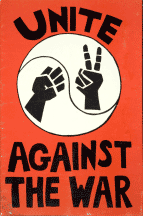
unite-against-the-warReports are emerging from July’s National Assembly, the vital effort to unite antiwar forces into a common movement. Delegates from the major peace organizations hammered out a strategy to address Iraq, Afghanistan, Pakistan and Palestine. Missing from the consensus? Nonviolence, and good riddance. It goes without saying that humanitarian activists are peaceful. To legislate a dogma of non-confrontation plays right into the hands of the authoritarians. Here’s the official report:
AN ASSESSMENT OF THE FIRST YEAR OF THE NATIONAL ASSEMBLY TO END THE IRAQ AND AFGHANISTAN WARS AND OCCUPATIONS

Address given by Marilyn Levin, member, National Assembly Administrative Body, and Planning Committee, Greater Boston United for Justice with Peace Coalition, to the National Antiwar Conference held July 10-12, 2009 in Pittsburgh, Pennsylvania

July 10-12, 2009, 255 people representing diverse organizations and constituencies from all over the country came together in Pittsburgh:

1) To look at where we are today,

2) To articulate our long range goals to rejuvenate the antiwar movement towards building a massive movement capable of forcing an end to their wars and occupations, to take our money back from the war machine to meet pressing social needs, and to save our planet for our children, and

3) To develop and vote for action plans as steps to realize these objectives.

All of our major objectives were accomplished and we leave today with a comprehensive action agenda to carry us through to next spring. Everyone had a chance to speak and differences were aired without rancor or splits to achieve unity in action.

Friday night’s speakers, along with many conference participants, grappled with how to unify and broaden the movement. Saturday afternoon and Sunday morning, we presented a great roster of workshops covering the major issues we face today. Saturday night’s rally was dynamic and inspiring.

There were two highlights of the conference for me. First was the international component where activist comrades joined us from Canada and courageous labor leaders of powerful mass movements in Haiti and Guadaloupe reminded us that imperialism and the struggle against it are global. There was a statement by members of the Viva Palestina aid convoy detained in Egypt. We passed motions in solidarity with the struggles of the people of Haiti, Honduras, and Palestine.

The second highlight was the discussion on Iran, where, in spite of strong passions stirred up by the rapidly evolving events there, we were able to illuminate the issues and debate our differences. Finally, we were able to agree on a unity position that all could embrace, as well as meeting the foremost call of the Iranians – US Hands off! No Sanctions! No interventions! Self-determination for the Iranian people! A wonderful example of a united front –- as inclusive as possible and taking principled positions that most will accept and act on.

So what is the National Assembly? What you saw this weekend explains who we are and how we function.

Democracy. All were invited and all perspectives welcomed. There was acceptance of the will of the conference even when it diverged from the proposals put forward by the leadership body. We were especially gratified that representatives from all the major antiwar coalitions came and addressed our conference.

Our willingness to struggle for unity and compromise when needed in order to move forward, as evidenced by a leadership that did not impose personal political views on others in service to unity.

An organization that admits to and learns from its mistakes and accepts its limitations when the unity we seek can’t yet be achieved.

An organization that has built a growing cadre of leaders that has developed trust, a structure that works, and a strong working relationship.

And finally, confidence, vision, and optimism. Confidence that we can provide leadership in rebooting our movement. A vision regarding how to accomplish that and an understanding of the necessity for these kinds of conferences leading to action. Optimism that masses of people will move in opposition to these horrendous policies that bring death and destruction and that they will have the power to change the world.

I’ve been asked to give an assessment of the first year since our initiation as an ongoing network with a mission, from our first conference in June, 2008 until today. Last year, we weren’t sure anyone would come and lo and behold 400 people came together in Cleveland to inaugurate a year of activities and set up a structure to maintain our work. A lot has transpired in that year and the National Assembly is well on its way as an established organization recognized throughout the movement as providing leadership and promoting a direction towards growth.

I need to start a little earlier and go back to why the National Assembly was called into existence in the first place.

What we saw, in the spring of 2008, was a movement at a low ebb – one that was shrinking rather than growing in spite of the war dragging on — this while the antiwar sentiment couldn’t be higher, and the disapproval rating for the Bush Administration couldn’t have been lower. From the high point of the largest action against the Iraq War in September, 2005 which drew 700,000 people, there was a pulling away from mass action by significant sections of the movement which supported electoral politics as the central strategy, in spite of a recurring pattern of disappointment when Democratic “antiwar” candidates voted again and again for war and war funding, and a split between the two major national coalitions, UFPJ and ANSWER, one that continues to this day. For the first time in five years, there was not enough unity or mass action perspective for any national demonstrations to take place marking the 5th year of the occupation of Iraq. Fundamentally, there was a vacuum of leadership.

Some far-sighted people like Jerry Gordon and Jeff Mackler, with experience gained from leadership in the last powerful antiwar movement that ended the Vietnam War, felt impelled to act. They began to organize a base of diverse but like-minded activists committed to building and expanding an effective antiwar movement in this country. The vehicle to accomplish this was the first national assembly, a national conference to pull activists together, to analyze the present state of the movement, to discuss where we needed to go and the actions that were needed to get us there.

We developed a unity statement with five basic principles that we hold today as the basis for where we stand:

1) Unity – all sections of the movement working together for common goals and actions;

2) Political Independence – no affiliations or support to any political party;

3) Democracy – decision-making at conferences with one person, one vote;

4) Mass Action – as the central strategy for organizing while embracing other forms of
outreach and protest; and

5) Out Now – the central demand to withdraw all military forces, contractors, and bases
from the countries where the U.S. was waging war on the people.

It seems simple but no one else saw it that way. Our conference was unique in the history of the present movement.

The organizers didn’t know what the mood and composition or strength of the conference would be, so we were cautious and minimal in the program we posed to the conference. We focused on Out Now from Iraq and modest action proposals, not being strong enough to initiate national actions on our own. The conference participants were ahead of us and ready to tackle the larger issues. Proposals were passed to add “Out Now from Afghanistan”, “End U.S. Support for the Occupation of Palestine”, and “Hands off Iran” to our set of demands, and given what has transpired in these areas, we were well prepared to take on a major role.

October 10th actions held in 20 cities were endorsed as well as a call for December actions building towards what we hoped would be unified, nationally coordinated bicoastal mass actions in the spring of 2009, the 6th year of the Iraq occupation. When Gaza was brutally assaulted, we joined with ANSWER and others to march in Washington and to demonstrate in the streets all over the country, and we’re still working under Palestinian leadership to bring justice and relief to a beleaguered population.

We made a concerted effort to find a common date for spring bi-coastal mobilizations. As you know, ANSWER chose March 21st as a day of united protests which we endorsed, while UFPJ called for a national march on Wall St. on April 4th. A number of National Assembly supporters who were also delegates to the UFPJ conference in December formed a mass action unity caucus and went to the conference with a resolution to allow delegates to vote for one or both actions but this was rejected. We’ll keep trying for 2010. The National Assembly endorsed and built both actions and marched behind our signs with our demands. The demonstrations were small (but spirited) and still of major importance.

For us, it’s quality, not quantity, as we position ourselves to be in the forefront as the pendulum swings in our direction once again.

Some take the position that mass demonstrations are not effective, unless we can pull 100,000 protestors into the streets. This is short-sighted and does not address how we get from small to large. Any successful movement for change doesn’t start with 100,000 people, and there has never been significant social change without mass actions. I remember my first anti-Vietnam war demonstration was in 1963 in Detroit and we had 15 people. In 1965, SDS called the first national march against the war in Washington. 25,000 people turned out and we thought it was huge!

Everyone talks about reaching out to the thousands of young people who mobilized to elect Obama. We agree, but we say the way to do this is by offering education and action. Action beyond calling, and emailing, and faxing the politicians they placed in office.

Why are mass demonstrations so important to building a powerful movement? It is because they accomplish so much in the process of building them. They provide:

Continuity. You can’t build anything by starting anew each time. Each action should lead to the next action or open national conference, with success building upon success. We need a continuity of leadership that builds trust and a reputation for integrity, and that learns lessons to improve. We need a continuity of organization and structure that can implement the tasks before us.

Visibility. Actions in the street give heart to the people the U.S. is attacking and occupying, letting them know that they are not alone. Mass actions create solidarity, offering support to anti-war soldiers, vets and their families, and a counter-force to the economic draft facing our youth, and they strengthen and deepen the antiwar sentiment of the people.

Inspiration. New people are brought into the movement, especially the youth, through activism. Have you ever talked to young people coming to a mass demonstration for the first time? They are inspired and thrilled to hear powerful speakers who are leaders of social justice movements and soldiers resisting the wars. They see they are not alone and get a taste of the power of large numbers of people marching together. They are energized to go home and join with others to continue to organize opposition to brutal U.S. wars and occupations. This is the way to reach out to the Obama supporters.

Explanation. An analysis of what is going on is offered along with tying together what seem at first to be disparate elements, i.e., war is tied to the economy, the war budget, bail-outs of the rich, the lack of basic needs being met, justice denied, and the impoverishment of the people.

Pressure on Government. People in this country are taught to be quiet. We’re told that our job is to elect officials whom we agree with periodically and then go home and wait while they fix things. This conveniently maintains the status quo but it sure doesn’t put pressure on them, or scare them, or force social change. Mass actions provide the most effective way to make significant change happen.

Let’s look at the present period. Obama’s election was based in large part on the hopes and aspirations of Americans for peace and a better life based on the promises and assumed promises that were made of peace, justice, and prosperity, which have not and will not be met.

Contrary to expectations, the previous administration’s policies are continued with a more handsome and articulate face. We all know that rather than winding down, wars and interventions are escalating and the rapacious greed of this immoral system knows no bounds.

Simultaneously, the economic crisis is causing terrible hardship for working people and for people who are no longer able to find work and their families. They are using this self-created financial disaster to further cut the standard of living and eliminate a secure future for older people and the young.

It was very moving and yet appalling to see this visually demonstrated when Robin Alexander of the United Electrical Workers Union asked people in the audience to stand who were unemployed, personally knew of soldier casualties, lived in communities where services were being cut, or who were otherwise negatively impacted by the wars and the failing economy. Nearly the entire room, a microcosm of the wider society, was standing by the end of that exercise.

It is inevitable that the present period of quiescence and hanging on to the hope that Obama and the new Congress will save us will come to a crashing end. People will not sit idly by forever while the world around them collapses. We are already seeing the beginnings of stirring. There is a greater willingness to go out in the streets to protest. There is more organizing taking place on campuses, more young people joining the movement. The many proposals for October actions are an indication that there is a widespread awareness of the need for actions this fall and the conviction that the movement must find common dates.

Brian Becker, National Coordinator of ANSWER, urged that we all work together to mount nationally coordinated actions next spring. Michael McPhearson, Co-Chair of UFPJ and Executive Director of Veterans for Peace, announced his support for October 17 and his willingness to do what he could to spur unified actions in the spring of 2010. We must have the faith and confidence that the people have the power to end the atrocities resulting from U.S. wars and occupations, and that they will recognize and utilize this power. As this happens, we must build a stronger antiwar movement that is able to provide leadership and the optimism to forge ahead no matter what the opposition throws at us.

The National Assembly to End the Iraq and Afghanistan Wars and Occupations is helping to provide that leadership and the vision that is needed. Although young and small, in one short year, we are now a force to be taken seriously and negotiated with, and by our persistent call for unity and mass action, our demonstrated ability to organize, and our coordinated strategy for revitalizing the movement, we are having an impact larger than our forces would indicate. In some ways, we too are a product of (and some say an antidote to) the 2008 election. To counter the malaise of the movement, we have quietly been building a solid core of activists and leaders around the country that understand the importance of a united front organized around principled demands and mass actions, not just calling Washington politicians when bills come up and crises happen.

At this conference, we have laid out an ambitious program of action that will take us through the spring of 2010. We are proud that we could provide the kick off for national organizing to bring a massive turnout to Pittsburgh for the G-20 protests September 25. Homeland Security is already making preparations to keep protesters hidden and stifle our right to speak out, but we won’t be silenced.

Following that, are a series of October building actions, culminating in large local and regional demonstrations on October 17 marking dates of significance related to the Iraq and Afghanistan wars and occupations and remembering the legacy of the anti-Vietnam war movement. Throughout the year, we will organize educational programs, support various forms of protest and organize around the inevitable emergencies caused by our government’s unholy interventions and threats to other nations.

We have initiated a Free Palestine Working Committee to ensure this work, which includes the growing boycott, divestment, and sanctions campaigns and the efforts to break the siege of Gaza, continues to be in the forefront and fully integrated in our work until justice and self-determination and return is in the hands of the Palestinians.

And lastly, we will continue to advocate for unity of the movement and once again bring thousands to Washington and the West Coast in the spring, to let our government and the world know that the U.S. movement against wars and occupations is alive and will not be quiet.

We will march and continue to march until all U.S. forces come home, bases are dismantled, and the sovereign people of the world have the right to control their own resources and determine their own futures, and the war budget becomes the peace budget.

Don’t sit on the sidelines and watch history being made. We urge all organizations to join the National Assembly and to play your part in building and shaping the powerful movement that is coming.

All out for the September 25 G-20 march in Pittsburgh! All out for the actions in early October! All out October 17!

2p, 2p and Honduras… and Mexico… and Nicaragua… and…

I don’t know if I’ve published this here or not or how I packaged it. But for background, the “p” stands for “piastre” a South VietNamese coin that was worth a little less than a quarter of a U.S. penny. This was the “Great Free Market Opportunity” our government was sending people to fight and die to defend. The way I heard it on some occasions it’s used to condemn the VietNamese people.”How nasty and vile and filthy they are” for living in such poverty.

But it was the VietNamese version of a washroom attendant, a little old granny lady… “Wipe your ass for you, GI… 2p, 2p do extra good job 2p, 2p…”

Yes, we were there, so it seems, to give the people such a wonderful Free Market and the opportunity to wipe our asses for less than a half a cent per “use”.

And to despise them for being so desperately poor.

I wasn’t there, my sources were, so what if you say it’s false?

Talk to them, those who are still alive that is.

Now there’s a war going on in Honduras, backed exclusively by U.S. and Canadian corporations, to topple a “Dictator” who was going to nationalize the resources of Honduras and make the U.S. and Canadian corporations pay more than the 3-4 dollars a day for the labor of the People of Honduras.

The police and military have been battling in the streets for a week now, busting the heads of “elitists” who are trying to “enslave” everybody in Honduras. They did this in a Military coup ahead of an election that the “Dictator” probably would have won.

That there’s no CIVILIANS out busting the heads of these “elitists” and “Communist Radicals” tells a far different story than you might hear on, say, Fox News or in the Colorado Springs Gazette.

In Nicaragua the goon-squads were called “Contras” and backed by the same people who bring us Fox News and the Gazette. They bombed and shot up schools, orphanages, churches and hospitals, and “our” government called them Heroes and Freedom Fighters.

In Mexico, the PAN party has been running the show for a while now. They took over from the “socialist radicals” in the PRI party and for the same reason as Honduras, and Nicaragua, and South VietNamese, to give the people “Freedom” and the unfettered “Free Market” and all the benefits of Capitalism.

Doug Lamborn and Tancredo and Michelle Malkin tell us so, thus, it must be true.

They also tell us that the economy in Mexico after two and a half terms of a PAN controlled “Free” government, so filled with opportunity… is somehow oh.. how does one make this sound logical… fueling a massive wave of Illegal Immigration into the United States. By people seeking to feed their families.

Record Numbers in fact.

My my my my my… give them all the Benefits of a Reagan-inspired Libertarian Free Market and their country falls to shit and more of the people have to flee poverty and come here to find work.

Like the KTEL commercials used to say “Now how much would you pay? BUT WAIT! THERE’S MORE!”

They’re wanting to expand the same Corporate Free Market Rule all across the United States as well, promising us such wonderful Economic Freedom and Opportunity…

Wipe your ass GI, 2p, 2p…

Cuba declines OAS offer of Trojan Horse

Over US objections, the Organization of American States (OAS, OEA) voted to invite Cuba back into the fold, from which it had been expelled in 1962 for hanging with Communists. Cuba’s reply? No thanks! Although Cuba’s acceptance by fellow nations was hailed a victory, Fidel Castro wrote: “It is naive to think that the good intentions of one president justifies the existence of a body that… supported… neoliberalism, drug trafficking, military bases and economic crises.”

In an essay published the day before Cuba’s official repudiation of the offer to recommit to the OAS, Fidel Castro recalled a lesson from the siege of Troy. Castro was reported widely as having called the OAS a “U.S. Trojan horse.” In reality, Castro blamed the OAS for having “opened the gates” to the Trojan horse of US post-colonial despotism.

The Trojan horse

RAFAEL Correa, president of Ecuador, currently visiting Honduras, stated the day before the OAS meeting: “I believe that the OAS has lost its raison d’être, maybe it never had a raison d’être.” The news, circulated by ANSA, adds that Correa, “prophesized ‘the demise’ of that organization given the many errors it has committed.”

He affirmed “that the countries of the American continent, given their geographic conditions, cannot all be put ‘in the same basket.’ And for that reason Ecuador proposed some months back the creation of the Organization of Latin American States.

“’It is not possible for the region’s problems to be discussed in Washington; let us construct something of our own, without countries alien to our culture, our values, and obviously including countries that were inexplicably separated from the inter-American system, and I am referring to the concrete case of Cuba… that was a tremendous shame and demonstrates the double standards that exist in international relations.’” On his arrival in Honduras, both President Zelaya and Correa stated that “The OAS must be reformed and reincorporate Cuba; if not, it will have to disappear.”

Another cable from the DPA news agency affirms:

“Cuba’s reintegration in the Organization of American States (OAS) has moved from being an issue per se of the organization’s General Assembly in Honduran San Pedro Sula, to once again being turned into an excuse for a struggle of interests that goes much further than the limits of the Caribbean island and could (once again) call hemispheric relations into question.

“The president of Venezuela, Hugo Chávez, made that very clear on describing the hemispheric meeting that begins this Tuesday in Honduras in quasi military terms.

“It will be,” he said, an ‘interesting battle’ in which if it is demonstrated that the OAS ‘continues being a ministry of the colonies’ that is not transformed in order ‘to subordinate itself to the will of the governments comprising it,’ it will be necessary to propose ‘leaving’ the organization and creating an alternative.”

“’Latin American countries are making Cuba the litmus test for the quality of the Obama administration’s approach to Latin America,” Julia E. Sweig, a Cuba scholar at the Council on Foreign Relations, told The Washington Post on the eve of the Honduran meeting.”

In resisting the aggressions of the most powerful empire ever to have existed, our people fought for the other sister peoples of this continent. The OAS was an accomplice of all the crimes committed against Cuba.

At one moment or another, the totality of the countries of Latin America were victims of interventions and political and economic aggression. There is not one single one that can deny that. It is naive to believe that the good intentions of a president of the United States can justify the existence of that institution that opened the gates to the Trojan horse that backed the Summits of the Americas, neoliberalism, drug trafficking, military bases and economic crises. Ignorance, underdevelopment, economic dependence, poverty, the forced return of those who emigrate in search of work, the brain drain, and even the sophisticated weapons of organized crime were the consequences of interventions and plundering proceeding from the North. Cuba, a little country, has demonstrated that it can resist the blockade and advance in many fields, and even cooperate with other countries.

Today’s speech by the president of Honduras, Manuel Zelaya, at the OAS General Assembly, contains principles that could go down in history. He said admirable things of his own country. I will confine myself to what he stated on Cuba.

“…In the Assembly of the Organization of American States that begins today in San Pedro Sula, Honduras, we must initiate the process of wise rectifications of old errors committed.

“We, the Latin Americans who were recently here, a couple of weeks or months ago, had a grand summit within the Rio Group in Salvador de Bahía, Brazil. There we made a commitment. The commitment, which was taken down in writing and unanimously by all of Latin America, is that in this San Pedro assembly, by majority vote or consensus, that old and worn error committed in 1962 of expelling the Cuban people from this organization would have to be amended.

“We must not go from this assembly, my dear dignitaries, without repealing the decree of that 8th meeting which sanctioned an entire people for having proclaimed socialist ideas and principles, principles now practiced in all parts of the world, including the United States and Europe (Applause). Today, principles of seeking different development alternatives are evident precisely in the change that there has been in the United States with the election of President Barack Obama…

“We cannot go from this assembly without making amends for that error and that infamy because, on the basis of this Organization of American States resolution, in existence for more than four decades, an unjust and useless blockade has been maintained against this sister people of Cuba, precisely because none of its aims have been achieved, but what it has demonstrated is that here, a few kilometers from our country, on a little island, there is a people prepared to resist and to make sacrifices for their independence and sovereignty.

“… not doing so would make us accomplices of a 1962 resolution to expel a state from the Organization of American States simple because it has other ideas, other thoughts, and proclaims principles of a different democracy. And we are not going to be accomplices of that.

“…We cannot go from this assembly without repealing what was enacted in that epoch.

“An exceptional Honduran, called in our country – and one of our national heroes – José Cecilio del Valle, the sage Valle, stated on April 17, 1826, in his famous article ‘Sovereignty and non-intervention’ – we had just proclaimed our independence from the Spanish kingdom – “’The nations of the world are independent and sovereign. Whatever its territorial extension or number of inhabitants might have been, a nation must treat others with the same treatment that it desires to receive from these. A nation does not have the right to intervene in the internal affairs of another nation.’”

With those words of Cecilio del Valle and the mention of Mahatma Gandhi, Jesus Christ, Martin Luther King, Abraham Lincoln, Morazán, Martí, Sandino and Bolívar, he concluded his speech.

A few minutes later, at the press conference after the opening of the Assembly, he responded to questions and reiterated principles. Then he gave the floor to Daniel Ortega, who was the author of one of the most profound and well-argued papers at the OAS Assembly. At Zelaya’s invitation, Fernando Lugo, president of Paraguay, and Rigoberto Menchú also spoke, expressing themselves in terms similar to Zelaya and Daniel.

The Assembly has been debating for hours. As I am concluding this Reflection, almost at nightfall, there is still no news of the decision. It is known that Zelaya’s speech was influential. Chávez is talking with [Venezuelan Foreign Minister] Maduro and urging him to firmly maintain that no resolution can be admitted that conditions the repeal of the unjust sanction against Cuba. Never has such rebellion been seen. Without any doubt, the battle is a hard one. Many countries are dependent on the index finger of one hand of the government of the United States pointing at the Monetary Fund, the World Bank, the InterAmerican Development Bank or in any other direction for punishing rebelliousness. Having waged it is already a feat in itself on the part of the most rebellious. June 2, 2009 will be recalled by future generations.

Cuba is not an enemy of peace, nor reluctant to interchange or cooperation among countries of distinct political systems, but has been and always will be intransigent in the defense of its principles.

Fidel Castro signature

Fidel Castro Ruz – June 2, 2009

Benazir Bhutto of Team America

Benazir Bhutto in true colorsWhy was Benazir Bhutto’s return to Pakistan feted with bombs? Whether the bombers were Pakistani security forces or Talibani “terrorists” or western black-ops (each faction by coincidence also fingered for 9/11), they targeted Bhutto because she represents US interests for Pakistan.
 
Our media says she heralds Democracy, their corporate owners know the truth is Capitalism of the most sordid exploitive kind. The press corps traveled with Bhutto on her much hyped homecoming from self-exile. Did their emotion-drenched personal interest leave any doubt their girl’s a member of the American-Dream team?

Team America includes:
Hamid Karzai, President of AFGHANISTAN
Alvaro Uribe, President of COLOMBIA
Meles Zenawi, President of ETHIOPIA
Rene Preval, President of HAITI
Emile Lahoud, President of LEBANON
Felipe Calderon, President of MEXICO
Mahmoud Abbas, President of OCCUPIED PALESTINE
Mohammed Yousef, Puppet in waiting in SOMALIA
Yoweri Museveni, President of UGANDA

Remember these US agents?
General Jorge Rafael Videla, President of ARGENTINA
Colonel Hugo Banzer, President of BOLIVIA
General Humberto Branco, President of BRAZIL
Sir Hassanal Bolkiah, the Sultan of BRUNEI
General Augusto Pinochet, President of CHILE
Fulgencio Batista, President of CUBA
Rafael Leonidas Trujillo, President of the DOMINICAN REPUBLIC
Maximiliano Hernandez Martinez, General of EL SALVADOR
Alfredo Cristiani, President of EL SALVADOR
Halie Selassie, Emperor of ETHIOPIA
General Sitiveni Rabuka, Commander, Armed Forces of FIJI
George Papadopoulos, Prime Minister of GREECE
General Efrain Rios Mont, President of GUATEMALA
Vinicio Cerezo, President of GUATEMALA
François & Jean Claude Duvalier, Presidents-for-Life of HAITI
Roberto Suazo Cordova, President of HONDURAS
General Suharto, President of INDONESIA
Mohammad Reza Pahlevi, Shah of IRAN, King of Kings
Saddam Hussein, President of IRAQ
General Samuel Doe, President of LIBERIA
Hussan II, King of MOROCCO
Anastasio Somoza, Sr. And Jr., Presidents of NICARAGUA
Mohammed Zia Ul-Haq, President of PAKISTAN
General Manuel Noriega, Chief of Defense forces, PANAMA
Alfredo Stroessner, President-for-Life of PARAGUAY
Ferdinand Marcos, President of the PHILIPPINES
Antonio De Oliveira Salazar, Prime Minister of PORTUGAL
Ian Smith, Prime Minister of RHODESIA
P. W. Botha, President of SOUTH AFRICA
Park Chung Hee, President of SOUTH KOREA
Ngo Dinh Diem, President of SOUTH VIET NAM
General Francisco Franco, President of SPAIN
Chiang Kai-Shek, President of TAIWAN
Turgut Ozal, Prime Minister of TURKEY
Mobutu Sese Seko, President of ZAIRE

How the US and its allies stole children in El Salvador

Many Americans are somewhat aware that the Argentinian allies of the US once stole babies from mothers that they had imprisoned, tortured, and then murdered. Those babies were then given to families of the leaders of the Argentinian military and government itself! This is an international scandal that still effects how many people perceive Argentinian society to this very day. It is a horrible legacy of the Dirty War that the US and its ally, the Argentinian government, waged on the Latin American Left.

In El Salvador, as in Guatemala and Honduras, too, the allies of the US engaged in the same sort of war crime; the stealing of children from their parents. Some of these children ended up in the US, others in Europe, and others were found dead, or inside El Salvador with families other than their natural ones. The New York Times has a recent story about one such child that as an adult has just relocated her natural family with the help of an organization called Pro-Busqueda. Check out their website for more info on their work.