Smokey Bear wants to prevent fires, does he belong to your resistance?

So there’s a t-shirt being pitched by the alt-mod-left, who want to coopt the anti-Trump rallying cry RESIST. It’s Smokey Bear with his head down and fist raised, invoking the Black Panther salute made iconic at the 1968 olympics. Except his fist is on FIRE, and it’s Smokey. WTF. Is he resisting putting it out? Smokey Bear’s singular catch-phrase is about YOU, PREVENTING FIRES. As usual, he’s holding a shovel, a reminder that fighting forest fires is essentially ditch-digging. So what is Smokey resisting? The urge to douse the fire burning up his hand? The image reminds me of the innanity of moderate democrats. Both “Smokey” and “Bear” have long become euphemisms for cops. This Smokey wants to embed with your resistance crew. Knock him out with a shovel.

Pro-immigrant activists with Occupy Denver file suit against DIA and DPD, challenge airport free speech “permit”


DENVER, COLORADO- Civil liberties champion David Lane has filed a complaint in US district court challenging Denver’s office of the city attorney for instituting a permit process at DIA to prevent public protest. Holding signs has become impermissible at the airport, without the issuance of a permit seven days in advnace, although police are not bothering themselves about signs welcoming homecomers or seeking to connect business visitors with their limo service. That selective enforcement is unconstitutional of course, and the lawfirm powerhouse of Kilmer Lane & Newman is filing suit on behalf of two Occupy Denver plaintiffs. last Sunday, January 29, both were threatened with arrest by DIA police. While two earlier attempts to assemble had capitulated to DPD intimidation, the Occupy Denver activists stood their ground. Why did you file your lawsuit? “We know our rights. We want the POLICE to know our rights.”

1. Full text of complaint:

Case 1:17-cv-00332 Document 1
Filed 02/06/17 USDC Colorado Page 1 of 14

Civil Action No.

IN THE UNITED STATES DISTRICT COURT FOR THE DISTRICT OF COLORADO

NAZLI MCDONNELL,
ERIC VERLO,

Plaintiffs, vs.

CITY AND COUNTY OF DENVER,?
DENVER POLICE COMMANDER ANTONIO LOPEZ, in his individual and official capacity,
DENVER POLICE SERGEANT VIRGINIA QUINONES, in her individual and official capacity,

Defendants.

______________________________________________________________________________

COMPLAINT

______________________________________________________________________________

Plaintiffs, by and through their attorneys David A. Lane and Andy McNulty of KILLMER, LANE & NEWMAN, LLP, allege as follows:

INTRODUCTION

1. Plaintiffs Eric Verlo and Nazli McDonnell challenge a regulation of alarming breadth that bans all First Amendment expression at Denver International Airport without a permit.

2. Plaintiffs are concerned citizens who believe that President Donald Trump has overstepped his executive authority by signing the January 27, 2017, Executive Order (hereinafter “Muslim Ban”), which permanently bans Syrian refugees from emigrating to the United States, temporarily bans nationals of seven countries (including permanent legal residents and visa-holders), and suspends all applications to the United States refugee program (even as to vetted entrants currently in transit).

3. Plaintiffs wish to express their disgust with President Trump’s (likely unconstitutional) Muslim Ban. They wish to do so in the same place that hundreds of thousands of Americans across the country have done: standing directly outside of the secure Customs and Border Protection (hereinafter “CBP”) screening area within an airport where immigrants to America enter into the main terminal after clearing customs. Plaintiffs, unlike many citizens across this great nation who have exercised their opposition to the Muslim Ban in airports by chanting, singing, dancing, and praying, simply wish to stand in silent protest, holding signs that express their solidarity with immigrants and the Muslim community.

4. Plaintiffs are banned from doing so by DENVER INTERNATIONAL AIRPORT REGULATION 50 (hereinafter “Regulation 50”).

5. Regulation 50 states: “No person or organization shall leaflet, conduct surveys, display signs, gather signatures, solicit funds, or engage in other speech related activity at Denver International Airport for religious, charitable, or political purposes, or in connection with a labor dispute, except pursuant to, and in compliance with, a permit for such activity issued by the CEO or his or her designee.” DENVER INTERNATIONAL AIRPORT REGULATION 50.03. In order to obtain a permit, an individual must “complete a permit application and submit it during regular business hours, at least seven (7) days prior to the commencement of the activity for which the permit is sought[.]” DENVER INTERNATIONAL AIRPORT REGULATION 50.04-1.

6. Plaintiffs ask that this Court enjoin the enforcement of Regulation 50 and prohibit Defendants from arresting them for their First Amendment-protected activity of standing in peaceful protest within Jeppesen Terminal. Regulation 50 is overbroad in violation of the First Amendment and vague in violation of the Fourteenth Amendment’s Due Process Clause.

7. This is a civil rights action for declaratory and injunctive relief as well as fees and costs arising under 42 U.S.C. §§ 1983, 1988 and 28 U.S.C. Section 2201 et seq. due to Defendants’ current and imminent violations of Plaintiffs’ rights guaranteed by the First and Fourteenth Amendments to the Constitution of the United States.

PARTIES

8. Plaintiff Eric Verlo is a citizen of the United States of America. Mr. Verlo wishes to show his resistance to President Trump’s Muslim Ban, so that others will be inspired to join in the resistance.

9. Plaintiff Nazli McDonnell is a citizen of the United States of America. Ms. McDonnell wishes to show her resistance to President Trump’s Muslim Ban, so that others will be inspired to join in the resistance.

10. Defendant City and County of Denver is a municipal corporation and political subdivision of the State of Colorado. Thus, it is an entity subject to the provisions of § 1983.

11. Defendant Antonio Lopez is a Commander with the Denver Police Department. Commander Lopez is responsible for security at Denver International Airport’s Jeppesen Terminal.

12. Defendant Virginia Quinones is a Sergeant with the Denver Police Department. Sergeant Quinones is responsible for security at Denver International Airport’s Jeppesen Terminal.

JURISDICTION AND VENUE

13. Plaintiffs bring this claim pursuant to 42 U.S.C. § 1983; the First Amendment to the United States Constitution, incorporated as against States and their municipal divisions through the Fourteenth Amendment to the United States Constitution; and the Due Process Clause of the Fourteenth Amendment.

14. This Court has jurisdiction under 28 U.S.C. § 1331 over Plaintiffs’ claims that “arise[] under the Constitution of the United States.”

FACTS

15. On January 27, 2017, President Donald Trump signed an Executive Order, which permanently banned Syrian refugees from emigrating to the United States, temporarily banned nationals of seven countries (including permanent legal residents and visa-holders), and suspended all applications to the United States refugee program (even as to vetted entrants currently in transit). President Trump’s Executive Order has been subsequently referred to as a “Muslim Ban,” because it both mirrors President Trump’s racist, anti-Islam statements made on December 7, 2015, that he was planning to ban all Muslims from entering the United States until our representatives can “figure out what’s going on” and the ban targets countries whose population is predominantly Muslim and seemingly bears little rational relation to each country’s security threat to the United States.

16. Immediately upon the enactment of President Trump’s Muslim Ban there was an outpouring of outrage from a large proportion of the American population and across the spectrum of political affiliation. This outrage led to resistance in the form of protests.

17. On January 28, 2017, and January 29, 2017, protests erupted in nearly every major city in the United States. The protests organically formed in our nation’s airports. Protesters chose to express their disgust with President Trump’s Muslim Ban in airports (and specifically outside of the secure CBP screening area) because individuals affected by the ban who were in transit to the United States were being held and questioned by CBP agents there. Many of these travelers, including lawful United States residents, were forced to sign documents revoking their lawful status within the United States and deported. Still others were simply deported with no explanation. Others still were held for hours as teams of lawyers rushed to prepare habeas petitions for their release.

18. News reports about the protests make clear that they have been peaceful and non- disruptive despite the gathering of, in some cases, thousands of people.

19. Airport staff have told protesters, and would-be protesters, at numerous airports across the nation, including Kansas City International Airport, that there are no restrictions on their speech and that all protesters who wish to participate in actions against the Muslim Ban are allowed. Protests have continued in other cities to this day.

20. On January 28, 2017, there was one such protest at Denver International Airport, within the Jeppesen Terminal. At approximately 5:00 p.m. hundreds gathered in the Jeppesen Terminal’s atrium, near arrivals, to protest and many others gathered to bear witness.

21. Prior to the protest, leaders had applied for a permit. It was denied. The reason for its denial was that the permit was not requested with seven days advance notice of the protest occurring. Regulation 50 requires seven days advance notice.

22. The January 28, 2017, protest began with speeches, chants, songs, and prayers. It was a peaceful gathering of solidarity for immigrants and Muslims. Every person at the January 28, 2017, protest was contained in an area of the Jeppesen Terminal atrium that is designed as a gathering space for people to sit, relax, and converse. No one was standing in the walkways or passageways of the terminal.

23. Soon after the January 28, 2017, protest began, members of the Denver Police Department arrived on-scene. Commander Antonio Lopez engaged the leader of the protest, Amal Kassir, along with State Representative Joe Salazar and representatives from the ACLU of Colorado, and informed them that the protest was unlawful. Commander Lopez told Ms. Kassir that anything that “could be construed as Free Speech” was prohibited at the Denver International Airport, including within the Jeppesen Terminal, without a permit. See Exhibit 1, January 28, 2017 Video.

24. Commander Lopez also stated that all “First Amendment expression” was prohibited at the Denver International Airport, including within the Jeppesen Terminal, without a permit on Regulation 50. Commander Lopez handed Regulation 50 to multiple protesters, including Ms. Kassir. See Exhibit 2, January 28, 2017 Video 2.

25. Regulation 50 states (in pertinent part): “No person or organization shall leaflet, conduct surveys, display signs, gather signatures, solicit funds, or engage in other speech related activity at Denver International Airport for religious, charitable, or political purposes, or in connection with a labor dispute, except pursuant to, and in compliance with, a permit for such activity issued by the CEO or his or her designee.” DENVER INTERNATIONAL AIRPORT REGULATION 50.03. In order to obtain a permit, an individual must “complete a permit application and submit it during regular business hours, at least seven (7) days prior to the commencement of the activity for which the permit is sought[.]” DENVER INTERNATIONAL AIRPORT REGULATION 50.04-1.

26. Commander Lopez, along with members of Denver International Security, told Ms. Kassir that every portion of Denver International Airport property, which has an approximately fifty square mile footprint, is off-limits for First Amendment expression. They suggested that Ms. Kassir move her protest to Tower Road, which is approximately six miles from the Jeppesen Terminal and, like most of the land surrounding Denver International Airport, adjacent to open prairie land with no inhabitants.

27. Commander Lopez threatened Ms. Kassir and numerous other demonstrators with arrest if they didn’t immediately cease any “First Amendment expression.” According to Commander Lopez’s directives, the individuals gathered in the Jeppesen Terminal could not stand holding signs, sing, speak to others about matters of public concern, hold the United States Constitution above their shoulders, or stand silently with their arms interlocked.

28. Ultimately, to avoid arrest, Ms. Kassir and the demonstrators moved outside of the Jeppesen Terminal to the large area on its south side, adjacent to the escalators leading to the commuter rail and under the Westin Hotel. The protest continued peacefully for a little while longer, then disbursed without issue.

29. The next day, January 29, 2017, Plaintiffs Eric Verlo and Nazli McDonnell traveled to Denver International Airport’s Jeppesen Terminal to express their opposition to President Trump’s Muslim Ban.

30. Mr. Verlo and Ms. McDonnell brought with them signs expressing support for immigrants and expressing concern that history was repeating itself with disastrous potential consequences.

31. Mr. Verlo and Ms. McDonnell positioned themselves adjacent to the secure CBP screening area within the Jeppesen Terminal at approximately 1:15 p.m.

32. Adjacent the secure CBP screening area at the Jeppesen Terminal is the only place where Mr. Verlo and Ms. McDonnell can reach their intended audience. Mr. Verlo and Ms. McDonnell wish to communicate with those who could be swayed by their message and, particularly, with immigrants. International travelers are often immigrants and/or lawful United States residents, including green card and other visa holders, other than citizens. Mr. Verlo and Ms. McDonnell wish to express their solidarity with immigrants directly to these individuals. Further, United States citizens who arrive from international locations are also individuals with whom Mr. Verlo and Ms. McDonnell wish to communicate. International travelers have experienced other cultures and are likely to be sympathetic to Mr. Verlo and Ms. McDonell’s message.

33. The secure CBP screening area is also the location where the Muslim Ban has been enforced by DHS, both at Denver International Airport and across the nation. Neither Plaintiff attempted to enter any restricted areas of Denver International Airport.

34. While silently displaying their signs, Mr. Verlo and Ms. McDonnell were in the open plaza near the secure CBP screening area within the Jeppesen Terminal and positioned significantly behind the railing, which demarcates where those waiting for loved ones are permitted to stand. Mr. Verlo and Ms. McDonnell did not impede the right of way of any passengers hustling to catch flights at the last moment. They simply stood with placards showing their distaste for the Executive Order and the man who executed it.

35. Mr. Verlo and Mr. McDonnell also observed another man in the terminal, named Gene Wells, who was expressing views similar to theirs.

36. Mr. Wells was wearing a sign taped to the back of his shirt.

37. Mr. Wells left the Jeppesen Terminal, but subsequently returned to protest. When he did, he was stopped by Denver Police Department officers who told him that he could not walk around the terminal with the slogan he had affixed to his back. Mr. Wells eventually rejoined Mr. Verlo and Mr. McDonnell at the international arrivals doors, but not without trepidation. He feared he might be arrested.

38. While Mr. Verlo and Ms. McDonnell were displaying their signs, Defendant Sergeant Virginia Quinones approached Mr. Verlo and Ms. McDonnell and threatened them with arrest if they did not leave Jeppesen Terminal. See Exhibit 3, January 29, 2017, Video.

39. Sergeant Quinones handed Mr. Verlo and Ms. McDonnell Regulation 50 and cited it as the reason they would be arrested if they did not leave Jeppesen Terminal. Id. Sergeant Quinones told Mr. Verlo and Ms. McDonnell that they would need a permit in order to stand silently, holding signs in opposition of the Muslim Ban and be in compliance with Regulation 50.

40. Had Mr. Verlo and Ms. McDonnell applied for a permit the second President Trump signed the Executive Order implementing the Muslim Ban, they still would have been unable to engage in protest within the Jeppesen Terminal under the terms and conditions of Regulation 50 on January 29, 2017.

41. Mr. Verlo and Ms. McDonnell did not immediately leave the Jeppesen Terminal after being threatened with arrest. However, they were startled by Sergeant Quiones’ threat and feared arrest for the duration of the time they were there.

42. Throughout the time Mr. Verlo and Ms. McDonnell were expressing their views within the Jeppesen Terminal they received numerous shows of support from passersby. Multiple self- proclaimed Muslims expressed heart-felt statements of appreciation to Mr. Verlo, Ms. McDonnell, and others holding signs.

43. Mr. Verlo and Ms. McDonnell ultimately left Jeppesen Terminal.

44. Mr. Verlo and Ms. McDonnell wish to return to Jeppesen Terminal to express solidarity with Muslims and opposition to the Muslim Ban, but are reticent to do so for fear of being arrested.

45. Upon information and belief, no individual has been arrested, or threatened with arrest, for wearing a “Make America Great Again” campaign hat without a permit within the Jeppesen Terminal at Denver International Airport.

46. Upon information and belief, no individual has been arrested, or threatened with arrest, for holding a sign welcoming home a member of our military without a permit within the Jeppesen Terminal at Denver International Airport.

47. Upon information and belief, no individual has been arrested, or threatened with arrest, for holding a sign and soliciting passengers for a limousine without a permit within the Jeppesen Terminal at Denver International Airport.

48. Upon information and belief, no individual has been arrested, or threatened with arrest, for discussing current affairs with another person without a permit within the Jeppesen Terminal at Denver International Airport.

49. At all times relevant to this Complaint, Defendants acted under color of law.

CLAIM I: FIRST AMENDMENT
(§ 1983 violation – all Defendants)

50. Plaintiffs repeat, re-allege, and incorporate by reference the allegations in the foregoing paragraphs of this Complaint as fully set forth herein.

51. Regulation 50 violates the Free Speech Clause of the First Amendment to the Constitution, on its face and as applied, because it impermissibly curtails Plaintiffs’ free-speech rights.

52. Plaintiffs wish to speak on a matter of public concern. 11

53. Denver International Airport’s Jeppesen Terminal is a public forum.

54. Regulation 50 directly infringes upon and chills reasonable persons from engaging in activity that is protected by the First Amendment.

55. Regulation 50 acts as an unconstitutional prior restraint on speech because it (1) requires a permit before allowing individuals to engage in speech, (2) allows for arbitrary and/or discriminatory permit denials, and (3) requires advance notice that is unconstitutionally excessive.

56. Regulation 50 is overbroad.?

57. Regulation 50 is not narrowly tailored to serve a compelling government interest.?

58. Regulation 50 does not further a substantial government interest.?

59. Regulation 50’s restriction on expressive conduct is greater than necessary to further any
government interest.?

60. Defendants’ actions and/or omissions enforcing Regulation 50 caused, directly or
proximately, Plaintiffs to suffer damages.

CLAIM II: FIRST AMENDMENT RETALIATION
(§ 1983 violation – all Defendants)

1. All statements of fact set forth previously are hereby incorporated into this claim as though set forth fully herein. ?

2. Plaintiffs engaged in First Amendment protected speech on a matter of public concern ?while displaying signs opposing President Trump’s Muslim Ban on January 29, 2017.

3. Defendants jointly and on their own accord responded to Plaintiffs’ First Amendment protected speech with retaliation, including but not limited to threatening Plaintiffs with arrest.

4. Defendants retaliatory actions were substantially motivated by Plaintiffs’ exercise of their First Amendment rights.

5. By unlawfully threatening Plaintiffs with arrest, Defendants sought to punish Plaintiffs for exercising their First Amendment rights and to silence their future speech. Defendants’ retaliatory actions would chill a person of ordinary firmness from engaging in such First Amendment protected activity.

6. Defendants’ actions and/or omissions enforcing Regulation 50 caused, directly and proximately, Plaintiffs to suffer damages.

CLAIM III: FOURTEENTH AMENDMENT DUE PROCESS
(§ 1983 violation – all Defendants)

7. All statements of fact set forth previously are hereby incorporated into this claim as though set forth fully herein.

8. The prohibitions of Regulation 50 are vague and not clearly defined. ?

9. Regulation 50 offers no clear and measurable standard by which Plaintiffs and others can ?act lawfully.

10. Regulation 50 does not provide explicit standards for application by law enforcement officers.

11. Regulation 50 fails to provide people of ordinary intelligence a reasonable opportunity to understand what conduct it prohibits, and authorizes or encourages arbitrary and discriminatory enforcement, or both.

12. Defendants’ actions and/or omissions enforcing Regulation 50 caused, directly and proximately, Plaintiffs to suffer damages.

PRAYER FOR RELIEF

WHEREFORE, Plaintiffs respectfully request that this Court enter judgment in their favor and against Defendants, and grant:

(a) Appropriate declaratory and other injunctive and/or equitable relief; 13

(b)  Enter a declaration that Regulation 50 is unconstitutional on its face and enjoin its enforcement; ?

(c)  Compensatory and consequential damages, including damages for emotional distress, loss of reputation, humiliation, loss of enjoyment of life, and other pain and suffering on all claims allowed by law in an amount to be determined at trial; ?

(d)  All economic losses on all claims allowed by law; ?

(e)  Punitive damages on all claims allowed by law and in an amount to be determined ?at trial; ?

(f)  Attorney’s fees and the costs associated with this action, pursuant to 42 U.S.C. § ?1988; ?

(g)  Pre and post-judgment interest at the lawful rate; and ?

(h)  Any further relief that this court deems just and proper, and any other relief as ?allowed by law. ?

Dated this 6th day of February 2017.

KILLMER, LANE & NEWMAN, LLP
s/ Andy McNulty

___________________________________
David A. Lane
?Andy McNulty?
Killmer, Lane & Newman, LLC
1543 Champa Street, Suite 400 Denver, Colorado 80202?
Attorneys for Plaintiff

2. Full text of Feb 6 motion for preliminary injunction:

Case 1:17-cv-00332 Document 2
Filed 02/06/17 USDC Colorado Page 1 of 23

Civil Action No.

IN THE UNITED STATES DISTRICT COURT FOR THE DISTRICT OF COLORADO

NAZLI MCDONNELL,
ERIC VERLO,

Plaintiffs, vs.

CITY AND COUNTY OF DENVER,
DENVER POLICE COMMANDER ANTONIO LOPEZ, in his individual and official capacity,
DENVER POLICE SERGEANT VIRGINIA QUINONES, in her individual and official capacity,

Defendants.

______________________________________________________________________________

MOTION FOR PRELIMINARY INJUNCTION

______________________________________________________________________________

Plaintiffs, by and through their attorneys David A. Lane and Andy McNulty of KILLMER, LANE & NEWMAN, LLP, hereby submit the following Motion for Preliminary Injunction, and in support thereof, states as follows:

1. Introduction

Over the last four days, many Americans have expressed public disapproval of President Donald Trump’s January 27, 2017, Executive Order, which permanently bans Syrian refugees from emigrating to the United States, temporarily bans nationals of seven countries (including permanent legal residents and visa-holders), and suspends all applications to the United States refugee program (even as to vetted entrants currently in transit). Plaintiffs are concerned and alarmed United States citizens who wish to join the growing chorus of voices expressing opposition to the Executive Order. To do so, they wish to stand in silent protest at the Jeppesen Terminal within Denver International Airport.

Plaintiffs did just this on January 29, 2017, standing in silent protest of the Executive Order outside of the secure Customs and Border Protection (hereinafter “CBP”) screening area within Jeppesen Terminal. Almost immediately, Plaintiffs were threatened with arrest by Denver Police Department Sergeant Virginia Quinones for standing silently and holding signs opposing the Executive Order, despite that fact that the Jeppesen Terminal has previously been used for expressive activity (and that protesters at more than ten major airports nationwide have protested peacefully without major disruption or legal restriction). While silently displaying their signs, Plaintiffs were in the plaza within the Jeppesen Terminal and positioned significantly behind the railing, which demarcates where those waiting for loved ones are permitted to stand, in the open plaza outside of the secure CBP screening area at the Jeppesen Terminal. Plaintiffs did not impede the right of way of any passengers hustling to catch flights at the last moment. They simply stood with placards showing their distaste for the Executive Order and the man who executed it.

Even though Plaintiffs were simply engaged in peaceful First Amendment protected expression, they were threatened with arrest. Sergeant Quinones informed Plaintiffs that, in order to stand silently with political signs, they would need a permit. Without a permit, Sergeant Quinones stated, all “First Amendment expression” at the Denver International Airport was banned.

This was not the first time since the enactment of the Executive Order that the Denver Police Department threatened individuals with arrest for engaging in First Amendment protected activity in Jeppesen Terminal. On January 28, 2016, a protest was held in the plaza of Jeppesen Terminal. During the protest, Denver Police Commander Antonio Lopez instructed multiple individuals, including State Representative Joseph Salazar and representatives from the ACLU of Colorado, that all “First Amendment expression” was banned at Denver International Airport without a permit. See Exhibit 1, January 28, 2017, Video 1; Exhibit 2, January 28, 2017, Video 2. The protesters had, in fact, applied for a permit earlier that day. However, it had not been granted because they had not done so seven days in advance of the protest in compliance with Denver International Airport regulations. Although no arrests were ultimately made, protesters were threatened numerous times by Commander Lopez, and other officers, with arrest.

The Denver International Airport regulation that both Sergeant Quinones and Commander Lopez relied upon in instructing Plaintiffs, and others, that Denver International Airport bans all “First Amendment expression” without a permit is DENVER INTERNATIONAL AIRPORT REGULATION 50 (hereinafter “Regulation 50”). Regulation 50 states that “no person or organization shall leaflet, conduct surveys, display signs, gather signatures, solicit funds, or engage in other speech related activity at Denver International Airport for religious, charitable, or political purposes, or in connection with a labor dispute, except pursuant to, and in compliance with, a permit for such activity issued by the CEO or his or her designee.” DENVER INTERNATIONAL AIRPORT REGULATION 50.03. In order to obtain a permit, an individual must “complete a permit application and submit it during regular business hours, at least seven (7) days prior to the commencement of the activity for which the permit is sought[.]” DENVER INTERNATIONAL AIRPORT REGULATION 50.04-1.

Plaintiffs wish to return to Denver International Airport to protest the Executive Order, but are reasonably frightened of arrest and, absent action by this Court, must choose between lawfully exercising their First Amendment right and being subject to arrest and/or prosecution.

Plaintiffs ask that this Court enter an injunction prohibiting their arrest for standing in peaceful protest within Jeppesen Terminal and invalidating Regulation 50 as violative of the First and Fourteenth Amendments to the United States Constitution.

2. Factual Background

All statements of fact set forth in the simultaneously filed Complaint are hereby incorporated into this Brief as though set forth fully herein.

3. Argument

3.1 The standard for issuance of a preliminary injunction.

When seeking a preliminary injunction, a plaintiff must establish that (1) he is likely to succeed on the merits; (2) he is likely to suffer irreparable harm; (3) the balance of equities tips in his favor; and (4) that an injunction is in the public interest. Winter v. Nat. Res. Def. Council, 555 U.S. 7, 20 (2008); see also ACLU v. Johnson, 194 F.3d 1149, 1155 (10th Cir. 1999).

The Tenth Circuit has modified the preliminary injunction test when the moving party demonstrates that the second, third, and fourth factors “tip strongly” in its favor. See Oklahoma ex rel. Okla. Tax Comm’n v. Int’l Registration Plan, Inc., 455 F.3d 1107, 1113 (10th Cir. 2006); see also 820 F.3d 1113, n.5 (10th Cir. 2016). “In such situations, the moving party may meet the requirement for showing success on the merits by showing that questions going to the merits are so serious, substantial, difficult, and doubtful as to make the issue ripe for litigation and deserving of more deliberate investigation.” Id. (internal quotation marks omitted). Moreover, this “fair chance of prevailing” test is appropriate in this case because Plaintiffs are challenging a policy, not a statue or ordinance. See Planned Parenthood Minn, N.D., & S.D. v. Rounds, 530 F.3d 724, 732 (9th Cir. 2008) (“[C]ourts should… apply the familiar ‘fair chance of prevailing’ test where a preliminary injunction is sought to enjoin something other than government action based on presumptively reasoned democratic processes.”).

Under either standard, Plaintiffs are able to demonstrate that the issuance of a preliminary injunction is appropriate in this matter.

3.3 Regulation 50 implicates Plaintiffs’ First Amendment rights. 1

When the government regulates the exercise of First Amendment rights, the burden is on the proponent of the restriction to establish its constitutionality. Phelps-Roper v. Koster, 713 F.3d 942, 949 (8th Cir. 2013). Moreover, when assessing the preliminary injunction factors in First Amendment cases, “the likelihood of success will often be the determinative factor.” Hobby Lobby Stores, Inc. v. Sebelius, 723 F.3d 1114, 1145 (10th Cir. 2013). This is because “the loss of First Amendment freedoms, for even minimal periods of time, unquestionably, constitutes irreparable injury,” Heideman v. Salt Lake City, 348 F.3d 1182, 1190 (10th Cir. 2003), and it is invariably in the public interest to protect an individual’s First Amendment rights. See Homans v. City of Albuquerque, 264 F.3d 1240, 1244 (10th Cir. 2001) (noting that “the public interest is better served” by protecting First Amendment rights).

[NOTE 1. It is important to note that facial challenges to government policies and statutes, when based on First and Fourteenth Amendment grounds, are not disfavored. See United States v. Stevens, 559 U.S. 460, 473 (2010); City of Chicago v. Morales, 527 U.S. 41 (1999).]

3.4 Plaintiffs are likely to succeed on the merits.

Plaintiffs are likely to succeed on the merits because Regulation 50 violates the Free Speech Clause of the First Amendment and the Due Process Clause of the Fourteenth Amendment.

3.4(a) Plaintiffs engaged, and wish to engage, in speech on a matter of public concern.

Plaintiffs’ speech is at the core of the First Amendment’s protection because it deals with a matter of public concern. “Speech deals with matters of public concern when it can be fairly considered as relating to any matter of political, social, or other concern to the community, or when it is a subject of legitimate news interest; that is, a subject of general interest and of value and concern to the public.” Snyder v. Phelps, 562 U.S. 443, 453 (2011) (internal quotation marks and citation omitted). “Speech on matters of public concern is at the heart of the First Amendment’s protection.” Id. at 451-52 (alterations and quotation marks omitted). “The First Amendment reflects ‘a profound national commitment to the principle that debate on public issues should be uninhibited, robust, and wide-open.’” Id. at 452 (quoting New York Times Co. v. Sullivan, 376 U.S. 254, 270 (1964)). Plaintiffs wish to engage in expression about President Donald Trump’s January 27, 2017, Executive Order, a topic that has generated nearly unprecedented debate and dissent. See Adrienne Mahsa Varkiani, Here’s Your List of All the Protests Happening Against the Muslim Ban, THINK PROGRESS (Jan. 28, 2017), https://thinkprogress.org/muslim-ban-protests-344f6e66022e#.ft1oznfv4 (compiling list of direct actions planned in response to President Trump’s January 27, 2017, Executive Order). Thus, Plaintiffs’ speech “‘occupies the highest rung of the hierarchy of First Amendment values, and is entitled to special protection.’” Snyder, 562 U.S. at 452 (quoting Connick v. Myers, 461 U.S. 138, 145 (1983)).

3.4(b) Regulation 50 acts as a prior restraint.

The restriction at issue in this matter is a prior restraint. “The term prior restraint is used ‘to describe administrative and judicial orders forbidding certain communications when issued in advance of the time that such communications are to occur.’” Alexander v. United States, 509 U.S. 544, 550 (1993) (quoting M. Nimmer, Nimmer on Freedom of Speech § 4.03, p. 4–14 (1984)). Regulation 50 is in an administrative order that forbids future communication and bases the ability to communicate in the future on the discretion of an administrative official. See DENVER INTERNATIONAL AIRPORT REGULATION 50.03 (“no person or organization shall leaflet, conduct surveys, display signs, gather signatures, solicit funds, or engage in other speech related activity at Denver International Airport for religious, charitable, or political purposes, or in connection with a labor dispute, except pursuant to, and in compliance with, a permit for such activity issued by the CEO or his or her designee.” (emphasis added)). It is a prior restraint.

The burden of proving a prior restraint is permissible is particularly steep. The Supreme Court has repeatedly held that “[a]ny system of prior restraints of expression comes to this Court bearing a heavy presumption against its constitutional validity.” Bantam Books, Inc. v. Sullivan, 372 U.S. 58, 70 (1963). For the reasons outlined infra, Defendants cannot meet this especially significant burden.

3.4(c) Jeppesen Terminal, outside of the passenger security zones, is a traditional public forum.

The Supreme Court has not definitively decided whether airport terminals, including Jeppesen Terminal, are public forums. In Lee v. International Society for Krishna Consciousness, Inc., 505 U.S. 830 (1992) (hereinafter “Lee I”), issued the same day as International Society for Krishna Consciousness, Inc. v. Lee, 505 U.S. 672 (1992) (hereinafter “Lee II”), the Supreme Court struck down a total ban on distribution of literature in airports. In Lee I, the Court issued a one sentence per curiam opinion, which affirmed the Second Circuit for the reasons expressed by Justice O’Connor, Justice Kennedy, and Justice Souter in Lee II. See Lee I, 505 U.S. at 831. Justice Kennedy and Justice Souter’s opinions in Lee II found that “airport corridors and shopping areas outside of the passenger security zones… are public forums, and speech in those places is entitled to protection against all government regulation inconsistent with public forum principles.” Lee II, 505 U.S. at 693 (Kennedy, J., concurring in the judgment); but see Lee II, 505 U.S. at 683 (“”[W]e think that neither by tradition nor purpose can the terminals be described as satisfying the standards we have previously set out for identifying a public forum.”).

Therefore, Plaintiffs ask this Court to find the area of Jeppesen Terminal outside of the passenger security zones to be a public forum. The historical use of the Jeppesen Terminal’s plazas and other areas outside of the passenger security zones (including the area outside of the secure CBP screening area) for political speech (particularly, the history of welcoming of American military personnel home from service, discussion between passengers of matters of public concern, and display of clothing advocating for political views and ideals) indicates that it is a public forum. See First Unitarian Church of Salt Lake City v. Salt Lake City Corp., 308 F.3d 1114, 1130 (10th Cir. 2002) (“Where courts have considered the traditional use of publicly accessible property for speech, they have refused to attribute legal significance to an historical absence of speech activities where that non-speech history was created by the very restrictions at issue in the case.”). Further, that the Jeppesen Terminal is free and open to the public (outside of the passenger security zones), illustrates that it is a public forum. See, e.g., Ark. Educ. Television Comm’n v. Forbes, 523 U.S. 666, 676 (1998); Cornelius v. NAACP Legal Def. & Educ. Fund, 473 U.S. 788, 800, 805, 809 (1985). Finally, Jeppesen Terminal retains characteristics similar to parks: it has large plazas lined with benches, it is surrounded by businesses which are open to the public, and it has dedicated walkways, similar to sidewalks, indicating that it is a public forum. See e.g., Frisby v. Schultz, 487 U.S. 474, 480-481 (1988); United States v. Grace, 461 U.S. 171, 177 (1983). Further, the Supreme Court has not strictly limited the public forum category to streets, sidewalks, and parks. See, e.g., Se. Promotions, Ltd. v. Conrad, 420 U.S. 546 (1975) (finding leased municipal theater is a public forum); Heffron v. Int’l Society for Krishna Consciousness, Inc., 452 U.S. 640 (1981) (finding state fair is a public forum); Edwards v. South Carolina, 372 U.S. 229 (1963) (finding grounds of state capitol are a traditional public forum). Even if the City claims that it has never intended for Jeppesen Terminal to be a public forum, this is not dispositive. See Lee, 505 U.S. at 830 (government policy prohibiting distribution of literature at airport on property struck down); Cornelius, 473 U.S. at 805 (government’s decision to limit access is not itself dispositive). Plaintiffs’ ask that this Court find Jeppesen Terminal, outside of the passenger security zones, a traditional public forum.

Since Jeppesen Terminal is a traditional public forum, any restriction on Plaintiffs’ speech must be content-neutral and narrowly tailored to a compelling government interest. Regulation 50 fails at both.

3.4(d) Regulation 50 is content-based.

Regulation 50 is a content-based restriction of expression. Although the Supreme Court has long held that content-based restrictions elicit strict scrutiny, see, e.g., Carey v. Brown, 447 U.S. 455 (1980), lower courts diverged on the meaning of “content-based” until Reed v. Town of Gilbert, 135 S. Ct. 2218 (2015). 2 Reed clarified that a restriction is content based simply if it draws distinctions “based on the message a speaker conveys.” 135 S. Ct. at 2227. Reed is clear that even “subtle” distinctions that define regulated expression “by its function or purpose . . . are distinctions based on the message a speaker conveys, and therefore, are subject to strict scrutiny.” Id. This accords with Texas v. Johnson, which held that “the emotive impact of speech on its audience is not a secondary effect unrelated to the content of the expression itself.” 491 U.S. 491 U.S. 297, 412 (1989) (internal quotations omitted).

[NOTE 2. Reed involved a municipal “sign code” that regulated signs differently based on the kind of message they conveyed (such as “ideological,” “political,” or “temporary directional”). 135 S. Ct. at 2224-25. The Court rejected the city’s argument that a law had to discriminate against certain viewpoints in order to be a content-based restriction. Id. at 2229.]

Regulation 50 is content-based on its face. It distinguishes between content and requires that an official determine the content of the speaker’s message when enforcing its proscriptions. Reed, 135 S. Ct. at 2227; see DENVER INTERNATIONAL AIRPORT REGULATION 50.03 (“No person or organization shall leaflet, conduct surveys, display signs, gather signatures, solicit funds, or engage in other speech related activity at Denver International Airport for religious, charitable, or political purposes, or in connection with a labor dispute[.]” (emphasis added)). The distinctions drawn by Regulation 50 make it a facially content-based restriction on expression that must elicit “the most exacting scrutiny.” Johnson, 491 U.S. at 412; Reed, 135 S. Ct. at 2227.

3.4(e) Regulation 50 is not narrowly tailored to serve a compelling government interest.

As a facially content-based restriction of expression at traditional public fora, Regulation 50 is presumptively unconstitutional unless Defendant “prove[s] that the restriction furthers a compelling interest and is narrowly tailored to achieve that interest.” Reed, 135 St. Ct. at 2231; accord Johnson, 491 U.S. at 412.

“A statute is narrowly tailored if it targets and eliminates no more than the exact source of the ‘evil’ it seeks to remedy.” Frisby v. Schultz, 487 U.S. 474, 485 (1988) (citation omitted). Regulation 50 reaches more speech than that which would impair the security of the airport or ensure that passengers are not unduly encumbered. In fact, it completely bans all “First Amendment expression.” “A complete ban can be narrowly tailored, but only if each activity within the proscription’s scope is an appropriately targeted evil.” Id.. Regulation 50 is not such a ban. For instance, Plaintiffs’ expression does nothing to jeopardize security at Denver International Airport or to inhibit the free flow of passengers through the airport.

Further, any argument that Plaintiffs can engage in expressive activity in another location lacks merit, as the Supreme Court has held that the First Amendment is violated when one specific location or audience, when important to the speaker, is foreclosed. See McCullen v. Coakley, 134 S. Ct. 2518, 2536 (2014); Schenck v. Pro-Choice Network, 519 U.S. 357, 377 (1997) (invalidating a “floating” buffer zone around people entering an abortion clinic partly on the ground that it prevented protestors “from communicating a message from a normal conversational distance or handing leaflets to people entering or leaving the clinics who are walking on the public sidewalks”); Schneider v. New Jersey, 308 U.S. 147, 163 (1939) (invalidating anti-handbilling ordinances even though “their operation is limited to streets and alleys and leaves persons free to distribute printed matter in other public places”). Regulation 50 lacks the narrow tailoring necessary to survive First Amendment strict scrutiny analysis.

3.4(f) Regulation 50 violates the First Amendment even if this Court determines Jeppesen Terminal is a nonpublic forum.

Regulation 50 bans all “First Amendment expression” absent a permit; it is unconstitutional even when analyzed under the lower standard of scrutiny applied by courts to First Amendment political speech in a nonpublic forum. In Board of Airport Commissioners of Los Angeles v. Jews for Jesus, Inc., 482 U.S. 569 (1987), the Supreme Court considered whether a resolution restricting free speech in the airport was constitutional. The resolution at issue stated that the airport “is not open for First Amendment activities by any individual and/or entity.” Id. at 574. Although the Court did not explicitly find that the airport was a nonpublic forum, it did hold that the resolution restricting speech in the airport was facially unreasonable, even if the airport was a nonpublic forum. Id. at 573. The Court noted that enforcing the resolution would prohibit “talking and reading, or the wearing of campaign buttons or symbolic clothing.” Id. at 574. The Court also noted, “[m]uch nondisruptive speech–such as the wearing of a T-shirt or button that contains a political message–may not be ‘airport related’ but is still protected speech even in a nonpublic forum.” Id. at 575 (citing Cohen v. California, 403 U.S. 15 (1971) (holding that wearing of jacket with offensive language in a courthouse was a form of nondisruptive expression that was protected by the First Amendment)). Thus, although specific conduct was not at issue in the Jews for Jesus decision, the Court nonetheless implicitly held that non-disruptive speech is protected by the First Amendment in nonpublic fora and that restrictions that encumber non-disruptive expression are unreasonable.

In Lee II, Justice O’Connor set forth the test for determining reasonableness in the context of nonpublic fora. 505 U.S. at 687 (O’Connor, J., concurring). 3 She stated, ”[t]he reasonableness of the Government’s restriction [on speech in a nonpublic forum] must be assessed in light of the purpose of the forum and all the surrounding circumstances.” Id. (O’Connor, J., concurring) (quoting Cornelius, 473 U.S. at 809). However, Justice O’Connor noted that while “[o]rdinarily . . . we have . . . been confronted with cases where the fora at issue were discrete, single-purpose facilities,” airports present a different analysis because they are multipurpose facilities. Id. at 688 (O’Connor, J., concurring) (citations omitted). She determined airports to be multipurpose facilities because

the Port Authority [has] chosen not to limit access to the airports under its control, [and] has created a huge complex open to travelers and nontravelers alike. The airports house restaurants, cafeterias, snack bars, coffee shops, cocktail lounges, post offices, banks, telegraph offices, clothing shops, drug stores, food stores, nurseries, barber shops, currency exchanges, art exhibits, commercial advertising displays, bookstores, newsstands, dental offices and private clubs.

Id. This led to the finding that “[t]he reasonableness inquiry, therefore, is not whether the restrictions on speech are consistent with preserving the property for air travel, but whether they are reasonably related to maintaining the multipurpose environment that the Port Authority has deliberately created.” Id. at 689. A complete ban on First Amendment activity at the Jeppesen Terminal, absent a permit that must be obtained by providing seven days advance notice, is not a reasonable restriction. Regulation 50 does not comport with Justice O’Connor’s conclusion that airports are more than simply places where air travel occurs.

[NOTE 3. It is important to note that Lee involved a plurality opinion, joined by Justice O’Connor. Therefore, Justice O’Connor’s concurrence is the “narrowest grounds” that justify the Court’s result and her concurrence holds substantial precedential weight.]

Moreover, Justice O’Connor distinguished between solicitations (which the Supreme Court found could be reasonably restricted) and distributing leaflets (which the Supreme Court found could not be reasonably restricted) in the airport:

[L]eafleting does not entail the same kinds of problems presented by face-to-face solicitation. Specifically, “one need not ponder the contents of a leaflet or pamphlet in order mechanically to take it out of someone’s hand . . . . The distribution of literature does not require that the recipient stop in order to receive the message the speaker wishes to convey; instead the recipient is free to read the message at a later time.”

Id. at 690 (quoting United States v. Kokinda, 497 U.S. 720, 734 (1990)).

Thus, the Court held in Lee II that prohibiting solicitation in a nonpublic forum is not unreasonable, but that prohibiting the distribution of leaflets and other literature at a nonpublic forum is unreasonable. See also Lee, 505 U.S. at 830 (decided the same day as Lee II and striking down a prohibition on the distribution of leaflets and other literature at La Guardia, John F. Kennedy, and Newark International airports) (per curiam). Circuit courts have also recognized the inherent right to distribute paper and other information in nonpublic fora. Following Lee I and Lee II, two circuit courts have held that airports, as nonpublic fora, could not preclude newspaper publishers from placing newsracks in airport terminals. See Jacobsen v. City of Rapid City, South Dakota, 128 F.3d 660 (8th Cir. 1997); Multimedia Publishing Co. of South Carolina, Inc. v. Greenville-Spartanburg Airport Dist., 991 F.2d 154 (4th Cir. 1993). To the extent that the airports were concerned about safety or the impediment of traffic flow, the courts held that the airport may impose reasonable restrictions, but they could not enforce an outright ban on the newspaper racks. See Jacobsen, 128 F.3d at 660; Multimedia Publishing Co. of South Carolina, Inc., 991 F.2d at 154.

Denver, through Regulation 50, has banned all “First Amendment expression” including leafleting and protests. In fact, Plaintiffs expression is arguably less intrusive and disruptive to air travel than the form of expression, namely leafletting, that the Court held could not be reasonably restricted in the areas of an airport that precede the security screening area. It is clear from Lee I, Lee II, and Jews for Jesus that Denver cannot ban all “First Amendment expression” at the Jeppesen Terminal.

3.4(f)(1) Independently, the viewpoint-based prohibition of Plaintiffs’ speech, based on Regulation 50, violates the First Amendment.

Even if Jeppesen Terminal is a nonpublic forum, “this does not mean the government has unbridled control over speech, . . . for it is axiomatic that ‘the First Amendment forbids the government to regulate speech in ways that favor some viewpoints or ideas at the expense of others.” Summum v. Callaghan, 130 F.3d 906, 916 (10th Cir. 1997) (quoting Lamb’s Chapel v. Center Moriches Union Free School Dist., 508 U.S. 384, 394, (1993)). “Restrictions on speech in nonpublic fora must be viewpoint neutral[.]” Warren v. Fairfax Cty., 196 F.3d 186, 193 (4th Cir. 1999) (citing Cornelius, 473 at 809). Defendants’ restriction of Plaintiffs’ speech, under the guise of Regulation 50, discriminates on the basis of viewpoint. Individuals walk through Denver International Airport with political messages and slogans on their shirts and luggage and discuss politics on a daily basis. Counsel for Plaintiffs has worn political shirts while traveling through Denver International Airport and discussed modern politics with fellow passengers on many occasions. However, no other individual, to Plaintiffs or Plaintiffs’ counsel’s knowledge, has been threatened with arrest for engaging in this political speech. Nor has any individual been arrested for displaying pro-President Trump messages, for example a red hat that reads “Make America Great Again.” Only Plaintiffs’ expressive activity against the President’s Executive Order, and others advocating similarly, has been threatened with arrest. Regulation 50 is being enforced as a clearly view-point based restriction. Defendants’ application of Regulation 50 to Plaintiffs speech is view-point based and violates the First Amendment.

3.4(g) The seven day advance notice requirement for obtaining a permit is not a reasonable restriction.

Notice periods restrict spontaneous free expression and assembly rights safeguarded in the First Amendment. Plaintiffs, like many others throughout history, wish to engage in First Amendment expression in quick response to topical events. While even in such time-sensitive situations, a municipality may require some short period of advance notice so as to allow it time to take measures to provide for necessary traffic control and other aspects of public safety, the period can be no longer than necessary to meet the City’s urgent and essential needs of this type. See American-Arab Anti-Discrimination Comm. v. City of Dearborn, 418 F.3d 600, 605 (6th Cir. 2005) (“Any notice period is a substantial inhibition on speech.”).

Advance notice requirements that have been upheld by courts have most generally been less than a week. See, e.g., A Quaker Action Group v. Morton, 516 F.2d 717, 735 (D.C. Cir. 1975) (two-day advance notice requirement is reasonable for use of National Park areas in District of Columbia for public gatherings); Powe v. Miles, 407 F.2d 73, 84 (2d Cir. 1968) (two-day advance notice requirement for parade is reasonable); Progressive Labor Party v. Lloyd, 487 F. Supp. 1054, 1059 (D. Mass. 1980) (three-day advance filing requirement for parade permit approved in context of broader challenge); Jackson v. Dobbs, 329 F. Supp. 287, 292 (N.D. Ga. 1970) (marchers must obtain permit by 4 p.m. on day before the march), aff’d, 442 F.2d 928 (5th Cir. 1971). Lengthy advance filing requirements for parade permits, such as the seven day advance notice requirement imposed by Regulation 50, have been struck down as violating the First Amendment. See American-Arab Anti-Discrimination Comm., 418 F.3d at 605-07 (holding that provision requiring thirty days’ notice is overbroad and is not saved by an unwritten policy of waiving the provision); NAACP, W. Region v. City of Richmond, 743 F.2d 1346, 1357 (9th Cir. 1984) (“[A]ll available precedent suggests that a 20-day advance notice requirement is overbroad.”). Even an advance filing requirement of five days has been held too long to comport with the First Amendment. See Douglas v. Brownell, 88 F.3d 1511, 1523-24 (8th Cir. 1996) (city’s asserted goals of protecting pedestrian and vehicular traffic and minimizing inconvenience to the public does not justify five-day advance filing requirement for any parade, defined as ten or more persons).

It is clear that, in the case at bar, a permit requirement of seven days advance notice is not a reasonable restriction of Plaintiffs’ First Amendment rights. Plaintiffs wish to engage in timely, direct action against, what they perceive as, a tyrannical and unconstitutional exercise of the executive power. If Plaintiffs were to have applied for a permit at the exact moment President Trump signed the Executive Order, they would still have been prevented from engaging in First Amendment activity on January 29, 2017. In direct action, like in most things, timing is everything. As evidenced by myriad protests that occurred across the nation’s airports, which were accompanied by no violence or destruction of property and did not otherwise jeopardize security, accommodation of protest at the Jeppesen Terminal is reasonable. Such a lengthy approval period, with no exceptions for spontaneous, peaceful protests, violates the First Amendment. See Church of the American Knights of the Ku Klux Klan v. City of Gary, 334 F.3d 676, 682 (7th Cir. 2003) (noting that “the length of the required period of advance notice is critical to its reasonableness; and given … that political demonstrations are often engendered by topical events, a very long period of advance notice with no exception for spontaneous demonstrations unreasonably limits free speech” (emphasis added)).

3.4(h) Regulation 50 is overbroad in violation of the First Amendment.

“[A] law may be invalidated as overbroad if ‘a substantial number of its applications are unconstitutional, judged in relation to the [ordinance]’s plainly legitimate sweep.’” United States v. Stevens, 559 U.S. 460, 473 (2010) (quoting Wash. State Grange v. Wash. State Republican Party, 552 U.S. 442, 449 n.6 (2008)). An overbroad statute may be challenged on its face even though a more narrowly drawn statute would be valid as applied to the party in the case before it. City Council of L.A. v. Taxpayers for Vincent, 466 U.S. 789, 798 (1984) (“[B]roadly written statutes may have such a deterrent effect on free expression that they should be subject to challenge even by a party whose own conduct may be unprotected.”). The Supreme Court “has repeatedly held that a government purpose to control or prevent activities constitutionally subject to state regulation may not be achieved by means which sweep unnecessarily broadly and thereby invade the area of protected freedoms.” NAACP v. Alabama ex rel. Flowers, 377 U.S. 288, 307 (1964); see also Grayned v. City of Rockford, 408 U.S. 109, 114-15 (1972) (“The crucial question, then, is whether the ordinance sweeps within its prohibitions what may not be punished under the First and Fourteenth Amendments.”). Courts have “provided this expansive remedy out of concern that the threat of enforcement of an overbroad law may deter or ‘chill’ constitutionally protected speech—especially when the overbroad statute imposes criminal sanctions.” Virginia v. Hicks, 539 U.S. 113, 119 (2003).

Determining whether a law is substantially overbroad requires a two-step analysis. First, a court must “construe the challenged [law]; it is impossible to determine whether a [law] reaches too far without first knowing what the [law] covers.” United States v. Williams, 553 U.S. 285, 293 (2008). Second, based on the first step, a court must determine whether the law “criminalizes a substantial amount of protected expressive activity.” Id. at 297.

Regulation 50 provides that “no person or organization shall leaflet, conduct surveys, display signs, gather signatures, solicit funds, or engage in other speech related activity at Denver International Airport for religious, charitable, or political purposes, or in connection with a labor dispute, except pursuant to, and in compliance with, a permit for such activity issued by the CEO or his or her designee.” Those tasked with enforcing Regulation 50, have stated that it bans all “First Amendment expression.” See Exhibit 1, January 28, 2017, Video 1; Exhibit 2, January 28, 2017, Video 2.

A complete prohibition on First Amendment expression and related activity proscripts a substantial amount of protected expressive activity. See Jews for Jesus, 482 U.S. at 569; Lee, 505 U.S. at 830. It prohibits face-to-face conversations and wearing clothing intended to convey a message, along with leafleting and other traditional First Amendment activity, all of which protected expression. Regulation 50’s overbreadth is stark and violates the guarantees of the First Amendment.

3.4(i) Regulation 50 is unconstitutionally vague.

“A fundamental principle in our legal system is that laws which regulate persons or entities must give fair notice of conduct that is forbidden or required.” F.C.C. v. Fox Television Stations, Inc., 132 S. Ct. 2307, 2317 (2012). “A law’s failure to provide fair notice of what constitutes a violation is a special concern where laws ‘abut[ ] upon sensitive areas of basic First Amendment freedoms’ because it ‘inhibit[s] the exercise’ of freedom of expression and ‘inevitably lead[s] citizens to steer far wider of the unlawful zone … than if the boundaries of the forbidden areas were clearly marked.’” Stahl v. City of St. Louis, 687 F.3d 1038, 1041 (8th Cir. 2012) (quoting Grayned, 408 U.S. at 109). For this reason, a stringent vagueness test applies to a law that interferes with the right of free speech. Vill. of Hoffman Estates v. Flipside, Hoffman Estates, Inc., 455 U.S. 489, 499 (1982). “Where a statute’s literal scope, unaided by a narrowing state court interpretation, is capable of reaching expression sheltered by the First Amendment, the doctrine demands a greater degree of specificity than in other contexts.” Smith v. Goguen, 415 U.S. 566, 573 (1974).

Regulation 50 is vague, and therefore unconstitutional, for two separate reasons. First, Regulation 50 fails “to provide the kind of notice that will enable ordinary people to understand what conduct it prohibits.” City of Chicago v. Morales, 527 U.S. 41, 56 (1999). A law is unconstitutionally vague where it “does not provide people with fair notice of when their actions are likely to become unlawful.” Stahl, 687 F.3d at 1041. Because violators of Regulation 50 are subject to criminal sanction, the strictest vagueness test applies. See Reno v. ACLU, 521 U.S. 844, 872 (1997) (recognizing criminal sanctions might “cause speakers to remain silent rather than communicate even arguably unlawful words, ideas, and images” which, together with the “‘risk of discriminatory enforcement’ of vague regulations, poses greater First Amendment concerns than those implicated by [a] civil regulation[.]”). Whether expressive activity will be deemed “First Amendment expression” in the Jeppesen Terminal is not predictable. Plaintiffs have reasonably refrained from protected speech for fear that someone might consider their expression to be in violation of the regulation. However, officials have failed to enforce the regulation against many others who are seemingly in violation, including those discussing politics with other passengers, wearing clothing meant to make some social or political statement, limo drivers soliciting passengers, and those welcoming home military veterans. Although there might be times when a speaker knows, or should know, that certain speech will violate the statute, in many situations such an effect is difficult or impossible to predict. See Stahl, 687 F.3d at 1041 (finding vagueness because even “[t]hough there are certainly times when a speaker knows or should know that certain speech or activities likely will cause a traffic problem, in many situations such an effect is difficult or impossible to predict.”). Regulation 50 fails to give fair notice and therefore violates the mandates of the Fourteenth Amendment.

Regulation 50 is also unconstitutionally broad because it “authorize[s] and even encourage[s] arbitrary and discriminatory enforcement.” Morales, 527 U.S. at 56. Regulation 50’s terms allow law enforcement officials wide discretion to decide whether any given speech is prohibited and arrest the speaker. “Such a statute does not provide for government by clearly defined laws, but rather for government by the moment-to-moment opinions of a policeman on his beat.” Cox v. Louisiana, 379 U.S. 536, 579 (1965); see Norton v. Discipline Comm. of E. Tenn. State Univ., 399 U.S. 906, 909 (1970) (“Officials of public universities . . . are no more free than policemen or prosecutors to punish speech because it is rude or disrespectful, or because it causes in them vague apprehensions, or because for any other reason they do not like its content.”).

Officers have been observed enforcing Regulation 50 against those protesting President Trump’s Executive Order, but not against those wearing other political shirts or buttons. Officers have not enforced the regulation against other political expression, including those standing in support of military veterans returning home from combat. Seemingly, the only ones who have been subject to this regulation are those who are specifically speaking against President Trump’s Executive Order. “The most meaningful aspect of the vagueness doctrine is . . . the requirement that a legislature establish minimal guidelines to govern law enforcement.” Smith, 415 U.S. at 574. Because the terms allow a police officer leeway to determine that expressive conduct is lawful, or not, they are vague. Regulation 50 permits “a standardless sweep [that] allows policemen, prosecutors, and juries to pursue their personal predilections.” Kolender v. Lawson, 461 U.S. 352, 358 (1983) (internal citations omitted). It is unconstitutional.

3.5 Absent an injunction, Plaintiffs will suffer irreparable harm.

“The loss of First Amendment freedoms, for even minimal periods of time, unquestionably constitutes irreparable injury.” Elrod v. Burns, 427 U.S. 347, 373 (1976); see also Verlo v. Martinez, 820 F.3d 1113, 1127 (10th Cir. 2016); Awad v. Ziriax, 670 F.3d 1111, 1131 (10th Cir. 2012) (“[W]hen an alleged constitutional right is involved, most courts hold that no further showing of irreparable injury is necessary.”); Verlo v. Martinez, 820 F.3d 1113, 1127 (10th Cir. 2016).

Moreover, Plaintiffs’ expression is a time-sensitive response to a nearly unprecedented action by our federal government. But see C. Norwood, A Twitter Tribute to Holocaust Victims, THE ATLANTIC (January 27, 2017), https://www.theatlantic.com/politics/archive/2017/01/jewish-refugees-in-the-us/514742/ (describing the rebuff of refugees fleeing Nazi Germany in 1939, many of whom would be murdered during the Holocaust); Korematsu v. United States, 323 U.S. 214 (1944). Delaying Plaintiffs’ protest, and discouraging Plaintiffs and others from demonstrating, detracts from its importance and provides a false appearance that Denver is not like other cities of all sizes across the country that have mustered sizeable protests at their airports. Denver has held itself out as a “sanctuary city.” Jon Murray, Mayor Hancock says he welcomes “sanctuary city” title if it means Denver supports immigrants and refugees, The DENVER POST (January 30, 2017), http://www.denverpost.com/2017/01/30/mayor-hancock-welcomes-sanctuary-city-title-denver-supports-immigrants-refugees/. For Colorado’s citizens to seemingly show lackluster support in this time of trial would not only irreparable harm Plaintiffs, and others, but it would go against the public interest.

3.6 The balance of the equities weighs in favor of granting a preliminary injunction.

“The balance of equities… generally favors the constitutionally-protected freedom of expression.” Phelps-Roper v. Nixon, 545 F.3d 685, 690 (8th Cir. 2008) overruled on other grounds by Phelps-Roper v. City of Manchester, Mo., 697 F.3d 678 (8th Cir. 2012). Courts have consistently held that when First Amendment freedoms are threatened, the balance of the equities weighs in the Plaintiffs’ favor. See Verlo, 820 F.3d at 1127; Awad, 670 F.3d at 1132. There is no harm to Defendant, who has no significant interest in the enforcement of Regulation 50 since it is likely unconstitutional.

3.7 A preliminary injunction is in the public interest.

“[I]t is always in the public interest to prevent the violation of a party’s constitutional rights.” Awad, 670 F.3d at 1133 (internal quotation marks omitted); accord Verlo, 820 F.3d at 1127; Pac. Frontier v. Pleasant Grove City, 414 F.3d 1221, 1237 (10th Cir. 2005) (“Vindicating First Amendment freedoms is clearly in the public interest.”); Cate v. Oldham, 707 F.2d 1176, 1190 (10th Cir. 1983) (noting “[t]he strong public interest in protecting First Amendment values”).

4. Conclusion

For the reasons stated, Plaintiffs respectfully request that this Court grant their Motion for a Preliminary Injunction, enjoin enforcement of Regulation 50, and prohibit Defendants from arresting Plaintiffs and all others similarly situated when they engage in First Amendment protected activity within Jeppesen Terminal.

Dated this 6th day of February, 2017

KILLMER, LANE & NEWMAN, LLP
s/ Andy McNulty
__________________________

David Lane
Andy McNulty
1543 Champa Street, Suite 400 Denver, CO 80202
Counsel for Plaintiffs

In spite of permits, plans or schedules, protests of Philly DNC begin Sunday, July 24, when whole world is watching.

Cleveland RNC protest marchCLEVELAND, OHIO- Already the 2016 RNC has a lesson to offer organizers of next week’s DNC in Philadelphia. Throw everything you’ve got into SUNDAY, Day Zero. Once party delegates disappear into the convention center, they take the reporters with them. It’s a mistake fresh activists make every election cycle. The biggest demonstrations are scheduled on the official start date, Monday, instead of Sunday when the streets have the undivided attention of the media, and especially of the international press. It’s no wonder Philly administrators approved protest permits for July 25-29, but none to large rally planners for Sunday July 24. My experience from conventions past is that Sunday marches will spontaneously take to the streets, but their numbers will remain limited by the fact that buses weren’t hired to bring the masses until the next day. By then only the alternative outlets will be covering events outside the convention floor. Even the largest protests on Monday will be belittled. The news stories will be about the underwelming turnout in comparison to the host city’s security preparations. Militarized cops will outnumber everyone and even protesters will feel let down by the apparent lack of resolve of their comrades who stayed home. It is dispiriting but it’s false, because the benchmark by which successful convention protests are judged is Chicago 1968, whose mythos has distorted a critical detail: the numbers. The protestors of the 1968 Democratic National Convention numbered only a thousand. The mayhem of lore was investigated and found to have been a “police riot” caused by Chicaco police forces which numbered 11,000. Those troop levels -both sides- will easily be surpassed in Philadelphia. The corporate media will of course pretend otherwise. If would-be disrupters of DNC 2016 were taught their people’s history, maybe they could take heart.

The frequently cited St Paul Principles had their time and place: ST PAUL


In my circle they’re called “Saint Paul’s Principles” because my colleagues think the edicts are Catholic I guess. The St Paul Principles came from St Paul Minnesota, circa 2008, and were formally adopted by the varied groups organizing to disrupt the Republican National Convention of 2008. They’ve lived on as guiding principles for activists of all ilk. In 2011 many Occupy encampments ratified the StPP as their own code of conduct, indifferent to whether they were applicable or even beneficial. Let’s examine the well intended dogma. Do they apply universally? Are they constructive? And how did they work out for St Paul? The last one is easy. As you may remember, disruption of the 2008 RNC failed spectacularly.

The St. Paul Principles

1. Our solidarity will be based on respect for a diversity of tactics and the plans of other groups.

2. The actions and tactics used will be organized to maintain a separation of time or space.

3. Any debates or criticisms will stay internal to the movement, avoiding any public or media denunciations of fellow activists and events.

4. We oppose any state repression of dissent, including surveillance, infiltration, disruption and violence. We agree not to assist law enforcement actions against activists and others.

It’s hard to argue against this elegant expression of solidarity. With the SPPs, the protest organizers aimed at preempting COINTELPRO style disruption from generating conflict within the movement. The implicit condemnation of violence was of state sponsored violence, not authentic barricade defense. And no snitching. The SPPs addressed the problems which were already scuttling Denver’s 2008 DNC protests. In Denver, “Recreate ’68” planners let the press infer they meant to revive the Chicago riots of 1968, prompting almost every traditional social justice group to circulate a contract which everyone was expected to sign. It was a vow of nonviolence. Organizations who refused to sign were ostracized and could expect the violent police clobbering they invited.

Essentially the SPPs aimed to unite the nonviolent and non-nonviolent activists, to ensure neither denounced the other, and that physically neither wound up caught in each other’s fights or sit-ins. Probably the chief concession was being asked of the nonviolent crowd: Please, as long as we promise not to shroud your family atmosphere and your baby strollers in tear gas, please let the Black Blocs do their thing without your repudiation. Please. We share the same goals.

Can you begin to see where such a strategy might fail to lead?

But the St Paul organizers did share the same goals. Their aim was to disrupt the RNC via a strategy they called “3S” actions. SWARM, SEIZE. STAY. It’s easy to see why three years later Occupy Wall Street was attracted to these directives. “3S” defines Occupy and another three years on, OWS activist followed the 2014 Climate March with an action called “Flood Wall Street” the instructions for which rephrased 3S aquatically.

The “movement” to which the SPPs refer shared a goal, to disrupt the RNC, by means of swarming, seizing, and staying, by whatever tactic each member group wanted. They shared a further agreement, that the city of St Paul was to be partitioned in sectors allowing groups to conduct their actions in isolation, united in time, but separated geographically so that red zone, yellow zone and green zone participants needn’t mix and find themselves out of their respective confort zones.

The groups organizing against the 2008 RNC shared one more thing in common, bound as they were to the St Paul Principles, they were all signatories to the principles.

Do the St Paul Principles apply universally?
It’s easy to see that the 2011 OWS occupations in major cities across the country shared a similar goal. It was, if perhaps more vague than to prevent a party convention, to disrupt the wheels of commerce by means of encampments; the “3S” tactic now reduced to a single verb “Occupy”. Allies such as unions and antiwar organizations, while sympathetic, cannot be said to have shared the same determinaton to disrupt. Even MoveOn with their “99% Spring”, FireDogLake with their merchandizing, and Adbusters had to relent with the revolutionary rhetoric. Eventually OWS spinoffs like Occupy Sandy Relief began to serve functions diametrically opposed to disruption. Did they expand the “movement”? Of course. But did the more inclusive “movement” outgrown the capacity for St Paul Principles to maintain its unity? Are activists bent on disruption expected to respect and support activists determined to prevent disruption?

I know it’s lovely to imagine every social justice effort as anti-authoritarian, and whether nonviolent or indulgent, each comprises a unique wing of a broad anti-government movement. If you are prepared to pretend that everyone’s aims are progressive, we share similar enough goals and we are reformists. But if some aims are revolutionary, explicitely anti-Capitalist for example like Occupy Wall Street, then reformists are counterrevolutionary. If you think reformists aren’t Capitalism’s first line of defense, even as they consider themselves activists, then you don’t know your adversaries from your allies. To imagine that activists shouldn’t address such chasms of understanding in favor of upholding popular delusion is going to get a movement nowhere.

At last year’s Climate March in NYC, the prevailing sentiment was against Capitalism. The organizers didn’t want to mouth it, but a vast number of marchers began to grasp instinctively that Capitalism has no solution for Climate Change. The anti-Capitalist movement can become “the movement” but reformists will have to understand they are obstructionists before they as individuals can be said to share the common goal.

The St Paul RNC Welcoming Committee aimed to disrupt the Republican National Convention for a WEEK. Can activist groups as they grow and transform over years and compete for membership and community resources expect that they shouldn’t be critical of one another’s missteps or aggressions even as their goals diverge?

How scalable are the St Paul Principles? Do they apply to no matter who considers themselves part of a greater “movement”. Do they apply to signatories and non-signatories alike?

Are the St Paul Principles constructive?
I would argue: Hardly. While it seems safer to segregate the Black Bloc from the civil disobedients from the family picnic crowd, you’re not going to reach critical mass with each on its own. With public dischord still in its infancy and while we have nowhere near the numbers to defend against or deter violent repression, perhaps it is only reasonable to program our street protests according to color zones, as if marches were amusement rides for protest tourism.

If you’re satisfied to lead combatants to jail and probation for mere symbolic shows of defiance, and you’re prepared to let nonviolent activists subject themselves to brutality which even when filmed will not awaken the conscience of the sociopathic oligarchs, and you’re resigned to let the masses burn themselves out with boredom given nothing to challenge their apathy, then the St Paul Principles are for you.

Are Colorado Springs Citizens Being Gagged On Fracking Issue?

Our colleague Lotus has initiated some fruitful correspondence on the subject of the still-impending fracking of the Pikes Peak region. In light of the City’s abrupt cancellation of the May 17 public hearing, we’ll present excerpts of his emails and telephone notes here.

Are Colorado Springs Citizens Being Gagged On Fracking Issue?

The fracking hearing was cancelled. The more I learn about how the fracking issue is being dealt with in Colorado Springs, the more it looks like citizens have very little room for input. This even seems to be true of the way the City Council Advisory Committee on fracking was run – very little room for public input.

The letter from Councilman Val Snider below seems to be saying that the public will only be allowed to respond to the recommendations of the advisory committee, will not be allowed general input concerning the issue of fracking.

It appears that 4-5 people from Huerfano/Las Animas Counties, who have been harmed by fracking, may be willing to speak to the city council and the public here in Colorado Springs. But the process seems to be so closed that it does not appear likely that these people who were harmed will be allowed to speak, allowed to warn people here in Colorado Springs what may be in store for them if they allow fracking in Colorado Springs. The informal Council meetings do not allow for public input. The formal meeting only allow for 3 minutes of input on subjects not on the agenda. And what will be on the agenda may not allow for general input, will be limited to discussion of the recommendations of the committee.

I read articles about how the El Paso County Commission dealt with fracking, and they ignored the recommendations of their own planning commission when they watered down their regulations. Where is the protection of our water, land and air when it comes to fracking? There does not seem to be much of any.

Lotus

From Colorado Springs City Councilman Val Snyder:

Hi Lotus,

The city will not be having any public meetings on fracking. The city will have public meetings on the recommendations of the Oil and Gas Committee on areas of potential regulation for oil and gas activities. The first public meeting on this is May 24, 6-8pm, at the City Administration Building.

There will be opportunities for public comment before City Council, as the potential oil and gas regulations work their way through the process. The first is tentatively scheduled for June 12, a formal Council meeting.

Thank you for your writing.

Val

From a telephone conversation with May Jensen:

Anti-Fracking Info From Mary Jensen & Other Info
(From my notes, so hope is accurate.)

I have been wondering why people from other communities who have been harmed by fracking (their land, water, personally, etc) have not been asked to speak to the local Colorado Springs City Council, El Paso County Commissioners, etc. So I finally located the author of a letter to the editor of the CS Independent, Mary Jensen, who has a doctorate in applied clinical nutrition.

Mary Jensen’s March 8-14, 2012 email:

Fracking concoction by Mary Jensen:

Across the state and the country, there is documented evidence of wells being contaminated by chemicals used in oil and gas fracking. Yet Gov. John Hickenlooper recently demonstrated how supposedly safe fracked water is by taking “a swig of it.”

I am incensed at the example he’s setting — playing Russian roulette by drinking water that may or may not have been sanitized for a cheap publicity stunt. He need only look as far as his own state to see the irreparable harm done to our people, our livestock, our air, our water and our lands.
Here are some materials Hickenlooper might have ingested in his fracked beverage:

• Benzene, a powerful bone-marrow poison (aplastic anemia) associated with leukemia, breast and uterine cancer. It may also cause fatigue, skin and mucous membrane irritation, and narcotic behavior including lightheadedness, disorientation, loss of consciousness and coma.

• Styrene, which may cause eye and mucous membrane irritation, neurotoxic effects in the central and peripheral nervous systems, loss of consciousness and death.

• Toluene, which may cause muscular incoordination, tremors, hearing loss, dizziness, vertigo, emotional instability and delusions, liver and kidney damage, and anemia — besides potential harm to developing fetuses.

• Xylene, with cancer-causing and neurotoxic effects, which can cause reproductive abnormalities and death through respiratory or cardiac arrest. More toxic than benzene and toluene!

• Methylene chloride, which may cause cancer, liver and kidney damage, central nervous system disorders and worse.

• Or any of more than 1,000 other safe “food additives” used by the oil and gas industry.

Hickenlooper is welcome to come down to Huerfano and Las Animas counties to talk with the ranchers and other folks who have been irreparably damaged by these poisons.

— Mary Jensen, Ph.D.

From telephone conversation with Mary Jensen on 5-12-12:

Mary especially emphasized that we should get Josh Joswick to speak to our elected leaders. Josh Joswick: commissioner in southern Colorado’s La Plata County, which successfully fought state regulators and companies in court for a say in oil and gas production.

http://www.chron.com/business/energy/article/Drilling-threatens-nature-Colorado-residents-say-1968302.php

Josh Joswick is now a Staff Organizer, Oil and Gas Issues the San Juan Citizens Alliance Staff Organizer, Colorado Energy Issues josh@sanjuancitizens.org Josh brings nearly 20 years of experience in dealing with the oil and gas industry to the position of Oil and Gas Issues Organizer. He served three terms as a La Plata County Commissioner from January 1993 to January 2005; in that capacity, locally he worked to see that La Plata County’s oil and gas land use regulations were not only enforced but expanded to protect surface owners’ rights. Josh has dealt with numerous agencies, and legislative and Congressional elected officials, to uphold the rights of local governments to exercise their land use authority as it pertained to oil and gas development, and to assert the right of local government to address with the environmental impacts of oil and gas development.

http://www.sanjuancitizens.org/otherpages/contact.shtml

http://www.spoke.com/people/josh-joswick-3e1429c09e597c10008191b9

Mary Jensen said there are probably at least 4-5 people who have been adversely affected by fracking that would be willing to travel to Colorado Springs in order to speak to the Council. Many people have gone to court and signed a settlement that they later learned prevents them from speaking to the press. Many of these people have spent everything they have fighting the fracking companies in court.

Silencing Communities: How the Fracking Industry Keeps Its Secrets
http://truth-out.org/news/item/9004-silencing-communities-how-the-fracking-industry-keeps-its- secrets

See attached two page fracking information add that was run in the LaVeta Signature and Huerfano County Journal. Organizers paid over $2,000 for these adds.

Mary mentioned that 6 people in her area have died of brain cancer, and another person has brain cancer.

Mary Jensen went on to say that she had heard that drilling down around Trinidad was disastrous in terms of contaminating many wells, but she did not have specifics. Her understanding is that the gas company declared bankruptcy and walked away from it all. (Contaminated wells are not likely to be usable for 100 years.)

In one of the Gazette articles, see below, it said that the Colorado Springs moratorium on fracking ends May 31, 2012. (A reason to extend the moratorium would be in order to provide more time to revise the regulatory structure.)

Mary said that fracking, this dangerous method of oil and gas extraction, is not more effective than simply drilling for oil and gas. Read: Deborah Rogers Transcript of “In Their Own Words: Examining Shale Gas Hype”

http://preservethefingerlakes.org/?p=127

Mary said that there is now a network of 14 anti-fracking organizations. The contact for getting on the Grassroots EnErgy activist Network (GREEN) is Citizens for Huerfano County, Kelly Kringel, kkringel@gmail.com

The CHC website is http://www.huerfanofrack.com/.

Also there is going to be a Colorado Grassroots Fractivist Summit, Jun 9, 2012

Mary stated that it was important that I visit the website TEDX http://www.endocrinedisruption.com/home.php and learn about the 600+ chemical used in fracking hundreds of which adversely affect the endocrine system.

http://www.endocrinedisruption.com/home.php

Mary said another important resource on fracking is A Primer for Local Governments on Environmental Liability

http://www.mrsc.org/subjects/environment/envliabprim.pdf

She said that the president of Citizens for Huerfano County, Kelly Kringel, kkringel@gmail.com , would be able to provide me with access to this document. The CHC website is
http://www.huerfanofrack.com/

On http://www.huerfanofrack.com/ I located POW: Protect Our Wells appears to be a mainly Colorado Springs based group. The president is Sandy Martin, 719-351-1640, sandra@protectourwells.org .

Other board members also seem to have CS area phone numbers

http://www.protectourwells.org/ ,
http://www.protectourwells.org/BOD.html .
http://www.huerfanofrack.com/
also listed the Sierra Club
http://rmc.sierraclub.org/ppg/
and Green Cities Coalition, which I am already familiar with.
http://www.greencitiescoalition.net/index.php?option=com_content&view=article&id=88&Itemid=30

Both of these organizations have people on the committee advising the Colorado Springs City Council on fracking.

Mary said that Perry Cabot from Colorado State University in Pueblo was helping people in her area with base line water studies. These are needed in order to later prove well contamination.

Mary said the Land Owner’s Guide To Oil and Gas Development by the Oil and Gas Accountability Project was another important document. And also the book Oil and Gas At Your Door: 970-259-3353.

Citizens for Huerfano County President, Kelly Kringel, kkringel@gmail.com, asked in an email if I knew Mary Talbott. I do not, so I did a search and came up with:

Mary Talbott & fracking issue:

Commissioner to energy company: ‘We’re scared of you’

http://www.gazette.com/articles/drilling-127253-county-approved.html

Citizens, county respond to frack attack

(Talbott, who is retired from the El Paso County Department of Health and Environment and does not live near prospective drill sites)

County, city leaders to get a present on Tuesday

(She plans to hand them a copy of “Split Estate,” a 75-minute DVD about drilling issues in Rifle, Colo. )

http://thecountyseat.freedomblogging.com/tag/el-paso-county-commissioners/

Talbott presented fracking report to El Paso County Board of Health (bottom p 3)

http://www.elpasocountyhealth.org/sites/default/files/11_14_11_Minutes.pdf

What has happened in El Paso County…Majority of Commissioners Ignored head of own planning commission, and the recommendations of the Commission!

Gazette article:

County adopts slimmed-down oil and gas regulations

ANDREW WINEKE
THE GAZETTE

http://www.gazette.com/articles/talbott-129368-denver-citizens.html

El Paso County commissioners on Tuesday narrowly approved a basic set of regulations to govern oil and gas drilling in the county.

The Board of County Commissioners voted 3-2 to approve a proposal that was significantly scaled down from what the county’s planning commission approved earlier this month. The regulations govern transportation, emergency response, noxious weeds and, controversially, water quality issues related to drilling.

Commissioners Peggy Littleton and Darryl Glenn objected to the water quality regulations, arguing that the county was overstepping its authority because the Colorado Oil and Gas Conservation Commission also regulates drilling-related water issues.

“I think it would be irresponsible for us to open ourselves up to lawsuits,” Littleton said.
The Attorney General’s Office and oil and gas commission director Dave Neslin have expressed concern over the county’s proposed rules, both in the version approved by the planning commission and a trimmed-down version the county’s planning staff developed last week, arguing that the county can’t regulate areas where the state has its rules in place.

However, commissioners Amy Lathen, Sallie Clark and Dennis Hisey said that water quality was too important to leave up to the state.

“I really don’t mind pushing the envelope when it comes to our water quality,” Hisey said.
The water quality monitoring regulations adopted by the county are similar to what the oil and gas commission has agreed to in other counties, requiring wells to be monitored initially for a baseline measurement and then at one, three, and six-year intervals after drilling begins.

The commissioners scrapped most of the rules proposed by the planning commission, including measures that would have governed setbacks from structures and property lines, mitigation of visual impacts and noise and impacts to wildlife. The commissioners will instead try to address those issues by working with the oil and gas commission on an intergovernmental agreement.

Getting some kind of oil and gas regulations in place was vitally important for the county, since a moratorium on oil and gas permits expired at midnight Tuesday and the county had no other regulations in place. Houston-based Ultra Resources has applied to drill six wells in El Paso County, four in unincorporated parts of the county and two more in Banning Lewis Ranch, inside the Colorado Springs city limits. The city imposed its own moratorium and set up a task force to study oil and gas regulations. The task force plans to make a recommendation to City Council by early May.
All of this was decided in a meeting that stretched nearly nine hours Tuesday. Several dozen speakers weighed in on the proposed regulations on each side of the issue.

Jeff Cahill, who lives near the Corral Bluffs Open Space, said that the proposed drilling has already hurt his property values and made it difficult for he and his wife to sell their home.
“They say they’re not going to impact us,” he told the commission. “Well, they’ve already impacted me.”

Steve Hicks, chairman of the El Paso County planning commission, urged the commission to pass more stringent regulations such as those approved by the planning commission.

“At times, there needs to be extra regulation where the state doesn’t go far enough, and this is one of them,” he said.

Other speakers praised the economic potential of expanded oil and gas development in the county.
Bob Stovall recounted his experience as an oil and gas lawyer and a city attorney in Farmington, N.M.

“Air is pretty clean there. Water is pretty clean there – and that’s after 100 years of oil and gas,” he said. “If oil and gas is around in this county, it could be good for us and it can be done well.”

Tisha Conoly Schuller, president and CEO of the Colorado Oil and Gas Association, said the county’s new regulations were a good framework to build on.

“The El Paso County commissioners made significant progress today,” she said. “The rules passed are 90 percent within the guidance provided by the Attorney General. There are still a couple of important issues to work through, but I am confident that the county is serious about finding common ground, and after seeing the progress made today, we will continue to work toward county regulations that are protective of the environment and within the scope of the county’s jurisdiction.”

Read more:

http://www.gazette.com/articles/county-132696-water-quality.html#ixzz1ujNiqAjK

Split Estate: an eye-opening examination of the consequences and conflicts that can arise between surface land owners in the western United States, and those who own and extract the energy and mineral rights below. http://splitestate.com/

http://www.splitestate.com/video_clips.html
http://www.amazon.com/s/ref=nb_sb_noss?rh=n%3A2625373011%2Ck%3Asplit+estate+dvd&k eywords=split+estate+dvd&ie=UTF8

“split estate,” in which landowners have surface rights but someone else owns the rights to the underground minerals. Josh Joswick : commissioner in southern Colorado’s La Plata County, which successfully fought state regulators and companies in court for a say in oil and gas production.

http://www.chron.com/business/energy/article/Drilling-threatens-nature-Colorado-residents-say- 1968302.php ;

http://www.spoke.com/people/josh-joswick-3e1429c09e597c10008191b9

Gasland, a documentary on fracking.
http://www.gaslandthemovie.com/whats- fracking/affirming-gasland ,
http://www.gaslandthemovie.com/
http://gizmodo.com/5905909/gasland-the-definitive-documentary-on-fracking

Frack-happy Ultra Petroleum is the city’s largest private landowner. What kind of neighbor might it be?

Ultra Petroleum Corp., which owns subsidiary Ultra Resources…has most of the leases and permits in El Paso County and Colorado Springs

http://www.csindy.com/coloradosprings/close-up/Content?oid=2422410

Occupy Wall Street mentor Adbusters issues latest tactical briefing. Chicago. May. Occupy.

Vancouver’s Adbusters Magazine sent the initial callouts to occupy Wall Street, to be the natural successor to unfinished revolutions in Tahrir Square and Madrid. Quickly enough it escaped their grasp. Adusters has issued two dozen “Tactical Briefings” since before September 17 to advise the growing rebellion, to be interpreted coming from a valued mentor, albeit an outsider, technically now, a non-occupier. The distinction was never more obvious than when one of their briefings advised striking the camps and waiting out the winter. But their briefing #25 offers more than retreat, it sets OWS sights on the joint NATO-G8 summit to be held in Chicago this May, against which very large demonstrations are already being planned. No specific advice on the other hand for local occupies, wisely perhaps, where tacticians can add no more to the strategy than hold your ground, by definition, occupy.

ADBUSTERS TACTICAL BRIEFING #25

Hey you redeemers, rebels and radicals out there,

Against the backdrop of a global uprising that is simmering in dozens of countries and thousands of cities and towns, the G8 and NATO will hold a rare simultaneous summit in Chicago this May. The world’s military and political elites, heads of state, 7,500 officials from 80 nations, and more than 2,500 journalists will be there.

And so will we.

On May 1, 50,000 people from all over the world will flock to Chicago, set up tents, kitchens, peaceful barricades and #OCCUPYCHICAGO for a month. With a bit of luck, we’ll pull off the biggest multinational occupation of a summit meeting the world has ever seen.

And this time around we’re not going to put up with the kind of police repression that happened during the Democratic National Convention protests in Chicago, 1968 … nor will we abide by any phony restrictions the City of Chicago may want to impose on our first amendment rights. We’ll go there with our heads held high and assemble for a month-long people’s summit … we’ll march and chant and sing and shout and exercise our right to tell our elected representatives what we want … the constitution will be our guide.

And when the G8 and NATO meet behind closed doors on May 19, we’ll be ready with our demands: a Robin Hood Tax … a ban on high frequency ‘flash’ trading … a binding climate change accord … a three strikes and you’re out law for corporate criminals … an all out initiative for a nuclear-free Middle East … whatever we decide in our general assemblies and in our global internet brainstorm – we the people will set the agenda for the next few years and demand our leaders carry it out.

And if they don’t listen … if they ignore us and put our demands on the back burner like they’ve done so many times before … then, with Gandhian ferocity, we’ll flashmob the streets, shut down stock exchanges, campuses, corporate headquarters and cities across the globe … we’ll make the price of doing business as usual too much to bear.

Jammers, pack your tents, muster up your courage and prepare for a big bang in Chicago this Spring. If we don’t stand up now and fight now for a different kind of future we may not have much of a future … so let’s live without dead time for a month in May and see what happens …

for the wild,
Culture Jammers HQ

Will occupying the streets Sept 17, Oct 6 and 15 precipitate an American Fall?

“American Fall” would be a pun, yes. A pan-Arabian-like Spring causing the US anti-democracy to tumble, being the objective. The English riots have put a dark spin on what might be Middle America’s reception to popular uprising, but mark the dates, because the brass ring nears whether you have the courage or not, and you won’t have the stomach for the alternative.
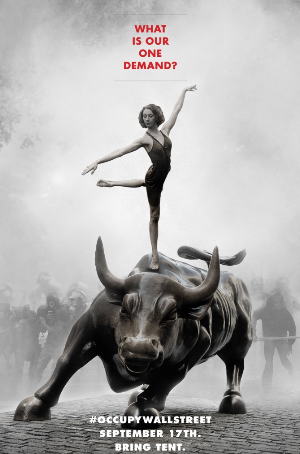
 
You’ve probably already sensed the buzz about #SEPT17, campus groups across the country have been bypassing the conventional chaperones to coordinate OCCUPY WALL STREET. Can they do it? Not without your help, and that doesn’t mean switching your phone service or knocking on doors to Get Out The Vote.

Donate, organize or help with the logistics. If you’ve the temerity, attend in person. At the very least, you’ll have your expenses reimbursed when the city settles your civil suit against them for false arrest. New York City already budgeted for the insurance policy that will pay the legal settlements for the probably now textbook law enforcement practice of kettling inconvenient protests. Or, thinking positively, you may just witness history. To make history you have to make it. Don’t leave it up to the Little Red Hen if you want a piece.

Next up is #OCT6, although the day varies regionally. The date marks the 10th anniversary of the Afghan invasion, but social justice groups of all stripes are throwing their sundry complaints unto one banner and have organized marches nationwide. Of course the nationals aims to SEIZE DC, where activists will converge on Freedom Square, English for “Tahrir Square”, with plans to camp there until the people’s voice is heard. DC has passed ordinances against overnight protests, but Freedom Square may be cut some slack for being off the National Mall. It’s a smaller public space which lies on the diagonal between the White House and the Capitol Building, abreast of General Tecumseh Sherman’s horse actually.

The determination to reclaim American Democracy with an action in DC hopes to recreate Madison Wisconsin on the Potomac, with the same grassroots support for a broad set of issues to which both parties have shown themselves unresponsive.

A successful DC foothold will get real traction being closely followed by an international call for a worldwide uprising. #OCT15 is being spearheaded by Spain’s movement for GLOBAL DEMOCRACY. Will it dilute regional efforts to have actions running concurrently, or will synchronized demonstrations overwhelm our transnational overseers? We can wait and see, or we can give it our best shot.

Here are more graphics in support of the kickoff September 17. Borrowing from Tunisia and Egypt, and before that Chicago 1968, it’s US Days of Rage.

In the course of a single spring we’ve seen massive demonstrations which provoked governments to interrupt cellphone service, shut down internet access, and answer protestors with direct gunfire. To what extreme will the USG be driven? What rights remain inviolate in the US? Not communication. Activist cellphones were blocked on the BART in San Francisco to thwart protests against police brutality.

McDonalds: Eat Like Fat Olympians

The authentic moment in the McDonalds commercial “Eat Like Olympians” is where an athlete walks amazed past tables of A-list Olympians stuffing their faces with Chicken McNuggets. He’s not starstruck, but dumbstruck at the sight of athletes poisoning themselves/selling out. Would they, could they? Not and hope to win. Center stage is US speed skater JR Celski and it’s a damn shame. I always hope medalists will seize their moment in the spotlight to hold their fists high like Mexico 1968. No, they’re so self-obsessed they shill for McDonalds and dope the minds of their admirers with Olympic strength toxin.

Canadian audiences have to suffer a wide campaign of misinformation from a handful of their Olympic hopefuls: Cassie Campbell, Brad Martin, Crispin Lipscomb, Cindy Klassen, Shawn Johnson, and Patrick Chan. Each pretending to eat the garbage.

How is being received? Have a look at this preteen rebuttal on Youtube entitled Olympics + McDonalds = Fat Olympians whose main character is a loving tribute to Shaun White.

Space time capsule December 21, 1968

Earth seen by ApolloWhat does it mean that the stars we see in the sky represent light coming at us from millions of years before? The images we have of Earth, of ourselves from space, reflect a distant past too actually. Although we’re accustomed now to visualizing our planet from above, as a quilt of satellite photos wrapped around a globe, viewable from any distance on Google Earth, the actual vision they mimic is a single thoroughly ubiquitous NASA photo called “The Blue Marble.”

We have only a handful of actual pictures of our planet, taken during the lunar expeditions Apollo 8-17, between 1968 and 1972. Together they allow our minds to conjure our blue globe selves floating against the continuum of space, but they’re also snapshots of the past, of home forty or so years ago.

That’s not just our planet set against the dark universe, that’s you, spinning along. Were you looking up toward the astronauts on their mission as these pictures were taken? You might have watched the launch at Cape Canaveral and hours later thought about the first men to leave Earth’s orbit.

The above photo isn’t the “Blue Marble.” The image above differs from the photo taken by Apollo 17 on Pear Harbor Day, December 7, 1972. That photograph was the first to capture the Earth in full sunlight, but it showed only the Southern Hemisphere. I wanted to chose one where you’re in the picture.

The above image is the first photograph of Earth taken from space, snapped by Apollo 8 as it left for the moon, Saturday, December 21st, 1968. If you were in North America at the time, you’re at the lower right.

If you don’t remember where you were around noon on the winter solstice in 1968, here’s a subsequent photograph they took on their eighth orbit around the moon. It’s the first “Earthrise” seen by man. That was December 24, 1968, a date for which you probably have additional family snapshots.

NASA Apollo 8 orbits the moon

Vaneigem on energy as commodity

NMT’s in-house Situationist has been conceptualizing a way forward well expressed in this May 2009 interview of Raoul Vaneigem:
Situationist“We are being “offered” biofuels on the condition we agree to transgenic rapeseed farming. Eco-tourism will accelerate the plundering of our biosphere. Windmill farms are being built without any advantage to the consumers. Those are the areas where intervention is possible. Natural resources belong to us, they are free, they must be made to serve the freedom of life. It will be up to the communities to secure their own energy and food independence so as to free themselves from the control of the multinationals and their state vassals everywhere. Claiming natural power for our use means reclaiming our own existence first. Only creativity will rid us of work. …

Freeness is the only absolute weapon capable of shattering the mighty self-destruction machine set in motion by consumer society, whose implosion is still releasing, like a deadly gas, bottom-line mentality, cupidity, financial gain, profit, and predation. Museums and culture should be free, for sure, but so should public services, currently prey to the scamming multinationals and states. Free trains, buses, subways, free healthcare, free schools, free water, air, electricity, free power, all through alternative networks to be set up. As freeness spreads, new solidarity networks will eradicate the stranglehold of the commodity. This is because life is a free gift, a continuous creation that the market’s vile profiteering alone deprives us of.”
–Raoul Vaneigem, 2009

Interviewed by Hans Ulrich Obrist, for e-flux, Journal #6. See original article or the copy mirrored below:

In Conversation with Raoul Vaneigem

Hans Ulrich Obrist: I just visited Edouard Glissant and Patrick Chamoiseau, who have written an appeal to Barack Obama. What would your appeal and/or advice be to Obama?

Raoul Vaneigem: I refuse to cultivate any relationship whatsoever with people of power. I agree with the Zapatistas from Chiapas who want nothing to do with either the state or its masters, the multinational mafias. I call for civil disobedience so that local communities can form, coordinate, and begin self-producing natural power, a more natural form of farming, and public services that are finally liberated from the scams of government by the Left or the Right. On the other hand, I welcome the appeal by Chamoiseau, Glissant, and their friends for the creation of an existence in which the poetry of a life rediscovered will put an end to the deadly stranglehold of the commodity.

HUO: Could we talk about your beginnings? How did your participation in situationism begin, and what was your fundamental contribution? At the outset of your relationship with the SI, there was the figure of Henri Lefebvre. What did he mean to you at the time? Why did you decide to send him poetic essays?

RV: I would first like to clarify that situationism is an ideology that the situationists were unanimous in rejecting. The term “situationist” was ever only a token of identification. Its particularity kept us from being mistaken for the throngs of ideologues. I have nothing in common with the spectacular recuperation of a project that, in my case, has remained revolutionary throughout. My participation in a group that has now disappeared was an important moment in my personal evolution, an evolution I have personally pressed on with in the spirit of the situationist project at its most revolutionary. My own radicality absolves me from any label. I grew up in an environment in which our fighting spirit was fueled by working class consciousness and a rather festive conception of existence. I found Lefebvre’s Critique of Everyday Life captivating. When La Somme et le reste [The Sum and the Remainder] was published, I sent him an essay of sorts on “poetry and revolution” that was an attempt to unify radical concepts, Lettrist language, music, and film imagery by crediting them all with the common virtue of making the people’s blood boil. Lefebvre kindly responded by putting me in touch with Guy Debord who immediately invited me to Paris. The two of us had very different temperaments, but we would agree over a period of nearly ten years on the need to bring consumer society to an end and to found a new society on the principle of self-management, where life supersedes survival and the existential angst that it generates.

HUO: Which situationist projects remain unrealized?

RV: Psychogeography, the construction of situations, the superseding of predatory behavior. The radicality, which, notwithstanding some lapses, never ceased to motivate us, remains a source of inspiration to this day. Its effects are just beginning to manifest themselves in the autonomous groups that are now coming to grips with the collapse of financial capitalism.

HUO: The Situationist International defined the situationist as someone who commits her- or himself to the construction of situations. What were those situations for you, concretely? How would you define the situationist project in 2009?

RV: By its very style of living and thinking, our group was already sketching out a situation, like a beachhead active within enemy territory. The military metaphor is questionable, but it does convey our will to liberate daily life from the control and stranglehold of an economy based on the profitable exploitation of man. We formed a “group-at-risk” that was conscious of the hostility of the dominant world, of the need for radical rupture, and of the danger of giving in to the paranoia typical of minds under siege. By showing its limits and its weaknesses, the situationist experience can also be seen as a critical meditation on the new type of society sketched out by the Paris Commune, by the Makhnovist movement and the Republic of Councils wiped out by Lenin and Trotsky, by the libertarian communities in Spain later smashed by the Communist Party. The situationist project is not about what happens once consumer society is rejected and a genuinely human society has emerged. Rather, it illuminates now how lifestyle can supersede survival, predatory behavior, power, trade and the death-reflex.

HUO: You and Guy Debord are the main protagonists of the situationist movement. How do you see Debord’s role and your role?

RV: Not as roles. That is precisely what situationism in its most ridiculous version aims at: reducing us to cardboard cut-outs that it can then set up against one another according to the spectacle’s standard operating procedure. I am simply the spokesman, among others, of a radical consciousness. I just do what I can to see that resistance to market exploitation is transformed into an offensive of life, and that an art of living sweeps away the ruins of oppression.

HUO: What were your reasons for resigning from the group?

RV: Following the occupation movements of May 1968, we knew that some recuperation was afoot. We were familiar with the mechanisms of alienation that would falsify our ideas and fit them neatly into the cultural puzzle. It became clear to us, during the last conference in Venice, that we had failed to shatter those mechanisms, that in fact they were shattering us from the inside. The group was crumbling, the Venice conference was demonstrating its increasing uselessness, and the only answers put forward were commensurate with the self-parody we had fallen into. Dissension intensified to the point of paranoid denunciation: of betrayals of radicality, of breaches of revolutionary spirit, of dereliction of conscience. Those times of catharsis and anathema are now long past, and it might be useful to examine how it is that we sowed the seeds of failure for which the group ended up paying such a heavy price. The shipwreck, however, did not indiscriminately sweep away to the shores of oblivion all of us who participated in the adventure. The group vanished in such a way as to allow the individuals to either consolidate their radicality, disown it, or lapse into the imposture of radicalism. I have attempted to analyze our experimental adventure in Entre le deuil du monde et la joie de vivre [Between Mourning the World and Exuberant Life].

HUO: You have written a lot on life, not survival. What is the difference?

RV: Survival is budgeted life. The system of exploitation of nature and man, starting in the Middle Neolithic with intensive farming, caused an involution in which creativity—a quality specific to humans—was supplanted by work, by the production of a covetous power. Creative life, as had begun to unfold during the Paleolithic, declined and gave way to a brutish struggle for subsistence. From then on, predation, which defines animal behavior, became the generator of all economic mechanisms.

HUO: Today, more than forty years after May ‘68, how do you feel life and society have evolved?

RV: We are witnessing the collapse of financial capitalism. This was easily predictable. Even among economists, where one finds even more idiots than in the political sphere, a number had been sounding the alarm for a decade or so. Our situation is paradoxical: never in Europe have the forces of repression been so weakened, yet never have the exploited masses been so passive. Still, insurrectional consciousness always sleeps with one eye open. The arrogance, incompetence, and powerlessness of the governing classes will eventually rouse it from its slumber, as will the progression in hearts and minds of what was most radical about May 1968.

HUO: Your new book takes us on a trip “between mourning the world and exuberant life.” You revisit May ‘68. What is left of May ‘68? Has it all been appropriated?

RV: Even if we are today seeing recycled ideologies and old religious infirmities being patched up in a hurry and tossed out to feed a general despair, which our ruling wheelers and dealers cash in on, they cannot conceal for long the shift in civilization revealed by May 1968. The break with patriarchal values is final. We are moving toward the end of the exploitation of nature, of work, of trade, of predation, of separation from the self, of sacrifice, of guilt, of the forsaking of happiness, of the fetishizing of money, of power, of hierarchy, of contempt for and fear of women, of the misleading of children, of intellectual dominion, of military and police despotism, of religions, of ideologies, of repression and the deadly resolutions of psychic tensions. This is not a fact I am describing, but an ongoing process that simply requires from us increased vigilance, awareness, and solidarity with life. We have to reground ourselves in order to rebuild—on human foundations—a world that has been ruined by the inhumanity of the cult of the commodity.

HUO: What do you think of the current moment, in 2009? Jean-Pierre Page has just published Penser l’après crise [Thinking the After-Crisis]. For him, everything must be reinvented. He says that a new world is emerging now in which the attempt to establish a US-led globalization has been aborted.

RV: The agrarian economy of the Ancien Régime was a fossilized form that was shattered by the emerging free-trade economy, from the 1789 revolution on. Similarly, the stock-dabbling speculative capitalism whose debacle we now witness is about to give way to a capitalism reenergized by the production of non-polluting natural power, the return to use value, organic farming, a hastily patched-up public sector, and a hypocritical moralization of trade. The future belongs to self-managed communities that produce indispensable goods and services for all (natural power, biodiversity, education, health centers, transport, metal and textile production . . .). The idea is to produce for us, for our own use—that is to say, no longer in order to sell them—goods that we are currently forced to buy at market prices even though they were conceived and manufactured by workers. It is time to break with the laws of a political racketeering that is designing, together with its own bankruptcy, that of our existence.

HUO: Is this a war of a new kind, as Page claims? An economic Third World War?

RV: We are at war, yes, but this is not an economic war. It is a world war against the economy. Against the economy that for thousands of years has been based on the exploitation of nature and man. And against a patched-up capitalism that will try to save its skin by investing in natural power and making us pay the high price for that which—once the new means of production are created—will be free as the wind, the sun, and the energy of plants and soil. If we do not exit economic reality and create a human reality in its place, we will once again allow market barbarism to live on.

HUO: In his book Making Globalization Work, Joseph Stiglitz argues for a reorganization of globalization along the lines of greater justice, in order to shrink global imbalances. What do you think of globalization? How does one get rid of profit as motive and pursue well-being instead? How does one escape from the growth imperative?

RV: The moralization of profit is an illusion and a fraud. There must be a decisive break with an economic system that has consistently spread ruin and destruction while pretending, amidst constant destitution, to deliver a most hypothetical well-being. Human relations must supersede and cancel out commercial relations. Civil disobedience means disregarding the decisions of a government that embezzles from its citizens to support the embezzlements of financial capitalism. Why pay taxes to the bankster-state, taxes vainly used to try to plug the sinkhole of corruption, when we could allocate them instead to the self-management of free power networks in every local community? The direct democracy of self-managed councils has every right to ignore the decrees of corrupt parliamentary democracy. Civil disobedience towards a state that is plundering us is a right. It is up to us to capitalize on this epochal shift to create communities where desire for life overwhelms the tyranny of money and power. We need concern ourselves neither with government debt, which covers up a massive defrauding of the public interest, nor with that contrivance of profit they call “growth.” From now on, the aim of local communities should be to produce for themselves and by themselves all goods of social value, meeting the needs of all—authentic needs, that is, not needs prefabricated by consumerist propaganda.

HUO: Edouard Glissant distinguishes between globality and globalization. Globalization eradicates differences and homogenizes, while globality is a global dialogue that produces differences. What do you think of his notion of globality?

RV: For me, it should mean acting locally and globally through a federation of communities in which our pork-barreling, corrupt parliamentary democracy is made obsolete by direct democracy. Local councils will be set up to take measures in favor of the environment and the daily lives of everyone. The situationists have called this “creating situations that rule out any backtracking.”

HUO: Might the current miscarriages of globalization have the same dangerous effects as the miscarriages of the previous globalization from the ‘30s? You have written that what was already intolerable in ‘68 when the economy was booming is even more intolerable today. Do you think the current economic despair might push the new generations to rebel?

RV: The crisis of the ‘30s was an economic crisis. What we are facing today is an implosion of the economy as a management system. It is the collapse of market civilization and the emergence of human civilization. The current turmoil signals a deep shift: the reference points of the old patriarchal world are vanishing. Percolating instead, still just barely and confusedly, are the early markers of a lifestyle that is genuinely human, an alliance with nature that puts an end to its exploitation, rape, and plundering. The worst would be the unawareness of life, the absence of sentient intelligence, violence without conscience. Nothing is more profitable to the racketeering mafias than chaos, despair, suicidal rebellion, and the nihilism that is spread by mercenary greed, in which money, even devalued in a panic, remains the only value.

HUO: In his book Utopistics, Immanuel Wallerstein claims that our world system is undergoing a structural crisis. He predicts it will take another twenty to fifty years for a more democratic and egalitarian system to replace it. He believes that the future belongs to “demarketized,” free-of-charge institutions (on the model, say, of public libraries). So we must oppose the marketization of water and air.1 What is your view?

RV: I do not know how long the current transformation will take (hopefully not too long, as I would like to witness it). But I have no doubt that this new alliance with the forces of life and nature will disseminate equality and freeness. We must go beyond our natural indignation at profit’s appropriation of our water, air, soil, environment, plants, animals. We must establish collectives that are capable of managing natural resources for the benefit of human interests, not market interests. This process of reappropriation that I foresee has a name: self-management, an experience attempted many times in hostile historical contexts. At this point, given the implosion of consumer society, it appears to be the only solution from both an individual and social point of view.

HUO: In your writing you have described the work imperative as an inhuman, almost animal condition. Do you consider market society to be a regression?

RV: As I mentioned above, evolution in the Paleolithic age meant the development of creativity—the distinctive trait of the human species as it breaks free from its original animality. But during the Neolithic, the osmotic relationship to nature loosened progressively, as intensive agriculture became based on looting and the exploitation of natural resources. It was also then that religion surfaced as an institution, society stratified, the reign of patriarchy began, of contempt for women, and of priests and kings with their stream of wars, destitution, and violence. Creation gave way to work, life to survival, jouissance to the animal predation that the appropriation economy confiscates, transcends, and spiritualizes. In this sense market civilization is indeed a regression in which technical progress supersedes human progress.

HUO: For you, what is a life in progress?

RV: Advancing from survival, the struggle for subsistence and predation to a new art of living, by recreating the world for the benefit of all.

HUO: My interviews often focus on the connections between art and architecture/urbanism, or literature and architecture/urbanism. Could you tell me about the Bureau of Unitary Urbanism?

RV: That was an idea more than a project. It was about the urgency of rebuilding our social fabric, so damaged by the stranglehold of the market. Such a rebuilding effort goes hand in hand with the rebuilding by individuals of their own daily existence. That is what psychogeography is really about: a passionate and critical deciphering of what in our environment needs to be destroyed, subjected to détournement, rebuilt.

HUO: In your view there is no such thing as urbanism?

RV: Urbanism is the ideological gridding and control of individuals and society by an economic system that exploits man and Earth and transforms life into a commodity. The danger in the self-built housing movement that is growing today would be to pay more attention to saving money than to the poetry of a new style of life.

HUO: How do you see cities in the year 2009? What kind of unitary urbanism for the third millennium? How do you envision the future of cities? What is your favorite city? You call Oarystis the city of desire. Oarystis takes its inspiration from the world of childhood and femininity. Nothing is static in Oarystis. John Cage once said that, like nature, “one never reaches a point of shapedness or finishedness. The situation is in constant unpredictable change.”2 Do you agree with Cage?

RV: I love wandering through Venice and Prague. I appreciate Mantua, Rome, Bologna, Barcelona, and certain districts of Paris. I care less about architecture than about how much human warmth its beauty has been capable of sustaining. Even Brussels, so devastated by real estate developers and disgraceful architects (remember that in the dialect of Brussels, “architect” is an insult), has held on to some wonderful bistros. Strolling from one to the next gives Brussels a charm that urbanism has deprived it of altogether. The Oarystis I describe is not an ideal city or a model space (all models are totalitarian). It is a clumsy and naïve rough draft for an experiment I still hope might one day be undertaken—so I agree with John Cage. This is not a diagram, but an experimental proposition that the creation of an environment is one and the same as the creation by individuals of their own future.

HUO: Is Oarystis based on natural power, like the Metabolist cities? Rem Koolhaas and I are working on a book on the Japanese Metabolists. When I read your wonderful text on Oarystis, I was reminded of that movement from the 1960s, especially the floating cities, Kikutake’s water cities. Is Oarystis a Metabolist city?

RV: When Oarystis was published, the architect Philippe Rothier and Diane Hennebert, who ran Brussels’ Architecture Museum at the time, rightly criticized me for ignoring the imaginative projects of a new generation of builders. Now that the old world is collapsing, the fusion of free natural power, self-built housing techniques, and the reinvention of sensual form is going to be decisive. So it is useful to remember that technical inventiveness must stem from the reinvention of individual and collective life. That is to say, what allows for genuine rupture and ecstatic inventiveness is self-management: the management by individuals and councils of their own lives and environment through direct democracy. Let us entrust the boundless freedoms of the imaginary to childhood and the child within us.

HUO: Several years ago I interviewed Constant on New Babylon. What were your dialogues with Constant and how do you see New Babylon today?

RV: I never met Constant, who if I am not mistaken had been expelled before my own association with the SI. New Babylon’s flaw is that it privileges technology over the formation of an individual and collective way of life—the necessary basis of any architectural concept. An architectural project only interests me if it is about the construction of daily life.

HUO: How can the city of the future contribute to biodiversity?

RV: By drawing inspiration from Alphonse Allais, by encouraging the countryside to infiltrate the city. By creating zones of organic farming, gardens, vegetable plots, and farms inside urban space. After all, there are so many bureaucratic and parasitical buildings that can’t wait to give way to fertile, pleasant land that is useful to all. Architects and squatters, build us some hanging gardens where we can go for walks, eat, and live!

HUO: Oarystis is in the form of a maze, but it is also influenced by Venice and its public piazzas. Could you tell us about the form of Oarystis?

RV: Our internal space-time is maze-like. In it, each of us is at once Theseus, Ariadne, and Minotaur. Our dérives would gain in awareness, alertness, harmony, and happiness if only external space-time could offer meanders that could conjure up the possible courses of our futures, as an analogy or echo of sorts—one that favors games of life, and prevents their inversion into games of death.

HUO: Will museums be abolished? Could you discuss the amphitheater of memory? A protestation against oblivion?

RV: The museum suffers from being a closed space in which works waste away. Painting, sculpture, music belong to the street, like the façades that contemplate us and come back to life when we greet them. Like life and love, learning is a continuous flow that enjoys the privilege of irrigating and fertilizing our sentient intelligence. Nothing is more contagious than creation. But the past also carries with it all the dross of our inhumanity. What should we do with it? A museum of horrors, of the barbarism of the past? I attempted to answer the question of the “duty of memory” in Ni pardon, ni talion [Neither Forgiveness Nor Retribution]:

Most of the great men we were brought up to worship were nothing more than cynical or sly murderers. History as taught in schools and peddled by an overflowing and hagiographic literature is a model of falsehood; to borrow a fashionable term, it is negationist. It might not deny the reality of gas chambers, it might no longer erect monuments to the glory of Stalin, Mao or Hitler, but it persists in celebrating the brutish conqueror: Alexander, called the Great—whose mentor was Aristotle, it is proudly intoned—Julius Caesar, Genghis Khan, Tamerlane, Napoleon, the throngs of generals, slaughterers of peoples, petty tyrants of the city or the state, torturer–judges, Javerts of every ilk, conniving diplomats, rapists and killers contracted by religions and ideologies; so much high renown carved from baseness, wickedness, and abjection. I am not suggesting we should unpave the avenues of official history and pave the side alleys instead. We are not in need of a purged history, but of a knowledge that scoops out into broad daylight facts that have been obscured, generation after generation, by the unceasing stratification of prejudice. I am not calling for a tribunal of the mind to begin condemning a bunch of undesirables who have been bizarrely put up on pedestals and celebrated in the motley pantheons of official memory. I just want to see the list of their crimes, the mention of their victims, the recollection of those who confronted them added to the inventory of their unsavory eulogies. I am not suggesting that the name of Francisco Ferrer wipe out that of his murderer, Alfonso XIII, but that at the very least everything be known of both. How dare textbooks still cultivate any respect for Bonaparte, responsible for the death of millions, for Louis XIV, slaughterer of peasants and persecutor of Protestants and freethinkers? For Calvin, murderer of Jacques Gruet and Michel Servet and dictator of Geneva, whose citizens, in tribute to Sébastien Castellion, would one day resolve to destroy the emblems and signs of such an unworthy worship? While Spain has now toppled the effigies of Francoism and rescinded the street names imposed by fascism, we somehow tolerate, towering in the sky of Paris, that Sacré-Coeur whose execrable architecture glorifies the crushing of the Commune. In Belgium there are still avenues and monuments honoring King Leopold II, one of the most cynical criminals of the nineteenth century, whose “red rubber” policy—denounced by Mark Twain, by Roger Casement (who paid for this with his life), by Edward Dene Morel, and more recently by Adam Hochschild—has so far bothered nary a conscience. This is a not a call to blow up his statues or to chisel away the inscriptions that celebrate him. This is a call to Belgian and Congolese citizens to cleanse and disinfect public places of this stain, the stain of one of the worst sponsors of colonial savagery. Paradoxically, I do tend to believe that forgetting can be productive, when it comes to the perpetrators of inhumanity. A forgetting that does not eradicate remembering, that does not blue-pencil memory, that is not an enforceable judgment, but that proceeds rather from a spontaneous feeling of revulsion, like a last-minute pivot to avoid dog droppings on the sidewalk. Once they have been exposed for their inhumanity, I wish for the instigators of past brutalities to be buried in the shroud of their wrongs. Let the memory of the crime obliterate the memory of the criminal.
3

HUO: Learning is deserting schools and going to the streets. Are streets becoming Thinkbelts? Cedric Price’s Potteries Thinkbelt used abandoned railroads for pop-up schools. What and where is learning today?

RV: Learning is permanent for all of us regardless of age. Curiosity feeds the desire to know. The call to teach stems from the pleasure of transmitting life: neither an imposition nor a power relation, it is pure gift, like life, from which it flows. Economic totalitarianism has ripped learning away from life, whose creative conscience it ought to be. We want to disseminate everywhere this poetry of knowledge that gives itself. Against school as a closed-off space (a barrack in the past, a slave market nowadays), we must invent nomadic learning.

HUO: How do you foresee the twenty-first-century university?

RV: The demise of the university: it will be liquidated by the quest for and daily practice of a universal learning of which it has always been but a pale travesty.

HUO: Could you tell me about the freeness principle (I am extremely interested in this; as a curator I have always believed museums should be free—Art for All, as Gilbert and George put it).

RV: Freeness is the only absolute weapon capable of shattering the mighty self-destruction machine set in motion by consumer society, whose implosion is still releasing, like a deadly gas, bottom-line mentality, cupidity, financial gain, profit, and predation. Museums and culture should be free, for sure, but so should public services, currently prey to the scamming multinationals and states. Free trains, buses, subways, free healthcare, free schools, free water, air, electricity, free power, all through alternative networks to be set up. As freeness spreads, new solidarity networks will eradicate the stranglehold of the commodity. This is because life is a free gift, a continuous creation that the market’s vile profiteering alone deprives us of.

HUO: Where is love in Oarystis?

RV: Everywhere. The love affair, as complex as it is simple, will serve as the building block for the new solidarity relations that sooner or later will supersede selfish calculation, competition, competitiveness, and predation, causes of our societies’ dehumanization.

HUO: Where is the city of the dead? In a forest rather than a cemetery?

RV: Yes, a forest, an auditorium in which the voices of the dead will speak amidst the lushness of nature, where life continuously creates itself anew.

HUO: Have you dreamt up other utopian cities apart from Oarystis? Or a concrete utopia in relation to the city?

RV: No, but I have not given up hope that such projects might mushroom and be realized one day, as we begin reconstructing a world devastated by the racketeering mafias.

HUO: In 1991 I founded a Robert Walser museum, a strollological museum, in Switzerland. I have always been fascinated by your notion of the stroll. Could you say something about your urban strolls with and without Debord? What about Walser’s? Have other strollologists inspired you?

RV: I hold Robert Walser in high regard, as many do. His lucidity and sense of dérive enchanted Kafka. I have always been fascinated by the long journey Hölderlin undertook following his break-up with Diotima. I admire Chatwin’s Songlines, in which he somehow manages to turn the most innocuous of walks into an intonation of the paths of fate, as though we were in the heart of the Australian bush. And I appreciate the strolls of Léon-Paul Fargue and the learning of Héron de Villefosse. My psychogeographic dérives with Guy Debord in Paris, Barcelona, Brussels, Beersel, and Antwerp were exceptional moments, combining theoretical speculation, sentient intelligence, the critical analysis of beings and places, and the pleasure of cheerful drinking. Our homeports were pleasant bistros with a warm atmosphere, havens where one was oneself because one felt in the air something of the authentic life, however fragile and short-lived. It was an identical mood that guided our wanderings through the streets, the lanes and the alleys, through the meanderings of a pleasure that our every step helped us gauge in terms of what it might take to expand and refine it just a little further. I have a feeling that the neighborhoods destroyed by the likes of Haussmann, Pompidou, and the real estate barbarians will one day be rebuilt by their inhabitants in the spirit of the joy and the life they once harbored.

HUO: What possibilities do you see for disalienation and détournement in 2009?

RV: This is a time of unprecedented chaos in material and moral conditions. Human values are going to have to compensate for the effects of the only value that has prevailed so far: money. But the implosion of financial totalitarianism means that this currency, which has so tripped us up, is now doomed to devaluation and a loss of all meaning. The absurdity of money is becoming concrete. It will gradually give way to new forms of exchange that will hasten its disappearance and lead to a gift economy.

HUO: What are the conditions for dialogue in 2009? Is there a way out of this system of isolation?

RV: Dialogue with power is neither possible nor desirable. Power has always acted unilaterally, by organizing chaos, by spreading fear, by forcing individuals and communities into selfish and blind withdrawal. As a matter of course, we will invent new solidarity networks and new intervention councils for the well-being of all of us and each of us, overriding the fiats of the state and its mafioso-political hierarchies. The voice of lived poetry will sweep away the last remaining echoes of a discourse in which words are in profit’s pay.

HUO: In your recent books you discuss your existence and temporality. The homogenizing forces of globalization homogenize time, and vice versa. How does one break with this? Could you discuss the temporality of happiness, as a notion?

RV: The productivity- and profit-based economy has implanted into lived human reality a separate reality structured by its ruling mechanisms: predation, competition and competitiveness, acquisitiveness and the struggle for power and subsistence. For thousands of years such denatured human behaviors have been deemed natural. The temporality of draining, erosion, tiredness, and decay is determined by labor, an activity that dominates and corrupts all others. The temporality of desire, love, and creation has a density that fractures the temporality of survival cadenced by work. Replacing the temporality of money will be a temporality of desire, a beyond-the-mirror, an opening to uncharted territories.

HUO: Is life ageless?

RV: I don’t claim that life is ageless. But since survival is nothing but permanent agony relieved by premature death, a renatured life that cultivates its full potential for passion and creation would surely achieve enough vitality to delay its endpoint considerably.

HUO: The Revolution of Everyday Life was a trigger for May ’68, and you have stated in other interviews that it is your key book that you are continually rewriting. Was the book an epiphany? How did it change the course of your work? What had you been doing previously?

RV: The book was prompted by an urgent need I was feeling at the time for a new perspective on the world and on myself, to pull me out of my state of survival, by means other than through suicide. This critical take on a consumer society that was corrupting and destroying life so relentlessly made me aware and conscious of my own life drive. And it became clear to me very quickly that this wasn’t a purely solipsistic project, that many readers were finding their own major concerns echoed there.

HUO: The Revolution of Everyday Life ends on an optimistic note: “We have a world of pleasures to win, and nothing to lose but boredom.”4 Are you still an optimist today?

RV: “Pessimists, what is it you were hoping for?,” Scutenaire wrote. I am neither a pessimist nor an optimist. I try to remain faithful to a principle: desire everything, expect nothing.

HUO: What is the most recent version of the book?

RV: Entre le deuil du monde et la joie de vivre [Between Mourning the World and Exuberant Life].

HUO: What book are you working on at the moment?

RV: I would love to have the resources to complete a Dictionary of Heresies, so as to clarify and correct the historical elements included in The Movement of the Free Spirit and Resistance to Christianity.

HUO: The question of temporality also brings us to Proust and his questionnaire (see inset). What might your definition of happiness be in 2009?

RV: Living ever more intensely and passionately in an ever more intense world. To those who sneer at my ecstatic candor, I reply with a phrase that brings me great comfort: “The desire for an other life is that life already.”5

HUO: Do you have unrealized projects? Unrealized books, unrealized projects in fields other than writing, unrealized architectural projects?

RV: My priority is to live better and better in a world that is more and more human. I would love to build the “urban countryside” of Oarystis, but I’m not just waiting patiently, like Fourier at the Palais Royal, for some billionaire to decide to finance the project only to lose everything to the financial crash a minute later.

HUO: What about your collaborations with other artists, painters, sculptors, designers, filmmakers?

RV: I don’t collaborate with anyone. At times I have offered a few texts to artist friends, not as a commentary on their work but as a counterpoint to it. Art moves me when, in it, I can sense its own overcoming, something that goes beyond it; when it nurtures a trace of life that blossoms as a true aspiration, the intuition of a new art of living.

HUO: Could you tell me about Brussels? What does Brussels mean to you? Where do you write?

RV: I live in the country, facing a garden and woods where the rhythm of the seasons has retained its beauty. Brussels as a city has been destroyed by urbanists and architects who are paid by real estate developers. There are still a few districts suitable for nice walks. I am fond of a good dozen wonderful cafés where one can enjoy excellent artisanal beers.

HUO: Do you agree with Geremek’s view that Europe is the big concern of the twenty-first century?

RV: I am not interested in this Europe ruled by racketeering bureaucracies and corrupt democracies. And regions only interest me once they are stripped of their regionalist ideology and are experiencing self-management and direct democracy. I feel neither Belgian nor European. The only homeland is a humanity that is at long last sovereign.

HUO: You have used a lot of pseudonyms. Je est un autre [I is an other]? How do you find or choose pseudonyms? How many pseudonyms have you used? Is there a complete list?

RV: I don’t keep any kind of score. I leave it up to the inspiration of the moment. There is nothing secret about using a pseudonym. Rather, it is about creating a distance, most often in commissioned work. This allows me to have some fun while alleviating my enduring financial difficulties, which I have always refused to resolve by compromising with the world of the spectacle.

HUO: A book that has been used by many artists and architects has been your Dictionnaire de citations pour servir au divertissement et a l’intelligence du temps [Dictionary of Quotations for the Entertainment and Intelligence of Our Time]. Where did that idea come from?

RV: It was a suggestion from my friend Pierre Drachline, who works for the Cherche Midi publishing house.

HUO: You have often criticized environmental movements who try to replace existing capitalism with capitalism of a different type. What do you think of Joseph Beuys? What non-capitalist project or movement do you support?

RV: We are being “offered” biofuels on the condition we agree to transgenic rapeseed farming. Eco-tourism will accelerate the plundering of our biosphere. Windmill farms are being built without any advantage to the consumers. Those are the areas where intervention is possible. Natural resources belong to us, they are free, they must be made to serve the freedom of life. It will be up to the communities to secure their own energy and food independence so as to free themselves from the control of the multinationals and their state vassals everywhere. Claiming natural power for our use means reclaiming our own existence first. Only creativity will rid us of work.

HUO: Last but not least, Rilke wrote that wonderful little book of advice to a young poet. What would your advice be to a young philosopher-writer in 2009?

RV: To apply to his own life the creativity he displays in his work. To follow the path of the heart, of what is most alive in him.

Translated from the French by Eric Anglès

Rock Creek Free Press available in COS

The Rock Creek Free Press is available online, but if you want it in print, the DC monthly is available in Colorado Springs at the Bookman, 3163 W. Colorado. The September issue features a speech given by legendary Australian journalist John Pilger on July 4th in San Francisco.

Here’s the RCFP transcript:

Two years ago I spoke at “Socialism in Chicago” about an invisible government which is a term used by Edward Bernays, one the founders of modern propaganda. It was Bernays, who in the 1920s invented public relations as a euphemism for propaganda. And it was Bernays, deploying the ideas of his uncle Sigmund Freud, who campaigned on behalf of the tobacco industry for women to take up smoking as an act of feminist liberation calling cigarettes “tortures of freedom”. At the same time he was involved in the disinformation which was critical in overthrowing the Arbenz government in Guatemala. So you have the association of cigarettes and regime change. The invisible government that Bernays had in mind brought together all media: PR, the press, broadcasting, advertising and their power of branding and image making. In other words, disinformation.

And I suppose I would like to talk today about this invisible government’s most recent achievement, the rise of Barrack Obama and the silencing of much of the left. But all of this has a history, of course and I’d like to go back, take you back some forty years to a sultry and, for me, very memorable day in Viet Nam.

I was a young war correspondent who had just arrived in a village in the Central Highlands called Tuylon. My assignment was to write about a unit of US Marines who had been sent to the village to win hearts and minds. “My orders,” said the Marine Sergeant, “are to sell the American way of liberty, as stated in the Pacification Handbook, this is designed to win the hearts and minds of folks as stated on page 86.” Now, page 86 was headed in capital letters: WHAM (winning hearts and minds). The Marine Unit was a combined action company which explained the Sergeant, meant, “We attack these folks on Mondays and we win their hearts and minds on Tuesdays.” He was joking, of course, but not quite.

The Sergeant, who didn’t speak Vietnamese, had arrived in the village, stood up on a Jeep and said through a bullhorn: “Come on out everybody we’ve got rice and candies and toothbrushes to give you.” This was greeted by silence. “Now listen, either you gooks come on out or we’re going to come right in there and get you!” Now the people of Tuylon finally came out and they stood in line to receive packets of Uncle Ben’s Miracle Rice, Hershey Bars, party balloons, and several thousand toothbrushes. Three portable, battery operated, yellow, flush lavatories were held back for the arrival of the colonel.

And when the colonel arrived that evening, the district chief was summoned and the yellow, flush lavatories unveiled. The colonel cleared his throat and took out a handwritten speech,

“Mr. District Chief and all you nice people,” said the colonel, “what these gifts represent is more than the sum of their parts, they carry the spirit of America. Ladies and gentlemen there’s no place on Earth like America, it’s the land where miracles happen, it’s a guiding light for me and for you. In America, you see, we count ourselves as real lucky as having the greatest democracy the world has ever known and we want you nice people to share in our good fortune.”

Thomas Jefferson, George Washington, even John Winthrope sitting upon a hill got a mention. All that was missing was the Star Bangled Banner playing softly in the background. Of course the villagers had no idea what the colonel was talking about, but when the Marines clapped, they clapped. And when the colonel waved, the children waved. And when he departed the colonel shook the Sergeant’s hand and said: “We’ve got plenty of hearts and minds here, carry on Sergeant.” “Yes Sir.” In Viet Nam I witnessed many scenes like that.

I’d grown up in faraway Australia on a cinematic diet of John Wayne, Randolph Scott, Walt Disney, and Ronald Reagan. The American way of liberty they portrayed might well have been lifted from the WHAM handbook. I’d learned that the United States had won World War II on its own and now led the free world as the chosen society. It was only later when I read Walter Lippmann’s book, Public Opinion, a manual of the invisible government, that I began to understand the power of emotions attached to false ideas and bad histories on a grand scale.

Now, historians call this exceptionalism, the notion that the United States has a divine right to bring what it calls “liberty” to the rest of humanity. Of course this is a very old refrain. The French and British created and celebrated their own civilizing missions while imposing colonial regimes that denied basic civil liberties. However, the power of the American message was, and remains, different. Whereas the Europeans were proud imperialists, Americans are trained to deny their imperialism. As Mexico was conquered and the Marines sent to Nicaragua, American textbooks referred to an Age of Innocence. American motives were always well meaning, moral, exceptional, as the colonel said, “There was no ideology” and that’s still the case.

Americanism is an ideology that is unique because its main feature is its denial that it is an ideology. It’s both conservative and it’s liberal. And it’s right and it’s left. And Barack Obama is its embodiment. Since Obama was elected leading liberals have talked about America returning to its true status as, “a nation of moral ideals”. Those are the words of Paul Krugman, the liberal columnist of The New York Times. In the San Francisco Chronicle, columnist Mark Morford wrote,

“Spiritually advanced people regard the new president as a light worker who can help usher in a new way of being on the planet.”

Tell that to an Afghan child whose family has been blown away by Obama’s bombs. Or a Pakistani child whose house has been visited by one of Obama’s drones. Or a Palestinian child surveying the carnage in Gaza caused by American “smart” weapons, which, disclosed Seymour Hersh, were re-supplied to Israel for use in the slaughter, and I quote; “Only after the Obama team let if be known, it would not object.” The man who stayed silent on Gaza is the man who now condemns Iran.

In a sense, Obama is the myth that is America’s last taboo. His most consistent theme was never “change”, it was power. “The United States,” he said, “leads the world in battling immediate evils and promoting the ultimate good. We must lead by building a 21st century military to ensure the security of our people and advance the security of all people.” And there is this remarkable statement, “At moments of great peril in the past century our leaders ensured that America, by deed and by example, led and lifted the world; that we stood and fought for the freedoms sought by billions of people beyond our borders.” Words like these remind me of the colonel in the village in Viet Nam, as he spun much the same nonsense.

Since 1945, by deed and by example, to use Obama’s words, America has overthrown 50 governments, including democracies, and crushed some 30 liberation movements and bombed countless men, women, and children to death. I’m grateful to Bill Blum for his cataloging of that. And yet, here is the 45th (sic) president of the United States having stacked his government with war mongers and corporate fraudsters and polluters from the Bush and Clinton eras, promising, not only more of the same, but a whole new war in Pakistan. Justified by the murderous clichés of Hilary Clinton, clichés like, “high value targets”. Within three days of his inauguration, Obama was ordering the death of people in faraway countries: Pakistan and Afghanistan. And yet, the peace movement, it seems, is prepared to look the other way and believe that the cool Obama will restore, as Krugman wrote, “the nation of moral ideals.”

Not long ago, I visited the American Museum of History in the celebrated Smithsonian Institute in Washington. One of the most popular exhibitions was called “The Price of Freedom: Americans at War”. It was holiday time and lines of happy people, including many children, shuffled through a Santa’s grotto of war and conquest. When messages about their nation’s great mission were lit up; these included tributes to the; “…exceptional Americans who saved a million lives…” in Viet Nam; where they were, “…determined to stop Communist expansion.” In Iraq other brave Americans, “employed air-strikes of unprecedented precision.” What was shocking was not so much the revisionism of two of the epic crimes of modern times, but the shear scale of omission.

Like all US presidents, Bush and Obama have very much in common. The wars of both presidents and the wars of Clinton and Reagan, Carter and Ford, Nixon and Kennedy are justified by the enduring myth of exceptional America. A myth the late Harold Pinter described as, “a brilliant, witty, highly successful act of hypnosis.”

The clever young man who recently made it to the White House is a very fine hypnotist; partly because it is indeed extraordinary to see an African American at the pinnacle of power in the land of slavery. However, this is the 21st century and race together with gender, and even class, can be very seductive tools of propaganda. For what is so often overlooked and what matters, I believe above all, is the class one serves. George Bush’s inner circle from the State Department to the Supreme Court was perhaps the most multi-racial in presidential history. It was PC par excellence. Think Condoleezza Rice, Colin Powell. It was also the most reactionary. Obama’s very presence in the White House appears to reaffirm the moral nation. He’s a marketing dream. But like Calvin Klein or Benetton, he’s a brand that promises something special, something exciting, almost risqué. As if he might be radical. As if he might enact change. He makes people feel good; he’s a post-modern man with no political baggage. And all that’s fake.

In his book, Dreams From My Father, Obama refers to the job he took after he graduated from Columbia in 1983; he describes his employer as, “…a consulting house to multi-national corporations.” For some reason he doesn’t say who his employer was or what he did there. The employer was Business International Corporation; which has a long history of providing cover for the CIA with covert action and infiltrating unions from the left. I know this because it was especially active in my own country, Australia. Obama doesn’t say what he did at Business International and they may be absolutely nothing sinister. But it seems worthy of inquiry, and debate, as a clue to, perhaps, who the man is.

During his brief period in the senate, Obama voted to continue the wars in Iraq and Afghanistan. He voted for the Patriot Act. He refused to support a bill for single payer health care. He supported the death penalty. As a presidential candidate he received more corporate backing than John McCain. He promised to close Guantanamo as a priority, but instead he has excused torture, reinstated military commissions, kept the Bush gulag intact, and opposed habeas corpus.

Daniel Ellsberg, the great whistleblower, was right, I believe, when he said, that under Bush a military coup had taken place in the United States giving the Pentagon unprecedented powers. These powers have been reinforced by the presence of Robert Gates – a Bush family crony and George W. Bush’s powerful Secretary of Defense. And by all the Bush Pentagon officials and generals who have kept their jobs under Obama.

In the middle of a recession, with millions of Americans losing their jobs and homes, Obama has increased the military budget. In Colombia he is planning to spend 46 million dollars on a new military base that will support a regime backed by death squads and further the tragic history of Washington’s intervention in that region.

In a pseudo-event in Prague, Obama promised a world without nuclear weapons to a global audience, mostly unaware that America is building new tactical nuclear weapons designed to blur the distinction between nuclear and conventional war. Like George Bush, he used the absurdity of Europe threatened by Iran to justify building a missile system aimed at Russia and China. In another pseudo-event, at the Annapolis Naval Academy, decked with flags and uniforms, Obama lied that America had gone to Iraq to bring freedom to that country. He announced that the troops were coming home. This was another deception. The head of the army, General George Casey says, with some authority, that America will be in Iraq for up to a decade. Other generals say fifteen years.

Chris Hedges, the very fine author of Empire of Illusion, puts it very well; “President Obama,” he wrote, “does one thing and brand Obama gets you to believe another.” This is the essence of successful advertising. You buy or do what the advertiser wants because of how they make you feel. And so you are kept in a perpetual state of childishness. He calls this “junk politics”.

But I think the real tragedy is that Obama, the brand, appears to have crippled or absorbed much of the anti-war movement – the peace movement. Out of 256 Democrats in Congress; 30, just 30, are willing to stand up against Obama’s and Nancy Pelosi’s war party. On June the 16th they voted for 106 billion dollars for more war.

The “Out of Iraq” caucus is out of action. Its member can’t even come up with a form of words of why they are silent. On March the 21st, a demonstration at the Pentagon by the once mighty United for Peace and Justice drew only a few thousand. The out-going president of UFPJ, Lesley Kagen, says her people aren’t turning up because, “It’s enough for many of them that Obama has a plan to end the war and that things are moving in the right direction.” And where is the mighty Move On, these days? Where is its campaign against the wars in Iraq and Afghanistan? And what, exactly, was said when Move On’s executive director, Jason Ruben, met Barack Obama at the White House in February?

Yes, a lot of good people mobilized for Obama. But what did they demand of him? Working to elect the Democratic presidential candidate may seem like activism, but it isn’t. Activism doesn’t give up. Activism doesn’t fall silent. Activism doesn’t rely on the opiate of hope. Woody Allen once said, “I felt a lot better when I gave up hope.” Real activism has little time for identity politics which like exceptionalism, can be fake. These are distractions that confuse and sucker good people. And not only in the United States, I can assure you.

I write for the Italian socialist newspaper, Il Manifesto, or rather I used to write for it. In February I sent the editor an article which raised questions about Obama as a progressive force. The article was rejected. Why, I asked? “For the moment,” wrote the editor, “we prefer to maintain a more positive approach to the novelty presented by Obama. We will take on specific issues, but we would not like to say that he will make no difference.” In other words, an American president drafted to promote the most rapacious system in history, is ordained and depoliticized by important sections of the left. It’s a remarkable situation. Remarkable, because those on the, so called, Radical Left have never been more aware, more conscious of the inequities of power. The Green Movement, for example, has raised the consciousness of millions, so that almost every child knows something about global warming. And yet, there seems to be a resistance, within the Green Movement, to the notion of power as a military force, a military project. And perhaps similar observations can also be made about sections of the Feminist Movement and the Gay Movement and certainly the Union Movement.

One of my favorite quotations is from Milan Kundera,

“The struggle of people against power is [the] struggle of memory against forgetting.”

We should never forget that the primary goal of great power is to distract and limit our natural desire for social justice and equity and real democracy.

Long ago Edward Bernays’ invisible government of propaganda elevated big business from its unpopular status as a kind of mafia to that of a patriotic driving force. The “American way of life” began as an advertising slogan. The modern image of Santa Claus was an invention of Coca Cola.

Today we are presented with an extraordinary opportunity. Thanks to the crash of Wall Street and the revelation, for many ordinary people, that the free market has nothing to do with freedom. The opportunity, within our grasp, is to recognize that something is stirring in America that is unfamiliar, perhaps, to many of us on the left, but is related to a great popular movement that’s growing all over the world. Look down at Latin America, less than twenty years ago there was the usual despair, the usual divisions of poverty and freedom, the usual thugs in uniforms running unspeakable regimes. Today for the first time perhaps in 500 years there’s a people’s movement based on the revival of indigenous cultures and language, a genuine populism. The recent amazing achievements in Bolivia, Ecuador, Venezuela, El Salvador, Argentina, Brazil, and Paraguay represent a struggle for community and political rights that is truly historic, with implications for all of us. The successes in Latin America are expressed perversely in the recent overthrow of the government of Honduras, because the smaller the country, the greater is the threat of a good example that the disease of emancipation will spread.

Indeed, right across the world social movements and grass roots organization have emerged to fight free market dogma. They’ve educated governments in the south that food for export is a problem, rather than a solution to global poverty. They’ve politicized ordinary people to stand up for their rights, as in the Philippines and South Africa. Look at the remarkable boycott, disinvestment and sanctions campaign, BDS, for short, aimed at Israel that’s sweeping the world. Israeli ships have been turned away from South Africa and Western Australia. A French company has been forced to abandon plans to build a railway connecting Jerusalem with illegal Israeli settlements. Israeli sporting bodies find themselves isolated. Universities in the United Kingdom have begun to sever ties with Israel. This is how apartheid South Africa was defeated. And this is how the great wind of the 1960s began to blow. And this is how every gain has been won: the end of slavery, universal suffrage, workers rights, civil rights, environmental protection, the list goes on and on.

And that brings us back, here, to the United States, because I believe something is stirring in this country. Are we aware, that in the last eight months millions of angry e-mails, sent by ordinary Americans, have flooded Washington. And I mean millions. People are outright outraged that their lives are attacked; they bear no resemblance to the passive mass presented by the media. Look at the polls; more than 2/3 of Americans say the government should care for those who cannot care for themselves, sixty-four percent would pay higher taxes to guarantee health care for everyone, sixty percent are favorable towards Unions, seventy percent want nuclear disarmament, seventy-two percent want the US completely out of Iraq and so on and so on. But where is much of the left? Where is the social justice movement? Where is the peace movement? Where is the civil rights movement? Ordinary Americans, for too long, have been misrepresented by stereotypes that are contemptuous. James Madison referred to his compatriots in the public as ignorant and meddlesome outsiders. And this contempt is probably as strong today, among the elite, as it was back then. That’s why the progressive attitudes of the public are seldom reported in the media, because they’re not ignorant, they’re subversive, they’re informed and they’re even anti-American. I once asked a friend, the great American war correspondent and humanitarian, Martha Gellhorn, to explain the term “anti-American” to me. “I’ll tell you what anti-American is,” she said in her forceful way, “its what governments and their vested interests call those who honor America by objecting to war and the theft of resources and believing in all of humanity. There are millions of these anti-Americans in the United States, they are ordinary people who belong to no elite and who judge their government in moral terms though they would call it common decency. They are not vain; they are the people with a waitful conscience, the best of America’s citizens. Sure, they disappear from view now and then, but they are like seeds beneath the snow. I would say they are truly exceptional.” Truly exceptional, I like that.

My own guess is that a populism is growing, once again in America evoking a powerful force beneath the surface which has a proud history. From such authentic grass roots Americanism came women suffrage, the eight hour day, graduated income tax, public ownership of railways and communications, the breaking of the power of corporate lobbyists and much more. In other words, real democracy. The American populists were far from perfect, but they often spoke for ordinary people and they were betrayed by leaders who urged them to compromise and merge with the Democratic Party. That was long ago, but how familiar it sounds. My guess is that something is coming again. The signs are there. Noam Chomsky is right when he says that, “Mere sparks can ignite a popular movement that may seem dormant.” No one predicted 1968, no one predicted the fall of apartheid, or the Berlin Wall, or the civil rights movement, or the great Latino rising of a few years ago.

I suggest that we take Woody Allen’s advice and give up on hope and listen, instead, to voices from below. What Obama and the bankers and the generals and the IMF and the CIA and CNN and BBC fear, is ordinary people coming together and acting together. It’s a fear as old as democracy, a fear that suddenly people convert their anger to action as they’ve done so often throughout history.

“At a time of universal deceit,” wrote George Orwell, “telling the truth is a revolutionary act.”

Thank you.

Lt. Calley finally apologizes for My Lai

antiwar poster by haeberle and brandtLt. William Calley has expressed remorse for the first time for leading the 1968 My Lai Massacre. Although he still maintains he was only following orders. Calley was sentenced to life imprisonment for his role, but President Nixon commuted his punishment to three years of house arrest. Who should have been accountable for the 500 civilians executed in My Lai?

Ward Churchill: Some People Push Back

British edition titled Reflections on the Justice of Roosting ChickensHere is Ward Churchill’s notorious 9/11 “Little Eichmanns” essay, published online September 12, 2001, presented here for archival purposes lest critics think they can silence one of our nation’s strongest dissenting voices. Churchill later expanded this piece into a book entitled On the Justice of Roosting Chickens: reflections on the consequences of U.S. imperial arrogance and criminality published by AK Press in 2003.

Some People Push Back: On the Justice of Roosting Chickens
by Ward Churchill

When queried by reporters concerning his views on the assassination of John F. Kennedy in November 1963, Malcolm X famously – and quite charitably, all things considered – replied that it was merely a case of “chickens coming home to roost.”

On the morning of September 11, 2001, a few more chickens – along with some half-million dead Iraqi children – came home to roost in a very big way at the twin towers of New York’s World Trade Center. Well, actually, a few of them seem to have nestled in at the Pentagon as well.

The Iraqi youngsters, all of them under 12, died as a predictable – in fact, widely predicted – result of the 1991 US “surgical” bombing of their country’s water purification and sewage facilities, as well as other “infrastructural” targets upon which Iraq’s civilian population depends for its very survival.

If the nature of the bombing were not already bad enough – and it should be noted that this sort of “aerial warfare” constitutes a Class I Crime Against humanity, entailing myriad gross violations of international law, as well as every conceivable standard of “civilized” behavior – the death toll has been steadily ratcheted up by US-imposed sanctions for a full decade now. Enforced all the while by a massive military presence and periodic bombing raids, the embargo has greatly impaired the victims’ ability to import the nutrients, medicines and other materials necessary to saving the lives of even their toddlers.

All told, Iraq has a population of about 18 million. The 500,000 kids lost to date thus represent something on the order of 25 percent of their age group. Indisputably, the rest have suffered – are still suffering – a combination of physical debilitation and psychological trauma severe enough to prevent their ever fully recovering. In effect, an entire generation has been obliterated.

The reason for this holocaust was/is rather simple, and stated quite straightforwardly by President George Bush, the 41st “freedom-loving” father of the freedom-lover currently filling the Oval Office, George the 43rd: “The world must learn that what we say, goes,” intoned George the Elder to the enthusiastic applause of freedom-loving Americans everywhere. How Old George conveyed his message was certainly no mystery to the US public. One need only recall the 24-hour-per-day dissemination of bombardment videos on every available TV channel, and the exceedingly high ratings of these telecasts, to gain a sense of how much they knew.

In trying to affix a meaning to such things, we would do well to remember the wave of elation that swept America at reports of what was happening along the so-called Highway of Death: perhaps 100,000 “towel-heads” and “camel jockeys” – or was it “sand niggers” that week? – in full retreat, routed and effectively defenseless, many of them conscripted civilian laborers, slaughtered in a single day by jets firing the most hyper-lethal types of ordnance. It was a performance worthy of the nazis during the early months of their drive into Russia. And it should be borne in mind that Good Germans gleefully cheered that butchery, too. Indeed, support for Hitler suffered no serious erosion among Germany’s “innocent civilians” until the defeat at Stalingrad in 1943.

There may be a real utility to reflecting further, this time upon the fact that it was pious Americans who led the way in assigning the onus of collective guilt to the German people as a whole, not for things they as individuals had done, but for what they had allowed – nay, empowered – their leaders and their soldiers to do in their name.

If the principle was valid then, it remains so now, as applicable to Good Americans as it was the Good Germans. And the price exacted from the Germans for the faultiness of their moral fiber was truly ghastly. Returning now to the children, and to the effects of the post-Gulf War embargo – continued bull force by Bush the Elder’s successors in the Clinton administration as a gesture of its “resolve” to finalize what George himself had dubbed the “New World Order” of American military/economic domination – it should be noted that not one but two high United Nations officials attempting to coordinate delivery of humanitarian aid to Iraq resigned in succession as protests against US policy.

One of them, former U.N. Assistant Secretary General Denis Halladay, repeatedly denounced what was happening as “a systematic program . . . of deliberate genocide.” His statements appeared in the New York Times and other papers during the fall of 1998, so it can hardly be contended that the American public was “unaware” of them. Shortly thereafter, Secretary of State Madeline Albright openly confirmed Halladay’s assessment. Asked during the widely-viewed TV program Meet the Press to respond to his “allegations,” she calmly announced that she’d decided it was “worth the price” to see that U.S. objectives were achieved.

The Politics of a Perpetrator Population
As a whole, the American public greeted these revelations with yawns.. There were, after all, far more pressing things than the unrelenting misery/death of a few hundred thousand Iraqi tikes to be concerned with. Getting “Jeremy” and “Ellington” to their weekly soccer game, for instance, or seeing to it that little “Tiffany” and “Ashley” had just the right roll-neck sweaters to go with their new cords. And, to be sure, there was the yuppie holy war against ashtrays – for “our kids,” no less – as an all-absorbing point of political focus.

In fairness, it must be admitted that there was an infinitesimally small segment of the body politic who expressed opposition to what was/is being done to the children of Iraq. It must also be conceded, however, that those involved by-and-large contented themselves with signing petitions and conducting candle-lit prayer vigils, bearing “moral witness” as vast legions of brown-skinned five-year-olds sat shivering in the dark, wide-eyed in horror, whimpering as they expired in the most agonizing ways imaginable.

Be it said as well, and this is really the crux of it, that the “resistance” expended the bulk of its time and energy harnessed to the systemically-useful task of trying to ensure, as “a principle of moral virtue” that nobody went further than waving signs as a means of “challenging” the patently exterminatory pursuit of Pax Americana. So pure of principle were these “dissidents,” in fact, that they began literally to supplant the police in protecting corporations profiting by the carnage against suffering such retaliatory “violence” as having their windows broken by persons less “enlightened” – or perhaps more outraged – than the self-anointed “peacekeepers.”

Property before people, it seems – or at least the equation of property to people – is a value by no means restricted to America’s boardrooms. And the sanctimony with which such putrid sentiments are enunciated turns out to be nauseatingly similar, whether mouthed by the CEO of Standard Oil or any of the swarm of comfort zone “pacifists” queuing up to condemn the black block after it ever so slightly disturbed the functioning of business-as-usual in Seattle.

Small wonder, all-in-all, that people elsewhere in the world – the Mideast, for instance – began to wonder where, exactly, aside from the streets of the US itself, one was to find the peace America’s purportedly oppositional peacekeepers claimed they were keeping.

The answer, surely, was plain enough to anyone unblinded by the kind of delusions engendered by sheer vanity and self-absorption. So, too, were the implications in terms of anything changing, out there, in America’s free-fire zones.

Tellingly, it was at precisely this point – with the genocide in Iraq officially admitted and a public response demonstrating beyond a shadow of a doubt that there were virtually no Americans, including most of those professing otherwise, doing anything tangible to stop it – that the combat teams which eventually commandeered the aircraft used on September 11 began to infiltrate the United States.

Meet the “Terrorists”
Of the men who came, there are a few things demanding to be said in the face of the unending torrent of disinformational drivel unleashed by George Junior and the corporate “news” media immediately following their successful operation on September 11.

They did not, for starters, “initiate” a war with the US, much less commit “the first acts of war of the new millennium.”

A good case could be made that the war in which they were combatants has been waged more-or-less continuously by the “Christian West” – now proudly emblematized by the United States – against the “Islamic East” since the time of the First Crusade, about 1,000 years ago. More recently, one could argue that the war began when Lyndon Johnson first lent significant support to Israel’s dispossession/displacement of Palestinians during the 1960s, or when George the Elder ordered “Desert Shield” in 1990, or at any of several points in between. Any way you slice it, however, if what the combat teams did to the WTC and the Pentagon can be understood as acts of war – and they can – then the same is true of every US “overflight’ of Iraqi territory since day one. The first acts of war during the current millennium thus occurred on its very first day, and were carried out by U.S. aviators acting under orders from their then-commander-in-chief, Bill Clinton. The most that can honestly be said of those involved on September 11 is that they finally responded in kind to some of what this country has dispensed to their people as a matter of course.

That they waited so long to do so is, notwithstanding the 1993 action at the WTC, more than anything a testament to their patience and restraint.

They did not license themselves to “target innocent civilians.”

There is simply no argument to be made that the Pentagon personnel killed on September 11 fill that bill. The building and those inside comprised military targets, pure and simple. As to those in the World Trade Center . . .

Well, really. Let’s get a grip here, shall we? True enough, they were civilians of a sort. But innocent? Gimme a break. They formed a technocratic corps at the very heart of America’s global financial empire – the “mighty engine of profit” to which the military dimension of U.S. policy has always been enslaved – and they did so both willingly and knowingly. Recourse to “ignorance” – a derivative, after all, of the word “ignore” – counts as less than an excuse among this relatively well-educated elite. To the extent that any of them were unaware of the costs and consequences to others of what they were involved in – and in many cases excelling at – it was because of their absolute refusal to see. More likely, it was because they were too busy braying, incessantly and self-importantly, into their cell phones, arranging power lunches and stock transactions, each of which translated, conveniently out of sight, mind and smelling distance, into the starved and rotting flesh of infants. If there was a better, more effective, or in fact any other way of visiting some penalty befitting their participation upon the little Eichmanns inhabiting the sterile sanctuary of the twin towers, I’d really be interested in hearing about it.

The men who flew the missions against the WTC and Pentagon were not “cowards.” That distinction properly belongs to the “firm-jawed lads” who delighted in flying stealth aircraft through the undefended airspace of Baghdad, dropping payload after payload of bombs on anyone unfortunate enough to be below – including tens of thousands of genuinely innocent civilians – while themselves incurring all the risk one might expect during a visit to the local video arcade. Still more, the word describes all those “fighting men and women” who sat at computer consoles aboard ships in the Persian Gulf, enjoying air-conditioned comfort while launching cruise missiles into neighborhoods filled with random human beings. Whatever else can be said of them, the men who struck on September 11 manifested the courage of their convictions, willingly expending their own lives in attaining their objectives.

Nor were they “fanatics” devoted to “Islamic fundamentalism.”

One might rightly describe their actions as “desperate.” Feelings of desperation, however, are a perfectly reasonable – one is tempted to say “normal” – emotional response among persons confronted by the mass murder of their children, particularly when it appears that nobody else really gives a damn (ask a Jewish survivor about this one, or, even more poignantly, for all the attention paid them, a Gypsy).

That desperate circumstances generate desperate responses is no mysterious or irrational principle, of the sort motivating fanatics. Less is it one peculiar to Islam. Indeed, even the FBI’s investigative reports on the combat teams’ activities during the months leading up to September 11 make it clear that the members were not fundamentalist Muslims. Rather, it’s pretty obvious at this point that they were secular activists – soldiers, really – who, while undoubtedly enjoying cordial relations with the clerics of their countries, were motivated far more by the grisly realities of the U.S. war against them than by a set of religious beliefs.

And still less were they/their acts “insane.”

Insanity is a condition readily associable with the very American idea that one – or one’s country – holds what amounts to a “divine right” to commit genocide, and thus to forever do so with impunity. The term might also be reasonably applied to anyone suffering genocide without attempting in some material way to bring the process to a halt. Sanity itself, in this frame of reference, might be defined by a willingness to try and destroy the perpetrators and/or the sources of their ability to commit their crimes. (Shall we now discuss the US “strategic bombing campaign” against Germany during World War II, and the mental health of those involved in it?)

Which takes us to official characterizations of the combat teams as an embodiment of “evil.”

Evil – for those inclined to embrace the banality of such a concept – was perfectly incarnated in that malignant toad known as Madeline Albright, squatting in her studio chair like Jaba the Hutt, blandly spewing the news that she’d imposed a collective death sentence upon the unoffending youth of Iraq. Evil was to be heard in that great American hero “Stormin’ Norman” Schwartzkopf’s utterly dehumanizing dismissal of their systematic torture and annihilation as mere “collateral damage.” Evil, moreover, is a term appropriate to describing the mentality of a public that finds such perspectives and the policies attending them acceptable, or even momentarily tolerable.

Had it not been for these evils, the counterattacks of September 11 would never have occurred. And unless “the world is rid of such evil,” to lift a line from George Junior, September 11 may well end up looking like a lark.

There is no reason, after all, to believe that the teams deployed in the assaults on the WTC and the Pentagon were the only such, that the others are composed of “Arabic-looking individuals” – America’s indiscriminately lethal arrogance and psychotic sense of self-entitlement have long since given the great majority of the world’s peoples ample cause to be at war with it – or that they are in any way dependent upon the seizure of civilian airliners to complete their missions.

To the contrary, there is every reason to expect that there are many other teams in place, tasked to employ altogether different tactics in executing operational plans at least as well-crafted as those evident on September 11, and very well equipped for their jobs. This is to say that, since the assaults on the WTC and Pentagon were act of war – not “terrorist incidents” – they must be understood as components in a much broader strategy designed to achieve specific results. From this, it can only be adduced that there are plenty of other components ready to go, and that they will be used, should this become necessary in the eyes of the strategists. It also seems a safe bet that each component is calibrated to inflict damage at a level incrementally higher than the one before (during the 1960s, the Johnson administration employed a similar policy against Vietnam, referred to as “escalation”).

Since implementation of the overall plan began with the WTC/Pentagon assaults, it takes no rocket scientist to decipher what is likely to happen next, should the U.S. attempt a response of the inexcusable variety to which it has long entitled itself.

About Those Boys (and Girls) in the Bureau
There’s another matter begging for comment at this point. The idea that the FBI’s “counterterrorism task forces” can do a thing to prevent what will happen is yet another dimension of America’s delusional pathology.. The fact is that, for all its publicly-financed “image-building” exercises, the Bureau has never shown the least aptitude for anything of the sort.

Oh, yeah, FBI counterintelligence personnel have proven quite adept at framing anarchists, communists and Black Panthers, sometimes murdering them in their beds or the electric chair. The Bureau’s SWAT units have displayed their ability to combat child abuse in Waco by burning babies alive, and its vaunted Crime Lab has been shown to pad its “crime-fighting’ statistics by fabricating evidence against many an alleged car thief. But actual “heavy-duty bad guys” of the sort at issue now? This isn’t a Bruce Willis/Chuck Norris/Sly Stallone movie, after all.. And J. Edgar Hoover doesn’t get to approve either the script or the casting.

The number of spies, saboteurs and bona fide terrorists apprehended, or even detected by the FBI in the course of its long and slimy history could be counted on one’s fingers and toes. On occasion, its agents have even turned out to be the spies, and, in many instances, the terrorists as well.

To be fair once again, if the Bureau functions as at best a carnival of clowns where its “domestic security responsibilities” are concerned, this is because – regardless of official hype – it has none. It is now, as it’s always been, the national political police force, an instrument created and perfected to ensure that all Americans, not just the consenting mass, are “free” to do exactly as they’re told.

The FBI and “cooperating agencies” can be thus relied upon to set about “protecting freedom” by destroying whatever rights and liberties were left to U.S. citizens before September 11 (in fact, they’ve already received authorization to begin). Sheeplike, the great majority of Americans can also be counted upon to bleat their approval, at least in the short run, believing as they always do that the nasty implications of what they’re doing will pertain only to others.

Oh Yeah, and “The Company,” Too

A possibly even sicker joke is the notion, suddenly in vogue, that the CIA will be able to pinpoint “terrorist threats,” “rooting out their infrastructure” where it exists and/or “terminating” it before it can materialize, if only it’s allowed to beef up its “human intelligence gathering capacity” in an unrestrained manner (including full-bore operations inside the US, of course).

Yeah. Right.

Since America has a collective attention-span of about 15 minutes, a little refresher seems in order: “The Company” had something like a quarter-million people serving as “intelligence assets” by feeding it information in Vietnam in 1968, and it couldn’t even predict the Tet Offensive. God knows how many spies it was fielding against the USSR at the height of Ronald Reagan’s version of the Cold War, and it was still caught flatfooted by the collapse of the Soviet Union. As to destroying “terrorist infrastructures,” one would do well to remember Operation Phoenix, another product of its open season in Vietnam. In that one, the CIA enlisted elite US units like the Navy Seals and Army Special Forces, as well as those of friendly countries – the south Vietnamese Rangers, for example, and Australian SAS – to run around “neutralizing” folks targeted by The Company’s legion of snitches as “guerrillas” (as those now known as “terrorists” were then called).

Sound familiar?

Upwards of 40,000 people – mostly bystanders, as it turns out – were murdered by Phoenix hit teams before the guerrillas, stronger than ever, ran the US and its collaborators out of their country altogether. And these are the guys who are gonna save the day, if unleashed to do their thing in North America?

The net impact of all this “counterterrorism” activity upon the combat teams’ ability to do what they came to do, of course, will be nil.

Instead, it’s likely to make it easier for them to operate (it’s worked that way in places like Northern Ireland). And, since denying Americans the luxury of reaping the benefits of genocide in comfort was self-evidently a key objective of the WTC/Pentagon assaults, it can be stated unequivocally that a more overt display of the police state mentality already pervading this country simply confirms the magnitude of their victory.

On Matters of Proportion and Intent
As things stand, including the 1993 detonation at the WTC, “Arab terrorists” have responded to the massive and sustained American terror bombing of Iraq with a total of four assaults by explosives inside the US. That’s about 1% of the 50,000 bombs the Pentagon announced were rained on Baghdad alone during the Gulf War (add in Oklahoma City and you’ll get something nearer an actual 1%).

They’ve managed in the process to kill about 5,000 Americans, or roughly 1% of the dead Iraqi children (the percentage is far smaller if you factor in the killing of adult Iraqi civilians, not to mention troops butchered as/after they’d surrendered and/or after the “war-ending” ceasefire had been announced).

In terms undoubtedly more meaningful to the property/profit-minded American mainstream, they’ve knocked down a half-dozen buildings – albeit some very well-chosen ones – as opposed to the “strategic devastation” visited upon the whole of Iraq, and punched a $100 billion hole in the earnings outlook of major corporate shareholders, as opposed to the U.S. obliteration of Iraq’s entire economy.

With that, they’ve given Americans a tiny dose of their own medicine.. This might be seen as merely a matter of “vengeance” or “retribution,” and, unquestionably, America has earned it, even if it were to add up only to something so ultimately petty.

The problem is that vengeance is usually framed in terms of “getting even,” a concept which is plainly inapplicable in this instance. As the above data indicate, it would require another 49,996 detonations killing 495,000 more Americans, for the “terrorists” to “break even” for the bombing of Baghdad/extermination of Iraqi children alone. And that’s to achieve “real number” parity. To attain an actual proportional parity of damage – the US is about 15 times as large as Iraq in terms of population, even more in terms of territory – they would, at a minimum, have to blow up about 300,000 more buildings and kill something on the order of 7.5 million people.

Were this the intent of those who’ve entered the US to wage war against it, it would remain no less true that America and Americans were only receiving the bill for what they’d already done. Payback, as they say, can be a real motherfucker (ask the Germans). There is, however, no reason to believe that retributive parity is necessarily an item on the agenda of those who planned the WTC/Pentagon operation. If it were, given the virtual certainty that they possessed the capacity to have inflicted far more damage than they did, there would be a lot more American bodies lying about right now.

Hence, it can be concluded that ravings carried by the “news” media since September 11 have contained at least one grain of truth: The peoples of the Mideast “aren’t like” Americans, not least because they don’t “value life’ in the same way. By this, it should be understood that Middle-Easterners, unlike Americans, have no history of exterminating others purely for profit, or on the basis of racial animus. Thus, we can appreciate the fact that they value life – all lives, not just their own – far more highly than do their U.S. counterparts.

The Makings of a Humanitarian Strategy
In sum one can discern a certain optimism – it might even be call humanitarianism – imbedded in the thinking of those who presided over the very limited actions conducted on September 11.

Their logic seems to have devolved upon the notion that the American people have condoned what has been/is being done in their name – indeed, are to a significant extent actively complicit in it – mainly because they have no idea what it feels like to be on the receiving end.

Now they do.

That was the “medicinal” aspect of the attacks.

To all appearances, the idea is now to give the tonic a little time to take effect, jolting Americans into the realization that the sort of pain they’re now experiencing first-hand is no different from – or the least bit more excruciating than – that which they’ve been so cavalier in causing others, and thus to respond appropriately.

More bluntly, the hope was – and maybe still is – that Americans, stripped of their presumed immunity from incurring any real consequences for their behavior, would comprehend and act upon a formulation as uncomplicated as “stop killing our kids, if you want your own to be safe.”

Either way, it’s a kind of “reality therapy” approach, designed to afford the American people a chance to finally “do the right thing” on their own, without further coaxing.

Were the opportunity acted upon in some reasonably good faith fashion – a sufficiently large number of Americans rising up and doing whatever is necessary to force an immediate lifting of the sanctions on Iraq, for instance, or maybe hanging a few of America’s abundant supply of major war criminals (Henry Kissinger comes quickly to mind, as do Madeline Albright, Colin Powell, Bill Clinton and George the Elder) – there is every reason to expect that military operations against the US on its domestic front would be immediately suspended.

Whether they would remain so would of course be contingent upon follow-up. By that, it may be assumed that American acceptance of onsite inspections by international observers to verify destruction of its weapons of mass destruction (as well as dismantlement of all facilities in which more might be manufactured), Nuremberg-style trials in which a few thousand US military/corporate personnel could be properly adjudicated and punished for their Crimes Against humanity, and payment of reparations to the array of nations/peoples whose assets the US has plundered over the years, would suffice.

Since they’ve shown no sign of being unreasonable or vindictive, it may even be anticipated that, after a suitable period of adjustment and reeducation (mainly to allow them to acquire the skills necessary to living within their means), those restored to control over their own destinies by the gallant sacrifices of the combat teams the WTC and Pentagon will eventually (re)admit Americans to the global circle of civilized societies. Stranger things have happened.

In the Alternative
Unfortunately, noble as they may have been, such humanitarian aspirations were always doomed to remain unfulfilled. For it to have been otherwise, a far higher quality of character and intellect would have to prevail among average Americans than is actually the case. Perhaps the strategists underestimated the impact a couple of generations-worth of media indoctrination can produce in terms of demolishing the capacity of human beings to form coherent thoughts. Maybe they forgot to factor in the mind-numbing effects of the indoctrination passed off as education in the US. Then, again, it’s entirely possible they were aware that a decisive majority of American adults have been reduced by this point to a level much closer to the kind of immediate self-gratification entailed in Pavlovian stimulus/response patterns than anything accessible by appeals to higher logic, and still felt morally obliged to offer the dolts an option to quit while they were ahead.

What the hell? It was worth a try.

But it’s becoming increasingly apparent that the dosage of medicine administered was entirely insufficient to accomplish its purpose.

Although there are undoubtedly exceptions, Americans for the most part still don’t get it.

Already, they’ve desecrated the temporary tomb of those killed in the WTC, staging a veritable pep rally atop the mangled remains of those they profess to honor, treating the whole affair as if it were some bizarre breed of contact sport. And, of course, there are the inevitable pom-poms shaped like American flags, the school colors worn as little red-white-and-blue ribbons affixed to labels, sportscasters in the form of “counterterrorism experts” drooling mindless color commentary during the pregame warm-up.

Refusing the realization that the world has suddenly shifted its axis, and that they are therefore no longer “in charge,” they have by-and-large reverted instantly to type, working themselves into their usual bloodlust on the now obsolete premise that the bloodletting will “naturally” occur elsewhere and to someone else.

“Patriotism,” a wise man once observed, “is the last refuge of scoundrels.”

And the braided, he might of added.

Braided Scoundrel-in-Chief, George Junior, lacking even the sense to be careful what he wished for, has teamed up with a gaggle of fundamentalist Christian clerics like Billy Graham to proclaim a “New Crusade” called “Infinite Justice” aimed at “ridding the world of evil.”

One could easily make light of such rhetoric, remarking upon how unseemly it is for a son to threaten his father in such fashion – or a president to so publicly contemplate the murder/suicide of himself and his cabinet – but the matter is deadly serious.

They are preparing once again to sally forth for the purpose of roasting brown-skinned children by the scores of thousands. Already, the B-1 bombers and the aircraft carriers and the missile frigates are en route, the airborne divisions are gearing up to go.

To where? Afghanistan?

The Sudan?

Iraq, again (or still)?

How about Grenada (that was fun)?

Any of them or all. It doesn’t matter.

The desire to pummel the helpless runs rabid as ever.

Only, this time it’s different.

The time the helpless aren’t, or at least are not so helpless as they were.

This time, somewhere, perhaps in an Afghani mountain cave, possibly in a Brooklyn basement, maybe another local altogether – but somewhere, all the same – there’s a grim-visaged (wo)man wearing a Clint Eastwood smile.

“Go ahead, punks,” s/he’s saying, “Make my day.”

And when they do, when they launch these airstrikes abroad – or may a little later; it will be at a time conforming to the “terrorists”‘ own schedule, and at a place of their choosing – the next more intensive dose of medicine administered here “at home.”

Of what will it consist this time? Anthrax? Mustard gas? Sarin? A tactical nuclear device?

That, too, is their choice to make.

Looking back, it will seem to future generations inexplicable why Americans were unable on their own, and in time to save themselves, to accept a rule of nature so basic that it could be mouthed by an actor, Lawrence Fishburn, in a movie, The Cotton Club.

“You’ve got to learn, ” the line went, “that when you push people around, some people push back.”

As they should.

As they must.

And as they undoubtedly will.

There is justice in such symmetry.

ADDENDUM
The preceding was a “first take” reading, more a stream-of-consciousness interpretive reaction to the September 11 counterattack than a finished piece on the topic. Hence, I’ll readily admit that I’ve been far less than thorough, and quite likely wrong about a number of things.

For instance, it may not have been (only) the ghosts of Iraqi children who made their appearance that day. It could as easily have been some or all of their butchered Palestinian cousins.

Or maybe it was some or all of the at least 3.2 million Indochinese who perished as a result of America’s sustained and genocidal assault on Southeast Asia (1959-1975), not to mention the millions more who’ve died because of the sanctions imposed thereafter.

Perhaps there were a few of the Korean civilians massacred by US troops at places like No Gun Ri during the early ‘50s, or the hundreds of thousands of Japanese civilians ruthlessly incinerated in the ghastly fire raids of World War II (only at Dresden did America bomb Germany in a similar manner).

And, of course, it could have been those vaporized in the militarily pointless nuclear bombings of Hiroshima and Nagasaki.

There are others, as well, a vast and silent queue of faceless victims, stretching from the million-odd Filipinos slaughtered during America’s “Indian War” in their islands at the beginning of the twentieth century, through the real Indians, America’s own, massacred wholesale at places like Horseshoe Bend and the Bad Axe, Sand Creek and Wounded Knee, the Washita, Bear River, and the Marias.

Was it those who expired along the Cherokee Trial of Tears of the Long Walk of the Navajo?

Those murdered by smallpox at Fort Clark in 1836?

Starved to death in the concentration camp at Bosque Redondo during the 1860s?

Maybe those native people claimed for scalp bounty in all 48 of the continental US states? Or the Raritans whose severed heads were kicked for sport along the streets of what was then called New Amsterdam, at the very site where the WTC once stood?

One hears, too, the whispers of those lost on the Middle Passage, and of those whose very flesh was sold in the slave market outside the human kennel from whence Wall Street takes its name. And of coolie laborers, imported by the gross-dozen to lay the tracks of empire across scorching desert sands, none of them allotted “a Chinaman’s chance” of surviving.

The list is too long, too awful to go on.

No matter what its eventual fate, America will have gotten off very, very cheap.

The full measure of its guilt can never be fully balanced or atoned for.

In response to criticism, Churchill issued this press release January 31, 2005:

PRESS RELEASE

In the last few days there has been widespread and grossly inaccurate media coverage concerning my analysis of the September 11, 2001 attacks on the World Trade Center and the Pentagon, coverage that has resulted in defamation of my character and threats against my life. What I actually said has been lost, indeed turned into the opposite of itself, and I hope the following facts will be reported at least to the same extent that the fabrications have been.

* The piece circulating on the internet was developed into a book, On the Justice of Roosting Chickens. Most of the book is a detailed chronology of U.S. military interventions since 1776 and U.S. violations of international law since World War II. My point is that we cannot allow the U.S. government, acting in our name, to engage in massive violations of international law and fundamental human rights and not expect to reap the consequences.

* I am not a “defender”of the September 11 attacks, but simply pointing out that if U.S. foreign policy results in massive death and destruction abroad, we cannot feign innocence when some of that destruction is returned. I have never said that people “should” engage in armed attacks on the United States, but that such attacks are a natural and unavoidable consequence of unlawful U.S. policy. As Martin Luther King, quoting Robert F. Kennedy, said, “Those who make peaceful change impossible make violent change inevitable.”

* This is not to say that I advocate violence; as a U.S. soldier in Vietnam I witnessed and participated in more violence than I ever wish to see. What I am saying is that if we want an end to violence, especially that perpetrated against civilians, we must take the responsibility for halting the slaughter perpetrated by the United States around the world. My feelings are reflected in Dr. King’s April 1967 Riverside speech, where, when asked about the wave of urban rebellions in U.S. cities, he said, “I could never again raise my voice against the violence of the oppressed . . . without having first spoken clearly to the greatest purveyor of violence in the world today — my own government.”

* In 1996 Madeleine Albright, then Ambassador to the UN and soon to be U.S. Secretary of State, did not dispute that 500,000 Iraqi children had died as a result of economic sanctions, but stated on national television that “we” had decided it was “worth the cost.” I mourn the victims of the September 11 attacks, just as I mourn the deaths of those Iraqi children, the more than 3 million people killed in the war in Indochina, those who died in the U.S. invasions of Grenada, Panama and elsewhere in Central America, the victims of the transatlantic slave trade, and the indigenous peoples still subjected to genocidal policies. If we respond with callous disregard to the deaths of others, we can only expect equal callousness to American deaths.

* Finally, I have never characterized all the September 11 victims as “Nazis.” What I said was that the “technocrats of empire” working in the World Trade Center were the equivalent of “little Eichmanns.” Adolf Eichmann was not charged with direct killing but with ensuring the smooth running of the infrastructure that enabled the Nazi genocide. Similarly, German industrialists were legitimately targeted by the Allies.

* It is not disputed that the Pentagon was a military target, or that a CIA office was situated in the World Trade Center. Following the logic by which U.S. Defense Department spokespersons have consistently sought to justify target selection in places like Baghdad, this placement of an element of the American “command and control infrastructure” in an ostensibly civilian facility converted the Trade Center itself into a “legitimate” target. Again following U.S. military doctrine, as announced in briefing after briefing, those who did not work for the CIA but were nonetheless killed in the attack amounted to no more than “collateral damage.” If the U.S. public is prepared to accept these “standards” when the are routinely applied to other people, they should be not be surprised when the same standards are applied to them.

* It should be emphasized that I applied the “little Eichmanns” characterization only to those described as “technicians.” Thus, it was obviously not directed to the children, janitors, food service workers, firemen and random passers-by killed in the 9-1-1 attack. According to Pentagon logic, were simply part of the collateral damage. Ugly? Yes. Hurtful? Yes. And that’s my point. It’s no less ugly, painful or dehumanizing a description when applied to Iraqis, Palestinians, or anyone else. If we ourselves do not want to be treated in this fashion, we must refuse to allow others to be similarly devalued and dehumanized in our name.

* The bottom line of my argument is that the best and perhaps only way to prevent 9-1-1-style attacks on the U.S. is for American citizens to compel their government to comply with the rule of law. The lesson of Nuremberg is that this is not only our right, but our obligation. To the extent we shirk this responsibility, we, like the “Good Germans” of the 1930s and ’40s, are complicit in its actions and have no legitimate basis for complaint when we suffer the consequences. This, of course, includes me, personally, as well as my family, no less than anyone else.

* These points are clearly stated and documented in my book, On the Justice of Roosting Chickens, which recently won Honorary Mention for the Gustavus Myer Human Rights Award. for best writing on human rights. Some people will, of course, disagree with my analysis, but it presents questions that must be addressed in academic and public debate if we are to find a real solution to the violence that pervades today’s world. The gross distortions of what I actually said can only be viewed as an attempt to distract the public from the real issues at hand and to further stifle freedom of speech and academic debate in this country.

Ward Churchill
Boulder, Colorado
January 31, 2005

Once an unrepentant soldier, always a…

Iraq liberatorA bumper sticker ahead of me read ONCE A MARINE, ALWAYS A MARINE. Next to it was LESS MEAN, LESS LEAN, STILL A MARINE. It got me thinking about the soldiers who come back from war, in light of later revelations of their true brutality. A suppressed investigation in the Mekong Delta 1968-1969, resurfaced in this month’s Nation: “A My Lai a Month.” Operation Speedy Express produced a casualty ration of 40:1, with Vietnamese civilians accounting for an estimated 92%. In view of atrocities which turn out to have been pervasive, what are we to conclude about our veterans? These men are still what? are always what?

The preponderance of our dehumanized ex-soldiers are not in the street committing serial murder and rape, at least not in American streets. The Vietnam vets who suffered are now antiwar. The others unrepentant have been perpetrating the wars that followed –should we be surprised– with the same ferocity and collateral damage? Suppressing the crimes committed in Vietnam, out of concern for the fragile consciences of our vets, has only served to grant license to the war-fueled sadists who still command our inhuman arsenal.

Yesterday, a memorial was held in Missouri for William Doyle, of the infamous Tiger Force unit of the 101st Airborne, who went to his grave bragging about the civilians he’d killed, wishing he’d killed more. The 1965-67 atrocities of the Tiger Force were only revealed in 2004. They were not aberrations but results of the orders the soldiers had been given. This was true about the Free Fire Zones of Operation Speedy Express of the 9th Infantry Division, and for the My Lai raid by the Charlie Company. Few were prosecuted, and fewer punished. Lieutenant Calley served only four months for presiding over the murder of 400 Vietnamese villagers in 1968.

To be fair, each of these examples involved the US Army. The Marines have their own rap-sheet of war crimes that span more engagements than just America’s declared wars, especially in Central and South America. Already Iraq War veterans are trying to confess their deeds in Operation Iraqi Freedom. How many years before journalists are able to report the true crimes of the battle of Fallujah?

October 2, 1968 Tlatelolco – the 40th anniversary

For an example of what happens when an army is used against its own population, Mexico 40 years ago provides an example. True that Mexico had foreign agents manipulating and penetrating its national political scene at the time of this massacre in Mexico City, but the US has some of the very same subversion today if not to the same extent. Certainly today’s Israeli agents infiltrating into the US military political structure are not totally akin to US agents infiltrating into the Mexican power elite back in 1968 as continues to this very day.

Tlatelolco – the 40th anniversary
Mexico, October 2, 1968: The Night of Tlatelolco; the Death of the Student Movement

Still, many armies have been used against their own populations and there is nothing unique or different about what American troops would do at home than from what Mexican troops did in Tlatelolco, if American troops were called upon by their officers to fire on American citizens. The nature of the military anywhere is to follow orders without any real questions of the leadership. That usually only will happen only if the military in question is disintegrating in total rout. Meanwhile….. they will shoot if called upon to do so.

Thank you Mr. President for all you do

Beijing beach volleyball bikinisIsn’t it vaguely jarring when someone is asked publicly what would be their fondest wish, and they don’t say “world peace?” I feel that way about athletes and celebrities in these times of great conflict. They could say Impeach Bush, Stop Torture, the Media Is Lying, or at the very least, the Emperor Has No Clothes! Instead they feed the media narrative fretting about their quest for a medal, about which we know already.

Not to say the reporters aren’t eager to run with whatever revelation they get. When Usain Bolt revealed that he fuels his running by eating “nuggets,” the press was quick to announce the Fastest Man on Earth eats McDonalds. It’s an easy conclusion. Where else are nuggets on a menu but the Mc variety? A convenient conclusion too, as McDonalds is a chief sponsor of the Olympics. They’re running adds featuring ex-athletes, in athletic settings, pitching McPhood. Although no Olympic athlete could jeopard his/her health to a McDonalds meal depth-charge. Sports reporters know that too. Shame on them for perpetrating the McNuggets disinfo until Bolt’s father could be reached for an explanation. Usain’s “nuggets” are a concoction of yams, and no doubt something Jamaican that will soon be ruled out as doping.

Reporters did interview an Olympic competitor who’s eating plenty at the Beijing McD’s. He’s an archer, who has no need to move around. Probably his weight stabilizes his aim. Probably too he’s got no aspirations for the Pentathlon. The convenient unofficial unsolicited McEndorser weighs 215 pounds.

I’ve heard Olympic athletes are oblivious to real world concerns. Perhaps I can forgive them for not making political statements, even though they have the forum. They’re forbidden, but as attention hounds, you’d think they’d notice that the athletes now most honored for the 1968 Mexico City Games were the ones who raised their fists.

Instead the 2008 Beijing Olympics has this: heralded to be the best Beach Volleyball duo of all time (The TV announcer kept asking “Can I say it? Can I say this is the best beach volleyball team of all time?!” -even though this sport/spectacle pandering to the NASCAR fans has been part of the Olympics only THREE TIMES BEFORE), the winners had this statement to make, after clearing it with their interviewer.

Said Kerri Walsh: “Can I say something? Thank you Mr. President, for your support. And thank you for all that you do!”

Can Russians do worse than US soldiers?

I’m listening right now to live alarmist coverage of Russia’s occupation of Georgia. Embeds are reporting to analysts about the panicked Georgians, about forced labor, and about marauding Russian soldiers committing atrocities. A cease fire has been signed, and though we don’t hear any gunfire, American leaders and media hounds are blustering about the Russian disproportionate use of force. When did our DoD decide to recognize that war crime?

It’s only been a few days that the Russians have been tasked with restoring order in the belligerent Georgia. They’re making Georgians help clean the streets and they’re destroying the military facilities which the US-advised Georgian forces just used in their attempt to seize South Ossetia. I’m poised to hear Belgian/Kuwait atrocity fabrications as our talking heads try to prompt Americans to “do something.” The Russian move is being likened to Hungary in 1956 and Czechoslovakia in 1968, where Americans can have nothing but regret about not having acted to repulse the Soviets.

But we Americans know something about occupations now don’t we? How misbehaved have the Russians been? Are we hearing about Russian Predator Drones zapping unsuspecting civilians? Are we hearing of Russian snipers shooting everything that moves, including toddlers in their back yards? Are we hearing about cars and buses being strafed to a halt at improvised Russian checkpoints? Are Georgian ambulances being shot by helicopters?

Where will Tent State be without tents?

Tent State UniversityA couple weeks ago, the students behind Tent State University were hoping to lobby Denver’s mayor for permission to camp overnight in a city park for the DNC. They had been given until August to show they could meet seven conditional requirements, but now the mayor has decided to tell them no. So where will Tent State be without tents? TSU was one of the ARD groups which splintered from Recreate-68, hoping to curry favorable treatment from the city. TSU leader Adam Jung even suggested the Denver City Park encampment would enable authorities to “retain control over the entire event.”
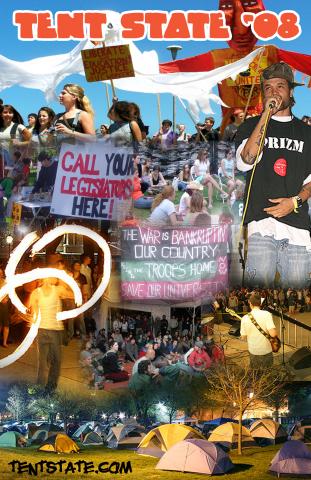
The Democratic convention protesters of 1968, who wound up on the truncheon end of the Chicago police riots, had been camped overnight by the simple result of their continuous protestation of having no representation at the DNC. Tent State University 2008No one asked permission. In 2008, by breaking off from the R-68 organizers and asking to be sanctioned by the city, TSU has allowed the Denver Police to preempt spontaneous demonstrations. Certainly in the eyes of the public and the residents of Denver. Now anyone who sticks around after curfew has been forewarned of the consequence.

The DNC Alliance for Real Democracy is a counter-protest Fifth Column

Denver DNC 2008DENVER, COLO.- The Alliance for Real Democracy (ARD), formed to counter the scrappily-named Recreate 68 at the DNC, is in reality an unwitting fifth column, set up by Democratic Party allies to temper protest in Denver. The UFPJ and other sundry “non-violent” progressives are funneling their members into the less populist ARD actions to divert participation from the major DNC demonstrations. But the aforementioned underwriters aren’t providing any funding, surprise! Leaving the ARD to protest exactly what it’s supposed to: nothing.

Alliance for Real DemocracyI think it’s heartbreaking to watch earnest young activists, representing the organizations comprising the ARD coalition, trying to organize activities without any commitment from their national affiliations. And some of the more outspoken national leaders, keen to make appearances at the DNC rallies, are beginning to smell a rat. They’re making backup arrangements to coordinate with the boots on the ground, R-68.

A Fifth Column refers to a group of partisans, usually spontaneously organized, which forms behind enemy lines as a conquering army approaches. It is the additional “column” of civilian fighters which an attacker might count on to stab the defenders in the back. Franco boasted of his fifth column in the Spanish Civil War. The French Resistance represented a fifth column for the Normandy liberators.

America’s antiwar movement has had its steady divisions, between UFPJ and A.N.S.W.E.R. most notably, but the rift has become more critical with the advent of another hopeful Democratic election win. Four years ago it was Kerry, with groups like Moveon.org trying to tone down the antiwar rhetoric. This year it’s Obama, and the appeasers are out in battalions. As usual, it’s done in the name of “nonviolence,” where too vigorous protest is seen as insufficiently nonviolent for the Democrat’s fragile delusions.

When R-68 began the groundwork for DNC protests, they were vilified for evoking the Chicago 1968 police riots. R-68 repudiated the violence, but not surprisingly those statements have yet to be reported in print. Meanwhile the bad press gave UFPJ and other nonviolence apostles the opportunity to break away and form their holy alliance to give their members sanctuary from the ruffians, re unpredictable young people.

But will it really? The R-68 group includes Unconventional Denver and Disrupt 08, but neither have violent plans. Black Block script-kiddies will turn up no matter whose event. Police agent provocateurs will instigate violence no matter how pious your crowd.

Code Pink, IVAW, Veterans For Peace, and UFPJ are among the national endorsers of ARD. Tent State, SFPJ, and Students for a Democratic Society are examples of young activists getting caught in their elders’ tar baby.

Because it’s not enough to vote for Obama, you have to quash dissent for Obama. It’s the Alliance For Real Democracy For Obama.

Naturally Denver protest organizers, whether ARD or R68, have found themselves having to confer about time slots and permits, out of respect for the success of each other’s activities. As a result, the national head of UFPJ, Leslie Cagan, issued an email decreeing that no ARD organization member would participate in the major Aug 24 kickoff antiwar demonstration. This drew question marks from prominent activist leaders who want to be at the biggest rally.

Bi-monthly CONSULTA meetings were scheduled by ARD and R68 to coordinate efforts. But the morning before the second Consulta, Leslie Cagan flew in from NYC for an emergency meeting with ARD leadership to brief them on what not to negotiate. She followed this with a hastily scheduled press conference the next day on the subject of Iran, it appeared to preempt her rivals’ DON’T BOMB IRAN action planned for August 2nd.

Colorado Springs own PPJPC is an endorser of ARD. Their letter of support was read into the minutes of a recent meeting, and it read like the typical support they’re getting from everyone. I’ll paraphrase the PPJPC letter:

“We at the Pikes Peak Justice and Peace Commission are honored to endorse your efforts at the DNC … due to critical funding shortages, we cannot offer you any monetary support at this time … Likewise, I’m sorry that I will not be able to participate in any events that week , but will try to interest our members in attending…” We’ll be with you in spirit, etc.

Why form a fifth column if you’re not going to support it? Because the ARD‘s job is to do nothing. Doing nothing is exactly how you stab activism in the back.

McCain was dubbed the “POW Songbird”

An excerpt from prisoner of war John McCain’s November 9, 1967 interview for the North Vietnamese newspaper NHAN DAN:
McCain told vietcong about US attack procedures
Vietnam Veterans Against John McCain have released a fact sheet on the highly decorated hero’s service in Vietnam. If this is reminiscent of the Swiftboat shits against John Kerry, at least these vets have the official records and news reports. Apparently John McCain III crashed a total of five planes, received one and a half medals per hour of service, and while the admiral’s son was pampered in the Hanoi Hilton, his extensive singing earned him the name “POW Songbird.”

FACT SHEET: Military record of John Sidney McCain III

Both McCain III’s father and grandfather were Admirals in the United States Navy. His father Admiral John S. ”Junior” McCain was commander of U.S. forces in Europe – later commander of American forces in Vietnam while McCain III was being held prisoner of war. His grandfather John S. McCain, Sr. commanded naval aviation at the Battle of Okinawa in 1945.

McCain III, like his father and grandfather, also attended the United States Naval Academy. McCain III finished near the bottom of his graduating class in 1958.

McCain III lost five U.S. Navy aircraft

1 – Student pilot McCain III lost jet number one in 1958 when he plunged into Corpus Christi Bay while practicing landings.

2 – Pilot McCain III lost another plane two years later while he was deployed in the Mediterranean. ”Flying too low over the Iberian Peninsula, he took out some power lines which led to a spate of newspaper stories in which he was predictably identified as the son of an admiral.

3 – Pilot McCain III lost number three in 1965 when he was returning from flying a Navy trainer solo to Philadelphia for an Army-Navy football game. McCain III radioed, ”I’ve got a flameout” and ejected at one thousand feet. The plane crashed to the ground and McCain III floated to a deserted beach.

4 – Combat pilot McCain III lost his fourth on July 29, 1967, soon after he was assigned to the USS Forrestal as an A-4 Skyhawk combat pilot. While waiting his turn for takeoff, an accidently fired rocket slammed into McCain Jr’s. plane. He escaped from the burning aircraft, but the explosions that followed killed 134 sailors, destroyed at least 20 aircraft, and threatened to sink the ship.

5 – Combat pilot McCain III lost a fifth plane three months later (Oct. 26, 1967) during his 23rd mission over North Vietnam when he failed to avoid a surface-to-air missile. McCain III ejected from the plane breaking both arms and a leg in the process and subsequently parachuted into Truc Bach Lake near Hanoi. After being pulled from the lake by the North Vietnamese, McCain III was bayoneted in his left foot and shoulder and struck by a rifle butt. He was then transported to the Hoa Lo Prison, also known as the Hanoi Hilton.

1973 New York Daily News labeled POW McCain III a “PW Songbird”

On McCain III’s fourth day of being denied medical treatment, slapped, and threatened with death by the communist (they were demanding military information in exchange for medical treatment), McCain III broke and told his interrogator, ”O.K., I’ll give you military information if you will take me to the hospital.” U.S. News and World Report, May 14, 1973 article written by former POW John McCain.

It was then that the communist learned that McCain III’s father was Admiral John S. McCain, the soon-to-be commander of all U.S. Forces in the Pacific. The Vietnamese rushed McCain III to Gai Lam military hospital (U.S. government documents), a medical facility normally unavailable for U.S. POWs.

By Nov. 9, 1967 (U.S. government documents) Hanoi press was quoting McCain III describing his mission including the number of aircraft in his flight, information about rescue ships, and the order of which U.S. attacks would take place.

While still in North Vietnam’s military hospital, McCain III gave an interview to prominent French television reporter Francois Chalais for a series titled Life in Hanoi. Chalais’ interview with McCain III was aired in Europe.

Vietnamese doctors operated on McCain’s Leg in early December, 1967. Six weeks after he was shot down, McCain was taken from the hospital and delivered to a U.S. POW camp.

In May of 1968, McCain III allowed himself to be interviewed by two North Vietnamese generals at separate times.” May 14, 1973 article written by former POW John McCain In August 1968, other POWs learned for the first time that John McCain III had been taken prisoner.

On June 5, 1969, the New York Daily News reported in a article headlined REDS SAY PW SONGBIRD IS PILOT SON OF ADMIRAL,

“…Hanoi has aired a broadcast in which the pilot son of United States Commander in the Pacific, Adm. John McCain, purportedly admits to having bombed civilian targets in North Vietnam and praises medical treatment he has received since being taken prisoner…”

The Washington Post explained McCain III’s broadcast:

“The English-Language broadcast beamed at South Vietnam was one of a series using American prisoners. It was in response to a plea by Defense Secretary Melvin S. Laird, May 19, that North Vietnam treat prisoners according to the humanitarian standards set forth by the Geneva Convention.”

In 1970, McCain III agreed to an interview with Dr. Fernando Barral, a Spanish psychiatrist who was living in Cuba at the time.

The meeting between Barral and McCain III (which was photographed by the Vietnamese) took place away from the prison at the office of the Committee for Foreign Cultural Relations in Hanoi (declassified government document). During the meeting, POW McCain sipped coffee and ate oranges and cakes with the Cuban.

While talking with Barral, McCain III further seriously violated the military Code of Conduct by failing to evade answering questions ”to the utmost of his ability” when he, according government documents, helped Barral by answering questions in Spanish, a language McCain had learned in school. The interview was published in January 1970.

McCain III was released from North Vietnam March 15, 1973

In 1993, during one of his many trips back to Hanoi, McCain asked the Vietnamese not to make public any records they hold pertaining to returned U.S. POWs. McCain III claims, that while a POW, he tried to kill himself.

McCain III was awarded “medals for valor” equal to nearly a medal-and-a-half for each hour he spent in combat

For 23 combat missions (an estimated 20 hours over enemy territory), the U.S. Navy awarded McCain III, the son of famous admirals, a Silver Star, a Legion of Merit for Valor, a Distinguished Flying Cross, three Bronze Stars, two Commendation medals plus two Purple Hearts and a dozen service medals.

“McCain had roughly 20 hours in combat,” explains Bill Bell, a veteran of Vietnam and former chief of the U.S. Office for POW/MIA Affairs — the first official U.S. representative in Vietnam since the 1973 fall of Saigon.

“Since McCain got 28 medals,” Bell continued, “that equals to about a medal-and-a-half for each hour he spent in combat. There were infantry guys — grunts on the ground — who had more than 7,000 hours in combat and I can tell you that there were times and situations where I’m sure a prison cell would have looked pretty good to them by comparison. The question really is how many guys got that number of medals for not being shot down.”

No one is faulting John McCain for collaborating with his Vietnamese captors. He survived captivity, however arduous or not. It is enough to say he is a survivor. It would be too much though to call him a hero.

To Recreate 68 at the Denver DNC is not a call to incite a Rumble in the Jungle

Free the Conspiracy EightContrary to the hype it is encouraging, RECREATE-68 does not want to recreate the violent clashes of the 1968 Democratic National Convention. That would have to be up to the police. While we know the Chicago Seven (+1) and their cohorts did not go quietly, it is now also well admitted that the violence in 1968 was perpetrated by the Chicago police without provocation.


I don’t think anyone wants to relive that brutality again, especially as riot police today have much more debilitating and potentially lethal weaponry. Recent demonstrations, as in Seattle against the WTO and in Miami against the FTAA, have seen militarized police force used against a well intended, if obviously outraged, outcry.

Last week at a public debate against Denver City Councilman Charlie Brown, Recreate-68 event coordinator Glen Spagnuolo made clear that they are not interested in receiving a beating or permanent injury at the hands of overzealous police. Of course the catch-phrase “recreate 68” does titillate with accompanying slogans like “Do It in Denver,” but this is done to pique people’s interest, and it has accomplished that.

Recreate-68 is determined to get people engaged with the DNC, in the streets, instead of in front of their televisions as passive spectators to the usurping of their power. The Democrats are party to continued funding of the war, raiding the US treasury for the rich, denying Americans universal health care, taking away our civil liberties with the Patriot Act, and colluding with murder, torture and profiteering. If the American people go along with these crimes, they are accomplices. Too bad they are also the victims. Official channels do not permit people to raise their voices above a silent consent. The DNC in August, in Denver, is opportunity knocking in the streets.

When party organizations admonish you to work through the system, they perpetuate their power to deny progressive reforms. The will of the people has only ever expressed itself through protest. Democracy, Human Rights, Abolition, Suffrage, Child Labor, Civil Rights, Pacifism. We have only made these gains by collective action. A redress of grievances is what it’s called in the constitution. I can just hear Democratic representatives saying, “oh we can’t go that that far, we could never get elected if we advocated for such extremist reforms.” They are undoubtedly right, because real reform is always up to you. But as much as Obama can urge you to feel hopeful, “you” doesn’t mean you voting for a representative who is promising you in actuality nothing.

Recreate 68 is about recreating the sense of connectivity Americans held in 1968, when young and old put their bodies into the line of fire desperate to bring an end to the disastrous Vietnam War. The people’s movement of the sixties had been growing, led by men soon assassinated. Students were rioting in London and Paris, and Cassius Clay was suspended from boxing for having declared himself a conscientious objector. By 1968 people understood that nothing would change unless they did it themselves.

Today we are into the sixth year of the Iraq War and there is no American antiwar momentum to speak of. There are diverse projects on the internet and in sporadic protests, but the US effort is a pitiable movement compared to the public outcry overseas.

Particularly lacking are young people. You may say it is because there is no draft, but enough are still volunteering to fight. I rather think that the youthful opposition is absent because of No Child Left Behind. Our children are being educated to be uncritical thinkers, in particular, narcissists and apolitical bubble babies with no immunity to corporate misinformation. They may be cynical, and clever by half, to the extent that they lack a social conscience. As a result, their forever adolescent thinking that nothing can touch them keeps them civically disengaged until it is too late and they are indebted to the machine.

The youthful cynicism which the slick corporate media celebrates as hip irreverence keeps kids from caring for their fellow people, and certainly holds them from believing that anything they do can make a difference. Look at the average age of the typical social activists. They’re past middle age. Is this a coincidence?

Young Americans, even up to age thirty something, are so jaded to have become tragically ineffectual. Electoral politics might be the extreme of their participation, and look where it will get them, against fraudulent pollsters and rigged voting systems.

I’m curious about what will happen in Denver if Recreate-68 is able to mobilize the youth. Perhaps kids will only be able to express themselves as Grand-Theft-Auto and Half-Life have taught them, as our soldiers are doing, cast adrift in Iraq. In that case, the disembodied violence to which we carelessly expose them will have come home to roost. If Denver becomes a riot, it is a development I think we will need to face.

For my part, I hope we can recreate 68. Let’s break through the media moratorium on the social issues important to us. Let’s remind the TV populace that we want to hold at least our Democratic Party politicians accountable to listen to our needs. If the candidates will not, and we’ve already learned that someone like Dennis Kucinich cannot get the nomination, perhaps the party system is too phony to matter.

What if the Democrats are only shills for the Republicans in charge? I believe the Democratic convention might only be setting up a candidate to lose to John McCain. For example, do you think Americans are ready to elect a woman or a black man to the presidency? I’d like to think so too, but I have a feeling the media is prepared to inform us in November, “oh, so close but no cigar!” Who is suggesting that Americans are past the gender or race card? Is it the corporate media, tool of the rich white man? Since when did the average American TV viewer wise up? George W. Bush’s approval rating was already at a dismal low when Americans reelected him in 2004. This, even after televised debates showed unequivocally that Bush was the dunce everyone remembered from the back of their classroom. Even if Bush didn’t really win in 2004, as in 2000, at least there were enough dumb white voters to make it look legitimate. Are those constituents going to vote for an unexperienced, non-veteran non-white Obama? Those errant voters are still out there, you see them, they still have W-04 stickers on their cars. And the the black box vote counting, voter registration and poll both gate-keeping are still in the hands of Republicans.

If the Democratic Party really hopes to represent the people, it has to do much better. If the Democratic Party is not prepared to offer Americans a real alternative to the corrupt misrepresentation in Washington, we can find better entertainment with the charades of the WWWF. Should the Dems hear this from you? Is your representative listening or still asking you to show patience? Take him or her to the mat, in Denver, in August.

Recreate-68 versus the City of Denver

Preparing for police brutality
DENVER- Glenn Spagnuolo of RECREATE-68 held his own against Denver City Councilman Charlie Brown at a symposium held today at the University of Denver about the upcoming DNC in August. Asked whether providing instruction for the use of shields truly constitutes advocating non-violent protest, Spagnuolo told of the permanent injuries which Police inflicted at previous demonstrations like the FTAA, and he described Denver’s newly requisitioned equipment such as shotguns which fire long distance tasers (XREP) and ear-piercing weapons systems (LRAD). Councilman Brown stressed the importance of protecting the upcoming DNC, its delegates, its protestors, the people of Denver, and the reputation of Denver, from the threat of terrorism.

The City of Denver refuses to release its security plan, to preempt a timely legal challenge. According to Spagnuolo, the city is considering a mile wide perimeter around Pepsi Stadium. Spagnuolo also clarified that Recreate-68 is not calling for repeating the violence of the 1968 Chicago convention, but instead hopes to re-activate the public to the level of engagement it exhibited in 1968, when the same Democratic Party refused to heed the will of the people to stop funding the illegal war in Vietnam. As history repeats itself forty years later, the anti-war movement has yet to summon the courage of the American people.

A couple of Recreate-68 innovations: Doc’s Place, a 24-hour people’s health clinic, to provide free conventional and alternative medical care for all for the duration of the DNC, “to deliver the promise no candidate has: Healthcare for all.” AS WELL, Recreate-68 is planning large FOOD NOT BOMBS events, to feed the homeless of Denver, to counter the efforts of the city to sweep its streets of the homeless in advance of the convention.

There did appear to be a conflict about how best to secure Denver’s image with the eyes of the world upon it.

Glenn Spagnuolo comes to Recreate-68 with experience leading to arrest and acquittal in demonstrations in 2005 and 2007 against the Columbus Day parade. He’s worked with the South Africa’s anti-apartheid struggle, ACT-UP, and against the FTAA in Florida.

Most recently, Denver held a lottery to allocate the choice protest venues for the duration of the DNC. Recreate-68 received some locations and time slots, but lost the prime spot and prime time to another candidate: the Democratic Party! Oddly, although the Democrats are going to be center-stage at the convention hall, they applied, and won, the right to occupy the main protest stage adjacent the Pepsi Center on the first evening of the convention.

The Beatles were counter-revolutionary

It sounds sexy, like “counter-culture.” But counter-revolutionaries were the Tsarist forces, or Loyalists in our hemisphere, who countered the revolutionary surges of the masses. The Beatles expressed themselves as being against the war, and Lennon ultimately gave the peace movement its anthem. But in 1968, when the Beatles were preaching peace and non-violence, Mick Jaggar was marching at the front of the student riots in London. Which actions ultimately closed down the Vietnam War? Was it Haight-Ashbury or the Left Bank? Was it Woodstock or American GIs finally fragging their officers? If you wonder why today’s pop icons say only what’s approved . . .
FLIP YOUR WIG game pieces George Harrison, John Lennon, Paul McCartney and Ringo Starr

A plague on both your houses!

Capulets versus MontaguesJoseph Kennedy, patriarch of what is often described as America’s royal family, built his fortune by bootlegging whiskey during the Prohibition and rose to power by mob control of the unions.
 
Ill-gotten gains are credited by some for the fate of Joseph’s offspring: the “Kennedy Curse.” Son JFK, elected president, shot; son Bobbie, declaring candidacy, shot; son Ted suffers a car-crash which derails his political aspirations; son of eldest son dies in a 1999 plane crash.

While Christian America ponders whether curse or karma, another constituency retains a dogged skepticism about the official account of both assassinations. That the details are still shrouded in secrecy suggests that whoever gained by killing the Kennedys is still around, and is still powerful enough to intimidate accomplices.

A lesser celebrated 20th Century up and comer is la familia Bush. Prescott Bush made his money in oil and nefarious financial deals with Hitler, and with influential friends formulated the CIA in 1947. His son rose through the CIA to be president. His eldest grandson was appointed to the presidency and to infamy as well.

Deathbed confessions, among other evidence, have tied the CIA to the assassination of JFK. “Conspiracy Theories” link the grassy knoll to ex-Batistas to George H. W. Bush’s little Zapata offshore Anti-Castro operation. (Alex Jones recounts that in the CIA Bay of Pigs Operation, launched without Kennedy’s permission, one of the American ships had been renamed “Barbara II,” its namesake perhaps the Grumman Avenger “Barbara” which H. W. crash-landed in WWII.) In fact, FBI records place G. W. on the first plane to DC (from Dealey Plaza?)

Recent improved photo-analysis show several high-ranking CIA operatives present at the RFK assassination in 1968. I’ll leave Chappaquiddick and John John’s Martha’s Vineyard plane crash to future leaks and investigators.

In the meantime, John Hinckley Jr., attempted assassin of Ronald Reagan while Vice President Bush was next in line, was not just any mentally disturbed highly-suggestible boy, but the son of friend of Bush’s son Neil.

And how about those fixed elections of 2000 and 2004? Never mind whatever it was that happened on 9/11!

Is America more prepared to accept a Kennedy Curse, than the possibility that one family’s and a nation’s bad fortune might really have been blood spilled by Long Knives, one Fascist putsch after the next, until the burning of the Reichstag?

Israel obstinate

PLOMore nations gave formal recognition to the PLO, a terrorist group, than to Israel. Thus more people thought the Palestinian Liberation Organization had a “right to exist” than did Israel, a chunk of Arab land appropriated to make a Jewish State. To date Israel has rejected 70 UN resolutions against its actions. I think it bears repeating them, lest typifying Israel’s behavior as illegal, be dismissed as a rant.

# 1. General Assembly Resolution 181 (1947): the 1947 Partition plan of Palestine and the creation of Israel.
# 2. General Assembly Resolution 194 (1947): Palestinian Refugees have the right to return to their homes in Israel.
# 3. Resolution 106 (1955): condemns Israel for Gaza raid.
# 4. Resolution 111 (1956): condemns Israel for raid on Syria that killed fifty-six people.
# 5. Resolution 127 (1958): recommends Israel suspend its no-man’s zone’ in Jerusalem.
# 6. Resolution 162 (1961): urges Israel to comply with UN decisions.
# 7. Resolution 171 (1962): determines flagrant violations by Israel in its attack on Syria.
# 8. Resolution 228 (1966): censures Israel for its attack on Samu in the West Bank, then under Jordanian control.
# 9. Resolution 237 (1967): urges Israel to allow return of new 1967 Palestinian refugees.
# 10. Resolution 242 (1967): Israel’s occupation of Palestine is Illegal.
# 11. Resolution 248 (1968): condemns Israel for its massive attack on Karameh in Jordan.
# 12. Resolution 250 (1968): calls on Israel to refrain from holding military parade in Jerusalem.
# 13. Resolution 251 (1968): deeply deplores Israeli military parade in Jerusalem in defiance of Resolution 250.
# 14. Resolution 252 (1968): declares invalid Israel’s acts to unify Jerusalem as Jewish capital.
# 15. Resolution 256 (1968): condemns Israeli raids on Jordan as flagrant violation.
# 16. Resolution 259 (1968): deplores Israel’s refusal to accept UN mission to probe occupation.
# 17. Resolution 262 (1968): condemns Israel for attack on Beirut airport.
# 18. Resolution 265 (1969): condemns Israel for air attacks for Salt in Jordan.
# 19. Resolution 267 (1969): censures Israel for administrative acts to change the status of Jerusalem.
# 20. Resolution 270 (1969): condemns Israel for air attacks on villages in southern Lebanon.
# 21. Resolution 271 (1969): condemns Israel’s failure to obey UN resolutions on Jerusalem.
# 22. Resolution 279 (1970): demands withdrawal of Israeli forces from Lebanon.
# 23. Resolution 280 (1970): condemns Israeli’s attacks against Lebanon.
# 24. Resolution 285 (1970): demands immediate Israeli withdrawal from Lebanon.
# 25. Resolution 298 (1971): deplores Israel’s changing of the status of Jerusalem.
# 26. Resolution 313 (1972): demands that Israel stop attacks against Lebanon.
# 27. Resolution 316 (1972): condemns Israel for repeated attacks on Lebanon.
# 28. Resolution 317 (1972): deplores Israel’s refusal to release.
# 29. Resolution 332 (1973): condemns Israel’s repeated attacks against Lebanon.
# 30. Resolution 337 (1973): condemns Israel for violating Lebanon’s sovereignty.
# 31. Resolution 347 (1974): condemns Israeli attacks on Lebanon.
# 32. General Assembly Resolution 3236 (1974): affirms the inalienable rights of the Palestinian people in Palestine to self-determination without external interference and to national independence and sovereignty.
# 33. Resolution 425 (1978): calls on Israel to withdraw its forces from Lebanon.
# 34. Resolution 427 (1978): calls on Israel to complete its withdrawal from Lebanon.
# 35. Resolution 444 (1979): deplores Israel’s lack of cooperation with UN peacekeeping forces.
# 36. Resolution 446 (1979): determines that Israeli settlements are a serious obstruction to peace and calls on Israel to abide by the Fourth Geneva Convention.
# 37. Resolution 450 (1979): calls on Israel to stop attacking Lebanon.
# 38. Resolution 452 (1979): calls on Israel to cease building settlements in occupied territories.
# 39. Resolution 465 (1980): deplores Israel’s settlements and asks all member states not to assist its settlements program.
# 40. Resolution 467 (1980): strongly deplores Israel’s military intervention in Lebanon.
# 41. Resolution 468 (1980): calls on Israel to rescind illegal expulsions of two Palestinian mayors and a judge and to facilitate their return.
# 42. Resolution 469 (1980): strongly deplores Israel’s failure to observe the council’s order not to deport Palestinians.
# 43. Resolution 471 (1980): expresses deep concern at Israel’s failure to abide by the Fourth Geneva Convention.
# 44. Resolution 476 (1980): reiterates that Israel’s claim to Jerusalem are null and void.
# 45. Resolution 478 (1980): censures (Israel) in the strongest terms for its claim to Jerusalem in its Basic Law.
# 46. Resolution 484 (1980): declares it imperative that Israel re-admit two deported Palestinian mayors.
# 47. Resolution 487 (1981): strongly condemns Israel for its attack on Iraq’s nuclear facility.
# 48. Resolution 497 (1981): decides that Israel’s annexation of Syria’s Golan Heights is null and void and demands that Israel rescinds its decision forthwith.
# 49. Resolution 498 (1981): calls on Israel to withdraw from Lebanon.
# 50. Resolution 501 (1982): calls on Israel to stop attacks against Lebanon and withdraw its troops.
# 51. Resolution 509 (1982): demands that Israel withdraw its forces forthwith and unconditionally from Lebanon.
# 52. Resolution 515 (1982): demands that Israel lift its siege of Beirut and allow food supplies to be brought in.
# 53. Resolution 517 (1982): censures Israel for failing to obey UN resolutions and demands that Israel withdraw its forces from Lebanon.
# 54. Resolution 518 (1982): demands that Israel cooperate fully with UN forces in Lebanon.
# 55. Resolution 520 (1982): condemns Israel’s attack into West Beirut.
# 56. Resolution 573 (1985): condemns Israel vigorously for bombing Tunisia in attack on PLO headquarters.
# 57. Resolution 587 (1986): takes note of previous calls on Israel to withdraw its forces from Lebanon and urges all parties to withdraw.
# 58. Resolution 592 (1986): strongly deplores the killing of Palestinian students at Bir Zeit University by Israeli troops.
# 59. Resolution 605 (1987): strongly deplores Israel’s policies and practices denying the human rights of Palestinians.
# 60. Resolution 607 (1988): calls on Israel not to deport Palestinians and strongly requests it to abide by the Fourth Geneva Convention.
# 61. Resolution 608 (1988): deeply regrets that Israel has defied the United Nations and deported Palestinian civilians.
# 62. Resolution 636 (1989): deeply regrets Israeli deportation of Palestinian civilians.
# 63. Resolution 641 (1989): deplores Israel’s continuing deportation of Palestinians.
# 64. Resolution 672 (1990): condemns Israel for violence against Palestinians at the Haram Al-Sharif/Temple Mount.
# 65. Resolution 673 (1990): deplores Israel’s refusal to cooperate with the United Nations.
# 66. Resolution 681 (1990): deplores Israel’s resumption of the deportation of Palestinians.
# 67. Resolution 694 (1991): deplores Israel’s deportation of Palestinians and calls on it to ensure their safe and immediate return.
# 68. Resolution 726 (1992): strongly condemns Israel’s deportation of Palestinians.
# 69. Resolution 799 (1992): strongly condemns Israel’s deportation of 413 Palestinians and calls for their immediate return.
# 70. Resolution 1397 (2002): affirms a vision of a region where two states, Israel and Palestine, live side by side within secure and recognized borders.
# 71. General Assembly Resolution ES-10/15 (2004): declares the wall built inside the occupied territories as contrary to international law and asks Israel to demolish it.