George Seurat’s afternoon on an island


CHICAGO- What’s in a name? I expect its originator could explain. Do art collectors or curators have final edit over a famous painting’s title? I can understand the Art Institute of Chicago nicknaming its familiar La Grande Jatte, but the first paragraph of the painting’s gallery description has to explain that the iconic riverbank scene is named not for a tributary, but an island on the river Seine, because their slimmed translation of its full title now reads “A Sunday on La Grande Jatte” à la Sunday in the Park with George. Gone are afternoon and island from Un dimanche après-midi sur l’Île de la Grande Jatte –you wonder why bother to keep “la”? I remember the original full English title from art history textbooks, whose color plates now seem like a greatest hits album of the Art Institute’s collection. Did Chicago corner the market on Impressionist masterpieces, or did their image licenses determine which we’re taught are representative? Reframing painting titles suggests to me there’s more likelihood of the latter. Does great art jump out at you intuitively? I doubt we even know what we like.

The above detail is not Seurat, but Gustave Caillebotte’s Rainy Day in Paris and illustrates the difference it makes to see a painting in a gallery. High Def. Hopper’s Night Hawks is just as stark in actual size, but Caillebotte’s wet Parisenne has a lace veil which you’d never have noticed on a print.

Occupying an empty house

My friend Maureen gets frustrated with me because i keep slinging all this outlandish stuff at her, and as one might expect, she has a hard time getting it sometimes, and an even harder time imagining that any of it might be true or practical. I keep telling her that money is over, she keeps telling me that people use money for good things. I start hanging around Occupy Wall St. and its attendant movement and she feels alienated because she lives largely from Stock Exchange investments. Maureen is not the only one with this issue; a man appeared at our GA in CSpgs last week deeply troubled by the fact that we “haters” were trying to force his grandma to eat cat food because as he noted, “Wall Street”, that is, the package of various stock offerings available there, is owned diffusely by grandmas and retirees, penny-pinchers and wheeler-dealers all over the world. My friend and this guy are both put off by the extremely jarring nature of the realizations at hand that have precipitated huge crowds of traffic-clotting protesters into the streets. (Actually that stranger stayed for the GA and came around, while Maureen has an injury preventing her attendance, so this is kinda for her, as well as everyone else).

The issue with the money that’s causing problems is closely associated with the Global nature of Occupy! and because of that, its fragmented nature. Both issues are rendered all the more discordant to many by their perceived urgency among occupiers. We want things to change right now, not after the next bullshit election cycle, but rather before we all die when the food chain collapses. Many within the movement at hand will object to what i posit here, but there really is no way around it in my own mind, so i have no choice but to put it out there. The FED, the IMF, World Bank, Bank of England, Royal Dutch, Al Rajhi, etc, etc, and their intertwined financial/military/industrial destruction machine already exist as a very solid Global beast with utterly uncontrollable and ravenous hungers. We humans are equally as Global, and Occupy! is the same. The destructive elements in this conflict as well as the creative are out of the hands of nationalistic players, and our old notions of money and its production will not save us in time. Once again, if it were gonna, it woulda.

I’ve put this educational chart up before, and if you have no motivation to look any further then i hope you’ll just go get another beer and stay out of the way. The World as we know it is a disaster, and we made it so. Don’t give me that crap about global warming is caused by dinosaur farts. We’ve dumped more toxic shit into the ecosystem in the last century than can be said to have even existed, anywhere. If Humanity can’t effect the world, like one hears on Rush, of some of those other insane programs where are all the American Bison? Passenger Pigeons? Pennsylvanians drinking tap water? Live, healthy corals? Why are so many of us completely, stubbornly ignorant of these obvious and urgent facts. It’s the Fear, of course, and it’s actually propagated deliberately by some, who fail in turn to recognize that they are trapped by it themselves. we’ll move on to the business of the Fear another time.

Plenty of accusations fly around about who caused the money crisis, the environmental crisis, and any other crisis at hand. It really doesn’t matter, and even though some players have obviously been behaving recklessly, some in succession with conspiratorial characters of some pedigree, we absolutely must give up the hatred and sort out solutions, if we want to live. There are a few links at the bottom to articles, (and one video–don’t like ’em myself), on financial and economic collapse. There are plenty more. The point is to assure you all that our monetary system, the means we’ve “developed” through haphazard mutual throat-slitting for trade and interaction among ourselves, is fucked. We can’t fix it. The “money” we’ve been passing around isn’t reflective of anything real. The “price” we pay for things has utterly nothing to do with their intrinsic worth or their scarcity in the world. This is our collective fault, not simply the fault of a couple Rothschilds and Morgans. We all scrabbled to keep up appearances and grubbed around to buy stupid shit we never needed, or even used. The numbers involved down at the FED are so unrealistic they’re meaningless, and trade imbalances and the like merely amount to spiffy terms for describing exported slavery, a kracken which is quickly coming home to roost for Westerners intent on prolonging the petro-economy for the sake of the god damn Fear. There is no money. Its value has been pilfered away by milquetoast pirates one Stewie Griffin party at a time.

The ends of the Dollar and the Euro represent terrific opportunity. Not for making more money, you dumb-ass! That’s the thinking that’s got us in this state in the first place. Some reasoned arguments exist that attempt to exonerate the financiers held up by many Occupiers as responsible for this mess. It really doesn’t matter. The people playing this game, which are all of us, have all been working at competition together ever since we began to establish societies. We didn’t know any better at the time. Now it’s apparent that the approach we’ve been taking isn’t working. If you are trapped in a mindset that insists on claiming a bigger slice of pie, or plaintively keens of the potential virtue of money if only it flows through the right hands, i’m sorry for you. Because when this all really hits the fan, you will be completely lost. We own nothing, except stuff that’s really not worth much, if you figure it in money. At some future point it may be necessary to argue these points at a higher level, because financiers are fond of obfuscation and bullshit in the literature, and hate to admit to themselves or anyone else how evilly they’ve been behaving, but soon enough the thing will collapse beyond the need to parse words.

So follow. The Earth is in the balance, because of the natural behavior of human beings when set loose to compete. Humans also have an innate drive to form societies and cooperate. The mechanisms of the old competitive game are worn, and the game is pretty much decided. We’ve already abandoned borders within the confines or the Game, only keeping nationalisms and “racial” distinctions in place when convenient to some other aspect of the Game, like the continued propagation of slavery, or the demonization of controllers of certain resources. Pull back and look a little. It’s 100% game players causing all the wars in the world, all the food shortages, all the misery. Do we really give a shit what color or religion a thirsty guy in the desert may be? Am i really worried about Iraqi invaders pouring over the horizon? Please! Even if all the current unrest and destabilization isn’t manipulated by people who thought George Orwell was writing textbooks, none of this is necessary. We don’t need petroleum, (look it up yourself fer cryin’ out loud). We don’t need to hate a bunch of desert nomads just because our shitheads set them up in business as a part of a grand scam. We don’t need to compete.

Cooperative living is so much easier and less troublesome you naysayers will be feeling really silly before this is over. It’s OK, though. It’s not so easy to see, at least for now. If it takes too long to avoid the pain you’ll see soon enough. Come see us then. What we have isn’t worth money but i am rich, rich rich! And this Manse won’t collapse, with or without money. Stay with us….

http://economiccrisis.us/
http://www.naturalnews.com/032999_financial_collapse_Euro.html
http://www.globalresearch.ca/index.php?context=va&aid=26756
http://www.uctv.tv/search-details.aspx?showID=16225
http://129.81.170.14/~dupre/SEEDS.pdf

Nonviolence is the refuge of cowards

I say this with the full authority of my own personal experience: nonviolence is for cowards. When push has come to shove, I stepped to the sidewalk but I am so full of admiration for those who stayed in the line of fire. Today much of the world commemorates Bastille Day, France’s unique independence day, because it launched the French Revolution. Not just a revolution for the masses of humanity, but their Enlightenment. Storming the Bastilles was no small transformative event, and the sans-culottes were not led by urgings to keep it nonviolent. The monarchy took heed, as it had for every historic concession, because the citizenry had it scared to death.

Have you changed social inequity by voting in the polls? Have you found justice via protest? Sought, beseeched, was as far as you got. Violent uprising has not lately looking too effective either. But it’s got the track record.

I’m not saying I’m up to the task, but I assure you I have the courage to be nonviolent in spades.

It is a most self-aggrandizing dishonesty that holds nonviolence to be brave. There is nothing easier than to take the path of least resistance. I don’t mean to downplay the audacity to protest, as opposed to conforming, although isn’t sticking to your principles squarly self-indulgent? I claim no credit for failing to bend on matters of principle. In fact, sometimes I feel positively anti-social.

But taken the next step, what’s easier than subjecting yourself to the authority of the sword? Again it’s the principle of not becoming like your abuser, another no-brainer, but no-bravery required.

Standing up for what you believe? Easy-peasy. To the death? Positively cowardly lion.

This is you inner dialog, be honest: I defy your authority, but only so far. I reject your physical oppression, but just kidding. I call for the total destruction of your hierarchy, but only in words, I’m entitled, and you can’t lay a finger on me because I’m playing by the rules.

Hope of getting anywhere: dismal. Modern social movements have only Gandhi and Mandela as purported success stories. But I’ll not insult the elders. The Gandhi and Mandela of our textbooks bear no resemblance to the reality, they are false role-models put forth by fascists who want to blunt every effort to rise against power.

Oh, nonviolence is the higher ideal, sure. Lovely. Browny points for the afterlife. Trickle-up transcendence has as much potential for success as awaiting extraterrestrials or building playing fields for disgraced baseball reincarnates.

Unless power wants to transcend the human experience, and lift all of us with it, mankind is not going anywhere. The only way you’re going to levitate powerful heads is with a guillotine. Dreadfully eighteenth century, but check out the horrific bygone days from which they’re reconstituting torture and feudalism.

You can probably contrive a litany of rationalizations for why it would be beneath you, but imagine picking up a gun and having a go against the overwhelming power of the state. Now that’s terrifying.

We’ll all be neo-know-sumpin’ Texans

Texas State Board of EducationThe conservative majority of the Texas Board of Education thinks school textbooks are “skewed” too much toward education. They want social studies to smile more favorably on Neoclassical Economics, America’s Christian heritage, and the legacy of today’s Neocons. Does it matter if Texas children are being taught dillwad propaganda? Well, the Texas school system is such a quantity buyer, scholastic publishers tailor national texts to conform to Texas know-nothing standards.

If your glass is half full, you might think the Tex-idiots have finally pushed illiteracy so far that American parents and teachers will simply laugh it off and adopt supplementary reading. On the other hand, this conservative surge compounds the devastation of No Child Left Behind. American schoolchildren are being made into absolute idiots, in the image of these 10 Republicans who voted along party lines to teach a history that challenges the separation of church and state.

If your kid doesn’t learn anything from the past, you have these folk to thank:

Don McLeroy– TA&M, dentist, veteran, sunday-school teacher
Gail Lowe– LSU, Lampasas County Conservative Club “Conservative of the Year”
Terri Leo– TA&M, Republican op
Barbara Cargill– Baylor, Methodist Wonders of the Woodlands Science Camp,
Ken Mercer– Texas Homeland Security Council
Geraldine “Tincy” Miller– SMU, TA&M, realtor
David Bradley– TA&M, insurance agent, Beaumont’s Citizens on Patrol
Cynthia Noland Dunbar– Spirit of Freedom Republican Women’s Club
Bob Craig– Texas Tech, SMU
Patricia Hardy– Howard Payne University

Vaneigem on energy as commodity

NMT’s in-house Situationist has been conceptualizing a way forward well expressed in this May 2009 interview of Raoul Vaneigem:
Situationist“We are being “offered” biofuels on the condition we agree to transgenic rapeseed farming. Eco-tourism will accelerate the plundering of our biosphere. Windmill farms are being built without any advantage to the consumers. Those are the areas where intervention is possible. Natural resources belong to us, they are free, they must be made to serve the freedom of life. It will be up to the communities to secure their own energy and food independence so as to free themselves from the control of the multinationals and their state vassals everywhere. Claiming natural power for our use means reclaiming our own existence first. Only creativity will rid us of work. …

Freeness is the only absolute weapon capable of shattering the mighty self-destruction machine set in motion by consumer society, whose implosion is still releasing, like a deadly gas, bottom-line mentality, cupidity, financial gain, profit, and predation. Museums and culture should be free, for sure, but so should public services, currently prey to the scamming multinationals and states. Free trains, buses, subways, free healthcare, free schools, free water, air, electricity, free power, all through alternative networks to be set up. As freeness spreads, new solidarity networks will eradicate the stranglehold of the commodity. This is because life is a free gift, a continuous creation that the market’s vile profiteering alone deprives us of.”
–Raoul Vaneigem, 2009

Interviewed by Hans Ulrich Obrist, for e-flux, Journal #6. See original article or the copy mirrored below:

In Conversation with Raoul Vaneigem

Hans Ulrich Obrist: I just visited Edouard Glissant and Patrick Chamoiseau, who have written an appeal to Barack Obama. What would your appeal and/or advice be to Obama?

Raoul Vaneigem: I refuse to cultivate any relationship whatsoever with people of power. I agree with the Zapatistas from Chiapas who want nothing to do with either the state or its masters, the multinational mafias. I call for civil disobedience so that local communities can form, coordinate, and begin self-producing natural power, a more natural form of farming, and public services that are finally liberated from the scams of government by the Left or the Right. On the other hand, I welcome the appeal by Chamoiseau, Glissant, and their friends for the creation of an existence in which the poetry of a life rediscovered will put an end to the deadly stranglehold of the commodity.

HUO: Could we talk about your beginnings? How did your participation in situationism begin, and what was your fundamental contribution? At the outset of your relationship with the SI, there was the figure of Henri Lefebvre. What did he mean to you at the time? Why did you decide to send him poetic essays?

RV: I would first like to clarify that situationism is an ideology that the situationists were unanimous in rejecting. The term “situationist” was ever only a token of identification. Its particularity kept us from being mistaken for the throngs of ideologues. I have nothing in common with the spectacular recuperation of a project that, in my case, has remained revolutionary throughout. My participation in a group that has now disappeared was an important moment in my personal evolution, an evolution I have personally pressed on with in the spirit of the situationist project at its most revolutionary. My own radicality absolves me from any label. I grew up in an environment in which our fighting spirit was fueled by working class consciousness and a rather festive conception of existence. I found Lefebvre’s Critique of Everyday Life captivating. When La Somme et le reste [The Sum and the Remainder] was published, I sent him an essay of sorts on “poetry and revolution” that was an attempt to unify radical concepts, Lettrist language, music, and film imagery by crediting them all with the common virtue of making the people’s blood boil. Lefebvre kindly responded by putting me in touch with Guy Debord who immediately invited me to Paris. The two of us had very different temperaments, but we would agree over a period of nearly ten years on the need to bring consumer society to an end and to found a new society on the principle of self-management, where life supersedes survival and the existential angst that it generates.

HUO: Which situationist projects remain unrealized?

RV: Psychogeography, the construction of situations, the superseding of predatory behavior. The radicality, which, notwithstanding some lapses, never ceased to motivate us, remains a source of inspiration to this day. Its effects are just beginning to manifest themselves in the autonomous groups that are now coming to grips with the collapse of financial capitalism.

HUO: The Situationist International defined the situationist as someone who commits her- or himself to the construction of situations. What were those situations for you, concretely? How would you define the situationist project in 2009?

RV: By its very style of living and thinking, our group was already sketching out a situation, like a beachhead active within enemy territory. The military metaphor is questionable, but it does convey our will to liberate daily life from the control and stranglehold of an economy based on the profitable exploitation of man. We formed a “group-at-risk” that was conscious of the hostility of the dominant world, of the need for radical rupture, and of the danger of giving in to the paranoia typical of minds under siege. By showing its limits and its weaknesses, the situationist experience can also be seen as a critical meditation on the new type of society sketched out by the Paris Commune, by the Makhnovist movement and the Republic of Councils wiped out by Lenin and Trotsky, by the libertarian communities in Spain later smashed by the Communist Party. The situationist project is not about what happens once consumer society is rejected and a genuinely human society has emerged. Rather, it illuminates now how lifestyle can supersede survival, predatory behavior, power, trade and the death-reflex.

HUO: You and Guy Debord are the main protagonists of the situationist movement. How do you see Debord’s role and your role?

RV: Not as roles. That is precisely what situationism in its most ridiculous version aims at: reducing us to cardboard cut-outs that it can then set up against one another according to the spectacle’s standard operating procedure. I am simply the spokesman, among others, of a radical consciousness. I just do what I can to see that resistance to market exploitation is transformed into an offensive of life, and that an art of living sweeps away the ruins of oppression.

HUO: What were your reasons for resigning from the group?

RV: Following the occupation movements of May 1968, we knew that some recuperation was afoot. We were familiar with the mechanisms of alienation that would falsify our ideas and fit them neatly into the cultural puzzle. It became clear to us, during the last conference in Venice, that we had failed to shatter those mechanisms, that in fact they were shattering us from the inside. The group was crumbling, the Venice conference was demonstrating its increasing uselessness, and the only answers put forward were commensurate with the self-parody we had fallen into. Dissension intensified to the point of paranoid denunciation: of betrayals of radicality, of breaches of revolutionary spirit, of dereliction of conscience. Those times of catharsis and anathema are now long past, and it might be useful to examine how it is that we sowed the seeds of failure for which the group ended up paying such a heavy price. The shipwreck, however, did not indiscriminately sweep away to the shores of oblivion all of us who participated in the adventure. The group vanished in such a way as to allow the individuals to either consolidate their radicality, disown it, or lapse into the imposture of radicalism. I have attempted to analyze our experimental adventure in Entre le deuil du monde et la joie de vivre [Between Mourning the World and Exuberant Life].

HUO: You have written a lot on life, not survival. What is the difference?

RV: Survival is budgeted life. The system of exploitation of nature and man, starting in the Middle Neolithic with intensive farming, caused an involution in which creativity—a quality specific to humans—was supplanted by work, by the production of a covetous power. Creative life, as had begun to unfold during the Paleolithic, declined and gave way to a brutish struggle for subsistence. From then on, predation, which defines animal behavior, became the generator of all economic mechanisms.

HUO: Today, more than forty years after May ‘68, how do you feel life and society have evolved?

RV: We are witnessing the collapse of financial capitalism. This was easily predictable. Even among economists, where one finds even more idiots than in the political sphere, a number had been sounding the alarm for a decade or so. Our situation is paradoxical: never in Europe have the forces of repression been so weakened, yet never have the exploited masses been so passive. Still, insurrectional consciousness always sleeps with one eye open. The arrogance, incompetence, and powerlessness of the governing classes will eventually rouse it from its slumber, as will the progression in hearts and minds of what was most radical about May 1968.

HUO: Your new book takes us on a trip “between mourning the world and exuberant life.” You revisit May ‘68. What is left of May ‘68? Has it all been appropriated?

RV: Even if we are today seeing recycled ideologies and old religious infirmities being patched up in a hurry and tossed out to feed a general despair, which our ruling wheelers and dealers cash in on, they cannot conceal for long the shift in civilization revealed by May 1968. The break with patriarchal values is final. We are moving toward the end of the exploitation of nature, of work, of trade, of predation, of separation from the self, of sacrifice, of guilt, of the forsaking of happiness, of the fetishizing of money, of power, of hierarchy, of contempt for and fear of women, of the misleading of children, of intellectual dominion, of military and police despotism, of religions, of ideologies, of repression and the deadly resolutions of psychic tensions. This is not a fact I am describing, but an ongoing process that simply requires from us increased vigilance, awareness, and solidarity with life. We have to reground ourselves in order to rebuild—on human foundations—a world that has been ruined by the inhumanity of the cult of the commodity.

HUO: What do you think of the current moment, in 2009? Jean-Pierre Page has just published Penser l’après crise [Thinking the After-Crisis]. For him, everything must be reinvented. He says that a new world is emerging now in which the attempt to establish a US-led globalization has been aborted.

RV: The agrarian economy of the Ancien Régime was a fossilized form that was shattered by the emerging free-trade economy, from the 1789 revolution on. Similarly, the stock-dabbling speculative capitalism whose debacle we now witness is about to give way to a capitalism reenergized by the production of non-polluting natural power, the return to use value, organic farming, a hastily patched-up public sector, and a hypocritical moralization of trade. The future belongs to self-managed communities that produce indispensable goods and services for all (natural power, biodiversity, education, health centers, transport, metal and textile production . . .). The idea is to produce for us, for our own use—that is to say, no longer in order to sell them—goods that we are currently forced to buy at market prices even though they were conceived and manufactured by workers. It is time to break with the laws of a political racketeering that is designing, together with its own bankruptcy, that of our existence.

HUO: Is this a war of a new kind, as Page claims? An economic Third World War?

RV: We are at war, yes, but this is not an economic war. It is a world war against the economy. Against the economy that for thousands of years has been based on the exploitation of nature and man. And against a patched-up capitalism that will try to save its skin by investing in natural power and making us pay the high price for that which—once the new means of production are created—will be free as the wind, the sun, and the energy of plants and soil. If we do not exit economic reality and create a human reality in its place, we will once again allow market barbarism to live on.

HUO: In his book Making Globalization Work, Joseph Stiglitz argues for a reorganization of globalization along the lines of greater justice, in order to shrink global imbalances. What do you think of globalization? How does one get rid of profit as motive and pursue well-being instead? How does one escape from the growth imperative?

RV: The moralization of profit is an illusion and a fraud. There must be a decisive break with an economic system that has consistently spread ruin and destruction while pretending, amidst constant destitution, to deliver a most hypothetical well-being. Human relations must supersede and cancel out commercial relations. Civil disobedience means disregarding the decisions of a government that embezzles from its citizens to support the embezzlements of financial capitalism. Why pay taxes to the bankster-state, taxes vainly used to try to plug the sinkhole of corruption, when we could allocate them instead to the self-management of free power networks in every local community? The direct democracy of self-managed councils has every right to ignore the decrees of corrupt parliamentary democracy. Civil disobedience towards a state that is plundering us is a right. It is up to us to capitalize on this epochal shift to create communities where desire for life overwhelms the tyranny of money and power. We need concern ourselves neither with government debt, which covers up a massive defrauding of the public interest, nor with that contrivance of profit they call “growth.” From now on, the aim of local communities should be to produce for themselves and by themselves all goods of social value, meeting the needs of all—authentic needs, that is, not needs prefabricated by consumerist propaganda.

HUO: Edouard Glissant distinguishes between globality and globalization. Globalization eradicates differences and homogenizes, while globality is a global dialogue that produces differences. What do you think of his notion of globality?

RV: For me, it should mean acting locally and globally through a federation of communities in which our pork-barreling, corrupt parliamentary democracy is made obsolete by direct democracy. Local councils will be set up to take measures in favor of the environment and the daily lives of everyone. The situationists have called this “creating situations that rule out any backtracking.”

HUO: Might the current miscarriages of globalization have the same dangerous effects as the miscarriages of the previous globalization from the ‘30s? You have written that what was already intolerable in ‘68 when the economy was booming is even more intolerable today. Do you think the current economic despair might push the new generations to rebel?

RV: The crisis of the ‘30s was an economic crisis. What we are facing today is an implosion of the economy as a management system. It is the collapse of market civilization and the emergence of human civilization. The current turmoil signals a deep shift: the reference points of the old patriarchal world are vanishing. Percolating instead, still just barely and confusedly, are the early markers of a lifestyle that is genuinely human, an alliance with nature that puts an end to its exploitation, rape, and plundering. The worst would be the unawareness of life, the absence of sentient intelligence, violence without conscience. Nothing is more profitable to the racketeering mafias than chaos, despair, suicidal rebellion, and the nihilism that is spread by mercenary greed, in which money, even devalued in a panic, remains the only value.

HUO: In his book Utopistics, Immanuel Wallerstein claims that our world system is undergoing a structural crisis. He predicts it will take another twenty to fifty years for a more democratic and egalitarian system to replace it. He believes that the future belongs to “demarketized,” free-of-charge institutions (on the model, say, of public libraries). So we must oppose the marketization of water and air.1 What is your view?

RV: I do not know how long the current transformation will take (hopefully not too long, as I would like to witness it). But I have no doubt that this new alliance with the forces of life and nature will disseminate equality and freeness. We must go beyond our natural indignation at profit’s appropriation of our water, air, soil, environment, plants, animals. We must establish collectives that are capable of managing natural resources for the benefit of human interests, not market interests. This process of reappropriation that I foresee has a name: self-management, an experience attempted many times in hostile historical contexts. At this point, given the implosion of consumer society, it appears to be the only solution from both an individual and social point of view.

HUO: In your writing you have described the work imperative as an inhuman, almost animal condition. Do you consider market society to be a regression?

RV: As I mentioned above, evolution in the Paleolithic age meant the development of creativity—the distinctive trait of the human species as it breaks free from its original animality. But during the Neolithic, the osmotic relationship to nature loosened progressively, as intensive agriculture became based on looting and the exploitation of natural resources. It was also then that religion surfaced as an institution, society stratified, the reign of patriarchy began, of contempt for women, and of priests and kings with their stream of wars, destitution, and violence. Creation gave way to work, life to survival, jouissance to the animal predation that the appropriation economy confiscates, transcends, and spiritualizes. In this sense market civilization is indeed a regression in which technical progress supersedes human progress.

HUO: For you, what is a life in progress?

RV: Advancing from survival, the struggle for subsistence and predation to a new art of living, by recreating the world for the benefit of all.

HUO: My interviews often focus on the connections between art and architecture/urbanism, or literature and architecture/urbanism. Could you tell me about the Bureau of Unitary Urbanism?

RV: That was an idea more than a project. It was about the urgency of rebuilding our social fabric, so damaged by the stranglehold of the market. Such a rebuilding effort goes hand in hand with the rebuilding by individuals of their own daily existence. That is what psychogeography is really about: a passionate and critical deciphering of what in our environment needs to be destroyed, subjected to détournement, rebuilt.

HUO: In your view there is no such thing as urbanism?

RV: Urbanism is the ideological gridding and control of individuals and society by an economic system that exploits man and Earth and transforms life into a commodity. The danger in the self-built housing movement that is growing today would be to pay more attention to saving money than to the poetry of a new style of life.

HUO: How do you see cities in the year 2009? What kind of unitary urbanism for the third millennium? How do you envision the future of cities? What is your favorite city? You call Oarystis the city of desire. Oarystis takes its inspiration from the world of childhood and femininity. Nothing is static in Oarystis. John Cage once said that, like nature, “one never reaches a point of shapedness or finishedness. The situation is in constant unpredictable change.”2 Do you agree with Cage?

RV: I love wandering through Venice and Prague. I appreciate Mantua, Rome, Bologna, Barcelona, and certain districts of Paris. I care less about architecture than about how much human warmth its beauty has been capable of sustaining. Even Brussels, so devastated by real estate developers and disgraceful architects (remember that in the dialect of Brussels, “architect” is an insult), has held on to some wonderful bistros. Strolling from one to the next gives Brussels a charm that urbanism has deprived it of altogether. The Oarystis I describe is not an ideal city or a model space (all models are totalitarian). It is a clumsy and naïve rough draft for an experiment I still hope might one day be undertaken—so I agree with John Cage. This is not a diagram, but an experimental proposition that the creation of an environment is one and the same as the creation by individuals of their own future.

HUO: Is Oarystis based on natural power, like the Metabolist cities? Rem Koolhaas and I are working on a book on the Japanese Metabolists. When I read your wonderful text on Oarystis, I was reminded of that movement from the 1960s, especially the floating cities, Kikutake’s water cities. Is Oarystis a Metabolist city?

RV: When Oarystis was published, the architect Philippe Rothier and Diane Hennebert, who ran Brussels’ Architecture Museum at the time, rightly criticized me for ignoring the imaginative projects of a new generation of builders. Now that the old world is collapsing, the fusion of free natural power, self-built housing techniques, and the reinvention of sensual form is going to be decisive. So it is useful to remember that technical inventiveness must stem from the reinvention of individual and collective life. That is to say, what allows for genuine rupture and ecstatic inventiveness is self-management: the management by individuals and councils of their own lives and environment through direct democracy. Let us entrust the boundless freedoms of the imaginary to childhood and the child within us.

HUO: Several years ago I interviewed Constant on New Babylon. What were your dialogues with Constant and how do you see New Babylon today?

RV: I never met Constant, who if I am not mistaken had been expelled before my own association with the SI. New Babylon’s flaw is that it privileges technology over the formation of an individual and collective way of life—the necessary basis of any architectural concept. An architectural project only interests me if it is about the construction of daily life.

HUO: How can the city of the future contribute to biodiversity?

RV: By drawing inspiration from Alphonse Allais, by encouraging the countryside to infiltrate the city. By creating zones of organic farming, gardens, vegetable plots, and farms inside urban space. After all, there are so many bureaucratic and parasitical buildings that can’t wait to give way to fertile, pleasant land that is useful to all. Architects and squatters, build us some hanging gardens where we can go for walks, eat, and live!

HUO: Oarystis is in the form of a maze, but it is also influenced by Venice and its public piazzas. Could you tell us about the form of Oarystis?

RV: Our internal space-time is maze-like. In it, each of us is at once Theseus, Ariadne, and Minotaur. Our dérives would gain in awareness, alertness, harmony, and happiness if only external space-time could offer meanders that could conjure up the possible courses of our futures, as an analogy or echo of sorts—one that favors games of life, and prevents their inversion into games of death.

HUO: Will museums be abolished? Could you discuss the amphitheater of memory? A protestation against oblivion?

RV: The museum suffers from being a closed space in which works waste away. Painting, sculpture, music belong to the street, like the façades that contemplate us and come back to life when we greet them. Like life and love, learning is a continuous flow that enjoys the privilege of irrigating and fertilizing our sentient intelligence. Nothing is more contagious than creation. But the past also carries with it all the dross of our inhumanity. What should we do with it? A museum of horrors, of the barbarism of the past? I attempted to answer the question of the “duty of memory” in Ni pardon, ni talion [Neither Forgiveness Nor Retribution]:

Most of the great men we were brought up to worship were nothing more than cynical or sly murderers. History as taught in schools and peddled by an overflowing and hagiographic literature is a model of falsehood; to borrow a fashionable term, it is negationist. It might not deny the reality of gas chambers, it might no longer erect monuments to the glory of Stalin, Mao or Hitler, but it persists in celebrating the brutish conqueror: Alexander, called the Great—whose mentor was Aristotle, it is proudly intoned—Julius Caesar, Genghis Khan, Tamerlane, Napoleon, the throngs of generals, slaughterers of peoples, petty tyrants of the city or the state, torturer–judges, Javerts of every ilk, conniving diplomats, rapists and killers contracted by religions and ideologies; so much high renown carved from baseness, wickedness, and abjection. I am not suggesting we should unpave the avenues of official history and pave the side alleys instead. We are not in need of a purged history, but of a knowledge that scoops out into broad daylight facts that have been obscured, generation after generation, by the unceasing stratification of prejudice. I am not calling for a tribunal of the mind to begin condemning a bunch of undesirables who have been bizarrely put up on pedestals and celebrated in the motley pantheons of official memory. I just want to see the list of their crimes, the mention of their victims, the recollection of those who confronted them added to the inventory of their unsavory eulogies. I am not suggesting that the name of Francisco Ferrer wipe out that of his murderer, Alfonso XIII, but that at the very least everything be known of both. How dare textbooks still cultivate any respect for Bonaparte, responsible for the death of millions, for Louis XIV, slaughterer of peasants and persecutor of Protestants and freethinkers? For Calvin, murderer of Jacques Gruet and Michel Servet and dictator of Geneva, whose citizens, in tribute to Sébastien Castellion, would one day resolve to destroy the emblems and signs of such an unworthy worship? While Spain has now toppled the effigies of Francoism and rescinded the street names imposed by fascism, we somehow tolerate, towering in the sky of Paris, that Sacré-Coeur whose execrable architecture glorifies the crushing of the Commune. In Belgium there are still avenues and monuments honoring King Leopold II, one of the most cynical criminals of the nineteenth century, whose “red rubber” policy—denounced by Mark Twain, by Roger Casement (who paid for this with his life), by Edward Dene Morel, and more recently by Adam Hochschild—has so far bothered nary a conscience. This is a not a call to blow up his statues or to chisel away the inscriptions that celebrate him. This is a call to Belgian and Congolese citizens to cleanse and disinfect public places of this stain, the stain of one of the worst sponsors of colonial savagery. Paradoxically, I do tend to believe that forgetting can be productive, when it comes to the perpetrators of inhumanity. A forgetting that does not eradicate remembering, that does not blue-pencil memory, that is not an enforceable judgment, but that proceeds rather from a spontaneous feeling of revulsion, like a last-minute pivot to avoid dog droppings on the sidewalk. Once they have been exposed for their inhumanity, I wish for the instigators of past brutalities to be buried in the shroud of their wrongs. Let the memory of the crime obliterate the memory of the criminal.
3

HUO: Learning is deserting schools and going to the streets. Are streets becoming Thinkbelts? Cedric Price’s Potteries Thinkbelt used abandoned railroads for pop-up schools. What and where is learning today?

RV: Learning is permanent for all of us regardless of age. Curiosity feeds the desire to know. The call to teach stems from the pleasure of transmitting life: neither an imposition nor a power relation, it is pure gift, like life, from which it flows. Economic totalitarianism has ripped learning away from life, whose creative conscience it ought to be. We want to disseminate everywhere this poetry of knowledge that gives itself. Against school as a closed-off space (a barrack in the past, a slave market nowadays), we must invent nomadic learning.

HUO: How do you foresee the twenty-first-century university?

RV: The demise of the university: it will be liquidated by the quest for and daily practice of a universal learning of which it has always been but a pale travesty.

HUO: Could you tell me about the freeness principle (I am extremely interested in this; as a curator I have always believed museums should be free—Art for All, as Gilbert and George put it).

RV: Freeness is the only absolute weapon capable of shattering the mighty self-destruction machine set in motion by consumer society, whose implosion is still releasing, like a deadly gas, bottom-line mentality, cupidity, financial gain, profit, and predation. Museums and culture should be free, for sure, but so should public services, currently prey to the scamming multinationals and states. Free trains, buses, subways, free healthcare, free schools, free water, air, electricity, free power, all through alternative networks to be set up. As freeness spreads, new solidarity networks will eradicate the stranglehold of the commodity. This is because life is a free gift, a continuous creation that the market’s vile profiteering alone deprives us of.

HUO: Where is love in Oarystis?

RV: Everywhere. The love affair, as complex as it is simple, will serve as the building block for the new solidarity relations that sooner or later will supersede selfish calculation, competition, competitiveness, and predation, causes of our societies’ dehumanization.

HUO: Where is the city of the dead? In a forest rather than a cemetery?

RV: Yes, a forest, an auditorium in which the voices of the dead will speak amidst the lushness of nature, where life continuously creates itself anew.

HUO: Have you dreamt up other utopian cities apart from Oarystis? Or a concrete utopia in relation to the city?

RV: No, but I have not given up hope that such projects might mushroom and be realized one day, as we begin reconstructing a world devastated by the racketeering mafias.

HUO: In 1991 I founded a Robert Walser museum, a strollological museum, in Switzerland. I have always been fascinated by your notion of the stroll. Could you say something about your urban strolls with and without Debord? What about Walser’s? Have other strollologists inspired you?

RV: I hold Robert Walser in high regard, as many do. His lucidity and sense of dérive enchanted Kafka. I have always been fascinated by the long journey Hölderlin undertook following his break-up with Diotima. I admire Chatwin’s Songlines, in which he somehow manages to turn the most innocuous of walks into an intonation of the paths of fate, as though we were in the heart of the Australian bush. And I appreciate the strolls of Léon-Paul Fargue and the learning of Héron de Villefosse. My psychogeographic dérives with Guy Debord in Paris, Barcelona, Brussels, Beersel, and Antwerp were exceptional moments, combining theoretical speculation, sentient intelligence, the critical analysis of beings and places, and the pleasure of cheerful drinking. Our homeports were pleasant bistros with a warm atmosphere, havens where one was oneself because one felt in the air something of the authentic life, however fragile and short-lived. It was an identical mood that guided our wanderings through the streets, the lanes and the alleys, through the meanderings of a pleasure that our every step helped us gauge in terms of what it might take to expand and refine it just a little further. I have a feeling that the neighborhoods destroyed by the likes of Haussmann, Pompidou, and the real estate barbarians will one day be rebuilt by their inhabitants in the spirit of the joy and the life they once harbored.

HUO: What possibilities do you see for disalienation and détournement in 2009?

RV: This is a time of unprecedented chaos in material and moral conditions. Human values are going to have to compensate for the effects of the only value that has prevailed so far: money. But the implosion of financial totalitarianism means that this currency, which has so tripped us up, is now doomed to devaluation and a loss of all meaning. The absurdity of money is becoming concrete. It will gradually give way to new forms of exchange that will hasten its disappearance and lead to a gift economy.

HUO: What are the conditions for dialogue in 2009? Is there a way out of this system of isolation?

RV: Dialogue with power is neither possible nor desirable. Power has always acted unilaterally, by organizing chaos, by spreading fear, by forcing individuals and communities into selfish and blind withdrawal. As a matter of course, we will invent new solidarity networks and new intervention councils for the well-being of all of us and each of us, overriding the fiats of the state and its mafioso-political hierarchies. The voice of lived poetry will sweep away the last remaining echoes of a discourse in which words are in profit’s pay.

HUO: In your recent books you discuss your existence and temporality. The homogenizing forces of globalization homogenize time, and vice versa. How does one break with this? Could you discuss the temporality of happiness, as a notion?

RV: The productivity- and profit-based economy has implanted into lived human reality a separate reality structured by its ruling mechanisms: predation, competition and competitiveness, acquisitiveness and the struggle for power and subsistence. For thousands of years such denatured human behaviors have been deemed natural. The temporality of draining, erosion, tiredness, and decay is determined by labor, an activity that dominates and corrupts all others. The temporality of desire, love, and creation has a density that fractures the temporality of survival cadenced by work. Replacing the temporality of money will be a temporality of desire, a beyond-the-mirror, an opening to uncharted territories.

HUO: Is life ageless?

RV: I don’t claim that life is ageless. But since survival is nothing but permanent agony relieved by premature death, a renatured life that cultivates its full potential for passion and creation would surely achieve enough vitality to delay its endpoint considerably.

HUO: The Revolution of Everyday Life was a trigger for May ’68, and you have stated in other interviews that it is your key book that you are continually rewriting. Was the book an epiphany? How did it change the course of your work? What had you been doing previously?

RV: The book was prompted by an urgent need I was feeling at the time for a new perspective on the world and on myself, to pull me out of my state of survival, by means other than through suicide. This critical take on a consumer society that was corrupting and destroying life so relentlessly made me aware and conscious of my own life drive. And it became clear to me very quickly that this wasn’t a purely solipsistic project, that many readers were finding their own major concerns echoed there.

HUO: The Revolution of Everyday Life ends on an optimistic note: “We have a world of pleasures to win, and nothing to lose but boredom.”4 Are you still an optimist today?

RV: “Pessimists, what is it you were hoping for?,” Scutenaire wrote. I am neither a pessimist nor an optimist. I try to remain faithful to a principle: desire everything, expect nothing.

HUO: What is the most recent version of the book?

RV: Entre le deuil du monde et la joie de vivre [Between Mourning the World and Exuberant Life].

HUO: What book are you working on at the moment?

RV: I would love to have the resources to complete a Dictionary of Heresies, so as to clarify and correct the historical elements included in The Movement of the Free Spirit and Resistance to Christianity.

HUO: The question of temporality also brings us to Proust and his questionnaire (see inset). What might your definition of happiness be in 2009?

RV: Living ever more intensely and passionately in an ever more intense world. To those who sneer at my ecstatic candor, I reply with a phrase that brings me great comfort: “The desire for an other life is that life already.”5

HUO: Do you have unrealized projects? Unrealized books, unrealized projects in fields other than writing, unrealized architectural projects?

RV: My priority is to live better and better in a world that is more and more human. I would love to build the “urban countryside” of Oarystis, but I’m not just waiting patiently, like Fourier at the Palais Royal, for some billionaire to decide to finance the project only to lose everything to the financial crash a minute later.

HUO: What about your collaborations with other artists, painters, sculptors, designers, filmmakers?

RV: I don’t collaborate with anyone. At times I have offered a few texts to artist friends, not as a commentary on their work but as a counterpoint to it. Art moves me when, in it, I can sense its own overcoming, something that goes beyond it; when it nurtures a trace of life that blossoms as a true aspiration, the intuition of a new art of living.

HUO: Could you tell me about Brussels? What does Brussels mean to you? Where do you write?

RV: I live in the country, facing a garden and woods where the rhythm of the seasons has retained its beauty. Brussels as a city has been destroyed by urbanists and architects who are paid by real estate developers. There are still a few districts suitable for nice walks. I am fond of a good dozen wonderful cafés where one can enjoy excellent artisanal beers.

HUO: Do you agree with Geremek’s view that Europe is the big concern of the twenty-first century?

RV: I am not interested in this Europe ruled by racketeering bureaucracies and corrupt democracies. And regions only interest me once they are stripped of their regionalist ideology and are experiencing self-management and direct democracy. I feel neither Belgian nor European. The only homeland is a humanity that is at long last sovereign.

HUO: You have used a lot of pseudonyms. Je est un autre [I is an other]? How do you find or choose pseudonyms? How many pseudonyms have you used? Is there a complete list?

RV: I don’t keep any kind of score. I leave it up to the inspiration of the moment. There is nothing secret about using a pseudonym. Rather, it is about creating a distance, most often in commissioned work. This allows me to have some fun while alleviating my enduring financial difficulties, which I have always refused to resolve by compromising with the world of the spectacle.

HUO: A book that has been used by many artists and architects has been your Dictionnaire de citations pour servir au divertissement et a l’intelligence du temps [Dictionary of Quotations for the Entertainment and Intelligence of Our Time]. Where did that idea come from?

RV: It was a suggestion from my friend Pierre Drachline, who works for the Cherche Midi publishing house.

HUO: You have often criticized environmental movements who try to replace existing capitalism with capitalism of a different type. What do you think of Joseph Beuys? What non-capitalist project or movement do you support?

RV: We are being “offered” biofuels on the condition we agree to transgenic rapeseed farming. Eco-tourism will accelerate the plundering of our biosphere. Windmill farms are being built without any advantage to the consumers. Those are the areas where intervention is possible. Natural resources belong to us, they are free, they must be made to serve the freedom of life. It will be up to the communities to secure their own energy and food independence so as to free themselves from the control of the multinationals and their state vassals everywhere. Claiming natural power for our use means reclaiming our own existence first. Only creativity will rid us of work.

HUO: Last but not least, Rilke wrote that wonderful little book of advice to a young poet. What would your advice be to a young philosopher-writer in 2009?

RV: To apply to his own life the creativity he displays in his work. To follow the path of the heart, of what is most alive in him.

Translated from the French by Eric Anglès

Rock Creek Free Press available in COS

The Rock Creek Free Press is available online, but if you want it in print, the DC monthly is available in Colorado Springs at the Bookman, 3163 W. Colorado. The September issue features a speech given by legendary Australian journalist John Pilger on July 4th in San Francisco.

Here’s the RCFP transcript:

Two years ago I spoke at “Socialism in Chicago” about an invisible government which is a term used by Edward Bernays, one the founders of modern propaganda. It was Bernays, who in the 1920s invented public relations as a euphemism for propaganda. And it was Bernays, deploying the ideas of his uncle Sigmund Freud, who campaigned on behalf of the tobacco industry for women to take up smoking as an act of feminist liberation calling cigarettes “tortures of freedom”. At the same time he was involved in the disinformation which was critical in overthrowing the Arbenz government in Guatemala. So you have the association of cigarettes and regime change. The invisible government that Bernays had in mind brought together all media: PR, the press, broadcasting, advertising and their power of branding and image making. In other words, disinformation.

And I suppose I would like to talk today about this invisible government’s most recent achievement, the rise of Barrack Obama and the silencing of much of the left. But all of this has a history, of course and I’d like to go back, take you back some forty years to a sultry and, for me, very memorable day in Viet Nam.

I was a young war correspondent who had just arrived in a village in the Central Highlands called Tuylon. My assignment was to write about a unit of US Marines who had been sent to the village to win hearts and minds. “My orders,” said the Marine Sergeant, “are to sell the American way of liberty, as stated in the Pacification Handbook, this is designed to win the hearts and minds of folks as stated on page 86.” Now, page 86 was headed in capital letters: WHAM (winning hearts and minds). The Marine Unit was a combined action company which explained the Sergeant, meant, “We attack these folks on Mondays and we win their hearts and minds on Tuesdays.” He was joking, of course, but not quite.

The Sergeant, who didn’t speak Vietnamese, had arrived in the village, stood up on a Jeep and said through a bullhorn: “Come on out everybody we’ve got rice and candies and toothbrushes to give you.” This was greeted by silence. “Now listen, either you gooks come on out or we’re going to come right in there and get you!” Now the people of Tuylon finally came out and they stood in line to receive packets of Uncle Ben’s Miracle Rice, Hershey Bars, party balloons, and several thousand toothbrushes. Three portable, battery operated, yellow, flush lavatories were held back for the arrival of the colonel.

And when the colonel arrived that evening, the district chief was summoned and the yellow, flush lavatories unveiled. The colonel cleared his throat and took out a handwritten speech,

“Mr. District Chief and all you nice people,” said the colonel, “what these gifts represent is more than the sum of their parts, they carry the spirit of America. Ladies and gentlemen there’s no place on Earth like America, it’s the land where miracles happen, it’s a guiding light for me and for you. In America, you see, we count ourselves as real lucky as having the greatest democracy the world has ever known and we want you nice people to share in our good fortune.”

Thomas Jefferson, George Washington, even John Winthrope sitting upon a hill got a mention. All that was missing was the Star Bangled Banner playing softly in the background. Of course the villagers had no idea what the colonel was talking about, but when the Marines clapped, they clapped. And when the colonel waved, the children waved. And when he departed the colonel shook the Sergeant’s hand and said: “We’ve got plenty of hearts and minds here, carry on Sergeant.” “Yes Sir.” In Viet Nam I witnessed many scenes like that.

I’d grown up in faraway Australia on a cinematic diet of John Wayne, Randolph Scott, Walt Disney, and Ronald Reagan. The American way of liberty they portrayed might well have been lifted from the WHAM handbook. I’d learned that the United States had won World War II on its own and now led the free world as the chosen society. It was only later when I read Walter Lippmann’s book, Public Opinion, a manual of the invisible government, that I began to understand the power of emotions attached to false ideas and bad histories on a grand scale.

Now, historians call this exceptionalism, the notion that the United States has a divine right to bring what it calls “liberty” to the rest of humanity. Of course this is a very old refrain. The French and British created and celebrated their own civilizing missions while imposing colonial regimes that denied basic civil liberties. However, the power of the American message was, and remains, different. Whereas the Europeans were proud imperialists, Americans are trained to deny their imperialism. As Mexico was conquered and the Marines sent to Nicaragua, American textbooks referred to an Age of Innocence. American motives were always well meaning, moral, exceptional, as the colonel said, “There was no ideology” and that’s still the case.

Americanism is an ideology that is unique because its main feature is its denial that it is an ideology. It’s both conservative and it’s liberal. And it’s right and it’s left. And Barack Obama is its embodiment. Since Obama was elected leading liberals have talked about America returning to its true status as, “a nation of moral ideals”. Those are the words of Paul Krugman, the liberal columnist of The New York Times. In the San Francisco Chronicle, columnist Mark Morford wrote,

“Spiritually advanced people regard the new president as a light worker who can help usher in a new way of being on the planet.”

Tell that to an Afghan child whose family has been blown away by Obama’s bombs. Or a Pakistani child whose house has been visited by one of Obama’s drones. Or a Palestinian child surveying the carnage in Gaza caused by American “smart” weapons, which, disclosed Seymour Hersh, were re-supplied to Israel for use in the slaughter, and I quote; “Only after the Obama team let if be known, it would not object.” The man who stayed silent on Gaza is the man who now condemns Iran.

In a sense, Obama is the myth that is America’s last taboo. His most consistent theme was never “change”, it was power. “The United States,” he said, “leads the world in battling immediate evils and promoting the ultimate good. We must lead by building a 21st century military to ensure the security of our people and advance the security of all people.” And there is this remarkable statement, “At moments of great peril in the past century our leaders ensured that America, by deed and by example, led and lifted the world; that we stood and fought for the freedoms sought by billions of people beyond our borders.” Words like these remind me of the colonel in the village in Viet Nam, as he spun much the same nonsense.

Since 1945, by deed and by example, to use Obama’s words, America has overthrown 50 governments, including democracies, and crushed some 30 liberation movements and bombed countless men, women, and children to death. I’m grateful to Bill Blum for his cataloging of that. And yet, here is the 45th (sic) president of the United States having stacked his government with war mongers and corporate fraudsters and polluters from the Bush and Clinton eras, promising, not only more of the same, but a whole new war in Pakistan. Justified by the murderous clichés of Hilary Clinton, clichés like, “high value targets”. Within three days of his inauguration, Obama was ordering the death of people in faraway countries: Pakistan and Afghanistan. And yet, the peace movement, it seems, is prepared to look the other way and believe that the cool Obama will restore, as Krugman wrote, “the nation of moral ideals.”

Not long ago, I visited the American Museum of History in the celebrated Smithsonian Institute in Washington. One of the most popular exhibitions was called “The Price of Freedom: Americans at War”. It was holiday time and lines of happy people, including many children, shuffled through a Santa’s grotto of war and conquest. When messages about their nation’s great mission were lit up; these included tributes to the; “…exceptional Americans who saved a million lives…” in Viet Nam; where they were, “…determined to stop Communist expansion.” In Iraq other brave Americans, “employed air-strikes of unprecedented precision.” What was shocking was not so much the revisionism of two of the epic crimes of modern times, but the shear scale of omission.

Like all US presidents, Bush and Obama have very much in common. The wars of both presidents and the wars of Clinton and Reagan, Carter and Ford, Nixon and Kennedy are justified by the enduring myth of exceptional America. A myth the late Harold Pinter described as, “a brilliant, witty, highly successful act of hypnosis.”

The clever young man who recently made it to the White House is a very fine hypnotist; partly because it is indeed extraordinary to see an African American at the pinnacle of power in the land of slavery. However, this is the 21st century and race together with gender, and even class, can be very seductive tools of propaganda. For what is so often overlooked and what matters, I believe above all, is the class one serves. George Bush’s inner circle from the State Department to the Supreme Court was perhaps the most multi-racial in presidential history. It was PC par excellence. Think Condoleezza Rice, Colin Powell. It was also the most reactionary. Obama’s very presence in the White House appears to reaffirm the moral nation. He’s a marketing dream. But like Calvin Klein or Benetton, he’s a brand that promises something special, something exciting, almost risqué. As if he might be radical. As if he might enact change. He makes people feel good; he’s a post-modern man with no political baggage. And all that’s fake.

In his book, Dreams From My Father, Obama refers to the job he took after he graduated from Columbia in 1983; he describes his employer as, “…a consulting house to multi-national corporations.” For some reason he doesn’t say who his employer was or what he did there. The employer was Business International Corporation; which has a long history of providing cover for the CIA with covert action and infiltrating unions from the left. I know this because it was especially active in my own country, Australia. Obama doesn’t say what he did at Business International and they may be absolutely nothing sinister. But it seems worthy of inquiry, and debate, as a clue to, perhaps, who the man is.

During his brief period in the senate, Obama voted to continue the wars in Iraq and Afghanistan. He voted for the Patriot Act. He refused to support a bill for single payer health care. He supported the death penalty. As a presidential candidate he received more corporate backing than John McCain. He promised to close Guantanamo as a priority, but instead he has excused torture, reinstated military commissions, kept the Bush gulag intact, and opposed habeas corpus.

Daniel Ellsberg, the great whistleblower, was right, I believe, when he said, that under Bush a military coup had taken place in the United States giving the Pentagon unprecedented powers. These powers have been reinforced by the presence of Robert Gates – a Bush family crony and George W. Bush’s powerful Secretary of Defense. And by all the Bush Pentagon officials and generals who have kept their jobs under Obama.

In the middle of a recession, with millions of Americans losing their jobs and homes, Obama has increased the military budget. In Colombia he is planning to spend 46 million dollars on a new military base that will support a regime backed by death squads and further the tragic history of Washington’s intervention in that region.

In a pseudo-event in Prague, Obama promised a world without nuclear weapons to a global audience, mostly unaware that America is building new tactical nuclear weapons designed to blur the distinction between nuclear and conventional war. Like George Bush, he used the absurdity of Europe threatened by Iran to justify building a missile system aimed at Russia and China. In another pseudo-event, at the Annapolis Naval Academy, decked with flags and uniforms, Obama lied that America had gone to Iraq to bring freedom to that country. He announced that the troops were coming home. This was another deception. The head of the army, General George Casey says, with some authority, that America will be in Iraq for up to a decade. Other generals say fifteen years.

Chris Hedges, the very fine author of Empire of Illusion, puts it very well; “President Obama,” he wrote, “does one thing and brand Obama gets you to believe another.” This is the essence of successful advertising. You buy or do what the advertiser wants because of how they make you feel. And so you are kept in a perpetual state of childishness. He calls this “junk politics”.

But I think the real tragedy is that Obama, the brand, appears to have crippled or absorbed much of the anti-war movement – the peace movement. Out of 256 Democrats in Congress; 30, just 30, are willing to stand up against Obama’s and Nancy Pelosi’s war party. On June the 16th they voted for 106 billion dollars for more war.

The “Out of Iraq” caucus is out of action. Its member can’t even come up with a form of words of why they are silent. On March the 21st, a demonstration at the Pentagon by the once mighty United for Peace and Justice drew only a few thousand. The out-going president of UFPJ, Lesley Kagen, says her people aren’t turning up because, “It’s enough for many of them that Obama has a plan to end the war and that things are moving in the right direction.” And where is the mighty Move On, these days? Where is its campaign against the wars in Iraq and Afghanistan? And what, exactly, was said when Move On’s executive director, Jason Ruben, met Barack Obama at the White House in February?

Yes, a lot of good people mobilized for Obama. But what did they demand of him? Working to elect the Democratic presidential candidate may seem like activism, but it isn’t. Activism doesn’t give up. Activism doesn’t fall silent. Activism doesn’t rely on the opiate of hope. Woody Allen once said, “I felt a lot better when I gave up hope.” Real activism has little time for identity politics which like exceptionalism, can be fake. These are distractions that confuse and sucker good people. And not only in the United States, I can assure you.

I write for the Italian socialist newspaper, Il Manifesto, or rather I used to write for it. In February I sent the editor an article which raised questions about Obama as a progressive force. The article was rejected. Why, I asked? “For the moment,” wrote the editor, “we prefer to maintain a more positive approach to the novelty presented by Obama. We will take on specific issues, but we would not like to say that he will make no difference.” In other words, an American president drafted to promote the most rapacious system in history, is ordained and depoliticized by important sections of the left. It’s a remarkable situation. Remarkable, because those on the, so called, Radical Left have never been more aware, more conscious of the inequities of power. The Green Movement, for example, has raised the consciousness of millions, so that almost every child knows something about global warming. And yet, there seems to be a resistance, within the Green Movement, to the notion of power as a military force, a military project. And perhaps similar observations can also be made about sections of the Feminist Movement and the Gay Movement and certainly the Union Movement.

One of my favorite quotations is from Milan Kundera,

“The struggle of people against power is [the] struggle of memory against forgetting.”

We should never forget that the primary goal of great power is to distract and limit our natural desire for social justice and equity and real democracy.

Long ago Edward Bernays’ invisible government of propaganda elevated big business from its unpopular status as a kind of mafia to that of a patriotic driving force. The “American way of life” began as an advertising slogan. The modern image of Santa Claus was an invention of Coca Cola.

Today we are presented with an extraordinary opportunity. Thanks to the crash of Wall Street and the revelation, for many ordinary people, that the free market has nothing to do with freedom. The opportunity, within our grasp, is to recognize that something is stirring in America that is unfamiliar, perhaps, to many of us on the left, but is related to a great popular movement that’s growing all over the world. Look down at Latin America, less than twenty years ago there was the usual despair, the usual divisions of poverty and freedom, the usual thugs in uniforms running unspeakable regimes. Today for the first time perhaps in 500 years there’s a people’s movement based on the revival of indigenous cultures and language, a genuine populism. The recent amazing achievements in Bolivia, Ecuador, Venezuela, El Salvador, Argentina, Brazil, and Paraguay represent a struggle for community and political rights that is truly historic, with implications for all of us. The successes in Latin America are expressed perversely in the recent overthrow of the government of Honduras, because the smaller the country, the greater is the threat of a good example that the disease of emancipation will spread.

Indeed, right across the world social movements and grass roots organization have emerged to fight free market dogma. They’ve educated governments in the south that food for export is a problem, rather than a solution to global poverty. They’ve politicized ordinary people to stand up for their rights, as in the Philippines and South Africa. Look at the remarkable boycott, disinvestment and sanctions campaign, BDS, for short, aimed at Israel that’s sweeping the world. Israeli ships have been turned away from South Africa and Western Australia. A French company has been forced to abandon plans to build a railway connecting Jerusalem with illegal Israeli settlements. Israeli sporting bodies find themselves isolated. Universities in the United Kingdom have begun to sever ties with Israel. This is how apartheid South Africa was defeated. And this is how the great wind of the 1960s began to blow. And this is how every gain has been won: the end of slavery, universal suffrage, workers rights, civil rights, environmental protection, the list goes on and on.

And that brings us back, here, to the United States, because I believe something is stirring in this country. Are we aware, that in the last eight months millions of angry e-mails, sent by ordinary Americans, have flooded Washington. And I mean millions. People are outright outraged that their lives are attacked; they bear no resemblance to the passive mass presented by the media. Look at the polls; more than 2/3 of Americans say the government should care for those who cannot care for themselves, sixty-four percent would pay higher taxes to guarantee health care for everyone, sixty percent are favorable towards Unions, seventy percent want nuclear disarmament, seventy-two percent want the US completely out of Iraq and so on and so on. But where is much of the left? Where is the social justice movement? Where is the peace movement? Where is the civil rights movement? Ordinary Americans, for too long, have been misrepresented by stereotypes that are contemptuous. James Madison referred to his compatriots in the public as ignorant and meddlesome outsiders. And this contempt is probably as strong today, among the elite, as it was back then. That’s why the progressive attitudes of the public are seldom reported in the media, because they’re not ignorant, they’re subversive, they’re informed and they’re even anti-American. I once asked a friend, the great American war correspondent and humanitarian, Martha Gellhorn, to explain the term “anti-American” to me. “I’ll tell you what anti-American is,” she said in her forceful way, “its what governments and their vested interests call those who honor America by objecting to war and the theft of resources and believing in all of humanity. There are millions of these anti-Americans in the United States, they are ordinary people who belong to no elite and who judge their government in moral terms though they would call it common decency. They are not vain; they are the people with a waitful conscience, the best of America’s citizens. Sure, they disappear from view now and then, but they are like seeds beneath the snow. I would say they are truly exceptional.” Truly exceptional, I like that.

My own guess is that a populism is growing, once again in America evoking a powerful force beneath the surface which has a proud history. From such authentic grass roots Americanism came women suffrage, the eight hour day, graduated income tax, public ownership of railways and communications, the breaking of the power of corporate lobbyists and much more. In other words, real democracy. The American populists were far from perfect, but they often spoke for ordinary people and they were betrayed by leaders who urged them to compromise and merge with the Democratic Party. That was long ago, but how familiar it sounds. My guess is that something is coming again. The signs are there. Noam Chomsky is right when he says that, “Mere sparks can ignite a popular movement that may seem dormant.” No one predicted 1968, no one predicted the fall of apartheid, or the Berlin Wall, or the civil rights movement, or the great Latino rising of a few years ago.

I suggest that we take Woody Allen’s advice and give up on hope and listen, instead, to voices from below. What Obama and the bankers and the generals and the IMF and the CIA and CNN and BBC fear, is ordinary people coming together and acting together. It’s a fear as old as democracy, a fear that suddenly people convert their anger to action as they’ve done so often throughout history.

“At a time of universal deceit,” wrote George Orwell, “telling the truth is a revolutionary act.”

Thank you.

Ludlow Massacre or unhappy incident?

Ludlow Tent Colony 1914
COLORADO COLLEGE- CC is holding a symposium on the 1914 Ludlow Massacre. Actually, it’s only called the Ludlow Symposium. True to Colorado Springs form, several among the audience want to call it an “incidence,” instead of a “massacre.” One of the participants, author Scott Martelle, is willing to oblige, explaining that if the militia hadn’t known that women and children were taking shelter beneath the tents which they were putting to the torch, then the soldiers were guilty only of criminally negligent homicide.

(*Note 4/12/09: this article has been revised in light of helpful comments offered by symposium participants. Also: Differences of opinion aside, I am remiss if I do not praise the scholars who were very generous with their time and encyclopedic memories to enrich this symposium.
1. CC’s own Professor David Mason authored an evocative narrative of lives caught up in the 1914 events, written in verse, entitled Ludlow.
2. Journalist Scott Thomas researched the most recent definitive account to date, the 2007 Blood Passion: the Ludlow Massacre and Class War in the American West.
3. Thomas Andrews, Associate Professor at CU Denver, enlarged the context in 2008 with his award winning Killing For Coal: America’s Deadliest Labor War.
4. Zeese Papanikolas represented his authorative Buried Unsung: Louis Tikas and the Ludlow Massacre, written in 1984.)

Does it matter what it’s called, or with what certainty? The symposium is filled with public school system educators looking for an angle with which to approach Ludlow with their kids. One of them expresses her doubt about teaching about Mother Jones, having just heard from the panelists a probably too-nuanced assessment of the labor hero’s tactics. The political climate of our age can’t find any purchase with moral nuance.

I’m stuck thinking that in recording social history, scholars cannot avoid writing the victor’s narrative. In particular as regards the history of labor, because neither academics nor even middle class hobbyists in the symposium’s audience can look at the events from the perspective of the working class.

Even the scholar’s objectivity is middle class. The opinion was expressed by the panel that the Ludlow aftermath was one of the few occasions when the story was spun to the benefit of labor interests. But this does not account for why authors and educators find themselves having to resurrect the tale of Ludlow these many years later. When it occurred, Americans may have swallowed the hyperbole, but since that time they’ve internalized its internment, effaced by a corporate culture so as to have disappeared from even our school textbooks.

I think this may have been something of the question posed by symposium organizer Jaime Stevensen to the panel, when she asked how the authors insulated themselves from the fictions woven into their own perspectives of history. She didn’t get any takers.

The very concept that history adds up to only so much trivial pursuit, is inherently a view from the ivory tower. BLOOD PASSION by Scott Martelle Do the Ludlow scholars not recognize that common people today face the same foes as did the miners of Ludlow? With the added impediment of a corporate PR system erasing its malevolent deeds. Have not American unions been maligned to the point of extinction? Yet at the same time, capitalists have thoroughly reprised their Machiavellian ways. History can be a tool, not only for statecraft, but for the common American to protect his hard-fought democratic gains.

The United Mine Workers of America having successfully spun the deaths of the striking miner families as a “massacre” may have made an unmerited impact on the public’s sympathies, but likewise, deciding to call Ludlow “not a massacre” will be falsely charged as well. Is there a valuable lesson in unlearning that unbridled corporate greed can be unthinkably inhumane?

OUT OF THE DEPTHS by Barron BeshoarHistorians can fancy themselves objective to ambivalence, but is that a luxury their readers and in particular the schoolchildren can afford? As we witness today the gloves coming off of the globalisation taskmasters?

How I prefer the emotional truth of earlier chroniclers like Barron Beshoar, author of OUT OF THE DEPTHS, a 1942 account of Ludlow, whose preface included this gem:

“If the mine guards and detectives, the mercenaries who served as the Gestapo and the coal districts appear to be scoundrels who sold themselves and their fellowmen for a few corporation dollars, the author will consider them adequately presented.”

KILLING FOR COAL by Thomas AndrewsAt Colorado College the consensus of contemporary historical synthesis, embodied by CU Denver’s Thomas Andrews‘ excellent book KILLING FOR COAL, seems to conclude about Ludlow, “we may never know exactly what happened.” This may reflect the Factual Truth, but it does so at the expense of unrecorded oral accounts, by depreciating their traditional path to us through of folklore.
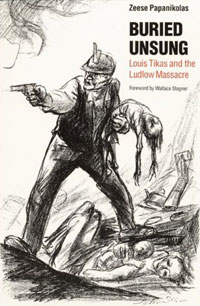
Buried UnsungAnother author made pains to debunk the lyrics “Sixteen tons, and what do you get, another day older and deeper in debt,” a cultural indictment of the “company store,” which was one of the grievances of the Ludlow strikers. He postulated that modern readers could be prone to let folklore color a predisposition against the company store. Perhaps a company store was in fact a convenience, derided because it was an arbitrary restriction against which human nature bucked. Trying to be helpful, another panelist suggested: “Imagine if the company store was 7-11, and you were told you could only shop there.” I believe both of these gentlemen are overlooking the much grosser complaint which the miners were protesting, that of insurmountable debt, systematically forced on them by their employers. That’s a phenomena on the rise today, if maybe not among college professors. Around the world, indentured servitude has never abated.

In our ivory tower we can debate which side, the union or the militia, fired the first shots on April 20. Who was at fault, seemed to be what that question would decide. At least panelist Anne Hyde had the presence of mind to lay some of the responsibility on the mine owners, who weren’t there of course, but whose stubborn greed played a not unsubstantial part in what the other panelists were attributing to “macho intransigence.”

That expression was in vogue to describe Cowboy presidencies. What an effete put down of militant activism. Are we to blame the striking miners for holding firm to their demands?

Thank goodness someone in the audience brought up recent efforts to deny the Sand Creek Massacre, which two panelists quickly weighed in to say “that was a real massacre,” discrediting Ludlow, obviously, and failing to grasp her point that indeed some Colorado Springs locals are rewriting Sand Creek as a battle, and not a massacre.

Another isolationist luxury has become to judge every action as it compares to a nonviolent ideal. It was noted that UMWA union leader John Lawson always recused himself from violent tactics. During the symposium’s opening reception, someone performed a song dedicated to the Ludlow martyr Louis Tikas, which lauded him for choosing to fight with words not guns, as if guns would discredit him.

I’ll play devil’s advocate and suggest that the miners fired the first shots. They saw Louis Tikas bludgeoned in the back of the head and then executed as he lay on the ground unconscious, they saw the National Guard move a machine gun into position above their tent city, and they probably began to fire at the soldiers lest a rain of bullets descend on miners’ wives and children before they had a chance to flee the camp.

The miners were asking that their union be recognized, that the Colorado eight hour work day be enforced, that the scales which determined their pay be verified, that their full hours be compensated, etc. The mine owners clung to their profits, and ordered the miners’ tent city, their only shelter and all their worldly possessions burned to the ground. Women and children were hiding in underground pits dug to escape the sniper fire which the mine guards sporadically aimed at the tents. The guards drove an armored car around the perimeter of the union camp, at all hours, for that purpose.

Ultimately this climate erupted into the violent clash on April 20, 1914, in which the miners battled with the far better equipped soldiers. The casualties were 25 to 1. I call that a massacre.

ADDENDUM: Photographs from visit to the Ludlow Memorial.
Site of Ludlow Massacre, photographed 2009
LUDLOW MEMORIAL, COLORADO- Day three of the Colorado College Ludlow Symposium featured a bus ride to the site of the 1914 Ludlow Massacre, then on to Trinidad to the grave of Union leader Louis Tikas. A reporter for Colorado Public Radio interviewed the symposium panelists at the U.M.W.A. memorial grounds.

April 2009 Visit to Ludlow site
David Mason is interviewed by a freelance reporter for Colorado Public Radio.

April 2009 Visit to Ludlow site
Scott Martelle and Thomas Andrews are interviewed above the fatal cellar.

April 2009 Visit to Ludlow site

April 2009 Visit to Ludlow site

TRINIDAD, COLORADO- Masonic Cemetary.
April 2009 Visit to Louis Tikas grave site

April 2009 Visit to Louis Tikas grave site
Zeese Papanikolas spoke about his protagonist’s gravestone and its reference to Tikas as a “Patriot.”

April 2009 Visit to Louis Tikas grave site

April 2009 Visit to Louis Tikas grave site

Hysterical Revisionism Parte Veint..

Ok, so one of the first posts I made was on the subject of what I call amongst other things Jingoistic Bullshit.
Like Ward Churchill getting fired and the suggestion being made by local Right Wing Freaks that he be prosecuted and even EXECUTED for teaching that the U.S. Army committed deliberate Extermination campaigns against Americans and used Biological Warfare in doing so.

The reason I bring it back up is because our Latest IDF Apologist/Propagandist keeps using the same notion the Others did, that we’re somehow “ignorant” of Middle East History merely because we don’t cite the History Textbooks they use in the Tel Aviv Public Schools.

To bring it on down, lest I be accused of being “unhinged”, if I were to enter into a discussion on Recent European History and, let’s say, just for giggles, pointed out that the British Public School textbooks say that the IRA are a bunch of terrorists (U.S. textbooks say the same stupid shit) and the insinuation that the Potato Famine was caused not by the British Overlords shipping out ALL the grain produced in Ireland, (even though it’s documented in shipping records, number (daily)of hundreds of tons of wheat shipped to England on one page and number of Irish Children dead in a sidebar on the same page)

But if I were to cite EXCLUSIVELY British History Texts as approved by Her Majesty Bess2 as an accurate portrayal of Irish History I would not be Taken Seriously.
Especially if I were to Arrogantly demand that the English version be the ONLY version accepted as valid for the discussion.

At that point not only would I be a Jingoistic Nutter I would also be an “Arse”.

To make a further point, there’s a Texas History Society who did a special that gets repeated on the Hysteric Channel and National Geographic Channel about the Alamo.

Which is what I wrote thereof c. 2 years ago.

Seems that even though the only written accounts of what happened to David Crockett and the other “defenders” after the walls were breached, Were Written By Mexican Soldiers…

And that even though the one most in question with the Freaks is one that asserted that General Antonio Jose y Maria Lopez (de Santa Ana) ordered a War Crime to be committed… Declaring the Texians to be “Unlawful combatants” (sound familiar, Trolls? Right Wingers? anybody? … Bueller? … anybody?) and Killing the Prisoners.

Including but not limited to one Colonel David Crockett.

In spite of this being evidence of War Crimes committed by the person who wrote it, it’s called into question Because We Are Supposed To Believe The John Wayne Version Wherein Davy Crockett Died In Battle…

And if we don’t, we’re, And I can not possibly make shit like this up, it takes a truly demented soul to think of it “undermining the Global War On Terror” because Our Troops are engaged in a war with the Brown-skinned Hordes and if they were taught to question the History as Told By The U.S. Government, why, they might question the “Historical Fact” that Iraq was Invaded, Conquered and Occupied Errrrr… I mean “Liberated” yeah, that’s the ticket, Liberated because Saddam Hussein refused to give up his Weapons of Mass Destruction.

A story told by the same IDF and Likud people who tell us that they were and are perfectly justified in Invading, occupying and murdering the citizens of Gaza.

Now, Seventh Grade Tel Aviv Public School History, you know, you only are obligated to mark on the Examinations that the dates and names and locations you just learned to recite (like a whole class full of 13 year old humanoid Parrots) said this, that or the other thing about The Glorious History of The State of Israel.

Bringing it into serious discussions with Grown-Ups and demanding that it be the only source of information that YOU will allow into the discussion comes off as being very Arrogant and Pigheaded.

Especially if the discussion is based on a website that doesn’t actually belong to you.

The Ward Churchill Haters and the New Defenders of The Legend Of The Alamo, they’re fairly easy to spot as being Arrogant Ignorant Rednecks who, in the words of a pastor I once knew “Need Less beer and more Bible”

IDF Trolls, apparently paid Trolls, making similar assertions come off as being, well, of the Same Caste.