
 Users of Facebook are accustomed to seeing friends listed in right-column ads, mentioned liking such-and-such a brand, or two or three. It’s understood that those friends at some point visited the brand’s page and clicked “like”, permitting that company, Amazon for example, to pay Facebook to advertise the “like” as frequently as it wishes. It’s also understood that when one “likes” a page, a post is simultaneously shared to herald the act and appears on the user’s wall unless that feature is turned off. What you may not know is that your initial timeline post can be reposted, in the center-thread, at the advertiser’s whim, perhaps limited to when you’re online, perhaps triggered when you log on, but not logged on your wall and thus unseen by you. Does it also boost the number of people pretended to be “talking about” that brand? Are 372,523 talking about Starbucks? That could include “you”, repeating yourself ad-maybe-nauseum.
Or maybe, for a premium, your original “like” is not shared simultaneously, but doled out as each of your friends comes online to guarantee one hundred percent reach. Who knows. As personalized as we know the ads can be, no doubt the algorithm is not calculated for clarity.
Do you remember which pages you’ve liked or not? Perhaps you clicked like to be able to comment on the page, or to monitor a monopolistic miscreant, or perhaps it was before Wells Fargo, Bank of America, or British Petroleum became persons and not-so-grata. Maybe now you’d rather not be said to like Chevron, Monsanto, or killer Coke. You can review your “likes” under INFO, then INTERESTS. Or you can check the list below. On each page, see if beside the LIKE button, you have the option to unlike, for example, Facebook.
Here’s a quick list of corporate brands which have fallen from fashion among those with fashion sense. You can click on each to check whether you are counted among their unpaid repeated endorsers.
Nike
Gap
Fox News
CNN
AT&T
Caterpillar
Disney
Walmart
Target
K-mart
Toys-r-us
Lowes
Ikea
Home Depot
And the fat merchants:
McDonalds
Burger King
Hardees
Carl’s Jr
Wendy’s
Taco Bell
KFC
Pizza Hut
Sonic
Chick-fil-A
Jimmy Johns
Subway
Outback
Dairy Queen
Dunkin Donuts
Krispy Kreme

 This is a detail from one of Coca-Cola’s posters by artist Andrew Bannecker for Bernstein and Andriulli. It’s a idyllic agricultural scene emerging like smoke from a genie’s bottle, in this case a Bottle of Hope we recognize as Coke’s. All of this beneath a banner proclaiming it “Hopenhagen.”
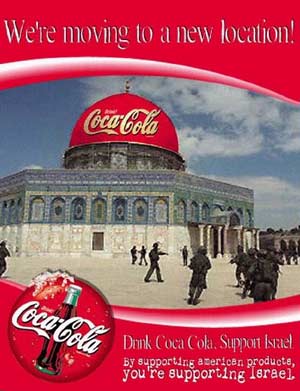 OK, it’s a famously discredited fake-ad to slander
  Coke is a corporate underwriter of Israeli expansion into the Palestinian Territories. Their Kiryat Gat bottling plant is built on
  The Yes Men Coke action at COP15 did produce a tongue-in-cheek press conference dubbed
  Can a moral nutritionist speak favorably of processed food? These AAFP doctors probably think family dentists still give out hard candy.
 Hearing policy makers scramble to buffer the US pork industry, such as
  So is it right that the corporate pork industry which creates such environmental damage, which looks to have brewed the recent Swine Flu epidemic, should not be implicated by the un-happenstance of the name Swine Flu?
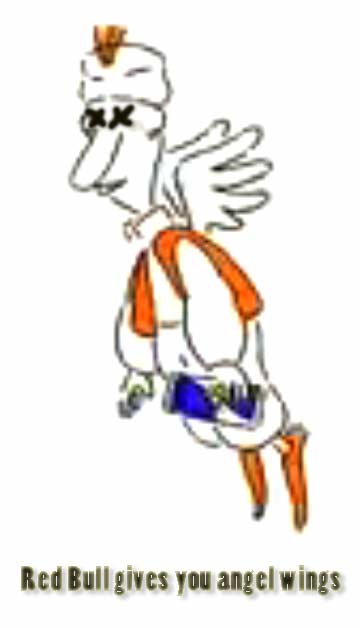 RED BULL contains: caffeine, ginseng and guarana (all legal stimulants) sugars, artificial sweeteners, taurine (an amino acid said to lower blood pressure).
 History has shown us that we can’t expect responsible behavior from corporations. They have an apparent duty to shareholders to make money, unfettered by ethical considerations. That’s why the Food and Drug Administration has been appointed our trusty watchdog. As soon as they’ve finished banning every natural supplement found in any organic health food store, I know they’ll muster the energy to take on Red Bull.
 Was Lampwick the archetypical dilettante? You know, dapper, cultured, erudite, jaded, amusing, but nihilist? The boys in Pinocchio who cut school to smoke, drink and play pool were turned into donkeys in