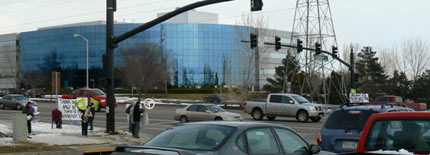
Academy Blvd public opinion still with us

See more pictures and a Mark Lewis video at CSAction
PPJPC members braved the cold for this month’s UFPJ Iraq Moratorium, held this time at the intersection of Profiteer and Death Merchant Blvds. A reprise of our popular 9/11 protest, we bannered at all corners to a chorus of supportive horns.

Due to the cold, and the difficulty of using walkers to cross the snow, some of us chose to park in a nearby vacant parking lot, until a security guard arrived with lights flashing. He told us “By the way, I’m on your side, but I have to ask you to move your cars.”
Rita is asked in convivial terms but emphatic gestures to find another place to park.
We did, but three police cars converged anyway.

Gitmo operating manual leaked

Wiki Leaks has obtained an updated copy of the Standard Operating Procedures for CAMP DELTA. They’ve posted both a DOC and PDF version available for download as it is UNCLASSIFIED. Due to the document’s size, the transparency group is inviting everyone to study and comment. Already revealed: certain detainees are hidden from the International Red Cross, the use of psychological torture, both violations of the Geneva Conventions. Below is the table of contents:
 
Camp Delta Standard Operating Procedures
Headquarters, Joint Task Force – Guantanamo (JTF-GTMO)
Guantanamo Bay, Cuba – 1 March 2004

Contents (listed by paragraph and page number), page iv
Camp Delta Rules, page ix
Chapter 1
Introduction
, page 1.1
Purpose ? 1-1, page 1.1
Minor SOP Modifications ? 1-2, page 1.1
References ? 1-3, page 1.1
Explanation of Abbreviations and Terms ? 1-4, page 1.1
JDOG Mission and Commander’s Intent ? 1-5, page 1.1
Responsibilities ? 1-6, page 1.1
U.S. Personnel Standards of Conduct ? 1-7, page 1.2
General Protection Policy ? 1-8, page 1.3

Chapter 2
Command and Control
, page 2.1
Chain of Command ? 2-1, page 2.1
Physical Plant ? 2-2, page 2.1
Camp Delta Operations ? 2-3, page 2.1

Section I – Personnel, page 2.1
Detention Operations Branch ? 2-5, page 2.1
Detention Services Branch ? 2-6, page 2.2

Section II – Functions, page 2.2
Detention Operations Center (DOC) ? 2-7, page 2.2
Record Keeping ? 2-8, page 2.3

Chapter 3
Detainee Reception Operations
, page 3.1
Overview ? 3-1, page 3.1
Infantry Support Operations ? 3-2, page 3.1
Land Movement ? 3-4, page 3.2
In-processing Security ? 3-5, page 3.2
Inbound and Outbound Operations DMO ? 3-6, page 3.4
Linguist Support ? 3-7, page 3.4
Facility Support ? 3-8, page 3.4

Chapter 4
Detainee Processing (Reception/Transfer/Release DMO)
page 4.1
Purpose ? 4-1, page 4.1
Initial Processing ? 4-2, page 4.1
Documents ? 4-3, page 4.1
Preparation for Processing ? 4-4, page 4.1
Personnel Requirements ? 4-5, page 4.1
In-Processing Procedures ? 4-6, page 4.1
MP Escort Responsibilities ? 4-7, page 4.2
Clothing Removal Rome (Station 1) ? 4-8, page 4.2
Shower (Station 2) ? 4-9, page 4.2
Cavity Search (Station 3) ? 4-10, page 4.2
Dressing/Shackle Exchange (Station 4) ? 4-11, page 4.2
DNA Sample (Station 5) ? 4-12, page 4.2
Height And Weight (Station 6) ? 4-13, page 4.2
DRS In-Processing (Station 7) ? 4-14, page 4.3
ID Wristband/Dossier (Station 8 ) ? 4-15, page 4.3
Fingerprint (Station 9) ? 4-16, page 4.3
Camp Rules (Station 10) ? 4-17, page 4.3
Post processing ? 4-18, page 4.3
Reporting ? 4-19, page 4.3
Behavior Management Plan ? 4-20, page 4.3

Chapter 5
Detention Facility Operations
, page 5.1
Section I –
Rules of Engagement (ROE) and Rules for the Use of Force (RUF) ? 5-1, page 5.1
Oleoresin Capsicum (OC) Use ? 5-2, page 5.3
Camp Rules ? 5-3, page 5.2

Section II –
Daily Reports ? 5-4, page 5.1

Incident Reports ? 5-5, page 5.2
SPOT Reports ? 5-6, page 5.2
Serious Incident Reports ? 5-7, page 5.3
Discipline Records ? 5-8, page 5.3

Section III –
Guard Mount ? 5-9, page 5.3
Change of Shift Procedures ? 5-10, page 5.3
Equipment Chit System ? 5-11, page 5.4

Section IV –
DOC Operations ? 5-12, page 5.6 Public Address System ? 5-13, page 5.4
Radio Discipline ? 5-14, page 5.4
Building Maintenance ? 5-15, page 5.6 Video Camera/ Combat Camera ? 5-16, page 5.8

Section V –
Evidence and Contraband Procedures ? 5-17, page 5.4
Investigations ? 5-18, page 5.8
Section VI – Other Agencies

Section VII – Training

Chapter 6
Cell Block Operations
, page 6.1
Section I – Security Procedures
Overview ? 6-1, page 6.1
Headcounts ? 6-2, page 6.1
Searches ? 6-3, page 6.1
Searching the Koran ? 6-4, page 6.1
Keys ? 6-5, page 6.2
Food Tray Slot (“Bean Hole”) Covers ? 6-6, page 6.2
Applying Restraints (“Shackling”) ? 6-7, page 6.2

Section II – Support Operations
Shower and Exercise ? 6-8, page 6.3
Detainee Mess Operations ? 6-9, page 6.3
Laundry / Linen ? 6-10, page 6.4
Barber ? 6-11, page 6.4
Other Personnel ? 6-12, page 6.4
Library Books ? 6-13, page 6.5
Medical Appointments ? 6-14, page 6.5

Section III – Documentation and Reporting
Block Documentation ? 6-15, page 6.5
Passive Collection ? 6-16, page 6.7
Cell Block Report ? 6-17, page 6.7

Section IV – Block Maintenance
Inspections and Inventories ? 6-18, page 6.7
Cleaning ? 6-19, page 6.7
Equipment Maintenance ? 6-20, page 6.7

Section V – Detainees
Detainee Standard of Conduct ? 6-21, page 6.7
Detainee Identification Band ? 6-22, page 6.8
Uniform and Dress Rules ? 6-23, page 6.8
Personal Hygiene and Appearance ? 6-24, page 6.8
Detainee comfort during inclement weather 6-26, page 6-10

Chapter 7
Sally Port Operations
, page 7.1
Sally Ports ? 7-1, page 7.1
Sally Ports 1 And 8 ? 7-2, page 7.1
Sally Ports 3 And 9 ? 7-3, page 7.4
Sally Ports 4 And 10 ? 7-4, page 7.5
Detainee Medical Clinic Gate ? 7-5, page 7.5
Roving Sally ? 7-6, page 7.6
Weapon Boxes ? 7-7, page 7.6
Badge ID Process? 7-8, page 7-6?

Chapter 8
Detainee Behavioral Management
, page 8.1
Purpose ? 8-1, page 8.1
Provision of Basic Needs ? 8-2, page 8.1
Discipline Process ? 8-3, page 8.1
Loss of Exercise ? 8-4, page 8.2
Loss of Hot Meals ? 8-5, page 8.2
Comfort Items ? 8-6, page 8.2
Detainee Classification System ? 8-7, page 8.2
GTMO Form 508-1 ? 8-8, page 8.4
Level 5 (Intel) Blocks ? 8-9, page 8.4
Confiscation of Items ? 8-10, page 8.5
Special Rewards ? 8-11, page 8.7

Chapter 9
Segregation Unit Operations
, page 9.1
Section I – In-Processing
In-processing and Documentation ? 9-1, page 9.1
Placement for Intelligence Purposes ? 9-2, page 9.1
Section II – Operations
Block Operations ? 9-3, page 9.1
Extension Request processing ? 9-4, page 9.2

Chapter 10
NAVSTA Brig Operations
, page 10.1
Purpose ? 10-1, page 10.1
Transport to NAVSTA Brig ? 10-2, page 10.1
Personnel Support Requirements ? 10-3, page 10.1
Medical Support Requirements ? 10-4, page 10.1
Meals ? 10-5, page 10.1
Exercise ? 10-6, page 10.1
Showers and Laundry ? 10-7, page 10.1
Special Orders for Guard Staff ? 10-8, page 10.2
Visitation ? 10-9, page 10.2
Use of the Television ? 10-10, page 10.3

Chapter 11
Escort Operations
, page 11.1
General ? 11-1, page 11.1
Escort Control ? 11-2, page 11.1
Priority of Escorts ? 11-3, page 11.1
Escort Teams ? 11-4, page 11.1
Vehicle Usage ? 11-5, page 11.3
Equipment Maintenance ? 11-6, page 11.4
Communications ? 11-7, page 11.4
Distinguished Visitors ? 11-8, page 11.4
NAVBASE Hospital Escorts ? 11-9, page 11.4

Chapter 12
Detainee Property
, page 12.1
Authorized Personnel ? 12-1, page 12.1
Property handling ? 12-2, page 12.1

Chapter 13
Detainee Mail Operations
, page 13.1
Types of Mail ? 13-1, page 13.1
Incoming Mail ? 13-2, page 13.1
Outgoing Mail ? 13-3, page 13.1
ICRC Mail ? 13-4, page 13.2
Cleared Mail ? 13-5, page 13.3
Redacted Mail ? 13-6, page 13.3
Held Mail ? 13-7, page 13.3
Mail screening ? 13-8, page 13.3
Mail Transmittal Records ? 13-9, page 13.4
Mail for Detainees Held at Locations Other Than GTMO ? 13-10, page 13.4
Mail Sent Directly to Detainees ? 13-11, page 13.4
Incorrectly Addressed Mail ? 13-12, page 13.5
Mail for Released Detainees ? 13-13, page 13.5
Detainees in Special Housing ? 13-14, page 13.5
Detainees with More Than 12 Items of Mail ? 13-15, page 13.5
Detainees Passing Mail between Cells ? 13-16, page 13.5

Chapter 14
Intelligence Operations
, page 14.1
General ? 14-1, page 14.1
Force Protection ? 14-2, page 14.1
Significant Activity Report ? 14-3, page 14.1
Disturbance Matrix ? 14-4, page 14.1
Communication Matrix and Link Diagram ? 14-5, page 14.1
Leadership Matrices ? 14-6, page 14.1
Items of Intelligence Value ? 14-7, page 14.1
Detainee Mail screening ? 14-8, page 14.1
Operational Intelligence ? 14-9, page 14.2
Source Operations and Reports ? 14-10, page 14.2
Duties ? 14-11, page 14.2
JIIF Guard Personnel ? 14-12, page 14.2
SCIF Security ? 14-13, page 14.3

Chapter 15
Linguist Operations
, page 15.1
General ? 15-1, page 15.1
Organization ? 15-2, page 15.1
Roles and Responsibilities ? 15-3, page 15.1
Camp Delta Operations ? 15-4, page 15.1
Detainee In-Processing Operations ? 15-5, page 15.2
Document Exploitation (DOCEX) ? 15-6, page 15.2
DOCEX Translation Guidelines ? 15-7, page 15.3
DOCEX Quality Control ? 15-8, page 15.3
Detainee Library ? 15-9, page 15.3
Passive Collection of CI Information ? 15-10, page 15.5
Intelligence Reference Guide for Linguists ? 15-11, page 15.5
Security Considerations ? 15-12, page 15.5

Chapter 16
Religious Support
, page 16.1
Section I – Accommodation of Religion
Chaplain ? 16-1, page 16.1
Religious Practices ? 16-2, page 16.1
Chaplain Requests ? 16-3, page 16.1
Fasting Requests ? 16-4, page 16.1

Section II – Muslim Detainee Religious Practices
The Muslim Prayer ? 16-5, page 16.2
Friday Prayer Service ? 16-6, page 16.2
Muslim Fasting ? 16-7, page 16.2
Muslim Holiday – Eid ? 16-8, page 16.2
Dietary Practices ? 16-9, page 16.3
Medical Practices ? 16-10, page 16.3
Wear and Appearance of Clothing ? 16-11, page 16.3
Showers and Hygiene ? 16-12, page 16.3
Religious Accommodation ? 16-13, page 16.3

Section III – Islam
Cultural Considerations ? 16-14, page 16.3

Section IV – Christian Detainee Religious Practices
The Christian Prayer ? 16-15, page 16.4
Christian Holidays ? 16-16, page 16.4
Religious Items ? 16-17, page 16.5

Section V – Muslim Funerals
Muslim Funeral and Burial Rites ? 16-18, page 16.5
Washing the Body ? 16-19, page 16.5
Shrouding the Body ? 16-20, page 16.5
Procedures for the Burial ? 16-21, page 16.6

Chapter 17
International Committee of the Red Cross (ICRC)
, page 17.1
Personnel ? 17-1, page 17.1
Operations ? 17-2, page 17.1
ICRC Visitation Rules ? 17-3, page 17.1
Levels of Visitation ? 17-4, page 17.1

Chapter 18
Food Service
, page 18.1
Responsibilities ? 18-1, page 18.1
Operations ? 18-2, page 18.1
Duties ? 18-3, page 18.1

Chapter 19
Medical
, page 19.1
Section I – Procedures
Restraint Procedures ? 19-1, page 19.1
Dispensing of Medications ? 19-2, page 19.1
Sick Call ? 19-4, page 19.2

Section II – Emergencies
Emergency Sick Call ? 19-5, page 19.2
Emergency Condition Responses ? 19-6, page 19.2
Combat Lifesavers ? 19-7, page 19.3

Section III – Medical Problems
Voluntary Total Fasting and Re-feeding ? 19-8, page 19.4
Bodily Fluids ? 19-9, page 19.4
Heat Category Measure ? 19-10, page 19.5

Section IV – Facilities
Detention Hospital ? 19-11, page 19.6

Chapter 20
Repair and Utility
, page 20.1
Work Orders ? 20-1, page 20.1
Tool Accountability ? 20-2, page 20.2

Chapter 21
Force Protection
, page 21.1
Section I – Precautions
Searches ? 21-1, page 21.1
Security Inspections and Vulnerability Assessments ? 21-2, page 21.1
Fire Prevention Precautions ? 21-3, page 21.1

Section II – Measures
Change in FPCON ? 21-4, page 21.1
Alert Roster/Recall Roster ? 21-5, page 21.7
Brevity Codes for Implementation of FPCON Levels ? 21-6, page 21.7

Section III – Alert Systems
Duress Condition ? 21-7, page 21.7
NAVBASE Siren System ? 21-8, page 21.8

Section IV – Weapons
Weapon Conditions ? 21-9, page 21.8
Weapons and Ammunition Storage Facility ? 21-10, page 21.8

Chapter 22
Key Control
, page 22.1
Overview ? 22-1, page 22.1
Key Custodian ? 22-2, page 22.1
Key Control Register ? 22-3, page 22.1
Key Access Roster ? 22-4, page 22.1
Key and Lock Accountability ? 22-5, page 22.1
Key Issue Procedures ? 22-6, page 22.1
Emergency Procedures ? 22-7, page 22.2

Chapter 23
External Security Operations
, page 23.1
Conduct of Infantry Soldiers ? 23-1, page 23.1
Task Organization ? 23-2, page 23.1
Infantry FPCON Actions ? 23-3, page 23.1
Tower Operations ? 23-4, page 23.1
Debrief Format ? 23-5, page 23.2
External Positions ? 23-6, page 23.2
Special Instructions ? 23-7, page 23.3
Mounted Patrols ? 23-8, page 23.4
Listening Posts (LP)/Observation Posts (OP) ? 23-9, page 23.5
Ammunition handling ? 23-10, page 23.5
Worcester TCP ? 23-11, page 23.5
Gardner TCP ? 23-12, page 23.7
Blocker Position (BP) ? 23-13, page 23.8

Chapter 24
Initial Reaction Force (IRF) Operations
, page 24.1
Section I – Preparation
Team Organization ? 24-1, page 24.1
IRF Team Equipment ? 24-2, page 24.1
Additional Equipment ? 24-3, page 24.1
Training ? 24-4, page 24.1
Brevity Code ? 24-5, page 24.2

Section II – Operations
IRF Team Guidelines ? 24-6, page 24.2
IRF Team Use ? 24-7, page 24.2

Section III – Documentation
Verbal Reporting ? 24-8, page 24.3
Written Reporting ? 24-9, page 24.3

Chapter 25
Quick Response Force (QRF) Operations
, page 25.1
Mission ? 25-1, page 25.1
Requirements ? 25-2, page 25.1
Notification Procedures ? 25-3, page 25.1
Ammunition Numbers and Accountability ? 25-4, page 25.1
Uniform ? 25-5, page 25.1

Chapter 26
Military Working Dogs (MWD)
, page 26.1
Responsibilities ? 26-1, page 26.1
Operations ? 26-2, page 26.1
Training ? 26-3, page 26.2
Logistics ? 26-4, page 26.2

Chapter 27
Operational Security (OPSEC) and Deceptive Lighting Plan
, page 27.1
Purpose ? 27-1, page 27.1
Responsibilities ? 27-2, page 27.1
Punitive Action ? 27-3, page 27.1
Essential Elements of Friendly Information (EEFI) ? 27-4, page 27.1
Prohibited Activity ? 27-5, page 27.1
Deceptive Light Plan ? 27-6, page 27.2

Chapter 28
Public Affairs
, page 28.1
Operations ? 28-1, page 28.1
Themes for Global War on Terrorism (GWOT) ? 28-2, page 28.1
Detainee International Public Information Themes ? 28-3, page 28.1

Chapter 29
Transitions
, page 29.1
Section I – To Camp IV
Preparation ? 29-1, page 29.1
Process ? 29-2, page 29.1
Movement to Camp IV ? 29-3, page 29.1

Section II – For Transfers
Preparation ? 29-4, page 29.1
Process ? 29-5, page 29.1
Movement to Camp IV ? 29-6, page 29.2
Standing Orders ? 29-7, page 29.2

Chapter 30
Delta Block Mental Health Facility (MHF)
, page 30.1
Section I – Operations
Overview ? 30-1, page 30.1
Staffing ? 30-2, page 30.1
Watch ? 30-3, page 30.1
Non-Acute Section ? 30-4, page 30.1
Video Monitoring Station ? 30-5, page 30.1
Interview Cells ? 30-6, page 30.1
Delta Acute Section and Self-Harm Precautions ? 30-7, page 30.1

Section II – Operations
Self-Harm Precautions Guidelines ? 30-8, page 30.1
Shower and Exercise ? 30-9, page 30.1
Dispensing of Prescribed Medication and Medical Sick call Procedures ? 30-10, page 30.1
Detainee Behavioral Management Matrix ? 30-11, page 30.1
Oleoresin Capsicum (OC) Use ? 30-12, page 30.1
Medical Records ? 30-13, page 30.1
Crisis/Mass Casualty Response ? 30-14, page 30.1

Section III – Restraint and Seclusion
Purpose ? 30-15, page 30.1
Background ? 30-16, page 30.1
Definitions ? 30-17, page 30.1
Indications ? 30-18, page 30.1
Practice Authority ? 30-19, page 30.1
Critical Elements ? 30-20, page 30.1
Doctor’s Order ? 30-21, page 30.1
Training ? 30-22, page 30.1
Performance Improvement ? 30-23, page 30.1

Section IV – Personnel
Combat Stress Reactions ? 30-24, page 30.1
Interpreters ? 30-25, page 30.1

Chapter 31
Supply Operations
, page 31.1
Waste Disposal ? 31-1, page 31.1
Camp Supply Rooms ? 31-2, page 31.1
Supply Requests ? 31-3, page 31.1
Computer Requests ? 31-4, page 31.1
MRE Sanitization ? 31-5, page 31.1

Chapter 32
Emergency Action Plans (EAPs)
, page 32.1
Attempted/Actual Self Harm ? 32-1, page 32.1-2
Mass Disturbance ? 32-2, page 32.2
Power Outage ? 32-3, page 32.4
Hostage Situation? 32-4, page 32.5
Death ? 32-5, page 32.5
Medical Emergency ? 32-6, page 32.5
Radio Range Ambulance access (emergency) 32.6a page 32.6
Fratricide ? 32-7, page 32.7
Fire ? 32-8, page 32.8
Bomb Threat / Discovery / Explosion ? 32-9, page 32.9
Mass Casualty Incident (MCI) ? 32-10, page 32.10
Evacuation Routes ? 32-11, page 32.14
Destructive Weather ? 32-12, page 32.15
Escape and Apprehension (“Orange Sherbet”) ? 32-16, page 32.17
Camp Coordinated Contraband Search & Seizure (“Clean Sweep”) ?32-16, page 32.17
Intrusion Detection System (IDS) Alarm T-SCIF ? 32-16, page 32-17

Chapter 33 Camp 4 Standard Operating Procedures
Commander’s Intent ? 33-1, page 33.1
Manning Requirements ? 33-2, page 33.1
Leave Policy ? 33-3, page 33.1
Chain of Command (Command and Control) ? 33-4, page 33.1
Service and Support ? 33-5, page 33.1
Personnel Responsibilities ? 33-6, page 33.2
General Rules ? 33-7, page 33.5
Bay Rules ? 33-8, page 33.6
Compound Recreation / Central Recreation Yard Rules ? 33-9, page 33.7
Central Shower/Bath Rules ? 33-10, page 33.8
Mess Yard Rules ? 33-11, page 33.8
Bay Leader Duties and Responsibilities ? 33-12, page 33.9
Laundry/Linen Exchange ? 33-13, page 33.9
Personnel and Detainee cleaning ? 33-14, page 33.10
Radio Call Signs ? 33-15, page 33.10
Fire Evacuation Plan ? 33-16, page 33.11
“OPERATION SNOWBALL” ? 33-17, page 33.11
Gator Maintenance ? 33-18, page 33.12
Logbooks ? 33-19, page 33.13
Radio/Telephone Transmissions ? 33-20, page 33.13
NIPR Account ? 33-21, page 33.13
Break Area ? 33-22, page 33.13
Sally Port Storage Lockers ? 33-23, page 33.13
P.A. Intercom and Announcement System ? 33-24, page 33.13
Detainee Movement from/to Camp 4 ? 33-25, page 33.13
Medical Personnel/Medication Distribution ? 33-26, page 33.14
Assigned Personnel Duty Uniform ? 33-27, page 33/14
Detainee Movement Operations (DMO) ? 33-28, page 33.14
Duress and IRF Codes ? 33-30, page 33.15

Chapter 34
Commissions
, page 34.1
Quick Reaction Force (QRF) Teams ? 34.1, page 34.1
Disturbance in the courtroom ?34.2, page 34.1
Medical Emergency ? 34.3, page 34.2
Fire ?34.4, page 34.2
Bomb Threat ?34.5, page 34.3
React to an Ambush along the convoy route ? 34.6, page 34.3

Information Not Covered By the Camp 4 SOP ? 34-7, page 34.4
Forms Found in Appendix C of the Camp Delta SOP (To Be Added At A Later Date) ? 34-8, pages 34.4

APPENDIXES
A. References
B. Camp Delta Forms

Glossary
Index

Child

ryeye.jpg
Your clear eye is the one absolutely beautiful thing.
I want to fill it with color and ducks,
The zoo of the new
 
Whose names you meditate —
April snowdrop, Indian pipe,
Little
 
Stalk without wrinkle,
Pool in which images
Should be grand and classical
 
Not this troublous
Wringing of hands, this dark
Ceiling without a star.

Sylvia Plath

We lose they lose

On the forbidden sidewalkProtesting at the side of the street does seem futile at times, it certainly seems so just thinking about it. But out there catching each others eyes, you’re reminded of its mysterious power, particularly when you’re shown to what extent those against you are willing to go to keep you from being there.

When we first turned up Monday at the Broadmoor Space Symposium Arms Bazaar, we were quickly moved from a section sidewalk declared off limits to us. The police could not explain exactly what ordinance or why, except that they had orders to keep us off the Lake Circle sidewalk. We complied the way reasonable people do, because the area to which we were confined seemed at first glance perfectly suitable. We occupied the corner of Lake and Lake Circle, where we could hand fliers to symposium attendees crossing to the Convention Center. But this gave us contact with only a fraction of the participants in attendance. The majority of the weapons dealers stayed inside the center, whose windows faced the sidewalk area forbidden to us.

We decided to accept the “free speech zone” given us until we could research the new restriction, mindful of the recent Appeals Court verdict which upheld the Broadmoor’s discretion to cordon off its entire neighborhood as a security zone for the NATO conference some years back. Citizens for Peace In Space lost that appeal.

It took Bill Sulzman until 10pm Wednesday to get someone at the CSPD to speak to the issue of the exclusive use permit granted to the Broadmoor. That representative, a Commander Overton, agreed to meet Bill the next morning to negotiate where protesters would or would not be restricted.

Was this a victory of discourse and civility? It certainly was a victory for the Space Arms Symposium. They effectively kept us off their turf until the last day, then thwarted a legal challenge by deciding to give in. We got to stand on the contested sidewalk for a snowy hour of the last day of the conference.

This is where less confrontational pacifists hinder their protest efforts. It might be well to resolve your differences by arbitration, meanwhile the bad guys hold the real estate. In the end our message does not get out, the war rages on, we are entangled in bureaucratic battles until our rights are upheld. This was the tactic used at the DNC, RNC, FTAA, WTO, and indeed our own St Patrick’s Day: detain the dissidents until their opportunity to be heard has passed. It’s an abridgment of our civil liberties, and the government factors into its budget the liability of likely legal judgments.

But what price lost free speech? What cost for every day the war goes on? We know that number. What cost for each further contract for more WMDs? If protest could stop that, that’s the price the government owes us. Could street protest have that effect? Somebody thinks so.

Last year at the Broadmoor, the reaction to our protest was very telling. The first day we were nearly arrested for trying to walk along the edge of a cordoned area, the same contested sidewalk. The head of Broadmoor security was screaming for officers to arrest us. The next day I was assaulted by an overwrought Marines commander in jogging shorts. He circled right to me and flung his hands around my throat, pushing me back until policemen pulled him off. The next day we rode a bicycle up and down the bike path adjacent the blocked sidewalk, to relentless harassment and endangerment by the security vehicle. Somebody doesn’t like to have to gaze upon our message. We could see military brass last year watching from the windows with arms crossed.

Our banners, then and now, quote Henry Ford “Take the profit out of war and you’ll have peace tomorrow” and President Eisenhower “Beware the military industrial complex.” We also have this haunting question: “will your children survive your work?”

The arms manufacturers in attendance at the Broadmoor are normally well buffeted from the real world. They work in industrial complexes and high rises out of reach of humanist and spiritual voices of conscience. They certainly don’t have to see the results of their work, the suffering or the poverty. They ride high on the war gravy train.

The Broadmoor gathering for me is the rare chance to look these people in the eye, to examine the war profiteers in their insular habitat. They might be bellicose, or proud, or defensive, and they may deride us. If it seems their consciences are not keeping score, the symposium organizers seem to have more faith in them than we do.

On this occasion the military industrial complex beat us, they kept us out of sight for most of their event. But we won too. No we didn’t get to challenge their method in court, but we did get to stand in the forbidden zone of their periphery, if but for a morning, a cold snowy morning. Though I believe the increasing snow fall lent our message the credibility of determination. We got to aim this banner right at them: “Will your children survive your work?”

Kurt Vonnegut goes

Kurt Vonnegut lectures at HarvardM and I just read Harrison Bergeron together two nights ago. I remembered the story from high school, where we also read Slaughterhouse Five to my father’s consternation. I like to think it was just the language he objected to.
 
My favorite essay of KV’s at In These Times was about governance guesswork.
 
Kurt Vonnegut could say it all and I don’t think he was through.

I just came across an excerpt someone posted from Jailbird:

“What could be so repulsive after all, during the Great Depression, especially, and with yet another war for natural wealth and markets coming, in a young man’s belief that each person could work as well as he or she was able, and should be rewarded, sick or well, young or old, brave or frightened, talented or imbecilic, according to his or her simple needs? How could anyone treat me as a person with a diseased mind if I thought that war need never come again–if only common people everywhere would take control of the planet’s wealth, disband their national armies and forget their national boundaries; if only they would think of themselves ever after as brothers and sisters, yes, and as mothers and fathers, too, and children of all other common people–everywhere. The only person who would be excluded from such friendly and merciful society would be one who took more wealth than he or she needed at any time.”

And this from an interview with Joel Bleifuss in 2003:

I myself feel that our country, for whose Constitution I fought in a just war, might as well have been invaded by Martians and body snatchers. Sometimes I wish it had been. What has happened, though, is that it has been taken over by means of the sleaziest, low-comedy, Keystone Cops-style coup d’etat imaginable. And those now in charge of the federal government are upper-crust C-students who know no history or geography, plus not-so-closeted white supremacists, aka “Christians,” and plus, most frighteningly, psychopathic personalities, or “PPs.”

To say somebody is a PP is to make a perfectly respectable medical diagnosis, like saying he or she has appendicitis or athlete’s foot. The classic medical text on PPs is “The Mask of Sanity ” by Dr. Hervey Cleckley. Read it! PPs are presentable, they know full well the suffering their actions may cause others, but they do not care. They cannot care because they are nuts. They have a screw loose!

And what syndrome better describes so many executives at Enron and WorldCom and on and on, who have enriched themselves while ruining their employees and investors and country, and who still feel as pure as the driven snow, no matter what anybody may say to or about them? And so many of these heartless PPs now hold big jobs in our federal government, as though they were leaders instead of sick.

What has allowed so many PPs to rise so high in corporations, and now in government, is that they are so decisive. Unlike normal people, they are never filled with doubts, for the simple reason that they cannot care what happens next. Simply can’t. Do this! Do that! Mobilize the reserves! Privatize the public schools! Attack Iraq! Cut health care! Tap everybody’s telephone! Cut taxes on the rich! Build a trillion-dollar missile shield! Fuck habeas corpus and the Sierra Club and In These Times, and kiss my ass!

Laura Bush’s ‘Take a Child to the Libary to Read’ program

The corporate media does such a snow job on us, that most Americans actually seem to buy deep into the image making that is pushed off onto us. Dubya the Clown sez, No Child Left Behind’ and we take that crap seriously, all due to the media dope we are brainwashed with so constantly. Dorothy, I’ve fallen to the ground amongst the poppies.

And how ’bout Laura’s Oprah-style booklists? They sold us on Reading, Righting, and Rithmatick, haven’t they? Such people people they are! Helping the little kids along…. to learn how to read. So let’s take a trip to the libary, shall we not? Let’s go to Salt Lake City’s public library with Chip Ward! Might be good to take some pepper spray along? What do you think?

Where to host the war crimes trials

War Crimes Trial in privateNotMyTribe is soliciting proposals for where to hold the impending War Crimes Trial. Brent Green replies:
 
In my van downtown.

This is kind of how I see it going: I’ll drive my van downtown- there’s a huge parking lot right on the bank of the river behind the UPS packing center. It’s unmarked, which I see as my biggest asset here, the secrecy of an unmarked van will keep these officials on familiar ground. I’ll hold out my dictionary (the only title the used bookstore wouldn’t purchase from me) and say “Place your right hand on this Science Bible, and promise that you’ll try hard not to fuck up.” W says “I swear.” I don’t believe him, he seems insincere, but I didn’t really give myself a backup option, so we move on.

I guess Bush will take the stand- a comfortable cloth spinning captain’s chair (one of Bush’s demands I’ll have to meet in order for him to submit to trial). I’ll grill him mercilessly.

“True or False: you are _______.” The correct answer is that tricky T/F hybrid that everyone mastered in elementary school quizzes, but that’s a very hard letter to say, so he’ll probably get this one wrong.

Whereupon I’ll make a powerful and moving objection “HEADS WILL ROLL!!!” I’ll shout, the wind shaking my ride.

We’ll turn on the radio for intermission. Some Mexican college rock station. Yo la tengo espanol.

And if you want experience and variety, this is your location. It’s seen it all. I got it from my Uncle Oscar who met Jack Kerouac once (not in the van)- it’s seen all there is: Illinois, DUI, DOA, FBI, Florida and a charging wild elk. Before Oscar raced dogs he used the van as an ambulance.

I pretended I was a lawyer once, to get my girlfriend a paycheck her boss was trying to keep for hisself.

Back when Great Uncle Oscar had the van it was always kept in tip-top shape. Uncle Oscar was rich. He was always saying “Get in the fucking van!!”

Uncle Oscar got more money than the government racing dogs between the cars on Wall Street.

Uncle Oscar lost his mind when his mistress died, and grew a cancerous hole the size some governments between his throat and his lungs. Wheezing like an elephant chasing dogs no one else could see up and down the cellar stairs. (Later, up, down and back up the street.)

Uncle Oscar’s legs went numb on Christmas Eve, a cart pulled by his dogs brought him to our front door (he was sitting on the hood, hollering whiskey fumes above the engine’s roar). With two strong hands and a trunk full of stuff he invited us “Come on In!” tramping snow through shoveled flowerbeds. He wasn’t yet, but he already looked dead.

After a long hard chase, Oscar liked to climb in his van and “help people.” He’d go ambulancing with a stethoscope and pliers and a bottle of Mescal. Mescal is terrible. Just everyone thinks so. Hitler didn’t like it ’cause it made him mean. But apparently it cures everything. Even road rash. Just say you’re halfway between the cab and the sidewalk and an ambulance turns you into a chalkline- Oscar’s there before you wake up. He cleans the blood off the hood with your shirt and puts you in the back. He opens the bottle, wraps your lips around the funnel, and moves the muscles in thee jaw (with his right hand- the left tipping back the bottle) ’till your teeth and your tongue eat the worm. Ambulancing was fun- even though I guess it directly led to my disbarrement (it was the only cause). I always told him it wasn’t his fault- but it was. Entirely.

Anyway, I guess Oscar should be the judge. He’s the oldest person I know, and he always says he’s done his share of courting.

Old Uncle Oscar, all hopped up on Viagara, screaming at Conde Rice “I hear my zipper shaking!”

I need these war crimes trials.

Lions and foxes and bears oh my!

this one is a follow up to the Neighborhood Fox thread I commented about.
We had a cougar. of course. He (or she, I ain’t getting close enough to check its genitals) is apparently coming around more frequently, our neighbor across the alley, not living there any more, but the low roof of the house, had cougar tracks in the snow. On the roof.
We had the large deer maybe elk but I’ll go with deer, a buck, was in the yard New Years. Does are more regular, the bucks are usually up the mountain somewhere.

But yesterday, on the Midland bicycle trail, my landlady was checking on the welfare of some feral kittens who have more or less adopted her. Looked down and saw bear tracks. Big ones. Fresh ones. Then she looked up and saw the bear in person, about a couple of blocks away.

Now, this is very bizarre. I remember somebody telling me once that bears actually hibernate in the winter? You probably know the story.

But with large animals down in the Springs, a cougar who seems to not be wandering far, a buck or possibly elk, and now an extremely out of season bear….
In the middle of what has been told to me is the harshest winter in the last 10 years or so.

Something is going very wrong and the animals seem to know it.

Holiday season anti-war TV spot

Names engraved in stone
A proposed 30 second television commercial aimed at counter-recruitment.

Camera opens on a festive living room where a large extended family is posing for a picture beside the Christmas tree.

Camera moves past family, over an incidental table beneath a window on which sits a framed photo of a soldier in uniform.

Camera keeps moving out the window, through a decorated yard, along sidewalk where a mother is pushing a baby carriage, led by three or four exuberant children.

Camera continues across street to car paused at corner streetlight beside a municipal park. Inside a young couple is talking, holding hands.

Camera moves through car, over shoulder of driver, lingering on young woman in the passenger seat smiling [nearly at camera] at the driver, then continues out the window to the park.

Camera floats through snow-covered park in straight line toward a distant monolith, a lone war memorial surrounded by empty park benches.

Camera closes in on list of engraved names, narrowing in on single name.

Giving thanks

My third grade twins were asked in school last week to write down three things they were thankful for. Both wrote that they were thankful for family, friends, the earth. Under each category they were asked to elaborate a bit. Under family, my little girl wrote that she was thankful for Mom, Dad, brothers and sisters.

My little boy, however, had a different take on the assignment. He wrote that he was thankful that his family was supportive, funny, and “willing.” Willing. How cute. Willing to do what? He didn’t really say.

Upon reflection I know that I, too, am thankful to the people in my world who are willing. Willing to let me be myself. Willing to forgive my indiscretions. Willing to hike with me on a snowy morning. Willing to be spontaneous and funny and engaging. Willing to offer words of encouragement or words of advice. Willing to confront me when necessary. Willing to love me, come what may.

I want to learn a lesson from my son, accidentally wise beyond his years, and be more willing.

Jet set

Not twin engine Bonanzas anymoreThis is not the photograph I wish I had taken. I was in Snowmass for the Aspen Jazz Festival, Labor Day weekend. Crossing from Aspen to Snowmass we drove by the airport. Several evenings, past Gulfstreams and other private jets gleaming in the moonlight. More tailfins than you could count.

The point being, these weren’t Cessnas or twin-engine Bonanzas or even Lear jets. These were miniature passenger jets, parked higgledy-piggedly at both ends of the airport runway. The point being, wealth in abundance, overflowing the confines of their taxpayer funded playpen, for all to see, and only see.

This picture was taken at the weekend’s close, when the most of the jetset had flown.

Ivy Leaguer accosts car stabs driver 2am

My attention was grabbed by a recent headline, IVY LEAGUER STABS BOSTON TEEN.
 
But let me tell you another story. In Colorado Springs, April 26, 2002, a friend of mine was driving back from a Thursday night concert in Boulder. Her girlfriend was half asleep, half intoxicated in the passenger seat. It was around 2am as they were driving through the Colorado College campus within a block of their home. Slowly rounding a quiet street corner, the girlfriend remembers something struck out at the car, perhaps a rock.
 
Lest I betray how this tale ends, I must point out that the subsequent events are entirely the recollection of the tired, inebriated passenger. The driver, Jocelyn Sandberg, 41, community activist, KRCC radio station manager and beloved on-air personality, did not survive the encounter.

Suddenly the car window was down and Jocelyn was having a shouted exchange with a youngish man on the street. Before the girlfriend could refrain her, the door was open and Jocelyn was getting out to confront the man. Jocelyn was very confident physically. Stocky, not butch, Jocelyn was back-on-her-heels jocular, the kind of girl it wouldn’t occur to you to offer to see safely to her car after dark. In fact Jocelyn usually worked a second job as a baker, walking there and back in the middle of the night.

The girlfriend remembers yelling for Jocelyn to return to the car. She watched as Jocelyn confronted the man at the curb. The man was in his mid-twenties or thirties. He struck Jocelyn, she fell to the ground face forward and he ran off. The girlfriend got out and ran to Jocelyn, but before she could get to her, Jocelyn had risen and taken after the man, north into the campus. Yelling after Jocelyn, she saw her disappear behind an administration building. Disgusted at Jocelyn’s typical stubbornness, the girlfriend returned to the car, climbed into the driver’s seat, and drove the last block home. While waiting for Jocelyn inside the house, she fell asleep.

When the girlfriend awoke an hour later, Jocelyn had not returned, so she called the police. By the time the officers arrived, Colorado College maintenance and security personnel had already discovered Jocelyn’s body. Jocelyn had bled to death on the SW side of Armstrong Hall, two hundred yards from where her car had been stopped. She suffered stab wounds in the face, neck and chest. The first cut may have been struck at the initial altercation at the curb.

Except for the girlfriend’s foggy description of the man, there were no witnesses. This was neither a robbery nor a premeditated assault. As for leads, Colorado College is a fairly insulated campus, buffeted by upscale neighborhoods, with very tight security. It’s not on the migratory route to anywhere, and the campus grounds present an inhospitable and unlikely hangout for transient males.

The girlfriend was of course considered the main suspect because it seemed improbable that a man could accost a moving car at 2AM in the morning. However other Colorado Springs residents can recall having snowballs thrown at their cars, in that same general area, by Colorado College students who would then dash off, leaving drivers unable to reciprocate their frustration.

When the police failed to produce any leads, the most persistent rumor was that the knife-wielding man had been a Colorado College student who was then perhaps whisked off campus by well-heeled, politically-connected parents. This could also explain the lack of concern shown by the college administrators. There was plenty of DNA evidence at the scene to test against the student population but such tests were not done.

A year later a stabbing in Boston revived that rumor. On April 12, 2003, a Saturday night around closing time, a Colorado College grad, Alexander Pring-Wilson, now studying at Harvard, was stumbling home drunk. On the way home he accosted a stationary car and stabbed the driver. Immediately after the event, still drunk, Pring-Wilson left this message on a friend’s answering machine:

“Hey, Jen. How’s it going? I just, um, I got attacked. I just got attacked by a group. I fended them off. I stabbed him a couple times and, don’t repeat this to police, um, but yeah, I’ve got a fucking killer headache. I just walked a couple of miles home. I think I’ve got a concussion. Anyway, I had a swell time tonight. I hope you guys made it home. Okay, bye-bye.”

Colorado Springs police were alerted to the stabbing death of Michael Colono and noted the similarities of the MO. Colorado Springs Detective David Edmondson inquired about obtaining DNS evidence from Pring-Wilson to test against the Jocelyn Sandberg stabbing case, Pring-Wilson’s lawyers refused.

Much was now made of the fact that Jocelyn’s witness described their assailant as weighing perhaps 150 pounds, not 200. And being 5′ 8″ instead of 6′ tall. But there was enough doubt. In a woman’s world, couldn’t 150 pounds denote a heavier person? And Jocelyn’s passenger was not making her observations from a sober perspective. Otherwise the age, hair and clean-cut description did fit.

When asked to present evidence of Pring-Wilson’s whereabouts on the 2002 date, lawyer Jeffrey Denner produced emails and credit card charges as proof that the suspect had been in Boston. Pring-Wilson had “accessed a Boston server” to send his mom an email. Likewise his credit card was charged on the next day. Naturally Colorado Springs police regarded this evidence as inconclusive.

But circumstantial evidence drawing Pring-Wilson to Colorado Springs grew. Pring-Wilson maintained a long-distance relationship with his girlfriend in Colorado Springs. And friends recall seeing him regularly at his alma mater. A fellow CC rugby forward estimates seeing Pring-Wilson back on campus “maybe 10” times in the two years following their graduation in 2000.
 
On a map showing the locations of Colorado Spring’s downtown bars, including Jose Muldoons which featured a Raggae band that night, and Pring-Wilson’s residence, the most likely route between the two points intersects with the corner where Jocelyn Sandberg’s car was accosted.
 
It should be an easy thing to prove or disprove: flight schedules, cell phone statements, Colorado College alumni events or no. Certainly his girlfriend Janice or his parents should be able to say either way.
  Walking off a drunk

 
Pring-Wilson’s family and friends are petitioning the governor of Massachusetts to reduce his sentence for the Boston stabbing. By their descriptions Pring-Wilson seems like a nice enough guy: accomplished, dedicated, compassionate, gentle -when sober, no doubt. No mention of his drinking. And according to everyone he was unassailably non-violent, notwithstanding having been captain of the Rugby team, playing forward, the offensive position. And how many gentle souls carry around four-inch Spyderco knives? Pring-Wilson’s drinking companions in Boston recall seeing the knife in the bar that evening. Seeing the knife in the bar?! Not everyone is agreed obviously that it’s such a common thing to carry around.

Could it be we’re talking about a sweet guy -with a drinking problem? Friends who haven’t signed the Pring-Wilson petition do attest that he was an obnoxious drunk. So we’re talking about an obnoxious drunk with maybe a chip on his shoulder and certainly a knife in his pocket. Maybe we’re talking about a 200 pound drunkard who cannot be dissuaded to do anything but whatever he wants. A person who parties hard, then wants to walk home, to walk it off, a couple of miles whatever, alone.

In October 2004 Pring-Wilson was convicted of the voluntary manslaughter of American-Puerto-Rican teenager Michael Colono and sentenced to six to eight years. The killing was found not to have been in self defense because the evidence indicated that Pring-Wilson had fisted his knife before the altercation began. Also, if he was jumped by the two teenagers as he claimed, Pring-Wilson came out of it relatively unhurt. Most damning, the knife blows were struck straight into Colono from a position above, not from wild slashing from a defensive position beneath, as Pring-Wilson claimed.

In their petition to Massachusetts Governor Romney urging him to remand their son to home-custody, the Pring-Wilsons threaten: “You must know that if any harm should come to Mr. Pring Wilson during the duration of his sentence you will be held accountable along with the Commonwealth of Mass.”

Strong words from understandably desperate parents, but who then shall be held responsible for the death of the Puerto-Rican teenager? Jose Cuervo? Spyderco knives?

Why do the parents not suggest, at the very least, that their son promise to disavow heavy drinking and knife-wielding? Nothing against gentle 200 pound rugby forward Alexander Pring-Wilson, it’s his knife-carrying drunken alter-ego that might be a danger. (Knives, drinking, middle of the night personas? A combination not unknown to the annals of crime or western literature.)

How often exactly did Pring-Wilson drink and insist on walking home alone, after his friends had taken cabs? Once a year? Spring break? One less aggressive drunk guy on the street with a deadly knife on Saturday nights would be a good thing for everyone.

There are also hundreds of Jocelyn’s friends in Colorado Springs who would like to hold somebody accountable for her death. Maybe Pring-Wilson could step up to the plate so that we could eliminate the possibility it was him. The sooner we can identify the aggressive man who stabbed Jocelyn Sandberg, the sooner we can prevent him from picking a fight with someone else’s car.