Every god but Allah for Muhammad Ali?

When the fuck did Muhammad Ali become Unitarian? He was Muslim. Why all the other God/G*d freaks crashing his funeral? I understand friends wanting to speak. This being a culture of celebrity worship, I can even understand a policy of open mike for celebrities. Presumably there was a pecking order to separate the A-list from the Bs. You’d think Ali’s memorial would have warranted also discriminating icons from mere celebrities. Religious demagogues should have been disqualified without question, no matter their humanitarian temperament. Ali was a follower of Elijah Muhammad. Where was Farrakhan? Where were the militants? Extorted to take a backseat. As usual the corporate media whitewashed Muhammad Ali’s activist persona in favor of painting him into a black Albert Schweitzer. As if the shared experience of rooting for boxing opponents in itself uplifts humanity.

Protect and Serve …Who?


When the police show up at your door dressed like this, I assumed the ‘Protect” means for them not you. They have done a great job of selling America the “Protect and Serve” but do you really need it? In February 1955, the Los Angeles Police Department, through the pages of the internally produced BEAT magazine, conducted a contest for a motto for the police academy. The winning entry was the motto, “To Protect and to Serve” submitted by Officer Joseph S. Dorobek. In my seventy six years of life, I can count on one finger the times I’ve had to call the “Serve and Protect” guys. And that was only at the insistence of my Insurance agent who had refused to pay the claim until the police were notified.

It did not escape my attention, as I explained to my Insurance agent “Why call the police now? the burglars are already gone, along with my stuff. I’m sure most people fail to notice that the police only show up after a crime; Not before, so where then does the “Protect” come into the equation. It should also be noted; to this day, that the police have never caught the burglar or returned any of my stuff.

When I was ten years old, I and some of my friends went to the East-town theater, I saw my first Frankenstein move. That night when my mother told me to go upstairs and go to bed, I refused as I was sure Frankenstein was waiting up there under my bed to get me. I was so scared, I almost shit my pants. In my feverish state of mind, I even thought my mother was conspiring with Frankie so that he could get me. It took me a few years of growing up to figure out, Hollywood was about making movies and money, if they had to scare the shit out of a ten year boy, so be it.

The “Protest and Serve” police join a long list of groups and people who use the fear factors to promote their own agenda for their own benefit. And of course the police can protect you from most of them.

You might recall some of them; The black man is coming to rob you and take your white women, the brown man is coming to take your jobs, the government is coming to take your guns, the IRS is coming to get your money, the devil is coming to get you for sinning, but then of course you can purchase absolution from guess who?

And who among us could ever forget; “Reefer Madness” the propaganda film that was sure to send you out into the streets beginning a career of robbing and raping and those were only two of the milder things that could happen after just one puff. I’m sure the big pharmaceutical companies had much to do with this as they also had their fears of losing their addicted customers.

And of course the police were always there to protect you from all this mayhem and madness, all except the devil and IRS, these areas are covered by your local church and lawyers.

And then we come to the granddaddy of all fears; The “Terrorist” you might remember him? They were that group of rag tag guys we saw on Fox News, swinging on monkey bars somewhere over in Afghanistan. The “Terrorist” were primarily the responsibility of the US army and Geo Bush. But then we discovered some of those “Terrorist” hiding in something called a cell, here in America.

So now we would need to call in the local police departments to protect us. The Army was so appreciative of the police help, they gave much of their equipment to help protect us from this new threat. The police were always there to protect us no matter where that threat might come from.

As we saw on January 26th 2015, when this elite “Protect and Serve” police force, discover a 17 year old unarmed girl sitting in a car, in an alley on the east side of Denver, putting four bullets in her, resulting in her tragic death and suffering of all those who loved her.

It is heartbreaking to look into the eyes of this young woman, Jessica Hernandez and see her as a threat and to think she was murdered by the Denver Police Department with no repercussions to any of her killers. You might think I’m being too hard on the Denver Police Department. Well!

We have all seen those funeral processions as they wind their way to the graveyard escorted by the “Protect and Serve” police. Not quite sure why a deceased person needs protection or what the hurry is to get them in the ground but my question is; Did those same “Protect and Serve” police that murdered this young girl, also escort her hearse to the graveyard? This is just too difficult and emotional to think about.

Another criminal sociopath evades the hangman. Maggie Thatcher goes to hell


Was Margaret Thatcher religious? We might take solace that her final breaths were complicated by abject horror of the fate she knew awaited her. She might have been iron willed and resolute, are we going to pretend she was clueless? But justice delayed is justice denied. Thatcher’s karma is pie in the sky, while her destructive legacy was concrete as the sarcophagus that will protect her.

Ordinary Britons are jubilant and now officials and talking heads are admonishing celebrants to respect her deadness. — Did we learn nothing from Reagan’s funeral? We eulogized the senile man, and the unintelligencia used our lapse to lionize the cretin! Are we now going show the same clueless deference to Margaret Thatcher and add to the false history supporting her enduring world dynasty of greedy-bastards?! Thatcher was a wicked sociopath and those who praise her expose their ignorance or lack of conscience.

My takeaway from the spontaneous celebrations of Margaret Thatcher’s death is that we’ve got to hold good-riddance parties BEFORE these mofos pass on! On a related note, what pretext does President Obama have for attending the inauguration of George Dubya’s presidential library if he isn’t bringing handcuffs? The World Court should arrest the lot at Thatcher’s funeral.

Ye Aulde Memoir

Another old piece. These stories are distorted by romanticized memory, at times, and others likely remember them differently. I by no means intend to insult any of the real persons that lived through this stuff with a cavalier treatment of tender recollections, or harsh description of personalities or actions. Each of us always did exactly what seemed to be exactly the right things to do at the time. And there survives much, much love, which has grown and developed like it always does, in ways we never see coming.

I’m not putting these old ones up because i’m too lazy to write new. I’ll have one of those next–but some of this old stuff fits. Hope you like it.

11 May 2009

One day during the summer of 1980 my brother David was in the hospital at Case Western Reserve University for yet another open-heart surgery. The scene that day was dramatic I suppose, but for our family at the time, it was in many ways just another day. The state of the relationships between us had come to the condition that existed then because each and every incident that had occurred in the history of the Universe had added to that cumulative point. The way it came together then could have been viewed as tragic, I suppose, but we never noticed.

I don’t even remember how I got the news that this particular episode was approaching. David’s surgery that year was one of many—so many, in fact, that by now surgeons and academics had written papers on his congenital condition, and even given it a polysyllabic title. His lead surgeon, a Dr. Ankeny as I recall, had once claimed that he had “learned more from David Bass than fourteen years of medical school.” We four siblings had in effect grown up in the hospital, with the constant potential for death in attendance on a daily basis. Many years would pass between that summer and the moment I decided any of this was applicable to self-reflection, and the sweltering summer afternoon was as present and imminently experiential as any other I lived through during that period.
Our family seemed done that year. I had been out of the picture for over a year. Dad had left soon after, leaving a sour tinge in the air with those remaining, though I never blamed him. When David queued up for one more death-defying, experimental, split-chest open-heart surgery, Dad came back to Cleveland from Florida to put in an obligatory appearance.

Here was a meeting that defied conventional description. Dave, the least guilty of all our immediate family, had been deeply affected by Dad’s exit from the filial stage earlier that year. I hadn’t seen, or even spoken to Dad for well over a year, nor could our interactions prior to then be described as warm and supportive. Outnumbered by angry or indifferent family members, and perhaps less acclimated to hospitals as the rest of us, Dad was way out of his simpler, down-to-earth element.

I showed up unannounced, with glorious southern tart Candy Stone from Mobile, Alabama in tow, she in dirty bare feet, nearly illegal shorts, one of those dangerous eighties tube-tops, and very red eyes. I don’t think Dad spoke more than a half dozen words to me. His eyes told the whole story of uncertainty, pain, and failure. Dave, fresh from surgery, quite literally green, with a repulsive grey crust around his lips and appending to the tubes and what not projecting from several of his orifices, refused to see Dad. Refused to allow him in the room. Dad left unrequited to return to his exile in Florida. I didn’t see him again for many years.

Once, David, following the Dead tour in our Mom’s old family van showing all the effects of the Rust Belt, with his underage Russian girlfriend, his fiddle, and a patchouli oil manufacturing operation, got pulled over in Alabama, for sport. By this time, David was unkempt, smelly, and obviously committing some crime or another. The cops shook him down pretty good, but of course he had no contraband. He has a vice or two, but the heart thing keeps him from excess. He had that young Russian girlfriend, though, and Alabama’s finest figured they could really hang him out to dry, (dang hippie). But she and Dave convince the alpha cop to let them call her mom in New York to confirm that permission had been granted for the road trip and no heinous kidnapping was going on. The mother spoke zero English, but somehow the girlfriend convinced the cop to allow her to translate for her mother. Mother and daughter held a five minute conversation about the mental acuity of Alabama cops, duly translated as an expression of permission, and the travelers were on their way. David drawls this story on stage in his hillbilly persona, fiddle in hand. It’s hilarious.

It seemed to me for a long time that David was the only one of us to escape that little bubble of anti-reality that made up our family life while we siblings were young. Maybe he somehow managed to avoid being trapped in it in the first place, residing only temporarily, with some sort of metaphysical pass associated with potential imminent death. I don’t know, but years later, during one of the high points of my own endeavor, Renaissance Paint and Remodeling, I remember feeling jealous of David. This was a recurring sentiment, and all the more abberant for the fact that my strongest memory of it falls during a visit to Dave’s place in North Carolina that amounted to a just-in-case kind of deal before a heart transplant. Whatever the rationality or fairness of my little envy, (not real envy, mind you, but one of those little personality spikes that one notes and passes through), David is the one of us that got away the least damaged, and has lived his idiosyncratic dream out in full, down to the fine print, with joy.

Mom tells a story about my first day at school. Or maybe the second. I had asked some question that Miss Gardner couldn’t answer, and after day two, came home grousing about how those people were ignorant, and furthermore lazy, since no one had even bothered to look up a response. Mom likes to carry on about how smart her offspring are. She doesn’t usually bring up in public how warped we can be.

Mom, we brothers agree, bequeathed us a legacy of somewhat dubious mental processes. She’s nuts. We all know it. She knows it. Dad knows it. The rest of her family knows it well, and most of them recognize a common bond of familial, brand-name insanity that we all seem to share. I expect this is a more or less common thing among families, but I remain convinced that we are a bit stranger than most, at least in part because of the unique circumstances we lived through.

Back in the day, Mom’s thing was what they call control issues. The dynamic of her issues was so complex I can’t imagine I’ll ever figure it out. Some of her personality came to her by heredity from her mother, whom we call Mo. Much of it developed in that crucible of stress Dave kept heated by his repeated, continuous flirtation with death. Mom, responding to my over-the-top reaction to a pubescent hormonal tsunami, became madly obsessive with minutiae, dividing her time among us brothers and badgering us constantly in a fashion no one can really get unless they have their own experience to compare. I think she and I trapped ourselves in a sort of feedback loop that could have ended no other way.

I was out of the house for good, by the age of fifteen, for all purposes off to lead a life of crime, I suppose. For some years, I lived out my interpretation of the old Kerouac/Kesey/Abbie Hoffman mythos, on the road, in the street, an utterly directionless rebel. A good five or six years passed without more that a word or two passing between Mom and me.

I was nineteen when I came to Colorado Springs. The vague and unformulated manifesto for global revolution I had worked out in my head was on hold, kept in place by a twelve-pack of cheap beer. I had a job as an electrician, and didn’t see any reason to change that, but we actually didn’t do much of anything but work and drink beer that year.

One day Mom called to say Mike, another brother, got himself in trouble again and she expected him to “run away.” I told her to give him my number and I’d let her know when he called. He did just a few days later, and can I come pick him up over on south Circle.

Mike and I spent a couple years engaging in the sort of insanity to which we had become habituated in Cleveland. The reader will require imagination to add flesh to the story here. The statute of limitations may prevent backlash, but I don’t mean to poke at a bees’ nest, and it seems unlikely you might imagine anything more extreme than what actually took place. We weren’t stupid, though, and the business of working for wages, or relying on illicit behavior for advancement just wasn’t good enough, so we formed a construction company and went to work. That proved to be a trap. Maybe an extension of the weird, family trap that all of us have discussed so deeply, without resolution.

Mike and I had it in our minds that the working man’s habit of grousing over how management acts is crap and that if we were going to grouse, we ought to just take the reins ourselves. It turned out we were pretty good, too, in a lot of ways. We worked together for the best part of twenty years, and reached moments of national prominence in our little niche. The whole period was characterized by more bone-crushing stress and absurd, super-human feats. We had little breaks from the madness when we’d crash the business, which we did three times. We were great at getting shit done, but lousy at administration in the final analysis.

Hiring employees in the construction business kept me exposed to the street element to which I had become accustomed. I involved myself in various efforts to assist folks in their low-budget struggles, imagining still that I could somehow change the world. In fact, contrary to Mike’s primary obsession with business success, I figured the whole pursuit as a means to some vague end involving social revolution. For a while a religious experience had me involved with a church effort to “reach out” to the hoodlums that used to cruise Nevada Avenue on Friday and Saturday nights. I even managed to glean an ordination from the Baptists, though now I suspect they’d regret bequeathing me with it. My identification with street folks and the urge to help them rise above conditions has never left me. Actually I’ve worked up the notion that we could all stand to rise above conditions.

Dad. I went even longer without speaking with him than I did with Mom. He dealt with our family’s teen-aged fulguration by folding his hand and striking out on his own. Offered a transfer by his employer, the story goes, he told Mom, “I’d like you to come to Florida with me, but I don’t think I can love you anymore.” No woman in her right mind would go for that deal, and Mom didn’t fall for it either. Dad packed his company car and struck out, leaving his all-important nest egg, and everything else, behind. When David was in the hospital again that summer, that’s where Dad came from to visit him.

I had been away, and I don’t recall blaming Dad for his poor dealings with the family. He had been raised in a very old-school, European style, and he simply couldn’t handle our ways. To this day, in spite of Dad’s expression of a taste for “philosophy,” our conversations are often guarded, pregnant with unspoken truths. I still don’t know his philosophy.

Last summer Dad, my youngest brother, and I went to Montana to camp and fish, riding an outfitter’s horses into some of the most pristine wilderness left in the lower forty-eight. I had genuinely hoped to break the communication barrier that stands between us, but we had to settle for hugs and meaningful silences, for the most part. Dad still plays with his cards pressed tightly to his chest, flashing a look of panic if the conversational waters begin to threaten him with submersion. I guess he can’t swim.

Dad’s experience, it seems to me has also been different from the norm, though I’m uncertain that any human being matches that mythical standard. His family, unlike Mom’s, which fought in the Revolution, was barely American. They were proud American citizens, but their traditions came from old Europe, and they still lived communally on the old Bass farm as they had done for a thousand years.

During my childhood, whenever David was out of the hospital, we’d spend weekends at the farm with the scene looking very much like something from an era that had long since passed in this country, all Dad’s siblings and extended family eating together, playing cards, children roaming the grounds like Huck Finn. It was all rather idyllic, truly, and the moment Grandma Bass died and the farm disappeared under a layer of vulgar office towers marked the shift from one childhood to another.

Dad’s life since then became an effort to recreate those years. His brother and sister had never left the farm. Even when his brother Paul married and had a child, he stayed there on Rockside, as the place was known. I think that scene served as an anchor for my Dad, and when he retired, impressively early despite having suffered huge financial setbacks, he bought his own farm, secluded and sylvan, and moved his socially inept brother and sister in with him.

Paul was a very strange dude. Throughout his lifetime he suffered from some sort of condition that caused him to wobble quite a bit and to mumble when he spoke, like a cartoon character. I still have no idea what the actual condition was–it was never discussed in medical terms, and Paul worked, loved, laughed, and lived in a fashion perfectly suited to him. He represented another unusual facet of our lives that never seemed unusual to us, simply because it just had always been what it was. During his declining years, Paul became more and more difficult to live with, his condition developing into a matter that caused him to actually require care, rather than merely one engendering bemusement. He became cantankerous, incontinent, and dangerous to himself, given his refusal to use a cane. Dad actively cared for him, there on the new farm, forty-five minutes from a paved road, until he died a few years ago.

I couldn’t make the funeral, but I spoke to Dad on the phone as he was back in the city making arrangements. I told him I thought his dealings with Paul were among the most impressive and moving things I had ever seen. I still see it that way. The conversation, which lasted no more than ten minutes I guess, may have been the deepest we’ve ever shared.

For the past eight or nine years every Sunday, so long as I’m in town, I give away food we cook up to whomever we can get to come up to the Colorado College campus and sample our fare. Often our guests are homeless or dirt poor, but we’re not so much stipulating low economic clout as a qualifier. We’ll feed anyone. Dick Celeste, the former governor of my home state, Ohio, and once ambassador to India, comes now and then. He’s a friend, and I visit him at his home, during party season at CC. Arlo Guthrie came down to our basement kitchen once–I put him to work washing dishes. Many of the crowd I see every week are chronic though, plagued by demons I surmise to have been born in conditions similar to mine as a youth. I’ve occasionally contemplated the accusation of “enabling” bad behavior that people toss my way once in a while, but many of our regulars, some of whom I’ve known for twenty-five years, are simply never going to approach any sort of productivity. They are simply too extraordinarily damaged, and as the proverb goes, there, but for the grace of God, go I.

The Christian experience I mentioned earlier was a reflection, or maybe an extension, of spiritual drives I always apprehended. I pursued it heartily for a time, beginning my adult involvement with the sort of hands-on charity our Sunday kitchen represents in a Christian context. The Church always felt skewed to me though, and a couple years’ studying of the questions involved convinced me to adopt thinking anathema to most of my Christian friends. The exclusionary thinking shared by many church folk, in turn, began to seem anathema to me.

Something about my family and its ability to weather long, rending forces, becoming over time a stronger entity for all its roiling turbulence, seems to me akin to the aspect of the human condition that produces the wrecked lives that bring folks to visit me on Sunday afternoons. Further spiritual thinking–some would say metaphysical thinking–concerning Chaos and Oneness has encouraged me to feel like the separation between me and the crowd I serve is illusory in some indefinable fashion. When members of our family passed through periods during which we found it necessary to step back from one another, the bonds that hold us together never broke, and the etheric bonds between my soup kitchen crowd and me, and ambassadors or presidents, don’t seem breakable either. We all seem to share certain common struggles, differences arising simply from disparate approaches, variant perspectives. Our family, it turns out was never what we imagined it ought to be, but perhaps something greater, and more viable, after all.

Part of my mission in ditching the construction business for more cerebral and perhaps less lucrative pursuits at an age when many of my peers in the building industry are thinking of golf courses and retirement comes from a belief that the differences in individuals are reconcilable. Feeding people is necessary, but falls short of bridging the apparent expanse between souls. I still want to change the world, even though I understand the futility of such a grandiose notion. Utopians always fail. But I expect that each time some failure becomes apparent, we can learn a little something, and maybe the next day we can fail a little better.

No account of self-examination is ever going to be complete. I won’t be asserting anything about how I’ve come full circle. Our family will never return to the conditions of my childhood. Nor is the new generation my brothers and cousins and I have brought into the world a retread of old lives. I haven’t even touched on my own experiences as head of a new family, but my children live lives vastly different from their forbears, and even though I rather hope they can avoid some of my mistakes, I suspect they’ll be making many of their own. It seems to be in their genes to require hard lessons. But, like my tortured friends in line at CC on Sunday mornings, or those in my circle equally tortured but accustomed to fine linens, whatever they may suffer holds its own value.

We all learn what we must learn. Life is perfectly safe. Its lessons are self-taught, but deep. I genuinely plan to write a real memoir and a family history, for my kids’ sake, but by the time we come full circle, it’s too late to write about it.

Occupy Denver recognizes Colo. AIM, mixes metaphor to Unoccupy America!

This weekend the General Assembly of Occupy Denver recognized that its intended occupation was actually a re-occupation, of lands to which original inhabitants lay claim. On Sunday the GA consensus voiced its solidarity with the American Indian Movement of Colorado who submitted a statement for ratification. It’s reprinted below via The Sole Reader:

COLORADO AIM’S CHALLENGE TO #OCCUPYDENVER

An Indigenous Platform Proposal for “Occupy Denver”

“Now we put our minds together to see what kind of world we can create for the seventh generation yet to come.”

John Mohawk (1944-2006), Seneca Nation

As indigenous peoples, we welcome the awakening of those who are relatively new to our homeland. We are thankful, and rejoice, for the emergence of a movement that is mindful of its place in the environment, that seeks economic and social justice, that strives for an end to oppression in all its forms, that demands an adequate standard of food, employment, shelter and health care for all, and that calls for envisioning a new, respectful and honorable society. We have been waiting for 519 years for such a movement, ever since that fateful day in October, 1492 when a different worldview arrived – one of greed, hierarchy, destruction and genocide.

In observing the “Occupy Together” expansion, we are reminded that the territories of our indigenous nations have been “under occupation” for decades, if not centuries. We remind the occupants of this encampment in Denver that they are on the territories of the Cheyenne, Arapaho and Ute peoples. In the U.S., indigenous nations were the first targets of corporate/government oppression. The landmark case of Johnson v. McIntosh (1823), which institutionalized the “doctrine of discovery” in U.S. law, and which justified the theft of 2 billion acres of indigenous territory, established a framework of corrupt political/legal/corporate collusion that continues throughout indigenous America, to the present.

If this movement is serious about confronting the foundational assumptions of the current U.S. system, then it must begin by addressing the original crimes of the U.S. colonizing system against indigenous nations. Without addressing justice for indigenous peoples, there can never be a genuine movement for justice and equality in the United States. Toward that end, we challenge Occupy Denver to take the lead, and to be the first “Occupy” city to integrate into its philosophy, a set of values that respects the rights of indigenous peoples, and that recognizes the importance of employing indigenous visions and models in restoring environmental, social, cultural, economic and political health to our homeland.

We call on Occupy Denver to adopt, as a starting point, the following:

1. To repudiate the Doctrine of Christian Discovery, to endorse the repeal of the papal bull Inter Caetera (1493) to work for the reversal of the U.S. Supreme Court case of Johnson v. M’Intosh 1823), and call for a repeal of the Columbus Day holiday as a Colorado and United States holiday.

2. To endorse the right of all indigenous peoples to the international right of self-determination, by virtue of which they freely determine their political status, and freely pursue their economic, social and cultural futures.

3. To demand the recognition, observance and enforcement of all treaties and agreements freely entered into `between indigenous nations and the United States. Treaties should be recognized as binding international instruments. Disputes should be recognized as a proper concern of international law, and should be arbitrated by impartial international bodies.

4. To insist that Indigenous people shall never be forcibly relocated from their lands or territories.

5. To acknowledge that Indigenous peoples have the right to practice and teach their spiritual and religious traditions customs and ceremonies, including in institutions of the State, e.g. prisons, jails and hospitals„ and to have access in privacy their religious and cultural sites, and the right to the repatriation of their human remains and funeral objects.

6. To recognize that Indigenous peoples and nations are entitled to the permanent control and enjoyment of their aboriginal-ancestral territories. This includes surface and subsurface rights, inland and coastal waters, renewable and non-renewable resources, and the economies based on these resources. In advancement of this position, to stand in solidarity with the Cree nations, whose territories are located in occupied northern Alberta, Canada, in their opposition to the Tar Sands development, the largest industrial project on earth. Further, to demand that President Barack Obama deny the permit for the Keystone XL Pipeline, proposed to run from the tar sands in Canada into the United States, and that the United States prohibit the use or transportation of Tar Sands oil in the United States.

7. To assert that Indigenous peoples have the right to maintain, control, protect and develop their cultural heritage, traditional knowledge and traditional cultural expressions. They have the right to maintain, control, protect and develop their intellectual property over such cultural heritage, traditional knowledge, and traditional cultural expressions. Further, indigenous peoples have the right to the ownership and protection of their human biological and genetic materials, samples, and stewardship of non-human biological and genetic materials found in indigenous territories.

8. To recognize that the settler state boundaries in the Americas are colonial fabrications that should not limit or restrict the ability of indigenous peoples to travel freely, without inhibition or restriction, throughout the Americas. This is especially true for indigenous nations whose people and territories have been separated by the acts of settler states that established international borders without the free, prior and informed consent of the indigenous peoples affected.

9. To demand that the United States shall take no adverse action regarding the territories, lands, resources or people of indigenous nations without the free, prior and informed consent of the indigenous peoples affected.

10. To demand the immediate release of American Indian political prisoner, Leonard Peltier, U.S. Prisoner #89637-132, from U.S. federal custody.

Finally, we also remind Occupy Denver that indigenous histories, political, cultural, environmental, medical, spiritual and economic traditions provide rich examples for frameworks that can offer concrete models of alternatives to the current crises facing the United States. We request that Occupy Denver actively utilize and integrate indigenous perspectives, teachers, and voices in its deliberations and decision-making processes.

Submitted 8 October 2011

American Indian Movement of Colorado

P.O. Box 292, Sedalia, CO 80135

If you have to ask for whom the fat lady sings, it is not for Tahrir Square.

–And to really mix my malaprops, she sings for them that bought her. If there was one variable which got away from the underdogs of Egypt’s Jan25 Revolution, it was who would referee the endgame. While Hosni Mubarak’s stunning defiance Thursday night looked like a Hail Mary pass hoping to provoke the protesters to mayhem, as a defensive strategy he was moving the goalposts. Anticipating a capitulation, the Tahrir Square demonstrators made clear it was the entire regime which needed ousting, no Suleiman, no Emergency Law, an inviolate list of demands. Mubarak’s insulting buffoonery focused the great beast’s wrath like a rodeo clown. When the announcement came he was stepping down, who could not help but raise a cheer, drowning out the earlier precautions. Mubarak played Egypt like a fiddle, as he burned it, while the fat lady of state media called the game over.

It’s not over until the fat lady sings
So opera advises American football, in reality a game governed strictly by elapsed time. The expression describes the mutual sense that every competition has a natural denouement. Actually another false notion, as this feeling is not often shared by the side fallen behind at the final score.

I’ve convoluted ask not for whom the bell tolls– and if you have to ask how much it costs–, Hemingway and Bugatti I believe, to stress the obvious, that Wagnerian sopranos are kept in furs by the wealthiest of patrons. As epic as might be your struggle, unless you transcend the stage to torch the theater, the status quo raises and lowers the curtain. Without seizing the state media, if even that had been possible, and without staging a narrative to compete with Mubarak’s Greekest of tragic high dives, the Tahrir Square revolutionaries became mere players to please the king.

How could we have missed the grand theatricality of Mubarak’s televised last stands, lighting and makeup dialed to Bela Lugosi? Anyone who knows to dramatize a campfire tale by holding a flashlight under his chin also knows they don’t do that for their profile pic.

In all three of his televised responses to the Jan25 reformers, Mubarak could be paraphrased to have said “over my dead body.” It was a road map his adversaries probably should have heeded. Where is Mubarak now? He’s not gone, he hasn’t even left Egypt. We are informed Mubarak has stepped down by the same henchmen who told protesters “all your demands will be met,” then meeting none.

We learn now that Egypt’s Supreme Council of the Military is trying to clear Tahrir Square. It’s outlawing those who would cause chaos and disorder, and forbidding labor unions to assemble or strike. It’s refusing to end Egypt’s emergency law, or to release the unknown thousand detained during the protests. What of Suleiman and the regime’s other cronies? We have only Mubarak’s doppelganger in an army cap. Field Marshall “Happy” Tantawi, takes to the microphone with no other agenda it appears than to restore Egypt its accustomed sonorous normalcy. If Tibetan throat-singing has an antecedent we can wager now it was Pharaoh throat-talking.

Dance with the one who brought you
A mantra worth cursing out, when Americans wonder why their elected representatives answer only to their biggest campaign donors. So why would Egypt’s Jan25 upstarts have banked on winning the cooperation of the army? I almost said “their” army, but it’s bought and paid for by Mubarak, actually by the same interests who buy US politicians. Deciding not to challenge the army spared lives, but it’s left the military regime in place. Regime unchanged.

There’s a problem when you harness the protection of the military without knowing the intentions of its leaders. You can win a nonviolent revolution against the schoolyard bully if you’ve got the deterrence of “My Bodyguard,” but when the army does that on a national scale it’s called a “bloodless coup.” I’d be curious to know if nonviolence cultists rank bloodless coups among behaviors they condone.

Egypt’s April 6 Youth Movement, chief instigators of the Jan25 uprising, attribute much of their organizing skill to training with OTPOR, the famously successful Serbian youth rebellion which ousted a Balkan despot. OTPOR is now a “pro-Democracy” consultant group that tours the world to awaken nascent freedom-seeking insurgents aspiring to popular uprisings. OTPOR refutes insinuations rising from the disclosure that it has accepted CIA funding, but curiously OTPOR is more often by happenstance advising malcontents in Venezuela, Bolivia, Equador, Iran, the usual outspoken rivals to US hegemony. What are they doing in Egypt? Had Hosni Mubarak gone rogue and we didn’t know it?

When pan-Arabists think of events in Tunisia and Egypt igniting popular uprisings across North Africa and the Middle East, there’s a line to draw between the common dictators and those more hostile to the West, whose rule is autocratic by necessity of having to defend against CIA and Mossad activities designed to foment instability.

Whether against anti-US foes or pro, it might be safe to say that OTPOR talks a good game, without having yet had a victory. They too deposed a dictator, but not his regime. The problem with OTPOR’s advice has to do with the end game.

I sat in on an OTPOR seminar once. They make a yearly visit to Colorado College to lecture for the nonviolence program. At the conclusion of one lecture I witnessed a tremendously telling aside, which emerged during the Q&A, and definitely wasn’t in the nonviolence syllabus. I wonder if the A6YM got the memo.

This presenter, a veteran of the student uprising that deposed Slobodan Milosevic in 2000, contended that after this victory for Democracy, etc, etc, after the attention span of the media had moved on, the same Milosevic cronies who’d been driven to the shadows, assassinated the opposition leaders and crept right back to power. His lesson, a mere thesis, which I paraphrase to reflect his muted emphasis: we should maybe have taken it one step further and made sure to kill the fuckers.

A6YM is still gambling they can separate the lower ranks of the army from the brass. If Robert Fisk’s report that Egyptian tank commanders refused January 30 orders to make a Tiananmen Square out of Tahrir, there may still be hope in such a strategy. But it certainly won’t work if no one will announce that it has worked. If a tyrant falls in the forest and no one hears, his rule doesn’t fall. The funeral cortege of Genghis Khan killed everyone in its path to keep word of his death from spreading across the empire until his successor could consolidate power. If you’re not going to push him off the cliff literally, perhaps Slavoj Zizek is right to say you’ve got to create a Tom and Jerry moment where despots like Mubarak see that there is no longer any foundation beneath him, where visualizing his own demise brings it upon himself. But can that be done without having director’s cut over the narrative?

What kind of farce are we perpetuating to pretend that Hosni Mubarak must be granted a dignified exit? What dignity commanded firing on unarmed protesters? Are we to pretend men who torture to retain their power can be cajoled to release it?

Instead, the Egyptian rebels find themselves with no ground beneath their feet, their “victorious revolution” now a meme being used to rally dissenters against America’s chief adversary Iran.

How many dead US soldiers does it take to screw in a light bulb?

It’s hard not to get excited when the Afghans are able to fell nine US soldiers with one stone. But am I glad about the US deaths? I am not. For one, the latest helicopter crash means “2010 is deadliest year of war in Afghanistan.” For US/NATO troops. No mention as usual about Afghan dead. Do we not embarrass ourselves with this insensitivity? I’m guessing the record high in occupier casualties means a several- fold deluge of victims too, but that isn’t marked by this milestone.

Our callous policy of not keeping count, means there can be no milestones for the innocent dead.

Opponents of the war are accused of gloating over US deaths, but what’s the point? Neither wounded, nor killed, funerals public or not, caskets shown or not, have swayed even the parents and military families from pumping their fists for continued war.

You wonder if the Department of Defense even has to try to disguise US casualties, calling them first NATO casualties, then US-led forces, and finally after the fact, American soldiers.

Will it take PTSD suffering vets killing their spouses, families and coworkers before America decides the war is taking too great a toll?

American deaths become simply as senseless as Afghan or Iraqi, tragic and lamentable. If there’s any silver lining, it’s the hope that America will run out of soldiers faster than it can ensnare more.

So how many dead US soldiers does it take to screw in a light bulb? I’m thinking metaphorically of the light bulb above the head which recognizes the profound error America has made in spreading war to Iraq and Afghanistan, the eureka moment when the average American decides enough is enough. The answer obviously, is not yet enough.

Labadee: Royal Caribbean’s Neo Haiti

Labadee oasis seas boi caimanFormer President Bill Clinton is heading to Haiti, again. As UN special envoy to Haiti, he paid a visit last year as a guest of the Royal Caribbean cruise ship line to promote their tourist facility at La’Badie. Said CEO Adam Goldstein: “Labadee is just a great example of the way that things can work in a very positive way in this country.” Are those new ways or old? The secured compound, laying under the protection of the old French colonial capitol, greets 7,000 cruise passengers a week, even this week, many of whom don’t know they’re in “Haiti,” on an old slave plantation, or what may have been the crucible of real Islamic rebel voodoo!

I didn’t know about the private resort of Labadee, but my attention was drawn in December to the announcement of the launch of The Oasis of the Seas, the largest cruise ship ever devised. It was leaving the shipyards of Finland, having to pass under a Danish suspension bridge at low tide, so titanic was she. I took note because the headline announced her maiden destination to be Haiti, an odd place I thought, to be ostentatious.

The spotlight which the recent earthquake has brought on the poverty in Haiti had me wondering if all seventeen decks of the Oasis of the Seas were gawking at the suffering masses awaiting aid in Port-au-Prince. Not a chance. The Oasis, and Royal Caribbean’s fleet of floating carbon boots harbor at a secluded oasis which the cruise line rents from Haiti. Its income represents the largest portion of Haiti’s tourism revenue. If you thought President Obama’s offer of $100 Million was stingy, you can calculate Royal Caribbean’s avarice on one hand.

The tragic earthquake hasn’t interrupted the cruises. It this tragedy has an upside, it’s that some vacationers are expressing less facility stuffing down a burger knowing most Haitians await relief.

Haiti receives $6 for each tourist who disembarks to zip-line, buy trinkets from licensed vendors, and sun on Christoper Columbus Beach. They’re told it was his old stomping ground –which actually can be said of Hispaniola’s entire northern coastline. Likewise the same is true about the slave plantations which, from the port of Cap Francois, provided 40% of Europe’s sugar and 60% of its coffee. Today Haiti is renowned as the poorest land in the Western Hemisphere. The verdant lands of La Partie Du Nord –of Les Grand Blancs— are separated from the Haitian population by a mountainous Massif, and in the case of Labadee, with barbed wire.

habitation-slave-plantationsRoyal Caribbean boasts that its operations are critical to the Haitian economy. It employs hundreds, but contrast that with what the coast could provide if it wasn’t privatized. The resort draws from a cheap labor pool of an unlimited mass of Haitians who are kept with no other options but to hope they can replace the couple hundred employees confined to the cruise line compound.

And yes, the cruise itineraries avoid mention of Haiti, attributing Labadee as a “private island” of Hispaniola. The private island concept is not new, cruise ship operators began several decades back to seek to give their customers refuge from the growing throngs of third world poor who paddle out to the ship hoping for first world largess. Another motive was that cruise lines could also monopolize where their passengers could spend their money while ashore. What began as exclusive contracts with port destinations, very notoriously the Alaskan inland passage, became ventures where cruise line operators bought entire tracks of properties retired from oil or military use, whether half islands, or merely beaches, recast as private beaches, populated by private workforces.

Disney Cruise Line: Castaway Cay, Bahamas
Princess Cruises: Princess Cays, Eleuthera, Bahamas
Norwegian Cruise Line: Great Stirrup Cay, Bahamas
Holland/Carnival: Half Moon Bay, Little San Salvador Island, Bahamas
Royal Caribbean/Celebrity: Coco Cay, Bahamas; Labadee, Hispaniola

According to the Royal Caribbean promotional material, the spelling Labadee is anglicized for English-speakers. It’s named after the Marquis de La’Badie, a “Frenchman who first settled the area in the 1600s.”

At one time the French plantation owners were comforted by their remote location, buffered they thought from the potential of slave rebellions from the south. In fact, Haiti’s famed uprising began in the north, not far at all from La’Badie. Off the Royal Caribbean itinerary, but only a stone’s throw away, that is to say, within distance of incoming stones, are landmarks important to the celebrated revolution: Haiti’s first copper mine, site of a lone concentration of Islamic slaves, and the Bois Caiman of lore.

The area of Cape Haitien, as it’s called today, holds two of Haiti’s geography secrets. One, the conclusive location of La Villa de Navidad, where Christopher Columbus built his first European settlement in the New World, a fort made of the timbers of the wrecked flagship Santa Maria; Columbus returned the next year to find his men murdered and the houses burned to the ground. Archeologists are still looking to find definitive traces in Caracol or Bord de Mer de Limonade.

Second, the site of the Bwa Kayiman, the ceremony which launched Haiti’s famed slave rebellion led by Toussaint Louverture. Some scholars have begun to question whether it happened at all. They base their skepticism on the absence of written testaments. Although it’s popularly understood that the gathering of conspirators was confessed under torture by rebels captured by the French authorities. The cynics suggest the story was a fabrication to demonize the black slaves and that:

the manuscript minutes of these interrogations have survived in the French National Archives and make no mention of this or any other vodun ceremony.

That’s something to wrap your mind around, that transcripts remain of torture sessions conducted so many years ago.

Naturally the secret gathering had to escape the suspicions of the French slaveholders, but the infamy of the declaration of the Bois Caiman has inspired every Bolivarian insurrection since, from Bolivar, to Marti, Sandino, Castro, Moralles and Chavez. Revisionists seeking to tamp the populist spirit question why its location remains a mystery. Oral tradition holds that the rebels gathered in an open space in the forests of Morne Rouge.

Morne Rouge, the place where BC ceremony hypotheses converge, is also the only place in Haiti to retain an important Islamic cult. This is because the first wave of slaves were from the Senegambian region and had already undergone heavy Islamic influence. Up to date, Mori Barthelemy and followers of the region maintain this tradition, with honor to the sun, specific funeral rites and so on. If one returns to sources of the 16th century, one finds that there is where the first copper mines were established by the Spaniards, when they started giving up on the gold.

You can find Labadee, 19° 47? 11? N, 72° 14? 44? W on any modern map. Pondering The Cape it occupies, and the deep water harbor it is able to afford a behemoth like the Oasis of the Seas, I was led to research the mysteries of Haiti’s NORD, and survey the progression of place names on European maps which span the years.

haiti
This is Cristóbal Colón‘s own recollection of the northern coast of what he called La Isla Española, marking his first landing at San Nicolas Môle, the island of Tortuga, Fort Navidad, and the landmark Monte Cristi whose height guided Columbus and led him to name Hispaniola after Spain.

haiti charlevoix
A later map made by the French attempts to show the divisions of the indigenous tribes. The site marked “Premier Etablissment” marks Navidad, built near the Taíno cultural center of Hayti-Bohío-Quisqueya.

haiti Vinckeboons
A 1639 Dutch map shows Cap François. On the south shore of Isla Tortuga lies the beach Playa Cyan, across the water from the river Rio dos Caymanis. Also note the hills to the east called Mançanilla, these divided the peaceful Taíno from the warring Caciq. The location name derives from the Manchineel Trees whose poison berries they used to poison the tips of their arrows.

haiti monte christo
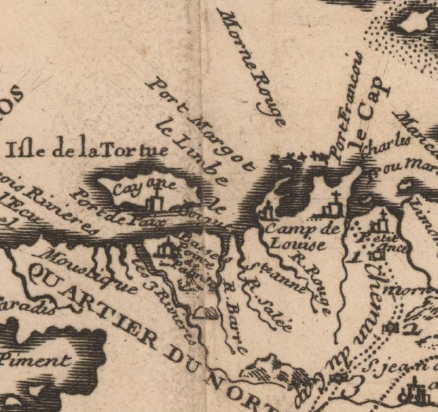
French map circa 1723 marks Cayne opposite the Iron Coast of L’Ile de la Tortue. There’s also a typical sailor’s landmark: Pointe des Palmiers (trans. Point of the Palms). The promontory of Cap François has here become Le Cap (The Cape). It shelters Port St. François, east of the heights of Morne Rouge and Mines de Cuivre (trans. copper mines).

haiti labat
French map of Cape Francois dated 1722 adds Le Limbe, the first area which the rebel slaves put to the torch; and Le Chemin du Cap, the main road to the valleys of the south.

haiti Ponce
This 1796 French map features another sailor’s aid, Pointe Tête de Chein (trans. Dog’s Head Point). The fortification battery on the Cape was built upon Roche à Picolet. This map was drawn after the rebellion of 1791. The Morne Rouge (trans. Red Heights) is now designated as Ravine du Morne au Diable and the Acul à Sabal. The Devil’s Ravine is the present location of Royal Caribbean’s Labadee.

The poor of Haiti are still taking heat for the Bwa Kayiman having been a pact with the devil.

haiti bellin
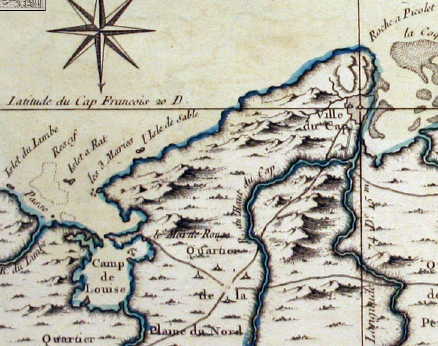
I add this 1764 map for personal interest. Few maps even today mark L’Islet à Rat (trans. Rat Island), which Columbus called La Amiga, was an aid to navigation out of his anchorage at Bay of Acul which he called Cabo de Caribata.

This map also details how colonial French St Domingue was divided into districts, here the Ville du Cap, the Quartier de Plaine du Nord and Camp de Louise.

haiti moreau
This 1770 map of Cap François and Environs distinguishes the larger slavery plantations.

haiti labadi

On the subject of Columbus, isn’t it surprising to reconcile the current verdict on his genocidal behavior, with the histories which have glorified his stature? After all, the primary accounts have never changed. How did earlier biographers overlook the damning and salacious details? One very polite telling of Columbus’ adventures, written by Filson Young published in 1906 provides a prim example. Here Young addresses the kidnap and rape of the indians whom Columbus encountered:

…his taking of the women raises a question which must be in the mind of any one who studies this extraordinary voyage—the question of the treatment of native women by the Spaniards. Columbus is entirely silent on the subject; but taking into account the nature of the Spanish rabble that formed his company, and his own views as to the right which he had to possess the persons and goods of the native inhabitants, I am afraid that there can be very little doubt that in this matter there is a good reason, for his silence. So far as Columbus himself was concerned, it is probable that he was innocent enough; he was not a sensualist by nature, and he was far too much interested and absorbed in the principal objects of his expedition, and had too great a sense of his own personal dignity, to have indulged in excesses that would, thus sanctioned by him, have produced a very disastrous effect on the somewhat rickety discipline of his crew. He was too wise a master, however, to forbid anything that it was not in his power to prevent; and it is probable that he shut his eyes to much that, if he did not tolerate it, he at any rate regarded as a matter of no very great importance. His crew had by this time learned to know their commander well enough not to commit under his eyes offences for which he would have been sure to punish them.

[Giving a list of instructions to the men Columbus planned to leave behind at La Navidad, among them: ]

…and especially to be on their guard to avoid injury or violence to the women, “by which they would cause scandal and set a bad example to the Indians and show the infamy of the Christians.”

no kolumbus day christopher columbusAnd here’s the rub. In this passage the author shows if we do not absolve Columbus, we indict ourselves.

The ruffianly crew had in their minds only the immediate possession of what they could get from the Indians; the Admiral had in his mind the whole possession of the islands and the bodies and souls of its inhabitants. If you take a piece of gold without giving a glass bead in exchange for it, it is called stealing; if you take a country and its inhabitants, and steal their peace from them, and give them blood and servitude in exchange for it, it is called colonisation and Empire-building. Every one understands the distinction; but so few people see the difference that Columbus of all men may be excused for his unconsciousness of it.

US health industry tells Vic to snuff it

vic chestnutVic Chesnutt took his own life on Christmas Day. By coincidence, he’d just given an upbeat interview to NPR’s Fresh Air in spite of an ongoing battle with his health care providers. The segment seemed to pierce the celebrity veil we imagine insulates our talent castes from the worries of everyman. When he died, I reflected on the interview. I was reluctant to mar a eulogy with the villainy of the US medical system — but then NPR re-aired the piece, en memoriam, minus the damning testimony. They added in its place a remembrance by three colleagues who concluded: “To say poor health care killed Vic Chesnutt would be very reductive.”

Reductive? These corporate musicians, at the behest of NPR, have to throw an artisan spin on Vic Chesnutt’s legacy because his art should transcend his mortality?! Vic’s art, real art, is about mortality. Vic’s death was real and the anxiety he expressed in his interview was real. He hadn’t chosen to keep his troubles to himself for the sake of the listeners’ seamless pleasurable enjoyment. Who are these commercial artists to mute Vic’s story? It made me sick.

Others wonder aloud why Vic’s rich musician friends couldn’t have offered to pay for the medical procedures he needed. Perhaps they did, who knows. And perhaps their concern not to be “reductive” was extracted from a much longer session where Vic Chesnutt’s struggles were discussed at length.

Vic’s talent may not have been lost on these would-be eulogists, but we can’t fault them for not being artist spirits enough themselves to know how to shepherd an honest narrative about Vic.

I point my finger at NPR for the rewrite, and I’ll take issue with one of the musicians. At a wake, there’s always someone who uses the opportunity for self-promotion, and at this one it was REM’s Michael Stipe. He discovered Vic Chesnutt, let’s get that out of the way. Michael’s remembrance of Vic was an anecdote about a lyric he thought he’d stolen from Vic. It was so good, he must have stolen it. Stipe was so honest, he called Vic to confess. Vic’s response was gracious, no it’s yours. Stipe insisted, and so did Vic. Such was Vic’s grace, and so elevated was Stipe’s regard for Vic, and evidently so great is Stipe’s humility and –in the end it turns out by Vic’s own lips– his genius. He transcended his master. Much of the draw of coattail opportunism at funerals is that dead men tell no tales.

NPR’s problem, and shall we imagine, the problem of its underwriters, the major health insurers, was that Vic Chesnutt killed himself right after telling an NPR audience he could succumb any day for lack of proper medical care. Chesnutt died from an overdose of pain killers, which raised the disquieting suggestion to listeners that he lived in a lot of pain. Sure Chesnutt had attempted suicide before. He’d written a love song to suicide. The trouble was, he declared in his interview that “Flirted with You All My Life” was a break-up song with death. “I don’t want to die” Chesnutt exclaimed most earnestly.

While our nation’s health insurers have been content to let the common sick extinguish themselves by attrition, their PR crews come to the rescue of high profile victims, usually the focus of mass protests, even if they come late. Vic Chesnutt had given them no time, between the airing of his interview, and his Christmas day demise.

To listeners who heard the first airing, especially ones who might never have heard of Vic, the tragedy of this internationally renown artists being unable to get health care was a climax. It was a moment when entertainment rang dissonant.

For the rewrite, Terry Gross removed the critical segment, leaving the focus on Chesnutt’s earlier suicide attempts. Gross sounded like an insurance interrogator the way she made Chesnutt clarify that his first attempted suicide was actually before his debilitating accident, before health issues would have been a motivation. I would like to see Gross dissect her guests’ responses with such scrutiny, I wonder why she began with Vic.

Thus the rewritten interview became an indictment of Vic Chesnutt’s propensity to self-destruct. Forget narrowing Vic to health care failure, Terry reduced him to habitual suicide. The character assassination continued by next highlighting his song “I’m a Coward.”

In place of the dramatic, redemptive climax, Gross interviewed Michael Stipe, Guy Picciotto and Jem Cohen. Just before wrapping up, Gross raised the issue of Vic’s health care. All agreed the system failed him, but their pre-discussion consensus was not to be “reductive.”

As if the songwriter’s legacy wasn’t going to speak for his whole. Here his colleagues were concerned that their characterization of his death would define him. If Vic had died mid-song, would there have been a need to say his life wasn’t just about that song?

Little did they suspect that NPR would “reduce” Chesnutt however they wanted. Once again where Vic Chesnutt’s sentiment connected with his audience, the industry hovered to intercept.

If you didn’t catch Chesnutt’s original interview on NPR’s Fresh Air, here’s how it ended:

GROSS: I read that you’re in debt like $50,000 because of health insurance issues.

Mr. CHESNUTT: That’s right.

GROSS: So – and this is because you had a series of surgeries and although you pay a lot for your health insurance, it didn’t cover all of it. Is that – do I have that right?

Mr. CHESNUTT: That’s exactly true, yeah.

GROSS: Uh-huh. So, what are your thoughts now as you watch the health care legislation controversy play out?

Mr. CHESNUTT: Well, I have been amazed and confused by the health care debate. We need health care reform. There is no doubt about it, we really need health care reform in this country. Because it’s absurd that somebody like me has to pay so much, it’s just too expensive in this country. It’s just ridiculously expensive. That they can take my house away for kidney stone operation is -that’s absurd.

GROSS: Is that what you’re facing the possibility of now?

Mr. CHESNUTT: Yeah. I mean, it could – I’m not sure exactly. I mean, I don’t have cash money to pay these people. I tried to pay them. I tried to make payments and then they finally ended up saying, no, you have to pay us in full now. And so, you know, I’m not sure what exactly my options are. I just – I really – you know, my feeling is that I think they’ve been paid, they’ve already been paid $100,000 from my insurance company. That seems like plenty. I mean, this would pay for like five or six of these operations in any other country in the world. You know, it affects – I mean, right now I need another surgery and I’ve putting it off for a year because I can’t afford it. And that’s absurd, I think.

I mean, I could actually lose a kidney. And, I mean, I could die only because I cannot afford to go in there again. I don’t want to die, especially just because of I don’t have enough money to go in the hospital. But that’s the reality of it. You know, I have a preexisting condition, my quadriplegia, and I can’t get health insurance.

GROSS: Is it true you can’t get good health insurance?

Mr. CHESNUTT: I can’t get – I’m uninsurable. The only reason I have any insurance now is because I was on Capitol Records for a while. And I had excellent health insurance there. And then when I got dropped from Capitol, I Cobra’d my insurance for as long as it was legally possible. And then – and which was insanely expensive to cobra this very nice insurance. And then, when that ran out, the insurance company said they could offer me one last thing and that is hospitalization. It only covers hospital bills. That’s all it covers. And it’s still $500 a month. So, it doesn’t pay for my drugs, my doctors or anything like that. All it pays for is hospitalization. And yet, I still owe all this money on top of that.

GROSS: Wow. Well, I wish you the best with your health and your music. And I really want to thank you–

Mr. CHESNUTT: Thank you.

GROSS: –a lot for talking with us.

Mr. CHESNUTT: Oh, I’m honored, honored beyond belief.

DC Sniper John Allen Muhammad was early post-911 Muslim Avenger

john allen muhammad beltway sniperWhat morbid fortuity that as President Obama heads to Fort Hood to commemorate the victims of renegade Nidal Malik Hasan, preparations are being made for the execution of another Islamic avenger, the Beltway sniper. As Americans satiate their blood lust against Muslims in the person of John Allen Muhammad who is scheduled to die tonight by lethal injection, perhaps comparisons to Major Hasan will draw attention to the ideological motives behind the 2002 shooting spree. We don’t have to like them, but it would obviously pay us to listen.

Not to excuse the Washington DC killings, nor suggest that the Gulf War veteran and convert to Islam is any less a cold-blooded murderer, but TV crime shows have painted he and accomplice Lee Boyd Malvo as sadistic serial killers, completely burying the sociopolitical elements which tie the snipers to the Global War On Terror/Islam, the legacy of the African American struggle, and its extreme incarnation as the Black Liberation Army.

Muhammad maintains his innocence, primarily because the evidence implicating him remains circumstantial. He was convicted on the strength of partner Malvo’s testimony, and recently lost a Supreme Court appeal. In his testimony, Malvo described three phases to Muhammad’s murderous plans. First was to be the sniper killings, which the two calculated could claim six victims a day. Phase two involved plans to murder a policeman and set bombs at the site of his funeral, to claim an unprecedented toll of police casualties. With money extorted from the government in return for a cessation to the killings, Muhammad and Malvo planned to retreat to Canada, where they planned to build a Utopian community for other disenfranchised African American men, where they would be trained for bigger and more numerous missions against the US.

While I can understand US public figures having to distance themselves from Muhammad, I’m not sure why the organizations speaking out for US political prisoners weren’t showing their solidarity for his motives. Were Muhammad’s ambitions much different from the freedom fighters of the EZLN? Does the rejection of Muhammad reflect the post 9/11 pallor of insurrection in word only?

The case against Major Hasan proceeds apace with the usual unofficial press leaks. I heard reporters site sources who don’t want to be identified by name, in deference to the legal constraints of the ongoing investigation. The accusations they make against Hasan, however, for the benefit of the media outlets, reflects not a concern for Hasan’s due process, but rather their fear for getting themselves in trouble. But the media is eating it up.

Who killed Neda Agha-Soltan?

neda soltaniThe video footage is shocking. An attractive young woman watching the demonstrations in Tehran is struck by a sniper’s bullet and dies before several video cameras. The tragedy is projected unto Facebook and Youtube, with advocates hoping it will galvanize (American) public support for the brave reform movement in Iran. News accounts blame “Basij snipers” on the rooftops. Other protesters have been killed in confrontations with Iranian riot police, without the benefit of video witnesses, much like two million Iraqis, Afghans, Pakistanis et al. Poor 27-year-old bystander Neda Soltani stood at the quite improbable convergence of bullet and camera –correction– cameras. I don’t have to suggest the scene was staged; whether or not the triggerman was an American is immaterial.

Think about just the improbability of your seeing this video. When was the last time the mainstream press has circulated a snuff film? The average person is embarrassed to watch a person die. It’s exploitive. Even when America was fixated on beheaded hostages, our television gatekeepers refused to broadcast the footage. Many horrific war killing moments have found their way unto Youtube, which antiwar activists could only hope would find wider distribution, if only to bring home the inhumanity of our soldiers’ deeds. It never happens.

The western press is running with this story because it demonizes the apparently naked inhumanity of Islam. Muslims stone women, hang gays, look: the bastards shoot their own people arbitrarily. Curiously our media doesn’t make hay with the hapless victims of US snipers.

neda salehi agha soltanThe Neda Soltani snuff footage hit internet shores prepackaged with a smiling mug, and a name that translated means “the voice.” Could a casting director have picked a better title character to represent Iran’s repressed? The western press is even poised to outdo the Muslims in indignant piety, already lauding Neda as a martyr, whom we are informed should launch a thousand Shiite funeral processions. Western pundits compare Neda to the first Shiite martyr, the grandson of Mohammed himself.

Of course, also showing excessive Islamic sensitivity, western reporters readily dismiss the vanishing of Neda’s body, to the Muslim tradition of hasty burials. For the record, in case you missed it, Neda dies onscreen from an apparent gunshot. We do not see the bullet strike, nor now can anyone habeas corpus.

If the scenario was acted entirely, given the success with which the girl’s face is being made into an icon, young Neda’s life is probably as utterly expendable now as already depicted. You think you’re mourning Neda now, imagine her fate if this is a hoax.

OR the gunman could just as well have been a US black-op hit-man who had his eye on the videographers approaching innocent Neda. The US military has long admitted that special forces are already operating in Iran. If the Iranian forces are shooting civilian protesters, what’s the harm of helping them out where there’s a camera ready?

When we’re not meant to see it, the soldiers shoot the cameramen too.

It could be the work of Moussavi henchmen, who are our henchmen.

The Green Revolution, or TwitterTM Revolution, rebranded a “Social Media Revolution,” is a fabrication of the US pro-democracy agents working to destabilize Iran. They are hard at work in Cuba, in Venezuela, in Bolivia, and everywhere regimes threaten US globalization by enslavement. Remember the Orange Revolution? Any movement that is color-coded is the work of organizers reading US how-to manuals or attending OTPOR training seminars.

Where are the international voices decrying election fraud in Iran? No one other than the US and its stooges is asserting that populist leader Ahmadinejad did not win by a landslide. Only Iran’s urban middle class has taken to the streets of Tehran. And to protest what? Their minority standing in Iran?

The reformists in Iran are protesting democracy, not the failure of democracy. They are protesting Mahmoud Ahmadinejad’s hard line against irreligious western economic and colonial policies which traditionally benefit the secular urban elite. “Pro-Democracy” is neoliberal for pro-capitalist plunder.

See: Shah’s Son Backs Iranian Protesters.

Like the “dissidents” of Cuba, the Green greenback-seekers are marching on the CIA’s dime, and being meted the fate of foreign provocateurs. I have no doubt the majority are idealists and are well-intended, but like the Kurds who rose against Saddam Hussein, the US has set them up for slaughter, the sooner to motivate western support for military aggression against their evil regime.

Our media pundits point out that the protest banners are written in English, a sign that the Iranians are desperate to appeal to American viewers. They dismiss Iranian accusations of the demonstrations being US-backed as pure paranoia, and ignore the most simple explanation behind the English slogans, and the websites and networks amplifying the message to English speakers: these materials are being crafted by USAID advisers. This is a propaganda campaign aimed at Western ears, to call for regime change in Iran.

Neda’s Theme is tried and true: Jessica Lynch, Roxana Saberi, Euna Lee and Laura Ling, Neda Salehi Agha Soltan. Onward Christian Soldiers.

Neda Agha Soltan iranian martyr victim of US sniperThe American public won’t believe another fiction about Kuwaiti babies dumped from incubators, or of Belgian children impaled on the bayonets of the evil Hun. So Madison Avenue has upped the amperage. Today’s television armchair adjudicators have to see innocent young women snuffed on film before our eyes. Provided to us by a press too otherwise prurient to show us the mass of death we deal everyday.
The Iranians in the streets, and poor pretty Neda, are being sacrificed by heartless US strategists. I doubt even an errant Iranian bullet can match the American military for cruelty.

Agents of injustice

“Law never made men a whit more just; and, by means of their respect for it, even the well-disposed are daily made the agents of injustice. A common and natural result of an undue respect for law is, that you may see a file of soldiers, colonel, captain, corporal, privates, powder-monkeys, and all, marching in admirable order over hill and dale to the wars, against their wills, ay, against their common sense and consciences, which makes it very steep marching indeed, and produces a palpitation of the heart. They have no doubt that it is a damnable business in which they are concerned; they are all peaceably inclined. Now, what are they? Men at all? or small movable forts and magazines, at the service of some unscrupulous man in power?

Visit the Navy Yard, and behold a marine, such a man as an American government can make, or such as it can make a man with its black arts — a mere shadow and reminiscence of humanity, a man laid out alive and standing, and already, as one may say, buried under arms with funeral accompaniments, though it may be

‘Not a drum was heard, not a funeral note,
As his corse to the rampart we hurried;
Not a soldier discharged his farewell shot
O’er the grave where our hero we buried.’

The mass of men serve the state thus, not as men mainly, but as machines, with their bodies. They are the standing army, and the militia, jailers, constables, posse comitatus,etc. In most cases there is no free exercise whatever of the judgment or of the moral sense; but they put themselves on a level with wood and earth and stones; and wooden men can perhaps be manufactured that will serve the purpose as well. Such command no more respect than men of straw or a lump of dirt. They have the same sort of worth only as horses and dogs. Yet such as these even are commonly esteemed good citizens. Others, as most legislators, politicians, lawyers, ministers, and office-holders, serve the state chiefly with their heads; and, as they rarely make any moral distinctions, they are as likely to serve the devil, without intending it, as God. A very few, as heroes, patriots, martyrs, reformers in the great sense, and men, serve the state with their consciences also, and so necessarily resist it for the most part; and they are commonly treated as enemies by it. A wise man will only be useful as a man, and will not submit to be “clay,” and “stop a hole to keep the wind away,” but leave that office to his dust at least:

‘I am too high-born to be propertied,
To be a secondary at control,
Or useful serving-man and instrument
To any sovereign state throughout the world.'”

–Henry David Thoreau, Civil Disobedience

ANZAC

I was going to do a short teach-in at the EcoFair today, (along with selling my Eco Jewelry) but i’ve got a mucked up arm.
More on that later. Short story, I didn’t go.

But today was also ANZAC Day, sort of an Australian, Canadian and New Zealand version of Veterans Day.

Veterans day here commemorates the end of the war.

ANZAC day is the first engagement by Australian and NZ troops under Aussie and NZ officers (also Canadian and Irish) at a place called Suvla Sud al Bar at Gallipoli… against the Turks.

To put it mildly, it was a straight up fuck-job.

They got mauled.

So did the Turks, because that’s what war is all about.

The British Army had decided to put the “colonials” into the fight right there…

With an amphibious invasion. One which they quickly learned they didn’t know how to run.

That was the guys at the top, like Winston Churchill. He resigned his command and took a field posting.

Remorse, yes, shame, yes… didn’t bring back the kids who were, as the song says

“in five minutes flat, we were all blown to Hell,
Nearly blew us back home
to Australia.

But the band played “Waltzing Matilda”
As we stopped
To bury our slain

We buried ours,
and the Turks buried theirs…
Then we started all over again

and some of them were kids.

The oldest surviving ANZAC died in 2002, while the Liberation Violent Takeover of Afghanistan was going on.

He was 102.

When he joined the Australia-New Zealand Auxilary Corps of the British Army he was 14.
He was 15 when he went to Gallipoli.

Some of our Young Friends who say we unnecessarily pick on the Devilpups and Young Marines and JROTC and Boy Scouts, which ranch-raise the kids to become Cannon Fodder, should contemplate that.

Their leaders will probably wire them up to call us Hate Speech Propagandists for pointing that out.

Screw their leaders.

I was going to sing the songs “The Band Played Waltzing Matilda” “Gallipoli” and “Green Fields o’ France” and play the pipes lowly, actually my flute, and sing it too, Flowers o’ the Forest.

I’ve seen the smilin’
of Fortune beguiling
I’ve witnessed her pleasure
an’ found her decay…

Sweet was it’s blessing
Kind it’s caressing
But now ’tis fled,
tis fled..
Far away…

I’ve seen the forest
adorned in the foremost
wi’ the flowers o’ the forest
most pleasant and gay.

Sae bonnie was their bloomin’
their scent, the air perfumin’

but now they are withered,
an’ a’ wae’ed away…

I’ve seen the mornin’
wi’ gold the hills adornin’

The dread tempest formin’
before parting day…

I’ve seen tweed silver streams
Glitterin’ in the sunny beams.

Grow drownly an’ dark
as they
Rolled on their way.

O, Fickle Fortune!
Why such cruel sportin’

an’ why thus perplex us
poor sons of the day?

Thy frown cannot fear me
Thy smiles cannot cheer me…

For the Flowers o’ the Forest
are all wae’ed away….

At the end of “And the Band Played Waltzing Matilda”

and the old men
still answer the call…
But as year follows year
more old men disappear…

Someday no one will march there

At all

Waltzing Matilda, Waltzin’ Matilda
you’ll go a-waltzin’ Matilda with me.

An’ their ghosts may still be heard
as ye march by that billabong…

Who’ll go a-waltzin’
Matilda wi’ me…

Waltzing Matilda is the unofficial national anthem of Oz-land.

The title refers to a backpack on a stick called a waltzing Matilda since it jerks about so much as you’re carrying it.

The song is about a homeless guy who stole a sheep (Capital offense in British Subjugated Australia at the time) and when the so-called “authorities” tried to take him prisoner he drowned himself instead.

They taught us part of the song, translated into American-recognizable speech, when I was in fourth grade.

Didn’t tell us what the song was about.

I didn’t get to do my teach-in at the EcoFair so I’m doing it here.

“The Flowers o’ the Forest” is funerary and memorial song.

At Scots and Irish funerals and their Canadian and ANZAC derivatives, they play it.

A lone piper usually.

The original was in Scots Gaelic and refers to Yet Another time the English marched into Scotland and massacred a whole bunch of Scotsmen.

Effectively wiped out a generation of young Scots.

They justify it on the grounds that the Scots weren’t a militarized, centralized, highly organized Fascist State thus it’s ok for the Militarily Superior British to do as they please with them.

Might Makes Right.

Where that connects to Australia is the British would round up Scots and Irish “insurgents” and “unlawful combatants” and ship them to Slave Colonies in Australia.

The homeless guy in Waltzing Matilda was a descendant of the deportees.

The “authorities” wanting to hang him after a “fair and impartial” Kangaroo Court hearing (where did you THINK the term came from?) were British Regulars working for the very rich, as usual.

If you want to do a music search on it or the other songs, they’re worth a listen.

You’ll also get links to the full stories behind them.

I mucked my arm pretty badly in November, had a slight accident involving my bicycle.

and the ground and my elbow making violent contact therewith.

I thought at the time that it wasn’t anything serious but now I have to go around with my arm in a sling until the orthopaedists check it out.

Means I can’t ride the bike, so I had to walk to the grocery store today.

I also use my cane for support, and with one hand on the cane and the other in a sling I go from being badly disabled to being downright helpless. Took a lot longer than it usually would and pretty much wiped me out for the rest of the day.

So I didn’t get to go down to the EcoFair.

Ah, well, more opportunities later.

History Begins at Sumer

Sumerian statuesI’m reading about the Sumarians (5,300 – 2,000 B.C.) FROM THE TABLETS OF SUMER: 39 Firsts in Man’s Recorded History. The Sumarians originated civilization as we know it, and their demise may look a lot like ours too. In case you missed the memo, Sumer was earliest Mesopotamia in southern Iraq.

Until the mid 19th Century, we didn’t know Sumerians from Adam. Their history is traced by now deciphered cuneiform writings on clay vessels. Now thanks to Bush’s Folly, we may learn very little more.

Until I have more to relate, I’ll treat you to the table of contents, where Princeton Assyriologist Samuel Noah Kramer lays out his thesis. You might be surprised at which cultural themes are apparently elemental.

From the Tablets of Sumer was published in 1956. The latest edition, History Begins at Sumer can be read online. Kramer also compiled an 18-volume Sumerian dictionary.

Thirty-Nine Firsts in Man’s Recorded History

1.     EDUCATION: The First School
2.     SCHOOLDAYS: The First Case of “Apple-Polishing”
3.     FATHER AND SON: The First Case of Juvenile Delinquency
4.     INTERNATIONAL AFFAIRS: The First “War of Nerves”
5.     GOVERNMENT: The First Bicameral Congress
6.     CIVIL WAR IN SUMER: The First Historian
7.     SOCIAL REFORM: The First Case of Tax Reduction
8.     LAW CODES: The First “Moses”
9.     JUSTICE: The First Legal Precedent
10.   MEDICINE: The First Pharmacopoeia
11.   AGRICULTURE: The First “Farmer’s Almanac”
12.   HORTICULTURE: The First Experiment in Shade-Tree Gardening
13.   PHILOSOPHY: Man’s First Cosmogony and Cosmology
14.   ETHICS: The First Moral Ideals
15.   SUFFERING AND SUBMISSION: The First “Job”
16.   WISDOM: The First Proverbs and Sayings
17.   “AESOPICA”: The First Animal Fables
18.   LOGOMACHY: The First Literary Debates
19.   PARADISE: The First Biblical Parallels
20.   A FLOOD: The First “Noah”
21.   HADES: The First Tale of Resurrection
22.   SLAYING OF THE DRAGON: The First “St. George”
23.   TALES OF GILGAMESH: The First Case of Literary Borrowing
24.   EPIC LITERATURE: Man’s First Heroic Age
25.   TO THE ROYAL BRIDEGROOM: The First Love Song
26.   BOOK LISTS: The First Library Catalogue
27.   WORLD PEACE AND HARMONY: Man’s First Golden Age
28.   ANCIENT COUNTERPARTS OF MODERN WOES:
The First “Sick” Society
29.   DESTRUCTION AND DELIVERANCE: The First Liturgic Laments
30.   THE IDEAL KING: The First Messiahs
31.   SHULGI OF UR: The First Long-Distance Champion
32.   POETRY: The First Literary Imagery
33.   THE SACRED MARRIAGE RITE: The First Sex Symbolism
34.   WEEPING GODDESSES: The First Mater Dolorosa
35.   AU-A A-U-A: The First Lullaby
36.   THE IDEAL MOTHER: Her First Literary Portrait
37.   THREE FUNERAL CHANTS: The First Elegies
38.   THE PICKAXE AND THE PLOW: Labor’s First Victory
39.   HOME OF THE FISH: The First Aquarium

Nonviolent vigils will be death of Gazans

Venezuela Statue of Liberty throws a shoe!GAZA PROTESTS PROLIFERATE! Demonstrators are occupying Israeli consulates, storming embassies, harassing pro-Israeli rallies, and spilling blood on Zionist memorials. Not that anything is working so far. Meanwhile, in non-stories for the press, the usual non-confrontational passivists are lighting candles in memory of the slain. Are they anticipating, in their non-violent wisdom, the eminent extinction of the Palestinians of Gaza? Pacifists seem more comfortable to commemorate the ideological sacrifice of martyrs sooner than advocate for the survival of the endangered.

Others are not content to mourn Zionism’s ultimate triumph. Here’s the best analysis yet I’ve encountered for antiwar strategists.

Oslo protests

In Caracas, the protests have the support of the state. Venezuelan president Chavez expelled the Israeli Ambassador and called his nation’s Jews to repudiate Israel’s inhumanity in Gaza:

“Now I hope that the Venezuelan Jewish community speaks out against this barbarism. Do it. Don’t you strongly reject all acts of persecution?”

Here is the Free Palestine Alliance statement released January 9, 2008:

The Massacre Intensifies:

As we prepare this thirteenth FPA statement, the Zionist army was continuing what it does best the wholesale slaughter of children and unarmed civilians. As would be expected of the current state of affairs of the US-controlled international scene, the massacre of the Palestinian people in the Gaza Strip is continuing despite yesterday’s feeble UN Security Council resolution that calls for Israel to immediately stop its attack. Actually, the US-Zionist leadership went the other way — more and more attacks. The Israeli Zionist army was given additional orders to escalate the conquest as it enters into a third phase of obliteration. Simultaneously as the Israeli cabinet was giving orders for a higher kill and destruction ratio, the US Senate was not going to be outdone by Zionists. It had to add to its long and shameful record. So it secretly issued a fast-tracked resolution fully supporting the ongoing massacre and giving Israel the needed cover. We ask, is this Senate resolution in the best interest of the people of the US?

But is it not the legacy and norm of the US-Israeli alliance to discard the will of the people of the US and the world. Is it not their norm to discard any and all UN resolutions that may remotely disagree with their strategic plans? The examples are far too many to list, including both UN General Assembly and Security Council resolutions dating as far back as 1947.

Yesterday’s UN resolution was approved by 14 of the 15 nations that currently sit on the Security Council, with the US abstaining. As would be expected, the resolution did not address the deadly siege that has been imposed on the Palestinian people in the Gaza Strip, nor did it condemn outright the fascistic actions of the Zionist polity.

Sadly, Palestinian victims have now reached at least 800 murdered and more than 3,300 injured. And these numbers are certain to climb substantially. Yesterday alone, fifty Palestinians were found murdered under their destroyed homes, some with their bodies already beginning to decompose. The Red Cross reported finding 4 near-death children slumped near and over their decomposing dead mothers. These children, like many others, were reported by the Red Cross to have been left without rescue in starvation and thirst for four full days around their killed mothers due to attacks on rescue workers.

On the very same day the UN Security Council resolution was issued, the United Nations Relief and Works Agency (UNRWA) that serves approximately 800,000 Palestinian refugees in the Gaza Strip decided that it was forced to fully halt its services. This decision came following the killing of one of UNRWA’s truck drivers, and due to the extreme conditions imposed by the Zionist army on relief workers. The UNRWA also strongly condemned the Israeli cover-up used to justify the bombardment of the Al-Fakhoura school that murdered and injured over 100 children and their parents.

Come Out in Force Tomorrow:

The people of the US have a moral obligation to turn out in massive numbers tomorrow, Saturday, from Washington, DC to San Francisco, Los Angeles and in between, to send a clear message that this campaign of murder must stop at once. In DC, we will be right there to send a message to the Bush administration, the incoming Barak administration, and to the entire US Congress. In San Francisco, where the United Nations took its first founding steps, we can highlight the charade of UN resolutions and international diplomacy, pointing to the double standards and outright racist behavior of the US and its allies. In Los Angeles and all other cities and towns, we can and must mobilize to join in protest in the largest possible numbers. This is the time to stand for what is moral and just. We cannot continue funding Israel while the people of the US are in dire need for funds right here to rescue homes and towns from collapse.

Rather than pay for the destruction of the Gaza Strip, let us pay for the construction of roadways, parks, and schools.

Rather than destroy thousands of Palestinian homes, let us fix the collapsing housing market and keep people in their own homes.

Rather than send more people homeless, let us protect folks from evictions and foreclosures.

Rather than kill doctors, nurses, and relief workers, let us build hospitals and provide health care to the millions without it.

This is our time to let Obama know that he could very easily stimulate both the economy and the morality of the US by stopping all funds used to kill babies and their mothers. Instead, we can invest these same funds in the education and upbringing of millions of impoverished children, right here in the US.

This is indeed our time, folks, and we must come out to lead the US Congress and administrations to the moral high ground. The interest of the US and its people is best served by supporting the construction of US infrastructure, housing, schools, hospitals, and by creating jobs at a living wage. Rather than kill Arab unionists, let us support strengthening unions and their demand for a respectable life and wages.

This is our time to show that Palestine is but a symbol for ALL just struggles. Struggles we all wage every day in various forms. The massacre against the Palestinian people should focus a very bright spotlight on what is wrong with US policies: US tax dollars are being sent to the Israeli army under US diplomatic cover, and are being used to boost corporations that manufacture military hardware, to conquer and destroy countries like Iraq and Afghanistan, rather than rescuing a failing nation from its impending economic depression.

Signs of Defeat:

We regard the UN Security Council Resolution as a fig leaf void of legitimacy. For one thing, it came 13 days following the massacre, and after more than 4,100 Palestinian casualties between killed and injured. It appears that key power-brokers at the UN had hoped that by waiting long enough (13 days) without action, the Zionists could in fact secure a political and military victory.

While the resolution attempts to provide a diplomatic cover for the Israelis and the US as a way out of their unattainable goals, it is nonetheless a clear indication that the ongoing conquest is unable to achieve any Zionist political gain. In fact, politically speaking, the US-Zionist-Arab regime tripartite axis is only achieving the very opposite of what they had intended through this massacre: (1) the Palestinians have achieved massive international, Arab, and Palestinian support; (2) the possibility for appointing a client regime in the Gaza Strip is non-existent; (3) the sustenance of the Abbas PA in its current formation has become very uncertain; and (4) the little legitimacy some Arab regimes have is that much more diminished.

To the extreme dismay of the US and Zionist leaders, the UN resolution demands an immediate stop to the attacks and the opening of all crossings; and it opens the gates for humanitarian aid. Hence, rejected by the Zionist leadership at once. Due to the weight of the pressure on US Arab allies, who could not under any circumstance return home empty-handed, the US had no choice but to abstain rather than give its usual veto — a way to give the US-supported despots a piece of paper to wave in the face of a sea of millions and millions in protest everywhere. Ironically, the gravity of the massacre made a full circle, compromising the stability of the alliance that is responsible for its implementation. The more violent the attack, the more stubborn the resistance, the more widespread the support, and the weaker the grip of despotic regimes.

Let us join the millions who have taken to the streets thus far, including today, in thousands of towns and cities in the world. There are those who are volunteering as doctors, nurses, and rescue workers, with many already killed and injured; there are those who are giving blood to hospitals and to the Red Cross and Red Crescent; those who are protesting; many are writing, painting, dancing and singing for freedom and liberation; and there are those who are holding sit-ins, and those who are giving flowers of appreciation to the Venezuelan government for their principled stance. All are out, and all are outraged.

Come and join!

Take your stand and come out tomorrow. Make it known that this massacre cannot continue!

All Out in Solidarity with the Palestinian People!

The Free Palestine Alliance

January 9, 2009

And this report from A.N.S.W.E.R. about Sunday’s march on DC:

From Washington, DC to San Francisco, Los Angeles, and Worldwide–Hundreds of Thousands March to Let Gaza Live!

On Sat., Jan. 10, hundreds of cities, and hundreds of thousands of people, responded to the call for an International Day of Emergency Action to support the people of Gaza. Outside the United States, marches took place in London, Edinburgh, Cairo, Athens, Kuala Lumpur, Beirut, Seoul, Mexico City, Jakarta, Montreal, Paris, Barcelona, Marseilles, Lyon, Oslo, Berlin, Bern, Karachi, Nablus, New Delhi, Amman, Sarajevo, Ramallah, Stockholm, and Tokyo. The protests continue to grow — today, another 250,000 took to the streets in Spain and more than 100,000 in Algeria.

In the U.S., the Day of Action was initiated on just one week’s notice by a call from the ANSWER Coalition, Muslim American Society Freedom, Free Palestine Alliance, National Council of Arab Americans, and Al-Awda – International Palestine Right to Return Coalition. In Washington DC, over 20,000 took to the streets in the freezing rain to demand, “Let Gaza Live!” The streets were so backed up that thousands of people in buses and cars were still arriving after the march had left Lafayette Park.

The demonstration began with a rally at the White House. Featured speakers included former Congresswoman Cynthia McKinney, who was just on a humanitarian relief mission attempting to bring supplies to Gaza when the boat she was on was intentionally struck by an Israeli military vessel; Mahdi Bray, Executive Director, Muslim American Society Freedom; Rev. Graylan Hagler, National President of Ministers for Racial, Social and Economic Justice; Mounzer Sleiman, Vice Chairman, National Council of Arab Americans; Ralph Nader; Paul Zulkowitz, Jews Against the Occupation; Brian Becker, National Coordinator, ANSWER Coalition; Mara Verheyden-Hilliard, attorney and co-founder, Partnership for Civil Justice; and others.

The spirited march then led to the Washington Post, where demonstrators denounced the paper for its biased pro-Israeli coverage of the massacre and its complete blackout of protest activities in the United States.

In San Francisco, 10,000 took part in the march and rally. The rally included a huge outpouring from the local Arab community, and energetic participation from Bay Area youth.

A crowd of 2000 demonstrators confronted a heavy police presence in downtown Orlando for the “Let Gaza Live: Florida Statewide March for Palestine” called by Act Now to Stop War and End Racism Coalition/Florida—just six days prior. The demonstration is the largest anti-war demonstration in Florida in more than a decade and certainly the largest ever protest in Florida calling for a free Palestine. Police tried to intimidate marchers by initially searching all bags, forcing protesters to remove sticks from signs, and denying the use of amplified sound. Organizers and protesters challenged and pushed back their unwarranted scare tactics, and the protest turned out to be a powerful success.

In Los Angeles, 10,000 people participated in a regional mass march and rally to “Let Gaza Live” at the Westwood Federal Building. Hundreds of Palestinian flags and signs reading “Stop bombing Gaza!” and “The real terrorists: U.S./Israel war machine!” lined all sides of the street and the lawn in front of the federal government headquarters. It was the largest protest and the first major march in Southern California since the Israeli bombing campaign and invasion began.

A funeral procession led the march with makeshift coffins draped with Palestinian flags, representing the hundreds of people killed by Israel’s genocidal attack on Gaza. Hundreds of children followed, along with a huge, hand-made Palestinian flag, in a contingent organized by the Palestinian American Women’s Association.

The worldwide movement is continuing to grow with more protests today, Jan. 11. There will be countless other actions in the days to come. Today in New York City, the police carried out a violent assault against those marching in mid-town Manhattan in support of the people of Palestine. A number of people were injured and arrested.

With the support of the United States, the Israeli military machine has expanded its invasion into urban areas of Gaza. The death toll among Palestinians is now nearly 900, with many thousands wounded. The injured and hungry of Gaza have no relief. We must do everything in our power to deepen and broaden this movement in the coming days.

Harold Pinter on drama and US banditry

“What has happened to our moral sensibility? Did we ever have any? What do these words mean? Do they refer to a term very rarely employed these days – conscience? A conscience to do not only with our own acts but to do with our shared responsibility in the acts of others? Is all this dead?”
-Harold Pinter (1930-2008)

I’m reminded of a friend of mine who asked “You know what PTSD is? It’s a bad conscience.”

An outspoken critic of the Iraq War, Harold Pinter died Christmas Eve. Here is the address he prerecorded for his acceptance of the Nobel Prize in 2005, when he had become too infirm to attend in person.

Nobel Lecture: Art, Truth & Politics

In 1958 I wrote the following:

‘There are no hard distinctions between what is real and what is unreal, nor between what is true and what is false. A thing is not necessarily either true or false; it can be both true and false.’

I believe that these assertions still make sense and do still apply to the exploration of reality through art. So as a writer I stand by them but as a citizen I cannot. As a citizen I must ask: What is true? What is false?

Truth in drama is forever elusive. You never quite find it but the search for it is compulsive. The search is clearly what drives the endeavour. The search is your task. More often than not you stumble upon the truth in the dark, colliding with it or just glimpsing an image or a shape which seems to correspond to the truth, often without realising that you have done so. But the real truth is that there never is any such thing as one truth to be found in dramatic art. There are many. These truths challenge each other, recoil from each other, reflect each other, ignore each other, tease each other, are blind to each other. Sometimes you feel you have the truth of a moment in your hand, then it slips through your fingers and is lost.

I have often been asked how my plays come about. I cannot say. Nor can I ever sum up my plays, except to say that this is what happened. That is what they said. That is what they did.

Most of the plays are engendered by a line, a word or an image. The given word is often shortly followed by the image. I shall give two examples of two lines which came right out of the blue into my head, followed by an image, followed by me.

The plays are The Homecoming and Old Times. The first line of The Homecoming is ‘What have you done with the scissors?’ The first line of Old Times is ‘Dark.’

In each case I had no further information.

In the first case someone was obviously looking for a pair of scissors and was demanding their whereabouts of someone else he suspected had probably stolen them. But I somehow knew that the person addressed didn’t give a damn about the scissors or about the questioner either, for that matter.

‘Dark’ I took to be a description of someone’s hair, the hair of a woman, and was the answer to a question. In each case I found myself compelled to pursue the matter. This happened visually, a very slow fade, through shadow into light.

I always start a play by calling the characters A, B and C.

In the play that became The Homecoming I saw a man enter a stark room and ask his question of a younger man sitting on an ugly sofa reading a racing paper. I somehow suspected that A was a father and that B was his son, but I had no proof. This was however confirmed a short time later when B (later to become Lenny) says to A (later to become Max), ‘Dad, do you mind if I change the subject? I want to ask you something. The dinner we had before, what was the name of it? What do you call it? Why don’t you buy a dog? You’re a dog cook. Honest. You think you’re cooking for a lot of dogs.’ So since B calls A ‘Dad’ it seemed to me reasonable to assume that they were father and son. A was also clearly the cook and his cooking did not seem to be held in high regard. Did this mean that there was no mother? I didn’t know. But, as I told myself at the time, our beginnings never know our ends.

‘Dark.’ A large window. Evening sky. A man, A (later to become Deeley), and a woman, B (later to become Kate), sitting with drinks. ‘Fat or thin?’ the man asks. Who are they talking about? But I then see, standing at the window, a woman, C (later to become Anna), in another condition of light, her back to them, her hair dark.

It’s a strange moment, the moment of creating characters who up to that moment have had no existence. What follows is fitful, uncertain, even hallucinatory, although sometimes it can be an unstoppable avalanche. The author’s position is an odd one. In a sense he is not welcomed by the characters. The characters resist him, they are not easy to live with, they are impossible to define. You certainly can’t dictate to them. To a certain extent you play a never-ending game with them, cat and mouse, blind man’s buff, hide and seek. But finally you find that you have people of flesh and blood on your hands, people with will and an individual sensibility of their own, made out of component parts you are unable to change, manipulate or distort.

So language in art remains a highly ambiguous transaction, a quicksand, a trampoline, a frozen pool which might give way under you, the author, at any time.

But as I have said, the search for the truth can never stop. It cannot be adjourned, it cannot be postponed. It has to be faced, right there, on the spot.

Political theatre presents an entirely different set of problems. Sermonising has to be avoided at all cost. Objectivity is essential. The characters must be allowed to breathe their own air. The author cannot confine and constrict them to satisfy his own taste or disposition or prejudice. He must be prepared to approach them from a variety of angles, from a full and uninhibited range of perspectives, take them by surprise, perhaps, occasionally, but nevertheless give them the freedom to go which way they will. This does not always work. And political satire, of course, adheres to none of these precepts, in fact does precisely the opposite, which is its proper function.

In my play The Birthday Party I think I allow a whole range of options to operate in a dense forest of possibility before finally focussing on an act of subjugation.

Mountain Language pretends to no such range of operation. It remains brutal, short and ugly. But the soldiers in the play do get some fun out of it. One sometimes forgets that torturers become easily bored. They need a bit of a laugh to keep their spirits up. This has been confirmed of course by the events at Abu Ghraib in Baghdad. Mountain Language lasts only 20 minutes, but it could go on for hour after hour, on and on and on, the same pattern repeated over and over again, on and on, hour after hour.

Ashes to Ashes, on the other hand, seems to me to be taking place under water. A drowning woman, her hand reaching up through the waves, dropping down out of sight, reaching for others, but finding nobody there, either above or under the water, finding only shadows, reflections, floating; the woman a lost figure in a drowning landscape, a woman unable to escape the doom that seemed to belong only to others.

But as they died, she must die too.

Political language, as used by politicians, does not venture into any of this territory since the majority of politicians, on the evidence available to us, are interested not in truth but in power and in the maintenance of that power. To maintain that power it is essential that people remain in ignorance, that they live in ignorance of the truth, even the truth of their own lives. What surrounds us therefore is a vast tapestry of lies, upon which we feed.

As every single person here knows, the justification for the invasion of Iraq was that Saddam Hussein possessed a highly dangerous body of weapons of mass destruction, some of which could be fired in 45 minutes, bringing about appalling devastation. We were assured that was true. It was not true. We were told that Iraq had a relationship with Al Quaeda and shared responsibility for the atrocity in New York of September 11th 2001. We were assured that this was true. It was not true. We were told that Iraq threatened the security of the world. We were assured it was true. It was not true.

The truth is something entirely different. The truth is to do with how the United States understands its role in the world and how it chooses to embody it.

But before I come back to the present I would like to look at the recent past, by which I mean United States foreign policy since the end of the Second World War. I believe it is obligatory upon us to subject this period to at least some kind of even limited scrutiny, which is all that time will allow here.

Everyone knows what happened in the Soviet Union and throughout Eastern Europe during the post-war period: the systematic brutality, the widespread atrocities, the ruthless suppression of independent thought. All this has been fully documented and verified.

But my contention here is that the US crimes in the same period have only been superficially recorded, let alone documented, let alone acknowledged, let alone recognised as crimes at all. I believe this must be addressed and that the truth has considerable bearing on where the world stands now. Although constrained, to a certain extent, by the existence of the Soviet Union, the United States’ actions throughout the world made it clear that it had concluded it had carte blanche to do what it liked.

Direct invasion of a sovereign state has never in fact been America’s favoured method. In the main, it has preferred what it has described as ‘low intensity conflict’. Low intensity conflict means that thousands of people die but slower than if you dropped a bomb on them in one fell swoop. It means that you infect the heart of the country, that you establish a malignant growth and watch the gangrene bloom. When the populace has been subdued – or beaten to death – the same thing – and your own friends, the military and the great corporations, sit comfortably in power, you go before the camera and say that democracy has prevailed. This was a commonplace in US foreign policy in the years to which I refer.

The tragedy of Nicaragua was a highly significant case. I choose to offer it here as a potent example of America’s view of its role in the world, both then and now.

I was present at a meeting at the US embassy in London in the late 1980s.

The United States Congress was about to decide whether to give more money to the Contras in their campaign against the state of Nicaragua. I was a member of a delegation speaking on behalf of Nicaragua but the most important member of this delegation was a Father John Metcalf. The leader of the US body was Raymond Seitz (then number two to the ambassador, later ambassador himself). Father Metcalf said: ‘Sir, I am in charge of a parish in the north of Nicaragua. My parishioners built a school, a health centre, a cultural centre. We have lived in peace. A few months ago a Contra force attacked the parish. They destroyed everything: the school, the health centre, the cultural centre. They raped nurses and teachers, slaughtered doctors, in the most brutal manner. They behaved like savages. Please demand that the US government withdraw its support from this shocking terrorist activity.’

Raymond Seitz had a very good reputation as a rational, responsible and highly sophisticated man. He was greatly respected in diplomatic circles. He listened, paused and then spoke with some gravity. ‘Father,’ he said, ‘let me tell you something. In war, innocent people always suffer.’ There was a frozen silence. We stared at him. He did not flinch.

Innocent people, indeed, always suffer.

Finally somebody said: ‘But in this case “innocent people” were the victims of a gruesome atrocity subsidised by your government, one among many. If Congress allows the Contras more money further atrocities of this kind will take place. Is this not the case? Is your government not therefore guilty of supporting acts of murder and destruction upon the citizens of a sovereign state?’

Seitz was imperturbable. ‘I don’t agree that the facts as presented support your assertions,’ he said.

As we were leaving the Embassy a US aide told me that he enjoyed my plays. I did not reply.

I should remind you that at the time President Reagan made the following statement: ‘The Contras are the moral equivalent of our Founding Fathers.’

The United States supported the brutal Somoza dictatorship in Nicaragua for over 40 years. The Nicaraguan people, led by the Sandinistas, overthrew this regime in 1979, a breathtaking popular revolution.

The Sandinistas weren’t perfect. They possessed their fair share of arrogance and their political philosophy contained a number of contradictory elements. But they were intelligent, rational and civilised. They set out to establish a stable, decent, pluralistic society. The death penalty was abolished. Hundreds of thousands of poverty-stricken peasants were brought back from the dead. Over 100,000 families were given title to land. Two thousand schools were built. A quite remarkable literacy campaign reduced illiteracy in the country to less than one seventh. Free education was established and a free health service. Infant mortality was reduced by a third. Polio was eradicated.

The United States denounced these achievements as Marxist/Leninist subversion. In the view of the US government, a dangerous example was being set. If Nicaragua was allowed to establish basic norms of social and economic justice, if it was allowed to raise the standards of health care and education and achieve social unity and national self respect, neighbouring countries would ask the same questions and do the same things. There was of course at the time fierce resistance to the status quo in El Salvador.

I spoke earlier about ‘a tapestry of lies’ which surrounds us. President Reagan commonly described Nicaragua as a ‘totalitarian dungeon’. This was taken generally by the media, and certainly by the British government, as accurate and fair comment. But there was in fact no record of death squads under the Sandinista government. There was no record of torture. There was no record of systematic or official military brutality. No priests were ever murdered in Nicaragua. There were in fact three priests in the government, two Jesuits and a Maryknoll missionary. The totalitarian dungeons were actually next door, in El Salvador and Guatemala. The United States had brought down the democratically elected government of Guatemala in 1954 and it is estimated that over 200,000 people had been victims of successive military dictatorships.

Six of the most distinguished Jesuits in the world were viciously murdered at the Central American University in San Salvador in 1989 by a battalion of the Alcatl regiment trained at Fort Benning, Georgia, USA. That extremely brave man Archbishop Romero was assassinated while saying mass. It is estimated that 75,000 people died. Why were they killed? They were killed because they believed a better life was possible and should be achieved. That belief immediately qualified them as communists. They died because they dared to question the status quo, the endless plateau of poverty, disease, degradation and oppression, which had been their birthright.

The United States finally brought down the Sandinista government. It took some years and considerable resistance but relentless economic persecution and 30,000 dead finally undermined the spirit of the Nicaraguan people. They were exhausted and poverty stricken once again. The casinos moved back into the country. Free health and free education were over. Big business returned with a vengeance. ‘Democracy’ had prevailed.

But this ‘policy’ was by no means restricted to Central America. It was conducted throughout the world. It was never-ending. And it is as if it never happened.

The United States supported and in many cases engendered every right wing military dictatorship in the world after the end of the Second World War. I refer to Indonesia, Greece, Uruguay, Brazil, Paraguay, Haiti, Turkey, the Philippines, Guatemala, El Salvador, and, of course, Chile. The horror the United States inflicted upon Chile in 1973 can never be purged and can never be forgiven.

Hundreds of thousands of deaths took place throughout these countries. Did they take place? And are they in all cases attributable to US foreign policy? The answer is yes they did take place and they are attributable to American foreign policy. But you wouldn’t know it.

It never happened. Nothing ever happened. Even while it was happening it wasn’t happening. It didn’t matter. It was of no interest. The crimes of the United States have been systematic, constant, vicious, remorseless, but very few people have actually talked about them. You have to hand it to America. It has exercised a quite clinical manipulation of power worldwide while masquerading as a force for universal good. It’s a brilliant, even witty, highly successful act of hypnosis.

I put to you that the United States is without doubt the greatest show on the road. Brutal, indifferent, scornful and ruthless it may be but it is also very clever. As a salesman it is out on its own and its most saleable commodity is self love. It’s a winner. Listen to all American presidents on television say the words, ‘the American people’, as in the sentence, ‘I say to the American people it is time to pray and to defend the rights of the American people and I ask the American people to trust their president in the action he is about to take on behalf of the American people.’

It’s a scintillating stratagem. Language is actually employed to keep thought at bay. The words ‘the American people’ provide a truly voluptuous cushion of reassurance. You don’t need to think. Just lie back on the cushion. The cushion may be suffocating your intelligence and your critical faculties but it’s very comfortable. This does not apply of course to the 40 million people living below the poverty line and the 2 million men and women imprisoned in the vast gulag of prisons, which extends across the US.

The United States no longer bothers about low intensity conflict. It no longer sees any point in being reticent or even devious. It puts its cards on the table without fear or favour. It quite simply doesn’t give a damn about the United Nations, international law or critical dissent, which it regards as impotent and irrelevant. It also has its own bleating little lamb tagging behind it on a lead, the pathetic and supine Great Britain.

What has happened to our moral sensibility? Did we ever have any? What do these words mean? Do they refer to a term very rarely employed these days – conscience? A conscience to do not only with our own acts but to do with our shared responsibility in the acts of others? Is all this dead? Look at Guantanamo Bay. Hundreds of people detained without charge for over three years, with no legal representation or due process, technically detained forever. This totally illegitimate structure is maintained in defiance of the Geneva Convention. It is not only tolerated but hardly thought about by what’s called the ‘international community’. This criminal outrage is being committed by a country, which declares itself to be ‘the leader of the free world’. Do we think about the inhabitants of Guantanamo Bay? What does the media say about them? They pop up occasionally – a small item on page six. They have been consigned to a no man’s land from which indeed they may never return. At present many are on hunger strike, being force-fed, including British residents. No niceties in these force-feeding procedures. No sedative or anaesthetic. Just a tube stuck up your nose and into your throat. You vomit blood. This is torture. What has the British Foreign Secretary said about this? Nothing. What has the British Prime Minister said about this? Nothing. Why not? Because the United States has said: to criticise our conduct in Guantanamo Bay constitutes an unfriendly act. You’re either with us or against us. So Blair shuts up.

The invasion of Iraq was a bandit act, an act of blatant state terrorism, demonstrating absolute contempt for the concept of international law. The invasion was an arbitrary military action inspired by a series of lies upon lies and gross manipulation of the media and therefore of the public; an act intended to consolidate American military and economic control of the Middle East masquerading – as a last resort – all other justifications having failed to justify themselves – as liberation. A formidable assertion of military force responsible for the death and mutilation of thousands and thousands of innocent people.

We have brought torture, cluster bombs, depleted uranium, innumerable acts of random murder, misery, degradation and death to the Iraqi people and call it ‘bringing freedom and democracy to the Middle East’.

How many people do you have to kill before you qualify to be described as a mass murderer and a war criminal? One hundred thousand? More than enough, I would have thought. Therefore it is just that Bush and Blair be arraigned before the International Criminal Court of Justice. But Bush has been clever. He has not ratified the International Criminal Court of Justice. Therefore if any American soldier or for that matter politician finds himself in the dock Bush has warned that he will send in the marines. But Tony Blair has ratified the Court and is therefore available for prosecution. We can let the Court have his address if they’re interested. It is Number 10, Downing Street, London.

Death in this context is irrelevant. Both Bush and Blair place death well away on the back burner. At least 100,000 Iraqis were killed by American bombs and missiles before the Iraq insurgency began. These people are of no moment. Their deaths don’t exist. They are blank. They are not even recorded as being dead. ‘We don’t do body counts,’ said the American general Tommy Franks.

Early in the invasion there was a photograph published on the front page of British newspapers of Tony Blair kissing the cheek of a little Iraqi boy. ‘A grateful child,’ said the caption. A few days later there was a story and photograph, on an inside page, of another four-year-old boy with no arms. His family had been blown up by a missile. He was the only survivor. ‘When do I get my arms back?’ he asked. The story was dropped. Well, Tony Blair wasn’t holding him in his arms, nor the body of any other mutilated child, nor the body of any bloody corpse. Blood is dirty. It dirties your shirt and tie when you’re making a sincere speech on television.

The 2,000 American dead are an embarrassment. They are transported to their graves in the dark. Funerals are unobtrusive, out of harm’s way. The mutilated rot in their beds, some for the rest of their lives. So the dead and the mutilated both rot, in different kinds of graves.

Here is an extract from a poem by Pablo Neruda, ‘I’m Explaining a Few Things’:

And one morning all that was burning,
one morning the bonfires
leapt out of the earth
devouring human beings
and from then on fire,
gunpowder from then on,
and from then on blood.
Bandits with planes and Moors,
bandits with finger-rings and duchesses,
bandits with black friars spattering blessings
came through the sky to kill children
and the blood of children ran through the streets
without fuss, like children’s blood.

Jackals that the jackals would despise
stones that the dry thistle would bite on and spit out,
vipers that the vipers would abominate.

Face to face with you I have seen the blood
of Spain tower like a tide
to drown you in one wave
of pride and knives.

Treacherous
generals:
see my dead house,
look at broken Spain:
from every house burning metal flows
instead of flowers
from every socket of Spain
Spain emerges
and from every dead child a rifle with eyes
and from every crime bullets are born
which will one day find
the bull’s eye of your hearts.

And you will ask: why doesn’t his poetry
speak of dreams and leaves
and the great volcanoes of his native land.

Come and see the blood in the streets.
Come and see
the blood in the streets.
Come and see the blood
in the streets!

Let me make it quite clear that in quoting from Neruda’s poem I am in no way comparing Republican Spain to Saddam Hussein’s Iraq. I quote Neruda because nowhere in contemporary poetry have I read such a powerful visceral description of the bombing of civilians.

I have said earlier that the United States is now totally frank about putting its cards on the table. That is the case. Its official declared policy is now defined as ‘full spectrum dominance’. That is not my term, it is theirs. ‘Full spectrum dominance’ means control of land, sea, air and space and all attendant resources.

The United States now occupies 702 military installations throughout the world in 132 countries, with the honourable exception of Sweden, of course. We don’t quite know how they got there but they are there all right.

The United States possesses 8,000 active and operational nuclear warheads. Two thousand are on hair trigger alert, ready to be launched with 15 minutes warning. It is developing new systems of nuclear force, known as bunker busters. The British, ever cooperative, are intending to replace their own nuclear missile, Trident. Who, I wonder, are they aiming at? Osama bin Laden? You? Me? Joe Dokes? China? Paris? Who knows? What we do know is that this infantile insanity – the possession and threatened use of nuclear weapons – is at the heart of present American political philosophy. We must remind ourselves that the United States is on a permanent military footing and shows no sign of relaxing it.

Many thousands, if not millions, of people in the United States itself are demonstrably sickened, shamed and angered by their government’s actions, but as things stand they are not a coherent political force – yet. But the anxiety, uncertainty and fear which we can see growing daily in the United States is unlikely to diminish.

I know that President Bush has many extremely competent speech writers but I would like to volunteer for the job myself. I propose the following short address which he can make on television to the nation. I see him grave, hair carefully combed, serious, winning, sincere, often beguiling, sometimes employing a wry smile, curiously attractive, a man’s man.

‘God is good. God is great. God is good. My God is good. Bin Laden’s God is bad. His is a bad God. Saddam’s God was bad, except he didn’t have one. He was a barbarian. We are not barbarians. We don’t chop people’s heads off. We believe in freedom. So does God. I am not a barbarian. I am the democratically elected leader of a freedom-loving democracy. We are a compassionate society. We give compassionate electrocution and compassionate lethal injection. We are a great nation. I am not a dictator. He is. I am not a barbarian. He is. And he is. They all are. I possess moral authority. You see this fist? This is my moral authority. And don’t you forget it.’

A writer’s life is a highly vulnerable, almost naked activity. We don’t have to weep about that. The writer makes his choice and is stuck with it. But it is true to say that you are open to all the winds, some of them icy indeed. You are out on your own, out on a limb. You find no shelter, no protection – unless you lie – in which case of course you have constructed your own protection and, it could be argued, become a politician.

I have referred to death quite a few times this evening. I shall now quote a poem of my own called ‘Death’.

Where was the dead body found?
Who found the dead body?
Was the dead body dead when found?
How was the dead body found?

Who was the dead body?

Who was the father or daughter or brother
Or uncle or sister or mother or son
Of the dead and abandoned body?

Was the body dead when abandoned?
Was the body abandoned?
By whom had it been abandoned?

Was the dead body naked or dressed for a journey?

What made you declare the dead body dead?
Did you declare the dead body dead?
How well did you know the dead body?
How did you know the dead body was dead?

Did you wash the dead body
Did you close both its eyes
Did you bury the body
Did you leave it abandoned
Did you kiss the dead body

When we look into a mirror we think the image that confronts us is accurate. But move a millimetre and the image changes. We are actually looking at a never-ending range of reflections. But sometimes a writer has to smash the mirror – for it is on the other side of that mirror that the truth stares at us.

I believe that despite the enormous odds which exist, unflinching, unswerving, fierce intellectual determination, as citizens, to define the real truth of our lives and our societies is a crucial obligation which devolves upon us all. It is in fact mandatory.

If such a determination is not embodied in our political vision we have no hope of restoring what is so nearly lost to us – the dignity of man.

Transit crash used as excuse for taxpayer-paid LA cop fest

Hundreds attend funeral of LAPD officer killed in Metrolink crash And just why is it that cops get paid to go to this funeral and it makes headlines for the cops?

There were at least 24 other people that have died from this case of poorly constructed mass transit lines and the ensuing crash that occurred, so shouldn’t money go to fix these problems and save lives instead of going to salaries for cops at funerals and advertisement for spending money on yet more thugs in uniforms? We need this money for social services and other government budget items, things like safer mass transit systems funding for example and not more funding for yet more uniformed cop thuggery in this country.

The cops get paid oodles of money for no good reason. The recent events at the Democratic and Republican Party conventions are also illustrative of the excessive Let’s Feed The Uniforms mentality that is bankrupting us around the country. How much was spent for that excessive use of thuggery force by the cops? And what was so damn special about the cop that died in this tragic accident that she merits the city paying its officers to do their thing at this ceremony? What about the funeral expenses of the other who have died? What about the medical care of the injured, many of whom lacked insurance and adequate medical coverage because of that?

This country has its priorities totally screwed up, and this cop fest is just one more illustration of that. It’s time to stop glorifying the cops. It’s time to stop having our money stolen away to deed the cops more and more donuts. They are goons for the rich and only ever marginally ever do anything for the working classes. The community needs to police itself and get rid of this excessive funding that now goes to prisons and uniformed thugs.

Henry David Thoreau’s writings about the military

ThoreauMost folk only know about Walden Pond and Henry David Thoreau’s reflections about the tranquility there. They think of him only as some sort of nature writer. However Thoreau was also an American anarchist whose other writings about society are not quite as well disseminated to college students. Below Henry David Thoreau writes about the American military…

A common and natural result of an undue respect for the law
is, that you may see a file of soldiers, colonel, captain,
corporal, privates, powder-monkeys, and all, marching
in admirable order over hill and dale to the wars,
against their wills, ay, against their common sense
and consciences, which makes it very steep marching
indeed, and produces a palpitation of the heart.
They have no doubt that it is a damnable business in
which they are concerned; they are all peaceably inclined.
Now, what are they? Men at all? or small movable forts and
magazines, at the service of some unscrupulous man in power?
Visit the Navy Yard, and behold a marine, such a man as an
American government can make, or such as it can make a man
with its black arts–a mere shadow and reminiscence of
humanity, a man laid out alive and standing, and already, as
one may say, buried under arms with funeral accompaniment,
though it may be,

“Not a drum was heard, not a funeral note,
As his corse to the rampart we hurried;
Not a soldier discharged his farewell shot
O’er the grave where out hero was buried.”

The mass of men serve the state thus, not as men
mainly, but as machines, with their bodies. They are the
standing army, and the militia, jailers, constables, posse
comitatus, etc. In most cases there is no free exercise
whatever of the judgement or of the moral sense; but they
put themselves on a level with wood and earth and stones;
and wooden men can perhaps be manufactured that will serve
the purpose as well. Such command no more respect than men
of straw or a lump of dirt. They have the same sort of
worth only as horses and dogs. Yet such as these even are
commonly esteemed good citizens.

from Civil Disobedience by Henry David Thoreau

Index to Not My Tribe mastheads

A few words about the changing NMT masthead. This is a partial listing of what we are not. Themes include war, environmental devastation, and the soulless invasion of man’s spirit. Special attention to riot police, Chinese repression, offshore drilling, and Las Vegas.

Guernica
Crazed warriors
AU peacekeepers
Pershing cavalry
CSPD tear gas 2003
Reenlistment Iraq
Fallujah offensive
Navy Seal divers
National Guard Kent State
Black Hawk helicopters
Helmeted riot police
Mexican riot police
Miami riot police
NYPD blue
Monster truck airborne
Lurking crocodile
Gestapo dead-checking
Chinese riot police
Debutante prom dresses
Cog wheels
Reef bleaching
Traffic exhaust
Mall of America
Gridlock on 405
Excavation
Chinese oil field
Landfill dump
Critical Mass vs NYPD
Mexican city
Tract housing sprawl
Chinese recruits
Shanghai cityscape
Chinese police
Beijing police exercises
Beijing Olympic security
Beijing riot police
Chinese Segway assault
Beijing smog
Forbidden City
Tiananmen Square standoff
Canadian oil rigs
Offshore oil rigs
Chinese oil platforms
Oil rig sunset
Irish offshore rigs
Three offshore oil rigs
Santa Barbara rig spill
Aerial view of spill
Four offshore oil rigs
More offshore platforms
Offshore oil spill
Oil tanker spill
Oil spill close-up
Oil spill clean-up
Oil rigs illuminated
Motorcycles in motorcade
Open pit mining
Long Beach oil derricks
Signal Hill oil
Early industrial pollution
Vegas circa 1950
Vegas downtown
Vegas circa 1980
Vegas neon
Vegas strip
Blackjack table
Neon cityscape
Los Angeles smog
Southern Cal suburb
Mall
Hazmat fire
Iraq salute
Redeployment
Enlistment oath
Police funeral motorcade
Tiananmen soldiers
Factory hog farming
Cattle feed lot
Caged chickens
Poultry processing
RNC riot sticks
Riot gas
DNC Denver
DNC Denver
DNC mounted
DNC Denver
DNC Denver
DNC Denver
DNC Denver
RNC Minneapolis
Army pledge
Junior Marines
Junior Marines
Junior Marines
Junior Marines
Vacant parking
Hi-tech border patrol
Bishops
Boxing
DNC beating
Military academy
Military fitness
Marching
Church and Tank
Bomber
Chinese soldiers
Putin between 41 and 43
President
Zionists
Roadside harassment
Food processing plant
Cheerleaders
National anthem
Boots
Shorts
Conference table
Food packing
Streetwalkers
Tanning bed
Theater seating
Lonely reef
Monster truck
Motorization
Coral bleaching

Racist Jewish Israel keeps killing kids

Israeli terrorism It is a sad state for the world Jewish community to now be about the leading group of racists in the world these days.

Quite simply, Jewish Israel refuses to give equal rights to its Arab population, continues an occupation of Arab Lands with the goal of annexing them, puts Arabs in the occupied territories into ghettos, and runs continual racist pogroms targeting for murder and injury the Arabs under Jewish domination. See Haaretz.com for the latest.. Palestinians: IDF troops wound 9 at boy’s funeral in West Bank They had already murdered the 11 year old boy, but that was not enough for the racist troops of Israel.

What is this Zionism then? The word is RACISM. Racist terrorism like that practiced by Israel and the US breeds a countering terrorism. The Japanese and Germans learned that the hard way in WW2 when the US and its allies responded to racist fascist terrorism by in turn terrorizing German and Japanese civilians.

Earth Play

Calling Mr.Green Jeans! Calling Mr. Green Jeans! It’s Earth Play soon, a day for pretense that corporate America really, really cares about the environment. You personally might even get a free day pass from the Gestapo if you go smoking organic on Earth Play! …Yeah, this Earth Day, why don’t we scrape Off the Greenwash some?

Earth Play is now 24/ 7 though. Everybody is doing it! I wouldn’t be surprised if the funeral industry doesn’t soon get into the act soon! The military already has, and soon the police might be getting electrical vehicles, hybrids, or even hydrogen celled ones! The Taser is green, not gas powered! Solar panels for The Supermax, Anybody? Hey, some at the J$P might even bite! I know they would.

The J$P is Greeeen! The T-shirts are greeeeen. The hug fest is getting greeeener! Earth Play is the Fun Way and it’s green. Give me a Green Mac with Secret Corporate Sauce, please. Meanwhile, nature keeps a dying off. Make that murdered off. Earth Play won’t work.

Gardasil? Guard-a-shill.

Merck Vioxx GardasilFederal health officials are very disappointed with us. It seems we are not lining up in appropriately vast numbers to receive the vaccinations the Center for Disease Control and Prevention (CDC) recommends. To nudge us along, the results of a study involving 838 teenage girls, disproportionately black, Hispanic and poor — a survey completed nearly 5 years ago — have been released with much hype and hysteria. 1 in 4 teenage girls has a sexually transmitted disease! They are teeming with the human papilloma virus (HPV)! Go get your 9-year-old the Gardasil vaccine to prevent cervical cancer!

A few facts to mull over. First of all, HPV is actually 100 different viruses that live on the skin. They are transmitted by skin-to-skin contact and cause terrible things like the embarrassing wart you had on your thumb in third grade. 37 of HPVs can be sexually transmitted. As with most viruses, an HPV infection generally resolves on its own, usually with no symptoms or lasting effects. In the case that an HPV infection lasts for years and years, it may indeed lead to cervical cancer. However, it is easily detected with a routine Pap test and, if found, successfully treated. So exactly how will vaccinating our 9 to 14-year-old daughters benefit anyone?

Well, it will benefit Merck and Company, the maker of Gardasil, to the tune of a billion dollars a year. It will benefit the doctors who provide the vaccination for $400 a pop, plus the cost of the three required office visits. It will benefit hospitals when the young girls become sick from the vaccine. In the 18 months since the vaccine was approved by the ever-vigilant FDA, there have been 1,981 emergency room visits and 143 hospitalizations directly attributable to Gardasil. It will also benefit funeral homes and morgues. So far Gardasil has caused 51 life-threatening events and the deaths of 11 girls. Lest you disbelieve me, you may check out the Vaccine Adverse Event Reporting System which is maintained by the CDC and the FDA.

Okay, I’m convinced, you say. I won’t vaccinate my daughter. Ah, not so fast. Merck representatives have been feverishly traversing the country encouraging state legislatures to make the HPV vaccine mandatory for young girls. That’s right: mandatory. Leading the obeisance charge is Texas Governor Rick Perry, who recently issued an executive order mandating that all girls entering the sixth grade receive the vaccine. Read this again, an executive order. He completely bypassed the Texas legislature, parental authority, and normal political process. He ordered Gardasil into law. And, guess what? He has ties to Merck. Why does this shit not even surprise me anymore?

Good at playing follow the leader, nearly every state legislature is going to mandate the HPV vaccine for girls between 12 and 14. This sickens me beyond belief.

To recap:
*The HPV encompasses more than 100 different viruses, 37 of which are sexually transmitted. Gardasil prevents only 4 of the HPV strains.

*HPV is so common that 80% of women have had it by the time they’re 50.

*HPV is easily detected during an annual gynecological exam and easily treated if found.

*Gardasil is expensive, dangerous, possibly deadly.

*The long-term effects of Gardasil are unknown. (Keep in mind the recently discovered connection between childhood vaccinations and autism).

One more tidbit of info. Merck is also the maker of Vioxx, a harmless little drug that relieves the pain of arthritis. Turns out, and of course they knew this, that Vioxx greatly increases the incidence of heart attack. It took more than a few deaths before Merck pulled Vioxx from the shelves, one of the largest drug recalls in history. The company is spending millions fighting and losing class-action lawsuits involving their last harmless wonder drug. What I wonder is why anyone continues to trust anything Merck claims. The strong-arm marketing campaign for Gardasil should be renamed Gardasil: Helping us pay for Vioxx losses one young cervix at a time.

Parents, please do NOT subject your daughters to Merck’s Gardasil vaccine. And when you are told by your school district that it is mandatory for school entry, remind them that under the law you are able to OPT OUT. It may take an affidavit from your pediatrician, but that’s an office visit you should gladly pay for.

Consumers to the very end

Garish funeral casketIf you’ve ever watched Six Feet Under, you have a sense of what happens to the body prior to a conventional funeral and burial. If this is an indignity that you are willing to suffer, and a price tag that you are willing to bear, so be it.

But consider for a moment the environmental impact of the typical funerary send-off.

After the funeral service, the body is sealed inside a metal casket or lacquered wooden coffin lined with plush satin and adorned with gleaming brass accessories. This is then lowered into a concrete vault and buried. The reinforced concrete tomb is covered with a ton of dirt, and planted with non-native grass which is kept artificially green with pesticide and weed killer.

A ten-acre tract of cemetery ground hides enough coffin wood to construct more than 40 homes, and contains nearly a thousand tons of casket steel and another twenty thousand tons of concrete.

Formaldehyde, the primary ingredient in embalming fluids and a known carcinogen, is another concern. Nearly a million gallons of embalming fluid are buried every year in North America, some of which eventually leaches out and runs into surrounding soil and groundwater.

Above ground, the local cemetery looks peaceful and pastoral. But below the surface it serves, to all intents and purposes, as a landfill of hazardous wastes and non-biodegradable materials. An affront to nature, to be sure.

Natural burial groundA modern natural burial, wherein the body is returned to the earth to decompose naturally and be recycled into new life, is an environmentally sustainable alternative to existing funeral practices. The body is prepared for burial without chemical preservatives and is buried in a simple shroud or biodegradable casket that might be made from locally harvested wood, wicker or even recycled paper.

A completed natural burial preserve is a green place with trees, grasses, and wildflowers, which in turn bring birds and other wildlife to the area. It is a living memorial and leaves a legacy of care for those of us who respect the earth and understand our connection to it.

What could be more organic than to become a part of nature? Death does, after all, complete the circle of life. I would find it comforting to know that my body will someday enrich the soil and allow living things to flourish. Maybe a molecule of mine will end up in a berry eaten by a bird. More likely, I’ll be a nut eaten by a manic squirrel.

Gitmo operating manual leaked

Wiki Leaks has obtained an updated copy of the Standard Operating Procedures for CAMP DELTA. They’ve posted both a DOC and PDF version available for download as it is UNCLASSIFIED. Due to the document’s size, the transparency group is inviting everyone to study and comment. Already revealed: certain detainees are hidden from the International Red Cross, the use of psychological torture, both violations of the Geneva Conventions. Below is the table of contents:
 
Camp Delta Standard Operating Procedures
Headquarters, Joint Task Force – Guantanamo (JTF-GTMO)
Guantanamo Bay, Cuba – 1 March 2004

Contents (listed by paragraph and page number), page iv
Camp Delta Rules, page ix
Chapter 1
Introduction
, page 1.1
Purpose ? 1-1, page 1.1
Minor SOP Modifications ? 1-2, page 1.1
References ? 1-3, page 1.1
Explanation of Abbreviations and Terms ? 1-4, page 1.1
JDOG Mission and Commander’s Intent ? 1-5, page 1.1
Responsibilities ? 1-6, page 1.1
U.S. Personnel Standards of Conduct ? 1-7, page 1.2
General Protection Policy ? 1-8, page 1.3

Chapter 2
Command and Control
, page 2.1
Chain of Command ? 2-1, page 2.1
Physical Plant ? 2-2, page 2.1
Camp Delta Operations ? 2-3, page 2.1

Section I – Personnel, page 2.1
Detention Operations Branch ? 2-5, page 2.1
Detention Services Branch ? 2-6, page 2.2

Section II – Functions, page 2.2
Detention Operations Center (DOC) ? 2-7, page 2.2
Record Keeping ? 2-8, page 2.3

Chapter 3
Detainee Reception Operations
, page 3.1
Overview ? 3-1, page 3.1
Infantry Support Operations ? 3-2, page 3.1
Land Movement ? 3-4, page 3.2
In-processing Security ? 3-5, page 3.2
Inbound and Outbound Operations DMO ? 3-6, page 3.4
Linguist Support ? 3-7, page 3.4
Facility Support ? 3-8, page 3.4

Chapter 4
Detainee Processing (Reception/Transfer/Release DMO)
page 4.1
Purpose ? 4-1, page 4.1
Initial Processing ? 4-2, page 4.1
Documents ? 4-3, page 4.1
Preparation for Processing ? 4-4, page 4.1
Personnel Requirements ? 4-5, page 4.1
In-Processing Procedures ? 4-6, page 4.1
MP Escort Responsibilities ? 4-7, page 4.2
Clothing Removal Rome (Station 1) ? 4-8, page 4.2
Shower (Station 2) ? 4-9, page 4.2
Cavity Search (Station 3) ? 4-10, page 4.2
Dressing/Shackle Exchange (Station 4) ? 4-11, page 4.2
DNA Sample (Station 5) ? 4-12, page 4.2
Height And Weight (Station 6) ? 4-13, page 4.2
DRS In-Processing (Station 7) ? 4-14, page 4.3
ID Wristband/Dossier (Station 8 ) ? 4-15, page 4.3
Fingerprint (Station 9) ? 4-16, page 4.3
Camp Rules (Station 10) ? 4-17, page 4.3
Post processing ? 4-18, page 4.3
Reporting ? 4-19, page 4.3
Behavior Management Plan ? 4-20, page 4.3

Chapter 5
Detention Facility Operations
, page 5.1
Section I –
Rules of Engagement (ROE) and Rules for the Use of Force (RUF) ? 5-1, page 5.1
Oleoresin Capsicum (OC) Use ? 5-2, page 5.3
Camp Rules ? 5-3, page 5.2

Section II –
Daily Reports ? 5-4, page 5.1

Incident Reports ? 5-5, page 5.2
SPOT Reports ? 5-6, page 5.2
Serious Incident Reports ? 5-7, page 5.3
Discipline Records ? 5-8, page 5.3

Section III –
Guard Mount ? 5-9, page 5.3
Change of Shift Procedures ? 5-10, page 5.3
Equipment Chit System ? 5-11, page 5.4

Section IV –
DOC Operations ? 5-12, page 5.6 Public Address System ? 5-13, page 5.4
Radio Discipline ? 5-14, page 5.4
Building Maintenance ? 5-15, page 5.6 Video Camera/ Combat Camera ? 5-16, page 5.8

Section V –
Evidence and Contraband Procedures ? 5-17, page 5.4
Investigations ? 5-18, page 5.8
Section VI – Other Agencies

Section VII – Training

Chapter 6
Cell Block Operations
, page 6.1
Section I – Security Procedures
Overview ? 6-1, page 6.1
Headcounts ? 6-2, page 6.1
Searches ? 6-3, page 6.1
Searching the Koran ? 6-4, page 6.1
Keys ? 6-5, page 6.2
Food Tray Slot (“Bean Hole”) Covers ? 6-6, page 6.2
Applying Restraints (“Shackling”) ? 6-7, page 6.2

Section II – Support Operations
Shower and Exercise ? 6-8, page 6.3
Detainee Mess Operations ? 6-9, page 6.3
Laundry / Linen ? 6-10, page 6.4
Barber ? 6-11, page 6.4
Other Personnel ? 6-12, page 6.4
Library Books ? 6-13, page 6.5
Medical Appointments ? 6-14, page 6.5

Section III – Documentation and Reporting
Block Documentation ? 6-15, page 6.5
Passive Collection ? 6-16, page 6.7
Cell Block Report ? 6-17, page 6.7

Section IV – Block Maintenance
Inspections and Inventories ? 6-18, page 6.7
Cleaning ? 6-19, page 6.7
Equipment Maintenance ? 6-20, page 6.7

Section V – Detainees
Detainee Standard of Conduct ? 6-21, page 6.7
Detainee Identification Band ? 6-22, page 6.8
Uniform and Dress Rules ? 6-23, page 6.8
Personal Hygiene and Appearance ? 6-24, page 6.8
Detainee comfort during inclement weather 6-26, page 6-10

Chapter 7
Sally Port Operations
, page 7.1
Sally Ports ? 7-1, page 7.1
Sally Ports 1 And 8 ? 7-2, page 7.1
Sally Ports 3 And 9 ? 7-3, page 7.4
Sally Ports 4 And 10 ? 7-4, page 7.5
Detainee Medical Clinic Gate ? 7-5, page 7.5
Roving Sally ? 7-6, page 7.6
Weapon Boxes ? 7-7, page 7.6
Badge ID Process? 7-8, page 7-6?

Chapter 8
Detainee Behavioral Management
, page 8.1
Purpose ? 8-1, page 8.1
Provision of Basic Needs ? 8-2, page 8.1
Discipline Process ? 8-3, page 8.1
Loss of Exercise ? 8-4, page 8.2
Loss of Hot Meals ? 8-5, page 8.2
Comfort Items ? 8-6, page 8.2
Detainee Classification System ? 8-7, page 8.2
GTMO Form 508-1 ? 8-8, page 8.4
Level 5 (Intel) Blocks ? 8-9, page 8.4
Confiscation of Items ? 8-10, page 8.5
Special Rewards ? 8-11, page 8.7

Chapter 9
Segregation Unit Operations
, page 9.1
Section I – In-Processing
In-processing and Documentation ? 9-1, page 9.1
Placement for Intelligence Purposes ? 9-2, page 9.1
Section II – Operations
Block Operations ? 9-3, page 9.1
Extension Request processing ? 9-4, page 9.2

Chapter 10
NAVSTA Brig Operations
, page 10.1
Purpose ? 10-1, page 10.1
Transport to NAVSTA Brig ? 10-2, page 10.1
Personnel Support Requirements ? 10-3, page 10.1
Medical Support Requirements ? 10-4, page 10.1
Meals ? 10-5, page 10.1
Exercise ? 10-6, page 10.1
Showers and Laundry ? 10-7, page 10.1
Special Orders for Guard Staff ? 10-8, page 10.2
Visitation ? 10-9, page 10.2
Use of the Television ? 10-10, page 10.3

Chapter 11
Escort Operations
, page 11.1
General ? 11-1, page 11.1
Escort Control ? 11-2, page 11.1
Priority of Escorts ? 11-3, page 11.1
Escort Teams ? 11-4, page 11.1
Vehicle Usage ? 11-5, page 11.3
Equipment Maintenance ? 11-6, page 11.4
Communications ? 11-7, page 11.4
Distinguished Visitors ? 11-8, page 11.4
NAVBASE Hospital Escorts ? 11-9, page 11.4

Chapter 12
Detainee Property
, page 12.1
Authorized Personnel ? 12-1, page 12.1
Property handling ? 12-2, page 12.1

Chapter 13
Detainee Mail Operations
, page 13.1
Types of Mail ? 13-1, page 13.1
Incoming Mail ? 13-2, page 13.1
Outgoing Mail ? 13-3, page 13.1
ICRC Mail ? 13-4, page 13.2
Cleared Mail ? 13-5, page 13.3
Redacted Mail ? 13-6, page 13.3
Held Mail ? 13-7, page 13.3
Mail screening ? 13-8, page 13.3
Mail Transmittal Records ? 13-9, page 13.4
Mail for Detainees Held at Locations Other Than GTMO ? 13-10, page 13.4
Mail Sent Directly to Detainees ? 13-11, page 13.4
Incorrectly Addressed Mail ? 13-12, page 13.5
Mail for Released Detainees ? 13-13, page 13.5
Detainees in Special Housing ? 13-14, page 13.5
Detainees with More Than 12 Items of Mail ? 13-15, page 13.5
Detainees Passing Mail between Cells ? 13-16, page 13.5

Chapter 14
Intelligence Operations
, page 14.1
General ? 14-1, page 14.1
Force Protection ? 14-2, page 14.1
Significant Activity Report ? 14-3, page 14.1
Disturbance Matrix ? 14-4, page 14.1
Communication Matrix and Link Diagram ? 14-5, page 14.1
Leadership Matrices ? 14-6, page 14.1
Items of Intelligence Value ? 14-7, page 14.1
Detainee Mail screening ? 14-8, page 14.1
Operational Intelligence ? 14-9, page 14.2
Source Operations and Reports ? 14-10, page 14.2
Duties ? 14-11, page 14.2
JIIF Guard Personnel ? 14-12, page 14.2
SCIF Security ? 14-13, page 14.3

Chapter 15
Linguist Operations
, page 15.1
General ? 15-1, page 15.1
Organization ? 15-2, page 15.1
Roles and Responsibilities ? 15-3, page 15.1
Camp Delta Operations ? 15-4, page 15.1
Detainee In-Processing Operations ? 15-5, page 15.2
Document Exploitation (DOCEX) ? 15-6, page 15.2
DOCEX Translation Guidelines ? 15-7, page 15.3
DOCEX Quality Control ? 15-8, page 15.3
Detainee Library ? 15-9, page 15.3
Passive Collection of CI Information ? 15-10, page 15.5
Intelligence Reference Guide for Linguists ? 15-11, page 15.5
Security Considerations ? 15-12, page 15.5

Chapter 16
Religious Support
, page 16.1
Section I – Accommodation of Religion
Chaplain ? 16-1, page 16.1
Religious Practices ? 16-2, page 16.1
Chaplain Requests ? 16-3, page 16.1
Fasting Requests ? 16-4, page 16.1

Section II – Muslim Detainee Religious Practices
The Muslim Prayer ? 16-5, page 16.2
Friday Prayer Service ? 16-6, page 16.2
Muslim Fasting ? 16-7, page 16.2
Muslim Holiday – Eid ? 16-8, page 16.2
Dietary Practices ? 16-9, page 16.3
Medical Practices ? 16-10, page 16.3
Wear and Appearance of Clothing ? 16-11, page 16.3
Showers and Hygiene ? 16-12, page 16.3
Religious Accommodation ? 16-13, page 16.3

Section III – Islam
Cultural Considerations ? 16-14, page 16.3

Section IV – Christian Detainee Religious Practices
The Christian Prayer ? 16-15, page 16.4
Christian Holidays ? 16-16, page 16.4
Religious Items ? 16-17, page 16.5

Section V – Muslim Funerals
Muslim Funeral and Burial Rites ? 16-18, page 16.5
Washing the Body ? 16-19, page 16.5
Shrouding the Body ? 16-20, page 16.5
Procedures for the Burial ? 16-21, page 16.6

Chapter 17
International Committee of the Red Cross (ICRC)
, page 17.1
Personnel ? 17-1, page 17.1
Operations ? 17-2, page 17.1
ICRC Visitation Rules ? 17-3, page 17.1
Levels of Visitation ? 17-4, page 17.1

Chapter 18
Food Service
, page 18.1
Responsibilities ? 18-1, page 18.1
Operations ? 18-2, page 18.1
Duties ? 18-3, page 18.1

Chapter 19
Medical
, page 19.1
Section I – Procedures
Restraint Procedures ? 19-1, page 19.1
Dispensing of Medications ? 19-2, page 19.1
Sick Call ? 19-4, page 19.2

Section II – Emergencies
Emergency Sick Call ? 19-5, page 19.2
Emergency Condition Responses ? 19-6, page 19.2
Combat Lifesavers ? 19-7, page 19.3

Section III – Medical Problems
Voluntary Total Fasting and Re-feeding ? 19-8, page 19.4
Bodily Fluids ? 19-9, page 19.4
Heat Category Measure ? 19-10, page 19.5

Section IV – Facilities
Detention Hospital ? 19-11, page 19.6

Chapter 20
Repair and Utility
, page 20.1
Work Orders ? 20-1, page 20.1
Tool Accountability ? 20-2, page 20.2

Chapter 21
Force Protection
, page 21.1
Section I – Precautions
Searches ? 21-1, page 21.1
Security Inspections and Vulnerability Assessments ? 21-2, page 21.1
Fire Prevention Precautions ? 21-3, page 21.1

Section II – Measures
Change in FPCON ? 21-4, page 21.1
Alert Roster/Recall Roster ? 21-5, page 21.7
Brevity Codes for Implementation of FPCON Levels ? 21-6, page 21.7

Section III – Alert Systems
Duress Condition ? 21-7, page 21.7
NAVBASE Siren System ? 21-8, page 21.8

Section IV – Weapons
Weapon Conditions ? 21-9, page 21.8
Weapons and Ammunition Storage Facility ? 21-10, page 21.8

Chapter 22
Key Control
, page 22.1
Overview ? 22-1, page 22.1
Key Custodian ? 22-2, page 22.1
Key Control Register ? 22-3, page 22.1
Key Access Roster ? 22-4, page 22.1
Key and Lock Accountability ? 22-5, page 22.1
Key Issue Procedures ? 22-6, page 22.1
Emergency Procedures ? 22-7, page 22.2

Chapter 23
External Security Operations
, page 23.1
Conduct of Infantry Soldiers ? 23-1, page 23.1
Task Organization ? 23-2, page 23.1
Infantry FPCON Actions ? 23-3, page 23.1
Tower Operations ? 23-4, page 23.1
Debrief Format ? 23-5, page 23.2
External Positions ? 23-6, page 23.2
Special Instructions ? 23-7, page 23.3
Mounted Patrols ? 23-8, page 23.4
Listening Posts (LP)/Observation Posts (OP) ? 23-9, page 23.5
Ammunition handling ? 23-10, page 23.5
Worcester TCP ? 23-11, page 23.5
Gardner TCP ? 23-12, page 23.7
Blocker Position (BP) ? 23-13, page 23.8

Chapter 24
Initial Reaction Force (IRF) Operations
, page 24.1
Section I – Preparation
Team Organization ? 24-1, page 24.1
IRF Team Equipment ? 24-2, page 24.1
Additional Equipment ? 24-3, page 24.1
Training ? 24-4, page 24.1
Brevity Code ? 24-5, page 24.2

Section II – Operations
IRF Team Guidelines ? 24-6, page 24.2
IRF Team Use ? 24-7, page 24.2

Section III – Documentation
Verbal Reporting ? 24-8, page 24.3
Written Reporting ? 24-9, page 24.3

Chapter 25
Quick Response Force (QRF) Operations
, page 25.1
Mission ? 25-1, page 25.1
Requirements ? 25-2, page 25.1
Notification Procedures ? 25-3, page 25.1
Ammunition Numbers and Accountability ? 25-4, page 25.1
Uniform ? 25-5, page 25.1

Chapter 26
Military Working Dogs (MWD)
, page 26.1
Responsibilities ? 26-1, page 26.1
Operations ? 26-2, page 26.1
Training ? 26-3, page 26.2
Logistics ? 26-4, page 26.2

Chapter 27
Operational Security (OPSEC) and Deceptive Lighting Plan
, page 27.1
Purpose ? 27-1, page 27.1
Responsibilities ? 27-2, page 27.1
Punitive Action ? 27-3, page 27.1
Essential Elements of Friendly Information (EEFI) ? 27-4, page 27.1
Prohibited Activity ? 27-5, page 27.1
Deceptive Light Plan ? 27-6, page 27.2

Chapter 28
Public Affairs
, page 28.1
Operations ? 28-1, page 28.1
Themes for Global War on Terrorism (GWOT) ? 28-2, page 28.1
Detainee International Public Information Themes ? 28-3, page 28.1

Chapter 29
Transitions
, page 29.1
Section I – To Camp IV
Preparation ? 29-1, page 29.1
Process ? 29-2, page 29.1
Movement to Camp IV ? 29-3, page 29.1

Section II – For Transfers
Preparation ? 29-4, page 29.1
Process ? 29-5, page 29.1
Movement to Camp IV ? 29-6, page 29.2
Standing Orders ? 29-7, page 29.2

Chapter 30
Delta Block Mental Health Facility (MHF)
, page 30.1
Section I – Operations
Overview ? 30-1, page 30.1
Staffing ? 30-2, page 30.1
Watch ? 30-3, page 30.1
Non-Acute Section ? 30-4, page 30.1
Video Monitoring Station ? 30-5, page 30.1
Interview Cells ? 30-6, page 30.1
Delta Acute Section and Self-Harm Precautions ? 30-7, page 30.1

Section II – Operations
Self-Harm Precautions Guidelines ? 30-8, page 30.1
Shower and Exercise ? 30-9, page 30.1
Dispensing of Prescribed Medication and Medical Sick call Procedures ? 30-10, page 30.1
Detainee Behavioral Management Matrix ? 30-11, page 30.1
Oleoresin Capsicum (OC) Use ? 30-12, page 30.1
Medical Records ? 30-13, page 30.1
Crisis/Mass Casualty Response ? 30-14, page 30.1

Section III – Restraint and Seclusion
Purpose ? 30-15, page 30.1
Background ? 30-16, page 30.1
Definitions ? 30-17, page 30.1
Indications ? 30-18, page 30.1
Practice Authority ? 30-19, page 30.1
Critical Elements ? 30-20, page 30.1
Doctor’s Order ? 30-21, page 30.1
Training ? 30-22, page 30.1
Performance Improvement ? 30-23, page 30.1

Section IV – Personnel
Combat Stress Reactions ? 30-24, page 30.1
Interpreters ? 30-25, page 30.1

Chapter 31
Supply Operations
, page 31.1
Waste Disposal ? 31-1, page 31.1
Camp Supply Rooms ? 31-2, page 31.1
Supply Requests ? 31-3, page 31.1
Computer Requests ? 31-4, page 31.1
MRE Sanitization ? 31-5, page 31.1

Chapter 32
Emergency Action Plans (EAPs)
, page 32.1
Attempted/Actual Self Harm ? 32-1, page 32.1-2
Mass Disturbance ? 32-2, page 32.2
Power Outage ? 32-3, page 32.4
Hostage Situation? 32-4, page 32.5
Death ? 32-5, page 32.5
Medical Emergency ? 32-6, page 32.5
Radio Range Ambulance access (emergency) 32.6a page 32.6
Fratricide ? 32-7, page 32.7
Fire ? 32-8, page 32.8
Bomb Threat / Discovery / Explosion ? 32-9, page 32.9
Mass Casualty Incident (MCI) ? 32-10, page 32.10
Evacuation Routes ? 32-11, page 32.14
Destructive Weather ? 32-12, page 32.15
Escape and Apprehension (“Orange Sherbet”) ? 32-16, page 32.17
Camp Coordinated Contraband Search & Seizure (“Clean Sweep”) ?32-16, page 32.17
Intrusion Detection System (IDS) Alarm T-SCIF ? 32-16, page 32-17

Chapter 33 Camp 4 Standard Operating Procedures
Commander’s Intent ? 33-1, page 33.1
Manning Requirements ? 33-2, page 33.1
Leave Policy ? 33-3, page 33.1
Chain of Command (Command and Control) ? 33-4, page 33.1
Service and Support ? 33-5, page 33.1
Personnel Responsibilities ? 33-6, page 33.2
General Rules ? 33-7, page 33.5
Bay Rules ? 33-8, page 33.6
Compound Recreation / Central Recreation Yard Rules ? 33-9, page 33.7
Central Shower/Bath Rules ? 33-10, page 33.8
Mess Yard Rules ? 33-11, page 33.8
Bay Leader Duties and Responsibilities ? 33-12, page 33.9
Laundry/Linen Exchange ? 33-13, page 33.9
Personnel and Detainee cleaning ? 33-14, page 33.10
Radio Call Signs ? 33-15, page 33.10
Fire Evacuation Plan ? 33-16, page 33.11
“OPERATION SNOWBALL” ? 33-17, page 33.11
Gator Maintenance ? 33-18, page 33.12
Logbooks ? 33-19, page 33.13
Radio/Telephone Transmissions ? 33-20, page 33.13
NIPR Account ? 33-21, page 33.13
Break Area ? 33-22, page 33.13
Sally Port Storage Lockers ? 33-23, page 33.13
P.A. Intercom and Announcement System ? 33-24, page 33.13
Detainee Movement from/to Camp 4 ? 33-25, page 33.13
Medical Personnel/Medication Distribution ? 33-26, page 33.14
Assigned Personnel Duty Uniform ? 33-27, page 33/14
Detainee Movement Operations (DMO) ? 33-28, page 33.14
Duress and IRF Codes ? 33-30, page 33.15

Chapter 34
Commissions
, page 34.1
Quick Reaction Force (QRF) Teams ? 34.1, page 34.1
Disturbance in the courtroom ?34.2, page 34.1
Medical Emergency ? 34.3, page 34.2
Fire ?34.4, page 34.2
Bomb Threat ?34.5, page 34.3
React to an Ambush along the convoy route ? 34.6, page 34.3

Information Not Covered By the Camp 4 SOP ? 34-7, page 34.4
Forms Found in Appendix C of the Camp Delta SOP (To Be Added At A Later Date) ? 34-8, pages 34.4

APPENDIXES
A. References
B. Camp Delta Forms

Glossary
Index