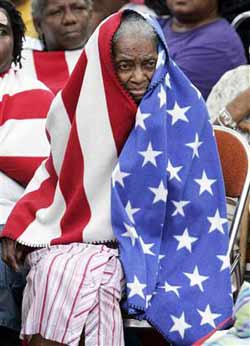
The next time someone tells me they’re a federal agent

The next time someone gets in my face and presumes to shout orders at me, and when I ask by whose authority, they tell say “I’m a federal agent”, I’m going to ask them: “Would that be with President Trump’s federal government?” That should take some wind out of their sails.

Pro-immigrant activists with Occupy Denver file suit against DIA and DPD, challenge airport free speech “permit”


DENVER, COLORADO- Civil liberties champion David Lane has filed a complaint in US district court challenging Denver’s office of the city attorney for instituting a permit process at DIA to prevent public protest. Holding signs has become impermissible at the airport, without the issuance of a permit seven days in advnace, although police are not bothering themselves about signs welcoming homecomers or seeking to connect business visitors with their limo service. That selective enforcement is unconstitutional of course, and the lawfirm powerhouse of Kilmer Lane & Newman is filing suit on behalf of two Occupy Denver plaintiffs. last Sunday, January 29, both were threatened with arrest by DIA police. While two earlier attempts to assemble had capitulated to DPD intimidation, the Occupy Denver activists stood their ground. Why did you file your lawsuit? “We know our rights. We want the POLICE to know our rights.”

1. Full text of complaint:

Case 1:17-cv-00332 Document 1
Filed 02/06/17 USDC Colorado Page 1 of 14

Civil Action No.

IN THE UNITED STATES DISTRICT COURT FOR THE DISTRICT OF COLORADO

NAZLI MCDONNELL,
ERIC VERLO,

Plaintiffs, vs.

CITY AND COUNTY OF DENVER,?
DENVER POLICE COMMANDER ANTONIO LOPEZ, in his individual and official capacity,
DENVER POLICE SERGEANT VIRGINIA QUINONES, in her individual and official capacity,

Defendants.

______________________________________________________________________________

COMPLAINT

______________________________________________________________________________

Plaintiffs, by and through their attorneys David A. Lane and Andy McNulty of KILLMER, LANE & NEWMAN, LLP, allege as follows:

INTRODUCTION

1. Plaintiffs Eric Verlo and Nazli McDonnell challenge a regulation of alarming breadth that bans all First Amendment expression at Denver International Airport without a permit.

2. Plaintiffs are concerned citizens who believe that President Donald Trump has overstepped his executive authority by signing the January 27, 2017, Executive Order (hereinafter “Muslim Ban”), which permanently bans Syrian refugees from emigrating to the United States, temporarily bans nationals of seven countries (including permanent legal residents and visa-holders), and suspends all applications to the United States refugee program (even as to vetted entrants currently in transit).

3. Plaintiffs wish to express their disgust with President Trump’s (likely unconstitutional) Muslim Ban. They wish to do so in the same place that hundreds of thousands of Americans across the country have done: standing directly outside of the secure Customs and Border Protection (hereinafter “CBP”) screening area within an airport where immigrants to America enter into the main terminal after clearing customs. Plaintiffs, unlike many citizens across this great nation who have exercised their opposition to the Muslim Ban in airports by chanting, singing, dancing, and praying, simply wish to stand in silent protest, holding signs that express their solidarity with immigrants and the Muslim community.

4. Plaintiffs are banned from doing so by DENVER INTERNATIONAL AIRPORT REGULATION 50 (hereinafter “Regulation 50”).

5. Regulation 50 states: “No person or organization shall leaflet, conduct surveys, display signs, gather signatures, solicit funds, or engage in other speech related activity at Denver International Airport for religious, charitable, or political purposes, or in connection with a labor dispute, except pursuant to, and in compliance with, a permit for such activity issued by the CEO or his or her designee.” DENVER INTERNATIONAL AIRPORT REGULATION 50.03. In order to obtain a permit, an individual must “complete a permit application and submit it during regular business hours, at least seven (7) days prior to the commencement of the activity for which the permit is sought[.]” DENVER INTERNATIONAL AIRPORT REGULATION 50.04-1.

6. Plaintiffs ask that this Court enjoin the enforcement of Regulation 50 and prohibit Defendants from arresting them for their First Amendment-protected activity of standing in peaceful protest within Jeppesen Terminal. Regulation 50 is overbroad in violation of the First Amendment and vague in violation of the Fourteenth Amendment’s Due Process Clause.

7. This is a civil rights action for declaratory and injunctive relief as well as fees and costs arising under 42 U.S.C. §§ 1983, 1988 and 28 U.S.C. Section 2201 et seq. due to Defendants’ current and imminent violations of Plaintiffs’ rights guaranteed by the First and Fourteenth Amendments to the Constitution of the United States.

PARTIES

8. Plaintiff Eric Verlo is a citizen of the United States of America. Mr. Verlo wishes to show his resistance to President Trump’s Muslim Ban, so that others will be inspired to join in the resistance.

9. Plaintiff Nazli McDonnell is a citizen of the United States of America. Ms. McDonnell wishes to show her resistance to President Trump’s Muslim Ban, so that others will be inspired to join in the resistance.

10. Defendant City and County of Denver is a municipal corporation and political subdivision of the State of Colorado. Thus, it is an entity subject to the provisions of § 1983.

11. Defendant Antonio Lopez is a Commander with the Denver Police Department. Commander Lopez is responsible for security at Denver International Airport’s Jeppesen Terminal.

12. Defendant Virginia Quinones is a Sergeant with the Denver Police Department. Sergeant Quinones is responsible for security at Denver International Airport’s Jeppesen Terminal.

JURISDICTION AND VENUE

13. Plaintiffs bring this claim pursuant to 42 U.S.C. § 1983; the First Amendment to the United States Constitution, incorporated as against States and their municipal divisions through the Fourteenth Amendment to the United States Constitution; and the Due Process Clause of the Fourteenth Amendment.

14. This Court has jurisdiction under 28 U.S.C. § 1331 over Plaintiffs’ claims that “arise[] under the Constitution of the United States.”

FACTS

15. On January 27, 2017, President Donald Trump signed an Executive Order, which permanently banned Syrian refugees from emigrating to the United States, temporarily banned nationals of seven countries (including permanent legal residents and visa-holders), and suspended all applications to the United States refugee program (even as to vetted entrants currently in transit). President Trump’s Executive Order has been subsequently referred to as a “Muslim Ban,” because it both mirrors President Trump’s racist, anti-Islam statements made on December 7, 2015, that he was planning to ban all Muslims from entering the United States until our representatives can “figure out what’s going on” and the ban targets countries whose population is predominantly Muslim and seemingly bears little rational relation to each country’s security threat to the United States.

16. Immediately upon the enactment of President Trump’s Muslim Ban there was an outpouring of outrage from a large proportion of the American population and across the spectrum of political affiliation. This outrage led to resistance in the form of protests.

17. On January 28, 2017, and January 29, 2017, protests erupted in nearly every major city in the United States. The protests organically formed in our nation’s airports. Protesters chose to express their disgust with President Trump’s Muslim Ban in airports (and specifically outside of the secure CBP screening area) because individuals affected by the ban who were in transit to the United States were being held and questioned by CBP agents there. Many of these travelers, including lawful United States residents, were forced to sign documents revoking their lawful status within the United States and deported. Still others were simply deported with no explanation. Others still were held for hours as teams of lawyers rushed to prepare habeas petitions for their release.

18. News reports about the protests make clear that they have been peaceful and non- disruptive despite the gathering of, in some cases, thousands of people.

19. Airport staff have told protesters, and would-be protesters, at numerous airports across the nation, including Kansas City International Airport, that there are no restrictions on their speech and that all protesters who wish to participate in actions against the Muslim Ban are allowed. Protests have continued in other cities to this day.

20. On January 28, 2017, there was one such protest at Denver International Airport, within the Jeppesen Terminal. At approximately 5:00 p.m. hundreds gathered in the Jeppesen Terminal’s atrium, near arrivals, to protest and many others gathered to bear witness.

21. Prior to the protest, leaders had applied for a permit. It was denied. The reason for its denial was that the permit was not requested with seven days advance notice of the protest occurring. Regulation 50 requires seven days advance notice.

22. The January 28, 2017, protest began with speeches, chants, songs, and prayers. It was a peaceful gathering of solidarity for immigrants and Muslims. Every person at the January 28, 2017, protest was contained in an area of the Jeppesen Terminal atrium that is designed as a gathering space for people to sit, relax, and converse. No one was standing in the walkways or passageways of the terminal.

23. Soon after the January 28, 2017, protest began, members of the Denver Police Department arrived on-scene. Commander Antonio Lopez engaged the leader of the protest, Amal Kassir, along with State Representative Joe Salazar and representatives from the ACLU of Colorado, and informed them that the protest was unlawful. Commander Lopez told Ms. Kassir that anything that “could be construed as Free Speech” was prohibited at the Denver International Airport, including within the Jeppesen Terminal, without a permit. See Exhibit 1, January 28, 2017 Video.

24. Commander Lopez also stated that all “First Amendment expression” was prohibited at the Denver International Airport, including within the Jeppesen Terminal, without a permit on Regulation 50. Commander Lopez handed Regulation 50 to multiple protesters, including Ms. Kassir. See Exhibit 2, January 28, 2017 Video 2.

25. Regulation 50 states (in pertinent part): “No person or organization shall leaflet, conduct surveys, display signs, gather signatures, solicit funds, or engage in other speech related activity at Denver International Airport for religious, charitable, or political purposes, or in connection with a labor dispute, except pursuant to, and in compliance with, a permit for such activity issued by the CEO or his or her designee.” DENVER INTERNATIONAL AIRPORT REGULATION 50.03. In order to obtain a permit, an individual must “complete a permit application and submit it during regular business hours, at least seven (7) days prior to the commencement of the activity for which the permit is sought[.]” DENVER INTERNATIONAL AIRPORT REGULATION 50.04-1.

26. Commander Lopez, along with members of Denver International Security, told Ms. Kassir that every portion of Denver International Airport property, which has an approximately fifty square mile footprint, is off-limits for First Amendment expression. They suggested that Ms. Kassir move her protest to Tower Road, which is approximately six miles from the Jeppesen Terminal and, like most of the land surrounding Denver International Airport, adjacent to open prairie land with no inhabitants.

27. Commander Lopez threatened Ms. Kassir and numerous other demonstrators with arrest if they didn’t immediately cease any “First Amendment expression.” According to Commander Lopez’s directives, the individuals gathered in the Jeppesen Terminal could not stand holding signs, sing, speak to others about matters of public concern, hold the United States Constitution above their shoulders, or stand silently with their arms interlocked.

28. Ultimately, to avoid arrest, Ms. Kassir and the demonstrators moved outside of the Jeppesen Terminal to the large area on its south side, adjacent to the escalators leading to the commuter rail and under the Westin Hotel. The protest continued peacefully for a little while longer, then disbursed without issue.

29. The next day, January 29, 2017, Plaintiffs Eric Verlo and Nazli McDonnell traveled to Denver International Airport’s Jeppesen Terminal to express their opposition to President Trump’s Muslim Ban.

30. Mr. Verlo and Ms. McDonnell brought with them signs expressing support for immigrants and expressing concern that history was repeating itself with disastrous potential consequences.

31. Mr. Verlo and Ms. McDonnell positioned themselves adjacent to the secure CBP screening area within the Jeppesen Terminal at approximately 1:15 p.m.

32. Adjacent the secure CBP screening area at the Jeppesen Terminal is the only place where Mr. Verlo and Ms. McDonnell can reach their intended audience. Mr. Verlo and Ms. McDonnell wish to communicate with those who could be swayed by their message and, particularly, with immigrants. International travelers are often immigrants and/or lawful United States residents, including green card and other visa holders, other than citizens. Mr. Verlo and Ms. McDonnell wish to express their solidarity with immigrants directly to these individuals. Further, United States citizens who arrive from international locations are also individuals with whom Mr. Verlo and Ms. McDonnell wish to communicate. International travelers have experienced other cultures and are likely to be sympathetic to Mr. Verlo and Ms. McDonell’s message.

33. The secure CBP screening area is also the location where the Muslim Ban has been enforced by DHS, both at Denver International Airport and across the nation. Neither Plaintiff attempted to enter any restricted areas of Denver International Airport.

34. While silently displaying their signs, Mr. Verlo and Ms. McDonnell were in the open plaza near the secure CBP screening area within the Jeppesen Terminal and positioned significantly behind the railing, which demarcates where those waiting for loved ones are permitted to stand. Mr. Verlo and Ms. McDonnell did not impede the right of way of any passengers hustling to catch flights at the last moment. They simply stood with placards showing their distaste for the Executive Order and the man who executed it.

35. Mr. Verlo and Mr. McDonnell also observed another man in the terminal, named Gene Wells, who was expressing views similar to theirs.

36. Mr. Wells was wearing a sign taped to the back of his shirt.

37. Mr. Wells left the Jeppesen Terminal, but subsequently returned to protest. When he did, he was stopped by Denver Police Department officers who told him that he could not walk around the terminal with the slogan he had affixed to his back. Mr. Wells eventually rejoined Mr. Verlo and Mr. McDonnell at the international arrivals doors, but not without trepidation. He feared he might be arrested.

38. While Mr. Verlo and Ms. McDonnell were displaying their signs, Defendant Sergeant Virginia Quinones approached Mr. Verlo and Ms. McDonnell and threatened them with arrest if they did not leave Jeppesen Terminal. See Exhibit 3, January 29, 2017, Video.

39. Sergeant Quinones handed Mr. Verlo and Ms. McDonnell Regulation 50 and cited it as the reason they would be arrested if they did not leave Jeppesen Terminal. Id. Sergeant Quinones told Mr. Verlo and Ms. McDonnell that they would need a permit in order to stand silently, holding signs in opposition of the Muslim Ban and be in compliance with Regulation 50.

40. Had Mr. Verlo and Ms. McDonnell applied for a permit the second President Trump signed the Executive Order implementing the Muslim Ban, they still would have been unable to engage in protest within the Jeppesen Terminal under the terms and conditions of Regulation 50 on January 29, 2017.

41. Mr. Verlo and Ms. McDonnell did not immediately leave the Jeppesen Terminal after being threatened with arrest. However, they were startled by Sergeant Quiones’ threat and feared arrest for the duration of the time they were there.

42. Throughout the time Mr. Verlo and Ms. McDonnell were expressing their views within the Jeppesen Terminal they received numerous shows of support from passersby. Multiple self- proclaimed Muslims expressed heart-felt statements of appreciation to Mr. Verlo, Ms. McDonnell, and others holding signs.

43. Mr. Verlo and Ms. McDonnell ultimately left Jeppesen Terminal.

44. Mr. Verlo and Ms. McDonnell wish to return to Jeppesen Terminal to express solidarity with Muslims and opposition to the Muslim Ban, but are reticent to do so for fear of being arrested.

45. Upon information and belief, no individual has been arrested, or threatened with arrest, for wearing a “Make America Great Again” campaign hat without a permit within the Jeppesen Terminal at Denver International Airport.

46. Upon information and belief, no individual has been arrested, or threatened with arrest, for holding a sign welcoming home a member of our military without a permit within the Jeppesen Terminal at Denver International Airport.

47. Upon information and belief, no individual has been arrested, or threatened with arrest, for holding a sign and soliciting passengers for a limousine without a permit within the Jeppesen Terminal at Denver International Airport.

48. Upon information and belief, no individual has been arrested, or threatened with arrest, for discussing current affairs with another person without a permit within the Jeppesen Terminal at Denver International Airport.

49. At all times relevant to this Complaint, Defendants acted under color of law.

CLAIM I: FIRST AMENDMENT
(§ 1983 violation – all Defendants)

50. Plaintiffs repeat, re-allege, and incorporate by reference the allegations in the foregoing paragraphs of this Complaint as fully set forth herein.

51. Regulation 50 violates the Free Speech Clause of the First Amendment to the Constitution, on its face and as applied, because it impermissibly curtails Plaintiffs’ free-speech rights.

52. Plaintiffs wish to speak on a matter of public concern. 11

53. Denver International Airport’s Jeppesen Terminal is a public forum.

54. Regulation 50 directly infringes upon and chills reasonable persons from engaging in activity that is protected by the First Amendment.

55. Regulation 50 acts as an unconstitutional prior restraint on speech because it (1) requires a permit before allowing individuals to engage in speech, (2) allows for arbitrary and/or discriminatory permit denials, and (3) requires advance notice that is unconstitutionally excessive.

56. Regulation 50 is overbroad.?

57. Regulation 50 is not narrowly tailored to serve a compelling government interest.?

58. Regulation 50 does not further a substantial government interest.?

59. Regulation 50’s restriction on expressive conduct is greater than necessary to further any
government interest.?

60. Defendants’ actions and/or omissions enforcing Regulation 50 caused, directly or
proximately, Plaintiffs to suffer damages.

CLAIM II: FIRST AMENDMENT RETALIATION
(§ 1983 violation – all Defendants)

1. All statements of fact set forth previously are hereby incorporated into this claim as though set forth fully herein. ?

2. Plaintiffs engaged in First Amendment protected speech on a matter of public concern ?while displaying signs opposing President Trump’s Muslim Ban on January 29, 2017.

3. Defendants jointly and on their own accord responded to Plaintiffs’ First Amendment protected speech with retaliation, including but not limited to threatening Plaintiffs with arrest.

4. Defendants retaliatory actions were substantially motivated by Plaintiffs’ exercise of their First Amendment rights.

5. By unlawfully threatening Plaintiffs with arrest, Defendants sought to punish Plaintiffs for exercising their First Amendment rights and to silence their future speech. Defendants’ retaliatory actions would chill a person of ordinary firmness from engaging in such First Amendment protected activity.

6. Defendants’ actions and/or omissions enforcing Regulation 50 caused, directly and proximately, Plaintiffs to suffer damages.

CLAIM III: FOURTEENTH AMENDMENT DUE PROCESS
(§ 1983 violation – all Defendants)

7. All statements of fact set forth previously are hereby incorporated into this claim as though set forth fully herein.

8. The prohibitions of Regulation 50 are vague and not clearly defined. ?

9. Regulation 50 offers no clear and measurable standard by which Plaintiffs and others can ?act lawfully.

10. Regulation 50 does not provide explicit standards for application by law enforcement officers.

11. Regulation 50 fails to provide people of ordinary intelligence a reasonable opportunity to understand what conduct it prohibits, and authorizes or encourages arbitrary and discriminatory enforcement, or both.

12. Defendants’ actions and/or omissions enforcing Regulation 50 caused, directly and proximately, Plaintiffs to suffer damages.

PRAYER FOR RELIEF

WHEREFORE, Plaintiffs respectfully request that this Court enter judgment in their favor and against Defendants, and grant:

(a) Appropriate declaratory and other injunctive and/or equitable relief; 13

(b)  Enter a declaration that Regulation 50 is unconstitutional on its face and enjoin its enforcement; ?

(c)  Compensatory and consequential damages, including damages for emotional distress, loss of reputation, humiliation, loss of enjoyment of life, and other pain and suffering on all claims allowed by law in an amount to be determined at trial; ?

(d)  All economic losses on all claims allowed by law; ?

(e)  Punitive damages on all claims allowed by law and in an amount to be determined ?at trial; ?

(f)  Attorney’s fees and the costs associated with this action, pursuant to 42 U.S.C. § ?1988; ?

(g)  Pre and post-judgment interest at the lawful rate; and ?

(h)  Any further relief that this court deems just and proper, and any other relief as ?allowed by law. ?

Dated this 6th day of February 2017.

KILLMER, LANE & NEWMAN, LLP
s/ Andy McNulty

___________________________________
David A. Lane
?Andy McNulty?
Killmer, Lane & Newman, LLC
1543 Champa Street, Suite 400 Denver, Colorado 80202?
Attorneys for Plaintiff

2. Full text of Feb 6 motion for preliminary injunction:

Case 1:17-cv-00332 Document 2
Filed 02/06/17 USDC Colorado Page 1 of 23

Civil Action No.

IN THE UNITED STATES DISTRICT COURT FOR THE DISTRICT OF COLORADO

NAZLI MCDONNELL,
ERIC VERLO,

Plaintiffs, vs.

CITY AND COUNTY OF DENVER,
DENVER POLICE COMMANDER ANTONIO LOPEZ, in his individual and official capacity,
DENVER POLICE SERGEANT VIRGINIA QUINONES, in her individual and official capacity,

Defendants.

______________________________________________________________________________

MOTION FOR PRELIMINARY INJUNCTION

______________________________________________________________________________

Plaintiffs, by and through their attorneys David A. Lane and Andy McNulty of KILLMER, LANE & NEWMAN, LLP, hereby submit the following Motion for Preliminary Injunction, and in support thereof, states as follows:

1. Introduction

Over the last four days, many Americans have expressed public disapproval of President Donald Trump’s January 27, 2017, Executive Order, which permanently bans Syrian refugees from emigrating to the United States, temporarily bans nationals of seven countries (including permanent legal residents and visa-holders), and suspends all applications to the United States refugee program (even as to vetted entrants currently in transit). Plaintiffs are concerned and alarmed United States citizens who wish to join the growing chorus of voices expressing opposition to the Executive Order. To do so, they wish to stand in silent protest at the Jeppesen Terminal within Denver International Airport.

Plaintiffs did just this on January 29, 2017, standing in silent protest of the Executive Order outside of the secure Customs and Border Protection (hereinafter “CBP”) screening area within Jeppesen Terminal. Almost immediately, Plaintiffs were threatened with arrest by Denver Police Department Sergeant Virginia Quinones for standing silently and holding signs opposing the Executive Order, despite that fact that the Jeppesen Terminal has previously been used for expressive activity (and that protesters at more than ten major airports nationwide have protested peacefully without major disruption or legal restriction). While silently displaying their signs, Plaintiffs were in the plaza within the Jeppesen Terminal and positioned significantly behind the railing, which demarcates where those waiting for loved ones are permitted to stand, in the open plaza outside of the secure CBP screening area at the Jeppesen Terminal. Plaintiffs did not impede the right of way of any passengers hustling to catch flights at the last moment. They simply stood with placards showing their distaste for the Executive Order and the man who executed it.

Even though Plaintiffs were simply engaged in peaceful First Amendment protected expression, they were threatened with arrest. Sergeant Quinones informed Plaintiffs that, in order to stand silently with political signs, they would need a permit. Without a permit, Sergeant Quinones stated, all “First Amendment expression” at the Denver International Airport was banned.

This was not the first time since the enactment of the Executive Order that the Denver Police Department threatened individuals with arrest for engaging in First Amendment protected activity in Jeppesen Terminal. On January 28, 2016, a protest was held in the plaza of Jeppesen Terminal. During the protest, Denver Police Commander Antonio Lopez instructed multiple individuals, including State Representative Joseph Salazar and representatives from the ACLU of Colorado, that all “First Amendment expression” was banned at Denver International Airport without a permit. See Exhibit 1, January 28, 2017, Video 1; Exhibit 2, January 28, 2017, Video 2. The protesters had, in fact, applied for a permit earlier that day. However, it had not been granted because they had not done so seven days in advance of the protest in compliance with Denver International Airport regulations. Although no arrests were ultimately made, protesters were threatened numerous times by Commander Lopez, and other officers, with arrest.

The Denver International Airport regulation that both Sergeant Quinones and Commander Lopez relied upon in instructing Plaintiffs, and others, that Denver International Airport bans all “First Amendment expression” without a permit is DENVER INTERNATIONAL AIRPORT REGULATION 50 (hereinafter “Regulation 50”). Regulation 50 states that “no person or organization shall leaflet, conduct surveys, display signs, gather signatures, solicit funds, or engage in other speech related activity at Denver International Airport for religious, charitable, or political purposes, or in connection with a labor dispute, except pursuant to, and in compliance with, a permit for such activity issued by the CEO or his or her designee.” DENVER INTERNATIONAL AIRPORT REGULATION 50.03. In order to obtain a permit, an individual must “complete a permit application and submit it during regular business hours, at least seven (7) days prior to the commencement of the activity for which the permit is sought[.]” DENVER INTERNATIONAL AIRPORT REGULATION 50.04-1.

Plaintiffs wish to return to Denver International Airport to protest the Executive Order, but are reasonably frightened of arrest and, absent action by this Court, must choose between lawfully exercising their First Amendment right and being subject to arrest and/or prosecution.

Plaintiffs ask that this Court enter an injunction prohibiting their arrest for standing in peaceful protest within Jeppesen Terminal and invalidating Regulation 50 as violative of the First and Fourteenth Amendments to the United States Constitution.

2. Factual Background

All statements of fact set forth in the simultaneously filed Complaint are hereby incorporated into this Brief as though set forth fully herein.

3. Argument

3.1 The standard for issuance of a preliminary injunction.

When seeking a preliminary injunction, a plaintiff must establish that (1) he is likely to succeed on the merits; (2) he is likely to suffer irreparable harm; (3) the balance of equities tips in his favor; and (4) that an injunction is in the public interest. Winter v. Nat. Res. Def. Council, 555 U.S. 7, 20 (2008); see also ACLU v. Johnson, 194 F.3d 1149, 1155 (10th Cir. 1999).

The Tenth Circuit has modified the preliminary injunction test when the moving party demonstrates that the second, third, and fourth factors “tip strongly” in its favor. See Oklahoma ex rel. Okla. Tax Comm’n v. Int’l Registration Plan, Inc., 455 F.3d 1107, 1113 (10th Cir. 2006); see also 820 F.3d 1113, n.5 (10th Cir. 2016). “In such situations, the moving party may meet the requirement for showing success on the merits by showing that questions going to the merits are so serious, substantial, difficult, and doubtful as to make the issue ripe for litigation and deserving of more deliberate investigation.” Id. (internal quotation marks omitted). Moreover, this “fair chance of prevailing” test is appropriate in this case because Plaintiffs are challenging a policy, not a statue or ordinance. See Planned Parenthood Minn, N.D., & S.D. v. Rounds, 530 F.3d 724, 732 (9th Cir. 2008) (“[C]ourts should… apply the familiar ‘fair chance of prevailing’ test where a preliminary injunction is sought to enjoin something other than government action based on presumptively reasoned democratic processes.”).

Under either standard, Plaintiffs are able to demonstrate that the issuance of a preliminary injunction is appropriate in this matter.

3.3 Regulation 50 implicates Plaintiffs’ First Amendment rights. 1

When the government regulates the exercise of First Amendment rights, the burden is on the proponent of the restriction to establish its constitutionality. Phelps-Roper v. Koster, 713 F.3d 942, 949 (8th Cir. 2013). Moreover, when assessing the preliminary injunction factors in First Amendment cases, “the likelihood of success will often be the determinative factor.” Hobby Lobby Stores, Inc. v. Sebelius, 723 F.3d 1114, 1145 (10th Cir. 2013). This is because “the loss of First Amendment freedoms, for even minimal periods of time, unquestionably, constitutes irreparable injury,” Heideman v. Salt Lake City, 348 F.3d 1182, 1190 (10th Cir. 2003), and it is invariably in the public interest to protect an individual’s First Amendment rights. See Homans v. City of Albuquerque, 264 F.3d 1240, 1244 (10th Cir. 2001) (noting that “the public interest is better served” by protecting First Amendment rights).

[NOTE 1. It is important to note that facial challenges to government policies and statutes, when based on First and Fourteenth Amendment grounds, are not disfavored. See United States v. Stevens, 559 U.S. 460, 473 (2010); City of Chicago v. Morales, 527 U.S. 41 (1999).]

3.4 Plaintiffs are likely to succeed on the merits.

Plaintiffs are likely to succeed on the merits because Regulation 50 violates the Free Speech Clause of the First Amendment and the Due Process Clause of the Fourteenth Amendment.

3.4(a) Plaintiffs engaged, and wish to engage, in speech on a matter of public concern.

Plaintiffs’ speech is at the core of the First Amendment’s protection because it deals with a matter of public concern. “Speech deals with matters of public concern when it can be fairly considered as relating to any matter of political, social, or other concern to the community, or when it is a subject of legitimate news interest; that is, a subject of general interest and of value and concern to the public.” Snyder v. Phelps, 562 U.S. 443, 453 (2011) (internal quotation marks and citation omitted). “Speech on matters of public concern is at the heart of the First Amendment’s protection.” Id. at 451-52 (alterations and quotation marks omitted). “The First Amendment reflects ‘a profound national commitment to the principle that debate on public issues should be uninhibited, robust, and wide-open.’” Id. at 452 (quoting New York Times Co. v. Sullivan, 376 U.S. 254, 270 (1964)). Plaintiffs wish to engage in expression about President Donald Trump’s January 27, 2017, Executive Order, a topic that has generated nearly unprecedented debate and dissent. See Adrienne Mahsa Varkiani, Here’s Your List of All the Protests Happening Against the Muslim Ban, THINK PROGRESS (Jan. 28, 2017), https://thinkprogress.org/muslim-ban-protests-344f6e66022e#.ft1oznfv4 (compiling list of direct actions planned in response to President Trump’s January 27, 2017, Executive Order). Thus, Plaintiffs’ speech “‘occupies the highest rung of the hierarchy of First Amendment values, and is entitled to special protection.’” Snyder, 562 U.S. at 452 (quoting Connick v. Myers, 461 U.S. 138, 145 (1983)).

3.4(b) Regulation 50 acts as a prior restraint.

The restriction at issue in this matter is a prior restraint. “The term prior restraint is used ‘to describe administrative and judicial orders forbidding certain communications when issued in advance of the time that such communications are to occur.’” Alexander v. United States, 509 U.S. 544, 550 (1993) (quoting M. Nimmer, Nimmer on Freedom of Speech § 4.03, p. 4–14 (1984)). Regulation 50 is in an administrative order that forbids future communication and bases the ability to communicate in the future on the discretion of an administrative official. See DENVER INTERNATIONAL AIRPORT REGULATION 50.03 (“no person or organization shall leaflet, conduct surveys, display signs, gather signatures, solicit funds, or engage in other speech related activity at Denver International Airport for religious, charitable, or political purposes, or in connection with a labor dispute, except pursuant to, and in compliance with, a permit for such activity issued by the CEO or his or her designee.” (emphasis added)). It is a prior restraint.

The burden of proving a prior restraint is permissible is particularly steep. The Supreme Court has repeatedly held that “[a]ny system of prior restraints of expression comes to this Court bearing a heavy presumption against its constitutional validity.” Bantam Books, Inc. v. Sullivan, 372 U.S. 58, 70 (1963). For the reasons outlined infra, Defendants cannot meet this especially significant burden.

3.4(c) Jeppesen Terminal, outside of the passenger security zones, is a traditional public forum.

The Supreme Court has not definitively decided whether airport terminals, including Jeppesen Terminal, are public forums. In Lee v. International Society for Krishna Consciousness, Inc., 505 U.S. 830 (1992) (hereinafter “Lee I”), issued the same day as International Society for Krishna Consciousness, Inc. v. Lee, 505 U.S. 672 (1992) (hereinafter “Lee II”), the Supreme Court struck down a total ban on distribution of literature in airports. In Lee I, the Court issued a one sentence per curiam opinion, which affirmed the Second Circuit for the reasons expressed by Justice O’Connor, Justice Kennedy, and Justice Souter in Lee II. See Lee I, 505 U.S. at 831. Justice Kennedy and Justice Souter’s opinions in Lee II found that “airport corridors and shopping areas outside of the passenger security zones… are public forums, and speech in those places is entitled to protection against all government regulation inconsistent with public forum principles.” Lee II, 505 U.S. at 693 (Kennedy, J., concurring in the judgment); but see Lee II, 505 U.S. at 683 (“”[W]e think that neither by tradition nor purpose can the terminals be described as satisfying the standards we have previously set out for identifying a public forum.”).

Therefore, Plaintiffs ask this Court to find the area of Jeppesen Terminal outside of the passenger security zones to be a public forum. The historical use of the Jeppesen Terminal’s plazas and other areas outside of the passenger security zones (including the area outside of the secure CBP screening area) for political speech (particularly, the history of welcoming of American military personnel home from service, discussion between passengers of matters of public concern, and display of clothing advocating for political views and ideals) indicates that it is a public forum. See First Unitarian Church of Salt Lake City v. Salt Lake City Corp., 308 F.3d 1114, 1130 (10th Cir. 2002) (“Where courts have considered the traditional use of publicly accessible property for speech, they have refused to attribute legal significance to an historical absence of speech activities where that non-speech history was created by the very restrictions at issue in the case.”). Further, that the Jeppesen Terminal is free and open to the public (outside of the passenger security zones), illustrates that it is a public forum. See, e.g., Ark. Educ. Television Comm’n v. Forbes, 523 U.S. 666, 676 (1998); Cornelius v. NAACP Legal Def. & Educ. Fund, 473 U.S. 788, 800, 805, 809 (1985). Finally, Jeppesen Terminal retains characteristics similar to parks: it has large plazas lined with benches, it is surrounded by businesses which are open to the public, and it has dedicated walkways, similar to sidewalks, indicating that it is a public forum. See e.g., Frisby v. Schultz, 487 U.S. 474, 480-481 (1988); United States v. Grace, 461 U.S. 171, 177 (1983). Further, the Supreme Court has not strictly limited the public forum category to streets, sidewalks, and parks. See, e.g., Se. Promotions, Ltd. v. Conrad, 420 U.S. 546 (1975) (finding leased municipal theater is a public forum); Heffron v. Int’l Society for Krishna Consciousness, Inc., 452 U.S. 640 (1981) (finding state fair is a public forum); Edwards v. South Carolina, 372 U.S. 229 (1963) (finding grounds of state capitol are a traditional public forum). Even if the City claims that it has never intended for Jeppesen Terminal to be a public forum, this is not dispositive. See Lee, 505 U.S. at 830 (government policy prohibiting distribution of literature at airport on property struck down); Cornelius, 473 U.S. at 805 (government’s decision to limit access is not itself dispositive). Plaintiffs’ ask that this Court find Jeppesen Terminal, outside of the passenger security zones, a traditional public forum.

Since Jeppesen Terminal is a traditional public forum, any restriction on Plaintiffs’ speech must be content-neutral and narrowly tailored to a compelling government interest. Regulation 50 fails at both.

3.4(d) Regulation 50 is content-based.

Regulation 50 is a content-based restriction of expression. Although the Supreme Court has long held that content-based restrictions elicit strict scrutiny, see, e.g., Carey v. Brown, 447 U.S. 455 (1980), lower courts diverged on the meaning of “content-based” until Reed v. Town of Gilbert, 135 S. Ct. 2218 (2015). 2 Reed clarified that a restriction is content based simply if it draws distinctions “based on the message a speaker conveys.” 135 S. Ct. at 2227. Reed is clear that even “subtle” distinctions that define regulated expression “by its function or purpose . . . are distinctions based on the message a speaker conveys, and therefore, are subject to strict scrutiny.” Id. This accords with Texas v. Johnson, which held that “the emotive impact of speech on its audience is not a secondary effect unrelated to the content of the expression itself.” 491 U.S. 491 U.S. 297, 412 (1989) (internal quotations omitted).

[NOTE 2. Reed involved a municipal “sign code” that regulated signs differently based on the kind of message they conveyed (such as “ideological,” “political,” or “temporary directional”). 135 S. Ct. at 2224-25. The Court rejected the city’s argument that a law had to discriminate against certain viewpoints in order to be a content-based restriction. Id. at 2229.]

Regulation 50 is content-based on its face. It distinguishes between content and requires that an official determine the content of the speaker’s message when enforcing its proscriptions. Reed, 135 S. Ct. at 2227; see DENVER INTERNATIONAL AIRPORT REGULATION 50.03 (“No person or organization shall leaflet, conduct surveys, display signs, gather signatures, solicit funds, or engage in other speech related activity at Denver International Airport for religious, charitable, or political purposes, or in connection with a labor dispute[.]” (emphasis added)). The distinctions drawn by Regulation 50 make it a facially content-based restriction on expression that must elicit “the most exacting scrutiny.” Johnson, 491 U.S. at 412; Reed, 135 S. Ct. at 2227.

3.4(e) Regulation 50 is not narrowly tailored to serve a compelling government interest.

As a facially content-based restriction of expression at traditional public fora, Regulation 50 is presumptively unconstitutional unless Defendant “prove[s] that the restriction furthers a compelling interest and is narrowly tailored to achieve that interest.” Reed, 135 St. Ct. at 2231; accord Johnson, 491 U.S. at 412.

“A statute is narrowly tailored if it targets and eliminates no more than the exact source of the ‘evil’ it seeks to remedy.” Frisby v. Schultz, 487 U.S. 474, 485 (1988) (citation omitted). Regulation 50 reaches more speech than that which would impair the security of the airport or ensure that passengers are not unduly encumbered. In fact, it completely bans all “First Amendment expression.” “A complete ban can be narrowly tailored, but only if each activity within the proscription’s scope is an appropriately targeted evil.” Id.. Regulation 50 is not such a ban. For instance, Plaintiffs’ expression does nothing to jeopardize security at Denver International Airport or to inhibit the free flow of passengers through the airport.

Further, any argument that Plaintiffs can engage in expressive activity in another location lacks merit, as the Supreme Court has held that the First Amendment is violated when one specific location or audience, when important to the speaker, is foreclosed. See McCullen v. Coakley, 134 S. Ct. 2518, 2536 (2014); Schenck v. Pro-Choice Network, 519 U.S. 357, 377 (1997) (invalidating a “floating” buffer zone around people entering an abortion clinic partly on the ground that it prevented protestors “from communicating a message from a normal conversational distance or handing leaflets to people entering or leaving the clinics who are walking on the public sidewalks”); Schneider v. New Jersey, 308 U.S. 147, 163 (1939) (invalidating anti-handbilling ordinances even though “their operation is limited to streets and alleys and leaves persons free to distribute printed matter in other public places”). Regulation 50 lacks the narrow tailoring necessary to survive First Amendment strict scrutiny analysis.

3.4(f) Regulation 50 violates the First Amendment even if this Court determines Jeppesen Terminal is a nonpublic forum.

Regulation 50 bans all “First Amendment expression” absent a permit; it is unconstitutional even when analyzed under the lower standard of scrutiny applied by courts to First Amendment political speech in a nonpublic forum. In Board of Airport Commissioners of Los Angeles v. Jews for Jesus, Inc., 482 U.S. 569 (1987), the Supreme Court considered whether a resolution restricting free speech in the airport was constitutional. The resolution at issue stated that the airport “is not open for First Amendment activities by any individual and/or entity.” Id. at 574. Although the Court did not explicitly find that the airport was a nonpublic forum, it did hold that the resolution restricting speech in the airport was facially unreasonable, even if the airport was a nonpublic forum. Id. at 573. The Court noted that enforcing the resolution would prohibit “talking and reading, or the wearing of campaign buttons or symbolic clothing.” Id. at 574. The Court also noted, “[m]uch nondisruptive speech–such as the wearing of a T-shirt or button that contains a political message–may not be ‘airport related’ but is still protected speech even in a nonpublic forum.” Id. at 575 (citing Cohen v. California, 403 U.S. 15 (1971) (holding that wearing of jacket with offensive language in a courthouse was a form of nondisruptive expression that was protected by the First Amendment)). Thus, although specific conduct was not at issue in the Jews for Jesus decision, the Court nonetheless implicitly held that non-disruptive speech is protected by the First Amendment in nonpublic fora and that restrictions that encumber non-disruptive expression are unreasonable.

In Lee II, Justice O’Connor set forth the test for determining reasonableness in the context of nonpublic fora. 505 U.S. at 687 (O’Connor, J., concurring). 3 She stated, ”[t]he reasonableness of the Government’s restriction [on speech in a nonpublic forum] must be assessed in light of the purpose of the forum and all the surrounding circumstances.” Id. (O’Connor, J., concurring) (quoting Cornelius, 473 U.S. at 809). However, Justice O’Connor noted that while “[o]rdinarily . . . we have . . . been confronted with cases where the fora at issue were discrete, single-purpose facilities,” airports present a different analysis because they are multipurpose facilities. Id. at 688 (O’Connor, J., concurring) (citations omitted). She determined airports to be multipurpose facilities because

the Port Authority [has] chosen not to limit access to the airports under its control, [and] has created a huge complex open to travelers and nontravelers alike. The airports house restaurants, cafeterias, snack bars, coffee shops, cocktail lounges, post offices, banks, telegraph offices, clothing shops, drug stores, food stores, nurseries, barber shops, currency exchanges, art exhibits, commercial advertising displays, bookstores, newsstands, dental offices and private clubs.

Id. This led to the finding that “[t]he reasonableness inquiry, therefore, is not whether the restrictions on speech are consistent with preserving the property for air travel, but whether they are reasonably related to maintaining the multipurpose environment that the Port Authority has deliberately created.” Id. at 689. A complete ban on First Amendment activity at the Jeppesen Terminal, absent a permit that must be obtained by providing seven days advance notice, is not a reasonable restriction. Regulation 50 does not comport with Justice O’Connor’s conclusion that airports are more than simply places where air travel occurs.

[NOTE 3. It is important to note that Lee involved a plurality opinion, joined by Justice O’Connor. Therefore, Justice O’Connor’s concurrence is the “narrowest grounds” that justify the Court’s result and her concurrence holds substantial precedential weight.]

Moreover, Justice O’Connor distinguished between solicitations (which the Supreme Court found could be reasonably restricted) and distributing leaflets (which the Supreme Court found could not be reasonably restricted) in the airport:

[L]eafleting does not entail the same kinds of problems presented by face-to-face solicitation. Specifically, “one need not ponder the contents of a leaflet or pamphlet in order mechanically to take it out of someone’s hand . . . . The distribution of literature does not require that the recipient stop in order to receive the message the speaker wishes to convey; instead the recipient is free to read the message at a later time.”

Id. at 690 (quoting United States v. Kokinda, 497 U.S. 720, 734 (1990)).

Thus, the Court held in Lee II that prohibiting solicitation in a nonpublic forum is not unreasonable, but that prohibiting the distribution of leaflets and other literature at a nonpublic forum is unreasonable. See also Lee, 505 U.S. at 830 (decided the same day as Lee II and striking down a prohibition on the distribution of leaflets and other literature at La Guardia, John F. Kennedy, and Newark International airports) (per curiam). Circuit courts have also recognized the inherent right to distribute paper and other information in nonpublic fora. Following Lee I and Lee II, two circuit courts have held that airports, as nonpublic fora, could not preclude newspaper publishers from placing newsracks in airport terminals. See Jacobsen v. City of Rapid City, South Dakota, 128 F.3d 660 (8th Cir. 1997); Multimedia Publishing Co. of South Carolina, Inc. v. Greenville-Spartanburg Airport Dist., 991 F.2d 154 (4th Cir. 1993). To the extent that the airports were concerned about safety or the impediment of traffic flow, the courts held that the airport may impose reasonable restrictions, but they could not enforce an outright ban on the newspaper racks. See Jacobsen, 128 F.3d at 660; Multimedia Publishing Co. of South Carolina, Inc., 991 F.2d at 154.

Denver, through Regulation 50, has banned all “First Amendment expression” including leafleting and protests. In fact, Plaintiffs expression is arguably less intrusive and disruptive to air travel than the form of expression, namely leafletting, that the Court held could not be reasonably restricted in the areas of an airport that precede the security screening area. It is clear from Lee I, Lee II, and Jews for Jesus that Denver cannot ban all “First Amendment expression” at the Jeppesen Terminal.

3.4(f)(1) Independently, the viewpoint-based prohibition of Plaintiffs’ speech, based on Regulation 50, violates the First Amendment.

Even if Jeppesen Terminal is a nonpublic forum, “this does not mean the government has unbridled control over speech, . . . for it is axiomatic that ‘the First Amendment forbids the government to regulate speech in ways that favor some viewpoints or ideas at the expense of others.” Summum v. Callaghan, 130 F.3d 906, 916 (10th Cir. 1997) (quoting Lamb’s Chapel v. Center Moriches Union Free School Dist., 508 U.S. 384, 394, (1993)). “Restrictions on speech in nonpublic fora must be viewpoint neutral[.]” Warren v. Fairfax Cty., 196 F.3d 186, 193 (4th Cir. 1999) (citing Cornelius, 473 at 809). Defendants’ restriction of Plaintiffs’ speech, under the guise of Regulation 50, discriminates on the basis of viewpoint. Individuals walk through Denver International Airport with political messages and slogans on their shirts and luggage and discuss politics on a daily basis. Counsel for Plaintiffs has worn political shirts while traveling through Denver International Airport and discussed modern politics with fellow passengers on many occasions. However, no other individual, to Plaintiffs or Plaintiffs’ counsel’s knowledge, has been threatened with arrest for engaging in this political speech. Nor has any individual been arrested for displaying pro-President Trump messages, for example a red hat that reads “Make America Great Again.” Only Plaintiffs’ expressive activity against the President’s Executive Order, and others advocating similarly, has been threatened with arrest. Regulation 50 is being enforced as a clearly view-point based restriction. Defendants’ application of Regulation 50 to Plaintiffs speech is view-point based and violates the First Amendment.

3.4(g) The seven day advance notice requirement for obtaining a permit is not a reasonable restriction.

Notice periods restrict spontaneous free expression and assembly rights safeguarded in the First Amendment. Plaintiffs, like many others throughout history, wish to engage in First Amendment expression in quick response to topical events. While even in such time-sensitive situations, a municipality may require some short period of advance notice so as to allow it time to take measures to provide for necessary traffic control and other aspects of public safety, the period can be no longer than necessary to meet the City’s urgent and essential needs of this type. See American-Arab Anti-Discrimination Comm. v. City of Dearborn, 418 F.3d 600, 605 (6th Cir. 2005) (“Any notice period is a substantial inhibition on speech.”).

Advance notice requirements that have been upheld by courts have most generally been less than a week. See, e.g., A Quaker Action Group v. Morton, 516 F.2d 717, 735 (D.C. Cir. 1975) (two-day advance notice requirement is reasonable for use of National Park areas in District of Columbia for public gatherings); Powe v. Miles, 407 F.2d 73, 84 (2d Cir. 1968) (two-day advance notice requirement for parade is reasonable); Progressive Labor Party v. Lloyd, 487 F. Supp. 1054, 1059 (D. Mass. 1980) (three-day advance filing requirement for parade permit approved in context of broader challenge); Jackson v. Dobbs, 329 F. Supp. 287, 292 (N.D. Ga. 1970) (marchers must obtain permit by 4 p.m. on day before the march), aff’d, 442 F.2d 928 (5th Cir. 1971). Lengthy advance filing requirements for parade permits, such as the seven day advance notice requirement imposed by Regulation 50, have been struck down as violating the First Amendment. See American-Arab Anti-Discrimination Comm., 418 F.3d at 605-07 (holding that provision requiring thirty days’ notice is overbroad and is not saved by an unwritten policy of waiving the provision); NAACP, W. Region v. City of Richmond, 743 F.2d 1346, 1357 (9th Cir. 1984) (“[A]ll available precedent suggests that a 20-day advance notice requirement is overbroad.”). Even an advance filing requirement of five days has been held too long to comport with the First Amendment. See Douglas v. Brownell, 88 F.3d 1511, 1523-24 (8th Cir. 1996) (city’s asserted goals of protecting pedestrian and vehicular traffic and minimizing inconvenience to the public does not justify five-day advance filing requirement for any parade, defined as ten or more persons).

It is clear that, in the case at bar, a permit requirement of seven days advance notice is not a reasonable restriction of Plaintiffs’ First Amendment rights. Plaintiffs wish to engage in timely, direct action against, what they perceive as, a tyrannical and unconstitutional exercise of the executive power. If Plaintiffs were to have applied for a permit at the exact moment President Trump signed the Executive Order, they would still have been prevented from engaging in First Amendment activity on January 29, 2017. In direct action, like in most things, timing is everything. As evidenced by myriad protests that occurred across the nation’s airports, which were accompanied by no violence or destruction of property and did not otherwise jeopardize security, accommodation of protest at the Jeppesen Terminal is reasonable. Such a lengthy approval period, with no exceptions for spontaneous, peaceful protests, violates the First Amendment. See Church of the American Knights of the Ku Klux Klan v. City of Gary, 334 F.3d 676, 682 (7th Cir. 2003) (noting that “the length of the required period of advance notice is critical to its reasonableness; and given … that political demonstrations are often engendered by topical events, a very long period of advance notice with no exception for spontaneous demonstrations unreasonably limits free speech” (emphasis added)).

3.4(h) Regulation 50 is overbroad in violation of the First Amendment.

“[A] law may be invalidated as overbroad if ‘a substantial number of its applications are unconstitutional, judged in relation to the [ordinance]’s plainly legitimate sweep.’” United States v. Stevens, 559 U.S. 460, 473 (2010) (quoting Wash. State Grange v. Wash. State Republican Party, 552 U.S. 442, 449 n.6 (2008)). An overbroad statute may be challenged on its face even though a more narrowly drawn statute would be valid as applied to the party in the case before it. City Council of L.A. v. Taxpayers for Vincent, 466 U.S. 789, 798 (1984) (“[B]roadly written statutes may have such a deterrent effect on free expression that they should be subject to challenge even by a party whose own conduct may be unprotected.”). The Supreme Court “has repeatedly held that a government purpose to control or prevent activities constitutionally subject to state regulation may not be achieved by means which sweep unnecessarily broadly and thereby invade the area of protected freedoms.” NAACP v. Alabama ex rel. Flowers, 377 U.S. 288, 307 (1964); see also Grayned v. City of Rockford, 408 U.S. 109, 114-15 (1972) (“The crucial question, then, is whether the ordinance sweeps within its prohibitions what may not be punished under the First and Fourteenth Amendments.”). Courts have “provided this expansive remedy out of concern that the threat of enforcement of an overbroad law may deter or ‘chill’ constitutionally protected speech—especially when the overbroad statute imposes criminal sanctions.” Virginia v. Hicks, 539 U.S. 113, 119 (2003).

Determining whether a law is substantially overbroad requires a two-step analysis. First, a court must “construe the challenged [law]; it is impossible to determine whether a [law] reaches too far without first knowing what the [law] covers.” United States v. Williams, 553 U.S. 285, 293 (2008). Second, based on the first step, a court must determine whether the law “criminalizes a substantial amount of protected expressive activity.” Id. at 297.

Regulation 50 provides that “no person or organization shall leaflet, conduct surveys, display signs, gather signatures, solicit funds, or engage in other speech related activity at Denver International Airport for religious, charitable, or political purposes, or in connection with a labor dispute, except pursuant to, and in compliance with, a permit for such activity issued by the CEO or his or her designee.” Those tasked with enforcing Regulation 50, have stated that it bans all “First Amendment expression.” See Exhibit 1, January 28, 2017, Video 1; Exhibit 2, January 28, 2017, Video 2.

A complete prohibition on First Amendment expression and related activity proscripts a substantial amount of protected expressive activity. See Jews for Jesus, 482 U.S. at 569; Lee, 505 U.S. at 830. It prohibits face-to-face conversations and wearing clothing intended to convey a message, along with leafleting and other traditional First Amendment activity, all of which protected expression. Regulation 50’s overbreadth is stark and violates the guarantees of the First Amendment.

3.4(i) Regulation 50 is unconstitutionally vague.

“A fundamental principle in our legal system is that laws which regulate persons or entities must give fair notice of conduct that is forbidden or required.” F.C.C. v. Fox Television Stations, Inc., 132 S. Ct. 2307, 2317 (2012). “A law’s failure to provide fair notice of what constitutes a violation is a special concern where laws ‘abut[ ] upon sensitive areas of basic First Amendment freedoms’ because it ‘inhibit[s] the exercise’ of freedom of expression and ‘inevitably lead[s] citizens to steer far wider of the unlawful zone … than if the boundaries of the forbidden areas were clearly marked.’” Stahl v. City of St. Louis, 687 F.3d 1038, 1041 (8th Cir. 2012) (quoting Grayned, 408 U.S. at 109). For this reason, a stringent vagueness test applies to a law that interferes with the right of free speech. Vill. of Hoffman Estates v. Flipside, Hoffman Estates, Inc., 455 U.S. 489, 499 (1982). “Where a statute’s literal scope, unaided by a narrowing state court interpretation, is capable of reaching expression sheltered by the First Amendment, the doctrine demands a greater degree of specificity than in other contexts.” Smith v. Goguen, 415 U.S. 566, 573 (1974).

Regulation 50 is vague, and therefore unconstitutional, for two separate reasons. First, Regulation 50 fails “to provide the kind of notice that will enable ordinary people to understand what conduct it prohibits.” City of Chicago v. Morales, 527 U.S. 41, 56 (1999). A law is unconstitutionally vague where it “does not provide people with fair notice of when their actions are likely to become unlawful.” Stahl, 687 F.3d at 1041. Because violators of Regulation 50 are subject to criminal sanction, the strictest vagueness test applies. See Reno v. ACLU, 521 U.S. 844, 872 (1997) (recognizing criminal sanctions might “cause speakers to remain silent rather than communicate even arguably unlawful words, ideas, and images” which, together with the “‘risk of discriminatory enforcement’ of vague regulations, poses greater First Amendment concerns than those implicated by [a] civil regulation[.]”). Whether expressive activity will be deemed “First Amendment expression” in the Jeppesen Terminal is not predictable. Plaintiffs have reasonably refrained from protected speech for fear that someone might consider their expression to be in violation of the regulation. However, officials have failed to enforce the regulation against many others who are seemingly in violation, including those discussing politics with other passengers, wearing clothing meant to make some social or political statement, limo drivers soliciting passengers, and those welcoming home military veterans. Although there might be times when a speaker knows, or should know, that certain speech will violate the statute, in many situations such an effect is difficult or impossible to predict. See Stahl, 687 F.3d at 1041 (finding vagueness because even “[t]hough there are certainly times when a speaker knows or should know that certain speech or activities likely will cause a traffic problem, in many situations such an effect is difficult or impossible to predict.”). Regulation 50 fails to give fair notice and therefore violates the mandates of the Fourteenth Amendment.

Regulation 50 is also unconstitutionally broad because it “authorize[s] and even encourage[s] arbitrary and discriminatory enforcement.” Morales, 527 U.S. at 56. Regulation 50’s terms allow law enforcement officials wide discretion to decide whether any given speech is prohibited and arrest the speaker. “Such a statute does not provide for government by clearly defined laws, but rather for government by the moment-to-moment opinions of a policeman on his beat.” Cox v. Louisiana, 379 U.S. 536, 579 (1965); see Norton v. Discipline Comm. of E. Tenn. State Univ., 399 U.S. 906, 909 (1970) (“Officials of public universities . . . are no more free than policemen or prosecutors to punish speech because it is rude or disrespectful, or because it causes in them vague apprehensions, or because for any other reason they do not like its content.”).

Officers have been observed enforcing Regulation 50 against those protesting President Trump’s Executive Order, but not against those wearing other political shirts or buttons. Officers have not enforced the regulation against other political expression, including those standing in support of military veterans returning home from combat. Seemingly, the only ones who have been subject to this regulation are those who are specifically speaking against President Trump’s Executive Order. “The most meaningful aspect of the vagueness doctrine is . . . the requirement that a legislature establish minimal guidelines to govern law enforcement.” Smith, 415 U.S. at 574. Because the terms allow a police officer leeway to determine that expressive conduct is lawful, or not, they are vague. Regulation 50 permits “a standardless sweep [that] allows policemen, prosecutors, and juries to pursue their personal predilections.” Kolender v. Lawson, 461 U.S. 352, 358 (1983) (internal citations omitted). It is unconstitutional.

3.5 Absent an injunction, Plaintiffs will suffer irreparable harm.

“The loss of First Amendment freedoms, for even minimal periods of time, unquestionably constitutes irreparable injury.” Elrod v. Burns, 427 U.S. 347, 373 (1976); see also Verlo v. Martinez, 820 F.3d 1113, 1127 (10th Cir. 2016); Awad v. Ziriax, 670 F.3d 1111, 1131 (10th Cir. 2012) (“[W]hen an alleged constitutional right is involved, most courts hold that no further showing of irreparable injury is necessary.”); Verlo v. Martinez, 820 F.3d 1113, 1127 (10th Cir. 2016).

Moreover, Plaintiffs’ expression is a time-sensitive response to a nearly unprecedented action by our federal government. But see C. Norwood, A Twitter Tribute to Holocaust Victims, THE ATLANTIC (January 27, 2017), https://www.theatlantic.com/politics/archive/2017/01/jewish-refugees-in-the-us/514742/ (describing the rebuff of refugees fleeing Nazi Germany in 1939, many of whom would be murdered during the Holocaust); Korematsu v. United States, 323 U.S. 214 (1944). Delaying Plaintiffs’ protest, and discouraging Plaintiffs and others from demonstrating, detracts from its importance and provides a false appearance that Denver is not like other cities of all sizes across the country that have mustered sizeable protests at their airports. Denver has held itself out as a “sanctuary city.” Jon Murray, Mayor Hancock says he welcomes “sanctuary city” title if it means Denver supports immigrants and refugees, The DENVER POST (January 30, 2017), http://www.denverpost.com/2017/01/30/mayor-hancock-welcomes-sanctuary-city-title-denver-supports-immigrants-refugees/. For Colorado’s citizens to seemingly show lackluster support in this time of trial would not only irreparable harm Plaintiffs, and others, but it would go against the public interest.

3.6 The balance of the equities weighs in favor of granting a preliminary injunction.

“The balance of equities… generally favors the constitutionally-protected freedom of expression.” Phelps-Roper v. Nixon, 545 F.3d 685, 690 (8th Cir. 2008) overruled on other grounds by Phelps-Roper v. City of Manchester, Mo., 697 F.3d 678 (8th Cir. 2012). Courts have consistently held that when First Amendment freedoms are threatened, the balance of the equities weighs in the Plaintiffs’ favor. See Verlo, 820 F.3d at 1127; Awad, 670 F.3d at 1132. There is no harm to Defendant, who has no significant interest in the enforcement of Regulation 50 since it is likely unconstitutional.

3.7 A preliminary injunction is in the public interest.

“[I]t is always in the public interest to prevent the violation of a party’s constitutional rights.” Awad, 670 F.3d at 1133 (internal quotation marks omitted); accord Verlo, 820 F.3d at 1127; Pac. Frontier v. Pleasant Grove City, 414 F.3d 1221, 1237 (10th Cir. 2005) (“Vindicating First Amendment freedoms is clearly in the public interest.”); Cate v. Oldham, 707 F.2d 1176, 1190 (10th Cir. 1983) (noting “[t]he strong public interest in protecting First Amendment values”).

4. Conclusion

For the reasons stated, Plaintiffs respectfully request that this Court grant their Motion for a Preliminary Injunction, enjoin enforcement of Regulation 50, and prohibit Defendants from arresting Plaintiffs and all others similarly situated when they engage in First Amendment protected activity within Jeppesen Terminal.

Dated this 6th day of February, 2017

KILLMER, LANE & NEWMAN, LLP
s/ Andy McNulty
__________________________

David Lane
Andy McNulty
1543 Champa Street, Suite 400 Denver, CO 80202
Counsel for Plaintiffs

All in a day’s work

Sept arrest on Lindsey Flanigan Courthouse plaza
10TH US CIRCUIT COURT OF APPEALS, DENVER, COLORADO- By 9:00 this morning I had been arrested by federal police for asserting a person’s right to enter a federal courthouse and observe an open court proceeding where the federal government denies any person without a valid state or federal ID.

Not only is there no requirement to carry ID or papers in this free country, but any person, regardless of who they may be or where they may have been born, has the right to observe open court.

If an ID is required to observe court, then vast numbers of people are being barred from a public part of government by the people.

This is unacceptable and is nothing short of justice by the elite, for the elite, and on the backs of the second class people.

David Lane was of course nearby and I was promptly unarrested and we got what we needed to bring this issue to the courts to test. I was uncuffed and released without new charges but I was still not allowed to attend court.

I finished with my planned arrest by 9:30.

Tribal Sovereignty means uh… you’re a sovereign entity, with a US passport.

Remember when George Bush couldn’t define “sovereignty?” Maybe it wasn’t his fault. How would you describe sovereign lands where US extraction and exploitative industries can operate without regulatory oversight, and tribes can issue identification papers unless they mean to travel somewhere. When the original Indian treaties were signed, US destiny was manifested with promises that the former landholders’ sovereignty would be respected. The Iroquois Lacrosse team have just learned tribal sovereignty means carrying the occupier’s passport.

The US State Department at first refused to grant travel permission to the sovereign Iroquois because they didn’t have the newfangled, traceable, trackable, American passport. When congressmen intervened on behalf of the Iroquois who did not wish to submit to United States stinkin’ papers, the government relented, granting a one-time exemption.

How do suppose they mean to explain that? A just-this-once exception on the sovereignty whatsit.

But the lacrosse team’s destination was England, and British bureaucrats held firm on the original argument that the sovereign Native Americans required non-Native American passports. Post 9/11 days are no time apparently to permit international travelers to pass themselves off with rinky dink documents issued by who knows what maize-republics. The USA may foist whatever charade it wants on its captive vanquished aborigines, that doesn’t mean England has to play dumb too.

Maybe the British are mindful not only that the Iroquois were among the inventors of lacrosse, but that they once used the pretext of a game to successfully storm an English fort. Is that among their worries, Post 9/11?

Post 9/11 is no time for the pretense of sovereignty. Whether schoolchildren can grasp its contradictions or not.

Here’s Bush again, doing his best Miss South Carolina:

“Uh, tribal sovereignty means that. It’s sovereign. You’re a, you’ve been given sovereignty and you’re viewed as a sovereign entity. And therefore the relationship between the federal government and tribes is one between sovereign entities.”

Forget worrying if gulf spill is Obama’s Katrina. Obama is America’s Katrina.

President Obama let America know at a press conference today that he OWNS this Katrina. BP’s failure is his failure. BP’s lie is now superseded by a minimalization of his own. More bad news about attempts to halt it, nevermind, the Federal Government’s in charge. What does it mean to say the buck stops here if all you’re really doing is stopping it? We’ve got a president playing the bag man on this environmental catastrophe, just as he’s taking responsibility for Bush’s foreign policy and Wall Street’s theft. Instead of pursuing our interests, he’s taking the fall. Except he’s in the position to say “so sue me.”

It’s not that Obama pretends he’s made of Teflon. From where he sits, he can be fly paper. And doesn’t that appear to be his role? It was his most celebrated accomplishment his first year in office. Make American hegemony a little more palatable to our overseas markets. He did it.

If anything’s changed, everything as gotten monumentally worse, with no turning back either. The oil’s leaving of the well, the economy’s only going to get worse before it gets worse. Obama’s right, no good is served trying to assign blame, horses, doors, the barn’s on fire.

Joe Stack’s Piper Cherokee Manifesto

Single Engine AircraftIt’s getting so you can’t fly a plane into a federal office building and hope somebody will finally find your website. Though engineer Joseph Stack left an online statement to explain his last act of desperation against the IRS, it was deleted “in compliance with a request from the FBI.” I guess his web hosts think the 1st Amendment has an FBI exemption. Even Google’s cache was expunged. This has freed Reporters to characterize Stack’s missive as a crazed rant. Nothing threatens the establishment like this conclusion: “Sadly, though I spent my entire life trying to believe it wasn’t so, … violence … is the only answer. The cruel joke is that [those] at the top have known this all along and have been laughing, at … fools like me all along.” I don’t know about you, but when I hear that a self-made engineer-businessman who has his own plane, commits suicide on principles he has articulated in a manifesto, I’m curious to hear him out.

I’m reminded of the sad story of the desperate antiwar activist who set himself on fire as a final protest of the escalating wars in Iraq and Afghanistan. He knew accomplices would only dissuade him, so he chose an isolated spot where he could proceed unmolested and set up a video camera to record the act. Naturally, policemen were the first to encounter his body and thus the footage of dramatic statement are consigned to the obscurity of their files.

single engine airplaneFortunately the internet is still too porous for redaction on the grounds of national security, or whatever reason the FBI contrived to censor Stack’s suicide note/screed/diatribe. The Smoking Gun has the usual non-text scans of what Joseph Stack wrote before he piloted his single-engine Piper PA-28 into the Austin TX IRS office. Here’s the full text of Stack’s manifesto.

If you’re reading this, you’re no doubt asking yourself, “Why did this have to happen?”  The simple truth is that it is complicated and has been coming for a long time.  The writing process, started many months ago, was intended to be therapy in the face of the looming realization that there isn’t enough therapy in the world that can fix what is really broken.  Needless to say, this rant could fill volumes with example after example if I would let it.  I find the process of writing it frustrating, tedious, and probably pointless… especially given my gross inability to gracefully articulate my thoughts in light of the storm raging in my head.  Exactly what is therapeutic about that I’m not sure, but desperate times call for desperate measures.

We are all taught as children that without laws there would be no society, only anarchy.  Sadly, starting at early ages we in this country have been brainwashed to believe that, in return for our dedication and service, our government stands for justice for all.  We are further brainwashed to believe that there is freedom in this place, and that we should be ready to lay our lives down for the noble principles represented by its founding fathers.  Remember? One of these was “no taxation without representation”.  I have spent the total years of my adulthood unlearning that crap from only a few years of my childhood.  These days anyone who really stands up for that principle is promptly labeled a “crackpot”, traitor and worse.

While very few working people would say they haven’t had their fair share of taxes (as can I), in my lifetime I can say with a great degree of certainty that there has never been a politician cast a vote on any matter with the likes of me or my interests in mind.  Nor, for that matter, are they the least bit interested in me or anything I have to say.

Why is it that a handful of thugs and plunderers can commit unthinkable atrocities (and in the case of the GM executives, for scores of years) and when it’s time for their gravy train to crash under the weight of their gluttony and overwhelming stupidity, the force of the full federal government has no difficulty coming to their aid within days if not hours?  Yet at the same time, the joke we call the American medical system, including the drug and insurance companies, are murdering tens of thousands of people a year and stealing from the corpses and victims they cripple, and this country’s leaders don’t see this as important as bailing out a few of their vile, rich cronies.  Yet, the political “representatives” (thieves, liars, and self-serving scumbags is far more accurate) have endless time to sit around for year after year and debate the state of the “terrible health care problem”.  It’s clear they see no crisis as long as the dead people don’t get in the way of their corporate profits rolling in.

And justice? You’ve got to be kidding!

How can any rational individual explain that white elephant conundrum in the middle of our tax system and, indeed, our entire legal system?  Here we have a system that is, by far, too complicated for the brightest of the master scholars to understand.  Yet, it mercilessly “holds accountable” its victims, claiming that they’re responsible for fully complying with laws not even the experts understand.  The law “requires” a signature on the bottom of a tax filing; yet no one can say truthfully that they understand what they are signing; if that’s not “duress” than what is.  If this is not the measure of a totalitarian regime, nothing is.

How did I get here?

My introduction to the real American nightmare starts back in the early ‘80s.  Unfortunately after more than 16 years of school, somewhere along the line I picked up the absurd, pompous notion that I could read and understand plain English.  Some friends introduced me to a group of people who were having ‘tax code’ readings and discussions.  In particular, zeroed in on a section relating to the wonderful “exemptions” that make institutions like the vulgar, corrupt Catholic Church so incredibly wealthy.  We carefully studied the law (with the help of some of the “best”, high-paid, experienced tax lawyers in the business), and then began to do exactly what the “big boys” were doing (except that we weren’t stealing from our congregation or lying to the government about our massive profits in the name of God).  We took a great deal of care to make it all visible, following all of the rules, exactly the way the law said it was to be done.

The intent of this exercise and our efforts was to bring about a much-needed re-evaluation of the laws that allow the monsters of organized religion to make such a mockery of people who earn an honest living.  However, this is where I learned that there are two “interpretations” for every law; one for the very rich, and one for the rest of us… Oh, and the monsters are the very ones making and enforcing the laws; the inquisition is still alive and well today in this country.

That little lesson in patriotism cost me $40,000+, 10 years of my life, and set my retirement plans back to 0.  It made me realize for the first time that I live in a country with an ideology that is based on a total and complete lie.  It also made me realize, not only how naive I had been, but also the incredible stupidity of the American public; that they buy, hook, line, and sinker, the crap about their “freedom”… and that they continue to do so with eyes closed in the face of overwhelming evidence and all that keeps happening in front of them.

Before even having to make a shaky recovery from the sting of the first lesson on what justice really means in this country (around 1984 after making my way through engineering school and still another five years of “paying my dues”), I felt I finally had to take a chance of launching my dream of becoming an independent engineer.

On the subjects of engineers and dreams of independence, I should digress somewhat to say that I’m sure that I inherited the fascination for creative problem solving from my father.  I realized this at a very young age.

The significance of independence, however, came much later during my early years of college; at the age of 18 or 19 when I was living on my own as student in an apartment in Harrisburg, Pennsylvania.  My neighbor was an elderly retired woman (80+ seemed ancient to me at that age) who was the widowed wife of a retired steel worker.  Her husband had worked all his life in the steel mills of central Pennsylvania with promises from big business and the union that, for his 30 years of service, he would have a pension and medical care to look forward to in his retirement.  Instead he was one of the thousands who got nothing because the incompetent mill management and corrupt union (not to mention the government) raided their pension funds and stole their retirement.  All she had was social security to live on.

In retrospect, the situation was laughable because here I was living on peanut butter and bread (or Ritz crackers when I could afford to splurge) for months at a time.  When I got to know this poor figure and heard her story I felt worse for her plight than for my own (I, after all, I thought I had everything to in front of me).  I was genuinely appalled at one point, as we exchanged stories and commiserated with each other over our situations, when she in her grandmotherly fashion tried to convince me that I would be “healthier” eating cat food (like her) rather than trying to get all my substance from peanut butter and bread.  I couldn’t quite go there, but the impression was made.  I decided that I didn’t trust big business to take care of me, and that I would take responsibility for my own future and myself.

Return to the early ‘80s, and here I was off to a terrifying start as a ‘wet-behind-the-ears’ contract software engineer… and two years later, thanks to the fine backroom, midnight effort by the sleazy executives of Arthur Andersen (the very same folks who later brought us Enron and other such calamities) and an equally sleazy New York Senator (Patrick Moynihan), we saw the passage of 1986 tax reform act with its section 1706.

For you who are unfamiliar, here is the core text of the IRS Section 1706, defining the treatment of workers (such as contract engineers) for tax purposes. Visit this link for a conference committee report (http://www.synergistech.com/1706.shtml#ConferenceCommitteeReport) regarding the intended interpretation of Section 1706 and the relevant parts of Section 530, as amended. For information on how these laws affect technical services workers and their clients, read our discussion here (http://www.synergistech.com/ic-taxlaw.shtml).

SEC. 1706. TREATMENT OF CERTAIN TECHNICAL PERSONNEL.

(a) IN GENERAL – Section 530 of the Revenue Act of 1978 is amended by adding at the end thereof the following new subsection:

(d) EXCEPTION. – This section shall not apply in the case of an individual who pursuant to an arrangement between the taxpayer and another person, provides services for such other person as an engineer, designer, drafter, computer programmer, systems analyst, or other similarly skilled worker engaged in a similar line of work.

(b) EFFECTIVE DATE. – The amendment made by this section shall apply to remuneration paid and services rendered after December 31, 1986.

Note:

·      “another person” is the client in the traditional job-shop relationship.

·      “taxpayer” is the recruiter, broker, agency, or job shop.

·      “individual”, “employee”, or “worker” is you.

Admittedly, you need to read the treatment to understand what it is saying but it’s not very complicated.  The bottom line is that they may as well have put my name right in the text of section (d).  Moreover, they could only have been more blunt if they would have came out and directly declared me a criminal and non-citizen slave.  Twenty years later, I still can’t believe my eyes.

During 1987, I spent close to $5000 of my ‘pocket change’, and at least 1000 hours of my time writing, printing, and mailing to any senator, congressman, governor, or slug that might listen; none did, and they universally treated me as if I was wasting their time.  I spent countless hours on the L.A. freeways driving to meetings and any and all of the disorganized professional groups who were attempting to mount a campaign against this atrocity.  This, only to discover that our efforts were being easily derailed by a few moles from the brokers who were just beginning to enjoy the windfall from the new declaration of their “freedom”.  Oh, and don’t forget, for all of the time I was spending on this, I was loosing income that I couldn’t bill clients.

After months of struggling it had clearly gotten to be a futile exercise.  The best we could get for all of our trouble is a pronouncement from an IRS mouthpiece that they weren’t going to enforce that provision (read harass engineers and scientists).  This immediately proved to be a lie, and the mere existence of the regulation began to have its impact on my bottom line; this, of course, was the intended effect.

Again, rewind my retirement plans back to 0 and shift them into idle.  If I had any sense, I clearly should have left abandoned engineering and never looked back.

Instead I got busy working 100-hour workweeks.  Then came the L.A. depression of the early 1990s.  Our leaders decided that they didn’t need the all of those extra Air Force bases they had in Southern California, so they were closed; just like that.  The result was economic devastation in the region that rivaled the widely publicized Texas S&L fiasco.  However, because the government caused it, no one gave a shit about all of the young families who lost their homes or street after street of boarded up houses abandoned to the wealthy loan companies who received government funds to “shore up” their windfall.  Again, I lost my retirement.

Years later, after weathering a divorce and the constant struggle trying to build some momentum with my business, I find myself once again beginning to finally pick up some speed.  Then came the .COM bust and the 911 nightmare.  Our leaders decided that all aircraft were grounded for what seemed like an eternity; and long after that, ‘special’ facilities like San Francisco were on security alert for months.  This made access to my customers prohibitively expensive.  Ironically, after what they had done the Government came to the aid of the airlines with billions of our tax dollars … as usual they left me to rot and die while they bailed out their rich, incompetent cronies WITH MY MONEY!  After these events, there went my business but not quite yet all of my retirement and savings.

By this time, I’m thinking that it might be good for a change.  Bye to California, I’ll try Austin for a while.  So I moved, only to find out that this is a place with a highly inflated sense of self-importance and where damn little real engineering work is done.  I’ve never experienced such a hard time finding work.  The rates are 1/3 of what I was earning before the crash, because pay rates here are fixed by the three or four large companies in the area who are in collusion to drive down prices and wages… and this happens because the justice department is all on the take and doesn’t give a fuck about serving anyone or anything but themselves and their rich buddies.

To survive, I was forced to cannibalize my savings and retirement, the last of which was a small IRA.  This came in a year with mammoth expenses and not a single dollar of income.  I filed no return that year thinking that because I didn’t have any income there was no need.  The sleazy government decided that they disagreed.  But they didn’t notify me in time for me to launch a legal objection so when I attempted to get a protest filed with the court I was told I was no longer entitled to due process because the time to file ran out.  Bend over for another $10,000 helping of justice.

So now we come to the present.  After my experience with the CPA world, following the business crash I swore that I’d never enter another accountant’s office again.  But here I am with a new marriage and a boatload of undocumented income, not to mention an expensive new business asset, a piano, which I had no idea how to handle.  After considerable thought I decided that it would be irresponsible NOT to get professional help; a very big mistake.

When we received the forms back I was very optimistic that they were in order.  I had taken all of the years information to Bill Ross, and he came back with results very similar to what I was expecting.  Except that he had neglected to include the contents of Sheryl’s unreported income; $12,700 worth of it. To make matters worse, Ross knew all along this was missing and I didn’t have a clue until he pointed it out in the middle of the audit.  By that time it had become brutally evident that he was representing himself and not me.

This left me stuck in the middle of this disaster trying to defend transactions that have no relationship to anything tax-related (at least the tax-related transactions were poorly documented).  Things I never knew anything about and things my wife had no clue would ever matter to anyone.  The end result is… well, just look around.

I remember reading about the stock market crash before the “great” depression and how there were wealthy bankers and businessmen jumping out of windows when they realized they screwed up and lost everything.  Isn’t it ironic how far we’ve come in 60 years in this country that they now know how to fix that little economic problem; they just steal from the middle class (who doesn’t have any say in it, elections are a joke) to cover their asses and it’s “business-as-usual”.  Now when the wealthy fuck up, the poor get to die for the mistakes… isn’t that a clever, tidy solution.

As government agencies go, the FAA is often justifiably referred to as a tombstone agency, though they are hardly alone.  The recent presidential puppet GW Bush and his cronies in their eight years certainly reinforced for all of us that this criticism rings equally true for all of the government.  Nothing changes unless there is a body count (unless it is in the interest of the wealthy sows at the government trough).  In a government full of hypocrites from top to bottom, life is as cheap as their lies and their self-serving laws.

I know I’m hardly the first one to decide I have had all I can stand.  It has always been a myth that people have stopped dying for their freedom in this country, and it isn’t limited to the blacks, and poor immigrants.  I know there have been countless before me and there are sure to be as many after.  But I also know that by not adding my body to the count, I ensure nothing will change.  I choose to not keep looking over my shoulder at “big brother” while he strips my carcass, I choose not to ignore what is going on all around me, I choose not to pretend that business as usual won’t continue; I have just had enough.

I can only hope that the numbers quickly get too big to be white-washed and ignored that the American zombies wake up and revolt; it will take nothing less.  I would only hope that by striking a nerve that stimulates the inevitable double standard, knee-jerk government reaction that results in more stupid draconian restrictions people wake up and begin to see the pompous political thugs and their mindless minions for what they are.  Sadly, though I spent my entire life trying to believe it wasn’t so, but violence not only is the answer, it is the only answer.  The cruel joke is that the really big chunks of shit at the top have known this all along and have been laughing, at and using this awareness against, fools like me all along.

I saw it written once that the definition of insanity is repeating the same process over and over and expecting the outcome to suddenly be different.  I am finally ready to stop this insanity.  Well, Mr. Big Brother IRS man, let’s try something different; take my pound of flesh and sleep well.

The communist creed: From each according to his ability, to each according to his need.

The capitalist creed: From each according to his gullibility, to each according to his greed.

Joe Stack (1956-2010)

02/18/2010

Ward Churchill to speak for O’odham

O'odham rightsAccording to Censored News, Activist and scholar Ward Churchill will speak at the Unitarian Universalist Church of Tucson, 4831 W. 22nd St., on November 13, 2009 at 7:00 p.m. to benefit O’odham VOICE Against the Wall, which since 2003 has organized and advocated for the traditional O’odham leaders and elders of the Tohono O’odham communities in the southern territory of the United States and northern territory of Mexico. Professor Churchill’s talk is part of the “Apartheid in America: Surviving Occupation in O’odham Lands”

O’odham activist Ofelia Rivas will also participate. The event is sponsored by the Dry River Radical Resource Center, the Earth First! Journal, and Voices against the Wall.

Here’s some background on the O’odham struggle:

pamphlet cover illustrationBy J. D. Hendricks, 2004
TIAMAT PUBLICATIONS #5

The People Who Emerged From the Earth

Over two thousand years ago the descendents of the O’odham moved into the southwestern region of the area now claimed by the U.S. as the state of Arizona. 1 The O’odham have had one of the longest histories of contact with the forces of European colonization compared with the rest of the native North American peoples. The O’odham’s first contact with Spanish invaders took place in the mid 16th century; nearly one hundred years before the colonization of the North Atlantic coast and Great Lakes regions were begun by the French and English colonists. As such, the history of the O’odham provides a good context for an investigation of the colonization of Native North America, and more specifically, an investigation of the interplay between, and results of, the varied responses to colonization – that of collaboration, accommodation, and resistance.

Many histories of the O’odham refer to these desert people as the Papago. The term Papago was a name given to the O’odham by the Spanish colonizers, and is likely the result of a Spanish corruption of the O’odham word “papabi” which was the O’odham name for one of their principal bean varieties. Thus, the Spanish colonizers term for the O’odham (Papago) came to mean “the bean eaters.” 2 For the purposes of this study I will refrain from the use of the term Papago and will refer to “the people” 3 by their traditional pre-colonial name. 4

As is often the case, with the name Papago being a good example, European constructs are often imposed upon indigenous peoples by the historians that seek to portray their past. This result can occur when historians seek to glorify European norms and traditions at the expense of indigenous ones, and can also be the result of the subconscious indoctrination of the historian by the dominant culture – in this case that of western style industrial civilization. In other cases it can be the result of a simple uncritical usage of language.

One of the most dominant and reoccurring “civilized” constructs imposed upon indigenous peoples history is the commonly understood notion that the O’odham, or any other indigenous North American culture for that matter, existed as a totality or uniformed mass. This study will seek to use the history of the interaction between the O’odham peoples and the United States, both its government and its peoples, to deconstruct this myth of the totality and provide a history of the O’odham’s varied responses to colonization from an anti-colonial and anti-industrial perspective. By investigating various important case studies in O’odham history, and looking not only at resistance but also accommodation and collaboration, it is hoped that this work will help to provide a more realistic historical picture of the effects of colonization, and the intentions and reactions of both the colonizer and the colonized. Within the previously stated context and theoretical framework, this study will argue that while the O’odham responded to the U.S. invasion of their lands in various ways, the choices to resist, accommodate, or collaborate with the forces of colonization did not affect the overall U.S. policy concerning the O’odham – that policy being the eventual total assimilation of the O’odham into the dominant “civilized” industrial system. 5

This investigation will include a strong focus on O’odham resistance to colonization, as any anti-colonial history should, however it will not discount or ignore the many historical occurrences of accommodation, and in some cases outright collaboration, with the colonizers. It is important to always keep in mind that none of the actions and reactions in any of the case studies looked at are attributable to the O’odham as a “totality,” but rather are attributable only to the various groupings of O’odham, be they incarnated in the form of the individual, the clan, the village, an economic or spiritual grouping, or an established political organization.

A God of Civilization and Coercion Comes to the O’odham

The O’odham’s first encounter with Spanish invaders took place in the mid sixteenth century when a group of conquistadors led by Alvaro Nunez Cabeza de Vaca entered O’odham territory in search of gold. These men did not find the riches they were looking for and left the desert region to return to the Spanish colony. However, soon after word spread of the O’odham villages on the northern periphery of the Spanish colony, missionaries began to travel north to bring God and “civilization” to the native people residing there. By 1686, Catholic missionaries had formed a few small missions in O’odham territory using what they believed to be the influence of their soft power 6 techniques to lure the O’odham into their missions where they were then subjected to a rigorous schedule of cultural indoctrination. Most O’odham historians, including Winston Erickson, 7 and to a lesser extent, Bernard Fontana 8 have, during this time period, focused on the O’odham who chose to reside nearby and within these early missions, thus painting a picture of the O’odham as accepting of Spanish influence and cultural indoctrination.

However a closer look at this time period reveals that mission O’odham were only a small percentage of the total population of O’odham residing in the Sonoran desert 9 and that the ones who were there may not have been so for the reasons that the colonizers believed. San Xavier del Bac, the largest mission in O’odham lands, as well as many other missions, took advantage of the fact that the desert O’odham migrated in the dry winter months to the Northern Piman settlements along the rivers to work the small farm plots for sustenance. 10 The Catholic missions inserted themselves into this traditional pattern. Those O’odham who worked and lived near the missions were, for the most part, seasonal residents, which shows that the missions were viewed merely as being of utilitarian value. Thus, the O’odham as a totality were not necessarily accommodating to or interested in anything the missionaries had to offer per se, and when the missionaries began to employ “hard power” techniques and abuse or overstep the grounds for their welcome it did not go without consequence. 11

Accommodating and ignoring the missionaries was not the only response to colonization practiced by the O’odham during the seventeenth and eighteenth centuries. Although historians such as Erickson feel that “the missions did serve the O’odham well….,” 12 that assertion is contradicted by the fact that there were many large scale rebellions waged against the missions from outside and from within. In 1695, 1751, 1756, and 1776, large scale rebellions occurred in which missionaries were killed and their missions burned to the ground. 13 In some cases these rebellions were the doing of joint O’odham/Apache alliances, which is significant considering that many histories of the O’odham and Apache portray them as immemorial enemies. This may be the result of the fact that by the early nineteenth century the Spanish government initiated a campaign of divide and conquer that was continued later by the Mexican and U.S. governments to turn the O’odham and Apache against one another, thus easing the project of their subjugation.

A Change in the Occupation Government: Washington Enters O’odham Lands

In 1821, Mexican Independence from Spain was achieved and interest in the O’odham dropped away nearly entirely. By 1828, the new and secular Mexican government began the process of shutting down the missions in O’odham territory and by 1842, the last of the missions were closed. Soon after, in 1846, the United Stated initiated a war for territorial expansion against Mexico. This war was not of immediate consequence to the O’odham peoples. Isolated in desert regions, the fighting between the two occupation powers affected them little in the short run. However, the signing of the Treaty of Guadalupe Hidalgo in 1848, which ended the war, would lay the foundations for a series of disastrous events which would affect the O’odham in very negative ways.

Of greatest consequence to the O’odham was the fact that the boundary between the United States and Mexico was not finalized by the treaty of Guadalupe Hidalgo. The boundary was designated by Article Five of the Treaty as being an arbitrary line roughly following the 32nd parallel, an area which runs through the southern part of modern Arizona. To the east, the border was provided by the Rio Grande. The exact boundary line along the 32nd parallel was to be decided at a later date. It is also important to note here that the Treaty also provided that all Mexican citizens absorbed by the United States were to be granted U.S. citizenship, which included all indigenous peoples in the annexed territory since under Mexican law they were considered citizens. In the treaty the United States also assumed the responsibility for preventing cross border raiding into Mexico by the southwestern tribes, specifically the Apache. 14

In the aftermath of the signing of the treaty of Guadalupe Hidalgo, it became quickly apparent that an acceptable border between Mexico and the United States along the 32nd parallel would not be achieved. An official survey expedition was assembled by the United States and Mexico in 1849 to trace out the boundary between the two countries with little success. Various borderlines were agreed to and then abandoned and re-made by the United States, sometimes in a unilateral decision that dismissed the positions of the Mexican government altogether. 15

The principal concern for the United States was to secure title to an area of land in northern Sonora, Mexico that was ideally suited for the construction of a portion of the southern continental railroad whose building was being discussed in the U.S. Congress at the time. One of the main advocates for this southern railroad route was a South Carolina man by the name of Colonel James Gadsden. Gadsden’s history of connections to powerful business, military, and political leaders is very interesting and his appointment by the United States to be Minister to Mexico in 1853 serves as a very informative source to gauge the United States’ intentions towards Native Americans and the O’odham in particular.

James Gadsden was born into an influential southern family and graduated from Yale University. After enlisting and serving in the war of 1812, Gadsden was sent to the Florida territory with Andrew Jackson to aid in the campaign of removal and extermination being waged against the Seminole Indians, which took place from 1816-1818. After this war against the Seminole, Gadsden was appointed by President Monroe as commissioner to oversee the removal of the Seminole Indians to Indian Territory. Like the more famous removal of the Cherokee, the removal of the Seminole, and the high death rate suffered as a result, unarguably constituted genocide. 16 As a reward for a job well done, Gadsden was appointed by Monroe to a seat on the legislative council of the territory of Florida, thus beginning Gadsden’s political career. In 1840, Gadsden was elected President of the Louisville, Charleston, and Cincinnati Railroad. In 1853, the Secretary of War, an ardent white supremacist and slavery defender by the name of Jefferson Davis, appointed Gadsden to be Minister to Mexico. 17 As Minister to Mexico, one of Gadsden’s primary missions was to negotiate a final demarcation of the boundary between the U.S. and Mexico. Although Gadsden was a zealous believer in Manifest Destiny, his ideas concerning racial Anglo-Saxonism 18 caused him to be an opponent of the total annexation of Mexico. Gadsden, like many racist U.S. politicians of that time, felt that the total absorption of Mexico and its non-Anglo population into the United States would pollute the Anglo bloodline too much and thus he sought only to gain enough territory for the United States to build the southern pacific route. 19 Thus, a man who had presided over a war of genocide against the Seminole Indians, was a devout racist, and who had obvious conflicts of interest due to his connections to the railroads, was put into a position to determine the territorial boundary between the United States and Mexico and in the process also determine the boundaries of the O’odham’s land. With its appointment of Gadsden, the intent of the U.S. government could not be clearer. Business interests and territorial expansion were to run roughshod, by any means necessary, over any native peoples who stood in the way.

It is no surprise that when James Gadsden finally successfully negotiated a treaty with Santa Anna to secure what is now the southern portion of Arizona, the O’odham were not consulted. In fact, the Gadsden Treaty, signed into law in 1853, did not contain any mention of the O’odham at all. Considering that the new boundary line put in place by the Gadsden Treaty literally split the traditional O’odham lands in two, it is obvious that the intentions of the United States were in no way benevolent. Here it is also important to point out that the terms of the Gadsden Treaty specifically included the same citizenship provisions which were spelled out in the earlier Treaty of Guadalupe Hidalgo. 20 Although the Gadsden treaty was of great significance for the O’odham, their isolation and the outbreak of the Civil War enabled them to live another decade in relative isolation from Anglo encroachment.

Assimilation, Cultural Destruction, Double Speak and Ordained Genocide

The causes which the Almighty originates, when in their appointed time he wills that one race of men – as in races of lower animals – shall disappear off the face of the earth and give place to another race, and so on, in the great cycle traced out by Himself, which may be seen, but has reasons too deep to be fathomed by us. The races of the mammoths and mastodons, and the great sloths, came and passed away: The red man of America is passing away!
–United States Congress Committee on Indian Affairs report, 1865. 21

No doubt with similar justifications in mind as those of the Committee on Indian Affairs, Anglo settlers began their invasion of O’odham lands less than a year after the conclusion of the Civil War. The Homestead Act had opened up the lands of Southern Arizona to Anglo squatters and in 1866, one of the first of many bills was passed by Congress granting mineral rights to any citizen who claimed them. 22 Every one of these homesteads opened and every resource extraction operation initiated without the express consent of the O’odham represented an illegal action under the Gadsden Treaty. The citizenship provisions of the Gadsden Treaty had granted citizenship to all former Mexican citizens and the O’odham were, by legal definition, included in this formulation. The United States, however, refused to consider “uncivilized” peoples as being worthy of the protections granted to citizens by the fourth amendment of the U.S. Constitution, which prohibits the expropriation of property. This refusal of the United States government to follow its own laws pertaining to Native Americans when those laws happen to stand in the way of U.S. interests has been a common occurrence in United States Indian policy. This land grab was only the first of many illegalities committed against the O’odham people by the United States and its citizens. In this respect the O’odham are in a special position when compared with many other tribes. While the theft of native lands by the United States Government was usually legally justified by treaty stipulations signed between a tribe and the U.S. government, this justification could not and cannot be used in the case of the O’odham since no treaty was ever signed with the O’odham by the United States Government. 23

For the most part, the O’odham did not resist this initial incursion of Anglo settlement, rather the O’odham practiced accommodation and moved farther out into the desert to shield themselves from the new settlers invading their lands. Traditional ways were maintained with the exception of the introduction of cattle ranching. The O’odham territory was well suited for the raising of cattle and a good number of O’odham became cattle ranchers, both for purposes of subsistence as well as for sale to Anglos residing in and around Tucson. In the 1880s, as increasing numbers of Anglo cattle ranchers began to invade and take over their pasture, some O’odham began to resist.

The O’odham resisted by stealing the Anglo cattle herds which were rounded up and driven south to be sold on the Mexican market. The expropriation of Anglo cattle herds was not isolated, and it became a major concern for the settlers and the government. In at least one case, a large cattle outfit was driven out of business. 24 The concern over this outbreak of O’odham theft of Anglo cattle was large enough that newspapers as far away as Los Angeles ran stories about the phenomenon. For the most part these stories seem to have been deliberately used to justify the enclosure of the O’odham into reservations as the government and Anglo cattle ranchers seized the opportunity to gain even more O’odham land by arguing that it was an unfair burden for the Anglo cattle ranchers to have to “support” the O’odham. 25 Here, in previous case study, we have another common attribute of U.S. Indian policy in general, and one which occurs again and again in the history of O’odham contact with the U.S. government and Anglo settlers – blaming the victim.

Another official position of United States Indian policy during this time period was that everything done to the Indians was, in the words of Indian Commissioner J. Q. Smith, in their own “best interests.” 26 Whether this obvious sham was based on a subconscious guilt and delusion or was a cynical example of “double-speak,” it is obvious that Native American’s best interest’s were the last thing on the government’s mind. Nevertheless, with this reasoning as justification, the first official reservation for the O’odham was created by executive order of President Grant on July 1, 1874. This small reservation surrounded the Old Catholic mission at San Xavier del Bac. It is estimated that only about ten percent 27 of the desert O’odham took up residence within this reservation – these were labeled as “civilized” O’odham by U.S. census takers. The vast majority of O’odham were labeled as “wild” and continued to live in the vast desert regions west of San Xavier del Bac. While it is obvious that the desert O’odham were resisting cultural assimilation by avoidance, even the mission O’odham maintained a resistance to European culture as the next example will illustrate.

While visiting the old mission at San Xavier a newspaper columnist from the Los Angeles Times wrote that upon her visit in 1882, she could see “not a single civilized human habitation within miles.” This writer goes on to state that the O’odham’s dwellings were in the form of “conical mud huts.” In the casual racism and Social Darwinist rhetoric of the period she also adds that,

“The Papagos are but little in advance of gophers and prairie dogs in their habitations.” 28

The point is that after more than 200 years of European influence, even the mission O’odham continued to build their traditional shelters. 29

Progressivism and Cultural Genocide: The Dawes Act

In 1887, the General Allotment Act, also known as the Dawes Act, was signed into law. The Dawes Act was the staging point for the forced assimilation of those remnants of Native American groupings which had not been totally decimated by the preceding period of “Indian Wars” and forced relocations. The essential function of the Dawes Act was to disrupt traditional tribal land holding patterns and thus force Native Americans into the Anglo system of private property. The O’odham, like most other Native American cultures, did not have a concept of private property – land was held in common for the benefit of the village group. Communally held land was an essential pre-requisite for their Anarchistic political system and extremely de-centralized tribal structure. 30

The first section of the Dawes Act provides for equal “sections” of land to be parceled out to each “head of family.” This head of family was always understood to be the father of each family when land was allotted. Thus, this first section of the act not only attempted to destroy the communal land system of Native Americans, it also instituted Patriarchy as the basis for social functioning in Native America. 31 In addition, Section Five of the Act also provides that any un-allotted lands be subject to purchase by the United States government. Section Six and Seven provide that all monies paid by the U.S. for un-allotted Native lands be held for each tribe by the U.S. Treasury and “subject to appropriation” by the U.S. government to repay itself for the implementation of allotment as well as to provide for the “civilization” of Native Americans. 32 In less veiled words, these sections are basically stating that Native Americans will be forced to pay for their own cultural annihilation.

This interpretation of the intent of the Dawes Act becomes clearer when one looks at the arguments and debates that took place in Congress and within self described progressive “Indian rights” groups such as the Indian Rights Association. Critics of the Dawes Act in Congress such as Rep. Russell Errett understood that

“the main purpose of this bill is not to help the Indian troubles so much as it is to provide a method for getting at the valuable Indian lands and opening them up for settlement.” 33

And Senator Dawes, the namesake of the final bill, speaking of the land and resources of Native Americans stated that

“civilization has got after these possessions with a greed never before equaled but it is idle to expect to stay it….” 34

As for the progressive Indian Rights Association, they argued that

“the organization of the Indians into tribes is, and has been, one of the most serious hindrances to the advancement of civilization, and that every effort should be made to secure disintegration of all tribal organizations….” 35

And one of their leaders, Reverend L. Abbott, provided justification with the statement:

“Barbarism has no rights which civilization is bound to respect.” 36

So here we have a self-proclaimed progressive Indian Rights organization arguing for cultural genocide and against the notion that Native Americans have any rights that civilized people are bound to respect! This conclusion provides a perfect example of the essence of “progressive” or “civilized” thought.

The Dawes Act had a much less devastating effect for the O’odham than it did for many other Native American tribes. At the time of its passage, the only official reservation for the O’odham was the San Xavier reservation which, as was stated earlier, was only a small 71,090 acre reservation around the old mission San Xavier del Bac. When the allotment agent came to San Xavier in 1890, he allotted out 41,600 acres of land to the 363 O’odham whom he counted in his census as being resident at the time. 37 The vast majority of the O’odham still continued to live west of San Xavier in the expansive desert regions and were little affected by the allotment schemes. Even those O’odham who lived in San Xavier and were allotted land paid little attention to the artificial boundaries drawn on paper which supposedly privatized their land – they continued to farm and graze the land communally. 38 This refusal to abide by the provisions of the Dawes Act is also a form of resistance to cultural assimilation and adds one more example to show that for those O’odham who resisted, the most often employed method of resistance was non-compliance and avoidance. This specific response to colonization was made possible by the isolation and expansiveness of their desert home, which many Anglo’s continued to view as a “hopeless desert.” 39

The Domestication of the “Wild Papago”

The vast majority of the O’odham continued to resist assimilation and maintained a fairly traditional lifestyle – minus the introduction of cattle herding and horse rearing. In the twenty years following the passage of the Dawes Act, a growing effort was made to enclose the “Wild Papago” 40 and forcibly strip them of their traditional culture and instill them with the “civilized” values of the industrial Anglo. As was mentioned previously in the paper, ranchers and the government used O’odham cattle theft from Anglo ranchers as one tool to justify the enclosure of the O’odham within a reservation. During this period, Anglo Cattle ranchers continued to encroach deeper and deeper into O’odham territory and scuffles began to break out.

In another classic example of the “blame the victim” tactic, a pro-enclosure story was printed in the Los Angeles Times, no doubt to build public pressure for the domestication of the “Wild Papago.” The story concerns a group of O’odham who had resisted an Anglo cattleman’s attempts to enclose one of their water sources. When these O’odham continually tore down the fence that this cattleman had built, the rancher filed a report with the local Indian Agency sheriff to have the men arrested. When the sheriff arrived to arrest the O’odham responsible for defending their water source, he was taken hostage. The sheriff was later released unharmed; however, the incident was used to make the argument that such troubles can only be expected to increase if the O’odham were not enclosed on a reservation where they could be more easily controlled and monitored. 41

The tactic of occupying and diverting natural water sources was one of the tools used by the Anglo settlers and government to destroy the self sufficiency of the O’odham and force them into reservations where they would be dependent on the government for their water and would thus be easier to control and monitor. Some of the O’odham clearly understood what was happening, which is evidenced by instances of resistance both to the enclosure of natural water sources as well as resistance to the drilling of wells. One example of the U.S. government using water as a tool of forced cultural assimilation can be found by looking at an event recorded by an O’odham calendar stick 42 keeper. In 1912, the O’odham residing in the village of Santa Rosa, an isolated and traditional village in the western desert region of O’odham territory, were paid a visit by an Anglo Indian Commissioner who wished to drill a well for them. The Chief of the village objected to the drilling of the well on the grounds that it would disturb their culture, their autonomy and their self-sufficiency. The government agent proceeded to have the well drilled anyway. Upon completion of the well, the Chief of the village, according to the calendar stick keeper, stated that

“the well must be left alone and, in order that the Papagos might continue their old life, water must still be carried from the spring in the foothills.” 43

However, the prohibition by the Chief could not be upheld due to the overwhelming convenience of the new well and after a period of abstaining from its usage, the village of Santa Rosa (including the Chief) gave in and thus was assimilated into the industrial system by being made dependent on the Government well. 44 During this same time period, encroaching Anglo farmers engaged in the diversion of O’odham water sources to irrigate their farms. This practice served as another method of forcing the self sufficient O’odham into a relationship of dependence upon the government. In many areas so much water was diverted that the O’odham could no longer grow their traditional summer crops. 45

In 1919, the first incarnation of an O’odham reservation to enclose the nearly two million acres of desert that the “Wild Papago” were residing in was established. The formation of the desert O’odham reservation in 1919 ushered in a period of exponentially increased government interference in O’odham matters, and of course, the various forms of coercive assimilation were multiplied. By 1933, thirty-two unwanted wells were drilled all over the new reservation. 46 The well drilling was often opposed by those who were trying to maintain the O’odham Him’dag – the traditional ways of the desert people.

Resistance and Collaboration: O’odham Responses to Forced Modernization

In contrast to the traditional O’odham who had maintained resistance to cultural assimilation for the past 300 years, there was also a small number of O’odham based in the new reservation that welcomed collaboration with the forces of Anglo modernization and advocated for cultural accommodation and in some instances for total cultural assimilation. These men would later form an organization called the Papago Good Government League, which would serve as the propaganda arm of the Bureau of Indian Affairs and government policy in general. The leadership of this new faction had been taken from their families as youths and placed in Protestant boarding schools to be culturally indoctrinated. The Tucson Presbyterian Training School was one of the indoctrination centers where many future members of the Good Government League had been sent. 47

Religious indoctrination, whether Catholic or Protestant, has always been one of the most powerful tools of colonization and its justification used by European invaders against the indigenous peoples of the Americas. The necessary counterpart to the forced indoctrination of Christian principals and morals has always been the repression of indigenous spiritual practices. The United States government understood the profound power that traditional spiritual practices had in maintaining group solidarity and cohesion and it is for this reason that such spiritual practices were made illegal and repressed historically. In 1883, a Court of Indian Offenses was established by congress at the request of Secretary of Interior Henry M. Teller to eliminate traditional spiritual practices. In a report to the commissioner of Indian Affairs, Teller laid out his goals and his rationale stating that,

“If it is the purpose of the Government to civilize the Indians, they must be compelled to desist from the savage and barbarous practices that are calculated to continue them in savagery….”

Teller went on to associate those who resisted the repression of their spirituality with the “non-progressive” faction of Indians and labeled traditional spiritualism as “debauchery,” “diabolism,” and “savagery.” The overarching argument of his letter is that in order to civilize the Indians and bring them into the industrial system, their traditional spiritualism must be destroyed. As an initial step towards this end, Teller advised that Medicine Men be “compelled” to desist from their practice of “deception.” 48

Although the Court of Indian Offenses advocated that coercion be used to repress and destroy indigenous spiritualism, it failed to succeed in this project even when it used force to try to stop traditional spiritual rituals. According to Historian Edward Spicer, the only thing the Court succeeded in doing was driving traditional spiritual practices underground. In the case of many resistant O’odham, traditional spiritual practices were continued without regard to regulations or prohibitions against them, and in many cases, federal authorities resorted to repression and arrest to try to stop these practices. One traditional spiritual practice of the O’odham which was particularly hated by the Protestant Missionaries and Indian Agents was the Vi-kita ceremony.

The Vi-kita ceremony of the O’odham has been written about and studied by many Anglo historians and anthropologists, the most prominent being Columbia Anthropologist Ruth Underhill. 49 Before going into a short description of the Vi-kita it is important to understand that this ceremony varied depending on who was conducting it and where it was being conducted. Peter Blaine, an influential O’odham man sympathetic to the traditional ways, wrote in his autobiography about Underhill’s methods. Blaine explained the traditional way for the O’odham to tell about their past was to do it

“in a group so that everybody had a chance to talk and tell it their way. Underhill was talking to just one man…Dr. Underhill was wrong all the way in how she got her information.” 50

As scholars from the dominant culture often do, Underhill had applied her own notions of hierarchy, authority and individualism to her work with the O’odham and totally disregarded their traditional methods of conveying information in a communal fashion.

The Vi-kita itself was a yearly rain and fertility festival preformed to initiate and give thanks for the yearly summer rains. The ceremony itself consisted of the communal singing of rain songs, dancing, intimate encounters, and the consumption of Navait (Saguaro wine), an alcoholic drink made by the fermentation of Saguaro Cactus buds. The consumption of this wine was meant to symbolize the connection between the sky and the earth. The intake of the Navait was representative of the earth’s intake of rain. Participants drank Navait until vomiting occurred as this act embodied the clouds issuing forth rain unto the earth. It was a powerful ceremony that bonded the O’odham with the elements of nature.

When Protestant missionaries, and a small number of Protestant O’odham in the Good Government League, backed by U.S. Indian Agents, began their attempts to usurp power on the newly formed western O’odham (Sells) 51 reservation in the early 20th century, one of the first things they attacked was the practice of the Vi-kita ceremony. In the early 1930s, Peter Blaine explained that the traditional O’odham from the San Xavier reservation would travel to the western reservation for the Vi-kita. He states that,

“In the late 1920s the government tried to stop this wine drinking ceremony on the Sells reservation. But no Papago or Agency police could ever stop it.”

In one instance Blaine tells the story of how he helped defend three traditional O’odham Vi-kita ceremony leaders when they were arrested by agents from the Indian Bureau and jailed in Tucson. During the trial, a group of Protestant O’odham men from the Good Government League 52 argued for the repression of the ceremony – one of these men, Richard Hendrix, would continue to plague the traditional O’odham in future encounters. To respond to the collaborationist Good Government League, the resistant traditional O’odham formed the League of Papago Chiefs to counter the attempts of the Protestant Good Government League to usurp control on the reservation. 53

The Indian Reorganization Act and O’odham land rights

On June 18th, 1934, President Roosevelt signed into law the Indian Reorganization Act which finally stopped the forced allotment process initiated by the Dawes Act in 1887. The Indian Reorganization Act was viewed by its proponents as being in the best interests of the Indians. One of the reasons for this view was the fact that the Dawes Act and its forced allotment provisions had resulted in the loss of 90,000,000 acres of tribal lands and it was hoped by some, including then Indian Commissioner John Collier, that the Indian Reorganization Act could be used to regain some of this lost land.

The public was also encouraged to view the Indian Reorganization Act as being beneficial for Native Americans. A large article in the Los Angles Times entitled “The Bill to Return Indian Rights” stated that:

“After a century of graft, plunder and injustice, this bill has the objective of handing their own souls back to the Indians.” 54

However, such optimism and notions of cultural relativism were not held by all. As a precursor to the Indian Reorganization Act, a report was prepared for the Secretary of the Interior in 1928 to lay out the need for a change in Federal Indian Policy. The report stated that the “great majority of Indians are ultimately to merge into the general population” and that it was the government’s responsibility to assimilate Native Americans into “white civilization” because “the hands of the clock cannot be turned backwards.” Sympathetic attempts to help Native Americans retain their culture were stigmatized as attempts to “preserve them as museum specimens.” 55 Indian Commissioner John Collier was one of those who believed that Native Americans should retain their culture and that “the awakening of the racial spirit must be sustained….” 56 However, although the finalized Indian Reorganization Act did contain elements that were meant to “help” Native Americans, many of its articles were still designed to impose “civilized” systems on Native Americans.

It can be argued that the intent of the finalized Indian Reorganization Act was to initiate a new chapter in the push for the total cultural assimilation of the Native American tribes. The argument that there was no qualitative change between the Dawes Act and the Reorganization Act is legitimate. The Indian Reorganization Act provides the examples for the argument. The main tool of assimilation in the Indian Reorganization Act was the provision in Section 17 which allowed for Native American tribes to form their own tribal governments, constitutions and laws which, although it is not specifically stated, were intended to be Anglo in structure and functioning. In the case that these native governments were not sufficiently acceptable to the U.S. government, section 17 also provided that all Tribal Government formations must be “approved by the Secretary of the Interior.” 57 This clearly shows that the intent of the Act was not to allow Native Americans to become fully autonomous, either culturally or politically. For a tribe such as the O’odham, which had a long history of decentralization and consensus decision making, the imposition of western style liberal democracy, with its attendant centralization and majority rule system, was an obvious method of forced cultural indoctrination. Peter Blaine, who was mentioned earlier, was an O’odham man who had sympathy for the traditional, decentralized and communal way of O’odham societal organization. When the collaborationist Papago Good Government League began to maneuver themselves into the position of representing all of the O’odham, Blaine took it upon himself to lead the charge to discredit their assertions to business interests and the Federal Government that they represented the O’odham. Blaine wrote that:

“This so-called council represented only their own church people, but they took it upon themselves to become a council for all Papagos. They had meetings. Nobody attended them but these four guys because most people didn’t recognize them as leaders.” 58

In 1934 Blaine, along with another O’odham from the Gila Bend reservation named Leon Pancho became the first O’odham to travel to Washington D.C. These two men were sent as representatives of the traditional chiefs of the O’odham villages to argue against a recent court order that closed the Sells reservation to outside, Anglo owned, mining. The court order was a result of a lawsuit brought by the members of the Good Government League, including Richard Hendrix, who had teamed up with outside lawyers. These lawyers were to receive as payment a ten percent share of all land reclaimed from the mining companies, or a monetary equivalent. As this entire procedure was done behind the backs of the majority of the O’odham, when it was revealed, there was great resentment towards the Good Government League by many of the O’odham.

While in Washington D.C., Blaine was informed of the pending Indian Reorganization Act, and he became a supporter of the Act due to its provision allowing for the self government of Native Americans, as well as a provision in section Six that allowed the Secretary of Interior to manage mineral, mining, and livestock on the reservation. 59 In the case of the O’odham this meant that the reservation would be re-opened to mining and they would regain an important means of economic sustenance. According to Blaine, the mines were an important economic resource for the O’odham as they provided jobs and a market where beef and other O’odham products could be sold. 60 This is yet another unfortunate example of how the incursion of Anglo industrial technology served to destroy the self-sufficiency of the O’odham by making them dependent on it for survival.

Whether or not the mines were truly in the best interest of the O’odham is a complex topic which cannot be dealt with here. However it should be stated that Blaine and his companions’ trip to Washington D.C. was financed by the Tucson Chamber of Commerce, an organization that functioned in support of the mining interests, not the O’odham. This Tucson Chamber of Commerce was the same organization that had aggressively petitioned President Wilson to rescind his 1916 act forming the Sells reservation because it prevented Anglo agricultural interests from exploiting the area’s “best agricultural and grazing lands.” 61

Resistance to and Collaboration with the “White Man’s War”

Not long after the passage of the Indian Reorganization Act and the formation of the first O’odham Tribal Government, the United States declared war on Japan, thus entering World War II. The participation of Native Americans in World War II has been well publicized, especially the role the Dineh (Navajo) played as code talkers in the South Pacific. The United States government and the mainstream media portrayed Native Americans as being eager to fight for their homeland, and eager to assimilate into “white civilization” once they returned from the war. Nearly 25,000 62 Native Americans served in the United States military during World War II, many of whom were no doubt under the impression that their service would be rewarded with increased “rights” after the war’s end. Instead, as a “reward” for Native Americans participation in World War II the United States government established the Indian Claims commission in 1946 to legalize the U.S. occupation of Native American Lands never granted to the U.S. by treaty, passed House Concurrent Resolution 108 to terminate tribal recognition as separate entities from the Federal Government, and then instituted a plan in 1954 to relocate Native Americans off the reservation and into “Indian Ghettos” in the nation’s large cities. 63 These were the “rewards” for participation in World War II.

Like many other Native American Tribes, some of the O’odham Nations members participated in World War II. Ruth Underhill claims that the O’odham enlisted to serve in World War II “in droves” 64 and it is documented that the O’odham tribal government bought $10,000 in war bonds. 65 However, the extent of this involvement was distorted by the media, academia, and even some of the O’odham leaders in the tribal government. Richard Hendrix, a former member of the collaborationist Good Government League, had risen to prominence in the new O’odham tribal government by this time and was interviewed by the Arizona Archaeological and Historical Society on November 16, 1942. In this interview Hendrix exposed the extent to which he had allowed his mind to be colonized and assimilated into that of the dominant white culture. Speaking of colonization in general and World War II in particular, Hendrix stated that the O’odham had:

Learned to love the American government and they learned to love the Stars and Stripes. And when the war came and the time came for our boys to be registered, there was no exception. They registered just the same as white boys did. And now they are out fighting alongside the white boys, the American boys. They are just as anxious as the white boys to kill as many Japs, to kill as many Germans, and they are very anxious to win this great war so that the Papago people in this desert land may continue to enjoy the freedom of their homes. 66

Hendrix’s internalization of white supremacist racial notions is a heart breaking and shocking example of the extent to which he had accepted the ideology of “white civilization.” In addition, his assertion that every O’odham boy registered for the war with “no exception” is glaringly false.

Aside from the fact that there are always exceptions to everything, there was also a large scale organized resistance to World War II led by an old Chief and medicine man, Pia Machita, and his band of traditional O’odham who resided in an isolated village in the north western area of the Sells Reservation known as the Hickwan district. According to Peter Blaine, the O’odham residing in some of the most isolated villages in the Hickwan district had not seen a white man until the 1930s, and continued to practice the traditional O’odham Him’dag. 67 When Pia Machita was informed of the compulsory registration of young O’odham boys for induction into World War II, he instructed the youth of his village to refuse to sign the registration forms when they were visited by the local Indian Agent. Pia Machita was a very traditional leader who refused cultural assimilation and would not accept the authority of the Bureau of Indian Affairs or the O’odham tribal government. Finally, after all efforts to persuade Pia Machita’s village to register had failed, the tribal chief of police and a gang of Federal Marshals led by U.S. Marshall Ben McKinney invaded the village at two in the morning on October 16th, 1941, with tear gas bombs and guns drawn – when the Marshals attempted to take Pia Machita into custody some of the young men from the village used force to liberate him and severely beat one of the federal marshals. In the face of this resistance, the government agents and their local collaborators retreated to Tucson. When the Attorney General’s Office heard of the resistance on the O’odham reservation, they immediately got involved in the effort to repress this draft resistance movement as quickly as possible to prevent its possible spread to other reservations. By May 17th, 1941, after a period of about six months of trying to track down Pia Machita and his small band of men, Marshall McKinney and O’odham collaborators including Jose Ignacio from the tribal government, surrounded Pia Machita in the village of Stoa Pitk and took him into custody without incident. 68

Peter Blaine was the O’odham tribal chairman during the time that Pia Machita was leading the draft resistance movement. Although he did not believe that Pia Machita and his men were threats in any way, he was annoyed by what he perceived to be their stubbornness and attributed their draft resistance to his belief that they “didn’t really understand what they were doing.” 69 In reality, it was Blaine who did not understand the reasons behind Pia Machita and his men’s resistance to enlistment. Pia Machita and his men understood very well what they were doing – they were resisting giving aid to a government that they understood was their enemy. Given this understanding, and given the dictionary definition of the word “collaboration,” it becomes necessary to label those O’odham who participated in the arrest of Pia Machita as such – collaborators. The understanding that the U.S. government was the enemy of the traditional O’odham of the Hickwan district was based upon a long history of attempts by the U.S. government to force the Traditional O’odham of that area to abandon the Him’dag and embrace elements of Anglo “progress” such as dams, railroads, wells, and the protestant religion. Despite Peter Blaine’s inability to understand why the O’odham in the Hickwan district rejected Anglo-civilization in its totality, he still maintained sympathy for the people there. When Pia Machita and two co-defendants were finally sentenced to serve 18 months in prison at Terminal Island Federal Prison for their roles in leading the resistance movement, Peter Blaine eventually came to their aid and used his connections as tribal chairman to persuade the sentencing Judge to release Pia Machita early and allow him to return to the reservation and his family. 70

Conclusion

The history of the O’odham’s contact with the United States government has been one marked by a persistent current of resistance to cultural assimilation into “white civilization.” This resistance has included a variety of tactics and actions. The favored tactic of resistance to assimilation for many of the O’odham groupings seems to have been that of avoidance and feigned accommodation to Anglo culture when expedient. However, as was evidenced by the O’odham’s early history of contact with the Spanish, they did not refrain from waging armed resistance to colonization when they were pushed into a situation where other tactics might have been ineffectual.

In addition to resistance and accommodation, it has also been shown that some of the O’odham choose to engage in direct collaboration with the Anglo colonization of their lands and minds. As this paper has shown, the levels of collaborative activity amongst the O’odham varied, and so did the effects of such collaboration. When investigating instances of collaboration it is always important to understand the context which produced them and to remember that the ultimate blame for a situation of oppression should always be placed upon the group committing the acts of repression – in this case the United States government and allied business interests. It is important to show such examples of collaboration and to understand that all human cultures who have been the victim of colonization have invariably contained individuals who chose to collaborate for a variety of reasons. The O’odham are no exception to this rule. Making apologies for collaboration or failing to mention the instances where such collaboration did occur creates a historical distortion and does nothing to aid present struggles for liberation.

The O’odham responses to colonization never represented a totality, but a strong current of resistance is evident throughout their history. In regards to the United States government, it can be said, given the primary sources looked at, and the final drafts of laws signed and policies followed, that the intent of the United States government toward all Native American tribes, when it was not outright genocidal, has been the cultural destruction and absorption of remaining Native Americans into the dominant industrial culture of “white civilization.” Regardless of the varying tactics used, and the various lip service about “best interests” and “justice,” it has been shown that there has never been a qualitative change in United States policy toward the O’odham people and Native Americans in general. The O’odham have maintained aspects of their traditional culture despite the best efforts of the government to force assimilation, not as a result of such efforts. A continuing current of struggle between the forces of colonization and resistance has persisted for centuries, in all its various forms, within the minds and bodies of many O’odham and will continue until liberation.

NOTES:

1
This date is based on archeological evidence gathered by E.W. Haury in Ventana Cave. Haury, E.W. The Stratigraphy and Archeology of Ventana Cave Arizona. Tuscon: University of Arizona Press, 1950. Cited from Williams, Thomas R. “The Structure of the Socialization Process in Papago Indian Society.” Social Forces, Vol.36, No.3. p.253.

2
Fontana, Bernard L. Of Earth and Little Rain: The Papago Indians. Tuscon: University of Arizona Press, 1989. pp.37-39.

3
The name “O’odham” is roughly translated as “the people” in the Piman dialect spoken by the various O’odham groupings.

4
In 1986 the tribal government of the Papago reservation officially changed its name to the Tohono O’odham Nation.

5
The term “civilized” is a problematic historical term, and its definition tends to be very subjective. The meaning of the term and its use as a label is heavily influenced by how the author and the reader understand its meaning. For the purposes of this paper, the term “civilized” refers to the totality of the “western” cultural, political, and economic system – and most importantly the belief that technological/industrial progress is inherently beneficial and liberatory. For most, being labeled “civilized” is viewed as a positive and the label of “un-civilized” or “savage” is viewed in the reverse. However, for the purposes of this study it is imperative to understand that this author views “civilization” itself as an inherently oppressive and destructive entity, and this must be kept in mind to correctly understand the arguments and analyses in the paper.

6
The term “soft power” refers to the concept of gaining influence and control over another group by means of the attraction of the dominating group’s cultural attributes and the use of commodification rather than using military might and coercion (“hard power”) to gain that influence. See Joseph S. Nye, Jr. Soft Power: The means to success in world politics. New York: Perseus Books, 2004.

7
Erickson, Winston T. Sharing the Desert: The Tohono O’odham in History. Tucson: University of Arizona Press, 2003.

8
Fontana, Bernard L. Of Earth and Little Rain: The Papago Indians. Tucson: University of Arizona Press, 1989.

9
According to Catholic missionary records, the numbers of mission O’odham during this time period were somewhere around 2,000. However, according to population estimates there were at least 10,000 O’odham peoples living in this area. See Fontana, Bernard L. Of Earth and Little Rain . pp.11,46.

10
Fontana, Bernard L., p.40.

11
It is well documented that many of the Missions resorted to physical abuse, forced confinement and occasional murder to coerce the O’odham into compliance. San Xavier del Bac, the largest and most famous of Catholic missions in O’odham lands was built with forced labor. See Daniel McCool; “Federal Indian Policy and the Sacred Mountains of the Papago Indians.” Journal of Ethnic Studies 9.3 (1981).p59.

12
Erickson, Winston P., p.66.

13
Fontana, Bernard L., pp.61-64.

14
Treaty of Guadalupe Hidalgo, Feb 2nd, 1848. United States Statutes At Large, pp. 922-943

15
For a detailed treatment of this series of events see; Garber, Paul N. The Gadsden Treaty. Glouchester: Peter Smith, 1959.

16
For more information on the removal of the Seminole; Stannard, David E. American Holocaust: The Conquest of the New World. New York: Oxford University Press, 1992. P.124. For additional information about the Seminole Wars see; Churchill, Ward. “A Little Matter Of Genocide: Holocaust and Denial in the Americas 1492 to the Present.” San Francisco: City Lights Books, 1997.

17
All dates for the political appointments of James Gadsden are cited from Paul Garber’s “The Gadsden Treaty.” Pages 74-81.

18
Racial Anglo-Saxonism was a belief popular in the later 19th century which held that Europeans of Anglo-Saxon descent were at the forefront of evolution and were responsible to bring civilization to the world. This ideology was used as a convenient justification for the extermination and removal of Native Americans. For a detailed study of this ideology see: Horsman, Reginald. Race And Manifest Destiny: The Origins of American Racial Anglo-Saxonism. Cambridge: Harvard University Press, 1981.

19
For a detailed investigation of the role that the railroads played in the Gadsden purchase see; Schmidt, Louis B. “Manifest Opportunity and the Gadsden Purchase.” Arizona and the West, vol.3 (autumn 1961).

20
Forbes, Jack D. The Papago-Apache Treaty of 1853: Property Rights and Religious Liberties of the O’odham, Maricopa and Other Native Peoples. Davis: Native American Studies Tecumseh Center, U.C. Davis, 1979. p.1.

21
United States Congress. Joint Special Committee. Condition of The Indian Tribes. Report of the joint special committee, appointed under joint resolution of March 3, 1865. With an appendix. Washington, D.C.: United States Government Printing Office, 1865.

22
Erickson, p.77

23
During this time period many treaties were negotiated with native tribes in the regions west of the Mississippi to gain legal justification for the United States’ theft of their lands. For a detailed list of treaties signed between the United States and Native American tribes, see the compendium edited by Charles J. Kappler. Indian Affairs: Laws and Treaties. 7 volumes. Washington, D.C.: Unites States Government Printing Office, 1903-4.

24
Spicer, Edward H. Cycles of Conquest: The Impact of Spain, Mexico, and the United States on the Indians of the Southwest, 1533-1960. Tucson: The University of Arizona Press, 1962. p.138.

25
“Arizona News; Papago Cattle-thieves Brought to Justice.” Los Angeles Times. Feb 1, 1894. Also see: “Arizona News; Report Showing the Depredations Committed by Papago Indians on Stockmen’s Herds.” Los Angeles Times. June 8, 1895, In addition see; “Arizona News: Papagoes Destroying Cattle in Large Numbers.” Los Angeles Times. Mar 23, 1894.

26
Kehoe, Lawrence. “Our New Indian Policy and Religious Liberty.” Catholic World, vol. 26 (Oct. 1887). P.96.

27
Erickson p.78.

28
“Tucson And Fort Lowell; Notes of a Visitor – The Church of San Xavier.” Los Angeles Times. Nov 18, 1882.

29
The Spanish had brought the adobe style of construction to the O’odham but, although the resources for adobe construction were readily available to the O’odham at San Xavier, they continued to build their traditional grass huts.

30
For a detailed study of traditional O’odham tribal structure and life style see; Underhill, Ruth M. Social Organization of the Papago Indians. Columbia: Columbia University Press, 1939. ________. Papago Woman. New York: Holt, Rinehart and Winston, 1979.

31
For the most part, traditional Native American societies exhibited gender parallelism and were rarely if ever patriarchal by definition. For a detailed study of gender in Native America see: Allen, Paula G. The Sacred Hoop: Recovering the Feminine in American Indian Traditions. Boston: Beacon Press, 1986.

32
All direct quotations from Dawes Act. General Allotment Act (Dawes Act). February 8, 1887. Printed in its totality in: Prucha, Francis, P. ed. Documents of United States Indian Policy. 3rd ed. Lincoln: University of Nebraska Press, 2000.

33
U.S. Congress, House Committee on Indian Affairs, Lands in Severalty to Indians: Report to Accompany H.R. 5038, 46th Cong., 2nd sess., May 28, 1880, H. Rept. 1576, pp.7-10. Reproduced in: Washburn, Wilcomb E. The Assault on Indian Tribalism: The General Allotment Law (Dawes Act) of 1887. Philadelphia: J.B. Lippincott Co., 1975.

34
Letter from Henry L. Dawes to Henry M. Teller (Commissioner of Indian Affairs), September 19, 1882. Dawes Papers, Library of Congress, Washington, D.C. Reproduced in: Washburn, Wilcomb E. The Assault on Indian Tribalism: The General Allotment Law (Dawes Act) of 1887. Philadelphia: J.B. Lippincott Co., 1975.

35
Washburn, Wilcomb E. The Assault on Indian Tribalism: The General Allotment Law (Dawes Act) of 1887. P.12.

36
Washburn, p.16.

37
Fontana, pp. 77-79.

38
Erickson, p. 92.

39
“Baboquivari Peak.” Los Angeles Times. Nov 4, 1894.

40
The term “Wild Papago” was a term used by the government and media to marginalize those O’odham who continued to resist “civilization.”

41
“The Indian War Cloud.” Los Angeles Times. May 22, 1885.

42
The Calendar Stick was a device used by the O’odham as a tool to aid in the remembering of their history. The Calendar Stick itself was a cactus stick on which notches were carved at various intervals which aided the history keeper in the remembrance of events.

43
Fontana, p.54.

44
This example is meant to show the insidious nature of industrial technology and is not intended to place any blame on this specific group of O’odham for their ultimate choice to begin using the well. This example is given to show how industrial technology always comes with strings attached. In this case, once the village becomes dependent on the well they in turn become dependent on the Anglo civilization which is needed to maintain the functioning of such a well, and thus become less able to resist other Anglo incursions. In addition it must be pointed out here that the traditional water gathering procedure talked about was preformed by O’odham women. Due to this fact, some may feel that by resisting the building of the well, the male O’odham are in fact seeking to perpetuate patriarchy. It is true that the O’odham did have a system of gendered roles, but the overall system made room for exceptions and is best characterized as one of gender parallelism, not patriarchy. It is the Anglo industrial system that brought patriarchy to the O’odham. For more information see: Underhill, Ruth. Papago Woman. New York: Holt, Rinehart and Winston, 1979. Also see: Allen, Paula G. The Sacred Hoop: Recovering the Feminine in American Indian Traditions. Boston: Beacon Press, 1986.

45
Forbes, Jack D. The Papago-Apache Treaty of 1853: Property Rights and Religious Liberties of the O’odham, Maricopa and Other Native Peoples. Davis: Native American Studies Tecumseh Center, U.C. Davis, 1979. pp..5-8.

46
Spicer, p. 140.

47
Spicer, p.141.

48
All quotes taken directly from: House Executive Document no.1, 48th Cong., 1st sess., serial 2190, pp.x-xii. Reproduced in; Prucha, Francis, P. ed. Documents of United States Indian Policy. 3rd ed. Lincoln: University of Nebraska Press, 2000.

49
For a detailed account of the Vi-kita see: Davis, Edward H. The Papago Ceremony of Vikita. New York: Museum of The American Indian, 1920. Also see: Underhill, Ruth. Papago Woman. New York: Holt, Rinehart and Winston, 1979.

50
Blaine, Peter. Papagos and Politics. Tucson: The Arizona Historical Society, 1981. p.42.

51
The expansive western O’odham reservation was officially called the Sells reservation. It was named after the first Indian agent in the region, John Sells.

52
The Good Government League was formed by a small group of Protestant O’odham who used the organization to advocate for the assimilation of the O’odham into Anglo civilization as well as to promote general U.S. Indian policy.

53
Blaine, pp.40-50.

54
“Bill To Return Indian Rights ” Los Angeles Times. June 8, 1934.

55
Lewis Meriam et al., The Problem of Indian Administration. Baltimore: Johns Hopkins Press, 1928. Selection printed in: Prucha, Francis, P. ed. Documents of United States Indian Policy. 3rd ed. Lincoln: University of Nebraska Press, 2000.

56
Annual Report of the Secretary of Interior, 1934, pp.78-83. Reprinted in; Prucha, Francis, P. ed. Documents of United States Indian Policy. 3rd ed. Lincoln: University of Nebraska Press, 2000.

57
Wheeler-Howard Act (Indian Reorganization Act) June 18, 1934. U.S. Statutes at Large, 48:984-88. Re-printed in: Prucha, Francis, P. ed. Documents of United States Indian Policy. 3rd ed. Lincoln: University of Nebraska Press, 2000.

58
Blaine, p.50.

59
Wheeler-Howard Act (Indian Reorganization Act) June 18, 1934. U.S. Statutes at Large, 48:984-88. Re-printed in: Prucha, Francis, P. ed. Documents of United States Indian Policy. 3rd ed. Lincoln: University of Nebraska Press, 2000.

60
Blaine, pp.50-53.

61
McCool, Daniel. “Federal Indian Policy and the Sacred Mountains of the Papago Indians.” Journal of Ethnic Studies 9.3 (1981). p.62.

62
Holm, Tom. “Fighting A White Mans War: The Extent and Legacy of American Indian Participation in World War II.” The Journal of Ethnic Studies. 9.2. p.70.

63
For more on this aspect of the Indian Claims Commission, and a discussion about the termination act see: Forbes, Jack D. The Papago-Apache Treaty of 1853: Property Rights and Religious Liberties of the O’odham, Maricopa and Other Native Peoples. Davis: Native American Studies Tecumseh Center, U.C. Davis, 1979.

64
Underhill, Ruth. Papago Woman. New York: Holt, Rinehart and Winston, 1979. P.94.

65
Blaine, p.115.

66
Hendrix, Richard. Talk by Richard Hendricks, Prominent Papago Indian, Given at the Arizona Archaeological and Historical Society, November 16, 1942. The Kiva, vol. 8 (Nov. 1942).

67
Blaine, p.92.

68
Flaccus, Elmer. “Arizona’s Last Great Indian War: The Saga of Pia Machita.” The Journal of Arizona History, vol. 22 (1981).

69
Blaine, p.101.

70
Blain, pp.103-4.

© 2004, REPRODUCTION FOR NON-PROFIT INFORMATIONAL PURPOSES IS ALLOWED

Sept 11 – America Reaps What It Sows!

A post-911 perspective by Black Liberation Army prisoner of war Jalil Muntaqim.

U.S. International Warfare Initiates World War III Human Rights During Wartime
By Jalil A. Muntaqim

In the aftermath of the September 11, 2001, attack on the World Trade Center and Pentagon, Americans have displayed their true colors of jingoism, a militaristic spirit of nationalism. Similarly, it was witnessed how the people of Iraq rallied in support of their President, Saddam Hussein, after the U.S. bombed to death 250,000 Iraqis, and continued devastation of that country with collateral damage of 1 million dead women and children. Hence, people rallying in support of their government and representatives is a common phenomenon when a country is attacked by an outsider. The U.S. has been foremost in the world extending foreign policy of free-market economy, to the extent of undermining other countries cultures and ideologies expressed as their way of life. Such conflicts inevitably positions the U.S. as the centerpiece, the bulls-eye for international political dissent, as indicated by demonstrations against the U.S. controlled IMF, WTO and World Bank conferences. The attack on the World Trade Center and Pentagon did not occur in a vacuum. The people that carried out the attacks were not blind followers or robots with an irrational hatred of the U.S. peoples. Rather, this attack was part of an overall blowback to U.S. imperialist policy in support of zionist Israel and opposition to fundamentalist Islam.

There are essentially three primary world ideologies or world views: the capitalist free-market economy/democracy; the socialist production economy; and Islamic theocratic government, of which has been in competition for many decades. However, in the last 20 years the socialist economies has been severely subverted and co-opted by free-market economies, the ideals of American style democracy. This isolated, for the most part, Islamic theocratic ideology and system of government as the principle target of the U.S. in its quest for world hegemony. This reality of competing world views and economies is further complicated due to religious underpinning of beliefs that motivates actions, especially as they are expressed by U.S. and Western European christianity and Israel zionist judaism in opposition to Islam. From the struggles of the Crusades to the present confrontation, the struggle for ideological supremacy reigns, as the faithful continue to proselytize in the name of the Supreme Being.

When geopolitics are combined with religious fervor in the character of nationalist identity and patriotism, rational and logical thinking is shoved aside as matters of the moment takes historical precedents. It has often been said that “Truth Crush to the Earth Will Rise Again”. Since truth is relative to ones belief, can it be safely said that America has reaped what it has sowed? The American truth of capitalist christian democracy and its imperialist hegemonic aspirations has crushed both socialist and Islamic world views. It has extended its avaricious tentacles as the world police and economic harbinger of all that is beneficent, in stark denial of its history as a purveyor of genocides, slavery and colonial violence.

The U.S. was the first to use biological-germ warfare on people when it distributed blankets infected with smallpox to Native Americans; it has refused to apologize for Afrikan slavery acknowledging it engaged in a crime against humanity requiring reparations; it is the first and only country to use the atomic bomb on the people of Hiroshima and Nagasaki and intern thousands of Japanese and Italians in this country; it used carpet bombing and defoliates against the peoples of Vietnam; it has initiated embargoes, coup d’etats and assassinations against those it opposes, while propping-up right-wing military dictators; as well as continued military bombing of Vieques. In essence, the U.S. governments hegemonic goals has created the ire of millions of people throughout the world. While domestically, racial profiling, police killing and mass incarceration of Black and Brown people has eroded patriotic sentiments in opposition to white supremacy.

As America weeps and laments its loss, the public find itself joining the torn ranks of those whose heartaches beat opposing U.S. greed and international profiteering. The American public acquiesce to U.S. international folly has cause them to feel the economic pains of those who live daily in poverty. Indeed, Americans should brace for years of economic uncertainty, where the American ideal of freedom and liberty will resemble plight of those who live under the right-wing dictatorships the U.S. has supported. The tyranny suffered by others in the world as a result of U.S. imperialism, has come full circle to visit this country with the wrath of the U.S. own mechanization. Since the U.S. taught and trained right-wing military dictators in the School of the Americas, including the CIA training of Osama bin Laden in the Afghanistan proxy war against the Russians, it will be this same kind of terrorist activist that will be unleashed on American soil, as El-Hajj Malik Shabazz stated after the assassination of John Kennedy, a matter of the chicken coming home to roost. Therefore, American civil liberties and human rights are being garrotted by the yoke of the right-wing in the name of national security. The legalization of U.S. fascism was initiated with the war against political dissent (Cointelpro); the war against organized crime (RICO laws); the war against illegal drugs (plethora of drug laws) and now culminating in the war against terrorism with the American Joint Anti-Terrorist Taskforce and Office of Home Security, further extending police, FBI and CIA powers to undermine domestic civil liberties and human rights.

The U.S. Secretary of Defense, Donald Rumsfeld, recently stated that the U.S. need to create a new language in defining how to combat terrorism. This Orwellian propaganda in the media espouses the U.S. is venturing in a new type of warfare to defend the American way of life. However, what this double-speak propagates as a long-term and sustained initiative against terrorism is essentially a way of embellishing and enlarging U.S. counter-insurgency activity it has been engaged in since the advent of the Green Berets, Rangers, Delta Force and Navy Seals. The U.S. has been involved in counter-insurgency activity in Afrika, Latin America and Asia for decades. But due to the September 11, 2001, attack on U.S. soil, the government has seized the opportunity to offensively pursue left-wing revolutionaries and Muslim insurgents throughout the world. This U.S. military action extends and substantiates its position as the international police.

Since the establishment of the Trilateral Commission that initiated the process for the development of one world government, the U.S. has broaden its capacity to impose and enforce its will on oppressed peoples globally. The FBI and CIA has been operating in Europe, Afrika, Asia and Latin America establishing the long arm of U.S. law and order. Its bases of operations have conducted surveillance, investigations to arrest, prosecute or neutralize left-wing revolutionaries or Muslim insurgents. As the U.S. consolidates its political and economic influence throughout the world, it will seek to protect its overall hegemonic imperialist goals. After the Gulf War, and the air (bombing) campaign in Yugoslavia, the U.S. has employed its military might to ensure its foreign policy are achieved.

Because NATO has evolved into a European military entity that Russia is seeking to join, today, the U.S. has positioned itself beyond the mission of NATO. The U.S. now concentrates its military might in opposing Islamic countries (Iran, Iraq, Libya, Sudan, Afghanistan, Philippines, etc.) and those the U.S. deem as rogue nations (North Korea, Vietnam, Cuba, etc.). The new military initiatives will be directed to towards Southeast Asia as the secondary target, as it continues to direct the Middle East conflict to preserve its oil investments and zionist interest. As the U.S. expand its imperialist military mission, as seen with committing military troops in Uzbekistan to also protect oil interest in the Caspian Sea, it has sought to redefine itself by targeting what it identify as the terrorist thereat wherever in the world it might exist. Hence, with the employment of conventional warfare combined with counter-insurgency tactical activities, the U.S. has pronounced itself as the military guardian of the world.

Although, the U.S. states its actions are in its self-interest, in terms of what is euphemistically defined as defending the free world, the truth of the matter is this action is a prelude to evolving one world government with the U.S. as its governing authority. Once the Peoples Republic of China becomes a full member of the WTO, and North Korea and Vietnam has been compromised, with Russia becoming an ally of NATO, the U.S. political-military influence in the world will be consolidated. The U.S. geopolitical strategy is not confined to the present crisis in the aftermath of the September 11, 2001, attack and targeting Osama bin Laden as the world’s nemesis. Rather, the U.S. strategy is to preserve its capacity to establish one world government as originally envisioned by the Trilateral Commission.

Nonetheless, there are some serious obstacles to this hegemonic goal, of which the world of fundamentalist Islam has become the principle target. Here, it should be noted that Islam condemns suicide or the mass killings of women, children and non-combatant males. Yet, the U.S., Israel, western Europe, Russia, India and China all view Islam as the enemy. Although, there are over 1.2 billion Muslims in the world, the current alliance of economic interest headed by the U.S., are united to vanquish what they consider the growing menace of fundamentalist Islam. It is with this understanding of U.S. geopolitics one is able to comprehend why the U.S. has redefine its military mission, as opposition to globalization and U.S. imperialism metamorph into a political struggle without borders or territorial imperatives.

The ideological struggle between capitalist free-market economy and Islamic theocratic determinates has exploded into an international conflagration of insurgency with the potential of initiating World War III. The Islamic fundamentalist movements throughout the world has the potential to test the U.S. military, political and economic resolve as the world’s leader and authority of an one world government. With over 1.2 billion adherents, Islam has become a formidable foe to contend with for ideological supremacy in the world’s geopolitics. Even without discussing the religious (moral and ethics) aspects that motivates the geopolitics of Islam in opposition to U.S. imperialist hegemony, the call for Jihad/Holy War against the U.S. presents a serious threat that could precipitate WW-III. Therefore, the U.S. find it necessary to redefine its military mission, develop new language to codify warfare and legitimize its international political and economic purpose. Yet, many of the world’s oppressed peoples’ have already experienced U.S. military counter-insurgency tactics (Ethiopia, Somalia, Nicaragua, Guatemala, Chile, Congo, etc.), including parts of the Islamic world. No matter how or why the U.S. attempts to persuade Americans that it is entering a new type of warfare, in reality it is more of the same, only extending the military arena to further protect its authority to establish one world government.

However, the U.S. is not the homogeneous country that people are deluded into believing exist. Rather, the U.S. has been held together due its ability to exploit the world’s resources and distribute (unequally) the profits amongst its citizens with its culture of conspicuous consumption. But, the recent attack on the U.S., and its aftermath may very well lead to the untangling and unraveling of the U.S. fabric as has been witnessed with the USSR and Yugoslavia. In understanding this true history of U.S. imperialism, outside and within its borders, essentially tells a story of why U.S. imperialism has been and will continue to be attacked.

Ultimately, the U.S. will eventually find itself at war with itself, as the ideology of a free democratic society will be found to be a big lie. This is especially disconcerting as greater restrictions on civil and human rights are made into law eroding the First and Fourth Amendment of the U.S. Constitution. As during the Vietnam conflict, internal contradictions of racism, poverty and inequality will be exacerbated as a result of the U.S. military campaign and domestic undermining of civil and human rights. It is expected that strife in America will eventually become violent dissolving any semblance of the illusion of America the Beautiful. In anticipation of U.S. progressive activist opposing this claimed war against terrorism, the federal government will pass new laws to severely restrict protest, demonstrations and dissent. In the ’60s, U.S. progressive activists evolved the slogan “Bring the War Home!” – the question is what will be the slogan this time, now that the war has been brought home?

Free the Land!!

Don’t be a strikebreaker!

The major grocery store chains here in Colorado are planning to attack their workers next week by forcing a strike. At issue is that they want to destroy the pensions of these workers so don’t break their strike by crossing the picket lines and into the stores to shop. All workers deserve a decent retirement!
United food and commercial workers

You can even help out on the picket line for a bit and show some solidarity with these people in their efforts to stop company cutbacks forced against them. You can also go do your own shopping for groceries at some of the ethnic grocery companies in Colorado and help save some of your own money in the meantime. Give yourself and union workers a break!

Here is what this strike will be about…

By Laura Chapin – UFCW Local 7 – For Immediate Release – 5/2/2009

The federal government has extended the deadline for the green – or fully funded – status for the major grocers’ pension fund from April 30 to June 30, giving the companies a second chance to do the right thing by their workers. The union has already agreed to the extension, so it’s up to the companies to meet the workers halfway.

Under the Worker Retiree and Employer Relief Act of 2008, trustees of a pension plans – both the union and the companies – have the option of extending their green status, or adequately funded status, for one year. If the company trustees fail to agree to extend the green status by the new deadline of June 30, the pension fund will go into a red status, meaning there will be insufficient funding to maintain the workers’ pension plan.

The union pension trustees have agreed to the one-year extension, but the company trustees have refused and instead proposed dramatic cuts to worker’s pension benefits. The benefits to be cut include eliminating the Golden Rule of 80, which raise the retirement eligibility from age 50 to age 62, eliminating the disability pension, and eliminating a $200 a month supplement between ages 60 and 62 years of age.

“We agreed to the extension because we want to give the economy time to recover,” said UFCW Associate Counsel Crisanta Duran. “Instead of meeting the workers halfway on the agreement, which would not have cost them a penny, the companies are choosing to use the under funded status as a bargaining chip and ask for almost 50% in cuts. This is not fair to the workers who are counting on the retirement they have earned.”

According to Safeway worker Arlys Carlson, “All we’re asking is that the companies take care of us the same way we’ve taken care customers all these years.”

UFCW Local #7 represents approximately 17,000 Colorado grocery workers at Safeway, King Soopers/City Market, and Albertsons. Negotiations began April 9 and will continue daily through the current contracts’ expiration on May 9.

For More Information:
Laura K. Chapin, (303) 425-0897 ext 302 ofc
(303) 885 – 1402 cell

The major companies simply want to destroy the unions with a strike. They have begun putting help wanted ads in the papers looking for scab workers to replace union workers. Sadly enough there are many who will try to grab these jobs and to Hell With Those Guys will be their attitude, since this is America, Land of the Screw the Others. Many are actually proud of themselves for being ‘smart’ when they do so. Wrong.

Ground Zero for The Empire’s Collapse- Depository Trust & Clearing Corporation?

DTCCThe Depository Trust & Clearing Corporation or DTCC is possibly Ground Zero for the US Empire’s potential coming economic collapse, because it is the primary and dominant insuring company that guarantees pay outs for those who hold junk stocks, if they go belly up.

‘DTCC’s DTC depository provides custody and asset servicing for 3.5 million securities issues, comprised mostly of stocks and bonds, from the United States and 110 other countries and territories, valued at $40 trillion, more than any other depository in the world. In 2007, DTCC settled the vast majority of securities transactions in the United States, more than $1.86 quadrillion in value.’ Taken from wikipedia’s DTCC entry

Looking to see who is in charge at DTCC? Nice group of pics, right? Nice people I’m sure… lol… Good patriotic Americans and what all.

The DTCC history show 2 events that pushed this corporate outfit to the head. One was Bill Clinton’s deregulation of securities signed into law in 2000 at the end of his presidency, and the other was 9/11.

9/11 effectively was the death blow to paper securities, and DTCC was right there offering electronic securities instead. Here at DTCC’s site one finds this brief explanation of No More Paper: The Problems with Paper …see below

Q. I have heard that many securities were lost on 9/11. Is that true?

A. Yes, although they were eventually all replaced. Some $16 billion worth of certificates disappeared in the collapse of the World Trade Center towers on 9/11, and it took many months and nearly $300 million in industry costs to replace them. During this period, electronic records were used to ensure the owners of the securities could be identified. Meanwhile, shares held electronically were not harmed at all on 9/11.

OK, that’s nice…. And here, written in 1999 about the Clinton Administration’s proposed financial deregulation of that year that then later allowed the rise of even more speculative securities and the eventual domination of DTCC over the securities market, is the following…

***Threat to financial stability***

The proposed deregulation will increase the degree of monopolization in finance and worsen the position of consumers in relation to creditors. Even more significant is its impact on the overall stability of US and world capitalism. The bill ties the banking system and the insurance industry even more directly to the volatile US stock market, virtually guaranteeing that any significant plunge on Wall Street will have an immediate and catastrophic impact throughout the US financial system.

The Glass-Steagall Act of 1933, which the deregulation bill would repeal, was not adopted to protect consumers, although one of its most celebrated provisions was the establishment of the Federal Deposit Insurance Corporation, which guarantees bank deposits of up to $100,000. The law was enacted during the first 100 days of the Roosevelt administration to rescue a banking system which had collapsed, wiping out the life savings of millions of working people, and threatening to bring the profit system to a complete standstill.

As a recent history of that era notes: “The more than five thousand bank failures between the Crash and the New Deal’s rescue operation in March 1933 wiped out some $7 billion in depositors’ money. Accelerating foreclosures on defaulted home mortgages—150,000 homeowners lost their property in 1930, 200,000 in 1931, 250,000 in 1932—stripped millions of people of both shelter and life savings at a single stroke and menaced the balance sheets of thousands of surviving banks” (David Kennedy, Freedom from Fear, Oxford University Press, 1999, pp. 162-63).

The separation of banking and the stock exchange was ordered in response to revelations of the gross corruption and manipulation of the market by giant banking houses, above all the House of Morgan, which organized huge corporate mergers for its own profit and awarded preferential access to share issues to favored politicians and businessmen. Such insider trading played a major role in the speculative boom which preceded the 1929 crash.

Over the past 20 years the restrictions imposed by Glass-Steagall have been gradually relaxed under pressure from the banks, which sought more profitable outlets for their capital, especially in the booming stock market, and which complained that foreign competitors suffered no such limitations to their financial operations. In 1990 the Federal Reserve Board first permitted a bank (J.P. Morgan) to sell stock through a subsidiary, although stock market operations were limited to 10 percent of the company’s total revenue. In 1996 this ceiling was lifted to 25 percent. Now it will be abolished.

The Wall Street Journal celebrated the agreement to end such restrictions with an editorial declaring that the banks had been unfairly scapegoated for the Great Depression. The headline of one Journal article detailing the impact of the proposed law declared, “Finally, 1929 Begins to Fade.”

This comment underscores the greatest irony in the banking deregulation bill. Legislation first adopted to save American capitalism from the consequences of the 1929 Wall Street Crash is being abolished just at the point where the conditions are emerging for an even greater speculative financial collapse. The enormous volatility in the stock exchange in recent months has been accompanied by repeated warnings that stocks are grossly overvalued, with some computer and Internet stocks selling at prices 100 times earnings or even greater.

And there is a much more recent experience than 1929 to serve as a cautionary tale. A financial deregulation bill was passed in the early 1980s under the Reagan administration, lifting many restrictions on the activities of savings and loan associations, which had previously been limited primarily to the home-loan market. The result was an orgy of speculation, profiteering and outright plundering of assets, culminating in collapse and the biggest financial bailout in US history, costing the federal government more than $500 billion. The repetition of such events in the much larger banking and securities markets would be beyond the scope of any federal bailout.

The complete article published back in 1999 at Clinton, Republicans agree to deregulation of US financial system Almost a totally prophetic article, as it turns out. So now we wait and see if all the government money thrown at these financial pirates…YES, financial pirates…’works’? Will it be capable of floating all this junk held insured by DTCC?

Somalia seizes Pentagon pirate ship

MaerkMore is coming in about the pirate ship just seized by Somalia off their shores. See Pirate Maersk Inc.

The ocean surveillance ships (of Pirate Maersk Inc) – USNS Effective, USNS Impeccable, USNS Loyal and USNS Victorious – work directly with the Navy fleets to listen for undersea threats. The range instrumentation ships – USNS Invincible and USNS Observation Island – support the U.S. Air Force by serving as seaborne platforms for radar systems. As part of MSC’s Special Mission Program, the noncombatant, government-owned ships will be crewed by U.S. commercial mariners.

Special mission ships provide operating platforms and services for unique U.S. military and federal government missions. These specialized services include oceanographic and hydrographic surveys, underwater surveillance, missile flight data collection and tracking, acoustic survey and submarine support.

In addition to performing special missions, MSC operates more than 110 noncombatant, civilian-crewed ships that replenish U.S. Navy ships, strategically preposition combat cargo at sea around the world and move 95 percent of military equipment and supplies used by deployed U.S. forces.

from Seafarers International Union, aiding Pentagon Pirates everywhere!

Red, White, and Blue cowardice- These colors do run!

American flagFor years now, the majority of Americans have allowed their country’s leaders to murder, torture, and lie in their name, with hardly a protest against it. They allowed their Constitution to be defiled by remaining silent as their government held innocents in solitary confinement without charges and tortured them for years, all the while many of them obtusely said that no torture was involved at all as for as they were concerned.
These lies and this complicity, by politicians of both parties, with US Federal government torture and mayhem now lie open and exposed, but does the common American want to correct and apologize for their support of crimes against humanity? Do all these ‘little Eichmanns’ feel any guilt and wish to atone for it now that it has been thoroughly exposed? Read 75% Oppose Release of Guantanamo Inmates in the United States and you decide.

And remember… these are our flag-waving dumb-cluck neighbors here. Instead of facing their acts done with flag in hand, they run! That’s our society’s Red, White, and Blue cowardice on display to the world once again! This poll shows that Americans are a nation of bullies and cowards.

Obama’s coverups

obama koolaidObama is covering up for George Bush’s Administration use of torture as policy. He wants to have it both ways, first claiming that he is changing policy, then in engaging in the old policies of ‘rendition’ and coverup of torture of POWs held by the US military. But there is yet another coverup underway, and that is how Obama is covering up for George Bush’s illegal support for the illegal actions of Israel in Gaza and elsewhere (remember Lebanon?). He may want to repeat the same under his own Administration? From MSNBC:
Obama administration defending Bush secrets.

You see, Obama’s Administration is all about coverups and trying to put a new face on the same old policies of the Republican Party, whether it be with his domestic or his foreign policies. Pretending to leave Iraq yet staying there. Pretending to stop US government made torture, yet continuing to engage in all the activities that use it (occupations of Afghanistan, attacks on Pakistan, continued worship of the military-industrial complex’s God GWOT). Obama is clearly one of the most duplicitous presidents the US has ever had. He is continuing the Federal Government give away’s to the corporate world, too.

And Number One on Obama’s coverup foreign agenda is continued coverup of what the Israeli game plan is all about, simply because it is the US government game plan also. Obama is continuing Cheney’s and the neocon’s program of trying to restructure the entire Middle East into a more compliant region for continued US domination and control of the peoples and the natural resources of the region. Oil is still the name of the game and Israel is still the US bulldog enforcer.

Obama needs to cover for Israel’s crimes since he plans to use their crimes to help further the US government’s own crimes. The US under Barack Obama is firmly on the side of Israel’s ethnic cleansing program in both Israel proper and in the Occupied Territories, and these are Obama’s coverups of the Bush Administration as much as how he is trying to coverup for Bush by keeping torture records secret, keeping executive privilege intact, and so on. There is no change beyond the superficial change of faces and parties in the White House.

Military-industrial war games shall continue and Barack will now direct them. Just don’t buy these Obama coverups if you want real change to ever occur? Don’t let him coverup for the use of torture nor the use of Israel’s military machine.

Colorado’s collapsing Medical Care

kildare promo stillThe Denver Post ran an article this Sunday that paints a pretty sad picture of what’s going on in Health Care as the Obama Regime stands by. Health services in distress- Newly jobless seek aid in “astronomical” numbers
 
Health services being shut down even as demand goes up, as the economy is just not getting the job down for what people actually need! Meanwhile, Big Business run local, state, and federal government sits idly by watching the on rush of disaster without responding to it in any meaningful manner. This is Hurricane Katrina unfolding once again, but on a national scale and a scale of national corruption that dwarfs the mess that Bush made out of Southern Louisiana and Southern Mississippi. The levees have burst wide open, because the money was spent elsewhere rather than in reinforcement of these vital services. Where’s the CHANGE?

The Democrat Party’s magic math

magic mathUS House passes economic package without a single Republican vote reads the Headline. The Republicans also have their own magic math ‘economic recovery’ giveaway for the super rich, but they are smart enough not to be caught together with the Democrats ‘winning’ now, but later to be caught by the public holding the burglary bag of new national debt created! They can say they ‘opposed’ The Grand Give Away, and they will have, too, since they were not in charge of doing it their way.

So let’s take a look at how the Democrats are using their magic math to try to deceive the newly going-to-be-unemployed/ underemployed.

In 2008, 2.6 US jobs were lost. This year the loss will be 3 million or more per relatively optimistic forecasts. Barack Obama’s most recent victory in the House called for spending greater than $800 billion to create what he says could be up to 4 million jobs (his words, not mine). Wait a sec? Then where will all the other money be going to be spent?

Let’s imagine these new jobs paying $20,000 per year and times that 4,000,000, shall we? That’s only $80 billion and the Feds could just give that money away to these 4,000,000 happy theoretical new workers for 10 years for a cost of 800 billion? Is that Obama’s plan? No, it is not. He is not even going to create 4 million new jobs for one whole year with that $800 billion of tax money obtained, and where will that money come from anyway? Eventually it has to come from public taxes.

But wait a second now? Most of that money will actually go to financial bailouts of institutions going under, as the Federal Government takes on their bad debts AND their top execs’ ill gotten profit making, all bills now due. The government will be ‘giving’ with one hand (a little to the small fok, and a much greater amount to the really large folk) and taking away yet more with the other hand, and almost all of that to be taken coming out of the small folks accounts! And then there will be the interest to forever pay back…

So this whole new Obama game plan will become the financial re-foundation of the New World Economy restabilization? Hardly! It can only be the new foundation for a total disintegration of the entire US national government into having to make foreign debt payments for an eternity. Forget the mirage of 4 million new jobs which is nothing more than a sugar coating for the Grand Theft. It’s not icing onhte cake but the cover-up for the theft!

It is increasingly becoming clear worldwide, that the business community has no real answers for anything these days. All problems the world faces are without current economic leadership having any real solutions to propose. They are simply glued into The System and the System is simply glued into one of its gigantic and periodic downturns. And since the Chinese and Russians are now glued into that System themselves, they have little to nothing constructive to offer as alternative either. In fact, their world looks even grimmer than ours does.

Now here’s the real math from Barack Obama… New bank bailout could cost up to $2 trillion: report from the Wall Street Journal. I thought these were the fundamentalists who were utterly opposed to just throwing money at problems? I guess not. And after the thrown money fails to solve anything, then what? Well it might come down to many people wanting to hang Obama in a couple of years? Why? Because then all there will be is a huge governmental debt on the $2 trillion spent, and a still totally dysfunctional economy. Beware the man who’ll leave you with just small change. It’s still welfare time for the elite guzzlers of that most important commodity.

The shipping news

container shipThe whining and hang-wringing about the “credit crunch” is getting on my nerves. It was this supposed crisis that led to the $700 billion bailout and we’re told every day that it must be solved quickly, no matter the cost, or we’re toast. But why? How many of us are actively seeking credit right now? Surely the developers and retailers want us to have lots and lots of it so we can keep hyper-consuming their goods; the bankers want us to have it so they can collect their interest and fees but, seriously, is free-flowing credit what the American public needs right now? Living beyond our means is what caused the credit meltdown in the first place!

Here’s a meaty statistic: the Baltic Dry Index, which measures the demand for global shipping capacity, dropped from 11,793 last May to, get this, an inconceivable zero. The complexity of the BDI is beyond the scope of this post but, suffice it to say, there are lots of cargo ships sitting at anchor today. The collapse of the BDI augurs a rapidly evaporating demand for foreign goods. Combine this with the massive deterioration in domestic consumption during the fourth quarter of 2008, and wager a guess as to the meaning of it all. We’re not buying anything and the world is following suit! So tell me, Wall Street wizards, why the continued hyperbole about a credit crunch?

How could our purchasing habits change so dramatically overnight? Currently, Americans own an estimated 250 million personal computers and 175 million iPods. There are 9 million mobile homes within our borders, approximately 102-130 million single-family homes, and countless million apartments. One could safely assert that there’s a home, an mp3 player and a personal computer for every man, woman and child in the United States. I’ll go on. Everyone has a television, a cell phone. Nearly everyone owns a car. Most have closets full of clothes they never wear, and we all have too many shoes. So when Barack Obama, Ben Bernanke or anyone else talks about freeing up the flow of credit, we should ask ourselves why.

Recently, through the dense economic fog came a thin ray of revelation: I may actually have enough stuff. Perhaps, just maybe, I can stop buying new stuff for awhile. I can keep my slightly dented iPod for yet another year. My Toyota with 90,000 miles is probably good for another road trip or two. I won’t move to a bigger house just yet, or buy the 52″ flatscreen Santa forgot to leave under the tree. I may have to forego the spring sales and make do with last summer’s tank tops, wrong color though they may be.

I don’t mean to minimize the hardship of doing without, but we are a nation of excess inventory. Somewhere in our stuffed dressers and overfull garages, there is room to accommodate a changed perspective.

Wall Street is telling us that all will soon be well. If we just give them hundreds of billions, they’ll take their cut and loan the rest to us so we can get back to “business as usual”. But what if we don’t cooperate with their economic “recovery” plan? What if we collectively turn our backs on Wall Street and Madison Avenue and live simply, buying what we need and paying as we go, stopping to share with others along the way?

Remember, our banks and investment companies built themselves toward inevitable failure during the economic boom. Don’t expect them to act nobly in the coming recession because they won’t. You can bank on that. So stop worrying about their silly market indices and their credit machinations. Let the Federal government give them another trillion pieces of worthless paper. Help them plaster their walls with negotiable instruments. Make them eat derivatives for breakfast, sell them short against the box and leverage them to outerspace. Leave them with their excess shipping capacity and their phantom dollar bills.

It’s time for the rest of us to disembark this sinking stinking ship for good.

Nonviolent vigils will be death of Gazans

Venezuela Statue of Liberty throws a shoe!GAZA PROTESTS PROLIFERATE! Demonstrators are occupying Israeli consulates, storming embassies, harassing pro-Israeli rallies, and spilling blood on Zionist memorials. Not that anything is working so far. Meanwhile, in non-stories for the press, the usual non-confrontational passivists are lighting candles in memory of the slain. Are they anticipating, in their non-violent wisdom, the eminent extinction of the Palestinians of Gaza? Pacifists seem more comfortable to commemorate the ideological sacrifice of martyrs sooner than advocate for the survival of the endangered.

Others are not content to mourn Zionism’s ultimate triumph. Here’s the best analysis yet I’ve encountered for antiwar strategists.

Oslo protests

In Caracas, the protests have the support of the state. Venezuelan president Chavez expelled the Israeli Ambassador and called his nation’s Jews to repudiate Israel’s inhumanity in Gaza:

“Now I hope that the Venezuelan Jewish community speaks out against this barbarism. Do it. Don’t you strongly reject all acts of persecution?”

Here is the Free Palestine Alliance statement released January 9, 2008:

The Massacre Intensifies:

As we prepare this thirteenth FPA statement, the Zionist army was continuing what it does best the wholesale slaughter of children and unarmed civilians. As would be expected of the current state of affairs of the US-controlled international scene, the massacre of the Palestinian people in the Gaza Strip is continuing despite yesterday’s feeble UN Security Council resolution that calls for Israel to immediately stop its attack. Actually, the US-Zionist leadership went the other way — more and more attacks. The Israeli Zionist army was given additional orders to escalate the conquest as it enters into a third phase of obliteration. Simultaneously as the Israeli cabinet was giving orders for a higher kill and destruction ratio, the US Senate was not going to be outdone by Zionists. It had to add to its long and shameful record. So it secretly issued a fast-tracked resolution fully supporting the ongoing massacre and giving Israel the needed cover. We ask, is this Senate resolution in the best interest of the people of the US?

But is it not the legacy and norm of the US-Israeli alliance to discard the will of the people of the US and the world. Is it not their norm to discard any and all UN resolutions that may remotely disagree with their strategic plans? The examples are far too many to list, including both UN General Assembly and Security Council resolutions dating as far back as 1947.

Yesterday’s UN resolution was approved by 14 of the 15 nations that currently sit on the Security Council, with the US abstaining. As would be expected, the resolution did not address the deadly siege that has been imposed on the Palestinian people in the Gaza Strip, nor did it condemn outright the fascistic actions of the Zionist polity.

Sadly, Palestinian victims have now reached at least 800 murdered and more than 3,300 injured. And these numbers are certain to climb substantially. Yesterday alone, fifty Palestinians were found murdered under their destroyed homes, some with their bodies already beginning to decompose. The Red Cross reported finding 4 near-death children slumped near and over their decomposing dead mothers. These children, like many others, were reported by the Red Cross to have been left without rescue in starvation and thirst for four full days around their killed mothers due to attacks on rescue workers.

On the very same day the UN Security Council resolution was issued, the United Nations Relief and Works Agency (UNRWA) that serves approximately 800,000 Palestinian refugees in the Gaza Strip decided that it was forced to fully halt its services. This decision came following the killing of one of UNRWA’s truck drivers, and due to the extreme conditions imposed by the Zionist army on relief workers. The UNRWA also strongly condemned the Israeli cover-up used to justify the bombardment of the Al-Fakhoura school that murdered and injured over 100 children and their parents.

Come Out in Force Tomorrow:

The people of the US have a moral obligation to turn out in massive numbers tomorrow, Saturday, from Washington, DC to San Francisco, Los Angeles and in between, to send a clear message that this campaign of murder must stop at once. In DC, we will be right there to send a message to the Bush administration, the incoming Barak administration, and to the entire US Congress. In San Francisco, where the United Nations took its first founding steps, we can highlight the charade of UN resolutions and international diplomacy, pointing to the double standards and outright racist behavior of the US and its allies. In Los Angeles and all other cities and towns, we can and must mobilize to join in protest in the largest possible numbers. This is the time to stand for what is moral and just. We cannot continue funding Israel while the people of the US are in dire need for funds right here to rescue homes and towns from collapse.

Rather than pay for the destruction of the Gaza Strip, let us pay for the construction of roadways, parks, and schools.

Rather than destroy thousands of Palestinian homes, let us fix the collapsing housing market and keep people in their own homes.

Rather than send more people homeless, let us protect folks from evictions and foreclosures.

Rather than kill doctors, nurses, and relief workers, let us build hospitals and provide health care to the millions without it.

This is our time to let Obama know that he could very easily stimulate both the economy and the morality of the US by stopping all funds used to kill babies and their mothers. Instead, we can invest these same funds in the education and upbringing of millions of impoverished children, right here in the US.

This is indeed our time, folks, and we must come out to lead the US Congress and administrations to the moral high ground. The interest of the US and its people is best served by supporting the construction of US infrastructure, housing, schools, hospitals, and by creating jobs at a living wage. Rather than kill Arab unionists, let us support strengthening unions and their demand for a respectable life and wages.

This is our time to show that Palestine is but a symbol for ALL just struggles. Struggles we all wage every day in various forms. The massacre against the Palestinian people should focus a very bright spotlight on what is wrong with US policies: US tax dollars are being sent to the Israeli army under US diplomatic cover, and are being used to boost corporations that manufacture military hardware, to conquer and destroy countries like Iraq and Afghanistan, rather than rescuing a failing nation from its impending economic depression.

Signs of Defeat:

We regard the UN Security Council Resolution as a fig leaf void of legitimacy. For one thing, it came 13 days following the massacre, and after more than 4,100 Palestinian casualties between killed and injured. It appears that key power-brokers at the UN had hoped that by waiting long enough (13 days) without action, the Zionists could in fact secure a political and military victory.

While the resolution attempts to provide a diplomatic cover for the Israelis and the US as a way out of their unattainable goals, it is nonetheless a clear indication that the ongoing conquest is unable to achieve any Zionist political gain. In fact, politically speaking, the US-Zionist-Arab regime tripartite axis is only achieving the very opposite of what they had intended through this massacre: (1) the Palestinians have achieved massive international, Arab, and Palestinian support; (2) the possibility for appointing a client regime in the Gaza Strip is non-existent; (3) the sustenance of the Abbas PA in its current formation has become very uncertain; and (4) the little legitimacy some Arab regimes have is that much more diminished.

To the extreme dismay of the US and Zionist leaders, the UN resolution demands an immediate stop to the attacks and the opening of all crossings; and it opens the gates for humanitarian aid. Hence, rejected by the Zionist leadership at once. Due to the weight of the pressure on US Arab allies, who could not under any circumstance return home empty-handed, the US had no choice but to abstain rather than give its usual veto — a way to give the US-supported despots a piece of paper to wave in the face of a sea of millions and millions in protest everywhere. Ironically, the gravity of the massacre made a full circle, compromising the stability of the alliance that is responsible for its implementation. The more violent the attack, the more stubborn the resistance, the more widespread the support, and the weaker the grip of despotic regimes.

Let us join the millions who have taken to the streets thus far, including today, in thousands of towns and cities in the world. There are those who are volunteering as doctors, nurses, and rescue workers, with many already killed and injured; there are those who are giving blood to hospitals and to the Red Cross and Red Crescent; those who are protesting; many are writing, painting, dancing and singing for freedom and liberation; and there are those who are holding sit-ins, and those who are giving flowers of appreciation to the Venezuelan government for their principled stance. All are out, and all are outraged.

Come and join!

Take your stand and come out tomorrow. Make it known that this massacre cannot continue!

All Out in Solidarity with the Palestinian People!

The Free Palestine Alliance

January 9, 2009

And this report from A.N.S.W.E.R. about Sunday’s march on DC:

From Washington, DC to San Francisco, Los Angeles, and Worldwide–Hundreds of Thousands March to Let Gaza Live!

On Sat., Jan. 10, hundreds of cities, and hundreds of thousands of people, responded to the call for an International Day of Emergency Action to support the people of Gaza. Outside the United States, marches took place in London, Edinburgh, Cairo, Athens, Kuala Lumpur, Beirut, Seoul, Mexico City, Jakarta, Montreal, Paris, Barcelona, Marseilles, Lyon, Oslo, Berlin, Bern, Karachi, Nablus, New Delhi, Amman, Sarajevo, Ramallah, Stockholm, and Tokyo. The protests continue to grow — today, another 250,000 took to the streets in Spain and more than 100,000 in Algeria.

In the U.S., the Day of Action was initiated on just one week’s notice by a call from the ANSWER Coalition, Muslim American Society Freedom, Free Palestine Alliance, National Council of Arab Americans, and Al-Awda – International Palestine Right to Return Coalition. In Washington DC, over 20,000 took to the streets in the freezing rain to demand, “Let Gaza Live!” The streets were so backed up that thousands of people in buses and cars were still arriving after the march had left Lafayette Park.

The demonstration began with a rally at the White House. Featured speakers included former Congresswoman Cynthia McKinney, who was just on a humanitarian relief mission attempting to bring supplies to Gaza when the boat she was on was intentionally struck by an Israeli military vessel; Mahdi Bray, Executive Director, Muslim American Society Freedom; Rev. Graylan Hagler, National President of Ministers for Racial, Social and Economic Justice; Mounzer Sleiman, Vice Chairman, National Council of Arab Americans; Ralph Nader; Paul Zulkowitz, Jews Against the Occupation; Brian Becker, National Coordinator, ANSWER Coalition; Mara Verheyden-Hilliard, attorney and co-founder, Partnership for Civil Justice; and others.

The spirited march then led to the Washington Post, where demonstrators denounced the paper for its biased pro-Israeli coverage of the massacre and its complete blackout of protest activities in the United States.

In San Francisco, 10,000 took part in the march and rally. The rally included a huge outpouring from the local Arab community, and energetic participation from Bay Area youth.

A crowd of 2000 demonstrators confronted a heavy police presence in downtown Orlando for the “Let Gaza Live: Florida Statewide March for Palestine” called by Act Now to Stop War and End Racism Coalition/Florida—just six days prior. The demonstration is the largest anti-war demonstration in Florida in more than a decade and certainly the largest ever protest in Florida calling for a free Palestine. Police tried to intimidate marchers by initially searching all bags, forcing protesters to remove sticks from signs, and denying the use of amplified sound. Organizers and protesters challenged and pushed back their unwarranted scare tactics, and the protest turned out to be a powerful success.

In Los Angeles, 10,000 people participated in a regional mass march and rally to “Let Gaza Live” at the Westwood Federal Building. Hundreds of Palestinian flags and signs reading “Stop bombing Gaza!” and “The real terrorists: U.S./Israel war machine!” lined all sides of the street and the lawn in front of the federal government headquarters. It was the largest protest and the first major march in Southern California since the Israeli bombing campaign and invasion began.

A funeral procession led the march with makeshift coffins draped with Palestinian flags, representing the hundreds of people killed by Israel’s genocidal attack on Gaza. Hundreds of children followed, along with a huge, hand-made Palestinian flag, in a contingent organized by the Palestinian American Women’s Association.

The worldwide movement is continuing to grow with more protests today, Jan. 11. There will be countless other actions in the days to come. Today in New York City, the police carried out a violent assault against those marching in mid-town Manhattan in support of the people of Palestine. A number of people were injured and arrested.

With the support of the United States, the Israeli military machine has expanded its invasion into urban areas of Gaza. The death toll among Palestinians is now nearly 900, with many thousands wounded. The injured and hungry of Gaza have no relief. We must do everything in our power to deepen and broaden this movement in the coming days.

US racially motivated murders post Katrina investigated by Nation Magazine

black woman, New OrleansA.C. Thompson at the Nation Magazine has done a fine bit of investigative journalism published this last week titled, Katrina’s Hidden Race War. In it he investigates the murders of Blacks by Whites in that city after Hurricane Katrina hit, and speculates about how nobody at either local, state, or federal governmental levels seems in the least bit interested in investigating the White racist vigilante violence there, which left some untold number of Blacks murdered or severely injured.

This violence was in the first place really fomented by the news media and these same governmental bodies, and now America is basically expected to forget all that? Should we though?

The violence that is reported on here is quite parallel to the violence of hundreds of Mexican and Central American immigrants being murdered by US governmental immigration policies, usually out in the hot deserts of California and Arizona, but often times in Mexico itself. Then we get down to the racial murder of Arabs in Iraq, and the deadly bombings of Pashtun civilians in Pakistan and Afghanistan. Then let’s not forget the racially motivated pogroms against the Somali people. What unfolds to us as we contemplate all this, is just how genocidal the mentality really is up in Washington D.C., take a Cheney or give a Barack as it be. Seems like little changes in the USA through the decades? Oh, and did I mention Gaza?

‘Change’ that isn’t change: Cronyism trumps empty rhetoric of Obama

changePromises of ‘change’ empty of all real content followed by cronyist selections of long time Democratic Party hacks to replace the Republican hacks of the last 8 years. Yes, it is change of a sort.

We will no longer have the direct thuggishness of the likes of Rumsfeld, Gonzalez, and Cheney in high office to focus on as targets against America’s ruling class viciousness. It’s back to the Slick Willie model of reactionary policies and talking heads. But is back to the Clintonist model of imperial rule ‘CHANGE’?

The latest empty rhetoric of Obama is focused on the promise of a ‘jobs program’, and is designed to take our minds off the hundreds upon hundreds of billions of dollars of give-aways to the biggest corporations the Democratic Party is underwriting with government funds. Obama will introduce his new economic leadership team Monday, a key step toward enacting a huge new economic recovery plan that aims to save or create 2.5 million jobs over the next two years Truth be told, this ‘jobs program’ sounds and looks like more of the Republican Party same, just couched in a different sales pitch.

Obama’s earliest measures have been to load the new Administration with long term Illinois political hacks and tag alongs of Obama, pairing them up with old Clinton regime standbys. It’s not a pretty picture, and when the inevitable failures of the DP Big Federal Government give-aways fail to revive the Pentagon welfare based US capitalist model, the populace of our country will certainly be turned back towards the Republicans who will become labeled by the corporate media as being the future ‘change’. vehicles Meanwhile… the Obama game is starting! It’s the change without change team at work!

The junked out American economy

GM cars
America is a junked out economy that only produces war and the crappiest delivery of health care at the costliest expense to all. It’s running on fumes just like General Motors. Running on fumes: GM could soon run out of cash.

Yes, GM cars may well go the route of the Yugo, as may well go your job? How reassuring it is to know that both the Republicans and Democrats will be united in enlisting their bipartisan services to sink the Federal Government and Federal Treasury, all in order to save the company that produces America’s Yugos. Putt, putt, putter, putt…. Maybe we’ll have to bicycle more?

These meds are dangerous to your child’s health; So why haven’t they been removed from pharmacy shelves?

TylenolIt’s a multiple billion dollar industry with dangerous ingredients in them, but they haven’t been removed from America’s pharmacies shelves at all. Actually these meds are there now everywhere, including convenience stores, grocery stores, and dollar stores. There are constant ads for them on television counselling parents to buy them for their babies and kids to ingest. Find them on coupons, in magazines, anywhere you might look.

Parents misuse these ‘medicines’ thinking that they are safe to get their small kids asleep. It is a kind of toxic baby sitter for many less aware mothers and dads. I am talking about ‘Children’s Tylenol’ and like formulations. How many parents angrily must have these products prescribed, given, and even forced on their children, all the while thinking that it is malpractice if they are not?

It is a step in the right direction to now have a ‘warning’ given about their dangers given out by at least one organization, but where is the Federal government here? They have sat quiet for decades upon decades as the evidence of how dangerous acetaminophen, pseudophed, and anti-histamines can be for kids. The worst danger of them all is acetaminophen (Tylenol) the supposedly safer ‘alternative’, or so spouts the advertising by Tylenol (McNEIL-PPC, Inc).

Drug companies: No cold meds for kids under 4
New voluntary warning labels caution against use by young children

They might finally get pulled off a few shelves thanks to some American pediatricians finally doing the right thing. Unfortunately, without a bigger campaign against their use, parents may actually use the same meds in adult form (or otherwise) on their kids? These medications need to be lobbied against and not lobbied for.

Don’t do it! Don’t do it even in smaller, more dilute doses! Don’t give these unnecessary and at times directly harmful medications to your small children. And just get rid of these meds altogether if there is any chance that somebody might try to commit suicide in your household. Tylenol can mess you over (yes! adults and teenagers alike, let alone children) quick if even a few too many are actually swallowed.

Credit crunch is a symptom of US economic malaise, not the cause of it

Texas A and MTaxpayers gifting the rich with $7,000,000,000 will not stop the coming capitalist depression at all, because it simply does not address the root causes of anything. We have been told that this crisis is merely the fault of toxic debts piling up from an American ‘housing bubble’, which happened due the crookedness of a few bad apples. Yes, its true, they add a few more details to this sob story but that is essentially all there is to the story line, with none of the American corporate ‘leadership’ class taking any personal or political responsibility at all. That is not too surprising about these moralizing immoralists at all. It is par for their course.

But the root cause of the capitalist downturn is about much more than a credit crunch cause or a real estate mortgages beginning the collapse. It is actually about the deficit military spending that corporate America has led us into with their stupid and asinine wars against shadows of their own making. Despite the destruction caused on that fateful day termed ‘9/11’, it could have been nothing more than a temporary and unfortunate side show for our country, but instead it was seized on by the military, policing, and corporate communities to justify skyrocketing their budgets, incomes, and profits. They went on a borrowing spree using foreign credit!

They did not buy anything of real value or substance though, and they progressively bankrupted the bulk of Americans by doing their borrowing, all the time while waving Old Glory and talking of American pride and national security, which they were busy undermining. ‘USA, USA, USA’ became the cry of the dunces they had marching behind them. They tortured not only Pentagon held POWs, but the American soul itself. The big guys total control over political life is what got us down into the pit.

Now, the only economic ‘security’ left for Americans is in the seeming ability to drag others down economically with us. Since we were such fat consumers here in the land of milk and honey, many depended on supplying us. However that market is about to collapse. Add to that that the whole world is left holding much of the valueless paper that our ruling class force fed to them at guns length. And, of course, we still have the biggest arsenal around. That almost makes our Federal Government just like any insane neighbor with an insanely huge gun collection, but barely living while dependent on food stamps to eat some fast food Chinese once and a while. Sarah and Dick to go hunting with perhaps?

Look around? The American auto industry just asked and got close to $30 billion in ‘bailout’ loot, too. It’s about to sink. And the biggest economic sink of them all is about to sink in the days ahead, also. Quite simply, our military is not sustainable. That is the cause of our economic malaise, not the housing market getting squeezed. All industry and finance got dragged down together in mass, and not just car sales and real estate.

The idiots of our country continue to want to wave the flag. They continue wanting to pump borrowed money into fighting unnecessary foreign wars like it is all some sort of crazed football game being played on the pro level! They like that corporate logo of Old Glory just as they do not mind all the corporate advertising hanging all over the place at the stadiums they hang out at weekends. They like the political and corporate cheerleaders, same as they like the young coed types with bonbons. at their games. This is their None Entiendo game done ever so Grande. Beep, beep, beep beep… Fireworks display!

The root cause of the economic downturn is deficit spending and deficit thinking by our neighbors, especially so in our White Conservative Christian neighborhoods, church on every other block. To sum it up, throwing $700,000,000,000 of tax money at the failed businesses solves nothing. It’s like throwing more weight on that old football bonfire.

Remember that collapse of the Texas A&M bonfire pileup several years ago? That’s the type of thinking America has on board at present. The economic bonfire stack is merely being set for collapse with this stupid bailout that they will eventually put through, because our nation is too dumb to have stopped it when we could. That picture of the Aggie bonfire before it collapsed is just like the Federal deficit debt pileup that is due to come crashing down on all of us. They constructed it out of vainglory.

Death of a Democracy

The domestic news is bleak across the board. Brother Jonah has already weighed in on the government’s latest post-9/11 power grab. Here’s a little more on the subject.
 
From the Army Times:
Beginning Oct. 1 for 12 months, the 1st BCT will be under the day-to-day control of U.S. Army North, the Army service component of Northern Command, as an on-call federal response force for natural or manmade emergencies and disasters, including terrorist attacks.
IT STARTS NEXT WEEK

…this new mission marks the first time an active unit has been given a dedicated assignment to NorthCom, a joint command established in 2002 to provide command and control for federal homeland defense efforts and coordinate defense support of civil authorities.
IT’S UNPRECEDENTED

After 1st BCT finishes its dwell-time mission, expectations are that another, as yet unnamed, active-duty brigade will take over and that the mission will be a permanent one.
IT’S PERMANENT

They may be called upon to help with civil unrest and crowd control or to deal with potentially horrific scenarios such as massive poisoning and chaos in response to a chemical, biological, radiological, nuclear or high-yield explosive, or CBRNE, attack.
THE POWERS WILL BE UNLIMITED

The 1st BCT’s soldiers also will learn how to use “the first ever nonlethal package that the Army has fielded,” 1st BCT commander Col. Roger Cloutier said, referring to crowd and traffic control equipment and nonlethal weapons designed to subdue unruly or dangerous individuals without killing them.
AND AIMED DIRECTLY AT US

“If we go in, we’re going in to help American citizens on American soil, to save lives, provide critical life support, help clear debris, restore normalcy and support whatever local agencies need us to do, so it’s kind of a different role,” said 1st BCT Commander, Roger Cloutier.
IT’S POWERED BY THE PROPAGANDA MACHINE

For the past 130 years, the Posse Comitatus Act, along with the Insurrection Act, has prohibited the government from using the U.S. military for domestic law enforcement. However, the 2007 Defense Authorization Bill allows the federal government to deploy the military here at home basically whenever they feel like it. This new “federal freedom” will most likely be used to limit our Constitutional liberties and suppress dissent.

Who’s minding the store? How are these bills — including one that throws out more than 100 years of American history with a single pocket veto — passing without a whimper? Why don’t we know? And why don’t we care?

In the words of Willy Loman, “Attention must be paid!”

Transferring bankruptcy from the private sector to the public sector

EagleWith all this bad private debt being hauled in by the US government hardly any notice has been given to the idea that the US Federal Government itself is putting itself at risk of default, too? In a way a governmental default (declaration of bankruptcy) would be a sort of poetic justice for the people of a country whose government has played an integral part in putting other governments around the globe into default with creditors in the past.

After all for just one given example, how much did America cry for Argentina when its government broke down? The US government had much to do with that governmental default, too, despite the fact that it occurred in a place we hardly even consider as being on the map.

Bill for US rescue package could reach $1 trillion All this bad debt taken in by the Feds can be covered easily by issuing paper dollars that Americans will be forced to use as currency, but what about others outside our national borders? They will simply devalue the US dollar in relation to their own currencies which will not be necessarily be covering bad debt of their own. When goods are imported into the US, we may well begin to see the start up of first $5 Stores, and then $10 Stores for those on tight budgets. The sky can be the limit here, can it not?

At some point foreigners may simply say ENOUGH. None of your dollars are worth even the paper they are written on and we will not accept them at all. Your country is BANKRUPT. So transferring private bad debt (‘toxic’ is the word they actually use) into the hands of the Federal government is no panacea at all. By itself, it cannot turn the situation around at all, as it merely buys time and transfers ‘responsibilities’ onto others, mainly onto the American people instead of America’s super-rich.

Sliming the tire to fix the flat

flatWatching the US Big Business government try to fix their economic flat is a lot like watching a driver sliming a car tire on the side of the road. It may or not work, depending quite a bit on the nature of the flat itself.

On Wednesday over $90 billion dollars left the value of US stocks, the largest amount in one day ever. That’s a lot of air lost through an economic puncture and lost very fast. The Federal Government is pumping slime in almost as fast as the air went out! ‘Slime’ being our collective national savings still calculated in increasingly devalued dollars.

None of this is too likely to work. If you look across that American economic tire you will see that it has been deeply slashed by a knife. I wonder who did it and why, don’t you? Beware! The people who did it may soon want you to buy them a new tire, even though the tire they made flat is actually yours!