If we must yield to Godwin’s Law in hyperbolizing about the less lesser of weasel presidential candidates, let’s agree that Trump is not Hitler, neither by villany, political accumen, IQ, nor charisma. If Trump is a Nazi he’s a dead ringer for Nazi blowhard Hermann Göring, self-aggrandizing Lord Fontleroy of the Luftwaffe, minus the hair.
Tag Archives: Hitler
The Putin knock-knock joke is easier to find than his Kremlin speech on Crimea
This graphic circulating on the interwebs is a lot easier to find than Vladimir Putin’s March 18 address to the Kremlin about the referendum in Crimea after the Western coup in Ukraine. Bypassing dubious translations excerpted on Capitalist media sites, here is a transcript of his speech direct from the Kremlin. Putin is no hero, but he threatens US-EU banking hegemony, gives asylum to Edward Snowden, and executes zero people with drones.
QUOTING PRESIDENT OF RUSSIA VLADIMIR PUTIN:
Federation Council members, State Duma deputies, good afternoon. Representatives of the Republic of Crimea and Sevastopol are here among us, citizens of Russia, residents of Crimea and Sevastopol!Dear friends, we have gathered here today in connection with an issue that is of vital, historic significance to all of us. A referendum was held in Crimea on March 16 in full compliance with democratic procedures and international norms.
More than 82 percent of the electorate took part in the vote. Over 96 percent of them spoke out in favour of reuniting with Russia. These numbers speak for themselves.
To understand the reason behind such a choice it is enough to know the history of Crimea and what Russia and Crimea have always meant for each other.
Everything in Crimea speaks of our shared history and pride. This is the location of ancient Khersones, where Prince Vladimir was baptised. His spiritual feat of adopting Orthodoxy predetermined the overall basis of the culture, civilisation and human values that unite the peoples of Russia, Ukraine and Belarus. The graves of Russian soldiers whose bravery brought Crimea into the Russian empire are also in Crimea. This is also Sevastopol – a legendary city with an outstanding history, a fortress that serves as the birthplace of Russia’s Black Sea Fleet. Crimea is Balaklava and Kerch, Malakhov Kurgan and Sapun Ridge. Each one of these places is dear to our hearts, symbolising Russian military glory and outstanding valour.
Crimea is a unique blend of different peoples’ cultures and traditions. This makes it similar to Russia as a whole, where not a single ethnic group has been lost over the centuries. Russians and Ukrainians, Crimean Tatars and people of other ethnic groups have lived side by side in Crimea, retaining their own identity, traditions, languages and faith.
Incidentally, the total population of the Crimean Peninsula today is 2.2 million people, of whom almost 1.5 million are Russians, 350,000 are Ukrainians who predominantly consider Russian their native language, and about 290,000-300,000 are Crimean Tatars, who, as the referendum has shown, also lean towards Russia.
True, there was a time when Crimean Tatars were treated unfairly, just as a number of other peoples in the USSR. There is only one thing I can say here: millions of people of various ethnicities suffered during those repressions, and primarily Russians.
Crimean Tatars returned to their homeland. I believe we should make all the necessary political and legislative decisions to finalise the rehabilitation of Crimean Tatars, restore them in their rights and clear their good name.
We have great respect for people of all the ethnic groups living in Crimea. This is their common home, their motherland, and it would be right – I know the local population supports this – for Crimea to have three equal national languages: Russian, Ukrainian and Tatar.
Colleagues,
In people’s hearts and minds, Crimea has always been an inseparable part of Russia. This firm conviction is based on truth and justice and was passed from generation to generation, over time, under any circumstances, despite all the dramatic changes our country went through during the entire 20th century.
After the revolution, the Bolsheviks, for a number of reasons – may God judge them – added large sections of the historical South of Russia to the Republic of Ukraine. This was done with no consideration for the ethnic make-up of the population, and today these areas form the southeast of Ukraine. Then, in 1954, a decision was made to transfer Crimean Region to Ukraine, along with Sevastopol, despite the fact that it was a federal city. This was the personal initiative of the Communist Party head Nikita Khrushchev. What stood behind this decision of his – a desire to win the support of the Ukrainian political establishment or to atone for the mass repressions of the 1930’s in Ukraine – is for historians to figure out.
What matters now is that this decision was made in clear violation of the constitutional norms that were in place even then. The decision was made behind the scenes. Naturally, in a totalitarian state nobody bothered to ask the citizens of Crimea and Sevastopol. They were faced with the fact. People, of course, wondered why all of a sudden Crimea became part of Ukraine. But on the whole – and we must state this clearly, we all know it – this decision was treated as a formality of sorts because the territory was transferred within the boundaries of a single state. Back then, it was impossible to imagine that Ukraine and Russia may split up and become two separate states. However, this has happened.
Unfortunately, what seemed impossible became a reality. The USSR fell apart. Things developed so swiftly that few people realised how truly dramatic those events and their consequences would be. Many people both in Russia and in Ukraine, as well as in other republics hoped that the Commonwealth of Independent States that was created at the time would become the new common form of statehood. They were told that there would be a single currency, a single economic space, joint armed forces; however, all this remained empty promises, while the big country was gone. It was only when Crimea ended up as part of a different country that Russia realised that it was not simply robbed, it was plundered.
At the same time, we have to admit that by launching the sovereignty parade Russia itself aided in the collapse of the Soviet Union. And as this collapse was legalised, everyone forgot about Crimea and Sevastopol – the main base of the Black Sea Fleet. Millions of people went to bed in one country and awoke in different ones, overnight becoming ethnic minorities in former Union republics, while the Russian nation became one of the biggest, if not the biggest ethnic group in the world to be divided by borders.
Now, many years later, I heard residents of Crimea say that back in 1991 they were handed over like a sack of potatoes. This is hard to disagree with. And what about the Russian state? What about Russia? It humbly accepted the situation. This country was going through such hard times then that realistically it was incapable of protecting its interests. However, the people could not reconcile themselves to this outrageous historical injustice. All these years, citizens and many public figures came back to this issue, saying that Crimea is historically Russian land and Sevastopol is a Russian city. Yes, we all knew this in our hearts and minds, but we had to proceed from the existing reality and build our good-neighbourly relations with independent Ukraine on a new basis. Meanwhile, our relations with Ukraine, with the fraternal Ukrainian people have always been and will remain of foremost importance for us.
Today we can speak about it openly, and I would like to share with you some details of the negotiations that took place in the early 2000s. The then President of Ukraine Mr Kuchma asked me to expedite the process of delimiting the Russian-Ukrainian border. At that time, the process was practically at a standstill. Russia seemed to have recognised Crimea as part of Ukraine, but there were no negotiations on delimiting the borders. Despite the complexity of the situation, I immediately issued instructions to Russian government agencies to speed up their work to document the borders, so that everyone had a clear understanding that by agreeing to delimit the border we admitted de facto and de jure that Crimea was Ukrainian territory, thereby closing the issue.
We accommodated Ukraine not only regarding Crimea, but also on such a complicated matter as the maritime boundary in the Sea of Azov and the Kerch Strait. What we proceeded from back then was that good relations with Ukraine matter most for us and they should not fall hostage to deadlock territorial disputes. However, we expected Ukraine to remain our good neighbour, we hoped that Russian citizens and Russian speakers in Ukraine, especially its southeast and Crimea, would live in a friendly, democratic and civilised state that would protect their rights in line with the norms of international law.
However, this is not how the situation developed. Time and time again attempts were made to deprive Russians of their historical memory, even of their language and to subject them to forced assimilation. Moreover, Russians, just as other citizens of Ukraine are suffering from the constant political and state crisis that has been rocking the country for over 20 years.
I understand why Ukrainian people wanted change. They have had enough of the authorities in power during the years of Ukraine’s independence. Presidents, prime ministers and parliamentarians changed, but their attitude to the country and its people remained the same. They milked the country, fought among themselves for power, assets and cash flows and did not care much about the ordinary people. They did not wonder why it was that millions of Ukrainian citizens saw no prospects at home and went to other countries to work as day labourers. I would like to stress this: it was not some Silicon Valley they fled to, but to become day labourers. Last year alone almost 3 million people found such jobs in Russia. According to some sources, in 2013 their earnings in Russia totalled over $20 billion, which is about 12% of Ukraine’s GDP.
I would like to reiterate that I understand those who came out on Maidan with peaceful slogans against corruption, inefficient state management and poverty. The right to peaceful protest, democratic procedures and elections exist for the sole purpose of replacing the authorities that do not satisfy the people. However, those who stood behind the latest events in Ukraine had a different agenda: they were preparing yet another government takeover; they wanted to seize power and would stop short of nothing. They resorted to terror, murder and riots. Nationalists, neo-Nazis, Russophobes and anti-Semites executed this coup. They continue to set the tone in Ukraine to this day.
The new so-called authorities began by introducing a draft law to revise the language policy, which was a direct infringement on the rights of ethnic minorities. However, they were immediately ‘disciplined’ by the foreign sponsors of these so-called politicians. One has to admit that the mentors of these current authorities are smart and know well what such attempts to build a purely Ukrainian state may lead to. The draft law was set aside, but clearly reserved for the future. Hardly any mention is made of this attempt now, probably on the presumption that people have a short memory. Nevertheless, we can all clearly see the intentions of these ideological heirs of Bandera, Hitler’s accomplice during World War II.
It is also obvious that there is no legitimate executive authority in Ukraine now, nobody to talk to. Many government agencies have been taken over by the impostors, but they do not have any control in the country, while they themselves – and I would like to stress this – are often controlled by radicals. In some cases, you need a special permit from the militants on Maidan to meet with certain ministers of the current government. This is not a joke – this is reality.
Those who opposed the coup were immediately threatened with repression. Naturally, the first in line here was Crimea, the Russian-speaking Crimea. In view of this, the residents of Crimea and Sevastopol turned to Russia for help in defending their rights and lives, in preventing the events that were unfolding and are still underway in Kiev, Donetsk, Kharkov and other Ukrainian cities.
Naturally, we could not leave this plea unheeded; we could not abandon Crimea and its residents in distress. This would have been betrayal on our part.
First, we had to help create conditions so that the residents of Crimea for the first time in history were able to peacefully express their free will regarding their own future. However, what do we hear from our colleagues in Western Europe and North America? They say we are violating norms of international law. Firstly, it’s a good thing that they at least remember that there exists such a thing as international law – better late than never.
Secondly, and most importantly – what exactly are we violating? True, the President of the Russian Federation received permission from the Upper House of Parliament to use the Armed Forces in Ukraine. However, strictly speaking, nobody has acted on this permission yet. Russia’s Armed Forces never entered Crimea; they were there already in line with an international agreement. True, we did enhance our forces there; however – this is something I would like everyone to hear and know – we did not exceed the personnel limit of our Armed Forces in Crimea, which is set at 25,000, because there was no need to do so.
Next. As it declared independence and decided to hold a referendum, the Supreme Council of Crimea referred to the United Nations Charter, which speaks of the right of nations to self-determination. Incidentally, I would like to remind you that when Ukraine seceded from the USSR it did exactly the same thing, almost word for word. Ukraine used this right, yet the residents of Crimea are denied it. Why is that?
Moreover, the Crimean authorities referred to the well-known Kosovo precedent – a precedent our western colleagues created with their own hands in a very similar situation, when they agreed that the unilateral separation of Kosovo from Serbia, exactly what Crimea is doing now, was legitimate and did not require any permission from the country’s central authorities. Pursuant to Article 2, Chapter 1 of the United Nations Charter, the UN International Court agreed with this approach and made the following comment in its ruling of July 22, 2010, and I quote: “No general prohibition may be inferred from the practice of the Security Council with regard to declarations of independence,” and “General international law contains no prohibition on declarations of independence.” Crystal clear, as they say.
I do not like to resort to quotes, but in this case, I cannot help it. Here is a quote from another official document: the Written Statement of the United States America of April 17, 2009, submitted to the same UN International Court in connection with the hearings on Kosovo. Again, I quote: “Declarations of independence may, and often do, violate domestic legislation. However, this does not make them violations of international law.” End of quote. They wrote this, disseminated it all over the world, had everyone agree and now they are outraged. Over what? The actions of Crimean people completely fit in with these instructions, as it were. For some reason, things that Kosovo Albanians (and we have full respect for them) were permitted to do, Russians, Ukrainians and Crimean Tatars in Crimea are not allowed. Again, one wonders why.
We keep hearing from the United States and Western Europe that Kosovo is some special case. What makes it so special in the eyes of our colleagues? It turns out that it is the fact that the conflict in Kosovo resulted in so many human casualties. Is this a legal argument? The ruling of the International Court says nothing about this. This is not even double standards; this is amazing, primitive, blunt cynicism. One should not try so crudely to make everything suit their interests, calling the same thing white today and black tomorrow. According to this logic, we have to make sure every conflict leads to human losses.
I will state clearly – if the Crimean local self-defence units had not taken the situation under control, there could have been casualties as well. Fortunately this did not happen. There was not a single armed confrontation in Crimea and no casualties. Why do you think this was so? The answer is simple: because it is very difficult, practically impossible to fight against the will of the people. Here I would like to thank the Ukrainian military – and this is 22,000 fully armed servicemen. I would like to thank those Ukrainian service members who refrained from bloodshed and did not smear their uniforms in blood.
Other thoughts come to mind in this connection. They keep talking of some Russian intervention in Crimea, some sort of aggression. This is strange to hear. I cannot recall a single case in history of an intervention without a single shot being fired and with no human casualties.
Colleagues,
Like a mirror, the situation in Ukraine reflects what is going on and what has been happening in the world over the past several decades. After the dissolution of bipolarity on the planet, we no longer have stability. Key international institutions are not getting any stronger; on the contrary, in many cases, they are sadly degrading. Our western partners, led by the United States of America, prefer not to be guided by international law in their practical policies, but by the rule of the gun. They have come to believe in their exclusivity and exceptionalism, that they can decide the destinies of the world, that only they can ever be right. They act as they please: here and there, they use force against sovereign states, building coalitions based on the principle “If you are not with us, you are against us.” To make this aggression look legitimate, they force the necessary resolutions from international organisations, and if for some reason this does not work, they simply ignore the UN Security Council and the UN overall.
This happened in Yugoslavia; we remember 1999 very well. It was hard to believe, even seeing it with my own eyes, that at the end of the 20th century, one of Europe’s capitals, Belgrade, was under missile attack for several weeks, and then came the real intervention. Was there a UN Security Council resolution on this matter, allowing for these actions? Nothing of the sort. And then, they hit Afghanistan, Iraq, and frankly violated the UN Security Council resolution on Libya, when instead of imposing the so-called no-fly zone over it they started bombing it too.
There was a whole series of controlled “colour” revolutions. Clearly, the people in those nations, where these events took place, were sick of tyranny and poverty, of their lack of prospects; but these feelings were taken advantage of cynically. Standards were imposed on these nations that did not in any way correspond to their way of life, traditions, or these peoples’ cultures. As a result, instead of democracy and freedom, there was chaos, outbreaks in violence and a series of upheavals. The Arab Spring turned into the Arab Winter.
A similar situation unfolded in Ukraine. In 2004, to push the necessary candidate through at the presidential elections, they thought up some sort of third round that was not stipulated by the law. It was absurd and a mockery of the constitution. And now, they have thrown in an organised and well-equipped army of militants.
We understand what is happening; we understand that these actions were aimed against Ukraine and Russia and against Eurasian integration. And all this while Russia strived to engage in dialogue with our colleagues in the West. We are constantly proposing cooperation on all key issues; we want to strengthen our level of trust and for our relations to be equal, open and fair. But we saw no reciprocal steps.
On the contrary, they have lied to us many times, made decisions behind our backs, placed us before an accomplished fact. This happened with NATO’s expansion to the East, as well as the deployment of military infrastructure at our borders. They kept telling us the same thing: “Well, this does not concern you.” That’s easy to say.
It happened with the deployment of a missile defence system. In spite of all our apprehensions, the project is working and moving forward. It happened with the endless foot-dragging in the talks on visa issues, promises of fair competition and free access to global markets.
Today, we are being threatened with sanctions, but we already experience many limitations, ones that are quite significant for us, our economy and our nation. For example, still during the times of the Cold War, the US and subsequently other nations restricted a large list of technologies and equipment from being sold to the USSR, creating the Coordinating Committee for Multilateral Export Controls list. Today, they have formally been eliminated, but only formally; and in reality, many limitations are still in effect.
In short, we have every reason to assume that the infamous policy of containment, led in the 18th, 19th and 20th centuries, continues today. They are constantly trying to sweep us into a corner because we have an independent position, because we maintain it and because we call things like they are and do not engage in hypocrisy. But there is a limit to everything. And with Ukraine, our western partners have crossed the line, playing the bear and acting irresponsibly and unprofessionally.
After all, they were fully aware that there are millions of Russians living in Ukraine and in Crimea. They must have really lacked political instinct and common sense not to foresee all the consequences of their actions. Russia found itself in a position it could not retreat from. If you compress the spring all the way to its limit, it will snap back hard. You must always remember this.
Today, it is imperative to end this hysteria, to refute the rhetoric of the cold war and to accept the obvious fact: Russia is an independent, active participant in international affairs; like other countries, it has its own national interests that need to be taken into account and respected.
At the same time, we are grateful to all those who understood our actions in Crimea; we are grateful to the people of China, whose leaders have always considered the situation in Ukraine and Crimea taking into account the full historical and political context, and greatly appreciate India’s reserve and objectivity.
Today, I would like to address the people of the United States of America, the people who, since the foundation of their nation and adoption of the Declaration of Independence, have been proud to hold freedom above all else. Isn’t the desire of Crimea’s residents to freely choose their fate such a value? Please understand us.
I believe that the Europeans, first and foremost, the Germans, will also understand me. Let me remind you that in the course of political consultations on the unification of East and West Germany, at the expert, though very high level, some nations that were then and are now Germany’s allies did not support the idea of unification. Our nation, however, unequivocally supported the sincere, unstoppable desire of the Germans for national unity. I am confident that you have not forgotten this, and I expect that the citizens of Germany will also support the aspiration of the Russians, of historical Russia, to restore unity.
I also want to address the people of Ukraine. I sincerely want you to understand us: we do not want to harm you in any way, or to hurt your national feelings. We have always respected the territorial integrity of the Ukrainian state, incidentally, unlike those who sacrificed Ukraine’s unity for their political ambitions. They flaunt slogans about Ukraine’s greatness, but they are the ones who did everything to divide the nation. Today’s civil standoff is entirely on their conscience. I want you to hear me, my dear friends. Do not believe those who want you to fear Russia, shouting that other regions will follow Crimea. We do not want to divide Ukraine; we do not need that. As for Crimea, it was and remains a Russian, Ukrainian, and Crimean-Tatar land.
I repeat, just as it has been for centuries, it will be a home to all the peoples living there. What it will never be and do is follow in Bandera’s footsteps!
Crimea is our common historical legacy and a very important factor in regional stability. And this strategic territory should be part of a strong and stable sovereignty, which today can only be Russian. Otherwise, dear friends (I am addressing both Ukraine and Russia), you and we – the Russians and the Ukrainians – could lose Crimea completely, and that could happen in the near historical perspective. Please think about it.
Let me note too that we have already heard declarations from Kiev about Ukraine soon joining NATO. What would this have meant for Crimea and Sevastopol in the future? It would have meant that NATO’s navy would be right there in this city of Russia’s military glory, and this would create not an illusory but a perfectly real threat to the whole of southern Russia. These are things that could have become reality were it not for the choice the Crimean people made, and I want to say thank you to them for this.
But let me say too that we are not opposed to cooperation with NATO, for this is certainly not the case. For all the internal processes within the organisation, NATO remains a military alliance, and we are against having a military alliance making itself at home right in our backyard or in our historic territory. I simply cannot imagine that we would travel to Sevastopol to visit NATO sailors. Of course, most of them are wonderful guys, but it would be better to have them come and visit us, be our guests, rather than the other way round.
Let me say quite frankly that it pains our hearts to see what is happening in Ukraine at the moment, see the people’s suffering and their uncertainty about how to get through today and what awaits them tomorrow. Our concerns are understandable because we are not simply close neighbours but, as I have said many times already, we are one people. Kiev is the mother of Russian cities. Ancient Rus is our common source and we cannot live without each other.
Let me say one other thing too. Millions of Russians and Russian-speaking people live in Ukraine and will continue to do so. Russia will always defend their interests using political, diplomatic and legal means. But it should be above all in Ukraine’s own interest to ensure that these people’s rights and interests are fully protected. This is the guarantee of Ukraine’s state stability and territorial integrity.
We want to be friends with Ukraine and we want Ukraine to be a strong, sovereign and self-sufficient country. Ukraine is one of our biggest partners after all. We have many joint projects and I believe in their success no matter what the current difficulties. Most importantly, we want peace and harmony to reign in Ukraine, and we are ready to work together with other countries to do everything possible to facilitate and support this. But as I said, only Ukraine’s own people can put their own house in order.
Residents of Crimea and the city of Sevastopol, the whole of Russia admired your courage, dignity and bravery. It was you who decided Crimea’s future. We were closer than ever over these days, supporting each other. These were sincere feelings of solidarity. It is at historic turning points such as these that a nation demonstrates its maturity and strength of spirit. The Russian people showed this maturity and strength through their united support for their compatriots.
Russia’s foreign policy position on this matter drew its firmness from the will of millions of our people, our national unity and the support of our country’s main political and public forces. I want to thank everyone for this patriotic spirit, everyone without exception. Now, we need to continue and maintain this kind of consolidation so as to resolve the tasks our country faces on its road ahead.
Obviously, we will encounter external opposition, but this is a decision that we need to make for ourselves. Are we ready to consistently defend our national interests, or will we forever give in, retreat to who knows where? Some Western politicians are already threatening us with not just sanctions but also the prospect of increasingly serious problems on the domestic front. I would like to know what it is they have in mind exactly: action by a fifth column, this disparate bunch of ‘national traitors’, or are they hoping to put us in a worsening social and economic situation so as to provoke public discontent? We consider such statements irresponsible and clearly aggressive in tone, and we will respond to them accordingly. At the same time, we will never seek confrontation with our partners, whether in the East or the West, but on the contrary, will do everything we can to build civilised and good-neighbourly relations as one is supposed to in the modern world.
Colleagues,
I understand the people of Crimea, who put the question in the clearest possible terms in the referendum: should Crimea be with Ukraine or with Russia? We can be sure in saying that the authorities in Crimea and Sevastopol, the legislative authorities, when they formulated the question, set aside group and political interests and made the people’s fundamental interests alone the cornerstone of their work. The particular historic, population, political and economic circumstances of Crimea would have made any other proposed option – however tempting it could be at the first glance – only temporary and fragile and would have inevitably led to further worsening of the situation there, which would have had disastrous effects on people’s lives. The people of Crimea thus decided to put the question in firm and uncompromising form, with no grey areas. The referendum was fair and transparent, and the people of Crimea clearly and convincingly expressed their will and stated that they want to be with Russia.
Russia will also have to make a difficult decision now, taking into account the various domestic and external considerations. What do people here in Russia think? Here, like in any democratic country, people have different points of view, but I want to make the point that the absolute majority of our people clearly do support what is happening.
The most recent public opinion surveys conducted here in Russia show that 95 percent of people think that Russia should protect the interests of Russians and members of other ethnic groups living in Crimea – 95 percent of our citizens. More than 83 percent think that Russia should do this even if it will complicate our relations with some other countries. A total of 86 percent of our people see Crimea as still being Russian territory and part of our country’s lands. And one particularly important figure, which corresponds exactly with the result in Crimea’s referendum: almost 92 percent of our people support Crimea’s reunification with Russia.
Thus we see that the overwhelming majority of people in Crimea and the absolute majority of the Russian Federation’s people support the reunification of the Republic of Crimea and the city of Sevastopol with Russia.
Now this is a matter for Russia’s own political decision, and any decision here can be based only on the people’s will, because the people is the ultimate source of all authority.
Members of the Federation Council, deputies of the State Duma, citizens of Russia, residents of Crimea and Sevastopol, today, in accordance with the people’s will, I submit to the Federal Assembly a request to consider a Constitutional Law on the creation of two new constituent entities within the Russian Federation: the Republic of Crimea and the city of Sevastopol, and to ratify the treaty on admitting to the Russian Federation Crimea and Sevastopol, which is already ready for signing. I stand assured of your support.
Have Americans overtaken the Nazis as the real benchmark for Godwin’s Rule?
Funny how Americans think the Nazis are still the ne plus ultra of evildom. Isn’t it about time we stop pretending the cruelty of Hitler’s machine exceeded ours? The US military has of course blown well past the benchmark of “Godwin’s Rule” by any measure of war crime both in quality and quantity, the question is, for how long has this been true? The initiate might think Vietnam marked our trespass into the Ugly American of infamy, our ensuing exploits in Latin America cementing our ignoble national character, but US colonial possessions worldwide know we’ve applied American moxie to a Final Solution stratagem wherever we’ve roamed. Before our westward expansion domestically, we settled with genocidal intent under a crown’s mentorship. America’s plan for its indigenous populations was the model for the Nazi relocation and extermination system, so for the Germans we were the “Nazis”. Odd how that perspective got lost in our history of WWII, our “Good War”.
Nazi Pope misjudged, resigns instead of ending life in a bunker with cyanide
Pope Ratzinger is stepping down, it’s not an admission of guilt, more like a plea of no contest to the avaricious, woman-phobic, pedophilic neo-religious order’s continued depravity. He’s leaving office to spend more time with his health, an honorable act to be applauded actually, an example for future Ronald Reagans and George W. Drunkards. Pope Benedict, his official title, was the Vatican’s first Nazi pope, having begun his career in uniform as a Hitler Youth, but he kept with the Catholic Church’s long tradition of Fascism.
Stop Joseph Kony? Who’s going to stop US military from raping all of Africa?
Wanna know who’s all over Kony, KONY 2012 that is? Denver’s Global Equality collective is on top of that shit like you wouldn’t believe. You may have thought the viral video debunked and that was that, a screening of KONY 2012 was attempted in Uganda and caused a riotous backlash. But offline and getting no mention in the MSM is our military’s propaganda campaign in the public schools. From elementary to high school, American children are being rallied to push for US military intervention in Africa. Fortunately anti-imperialist Global Equality owns that cause and has been sending operatives into as many Denver area schools as they can. They’ve got multitudes of handouts, posters, and stickers to subvert the pro-intervention line. Unadulterated, the official message has American children pumping their fists to support hunting down warlord Kony. It’s not just boosterism, they’re recruiting! Our Hitler Youth are vowing to join up to defeat Joseph Kony, for the crime of abducting children to fight in his army, aptly named “invisible children” because our would-be conscripts forget that’s who they’ll be killing. If you want to save the children in the Denver schools, contact Global Equality about getting their anti-press-kit, otherwise their resources are available online.
First they came for the Communists, but we don’t like Communists…
First they came for the Communists,?
and I didn’t speak out because I wasn’t a Communist.
Then they came for the Trade Unionists,
?and I didn’t speak out because I wasn’t a Trade Unionist.
Then they came for the Jews,?
and I didn’t speak out because I wasn’t a Jew.
Then they came for me?
and there was no one left to speak out for me.
These famous words float an admonition, but isn’t it more likely an adage? They describe the passivity which permitted Hitler’s abuses, but could apply to the ordinary manifestation of totalitarianism. Has human nature yet learned except in hindsight? First they came for the Communists, but we all spoke out, the end. That’s because the big lie is “they.” Try substituting “we” and you see the tsunamic inevitability of mob ethnocentrism. First we came for the Communists, Trade Unionists, and Jews, then him, then her, pure fun until it was me. Oops.
This quote, spoken by German priest Martin Niemoll, features prominently in the US Holocaust Museum in Washington DC. When I saw it I made a note to look up what seemed a strange discrepancy. Curiously in their version, the first group to be targeted are Socialists, not Communists. I say curiously, because I wouldn’t bring it up if I didn’t think the distinction was very unfortunate.
There are several variations of this “poem” because Niemoll repeated it in many sermons and never wrote it down. Asked about it through the years, sometimes he included Jehovah’s Witnesses and gays, and omitted others. Never, however, did he fail to mention Communists, and never were they not the first.
Does it make a difference? If you consider that Communists are the beasts of burden for Socialism, yes. If there’s a boogieman of Capitalism, it’s not the straw man Socialist, it’s the grassroots, proletariat Communist. Socialists are the intellectuals. The far less palatable working class are the Communists. How unfortunate to scrub Niemoll’s warning of its authentic historical detail. The Nazis first came for the Communists.
Bed bugs have made a comeback in the lives of the American poor, lending an uncomfortable new relevance to a folk bedtime salutation. Imagine if we said “Goodnight, don’t let the butterflies bite.” That carries no folk wisdom whatever.
And so how perverse that a traditionally maligned group such as the Jews, firmly ensconcing themselves on Niemoll’s list, decide another unpopular group needn’t the same protection. Doesn’t it defeat the very threat the old priest wanted us to think about? Yes, each group is meant to represent people in general, universality. But it doesn’t work to say bunnies, or amiable characteristics, because then the prospect doesn’t make sense, our youngsters are made vigilant facing a direction from which an attack never comes.
If the exclusion of Communists was a concession to the perennial Red Scare climate of the US capitol, it sadly confirms why Martin Niemoll’s warning won’t find purchase. Even in a Holocaust Museum dedicated to “never again” coming after people based on their social group, some don’t care about looking out for the most vulnerable.
Imagine Niemoll’s dictum as paraphrased for the Hindu castes. Imagine the Brahmins reciting it, leaving off the untouchables.
Bin Laden was right, but you knew this already, America is a Godless nation
Lawless and Godless. My stomach has been in a knot all day. I remember feeling this way when we executed Saddam Hussein, by all accounts a brutal despot. We tried him in a kangaroo court, without even the courage to make the audio or transcript public, because he would have ratted us out. Then we had him summarily hung. Now I’ve no great objection to regicide, I favor it actually when imposed by public coup. At the hands of foreign invaders it’s victor’s justice, and probably deliberately criminal to humiliate the conquered. Last night a US special forces hunt and kill team shot the unarmed Osama bin Laden and others, in a fire-fight whose casualty ratio was that of a firing squad. Bin Laden’s body was immediately disposed the way we taught Argentine and Chilean death squads to do it, disappeared out over the sea. Gone, just like those famous shoes that offended George the Wretched Bush, vaporized in post-incident explosives tests it was said, not kept by any Princeton grad as talisman keepsakes, like for example the bones of Chief Geronimo, the famed Native American resistance leader whose grave was robbed by elder alum Prescott Bush to provide the skull and crossbones for which the secretive society was named. Oddly, the operation to assassinate bin Laden was called “GERONIMO.”
That, or we named the mission after an expression that means, as far as I remember, “here goes nothing!” Usually shouted as you were leaping somewhere. Regardless it’s an incredibly insensitive subject to invoke as you’re intending to assassinate a later era’s most significant resistance leader. When we decide to take out Subcommandante Marcos, are we going to name it Operation Bin Laden? And don’t pretend someone doesn’t want dibs on his pipe.
We’re told we disposed of bin Laden’s body to prevent the forces of evil, aka Islam, from creating a shrine. But are Muslims the only people who worship at a shrine? I’m inclined to believe a whole other denomination of people attribute something mythic to a hero’s remains, more perhaps even than his mere followers.
Now I wouldn’t put it past America’s spooks to wring those shoes of the sweat of the wearer who summoned the courage to have a go at Bush, which no one before or since, neither prizefighter nor pope, has dared to do. Likewise, I’d think even your average incurious scientist could get a grant to scan the heart and brain of a man worth half a billion dollars yet renounced a life of luxury to dedicate his life to fight the godless Soviet invaders, and later, the most sinister, most profane dragon which has so far destroyed or enslaved everything in its fiery wake. What distinguishes this fluke DNA and how can we eradicate its traces so that Capitalism isn’t jeopardized by a recurrence?
But that’s looking at this from the scientific side.
That’s right, less than the extra-judicial lynching, I am most disturbed by President Obama’s decision to officially dispose of bin Laden’s body. To make it disappear, to thwart followers, as if it bore some malignant power, attributable to a kind of person like Adolf Hitler. Terrorist mastermind Osama bin Laden killed but a fraction, compared to whoever it might be said was the mastermind of the War On Terror. And what of those behind the War on the Third World, the War on Debtor Nations, the War on the Not yet Enslaved, which has become the War On Islam? They were also his declared enemies. And so bin Laden was but an adversary, who held an opposing economic view. His means were violent, but peanuts compared to the poverty, death and destruction wreaked by Western imperialism and war. I subscribe to neither his methods nor his ideology, but Bin Laden was no demon. He was the champion of billions of our victims, and to call him a worthy opponent is to flatter ourselves.
And that’s why I suspect somebody right now is worshiping what remains of bin Laden’s essence, in the same manner that Sunday, the very day Operation Geronimo was deployed, the rest of the Western world was staring at television screens, in songful prayer, focused on a bible atop the coffin of a recently disinterred Pope John Paul.
Ed has a go at the Hitler Bunker video
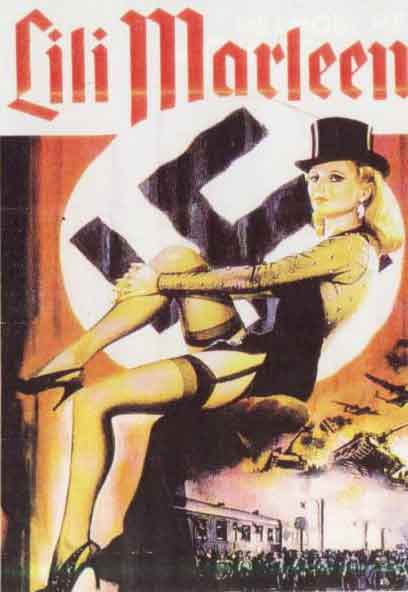
Your father’s Lili Marlene, specifically
On the subject of historical misconceptions, you might say I’m hugely sentimental. So the tale of Lili Marlene catches me up like a honey trap. What does the name conjure for you? A Nazi Mata Hari? A fictional musical persona beloved by soldiers on both sides of the Good War? While even antiwar sentiments wax nostalgic about its universal love-conquers-all popularity, the WWII melody evokes romantic memories fueled by dueling propagandas. And when a victorious meme writes the history, it can erase its footprints, leading from what was effectively a literary rape.
A recent folk reference for example, an otherwise impeccably adroit Lili Marlene Walks Away, about Marlene the streetwalker, leaves me just sick in the heart.
The historical narrative has it that Lili Marlene was actually Lili and Marleen, two girlfriends for whom German soldier Hans Liep pined from the trenches of WWI. With unchivalrous poetic license Liep conflated the two and penned a love poem as it might have been written to him, “signed, Lili Marleen.” Two decades later a German composer set the words to music and then came the outbreak of the next war. The original recording by Lale Anderson was a flop until broadcasts to the front lines over Radio Belgrade captivated homesick Wehrmacht soldiers and eventually the lovelorn battling on both sides. Lili Marlene emerged the most popular song of all time, translated in as many languages as fought in the war. Was this owed to a universal empathy toward the pangs of love, or was it the appeal of a truly catchy melody and lyrics carefully crafted to suit the moment? And how did Lili’s character become redefined?
For the German audience, the character of Lili Marlene did not change. For some the song lost its sheen for having been co-opted by the Third Reich war machine. But even as the singer’s living embodiment of “Lili Marleen” became tarnished by her Faustian-won fame, the title role of “Lili” remained the non-fictional love interest with whom her soldier lover spent every furtive off-duty moment, revisited in memory and in anticipation. Concurrent translations across the European continent stuck to the same essential theme, owing no doubt to listeners being in the main multilingual. They understood enough of the original German not to be sold another Lili Marlene. English was another story, but the Allies didn’t start it.
Nazi propaganda minister Joseph Goebbels at first banned the song because he saw it as demoralizing to soldiers enduring the deprivations of war. He referred to Lili Marlene as “The tearjerker with the death-dance smell” until its popularity reached a critical mass even he couldn’t stop. When opposing forces seemed also to succumb to the song’s wiles, Goebbels sought to intensify the poison’s venom.
The original German lyric was written in an ambiguous voice, either that of the soldier or his faithful girl, revisiting their every last moment together and the promise of more. Even as the imagery may have been accepted as a soldier’s fantasies, the singer’s female gender was consistent with the voice of his lover’s reassurances. As a result, the original singer came to personify the character Lili Marleen. For soldiers of every side the voice they heard was that of “Lili Marlene.”
The popular account goes that when Allied soldiers were observed singing along to Radio Belgrade, an English lyric was ordered post haste lest American GIs and British Tommies be singing in German. Rarely mentioned is that the seduction interrupted had been in English.
A recent compilation of nearly 200 different renditions of Lili Marlene gives an unprecedented look into the WWII propaganda battle waged over control of the Lili Marlene narrative. Many of the key recordings have reached Youtube.
When the Germans surmised that Allied soldiers wanted to do more than whistle along, a lyric was devised for them which changed the ambiguity of the narrator to the first person. YOUR Lili Marleen became MY Lili Marlene. And oddly, but for reasons un-mysterious obviously, the vocalist remained a woman. The English version was supposed to be a translation after all, and no one was under any illusion that the song’s original appeal with soldiers was not owed to the enchantment of the chanteuse.
The plodding, dripping sentimentality of the melody also lent well to marches. Lili Marleen, in English, Marlene, was an ideal tonic for a war long on effort and deprivation.
An American GI today could still be forgiven for hearing Lili Marlene and saying: those aren’t the lyrics I remember. Late and post war USO tours effaced the earlier Nazi radio broadcasts. There was a German English version before the British and American after that, when Lili of the home front became the seductress became the whore.
If the song conjures an American image at all, it’s Marlene Dietrich, who subsequently claimed the song for her own, perhaps why it’s named Marlene and not Marleen, I don’t know. But her vampy rendition colors interpretations to this day. An American film star from the 30s, Dietrich is still mistakenly remembered as a reformed German double agent, possibly the Axis Sally propagandist who originated her namesake song.
To my mind, familiarity would be the only reason to favor Dietrich’s rendition of Lili Marlene. The original 1938 German and its first English incarnation in 1942 were both by Lale Andersen, easily the most moving. But Marlene Dietrich wasn’t selling love, or was, to be more precise.
The lyric to the original German recording translates thus:
In front of the barracks, in front of the main gate,
Stood a lamppost, if it stands there still,
So will we see each other there again,
By the lamppost we’ll stand,
As before, Lili Marleen. As before, Lili Marleen.Our two shadows looked like one.
That we were so much in love, at a glance anyone could see.
And everyone will see it,
When we stand by the lamppost,
As before, Lili Marleen. As before, Lili Marleen.
(The motif of female narrator was conceded by a 1943 BBC propaganda rerecording made for broadcast back to Germany. Instead of a love song, the lyric became a war-weary rant where a hoarse-throated middle-aged “Lili” calls for an uprising against Hitler. Loosely translated it went:
Maybe you’ll die in Russia, maybe you’ll die in Africa,
You will die somewhere, that’s what your Führer wants.
But if you see us again, where will this lamppost be?
In another Germany.
Your Lili Marleen.The Führer is a oppressor, that’s what we all see,
Making every child an orphan, every woman a widow,
It’s all his fault, I want to see? him at the lamppost,
Hang him up at the lamppost.
Your Lili Marleen.
)
The German propagandists were more insidious with their subversion of Andersen’s 1942 recording, sticking closely to the original setting, shifting the narrator squarely to the male, relegating Lili not just to the third person but to the past, and interjecting heaping doses of sentimentality:
Underneath the lantern, by the barrack gate,
There I met Marleen every night at eight.
That was a time in early Spring,
When birds all sing, then love was king
Of my heart and Marleen’s, of my heart and Marleen’s.
The next verse begins with a cringe-worthy overstep of a military put-down, perhaps however to divert critical faculties from the real manipulation. Even though the song is now in English, the soldiers expect it serves German propaganda. Disarmed by the amateurish mocking of “retreat,” the listener is vulnerable as the rest of the lyric preys on a soldier’s insecurity about his sweetheart’s fidelity, the longer the war years become interminable. The subject is the usual propaganda leaflet fare, but animated with the potency of music. Faithful “as before” became “time would part” Marlene.
Waiting for the drumbeat, signaling retreat,
Walking in the shadows, where all lovers meet.
Yes those were days of long ago,
I loved her so, I couldn’t know
That time would part Marleen, that time would part Marleen.
The pace leadens to deliver the fatal pronouncement, again the anticipation of reunion becomes perseveration and lament:
When I heard the bugle, calling me away,
By the gate I kissed her, kissed her tears away.
And by the flick’ring lantern’s light,
I held her tight, t’was our last night,
My last night with Marleen, my last night with Marleen.
The last verse repeats the first, which I omitted earlier. It’s a call to action, obviously absent the original, “Now is the time-” meaning desertion into the aforementioned shadows, “to meet your-” and I must admit to be unsure of a transcription. From Andersen’s accent to the unclear recording quality of her backup chorus, it’s difficult to determine whom Lili wants the soldier to meet. “Your girl” and two other words which rhyme with girl, the first begins with P, the last with S.
Still I hear the bugle, hear its silv’ry call,
Carried by the night air, telling one and all:
Now is the time to meet your pearl,
To meet your girl, to meet your soul,
As once I met Marleen, my sweet Lili Marleen.
Your girl, not Lili Marleen. She’s gone, a love lost to regret. In their German-accented affected English, the male chorus appeared to provide a mocking echo “Now is the time to meet your death.”
Needless to say it was imperative that while Radio Belgrade reached the English and American soldiers in North Africa and Italy, the Allies had to record an antidote. A first version by a Brit kept with the romantic original:
In the dark of evening, where you stand and wait,
Hangs a lantern gleaming by the barrack gate.
We’ll meet again by lantern shine
As we did once upon a time.
We two Lili Marlene, we two Lili Marlene.Our shadows once stood facing, a tall one and a small.
They mingled in embracing, upon the lighted wall.
And passers by could see and tell
Who kissed my shadow there so well:
My girl Lili Marlene, my girl Lili Marlene.
But that didn’t address the problem of demoralization, Goebbels’ original concern shared by military commanders no matter which side: soldiers overtaken by depression.
Plus the Allies needed less a song about the girl back home than one about the German lass awaiting the Yankee conqueror. Who are we kidding? Lili Marlene’s German voice did not invoke thoughts of home so much as a foreign woman taunting, however innocent, from behind enemy lines. Eventually those lands would be overrun, her lover to die in their defense, Lili to await the last man standing. How many soldiers listened to Radio Belgrade and did not fantasize about cuckolding their adversary with his beloved Lili Marlene?
The Allied troops needed a Lili of not-unfaithful character, but one available to them. It was no big leap for an American lyricist to transform Fritz’s Lili, faithfully waiting for him under the lamppost, to “Lili of the Lamplight,” the only type of German woman with whom American GIs would be able to get near, a prostitute.
Underneath the lantern by the barrack gate,
Darling I remember the way you used to wait.
Twas there that you whispered tenderly
That you loved me, you’d always be
My Lili of the lamplight, my own Lili Marlene.
You’ll always be mine? My love? No, my lover by the lamplight. In the new scheme, the mentions of love and tears become sublimated by kisses, caresses, whispers of tender nothings and feet waiting in the street. Sung to the Allied troops as they marched unto Berlin by a husky voiced vamp. That’s your Lili Marlene.
De Gaulle urges resistance in occupied France, Palestine, Iraq and Afghanistan
June 18 marked the 70th anniversary of the Free-French General de Gaulle’s famous 1940 radio address when he urged occupied France to resist because victory over their invaders would be inevitable. Does the western media commemorate de Gaulle’s message without an inkling of irony?
Of course, today’s occupied peoples cannot be offered the same assurance, that help is on its way. Just as Europe was overwhelmed by Hitler’s superior force, de Gaulle knew that US industry would trump that. There will be no white knight to rescue Iraq and Afghanistan, but “L’Appel du 18 Juin,” celebrated in 2010, reaffirms every people’s right to resist foreign invaders. And not nonviolently.
General Petain, leader of France’s Vichy government, was forever condemned for surrendering France and collaborating with the Germans. But he too knew that US industrial might, and its unlimited resources, ensured an allied victory. Petain can be thanked for sparing French cities the excessive ravages of war. Most of France’s historical architecture survived WWII because Petain played along with the occupiers. But France is free today thanks to the resistance.
The Gazan People’s Front or People’s Front of Gaza less funny than Nazirene
A Gaza Flotilla PR mishap, as minor as a participant speaking out of place, was seized upon by one reporter to suggest rivalry between co-sponsors of the relief convoy due to convene Saturday at Gaza’s door. When an interviewee said “Free Palestine Movement” instead of “Free Gaza,” the reporter recalled scenes from Monty Python’s Life of Brian and the mortal rivalry between the “People’s Judean Front” and the “People’s Front of Judea,” often understood to lampoon the PLO and it splinter groups. Haha. But why didn’t the reporter mention Python’s other irreverent terrorist gang also fighting the Roman occupation: the uber-Zionist Nazirene? Because Otto and the Nazirene, that’s right, not Nazarene, were cut from the video when control was wrestled from Monty Python for the rights.

Why the offense? Because they wore swastika-like Stars-of-David and they goose-stepped? Because they followed a small-mustached leader named Otto who dreamed of a racially pure state for Jews only?
I’m surprised that more Monty Python fans aren’t livid at the suggestion the classic has been censored for all posterity. But only those who saw Life of Brian in the theater, or can pick up an out-of-print paperback of the screenplay, would know what lines successive viewers don’t hear to memorize.
Lines like these between Eric Idle and Graham Chapman:
OTTO: It’s time, you know … Time that we Jews racially purified ourselves … We need more living room. We must move into the traditionally Jewish areas of Samaria.
BRIAN: What about the Samaritans?
OTTO: Well, we can put them in little camps. And after Samaria we must move into Jordan and create a great Jewish state that will last a thousand years.
Imagine a Zionist depicted using Hitler’s expression “living space!” Lebensraum meant a homeland where the German people could live unmolested, with room for their population to grow.
Associating Zionists with Nazis has always meant courting trouble. Does it sound incredible that defenders of Israel would take a knife to Monty Python’s work? Know any other blockbuster movies of the late 70s which mysteriously shed memorable scenes when they reemerged on video?
Criterion recently released a DVD with extras that purport to include the deleted scenes, you can see them on Youtube, but they are actually outtakes with bits missing still, in particular the lines above.
I wrote about this at length in an earlier post, when I came upon the missing dialog just by chance. In that post I also transcribed the full text of the censored scenes.
Back to the joke made at the Free Gaza Movement‘s expense. Hopefully the organizers can laugh it off. Really Jerusalem-based reporter Jackie Rowland was making hay of an email shown to her by a participant being compelled to switch the word “Palestine” for “Gaza” because they were not authorized to speak officially for the “Free Gaza Movement.” With any improvised collection of activists, only those tasked should speak for the whole. Especially someone who may have been admonished beforehand not to present themselves as a spokesman.
I cannot presume to know what were the motives in this instance, but it’s been my experience that characters bent on disrupting the work of activists often put themselves before the cameras to sabotage the message. Leaders have to guard against that tactic.
The reporter should have know as much. Imagine interviewing Rush Limbaugh and taking him at his word that he represented the White House.
The activist should have made that fact more clear. It certainly was disingenuous of the reporter however, because it would be easy to confirm that there was no such group, instead of concluding that rival non-profits were vying for taking credit for the convoy. In that way Jackie Rowland’s article seemed like a mean-spirited laugh.
The groups which have brought the multi-million dollar enterprise together that is the Gaza Freedom Flotilla appear to me to be far from adversaries, otherwise how could this be the ninth unified attempt?
The same cannot be said for Fatah and Hamas of course, nor of the extremists in Israel.
The latest reports have the relief convoy meeting in the international waters off of Gaza on Saturday. The story has been playing well in the international press, and is beginning to see daylight in the US. Apart from those with a Zionist slant, two decent reports emerged today in the WSJ and Time.
Robert Fisk and the language of power, danger words: Competing Narratives
Celebrated reporter -and verb- Robert Fisk had harsh words, “danger words” he called them, for host Al-Jazeera where he gave an address about the language of power which has infected newsman and reader alike. Beware your unambiguous acceptance of empty terms into which state propagandists let you infer nuance: power players, activism, non-state actors, key players, geostrategic players, narratives, external players, meaningful solutions, –meaning what?
I’ll not divulge why these stung Al-J, but I’d like to detail the full list, and commit not to condone their false usage at NMT, without ridicule, “quotes” or disclaimer.
Fisk listed several expressions which he attributes to government craftsmen. Unfortunately journalists have been parroting these terms without questioning their dubious meaning. Fisk began with a favorite, the endless, disingenuous, “peace process.” What is that – victor-defined purgatory? Why would “peace” be a “process” Fisk asks.
How appropriate that some of the West’s strongest critics are linguists. Fisk lauded the current seagoing rescue of Gaza, the convoy determined to break the Israeli blockade. He compared it to the Berlin Airlift, when governments saw fit to help besieged peoples, even former enemies. This time however, the people have to act where their governments do not.
I read recently that the Gaza Freedom Flotilla might be preparing accommodations for Noam Chomsky to join the passage. Won’t that be an escalation? I imagine if Robert Fisk would climb aboard too, it would spell doom for any chance the relief supplies would reach the Gazans. A ship convoy with Chomsky and Fisk on board would present an opportunity that an Israeli torpedo could not resist.
Here is his list. If you can’t peruse the lecture, at least ponder these words with as much skepticism as you can. The parenthesis denote my shorthand.
peace process (detente under duress, while enduring repression)
“Peace of the Brave” (accept your subjugation, coined for Algeria, then France lost)
“Hearts and Minds” (Vietnam era psych-ops, then US lost)
spike (to avoid saying: increase)
surge (reinforcements, you send them in you’re losing)
key players (only puppets and their masters need apply)
back on track (the objective has been on rails?)
peace envoy (in mob-speak: the cleaner)
road map (winner’s bill of lading for the spoils)
experts (vetted opinions)
indirect talks (concurrent soliloquies, duets performed solo in proximity to common fiddler calling tune)
competing narratives (parallel universes in one? naturally the perpetrator is going to tell a different tale, disputing that of victim’s; ungoing result is no justice and no injustice) examples:
occupied vs. disputed;
wall vs. security barrier;
colonization vs settlements, outposts or Jewish neighborhoods.
foreign fighters (them, but always us)
Af-Pak (ignores third party India and thus dispute to Kashmir)
appeasers (sissies who don’t have bully’s back)
Weapons of Mass Destruction (not Iraq, now not Iran)
think tanks (ministry of propaganda privatized)
challenges (avoids they are problems)
intervention (asserted authority by military force)
change agents (by undisclosed means?)
Until asked otherwise, I’ll append Fisk’s talk here:
Robert Fisk, The Independent newspaper’s Middle East correspondent, gave the following address to the fifth Al Jazeera annual forum on May 23.
Power and the media are not just about cosy relationships between journalists and political leaders, between editors and presidents. They are not just about the parasitic-osmotic relationship between supposedly honourable reporters and the nexus of power that runs between White House and state department and Pentagon, between Downing Street and the foreign office and the ministry of defence. In the western context, power and the media is about words – and the use of words.
It is about semantics.
It is about the employment of phrases and clauses and their origins. And it is about the misuse of history; and about our ignorance of history.
More and more today, we journalists have become prisoners of the language of power.
Is this because we no longer care about linguistics? Is this because lap-tops ‘correct’ our spelling, ‘trim’ our grammar so that our sentences so often turn out to be identical to those of our rulers? Is this why newspaper editorials today often sound like political speeches?
Let me show you what I mean.
For two decades now, the US and British – and Israeli and Palestinian – leaderships have used the words ‘peace process’ to define the hopeless, inadequate, dishonourable agreement that allowed the US and Israel to dominate whatever slivers of land would be given to an occupied people.
I first queried this expression, and its provenance, at the time of Oslo – although how easily we forget that the secret surrenders at Oslo were themselves a conspiracy without any legal basis. Poor old Oslo, I always think! What did Oslo ever do to deserve this? It was the White House agreement that sealed this preposterous and dubious treaty – in which refugees, borders, Israeli colonies – even timetables – were to be delayed until they could no longer be negotiated.
And how easily we forget the White House lawn – though, yes, we remember the images – upon which it was Clinton who quoted from the Qur’an, and Arafat who chose to say: “Thank you, thank you, thank you, Mr. President.” And what did we call this nonsense afterwards? Yes, it was ‘a moment of history’! Was it? Was it so?
Do you remember what Arafat called it? “The peace of the brave.” But I don’t remember any of us pointing out that “the peace of the brave” was used originally by General de Gaulle about the end of the Algerian war. The French lost the war in Algeria. We did not spot this extraordinary irony.
Same again today. We western journalists – used yet again by our masters – have been reporting our jolly generals in Afghanistan as saying that their war can only be won with a “hearts and minds” campaign. No-one asked them the obvious question: Wasn’t this the very same phrase used about Vietnamese civilians in the Vietnam war? And didn’t we – didn’t the West – lose the war in Vietnam?
Yet now we western journalists are actually using – about Afghanistan – the phrase ‘hearts and minds’ in our reports as if it is a new dictionary definition rather than a symbol of defeat for the second time in four decades, in some cases used by the very same soldiers who peddled this nonsense – at a younger age – in Vietnam.
Just look at the individual words which we have recently co-opted from the US military.
When we westerners find that ‘our’ enemies – al-Qaeda, for example, or the Taliban -have set off more bombs and staged more attacks than usual, we call it ‘a spike in violence’. Ah yes, a ‘spike’!
A ‘spike’ in violence, ladies and gentlemen is a word first used, according to my files, by a brigadier general in the Baghdad Green Zone in 2004. Yet now we use that phrase, we extemporise on it, we relay it on the air as our phrase. We are using, quite literally, an expression created for us by the Pentagon. A spike, of course, goes sharply up, then sharply downwards. A ‘spike’ therefore avoids the ominous use of the words ‘increase in violence’ – for an increase, ladies and gentlemen, might not go down again afterwards.
Now again, when US generals refer to a sudden increase in their forces for an assault on Fallujah or central Baghdad or Kandahar – a mass movement of soldiers brought into Muslim countries by the tens of thousands – they call this a ‘surge’. And a surge, like a tsunami, or any other natural phenomena, can be devastating in its effects. What these ‘surges’ really are – to use the real words of serious journalism – are reinforcements. And reinforcements are sent to wars when armies are losing those wars. But our television and newspaper boys and girls are still talking about ‘surges’ without any attribution at all! The Pentagon wins again.
Meanwhile the ‘peace process’ collapsed. Therefore our leaders – or ‘key players’ as we like to call them – tried to make it work again. Therefore the process had to be put ‘back on track’. It was a railway train, you see. The carriages had come off the line. So the train had to be put ‘back on track’. The Clinton administration first used this phrase, then the Israelis, then the BBC.
But there was a problem when the ‘peace process’ had been put ‘back on track’ – and still came off the line. So we produced a ‘road map’ – run by a Quartet and led by our old Friend of God, Tony Blair, who – in an obscenity of history – we now refer to as a ‘peace envoy’.
But the ‘road map’ isn’t working. And now, I notice, the old ‘peace process’ is back in our newspapers and on our television screens. And two days ago, on CNN, one of those boring old fogies that the TV boys and girls call ‘experts’ – I’ll come back to them in a moment – told us again that the ‘peace process’ was being put ‘back on track’ because of the opening of ‘indirect talks’ between Israelis and Palestinians.
Ladies and gentlemen, this isn’t just about clichés – this is preposterous journalism. There is no battle between power and the media. Through language, we have become them.
Maybe one problem is that we no longer think for ourselves because we no longer read books. The Arabs still read books – I’m not talking here about Arab illiteracy rates – but I’m not sure that we in the West still read books. I often dictate messages over the phone and find I have to spend ten minutes to repeat to someone’s secretary a mere hundred words. They don’t know how to spell.
I was on a plane the other day, from Paris to Beirut – the flying time is about three hours and 45 minutes – and the woman next to me was reading a French book about the history of the Second World War. And she was turning the page every few seconds. She had finished the book before we reached Beirut! And I suddenly realised she wasn’t reading the book – she was surfing the pages! She had lost the ability to what I call ‘deep read’. Is this one of our problems as journalists, I wonder, that we no longer ‘deep read’? We merely use the first words that come to hand …
Let me show you another piece of media cowardice that makes my 63-year-old teeth grind together after 34 years of eating humus and tahina in the Middle East.
We are told, in so many analysis features, that what we have to deal with in the Middle East are ‘competing narratives’. How very cosy. There’s no justice, no injustice, just a couple of people who tell different history stories. ‘Competing narratives’ now regularly pop up in the British press. The phrase is a species – or sub-species – of the false language of anthropology. It deletes the possibility that one group of people – in the Middle East, for example – are occupied, while another group of people are doing the occupying. Again, no justice, no injustice, no oppression or oppressing, just some friendly ‘competing narratives’, a football match, if you like, a level playing field because the two sides are – are they not – ‘in competition’. It’s two sides in a football match. And two sides have to be given equal time in every story.
So an ‘occupation’ can become a ‘dispute’. Thus a ‘wall’ becomes a ‘fence’ or a ‘security barrier’. Thus Israeli colonisation of Arab land contrary to all international law becomes ‘settlements’ or ‘outposts’ or ‘Jewish neighbourhoods’.
You will not be surprised to know that it was Colin Powell, in his starring, powerless appearance as secretary of state to George W. Bush, who told US diplomats in the Middle East to refer to occupied Palestinian land as ‘disputed land’ – and that was good enough for most of the American media.
So watch out for ‘competing narratives’, ladies and gentlemen. There are no ‘competing narratives’, of course, between the US military and the Taliban. When there are, however, you’ll know the West has lost.
But I’ll give you a lovely, personal example of how ‘competing narratives’ come undone. Last month, I gave a lecture in Toronto to mark the 95th anniversary of the 1915 Armenian genocide, the deliberate mass murder of one and a half million Armenian Christians by the Ottoman Turkish army and militia. Before my talk, I was interviewed on Canadian Television, CTV, which also owns the Toronto Globe and Mail newspaper. And from the start, I could see that the interviewer had a problem. Canada has a large Armenian community. But Toronto also has a large Turkish community. And the Turks, as the Globe and Mail always tell us, “hotly dispute” that this was a genocide. So the interviewer called the genocide “deadly massacres”.
Of course, I spotted her specific problem straight away. She could not call the massacres a ‘genocide’, because the Turkish community would be outraged. But equally, she sensed that ‘massacres’ on its own – especially with the gruesome studio background photographs of dead Armenians – was not quite up to defining a million and a half murdered human beings. Hence the ‘deadly massacres’. How odd!!! If there are ‘deadly’ massacres, are there some massacres which are not ‘deadly’, from which the victims walk away alive? It was a ludicrous tautology.
In the end, I told this little tale of journalistic cowardice to my Armenian audience, among whom were sitting CTV executives. Within an hour of my ending, my Armenian host received an SMS about me from a CTV reporter. “Shitting on CTV was way out of line,” the reporter complained. I doubted, personally, if the word ‘shitting’ would find its way onto CTV. But then, neither does ‘genocide’. I’m afraid ‘competing narratives’ had just exploded.
Yet the use of the language of power – of its beacon-words and its beacon-phrases -goes on among us still. How many times have I heard western reporters talking about ‘foreign fighters’ in Afghanistan? They are referring, of course, to the various Arab groups supposedly helping the Taliban. We heard the same story from Iraq. Saudis, Jordanians, Palestinian, Chechen fighters, of course. The generals called them ‘foreign fighters’. And then immediately we western reporters did the same. Calling them ‘foreign fighters’ meant they were an invading force. But not once – ever – have I heard a mainstream western television station refer to the fact that there are at least 150,000 ‘foreign fighters’ in Afghanistan. And that most of them, ladies and gentlemen, are in American or other Nato uniforms!
Similarly, the pernicious phrase ‘Af-Pak’ – as racist as it is politically dishonest – is now used by reporters when it originally was a creation of the US state department, on the day that Richard Holbrooke was appointed special US representative to Afghanistan and Pakistan. But the phrase avoided the use of the word ‘India’ whose influence in Afghanistan and whose presence in Afghanistan, is a vital part of the story. Furthermore, ‘Af-Pak’ – by deleting India – effectively deleted the whole Kashmir crisis from the conflict in south-east Asia. It thus deprived Pakistan of any say in US local policy on Kashmir – after all, Holbrooke was made the ‘Af-Pak’ envoy, specifically forbidden from discussing Kashmir. Thus the phrase ‘Af-Pak’, which totally deletes the tragedy of Kashmir – too many ‘competing narratives’, perhaps? – means that when we journalists use the same phrase, ‘Af-Pak’, which was surely created for us journalists, we are doing the state department’s work.
Now let’s look at history. Our leaders love history. Most of all, they love the Second World War. In 2003, George W. Bush thought he was Churchill as well as George W. Bush. True, Bush had spent the Vietnam war protecting the skies of Texas from the Vietcong. But now, in 2003, he was standing up to the ‘appeasers’ who did not want a war with Saddam who was, of course, ‘the Hitler of the Tigris’. The appeasers were the British who did not want to fight Nazi Germany in 1938. Blair, of course, also tried on Churchill’s waistcoat and jacket for size. No ‘appeaser’ he. America was Britain’s oldest ally, he proclaimed – and both Bush and Blair reminded journalists that the US had stood shoulder-to-shoulder with Britain in her hour of need in 1940.
But none of this was true.
Britain’s old ally was not the United States. It was Portugal, a neutral fascist state during World War Two. Only my own newspaper, The Independent, picked this up.
Nor did America fight alongside Britain in her hour of need in 1940, when Hitler threatened invasion and the German air force blitzed London. No, in 1940 America was enjoying a very profitable period of neutrality – and did not join Britain in the war until Japan attacked the US naval base at Pearl Harbour in December of 1941.
Ouch!
Back in 1956, I read the other day, Eden called Nasser the ‘Mussolini of the Nile’. A bad mistake. Nasser was loved by the Arabs, not hated as Mussolini was by the majority of Africans, especially the Arab Libyans. The Mussolini parallel was not challenged or questioned by the British press. And we all know what happened at Suez in 1956.
Yes, when it comes to history, we journalists really do let the presidents and prime ministers take us for a ride.
Today, as foreigners try to take food and fuel by sea to the hungry Palestinians of Gaza, we journalists should be reminding our viewers and listeners of a long-ago day when America and Britain went to the aid of a surrounded people, bringing food and fuel – our own servicemen dying as they did so – to help a starving population. That population had been surrounded by a fence erected by a brutal army which wished to starve the people into submission. The army was Russian. The city was Berlin. The wall was to come later. The people had been our enemies only three years earlier. Yet we flew the Berlin airlift to save them. Now look at Gaza today. Which western journalist – and we love historical parallels – has even mentioned 1948 Berlin in the context of Gaza?
Look at more recent times. Saddam had ‘weapons of mass destruction’ – you can fit ‘WMD’ into a headline – but of course, he didn’t, and the American press went through embarrassing bouts of self-condemnation afterwards. How could it have been so misled, the New York Times asked itself? It had not, the paper concluded, challenged the Bush administration enough.
And now the very same paper is softly – very softly – banging the drums for war in Iran. Iran is working on WMD. And after the war, if there is a war, more self-condemnation, no doubt, if there are no nuclear weapons projects.
Yet the most dangerous side of our new semantic war, our use of the words of power – though it is not a war since we have largely surrendered – is that it isolates us from our viewers and readers. They are not stupid. They understand words, in many cases – I fear – better than we do. History, too. They know that we are drowning our vocabulary with the language of generals and presidents, from the so-called elites, from the arrogance of the Brookings Institute experts, or those of those of the Rand Corporation or what I call the ‘THINK TANKS’. Thus we have become part of this language.
Here, for example, are some of the danger words:
· POWER PLAYERS
· ACTIVISM
· NON-STATE ACTORS
· KEY PLAYERS
· GEOSTRATEGIC PLAYERS
· NARRATIVES
· EXTERNAL PLAYERS
· PEACE PROCESS
· MEANINGFUL SOLUTIONS
· AF-PAK
· CHANGE AGENTS (whatever these sinister creatures are).
I am not a regular critic of Al Jazeera. It gives me the freedom to speak on air. Only a few years ago, when Wadah Khanfar (now Director General of Al Jazeera) was Al Jazeera’s man in Baghdad, the US military began a slanderous campaign against Wadah’s bureau, claiming – untruthfully – that Al Jazeera was in league with al-Qaeda because they were receiving videotapes of attacks on US forces. I went to Fallujah to check this out. Wadah was 100 per cent correct. Al-Qaeda was handing in their ambush footage without any warning, pushing it through office letter-boxes. The Americans were lying.
Wadah is, of course, wondering what is coming next.
Well, I have to tell you, ladies and gentlemen, that all those ‘danger words’ I have just read out to you – from KEY PLAYERS to NARRATIVES to PEACE PROCESS to AF-PAK – all occur in the nine-page Al Jazeera programme for this very forum.
I’m not condemning Al Jazeera for this, ladies and gentlemen. Because this vocabulary is not adopted through political connivance. It is an infection that we all suffer from – I’ve used ‘peace process’ a few times myself, though with quotation marks which you can’t use on television – but yes, it’s a contagion.
And when we use these words, we become one with the power and the elites which rule our world without fear of challenge from the media. Al Jazeera has done more than any television network I know to challenge authority, both in the Middle East and in the West. (And I am not using ‘challenge’ in the sense of ‘problem’, as in ‘”I face many challenges,” says General McCrystal.’)
How do we escape this disease? Watch out for the spell-checkers in our lap-tops, the sub-editor’s dreams of one-syllable words, stop using Wikipedia. And read books – real books, with paper pages, which means deep reading. History books, especially.
Al Jazeera is giving good coverage to the flotilla – the convoy of boats setting off for Gaza. I don’t think they are a bunch of anti-Israelis. I think the international convoy is on its way because people aboard these ships – from all over the world – are trying to do what our supposedly humanitarian leaders have failed to do. They are bringing food and fuel and hospital equipment to those who suffer. In any other context, the Obamas and the Sarkozys and the Camerons would be competing to land US Marines and the Royal Navy and French forces with humanitarian aid – as Clinton did in Somalia. Didn’t the God-like Blair believe in humanitarian ‘intervention’ in Kosovo and Sierra Leone?
In normal circumstances, Blair might even have put a foot over the border.
But no. We dare not offend the Israelis. And so ordinary people are trying to do what their leaders have culpably failed to do. Their leaders have failed them.
Have the media? Are we showing documentary footage of the Berlin airlift today? Or of Clinton’s attempt to rescue the starving people of Somalia, of Blair’s humanitarian ‘intervention’ in the Balkans, just to remind our viewers and readers – and the people on those boats – that this is about hypocrisy on a massive scale?
The hell we are! We prefer ‘competing narratives’. Few politicians want the Gaza voyage to reach its destination – be its end successful, farcical or tragic. We believe in the ‘peace process’, the ‘road map’. Keep the ‘fence’ around the Palestinians. Let the ‘key players’ sort it out.
Ladies and gentlemen, I am not your ‘key speaker’ this morning.
I am your guest, and I thank you for your patience in listening to me.
Simon Wiesenthal Center makes best case against Israel colonial legitimacy
Give Israel credit for answering their critics head on, but that is the Zionist hubris. Simon Wiesenthal is propagating the latest Hasbara crib sheet to counter the ten most threatening lies about Israel. We couldn’t have summarized the arguments better ourselves. One man’s “lies” are his victim’s desperate appeals to confound systemic myopic denial. Here it is in their own nutshell:
Israel was created by European guilt over the Nazi Holocaust. Why should Palestinians pay the price? … Had Israel withdrawn to its June 1967 borders, peace would have come long ago. … Israel is the main stumbling block to achieving a two-state solution. … Nuclear Israel, not Iran, is the greatest threat to peace and stability. … Israel is an apartheid state deserving of international boycott, divestment and sanctions campaigns. … Plans to build 1,600 more homes in East Jerusalem prove Israel is “Judaizing” the Holy City. … Israeli policies endanger U.S. troops in Afghanistan and Iraq. … Israeli policies are the cause of worldwide anti-Semitism. … Israel, not Hamas, is responsible for the “humanitarian catastrophe” in Gaza. … Goldstone was right when he charged that Israel was guilty of war crimes against civilians. … The only hope for peace is a single, binational state eliminating the Jewish State of Israel.
Even dissembled, the case weighs hard against Zionist mendacity.
OK, a tad capricious
To Wiesenthal’s credit, the arguments are loaded with a laudable reserve of disingenuity:
5,500 MORE HOMES have been zoned for East Jerusalem, not 1,600, (and yes, Jerusalem’s mayor has set quotas, a Jewish to non-Jewish target ratio to counter a higher Arab birthrate).
Israeli policies are the cause of [PROLIFERATION] of worldwide anti-Semitism,
The Gaza “humanitarian catastrophe” soft-pedals the critics’ real accusation: MASSACRE. Imagine referring to the Holocaust as befalling its victims with the ambivalence of a tsunami.
JUDGE Goldstone isn’t the only accuser who’s documented the criminality the world witnessed WITH ITS OWN EYES.
Apartheid legitimizers blink
Further demonstrating the disintegrating global support for a Jewish haven-state, the Simon Wiesenthal Center has all but dropped its cover as Holocaust-remembrance-sledgehammer to directly shore up the supposed public grant of legitimacy to Zionist colonialism.
Trying to turn the argument on Israel’s “de-ligitimizers” couldn’t be more out of touch.
While the US fights in expanding but downward spirals against the entropy of Pax Americana, Western public support for empire-building erodes for even the pretext of “globalization.” White Man’s Burden has smartened to Carbon Debt, missionary zeal evolved to indigenous and environmental protectionism. Religious crusades haven’t held water for centuries, but what an Auld Testament to Zionism’s xenophobic tenacity to posit the Jewish People as “chosen” to revive God-manifested destiny.
What part of “Apartheid is for Neanderthals” do Palestine’s neo- Afrikaners fail to understand? Even an 18th Century South African settler categorization gives the mid-twentieth century European transplants in Zion too much credit for pretended genealogical roots in the Middle East.
Only State Solution
Not very well concealed in Wiesenthal’s framing of the “Top Ten Lies” is a specious conceit formed by straw arguments three and ten, which presume the desirability of a “two-state solution” and/or a misguided hope for an inevitable “binational state.” Only in Wiesenthal’s rebuttal is there utterance of Israel’s true taboo –unmentionable because it will be self-fulfilling. The single state solution is dismissed with cavalier aplomb as “a non-starter.”
They desperately wish. On what basis do Zionists imbue themselves authority to trump international consensus? Hopefully it is not their nuclear arsenal. No other religious ideology, armed with nukes or without, asserts any permutation of divine refugee-status provenance to an autonomous “homeland.” Not even Tibet.
I expect sooner than the Zionists like –but then the self-defeatist arrogance may bely my presumption– the Simon Wiesenthal Center will be scrambling to bolster rationalizations against the only peaceful solution already on everyone’s mind and taxing our humanitarian patience: the single-state multi-theist modern egalitarian democracy.
Hasbara desperation
We reprint a near-complete representation of the SWC brochure below for our readers, if also to facilitate the identification of pro-Israel internet trolls by the tracts they are presently copy-and-pasting all over blog discussions. Who would have suspected that the resurgent wave of Zionist troll tripe was so transparently linked to official AIPAC and Wiesenthal Center press releases. We give the IDF Hasbara budget too much credit.
A recent IDF-merc commenter goaded us to “envy Israeli intellectual superiority.” I will admit it, I am in awe. Eagerly too. I know where it got Icarus.
Israel goes Titanic. Gotta love a good spectacle.
Appendix
Here then, courtesy of the Simon Wiesenthal Center, the 2010 Top Ten Anti-Israel Lies, enjoy!
2010 TOP TEN
ANTI-ISRAEL LIESIsrael is under assault!
Here’s what you need to know.
Act now…Lie No. 1: Israel was created by European guilt over the Nazi Holocaust. Why should Palestinians pay the price?
Three thousand years before the Holocaust, before there was a Roman Empire, Israel’s kings and prophets walked the streets of Jerusalem. The whole world knows that Isaiah did not speak his prophesies from Portugal, nor Jeremiah his lamentations from France. Revered by its people, Jerusalem is mentioned in the Hebrew Scriptures 600 times, but not once in the Koran. Throughout the 2,000-year exile of the Jews, there was a continuous Jewish presence in the Holy Land.
Lie No. 2: Had Israel withdrawn to its June 1967 borders, peace would have come long ago.
Since 1967, Israel repeatedly has conceded “land for peace.” Following Egyptian President Sadat’s historic 1977 visit to Jerusalem, Israel withdrew from the vast Sinai Peninsula and has been at peace with Egypt ever since. But the Palestinian Authority has never fulfilled its promise to end propaganda attacks nor drop the Palestinian National Charter’s call for Israel’s destruction. In 2000, Prime Minister Barak offered Yasser Arafat full sovereignty more than 97 percent of the West Bank, a corridor to Gaza, and a capital in the Arab section of Jerusalem. Arafat said no.
Lie No. 3: Israel is the main stumbling block to achieving a two-state solution.
The Palestinians themselves are the only stumbling block to achieving a two-state solution. With whom should Israel negotiate? With President Abbas, who for four years has been barred by Hamas from visiting 1.5 million constituents in Gaza? With his Palestinian Authority, which continues to glorify terrorists and preaches hate in its educational system and the media? With Hamas, whose Iranian-backed leaders deny the Holocaust and use fanatical Jihadist rhetoric to call for Israel’s destruction?
Lie No. 4: Nuclear Israel, not Iran, is the greatest threat to peace and stability.
The United States and Europe can afford to wait to see what the Iranian regime does with its nuclear ambitions, but Israel cannot. Israel is on the front lines and remembers every day the price the Jewish people paid for not taking Hitler at his word. Israel is not prepared to sacrifice another 6 million Jews on the altar of the world’s indifference.
Lie No. 5: Israel is an apartheid state deserving of international boycott, divestment and sanctions campaigns.
In fact, Israel is a democratic state. Its 20 percent Arab minority enjoys all the political, economic and religious rights and freedoms of citizenship, including electing members of their choice to the Knesset (Parliament).
Lie No. 6: Plans to build 1,600 more homes in East Jerusalem prove Israel is “Judaizing” the Holy City.
Ramat Shlomo was not about Arab neighborhoods in East Jerusalem but about a long established, heavily populated Jewish neighborhood in northern Jerusalem, where 250,000 Jews live (about the size of Newark, N.J.) — an area that will never be relinquished by Israel.
Lie No. 7: Israeli policies endanger U.S. troops in Afghanistan and Iraq.
A resolution of the Palestinian-Israeli conflict would benefit everyone, including the United States. But an imposed return to what Abba Eban called “1967 Auschwitz borders” would endanger Israel’s survival and ultimately be disastrous for American interests and credibility in the world.
Lie No. 8: Israeli policies are the cause of worldwide anti-Semitism.
From the Inquisition to the pogroms, to the 6 million Jews murdered by the Nazis, history proves that Jew hatred existed on a global scale before the creation of the State of Israel. It would still exist in 2010 even if Israel had never been created. For example, one poll indicates that 40 percent of Europeans blame the recent global economic crisis on “Jews having too much economic power” — a canard that has nothing to do with Israel.
Lie No. 9: Israel, not Hamas, is responsible for the “humanitarian catastrophe” in Gaza. Goldstone was right when he charged that Israel was guilty of war crimes against civilians.
The United Nations Human Rights Council is obsessed with false anti-Israel resolutions. It refuses to address grievous human rights abuses in Iran, North Korea, Sudan, Saudi Arabia, Cuba and beyond. Faced with similar attacks, every U.N. member-state, including the United States and Canada, surely would have acted more aggressively than the Israel Defense Forces did in Gaza.
Lie No. 10: The only hope for peace is a single, binational state eliminating the Jewish State of Israel.
The one-state solution is a non-starter because it would eliminate the Jewish homeland. However, the current pressures on Israel are equally dangerous. In effect, the world is demanding that Israel, the size of New Jersey, shrink further by accepting a three-state solution: a P.A. state on the West Bank and a Hamas terrorist one in Gaza. All this as Hezbollah, Iran’s proxy in Lebanon, stockpiles 50,000 rockets, threatening northern and central Israel’s main population centers. Current polls show that while most Israelis favor a two-state solution, most Palestinians continue to oppose it.
Ignoble WWII bombing of Coventry commemorated with coined slur, ours
Here’s a bit of WWII distortion the History Channel is passing off as, um, history. Did you know that those dirty Krauts leveled the English city of Coventry so completely that they coined a word to celebrate it? Apparently that term was “Coventrated.” Oh, it’s a real verb alright — trouble is, it’s English. The British intelligence office seized upon the conjugated Coventriert to mean: subjected to heavy bombardment, and pretended the Huns were such bastards they commemorated the atrocity by mocking their victims in the Teutonic dictionary.
Also problematic, the barbaric Teutons failed to “coventrate” with equal efficacy anywhere else. But the Allies sure did. By night and by day, the UK and US bombers respectively “coventrated” the German and Hungarian homelands, with all the more ferocity because they were dishing the Nazis, haha, a taste of their own medicine.
The bombing of Coventry was tragedy enough, and might have been ameliorated had Churchill responded to the intelligence forewarning but risk betraying that the Brits were intercepting Germany’s secret ciphers. Allowing Coventry to fall victim was one of the high prices of keeping ULTRA a secret, but Hitler’s choice to bomb the historic city and its famed Cathedral was to provoke much enmity with the English public. Britain’s propaganda ministry was able to compound the resentment against the Germans for the devastation of Coventry by portraying the enemy as not just Philistine, but Bombast.
Of course more German cities suffered under the 24-hour US-UK tag-team bombing raids, many incurring orders of magnitude greater casualties than the 600 dead of Coventry. Notable among the Axis cities was the medieval capital of Dresden which possessed not one legitimate military target. No mention of those victims in the History Channel’s records of military misdeeds, meanwhile propagandist Newscorp property HarperCollins is weaving the coventriert detail for revisionist Dresden-deniers.
The stories of America’s firebombing of Japanese cities have already been suppressed. Apologists have long been at work justifying the use of atomic weapons against civilians in Hiroshima and Nagazaki. Where were the propagandists to conjugate Hiroshima?
America’s other unique bombing method would later be described minus geographical references, as simple carpet bombing.
The History Channel is part of the A&E network, co-owed by warmongers Disney, Hearst and NBC/GE. Their mention of “coventrate” came in a program about Lao Tsu’s Art of War, as his military edicts might have predicted, Nostradamus-like, the outcome of the Viet Nam War. Here’s an example of the program’s perspective:
The Vietcong lost the public support of many Vietnamese when they executed thousands of South Vietnamese under the employ of the US.
Meanwhile the American cause lost its public support when the US public caught sight of photographs of US war casualties.
Sound like a fair comparison? The Vietnamese weren’t demoralized by the millions killed in their midst, while the antiwar movement was not galvanized by the revelations of US atrocities? Right.
Sticks and stones can hurt Berlusconi
Wounded premier kept for four days in the hospital. At a young age we’re taught to pretend that words cannot hurt us like sticks and stones. Later we accord to words more power even than paper, scissors, rock –those of us for whom violence is only a surreality.
Both delusions it seems to me come of a world inured by a void of physical hardship. I can’t help but believe that Silvio Berlusconi’s assailant got a message across to the Italian despot that none before had been able to connect, no matter their shouts, pleas or accusations.
Will Berlusconi rebound like Hitler or Stalin after the attempts on their lives? This wasn’t an assassination attempt, whether or not Massimo Tartaglia’s act was premeditated. And it wasn’t a conspiracy either. Massimo by his own hand cut the pompous autocrat down to a mortal stature.
I’m guessing Berlusconi is no stranger to fist fights, he probably pulls his errant subjects’ fingers off using the piers himself. But it’s probably been awhile since he’s been sucker punched. A sudden, uninvited violence like that is the closest example Berlusconi can experience of the institutional violence his regime and ours visit upon innocent people. From out of nowhere.
If Berlusconi and his fellow autocratic leaders beef up their security after this episode, so what? If it now becomes virtually impossible for a common man to get within arms length, or even shoe-throwing distance of a world leader, so what? What expectations do we have that there has ever been communication at that level? Massimo’s gesture, like al-Zaidi’s puts closure on the facade of our leadership. We must communicate among ourselves. Nothing comes of begging crumbs from people in power.
It fills me with inspiration, it really does, to look the wounded visage of Silvio Berlusconi’s, his untouchable countenance wiped clean away.
That said, my favorite scene from Jim Carrey’s How the Grinch Stole Christmas comes at the end, after he’s gotten the best of the despicable Whoville mayor. “No hard feeling?” the Grinch asks, leaning in close and extending his hand. But instead of shaking his hand, he points his finger into the mayor’s face and laughs: Hahahahahaha Hahahahahahaha Hahahahahahahaha Hahahahahahahah!
Vaneigem on energy as commodity
NMT’s in-house Situationist has been conceptualizing a way forward well expressed in this May 2009 interview of Raoul Vaneigem:
“We are being “offered” biofuels on the condition we agree to transgenic rapeseed farming. Eco-tourism will accelerate the plundering of our biosphere. Windmill farms are being built without any advantage to the consumers. Those are the areas where intervention is possible. Natural resources belong to us, they are free, they must be made to serve the freedom of life. It will be up to the communities to secure their own energy and food independence so as to free themselves from the control of the multinationals and their state vassals everywhere. Claiming natural power for our use means reclaiming our own existence first. Only creativity will rid us of work. …
Freeness is the only absolute weapon capable of shattering the mighty self-destruction machine set in motion by consumer society, whose implosion is still releasing, like a deadly gas, bottom-line mentality, cupidity, financial gain, profit, and predation. Museums and culture should be free, for sure, but so should public services, currently prey to the scamming multinationals and states. Free trains, buses, subways, free healthcare, free schools, free water, air, electricity, free power, all through alternative networks to be set up. As freeness spreads, new solidarity networks will eradicate the stranglehold of the commodity. This is because life is a free gift, a continuous creation that the market’s vile profiteering alone deprives us of.”
–Raoul Vaneigem, 2009
Interviewed by Hans Ulrich Obrist, for e-flux, Journal #6. See original article or the copy mirrored below:
In Conversation with Raoul Vaneigem
Hans Ulrich Obrist: I just visited Edouard Glissant and Patrick Chamoiseau, who have written an appeal to Barack Obama. What would your appeal and/or advice be to Obama?
Raoul Vaneigem: I refuse to cultivate any relationship whatsoever with people of power. I agree with the Zapatistas from Chiapas who want nothing to do with either the state or its masters, the multinational mafias. I call for civil disobedience so that local communities can form, coordinate, and begin self-producing natural power, a more natural form of farming, and public services that are finally liberated from the scams of government by the Left or the Right. On the other hand, I welcome the appeal by Chamoiseau, Glissant, and their friends for the creation of an existence in which the poetry of a life rediscovered will put an end to the deadly stranglehold of the commodity.
HUO: Could we talk about your beginnings? How did your participation in situationism begin, and what was your fundamental contribution? At the outset of your relationship with the SI, there was the figure of Henri Lefebvre. What did he mean to you at the time? Why did you decide to send him poetic essays?
RV: I would first like to clarify that situationism is an ideology that the situationists were unanimous in rejecting. The term “situationist” was ever only a token of identification. Its particularity kept us from being mistaken for the throngs of ideologues. I have nothing in common with the spectacular recuperation of a project that, in my case, has remained revolutionary throughout. My participation in a group that has now disappeared was an important moment in my personal evolution, an evolution I have personally pressed on with in the spirit of the situationist project at its most revolutionary. My own radicality absolves me from any label. I grew up in an environment in which our fighting spirit was fueled by working class consciousness and a rather festive conception of existence. I found Lefebvre’s Critique of Everyday Life captivating. When La Somme et le reste [The Sum and the Remainder] was published, I sent him an essay of sorts on “poetry and revolution” that was an attempt to unify radical concepts, Lettrist language, music, and film imagery by crediting them all with the common virtue of making the people’s blood boil. Lefebvre kindly responded by putting me in touch with Guy Debord who immediately invited me to Paris. The two of us had very different temperaments, but we would agree over a period of nearly ten years on the need to bring consumer society to an end and to found a new society on the principle of self-management, where life supersedes survival and the existential angst that it generates.
HUO: Which situationist projects remain unrealized?
RV: Psychogeography, the construction of situations, the superseding of predatory behavior. The radicality, which, notwithstanding some lapses, never ceased to motivate us, remains a source of inspiration to this day. Its effects are just beginning to manifest themselves in the autonomous groups that are now coming to grips with the collapse of financial capitalism.
HUO: The Situationist International defined the situationist as someone who commits her- or himself to the construction of situations. What were those situations for you, concretely? How would you define the situationist project in 2009?
RV: By its very style of living and thinking, our group was already sketching out a situation, like a beachhead active within enemy territory. The military metaphor is questionable, but it does convey our will to liberate daily life from the control and stranglehold of an economy based on the profitable exploitation of man. We formed a “group-at-risk” that was conscious of the hostility of the dominant world, of the need for radical rupture, and of the danger of giving in to the paranoia typical of minds under siege. By showing its limits and its weaknesses, the situationist experience can also be seen as a critical meditation on the new type of society sketched out by the Paris Commune, by the Makhnovist movement and the Republic of Councils wiped out by Lenin and Trotsky, by the libertarian communities in Spain later smashed by the Communist Party. The situationist project is not about what happens once consumer society is rejected and a genuinely human society has emerged. Rather, it illuminates now how lifestyle can supersede survival, predatory behavior, power, trade and the death-reflex.
HUO: You and Guy Debord are the main protagonists of the situationist movement. How do you see Debord’s role and your role?
RV: Not as roles. That is precisely what situationism in its most ridiculous version aims at: reducing us to cardboard cut-outs that it can then set up against one another according to the spectacle’s standard operating procedure. I am simply the spokesman, among others, of a radical consciousness. I just do what I can to see that resistance to market exploitation is transformed into an offensive of life, and that an art of living sweeps away the ruins of oppression.
HUO: What were your reasons for resigning from the group?
RV: Following the occupation movements of May 1968, we knew that some recuperation was afoot. We were familiar with the mechanisms of alienation that would falsify our ideas and fit them neatly into the cultural puzzle. It became clear to us, during the last conference in Venice, that we had failed to shatter those mechanisms, that in fact they were shattering us from the inside. The group was crumbling, the Venice conference was demonstrating its increasing uselessness, and the only answers put forward were commensurate with the self-parody we had fallen into. Dissension intensified to the point of paranoid denunciation: of betrayals of radicality, of breaches of revolutionary spirit, of dereliction of conscience. Those times of catharsis and anathema are now long past, and it might be useful to examine how it is that we sowed the seeds of failure for which the group ended up paying such a heavy price. The shipwreck, however, did not indiscriminately sweep away to the shores of oblivion all of us who participated in the adventure. The group vanished in such a way as to allow the individuals to either consolidate their radicality, disown it, or lapse into the imposture of radicalism. I have attempted to analyze our experimental adventure in Entre le deuil du monde et la joie de vivre [Between Mourning the World and Exuberant Life].
HUO: You have written a lot on life, not survival. What is the difference?
RV: Survival is budgeted life. The system of exploitation of nature and man, starting in the Middle Neolithic with intensive farming, caused an involution in which creativity—a quality specific to humans—was supplanted by work, by the production of a covetous power. Creative life, as had begun to unfold during the Paleolithic, declined and gave way to a brutish struggle for subsistence. From then on, predation, which defines animal behavior, became the generator of all economic mechanisms.
HUO: Today, more than forty years after May ‘68, how do you feel life and society have evolved?
RV: We are witnessing the collapse of financial capitalism. This was easily predictable. Even among economists, where one finds even more idiots than in the political sphere, a number had been sounding the alarm for a decade or so. Our situation is paradoxical: never in Europe have the forces of repression been so weakened, yet never have the exploited masses been so passive. Still, insurrectional consciousness always sleeps with one eye open. The arrogance, incompetence, and powerlessness of the governing classes will eventually rouse it from its slumber, as will the progression in hearts and minds of what was most radical about May 1968.
HUO: Your new book takes us on a trip “between mourning the world and exuberant life.” You revisit May ‘68. What is left of May ‘68? Has it all been appropriated?
RV: Even if we are today seeing recycled ideologies and old religious infirmities being patched up in a hurry and tossed out to feed a general despair, which our ruling wheelers and dealers cash in on, they cannot conceal for long the shift in civilization revealed by May 1968. The break with patriarchal values is final. We are moving toward the end of the exploitation of nature, of work, of trade, of predation, of separation from the self, of sacrifice, of guilt, of the forsaking of happiness, of the fetishizing of money, of power, of hierarchy, of contempt for and fear of women, of the misleading of children, of intellectual dominion, of military and police despotism, of religions, of ideologies, of repression and the deadly resolutions of psychic tensions. This is not a fact I am describing, but an ongoing process that simply requires from us increased vigilance, awareness, and solidarity with life. We have to reground ourselves in order to rebuild—on human foundations—a world that has been ruined by the inhumanity of the cult of the commodity.
HUO: What do you think of the current moment, in 2009? Jean-Pierre Page has just published Penser l’après crise [Thinking the After-Crisis]. For him, everything must be reinvented. He says that a new world is emerging now in which the attempt to establish a US-led globalization has been aborted.
RV: The agrarian economy of the Ancien Régime was a fossilized form that was shattered by the emerging free-trade economy, from the 1789 revolution on. Similarly, the stock-dabbling speculative capitalism whose debacle we now witness is about to give way to a capitalism reenergized by the production of non-polluting natural power, the return to use value, organic farming, a hastily patched-up public sector, and a hypocritical moralization of trade. The future belongs to self-managed communities that produce indispensable goods and services for all (natural power, biodiversity, education, health centers, transport, metal and textile production . . .). The idea is to produce for us, for our own use—that is to say, no longer in order to sell them—goods that we are currently forced to buy at market prices even though they were conceived and manufactured by workers. It is time to break with the laws of a political racketeering that is designing, together with its own bankruptcy, that of our existence.
HUO: Is this a war of a new kind, as Page claims? An economic Third World War?
RV: We are at war, yes, but this is not an economic war. It is a world war against the economy. Against the economy that for thousands of years has been based on the exploitation of nature and man. And against a patched-up capitalism that will try to save its skin by investing in natural power and making us pay the high price for that which—once the new means of production are created—will be free as the wind, the sun, and the energy of plants and soil. If we do not exit economic reality and create a human reality in its place, we will once again allow market barbarism to live on.
HUO: In his book Making Globalization Work, Joseph Stiglitz argues for a reorganization of globalization along the lines of greater justice, in order to shrink global imbalances. What do you think of globalization? How does one get rid of profit as motive and pursue well-being instead? How does one escape from the growth imperative?
RV: The moralization of profit is an illusion and a fraud. There must be a decisive break with an economic system that has consistently spread ruin and destruction while pretending, amidst constant destitution, to deliver a most hypothetical well-being. Human relations must supersede and cancel out commercial relations. Civil disobedience means disregarding the decisions of a government that embezzles from its citizens to support the embezzlements of financial capitalism. Why pay taxes to the bankster-state, taxes vainly used to try to plug the sinkhole of corruption, when we could allocate them instead to the self-management of free power networks in every local community? The direct democracy of self-managed councils has every right to ignore the decrees of corrupt parliamentary democracy. Civil disobedience towards a state that is plundering us is a right. It is up to us to capitalize on this epochal shift to create communities where desire for life overwhelms the tyranny of money and power. We need concern ourselves neither with government debt, which covers up a massive defrauding of the public interest, nor with that contrivance of profit they call “growth.” From now on, the aim of local communities should be to produce for themselves and by themselves all goods of social value, meeting the needs of all—authentic needs, that is, not needs prefabricated by consumerist propaganda.
HUO: Edouard Glissant distinguishes between globality and globalization. Globalization eradicates differences and homogenizes, while globality is a global dialogue that produces differences. What do you think of his notion of globality?
RV: For me, it should mean acting locally and globally through a federation of communities in which our pork-barreling, corrupt parliamentary democracy is made obsolete by direct democracy. Local councils will be set up to take measures in favor of the environment and the daily lives of everyone. The situationists have called this “creating situations that rule out any backtracking.”
HUO: Might the current miscarriages of globalization have the same dangerous effects as the miscarriages of the previous globalization from the ‘30s? You have written that what was already intolerable in ‘68 when the economy was booming is even more intolerable today. Do you think the current economic despair might push the new generations to rebel?
RV: The crisis of the ‘30s was an economic crisis. What we are facing today is an implosion of the economy as a management system. It is the collapse of market civilization and the emergence of human civilization. The current turmoil signals a deep shift: the reference points of the old patriarchal world are vanishing. Percolating instead, still just barely and confusedly, are the early markers of a lifestyle that is genuinely human, an alliance with nature that puts an end to its exploitation, rape, and plundering. The worst would be the unawareness of life, the absence of sentient intelligence, violence without conscience. Nothing is more profitable to the racketeering mafias than chaos, despair, suicidal rebellion, and the nihilism that is spread by mercenary greed, in which money, even devalued in a panic, remains the only value.
HUO: In his book Utopistics, Immanuel Wallerstein claims that our world system is undergoing a structural crisis. He predicts it will take another twenty to fifty years for a more democratic and egalitarian system to replace it. He believes that the future belongs to “demarketized,” free-of-charge institutions (on the model, say, of public libraries). So we must oppose the marketization of water and air.1 What is your view?
RV: I do not know how long the current transformation will take (hopefully not too long, as I would like to witness it). But I have no doubt that this new alliance with the forces of life and nature will disseminate equality and freeness. We must go beyond our natural indignation at profit’s appropriation of our water, air, soil, environment, plants, animals. We must establish collectives that are capable of managing natural resources for the benefit of human interests, not market interests. This process of reappropriation that I foresee has a name: self-management, an experience attempted many times in hostile historical contexts. At this point, given the implosion of consumer society, it appears to be the only solution from both an individual and social point of view.
HUO: In your writing you have described the work imperative as an inhuman, almost animal condition. Do you consider market society to be a regression?
RV: As I mentioned above, evolution in the Paleolithic age meant the development of creativity—the distinctive trait of the human species as it breaks free from its original animality. But during the Neolithic, the osmotic relationship to nature loosened progressively, as intensive agriculture became based on looting and the exploitation of natural resources. It was also then that religion surfaced as an institution, society stratified, the reign of patriarchy began, of contempt for women, and of priests and kings with their stream of wars, destitution, and violence. Creation gave way to work, life to survival, jouissance to the animal predation that the appropriation economy confiscates, transcends, and spiritualizes. In this sense market civilization is indeed a regression in which technical progress supersedes human progress.
HUO: For you, what is a life in progress?
RV: Advancing from survival, the struggle for subsistence and predation to a new art of living, by recreating the world for the benefit of all.
HUO: My interviews often focus on the connections between art and architecture/urbanism, or literature and architecture/urbanism. Could you tell me about the Bureau of Unitary Urbanism?
RV: That was an idea more than a project. It was about the urgency of rebuilding our social fabric, so damaged by the stranglehold of the market. Such a rebuilding effort goes hand in hand with the rebuilding by individuals of their own daily existence. That is what psychogeography is really about: a passionate and critical deciphering of what in our environment needs to be destroyed, subjected to détournement, rebuilt.
HUO: In your view there is no such thing as urbanism?
RV: Urbanism is the ideological gridding and control of individuals and society by an economic system that exploits man and Earth and transforms life into a commodity. The danger in the self-built housing movement that is growing today would be to pay more attention to saving money than to the poetry of a new style of life.
HUO: How do you see cities in the year 2009? What kind of unitary urbanism for the third millennium? How do you envision the future of cities? What is your favorite city? You call Oarystis the city of desire. Oarystis takes its inspiration from the world of childhood and femininity. Nothing is static in Oarystis. John Cage once said that, like nature, “one never reaches a point of shapedness or finishedness. The situation is in constant unpredictable change.”2 Do you agree with Cage?
RV: I love wandering through Venice and Prague. I appreciate Mantua, Rome, Bologna, Barcelona, and certain districts of Paris. I care less about architecture than about how much human warmth its beauty has been capable of sustaining. Even Brussels, so devastated by real estate developers and disgraceful architects (remember that in the dialect of Brussels, “architect” is an insult), has held on to some wonderful bistros. Strolling from one to the next gives Brussels a charm that urbanism has deprived it of altogether. The Oarystis I describe is not an ideal city or a model space (all models are totalitarian). It is a clumsy and naïve rough draft for an experiment I still hope might one day be undertaken—so I agree with John Cage. This is not a diagram, but an experimental proposition that the creation of an environment is one and the same as the creation by individuals of their own future.
HUO: Is Oarystis based on natural power, like the Metabolist cities? Rem Koolhaas and I are working on a book on the Japanese Metabolists. When I read your wonderful text on Oarystis, I was reminded of that movement from the 1960s, especially the floating cities, Kikutake’s water cities. Is Oarystis a Metabolist city?
RV: When Oarystis was published, the architect Philippe Rothier and Diane Hennebert, who ran Brussels’ Architecture Museum at the time, rightly criticized me for ignoring the imaginative projects of a new generation of builders. Now that the old world is collapsing, the fusion of free natural power, self-built housing techniques, and the reinvention of sensual form is going to be decisive. So it is useful to remember that technical inventiveness must stem from the reinvention of individual and collective life. That is to say, what allows for genuine rupture and ecstatic inventiveness is self-management: the management by individuals and councils of their own lives and environment through direct democracy. Let us entrust the boundless freedoms of the imaginary to childhood and the child within us.
HUO: Several years ago I interviewed Constant on New Babylon. What were your dialogues with Constant and how do you see New Babylon today?
RV: I never met Constant, who if I am not mistaken had been expelled before my own association with the SI. New Babylon’s flaw is that it privileges technology over the formation of an individual and collective way of life—the necessary basis of any architectural concept. An architectural project only interests me if it is about the construction of daily life.
HUO: How can the city of the future contribute to biodiversity?
RV: By drawing inspiration from Alphonse Allais, by encouraging the countryside to infiltrate the city. By creating zones of organic farming, gardens, vegetable plots, and farms inside urban space. After all, there are so many bureaucratic and parasitical buildings that can’t wait to give way to fertile, pleasant land that is useful to all. Architects and squatters, build us some hanging gardens where we can go for walks, eat, and live!
HUO: Oarystis is in the form of a maze, but it is also influenced by Venice and its public piazzas. Could you tell us about the form of Oarystis?
RV: Our internal space-time is maze-like. In it, each of us is at once Theseus, Ariadne, and Minotaur. Our dérives would gain in awareness, alertness, harmony, and happiness if only external space-time could offer meanders that could conjure up the possible courses of our futures, as an analogy or echo of sorts—one that favors games of life, and prevents their inversion into games of death.
HUO: Will museums be abolished? Could you discuss the amphitheater of memory? A protestation against oblivion?
RV: The museum suffers from being a closed space in which works waste away. Painting, sculpture, music belong to the street, like the façades that contemplate us and come back to life when we greet them. Like life and love, learning is a continuous flow that enjoys the privilege of irrigating and fertilizing our sentient intelligence. Nothing is more contagious than creation. But the past also carries with it all the dross of our inhumanity. What should we do with it? A museum of horrors, of the barbarism of the past? I attempted to answer the question of the “duty of memory” in Ni pardon, ni talion [Neither Forgiveness Nor Retribution]:
Most of the great men we were brought up to worship were nothing more than cynical or sly murderers. History as taught in schools and peddled by an overflowing and hagiographic literature is a model of falsehood; to borrow a fashionable term, it is negationist. It might not deny the reality of gas chambers, it might no longer erect monuments to the glory of Stalin, Mao or Hitler, but it persists in celebrating the brutish conqueror: Alexander, called the Great—whose mentor was Aristotle, it is proudly intoned—Julius Caesar, Genghis Khan, Tamerlane, Napoleon, the throngs of generals, slaughterers of peoples, petty tyrants of the city or the state, torturer–judges, Javerts of every ilk, conniving diplomats, rapists and killers contracted by religions and ideologies; so much high renown carved from baseness, wickedness, and abjection. I am not suggesting we should unpave the avenues of official history and pave the side alleys instead. We are not in need of a purged history, but of a knowledge that scoops out into broad daylight facts that have been obscured, generation after generation, by the unceasing stratification of prejudice. I am not calling for a tribunal of the mind to begin condemning a bunch of undesirables who have been bizarrely put up on pedestals and celebrated in the motley pantheons of official memory. I just want to see the list of their crimes, the mention of their victims, the recollection of those who confronted them added to the inventory of their unsavory eulogies. I am not suggesting that the name of Francisco Ferrer wipe out that of his murderer, Alfonso XIII, but that at the very least everything be known of both. How dare textbooks still cultivate any respect for Bonaparte, responsible for the death of millions, for Louis XIV, slaughterer of peasants and persecutor of Protestants and freethinkers? For Calvin, murderer of Jacques Gruet and Michel Servet and dictator of Geneva, whose citizens, in tribute to Sébastien Castellion, would one day resolve to destroy the emblems and signs of such an unworthy worship? While Spain has now toppled the effigies of Francoism and rescinded the street names imposed by fascism, we somehow tolerate, towering in the sky of Paris, that Sacré-Coeur whose execrable architecture glorifies the crushing of the Commune. In Belgium there are still avenues and monuments honoring King Leopold II, one of the most cynical criminals of the nineteenth century, whose “red rubber” policy—denounced by Mark Twain, by Roger Casement (who paid for this with his life), by Edward Dene Morel, and more recently by Adam Hochschild—has so far bothered nary a conscience. This is a not a call to blow up his statues or to chisel away the inscriptions that celebrate him. This is a call to Belgian and Congolese citizens to cleanse and disinfect public places of this stain, the stain of one of the worst sponsors of colonial savagery. Paradoxically, I do tend to believe that forgetting can be productive, when it comes to the perpetrators of inhumanity. A forgetting that does not eradicate remembering, that does not blue-pencil memory, that is not an enforceable judgment, but that proceeds rather from a spontaneous feeling of revulsion, like a last-minute pivot to avoid dog droppings on the sidewalk. Once they have been exposed for their inhumanity, I wish for the instigators of past brutalities to be buried in the shroud of their wrongs. Let the memory of the crime obliterate the memory of the criminal.
3HUO: Learning is deserting schools and going to the streets. Are streets becoming Thinkbelts? Cedric Price’s Potteries Thinkbelt used abandoned railroads for pop-up schools. What and where is learning today?
RV: Learning is permanent for all of us regardless of age. Curiosity feeds the desire to know. The call to teach stems from the pleasure of transmitting life: neither an imposition nor a power relation, it is pure gift, like life, from which it flows. Economic totalitarianism has ripped learning away from life, whose creative conscience it ought to be. We want to disseminate everywhere this poetry of knowledge that gives itself. Against school as a closed-off space (a barrack in the past, a slave market nowadays), we must invent nomadic learning.
HUO: How do you foresee the twenty-first-century university?
RV: The demise of the university: it will be liquidated by the quest for and daily practice of a universal learning of which it has always been but a pale travesty.
HUO: Could you tell me about the freeness principle (I am extremely interested in this; as a curator I have always believed museums should be free—Art for All, as Gilbert and George put it).
RV: Freeness is the only absolute weapon capable of shattering the mighty self-destruction machine set in motion by consumer society, whose implosion is still releasing, like a deadly gas, bottom-line mentality, cupidity, financial gain, profit, and predation. Museums and culture should be free, for sure, but so should public services, currently prey to the scamming multinationals and states. Free trains, buses, subways, free healthcare, free schools, free water, air, electricity, free power, all through alternative networks to be set up. As freeness spreads, new solidarity networks will eradicate the stranglehold of the commodity. This is because life is a free gift, a continuous creation that the market’s vile profiteering alone deprives us of.
HUO: Where is love in Oarystis?
RV: Everywhere. The love affair, as complex as it is simple, will serve as the building block for the new solidarity relations that sooner or later will supersede selfish calculation, competition, competitiveness, and predation, causes of our societies’ dehumanization.
HUO: Where is the city of the dead? In a forest rather than a cemetery?
RV: Yes, a forest, an auditorium in which the voices of the dead will speak amidst the lushness of nature, where life continuously creates itself anew.
HUO: Have you dreamt up other utopian cities apart from Oarystis? Or a concrete utopia in relation to the city?
RV: No, but I have not given up hope that such projects might mushroom and be realized one day, as we begin reconstructing a world devastated by the racketeering mafias.
HUO: In 1991 I founded a Robert Walser museum, a strollological museum, in Switzerland. I have always been fascinated by your notion of the stroll. Could you say something about your urban strolls with and without Debord? What about Walser’s? Have other strollologists inspired you?
RV: I hold Robert Walser in high regard, as many do. His lucidity and sense of dérive enchanted Kafka. I have always been fascinated by the long journey Hölderlin undertook following his break-up with Diotima. I admire Chatwin’s Songlines, in which he somehow manages to turn the most innocuous of walks into an intonation of the paths of fate, as though we were in the heart of the Australian bush. And I appreciate the strolls of Léon-Paul Fargue and the learning of Héron de Villefosse. My psychogeographic dérives with Guy Debord in Paris, Barcelona, Brussels, Beersel, and Antwerp were exceptional moments, combining theoretical speculation, sentient intelligence, the critical analysis of beings and places, and the pleasure of cheerful drinking. Our homeports were pleasant bistros with a warm atmosphere, havens where one was oneself because one felt in the air something of the authentic life, however fragile and short-lived. It was an identical mood that guided our wanderings through the streets, the lanes and the alleys, through the meanderings of a pleasure that our every step helped us gauge in terms of what it might take to expand and refine it just a little further. I have a feeling that the neighborhoods destroyed by the likes of Haussmann, Pompidou, and the real estate barbarians will one day be rebuilt by their inhabitants in the spirit of the joy and the life they once harbored.
HUO: What possibilities do you see for disalienation and détournement in 2009?
RV: This is a time of unprecedented chaos in material and moral conditions. Human values are going to have to compensate for the effects of the only value that has prevailed so far: money. But the implosion of financial totalitarianism means that this currency, which has so tripped us up, is now doomed to devaluation and a loss of all meaning. The absurdity of money is becoming concrete. It will gradually give way to new forms of exchange that will hasten its disappearance and lead to a gift economy.
HUO: What are the conditions for dialogue in 2009? Is there a way out of this system of isolation?
RV: Dialogue with power is neither possible nor desirable. Power has always acted unilaterally, by organizing chaos, by spreading fear, by forcing individuals and communities into selfish and blind withdrawal. As a matter of course, we will invent new solidarity networks and new intervention councils for the well-being of all of us and each of us, overriding the fiats of the state and its mafioso-political hierarchies. The voice of lived poetry will sweep away the last remaining echoes of a discourse in which words are in profit’s pay.
HUO: In your recent books you discuss your existence and temporality. The homogenizing forces of globalization homogenize time, and vice versa. How does one break with this? Could you discuss the temporality of happiness, as a notion?
RV: The productivity- and profit-based economy has implanted into lived human reality a separate reality structured by its ruling mechanisms: predation, competition and competitiveness, acquisitiveness and the struggle for power and subsistence. For thousands of years such denatured human behaviors have been deemed natural. The temporality of draining, erosion, tiredness, and decay is determined by labor, an activity that dominates and corrupts all others. The temporality of desire, love, and creation has a density that fractures the temporality of survival cadenced by work. Replacing the temporality of money will be a temporality of desire, a beyond-the-mirror, an opening to uncharted territories.
HUO: Is life ageless?
RV: I don’t claim that life is ageless. But since survival is nothing but permanent agony relieved by premature death, a renatured life that cultivates its full potential for passion and creation would surely achieve enough vitality to delay its endpoint considerably.
HUO: The Revolution of Everyday Life was a trigger for May ’68, and you have stated in other interviews that it is your key book that you are continually rewriting. Was the book an epiphany? How did it change the course of your work? What had you been doing previously?
RV: The book was prompted by an urgent need I was feeling at the time for a new perspective on the world and on myself, to pull me out of my state of survival, by means other than through suicide. This critical take on a consumer society that was corrupting and destroying life so relentlessly made me aware and conscious of my own life drive. And it became clear to me very quickly that this wasn’t a purely solipsistic project, that many readers were finding their own major concerns echoed there.
HUO: The Revolution of Everyday Life ends on an optimistic note: “We have a world of pleasures to win, and nothing to lose but boredom.”4 Are you still an optimist today?
RV: “Pessimists, what is it you were hoping for?,” Scutenaire wrote. I am neither a pessimist nor an optimist. I try to remain faithful to a principle: desire everything, expect nothing.
HUO: What is the most recent version of the book?
RV: Entre le deuil du monde et la joie de vivre [Between Mourning the World and Exuberant Life].
HUO: What book are you working on at the moment?
RV: I would love to have the resources to complete a Dictionary of Heresies, so as to clarify and correct the historical elements included in The Movement of the Free Spirit and Resistance to Christianity.
HUO: The question of temporality also brings us to Proust and his questionnaire (see inset). What might your definition of happiness be in 2009?
RV: Living ever more intensely and passionately in an ever more intense world. To those who sneer at my ecstatic candor, I reply with a phrase that brings me great comfort: “The desire for an other life is that life already.”5
HUO: Do you have unrealized projects? Unrealized books, unrealized projects in fields other than writing, unrealized architectural projects?
RV: My priority is to live better and better in a world that is more and more human. I would love to build the “urban countryside” of Oarystis, but I’m not just waiting patiently, like Fourier at the Palais Royal, for some billionaire to decide to finance the project only to lose everything to the financial crash a minute later.
HUO: What about your collaborations with other artists, painters, sculptors, designers, filmmakers?
RV: I don’t collaborate with anyone. At times I have offered a few texts to artist friends, not as a commentary on their work but as a counterpoint to it. Art moves me when, in it, I can sense its own overcoming, something that goes beyond it; when it nurtures a trace of life that blossoms as a true aspiration, the intuition of a new art of living.
HUO: Could you tell me about Brussels? What does Brussels mean to you? Where do you write?
RV: I live in the country, facing a garden and woods where the rhythm of the seasons has retained its beauty. Brussels as a city has been destroyed by urbanists and architects who are paid by real estate developers. There are still a few districts suitable for nice walks. I am fond of a good dozen wonderful cafés where one can enjoy excellent artisanal beers.
HUO: Do you agree with Geremek’s view that Europe is the big concern of the twenty-first century?
RV: I am not interested in this Europe ruled by racketeering bureaucracies and corrupt democracies. And regions only interest me once they are stripped of their regionalist ideology and are experiencing self-management and direct democracy. I feel neither Belgian nor European. The only homeland is a humanity that is at long last sovereign.
HUO: You have used a lot of pseudonyms. Je est un autre [I is an other]? How do you find or choose pseudonyms? How many pseudonyms have you used? Is there a complete list?
RV: I don’t keep any kind of score. I leave it up to the inspiration of the moment. There is nothing secret about using a pseudonym. Rather, it is about creating a distance, most often in commissioned work. This allows me to have some fun while alleviating my enduring financial difficulties, which I have always refused to resolve by compromising with the world of the spectacle.
HUO: A book that has been used by many artists and architects has been your Dictionnaire de citations pour servir au divertissement et a l’intelligence du temps [Dictionary of Quotations for the Entertainment and Intelligence of Our Time]. Where did that idea come from?
RV: It was a suggestion from my friend Pierre Drachline, who works for the Cherche Midi publishing house.
HUO: You have often criticized environmental movements who try to replace existing capitalism with capitalism of a different type. What do you think of Joseph Beuys? What non-capitalist project or movement do you support?
RV: We are being “offered” biofuels on the condition we agree to transgenic rapeseed farming. Eco-tourism will accelerate the plundering of our biosphere. Windmill farms are being built without any advantage to the consumers. Those are the areas where intervention is possible. Natural resources belong to us, they are free, they must be made to serve the freedom of life. It will be up to the communities to secure their own energy and food independence so as to free themselves from the control of the multinationals and their state vassals everywhere. Claiming natural power for our use means reclaiming our own existence first. Only creativity will rid us of work.
HUO: Last but not least, Rilke wrote that wonderful little book of advice to a young poet. What would your advice be to a young philosopher-writer in 2009?
RV: To apply to his own life the creativity he displays in his work. To follow the path of the heart, of what is most alive in him.
Translated from the French by Eric Anglès

Original Anti-Zionist jokes in Monty Python’s LIFE OF BRIAN remain cut out of Criterion special edition
Think you know the saga of the deleted scenes from Monty Python’s LIFE OF BRIAN? Not if you trust Wikipedia. The 1979 comedy didn’t just take the mickey out of Jesus and the feuding Palestinian Liberation fronts, it poked fun at Zionists, as goose-stepping racists led by Eric Idle’s OTTO the NAZIRENE determined to promote Jewish racial purity, carve a Lebensraum from the “traditional Jewish areas of Samaria,” displace the Samaritans into internment camps, and plan an Anschluss of Jordan to “create a great Jewish state that will last a thousand years.” My, my, my. But the defamed parties had the last laugh. They acquired the studio with the rights to the film, obliterated the offending celluloid, reedited the video release, and have rewritten cinematic history.
Maybe you don’t care what Israel has been doing to the Palestinians. Did you know someone is messing with the oeuvre of Monty Python? We had the comedy sketches memorized in college. Who could have imagined the originals would be vulnerable to tampering?
I’m not sure this is an overreaction. Monty Python is not Shakespeare, what is? But it’s not Nicholas Sparks either. For a populist phenom I say Python rivals Swift. This is book burning, is what it is — a sinister effacing of creative work. In a recent British poll, Life of Brian was in contention for England’s greatest film comedy. But for your consideration, instead of a director’s cut, we’ve got a censor’s cut.
Here’s the lowdown in brief: three integral scenes of the theatrical release were removed from the video version. The third scene was recut to make up for the absence of the first two. And a key character was stricken from the credits.
When Criterion later released a collector’s edition, the missing sequences were included in the extras as “deleted scenes.” But these scenes were represented by mangled outtakes of the originals, from which key lines remain excised. Then an official narrative was fabricated to recount how the sequences had been removed from the original version to improve the flow, the crude outtakes testifying to why they didn’t make the cut.
But that’s all bullocks –and the niggling weak spot to this digital book burning is, ironically enough, that BOOKS were published in 1979 to accompany the film’s release: a mass-market paperback of the screenplay, and an oversized Monty Python Scrapbook.
The rewrite runs afoul too of anyone who remembers seeing the film in its first release.
Not My Tribe has suffered its own internal dissension over comparing Israel to the Nazis. Apparently it’s SO not done, not even Monty Python can get away with it.
You may have revisited the video many times, now the DVD, maybe you read about the scandals about the film’s release, maybe you memorized some of the Biggus Dickus dialog; are you curious that you missed the bits about Samaria, Jordan and purified Jewish blood?
When the Catholic church objects to a movie, it declares a boycott. Zionists take a more effective strategy. When pulling funding from the project doesn’t work, they buy the rights and delete the scenes. You’d think a film as celebrated as Life of Brian would be inviolate to culture vandals. And so far the desecration has escaped the legions of Monty Python fans. Wikipedia recounts how Otto’s scenes were deleted from the film, and thankfully resurfaced to be included as outtakes on the 2007 Criterion edition. But the account is untrue.
From restored out-takes we might surmise that Jewish objection were limited to the Star of David embellished as a swastika, but from the un-restored material it seems that the modern censors objected to Zionists depicted as determined to carve their own Lebensraum in Samariaby by means of Anschluss and concentration camps, for the sake of a third Jewish reich. And what have we now happening in the Occupied Territories which Israeli settlers insist on calling their Sumaria and Judea of biblical history, and what of the open air internment of the Palestinians in Gaza. Oh My Goodness.
The Criterion edition of Monty Python’s Life of Brian has some famously restored scenes, alleged to have been cut from the original version. They’re available again, and you can see them on Youtube. But it’s Poppycock. The scenes in question were actually removed from the video release, and “lost” by the studio which took over handmade films. The deleted scenes were actually out-takes of the originals. Fortunately, the screenplay published to accompany the 1979 release has the original lines, which vary quite curiously from what’s being peddled as the restored original. Yes, the deleted scenes have deleted scenes.
If you saw the 1979 film in the theater, you might remember Otto, the Hitleresque Zionist with the curiously non-German accent. Here is the original script made from the final take. The out-take restored as “deleted scenes” stray considerably from these lines. The lines in bold have simply been simply clipped.
BRIAN slips out through the back door and descends some steps into MANDY’S garden where he sits, head in hands.
Suddenly a voice assails him.
OTTO: Hail, Leader!
BRIAN: What?
OTTO: Oh, I– I’m so sorry. Have you seen the new Leader?
BRIAN: The what?
OTTO: The new Leader. Where is the new leader? I wish to hail him. Hail, Leader. See.
BRIAN: Oh. Who are you?
OTTO: My name. Is. Otto.
BRIAN: Oh.
OTTO: Yes. Otto. It’s time, you know. . .
BRIAN: What?
OTTO: . . . Time that we Jews racially purified ourselves.
BRIAN: Oh.
OTTO: He’s right you know. The new leader. We need more living room. We must move into the traditionally Jewish areas of Samaria.
BRIAN: What about the Samaritans?
OTTO: Well, we can put them in little camps. And after Samaria we must move into Jordan and create a great Jewish state that will last a thousand years.
BRIAN: Yes, I’m not sure, but I . . .
OTTO: Oh, I grow so impatient, you know. To see the Leader that has been promised our people for centuries. The Leader who will save Israel by ridding it of the scum of non-Jewish people, making it pure, no foreigners, no gypsies, no riff-raff.
BRIAN: Shh! Otto!
OTTO: What? The Leader? Hail Leader!
BRIAN: No, no. It’s dangerous.
OTTO: Oh, danger: There’s no danger. (flicks his fingers) Men!
A phalanx of armed, rather sinister, men appear from the shadows and fall in.
OTTO: Impressive, eh?
BRIAN: Yes.
OTTO: Yes, we are a thoroughly trained suicide squad.
BRIAN: Ah-hah.
OTTO: Oh yes, we can commit suicide within twenty seconds.
BRIAN: Twenty seconds?
OTTO: You don’t believe me?
BRIAN: Well . . .Yes . . .
OTTO: I think you question me.
BRIAN: No. No.
OTTO: I can see you do not believe me.
BRIAN: No, no. I do.
OTTO: Enough. I prove it to you. Squad.
SQUAD: Hail Leader.
OTTO: Co-mmit Suicide.
They all pull out their swords with military precision and plunge them into themselves in time, falling in a big heap on the ground. Dead.
OTTO: (with pride) See.
BRIAN: Yes.
OTTO: I think now you believe me. Yes?
BRIAN: Yes.
OTTO: I think now I prove it to you, huh?
BRIAN: Yes, you certainly did.
OTTO: All dead.
BRIAN: Yes.
OTTO: Not one living.
BRIAN: No.
OTTO: You see, they are all of them quite dead. See I kick this one. He’s dead. And this one’s dead, I tread on his head. And he’s dead. And he’s dead. All good Jewish boys, no foreigners. But they died a hero’s death and their names will live forever. Helmut . . . Johnny . . . the little guy . . . er . . . the other fat one . . . their names will be remembered . . . eventually . . . forever. So now I go. Hail Leader.
BRIAN: Wait Otto. You can’t just leave them all here.
OTTO: Why not–they’re all dead.
One oh the ‘corpses’ farts. There is a giggle.
OTTO: Wait a minute. There is somebody here who is not dead. There’s somebody here who is only pretending to be dead. Stand up, you.
One of the bodies stands up sheepishly. As he does so, he stands on someone else who quite clearly says ‘Ow.’
OTTO: Who said ‘ow’? You’re not dead either. Neither are you. Stand up, stand up, all of you. Oh, my heck, is there not even one dead?!
They have all stood up averting their eyes in shame.
HELMUT: No, sir. Not one.
ADOLF: We thought it was a practice, sir.
OTTO: Oh my cock! Tomorrow, as a punishment, you will all eat–pork sausages!
There is a horrified muttering at this suggestion. OTTO turns sharply to BRIAN.
OTTO: OK. Tell the Leader that we are ready to die for him the moment he gives the sign.
BRIAN: What sign?
OTTO: The sign that is the sign, that shall be the sign. Men, forward!
OTTO’S MEN march away singing their exciting song.
OTTO’S MEN’S SONG:
There’s a man we call our Leader.
He’s fine and strong and brave,
And we’ll follow him unquestioning
Towards an early grave. He-e gives us hope of sacrifice
And a chance to die in vain,
And if we’re one of the lucky ones,
We’ll live to die again.BRIAN: Silly bugger.

A second scene involves Otto and his Nazirenes receiving the sign, as the crucifixion party departs the city gates.
JUDITH now is running through the crowded streets. She reaches some steps and climbs up onto a roof. Quickly, she opens a basket and releases a flock of pigeons.
A very STRANGE MAN is lying on a lonely hilltop. Suddenly he rouses himself, sits up and peers into the distance towards Jerusalem.
A flock of pigeons flies up against the sun.
Seeing this, the STRANGE MAN rouses himself and does an extremely odd but elaborate dance.
Further away, on an even lonelier hilltop, a pile of straw moves to reveal that it is in fact a MAN dressed in straw. He watches the STRANGE MAN’S dance closely.
STRAW LOOK-OUT: It is the sign!
Instantly OTTO appears, with all his men.
OTTO: The sign that is the sign?
LOOK-OUT: Yes!
OTTO: Men! Our time has come! Our leader calls! Men forward!
The MEN march into the wall and each other.
OTTO: Oh my cock.
Of course the omission of Otto’s gang created a problem for the film’s final scene, where his men repeat their self-sacrifice beneath the crosses. Here was the original sequence:
Suddenly PARVUS looks up. He has heard something.
OTTO and his MEN appear over the skyline.
BRIAN: Otto! (a new flicker of hope in his eyes)
OTTO: Men, charge!
They charge.
The ROMANS, seeing this formidable army bearing down on them, finger their swords rather nervously and then break and run away back towards the city gate.
BRIAN’S face lights up with renewed hope as he sees OTTO’S army advancing at the double. The army arrives under the cross, swords held aloft. The ROMANS have all run away.
OTTO: (to Brian) Leader! We salute you. Men! Die for your cause!
With immaculate precision they all run themselves through, including OTTO.
OTTO: You see. Every man a hero. They died for their country.
BRIAN: You silly sods.
For the re-edited video and subsequent DVD versions, audio voice-overs were added to explain Otto’s final charge. None of this was in the original.
–[A group of faux oriental-looking warriors come over a hill, led by their leader, King Otto. Care to venture a guess as to who they are? Yes, it’s…]
WORKER
The Judean People’s Front!PARVUS
The Judean People’s Front!OTTO
Forward all!WORKERS
Look out! The Judean People’s Front!–[The JPF stop in front of Brian’s cross.]
OTTO
Ve are the Judean People’s Front! Crack suicide squad. Suicide Squad! Attack!!!
–[drumroll]
–[They all ceremonially whip out their weapons, open a hatch in their armor, and proceed to kill themselves.]OTTO
Ungggghhh… that showed ’em, huh?BRIAN
You silly sods.
11/16
ADDENDUM:
Scan from Monty Python Scrapbook of Brian of Nazareth, (NY: Grosset & Dunlap, 1979) page 5: “Dramatis Personae, in order of appearance” lower ninth tenth of list.

Note Eric Idle as Otto, the Nazirene, evidently scrubbed from the revised credits too.
Uzi Landau doesn’t steal Palestinian homes because there is no such thing

DENVER- Israeli PR envoy Uzi Landau addressed CU Denver students today, the majority of whom were antagonistic to his message. Denver policemen lined the walls, altar and choir loft, as Landau went on about the mortal threat which “extremist” Islam poses to Judeo-Christian civilization. Landau likened Iran to Nazi Germany and Ahmadinejad to Hitler, but had no comparison for the nefarious and subversive terror plots which Iran has been foisting on the free world. I’m thinking perhaps, like the CIA or Mossad?
Landau entered the room strangely like a Mafia don, flanked by an entourage of black coats and security. A well dressed man and a woman who an hour earlier had been loitering behind me as I protested outside, and whom I took to be Russian when I heard them speak to each other, now appeared as part of Landau’s party.
Due to the sudden snowfall, the campus closed for the afternoon. As a result, the turnout for Landau’s speech was sparse. The security detail of Denver and campus police officers which subjected attendees to metal detectors and bag searches, and kept vigil from the sidelines, would have been disproportionate even if all the seats had been filled. One got the impression that law enforcement were there to assure the audience stayed awake and respectful. Policemen could be seen conspicuously conferring about the seating area occupied by activist Glenn Spagnuolo and his colleagues. When Glenn rose and walked forward to queue for the microphone, a handful of the officers adjusted their positions accordingly.
Glenn was responsible for pulling together voices to oppose Uzi Landau’s appearance. Glenn had a personal connection to Landau, having worked in the occupied territories like Rachel Corrie, and knew the activist who was ultimately killed by a bulldozer working under orders of Uzi Landau. Subsequent to that event, Glenn was deported to Jordan.
When Glenn announced the protest against Landau’s visit, the CU organizers were faced with additional security costs, for which they had no budget. Attempts were made to negotiate calling off the protest. Ultimately the Israeli embassy fronted the funds for the added police.
You might ask, against whom were the officers protecting Uzi Landau? Considering audience members had already been search for weapons, were the police trying to prevent a citizen’s arrest?
The good news, Israeli PR envoy Uzi Landau is not a very good speaker. His heavy accent and habit of letting his voice trail off confident the audience is hanging on his words, makes Landau a fortuitous emissary for those cheering against a military attack upon Iran. The bad news is that landau is as far right as they come, and if he’s reaching sympathetic ears, there are too many racist Americans without any understanding of international law.
I was surprised to discover that this Israeli minister’s talking points were no more nuanced than the flack we receive at this website from IDF Internet Megaphone trolls. Landau reflected the same disrespect for the people from whom lands were taken, and are still being taken. He argued that soldiers must be permitted to target insurgents regardless the civilian casualties.
Landau spoke confidently without batting an eye about the plight of Palestinians. He justified increased Israeli settlements based on Israel’s better record of land stewardship, and of course, he argued that anti-Semitism nugget: why should there be any lands forbidden to Jews? Specifically, to paraphrase: “If Israel can be 20% Palestinian, why cannot the Occupied Territories be 20% Jewish?”
Because Israel then builds walls around settlements and claims more land.
To his credit, Uzi Landau was entertainingly pugilistic in his response to audience questions. Instead of ignoring comments being made out of turn, he took them on, so confident and self-righteous he was about Israel’s actions. Even in Gaza, even in the context of over 60 years of occupation. But to Landau, the Palestinian Problem is dismissed easily. Palestinians don’t exist. They didn’t exist, they didn’t accept the offers of statehood when given the chance, their opportunity past, they never were.
Landau accused his detractors of offering no facts. He, on the other hand, came equipped with facts. One fact of his, from history: Even before it was declared a Jewish nation by the UN, the land of Israel had been in continuous possession of the Jews. So called “Palestinians” only came to the area for the jobs the Israelis offered them.
One of the best questions posed had to do with borders. If G-d promised the holy land to the Jews, which land was that precisely, as defined by what borders? For example, the UN granted land to inaugurate the nation of Israel. It didn’t include Jerusalem, nor much of to what Israel is laying claim. Does the “promised land” encompass more than Israel has even now? What can be the expected boundaries of Israel’s assumed birthright?
Dr. Landau didn’t dwell long on this polemic, except to say with a smile: “that will depend on our neighbors.”
Pam “Heil Hitler” Pilger gets it all wrong
Much is being made of the irony that the anti-health teabagger who shouted “HEIL HITLER” at a Jewish man who spoke in favor of universal health care, was herself wearing an ISRAELI DEFENSE FORCES t-shirt.
Irony? I think the association originates from more than “irony.”
Thanks to having been interviewed earlier in the evening by a local TV reporter, the nutjob has been identified as Pamela Pilger of Las Vegas, Nevada. Online sleuths record that she and her husband are Sarah Palin supporters, etc, oink oink. Her telephone and address are available online, and I’m not terribly conflicted about disseminating that info. *
From Mrs. Pilger’s interview we learn she is a conservative, who believes in Christian values, excepting charity obviously.
Pilger is likely a Christian Zionist, explained by her cross earings and IDF t-shirt. How could a politically charged t-shirt worn to a political event, be but chosen on purpose? And a Christian Zionist who mocks Jews, really no surprise there.
What interests me about Mrs. Pilger and the t-shirt which seems at odds with her dimly-improvised retorts, is how she represents the American idiot: completely wrong. Pilger doesn’t know enough to keep from making contradictory outbursts, but she does know: health care NO, Israel PRO.
How is it that opponents of health care reform, for example, are wrong-headed about every issue on the table? Environment, war, labor, human rights, civil liberties, immigration, etc; and in Pilger’s case, anti-health care and pro-Israel. These are not uniformly “conservative” values. They do not comprise an idiot’s manifesto.
Yet in practice, these disparate dictum flock inseparably.
How can idiots be so consistent? If their antics reflected real grass roots idiocy, they’d be all over the board. What does an American idiot know of the Middle East, pro-Palestinian or con?
Wouldn’t an idiot xenophobe bigot most likely be anti-Semitic? Aka Pam Pilger? Whose idea, the IDF allegiance? Whose very consistent guidance are the idiots following? There’s nothing idiotic about the neoliberal, exploitive agenda behind the ideological idiots. Are they such idiots that they cannot see that?
Wingbat Pilger’s t-shirt and her opposition to health care reform –in spite of confessing that her husband lacks insurance– betrays that her idiotic fervor is not even her own.
* (Even as idiot pawns, shouldn’t they take responsibility for the Astroturf populist propaganda they are helping to lay? I hope an archive is being kept of their profoundly insensitive rantings. In the future, when these crackers Google themselves, the first thing they should see is their 15-minutes of infamy, yelling about how they don’t want illegal immigrants stealing their tax-dollars, etc. Hold the bastards accountable for reflecting so poorly the average American.
The idiots may never come around, but maybe their neighbors or associates will better be able to size them up. One day, perhaps their grandchild, improved by a marriage outside the family, will see the footage and marvel- Oh my goodness, my Grandma was not a very kind lady.
More practically, imagine trying to eulogize Pamela Pilger one day, with her video performance for all to see!)
UCSB Hillel students Rebecca Joseph, Tova Hausman highlight poor education
Today’s university campuses have to deal with College Republicans, ACTA and NeoMcCarthyists. The latest uneducable creeps shopped their leftist-professor- horror-story to the Anti-Defamation League, to brand their teacher’s criticism of Israel as “anti-Semitic.” UCSB senior Rebecca Joseph and junior Tova Hausman both took exception to Professor William Robinson’s Sociology Listserv email comparing Israel’s mop up operation in Gaza to the Warsaw Ghetto. Below are the words they cut and pasted together to accuse Robinson.
The literacy level of these two students is probably on par for Twilight fans, but definitely unbecoming for the University of California system. The first letter is reputedly from a college senior. Rebecca Joseph‘s opening argument was plagiarized from the internet, but she continues to scold Professor Robinson for straying from her idea of what makes a university professor. The second complaint from UCSB junior Tova Hausman copies the first letter’s form, but adds the accusation of sexual misconduct for leaving her feeling raped.
Is it unfair to put simple college students under national scrutiny like this? From their own words they show themselves to be rather helpless. But what to do when students, or some unscrupulous backers, are taking aim at a respected tenured professor? It’s serious business. Organizations like ACTA and Hillel are out to enforce a veritable Right Wing PC rectitude. As if it’s politically incorrect to make fun of uneducated on campus!
Keeping educators silenced was easier during the Bush administration, but the dampers are still on Academic Freedom. Ward Churchill may have won his case in court against the University of Colorado, but opinionated faculty are still few and far between. The latest attack against William Robinson attempts to reinforce more of the same.
Probably by now Hillel is wishing they’d coaxed a better educated pair of students to face off against Robinson. The administrators who received the complaint letters should have earmarked the girls for a remedial English refresher in anticipation of their graduation. But let’s look beyond the cheap shots.
The accusations inarticulated here are scurrilous where they are not outright illogical. You be the judge.
First Student Complaint
Here’s the first complaint received by UCSB, from Rebecca Joseph, Vice-president of the Santa Barbara campus Orthodox Jewish Chabad. Interestingly, UCSB has a number of pro-Israel action groups: Hillel, Jewish Awareness Movement on Campus, American Students for Israel, Stand With Us, AIPAC and the Israeli Palestinian Film Festival (which judging by the lineup runs films only by un-self-critical Israelis and sympathetic Palestinians).
Here is Rebecca Joseph’s complaint, uncorrected.
To Whom It May Concern:
On Monday, january 19, at 1:02 pm, I received an email from Professor Robinson for the course Sociology of Globalization (Soc 130SG). The subject of the email was “Parallel images of Nazis and Israelis.” This email compared the aggression of the Nazis to the Jews in Germany, to that which is going on between Palestine and Israel today. Professor Robinson wrote the first three paragraphs including the following: “Gaza is Israel’s Warsaw…” In addition to his few words, he attached an email describing the comparison which goes on to another attachment showing pictures to prove his point.
This email shocked me; before I did anything I gave him the benefit of the doubt and emailed him back asking, “I just wanted to know what this information was for? Is it for some assignment or just information that you put out there for us?” His response was “Rebecca, just for your interest….. I should have clarified.”
At this point I felt nauseous that a professor could use his power to send this email with his views attached, to each student in his class. To me this overstepped the boundaries of a professor and his conduct in a system of higher education. Due to this horrific email I had to drop the course. being a senior and needing any classes I could get, this left me in need of more classes which added more stress.
Two weeks later I saw a friend that was in the course with me and I asked him if it was ever brought up in class or discussed even for a brief minute or two, he responded by telling me that he never even mentioned it in class and that he too would have dropped the course, but he needed it to graduate on time.
Anti Semitism is considered to be hatred toward Jews –individually and as a group– that can be attributed to the Jewish religion and/or ethnicity. An important issue is the distinction between legitimate criticism of policies and practices of the State of Israel, and commentary that assumes an anti-Semitic character. The demonization of Israel, or vilification of Israeli leaders, sometimes through comparisons with Nazi leaders, and through the use of Nazi symbols to caricature them, indicates an anti-Semitic bias rather than a valid criticism of policy.
I found these parallel images intimidating, disgusting, and beyond a teacher role as an educator in the university system. I feel that something must be done so other students don’t have to go through the same intimidating, disgust I went through. I was asked to speak to him and get him to apologize but I feel that it will not make a difference for future students of his.
Whatever the outcome may be, I am hoping for some apology from Robinson, for not only my self and but for my peers in the class as well. In addition I would like to see more happen then just an apology because he has breached the University’s Code of Conduct for Professors and that this issue must be dealt with immediately.
In the Faculty Code of Conduct in Part II, Professional Responsibilities, Ethical Principles, and Unacceptable Faculty conduct, in Section A, Teaching and Students, it states that “The integrity of the faculty-student relationship is the foundation of the University’s educational mission. This relationship vests considerable trust in the faculty member, who, in turn, bears authority and accountability as mentor, educator, and evaluator.”
However Professor Robinson has turned away from his professional responsibilities through his “significant intrusion of material unrelated to the course.” (Part II, Section A, Number 1, b). He has also violated the universities policy by “participating in or deliberately abetting disruption, interference, or intimidation in the classroom,” (Part II, Section A, Number 5). Robinson has done so through this intimidating email which had pushed me to withdraw from this course and take another one.
In the University System professors above all, are to be “effective teachers and scholars,” Robinson has gone against his rights as a professor at the university through his, “unauthorized use of University resources or facilities on a significant scale for personal, commercial, political, or religious purposes,” (Section II, Section C, Number 3). Robinson used his university resources, to email each student in this course to get his view across, in doing so; he became a representation of the faculty members of the University of California Santa Barbara. The code of conduct state that, “faculty members have the same rights and obligations as all citizens. They are as free as other citizens to express their views and to participate in the political process of the community. When they act or speak in their personal and private capacities, they should avoid deliberately creating the impression that they represent the University.” By Robinson using his university email account he attaches his thoughts with that of the university and they become a single entity sharing the same ideas.
Thank you very much for your time and consideration of this matter and I am hoping to here [sic] back in the near future.
Thank you,
Rebecca Joseph
Second student complaint
The second letter, which cribs from the first obviously, was sent by UCSB junior Tova Hausman. At least she credits the US State Dept as the source of her definition of “anti-Semitism.” But Hausman adds the accusation of sexual impropriety, taking a page it seems from David Mamet’s Oleanna.
February 19, 2009
To whom it may concern,
My name is Tova Hausman, and I was enrolled in Professor William Robinson’s Sociology 130 SG course this Winter 2009. The course was called Social Globalization. Our class received an email in the second week of class, from the professor, called “Parallel images of Nazis and Israelis.” It discussed the parallel acts and images between Nazi Germany during World War II and the present day Israelis. He claims that what the Nazis did to the Jews during the war is parallel to what Israel is doing to Palestine right now. Professor Robinson clearly stated his anti Semitic political views in this email that were unjust and unsolicited. The department of states 2004 definition of anti-Semitism: Anti Semitism is considered to be hatred toward Jews –individually and as a group– that can be attributed to the Jewish religion and/or ethnicity. An important issue is the distinction between legitimate criticism of policies and practices of the State of Israel, and commentary that assumes an anti-Semitic character. The demonization of Israel, or vilification of Israeli leaders, sometimes through comparisons with Nazi leaders, and through the use of Nazi symbols to caricature them, indicates an anti-Semitic bias rather than a valid criticism of policy……
In all the years of schooling and higher education I have never experienced an abuse of an educator position. Taking the opportunity to disseminate personal political views through obtaining email addresses of the class roster that are only for academic use, show betrayal and complete abuse of powers by the professor. To hide behind a computer and send this provocative email shows poor judgment and perhaps a warped personality. The classroom and the forum of which higher education is presented needs to be safe and guarded so the rights of individuals are respected. handle
To express one’s political views is not necessarily wrong but here it was not relevant to the subject matter. How could one continue to participate in this professor’s class? The fact that the professor attached his views to the depiction of what my great grandparents and family experienced shows lack of sensitivity and awareness. What he did was criminal because he took my trust and invaded something that is very personal. I felt as if I have been violated by this professor. Yes I am aware of Anti-Semites, but to abuse this position in an environment of higher education where I always thought it to be safe, until now, is intimidating.
This professor should be stopped immediately from continuing to disseminate this information and be punished because his damage is irreversible. He abused his privilege to teach, to lead, and to mentor.
Bellow is a list of the faculty code of conduct in which I believe Professor Robinson violated:
Part I — Professional Rights of Faculty
2. the right to present controversial material relevant to a course of instruction.Part II — Professional Responsibilities, Ethical Principles, and Unacceptable Faculty Conduct
A. Teaching and StudentThe integrity of the faculty-student relationship is the foundation of the University’s educational mission. This relationship vests considerable trust in the faculty member, who, in turn, bears authority and accountability as mentor, educator, and evaluator. The unequal institutional power inherent in this relationship heighten the vulnerability of the student and the potential for coercion. The pedagogical relationship between faculty member and student must be protected from influences or activities that can interfere with learning consistent with the goals and ideals of the University. Whenever a faculty member is responsible for academic supervision of a student, a personal relationship between them of a romantic or sexual nature, even if consensual, is inappropriate. Any such relationship jeopardizes the integrity of the educational process.
1. Failure to meet the responsibilities of instruction, including:
(b) significant intrusion of material unrelated to the course;2. Discrimination, including harassment, against a student on political grounds, or for reasons of race, religion, sex, sexual orientation, ethnic origin, national origin, ancestry, marital status, medical condition, status as a covered veteran, or, within the limits imposed by law or University regulation, because of age or citizenship or for other arbitrary or personal reasons.
5. Participating in or deliberately abetting disruption, interference, or intimidation in the classroom.
Types of unacceptable conduct:
B. Scholarship
Violation of canons of intellectual honesty, such as research misconduct and/or intentional misappropriation of the writings, research, and findings of others.C. University
3. Unauthorized use of University resources or facilities on a significant scale for personal, commercial, political, or religious purposes.E. The Community Ethical Principles.
“Faculty members have the same rights and obligations as all citizens. They are as free as other citizens to express their views and to participate in the political processes of the community. When they act or speak in their personal and private capacities, they should avoid deliberately creating the impression that they represent the University.” (U.C. Academic Council Statement, 1971)I expect this matter to be looked into and wish to be contacted soon.
Thank you,
Tova Hausman
Well let’s make a point to contact this McCarthy wannabe. These are crummy students fancying themselves campus sanitizers for Israel. What contemptible innuendo and vacuous indignation! The two students reportedly approached the Simon Wiesenthal Center, where they were advised to work through the Jewish Anti-Defamation League.
Letter sent from the ADL
Pressure then came from Anti-Defamation League National Director Abraham Foxman who visited the campus in a covert meeting to recommend the immediate reprimand of Professor Robinson. (Foxman even had these words for the Gaza analysis offered by Bill Moyers.)
February 9, 2009
William I. Robinson
Professor of Sociology
Global and international Studies
Latin American and Iberian Studies
University of California – Santa Barbara
Santa Barbara, CA 93106Dear Professor Robinson:
We have received complaints that on January 19, 2009, you sent an email to a number of your student entitled “parallel images of Nazis and Israelis.” If this allegation is true, ADL strongly condemns the views expressed in your email and urges you to unequivocally repudiate them.
While your writings are protected by the First Amendment and academic freedom, we rely upon our own rights to say that your comparisons of Nazis and Israelis were offensive, a historical and have crossed the line well beyond legitimate criticism of Israel.
In our view, no accurate comparison can be made between the complex Israeli-Palestinian conflict and the atrocities committed by the Nazis against the Jews. Nor can Israeli actions or policies be fairly characterized as acts of ethnic cleansing or genocide. Unlike the Holocaust (and to more recent examples of genocide and ethnic cleansing in Darfur, Rwanda and Kosovo), there is no Israeli ideology, policy or plan to persecute, exterminate or expel the Palestinian population — nor has there ever been. In direct contrast, the Nazis’ “final solution” to the “Jewish problem” was the deliberate, systematic and mechanized extermination of European Jewry. Hitler’s “final Solution” led to the calculated, premeditated murder of six million Jews and the destruction of thriving Jewish communities across Europe.
We also think it is important to note that the tone and extreme views presented in your email were intimidating to students and likely chilled thoughtful discussion on the Israeli-Palestinian conflict. Clearly, that is antithetical to the very purpose of the academy. Finally, using your university email address to send out material that appears unrelated to your Globalization of Sociology course likely violates numerous parts of the University of Santa Barbara Faculty Code of Conduct (see, for example, Part I, 2; Part II, A, 1, b; Part II, C, 3; Part II, E, 1).
Again, ADL strongly condemns the views expressed in the January 19, 2009 email and we urge you to unequivocally repudiate them.
Sincerely,
Cynthia Silverman
Santa Barbara Regional Director
Anti-Defamation LeagueCc:
Department Chair, Verta Dean
Chancellor, Henry T. Yang
President, Mark G. Yudof
Email from UCSB Charges Officer:
Instead of dismissing the dubious accusations, the school is convening an investigation. But not without impropriety on the part of the Charges Officer Martin Scharlemann. Prof. Scharlemann insisted that Robinson produce a written refutation BEFORE he would reveal the formal accusations leveled by the two students. Read the formidable exchanges at the website mounted by the UCSB students and faculty rallying to Robinson’s defense.
Charges Officer E-mail Re: Charges
Professor Robinson,
Responding to your memo of 3 April, here is a summary of the allegations:
* You, as professor of an academic course, sent to each student enrolled in that course a highly partisan email accompanied by lurid
photographs.* The email was unexpected and without educational context.
* You offered no explanation of how the material related to the content of the course.
* You offered no avenue to discuss, nor encouraged any response, to the opinions and photographs included in the email.
* You directly told a student who inquired that the email was not connected to the course.
* As a result, two enrolled students were too distraught to continue with the course.
* The constellation of allegations listed above, if substantially true, may violate the Faculty Code of Conduct.
In the (”not exhaustive”) list of examples included with that Faculty Code of Conduct, the most proximate are part II, A. 1. b and A. 4.
On the other matters you raise, while my conversation with the students was confidential, I can tell you that I did not advise them to seek an “apology” from you. And yes, I did offer you an opportunity “if you wish” to provide a written response to the complaint before I met with the Charges Advisory Committee, which is solely vested with the authority to dismiss a complaint as frivolous and unfounded.
-Martin Scharlemann
And from the internets…
And let’s not overlook the attempts to initiate an email campaign to bring public pressure on UCSB to reprimand Professor Robinson. A commenter to this blog linked to a website advocating a form email to convey (our) universal indignation over the anti-Semitism at UCSB. The form letter is suggested by “anonymous” (possibly Alvin Black aka Dr. Mike) and he recommended signing it “Name withheld to protect privacy.” We reprint the opening and closing here:
Dear Chancellor Yang,
As I am sure you know, several months ago, Professor William I. Robinson, a self described “scholar -activist” and professor of Sociology and Global Studies at your university, forwarded an email to his students condemning Israel. The email contained images of Nazi atrocities along with images from Israel’s defensive campaign against Hamas’s terror. This comparison is considered by both the US State Dept and the European Union, in their working paper on anti-Semitism, to cross the line into anti-Semitism. This email was so disturbing to at least two students that they felt compelled to drop his class. Because of the nature of the emails, the Anti-Defamation League, as well as the UCSB Academic Senate’s Charges Committee have become involved.
[…etc…]
And thus the Arab world’s war against Israel becomes a nation-wide campus war against Jews.
Professor Robinson seems to have chosen to join the ranks of these “erstwhile defenders.”
I most sincerely urge you, therefore, to draw a line in the sand. The university should not be a promoter of Jew-hatred, nor an inciter of violence.
Sincerely yours,
Name withheld to protect privacy
Anonymity
Isn’t that what this post is about actually? We’ve aggregated the criticisms flying against Professor Robinson, but most notably this article seeks to expose the UCSB students who led the faceless attack against Professor Robinson.
Until the Los Angeles Times revealed their names today, the identities of both Joseph and Hausman had been concealed. Even the specific complaints they brought against Robinson were kept secret from the accused himself. Now, what kind of people insist on slandering others from the shadows?
At NMT, we make ourselves known, while many of our detractors do not. We could not care less, but if apologists for Israel’s crimes consider themselves in the right, why do they hide behind aliases?
If you support Israel’s “right to defend itself” by breaking international conventions and committing war crimes, stand up and say it. If you think Israel has every right to take the land of the Palestinians and keep it, Goddamn it come out from behind your creepy disguises and say it. If you’re going to impugn others for whatever false transgression, without the courage to reveal yourself, do you expect anyone to accord you credibility?
If you are going to condemn the Palestinians of Gaza for exercising their basic human right to resist an illegal foreign invasion and occupation of their land, you better have the nerve to say it publicly. Cowards.
UCSB Prof William Robinson pro-Semite

Wouldn’t you think it bad form for Israeli militants to behave like Nazis, while immunizing themselves with the self-righteous indignation that any criticism of their actions can simply be dismissed as “anti-Semitic?” Photographs and confessions emerging from the IDF’s atrocities in Gaza just beg comparison the German Einsatzgruppen in Poland. Earlier this year UC Santa Barbara professor William Robinson forwarded an email photo essay to a UCSB listserv, the already much-circulated side by side comparison to the WWII atrocities. Two students complained, plagiarizing stock IDF lingo. Now the Anti-Defamation League wants Robinson to recant. With IDF propagandists pouring on the bullshit, let’s revisit the documents.
As has already been noted, Professor Robinson is a harsh critic of US foreign policy, and already a likely target for the goon squad enforcers of Western Capitalism. Not many of America’s actions are defensible, so Robinson has to be attacked by desperate means. Lucky for the lackey-jackals, Robinson chose to criticize Israel’s atrocities against the Palestinians of Gaza. Bingo!
The Israeli propaganda machine has armed aspiring Israel-defenders with a blanket rebuttal: just yell “ANTI-SEMITISM!” And what a load of crap that is. Much turns on the definition of “anti-Semitism.” It packs the punch of meaning someone who hates Jews, but the advocates of Zionism have expanded the definition into 3-D! Zionist apologist Nathan Sharansky has coined the 3D definition of ant-Semitism: demonization of Israel, double standards, and delegitimization. You don’t have to look closely to note that those points outline all the rebuttals of criticisms of Israel and any question of the legitimacy of the Zionist usurpation of Palestine.
The criticisms posed by those concerned for the fate of Gaza are the same expressed by a large portion of the Israeli Jewish population as well. But the US Israeli lobby, militantly Zionist, has the complicity of the US war-mongering corporate media, thus the IDF Megaphone protestations get traction. These are the same cheap shots leveled against Ward Churchill. By flooding the internet to create the sensation that the indignation was shared, the IDF spammers have been successful in slandering these dissenting academics.
Since we’re seeing this technique being slopped unto our comment forums, let’s examine the statement for which Robinson is being attacked. First we’ll present Robinson’s email. The next post will feature the ensuing letters of complaint, two from UCSB students, and third from the ADL.
Original Email
Here is Professor Robinson’s original email, including his attachment of the Judith Stone article. This accompanied the aforementioned photo essay he forwarded.
Subject: [socforum] parallel images of Nazis and Israelis
From: “William I. Robinson” …
Date: Mon, 19 Jan 2009 21:00:05
…If Martin Luther King were alive on this day of January 19, 2009, there is no doubt that he would be condemning the Israeli aggression against Gaza along with U.S. military and political support for Israeli war crimes, or that he would be standing shoulder to shoulder with the Palestinians. I am forwarding some horrific, parallel images of Nazi atrocities against the Jews and Israeli atrocities against the Palestinians. Perhaps the most frightening are not those providing a graphic depiction of the carnage but that which shows Israeli children writing “with love” on a bomb that will tear apart Palestinian children.
Gaza is Israel’s Warsaw – a vast concentration camp that confined and blockaded Palestinians, subjecting them to the slow death of malnutrition, disease and despair, nearly two years before their subjection to the quick death of Israeli bombs. We are witness to a slow-motion process of genocide (Websters: “the systematic killing of, or a program of action intended to destroy, a whole national or ethnic group”), a process whose objective is not so much to physically eliminate each and every Palestinian than to eliminate the Palestinians as a people in any meaningful sense of the notion of people-hood.
The Israeli army is the fifth most potent military machine in the world and one that is backed by a propaganda machine that rivals and may well surpass that of the U.S., a machine that dares to make the ludicrous and obnoxious claim that opposition to the policies and practices of the Israeli state is anti-Semitism. It should be no surprise that a state founded on the negation of a people was one of the principal backers of the apartheid South African state not to mention of the Latin American military dictatorships until those regimes collapsed under mass protest, and today arms, trains, and advises military and paramilitary forces in Colombia, one of the world’s worst human rights violators.
Below is an article written by a U.S. Jew and sent to a Jewish newspaper. The editor of the paper was fired for publishing it.
Quest for Justice
By Judith Stone
I am a Jew. I was a participant in the Rally for the Right of Return to Palestine. It was the right thing to do.
I’ve heard about the European holocaust against the Jews since I was a small child. I’ve visited the memorials in Washington, DC and Jerusalem dedicated to Jewish lives lost and I’ve cried at the recognition to what level of atrocity mankind is capable of sinking.
Where are the Jews of conscience? No righteous malice can be held against the survivors of Hitler’s holocaust. These fragments of humanity were in no position to make choices beyond that of personal survival. We must not forget that being a survivor or a co-religionist of the victims of the European Holocaust does not grant dispensation from abiding by the rules of humanity.
“Never again” as a motto, rings hollow when it means “never again to us alone.” My generation was raised being led to believe that the biblical land was a vast desert inhabited by a handful of impoverished Palestinians living with their camels and eking out a living in the sand. The arrival of the Jews was touted as a tremendous benefit to these desert dwellers. Golda Mier even assured us that there “is no Palestinian problem.”
We know now this picture wasn’t as it was painted. Palestine was a land filled with people who called it home. There were thriving towns and villages, schools and hospitals. There were Jews, Christians and Muslims. In fact, prior to the occupation, Jews represented a mere 7 percent of the population and owned 3 percent of the land.
Taking the blinders off for a moment, I see a second atrocity perpetuated by the very people who should be exquisitely sensitive to the suffering of others. These people knew what it felt like to be ordered out of your home at gun point and forced to march into the night to unknown destinations or face execution on the spot. The people who displaced the Palestinians knew first hand what it means to watch your home in flames, to surrender everything dear to your heart at a moment’s notice. Bulldozers leveled hundreds of villages, along with the remains of the village inhabitants, the old and the young. This was nothing new to the world.
Poland is a vast graveyard of the Jews of Europe. Israel is the final resting place of the massacred Palestinian people. A short distance from the memorial to the Jewish children lost to the holocaust in Europe there is a leveled parking lot. Under this parking lot is what’s left of a once flourishing village and the bodies of men, women and children whose only crime was taking up needed space and not leaving graciously. This particular burial marker reads: “Public Parking”.
I’ve talked with Palestinians. I have yet to meet a Palestinian who hasn’t lost a member of their family to the Israeli Shoah, nor a Palestinian who cannot name a relative or friend languishing under inhumane conditions in an Israeli prison. Time and time again, Israel is cited for human rights violations to no avail. On a recent trip to Israel, I visited the refugee camps inhabited by a people who have waited 52 years in these ‘temporary’ camps to go home. Every Palestinian grandparent can tell you the name of their village, their street, and where the olive trees were planted. Their grandchildren may never have been home, but they can tell you where their great-grandfather lies buried and where the village well stood. The press has fostered the portrait of the Palestinian terrorist. But, the victims who rose up against human indignity in the Warsaw Ghetto are called heroes. Those who lost their lives are called martyrs. The Palestinian who tosses a rock in desperation is a terrorist.
Two years ago I drove through Palestine and watched intricate sprinkler systems watering lush green lawns of Zionist settlers in their new condominium complexes, surrounded by armed guards and barbed wire in the midst of a Palestinian community where there was not adequate water to drink and the surrounding fields were sandy and dry. University professor Moshe Zimmerman reported in the Jerusalem Post (April 30, 1995), “The Jewish children of Hebron are just like Hitler’s youth.”
We Jews are suing for restitution, lost wages, compensation for homes, land, slave labor and back wages in Europe. Am I a traitor of a Jew for supporting the right of return of the Palestinian refugees to their birthplace and compensation for what was taken that cannot be returned?
The Jewish dead cannot be brought back to life and neither can the Palestinian massacred be resurrected. David Ben Gurion said, “Let us not ignore the truth among ourselves…politically, we are the aggressors and they defend themselves…The country is theirs, because they inhabit it, whereas we want to come here and settle down, and in their view we want to take away from them their country…”
Palestine is a land that has been occupied and emptied of its people. It’s cultural and physical landmarks have been obliterated and replaced by tidy Hebrew signs. The history of a people was the first thing eradicated by the occupiers. The history of the indigenous people has been all but eradicated as though they never existed. And all this has been hailed by the world as a miraculous act of G-d. We must recognize that Israel’s existence is not even a question of legality so much as it is an illegal fait accompli realized through the use of force while supported by the Western powers. The UN missions directed at Israel in attempting to correct its violations of have thus far been futile.
In Hertzl’s “The Jewish State,” the father of Zionism said, “…We must investigate and take possession of the new Jewish country by means of every modern expedient.” I guess I agree with Ehud Barak (3 June 1998) when he said, “If I were a Palestinian, I’d also join a terror group.” I’d go a step further perhaps. Rather than throwing little stones in desperation, I’d hurtle a boulder.
Hopefully, somewhere deep inside, every Jew of conscience knows that this was no war; that this was not G-d’s restitution of the holy land to it’s rightful owners. We know that a human atrocity was and continues to be perpetuated against an innocent people who couldn’t come up with the arms and money to defend themselves against the western powers bent upon their demise as a people.
We cannot continue to say, “But what were we to do?” Zionism is not synonymous with Judaism. I wholly support the rally of the right of return of the Palestinian people.
The New England Journal of Bloodshed Analysis
American ‘medical science’ is something special! Can you imagine Attila the Hun or Napoleon Bonaparte or even Adolph Hitler with these scientific minded docs that The American Empire has?
‘Doctor, is it OK if I flood this man’s nose with water for 1.2 seconds more? How about 0.6 seconds more?’
And even the opposition to this scientifically directed violence seems compelled to respond with more ‘science’ of its own. See The Weapons That Kill Civilians — Deaths of Children and Noncombatants in Iraq, 2003–2008, a study done by The New England Journal of Bloodshed Analysis.
Churchill better historian than Shakespeare….
Because Shakespeare did something Dr Churchill refused to do. In his Toady Subservience to King James I, he re-wrote the history of Scotland.
Macbeth is a Morality Play cleverly disguised as propaganda, or perhaps the other way round.
Now, I’m one of the un-fans of the Really Stupid Notion of “the Divine Right of Kings” the bullshit about how God appoints our Leaders and if we don’t Obey them we’re in some way rebelling against God Himself.
Usually it’s Despots like George Bush and Richard Nixon and Hitler who push that bullshit.
One other really vicious Despot who did that:
James the First of England.
This Freak.
In the dedication pages of the Bible which bears his UnHoly name he’s described as “James,
by the grace of God King of England
Apparently Shakespeare had done something dreadfully naughty that pissed off this Holy Terror.
Because he wasn’t LEGALLY required to write the play Macbeth.
Now, judging by the “Divine Right of Kings” doctrine, the Noble Ancestor of James, one “king” Duncan, was a poseur.
The Pretender to the throne.
They all were, actually, but Duncan compounded his claim by having Macbeth murdered.
Much the same way James I clawed his way to the top of the Succession.
Shakespeare wrote the play to please or perhaps, (giving James’ reputation for being a cold blooded KILLER all the leeway he possibly could) APPEASE the king.
and took the story from Holished’s Chronicles of The Kings of Scotland.
Big Problem, though… Duncan was James’ grandpappy.
Macbeth had to be made the villain, witchcraft and murder charges inserted therein… to make it palatable for the Murder Master.
Otherwise Shakespeare would have been hanged.
Much the same way the “historical” societies here in Colorado Springs expressed the desire to do to Dr Churchill…
Of course I don’t think they have the stomach (guts) for physical violence… if they have to participate and thus risk having their own guts spilled.
They did railroad him out of his career and even still some of the coward punks, like Bill O’Reilly and Local Mouthpieces like “Gunny” Bob, want to see him charged with Treason.
Treason is a Capital Offense.
Here in a town where we have monuments and streets and parks dedicated to Murderers like Stanton, Mills, Custer, Chivington, Palmer…
Racists all, and dedicated to the notion that the English Race is actually the “Chosen People of God”.
Hate-Freak Bitch Sarah Palin teaches that at her blasphemous “church” and her local representatives like Michelle Malkin believe and work toward the same goal.
They also worship King James First of England, Sixth of Scotland, as though he was actually a Saint.
The reasons for Military Service, Training and Recruitment Programs…
Such as the Youth Programs which the Right WingNuts are so upset because we compare them (correctly) to the HitlerJugend.
I am fully aware that everything I write here will be denied and called false, simply because the Pentagon says differently.
But the reasons many have put forth about the mission of the Military and Paramilitary Youth groups as to what their Training Programs are set to accumplish are purest bullshit.
Joining the Military to get health benefits, education, build a career or to get your life together, for instance.
The military doesn’t care about your health beyond what is necessary for you to complete your mission.
And that mission is to Kill when you are ordered to do so.
The Military likewise doesn’t care if you remain uneducated, in fact, Education is contrary to the training mission.
People who are educated, who think independently, are a liability to the mission of the Military, which is to Kill when you are ordered to do so.
Thinking for yourself would make you question your orders.
The Military does not exist as a Career Opportunity, if you can make a career of the Military they won’t object, but the primary mission is for you to Kill when you are ordered to do so.
If it’s done by Career people or people who are in only for one enlistment it doesn’t matter.
The Military does not exist as your own publicly funded private counseling service.
They don’t care if you “become a man” or “straighten out your life” by or through their training.
The training is to make you accept, without ever questioning orders, their mission, which, once again, is to Kill People when you are told to do so.
After you complete your “duty” to Kill People when told to do so, and you are out of the Military either through being killed, wounded so badly that you are no longer of any use to the Military and their mission, if your enlistment is finished or you retire, the Military no longer has any reason to care about your Education, your health care, your career goals or your lifestyle.
The “goals” you set as a reason for Military service are your own affair.
The so-called Benefits are a Recruitment Pitch, and remember, the Recruiter gets paid more for every kid he gets to join the service.
Paid more directly in bonuses and paid more in promotion in rank, rank being your Pay Grade.
The Recruiter is literally selling you to the Army/Navy/Air Force/Marines.
The training regimen is designed to make you obey without thinking and without question.
Whether in the Marine Corps, other branches of the Military such as the Air Force, or the Kiddie Korps like Devil Dogs, the fundamental part of the training is a technoque politely called Pavlovian Conditioning.
Other groups who use this Conditioning Technique are Cults, Dictatorships, Torturers, and Prisons.
When Cults do the same technique, it’s called Brainwashing.
When the Red Chinese did the same thing in order to SUCCESSFULLY control the prisoner of war camps in the Korean War, it was called Brainwashing.
Did you know, there was not ONE prison insurrection nor even ONE escape from the Chinese prison camps?
The level of severity of the training regimen doesn’t make any difference.
The end result is the same if you’re in the Marines or in the Air Force or The People’s Temple or in Devilpups.
Devilpups would have the least Intensive training of them because they’re working with children, and that does NOT mean that they’re “going soft on the kids”.
It simply means that kids are easier to train to follow orders.
They’re more prone to accept “groupthink”.
It’s the same reason Reverend David Wilkerson said in his book “The Cross and the Switchblade” that they YOUNGEST gang members were the most dangerous.
And in truth, they ARE.
It’s the same reason the United States Army Office of Special Services, the precursor to today’s C.I.A., wrote in training manuals for Resistance Groups in Axis-occupied countries that children as young as 12 make the most effective recruits in these organizations.
It’s the reason the U.S. Government Claims to oppose “terror” groups like Hizbollah and the Resistance in Gaza and Iraq and Afghanistan.
They feel so bad for these poor kids that they imprison them, torture and kill them the same as though they were adults.
In other words, crocodile tears.
It’s the reason Military Recruiters are allowed to ply their Sick Trade among Elementary School kids.
What the hell is wrong with these freaks
Young Marines I mean.
I have PT in 7 hours and should be sleeping but this is weighing on me.
According to a couple of comments made by a kid who is a Member of their organization they recruited him by saying that if he didn’t join them, he would turn into a Homosexual Drug Addict…
Colorado Springs Celebrates Underage Vets
If “Devilpup” is actually an Adult leader of the organization and trying to sell it to us as a “Character Building” group then the dude is seriously messed up in his head.
If he IS actually just a member of the Junior Terrorist League, Young Marines Division, then the people who sold him that line of Bullshit are the ones who have a Serious Mental Deficit Disorder and are trying to make him, and his fellow kids, grow up as retarded as they are.
Aside from
These organizations are helping the youth of this nation make something of themselves–besides drug addicts, corrupt politicians, and gay pride parade dancers. (And yes, I don’t give a cr*p over political correctness. Wise people don’t.)
Being almost word for word a quote from Adolf Hitler…
They’re recruiting these kids into Paramilitary Organizations based on Fear of being Gay?
They seriously not only told that to the kids once, they apparently make them memorize the Hate.
They teach these kids that they’re better than Perry, who died with a needle in his arm, better than my friend “Hoot” Gibson, I used to work day labor with him, and yeah, he was a wino… Hoot tried to catch a train one day and slipped under the wheels…
Ira Hayes who died drunk in a ditch.
at least according to Private X.
Perry was in the Marine Raiders, went to Vietnam and Cambodia… I saw his commendations and know he was real.
But the Devilpups would, apparently, from the tone of the comment, considered him to be just another junkie.
Same with Clarence, Private X you never met Clarence and I hope for your sake that before you ever do you should clean up your attitude a little… No, make that “Clean it up a Whole Lot”.
Another VietNam Vet, Marine, came back but left some of his soul back in Nam.
Hoot was in the First Marines, a young sergeant when they were island hopping in the Pacific Theater. Operated a flamethrower.
In the years I knew him a lot of people thought of as just another bum, a wino. Yeah, he drank a lot, big deal.
He doesn’t need snot-nosed 14 year olds spitting on his memory. He didn’t tell me a damn thing about his service, other Marines did.
Ira Hayes I never met. He, too, fought in the Pacific Theater, they’ve got a statue of him from a really famous photograph…
He was one of the guys raising the flag on Mount Suribachi.
The Devilpups are teaching you Hatred for your fellow Americans and they should really seriously be ashamed of themselves for doing it.
Oh, and talking about somehow your Hatred Values being Christian or Godly, you should drop that Devil from your groups name.
I’m Brother Jonah, and I approved this message.
I’m Brother Jonah and I also Wrote this message.
I’m not in hiding, you want to brace me up sometime and discuss how your hatred for your fellow Americans is somehow Righteousness, I’m easy to find.
OTTO: Hail, Leader!
OTTO: Men! Our time has come! Our leader calls! Men forward!